This partial transcript was computer-generated. While our team has reviewed it, there may be errors.
Mina Kim: Welcome to Forum. I’m Mina Kim. It’s not too early to be thinking about the midterm elections. With the June primary just a few months away and the November general election here before you know it, 2026 will be hugely consequential for California voters — especially after voters last year passed Proposition 50’s congressional maps to favor Democrats and counter Texas’s redistricting push to favor Republicans. That means many Californians will be voting in new districts for congressional seats.
So listeners, what kind of governor do you want for California? What races are you watching? And above all, just how important are these midterm elections to you compared to years past? You can tell us by calling 866-733-6786, emailing [email protected], or finding us on Discord, BlueSky, Facebook, Instagram, or Threads at KQED Forum.
Starting us off with the latest news in the governor’s race is Guy Marzorati, correspondent for KQED’s California Politics and Government Desk. Hey, Guy.
Guy Marzorati: Hey, Mina.
Mina Kim: So the news that broke this morning: San Jose Mayor Matt Mahan announcing his run for governor. I imagine you may have seen this coming. What’s his story?
Guy Marzorati: Yeah. Mahan has only been mayor of San Jose for about three years, but he’s already eyeing higher office. I think in his mind, he feels he can build on some of the successes he’s had in San Jose — most notably, the drop in unsheltered homelessness since he’s taken office.
That said, it’ll be an uphill challenge for him, as it will be for all the candidates, to separate themselves in such a crowded Democratic field running in the June primary. It’s been a really close race so far, with no candidate truly breaking out in public polling. So we’ll see what Mahan’s candidacy brings. He’s more of a centrist, could potentially attract big dollars from Silicon Valley, but he’s also long raised the ire of labor unions locally. All of that will shape what he brings to this race.
Mina Kim: There was a New York Times profile of him today noting that he’s been willing to criticize Governor Newsom — and notably, less willing to criticize the president.
Guy Marzorati: Yeah. I mean, look — Mahan has taken a similar approach to Daniel Lurie here in San Francisco. They’ve avoided open confrontation with President Trump and largely avoided talking about him at all. That plays into a focus on local issues like homelessness and public safety.
But it’s a different ballgame when you’re running a city versus running for governor. We’ve seen Governor Gavin Newsom get a lot of support from Democrats by taking a very visible, combative stance toward Trump on the national stage. So you have to wonder if that’s what voters are looking for — and what Mahan could offer in that regard.
I asked him yesterday what he’d say to voters who want a fighter, someone who will stand up to Trump. He said he’d stand up for California values, but also argued that the best form of resistance is getting results. I do think we’ll see this divergence among candidates — fighting Trump versus fixing problems. That “fight versus fix” framing is likely to shape this race.
Mina Kim: One of Mahan’s biggest challenges has to be name recognition. California is such a large state, and it’s incredibly expensive to get known statewide.
Guy Marzorati: Absolutely. When he ran for mayor, he could knock on thousands of doors across San Jose. As sprawling as the city is, he was still able to run a grassroots campaign and pull off a big upset in 2022. Running for governor is completely different. The campaign plays out through media and advertising, not one-on-one contact with voters.
So he’d have to run a very different kind of campaign. That’s where tech support could come in — and that cuts both ways. On the one hand, it brings money and institutional backing. On the other, opponents can frame that as being backed by tech elites. That can be a vulnerability as much as an asset.
Mina Kim: You’ve made me rethink my earlier question about what kind of governor listeners want. Do you want a Trump combatant, or someone more focused on California-specific issues? So, Guy, walk us through some of the other major candidates at this point. Katie Porter has been leading in public polling, but not by much.
Guy Marzorati: Right. We’ve seen a fairly consistent top four in recent polls: two Republicans — Chad Bianco, the Riverside County sheriff, and Steve Hilton, a former businessman and commentator — and two Democrats — Eric Swalwell, a congressmember from the East Bay, and Katie Porter, a former congressmember from Orange County.
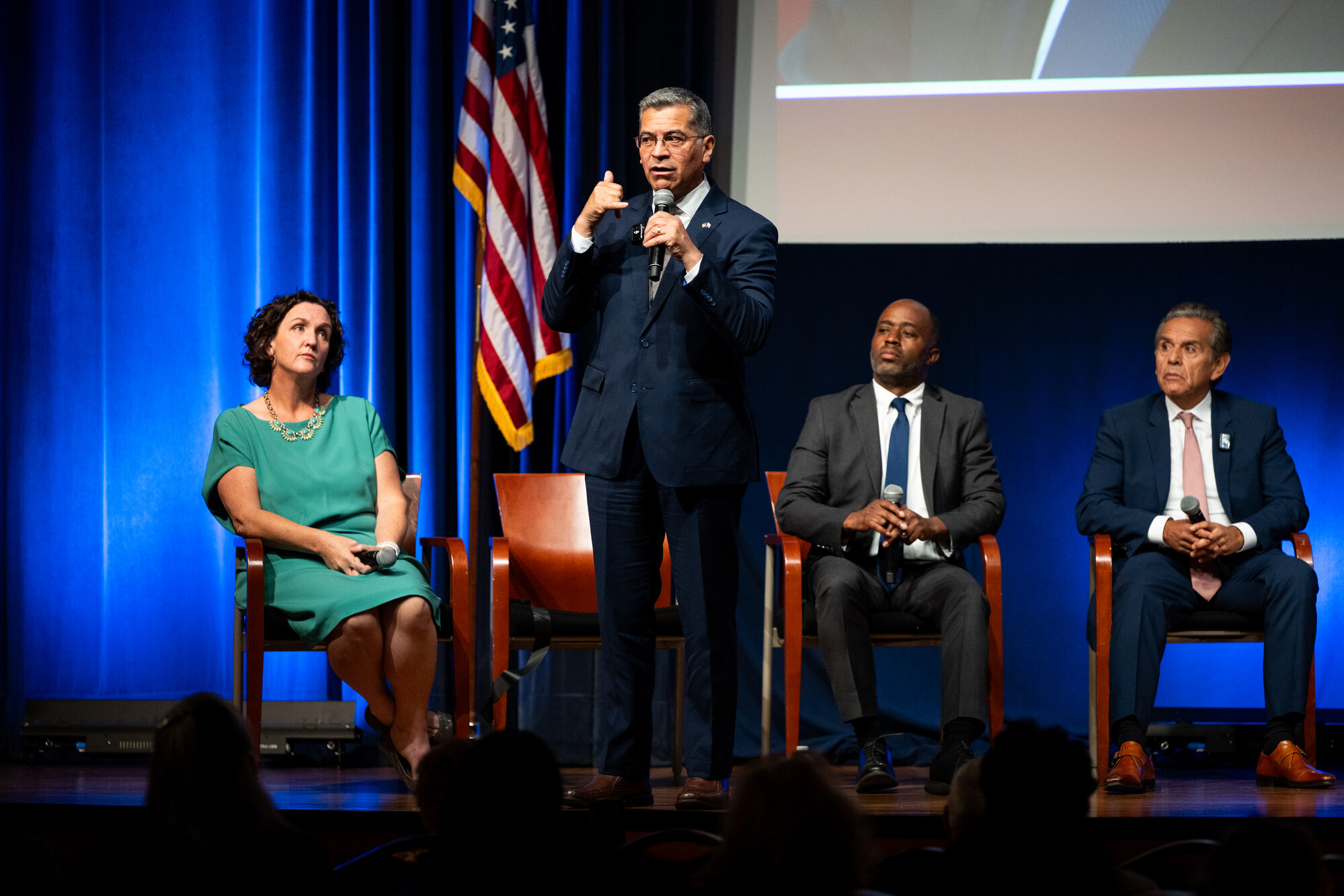
Below them is a crowded field: Antonio Villaraigosa, former mayor of Los Angeles; Tom Steyer, an investor who’s already spent nearly $30 million on ads; Javier Becerra, the state’s former attorney general; Betty Yee, former state controller; Tony Thurmond, the state superintendent of public instruction; and others.
It’s a very crowded field, and even the leading candidates are polling below 20 percent. A lot of voters remain undecided, and frankly, many haven’t been paying close attention yet. Given everything else going on — Proposition 50, national politics — this race has largely flown under the radar so far.
Mina Kim: This might be a hard question, but if you had to identify a defining policy issue for someone like Katie Porter or Eric Swalwell, what would it be?
Guy Marzorati: Honestly, it’s hard to say. They all talk about building more housing, reducing homelessness, and changing laws to make it easier to build homes. But this campaign hasn’t really played out as a debate over policy.
So far, it’s largely been a race over who can best define themselves as someone who will stand up to Trump. Each candidate has tried to make the case that they’re the strongest fighter. Even though Trump would only be president for two of the potential eight years this governor would serve, that framing has dominated given the current political moment. We really haven’t seen much substantive debate over policy yet.
Mina Kim: You were at a forum in San Francisco last week, and immigration seemed to be a major issue. Were you hearing much variation there?
Guy Marzorati: Not really. That forum included only Democratic candidates, so the messaging was very similar. The two Republicans, Chad Bianco and Steve Hilton, would obviously take a different approach. I don’t expect a Republican governor — the math just doesn’t usually work out statewide.
At Democratic forums, you hear consistent messaging about standing up to ICE and pushing back against immigration enforcement actions by the Trump administration. There have also been early rumblings about whether there are too many Democrats in the race — and whether that could theoretically allow two Republicans to advance from the primary.
I still think it’s too early to seriously worry about that. If that scenario looks plausible in March or April, I think party leaders would step in and pressure some candidates to drop out. For now, it’s just out there in the ether.
Mina Kim: That would be pretty wild. But yeah, given how hard it’s been for Republicans to win statewide office, it probably wouldn’t get that far. Let’s go to a caller. Paul is in San Francisco. Hi, Paul.
Paul (caller): Yes. I’m a third-generation Californian from San Francisco. San Francisco and California had a lot of problems under the Biden administration, and we weren’t able to solve those problems then. Blaming Trump for everything is a canard — it’s a distraction from what you actually stand for. And maybe if we get some big business, like tech, to support a candidate like Mahan, we could get some fiscal responsibility in California, which most Democrats don’t seem willing to embrace.
Mina Kim: Thanks, Paul. Guy, it sounds like Paul is more in the camp of wanting a California-focused governor rather than someone sparring with the federal administration.
Guy Marzorati: Paul raises an interesting point. California cities had serious issues even when Joe Biden was president, and voters here actually felt things were going in a worse direction then than when Trump took office. I wonder how much of that is about redirected anger and anxiety.
We’ve seen this dramatically in San Francisco, where in just six months, voters went from saying the city was on the wrong track to saying it’s on the right track. Is that because crime is down and homelessness looks different, or because people’s anger is now focused on Washington instead of local officials?
I don’t have a definitive answer, but I think Paul is right that frustrations with local governance existed well before Trump returned to office.
Mina Kim: A listener writes: “I’m not yet sure who I want for governor, but the 2026 midterms will be the first time I vote for candidates I fully support — not just the ones I think can win. I’m tired of voting for the lesser evil. We need new leaders, not lukewarm opportunists who only win in the shadow of fascism.”
We’re talking about the 2026 midterms and how they’re shaping up in California — from the governor’s race to the fight for control of Congress. We’ll dig into that more after the break with Guy Marzorati and with you. Stay with us. I’m Mina Kim.