This partial transcript was computer-generated. While our team has reviewed it, there may be errors.
Mina Kim: From KQED, welcome to Forum. I’m Mina Kim.
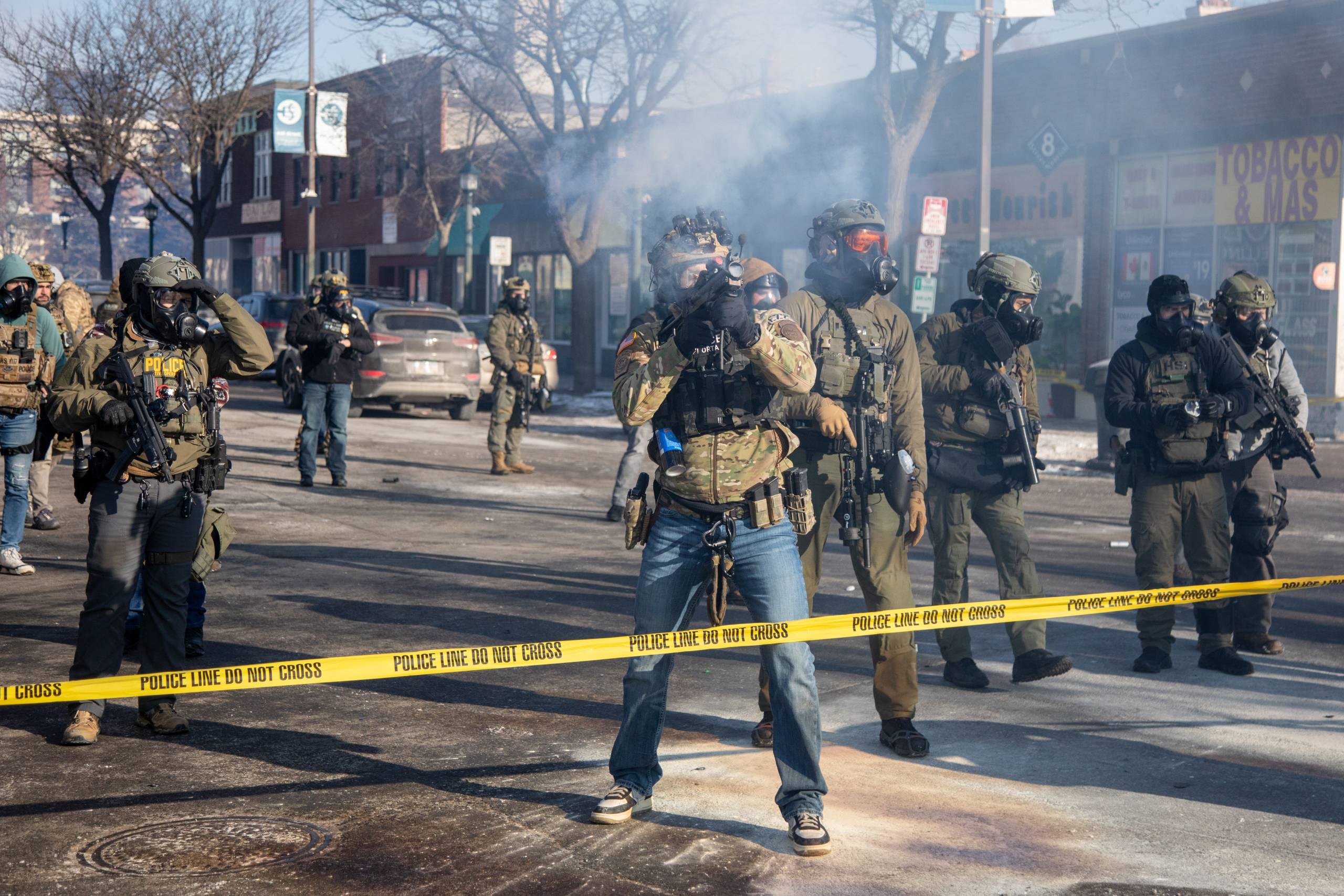
Border Patrol commander Greg Bovino is reportedly returning to California. He oversaw — and was the public face of — the operation in Minneapolis that resulted in the killings of two Americans by federal agents within two weeks of each other. A leadership change in Minneapolis, shifting authority to border czar Tom Homan, is among a handful of moves by President Trump. Those moves also include distancing himself from key administration officials’ characterization of Alex Pretti, the 37-year-old ICU nurse, as a domestic terrorist bent on killing law enforcement — a claim refuted by multiple videos and one that has drawn bipartisan ire.
Here’s Republican Senator Thom Tillis yesterday, speaking to reporters about DHS Secretary Kristi Noem and White House Deputy Chief of Staff Stephen Miller.
Thom Tillis (clip): One of the people that came out publicly and said that this guy was a terrorist before he had even talked with anybody on the ground — and that’s clearly not the case now. So, I mean, it’s just that — I mean, Stephen Miller never fails to live up to my expectations of incompetence. White House deputy chief of staff — fired. I’m going to leave that up to the president. I can tell you, if I were president, neither one of them would be in Washington right now.
Reporter (clip): But do you think Noem should step down?
Thom Tillis (clip): I think Noem would decide what — I mean, I think if Noem looks at her body of work, I could not — if I were in her position — think of any point of pride over the last year.
Mina Kim: Another Republican Senate leader, John Thune, called the party’s response to the killing an inflection point. But an inflection point leading to what?
Listeners, are you impressed by the president’s actions to tamp down backlash from Minneapolis? Do you think this marks a turning point?
Joining me now is Claudia Grisales, congressional correspondent for NPR. Claudia, really glad to have you with us.
Claudia Grisales: Great to be with you.
Mina Kim: Also with us is Zack Beauchamp, senior correspondent for Vox, who covers challenges to democracy and right-wing populism. Zack, glad to have you too.
Zack Beauchamp: Happy to be here.
Mina Kim: Claudia, let me start with you. The killing of ICU nurse Alex Pretti by federal agents came just two weeks after the killing of Renee Macklin Good, a mother of three, also in Minneapolis. It’s drawn notable pushback from a relatively small — but growing — group of GOP lawmakers, which is rare, especially on the president’s signature issue of immigration. What are you hearing about the range of criticisms, and where they’re coming from?
Claudia Grisales: From both sides, as you said. And it really is a rarity to see this many Republicans speak out publicly against what happened — the killing of Pretti by federal agents.
I was talking to a Democratic aide recently who said that, when it came to Renee Macklin Good, many could say that was a tragic mistake. They didn’t expect to see something like that happen again. But with Pretti, it became a tragic part of a pattern. That alarmed Democrats again, but also many Republicans — as we heard from Senator Tillis — who have been very vocal about their anger and frustration over what happened in Minneapolis during this raid.
Mina Kim: As you say, the fact that there have now been two killings in Minneapolis makes it difficult to argue that one was just a tragic mistake or a one-off. What else do you think is driving this shift? Is it the president’s plummeting poll numbers? Concerns about the midterms?
Claudia Grisales: It’s definitely a perfect storm. The president has been struggling in terms of his approval numbers, and he’s also been stepping on Republicans’ messaging on the campaign trail.
They want to focus on the midterms. They want to tout the big partisan package they passed last year — what they dubbed the “one big beautiful bill.” But it seems that at every turn, when Republicans on the ballot this November want to get their message out, the president ends up stepping all over it.
Mina Kim: Do you think this will yield any concrete action by Republicans? We’ve heard calls for investigations. We heard Senator Tillis suggest that Kristi Noem should step down. Do you see any immediate action on the horizon?
Claudia Grisales: That’s really difficult to envision. We’ve heard a lot from Senate Republicans. House Republicans, although some have spoken out — including several committee chairs — have been quieter overall.
They’re not in town this week. When they return, we may hear more. But because House Republicans rely more heavily on the president for their political futures, we expect many of them to ultimately align with him, no matter what he says.
Mina Kim: Zack, many analysts have noted that Alex Pretti’s killing has broken through to conservative — even politically disengaged — audiences. What do you think made that possible?
Zack Beauchamp: It’s the footage. I mean, I assume you’ve seen at least one of the videos. I watched multiple angles while reporting on this over the weekend. It’s unequivocal.
If you were trying to perfectly construct, in a lab, a series of events that would discredit the president’s approach to enforcing immigration law in Minneapolis — assuming that’s what this was about — you couldn’t imagine anything more damning.
A man intervened to protect a woman who was being brutalized by a federal officer. He was pepper-sprayed, defenseless, and then killed. His gun was removed before he could even touch it. There’s no question that what happened was unjustified.
What compounds the damage is how the government responded: the immediate, obvious, and verifiable lies. The attempt — seemingly driven by Stephen Miller — to paint Pretti as an assassin or domestic terrorist. Claims that he approached officers with a gun, when the gun was in his pocket and had already been taken away.
This isn’t the typical Trump administration lying about something abstract, like economic statistics. This is something people can see with their own eyes. The footage is there. The proof is undeniable. And the brazenness of the lies finally caught up with the government. Now they’re scrambling because their usual playbook isn’t working.
Mina Kim: Let’s hear from DHS Secretary Kristi Noem, speaking at a news conference just a couple of hours after Alex Pretti was killed last Saturday.
Kristi Noem (clip): Medics were on the scene immediately and attempted to deliver medical aid to the subject, but he was pronounced dead at the scene. The suspect also had two magazines with ammunition that held dozens of rounds. He also had no ID. This looks like a situation where an individual arrived at the scene to inflict maximum damage on individuals and to kill law enforcement.
Mina Kim: Zack, you’ve written that in a functioning liberal democracy, killings like this are taken very seriously by public officials, with investigations launched immediately. What does this response tell you about where we are right now?
Zack Beauchamp: It’s a very strange moment. On paper, we still have a liberal democratic system — laws, institutions, all of that — with all its flaws, of course. And to be clear, even in functioning democracies, police killings happen and investigations aren’t always handled properly.
What’s different here is that there’s usually at least a pretense — a commitment in principle — to take something like this seriously. This government doesn’t seem interested in that.
From day one, it’s asserted levels of executive authority that are completely inconsistent with the Constitution and federal law. ICE on the ground is behaving lawlessly. We’ve seen federal judges openly exasperated, hauling in top immigration officials and saying, “You are not following the law, and you are not listening when we tell you to.”
This is a systematic effort to ignore the rules — to act as though the norms governing law enforcement in a democratic society simply don’t apply. It mirrors how the White House is treating limits on executive power: we’re going to do what we want, and you can try to stop us.
The only heartening thing about this incredibly dark episode is how clearly the public is reacting against it. When people see what happened to Renee Macklin Good and then Alex Pretti, the response is overwhelmingly negative for the administration. Polling now shows that a majority of Americans favor abolishing ICE.
I wouldn’t overinterpret that — I don’t know if it’ll still be true in 2029 — but right now it speaks volumes about how furious the public is over these killings and the policies that led to them.
Mina Kim: We also have a clip from Minnesota Republican gubernatorial candidate Chris Madel, explaining why he withdrew from the race earlier this week.
Chris Madel (clip): I cannot support the national Republican Party’s stated retribution on the citizens of our state, nor can I count myself a member of a party that would do so. I support the originally stated goals of Immigration and Customs Enforcement’s Operation Metro Surge — locating and deporting the worst of the worst from our state. And I’ve seen many examples of ICE arresting non–U.S. citizens in Minnesota convicted of serious crimes, including murder, rape, and child sexual assault.
Mina Kim: Listeners, I want to ask you what you think the administration’s endgame is with these immigration raids and federal deployments in cities. What do you make of the president’s efforts to tamp down criticism of what happened in Minneapolis? Do you think this marks a turning point? And what, if anything, could make the violence stop?
You can email us at [email protected]. Find us on Discord, Bluesky, Facebook, Instagram, or Threads at KQED Forum. Or call us at 866-733-6786.
A listener on Bluesky writes, “Trump’s endgame is to warn other blue states that federal law enforcement will take place everywhere — that there is no heckler’s veto that will stop them.”
Mina Kim: Zack, your recent piece called the killing of Alex Pretti a grim turning point. A grim turning point to what?
Zack Beauchamp: That’s what we’re finding out. That piece was written in the immediate aftermath, when the Trump administration was dissembling about what happened and doubling down on its defense of the CBP officer who shot Pretti.
At the time, I thought it signaled a shift toward a strategy of intimidation — using naked force to consolidate power. But I also noted that it might backfire, that public outrage could force a retreat.
I’m becoming more optimistic that we’re in that second scenario.
Mina Kim: We’ll get your assessment of the president’s most recent actions over the past couple of days after the break. I’m joined by Zack Beauchamp of Vox and Claudia Grisales of NPR — and by you, our listeners.
This is Forum. I’m Mina Kim.