This partial transcript is computer-generated. While our team has reviewed it, there may be errors.
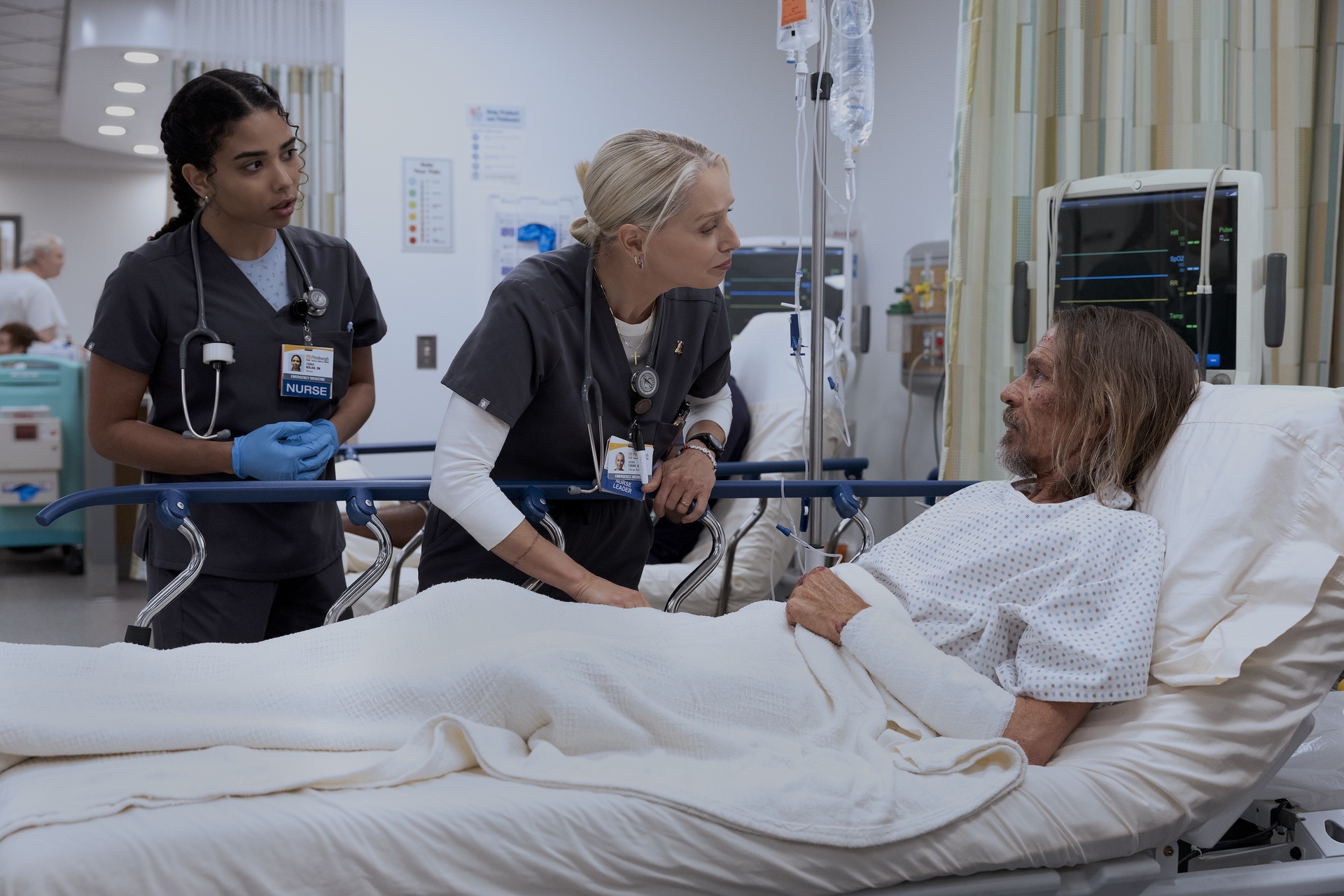
Mina Kim: Welcome to Forum. I’m Mina Kim. Have you heard of—or watched—the HBO drama The Pitt, about an emergency room staff at a fictional trauma center in Pittsburgh, Pennsylvania?
The second season of the show is now a few episodes in, and its first season was a hit, averaging 10 million viewers. Health care providers have noted it’s having an impact on health care conversations—what some call “the Pitt effect.” Researchers at USC Annenberg have documented that effect in the form of greater interest in organ donation and end-of-life care from patients, as well as a sense of validation among doctors and nurses.
With all those viewers, we wondered whether the Pitt effect is showing up in California. Joining me now are three ER doctors from across the state.
Dr. Sarah Medeiros is a clinical emergency physician at the UC Davis VA Hospital, a professor of emergency medicine at UC Davis, and host of the EM Pulse podcast. Dr. Medeiros, so glad to have you with us.
Dr. Sarah Medeiros: Thanks for having me.
Mina Kim: Also with us is Dr. Christopher Colwell, vice chair and chief of emergency medicine at Zuckerberg San Francisco General Hospital. Dr. Colwell, glad to have you.
Dr. Christopher Colwell: Glad to be here. Thank you for having me.
Mina Kim: And Dr. Patil Armenian is a professor of clinical emergency medicine and medical toxicology at UCSF Fresno. So glad to have you as well, Dr. Armenian.
Dr. Patil Armenian: Thank you so much. I’m excited to be here.
Mina Kim: I’d love to start with you, Dr. Armenian, because I understand you don’t usually watch medical shows. What made you watch The Pitt?
Dr. Patil Armenian: No, I don’t. I like to watch trash reality TV and anything that cleans my brain cells after a long shift. I watched it because everybody at work would not stop talking about it—nurses, resident physicians, other attendings. I finally thought, I need to know what they’re all talking about.
Mina Kim: And not just colleagues—family members and friends were urging you to watch it too?
Dr. Patil Armenian: Yes. They kept asking me, “Is The Pitt like real life? Is that really what you do?” I’ve been doing this for 20 years, and I’ve always tried to explain to family and friends what my job as an emergency physician really is. I genuinely feel like they didn’t fully understand until they watched The Pitt. So I had to see if it was actually accurate—and it is. I’ve had a lot of shifts just like that.
Mina Kim: Wow. What felt most true to life for you? Just one example, though I’m sure there are many.
Dr. Patil Armenian: There are so many pieces, but one thing I didn’t realize I had bottled up was dealing with the COVID pandemic. Even in the first episode of season one, when you see the flashback to COVID times, that really hit me hard. I felt the personal impact of what we all went through at work during that time.
Mina Kim: Did you have a similar reaction to the character Dr. Robbie?
Dr. Patil Armenian: Honestly, I burst into tears as soon as I saw that scene. I thought I had processed the pandemic and worked through it, but it turns out I hadn’t. So I guess I’m not processing things all that differently from Dr. Robbie.
Mina Kim: Chris, I’m curious about your thoughts. The show portrays the trauma of COVID and its impact on doctors, nurses, and staff, but also other realities of your work. What stands out to you, Dr. Colwell?
Dr. Christopher Colwell: As was just mentioned, the recovery process is still ongoing. We’re still seeing the ramifications now, nearly six years after the pandemic first hit. I have very vivid memories of March 2020, when things evolved so quickly.
In the emergency department, we didn’t have time to let it sink in or adjust. It all hit at once. As frontline providers, we were facing so much before we really knew what COVID was or what the impacts of our actions would be. I don’t think many of us realized how deeply that would affect us.
The show brings some of that out, and while we’re not anywhere near where we were a few years ago, COVID still impacts what we do. I think the show does a good job of incorporating that into the practice of emergency medicine today.
Mina Kim: What’s an example of something you’re still feeling as a result of the pandemic?
Dr. Christopher Colwell: For me, it was the not knowing—having to care for patients without truly understanding what was best for them or how to protect them, ourselves, or our staff.
We didn’t know what safety looked like back then. I remember vividly scenes in the show where a doctor walks in wearing full protective gear, looking around and not knowing what to do. I had that same sensation—wearing equipment I wasn’t used to and feeling uncertain. That’s a very disconcerting feeling.
Mina Kim: You also thought the show portrayed the waiting room particularly well. What stood out to you there?
Dr. Christopher Colwell: Oh my goodness—yes. I watched the show somewhat reluctantly, mostly at my family’s urging, but I knew I’d have to see it eventually. The first thing that hit me was the waiting room.
That’s our reality in city emergency departments. You walk in and immediately see the level of need and suffering. We have to prioritize the most urgent cases, which means telling people over and over, “We’ll get to you as soon as we can.”
We understand their pain, but we also know that’s not good enough—for them or for us. That moral weight, walking through a waiting room and hearing those stories, really takes a toll.
Mina Kim: It’s a good reminder of how triage works, even though it can feel incredibly frustrating as a patient.
Dr. Medeiros, what episodes or moments resonated most with you?
Dr. Sarah Medeiros: I agree with my colleagues—the COVID portrayal is very real. We’re all very good at compartmentalizing; it’s part of how we do this job. We try to leave things at work, which is probably why many of us didn’t rush to watch the show.
I watched a couple of episodes and then turned to more escapist TV, because watching it really does feel like watching work. One scene that stood out is when Dr. Robbie lists the names of patients who died that day. He talks about carrying them with him, and that really resonated.
We all carry those cases. Any time a situation reminds you of a past trauma, it comes back. These are ghosts we don’t forget. We try not to take them home, but they’re always there.
Mina Kim: Did your family—your kids—start asking more questions about what that’s like for you?
Dr. Sarah Medeiros: They did. I don’t talk about everything, so I think they were surprised. My parents love watching medical dramas with me and seeing me roll my eyes at how unrealistic they are. This time, I said, “No—this one’s real.”
That led to questions like, “Do people really die? Do kids die?” And the answer is yes—that’s part of my job. I also had to explain that the density of acuity on The Pitt isn’t what we see in a single shift. I’ve seen all of those patients, just not all in one day.
Mina Kim: Right—the show compresses an entire career’s worth of experiences into one shift.
Listeners, we want to hear from you. Are you a fan of The Pitt? Have you felt the “Pitt effect” as a patient or health care provider? What do you want people to know about the realities of emergency rooms in California?
Email [email protected], find us on Discord, Bluesky, Facebook, Instagram, or Threads at KQED Forum, or call us at 866-733-6786.
A listener on Discord writes: “I just started watching—so good. It replicates my experiences working in emergency departments almost flawlessly.”
We’re talking with Dr. Christopher Colwell of Zuckerberg San Francisco General Hospital, Dr. Patil Armenian of UCSF Fresno, and Dr. Sarah Medeiros of UC Davis. Stay with us for more. I’m Mina Kim.