This partial transcript was computer-generated. While our team has reviewed it, there may be errors.
Alexis Madrigal: Welcome to Forum. I’m Alexis Madrigal. There’s nothing quite like a little earthquake very close to your house to remind you to check your emergency supplies. My family lives about a mile from the Hayward Fault, so we pretty regularly get little 3.0-ish quakes — just strong enough to make you think, Is this the big one? But then over fast enough to not be too stressful.
That said, what’s happening out in San Ramon right now is something different. On a recent day, they had 19 quakes of magnitude 2.0 or higher. Here to discuss what’s going on out there and to take all your earthquake questions, we’re joined by Richard Allen, director of the Berkeley Seismological Laboratory and a professor in the Department of Earth and Planetary Science at UC Berkeley. Welcome.
Richard Allen: Thanks. Great to be here.
Alexis Madrigal: And we’ve got Annemarie Baltay, who’s a research geophysicist with the Earthquake Science Center at the U.S. Geological Survey. Thanks for joining us.
Annemarie Baltay: Thanks so much for having me.
Alexis Madrigal: Richard, are we having more earthquakes than normal? How do you think about this?
Richard Allen: Well, yeah — I get asked this question all the time whenever we start to have some shocks. And the answer is that we’re not really having anything particularly unusual. It’s true that we’ve had several earthquakes along the Hayward Fault over the last few months, and then, of course, we have this swarm that’s going on right now.
But the swarm is actually not that unusual. We’ve had more than ten of these swarms over the last few decades. They flare up from time to time — they last days to weeks, and then they typically fade away. What we’ve not seen is this swarm ending in a large-magnitude earthquake. But, of course, that doesn’t mean we won’t have one this time. In the Bay Area, as we all know, we always have to be ready for large-magnitude earthquakes.
Alexis Madrigal: But let’s say you lived in San Ramon. Would an earthquake swarm be an interesting phenomenon, or would it be something where you’re like, Oh, no big deal — it’s just another earthquake, and another earthquake, and another earthquake?
Richard Allen: I know it’s pretty traumatizing for people who live there. When you’re getting woken up on a regular basis over many days, even these small-magnitude earthquakes give you a very sudden, sharp thud, which can wake people up. That’s pretty traumatizing — there’s no getting away from that, unfortunately.
But at the same time, we know we’ve seen this before. So we need to keep in mind that it’s not too serious an issue.
Alexis Madrigal: Yeah. Annemarie, what is an earthquake swarm or cluster?
Annemarie Baltay: Yeah, that’s a great question. In some sense, it’s just a matter of words. Traditionally, we talk about a mainshock-aftershock sequence, where the first earthquake is the largest, and then we know from observations and statistics that earthquakes tend to decrease in magnitude and frequency over time.
A swarm is just a series of earthquakes that doesn’t follow that pattern. In the case of San Ramon, what we’ve traditionally seen — like Richard said — over many decades is that the first earthquakes may not be the largest, but they’re all of similar size. We saw quite a few magnitude-3.5-ish earthquakes in this swarm, and that’s typical.
So it may be a slightly different physical mechanism, where earthquakes are popping off little by little, one after the other, rather than being one big release of stress like we see in a mainshock-aftershock sequence.
Alexis Madrigal: So interesting. We’re talking about the recent swarm of earthquakes in San Ramon and other earthquake issues in the area. Maybe you felt the one in Sonoma County this weekend. You can give us a call with your earthquake questions — we’ve got your experts here — at 866-733-6786. You can email [email protected]. You can find us on social media — BlueSky, Instagram, Discord — we’re KQED Forum there as well.
Annemarie, is it the nature of the fault — the way the fault itself is put together — that leads some places, like the Calaveras Fault, which is the one in San Ramon, to have this kind of behavior?
Annemarie Baltay: Yeah, we think so. But this is actually a great open question. We can’t stick our heads down in the Earth and see exactly what’s going on. Much of what we know comes from observing the fault at the surface with seismometers or digging into the shallow subsurface.
What we think might be happening at the northern end of the Calaveras Fault is that it terminates into a bunch of smaller faults that fragment off. There may be smaller activity happening on those faults that host these swarms. We know this area experiences swarms very typically, so there must be some physical explanation there.
Alexis Madrigal: That’s so interesting. The Calaveras Fault feels like the third wheel here. We always talk about the San Andreas, and of course the Hayward Fault. Talk to me a little bit about the Calaveras fault and its relationship to those other two.
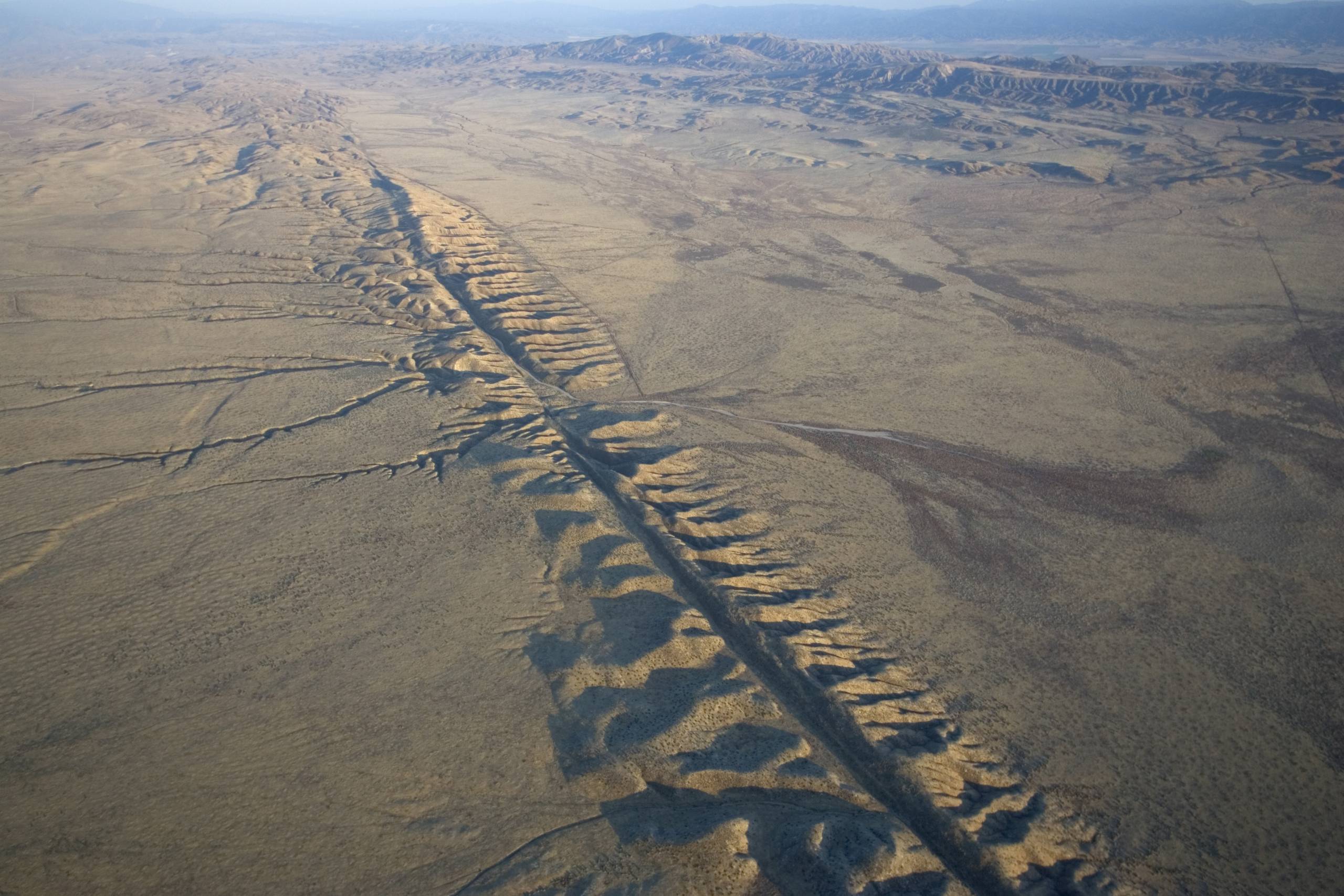
Richard Allen: Sure. The San Andreas is the one everybody is most familiar with. But as the San Andreas Fault system comes up into the Bay Area, it splits into multiple parallel faults. The second one people think of is the Hayward Fault, which runs right through Oakland and the East Bay. As you go further east, you get to the Calaveras Fault.
This is really a splay of faults accommodating the same process — the plate tectonic motion between the Pacific Plate and the North American Plate moving past one another. That motion is distributed across these faults. There are many more than just three, but these are the ones that seem most active and have the highest probability of hosting a large-magnitude earthquake in the future.
Alexis Madrigal: Does the Calaveras fault have that potential? Give me the ranking — what are our highest-risk faults?
Annemarie Baltay: Sure. The USGS puts out an outlook for the Bay Area. Right now, we’re in a forecast period that runs until 2043 — about 18 years.
Alexis Madrigal: It’s a long forecast.
Annemarie Baltay: It is — that’s the nature of it. We can’t say exactly when or where an earthquake will occur, but over that period, there’s about a 72% probability of having a magnitude-6.7 or larger earthquake in the Bay Area.
We can then look statistically at which faults are most likely to host that 6.7. The Hayward Fault is the most likely. The San Andreas is also quite likely, followed by the Calaveras and the Concord Fault.
Alexis Madrigal: So the Calaveras fault does contribute to that overall probability.
Annemarie Baltay: Yes, it does.
Alexis Madrigal: The Hayward is there, right, because the last big one was in 1868 — and the record is roughly every 140 years, and we’re past that now.
Richard Allen: That’s right. The last was in 1868 — ironically, the same year UC Berkeley was founded. We estimate the recurrence interval at about 140 to 150 years, with uncertainties of tens of years. That means we’re past the average recurrence interval.
So we really have to be ready at any time — but it could also still be years away. That’s the dilemma. There’s no hiding from the fact that we need to be ready for a major earthquake, even if it doesn’t happen right away.
Alexis Madrigal: There’s a lot of uncertainty there. Do you think we’ll ever get better at narrowing that down, Annemarie?
Annemarie Baltay: I think it’s really the nature of the Earth. We can look back over historic and prehistoric times and see average recurrence rates. Let me give you an analogy for folks in San Francisco: If you’re waiting for the N line — it’s supposed to come every 15 minutes. But no one’s surprised if you wait 30 or 40 minutes, and then three trains show up at once.
That’s how earthquakes work. We understand the long-term system, but on a human time scale, we can’t say exactly when or where they’ll happen.
Richard Allen: If I can add to that — while the statistics leave us with uncertainty, we’re excited about new opportunities to learn more. The Hayward and Calaveras faults radiate a lot of information: creep, repeating micro-earthquakes, and other signals. Some faults are completely locked and silent. These aren’t.
So while uncertainties remain, we’re hopeful we can learn more about where we are in the earthquake cycle and say more in the future.
Alexis Madrigal: And if the Hayward does go, it’ll be one of the most instrumented faults on Earth.
Richard Allen: Exactly. That’s why instrumentation matters — collecting data before, during, and after the earthquake.
Alexis Madrigal: Annemarie, these little quakes don’t relieve pressure for a big one, right?
Annemarie Baltay: That’s right. There just aren’t enough of them, and they don’t release enough stress.
Alexis Madrigal: Because the scale is exponential.
Annemarie Baltay: Exactly. A magnitude-3 releases about 32 times more energy than a magnitude-2 — but there aren’t nearly enough 2s to add up.
Alexis Madrigal: Got it. We’re talking about the recent earthquake cluster in San Ramon and taking your earthquake questions. We’re joined by Annemarie Baltay of the USGS and Richard Allen of UC Berkeley.