This partial transcript was computer-generated. While our team has reviewed it, there may be errors.
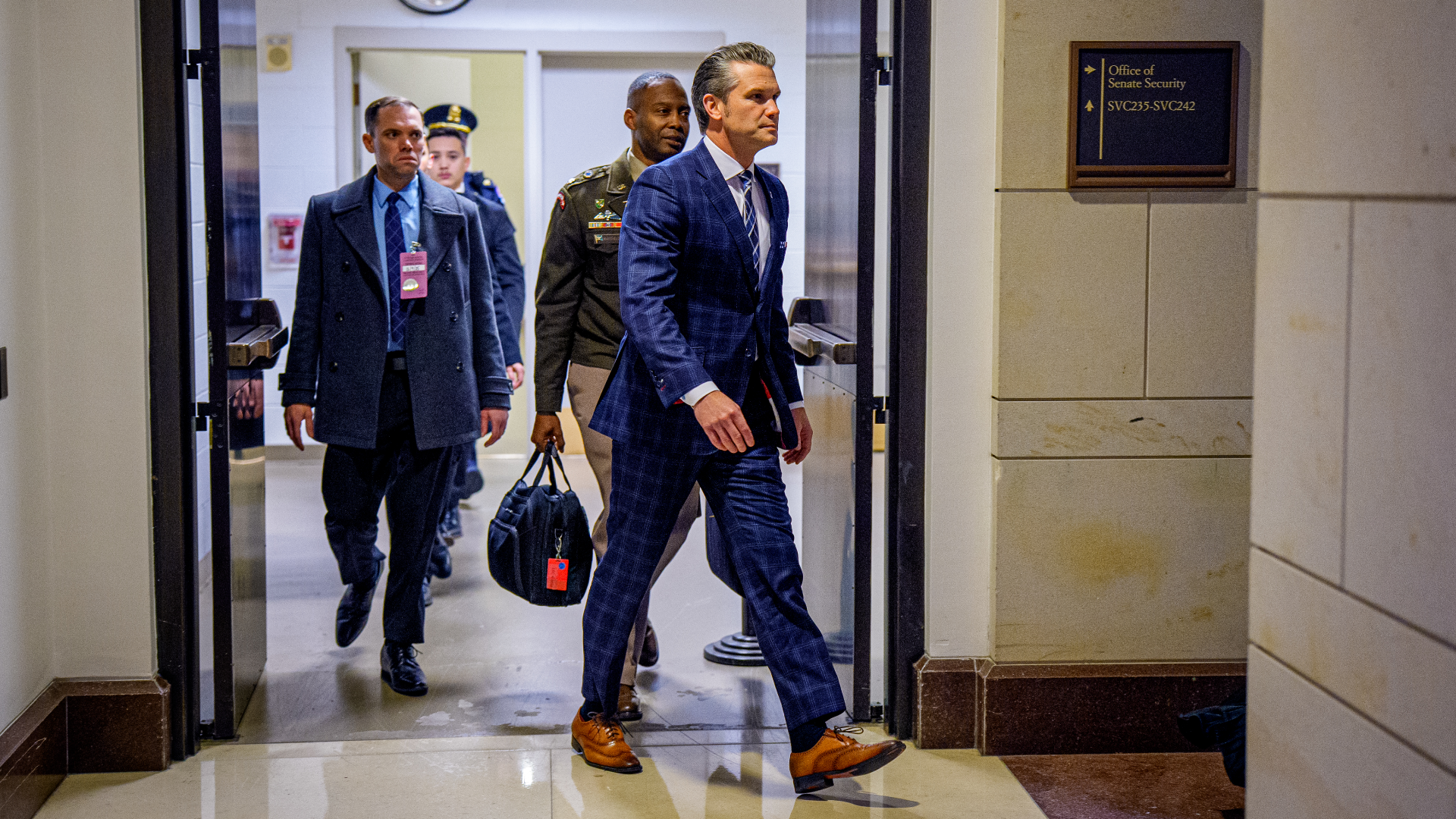
Mina Kim: Welcome to Forum. I’m Mina Kim. A classified briefing yesterday from Defense Secretary Pete Hegseth to congressional leaders and top members of the House and Senate intelligence committees was very unsatisfying, according to Senate Minority Leader Chuck Schumer, who — along with other lawmakers — is demanding to see full video of a U.S. military strike on a boat in the Caribbean.
The attack included a follow-up strike that killed two survivors of the initial blast and has become the subject of intense scrutiny among lawmakers and military and legal experts. Julian E. Barnes covers U.S. intelligence agencies and international security for The New York Times. Julian, welcome to Forum.
Julian E. Barnes: Thanks for having me.
Mina Kim: Glad to have you. Can you start by reviewing what happened on September 2 when the U.S. military launched two attacks on a speedboat in the Caribbean Sea?
Julian E. Barnes: Sure. What we know is that the U.S. military was tracking this boat in the Caribbean — coming from Venezuela and reportedly headed either to Trinidad and Tobago or Suriname. The U.S. military said they had intelligence that the boat was carrying cocaine and was in communication with other narcotraffickers.
So on September 2, the first of what has become a campaign of military strikes on alleged narcotraffickers took place. The first missile was launched at the boat. It was carrying eleven people, and it killed all but two.
We now know those two survivors ended up in the water. The boat was ripped in half by the first strike, and they were clinging to the wreckage and climbing onto the hull. And we now know that Commander Mitch Bradley — at that time the head of Joint Special Operations Command — ordered a second strike to sink the boat, kill the survivors, and destroy the drugs.
This second strike has become the focus of congressional oversight over the last week and a half. There have been a number of classified briefings — none shown to the public — but a range of lawmakers have questioned Admiral Bradley, General Dan Cain, and yesterday, Defense Secretary Pete Hegseth, Marco Rubio, John Ratcliffe, and the head of the CIA.
Mina Kim: The survivors’ behavior is being interpreted in different ways. Can you explain those interpretations? First, what are Democrats and most of the military and legal experts you spoke to saying is the most logical reason for the survivors’ behavior?
Julian E. Barnes: The video — which has not been shown publicly but which lawmakers and congressional aides have seen — shows the survivors climbing onto the wreckage of the boat and waving, making gestures.
Most people who have seen it say the most logical explanation is that they are seeking rescue. They had seen the American aircraft that launched the attack. This was the first strike, so they did not know there was a military campaign against drug boats. They might not have known they had just been hit by an American missile.
So a lot of people believe they were waving for rescue, seeing the AC-130 or another aircraft overhead. Others interpreted it as a wave of surrender.
But initially, the military leaders briefed Congress that this was a form of communication — that the survivors might have been signaling to another drug boat or drug plane. We now know there was no such drug boat in visual range. So that explanation — offered as a rationale for the strike — does not hold up under logical scrutiny.
Mina Kim: Why would it be important for military commanders and the administration to say the shipwrecked men were communicating with other drug boats? Is it because, if they were shipwrecked and seeking rescue, killing them would have been a crime?
Julian E. Barnes: If this is indeed an armed conflict — which the U.S. military asserts, even though Congress has not authorized it — international law and the military’s own Law of War Manual are very clear.
The Second Geneva Convention says you cannot target shipwrecked individuals — people who are out of the fight. It is a war crime to kill someone who is not in a position to take part in the fight and who is struggling for life on a capsized boat.
On the other hand, if someone is still in the fight — still has weapons, still poses a threat — they remain a legitimate target under the laws of armed conflict and the military’s own code.
So what a reasonable person would have thought about the intent of these survivors is extremely important. And when you describe the situation, the average person understands that someone fighting for their life in the water is not still involved in the fight — they’re not a classic combatant anymore.
Mina Kim: Let me ask our listeners: What do you think? What are your reactions to what you’re hearing about the latest revelations regarding U.S. military strikes in the Caribbean?
You can email [email protected], find us on Discord, Bluesky, Facebook, Instagram, or Threads at KQED Forum. And you can call us at 866-733-6786.
Julian, can you remind us what a massive departure this type of military action is from how the U.S. has normally handled drug smugglers on boats?
Julian E. Barnes: That’s a really important point. We have not treated this as a traditional military operation. We have not treated drug traffickers the same way we treat terrorists or members of an enemy army. This has historically been a law enforcement issue.
Until the Trump administration began this campaign in September, the U.S. government put Coast Guard personnel on Navy ships. When a Navy ship stopped a boat suspected of drug smuggling, it was a law enforcement action. The Coast Guard took the lead — gathering evidence, and the people could be brought to Florida for possible prosecution.
You would have to prove in a court of law that they were trafficking drugs — violating American law. But in this case, treating it as a military operation means the evidence is destroyed when bombs are dropped. The people have — with one exception — been killed. The drugs, if present, have ended up at the bottom of the sea.
And the military has not released detailed information about how they know these boats were carrying drugs. We have some anonymous information about the basics, but no detailed account the public can interrogate. It’s quite a departure from past practice.
Mina Kim: I want to play a cut of Secretary Hegseth speaking at a defense forum in Simi Valley this past Saturday, where he appears to be giving the DOD’s justification for attacking drug smugglers in this military way.
Pete Hegseth (clip): The days in which these narcoterrorists — designated terror organizations — operate freely in our hemisphere are over. These narcoterrorists are the Al Qaeda of our hemisphere, and we are hunting them with the same sophistication and precision that we hunted Al Qaeda. We are tracking them. We are killing them. And we will keep killing them so long as they are poisoning our people with narcotics so lethal that they’re tantamount to chemical weapons.
Mina Kim: So he’s essentially saying drug smugglers are narcoterrorists comparable to Al Qaeda, which actually attacked the U.S.
Julian E. Barnes: Yeah. I was in California and listened to his speech and talked to people about it. It is quite a departure. He’s saying drug smugglers are the same as Al Qaeda. When he talks about chemical weapons, he’s suggesting the drugs themselves are weapons designed to kill Americans.
Drugs do kill Americans — but the drugs they’re targeting in the Caribbean are mostly cocaine. There are cocaine overdoses, though far fewer than fentanyl deaths in the U.S.
So it is quite a departure to consider cocaine a weapon. In a counterterrorism context, if someone is planting an IED, or a survivor of a drone strike moves toward an explosive, that’s a hostile act. But saying that carrying drugs is a hostile act is a very different scenario.
Mina Kim: The other thing you said at the top — and we’re coming up on a break — is that the boat wasn’t bound for the U.S.
Julian E. Barnes: Drug trafficking from Venezuela largely heads to Europe. Ninety percent of it goes to Europe. These drugs were bound for Europe, not the United States.
Mina Kim: We’re talking with Julian Barnes, intelligence and national security reporter for The New York Times, about U.S. military strikes on boats in the Caribbean and the most recent one that’s getting a lot of scrutiny. More with him after the break.