This partial transcript was computer-generated. While our team has reviewed it, there may be errors.
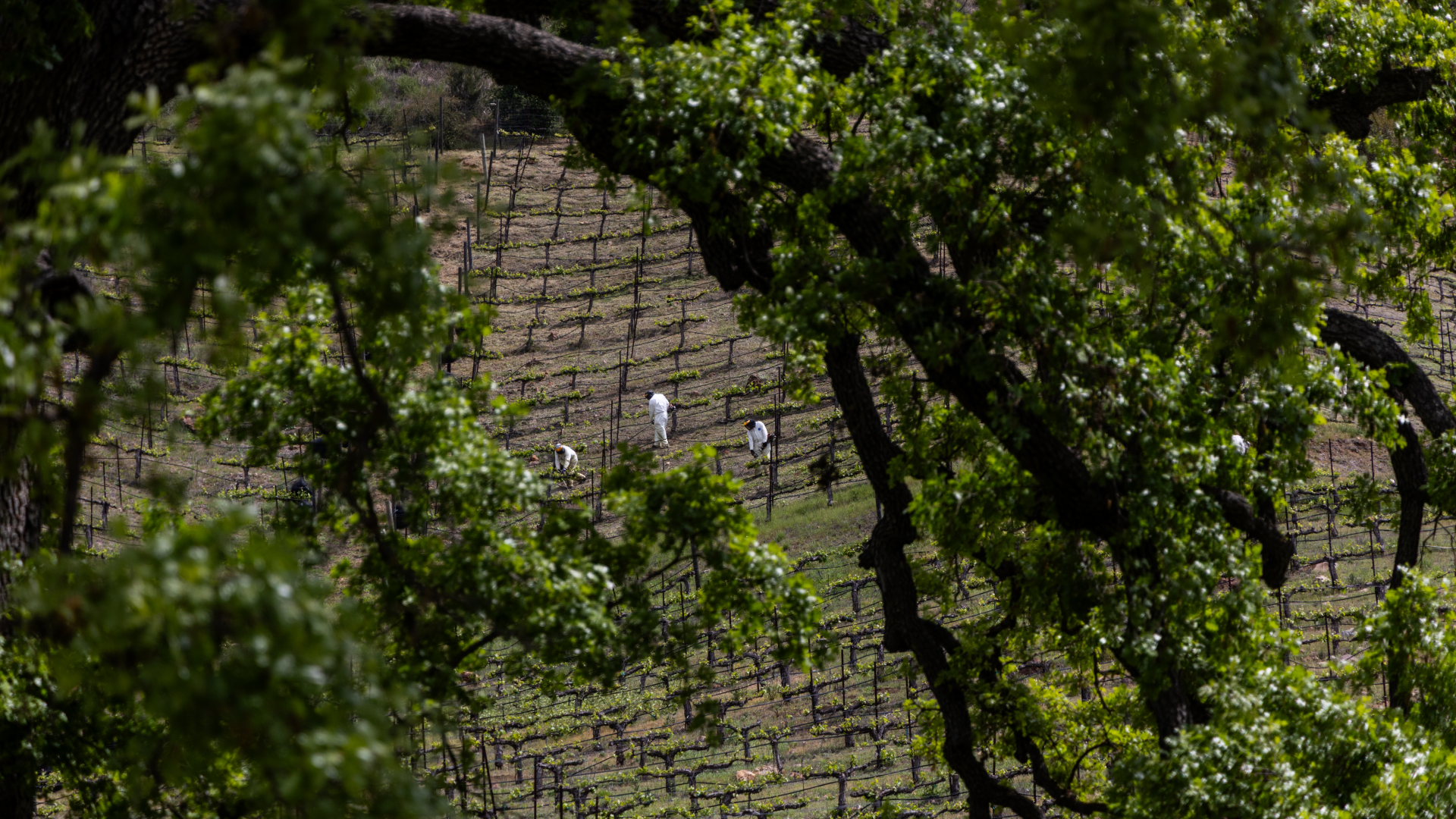
Mina Kim: From KQED. Welcome to Forum. I’m Mina Kim. Picking strawberries, apples, cabbages or kale in California’s fields and orchards is hard work — sometimes punishing and dangerous when the weather and heat are bad, with heavy loads to lift and quotas to meet. And yet children are doing this work alongside adults. California allows kids as young as twelve to work in agriculture. But according to an investigation by Capital & Main in partnership with the Los Angeles Times, the state is failing to ensure the children’s health and safety.
We learn more this hour with Robert J. Lopez, Pulitzer Prize–winning independent journalist and fellow at the McGraw Center for Business Journalism. Robert, thanks so much for being with us.
Robert J. Lopez: Thank you for having me.
Mina Kim: Also with us is Erica Diaz Cervantes, a former underage farmworker, now senior policy advocate at the Central Coast Alliance United for a Sustainable Economy, or CAUSE. Erica, welcome to you as well.
Erica Diaz Cervantes: Thank you so much. Happy to be here.
Mina Kim: Glad to have you here. So Robert, how many kids do you estimate work as farmworkers in California’s fields? And I say “estimate,” right, for a reason.
Robert J. Lopez: Yes, it is an estimate because there is really no tracking that’s done comprehensively by government agencies. The work is very transitory, so it’s very hard to know exactly how many young people are out there — but certainly several thousand in California. And elsewhere across the nation, there are others, but I focus solely on California. That’s really about the best estimate we came up with in my talks with experts, examining various studies that have been done by the federal government, surveys and things like that. So I think that’s a fair estimate.
Mina Kim: And are most of these young people migrants? U.S.-born? What can you tell us?
Robert J. Lopez: Well, nearly all the young people I spoke to were born in the United States. Their parents immigrated primarily from Mexico, and these are mixed-status families. By that I mean the children are born here and citizens, and many of the parents are not documented but also work alongside their sons and daughters in the fields.
Mina Kim: Doing what kind of work exactly?
Robert J. Lopez: It varies. They pick strawberries, as you said. They plant broccoli, plant lettuce, pick broccoli, pick lettuce, pick blueberries. They work in orchards with citrus fruit, stone fruit. They may harvest garlic in the San Joaquin Valley. There are various jobs. And when they’re not planting or picking, they try to get any other work they can get, such as pulling weeds from fields or removing old plastic tarps. Farmworking is not a forty-hour-a-week job. It’s seasonal and dependent on many factors. So families need to survive, and they’ll do whatever work they can get when it’s available.
Mina Kim: And why is it that California allows children as young as twelve to work in agriculture like this, when child laborers in other industries are usually required to be fourteen or older?
Robert J. Lopez: In most instances, California requires minors to be fourteen years old to work. But in agriculture, a child can be as young as twelve and work up to forty hours a week when school is not in session. And the reason is really a complex one that lies in federal law. The Fair Labor Standards Act, which was passed in the late 1930s, initially didn’t include farmworkers. Farmworkers were only included years later, in the 1960s. So it’s really rooted in federal law and goes back several generations.
And in some states, there is no minimum age. California actually has some of the strongest workplace safety laws in the United States — including outdoor heat laws, child labor regulations, pesticide safety laws. But as I found out in my investigation, many of these are not being enforced.
Mina Kim: Yes. You would think if the state allows such young workers, the expectation would be that they’d be vigilant about enforcing child labor laws, since kids are more vulnerable in workplaces — power-wise, and then more sensitive to conditions in the fields.
Robert J. Lopez: You would think so. But it’s very difficult when, for example, the Bureau of Field Enforcement — this is a state agency that is the frontline unit for enforcing not only child labor laws but wage and hour laws. So when you have fifty-four inspectors, which is what their data showed as of May, responsible for covering the entire state of California — and not just agriculture but more than a half-dozen industries, including car washes, hotels, retail establishments, warehouses — I mean, you just don’t have enough people to create a physical presence.
And many of the researchers I talked to at UC Merced and elsewhere who have studied enforcement actions in labor note that when you’re out there giving citations and inspecting worksites, there’s a deterrent effect. People know inspectors may show up. But when there’s no presence at all, then none of that happens.
Mina Kim: Erica, I want to turn to you because you started working in the fields when you were twelve. What was it like for you? What do you remember about starting?
Erica Diaz Cervantes: Yeah, thank you. Like you mentioned, I started working in the fields with my parents when I was as young as twelve years old. I remember working with my mom — we worked picking green beans. That was our first job. And it wasn’t just myself; it was my brother, who was eleven at the time, and my older sister, who was fourteen. And so it was the three of us working alongside my mom.
What I remember from that summer is just that it was extremely hot. We were covered in multiple layers of clothing to protect us from the exposure of toxic chemicals as well as heat exposure. I remember feeling this pressure to fill up our buckets with green beans as quickly as we could and get it to the truck and make sure our cards were stamped — they were marking the amount of buckets we were filling up.
In that same job we also picked green tomatoes, and I remember those buckets being extremely heavy. I often tried to carry it myself down these really rugged dirt pathways, but it was a struggle. So oftentimes it was my brother and I carrying about a thirty-pound bucket of tomatoes and trying to pick as quickly as we could to try to make enough money for that day.
Mina Kim: Yeah — pick as quickly as you can. Because what was the culture in these workplaces? What were the expectations? How did you feel you were treated?
Erica Diaz Cervantes: Yeah. I just remember feeling really intimidated by the supervisors, by the crew leaders. There was constant pressure to continue working as quickly as you can. Anytime we tried to take any breaks or even go get some water, it was really discouraged. And we were even reprimanded for doing so because we were wasting productivity time.
A lot of times my mom would try to help us in terms of being able to match the pace of the rest of the crew so we weren’t falling behind. And I just remember feeling really scared every time we saw the supervisor’s truck come and inspect the fields. Every time he would walk around the crew and watch how we were picking the crops, I felt a really deep sense of fear — like, I need to pick as fast as I can. Even though my back was hurting, my knees were hurting, and I felt exhausted already by, you know, eleven a.m. The heat was starting to pick up. I felt like I couldn’t rest at all because I was scared of the punishment we would get if we didn’t continue to pick quickly.
Mina Kim: And you were paid per box or per bucket, am I right?
Erica Diaz Cervantes: Yeah. So for the buckets, I don’t recall how much they were paying us at the time, but I remember it wasn’t a lot. I remember we had to pick multiple buckets and boxes to be able to earn enough and support my family. And I just remember at the time thinking, you know, I need to work really hard and work really fast and make sure that no attention is being drawn to us — negative attention — because there was this really strong power dynamic between us, being the farmworkers working in the fields, and the supervisors and employers managing the workplaces.
Mina Kim: Yeah. Robert, in terms of the things Erica is describing — first of all, how much are the kids you’re talking to today being paid? And does it meet California’s laws around minimum wage, for example?
Robert J. Lopez: Well, first of all, most of the youth I spoke to who worked for piece rate — which is by the unit, as Erica described — shared similar stories: intimidation, worry that if they don’t work fast enough they’re going to get their parents fired, and then they get fired. And in fact that did happen with one young man I interviewed.
So they told the same types of stories time and again. And the rates vary depending on a lot of factors — the season, the time of year, how much fruit there is in a field. But in some cases, young workers were getting paid $2.40 a box.
Mina Kim: Two dollars and forty cents.
Robert J. Lopez: For a box of strawberries. And when I say a box, it’s a cardboard box that holds eight of those cartons you buy in a supermarket, for anywhere from five to seven dollars a carton. So eight of those. So they’re getting $2.40. And in some cases, that’s all they got.
And the issue is, if you’re an adult, strong, and you can work fast and you’re experienced and a veteran, you can pick a lot of boxes. But young people are not as strong; they don’t work as fast — just as Erica described with her own experience. So as a result, there would be times when they didn’t fill many boxes. And so at the end of the day, they wouldn’t earn the equivalent of minimum wage, which would be a violation of state child labor and labor laws. Because under state law, piece-rate workers, regardless of industry, have to earn the equivalent of at least minimum wage.
So when that doesn’t happen, that’s a violation of state law. And I heard countless stories from young people — not just in the fields but also in orchards, filling five-hundred-pound crates with grapefruit, lemons, oranges. I heard countless stories in which they talked about earning wages that did not equal minimum wage. This is something I heard from the very beginning when I first started doing my interviews throughout the course of the campaign.
Mina Kim: We’re talking about child farmworkers in California and shining a spotlight on the issues they face. More after the break. I’m Mina Kim.