This partial transcript was computer-generated. While our team has reviewed it, there may be errors.
RACHEL MYRO: This is Forum. I’m Rachel Myro, in for Mina Kim. Supreme Court Justice Louis Brandeis famously said, “We can have a democratic society or we can have the concentration of great wealth in the hands of a few. We cannot have both.”
This warning is a clarion call to action for Gil Duran, the former political strategist behind the newsletter and forthcoming book Nerd Reich: Silicon Valley Fascism and the War on Democracy. In recent years, he’s tracked how a small pack of Silicon Valley moguls with staggering resources have increasingly started to sing in harmony around the idea of replacing democracy with something else that suits their taste for white supremacy and subjugation of anyone who doesn’t fall in line.
Gil Duran joins us in studio now. Gil, thank you for being here.
GIL DURAN: Thanks for having me.
RACHEL MYRO: I wanna say welcome back, and thank you again for naming what I think a growing number of journalists, late night comedians and others have been documenting in bits and pieces — this kind of interlocking set of bunker worldviews calling for a post-liberal America. What drew you into this headspace?
GIL DURAN: San Francisco politics, really. It was during the recalls here in San Francisco that I started to notice this right-wing edge to a lot of what the venture capitalists who were funding that recall were saying. And in particular, there was Garry Tan of Y Combinator who, on occasion, would mention this thing called the “network state.”
And I didn’t pay much attention to it at first, but there was a local woman and activist named Emily Mills who started tweeting these long threads about what the network state was and what it meant. And to cut to the heart of it, the network state is a scary cult of tech zillionaires who have this very concentrated and focused idea about replacing democracy with what is essentially corporate autocracy — or what I call tech fascism.
And so I immersed myself in that, and that’s what led me into the research that is now gonna result in a book that’s coming out next year.
RACHEL MYRO: Congratulations. You were on Forum in April with Mina Kim, but catch up the rest of us: with the broadest of brushstrokes, how would you describe this ecosystem of billionaires and firebrands that you’ve been following?
GIL DURAN: Well, they’ve gained a lot of power in the Trump administration. David Sacks, who was one of the main voices behind the San Francisco recalls, is now Trump’s crypto and AI czar. And over the week, The New York Times did a big exposé on him and how the decisions he’s making are benefiting the businesses in which he’s investing, as well as the businesses in which his friends are investing.
Peter Thiel has his acolytes all through government in positions of power. Elon Musk was the head of something called DOGE, but still a lot of his people are in the government as well. And so we’ve seen this era where all of these tech oligarchs are playing a direct role in our government.
At the same time, there’s been a narrative of unprecedented corruption in Washington, with the Trump family making billions of dollars — on paper, at least — in crypto wealth. And no one seems to be able to sort of stop this. There’s no shame anymore in Washington.
So what we’re seeing really is an effort to buy government power and influence. And so far, it’s working. And in the network state cult ideology, this is called “voice” — using your power, influence and wealth to take over existing institutions of government. And so we’re seeing that play out.
And we’ve also, you know, the media has realized that the work of this guy Curtis Yarvin, this blogger who was funded and supported by Peter Thiel for a long time, his ideas for purging the federal government have come into play with Doge. So something that sounded very conspiratorial to a lot of people last year is suddenly headline news.
And I think people are waking up to the fact that this is not an accident. This is a strategy, and it’s a plan.
RACHEL MYRO: I think for a lot of people, starting since President Trump’s return to the White House in January, it looked, at least initially, like he was bringing so many of the richest, most powerful men in Silicon Valley to heel, to essentially make them kiss the ring. But what you’re describing sounds like the other way around. Do you think President Trump is their creature?
GIL DURAN: He is now. I think they view MAGA, which is a fascist movement, as a political technology for seizing power. There’s been nothing like it, really, in American history. Look at how far Trump has been able to get.
And so they have invested in MAGA fascism as a way to extend their own power. I don’t think most of them can stand Trump, but he is the tool, the vehicle, the product that is allowing them to spread their ideas and get their way. He’s someone who’s open to a deal. And this is a deal with the devil they have made.
And so I think they have more power than they probably thought they’d be able to get. At the same time, things are not going very well. Trump’s poll numbers are diving. This is a very unpopular administration. We’re headed into major economic headwinds. So they were about to learn a really hard lesson of politics, which is: what happens when everybody hates you? And I think that’s where we’re headed in twenty twenty six — that we’re at the turn here.
RACHEL MYRO: From your lips to God’s ears, as some people like to say. But, you know, then again, we are seeing a lot of biblical rhetoric being folded into much of this talk that you’re describing.
And even to the extent that somebody like Peter Thiel — who I don’t think anybody would identify as a traditional Christian — is using biblical rhetoric. And I have to say, I’m sort of surprised by his desire to come out of the shadows, to take on a more prominent public role, but also, as I’ve already suggested, suspicious that his intent is not Christian at all.
GIL DURAN: Peter Thiel is trying to put a Christian mask on some very extreme tech ideas. And Umberto Eco, who wrote about being an enthusiastic young fascist as a boy under Mussolini, wrote an essay called “Ur-Fascism.” And one of the points in “Ur-Fascism” is that fascism imposes an Armageddon framework on politics. It’s an existential battle against an evil enemy.
And what Peter Thiel is doing in these secret Antichrist speeches he’s been giving around the world — including one he gave in San Francisco in September; he gave four of them at the Commonwealth Club, which he rented, by the way, it was not an official Commonwealth Club program — is saying that the Antichrist is alive and well and on Earth at this moment, and that the Antichrist is anybody who opposes the massive acceleration of capitalism and technology to make us a multi-planetary, AI-enhanced species that will allegedly live forever and find eternal life in the stars.
And I know that all sounds crazy, but this is increasingly what these venture capitalists are talking about in California and Silicon Valley: this very apocalyptic, existential idea that we have to make this great tech acceleration or risk humanity being phased out when the sun heats the Earth in two billion years and life’s no longer possible here.
They’re thinking way, way, way out in the future to morally justify a political argument for them to have no regulation, no law, no democracy and nothing at all to counter their power. That’s essentially what Peter Thiel is doing in his Antichrist speeches.
And he actually quotes — he hinges his whole Antichrist theory on — the work of Carl Schmidt, who was a Nazi jurist and philosopher, who argued that politics is a battle against an existential enemy and that only one side can win, and that you have to use religious frameworks in politics to get everyone motivated.
Apocalyptic arguments are a very powerful technology in politics. They really motivate people. Historically, this has been true. And so that’s a pretty dangerous stage to reach — Peter Thiel talking nonstop about the Antichrist. And he should really de-escalate that, I would say, because these kinds of arguments inherently lead to violence.
RACHEL MYRO: On any given day, you can attend a conference in San Francisco — or anywhere in the Bay Area, really — or a panel discussion or listen to a podcast where Silicon Valley thinkers, big thinkers, are talking about how they plan to change the world, or at least they’re promising to change the world.
What makes the people you’re talking about a credible threat to our democracy?
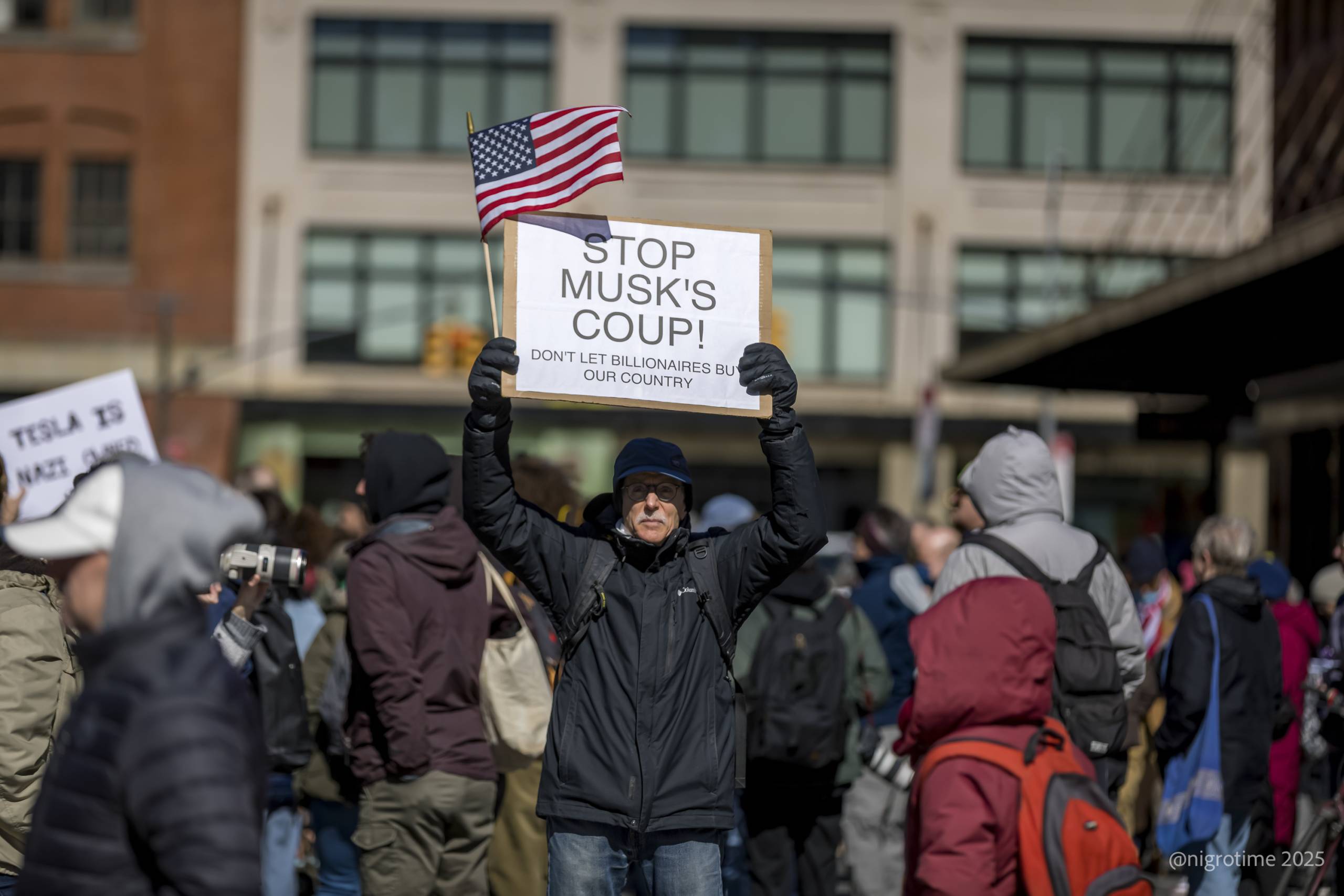
GIL DURAN: They have so much money. That’s the only real superpower they have, is they have found a way to amass billions and billions of dollars. And now Elon Musk, who literally threw a Nazi salute at the inauguration, has got a deal to become a trillionaire.
And that money gives them a tremendous amount of power in a society where political influence is for sale. And that, unfortunately, is the United States of America. And to your quote that you started off with, from Louis Brandeis — we can have billionaires or we can have democracy. We can’t have both.
And that’s the lesson we’re learning right now. And it’s not because everyone should hate billionaires. It’s because the billionaires have decided that this is how they’re gonna use their power in society — not to solve hunger, not to solve preventable deaths, not to make the world a better place, but to start carving out an entire sphere of influence that is free from democracy.
And that leaves the rest of us with this collapsing world that they have largely sought to create.
RACHEL MYRO: You know, the San Francisco Bay Area has been a hotbed for countercultural movements since well before we came on the scene. But in the nineteen sixties and the seventies, it was happening out on the streets, out in the open. You couldn’t miss it, even if you didn’t wanna participate.
These days, I feel like it’s all much more opaque unless I’m closely following the news or your newsletter.
GIL DURAN: Yeah, definitely. It’s interesting, too, the degree to which some of these formerly libertarian ideas come out of the counterculture, come out of the idea that we can go into these other realms and we can escape authority and authority is bad.
There’s a book, From Counterculture to Cyberculture, that really captures this. You know, John Perry Barlow, who was a songwriter for the Grateful Dead, wrote this whole thing in nineteen ninety-six called “The Declaration of the Independence of Cyberspace” that was about how the internet was gonna free us from government authority, which sounds like a very leftist, hippie thing to say — except that these guys all got rich, and now they are the government.
RACHEL MYRO: Boy, have things changed just in the time that we’ve been watching them as adults.
We are talking about anti-democracy extremism in Silicon Valley and beyond with Gil Duran, journalist and author. He’s producing a newsletter covering the tech industry called The Nerd Reich, which is also the title of his forthcoming book out in August of next year: The Nerd Reich: Silicon Valley Fascism and the War on Democracy.
And we want you to join the conversation. Do you have friends, family, maybe coworkers quoting Elon Musk or Peter Thiel? How do you handle it? How do you engage in conversation — or not? Are you feeling resigned about tech money’s role in politics or thinking of ways to resist?