This partial transcript was computer-generated. While our team has reviewed it, there may be errors.
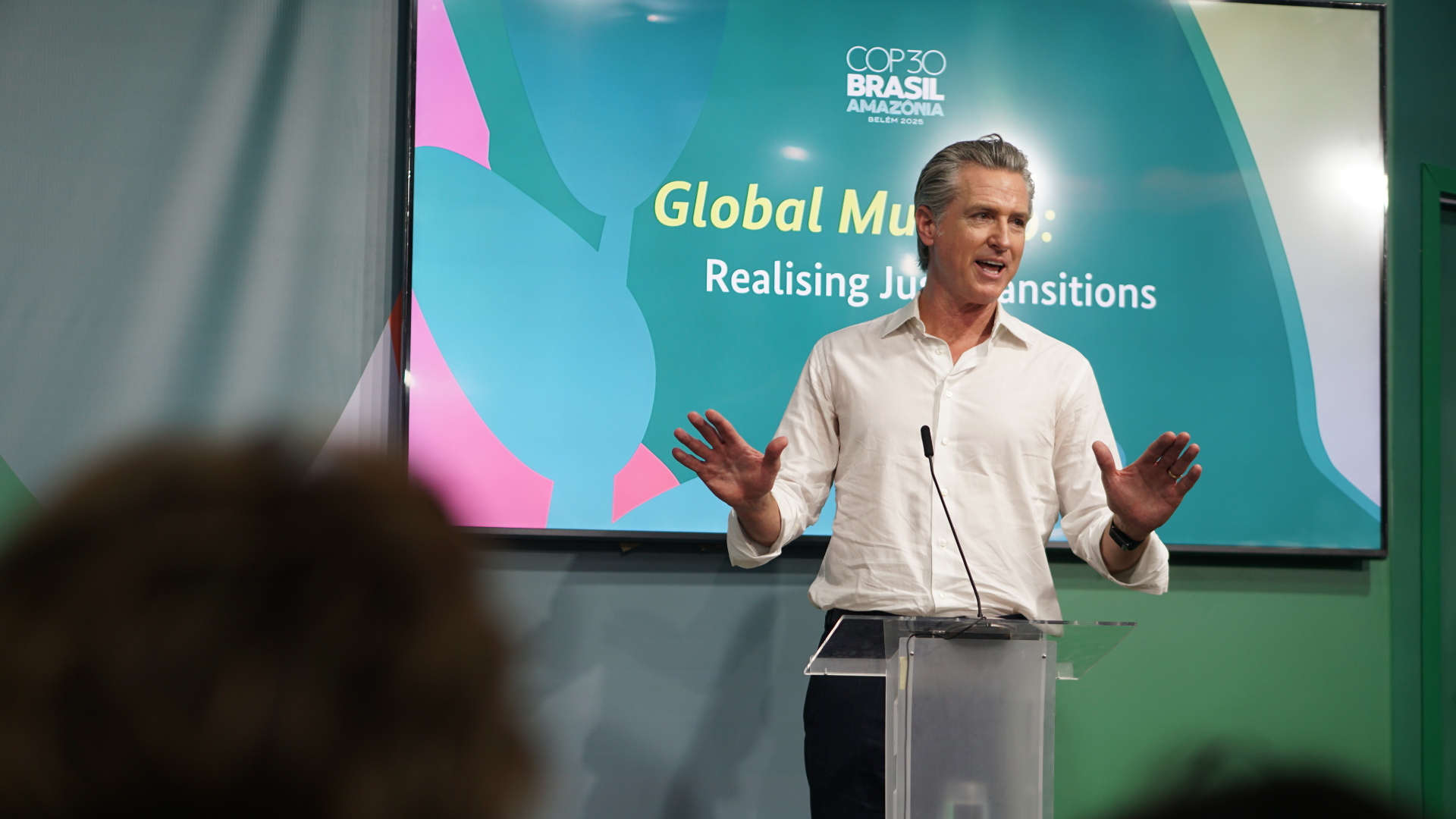
Mina Kim: Welcome to Forum. I’m Mina Kim. California is making its presence felt at the UN climate conference in Brazil, even if the U.S. is not — with the Trump administration failing to send a single representative. Here’s Governor Gavin Newsom at the gathering known as COP30.
Gavin Newsom (clip): California has two things: a reliable partner in relationship to this space. I cannot say that for the United States of America, particularly as it relates to the current occupant in the White House. Quite the contrary. But the state of California has been a consistent partner for a half century and will continue to be for decades to come.
Mina Kim: But recent polls find climate change impacts — despite their urgency — have fallen down the list of voter concerns. And Democrats, taking the hint, are barely talking about it, according to a Washington Post tracker. Listeners, have you noticed this drop in mentions of climate change? What do you think it’ll take to make addressing climate change a high priority again? You can post on our social channels, email [email protected], or call us at 866-733-6786.
Joining me first is Camille von Kaenel, California environment reporter for Politico. Camille, welcome to Forum.
Camille von Kaenel: Hey. Thanks for having me.
Mina Kim: Glad to have you. So the UN climate conference goes till Friday, and it sounds like Governor Newsom got a rock-star reception when he was there last week. Tell us what you saw.
Camille von Kaenel: Yeah, that’s right. I was traveling with the governor last week on his sort of fly-by visit to this conference in the port city of Belém in Brazil. It was his first time at one of these conferences, but California always sends a big delegation. And he was stepping into this moment riding a political high. Given the Trump administration’s absence from these talks, he really wanted to take advantage of this split screen between Washington, D.C.’s approach to climate change and California’s approach. And he really seized the moment.
I mean, I’ve never seen scrums of reporters so intense. He was walking down the hallway at this conference and people were grabbing onto him — security had to shove people away to keep them back. Reporters were bombarding him with questions. He was definitely the main attraction on the second day of the talks when he was there, even though, as a state and not a nation, California doesn’t have any bearing on the actual negotiations under the UN framework.
He also gave some rousing speeches that sounded more like stump speeches and got a lot of applause. Walking down the hallway, people were shouting at him — “Keep up the social media!” and “Go Gavin!” — and then there were a few people who were like, “Who is that?”
Mina Kim: Well, overall, it sounds like it probably served his presidential aspirations pretty well. But what did Newsom accomplish on the climate front?
Camille von Kaenel: Yeah, that’s a good question. As I mentioned, California is a state — even though it’s the world’s fourth-largest economy, as the governor says at every turn — and it can’t sign treaties with other countries. So he leaned into the theater and influence rather than policy outcomes California could achieve at COP.
Concretely, that meant he was signing a lot of nonbinding agreements with other countries or states. He signed agreements with Chile; with Pará, the state where the talks are being held; with Nigeria; and with Baden-Württemberg in Germany, one of California’s original partners in promoting subnational climate action. He made a big deal of these agreements, talked to a lot of reporters, and aimed to continue California’s campaign of influence as a climate-policy laboratory and technology incubator.
Mina Kim: Can you describe one of the agreements — maybe the one with Chile?
Camille von Kaenel: Yeah. The one with Chile was, I thought, the most substantive. In that agreement, California agreed to share data from a satellite it helped launch — along with nonprofit and philanthropic partners — that tracks methane and methane leaks. You might remember former Governor Jerry Brown saying that if the Trump administration wasn’t going to act on climate change, California would launch its own “damn satellite.” This is that satellite.
Governor Newsom emphasized that California is providing resources the federal government can’t, and is sharing them with other countries. Chile was happy to sign that agreement.
Mina Kim: You also note that Newsom’s decision to go to COP30 and make a big show of it might be politically risky. Why?
Camille von Kaenel: Polls show that voters care about climate change, but it’s not their top concern heading into the next election. Their top concerns are cost of living, jobs, health care. Broadly, the Democratic Party has been shifting rightward on climate. At the same time Newsom was in Brazil, another potential 2028 Democratic presidential contender, Pennsylvania Governor Josh Shapiro, pulled his state out of a regional emissions trading market for budget reasons.
So Democrats at large have pulled back from some climate policy — and that includes Newsom. He’s taken criticism from in-state environmental groups for recent moves, including expanding oil drilling in Kern County, which have been viewed as reversals or tempering of environmental ambition.
While I was there listening to the governor’s swagger, I wondered how that translated politically, given the electorate. He’s aware of this, too. I asked him about it, and he acknowledged there’s no poll suggesting Democrats should be talking about climate change — but he thinks it’s important, and thinks it’s more about how politicians talk about climate.
Mina Kim: I see. So yes, you’re saying Newsom has tempered his climate ambitions partly for political reasons, but also partly because of Trump administration actions. Can you remind us of some of those challenges?
Camille von Kaenel: The Trump administration has been effective — even more effective than during the first administration — and state climate officials acknowledge that. The most prominent example is Congress rolling back California’s special authority to enact its own clean-car rules, which the state was using to phase out sales of new gas-powered cars. That was California’s signature policy for meeting its emissions goals.
It’s in court now, so it’s up in the air, but at the moment, California can’t enforce that rule. The other states that adopted the rule can’t enforce it either. And there isn’t much California can do. The governor at one point floated offering more EV incentives, but walked that back because there isn’t enough funding.
So California has been left a little flat-footed. And even while Newsom was in Brazil delivering rousing speeches, reports came out that the Trump administration was considering selling leases for new offshore oil operations off the California coast. The governor had to defend himself — he said those plans are “dead on arrival” — but it’s a live, evolving situation.
Mina Kim: We’re talking with Camille von Kaenel, California environment reporter for Politico, about how California tried to make its presence felt at COP30, which goes through Friday, while the U.S. — the Trump administration — was absent. And listeners, if you’ve noticed drops in mentions of climate change or are concerned about what appears to be a U.S. abdication of climate progress, tell us what you think it’ll take to make addressing climate change a high priority again. Post on Discord, BlueSky, Facebook, Instagram, or Threads. Call us at 866-733-6786, or email [email protected].
How is Gavin Newsom addressing that? You said he was aware that polls show climate isn’t a top voter priority. How is he adjusting his messaging?
Camille von Kaenel: He’s couching things differently. He’s seen the recent wins of two new Democratic governors on the East Coast — in Virginia and New Jersey — who focused on energy affordability. In California we have very high gas and electricity prices, among the highest in the nation, which is a political challenge for any governor with broader ambitions.
So he’s beginning to talk about climate policies — energy efficiency, renewable energy — in the context of potentially lowering prices. Solar power might be cheaper than oil and gas, for example. He’s also talking about climate in terms of economic competitiveness. He talks a lot about how China is going to “clean our clock,” because China is all in on renewable energy and electric vehicles and is selling that technology worldwide. He wants California and the U.S. to stay competitive in that future economy.
Mina Kim: So really turning it into an economic conversation. We’re coming up on the break, but before you leave us, Camille, I’m curious: what was it like on the ground at COP30? What was the energy like?
Camille von Kaenel: It was my first time at a COP, so I don’t have a lot of reference points, but it was much busier than I expected. You have people from all over the world gathering in what is sometimes a makeshift conference hall. It would rain in the afternoons and sometimes leak through the roof. You see people in traditional wear from their countries, people who look to be wearing Indigenous clothing, people coming in from deep in the Amazon to sell products and make their presence felt.
Mina Kim: Camille von Kaenel of Politico, thank you so much. More after the break, listeners. You’re listening to Forum. I’m Mina Kim.