This partial transcript was computer-generated. While our team has reviewed it, there may be errors.
Mina Kim: Welcome to Forum. I’m Mina Kim. Nick Miroff’s latest piece for The Atlantic takes a closer look at the impact of ICE agents wearing face coverings during aggressive immigration enforcement operations. Called “Why They Mask,” his story comes as the Trump administration asks a federal court to stop California’s new law banning face masks on federal agents from taking effect in January. Nick Miroff joins me now. Welcome to Forum.
Nick Miroff: Hi, Mina. Good to be with you again.
Mina Kim: So Nick, it was striking to read — and remember from your piece — that before this year, ICE’s work happened, as you say, more quietly and administratively. You’ve covered immigration a long time. Talk about what it was like traditionally.
Nick Miroff: ICE officers are trained to do what they call “targeted enforcement.” Generally when they go out to make an arrest, they know who they’re looking for. They’ve done some kind of research and surveillance on that person. But a lot of what ICE officers have been doing, especially under the Biden administration, was more akin to case management. You know, people are coming to check in at ICE offices to make sure they’re complying with their immigration court orders — that type of thing. And, you know, going out and making arrests was only for a more specialized unit of ICE.
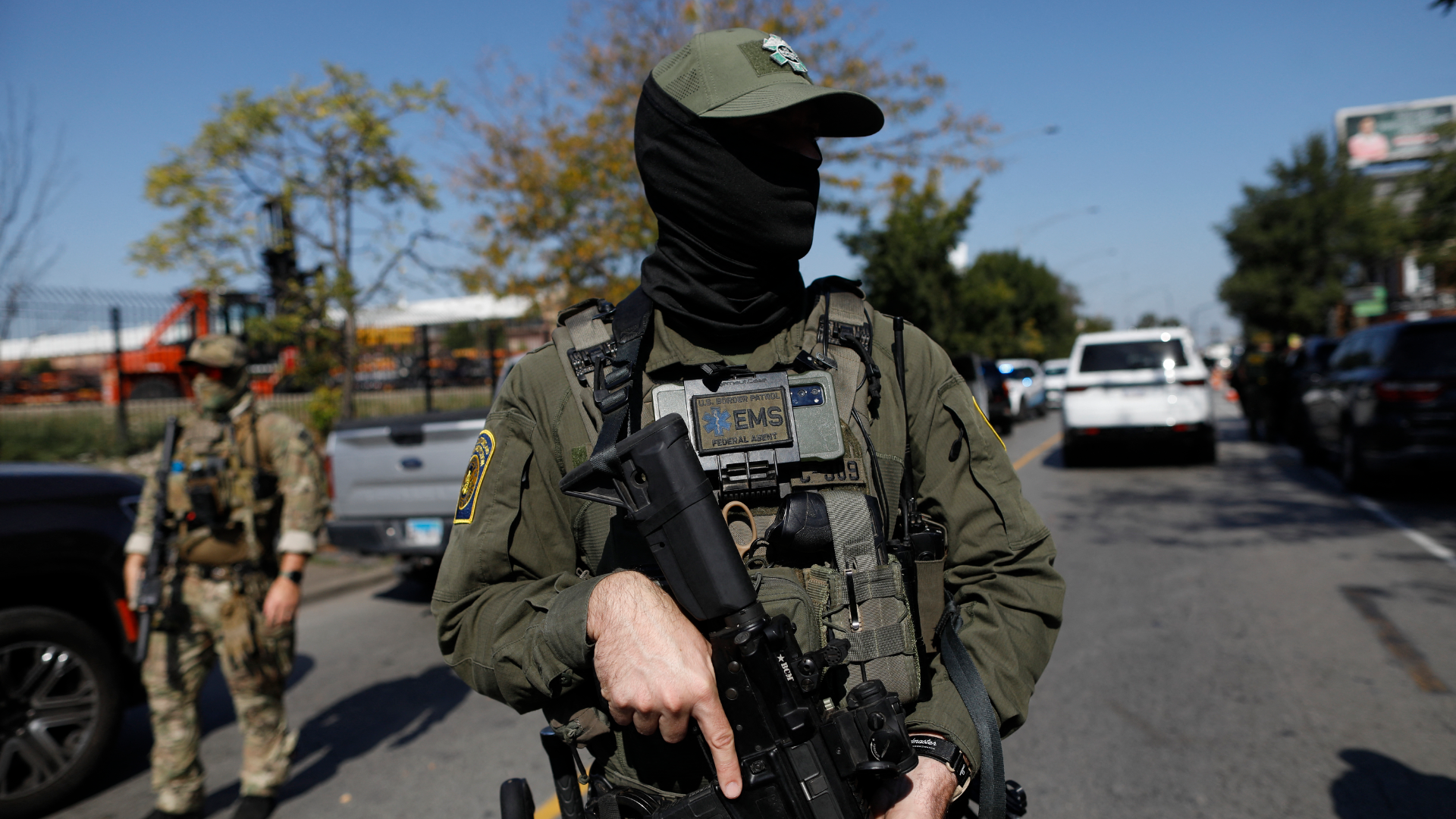
And they certainly were not just going out into the streets and doing this kind of sweeping enforcement in a very aggressive, public way — the kind of stuff that everyone is now familiar with from all the social media clips. So it’s just one of the factors that has ended up leading to officers, very early on in this administration, putting face coverings on and covering their faces.
Mina Kim: Yes. You say these face masks have become a standard accessory for federal immigration enforcement — and even a symbol of the mass deportation campaign that is Trump’s top domestic policy initiative, as you put it. What is the justification you’ve heard from Homeland Security officials and the DOJ now for these masks?
Nick Miroff: One of the things that was so striking to me is I went back and looked at some of my photos from going out with ICE officers in the first week of the administration, and nobody was wearing masks. And yet, you know, if you look just a month or two later at photos and videos of some of their more high-profile arrests, almost all of the agents and officers have their faces covered. So it happened very quickly.
I think it was several factors — but a big one is that these agents and officers were being sent out in public in a way they were really not familiar with, and not comfortable with. They were facing, in some cases, angry crowds, protesters, and people recording these interactions.
I think there’s a real fear that any misstep or mistake could end up producing a viral video. They talk about the risk of being doxxed, of being singled out and targeted, having their families harassed. One of the most common refrains I heard was that, “I signed up for this job, but my family didn’t.” And so a lot of them say they’re doing it to protect their privacy and their families.
You know, I don’t think that there’s been a massive doxxing assault or attack on the ICE workforce generally. But the role the administration has put them in has created a lot of discomfort and fear — and the mask is kind of a way for them to opt out of some of the political and moral controversies of the job they’re being asked to do.
Mina Kim: And there have been a few troubling incidents — like the man living illegally in Dallas who was arrested in October for offering ten thousand dollars for killing ICE agents. He asked for this in a post on TikTok, as you point out, and there have been other incidents as well. So, Nick, some veteran ICE agents you spoke with say they’re concerned about the masks as a development, but also call them a “necessary evil.” What concerns did they have about the effect that masks have on policing and the public?
Nick Miroff: I think almost every veteran official I spoke to knows that the masks are bad — that they’re a negative development, that they create a really bad public image. ICE is, you know, already a controversial agency, and they know that going around looking like criminals, essentially, with your faces covered, hurts that public image even more.
And others I spoke to said that, you know, when you’re wearing a mask, you’re less accountable. They know that for some officers who are covering their faces, they feel entitled to maybe use more force. And, you know, if people know their faces are exposed — that they can be easily identified — then maybe they conduct themselves with a little more responsibility and restraint. So there’s concern on that level.
But another thing that really stuck with me was that ICE officials in charge feel like they can’t order the workforce to remove their masks and show their faces because they’re worried that if something were to happen, it would be their fault. And I think there’s a certain amount of deference there — they know they’ve already asked this workforce to work long hours, to go overtime to meet the incessant demands of the Trump administration. And so this is one thing they’re willing to go along with, even if they think it’s ultimately bad for the agency and for American law enforcement generally.
Mina Kim: Well, I want to invite listeners into the conversation. Listeners: When you see footage of federal agents wearing masks, or if you’ve witnessed some of these raids, what does it bring up for you? Do you work in law enforcement? What do you think of the use of masks by federal agents? Do you think it’s justifiable for them to wear face masks — and under what circumstances?
Nick, you also point out that there’s no denying some agents use the masks to intimidate — that this new show of force in cities by ICE agents is designed to project toughness, to stoke fear.
Nick Miroff: Yeah, I think that’s without a doubt. There was an incident that really disturbed a lot of people — right around Halloween — when some activists filmed agents going out to work in plain-clothes vehicles, and they were wearing Halloween masks to make themselves look like ghouls.
And when activists asked the Department of Homeland Security if that was appropriate, the department’s response was: “Happy Halloween.” And so, you know, some of this is, I think, a way for some of them to be less accountable, to look more intimidating. And yet for some of the veteran career officials — who do care about the long-term health of this agency and insist that ICE has a legitimate role in American law enforcement — they know this is bad and will further erode the agency’s already battered public image.
Mina Kim: Yeah. This is bringing up questions from our listeners along the lines of: Did masks become necessary because of attacks by activists? Or did the masks provoke attacks from activists? Essentially, do they escalate things by their very presence? What do you think?
Nick Miroff: Yeah, well — one veteran ICE official I spoke with said the masks automatically inflame tensions whenever people show up wearing them. If you see a bunch of officers in plain clothes with no identifying insignia — sometimes it’s even hard to know what agency they’re with, because they wear ballistic vests that just say “POLICE” — and then that person has a mask on, and you can’t necessarily tell who’s talking to you, and several people are yelling, so they inflame tensions.
Look — there’s a reason why in American law enforcement police officers don’t go around in masks. Masks are long associated with authoritarian states, secret police — all the things we don’t want to see in a liberal democracy. And so the fact that these officers are going around this way — whether or not they feel they need it for their own protection — is unquestionably a negative development.
Mina Kim: Let me go to caller Stacy in San Francisco. Hi Stacy, you’re on.
Stacy: Hi, thank you so much for having me. I’m just wondering — aside from the fact that this obviously reflects authoritarian regimes and practices — how does Nick feel about the fact that if I’m attacked by someone who is in a mask and does not have any form of ID on them, no identification marks, no patrol car or ICE emblem, I will protect myself if I can.
What is to happen if people start protecting themselves? In a court of law, if I attack someone and — God forbid — hurt them somehow, I have every right to state to a jury that I was simply defending myself. Someone attacked me. I had no idea who they were. They have no emblem, no ID. It could have been anybody.
Mina Kim: I’m hearing concern from Stacy — how will things turn out for people who are trying to defend themselves against someone they don’t even know is a law enforcement officer?
Nick Miroff: Yeah. Stacy points out one of the major problems with this kind of masked policing, which is that members of the public are surprised and confused. They don’t necessarily know that the person yelling at them or ordering them to do something is actually a police officer. We’ve seen a rash of people impersonating ICE officers. The FBI has issued a warning about it.
There have been multiple cases in the last six months of criminals dressing up as ICE officers — pretending to be ICE — to rob people, to break into homes. So in addition to that, there’s also the legal question Stacy raises, which is: if you respond defensively because you think you’re being attacked by a kidnapper or someone who isn’t a police officer, what is your level of responsibility? All of these questions point to the dangers of having masked law enforcement out on U.S. streets.
Mina Kim: Yeah. Ron asks something similar: “How do stand-your-ground laws work when an ICE agent seems threatening?” We’re talking with Nick Miroff, staff writer for The Atlantic, who covers immigration, the Department of Homeland Security, and the U.S.–Mexico border. His latest piece for The Atlantic is titled “Why They Mask,” taking a closer look at the impact of ICE’s use of masks.