This partial transcript was computer-generated. While our team has reviewed it, there may be errors.
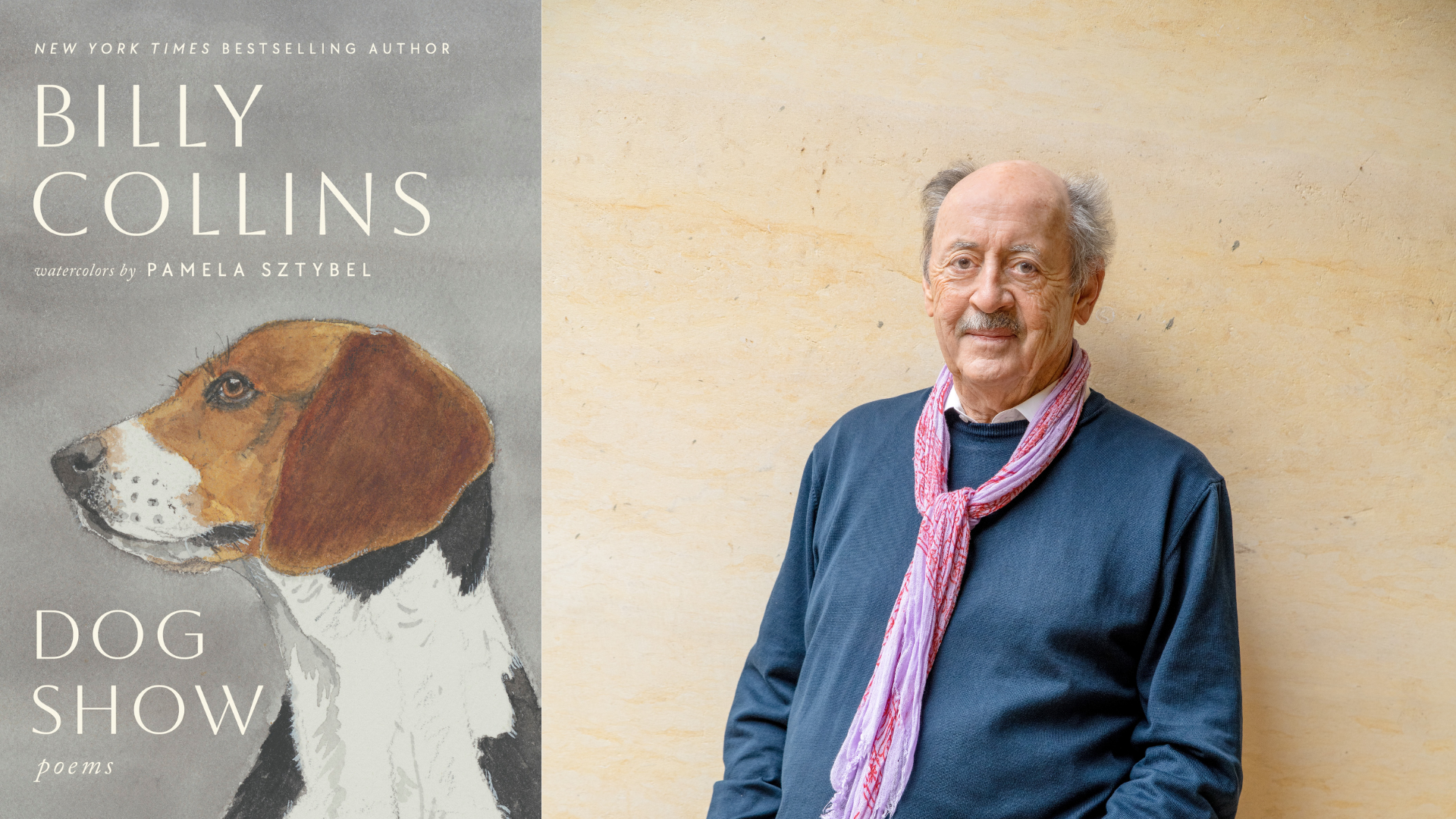
Mina Kim: From KQED. Welcome to Forum. I’m Mina Kim. “The dog,” writes poet Billy Collins, “moves through the world unencumbered with, quote, nothing but her brown coat and her modest blue collar.” In a new poetry collection, the former U.S. Poet Laureate turns his gaze toward the quiet wisdom of our canine friends — their reminders to slow down, pay attention, to let the ordinary become radiant. Collins’ new collection is called Dog Show. What has a dog shown you? Billy Collins, welcome to Forum.
Billy Collins: Thank you for having me.
Mina Kim: So tell me why dogs for you? Was there a moment — an early feature or aspect of dogs — that you found surprisingly profound?
Billy Collins: Well, not surprisingly. My first encounter with dogs was purely literary. We lived in Queens, New York — in Jackson Heights — in a nice garden apartment, but there was really no place for a dog there. But my father got me, I was just twelve or maybe a little before that, books from the Lassie series by Albert Payson Terhune. These were all collies raised on, I think it’s called Sunnybrook Farm. And I read about ten of them. I was also into boy-detective fiction, like The Hardy Boys, but I wanted a dog.
And finally we moved to Westchester and to a house, and my father broke down and got me a dog. But before he got the dog, he said, “Remember, we’re buying a heartache.” And I think that really resonates. This book — a book of poems written over quite a few years — really tries to avoid the sentimentality of Old Shep or the hard part of having a dog. Someone said dogs have only one flaw, and that is they don’t live long enough.
Anyway, that was my first dog. And just one thing about the first dog — his name was Sparky, like maybe every tenth dog is called Sparky. So if you yell “Sparky” in a dog park, half of them run over. But I thought Sparky was a wonderful black-and-white crossbreed. Only later, when I looked at photographs, did I discover he was an extremely ugly dog. But that didn’t get through. He was my dog, so he was beautiful.
Mina Kim: I’m still just so struck by what your dad said — that a dog is a heartache. How did that affect you as a child, or is it something that resonated more as time went on?
Billy Collins: Well, if you have several dogs, you have basically a string of heartaches, and you have to recover from them. One of the saddest things about dogs making their early departures is you know they’ve never had a concept of dying. So it comes as quite a surprise to them, and it must come as a kind of shift of mood or something.
I do have one poem in which a dog is thinking out loud to us — a dog who has a sense of its own mortality. Want to hear that one?
Mina Kim: Yeah, sure. Absolutely.
Billy Collins: It’s a short one. It’s called “A Dog on His Master.”
As young as I look,
I am growing older faster than he.
Seven to one is the ratio they tend to say.
Whatever the number, I will pass him one day
and take the lead the way I do on our walks in the woods.
And if this ever manages to cross his mind,
it would be the sweetest shadow I have ever cast on snow or grass.
Mina Kim: Billy Collins reading from his new poetry collection Dog Show. I’m wondering if you could read one more for us — “The Collar.” I was so struck by this one because it’s just about a dog collar. So relatable, so simple, so ordinary — but the end is so surprising.
Billy Collins: Yeah. It’s in skinny lines, so it maybe kind of looks like a collar.
“The Collar”
A dog’s collar typically features a silvery D-ring where the leash is clipped on,
and usually the pendants of a gray rabies tag,
and a smaller ID bearing a number and his name,
which can work to unhinge your heart when the collar is slipped over his ears and off his body,
freeing him for good.
Mina Kim: I understand from your author’s note that you are between dogs, Billy. So it sounds like your plan for your dog hiatus is that it will eventually come to an end.
Billy Collins: Yeah, I hope there’s a dog out there for me. There just hasn’t been for a while because — well, really because of running around the country too much and not being in one place. And I think you can leave a cat alone for quite a long time, but they say six hours is about as long as you can leave a dog alone without the dog emotionally suffering from that.
Mina Kim: A listener writes: “My dog and I grew up together, and now she’s very old. When I saw her over the weekend, I walked into the room saying things she couldn’t hear, and she didn’t get up to greet me — so far from the way she used to jump and zoom — but her tail still thumped against the floor. Seeing her age made me feel the passage of time, viscerally. We were girls together.”
Billy Collins: Oh, that’s beautiful. Did you write that down somewhere?
Mina Kim: Yeah. This listener wrote this to us, actually.
Billy Collins: It’s nicely phrased. I was going to be really impressed if you just made that up.
Mina Kim: I guess it made me wonder if your hiatus is not just connected to busyness, but maybe a little bit of grief. It is hard to outlive dogs, isn’t it?
Billy Collins: Yeah. You’re buying another heartache, from my father’s point of view. And there’s probably a little voice sitting on your shoulder saying, “Do you really want to go through that again?” But I’m fond of saying, yes — they will break your heart. But before they do, they will enlarge it.
Mina Kim: Billy, could you read the opening poem in your collection called “Dharma” for us?
Billy Collins: Sure. Let me just make it clear: Dharma is not the dog’s name. The dog’s name was Janine. Dharma is a much more resonant spirit — I’m just trying to investigate whether the dog has a kind of spiritual dimension to it.
“Dharma.”
The way the dog trots out the front door every morning
without a hat or an umbrella,
without any money or the keys to her doghouse,
never fails to fill the saucer of my heart with milky admiration.
Who provides a finer example of a life without encumbrance?
Thoreau in his curtainless hut with a single plate, a single spoon,
Gandhi with his staff and his wire spectacles.
Off she goes into the material world with nothing
but her brown coat and her modest blue collar,
following only her wet nose, the twin portals of her steady breathing,
followed only by the plume of her tail.
If only she did not shove the cat aside every morning and eat all his food,
what a model of self-containment she would be.
What a paragon of earthly detachment.
If only she were not so eager for a rub behind the ears,
so acrobatic in her welcomes.
If only I were not her god.
Mina Kim: Does the fact that she sees you as her god — and does some of those things you describe in that last part of the poem — interrupt your ability to really see the spiritual dimension of a dog?
Billy Collins: Well, yes. I think a dog is basically a dog. You can invest a dog with all sorts of attributes — particularly faithfulness and companionship. Man’s best friend. Clearly, a cat isn’t man’s best friend. And that’s an interesting description that’s been echoed through the ages: man’s best friend.
Because if you really look at the idea of friendship — at least my idea — friendship is a relationship without purpose. You don’t want anything from your friend. He or she doesn’t want anything from you. All you want to do is spend time together. And that’s the way a dog is a friend. The dog doesn’t want anything from you — well, maybe food and water — but the dog just wants to be with you.
If you wake up at 3:30 in the morning — well, first thing that happens is the dog wakes up immediately. What are we doing? Right? “We’re going to go for a drive.” Really? There goes the tail wagging. Dog hops in the car — doesn’t care where you’re going. He’s with you. And that’s the main thing. You can’t get a cat to do that unless by force. They just want to be with you.
Mina Kim: The other thing I was struck by in that poem is the contradiction between the model of detachment and then the bundle of desire and need. Was there something useful about noting that contradiction?
Billy Collins: Well, they’re so attached to you. At the same time, one loves just looking at a dog because a dog is always a dog. I mean, I think they have their moods, clearly. And even dogs who don’t look very expressive, I think, have expressions if you’re careful about reading them.
For example, a dog coming back to you with the wrong stick — you can see something in the dog’s eyes. Not exactly shame, but he’s sort of aware he’s got the wrong stick, but he’s trying to get away with it. A little bit of deceptiveness in his eyes.
Mina Kim: We’re talking with poet Billy Collins about dogs — what we can learn from them, and what they teach us about us. The new book is called Dog Show.
And listeners: What has your dog taught you? Has a dog changed the way you see the world? Helped you understand it? What role does your dog play in your life?