This partial transcript was computer-generated. While our team has reviewed it, there may be errors.
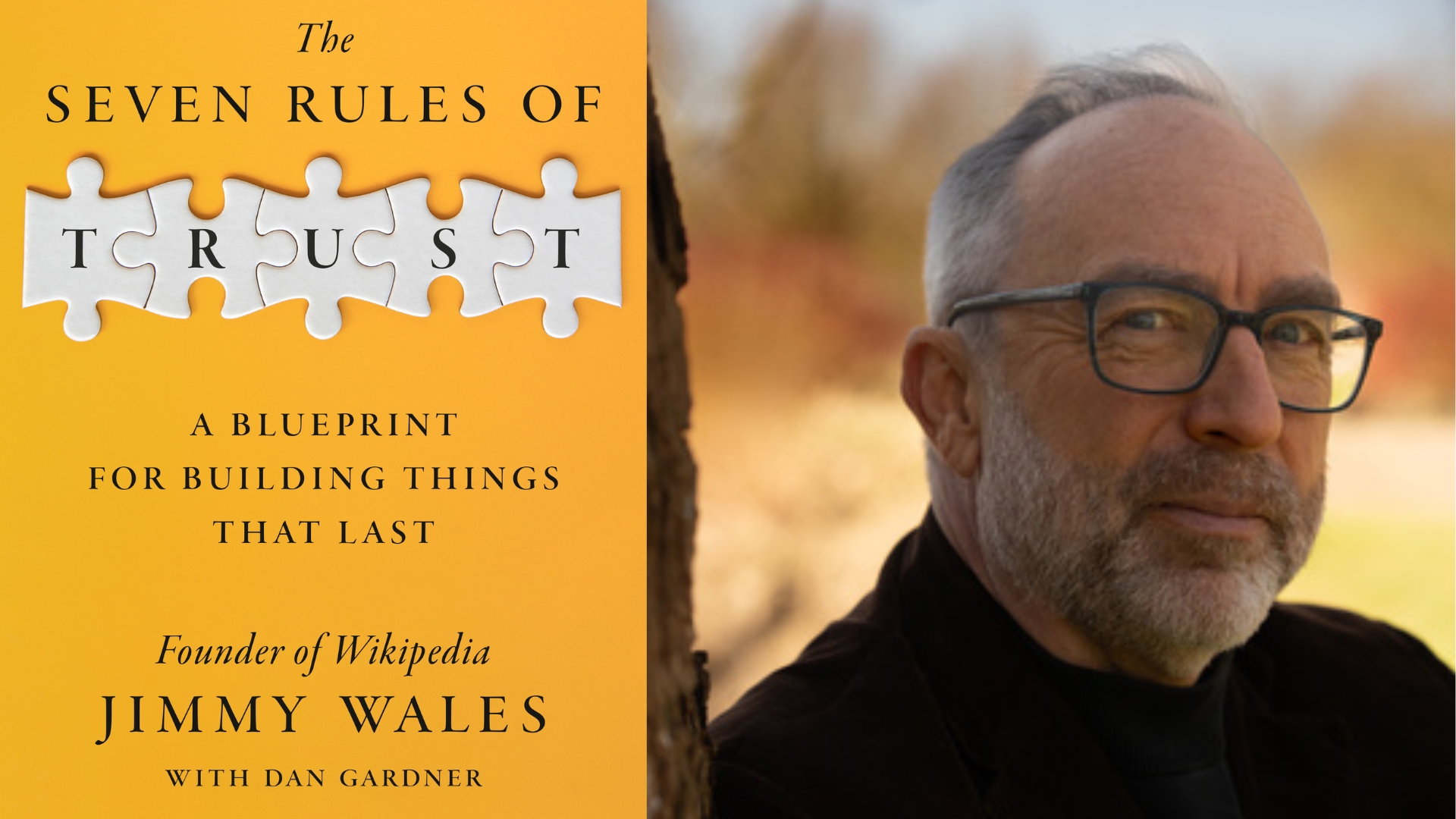
Mina Kim: Welcome to Forum. I’m Mina Kim. Wikipedia — the online encyclopedia that can, for the most part, be written and edited by anyone — relies on trust: trust that the crowdsourced information is contributed in good faith and is generally accurate. And in this day and age, when trust in institutions and in each other is waning, it’s striking that Wikipedia remains one of the most visited websites in the world, with billions of page views every month. Founder Jimmy Wales has been thinking about why Wikipedia has been able to keep people’s trust for so long. It was founded in 2001. He’s written a new book called “The Seven Rules of Trust,” a blueprint for building things that last. And listeners, do you use Wikipedia? Has it earned your trust? Jimmy Wales, welcome to Forum.
Jimmy Wales: Hi. Thanks for having me.
Mina Kim: So Wikipedia — I was reading your stats — gets 11 billion page views a month, and that’s just the English-language Wikipedia. There are more than 300 Wikipedias in other languages.
Jimmy Wales: Yeah, we’re truly global in a way that most things aren’t.
Mina Kim: And is it possible that people use Wikipedia without even knowing it?
Jimmy Wales: Well, they certainly are using the information that comes from Wikipedia because we have an open license, so people are using our content in all kinds of ways. But yeah, I think it’s entirely possible. But, of course, a lot of people are using Wikipedia and they do know it, which is good.
Mina Kim: Yeah. I was thinking about it because I was telling folks, I don’t think I use Wikipedia that much, but I was thinking more along the lines of: I don’t necessarily specifically go to the site. But yes, the first result when I type something into the search engine will often be information from Wikipedia.
Jimmy Wales: Yeah, that’s right. Yeah.
Mina Kim: Yeah. So talk about the many ways that trust is at the core of Wikipedia’s ability to function.
Jimmy Wales: I mean, well, you know, the thing about Wikipedia is it’s an open system. You can edit almost any page in Wikipedia, generally without even logging in. And, you know, we trust the users to come and to contribute in a good way. Of course, we’re not naïve about it. If you’re misbehaving, you’ll get yourself blocked by the community. But in general, it’s a surprisingly trusting thing. I mean, it seemed a little bit crazy at the beginning to say, “Oh, a website that’s completely open and anyone can come and change things.” But it probably feels a little bit crazier now — even though we all know it works — because of the toxicity of social media and so forth. I mean, you can get the idea that you couldn’t possibly do this; it would just be immediately covered with trolls. But the truth is, most people are perfectly nice people, and a few of them are annoying. But, you know, it still works.
Mina Kim: How would you describe somebody who tends to contribute or edit Wikipedia?
Jimmy Wales: Well, we call ourselves Wikipedians, and we’re a bunch of nerds, mainly. You know, the community is really made up of people who are often really into some fairly obscure topic — you know, a period of history. Or, you know, there’s WikiProjects on all kinds of subjects, like WikiProject Trains is all about trains and the history of trains and so forth. So it’s a lot of that kind of stuff, and, you know, not particularly political in terms of the community, and not particularly interested in — they’re not, like, social media influencers. So they’re not looking to build an audience and all of the things that you do get in other media.
Mina Kim: Yeah. I want to invite listeners in, actually, based on so many of the things that you said. First, I’m curious, listeners, if you’ve ever contributed or edited a Wikipedia page. I’m also curious: what’s the most obscure thing you’ve learned from Wikipedia? And, of course, what questions do you have for Jimmy Wales — a founder of this website — in this day and age that seems to still be growing and lasting such a long time.
So how has Wikipedia been able to cultivate trust among its community of main editors? I guess I would say they number what — in, like, the 150,000 or so?
Jimmy Wales: Yeah. Yeah. I mean, it’s hard to say exactly because it’s — you know, if somebody edits once a year, maybe they’re not really a community member exactly. But if they edit every day, they obviously are. So how we count just depends on how much activity you want to draw the line at. You know, the main way that we build trust has to do — you know, one of the rules of trust is about civility. You know, your mother was right: being nice to other people is really important. We have a rule in Wikipedia — no personal attacks. Of course, we’re human, so people get upset and sometimes, you know, do that. But we also have a culture where, if you’ve gotten upset and said something intemperate, you probably should apologize. And, you know, those are the kinds of things that we don’t see necessarily in social media, which, depending on the platform, can be very attacking and really quite toxic. But that idea of saying, “Okay, look, assume good faith. Probably the other person has similar motives to you. They want to make the encyclopedia better. Maybe you disagree on some point, but probably you can find a way to work it out.” And that spirit within the community is something that we have to continuously cultivate and talk about.
Mina Kim: Listener Henry writes: “Though I have never edited an entry, it’s the first place I go when I want to learn something. My friends and I also used to play a lot of Wiki Race, which was super fun, especially during boring Zoom classes in the pandemic. You get two articles and you have to find the most efficient way to get from one to the other via hyperlinks. I think I learned more doing that than in some of my classes.”
Jimmy Wales: Yeah, it’s great. I mean, actually, what somebody discovered a few years ago — and this was not in any way intentional — is if you click the first link in every Wikipedia entry as you go through, you very often end up, you know, sort of in broader and broader categories, but you often end up at philosophy, which is quite interesting.
Mina Kim: Yeah. So by extension, how have you gotten users to trust the information that’s on Wikipedia?
Jimmy Wales: Well, yeah. So when we think about the trust that readers have in Wikipedia, there’s a few elements that are really, really important. First of all, the transparency of showing sources. You know, whatever we say, we should link to a source, and the source should be high quality — you know, respected magazines, newspapers, academic journals, that sort of thing. So that really helps a lot, because you can check the information — where it came from. Another really important element is neutrality — the idea that Wikipedia shouldn’t take a side on any controversial topic. And, you know, to the extent we live up to that, I think it helps to build trust because people say, “Okay, they’re not here to convince me one way or the other; they’re just here to explain the debate to me.” And I think that’s really, really important and something that we need to continue to improve and to focus on.
Mina Kim: Mhmm. Rishi on Discord writes: “I’ve been wondering why Wikipedia is not completely run over by extreme wingers like other media. For influencers, there is no money in it. For ranters, there’s no virality in it. Wikipedia is perhaps more impartial and trustworthy than the U.S. Supreme Court.” What would you add to that? Because there are a couple of things that I also note in terms of people’s willingness to engage with it and finding the information. I guess neutral, as you say, is the goal. One of the things that you do is put a banner or flag on information that you worry might not be neutral, right?
Jimmy Wales: Yeah. Yeah. That’s another element that I think helps to build trust is, you know, you see the banners — “the neutrality of this article has been disputed,” or “the following section doesn’t cite any sources.” At first glance you might think, “Won’t that reduce people’s trust because you’re sort of telling them that it’s not very good?” But actually people do appreciate that. They say, “Okay, that’s interesting — it’s good that they told me that.” And I always joke, sometimes I wish The New York Times would say, “Oh, well, we had a big fight in the newsroom, we weren’t really sure about running this story, but we decided to run it. Just be warned that the neutrality of this has been disputed in our newsroom,” rather than the sort of voice-of-God, “Here are all the facts the way we have it.” Just really kind of acknowledge the messiness and the complexity of knowledge.
Mina Kim: Yeah. You also offer up criticisms of Wikipedia on Wikipedia, right?
Jimmy Wales: Oh yeah, definitely. Yeah. We spend a lot of our time actually questioning ourselves and really trying to grapple with: how do we do things better? How can we improve Wikipedia? And I think we have to keep that spirit. If we keep the spirit of saying, “Okay, look, Wikipedia is pretty good — fine, great, we’re happy people like it — but how can we do better? How can we make Wikipedia stronger?” And actually this is one of the areas — you know, AI and large language models are a huge technological revolution that we’re in the midst of. And we know that AI isn’t particularly trustworthy — all the large language models hallucinate and make stuff up and so forth — so we can’t just use them. But we can say, “Okay, hold on. Maybe they can help us in some ways. Maybe we can use them to suggest edits.” They don’t have to be perfect, but as long as they do well enough that it doesn’t waste people’s time, we might find that interesting as a way to help people find things to edit — you know, find some suggestions that are pretty simple and easy ways to get started.
Mina Kim: You also said that maybe they can summarize Wikipedia editor disputes or something like that, because those can be pages and pages long?
Jimmy Wales: Yeah, exactly. Yeah. It’s one of the areas — you know, in the book, one of the rules is transparency. And one of the problems we have with transparency is we’re so transparent — and all the debates are right there in public to see — that sometimes there are dozens, hundreds of pages. So if you’re new and you want to get involved in the debate, you may have a really hard time even figuring out what’s been said already and what the parameters of the debate are. And I actually think that’s a fun little idea I have. We haven’t really tried it yet — I’ve done a few experiments myself — but I think that could be an area. And more broadly than just Wikipedia: there are so many cases where governments are publishing thousands and thousands of documents. Great — that’s transparent in one sense, but in an era where the resources of journalists are really taxed — we’ve had a real crisis in the business model for journalism — okay, well, maybe AI can help. Maybe instead of just publishing reams and reams of documents, there could also be a decent summary that’s produced. It has to be good enough; it doesn’t have to be perfect. That’s kind of where I get to: the technology is pretty good, but it’s definitely not perfect. So where can we use something like that? That’s the way I think about it.
Mina Kim: Listener Jim writes: “I use Wikipedia multiple times a week. I’ve edited misspellings over several years. I contribute the equivalent of a dollar per day to support Wikipedia.” We’re talking to the founder of Wikipedia, Jimmy Wales. His new book is “The Seven Rules of Trust: A Blueprint for Building Things That Last.” We’re hearing from a lot of listeners about their support of it. We’ll also get into some of the challenges and criticisms of Wikipedia after the break. Stay with us. This is Forum. I’m Mina Kim.