This partial transcript was computer-generated. While our team has reviewed it, there may be errors.
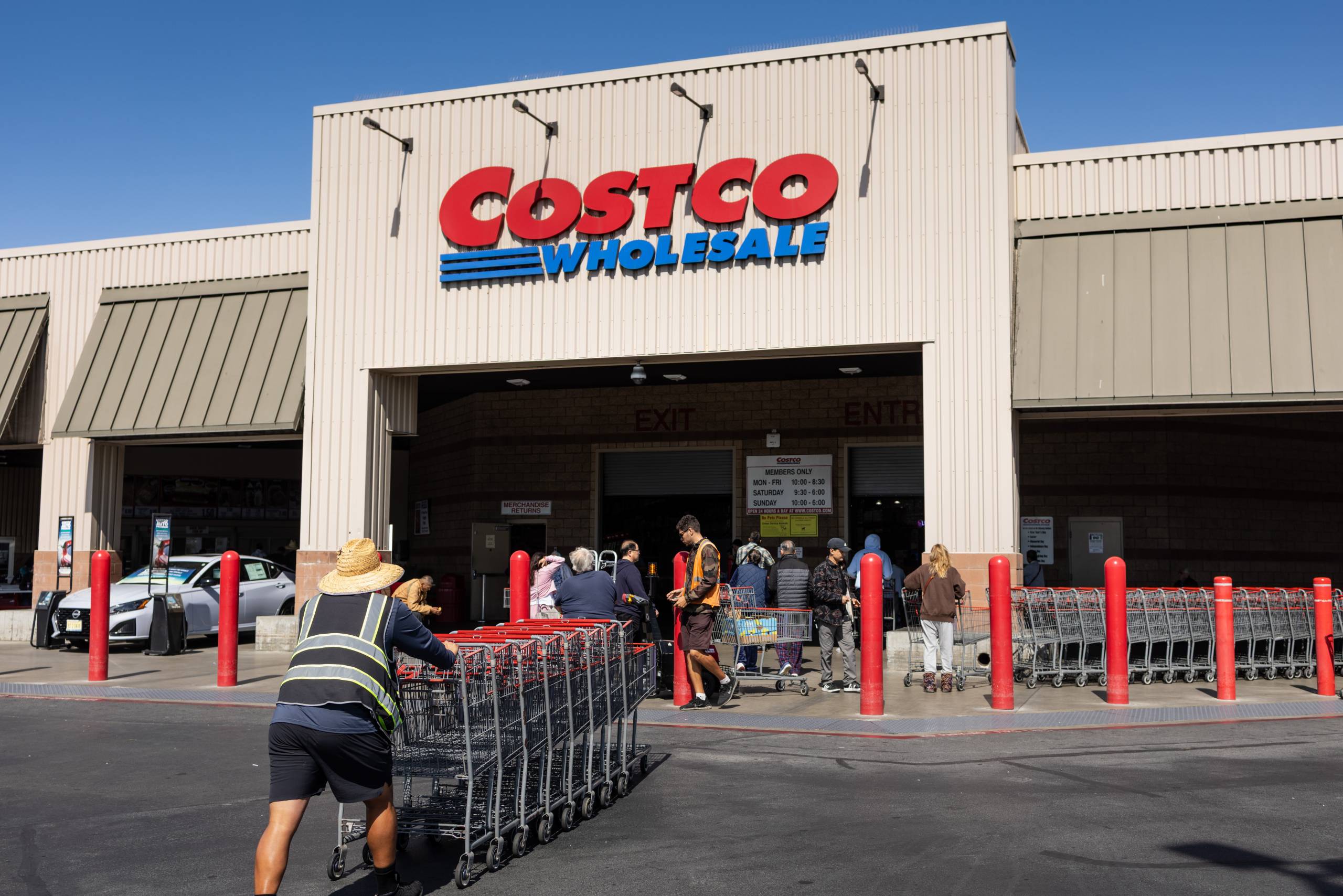
Mina Kim: Welcome to Forum. I’m Mina Kim. The look of a Costco warehouse is unmistakable — rows of industrial shelves stacked high with merchandise on pallets, red, white, and blue signage, including one promoting its enduring $1.50 hot dog and soda deal.
And people love this place — not just for the discount prices. They’ve associated their identities with it, like A.J. Befumo and his son Eric, who’ve found fame as the “Costco guys.”
(Clip plays)
Eric “Big Justice” Befumo: We’re Costco guys. Of course we get the sample, even though we bought the thing the last three times we were here.
A.J. Befumo: We’re Costco guys. Of course we cool off in the milk fridge.
Mina Kim: All this I learned from reading New Yorker staff writer Molly Fischer’s recent piece on the retail chain — and from examining my own interactions with the store. (Members since 2011 here.)
But Fischer’s piece also piqued my interest because of the question it asks: Can the golden age of Costco last?
Molly Fischer joins me now. And listeners, are you a Costco fan? Why? Call 866-733-6786 — that’s 866-733-6786. Or you can post on our social channels — BlueSky, Instagram, Discord — or email [email protected].
Molly Fischer, welcome to Forum.
Molly Fischer: Thank you so much for having me. I gotta say, when I think about the hallmarks of my Bay Area childhood, KQED and Costco are right up there.
Mina Kim: Neck and neck.
Molly Fischer: I mean, yeah — I’m in the backseat of the car, I’m in a Previa, we’re going to Costco. So this is perfect.
Mina Kim: Oh yeah. That’s great. Tell me your strongest memories of the San Jose Costco. I’d love to talk about your strongest memories of KQED, but, you know — the topic is Costco after all.
Molly Fischer: Well, it’s funny. I grew up in a family of transplants to the Bay Area, like so many people I knew growing up. And Costco was something my family — my dad in particular — discovered as a California transplant.
He and his best friend were always joking about, riffing about, talking about their Costco stories — the employees they knew, the things they found on sale. Infamously within the family, my dad wore Kirkland Signature pants — Kirkland Signature being the Costco house brand.
So Costco was this stalwart source of all the basic household goods you take for granted when you’re a kid — paper towels, breakfast cereal, coffee, whatever else. But it was also a destination. My brothers and I would serve as my dad’s gophers, running through the aisles trying to find whatever he was looking for.
It was funny realizing, as an adult and while writing this story, that Costco plays that role in so many people’s lives. I think of it as such a specifically Californian, Bay Area thing — and I can make the case for that later — but it’s also true that Costco has formed the backdrop of a lot of people’s childhoods, especially those who, like me, grew up in the ’80s and ’90s and saw the company become part of family life.
Mina Kim: Yeah — and they really have gone gangbusters. I had no idea until I read your piece that they’re as massive as they are. More than 900 Costcos worldwide — and in terms of revenue, only Amazon and Walmart are bigger?
Molly Fischer: I know, it’s wild. And Kirkland Signature — the in-house brand — does more revenue than Nike, which is kind of boggling. It’s the anti-brand that became a brand in its own right.
Maybe the biggest hit Christmas present I ever gave my two younger brothers was matching Kirkland Signature sweatshirts. People feel loyalty to Kirkland Signature now the way they do to something like Nike.
Mina Kim: And it’s also mind-boggling that they don’t advertise in any traditional sense — it’s all word of mouth.
Molly Fischer: Exactly. When I started thinking about it, it felt obvious, but I hadn’t put together how shrewd Costco is on this front.
As I said, I grew up with the sense that Costco was something you told stories about — something you joked about. It was like a natural phenomenon, the way you might talk about the weather. But that’s part of how Costco works — it relies on people wanting to talk about it.
You might find some totally unexpected product there, or have an unexpected conversation with an employee. For all its hugeness, it has this tangible, human-scale quality that people engage with — and even complain about.
Because it’s not necessarily easy or frictionless, as they say in e-commerce. You have to schlep what you bought to your car. You have to navigate aisles with a huge cart. There’s hassle involved — but people like talking about the hassle too. It becomes a war story almost.
Mina Kim: You referenced this clip from comedian Sheng Wang about parking, which we grabbed — and I just want to play it now.
Molly Fischer: Oh, please.
(Clip plays)
Sheng Wang: If I can’t find parking in under eight minutes, I drive away. Let it go, dude. That’s okay. Today is not the day. I’m not gonna force it. It’s Costco — I respect it like the ocean. That’s not my schedule, that’s the moon, that’s the tides. Costco is bigger than all of us.
Mina Kim: One hundred percent. And Alana writes on Instagram, “I will single-handedly keep the golden age of Costco going.”
Molly Fischer: I think a lot of people feel that way. It’s amazing.
Mina Kim: Yes — people say things like “my Costco.” They feel real loyalty. How much do you think the membership model contributes to that?
Molly Fischer: I think that’s part of it, absolutely. In a very literal way, you have to choose to be a member. Every time you go, you show and scan your membership card — and everyone else there is a member too. That creates a sense of belonging.
But I also think people’s goodwill toward Costco has a lot to do with its reputation for treating employees well. Compared to other companies its size — where you might have a queasier sense of their ethics or business practices — Costco has a strong reputation.
Many people I spoke with, even casual shoppers, expressed a sense that Costco is a force for good — that it’s doing right by its employees and isn’t a soul-sucking, bleak part of capitalism to participate in. So yes, the membership model helps, but the moral reputation is a big part too.
Mina Kim: Yeah. Let me go to caller Charlotte in Oakley. Hi, Charlotte — join us.
Charlotte: Hello! Thank you for having me. We’re a family of five, and we love the chickens. Five dollars — you can’t beat it. Even if you buy it raw and cook it yourself, it’s not the same. It’s ready-made, and we love that loss leader.
Also, our kids love the food court. Everyone’s happy there. I get my shrimp from the sales floor, they get their pizza and hot dogs — sometimes you just need a quick meal.
Mina Kim: Oh, Charlotte, thank you so much for sharing that. And Charlotte knows the rotisserie chicken is a loss leader. So Molly — how is it that Costco can pay its workers relatively well, especially frontline workers, and still keep prices so low?
Molly Fischer: There are a lot of ways to answer that. If you look at Costco’s history — its founders and mentors — you can see where the model came from.
But in a basic way, the warehouse model itself is efficient. Goods are packaged in pallets, stacked on simple industrial shelving — no elaborate displays, no frills. That means fewer workers are needed to maintain the store.
But the bigger picture is Costco’s belief that treating workers well isn’t just altruism — it’s good business. There’s been academic work on this — the idea that if you create a workforce that’s well-compensated, stable, and able to build a career, that stability makes your company more productive and profitable.
It helps you serve customers better if your frontline workers have benefits, fair schedules, and decent lives. When you walk into a Costco, you often feel that — employees seem engaged, not demoralized. The goal is a workforce that feels motivated because they’re treated humanely.
Mina Kim: Yeah. I love that you said Costco is a place idealistic MBAs can feel good about.
Molly Fischer: It’s true! There’s actually kind of a subculture — MBAs with an idealistic eye who are fascinated by Costco.
Mina Kim: We’re talking about the golden age of Costco — and whether it can last — with Molly Fischer, staff writer at The New Yorker, who asked that very question.
Listeners, what do you want to ask or tell Molly about Costco? Do you love shopping there — or maybe you’re not a fan? What are your Costco go-to items or shopping strategies? Because it seems like everyone has one.
And have you noticed any changes at Costco, as a consumer or employee? The number is 866-733-6786. Find us on Discord, BlueSky, Facebook, Instagram — @KQEDForum — or email [email protected].
More after the break. I’m Mina Kim.