This partial transcript was computer-generated. While our team has reviewed it, there may be errors.
Mina Kim: Welcome to Forum. I’m Mina Kim.
David Brooks, the longtime conservative turned Republican exile because of Trumpism, has said he’s not a movement guy. But in his new Atlantic cover story — and since last April, really, in The New York Times — Brooks has been calling for one: a mass movement, a national uprising strong enough to reverse what he calls a raging tide of authoritarian populism.
He writes: “The second Trump administration has flouted court decisions in a third of all rulings against it. It operates as a national extortion racket, using federal power to control the inner workings of universities, law firms, and corporations. It has thoroughly politicized the Justice Department and turned ICE into a massive paramilitary organization with apparently unconstrained powers.”
Public officials’ first duty, Brooks says, is to put the law before the satisfaction of their own selfish impulses — a concept he argues is alien to Trump.
David Brooks is also a commentator for PBS NewsHour, and his 2023 book How to Know a Person was just released in paperback. Welcome to Forum, David.
David Brooks: Great to be back. Thank you.
Mina Kim: I just read from that long list of things you say the Trump administration has done — and that’s only part of it. How do you think we should understand the purpose of these moves? You’ve said we’d be wrong to see them as separate actions.
David Brooks: Yeah. I think Trump, and MAGA in general, is an attempt to make the world safe for gangsterism.
There’s a famous saying in Thucydides: “The strong do what they can and the weak suffer what they must.” Trump is taking all the norms, rules, and constitutional protections that create a democracy based on conversation and persuasion — and eliminating them so that people like him, who are ruthless, can gain power, profit, and advantage.
It’s worth going back to George Orwell’s 1984. One of the apparatchiks of the totalitarian state says, “We don’t have ideas; we’re about power. We just want more power.” And how do you know you possess power? Not when others obey you willingly — but when they suffer.
I remember in the early days of the administration, so many of my friends here in Washington, D.C. — evangelical Christians who worked in scientific research at the NIH or at USAID saving lives around the world — were fired. They saw their livelihoods and their missions destroyed. I asked myself, why would the Trump administration go after evangelical Christians? It was because they’d built their lives around compassion and helping the least among us — things Trump had no interest in.
So I see it as a form of nihilism, not just politics.
Mina Kim: Yeah. I remember Russell Vought saying he wanted federal workers to “experience trauma” — to not even want to come into work.
David Brooks: Yeah. And, you know, I’ve lived in Washington a long time, and I know a lot of federal workers. Sure, they probably lean left more than right, but most just want to do a good job. They’re not political ideologues — they want to do the work their agencies are supposed to do.
If they’re working on human rights at the State Department, or as a lawyer in the CIA, or a bureaucrat in the Department of Education — they just want to serve. I used to ask political appointees from earlier Republican administrations what they thought of their career staff, and without exception, they said, “They’re very good.”
These are people who could make more money elsewhere. But somehow, Russell Vought and MAGA don’t see that reality.
When I graduated from college in 1983, I’d read Edmund Burke. I debated Milton Friedman on PBS back then — I didn’t win, by the way — and went on to work for William F. Buckley at National Review and then the Wall Street Journal editorial page. I did the right-wing circuit.
People like me were earnest conservatives — we read Burke, Russell Kirk, Irving Kristol. We believed in a conservative vision. But there was another group, particularly at Dartmouth, around a right-wing campus magazine called The Dartmouth Review. They weren’t pro-conservative — they were anti-left.
I remember when progressive students at Dartmouth built a shantytown to protest apartheid. One night, The Dartmouth Review crew took sledgehammers and destroyed it. I was appalled — first, because apartheid was absolutely worth protesting, and second, because wielding sledgehammers felt a lot more like the Gestapo than Edmund Burke.
Some of those people — like Laura Ingraham and Dinesh D’Souza — have gone from strength to strength, while people like me have been exiled from the conservative movement. It turns out the anti-left impulse was more powerful than the pro-conservative one.
Mina Kim: That anti-left movement has found a home in Trumpism. You say we’d be naive to think Trumpism will end in a few years. Why?
David Brooks: Because it’s a global populist movement. Every country has its version of Trump. In every country, the right-wing party has become the working-class party, and the affluent have become the left. It’s built into the structure of the information age.
Years ago, I had a research assistant at The Times named James. I noticed a book on his desk — The Revolt of the Elites by Christopher Lasch, published in 1995. James was barely born when it came out. But if you read that book, everything Lasch wrote is what Donald Trump and J.D. Vance say today: that educated elites have betrayed the working class and created their own world.
James is now J.D. Vance’s speechwriter.
That’s how deep this current runs — it didn’t just begin when Trump came down the escalator. MAGA is a set of ideas and a culture. It gives people identity, belonging, joy, even religion. If you saw the Charlie Cook memorial service, it was religious — MAGA and a form of Christianity have merged.
So MAGA gives people meaning — patriotic, emotional, spiritual, social. And those of us who oppose it can’t counter that with tax credits or policy. We need our own moral framework, sense of belonging, and vision. That won’t come from politicians thinking about the next election. Chuck Schumer isn’t going to save us. We have to think about culture, religion, and values — and tie that to politics.
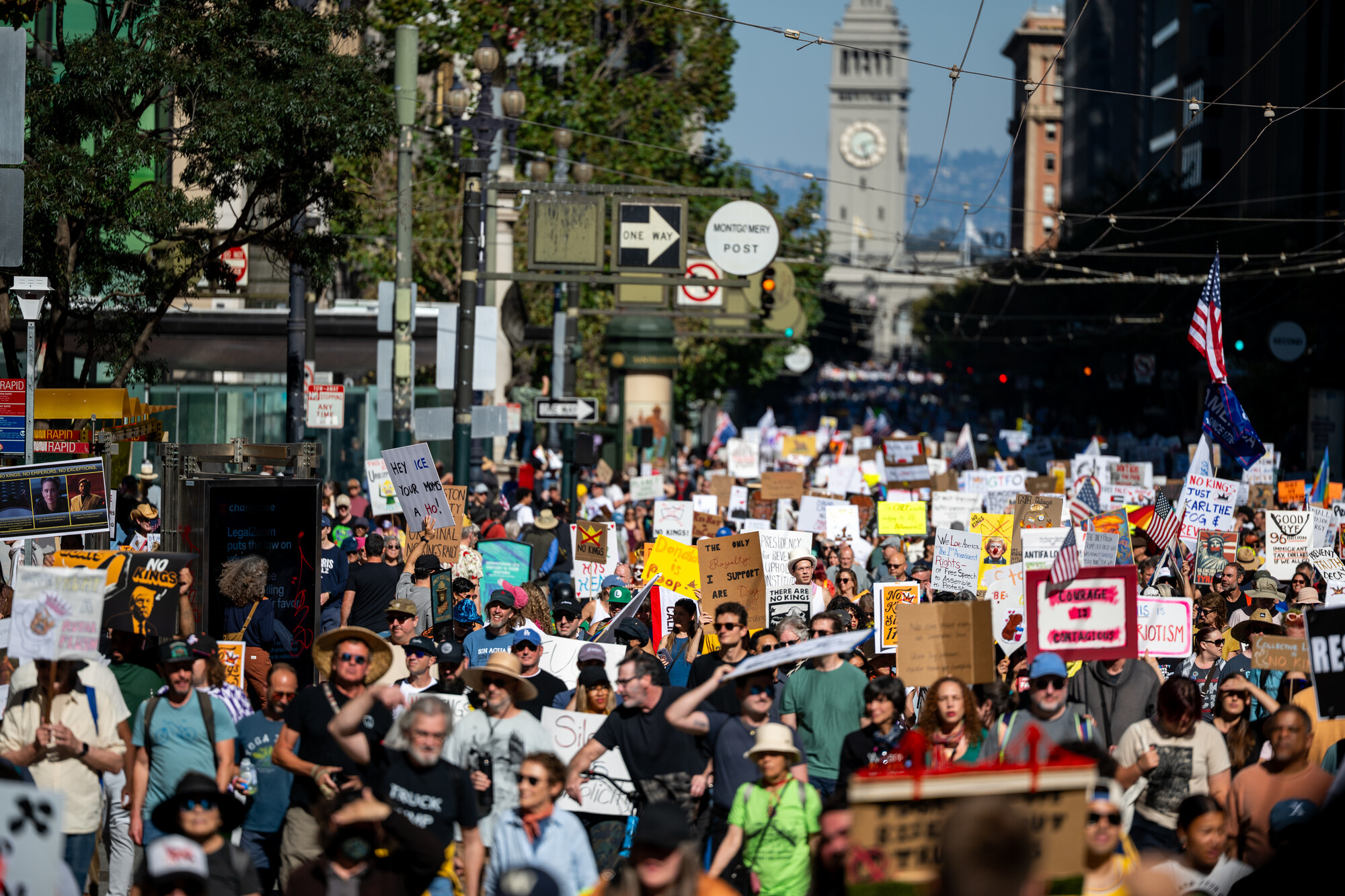
Mina Kim: So what did you think of the No Kings protests and rallies last Saturday? Do they start to build the kind of broader social movement you’re calling for?
David Brooks: Yeah, I liked them — very much. For selfish reasons too. As you mentioned, I’m center-right, and I want the movement to stretch from people like me to the left. I want a movement that people like me — exiled from the Republican Party — can feel comfortable in.
And looking at the No Kings rallies around the country, they were awash in patriotism. It didn’t have the vibe of Occupy Wall Street, which frankly gave me the heebie-jeebies. It felt like my tribe — diverse in viewpoints, but united in love of America.
It’s an embrace of democracy and the Constitution — a belief in persuasion over power. I think large majorities of Americans can sign on to that.
But No Kings still needs a positive vision. It’s one thing to say what you’re against — and that’s important. Movements begin by declaring something disgraceful. The Me Too movement did that with sexual abuse. No Kings did it with constitutional violations — saying, “No, we don’t accept this.” That’s powerful.
But then you need ideas. When I became a conservative years ago, I entered a movement built on ideas — Milton Friedman, William F. Buckley, a whole ecosystem of thinkers, books, and magazines. That’s what gives a movement staying power.
Think of the civil rights movement. It was fundamentally a religious movement — grounded in thinkers like Reinhold Niebuhr and the prophetic Black church tradition. People like Martin Luther King Jr. and Bayard Rustin gave it moral and intellectual structure.
That’s what we need now — a coherent set of ideas and principles to animate the movement. I still believe it’s out there.
Mina Kim: We’re talking with David Brooks, who says we need a mass movement now. We’ll have more with him — and with you — after the break.