This partial transcript was computer-generated. While our team has reviewed it, there may be errors.
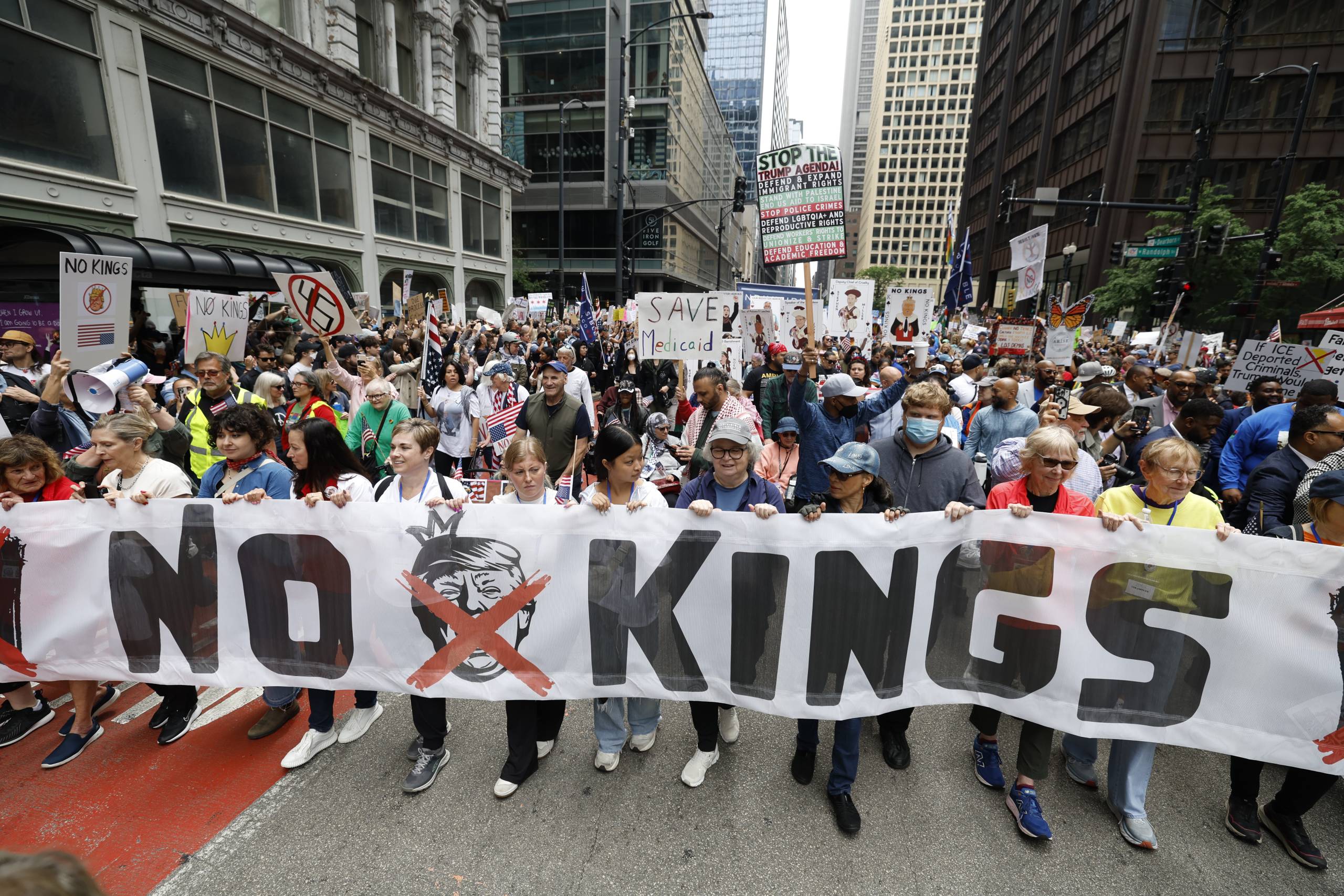
Mina Kim: Welcome to Forum. I’m Mina Kim. Organizers of the No Kings protests on October 18 are predicting even bigger crowds than the millions who gathered peacefully across the country last June. Immigration raids, troop deployments in cities, and threats to the First Amendment are animating people to act.
Is this you? Are you going? Tell us why or why not. This is a short segment, so tell us now at 866-733-6786. You can also email your questions and comments to [email protected] or post them on Discord, BlueSky, Facebook, Instagram, or Threads — we’re @KQEDForum.
Joining me is Omar Wasow, assistant professor of political science at UC Berkeley. Omar, welcome to Forum.
Omar Wasow: Thank you for having me.
Mina Kim: So what do you think? Is this wishful thinking on the part of organizers, or are you also sensing an increase in anger or worry that might motivate more people to come out this weekend?
Omar Wasow: I suspect there will be a larger turnout. Social movements often work as a kind of cascade through society — momentum builds, it fades, and builds again. Given that the policies of the Trump administration haven’t softened, I think more people will be mobilized.
Looking back at my research on the 1960s, we see this same pattern: early activists send a signal that encourages others to join, and the movement grows as participation expands.
Mina Kim: Several GOP leaders have been trying to get ahead of the rally, framing it as the Democrats’ “terrorist wing.” I think Speaker Johnson even called it a “hate America rally” for “pro-Hamas and Antifa people.” What do you make of that?
Omar Wasow: It’s a classic pattern — when protests occur, people in power often work to delegitimize them. Across history and countries, when organic protest movements emerge, they’re frequently labeled “outside agitators.” It’s as if dissent is so inconceivable that it must be blamed on some nefarious outside force.
That kind of effort to broadly delegitimize the opposition’s claims is something we’ve seen in the U.S. — especially in the 1960s — and around the world.
Mina Kim: Some No Kings organizers are saying that’s actually a good sign — that they’re getting under the opposition’s skin. Do you agree?
Omar Wasow: Yes. To paraphrase Oscar Wilde, “The only thing worse than being talked about is not being talked about.”
For a social movement, if you’re in the minds of your opponents, that means your issue has entered public consciousness — and that’s one of the central goals of protest: to elevate your concerns in the public mind.
Mina Kim: Roger on BlueSky writes: “I can’t attend No Kings because I’ll be driving down the coast, so I’ve printed posters to tape on my backseat windows. If I can’t go to the protest, I can at least bring a bit of it with me. No Kings.”
And Emily writes: “I’m going to the No Kings protest in San Francisco and decided, spur of the moment, to host a sign-making open house. This is my first time hosting a political event. Making it social feels important. I also bought patriotic scarves to wear and share — we have to take back the stars and stripes. I believe wholeheartedly that peaceful protest to save democracy and civil liberties is an act of patriotism. So much is under attack, and it’s easy to feel overwhelmed or avoidant. As a psychologist, I think a lot about the skills we need to connect, build coalitions across differences, and work together effectively.”
These two are making me want to ask another question — what will your sign say if you’re going? Again, tell us by calling 866-733-6786 or posting @KQEDForum.
Emily also brings up the question of effectiveness. What does it mean for a protest to be effective? What are they designed to do?
Omar Wasow: The first thing I hear in Emily’s comment — and the one before it — is that protests create a sense of efficacy in participants. In a huge country, it can be hard to feel like your voice matters. Exercising your First Amendment right to assemble can restore that sense of agency.
But beyond the personal impact, protests shape media coverage — and through that, public opinion. When protests highlight an issue, sympathetic media coverage can persuade more people to join a coalition and eventually vote in support of that coalition’s goals. That’s something I found in my research on the 1960s.
Mina Kim: Let’s go to caller Jeff in Sebastopol. Hi, Jeff — you’re on.
Jeff: Hi. I’m just calling to let you know that even though we’re having a small one in Sebastopol — and we had a nice-sized one in Santa Rosa at the last No Kings Day — we’re going to the Embarcadero Plaza because we want to make a big noise. We want everybody to make some noise to defend democracy. Thank you.
Mina Kim: Thanks, Jeff. So you want to make a bigger noise this time. Let’s go to Nate in Petaluma. Hi, Nate — you’re on.
Nate: Hi. I’m going to the No Kings protest in Santa Rosa in support of the Sanctuary Coalition of Sonoma County. We have a petition to stop the Sonoma County sheriff from sharing information with ICE on Change.org, and I’m going in support of our movement.
Mina Kim: Thanks, Nate. You know, people have said the No Kings protest is broad — a big tent that allows many different goals to fit under it. Talk about the benefits, but also the drawbacks, of that.
Omar Wasow: There are trade-offs. Any movement wants to build a large coalition — like in the 1960s, when civil rights organizers sought to create a national majority to pass legislation like the Voting Rights Act.
The power of the No Kings movement is its breadth. The challenge is that a very broad coalition might not elevate any one issue — like mass deportations — to capture the public’s moral attention. But as Nate’s comment showed, broad movements can mobilize locally around specific issues.
We saw this during earlier protests against the Trump administration — for example, against the so-called “Muslim ban.” Public outcry shifted opinion and ultimately policy. So a big-tent movement can work — but it’s harder to focus the narrative around a single, galvanizing injustice.
Mina Kim: Red writes some advice for countering Mike Johnson: “Bring ‘No Kings’ signs and also ‘We Love America’ signs. Wave American flags — not upside down — and keep the peace.”
We’ve seen this administration willing to use force to stifle dissent. Omar, are you watching for that? Do you think that could happen this weekend, based on what you’re seeing from the opposition?
Omar Wasow: It’s always hard to predict the future. But based on past No Kings protests — which were overwhelmingly peaceful — I expect that to continue, from both protesters and law enforcement.
That said, there are always particular flashpoints — Portland, Chicago, D.C. — where there’s been National Guard mobilization and more tension. Conflict can attract media attention, which helps a movement get visibility, but it also risks harm. State repression can generate sympathy — but it’s costly for those on the ground. So it’s a delicate balance.
Mina Kim: What advice do you have for people navigating that? How can they best engage in protest?
Omar Wasow: One thing we’ve seen, especially coming out of Portland, is the strategic use of humor. The media gravitates toward drama and spectacle — and humor can create that without violence.
Frog costumes, inflatable unicorns — they’re visually compelling, funny, and they change the narrative. Instead of chaos or “lawlessness,” they show something creative and human. Groups like ACT UP used humor this way — famously putting a giant condom over Senator Jesse Helms’ house to protest his opposition to AIDS research funding. It was clever, attention-grabbing, and drew sympathetic coverage. Humor can be a powerful tool.
Mina Kim: We’re talking with Omar Wasow, assistant professor of political science at UC Berkeley, about what’s driving people to the No Kings protests planned for Saturday in California and across the country.
Organizers predict a bigger turnout than last June. Listeners — are they right? Are you going? Why or why not? And if you’re bringing a sign, what will it say? Email us at [email protected] or find us on Discord, BlueSky, Facebook, Instagram, or Threads at @KQEDForum. You can also call us at 866-733-6786.
Cliff writes: “My father fought in World War II in 1943. All of America and the Allies were committed to fighting fascism. And now some Americans are embracing or tolerating it. If we don’t protest, we’re letting down the heritage of those who gave everything to defeat fascism. The country is imploding from Trump’s chaos — tariffs destroying the economy, propaganda, lies, corruption, cuts to social programs forcing people into poverty, and illegal deportations. Horrifying.”
And Cynthia writes: “My husband, my sister-in-law, and I are all in our seventies. We’ll be there in San Mateo in our shirts — possibly with signs. Our son and his wife are joining us. I’m three weeks out from surgery, so I can’t make the full march from Hillsdale Mall to Central Park, but I’ll meet the group halfway. This is really important.”
We’ll have more with you — and with Omar Wasow — after the break. Stay with us. This is Forum. I’m Mina Kim.