We meet Stanford chemical engineer William Tarpeh, who was recently awarded a 2025 MacArthur “Genius” Fellowship. Tarpeh’s work involves developing systems to extract nitrogen from waste streams to be used in fertilizer, cleaners and industrial chemical production. We talk to him about the environmental and public health benefits of his projects in Kenya and elsewhere, the role that California has played in his academic career and his plans for the fellowship.
MacArthur Genius Grantee Creates Sustainable Wastewater Treatment Solutions
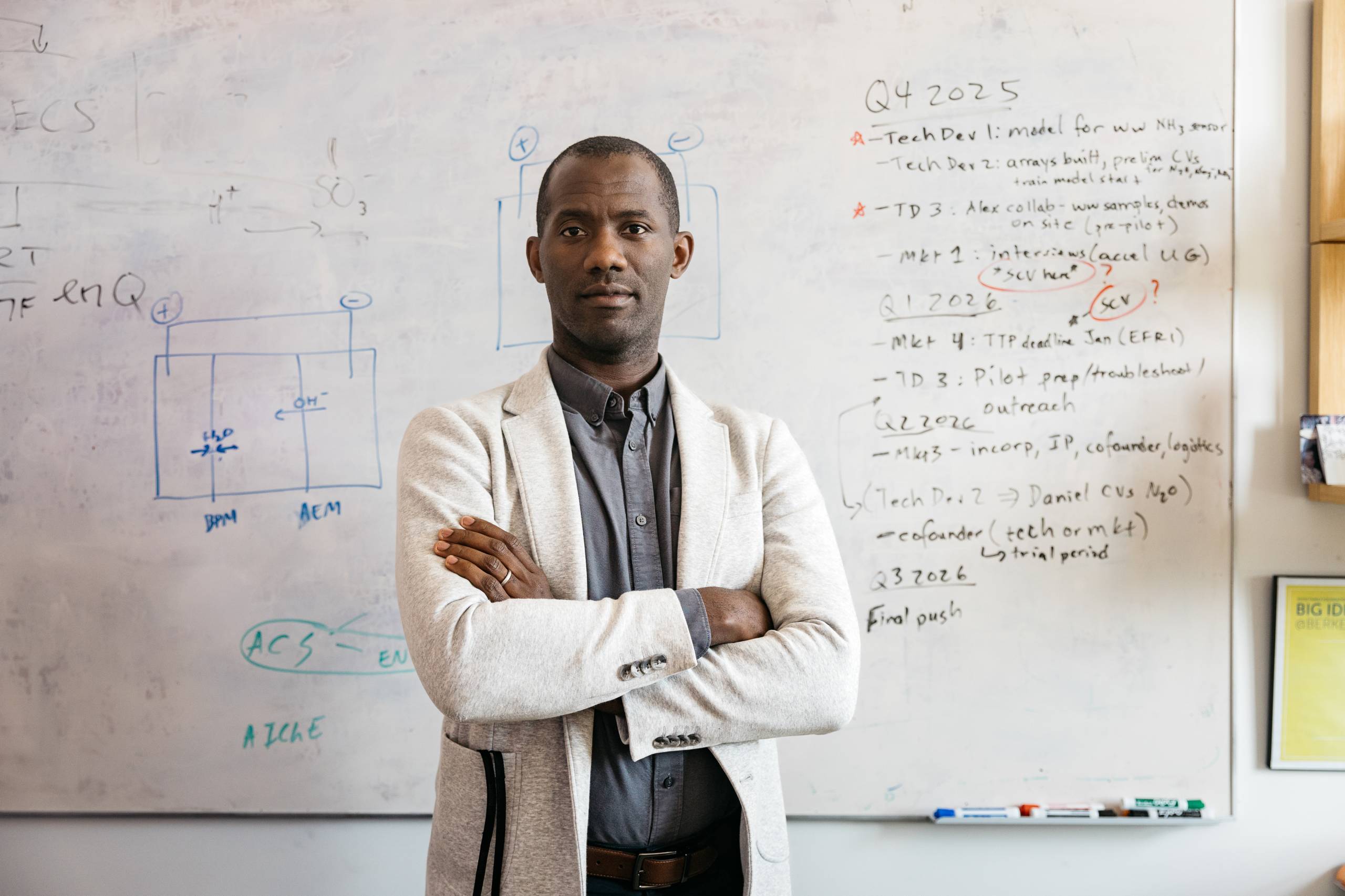
William Tarpeh (photo credit MacArthur Foundation)
This partial transcript was computer-generated. While our team has reviewed it, there may be errors.
Mina Kim: From KQED, welcome back to Forum. I’m Mina Kim.
Among the 22 recently announced MacArthur “genius grant” winners is William Terpeh, a chemical engineer at Stanford. In Tarpeh’s words, just as an oil refinery takes crude and turns it into many different products, his lab does a similar thing with wastewater—only in more practical and sustainable ways. As a MacArthur Fellow, Tarpeh now has an $800,000, no-strings-attached stipend to continue his work. He joins me now. William, welcome to Forum, and congratulations on the MacArthur award.
William Tarpeh: Thank you so much, Mina. It’s great to be here with you.
Mina Kim: Tell us first what you mean by turning wastewater into highly useful products. What do you derive from wastewater?
William Tarpeh: Sure. Most of us think of wastewater as something to get rid of—a nuisance at best. We ask: what can we mine from it? We can make fertilizers and chemicals that are bought and sold. We can make disinfectants like ammonia used in household cleaners. And more recently, we’re trying to recover battery ingredients—lithium, nickel, and cobalt—from either spent batteries or other wastewaters that contain them.
Mina Kim: You’ve developed a way to do this that requires far less energy, infrastructure, and even fewer chemicals.
William Tarpeh: Yes. Our big idea is to “close the loop.” Of course we want to reduce greenhouse-gas emissions, costs, and energy. But even when we do that, there’s another loop to close. For example, we’ve managed to recover ammonia as a fertilizer from different wastewaters—but to do that, we’ve needed sulfuric acid. So we ask: how can we get sulfuric acid from a more sustainable source? It’s an iterative approach with a big vision.
Mina Kim: And electricity is the main way you power this?
William Tarpeh: Yes. We try to use electricity—and as much renewable electricity as we can. That’s been hugely enabling over the past couple of decades, especially here in California. We can build on-site treatment devices that run on renewables—solar, wind, or other sources.
Mina Kim: Help us understand the role—or challenge—that wastewater presents going forward. What are the environmental issues it can cause?
William Tarpeh: Bringing it close to home, many Bay Area folks remember the big algal bloom a couple summers ago—2022 or 2023. Parts of the Bay became unsightly; there were large fish kills; livelihoods tied to tourism, boating, and fishing were affected. Those blooms are caused by excess nitrogen and phosphorus discharged to the Bay, much of it from treatment plants that aren’t yet designed to remove these nutrients.
In other parts of the world where wastewater isn’t treated to the same standard, diarrheal diseases can spread because of viruses and bacteria in wastewater. We see issues in mining as well—think cobalt mining in parts of sub-Saharan Africa or lithium mining. There are many kinds of wastewaters and effects; we’re trying to tackle them one at a time.
Mina Kim: The hope ultimately is to extract from it many, many times so that less ends up in the environment?
William Tarpeh: Absolutely. I think of “seventh generation” dish soap—can we have “seventh- or eighth-generation” lithium that’s circulated through our economy seven or eight times before we finally discharge it, rather than “use once and discard”?
Mina Kim: Let me invite listeners to ask questions about William Tarpeh’s work—assistant professor of chemical engineering at Stanford University and a 2025 MacArthur Fellow. Also, if you want to ask about what it’s like to be a MacArthur Fellow, you can do that as well. William, as people may know, no one applies for a MacArthur grant; a committee selects the fellows. It comes as a surprise. How did you learn you’d been selected?
William Tarpeh: My surprise came a little earlier—I didn’t find out the same day as everyone else, but it was similar. Someone from the foundation reached out with a question about wastewater. They said they were thinking about wastewater broadly and wanted expert advice. Like any good academic, I said absolutely.
We scheduled a call for a Wednesday in September. I hustled up four flights from our lab to my office and answered out of breath. “Jay” from the MacArthur Foundation asked, “Are you alone?” which felt like a strange question. I closed my door and said yes. He said, “I’ll jump to it. We love wastewater—and we want to tell you you’ve won a MacArthur award.”
I went speechless. My mind went blank. Jay asked, “Hello? Are you still here?” Then he explained how it would work and—most importantly—not to tell anyone. I was allowed to tell one person, so I called my wife, Rachel, right after. The challenge was keeping it secret for a couple of weeks. I’m relieved it’s out now—I don’t have to live the life of a double agent anymore.
Mina Kim: What’s been the reaction from people?
William Tarpeh: So excited. I got beautiful texts, emails, and calls from close friends, family, and colleagues at Stanford and beyond. Funny enough, I did my PhD at Berkeley, and folks here know the Stanford-Berkeley rivalry. Berkeley posted first about it—everyone wanted to claim me. It’s fine—both can. I’m excited because it’s a recognition of my whole field. I’m not the only person who loves thinking about wastewater all day, every day. It represents the field, which is thrilling.
Mina Kim: Listener Tess writes: “How do we support your project? It sounds brilliant. Why just treat water to neutral when one can mine the wastewater?”
William Tarpeh: Fantastic question. Especially in California, water is top of mind. Keep asking scientists like me—and your representatives—about projects like this. It comes down to partnerships: local wastewater treatment plants, farms, and industrial producers. The impact can’t just be what I do in a Stanford basement lab; it has to make its way into the world.
Mina Kim: Nas asks for an on-the-ground example of how the systems work in practice. Is anything up and running in a community? I know you’ve tried applying this to agricultural runoff in California.
William Tarpeh: We collected agricultural runoff from a farm in Salinas and brought it back to the lab. We treated that real wastewater over hours and days—that’s the first step. The next step is field deployment. I’m writing proposals to the U.S. Department of Agriculture to take our device into the field at on-site production facilities. Then we face real-world challenges: Can we run something for a long time outside the lab? Can people interact with it? We’ve done educational outreach with local farmers; there’s a lot of excitement about removing nitrate and ammonia from their wastewater.
Mina Kim: Nora asks: Can we apply William Tarpeh’s process at existing wastewater treatment facilities, or do we need entirely new plants?
William Tarpeh: Great question—the frontier of the field. In our jargon, it’s the level of adaptation required. Do we need a new plant, or can we “plug-and-play” at, say, East Bay MUD in Oakland? The short answer: we can plug-and-play. Many devices are small—handheld or tabletop. On campus, we can literally insert devices into the treatment loop and send water right back to the plant. Those partnerships are critical—adapting to what each plant needs.
The exciting part: our devices can be much smaller than status-quo systems that only remove nitrogen. We can recover it—and do so in less area. As we all know, land in the Bay Area isn’t cheap.
Mina Kim: I understand you tried to scale this and did a pilot project in Kenya, based on your award materials. What did you do there?
William Tarpeh: During my PhD at Berkeley, I spent parts of three summers in Nairobi, Kenya. It was a fascinating place to work because there aren’t many conventional treatment plants to adapt. We worked with people using pit latrines and informal toilets.
We partnered with Sanergy (its subsidiary is Fresh Life), a company collecting containers from hundreds—now thousands—of toilets. For me as a technologist, it meant access to the largest single batch of urine I’d ever seen—thousands of liters to treat. We ran pilot studies for selective ammonia recovery and showed it could work well. We paused during the pandemic, but we’ve also partnered in Senegal and South Africa. I’m eager to reinvigorate those projects with new enthusiasm, people, and resources.
Mina Kim: We’re talking with new MacArthur Fellow William Tarpeh, assistant professor of chemical engineering at Stanford, who’s been recognized for extracting highly useful chemicals from wastewater in sustainable ways.
Let me remind listeners: you’re listening to Forum. I’m Mina Kim. It’s fun hearing that wastewater is your happy place. How did you get so passionate about it—or about chemical engineering more broadly?
William Tarpeh: It’s a unique passion—I’ll acknowledge that. (We’re always hiring in wastewater, by the way!) I got interested in water in high school, in a class on globalization. It struck me that two people born in different places can have completely different life outcomes because of infrastructure. I thought about drinking water and how, as an engineer interested in chemistry, I could help.
Then I kept taking the path less traveled. Many people work on drinking water; fewer work on sanitation and wastewater—so I went that way. Many focused on feces—so I focused on urine, since treating feces often requires keeping urine separate. There was a lot of work on phosphorus—so I focused on nitrogen, because there’s more nitrogen in urine. At each fork, I chose the weed-filled path over the clearly marked one. That still excites me today.
Mina Kim: Annette writes: “A large concern is unprocessed medicines and excreted hormones in wastewater. Do your processes destroy them so they stop affecting wildlife? The effects of emerging substances are scary.”
William Tarpeh: Excellent question. Contaminants of emerging concern—PFAS “forever chemicals,” pharmaceuticals (even aspirin)—can affect wildlife. In our nitrogen-removal and recovery processes, we’ve seen some degradation of these compounds as a bonus. Realistically, we view our technology as one link in a treatment chain alongside processes targeted specifically at organics and pharmaceuticals. Still, the bonus destruction helps. And when we make products, we aim to ensure they’re free of these contaminants.
Mina Kim: I understand some of your work has faced federal funding cuts. What happened?
William Tarpeh: In April, an EPA grant of ours was cut. Many researchers with EPA funding saw the same. This was a three-year project in year two; one morning I woke up to an email to stop work.
The project—on “sanitation justice”—was in a predominantly Black, low-income rural community in Alabama where septic tanks fail, flooding yards and even backing up into homes. We partnered closely with a community organization led by MacArthur Fellow Catherine Coleman Flowers to document challenges and measure water quality—we observed wastewater in the community. Next we planned to co-develop solutions with residents—financially, socially, culturally, and environmentally sustainable, with possible resource recovery. That’s now paused and under appeal.
Mina Kim: Heidi writes: “Congratulations—and yay for wastewater being spotlighted! What are you targeting regarding discharge? Nutrients for land application? Reducing specific parameters for discharge to streams and rivers?” We have less than a minute.
William Tarpeh: Great question. For the vision, we’re interested in a lot—but municipally, nutrients (nitrogen and phosphorus) have been our main remit. We’re making fertilizers and aiming for higher-value products like hydrazine (a jet/rocket fuel) and hydroxylamine (a pharmaceutical precursor). We want to increase the value and breadth of what we can recover.
Mina Kim: I’m guessing you haven’t decided yet what you’ll do with the $800,000, disbursed over five years.
William Tarpeh: That’s a good guess. I’m still reeling. Bottom line: I’m excited to keep pursuing this work—and to partner with communities to make it real.
Mina Kim: William Tarpeh, assistant professor of chemical engineering at Stanford and a 2025 MacArthur Fellow—congratulations again, and thanks so much for talking with us.
William Tarpeh: Thank you so much. It’s been a joy, Mina.
Mina Kim: Thanks to Mark Nieto for producing today’s segments.