California City in Kern county is now home to the state’s largest ICE detention facility after private prison giant CoreCivic formally contracted to run it last month. But immigrant rights advocates say it lacks proper permits, and detainees have staged hunger strikes to protest filthy conditions and lack of access to medical care. Meanwhile, California City officials say they have no authority to challenge prison operations. We talk about how it’s dividing the community.
Is California’s Largest ICE Detention Center Operating Legally?
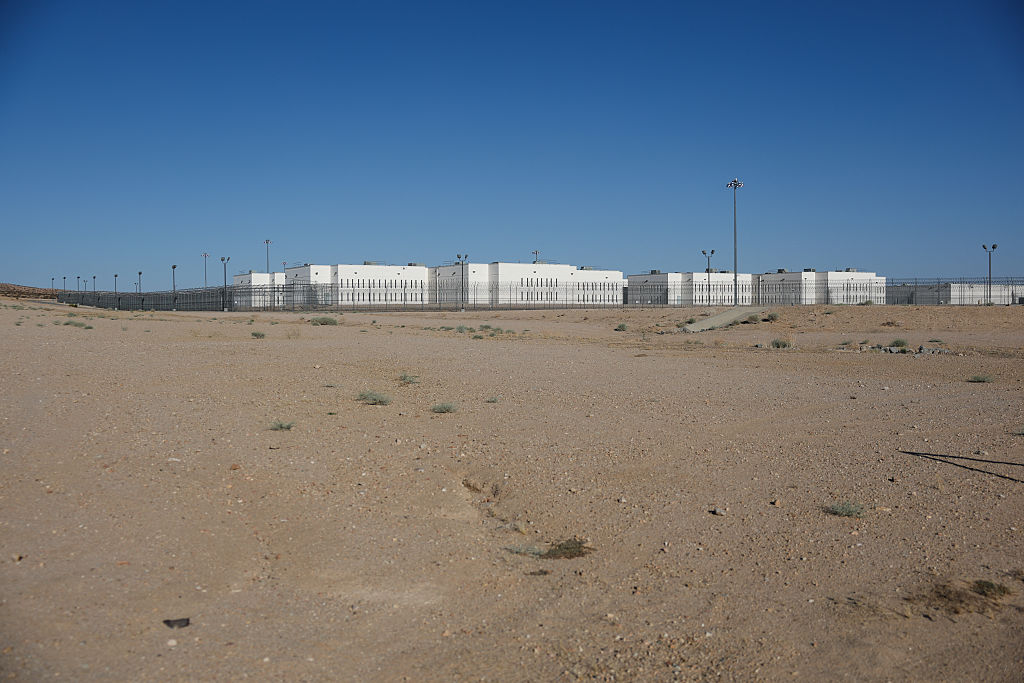
The CoreCivic, Inc. California City Immigration Processing Center stands in the Kern County desert awaiting reopening as a federal immigrant detention facility under contract with the US Immigration and Customs Enforcement (ICE) in California City, California on July 10, 2025. (Photo by Patrick T. Fallon/AFP via Getty Images)
This partial transcript was computer-generated. While our team has reviewed it, there may be errors.
Mina Kim: Welcome to Forum. I’m Mina Kim. California City is about two hours away from Los Angeles in the middle of a sprawling desert in Kern County. And as of late August, an idle former state prison there has become an ICE detention facility capable of holding more than 2,500. It’s already drawn complaints of inhumane treatment of detainees and accusations of operating illegally.
We look this hour at the impact the detention center is having on the community and the questions it’s raising about the potential for ICE facilities popping up in other parts of California. Joining me first is Sam Levin, a correspondent for The Guardian US, whose latest piece is called Hell on Earth: Immigrants Held at a New California Detention Facility Beg for Help. Sam, welcome to Forum.
Sam Levin: Thank you so much for having me.
Mina Kim: So, “hell on earth.” Talk about what detainees have told you about what they’ve experienced there.
Sam Levin: I collected firsthand accounts from six people detained at California City ICE detention center and spoke extensively with advocates and lawyers working with the folks inside. And they described poor and filthy conditions, inadequate medical care, and harsh and cruel treatment by some staff members. All these claims CoreCivic, the private prison operator, has disputed.
But the conditions they’ve described is just dirty, backed-up toilets, having to clean the place themselves but not having the supplies they need, not having enough soap, clothes, basic amenities, not getting basic medical care, being able to be seen by a doctor when they have urgent issues, and then just being treated in humiliating and disrespectful ways by staff.
Mina Kim: It’s important to note that you can be detained by ICE without having been charged or having criminal charges filed against you and that many people there have no criminal record. So how are they coping with these kinds of conditions? What are they trying to do?
Sam Levin: There have been reports of people trying to protest in ways that they can. I spoke directly with someone who was engaged in a hunger strike because he felt he had no other way to speak out about what was going on and about how dire the situation was.
And there are groups who reported — the California Collaborative for Immigrant Justice, a group that has been working closely with advocates, and the folks detained inside say that, you know, more than a hundred people detained had taken steps like sit-ins and hunger strikes to speak out. And CoreCivic has acknowledged that there were some activity along those lines, and some of those people were actually sent to isolation or solitary because of, you know, speaking out.
And so they’ve tried to just speak out in any way they can — protest, make their voices heard — because they do feel like it is a very desperate situation. And as you said from the headline of my story, you know, some describe it as hell on earth or a zoo, just very chaotic and difficult, in some of the worst places they’ve ever been detained.
Mina Kim: Your story also reported some detainees telling you that they think part of the reason for the way that they’re being treated is that staff there did not seem ready for them to arrive.
Sam Levin: There’s definitely a feeling among the people I spoke to and advocates as well that this was a rushed opening, and we see that in how the facility was opened while it was still in the process of going through the city permits. And there’s a feeling that the staff just weren’t ready.
And, you know, at least one person I spoke to said the staff essentially said that we weren’t ready for you and just we didn’t have enough supplies and that there’s just a kind of chaos in how it’s operating. They weren’t getting basic kind of recreation time that they felt they deserved and were required to get, and the facility was just dirty and not ready for them.
And that’s made it really difficult and made for a really difficult transition into these facilities. And they reported that they weren’t getting their daily medications initially. And CoreCivic has said those initial delays have been addressed, but people were saying that they were begging for their medications, anxiety medications, things that they need to live, to survive, and not getting those in a timely fashion and not being able to see a doctor. These are really, really serious allegations.
Mina Kim: And you said CoreCivic has denied these allegations. Can you say more about what they said to you?
Sam Levin: CoreCivic has said that they treat people humanely, that they operate facilities across the country, and that everyone has their medical needs met, and, you know, that staff treat people appropriately and has generally denied the claims that this is an inhumane place and that it is operating in a fashion that is treating people unfairly.
Mina Kim: Yeah. We reached out to CoreCivic as well, and Senior Director of Public Affairs Ryan Gustin said, quote, “Regarding the allegations that have been raised, we have seen no evidence to support them and have no reason to believe they are credible. CoreCivic takes seriously our obligation to adhere to all applicable federal standards in all our ICE contracted facilities. All our facilities operate with a significant amount of oversight and accountability, including being monitored by federal officials on a daily basis to ensure an appropriate standard of living and care for every individual.” I don’t know if you have a reaction to that, Sam.
Sam Levin: Yeah. This is a standard response that they’ve given to claims of problems inside their facilities, and they say that there is oversight. And, you know, there have been some city officials, of course, who have visited, but we’ve seen generally with ICE detention facilities across the country that it’s opaque, we don’t always know what’s happening inside there, there’s not a lot of access, and people who have tried to do oversight and accountability have struggled to go inside and get a true picture of what’s happening.
And so that does leave us, the public, forced to rely on the accounts of people who are inside to understand what is happening, which is why, you know, we’ve done the work as reporters to collect those accounts and talk to people and just hear firsthand about what they’re experiencing — from multiple people. And, you know, we’re hearing the same things from different people we talked to, which was these concerns about conditions, medical care, and treatment by staff.
Mina Kim: Have any of these concerns been addressed? Do you know by now?
Sam Levin: I know that there were some pains initially in terms of just the chaotic opening of the place, people being rushed to transfer there, where people felt like the initial problems were part of that chaos. And so some people have said that, you know, they were getting medications now that they weren’t initially getting and that there’s been, you know, some improvements, I suppose, in how they were being treated just as the facility was operating more functionally.
But as I understand it and from what I’ve heard, people still feel on a fundamental level that they’re not being treated appropriately there, that the treatment is inhumane and that the conditions are poor and that they deserve better. And this place, as you said, is a former state prison. And so there’s a feeling amongst the folks that I talked to that they are being treated like they are criminals, like they are criminal defendants inside a prison, when of course they are there for civil immigration violations and not serving a criminal sentence. But they feel like they’re being treated as if this is a criminal facility.
Mina Kim: We’re talking with Sam Levin, correspondent for The Guardian US, about an ICE detention facility in Kern County’s California City that’s operated by private prison giant CoreCivic, but detainees are protesting filthy conditions and lack of access to medical care, and immigrants’ rights advocates are saying it lacks the proper permits.
Listeners, join the conversation with your questions about what’s happening at the ICE detention facility in California City by emailing [email protected], finding us on Discord, Bluesky, Facebook, Instagram, or Threads @KQEDForum, or call us at 866-733-6786.
I want to bring in Tyche Hendricks, senior editor covering immigration for KQED, who also wrote a piece called “California’s Newest Immigration Facility Is Also Its Biggest. Is It Operating Legally?” Tyche, thanks for coming on.
Tyche Hendricks: My pleasure.
Mina Kim: Can you start by just telling us how this detention facility came to be here in California City?
Tyche Hendricks: Sure. So, this is a private prison owned by a company called CoreCivic. They built it in the 1990s. They had the federal government as a client for a while. But for the last decade or so, it’s been a state prison. As California has been in a process of criminal justice reform and reducing incarceration, they ended the contract a couple years ago, and it’s been sitting vacant.
And so this became — ICE, you know, is really trying to expand massively. This Trump administration expansion in deportation and detention is part of that. And so it’s a business opportunity for CoreCivic and other private prison companies.
Mina Kim: So when the state prison — essentially that CoreCivic contracted with the state to run — when it went away, what effect did that have on the community in California City?
Tyche Hendricks: Yeah. Well, I mean, it’s worth sort of contextualizing. California City has about 15,000 people. It’s not a wealthy place. There aren’t a lot of jobs. There’s, you know, I think an Air Force base many miles away that is a source of jobs. The cannabis industry is a source of jobs. But this is like an anchor employer in this community. And also part of the tax base.
So there are reasons that there are folks there who may want it and feel that they rely on it. But there’s also, you know, opposition there too.
Mina Kim: Yeah. Talk about that. How do local residents feel about this? What role has this ICE detention facility played in terms of tensions in the city or divisions in the city?
Tyche Hendricks: Yeah. Yeah. I mean, it’s a community that is somewhat split between Republican and Democratic voter registration. One of our colleagues in the summer was down there and talked to people who were Trump voters but who were saying, like, I’m not sure this approach to immigration enforcement is something I subscribe to.
So that’s anecdotal. I’ve been tuning in to some planning commission meetings where there was overwhelming opposition. And not all of those voices were local — some were advocates from other places. But there are local people who are very much opposed.
And it’s a city that’s had some trouble with its governance, some disarray at the governmental level. So the question of oversight is a big one. CoreCivic applied for a business license, but hasn’t gotten that yet. So there’s some tension there.
Mina Kim: Yeah. I definitely want to get into some of the questions that are being raised by some of those advocates who are coming to the public meetings. But yes, reading reports of it being a 40 percent Latino population, and so there are a lot of people there who are on edge with this facility nearby, while other residents of California City are hoping that this will be a new economic engine for them as well.
Stay with us for more. You’re listening to Forum. I’m Mina Kim.