This partial transcript was computer-generated. While our team has reviewed it, there may be errors.
Mina Kim: Welcome to Forum. I’m Mina Kim. What do frog skin, polyester hair, and pig kidneys have in common? They’ve all been used to try to replace our remarkably complex body parts. Science writer Mary Roach, bestselling author of Stiff and Fuzz, has been exploring humanity’s relentless quest to recreate anatomy — how far we’ve come, and the difficult questions that arise as the science evolves.
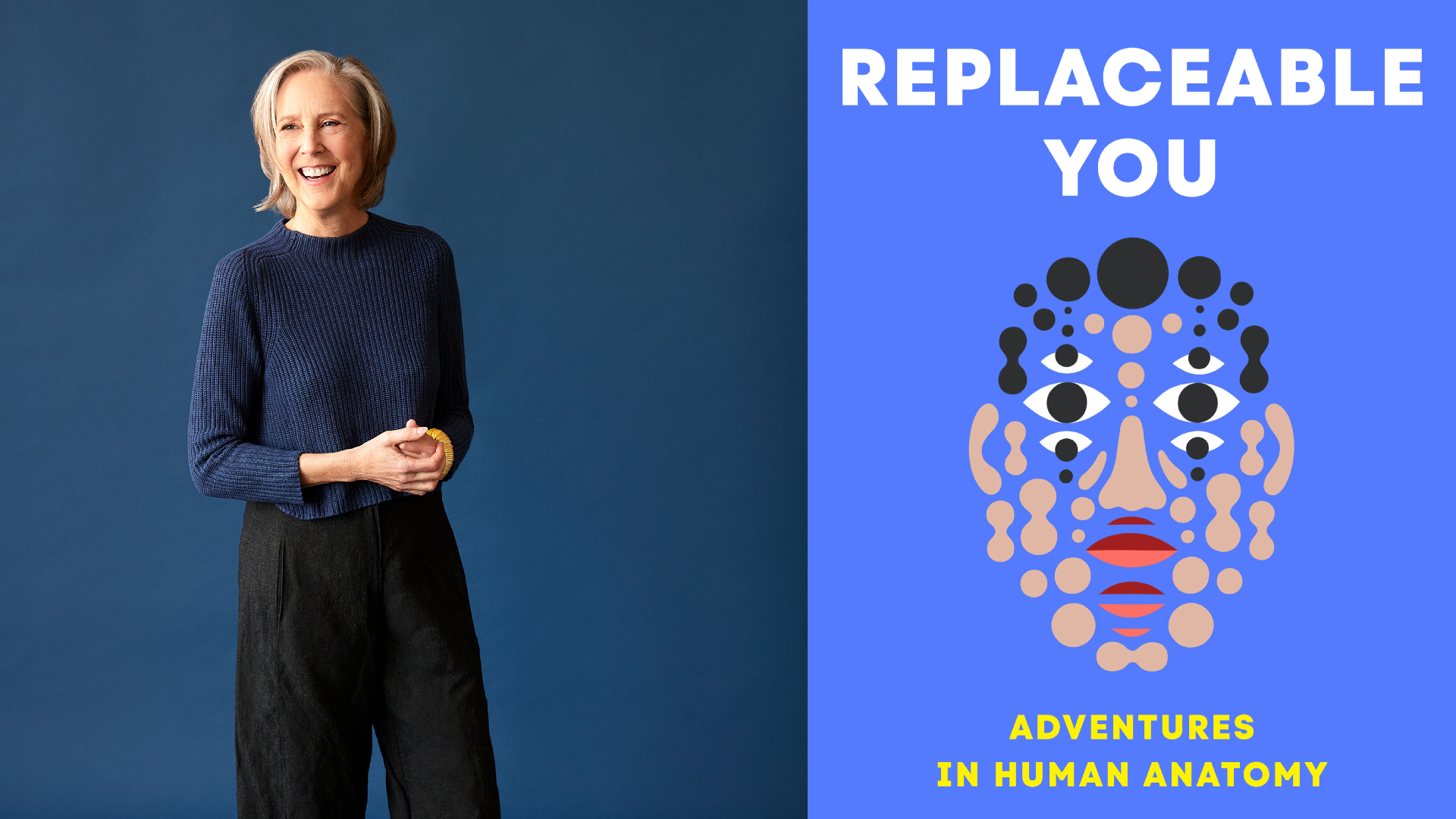
Her new book, out tomorrow, is called Replaceable You: Adventures in Human Anatomy. Mary Roach, welcome to Forum.
Mary Roach: Thank you so much, Mina.
Mina Kim: Your book is a great reminder that we’ve been on this medical journey of body-part replacement for a long time — hundreds of years, in the case of teeth. What did you learn about early dentures?
Mary Roach: Oh, sure. Early dentures… you did not want a pair. There were a number of technologies. One of the most gruesome — though not used for long — was in 1800s France. It was called “floating teeth.” They actually pierced the gums and suspended the uppers with wires through them. That didn’t last.
Around George Washington’s era, uppers and lowers would be attached with a coil — spring-loaded. The spring pushed the uppers into place, but Washington said it also pushed them out of his mouth. When I look at a dollar bill now, or his portraits, I think: you can see him trying to hold his dentures in. That stiff, grim look — now I understand it.
Mina Kim: Yeah. And in the Victorian era, a lot of people lacked teeth. But I was struck by what you found in the mid-20th century — people choosing to pull out their healthy teeth. Why?
Mary Roach: Yeah, that amazed me. I came across the term “matrimonial teeth.” A bride’s present would be to have all her teeth pulled and be fitted with dentures. The idea was: she’d look beautiful for photos, and it would be cheaper to do them all at once. Which isn’t true — the bone resorbs, and you need refits.
I wondered how common it was. Then I found a Reddit thread — someone asked if this was really a bridal present in the ’40s, ’50s, ’60s. A thousand people answered: yes, my grandmother, my grandfather, my dad had it done. Terry Gross even interviewed Paul McCartney, who said his dad told him at 21, “Go get them all pulled.” It was a fad. It was all the rage.
I felt so bad for those people. Dentures then were poly-gripped in place, but they slipped and slid. People were embarrassed, uncomfortable kissing or laughing. It wasn’t a good replacement. Today you can clip plates onto implants — they stay put, you can chew. But back then, it was rough.
Mina Kim: You mused whether they were succumbing to the lure of progress.
Mary Roach: Yeah. There’s this hopeful attitude that anything new and scientific must be better. And sometimes it is, but rarely as good as what you had.
Take my dad. He lost all his molars but kept his front teeth. He never got dentures. He just “beavered” his food, as my brother put it. And he could eat anything. He was smart — he didn’t have to deal with slipping dentures or the smell.
Mina Kim: We actually already have a listener comment. One writes: “My grandmother in Greece had all her teeth removed in her forties, on advice that it would help with her headaches. It didn’t. My father said she was deeply sad about it until the end of her life. He said her original teeth were beautiful.”
Let me invite more listeners to join the conversation. Have you had a body part replaced — hip joints, dental implants, maybe a new organ? What questions do you have about how far along we are with replacement science? And have you struggled with the decision to replace a body part — and why?
You can email [email protected], find us on Discord, Bluesky, Facebook, Instagram, or Threads @kqedforum. Or call 866-733-6786. Again, 866-733-6786.
I loved the detail you added that the mid-20th century was also when The Six Million Dollar Man came out — this idea that he’d be stronger, better, faster with science-made parts.
Mary Roach: Yeah, I remember that show. He had the bionic eye, and when he queued it up, it beeped. I thought: that’s an annoying feature. You don’t need it to beep!
Mina Kim: Exactly. We’ve learned that often the artificial part doesn’t function as well as the original. And I’m reminded, Mary, of a conversation you had with surgeon Jeremy Goverman, who told you he didn’t think we can really replace the human body, because it’s so miraculous in its complexity.
Mary Roach: Right. We’ve come a long way in replacing parts that are failing or missing. But matching what we started with? We’re not there yet. I even thought: let’s get simple. Tears. Artificial tears.
Mina Kim: Oh, they’re pretty good, right?
Mary Roach: I thought so. I even looked up a place called TearLab, imagining a giant eye statue and people crying at sad movies. Turns out it’s just a tabletop device for measuring dry eye. But the inventor knew a lot about tears, so we talked — two full free Zoom cycles because I’m too cheap to pay. [laughs]
And I learned: it’s not the tears you cry, but the tear film that protects and lubricates the eye. It has a scaffold structure that prevents evaporation. Mucins collect debris and park it in the corner — that “sleep snot” in the morning. Lubrisin is an amazing lubricant. Bottom line: we haven’t figured out how to replace the tear film.
Mina Kim: Not even that. You were like, “Salt water with a little oil — how hard could that be?”
Mary Roach: Exactly. But the products out there only work for an hour or two. They actually wash away some of the good stuff. Nothing is simple.
Mina Kim: Yeah. And yet, while it’s impossible to replicate the body’s complexity, it’s worth trying, because replacements can be life-changing. Could you remind us of some problems we’ve done a pretty good job solving?
Mary Roach: Cataract surgery, for example. A friend of mine just had both eyes done at once. It’s become so reliable, safe, and effective you do it in an afternoon and see the world differently that same day.
But back in the day? Thousands of years ago, they did it with no anesthesia. Just a sharp stick in the eye — pierce the lens and push it down. A 12th-century medical manual said: hold it down for four or five Our Fathers. That was the time count. The patient could then see light and shapes, though infections and other problems were common.
Mina Kim: We’re talking about the quest to recreate and replace our anatomy with Mary Roach. More after the break. I’m Mina Kim.