This partial transcript was computer-generated. While our team has reviewed it, there may be errors.
Mina Kim: Welcome to Forum. I’m Mina Kim. Peter Hotez is a prominent vaccine expert. Michael Mann, a well-known climate scientist. And while their fields are quite different, they are united, they say, by a common underlying threat: politically and ideologically motivated opposition to science from powerful interests.
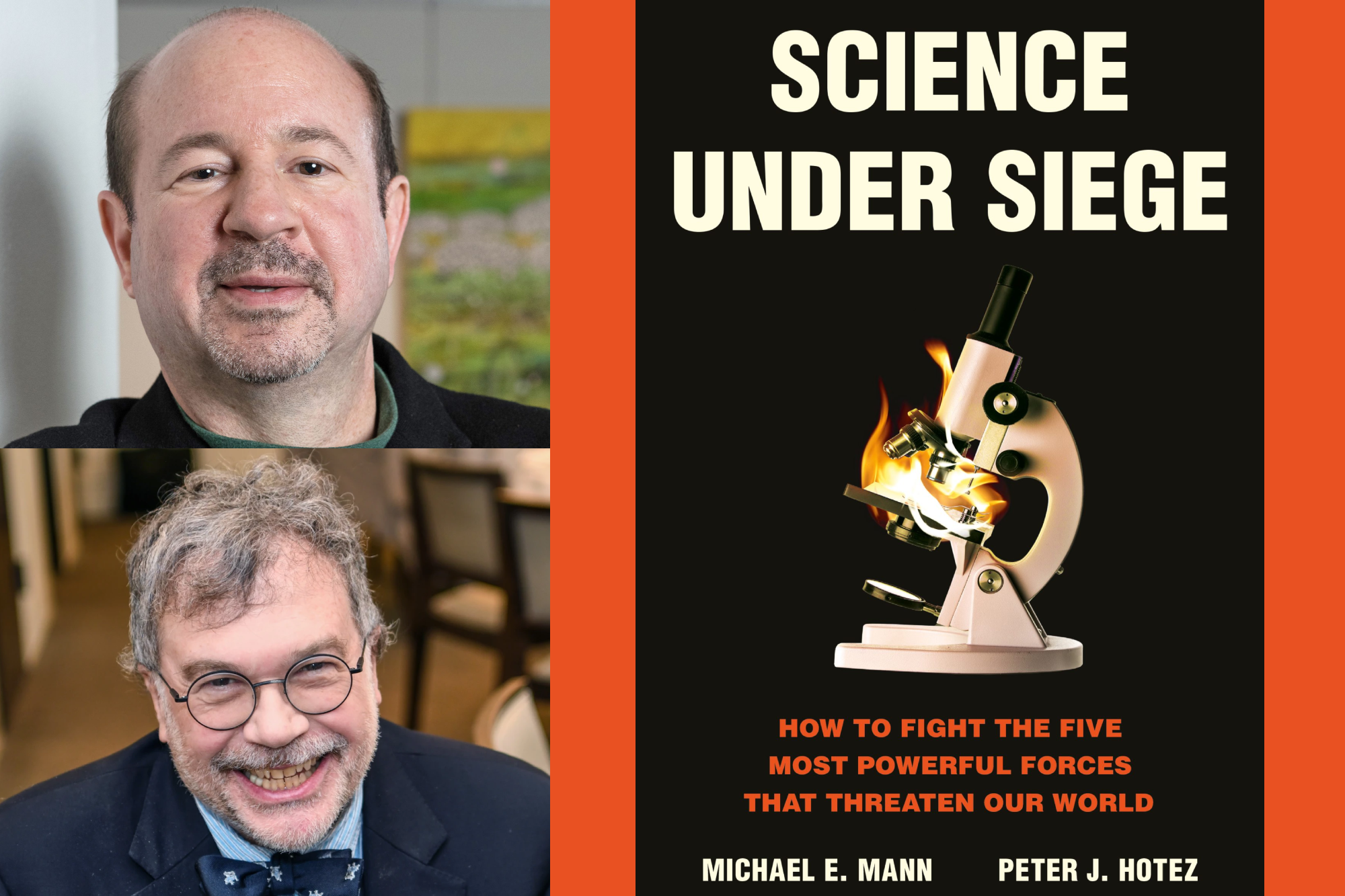
Hotez and Mann also share the experience of being personally attacked and threatened to the point of needing law enforcement protection. But they say that also means they know how to recognize and defend against the weapons of anti-science — weapons they describe in a new book called Science Under Siege: How to Fight the Five Most Powerful Forces that Threaten Our World.
Listeners, what anti-science rhetoric have you encountered? Dr. Peter Hotez is professor and dean of the National School of Tropical Medicine at Baylor College of Medicine and co-director of the Center for Vaccine Development at Texas Children’s Hospital. Welcome, Peter.
Peter Hotez: Oh, thank you for having me.
Mina Kim: Michael Mann is with us, presidential distinguished professor of Earth and Environmental Science at the University of Pennsylvania. Glad to have you with us as well, Michael.
Michael Mann: Thanks. It’s great to be with you.
Mina Kim: So, Michael, when, as a climate scientist, did you start to see common cause with Peter, a vaccine specialist?
Michael Mann: Well, I was watching Peter be subject to the same sorts of attacks that we climate scientists had been subject to decades ago by those looking to discredit the case for concern about human-caused climate change — fossil fuel interests and those advocating for them.
And Peter, with the rise of the COVID-19 pandemic, he and his fellow public health scientists like Tony Fauci were being attacked again for ideological reasons, in an effort to discredit them and intimidate them.
And so we interacted, I think on social media. At some point, I think I reached out to him. I felt like we climate scientists had some lessons to provide — some advice to our fellow scientists in the world of vaccines, who were finding themselves, again, subject to the same sorts of ideologically motivated attacks that we climate scientists had experienced decades ago.
Mina Kim: So, Peter, what was happening to you, and what were some of the things that Michael told you?
Peter Hotez: I think, you know, for me, a watershed moment was in 2023. There was this crazy episode where I was being taunted into, or cajoled into — whatever word you want to use — debating Mr. Kennedy, Robert F. Kennedy Jr., when he was running for president, on the Joe Rogan show by Joe Rogan, Mr. Kennedy, and then Elon Musk weighed in, and other prominent individuals as well.
Sometimes I say basically everyone on Twitter who had followers — except maybe Taylor Swift — weighed in. And it was this massive pile-on and taunting for me to debate Mr. Kennedy. I started thinking, what the heck is going on here? Here I am, a vaccine scientist and pediatrician. I make low-cost vaccines.
I got involved in debating anti-vaccine activism years ago because I also have a daughter with autism, and I wound up writing a book called Vaccines Did Not Cause Rachel’s Autism. That’s how I got involved. But why there was this intense push for me to debate Robert F. Kennedy Jr., when I already had a preexisting relationship with him and knew he had no real interest in vaccine science or much interest in autism either, I couldn’t figure out.
Michael was really helpful for me because, as a climate scientist, he had endured similar kinds of taunts and attacks starting at least ten years earlier. He became an important mentor and source of comfort. And then we started comparing notes and realized that if you think of the attacks on biomedicine and vaccines as one circle of the Venn diagram and the attacks on climate science as another circle, they’re not totally overlapping — but there was a lot more overlap than we realized. As we started writing the book together, we saw even more. We were able to make some lemonade out of the lemons and turn it into a productive collaboration.
Mina Kim: Yeah. And what do you think the tactic was, Peter? Was it to discredit you? Was it to lend credence to RFK’s argument? What do you think it was?
Peter Hotez: Yeah. Well, I remember around then, both Michael and I came to the conclusion that they wanted a serious scientist to have a public debate with Mr. Kennedy — to show how clever he was, to legitimize him as a serious candidate.
Molly Jong-Fast, who I’d also known from my time going on cable news channels to talk about COVID, came to that conclusion as well. And I wanted nothing to do with it. I didn’t want to help his presidential candidacy.
But also, I don’t think it’s right. I don’t think we should be engaging people like that in public forums when they’re not good-faith actors and have no interest in the science. And when I started to think about it more deeply, I realized I can’t think of many examples where science was advanced through public debate — especially with someone without any scientific background.
I mean, sure, Albert Einstein and Niels Bohr had public discussions at the Solvay physics conferences in the 1920s about quantum mechanics. But that was very different — two scientists who valued each other and were really trying to figure things out. This was purely performative. And I didn’t think it sent the right message to scientists, especially young scientists, because we already have a way of doing science: peer-reviewed journals, conference presentations, critical audiences. This was something else entirely, not intended to advance science.
When I refused, it generated very intense pushback, with doxxing and all sorts of massive pile-ons. Elon Musk even tweeted, “What is Hotez hiding?” — which created another wave of aggression. It took me to a pretty dark place during that time.
Mina Kim: Peter, I was sorry to read about the death threats and people coming to your home. And, Michael, your point is that this was not just a Joe Rogan thing. This is part of a broader network of people trying to discredit science. Can you talk about that broader, coordinated strategy you describe?
Michael Mann: Yeah, absolutely. I mean, it goes back decades — to the tobacco wars, when tobacco companies tried to discredit independent scientists who were finding that smoking causes lung cancer and serious health impacts.
There’s a line in one of the tobacco industry documents that eventually came out in lawsuits against Brown & Williamson: “Doubt is our product.” What that meant was, if they could convince the public and policymakers that there was no threat, that was a win. They could keep making profits at the expense of people dying from their product.
The fossil fuel industry took that playbook and ran with it in the 1990s. That’s when I was coming up in the field. In the late ’90s, my coauthors and I published the now-iconic hockey stick curve that demonstrated the profound, unprecedented nature of recent warming. It became a symbol in the climate debate, inconvenient for fossil fuel interests and climate deniers, because it laid bare the reality of the impact fossil fuel burning is having.
As a result, they used the same playbook to undermine public faith in the science — even while their own internal reports, like a 1982 ExxonMobil report, warned of potentially catastrophic consequences.
Mina Kim: Wow.
Michael Mann: Those weren’t Al Gore’s words. They weren’t my words. That was ExxonMobil. And we’ve seen this playbook used time and again — against me, against Peter, against countless others.
Mina Kim: We’ll talk more about that playbook right after the break. Stay with us. This is Forum. I’m Mina Kim.