Imagine approaching a wildfire with nothing but a bandana to protect you. That’s how U.S. Forest Service firefighters typically battle blazes – with no masks or other respiratory protection. New York Times reporter Hannah Dreier recently headed into the field to find out why. We’ll talk to Dreier and a California firefighter about why it’s been so hard to change the culture and policy around protective gear and how firefighters are dealing with the life-threatening effects.
Why Are Firefighters Battling Wildfires Without Masks?
We talk about why it’s been so hard to change the culture and policy around protective respiratory gear for firefighters and how firefighters are dealing with the life-threatening effects.
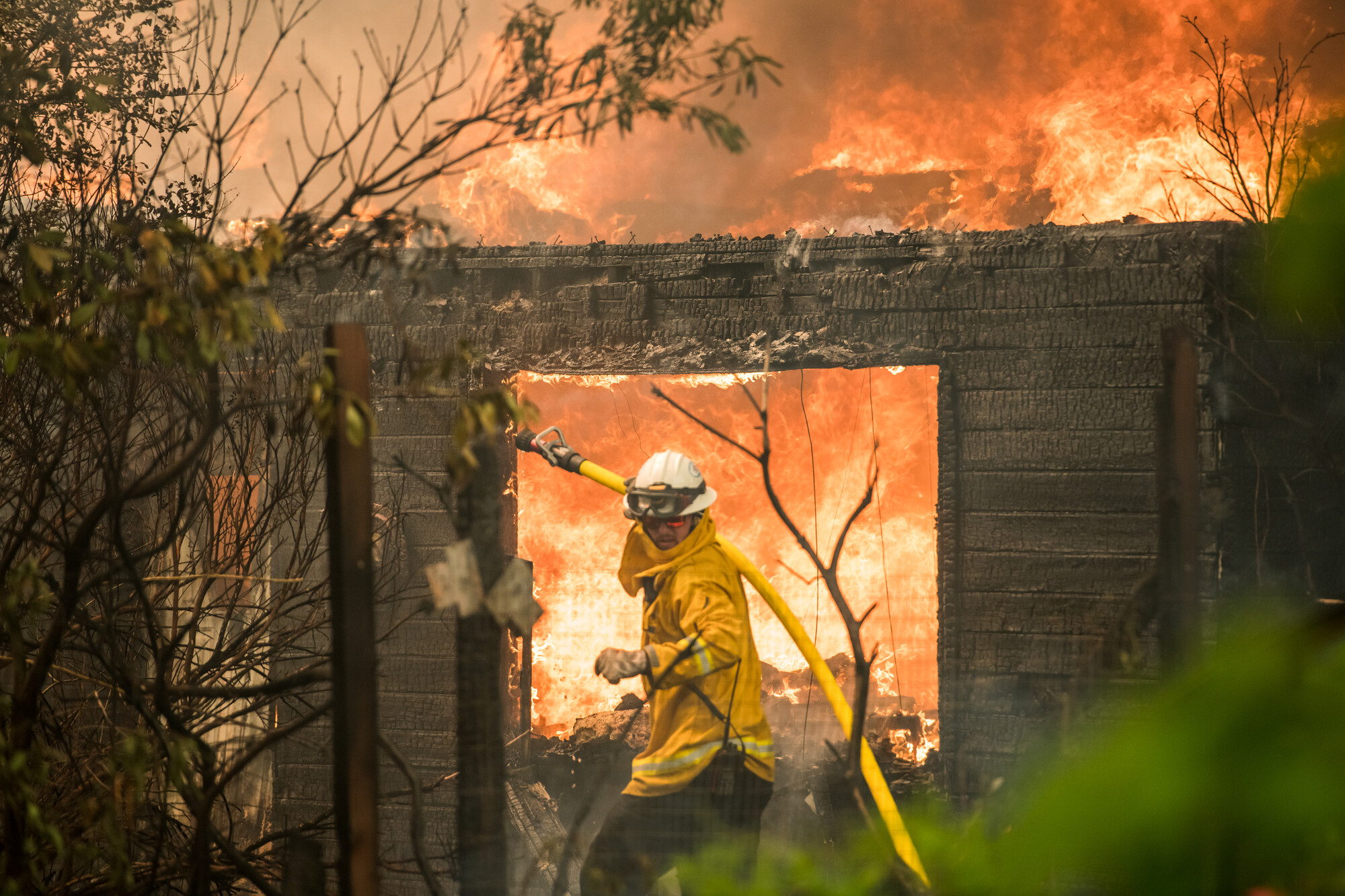
A firefighter battles the LNU Lightning Complex blaze as it engulfs a home off Pleasants Valley Road near Vacaville on Aug. 19, 2020. (Beth LaBerge/KQED)
This partial transcript was computer-generated. While our team has reviewed it, there may be errors.
Mina Kim: Welcome to Forum. I’m Mina Kim. Fire crews are getting a handle on the Pickett Fire burning in Napa Valley, which is now 13 percent contained after breaking out Thursday and sparking evacuations as it grew to more than 6,000 acres.
Meantime, the Gifford Fire in Central California, the state’s largest so far this year, is approaching full containment after burning more than 130,000 acres since August 1.
New York Times investigative journalist Hannah Dreier embedded with a wildfire-fighting team on the Gifford Fire as part of her reporting on the devastating effects of smoke inhalation. Dreier also looked at why the U.S. Forest Service has, for decades, fought efforts to better protect their crews. She joins me now. Hannah, welcome to Forum.
Hannah Dreier: Thank you so much for having me.
Mina Kim: So first, not many people have had the experience of being on-site during a wildfire. What was that like for you?
Hannah Dreier: I mean, it’s an incredible thing to see. These crews go right up to the fire line, so we were really feet away from fire. And you can see the flames. They sort of look like a rolling volcano just coming down the hill, and the firefighters stay firm and hold the line and do everything they can to contain these fires and stop them from getting to homes.
Mina Kim: How bad was the smoke when you were out there?
Hannah Dreier: I mean, it was the middle of the day, and it looked like twilight. It got smokier and smokier as these firefighters worked, and eventually it was hard to see even a few feet away. And they were coughing. Their eyes were watering. And what really struck me was that I was the only one in the whole area with a mask on. They were working with no respiratory protection at all.
Mina Kim: And how did that make you feel? Like, there are very good reasons for why you would do that and why you would protect yourself. But did you feel like you stood out a little?
Hannah Dreier: Oh, of course. I mean, I felt like the biggest nerd. You know how it is to wear a mask. We all remember from the pandemic. I really felt like I stood out and like I looked dumb, like they were judging me. And, you know, I think they were.
But I, by that time, had spent months talking to firefighters who were very, very sick from smoke-related illnesses. And so I knew the cost of being in that smoke. The firefighters who were out there with me, they were mostly in their early twenties, and they told me they didn’t think there was really much risk to them at all. They told me, “Oh, this is just organic material. We’re fine. We would never be in a place that isn’t really safe for us to be.” And it was heartbreaking to hear them talking like that when I had seen firsthand so much of what those long-term risks can really look like.
Mina Kim: Yeah. So tell me what these firefighters shared with you about the immediate effects, right, of being in that smoke — which sounded incredibly difficult — to the longer-term ones of breathing problems and lung cancer.
Hannah Dreier: So the immediate effects of being in smoke are things like coughing, getting a headache. People sometimes will get dizzy, and those are things that go away when firefighters are allowed to rest and get out of the smoke.
The more insidious harms are these long-term ones. And when you start talking to people who do wildland firefighting, very quickly you start hearing stories of people who had to be medically retired at young ages because of illnesses related to smoke. So I spoke with many firefighters who developed severe lung issues in their thirties that left them gasping for air. I talked to firefighters who were told they needed double lung transplants by their forties. And they’re also getting rare and deadly cancers at very young ages. And some are dying and leaving behind young children and parents and partners who are left wondering if their loved one is gone because of the time that they spent without a mask in that toxic smoke.
Mina Kim: You had some incredible descriptions too, just about the difficulty of doing some basic things like pushing a shopping cart at a grocery store or picking up kids.
Hannah Dreier: Yeah. I mean, I talked to many people who are in their twenties, their thirties, their early forties who are just completely debilitated by illnesses that their doctors tell them are linked to the smoke exposure. So a lot of these firefighters have young kids, and they told me they’re not able to play with them. They’re not able to pick them up. They get winded just walking up a flight of stairs. Or they’re exhausted because they spend the whole night waking up gasping for air because of these long-term lung issues. And, you know, I talked to other people who have terminal cancer diagnoses, and they told me they’re just sort of waiting for the pills to stop working, trying to get what time they can with their families, but their lives are really being cut short.
Mina Kim: I want to invite our listeners into the conversation. We’re talking about why wildland firefighters are facing wildfires without masks or other meaningful respiratory protection, which is what Hannah realized when she herself went to the Gifford Fire to see firsthand what it’s like out there. And she also reported on the impact that that’s having on firefighters’ health and lives.
Did you know this, listeners, that they don’t use masks to protect from wildfire smoke? Or are you a firefighter who’s dealing with the health effects of smoke inhalation or have had experiences like Hannah has described with regard to exposure to wildfire smoke?
The email address is [email protected]. Find us on our social channels — Discord, BlueSky, Facebook, Instagram, or Threads — @kqedforum. Or call us at 866-733-6786.
I want to bring into the conversation now Joe Perez, a firefighter from Northern California. Joe, I really appreciate you being on with us. Right — so help me understand this a little bit. It sounds like, from Hannah’s reporting, that there’s basically both cultural pressures and institutional pressures operating here when it comes to wearing masks during wildfires. Can you talk about, you know, what those cultural pressures are like? What wildfire-fighting culture has been as you experienced it?
Joe Perez: Yeah. I think there’s a lot of different angles on this. I mean, the cultural is one of them. Right? When I started about twenty years ago, there was really not much discussion in fire academies about cancer awareness or really any of the occupational tolls that kinda happen with the job. So it’s something that we’re not necessarily aware of, at least in my generation of firefighting.
I know that having taken classes more recently, that is something that is spoken about, and it’s encouraged for individuals to protect themselves more. So you have kind of a generational issue on one end of it. On the other end is that we’re typically a pretty healthy workforce. Most people that are in firefighting, at least for the municipal departments, go through physical exams, and they’re very healthy individuals, and they go through a testing process and everything.
And so when you’re healthy and you’re working hard, you don’t really notice the toll it’s taking on you until a little bit later on into your career. In my case, in 2020 is when I started noticing the effects that it was having on me, and it was something I wasn’t even necessarily aware of until my partner at the time was letting me know, like, “Hey, do you know that you’re wheezing or that you sound like you’re struggling to breathe at night?”
I kinda shrugged it off. And my partner’s like, “Well, do you wear a mask?” I’m like, “No. That’s not what we do. We do a bandana.” And she’s like, “That is crazy.”
And I’m like — for me, there was resistance. Right? Like, stop telling me how to do my job. Stop telling me — you know, this is how we do things. And it wasn’t until someone else was pointing it out, and I was starting to notice these changes in myself, that I realized, oh, okay. This is starting to take a toll on me.
Mina Kim: You have seen some of the most destructive wildfires in California in the last, what, five or ten years or so. Which ones were you at?
Joe Perez: Yeah. So, the ones that I was at were in 2017 and 2019 and really in 2020. And there was the LNU Complex Fire specifically — that’s where I feel like I got most of the exposure that I got. But again, I work as a municipal firefighter, which — we have different kinds of tasks than a federal firefighter. A lot of the federal firefighters are working out in very, very rugged wilderness. A lot of them are out for longer durations. For municipal firefighters, you’re rotated off the line a little bit more frequently, but the jobs are a little different.
Mina Kim: So, Joe, help me understand this. So then would you say that municipal firefighting culture with regard to wearing masks is different from, like, the U.S. Forest Service or federal firefighters?
Joe Perez: I think both of them are gonna be somewhat resistant just because it’s a change. Right? And I think there’s a perception about the masks, about them reducing your ability to do the work. In my experience with wearing a mask — or more recently wearing masks — yeah, you’ll get a little bit of reduction in work. But it’s just changing your thought process of, like, hey, I might have to slow my work down a little bit more, but I’ll be at the end of the event, I feel a lot better. I know that after wearing masks.
But yes, on the city side of things or the municipal side, we wear self-contained breathing apparatus, which is a full-face mask. That’s a requirement anytime you go into a burning structure. And so maybe there’ll be a little bit less resistance for municipal firefighters.
But I feel like in the case of the feds or the state, where they do a little bit less of the structure fire firefighting and there’s a lot more history of using shrouds and bandanas and whatnot, you’ll probably get a little bit more pushback on that.
But really, I think it comes down to educating the workforce. If you can let these individuals know, like, hey, look — this is gonna have cumulative effects, and there’s a latency period. You’re not gonna notice it five years into your career. You’re gonna notice it ten, fifteen, maybe even at your retirement. You’re gonna have these health effects. It’s really hard to look that far out when you’re doing something that’s an emergency right now.
Mina Kim: Yeah. Hannah, you focused on the U.S. Forest Service in particular. Can you talk about just the norms of the U.S. Forest Service and what effect, if you think it has one, on state firefighting agencies and city ones as well?
Hannah Dreier: Like me at the beginning of this reporting, most people don’t really know who is sending out the firefighters who are fighting back these big wildfires. It turns out there are about 40,000 people who fight wildfires for a living, and the largest share of them work for the Forest Service. The Forest Service carries the most prestige in the industry and sort of is the de facto standard setter for a lot of these safety regulations.
And the Forest Service actually has a rule that firefighters are not supposed to wear masks at all on the fire line. This is really different from what goes on in other countries, where firefighters are given masks and encouraged to wear them when they’re working. The Forest Service says, “We don’t want our workers wearing these masks,” and the reason they give is that they worry people might overheat.
Mina Kim: They worry that people might overheat while they’re breathing in these masks because they are uncomfortable. I mean, let’s be real. But is that a big problem in the other countries?
Hannah Dreier: Yeah. So they’re uncomfortable. But no, other countries have not seen some uptick in heat-stress deaths or heat stroke. And what whistleblowers inside the Forest Service told me is that really what’s going on here is a resistance to admitting how dangerous this smoke is.
Mina Kim: Wow. We’ll get into that right after the break. We’re talking about wildland firefighting and a lack of protective gear for smoke. More with Hannah Dreier and Joe Perez after the break. I’m Mina Kim.