The American Academy of Pediatrics is breaking with the CDC for the first time in decades by continuing to recommend Covid-19 shots for infants and young children. By contrast the CDC, under Health and Human Services Secretary Robert F. Kennedy, Jr., is no longer recommending the vaccine for healthy kids. Infectious disease expert Michael Osterholm joins us to help make sense of the conflicting messages. We’ll also get his thoughts on federal cuts to vaccine research funding, and our readiness for future pandemics.
Leading Pediatric Group Splits with CDC Over Vaccine Recommendations
We talk to infectious disease expert Michael Osterholm about how to make sense of the conflicting messages about vaccines. We’ll also get his thoughts on federal cuts to vaccine research funding, and our readiness for future pandemics.
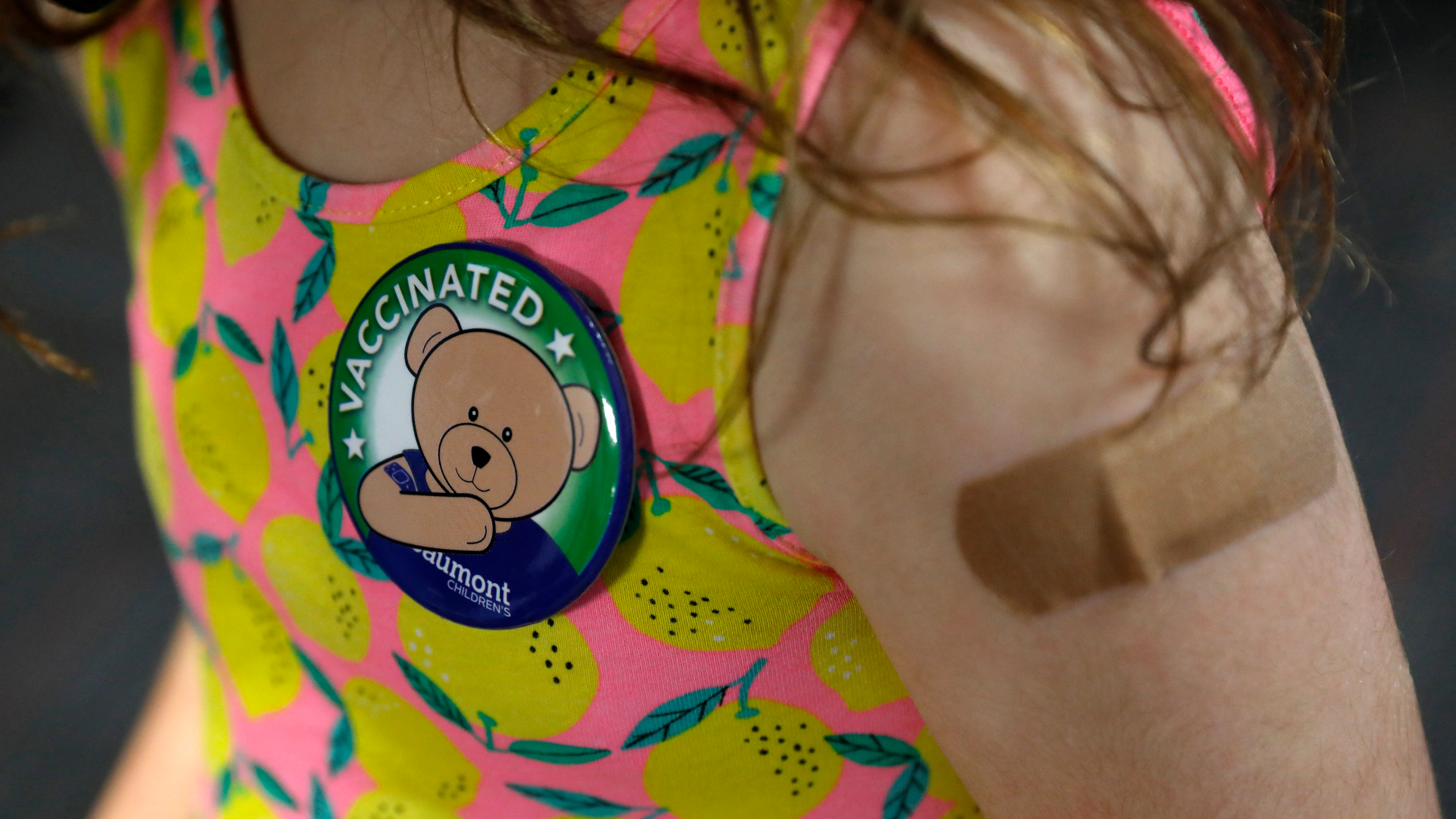
A child wears a pin she received after receiving her first dose of the Pfizer Covid-19 vaccine at the Beaumont Health offices in Southfield, Michigan on November 5, 2021. (Jeff Kowalsky/AFP via Getty Images)
This partial transcript was computer-generated. While our team has reviewed it, there may be errors.
Mina Kim: Welcome to Forum. I’m Mina Kim. When the leading pediatricians association, the American Academy of Pediatrics, broke with the CDC this week in recommending the COVID vaccine for children, it said all infants and young toddlers should get the COVID vaccine, that two- to eighteen-year-olds should get it if they’re at or live with people at high risk — though the vaccine should still be available regardless. The CDC, on the other hand, has said getting the vaccine, if you’re six months to seventeen years old, should be based on, quote, shared clinical decision-making.
Dr. Michael Osterholm is here to provide context for the AAP’s rare break from the federal agency it normally aligns with, as well as developments more broadly at the Department of Health and Human Services. He’s director of the Center for Infectious Disease Research and Policy at the University of Minnesota and coauthor of a new book coming out next month called The Big One: How We Must Prepare for Future Deadly Pandemics. Welcome to Forum, Dr. Osterholm.
Michael Osterholm: Thank you.
Mina Kim: So first, what was your reaction to this unusual split between the AAP and CDC? What do you think we need to understand about it?
Michael Osterholm: Well, let me, first of all, kinda turn it on its head. I don’t think that the AAP broke with CDC. CDC broke with the entire scientific and medical community, and they did that in a way without data to support it and was largely politically motivated. What the AAP did was exactly what we’d expect an organization like that to do: put children first, decide on what you’re going to recommend based on the entire database of information that you have, and have that information basically reviewed and re-reviewed. Then decisions are made: can we, in fact, support this recommendation based on these data or not?
And so I think what we have to do in this country is realize that we are in absolutely an unprecedented time in public health. I’ve been in the business fifty years now and I’ve never seen the kind of dangerous decisions that are being made by a very, very few group of people close to Secretary Kennedy. Even when we talk about the CDC making a recommendation, they really didn’t. What happened was leadership at HHS and one or two at CDC made those decisions. It wasn’t the rank-and-file experts, the people who really know what they’re talking about. So I hope the media actually begins to think about it this way, turn it on its head: how did CDC split with the entire medical and scientific community?
Mina Kim: Well, what’s wrong with recommending shared clinical decision-making — or essentially, as I understand it, that parents of children aged six months to seventeen should discuss the vaccination with a health care provider first?
Michael Osterholm: Well, first of all, that is always good, and we never want to diminish the possibility for getting input. But remember right now, today, the vast majority of people get their vaccinations not in doctors’ offices but at pharmacies. Oftentimes, there isn’t a clinical expert around that can actually provide any information. This is a huge limiting factor.
You know, I think people sometimes are a little surprised when they hear me say vaccines aren’t all that special. What’s special is vaccination. It’s when a vaccine actually gets used. And in this case, if I were going to a pharmacy and the pharmacist said, “Well, you’ll have to go check with your physician,” how many people in this country don’t have physicians? How many people in this country find it takes weeks, if not months, to get an appointment to go see someone? So this is a barrier. It basically addresses head-on: well, you can have your vaccine, but we’re not gonna let you get that vaccination. We’ll put every obstacle in the way we can — and that’s exactly what’s happening right now.
Mina Kim: So you’re talking about how we should better understand what’s been happening as the CDC breaking with the broader scientific community. But it certainly cannot be a good thing to have our leading government institution on disease control differing with medical societies. How are we supposed to make sense of this as average citizens?
Michael Osterholm: Well, you know, this is a very, very painful time for many of us in public health. You know, I have always ascribed to the fact that the public health altar is in Atlanta, and that, in fact, that’s where we have for all these decades counted on expertise to be available. We’ve counted on that location, the organization, to provide the kind of expert input you’re referring to. When they spoke, you could count on it.
Remember that today the process for making vaccine recommendations is not just a singular CDC action. What happens is that the Advisory Committee on Immunization Practices — a group of experts, roughly around seventeen from the private sector, academia, etc. — they are not part of the government. They actually are the ones that consider these issues. They go through and pour over the data. They then come back with recommendations that are passed on to the director of the CDC.
Well, remember that Mr. Kennedy fired the entire ACIP several months ago and appointed eight new members — one dropped out — and at least six of them are well-described anti-vaccine individuals. So now you don’t have that expertise coming out of CDC.
What then also happened in the past was once CDC made the decision to accept the ACIP recommendations, which was almost universally done, the societies involved with specific at-risk populations would decide how to take that information and craft it for their populations. In this case, the Academy of Pediatrics did it for children. ACOG does it for adult women and pregnant women. The Infectious Diseases Society of America does it for immunocompromised individuals, etc.
And so what’s happened now is that I’m part of a process here at the University of Minnesota called the Vaccine Integrity Project. What we’ve done is actually take all the information that’s been published in the literature around the world since the last time ACIP reviewed vaccine recommendations for COVID, influenza, and RSV — the seasonal viral pathogens we’re confronted with right now.
We reviewed over seventeen hundred papers and abstracts that addressed one of these three vaccines with regard to safety, effectiveness, and overall utility of use. We summarized all of that information and just presented it publicly on Tuesday. The Academy of Pediatrics had access to the same information. We’ve been meeting with them weekly, and so what they’re acting on right now — the first of the societies — is basically doing their job as they should have been doing their job and as they had been doing their job for decades.
And so I applaud the Academy of Pediatrics. I think they were right on the mark with the science. We’re looking forward to getting the recommendations from the other societies, and I anticipate you’re going to see all of them take the same approach as the AAP. Again, that should give you some idea of where CDC stands in the scientific world. They’re not going to find a professional friend in any of these discussions.
Mina Kim: So one of the other effects of the recommendations by the advisory council in the CDC is that besides setting the childhood vaccination schedule, it also determines what vaccines insurance companies should cover. So that’s also an effect of the CDC making this recommendation. As leader of the Vaccine Integrity Project, do you see a possibility where insurance companies could use your recommendations over ACIP’s?
Michael Osterholm: Well, let me address that head-on. But first, let me just give you an example of what we’re up against, and then we can talk about how the payers should look at this.
Mina Kim: Yeah.
Michael Osterholm: You asked earlier about how the public is going to take all of this. And we recognize they’re going to be confused because for decades we’ve been telling them, listen to the CDC. Now we’re telling them, you can’t trust anything that comes out of the CDC.
Not because there still aren’t some incredibly talented, very thoughtful, scientifically oriented people who work there, but because the leadership — specifically HHS leadership — has completely neutralized them as a scientific voice.
Imagine the following situation. You’re gonna get on a plane, fly somewhere, and it turns out there’s some concern about the integrity of that plane. They assemble a hundred of the plane mechanics at that airport and ask them: would you get on this plane or not? Ninety-nine of them say, “No way. It’s not gonna make it.” One says, “Oh, yeah. No problem. Don’t worry about it.” That’s not the kind of information most of us would use to say, “Sure, I’ll get on that plane.”
Well, that’s exactly where it is right now with vaccine recommendations. Very, very few people, I think, once they understand how CDC and HHS have come together with this information, are like that one plane mechanic who said “no problem” when ninety-nine said “no way.”
So what we have to help the public understand is: please, I know this is a transition. I know you’re going to be confused. But there are other voices out here who are really capable of providing you unbiased, science-based information. Don’t count on that one mechanic — i.e., CDC right now — for that information.
Now, to get to your point about the payers: this is a huge issue. As I said earlier, vaccines are nothing if they don’t turn into vaccinations. And we know many people cannot afford vaccines today, particularly families. Families with young children should be at the front of the line for these vaccines.
What we’re finding in our discussions with payers is that they are looking at ways they can cover more than what has been recommended by CDC. Think of that as the basement of the recommendations. When they look at the ceiling, it may be that they will justify paying for all of these vaccines as they did before. Our work at the Vaccine Integrity Project was also meant to help with that. They can now rely on a body of data that supports the recommendations the societies are making. It’s a neutral, unbiased group saying these vaccines are very important. They are effective. They are safe. And we hope that will turn the tide in terms of approval.
Mina Kim: Michael, when the Academy of Pediatrics announced its recommendations differing from the CDC, it explained it by saying CDC overhauled and replaced its advisory committee with individuals who have a history of spreading vaccine misinformation. HHS has pushed back and suggested that the AAP should strengthen its conflict-of-interest safeguards and keep its publications free from financial influence — essentially saying that they’re the agency responding to big pharma and conflicts of interest. So I just want to get your response to that as we go into the break. We have thirty seconds.
Michael Osterholm: You know, sometimes I’m not sure whether to laugh out loud or cry. If you want to look at conflicts of interest, it’s the Kennedys. It’s the people around him who are making money right now on this mis- and disinformation campaign on vaccines. That’s where the real challenge is.
As far as the academies go, all of them have to fully disclose any kind of influence that money may have in terms of their organizations, and they have done that. Our group — the Vaccine Integrity Project — has no conflicts of interest. We made everyone sign a disclosure acknowledging any possible conflicts. We have none, and we came up with the data the academy is using.
Mina Kim: Michael Osterholm. We’ll have more with him after the break. Stay with us. This is Forum. I’m Mina Kim.