Can the U.S. help bring an end to Russia’s war in Ukraine? President Donald Trump and Russian President Vladimir Putin met in Anchorage, Alaska on Friday to discuss a ceasefire in Ukraine. Trump has floated ideas including so-called “land swaps” and potential U.S. security guarantees for Ukraine, but with Ukraine excluded from the talks and Russia continuing to escalate its attacks, movement toward peace remains uncertain. We get analysis from former U.S. Ambassador to Russia Michael McFaul and other experts.
Trump and Putin Meet in Alaska as Russia Continues to Attack Ukraine
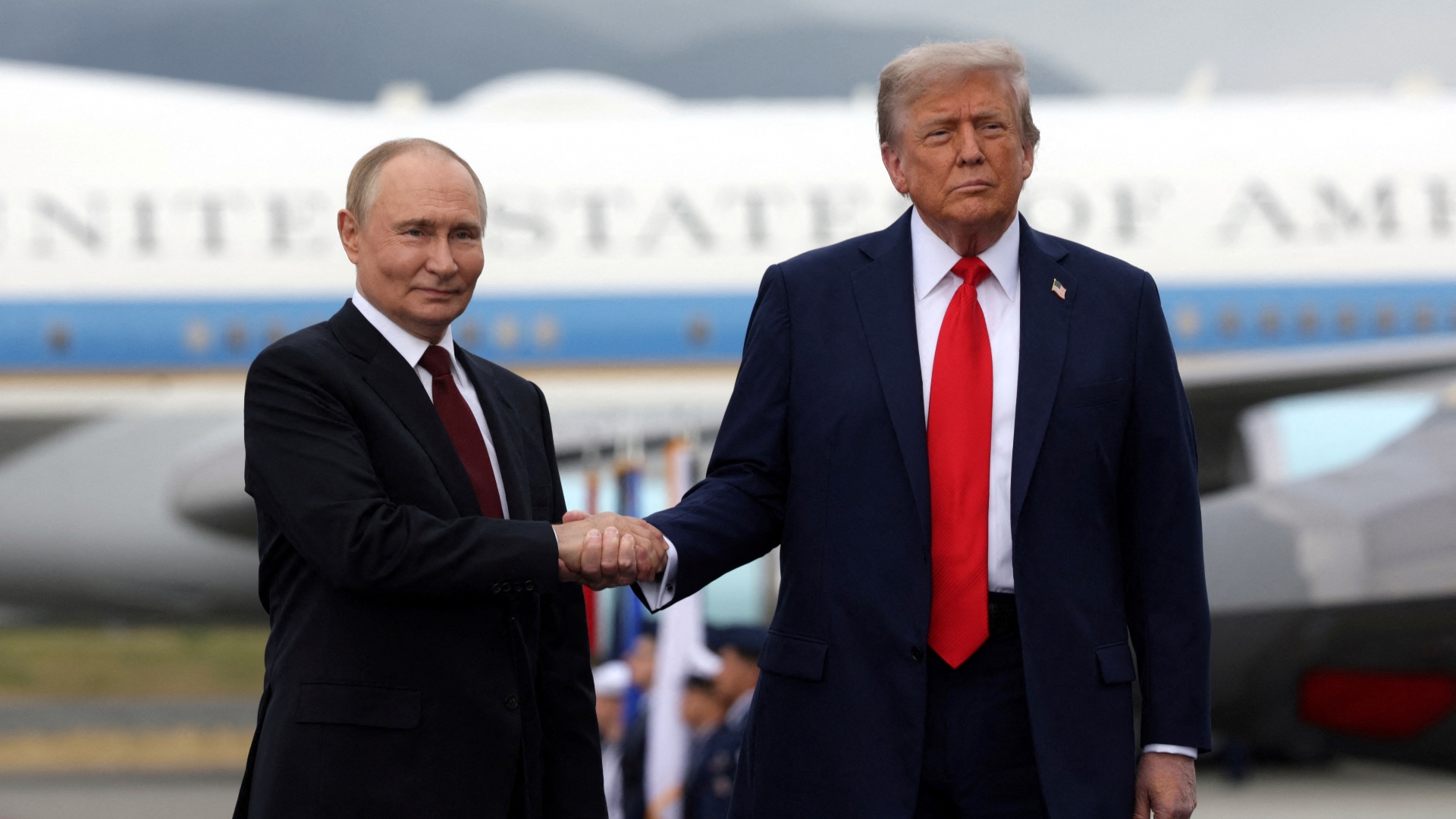
In this pool photograph distributed by the Russian state agency Sputnik, US President Donald Trump and Russian President Vladimir Putin shake hands after their arrival for a US-Russia summit on Ukraine at Joint Base Elmendorf-Richardson in Anchorage, Alaska, on August 15, 2025. (GAVRIIL GRIGOROV/POOL/AFP via Getty Images)
This partial transcript was computer-generated. While our team has reviewed it, there may be errors.
Mina Kim: From KQED in San Francisco, I’m Mina Kim. Ukrainian President Volodymyr Zelenskyy and European leaders are in Washington as we speak for a meeting at the White House following President Trump’s Friday summit in Alaska with Russian President Vladimir Putin. Those talks have fueled concerns in Europe that Trump is supporting Russia’s position and will ask Ukraine to cede unconquered territory in a peace deal.
We take a closer look at the impact of the Alaska summit and the stakes for Ukraine and Europe. Joining me first is NPR senior White House correspondent Tamara Keith, who was in Anchorage during the summit. Hey, Tam, thanks so much for talking with us.
Tamara Keith: Glad to be with you.
Mina Kim: So Trump called the meeting a “ten out of ten” and said “very good progress” was made toward peace. Though that’s not how a lot of observers are characterizing it. Can you take us back and describe the scene, Tamara?
Tamara Keith: Yeah. And it’s important to note that coming into this — including on the flight over to Alaska — President Trump had said he would be disappointed if he didn’t come away with a ceasefire. He said there would be very serious consequences if Russia didn’t agree to stop the war, or at least agree to a ceasefire. He had previously been threatening secondary sanctions and other economic consequences.
Well, what comes away from this summit is that those consequences are not in place — but also, there was no ceasefire.
To give you the scene: we were all gathered at Joint Base Elmendorf, just outside of Anchorage, Alaska. The two presidents’ planes arrived at this airbase. Red carpets were rolled out. The presidents met on the red carpet for a handshake. There was a flyover, certainly meant to show strength by President Trump, that included a B-2 bomber — the bomber that dropped bunker-busting bombs in Iran recently.
So there was this big show. They shook hands warmly, then got into the president’s motorcade, into his limousine known as “The Beast,” and drove off for meetings. It was a three-on-three: U.S. officials and Russian officials in the room.
It ended pretty abruptly. They met for a couple of hours, but there was supposed to be a lunch afterward. There was supposed to be a joint press conference, which turned out to be just short joint statements that didn’t talk about a ceasefire at all.
Mina Kim: Then on Sunday, Trump’s foreign envoy Steve Witkoff — who was at the talks — told CNN that Putin had signed off on robust security guarantees that the U.S. and Europe would provide to Ukraine. Do you have any insight into this?
Tamara Keith: What we know is what Witkoff said on TV — that it would be Article Five-style security guarantees. Article Five is the part of the NATO charter that says if there’s an attack on one, there’s an attack on all. That’s what gives NATO its strength.
Ukraine has wanted to become a member of NATO for a long time. NATO countries have resisted that. Obviously, Putin has strongly resisted that and seen it as a threat — even blaming Ukraine’s desire to join NATO, and Ukraine’s closeness with the West, for his invasion more than three years ago.
Mina Kim: And as you’ve reported, after that summit, Trump sat on Air Force One making phone calls to Zelenskyy and European leaders, then announced Zelenskyy would come to the White House today. What do we know about that interaction, and what can we expect today?
Tamara Keith: The European leaders have already arrived at the White House. They entered from the South Lawn. The press is waiting on the North Lawn for Zelenskyy, who will be greeted by President Trump. Zelenskyy already had off-site meetings with U.S. officials earlier today.
And remember, the last time Zelenskyy was in the Oval Office, he got totally berated by the president and vice president. A reporter friendly to Trump even asked him why he wasn’t wearing a suit. It was an absolute blow-up. They were supposed to have a press conference, and they didn’t. Instead, Zelenskyy left. So this is, in some ways, a redo. The question is, will it go better?
The fact that all these European leaders have dropped everything to be here shows the stakes.
Mina Kim: Absolutely. And what has Zelenskyy said that he’s hoping to achieve out of this?
Tamara Keith: Zelenskyy has been measured. He doesn’t want to give up what Putin wants him to give up. But he does want the war to end, and he doesn’t want President Trump to choose Russia’s side.
Zelenskyy is in a very tough place. The U.S. and European countries have been providing significant security assistance. Trump came in skeptical of that support, but NATO countries convinced him they could just buy powerful weapon systems and pass them along to Ukraine — so the U.S. wouldn’t have to pay directly.
That was a recent victory for Ukraine and NATO. But support is tenuous. Trump has vacillated between being friendly toward Putin’s position and being more supportive of Ukraine. This is a critical moment. Appeasing Putin could just empower him to try to take more of Ukraine later.
Mina Kim: Tamara Keith, senior White House correspondent and cohost of the NPR Politics Podcast, thank you so much for your time today.
Tamara Keith: I really appreciate it.
Mina Kim: Joining me now is Anna Nemtsova, Eastern Europe correspondent for The Daily Beast and a contributor to The Atlantic. Anna, so glad to have you with us.
Anna Nemtsova: Thank you so much for having me.
Mina Kim: You’re in contact with everyday Ukrainians as well as Ukrainian politicians and business leaders. What reactions are you hearing to the meeting between Trump and Putin?
Anna Nemtsova: That was painful for everybody to see. I spoke today with soldiers at a rehab center in Kyiv who are receiving titanium implants. They refused to exercise that day. They smoked and sank into conversation. Some asked, “What was this for?” It was painful to see Trump shaking hands with Putin and painful to hear Putin’s demands.
Some of the most infuriating demands concerned language and the church. For many Ukrainians, that struck at their identity — their independence from the Russian empire. As for swapping territories, many say, “They’ll decide this without asking us. We’re probably going to lose some of Luhansk and Donetsk anyway — they’re completely destroyed.”
But the frustration is that their fate is being decided without them, without their voice. That is painful for many people.
Mina Kim: I imagine so. Recent Gallup polling shows nearly 70 percent of Ukrainians now favor a negotiated end to the war, compared to about 24 percent who favor fighting until victory. That’s the reverse of 2022, when more than 70 percent supported fighting until victory. What’s behind that change?
Anna Nemtsova: People are very tired of the war. There is fatigue. Children are dying. According to a UN report in March, 200 percent more children were killed than the month before. Just last night, three more children were killed.
At the same time, most Ukrainians reject peace at any cost. The crucial thing for Ukraine is security guarantees. When Witkoff mentioned them yesterday, many were happy to hear it. Some mothers I spoke with were glad to see Melania Trump writing a letter to Putin about a peaceful childhood — though frustrated Ukraine wasn’t mentioned.
They want the West to explore every possibility, hold more summits, write more letters — anything so children would not die.
Mina Kim: Do people feel Zelenskyy is close to their needs and views as he approaches Trump today?
Anna Nemtsova: People are glad Zelenskyy isn’t alone but with a coalition of allies. They see that coalition as Ukraine’s true partners. Yes, there’s criticism about corruption and leadership, but today he’s a hero for many Ukrainians. It all depends on the outcome of this meeting.
Mina Kim: We’re all watching closely. Anna Nemtsova, thank you so much for talking with us.
Anna Nemtsova: Thank you.
Mina Kim: Anna is Eastern Europe correspondent for The Daily Beast and a contributor to The Atlantic.
Listeners, what questions or reactions do you have about the details coming out of Trump’s meeting with Putin? What are you hoping will come of Trump’s meeting today with Zelenskyy and European leaders? Do you have a connection to Ukraine or Russia? What would you like people to understand?