A federal judge in San Francisco on Tuesday ordered the Trump administration to restore more than $80 million in grants it withheld from UCLA. The ruling comes as the government accuses the university of antisemitism on campus and discrimination in admissions. To resolve the funding freeze, Trump is demanding a $1 billion settlement, which Governor Gavin Newsom characterizes as extortion and UC officials say would “completely devastate” the public university system. We look at how UCLA and other universities are responding to Trump’s pressure campaign.
UCLA Faces $1 Billion Fine in Trump Administration’s Latest Battle with Higher Education
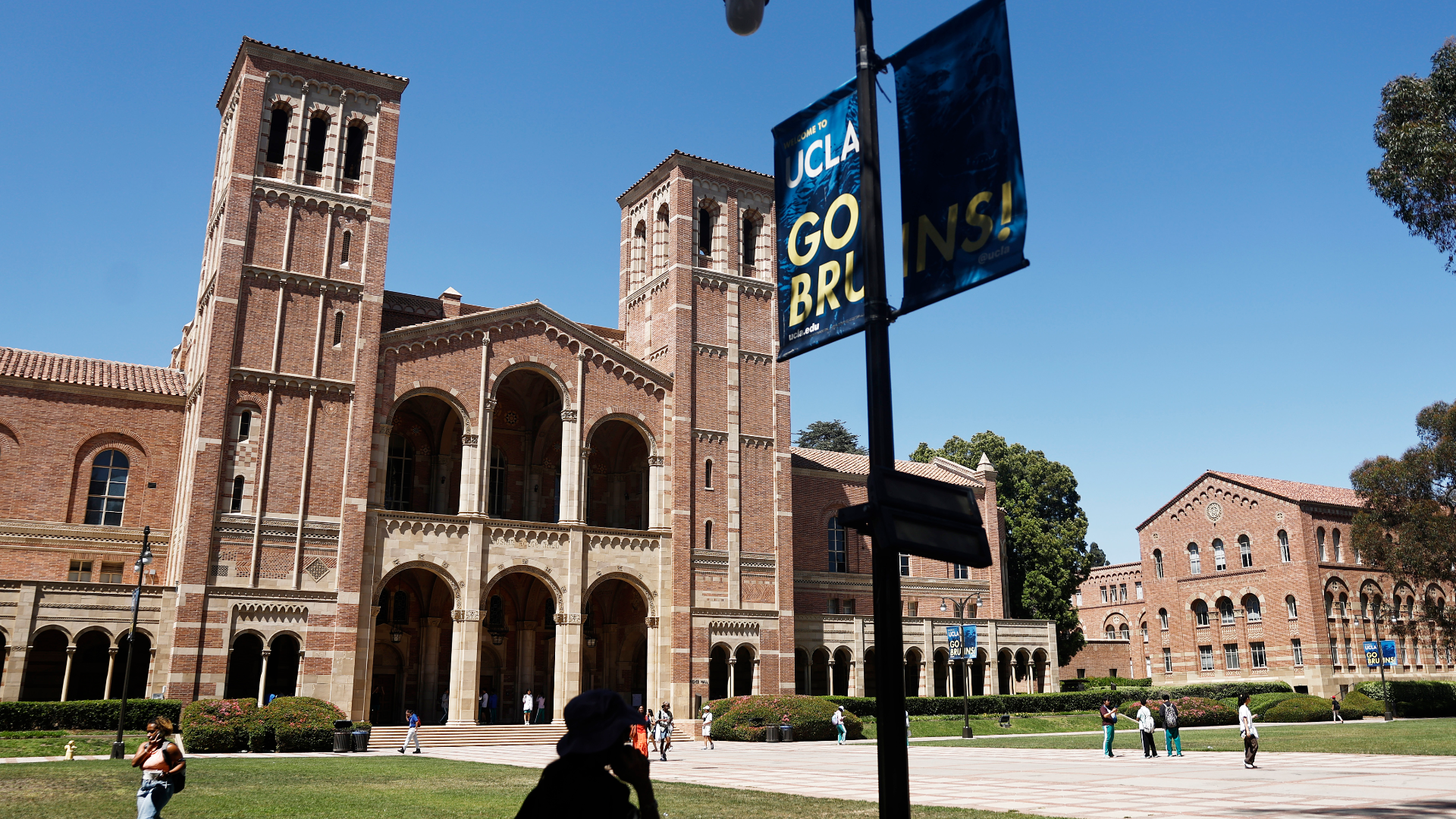
People walk on the plaza outside Royce Hall, the site of 2024 pro-Palestinian protests, on the UCLA campus on July 30, 2025. (Mario Tama via Getty Images)
This partial transcript was computer-generated. While our team has reviewed it, there may be errors.
Mina Kim: Welcome to Forum. I’m Mina Kim. “Bring it on, Gavin.” That’s how White House Press Secretary Caroline Levitt responded this week to the California governor’s vow to fight like hell against the Trump administration’s demand that UCLA pay a billion dollars to resolve the government’s claims of admissions discrimination and antisemitism on campus. Trump’s officials also froze more than five hundred eighty million in federal research grants late last month.
This hour, we take a closer look at the impact that’s having and the range of responses UCLA is weighing, as Harvard reportedly nears a settlement with Trump for similar charges. Joining me now is Jaweed Kaleem, education reporter for the Los Angeles Times. Welcome to Forum, Jaweed.
Jaweed Kaleem: Hi. Thanks for having me.
Mina Kim: So tell me — what exactly is the Trump administration accusing UCLA of and demanding that it do?
Jaweed Kaleem: It says that UCLA has violated the civil rights of Jewish students, and it says that UCLA has not responded to those students and faculty complaining about antisemitism. It traces these complaints back to the pro-Palestinian encampment in 2024. But not just that — the Trump side also says that UCLA discriminates in admissions by using affirmative action, which is illegal. It also says that it is too friendly toward transgender people in housing, sports, and gender-neutral bathrooms. So these are the three main areas that it has cited.
Mina Kim: Yeah, and pay a billion dollars essentially as a fine in installments to go where? And what other kinds of policy changes is it demanding UCLA make as well?
Jaweed Kaleem: Yeah, probably more than a billion dollars, but the billion is the round number. It would be over a period of years and would go to the U.S. Treasury. In addition — that’s just the financial aspect — the government wants a lot of changes on campus. They want detailed admission data because they believe race is being used, so they want more data than UC currently releases (and it already releases a lot).
They want changes around gender on campus — in terms of how the university identifies a man and a woman, and how that relates to sports or housing or all kinds of campus life issues. They want the elimination of scholarships related to diversity. If you go to the UCLA website, there’s a ton of links to different kinds of scholarships, primarily from outside groups, but UCLA is linking to them for Native Americans, Latinos, Black students. UCLA’s Black Bruin Resource and Latino Success Centers are linked as well. So they want the elimination of all these diversity programs and scholarships, which is a big part of UCLA’s pride. They really want to change the identity of the campus as it is.
Mina Kim: So we’ve gotten a taste of what the governor thinks UCLA and the UC system should do — fight back, essentially, even sue?
Jaweed Kaleem: The governor wants to sue — he said that pretty clearly. The governor calls this extortion. He calls it ransom. He sees this as part of the larger fight from California, and from Governor Newsom, against President Trump — including the redistricting that’s been talked about as well in California and Texas. Now it’s up to the UC regents what to do in the end. They are a twenty-four-member board. The governor is on the board, and he can have a vote there. He usually does not get involved, but in big matters like this, he is.
So they can choose to settle, to sue — but the governor wields influence, and he wants to go and fight.
Mina Kim: I see. Well, there was a federal judge’s ruling this week related to an earlier case over blocked science grants — brought by UCSF and UC Berkeley — that said the Trump administration couldn’t freeze science funds to UCLA either. How far did that ruling go, and how might it strengthen a potential case against the government by UCLA if they go the legal route?
Jaweed Kaleem: This was a unique case because it had been ongoing for two months prior to all these funding freezes at UCLA in late July. This was a group of researchers from UC Berkeley and UC San Francisco who had received grants from various federal agencies that had been suddenly canceled or terminated earlier this year.
What they noticed was that their grants all kind of had something in common — they were science, they were arts, they were different kinds of projects, but they all related in some way to gender or race, studying those kinds of populations or effects on those populations. They thought their grants might have just been flagged in a keyword search, since the federal government has very clearly said it does not like any kind of diversity-related research or programming in the country.
So they took this to court. They said, “We were just told in form letters without any explanation that our grants are done. We feel that the government had promised these to us and that we’re being targeted for our viewpoints — our First Amendment rights.”
The judge was inclined to agree, and she made this into a class action lawsuit applying not just to those researchers at Berkeley and San Francisco, but to all UC researchers with grants from a handful of federal agencies, including the National Science Foundation.
So when NSF grants were suspended at UCLA, these lawyers in this case went back — and the judge went back — and said, “Hey, Trump administration, I told you not to suspend these grants from this Science Foundation, and now you’re doing it again at a different UC. How is that not violating my order?” And what she decided was that they were violating her order.
That means that about thirteen or fourteen percent of the money cut in late July at UCLA is being restored. But that still leaves more than five hundred million dollars missing — mostly from the National Institutes of Health.
Mina Kim: Right. It’s been interesting — the regents and the UC system have both said this is wrong, but have also signaled a willingness to negotiate?
Jaweed Kaleem: That’s what they said early on before Newsom came in, and they have still indicated that in a lighter way since Newsom’s remarks. But their posture has been negotiation, and it’s pretty clear why — because they know there’s a lot to lose.
They’ve seen the way the federal government has come down upon Harvard University when it has gone to court multiple times over similar actions and grant freezes. They know a court fight is a long fight. They also know that depending on where the court fight goes, it could succeed in a district court in California, it could succeed in the Ninth Circuit — but many legal actions against the president’s administration are not necessarily sitting well in the Supreme Court, which heavily leans conservative.
So they’re looking at that long-term picture and the harm the campus could experience in the meantime. But at the same time, this is a public university. These are tax dollars. This is California — a deep-blue state with a Democratic governor who’s eyeing bigger aspirations. And a lot of faculty, staff, and students do not want UCLA to negotiate at all.
Mina Kim: We’re talking about how the Trump administration has frozen more than five hundred eighty million dollars of federal grants to UCLA over claims of antisemitism, and how Trump is demanding a billion dollars to resolve the issue. We’re looking at how UCLA is responding with Jaweed Kaleem, education reporter for the LA Times.
And listeners, I want to ask you: What do you think of how UCLA is responding, or how you’d like to see UCLA respond? Do you attend or work there? Has your work been affected by this administration or the grant freezes? Are you a student? How are you feeling at this moment?
Meantime, while they are weighing how to address this situation, they are already experiencing pain from the freezing of these federal grants. Can you just talk about what you have learned in terms of the impact the grant freezes have already had and are having, Jaweed?
Jaweed Kaleem: Yeah, these are very serious, and their impacts are on all different levels. One is simply employment and paychecks for people. A lot of these grants are led by professors or faculty — maybe tenured, with some stability — but the grants are meant to support doctoral students, postdoctoral researchers, even undergraduates who are being trained in science, brain science, aspiring doctors.
There are professors and students who are looking at Parkinson’s disease, cancer, climate change, heat, wildfires, smoke. These grants support their tuition, basic living expenses — their ability to live day to day so they can do the research. Some of this work takes years. Those people are scrambling because their money may run out soon.
Then these labs — some use materials like live animals: rats, mice, and other materials you can’t just shut down. You have to take care of the animals — feed them, clean them, take them to the vets, keep the lights on, keep things running. That kind of work is also at risk.
From the first few days, there was clear talk among departments: Will we have to lay off people? Shut down certain labs? Seek private donations? And there are some labs actually posting online asking for donations.
Mina Kim: We’re talking with Jaweed Kaleem about the impacts of Trump’s freezing of more than five hundred million dollars in federal grants and his broader pressure campaign against higher education. We’ll have more with him and you, listeners, after the break. You’re listening to Forum. I’m Mina Kim.