The latest reporting from Gaza describes a humanitarian crisis of catastrophic proportions. Children are starving; families face impossible choices between food and safety. Hospitals cannot function and medical staff are too weak to help patients. We talk to aid workers and journalists reporting from both sides of Israel’s near-total blockade of supplies going into Gaza about what they’re witnessing and what it will take to save lives.
Starvation in Gaza Persists Despite Increased Aid Deliveries
We talk to aid workers and journalists reporting from both sides of Israel’s near-total blockade of supplies going into Gaza about what they're witnessing and what it will take to save lives.
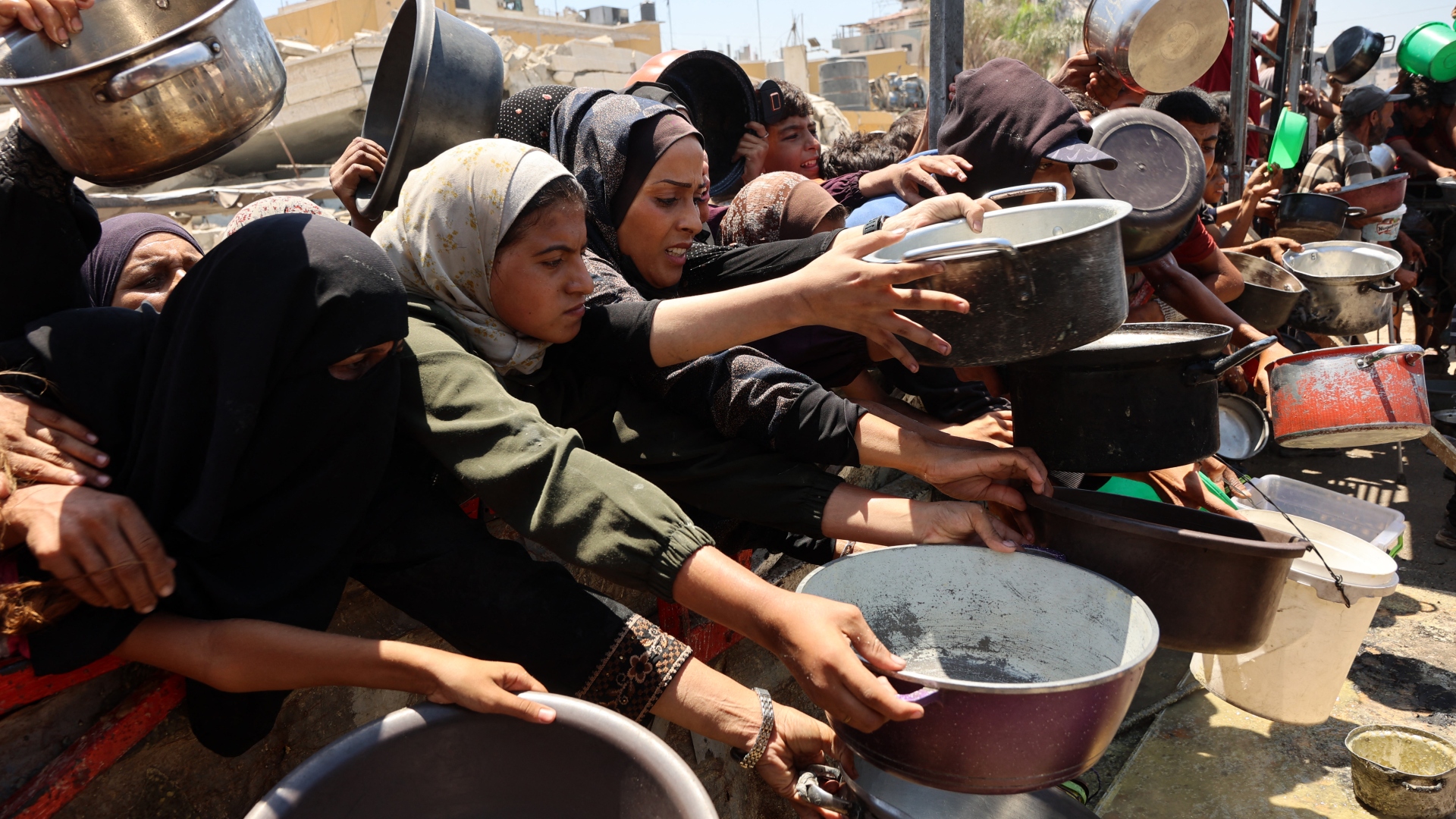
Palestinians receive lentil soup at a food distribution point in Gaza City on August 2, 2025. (OMAR AL-QATTAA/AFP via Getty Images)
This partial transcript was computer-generated. While our team has reviewed it, there may be errors.
Mina Kim: Welcome to Forum. I’m Mina Kim.
International airdrops of food aid into Gaza have resumed in the last two weeks after Israel eased restrictions in response to global outrage over widespread starvation among Palestinians.
At least 180 people have died from hunger — including more than 90 children — according to Gaza’s health ministry.
The Independent‘s Bel Trew was aboard a Jordanian military plane earlier this week as pallets of food were flung from the aircraft to the people below.
Trew is chief international correspondent for The Independent, based in Jerusalem, and joins me now.
Bel, welcome to Forum.
Also with us is Tjada D’Oyen McKenna, CEO of Mercy Corps, a nongovernmental humanitarian aid organization. Thank you for being with us as well, Tjada.
Bel, let me start with you. Tell us about the airdrop you observed. What was it like?
Bel Trew: Well, I mean, first of all, it’s important to make it very clear that airdrops should be a last, desperate resort to get aid to anyone in distress.
That’s because they’re inefficient, expensive, and — in some cases — dangerous or even fatal.
But in the situation Gaza is in, effectively under a blockade by Israel, it’s one of the few ways to get aid into the desperate, starving population.
I was with the Jordanian military. The Jordanians are also delivering food by land, but they told me they want to get aid in any way they can.
They’re doing seven or eight different flights a day. Each flight can cost as much as $32,000 — which is considerably more expensive than getting a truck into Gaza.
They drop one-ton pallets of supplies — things like flour and sugar — out the back of C-130 planes, and they float to the ground on parachutes.
It’s impossible to direct them to any specific location. It’s impossible to ensure that the most vulnerable — the most malnourished — are able to get that aid.
In some cases, it’s been landing in the sea. I spoke to a father in northern Gaza who can’t swim — he said he couldn’t get the aid. A friend took a boat out, but by the time they got the aid from the sea, it was completely destroyed.
Looking out the windows of the plane took my breath away.
I was there in Gaza during the 2012 war, the 2014 war, right after the 2021 war. I’ve been to places like Mosul, Libya, Yemen — I’ve covered a lot of conflicts.
I have not seen a level of destruction like this.
It looks like the bottom of a fire pit. The destruction stretches across the entire landscape. We flew over the full length of Gaza — all you can see is devastation.
Then there are families corralled into small areas, usually on the beach or in the south, in the so-called humanitarian zone — in tents.
That was another shocking sight. We flew over an area called Al-Mawasi, which has been labeled a humanitarian zone — although even today, it came under Israeli strikes.
It was breathtaking. You could see white blobs — the tents — stretching to the horizon.
There are hundreds of thousands of people forced to flee their homes due to bombardment and evacuation orders. They’re living in makeshift shelters.
What hit me was the sheer scale of devastation and the task ahead if the war were to stop.
Ninety-two percent of homes in Gaza have been damaged or destroyed. Some estimates say it could take 21 years to rebuild.
And then, there’s the futility of this aid delivery system. Eight pallet boxes — eight tons — is less than what a single truck carries.
It costs tens of thousands of dollars and lands in places you can’t control.
Meanwhile, my colleagues on the ground describe mad scrums when these land — one father of three told me he goes to the drop-offs with a knife because armed gangs are taking aid out of people’s hands.
And then the worst happened. On Monday, during a different flight — not the one I was on — one of those pallets crushed a man to death.
We spoke to his cousin at the funeral. The man was a nurse named Odeh. He’d been waiting in the blistering heat for four hours, and he couldn’t get out of the way when the pallet landed.
It just hammers home the absurdity of the situation. Gaza is 25 miles long, just a couple miles wide. It’s completely accessible by land and sea.
The best way to get aid in is a full ceasefire — followed by a coordinated international effort to deliver that aid.
And don’t forget, it’s not only Palestinian civilians who are suffering in famine — the remaining hostages are also likely suffering.
So for me, it was just a heartbreaking, galling experience, realizing how far down into this hell we’ve come.
Mina Kim: Tjada, I imagine you would agree with Bel that these airdrops have done little to address the overwhelming need Bel witnessed from the air — and that’s on the ground right now.
Tell me — what will it take? Is Bel right, that we need a cessation of hostilities and a full-scale effort to bring in food by land?
Tjada D’Oyen McKenna: Yeah. No — I thank Bel for painting such a vivid picture of the futility and inefficiencies of the airdrop system.
Just to add: these airdrops do nothing to support those most at risk of imminent death from famine and malnutrition.
We’re talking about people already weakened — people in health care settings, the elderly, small children. None of them can join a scrum to get an airdrop.
None of these methods are adequate substitutes for a functioning humanitarian system.
When we had the ceasefire operating under the UN-led aid system, we had 400 distribution points across the strip. We were able to get 10,000 truckloads of food and supplies into Gaza in just two weeks.
At this point, nothing less than a full resumption of that system will work.
We also need a ceasefire so that aid workers can move safely — and people can go get food and supplies without the risk of being killed or harmed.
That is the only solution right now.
And even now, death from malnutrition takes time. It starts with skipped meals, then becomes acute malnutrition requiring medical intervention — and, eventually, death, especially when people have infections or other conditions their bodies can’t fight.
Every hour we wait, more people die. We don’t have a minute to waste. The zone needs to be flooded with aid.
Mina Kim: And very specific nutritional and medical supplies to address the starvation crisis.
What are people at Mercy Corps able to get in right now?
Tjada D’Oyen McKenna: It’s been really heartbreaking for us.
Since the conflict began, we’ve served over 400,000 people with food kits, emergency shelter, hygiene kits, and psychosocial support.
Since the blockade, we’ve been mostly limited to helping people get access to clean water — and that’s another underreported crisis. This is a full-blown water crisis too.
But when I talk to my team members — they’re not immune.
You ask how they’re feeling, and they say, “We feel hungry.” This isn’t just something on the news — they’re living it.
They talk about food scarcity, price increases, being down to one meal a day.
My staff tells me about children crying from hunger. One said, “If the war won’t stop, at least let us eat.”
Our staff are making the same difficult trade-offs as everyone else — wondering, “Will we eat today? How many meals? Do we have enough water? What’s next?”
Mina Kim: Tjada, as you know, the Israeli government has said it has limited food supplies because aid was being stolen by armed Hamas militants. What’s your response?
Tjada D’Oyen McKenna: There’s just no evidence of that.
Right now, there are more than 3,500 trucks sitting at both borders, ready to go in.
The reality is, this blockade — and the lack of commercial food as well, not just aid — has created a desperate situation.
There’s no aid, no commercial food. So everyone is desperate.
One of our staff members who goes in and out described what happens when an aid truck comes in — women and children throw themselves under and onto the truck, just trying to get food.
Because there’s no functioning distribution system, people are seizing on whatever they can.
What would stop that is a reliable, consistent flow of aid and a system of distribution points.
Right now, Israel has choked that system down to four distribution sites — where more than 1,300 people have died just trying to reach them.
The Guardian found that some of these sites are open an average of just 11 minutes a day.
Tens of people are hurt or killed daily trying to get food.
Dismantling the distribution system, then depriving it of food — that’s what has made the current situation impossible.
Mina Kim: Bel, we’re coming up on a break — but last week, Hamas released videos of two emaciated Israeli hostages held in Gaza. Twenty more are believed to still be alive.
Has that added pressure on the government to pause or end hostilities and allow more aid?
Bel Trew: Yes. I would say there has been continuous pressure from the families — the largest group representing hostages and captives still in Gaza.
They’ve been in the streets every single week, saying their loved ones could die any second. They’re calling for a ceasefire now.
That pressure intensified after the release of those horrific images — two emaciated hostages.
One of them said on camera he was digging his own grave.
But unfortunately, Prime Minister Netanyahu seems pretty firm in his decision to continue the war.
Mina Kim: We’re talking about the widespread starvation journalists and aid workers are witnessing in Gaza.
More after the break. I’m Mina Kim.