New Yorker staff writer Burkhard Bilger doesn’t have great teeth. According to Bilger, his “gaptoothed grin” makes him look like he came from a bar fight or a remake of “Deliverance.” Given his lousy dental insurance, a friend recommended that Bilger head to Mexico’s “Molar City,” Los Algodones, a place that has the highest per capita concentration of dentists in the world, to get his teeth fixed. Medical tourism is nothing new, but few think of going abroad for their teeth. Yet most Americans have inadequate dental insurance and the system is geared to abandon you just when you need it the most. We talk to Bilger and dental professionals about why dental care does not get the respect, or coverage, that it deserves.
Why Americans Flock to Mexico’s “Molar City” for Dental Care
We talk to journalist Burkhard Bilger and dental professionals about why dental care does not get the respect, or coverage, that it deserves.
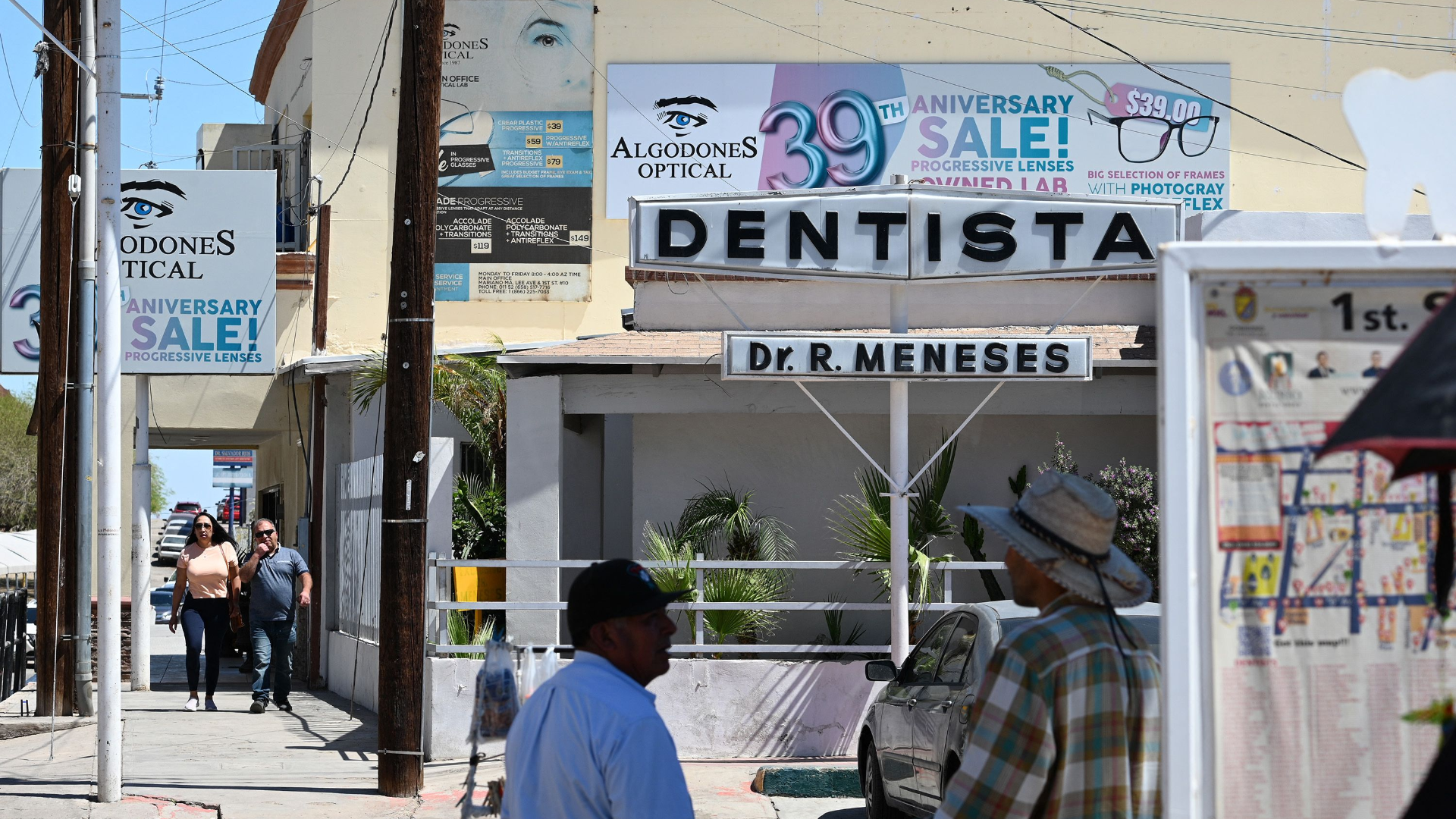
Signs advertise dental storefronts in Los Algodones, Mexico, just across the border from Yuma, Arizona. Hundreds of thousands of Americans travel across the Mexican border every year to the tiny town of Los Algodones, in search not of sun and sand, but root canals and veneers. Around 600 dentists cram the four main streets of the town, offering procedures at just a fraction of the cost in the United States. (Robyn Beck via Getty Images)
This partial transcript was computer-generated. While our team has reviewed it, there may be errors.
Lesley McClurg: From KQED in San Francisco, I’m Lesley McClurg, in today for Alexis Madrigal.
Writer Burkhard Bilger’s teeth were snaggled and stained. He says his gapped-tooth grin looked like he just stumbled out of a bar fight. With lousy dental insurance, he crossed the border to Mexico’s Molar City, Los Algodones, which has the highest concentration of dentists in the world. He joined thousands of Americans seeking care they can’t afford in the U.S. We talked to Bilger and dental experts about why American health care doesn’t treat your teeth like the rest of your body.
My six-year-old just lost her first two teeth. But unfortunately, the ones that are coming in — they’re coming in at these pretty odd angles, kinda like they’re trying to elbow their way into her mouth. And I’m already pretty worried about what it’s gonna cost to straighten them out. My partner is paying an orthodontist twenty thousand dollars to straighten his two kids’ teeth. I’m thinking maybe when it’s time, we should just head to Los Algodones, Mexico.
This is a town just past the Arizona border known as Molar City. That’s what journalist Burkhard Bilger did. He just wrote about it in The New Yorker. Welcome, Burkhard.
Burkhard Bilger: Good to be here.
Lesley McClurg: Why does your wife call you Snaggletooth?
Burkhard Bilger: Well, I should say we met when we were in fifth grade, and she had buck teeth back when this started. So it’s an old name-calling habit between us. I have pretty crooked teeth. I mean, the upper left teeth are somewhat straight, but I have this one incisor on the right side that’s bent way back. So it looks like a big gap. And then my lower teeth are pretty crooked all the way down the line. So it’s not a wrongful name that she’s calling me.
Lesley McClurg: And so how did you hear about Molar City?
Burkhard Bilger: Well, honestly, I’ve been hearing about medical tourism in Mexico for a while, and I knew there was a city that had lots of dentists. I asked my friend Todd, who lives upstairs from me — he lives part-time in Mexico during the year — if he knew of one particular place he’d recommend. And he sent me a link to Los Algodones, which, you know, it’s 5,500 people in the town, and I think around between 1,000 and 1,500 of them are dentists. So it’s just this huge population of dentists right on the border, across from Yuma, Arizona. It’s the northernmost town in Arizona, so it seemed like a good place to go.
Lesley McClurg: And how did this little town come to have more dentists per capita than anywhere else in the world? I mean, back in the day, it was filled with strip clubs and cantinas. How did that change? How did that arc happen?
Burkhard Bilger: Yeah, I mean, it was always right on the border. I mean, you can literally walk from Yuma across the border into Los Algodones. So it’s extremely convenient for people on the other side. During Prohibition, that meant a lot of people just walked over there to get drinks, to get girls — all that kind of thing.
Then in 1969, Bernardo Magaña, a dentist from Mexicali, came in and decided to set up shop in Los Algodones. He thought, you know, this is a place — obviously there are people here who will need dental care, and no one else is doing it. And he set up shop across from border control. I mean, directly across, so Americans who came over could see him.
It took about ten, fifteen years before a lot of other dentists came, but pretty much over the next thirty, forty years, it kept rolling and rolling and increasing. Now it’s become a town that — it’s not just dental work, though there are 300 dental clinics — but also you can get cheap eyeglasses, there are pharmacies, you can get stem cell injections, hair transplants, every kind of cosmetic surgery. It’s become an all-purpose self-care and medical care kind of place.
Lesley McClurg: And you decide to go there, but why hadn’t you gotten your teeth fixed before now?
Burkhard Bilger: I mean, I grew up — there are five kids in our family. My mom and dad are both German, moved here in ’62. And for Germans of their generation, it just wasn’t a thing to wear braces. It was just kind of a feature you had on your face, like a big nose or something.
And there were five of us, and braces were expensive and uncomfortable and took years. I think my mom kind of let the moment pass when a dentist recommended I go to an orthodontist, and I didn’t remind her because I didn’t want to go through that.
Lesley McClurg: And so you go to Los Algodones. You land in a place called Sani Dental. I mean, this place sounds enormous. What was it like — kind of paint a picture for us — and what services do they offer there?
Burkhard Bilger: Yeah. I mean, it’s the biggest clinic in Los Algodones, and it looks quite fancy from the outside.
To get there, it’s a little daunting — you’re walking down these streets full of hawkers calling you aside, offering cut-rate root canals or cheap stem cell injections. So it feels a little dicey.
But once you get through the doors of Sani Dental, it’s a very professional clinic. Pretty sleek, well-equipped — panoramic X-ray machines, 3D scanners, its own lab where they mold and create dentures and crowns.
It has 35 dentists on call, often working well past midnight — there’s such a huge demand. It’s really kind of a factory for dental work in Mexico.
Lesley McClurg: And I think they even throw in a hotel — a free night’s stay if you spend $1,000, and two nights if you spend $2,000.
Burkhard Bilger: Yeah, yeah, yeah. The original founders, Enrique Jimenez and his wife Miranda, they’ve made their old house into a hotel called Hacienda Los Algodones.
If you go there, yeah, you get those free stay nights if you spend enough money. But it’s also interesting because you’re surrounded by dental patients — you meet in the morning for breakfast, everyone’s trading stories and swapping anecdotes. It’s kind of a crazy scene.
Lesley McClurg: It sounds like a legit environment. It sounds reassuring — it’s nice, it’s comfortable, they have good technology. If someone decides to go to Los Algodones, how do they know they’re going to get good care? Is there any way to be assured that those hawkers — or wherever they end up landing — are going to do good work?
Burkhard Bilger: I mean, I think there are fewer assurances than in the United States, where there’s a higher degree of regulation. But I do feel like, you know, you can certainly look at the credentials of the dentist you’re going to. And many of them are trained in very fine dental colleges in Mexico — Mexico City, Mexicali, all over the place.
The dentists I saw at Sani were easily as credentialed as the dentists I’ve seen in the United States. Now, that said, in the U.S. too, there’s an enormous difference as you go from dentist to dentist. I mean, in the piece, I cite a report from 1997 by a guy named William Ecenbarger — he was a reporter for the Philadelphia Inquirer and Reader’s Digest. He went to 50 dentists in the United States in a space of a couple months.
Before he left, he had a panel of four expert dentists at universities look at his teeth. They said, “Well, you need one crown, and maybe $500 to $1,500 worth of care.” After he’d gone to 50 different dentists, he’d had everything from people saying he needed five crowns, to 12 crowns, to 28 crowns, to entire full-mouth reconstruction. Prices ranged from $500 to $30,000. So, you know, the same kind of buyer-beware process is true in the United States, I think, as it is in Mexico.
Lesley McClurg: I have definitely felt that. When they tell you you need something, I’m always a bit more skeptical than I would be if my doctor told me I needed something. What did Sani Dental suggest for you, and how much was the price tag?
Burkhard Bilger: Well, I should say I went in with kind of two scenarios. I said, “Look, tell me what I need functionally — like, what do I need to maintain the health of my teeth? And once you’ve done that, tell me how much that would cost. Then, tell me what it would take — and how much it would cost — to give me a full set of straight teeth, teeth that look as nice as the models in the posters in your office.”
I had a very good diagnostician, Juan Carlos Miranda Villa, who looked at me and said, “Well, you need ten fillings.” That’s quite a few, but mostly small ones at the roots of my teeth, where the gums were separating and some of the roots were showing. So it was pretty straightforward.
Then he said, “But if you want fully straight teeth, I’m going to have to grind down 28 of your teeth to little nubs and put crowns on them — and probably pull one molar out and replace that.” That would cost $14,000 for the whole treatment.
Lesley McClurg: Twenty-eight teeth? That sounds very painful. You decided to go to Beverly Hills just to do a little bit of price comparison. What did they tell you? What did they suggest? And how much would it cost?
Burkhard Bilger: Yeah, I went to a well-known dentist there called Kevin Sands — he’s really the dentist to the stars. He does Matthew McConaughey, Robert Downey Jr., the Kardashians, Miley Cyrus, on and on. Some of the royal families from Qatar and Saudi Arabia — he’s done everybody.
I figured I wanted to see what that kind of environment is like — where you’re really getting the highest quality care and people are paying top dollar for it. So I told him the same thing: “What would it take to give me a straight smile?”
And, you know, he ended up coming up with exactly the same scenario as Sani Dental did. But instead of $14,000, it was $119,000.
Lesley McClurg: $119,000 instead of $14,000.
Burkhard Bilger: Yeah. That’s more than eight times as much.
Lesley McClurg: I’m guessing you didn’t go for that one. But did you go for the one at Sani Dental?
Burkhard Bilger: You know, I did not go for it. And it’s interesting — I’m not going to pretend I have no vanity. Certainly as a middle schooler and early high schooler, I was a little embarrassed about my teeth, and sometimes would hide my gap with my hand when I talked to people. But I’ve been around long enough now that I’m kind of used to it. It’s part of my personality.
And actually, when I was at Sani Dental, they did a mock-up. They took 3D scans of my teeth, then made molds that could fit over them — with kind of spaces inside to show what the straightened versions would look like. Then my dentist filled that with resin, stuck it on top of my teeth, and when she pulled off the molds, I had these plastic fake teeth over my real teeth that looked like what my future teeth would be if I straightened out my bite.
I sent it to my wife, and I sent it to my friend Todd. Todd was like, “God, you gotta do it. Do it.” And my wife — the same person who called me Snaggletooth and was always appalled by my teeth — she was horrified at the idea that I would change them. She just thought, “That is not you. Who is this smiling door-to-door salesman greeting me from this picture? That’s not who you are.” So I didn’t do it.
Lesley McClurg: But you did get some of the other work done, right? You got the fillings done. How did that go, and how is it holding up?
Burkhard Bilger: The fillings went great. Two sessions — less than two hours for six fillings the first day, and the other four took maybe 45 minutes. They’ve held up great. For me, the quality of the work was as good as anything I’ve gotten.
I did a lot of walking around and talking to other patients — both at a casino across the border where they wait for their appointments, and inside the clinic itself. In general, people were quite happy with the work they’d gotten and thrilled at the price.
What was kind of moving for me was that they were from all over the world. A lot of them were retirees — snowbirds who come down to Arizona to live — but many were from small towns and just couldn’t afford American health care. So they’d shown up and were just so relieved to get it done.
Lesley McClurg: We’re talking about Mexico’s Molar City. We’re joined by Burkhard Bilger. He’s a staff writer for The New Yorker. He just authored a new article called Word of Mouth.
We’ll be right back after this break. Stay with us.