Is legacy media self-censoring under the Trump Administration? The canceling of “The Late Show with Stephen Colbert” and the multi-million dollar payouts from the parent companies of CBS and ABC to settle defamation lawsuits are all causes for concern, according to media analyst and Guardian US columnist Margaret Sullivan, who worries hard news reporting could become a thing of the past. We talk with Sullivan about how major media outlets are responding to Trump’s intensifying attacks and how it could hasten a march to autocracy.
Is the American Media Caving to Trump?
We talk with columnist Margaret Sullivan about how major media outlets are responding to Trump’s intensifying attacks and how it could hasten a march to autocracy.
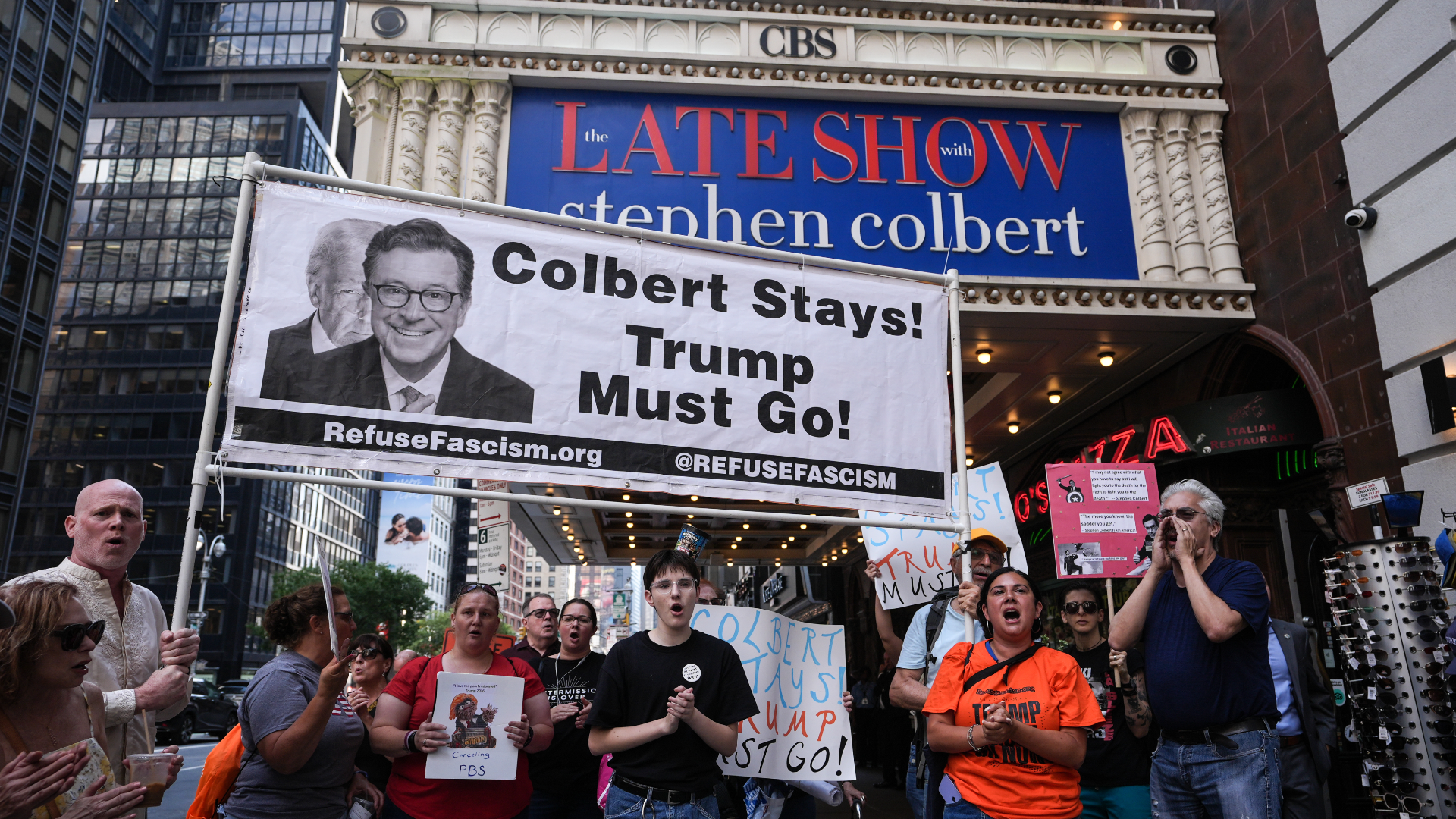
Dozens of anti-Trump protesters gathered outside the Ed Sullivan Theater, home of The Late Show with Stephen Colbert, to protest CBS's reported decision to fire the longtime host. Demonstrators held signs and chanted in support of Colbert, blaming political pressure and criticizing the network's move as a blow to free speech and satire. The protest came shortly after rumors surfaced that Colbert's termination was linked to his outspoken criticism of President Donald Trump. (Lokman Vural Elibol/Anadolu via Getty Images)
This partial transcript was computer-generated. While our team has reviewed it, there may be errors.
Mina Kim: Welcome to Forum. I’m Mina Kim.
President Trump appears, so far, to be winning his war against the media. Paramount, the parent company of CBS, agreed last month to pay $16 million to settle Trump’s lawsuit over the editing of a 60 Minutes interview — then, days later, canceled The Late Show with Stephen Colbert, known for its comedy critical of the president.
Sixty million is also the amount ABC News agreed to pay Trump in December to settle a defamation lawsuit.
Margaret Sullivan is worried about the lack of resistance we’re seeing from major media companies — and even eagerness to appease Trump, who is now going after The Wall Street Journal for publishing a story about a lewd birthday card he apparently sent to Jeffrey Epstein.
Margaret Sullivan is a columnist for The Guardian US, former public editor of The New York Times, and writes a Substack called American Crisis.
Margaret, welcome to Forum.
Margaret Sullivan: Thanks very much for having me.
Mina Kim: Really glad to have you. Can you actually talk first about The Wall Street Journal case? Trump has sued them for $10 billion after it published a story about his close relationship with Jeffrey Epstein. Talk about what’s important about this case and its status.
Margaret Sullivan: Well, from what I can tell, The Wall Street Journal did its due diligence and published a well-vetted article about Donald Trump’s relationship with Jeffrey Epstein.
Years ago, when Epstein’s 50th birthday had arrived, apparently his then-partner or companion, Ghislaine Maxwell, had asked people to contribute cards or notes to this birthday book. The Journal reported on Trump’s card to him, and it was very suggestive. It was lascivious.
It seemed to suggest — without coming right out and saying it — a mutual liking for sex with underage girls. It had a sketch of a naked woman, and the Donald Trump signature was sort of in the place where pubic hair would be.
Trump immediately branded the story a hoax and a fake, which I don’t think it was — because I believe the Journal had this nailed down.
He has now sued the Journal for, as you said, some astronomical amount of money. And this is sort of his go-to way of behaving when there’s a story — or a series of stories, or a kind of coverage — that he doesn’t like. He goes to court and sues. And he’s been very successful in getting settlements, so you can see why he continues doing it.
Mina Kim: Yeah, Trump fought really hard to get that story not to be published — and then once it was, he filed that lawsuit.
And The Wall Street Journal is not settling or backing down, as far as I can tell now — but others have. I’m wondering if you could walk us through what happened with CBS and its parent company, Paramount, and their recent decision to settle.
Margaret Sullivan: Sure. And I’ll just say before I get to that that it is a little bit surprising that The Wall Street Journal is taking this hard line — or, you know, holding firm, I guess — in publishing the story and saying that they’re planning to defend it and not back down.
I say that because The Journal is controlled by Rupert Murdoch, who also controls and co-founded Fox News. We know where Fox News comes down on Trump — it’s always been very much in his corner and a great ally.
So it is a little surprising to see a Murdoch property being this tough on Donald Trump. I just add that as a piece of context.
What happened with CBS is really discouraging.
The backstory here is that last fall, during the presidential election, 60 Minutes — the famous magazine show that airs Sunday nights on CBS — did an interview, kind of a profile/interview with then-candidate Kamala Harris.
It was a pretty standard interview. They went through a bunch of different questions, and she responded. Of course, it was pre-recorded, which is normal. And they did some editing to make it more streamlined — again, totally normal. You don’t air an entire interview; you cut it down.
Trump immediately claimed that it was edited falsely — that it was edited in a biased way to make Harris look more cogent, better, more positive.
There’s really no evidence that was the case, but that was the claim.
No one — no regular person who’s not very partisan — has looked at this editing or the piece itself and said, “Oh yeah, that’s clearly liberal bias.” It just… it was a normal interview.
Anyway, Trump decided to sue CBS. And at first, I think they said, “Okay, well, we did nothing wrong, and we’re going to defend this.”
60 Minutes has had very high standards over the years.
More backstory here: CBS is owned by Paramount Global. And Paramount Global — a big corporation with many pieces, not just media — has been trying to do a major merger with Skydance, another huge media company.
They needed to get clearance through certain federal agencies. And Trump was using his influence with these agencies to put pressure on CBS and its parent company to yield to him.
And in fact, largely, they did. They settled. They gave him $16 million, which I think is supposed to go to his future presidential library or something like that.
But it’s still a settlement very much in his favor and allows him to say, “See, I told you it was all a hoax — and now with the settlement, you see that it is.”
So, very unfortunately, it’s a kind of capitulation we’re seeing more of from the parent companies of media organizations.
Mina Kim: And then they would go on to cancel The Late Show with Stephen Colbert, who’s known for being a Trump critic on his show. What do you make of that — and the timing?
Margaret Sullivan: Well, I mean, the timing certainly was interesting. It’s hard to know — was this all set up? Were they going to cancel it anyway?
These shows, these late-night shows, do lose money — although The Late Show with Stephen Colbert was the highest-rated of the late-night shows.
Just two days before the show was canceled, Colbert had really gone on a rant about the settlement we were just talking about, and he called it a “big fat bribe.” I think I have that wording right — but he did use the word “bribe.” And lo and behold, two days later, the show was canceled.
Now, I can’t prove a cause and effect there, and it may well have been in the works before, but it didn’t look good — let’s put it that way.
All of this, in a larger context — and this has been true for Donald Trump ever since he began to run for president back in 2015, and even before that — he wants very much to control the message.
How do you control the message? Part of it is: you control the media.
And he’s been very successful — just in the six months or so since he’s been inaugurated — in bringing the big media companies to heel. Many of them are agreeing to do his bidding, in one way or another.
Now, there are exceptions. It’s not across the board. I think CBS News overall still does a good job. 60 Minutes caught a bit of a break in that their new executive producer is someone journalists inside the program really like and trust.
So it’s not all dark and bleak. But a lot of it is.
Mina Kim: Yeah. But it’s a new executive producer because the previous one left after Paramount—
Margaret Sullivan: He left, and he said as he left — and he’d been there a long time and was very well respected — he said he no longer felt he had the editorial freedom he had always enjoyed.
Mina Kim: Is it fair to say, Margaret, that in this case — because there was a merger on the line — it appears the merger was more important to Paramount than its journalism entity, its journalistic integrity?
Margaret Sullivan: Well, you can certainly make that case. And I have made it.
This is something we’ve seen throughout the media. These news organizations are now owned by big companies. Many of them are. And these companies have many interests.
Their biggest interest is making money and increasing profits for their shareholders — and, in some cases, for their leadership.
So yes, they may give a nod to editorial freedom and freedom of the press and all that good stuff. But at the end of the day, they’re very attuned to not having anything get in the way of maximizing profit.
So yes — I do think that’s what happened here. And it’s very regrettable, because we need a free press. We need an independent press. A strong and brave press in order to have a democracy.
And with our democracy under threat — for so many reasons — it’s really important that news organizations stand up.
That’s why I’m heartened to see The Wall Street Journal so far standing behind that story. And I know The Journal has done tough investigations in the past.
They have a reputation for making stories bulletproof. Like, there’s not going to be a problem with the story that can be easily attacked — is my best guess.
So there are exceptions. But overall, we’re seeing a lot of capitulation, a lot of cowardice, and a lot of kowtowing to Trump.
Mina Kim: We’re talking about all of that — the capitulation, the kowtowing, and the impacts of that — with Margaret Sullivan, a columnist writing about media, politics, and culture for The Guardian US, and who has been writing about this for so, so many other major outlets.
And you, our listeners, are invited to join the conversation with your questions about these settlements, your concerns about what they mean, and if you’ve noticed changes in the way major news outlets are responding to Trump’s attacks — either in the legal arena or in their coverage.
More after the break. This is Forum. I’m Mina Kim.