California Democrats have long criticized gerrymandering, the practice of drawing district maps to influence election outcomes. But as Texas Republicans have unveiled district maps intended to favor conservatives in the 2026 midterms, California lawmakers are sketching new plans of their own. Governor Gavin Newsom has announced plans to seek a special election in November, asking California voters to approve new districts that might lend Democrats an edge in the national election – temporarily sidelining California’s independent districting commission. We’ll talk with political reporters about what’s at stake in this redistricting fight.
California Leaders Eye Special Election to Counter Texas Redistricting Plans
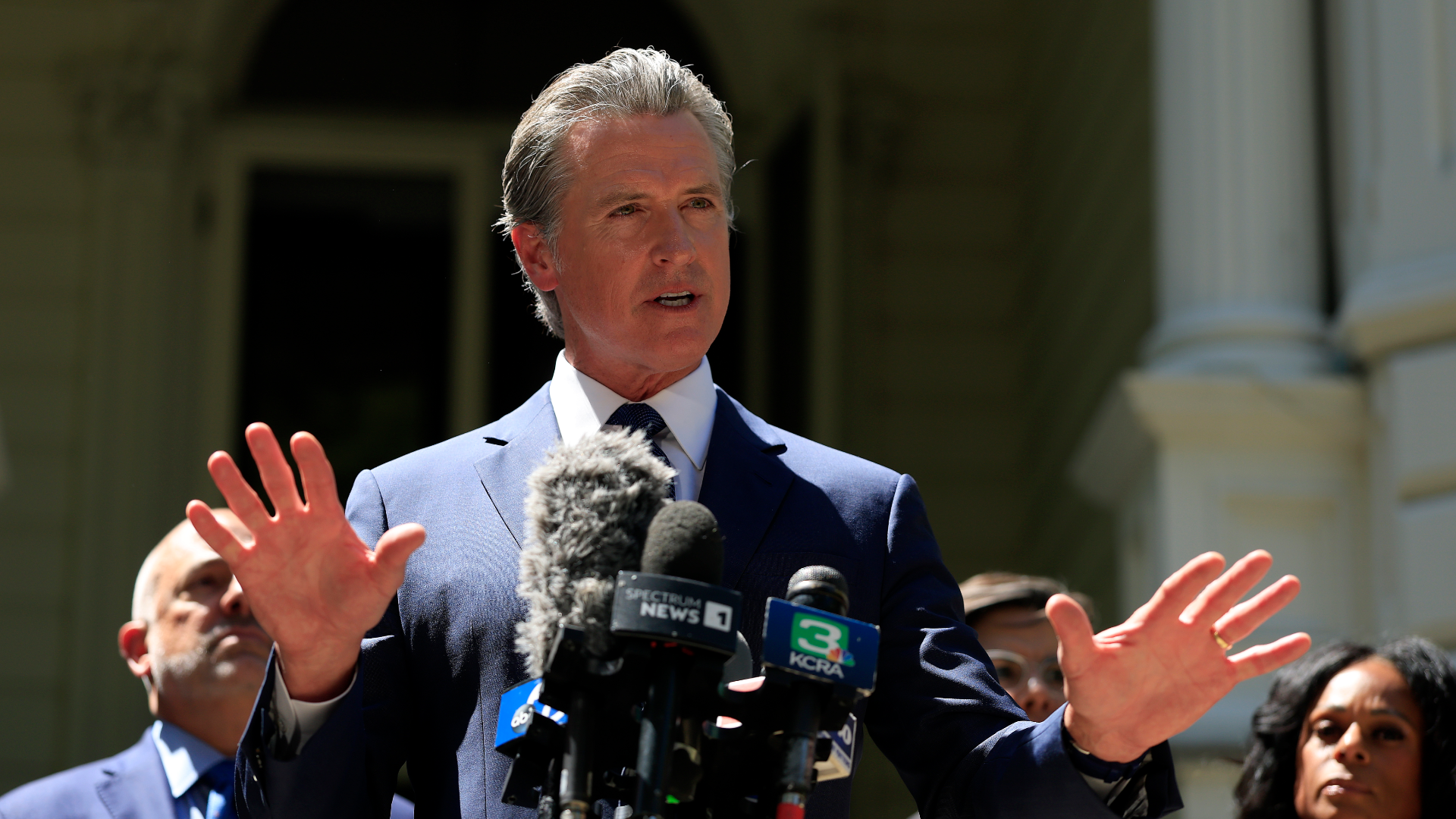
California Gov. Gavin Newsom met with Texas lawmakers to push back on Texas's redistricting maneuver and talk about how California plans to respond. (Justin Sullivan via Getty Images)
Forum is now on YouTube. Subscribe to the KQED News YouTube channel and watch the full interview.
This partial transcript was computer-generated. While our team has reviewed it, there may be errors.
Mina Kim: Welcome to Forum. I’m Mina Kim. Texas Democrats have left the state to delay a vote on a bill to redraw its voting maps and make it easier for Republicans to pick up five more seats in the midterms. Ohio is also poised to redistrict to favor more Republicans. Democrats are furious, including Governor Gavin Newsom, who has called for responding in kind and redrawing California’s congressional districts to benefit more Democrats in 2026. But it’s a lot harder to do that here.
This hour, we look at why—and whether or not Democrats should, in these political times, engage in essentially a redistricting arms race. What do you think, listeners?
Joining me first is Laurel Rosenhall, who covers California politics and government for The New York Times. Welcome to Forum, Laurel.
Laurel Rosenhall: Thanks for having me. Great to be here.
Mina Kim: So first, help us understand what’s happening in Texas. Why did Democrats flee the state? What’s Texas’ majority trying to do?
Laurel Rosenhall: Well, they’re responding to a request from President Trump, who asked the governor there in Texas to redraw the maps to help Republicans gain more seats—to make it more likely that voters would elect more Republicans by redrawing the boundaries of the district lines. So that’s what the Republican majority in Texas is considering.
And the Democrats left the state—many of them left the state—as a way to kind of boycott that plan. They don’t have enough votes to stop it by voting no, but they could prevent the session from moving forward temporarily by leaving the state. They don’t have a quorum if they don’t have enough lawmakers there to do the vote.
So they have sort of fled to a few different states around the country. It remains to be seen how long that will last and whether it will ultimately be successful. In past years, Democrats in Texas have tried something similar, and it basically delayed the redistricting vote—but it didn’t stop it from happening.
Mina Kim: So that’s how Democrats in Texas are responding. Talk about how Gavin Newsom has responded to what Texas is trying to do.
Laurel Rosenhall: Yeah. So we’ve seen Newsom in the last couple of weeks really ramp up the discussion of this plan, which has now gone from talk to—you know—they’re looking at draft maps, and he’s talking about putting this on the ballot.
I think the important thing to think about is that in many states, like Texas, the legislature draws these maps. So whichever party controls the legislature has the power to draw the maps the way they’d like. In California—and a handful of other states across the nation—the voters put that power in the hands of an independent commission. California voters passed a constitutional amendment to do that.
So, effectively, for Democrats to gerrymander here as a way to counterbalance what’s happening in Texas, it’s just a lot more procedurally complicated and requires a lot more steps. Newsom is floating this plan to combat what Texas is doing with a California gerrymander, but his ability to just do it the way the Texas governor and legislature can is really hamstrung by all of these procedural requirements that exist in California.
Mina Kim: And how many more seats does he think could potentially come from this? I understand Democrats currently hold, what, 43 of the state’s 52 House seats?
Laurel Rosenhall: So, Newsom was asked about that yesterday, and he very pointedly did not say a number. He said he’s leaving it up to the lawmakers to draw the maps. He doesn’t have a specific number in mind.
But we understand there is a draft being considered right now that would have five new Democratic seats—so, five new Republican seats in Texas, five new Democratic seats in California.
Mina Kim: So he wants to sideline the independent commission, put this out to the voters in a special election—potentially in November—if he can get these new maps drawn and everything agreed to by the legislature. How are Democrats responding to this in the state—California Democrats?
Laurel Rosenhall: Many have expressed support. Many are kind of going along with this message that they feel they need to fight fire with fire—that if Republicans are going to gerrymander, then Democrats need to do the same.
There have been a couple of dissenters, but I have not so far seen widespread dissent. It’s worth noting that—again, back to my comment earlier about the many procedural steps that would need to be taken—if California does this, two-thirds of the legislature would have to vote to put this on the ballot, and then a majority of voters would have to approve it.
So we’ll see. Later this month this will likely come up in the legislature—that’s when we’ll see them show their cards. But the state legislature is on summer recess right now. They’re coming back on August 18th, and it’s looking like action will be taken shortly after that.
Mina Kim: Wow. You wrote about how former California Governor Arnold Schwarzenegger is not a fan of this “fight fire with fire” plan that Governor Newsom has proposed if Texas, in fact, does succeed in moving forward with redrawing its maps to favor Republicans. Talk about why he feels that way—and why his voice is significant here.
Laurel Rosenhall: Yeah. So California’s plan—or the system we have in California of independent redistricting—was championed by Arnold Schwarzenegger when he was the governor of California.
He had this idea of post-partisan politics. He ran his administration in kind of a bipartisan manner—had Democrats in his administration—and he saw a lot of gridlock in Sacramento between the two parties. That was in the era when the budget required a two-thirds vote and it was very hard for lawmakers to pass a budget.
He really saw independent redistricting as a tool to break politicians’ control of politics and, in his view, give more power to the people. The idea of independent redistricting is to make the districts more reflective of the voters and communities—and less reflective of politicians’ wishes about who wins and who gets political control.
So he put these measures on the ballot that California voters approved in 2008 and 2010. He was a big champion of them. And so the system California has is really one of the legacies of Schwarzenegger’s time as governor. That reform—and also the so-called top-two primary, the nonpartisan primary—those are his babies.
After he left the Governor’s office, he became sort of an evangelist for this idea. He went to other states, campaigned to pass similar efforts. When the issue went before the Supreme Court, he submitted amicus briefs in support of independent redistricting.
So even though Schwarzenegger is, like, an action movie star, bodybuilder, governator—he is actually really into this kind of nerdy, wonky idea of organizing democracy in a way that reflects the voters. His spokesman made clear to me that Schwarzenegger would not be okay with his big legacy reform getting trashed in California.
Schwarzenegger himself hasn’t come out yet and said anything, but he’s very opposed to gerrymandering by both parties. He achieved something significant in getting California’s system to change. And it’s reasonable to think that if California moves ahead with a plan that would trash part of his legacy, he would have something to say about it.
Mina Kim: Yeah. I understand his spokesman also said that he felt that by doing partisan gerrymandering in response to Texas’s gerrymander, “two wrongs don’t make a right.”
Listeners, what do you think? Would you support California redrawing its voting maps in favor of Democrats before the midterms to counter Texas and other GOP efforts to redistrict in favor of Republicans? What questions or concerns do you have about the process of redrawing California’s maps or the kind of impacts that would have? You can email [email protected], find us on Discord, Bluesky, Facebook, Instagram or Threads at @kqedforum, or call us at 866-733-6786.
Along those lines of former Governor Schwarzenegger’s concerns, this has been called a “race to the bottom.” I’m wondering how Newsom or other Democrats who have jumped on board counter that. What are they saying about why it’s needed?
Laurel Rosenhall: Newsom is really going big on the argument that Trump and the Republicans are trying to rig the election—that’s the phrase we’ve heard him use over and over again—and that if Democrats sit back and act “holier than thou,” that’s just basically giving up power.
He’s really going with this: it’s a firefight. He says he likes the idea of independent redistricting and taking politicians out of control, but that it should be done nationwide. Because if only Democratic states are doing it, then they’re giving up power.
The other thing to know is that what he’s talked about publicly—and again, this hasn’t been voted on yet, so we don’t know what the final language will be—but what Newsom has said is that the plan would call for this Democratic gerrymander in California for the next three congressional elections: 2026, 2028, and 2030. And that the state would then return to the existing nonpartisan system after the next census—so in the 2030s, we’d allegedly go back.
Mina Kim: Laurel Rosenhall, who covers California politics and government for The New York Times, thanks so much for talking with us.
Laurel Rosenhall: Great to be here. Thank you.
Mina Kim: We’ll dig in more to how California could make this happen right after the break. Stay with us, listeners. This is Forum. I’m Mina Kim.