President Trump’s recently passed megabill allocates $75 billion in extra funding to Immigration and Customs Enforcement, tripling its budget and making ICE the largest law enforcement agency in the country. Historian and journalist Garrett Graff has covered law enforcement and democracy for the last 20 years and says it’s hard not to see the funding increase as “turbo-charging an increasingly lawless regime of immigration enforcement.” We talk to him about the implications of a radically expanded ICE.
ICE’s Budget Just Tripled. What’s Next?
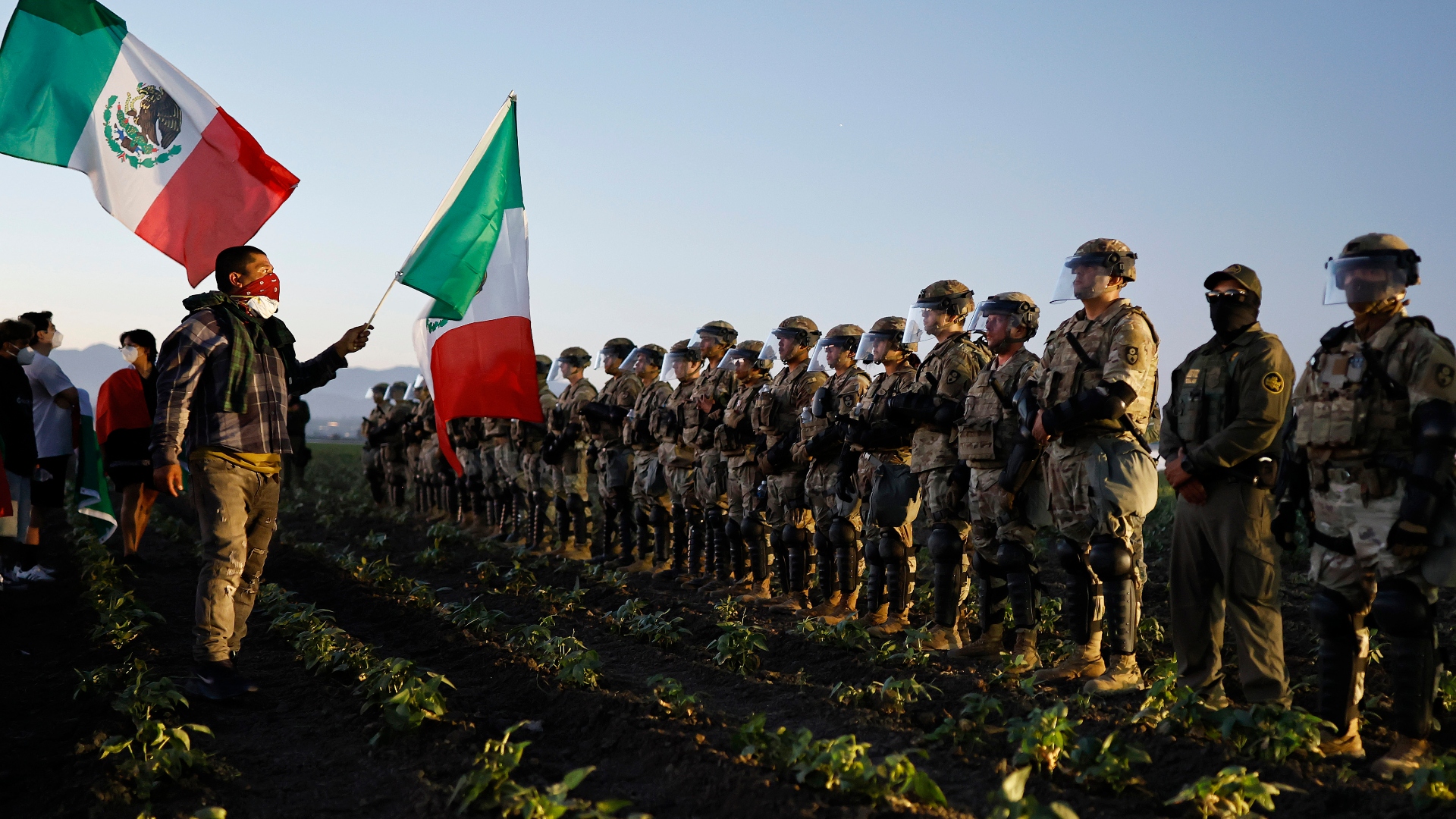
National Guard members and a federal agent block people protesting an ICE immigration raid at a nearby licensed cannabis farm on July 10, 2025 near Camarillo, California. (Mario Tama/Getty Images)
Show Highlights
Historic Budget Surge
With the passage of President Trump’s sweeping “mega bill,” the budget for Immigration and Customs Enforcement (ICE) has jumped from $10 billion to a staggering $75 billion — $30 billion allocated to hire new staff and deport more people, and $45 billion for expanded detention capacity. U.S. Customs and Border Protection (CBP) received another $46 billion.
According to journalist Garrett Graff, this level of funding transforms ICE from a mid-size law enforcement agency into a force rivaling the budget and scale of the U.S. Marine Corps. It now eclipses the FBI, ATF, DEA, Secret Service, and U.S. Marshals combined.
Mass Hiring, Minimal Oversight
ICE will be onboarding more than 10,000 new officers. CBP will add another 3,000 agents. But no law enforcement agency — especially one with a checkered record like ICE — can safely scale that fast, Graff said. Hiring at such speed inevitably erodes training standards, background checks and internal oversight.
Graff drew comparisons to past hiring surges at CBP after 9/11, which led to systemic misconduct. Between 2005 and 2012, over 2,170 CBP agents were arrested — averaging one arrest per day for seven years. “The moments when agencies have tried to do this in the past have all resulted in infamous disasters,” he said.
From Enforcement to Intimidation
ICE’s public-facing tactics have shifted dramatically. Instead of focusing on high-priority targets like gang members or traffickers, the agency is increasingly conducting high-volume sweeps in public places: construction sites, parking lots, schools, and churches. Graff warned that the agency’s new recruitment strategy is likely to attract “America’s worst bullies” — people drawn to the job not out of a sense of duty, but a thirst for power and intimidation.
“The headlines, the social media clips, the pitches are basically saying: ‘If you are excited to dress up like you’re taking Fallujah, and raid and rough up hardworking roofers in the Home Depot parking lot — come work for ICE,’” he said.
The optics have changed too. Raids now frequently involve masked agents in unmarked vans — tactics Graff described as more aligned with “a secret police force in an authoritarian or totalitarian regime.”
Due Process Dismantled
While ICE’s officer count is tripling, the number of immigration judges is increasing only slightly — from 700 to 800 — a clear signal that due process is not keeping pace with enforcement. Graff noted this imbalance is intentional: the system is designed to operate increasingly outside of judicial oversight.
One caller, a 66-year-old white man, said he now carries his passport at all times. Another caller, a Latina healthcare professional from San Francisco, asked if she should fear being mistakenly detained just for looking Latina. “Any interaction in the public sphere could lead to someone’s detention and removal,” Graff said.
Political Weaponization
Listeners raised concerns that the ICE expansion could be used not just to enforce immigration policy but to intimidate political dissent. Graff didn’t dismiss the idea. He floated a chilling scenario: ICE showing up at polling places during the 2026 midterms or 2028 presidential election under the guise of enforcing voter ID laws or investigating fraud. “You wouldn’t have to intimidate a lot of voters to stay home from the polls out of fear of being deported to really sway the outcome of the elections,” he said.
California Pushback, Federal Tension
California lawmakers have proposed bills to limit ICE’s power, including the “No Secret Police Act,” which would prohibit the use of masks by law enforcement, and the “No Vigilantes Act,” which would require name and badge identification. But it’s unclear how far states can go in regulating federal agencies.
Graff noted that ICE has already refused to let Democratic members of Congress inspect detention centers — in direct violation of federal law. “This is not a healthy agency, and it’s one that doesn’t believe that it will ever be accountable to a normal rule of law again,” he said.
ICE’s Falling Public Support
Once a centerpiece of Trump’s political brand, immigration enforcement is now among his most unpopular issues, according to Graff. He pointed to a growing disconnect between ICE’s actions and public expectations. “All of us support a certain level of targeting legitimate criminals,” he said, “but that’s not what we’re seeing ICE do day in, day out right now.”
Enforcement has expanded to include green card holders, students, and visa applicants — even those with no criminal record. He described ICE crackdowns on immigrants based on social media activity, the detention of long-term residents, and the arrest of a Tufts student for writing a critical op-ed.
Graff said that as ICE’s practices stray further from public expectations, political opposition will keep growing. “I have to imagine that by 2028, ‘Abolish ICE’ is going to be the moderate political position in the election cycle,” he said.
Detention Regimes and Human Rights
Graff said the changes ahead for immigrant detention will be equally extreme. ICE is pushing for more large-scale detention centers — often in red states — and has relaxed its adherence to the Flores settlement, which prevents prolonged child detention. He cited Florida’s “Alligator Alcatraz” facility as an emerging MAGA photo-op, where inhumane conditions are celebrated as political theater. The risk, he warned, is that we’re normalizing detention practices that, in any other context, would be labeled “concentration camps.”
This content was edited by the Forum production team but was generated with the help of AI.