The flooding in Central Texas over the Fourth of July holiday has claimed more than 100 lives and caused widespread destruction across six counties. Search and rescue efforts are ongoing, with teams from across the country — including California — joining the response. We get on-the-ground updates, hear how rescue operations are going and as extreme weather events become more common, we look at whether this could happen in California.
Over 100 Dead, Dozens Still Missing As Texas Recovers from Unprecedented Flooding
We get on-the-ground updates about the flooding in Central Texas, hear how rescue operations are going and as extreme weather events become more common, we look at whether this could happen in California.
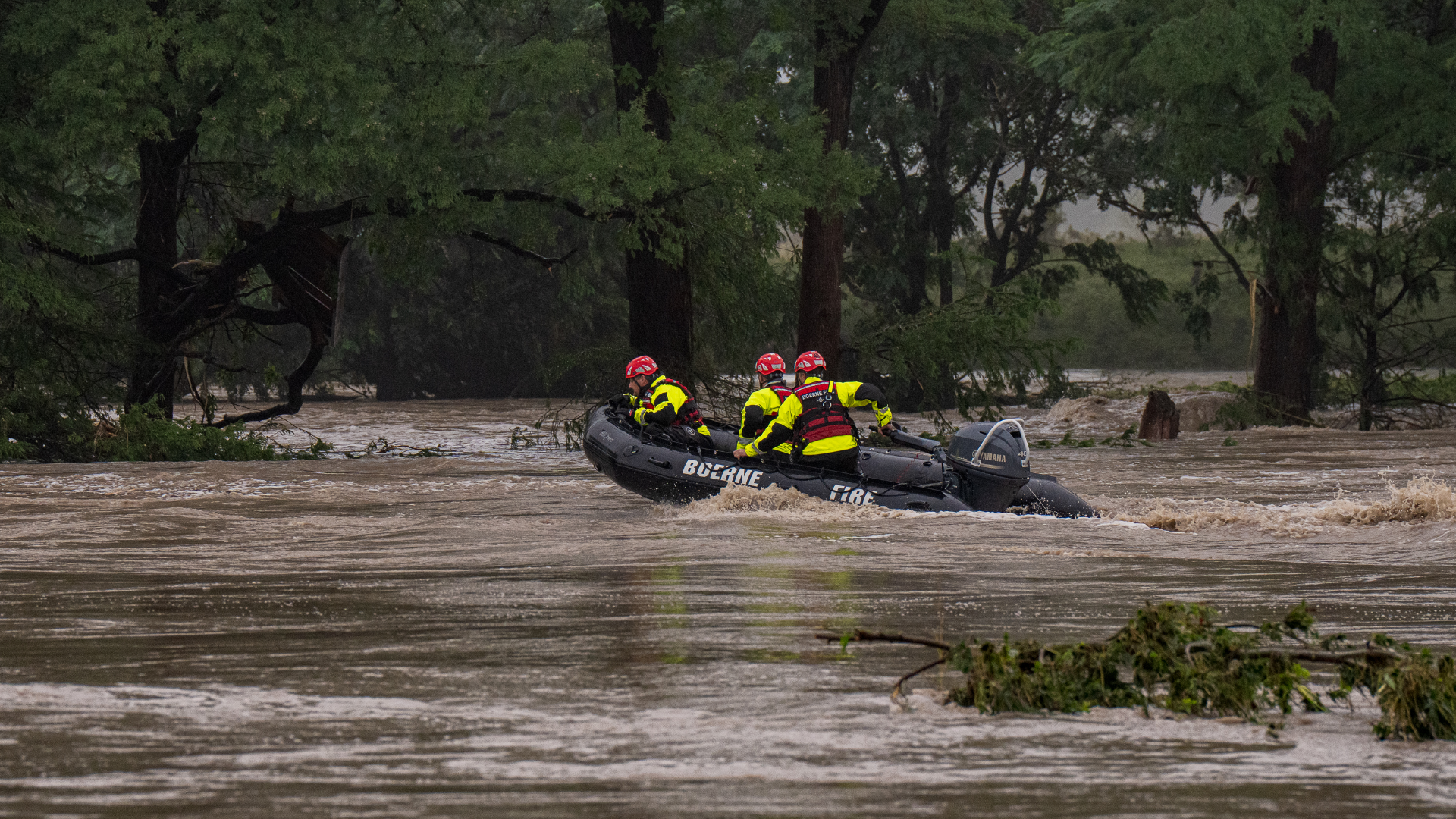
Boerne Search and Rescue teams navigate upstream in an inflatable boat on the flooded Guadalupe River on July 4, 2025 in Comfort, Texas. (Eric Vryn via Getty Images)
Show Highlights
Devastation and Tragedy of the Texas Floods
“I’ve been seeing a lot of devastation,” said Lucio Vasquez, a breaking news reporter for the Texas Newsroom. “A lot of people have lost, basically everything.” The flooding, which occurred in the early morning hours while many were sleeping, impacted the Camp Mystic Christian summer camp, sweeping away several cabins housing young girls. Vasquez described heartbreaking stories, including two sisters “found with their hands interlocked” miles downstream.
On-the-Ground Updates from the Disaster Zone
Rescue and recovery efforts have been hampered by the rural nature of the area. Local officials initially struggled to provide sufficient warnings, with some residents reporting they didn’t receive alerts until hours after the flooding began. However, Vasquez noted that despite the difficulties, “they have what amounts to an army of volunteers and public safety agencies…going through the debris and trying to find people either still somehow surviving or the remains of those who were lost.”
Factors Contributing to the Deadly Flooding Event
Greg Porter, senior newsroom meteorologist at the San Francisco Chronicle, explained that the Texas Hill Country region is prone to flash flooding due to its topography, proximity to the moisture-laden Gulf of Mexico and soil conditions that inhibit water absorption. The decaying tropical storm system that triggered this event, was particularly challenging to forecast. “It was a confluence of factors here that are really, really small scale, and one particular observation from a balloon isn’t necessarily gonna make that better,” Porter said.
According to Hayley Smith, a reporter covering extreme weather for the Los Angeles Times, the National Weather Service issued forecasts and warnings leading up to the event, including a “flash flood emergency” alert. Smith said those alerts are fairly rare and are used to indicate a severe threat to human life and catastrophic damage. However, questions remain about how local officials and camp administrators responded to those warnings and implemented safety plans.
Cuts to Federal Weather Agencies and Potential Impacts
Smith reported on cuts to the National Weather Service and its parent agency, NOAA, as part of the Trump administration’s efforts to reduce “climate change alarmism.” Hundreds of positions have been eliminated, and the administration’s proposed budget aims to cut NOAA’s funding by over $2 billion next year. While the agencies maintained they did their job in this case, Smith noted, “The fact that the federal government is continuing its efforts to defund and defang and weaken these agencies that help people prepare for and respond to these events, even in the wake of this disaster, is disheartening.”
California’s Vulnerability to Similar Disasters
Both Porter and Smith acknowledged that California faces risks of similar extreme weather events, particularly in desert areas, wildfire burn scar regions and foothill communities near coastal ranges and the Sierra Nevada mountains. As Porter warned, “The fire scars, the burn scars, debris piece, the debris flow piece is a huge amplifier in California.” Smith adds that at least two California National Weather Service offices no longer have enough staff to operate overnight to cover fire and flood-prone areas like the Central Valley and Sierra. Ultimately, she cautioned that due to climate change, “We can expect to see more disasters like this one, not just in Texas, but around the world.”
This content was edited by the Forum production team but was generated with the help of AI.