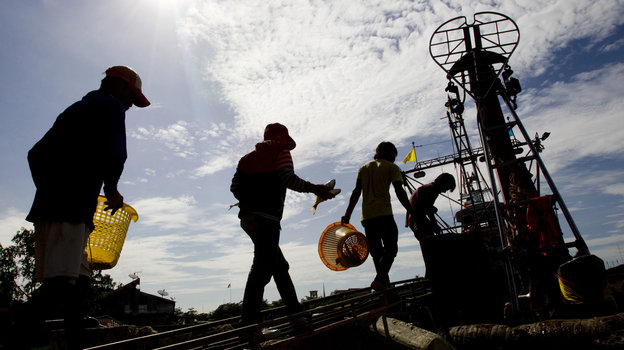
The report says:
"The rapid growth of the Thai fishing sector over the past decades has come to an end, with higher fuel costs and a significant decrease in the Catch Per Unit of Effort (CPUE) due to overfishing. This has led to dramatic changes in the structure of employment and working conditions within the sector. Fewer people, both Thai and migrants, are willing to work on board because of the working conditions and as such, unscrupulous brokers and employers will often provide misleading information, withhold payment, threaten violence and use other means to recruit and employ fishers. It can therefore be said that this labor shortage — estimated to be as high as 50,000 workers — is both a cause and an effect of the abusive labor practices that are seen in the fishing sector."
But it does note that "a significant proportion of the sample did not appear to be in an exploitative situation."
Still, the report increases pressure on the Thai government to better regulate the $7 billion fishing industry.
For four years in a row, the State Department put Thailand on its tier 2 watch list, the second-worst position, for failing to increase efforts to address human trafficking. But earlier this year, it was granted a waiver from an otherwise-required downgrade because "the government has a written plan that, if implemented, would constitute making significant efforts to meet the minimum standards for the elimination of trafficking and is devoting sufficient resources to implement that plan."
The State Department's annual report cited Thailand's fishing industry, noting in June that "a significant portion of labor trafficking victims within Thailand are exploited in commercial fishing [and] fishing-related industries.
At the time, Luis CdeBaca, the U.S. ambassador in the Office to Monitor and Combat Trafficking in Persons, told NPR's Michele Kelemen in June that he wanted the report to hit home:
"This year's report looks at things like the fishing industry — and actually raises a question that I think all of us should be asking, which is: How much of my life is impacting modern-day slavery? Do I know where the shrimp is being caught or processed that is on my plate? ... And instead of it being somebody else's problem, how can I make it my problem? How can I actually do something about it?"
Similar problems also exist in shrimp farms and processing plants in the country, as NPR's Eliza Barclay noted in The Salt.
Copyright 2013 NPR.