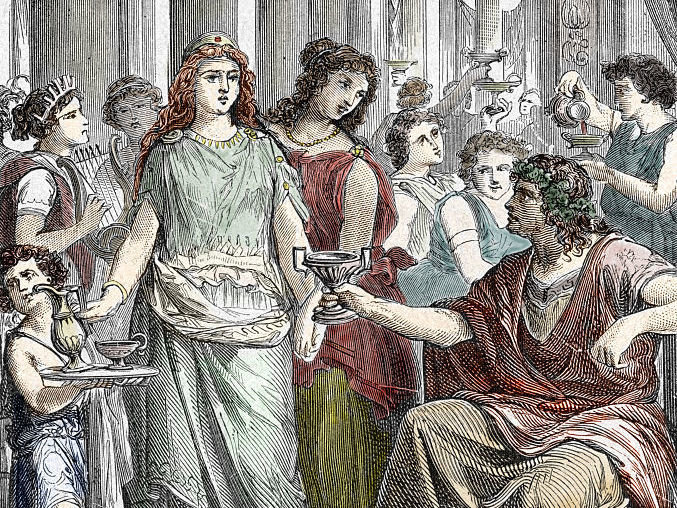
With wine, older usually means better. Vintage, our word for "classily aged," comes from the winemaking process. Wines from decades ago fetch far higher prices than freshly-made ones. Wine itself is woven throughout ancient history, from ancient Judeo-Christian rites (hello, Last Supper!) to Egyptian ceremonies to Roman orgies. And the grape varieties we like tend to have auspicious and lengthy pasts: for instance, Chardonnay grapes from the Champagne region have been made into white wine since the Middle Ages.
But until now, nobody knew just how ancient the wines we've been drinking are. According to a new study in Nature Plants published Monday, many of the most popular wine varieties sold today are extremely genetically similar to the wines that Ancient Romans drank — and may have existed for thousands of years longer.
To determine the genetic lineages of the wines they studied, researchers collected 28 grape seeds from nine ancient sites in France, some sites dating back 2,500 years. They then analyzed the grapes' genes and compared them to modern varietals — something that hasn't been done before, and required a monumental cross-disciplinary effort by ancient DNA researchers, archaeologists and modern grape geneticists.
Of the 28 ancient seeds the researchers tested, all were genetically related to grapes grown today. Sixteen of the 28 were within one or two generations of modern varieties. And in at least once case, the researchers found that consumers are drinking wine from the same grapes as Medieval Frenchmen from 900 years ago: the rare savagnin blanc (not to be confused with sauvignon), a light, floral white varietal with rigorous growing standards and a small range of cultivation in eastern France.
In other cases, we are drinking almost the exact same wine as Roman emperors—our pinot noir and syrah grapes are "siblings" of the Roman varieties.
The researchers' findings demonstrate just how enduring wine consumers' tastes can be, and how careful winemakers have been in preserving popular and enduring varietals, according to Nathan Wales, a study co-author and lecturer at the University of York specializing in paleogenomics (the study of ancient DNA).
"When we imagined people 1,000 years ago drinking wine ... the question was ... how different was the stuff in that bottle? Now we've got the answer," says Wales. "It's incredibly likely that someone 1,000 years ago was drinking something that's pretty much genetically identical to what we drink today."
But wait. Living things evolve, right? Not domesticated wine grapes — we've hijacked natural selection to serve our own tastes for thousands of years. It works like this: Instead of letting grapes pollinate each other and go through sexual reproduction, most winemakers essentially clone their plants through a process called "vegetative propagation." This can either involve inserting dormant buds into existing roots, or taking a vine shoot from a mother plant and planting it directly in the earth. The new vine remains genetically identical to its "parent," with all the ineffable qualities that make it produce merlots and pinot grigios.
Zoë Migicovsky, a postdoctoral researcher at Dalhousie University in Canada specializing in apple and grape genetics who was not involved in the study, calls the research "fascinating."
"[These grapevines have] been around for hundreds and hundreds of years, but everything around [them] has continued to change," she says.
But, she says, the research also reveals a deep vulnerability in wine cultivation — our own obsession with pedigree and timelessness.
As the environment changes around these wine varietals, they remain the same — genetically frozen in the past. This renders them susceptible to ever-evolving pests, pathogens and extreme weather. "If these varietals are genetically identical all over the world ... it means they're all susceptible to the same pests and diseases as well," Migicovsky says. "We [will] need to use more chemicals and sprays in growing [them]" as threats advance.
A big part of Migicovsky's research involves the resilience of wine — how to breed sturdier grapes, ones that can withstand the environmental changes we're going through now as a result of climate change. Warming temperatures may increase the strength of certain pests and pathogens. And extreme weather events will hit the wine industry hard, she says. For instance, just recently in her home province in Nova Scotia, Canada, a frost "devastated" the wine industry. "We're going to see more and more of that now," she says.
But this doesn't mean all wines are doomed. "There is a lot of diversity in grapevines," Migicovsky says. "We can breed varieties that are more tolerant and resistant for our current environment." It's mostly a brand name thing: The same forces that have kept pinots nearly identical for 2,000 years are making winemakers vulnerable, clinging to ancient lineages like old aristocrats. Tastes can change and evolve, and new grapes could display a magnificent array of tastes and textures to rival the ones we have now, Migicovsky believes. To keep the wine industry alive, she says it may be up to winemakers and consumers to let go of the savagnins, the pinots, the merlots — and embrace a hardier set of grapes that will survive to titillate and inebriate future generations.
Copyright 2019 NPR. To see more, visit NPR.org.