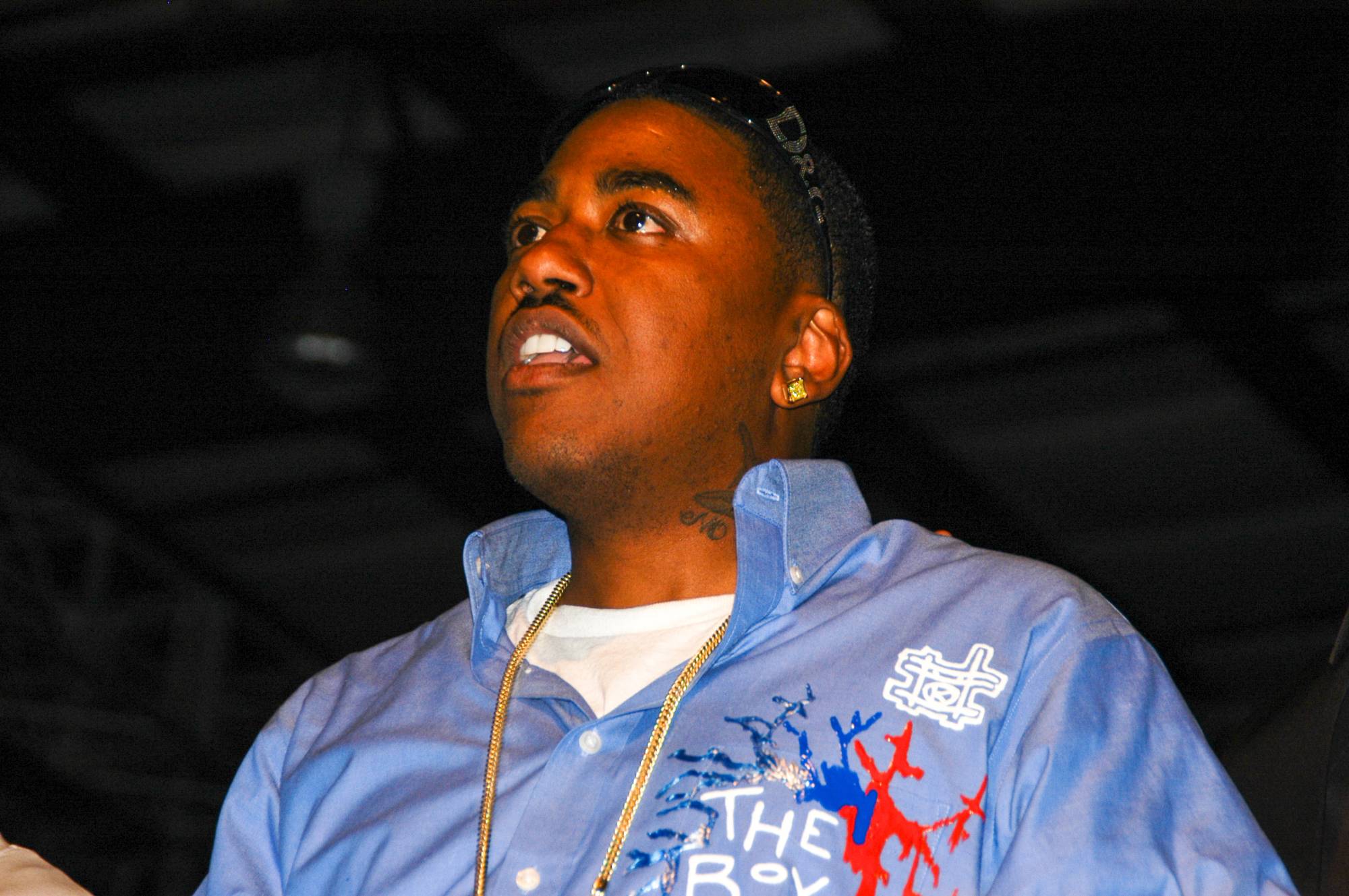
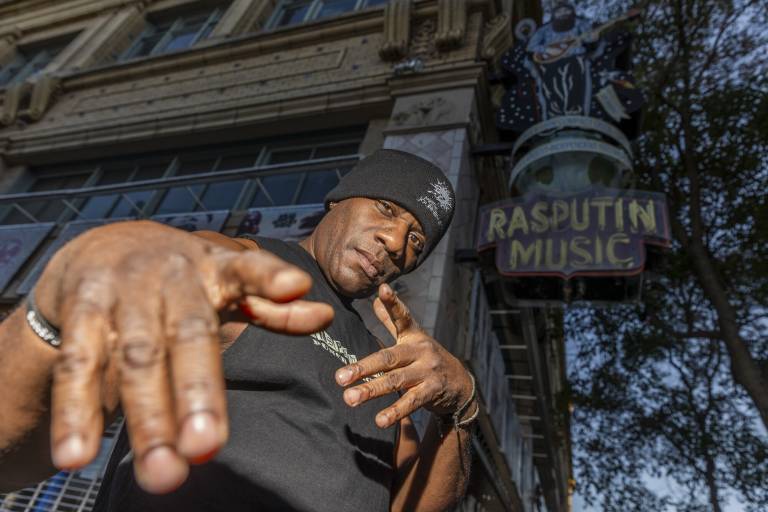
Unsigned and Hella Broke: The East Bay’s Dirt-Hustling 1990s Hip-Hop Subculture
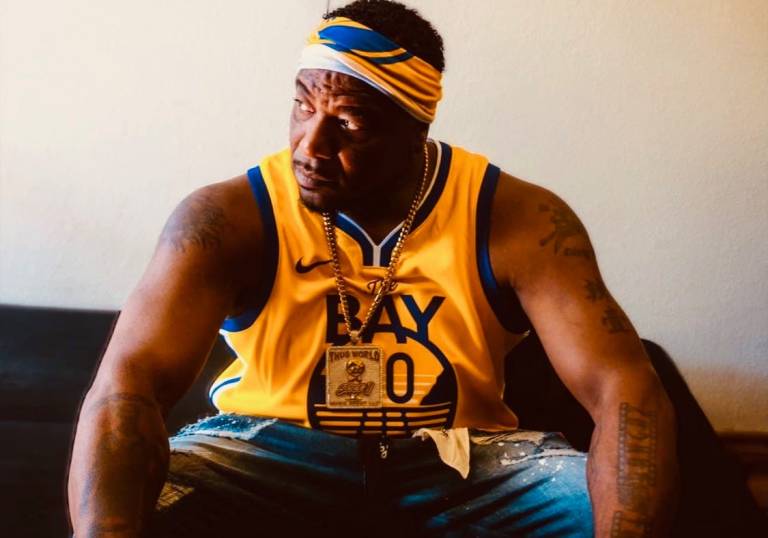
Spice 1 Talks Growing Up in Hayward, Running From Cops and Breakin’ at the Mall
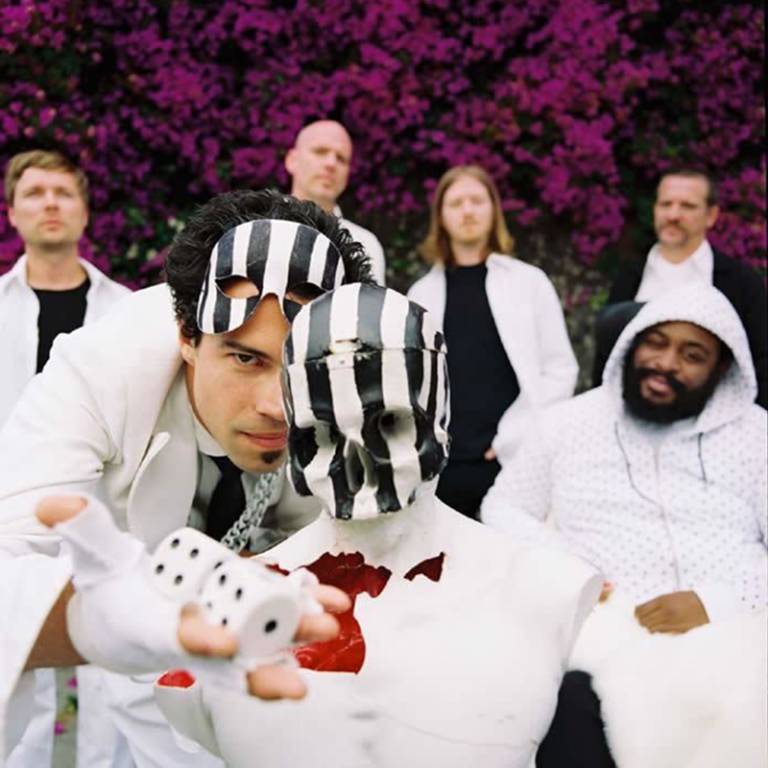
Remembering Anticon and Hip-Hop’s Reckoning With Weirdness
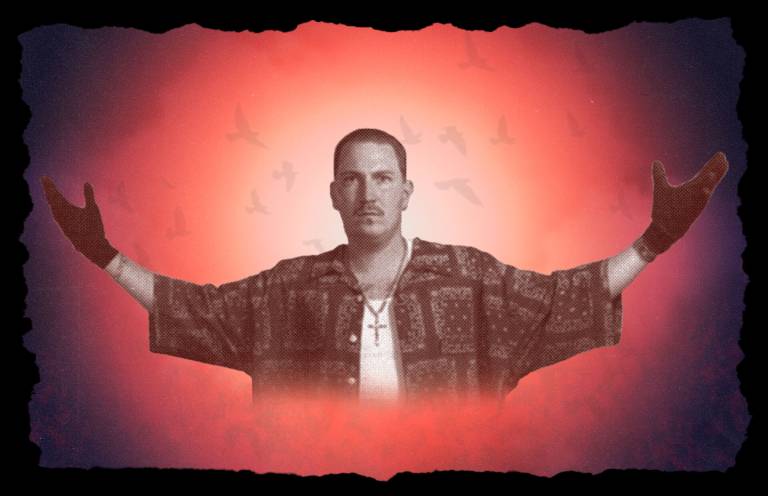
What Woodie’s Brutally Honest Rap Meant for Antioch
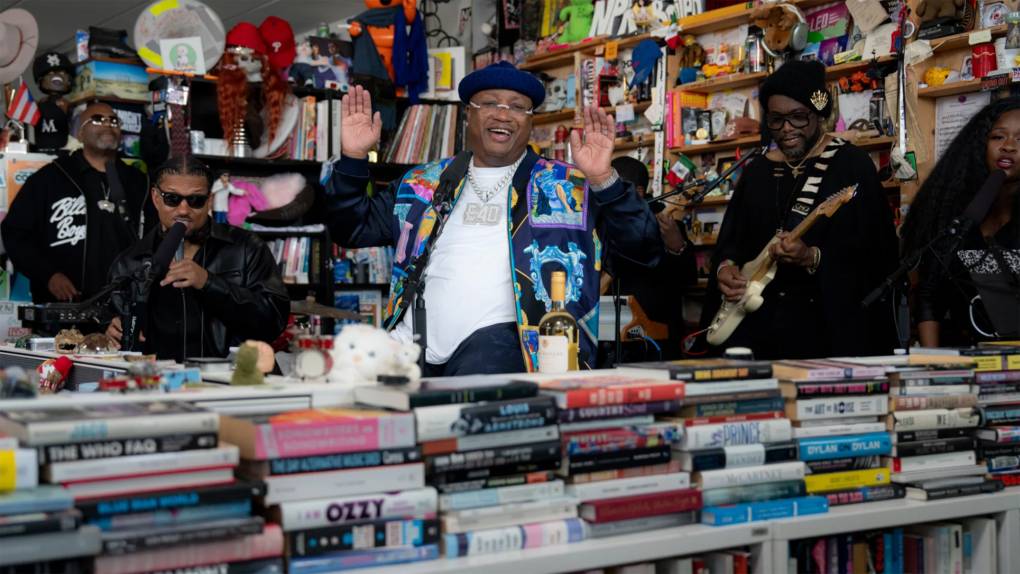
E-40’s Tiny Desk Concert Is Here
After 100 Episodes, ‘History of the Bay’ Expands Its Horizons
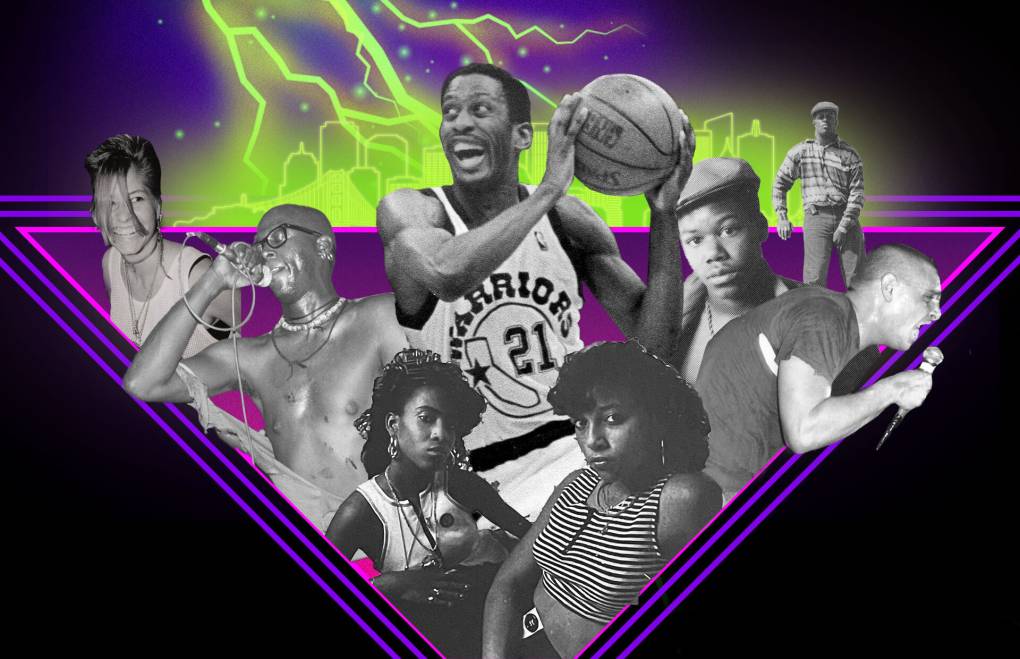
The Real-Life Tales Behind ‘Freaky Tales’
With Casual’s ‘Starduster,’ a Rap Legend Reaches New Heights
Sponsored
Player sponsored by
window.__IS_SSR__=true
window.__INITIAL_STATE__={
"attachmentsReducer": {
"audio_0": {
"type": "attachments",
"id": "audio_0",
"imgSizes": {
"kqedFullSize": {
"file": "https://ww2.kqed.org/news/wp-content/themes/KQED-unified/img/audio_bgs/background0.jpg"
}
}
},
"audio_1": {
"type": "attachments",
"id": "audio_1",
"imgSizes": {
"kqedFullSize": {
"file": "https://ww2.kqed.org/news/wp-content/themes/KQED-unified/img/audio_bgs/background1.jpg"
}
}
},
"audio_2": {
"type": "attachments",
"id": "audio_2",
"imgSizes": {
"kqedFullSize": {
"file": "https://ww2.kqed.org/news/wp-content/themes/KQED-unified/img/audio_bgs/background2.jpg"
}
}
},
"audio_3": {
"type": "attachments",
"id": "audio_3",
"imgSizes": {
"kqedFullSize": {
"file": "https://ww2.kqed.org/news/wp-content/themes/KQED-unified/img/audio_bgs/background3.jpg"
}
}
},
"audio_4": {
"type": "attachments",
"id": "audio_4",
"imgSizes": {
"kqedFullSize": {
"file": "https://ww2.kqed.org/news/wp-content/themes/KQED-unified/img/audio_bgs/background4.jpg"
}
}
},
"placeholder": {
"type": "attachments",
"id": "placeholder",
"imgSizes": {
"thumbnail": {
"file": "https://cdn.kqed.org/wp-content/uploads/2024/12/KQED-Default-Image-816638274-2000x1333-1-160x107.jpg",
"width": 160,
"height": 107,
"mimeType": "image/jpeg"
},
"medium": {
"file": "https://cdn.kqed.org/wp-content/uploads/2024/12/KQED-Default-Image-816638274-2000x1333-1-800x533.jpg",
"width": 800,
"height": 533,
"mimeType": "image/jpeg"
},
"medium_large": {
"file": "https://cdn.kqed.org/wp-content/uploads/2024/12/KQED-Default-Image-816638274-2000x1333-1-768x512.jpg",
"width": 768,
"height": 512,
"mimeType": "image/jpeg"
},
"large": {
"file": "https://cdn.kqed.org/wp-content/uploads/2024/12/KQED-Default-Image-816638274-2000x1333-1-1020x680.jpg",
"width": 1020,
"height": 680,
"mimeType": "image/jpeg"
},
"1536x1536": {
"file": "https://cdn.kqed.org/wp-content/uploads/2024/12/KQED-Default-Image-816638274-2000x1333-1-1536x1024.jpg",
"width": 1536,
"height": 1024,
"mimeType": "image/jpeg"
},
"fd-lrg": {
"file": "https://cdn.kqed.org/wp-content/uploads/2024/12/KQED-Default-Image-816638274-2000x1333-1-1536x1024.jpg",
"width": 1536,
"height": 1024,
"mimeType": "image/jpeg"
},
"fd-med": {
"file": "https://cdn.kqed.org/wp-content/uploads/2024/12/KQED-Default-Image-816638274-2000x1333-1-1020x680.jpg",
"width": 1020,
"height": 680,
"mimeType": "image/jpeg"
},
"fd-sm": {
"file": "https://cdn.kqed.org/wp-content/uploads/2024/12/KQED-Default-Image-816638274-2000x1333-1-800x533.jpg",
"width": 800,
"height": 533,
"mimeType": "image/jpeg"
},
"post-thumbnail": {
"file": "https://cdn.kqed.org/wp-content/uploads/2024/12/KQED-Default-Image-816638274-2000x1333-1-672x372.jpg",
"width": 672,
"height": 372,
"mimeType": "image/jpeg"
},
"twentyfourteen-full-width": {
"file": "https://cdn.kqed.org/wp-content/uploads/2024/12/KQED-Default-Image-816638274-2000x1333-1-1038x576.jpg",
"width": 1038,
"height": 576,
"mimeType": "image/jpeg"
},
"xxsmall": {
"file": "https://cdn.kqed.org/wp-content/uploads/2024/12/KQED-Default-Image-816638274-2000x1333-1-160x107.jpg",
"width": 160,
"height": 107,
"mimeType": "image/jpeg"
},
"xsmall": {
"file": "https://cdn.kqed.org/wp-content/uploads/2024/12/KQED-Default-Image-816638274-2000x1333-1-672x372.jpg",
"width": 672,
"height": 372,
"mimeType": "image/jpeg"
},
"small": {
"file": "https://cdn.kqed.org/wp-content/uploads/2024/12/KQED-Default-Image-816638274-2000x1333-1-672x372.jpg",
"width": 672,
"height": 372,
"mimeType": "image/jpeg"
},
"xlarge": {
"file": "https://cdn.kqed.org/wp-content/uploads/2024/12/KQED-Default-Image-816638274-2000x1333-1-1020x680.jpg",
"width": 1020,
"height": 680,
"mimeType": "image/jpeg"
},
"full-width": {
"file": "https://cdn.kqed.org/wp-content/uploads/2024/12/KQED-Default-Image-816638274-2000x1333-1-1920x1280.jpg",
"width": 1920,
"height": 1280,
"mimeType": "image/jpeg"
},
"guest-author-32": {
"file": "https://cdn.kqed.org/wp-content/uploads/2025/01/KQED-Default-Image-816638274-1333x1333-1-160x160.jpg",
"width": 32,
"height": 32,
"mimeType": "image/jpeg"
},
"guest-author-50": {
"file": "https://cdn.kqed.org/wp-content/uploads/2025/01/KQED-Default-Image-816638274-1333x1333-1-160x160.jpg",
"width": 50,
"height": 50,
"mimeType": "image/jpeg"
},
"guest-author-64": {
"file": "https://cdn.kqed.org/wp-content/uploads/2025/01/KQED-Default-Image-816638274-1333x1333-1-160x160.jpg",
"width": 64,
"height": 64,
"mimeType": "image/jpeg"
},
"guest-author-96": {
"file": "https://cdn.kqed.org/wp-content/uploads/2025/01/KQED-Default-Image-816638274-1333x1333-1-160x160.jpg",
"width": 96,
"height": 96,
"mimeType": "image/jpeg"
},
"guest-author-128": {
"file": "https://cdn.kqed.org/wp-content/uploads/2025/01/KQED-Default-Image-816638274-1333x1333-1-160x160.jpg",
"width": 128,
"height": 128,
"mimeType": "image/jpeg"
},
"detail": {
"file": "https://cdn.kqed.org/wp-content/uploads/2025/01/KQED-Default-Image-816638274-1333x1333-1-160x160.jpg",
"width": 160,
"height": 160,
"mimeType": "image/jpeg"
},
"kqedFullSize": {
"file": "https://cdn.kqed.org/wp-content/uploads/2024/12/KQED-Default-Image-816638274-2000x1333-1.jpg",
"width": 2000,
"height": 1333
}
}
},
"arts_13984635": {
"type": "attachments",
"id": "arts_13984635",
"meta": {
"index": "attachments_1716263798",
"site": "arts",
"id": "13984635",
"found": true
},
"title": "GettyImages-2156279452",
"publishDate": 1765236195,
"status": "inherit",
"parent": 0,
"modified": 1765304687,
"caption": "San Francisco rapper Messy Marv, pictured here at the B.A.R.S. (Bay Area Rap Scene) Awards in Oakland, California on Dec. 2, 2006. ",
"credit": "Julia Beverly/Getty Images",
"altTag": "A twentysomething Black man in a light blue collared shirt, gold chain and sunglasses on top of his head looks upward and to the left",
"description": null,
"imgSizes": {
"medium": {
"file": "https://cdn.kqed.org/wp-content/uploads/sites/2/2025/12/GettyImages-2156279452-2000x1329.jpg",
"width": 2000,
"height": 1329,
"mimeType": "image/jpeg"
},
"large": {
"file": "https://cdn.kqed.org/wp-content/uploads/sites/2/2025/12/GettyImages-2156279452-2000x1329.jpg",
"width": 2000,
"height": 1329,
"mimeType": "image/jpeg"
},
"thumbnail": {
"file": "https://cdn.kqed.org/wp-content/uploads/sites/2/2025/12/GettyImages-2156279452-160x106.jpg",
"width": 160,
"height": 106,
"mimeType": "image/jpeg"
},
"medium_large": {
"file": "https://cdn.kqed.org/wp-content/uploads/sites/2/2025/12/GettyImages-2156279452-768x510.jpg",
"width": 768,
"height": 510,
"mimeType": "image/jpeg"
},
"1536x1536": {
"file": "https://cdn.kqed.org/wp-content/uploads/sites/2/2025/12/GettyImages-2156279452-1536x1020.jpg",
"width": 1536,
"height": 1020,
"mimeType": "image/jpeg"
},
"2048x2048": {
"file": "https://cdn.kqed.org/wp-content/uploads/sites/2/2025/12/GettyImages-2156279452-2048x1360.jpg",
"width": 2048,
"height": 1360,
"mimeType": "image/jpeg"
},
"post-thumbnail": {
"file": "https://cdn.kqed.org/wp-content/uploads/sites/2/2025/12/GettyImages-2156279452-672x372.jpg",
"width": 672,
"height": 372,
"mimeType": "image/jpeg"
},
"twentyfourteen-full-width": {
"file": "https://cdn.kqed.org/wp-content/uploads/sites/2/2025/12/GettyImages-2156279452-1038x576.jpg",
"width": 1038,
"height": 576,
"mimeType": "image/jpeg"
},
"full-width": {
"file": "https://cdn.kqed.org/wp-content/uploads/sites/2/2025/12/GettyImages-2156279452-2000x1329.jpg",
"width": 2000,
"height": 1329,
"mimeType": "image/jpeg"
},
"npr-cds-wide": {
"file": "https://cdn.kqed.org/wp-content/uploads/sites/2/2025/12/GettyImages-2156279452-1200x675.jpg",
"width": 1200,
"height": 675,
"mimeType": "image/jpeg"
},
"kqedFullSize": {
"file": "https://cdn.kqed.org/wp-content/uploads/sites/2/2025/12/GettyImages-2156279452.jpg",
"width": 2240,
"height": 1488
}
},
"fetchFailed": false,
"isLoading": false
},
"arts_13984166": {
"type": "attachments",
"id": "arts_13984166",
"meta": {
"index": "attachments_1716263798",
"site": "arts",
"id": "13984166",
"found": true
},
"title": "251125-sunspotjonz00136_TV_qed",
"publishDate": 1764194908,
"status": "inherit",
"parent": 0,
"modified": 1764736694,
"caption": "Sunspot Jonz poses for a portrait outside of Rasputin Music on Telegraph Avenue, where he once sold his own cassette tapes during the 1990s ‘Unsigned and Hella Broke’ era of underground hip-hop, in Berkeley on Nov. 25, 2025. ",
"credit": "Tâm Vũ/KQED",
"altTag": null,
"description": null,
"imgSizes": {
"thumbnail": {
"file": "https://cdn.kqed.org/wp-content/uploads/sites/2/2025/11/251125-sunspotjonz00136_TV_qed-160x107.jpg",
"width": 160,
"height": 107,
"mimeType": "image/jpeg"
},
"medium_large": {
"file": "https://cdn.kqed.org/wp-content/uploads/sites/2/2025/11/251125-sunspotjonz00136_TV_qed-768x512.jpg",
"width": 768,
"height": 512,
"mimeType": "image/jpeg"
},
"1536x1536": {
"file": "https://cdn.kqed.org/wp-content/uploads/sites/2/2025/11/251125-sunspotjonz00136_TV_qed-1536x1024.jpg",
"width": 1536,
"height": 1024,
"mimeType": "image/jpeg"
},
"post-thumbnail": {
"file": "https://cdn.kqed.org/wp-content/uploads/sites/2/2025/11/251125-sunspotjonz00136_TV_qed-672x372.jpg",
"width": 672,
"height": 372,
"mimeType": "image/jpeg"
},
"twentyfourteen-full-width": {
"file": "https://cdn.kqed.org/wp-content/uploads/sites/2/2025/11/251125-sunspotjonz00136_TV_qed-1038x576.jpg",
"width": 1038,
"height": 576,
"mimeType": "image/jpeg"
},
"npr-cds-wide": {
"file": "https://cdn.kqed.org/wp-content/uploads/sites/2/2025/11/251125-sunspotjonz00136_TV_qed-1200x675.jpg",
"width": 1200,
"height": 675,
"mimeType": "image/jpeg"
},
"kqedFullSize": {
"file": "https://cdn.kqed.org/wp-content/uploads/sites/2/2025/11/251125-sunspotjonz00136_TV_qed.jpg",
"width": 2000,
"height": 1333
}
},
"fetchFailed": false,
"isLoading": false
},
"arts_13983518": {
"type": "attachments",
"id": "arts_13983518",
"meta": {
"index": "attachments_1716263798",
"site": "arts",
"id": "13983518",
"found": true
},
"title": "92d49c34-0344-46cb-a383-f5ce35f4acce_1125x788",
"publishDate": 1762469002,
"status": "inherit",
"parent": 13983488,
"modified": 1762469294,
"caption": "Spice 1 came up during the 1980s in Oakland and Hayward, and has released more than 20 albums since. ",
"credit": "Courtesy Spice 1",
"altTag": "A Black man in a yellow printed tank top and headband sits looking off to the left",
"description": null,
"imgSizes": {
"thumbnail": {
"file": "https://cdn.kqed.org/wp-content/uploads/sites/2/2025/11/92d49c34-0344-46cb-a383-f5ce35f4acce_1125x788-160x112.jpg",
"width": 160,
"height": 112,
"mimeType": "image/jpeg"
},
"medium_large": {
"file": "https://cdn.kqed.org/wp-content/uploads/sites/2/2025/11/92d49c34-0344-46cb-a383-f5ce35f4acce_1125x788-768x538.jpg",
"width": 768,
"height": 538,
"mimeType": "image/jpeg"
},
"post-thumbnail": {
"file": "https://cdn.kqed.org/wp-content/uploads/sites/2/2025/11/92d49c34-0344-46cb-a383-f5ce35f4acce_1125x788-672x372.jpg",
"width": 672,
"height": 372,
"mimeType": "image/jpeg"
},
"twentyfourteen-full-width": {
"file": "https://cdn.kqed.org/wp-content/uploads/sites/2/2025/11/92d49c34-0344-46cb-a383-f5ce35f4acce_1125x788-1038x576.jpg",
"width": 1038,
"height": 576,
"mimeType": "image/jpeg"
},
"npr-cds-wide": {
"file": "https://cdn.kqed.org/wp-content/uploads/sites/2/2025/11/92d49c34-0344-46cb-a383-f5ce35f4acce_1125x788-1125x675.jpg",
"width": 1125,
"height": 675,
"mimeType": "image/jpeg"
},
"kqedFullSize": {
"file": "https://cdn.kqed.org/wp-content/uploads/sites/2/2025/11/92d49c34-0344-46cb-a383-f5ce35f4acce_1125x788.jpg",
"width": 1125,
"height": 788
}
},
"fetchFailed": false,
"isLoading": false
},
"arts_13979402": {
"type": "attachments",
"id": "arts_13979402",
"meta": {
"index": "attachments_1716263798",
"site": "arts",
"id": "13979402",
"found": true
},
"title": "Anticon.Lead",
"publishDate": 1753989530,
"status": "inherit",
"parent": 13979349,
"modified": 1753996067,
"caption": "The dizzying Bay Area hip-hop collective Anticon forced listeners in the Y2K era to hear differently, even within a burgeoning ‘indie rap’ scene. Its many artists and groups included Subtle, pictured, with Doseone and Dax Pierson at front. ",
"credit": "Courtesy Doseone",
"altTag": null,
"description": null,
"imgSizes": {
"thumbnail": {
"file": "https://cdn.kqed.org/wp-content/uploads/sites/2/2025/07/Anticon.Lead_-160x160.jpg",
"width": 160,
"height": 160,
"mimeType": "image/jpeg"
},
"medium_large": {
"file": "https://cdn.kqed.org/wp-content/uploads/sites/2/2025/07/Anticon.Lead_-768x768.jpg",
"width": 768,
"height": 768,
"mimeType": "image/jpeg"
},
"post-thumbnail": {
"file": "https://cdn.kqed.org/wp-content/uploads/sites/2/2025/07/Anticon.Lead_-672x372.jpg",
"width": 672,
"height": 372,
"mimeType": "image/jpeg"
},
"twentyfourteen-full-width": {
"file": "https://cdn.kqed.org/wp-content/uploads/sites/2/2025/07/Anticon.Lead_-800x576.jpg",
"width": 800,
"height": 576,
"mimeType": "image/jpeg"
},
"kqedFullSize": {
"file": "https://cdn.kqed.org/wp-content/uploads/sites/2/2025/07/Anticon.Lead_.jpg",
"width": 800,
"height": 800
}
},
"fetchFailed": false,
"isLoading": false
},
"arts_13978690": {
"type": "attachments",
"id": "arts_13978690",
"meta": {
"index": "attachments_1716263798",
"site": "arts",
"id": "13978690",
"found": true
},
"title": "Woodie-Graphic1_2",
"publishDate": 1752436280,
"status": "inherit",
"parent": 13978683,
"modified": 1752436707,
"caption": "Despite a troubled past and Latino gang ties, Woodie forged Antioch’s hip-hop identity as a white rapper and built a platform for local talent.",
"credit": "East Co. Co. Records / Design by Darren Tu",
"altTag": "Against a red background, a young man with short hair in a white T-shirt beneath a patterned collared shirt holds his arms up and to each side, looking into the camera.",
"description": null,
"imgSizes": {
"thumbnail": {
"file": "https://cdn.kqed.org/wp-content/uploads/sites/2/2025/07/Woodie-Graphic1_2-160x103.jpg",
"width": 160,
"height": 103,
"mimeType": "image/jpeg"
},
"medium_large": {
"file": "https://cdn.kqed.org/wp-content/uploads/sites/2/2025/07/Woodie-Graphic1_2-768x496.jpg",
"width": 768,
"height": 496,
"mimeType": "image/jpeg"
},
"1536x1536": {
"file": "https://cdn.kqed.org/wp-content/uploads/sites/2/2025/07/Woodie-Graphic1_2-1536x992.jpg",
"width": 1536,
"height": 992,
"mimeType": "image/jpeg"
},
"post-thumbnail": {
"file": "https://cdn.kqed.org/wp-content/uploads/sites/2/2025/07/Woodie-Graphic1_2-672x372.jpg",
"width": 672,
"height": 372,
"mimeType": "image/jpeg"
},
"twentyfourteen-full-width": {
"file": "https://cdn.kqed.org/wp-content/uploads/sites/2/2025/07/Woodie-Graphic1_2-1038x576.jpg",
"width": 1038,
"height": 576,
"mimeType": "image/jpeg"
},
"kqedFullSize": {
"file": "https://cdn.kqed.org/wp-content/uploads/sites/2/2025/07/Woodie-Graphic1_2.jpg",
"width": 1920,
"height": 1240
}
},
"fetchFailed": false,
"isLoading": false
},
"arts_13976929": {
"type": "attachments",
"id": "arts_13976929",
"meta": {
"index": "attachments_1716263798",
"site": "arts",
"id": "13976929",
"found": true
},
"title": "E40.TinyDesk",
"publishDate": 1748875017,
"status": "inherit",
"parent": 13976928,
"modified": 1748875104,
"caption": "E-40 performs at NPR's Tiny Desk in Washington, D.C.",
"credit": "Zayrha Rodriguez",
"altTag": "A Black man in glasses and a roll-up beanie smiles and gestures in front of a cluttered bookshelf",
"description": null,
"imgSizes": {
"medium": {
"file": "https://cdn.kqed.org/wp-content/uploads/sites/2/2025/06/E40.TinyDesk-800x450.jpg",
"width": 800,
"height": 450,
"mimeType": "image/jpeg"
},
"large": {
"file": "https://cdn.kqed.org/wp-content/uploads/sites/2/2025/06/E40.TinyDesk-1020x574.jpg",
"width": 1020,
"height": 574,
"mimeType": "image/jpeg"
},
"thumbnail": {
"file": "https://cdn.kqed.org/wp-content/uploads/sites/2/2025/06/E40.TinyDesk-160x90.jpg",
"width": 160,
"height": 90,
"mimeType": "image/jpeg"
},
"medium_large": {
"file": "https://cdn.kqed.org/wp-content/uploads/sites/2/2025/06/E40.TinyDesk-768x432.jpg",
"width": 768,
"height": 432,
"mimeType": "image/jpeg"
},
"1536x1536": {
"file": "https://cdn.kqed.org/wp-content/uploads/sites/2/2025/06/E40.TinyDesk-1536x864.jpg",
"width": 1536,
"height": 864,
"mimeType": "image/jpeg"
},
"post-thumbnail": {
"file": "https://cdn.kqed.org/wp-content/uploads/sites/2/2025/06/E40.TinyDesk-672x372.jpg",
"width": 672,
"height": 372,
"mimeType": "image/jpeg"
},
"twentyfourteen-full-width": {
"file": "https://cdn.kqed.org/wp-content/uploads/sites/2/2025/06/E40.TinyDesk-1038x576.jpg",
"width": 1038,
"height": 576,
"mimeType": "image/jpeg"
},
"full-width": {
"file": "https://cdn.kqed.org/wp-content/uploads/sites/2/2025/06/E40.TinyDesk-1920x1080.jpg",
"width": 1920,
"height": 1080,
"mimeType": "image/jpeg"
},
"kqedFullSize": {
"file": "https://cdn.kqed.org/wp-content/uploads/sites/2/2025/06/E40.TinyDesk.jpg",
"width": 2000,
"height": 1125
}
},
"fetchFailed": false,
"isLoading": false
},
"arts_13975005": {
"type": "attachments",
"id": "arts_13975005",
"meta": {
"index": "attachments_1716263798",
"site": "arts",
"id": "13975005",
"found": true
},
"title": "Screenshot-2025-04-21-at-4.07.56 PM",
"publishDate": 1745277211,
"status": "inherit",
"parent": 13974977,
"modified": 1745277264,
"caption": "‘History of the Bay’ host Dregs One interviews Bay Area rap icon Too Short for the podcast's 100th episode. ",
"credit": "History of the Bay/EMPIRE",
"altTag": null,
"description": null,
"imgSizes": {
"medium": {
"file": "https://cdn.kqed.org/wp-content/uploads/sites/2/2025/04/Screenshot-2025-04-21-at-4.07.56 PM-800x450.jpg",
"width": 800,
"height": 450,
"mimeType": "image/jpeg"
},
"large": {
"file": "https://cdn.kqed.org/wp-content/uploads/sites/2/2025/04/Screenshot-2025-04-21-at-4.07.56 PM-1020x574.jpg",
"width": 1020,
"height": 574,
"mimeType": "image/jpeg"
},
"thumbnail": {
"file": "https://cdn.kqed.org/wp-content/uploads/sites/2/2025/04/Screenshot-2025-04-21-at-4.07.56 PM-160x90.jpg",
"width": 160,
"height": 90,
"mimeType": "image/jpeg"
},
"medium_large": {
"file": "https://cdn.kqed.org/wp-content/uploads/sites/2/2025/04/Screenshot-2025-04-21-at-4.07.56 PM-768x432.jpg",
"width": 768,
"height": 432,
"mimeType": "image/jpeg"
},
"1536x1536": {
"file": "https://cdn.kqed.org/wp-content/uploads/sites/2/2025/04/Screenshot-2025-04-21-at-4.07.56 PM-1536x864.jpg",
"width": 1536,
"height": 864,
"mimeType": "image/jpeg"
},
"post-thumbnail": {
"file": "https://cdn.kqed.org/wp-content/uploads/sites/2/2025/04/Screenshot-2025-04-21-at-4.07.56 PM-672x372.jpg",
"width": 672,
"height": 372,
"mimeType": "image/jpeg"
},
"twentyfourteen-full-width": {
"file": "https://cdn.kqed.org/wp-content/uploads/sites/2/2025/04/Screenshot-2025-04-21-at-4.07.56 PM-1038x576.jpg",
"width": 1038,
"height": 576,
"mimeType": "image/jpeg"
},
"full-width": {
"file": "https://cdn.kqed.org/wp-content/uploads/sites/2/2025/04/Screenshot-2025-04-21-at-4.07.56 PM-1920x1080.jpg",
"width": 1920,
"height": 1080,
"mimeType": "image/jpeg"
},
"kqedFullSize": {
"file": "https://cdn.kqed.org/wp-content/uploads/sites/2/2025/04/Screenshot-2025-04-21-at-4.07.56 PM.jpg",
"width": 2000,
"height": 1125
}
},
"fetchFailed": false,
"isLoading": false
},
"arts_13973912": {
"type": "attachments",
"id": "arts_13973912",
"meta": {
"index": "attachments_1716263798",
"site": "arts",
"id": "13973912",
"found": true
},
"title": "freaky-tales-illustration_3",
"publishDate": 1743541686,
"status": "inherit",
"parent": 13973907,
"modified": 1743544297,
"caption": "The Oakland movie ‘Freaky Tales’ is based on actual events and people from 1987, including (L–R) Kamala Parks, George Stephens, Bailey Brown, ‘Sleepy’ Floyd, Tamra Goins, Too Short, Freddy B and Dave Dictor. ",
"credit": "Murray Bowles/Gary Reyes via Getty Images/Dangerous Music/75 Girls Records/Manic D Press; Illustration by Darren Tu/KQED",
"altTag": "Green lightning strikes from above onto a collage of rappers, punk rockers and basketball players.",
"description": null,
"imgSizes": {
"medium": {
"file": "https://cdn.kqed.org/wp-content/uploads/sites/2/2025/04/freaky-tales-illustration_3-800x517.jpg",
"width": 800,
"height": 517,
"mimeType": "image/jpeg"
},
"large": {
"file": "https://cdn.kqed.org/wp-content/uploads/sites/2/2025/04/freaky-tales-illustration_3-1020x659.jpg",
"width": 1020,
"height": 659,
"mimeType": "image/jpeg"
},
"thumbnail": {
"file": "https://cdn.kqed.org/wp-content/uploads/sites/2/2025/04/freaky-tales-illustration_3-160x103.jpg",
"width": 160,
"height": 103,
"mimeType": "image/jpeg"
},
"medium_large": {
"file": "https://cdn.kqed.org/wp-content/uploads/sites/2/2025/04/freaky-tales-illustration_3-768x496.jpg",
"width": 768,
"height": 496,
"mimeType": "image/jpeg"
},
"1536x1536": {
"file": "https://cdn.kqed.org/wp-content/uploads/sites/2/2025/04/freaky-tales-illustration_3-1536x992.jpg",
"width": 1536,
"height": 992,
"mimeType": "image/jpeg"
},
"post-thumbnail": {
"file": "https://cdn.kqed.org/wp-content/uploads/sites/2/2025/04/freaky-tales-illustration_3-672x372.jpg",
"width": 672,
"height": 372,
"mimeType": "image/jpeg"
},
"twentyfourteen-full-width": {
"file": "https://cdn.kqed.org/wp-content/uploads/sites/2/2025/04/freaky-tales-illustration_3-1038x576.jpg",
"width": 1038,
"height": 576,
"mimeType": "image/jpeg"
},
"kqedFullSize": {
"file": "https://cdn.kqed.org/wp-content/uploads/sites/2/2025/04/freaky-tales-illustration_3.jpg",
"width": 1920,
"height": 1240
}
},
"fetchFailed": false,
"isLoading": false
},
"arts_13970343": {
"type": "attachments",
"id": "arts_13970343",
"meta": {
"index": "attachments_1716263798",
"site": "arts",
"id": "13970343",
"found": true
},
"title": "Casual.Rap",
"publishDate": 1736969535,
"status": "inherit",
"parent": 13970340,
"modified": 1736969564,
"caption": "Casual's new EP shows him in top form. ",
"credit": "Courtesy Needle to the Groove",
"altTag": null,
"description": null,
"imgSizes": {
"medium": {
"file": "https://cdn.kqed.org/wp-content/uploads/sites/2/2025/01/Casual.Rap_-800x450.png",
"width": 800,
"height": 450,
"mimeType": "image/png"
},
"large": {
"file": "https://cdn.kqed.org/wp-content/uploads/sites/2/2025/01/Casual.Rap_-1020x574.png",
"width": 1020,
"height": 574,
"mimeType": "image/png"
},
"thumbnail": {
"file": "https://cdn.kqed.org/wp-content/uploads/sites/2/2025/01/Casual.Rap_-160x90.png",
"width": 160,
"height": 90,
"mimeType": "image/png"
},
"medium_large": {
"file": "https://cdn.kqed.org/wp-content/uploads/sites/2/2025/01/Casual.Rap_-768x432.png",
"width": 768,
"height": 432,
"mimeType": "image/png"
},
"post-thumbnail": {
"file": "https://cdn.kqed.org/wp-content/uploads/sites/2/2025/01/Casual.Rap_-672x372.png",
"width": 672,
"height": 372,
"mimeType": "image/png"
},
"twentyfourteen-full-width": {
"file": "https://cdn.kqed.org/wp-content/uploads/sites/2/2025/01/Casual.Rap_-1038x576.png",
"width": 1038,
"height": 576,
"mimeType": "image/png"
},
"kqedFullSize": {
"file": "https://cdn.kqed.org/wp-content/uploads/sites/2/2025/01/Casual.Rap_.png",
"width": 1488,
"height": 837
}
},
"fetchFailed": false,
"isLoading": false
}
},
"audioPlayerReducer": {
"postId": "stream_live",
"isPaused": true,
"isPlaying": false,
"pfsActive": false,
"pledgeModalIsOpen": true,
"playerDrawerIsOpen": false
},
"authorsReducer": {
"byline_arts_13983488": {
"type": "authors",
"id": "byline_arts_13983488",
"meta": {
"override": true
},
"slug": "byline_arts_13983488",
"name": "Joshua Minsoo Kim",
"isLoading": false
},
"gmeline": {
"type": "authors",
"id": "185",
"meta": {
"index": "authors_1716337520",
"id": "185",
"found": true
},
"name": "Gabe Meline",
"firstName": "Gabe",
"lastName": "Meline",
"slug": "gmeline",
"email": "gmeline@kqed.org",
"display_author_email": false,
"staff_mastheads": [
"arts"
],
"title": "Senior Editor, KQED Arts & Culture",
"bio": "Gabe Meline entered journalism at age 15 making photocopied zines, and has since earned awards from the Edward R. Murrow Awards, the Society for Professional Journalists, the Online Journalism Awards, the Association of Alternative Newsweeklies and the California Newspaper Publishers Association. Prior to KQED, he was the editor of the \u003cem>North Bay Bohemian\u003c/em> and a touring musician. He lives with his wife, his daughter, and a 1964 Volvo in his hometown of Santa Rosa, CA.",
"avatar": "https://secure.gravatar.com/avatar/80e9715844c5fc3f07edac5b08973b76?s=600&d=blank&r=g",
"twitter": null,
"facebook": null,
"instagram": "gmeline",
"linkedin": null,
"sites": [
{
"site": "",
"roles": [
"editor"
]
},
{
"site": "arts",
"roles": [
"administrator"
]
},
{
"site": "artschool",
"roles": [
"editor"
]
},
{
"site": "news",
"roles": [
"author"
]
},
{
"site": "pop",
"roles": [
"editor"
]
},
{
"site": "bayareabites",
"roles": [
"editor"
]
},
{
"site": "food",
"roles": [
"editor"
]
},
{
"site": "liveblog",
"roles": [
"editor"
]
},
{
"site": "hiphop",
"roles": [
"editor"
]
}
],
"headData": {
"title": "Gabe Meline | KQED",
"description": "Senior Editor, KQED Arts & Culture",
"ogImgSrc": "https://secure.gravatar.com/avatar/80e9715844c5fc3f07edac5b08973b76?s=600&d=blank&r=g",
"twImgSrc": "https://secure.gravatar.com/avatar/80e9715844c5fc3f07edac5b08973b76?s=600&d=blank&r=g"
},
"isLoading": false,
"link": "/author/gmeline"
},
"ogpenn": {
"type": "authors",
"id": "11491",
"meta": {
"index": "authors_1716337520",
"id": "11491",
"found": true
},
"name": "Pendarvis Harshaw",
"firstName": "Pendarvis",
"lastName": "Harshaw",
"slug": "ogpenn",
"email": "ogpenn@gmail.com",
"display_author_email": false,
"staff_mastheads": [
"arts"
],
"title": "Community Engagement Reporter",
"bio": "Pendarvis Harshaw is an educator, host and writer with KQED Arts.",
"avatar": "https://secure.gravatar.com/avatar/093d33baff5354890e29ad83d58d2c49?s=600&d=blank&r=g",
"twitter": null,
"facebook": null,
"instagram": "ogpenn",
"linkedin": null,
"sites": [
{
"site": "arts",
"roles": [
"editor"
]
},
{
"site": "news",
"roles": [
"editor"
]
},
{
"site": "bayareabites",
"roles": [
"author"
]
},
{
"site": "hiphop",
"roles": [
"editor"
]
}
],
"headData": {
"title": "Pendarvis Harshaw | KQED",
"description": "Community Engagement Reporter",
"ogImgSrc": "https://secure.gravatar.com/avatar/093d33baff5354890e29ad83d58d2c49?s=600&d=blank&r=g",
"twImgSrc": "https://secure.gravatar.com/avatar/093d33baff5354890e29ad83d58d2c49?s=600&d=blank&r=g"
},
"isLoading": false,
"link": "/author/ogpenn"
},
"achazaro": {
"type": "authors",
"id": "11748",
"meta": {
"index": "authors_1716337520",
"id": "11748",
"found": true
},
"name": "Alan Chazaro",
"firstName": "Alan",
"lastName": "Chazaro",
"slug": "achazaro",
"email": "agchazaro@gmail.com",
"display_author_email": true,
"staff_mastheads": [],
"title": "Food Writer and Reporter",
"bio": "Alan Chazaro is the author of \u003cem>This Is Not a Frank Ocean Cover Album\u003c/em> (Black Lawrence Press, 2019), \u003cem>Piñata Theory\u003c/em> (Black Lawrence Press, 2020), and \u003cem>Notes from the Eastern Span of the Bay Bridge\u003c/em> (Ghost City Press, 2021). He is a graduate of June Jordan’s Poetry for the People program at UC Berkeley and a former Lawrence Ferlinghetti Fellow at the University of San Francisco. He writes about sports, food, art, music, education, and culture while repping the Bay on \u003ca href=\"https://twitter.com/alan_chazaro\">Twitter\u003c/a> and \u003ca href=\"https://www.instagram.com/alan_chazaro/?hl=en\">Instagram\u003c/a> at @alan_chazaro.",
"avatar": "https://secure.gravatar.com/avatar/ea8b6dd970fc5c29e7a188e7d5861df7?s=600&d=blank&r=g",
"twitter": "alan_chazaro",
"facebook": null,
"instagram": null,
"linkedin": null,
"sites": [
{
"site": "arts",
"roles": [
"contributor"
]
},
{
"site": "news",
"roles": [
"editor"
]
}
],
"headData": {
"title": "Alan Chazaro | KQED",
"description": "Food Writer and Reporter",
"ogImgSrc": "https://secure.gravatar.com/avatar/ea8b6dd970fc5c29e7a188e7d5861df7?s=600&d=blank&r=g",
"twImgSrc": "https://secure.gravatar.com/avatar/ea8b6dd970fc5c29e7a188e7d5861df7?s=600&d=blank&r=g"
},
"isLoading": false,
"link": "/author/achazaro"
},
"mreeves": {
"type": "authors",
"id": "11855",
"meta": {
"index": "authors_1716337520",
"id": "11855",
"found": true
},
"name": "Mosi Reeves",
"firstName": "Mosi",
"lastName": "Reeves",
"slug": "mreeves",
"email": "infamous30@gmail.com",
"display_author_email": false,
"staff_mastheads": [],
"title": "KQED Contributor",
"bio": "Mosi Reeves is a journalist and cultural critic based in Oakland, California. In addition to KQED, his work has appeared in \u003cem>Rolling Stone\u003c/em>, \u003cem>The Wire\u003c/em>, Pitchfork, \u003cem>Billboard\u003c/em>, and Grammy.com.",
"avatar": "https://secure.gravatar.com/avatar/6f376003ca1cf7a873edc107f5f331f1?s=600&d=blank&r=g",
"twitter": null,
"facebook": null,
"instagram": null,
"linkedin": null,
"sites": [
{
"site": "arts",
"roles": [
"contributor"
]
},
{
"site": "pop",
"roles": [
"contributor"
]
}
],
"headData": {
"title": "Mosi Reeves | KQED",
"description": "KQED Contributor",
"ogImgSrc": "https://secure.gravatar.com/avatar/6f376003ca1cf7a873edc107f5f331f1?s=600&d=blank&r=g",
"twImgSrc": "https://secure.gravatar.com/avatar/6f376003ca1cf7a873edc107f5f331f1?s=600&d=blank&r=g"
},
"isLoading": false,
"link": "/author/mreeves"
}
},
"breakingNewsReducer": {},
"pagesReducer": {},
"postsReducer": {
"stream_live": {
"type": "live",
"id": "stream_live",
"audioUrl": "https://streams.kqed.org/kqedradio",
"title": "Live Stream",
"excerpt": "Live Stream information currently unavailable.",
"link": "/radio",
"featImg": "",
"label": {
"name": "KQED Live",
"link": "/"
}
},
"stream_kqedNewscast": {
"type": "posts",
"id": "stream_kqedNewscast",
"audioUrl": "https://www.kqed.org/.stream/anon/radio/RDnews/newscast.mp3?_=1",
"title": "KQED Newscast",
"featImg": "",
"label": {
"name": "88.5 FM",
"link": "/"
}
},
"arts_13984638": {
"type": "posts",
"id": "arts_13984638",
"meta": {
"index": "posts_1716263798",
"site": "arts",
"id": "13984638",
"score": null,
"sort": [
1765310852000
]
},
"guestAuthors": [],
"slug": "messy-marv-san-francisco-rap-community-support",
"title": "The Bay Showed Love to Messy Marv in 2025",
"publishDate": 1765310852,
"format": "standard",
"headTitle": "The Bay Showed Love to Messy Marv in 2025 | KQED",
"labelTerm": {},
"content": "\u003cp>\u003cem>This week, as we near the end of 2025, the writers and editors of KQED Arts & Culture are reflecting on \u003ca href=\"https://www.kqed.org/arts/tag/one-beautiful-thing\">One Beautiful Thing\u003c/a> from the year.\u003c/em>\u003c/p>\n\u003cp>[dropcap]T[/dropcap]his year, nothing has been more beautiful than the outpouring of support for famed San Francisco rapper Messy Marv.\u003c/p>\n\u003cp>After being released last year from a stint behind bars, the lyrical game spitter has been spotted struggling on the streets of the Bay. People have pulled up and given him \u003ca href=\"https://www.youtube.com/shorts/mXuWiOev5ow\">money\u003c/a>, \u003ca href=\"https://www.youtube.com/shorts/29nYDBERpBQ\">food\u003c/a>, a \u003ca href=\"https://www.youtube.com/shorts/a5WY-nRTLYg\">haircut\u003c/a>, as well as love and support; that affection has only been \u003ca href=\"https://www.instagram.com/p/DRTEsgIEiCz/\">amplified online\u003c/a>.\u003c/p>\n\u003cp>\u003cimg loading=\"lazy\" decoding=\"async\" class=\"alignright size-full wp-image-13833985\" src=\"https://cdn.kqed.org/wp-content/uploads/sites/2/2018/05/OGPenn.Cap_.jpg\" alt=\"\" width=\"180\" height=\"207\" srcset=\"https://cdn.kqed.org/wp-content/uploads/sites/2/2018/05/OGPenn.Cap_.jpg 180w, https://cdn.kqed.org/wp-content/uploads/sites/2/2018/05/OGPenn.Cap_-160x184.jpg 160w\" sizes=\"auto, (max-width: 180px) 100vw, 180px\">Marv’s return was highlighted by an emotional reunion with \u003ca href=\"https://www.instagram.com/p/DPM4vs5keOY/\">Mistah F.A.B.\u003c/a> in September, which inspired another resounding wave of props to remind people of his rightful spot in the Bay Area’s hip-hop pantheon.\u003c/p>\n\u003cp>The question of who goes on the Mt. Rushmore of Bay Area rap has always bothered me.\u003c/p>\n\u003cp>[ad fullwidth]\u003c/p>\n\u003cp>Set aside that it’s referencing images of colonists carved into sacred stones of the Lakota Sioux, who called the land formation Tȟuŋkášila Šákpe, or Six Grandfathers. My main problem is with people believing that four individuals can truly represent the entirety of this unique, obscure, vast flavor of hip-hop we know and love.\u003c/p>\n\u003cp>\u003cem>Do you know the depth of Bay Area hip-hop? \u003c/em>\u003c/p>\n\u003cfigure id=\"attachment_13951128\" class=\"wp-caption aligncenter\" style=\"max-width: 800px\">\u003cimg loading=\"lazy\" decoding=\"async\" class=\"size-medium wp-image-13951128\" src=\"https://cdn.kqed.org/wp-content/uploads/sites/2/2024/01/3-800x1064.png\" alt=\"Fillmore raised MC, San Francisco rap star Messy Marv poses for a photo.\" width=\"800\" height=\"1064\" srcset=\"https://cdn.kqed.org/wp-content/uploads/sites/2/2024/01/3-800x1064.png 800w, https://cdn.kqed.org/wp-content/uploads/sites/2/2024/01/3-1020x1357.png 1020w, https://cdn.kqed.org/wp-content/uploads/sites/2/2024/01/3-160x213.png 160w, https://cdn.kqed.org/wp-content/uploads/sites/2/2024/01/3-768x1022.png 768w, https://cdn.kqed.org/wp-content/uploads/sites/2/2024/01/3.png 1108w\" sizes=\"auto, (max-width: 800px) 100vw, 800px\">\u003cfigcaption class=\"wp-caption-text\">Fillmore-raised MC and San Francisco rap star Messy Marv in the 2000s. \u003ccite>(D-Ray)\u003c/cite>\u003c/figcaption>\u003c/figure>\n\u003cp>The list of figureheads for Northern California’s rap scene usually starts with Too Short, the Godfather, and E-40, the king of slang. The Furly Ghost himself, Mac Dre, is often a shoo-in. And then the discussion gets interesting.\u003c/p>\n\u003cp>MC Hammer broke pop barriers and went diamond. The Jacka’s music reached folks on prison yards and those praying in Mecca. And HBK held it down when the Bay wasn’t really making a sound.\u003c/p>\n\u003cp>Hieroglyphics created a brand known around the world, and \u003ca href=\"https://www.xxlmag.com/california-love/\">San Quinn is in the Guinness Book of World Records\u003c/a> for recording the most features before the age of 21. Kamaiyah is a party music machine, Traxamillion gave us anthems for virtually every Bay Area city and Rick Rock embodies the term “slap.”\u003c/p>\n\u003cp>The Conscious Daughters gave us “Somethin’ to Ride To,” Larry June is showing us there’s a healthy way to be a player and Keak Da Sneak is still the people’s champ. There’s Digital Underground, Luniz, Rappin’ 4-Tay, Richie Rich, Mistah F.A.B. and more.\u003c/p>\n\u003cp>And then there’s Messy Marv.\u003c/p>\n\u003cfigure id=\"attachment_13924090\" class=\"wp-caption aligncenter\" style=\"max-width: 800px\">\u003cimg loading=\"lazy\" decoding=\"async\" class=\"size-medium wp-image-13924090\" src=\"https://cdn.kqed.org/wp-content/uploads/sites/2/2023/01/1b391526-3797-4371-acff-a39092a7d871-800x756.jpg\" alt=\"\" width=\"800\" height=\"756\" srcset=\"https://cdn.kqed.org/wp-content/uploads/sites/2/2023/01/1b391526-3797-4371-acff-a39092a7d871-800x756.jpg 800w, https://cdn.kqed.org/wp-content/uploads/sites/2/2023/01/1b391526-3797-4371-acff-a39092a7d871-1020x964.jpg 1020w, https://cdn.kqed.org/wp-content/uploads/sites/2/2023/01/1b391526-3797-4371-acff-a39092a7d871-160x151.jpg 160w, https://cdn.kqed.org/wp-content/uploads/sites/2/2023/01/1b391526-3797-4371-acff-a39092a7d871-768x726.jpg 768w, https://cdn.kqed.org/wp-content/uploads/sites/2/2023/01/1b391526-3797-4371-acff-a39092a7d871.jpg 1125w\" sizes=\"auto, (max-width: 800px) 100vw, 800px\">\u003cfigcaption class=\"wp-caption-text\">Nump (at right) with Messy Marv, who gave Nump his name during studio sessions in the early 2000s. \u003ccite>(Courtesy of Nump)\u003c/cite>\u003c/figcaption>\u003c/figure>\n\u003cp>He’s a rapper that’s seen some of the highest highs and the lowest lows. And his story shows why the Mt. Rushmore question is asinine, and leaves no room for the nuances of an artist’s career, or the person’s lived experience.\u003c/p>\n\u003cp>For some rappers, “making it” isn’t about talent and hit tracks, radio spins, plaques on the wall or songs reaching the charts. It’s about surviving.\u003c/p>\n\u003cp>Messy Marv has done all of the above.\u003c/p>\n\u003cp>He’s rocked shows all across the country, dropped multiple tracks that’ve reached the Billboard charts and collaborated with the likes of \u003ca href=\"https://www.youtube.com/watch?v=GNGSCgs8moM&t=43s\">Keyshia Cole\u003c/a>, \u003ca href=\"https://www.youtube.com/watch?v=xHZphkKEt2Q\">Dead Prez\u003c/a> and \u003ca href=\"https://www.youtube.com/watch?v=Izr9s1ozOss\">George Clinton\u003c/a>. He’s navigated true poverty, dealt with addiction and been in and out of one system or another since he was a kid.\u003c/p>\n\u003cp>[aside postID='arts_13983670']“I’m a foster care baby,” \u003ca href=\"https://www.youtube.com/watch?v=KPhMR8X5NHk\">Messy Marv told Dregs One\u003c/a>, host of the \u003cem>History of The Bay\u003c/em> podcast during a revealing interview last year. Discussing his parents, whom he’s never met, he said, “They left me on the porch when I was two years old, and sold me for $70.”\u003c/p>\n\u003cp>He slept in trap houses with dogs, and was exposed to the fast life at a young age. “I was tooting powder at 9,” Marv told Dregs One in the same interview. “This is a Fillmore tradition,” he added. “Smoke a lil’ coke and toot a lil’ powder cocaine. This is history.”\u003c/p>\n\u003cp>Marv found family through \u003ca href=\"https://www.instagram.com/richrocka/?hl=en\">Rich Rocka\u003c/a> (formerly known as Ya Boy) and the neighboring Fillmore community; serenity came later in the form of hip-hop.\u003c/p>\n\u003cp>Inspired by the music of pioneering San Francisco rappers \u003ca href=\"https://www.instagram.com/hughemc/\">Hugh EMC\u003c/a> and the late \u003ca href=\"https://www.kqed.org/arts/13928057/alien-mac-kitty-cougnut-daughter-san-francisco-frisco-rap-legacy\">Cougnut\u003c/a>, and coupled with a push to perform during a middle school talent show, Messy Marv found his lane.\u003c/p>\n\u003cp>He dropped his first full album \u003cem>Messy Situationz\u003c/em> in 1996. Two years later he partnered with fellow Fillmore rapper \u003ca href=\"https://www.instagram.com/sanquinn415/\">San Quinn\u003c/a> for \u003cem>Explosive Mode\u003c/em>, a project that still stands as a certified hood classic.\u003c/p>\n\u003cfigure id=\"attachment_13984674\" class=\"wp-caption aligncenter\" style=\"max-width: 2000px\">\u003cimg loading=\"lazy\" decoding=\"async\" class=\"size-full wp-image-13984674\" src=\"https://cdn.kqed.org/wp-content/uploads/sites/2/2025/12/img_9880.jpg\" alt=\"\" width=\"2000\" height=\"1333\" srcset=\"https://cdn.kqed.org/wp-content/uploads/sites/2/2025/12/img_9880.jpg 2000w, https://cdn.kqed.org/wp-content/uploads/sites/2/2025/12/img_9880-160x107.jpg 160w, https://cdn.kqed.org/wp-content/uploads/sites/2/2025/12/img_9880-768x512.jpg 768w, https://cdn.kqed.org/wp-content/uploads/sites/2/2025/12/img_9880-1536x1024.jpg 1536w\" sizes=\"auto, (max-width: 2000px) 100vw, 2000px\">\u003cfigcaption class=\"wp-caption-text\">‘Explosive Mode,’ Messy Marv’s 1998 album with San Quinn. \u003ccite>(Gabe Meline/KQED)\u003c/cite>\u003c/figcaption>\u003c/figure>\n\u003cp>Marv then went on a run from the late ’90s through the early 2000s, dropping dozens of albums, recording hundreds of features and founding his own label, Scalen Entertainment.\u003c/p>\n\u003cp>His music reflected his real-life involvement with the streets, fast cars, women and drug use. With a certain ease, he used his guttural voice and punchy wordplay to paint vivid images of “the other side” of the most picturesque city in the world.\u003c/p>\n\u003cp>Marv’s career is full of erroneous decisions and unfortunate mishaps. In 2001 he was confined to a wheelchair for six months after \u003ca href=\"https://www.youtube.com/watch?v=KPhMR8X5NHk&t=2413s\">surviving a leap from a four-story window\u003c/a> that left his legs shattered. In 2005 he was \u003ca href=\"https://www.sfgate.com/crime/article/for-s-f-rappers-another-dream-deferred-2560404.php\">arrested on weapons possession charges\u003c/a> while en route to a photoshoot for the magazine \u003cem>XXL\u003c/em>. In 2018 he was seen \u003ca href=\"https://www.youtube.com/watch?v=73KjowD6TLg\">brandishing a firearm\u003c/a> while searching for rapper J-Diggs in Vallejo.\u003c/p>\n\u003cp>And still, Marv holds a special place in Bay Area hip-hop lore.\u003c/p>\n\u003cp>Two years ago, as O.J. Simpson discussed his love of hip-hop during an appearance on Cam’ron and Ma$e’s popular podcast \u003cem>It Is What It Is\u003c/em>, he surprised nearly everyone by \u003ca href=\"https://www.facebook.com/watch/?v=311185161773531\">mentioning Messy Marv first\u003c/a>.\u003c/p>\n\u003cp>[aside postID='arts_13895586']I’ve talked to so many people about Marv’s influence. That includes renowned hip-hop \u003ca href=\"https://www.kqed.org/arts/13951122/d-ray-bay-area-hip-hop-photographer\">photographer D-Ray\u003c/a>, who made some of the earliest images of Marv as a rapper, and \u003ca href=\"https://www.kqed.org/arts/13956701/therapy-in-the-ghetto-reimagined-to-raise-mental-health-awareness-in-sfs-bayview\">Gunna Goes Global\u003c/a>, an MC raised in the shadows of Marv’s ascension in the Fillmore. They all say the same thing: Messy Marv is tragically underrated.\u003c/p>\n\u003cp>A recent call to one of Marv’s close family members revealed to me that the famed rapper is still in need of help. And a text from Mistah F.A.B., who also runs the “\u003ca href=\"https://thethugstherapy.com/\">T.H.U.G. Therapy\u003c/a>” men’s support group, reminded me that “mental health is important.”\u003c/p>\n\u003cp>Like many all across the Bay, I’m hoping for the best for Marv. I’ll also echo something \u003ca href=\"https://www.youtube.com/watch?v=mC6momU_K50\">Mistah F.A.B. told Dregs One\u003c/a> earlier this year, while discussing Messy Marv: “They can’t take who we was,” he said, paraphrasing a line from the film \u003ca href=\"https://www.youtube.com/watch?v=K8NeB6-JQqI\">\u003cem>Above The Rim\u003c/em>\u003c/a>.\u003c/p>\n\u003cp>“A gold medal in 2002 is still a gold medal in 2025,” added F.A.B. “And Mess will always be a gold medalist in my eyes.”\u003c/p>\n\u003cp>[ad floatright]\u003c/p>\n\u003cp>I don’t believe we should have a Mt. Rushmore of Bay Area hip-hop. But if we were to hoist the names of the greatest locally raised hip-hop artists to the top of, say, Twin Peaks? Then there’d better be a spot reserved for Messy Marv.\u003c/p>\n\n",
"blocks": [],
"excerpt": "This year, the outpouring of love for the San Francisco rapper was a beautiful thing, writes Pendarvis Harshaw.",
"status": "publish",
"parent": 0,
"modified": 1765486998,
"stats": {
"hasAudio": false,
"hasVideo": false,
"hasChartOrMap": false,
"iframeSrcs": [],
"hasGoogleForm": false,
"hasGallery": false,
"hasHearkenModule": false,
"hasPolis": false,
"paragraphCount": 33,
"wordCount": 1302
},
"headData": {
"title": "The Bay Showed Love to Messy Marv in 2025 | KQED",
"description": "This year, the outpouring of love for the San Francisco rapper was a beautiful thing, writes Pendarvis Harshaw.",
"ogTitle": "",
"ogDescription": "",
"ogImgId": "",
"twTitle": "",
"twDescription": "",
"twImgId": "",
"schema": {
"@context": "https://schema.org",
"@type": "Article",
"headline": "The Bay Showed Love to Messy Marv in 2025",
"datePublished": "2025-12-09T12:07:32-08:00",
"dateModified": "2025-12-11T13:03:18-08:00",
"image": "https://cdn.kqed.org/wp-content/uploads/2020/02/KQED-OG-Image@1x.png"
}
},
"primaryCategory": {
"termId": 1,
"slug": "arts",
"name": "Arts"
},
"source": "One Beautiful Thing",
"sourceUrl": "https://www.kqed.org/arts/tag/one-beautiful-thing",
"sticky": false,
"nprStoryId": "kqed-13984638",
"templateType": "standard",
"featuredImageType": "standard",
"subhead": "This year, people showed up and showed love to one of the most underrated artists",
"excludeFromSiteSearch": "Include",
"articleAge": "0",
"path": "/arts/13984638/messy-marv-san-francisco-rap-community-support",
"audioTrackLength": null,
"parsedContent": [
{
"type": "contentString",
"content": "\u003cdiv class=\"post-body\">\u003cp>\u003cp>\u003cem>This week, as we near the end of 2025, the writers and editors of KQED Arts & Culture are reflecting on \u003ca href=\"https://www.kqed.org/arts/tag/one-beautiful-thing\">One Beautiful Thing\u003c/a> from the year.\u003c/em>\u003c/p>\n\u003cp>\u003c/p>\u003cp>\u003cspan class=\"utils-parseShortcode-shortcodes-__dropcapShortcode__dropcap\">T\u003c/span>\u003c/p>\u003cp>his year, nothing has been more beautiful than the outpouring of support for famed San Francisco rapper Messy Marv.\u003c/p>\n\u003cp>After being released last year from a stint behind bars, the lyrical game spitter has been spotted struggling on the streets of the Bay. People have pulled up and given him \u003ca href=\"https://www.youtube.com/shorts/mXuWiOev5ow\">money\u003c/a>, \u003ca href=\"https://www.youtube.com/shorts/29nYDBERpBQ\">food\u003c/a>, a \u003ca href=\"https://www.youtube.com/shorts/a5WY-nRTLYg\">haircut\u003c/a>, as well as love and support; that affection has only been \u003ca href=\"https://www.instagram.com/p/DRTEsgIEiCz/\">amplified online\u003c/a>.\u003c/p>\n\u003cp>\u003cimg loading=\"lazy\" decoding=\"async\" class=\"alignright size-full wp-image-13833985\" src=\"https://cdn.kqed.org/wp-content/uploads/sites/2/2018/05/OGPenn.Cap_.jpg\" alt=\"\" width=\"180\" height=\"207\" srcset=\"https://cdn.kqed.org/wp-content/uploads/sites/2/2018/05/OGPenn.Cap_.jpg 180w, https://cdn.kqed.org/wp-content/uploads/sites/2/2018/05/OGPenn.Cap_-160x184.jpg 160w\" sizes=\"auto, (max-width: 180px) 100vw, 180px\">Marv’s return was highlighted by an emotional reunion with \u003ca href=\"https://www.instagram.com/p/DPM4vs5keOY/\">Mistah F.A.B.\u003c/a> in September, which inspired another resounding wave of props to remind people of his rightful spot in the Bay Area’s hip-hop pantheon.\u003c/p>\n\u003cp>The question of who goes on the Mt. Rushmore of Bay Area rap has always bothered me.\u003c/p>\n\u003cp>\u003c/p>\u003c/div>",
"attributes": {
"named": {},
"numeric": []
}
},
{
"type": "component",
"content": "",
"name": "ad",
"attributes": {
"named": {
"label": "fullwidth"
},
"numeric": [
"fullwidth"
]
}
},
{
"type": "contentString",
"content": "\u003cdiv class=\"post-body\">\u003cp>\u003c/p>\n\u003cp>Set aside that it’s referencing images of colonists carved into sacred stones of the Lakota Sioux, who called the land formation Tȟuŋkášila Šákpe, or Six Grandfathers. My main problem is with people believing that four individuals can truly represent the entirety of this unique, obscure, vast flavor of hip-hop we know and love.\u003c/p>\n\u003cp>\u003cem>Do you know the depth of Bay Area hip-hop? \u003c/em>\u003c/p>\n\u003cfigure id=\"attachment_13951128\" class=\"wp-caption aligncenter\" style=\"max-width: 800px\">\u003cimg loading=\"lazy\" decoding=\"async\" class=\"size-medium wp-image-13951128\" src=\"https://cdn.kqed.org/wp-content/uploads/sites/2/2024/01/3-800x1064.png\" alt=\"Fillmore raised MC, San Francisco rap star Messy Marv poses for a photo.\" width=\"800\" height=\"1064\" srcset=\"https://cdn.kqed.org/wp-content/uploads/sites/2/2024/01/3-800x1064.png 800w, https://cdn.kqed.org/wp-content/uploads/sites/2/2024/01/3-1020x1357.png 1020w, https://cdn.kqed.org/wp-content/uploads/sites/2/2024/01/3-160x213.png 160w, https://cdn.kqed.org/wp-content/uploads/sites/2/2024/01/3-768x1022.png 768w, https://cdn.kqed.org/wp-content/uploads/sites/2/2024/01/3.png 1108w\" sizes=\"auto, (max-width: 800px) 100vw, 800px\">\u003cfigcaption class=\"wp-caption-text\">Fillmore-raised MC and San Francisco rap star Messy Marv in the 2000s. \u003ccite>(D-Ray)\u003c/cite>\u003c/figcaption>\u003c/figure>\n\u003cp>The list of figureheads for Northern California’s rap scene usually starts with Too Short, the Godfather, and E-40, the king of slang. The Furly Ghost himself, Mac Dre, is often a shoo-in. And then the discussion gets interesting.\u003c/p>\n\u003cp>MC Hammer broke pop barriers and went diamond. The Jacka’s music reached folks on prison yards and those praying in Mecca. And HBK held it down when the Bay wasn’t really making a sound.\u003c/p>\n\u003cp>Hieroglyphics created a brand known around the world, and \u003ca href=\"https://www.xxlmag.com/california-love/\">San Quinn is in the Guinness Book of World Records\u003c/a> for recording the most features before the age of 21. Kamaiyah is a party music machine, Traxamillion gave us anthems for virtually every Bay Area city and Rick Rock embodies the term “slap.”\u003c/p>\n\u003cp>The Conscious Daughters gave us “Somethin’ to Ride To,” Larry June is showing us there’s a healthy way to be a player and Keak Da Sneak is still the people’s champ. There’s Digital Underground, Luniz, Rappin’ 4-Tay, Richie Rich, Mistah F.A.B. and more.\u003c/p>\n\u003cp>And then there’s Messy Marv.\u003c/p>\n\u003cfigure id=\"attachment_13924090\" class=\"wp-caption aligncenter\" style=\"max-width: 800px\">\u003cimg loading=\"lazy\" decoding=\"async\" class=\"size-medium wp-image-13924090\" src=\"https://cdn.kqed.org/wp-content/uploads/sites/2/2023/01/1b391526-3797-4371-acff-a39092a7d871-800x756.jpg\" alt=\"\" width=\"800\" height=\"756\" srcset=\"https://cdn.kqed.org/wp-content/uploads/sites/2/2023/01/1b391526-3797-4371-acff-a39092a7d871-800x756.jpg 800w, https://cdn.kqed.org/wp-content/uploads/sites/2/2023/01/1b391526-3797-4371-acff-a39092a7d871-1020x964.jpg 1020w, https://cdn.kqed.org/wp-content/uploads/sites/2/2023/01/1b391526-3797-4371-acff-a39092a7d871-160x151.jpg 160w, https://cdn.kqed.org/wp-content/uploads/sites/2/2023/01/1b391526-3797-4371-acff-a39092a7d871-768x726.jpg 768w, https://cdn.kqed.org/wp-content/uploads/sites/2/2023/01/1b391526-3797-4371-acff-a39092a7d871.jpg 1125w\" sizes=\"auto, (max-width: 800px) 100vw, 800px\">\u003cfigcaption class=\"wp-caption-text\">Nump (at right) with Messy Marv, who gave Nump his name during studio sessions in the early 2000s. \u003ccite>(Courtesy of Nump)\u003c/cite>\u003c/figcaption>\u003c/figure>\n\u003cp>He’s a rapper that’s seen some of the highest highs and the lowest lows. And his story shows why the Mt. Rushmore question is asinine, and leaves no room for the nuances of an artist’s career, or the person’s lived experience.\u003c/p>\n\u003cp>For some rappers, “making it” isn’t about talent and hit tracks, radio spins, plaques on the wall or songs reaching the charts. It’s about surviving.\u003c/p>\n\u003cp>Messy Marv has done all of the above.\u003c/p>\n\u003cp>He’s rocked shows all across the country, dropped multiple tracks that’ve reached the Billboard charts and collaborated with the likes of \u003ca href=\"https://www.youtube.com/watch?v=GNGSCgs8moM&t=43s\">Keyshia Cole\u003c/a>, \u003ca href=\"https://www.youtube.com/watch?v=xHZphkKEt2Q\">Dead Prez\u003c/a> and \u003ca href=\"https://www.youtube.com/watch?v=Izr9s1ozOss\">George Clinton\u003c/a>. He’s navigated true poverty, dealt with addiction and been in and out of one system or another since he was a kid.\u003c/p>\n\u003cp>\u003c/p>\u003c/div>",
"attributes": {
"named": {},
"numeric": []
}
},
{
"type": "component",
"content": "",
"name": "aside",
"attributes": {
"named": {
"postid": "arts_13983670",
"label": ""
},
"numeric": []
}
},
{
"type": "contentString",
"content": "\u003cdiv class=\"post-body\">\u003cp>“I’m a foster care baby,” \u003ca href=\"https://www.youtube.com/watch?v=KPhMR8X5NHk\">Messy Marv told Dregs One\u003c/a>, host of the \u003cem>History of The Bay\u003c/em> podcast during a revealing interview last year. Discussing his parents, whom he’s never met, he said, “They left me on the porch when I was two years old, and sold me for $70.”\u003c/p>\n\u003cp>He slept in trap houses with dogs, and was exposed to the fast life at a young age. “I was tooting powder at 9,” Marv told Dregs One in the same interview. “This is a Fillmore tradition,” he added. “Smoke a lil’ coke and toot a lil’ powder cocaine. This is history.”\u003c/p>\n\u003cp>Marv found family through \u003ca href=\"https://www.instagram.com/richrocka/?hl=en\">Rich Rocka\u003c/a> (formerly known as Ya Boy) and the neighboring Fillmore community; serenity came later in the form of hip-hop.\u003c/p>\n\u003cp>Inspired by the music of pioneering San Francisco rappers \u003ca href=\"https://www.instagram.com/hughemc/\">Hugh EMC\u003c/a> and the late \u003ca href=\"https://www.kqed.org/arts/13928057/alien-mac-kitty-cougnut-daughter-san-francisco-frisco-rap-legacy\">Cougnut\u003c/a>, and coupled with a push to perform during a middle school talent show, Messy Marv found his lane.\u003c/p>\n\u003cp>He dropped his first full album \u003cem>Messy Situationz\u003c/em> in 1996. Two years later he partnered with fellow Fillmore rapper \u003ca href=\"https://www.instagram.com/sanquinn415/\">San Quinn\u003c/a> for \u003cem>Explosive Mode\u003c/em>, a project that still stands as a certified hood classic.\u003c/p>\n\u003cfigure id=\"attachment_13984674\" class=\"wp-caption aligncenter\" style=\"max-width: 2000px\">\u003cimg loading=\"lazy\" decoding=\"async\" class=\"size-full wp-image-13984674\" src=\"https://cdn.kqed.org/wp-content/uploads/sites/2/2025/12/img_9880.jpg\" alt=\"\" width=\"2000\" height=\"1333\" srcset=\"https://cdn.kqed.org/wp-content/uploads/sites/2/2025/12/img_9880.jpg 2000w, https://cdn.kqed.org/wp-content/uploads/sites/2/2025/12/img_9880-160x107.jpg 160w, https://cdn.kqed.org/wp-content/uploads/sites/2/2025/12/img_9880-768x512.jpg 768w, https://cdn.kqed.org/wp-content/uploads/sites/2/2025/12/img_9880-1536x1024.jpg 1536w\" sizes=\"auto, (max-width: 2000px) 100vw, 2000px\">\u003cfigcaption class=\"wp-caption-text\">‘Explosive Mode,’ Messy Marv’s 1998 album with San Quinn. \u003ccite>(Gabe Meline/KQED)\u003c/cite>\u003c/figcaption>\u003c/figure>\n\u003cp>Marv then went on a run from the late ’90s through the early 2000s, dropping dozens of albums, recording hundreds of features and founding his own label, Scalen Entertainment.\u003c/p>\n\u003cp>His music reflected his real-life involvement with the streets, fast cars, women and drug use. With a certain ease, he used his guttural voice and punchy wordplay to paint vivid images of “the other side” of the most picturesque city in the world.\u003c/p>\n\u003cp>Marv’s career is full of erroneous decisions and unfortunate mishaps. In 2001 he was confined to a wheelchair for six months after \u003ca href=\"https://www.youtube.com/watch?v=KPhMR8X5NHk&t=2413s\">surviving a leap from a four-story window\u003c/a> that left his legs shattered. In 2005 he was \u003ca href=\"https://www.sfgate.com/crime/article/for-s-f-rappers-another-dream-deferred-2560404.php\">arrested on weapons possession charges\u003c/a> while en route to a photoshoot for the magazine \u003cem>XXL\u003c/em>. In 2018 he was seen \u003ca href=\"https://www.youtube.com/watch?v=73KjowD6TLg\">brandishing a firearm\u003c/a> while searching for rapper J-Diggs in Vallejo.\u003c/p>\n\u003cp>And still, Marv holds a special place in Bay Area hip-hop lore.\u003c/p>\n\u003cp>Two years ago, as O.J. Simpson discussed his love of hip-hop during an appearance on Cam’ron and Ma$e’s popular podcast \u003cem>It Is What It Is\u003c/em>, he surprised nearly everyone by \u003ca href=\"https://www.facebook.com/watch/?v=311185161773531\">mentioning Messy Marv first\u003c/a>.\u003c/p>\n\u003cp>\u003c/p>\u003c/div>",
"attributes": {
"named": {},
"numeric": []
}
},
{
"type": "component",
"content": "",
"name": "aside",
"attributes": {
"named": {
"postid": "arts_13895586",
"label": ""
},
"numeric": []
}
},
{
"type": "contentString",
"content": "\u003cdiv class=\"post-body\">\u003cp>I’ve talked to so many people about Marv’s influence. That includes renowned hip-hop \u003ca href=\"https://www.kqed.org/arts/13951122/d-ray-bay-area-hip-hop-photographer\">photographer D-Ray\u003c/a>, who made some of the earliest images of Marv as a rapper, and \u003ca href=\"https://www.kqed.org/arts/13956701/therapy-in-the-ghetto-reimagined-to-raise-mental-health-awareness-in-sfs-bayview\">Gunna Goes Global\u003c/a>, an MC raised in the shadows of Marv’s ascension in the Fillmore. They all say the same thing: Messy Marv is tragically underrated.\u003c/p>\n\u003cp>A recent call to one of Marv’s close family members revealed to me that the famed rapper is still in need of help. And a text from Mistah F.A.B., who also runs the “\u003ca href=\"https://thethugstherapy.com/\">T.H.U.G. Therapy\u003c/a>” men’s support group, reminded me that “mental health is important.”\u003c/p>\n\u003cp>Like many all across the Bay, I’m hoping for the best for Marv. I’ll also echo something \u003ca href=\"https://www.youtube.com/watch?v=mC6momU_K50\">Mistah F.A.B. told Dregs One\u003c/a> earlier this year, while discussing Messy Marv: “They can’t take who we was,” he said, paraphrasing a line from the film \u003ca href=\"https://www.youtube.com/watch?v=K8NeB6-JQqI\">\u003cem>Above The Rim\u003c/em>\u003c/a>.\u003c/p>\n\u003cp>“A gold medal in 2002 is still a gold medal in 2025,” added F.A.B. “And Mess will always be a gold medalist in my eyes.”\u003c/p>\n\u003cp>\u003c/p>\u003c/div>",
"attributes": {
"named": {},
"numeric": []
}
},
{
"type": "component",
"content": "",
"name": "ad",
"attributes": {
"named": {
"label": "floatright"
},
"numeric": [
"floatright"
]
}
},
{
"type": "contentString",
"content": "\u003cdiv class=\"post-body\">\u003cp>\u003c/p>\n\u003cp>I don’t believe we should have a Mt. Rushmore of Bay Area hip-hop. But if we were to hoist the names of the greatest locally raised hip-hop artists to the top of, say, Twin Peaks? Then there’d better be a spot reserved for Messy Marv.\u003c/p>\n\n\u003c/div>\u003c/p>",
"attributes": {
"named": {},
"numeric": []
}
}
],
"link": "/arts/13984638/messy-marv-san-francisco-rap-community-support",
"authors": [
"11491"
],
"categories": [
"arts_1",
"arts_69"
],
"tags": [
"arts_10278",
"arts_1806",
"arts_831",
"arts_22085",
"arts_4773",
"arts_19127",
"arts_22382",
"arts_1146",
"arts_19347"
],
"featImg": "arts_13984635",
"label": "source_arts_13984638"
},
"arts_13984326": {
"type": "posts",
"id": "arts_13984326",
"meta": {
"index": "posts_1716263798",
"site": "arts",
"id": "13984326",
"score": null,
"sort": [
1764784835000
]
},
"guestAuthors": [],
"slug": "unsigned-and-hella-broke-bay-area-independent-hip-hop",
"title": "Unsigned and Hella Broke: The East Bay’s Dirt-Hustling 1990s Hip-Hop Subculture",
"publishDate": 1764784835,
"format": "standard",
"headTitle": "Unsigned and Hella Broke: The East Bay’s Dirt-Hustling 1990s Hip-Hop Subculture | KQED",
"labelTerm": {
"site": "arts"
},
"content": "\u003cp>\u003cem>Editor’s note: This story is part of \u003c/em>\u003ca href=\"https://www.kqed.org/bayareahiphop\">That’s My Word\u003c/a>\u003cem>, an ongoing KQED series about \u003ca href=\"https://www.kqed.org/bayareahiphop\">Bay Area hip-hop\u003c/a> history.\u003c/em>\u003c/p>\n\u003cp>“I’ll never lose that spirit, but I don’t miss being on the street from morning to night,” says Corey “Sunspot Jonz” Johnson.\u003c/p>\n\u003cp>Johnson is talking about his years of “dirt hustling,” when he sold stapled and Xeroxed copies of his zine \u003ci>Unsigned and Hella Broke \u003c/i>and cassette tapes by his rap group Mystik Journeymen on Telegraph Avenue in Berkeley. Anyone who either attended UC Berkeley in the 1990s or frequented heavily trafficked storefronts like Blondie’s Pizza and Leopold’s Music undoubtedly has memories of being approached by a friendly teenager who moonlit as a rapper and tried to sell you a homemade tape. It was very nearly a rite of passage during an era now romanticized for birthing the Bay Area’s underground hip-hop scene.\u003c/p>\n\u003cp>Sunspot Jonz may have given the Unsigned and Hella Broke era its name, but he wasn’t the only one on Telegraph Avenue. Others who gathered there to sell their wares included the Berkeley duo Fundamentals, Kirby Dominant, Fremont rapper/producer “Walt Liquor” Taylor and his group Mixed Practice, the Cytoplasmz crew, Queen Nefra, and Hobo Junction, the crew led by the dextrous rapper \u003ca href=\"https://www.kqed.org/arts/13968340/saafir-dead-oakland-rapper-dies-at-54\">Saafir\u003c/a>. They duplicated their songs onto blank cassette tapes, added modestly illustrated J-cards and sold them wherever they could, from sidewalks along Telegraph and outside of local concert venues to newly launched message boards on the nascent internet.\u003c/p>\n\u003cfigure id=\"attachment_13984377\" class=\"wp-caption aligncenter\" style=\"max-width: 1079px\">\u003cimg loading=\"lazy\" decoding=\"async\" src=\"https://cdn.kqed.org/wp-content/uploads/sites/2/2025/12/R-3874152-1371056865-1515.jpg\" alt=\"\" width=\"1079\" height=\"550\" class=\"size-full wp-image-13984377\" srcset=\"https://cdn.kqed.org/wp-content/uploads/sites/2/2025/12/R-3874152-1371056865-1515.jpg 1079w, https://cdn.kqed.org/wp-content/uploads/sites/2/2025/12/R-3874152-1371056865-1515-160x82.jpg 160w, https://cdn.kqed.org/wp-content/uploads/sites/2/2025/12/R-3874152-1371056865-1515-768x391.jpg 768w\" sizes=\"auto, (max-width: 1079px) 100vw, 1079px\">\u003cfigcaption class=\"wp-caption-text\">Cassettes sold hand-to-hand in the Bay Area’s independent hip-hop scene included the Dereliks’ ‘A Turn on the Wheel Is Worth More Than a Record Deal,’ Hobo Junction’s ‘Limited Edition’ and Bored Stiff’s ‘Explainin’.’\u003c/figcaption>\u003c/figure>\n\u003cp>At the time, the sound of the Bay Area underground was typified by warm and muddy tones generated by basic four-track recording equipment, with deliberately abstract lyrics. Its homespun quality stood in defiantly uncommercial contrast to the slick “gangsta” style that defined mainstream rap after the arrival of Dr. Dre’s 1992 opus \u003ci>The Chronic\u003c/i>. Its ethos posited hip-hop as not just a popular musical genre, but a vocation that required personal commitment and sacrifice.\u003c/p>\n\u003cp>[ad fullwidth]\u003c/p>\n\u003cp>“Nobody in Living Legends had a job. Nobody had kids at the time. Nobody had anything but to do \u003ci>this \u003c/i>every day,” says Sunspot, who rapped and produced beats in Mystik Journeymen alongside L.A. transplant Tommy “Luckyiam” Woolfolk.\u003c/p>\n\u003cp>Mystik Journeymen eventually built a modest yet far-flung cult following, traveling overseas and laying the groundwork for an international DIY touring circuit that others would duplicate. In 1996, the duo co-founded the group Living Legends, alongside Berkeley rapper The Grouch, L.A. rappers Murs and Eligh; San Jose State student Scarab; Fresno rapper Asop and DJ/producer Bicasso, a graduate of Cal Poly Humboldt. (Arata was briefly a member before returning home to Japan.) On Dec. 5 at the UC Theater in Berkeley, they headline \u003ca href=\"https://www.theuctheatre.org/shows/how-the-grouch-stole-christmas-tour-living-legends-05-dec\">How the Grouch Stole Christmas\u003c/a>, an annual concert tour organized by The Grouch since 2007; Oakland icons Souls of Mischief and Kentucky trio Cunninlynguists support.\u003c/p>\n\u003cfigure id=\"attachment_13984360\" class=\"wp-caption aligncenter\" style=\"max-width: 2390px\">\u003cimg loading=\"lazy\" decoding=\"async\" src=\"https://cdn.kqed.org/wp-content/uploads/sites/2/2025/12/LL-VARIOUS.jpg\" alt=\"\" width=\"2390\" height=\"1875\" class=\"size-full wp-image-13984360\" srcset=\"https://cdn.kqed.org/wp-content/uploads/sites/2/2025/12/LL-VARIOUS.jpg 2390w, https://cdn.kqed.org/wp-content/uploads/sites/2/2025/12/LL-VARIOUS-2000x1569.jpg 2000w, https://cdn.kqed.org/wp-content/uploads/sites/2/2025/12/LL-VARIOUS-160x126.jpg 160w, https://cdn.kqed.org/wp-content/uploads/sites/2/2025/12/LL-VARIOUS-768x603.jpg 768w, https://cdn.kqed.org/wp-content/uploads/sites/2/2025/12/LL-VARIOUS-1536x1205.jpg 1536w, https://cdn.kqed.org/wp-content/uploads/sites/2/2025/12/LL-VARIOUS-2048x1607.jpg 2048w\" sizes=\"auto, (max-width: 2390px) 100vw, 2390px\">\u003cfigcaption class=\"wp-caption-text\">Various members of Living Legends gather outside a show in the 1990s. \u003ccite>(Courtesy Sunspot Jonz)\u003c/cite>\u003c/figcaption>\u003c/figure>\n\u003cp>But for Sunspot, reminiscing about his formative years on Telegraph Avenue elicits complicated feelings. His drive and passion back then put “a battery pack in our asses,” as Fundamentals rapper/producer Jonathan “King Koncepts” Sklute appreciatively notes. Yet it also was an extreme result of surviving as a starving artist.\u003c/p>\n\u003cp>“Do I miss being on the street?” asks Sunspot, whose many 2025 projects include releasing a solo album (\u003ci>\u003ca href=\"https://youtu.be/tOmlruvkQak?si=o4fR_64__VH1E-xY\">Bad to the Bonez\u003c/a>\u003c/i>), organizing his annual “Hip Hop Fairyland” back-to-school bazaar at Children’s Fairyland through his Hip-Hop Scholastics nonprofit, and publishing a children’s book he wrote and illustrated (\u003ca href=\"https://www.amazon.com/dp/B0G1YL39RL\">\u003ci>Werewolves Want the Moon for Christmas\u003c/i>\u003c/a>). “I would literally wake up, scrape together money I had to get on the bus or BART from East Oakland to Berkeley, and unless I sold a tape, I wasn’t getting two things: I wasn’t getting lunch, and I wasn’t getting a ride home, because I needed to make enough for the bus fare home.\u003c/p>\n\u003cp>“I am done with those days.” \u003c/p>\n\u003cfigure id=\"attachment_13984165\" class=\"wp-caption aligncenter\" style=\"max-width: 2000px\">\u003cimg loading=\"lazy\" decoding=\"async\" src=\"https://cdn.kqed.org/wp-content/uploads/sites/2/2025/11/251124-bretalexanderswet00132_TV_qed.jpg\" alt=\"\" width=\"2000\" height=\"1333\" class=\"size-full wp-image-13984165\" srcset=\"https://cdn.kqed.org/wp-content/uploads/sites/2/2025/11/251124-bretalexanderswet00132_TV_qed.jpg 2000w, https://cdn.kqed.org/wp-content/uploads/sites/2/2025/11/251124-bretalexanderswet00132_TV_qed-160x107.jpg 160w, https://cdn.kqed.org/wp-content/uploads/sites/2/2025/11/251124-bretalexanderswet00132_TV_qed-768x512.jpg 768w, https://cdn.kqed.org/wp-content/uploads/sites/2/2025/11/251124-bretalexanderswet00132_TV_qed-1536x1024.jpg 1536w\" sizes=\"auto, (max-width: 2000px) 100vw, 2000px\">\u003cfigcaption class=\"wp-caption-text\">Bret Alexander Sweet poses for a portrait on Telegraph Avenue, where he used to sell his own cassette tapes in the 1990s as part of the Bay Area’s independent hip-hop scene. \u003ccite>(Tâm Vũ/KQED)\u003c/cite>\u003c/figcaption>\u003c/figure>\n\u003ch2>From high school to the Avenue\u003c/h2>\n\u003cp>The roots of Telegraph Avenue as a brief yet memorable hub for local hip-hop entrepreneurs lie in the University of California, Berkeley. Located at the northernmost end of Telegraph, it’s an unofficial gateway for students to the rest of the Bay Area. At the dawn of the 1990s, as the culture blossomed both locally and nationally, small groups of youth in ciphers joined the annoyingly loud drum circles and couples furiously making out on park benches that typified the daily Sproul Plaza backdrop.\u003c/p>\n\u003cp>Back then, “[Telegraph was] the magnetism point of the entire Bay Area, of something for young people to go and do,” says Bret “Karma” Sweet of Fundamentals. “If you went to Telegraph next week and you would see all the streets are blocked off because there’s [a street festival] where they can sell things for Black Friday, that’s how Telegraph used to be \u003ci>every day\u003c/i>, especially weekends from 1993 to 2001.”\u003c/p>\n\u003cp>[aside postID='arts_13979349']Amid a confluence of developments around the Bay, from Oakland’s Digital Underground on KMEL-FM and \u003ci>Billboard \u003c/i>charts to \u003ca href=\"https://www.kqed.org/news/11690787/when-oakland-was-a-chocolate-city-a-brief-history-of-festival-at-the-lake\">Festival at the Lake\u003c/a> in Lake Merritt, there was the emergence of\u003ca href=\"https://bsc.coop/housing/our-houses-apartments/african-american-theme-house\"> The Afro House\u003c/a>, a South Berkeley student co-op established in 1977, as a spot for house parties. And there was the Justice League, a crew of 20-30 DJs and MCs that included Beni B (who formed the prominent independent label ABB Records in 1997) as well as UC Berkeley students Hodari “Dr. Bomb” Davis, \u003ca href=\"http://www.kqed.org/bayareahiphop/timeline#college-radio-makes-its-mark\">Davey D\u003c/a>, and Defari and Superstar Quamallah (the latter two became ABB artists).\u003c/p>\n\u003cp>A year after Davis graduated in 1991, he began teaching at Berkeley High, and drew national attention for leading its African American studies department. He was \u003ca href=\"https://youtu.be/RZJxp4iFSK0?si=9PNjzJsSPOQZYVoF&t=1144\">prominently featured in the controversial 1994 PBS \u003ci>Frontline \u003c/i>documentary \u003ci>School Colors\u003c/i>\u003c/a>, which led media outlets such as the \u003ci>New York Times \u003c/i>to \u003ca href=\"https://www.nytimes.com/1994/10/18/arts/television-review-school-s-integration-falling-short-of-ideal.html\">blithely criticize his activism on integration and race relations\u003c/a>. But Davis also launched Live Lyricist Society, an academic club where students could practice hip-hop elements such as DJing, B-boy dancing, and MC’ing. (Its name was inspired by the Robin Williams movie \u003ci>Dead Poets Society\u003c/i>.)\u003c/p>\n\u003cfigure id=\"attachment_13984375\" class=\"wp-caption aligncenter\" style=\"max-width: 1455px\">\u003cimg loading=\"lazy\" decoding=\"async\" src=\"https://cdn.kqed.org/wp-content/uploads/sites/2/2025/12/Screenshot-2025-12-02-at-9.45.22%E2%80%AFPM.jpg\" alt=\"\" width=\"1455\" height=\"1120\" class=\"size-full wp-image-13984375\" srcset=\"https://cdn.kqed.org/wp-content/uploads/sites/2/2025/12/Screenshot-2025-12-02-at-9.45.22 PM.jpg 1455w, https://cdn.kqed.org/wp-content/uploads/sites/2/2025/12/Screenshot-2025-12-02-at-9.45.22 PM-160x123.jpg 160w, https://cdn.kqed.org/wp-content/uploads/sites/2/2025/12/Screenshot-2025-12-02-at-9.45.22 PM-768x591.jpg 768w\" sizes=\"auto, (max-width: 1455px) 100vw, 1455px\">\u003cfigcaption class=\"wp-caption-text\">Hodari Davis in the 1994 PBS documentary ‘School Colors.’ \u003ccite>(PBS)\u003c/cite>\u003c/figcaption>\u003c/figure>\n\u003cp>In 1992, “I’m walking across campus on Berkeley High School, and I noticed that these kids are freestyling on the courtyard. … They’re doing it in the middle of the day, which was a problem for other teachers, because it meant that whole groups of people would be late to class,” says Davis. Eventually, he offered his classroom as a space for the students to practice their craft. “We never kicked anybody out because they were weak. The point was to get people’s skills up,” he adds.\u003c/p>\n\u003cp>As students in the Live Lyricist Society club, Fundamentals’ King Koncepts and Karma fondly recall campus visits by rap stars that Davis invited, like Outkast and the Wu-Tang Clan (with help from Justice League crew like Davey D, by then a well-known journalist and radio host). \u003c/p>\n\u003cp>“When Wu-Tang came, it was damn near a riot. [The organizers] had to do it outside because there wasn’t any indoor space that could accommodate that amount of people. They had to do a signing and a talk in the courtyard,” remembers Koncepts. “But the only people who knew Outkast at that time were people who were clued in. … We were ciphering with them in the hallway.”\u003c/p>\n\u003ch2>Broke-ass parties at the East Oakland warehouse\u003c/h2>\n\u003cp>Meanwhile in East Oakland, Sunspot formed Mystik Journeymen, after spending two years at college in Hawaii. He cycled through various collaborators before meeting Luckyiam on a trip to L.A. “Tom always has my back, no matter how psycho and stupid and childish my ideas would be,” he says.\u003c/p>\n\u003cfigure id=\"attachment_13984364\" class=\"wp-caption aligncenter\" style=\"max-width: 1806px\">\u003cimg loading=\"lazy\" decoding=\"async\" src=\"https://cdn.kqed.org/wp-content/uploads/sites/2/2025/12/MJ-ELIGH-MURS-AUSTRALIA-FLIER_0001.jpg\" alt=\"\" width=\"1806\" height=\"1204\" class=\"size-full wp-image-13984364\" srcset=\"https://cdn.kqed.org/wp-content/uploads/sites/2/2025/12/MJ-ELIGH-MURS-AUSTRALIA-FLIER_0001.jpg 1806w, https://cdn.kqed.org/wp-content/uploads/sites/2/2025/12/MJ-ELIGH-MURS-AUSTRALIA-FLIER_0001-160x107.jpg 160w, https://cdn.kqed.org/wp-content/uploads/sites/2/2025/12/MJ-ELIGH-MURS-AUSTRALIA-FLIER_0001-768x512.jpg 768w, https://cdn.kqed.org/wp-content/uploads/sites/2/2025/12/MJ-ELIGH-MURS-AUSTRALIA-FLIER_0001-1536x1024.jpg 1536w\" sizes=\"auto, (max-width: 1806px) 100vw, 1806px\">\u003cfigcaption class=\"wp-caption-text\">Mystik Journeymen in the studio. \u003ccite>(Courtesy Sunspot Jonz)\u003c/cite>\u003c/figcaption>\u003c/figure>\n\u003cp>Mystik Journeymen opened for the likes of Broun Fellinis and Conscious Daughters, earned a “Demo Tape of the Week” nod in the \u003ci>San Francisco Bay Guardian\u003c/i>, and were mentored by \u003ca href=\"https://www.kqed.org/arts/13914311/rono-tse-disposable-heroes-hiphoprisy-michael-franti\">Rono Tse of Disposable Heroes of HipHoprisy\u003c/a>. As the Journeymen’s local reputation ascended, Tse helped the duo get a publishing deal at Polygram, which allowed them to buy equipment and studio time at Hyde Street Studios in San Francisco. The deal should’ve led to a London Records contract. Instead, Sunspot says, “Polygram was, like, ‘We don’t know what to do with you,’” and released the group from its contract. “We weren’t ready. The way we were going to make it wasn’t gonna be by making songs all perfect for the radio. The way we were going to make it is by making songs from our heart.”\u003c/p>\n\u003cp>Tse also found the duo a unit at 4001 San Leandro Street, a warehouse in East Oakland. Sunspot and Luckyiam began throwing “Unsigned and Hella Broke” parties to pay the bills. Famously, they charged $3 and a package of Top Ramen noodles for entry. “They had no money. That’s how they were feeding themselves,” says Koncepts, who remembers “literally being at 4001 eating Top Ramen. Like, somebody would cook it up.”\u003c/p>\n\u003cp>As the 4001 San Leandro Street parties grew and, later, moved to Jackson Street Studios, the Journeymen attracted acolytes. One of them was Corey “The Grouch” Scoffern, an Oakland youth hungering to network with fellow hip-hop enthusiasts. He met the group during one of its performances at Yo Mama’s Kitchen.\u003c/p>\n\u003cp>“Hip-hop was like a subculture at the time that was growing and becoming what it is today. But it wasn’t there yet,” says The Grouch. “I didn’t hear of any unsigned artists following their dreams and putting their music in the world out on their own. And that’s what I discovered when I was introduced to Mystik Journeymen.”\u003c/p>\n\u003cfigure id=\"attachment_13984367\" class=\"wp-caption aligncenter\" style=\"max-width: 1140px\">\u003cimg loading=\"lazy\" decoding=\"async\" src=\"https://cdn.kqed.org/wp-content/uploads/sites/2/2025/12/Screenshot-2023-09-05-at-2.48.06-PM.jpg\" alt=\"\" width=\"1140\" height=\"1464\" class=\"size-full wp-image-13984367\" srcset=\"https://cdn.kqed.org/wp-content/uploads/sites/2/2025/12/Screenshot-2023-09-05-at-2.48.06-PM.jpg 1140w, https://cdn.kqed.org/wp-content/uploads/sites/2/2025/12/Screenshot-2023-09-05-at-2.48.06-PM-160x205.jpg 160w, https://cdn.kqed.org/wp-content/uploads/sites/2/2025/12/Screenshot-2023-09-05-at-2.48.06-PM-768x986.jpg 768w\" sizes=\"auto, (max-width: 1140px) 100vw, 1140px\">\u003cfigcaption class=\"wp-caption-text\">A collage of underground hip-hop artist names from an issue of ‘Unsigned and Hella Broke.’ \u003ccite>(King Koncepts)\u003c/cite>\u003c/figcaption>\u003c/figure>\n\u003cp>1995 proved to be a breakthrough year for local underground rap. Mystik Journeymen dropped their first official project the previous year, \u003ci>4001: The Stolen Legacy\u003c/i>, then followed with \u003ci>Walkmen Invaders\u003c/i>, both on their Outhouse imprint. Walt Liquor’s group Mixed Practice dropped \u003ci>Homegrown: The EP\u003c/i>. Hobo Junction dropped \u003ci>Limited Edition\u003c/i>, which generated an unexpected national hit in Whoridas’ “Shot Callin’ and Big Ballin’” after L.A. label Southpaw Records picked it up for distribution. (According to Bas-1 of Cytoplasmz, it was Hobo Junction rapper Eyecue who coined the phrase “dirt hustling.”)\u003c/p>\n\u003cp>The Grouch completed his debut, \u003ci>Don’t Talk to Me\u003c/i>, after Sunspot jokingly threatened to “beat him up” if he didn’t finish it. The Journeymen captured the energy of it all in \u003ci>Unsigned and Hella Broke\u003c/i>, a photocopied zine they assembled on an occasional basis between 1993 and 1996.\u003c/p>\n\u003cp>[aside postID='arts_13937489']At its inception, this byzantine movement drew middling industry support. For rap fans that associated “Yay Area” rap with street-oriented mobb music like the Luniz’ “I Got 5 on It” and E-40’s “Sprinkle Me,” these indie acts must’ve seemed like the kind of local yokels that follow in the wake of bigger artists’ success, and whose art seemed insubstantial by comparison.\u003c/p>\n\u003cp>“I met MC Hammer at this [SF mastering studio] called the Rocket Lab,” remembers Sunspot, “and he was, like, ‘Who you guys signed to?’ And I was, like, ‘No one. We’re just doing it ourselves.’ And he was, like, ‘Okay, y’all ain’t doing nothin’.’ And I was, like, \u003ci>whoa\u003c/i>. These motherfuckers really discount us because we’re not trying to be hoe-ed or slaved out to some label.”\u003c/p>\n\u003cfigure id=\"attachment_13984368\" class=\"wp-caption aligncenter\" style=\"max-width: 1463px\">\u003cimg loading=\"lazy\" decoding=\"async\" src=\"https://cdn.kqed.org/wp-content/uploads/sites/2/2025/12/KemeticSuns.jpg\" alt=\"\" width=\"1463\" height=\"335\" class=\"size-full wp-image-13984368\" srcset=\"https://cdn.kqed.org/wp-content/uploads/sites/2/2025/12/KemeticSuns.jpg 1463w, https://cdn.kqed.org/wp-content/uploads/sites/2/2025/12/KemeticSuns-160x37.jpg 160w, https://cdn.kqed.org/wp-content/uploads/sites/2/2025/12/KemeticSuns-768x176.jpg 768w\" sizes=\"auto, (max-width: 1463px) 100vw, 1463px\">\u003cfigcaption class=\"wp-caption-text\">Fundamentals members King Koncepts and Karma (L–R, center) and other members of the Kemetic Suns crew. \u003ccite>(Courtesy Bret Sweet)\u003c/cite>\u003c/figcaption>\u003c/figure>\n\u003ch2>Resourceful creativity meets police harassment\u003c/h2>\n\u003cp>But for those who took the time to listen, the Journeymen’s tapes as well as similar releases by San Francisco’s Bored Stiff (\u003ci>\u003ca href=\"https://www.youtube.com/watch?v=UsUHUp69VXg&list=PLO5qzC_OCrlhnKRpQLJdcVjvKoiBRPwH7\">Explainin’\u003c/a>\u003c/i>), the South Bay’s Dereliks (\u003ci>\u003ca href=\"https://youtu.be/7GaAj4M90Vs?si=8l0PbB_0ZWaSWMB8\">A Turn on the Wheel Is Worth More Than a Record Deal\u003c/a>\u003c/i>) and others were soulful, imaginative, and engrossing. On tracks like “\u003ca href=\"https://youtu.be/yDM7BBFleVk?si=ksxgjNvrUWYD3xqA\">Call Ov Da Wild\u003c/a>” and “\u003ca href=\"https://youtu.be/G52NArlILxs?si=QrZMXvjtxcpugjT8\">Runnin’ Through the Swamps\u003c/a>,” the Journeymen explored their inner mind’s eye with bracing honesty, and earnestly questioned the meaning of life with ruddy melodies and slangy verses. Their music captivated thousands of local youth that couldn’t relate to the G-funk beats and thugged-out dramatics dominating mainstream rap and were inquisitive enough to seek out alternatives.\u003c/p>\n\u003cp>Fundamentals’ Koncepts — who also enjoyed the likes of E-40 and DJ Quik — had just graduated from Berkeley High when he and Karma made \u003ci>\u003ca href=\"https://www.youtube.com/watch?v=ZVuBYizoeUc\">Thirty Daze and a Plane Ticket\u003c/a>\u003c/i>, a title inspired by Koncepts’ impending move to New York to attend NYU. “I used to find it real cringey, because I’m baring my soul from the perspective of a 17 year-old kid,” says Koncepts, who now works in the music industry and runs a label, Key System Recordings. (Full disclosure: I contributed liner notes to a Key System project.) “But I think it’s really sweet. My whole life was about to change.”\u003c/p>\n\u003cp>With little in the way of media attention, save for brief items in magazines like \u003ci>Rap Pages, 4080, \u003c/i>and \u003ci>URB \u003c/i>or alt-weeklies like the \u003ci>Bay Guardian\u003c/i> that didn’t capture the scene’s growing depth, Telegraph Avenue seemed like a great place to boost much-needed awareness. It was a near-daily open bazaar, with crowds of students, tourists, and even the occasional naked person navigating streets filled with shops and street vendors. The best spot was on the corner of Durant and Telegraph, right next to Leopold’s Records before it closed in 1996.\u003c/p>\n\u003cfigure id=\"attachment_13984163\" class=\"wp-caption aligncenter\" style=\"max-width: 2000px\">\u003cimg loading=\"lazy\" decoding=\"async\" src=\"https://cdn.kqed.org/wp-content/uploads/sites/2/2025/11/251124-bretalexanderswet00044_TV_qed.jpg\" alt=\"\" width=\"2000\" height=\"1333\" class=\"size-full wp-image-13984163\" srcset=\"https://cdn.kqed.org/wp-content/uploads/sites/2/2025/11/251124-bretalexanderswet00044_TV_qed.jpg 2000w, https://cdn.kqed.org/wp-content/uploads/sites/2/2025/11/251124-bretalexanderswet00044_TV_qed-160x107.jpg 160w, https://cdn.kqed.org/wp-content/uploads/sites/2/2025/11/251124-bretalexanderswet00044_TV_qed-768x512.jpg 768w, https://cdn.kqed.org/wp-content/uploads/sites/2/2025/11/251124-bretalexanderswet00044_TV_qed-1536x1024.jpg 1536w\" sizes=\"auto, (max-width: 2000px) 100vw, 2000px\">\u003cfigcaption class=\"wp-caption-text\">Bret Alexander Sweet’s tapes, CD, and record, rest on a divider on Telegraph Avenue, where he sold his own tapes in the 1990s. \u003ccite>(Tâm Vũ/KQED)\u003c/cite>\u003c/figcaption>\u003c/figure>\n\u003cp>“This is the economics of it,” says Walt Liquor, who sold copies of his group Mixed Practice’s \u003ci>\u003ca href=\"https://youtu.be/YrzxuuVqzwU?si=WL5JhFfefhagUKyM\">Homegrown\u003c/a>\u003c/i>. Today, he’s a soundtrack producer and artist manager with several IMDB credits, most recently the Lifetime Channel movie \u003ci>Terry McMillan Presents: Preach, Pray, Love\u003c/i>. “I would go to Costco and get a whole brick of 90-minute TDK tapes for 100 bucks. Let’s say I get 100 tapes. I’d just sit there and dub them shits. I’d record them in my bedroom, having fun with my homies … and selling them for $10 a pop.”\u003c/p>\n\u003cp>As Black youth solicited passersby, formed impromptu ciphers, took food breaks at Blondie’s and hung out all day outside on the street, police scrutiny inevitably followed.\u003c/p>\n\u003cp>[aside postID='arts_13914311']Before he passed away this year on August 18, Living Legends’ Asop recalled how the police harassed him for selling copies of his tapes \u003ci>\u003ca href=\"https://youtu.be/HydxuPEguR4?si=ajVNkDNIKEYq-NyP\">Who Are U\u003c/a>\u003c/i> and \u003ci>\u003ca href=\"https://youtu.be/TGsnYFjn9h8?si=2wu1k3pc-a4RU8yO\">Demonstration\u003c/a>\u003c/i>. “I remember the police started running us off Telegraph Avenue,” he told me in a 2001 \u003ci>URB\u003c/i> magazine story. “I had a box of tapes once and some money in my pocket, and it was just like I had dope. They handcuffed me, took my stuff and my money and let me go.”\u003c/p>\n\u003cp>Karma of Fundamentals was also arrested, thrown in jail, and forced to go to court and pay a fine. “The reason why they would do that is because the other vendors who were selling tie-dyed shirts or necklaces or whatever would go, like, ‘Hey, these guys don’t have a permit,’” he says. \u003c/p>\n\u003cp>Despite the hassles, Karma says he eventually sold thousands of tapes on Telegraph as well as on the internet, a grind that earned him a measure of respect. “Imagine being these kids who keep dreaming that one day they’ll know our name,” he says. “Even the guys who used to pick on you in high school are rolling down [the street and seeing you] and bumping your music. And they’re playing it for \u003ci>you\u003c/i>.”\u003c/p>\n\u003cfigure id=\"attachment_13984168\" class=\"wp-caption aligncenter\" style=\"max-width: 2000px\">\u003cimg loading=\"lazy\" decoding=\"async\" src=\"https://cdn.kqed.org/wp-content/uploads/sites/2/2025/11/251125-sunspotjonz00286_TV_qed.jpg\" alt=\"\" width=\"2000\" height=\"1333\" class=\"size-full wp-image-13984168\" srcset=\"https://cdn.kqed.org/wp-content/uploads/sites/2/2025/11/251125-sunspotjonz00286_TV_qed.jpg 2000w, https://cdn.kqed.org/wp-content/uploads/sites/2/2025/11/251125-sunspotjonz00286_TV_qed-160x107.jpg 160w, https://cdn.kqed.org/wp-content/uploads/sites/2/2025/11/251125-sunspotjonz00286_TV_qed-768x512.jpg 768w, https://cdn.kqed.org/wp-content/uploads/sites/2/2025/11/251125-sunspotjonz00286_TV_qed-1536x1024.jpg 1536w\" sizes=\"auto, (max-width: 2000px) 100vw, 2000px\">\u003cfigcaption class=\"wp-caption-text\">Sunspot Jonz shows off his hat representing Oakland on Telegraph Avenue in Berkeley on November 25, 2025. \u003ccite>(Tâm Vũ/KQED)\u003c/cite>\u003c/figcaption>\u003c/figure>\n\u003ch2>‘We couldn’t be eating ramen forever’\u003c/h2>\n\u003cp>The formation of Living Legends in 1996 symbolized the scene’s emerging professionalism, moving from word-of-mouth house parties to more official event venues like La Peña Cultural Center. The Grouch, for one, welcomed the growth. “I feel like it’s natural. I feel like we couldn’t be eating ramen forever,” he says.\u003c/p>\n\u003cp>However, the music changed as well, shifting from the murky production and raw lyrics of the mid-’90s tapes to the clean keyboard bounce and DJ Premier-like chops that typified indie-rap toward the end of the decade, as evoked by standout Legends projects like The Grouch’s 1997 album \u003ci>\u003ca href=\"https://youtu.be/0IBntZWJdvU?si=4UVygiMN-HIhURHw\">Success Is Destiny\u003c/a>\u003c/i> and Mystik Journeymen’s 1998 album \u003ci>\u003ca href=\"https://youtu.be/t2-Y236gllo?si=VoPh_3ApPeN3jcY5\">Worldwide Underground\u003c/a>\u003c/i>. Local companies like TRC Distribution catered to the rising tide, allowing local acts to press 12-inch vinyl and CDs with finished artwork — a marked upgrade from Maxell blank cassettes and hand-drawn covers. With more industry structure, the number of artists calling themselves “underground” and “indie” multiplied.\u003c/p>\n\u003cp>“That’s when I learned that saturation isn’t always great,” says Sunspot. “If we’re going to be underground, we need to be underground \u003ci>superstars\u003c/i>. We need to be next-level underground.” That led the Legends to pursue larger venues like San Francisco’s Maritime Hall and, later in the 2000s, the national Rock the Bells festival. Still, his older fans often yearned for the “Top Ramen” glory days. \u003c/p>\n\u003cp>“I had an ex-girlfriend tell me, ‘Please never do a show in an arena.’ When it’s sacred, people only want you for \u003ci>them\u003c/i>. They don’t care what that means for your career, or your longevity. They want you to be in the same box you always stayed. But the thing is, we are all artists, and we’re gonna evolve,” he says.\u003c/p>\n\u003cfigure id=\"attachment_13984363\" class=\"wp-caption aligncenter\" style=\"max-width: 1802px\">\u003cimg loading=\"lazy\" decoding=\"async\" src=\"https://cdn.kqed.org/wp-content/uploads/sites/2/2025/12/MJ-VARIOUS_0001.jpg\" alt=\"\" width=\"1802\" height=\"1224\" class=\"size-full wp-image-13984363\" srcset=\"https://cdn.kqed.org/wp-content/uploads/sites/2/2025/12/MJ-VARIOUS_0001.jpg 1802w, https://cdn.kqed.org/wp-content/uploads/sites/2/2025/12/MJ-VARIOUS_0001-160x109.jpg 160w, https://cdn.kqed.org/wp-content/uploads/sites/2/2025/12/MJ-VARIOUS_0001-768x522.jpg 768w, https://cdn.kqed.org/wp-content/uploads/sites/2/2025/12/MJ-VARIOUS_0001-1536x1043.jpg 1536w\" sizes=\"auto, (max-width: 1802px) 100vw, 1802px\">\u003cfigcaption class=\"wp-caption-text\">Out of the warehouse and onto the stage: Mystik Journeymen live. \u003ccite>(Courtesy Sunspot Jonz)\u003c/cite>\u003c/figcaption>\u003c/figure>\n\u003cp>Today, original copies of Mystik Journeymen’s sundry demo tapes, Fundamentals’ \u003ci>Thirty Daze and a Plane Ticket\u003c/i> and Hobo Junction’s \u003ci>Limited Edition\u003c/i> trade for up to hundreds of dollars. For collectors and rap scholars, the Bay’s underground era yielded a rich source of creativity. However, its cult status means that many people don’t know or appreciate how much those artists contributed to local music history. \u003c/p>\n\u003cp>“When I look back on it from 30 years, every single hip-hop household name has been built by a major label, and if there’s one or two exceptions like \u003ca href=\"https://www.kqed.org/arts/13967904/watch-larussell-pay-tribute-to-the-bay-during-his-tiny-desk-concert\">LaRussell\u003c/a>, that speaks to my point,” says The Grouch, who rues that the streaming economy tends to reward major label stars. “We were not able to touch on a household name level, and so that affects business, and the power you have in the industry.”\u003c/p>\n\u003cp>Perhaps it’s ironic that the heroes of the Bay Area underground, who once valued their distance from the music industry, now struggle to be taken seriously as artists because of it. But it’s also an opportunity: the ’90s Bay Area hip-hop underground is now ripe for discovery by anyone looking for an alternative to the rap mainstream. As the Grouch puts it, “I still say we’re the most underground, independent crew to ever do it, you know?”\u003c/p>\n\u003cp>As for Sunspot, who now operates as a multi-disciplinary artist and cultural strategist, he continues to carry the ethos he honed on Telegraph Avenue, applying the same formula to his current projects.\u003c/p>\n\u003cp>[ad floatright]\u003c/p>\n\u003cp>“I’ll never lose that spirit,” he says.\u003c/p>\n\n",
"blocks": [],
"excerpt": "How a movement made of homemade cassette tapes and independent hustle changed Bay Area hip-hop history.",
"status": "publish",
"parent": 0,
"modified": 1764867584,
"stats": {
"hasAudio": false,
"hasVideo": false,
"hasChartOrMap": false,
"iframeSrcs": [],
"hasGoogleForm": false,
"hasGallery": false,
"hasHearkenModule": false,
"hasPolis": false,
"paragraphCount": 45,
"wordCount": 3603
},
"headData": {
"title": "Unsigned and Hella Broke: The East Bay’s Dirt-Hustling 1990s Hip-Hop Subculture | KQED",
"description": "How a movement made of homemade cassette tapes and independent hustle changed Bay Area hip-hop history.",
"ogTitle": "",
"ogDescription": "",
"ogImgId": "",
"twTitle": "",
"twDescription": "",
"twImgId": "",
"schema": {
"@context": "https://schema.org",
"@type": "Article",
"headline": "Unsigned and Hella Broke: The East Bay’s Dirt-Hustling 1990s Hip-Hop Subculture",
"datePublished": "2025-12-03T10:00:35-08:00",
"dateModified": "2025-12-04T08:59:44-08:00",
"image": "https://cdn.kqed.org/wp-content/uploads/2020/02/KQED-OG-Image@1x.png"
}
},
"primaryCategory": {
"termId": 1,
"slug": "arts",
"name": "Arts"
},
"sticky": false,
"nprStoryId": "kqed-13984326",
"templateType": "standard",
"featuredImageType": "standard",
"excludeFromSiteSearch": "Include",
"articleAge": "0",
"path": "/arts/13984326/unsigned-and-hella-broke-bay-area-independent-hip-hop",
"audioTrackLength": null,
"parsedContent": [
{
"type": "contentString",
"content": "\u003cdiv class=\"post-body\">\u003cp>\u003cp>\u003cem>Editor’s note: This story is part of \u003c/em>\u003ca href=\"https://www.kqed.org/bayareahiphop\">That’s My Word\u003c/a>\u003cem>, an ongoing KQED series about \u003ca href=\"https://www.kqed.org/bayareahiphop\">Bay Area hip-hop\u003c/a> history.\u003c/em>\u003c/p>\n\u003cp>“I’ll never lose that spirit, but I don’t miss being on the street from morning to night,” says Corey “Sunspot Jonz” Johnson.\u003c/p>\n\u003cp>Johnson is talking about his years of “dirt hustling,” when he sold stapled and Xeroxed copies of his zine \u003ci>Unsigned and Hella Broke \u003c/i>and cassette tapes by his rap group Mystik Journeymen on Telegraph Avenue in Berkeley. Anyone who either attended UC Berkeley in the 1990s or frequented heavily trafficked storefronts like Blondie’s Pizza and Leopold’s Music undoubtedly has memories of being approached by a friendly teenager who moonlit as a rapper and tried to sell you a homemade tape. It was very nearly a rite of passage during an era now romanticized for birthing the Bay Area’s underground hip-hop scene.\u003c/p>\n\u003cp>Sunspot Jonz may have given the Unsigned and Hella Broke era its name, but he wasn’t the only one on Telegraph Avenue. Others who gathered there to sell their wares included the Berkeley duo Fundamentals, Kirby Dominant, Fremont rapper/producer “Walt Liquor” Taylor and his group Mixed Practice, the Cytoplasmz crew, Queen Nefra, and Hobo Junction, the crew led by the dextrous rapper \u003ca href=\"https://www.kqed.org/arts/13968340/saafir-dead-oakland-rapper-dies-at-54\">Saafir\u003c/a>. They duplicated their songs onto blank cassette tapes, added modestly illustrated J-cards and sold them wherever they could, from sidewalks along Telegraph and outside of local concert venues to newly launched message boards on the nascent internet.\u003c/p>\n\u003cfigure id=\"attachment_13984377\" class=\"wp-caption aligncenter\" style=\"max-width: 1079px\">\u003cimg loading=\"lazy\" decoding=\"async\" src=\"https://cdn.kqed.org/wp-content/uploads/sites/2/2025/12/R-3874152-1371056865-1515.jpg\" alt=\"\" width=\"1079\" height=\"550\" class=\"size-full wp-image-13984377\" srcset=\"https://cdn.kqed.org/wp-content/uploads/sites/2/2025/12/R-3874152-1371056865-1515.jpg 1079w, https://cdn.kqed.org/wp-content/uploads/sites/2/2025/12/R-3874152-1371056865-1515-160x82.jpg 160w, https://cdn.kqed.org/wp-content/uploads/sites/2/2025/12/R-3874152-1371056865-1515-768x391.jpg 768w\" sizes=\"auto, (max-width: 1079px) 100vw, 1079px\">\u003cfigcaption class=\"wp-caption-text\">Cassettes sold hand-to-hand in the Bay Area’s independent hip-hop scene included the Dereliks’ ‘A Turn on the Wheel Is Worth More Than a Record Deal,’ Hobo Junction’s ‘Limited Edition’ and Bored Stiff’s ‘Explainin’.’\u003c/figcaption>\u003c/figure>\n\u003cp>At the time, the sound of the Bay Area underground was typified by warm and muddy tones generated by basic four-track recording equipment, with deliberately abstract lyrics. Its homespun quality stood in defiantly uncommercial contrast to the slick “gangsta” style that defined mainstream rap after the arrival of Dr. Dre’s 1992 opus \u003ci>The Chronic\u003c/i>. Its ethos posited hip-hop as not just a popular musical genre, but a vocation that required personal commitment and sacrifice.\u003c/p>\n\u003cp>\u003c/p>\u003c/div>",
"attributes": {
"named": {},
"numeric": []
}
},
{
"type": "component",
"content": "",
"name": "ad",
"attributes": {
"named": {
"label": "fullwidth"
},
"numeric": [
"fullwidth"
]
}
},
{
"type": "contentString",
"content": "\u003cdiv class=\"post-body\">\u003cp>\u003c/p>\n\u003cp>“Nobody in Living Legends had a job. Nobody had kids at the time. Nobody had anything but to do \u003ci>this \u003c/i>every day,” says Sunspot, who rapped and produced beats in Mystik Journeymen alongside L.A. transplant Tommy “Luckyiam” Woolfolk.\u003c/p>\n\u003cp>Mystik Journeymen eventually built a modest yet far-flung cult following, traveling overseas and laying the groundwork for an international DIY touring circuit that others would duplicate. In 1996, the duo co-founded the group Living Legends, alongside Berkeley rapper The Grouch, L.A. rappers Murs and Eligh; San Jose State student Scarab; Fresno rapper Asop and DJ/producer Bicasso, a graduate of Cal Poly Humboldt. (Arata was briefly a member before returning home to Japan.) On Dec. 5 at the UC Theater in Berkeley, they headline \u003ca href=\"https://www.theuctheatre.org/shows/how-the-grouch-stole-christmas-tour-living-legends-05-dec\">How the Grouch Stole Christmas\u003c/a>, an annual concert tour organized by The Grouch since 2007; Oakland icons Souls of Mischief and Kentucky trio Cunninlynguists support.\u003c/p>\n\u003cfigure id=\"attachment_13984360\" class=\"wp-caption aligncenter\" style=\"max-width: 2390px\">\u003cimg loading=\"lazy\" decoding=\"async\" src=\"https://cdn.kqed.org/wp-content/uploads/sites/2/2025/12/LL-VARIOUS.jpg\" alt=\"\" width=\"2390\" height=\"1875\" class=\"size-full wp-image-13984360\" srcset=\"https://cdn.kqed.org/wp-content/uploads/sites/2/2025/12/LL-VARIOUS.jpg 2390w, https://cdn.kqed.org/wp-content/uploads/sites/2/2025/12/LL-VARIOUS-2000x1569.jpg 2000w, https://cdn.kqed.org/wp-content/uploads/sites/2/2025/12/LL-VARIOUS-160x126.jpg 160w, https://cdn.kqed.org/wp-content/uploads/sites/2/2025/12/LL-VARIOUS-768x603.jpg 768w, https://cdn.kqed.org/wp-content/uploads/sites/2/2025/12/LL-VARIOUS-1536x1205.jpg 1536w, https://cdn.kqed.org/wp-content/uploads/sites/2/2025/12/LL-VARIOUS-2048x1607.jpg 2048w\" sizes=\"auto, (max-width: 2390px) 100vw, 2390px\">\u003cfigcaption class=\"wp-caption-text\">Various members of Living Legends gather outside a show in the 1990s. \u003ccite>(Courtesy Sunspot Jonz)\u003c/cite>\u003c/figcaption>\u003c/figure>\n\u003cp>But for Sunspot, reminiscing about his formative years on Telegraph Avenue elicits complicated feelings. His drive and passion back then put “a battery pack in our asses,” as Fundamentals rapper/producer Jonathan “King Koncepts” Sklute appreciatively notes. Yet it also was an extreme result of surviving as a starving artist.\u003c/p>\n\u003cp>“Do I miss being on the street?” asks Sunspot, whose many 2025 projects include releasing a solo album (\u003ci>\u003ca href=\"https://youtu.be/tOmlruvkQak?si=o4fR_64__VH1E-xY\">Bad to the Bonez\u003c/a>\u003c/i>), organizing his annual “Hip Hop Fairyland” back-to-school bazaar at Children’s Fairyland through his Hip-Hop Scholastics nonprofit, and publishing a children’s book he wrote and illustrated (\u003ca href=\"https://www.amazon.com/dp/B0G1YL39RL\">\u003ci>Werewolves Want the Moon for Christmas\u003c/i>\u003c/a>). “I would literally wake up, scrape together money I had to get on the bus or BART from East Oakland to Berkeley, and unless I sold a tape, I wasn’t getting two things: I wasn’t getting lunch, and I wasn’t getting a ride home, because I needed to make enough for the bus fare home.\u003c/p>\n\u003cp>“I am done with those days.” \u003c/p>\n\u003cfigure id=\"attachment_13984165\" class=\"wp-caption aligncenter\" style=\"max-width: 2000px\">\u003cimg loading=\"lazy\" decoding=\"async\" src=\"https://cdn.kqed.org/wp-content/uploads/sites/2/2025/11/251124-bretalexanderswet00132_TV_qed.jpg\" alt=\"\" width=\"2000\" height=\"1333\" class=\"size-full wp-image-13984165\" srcset=\"https://cdn.kqed.org/wp-content/uploads/sites/2/2025/11/251124-bretalexanderswet00132_TV_qed.jpg 2000w, https://cdn.kqed.org/wp-content/uploads/sites/2/2025/11/251124-bretalexanderswet00132_TV_qed-160x107.jpg 160w, https://cdn.kqed.org/wp-content/uploads/sites/2/2025/11/251124-bretalexanderswet00132_TV_qed-768x512.jpg 768w, https://cdn.kqed.org/wp-content/uploads/sites/2/2025/11/251124-bretalexanderswet00132_TV_qed-1536x1024.jpg 1536w\" sizes=\"auto, (max-width: 2000px) 100vw, 2000px\">\u003cfigcaption class=\"wp-caption-text\">Bret Alexander Sweet poses for a portrait on Telegraph Avenue, where he used to sell his own cassette tapes in the 1990s as part of the Bay Area’s independent hip-hop scene. \u003ccite>(Tâm Vũ/KQED)\u003c/cite>\u003c/figcaption>\u003c/figure>\n\u003ch2>From high school to the Avenue\u003c/h2>\n\u003cp>The roots of Telegraph Avenue as a brief yet memorable hub for local hip-hop entrepreneurs lie in the University of California, Berkeley. Located at the northernmost end of Telegraph, it’s an unofficial gateway for students to the rest of the Bay Area. At the dawn of the 1990s, as the culture blossomed both locally and nationally, small groups of youth in ciphers joined the annoyingly loud drum circles and couples furiously making out on park benches that typified the daily Sproul Plaza backdrop.\u003c/p>\n\u003cp>Back then, “[Telegraph was] the magnetism point of the entire Bay Area, of something for young people to go and do,” says Bret “Karma” Sweet of Fundamentals. “If you went to Telegraph next week and you would see all the streets are blocked off because there’s [a street festival] where they can sell things for Black Friday, that’s how Telegraph used to be \u003ci>every day\u003c/i>, especially weekends from 1993 to 2001.”\u003c/p>\n\u003cp>\u003c/p>\u003c/div>",
"attributes": {
"named": {},
"numeric": []
}
},
{
"type": "component",
"content": "",
"name": "aside",
"attributes": {
"named": {
"postid": "arts_13979349",
"label": ""
},
"numeric": []
}
},
{
"type": "contentString",
"content": "\u003cdiv class=\"post-body\">\u003cp>Amid a confluence of developments around the Bay, from Oakland’s Digital Underground on KMEL-FM and \u003ci>Billboard \u003c/i>charts to \u003ca href=\"https://www.kqed.org/news/11690787/when-oakland-was-a-chocolate-city-a-brief-history-of-festival-at-the-lake\">Festival at the Lake\u003c/a> in Lake Merritt, there was the emergence of\u003ca href=\"https://bsc.coop/housing/our-houses-apartments/african-american-theme-house\"> The Afro House\u003c/a>, a South Berkeley student co-op established in 1977, as a spot for house parties. And there was the Justice League, a crew of 20-30 DJs and MCs that included Beni B (who formed the prominent independent label ABB Records in 1997) as well as UC Berkeley students Hodari “Dr. Bomb” Davis, \u003ca href=\"http://www.kqed.org/bayareahiphop/timeline#college-radio-makes-its-mark\">Davey D\u003c/a>, and Defari and Superstar Quamallah (the latter two became ABB artists).\u003c/p>\n\u003cp>A year after Davis graduated in 1991, he began teaching at Berkeley High, and drew national attention for leading its African American studies department. He was \u003ca href=\"https://youtu.be/RZJxp4iFSK0?si=9PNjzJsSPOQZYVoF&t=1144\">prominently featured in the controversial 1994 PBS \u003ci>Frontline \u003c/i>documentary \u003ci>School Colors\u003c/i>\u003c/a>, which led media outlets such as the \u003ci>New York Times \u003c/i>to \u003ca href=\"https://www.nytimes.com/1994/10/18/arts/television-review-school-s-integration-falling-short-of-ideal.html\">blithely criticize his activism on integration and race relations\u003c/a>. But Davis also launched Live Lyricist Society, an academic club where students could practice hip-hop elements such as DJing, B-boy dancing, and MC’ing. (Its name was inspired by the Robin Williams movie \u003ci>Dead Poets Society\u003c/i>.)\u003c/p>\n\u003cfigure id=\"attachment_13984375\" class=\"wp-caption aligncenter\" style=\"max-width: 1455px\">\u003cimg loading=\"lazy\" decoding=\"async\" src=\"https://cdn.kqed.org/wp-content/uploads/sites/2/2025/12/Screenshot-2025-12-02-at-9.45.22%E2%80%AFPM.jpg\" alt=\"\" width=\"1455\" height=\"1120\" class=\"size-full wp-image-13984375\" srcset=\"https://cdn.kqed.org/wp-content/uploads/sites/2/2025/12/Screenshot-2025-12-02-at-9.45.22 PM.jpg 1455w, https://cdn.kqed.org/wp-content/uploads/sites/2/2025/12/Screenshot-2025-12-02-at-9.45.22 PM-160x123.jpg 160w, https://cdn.kqed.org/wp-content/uploads/sites/2/2025/12/Screenshot-2025-12-02-at-9.45.22 PM-768x591.jpg 768w\" sizes=\"auto, (max-width: 1455px) 100vw, 1455px\">\u003cfigcaption class=\"wp-caption-text\">Hodari Davis in the 1994 PBS documentary ‘School Colors.’ \u003ccite>(PBS)\u003c/cite>\u003c/figcaption>\u003c/figure>\n\u003cp>In 1992, “I’m walking across campus on Berkeley High School, and I noticed that these kids are freestyling on the courtyard. … They’re doing it in the middle of the day, which was a problem for other teachers, because it meant that whole groups of people would be late to class,” says Davis. Eventually, he offered his classroom as a space for the students to practice their craft. “We never kicked anybody out because they were weak. The point was to get people’s skills up,” he adds.\u003c/p>\n\u003cp>As students in the Live Lyricist Society club, Fundamentals’ King Koncepts and Karma fondly recall campus visits by rap stars that Davis invited, like Outkast and the Wu-Tang Clan (with help from Justice League crew like Davey D, by then a well-known journalist and radio host). \u003c/p>\n\u003cp>“When Wu-Tang came, it was damn near a riot. [The organizers] had to do it outside because there wasn’t any indoor space that could accommodate that amount of people. They had to do a signing and a talk in the courtyard,” remembers Koncepts. “But the only people who knew Outkast at that time were people who were clued in. … We were ciphering with them in the hallway.”\u003c/p>\n\u003ch2>Broke-ass parties at the East Oakland warehouse\u003c/h2>\n\u003cp>Meanwhile in East Oakland, Sunspot formed Mystik Journeymen, after spending two years at college in Hawaii. He cycled through various collaborators before meeting Luckyiam on a trip to L.A. “Tom always has my back, no matter how psycho and stupid and childish my ideas would be,” he says.\u003c/p>\n\u003cfigure id=\"attachment_13984364\" class=\"wp-caption aligncenter\" style=\"max-width: 1806px\">\u003cimg loading=\"lazy\" decoding=\"async\" src=\"https://cdn.kqed.org/wp-content/uploads/sites/2/2025/12/MJ-ELIGH-MURS-AUSTRALIA-FLIER_0001.jpg\" alt=\"\" width=\"1806\" height=\"1204\" class=\"size-full wp-image-13984364\" srcset=\"https://cdn.kqed.org/wp-content/uploads/sites/2/2025/12/MJ-ELIGH-MURS-AUSTRALIA-FLIER_0001.jpg 1806w, https://cdn.kqed.org/wp-content/uploads/sites/2/2025/12/MJ-ELIGH-MURS-AUSTRALIA-FLIER_0001-160x107.jpg 160w, https://cdn.kqed.org/wp-content/uploads/sites/2/2025/12/MJ-ELIGH-MURS-AUSTRALIA-FLIER_0001-768x512.jpg 768w, https://cdn.kqed.org/wp-content/uploads/sites/2/2025/12/MJ-ELIGH-MURS-AUSTRALIA-FLIER_0001-1536x1024.jpg 1536w\" sizes=\"auto, (max-width: 1806px) 100vw, 1806px\">\u003cfigcaption class=\"wp-caption-text\">Mystik Journeymen in the studio. \u003ccite>(Courtesy Sunspot Jonz)\u003c/cite>\u003c/figcaption>\u003c/figure>\n\u003cp>Mystik Journeymen opened for the likes of Broun Fellinis and Conscious Daughters, earned a “Demo Tape of the Week” nod in the \u003ci>San Francisco Bay Guardian\u003c/i>, and were mentored by \u003ca href=\"https://www.kqed.org/arts/13914311/rono-tse-disposable-heroes-hiphoprisy-michael-franti\">Rono Tse of Disposable Heroes of HipHoprisy\u003c/a>. As the Journeymen’s local reputation ascended, Tse helped the duo get a publishing deal at Polygram, which allowed them to buy equipment and studio time at Hyde Street Studios in San Francisco. The deal should’ve led to a London Records contract. Instead, Sunspot says, “Polygram was, like, ‘We don’t know what to do with you,’” and released the group from its contract. “We weren’t ready. The way we were going to make it wasn’t gonna be by making songs all perfect for the radio. The way we were going to make it is by making songs from our heart.”\u003c/p>\n\u003cp>Tse also found the duo a unit at 4001 San Leandro Street, a warehouse in East Oakland. Sunspot and Luckyiam began throwing “Unsigned and Hella Broke” parties to pay the bills. Famously, they charged $3 and a package of Top Ramen noodles for entry. “They had no money. That’s how they were feeding themselves,” says Koncepts, who remembers “literally being at 4001 eating Top Ramen. Like, somebody would cook it up.”\u003c/p>\n\u003cp>As the 4001 San Leandro Street parties grew and, later, moved to Jackson Street Studios, the Journeymen attracted acolytes. One of them was Corey “The Grouch” Scoffern, an Oakland youth hungering to network with fellow hip-hop enthusiasts. He met the group during one of its performances at Yo Mama’s Kitchen.\u003c/p>\n\u003cp>“Hip-hop was like a subculture at the time that was growing and becoming what it is today. But it wasn’t there yet,” says The Grouch. “I didn’t hear of any unsigned artists following their dreams and putting their music in the world out on their own. And that’s what I discovered when I was introduced to Mystik Journeymen.”\u003c/p>\n\u003cfigure id=\"attachment_13984367\" class=\"wp-caption aligncenter\" style=\"max-width: 1140px\">\u003cimg loading=\"lazy\" decoding=\"async\" src=\"https://cdn.kqed.org/wp-content/uploads/sites/2/2025/12/Screenshot-2023-09-05-at-2.48.06-PM.jpg\" alt=\"\" width=\"1140\" height=\"1464\" class=\"size-full wp-image-13984367\" srcset=\"https://cdn.kqed.org/wp-content/uploads/sites/2/2025/12/Screenshot-2023-09-05-at-2.48.06-PM.jpg 1140w, https://cdn.kqed.org/wp-content/uploads/sites/2/2025/12/Screenshot-2023-09-05-at-2.48.06-PM-160x205.jpg 160w, https://cdn.kqed.org/wp-content/uploads/sites/2/2025/12/Screenshot-2023-09-05-at-2.48.06-PM-768x986.jpg 768w\" sizes=\"auto, (max-width: 1140px) 100vw, 1140px\">\u003cfigcaption class=\"wp-caption-text\">A collage of underground hip-hop artist names from an issue of ‘Unsigned and Hella Broke.’ \u003ccite>(King Koncepts)\u003c/cite>\u003c/figcaption>\u003c/figure>\n\u003cp>1995 proved to be a breakthrough year for local underground rap. Mystik Journeymen dropped their first official project the previous year, \u003ci>4001: The Stolen Legacy\u003c/i>, then followed with \u003ci>Walkmen Invaders\u003c/i>, both on their Outhouse imprint. Walt Liquor’s group Mixed Practice dropped \u003ci>Homegrown: The EP\u003c/i>. Hobo Junction dropped \u003ci>Limited Edition\u003c/i>, which generated an unexpected national hit in Whoridas’ “Shot Callin’ and Big Ballin’” after L.A. label Southpaw Records picked it up for distribution. (According to Bas-1 of Cytoplasmz, it was Hobo Junction rapper Eyecue who coined the phrase “dirt hustling.”)\u003c/p>\n\u003cp>The Grouch completed his debut, \u003ci>Don’t Talk to Me\u003c/i>, after Sunspot jokingly threatened to “beat him up” if he didn’t finish it. The Journeymen captured the energy of it all in \u003ci>Unsigned and Hella Broke\u003c/i>, a photocopied zine they assembled on an occasional basis between 1993 and 1996.\u003c/p>\n\u003cp>\u003c/p>\u003c/div>",
"attributes": {
"named": {},
"numeric": []
}
},
{
"type": "component",
"content": "",
"name": "aside",
"attributes": {
"named": {
"postid": "arts_13937489",
"label": ""
},
"numeric": []
}
},
{
"type": "contentString",
"content": "\u003cdiv class=\"post-body\">\u003cp>At its inception, this byzantine movement drew middling industry support. For rap fans that associated “Yay Area” rap with street-oriented mobb music like the Luniz’ “I Got 5 on It” and E-40’s “Sprinkle Me,” these indie acts must’ve seemed like the kind of local yokels that follow in the wake of bigger artists’ success, and whose art seemed insubstantial by comparison.\u003c/p>\n\u003cp>“I met MC Hammer at this [SF mastering studio] called the Rocket Lab,” remembers Sunspot, “and he was, like, ‘Who you guys signed to?’ And I was, like, ‘No one. We’re just doing it ourselves.’ And he was, like, ‘Okay, y’all ain’t doing nothin’.’ And I was, like, \u003ci>whoa\u003c/i>. These motherfuckers really discount us because we’re not trying to be hoe-ed or slaved out to some label.”\u003c/p>\n\u003cfigure id=\"attachment_13984368\" class=\"wp-caption aligncenter\" style=\"max-width: 1463px\">\u003cimg loading=\"lazy\" decoding=\"async\" src=\"https://cdn.kqed.org/wp-content/uploads/sites/2/2025/12/KemeticSuns.jpg\" alt=\"\" width=\"1463\" height=\"335\" class=\"size-full wp-image-13984368\" srcset=\"https://cdn.kqed.org/wp-content/uploads/sites/2/2025/12/KemeticSuns.jpg 1463w, https://cdn.kqed.org/wp-content/uploads/sites/2/2025/12/KemeticSuns-160x37.jpg 160w, https://cdn.kqed.org/wp-content/uploads/sites/2/2025/12/KemeticSuns-768x176.jpg 768w\" sizes=\"auto, (max-width: 1463px) 100vw, 1463px\">\u003cfigcaption class=\"wp-caption-text\">Fundamentals members King Koncepts and Karma (L–R, center) and other members of the Kemetic Suns crew. \u003ccite>(Courtesy Bret Sweet)\u003c/cite>\u003c/figcaption>\u003c/figure>\n\u003ch2>Resourceful creativity meets police harassment\u003c/h2>\n\u003cp>But for those who took the time to listen, the Journeymen’s tapes as well as similar releases by San Francisco’s Bored Stiff (\u003ci>\u003ca href=\"https://www.youtube.com/watch?v=UsUHUp69VXg&list=PLO5qzC_OCrlhnKRpQLJdcVjvKoiBRPwH7\">Explainin’\u003c/a>\u003c/i>), the South Bay’s Dereliks (\u003ci>\u003ca href=\"https://youtu.be/7GaAj4M90Vs?si=8l0PbB_0ZWaSWMB8\">A Turn on the Wheel Is Worth More Than a Record Deal\u003c/a>\u003c/i>) and others were soulful, imaginative, and engrossing. On tracks like “\u003ca href=\"https://youtu.be/yDM7BBFleVk?si=ksxgjNvrUWYD3xqA\">Call Ov Da Wild\u003c/a>” and “\u003ca href=\"https://youtu.be/G52NArlILxs?si=QrZMXvjtxcpugjT8\">Runnin’ Through the Swamps\u003c/a>,” the Journeymen explored their inner mind’s eye with bracing honesty, and earnestly questioned the meaning of life with ruddy melodies and slangy verses. Their music captivated thousands of local youth that couldn’t relate to the G-funk beats and thugged-out dramatics dominating mainstream rap and were inquisitive enough to seek out alternatives.\u003c/p>\n\u003cp>Fundamentals’ Koncepts — who also enjoyed the likes of E-40 and DJ Quik — had just graduated from Berkeley High when he and Karma made \u003ci>\u003ca href=\"https://www.youtube.com/watch?v=ZVuBYizoeUc\">Thirty Daze and a Plane Ticket\u003c/a>\u003c/i>, a title inspired by Koncepts’ impending move to New York to attend NYU. “I used to find it real cringey, because I’m baring my soul from the perspective of a 17 year-old kid,” says Koncepts, who now works in the music industry and runs a label, Key System Recordings. (Full disclosure: I contributed liner notes to a Key System project.) “But I think it’s really sweet. My whole life was about to change.”\u003c/p>\n\u003cp>With little in the way of media attention, save for brief items in magazines like \u003ci>Rap Pages, 4080, \u003c/i>and \u003ci>URB \u003c/i>or alt-weeklies like the \u003ci>Bay Guardian\u003c/i> that didn’t capture the scene’s growing depth, Telegraph Avenue seemed like a great place to boost much-needed awareness. It was a near-daily open bazaar, with crowds of students, tourists, and even the occasional naked person navigating streets filled with shops and street vendors. The best spot was on the corner of Durant and Telegraph, right next to Leopold’s Records before it closed in 1996.\u003c/p>\n\u003cfigure id=\"attachment_13984163\" class=\"wp-caption aligncenter\" style=\"max-width: 2000px\">\u003cimg loading=\"lazy\" decoding=\"async\" src=\"https://cdn.kqed.org/wp-content/uploads/sites/2/2025/11/251124-bretalexanderswet00044_TV_qed.jpg\" alt=\"\" width=\"2000\" height=\"1333\" class=\"size-full wp-image-13984163\" srcset=\"https://cdn.kqed.org/wp-content/uploads/sites/2/2025/11/251124-bretalexanderswet00044_TV_qed.jpg 2000w, https://cdn.kqed.org/wp-content/uploads/sites/2/2025/11/251124-bretalexanderswet00044_TV_qed-160x107.jpg 160w, https://cdn.kqed.org/wp-content/uploads/sites/2/2025/11/251124-bretalexanderswet00044_TV_qed-768x512.jpg 768w, https://cdn.kqed.org/wp-content/uploads/sites/2/2025/11/251124-bretalexanderswet00044_TV_qed-1536x1024.jpg 1536w\" sizes=\"auto, (max-width: 2000px) 100vw, 2000px\">\u003cfigcaption class=\"wp-caption-text\">Bret Alexander Sweet’s tapes, CD, and record, rest on a divider on Telegraph Avenue, where he sold his own tapes in the 1990s. \u003ccite>(Tâm Vũ/KQED)\u003c/cite>\u003c/figcaption>\u003c/figure>\n\u003cp>“This is the economics of it,” says Walt Liquor, who sold copies of his group Mixed Practice’s \u003ci>\u003ca href=\"https://youtu.be/YrzxuuVqzwU?si=WL5JhFfefhagUKyM\">Homegrown\u003c/a>\u003c/i>. Today, he’s a soundtrack producer and artist manager with several IMDB credits, most recently the Lifetime Channel movie \u003ci>Terry McMillan Presents: Preach, Pray, Love\u003c/i>. “I would go to Costco and get a whole brick of 90-minute TDK tapes for 100 bucks. Let’s say I get 100 tapes. I’d just sit there and dub them shits. I’d record them in my bedroom, having fun with my homies … and selling them for $10 a pop.”\u003c/p>\n\u003cp>As Black youth solicited passersby, formed impromptu ciphers, took food breaks at Blondie’s and hung out all day outside on the street, police scrutiny inevitably followed.\u003c/p>\n\u003cp>\u003c/p>\u003c/div>",
"attributes": {
"named": {},
"numeric": []
}
},
{
"type": "component",
"content": "",
"name": "aside",
"attributes": {
"named": {
"postid": "arts_13914311",
"label": ""
},
"numeric": []
}
},
{
"type": "contentString",
"content": "\u003cdiv class=\"post-body\">\u003cp>Before he passed away this year on August 18, Living Legends’ Asop recalled how the police harassed him for selling copies of his tapes \u003ci>\u003ca href=\"https://youtu.be/HydxuPEguR4?si=ajVNkDNIKEYq-NyP\">Who Are U\u003c/a>\u003c/i> and \u003ci>\u003ca href=\"https://youtu.be/TGsnYFjn9h8?si=2wu1k3pc-a4RU8yO\">Demonstration\u003c/a>\u003c/i>. “I remember the police started running us off Telegraph Avenue,” he told me in a 2001 \u003ci>URB\u003c/i> magazine story. “I had a box of tapes once and some money in my pocket, and it was just like I had dope. They handcuffed me, took my stuff and my money and let me go.”\u003c/p>\n\u003cp>Karma of Fundamentals was also arrested, thrown in jail, and forced to go to court and pay a fine. “The reason why they would do that is because the other vendors who were selling tie-dyed shirts or necklaces or whatever would go, like, ‘Hey, these guys don’t have a permit,’” he says. \u003c/p>\n\u003cp>Despite the hassles, Karma says he eventually sold thousands of tapes on Telegraph as well as on the internet, a grind that earned him a measure of respect. “Imagine being these kids who keep dreaming that one day they’ll know our name,” he says. “Even the guys who used to pick on you in high school are rolling down [the street and seeing you] and bumping your music. And they’re playing it for \u003ci>you\u003c/i>.”\u003c/p>\n\u003cfigure id=\"attachment_13984168\" class=\"wp-caption aligncenter\" style=\"max-width: 2000px\">\u003cimg loading=\"lazy\" decoding=\"async\" src=\"https://cdn.kqed.org/wp-content/uploads/sites/2/2025/11/251125-sunspotjonz00286_TV_qed.jpg\" alt=\"\" width=\"2000\" height=\"1333\" class=\"size-full wp-image-13984168\" srcset=\"https://cdn.kqed.org/wp-content/uploads/sites/2/2025/11/251125-sunspotjonz00286_TV_qed.jpg 2000w, https://cdn.kqed.org/wp-content/uploads/sites/2/2025/11/251125-sunspotjonz00286_TV_qed-160x107.jpg 160w, https://cdn.kqed.org/wp-content/uploads/sites/2/2025/11/251125-sunspotjonz00286_TV_qed-768x512.jpg 768w, https://cdn.kqed.org/wp-content/uploads/sites/2/2025/11/251125-sunspotjonz00286_TV_qed-1536x1024.jpg 1536w\" sizes=\"auto, (max-width: 2000px) 100vw, 2000px\">\u003cfigcaption class=\"wp-caption-text\">Sunspot Jonz shows off his hat representing Oakland on Telegraph Avenue in Berkeley on November 25, 2025. \u003ccite>(Tâm Vũ/KQED)\u003c/cite>\u003c/figcaption>\u003c/figure>\n\u003ch2>‘We couldn’t be eating ramen forever’\u003c/h2>\n\u003cp>The formation of Living Legends in 1996 symbolized the scene’s emerging professionalism, moving from word-of-mouth house parties to more official event venues like La Peña Cultural Center. The Grouch, for one, welcomed the growth. “I feel like it’s natural. I feel like we couldn’t be eating ramen forever,” he says.\u003c/p>\n\u003cp>However, the music changed as well, shifting from the murky production and raw lyrics of the mid-’90s tapes to the clean keyboard bounce and DJ Premier-like chops that typified indie-rap toward the end of the decade, as evoked by standout Legends projects like The Grouch’s 1997 album \u003ci>\u003ca href=\"https://youtu.be/0IBntZWJdvU?si=4UVygiMN-HIhURHw\">Success Is Destiny\u003c/a>\u003c/i> and Mystik Journeymen’s 1998 album \u003ci>\u003ca href=\"https://youtu.be/t2-Y236gllo?si=VoPh_3ApPeN3jcY5\">Worldwide Underground\u003c/a>\u003c/i>. Local companies like TRC Distribution catered to the rising tide, allowing local acts to press 12-inch vinyl and CDs with finished artwork — a marked upgrade from Maxell blank cassettes and hand-drawn covers. With more industry structure, the number of artists calling themselves “underground” and “indie” multiplied.\u003c/p>\n\u003cp>“That’s when I learned that saturation isn’t always great,” says Sunspot. “If we’re going to be underground, we need to be underground \u003ci>superstars\u003c/i>. We need to be next-level underground.” That led the Legends to pursue larger venues like San Francisco’s Maritime Hall and, later in the 2000s, the national Rock the Bells festival. Still, his older fans often yearned for the “Top Ramen” glory days. \u003c/p>\n\u003cp>“I had an ex-girlfriend tell me, ‘Please never do a show in an arena.’ When it’s sacred, people only want you for \u003ci>them\u003c/i>. They don’t care what that means for your career, or your longevity. They want you to be in the same box you always stayed. But the thing is, we are all artists, and we’re gonna evolve,” he says.\u003c/p>\n\u003cfigure id=\"attachment_13984363\" class=\"wp-caption aligncenter\" style=\"max-width: 1802px\">\u003cimg loading=\"lazy\" decoding=\"async\" src=\"https://cdn.kqed.org/wp-content/uploads/sites/2/2025/12/MJ-VARIOUS_0001.jpg\" alt=\"\" width=\"1802\" height=\"1224\" class=\"size-full wp-image-13984363\" srcset=\"https://cdn.kqed.org/wp-content/uploads/sites/2/2025/12/MJ-VARIOUS_0001.jpg 1802w, https://cdn.kqed.org/wp-content/uploads/sites/2/2025/12/MJ-VARIOUS_0001-160x109.jpg 160w, https://cdn.kqed.org/wp-content/uploads/sites/2/2025/12/MJ-VARIOUS_0001-768x522.jpg 768w, https://cdn.kqed.org/wp-content/uploads/sites/2/2025/12/MJ-VARIOUS_0001-1536x1043.jpg 1536w\" sizes=\"auto, (max-width: 1802px) 100vw, 1802px\">\u003cfigcaption class=\"wp-caption-text\">Out of the warehouse and onto the stage: Mystik Journeymen live. \u003ccite>(Courtesy Sunspot Jonz)\u003c/cite>\u003c/figcaption>\u003c/figure>\n\u003cp>Today, original copies of Mystik Journeymen’s sundry demo tapes, Fundamentals’ \u003ci>Thirty Daze and a Plane Ticket\u003c/i> and Hobo Junction’s \u003ci>Limited Edition\u003c/i> trade for up to hundreds of dollars. For collectors and rap scholars, the Bay’s underground era yielded a rich source of creativity. However, its cult status means that many people don’t know or appreciate how much those artists contributed to local music history. \u003c/p>\n\u003cp>“When I look back on it from 30 years, every single hip-hop household name has been built by a major label, and if there’s one or two exceptions like \u003ca href=\"https://www.kqed.org/arts/13967904/watch-larussell-pay-tribute-to-the-bay-during-his-tiny-desk-concert\">LaRussell\u003c/a>, that speaks to my point,” says The Grouch, who rues that the streaming economy tends to reward major label stars. “We were not able to touch on a household name level, and so that affects business, and the power you have in the industry.”\u003c/p>\n\u003cp>Perhaps it’s ironic that the heroes of the Bay Area underground, who once valued their distance from the music industry, now struggle to be taken seriously as artists because of it. But it’s also an opportunity: the ’90s Bay Area hip-hop underground is now ripe for discovery by anyone looking for an alternative to the rap mainstream. As the Grouch puts it, “I still say we’re the most underground, independent crew to ever do it, you know?”\u003c/p>\n\u003cp>As for Sunspot, who now operates as a multi-disciplinary artist and cultural strategist, he continues to carry the ethos he honed on Telegraph Avenue, applying the same formula to his current projects.\u003c/p>\n\u003cp>\u003c/p>\u003c/div>",
"attributes": {
"named": {},
"numeric": []
}
},
{
"type": "component",
"content": "",
"name": "ad",
"attributes": {
"named": {
"label": "floatright"
},
"numeric": [
"floatright"
]
}
},
{
"type": "contentString",
"content": "\u003cdiv class=\"post-body\">\u003cp>\u003c/p>\n\u003cp>“I’ll never lose that spirit,” he says.\u003c/p>\n\n\u003c/div>\u003c/p>",
"attributes": {
"named": {},
"numeric": []
}
}
],
"link": "/arts/13984326/unsigned-and-hella-broke-bay-area-independent-hip-hop",
"authors": [
"11855"
],
"categories": [
"arts_1",
"arts_69"
],
"tags": [
"arts_8505",
"arts_1270",
"arts_10278",
"arts_831",
"arts_22382",
"arts_9186",
"arts_19347"
],
"featImg": "arts_13984166",
"label": "arts"
},
"arts_13983488": {
"type": "posts",
"id": "arts_13983488",
"meta": {
"index": "posts_1716263798",
"site": "arts",
"id": "13983488",
"score": null,
"sort": [
1762470205000
]
},
"guestAuthors": [],
"slug": "spice-1-interview-hayward-oakland-too-short-1980s",
"title": "Spice 1 Talks Growing Up in Hayward, Running From Cops and Breakin’ at the Mall",
"publishDate": 1762470205,
"format": "standard",
"headTitle": "Spice 1 Talks Growing Up in Hayward, Running From Cops and Breakin’ at the Mall | KQED",
"labelTerm": {},
"content": "\u003cp>Spice 1 is a \u003ca href=\"https://www.kqed.org/bayareahiphop\">Bay Area rap\u003c/a> legend. Born Robert Lee Greene Jr., he first became interested in rapping after watching Ice-T in the 1980s movies \u003cem>Breakin’\u003c/em> and \u003cem>Rappin’\u003c/em>. As a teenager, he was taken under \u003ca href=\"https://www.kqed.org/arts/tag/too-short\">Too Short\u003c/a>’s wing, joined the Dangerous Crew and signed to Jive Records, releasing six albums under the label throughout the 1990s. Incredibly prolific since, his latest album is \u003cem>Platinum O.G. 2\u003c/em>. \u003c/p>\n\u003cp>Ahead of his headlining set at the third annual \u003ca href=\"https://www.tixr.com/groups/publicsf/events/3rd-annual-history-of-the-bay-day-159082?utm_source=publicsf&utm_medium=venuewebsite\">History of the Bay party on Sunday, Nov. 9\u003c/a> at Public Works in San Francisco (which includes appearances by \u003ca href=\"https://www.kqed.org/arts/13973907/freaky-tales-true-stories-pedro-pascal-too-short-924-gilman-oakland\">Too Short\u003c/a>, \u003ca href=\"https://www.kqed.org/arts/13836150/the-power-of-taking-up-space-at-marshawn-lynchs-oakland-rideout\">Marshawn Lynch\u003c/a>, \u003ca href=\"https://www.kqed.org/arts/10489213/a-day-in-the-life-with-breakout-bay-area-rappers-hbk-gang\">Iamsu\u003c/a>, \u003ca href=\"https://www.kqed.org/arts/tag/lyrics-born\">Lyrics Born\u003c/a> and others) Joshua Minsoo Kim spoke with Spice 1 to discuss his upbringing in Hayward, breakdancing at the mall, running from the cops, meeting Too Short and picking up the mic.\u003c/p>\n\u003cp>\u003cem>An abridged Q&A appears below; read the full, unedited interview at \u003ca href=\"https://toneglow.substack.com/p/tone-glow-146-spice-1\">Tone Glow\u003c/a>.\u003c/em>\u003c/p>\n\u003cp>https://www.youtube.com/watch?v=kRJA2YrA6qI\u003c/p>\n\u003cp>\u003cstrong>Joshua Minsoo Kim:\u003c/strong> How’s your day been?\u003c/p>\n\u003cp>[ad fullwidth]\u003c/p>\n\u003cp>\u003cstrong>Spice 1:\u003c/strong> Man, I’m good. I just woke up from a nap. I gotta take that OG nap, y’know what I’m sayin’? You don’t take that OG nap at 12 or 1 o’clock, you’re not gonna make it to 9 (\u003cem>laughter\u003c/em>). You gotta get that extra energy.\u003c/p>\n\u003cp>\u003cstrong>I saw online that you were born in Corsicana, Texas. How long were you there for?\u003c/strong>\u003c/p>\n\u003cp>I was born in Bryan, Texas. College Station. Texas A&M, that area. It’s about 100 miles outside of Houston. I don’t think I even turned one year old before I got to California. And we was living in Oakland.\u003c/p>\n\u003cp>\u003cstrong>I wanted to ask about your family. I know your dad was a poet and that his dad was a poet, too. Did you grow up reading or hearing your father’s poetry when you were a kid? Was that a thing he would do?\u003c/strong>\u003c/p>\n\u003cp>Yeah, he’d show me his poems. His poetry was kind of like my raps. He was really militant (\u003cem>laughs\u003c/em>). He would speak at Black Panther events sometimes. He would go to the \u003ca href=\"https://www.cwmorse.org/uhuruhouse/\">Uhuru House\u003c/a> in East Oakland and speak while I would be getting my haircut down the street. First time he showed me some poetry he was like, “I wrote a poem, I want you to hear it.” We were in the car and I was in the passenger seat. I don’t even remember the whole poem but I remember him starting off (\u003cem>in a loud, authoritative voice\u003c/em>) \u003cem>“N****s die! N****s think they fly, n****s gon’ die tryin’ be cool.”\u003c/em> When he said this I was like, okay, pops is crazy (\u003cem>laughter\u003c/em>). I’m in the car trying not to laugh and he’s just like, \u003cem>“N****s die!”\u003c/em> and I’m like, oh shit, if I laugh I’d be in trouble. Like, this n**** crazy! (\u003cem>laughter\u003c/em>).\u003c/p>\n\u003cp>His poetry was very militant and he may have written other poems but it was crazy when he showed me that one. It was dope, though. When I got older, that’s what I seen. And you probably seen it too. N****s out here dying, and not just Black dudes. \u003cem>People. N****s.\u003c/em> People are out here dying tryin’ to be cool. They gon’ be too busy looking good—when death come, they ain’t even gon’ know. What’s that song? “Imma be fly when the feds watch” or something like that.\u003c/p>\n\u003cp>[aside postID='arts_13927349']\u003cstrong>That’s 2 Chainz. “Feds Watching.”\u003c/strong>\u003c/p>\n\u003cp>Yeah. Basically, my dad was tellin’ me, pay attention to this shit. Don’t walk around thinkin’ you the shit. Pay attention to what’s around you. You gon’ be too busy trying to look good when death come. It had a message to it—I just caught the message years later.\u003c/p>\n\u003cp>\u003cstrong>How old were you when he said the poem in the car?\u003c/strong>\u003c/p>\n\u003cp>I was probably nine (\u003cem>laughs\u003c/em>). Shout out to pops. Real smart dude, real intelligent man. He showed me a lot. Shout out to Robert Greene Sr.\u003c/p>\n\u003cp>\u003cstrong>Did you know your grandfather? He wrote poems, too.\u003c/strong>\u003c/p>\n\u003cp>I didn’t know he wrote poems until my dad told me, and then my sisters, my cousins do spoken word. It was amazing to know that. My sisters and cousins do spoken word and they’re really good too.\u003c/p>\n\u003cp>\u003cstrong>Older or younger?\u003c/strong>\u003c/p>\n\u003cp>Older sister.\u003c/p>\n\u003cp>https://www.youtube.com/watch?v=S8K31tTV554\u003c/p>\n\u003cp>\u003cstrong>What was it like growing up in the Greene household?\u003c/strong>\u003c/p>\n\u003cp>My dad and mom split up when I was two or three, and when I was nine or ten years old, my mom remarried and I got my crazy-ass step-dad. My real dad lived in Oakland and we lived in Hayward. And it was like how \u003cem>Boyz n the Hood\u003c/em> was. My dad had the same orange Volkswagen convertible. The \u003cem>same\u003c/em> car. And he would act exactly how Tre’s dad act. He was like that to a T. That was Robert Greene Sr.! He’d come get me in the orange Volkswagen and I would come from Hayward to Oakland. I’d see my homeboys from Oakland and, just like Tre, I’d be waitin’ for dad to go in the house so I could play. They’d be like, “Chico! What’s up man!” And my dad would always say exactly what Tre’s dad said: “Wash my car and rake them leaves up before you start playing.” The same shit! When I saw that movie, it was like the spitting image of how my father and me were.\u003c/p>\n\u003cp>My sister, I would try to show her my raps and she’d be like, “That shit wack, n****! Get that shit outta here!” If I could impress an older female like my sister, then I could impress anybody. But she was just saying that shit was wack even if it was dope. She said she wanted to make me better by telling me my shit was wack. And it was like, okay… it worked (\u003cem>laughter\u003c/em>).\u003c/p>\n\u003cp>\u003cstrong>Did she ever give approval?\u003c/strong>\u003c/p>\n\u003cp>“\u003ca href=\"https://www.youtube.com/watch?v=kRJA2YrA6qI\">187 Proof\u003c/a>,” my first single—she was loving that. She was like, “Shit, well I couldn’t write like that. That was cool.” That song was a blessing to me because it raised a lot of eyebrows and turned a lot of heads my way.\u003c/p>\n\u003cfigure id=\"attachment_13983524\" class=\"wp-caption aligncenter\" style=\"max-width: 599px\">\u003cimg loading=\"lazy\" decoding=\"async\" src=\"https://cdn.kqed.org/wp-content/uploads/sites/2/2025/11/R-5525685-1597856575-3411.jpg\" alt=\"\" width=\"599\" height=\"589\" class=\"size-full wp-image-13983524\" srcset=\"https://cdn.kqed.org/wp-content/uploads/sites/2/2025/11/R-5525685-1597856575-3411.jpg 599w, https://cdn.kqed.org/wp-content/uploads/sites/2/2025/11/R-5525685-1597856575-3411-160x157.jpg 160w\" sizes=\"auto, (max-width: 599px) 100vw, 599px\">\u003cfigcaption class=\"wp-caption-text\">Spice 1’s debut album, released in 1992. \u003ccite>(Jive Records)\u003c/cite>\u003c/figcaption>\u003c/figure>\n\u003cp>\u003cstrong>You had this family who were into the arts, and I know that your dad showed you The Last Poets, too. How old were you when you started rapping? I know you were in the \u003ca href=\"https://en.wikipedia.org/wiki/The_Dangerous_Crew\">Dangerous Crew\u003c/a> in high school, but when did it all begin?\u003c/strong>\u003c/p>\n\u003cp>I used to breakdance, and I was in my little breakdancing crew. We was hip-hop. We’d sneak out at night and spray paint our group name on the side of the BART trains. We’d sneak on the BART like we was from New York. We’d hop on the train from Hayward to San Francisco and go to Pier 39 and we would breakdance our way to some real good money. Next thing you know, we got two or three thousand dollars in the hat, we’d split it between all of us, and we’d be on our way back home. Eventually, I seen Ice-T in the movie \u003cem>Breakin’\u003c/em>. He was on stage singing the song “Killers.” [Editor’s Note: This specific scene is from the 1985 movie Rappin’]. “Killers! Bloodthirsty killers!”\u003c/p>\n\u003cp>I was watching him and I was like, that’s dope, I wanna do that. Give me the motherfuckin’ mic and let me talk my shit! After I seen that I was like, man, Imma write some raps and I showed it to a few people and I kept on doing it. The next thing you know, I was standing up in front of crowds. I remembered all my songs and I was just gettin’ it. I had to tell my little breakdancing crew, hey, I probably won’t be doing this no more, I’m on the microphone now. And that was it. This was around 1986 I think. It was a lot going on. Hip-hop hit the nation real tough, real big. Crack hit the nation real big. Gangs hit the nation real big. Around that time, I felt like I was developing my style, so by the time ’90 came in, “187 Proof” was out. I couldn’t even buy alcohol back then.\u003c/p>\n\u003cp>https://www.youtube.com/watch?v=h5Bdmle6CS8\u003c/p>\n\u003cp>\u003cstrong>What memories do you have of being in that breakdancing crew? Does anything stand out?\u003c/strong>\u003c/p>\n\u003cp>It gave me a sense of being on a team. Baseball and basketball is the same thing. When you’re in a breakin’ crew, you’re on a team and help each other make different moves, make up different stuff, and it shows you how to work with other people and get something accomplished. We was \u003cem>good\u003c/em>. We won some trophies! We were called Video Numbers.\u003c/p>\n\u003cp>We was kind of crazy. I remember we were in a battle at the mall against Planet Poppers or something—I can’t remember the name. We had a big crowd and we was one of the hottest groups out there. We was hitting our moves and then we got into it with these dudes. A fight broke out and everything calmed down and I did a few moves and stepped out. I see my homie to the left and he’s like, “Come here!” I go over to him and he’s like, “I got a stolen car outside!” And I was like, “For real?” We go outside, I hop in the car. I’m not thinkin’. I’m \u003cem>on one\u003c/em>. We’re in the parking lot of the mall in a stolen car doing doughnuts. We burnin’ that muthafucka (\u003cem>laughter\u003c/em>). Figure eights and all that! I just remember hearing \u003cem>skrrrt\u003c/em> and us laughing real hard and then the police got behind us. We parked the car, hopped out, and ran back into the mall and tried to mix in with the rest of the crowd. And it worked. I was like, wow, they’re probably looking for our group, we better take these hats off (\u003cem>laughter\u003c/em>). Those years, everything was a learning experience. The bad shit and the good shit made me who I am today.\u003c/p>\n\u003cp>\u003cstrong>What’s the good shit that comes to mind immediately?\u003c/strong>\u003c/p>\n\u003cp>Definitely when I met Too Short’s manager, \u003ca href=\"https://www.instagram.com/raustin510/?hl=en\">Randy Austin\u003c/a>, through some friends at school. \u003ca href=\"https://www.kqed.org/arts/13973907/freaky-tales-true-stories-pedro-pascal-too-short-924-gilman-oakland\">N-Tice and Barbie of the Danger Zone\u003c/a>, who are on “Don’t Fight the Feelin’,” were my friends. When you keep good relations with people, you never know what can happen or who they know or how they may be able to help. I knew this girl and we were kickin’ it and we both switched schools at the same time and she was like, “I heard you rap, my uncle is Too Short’s manager.” I was like, “Oh shit, I been knowin’ you for years, I didn’t know that.” I was always cool with her. When Short would come pick me up from school, he’d pick them up too and we’d all be in the car ride. It taught me a lot as far as building relationships with people. Shit, you never know what you gon’ get when you don’t burn bridges. Shout out to the Danger Zone. Those are my homegirls.\u003c/p>\n\u003cp>[aside postID='arts_13922616']\u003cstrong>Do you remember the first time you met Too Short and what that was like? How were you feeling?\u003c/strong>\u003c/p>\n\u003cp>It was Randy callin’ me on the phone and he was like, “What’s your name? MC Spice? We gon’ come pick you up at school tomorrow.” And I’m like, “Whatever muthafucka, who the hell is this? Fuck outta here.” I hung the phone up and then 10 minutes later, the phone rang again and my mom answered. She was like, “Chico! There’s someone named Too Short on the phone!” I get on the phone and it’s Short, saying (\u003cem>imitating his voice\u003c/em>) “Hey man, what time you get out of school?” So now I gotta be cool. This is muthafuckin’ Too Short on the phone! I’m like (\u003cem>in the coolest, most nonchalant voice\u003c/em>) “Oh, you know, I get out of school about 2:30, 3 o’clock.” And he’s like, “Okay, we gon’ come swoop you, just stand outside.” I was tryin’ be cool, and when he hung up I was like (\u003cem>five seconds of excited, cartoonish babbling\u003c/em>). It was Too Short!!!!\u003c/p>\n\u003cp>The next day at school, I’m tellin’ all my friends that Too Short called me. They just like, “Hell nah. No way Too Short comin’ to get you fool.” So we’re all standing there outside the school, waiting for him to pull up and sure enough, he pull up in a burgundy Biarritz convertible. White interior. He pull up and I said, “See! I told you!” He picked me up for the rest of the school year. We was hanging out and he’d take me to the studio. That experience of me being in the studio was an influence. The dude was cool as hell. I wanted to drive his car but he wouldn’t let me do that. And then I stole one and drove it over there and I was doing doughnuts in front of his house making hella noise. He opened up the door and yelled, “Chico! Get that stolen-ass car off my mama’s house n****!” I was thinking, why the fuck he think this car was stolen? But he knew damn well I stole that muthafuckin’ car. It was a Cadillac Biarritz. That’s uncle Short, man. I used to do a lot of things to impress that dude (\u003cem>laughter\u003c/em>).\u003c/p>\n\u003cfigure id=\"attachment_13983519\" class=\"wp-caption aligncenter\" style=\"max-width: 750px\">\u003cimg loading=\"lazy\" decoding=\"async\" src=\"https://cdn.kqed.org/wp-content/uploads/sites/2/2025/11/21ebc59c-e340-47a4-8d61-a1b57f184627_750x421.jpg\" alt=\"\" width=\"750\" height=\"421\" class=\"size-full wp-image-13983519\" srcset=\"https://cdn.kqed.org/wp-content/uploads/sites/2/2025/11/21ebc59c-e340-47a4-8d61-a1b57f184627_750x421.jpg 750w, https://cdn.kqed.org/wp-content/uploads/sites/2/2025/11/21ebc59c-e340-47a4-8d61-a1b57f184627_750x421-160x90.jpg 160w\" sizes=\"auto, (max-width: 750px) 100vw, 750px\">\u003cfigcaption class=\"wp-caption-text\">Spice 1. \u003ccite>(Courtesy Spice 1)\u003c/cite>\u003c/figcaption>\u003c/figure>\n\u003cp>\u003cstrong>I wanna talk about that first tape with the Dangerous Crew. You had “Leave It to Me” on there and there were songs by Rappin’ 4-Tay and Crazy Rak. You went from the breakin’ crew and now you were with this rap crew. What was that like? And you were still a teenager at the time.\u003c/strong>\u003c/p>\n\u003cp>Going to school, I understood what haterism was at a very young age. A lot of my friends believed in me and was down with me from day one. But a lot of cats didn’t believe in me, even in my high school. They were doubting me and I would come through with my record and they would try their hardest to act unimpressed by this shit. It always bothered me. There’s this saying: “A prophet is never honored in his own space.” I felt the wrath of that at a young age. I felt how deep the hate could get. Many people would be trippin’ on you because they felt they should be in your position or they didn’t like that you were making it out and they not. You never know how deep it could go. And I experienced a lot of this stuff as a teen in high school. I was in school with my CD out, with Too Short and the Dangerous Crew. I was passing it out at school and you was getting a lot of looks like, yeah, whatever muthafucka. And I was like, no, it’s \u003cem>real\u003c/em> muthafucka.\u003c/p>\n\u003cp>The point of that, of passing out your CDs, is to get everybody to be like, “that’s him.” But I didn’t get that from my peers at school. A few of my friends was with me, but the majority was like, whatever n****. That taught me a lot right there. And even coming back with my album and passing out flyers that says I’m opening up for Eazy-E and N.W.A. I was 16. A few of my friends was like, “We comin’ through.” They started to rock with me then. They witnessed it for real. I really get down. I rocked the crowd, there was no doubt. There was no boos. They might’ve tried to talk shit before I started rapping, but once I started spitting I turnt them crowd of haters into some muthafuckas who love me. Right there before your eyes. And that’s what you supposed to do.\u003c/p>\n\u003cp>\u003cstrong>Were you scared at all about opening for them?\u003c/strong>\u003c/p>\n\u003cp>I had so much energy at that point in time. I was just on one. I coulda jumped into a roaring ocean—I had so much energy in me. I knew I had outrapped a lot of rappers by the time I got there. I had a lot of confidence in me and my music. My DJ was dope. It was \u003ca href=\"https://www.discogs.com/artist/331474-Pizzo\">DJ Pizzo\u003c/a>, and he used to DJ for \u003ca href=\"https://www.kqed.org/arts/tag/e-40\">E-40\u003c/a> and Too Short but he was my DJ from the beginning. He was from Hayward. We rocked that shit. They wanted to see N.W.A. and Eazy-E, they didn’t know who the fuck I was, but they knew who I was after I got off stage. Too Short came up and watched me get down. Rodney-O & Joe Cooley, I opened up for them too. We had these concerts at the skating rink. They got me a lot of exposure. Four years later, by the time I was 20, “187 Proof” dropped.\u003c/p>\n\u003cp>\u003cstrong>I love that you had all these people who were older than you who were really supportive.\u003c/strong>\u003c/p>\n\u003cp>That was cool, man. A lot of people felt like I wasn’t supposed to be in the position I was, but being around Short and the whole Dangerous Crew—\u003ca href=\"https://www.kqed.org/arts/13845996/four-years-after-drake-dispute-rappin-4-tays-song-royalties-are-for-sale\">4-Tay\u003c/a>, \u003ca href=\"https://www.discogs.com/artist/568712-JJ-Hard\">J.J. Hard\u003c/a>, even the homegirls—it was all a big influence to keep going. J.J. Hard still do his thing too. I saw him at the \u003ca href=\"https://www.kqed.org/arts/13937563/tupac-shakur-way-oakland-street-renaming\">Tupac thing where they gave him his street\u003c/a>. Hopefully I do some work with him still. We’re still pushing—it’s the Dangerous Crew! Everything and everybody who come into your life is either a blessing or a lesson. Every time you make a mistake, you gotta learn from it. Learn from everything.\u003c/p>\n\u003chr>\n\u003cp>\u003cem>Spice 1 performs at the third annual History of the Bay party on Sunday, Nov. 9 at Public Works in San Francisco. \u003ca href=\"https://www.tixr.com/groups/publicsf/events/3rd-annual-history-of-the-bay-day-159082?utm_source=publicsf&utm_medium=venuewebsite\">Tickets and more information here\u003c/a>. \u003c/em>\u003c/p>\n\u003cp>[ad floatright]\u003c/p>\n\u003cp>\u003cem>To read the rest of this conversation, which touches on Spice 1’s relationships with Jive Records, his dad, the city of Houston, reggae music, Bruce Lee and the remix to ‘I Got 5 On It,’ head over to \u003ca href=\"https://toneglow.substack.com/p/tone-glow-146-spice-1\">the full interview at Tone Glow\u003c/a>.\u003c/em>\u003c/p>\n\n",
"blocks": [],
"excerpt": "‘Those years, everything was a learning experience,’ the Bay Area rap legend says.",
"status": "publish",
"parent": 0,
"modified": 1762470205,
"stats": {
"hasAudio": false,
"hasVideo": true,
"hasChartOrMap": false,
"iframeSrcs": [],
"hasGoogleForm": false,
"hasGallery": false,
"hasHearkenModule": false,
"hasPolis": false,
"paragraphCount": 45,
"wordCount": 3321
},
"headData": {
"title": "Spice 1 Talks Growing Up in Hayward, Running From Cops and Breakin’ at the Mall | KQED",
"description": "‘Those years, everything was a learning experience,’ the Bay Area rap legend says.",
"ogTitle": "",
"ogDescription": "",
"ogImgId": "",
"twTitle": "",
"twDescription": "",
"twImgId": "",
"schema": {
"@context": "https://schema.org",
"@type": "Article",
"headline": "Spice 1 Talks Growing Up in Hayward, Running From Cops and Breakin’ at the Mall",
"datePublished": "2025-11-06T15:03:25-08:00",
"dateModified": "2025-11-06T15:03:25-08:00",
"image": "https://cdn.kqed.org/wp-content/uploads/2020/02/KQED-OG-Image@1x.png"
}
},
"primaryCategory": {
"termId": 1,
"slug": "arts",
"name": "Arts"
},
"source": "That's My Word",
"sourceUrl": "https://www.kqed.org/bayareahiphop",
"sticky": false,
"nprByline": "Joshua Minsoo Kim",
"nprStoryId": "kqed-13983488",
"templateType": "standard",
"featuredImageType": "standard",
"excludeFromSiteSearch": "Include",
"showOnAuthorArchivePages": "No",
"articleAge": "0",
"path": "/arts/13983488/spice-1-interview-hayward-oakland-too-short-1980s",
"audioTrackLength": null,
"parsedContent": [
{
"type": "contentString",
"content": "\u003cdiv class=\"post-body\">\u003cp>\u003cp>Spice 1 is a \u003ca href=\"https://www.kqed.org/bayareahiphop\">Bay Area rap\u003c/a> legend. Born Robert Lee Greene Jr., he first became interested in rapping after watching Ice-T in the 1980s movies \u003cem>Breakin’\u003c/em> and \u003cem>Rappin’\u003c/em>. As a teenager, he was taken under \u003ca href=\"https://www.kqed.org/arts/tag/too-short\">Too Short\u003c/a>’s wing, joined the Dangerous Crew and signed to Jive Records, releasing six albums under the label throughout the 1990s. Incredibly prolific since, his latest album is \u003cem>Platinum O.G. 2\u003c/em>. \u003c/p>\n\u003cp>Ahead of his headlining set at the third annual \u003ca href=\"https://www.tixr.com/groups/publicsf/events/3rd-annual-history-of-the-bay-day-159082?utm_source=publicsf&utm_medium=venuewebsite\">History of the Bay party on Sunday, Nov. 9\u003c/a> at Public Works in San Francisco (which includes appearances by \u003ca href=\"https://www.kqed.org/arts/13973907/freaky-tales-true-stories-pedro-pascal-too-short-924-gilman-oakland\">Too Short\u003c/a>, \u003ca href=\"https://www.kqed.org/arts/13836150/the-power-of-taking-up-space-at-marshawn-lynchs-oakland-rideout\">Marshawn Lynch\u003c/a>, \u003ca href=\"https://www.kqed.org/arts/10489213/a-day-in-the-life-with-breakout-bay-area-rappers-hbk-gang\">Iamsu\u003c/a>, \u003ca href=\"https://www.kqed.org/arts/tag/lyrics-born\">Lyrics Born\u003c/a> and others) Joshua Minsoo Kim spoke with Spice 1 to discuss his upbringing in Hayward, breakdancing at the mall, running from the cops, meeting Too Short and picking up the mic.\u003c/p>\n\u003cp>\u003cem>An abridged Q&A appears below; read the full, unedited interview at \u003ca href=\"https://toneglow.substack.com/p/tone-glow-146-spice-1\">Tone Glow\u003c/a>.\u003c/em>\u003c/p>\u003c/p>\u003cp>\u003cspan class='utils-parseShortcode-shortcodes-__youtubeShortcode__embedYoutube'>\n \u003cspan class='utils-parseShortcode-shortcodes-__youtubeShortcode__embedYoutubeInside'>\n \u003ciframe\n loading='lazy'\n class='utils-parseShortcode-shortcodes-__youtubeShortcode__youtubePlayer'\n type='text/html'\n src='//www.youtube.com/embed/kRJA2YrA6qI'\n title='//www.youtube.com/embed/kRJA2YrA6qI'\n allowfullscreen='true'\n style='border:0;'>\u003c/iframe>\n \u003c/span>\n \u003c/span>\u003c/p>\u003cp>\u003cp>\u003cstrong>Joshua Minsoo Kim:\u003c/strong> How’s your day been?\u003c/p>\n\u003cp>\u003c/p>\u003c/div>",
"attributes": {
"named": {},
"numeric": []
}
},
{
"type": "component",
"content": "",
"name": "ad",
"attributes": {
"named": {
"label": "fullwidth"
},
"numeric": [
"fullwidth"
]
}
},
{
"type": "contentString",
"content": "\u003cdiv class=\"post-body\">\u003cp>\u003c/p>\n\u003cp>\u003cstrong>Spice 1:\u003c/strong> Man, I’m good. I just woke up from a nap. I gotta take that OG nap, y’know what I’m sayin’? You don’t take that OG nap at 12 or 1 o’clock, you’re not gonna make it to 9 (\u003cem>laughter\u003c/em>). You gotta get that extra energy.\u003c/p>\n\u003cp>\u003cstrong>I saw online that you were born in Corsicana, Texas. How long were you there for?\u003c/strong>\u003c/p>\n\u003cp>I was born in Bryan, Texas. College Station. Texas A&M, that area. It’s about 100 miles outside of Houston. I don’t think I even turned one year old before I got to California. And we was living in Oakland.\u003c/p>\n\u003cp>\u003cstrong>I wanted to ask about your family. I know your dad was a poet and that his dad was a poet, too. Did you grow up reading or hearing your father’s poetry when you were a kid? Was that a thing he would do?\u003c/strong>\u003c/p>\n\u003cp>Yeah, he’d show me his poems. His poetry was kind of like my raps. He was really militant (\u003cem>laughs\u003c/em>). He would speak at Black Panther events sometimes. He would go to the \u003ca href=\"https://www.cwmorse.org/uhuruhouse/\">Uhuru House\u003c/a> in East Oakland and speak while I would be getting my haircut down the street. First time he showed me some poetry he was like, “I wrote a poem, I want you to hear it.” We were in the car and I was in the passenger seat. I don’t even remember the whole poem but I remember him starting off (\u003cem>in a loud, authoritative voice\u003c/em>) \u003cem>“N****s die! N****s think they fly, n****s gon’ die tryin’ be cool.”\u003c/em> When he said this I was like, okay, pops is crazy (\u003cem>laughter\u003c/em>). I’m in the car trying not to laugh and he’s just like, \u003cem>“N****s die!”\u003c/em> and I’m like, oh shit, if I laugh I’d be in trouble. Like, this n**** crazy! (\u003cem>laughter\u003c/em>).\u003c/p>\n\u003cp>His poetry was very militant and he may have written other poems but it was crazy when he showed me that one. It was dope, though. When I got older, that’s what I seen. And you probably seen it too. N****s out here dying, and not just Black dudes. \u003cem>People. N****s.\u003c/em> People are out here dying tryin’ to be cool. They gon’ be too busy looking good—when death come, they ain’t even gon’ know. What’s that song? “Imma be fly when the feds watch” or something like that.\u003c/p>\n\u003cp>\u003c/p>\u003c/div>",
"attributes": {
"named": {},
"numeric": []
}
},
{
"type": "component",
"content": "",
"name": "aside",
"attributes": {
"named": {
"postid": "arts_13927349",
"label": ""
},
"numeric": []
}
},
{
"type": "contentString",
"content": "\u003cdiv class=\"post-body\">\u003cp>\u003cstrong>That’s 2 Chainz. “Feds Watching.”\u003c/strong>\u003c/p>\n\u003cp>Yeah. Basically, my dad was tellin’ me, pay attention to this shit. Don’t walk around thinkin’ you the shit. Pay attention to what’s around you. You gon’ be too busy trying to look good when death come. It had a message to it—I just caught the message years later.\u003c/p>\n\u003cp>\u003cstrong>How old were you when he said the poem in the car?\u003c/strong>\u003c/p>\n\u003cp>I was probably nine (\u003cem>laughs\u003c/em>). Shout out to pops. Real smart dude, real intelligent man. He showed me a lot. Shout out to Robert Greene Sr.\u003c/p>\n\u003cp>\u003cstrong>Did you know your grandfather? He wrote poems, too.\u003c/strong>\u003c/p>\n\u003cp>I didn’t know he wrote poems until my dad told me, and then my sisters, my cousins do spoken word. It was amazing to know that. My sisters and cousins do spoken word and they’re really good too.\u003c/p>\n\u003cp>\u003cstrong>Older or younger?\u003c/strong>\u003c/p>\n\u003cp>Older sister.\u003c/p>\u003c/p>\u003cp>\u003cspan class='utils-parseShortcode-shortcodes-__youtubeShortcode__embedYoutube'>\n \u003cspan class='utils-parseShortcode-shortcodes-__youtubeShortcode__embedYoutubeInside'>\n \u003ciframe\n loading='lazy'\n class='utils-parseShortcode-shortcodes-__youtubeShortcode__youtubePlayer'\n type='text/html'\n src='//www.youtube.com/embed/S8K31tTV554'\n title='//www.youtube.com/embed/S8K31tTV554'\n allowfullscreen='true'\n style='border:0;'>\u003c/iframe>\n \u003c/span>\n \u003c/span>\u003c/p>\u003cp>\u003cp>\u003cstrong>What was it like growing up in the Greene household?\u003c/strong>\u003c/p>\n\u003cp>My dad and mom split up when I was two or three, and when I was nine or ten years old, my mom remarried and I got my crazy-ass step-dad. My real dad lived in Oakland and we lived in Hayward. And it was like how \u003cem>Boyz n the Hood\u003c/em> was. My dad had the same orange Volkswagen convertible. The \u003cem>same\u003c/em> car. And he would act exactly how Tre’s dad act. He was like that to a T. That was Robert Greene Sr.! He’d come get me in the orange Volkswagen and I would come from Hayward to Oakland. I’d see my homeboys from Oakland and, just like Tre, I’d be waitin’ for dad to go in the house so I could play. They’d be like, “Chico! What’s up man!” And my dad would always say exactly what Tre’s dad said: “Wash my car and rake them leaves up before you start playing.” The same shit! When I saw that movie, it was like the spitting image of how my father and me were.\u003c/p>\n\u003cp>My sister, I would try to show her my raps and she’d be like, “That shit wack, n****! Get that shit outta here!” If I could impress an older female like my sister, then I could impress anybody. But she was just saying that shit was wack even if it was dope. She said she wanted to make me better by telling me my shit was wack. And it was like, okay… it worked (\u003cem>laughter\u003c/em>).\u003c/p>\n\u003cp>\u003cstrong>Did she ever give approval?\u003c/strong>\u003c/p>\n\u003cp>“\u003ca href=\"https://www.youtube.com/watch?v=kRJA2YrA6qI\">187 Proof\u003c/a>,” my first single—she was loving that. She was like, “Shit, well I couldn’t write like that. That was cool.” That song was a blessing to me because it raised a lot of eyebrows and turned a lot of heads my way.\u003c/p>\n\u003cfigure id=\"attachment_13983524\" class=\"wp-caption aligncenter\" style=\"max-width: 599px\">\u003cimg loading=\"lazy\" decoding=\"async\" src=\"https://cdn.kqed.org/wp-content/uploads/sites/2/2025/11/R-5525685-1597856575-3411.jpg\" alt=\"\" width=\"599\" height=\"589\" class=\"size-full wp-image-13983524\" srcset=\"https://cdn.kqed.org/wp-content/uploads/sites/2/2025/11/R-5525685-1597856575-3411.jpg 599w, https://cdn.kqed.org/wp-content/uploads/sites/2/2025/11/R-5525685-1597856575-3411-160x157.jpg 160w\" sizes=\"auto, (max-width: 599px) 100vw, 599px\">\u003cfigcaption class=\"wp-caption-text\">Spice 1’s debut album, released in 1992. \u003ccite>(Jive Records)\u003c/cite>\u003c/figcaption>\u003c/figure>\n\u003cp>\u003cstrong>You had this family who were into the arts, and I know that your dad showed you The Last Poets, too. How old were you when you started rapping? I know you were in the \u003ca href=\"https://en.wikipedia.org/wiki/The_Dangerous_Crew\">Dangerous Crew\u003c/a> in high school, but when did it all begin?\u003c/strong>\u003c/p>\n\u003cp>I used to breakdance, and I was in my little breakdancing crew. We was hip-hop. We’d sneak out at night and spray paint our group name on the side of the BART trains. We’d sneak on the BART like we was from New York. We’d hop on the train from Hayward to San Francisco and go to Pier 39 and we would breakdance our way to some real good money. Next thing you know, we got two or three thousand dollars in the hat, we’d split it between all of us, and we’d be on our way back home. Eventually, I seen Ice-T in the movie \u003cem>Breakin’\u003c/em>. He was on stage singing the song “Killers.” [Editor’s Note: This specific scene is from the 1985 movie Rappin’]. “Killers! Bloodthirsty killers!”\u003c/p>\n\u003cp>I was watching him and I was like, that’s dope, I wanna do that. Give me the motherfuckin’ mic and let me talk my shit! After I seen that I was like, man, Imma write some raps and I showed it to a few people and I kept on doing it. The next thing you know, I was standing up in front of crowds. I remembered all my songs and I was just gettin’ it. I had to tell my little breakdancing crew, hey, I probably won’t be doing this no more, I’m on the microphone now. And that was it. This was around 1986 I think. It was a lot going on. Hip-hop hit the nation real tough, real big. Crack hit the nation real big. Gangs hit the nation real big. Around that time, I felt like I was developing my style, so by the time ’90 came in, “187 Proof” was out. I couldn’t even buy alcohol back then.\u003c/p>\u003c/p>\u003cp>\u003cspan class='utils-parseShortcode-shortcodes-__youtubeShortcode__embedYoutube'>\n \u003cspan class='utils-parseShortcode-shortcodes-__youtubeShortcode__embedYoutubeInside'>\n \u003ciframe\n loading='lazy'\n class='utils-parseShortcode-shortcodes-__youtubeShortcode__youtubePlayer'\n type='text/html'\n src='//www.youtube.com/embed/h5Bdmle6CS8'\n title='//www.youtube.com/embed/h5Bdmle6CS8'\n allowfullscreen='true'\n style='border:0;'>\u003c/iframe>\n \u003c/span>\n \u003c/span>\u003c/p>\u003cp>\u003cp>\u003cstrong>What memories do you have of being in that breakdancing crew? Does anything stand out?\u003c/strong>\u003c/p>\n\u003cp>It gave me a sense of being on a team. Baseball and basketball is the same thing. When you’re in a breakin’ crew, you’re on a team and help each other make different moves, make up different stuff, and it shows you how to work with other people and get something accomplished. We was \u003cem>good\u003c/em>. We won some trophies! We were called Video Numbers.\u003c/p>\n\u003cp>We was kind of crazy. I remember we were in a battle at the mall against Planet Poppers or something—I can’t remember the name. We had a big crowd and we was one of the hottest groups out there. We was hitting our moves and then we got into it with these dudes. A fight broke out and everything calmed down and I did a few moves and stepped out. I see my homie to the left and he’s like, “Come here!” I go over to him and he’s like, “I got a stolen car outside!” And I was like, “For real?” We go outside, I hop in the car. I’m not thinkin’. I’m \u003cem>on one\u003c/em>. We’re in the parking lot of the mall in a stolen car doing doughnuts. We burnin’ that muthafucka (\u003cem>laughter\u003c/em>). Figure eights and all that! I just remember hearing \u003cem>skrrrt\u003c/em> and us laughing real hard and then the police got behind us. We parked the car, hopped out, and ran back into the mall and tried to mix in with the rest of the crowd. And it worked. I was like, wow, they’re probably looking for our group, we better take these hats off (\u003cem>laughter\u003c/em>). Those years, everything was a learning experience. The bad shit and the good shit made me who I am today.\u003c/p>\n\u003cp>\u003cstrong>What’s the good shit that comes to mind immediately?\u003c/strong>\u003c/p>\n\u003cp>Definitely when I met Too Short’s manager, \u003ca href=\"https://www.instagram.com/raustin510/?hl=en\">Randy Austin\u003c/a>, through some friends at school. \u003ca href=\"https://www.kqed.org/arts/13973907/freaky-tales-true-stories-pedro-pascal-too-short-924-gilman-oakland\">N-Tice and Barbie of the Danger Zone\u003c/a>, who are on “Don’t Fight the Feelin’,” were my friends. When you keep good relations with people, you never know what can happen or who they know or how they may be able to help. I knew this girl and we were kickin’ it and we both switched schools at the same time and she was like, “I heard you rap, my uncle is Too Short’s manager.” I was like, “Oh shit, I been knowin’ you for years, I didn’t know that.” I was always cool with her. When Short would come pick me up from school, he’d pick them up too and we’d all be in the car ride. It taught me a lot as far as building relationships with people. Shit, you never know what you gon’ get when you don’t burn bridges. Shout out to the Danger Zone. Those are my homegirls.\u003c/p>\n\u003cp>\u003c/p>\u003c/div>",
"attributes": {
"named": {},
"numeric": []
}
},
{
"type": "component",
"content": "",
"name": "aside",
"attributes": {
"named": {
"postid": "arts_13922616",
"label": ""
},
"numeric": []
}
},
{
"type": "contentString",
"content": "\u003cdiv class=\"post-body\">\u003cp>\u003cstrong>Do you remember the first time you met Too Short and what that was like? How were you feeling?\u003c/strong>\u003c/p>\n\u003cp>It was Randy callin’ me on the phone and he was like, “What’s your name? MC Spice? We gon’ come pick you up at school tomorrow.” And I’m like, “Whatever muthafucka, who the hell is this? Fuck outta here.” I hung the phone up and then 10 minutes later, the phone rang again and my mom answered. She was like, “Chico! There’s someone named Too Short on the phone!” I get on the phone and it’s Short, saying (\u003cem>imitating his voice\u003c/em>) “Hey man, what time you get out of school?” So now I gotta be cool. This is muthafuckin’ Too Short on the phone! I’m like (\u003cem>in the coolest, most nonchalant voice\u003c/em>) “Oh, you know, I get out of school about 2:30, 3 o’clock.” And he’s like, “Okay, we gon’ come swoop you, just stand outside.” I was tryin’ be cool, and when he hung up I was like (\u003cem>five seconds of excited, cartoonish babbling\u003c/em>). It was Too Short!!!!\u003c/p>\n\u003cp>The next day at school, I’m tellin’ all my friends that Too Short called me. They just like, “Hell nah. No way Too Short comin’ to get you fool.” So we’re all standing there outside the school, waiting for him to pull up and sure enough, he pull up in a burgundy Biarritz convertible. White interior. He pull up and I said, “See! I told you!” He picked me up for the rest of the school year. We was hanging out and he’d take me to the studio. That experience of me being in the studio was an influence. The dude was cool as hell. I wanted to drive his car but he wouldn’t let me do that. And then I stole one and drove it over there and I was doing doughnuts in front of his house making hella noise. He opened up the door and yelled, “Chico! Get that stolen-ass car off my mama’s house n****!” I was thinking, why the fuck he think this car was stolen? But he knew damn well I stole that muthafuckin’ car. It was a Cadillac Biarritz. That’s uncle Short, man. I used to do a lot of things to impress that dude (\u003cem>laughter\u003c/em>).\u003c/p>\n\u003cfigure id=\"attachment_13983519\" class=\"wp-caption aligncenter\" style=\"max-width: 750px\">\u003cimg loading=\"lazy\" decoding=\"async\" src=\"https://cdn.kqed.org/wp-content/uploads/sites/2/2025/11/21ebc59c-e340-47a4-8d61-a1b57f184627_750x421.jpg\" alt=\"\" width=\"750\" height=\"421\" class=\"size-full wp-image-13983519\" srcset=\"https://cdn.kqed.org/wp-content/uploads/sites/2/2025/11/21ebc59c-e340-47a4-8d61-a1b57f184627_750x421.jpg 750w, https://cdn.kqed.org/wp-content/uploads/sites/2/2025/11/21ebc59c-e340-47a4-8d61-a1b57f184627_750x421-160x90.jpg 160w\" sizes=\"auto, (max-width: 750px) 100vw, 750px\">\u003cfigcaption class=\"wp-caption-text\">Spice 1. \u003ccite>(Courtesy Spice 1)\u003c/cite>\u003c/figcaption>\u003c/figure>\n\u003cp>\u003cstrong>I wanna talk about that first tape with the Dangerous Crew. You had “Leave It to Me” on there and there were songs by Rappin’ 4-Tay and Crazy Rak. You went from the breakin’ crew and now you were with this rap crew. What was that like? And you were still a teenager at the time.\u003c/strong>\u003c/p>\n\u003cp>Going to school, I understood what haterism was at a very young age. A lot of my friends believed in me and was down with me from day one. But a lot of cats didn’t believe in me, even in my high school. They were doubting me and I would come through with my record and they would try their hardest to act unimpressed by this shit. It always bothered me. There’s this saying: “A prophet is never honored in his own space.” I felt the wrath of that at a young age. I felt how deep the hate could get. Many people would be trippin’ on you because they felt they should be in your position or they didn’t like that you were making it out and they not. You never know how deep it could go. And I experienced a lot of this stuff as a teen in high school. I was in school with my CD out, with Too Short and the Dangerous Crew. I was passing it out at school and you was getting a lot of looks like, yeah, whatever muthafucka. And I was like, no, it’s \u003cem>real\u003c/em> muthafucka.\u003c/p>\n\u003cp>The point of that, of passing out your CDs, is to get everybody to be like, “that’s him.” But I didn’t get that from my peers at school. A few of my friends was with me, but the majority was like, whatever n****. That taught me a lot right there. And even coming back with my album and passing out flyers that says I’m opening up for Eazy-E and N.W.A. I was 16. A few of my friends was like, “We comin’ through.” They started to rock with me then. They witnessed it for real. I really get down. I rocked the crowd, there was no doubt. There was no boos. They might’ve tried to talk shit before I started rapping, but once I started spitting I turnt them crowd of haters into some muthafuckas who love me. Right there before your eyes. And that’s what you supposed to do.\u003c/p>\n\u003cp>\u003cstrong>Were you scared at all about opening for them?\u003c/strong>\u003c/p>\n\u003cp>I had so much energy at that point in time. I was just on one. I coulda jumped into a roaring ocean—I had so much energy in me. I knew I had outrapped a lot of rappers by the time I got there. I had a lot of confidence in me and my music. My DJ was dope. It was \u003ca href=\"https://www.discogs.com/artist/331474-Pizzo\">DJ Pizzo\u003c/a>, and he used to DJ for \u003ca href=\"https://www.kqed.org/arts/tag/e-40\">E-40\u003c/a> and Too Short but he was my DJ from the beginning. He was from Hayward. We rocked that shit. They wanted to see N.W.A. and Eazy-E, they didn’t know who the fuck I was, but they knew who I was after I got off stage. Too Short came up and watched me get down. Rodney-O & Joe Cooley, I opened up for them too. We had these concerts at the skating rink. They got me a lot of exposure. Four years later, by the time I was 20, “187 Proof” dropped.\u003c/p>\n\u003cp>\u003cstrong>I love that you had all these people who were older than you who were really supportive.\u003c/strong>\u003c/p>\n\u003cp>That was cool, man. A lot of people felt like I wasn’t supposed to be in the position I was, but being around Short and the whole Dangerous Crew—\u003ca href=\"https://www.kqed.org/arts/13845996/four-years-after-drake-dispute-rappin-4-tays-song-royalties-are-for-sale\">4-Tay\u003c/a>, \u003ca href=\"https://www.discogs.com/artist/568712-JJ-Hard\">J.J. Hard\u003c/a>, even the homegirls—it was all a big influence to keep going. J.J. Hard still do his thing too. I saw him at the \u003ca href=\"https://www.kqed.org/arts/13937563/tupac-shakur-way-oakland-street-renaming\">Tupac thing where they gave him his street\u003c/a>. Hopefully I do some work with him still. We’re still pushing—it’s the Dangerous Crew! Everything and everybody who come into your life is either a blessing or a lesson. Every time you make a mistake, you gotta learn from it. Learn from everything.\u003c/p>\n\u003chr>\n\u003cp>\u003cem>Spice 1 performs at the third annual History of the Bay party on Sunday, Nov. 9 at Public Works in San Francisco. \u003ca href=\"https://www.tixr.com/groups/publicsf/events/3rd-annual-history-of-the-bay-day-159082?utm_source=publicsf&utm_medium=venuewebsite\">Tickets and more information here\u003c/a>. \u003c/em>\u003c/p>\n\u003cp>\u003c/p>\u003c/div>",
"attributes": {
"named": {},
"numeric": []
}
},
{
"type": "component",
"content": "",
"name": "ad",
"attributes": {
"named": {
"label": "floatright"
},
"numeric": [
"floatright"
]
}
},
{
"type": "contentString",
"content": "\u003cdiv class=\"post-body\">\u003cp>\u003c/p>\n\u003cp>\u003cem>To read the rest of this conversation, which touches on Spice 1’s relationships with Jive Records, his dad, the city of Houston, reggae music, Bruce Lee and the remix to ‘I Got 5 On It,’ head over to \u003ca href=\"https://toneglow.substack.com/p/tone-glow-146-spice-1\">the full interview at Tone Glow\u003c/a>.\u003c/em>\u003c/p>\n\n\u003c/div>\u003c/p>",
"attributes": {
"named": {},
"numeric": []
}
}
],
"link": "/arts/13983488/spice-1-interview-hayward-oakland-too-short-1980s",
"authors": [
"byline_arts_13983488"
],
"categories": [
"arts_1",
"arts_69"
],
"tags": [
"arts_10278",
"arts_22278",
"arts_831",
"arts_1143",
"arts_22382",
"arts_585",
"arts_19347"
],
"featImg": "arts_13983518",
"label": "source_arts_13983488"
},
"arts_13979349": {
"type": "posts",
"id": "arts_13979349",
"meta": {
"index": "posts_1716263798",
"site": "arts",
"id": "13979349",
"score": null,
"sort": [
1753991388000
]
},
"guestAuthors": [],
"slug": "anticon-history-doseone-jel-sole-alias-clouddead-odd-nosdam-oakland",
"title": "Remembering Anticon and Hip-Hop’s Reckoning With Weirdness",
"publishDate": 1753991388,
"format": "standard",
"headTitle": "Remembering Anticon and Hip-Hop’s Reckoning With Weirdness | KQED",
"labelTerm": {},
"content": "\u003cp>\u003cem>Editor’s note: This story is part of \u003c/em>\u003ca href=\"https://www.kqed.org/bayareahiphop\">That’s My Word\u003c/a>\u003cem>, an ongoing KQED series about \u003ca href=\"https://www.kqed.org/bayareahiphop\">Bay Area hip-hop\u003c/a> history.\u003c/em>\u003c/p>\n\u003cp>“While hip-hop was struggling to digest us, \u003ci>music\u003c/i> was accepting us,” said Adam Drucker, the rapper, producer and vocalist also known as Doseone, while telling me about the Anticon collective back in 2023. This was during the height of celebrations for hip-hop’s ostensible 50th anniversary, generating all-star concerts, award-show tributes and, in the Bay Area, \u003ca href=\"https://www.kqed.org/bayareahiphop\">\u003ci>That’s My Word\u003c/i>\u003c/a>, KQED’s ongoing initiative spotlighting the history of local hip-hop.\u003c/p>\n\u003cp>But it also inspired reflections about who’s traditionally considered part of that history, and who is often left out. For Doseone, a founding member of the iconoclastic Anticon collective in Oakland established by Tim “Sole” Holland and James “Pedestrian” Best in 1998, the moment generated complicated feelings.\u003c/p>\n\u003cp>“What you find out sometimes,” he told me, is that “if you make something exactly the way you want it because it’s never been done before, and it’s a little bit of that and a little bit of this, it’s a smaller group of people with a more refined palette [that appreciate it]. It doesn’t mean success. It doesn’t mean being included in lists. It doesn’t mean trophies. But it does \u003ci>exist\u003c/i>.”\u003c/p>\n\u003cfigure id=\"attachment_13979251\" class=\"wp-caption aligncenter\" style=\"max-width: 2000px\">\u003cimg loading=\"lazy\" decoding=\"async\" src=\"https://cdn.kqed.org/wp-content/uploads/sites/2/2025/07/250728-JELPRODUCERANTICON-05-KQED.jpg\" alt=\"\" width=\"2000\" height=\"1333\" class=\"size-full wp-image-13979251\" srcset=\"https://cdn.kqed.org/wp-content/uploads/sites/2/2025/07/250728-JELPRODUCERANTICON-05-KQED.jpg 2000w, https://cdn.kqed.org/wp-content/uploads/sites/2/2025/07/250728-JELPRODUCERANTICON-05-KQED-160x107.jpg 160w, https://cdn.kqed.org/wp-content/uploads/sites/2/2025/07/250728-JELPRODUCERANTICON-05-KQED-768x512.jpg 768w, https://cdn.kqed.org/wp-content/uploads/sites/2/2025/07/250728-JELPRODUCERANTICON-05-KQED-1536x1024.jpg 1536w\" sizes=\"auto, (max-width: 2000px) 100vw, 2000px\">\u003cfigcaption class=\"wp-caption-text\">Jeff Logan, better known as the hip-hop producer Jel and co-founder of the Anticon label, sits at the mixing board at Wyldwood Studios in Berkeley on July 28, 2025. \u003ccite>(Beth LaBerge/KQED)\u003c/cite>\u003c/figcaption>\u003c/figure>\n\u003cp>Two years later, that feeling of being underappreciated has subsided. That may be due in part to the critical acclaim Doseone, who now lives in Colorado, has received for \u003ci>All Portrait, No Chorus\u003c/i>, released this year by popular New York label Backwoodz Studioz, making it Dose’s most high-profile album in years. (He’s also a video-game composer for popular games like \u003ci>Enter the Gungeon\u003c/i>.) Or the fact that onetime Anticon producer Jeffrey “Jel” Logan continues to work with a wide range of artists, from M. Sayyid of Antipop Consortium to indie pioneers \u003ca href=\"https://www.kqed.org/arts/13929861/latyrx-lateef-lyrics-born-solesides-quannum\">Latyrx\u003c/a>, all while DJing at local spots like the Berkeley vintage store B League. And last year, producer David “Odd Nosdam” Madson remastered \u003ci>cLOUDDEAD\u003c/i>, his 2001 album with Dose and Yoni “Why?” Wolf, for the San Francisco imprint Superior Viaduct. The collection of tracks, which shift between meandering singsong raps, yearning synth washes, and elliptical, poetic lyrics, have been cited as an inspiration by TV on the Radio and many others.\u003c/p>\n\u003cp>[ad fullwidth]\u003c/p>\n\u003cp>“Listening to [Frank Ocean’s alt-R&B masterwork] \u003ci>Blonde\u003c/i>, there’s moments where I’m, like, this somehow feels like the \u003ci>cLOUDDEAD \u003c/i>feeling, the way things are stretched out and collage-y with the ambient parts,” says Odd Nosdam, the Berkeley-based producer whose evocative ambient loops helped define the project.\u003c/p>\n\u003cp>But even if the R&B enigma didn’t mainline \u003ci>cLOUDDEAD\u003c/i> excursions like “Bike” and “I Promise to Never Get Paint on My Glasses Again” before making \u003ci>Blonde\u003c/i>, it’s clear that in the early aughts, Anticon helped innovate a hard-to-define sound, still prominent today, that vacillates between lo-fi electronics, shoegaze-y dynamics, winsome singsong raps, and hip-hop breaks. They anticipated much of current popular music, from the “cloud rap” trend of the early 2010s buoyed by Bay acts like Lil B and Main Attrakionz to a certain incorporation of melody that continues to define modern rap. Perhaps they don’t get as much mainstream credit as others. But their peers have begun to understand Anticon’s singular place in the underground hip-hop canon.\u003c/p>\n\u003cfigure id=\"attachment_13979365\" class=\"wp-caption aligncenter\" style=\"max-width: 2000px\">\u003cimg loading=\"lazy\" decoding=\"async\" src=\"https://cdn.kqed.org/wp-content/uploads/sites/2/2025/07/DoseOne_soundwave_2.jpg\" alt=\"\" width=\"2000\" height=\"1333\" class=\"size-full wp-image-13979365\" srcset=\"https://cdn.kqed.org/wp-content/uploads/sites/2/2025/07/DoseOne_soundwave_2.jpg 2000w, https://cdn.kqed.org/wp-content/uploads/sites/2/2025/07/DoseOne_soundwave_2-160x107.jpg 160w, https://cdn.kqed.org/wp-content/uploads/sites/2/2025/07/DoseOne_soundwave_2-768x512.jpg 768w, https://cdn.kqed.org/wp-content/uploads/sites/2/2025/07/DoseOne_soundwave_2-1536x1024.jpg 1536w\" sizes=\"auto, (max-width: 2000px) 100vw, 2000px\">\u003cfigcaption class=\"wp-caption-text\">What started as Anticon’s fearless experimentation in underground rap “became so much more that that,” says Doseone, pictured. \u003ccite>(Don Hicks)\u003c/cite>\u003c/figcaption>\u003c/figure>\n\u003cp>“You listen back to all that music, and there’s still really nothing else like it. It’s really original,” says Zack Kasten, who runs Handsmade Records in Oakland. He’s organizing an Aug. 2 memorial event for Dax Pierson, a musician and longtime friend of Anticon who passed away on Dec. 30, 2024, at the age of 54. Doseone and Jel will perform, as well as Paris-based rapper/producer Sayyid (who once lived in San Jose and worked with SF performance artists Survival Research Laboratories), rising Oakland producer Mars Kumari, and openers Golden Champagne and Flavored Sweatshirt. Proceeds go to Pierson’s life partner, Chuck Nanney.\u003c/p>\n\u003ch2>A cross-country coalescing\n\u003ch2>\n\u003c/h2>\u003c/h2>\u003cp>Anticon began as a Bay Area phenomenon. Its core seven members relocated from other parts of the country like Maine (Sole and Brendon “Alias” Whitney), Los Angeles (The Pedestrian), Cincinnati (Odd Nosdam and Yoni Wolf as well as Doseone, via New Jersey), and Chicago (Jel).\u003c/p>\n\u003cp>Each had a history of being the one white guy in their neighborhood who really got into hip-hop in the late ’80s and early ’90s. They befriended one another as the underground hip-hop scene took shape in the mid- to late-’90s, with the 1997 Scribble Jam festival in Cincinnati – where \u003ca href=\"https://www.youtube.com/watch?v=EgZVZE5USl4\">Doseone competed alongside Eminem\u003c/a> in a now-legendary freestyle battle – as a key event. Doseone, a fan of Bay underground icons like \u003ca href=\"https://www.kqed.org/arts/13968340/saafir-dead-oakland-rapper-dies-at-54\">Saafir\u003c/a> and \u003ca href=\"https://www.kqed.org/arts/13927692/del-funky-homosapien-no-need-for-alarm-30-years-anniversary\">Del the Funky Homosapien\u003c/a>, recalls sending his material to Lyrics Born for approval; then creating the conspiracy-minded Presage project (1998’s \u003ci>Outer Perimeter\u003c/i>) with Jel and Minneapolis DJ Mr. Dibbs for the San Francisco label Future Primitive Sound.\u003c/p>\n\u003cfigure id=\"attachment_13979366\" class=\"wp-caption aligncenter\" style=\"max-width: 2000px\">\u003cimg loading=\"lazy\" decoding=\"async\" src=\"https://cdn.kqed.org/wp-content/uploads/sites/2/2025/07/IMG_1363.jpg\" alt=\"\" width=\"2000\" height=\"1483\" class=\"size-full wp-image-13979366\" srcset=\"https://cdn.kqed.org/wp-content/uploads/sites/2/2025/07/IMG_1363.jpg 2000w, https://cdn.kqed.org/wp-content/uploads/sites/2/2025/07/IMG_1363-160x119.jpg 160w, https://cdn.kqed.org/wp-content/uploads/sites/2/2025/07/IMG_1363-768x569.jpg 768w, https://cdn.kqed.org/wp-content/uploads/sites/2/2025/07/IMG_1363-1536x1139.jpg 1536w\" sizes=\"auto, (max-width: 2000px) 100vw, 2000px\">\u003cfigcaption class=\"wp-caption-text\">Yoni Wolf, Odd Nosdam, Sole, Mr. Pennsylvania (of Grand Buffet), Doseone, Passage, Jel and Lord Grunge (of Grand Buffet) in Pittsburgh, sometime in the early 2000s. \u003ccite>(Courtesy Doseone)\u003c/cite>\u003c/figcaption>\u003c/figure>\n\u003cp>The late \u003ca href=\"https://www.kqed.org/arts/13810229/remembering-dj-stef-a-bay-area-underground-hip-hop-icon\">Stephanie “DJ Stef” Ornelas\u003c/a> invited Sole to one of her Vinyl Exchange events in San Francisco. “She showed me an amazing time, and the reception I got through her world was, like, night and day compared to trying to break into the East Coast scene,” he remembered. “I was, like, the Bay is where it’s at. This is where I’m going.” He soon convinced the rest of the group, which had begun expanding with sundry associates like Chris “DJ Mayonnaise” Greer, David “Passage” Bryant, Tommy “Controller 7” McMahon, Rus “Rev. Destructo” Laich and Dave “Moodswing9” Cuzner, to accompany him.\u003c/p>\n\u003cp>The fledgling Anticon camp crammed into a two-and-a-half-bedroom apartment on Lester Avenue in Lake Merritt. “[We] were not rich, man. Everybody was lower middle class. We did not come from shit,” says Dose, remembering how they worked temp jobs while struggling to launch their careers. Later, some of them moved into a warehouse space in West Oakland. They sold CD-Rs on Telegraph Avenue near the UC Berkeley campus, continuing a tradition begun by the Mystik Journeymen, Hobo Junction, and Kemetic Suns crews earlier in the decade. And they founded their own label, Anticon, or “ant icon” — explaining that it stood for anti-conventionalism and anti-conformity. \u003c/p>\n\u003cp>It was during this era when \u003ca href=\"https://www.kqed.org/forum/2010101891144/with-zines-and-mixtapes-writer-hua-hsu-found-identity-friendship-and-consolation\">Hua Hsu\u003c/a>, then a UC Berkeley student and now a Pulitzer Prize-winning staff writer for \u003ci>The New Yorker\u003c/i>, first met the Anticon crew. “In the late nineties or early two-thousands, there were still tons of people hawking tapes and homemade CDs around Telegraph,” Hsu wrote to me via email in 2023. “I started hanging out with Sole and visiting him and the other Anticon guys once they moved into a house together in Oakland. I liked the music, but I was drawn to them more as this collection of oddballs who had somehow found one another.”\u003c/p>\n\u003cfigure id=\"attachment_13979360\" class=\"wp-caption aligncenter\" style=\"max-width: 2000px\">\u003cimg loading=\"lazy\" decoding=\"async\" src=\"https://cdn.kqed.org/wp-content/uploads/sites/2/2025/07/LtoR-Jel-Doseone-Sole-Mayo-Alias-Anticon-Warehouse-Oakland-1999.jpg\" alt=\"\" width=\"2000\" height=\"1621\" class=\"size-full wp-image-13979360\" srcset=\"https://cdn.kqed.org/wp-content/uploads/sites/2/2025/07/LtoR-Jel-Doseone-Sole-Mayo-Alias-Anticon-Warehouse-Oakland-1999.jpg 2000w, https://cdn.kqed.org/wp-content/uploads/sites/2/2025/07/LtoR-Jel-Doseone-Sole-Mayo-Alias-Anticon-Warehouse-Oakland-1999-160x130.jpg 160w, https://cdn.kqed.org/wp-content/uploads/sites/2/2025/07/LtoR-Jel-Doseone-Sole-Mayo-Alias-Anticon-Warehouse-Oakland-1999-768x622.jpg 768w, https://cdn.kqed.org/wp-content/uploads/sites/2/2025/07/LtoR-Jel-Doseone-Sole-Mayo-Alias-Anticon-Warehouse-Oakland-1999-1536x1245.jpg 1536w\" sizes=\"auto, (max-width: 2000px) 100vw, 2000px\">\u003cfigcaption class=\"wp-caption-text\">(L–R) Jel, Doseone, Sole, Mayo and Alias at the Anticon warehouse in West Oakland, circa 1999. \u003ccite>(Courtesy Odd Nosdam)\u003c/cite>\u003c/figcaption>\u003c/figure>\n\u003cp>However, the collective also generated tension for their sheer industriousness – issuing dozens of recordings a year, including Sole’s 1999 bow \u003ci>Bottle of Humans \u003c/i>and Doseone and Jel’s 2000 pairing \u003ci>Them\u003c/i> (a title inspired by the 1954 horror movie \u003ci>Them!\u003c/i>), all at a time when putting out so much official music was still relatively unusual. Tongue-in-cheek claims by Sole, perhaps the crew’s most visible mouthpiece, that Anticon represented a kind of massive leap in hip-hop artistry rankled detractors. Their breakout national release was the 1999 compilation \u003ci>Music for the Advancement of Hip-Hop\u003c/i>.\u003c/p>\n\u003cp>“For all their intellectualized bravado, I personally found them fundamentally really sweet, more pranksters than trolls,” Hsu observed. Nevertheless, by reacting to a “jiggy” era led by the likes of Sean “Puff Daddy” Combs and Jay-Z, they were typical of countless indie rappers who felt artistically superior to an ethos seemingly defined by the trappings of excessive wealth.\u003c/p>\n\u003cp>“There was a lot of anxiety about success and purity. The idea of DIY success was really prized, and our local heroes were people like \u003ca href=\"https://www.kqed.org/arts/tag/hieroglyphics\">Hiero\u003c/a> and Living Legends, this idea of never compromising and doing everything from the ground up,” Hsu adds. “Even if you weren’t into \u003ca href=\"https://www.kqed.org/arts/tag/too-short\">Too Short\u003c/a> and \u003ca href=\"https://www.kqed.org/arts/tag/e-40\">E-40\u003c/a>, that idea of hustling tapes from a trunk (or on Telegraph) was part of the local DNA.”\u003c/p>\n\u003cfigure id=\"attachment_13979359\" class=\"wp-caption aligncenter\" style=\"max-width: 2000px\">\u003cimg loading=\"lazy\" decoding=\"async\" src=\"https://cdn.kqed.org/wp-content/uploads/sites/2/2025/07/Brenden-Adam-Dax-David-Anticon6months-Office-Emeryville-2002.jpg\" alt=\"\" width=\"2000\" height=\"1500\" class=\"size-full wp-image-13979359\" srcset=\"https://cdn.kqed.org/wp-content/uploads/sites/2/2025/07/Brenden-Adam-Dax-David-Anticon6months-Office-Emeryville-2002.jpg 2000w, https://cdn.kqed.org/wp-content/uploads/sites/2/2025/07/Brenden-Adam-Dax-David-Anticon6months-Office-Emeryville-2002-160x120.jpg 160w, https://cdn.kqed.org/wp-content/uploads/sites/2/2025/07/Brenden-Adam-Dax-David-Anticon6months-Office-Emeryville-2002-768x576.jpg 768w, https://cdn.kqed.org/wp-content/uploads/sites/2/2025/07/Brenden-Adam-Dax-David-Anticon6months-Office-Emeryville-2002-1536x1152.jpg 1536w\" sizes=\"auto, (max-width: 2000px) 100vw, 2000px\">\u003cfigcaption class=\"wp-caption-text\">Clockwise from top left, Alias, Doseone, Odd Nosdam and Dax Pierson at the 6months Distribution office in Emeryville in 2002. \u003ccite>(Courtesy Odd Nosdam)\u003c/cite>\u003c/figcaption>\u003c/figure>\n\u003ch2>‘Dax opened us up’\u003c/h2>\n\u003cp>Then there was the fact that Anticon consisted of white transplants that swiftly turned into a briefly dominant local presence, successfully mounting shows at local venues like Slim’s and Bottom of the Hill that, at the time, seemed otherwise averse to booking hip-hop acts. As local weeklies like the \u003ci>San Francisco Bay Guardian \u003c/i>(where I worked for a time) and \u003ci>SF Weekly \u003c/i>as well as \u003ci>Spin \u003c/i>and other national magazines covered their rise, the resulting backlash took on racial overtones. “It’s just ridiculous high school shit to me,” says Jel.\u003c/p>\n\u003cp>Less forgivably, Wolf acknowledges, Anticon was also an all-male crew whose lyrics could be carelessly demeaning of women. They weren’t alone: the underground scene was dominated by men. “It was so sausage-festy, for sure,” said Wolf. “I love each and every one of the dudes. But when you get a bunch of guys together, it’s a lot of testosterone.” \u003c/p>\n\u003cp>But even as Anticon grew alienated from the cloistered yet combative backpacker world, they also found plenty of supporters, and not just the white collegiates that only listened to “conscious” rap. From 1999 to 2000, they held events at Rico’s Loft, a now-shuttered nightclub in San Francisco’s SoMa district. A showcase for the rapidly expanding crew’s talents, it offered an opportunity to book and perform alongside heroes like Myka 9 and P.E.A.C.E. from pioneering Los Angeles group Freestyle Fellowship, and break bread with local acts like Kirby Dominant.\u003c/p>\n\u003cfigure id=\"attachment_13979372\" class=\"wp-caption aligncenter\" style=\"max-width: 2000px\">\u003cimg loading=\"lazy\" decoding=\"async\" src=\"https://cdn.kqed.org/wp-content/uploads/sites/2/2025/07/IMG_3574.jpg\" alt=\"\" width=\"2000\" height=\"1310\" class=\"size-full wp-image-13979372\" srcset=\"https://cdn.kqed.org/wp-content/uploads/sites/2/2025/07/IMG_3574.jpg 2000w, https://cdn.kqed.org/wp-content/uploads/sites/2/2025/07/IMG_3574-160x105.jpg 160w, https://cdn.kqed.org/wp-content/uploads/sites/2/2025/07/IMG_3574-768x503.jpg 768w, https://cdn.kqed.org/wp-content/uploads/sites/2/2025/07/IMG_3574-1536x1006.jpg 1536w\" sizes=\"auto, (max-width: 2000px) 100vw, 2000px\">\u003cfigcaption class=\"wp-caption-text\">Dax Pierson and Doseone in an undated photo. \u003ccite>(Courtesy Doseone)\u003c/cite>\u003c/figcaption>\u003c/figure>\n\u003cp>Then there was Dax Pierson, a buyer at Amoeba Records as well as a keyboardist for local bands like Winfred E. Eye. “Dax opened us up, one by one, to all of the other parallel [to Anticon] but completely different forms of music: Boards of Canada, Pinback, Merzbow, Tortoise, Robert Wyatt, This Heat,” says Doseone. “It started to change everyone’s concept of music.” Pierson helped form Subtle, a fusion of melodic rap and electronic music, with Doseone, Jel, Jordan Dalrymple, Marton Dowers and Alex Kort. Subtle eventually signed a major-label deal with Lex Records in the UK for critically acclaimed mid-aughts albums like 2004’s \u003ci>A New White \u003c/i>and 2006’s \u003ci>For Hero : For Fool, \u003c/i>released amid a posthumous surge back home in popularity of Bay Area icon Mac Dre.\u003c/p>\n\u003cp>Anticon’s burgeoning activity undoubtedly felt irrelevant to the average rap fan more interested in hyphy; Anticon’s members found more acceptance within the broader realm of indie music than American rap. The secretive yet revered Scottish electronic duo Boards of Canada were noted fans of cLOUDDEAD, and remixed one of their singles, 2003’s “Dead Dogs Two.” Subtle collaborated with German indie group the Notwist on a 2005 project, 13&God. Yoni Wolf assembled twee electronic pop projects like Hymie’s Basement, a 2003 collaboration with Andrew “Fog” Broder. \u003c/p>\n\u003cp>Meanwhile, as a record label, Anticon proved ahead of its time, yielding an expansive catalogue that encompassed dozens of recordings while challenging and widening notions of what hip-hop can encompass. “Whether it’s Baths, Thee More Shallows, Dosh, Young Fathers, Why?, Sole, or myself, all that stuff started as these underground rap people,” says Doseone. “But it became more than that, and that’s why I think it was significant and important.”\u003c/p>\n\u003cp>“We just got more experimental,” says Jel. “We fit in the ‘weirdness’ section of hip-hop in the Bay.”\u003c/p>\n\u003cfigure id=\"attachment_13979364\" class=\"wp-caption aligncenter\" style=\"max-width: 1081px\">\u003cimg loading=\"lazy\" decoding=\"async\" src=\"https://cdn.kqed.org/wp-content/uploads/sites/2/2025/07/Dax.Center.Anticon.jpg\" alt=\"\" width=\"1081\" height=\"745\" class=\"size-full wp-image-13979364\" srcset=\"https://cdn.kqed.org/wp-content/uploads/sites/2/2025/07/Dax.Center.Anticon.jpg 1081w, https://cdn.kqed.org/wp-content/uploads/sites/2/2025/07/Dax.Center.Anticon-160x110.jpg 160w, https://cdn.kqed.org/wp-content/uploads/sites/2/2025/07/Dax.Center.Anticon-768x529.jpg 768w\" sizes=\"auto, (max-width: 1081px) 100vw, 1081px\">\u003cfigcaption class=\"wp-caption-text\">Subtle, with members Alex Kort, Doseone, Jordan Dalrymple, Dax Pierson, Jel and Marty Dowers. \u003ccite>(Courtesy Doseone)\u003c/cite>\u003c/figcaption>\u003c/figure>\n\u003ch2>Dissolving and dispersing\u003c/h2>\n\u003cp>Today, only Jel and Odd Nosdam still live in the Bay Area. Despite popular Anticon releases by Wolf’s band Why? (2005’s \u003ci>Elephant Eyelash\u003c/i> and 2008’s \u003ci>Alopecia\u003c/i>, in particular) as well as Chicago rapper Serengeti (2011’s \u003ci>Family&Friends\u003c/i>), the record label eventually collapsed in 2018 amid internal acrimony. Sole, whose angst-ridden lyricism and heroic panache once fueled the collective, now lives happily on a farm in Maine while releasing\u003ca href=\"https://www.patreon.com/soleone\"> music via Patreon\u003c/a>. Wolf moved back to Cincinnati and released \u003ci>The Well I Fell Into \u003c/i>last year. The Pedestrian, who once sparked national headlines with his \u003ca href=\"https://eastbayexpress.com/black-like-me-1/\">2003 \u003ci>East Bay Express \u003c/i>cover story on message board-rapper-turned-jihadist John Walker Lindh\u003c/a>, more recently worked as a lecturer at UCLA.\u003c/p>\n\u003cp>Sadly, Brendon “Alias” Whitney passed away in 2018 at the age of 41. Whitney was an uncommonly kind and gentle soul, and the kind of person that could innately make you reflect on the vulnerability and sensitivity of humankind. His best work, like 2002’s \u003ci>The Other Side of the Looking Glass\u003c/i> and 2018’s \u003ci>Less Is Orchestra\u003c/i>, the latter a posthumous collaboration with Doseone, reflected those traits.\u003c/p>\n\u003cp>Last February, Doseone returned to Oakland to help lead a memorial service for Pierson, who \u003ca href=\"https://www.sfgate.com/sf-culture/article/revered-bay-area-musician-dax-pierson-dies-20051711.php\">passed away in 2024\u003c/a> after years of life as a paraplegic. Despite being paralyzed in a 2005 car crash while touring with Subtle, he continued to perform with the band from a wheelchair. In 2021, he released the haunting yet optimistic instrumental electronic album, \u003ci>Nerve Bumps (A Queer Divine Dissatisfaction)\u003c/i>, via San Francisco dance label \u003ca href=\"https://www.kqed.org/arts/13961027/dark-entries-records-15th-anniversary-parties-san-francisco\">Dark Entries\u003c/a> and \u003ca href=\"https://www.kqed.org/arts/tag/ratskin-records\">Ratskin Records\u003c/a>.\u003c/p>\n\u003cfigure id=\"attachment_13979371\" class=\"wp-caption aligncenter\" style=\"max-width: 2000px\">\u003cimg loading=\"lazy\" decoding=\"async\" src=\"https://cdn.kqed.org/wp-content/uploads/sites/2/2025/07/IMG_1937.jpg\" alt=\"\" width=\"2000\" height=\"1500\" class=\"size-full wp-image-13979371\" srcset=\"https://cdn.kqed.org/wp-content/uploads/sites/2/2025/07/IMG_1937.jpg 2000w, https://cdn.kqed.org/wp-content/uploads/sites/2/2025/07/IMG_1937-160x120.jpg 160w, https://cdn.kqed.org/wp-content/uploads/sites/2/2025/07/IMG_1937-768x576.jpg 768w, https://cdn.kqed.org/wp-content/uploads/sites/2/2025/07/IMG_1937-1536x1152.jpg 1536w\" sizes=\"auto, (max-width: 2000px) 100vw, 2000px\">\u003cfigcaption class=\"wp-caption-text\">(L–R) Patrick Scott, Marty Dowers, Jeff “Jel” Logan, Alex Kort, Adam “Doseone” Drucker and Jordan Dalrymple at a memorial for Dax Pierson at Chapel of the Chimes in Oakland in 2025.\u003cbr> \u003ccite>(Lily Hussey)\u003c/cite>\u003c/figcaption>\u003c/figure>\n\u003cp>With the untimely passing of Pierson as well as Whitney, Doseone – who will be arriving from a Japan tour for this weekend’s memorial concert – can’t help but reflect on how distant those years when Anticon was shaking up the music world feel now. \u003c/p>\n\u003cp>“You really see that the friends you make when you’re a burning ball of gas and young and passionate, if you can keep those friends, man, you just don’t make them again,” he says. \u003c/p>\n\u003chr>\n\u003cp>[ad floatright]\u003c/p>\n\u003cp>\u003ci>‘\u003ca href=\"https://grayarea.org/event/dax-pierson-celebration-of-life/\">A Celebration of Life for Dax Pierson\u003c/a>’ features performances by Doseone, M.Sayyid, Jel, Golden Champagne, Flavored Sweatshirt and Mars Kumari on Saturday, Aug. 2, at Gray Area Theater in San Francisco.\u003c/i>\u003c/p>\n\n",
"blocks": [],
"excerpt": "The dizzying Bay Area collective forced listeners to hear differently, even within a burgeoning ‘indie rap’ scene.\r\n",
"status": "publish",
"parent": 0,
"modified": 1754082713,
"stats": {
"hasAudio": false,
"hasVideo": false,
"hasChartOrMap": false,
"iframeSrcs": [],
"hasGoogleForm": false,
"hasGallery": false,
"hasHearkenModule": false,
"hasPolis": false,
"paragraphCount": 31,
"wordCount": 2709
},
"headData": {
"title": "Anticon: A Brief History of the Fiercely Creative Hip-Hop Collective | KQED",
"description": "The dizzying Bay Area collective forced listeners to hear differently, even within a burgeoning ‘indie rap’ scene.\r\n",
"ogTitle": "Remembering Anticon and Hip-Hop’s Reckoning With Weirdness",
"ogDescription": "",
"ogImgId": "",
"twTitle": "Remembering Anticon and Hip-Hop’s Reckoning With Weirdness",
"twDescription": "",
"twImgId": "",
"socialTitle": "Anticon: A Brief History of the Fiercely Creative Hip-Hop Collective%%page%% %%sep%% KQED",
"schema": {
"@context": "https://schema.org",
"@type": "Article",
"headline": "Remembering Anticon and Hip-Hop’s Reckoning With Weirdness",
"datePublished": "2025-07-31T12:49:48-07:00",
"dateModified": "2025-08-01T14:11:53-07:00",
"image": "https://cdn.kqed.org/wp-content/uploads/2020/02/KQED-OG-Image@1x.png"
}
},
"primaryCategory": {
"termId": 1,
"slug": "arts",
"name": "Arts"
},
"source": "That's My Word",
"sticky": false,
"nprStoryId": "kqed-13979349",
"templateType": "standard",
"featuredImageType": "standard",
"excludeFromSiteSearch": "Include",
"articleAge": "0",
"path": "/arts/13979349/anticon-history-doseone-jel-sole-alias-clouddead-odd-nosdam-oakland",
"audioTrackLength": null,
"parsedContent": [
{
"type": "contentString",
"content": "\u003cdiv class=\"post-body\">\u003cp>\u003cp>\u003cem>Editor’s note: This story is part of \u003c/em>\u003ca href=\"https://www.kqed.org/bayareahiphop\">That’s My Word\u003c/a>\u003cem>, an ongoing KQED series about \u003ca href=\"https://www.kqed.org/bayareahiphop\">Bay Area hip-hop\u003c/a> history.\u003c/em>\u003c/p>\n\u003cp>“While hip-hop was struggling to digest us, \u003ci>music\u003c/i> was accepting us,” said Adam Drucker, the rapper, producer and vocalist also known as Doseone, while telling me about the Anticon collective back in 2023. This was during the height of celebrations for hip-hop’s ostensible 50th anniversary, generating all-star concerts, award-show tributes and, in the Bay Area, \u003ca href=\"https://www.kqed.org/bayareahiphop\">\u003ci>That’s My Word\u003c/i>\u003c/a>, KQED’s ongoing initiative spotlighting the history of local hip-hop.\u003c/p>\n\u003cp>But it also inspired reflections about who’s traditionally considered part of that history, and who is often left out. For Doseone, a founding member of the iconoclastic Anticon collective in Oakland established by Tim “Sole” Holland and James “Pedestrian” Best in 1998, the moment generated complicated feelings.\u003c/p>\n\u003cp>“What you find out sometimes,” he told me, is that “if you make something exactly the way you want it because it’s never been done before, and it’s a little bit of that and a little bit of this, it’s a smaller group of people with a more refined palette [that appreciate it]. It doesn’t mean success. It doesn’t mean being included in lists. It doesn’t mean trophies. But it does \u003ci>exist\u003c/i>.”\u003c/p>\n\u003cfigure id=\"attachment_13979251\" class=\"wp-caption aligncenter\" style=\"max-width: 2000px\">\u003cimg loading=\"lazy\" decoding=\"async\" src=\"https://cdn.kqed.org/wp-content/uploads/sites/2/2025/07/250728-JELPRODUCERANTICON-05-KQED.jpg\" alt=\"\" width=\"2000\" height=\"1333\" class=\"size-full wp-image-13979251\" srcset=\"https://cdn.kqed.org/wp-content/uploads/sites/2/2025/07/250728-JELPRODUCERANTICON-05-KQED.jpg 2000w, https://cdn.kqed.org/wp-content/uploads/sites/2/2025/07/250728-JELPRODUCERANTICON-05-KQED-160x107.jpg 160w, https://cdn.kqed.org/wp-content/uploads/sites/2/2025/07/250728-JELPRODUCERANTICON-05-KQED-768x512.jpg 768w, https://cdn.kqed.org/wp-content/uploads/sites/2/2025/07/250728-JELPRODUCERANTICON-05-KQED-1536x1024.jpg 1536w\" sizes=\"auto, (max-width: 2000px) 100vw, 2000px\">\u003cfigcaption class=\"wp-caption-text\">Jeff Logan, better known as the hip-hop producer Jel and co-founder of the Anticon label, sits at the mixing board at Wyldwood Studios in Berkeley on July 28, 2025. \u003ccite>(Beth LaBerge/KQED)\u003c/cite>\u003c/figcaption>\u003c/figure>\n\u003cp>Two years later, that feeling of being underappreciated has subsided. That may be due in part to the critical acclaim Doseone, who now lives in Colorado, has received for \u003ci>All Portrait, No Chorus\u003c/i>, released this year by popular New York label Backwoodz Studioz, making it Dose’s most high-profile album in years. (He’s also a video-game composer for popular games like \u003ci>Enter the Gungeon\u003c/i>.) Or the fact that onetime Anticon producer Jeffrey “Jel” Logan continues to work with a wide range of artists, from M. Sayyid of Antipop Consortium to indie pioneers \u003ca href=\"https://www.kqed.org/arts/13929861/latyrx-lateef-lyrics-born-solesides-quannum\">Latyrx\u003c/a>, all while DJing at local spots like the Berkeley vintage store B League. And last year, producer David “Odd Nosdam” Madson remastered \u003ci>cLOUDDEAD\u003c/i>, his 2001 album with Dose and Yoni “Why?” Wolf, for the San Francisco imprint Superior Viaduct. The collection of tracks, which shift between meandering singsong raps, yearning synth washes, and elliptical, poetic lyrics, have been cited as an inspiration by TV on the Radio and many others.\u003c/p>\n\u003cp>\u003c/p>\u003c/div>",
"attributes": {
"named": {},
"numeric": []
}
},
{
"type": "component",
"content": "",
"name": "ad",
"attributes": {
"named": {
"label": "fullwidth"
},
"numeric": [
"fullwidth"
]
}
},
{
"type": "contentString",
"content": "\u003cdiv class=\"post-body\">\u003cp>\u003c/p>\n\u003cp>“Listening to [Frank Ocean’s alt-R&B masterwork] \u003ci>Blonde\u003c/i>, there’s moments where I’m, like, this somehow feels like the \u003ci>cLOUDDEAD \u003c/i>feeling, the way things are stretched out and collage-y with the ambient parts,” says Odd Nosdam, the Berkeley-based producer whose evocative ambient loops helped define the project.\u003c/p>\n\u003cp>But even if the R&B enigma didn’t mainline \u003ci>cLOUDDEAD\u003c/i> excursions like “Bike” and “I Promise to Never Get Paint on My Glasses Again” before making \u003ci>Blonde\u003c/i>, it’s clear that in the early aughts, Anticon helped innovate a hard-to-define sound, still prominent today, that vacillates between lo-fi electronics, shoegaze-y dynamics, winsome singsong raps, and hip-hop breaks. They anticipated much of current popular music, from the “cloud rap” trend of the early 2010s buoyed by Bay acts like Lil B and Main Attrakionz to a certain incorporation of melody that continues to define modern rap. Perhaps they don’t get as much mainstream credit as others. But their peers have begun to understand Anticon’s singular place in the underground hip-hop canon.\u003c/p>\n\u003cfigure id=\"attachment_13979365\" class=\"wp-caption aligncenter\" style=\"max-width: 2000px\">\u003cimg loading=\"lazy\" decoding=\"async\" src=\"https://cdn.kqed.org/wp-content/uploads/sites/2/2025/07/DoseOne_soundwave_2.jpg\" alt=\"\" width=\"2000\" height=\"1333\" class=\"size-full wp-image-13979365\" srcset=\"https://cdn.kqed.org/wp-content/uploads/sites/2/2025/07/DoseOne_soundwave_2.jpg 2000w, https://cdn.kqed.org/wp-content/uploads/sites/2/2025/07/DoseOne_soundwave_2-160x107.jpg 160w, https://cdn.kqed.org/wp-content/uploads/sites/2/2025/07/DoseOne_soundwave_2-768x512.jpg 768w, https://cdn.kqed.org/wp-content/uploads/sites/2/2025/07/DoseOne_soundwave_2-1536x1024.jpg 1536w\" sizes=\"auto, (max-width: 2000px) 100vw, 2000px\">\u003cfigcaption class=\"wp-caption-text\">What started as Anticon’s fearless experimentation in underground rap “became so much more that that,” says Doseone, pictured. \u003ccite>(Don Hicks)\u003c/cite>\u003c/figcaption>\u003c/figure>\n\u003cp>“You listen back to all that music, and there’s still really nothing else like it. It’s really original,” says Zack Kasten, who runs Handsmade Records in Oakland. He’s organizing an Aug. 2 memorial event for Dax Pierson, a musician and longtime friend of Anticon who passed away on Dec. 30, 2024, at the age of 54. Doseone and Jel will perform, as well as Paris-based rapper/producer Sayyid (who once lived in San Jose and worked with SF performance artists Survival Research Laboratories), rising Oakland producer Mars Kumari, and openers Golden Champagne and Flavored Sweatshirt. Proceeds go to Pierson’s life partner, Chuck Nanney.\u003c/p>\n\u003ch2>A cross-country coalescing\n\u003ch2>\n\u003c/h2>\u003c/h2>\u003cp>Anticon began as a Bay Area phenomenon. Its core seven members relocated from other parts of the country like Maine (Sole and Brendon “Alias” Whitney), Los Angeles (The Pedestrian), Cincinnati (Odd Nosdam and Yoni Wolf as well as Doseone, via New Jersey), and Chicago (Jel).\u003c/p>\n\u003cp>Each had a history of being the one white guy in their neighborhood who really got into hip-hop in the late ’80s and early ’90s. They befriended one another as the underground hip-hop scene took shape in the mid- to late-’90s, with the 1997 Scribble Jam festival in Cincinnati – where \u003ca href=\"https://www.youtube.com/watch?v=EgZVZE5USl4\">Doseone competed alongside Eminem\u003c/a> in a now-legendary freestyle battle – as a key event. Doseone, a fan of Bay underground icons like \u003ca href=\"https://www.kqed.org/arts/13968340/saafir-dead-oakland-rapper-dies-at-54\">Saafir\u003c/a> and \u003ca href=\"https://www.kqed.org/arts/13927692/del-funky-homosapien-no-need-for-alarm-30-years-anniversary\">Del the Funky Homosapien\u003c/a>, recalls sending his material to Lyrics Born for approval; then creating the conspiracy-minded Presage project (1998’s \u003ci>Outer Perimeter\u003c/i>) with Jel and Minneapolis DJ Mr. Dibbs for the San Francisco label Future Primitive Sound.\u003c/p>\n\u003cfigure id=\"attachment_13979366\" class=\"wp-caption aligncenter\" style=\"max-width: 2000px\">\u003cimg loading=\"lazy\" decoding=\"async\" src=\"https://cdn.kqed.org/wp-content/uploads/sites/2/2025/07/IMG_1363.jpg\" alt=\"\" width=\"2000\" height=\"1483\" class=\"size-full wp-image-13979366\" srcset=\"https://cdn.kqed.org/wp-content/uploads/sites/2/2025/07/IMG_1363.jpg 2000w, https://cdn.kqed.org/wp-content/uploads/sites/2/2025/07/IMG_1363-160x119.jpg 160w, https://cdn.kqed.org/wp-content/uploads/sites/2/2025/07/IMG_1363-768x569.jpg 768w, https://cdn.kqed.org/wp-content/uploads/sites/2/2025/07/IMG_1363-1536x1139.jpg 1536w\" sizes=\"auto, (max-width: 2000px) 100vw, 2000px\">\u003cfigcaption class=\"wp-caption-text\">Yoni Wolf, Odd Nosdam, Sole, Mr. Pennsylvania (of Grand Buffet), Doseone, Passage, Jel and Lord Grunge (of Grand Buffet) in Pittsburgh, sometime in the early 2000s. \u003ccite>(Courtesy Doseone)\u003c/cite>\u003c/figcaption>\u003c/figure>\n\u003cp>The late \u003ca href=\"https://www.kqed.org/arts/13810229/remembering-dj-stef-a-bay-area-underground-hip-hop-icon\">Stephanie “DJ Stef” Ornelas\u003c/a> invited Sole to one of her Vinyl Exchange events in San Francisco. “She showed me an amazing time, and the reception I got through her world was, like, night and day compared to trying to break into the East Coast scene,” he remembered. “I was, like, the Bay is where it’s at. This is where I’m going.” He soon convinced the rest of the group, which had begun expanding with sundry associates like Chris “DJ Mayonnaise” Greer, David “Passage” Bryant, Tommy “Controller 7” McMahon, Rus “Rev. Destructo” Laich and Dave “Moodswing9” Cuzner, to accompany him.\u003c/p>\n\u003cp>The fledgling Anticon camp crammed into a two-and-a-half-bedroom apartment on Lester Avenue in Lake Merritt. “[We] were not rich, man. Everybody was lower middle class. We did not come from shit,” says Dose, remembering how they worked temp jobs while struggling to launch their careers. Later, some of them moved into a warehouse space in West Oakland. They sold CD-Rs on Telegraph Avenue near the UC Berkeley campus, continuing a tradition begun by the Mystik Journeymen, Hobo Junction, and Kemetic Suns crews earlier in the decade. And they founded their own label, Anticon, or “ant icon” — explaining that it stood for anti-conventionalism and anti-conformity. \u003c/p>\n\u003cp>It was during this era when \u003ca href=\"https://www.kqed.org/forum/2010101891144/with-zines-and-mixtapes-writer-hua-hsu-found-identity-friendship-and-consolation\">Hua Hsu\u003c/a>, then a UC Berkeley student and now a Pulitzer Prize-winning staff writer for \u003ci>The New Yorker\u003c/i>, first met the Anticon crew. “In the late nineties or early two-thousands, there were still tons of people hawking tapes and homemade CDs around Telegraph,” Hsu wrote to me via email in 2023. “I started hanging out with Sole and visiting him and the other Anticon guys once they moved into a house together in Oakland. I liked the music, but I was drawn to them more as this collection of oddballs who had somehow found one another.”\u003c/p>\n\u003cfigure id=\"attachment_13979360\" class=\"wp-caption aligncenter\" style=\"max-width: 2000px\">\u003cimg loading=\"lazy\" decoding=\"async\" src=\"https://cdn.kqed.org/wp-content/uploads/sites/2/2025/07/LtoR-Jel-Doseone-Sole-Mayo-Alias-Anticon-Warehouse-Oakland-1999.jpg\" alt=\"\" width=\"2000\" height=\"1621\" class=\"size-full wp-image-13979360\" srcset=\"https://cdn.kqed.org/wp-content/uploads/sites/2/2025/07/LtoR-Jel-Doseone-Sole-Mayo-Alias-Anticon-Warehouse-Oakland-1999.jpg 2000w, https://cdn.kqed.org/wp-content/uploads/sites/2/2025/07/LtoR-Jel-Doseone-Sole-Mayo-Alias-Anticon-Warehouse-Oakland-1999-160x130.jpg 160w, https://cdn.kqed.org/wp-content/uploads/sites/2/2025/07/LtoR-Jel-Doseone-Sole-Mayo-Alias-Anticon-Warehouse-Oakland-1999-768x622.jpg 768w, https://cdn.kqed.org/wp-content/uploads/sites/2/2025/07/LtoR-Jel-Doseone-Sole-Mayo-Alias-Anticon-Warehouse-Oakland-1999-1536x1245.jpg 1536w\" sizes=\"auto, (max-width: 2000px) 100vw, 2000px\">\u003cfigcaption class=\"wp-caption-text\">(L–R) Jel, Doseone, Sole, Mayo and Alias at the Anticon warehouse in West Oakland, circa 1999. \u003ccite>(Courtesy Odd Nosdam)\u003c/cite>\u003c/figcaption>\u003c/figure>\n\u003cp>However, the collective also generated tension for their sheer industriousness – issuing dozens of recordings a year, including Sole’s 1999 bow \u003ci>Bottle of Humans \u003c/i>and Doseone and Jel’s 2000 pairing \u003ci>Them\u003c/i> (a title inspired by the 1954 horror movie \u003ci>Them!\u003c/i>), all at a time when putting out so much official music was still relatively unusual. Tongue-in-cheek claims by Sole, perhaps the crew’s most visible mouthpiece, that Anticon represented a kind of massive leap in hip-hop artistry rankled detractors. Their breakout national release was the 1999 compilation \u003ci>Music for the Advancement of Hip-Hop\u003c/i>.\u003c/p>\n\u003cp>“For all their intellectualized bravado, I personally found them fundamentally really sweet, more pranksters than trolls,” Hsu observed. Nevertheless, by reacting to a “jiggy” era led by the likes of Sean “Puff Daddy” Combs and Jay-Z, they were typical of countless indie rappers who felt artistically superior to an ethos seemingly defined by the trappings of excessive wealth.\u003c/p>\n\u003cp>“There was a lot of anxiety about success and purity. The idea of DIY success was really prized, and our local heroes were people like \u003ca href=\"https://www.kqed.org/arts/tag/hieroglyphics\">Hiero\u003c/a> and Living Legends, this idea of never compromising and doing everything from the ground up,” Hsu adds. “Even if you weren’t into \u003ca href=\"https://www.kqed.org/arts/tag/too-short\">Too Short\u003c/a> and \u003ca href=\"https://www.kqed.org/arts/tag/e-40\">E-40\u003c/a>, that idea of hustling tapes from a trunk (or on Telegraph) was part of the local DNA.”\u003c/p>\n\u003cfigure id=\"attachment_13979359\" class=\"wp-caption aligncenter\" style=\"max-width: 2000px\">\u003cimg loading=\"lazy\" decoding=\"async\" src=\"https://cdn.kqed.org/wp-content/uploads/sites/2/2025/07/Brenden-Adam-Dax-David-Anticon6months-Office-Emeryville-2002.jpg\" alt=\"\" width=\"2000\" height=\"1500\" class=\"size-full wp-image-13979359\" srcset=\"https://cdn.kqed.org/wp-content/uploads/sites/2/2025/07/Brenden-Adam-Dax-David-Anticon6months-Office-Emeryville-2002.jpg 2000w, https://cdn.kqed.org/wp-content/uploads/sites/2/2025/07/Brenden-Adam-Dax-David-Anticon6months-Office-Emeryville-2002-160x120.jpg 160w, https://cdn.kqed.org/wp-content/uploads/sites/2/2025/07/Brenden-Adam-Dax-David-Anticon6months-Office-Emeryville-2002-768x576.jpg 768w, https://cdn.kqed.org/wp-content/uploads/sites/2/2025/07/Brenden-Adam-Dax-David-Anticon6months-Office-Emeryville-2002-1536x1152.jpg 1536w\" sizes=\"auto, (max-width: 2000px) 100vw, 2000px\">\u003cfigcaption class=\"wp-caption-text\">Clockwise from top left, Alias, Doseone, Odd Nosdam and Dax Pierson at the 6months Distribution office in Emeryville in 2002. \u003ccite>(Courtesy Odd Nosdam)\u003c/cite>\u003c/figcaption>\u003c/figure>\n\u003ch2>‘Dax opened us up’\u003c/h2>\n\u003cp>Then there was the fact that Anticon consisted of white transplants that swiftly turned into a briefly dominant local presence, successfully mounting shows at local venues like Slim’s and Bottom of the Hill that, at the time, seemed otherwise averse to booking hip-hop acts. As local weeklies like the \u003ci>San Francisco Bay Guardian \u003c/i>(where I worked for a time) and \u003ci>SF Weekly \u003c/i>as well as \u003ci>Spin \u003c/i>and other national magazines covered their rise, the resulting backlash took on racial overtones. “It’s just ridiculous high school shit to me,” says Jel.\u003c/p>\n\u003cp>Less forgivably, Wolf acknowledges, Anticon was also an all-male crew whose lyrics could be carelessly demeaning of women. They weren’t alone: the underground scene was dominated by men. “It was so sausage-festy, for sure,” said Wolf. “I love each and every one of the dudes. But when you get a bunch of guys together, it’s a lot of testosterone.” \u003c/p>\n\u003cp>But even as Anticon grew alienated from the cloistered yet combative backpacker world, they also found plenty of supporters, and not just the white collegiates that only listened to “conscious” rap. From 1999 to 2000, they held events at Rico’s Loft, a now-shuttered nightclub in San Francisco’s SoMa district. A showcase for the rapidly expanding crew’s talents, it offered an opportunity to book and perform alongside heroes like Myka 9 and P.E.A.C.E. from pioneering Los Angeles group Freestyle Fellowship, and break bread with local acts like Kirby Dominant.\u003c/p>\n\u003cfigure id=\"attachment_13979372\" class=\"wp-caption aligncenter\" style=\"max-width: 2000px\">\u003cimg loading=\"lazy\" decoding=\"async\" src=\"https://cdn.kqed.org/wp-content/uploads/sites/2/2025/07/IMG_3574.jpg\" alt=\"\" width=\"2000\" height=\"1310\" class=\"size-full wp-image-13979372\" srcset=\"https://cdn.kqed.org/wp-content/uploads/sites/2/2025/07/IMG_3574.jpg 2000w, https://cdn.kqed.org/wp-content/uploads/sites/2/2025/07/IMG_3574-160x105.jpg 160w, https://cdn.kqed.org/wp-content/uploads/sites/2/2025/07/IMG_3574-768x503.jpg 768w, https://cdn.kqed.org/wp-content/uploads/sites/2/2025/07/IMG_3574-1536x1006.jpg 1536w\" sizes=\"auto, (max-width: 2000px) 100vw, 2000px\">\u003cfigcaption class=\"wp-caption-text\">Dax Pierson and Doseone in an undated photo. \u003ccite>(Courtesy Doseone)\u003c/cite>\u003c/figcaption>\u003c/figure>\n\u003cp>Then there was Dax Pierson, a buyer at Amoeba Records as well as a keyboardist for local bands like Winfred E. Eye. “Dax opened us up, one by one, to all of the other parallel [to Anticon] but completely different forms of music: Boards of Canada, Pinback, Merzbow, Tortoise, Robert Wyatt, This Heat,” says Doseone. “It started to change everyone’s concept of music.” Pierson helped form Subtle, a fusion of melodic rap and electronic music, with Doseone, Jel, Jordan Dalrymple, Marton Dowers and Alex Kort. Subtle eventually signed a major-label deal with Lex Records in the UK for critically acclaimed mid-aughts albums like 2004’s \u003ci>A New White \u003c/i>and 2006’s \u003ci>For Hero : For Fool, \u003c/i>released amid a posthumous surge back home in popularity of Bay Area icon Mac Dre.\u003c/p>\n\u003cp>Anticon’s burgeoning activity undoubtedly felt irrelevant to the average rap fan more interested in hyphy; Anticon’s members found more acceptance within the broader realm of indie music than American rap. The secretive yet revered Scottish electronic duo Boards of Canada were noted fans of cLOUDDEAD, and remixed one of their singles, 2003’s “Dead Dogs Two.” Subtle collaborated with German indie group the Notwist on a 2005 project, 13&God. Yoni Wolf assembled twee electronic pop projects like Hymie’s Basement, a 2003 collaboration with Andrew “Fog” Broder. \u003c/p>\n\u003cp>Meanwhile, as a record label, Anticon proved ahead of its time, yielding an expansive catalogue that encompassed dozens of recordings while challenging and widening notions of what hip-hop can encompass. “Whether it’s Baths, Thee More Shallows, Dosh, Young Fathers, Why?, Sole, or myself, all that stuff started as these underground rap people,” says Doseone. “But it became more than that, and that’s why I think it was significant and important.”\u003c/p>\n\u003cp>“We just got more experimental,” says Jel. “We fit in the ‘weirdness’ section of hip-hop in the Bay.”\u003c/p>\n\u003cfigure id=\"attachment_13979364\" class=\"wp-caption aligncenter\" style=\"max-width: 1081px\">\u003cimg loading=\"lazy\" decoding=\"async\" src=\"https://cdn.kqed.org/wp-content/uploads/sites/2/2025/07/Dax.Center.Anticon.jpg\" alt=\"\" width=\"1081\" height=\"745\" class=\"size-full wp-image-13979364\" srcset=\"https://cdn.kqed.org/wp-content/uploads/sites/2/2025/07/Dax.Center.Anticon.jpg 1081w, https://cdn.kqed.org/wp-content/uploads/sites/2/2025/07/Dax.Center.Anticon-160x110.jpg 160w, https://cdn.kqed.org/wp-content/uploads/sites/2/2025/07/Dax.Center.Anticon-768x529.jpg 768w\" sizes=\"auto, (max-width: 1081px) 100vw, 1081px\">\u003cfigcaption class=\"wp-caption-text\">Subtle, with members Alex Kort, Doseone, Jordan Dalrymple, Dax Pierson, Jel and Marty Dowers. \u003ccite>(Courtesy Doseone)\u003c/cite>\u003c/figcaption>\u003c/figure>\n\u003ch2>Dissolving and dispersing\u003c/h2>\n\u003cp>Today, only Jel and Odd Nosdam still live in the Bay Area. Despite popular Anticon releases by Wolf’s band Why? (2005’s \u003ci>Elephant Eyelash\u003c/i> and 2008’s \u003ci>Alopecia\u003c/i>, in particular) as well as Chicago rapper Serengeti (2011’s \u003ci>Family&Friends\u003c/i>), the record label eventually collapsed in 2018 amid internal acrimony. Sole, whose angst-ridden lyricism and heroic panache once fueled the collective, now lives happily on a farm in Maine while releasing\u003ca href=\"https://www.patreon.com/soleone\"> music via Patreon\u003c/a>. Wolf moved back to Cincinnati and released \u003ci>The Well I Fell Into \u003c/i>last year. The Pedestrian, who once sparked national headlines with his \u003ca href=\"https://eastbayexpress.com/black-like-me-1/\">2003 \u003ci>East Bay Express \u003c/i>cover story on message board-rapper-turned-jihadist John Walker Lindh\u003c/a>, more recently worked as a lecturer at UCLA.\u003c/p>\n\u003cp>Sadly, Brendon “Alias” Whitney passed away in 2018 at the age of 41. Whitney was an uncommonly kind and gentle soul, and the kind of person that could innately make you reflect on the vulnerability and sensitivity of humankind. His best work, like 2002’s \u003ci>The Other Side of the Looking Glass\u003c/i> and 2018’s \u003ci>Less Is Orchestra\u003c/i>, the latter a posthumous collaboration with Doseone, reflected those traits.\u003c/p>\n\u003cp>Last February, Doseone returned to Oakland to help lead a memorial service for Pierson, who \u003ca href=\"https://www.sfgate.com/sf-culture/article/revered-bay-area-musician-dax-pierson-dies-20051711.php\">passed away in 2024\u003c/a> after years of life as a paraplegic. Despite being paralyzed in a 2005 car crash while touring with Subtle, he continued to perform with the band from a wheelchair. In 2021, he released the haunting yet optimistic instrumental electronic album, \u003ci>Nerve Bumps (A Queer Divine Dissatisfaction)\u003c/i>, via San Francisco dance label \u003ca href=\"https://www.kqed.org/arts/13961027/dark-entries-records-15th-anniversary-parties-san-francisco\">Dark Entries\u003c/a> and \u003ca href=\"https://www.kqed.org/arts/tag/ratskin-records\">Ratskin Records\u003c/a>.\u003c/p>\n\u003cfigure id=\"attachment_13979371\" class=\"wp-caption aligncenter\" style=\"max-width: 2000px\">\u003cimg loading=\"lazy\" decoding=\"async\" src=\"https://cdn.kqed.org/wp-content/uploads/sites/2/2025/07/IMG_1937.jpg\" alt=\"\" width=\"2000\" height=\"1500\" class=\"size-full wp-image-13979371\" srcset=\"https://cdn.kqed.org/wp-content/uploads/sites/2/2025/07/IMG_1937.jpg 2000w, https://cdn.kqed.org/wp-content/uploads/sites/2/2025/07/IMG_1937-160x120.jpg 160w, https://cdn.kqed.org/wp-content/uploads/sites/2/2025/07/IMG_1937-768x576.jpg 768w, https://cdn.kqed.org/wp-content/uploads/sites/2/2025/07/IMG_1937-1536x1152.jpg 1536w\" sizes=\"auto, (max-width: 2000px) 100vw, 2000px\">\u003cfigcaption class=\"wp-caption-text\">(L–R) Patrick Scott, Marty Dowers, Jeff “Jel” Logan, Alex Kort, Adam “Doseone” Drucker and Jordan Dalrymple at a memorial for Dax Pierson at Chapel of the Chimes in Oakland in 2025.\u003cbr> \u003ccite>(Lily Hussey)\u003c/cite>\u003c/figcaption>\u003c/figure>\n\u003cp>With the untimely passing of Pierson as well as Whitney, Doseone – who will be arriving from a Japan tour for this weekend’s memorial concert – can’t help but reflect on how distant those years when Anticon was shaking up the music world feel now. \u003c/p>\n\u003cp>“You really see that the friends you make when you’re a burning ball of gas and young and passionate, if you can keep those friends, man, you just don’t make them again,” he says. \u003c/p>\n\u003chr>\n\u003cp>\u003c/p>\u003c/div>",
"attributes": {
"named": {},
"numeric": []
}
},
{
"type": "component",
"content": "",
"name": "ad",
"attributes": {
"named": {
"label": "floatright"
},
"numeric": [
"floatright"
]
}
},
{
"type": "contentString",
"content": "\u003cdiv class=\"post-body\">\u003cp>\u003c/p>\n\u003cp>\u003ci>‘\u003ca href=\"https://grayarea.org/event/dax-pierson-celebration-of-life/\">A Celebration of Life for Dax Pierson\u003c/a>’ features performances by Doseone, M.Sayyid, Jel, Golden Champagne, Flavored Sweatshirt and Mars Kumari on Saturday, Aug. 2, at Gray Area Theater in San Francisco.\u003c/i>\u003c/p>\n\n\u003c/div>\u003c/p>",
"attributes": {
"named": {},
"numeric": []
}
}
],
"link": "/arts/13979349/anticon-history-doseone-jel-sole-alias-clouddead-odd-nosdam-oakland",
"authors": [
"11855"
],
"categories": [
"arts_1",
"arts_69",
"arts_235"
],
"tags": [
"arts_8505",
"arts_10342",
"arts_10278",
"arts_831",
"arts_1143",
"arts_22382",
"arts_19347"
],
"featImg": "arts_13979402",
"label": "source_arts_13979349"
},
"arts_13978683": {
"type": "posts",
"id": "arts_13978683",
"meta": {
"index": "posts_1716263798",
"site": "arts",
"id": "13978683",
"score": null,
"sort": [
1752490839000
]
},
"guestAuthors": [],
"slug": "woodie-antioch-rapper-the-yoc-bay-area-rap",
"title": "What Woodie’s Brutally Honest Rap Meant for Antioch",
"publishDate": 1752490839,
"format": "standard",
"headTitle": "What Woodie’s Brutally Honest Rap Meant for Antioch | KQED",
"labelTerm": {},
"content": "\u003cp>\u003cem>Editor’s note: This story is part of \u003c/em>\u003ca href=\"https://www.kqed.org/bayareahiphop\">That’s My Word\u003c/a>\u003cem>, an ongoing KQED series about \u003ca href=\"https://www.kqed.org/bayareahiphop\">Bay Area hip-hop\u003c/a> history.\u003c/em>\u003c/p>\n\u003cp>A-Wax had just gotten out of jail when he decided to hit up a hotel party in Concord.\u003c/p>\n\u003cp>The year was 2001, and the aspiring lyricist from Pittsburg, California found himself talking to a local rapper from Antioch who’d just been released from prison. The pair made plans to record together that night, and connected in the studio shortly afterward.\u003c/p>\n\u003cp>Over two decades later, that interaction with Ryan Mitchell Wood, better known as \u003ca href=\"https://www.youtube.com/watch?v=Jkrf43Fpn7k\">Woodie\u003c/a> — one of the most influential rappers from East Contra Costa County — remains a core memory for \u003ca href=\"https://www.instagram.com/waxfase/?hl=en\">A-Wax\u003c/a>.\u003c/p>\n\u003cp>“He was a white guy in a Mexican gang and I was a white guy in a Black gang,” A-Wax recalls of Woodie, who died in 2007. “He just told me to come through to the studio. I was thrown aback. We didn’t know each other. Most people would want money for that, but he just genuinely wanted to link up and make good music.”\u003c/p>\n\u003cp>[ad fullwidth]\u003c/p>\n\u003cp>The resulting track, “\u003ca href=\"https://www.youtube.com/watch?v=hUvOuFYFCIE\">Journey\u003c/a>,” which Woodie produced, is a sempiternal Bay Area mobb banger with slow-dripping bells, sinister synths and cryptic tales of East Bay street life and scandal. The lead single on A-Wax’s debut album \u003ci>Savage Timez\u003c/i>, it represents a different era of Bay Area sound, one nearly alien to the modern general public. It also stands as proof of the non-fungible influence Woodie had on Antioch’s rap world and its surrounding communities as both a storyteller and production maestro.\u003c/p>\n\u003cp>[aside postID=arts_13938026 hero='https://cdn.kqed.org/wp-content/uploads/sites/2/2023/11/HBKGang.16x9.jpg']\u003c/p>\n\u003cp>Yet when discussing the Bay Area’s extensive rap canon — a colorful spectrum of voices and personalities born on early-’80s handmade cassette tapes that eventually reached a crescendo with hyphy, which spread throughout the Bay Area like a constantly permutating remix of a remix — the city of Antioch rarely comes to mind.\u003c/p>\n\u003cp>With just over 115,000 residents, Antioch is tucked away on the Bay Area’s northeastern outskirts, a remote outpost nearer to Stockton than San Francisco. Founded as Smith’s Landing in 1849 as a gateway settlement into the San Francisco Bay, the historically agricultural community sits along the slow-moving San Joaquin River, offering the promise of a quieter life outside of the region’s larger, more industrialized epicenters.\u003c/p>\n\u003cp>So it’s all the more impressive and confounding that of all the Bay Area’s zip codes and bustling populations, Antioch in the late ’90s (rather than, say, East Side San Jose or the Mission District) became ground zero for Northern California’s Latino rap zeitgeist — and all thanks to a white dude. Though largely unrecognized by today’s listener, Woodie’s contributions to Antioch cannot be overlooked. Indeed, very few contemporary rappers could do for their city what Woodie did for his in an era of independent street hustlership.\u003c/p>\n\u003cfigure id=\"attachment_13978686\" class=\"wp-caption aligncenter\" style=\"max-width: 1080px\">\u003cimg loading=\"lazy\" decoding=\"async\" src=\"https://cdn.kqed.org/wp-content/uploads/sites/2/2025/07/Woodie-4.jpg\" alt=\"\" width=\"1080\" height=\"1080\" class=\"size-full wp-image-13978686\" srcset=\"https://cdn.kqed.org/wp-content/uploads/sites/2/2025/07/Woodie-4.jpg 1080w, https://cdn.kqed.org/wp-content/uploads/sites/2/2025/07/Woodie-4-160x160.jpg 160w, https://cdn.kqed.org/wp-content/uploads/sites/2/2025/07/Woodie-4-768x768.jpg 768w\" sizes=\"auto, (max-width: 1080px) 100vw, 1080px\">\u003cfigcaption class=\"wp-caption-text\">(L–R) Woodie and A-Wax, from the cover of their joint release ‘2 Sides of the Game.’ ‘He was a white guy in a Mexican gang and I was a white guy in a Black gang,’ says A-Wax today. ‘He just genuinely wanted to link up and make good music.’ \u003ccite>(Bay Rider Entertainment / Design by Darren Tu)\u003c/cite>\u003c/figcaption>\u003c/figure>\n\u003ch2>Living the Yoc Life\u003c/h2>\n\u003cp>Woodie moved from San Leandro to Antioch at age 10. As an only child, he had a strong connection to his single mother, who later would frequently be mentioned in Woodie’s songs. By 14, Woodie had bounced around Antioch High School, Prospects High Alternative School and Live Oak Continuation School without ever graduating. That’s when he became steeped in Latino culture, making friends with those who would initiate him into gang life. After meeting Carlos “Blackbird” Ramirez, Woodie’s involvement with the \u003ca href=\"https://www.youtube.com/watch?v=3D6JTfmDC7U\">West Twompster Norteños\u003c/a> deepened. \u003c/p>\n\u003cp>As a teenager, Woodie dabbled in breakdancing and rapping. He showed an aptitude for the creative aspects that hip-hop offered. But he was also drawn to other temptations and lifestyles. He appears to have spent time at Folsom State Prison for assault with a deadly weapon; multiple \u003ca href=\"https://www.findagrave.com/memorial/222829330/ryan_mitchell-wood\">online sources reference his prison sentence\u003c/a>, though no public documentation of it exists, and the timeline of Woodie’s imprisonment is unclear.\u003c/p>\n\u003cp>In 1994, Woodie and Ramirez’s close friend Gabriel “Snoop” Roberson was \u003ca href=\"https://www.mercurynews.com/2021/04/07/parole-denied-for-antioch-man-whose-murder-case-took-on-notoriety-through-rapper-woodies-songs-decries-kangaroo-court-as-hes-led-away/\">convicted of murder\u003c/a> and sentenced to life in a gang-related quintuple shooting. Four years later, Ramirez was caught in \u003ca href=\"https://www.cbsnews.com/news/two-day-standoff-ends-in-tragedy/\">a two-day standoff with the Antioch Police Department\u003c/a> that tragically resulted in an apparent murder-suicide, leaving he and his two daughters dead. Conflicting accounts persist about the incident, with \u003ca href=\"https://www.reddit.com/r/Bad_Cop_No_Donut/comments/150teik/the_story_of_blackbird_from_northern_california/\">internet sleuths\u003c/a> maintaining that Ramirez was a target of police misconduct. Woodie felt the same way, and the influence of both Ramirez and Roberson cast a lasting shadow over Woodie’s life and lyrics, even as the details of both circumstances grew muddied. \u003c/p>\n\u003cp>[aside postID=arts_13931795 hero='https://cdn.kqed.org/wp-content/uploads/sites/2/2023/07/Hus-Jack.jpg']\u003c/p>\n\u003cp>One thing is clear: Woodie’s life as a white Norteño rapper came with severe complications — and consequences. Woodie \u003ca href=\"https://www.youtube.com/watch?v=7ZQ0uUMEEyQ\">died in 2007\u003c/a> at the age of 31, reportedly from a self-inflicted gunshot wound to the head while living in Florence, Oregon. A quick YouTube search will yield various conspiracy theories about Woodie’s death, and for many fans, it’s become a sensitive subject without conclusive answers. To make matters worse, in 2018 — more than a decade after his death — \u003ca href=\"https://www.eastbaytimes.com/2018/06/01/beyond-disrespectful-iconic-late-antioch-rapper-woodies-headstone-disappears/\">Woodie’s memorial marker was stolen from Holy Cross Cemetery in Antioch\u003c/a>. \u003c/p>\n\u003cp>After the theft, Storm Wolf, who coordinated the memorial’s installation, told the \u003ci>East Bay Times\u003c/i> that as loved as Woodie was, “there were people who hated him that much too.”\u003c/p>\n\u003cp>Posthumously, however, there are countless stories of Woodie’s stature as a beloved community figure, particularly among Latinos. “Being a Mexican from East San Jose, Woodie helped me get through some hard lonely times as a teen. RIP to one of the realest there ever was,” wrote one viewer on a \u003ca href=\"https://www.youtube.com/watch?v=Jkrf43Fpn7k\">\u003ci>History of the Bay\u003c/i>\u003c/a> video dedicated to Woodie’s life and career. Every comment section regarding Woodie’s music is populated with similar testimonies.\u003c/p>\n\u003cp>And regardless of people’s personal opinions of him, everyone seems to agree that Woodie succeeded in doing what no one else had up to that point: putting Antioch on the map with fiercely studious, generational artistry. \u003c/p>\n\u003cfigure id=\"attachment_13978688\" class=\"wp-caption aligncenter\" style=\"max-width: 1080px\">\u003cimg loading=\"lazy\" decoding=\"async\" src=\"https://cdn.kqed.org/wp-content/uploads/sites/2/2025/07/Woodie-3_2.jpg\" alt=\"\" width=\"1080\" height=\"1080\" class=\"size-full wp-image-13978688\" srcset=\"https://cdn.kqed.org/wp-content/uploads/sites/2/2025/07/Woodie-3_2.jpg 1080w, https://cdn.kqed.org/wp-content/uploads/sites/2/2025/07/Woodie-3_2-160x160.jpg 160w, https://cdn.kqed.org/wp-content/uploads/sites/2/2025/07/Woodie-3_2-768x768.jpg 768w\" sizes=\"auto, (max-width: 1080px) 100vw, 1080px\">\u003cfigcaption class=\"wp-caption-text\">Woodie’s influence on Latino rap fans in the Bay Area is still felt today. \u003ccite>(East Co. Co. Records / Design by Darren Tu)\u003c/cite>\u003c/figcaption>\u003c/figure>\n\u003cp>Megan Calderon met Woodie at the Contra Costa County Fair in Antioch when they were both teenagers in the ’90s, and the two maintained a lifelong friendship. While Calderon pursued classes at Los Medanos College, Woodie enrolled at nearby Heald College to take a course in sound engineering.\u003c/p>\n\u003cp>“I bought a recording arts book for him back then for one dollar,” Calderon says. “I remember he told me how helpful that book was. He became self-taught. There was no older homie or brother or cousin that showed him how to get into the rap game and do music. He just played on the keyboard, messed around and learned how to do the recordings himself. His work ethic was respectable; he literally worked from the ground up. It was super cool to see.”\u003c/p>\n\u003ch2>‘2 Sides of the Game’\u003c/h2>\n\u003cp>It wasn’t until after Woodie was released from prison that he asserted himself as one of the Bay Area’s most operose rap voices, particularly among Chicano listeners. It’s because of Woodie — the slick-haired, 49ers jersey-adorned emcee and producer who represented Antioch with the same to-the-grave vigor as Compton’s Eazy-E or Brooklyn’s Notorious B.I.G. — that “the Yoc” even existed in the greater Bay Area lexicon. \u003c/p>\n\u003cp>Prior to Woodie, Latino rap in the Bay Area had just started to gain recognition. In 1988, the Latin Poets (featuring \u003ca href=\"https://www.youtube.com/watch?v=LjWWdDd2Nqc\">Don Cisco\u003c/a> from San Francisco’s Excelsior District) released “Viva La Musica,” understood to be the first Spanish-imbued hip-hop song from the Bay. In 1992, N2DEEP from Vallejo released “\u003ca href=\"https://www.youtube.com/watch?v=WVtRyrOaoZA\">Back to the Hotel\u003c/a>,” which became a massive hit not only on local airwaves, but on MTV. \u003c/p>\n\u003cp>[aside postID=arts_13939381 hero='https://cdn.kqed.org/wp-content/uploads/sites/2/2023/12/5150.MAIN_.jpg']\u003c/p>\n\u003cp>Another key figure during that period was \u003ca href=\"https://www.youtube.com/@GaryBacaTV\">Gary Baca\u003c/a>, also known as G-Spot, a DJ and cable access TV host. His program featured Vallejo’s Funky Aztecs, who peaked with the 2Pac-assisted single “\u003ca href=\"https://www.youtube.com/watch?v=h5AUARw6Hmo\">Slippin’ Into Darkness\u003c/a>” (the song’s video features vatos, lowriders and cholas, and describes lascivious pursuits while encouraging Black and Latino unity over West Coast funk). Other Latin hip-hop figures who would call the Bay Area home include Chuy Gomez, Darkroom Familia, Equipto, Deuce Eclipse, Krudas Cubensi and Los Rakas.\u003c/p>\n\u003cp>Still, Woodie stood apart from his contemporaries. Aside from being a white man with heavy Norteño gang affiliations — an uncommon archetype for a Bay Area rapper, then and now — he was a prolific producer, and the owner of his own record label, East Co. Co. Records, founded in 1997. To fund the label, Woodie put up his Buick Skylark as collateral for a loan; the vehicle would later be featured on his first album cover.\u003c/p>\n\u003cp>In 1998, Woodie dropped his magnum-opus debut, \u003ci>Yoc Influenced\u003c/i>. The project quickly garnered recognition, and Woodie became one of the Bay’s most promising unsigned talents. He would eventually get picked up by Koch Records in 2001 and enjoy national distribution for his second album, \u003ci>Demonz N My Sleep\u003c/i>.\u003c/p>\n\u003cp>But Woodie built his reputation largely on local, independent success — a trademark of many Bay Area greats.\u003c/p>\n\u003cp>“It was a lot more hands-on,” says A-Wax. “We had to paint the town with promotional items on stop signs, liquor store windows, high traffic areas. It was all hand-to-hand, word of mouth: CDs on deck in the trunks of our cars. It was one brick at a time to lay the foundation, without any way to mass promote [on social media]. It was a different beast.”\u003c/p>\n\u003cp>Along with self-delivering CDs to Tower Records, as well as Under Records in Pittsburg and Rock Bottom in Antioch, Woodie and his cohort relied on community hubs to host shows, sell merch and record promotional commercials. It eventually paid off.\u003c/p>\n\u003cfigure id=\"attachment_13978691\" class=\"wp-caption aligncenter\" style=\"max-width: 1920px\">\u003cimg loading=\"lazy\" decoding=\"async\" src=\"https://cdn.kqed.org/wp-content/uploads/sites/2/2025/07/Woodie-Graphic-5.jpg\" alt=\"\" width=\"1920\" height=\"1240\" class=\"size-full wp-image-13978691\" srcset=\"https://cdn.kqed.org/wp-content/uploads/sites/2/2025/07/Woodie-Graphic-5.jpg 1920w, https://cdn.kqed.org/wp-content/uploads/sites/2/2025/07/Woodie-Graphic-5-160x103.jpg 160w, https://cdn.kqed.org/wp-content/uploads/sites/2/2025/07/Woodie-Graphic-5-768x496.jpg 768w, https://cdn.kqed.org/wp-content/uploads/sites/2/2025/07/Woodie-Graphic-5-1536x992.jpg 1536w\" sizes=\"auto, (max-width: 1920px) 100vw, 1920px\">\u003cfigcaption class=\"wp-caption-text\">Woodie in a detail from the cover of ‘Yoc Influenced,’ his breakout release. \u003ccite>(East Co. Co. Records / Design by Darren Tu)\u003c/cite>\u003c/figcaption>\u003c/figure>\n\u003ch2>Northern Expozure\u003c/h2>\n\u003cp>At his apex, Woodie rapped as if he were trapped in an eternal cypher with his inner demons — his songs often referenced sin, Catholicism, suicide and forgiveness. He grappled with the moral dilemmas and emotional vulnerabilities of being involved in crime in ways that most gang-affiliated, shoot-’em-all rappers from the ’90s rarely, if ever, vocalized.\u003c/p>\n\u003cp>“My mother prays that I quit the life I lead / Damn, I try to change my ways, but these streets are callin’ me/ And I love her to death, but at the same time I’m a soldier / I gotta put in work, let rivals know they can’t get over” he says on “The Streets Are Callin’ Me.” The song underscores a conflicted duality: Woodie’s internal search for right and wrong, approval and survival.\u003c/p>\n\u003cp>Woodie wasn’t just bragging about drive-bys in his music; he was self-analyzing and healing, scanning his past for scars and revealing them publicly. Rather than mindless glorification, his depiction of a predominantly Latino gang experience came through the eyes of a tormented outcast, a poet giving insight into a violent subculture that traditionally lacked dimension beyond sensational news headlines and Hollywood gang flicks.\u003c/p>\n\u003cp>https://www.youtube.com/watch?v=J4nC05Jr1Gs\u003c/p>\n\u003cp>In “The Clock Is Tickin’,” the Antioch philosopher reflects on religious teachings with a tone that’s skeptical, if not harrowingly pragmatic: “The Bible says I live my life rough, statistics say I’ll die young / I can’t disagree ’cause I’m a fucking walking time bomb.”\u003c/p>\n\u003cp>Just as with the work of 2Pac, Mac Dre, The Jacka and Nipsey Hussle — other great California rappers lost too soon to violence — a gloom of brooding mystery and enigma hangs over Woodie’s subversive storytelling. His words are clouded with a swirling sense of guilt, while confidently projecting clairvoyance about his time coming to an end. \u003ci>Yoc Influenced\u003c/i> is filled with what-ifs (“damn, I tried to change my ways but the streets are calling me”), how-comes (“We used to be homies / You flipped the script and now we rivals”) and fuck-its (“If I fail I’ll rot in jail / and if I succeed I’ll burn in hell / So either way I’m fucked in these streets”).\u003c/p>\n\u003cp>Woodie’s own trademark production — eerie, otherworldly — underpinned his every word, providing a funky iciness. Though overlooked, his career as a producer was arguably more important than his rapping in creating Antioch’s soundscape. \u003ca href=\"https://www.instagram.com/bigtone/?hl=en\">Big Tone\u003c/a>, one of Woodie’s former protégés and a fellow Antiochian, describes Woodie’s beats as sounding “like the intro theme song of \u003ci>X-Files\u003c/i>,” the cult television show about unsolved paranormal and extraterrestrial incidents.\u003c/p>\n\u003cp>[aside postID=arts_13933590 hero='https://cdn.kqed.org/wp-content/uploads/sites/2/2023/08/Chuy_Ak_CMC-1920x1080.jpg']\u003c/p>\n\u003cp>Like A-Wax, Big Tone (a formerly gang-related Chicano rapper) made his rap debut with Woodie’s assistance; he eventually launched his own label, Sav It Out Records. Tone is one of many in Antioch who praise Woodie not just for his mentorship, but his enduring sonic imprint: creeping synthesizers haunted by dark thumps of bass, accompanied by razor-sharp ruminations on life, prison, loyalty and death.\u003c/p>\n\u003cp>“Before I knew him personally, I was just a fan of his music,” says Big Tone, who recently shared \u003ca href=\"https://www.youtube.com/watch?v=j2CIydHYcv8&t=248s\">footage of Bay Area icon Mac Dre partying with Woodie\u003c/a> in a tribute song about Antioch, titled “Rivertown.” “Then he found out about me, put me on one of his albums and gave me exposure. He would give you the shirt off his back if you needed it.”\u003c/p>\n\u003cp>Woodie built a niche, regional empire from vacuous air, shouting “Much pride north side of the Golden Gate / it’s Woodie Wood from the A-N-T-I-O-C-H” and documenting his own community with the sociological lens of a gang historian. On \u003ca href=\"https://www.youtube.com/watch?v=V2Xlq5cugFA\">his regionally authoritative hit “Norte Sidin’”\u003c/a> — a blapper which put Woodie on the radar of most listeners — he chronologically lays out Antioch’s rising turf wars like no one had before, all over a sample of Bananarama’s “Cruel Summer”: “Back in ’92 only a few of us was ridin’ / ’93 who are these fools South Sidin’ / ’94 we kept the pistol chamber smoking / ’95 they realized the Yoc ain’t joking.”\u003c/p>\n\u003cp>Woodie followed up the biggest solo success of his career with a group effort: \u003ci>Northern Expozure\u003c/i>, a compilation highlighting other rappers and producers from East Contra Costa County, with an emphasis on Norteño gang members. The compilation would eventually spawn eight volumes. Just as beloved as his own solo albums, the \u003ci>Northern Expozure\u003c/i> series might be Woodie’s biggest contribution to future generations of Antioch rappers, showcasing previously undiscovered talents like Lil Shadow and the aforementioned Big Tone and A-Wax. \u003c/p>\n\u003cfigure id=\"attachment_13978687\" class=\"wp-caption aligncenter\" style=\"max-width: 1080px\">\u003cimg loading=\"lazy\" decoding=\"async\" src=\"https://cdn.kqed.org/wp-content/uploads/sites/2/2025/07/Woodie-2_2.jpg\" alt=\"\" width=\"1080\" height=\"1080\" class=\"size-full wp-image-13978687\" srcset=\"https://cdn.kqed.org/wp-content/uploads/sites/2/2025/07/Woodie-2_2.jpg 1080w, https://cdn.kqed.org/wp-content/uploads/sites/2/2025/07/Woodie-2_2-160x160.jpg 160w, https://cdn.kqed.org/wp-content/uploads/sites/2/2025/07/Woodie-2_2-768x768.jpg 768w\" sizes=\"auto, (max-width: 1080px) 100vw, 1080px\">\u003cfigcaption class=\"wp-caption-text\">With ‘Northern Expozure,’ Woodie used his newfound notoriety as a platform to promote other artists. \u003ccite>(Bay Rider Entertainment / Design by Darren Tu)\u003c/cite>\u003c/figcaption>\u003c/figure>\n\u003cp>According to A-Wax, who released “East Co Co” in 2022 as \u003ca href=\"https://www.youtube.com/watch?v=THB9ZydxckM\">a heartfelt tribute to his fallen mentor\u003c/a>, Woodie loosely modeled his vision after independent San Francisco rap legend JT the Bigga Figga and his homegrown enterprise Get Low Recordz. \u003c/p>\n\u003cp>“Own the label, sign the artists, make your own beats,” A-Wax explains. “JT was the one we looked up to who did everything on his own … He was kicking up noise. I wasn’t around JT to learn the ins and outs hands-on, but I seen it from a distance, and I know [Woodie] was running the same game plan.”\u003c/p>\n\u003cp>The progenitor of Antioch’s rap culture, Woodie turned “Yoc Life” and “\u003ca href=\"https://www.youtube.com/watch?v=smsLr6yvbeQ\">Mob Livin’\u003c/a>” into phrases that continue to ring out from lowriders, customized pickups and tinted-window coupes to this day. Woodie never reached the same commercial success as revered Bay rappers like E-40, but then again, who has? Woodie’s legacy is certainly layered, one of a transcendent underground artist loved by his fans and tarnished by his foes. Nonetheless, he remains one of the most gifted and altruistic California gang rappers of all time.\u003c/p>\n\u003cp>“This music thing, I’m doing it for my family and my homies,” he says on “Take My Soul,” a bonus track on \u003ci>Yoc Influenced\u003c/i>. “I’m trying to leave some cash in their pockets before I go. The clock is ticking. It’s just a matter of time.”\u003c/p>\n\u003cp>[ad floatright]\u003c/p>\n\u003cp>The clock eventually ran out for Woodie. But before he left, he gave us all — homies, fans, the Yay — a burning soundtrack that lives on.\u003c/p>\n\n",
"blocks": [],
"excerpt": "Despite a troubled past and Latino gang ties, the white rapper forged Antioch’s hip-hop identity and built a platform for local talent.",
"status": "publish",
"parent": 0,
"modified": 1752524027,
"stats": {
"hasAudio": false,
"hasVideo": true,
"hasChartOrMap": false,
"iframeSrcs": [],
"hasGoogleForm": false,
"hasGallery": false,
"hasHearkenModule": false,
"hasPolis": false,
"paragraphCount": 47,
"wordCount": 3071
},
"headData": {
"title": "What Woodie’s Brutally Honest Rap Meant for Antioch | KQED",
"description": "Despite a troubled past and Latino gang ties, the white rapper forged Antioch’s hip-hop identity and built a platform for local talent.",
"ogTitle": "",
"ogDescription": "",
"ogImgId": "",
"twTitle": "",
"twDescription": "",
"twImgId": "",
"schema": {
"@context": "https://schema.org",
"@type": "Article",
"headline": "What Woodie’s Brutally Honest Rap Meant for Antioch",
"datePublished": "2025-07-14T04:00:39-07:00",
"dateModified": "2025-07-14T13:13:47-07:00",
"image": "https://cdn.kqed.org/wp-content/uploads/2020/02/KQED-OG-Image@1x.png"
}
},
"primaryCategory": {
"termId": 1,
"slug": "arts",
"name": "Arts"
},
"source": "That's My Word",
"sourceUrl": "https://www.kqed.org/bayareahiphop",
"sticky": false,
"nprStoryId": "kqed-13978683",
"templateType": "standard",
"featuredImageType": "standard",
"excludeFromSiteSearch": "Include",
"articleAge": "0",
"path": "/arts/13978683/woodie-antioch-rapper-the-yoc-bay-area-rap",
"audioTrackLength": null,
"parsedContent": [
{
"type": "contentString",
"content": "\u003cdiv class=\"post-body\">\u003cp>\u003cp>\u003cem>Editor’s note: This story is part of \u003c/em>\u003ca href=\"https://www.kqed.org/bayareahiphop\">That’s My Word\u003c/a>\u003cem>, an ongoing KQED series about \u003ca href=\"https://www.kqed.org/bayareahiphop\">Bay Area hip-hop\u003c/a> history.\u003c/em>\u003c/p>\n\u003cp>A-Wax had just gotten out of jail when he decided to hit up a hotel party in Concord.\u003c/p>\n\u003cp>The year was 2001, and the aspiring lyricist from Pittsburg, California found himself talking to a local rapper from Antioch who’d just been released from prison. The pair made plans to record together that night, and connected in the studio shortly afterward.\u003c/p>\n\u003cp>Over two decades later, that interaction with Ryan Mitchell Wood, better known as \u003ca href=\"https://www.youtube.com/watch?v=Jkrf43Fpn7k\">Woodie\u003c/a> — one of the most influential rappers from East Contra Costa County — remains a core memory for \u003ca href=\"https://www.instagram.com/waxfase/?hl=en\">A-Wax\u003c/a>.\u003c/p>\n\u003cp>“He was a white guy in a Mexican gang and I was a white guy in a Black gang,” A-Wax recalls of Woodie, who died in 2007. “He just told me to come through to the studio. I was thrown aback. We didn’t know each other. Most people would want money for that, but he just genuinely wanted to link up and make good music.”\u003c/p>\n\u003cp>\u003c/p>\u003c/div>",
"attributes": {
"named": {},
"numeric": []
}
},
{
"type": "component",
"content": "",
"name": "ad",
"attributes": {
"named": {
"label": "fullwidth"
},
"numeric": [
"fullwidth"
]
}
},
{
"type": "contentString",
"content": "\u003cdiv class=\"post-body\">\u003cp>\u003c/p>\n\u003cp>The resulting track, “\u003ca href=\"https://www.youtube.com/watch?v=hUvOuFYFCIE\">Journey\u003c/a>,” which Woodie produced, is a sempiternal Bay Area mobb banger with slow-dripping bells, sinister synths and cryptic tales of East Bay street life and scandal. The lead single on A-Wax’s debut album \u003ci>Savage Timez\u003c/i>, it represents a different era of Bay Area sound, one nearly alien to the modern general public. It also stands as proof of the non-fungible influence Woodie had on Antioch’s rap world and its surrounding communities as both a storyteller and production maestro.\u003c/p>\n\u003cp>\u003c/p>\u003c/div>",
"attributes": {
"named": {},
"numeric": []
}
},
{
"type": "component",
"content": "",
"name": "aside",
"attributes": {
"named": {
"postid": "arts_13938026",
"hero": "https://cdn.kqed.org/wp-content/uploads/sites/2/2023/11/HBKGang.16x9.jpg",
"label": ""
},
"numeric": []
}
},
{
"type": "contentString",
"content": "\u003cdiv class=\"post-body\">\u003cp>\u003c/p>\n\u003cp>Yet when discussing the Bay Area’s extensive rap canon — a colorful spectrum of voices and personalities born on early-’80s handmade cassette tapes that eventually reached a crescendo with hyphy, which spread throughout the Bay Area like a constantly permutating remix of a remix — the city of Antioch rarely comes to mind.\u003c/p>\n\u003cp>With just over 115,000 residents, Antioch is tucked away on the Bay Area’s northeastern outskirts, a remote outpost nearer to Stockton than San Francisco. Founded as Smith’s Landing in 1849 as a gateway settlement into the San Francisco Bay, the historically agricultural community sits along the slow-moving San Joaquin River, offering the promise of a quieter life outside of the region’s larger, more industrialized epicenters.\u003c/p>\n\u003cp>So it’s all the more impressive and confounding that of all the Bay Area’s zip codes and bustling populations, Antioch in the late ’90s (rather than, say, East Side San Jose or the Mission District) became ground zero for Northern California’s Latino rap zeitgeist — and all thanks to a white dude. Though largely unrecognized by today’s listener, Woodie’s contributions to Antioch cannot be overlooked. Indeed, very few contemporary rappers could do for their city what Woodie did for his in an era of independent street hustlership.\u003c/p>\n\u003cfigure id=\"attachment_13978686\" class=\"wp-caption aligncenter\" style=\"max-width: 1080px\">\u003cimg loading=\"lazy\" decoding=\"async\" src=\"https://cdn.kqed.org/wp-content/uploads/sites/2/2025/07/Woodie-4.jpg\" alt=\"\" width=\"1080\" height=\"1080\" class=\"size-full wp-image-13978686\" srcset=\"https://cdn.kqed.org/wp-content/uploads/sites/2/2025/07/Woodie-4.jpg 1080w, https://cdn.kqed.org/wp-content/uploads/sites/2/2025/07/Woodie-4-160x160.jpg 160w, https://cdn.kqed.org/wp-content/uploads/sites/2/2025/07/Woodie-4-768x768.jpg 768w\" sizes=\"auto, (max-width: 1080px) 100vw, 1080px\">\u003cfigcaption class=\"wp-caption-text\">(L–R) Woodie and A-Wax, from the cover of their joint release ‘2 Sides of the Game.’ ‘He was a white guy in a Mexican gang and I was a white guy in a Black gang,’ says A-Wax today. ‘He just genuinely wanted to link up and make good music.’ \u003ccite>(Bay Rider Entertainment / Design by Darren Tu)\u003c/cite>\u003c/figcaption>\u003c/figure>\n\u003ch2>Living the Yoc Life\u003c/h2>\n\u003cp>Woodie moved from San Leandro to Antioch at age 10. As an only child, he had a strong connection to his single mother, who later would frequently be mentioned in Woodie’s songs. By 14, Woodie had bounced around Antioch High School, Prospects High Alternative School and Live Oak Continuation School without ever graduating. That’s when he became steeped in Latino culture, making friends with those who would initiate him into gang life. After meeting Carlos “Blackbird” Ramirez, Woodie’s involvement with the \u003ca href=\"https://www.youtube.com/watch?v=3D6JTfmDC7U\">West Twompster Norteños\u003c/a> deepened. \u003c/p>\n\u003cp>As a teenager, Woodie dabbled in breakdancing and rapping. He showed an aptitude for the creative aspects that hip-hop offered. But he was also drawn to other temptations and lifestyles. He appears to have spent time at Folsom State Prison for assault with a deadly weapon; multiple \u003ca href=\"https://www.findagrave.com/memorial/222829330/ryan_mitchell-wood\">online sources reference his prison sentence\u003c/a>, though no public documentation of it exists, and the timeline of Woodie’s imprisonment is unclear.\u003c/p>\n\u003cp>In 1994, Woodie and Ramirez’s close friend Gabriel “Snoop” Roberson was \u003ca href=\"https://www.mercurynews.com/2021/04/07/parole-denied-for-antioch-man-whose-murder-case-took-on-notoriety-through-rapper-woodies-songs-decries-kangaroo-court-as-hes-led-away/\">convicted of murder\u003c/a> and sentenced to life in a gang-related quintuple shooting. Four years later, Ramirez was caught in \u003ca href=\"https://www.cbsnews.com/news/two-day-standoff-ends-in-tragedy/\">a two-day standoff with the Antioch Police Department\u003c/a> that tragically resulted in an apparent murder-suicide, leaving he and his two daughters dead. Conflicting accounts persist about the incident, with \u003ca href=\"https://www.reddit.com/r/Bad_Cop_No_Donut/comments/150teik/the_story_of_blackbird_from_northern_california/\">internet sleuths\u003c/a> maintaining that Ramirez was a target of police misconduct. Woodie felt the same way, and the influence of both Ramirez and Roberson cast a lasting shadow over Woodie’s life and lyrics, even as the details of both circumstances grew muddied. \u003c/p>\n\u003cp>\u003c/p>\u003c/div>",
"attributes": {
"named": {},
"numeric": []
}
},
{
"type": "component",
"content": "",
"name": "aside",
"attributes": {
"named": {
"postid": "arts_13931795",
"hero": "https://cdn.kqed.org/wp-content/uploads/sites/2/2023/07/Hus-Jack.jpg",
"label": ""
},
"numeric": []
}
},
{
"type": "contentString",
"content": "\u003cdiv class=\"post-body\">\u003cp>\u003c/p>\n\u003cp>One thing is clear: Woodie’s life as a white Norteño rapper came with severe complications — and consequences. Woodie \u003ca href=\"https://www.youtube.com/watch?v=7ZQ0uUMEEyQ\">died in 2007\u003c/a> at the age of 31, reportedly from a self-inflicted gunshot wound to the head while living in Florence, Oregon. A quick YouTube search will yield various conspiracy theories about Woodie’s death, and for many fans, it’s become a sensitive subject without conclusive answers. To make matters worse, in 2018 — more than a decade after his death — \u003ca href=\"https://www.eastbaytimes.com/2018/06/01/beyond-disrespectful-iconic-late-antioch-rapper-woodies-headstone-disappears/\">Woodie’s memorial marker was stolen from Holy Cross Cemetery in Antioch\u003c/a>. \u003c/p>\n\u003cp>After the theft, Storm Wolf, who coordinated the memorial’s installation, told the \u003ci>East Bay Times\u003c/i> that as loved as Woodie was, “there were people who hated him that much too.”\u003c/p>\n\u003cp>Posthumously, however, there are countless stories of Woodie’s stature as a beloved community figure, particularly among Latinos. “Being a Mexican from East San Jose, Woodie helped me get through some hard lonely times as a teen. RIP to one of the realest there ever was,” wrote one viewer on a \u003ca href=\"https://www.youtube.com/watch?v=Jkrf43Fpn7k\">\u003ci>History of the Bay\u003c/i>\u003c/a> video dedicated to Woodie’s life and career. Every comment section regarding Woodie’s music is populated with similar testimonies.\u003c/p>\n\u003cp>And regardless of people’s personal opinions of him, everyone seems to agree that Woodie succeeded in doing what no one else had up to that point: putting Antioch on the map with fiercely studious, generational artistry. \u003c/p>\n\u003cfigure id=\"attachment_13978688\" class=\"wp-caption aligncenter\" style=\"max-width: 1080px\">\u003cimg loading=\"lazy\" decoding=\"async\" src=\"https://cdn.kqed.org/wp-content/uploads/sites/2/2025/07/Woodie-3_2.jpg\" alt=\"\" width=\"1080\" height=\"1080\" class=\"size-full wp-image-13978688\" srcset=\"https://cdn.kqed.org/wp-content/uploads/sites/2/2025/07/Woodie-3_2.jpg 1080w, https://cdn.kqed.org/wp-content/uploads/sites/2/2025/07/Woodie-3_2-160x160.jpg 160w, https://cdn.kqed.org/wp-content/uploads/sites/2/2025/07/Woodie-3_2-768x768.jpg 768w\" sizes=\"auto, (max-width: 1080px) 100vw, 1080px\">\u003cfigcaption class=\"wp-caption-text\">Woodie’s influence on Latino rap fans in the Bay Area is still felt today. \u003ccite>(East Co. Co. Records / Design by Darren Tu)\u003c/cite>\u003c/figcaption>\u003c/figure>\n\u003cp>Megan Calderon met Woodie at the Contra Costa County Fair in Antioch when they were both teenagers in the ’90s, and the two maintained a lifelong friendship. While Calderon pursued classes at Los Medanos College, Woodie enrolled at nearby Heald College to take a course in sound engineering.\u003c/p>\n\u003cp>“I bought a recording arts book for him back then for one dollar,” Calderon says. “I remember he told me how helpful that book was. He became self-taught. There was no older homie or brother or cousin that showed him how to get into the rap game and do music. He just played on the keyboard, messed around and learned how to do the recordings himself. His work ethic was respectable; he literally worked from the ground up. It was super cool to see.”\u003c/p>\n\u003ch2>‘2 Sides of the Game’\u003c/h2>\n\u003cp>It wasn’t until after Woodie was released from prison that he asserted himself as one of the Bay Area’s most operose rap voices, particularly among Chicano listeners. It’s because of Woodie — the slick-haired, 49ers jersey-adorned emcee and producer who represented Antioch with the same to-the-grave vigor as Compton’s Eazy-E or Brooklyn’s Notorious B.I.G. — that “the Yoc” even existed in the greater Bay Area lexicon. \u003c/p>\n\u003cp>Prior to Woodie, Latino rap in the Bay Area had just started to gain recognition. In 1988, the Latin Poets (featuring \u003ca href=\"https://www.youtube.com/watch?v=LjWWdDd2Nqc\">Don Cisco\u003c/a> from San Francisco’s Excelsior District) released “Viva La Musica,” understood to be the first Spanish-imbued hip-hop song from the Bay. In 1992, N2DEEP from Vallejo released “\u003ca href=\"https://www.youtube.com/watch?v=WVtRyrOaoZA\">Back to the Hotel\u003c/a>,” which became a massive hit not only on local airwaves, but on MTV. \u003c/p>\n\u003cp>\u003c/p>\u003c/div>",
"attributes": {
"named": {},
"numeric": []
}
},
{
"type": "component",
"content": "",
"name": "aside",
"attributes": {
"named": {
"postid": "arts_13939381",
"hero": "https://cdn.kqed.org/wp-content/uploads/sites/2/2023/12/5150.MAIN_.jpg",
"label": ""
},
"numeric": []
}
},
{
"type": "contentString",
"content": "\u003cdiv class=\"post-body\">\u003cp>\u003c/p>\n\u003cp>Another key figure during that period was \u003ca href=\"https://www.youtube.com/@GaryBacaTV\">Gary Baca\u003c/a>, also known as G-Spot, a DJ and cable access TV host. His program featured Vallejo’s Funky Aztecs, who peaked with the 2Pac-assisted single “\u003ca href=\"https://www.youtube.com/watch?v=h5AUARw6Hmo\">Slippin’ Into Darkness\u003c/a>” (the song’s video features vatos, lowriders and cholas, and describes lascivious pursuits while encouraging Black and Latino unity over West Coast funk). Other Latin hip-hop figures who would call the Bay Area home include Chuy Gomez, Darkroom Familia, Equipto, Deuce Eclipse, Krudas Cubensi and Los Rakas.\u003c/p>\n\u003cp>Still, Woodie stood apart from his contemporaries. Aside from being a white man with heavy Norteño gang affiliations — an uncommon archetype for a Bay Area rapper, then and now — he was a prolific producer, and the owner of his own record label, East Co. Co. Records, founded in 1997. To fund the label, Woodie put up his Buick Skylark as collateral for a loan; the vehicle would later be featured on his first album cover.\u003c/p>\n\u003cp>In 1998, Woodie dropped his magnum-opus debut, \u003ci>Yoc Influenced\u003c/i>. The project quickly garnered recognition, and Woodie became one of the Bay’s most promising unsigned talents. He would eventually get picked up by Koch Records in 2001 and enjoy national distribution for his second album, \u003ci>Demonz N My Sleep\u003c/i>.\u003c/p>\n\u003cp>But Woodie built his reputation largely on local, independent success — a trademark of many Bay Area greats.\u003c/p>\n\u003cp>“It was a lot more hands-on,” says A-Wax. “We had to paint the town with promotional items on stop signs, liquor store windows, high traffic areas. It was all hand-to-hand, word of mouth: CDs on deck in the trunks of our cars. It was one brick at a time to lay the foundation, without any way to mass promote [on social media]. It was a different beast.”\u003c/p>\n\u003cp>Along with self-delivering CDs to Tower Records, as well as Under Records in Pittsburg and Rock Bottom in Antioch, Woodie and his cohort relied on community hubs to host shows, sell merch and record promotional commercials. It eventually paid off.\u003c/p>\n\u003cfigure id=\"attachment_13978691\" class=\"wp-caption aligncenter\" style=\"max-width: 1920px\">\u003cimg loading=\"lazy\" decoding=\"async\" src=\"https://cdn.kqed.org/wp-content/uploads/sites/2/2025/07/Woodie-Graphic-5.jpg\" alt=\"\" width=\"1920\" height=\"1240\" class=\"size-full wp-image-13978691\" srcset=\"https://cdn.kqed.org/wp-content/uploads/sites/2/2025/07/Woodie-Graphic-5.jpg 1920w, https://cdn.kqed.org/wp-content/uploads/sites/2/2025/07/Woodie-Graphic-5-160x103.jpg 160w, https://cdn.kqed.org/wp-content/uploads/sites/2/2025/07/Woodie-Graphic-5-768x496.jpg 768w, https://cdn.kqed.org/wp-content/uploads/sites/2/2025/07/Woodie-Graphic-5-1536x992.jpg 1536w\" sizes=\"auto, (max-width: 1920px) 100vw, 1920px\">\u003cfigcaption class=\"wp-caption-text\">Woodie in a detail from the cover of ‘Yoc Influenced,’ his breakout release. \u003ccite>(East Co. Co. Records / Design by Darren Tu)\u003c/cite>\u003c/figcaption>\u003c/figure>\n\u003ch2>Northern Expozure\u003c/h2>\n\u003cp>At his apex, Woodie rapped as if he were trapped in an eternal cypher with his inner demons — his songs often referenced sin, Catholicism, suicide and forgiveness. He grappled with the moral dilemmas and emotional vulnerabilities of being involved in crime in ways that most gang-affiliated, shoot-’em-all rappers from the ’90s rarely, if ever, vocalized.\u003c/p>\n\u003cp>“My mother prays that I quit the life I lead / Damn, I try to change my ways, but these streets are callin’ me/ And I love her to death, but at the same time I’m a soldier / I gotta put in work, let rivals know they can’t get over” he says on “The Streets Are Callin’ Me.” The song underscores a conflicted duality: Woodie’s internal search for right and wrong, approval and survival.\u003c/p>\n\u003cp>Woodie wasn’t just bragging about drive-bys in his music; he was self-analyzing and healing, scanning his past for scars and revealing them publicly. Rather than mindless glorification, his depiction of a predominantly Latino gang experience came through the eyes of a tormented outcast, a poet giving insight into a violent subculture that traditionally lacked dimension beyond sensational news headlines and Hollywood gang flicks.\u003c/p>\u003c/p>\u003cp>\u003cspan class='utils-parseShortcode-shortcodes-__youtubeShortcode__embedYoutube'>\n \u003cspan class='utils-parseShortcode-shortcodes-__youtubeShortcode__embedYoutubeInside'>\n \u003ciframe\n loading='lazy'\n class='utils-parseShortcode-shortcodes-__youtubeShortcode__youtubePlayer'\n type='text/html'\n src='//www.youtube.com/embed/J4nC05Jr1Gs'\n title='//www.youtube.com/embed/J4nC05Jr1Gs'\n allowfullscreen='true'\n style='border:0;'>\u003c/iframe>\n \u003c/span>\n \u003c/span>\u003c/p>\u003cp>\u003cp>In “The Clock Is Tickin’,” the Antioch philosopher reflects on religious teachings with a tone that’s skeptical, if not harrowingly pragmatic: “The Bible says I live my life rough, statistics say I’ll die young / I can’t disagree ’cause I’m a fucking walking time bomb.”\u003c/p>\n\u003cp>Just as with the work of 2Pac, Mac Dre, The Jacka and Nipsey Hussle — other great California rappers lost too soon to violence — a gloom of brooding mystery and enigma hangs over Woodie’s subversive storytelling. His words are clouded with a swirling sense of guilt, while confidently projecting clairvoyance about his time coming to an end. \u003ci>Yoc Influenced\u003c/i> is filled with what-ifs (“damn, I tried to change my ways but the streets are calling me”), how-comes (“We used to be homies / You flipped the script and now we rivals”) and fuck-its (“If I fail I’ll rot in jail / and if I succeed I’ll burn in hell / So either way I’m fucked in these streets”).\u003c/p>\n\u003cp>Woodie’s own trademark production — eerie, otherworldly — underpinned his every word, providing a funky iciness. Though overlooked, his career as a producer was arguably more important than his rapping in creating Antioch’s soundscape. \u003ca href=\"https://www.instagram.com/bigtone/?hl=en\">Big Tone\u003c/a>, one of Woodie’s former protégés and a fellow Antiochian, describes Woodie’s beats as sounding “like the intro theme song of \u003ci>X-Files\u003c/i>,” the cult television show about unsolved paranormal and extraterrestrial incidents.\u003c/p>\n\u003cp>\u003c/p>\u003c/div>",
"attributes": {
"named": {},
"numeric": []
}
},
{
"type": "component",
"content": "",
"name": "aside",
"attributes": {
"named": {
"postid": "arts_13933590",
"hero": "https://cdn.kqed.org/wp-content/uploads/sites/2/2023/08/Chuy_Ak_CMC-1920x1080.jpg",
"label": ""
},
"numeric": []
}
},
{
"type": "contentString",
"content": "\u003cdiv class=\"post-body\">\u003cp>\u003c/p>\n\u003cp>Like A-Wax, Big Tone (a formerly gang-related Chicano rapper) made his rap debut with Woodie’s assistance; he eventually launched his own label, Sav It Out Records. Tone is one of many in Antioch who praise Woodie not just for his mentorship, but his enduring sonic imprint: creeping synthesizers haunted by dark thumps of bass, accompanied by razor-sharp ruminations on life, prison, loyalty and death.\u003c/p>\n\u003cp>“Before I knew him personally, I was just a fan of his music,” says Big Tone, who recently shared \u003ca href=\"https://www.youtube.com/watch?v=j2CIydHYcv8&t=248s\">footage of Bay Area icon Mac Dre partying with Woodie\u003c/a> in a tribute song about Antioch, titled “Rivertown.” “Then he found out about me, put me on one of his albums and gave me exposure. He would give you the shirt off his back if you needed it.”\u003c/p>\n\u003cp>Woodie built a niche, regional empire from vacuous air, shouting “Much pride north side of the Golden Gate / it’s Woodie Wood from the A-N-T-I-O-C-H” and documenting his own community with the sociological lens of a gang historian. On \u003ca href=\"https://www.youtube.com/watch?v=V2Xlq5cugFA\">his regionally authoritative hit “Norte Sidin’”\u003c/a> — a blapper which put Woodie on the radar of most listeners — he chronologically lays out Antioch’s rising turf wars like no one had before, all over a sample of Bananarama’s “Cruel Summer”: “Back in ’92 only a few of us was ridin’ / ’93 who are these fools South Sidin’ / ’94 we kept the pistol chamber smoking / ’95 they realized the Yoc ain’t joking.”\u003c/p>\n\u003cp>Woodie followed up the biggest solo success of his career with a group effort: \u003ci>Northern Expozure\u003c/i>, a compilation highlighting other rappers and producers from East Contra Costa County, with an emphasis on Norteño gang members. The compilation would eventually spawn eight volumes. Just as beloved as his own solo albums, the \u003ci>Northern Expozure\u003c/i> series might be Woodie’s biggest contribution to future generations of Antioch rappers, showcasing previously undiscovered talents like Lil Shadow and the aforementioned Big Tone and A-Wax. \u003c/p>\n\u003cfigure id=\"attachment_13978687\" class=\"wp-caption aligncenter\" style=\"max-width: 1080px\">\u003cimg loading=\"lazy\" decoding=\"async\" src=\"https://cdn.kqed.org/wp-content/uploads/sites/2/2025/07/Woodie-2_2.jpg\" alt=\"\" width=\"1080\" height=\"1080\" class=\"size-full wp-image-13978687\" srcset=\"https://cdn.kqed.org/wp-content/uploads/sites/2/2025/07/Woodie-2_2.jpg 1080w, https://cdn.kqed.org/wp-content/uploads/sites/2/2025/07/Woodie-2_2-160x160.jpg 160w, https://cdn.kqed.org/wp-content/uploads/sites/2/2025/07/Woodie-2_2-768x768.jpg 768w\" sizes=\"auto, (max-width: 1080px) 100vw, 1080px\">\u003cfigcaption class=\"wp-caption-text\">With ‘Northern Expozure,’ Woodie used his newfound notoriety as a platform to promote other artists. \u003ccite>(Bay Rider Entertainment / Design by Darren Tu)\u003c/cite>\u003c/figcaption>\u003c/figure>\n\u003cp>According to A-Wax, who released “East Co Co” in 2022 as \u003ca href=\"https://www.youtube.com/watch?v=THB9ZydxckM\">a heartfelt tribute to his fallen mentor\u003c/a>, Woodie loosely modeled his vision after independent San Francisco rap legend JT the Bigga Figga and his homegrown enterprise Get Low Recordz. \u003c/p>\n\u003cp>“Own the label, sign the artists, make your own beats,” A-Wax explains. “JT was the one we looked up to who did everything on his own … He was kicking up noise. I wasn’t around JT to learn the ins and outs hands-on, but I seen it from a distance, and I know [Woodie] was running the same game plan.”\u003c/p>\n\u003cp>The progenitor of Antioch’s rap culture, Woodie turned “Yoc Life” and “\u003ca href=\"https://www.youtube.com/watch?v=smsLr6yvbeQ\">Mob Livin’\u003c/a>” into phrases that continue to ring out from lowriders, customized pickups and tinted-window coupes to this day. Woodie never reached the same commercial success as revered Bay rappers like E-40, but then again, who has? Woodie’s legacy is certainly layered, one of a transcendent underground artist loved by his fans and tarnished by his foes. Nonetheless, he remains one of the most gifted and altruistic California gang rappers of all time.\u003c/p>\n\u003cp>“This music thing, I’m doing it for my family and my homies,” he says on “Take My Soul,” a bonus track on \u003ci>Yoc Influenced\u003c/i>. “I’m trying to leave some cash in their pockets before I go. The clock is ticking. It’s just a matter of time.”\u003c/p>\n\u003cp>\u003c/p>\u003c/div>",
"attributes": {
"named": {},
"numeric": []
}
},
{
"type": "component",
"content": "",
"name": "ad",
"attributes": {
"named": {
"label": "floatright"
},
"numeric": [
"floatright"
]
}
},
{
"type": "contentString",
"content": "\u003cdiv class=\"post-body\">\u003cp>\u003c/p>\n\u003cp>The clock eventually ran out for Woodie. But before he left, he gave us all — homies, fans, the Yay — a burning soundtrack that lives on.\u003c/p>\n\n\u003c/div>\u003c/p>",
"attributes": {
"named": {},
"numeric": []
}
}
],
"link": "/arts/13978683/woodie-antioch-rapper-the-yoc-bay-area-rap",
"authors": [
"11748"
],
"series": [
"arts_22314"
],
"categories": [
"arts_1",
"arts_69",
"arts_235"
],
"tags": [
"arts_5278",
"arts_10278",
"arts_10422",
"arts_831",
"arts_1256",
"arts_22382",
"arts_19347"
],
"featImg": "arts_13978690",
"label": "source_arts_13978683"
},
"arts_13976928": {
"type": "posts",
"id": "arts_13976928",
"meta": {
"index": "posts_1716263798",
"site": "arts",
"id": "13976928",
"score": null,
"sort": [
1748875352000
]
},
"guestAuthors": [],
"slug": "e-40s-tiny-desk-concert-is-here",
"title": "E-40’s Tiny Desk Concert Is Here",
"publishDate": 1748875352,
"format": "video",
"headTitle": "E-40’s Tiny Desk Concert Is Here | KQED",
"labelTerm": {
"site": "arts"
},
"content": "\u003cp>\u003ca href=\"https://www.kqed.org/arts/tag/e-40\">E-40\u003c/a> recently stopped by NPR’s Tiny Desk for an 11-song set celebrating 37 years in the game — and the Bay Area hip-hop icon brought the heat.\u003c/p>\n\u003cp>The NPR concert simultaneously marks the 30-year anniversary of E-40’s 1995 album \u003cem>In a Major Way\u003c/em>, an album almost unfathomably stacked with regional talent. So it’s fitting that for his Tiny Desk set, 40 Water brought along a live band of today’s Bay Area heavy hitters, led by Kev Choice and including Howard Wiley, Marcus Phillips, Dame Drummer, Martin Luther, Silk-E and others. \u003c/p>\n\u003cp>[aside postID='arts_13976039']Smooth as ever and tightly rehearsed, watch E-40 and his live band in action above. \u003c/p>\n\u003cp>[ad fullwidth]\u003c/p>\u003cp>\u003c/p>\n",
"blocks": [],
"excerpt": "With an eight-piece live band, the Bay ambassador dropped by NPR for a tightly rehearsed 11-song set.",
"status": "publish",
"parent": 0,
"modified": 1748963211,
"stats": {
"hasAudio": false,
"hasVideo": false,
"hasChartOrMap": false,
"iframeSrcs": [],
"hasGoogleForm": false,
"hasGallery": false,
"hasHearkenModule": false,
"hasPolis": false,
"paragraphCount": 5,
"wordCount": 125
},
"headData": {
"title": "E-40’s Tiny Desk Concert Is Here | KQED",
"description": "With an eight-piece live band, the Bay ambassador dropped by NPR for a tightly rehearsed 11-song set.",
"ogTitle": "",
"ogDescription": "",
"ogImgId": "",
"twTitle": "",
"twDescription": "",
"twImgId": "",
"schema": {
"@context": "https://schema.org",
"@type": "Article",
"headline": "E-40’s Tiny Desk Concert Is Here",
"datePublished": "2025-06-02T07:42:32-07:00",
"dateModified": "2025-06-03T08:06:51-07:00",
"image": "https://cdn.kqed.org/wp-content/uploads/2020/02/KQED-OG-Image@1x.png"
}
},
"videoEmbed": "https://www.youtube.com/watch?v=59eBs8iiLU0",
"sticky": false,
"nprStoryId": "kqed-13976928",
"templateType": "standard",
"featuredImageType": "standard",
"excludeFromSiteSearch": "Include",
"articleAge": "0",
"path": "/arts/13976928/e-40s-tiny-desk-concert-is-here",
"audioTrackLength": null,
"parsedContent": [
{
"type": "contentString",
"content": "\u003cdiv class=\"post-body\">\u003cp>\u003cp>\u003ca href=\"https://www.kqed.org/arts/tag/e-40\">E-40\u003c/a> recently stopped by NPR’s Tiny Desk for an 11-song set celebrating 37 years in the game — and the Bay Area hip-hop icon brought the heat.\u003c/p>\n\u003cp>The NPR concert simultaneously marks the 30-year anniversary of E-40’s 1995 album \u003cem>In a Major Way\u003c/em>, an album almost unfathomably stacked with regional talent. So it’s fitting that for his Tiny Desk set, 40 Water brought along a live band of today’s Bay Area heavy hitters, led by Kev Choice and including Howard Wiley, Marcus Phillips, Dame Drummer, Martin Luther, Silk-E and others. \u003c/p>\n\u003cp>\u003c/p>\u003c/div>",
"attributes": {
"named": {},
"numeric": []
}
},
{
"type": "component",
"content": "",
"name": "aside",
"attributes": {
"named": {
"postid": "arts_13976039",
"label": ""
},
"numeric": []
}
},
{
"type": "contentString",
"content": "\u003cdiv class=\"post-body\">\u003cp>Smooth as ever and tightly rehearsed, watch E-40 and his live band in action above. \u003c/p>\n\u003cp>\u003c/p>\u003c/div>",
"attributes": {
"named": {},
"numeric": []
}
},
{
"type": "component",
"content": "",
"name": "ad",
"attributes": {
"named": {
"label": "fullwidth"
},
"numeric": [
"fullwidth"
]
}
},
{
"type": "contentString",
"content": "\u003cdiv class=\"post-body\">\u003cp>\u003c/p>\u003cp>\u003c/p>\n\u003c/div>\u003c/p>",
"attributes": {
"named": {},
"numeric": []
}
}
],
"link": "/arts/13976928/e-40s-tiny-desk-concert-is-here",
"authors": [
"185"
],
"categories": [
"arts_1",
"arts_69"
],
"tags": [
"arts_1601",
"arts_10278",
"arts_831",
"arts_974",
"arts_6554",
"arts_19347"
],
"featImg": "arts_13976929",
"label": "arts"
},
"arts_13974977": {
"type": "posts",
"id": "arts_13974977",
"meta": {
"index": "posts_1716263798",
"site": "arts",
"id": "13974977",
"score": null,
"sort": [
1745278905000
]
},
"guestAuthors": [],
"slug": "history-of-the-bay-podcast-100-episodes-too-short-bay-area",
"title": "After 100 Episodes, ‘History of the Bay’ Expands Its Horizons",
"publishDate": 1745278905,
"format": "standard",
"headTitle": "After 100 Episodes, ‘History of the Bay’ Expands Its Horizons | KQED",
"labelTerm": {
"site": "arts"
},
"content": "\u003cp>When \u003ca href=\"https://www.kqed.org/arts/13916721/sucka-free-history-with-dregs-one\">Dregs One\u003c/a> finally met \u003ca href=\"https://www.kqed.org/arts/tag/too-short\">Too Short\u003c/a> face-to-face this past February, during NBA All-Star weekend in San Francisco, the two weren’t exactly strangers. Short, of course, is a Bay Area rap icon, now 22 albums deep in the game — and he’d definitely noticed Dregs’ work to tell the stories of the region’s hip-hop producers, graffiti artists and rap pioneers on his \u003cem>\u003ca href=\"https://creators.spotify.com/pod/profile/historyofthebay/\">History of the Bay\u003c/a>\u003c/em> podcast.\u003c/p>\n\u003cp>It was only fitting, then, that Too Short be the guest on the landmark 100th episode of \u003cem>History of the Bay\u003c/em> — an appearance that Dregs tells KQED has been a longtime goal. Short’s been “very supportive since the beginning, in terms of commenting, sharing and engaging on social media,” allowing for what’s usually an hour- or hour-and-a-half-long conversation on the podcast to last for more than two hours.\u003c/p>\n\u003cp>[aside postID='arts_13916721']It’s the culmination of a long road for \u003cem>History of the Bay\u003c/em>, which began in early 2022 as short TikToks. Onscreen, Dregs would summarize entire careers or scenes in in 60 seconds or less. (The first two? Graffiti spot Psycho City and Tupac Shakur.) Some blew up with as many as half a million views, and six months later, the podcast was born — a way to stretch out beyond TikTok’s time limitations and hear from the artists themselves.\u003c/p>\n\u003cp>Now, Dregs is expanding yet again. Episode No. 101 will feature actor Danny Glover, and Dregs wants to host more actors, activists, journalists and musicians of different genres on \u003cem>History of the Bay\u003c/em>.\u003c/p>\n\u003cp>“I’d actually be interested in like, regular people. School teachers!” Dregs says. “I want to get this podcast to where it doesn’t really matter who I have on, the audience is strong enough to trust me to know that whatever story gets told will be interesting.”\u003c/p>\n\u003cp>[ad fullwidth]\u003c/p>\n\u003cp>[aside postID='arts_13973907']It’s also been a time of literal expansion for the podcast, which recently moved to the office of record label EMPIRE, whose sponsorship comes with a small production team, including videographer Trevor Potter and production manager Jazmin Ontiveros. Having the support of EMPIRE’s CEO Ghazi Shami “really means a lot to me,” Dregs says. “This culture is important to him.”\u003c/p>\n\u003cp>And while reporting on said culture can involve egos, beef and grudges, Dregs has enough street knowledge to sidestep them (“it’s really served me well by going out of my way to not be messy,” he says). He intersperses interviews of rappers like Philthy Rich, Messy Marv and LaRussell with graphic designers like \u003ca href=\"https://www.youtube.com/watch?v=ZErUFFA8SR0\">Shemp\u003c/a> or personal injury billboard queen \u003ca href=\"https://www.youtube.com/watch?v=xc531VHZUN4\">Anh Phoong\u003c/a>. And, for October, he’s already planning a return of the \u003ca href=\"https://www.kqed.org/arts/13931387/photos-history-of-the-bay-day-party-dregs-one-review\">\u003cem>History of the Bay\u003c/em> live event\u003c/a> at the Midway in San Francisco.\u003c/p>\n\u003cp>As for what the podcast might look like another 100 episodes from now, Dregs says he just wants to continue pushing Bay Area culture to an international audience, “so they learn about the Bay and start appreciating it more.”\u003c/p>\n\u003chr>\n\u003cp>\u003c/p>\n\u003cp>\u003cem>‘History of the Bay’ drops new episodes weekly, and can be found on \u003ca href=\"https://creators.spotify.com/pod/profile/historyofthebay/\">podcast platforms\u003c/a> and \u003ca href=\"https://www.youtube.com/playlist?list=PLrcnRVZo1Y9S-8xIlv8knxRcYwCqsu1OC\">YouTube\u003c/a>.\u003c/em>\u003c/p>\n\n",
"blocks": [],
"excerpt": "With a new studio and broader focus, Dregs One is committed to bringing Bay Area street culture to the world.",
"status": "publish",
"parent": 0,
"modified": 1745278975,
"stats": {
"hasAudio": false,
"hasVideo": false,
"hasChartOrMap": false,
"iframeSrcs": [],
"hasGoogleForm": false,
"hasGallery": false,
"hasHearkenModule": false,
"hasPolis": false,
"paragraphCount": 11,
"wordCount": 552
},
"headData": {
"title": "After 100 Episodes, ‘History of the Bay’ Expands Its Horizons | KQED",
"description": "With a new studio and broader focus, Dregs One is committed to bringing Bay Area street culture to the world.",
"ogTitle": "",
"ogDescription": "",
"ogImgId": "",
"twTitle": "",
"twDescription": "",
"twImgId": "",
"schema": {
"@context": "https://schema.org",
"@type": "Article",
"headline": "After 100 Episodes, ‘History of the Bay’ Expands Its Horizons",
"datePublished": "2025-04-21T16:41:45-07:00",
"dateModified": "2025-04-21T16:42:55-07:00",
"image": "https://cdn.kqed.org/wp-content/uploads/2020/02/KQED-OG-Image@1x.png"
}
},
"sticky": false,
"nprStoryId": "kqed-13974977",
"templateType": "standard",
"featuredImageType": "standard",
"excludeFromSiteSearch": "Include",
"articleAge": "0",
"path": "/arts/13974977/history-of-the-bay-podcast-100-episodes-too-short-bay-area",
"audioTrackLength": null,
"parsedContent": [
{
"type": "contentString",
"content": "\u003cdiv class=\"post-body\">\u003cp>\u003cp>When \u003ca href=\"https://www.kqed.org/arts/13916721/sucka-free-history-with-dregs-one\">Dregs One\u003c/a> finally met \u003ca href=\"https://www.kqed.org/arts/tag/too-short\">Too Short\u003c/a> face-to-face this past February, during NBA All-Star weekend in San Francisco, the two weren’t exactly strangers. Short, of course, is a Bay Area rap icon, now 22 albums deep in the game — and he’d definitely noticed Dregs’ work to tell the stories of the region’s hip-hop producers, graffiti artists and rap pioneers on his \u003cem>\u003ca href=\"https://creators.spotify.com/pod/profile/historyofthebay/\">History of the Bay\u003c/a>\u003c/em> podcast.\u003c/p>\n\u003cp>It was only fitting, then, that Too Short be the guest on the landmark 100th episode of \u003cem>History of the Bay\u003c/em> — an appearance that Dregs tells KQED has been a longtime goal. Short’s been “very supportive since the beginning, in terms of commenting, sharing and engaging on social media,” allowing for what’s usually an hour- or hour-and-a-half-long conversation on the podcast to last for more than two hours.\u003c/p>\n\u003cp>\u003c/p>\u003c/div>",
"attributes": {
"named": {},
"numeric": []
}
},
{
"type": "component",
"content": "",
"name": "aside",
"attributes": {
"named": {
"postid": "arts_13916721",
"label": ""
},
"numeric": []
}
},
{
"type": "contentString",
"content": "\u003cdiv class=\"post-body\">\u003cp>It’s the culmination of a long road for \u003cem>History of the Bay\u003c/em>, which began in early 2022 as short TikToks. Onscreen, Dregs would summarize entire careers or scenes in in 60 seconds or less. (The first two? Graffiti spot Psycho City and Tupac Shakur.) Some blew up with as many as half a million views, and six months later, the podcast was born — a way to stretch out beyond TikTok’s time limitations and hear from the artists themselves.\u003c/p>\n\u003cp>Now, Dregs is expanding yet again. Episode No. 101 will feature actor Danny Glover, and Dregs wants to host more actors, activists, journalists and musicians of different genres on \u003cem>History of the Bay\u003c/em>.\u003c/p>\n\u003cp>“I’d actually be interested in like, regular people. School teachers!” Dregs says. “I want to get this podcast to where it doesn’t really matter who I have on, the audience is strong enough to trust me to know that whatever story gets told will be interesting.”\u003c/p>\n\u003cp>\u003c/p>\u003c/div>",
"attributes": {
"named": {},
"numeric": []
}
},
{
"type": "component",
"content": "",
"name": "ad",
"attributes": {
"named": {
"label": "fullwidth"
},
"numeric": [
"fullwidth"
]
}
},
{
"type": "contentString",
"content": "\u003cdiv class=\"post-body\">\u003cp>\u003c/p>\n\u003cp>\u003c/p>\u003c/div>",
"attributes": {
"named": {},
"numeric": []
}
},
{
"type": "component",
"content": "",
"name": "aside",
"attributes": {
"named": {
"postid": "arts_13973907",
"label": ""
},
"numeric": []
}
},
{
"type": "contentString",
"content": "\u003cdiv class=\"post-body\">\u003cp>It’s also been a time of literal expansion for the podcast, which recently moved to the office of record label EMPIRE, whose sponsorship comes with a small production team, including videographer Trevor Potter and production manager Jazmin Ontiveros. Having the support of EMPIRE’s CEO Ghazi Shami “really means a lot to me,” Dregs says. “This culture is important to him.”\u003c/p>\n\u003cp>And while reporting on said culture can involve egos, beef and grudges, Dregs has enough street knowledge to sidestep them (“it’s really served me well by going out of my way to not be messy,” he says). He intersperses interviews of rappers like Philthy Rich, Messy Marv and LaRussell with graphic designers like \u003ca href=\"https://www.youtube.com/watch?v=ZErUFFA8SR0\">Shemp\u003c/a> or personal injury billboard queen \u003ca href=\"https://www.youtube.com/watch?v=xc531VHZUN4\">Anh Phoong\u003c/a>. And, for October, he’s already planning a return of the \u003ca href=\"https://www.kqed.org/arts/13931387/photos-history-of-the-bay-day-party-dregs-one-review\">\u003cem>History of the Bay\u003c/em> live event\u003c/a> at the Midway in San Francisco.\u003c/p>\n\u003cp>As for what the podcast might look like another 100 episodes from now, Dregs says he just wants to continue pushing Bay Area culture to an international audience, “so they learn about the Bay and start appreciating it more.”\u003c/p>\n\u003chr>\n\u003cp>\u003c/p>\n\u003cp>\u003cem>‘History of the Bay’ drops new episodes weekly, and can be found on \u003ca href=\"https://creators.spotify.com/pod/profile/historyofthebay/\">podcast platforms\u003c/a> and \u003ca href=\"https://www.youtube.com/playlist?list=PLrcnRVZo1Y9S-8xIlv8knxRcYwCqsu1OC\">YouTube\u003c/a>.\u003c/em>\u003c/p>\n\n\u003c/div>\u003c/p>",
"attributes": {
"named": {},
"numeric": []
}
}
],
"link": "/arts/13974977/history-of-the-bay-podcast-100-episodes-too-short-bay-area",
"authors": [
"185"
],
"categories": [
"arts_1",
"arts_76",
"arts_7862",
"arts_69"
],
"tags": [
"arts_2457",
"arts_831",
"arts_3837",
"arts_974",
"arts_1146",
"arts_19347",
"arts_3478"
],
"featImg": "arts_13975005",
"label": "arts"
},
"arts_13973907": {
"type": "posts",
"id": "arts_13973907",
"meta": {
"index": "posts_1716263798",
"site": "arts",
"id": "13973907",
"score": null,
"sort": [
1743602453000
]
},
"guestAuthors": [],
"slug": "freaky-tales-true-stories-pedro-pascal-too-short-924-gilman-oakland",
"title": "The Real-Life Tales Behind ‘Freaky Tales’",
"publishDate": 1743602453,
"format": "standard",
"headTitle": "The Real-Life Tales Behind ‘Freaky Tales’ | KQED",
"labelTerm": {
"site": "arts"
},
"content": "\u003cp>It was not your usual Wednesday night at the \u003ca href=\"https://www.kqed.org/arts/tag/grand-lake-theatre\">Grand Lake Theatre\u003c/a>.\u003c/p>\n\u003cp>Outside Oakland’s movie palace in March, Hollywood actors made their way down the red carpet. Rap legends and punk OGs mingled beneath the marquee. Fans got on their tiptoes behind the line of TV cameras, jockeying for a glimpse of the film’s star, Pedro Pascal.\u003c/p>\n\u003cp>Premieres at the Grand Lake are always exciting, but they’re extra special when the movie is \u003ca href=\"https://www.kqed.org/arts/13974034/freaky-tales-movie-easter-eggs-locations-cameos-oakland\">filmed and set in Oakland\u003c/a>. \u003cem>Freaky Tales\u003c/em>, from screenwriting and directing team Ryan Fleck and Anna Boden (\u003cem>Half Nelson, Captain Marvel\u003c/em>), is a revenge-fantasy flick that takes place in the year 1987. It’s filmed at Oakland landmarks, including the Oakland Coliseum, Giant Burger and the old Loard’s ice cream parlor on Coolidge and MacArthur. Marshawn Lynch and Rancid’s Tim Armstrong make cameos, as does Oakland rap icon \u003ca href=\"https://www.kqed.org/arts/tag/too-short\">Too Short\u003c/a>, who narrates and helped produce the film.\u003c/p>\n\u003cfigure id=\"attachment_13973843\" class=\"wp-caption aligncenter\" style=\"max-width: 2000px\">\u003cimg loading=\"lazy\" decoding=\"async\" class=\"size-full wp-image-13973843\" src=\"https://cdn.kqed.org/wp-content/uploads/sites/2/2025/03/20250319_FREAKYTALES_GC-114-KQED.jpg\" alt=\"\" width=\"2000\" height=\"1333\" srcset=\"https://cdn.kqed.org/wp-content/uploads/sites/2/2025/03/20250319_FREAKYTALES_GC-114-KQED.jpg 2000w, https://cdn.kqed.org/wp-content/uploads/sites/2/2025/03/20250319_FREAKYTALES_GC-114-KQED-800x533.jpg 800w, https://cdn.kqed.org/wp-content/uploads/sites/2/2025/03/20250319_FREAKYTALES_GC-114-KQED-1020x680.jpg 1020w, https://cdn.kqed.org/wp-content/uploads/sites/2/2025/03/20250319_FREAKYTALES_GC-114-KQED-160x107.jpg 160w, https://cdn.kqed.org/wp-content/uploads/sites/2/2025/03/20250319_FREAKYTALES_GC-114-KQED-768x512.jpg 768w, https://cdn.kqed.org/wp-content/uploads/sites/2/2025/03/20250319_FREAKYTALES_GC-114-KQED-1536x1024.jpg 1536w, https://cdn.kqed.org/wp-content/uploads/sites/2/2025/03/20250319_FREAKYTALES_GC-114-KQED-1920x1280.jpg 1920w\" sizes=\"auto, (max-width: 2000px) 100vw, 2000px\">\u003cfigcaption class=\"wp-caption-text\">Fans crowd the sidewalk for the ‘Freaky Tales’ special screening at the Grand Lake Theater in Oakland on March 19, 2025. \u003ccite>(Gina Castro/KQED)\u003c/cite>\u003c/figcaption>\u003c/figure>\n\u003cfigure id=\"attachment_13973838\" class=\"wp-caption aligncenter\" style=\"max-width: 2000px\">\u003cimg loading=\"lazy\" decoding=\"async\" class=\"size-full wp-image-13973838\" src=\"https://cdn.kqed.org/wp-content/uploads/sites/2/2025/03/20250319_FREAKYTALES_GC-73-KQED.jpg\" alt=\"\" width=\"2000\" height=\"1333\" srcset=\"https://cdn.kqed.org/wp-content/uploads/sites/2/2025/03/20250319_FREAKYTALES_GC-73-KQED.jpg 2000w, https://cdn.kqed.org/wp-content/uploads/sites/2/2025/03/20250319_FREAKYTALES_GC-73-KQED-800x533.jpg 800w, https://cdn.kqed.org/wp-content/uploads/sites/2/2025/03/20250319_FREAKYTALES_GC-73-KQED-1020x680.jpg 1020w, https://cdn.kqed.org/wp-content/uploads/sites/2/2025/03/20250319_FREAKYTALES_GC-73-KQED-160x107.jpg 160w, https://cdn.kqed.org/wp-content/uploads/sites/2/2025/03/20250319_FREAKYTALES_GC-73-KQED-768x512.jpg 768w, https://cdn.kqed.org/wp-content/uploads/sites/2/2025/03/20250319_FREAKYTALES_GC-73-KQED-1536x1024.jpg 1536w, https://cdn.kqed.org/wp-content/uploads/sites/2/2025/03/20250319_FREAKYTALES_GC-73-KQED-1920x1280.jpg 1920w\" sizes=\"auto, (max-width: 2000px) 100vw, 2000px\">\u003cfigcaption class=\"wp-caption-text\">Pedro Pascal poses on the red carpet before the ‘Freaky Tales’ premiere at the Grand Lake Theater in Oakland on March 19, 2025. \u003ccite>(Gina Castro/KQED)\u003c/cite>\u003c/figcaption>\u003c/figure>\n\u003cp>It’s full, in other words, of \u003ca href=\"https://www.kqed.org/arts/13974034/freaky-tales-movie-easter-eggs-locations-cameos-oakland\">people and locations that carry name recognition for locals\u003c/a>. But nationally, Oakland has never quite received proper credit for its contributions to American culture at large. As rapper \u003ca href=\"https://www.kqed.org/arts/13921058/watch-rising-oakland-rap-star-symbas-tiny-desk-concert\">Symba\u003c/a>, who plays Too Short in the film, remarked on the red carpet, “People get their curations, their whole make-up, from things that we created here.”\u003c/p>\n\u003cp>\u003cem>Freaky Tales\u003c/em>, then, is a movie about a town with a permanent underdog complex — and, fittingly, it’s told through different chapters, interconnected by Pascal’s performance as a hitman, that have underdogs as their heroes. A ragtag bunch of pacifist punk rockers beats up a crew of Nazi skinheads. Two teenage girls in a rap battle rip to shreds a rapper known for objectifying women. A basketball point guard comes alive for a mind-blowing fourth quarter in a historic comeback win.\u003c/p>\n\u003cp>[ad fullwidth]\u003c/p>\n\u003cp>The freakiest thing of all? These are events that really happened.\u003c/p>\n\u003cfigure id=\"attachment_13973913\" class=\"wp-caption aligncenter\" style=\"max-width: 2000px\">\u003cimg loading=\"lazy\" decoding=\"async\" class=\"size-full wp-image-13973913\" src=\"https://cdn.kqed.org/wp-content/uploads/sites/2/2025/04/FT_01151RC2.jpg\" alt=\"\" width=\"2000\" height=\"1333\" srcset=\"https://cdn.kqed.org/wp-content/uploads/sites/2/2025/04/FT_01151RC2.jpg 2000w, https://cdn.kqed.org/wp-content/uploads/sites/2/2025/04/FT_01151RC2-800x533.jpg 800w, https://cdn.kqed.org/wp-content/uploads/sites/2/2025/04/FT_01151RC2-1020x680.jpg 1020w, https://cdn.kqed.org/wp-content/uploads/sites/2/2025/04/FT_01151RC2-160x107.jpg 160w, https://cdn.kqed.org/wp-content/uploads/sites/2/2025/04/FT_01151RC2-768x512.jpg 768w, https://cdn.kqed.org/wp-content/uploads/sites/2/2025/04/FT_01151RC2-1536x1024.jpg 1536w, https://cdn.kqed.org/wp-content/uploads/sites/2/2025/04/FT_01151RC2-1920x1280.jpg 1920w\" sizes=\"auto, (max-width: 2000px) 100vw, 2000px\">\u003cfigcaption class=\"wp-caption-text\">Jay Ellis as Sleepy Floyd in ‘Freaky Tales,’ surrounded by other actors in a scene outside the Oakland Coliseum. \u003ccite>(Lionsgate Films)\u003c/cite>\u003c/figcaption>\u003c/figure>\n\u003cp>Thankfully, the events depicted in \u003cem>Freaky Tales\u003c/em> involved people who are still around to witness what likely seemed impossible 38 years ago: a Hollywood movie with Oakland as its true star. Here are some of their real-life tales.\u003c/p>\n\u003ch2>Punching Nazis: A punk love story\u003c/h2>\n\u003cp>The first chapter of \u003cem>Freaky Tales\u003c/em> follows young couple Tina (Ji-young Yoo) and Lucid (Jack Champion) as they navigate an increasing menace to their home-base punk collective of \u003ca href=\"https://www.kqed.org/arts/tag/924-gilman\">924 Gilman\u003c/a>: neo-Nazi skinheads, who barge into shows, knock people to the ground, assault girls and women and destroy band equipment.\u003c/p>\n\u003cp>After taking a vote led by security guard Greg (LeQuan Antonio Bennett), the punks decide to fight back. During an Operation Ivy show at the Berkeley club, the Nazi skinheads return, but this time they’re met by a wall of punks armed with bats, chains and trash can lids. Battered in the ensuing brawl, the defeated Nazis pile into their smashed and dented pickup truck and drive away to the El Cerrito hills.\u003c/p>\n\u003cfigure id=\"attachment_13973920\" class=\"wp-caption aligncenter\" style=\"max-width: 2000px\">\u003cimg loading=\"lazy\" decoding=\"async\" class=\"size-full wp-image-13973920\" src=\"https://cdn.kqed.org/wp-content/uploads/sites/2/2025/04/SkinheadLineup.jpg\" alt=\"\" width=\"2000\" height=\"1499\" srcset=\"https://cdn.kqed.org/wp-content/uploads/sites/2/2025/04/SkinheadLineup.jpg 2000w, https://cdn.kqed.org/wp-content/uploads/sites/2/2025/04/SkinheadLineup-800x600.jpg 800w, https://cdn.kqed.org/wp-content/uploads/sites/2/2025/04/SkinheadLineup-1020x764.jpg 1020w, https://cdn.kqed.org/wp-content/uploads/sites/2/2025/04/SkinheadLineup-160x120.jpg 160w, https://cdn.kqed.org/wp-content/uploads/sites/2/2025/04/SkinheadLineup-768x576.jpg 768w, https://cdn.kqed.org/wp-content/uploads/sites/2/2025/04/SkinheadLineup-1536x1151.jpg 1536w, https://cdn.kqed.org/wp-content/uploads/sites/2/2025/04/SkinheadLineup-1920x1439.jpg 1920w\" sizes=\"auto, (max-width: 2000px) 100vw, 2000px\">\u003cfigcaption class=\"wp-caption-text\">A group of Nazi skinheads approaches punk club 924 Gilman in a scene from ‘Freaky Tales.’ \u003ccite>(Lionsgate Films)\u003c/cite>\u003c/figcaption>\u003c/figure>\n\u003cfigure id=\"attachment_13973928\" class=\"wp-caption aligncenter\" style=\"max-width: 2000px\">\u003cimg loading=\"lazy\" decoding=\"async\" class=\"size-full wp-image-13973928\" src=\"https://cdn.kqed.org/wp-content/uploads/sites/2/2025/04/GILMAN-143.jpg\" alt=\"\" width=\"2000\" height=\"1333\" srcset=\"https://cdn.kqed.org/wp-content/uploads/sites/2/2025/04/GILMAN-143.jpg 2000w, https://cdn.kqed.org/wp-content/uploads/sites/2/2025/04/GILMAN-143-800x533.jpg 800w, https://cdn.kqed.org/wp-content/uploads/sites/2/2025/04/GILMAN-143-1020x680.jpg 1020w, https://cdn.kqed.org/wp-content/uploads/sites/2/2025/04/GILMAN-143-160x107.jpg 160w, https://cdn.kqed.org/wp-content/uploads/sites/2/2025/04/GILMAN-143-768x512.jpg 768w, https://cdn.kqed.org/wp-content/uploads/sites/2/2025/04/GILMAN-143-1536x1024.jpg 1536w, https://cdn.kqed.org/wp-content/uploads/sites/2/2025/04/GILMAN-143-1920x1280.jpg 1920w\" sizes=\"auto, (max-width: 2000px) 100vw, 2000px\">\u003cfigcaption class=\"wp-caption-text\">In 1987, skinheads caused trouble at punk shows around the country, including at 924 Gilman in Berkeley, pictured. \u003ccite>(Murray Bowles)\u003c/cite>\u003c/figcaption>\u003c/figure>\n\u003cp>Minus a few details, the chapter is remarkably true to real-life events. Fleck and Boden had a good roadmap: the fight is recalled at length in \u003ca href=\"https://www.kqed.org/arts/13239750/the-definitive-documentary-on-east-bay-punk-is-coming-pit-warning\">the East Bay punk documentary \u003cem>Turn It Around\u003c/em>\u003c/a>, directed by Gilman alum Corbett Redford, who came on as a technical advisor for the film.\u003c/p>\n\u003cp>“Greg” in the film is based on George Stephens, a.k.a. George Hated, who in 1987 lived in West Oakland, sang in the band The Hated and served as head of security at Gilman. In an interview, Stephens, now 57, recalled walking out to the sidewalk that night and seeing Nondo, his friend who was also working security, lying in the gutter outside the front door.\u003c/p>\n\u003cp>[aside postID='arts_13974034']“And there were three Nazis standing over him, one holding a bat. So I grabbed the bat out of the guy’s hands and hit the three of them, got Nondo up, and got him inside,” Stephens said.\u003c/p>\n\u003cp>On any other night, that might have been the end of it. But just like in the film, the punks at Gilman had vowed to fight, and emptied into the street. Even Dave Dictor, the singer of “peace-punk” band MDC, who were headlining that night, joined in wielding an aluminum crutch.\u003c/p>\n\u003cp>“More people came out, and it turned into an absolute mess,” said Stephens.\u003c/p>\n\u003cfigure id=\"attachment_13973959\" class=\"wp-caption aligncenter\" style=\"max-width: 2000px\">\u003cimg loading=\"lazy\" decoding=\"async\" class=\"size-full wp-image-13973959\" src=\"https://cdn.kqed.org/wp-content/uploads/sites/2/2025/04/250401-VARIOUS-FREAKY-TALES-MD-07-KQED-2.jpg\" alt=\"\" width=\"2000\" height=\"1333\" srcset=\"https://cdn.kqed.org/wp-content/uploads/sites/2/2025/04/250401-VARIOUS-FREAKY-TALES-MD-07-KQED-2.jpg 2000w, https://cdn.kqed.org/wp-content/uploads/sites/2/2025/04/250401-VARIOUS-FREAKY-TALES-MD-07-KQED-2-800x533.jpg 800w, https://cdn.kqed.org/wp-content/uploads/sites/2/2025/04/250401-VARIOUS-FREAKY-TALES-MD-07-KQED-2-1020x680.jpg 1020w, https://cdn.kqed.org/wp-content/uploads/sites/2/2025/04/250401-VARIOUS-FREAKY-TALES-MD-07-KQED-2-160x107.jpg 160w, https://cdn.kqed.org/wp-content/uploads/sites/2/2025/04/250401-VARIOUS-FREAKY-TALES-MD-07-KQED-2-768x512.jpg 768w, https://cdn.kqed.org/wp-content/uploads/sites/2/2025/04/250401-VARIOUS-FREAKY-TALES-MD-07-KQED-2-1536x1024.jpg 1536w, https://cdn.kqed.org/wp-content/uploads/sites/2/2025/04/250401-VARIOUS-FREAKY-TALES-MD-07-KQED-2-1920x1280.jpg 1920w\" sizes=\"auto, (max-width: 2000px) 100vw, 2000px\">\u003cfigcaption class=\"wp-caption-text\">George Stephens today, pictured in Alameda on April 1, 2025. \u003ccite>(Martin do Nascimento/KQED)\u003c/cite>\u003c/figcaption>\u003c/figure>\n\u003cp>Kamala Parks, who co-founded Gilman and drummed in several bands, remembered the nuanced deliberations about retaliating against Nazis among volunteers at the club, whose door rules stated “No Fighting.”\u003c/p>\n\u003cp>“A lot of folks who had previously taken a more pacifist standpoint had been convinced to fight back, mainly because skinhead violence had gotten more pronounced,” she said. (Parks herself had been punched in the face by a skinhead during a previous melee across town.)\u003c/p>\n\u003cp>By the end of the brawl outside Gilman, the punks had won. They even chased the Nazis across the street and smashed up their pickup truck before the skinheads sped away, fleeing.\u003c/p>\n\u003cfigure id=\"attachment_13973986\" class=\"wp-caption aligncenter\" style=\"max-width: 1025px\">\u003cimg loading=\"lazy\" decoding=\"async\" class=\"size-full wp-image-13973986\" src=\"https://cdn.kqed.org/wp-content/uploads/sites/2/2025/04/Kamla.Flyer_.George.Rules_.jpg\" alt=\"\" width=\"1025\" height=\"1319\" srcset=\"https://cdn.kqed.org/wp-content/uploads/sites/2/2025/04/Kamla.Flyer_.George.Rules_.jpg 1025w, https://cdn.kqed.org/wp-content/uploads/sites/2/2025/04/Kamla.Flyer_.George.Rules_-800x1029.jpg 800w, https://cdn.kqed.org/wp-content/uploads/sites/2/2025/04/Kamla.Flyer_.George.Rules_-1020x1313.jpg 1020w, https://cdn.kqed.org/wp-content/uploads/sites/2/2025/04/Kamla.Flyer_.George.Rules_-160x206.jpg 160w, https://cdn.kqed.org/wp-content/uploads/sites/2/2025/04/Kamla.Flyer_.George.Rules_-768x988.jpg 768w\" sizes=\"auto, (max-width: 1025px) 100vw, 1025px\">\u003cfigcaption class=\"wp-caption-text\">(Clockwise from upper left) Kamala Parks drums with Cringer at 924 Gilman in 1990; the flyer for the show at Gilman on the night of the Nazi brawl, May 17, 1987; George Hated sings with the Hated at Gilman in 1992; rules posted at Gilman’s front door. \u003ccite>(Murray Bowles)\u003c/cite>\u003c/figcaption>\u003c/figure>\n\u003cp>“My heart was pounding right out of my chest,” Dave Dictor, MDC’s singer, recalled in \u003ca href=\"https://www.goodreads.com/book/show/29363293-mdc\">his 2016 autobiography\u003c/a>. “Right after the battle it was time to get on stage and sing, but I was too numb to be able to change gears to talk about it from the stage. As I remember, we just plowed through the set.”\u003c/p>\n\u003cp>Those mixed emotions were real, Parks said. “There was euphoria, but there’s dread, because you don’t know what’s going to happen next. You don’t know if they’re going to come back with a bigger group of people.”\u003c/p>\n\u003cfigure id=\"attachment_13973991\" class=\"wp-caption aligncenter\" style=\"max-width: 2000px\">\u003cimg loading=\"lazy\" decoding=\"async\" class=\"wp-image-13973991 size-full\" src=\"https://cdn.kqed.org/wp-content/uploads/sites/2/2025/04/250401-VARIOUS-FREAKY-TALES-MD-05-KQED-4.jpg\" alt=\"\" width=\"2000\" height=\"1333\" srcset=\"https://cdn.kqed.org/wp-content/uploads/sites/2/2025/04/250401-VARIOUS-FREAKY-TALES-MD-05-KQED-4.jpg 2000w, https://cdn.kqed.org/wp-content/uploads/sites/2/2025/04/250401-VARIOUS-FREAKY-TALES-MD-05-KQED-4-800x533.jpg 800w, https://cdn.kqed.org/wp-content/uploads/sites/2/2025/04/250401-VARIOUS-FREAKY-TALES-MD-05-KQED-4-1020x680.jpg 1020w, https://cdn.kqed.org/wp-content/uploads/sites/2/2025/04/250401-VARIOUS-FREAKY-TALES-MD-05-KQED-4-160x107.jpg 160w, https://cdn.kqed.org/wp-content/uploads/sites/2/2025/04/250401-VARIOUS-FREAKY-TALES-MD-05-KQED-4-768x512.jpg 768w, https://cdn.kqed.org/wp-content/uploads/sites/2/2025/04/250401-VARIOUS-FREAKY-TALES-MD-05-KQED-4-1536x1024.jpg 1536w, https://cdn.kqed.org/wp-content/uploads/sites/2/2025/04/250401-VARIOUS-FREAKY-TALES-MD-05-KQED-4-1920x1280.jpg 1920w\" sizes=\"auto, (max-width: 2000px) 100vw, 2000px\">\u003cfigcaption class=\"wp-caption-text\">Kamala Parks today, pictured in downtown Oakland on April 1, 2025. \u003ccite>(Martin do Nascimento/KQED)\u003c/cite>\u003c/figcaption>\u003c/figure>\n\u003cp>Parks stayed on edge for a few weeks afterward. Amazingly, the Nazis never came back to Gilman.\u003c/p>\n\u003cp>As Stephens points out, though, they never went away for good.\u003c/p>\n\u003cp>“I mean, we live in America,” Stephens said. “It’s not surprising that the Proud Boys are back. That fringe has never really gone away in America.”\u003c/p>\n\u003cfigure id=\"attachment_13973946\" class=\"wp-caption aligncenter\" style=\"max-width: 2000px\">\u003cimg loading=\"lazy\" decoding=\"async\" class=\"size-full wp-image-13973946\" src=\"https://cdn.kqed.org/wp-content/uploads/sites/2/2025/04/250401-VARIOUS-FREAKY-TALES-MD-08-KQED.jpg\" alt=\"\" width=\"2000\" height=\"1333\" srcset=\"https://cdn.kqed.org/wp-content/uploads/sites/2/2025/04/250401-VARIOUS-FREAKY-TALES-MD-08-KQED.jpg 2000w, https://cdn.kqed.org/wp-content/uploads/sites/2/2025/04/250401-VARIOUS-FREAKY-TALES-MD-08-KQED-800x533.jpg 800w, https://cdn.kqed.org/wp-content/uploads/sites/2/2025/04/250401-VARIOUS-FREAKY-TALES-MD-08-KQED-1020x680.jpg 1020w, https://cdn.kqed.org/wp-content/uploads/sites/2/2025/04/250401-VARIOUS-FREAKY-TALES-MD-08-KQED-160x107.jpg 160w, https://cdn.kqed.org/wp-content/uploads/sites/2/2025/04/250401-VARIOUS-FREAKY-TALES-MD-08-KQED-768x512.jpg 768w, https://cdn.kqed.org/wp-content/uploads/sites/2/2025/04/250401-VARIOUS-FREAKY-TALES-MD-08-KQED-1536x1024.jpg 1536w, https://cdn.kqed.org/wp-content/uploads/sites/2/2025/04/250401-VARIOUS-FREAKY-TALES-MD-08-KQED-1920x1280.jpg 1920w\" sizes=\"auto, (max-width: 2000px) 100vw, 2000px\">\u003cfigcaption class=\"wp-caption-text\">924 Gilman St. in Berkeley on April 1, 2025. \u003ccite>(Martin do Nascimento/KQED)\u003c/cite>\u003c/figcaption>\u003c/figure>\n\u003ch2>You want a bit of danger, step into my zone\u003c/h2>\n\u003cp>“Ryan will tell you, he’s been pitching me a version of \u003cem>Freaky Tales\u003c/em> for literally 15 years,” said Anna Boden, the film’s co-writer and co-director, in an interview. Her filmmaking partner, Ryan Fleck, grew up in Oakland; Boden in Massachusetts.\u003c/p>\n\u003cp>“And he grew up listening to Too Short’s music and I did not. And so I was listening to Too Short’s music for the first time as a grown woman. And it was, like, a \u003cem>very\u003c/em> different experience for me than it was for Ryan,” she said of Short’s explicit and often misogynist subject material.\u003c/p>\n\u003cfigure id=\"attachment_13973969\" class=\"wp-caption aligncenter\" style=\"max-width: 1208px\">\u003cimg loading=\"lazy\" decoding=\"async\" class=\"size-full wp-image-13973969\" src=\"https://cdn.kqed.org/wp-content/uploads/sites/2/2025/04/Short.FreddyB.jpg\" alt=\"\" width=\"1208\" height=\"598\" srcset=\"https://cdn.kqed.org/wp-content/uploads/sites/2/2025/04/Short.FreddyB.jpg 1208w, https://cdn.kqed.org/wp-content/uploads/sites/2/2025/04/Short.FreddyB-800x396.jpg 800w, https://cdn.kqed.org/wp-content/uploads/sites/2/2025/04/Short.FreddyB-1020x505.jpg 1020w, https://cdn.kqed.org/wp-content/uploads/sites/2/2025/04/Short.FreddyB-160x79.jpg 160w, https://cdn.kqed.org/wp-content/uploads/sites/2/2025/04/Short.FreddyB-768x380.jpg 768w\" sizes=\"auto, (max-width: 1208px) 100vw, 1208px\">\u003cfigcaption class=\"wp-caption-text\">Too Short on the cover of his single ‘Freaky Tales,’ circa 1988; at right, Short’s early rap partner Freddy B in 1992. \u003ccite>(Dangerous Music/Serious Sounds)\u003c/cite>\u003c/figcaption>\u003c/figure>\n\u003cp>But one song stuck out for Boden. In “\u003ca href=\"https://www.youtube.com/watch?v=MfSYngzHOsY\">Don’t Fight the Feelin’\u003c/a>” from the 1989 album \u003cem>Life Is… Too Short\u003c/em>, Short trades verses with a female rap duo called Danger Zone, who insult his bankroll, poke fun at his bad breath and make repeated references to his size below the belt: “Do they call you Short because of your height or your width? / Diss me boy, I’ll hang your balls from a cliff.”\u003c/p>\n\u003cp>Boden knew she had found her entry to the story. “Hearing him allow himself to be taken down by these young women was kind of mind-blowing to me,” she said.\u003c/p>\n\u003cp>In the film, Barbie and Entice from Danger Zone are approached by Lenny G (the rapper Stunnaman02, in a role based on Short’s early rap partner \u003ca href=\"http://www.kqed.org/bayareahiphop/timeline#too-short-and-freddy-b-start-making-handmade-tapes\">Freddy B\u003c/a>) to battle Short onstage at the Town’s hottest nightclub, Sweet Jimmie’s. Dubious of the proposition, but tired of being mistreated at their day job scooping ice cream, they accept.\u003c/p>\n\u003cfigure id=\"attachment_13973921\" class=\"wp-caption aligncenter\" style=\"max-width: 2000px\">\u003cimg loading=\"lazy\" decoding=\"async\" class=\"size-full wp-image-13973921\" src=\"https://cdn.kqed.org/wp-content/uploads/sites/2/2025/04/FT_00825RC2.jpg\" alt=\"\" width=\"2000\" height=\"1333\" srcset=\"https://cdn.kqed.org/wp-content/uploads/sites/2/2025/04/FT_00825RC2.jpg 2000w, https://cdn.kqed.org/wp-content/uploads/sites/2/2025/04/FT_00825RC2-800x533.jpg 800w, https://cdn.kqed.org/wp-content/uploads/sites/2/2025/04/FT_00825RC2-1020x680.jpg 1020w, https://cdn.kqed.org/wp-content/uploads/sites/2/2025/04/FT_00825RC2-160x107.jpg 160w, https://cdn.kqed.org/wp-content/uploads/sites/2/2025/04/FT_00825RC2-768x512.jpg 768w, https://cdn.kqed.org/wp-content/uploads/sites/2/2025/04/FT_00825RC2-1536x1024.jpg 1536w, https://cdn.kqed.org/wp-content/uploads/sites/2/2025/04/FT_00825RC2-1920x1280.jpg 1920w\" sizes=\"auto, (max-width: 2000px) 100vw, 2000px\">\u003cfigcaption class=\"wp-caption-text\">(L–R) Dominique Thorne and Normani as Danger Zone’s Barbie and Entice in a scene from ‘Freaky Tales.’ \u003ccite>(Lionsgate Films)\u003c/cite>\u003c/figcaption>\u003c/figure>\n\u003cp>The song unfolds in a thrilling scene, verse for verse, with actor and rapper Symba portraying Short’s hunched gait and coy taunting. (Symba asked Short for pointers, “and he sent me four videos, and was like, ‘Just embody this, and you’ll be alright,’” he said.) Danger Zone, meanwhile, keep coming back with heat, and win over the crowd. By the end, Short daps up the girls, conceding a draw, if not defeat.\u003c/p>\n\u003cp>In reality, “Don’t Fight the Feelin’” came together in the studio, not on stage.\u003c/p>\n\u003cp>Today, Tamra Goins is a talent agent in L.A. But in 1987, she was Entice — the 15-year-old East Oakland girl who linked up with her cousin, Bailey Brown, to form Danger Zone. They’d met Short through \u003ca href=\"https://www.kqed.org/arts/13934715/kimmie-fresh-real-freaky-tales-oakland\">the female rap pioneer Kimmie Fresh\u003c/a> years before recording “Don’t Fight the Feelin’,” she said in an interview. Danger Zone had even been signed to Short’s Dangerous Music label, which released their song “\u003ca href=\"https://www.youtube.com/watch?v=SvMjOBASvbc\">Jailbait\u003c/a>,” a blunt warning to underage girls about predatory men.\u003c/p>\n\u003cfigure id=\"attachment_13973922\" class=\"wp-caption aligncenter\" style=\"max-width: 944px\">\u003cimg loading=\"lazy\" decoding=\"async\" class=\"size-full wp-image-13973922\" src=\"https://cdn.kqed.org/wp-content/uploads/sites/2/2025/04/DangerZone.jpg\" alt=\"\" width=\"944\" height=\"808\" srcset=\"https://cdn.kqed.org/wp-content/uploads/sites/2/2025/04/DangerZone.jpg 944w, https://cdn.kqed.org/wp-content/uploads/sites/2/2025/04/DangerZone-800x685.jpg 800w, https://cdn.kqed.org/wp-content/uploads/sites/2/2025/04/DangerZone-160x137.jpg 160w, https://cdn.kqed.org/wp-content/uploads/sites/2/2025/04/DangerZone-768x657.jpg 768w\" sizes=\"auto, (max-width: 944px) 100vw, 944px\">\u003cfigcaption class=\"wp-caption-text\">Fifteen-year-old cousins Bailey Brown and Tamra Goins, a.k.a. Barbie and Entice of Danger Zone, pictured in 1988. \u003ccite>(Dangerous Music)\u003c/cite>\u003c/figcaption>\u003c/figure>\n\u003cp>When Short’s manager, Randy Austin, pitched the concept for “Don’t Fight the Feelin’” to be included on Short’s next full-length album, Goins was hesitant, just like her character in the movie.\u003c/p>\n\u003cp>“We’re terrified, right? Because one, we’re kids. Two, Short was known to call people head doctors. I think I was still a virgin! So we just were terrified of what he could possibly say,” Goins said.\u003c/p>\n\u003cp>Laying down the track at engineer Al Eaton’s One Little Indian studio in Richmond — essentially Eaton’s living room — Goins and Brown came for Short so viciously that the men present, like rappers Spice 1 and Rappin’ 4-Tay, kept laughing and ruining the take. “They’re running out of the house, cracking up, laughing,” said Goins. “We can’t even get through it!”\u003c/p>\n\u003cfigure id=\"attachment_13973836\" class=\"wp-caption aligncenter\" style=\"max-width: 2000px\">\u003cimg loading=\"lazy\" decoding=\"async\" class=\"size-full wp-image-13973836\" src=\"https://cdn.kqed.org/wp-content/uploads/sites/2/2025/03/20250319_FREAKYTALES_GC-33-KQED.jpg\" alt=\"\" width=\"2000\" height=\"1333\" srcset=\"https://cdn.kqed.org/wp-content/uploads/sites/2/2025/03/20250319_FREAKYTALES_GC-33-KQED.jpg 2000w, https://cdn.kqed.org/wp-content/uploads/sites/2/2025/03/20250319_FREAKYTALES_GC-33-KQED-800x533.jpg 800w, https://cdn.kqed.org/wp-content/uploads/sites/2/2025/03/20250319_FREAKYTALES_GC-33-KQED-1020x680.jpg 1020w, https://cdn.kqed.org/wp-content/uploads/sites/2/2025/03/20250319_FREAKYTALES_GC-33-KQED-160x107.jpg 160w, https://cdn.kqed.org/wp-content/uploads/sites/2/2025/03/20250319_FREAKYTALES_GC-33-KQED-768x512.jpg 768w, https://cdn.kqed.org/wp-content/uploads/sites/2/2025/03/20250319_FREAKYTALES_GC-33-KQED-1536x1024.jpg 1536w, https://cdn.kqed.org/wp-content/uploads/sites/2/2025/03/20250319_FREAKYTALES_GC-33-KQED-1920x1280.jpg 1920w\" sizes=\"auto, (max-width: 2000px) 100vw, 2000px\">\u003cfigcaption class=\"wp-caption-text\">(L–R) Co-director Ryan Fleck high-fives Tamra Goins, a.k.a. Entice from Danger Zone, ahead of the ‘Freaky Tales’ premiere at the Grand Lake Theater in Oakland on March 19, 2025. \u003ccite>(Gina Castro/KQED)\u003c/cite>\u003c/figcaption>\u003c/figure>\n\u003cp>Short was similarly unprepared for Danger Zone’s verses.\u003c/p>\n\u003cp>“We made the song, I did my two verses. And it was supposed to be about an old dude pullin’ up in his car flirting with these young girls,” Short explained on Nick Cannon’s \u003cem>We Playin’ Spades\u003c/em> podcast. “My verse was kinda nice. And they came back rippin’ me to shreds!”\u003c/p>\n\u003cp>[aside postID='arts_13934715']Short was rattled, but “I went home and listened to it, and I was like, ‘Damn, this is kind of cool … let me go back and talk a lotta shit about \u003cem>them\u003c/em>, and it’ll be a crazy song!’’\u003c/p>\n\u003cp>After redoing his verses to match Danger Zone’s venom and adding Rappin’ 4-Tay to the track, the song grew to a ridiculous length of over 8 minutes. \u003ca href=\"http://www.kqed.org/bayareahiphop/timeline#kimmie-fresh-answers-too-shorts-freaky-tales-with-the-girls-story\">Kimmie Fresh had released her own eight-minute diss track to Short\u003c/a>, but this was men and women on the same song, a battle of the sexes on wax. Short knew it was gold.\u003c/p>\n\u003cfigure id=\"attachment_13973963\" class=\"wp-caption aligncenter\" style=\"max-width: 2000px\">\u003cimg loading=\"lazy\" decoding=\"async\" class=\"size-full wp-image-13973963\" src=\"https://cdn.kqed.org/wp-content/uploads/sites/2/2025/04/GettyImages-1943659116.jpg\" alt=\"\" width=\"2000\" height=\"1213\" srcset=\"https://cdn.kqed.org/wp-content/uploads/sites/2/2025/04/GettyImages-1943659116.jpg 2000w, https://cdn.kqed.org/wp-content/uploads/sites/2/2025/04/GettyImages-1943659116-800x485.jpg 800w, https://cdn.kqed.org/wp-content/uploads/sites/2/2025/04/GettyImages-1943659116-1020x619.jpg 1020w, https://cdn.kqed.org/wp-content/uploads/sites/2/2025/04/GettyImages-1943659116-160x97.jpg 160w, https://cdn.kqed.org/wp-content/uploads/sites/2/2025/04/GettyImages-1943659116-768x466.jpg 768w, https://cdn.kqed.org/wp-content/uploads/sites/2/2025/04/GettyImages-1943659116-1536x932.jpg 1536w, https://cdn.kqed.org/wp-content/uploads/sites/2/2025/04/GettyImages-1943659116-1920x1164.jpg 1920w\" sizes=\"auto, (max-width: 2000px) 100vw, 2000px\">\u003cfigcaption class=\"wp-caption-text\">Danger Zone’s Tamra Goins (Entice) at far left, and Bailey Brown (Barbie) third from left, in a group photo of the cast and crew of ‘Freaky Tales’ at the Sundance Film Festival in January 2024. \u003ccite>(Dia Dipasupil/Getty Images)\u003c/cite>\u003c/figcaption>\u003c/figure>\n\u003cp>Despite the song’s legendary status, Danger Zone never performed “Don’t Fight the Feelin’” live onstage with Short, as depicted in \u003cem>Freaky Tales\u003c/em>. (Goins and Short have done the song without Brown a handful of times at cruises and sorority events.) Brown, who later traveled the world as a dancer for MC Hammer, \u003ca href=\"https://www.tiktok.com/@getaroundwithbaileybrown\">currently lives in Ghana\u003c/a> most of the year, scriptwriting and producing.\u003c/p>\n\u003cp>Now 53, Goins is proud of the song’s longevity among fans like Shaquille O’Neal, who lovingly \u003ca href=\"https://youtu.be/APrhXcftYPs?feature=shared&t=204\">goaded her into performing it on \u003cem>Sway’s Universe\u003c/em> in 2011\u003c/a>. But it comes with a dash of concern for her former 15-year-old self, rapping so brazenly amid the older pimps and players that inspired “Jailbait.”\u003c/p>\n\u003cp>“Sometimes I’ll look back at the lyrics and I go, ‘Oh!’” she said. “I’m a mom now. I’ll be like, ‘And why was your name \u003cem>Entice\u003c/em>?’”\u003c/p>\n\u003cfigure id=\"attachment_13973926\" class=\"wp-caption aligncenter\" style=\"max-width: 1427px\">\u003cimg loading=\"lazy\" decoding=\"async\" class=\"size-full wp-image-13973926\" src=\"https://cdn.kqed.org/wp-content/uploads/sites/2/2025/04/SleepyFloyd.May101987.jpg\" alt=\"\" width=\"1427\" height=\"1884\" srcset=\"https://cdn.kqed.org/wp-content/uploads/sites/2/2025/04/SleepyFloyd.May101987.jpg 1427w, https://cdn.kqed.org/wp-content/uploads/sites/2/2025/04/SleepyFloyd.May101987-800x1056.jpg 800w, https://cdn.kqed.org/wp-content/uploads/sites/2/2025/04/SleepyFloyd.May101987-1020x1347.jpg 1020w, https://cdn.kqed.org/wp-content/uploads/sites/2/2025/04/SleepyFloyd.May101987-160x211.jpg 160w, https://cdn.kqed.org/wp-content/uploads/sites/2/2025/04/SleepyFloyd.May101987-768x1014.jpg 768w, https://cdn.kqed.org/wp-content/uploads/sites/2/2025/04/SleepyFloyd.May101987-1163x1536.jpg 1163w\" sizes=\"auto, (max-width: 1427px) 100vw, 1427px\">\u003cfigcaption class=\"wp-caption-text\">The Golden State Warriors’ Eric ‘Sleepy’ Floyd drives to the basket past Los Angeles Lakers’ James Worthy during their playoff game at the Oakland Arena on May 10, 1987. Floyd scored an NBA playoff record-setting 29 points in the fourth quarter, 12 field goals in the same quarter and 39 points in a half, to lead the Warriors to a 129-121 victory over the Lakers. \u003ccite>(Gary Reyes/Oakland Tribune via Getty Images)\u003c/cite>\u003c/figcaption>\u003c/figure>\n\u003ch2>A warrior in more ways than one\u003c/h2>\n\u003cp>\u003cem>Freaky Tales\u003c/em>’ final chapter revolves around a story so well-known that it’s in the record books. In Game 4 of the 1987 NBA playoffs, the \u003ca href=\"https://www.kqed.org/arts/tag/warriors\">Warriors\u003c/a> were down 3-0 against the Lakers and trailed 102-88 going into the fourth quarter.\u003c/p>\n\u003cp>Out of nowhere, Eric “Sleepy” Floyd roared into action, scoring 29 points in the fourth quarter to propel the Warriors to victory. Game announcer Greg Papa, baffled and slightly hoarse, was moved to exclaim, “\u003ca href=\"https://youtu.be/u1sVoWIhUKg?feature=shared&t=135\">Sleepy Floyd is Superman!\u003c/a>”\u003c/p>\n\u003cp>It still stands today as the NBA postseason record for the most points scored by a player in a single quarter.\u003c/p>\n\u003cfigure id=\"attachment_13973835\" class=\"wp-caption aligncenter\" style=\"max-width: 2000px\">\u003cimg loading=\"lazy\" decoding=\"async\" class=\"size-full wp-image-13973835\" src=\"https://cdn.kqed.org/wp-content/uploads/sites/2/2025/03/20250319_FREAKYTALES_GC-7-KQED.jpg\" alt=\"\" width=\"2000\" height=\"1333\" srcset=\"https://cdn.kqed.org/wp-content/uploads/sites/2/2025/03/20250319_FREAKYTALES_GC-7-KQED.jpg 2000w, https://cdn.kqed.org/wp-content/uploads/sites/2/2025/03/20250319_FREAKYTALES_GC-7-KQED-800x533.jpg 800w, https://cdn.kqed.org/wp-content/uploads/sites/2/2025/03/20250319_FREAKYTALES_GC-7-KQED-1020x680.jpg 1020w, https://cdn.kqed.org/wp-content/uploads/sites/2/2025/03/20250319_FREAKYTALES_GC-7-KQED-160x107.jpg 160w, https://cdn.kqed.org/wp-content/uploads/sites/2/2025/03/20250319_FREAKYTALES_GC-7-KQED-768x512.jpg 768w, https://cdn.kqed.org/wp-content/uploads/sites/2/2025/03/20250319_FREAKYTALES_GC-7-KQED-1536x1024.jpg 1536w, https://cdn.kqed.org/wp-content/uploads/sites/2/2025/03/20250319_FREAKYTALES_GC-7-KQED-1920x1280.jpg 1920w\" sizes=\"auto, (max-width: 2000px) 100vw, 2000px\">\u003cfigcaption class=\"wp-caption-text\">Eric ‘Sleepy’ Floyd enters the ‘Freaky Tales’ premiere at the Grand Lake Theater in Oakland on March 19, 2025. \u003ccite>(Gina Castro/KQED)\u003c/cite>\u003c/figcaption>\u003c/figure>\n\u003cp>Outside the Grand Lake last month, Sleepy Floyd seemed surprised and humbled that his achievement is now part of a Hollywood film. Calling \u003cem>Freaky Tales\u003c/em> “a love song to Oakland,” the point guard, now 65 and living in his home state of North Carolina, remarked that “just to have it centered around that game, truly I’m just blessed and honored to be a part of it.”\u003c/p>\n\u003cp>Floyd, who in the same matchup against the Lakers also set the record for the most points scored in a half of a playoff game with 39, is portrayed in \u003cem>Freaky Tales\u003c/em> by Jay Ellis (\u003cem>Insecure, Top Gun: Maverick\u003c/em>). Without giving away too much, Sleepy Floyd becomes the star of the film’s climax, diverging drastically from real-life events, complete with supernatural samurai skills.\u003c/p>\n\u003cp>“They made me look a lot cooler than I actually am,” Floyd said with a chuckle.\u003c/p>\n\u003cfigure id=\"attachment_13973842\" class=\"wp-caption aligncenter\" style=\"max-width: 2000px\">\u003cimg loading=\"lazy\" decoding=\"async\" class=\"size-full wp-image-13973842\" src=\"https://cdn.kqed.org/wp-content/uploads/sites/2/2025/03/20250319_FREAKYTALES_GC-110-KQED.jpg\" alt=\"\" width=\"2000\" height=\"1333\" srcset=\"https://cdn.kqed.org/wp-content/uploads/sites/2/2025/03/20250319_FREAKYTALES_GC-110-KQED.jpg 2000w, https://cdn.kqed.org/wp-content/uploads/sites/2/2025/03/20250319_FREAKYTALES_GC-110-KQED-800x533.jpg 800w, https://cdn.kqed.org/wp-content/uploads/sites/2/2025/03/20250319_FREAKYTALES_GC-110-KQED-1020x680.jpg 1020w, https://cdn.kqed.org/wp-content/uploads/sites/2/2025/03/20250319_FREAKYTALES_GC-110-KQED-160x107.jpg 160w, https://cdn.kqed.org/wp-content/uploads/sites/2/2025/03/20250319_FREAKYTALES_GC-110-KQED-768x512.jpg 768w, https://cdn.kqed.org/wp-content/uploads/sites/2/2025/03/20250319_FREAKYTALES_GC-110-KQED-1536x1024.jpg 1536w, https://cdn.kqed.org/wp-content/uploads/sites/2/2025/03/20250319_FREAKYTALES_GC-110-KQED-1920x1280.jpg 1920w\" sizes=\"auto, (max-width: 2000px) 100vw, 2000px\">\u003cfigcaption class=\"wp-caption-text\">The ‘Freaky Tales’ cast, with Pedro Pascal and Jay Ellis at center, pose on the red carpet ahead of the Oakland premiere at the Grand Lake Theater on March 19, 2025. \u003ccite>(Gina Castro/KQED)\u003c/cite>\u003c/figcaption>\u003c/figure>\n\u003cp>The Gilman punks’ beatdown, Danger Zone’s dominance, Sleepy Floyd’s fireworks — \u003cem>Freaky Tales\u003c/em> makes clear to a nationwide moviegoing audience what Oakland has always known about itself: this is a place of amazing people, events and stories.\u003c/p>\n\u003cp>Asked about Oakland on the red carpet at the Grand Lake premiere, Pedro Pascal put it simply: “It’s the raddest city in the world.”\u003c/p>\n\u003chr>\n\u003cp>[ad floatright]\u003c/p>\n\u003cp>\u003cem>‘Freaky Tales’ opens in wide release on Friday, April 4. \u003c/em>\u003c/p>\n\n",
"blocks": [],
"excerpt": "A Nazi beatdown, an Oakland rap battle, a hoops miracle — the new Pedro Pascal movie is based on actual people and events.",
"status": "publish",
"parent": 0,
"modified": 1754968054,
"stats": {
"hasAudio": false,
"hasVideo": false,
"hasChartOrMap": false,
"iframeSrcs": [],
"hasGoogleForm": false,
"hasGallery": false,
"hasHearkenModule": false,
"hasPolis": false,
"paragraphCount": 51,
"wordCount": 2887
},
"headData": {
"title": "‘Freaky Tales’ Is Based on These Crazy-But-True Stories From Oakland | KQED",
"description": "The new Pedro Pascal movie depicts a Nazi beatdown, a rap battle and a hoops miracle — all of which actually happened in 1987.",
"ogTitle": "The Real-Life Tales Behind ‘Freaky Tales’",
"ogDescription": "A Nazi beatdown, an Oakland rap battle, a hoops miracle — the new Pedro Pascal movie is based on actual people and events.",
"ogImgId": "",
"twTitle": "The Real-Life Tales Behind ‘Freaky Tales’",
"twDescription": "A Nazi beatdown, an Oakland rap battle, a hoops miracle — the new Pedro Pascal movie is based on actual people and events.",
"twImgId": "",
"socialTitle": "‘Freaky Tales’ Is Based on These Crazy-But-True Stories From Oakland %%page%% %%sep%% KQED",
"socialDescription": "The new Pedro Pascal movie depicts a Nazi beatdown, a rap battle and a hoops miracle — all of which actually happened in 1987.",
"schema": {
"@context": "https://schema.org",
"@type": "Article",
"headline": "The Real-Life Tales Behind ‘Freaky Tales’",
"datePublished": "2025-04-02T07:00:53-07:00",
"dateModified": "2025-08-11T20:07:34-07:00",
"image": "https://cdn.kqed.org/wp-content/uploads/2020/02/KQED-OG-Image@1x.png"
}
},
"primaryCategory": {
"termId": 1,
"slug": "arts",
"name": "Arts"
},
"audioUrl": "https://traffic.omny.fm/d/clips/0af137ef-751e-4b19-a055-aaef00d2d578/ffca7e9f-6831-41c5-bcaf-aaef00f5a073/7eb73cbd-23a7-4796-b09d-b2b4010b45e3/audio.mp3",
"sticky": false,
"nprStoryId": "kqed-13973907",
"templateType": "standard",
"featuredImageType": "standard",
"excludeFromSiteSearch": "Include",
"articleAge": "0",
"path": "/arts/13973907/freaky-tales-true-stories-pedro-pascal-too-short-924-gilman-oakland",
"audioTrackLength": null,
"parsedContent": [
{
"type": "contentString",
"content": "\u003cdiv class=\"post-body\">\u003cp>\u003cp>It was not your usual Wednesday night at the \u003ca href=\"https://www.kqed.org/arts/tag/grand-lake-theatre\">Grand Lake Theatre\u003c/a>.\u003c/p>\n\u003cp>Outside Oakland’s movie palace in March, Hollywood actors made their way down the red carpet. Rap legends and punk OGs mingled beneath the marquee. Fans got on their tiptoes behind the line of TV cameras, jockeying for a glimpse of the film’s star, Pedro Pascal.\u003c/p>\n\u003cp>Premieres at the Grand Lake are always exciting, but they’re extra special when the movie is \u003ca href=\"https://www.kqed.org/arts/13974034/freaky-tales-movie-easter-eggs-locations-cameos-oakland\">filmed and set in Oakland\u003c/a>. \u003cem>Freaky Tales\u003c/em>, from screenwriting and directing team Ryan Fleck and Anna Boden (\u003cem>Half Nelson, Captain Marvel\u003c/em>), is a revenge-fantasy flick that takes place in the year 1987. It’s filmed at Oakland landmarks, including the Oakland Coliseum, Giant Burger and the old Loard’s ice cream parlor on Coolidge and MacArthur. Marshawn Lynch and Rancid’s Tim Armstrong make cameos, as does Oakland rap icon \u003ca href=\"https://www.kqed.org/arts/tag/too-short\">Too Short\u003c/a>, who narrates and helped produce the film.\u003c/p>\n\u003cfigure id=\"attachment_13973843\" class=\"wp-caption aligncenter\" style=\"max-width: 2000px\">\u003cimg loading=\"lazy\" decoding=\"async\" class=\"size-full wp-image-13973843\" src=\"https://cdn.kqed.org/wp-content/uploads/sites/2/2025/03/20250319_FREAKYTALES_GC-114-KQED.jpg\" alt=\"\" width=\"2000\" height=\"1333\" srcset=\"https://cdn.kqed.org/wp-content/uploads/sites/2/2025/03/20250319_FREAKYTALES_GC-114-KQED.jpg 2000w, https://cdn.kqed.org/wp-content/uploads/sites/2/2025/03/20250319_FREAKYTALES_GC-114-KQED-800x533.jpg 800w, https://cdn.kqed.org/wp-content/uploads/sites/2/2025/03/20250319_FREAKYTALES_GC-114-KQED-1020x680.jpg 1020w, https://cdn.kqed.org/wp-content/uploads/sites/2/2025/03/20250319_FREAKYTALES_GC-114-KQED-160x107.jpg 160w, https://cdn.kqed.org/wp-content/uploads/sites/2/2025/03/20250319_FREAKYTALES_GC-114-KQED-768x512.jpg 768w, https://cdn.kqed.org/wp-content/uploads/sites/2/2025/03/20250319_FREAKYTALES_GC-114-KQED-1536x1024.jpg 1536w, https://cdn.kqed.org/wp-content/uploads/sites/2/2025/03/20250319_FREAKYTALES_GC-114-KQED-1920x1280.jpg 1920w\" sizes=\"auto, (max-width: 2000px) 100vw, 2000px\">\u003cfigcaption class=\"wp-caption-text\">Fans crowd the sidewalk for the ‘Freaky Tales’ special screening at the Grand Lake Theater in Oakland on March 19, 2025. \u003ccite>(Gina Castro/KQED)\u003c/cite>\u003c/figcaption>\u003c/figure>\n\u003cfigure id=\"attachment_13973838\" class=\"wp-caption aligncenter\" style=\"max-width: 2000px\">\u003cimg loading=\"lazy\" decoding=\"async\" class=\"size-full wp-image-13973838\" src=\"https://cdn.kqed.org/wp-content/uploads/sites/2/2025/03/20250319_FREAKYTALES_GC-73-KQED.jpg\" alt=\"\" width=\"2000\" height=\"1333\" srcset=\"https://cdn.kqed.org/wp-content/uploads/sites/2/2025/03/20250319_FREAKYTALES_GC-73-KQED.jpg 2000w, https://cdn.kqed.org/wp-content/uploads/sites/2/2025/03/20250319_FREAKYTALES_GC-73-KQED-800x533.jpg 800w, https://cdn.kqed.org/wp-content/uploads/sites/2/2025/03/20250319_FREAKYTALES_GC-73-KQED-1020x680.jpg 1020w, https://cdn.kqed.org/wp-content/uploads/sites/2/2025/03/20250319_FREAKYTALES_GC-73-KQED-160x107.jpg 160w, https://cdn.kqed.org/wp-content/uploads/sites/2/2025/03/20250319_FREAKYTALES_GC-73-KQED-768x512.jpg 768w, https://cdn.kqed.org/wp-content/uploads/sites/2/2025/03/20250319_FREAKYTALES_GC-73-KQED-1536x1024.jpg 1536w, https://cdn.kqed.org/wp-content/uploads/sites/2/2025/03/20250319_FREAKYTALES_GC-73-KQED-1920x1280.jpg 1920w\" sizes=\"auto, (max-width: 2000px) 100vw, 2000px\">\u003cfigcaption class=\"wp-caption-text\">Pedro Pascal poses on the red carpet before the ‘Freaky Tales’ premiere at the Grand Lake Theater in Oakland on March 19, 2025. \u003ccite>(Gina Castro/KQED)\u003c/cite>\u003c/figcaption>\u003c/figure>\n\u003cp>It’s full, in other words, of \u003ca href=\"https://www.kqed.org/arts/13974034/freaky-tales-movie-easter-eggs-locations-cameos-oakland\">people and locations that carry name recognition for locals\u003c/a>. But nationally, Oakland has never quite received proper credit for its contributions to American culture at large. As rapper \u003ca href=\"https://www.kqed.org/arts/13921058/watch-rising-oakland-rap-star-symbas-tiny-desk-concert\">Symba\u003c/a>, who plays Too Short in the film, remarked on the red carpet, “People get their curations, their whole make-up, from things that we created here.”\u003c/p>\n\u003cp>\u003cem>Freaky Tales\u003c/em>, then, is a movie about a town with a permanent underdog complex — and, fittingly, it’s told through different chapters, interconnected by Pascal’s performance as a hitman, that have underdogs as their heroes. A ragtag bunch of pacifist punk rockers beats up a crew of Nazi skinheads. Two teenage girls in a rap battle rip to shreds a rapper known for objectifying women. A basketball point guard comes alive for a mind-blowing fourth quarter in a historic comeback win.\u003c/p>\n\u003cp>\u003c/p>\u003c/div>",
"attributes": {
"named": {},
"numeric": []
}
},
{
"type": "component",
"content": "",
"name": "ad",
"attributes": {
"named": {
"label": "fullwidth"
},
"numeric": [
"fullwidth"
]
}
},
{
"type": "contentString",
"content": "\u003cdiv class=\"post-body\">\u003cp>\u003c/p>\n\u003cp>The freakiest thing of all? These are events that really happened.\u003c/p>\n\u003cfigure id=\"attachment_13973913\" class=\"wp-caption aligncenter\" style=\"max-width: 2000px\">\u003cimg loading=\"lazy\" decoding=\"async\" class=\"size-full wp-image-13973913\" src=\"https://cdn.kqed.org/wp-content/uploads/sites/2/2025/04/FT_01151RC2.jpg\" alt=\"\" width=\"2000\" height=\"1333\" srcset=\"https://cdn.kqed.org/wp-content/uploads/sites/2/2025/04/FT_01151RC2.jpg 2000w, https://cdn.kqed.org/wp-content/uploads/sites/2/2025/04/FT_01151RC2-800x533.jpg 800w, https://cdn.kqed.org/wp-content/uploads/sites/2/2025/04/FT_01151RC2-1020x680.jpg 1020w, https://cdn.kqed.org/wp-content/uploads/sites/2/2025/04/FT_01151RC2-160x107.jpg 160w, https://cdn.kqed.org/wp-content/uploads/sites/2/2025/04/FT_01151RC2-768x512.jpg 768w, https://cdn.kqed.org/wp-content/uploads/sites/2/2025/04/FT_01151RC2-1536x1024.jpg 1536w, https://cdn.kqed.org/wp-content/uploads/sites/2/2025/04/FT_01151RC2-1920x1280.jpg 1920w\" sizes=\"auto, (max-width: 2000px) 100vw, 2000px\">\u003cfigcaption class=\"wp-caption-text\">Jay Ellis as Sleepy Floyd in ‘Freaky Tales,’ surrounded by other actors in a scene outside the Oakland Coliseum. \u003ccite>(Lionsgate Films)\u003c/cite>\u003c/figcaption>\u003c/figure>\n\u003cp>Thankfully, the events depicted in \u003cem>Freaky Tales\u003c/em> involved people who are still around to witness what likely seemed impossible 38 years ago: a Hollywood movie with Oakland as its true star. Here are some of their real-life tales.\u003c/p>\n\u003ch2>Punching Nazis: A punk love story\u003c/h2>\n\u003cp>The first chapter of \u003cem>Freaky Tales\u003c/em> follows young couple Tina (Ji-young Yoo) and Lucid (Jack Champion) as they navigate an increasing menace to their home-base punk collective of \u003ca href=\"https://www.kqed.org/arts/tag/924-gilman\">924 Gilman\u003c/a>: neo-Nazi skinheads, who barge into shows, knock people to the ground, assault girls and women and destroy band equipment.\u003c/p>\n\u003cp>After taking a vote led by security guard Greg (LeQuan Antonio Bennett), the punks decide to fight back. During an Operation Ivy show at the Berkeley club, the Nazi skinheads return, but this time they’re met by a wall of punks armed with bats, chains and trash can lids. Battered in the ensuing brawl, the defeated Nazis pile into their smashed and dented pickup truck and drive away to the El Cerrito hills.\u003c/p>\n\u003cfigure id=\"attachment_13973920\" class=\"wp-caption aligncenter\" style=\"max-width: 2000px\">\u003cimg loading=\"lazy\" decoding=\"async\" class=\"size-full wp-image-13973920\" src=\"https://cdn.kqed.org/wp-content/uploads/sites/2/2025/04/SkinheadLineup.jpg\" alt=\"\" width=\"2000\" height=\"1499\" srcset=\"https://cdn.kqed.org/wp-content/uploads/sites/2/2025/04/SkinheadLineup.jpg 2000w, https://cdn.kqed.org/wp-content/uploads/sites/2/2025/04/SkinheadLineup-800x600.jpg 800w, https://cdn.kqed.org/wp-content/uploads/sites/2/2025/04/SkinheadLineup-1020x764.jpg 1020w, https://cdn.kqed.org/wp-content/uploads/sites/2/2025/04/SkinheadLineup-160x120.jpg 160w, https://cdn.kqed.org/wp-content/uploads/sites/2/2025/04/SkinheadLineup-768x576.jpg 768w, https://cdn.kqed.org/wp-content/uploads/sites/2/2025/04/SkinheadLineup-1536x1151.jpg 1536w, https://cdn.kqed.org/wp-content/uploads/sites/2/2025/04/SkinheadLineup-1920x1439.jpg 1920w\" sizes=\"auto, (max-width: 2000px) 100vw, 2000px\">\u003cfigcaption class=\"wp-caption-text\">A group of Nazi skinheads approaches punk club 924 Gilman in a scene from ‘Freaky Tales.’ \u003ccite>(Lionsgate Films)\u003c/cite>\u003c/figcaption>\u003c/figure>\n\u003cfigure id=\"attachment_13973928\" class=\"wp-caption aligncenter\" style=\"max-width: 2000px\">\u003cimg loading=\"lazy\" decoding=\"async\" class=\"size-full wp-image-13973928\" src=\"https://cdn.kqed.org/wp-content/uploads/sites/2/2025/04/GILMAN-143.jpg\" alt=\"\" width=\"2000\" height=\"1333\" srcset=\"https://cdn.kqed.org/wp-content/uploads/sites/2/2025/04/GILMAN-143.jpg 2000w, https://cdn.kqed.org/wp-content/uploads/sites/2/2025/04/GILMAN-143-800x533.jpg 800w, https://cdn.kqed.org/wp-content/uploads/sites/2/2025/04/GILMAN-143-1020x680.jpg 1020w, https://cdn.kqed.org/wp-content/uploads/sites/2/2025/04/GILMAN-143-160x107.jpg 160w, https://cdn.kqed.org/wp-content/uploads/sites/2/2025/04/GILMAN-143-768x512.jpg 768w, https://cdn.kqed.org/wp-content/uploads/sites/2/2025/04/GILMAN-143-1536x1024.jpg 1536w, https://cdn.kqed.org/wp-content/uploads/sites/2/2025/04/GILMAN-143-1920x1280.jpg 1920w\" sizes=\"auto, (max-width: 2000px) 100vw, 2000px\">\u003cfigcaption class=\"wp-caption-text\">In 1987, skinheads caused trouble at punk shows around the country, including at 924 Gilman in Berkeley, pictured. \u003ccite>(Murray Bowles)\u003c/cite>\u003c/figcaption>\u003c/figure>\n\u003cp>Minus a few details, the chapter is remarkably true to real-life events. Fleck and Boden had a good roadmap: the fight is recalled at length in \u003ca href=\"https://www.kqed.org/arts/13239750/the-definitive-documentary-on-east-bay-punk-is-coming-pit-warning\">the East Bay punk documentary \u003cem>Turn It Around\u003c/em>\u003c/a>, directed by Gilman alum Corbett Redford, who came on as a technical advisor for the film.\u003c/p>\n\u003cp>“Greg” in the film is based on George Stephens, a.k.a. George Hated, who in 1987 lived in West Oakland, sang in the band The Hated and served as head of security at Gilman. In an interview, Stephens, now 57, recalled walking out to the sidewalk that night and seeing Nondo, his friend who was also working security, lying in the gutter outside the front door.\u003c/p>\n\u003cp>\u003c/p>\u003c/div>",
"attributes": {
"named": {},
"numeric": []
}
},
{
"type": "component",
"content": "",
"name": "aside",
"attributes": {
"named": {
"postid": "arts_13974034",
"label": ""
},
"numeric": []
}
},
{
"type": "contentString",
"content": "\u003cdiv class=\"post-body\">\u003cp>“And there were three Nazis standing over him, one holding a bat. So I grabbed the bat out of the guy’s hands and hit the three of them, got Nondo up, and got him inside,” Stephens said.\u003c/p>\n\u003cp>On any other night, that might have been the end of it. But just like in the film, the punks at Gilman had vowed to fight, and emptied into the street. Even Dave Dictor, the singer of “peace-punk” band MDC, who were headlining that night, joined in wielding an aluminum crutch.\u003c/p>\n\u003cp>“More people came out, and it turned into an absolute mess,” said Stephens.\u003c/p>\n\u003cfigure id=\"attachment_13973959\" class=\"wp-caption aligncenter\" style=\"max-width: 2000px\">\u003cimg loading=\"lazy\" decoding=\"async\" class=\"size-full wp-image-13973959\" src=\"https://cdn.kqed.org/wp-content/uploads/sites/2/2025/04/250401-VARIOUS-FREAKY-TALES-MD-07-KQED-2.jpg\" alt=\"\" width=\"2000\" height=\"1333\" srcset=\"https://cdn.kqed.org/wp-content/uploads/sites/2/2025/04/250401-VARIOUS-FREAKY-TALES-MD-07-KQED-2.jpg 2000w, https://cdn.kqed.org/wp-content/uploads/sites/2/2025/04/250401-VARIOUS-FREAKY-TALES-MD-07-KQED-2-800x533.jpg 800w, https://cdn.kqed.org/wp-content/uploads/sites/2/2025/04/250401-VARIOUS-FREAKY-TALES-MD-07-KQED-2-1020x680.jpg 1020w, https://cdn.kqed.org/wp-content/uploads/sites/2/2025/04/250401-VARIOUS-FREAKY-TALES-MD-07-KQED-2-160x107.jpg 160w, https://cdn.kqed.org/wp-content/uploads/sites/2/2025/04/250401-VARIOUS-FREAKY-TALES-MD-07-KQED-2-768x512.jpg 768w, https://cdn.kqed.org/wp-content/uploads/sites/2/2025/04/250401-VARIOUS-FREAKY-TALES-MD-07-KQED-2-1536x1024.jpg 1536w, https://cdn.kqed.org/wp-content/uploads/sites/2/2025/04/250401-VARIOUS-FREAKY-TALES-MD-07-KQED-2-1920x1280.jpg 1920w\" sizes=\"auto, (max-width: 2000px) 100vw, 2000px\">\u003cfigcaption class=\"wp-caption-text\">George Stephens today, pictured in Alameda on April 1, 2025. \u003ccite>(Martin do Nascimento/KQED)\u003c/cite>\u003c/figcaption>\u003c/figure>\n\u003cp>Kamala Parks, who co-founded Gilman and drummed in several bands, remembered the nuanced deliberations about retaliating against Nazis among volunteers at the club, whose door rules stated “No Fighting.”\u003c/p>\n\u003cp>“A lot of folks who had previously taken a more pacifist standpoint had been convinced to fight back, mainly because skinhead violence had gotten more pronounced,” she said. (Parks herself had been punched in the face by a skinhead during a previous melee across town.)\u003c/p>\n\u003cp>By the end of the brawl outside Gilman, the punks had won. They even chased the Nazis across the street and smashed up their pickup truck before the skinheads sped away, fleeing.\u003c/p>\n\u003cfigure id=\"attachment_13973986\" class=\"wp-caption aligncenter\" style=\"max-width: 1025px\">\u003cimg loading=\"lazy\" decoding=\"async\" class=\"size-full wp-image-13973986\" src=\"https://cdn.kqed.org/wp-content/uploads/sites/2/2025/04/Kamla.Flyer_.George.Rules_.jpg\" alt=\"\" width=\"1025\" height=\"1319\" srcset=\"https://cdn.kqed.org/wp-content/uploads/sites/2/2025/04/Kamla.Flyer_.George.Rules_.jpg 1025w, https://cdn.kqed.org/wp-content/uploads/sites/2/2025/04/Kamla.Flyer_.George.Rules_-800x1029.jpg 800w, https://cdn.kqed.org/wp-content/uploads/sites/2/2025/04/Kamla.Flyer_.George.Rules_-1020x1313.jpg 1020w, https://cdn.kqed.org/wp-content/uploads/sites/2/2025/04/Kamla.Flyer_.George.Rules_-160x206.jpg 160w, https://cdn.kqed.org/wp-content/uploads/sites/2/2025/04/Kamla.Flyer_.George.Rules_-768x988.jpg 768w\" sizes=\"auto, (max-width: 1025px) 100vw, 1025px\">\u003cfigcaption class=\"wp-caption-text\">(Clockwise from upper left) Kamala Parks drums with Cringer at 924 Gilman in 1990; the flyer for the show at Gilman on the night of the Nazi brawl, May 17, 1987; George Hated sings with the Hated at Gilman in 1992; rules posted at Gilman’s front door. \u003ccite>(Murray Bowles)\u003c/cite>\u003c/figcaption>\u003c/figure>\n\u003cp>“My heart was pounding right out of my chest,” Dave Dictor, MDC’s singer, recalled in \u003ca href=\"https://www.goodreads.com/book/show/29363293-mdc\">his 2016 autobiography\u003c/a>. “Right after the battle it was time to get on stage and sing, but I was too numb to be able to change gears to talk about it from the stage. As I remember, we just plowed through the set.”\u003c/p>\n\u003cp>Those mixed emotions were real, Parks said. “There was euphoria, but there’s dread, because you don’t know what’s going to happen next. You don’t know if they’re going to come back with a bigger group of people.”\u003c/p>\n\u003cfigure id=\"attachment_13973991\" class=\"wp-caption aligncenter\" style=\"max-width: 2000px\">\u003cimg loading=\"lazy\" decoding=\"async\" class=\"wp-image-13973991 size-full\" src=\"https://cdn.kqed.org/wp-content/uploads/sites/2/2025/04/250401-VARIOUS-FREAKY-TALES-MD-05-KQED-4.jpg\" alt=\"\" width=\"2000\" height=\"1333\" srcset=\"https://cdn.kqed.org/wp-content/uploads/sites/2/2025/04/250401-VARIOUS-FREAKY-TALES-MD-05-KQED-4.jpg 2000w, https://cdn.kqed.org/wp-content/uploads/sites/2/2025/04/250401-VARIOUS-FREAKY-TALES-MD-05-KQED-4-800x533.jpg 800w, https://cdn.kqed.org/wp-content/uploads/sites/2/2025/04/250401-VARIOUS-FREAKY-TALES-MD-05-KQED-4-1020x680.jpg 1020w, https://cdn.kqed.org/wp-content/uploads/sites/2/2025/04/250401-VARIOUS-FREAKY-TALES-MD-05-KQED-4-160x107.jpg 160w, https://cdn.kqed.org/wp-content/uploads/sites/2/2025/04/250401-VARIOUS-FREAKY-TALES-MD-05-KQED-4-768x512.jpg 768w, https://cdn.kqed.org/wp-content/uploads/sites/2/2025/04/250401-VARIOUS-FREAKY-TALES-MD-05-KQED-4-1536x1024.jpg 1536w, https://cdn.kqed.org/wp-content/uploads/sites/2/2025/04/250401-VARIOUS-FREAKY-TALES-MD-05-KQED-4-1920x1280.jpg 1920w\" sizes=\"auto, (max-width: 2000px) 100vw, 2000px\">\u003cfigcaption class=\"wp-caption-text\">Kamala Parks today, pictured in downtown Oakland on April 1, 2025. \u003ccite>(Martin do Nascimento/KQED)\u003c/cite>\u003c/figcaption>\u003c/figure>\n\u003cp>Parks stayed on edge for a few weeks afterward. Amazingly, the Nazis never came back to Gilman.\u003c/p>\n\u003cp>As Stephens points out, though, they never went away for good.\u003c/p>\n\u003cp>“I mean, we live in America,” Stephens said. “It’s not surprising that the Proud Boys are back. That fringe has never really gone away in America.”\u003c/p>\n\u003cfigure id=\"attachment_13973946\" class=\"wp-caption aligncenter\" style=\"max-width: 2000px\">\u003cimg loading=\"lazy\" decoding=\"async\" class=\"size-full wp-image-13973946\" src=\"https://cdn.kqed.org/wp-content/uploads/sites/2/2025/04/250401-VARIOUS-FREAKY-TALES-MD-08-KQED.jpg\" alt=\"\" width=\"2000\" height=\"1333\" srcset=\"https://cdn.kqed.org/wp-content/uploads/sites/2/2025/04/250401-VARIOUS-FREAKY-TALES-MD-08-KQED.jpg 2000w, https://cdn.kqed.org/wp-content/uploads/sites/2/2025/04/250401-VARIOUS-FREAKY-TALES-MD-08-KQED-800x533.jpg 800w, https://cdn.kqed.org/wp-content/uploads/sites/2/2025/04/250401-VARIOUS-FREAKY-TALES-MD-08-KQED-1020x680.jpg 1020w, https://cdn.kqed.org/wp-content/uploads/sites/2/2025/04/250401-VARIOUS-FREAKY-TALES-MD-08-KQED-160x107.jpg 160w, https://cdn.kqed.org/wp-content/uploads/sites/2/2025/04/250401-VARIOUS-FREAKY-TALES-MD-08-KQED-768x512.jpg 768w, https://cdn.kqed.org/wp-content/uploads/sites/2/2025/04/250401-VARIOUS-FREAKY-TALES-MD-08-KQED-1536x1024.jpg 1536w, https://cdn.kqed.org/wp-content/uploads/sites/2/2025/04/250401-VARIOUS-FREAKY-TALES-MD-08-KQED-1920x1280.jpg 1920w\" sizes=\"auto, (max-width: 2000px) 100vw, 2000px\">\u003cfigcaption class=\"wp-caption-text\">924 Gilman St. in Berkeley on April 1, 2025. \u003ccite>(Martin do Nascimento/KQED)\u003c/cite>\u003c/figcaption>\u003c/figure>\n\u003ch2>You want a bit of danger, step into my zone\u003c/h2>\n\u003cp>“Ryan will tell you, he’s been pitching me a version of \u003cem>Freaky Tales\u003c/em> for literally 15 years,” said Anna Boden, the film’s co-writer and co-director, in an interview. Her filmmaking partner, Ryan Fleck, grew up in Oakland; Boden in Massachusetts.\u003c/p>\n\u003cp>“And he grew up listening to Too Short’s music and I did not. And so I was listening to Too Short’s music for the first time as a grown woman. And it was, like, a \u003cem>very\u003c/em> different experience for me than it was for Ryan,” she said of Short’s explicit and often misogynist subject material.\u003c/p>\n\u003cfigure id=\"attachment_13973969\" class=\"wp-caption aligncenter\" style=\"max-width: 1208px\">\u003cimg loading=\"lazy\" decoding=\"async\" class=\"size-full wp-image-13973969\" src=\"https://cdn.kqed.org/wp-content/uploads/sites/2/2025/04/Short.FreddyB.jpg\" alt=\"\" width=\"1208\" height=\"598\" srcset=\"https://cdn.kqed.org/wp-content/uploads/sites/2/2025/04/Short.FreddyB.jpg 1208w, https://cdn.kqed.org/wp-content/uploads/sites/2/2025/04/Short.FreddyB-800x396.jpg 800w, https://cdn.kqed.org/wp-content/uploads/sites/2/2025/04/Short.FreddyB-1020x505.jpg 1020w, https://cdn.kqed.org/wp-content/uploads/sites/2/2025/04/Short.FreddyB-160x79.jpg 160w, https://cdn.kqed.org/wp-content/uploads/sites/2/2025/04/Short.FreddyB-768x380.jpg 768w\" sizes=\"auto, (max-width: 1208px) 100vw, 1208px\">\u003cfigcaption class=\"wp-caption-text\">Too Short on the cover of his single ‘Freaky Tales,’ circa 1988; at right, Short’s early rap partner Freddy B in 1992. \u003ccite>(Dangerous Music/Serious Sounds)\u003c/cite>\u003c/figcaption>\u003c/figure>\n\u003cp>But one song stuck out for Boden. In “\u003ca href=\"https://www.youtube.com/watch?v=MfSYngzHOsY\">Don’t Fight the Feelin’\u003c/a>” from the 1989 album \u003cem>Life Is… Too Short\u003c/em>, Short trades verses with a female rap duo called Danger Zone, who insult his bankroll, poke fun at his bad breath and make repeated references to his size below the belt: “Do they call you Short because of your height or your width? / Diss me boy, I’ll hang your balls from a cliff.”\u003c/p>\n\u003cp>Boden knew she had found her entry to the story. “Hearing him allow himself to be taken down by these young women was kind of mind-blowing to me,” she said.\u003c/p>\n\u003cp>In the film, Barbie and Entice from Danger Zone are approached by Lenny G (the rapper Stunnaman02, in a role based on Short’s early rap partner \u003ca href=\"http://www.kqed.org/bayareahiphop/timeline#too-short-and-freddy-b-start-making-handmade-tapes\">Freddy B\u003c/a>) to battle Short onstage at the Town’s hottest nightclub, Sweet Jimmie’s. Dubious of the proposition, but tired of being mistreated at their day job scooping ice cream, they accept.\u003c/p>\n\u003cfigure id=\"attachment_13973921\" class=\"wp-caption aligncenter\" style=\"max-width: 2000px\">\u003cimg loading=\"lazy\" decoding=\"async\" class=\"size-full wp-image-13973921\" src=\"https://cdn.kqed.org/wp-content/uploads/sites/2/2025/04/FT_00825RC2.jpg\" alt=\"\" width=\"2000\" height=\"1333\" srcset=\"https://cdn.kqed.org/wp-content/uploads/sites/2/2025/04/FT_00825RC2.jpg 2000w, https://cdn.kqed.org/wp-content/uploads/sites/2/2025/04/FT_00825RC2-800x533.jpg 800w, https://cdn.kqed.org/wp-content/uploads/sites/2/2025/04/FT_00825RC2-1020x680.jpg 1020w, https://cdn.kqed.org/wp-content/uploads/sites/2/2025/04/FT_00825RC2-160x107.jpg 160w, https://cdn.kqed.org/wp-content/uploads/sites/2/2025/04/FT_00825RC2-768x512.jpg 768w, https://cdn.kqed.org/wp-content/uploads/sites/2/2025/04/FT_00825RC2-1536x1024.jpg 1536w, https://cdn.kqed.org/wp-content/uploads/sites/2/2025/04/FT_00825RC2-1920x1280.jpg 1920w\" sizes=\"auto, (max-width: 2000px) 100vw, 2000px\">\u003cfigcaption class=\"wp-caption-text\">(L–R) Dominique Thorne and Normani as Danger Zone’s Barbie and Entice in a scene from ‘Freaky Tales.’ \u003ccite>(Lionsgate Films)\u003c/cite>\u003c/figcaption>\u003c/figure>\n\u003cp>The song unfolds in a thrilling scene, verse for verse, with actor and rapper Symba portraying Short’s hunched gait and coy taunting. (Symba asked Short for pointers, “and he sent me four videos, and was like, ‘Just embody this, and you’ll be alright,’” he said.) Danger Zone, meanwhile, keep coming back with heat, and win over the crowd. By the end, Short daps up the girls, conceding a draw, if not defeat.\u003c/p>\n\u003cp>In reality, “Don’t Fight the Feelin’” came together in the studio, not on stage.\u003c/p>\n\u003cp>Today, Tamra Goins is a talent agent in L.A. But in 1987, she was Entice — the 15-year-old East Oakland girl who linked up with her cousin, Bailey Brown, to form Danger Zone. They’d met Short through \u003ca href=\"https://www.kqed.org/arts/13934715/kimmie-fresh-real-freaky-tales-oakland\">the female rap pioneer Kimmie Fresh\u003c/a> years before recording “Don’t Fight the Feelin’,” she said in an interview. Danger Zone had even been signed to Short’s Dangerous Music label, which released their song “\u003ca href=\"https://www.youtube.com/watch?v=SvMjOBASvbc\">Jailbait\u003c/a>,” a blunt warning to underage girls about predatory men.\u003c/p>\n\u003cfigure id=\"attachment_13973922\" class=\"wp-caption aligncenter\" style=\"max-width: 944px\">\u003cimg loading=\"lazy\" decoding=\"async\" class=\"size-full wp-image-13973922\" src=\"https://cdn.kqed.org/wp-content/uploads/sites/2/2025/04/DangerZone.jpg\" alt=\"\" width=\"944\" height=\"808\" srcset=\"https://cdn.kqed.org/wp-content/uploads/sites/2/2025/04/DangerZone.jpg 944w, https://cdn.kqed.org/wp-content/uploads/sites/2/2025/04/DangerZone-800x685.jpg 800w, https://cdn.kqed.org/wp-content/uploads/sites/2/2025/04/DangerZone-160x137.jpg 160w, https://cdn.kqed.org/wp-content/uploads/sites/2/2025/04/DangerZone-768x657.jpg 768w\" sizes=\"auto, (max-width: 944px) 100vw, 944px\">\u003cfigcaption class=\"wp-caption-text\">Fifteen-year-old cousins Bailey Brown and Tamra Goins, a.k.a. Barbie and Entice of Danger Zone, pictured in 1988. \u003ccite>(Dangerous Music)\u003c/cite>\u003c/figcaption>\u003c/figure>\n\u003cp>When Short’s manager, Randy Austin, pitched the concept for “Don’t Fight the Feelin’” to be included on Short’s next full-length album, Goins was hesitant, just like her character in the movie.\u003c/p>\n\u003cp>“We’re terrified, right? Because one, we’re kids. Two, Short was known to call people head doctors. I think I was still a virgin! So we just were terrified of what he could possibly say,” Goins said.\u003c/p>\n\u003cp>Laying down the track at engineer Al Eaton’s One Little Indian studio in Richmond — essentially Eaton’s living room — Goins and Brown came for Short so viciously that the men present, like rappers Spice 1 and Rappin’ 4-Tay, kept laughing and ruining the take. “They’re running out of the house, cracking up, laughing,” said Goins. “We can’t even get through it!”\u003c/p>\n\u003cfigure id=\"attachment_13973836\" class=\"wp-caption aligncenter\" style=\"max-width: 2000px\">\u003cimg loading=\"lazy\" decoding=\"async\" class=\"size-full wp-image-13973836\" src=\"https://cdn.kqed.org/wp-content/uploads/sites/2/2025/03/20250319_FREAKYTALES_GC-33-KQED.jpg\" alt=\"\" width=\"2000\" height=\"1333\" srcset=\"https://cdn.kqed.org/wp-content/uploads/sites/2/2025/03/20250319_FREAKYTALES_GC-33-KQED.jpg 2000w, https://cdn.kqed.org/wp-content/uploads/sites/2/2025/03/20250319_FREAKYTALES_GC-33-KQED-800x533.jpg 800w, https://cdn.kqed.org/wp-content/uploads/sites/2/2025/03/20250319_FREAKYTALES_GC-33-KQED-1020x680.jpg 1020w, https://cdn.kqed.org/wp-content/uploads/sites/2/2025/03/20250319_FREAKYTALES_GC-33-KQED-160x107.jpg 160w, https://cdn.kqed.org/wp-content/uploads/sites/2/2025/03/20250319_FREAKYTALES_GC-33-KQED-768x512.jpg 768w, https://cdn.kqed.org/wp-content/uploads/sites/2/2025/03/20250319_FREAKYTALES_GC-33-KQED-1536x1024.jpg 1536w, https://cdn.kqed.org/wp-content/uploads/sites/2/2025/03/20250319_FREAKYTALES_GC-33-KQED-1920x1280.jpg 1920w\" sizes=\"auto, (max-width: 2000px) 100vw, 2000px\">\u003cfigcaption class=\"wp-caption-text\">(L–R) Co-director Ryan Fleck high-fives Tamra Goins, a.k.a. Entice from Danger Zone, ahead of the ‘Freaky Tales’ premiere at the Grand Lake Theater in Oakland on March 19, 2025. \u003ccite>(Gina Castro/KQED)\u003c/cite>\u003c/figcaption>\u003c/figure>\n\u003cp>Short was similarly unprepared for Danger Zone’s verses.\u003c/p>\n\u003cp>“We made the song, I did my two verses. And it was supposed to be about an old dude pullin’ up in his car flirting with these young girls,” Short explained on Nick Cannon’s \u003cem>We Playin’ Spades\u003c/em> podcast. “My verse was kinda nice. And they came back rippin’ me to shreds!”\u003c/p>\n\u003cp>\u003c/p>\u003c/div>",
"attributes": {
"named": {},
"numeric": []
}
},
{
"type": "component",
"content": "",
"name": "aside",
"attributes": {
"named": {
"postid": "arts_13934715",
"label": ""
},
"numeric": []
}
},
{
"type": "contentString",
"content": "\u003cdiv class=\"post-body\">\u003cp>Short was rattled, but “I went home and listened to it, and I was like, ‘Damn, this is kind of cool … let me go back and talk a lotta shit about \u003cem>them\u003c/em>, and it’ll be a crazy song!’’\u003c/p>\n\u003cp>After redoing his verses to match Danger Zone’s venom and adding Rappin’ 4-Tay to the track, the song grew to a ridiculous length of over 8 minutes. \u003ca href=\"http://www.kqed.org/bayareahiphop/timeline#kimmie-fresh-answers-too-shorts-freaky-tales-with-the-girls-story\">Kimmie Fresh had released her own eight-minute diss track to Short\u003c/a>, but this was men and women on the same song, a battle of the sexes on wax. Short knew it was gold.\u003c/p>\n\u003cfigure id=\"attachment_13973963\" class=\"wp-caption aligncenter\" style=\"max-width: 2000px\">\u003cimg loading=\"lazy\" decoding=\"async\" class=\"size-full wp-image-13973963\" src=\"https://cdn.kqed.org/wp-content/uploads/sites/2/2025/04/GettyImages-1943659116.jpg\" alt=\"\" width=\"2000\" height=\"1213\" srcset=\"https://cdn.kqed.org/wp-content/uploads/sites/2/2025/04/GettyImages-1943659116.jpg 2000w, https://cdn.kqed.org/wp-content/uploads/sites/2/2025/04/GettyImages-1943659116-800x485.jpg 800w, https://cdn.kqed.org/wp-content/uploads/sites/2/2025/04/GettyImages-1943659116-1020x619.jpg 1020w, https://cdn.kqed.org/wp-content/uploads/sites/2/2025/04/GettyImages-1943659116-160x97.jpg 160w, https://cdn.kqed.org/wp-content/uploads/sites/2/2025/04/GettyImages-1943659116-768x466.jpg 768w, https://cdn.kqed.org/wp-content/uploads/sites/2/2025/04/GettyImages-1943659116-1536x932.jpg 1536w, https://cdn.kqed.org/wp-content/uploads/sites/2/2025/04/GettyImages-1943659116-1920x1164.jpg 1920w\" sizes=\"auto, (max-width: 2000px) 100vw, 2000px\">\u003cfigcaption class=\"wp-caption-text\">Danger Zone’s Tamra Goins (Entice) at far left, and Bailey Brown (Barbie) third from left, in a group photo of the cast and crew of ‘Freaky Tales’ at the Sundance Film Festival in January 2024. \u003ccite>(Dia Dipasupil/Getty Images)\u003c/cite>\u003c/figcaption>\u003c/figure>\n\u003cp>Despite the song’s legendary status, Danger Zone never performed “Don’t Fight the Feelin’” live onstage with Short, as depicted in \u003cem>Freaky Tales\u003c/em>. (Goins and Short have done the song without Brown a handful of times at cruises and sorority events.) Brown, who later traveled the world as a dancer for MC Hammer, \u003ca href=\"https://www.tiktok.com/@getaroundwithbaileybrown\">currently lives in Ghana\u003c/a> most of the year, scriptwriting and producing.\u003c/p>\n\u003cp>Now 53, Goins is proud of the song’s longevity among fans like Shaquille O’Neal, who lovingly \u003ca href=\"https://youtu.be/APrhXcftYPs?feature=shared&t=204\">goaded her into performing it on \u003cem>Sway’s Universe\u003c/em> in 2011\u003c/a>. But it comes with a dash of concern for her former 15-year-old self, rapping so brazenly amid the older pimps and players that inspired “Jailbait.”\u003c/p>\n\u003cp>“Sometimes I’ll look back at the lyrics and I go, ‘Oh!’” she said. “I’m a mom now. I’ll be like, ‘And why was your name \u003cem>Entice\u003c/em>?’”\u003c/p>\n\u003cfigure id=\"attachment_13973926\" class=\"wp-caption aligncenter\" style=\"max-width: 1427px\">\u003cimg loading=\"lazy\" decoding=\"async\" class=\"size-full wp-image-13973926\" src=\"https://cdn.kqed.org/wp-content/uploads/sites/2/2025/04/SleepyFloyd.May101987.jpg\" alt=\"\" width=\"1427\" height=\"1884\" srcset=\"https://cdn.kqed.org/wp-content/uploads/sites/2/2025/04/SleepyFloyd.May101987.jpg 1427w, https://cdn.kqed.org/wp-content/uploads/sites/2/2025/04/SleepyFloyd.May101987-800x1056.jpg 800w, https://cdn.kqed.org/wp-content/uploads/sites/2/2025/04/SleepyFloyd.May101987-1020x1347.jpg 1020w, https://cdn.kqed.org/wp-content/uploads/sites/2/2025/04/SleepyFloyd.May101987-160x211.jpg 160w, https://cdn.kqed.org/wp-content/uploads/sites/2/2025/04/SleepyFloyd.May101987-768x1014.jpg 768w, https://cdn.kqed.org/wp-content/uploads/sites/2/2025/04/SleepyFloyd.May101987-1163x1536.jpg 1163w\" sizes=\"auto, (max-width: 1427px) 100vw, 1427px\">\u003cfigcaption class=\"wp-caption-text\">The Golden State Warriors’ Eric ‘Sleepy’ Floyd drives to the basket past Los Angeles Lakers’ James Worthy during their playoff game at the Oakland Arena on May 10, 1987. Floyd scored an NBA playoff record-setting 29 points in the fourth quarter, 12 field goals in the same quarter and 39 points in a half, to lead the Warriors to a 129-121 victory over the Lakers. \u003ccite>(Gary Reyes/Oakland Tribune via Getty Images)\u003c/cite>\u003c/figcaption>\u003c/figure>\n\u003ch2>A warrior in more ways than one\u003c/h2>\n\u003cp>\u003cem>Freaky Tales\u003c/em>’ final chapter revolves around a story so well-known that it’s in the record books. In Game 4 of the 1987 NBA playoffs, the \u003ca href=\"https://www.kqed.org/arts/tag/warriors\">Warriors\u003c/a> were down 3-0 against the Lakers and trailed 102-88 going into the fourth quarter.\u003c/p>\n\u003cp>Out of nowhere, Eric “Sleepy” Floyd roared into action, scoring 29 points in the fourth quarter to propel the Warriors to victory. Game announcer Greg Papa, baffled and slightly hoarse, was moved to exclaim, “\u003ca href=\"https://youtu.be/u1sVoWIhUKg?feature=shared&t=135\">Sleepy Floyd is Superman!\u003c/a>”\u003c/p>\n\u003cp>It still stands today as the NBA postseason record for the most points scored by a player in a single quarter.\u003c/p>\n\u003cfigure id=\"attachment_13973835\" class=\"wp-caption aligncenter\" style=\"max-width: 2000px\">\u003cimg loading=\"lazy\" decoding=\"async\" class=\"size-full wp-image-13973835\" src=\"https://cdn.kqed.org/wp-content/uploads/sites/2/2025/03/20250319_FREAKYTALES_GC-7-KQED.jpg\" alt=\"\" width=\"2000\" height=\"1333\" srcset=\"https://cdn.kqed.org/wp-content/uploads/sites/2/2025/03/20250319_FREAKYTALES_GC-7-KQED.jpg 2000w, https://cdn.kqed.org/wp-content/uploads/sites/2/2025/03/20250319_FREAKYTALES_GC-7-KQED-800x533.jpg 800w, https://cdn.kqed.org/wp-content/uploads/sites/2/2025/03/20250319_FREAKYTALES_GC-7-KQED-1020x680.jpg 1020w, https://cdn.kqed.org/wp-content/uploads/sites/2/2025/03/20250319_FREAKYTALES_GC-7-KQED-160x107.jpg 160w, https://cdn.kqed.org/wp-content/uploads/sites/2/2025/03/20250319_FREAKYTALES_GC-7-KQED-768x512.jpg 768w, https://cdn.kqed.org/wp-content/uploads/sites/2/2025/03/20250319_FREAKYTALES_GC-7-KQED-1536x1024.jpg 1536w, https://cdn.kqed.org/wp-content/uploads/sites/2/2025/03/20250319_FREAKYTALES_GC-7-KQED-1920x1280.jpg 1920w\" sizes=\"auto, (max-width: 2000px) 100vw, 2000px\">\u003cfigcaption class=\"wp-caption-text\">Eric ‘Sleepy’ Floyd enters the ‘Freaky Tales’ premiere at the Grand Lake Theater in Oakland on March 19, 2025. \u003ccite>(Gina Castro/KQED)\u003c/cite>\u003c/figcaption>\u003c/figure>\n\u003cp>Outside the Grand Lake last month, Sleepy Floyd seemed surprised and humbled that his achievement is now part of a Hollywood film. Calling \u003cem>Freaky Tales\u003c/em> “a love song to Oakland,” the point guard, now 65 and living in his home state of North Carolina, remarked that “just to have it centered around that game, truly I’m just blessed and honored to be a part of it.”\u003c/p>\n\u003cp>Floyd, who in the same matchup against the Lakers also set the record for the most points scored in a half of a playoff game with 39, is portrayed in \u003cem>Freaky Tales\u003c/em> by Jay Ellis (\u003cem>Insecure, Top Gun: Maverick\u003c/em>). Without giving away too much, Sleepy Floyd becomes the star of the film’s climax, diverging drastically from real-life events, complete with supernatural samurai skills.\u003c/p>\n\u003cp>“They made me look a lot cooler than I actually am,” Floyd said with a chuckle.\u003c/p>\n\u003cfigure id=\"attachment_13973842\" class=\"wp-caption aligncenter\" style=\"max-width: 2000px\">\u003cimg loading=\"lazy\" decoding=\"async\" class=\"size-full wp-image-13973842\" src=\"https://cdn.kqed.org/wp-content/uploads/sites/2/2025/03/20250319_FREAKYTALES_GC-110-KQED.jpg\" alt=\"\" width=\"2000\" height=\"1333\" srcset=\"https://cdn.kqed.org/wp-content/uploads/sites/2/2025/03/20250319_FREAKYTALES_GC-110-KQED.jpg 2000w, https://cdn.kqed.org/wp-content/uploads/sites/2/2025/03/20250319_FREAKYTALES_GC-110-KQED-800x533.jpg 800w, https://cdn.kqed.org/wp-content/uploads/sites/2/2025/03/20250319_FREAKYTALES_GC-110-KQED-1020x680.jpg 1020w, https://cdn.kqed.org/wp-content/uploads/sites/2/2025/03/20250319_FREAKYTALES_GC-110-KQED-160x107.jpg 160w, https://cdn.kqed.org/wp-content/uploads/sites/2/2025/03/20250319_FREAKYTALES_GC-110-KQED-768x512.jpg 768w, https://cdn.kqed.org/wp-content/uploads/sites/2/2025/03/20250319_FREAKYTALES_GC-110-KQED-1536x1024.jpg 1536w, https://cdn.kqed.org/wp-content/uploads/sites/2/2025/03/20250319_FREAKYTALES_GC-110-KQED-1920x1280.jpg 1920w\" sizes=\"auto, (max-width: 2000px) 100vw, 2000px\">\u003cfigcaption class=\"wp-caption-text\">The ‘Freaky Tales’ cast, with Pedro Pascal and Jay Ellis at center, pose on the red carpet ahead of the Oakland premiere at the Grand Lake Theater on March 19, 2025. \u003ccite>(Gina Castro/KQED)\u003c/cite>\u003c/figcaption>\u003c/figure>\n\u003cp>The Gilman punks’ beatdown, Danger Zone’s dominance, Sleepy Floyd’s fireworks — \u003cem>Freaky Tales\u003c/em> makes clear to a nationwide moviegoing audience what Oakland has always known about itself: this is a place of amazing people, events and stories.\u003c/p>\n\u003cp>Asked about Oakland on the red carpet at the Grand Lake premiere, Pedro Pascal put it simply: “It’s the raddest city in the world.”\u003c/p>\n\u003chr>\n\u003cp>\u003c/p>\u003c/div>",
"attributes": {
"named": {},
"numeric": []
}
},
{
"type": "component",
"content": "",
"name": "ad",
"attributes": {
"named": {
"label": "floatright"
},
"numeric": [
"floatright"
]
}
},
{
"type": "contentString",
"content": "\u003cdiv class=\"post-body\">\u003cp>\u003c/p>\n\u003cp>\u003cem>‘Freaky Tales’ opens in wide release on Friday, April 4. \u003c/em>\u003c/p>\n\n\u003c/div>\u003c/p>",
"attributes": {
"named": {},
"numeric": []
}
}
],
"link": "/arts/13973907/freaky-tales-true-stories-pedro-pascal-too-short-924-gilman-oakland",
"authors": [
"185"
],
"categories": [
"arts_1",
"arts_7862",
"arts_74",
"arts_69",
"arts_235",
"arts_75",
"arts_13238"
],
"tags": [
"arts_21795",
"arts_10342",
"arts_10278",
"arts_10422",
"arts_9346",
"arts_22117",
"arts_1143",
"arts_822",
"arts_913",
"arts_22382",
"arts_19347",
"arts_3478"
],
"featImg": "arts_13973912",
"label": "arts"
},
"arts_13970340": {
"type": "posts",
"id": "arts_13970340",
"meta": {
"index": "posts_1716263798",
"site": "arts",
"id": "13970340",
"score": null,
"sort": [
1736970100000
]
},
"guestAuthors": [],
"slug": "casual-starduster-rap-oakland",
"title": "With Casual’s ‘Starduster,’ a Rap Legend Reaches New Heights",
"publishDate": 1736970100,
"format": "standard",
"headTitle": "With Casual’s ‘Starduster,’ a Rap Legend Reaches New Heights | KQED",
"labelTerm": {
"term": 140,
"site": "arts"
},
"content": "\u003cp>Despite being part of a legendary crew, releasing a classic major label debut, and participating in one of the world’s most famous rap battles, the rapper \u003ca href=\"https://www.instagram.com/casualrapgod/?hl=en\">Casual\u003c/a> has always felt a bit underrated.\u003c/p>\n\u003cp>Maybe it’s because his style sits at the center of so many overlapping circles in the Venn diagram of Bay Area rap: streetwise, intelligent, angular. Maybe it’s because his bars are tightly composed instead of elastic and pliable. None of these are impediments to quality, but in a trend-centered rap landscape, they \u003cem>can\u003c/em> cause a fickle public to overlook a simple fact: Casual never fell off.\u003c/p>\n\u003cp>For proof, look no further than \u003cem>\u003ca href=\"https://casual1.bandcamp.com/album/starduster\">Starduster\u003c/a>\u003c/em>, a five-song EP released last November that shows the Hieroglyphics rapper in his most solid form. With sharp, inventive production by Albert Jenkins and a renewed fire in his pen, Casual isn’t stuck in the past. Over Jenkins’ futuristic production, he opens the EP with “The Design,” acknowledging modern concerns like commenting and blocking: “Rappers follow me ’cause rhymes from my catalog read like an intergalactic battle log,” he spits.\u003c/p>\n\u003cp>[aside postID='arts_13924170']Guitarists talk incessantly about tone; rappers don’t, enough. But Casual’s tone carries multitudes. See “Belly (Remix),” which, after some nasally bars with more internal rhyming than Dr. Seuss, slowly pivots to a voice full of defiance and grit. There’s a street scene, a shady character on the corner, an errant tattoo gun. Casual wraps it up declaring: “Imma keep puttin’ rhymes on the gram ’til you silly motherfuckers realize who I am.”\u003c/p>\n\u003cp>\u003cem>Starduster\u003c/em> is released by Needle to the Groove Records, a record store with locations in Fremont and San Jose. But ever since his 1993 debut \u003cem>Fear Itself\u003c/em>, Casual’s been inextricably linked with Oakland, making this week’s record-release show in the Town a homecoming not to miss. Supporting DJs Domino and Platurn need no introduction among hip-hop heads, and Psalm One and Fatboy Sharif, from Chicago and New Jersey, are set to fly out for the occasion. Needle to the Groove’s own David Ma and \u003cem>Starduster\u003c/em> producer Jenkins will also man the decks.\u003c/p>\n\u003cp>[ad fullwidth]\u003c/p>\n\u003cp>It’s hard to talk about this EP without acknowledging Casual’s one-time battle opponent \u003ca href=\"https://www.kqed.org/arts/13968340/saafir-dead-oakland-rapper-dies-at-54\">Saafir\u003c/a>, the immensely gifted rapper who died just days after \u003cem>Starduster\u003c/em>’s release. Both Casual and Saafir moved on from their \u003ca href=\"https://www.kqed.org/arts/13924170/hieroglyphics-hobo-junction-battle-documentary\">legendary 1994 on-air battle\u003c/a> with an eventual \u003ca href=\"https://youtu.be/E8a2coZvmpE?feature=shared&t=780\">mutual respect\u003c/a>; even today, Casual can \u003ca href=\"https://www.youtube.com/live/2NQW6x8JMec?feature=shared&t=6030\">rap along to parts of Saafir’s verses\u003c/a>.\u003c/p>\n\u003cp>Rap battles often propel both contenders to new heights. With \u003cem>Starduster\u003c/em>, Casual proves he’s still ascending, higher and higher.\u003c/p>\n\u003chr>\n\u003cp>\u003c/p>\n\u003cp>\u003cem>Casual headlines a record-release show for ‘Starduster’ on Thursday, Jan. 16, at Crybaby in Oakland. \u003ca href=\"https://crybaby.live/tm-event/the-return-casual-from-the-legendary-hieroglyphics-crew-live/\">Details here\u003c/a>. \u003c/em>\u003c/p>\n\n",
"blocks": [],
"excerpt": "The Heiroglyphics rapper celebrates his new EP with a release party at Oakland’s Crybaby.",
"status": "publish",
"parent": 0,
"modified": 1736970417,
"stats": {
"hasAudio": false,
"hasVideo": false,
"hasChartOrMap": false,
"iframeSrcs": [],
"hasGoogleForm": false,
"hasGallery": false,
"hasHearkenModule": false,
"hasPolis": false,
"paragraphCount": 10,
"wordCount": 485
},
"headData": {
"title": "With Casual’s ‘Starduster,’ a Rap Legend Reaches New Heights | KQED",
"description": "The Heiroglyphics rapper celebrates his new EP with a release party at Oakland’s Crybaby.",
"ogTitle": "",
"ogDescription": "",
"ogImgId": "",
"twTitle": "",
"twDescription": "",
"twImgId": "",
"schema": {
"@context": "https://schema.org",
"@type": "Article",
"headline": "With Casual’s ‘Starduster,’ a Rap Legend Reaches New Heights",
"datePublished": "2025-01-15T11:41:40-08:00",
"dateModified": "2025-01-15T11:46:57-08:00",
"image": "https://cdn.kqed.org/wp-content/uploads/2020/02/KQED-OG-Image@1x.png"
}
},
"sticky": false,
"nprStoryId": "kqed-13970340",
"templateType": "standard",
"featuredImageType": "standard",
"excludeFromSiteSearch": "Include",
"articleAge": "0",
"path": "/arts/13970340/casual-starduster-rap-oakland",
"audioTrackLength": null,
"parsedContent": [
{
"type": "contentString",
"content": "\u003cdiv class=\"post-body\">\u003cp>\u003cp>Despite being part of a legendary crew, releasing a classic major label debut, and participating in one of the world’s most famous rap battles, the rapper \u003ca href=\"https://www.instagram.com/casualrapgod/?hl=en\">Casual\u003c/a> has always felt a bit underrated.\u003c/p>\n\u003cp>Maybe it’s because his style sits at the center of so many overlapping circles in the Venn diagram of Bay Area rap: streetwise, intelligent, angular. Maybe it’s because his bars are tightly composed instead of elastic and pliable. None of these are impediments to quality, but in a trend-centered rap landscape, they \u003cem>can\u003c/em> cause a fickle public to overlook a simple fact: Casual never fell off.\u003c/p>\n\u003cp>For proof, look no further than \u003cem>\u003ca href=\"https://casual1.bandcamp.com/album/starduster\">Starduster\u003c/a>\u003c/em>, a five-song EP released last November that shows the Hieroglyphics rapper in his most solid form. With sharp, inventive production by Albert Jenkins and a renewed fire in his pen, Casual isn’t stuck in the past. Over Jenkins’ futuristic production, he opens the EP with “The Design,” acknowledging modern concerns like commenting and blocking: “Rappers follow me ’cause rhymes from my catalog read like an intergalactic battle log,” he spits.\u003c/p>\n\u003cp>\u003c/p>\u003c/div>",
"attributes": {
"named": {},
"numeric": []
}
},
{
"type": "component",
"content": "",
"name": "aside",
"attributes": {
"named": {
"postid": "arts_13924170",
"label": ""
},
"numeric": []
}
},
{
"type": "contentString",
"content": "\u003cdiv class=\"post-body\">\u003cp>Guitarists talk incessantly about tone; rappers don’t, enough. But Casual’s tone carries multitudes. See “Belly (Remix),” which, after some nasally bars with more internal rhyming than Dr. Seuss, slowly pivots to a voice full of defiance and grit. There’s a street scene, a shady character on the corner, an errant tattoo gun. Casual wraps it up declaring: “Imma keep puttin’ rhymes on the gram ’til you silly motherfuckers realize who I am.”\u003c/p>\n\u003cp>\u003cem>Starduster\u003c/em> is released by Needle to the Groove Records, a record store with locations in Fremont and San Jose. But ever since his 1993 debut \u003cem>Fear Itself\u003c/em>, Casual’s been inextricably linked with Oakland, making this week’s record-release show in the Town a homecoming not to miss. Supporting DJs Domino and Platurn need no introduction among hip-hop heads, and Psalm One and Fatboy Sharif, from Chicago and New Jersey, are set to fly out for the occasion. Needle to the Groove’s own David Ma and \u003cem>Starduster\u003c/em> producer Jenkins will also man the decks.\u003c/p>\n\u003cp>\u003c/p>\u003c/div>",
"attributes": {
"named": {},
"numeric": []
}
},
{
"type": "component",
"content": "",
"name": "ad",
"attributes": {
"named": {
"label": "fullwidth"
},
"numeric": [
"fullwidth"
]
}
},
{
"type": "contentString",
"content": "\u003cdiv class=\"post-body\">\u003cp>\u003c/p>\n\u003cp>It’s hard to talk about this EP without acknowledging Casual’s one-time battle opponent \u003ca href=\"https://www.kqed.org/arts/13968340/saafir-dead-oakland-rapper-dies-at-54\">Saafir\u003c/a>, the immensely gifted rapper who died just days after \u003cem>Starduster\u003c/em>’s release. Both Casual and Saafir moved on from their \u003ca href=\"https://www.kqed.org/arts/13924170/hieroglyphics-hobo-junction-battle-documentary\">legendary 1994 on-air battle\u003c/a> with an eventual \u003ca href=\"https://youtu.be/E8a2coZvmpE?feature=shared&t=780\">mutual respect\u003c/a>; even today, Casual can \u003ca href=\"https://www.youtube.com/live/2NQW6x8JMec?feature=shared&t=6030\">rap along to parts of Saafir’s verses\u003c/a>.\u003c/p>\n\u003cp>Rap battles often propel both contenders to new heights. With \u003cem>Starduster\u003c/em>, Casual proves he’s still ascending, higher and higher.\u003c/p>\n\u003chr>\n\u003cp>\u003c/p>\n\u003cp>\u003cem>Casual headlines a record-release show for ‘Starduster’ on Thursday, Jan. 16, at Crybaby in Oakland. \u003ca href=\"https://crybaby.live/tm-event/the-return-casual-from-the-legendary-hieroglyphics-crew-live/\">Details here\u003c/a>. \u003c/em>\u003c/p>\n\n\u003c/div>\u003c/p>",
"attributes": {
"named": {},
"numeric": []
}
}
],
"link": "/arts/13970340/casual-starduster-rap-oakland",
"authors": [
"185"
],
"programs": [
"arts_140"
],
"categories": [
"arts_1",
"arts_69",
"arts_22313"
],
"tags": [
"arts_8505",
"arts_2284",
"arts_831",
"arts_1143",
"arts_974",
"arts_9186",
"arts_585",
"arts_19347"
],
"featImg": "arts_13970343",
"label": "arts_140"
}
},
"programsReducer": {
"all-things-considered": {
"id": "all-things-considered",
"title": "All Things Considered",
"info": "Every weekday, \u003cem>All Things Considered\u003c/em> hosts Robert Siegel, Audie Cornish, Ari Shapiro, and Kelly McEvers present the program's trademark mix of news, interviews, commentaries, reviews, and offbeat features. Michel Martin hosts on the weekends.",
"airtime": "MON-FRI 1pm-2pm, 4:30pm-6:30pm\u003cbr />SAT-SUN 5pm-6pm",
"imageSrc": "https://cdn.kqed.org/wp-content/uploads/2024/04/All-Things-Considered-Podcast-Tile-360x360-1.jpg",
"officialWebsiteLink": "https://www.npr.org/programs/all-things-considered/",
"meta": {
"site": "news",
"source": "npr"
},
"link": "/radio/program/all-things-considered"
},
"american-suburb-podcast": {
"id": "american-suburb-podcast",
"title": "American Suburb: The Podcast",
"tagline": "The flip side of gentrification, told through one town",
"info": "Gentrification is changing cities across America, forcing people from neighborhoods they have long called home. Call them the displaced. Now those priced out of the Bay Area are looking for a better life in an unlikely place. American Suburb follows this migration to one California town along the Delta, 45 miles from San Francisco. But is this once sleepy suburb ready for them?",
"imageSrc": "https://cdn.kqed.org/wp-content/uploads/2024/04/American-Suburb-Podcast-Tile-703x703-1.jpg",
"officialWebsiteLink": "/news/series/american-suburb-podcast",
"meta": {
"site": "news",
"source": "kqed",
"order": 19
},
"link": "/news/series/american-suburb-podcast/",
"subscribe": {
"npr": "https://rpb3r.app.goo.gl/RBrW",
"apple": "https://itunes.apple.com/WebObjects/MZStore.woa/wa/viewPodcast?mt=2&id=1287748328",
"tuneIn": "https://tunein.com/radio/American-Suburb-p1086805/",
"rss": "https://ww2.kqed.org/news/series/american-suburb-podcast/feed/podcast",
"google": "https://podcasts.google.com/feed/aHR0cHM6Ly9mZWVkcy5tZWdhcGhvbmUuZm0vS1FJTkMzMDExODgxNjA5"
}
},
"baycurious": {
"id": "baycurious",
"title": "Bay Curious",
"tagline": "Exploring the Bay Area, one question at a time",
"info": "KQED’s new podcast, Bay Curious, gets to the bottom of the mysteries — both profound and peculiar — that give the Bay Area its unique identity. And we’ll do it with your help! You ask the questions. You decide what Bay Curious investigates. And you join us on the journey to find the answers.",
"imageSrc": "https://cdn.kqed.org/wp-content/uploads/2024/04/Bay-Curious-Podcast-Tile-703x703-1.jpg",
"imageAlt": "\"KQED Bay Curious",
"officialWebsiteLink": "/news/series/baycurious",
"meta": {
"site": "news",
"source": "kqed",
"order": 3
},
"link": "/podcasts/baycurious",
"subscribe": {
"apple": "https://podcasts.apple.com/us/podcast/bay-curious/id1172473406",
"npr": "https://www.npr.org/podcasts/500557090/bay-curious",
"rss": "https://ww2.kqed.org/news/category/bay-curious-podcast/feed/podcast",
"google": "https://podcasts.google.com/feed/aHR0cHM6Ly93dzIua3FlZC5vcmcvbmV3cy9jYXRlZ29yeS9iYXktY3VyaW91cy1wb2RjYXN0L2ZlZWQvcG9kY2FzdA",
"stitcher": "https://www.stitcher.com/podcast/kqed/bay-curious",
"spotify": "https://open.spotify.com/show/6O76IdmhixfijmhTZLIJ8k"
}
},
"bbc-world-service": {
"id": "bbc-world-service",
"title": "BBC World Service",
"info": "The day's top stories from BBC News compiled twice daily in the week, once at weekends.",
"airtime": "MON-FRI 9pm-10pm, TUE-FRI 1am-2am",
"imageSrc": "https://cdn.kqed.org/wp-content/uploads/2024/04/BBC-World-Service-Podcast-Tile-360x360-1.jpg",
"officialWebsiteLink": "https://www.bbc.co.uk/sounds/play/live:bbc_world_service",
"meta": {
"site": "news",
"source": "BBC World Service"
},
"link": "/radio/program/bbc-world-service",
"subscribe": {
"apple": "https://itunes.apple.com/us/podcast/global-news-podcast/id135067274?mt=2",
"tuneIn": "https://tunein.com/radio/BBC-World-Service-p455581/",
"rss": "https://podcasts.files.bbci.co.uk/p02nq0gn.rss"
}
},
"californiareport": {
"id": "californiareport",
"title": "The California Report",
"tagline": "California, day by day",
"info": "KQED’s statewide radio news program providing daily coverage of issues, trends and public policy decisions.",
"imageSrc": "https://cdn.kqed.org/wp-content/uploads/2024/04/The-California-Report-Podcast-Tile-703x703-1.jpg",
"imageAlt": "KQED The California Report",
"officialWebsiteLink": "/californiareport",
"meta": {
"site": "news",
"source": "kqed",
"order": 8
},
"link": "/californiareport",
"subscribe": {
"apple": "https://podcasts.apple.com/us/podcast/kqeds-the-california-report/id79681292",
"google": "https://podcasts.google.com/feed/aHR0cHM6Ly9mZWVkcy5tZWdhcGhvbmUuZm0vS1FJTkM1MDAyODE4NTgz",
"npr": "https://www.npr.org/podcasts/432285393/the-california-report",
"stitcher": "https://www.stitcher.com/podcast/kqedfm-kqeds-the-california-report-podcast-8838",
"rss": "https://ww2.kqed.org/news/tag/tcram/feed/podcast"
}
},
"californiareportmagazine": {
"id": "californiareportmagazine",
"title": "The California Report Magazine",
"tagline": "Your state, your stories",
"info": "Every week, The California Report Magazine takes you on a road trip for the ears: to visit the places and meet the people who make California unique. The in-depth storytelling podcast from the California Report.",
"airtime": "FRI 4:30pm-5pm, 6:30pm-7pm, 11pm-11:30pm",
"imageSrc": "https://cdn.kqed.org/wp-content/uploads/2024/04/The-California-Report-Magazine-Podcast-Tile-703x703-1.jpg",
"imageAlt": "KQED The California Report Magazine",
"officialWebsiteLink": "/californiareportmagazine",
"meta": {
"site": "news",
"source": "kqed",
"order": 10
},
"link": "/californiareportmagazine",
"subscribe": {
"apple": "https://podcasts.apple.com/us/podcast/the-california-report-magazine/id1314750545",
"google": "https://podcasts.google.com/feed/aHR0cHM6Ly9mZWVkcy5tZWdhcGhvbmUuZm0vS1FJTkM3NjkwNjk1OTAz",
"npr": "https://www.npr.org/podcasts/564733126/the-california-report-magazine",
"stitcher": "https://www.stitcher.com/podcast/kqed/the-california-report-magazine",
"rss": "https://ww2.kqed.org/news/tag/tcrmag/feed/podcast"
}
},
"city-arts": {
"id": "city-arts",
"title": "City Arts & Lectures",
"info": "A one-hour radio program to hear celebrated writers, artists and thinkers address contemporary ideas and values, often discussing the creative process. Please note: tapes or transcripts are not available",
"imageSrc": "https://ww2.kqed.org/radio/wp-content/uploads/sites/50/2018/05/cityartsandlecture-300x300.jpg",
"officialWebsiteLink": "https://www.cityarts.net/",
"airtime": "SUN 1pm-2pm, TUE 10pm, WED 1am",
"meta": {
"site": "news",
"source": "City Arts & Lectures"
},
"link": "https://www.cityarts.net",
"subscribe": {
"tuneIn": "https://tunein.com/radio/City-Arts-and-Lectures-p692/",
"rss": "https://www.cityarts.net/feed/"
}
},
"closealltabs": {
"id": "closealltabs",
"title": "Close All Tabs",
"tagline": "Your irreverent guide to the trends redefining our world",
"info": "Close All Tabs breaks down how digital culture shapes our world through thoughtful insights and irreverent humor.",
"imageSrc": "https://cdn.kqed.org/wp-content/uploads/2025/02/CAT_2_Tile-scaled.jpg",
"imageAlt": "\"KQED Close All Tabs",
"officialWebsiteLink": "/podcasts/closealltabs",
"meta": {
"site": "news",
"source": "kqed",
"order": 1
},
"link": "/podcasts/closealltabs",
"subscribe": {
"apple": "https://podcasts.apple.com/us/podcast/close-all-tabs/id214663465",
"rss": "https://feeds.megaphone.fm/KQINC6993880386",
"amazon": "https://music.amazon.com/podcasts/92d9d4ac-67a3-4eed-b10a-fb45d45b1ef2/close-all-tabs",
"spotify": "https://open.spotify.com/show/6LAJFHnGK1pYXYzv6SIol6?si=deb0cae19813417c"
}
},
"code-switch-life-kit": {
"id": "code-switch-life-kit",
"title": "Code Switch / Life Kit",
"info": "\u003cem>Code Switch\u003c/em>, which listeners will hear in the first part of the hour, has fearless and much-needed conversations about race. Hosted by journalists of color, the show tackles the subject of race head-on, exploring how it impacts every part of society — from politics and pop culture to history, sports and more.\u003cbr />\u003cbr />\u003cem>Life Kit\u003c/em>, which will be in the second part of the hour, guides you through spaces and feelings no one prepares you for — from finances to mental health, from workplace microaggressions to imposter syndrome, from relationships to parenting. The show features experts with real world experience and shares their knowledge. Because everyone needs a little help being human.\u003cbr />\u003cbr />\u003ca href=\"https://www.npr.org/podcasts/510312/codeswitch\">\u003cem>Code Switch\u003c/em> offical site and podcast\u003c/a>\u003cbr />\u003ca href=\"https://www.npr.org/lifekit\">\u003cem>Life Kit\u003c/em> offical site and podcast\u003c/a>\u003cbr />",
"airtime": "SUN 9pm-10pm",
"imageSrc": "https://cdn.kqed.org/wp-content/uploads/2024/04/Code-Switch-Life-Kit-Podcast-Tile-360x360-1.jpg",
"meta": {
"site": "radio",
"source": "npr"
},
"link": "/radio/program/code-switch-life-kit",
"subscribe": {
"apple": "https://podcasts.apple.com/podcast/1112190608?mt=2&at=11l79Y&ct=nprdirectory",
"google": "https://podcasts.google.com/feed/aHR0cHM6Ly93d3cubnByLm9yZy9yc3MvcG9kY2FzdC5waHA_aWQ9NTEwMzEy",
"spotify": "https://open.spotify.com/show/3bExJ9JQpkwNhoHvaIIuyV",
"rss": "https://feeds.npr.org/510312/podcast.xml"
}
},
"commonwealth-club": {
"id": "commonwealth-club",
"title": "Commonwealth Club of California Podcast",
"info": "The Commonwealth Club of California is the nation's oldest and largest public affairs forum. As a non-partisan forum, The Club brings to the public airwaves diverse viewpoints on important topics. The Club's weekly radio broadcast - the oldest in the U.S., dating back to 1924 - is carried across the nation on public radio stations and is now podcasting. Our website archive features audio of our recent programs, as well as selected speeches from our long and distinguished history. This podcast feed is usually updated twice a week and is always un-edited.",
"airtime": "THU 10pm, FRI 1am",
"imageSrc": "https://cdn.kqed.org/wp-content/uploads/2024/04/Commonwealth-Club-Podcast-Tile-360x360-1.jpg",
"officialWebsiteLink": "https://www.commonwealthclub.org/podcasts",
"meta": {
"site": "news",
"source": "Commonwealth Club of California"
},
"link": "/radio/program/commonwealth-club",
"subscribe": {
"apple": "https://itunes.apple.com/us/podcast/commonwealth-club-of-california-podcast/id976334034?mt=2",
"google": "https://podcasts.google.com/feed/aHR0cDovL3d3dy5jb21tb253ZWFsdGhjbHViLm9yZy9hdWRpby9wb2RjYXN0L3dlZWtseS54bWw",
"tuneIn": "https://tunein.com/radio/Commonwealth-Club-of-California-p1060/"
}
},
"forum": {
"id": "forum",
"title": "Forum",
"tagline": "The conversation starts here",
"info": "KQED’s live call-in program discussing local, state, national and international issues, as well as in-depth interviews.",
"airtime": "MON-FRI 9am-11am, 10pm-11pm",
"imageSrc": "https://cdn.kqed.org/wp-content/uploads/2024/04/Forum-Podcast-Tile-703x703-1.jpg",
"imageAlt": "KQED Forum with Mina Kim and Alexis Madrigal",
"officialWebsiteLink": "/forum",
"meta": {
"site": "news",
"source": "kqed",
"order": 9
},
"link": "/forum",
"subscribe": {
"apple": "https://podcasts.apple.com/us/podcast/kqeds-forum/id73329719",
"google": "https://podcasts.google.com/feed/aHR0cHM6Ly9mZWVkcy5tZWdhcGhvbmUuZm0vS1FJTkM5NTU3MzgxNjMz",
"npr": "https://www.npr.org/podcasts/432307980/forum",
"stitcher": "https://www.stitcher.com/podcast/kqedfm-kqeds-forum-podcast",
"rss": "https://feeds.megaphone.fm/KQINC9557381633"
}
},
"freakonomics-radio": {
"id": "freakonomics-radio",
"title": "Freakonomics Radio",
"info": "Freakonomics Radio is a one-hour award-winning podcast and public-radio project hosted by Stephen Dubner, with co-author Steve Levitt as a regular guest. It is produced in partnership with WNYC.",
"imageSrc": "https://ww2.kqed.org/news/wp-content/uploads/sites/10/2018/05/freakonomicsRadio.png",
"officialWebsiteLink": "http://freakonomics.com/",
"airtime": "SUN 1am-2am, SAT 3pm-4pm",
"meta": {
"site": "radio",
"source": "WNYC"
},
"link": "/radio/program/freakonomics-radio",
"subscribe": {
"npr": "https://rpb3r.app.goo.gl/4s8b",
"apple": "https://itunes.apple.com/us/podcast/freakonomics-radio/id354668519",
"tuneIn": "https://tunein.com/podcasts/WNYC-Podcasts/Freakonomics-Radio-p272293/",
"rss": "https://feeds.feedburner.com/freakonomicsradio"
}
},
"fresh-air": {
"id": "fresh-air",
"title": "Fresh Air",
"info": "Hosted by Terry Gross, \u003cem>Fresh Air from WHYY\u003c/em> is the Peabody Award-winning weekday magazine of contemporary arts and issues. One of public radio's most popular programs, Fresh Air features intimate conversations with today's biggest luminaries.",
"airtime": "MON-FRI 7pm-8pm",
"imageSrc": "https://cdn.kqed.org/wp-content/uploads/2024/04/Fresh-Air-Podcast-Tile-360x360-1.jpg",
"officialWebsiteLink": "https://www.npr.org/programs/fresh-air/",
"meta": {
"site": "radio",
"source": "npr"
},
"link": "/radio/program/fresh-air",
"subscribe": {
"npr": "https://rpb3r.app.goo.gl/4s8b",
"apple": "https://itunes.apple.com/WebObjects/MZStore.woa/wa/viewPodcast?s=143441&mt=2&id=214089682&at=11l79Y&ct=nprdirectory",
"tuneIn": "https://tunein.com/radio/Fresh-Air-p17/",
"rss": "https://feeds.npr.org/381444908/podcast.xml"
}
},
"here-and-now": {
"id": "here-and-now",
"title": "Here & Now",
"info": "A live production of NPR and WBUR Boston, in collaboration with stations across the country, Here & Now reflects the fluid world of news as it's happening in the middle of the day, with timely, in-depth news, interviews and conversation. Hosted by Robin Young, Jeremy Hobson and Tonya Mosley.",
"airtime": "MON-THU 11am-12pm",
"imageSrc": "https://cdn.kqed.org/wp-content/uploads/2024/04/Here-And-Now-Podcast-Tile-360x360-1.jpg",
"officialWebsiteLink": "http://www.wbur.org/hereandnow",
"meta": {
"site": "news",
"source": "npr"
},
"link": "/radio/program/here-and-now",
"subsdcribe": {
"apple": "https://itunes.apple.com/WebObjects/MZStore.woa/wa/viewPodcast?mt=2&id=426698661",
"tuneIn": "https://tunein.com/radio/Here--Now-p211/",
"rss": "https://feeds.npr.org/510051/podcast.xml"
}
},
"hidden-brain": {
"id": "hidden-brain",
"title": "Hidden Brain",
"info": "Shankar Vedantam uses science and storytelling to reveal the unconscious patterns that drive human behavior, shape our choices and direct our relationships.",
"imageSrc": "https://ww2.kqed.org/radio/wp-content/uploads/sites/50/2018/05/hiddenbrain.jpg",
"officialWebsiteLink": "https://www.npr.org/series/423302056/hidden-brain",
"airtime": "SUN 7pm-8pm",
"meta": {
"site": "news",
"source": "NPR"
},
"link": "/radio/program/hidden-brain",
"subscribe": {
"apple": "https://itunes.apple.com/us/podcast/hidden-brain/id1028908750?mt=2",
"tuneIn": "https://tunein.com/podcasts/Science-Podcasts/Hidden-Brain-p787503/",
"rss": "https://feeds.npr.org/510308/podcast.xml"
}
},
"how-i-built-this": {
"id": "how-i-built-this",
"title": "How I Built This with Guy Raz",
"info": "Guy Raz dives into the stories behind some of the world's best known companies. How I Built This weaves a narrative journey about innovators, entrepreneurs and idealists—and the movements they built.",
"imageSrc": "https://ww2.kqed.org/news/wp-content/uploads/sites/10/2018/05/howIBuiltThis.png",
"officialWebsiteLink": "https://www.npr.org/podcasts/510313/how-i-built-this",
"airtime": "SUN 7:30pm-8pm",
"meta": {
"site": "news",
"source": "npr"
},
"link": "/radio/program/how-i-built-this",
"subscribe": {
"npr": "https://rpb3r.app.goo.gl/3zxy",
"apple": "https://itunes.apple.com/us/podcast/how-i-built-this-with-guy-raz/id1150510297?mt=2",
"tuneIn": "https://tunein.com/podcasts/Arts--Culture-Podcasts/How-I-Built-This-p910896/",
"rss": "https://feeds.npr.org/510313/podcast.xml"
}
},
"hyphenacion": {
"id": "hyphenacion",
"title": "Hyphenación",
"tagline": "Where conversation and cultura meet",
"info": "What kind of no sabo word is Hyphenación? For us, it’s about living within a hyphenation. Like being a third-gen Mexican-American from the Texas border now living that Bay Area Chicano life. Like Xorje! Each week we bring together a couple of hyphenated Latinos to talk all about personal life choices: family, careers, relationships, belonging … everything is on the table. ",
"imageSrc": "https://cdn.kqed.org/wp-content/uploads/2025/03/Hyphenacion_FinalAssets_PodcastTile.png",
"imageAlt": "KQED Hyphenación",
"officialWebsiteLink": "/podcasts/hyphenacion",
"meta": {
"site": "news",
"source": "kqed",
"order": 15
},
"link": "/podcasts/hyphenacion",
"subscribe": {
"apple": "https://podcasts.apple.com/us/podcast/hyphenaci%C3%B3n/id1191591838",
"spotify": "https://open.spotify.com/show/2p3Fifq96nw9BPcmFdIq0o?si=39209f7b25774f38",
"youtube": "https://www.youtube.com/c/kqedarts",
"amazon": "https://music.amazon.com/podcasts/6c3dd23c-93fb-4aab-97ba-1725fa6315f1/hyphenaci%C3%B3n",
"rss": "https://feeds.megaphone.fm/KQINC2275451163"
}
},
"jerrybrown": {
"id": "jerrybrown",
"title": "The Political Mind of Jerry Brown",
"tagline": "Lessons from a lifetime in politics",
"info": "The Political Mind of Jerry Brown brings listeners the wisdom of the former Governor, Mayor, and presidential candidate. Scott Shafer interviewed Brown for more than 40 hours, covering the former governor's life and half-century in the political game – and Brown has some lessons he'd like to share. ",
"imageSrc": "https://cdn.kqed.org/wp-content/uploads/2024/04/The-Political-Mind-of-Jerry-Brown-Podcast-Tile-703x703-1.jpg",
"imageAlt": "KQED The Political Mind of Jerry Brown",
"officialWebsiteLink": "/podcasts/jerrybrown",
"meta": {
"site": "news",
"source": "kqed",
"order": 18
},
"link": "/podcasts/jerrybrown",
"subscribe": {
"npr": "https://www.npr.org/podcasts/790253322/the-political-mind-of-jerry-brown",
"apple": "https://itunes.apple.com/us/podcast/id1492194549",
"rss": "https://ww2.kqed.org/news/series/jerrybrown/feed/podcast/",
"tuneIn": "http://tun.in/pjGcK",
"stitcher": "https://www.stitcher.com/podcast/kqed/the-political-mind-of-jerry-brown",
"spotify": "https://open.spotify.com/show/54C1dmuyFyKMFttY6X2j6r?si=K8SgRCoISNK6ZbjpXrX5-w",
"google": "https://podcasts.google.com/feed/aHR0cHM6Ly93dzIua3FlZC5vcmcvbmV3cy9zZXJpZXMvamVycnlicm93bi9mZWVkL3BvZGNhc3Qv"
}
},
"latino-usa": {
"id": "latino-usa",
"title": "Latino USA",
"airtime": "MON 1am-2am, SUN 6pm-7pm",
"info": "Latino USA, the radio journal of news and culture, is the only national, English-language radio program produced from a Latino perspective.",
"imageSrc": "https://ww2.kqed.org/radio/wp-content/uploads/sites/50/2018/04/latinoUsa.jpg",
"officialWebsiteLink": "http://latinousa.org/",
"meta": {
"site": "news",
"source": "npr"
},
"link": "/radio/program/latino-usa",
"subscribe": {
"npr": "https://rpb3r.app.goo.gl/xtTd",
"apple": "https://itunes.apple.com/WebObjects/MZStore.woa/wa/viewPodcast?s=143441&mt=2&id=79681317&at=11l79Y&ct=nprdirectory",
"tuneIn": "https://tunein.com/radio/Latino-USA-p621/",
"rss": "https://feeds.npr.org/510016/podcast.xml"
}
},
"marketplace": {
"id": "marketplace",
"title": "Marketplace",
"info": "Our flagship program, helmed by Kai Ryssdal, examines what the day in money delivered, through stories, conversations, newsworthy numbers and more. Updated Monday through Friday at about 3:30 p.m. PT.",
"airtime": "MON-FRI 4pm-4:30pm, MON-WED 6:30pm-7pm",
"imageSrc": "https://cdn.kqed.org/wp-content/uploads/2024/04/Marketplace-Podcast-Tile-360x360-1.jpg",
"officialWebsiteLink": "https://www.marketplace.org/",
"meta": {
"site": "news",
"source": "American Public Media"
},
"link": "/radio/program/marketplace",
"subscribe": {
"apple": "https://itunes.apple.com/WebObjects/MZStore.woa/wa/viewPodcast?s=143441&mt=2&id=201853034&at=11l79Y&ct=nprdirectory",
"tuneIn": "https://tunein.com/radio/APM-Marketplace-p88/",
"rss": "https://feeds.publicradio.org/public_feeds/marketplace-pm/rss/rss"
}
},
"masters-of-scale": {
"id": "masters-of-scale",
"title": "Masters of Scale",
"info": "Masters of Scale is an original podcast in which LinkedIn co-founder and Greylock Partner Reid Hoffman sets out to describe and prove theories that explain how great entrepreneurs take their companies from zero to a gazillion in ingenious fashion.",
"airtime": "Every other Wednesday June 12 through October 16 at 8pm (repeats Thursdays at 2am)",
"imageSrc": "https://cdn.kqed.org/wp-content/uploads/2024/04/Masters-of-Scale-Podcast-Tile-360x360-1.jpg",
"officialWebsiteLink": "https://mastersofscale.com/",
"meta": {
"site": "radio",
"source": "WaitWhat"
},
"link": "/radio/program/masters-of-scale",
"subscribe": {
"apple": "http://mastersofscale.app.link/",
"rss": "https://rss.art19.com/masters-of-scale"
}
},
"mindshift": {
"id": "mindshift",
"title": "MindShift",
"tagline": "A podcast about the future of learning and how we raise our kids",
"info": "The MindShift podcast explores the innovations in education that are shaping how kids learn. Hosts Ki Sung and Katrina Schwartz introduce listeners to educators, researchers, parents and students who are developing effective ways to improve how kids learn. We cover topics like how fed-up administrators are developing surprising tactics to deal with classroom disruptions; how listening to podcasts are helping kids develop reading skills; the consequences of overparenting; and why interdisciplinary learning can engage students on all ends of the traditional achievement spectrum. This podcast is part of the MindShift education site, a division of KQED News. KQED is an NPR/PBS member station based in San Francisco. You can also visit the MindShift website for episodes and supplemental blog posts or tweet us \u003ca href=\"https://twitter.com/MindShiftKQED\">@MindShiftKQED\u003c/a> or visit us at \u003ca href=\"/mindshift\">MindShift.KQED.org\u003c/a>",
"imageSrc": "https://cdn.kqed.org/wp-content/uploads/2024/04/Mindshift-Podcast-Tile-703x703-1.jpg",
"imageAlt": "KQED MindShift: How We Will Learn",
"officialWebsiteLink": "/mindshift/",
"meta": {
"site": "news",
"source": "kqed",
"order": 12
},
"link": "/podcasts/mindshift",
"subscribe": {
"apple": "https://podcasts.apple.com/us/podcast/mindshift-podcast/id1078765985",
"google": "https://podcasts.google.com/feed/aHR0cHM6Ly9mZWVkcy5tZWdhcGhvbmUuZm0vS1FJTkM1NzY0NjAwNDI5",
"npr": "https://www.npr.org/podcasts/464615685/mind-shift-podcast",
"stitcher": "https://www.stitcher.com/podcast/kqed/stories-teachers-share",
"spotify": "https://open.spotify.com/show/0MxSpNYZKNprFLCl7eEtyx"
}
},
"morning-edition": {
"id": "morning-edition",
"title": "Morning Edition",
"info": "\u003cem>Morning Edition\u003c/em> takes listeners around the country and the world with multi-faceted stories and commentaries every weekday. Hosts Steve Inskeep, David Greene and Rachel Martin bring you the latest breaking news and features to prepare you for the day.",
"airtime": "MON-FRI 3am-9am",
"imageSrc": "https://cdn.kqed.org/wp-content/uploads/2024/04/Morning-Edition-Podcast-Tile-360x360-1.jpg",
"officialWebsiteLink": "https://www.npr.org/programs/morning-edition/",
"meta": {
"site": "news",
"source": "npr"
},
"link": "/radio/program/morning-edition"
},
"onourwatch": {
"id": "onourwatch",
"title": "On Our Watch",
"tagline": "Deeply-reported investigative journalism",
"info": "For decades, the process for how police police themselves has been inconsistent – if not opaque. In some states, like California, these proceedings were completely hidden. After a new police transparency law unsealed scores of internal affairs files, our reporters set out to examine these cases and the shadow world of police discipline. On Our Watch brings listeners into the rooms where officers are questioned and witnesses are interrogated to find out who this system is really protecting. Is it the officers, or the public they've sworn to serve?",
"imageSrc": "https://cdn.kqed.org/wp-content/uploads/2024/04/On-Our-Watch-Podcast-Tile-703x703-1.jpg",
"imageAlt": "On Our Watch from NPR and KQED",
"officialWebsiteLink": "/podcasts/onourwatch",
"meta": {
"site": "news",
"source": "kqed",
"order": 11
},
"link": "/podcasts/onourwatch",
"subscribe": {
"apple": "https://podcasts.apple.com/podcast/id1567098962",
"google": "https://podcasts.google.com/feed/aHR0cHM6Ly9mZWVkcy5ucHIub3JnLzUxMDM2MC9wb2RjYXN0LnhtbD9zYz1nb29nbGVwb2RjYXN0cw",
"npr": "https://rpb3r.app.goo.gl/onourwatch",
"spotify": "https://open.spotify.com/show/0OLWoyizopu6tY1XiuX70x",
"tuneIn": "https://tunein.com/radio/On-Our-Watch-p1436229/",
"stitcher": "https://www.stitcher.com/show/on-our-watch",
"rss": "https://feeds.npr.org/510360/podcast.xml"
}
},
"on-the-media": {
"id": "on-the-media",
"title": "On The Media",
"info": "Our weekly podcast explores how the media 'sausage' is made, casts an incisive eye on fluctuations in the marketplace of ideas, and examines threats to the freedom of information and expression in America and abroad. For one hour a week, the show tries to lift the veil from the process of \"making media,\" especially news media, because it's through that lens that we see the world and the world sees us",
"airtime": "SUN 2pm-3pm, MON 12am-1am",
"imageSrc": "https://ww2.kqed.org/radio/wp-content/uploads/sites/50/2018/04/onTheMedia.png",
"officialWebsiteLink": "https://www.wnycstudios.org/shows/otm",
"meta": {
"site": "news",
"source": "wnyc"
},
"link": "/radio/program/on-the-media",
"subscribe": {
"apple": "https://itunes.apple.com/us/podcast/on-the-media/id73330715?mt=2",
"tuneIn": "https://tunein.com/radio/On-the-Media-p69/",
"rss": "http://feeds.wnyc.org/onthemedia"
}
},
"pbs-newshour": {
"id": "pbs-newshour",
"title": "PBS NewsHour",
"info": "Analysis, background reports and updates from the PBS NewsHour putting today's news in context.",
"airtime": "MON-FRI 3pm-4pm",
"imageSrc": "https://cdn.kqed.org/wp-content/uploads/2024/04/PBS-News-Hour-Podcast-Tile-360x360-1.jpg",
"officialWebsiteLink": "https://www.pbs.org/newshour/",
"meta": {
"site": "news",
"source": "pbs"
},
"link": "/radio/program/pbs-newshour",
"subscribe": {
"apple": "https://itunes.apple.com/us/podcast/pbs-newshour-full-show/id394432287?mt=2",
"tuneIn": "https://tunein.com/radio/PBS-NewsHour---Full-Show-p425698/",
"rss": "https://www.pbs.org/newshour/feeds/rss/podcasts/show"
}
},
"perspectives": {
"id": "perspectives",
"title": "Perspectives",
"tagline": "KQED's series of daily listener commentaries since 1991",
"info": "KQED's series of daily listener commentaries since 1991.",
"imageSrc": "https://cdn.kqed.org/wp-content/uploads/2025/01/Perspectives_Tile_Final.jpg",
"officialWebsiteLink": "/perspectives/",
"meta": {
"site": "radio",
"source": "kqed",
"order": 14
},
"link": "/perspectives",
"subscribe": {
"apple": "https://podcasts.apple.com/us/podcast/id73801135",
"npr": "https://www.npr.org/podcasts/432309616/perspectives",
"rss": "https://ww2.kqed.org/perspectives/category/perspectives/feed/",
"google": "https://podcasts.google.com/feed/aHR0cHM6Ly93dzIua3FlZC5vcmcvcGVyc3BlY3RpdmVzL2NhdGVnb3J5L3BlcnNwZWN0aXZlcy9mZWVkLw"
}
},
"planet-money": {
"id": "planet-money",
"title": "Planet Money",
"info": "The economy explained. Imagine you could call up a friend and say, Meet me at the bar and tell me what's going on with the economy. Now imagine that's actually a fun evening.",
"airtime": "SUN 3pm-4pm",
"imageSrc": "https://ww2.kqed.org/radio/wp-content/uploads/sites/50/2018/04/planetmoney.jpg",
"officialWebsiteLink": "https://www.npr.org/sections/money/",
"meta": {
"site": "news",
"source": "npr"
},
"link": "/radio/program/planet-money",
"subscribe": {
"npr": "https://rpb3r.app.goo.gl/M4f5",
"apple": "https://itunes.apple.com/us/podcast/planet-money/id290783428?mt=2",
"tuneIn": "https://tunein.com/podcasts/Business--Economics-Podcasts/Planet-Money-p164680/",
"rss": "https://feeds.npr.org/510289/podcast.xml"
}
},
"politicalbreakdown": {
"id": "politicalbreakdown",
"title": "Political Breakdown",
"tagline": "Politics from a personal perspective",
"info": "Political Breakdown is a new series that explores the political intersection of California and the nation. Each week hosts Scott Shafer and Marisa Lagos are joined with a new special guest to unpack politics -- with personality — and offer an insider’s glimpse at how politics happens.",
"airtime": "THU 6:30pm-7pm",
"imageSrc": "https://cdn.kqed.org/wp-content/uploads/2024/04/Political-Breakdown-2024-Podcast-Tile-703x703-1.jpg",
"imageAlt": "KQED Political Breakdown",
"officialWebsiteLink": "/podcasts/politicalbreakdown",
"meta": {
"site": "radio",
"source": "kqed",
"order": 5
},
"link": "/podcasts/politicalbreakdown",
"subscribe": {
"apple": "https://podcasts.apple.com/us/podcast/political-breakdown/id1327641087",
"google": "https://podcasts.google.com/feed/aHR0cHM6Ly9mZWVkcy5tZWdhcGhvbmUuZm0vS1FJTkM5Nzk2MzI2MTEx",
"npr": "https://www.npr.org/podcasts/572155894/political-breakdown",
"stitcher": "https://www.stitcher.com/podcast/kqed/political-breakdown",
"spotify": "https://open.spotify.com/show/07RVyIjIdk2WDuVehvBMoN",
"rss": "https://ww2.kqed.org/news/tag/political-breakdown/feed/podcast"
}
},
"possible": {
"id": "possible",
"title": "Possible",
"info": "Possible is hosted by entrepreneur Reid Hoffman and writer Aria Finger. Together in Possible, Hoffman and Finger lead enlightening discussions about building a brighter collective future. The show features interviews with visionary guests like Trevor Noah, Sam Altman and Janette Sadik-Khan. Possible paints an optimistic portrait of the world we can create through science, policy, business, art and our shared humanity. It asks: What if everything goes right for once? How can we get there? Each episode also includes a short fiction story generated by advanced AI GPT-4, serving as a thought-provoking springboard to speculate how humanity could leverage technology for good.",
"airtime": "SUN 2pm",
"imageSrc": "https://cdn.kqed.org/wp-content/uploads/2024/04/Possible-Podcast-Tile-360x360-1.jpg",
"officialWebsiteLink": "https://www.possible.fm/",
"meta": {
"site": "news",
"source": "Possible"
},
"link": "/radio/program/possible",
"subscribe": {
"apple": "https://podcasts.apple.com/us/podcast/possible/id1677184070",
"spotify": "https://open.spotify.com/show/730YpdUSNlMyPQwNnyjp4k"
}
},
"pri-the-world": {
"id": "pri-the-world",
"title": "PRI's The World: Latest Edition",
"info": "Each weekday, host Marco Werman and his team of producers bring you the world's most interesting stories in an hour of radio that reminds us just how small our planet really is.",
"airtime": "MON-FRI 2pm-3pm",
"imageSrc": "https://cdn.kqed.org/wp-content/uploads/2024/04/The-World-Podcast-Tile-360x360-1.jpg",
"officialWebsiteLink": "https://www.pri.org/programs/the-world",
"meta": {
"site": "news",
"source": "PRI"
},
"link": "/radio/program/pri-the-world",
"subscribe": {
"apple": "https://itunes.apple.com/us/podcast/pris-the-world-latest-edition/id278196007?mt=2",
"tuneIn": "https://tunein.com/podcasts/News--Politics-Podcasts/PRIs-The-World-p24/",
"rss": "http://feeds.feedburner.com/pri/theworld"
}
},
"radiolab": {
"id": "radiolab",
"title": "Radiolab",
"info": "A two-time Peabody Award-winner, Radiolab is an investigation told through sounds and stories, and centered around one big idea. In the Radiolab world, information sounds like music and science and culture collide. Hosted by Jad Abumrad and Robert Krulwich, the show is designed for listeners who demand skepticism, but appreciate wonder. WNYC Studios is the producer of other leading podcasts including Freakonomics Radio, Death, Sex & Money, On the Media and many more.",
"airtime": "SUN 12am-1am, SAT 2pm-3pm",
"imageSrc": "https://ww2.kqed.org/radio/wp-content/uploads/sites/50/2018/04/radiolab1400.png",
"officialWebsiteLink": "https://www.wnycstudios.org/shows/radiolab/",
"meta": {
"site": "science",
"source": "WNYC"
},
"link": "/radio/program/radiolab",
"subscribe": {
"apple": "https://itunes.apple.com/us/podcast/radiolab/id152249110?mt=2",
"tuneIn": "https://tunein.com/radio/RadioLab-p68032/",
"rss": "https://feeds.wnyc.org/radiolab"
}
},
"reveal": {
"id": "reveal",
"title": "Reveal",
"info": "Created by The Center for Investigative Reporting and PRX, Reveal is public radios first one-hour weekly radio show and podcast dedicated to investigative reporting. Credible, fact based and without a partisan agenda, Reveal combines the power and artistry of driveway moment storytelling with data-rich reporting on critically important issues. The result is stories that inform and inspire, arming our listeners with information to right injustices, hold the powerful accountable and improve lives.Reveal is hosted by Al Letson and showcases the award-winning work of CIR and newsrooms large and small across the nation. In a radio and podcast market crowded with choices, Reveal focuses on important and often surprising stories that illuminate the world for our listeners.",
"airtime": "SAT 4pm-5pm",
"imageSrc": "https://ww2.kqed.org/radio/wp-content/uploads/sites/50/2018/04/reveal300px.png",
"officialWebsiteLink": "https://www.revealnews.org/episodes/",
"meta": {
"site": "news",
"source": "npr"
},
"link": "/radio/program/reveal",
"subscribe": {
"apple": "https://itunes.apple.com/us/podcast/reveal/id886009669",
"tuneIn": "https://tunein.com/radio/Reveal-p679597/",
"rss": "http://feeds.revealradio.org/revealpodcast"
}
},
"rightnowish": {
"id": "rightnowish",
"title": "Rightnowish",
"tagline": "Art is where you find it",
"info": "Rightnowish digs into life in the Bay Area right now… ish. Journalist Pendarvis Harshaw takes us to galleries painted on the sides of liquor stores in West Oakland. We'll dance in warehouses in the Bayview, make smoothies with kids in South Berkeley, and listen to classical music in a 1984 Cutlass Supreme in Richmond. Every week, Pen talks to movers and shakers about how the Bay Area shapes what they create, and how they shape the place we call home.",
"imageSrc": "https://cdn.kqed.org/wp-content/uploads/2024/04/Rightnowish-Podcast-Tile-500x500-1.jpg",
"imageAlt": "KQED Rightnowish with Pendarvis Harshaw",
"officialWebsiteLink": "/podcasts/rightnowish",
"meta": {
"site": "arts",
"source": "kqed",
"order": 16
},
"link": "/podcasts/rightnowish",
"subscribe": {
"npr": "https://www.npr.org/podcasts/721590300/rightnowish",
"rss": "https://ww2.kqed.org/arts/programs/rightnowish/feed/podcast",
"apple": "https://podcasts.apple.com/us/podcast/rightnowish/id1482187648",
"stitcher": "https://www.stitcher.com/podcast/kqed/rightnowish",
"google": "https://podcasts.google.com/feed/aHR0cHM6Ly9mZWVkcy5tZWdhcGhvbmUuZm0vS1FJTkMxMjU5MTY3NDc4",
"spotify": "https://open.spotify.com/show/7kEJuafTzTVan7B78ttz1I"
}
},
"science-friday": {
"id": "science-friday",
"title": "Science Friday",
"info": "Science Friday is a weekly science talk show, broadcast live over public radio stations nationwide. Each week, the show focuses on science topics that are in the news and tries to bring an educated, balanced discussion to bear on the scientific issues at hand. Panels of expert guests join host Ira Flatow, a veteran science journalist, to discuss science and to take questions from listeners during the call-in portion of the program.",
"airtime": "FRI 11am-1pm",
"imageSrc": "https://cdn.kqed.org/wp-content/uploads/2024/04/Science-Friday-Podcast-Tile-360x360-1.jpg",
"officialWebsiteLink": "https://www.wnycstudios.org/shows/science-friday",
"meta": {
"site": "news",
"source": "npr"
},
"link": "/radio/program/science-friday",
"subscribe": {
"apple": "https://itunes.apple.com/WebObjects/MZStore.woa/wa/viewPodcast?s=143441&mt=2&id=73329284&at=11l79Y&ct=nprdirectory",
"tuneIn": "https://tunein.com/radio/Science-Friday-p394/",
"rss": "http://feeds.wnyc.org/science-friday"
}
},
"snap-judgment": {
"id": "snap-judgment",
"title": "Snap Judgment",
"tagline": "Real stories with killer beats",
"info": "The Snap Judgment radio show and podcast mixes real stories with killer beats to produce cinematic, dramatic radio. Snap's musical brand of storytelling dares listeners to see the world through the eyes of another. This is storytelling... with a BEAT!! Snap first aired on public radio stations nationwide in July 2010. Today, Snap Judgment airs on over 450 public radio stations and is brought to the airwaves by KQED & PRX.",
"airtime": "SAT 1pm-2pm, 9pm-10pm",
"imageSrc": "https://cdn.kqed.org/wp-content/uploads/2024/05/Snap-Judgment-Podcast-Tile-703x703-1.jpg",
"officialWebsiteLink": "https://snapjudgment.org",
"meta": {
"site": "arts",
"source": "kqed",
"order": 4
},
"link": "https://snapjudgment.org",
"subscribe": {
"apple": "https://podcasts.apple.com/us/podcast/snap-judgment/id283657561",
"npr": "https://www.npr.org/podcasts/449018144/snap-judgment",
"stitcher": "https://www.pandora.com/podcast/snap-judgment/PC:241?source=stitcher-sunset",
"spotify": "https://open.spotify.com/show/3Cct7ZWmxHNAtLgBTqjC5v",
"rss": "https://snap.feed.snapjudgment.org/"
}
},
"soldout": {
"id": "soldout",
"title": "SOLD OUT: Rethinking Housing in America",
"tagline": "A new future for housing",
"info": "Sold Out: Rethinking Housing in America",
"imageSrc": "https://cdn.kqed.org/wp-content/uploads/2024/04/Sold-Out-Podcast-Tile-703x703-1.jpg",
"imageAlt": "KQED Sold Out: Rethinking Housing in America",
"officialWebsiteLink": "/podcasts/soldout",
"meta": {
"site": "news",
"source": "kqed",
"order": 13
},
"link": "/podcasts/soldout",
"subscribe": {
"npr": "https://www.npr.org/podcasts/911586047/s-o-l-d-o-u-t-a-new-future-for-housing",
"apple": "https://podcasts.apple.com/us/podcast/introducing-sold-out-rethinking-housing-in-america/id1531354937",
"rss": "https://feeds.megaphone.fm/soldout",
"spotify": "https://open.spotify.com/show/38dTBSk2ISFoPiyYNoKn1X",
"stitcher": "https://www.stitcher.com/podcast/kqed/sold-out-rethinking-housing-in-america",
"tunein": "https://tunein.com/radio/SOLD-OUT-Rethinking-Housing-in-America-p1365871/",
"google": "https://podcasts.google.com/feed/aHR0cHM6Ly9mZWVkcy5tZWdhcGhvbmUuZm0vc29sZG91dA"
}
},
"spooked": {
"id": "spooked",
"title": "Spooked",
"tagline": "True-life supernatural stories",
"info": "",
"imageSrc": "https://cdn.kqed.org/wp-content/uploads/2024/10/Spooked-Podcast-Tile-703x703-1.jpg",
"imageAlt": "",
"officialWebsiteLink": "https://spookedpodcast.org/",
"meta": {
"site": "news",
"source": "kqed",
"order": 7
},
"link": "https://spookedpodcast.org/",
"subscribe": {
"apple": "https://podcasts.apple.com/us/podcast/spooked/id1279361017",
"npr": "https://www.npr.org/podcasts/549547848/snap-judgment-presents-spooked",
"spotify": "https://open.spotify.com/show/76571Rfl3m7PLJQZKQIGCT",
"rss": "https://feeds.simplecast.com/TBotaapn"
}
},
"tech-nation": {
"id": "tech-nation",
"title": "Tech Nation Radio Podcast",
"info": "Tech Nation is a weekly public radio program, hosted by Dr. Moira Gunn. Founded in 1993, it has grown from a simple interview show to a multi-faceted production, featuring conversations with noted technology and science leaders, and a weekly science and technology-related commentary.",
"airtime": "FRI 10pm",
"imageSrc": "https://cdn.kqed.org/wp-content/uploads/2024/04/Tech-Nation-Radio-Podcast-Tile-360x360-1.jpg",
"officialWebsiteLink": "http://technation.podomatic.com/",
"meta": {
"site": "science",
"source": "Tech Nation Media"
},
"link": "/radio/program/tech-nation",
"subscribe": {
"rss": "https://technation.podomatic.com/rss2.xml"
}
},
"ted-radio-hour": {
"id": "ted-radio-hour",
"title": "TED Radio Hour",
"info": "The TED Radio Hour is a journey through fascinating ideas, astonishing inventions, fresh approaches to old problems, and new ways to think and create.",
"airtime": "SUN 3pm-4pm, SAT 10pm-11pm",
"imageSrc": "https://ww2.kqed.org/radio/wp-content/uploads/sites/50/2018/04/tedRadioHour.jpg",
"officialWebsiteLink": "https://www.npr.org/programs/ted-radio-hour/?showDate=2018-06-22",
"meta": {
"site": "news",
"source": "npr"
},
"link": "/radio/program/ted-radio-hour",
"subscribe": {
"npr": "https://rpb3r.app.goo.gl/8vsS",
"apple": "https://itunes.apple.com/WebObjects/MZStore.woa/wa/viewPodcast?s=143441&mt=2&id=523121474&at=11l79Y&ct=nprdirectory",
"tuneIn": "https://tunein.com/radio/TED-Radio-Hour-p418021/",
"rss": "https://feeds.npr.org/510298/podcast.xml"
}
},
"thebay": {
"id": "thebay",
"title": "The Bay",
"tagline": "Local news to keep you rooted",
"info": "Host Devin Katayama walks you through the biggest story of the day with reporters and newsmakers.",
"imageSrc": "https://cdn.kqed.org/wp-content/uploads/2024/04/The-Bay-Podcast-Tile-703x703-1.jpg",
"imageAlt": "KQED The Bay",
"officialWebsiteLink": "/podcasts/thebay",
"meta": {
"site": "radio",
"source": "kqed",
"order": 2
},
"link": "/podcasts/thebay",
"subscribe": {
"apple": "https://podcasts.apple.com/us/podcast/the-bay/id1350043452",
"google": "https://podcasts.google.com/feed/aHR0cHM6Ly9mZWVkcy5tZWdhcGhvbmUuZm0vS1FJTkM4MjU5Nzg2MzI3",
"npr": "https://www.npr.org/podcasts/586725995/the-bay",
"stitcher": "https://www.stitcher.com/podcast/kqed/the-bay",
"spotify": "https://open.spotify.com/show/4BIKBKIujizLHlIlBNaAqQ",
"rss": "https://feeds.megaphone.fm/KQINC8259786327"
}
},
"thelatest": {
"id": "thelatest",
"title": "The Latest",
"tagline": "Trusted local news in real time",
"info": "",
"imageSrc": "https://cdn.kqed.org/wp-content/uploads/2025/05/The-Latest-2025-Podcast-Tile-703x703-1.jpg",
"imageAlt": "KQED The Latest",
"officialWebsiteLink": "/thelatest",
"meta": {
"site": "news",
"source": "kqed",
"order": 6
},
"link": "/thelatest",
"subscribe": {
"apple": "https://podcasts.apple.com/us/podcast/the-latest-from-kqed/id1197721799",
"npr": "https://www.npr.org/podcasts/1257949365/the-latest-from-k-q-e-d",
"spotify": "https://open.spotify.com/show/5KIIXMgM9GTi5AepwOYvIZ?si=bd3053fec7244dba",
"rss": "https://feeds.megaphone.fm/KQINC9137121918"
}
},
"theleap": {
"id": "theleap",
"title": "The Leap",
"tagline": "What if you closed your eyes, and jumped?",
"info": "Stories about people making dramatic, risky changes, told by award-winning public radio reporter Judy Campbell.",
"imageSrc": "https://cdn.kqed.org/wp-content/uploads/2024/04/The-Leap-Podcast-Tile-703x703-1.jpg",
"imageAlt": "KQED The Leap",
"officialWebsiteLink": "/podcasts/theleap",
"meta": {
"site": "news",
"source": "kqed",
"order": 17
},
"link": "/podcasts/theleap",
"subscribe": {
"apple": "https://podcasts.apple.com/us/podcast/the-leap/id1046668171",
"google": "https://podcasts.google.com/feed/aHR0cHM6Ly9mZWVkcy5tZWdhcGhvbmUuZm0vS1FJTkM0NTcwODQ2MjY2",
"npr": "https://www.npr.org/podcasts/447248267/the-leap",
"stitcher": "https://www.stitcher.com/podcast/kqed/the-leap",
"spotify": "https://open.spotify.com/show/3sSlVHHzU0ytLwuGs1SD1U",
"rss": "https://ww2.kqed.org/news/programs/the-leap/feed/podcast"
}
},
"the-moth-radio-hour": {
"id": "the-moth-radio-hour",
"title": "The Moth Radio Hour",
"info": "Since its launch in 1997, The Moth has presented thousands of true stories, told live and without notes, to standing-room-only crowds worldwide. Moth storytellers stand alone, under a spotlight, with only a microphone and a roomful of strangers. The storyteller and the audience embark on a high-wire act of shared experience which is both terrifying and exhilarating. Since 2008, The Moth podcast has featured many of our favorite stories told live on Moth stages around the country. For information on all of our programs and live events, visit themoth.org.",
"airtime": "SAT 8pm-9pm and SUN 11am-12pm",
"imageSrc": "https://ww2.kqed.org/radio/wp-content/uploads/sites/50/2018/04/theMoth.jpg",
"officialWebsiteLink": "https://themoth.org/",
"meta": {
"site": "arts",
"source": "prx"
},
"link": "/radio/program/the-moth-radio-hour",
"subscribe": {
"apple": "https://itunes.apple.com/us/podcast/the-moth-podcast/id275699983?mt=2",
"tuneIn": "https://tunein.com/radio/The-Moth-p273888/",
"rss": "http://feeds.themoth.org/themothpodcast"
}
},
"the-new-yorker-radio-hour": {
"id": "the-new-yorker-radio-hour",
"title": "The New Yorker Radio Hour",
"info": "The New Yorker Radio Hour is a weekly program presented by the magazine's editor, David Remnick, and produced by WNYC Studios and The New Yorker. Each episode features a diverse mix of interviews, profiles, storytelling, and an occasional burst of humor inspired by the magazine, and shaped by its writers, artists, and editors. This isn't a radio version of a magazine, but something all its own, reflecting the rich possibilities of audio storytelling and conversation. Theme music for the show was composed and performed by Merrill Garbus of tUnE-YArDs.",
"airtime": "SAT 10am-11am",
"imageSrc": "https://cdn.kqed.org/wp-content/uploads/2024/04/The-New-Yorker-Podcast-Tile-360x360-1.jpg",
"officialWebsiteLink": "https://www.wnycstudios.org/shows/tnyradiohour",
"meta": {
"site": "arts",
"source": "WNYC"
},
"link": "/radio/program/the-new-yorker-radio-hour",
"subscribe": {
"apple": "https://itunes.apple.com/us/podcast/id1050430296",
"tuneIn": "https://tunein.com/podcasts/WNYC-Podcasts/New-Yorker-Radio-Hour-p803804/",
"rss": "https://feeds.feedburner.com/newyorkerradiohour"
}
},
"the-sam-sanders-show": {
"id": "the-sam-sanders-show",
"title": "The Sam Sanders Show",
"info": "One of public radio's most dynamic voices, Sam Sanders helped launch The NPR Politics Podcast and hosted NPR's hit show It's Been A Minute. Now, the award-winning host returns with something brand new, The Sam Sanders Show. Every week, Sam Sanders and friends dig into the culture that shapes our lives: what's driving the biggest trends, how artists really think, and even the memes you can't stop scrolling past. Sam is beloved for his way of unpacking the world and bringing you up close to fresh currents and engaging conversations. The Sam Sanders Show is smart, funny and always a good time.",
"airtime": "FRI 12-1pm AND SAT 11am-12pm",
"imageSrc": "https://cdn.kqed.org/wp-content/uploads/2025/11/The-Sam-Sanders-Show-Podcast-Tile-400x400-1.jpg",
"officialWebsiteLink": "https://www.kcrw.com/shows/the-sam-sanders-show/latest",
"meta": {
"site": "arts",
"source": "KCRW"
},
"link": "https://www.kcrw.com/shows/the-sam-sanders-show/latest",
"subscribe": {
"rss": "https://feed.cdnstream1.com/zjb/feed/download/ac/28/59/ac28594c-e1d0-4231-8728-61865cdc80e8.xml"
}
},
"the-splendid-table": {
"id": "the-splendid-table",
"title": "The Splendid Table",
"info": "\u003cem>The Splendid Table\u003c/em> hosts our nation's conversations about cooking, sustainability and food culture.",
"imageSrc": "https://cdn.kqed.org/wp-content/uploads/2024/04/The-Splendid-Table-Podcast-Tile-360x360-1.jpg",
"officialWebsiteLink": "https://www.splendidtable.org/",
"airtime": "SUN 10-11 pm",
"meta": {
"site": "radio",
"source": "npr"
},
"link": "/radio/program/the-splendid-table"
},
"this-american-life": {
"id": "this-american-life",
"title": "This American Life",
"info": "This American Life is a weekly public radio show, heard by 2.2 million people on more than 500 stations. Another 2.5 million people download the weekly podcast. It is hosted by Ira Glass, produced in collaboration with Chicago Public Media, delivered to stations by PRX The Public Radio Exchange, and has won all of the major broadcasting awards.",
"airtime": "SAT 12pm-1pm, 7pm-8pm",
"imageSrc": "https://ww2.kqed.org/radio/wp-content/uploads/sites/50/2018/04/thisAmericanLife.png",
"officialWebsiteLink": "https://www.thisamericanlife.org/",
"meta": {
"site": "news",
"source": "wbez"
},
"link": "/radio/program/this-american-life",
"subscribe": {
"apple": "https://itunes.apple.com/WebObjects/MZStore.woa/wa/viewPodcast?s=143441&mt=2&id=201671138&at=11l79Y&ct=nprdirectory",
"rss": "https://www.thisamericanlife.org/podcast/rss.xml"
}
},
"tinydeskradio": {
"id": "tinydeskradio",
"title": "Tiny Desk Radio",
"info": "We're bringing the best of Tiny Desk to the airwaves, only on public radio.",
"airtime": "SUN 8pm and SAT 9pm",
"imageSrc": "https://cdn.kqed.org/wp-content/uploads/2025/04/300x300-For-Member-Station-Logo-Tiny-Desk-Radio-@2x.png",
"officialWebsiteLink": "https://www.npr.org/series/g-s1-52030/tiny-desk-radio",
"meta": {
"site": "news",
"source": "npr"
},
"link": "/radio/program/tinydeskradio",
"subscribe": {
"rss": "https://feeds.npr.org/g-s1-52030/rss.xml"
}
},
"wait-wait-dont-tell-me": {
"id": "wait-wait-dont-tell-me",
"title": "Wait Wait... Don't Tell Me!",
"info": "Peter Sagal and Bill Kurtis host the weekly NPR News quiz show alongside some of the best and brightest news and entertainment personalities.",
"airtime": "SUN 10am-11am, SAT 11am-12pm, SAT 6pm-7pm",
"imageSrc": "https://cdn.kqed.org/wp-content/uploads/2024/04/Wait-Wait-Podcast-Tile-300x300-1.jpg",
"officialWebsiteLink": "https://www.npr.org/programs/wait-wait-dont-tell-me/",
"meta": {
"site": "news",
"source": "npr"
},
"link": "/radio/program/wait-wait-dont-tell-me",
"subscribe": {
"npr": "https://rpb3r.app.goo.gl/Xogv",
"apple": "https://itunes.apple.com/WebObjects/MZStore.woa/wa/viewPodcast?s=143441&mt=2&id=121493804&at=11l79Y&ct=nprdirectory",
"tuneIn": "https://tunein.com/radio/Wait-Wait-Dont-Tell-Me-p46/",
"rss": "https://feeds.npr.org/344098539/podcast.xml"
}
},
"weekend-edition-saturday": {
"id": "weekend-edition-saturday",
"title": "Weekend Edition Saturday",
"info": "Weekend Edition Saturday wraps up the week's news and offers a mix of analysis and features on a wide range of topics, including arts, sports, entertainment, and human interest stories. The two-hour program is hosted by NPR's Peabody Award-winning Scott Simon.",
"airtime": "SAT 5am-10am",
"imageSrc": "https://cdn.kqed.org/wp-content/uploads/2024/04/Weekend-Edition-Podcast-Tile-360x360-1.jpg",
"officialWebsiteLink": "https://www.npr.org/programs/weekend-edition-saturday/",
"meta": {
"site": "news",
"source": "npr"
},
"link": "/radio/program/weekend-edition-saturday"
},
"weekend-edition-sunday": {
"id": "weekend-edition-sunday",
"title": "Weekend Edition Sunday",
"info": "Weekend Edition Sunday features interviews with newsmakers, artists, scientists, politicians, musicians, writers, theologians and historians. The program has covered news events from Nelson Mandela's 1990 release from a South African prison to the capture of Saddam Hussein.",
"airtime": "SUN 5am-10am",
"imageSrc": "https://cdn.kqed.org/wp-content/uploads/2024/04/Weekend-Edition-Podcast-Tile-360x360-1.jpg",
"officialWebsiteLink": "https://www.npr.org/programs/weekend-edition-sunday/",
"meta": {
"site": "news",
"source": "npr"
},
"link": "/radio/program/weekend-edition-sunday"
}
},
"racesReducer": {},
"racesGenElectionReducer": {},
"radioSchedulesReducer": {},
"listsReducer": {
"posts/arts?tag=tmw-latest": {
"isFetching": false,
"latestQuery": {
"from": 0,
"postsToRender": 9
},
"tag": null,
"vitalsOnly": true,
"totalRequested": 9,
"isLoading": false,
"isLoadingMore": true,
"total": {
"value": 91,
"relation": "eq"
},
"items": [
"arts_13984638",
"arts_13984326",
"arts_13983488",
"arts_13979349",
"arts_13978683",
"arts_13976928",
"arts_13974977",
"arts_13973907",
"arts_13970340"
]
}
},
"recallGuideReducer": {
"intros": {},
"policy": {},
"candidates": {}
},
"savedArticleReducer": {
"articles": [],
"status": {}
},
"pfsSessionReducer": {},
"subscriptionsReducer": {},
"termsReducer": {
"about": {
"name": "About",
"type": "terms",
"id": "about",
"slug": "about",
"link": "/about",
"taxonomy": "site"
},
"arts": {
"name": "Arts & Culture",
"grouping": [
"arts",
"pop",
"trulyca"
],
"description": "KQED Arts provides daily in-depth coverage of the Bay Area's music, art, film, performing arts, literature and arts news, as well as cultural commentary and criticism.",
"type": "terms",
"id": "arts",
"slug": "arts",
"link": "/arts",
"taxonomy": "site"
},
"artschool": {
"name": "Art School",
"parent": "arts",
"type": "terms",
"id": "artschool",
"slug": "artschool",
"link": "/artschool",
"taxonomy": "site"
},
"bayareabites": {
"name": "KQED food",
"grouping": [
"food",
"bayareabites",
"checkplease"
],
"parent": "food",
"type": "terms",
"id": "bayareabites",
"slug": "bayareabites",
"link": "/food",
"taxonomy": "site"
},
"bayareahiphop": {
"name": "Bay Area Hiphop",
"type": "terms",
"id": "bayareahiphop",
"slug": "bayareahiphop",
"link": "/bayareahiphop",
"taxonomy": "site"
},
"campaign21": {
"name": "Campaign 21",
"type": "terms",
"id": "campaign21",
"slug": "campaign21",
"link": "/campaign21",
"taxonomy": "site"
},
"checkplease": {
"name": "KQED food",
"grouping": [
"food",
"bayareabites",
"checkplease"
],
"parent": "food",
"type": "terms",
"id": "checkplease",
"slug": "checkplease",
"link": "/food",
"taxonomy": "site"
},
"education": {
"name": "Education",
"grouping": [
"education"
],
"type": "terms",
"id": "education",
"slug": "education",
"link": "/education",
"taxonomy": "site"
},
"elections": {
"name": "Elections",
"type": "terms",
"id": "elections",
"slug": "elections",
"link": "/elections",
"taxonomy": "site"
},
"events": {
"name": "Events",
"type": "terms",
"id": "events",
"slug": "events",
"link": "/events",
"taxonomy": "site"
},
"event": {
"name": "Event",
"alias": "events",
"type": "terms",
"id": "event",
"slug": "event",
"link": "/event",
"taxonomy": "site"
},
"filmschoolshorts": {
"name": "Film School Shorts",
"type": "terms",
"id": "filmschoolshorts",
"slug": "filmschoolshorts",
"link": "/filmschoolshorts",
"taxonomy": "site"
},
"food": {
"name": "KQED food",
"grouping": [
"food",
"bayareabites",
"checkplease"
],
"type": "terms",
"id": "food",
"slug": "food",
"link": "/food",
"taxonomy": "site"
},
"forum": {
"name": "Forum",
"relatedContentQuery": "posts/forum?",
"parent": "news",
"type": "terms",
"id": "forum",
"slug": "forum",
"link": "/forum",
"taxonomy": "site"
},
"futureofyou": {
"name": "Future of You",
"grouping": [
"science",
"futureofyou"
],
"parent": "science",
"type": "terms",
"id": "futureofyou",
"slug": "futureofyou",
"link": "/futureofyou",
"taxonomy": "site"
},
"jpepinheart": {
"name": "KQED food",
"relatedContentQuery": "posts/food,bayareabites,checkplease",
"parent": "food",
"type": "terms",
"id": "jpepinheart",
"slug": "jpepinheart",
"link": "/food",
"taxonomy": "site"
},
"liveblog": {
"name": "Live Blog",
"type": "terms",
"id": "liveblog",
"slug": "liveblog",
"link": "/liveblog",
"taxonomy": "site"
},
"livetv": {
"name": "Live TV",
"parent": "tv",
"type": "terms",
"id": "livetv",
"slug": "livetv",
"link": "/livetv",
"taxonomy": "site"
},
"lowdown": {
"name": "The Lowdown",
"relatedContentQuery": "posts/lowdown?",
"parent": "news",
"type": "terms",
"id": "lowdown",
"slug": "lowdown",
"link": "/lowdown",
"taxonomy": "site"
},
"mindshift": {
"name": "Mindshift",
"parent": "news",
"description": "MindShift explores the future of education by highlighting the innovative – and sometimes counterintuitive – ways educators and parents are helping all children succeed.",
"type": "terms",
"id": "mindshift",
"slug": "mindshift",
"link": "/mindshift",
"taxonomy": "site"
},
"news": {
"name": "News",
"grouping": [
"news",
"forum"
],
"type": "terms",
"id": "news",
"slug": "news",
"link": "/news",
"taxonomy": "site"
},
"perspectives": {
"name": "Perspectives",
"parent": "radio",
"type": "terms",
"id": "perspectives",
"slug": "perspectives",
"link": "/perspectives",
"taxonomy": "site"
},
"podcasts": {
"name": "Podcasts",
"type": "terms",
"id": "podcasts",
"slug": "podcasts",
"link": "/podcasts",
"taxonomy": "site"
},
"pop": {
"name": "Pop",
"parent": "arts",
"type": "terms",
"id": "pop",
"slug": "pop",
"link": "/pop",
"taxonomy": "site"
},
"pressroom": {
"name": "Pressroom",
"type": "terms",
"id": "pressroom",
"slug": "pressroom",
"link": "/pressroom",
"taxonomy": "site"
},
"quest": {
"name": "Quest",
"parent": "science",
"type": "terms",
"id": "quest",
"slug": "quest",
"link": "/quest",
"taxonomy": "site"
},
"radio": {
"name": "Radio",
"grouping": [
"forum",
"perspectives"
],
"description": "Listen to KQED Public Radio – home of Forum and The California Report – on 88.5 FM in San Francisco, 89.3 FM in Sacramento, 88.3 FM in Santa Rosa and 88.1 FM in Martinez.",
"type": "terms",
"id": "radio",
"slug": "radio",
"link": "/radio",
"taxonomy": "site"
},
"root": {
"name": "KQED",
"image": "https://ww2.kqed.org/app/uploads/2020/02/KQED-OG-Image@1x.png",
"imageWidth": 1200,
"imageHeight": 630,
"headData": {
"title": "KQED | News, Radio, Podcasts, TV | Public Media for Northern California",
"description": "KQED provides public radio, television, and independent reporting on issues that matter to the Bay Area. We’re the NPR and PBS member station for Northern California."
},
"type": "terms",
"id": "root",
"slug": "root",
"link": "/root",
"taxonomy": "site"
},
"science": {
"name": "Science",
"grouping": [
"science",
"futureofyou"
],
"description": "KQED Science brings you award-winning science and environment coverage from the Bay Area and beyond.",
"type": "terms",
"id": "science",
"slug": "science",
"link": "/science",
"taxonomy": "site"
},
"stateofhealth": {
"name": "State of Health",
"parent": "science",
"type": "terms",
"id": "stateofhealth",
"slug": "stateofhealth",
"link": "/stateofhealth",
"taxonomy": "site"
},
"support": {
"name": "Support",
"type": "terms",
"id": "support",
"slug": "support",
"link": "/support",
"taxonomy": "site"
},
"thedolist": {
"name": "The Do List",
"parent": "arts",
"type": "terms",
"id": "thedolist",
"slug": "thedolist",
"link": "/thedolist",
"taxonomy": "site"
},
"trulyca": {
"name": "Truly CA",
"grouping": [
"arts",
"pop",
"trulyca"
],
"parent": "arts",
"type": "terms",
"id": "trulyca",
"slug": "trulyca",
"link": "/trulyca",
"taxonomy": "site"
},
"tv": {
"name": "TV",
"type": "terms",
"id": "tv",
"slug": "tv",
"link": "/tv",
"taxonomy": "site"
},
"voterguide": {
"name": "Voter Guide",
"parent": "elections",
"alias": "elections",
"type": "terms",
"id": "voterguide",
"slug": "voterguide",
"link": "/voterguide",
"taxonomy": "site"
},
"guiaelectoral": {
"name": "Guia Electoral",
"parent": "elections",
"alias": "elections",
"type": "terms",
"id": "guiaelectoral",
"slug": "guiaelectoral",
"link": "/guiaelectoral",
"taxonomy": "site"
},
"arts_19347": {
"type": "terms",
"id": "arts_19347",
"meta": {
"index": "terms_1716263798",
"site": "arts",
"id": "19347",
"found": true
},
"relationships": {},
"featImg": null,
"name": "tmw-latest",
"description": null,
"taxonomy": "tag",
"headData": {
"twImgId": null,
"twTitle": null,
"ogTitle": null,
"ogImgId": null,
"twDescription": null,
"description": null,
"title": "tmw-latest Archives | KQED Arts",
"ogDescription": null,
"imageData": {
"ogImageSize": {
"file": "https://cdn.kqed.org/wp-content/uploads/2020/02/KQED-OG-Image@1x.png",
"width": 1200,
"height": 630
},
"twImageSize": {
"file": "https://cdn.kqed.org/wp-content/uploads/2020/02/KQED-OG-Image@1x.png"
},
"twitterCard": "summary_large_image"
}
},
"ttid": 19359,
"slug": "tmw-latest",
"isLoading": false,
"link": "/arts/tag/tmw-latest"
},
"source_arts_13984638": {
"type": "terms",
"id": "source_arts_13984638",
"meta": {
"override": true
},
"name": "One Beautiful Thing",
"link": "https://www.kqed.org/arts/tag/one-beautiful-thing",
"isLoading": false
},
"source_arts_13983488": {
"type": "terms",
"id": "source_arts_13983488",
"meta": {
"override": true
},
"name": "That's My Word",
"link": "https://www.kqed.org/bayareahiphop",
"isLoading": false
},
"source_arts_13979349": {
"type": "terms",
"id": "source_arts_13979349",
"meta": {
"override": true
},
"name": "That's My Word",
"isLoading": false
},
"source_arts_13978683": {
"type": "terms",
"id": "source_arts_13978683",
"meta": {
"override": true
},
"name": "That's My Word",
"link": "https://www.kqed.org/bayareahiphop",
"isLoading": false
},
"arts_1": {
"type": "terms",
"id": "arts_1",
"meta": {
"index": "terms_1716263798",
"site": "arts",
"id": "1",
"found": true
},
"relationships": {},
"featImg": null,
"name": "Arts",
"description": null,
"taxonomy": "category",
"headData": {
"twImgId": null,
"twTitle": null,
"ogTitle": null,
"ogImgId": null,
"twDescription": null,
"description": null,
"title": "Arts Archives | KQED Arts",
"ogDescription": null
},
"ttid": 1,
"slug": "arts",
"isLoading": false,
"link": "/arts/category/arts"
},
"arts_69": {
"type": "terms",
"id": "arts_69",
"meta": {
"index": "terms_1716263798",
"site": "arts",
"id": "69",
"found": true
},
"relationships": {},
"featImg": null,
"name": "Music",
"description": null,
"taxonomy": "category",
"headData": {
"twImgId": null,
"twTitle": null,
"ogTitle": null,
"ogImgId": null,
"twDescription": null,
"description": null,
"title": "Music Archives | KQED Arts",
"ogDescription": null
},
"ttid": 70,
"slug": "music",
"isLoading": false,
"link": "/arts/category/music"
},
"arts_10278": {
"type": "terms",
"id": "arts_10278",
"meta": {
"index": "terms_1716263798",
"site": "arts",
"id": "10278",
"found": true
},
"relationships": {},
"featImg": null,
"name": "featured-arts",
"description": null,
"taxonomy": "tag",
"headData": {
"twImgId": null,
"twTitle": null,
"ogTitle": null,
"ogImgId": null,
"twDescription": null,
"description": null,
"title": "featured-arts Archives | KQED Arts",
"ogDescription": null
},
"ttid": 10290,
"slug": "featured-arts",
"isLoading": false,
"link": "/arts/tag/featured-arts"
},
"arts_1806": {
"type": "terms",
"id": "arts_1806",
"meta": {
"index": "terms_1716263798",
"site": "arts",
"id": "1806",
"found": true
},
"relationships": {},
"featImg": null,
"name": "fillmore",
"description": null,
"taxonomy": "tag",
"headData": {
"twImgId": null,
"twTitle": null,
"ogTitle": null,
"ogImgId": null,
"twDescription": null,
"description": null,
"title": "fillmore Archives | KQED Arts",
"ogDescription": null
},
"ttid": 1818,
"slug": "fillmore",
"isLoading": false,
"link": "/arts/tag/fillmore"
},
"arts_831": {
"type": "terms",
"id": "arts_831",
"meta": {
"index": "terms_1716263798",
"site": "arts",
"id": "831",
"found": true
},
"relationships": {},
"featImg": null,
"name": "Hip Hop",
"description": null,
"taxonomy": "tag",
"headData": {
"twImgId": null,
"twTitle": null,
"socialTitle": "Fresh Off the Streets: Get Amped by the Bay's Hottest Hip-Hop Stories",
"ogTitle": null,
"ogImgId": null,
"twDescription": null,
"description": "Discover rising stars, hidden gems, and live events that'll keep your head nodding. Find your next favorite local hip hop artist right here.",
"metaRobotsNoIndex": "index",
"title": "Fresh Off the Streets: Get Amped by the Bay's Hottest Hip-Hop Stories",
"ogDescription": null
},
"ttid": 849,
"slug": "hip-hop",
"isLoading": false,
"link": "/arts/tag/hip-hop"
},
"arts_22085": {
"type": "terms",
"id": "arts_22085",
"meta": {
"index": "terms_1716263798",
"site": "arts",
"id": "22085",
"found": true
},
"relationships": {},
"featImg": null,
"name": "incarceration",
"description": null,
"taxonomy": "tag",
"headData": {
"twImgId": null,
"twTitle": null,
"ogTitle": null,
"ogImgId": null,
"twDescription": null,
"description": null,
"title": "incarceration Archives | KQED Arts",
"ogDescription": null
},
"ttid": 22097,
"slug": "incarceration",
"isLoading": false,
"link": "/arts/tag/incarceration"
},
"arts_4773": {
"type": "terms",
"id": "arts_4773",
"meta": {
"index": "terms_1716263798",
"site": "arts",
"id": "4773",
"found": true
},
"relationships": {},
"featImg": null,
"name": "mental health",
"description": null,
"taxonomy": "tag",
"headData": {
"twImgId": null,
"twTitle": null,
"ogTitle": null,
"ogImgId": null,
"twDescription": null,
"description": null,
"title": "mental health Archives | KQED Arts",
"ogDescription": null
},
"ttid": 4785,
"slug": "mental-health",
"isLoading": false,
"link": "/arts/tag/mental-health"
},
"arts_19127": {
"type": "terms",
"id": "arts_19127",
"meta": {
"index": "terms_1716263798",
"site": "arts",
"id": "19127",
"found": true
},
"relationships": {},
"name": "One Beautiful Thing",
"slug": "one-beautiful-thing",
"taxonomy": "tag",
"description": null,
"featImg": null,
"headData": {
"title": "One Beautiful Thing | KQED Arts",
"description": null,
"ogTitle": null,
"ogDescription": null,
"ogImgId": null,
"twTitle": null,
"twDescription": null,
"twImgId": null
},
"ttid": 19139,
"isLoading": false,
"link": "/arts/tag/one-beautiful-thing"
},
"arts_22382": {
"type": "terms",
"id": "arts_22382",
"meta": {
"index": "terms_1716263798",
"site": "arts",
"id": "22382",
"found": true
},
"relationships": {},
"name": "rap music",
"slug": "rap-music",
"taxonomy": "tag",
"description": null,
"featImg": null,
"headData": {
"title": "rap music | KQED Arts",
"description": null,
"ogTitle": null,
"ogDescription": null,
"ogImgId": null,
"twTitle": null,
"twDescription": null,
"twImgId": null
},
"ttid": 22394,
"isLoading": false,
"link": "/arts/tag/rap-music"
},
"arts_1146": {
"type": "terms",
"id": "arts_1146",
"meta": {
"index": "terms_1716263798",
"site": "arts",
"id": "1146",
"found": true
},
"relationships": {},
"featImg": null,
"name": "San Francisco",
"description": null,
"taxonomy": "tag",
"headData": {
"twImgId": null,
"twTitle": null,
"ogTitle": null,
"ogImgId": null,
"twDescription": null,
"description": null,
"title": "San Francisco Archives | KQED Arts",
"ogDescription": null
},
"ttid": 701,
"slug": "san-francisco",
"isLoading": false,
"link": "/arts/tag/san-francisco"
},
"arts_21866": {
"type": "terms",
"id": "arts_21866",
"meta": {
"index": "terms_1716263798",
"site": "arts",
"id": "21866",
"found": true
},
"relationships": {},
"featImg": null,
"name": "Arts and Culture",
"description": null,
"taxonomy": "interest",
"headData": {
"twImgId": null,
"twTitle": null,
"ogTitle": null,
"ogImgId": null,
"twDescription": null,
"description": null,
"title": "Arts and Culture Archives | KQED Arts",
"ogDescription": null
},
"ttid": 21878,
"slug": "arts-and-culture",
"isLoading": false,
"link": "/arts/interest/arts-and-culture"
},
"arts_21859": {
"type": "terms",
"id": "arts_21859",
"meta": {
"index": "terms_1716263798",
"site": "arts",
"id": "21859",
"found": true
},
"relationships": {},
"featImg": null,
"name": "San Francisco",
"description": null,
"taxonomy": "interest",
"headData": {
"twImgId": null,
"twTitle": null,
"ogTitle": null,
"ogImgId": null,
"twDescription": null,
"description": null,
"title": "San Francisco Archives | KQED Arts",
"ogDescription": null
},
"ttid": 21871,
"slug": "san-francisco",
"isLoading": false,
"link": "/arts/interest/san-francisco"
},
"arts_8505": {
"type": "terms",
"id": "arts_8505",
"meta": {
"index": "terms_1716263798",
"site": "arts",
"id": "8505",
"found": true
},
"relationships": {},
"featImg": null,
"name": "bay area hip-hop",
"description": null,
"taxonomy": "tag",
"headData": {
"twImgId": null,
"twTitle": null,
"ogTitle": null,
"ogImgId": null,
"twDescription": null,
"description": null,
"title": "bay area hip-hop Archives | KQED Arts",
"ogDescription": null
},
"ttid": 8517,
"slug": "bay-area-hip-hop",
"isLoading": false,
"link": "/arts/tag/bay-area-hip-hop"
},
"arts_1270": {
"type": "terms",
"id": "arts_1270",
"meta": {
"index": "terms_1716263798",
"site": "arts",
"id": "1270",
"found": true
},
"relationships": {},
"featImg": null,
"name": "Berkeley",
"description": null,
"taxonomy": "tag",
"headData": {
"twImgId": null,
"twTitle": null,
"ogTitle": null,
"ogImgId": null,
"twDescription": null,
"description": null,
"title": "Berkeley Archives | KQED Arts",
"ogDescription": null
},
"ttid": 1282,
"slug": "berkeley",
"isLoading": false,
"link": "/arts/tag/berkeley"
},
"arts_9186": {
"type": "terms",
"id": "arts_9186",
"meta": {
"index": "terms_1716263798",
"site": "arts",
"id": "9186",
"found": true
},
"relationships": {},
"featImg": null,
"name": "record stores",
"description": null,
"taxonomy": "tag",
"headData": {
"twImgId": null,
"twTitle": null,
"ogTitle": null,
"ogImgId": null,
"twDescription": null,
"description": null,
"title": "record stores Archives | KQED Arts",
"ogDescription": null
},
"ttid": 9198,
"slug": "record-stores",
"isLoading": false,
"link": "/arts/tag/record-stores"
},
"arts_21872": {
"type": "terms",
"id": "arts_21872",
"meta": {
"index": "terms_1716263798",
"site": "arts",
"id": "21872",
"found": true
},
"relationships": {},
"featImg": null,
"name": "Berkeley",
"description": null,
"taxonomy": "interest",
"headData": {
"twImgId": null,
"twTitle": null,
"ogTitle": null,
"ogImgId": null,
"twDescription": null,
"description": null,
"title": "Berkeley Archives | KQED Arts",
"ogDescription": null
},
"ttid": 21884,
"slug": "berkeley",
"isLoading": false,
"link": "/arts/interest/berkeley"
},
"arts_21871": {
"type": "terms",
"id": "arts_21871",
"meta": {
"index": "terms_1716263798",
"site": "arts",
"id": "21871",
"found": true
},
"relationships": {},
"featImg": null,
"name": "East Bay",
"description": null,
"taxonomy": "interest",
"headData": {
"twImgId": null,
"twTitle": null,
"ogTitle": null,
"ogImgId": null,
"twDescription": null,
"description": null,
"title": "East Bay Archives | KQED Arts",
"ogDescription": null
},
"ttid": 21883,
"slug": "east-bay",
"isLoading": false,
"link": "/arts/interest/east-bay"
},
"arts_21879": {
"type": "terms",
"id": "arts_21879",
"meta": {
"index": "terms_1716263798",
"site": "arts",
"id": "21879",
"found": true
},
"relationships": {},
"featImg": null,
"name": "Entertainment",
"description": null,
"taxonomy": "interest",
"headData": {
"twImgId": null,
"twTitle": null,
"ogTitle": null,
"ogImgId": null,
"twDescription": null,
"description": null,
"title": "Entertainment Archives | KQED Arts",
"ogDescription": null
},
"ttid": 21891,
"slug": "entertainment",
"isLoading": false,
"link": "/arts/interest/entertainment"
},
"arts_22278": {
"type": "terms",
"id": "arts_22278",
"meta": {
"index": "terms_1716263798",
"site": "arts",
"id": "22278",
"found": true
},
"relationships": {},
"name": "hayward",
"slug": "hayward",
"taxonomy": "tag",
"description": null,
"featImg": null,
"headData": {
"title": "hayward | KQED Arts",
"description": null,
"ogTitle": null,
"ogDescription": null,
"ogImgId": null,
"twTitle": null,
"twDescription": null,
"twImgId": null
},
"ttid": 22290,
"isLoading": false,
"link": "/arts/tag/hayward"
},
"arts_1143": {
"type": "terms",
"id": "arts_1143",
"meta": {
"index": "terms_1716263798",
"site": "arts",
"id": "1143",
"found": true
},
"relationships": {},
"featImg": null,
"name": "Oakland",
"description": null,
"taxonomy": "tag",
"headData": {
"twImgId": null,
"twTitle": null,
"ogTitle": null,
"ogImgId": null,
"twDescription": null,
"description": null,
"title": "Oakland Archives | KQED Arts",
"ogDescription": null
},
"ttid": 692,
"slug": "oakland",
"isLoading": false,
"link": "/arts/tag/oakland"
},
"arts_585": {
"type": "terms",
"id": "arts_585",
"meta": {
"index": "terms_1716263798",
"site": "arts",
"id": "585",
"found": true
},
"relationships": {},
"featImg": null,
"name": "thedolist",
"description": null,
"taxonomy": "tag",
"headData": {
"twImgId": null,
"twTitle": null,
"ogTitle": null,
"ogImgId": null,
"twDescription": null,
"description": null,
"title": "thedolist Archives | KQED Arts",
"ogDescription": null
},
"ttid": 590,
"slug": "thedolist",
"isLoading": false,
"link": "/arts/tag/thedolist"
},
"arts_21860": {
"type": "terms",
"id": "arts_21860",
"meta": {
"index": "terms_1716263798",
"site": "arts",
"id": "21860",
"found": true
},
"relationships": {},
"featImg": null,
"name": "Oakland",
"description": null,
"taxonomy": "interest",
"headData": {
"twImgId": null,
"twTitle": null,
"ogTitle": null,
"ogImgId": null,
"twDescription": null,
"description": null,
"title": "Oakland Archives | KQED Arts",
"ogDescription": null
},
"ttid": 21872,
"slug": "oakland",
"isLoading": false,
"link": "/arts/interest/oakland"
},
"arts_235": {
"type": "terms",
"id": "arts_235",
"meta": {
"index": "terms_1716263798",
"site": "arts",
"id": "235",
"found": true
},
"relationships": {},
"featImg": null,
"name": "News",
"description": null,
"taxonomy": "category",
"headData": {
"twImgId": null,
"twTitle": null,
"ogTitle": null,
"ogImgId": null,
"twDescription": null,
"description": null,
"title": "News Archives | KQED Arts",
"ogDescription": null
},
"ttid": 236,
"slug": "news",
"isLoading": false,
"link": "/arts/category/news"
},
"arts_10342": {
"type": "terms",
"id": "arts_10342",
"meta": {
"index": "terms_1716263798",
"site": "arts",
"id": "10342",
"found": true
},
"relationships": {},
"featImg": null,
"name": "editorspick",
"description": null,
"taxonomy": "tag",
"headData": {
"twImgId": null,
"twTitle": null,
"ogTitle": null,
"ogImgId": null,
"twDescription": null,
"description": null,
"title": "editorspick Archives | KQED Arts",
"ogDescription": null
},
"ttid": 10354,
"slug": "editorspick",
"isLoading": false,
"link": "/arts/tag/editorspick"
},
"arts_22314": {
"type": "terms",
"id": "arts_22314",
"meta": {
"index": "terms_1716263798",
"site": "arts",
"id": "22314",
"found": true
},
"relationships": {},
"name": "That’s My Word",
"slug": "thats-my-word",
"taxonomy": "series",
"description": null,
"featImg": null,
"headData": {
"title": "That’s My Word | KQED Arts",
"description": null,
"ogTitle": null,
"ogDescription": null,
"ogImgId": null,
"twTitle": null,
"twDescription": null,
"twImgId": null
},
"ttid": 22326,
"isLoading": false,
"link": "/arts/series/thats-my-word"
},
"arts_5278": {
"type": "terms",
"id": "arts_5278",
"meta": {
"index": "terms_1716263798",
"site": "arts",
"id": "5278",
"found": true
},
"relationships": {},
"featImg": null,
"name": "antioch",
"description": null,
"taxonomy": "tag",
"headData": {
"twImgId": null,
"twTitle": null,
"ogTitle": null,
"ogImgId": null,
"twDescription": null,
"description": null,
"title": "antioch Archives | KQED Arts",
"ogDescription": null
},
"ttid": 5290,
"slug": "antioch",
"isLoading": false,
"link": "/arts/tag/antioch"
},
"arts_10422": {
"type": "terms",
"id": "arts_10422",
"meta": {
"index": "terms_1716263798",
"site": "arts",
"id": "10422",
"found": true
},
"relationships": {},
"featImg": null,
"name": "featured-news",
"description": null,
"taxonomy": "tag",
"headData": {
"twImgId": null,
"twTitle": null,
"ogTitle": null,
"ogImgId": null,
"twDescription": null,
"description": null,
"title": "featured-news Archives | KQED Arts",
"ogDescription": null
},
"ttid": 10434,
"slug": "featured-news",
"isLoading": false,
"link": "/arts/tag/featured-news"
},
"arts_1256": {
"type": "terms",
"id": "arts_1256",
"meta": {
"index": "terms_1716263798",
"site": "arts",
"id": "1256",
"found": true
},
"relationships": {},
"featImg": null,
"name": "Latino",
"description": null,
"taxonomy": "tag",
"headData": {
"twImgId": null,
"twTitle": null,
"ogTitle": null,
"ogImgId": null,
"twDescription": null,
"description": null,
"title": "Latino Archives | KQED Arts",
"ogDescription": null
},
"ttid": 1268,
"slug": "latino",
"isLoading": false,
"link": "/arts/tag/latino"
},
"arts_1601": {
"type": "terms",
"id": "arts_1601",
"meta": {
"index": "terms_1716263798",
"site": "arts",
"id": "1601",
"found": true
},
"relationships": {},
"featImg": null,
"name": "E-40",
"description": null,
"taxonomy": "tag",
"headData": {
"twImgId": null,
"twTitle": null,
"ogTitle": null,
"ogImgId": null,
"twDescription": null,
"description": null,
"title": "E-40 Archives | KQED Arts",
"ogDescription": null
},
"ttid": 1613,
"slug": "e-40",
"isLoading": false,
"link": "/arts/tag/e-40"
},
"arts_974": {
"type": "terms",
"id": "arts_974",
"meta": {
"index": "terms_1716263798",
"site": "arts",
"id": "974",
"found": true
},
"relationships": {},
"featImg": null,
"name": "rap",
"description": null,
"taxonomy": "tag",
"headData": {
"twImgId": null,
"twTitle": null,
"ogTitle": null,
"ogImgId": null,
"twDescription": null,
"description": null,
"title": "rap Archives | KQED Arts",
"ogDescription": null
},
"ttid": 992,
"slug": "rap",
"isLoading": false,
"link": "/arts/tag/rap"
},
"arts_6554": {
"type": "terms",
"id": "arts_6554",
"meta": {
"index": "terms_1716263798",
"site": "arts",
"id": "6554",
"found": true
},
"relationships": {},
"featImg": null,
"name": "tiny desk",
"description": null,
"taxonomy": "tag",
"headData": {
"twImgId": null,
"twTitle": null,
"ogTitle": null,
"ogImgId": null,
"twDescription": null,
"description": null,
"title": "tiny desk Archives | KQED Arts",
"ogDescription": null
},
"ttid": 6566,
"slug": "tiny-desk",
"isLoading": false,
"link": "/arts/tag/tiny-desk"
},
"arts_76": {
"type": "terms",
"id": "arts_76",
"meta": {
"index": "terms_1716263798",
"site": "arts",
"id": "76",
"found": true
},
"relationships": {},
"featImg": null,
"name": "Fashion/Design",
"description": null,
"taxonomy": "category",
"headData": {
"twImgId": null,
"twTitle": null,
"ogTitle": null,
"ogImgId": null,
"twDescription": null,
"description": null,
"title": "Fashion/Design Archives | KQED Arts",
"ogDescription": null
},
"ttid": 77,
"slug": "design",
"isLoading": false,
"link": "/arts/category/design"
},
"arts_7862": {
"type": "terms",
"id": "arts_7862",
"meta": {
"index": "terms_1716263798",
"site": "arts",
"id": "7862",
"found": true
},
"relationships": {},
"featImg": null,
"name": "History",
"description": null,
"taxonomy": "category",
"headData": {
"twImgId": null,
"twTitle": null,
"ogTitle": null,
"ogImgId": null,
"twDescription": null,
"description": null,
"title": "History Archives | KQED Arts",
"ogDescription": null
},
"ttid": 7874,
"slug": "history",
"isLoading": false,
"link": "/arts/category/history"
},
"arts_2457": {
"type": "terms",
"id": "arts_2457",
"meta": {
"index": "terms_1716263798",
"site": "arts",
"id": "2457",
"found": true
},
"relationships": {},
"featImg": null,
"name": "Empire",
"description": null,
"taxonomy": "tag",
"headData": {
"twImgId": null,
"twTitle": null,
"ogTitle": null,
"ogImgId": null,
"twDescription": null,
"description": null,
"title": "Empire Archives | KQED Arts",
"ogDescription": null
},
"ttid": 2469,
"slug": "empire",
"isLoading": false,
"link": "/arts/tag/empire"
},
"arts_3837": {
"type": "terms",
"id": "arts_3837",
"meta": {
"index": "terms_1716263798",
"site": "arts",
"id": "3837",
"found": true
},
"relationships": {},
"featImg": null,
"name": "podcasts",
"description": null,
"taxonomy": "tag",
"headData": {
"twImgId": null,
"twTitle": null,
"ogTitle": null,
"ogImgId": null,
"twDescription": null,
"description": null,
"title": "podcasts Archives | KQED Arts",
"ogDescription": null
},
"ttid": 3849,
"slug": "podcasts",
"isLoading": false,
"link": "/arts/tag/podcasts"
},
"arts_3478": {
"type": "terms",
"id": "arts_3478",
"meta": {
"index": "terms_1716263798",
"site": "arts",
"id": "3478",
"found": true
},
"relationships": {},
"featImg": null,
"name": "Too Short",
"description": null,
"taxonomy": "tag",
"headData": {
"twImgId": null,
"twTitle": null,
"ogTitle": null,
"ogImgId": null,
"twDescription": null,
"description": null,
"title": "Too Short Archives | KQED Arts",
"ogDescription": null
},
"ttid": 3490,
"slug": "too-short",
"isLoading": false,
"link": "/arts/tag/too-short"
},
"arts_74": {
"type": "terms",
"id": "arts_74",
"meta": {
"index": "terms_1716263798",
"site": "arts",
"id": "74",
"found": true
},
"relationships": {},
"featImg": null,
"name": "Movies",
"description": null,
"taxonomy": "category",
"headData": {
"twImgId": null,
"twTitle": null,
"ogTitle": null,
"ogImgId": null,
"twDescription": null,
"description": null,
"title": "Movies Archives | KQED Arts",
"ogDescription": null
},
"ttid": 75,
"slug": "movies",
"isLoading": false,
"link": "/arts/category/movies"
},
"arts_75": {
"type": "terms",
"id": "arts_75",
"meta": {
"index": "terms_1716263798",
"site": "arts",
"id": "75",
"found": true
},
"relationships": {},
"featImg": null,
"name": "Pop Culture",
"description": null,
"taxonomy": "category",
"headData": {
"twImgId": null,
"twTitle": null,
"ogTitle": null,
"ogImgId": null,
"twDescription": null,
"description": null,
"title": "Pop Culture Archives | KQED Arts",
"ogDescription": null
},
"ttid": 76,
"slug": "popculture",
"isLoading": false,
"link": "/arts/category/popculture"
},
"arts_13238": {
"type": "terms",
"id": "arts_13238",
"meta": {
"index": "terms_1716263798",
"site": "arts",
"id": "13238",
"found": true
},
"relationships": {},
"featImg": null,
"name": "Sports",
"description": null,
"taxonomy": "category",
"headData": {
"twImgId": null,
"twTitle": null,
"ogTitle": null,
"ogImgId": null,
"twDescription": null,
"description": null,
"title": "Sports Archives | KQED Arts",
"ogDescription": null
},
"ttid": 13250,
"slug": "sports",
"isLoading": false,
"link": "/arts/category/sports"
},
"arts_21795": {
"type": "terms",
"id": "arts_21795",
"meta": {
"index": "terms_1716263798",
"site": "arts",
"id": "21795",
"found": true
},
"relationships": {},
"featImg": null,
"name": "924 gilman",
"description": null,
"taxonomy": "tag",
"headData": {
"twImgId": null,
"twTitle": null,
"ogTitle": null,
"ogImgId": null,
"twDescription": null,
"description": null,
"title": "924 gilman Archives | KQED Arts",
"ogDescription": null
},
"ttid": 21807,
"slug": "924-gilman",
"isLoading": false,
"link": "/arts/tag/924-gilman"
},
"arts_9346": {
"type": "terms",
"id": "arts_9346",
"meta": {
"index": "terms_1716263798",
"site": "arts",
"id": "9346",
"found": true
},
"relationships": {},
"featImg": null,
"name": "golden state warriors",
"description": null,
"taxonomy": "tag",
"headData": {
"twImgId": null,
"twTitle": null,
"ogTitle": null,
"ogImgId": null,
"twDescription": null,
"description": null,
"title": "golden state warriors Archives | KQED Arts",
"ogDescription": null
},
"ttid": 9358,
"slug": "golden-state-warriors",
"isLoading": false,
"link": "/arts/tag/golden-state-warriors"
},
"arts_22117": {
"type": "terms",
"id": "arts_22117",
"meta": {
"index": "terms_1716263798",
"site": "arts",
"id": "22117",
"found": true
},
"relationships": {},
"featImg": null,
"name": "grand lake theatre",
"description": null,
"taxonomy": "tag",
"headData": {
"twImgId": null,
"twTitle": null,
"ogTitle": null,
"ogImgId": null,
"twDescription": null,
"description": null,
"title": "grand lake theatre Archives | KQED Arts",
"ogDescription": null
},
"ttid": 22129,
"slug": "grand-lake-theatre",
"isLoading": false,
"link": "/arts/tag/grand-lake-theatre"
},
"arts_822": {
"type": "terms",
"id": "arts_822",
"meta": {
"index": "terms_1716263798",
"site": "arts",
"id": "822",
"found": true
},
"relationships": {},
"featImg": null,
"name": "photography",
"description": null,
"taxonomy": "tag",
"headData": {
"twImgId": null,
"twTitle": null,
"ogTitle": null,
"ogImgId": null,
"twDescription": null,
"description": null,
"title": "photography Archives | KQED Arts",
"ogDescription": null
},
"ttid": 840,
"slug": "photography",
"isLoading": false,
"link": "/arts/tag/photography"
},
"arts_913": {
"type": "terms",
"id": "arts_913",
"meta": {
"index": "terms_1716263798",
"site": "arts",
"id": "913",
"found": true
},
"relationships": {},
"featImg": null,
"name": "punk",
"description": null,
"taxonomy": "tag",
"headData": {
"twImgId": null,
"twTitle": null,
"ogTitle": null,
"ogImgId": null,
"twDescription": null,
"description": null,
"title": "punk Archives | KQED Arts",
"ogDescription": null
},
"ttid": 931,
"slug": "punk",
"isLoading": false,
"link": "/arts/tag/punk"
},
"arts_21863": {
"type": "terms",
"id": "arts_21863",
"meta": {
"index": "terms_1716263798",
"site": "arts",
"id": "21863",
"found": true
},
"relationships": {},
"featImg": null,
"name": "News",
"description": null,
"taxonomy": "interest",
"headData": {
"twImgId": null,
"twTitle": null,
"ogTitle": null,
"ogImgId": null,
"twDescription": null,
"description": null,
"title": "News Archives | KQED Arts",
"ogDescription": null
},
"ttid": 21875,
"slug": "news",
"isLoading": false,
"link": "/arts/interest/news"
},
"arts_140": {
"type": "terms",
"id": "arts_140",
"meta": {
"index": "terms_1716263798",
"site": "arts",
"id": "140",
"found": true
},
"relationships": {},
"name": "The Do List",
"slug": "the-do-list",
"taxonomy": "program",
"description": null,
"featImg": "https://cdn.kqed.org/wp-content/uploads/sites/2/2015/11/The-Do-LIst-logo-2014-horizontal-015.png",
"headData": {
"title": "The Do List Archives | KQED Arts",
"description": null,
"ogTitle": null,
"ogDescription": null,
"ogImgId": null,
"twTitle": null,
"twDescription": null,
"twImgId": null
},
"ttid": 141,
"isLoading": false,
"link": "/arts/program/the-do-list"
},
"arts_22313": {
"type": "terms",
"id": "arts_22313",
"meta": {
"index": "terms_1716263798",
"site": "arts",
"id": "22313",
"found": true
},
"relationships": {},
"name": "The Do List",
"slug": "the-do-list",
"taxonomy": "category",
"description": null,
"featImg": null,
"headData": {
"title": "The Do List | KQED Arts",
"description": null,
"ogTitle": null,
"ogDescription": null,
"ogImgId": null,
"twTitle": null,
"twDescription": null,
"twImgId": null
},
"ttid": 22325,
"isLoading": false,
"link": "/arts/category/the-do-list"
},
"arts_2284": {
"type": "terms",
"id": "arts_2284",
"meta": {
"index": "terms_1716263798",
"site": "arts",
"id": "2284",
"found": true
},
"relationships": {},
"featImg": null,
"name": "Hieroglyphics",
"description": null,
"taxonomy": "tag",
"headData": {
"twImgId": null,
"twTitle": null,
"ogTitle": null,
"ogImgId": null,
"twDescription": null,
"description": null,
"title": "Hieroglyphics Archives | KQED Arts",
"ogDescription": null
},
"ttid": 2296,
"slug": "hieroglyphics",
"isLoading": false,
"link": "/arts/tag/hieroglyphics"
}
},
"userAgentReducer": {
"userAgent": "Mozilla/5.0 AppleWebKit/537.36 (KHTML, like Gecko; compatible; ClaudeBot/1.0; +claudebot@anthropic.com)",
"isBot": true
},
"userPermissionsReducer": {
"wpLoggedIn": false
},
"localStorageReducer": {},
"browserHistoryReducer": [],
"eventsReducer": {},
"fssReducer": {},
"tvDailyScheduleReducer": {},
"tvWeeklyScheduleReducer": {},
"tvPrimetimeScheduleReducer": {},
"tvMonthlyScheduleReducer": {},
"userAccountReducer": {
"user": {
"email": null,
"emailStatus": "EMAIL_UNVALIDATED",
"loggedStatus": "LOGGED_OUT",
"loggingChecked": false,
"articles": [],
"firstName": null,
"lastName": null,
"phoneNumber": null,
"fetchingMembership": false,
"membershipError": false,
"memberships": [
{
"id": null,
"startDate": null,
"firstName": null,
"lastName": null,
"familyNumber": null,
"memberNumber": null,
"memberSince": null,
"expirationDate": null,
"pfsEligible": false,
"isSustaining": false,
"membershipLevel": "Prospect",
"membershipStatus": "Non Member",
"lastGiftDate": null,
"renewalDate": null,
"lastDonationAmount": null
}
]
},
"authModal": {
"isOpen": false,
"view": "LANDING_VIEW"
},
"error": null
},
"youthMediaReducer": {},
"checkPleaseReducer": {
"filterData": {},
"restaurantData": []
},
"location": {
"pathname": "/arts/tag/tmw-latest",
"previousPathname": "/"
}
}