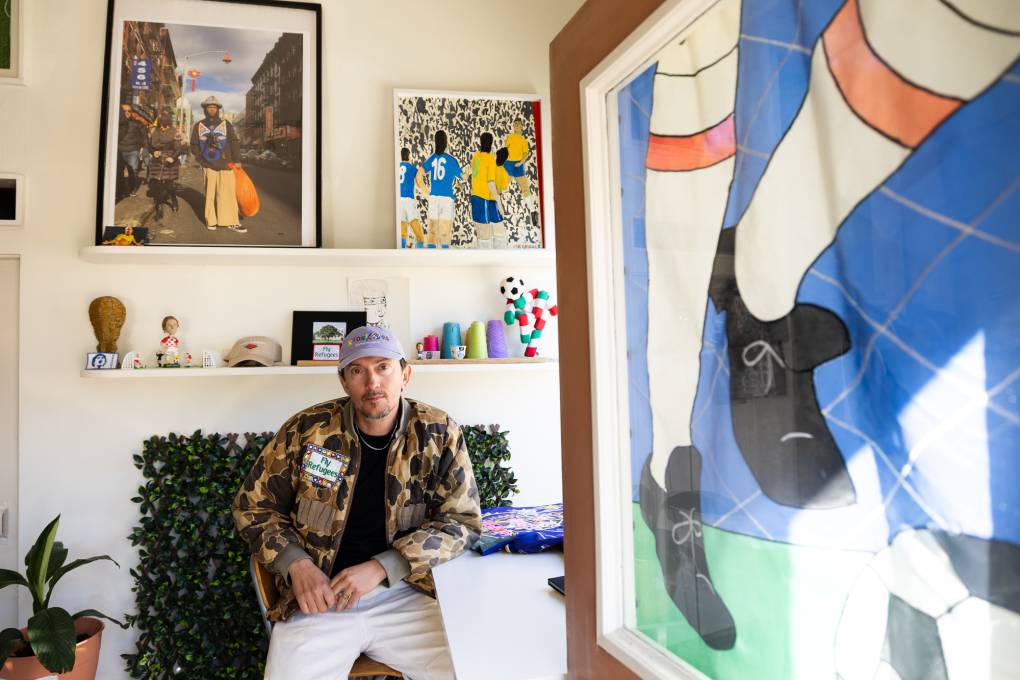
Sko Habibi Stitches a Sense of Home into Neon Sports Jerseys
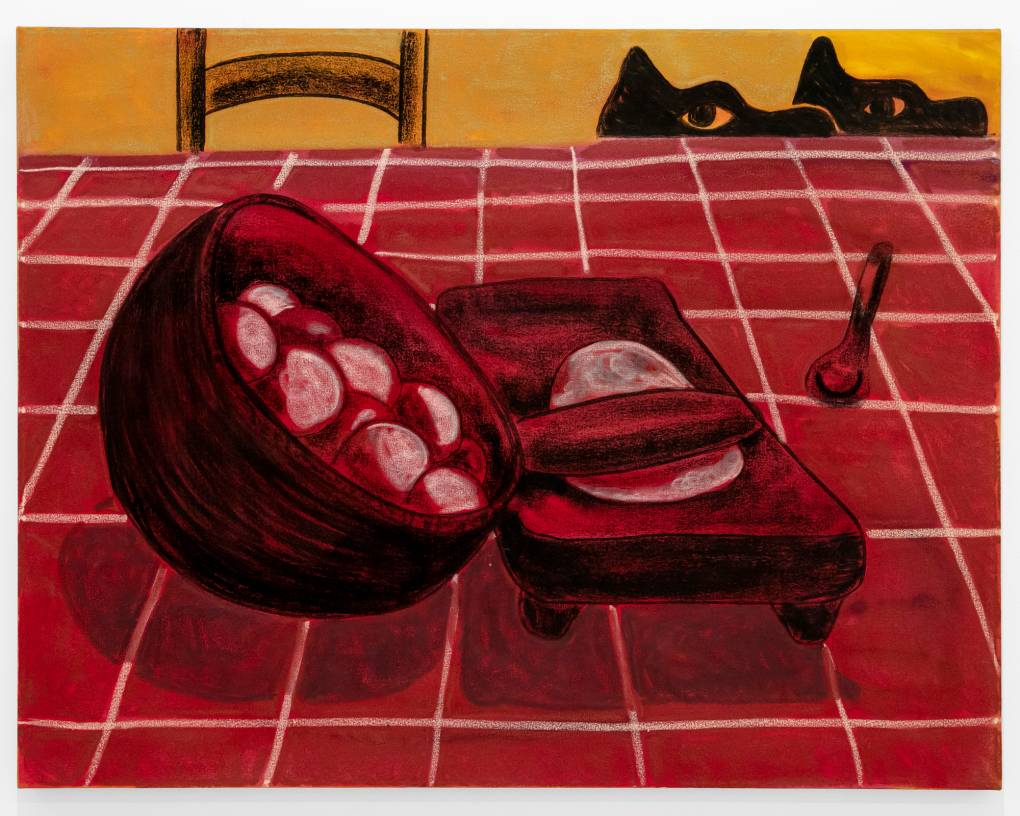
Oakland Artist Esteban Samayoa Makes an Ambitious Solo Debut at pt.2
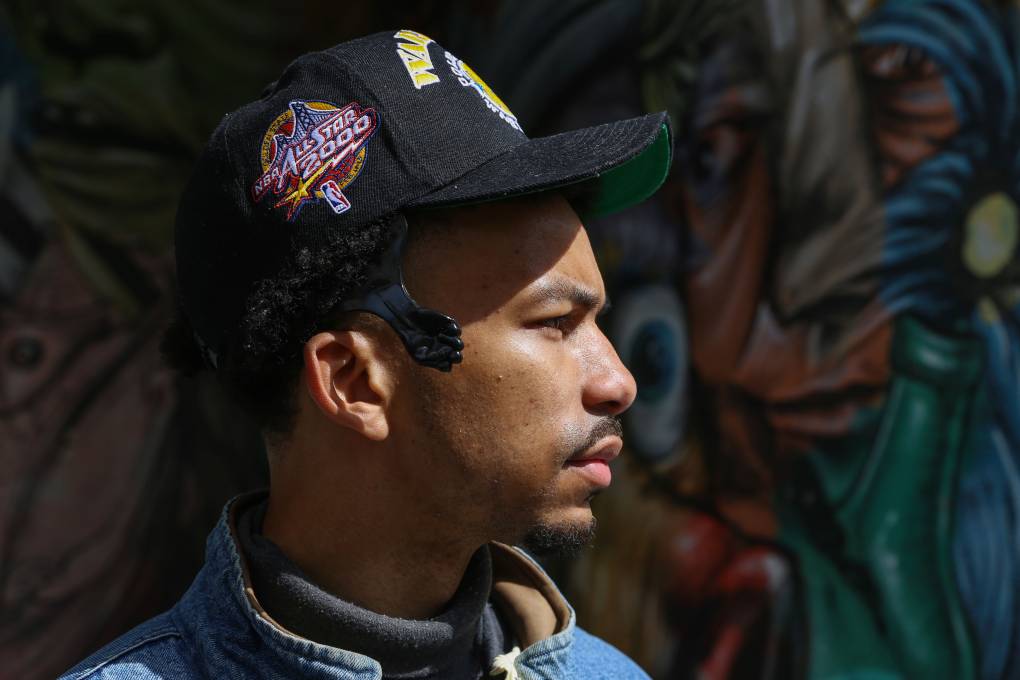
Michael Sneed Is More Than a Vibe — He’s a Symbol for Oakland
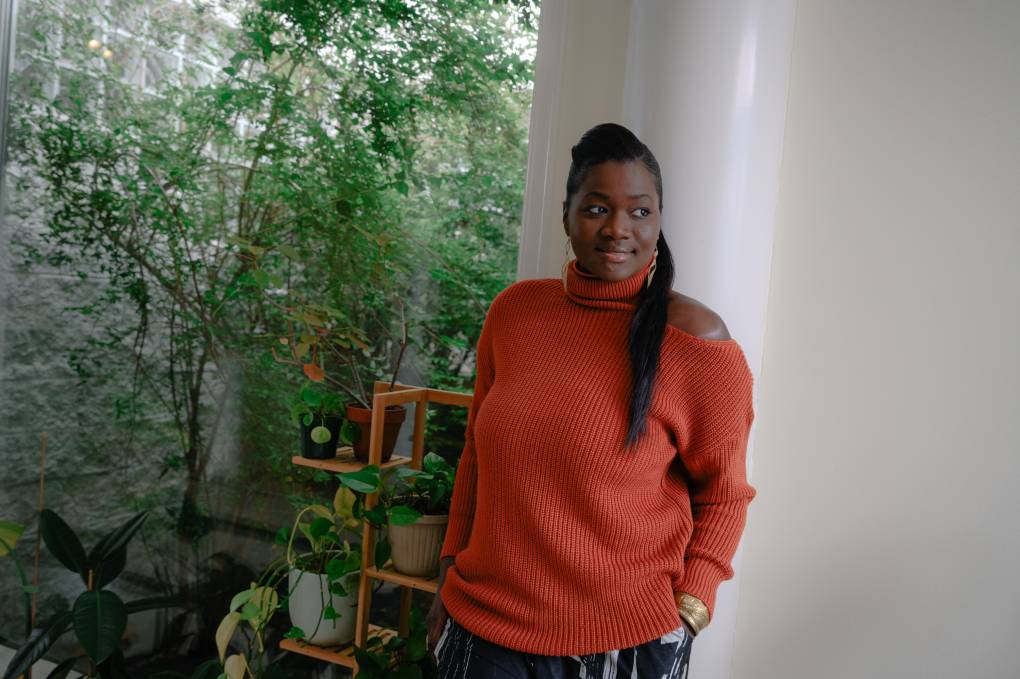
For Bay Area Designer Diarra Bousso, Math + Art = Happiness
Lolo Zouaï Has Definitely Entered the Chat
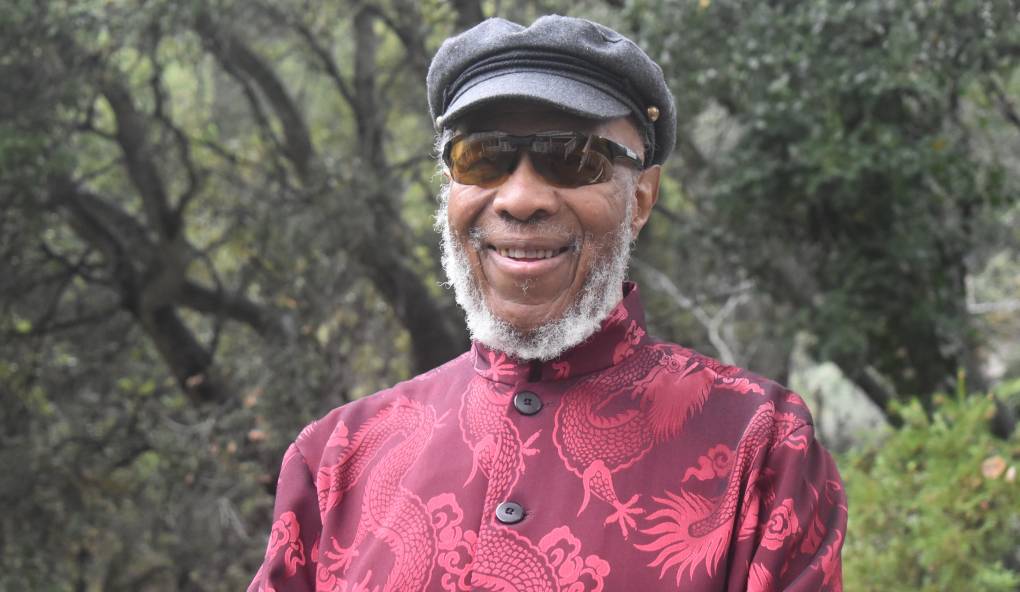
At 90, Bay Area Sax Great John Handy Is Still Composing His Legacy
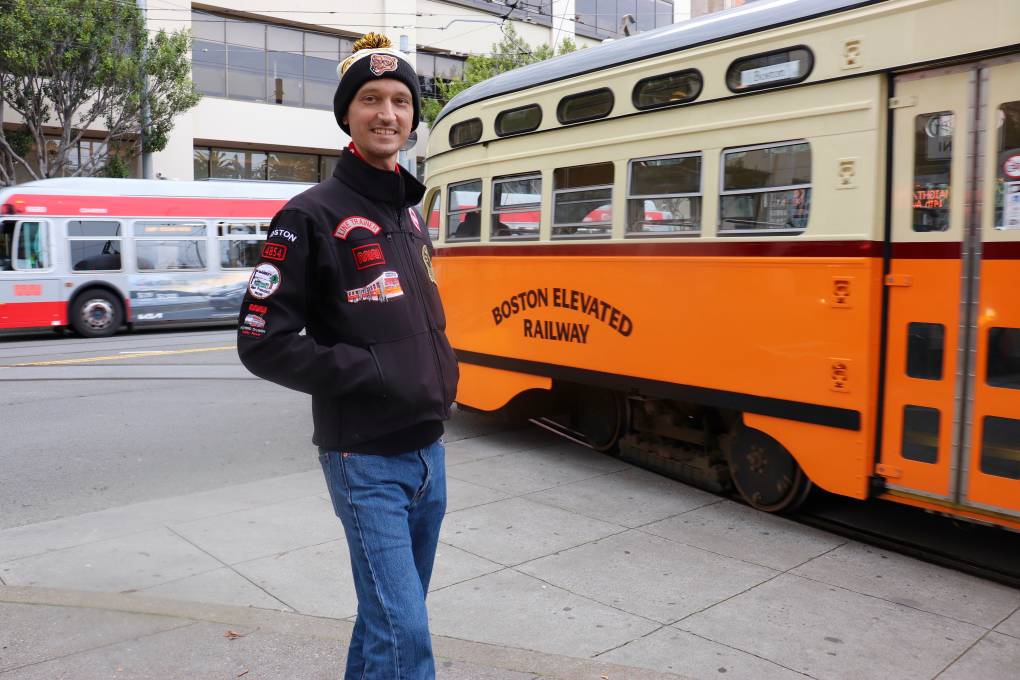
Muni’s Operator of the Year Battles Cancer, Traverses the City Like a Superhero
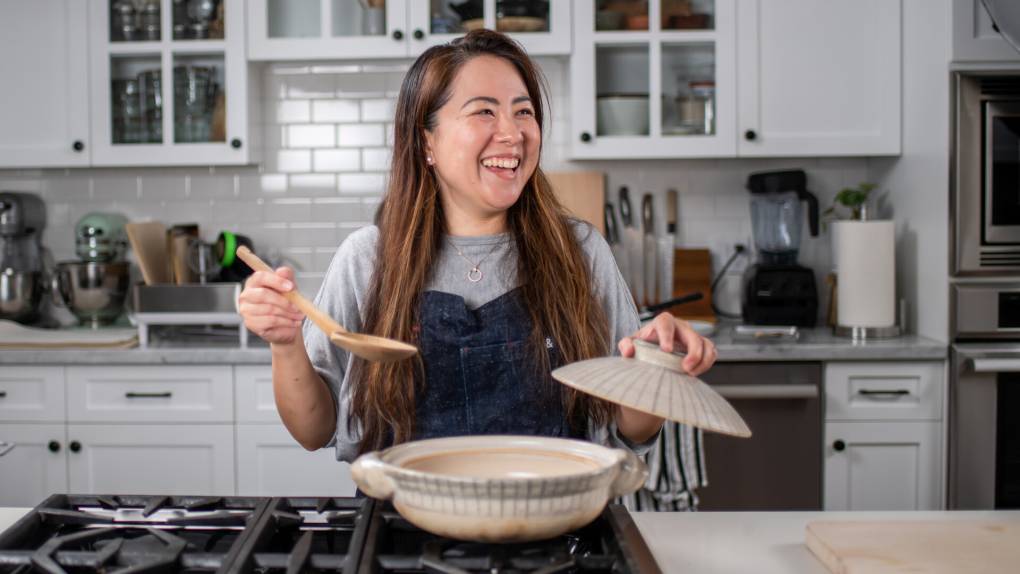
The Quiet Star Behind Just One Cookbook, the Internet's Favorite Japanese Recipe Blog
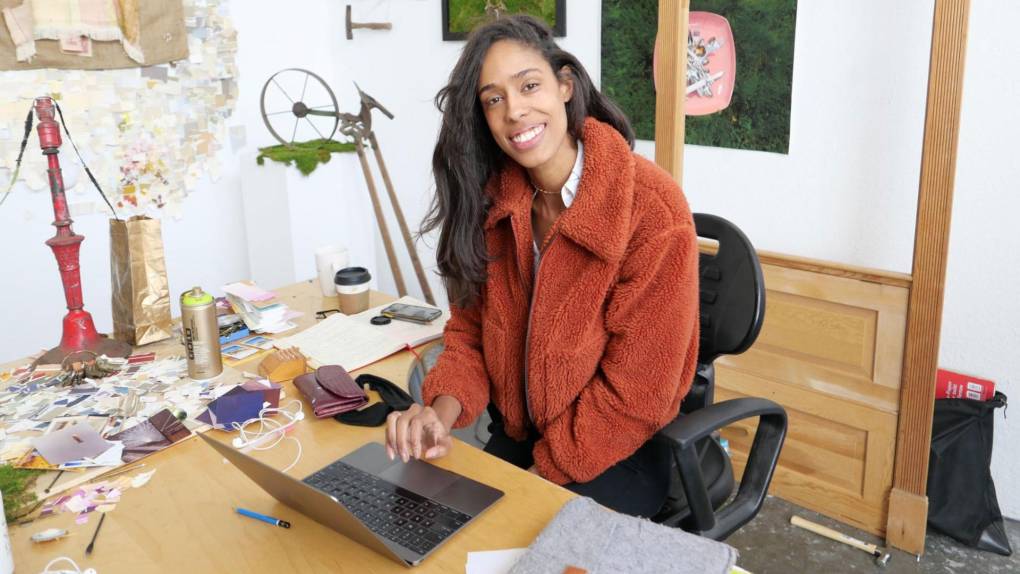
Artist Hannah Waiters Invites Her Audience to Be Part of the Story
Sponsored
Player sponsored by
window.__IS_SSR__=true
window.__INITIAL_STATE__={
"attachmentsReducer": {
"audio_0": {
"type": "attachments",
"id": "audio_0",
"imgSizes": {
"kqedFullSize": {
"file": "https://ww2.kqed.org/news/wp-content/themes/KQED-unified/img/audio_bgs/background0.jpg"
}
}
},
"audio_1": {
"type": "attachments",
"id": "audio_1",
"imgSizes": {
"kqedFullSize": {
"file": "https://ww2.kqed.org/news/wp-content/themes/KQED-unified/img/audio_bgs/background1.jpg"
}
}
},
"audio_2": {
"type": "attachments",
"id": "audio_2",
"imgSizes": {
"kqedFullSize": {
"file": "https://ww2.kqed.org/news/wp-content/themes/KQED-unified/img/audio_bgs/background2.jpg"
}
}
},
"audio_3": {
"type": "attachments",
"id": "audio_3",
"imgSizes": {
"kqedFullSize": {
"file": "https://ww2.kqed.org/news/wp-content/themes/KQED-unified/img/audio_bgs/background3.jpg"
}
}
},
"audio_4": {
"type": "attachments",
"id": "audio_4",
"imgSizes": {
"kqedFullSize": {
"file": "https://ww2.kqed.org/news/wp-content/themes/KQED-unified/img/audio_bgs/background4.jpg"
}
}
},
"placeholder": {
"type": "attachments",
"id": "placeholder",
"imgSizes": {
"thumbnail": {
"file": "https://cdn.kqed.org/wp-content/uploads/2024/12/KQED-Default-Image-816638274-2000x1333-1-160x107.jpg",
"width": 160,
"height": 107,
"mimeType": "image/jpeg"
},
"medium": {
"file": "https://cdn.kqed.org/wp-content/uploads/2024/12/KQED-Default-Image-816638274-2000x1333-1-800x533.jpg",
"width": 800,
"height": 533,
"mimeType": "image/jpeg"
},
"medium_large": {
"file": "https://cdn.kqed.org/wp-content/uploads/2024/12/KQED-Default-Image-816638274-2000x1333-1-768x512.jpg",
"width": 768,
"height": 512,
"mimeType": "image/jpeg"
},
"large": {
"file": "https://cdn.kqed.org/wp-content/uploads/2024/12/KQED-Default-Image-816638274-2000x1333-1-1020x680.jpg",
"width": 1020,
"height": 680,
"mimeType": "image/jpeg"
},
"1536x1536": {
"file": "https://cdn.kqed.org/wp-content/uploads/2024/12/KQED-Default-Image-816638274-2000x1333-1-1536x1024.jpg",
"width": 1536,
"height": 1024,
"mimeType": "image/jpeg"
},
"fd-lrg": {
"file": "https://cdn.kqed.org/wp-content/uploads/2024/12/KQED-Default-Image-816638274-2000x1333-1-1536x1024.jpg",
"width": 1536,
"height": 1024,
"mimeType": "image/jpeg"
},
"fd-med": {
"file": "https://cdn.kqed.org/wp-content/uploads/2024/12/KQED-Default-Image-816638274-2000x1333-1-1020x680.jpg",
"width": 1020,
"height": 680,
"mimeType": "image/jpeg"
},
"fd-sm": {
"file": "https://cdn.kqed.org/wp-content/uploads/2024/12/KQED-Default-Image-816638274-2000x1333-1-800x533.jpg",
"width": 800,
"height": 533,
"mimeType": "image/jpeg"
},
"post-thumbnail": {
"file": "https://cdn.kqed.org/wp-content/uploads/2024/12/KQED-Default-Image-816638274-2000x1333-1-672x372.jpg",
"width": 672,
"height": 372,
"mimeType": "image/jpeg"
},
"twentyfourteen-full-width": {
"file": "https://cdn.kqed.org/wp-content/uploads/2024/12/KQED-Default-Image-816638274-2000x1333-1-1038x576.jpg",
"width": 1038,
"height": 576,
"mimeType": "image/jpeg"
},
"xxsmall": {
"file": "https://cdn.kqed.org/wp-content/uploads/2024/12/KQED-Default-Image-816638274-2000x1333-1-160x107.jpg",
"width": 160,
"height": 107,
"mimeType": "image/jpeg"
},
"xsmall": {
"file": "https://cdn.kqed.org/wp-content/uploads/2024/12/KQED-Default-Image-816638274-2000x1333-1-672x372.jpg",
"width": 672,
"height": 372,
"mimeType": "image/jpeg"
},
"small": {
"file": "https://cdn.kqed.org/wp-content/uploads/2024/12/KQED-Default-Image-816638274-2000x1333-1-672x372.jpg",
"width": 672,
"height": 372,
"mimeType": "image/jpeg"
},
"xlarge": {
"file": "https://cdn.kqed.org/wp-content/uploads/2024/12/KQED-Default-Image-816638274-2000x1333-1-1020x680.jpg",
"width": 1020,
"height": 680,
"mimeType": "image/jpeg"
},
"full-width": {
"file": "https://cdn.kqed.org/wp-content/uploads/2024/12/KQED-Default-Image-816638274-2000x1333-1-1920x1280.jpg",
"width": 1920,
"height": 1280,
"mimeType": "image/jpeg"
},
"guest-author-32": {
"file": "https://cdn.kqed.org/wp-content/uploads/2025/01/KQED-Default-Image-816638274-1333x1333-1-160x160.jpg",
"width": 32,
"height": 32,
"mimeType": "image/jpeg"
},
"guest-author-50": {
"file": "https://cdn.kqed.org/wp-content/uploads/2025/01/KQED-Default-Image-816638274-1333x1333-1-160x160.jpg",
"width": 50,
"height": 50,
"mimeType": "image/jpeg"
},
"guest-author-64": {
"file": "https://cdn.kqed.org/wp-content/uploads/2025/01/KQED-Default-Image-816638274-1333x1333-1-160x160.jpg",
"width": 64,
"height": 64,
"mimeType": "image/jpeg"
},
"guest-author-96": {
"file": "https://cdn.kqed.org/wp-content/uploads/2025/01/KQED-Default-Image-816638274-1333x1333-1-160x160.jpg",
"width": 96,
"height": 96,
"mimeType": "image/jpeg"
},
"guest-author-128": {
"file": "https://cdn.kqed.org/wp-content/uploads/2025/01/KQED-Default-Image-816638274-1333x1333-1-160x160.jpg",
"width": 128,
"height": 128,
"mimeType": "image/jpeg"
},
"detail": {
"file": "https://cdn.kqed.org/wp-content/uploads/2025/01/KQED-Default-Image-816638274-1333x1333-1-160x160.jpg",
"width": 160,
"height": 160,
"mimeType": "image/jpeg"
},
"kqedFullSize": {
"file": "https://cdn.kqed.org/wp-content/uploads/2024/12/KQED-Default-Image-816638274-2000x1333-1.jpg",
"width": 2000,
"height": 1333
}
}
},
"arts_13970167": {
"type": "attachments",
"id": "arts_13970167",
"meta": {
"index": "attachments_1716263798",
"site": "arts",
"id": "13970167",
"found": true
},
"title": "20250110_Sko-Habibi_DMB_00133",
"publishDate": 1736793732,
"status": "inherit",
"parent": 0,
"modified": 1738884546,
"caption": "Jasko Begovic, aka Sko Habibi, at his studio in Bernal Heights, San Francisco, on Jan. 10, 2025.",
"credit": "David M. Barreda/KQED",
"altTag": "white man sitting in studio surrounded by images of athletes and textile art",
"description": null,
"imgSizes": {
"medium": {
"file": "https://cdn.kqed.org/wp-content/uploads/sites/2/2025/01/20250110_Sko-Habibi_DMB_00133-800x533.jpg",
"width": 800,
"height": 533,
"mimeType": "image/jpeg"
},
"large": {
"file": "https://cdn.kqed.org/wp-content/uploads/sites/2/2025/01/20250110_Sko-Habibi_DMB_00133-1020x680.jpg",
"width": 1020,
"height": 680,
"mimeType": "image/jpeg"
},
"thumbnail": {
"file": "https://cdn.kqed.org/wp-content/uploads/sites/2/2025/01/20250110_Sko-Habibi_DMB_00133-160x107.jpg",
"width": 160,
"height": 107,
"mimeType": "image/jpeg"
},
"medium_large": {
"file": "https://cdn.kqed.org/wp-content/uploads/sites/2/2025/01/20250110_Sko-Habibi_DMB_00133-768x512.jpg",
"width": 768,
"height": 512,
"mimeType": "image/jpeg"
},
"1536x1536": {
"file": "https://cdn.kqed.org/wp-content/uploads/sites/2/2025/01/20250110_Sko-Habibi_DMB_00133-1536x1024.jpg",
"width": 1536,
"height": 1024,
"mimeType": "image/jpeg"
},
"post-thumbnail": {
"file": "https://cdn.kqed.org/wp-content/uploads/sites/2/2025/01/20250110_Sko-Habibi_DMB_00133-672x372.jpg",
"width": 672,
"height": 372,
"mimeType": "image/jpeg"
},
"twentyfourteen-full-width": {
"file": "https://cdn.kqed.org/wp-content/uploads/sites/2/2025/01/20250110_Sko-Habibi_DMB_00133-1038x576.jpg",
"width": 1038,
"height": 576,
"mimeType": "image/jpeg"
},
"full-width": {
"file": "https://cdn.kqed.org/wp-content/uploads/sites/2/2025/01/20250110_Sko-Habibi_DMB_00133-1920x1280.jpg",
"width": 1920,
"height": 1280,
"mimeType": "image/jpeg"
},
"kqedFullSize": {
"file": "https://cdn.kqed.org/wp-content/uploads/sites/2/2025/01/20250110_Sko-Habibi_DMB_00133.jpg",
"width": 2000,
"height": 1333
}
},
"fetchFailed": false,
"isLoading": false
},
"arts_13932177": {
"type": "attachments",
"id": "arts_13932177",
"meta": {
"index": "attachments_1716263798",
"site": "arts",
"id": "13932177",
"found": true
},
"parent": 13932138,
"imgSizes": {
"twentyfourteen-full-width": {
"file": "https://ww2.kqed.org/app/uploads/sites/2/2023/07/es_tabletop_2000-1038x576.jpg",
"width": 1038,
"mimeType": "image/jpeg",
"height": 576
},
"thumbnail": {
"file": "https://ww2.kqed.org/app/uploads/sites/2/2023/07/es_tabletop_2000-160x128.jpg",
"width": 160,
"mimeType": "image/jpeg",
"height": 128
},
"post-thumbnail": {
"file": "https://ww2.kqed.org/app/uploads/sites/2/2023/07/es_tabletop_2000-672x372.jpg",
"width": 672,
"mimeType": "image/jpeg",
"height": 372
},
"kqedFullSize": {
"file": "https://ww2.kqed.org/app/uploads/sites/2/2023/07/es_tabletop_2000.jpg",
"width": 2000,
"height": 1600
},
"large": {
"file": "https://ww2.kqed.org/app/uploads/sites/2/2023/07/es_tabletop_2000-1020x816.jpg",
"width": 1020,
"mimeType": "image/jpeg",
"height": 816
},
"1536x1536": {
"file": "https://ww2.kqed.org/app/uploads/sites/2/2023/07/es_tabletop_2000-1536x1229.jpg",
"width": 1536,
"mimeType": "image/jpeg",
"height": 1229
},
"full-width": {
"file": "https://ww2.kqed.org/app/uploads/sites/2/2023/07/es_tabletop_2000-1920x1536.jpg",
"width": 1920,
"mimeType": "image/jpeg",
"height": 1536
},
"medium": {
"file": "https://ww2.kqed.org/app/uploads/sites/2/2023/07/es_tabletop_2000-800x640.jpg",
"width": 800,
"mimeType": "image/jpeg",
"height": 640
},
"medium_large": {
"file": "https://ww2.kqed.org/app/uploads/sites/2/2023/07/es_tabletop_2000-768x614.jpg",
"width": 768,
"mimeType": "image/jpeg",
"height": 614
}
},
"publishDate": 1690489324,
"modified": 1690489690,
"caption": "Esteban Samayoa, 'La mesa,' 2023; Oil, oil pastel on canvas, 34 x 44 inches.",
"description": null,
"title": "es_tabletop_2000",
"credit": "Courtesy of pt.2",
"status": "inherit",
"altTag": "Two dogs peek over red tablecloth where bowl of dough sits next to a rolling pin and spoon",
"fetchFailed": false,
"isLoading": false
},
"arts_13931358": {
"type": "attachments",
"id": "arts_13931358",
"meta": {
"index": "attachments_1716263798",
"site": "arts",
"id": "13931358",
"found": true
},
"parent": 13931355,
"imgSizes": {
"twentyfourteen-full-width": {
"file": "https://ww2.kqed.org/app/uploads/sites/2/2023/07/michaelsneed_JY_014-1038x576.jpg",
"width": 1038,
"mimeType": "image/jpeg",
"height": 576
},
"thumbnail": {
"file": "https://ww2.kqed.org/app/uploads/sites/2/2023/07/michaelsneed_JY_014-160x107.jpg",
"width": 160,
"mimeType": "image/jpeg",
"height": 107
},
"post-thumbnail": {
"file": "https://ww2.kqed.org/app/uploads/sites/2/2023/07/michaelsneed_JY_014-672x372.jpg",
"width": 672,
"mimeType": "image/jpeg",
"height": 372
},
"kqedFullSize": {
"file": "https://ww2.kqed.org/app/uploads/sites/2/2023/07/michaelsneed_JY_014-scaled.jpg",
"width": 2560,
"height": 1706
},
"2048x2048": {
"file": "https://ww2.kqed.org/app/uploads/sites/2/2023/07/michaelsneed_JY_014-2048x1365.jpg",
"width": 2048,
"mimeType": "image/jpeg",
"height": 1365
},
"large": {
"file": "https://ww2.kqed.org/app/uploads/sites/2/2023/07/michaelsneed_JY_014-1020x680.jpg",
"width": 1020,
"mimeType": "image/jpeg",
"height": 680
},
"1536x1536": {
"file": "https://ww2.kqed.org/app/uploads/sites/2/2023/07/michaelsneed_JY_014-1536x1024.jpg",
"width": 1536,
"mimeType": "image/jpeg",
"height": 1024
},
"full-width": {
"file": "https://ww2.kqed.org/app/uploads/sites/2/2023/07/michaelsneed_JY_014-1920x1280.jpg",
"width": 1920,
"mimeType": "image/jpeg",
"height": 1280
},
"medium": {
"file": "https://ww2.kqed.org/app/uploads/sites/2/2023/07/michaelsneed_JY_014-800x533.jpg",
"width": 800,
"mimeType": "image/jpeg",
"height": 533
},
"medium_large": {
"file": "https://ww2.kqed.org/app/uploads/sites/2/2023/07/michaelsneed_JY_014-768x512.jpg",
"width": 768,
"mimeType": "image/jpeg",
"height": 512
}
},
"publishDate": 1688759712,
"modified": 1689114508,
"caption": "Bay Area rapper Michael Sneed poses for a portrait in Oakland on June 9, 2023.",
"description": null,
"title": "michaelsneed_JY_014",
"credit": "Juliana Yamada",
"status": "inherit",
"altTag": "The facial profile of a young Oakland rapper as he looks away from the camera",
"fetchFailed": false,
"isLoading": false
},
"arts_13929888": {
"type": "attachments",
"id": "arts_13929888",
"meta": {
"index": "attachments_1716263798",
"site": "arts",
"id": "13929888",
"found": true
},
"parent": 13929878,
"imgSizes": {
"twentyfourteen-full-width": {
"file": "https://ww2.kqed.org/app/uploads/sites/2/2023/05/Diarra-Bousso_ksuzuki_diarrablu-0167-1038x576.jpg",
"width": 1038,
"mimeType": "image/jpeg",
"height": 576
},
"thumbnail": {
"file": "https://ww2.kqed.org/app/uploads/sites/2/2023/05/Diarra-Bousso_ksuzuki_diarrablu-0167-160x106.jpg",
"width": 160,
"mimeType": "image/jpeg",
"height": 106
},
"post-thumbnail": {
"file": "https://ww2.kqed.org/app/uploads/sites/2/2023/05/Diarra-Bousso_ksuzuki_diarrablu-0167-672x372.jpg",
"width": 672,
"mimeType": "image/jpeg",
"height": 372
},
"kqedFullSize": {
"file": "https://ww2.kqed.org/app/uploads/sites/2/2023/05/Diarra-Bousso_ksuzuki_diarrablu-0167-scaled.jpg",
"width": 2560,
"height": 1703
},
"2048x2048": {
"file": "https://ww2.kqed.org/app/uploads/sites/2/2023/05/Diarra-Bousso_ksuzuki_diarrablu-0167-2048x1363.jpg",
"width": 2048,
"mimeType": "image/jpeg",
"height": 1363
},
"large": {
"file": "https://ww2.kqed.org/app/uploads/sites/2/2023/05/Diarra-Bousso_ksuzuki_diarrablu-0167-1020x679.jpg",
"width": 1020,
"mimeType": "image/jpeg",
"height": 679
},
"1536x1536": {
"file": "https://ww2.kqed.org/app/uploads/sites/2/2023/05/Diarra-Bousso_ksuzuki_diarrablu-0167-1536x1022.jpg",
"width": 1536,
"mimeType": "image/jpeg",
"height": 1022
},
"full-width": {
"file": "https://ww2.kqed.org/app/uploads/sites/2/2023/05/Diarra-Bousso_ksuzuki_diarrablu-0167-1920x1277.jpg",
"width": 1920,
"mimeType": "image/jpeg",
"height": 1277
},
"medium": {
"file": "https://ww2.kqed.org/app/uploads/sites/2/2023/05/Diarra-Bousso_ksuzuki_diarrablu-0167-800x532.jpg",
"width": 800,
"mimeType": "image/jpeg",
"height": 532
},
"medium_large": {
"file": "https://ww2.kqed.org/app/uploads/sites/2/2023/05/Diarra-Bousso_ksuzuki_diarrablu-0167-768x511.jpg",
"width": 768,
"mimeType": "image/jpeg",
"height": 511
}
},
"publishDate": 1685557174,
"modified": 1685557258,
"caption": "DIARRABLU founder and creative director Diarra Bousso stands for a portrait at her home in Hillsborough on May 5. Bousso created her own algorithms to design clothing and other products.",
"description": null,
"title": "Diarra Bousso_ksuzuki_diarrablu 0167",
"credit": "Kori Suzuki/KQED",
"status": "inherit",
"altTag": "a young Black woman in an orange sweater stands smiling in a house filled with plants",
"fetchFailed": false,
"isLoading": false
},
"arts_13928394": {
"type": "attachments",
"id": "arts_13928394",
"meta": {
"index": "attachments_1716263798",
"site": "arts",
"id": "13928394",
"found": true
},
"parent": 13928379,
"imgSizes": {
"twentyfourteen-full-width": {
"file": "https://ww2.kqed.org/app/uploads/sites/2/2023/04/123123-1038x576.jpg",
"width": 1038,
"mimeType": "image/jpeg",
"height": 576
},
"thumbnail": {
"file": "https://ww2.kqed.org/app/uploads/sites/2/2023/04/123123-160x106.jpg",
"width": 160,
"mimeType": "image/jpeg",
"height": 106
},
"post-thumbnail": {
"file": "https://ww2.kqed.org/app/uploads/sites/2/2023/04/123123-672x372.jpg",
"width": 672,
"mimeType": "image/jpeg",
"height": 372
},
"kqedFullSize": {
"file": "https://ww2.kqed.org/app/uploads/sites/2/2023/04/123123-scaled.jpg",
"width": 2560,
"height": 1699
},
"2048x2048": {
"file": "https://ww2.kqed.org/app/uploads/sites/2/2023/04/123123-2048x1359.jpg",
"width": 2048,
"mimeType": "image/jpeg",
"height": 1359
},
"large": {
"file": "https://ww2.kqed.org/app/uploads/sites/2/2023/04/123123-1020x677.jpg",
"width": 1020,
"mimeType": "image/jpeg",
"height": 677
},
"1536x1536": {
"file": "https://ww2.kqed.org/app/uploads/sites/2/2023/04/123123-1536x1019.jpg",
"width": 1536,
"mimeType": "image/jpeg",
"height": 1019
},
"full-width": {
"file": "https://ww2.kqed.org/app/uploads/sites/2/2023/04/123123-1920x1274.jpg",
"width": 1920,
"mimeType": "image/jpeg",
"height": 1274
},
"medium": {
"file": "https://ww2.kqed.org/app/uploads/sites/2/2023/04/123123-800x531.jpg",
"width": 800,
"mimeType": "image/jpeg",
"height": 531
},
"medium_large": {
"file": "https://ww2.kqed.org/app/uploads/sites/2/2023/04/123123-768x510.jpg",
"width": 768,
"mimeType": "image/jpeg",
"height": 510
}
},
"publishDate": 1682619626,
"modified": 1682626006,
"caption": "Lolo Zouaï performs at Bimbo's 365 club on April 11, 2023. The pop singer, who grew up in San Francisco, is currently on her first world tour. ",
"description": null,
"title": "123123",
"credit": "Danica Robinson",
"status": "inherit",
"altTag": "a young woman with blonde hair in a white fingerless gloves and a bustier dances with her arms up while smiling on stage in purple light",
"fetchFailed": false,
"isLoading": false
},
"arts_13924635": {
"type": "attachments",
"id": "arts_13924635",
"meta": {
"index": "attachments_1716263798",
"site": "arts",
"id": "13924635",
"found": true
},
"parent": 13924370,
"imgSizes": {
"twentyfourteen-full-width": {
"file": "https://ww2.kqed.org/app/uploads/sites/2/2023/02/DSC_0758-1038x576.jpg",
"width": 1038,
"mimeType": "image/jpeg",
"height": 576
},
"thumbnail": {
"file": "https://ww2.kqed.org/app/uploads/sites/2/2023/02/DSC_0758-160x93.jpg",
"width": 160,
"mimeType": "image/jpeg",
"height": 93
},
"post-thumbnail": {
"file": "https://ww2.kqed.org/app/uploads/sites/2/2023/02/DSC_0758-672x372.jpg",
"width": 672,
"mimeType": "image/jpeg",
"height": 372
},
"kqedFullSize": {
"file": "https://ww2.kqed.org/app/uploads/sites/2/2023/02/DSC_0758-scaled.jpg",
"width": 2560,
"height": 1486
},
"2048x2048": {
"file": "https://ww2.kqed.org/app/uploads/sites/2/2023/02/DSC_0758-2048x1189.jpg",
"width": 2048,
"mimeType": "image/jpeg",
"height": 1189
},
"large": {
"file": "https://ww2.kqed.org/app/uploads/sites/2/2023/02/DSC_0758-1020x592.jpg",
"width": 1020,
"mimeType": "image/jpeg",
"height": 592
},
"1536x1536": {
"file": "https://ww2.kqed.org/app/uploads/sites/2/2023/02/DSC_0758-1536x892.jpg",
"width": 1536,
"mimeType": "image/jpeg",
"height": 892
},
"full-width": {
"file": "https://ww2.kqed.org/app/uploads/sites/2/2023/02/DSC_0758-1920x1115.jpg",
"width": 1920,
"mimeType": "image/jpeg",
"height": 1115
},
"medium": {
"file": "https://ww2.kqed.org/app/uploads/sites/2/2023/02/DSC_0758-800x464.jpg",
"width": 800,
"mimeType": "image/jpeg",
"height": 464
},
"medium_large": {
"file": "https://ww2.kqed.org/app/uploads/sites/2/2023/02/DSC_0758-768x446.jpg",
"width": 768,
"mimeType": "image/jpeg",
"height": 446
}
},
"publishDate": 1675364191,
"modified": 1675364386,
"caption": "Bay Area sax legend John Handy, at the cusp of 90, is sharp as ever.",
"description": null,
"title": "DSC_0758",
"credit": "Andrew Gilbert",
"status": "inherit",
"altTag": "an older Black man with a gray beard dressed in a colorful red shirt and a hat smiles in an outdoor portrait with a large tree behind him",
"fetchFailed": false,
"isLoading": false
},
"arts_13924308": {
"type": "attachments",
"id": "arts_13924308",
"meta": {
"index": "attachments_1716263798",
"site": "arts",
"id": "13924308",
"found": true
},
"parent": 13924307,
"imgSizes": {
"twentyfourteen-full-width": {
"file": "https://ww2.kqed.org/app/uploads/sites/2/2023/01/IMG_1835-1038x576.jpg",
"width": 1038,
"mimeType": "image/jpeg",
"height": 576
},
"thumbnail": {
"file": "https://ww2.kqed.org/app/uploads/sites/2/2023/01/IMG_1835-160x107.jpg",
"width": 160,
"mimeType": "image/jpeg",
"height": 107
},
"post-thumbnail": {
"file": "https://ww2.kqed.org/app/uploads/sites/2/2023/01/IMG_1835-672x372.jpg",
"width": 672,
"mimeType": "image/jpeg",
"height": 372
},
"kqedFullSize": {
"file": "https://ww2.kqed.org/app/uploads/sites/2/2023/01/IMG_1835-scaled.jpg",
"width": 2560,
"height": 1707
},
"2048x2048": {
"file": "https://ww2.kqed.org/app/uploads/sites/2/2023/01/IMG_1835-2048x1365.jpg",
"width": 2048,
"mimeType": "image/jpeg",
"height": 1365
},
"large": {
"file": "https://ww2.kqed.org/app/uploads/sites/2/2023/01/IMG_1835-1020x680.jpg",
"width": 1020,
"mimeType": "image/jpeg",
"height": 680
},
"1536x1536": {
"file": "https://ww2.kqed.org/app/uploads/sites/2/2023/01/IMG_1835-1536x1024.jpg",
"width": 1536,
"mimeType": "image/jpeg",
"height": 1024
},
"full-width": {
"file": "https://ww2.kqed.org/app/uploads/sites/2/2023/01/IMG_1835-1920x1280.jpg",
"width": 1920,
"mimeType": "image/jpeg",
"height": 1280
},
"medium": {
"file": "https://ww2.kqed.org/app/uploads/sites/2/2023/01/IMG_1835-800x533.jpg",
"width": 800,
"mimeType": "image/jpeg",
"height": 533
},
"medium_large": {
"file": "https://ww2.kqed.org/app/uploads/sites/2/2023/01/IMG_1835-768x512.jpg",
"width": 768,
"mimeType": "image/jpeg",
"height": 512
}
},
"publishDate": 1674775126,
"modified": 1674837404,
"caption": "Mike Delia stands in front of the F Line, near Market St. and Embarcadero.",
"description": null,
"title": "IMG_1835",
"credit": "Alan Chazaro/KQED",
"status": "inherit",
"altTag": "a Muni operator stands in front of two transit vehicles near Market Street in San Francisco",
"fetchFailed": false,
"isLoading": false
},
"arts_13920733": {
"type": "attachments",
"id": "arts_13920733",
"meta": {
"index": "attachments_1716263798",
"site": "arts",
"id": "13920733",
"found": true
},
"parent": 0,
"imgSizes": {
"twentyfourteen-full-width": {
"file": "https://ww2.kqed.org/app/uploads/sites/2/2022/10/RS58863_049_KQED_JustOneCookbook_09202022-qut-1-1038x576.jpg",
"width": 1038,
"mimeType": "image/jpeg",
"height": 576
},
"thumbnail": {
"file": "https://ww2.kqed.org/app/uploads/sites/2/2022/10/RS58863_049_KQED_JustOneCookbook_09202022-qut-1-160x90.jpg",
"width": 160,
"mimeType": "image/jpeg",
"height": 90
},
"post-thumbnail": {
"file": "https://ww2.kqed.org/app/uploads/sites/2/2022/10/RS58863_049_KQED_JustOneCookbook_09202022-qut-1-672x372.jpg",
"width": 672,
"mimeType": "image/jpeg",
"height": 372
},
"kqedFullSize": {
"file": "https://ww2.kqed.org/app/uploads/sites/2/2022/10/RS58863_049_KQED_JustOneCookbook_09202022-qut-1.jpg",
"width": 1920,
"height": 1080
},
"large": {
"file": "https://ww2.kqed.org/app/uploads/sites/2/2022/10/RS58863_049_KQED_JustOneCookbook_09202022-qut-1-1020x574.jpg",
"width": 1020,
"mimeType": "image/jpeg",
"height": 574
},
"1536x1536": {
"file": "https://ww2.kqed.org/app/uploads/sites/2/2022/10/RS58863_049_KQED_JustOneCookbook_09202022-qut-1-1536x864.jpg",
"width": 1536,
"mimeType": "image/jpeg",
"height": 864
},
"medium": {
"file": "https://ww2.kqed.org/app/uploads/sites/2/2022/10/RS58863_049_KQED_JustOneCookbook_09202022-qut-1-800x450.jpg",
"width": 800,
"mimeType": "image/jpeg",
"height": 450
},
"medium_large": {
"file": "https://ww2.kqed.org/app/uploads/sites/2/2022/10/RS58863_049_KQED_JustOneCookbook_09202022-qut-1-768x432.jpg",
"width": 768,
"mimeType": "image/jpeg",
"height": 432
}
},
"publishDate": 1666394562,
"modified": 1666395873,
"caption": "Namiko Chen shoots all of the photos and videos for her blog Just One Cookbook at her home in the Peninsula. In the 11 years since she started the site, it has grown to become the internet's most popular English-language resource on Japanese home cooking.",
"description": null,
"title": "RS58863_049_KQED_JustOneCookbook_09202022-qut",
"credit": "Beth LaBerge/KQED",
"status": "inherit",
"altTag": "An Asian woman in a dark blue apron smiles while standing at the stove with a ladle and a pot lid in her hands.",
"fetchFailed": false,
"isLoading": false
},
"arts_13903643": {
"type": "attachments",
"id": "arts_13903643",
"meta": {
"index": "attachments_1716263798",
"site": "arts",
"id": "13903643",
"found": true
},
"parent": 13903617,
"imgSizes": {
"twentyfourteen-full-width": {
"file": "https://ww2.kqed.org/app/uploads/sites/2/2021/09/Hannah_COVER-1038x576.jpg",
"width": 1038,
"mimeType": "image/jpeg",
"height": 576
},
"thumbnail": {
"file": "https://ww2.kqed.org/app/uploads/sites/2/2021/09/Hannah_COVER-160x90.jpg",
"width": 160,
"mimeType": "image/jpeg",
"height": 90
},
"post-thumbnail": {
"file": "https://ww2.kqed.org/app/uploads/sites/2/2021/09/Hannah_COVER-672x372.jpg",
"width": 672,
"mimeType": "image/jpeg",
"height": 372
},
"kqedFullSize": {
"file": "https://ww2.kqed.org/app/uploads/sites/2/2021/09/Hannah_COVER.jpg",
"width": 1920,
"height": 1080
},
"large": {
"file": "https://ww2.kqed.org/app/uploads/sites/2/2021/09/Hannah_COVER-1020x574.jpg",
"width": 1020,
"mimeType": "image/jpeg",
"height": 574
},
"1536x1536": {
"file": "https://ww2.kqed.org/app/uploads/sites/2/2021/09/Hannah_COVER-1536x864.jpg",
"width": 1536,
"mimeType": "image/jpeg",
"height": 864
},
"medium": {
"file": "https://ww2.kqed.org/app/uploads/sites/2/2021/09/Hannah_COVER-800x450.jpg",
"width": 800,
"mimeType": "image/jpeg",
"height": 450
},
"medium_large": {
"file": "https://ww2.kqed.org/app/uploads/sites/2/2021/09/Hannah_COVER-768x432.jpg",
"width": 768,
"mimeType": "image/jpeg",
"height": 432
}
},
"publishDate": 1632344945,
"modified": 1632345240,
"caption": "Hannah Waiters in her studio.",
"description": "Hannah Waiters in her studio.",
"title": "Hannah_COVER",
"credit": "Courtesy the artist",
"status": "inherit",
"altTag": "A woman sits at a desk in front of a computer.",
"fetchFailed": false,
"isLoading": false
}
},
"audioPlayerReducer": {
"postId": "stream_live",
"isPaused": true,
"isPlaying": false,
"pfsActive": false,
"pledgeModalIsOpen": true,
"playerDrawerIsOpen": false
},
"authorsReducer": {
"byline_arts_13971497": {
"type": "authors",
"id": "byline_arts_13971497",
"meta": {
"override": true
},
"slug": "byline_arts_13971497",
"name": "Sarah O’Neal",
"isLoading": false
},
"byline_arts_13932138": {
"type": "authors",
"id": "byline_arts_13932138",
"meta": {
"override": true
},
"slug": "byline_arts_13932138",
"name": "Nia Coats",
"isLoading": false
},
"byline_arts_13928379": {
"type": "authors",
"id": "byline_arts_13928379",
"meta": {
"override": true
},
"slug": "byline_arts_13928379",
"name": "Nia Coats",
"isLoading": false
},
"byline_arts_13903617": {
"type": "authors",
"id": "byline_arts_13903617",
"meta": {
"override": true
},
"slug": "byline_arts_13903617",
"name": "Luke Williams",
"isLoading": false
},
"agilbert": {
"type": "authors",
"id": "86",
"meta": {
"index": "authors_1716337520",
"id": "86",
"found": true
},
"name": "Andrew Gilbert",
"firstName": "Andrew",
"lastName": "Gilbert",
"slug": "agilbert",
"email": "jazzscribe@aol.com",
"display_author_email": false,
"staff_mastheads": [],
"title": "KQED Contributor",
"bio": "A Los Angeles native based in the Berkeley area since 1996, Andrew Gilbert covers jazz, international music and dance for KQED's \u003ci>California Report, \u003c/i>the\u003ci> Mercury News\u003c/i>, \u003ci>San Francisco Chronicle\u003c/i>, \u003ci>Berkeleyside.com\u003c/i>, and other publications. He is available for weddings and bar and bat mitzvahs. #jazzscribe",
"avatar": "https://secure.gravatar.com/avatar/445e6fe4cc696bd39773e3c90f5108b6?s=600&d=blank&r=g",
"twitter": null,
"facebook": null,
"instagram": null,
"linkedin": null,
"sites": [
{
"site": "arts",
"roles": [
"Contributor",
"author"
]
},
{
"site": "news",
"roles": [
"author"
]
}
],
"headData": {
"title": "Andrew Gilbert | KQED",
"description": "KQED Contributor",
"ogImgSrc": "https://secure.gravatar.com/avatar/445e6fe4cc696bd39773e3c90f5108b6?s=600&d=blank&r=g",
"twImgSrc": "https://secure.gravatar.com/avatar/445e6fe4cc696bd39773e3c90f5108b6?s=600&d=blank&r=g"
},
"isLoading": false,
"link": "/author/agilbert"
},
"aproehl": {
"type": "authors",
"id": "11296",
"meta": {
"index": "authors_1716337520",
"id": "11296",
"found": true
},
"name": "Ariana Proehl",
"firstName": "Ariana",
"lastName": "Proehl",
"slug": "aproehl",
"email": "aproehl@KQED.org",
"display_author_email": true,
"staff_mastheads": [
"news"
],
"title": "Culture Reporter, KQED",
"bio": "Ariana Proehl is a Culture Reporter and Host.",
"avatar": "https://secure.gravatar.com/avatar/c96b24567eb5bb3a4f8bb295ed53e232?s=600&d=blank&r=g",
"twitter": "ArianaProehl",
"facebook": null,
"instagram": null,
"linkedin": null,
"sites": [
{
"site": "arts",
"roles": []
},
{
"site": "news",
"roles": []
},
{
"site": "education",
"roles": []
},
{
"site": "forum",
"roles": []
}
],
"headData": {
"title": "Ariana Proehl | KQED",
"description": "Culture Reporter, KQED",
"ogImgSrc": "https://secure.gravatar.com/avatar/c96b24567eb5bb3a4f8bb295ed53e232?s=600&d=blank&r=g",
"twImgSrc": "https://secure.gravatar.com/avatar/c96b24567eb5bb3a4f8bb295ed53e232?s=600&d=blank&r=g"
},
"isLoading": false,
"link": "/author/aproehl"
},
"achazaro": {
"type": "authors",
"id": "11748",
"meta": {
"index": "authors_1716337520",
"id": "11748",
"found": true
},
"name": "Alan Chazaro",
"firstName": "Alan",
"lastName": "Chazaro",
"slug": "achazaro",
"email": "agchazaro@gmail.com",
"display_author_email": true,
"staff_mastheads": [],
"title": "Food Writer and Reporter",
"bio": "Alan Chazaro is the author of \u003cem>This Is Not a Frank Ocean Cover Album\u003c/em> (Black Lawrence Press, 2019), \u003cem>Piñata Theory\u003c/em> (Black Lawrence Press, 2020), and \u003cem>Notes from the Eastern Span of the Bay Bridge\u003c/em> (Ghost City Press, 2021). He is a graduate of June Jordan’s Poetry for the People program at UC Berkeley and a former Lawrence Ferlinghetti Fellow at the University of San Francisco. He writes about sports, food, art, music, education, and culture while repping the Bay on \u003ca href=\"https://twitter.com/alan_chazaro\">Twitter\u003c/a> and \u003ca href=\"https://www.instagram.com/alan_chazaro/?hl=en\">Instagram\u003c/a> at @alan_chazaro.",
"avatar": "https://secure.gravatar.com/avatar/ea8b6dd970fc5c29e7a188e7d5861df7?s=600&d=blank&r=g",
"twitter": "alan_chazaro",
"facebook": null,
"instagram": null,
"linkedin": null,
"sites": [
{
"site": "arts",
"roles": [
"contributor"
]
},
{
"site": "news",
"roles": [
"editor"
]
}
],
"headData": {
"title": "Alan Chazaro | KQED",
"description": "Food Writer and Reporter",
"ogImgSrc": "https://secure.gravatar.com/avatar/ea8b6dd970fc5c29e7a188e7d5861df7?s=600&d=blank&r=g",
"twImgSrc": "https://secure.gravatar.com/avatar/ea8b6dd970fc5c29e7a188e7d5861df7?s=600&d=blank&r=g"
},
"isLoading": false,
"link": "/author/achazaro"
},
"ksong": {
"type": "authors",
"id": "11813",
"meta": {
"index": "authors_1716337520",
"id": "11813",
"found": true
},
"name": "Kristie Song",
"firstName": "Kristie",
"lastName": "Song",
"slug": "ksong",
"email": "ksong@kqed.org",
"display_author_email": false,
"staff_mastheads": [],
"title": "Editorial Intern ",
"bio": "Kristie Song is an Arts & Culture Intern at KQED. She is currently a graduate student at UC Berkeley, where she studies audio and multimedia journalism. Previously, she covered the local community for Oakland North, produced episodes for The Science of Happiness, and served as news director for KUCI, UC Irvine’s radio station. Outside of reporting, she likes drawing comics, listening to angsty rock, and practicing the guitar.",
"avatar": "https://secure.gravatar.com/avatar/c1149e78c3c44f92d4945a8ab0711af6?s=600&d=blank&r=g",
"twitter": null,
"facebook": null,
"instagram": null,
"linkedin": null,
"sites": [
{
"site": "arts",
"roles": [
"editor"
]
}
],
"headData": {
"title": "Kristie Song | KQED",
"description": "Editorial Intern ",
"ogImgSrc": "https://secure.gravatar.com/avatar/c1149e78c3c44f92d4945a8ab0711af6?s=600&d=blank&r=g",
"twImgSrc": "https://secure.gravatar.com/avatar/c1149e78c3c44f92d4945a8ab0711af6?s=600&d=blank&r=g"
},
"isLoading": false,
"link": "/author/ksong"
}
},
"breakingNewsReducer": {},
"pagesReducer": {},
"postsReducer": {
"stream_live": {
"type": "live",
"id": "stream_live",
"audioUrl": "https://streams.kqed.org/kqedradio",
"title": "Live Stream",
"excerpt": "Live Stream information currently unavailable.",
"link": "/radio",
"featImg": "",
"label": {
"name": "KQED Live",
"link": "/"
}
},
"stream_kqedNewscast": {
"type": "posts",
"id": "stream_kqedNewscast",
"audioUrl": "https://www.kqed.org/.stream/anon/radio/RDnews/newscast.mp3?_=1",
"title": "KQED Newscast",
"featImg": "",
"label": {
"name": "88.5 FM",
"link": "/"
}
},
"arts_13971497": {
"type": "posts",
"id": "arts_13971497",
"meta": {
"index": "posts_1716263798",
"site": "arts",
"id": "13971497",
"score": null,
"sort": [
1738885752000
]
},
"guestAuthors": [],
"slug": "sko-habibi-jasko-begovic-sfmoma-oakland-roots",
"title": "Sko Habibi Stitches a Sense of Home into Neon Sports Jerseys",
"publishDate": 1738885752,
"format": "standard",
"headTitle": "Sko Habibi Stitches a Sense of Home into Neon Sports Jerseys | KQED",
"labelTerm": {
"site": "arts"
},
"content": "\u003cp>The stories behind our names, given or chosen, preserve memories that would otherwise be lost to time. Sko Habibi is the name \u003ca href=\"https://www.instagram.com/skohabibi/?hl=en\">Jasko Begovic\u003c/a> chose when he started identifying as an artist over two decades ago. Sko, short for Jasko, and habibi, the Arabic word for beloved. His name, like his work, is a glimpse at the communities and people who helped him on his journey to create, and survive. \u003c/p>\n\u003cp>Begovic first heard the word habibi while sitting at the dinner table of a friend’s family. He was a young teen, recently relocated to Germany as a refugee. Even with a full house and over 10 mouths to feed, his friends’ loud and loving Lebanese family were clear that there was always room for Begovic. \u003c/p>\n\u003cp>Their generosity was the epitome of the immigrant way, making space where there should be none, turning scraps into meals that leave everyone fed and cared for. That ethos is now at the crux of Begovic’s work, and his own drive to create community. \u003c/p>\n\u003cp>Begovic may finally be getting his flowers from art institutions — his textile sculptures, which bridge the worlds of fashion and soccer, are included in the San Francisco Museum of Modern Art’s \u003cem>\u003ca href=\"https://www.sfmoma.org/exhibition/get-in-the-game/\">Get in the Game\u003c/a>\u003c/em> show — but he has been making waves in the Bay Area art scene for years. \u003c/p>\n\u003cfigure id=\"attachment_13970168\" class=\"wp-caption aligncenter\" style=\"max-width: 2000px\">\u003cimg loading=\"lazy\" decoding=\"async\" src=\"https://cdn.kqed.org/wp-content/uploads/sites/2/2025/01/20250110_Sko-Habibi_DMB_00077.jpg\" alt=\"man with camo jacket and cat head in embroidered textiles on back\" width=\"2000\" height=\"1333\" class=\"size-full wp-image-13970168\" srcset=\"https://cdn.kqed.org/wp-content/uploads/sites/2/2025/01/20250110_Sko-Habibi_DMB_00077.jpg 2000w, https://cdn.kqed.org/wp-content/uploads/sites/2/2025/01/20250110_Sko-Habibi_DMB_00077-800x533.jpg 800w, https://cdn.kqed.org/wp-content/uploads/sites/2/2025/01/20250110_Sko-Habibi_DMB_00077-1020x680.jpg 1020w, https://cdn.kqed.org/wp-content/uploads/sites/2/2025/01/20250110_Sko-Habibi_DMB_00077-160x107.jpg 160w, https://cdn.kqed.org/wp-content/uploads/sites/2/2025/01/20250110_Sko-Habibi_DMB_00077-768x512.jpg 768w, https://cdn.kqed.org/wp-content/uploads/sites/2/2025/01/20250110_Sko-Habibi_DMB_00077-1536x1024.jpg 1536w, https://cdn.kqed.org/wp-content/uploads/sites/2/2025/01/20250110_Sko-Habibi_DMB_00077-1920x1280.jpg 1920w\" sizes=\"auto, (max-width: 2000px) 100vw, 2000px\">\u003cfigcaption class=\"wp-caption-text\">Jasko Begovic poses wearing one of his embellished garments. \u003ccite>(David M. Barreda/KQED)\u003c/cite>\u003c/figcaption>\u003c/figure>\n\u003cp>As a multimedia textile artist who splits his time between creating art, coaching young soccer players and raising a toddler, Begovic isn’t interested in climbing the ranks of the art world. He isn’t in competition with anyone else (a rule that admittedly gets tossed as soon as he laces up his sneakers and joins a soccer game). \u003c/p>\n\u003cp>[ad fullwidth]\u003c/p>\n\u003cp>For Begovic, art is how he stays human and asserts his personhood in a world hell-bent on limiting his humanity: as a man raised in a mixed Muslim family, as a genocide survivor, or as a refugee. \u003c/p>\n\u003ch2>Art as a language\u003c/h2>\n\u003cp>Begovic was born in former Yugoslavia and raised in a small village alongside a huge Bosnian family. His childhood was idyllic; warm memories saturate his stories about running around with cousins. But that was before the war in Bosnia began, before his older brother was conscripted, and his family was separated. \u003c/p>\n\u003cp>At 11, a Serbian uncle hid Begovic and his cousin until they could escape through a soldier exchange. This miraculous intervention allowed him to flee the country, leaving his family’s ancestral land for refugee status in Germany. \u003c/p>\n\u003cfigure id=\"attachment_13970169\" class=\"wp-caption aligncenter\" style=\"max-width: 2000px\">\u003cimg loading=\"lazy\" decoding=\"async\" src=\"https://cdn.kqed.org/wp-content/uploads/sites/2/2025/01/20250110_Sko-Habibi_DMB_00117.jpg\" alt=\"man poses in camo jacket and hat\" width=\"2000\" height=\"1333\" class=\"size-full wp-image-13970169\" srcset=\"https://cdn.kqed.org/wp-content/uploads/sites/2/2025/01/20250110_Sko-Habibi_DMB_00117.jpg 2000w, https://cdn.kqed.org/wp-content/uploads/sites/2/2025/01/20250110_Sko-Habibi_DMB_00117-800x533.jpg 800w, https://cdn.kqed.org/wp-content/uploads/sites/2/2025/01/20250110_Sko-Habibi_DMB_00117-1020x680.jpg 1020w, https://cdn.kqed.org/wp-content/uploads/sites/2/2025/01/20250110_Sko-Habibi_DMB_00117-160x107.jpg 160w, https://cdn.kqed.org/wp-content/uploads/sites/2/2025/01/20250110_Sko-Habibi_DMB_00117-768x512.jpg 768w, https://cdn.kqed.org/wp-content/uploads/sites/2/2025/01/20250110_Sko-Habibi_DMB_00117-1536x1024.jpg 1536w, https://cdn.kqed.org/wp-content/uploads/sites/2/2025/01/20250110_Sko-Habibi_DMB_00117-1920x1280.jpg 1920w\" sizes=\"auto, (max-width: 2000px) 100vw, 2000px\">\u003cfigcaption class=\"wp-caption-text\">After fleeing with his family to Germany, Begovic connected with other teenagers through graffiti and hip-hop. ‘It provoked my spirit,’ he remembers. \u003ccite>(David M. Barreda/KQED)\u003c/cite>\u003c/figcaption>\u003c/figure>\n\u003cp>It was as a bored kid in the back of a German classroom, surrounded by a language he didn’t understand and peers who had no context for the genocide he had just survived, that Begovic found art. \u003c/p>\n\u003cp>By chance, he was seated next to a kid named Daniel who scribbled in journals instead of paying attention in class. Watching Daniel write graffiti and practice his tags was Begovic’s introduction to street art, and it became their shared mode of communication. \u003c/p>\n\u003cp>In former Yugoslavia, art was a craft some students excelled at — Begovic was not a good artist. But suddenly, the function of art shifted. Through his new classmate he was introduced to the world of hip-hop, and the Balkan, African and Arab immigrant communities who were using it to connect to each other. \u003c/p>\n\u003cp>“It provoked my spirit,” Begovic remembers. “That’s where understanding art as language was birthed in me.”\u003c/p>\n\u003ch2>Depicting ‘the immigrant’s world’\u003c/h2>\n\u003cp>This bridging of language and cultures through art is at the heart of all of his creations. For Begovic, shedding shame around the violence and displacement he experienced frees him up to create. “I embrace it,” he says. “I’m not running away from my journey. I transform it and make it my own.”\u003c/p>\n\u003cp>This transformation is emphasized in the fabrics he chooses and the stories they tell. He constructs the mannequins wearing his textile pieces to stand tall, with stretched necks and confident stares. Neon colors and deconstructed sports jerseys announce their presence. Begovic sews the names of loved ones who have passed onto the laces of his figures’ shoes in beads, making it clear that each character is an externalization of the grief he carries. \u003c/p>\n\u003cfigure id=\"attachment_13970172\" class=\"wp-caption aligncenter\" style=\"max-width: 2000px\">\u003cimg loading=\"lazy\" decoding=\"async\" src=\"https://cdn.kqed.org/wp-content/uploads/sites/2/2025/01/20250110_Sko-Habibi_DMB_00014.jpg\" alt=\"'fly refugees' patch next to figurine of soccer player\" width=\"2000\" height=\"1333\" class=\"size-full wp-image-13970172\" srcset=\"https://cdn.kqed.org/wp-content/uploads/sites/2/2025/01/20250110_Sko-Habibi_DMB_00014.jpg 2000w, https://cdn.kqed.org/wp-content/uploads/sites/2/2025/01/20250110_Sko-Habibi_DMB_00014-800x533.jpg 800w, https://cdn.kqed.org/wp-content/uploads/sites/2/2025/01/20250110_Sko-Habibi_DMB_00014-1020x680.jpg 1020w, https://cdn.kqed.org/wp-content/uploads/sites/2/2025/01/20250110_Sko-Habibi_DMB_00014-160x107.jpg 160w, https://cdn.kqed.org/wp-content/uploads/sites/2/2025/01/20250110_Sko-Habibi_DMB_00014-768x512.jpg 768w, https://cdn.kqed.org/wp-content/uploads/sites/2/2025/01/20250110_Sko-Habibi_DMB_00014-1536x1024.jpg 1536w, https://cdn.kqed.org/wp-content/uploads/sites/2/2025/01/20250110_Sko-Habibi_DMB_00014-1920x1280.jpg 1920w\" sizes=\"auto, (max-width: 2000px) 100vw, 2000px\">\u003cfigcaption class=\"wp-caption-text\">A patch in Begovic’s studio. \u003ccite>(David M. Barreda/KQED)\u003c/cite>\u003c/figcaption>\u003c/figure>\n\u003cp>But there is also a performative, comedic aspect to it all. Instead of “Fly Emirates,” Begovic’s soccer shorts have “Fly Refugees” embroidered on them. “It’s playing on the whole Emirates element, the money, the richness,” he says. “It also comes from the flea market culture. Gucci with three Cs, Adidas with four stripes. That’s the immigrant’s world.” \u003c/p>\n\u003cp>It’s a world familiar to those who are denied entry across many borders. And Begovic’s work opens a window into lives otherwise relegated to the margins. \u003c/p>\n\u003cp>In November 2024, Begovic performed an art piece at \u003cem>Light Travels (Du Sang)\u003c/em>, a runway show by the Oakland fashion designer and artist \u003ca href=\"https://www.instagram.com/asaadbruno/?hl=en\">Asaad Bruno\u003c/a>. Begovic, inhabiting his Sko Habibi identity, presented \u003cem>Flee Market\u003c/em>, a recreation of the refugee reality on the streets of major cities across the globe. The performance opened with Sko Habibi arranging items on a heavy green tarp while speaking to himself in Bosnian. At least a hundred audience members sat quietly, fixated on the nimble movements of the masked man at center of the scene.\u003c/p>\n\u003cp>Vendors and potential customers joined him. In this staging, the performers were friends, other members of Oakland’s burgeoning arts and soccer community. They passed a soccer ball around, playing with Begovic’s young daughter on the runway. Suddenly, a blaring police sirens cut through the playful atmosphere, sending everyone on the run. In seconds, the tarp was strategically rolled up, and Sko Habibi made his escape. It’s a scene pulled straight from the streets of Paris, where the audio was recorded. \u003c/p>\n\u003cfigure id=\"attachment_13971511\" class=\"wp-caption aligncenter\" style=\"max-width: 1200px\">\u003cimg loading=\"lazy\" decoding=\"async\" src=\"https://cdn.kqed.org/wp-content/uploads/sites/2/2025/02/14_SFMOMA_Get-in-the-Game-Install-View_Millman0844.jpg\" alt=\"\" width=\"1200\" height=\"1600\" class=\"size-full wp-image-13971511\" srcset=\"https://cdn.kqed.org/wp-content/uploads/sites/2/2025/02/14_SFMOMA_Get-in-the-Game-Install-View_Millman0844.jpg 1200w, https://cdn.kqed.org/wp-content/uploads/sites/2/2025/02/14_SFMOMA_Get-in-the-Game-Install-View_Millman0844-800x1067.jpg 800w, https://cdn.kqed.org/wp-content/uploads/sites/2/2025/02/14_SFMOMA_Get-in-the-Game-Install-View_Millman0844-1020x1360.jpg 1020w, https://cdn.kqed.org/wp-content/uploads/sites/2/2025/02/14_SFMOMA_Get-in-the-Game-Install-View_Millman0844-160x213.jpg 160w, https://cdn.kqed.org/wp-content/uploads/sites/2/2025/02/14_SFMOMA_Get-in-the-Game-Install-View_Millman0844-768x1024.jpg 768w, https://cdn.kqed.org/wp-content/uploads/sites/2/2025/02/14_SFMOMA_Get-in-the-Game-Install-View_Millman0844-1152x1536.jpg 1152w\" sizes=\"auto, (max-width: 1200px) 100vw, 1200px\">\u003cfigcaption class=\"wp-caption-text\">Installation view of ‘Get in the Game’ with Begovic’s textile work on mannequins and hanging from the back wall. \u003ccite>(Courtesy SFMOM; Photo by Matthew Millman)\u003c/cite>\u003c/figcaption>\u003c/figure>\n\u003ch2>‘Feels like home’\u003c/h2>\n\u003cp>On the seventh floor of SFMOMA, the museum’s blockbuster art-meets-sports show \u003ci>Get in the Game\u003c/i> features work Begovic first created for the Oakland Roots and Oakland Soul soccer teams. His original commission of a few pieces turned into over a dozen, and surfaced a number of characters he felt compelled to depict in a short film titled \u003cem>\u003ca href=\"https://youtu.be/KP7liMnBnYg?si=RthSV-IbwPJ1lR9n\">HumanE.T.\u003c/a>\u003c/em>, made in collaboration with the Oakland Roots. \u003c/p>\n\u003cp>The title plays on the “alien” status imposed on refugees and migrants. “As immigrants, as refugees, on our passports, on our visas it’s like, alien, alien,” Begovic says. “The E.T. comes from [being seen as] extraterrestrial. You are the other, you’re an outsider, you’re a foreigner, you’re a refugee.” \u003c/p>\n\u003cp>Begovic’s aim, he says, is to transform that othering into something else. “To ask, am I really that different from you?” he says.\u003c/p>\n\u003cp>During our conversation, Begovic describes his love for spending time at 24th and Mission Streets with his daughter, whose unabashed curiosity helps him see the world around him with wonder and awe. Part of his attraction to the intersection comes from the expressions of life reflecting “back home,” even if it’s not \u003cem>his\u003c/em> home.\u003c/p>\n\u003cfigure id=\"attachment_13970165\" class=\"wp-caption aligncenter\" style=\"max-width: 2000px\">\u003cimg loading=\"lazy\" decoding=\"async\" src=\"https://cdn.kqed.org/wp-content/uploads/sites/2/2025/01/20250110_Sko-Habibi_DMB_00165.jpg\" alt=\"white man in baseball cap in dim light\" width=\"2000\" height=\"1333\" class=\"size-full wp-image-13970165\" srcset=\"https://cdn.kqed.org/wp-content/uploads/sites/2/2025/01/20250110_Sko-Habibi_DMB_00165.jpg 2000w, https://cdn.kqed.org/wp-content/uploads/sites/2/2025/01/20250110_Sko-Habibi_DMB_00165-800x533.jpg 800w, https://cdn.kqed.org/wp-content/uploads/sites/2/2025/01/20250110_Sko-Habibi_DMB_00165-1020x680.jpg 1020w, https://cdn.kqed.org/wp-content/uploads/sites/2/2025/01/20250110_Sko-Habibi_DMB_00165-160x107.jpg 160w, https://cdn.kqed.org/wp-content/uploads/sites/2/2025/01/20250110_Sko-Habibi_DMB_00165-768x512.jpg 768w, https://cdn.kqed.org/wp-content/uploads/sites/2/2025/01/20250110_Sko-Habibi_DMB_00165-1536x1024.jpg 1536w, https://cdn.kqed.org/wp-content/uploads/sites/2/2025/01/20250110_Sko-Habibi_DMB_00165-1920x1280.jpg 1920w\" sizes=\"auto, (max-width: 2000px) 100vw, 2000px\">\u003cfigcaption class=\"wp-caption-text\">‘Even though my village is so far away,’ Begovic says, ‘I still find that frequency through other communities, through people, through art.’ \u003ccite>(David M. Barreda/KQED)\u003c/cite>\u003c/figcaption>\u003c/figure>\n\u003cp>“I’m not Mexican, I don’t understand a lot of the tradition, and even the food is different, but at the same time the essence of how they go about life and interacting with each other —” he pauses, “when I go there, I’m like, ‘Oh, I’m home.’ It’s not Bosnian or Balkan culture, but it feels like home.” \u003c/p>\n\u003cp>“Maybe that’s what I find in these places, in people that are genuine,” he continues. “Maybe home can be an interaction with a person on the street. It can be a lady that has the same laugh as my mom. Even though my village is so far away, I still find that frequency through other communities, through people, through art.”\u003c/p>\n\u003cp>Where most see limits and irreconcilable grief, Begovic hears connection and possibility. At the heart of Sko Habibi’s inner world is a child, unafraid to question authority and push back on the dominant narrative. His work asks us to face the scarier feelings without fear; it asks us to sit with others and listen to the stories they want to share and the truths they safeguard. If we do that, maybe we will arrive somewhere even more human.\u003c/p>\n\u003chr>\n\u003cp>[ad floatright]\u003c/p>\n\u003cp>\u003ci>Work by Jasko Begovic (Sko Habibi) is on view at the San Francisco Museum of Modern Art in ‘\u003ca href=\"https://www.sfmoma.org/exhibition/get-in-the-game/\">Get in the Game\u003c/a>’ through Feb. 18, 2025.\u003c/i>\u003c/p>\n\n",
"blocks": [],
"excerpt": "Local artist Jasko Begovic bridges the worlds of fashion and soccer in his personal, deeply humanizing work.",
"status": "publish",
"parent": 0,
"modified": 1742835272,
"stats": {
"hasAudio": false,
"hasVideo": false,
"hasChartOrMap": false,
"iframeSrcs": [],
"hasGoogleForm": false,
"hasGallery": false,
"hasHearkenModule": false,
"hasPolis": false,
"paragraphCount": 28,
"wordCount": 1590
},
"headData": {
"title": "Sko Habibi Stitches a Sense of Home into Neon Sports Jerseys | KQED",
"description": "Local artist Jasko Begovic bridges the worlds of fashion and soccer in his personal, deeply humanizing work.",
"ogTitle": "",
"ogDescription": "",
"ogImgId": "",
"twTitle": "",
"twDescription": "",
"twImgId": "",
"schema": {
"@context": "https://schema.org",
"@type": "Article",
"headline": "Sko Habibi Stitches a Sense of Home into Neon Sports Jerseys",
"datePublished": "2025-02-06T15:49:12-08:00",
"dateModified": "2025-03-24T09:54:32-07:00",
"image": "https://cdn.kqed.org/wp-content/uploads/2020/02/KQED-OG-Image@1x.png"
}
},
"sticky": false,
"nprByline": "Sarah O’Neal",
"nprStoryId": "kqed-13971497",
"templateType": "standard",
"featuredImageType": "standard",
"excludeFromSiteSearch": "Include",
"showOnAuthorArchivePages": "No",
"articleAge": "0",
"path": "/arts/13971497/sko-habibi-jasko-begovic-sfmoma-oakland-roots",
"audioTrackLength": null,
"parsedContent": [
{
"type": "contentString",
"content": "\u003cdiv class=\"post-body\">\u003cp>\u003cp>The stories behind our names, given or chosen, preserve memories that would otherwise be lost to time. Sko Habibi is the name \u003ca href=\"https://www.instagram.com/skohabibi/?hl=en\">Jasko Begovic\u003c/a> chose when he started identifying as an artist over two decades ago. Sko, short for Jasko, and habibi, the Arabic word for beloved. His name, like his work, is a glimpse at the communities and people who helped him on his journey to create, and survive. \u003c/p>\n\u003cp>Begovic first heard the word habibi while sitting at the dinner table of a friend’s family. He was a young teen, recently relocated to Germany as a refugee. Even with a full house and over 10 mouths to feed, his friends’ loud and loving Lebanese family were clear that there was always room for Begovic. \u003c/p>\n\u003cp>Their generosity was the epitome of the immigrant way, making space where there should be none, turning scraps into meals that leave everyone fed and cared for. That ethos is now at the crux of Begovic’s work, and his own drive to create community. \u003c/p>\n\u003cp>Begovic may finally be getting his flowers from art institutions — his textile sculptures, which bridge the worlds of fashion and soccer, are included in the San Francisco Museum of Modern Art’s \u003cem>\u003ca href=\"https://www.sfmoma.org/exhibition/get-in-the-game/\">Get in the Game\u003c/a>\u003c/em> show — but he has been making waves in the Bay Area art scene for years. \u003c/p>\n\u003cfigure id=\"attachment_13970168\" class=\"wp-caption aligncenter\" style=\"max-width: 2000px\">\u003cimg loading=\"lazy\" decoding=\"async\" src=\"https://cdn.kqed.org/wp-content/uploads/sites/2/2025/01/20250110_Sko-Habibi_DMB_00077.jpg\" alt=\"man with camo jacket and cat head in embroidered textiles on back\" width=\"2000\" height=\"1333\" class=\"size-full wp-image-13970168\" srcset=\"https://cdn.kqed.org/wp-content/uploads/sites/2/2025/01/20250110_Sko-Habibi_DMB_00077.jpg 2000w, https://cdn.kqed.org/wp-content/uploads/sites/2/2025/01/20250110_Sko-Habibi_DMB_00077-800x533.jpg 800w, https://cdn.kqed.org/wp-content/uploads/sites/2/2025/01/20250110_Sko-Habibi_DMB_00077-1020x680.jpg 1020w, https://cdn.kqed.org/wp-content/uploads/sites/2/2025/01/20250110_Sko-Habibi_DMB_00077-160x107.jpg 160w, https://cdn.kqed.org/wp-content/uploads/sites/2/2025/01/20250110_Sko-Habibi_DMB_00077-768x512.jpg 768w, https://cdn.kqed.org/wp-content/uploads/sites/2/2025/01/20250110_Sko-Habibi_DMB_00077-1536x1024.jpg 1536w, https://cdn.kqed.org/wp-content/uploads/sites/2/2025/01/20250110_Sko-Habibi_DMB_00077-1920x1280.jpg 1920w\" sizes=\"auto, (max-width: 2000px) 100vw, 2000px\">\u003cfigcaption class=\"wp-caption-text\">Jasko Begovic poses wearing one of his embellished garments. \u003ccite>(David M. Barreda/KQED)\u003c/cite>\u003c/figcaption>\u003c/figure>\n\u003cp>As a multimedia textile artist who splits his time between creating art, coaching young soccer players and raising a toddler, Begovic isn’t interested in climbing the ranks of the art world. He isn’t in competition with anyone else (a rule that admittedly gets tossed as soon as he laces up his sneakers and joins a soccer game). \u003c/p>\n\u003cp>\u003c/p>\u003c/div>",
"attributes": {
"named": {},
"numeric": []
}
},
{
"type": "component",
"content": "",
"name": "ad",
"attributes": {
"named": {
"label": "fullwidth"
},
"numeric": [
"fullwidth"
]
}
},
{
"type": "contentString",
"content": "\u003cdiv class=\"post-body\">\u003cp>\u003c/p>\n\u003cp>For Begovic, art is how he stays human and asserts his personhood in a world hell-bent on limiting his humanity: as a man raised in a mixed Muslim family, as a genocide survivor, or as a refugee. \u003c/p>\n\u003ch2>Art as a language\u003c/h2>\n\u003cp>Begovic was born in former Yugoslavia and raised in a small village alongside a huge Bosnian family. His childhood was idyllic; warm memories saturate his stories about running around with cousins. But that was before the war in Bosnia began, before his older brother was conscripted, and his family was separated. \u003c/p>\n\u003cp>At 11, a Serbian uncle hid Begovic and his cousin until they could escape through a soldier exchange. This miraculous intervention allowed him to flee the country, leaving his family’s ancestral land for refugee status in Germany. \u003c/p>\n\u003cfigure id=\"attachment_13970169\" class=\"wp-caption aligncenter\" style=\"max-width: 2000px\">\u003cimg loading=\"lazy\" decoding=\"async\" src=\"https://cdn.kqed.org/wp-content/uploads/sites/2/2025/01/20250110_Sko-Habibi_DMB_00117.jpg\" alt=\"man poses in camo jacket and hat\" width=\"2000\" height=\"1333\" class=\"size-full wp-image-13970169\" srcset=\"https://cdn.kqed.org/wp-content/uploads/sites/2/2025/01/20250110_Sko-Habibi_DMB_00117.jpg 2000w, https://cdn.kqed.org/wp-content/uploads/sites/2/2025/01/20250110_Sko-Habibi_DMB_00117-800x533.jpg 800w, https://cdn.kqed.org/wp-content/uploads/sites/2/2025/01/20250110_Sko-Habibi_DMB_00117-1020x680.jpg 1020w, https://cdn.kqed.org/wp-content/uploads/sites/2/2025/01/20250110_Sko-Habibi_DMB_00117-160x107.jpg 160w, https://cdn.kqed.org/wp-content/uploads/sites/2/2025/01/20250110_Sko-Habibi_DMB_00117-768x512.jpg 768w, https://cdn.kqed.org/wp-content/uploads/sites/2/2025/01/20250110_Sko-Habibi_DMB_00117-1536x1024.jpg 1536w, https://cdn.kqed.org/wp-content/uploads/sites/2/2025/01/20250110_Sko-Habibi_DMB_00117-1920x1280.jpg 1920w\" sizes=\"auto, (max-width: 2000px) 100vw, 2000px\">\u003cfigcaption class=\"wp-caption-text\">After fleeing with his family to Germany, Begovic connected with other teenagers through graffiti and hip-hop. ‘It provoked my spirit,’ he remembers. \u003ccite>(David M. Barreda/KQED)\u003c/cite>\u003c/figcaption>\u003c/figure>\n\u003cp>It was as a bored kid in the back of a German classroom, surrounded by a language he didn’t understand and peers who had no context for the genocide he had just survived, that Begovic found art. \u003c/p>\n\u003cp>By chance, he was seated next to a kid named Daniel who scribbled in journals instead of paying attention in class. Watching Daniel write graffiti and practice his tags was Begovic’s introduction to street art, and it became their shared mode of communication. \u003c/p>\n\u003cp>In former Yugoslavia, art was a craft some students excelled at — Begovic was not a good artist. But suddenly, the function of art shifted. Through his new classmate he was introduced to the world of hip-hop, and the Balkan, African and Arab immigrant communities who were using it to connect to each other. \u003c/p>\n\u003cp>“It provoked my spirit,” Begovic remembers. “That’s where understanding art as language was birthed in me.”\u003c/p>\n\u003ch2>Depicting ‘the immigrant’s world’\u003c/h2>\n\u003cp>This bridging of language and cultures through art is at the heart of all of his creations. For Begovic, shedding shame around the violence and displacement he experienced frees him up to create. “I embrace it,” he says. “I’m not running away from my journey. I transform it and make it my own.”\u003c/p>\n\u003cp>This transformation is emphasized in the fabrics he chooses and the stories they tell. He constructs the mannequins wearing his textile pieces to stand tall, with stretched necks and confident stares. Neon colors and deconstructed sports jerseys announce their presence. Begovic sews the names of loved ones who have passed onto the laces of his figures’ shoes in beads, making it clear that each character is an externalization of the grief he carries. \u003c/p>\n\u003cfigure id=\"attachment_13970172\" class=\"wp-caption aligncenter\" style=\"max-width: 2000px\">\u003cimg loading=\"lazy\" decoding=\"async\" src=\"https://cdn.kqed.org/wp-content/uploads/sites/2/2025/01/20250110_Sko-Habibi_DMB_00014.jpg\" alt=\"'fly refugees' patch next to figurine of soccer player\" width=\"2000\" height=\"1333\" class=\"size-full wp-image-13970172\" srcset=\"https://cdn.kqed.org/wp-content/uploads/sites/2/2025/01/20250110_Sko-Habibi_DMB_00014.jpg 2000w, https://cdn.kqed.org/wp-content/uploads/sites/2/2025/01/20250110_Sko-Habibi_DMB_00014-800x533.jpg 800w, https://cdn.kqed.org/wp-content/uploads/sites/2/2025/01/20250110_Sko-Habibi_DMB_00014-1020x680.jpg 1020w, https://cdn.kqed.org/wp-content/uploads/sites/2/2025/01/20250110_Sko-Habibi_DMB_00014-160x107.jpg 160w, https://cdn.kqed.org/wp-content/uploads/sites/2/2025/01/20250110_Sko-Habibi_DMB_00014-768x512.jpg 768w, https://cdn.kqed.org/wp-content/uploads/sites/2/2025/01/20250110_Sko-Habibi_DMB_00014-1536x1024.jpg 1536w, https://cdn.kqed.org/wp-content/uploads/sites/2/2025/01/20250110_Sko-Habibi_DMB_00014-1920x1280.jpg 1920w\" sizes=\"auto, (max-width: 2000px) 100vw, 2000px\">\u003cfigcaption class=\"wp-caption-text\">A patch in Begovic’s studio. \u003ccite>(David M. Barreda/KQED)\u003c/cite>\u003c/figcaption>\u003c/figure>\n\u003cp>But there is also a performative, comedic aspect to it all. Instead of “Fly Emirates,” Begovic’s soccer shorts have “Fly Refugees” embroidered on them. “It’s playing on the whole Emirates element, the money, the richness,” he says. “It also comes from the flea market culture. Gucci with three Cs, Adidas with four stripes. That’s the immigrant’s world.” \u003c/p>\n\u003cp>It’s a world familiar to those who are denied entry across many borders. And Begovic’s work opens a window into lives otherwise relegated to the margins. \u003c/p>\n\u003cp>In November 2024, Begovic performed an art piece at \u003cem>Light Travels (Du Sang)\u003c/em>, a runway show by the Oakland fashion designer and artist \u003ca href=\"https://www.instagram.com/asaadbruno/?hl=en\">Asaad Bruno\u003c/a>. Begovic, inhabiting his Sko Habibi identity, presented \u003cem>Flee Market\u003c/em>, a recreation of the refugee reality on the streets of major cities across the globe. The performance opened with Sko Habibi arranging items on a heavy green tarp while speaking to himself in Bosnian. At least a hundred audience members sat quietly, fixated on the nimble movements of the masked man at center of the scene.\u003c/p>\n\u003cp>Vendors and potential customers joined him. In this staging, the performers were friends, other members of Oakland’s burgeoning arts and soccer community. They passed a soccer ball around, playing with Begovic’s young daughter on the runway. Suddenly, a blaring police sirens cut through the playful atmosphere, sending everyone on the run. In seconds, the tarp was strategically rolled up, and Sko Habibi made his escape. It’s a scene pulled straight from the streets of Paris, where the audio was recorded. \u003c/p>\n\u003cfigure id=\"attachment_13971511\" class=\"wp-caption aligncenter\" style=\"max-width: 1200px\">\u003cimg loading=\"lazy\" decoding=\"async\" src=\"https://cdn.kqed.org/wp-content/uploads/sites/2/2025/02/14_SFMOMA_Get-in-the-Game-Install-View_Millman0844.jpg\" alt=\"\" width=\"1200\" height=\"1600\" class=\"size-full wp-image-13971511\" srcset=\"https://cdn.kqed.org/wp-content/uploads/sites/2/2025/02/14_SFMOMA_Get-in-the-Game-Install-View_Millman0844.jpg 1200w, https://cdn.kqed.org/wp-content/uploads/sites/2/2025/02/14_SFMOMA_Get-in-the-Game-Install-View_Millman0844-800x1067.jpg 800w, https://cdn.kqed.org/wp-content/uploads/sites/2/2025/02/14_SFMOMA_Get-in-the-Game-Install-View_Millman0844-1020x1360.jpg 1020w, https://cdn.kqed.org/wp-content/uploads/sites/2/2025/02/14_SFMOMA_Get-in-the-Game-Install-View_Millman0844-160x213.jpg 160w, https://cdn.kqed.org/wp-content/uploads/sites/2/2025/02/14_SFMOMA_Get-in-the-Game-Install-View_Millman0844-768x1024.jpg 768w, https://cdn.kqed.org/wp-content/uploads/sites/2/2025/02/14_SFMOMA_Get-in-the-Game-Install-View_Millman0844-1152x1536.jpg 1152w\" sizes=\"auto, (max-width: 1200px) 100vw, 1200px\">\u003cfigcaption class=\"wp-caption-text\">Installation view of ‘Get in the Game’ with Begovic’s textile work on mannequins and hanging from the back wall. \u003ccite>(Courtesy SFMOM; Photo by Matthew Millman)\u003c/cite>\u003c/figcaption>\u003c/figure>\n\u003ch2>‘Feels like home’\u003c/h2>\n\u003cp>On the seventh floor of SFMOMA, the museum’s blockbuster art-meets-sports show \u003ci>Get in the Game\u003c/i> features work Begovic first created for the Oakland Roots and Oakland Soul soccer teams. His original commission of a few pieces turned into over a dozen, and surfaced a number of characters he felt compelled to depict in a short film titled \u003cem>\u003ca href=\"https://youtu.be/KP7liMnBnYg?si=RthSV-IbwPJ1lR9n\">HumanE.T.\u003c/a>\u003c/em>, made in collaboration with the Oakland Roots. \u003c/p>\n\u003cp>The title plays on the “alien” status imposed on refugees and migrants. “As immigrants, as refugees, on our passports, on our visas it’s like, alien, alien,” Begovic says. “The E.T. comes from [being seen as] extraterrestrial. You are the other, you’re an outsider, you’re a foreigner, you’re a refugee.” \u003c/p>\n\u003cp>Begovic’s aim, he says, is to transform that othering into something else. “To ask, am I really that different from you?” he says.\u003c/p>\n\u003cp>During our conversation, Begovic describes his love for spending time at 24th and Mission Streets with his daughter, whose unabashed curiosity helps him see the world around him with wonder and awe. Part of his attraction to the intersection comes from the expressions of life reflecting “back home,” even if it’s not \u003cem>his\u003c/em> home.\u003c/p>\n\u003cfigure id=\"attachment_13970165\" class=\"wp-caption aligncenter\" style=\"max-width: 2000px\">\u003cimg loading=\"lazy\" decoding=\"async\" src=\"https://cdn.kqed.org/wp-content/uploads/sites/2/2025/01/20250110_Sko-Habibi_DMB_00165.jpg\" alt=\"white man in baseball cap in dim light\" width=\"2000\" height=\"1333\" class=\"size-full wp-image-13970165\" srcset=\"https://cdn.kqed.org/wp-content/uploads/sites/2/2025/01/20250110_Sko-Habibi_DMB_00165.jpg 2000w, https://cdn.kqed.org/wp-content/uploads/sites/2/2025/01/20250110_Sko-Habibi_DMB_00165-800x533.jpg 800w, https://cdn.kqed.org/wp-content/uploads/sites/2/2025/01/20250110_Sko-Habibi_DMB_00165-1020x680.jpg 1020w, https://cdn.kqed.org/wp-content/uploads/sites/2/2025/01/20250110_Sko-Habibi_DMB_00165-160x107.jpg 160w, https://cdn.kqed.org/wp-content/uploads/sites/2/2025/01/20250110_Sko-Habibi_DMB_00165-768x512.jpg 768w, https://cdn.kqed.org/wp-content/uploads/sites/2/2025/01/20250110_Sko-Habibi_DMB_00165-1536x1024.jpg 1536w, https://cdn.kqed.org/wp-content/uploads/sites/2/2025/01/20250110_Sko-Habibi_DMB_00165-1920x1280.jpg 1920w\" sizes=\"auto, (max-width: 2000px) 100vw, 2000px\">\u003cfigcaption class=\"wp-caption-text\">‘Even though my village is so far away,’ Begovic says, ‘I still find that frequency through other communities, through people, through art.’ \u003ccite>(David M. Barreda/KQED)\u003c/cite>\u003c/figcaption>\u003c/figure>\n\u003cp>“I’m not Mexican, I don’t understand a lot of the tradition, and even the food is different, but at the same time the essence of how they go about life and interacting with each other —” he pauses, “when I go there, I’m like, ‘Oh, I’m home.’ It’s not Bosnian or Balkan culture, but it feels like home.” \u003c/p>\n\u003cp>“Maybe that’s what I find in these places, in people that are genuine,” he continues. “Maybe home can be an interaction with a person on the street. It can be a lady that has the same laugh as my mom. Even though my village is so far away, I still find that frequency through other communities, through people, through art.”\u003c/p>\n\u003cp>Where most see limits and irreconcilable grief, Begovic hears connection and possibility. At the heart of Sko Habibi’s inner world is a child, unafraid to question authority and push back on the dominant narrative. His work asks us to face the scarier feelings without fear; it asks us to sit with others and listen to the stories they want to share and the truths they safeguard. If we do that, maybe we will arrive somewhere even more human.\u003c/p>\n\u003chr>\n\u003cp>\u003c/p>\u003c/div>",
"attributes": {
"named": {},
"numeric": []
}
},
{
"type": "component",
"content": "",
"name": "ad",
"attributes": {
"named": {
"label": "floatright"
},
"numeric": [
"floatright"
]
}
},
{
"type": "contentString",
"content": "\u003cdiv class=\"post-body\">\u003cp>\u003c/p>\n\u003cp>\u003ci>Work by Jasko Begovic (Sko Habibi) is on view at the San Francisco Museum of Modern Art in ‘\u003ca href=\"https://www.sfmoma.org/exhibition/get-in-the-game/\">Get in the Game\u003c/a>’ through Feb. 18, 2025.\u003c/i>\u003c/p>\n\n\u003c/div>\u003c/p>",
"attributes": {
"named": {},
"numeric": []
}
}
],
"link": "/arts/13971497/sko-habibi-jasko-begovic-sfmoma-oakland-roots",
"authors": [
"byline_arts_13971497"
],
"categories": [
"arts_1",
"arts_22352",
"arts_13238",
"arts_70"
],
"tags": [
"arts_10278",
"arts_22450",
"arts_1401",
"arts_21960",
"arts_5253"
],
"featImg": "arts_13970167",
"label": "arts"
},
"arts_13932138": {
"type": "posts",
"id": "arts_13932138",
"meta": {
"index": "posts_1716263798",
"site": "arts",
"id": "13932138",
"score": null,
"sort": [
1690493066000
]
},
"parent": 0,
"labelTerm": {
"site": "arts",
"term": 140
},
"blocks": [],
"publishDate": 1690493066,
"format": "standard",
"title": "Oakland Artist Esteban Samayoa Makes an Ambitious Solo Debut at pt.2",
"headTitle": "Oakland Artist Esteban Samayoa Makes an Ambitious Solo Debut at pt.2 | KQED",
"content": "\u003cp>Above the pt.2 gallery space on Oakland’s Webster Street, artists of all mediums work away in private studios. While musicians like Ovrkast and Demahjiae make new sounds, artists like Landon Pointer and \u003ca href=\"https://www.instagram.com/wulffvnky/?hl=en\">Esteban Raheem Abdul Raheem Samayoa\u003c/a> prepare art for upcoming shows.\u003c/p>\n\u003cp>On one side of Samayoa’s studio, big, mural-like canvases layered with black charcoal and white airbrush paint stand as tall as the artist. His first solo show in a year, \u003cem>\u003ca href=\"https://www.part2gallery.com/blog/aint/esteban\">Ain’t No Dogs In Heaven\u003c/a>\u003c/em>, opens downstairs at pt.2 on Aug. 5 in three different rooms that represent three distinct chapters of his life: Pops, Esteban Samayoa and Raheem Abdul Raheem.\u003c/p>\n\u003cfigure id=\"attachment_13932173\" class=\"wp-caption alignright\" style=\"max-width: 800px\">\u003cimg loading=\"lazy\" decoding=\"async\" class=\"size-full wp-image-13932173\" src=\"https://ww2.kqed.org/app/uploads/sites/2/2023/07/Samayoa_portrait_800.jpg\" alt=\"Young man in work apron and black skullcap sits with hands clasped in front of a blank canvas\" width=\"800\" height=\"1196\" srcset=\"https://cdn.kqed.org/wp-content/uploads/sites/2/2023/07/Samayoa_portrait_800.jpg 800w, https://cdn.kqed.org/wp-content/uploads/sites/2/2023/07/Samayoa_portrait_800-160x239.jpg 160w, https://cdn.kqed.org/wp-content/uploads/sites/2/2023/07/Samayoa_portrait_800-768x1148.jpg 768w\" sizes=\"(max-width: 800px) 100vw, 800px\">\u003cfigcaption class=\"wp-caption-text\">Esteban Samayoa in his studio. \u003ccite>(Photo by Vanessa Vigil)\u003c/cite>\u003c/figcaption>\u003c/figure>\n\u003cp>The show will start with black-and-white imagery from Samayoa’s childhood in Sacramento, the next room will reference the inspiration he found in his Latino culture, and the last space will document his journey to the Islamic faith. It’s an ambitious presentation for the 29-year-old artist, representing months of work and spanning over a dozen paintings and sculptures, many of them large-scale.\u003c/p>\n\u003cp>Samayoa, who grew up in a Mexican and Guatemalan household, and attended mosque with friends and neighbors, was always drawn to art. His mom told him he was drawing at the age of three — and not the normal stick figures with a sun in the corner of the page. “She was like, ‘You understood the concept of how a figure looks like, how people look, how cars look. And you were drawing that at a young age,’” he says. “That has always stuck with me.”\u003c/p>\n\u003cp>Imagery from his Sacramento days shows up throughout his work. Dogs are a constant motif; some of his first drawings depicted \u003ca href=\"https://metro-goldwyn-mayer-cartoons.fandom.com/wiki/Slick_Wolf\">Slick Wolf\u003c/a> from the old Tex Avery cartoons. Like his father and grandfather — who drove classic Cadillacs — the wolf drove nice cars. As he got older, Samayoa saw himself in dogs like the Doberman and rottweiler breeds, which have connotations of being dangerous. With tattoos on his face and hands, people can initially judge him as a threat, but just like the dogs he grew up with, he’s the opposite: a soft-spoken, kind person.\u003c/p>\n\u003cp>[ad fullwidth]\u003c/p>\n\u003cp>Samayoa moved to Oakland from Sacramento in 2018, taking the leap to being a full-time artist with the hopes of making a living off his art. That two-hour distance from home created the space to grow his confidence in both himself and his work. Showing at places like \u003ca href=\"https://www.swimgallery.com/exhibitions\">Swim Gallery\u003c/a> and \u003ca href=\"https://goodmothergallery.com/artists/50-esteban-samayoa/\">Good Mother Gallery\u003c/a>, he began to build an artistic network. He was gaining momentum — and then the pandemic hit.\u003c/p>\n\u003cp>For many, including Samayoa, the pandemic meant more time at home, but also more time to dedicate to his craft. And that extra $600 Gavin Newsom was giving out was unmatched. Samayoa used his time and money to further develop his “Pops”-era style: airbrushed black-and-white imagery that looks like it could live on a big T-shirt back in the early 2000s.\u003c/p>\n\u003cfigure id=\"attachment_13932175\" class=\"wp-caption aligncenter\" style=\"max-width: 2000px\">\u003cimg loading=\"lazy\" decoding=\"async\" class=\"size-full wp-image-13932175\" src=\"https://ww2.kqed.org/app/uploads/sites/2/2023/07/PT230112-Samayoa-02-02_COVER.jpg\" alt=\"Complex black-and-white painting with airbrushed figures, dogs, teeth and chain-link fence\" width=\"2000\" height=\"1500\" srcset=\"https://cdn.kqed.org/wp-content/uploads/sites/2/2023/07/PT230112-Samayoa-02-02_COVER.jpg 2000w, https://cdn.kqed.org/wp-content/uploads/sites/2/2023/07/PT230112-Samayoa-02-02_COVER-800x600.jpg 800w, https://cdn.kqed.org/wp-content/uploads/sites/2/2023/07/PT230112-Samayoa-02-02_COVER-1020x765.jpg 1020w, https://cdn.kqed.org/wp-content/uploads/sites/2/2023/07/PT230112-Samayoa-02-02_COVER-160x120.jpg 160w, https://cdn.kqed.org/wp-content/uploads/sites/2/2023/07/PT230112-Samayoa-02-02_COVER-768x576.jpg 768w, https://cdn.kqed.org/wp-content/uploads/sites/2/2023/07/PT230112-Samayoa-02-02_COVER-1536x1152.jpg 1536w, https://cdn.kqed.org/wp-content/uploads/sites/2/2023/07/PT230112-Samayoa-02-02_COVER-1920x1440.jpg 1920w\" sizes=\"(max-width: 2000px) 100vw, 2000px\">\u003cfigcaption class=\"wp-caption-text\">Esteban Raheem Abdul Raheem Samayoa, ‘All in the Family,’ 2023; Acrylic on canvas, 72 x 84 inches. \u003ccite>(Courtesy of pt.2)\u003c/cite>\u003c/figcaption>\u003c/figure>\n\u003cp>When he works with charcoal on raw canvas surfaces, Samayoa’s labor is evident. “It’s kind of painterly because I lay it on pretty thick, and I have to blend it with a rag or paper towel to really get it in the fibers of the cloth,” he says. “I knew I was a natural with charcoal, and I just ran with that.”\u003c/p>\n\u003cp>That assurance is hard-won. Though his shows at Good Mother and Swim Gallery went well, he sold nothing out of a later group show at pt.2. It was a blow to his confidence as an artist, and he took a step back from showing his work.\u003c/p>\n\u003cp>“I was like, ‘Yo, maybe I’m not who I thought I was right now,’” he says. “But at the same time, I’m like, ‘Oh, every artist goes through this.’ I really need to sit down and focus on my practice and what’s important.”\u003c/p>\n\u003cp>Taking that time to recenter, he saw that he wanted to tell his audiences a more complete story of his life. In the “Esteban” section of \u003cem>Ain’t No Dogs In Heaven\u003c/em>, his oil and oil pastel paintings reflect on his Mexican and Guatemalan background — and show him branching out from black and white for the first time. “These color works, it’s kind of me just exploring my heritage from a new perspective,” he says. In the show’s final section, made up of cast prayer rugs and other installation elements, audiences will get a sense of where he is now, after his conversation to Islam.\u003c/p>\n\u003cfigure id=\"attachment_13932180\" class=\"wp-caption aligncenter\" style=\"max-width: 2000px\">\u003cimg loading=\"lazy\" decoding=\"async\" class=\"size-full wp-image-13932180\" src=\"https://ww2.kqed.org/app/uploads/sites/2/2023/07/es_sml_dual_dog_200.jpg\" alt=\"Vertical painting in reds and browns of two dogs' faces overlapping\" width=\"2000\" height=\"2500\" srcset=\"https://cdn.kqed.org/wp-content/uploads/sites/2/2023/07/es_sml_dual_dog_200.jpg 2000w, https://cdn.kqed.org/wp-content/uploads/sites/2/2023/07/es_sml_dual_dog_200-800x1000.jpg 800w, https://cdn.kqed.org/wp-content/uploads/sites/2/2023/07/es_sml_dual_dog_200-1020x1275.jpg 1020w, https://cdn.kqed.org/wp-content/uploads/sites/2/2023/07/es_sml_dual_dog_200-160x200.jpg 160w, https://cdn.kqed.org/wp-content/uploads/sites/2/2023/07/es_sml_dual_dog_200-768x960.jpg 768w, https://cdn.kqed.org/wp-content/uploads/sites/2/2023/07/es_sml_dual_dog_200-1229x1536.jpg 1229w, https://cdn.kqed.org/wp-content/uploads/sites/2/2023/07/es_sml_dual_dog_200-1638x2048.jpg 1638w, https://cdn.kqed.org/wp-content/uploads/sites/2/2023/07/es_sml_dual_dog_200-1920x2400.jpg 1920w\" sizes=\"(max-width: 2000px) 100vw, 2000px\">\u003cfigcaption class=\"wp-caption-text\">Esteban Samayoa, ‘Dos Peritos (For the dogs),’ 2023; Oil, oil pastel on canvas, 26 x 20 inches. \u003ccite>(Courtesy of pt.2)\u003c/cite>\u003c/figcaption>\u003c/figure>\n\u003cp>Moving through the show, Samayoa’s artworks will lead viewers through both the constants of his life and the different stages of his experiences: dealing with the realities of having two absent parents, his love for dogs, the cars he saw his dad drive, and his new sense of self as Raheem Abdul Raheem.\u003c/p>\n\u003cp>At this point, Samayoa feels like he has finally exited survival mode. Like everyone, he says, he has made mistakes in the past that made him think, “Maybe I’m not going to heaven.” But with \u003cem>Ain’t No Dogs In Heaven\u003c/em>, Samayoa has gained a sense of freedom in his life. Art is his end goal, but at the same time, he wants his work to reach people who might not see themselves in gallery spaces — people who look like him and come from his various communities.\u003c/p>\n\u003cp>“I just want this show to inspire other people,” he says. “I just want to do as much talking about it because I think it’s important, the mental state of our community. That is what this show is, the growth that we all have within ourselves.”\u003c/p>\n\u003cp>\u003cimg loading=\"lazy\" decoding=\"async\" class=\"aligncenter size-full wp-image-12127869\" src=\"https://ww2.kqed.org/app/uploads/sites/2/2016/09/Q.Logo_.Break_.jpg\" alt=\"\" width=\"800\" height=\"78\" srcset=\"https://cdn.kqed.org/wp-content/uploads/sites/2/2016/09/Q.Logo_.Break_.jpg 800w, https://cdn.kqed.org/wp-content/uploads/sites/2/2016/09/Q.Logo_.Break_-400x39.jpg 400w, https://cdn.kqed.org/wp-content/uploads/sites/2/2016/09/Q.Logo_.Break_-768x75.jpg 768w\" sizes=\"(max-width: 800px) 100vw, 800px\">\u003c/p>\n\u003cp>\u003c/p>\n\u003cp>\u003ci>‘\u003ca href=\"https://www.part2gallery.com/blog/aint/esteban\">Ain’t No Dogs In Heaven\u003c/a>’ is on view at pt.2 gallery (1523b Webster St., Oakland) Aug. 5–Sept. 9, 2023.\u003c/i>\u003c/p>\n\n",
"stats": {
"hasVideo": false,
"hasChartOrMap": false,
"hasAudio": false,
"hasPolis": false,
"wordCount": 1087,
"hasGoogleForm": false,
"hasGallery": false,
"hasHearkenModule": false,
"iframeSrcs": [],
"paragraphCount": 18
},
"modified": 1705005224,
"excerpt": "‘Ain’t No Dogs in Heaven’ draws from the artist’s Sacramento childhood while embracing his Latino heritage and Islamic faith.",
"headData": {
"twImgId": "",
"twTitle": "Oakland Artist Esteban Samayoa Makes an Ambitious Solo Debut at pt.2",
"socialTitle": "Esteban Samayoa Makes His Solo Debut at Oakland’s pt.2 Gallery %%page%% %%sep%% KQED",
"ogTitle": "Oakland Artist Esteban Samayoa Makes an Ambitious Solo Debut at pt.2",
"ogImgId": "",
"twDescription": "",
"description": "‘Ain’t No Dogs in Heaven’ draws from the artist’s Sacramento childhood while embracing his Latino heritage and Islamic faith.",
"title": "Esteban Samayoa Makes His Solo Debut at Oakland’s pt.2 Gallery | KQED",
"ogDescription": "",
"schema": {
"@context": "https://schema.org",
"@type": "Article",
"headline": "Oakland Artist Esteban Samayoa Makes an Ambitious Solo Debut at pt.2",
"datePublished": "2023-07-27T14:24:26-07:00",
"dateModified": "2024-01-11T12:33:44-08:00",
"image": "https://cdn.kqed.org/wp-content/uploads/2020/02/KQED-OG-Image@1x.png"
}
},
"guestAuthors": [],
"slug": "esteban-raheem-abdul-raheem-samayoa-pt-2",
"status": "publish",
"templateType": "standard",
"nprByline": "Nia Coats",
"excludeFromSiteSearch": "Include",
"featuredImageType": "standard",
"sticky": false,
"showOnAuthorArchivePages": "No",
"articleAge": "0",
"path": "/arts/13932138/esteban-raheem-abdul-raheem-samayoa-pt-2",
"audioTrackLength": null,
"parsedContent": [
{
"type": "contentString",
"content": "\u003cdiv class=\"post-body\">\u003cp>\u003cp>Above the pt.2 gallery space on Oakland’s Webster Street, artists of all mediums work away in private studios. While musicians like Ovrkast and Demahjiae make new sounds, artists like Landon Pointer and \u003ca href=\"https://www.instagram.com/wulffvnky/?hl=en\">Esteban Raheem Abdul Raheem Samayoa\u003c/a> prepare art for upcoming shows.\u003c/p>\n\u003cp>On one side of Samayoa’s studio, big, mural-like canvases layered with black charcoal and white airbrush paint stand as tall as the artist. His first solo show in a year, \u003cem>\u003ca href=\"https://www.part2gallery.com/blog/aint/esteban\">Ain’t No Dogs In Heaven\u003c/a>\u003c/em>, opens downstairs at pt.2 on Aug. 5 in three different rooms that represent three distinct chapters of his life: Pops, Esteban Samayoa and Raheem Abdul Raheem.\u003c/p>\n\u003cfigure id=\"attachment_13932173\" class=\"wp-caption alignright\" style=\"max-width: 800px\">\u003cimg loading=\"lazy\" decoding=\"async\" class=\"size-full wp-image-13932173\" src=\"https://ww2.kqed.org/app/uploads/sites/2/2023/07/Samayoa_portrait_800.jpg\" alt=\"Young man in work apron and black skullcap sits with hands clasped in front of a blank canvas\" width=\"800\" height=\"1196\" srcset=\"https://cdn.kqed.org/wp-content/uploads/sites/2/2023/07/Samayoa_portrait_800.jpg 800w, https://cdn.kqed.org/wp-content/uploads/sites/2/2023/07/Samayoa_portrait_800-160x239.jpg 160w, https://cdn.kqed.org/wp-content/uploads/sites/2/2023/07/Samayoa_portrait_800-768x1148.jpg 768w\" sizes=\"(max-width: 800px) 100vw, 800px\">\u003cfigcaption class=\"wp-caption-text\">Esteban Samayoa in his studio. \u003ccite>(Photo by Vanessa Vigil)\u003c/cite>\u003c/figcaption>\u003c/figure>\n\u003cp>The show will start with black-and-white imagery from Samayoa’s childhood in Sacramento, the next room will reference the inspiration he found in his Latino culture, and the last space will document his journey to the Islamic faith. It’s an ambitious presentation for the 29-year-old artist, representing months of work and spanning over a dozen paintings and sculptures, many of them large-scale.\u003c/p>\n\u003cp>Samayoa, who grew up in a Mexican and Guatemalan household, and attended mosque with friends and neighbors, was always drawn to art. His mom told him he was drawing at the age of three — and not the normal stick figures with a sun in the corner of the page. “She was like, ‘You understood the concept of how a figure looks like, how people look, how cars look. And you were drawing that at a young age,’” he says. “That has always stuck with me.”\u003c/p>\n\u003cp>Imagery from his Sacramento days shows up throughout his work. Dogs are a constant motif; some of his first drawings depicted \u003ca href=\"https://metro-goldwyn-mayer-cartoons.fandom.com/wiki/Slick_Wolf\">Slick Wolf\u003c/a> from the old Tex Avery cartoons. Like his father and grandfather — who drove classic Cadillacs — the wolf drove nice cars. As he got older, Samayoa saw himself in dogs like the Doberman and rottweiler breeds, which have connotations of being dangerous. With tattoos on his face and hands, people can initially judge him as a threat, but just like the dogs he grew up with, he’s the opposite: a soft-spoken, kind person.\u003c/p>\n\u003cp>\u003c/p>\u003c/div>",
"attributes": {
"named": {},
"numeric": []
}
},
{
"type": "component",
"content": "",
"name": "ad",
"attributes": {
"named": {
"label": "fullwidth"
},
"numeric": [
"fullwidth"
]
}
},
{
"type": "contentString",
"content": "\u003cdiv class=\"post-body\">\u003cp>\u003c/p>\n\u003cp>Samayoa moved to Oakland from Sacramento in 2018, taking the leap to being a full-time artist with the hopes of making a living off his art. That two-hour distance from home created the space to grow his confidence in both himself and his work. Showing at places like \u003ca href=\"https://www.swimgallery.com/exhibitions\">Swim Gallery\u003c/a> and \u003ca href=\"https://goodmothergallery.com/artists/50-esteban-samayoa/\">Good Mother Gallery\u003c/a>, he began to build an artistic network. He was gaining momentum — and then the pandemic hit.\u003c/p>\n\u003cp>For many, including Samayoa, the pandemic meant more time at home, but also more time to dedicate to his craft. And that extra $600 Gavin Newsom was giving out was unmatched. Samayoa used his time and money to further develop his “Pops”-era style: airbrushed black-and-white imagery that looks like it could live on a big T-shirt back in the early 2000s.\u003c/p>\n\u003cfigure id=\"attachment_13932175\" class=\"wp-caption aligncenter\" style=\"max-width: 2000px\">\u003cimg loading=\"lazy\" decoding=\"async\" class=\"size-full wp-image-13932175\" src=\"https://ww2.kqed.org/app/uploads/sites/2/2023/07/PT230112-Samayoa-02-02_COVER.jpg\" alt=\"Complex black-and-white painting with airbrushed figures, dogs, teeth and chain-link fence\" width=\"2000\" height=\"1500\" srcset=\"https://cdn.kqed.org/wp-content/uploads/sites/2/2023/07/PT230112-Samayoa-02-02_COVER.jpg 2000w, https://cdn.kqed.org/wp-content/uploads/sites/2/2023/07/PT230112-Samayoa-02-02_COVER-800x600.jpg 800w, https://cdn.kqed.org/wp-content/uploads/sites/2/2023/07/PT230112-Samayoa-02-02_COVER-1020x765.jpg 1020w, https://cdn.kqed.org/wp-content/uploads/sites/2/2023/07/PT230112-Samayoa-02-02_COVER-160x120.jpg 160w, https://cdn.kqed.org/wp-content/uploads/sites/2/2023/07/PT230112-Samayoa-02-02_COVER-768x576.jpg 768w, https://cdn.kqed.org/wp-content/uploads/sites/2/2023/07/PT230112-Samayoa-02-02_COVER-1536x1152.jpg 1536w, https://cdn.kqed.org/wp-content/uploads/sites/2/2023/07/PT230112-Samayoa-02-02_COVER-1920x1440.jpg 1920w\" sizes=\"(max-width: 2000px) 100vw, 2000px\">\u003cfigcaption class=\"wp-caption-text\">Esteban Raheem Abdul Raheem Samayoa, ‘All in the Family,’ 2023; Acrylic on canvas, 72 x 84 inches. \u003ccite>(Courtesy of pt.2)\u003c/cite>\u003c/figcaption>\u003c/figure>\n\u003cp>When he works with charcoal on raw canvas surfaces, Samayoa’s labor is evident. “It’s kind of painterly because I lay it on pretty thick, and I have to blend it with a rag or paper towel to really get it in the fibers of the cloth,” he says. “I knew I was a natural with charcoal, and I just ran with that.”\u003c/p>\n\u003cp>That assurance is hard-won. Though his shows at Good Mother and Swim Gallery went well, he sold nothing out of a later group show at pt.2. It was a blow to his confidence as an artist, and he took a step back from showing his work.\u003c/p>\n\u003cp>“I was like, ‘Yo, maybe I’m not who I thought I was right now,’” he says. “But at the same time, I’m like, ‘Oh, every artist goes through this.’ I really need to sit down and focus on my practice and what’s important.”\u003c/p>\n\u003cp>Taking that time to recenter, he saw that he wanted to tell his audiences a more complete story of his life. In the “Esteban” section of \u003cem>Ain’t No Dogs In Heaven\u003c/em>, his oil and oil pastel paintings reflect on his Mexican and Guatemalan background — and show him branching out from black and white for the first time. “These color works, it’s kind of me just exploring my heritage from a new perspective,” he says. In the show’s final section, made up of cast prayer rugs and other installation elements, audiences will get a sense of where he is now, after his conversation to Islam.\u003c/p>\n\u003cfigure id=\"attachment_13932180\" class=\"wp-caption aligncenter\" style=\"max-width: 2000px\">\u003cimg loading=\"lazy\" decoding=\"async\" class=\"size-full wp-image-13932180\" src=\"https://ww2.kqed.org/app/uploads/sites/2/2023/07/es_sml_dual_dog_200.jpg\" alt=\"Vertical painting in reds and browns of two dogs' faces overlapping\" width=\"2000\" height=\"2500\" srcset=\"https://cdn.kqed.org/wp-content/uploads/sites/2/2023/07/es_sml_dual_dog_200.jpg 2000w, https://cdn.kqed.org/wp-content/uploads/sites/2/2023/07/es_sml_dual_dog_200-800x1000.jpg 800w, https://cdn.kqed.org/wp-content/uploads/sites/2/2023/07/es_sml_dual_dog_200-1020x1275.jpg 1020w, https://cdn.kqed.org/wp-content/uploads/sites/2/2023/07/es_sml_dual_dog_200-160x200.jpg 160w, https://cdn.kqed.org/wp-content/uploads/sites/2/2023/07/es_sml_dual_dog_200-768x960.jpg 768w, https://cdn.kqed.org/wp-content/uploads/sites/2/2023/07/es_sml_dual_dog_200-1229x1536.jpg 1229w, https://cdn.kqed.org/wp-content/uploads/sites/2/2023/07/es_sml_dual_dog_200-1638x2048.jpg 1638w, https://cdn.kqed.org/wp-content/uploads/sites/2/2023/07/es_sml_dual_dog_200-1920x2400.jpg 1920w\" sizes=\"(max-width: 2000px) 100vw, 2000px\">\u003cfigcaption class=\"wp-caption-text\">Esteban Samayoa, ‘Dos Peritos (For the dogs),’ 2023; Oil, oil pastel on canvas, 26 x 20 inches. \u003ccite>(Courtesy of pt.2)\u003c/cite>\u003c/figcaption>\u003c/figure>\n\u003cp>Moving through the show, Samayoa’s artworks will lead viewers through both the constants of his life and the different stages of his experiences: dealing with the realities of having two absent parents, his love for dogs, the cars he saw his dad drive, and his new sense of self as Raheem Abdul Raheem.\u003c/p>\n\u003cp>At this point, Samayoa feels like he has finally exited survival mode. Like everyone, he says, he has made mistakes in the past that made him think, “Maybe I’m not going to heaven.” But with \u003cem>Ain’t No Dogs In Heaven\u003c/em>, Samayoa has gained a sense of freedom in his life. Art is his end goal, but at the same time, he wants his work to reach people who might not see themselves in gallery spaces — people who look like him and come from his various communities.\u003c/p>\n\u003cp>“I just want this show to inspire other people,” he says. “I just want to do as much talking about it because I think it’s important, the mental state of our community. That is what this show is, the growth that we all have within ourselves.”\u003c/p>\n\u003cp>\u003cimg loading=\"lazy\" decoding=\"async\" class=\"aligncenter size-full wp-image-12127869\" src=\"https://ww2.kqed.org/app/uploads/sites/2/2016/09/Q.Logo_.Break_.jpg\" alt=\"\" width=\"800\" height=\"78\" srcset=\"https://cdn.kqed.org/wp-content/uploads/sites/2/2016/09/Q.Logo_.Break_.jpg 800w, https://cdn.kqed.org/wp-content/uploads/sites/2/2016/09/Q.Logo_.Break_-400x39.jpg 400w, https://cdn.kqed.org/wp-content/uploads/sites/2/2016/09/Q.Logo_.Break_-768x75.jpg 768w\" sizes=\"(max-width: 800px) 100vw, 800px\">\u003c/p>\n\u003cp>\u003c/p>\n\u003cp>\u003ci>‘\u003ca href=\"https://www.part2gallery.com/blog/aint/esteban\">Ain’t No Dogs In Heaven\u003c/a>’ is on view at pt.2 gallery (1523b Webster St., Oakland) Aug. 5–Sept. 9, 2023.\u003c/i>\u003c/p>\n\n\u003c/div>\u003c/p>",
"attributes": {
"named": {},
"numeric": []
}
}
],
"link": "/arts/13932138/esteban-raheem-abdul-raheem-samayoa-pt-2",
"authors": [
"byline_arts_13932138"
],
"programs": [
"arts_140"
],
"categories": [
"arts_1",
"arts_70"
],
"tags": [
"arts_10278",
"arts_2636",
"arts_1009",
"arts_1401",
"arts_16266",
"arts_585"
],
"featImg": "arts_13932177",
"label": "arts_140"
},
"arts_13931355": {
"type": "posts",
"id": "arts_13931355",
"meta": {
"index": "posts_1716263798",
"site": "arts",
"id": "13931355",
"score": null,
"sort": [
1689270344000
]
},
"guestAuthors": [],
"slug": "michael-sneed-is-more-than-a-vibe-hes-a-symbol-for-oakland",
"title": "Michael Sneed Is More Than a Vibe — He’s a Symbol for Oakland",
"publishDate": 1689270344,
"format": "standard",
"headTitle": "Michael Sneed Is More Than a Vibe — He’s a Symbol for Oakland | KQED",
"labelTerm": {
"site": "arts"
},
"content": "\u003cp>Walking around 15th Street in Oakland on a Friday afternoon — past beloved eateries like Minto’s Jamaican Restaurant & Bar, Baba’s House and Hoza Pizzeria — reminds me of what makes the Bay Area such a vibrant destination. On our best days, no one is beating our pound-for-pound cultural offerings.\u003c/p>\n\u003cp>Our region is also struggling: we’ve made headlines in recent months for rising crime, the fentanyl crisis and other challenges. Many of those criticisms are arguably hyperbolized or oversimplifications of social issues with systemic root causes. But there are undoubtedly real shortcomings that make it difficult for longtime residents, particularly creatives and working- and middle-class families, to thrive along this wondrously fog-filled coast.\u003c/p>\n\u003cp>Personally, I’ve grappled with what it means to be from a place that doesn’t have many affordable spaces left, and I wonder about the psychological consequences of that daily erasure. It’s no secret that Bay Area cities \u003ca href=\"https://www.cnbc.com/2023/05/26/most-expensive-cities-to-raise-a-child-in-the-us.html\">regularly lead the nation as the most expensive zip codes\u003c/a> in which to raise a family.\u003c/p>\n\u003cp>Michael Sneed — an East Oakland rapper, producer and vocalist — explores this duality on his latest EP, \u003ci>Junior Varsity Blues\u003c/i>. The record is a poetic manifesto, colored by jaded grief about displacement and his changing community. But he doesn’t shy away from expressing hometown pride, either. Having started out rapping at age 15, the 24-year-old is now unlocking his vocal superpowers to share narratives about Black joy, personal malaise, reclamation, nostalgia and the importance of friendships amid the swirling chaos of tech-fueled capitalism.\u003c/p>\n\u003cfigure id=\"attachment_13880362\" class=\"wp-caption aligncenter\" style=\"max-width: 800px\">\u003cimg loading=\"lazy\" decoding=\"async\" class=\"wp-image-13880362 size-medium\" src=\"https://ww2.kqed.org/app/uploads/sites/2/2020/05/Holiday18-preview_090-800x533.jpeg\" alt=\"three young men sit on a sofa in a music studio\" width=\"800\" height=\"533\" srcset=\"https://cdn.kqed.org/wp-content/uploads/sites/2/2020/05/Holiday18-preview_090-800x533.jpeg 800w, https://cdn.kqed.org/wp-content/uploads/sites/2/2020/05/Holiday18-preview_090-160x107.jpeg 160w, https://cdn.kqed.org/wp-content/uploads/sites/2/2020/05/Holiday18-preview_090-768x512.jpeg 768w, https://cdn.kqed.org/wp-content/uploads/sites/2/2020/05/Holiday18-preview_090-1020x680.jpeg 1020w, https://cdn.kqed.org/wp-content/uploads/sites/2/2020/05/Holiday18-preview_090-1920x1280.jpeg 1920w\" sizes=\"(max-width: 800px) 100vw, 800px\">\u003cfigcaption class=\"wp-caption-text\">Michael Sneed (center) at Different Fur Studios in San Francisco with Mikos da Gawd (left) and WADE08 (right). \u003ccite>(Erin Conger)\u003c/cite>\u003c/figcaption>\u003c/figure>\n\u003cp>Sneed grew up in the 100s section of Deep East Oakland with his parents and older sisters. He lives on a block that is still predominantly Black, where close-knit families support each other. He’s fortunate, Sneed tells me. But for many lifelong Oaklanders, particularly Black, Latinx and Pacific Islanders, \u003ca href=\"https://bayareaequityatlas.org/node/65531\">the city’s dramatic shifts have made it nearly impossible to remain.\u003c/a>\u003c/p>\n\u003cp>It’s not news that the Bay Area’s inequities disproportionately affect the Black community. “The slow churn of the erasure of the region’s historic communities that birthed the Black Panther Party and raised the likes of Maya Angelou and Etta James is well underway,” \u003ca href=\"https://capitalbnews.org/climate-reparations-bay-area/\">writes Adam Mahoney\u003c/a>, in a piece on climate reparations, reporting that the nine-county region’s Black population has decreased by 20% since 1990, while the total population has grown by 25%.\u003c/p>\n\u003cp>As we wander downtown Oakland, Sneed recalls the city he grew up in, and what he most misses about it: poetry slams and open mics for youth, Monta Ellis on the Golden State Warriors, and most importantly, his peers and friends who have had to move away.\u003c/p>\n\u003cfigure id=\"attachment_13931359\" class=\"wp-caption aligncenter\" style=\"max-width: 800px\">\u003cimg loading=\"lazy\" decoding=\"async\" class=\"size-medium wp-image-13931359\" src=\"https://ww2.kqed.org/app/uploads/sites/2/2023/07/michaelsneed_JY_016-800x533.jpg\" alt=\"A young Oakland rapper leans against a wall in Oakland on a sunny day\" width=\"800\" height=\"533\" srcset=\"https://cdn.kqed.org/wp-content/uploads/sites/2/2023/07/michaelsneed_JY_016-800x533.jpg 800w, https://cdn.kqed.org/wp-content/uploads/sites/2/2023/07/michaelsneed_JY_016-1020x680.jpg 1020w, https://cdn.kqed.org/wp-content/uploads/sites/2/2023/07/michaelsneed_JY_016-160x107.jpg 160w, https://cdn.kqed.org/wp-content/uploads/sites/2/2023/07/michaelsneed_JY_016-768x512.jpg 768w, https://cdn.kqed.org/wp-content/uploads/sites/2/2023/07/michaelsneed_JY_016-1536x1024.jpg 1536w, https://cdn.kqed.org/wp-content/uploads/sites/2/2023/07/michaelsneed_JY_016-2048x1366.jpg 2048w, https://cdn.kqed.org/wp-content/uploads/sites/2/2023/07/michaelsneed_JY_016-1920x1280.jpg 1920w\" sizes=\"(max-width: 800px) 100vw, 800px\">\u003cfigcaption class=\"wp-caption-text\">Michael Sneed poses for a portrait in Oakland. \u003ccite>(Juliana Yamada)\u003c/cite>\u003c/figcaption>\u003c/figure>\n\u003cp>“No one has been immediately displaced in my family, but I’ve had peers who can’t find housing because it’s too expensive,” he says. “There’s no reason why there should be people houseless on freeways in tents. It shouldn’t be a thing. The whole purpose of having a government is to prevent that and to protect the people, especially if you have a government with as much money as the United States and California. There’s no reason.”\u003c/p>\n\u003cp>Following a\u003ca href=\"https://www.youtube.com/watch?v=8BAPTZcMtMI\"> song collaboration and high-profile tour with P-Lo,\u003c/a> Sneed returned to The Town more attuned than ever to what makes the Bay Area simultaneously special and intolerable. A particularly poignant example of his gospel-inspired sound is “\u003ca href=\"https://www.youtube.com/watch?v=MGuS7hnPNyc\">Paw Patrol\u003c/a>,” accompanied by a music video filmed in his neighborhood that evokes a homely retro vibe.\u003c/p>\n\u003cp>https://www.youtube.com/watch?v=MGuS7hnPNyc\u003c/p>\n\u003cp>Forced migration and gentrification are prevalent themes in his music, especially on tracks like \u003ca href=\"https://www.kqed.org/news/11940879/michael-sneed-city\">“City,” which outline the rapper’s frustrations with houselessness and exorbitant rents. \u003c/a>With a high-pitched voice that many have compared to Chicago’s Chance the Rapper, Sneed weaves in and out of intonations with a choir-trained precision that borders on falsetto, presenting a simple but profound question as the song’s hook: “Ayo the block don’t look the same as it used to, where my city go?”\u003c/p>\n\u003cp>Combined with deep reflections about his family’s health (most notably, the painful loss of his grandmother and aunt), the birth of his niece, playing basketball as a teenager, and criticisms of the tech industry, the seven-track project presents a layered portrait of a young, Black man who graduated from Howard University who is living as joyfully as he can under the crushing weight of Northern California’s demands. It’s a theme many local artists have explored in their music. But with Sneed, there’s a touch of theatrics and a goofy lovability that’s rare in East Oakland rap.\u003c/p>\n\u003cp>One of the album’s standout singles, “The Answer,” draws from the artist’s love of hoops (functioning as a reference to the iconic point guard, Allen Iverson, who was known as both A.I. and The Answer in his playing days) while expressing his flamboyance with clever wordplay: “When I was five I used to get in trouble for coloring out of the lines/ why if you colored they want you to stay in the line/ I feel like A.I. up in his prime.” The video, which is titled “the world’s first A.I. music video,” reached 16,000 views in one month (and no, it is not the world’s first A.I. music video).\u003c/p>\n\u003cfigure id=\"attachment_13925558\" class=\"wp-caption aligncenter\" style=\"max-width: 800px\">\u003cimg loading=\"lazy\" decoding=\"async\" class=\"size-medium wp-image-13925558\" src=\"https://ww2.kqed.org/app/uploads/sites/2/2023/02/Michael-Sneed-performs-at-Brick-and-Mortar-Music-Hall-in-San-Francisco-on-Wednesday-Wednesday-Feb.-22-2023.--800x533.jpg\" alt=\"\" width=\"800\" height=\"533\" srcset=\"https://cdn.kqed.org/wp-content/uploads/sites/2/2023/02/Michael-Sneed-performs-at-Brick-and-Mortar-Music-Hall-in-San-Francisco-on-Wednesday-Wednesday-Feb.-22-2023.--800x533.jpg 800w, https://cdn.kqed.org/wp-content/uploads/sites/2/2023/02/Michael-Sneed-performs-at-Brick-and-Mortar-Music-Hall-in-San-Francisco-on-Wednesday-Wednesday-Feb.-22-2023.--1020x680.jpg 1020w, https://cdn.kqed.org/wp-content/uploads/sites/2/2023/02/Michael-Sneed-performs-at-Brick-and-Mortar-Music-Hall-in-San-Francisco-on-Wednesday-Wednesday-Feb.-22-2023.--160x107.jpg 160w, https://cdn.kqed.org/wp-content/uploads/sites/2/2023/02/Michael-Sneed-performs-at-Brick-and-Mortar-Music-Hall-in-San-Francisco-on-Wednesday-Wednesday-Feb.-22-2023.--768x512.jpg 768w, https://cdn.kqed.org/wp-content/uploads/sites/2/2023/02/Michael-Sneed-performs-at-Brick-and-Mortar-Music-Hall-in-San-Francisco-on-Wednesday-Wednesday-Feb.-22-2023.--1536x1024.jpg 1536w, https://cdn.kqed.org/wp-content/uploads/sites/2/2023/02/Michael-Sneed-performs-at-Brick-and-Mortar-Music-Hall-in-San-Francisco-on-Wednesday-Wednesday-Feb.-22-2023.-.jpg 1920w\" sizes=\"(max-width: 800px) 100vw, 800px\">\u003cfigcaption class=\"wp-caption-text\">Michael Sneed performs at Brick and Mortar Music Hall in San Francisco on Feb. 22, 2023. \u003ccite>(Estefany Gonzalez)\u003c/cite>\u003c/figcaption>\u003c/figure>\n\u003cp>“I wasn’t thinking of \u003ca href=\"https://www.kqed.org/arts/13928457/chatgpt-says-these-are-the-best-bay-area-rap-albums-of-all-time\">artificial intelligence \u003c/a>at all,” Sneed tells me inside The Hatch, a Black-owned bar in the city, while sipping on a non-alcoholic lemonade. “That song to me is kind of using Allen Iverson as this guy who did his own thing. He wore the baggy shorts, the gold chains. He said ‘I’m gonna be so hip-hop that it makes you uncomfortable.’ And he was almost punished because of that. [This song is about] using him, or his avatar, as a way to highlight Black men like that.”\u003c/p>\n\u003cp>“A.I. was so fearless and unapologetically himself and hip-hop, and it kind of gave athletes [and] people of the culture in general freedom to express themselves in spaces that aren’t necessarily hip-hop or basketball,” he continues. “That’s tight about him. I don’t think he gets enough props for that. In a way, he was postmodernist.”\u003c/p>\n\u003cp>Basketball is a major element of \u003cem>Junior Varsity Blues\u003c/em>, with fictional skits of a team tryout peppering the 23-minute project. It’s the only sport Sneed grew up playing, and it’s how he bonded with his peers and family members. For an artsy kid, it gave him an unexpected outlet.\u003c/p>\n\u003cp>“Even though I wasn’t good, it was important to me,” he admits. “I was always daydreaming, never paying attention. I dressed goofy. I showed up [to play basketball] in church socks. But it’s how I met a lot of friends in high school.”\u003c/p>\n\u003cp>https://www.youtube.com/watch?v=VwCgGd-dDn0\u003c/p>\n\u003cp> \u003c/p>\n\u003cp>With \u003ca href=\"https://www.theringer.com/nba-draft/2023/3/28/23657469/amen-ausar-thompson-twins-2023-nba-draft-overtime-elite\">his younger twin cousins recently entering the NBA as nationally touted prospects\u003c/a>, Sneed appreciates what athletics can provide for a community. But he doesn’t overly glamorize the sport, either. His music regularly veers into his more niche interests — like anime (which his Nickelodeon’s \u003cem>Avatar\u003c/em>-inspired tagline, “Yip! Yip!” makes clear in every verse) and Broadway musical productions like \u003ci>The Lion King\u003c/i> and \u003ci>Wicked \u003c/i>(his EP features a song titled “WICKED”).\u003c/p>\n\u003cp>Despite his introspective nerdisms, though, it’s not all “\u003ca href=\"https://www.youtube.com/watch?v=poIXEf0k9oo\">Hula Hoop\u003c/a>” and “\u003ca href=\"https://www.youtube.com/watch?v=6BJPSKr0DBQ\">Hopscotch\u003c/a>” games for Sneed. Beyond the lighthearted inner child hardwired into his raps, his songs inevitably return to heavy subject matter, like contemplating the death of Black Panther Party leaders, having emotional withdrawals while withdrawing money from the bank and losing faith in God over slow-paced, self-produced instrumentals. Songs like “It’s Impossible! It’s a Miracle!” serve as cathartic hymnals, presenting the rapper in his most vulnerable state as he rattles off a litany of impossible life challenges.\u003c/p>\n\u003cp>“There was so much adversity [at the time of writing the song]. Mending felt like it would be a miracle,” Sneed says. “I’m only myself because of how hard things can be. I need someone to tell me it’ll be alright. I’m always trying to put that in my music. It’s really just me speaking to myself. If my words can help someone else through those tough Monday mornings, then alright. That’s powerful. It’s to help me, and to help others.”\u003c/p>\n\u003cfigure id=\"attachment_13931357\" class=\"wp-caption alignnone\" style=\"max-width: 800px\">\u003cimg loading=\"lazy\" decoding=\"async\" class=\"size-medium wp-image-13931357\" src=\"https://ww2.kqed.org/app/uploads/sites/2/2023/07/michaelsneed_JY_004-800x533.jpg\" alt=\"A young Oakland rapper leans against the glass window outside of the Fox Theater\" width=\"800\" height=\"533\" srcset=\"https://cdn.kqed.org/wp-content/uploads/sites/2/2023/07/michaelsneed_JY_004-800x533.jpg 800w, https://cdn.kqed.org/wp-content/uploads/sites/2/2023/07/michaelsneed_JY_004-1020x680.jpg 1020w, https://cdn.kqed.org/wp-content/uploads/sites/2/2023/07/michaelsneed_JY_004-160x107.jpg 160w, https://cdn.kqed.org/wp-content/uploads/sites/2/2023/07/michaelsneed_JY_004-768x512.jpg 768w, https://cdn.kqed.org/wp-content/uploads/sites/2/2023/07/michaelsneed_JY_004-1536x1024.jpg 1536w, https://cdn.kqed.org/wp-content/uploads/sites/2/2023/07/michaelsneed_JY_004-2048x1365.jpg 2048w, https://cdn.kqed.org/wp-content/uploads/sites/2/2023/07/michaelsneed_JY_004-1920x1280.jpg 1920w\" sizes=\"(max-width: 800px) 100vw, 800px\">\u003cfigcaption class=\"wp-caption-text\">Bay Area rapper Michael Sneed poses for a portrait in front of the Fox Theatre. Sneed grew up consuming theatre and his roots now influence his music. \u003ccite>(Juliana Yamada)\u003c/cite>\u003c/figcaption>\u003c/figure>\n\u003cp>Currently an unsigned artist, the ascendant Oaklander is considering a move to Los Angeles, where other successful East Bay artists like Kehlani, G Eazy and P-Lo have already relocated. It’s relatively common for Bay Area artists — particularly rappers — to leave the Bay. There’s a cross-national migratory route to Atlanta that has been popularized by Too $hort and Iamsu!. And, of course there’s New York City, which is the current residence of \u003ca href=\"https://www.instagram.com/reyresurreccion/?hl=en\">Rey Resurreccion\u003c/a> and serves as a part-time getaway for \u003ca href=\"https://www.kqed.org/arts/13908051/rising-artist-ovrkast-makes-introspective-rap-for-cloudy-days\">Ovrkast., one of Sneed’s best friends\u003c/a> and closest collaborators. \u003ca href=\"https://www.kqed.org/arts/13908051/rising-artist-ovrkast-makes-introspective-rap-for-cloudy-days\">It’s a phenomenon that KQED’s Pendarvis Harshaw once dubbed “\u003c/a>\u003ca href=\"https://www.kqed.org/arts/13846175/ian-kelly-and-the-role-of-the-bay-area-expatriate\">the role of the Bay Area expatriate\u003c/a>\u003ca href=\"https://www.kqed.org/arts/13908051/rising-artist-ovrkast-makes-introspective-rap-for-cloudy-days\">” in music.\u003c/a>\u003c/p>\n\u003cp>Even if Sneed can’t afford to remain in his city of birth, or feels like artistic opportunities are greater elsewhere, he plans to stay connected to his home in the East Bay. He’s done it before, when he left Oakland for Washington D.C. to attend university, then came back. The temporary move expanded his sense of self and place, bolstering his appreciation — and complex understanding — for his return.\u003c/p>\n\u003cp>Regardless of wherever Sneed lands, he’ll take East Oakland with him. As he declares on “WICKED,” “I’m not a vibe, I’m a symbol to my city.”\u003c/p>\n\u003cp>\u003cimg loading=\"lazy\" decoding=\"async\" class=\"alignnone size-medium wp-image-12127869\" src=\"https://ww2.kqed.org/app/uploads/sites/2/2016/09/Q.Logo_.Break_-800x78.jpg\" alt=\"\" width=\"800\" height=\"78\" srcset=\"https://cdn.kqed.org/wp-content/uploads/sites/2/2016/09/Q.Logo_.Break_.jpg 800w, https://cdn.kqed.org/wp-content/uploads/sites/2/2016/09/Q.Logo_.Break_-400x39.jpg 400w, https://cdn.kqed.org/wp-content/uploads/sites/2/2016/09/Q.Logo_.Break_-768x75.jpg 768w\" sizes=\"(max-width: 800px) 100vw, 800px\">\u003c/p>\n\u003cp>\u003cem>Michael Sneed’s \u003ca href=\"https://open.spotify.com/album/1SIeFvO8So4ow0vcFosVQ6\">‘Junior Varsity Blues’ \u003c/a> is available on all streaming platforms. His recent tourmate, P-Lo, will be at \u003ca href=\"https://twitter.com/p_lo/status/1676792144466710528\">STUNNA’s Shop at Stashed SF\u003c/a> (2360 3rd St., SF) on Sat., July 15 from 4 – 8 p.m. \u003c/em>\u003c/p>\n\u003cp>[ad fullwidth]\u003c/p>\n\u003cp>[ad floatright]\u003c/p>\n",
"blocks": [],
"excerpt": "On ‘Junior Varsity Blues,’ the ascendant rapper-producer grapples with the changing face of his hometown.",
"status": "publish",
"parent": 0,
"modified": 1726758445,
"stats": {
"hasAudio": false,
"hasVideo": true,
"hasChartOrMap": false,
"iframeSrcs": [],
"hasGoogleForm": false,
"hasGallery": false,
"hasHearkenModule": false,
"hasPolis": false,
"paragraphCount": 26,
"wordCount": 1881
},
"headData": {
"title": "Michael Sneed Is More Than a Vibe — He’s a Symbol for Oakland | KQED",
"description": "On ‘Junior Varsity Blues,’ the ascendant rapper-producer grapples with the changing face of his hometown.",
"ogTitle": "",
"ogDescription": "",
"ogImgId": "",
"twTitle": "",
"twDescription": "",
"twImgId": "",
"schema": {
"@context": "https://schema.org",
"@type": "Article",
"headline": "Michael Sneed Is More Than a Vibe — He’s a Symbol for Oakland",
"datePublished": "2023-07-13T10:45:44-07:00",
"dateModified": "2024-09-19T08:07:25-07:00",
"image": "https://cdn.kqed.org/wp-content/uploads/2020/02/KQED-OG-Image@1x.png"
}
},
"sticky": false,
"excludeFromSiteSearch": "Include",
"articleAge": "0",
"path": "/arts/13931355/michael-sneed-is-more-than-a-vibe-hes-a-symbol-for-oakland",
"audioTrackLength": null,
"parsedContent": [
{
"type": "contentString",
"content": "\u003cdiv class=\"post-body\">\u003cp>\u003cp>Walking around 15th Street in Oakland on a Friday afternoon — past beloved eateries like Minto’s Jamaican Restaurant & Bar, Baba’s House and Hoza Pizzeria — reminds me of what makes the Bay Area such a vibrant destination. On our best days, no one is beating our pound-for-pound cultural offerings.\u003c/p>\n\u003cp>Our region is also struggling: we’ve made headlines in recent months for rising crime, the fentanyl crisis and other challenges. Many of those criticisms are arguably hyperbolized or oversimplifications of social issues with systemic root causes. But there are undoubtedly real shortcomings that make it difficult for longtime residents, particularly creatives and working- and middle-class families, to thrive along this wondrously fog-filled coast.\u003c/p>\n\u003cp>Personally, I’ve grappled with what it means to be from a place that doesn’t have many affordable spaces left, and I wonder about the psychological consequences of that daily erasure. It’s no secret that Bay Area cities \u003ca href=\"https://www.cnbc.com/2023/05/26/most-expensive-cities-to-raise-a-child-in-the-us.html\">regularly lead the nation as the most expensive zip codes\u003c/a> in which to raise a family.\u003c/p>\n\u003cp>Michael Sneed — an East Oakland rapper, producer and vocalist — explores this duality on his latest EP, \u003ci>Junior Varsity Blues\u003c/i>. The record is a poetic manifesto, colored by jaded grief about displacement and his changing community. But he doesn’t shy away from expressing hometown pride, either. Having started out rapping at age 15, the 24-year-old is now unlocking his vocal superpowers to share narratives about Black joy, personal malaise, reclamation, nostalgia and the importance of friendships amid the swirling chaos of tech-fueled capitalism.\u003c/p>\n\u003cfigure id=\"attachment_13880362\" class=\"wp-caption aligncenter\" style=\"max-width: 800px\">\u003cimg loading=\"lazy\" decoding=\"async\" class=\"wp-image-13880362 size-medium\" src=\"https://ww2.kqed.org/app/uploads/sites/2/2020/05/Holiday18-preview_090-800x533.jpeg\" alt=\"three young men sit on a sofa in a music studio\" width=\"800\" height=\"533\" srcset=\"https://cdn.kqed.org/wp-content/uploads/sites/2/2020/05/Holiday18-preview_090-800x533.jpeg 800w, https://cdn.kqed.org/wp-content/uploads/sites/2/2020/05/Holiday18-preview_090-160x107.jpeg 160w, https://cdn.kqed.org/wp-content/uploads/sites/2/2020/05/Holiday18-preview_090-768x512.jpeg 768w, https://cdn.kqed.org/wp-content/uploads/sites/2/2020/05/Holiday18-preview_090-1020x680.jpeg 1020w, https://cdn.kqed.org/wp-content/uploads/sites/2/2020/05/Holiday18-preview_090-1920x1280.jpeg 1920w\" sizes=\"(max-width: 800px) 100vw, 800px\">\u003cfigcaption class=\"wp-caption-text\">Michael Sneed (center) at Different Fur Studios in San Francisco with Mikos da Gawd (left) and WADE08 (right). \u003ccite>(Erin Conger)\u003c/cite>\u003c/figcaption>\u003c/figure>\n\u003cp>Sneed grew up in the 100s section of Deep East Oakland with his parents and older sisters. He lives on a block that is still predominantly Black, where close-knit families support each other. He’s fortunate, Sneed tells me. But for many lifelong Oaklanders, particularly Black, Latinx and Pacific Islanders, \u003ca href=\"https://bayareaequityatlas.org/node/65531\">the city’s dramatic shifts have made it nearly impossible to remain.\u003c/a>\u003c/p>\n\u003cp>It’s not news that the Bay Area’s inequities disproportionately affect the Black community. “The slow churn of the erasure of the region’s historic communities that birthed the Black Panther Party and raised the likes of Maya Angelou and Etta James is well underway,” \u003ca href=\"https://capitalbnews.org/climate-reparations-bay-area/\">writes Adam Mahoney\u003c/a>, in a piece on climate reparations, reporting that the nine-county region’s Black population has decreased by 20% since 1990, while the total population has grown by 25%.\u003c/p>\n\u003cp>As we wander downtown Oakland, Sneed recalls the city he grew up in, and what he most misses about it: poetry slams and open mics for youth, Monta Ellis on the Golden State Warriors, and most importantly, his peers and friends who have had to move away.\u003c/p>\n\u003cfigure id=\"attachment_13931359\" class=\"wp-caption aligncenter\" style=\"max-width: 800px\">\u003cimg loading=\"lazy\" decoding=\"async\" class=\"size-medium wp-image-13931359\" src=\"https://ww2.kqed.org/app/uploads/sites/2/2023/07/michaelsneed_JY_016-800x533.jpg\" alt=\"A young Oakland rapper leans against a wall in Oakland on a sunny day\" width=\"800\" height=\"533\" srcset=\"https://cdn.kqed.org/wp-content/uploads/sites/2/2023/07/michaelsneed_JY_016-800x533.jpg 800w, https://cdn.kqed.org/wp-content/uploads/sites/2/2023/07/michaelsneed_JY_016-1020x680.jpg 1020w, https://cdn.kqed.org/wp-content/uploads/sites/2/2023/07/michaelsneed_JY_016-160x107.jpg 160w, https://cdn.kqed.org/wp-content/uploads/sites/2/2023/07/michaelsneed_JY_016-768x512.jpg 768w, https://cdn.kqed.org/wp-content/uploads/sites/2/2023/07/michaelsneed_JY_016-1536x1024.jpg 1536w, https://cdn.kqed.org/wp-content/uploads/sites/2/2023/07/michaelsneed_JY_016-2048x1366.jpg 2048w, https://cdn.kqed.org/wp-content/uploads/sites/2/2023/07/michaelsneed_JY_016-1920x1280.jpg 1920w\" sizes=\"(max-width: 800px) 100vw, 800px\">\u003cfigcaption class=\"wp-caption-text\">Michael Sneed poses for a portrait in Oakland. \u003ccite>(Juliana Yamada)\u003c/cite>\u003c/figcaption>\u003c/figure>\n\u003cp>“No one has been immediately displaced in my family, but I’ve had peers who can’t find housing because it’s too expensive,” he says. “There’s no reason why there should be people houseless on freeways in tents. It shouldn’t be a thing. The whole purpose of having a government is to prevent that and to protect the people, especially if you have a government with as much money as the United States and California. There’s no reason.”\u003c/p>\n\u003cp>Following a\u003ca href=\"https://www.youtube.com/watch?v=8BAPTZcMtMI\"> song collaboration and high-profile tour with P-Lo,\u003c/a> Sneed returned to The Town more attuned than ever to what makes the Bay Area simultaneously special and intolerable. A particularly poignant example of his gospel-inspired sound is “\u003ca href=\"https://www.youtube.com/watch?v=MGuS7hnPNyc\">Paw Patrol\u003c/a>,” accompanied by a music video filmed in his neighborhood that evokes a homely retro vibe.\u003c/p>\u003c/p>\u003cp>\u003cspan class='utils-parseShortcode-shortcodes-__youtubeShortcode__embedYoutube'>\n \u003cspan class='utils-parseShortcode-shortcodes-__youtubeShortcode__embedYoutubeInside'>\n \u003ciframe\n loading='lazy'\n class='utils-parseShortcode-shortcodes-__youtubeShortcode__youtubePlayer'\n type='text/html'\n src='//www.youtube.com/embed/MGuS7hnPNyc'\n title='//www.youtube.com/embed/MGuS7hnPNyc'\n allowfullscreen='true'\n style='border:0;'>\u003c/iframe>\n \u003c/span>\n \u003c/span>\u003c/p>\u003cp>\u003cp>Forced migration and gentrification are prevalent themes in his music, especially on tracks like \u003ca href=\"https://www.kqed.org/news/11940879/michael-sneed-city\">“City,” which outline the rapper’s frustrations with houselessness and exorbitant rents. \u003c/a>With a high-pitched voice that many have compared to Chicago’s Chance the Rapper, Sneed weaves in and out of intonations with a choir-trained precision that borders on falsetto, presenting a simple but profound question as the song’s hook: “Ayo the block don’t look the same as it used to, where my city go?”\u003c/p>\n\u003cp>Combined with deep reflections about his family’s health (most notably, the painful loss of his grandmother and aunt), the birth of his niece, playing basketball as a teenager, and criticisms of the tech industry, the seven-track project presents a layered portrait of a young, Black man who graduated from Howard University who is living as joyfully as he can under the crushing weight of Northern California’s demands. It’s a theme many local artists have explored in their music. But with Sneed, there’s a touch of theatrics and a goofy lovability that’s rare in East Oakland rap.\u003c/p>\n\u003cp>One of the album’s standout singles, “The Answer,” draws from the artist’s love of hoops (functioning as a reference to the iconic point guard, Allen Iverson, who was known as both A.I. and The Answer in his playing days) while expressing his flamboyance with clever wordplay: “When I was five I used to get in trouble for coloring out of the lines/ why if you colored they want you to stay in the line/ I feel like A.I. up in his prime.” The video, which is titled “the world’s first A.I. music video,” reached 16,000 views in one month (and no, it is not the world’s first A.I. music video).\u003c/p>\n\u003cfigure id=\"attachment_13925558\" class=\"wp-caption aligncenter\" style=\"max-width: 800px\">\u003cimg loading=\"lazy\" decoding=\"async\" class=\"size-medium wp-image-13925558\" src=\"https://ww2.kqed.org/app/uploads/sites/2/2023/02/Michael-Sneed-performs-at-Brick-and-Mortar-Music-Hall-in-San-Francisco-on-Wednesday-Wednesday-Feb.-22-2023.--800x533.jpg\" alt=\"\" width=\"800\" height=\"533\" srcset=\"https://cdn.kqed.org/wp-content/uploads/sites/2/2023/02/Michael-Sneed-performs-at-Brick-and-Mortar-Music-Hall-in-San-Francisco-on-Wednesday-Wednesday-Feb.-22-2023.--800x533.jpg 800w, https://cdn.kqed.org/wp-content/uploads/sites/2/2023/02/Michael-Sneed-performs-at-Brick-and-Mortar-Music-Hall-in-San-Francisco-on-Wednesday-Wednesday-Feb.-22-2023.--1020x680.jpg 1020w, https://cdn.kqed.org/wp-content/uploads/sites/2/2023/02/Michael-Sneed-performs-at-Brick-and-Mortar-Music-Hall-in-San-Francisco-on-Wednesday-Wednesday-Feb.-22-2023.--160x107.jpg 160w, https://cdn.kqed.org/wp-content/uploads/sites/2/2023/02/Michael-Sneed-performs-at-Brick-and-Mortar-Music-Hall-in-San-Francisco-on-Wednesday-Wednesday-Feb.-22-2023.--768x512.jpg 768w, https://cdn.kqed.org/wp-content/uploads/sites/2/2023/02/Michael-Sneed-performs-at-Brick-and-Mortar-Music-Hall-in-San-Francisco-on-Wednesday-Wednesday-Feb.-22-2023.--1536x1024.jpg 1536w, https://cdn.kqed.org/wp-content/uploads/sites/2/2023/02/Michael-Sneed-performs-at-Brick-and-Mortar-Music-Hall-in-San-Francisco-on-Wednesday-Wednesday-Feb.-22-2023.-.jpg 1920w\" sizes=\"(max-width: 800px) 100vw, 800px\">\u003cfigcaption class=\"wp-caption-text\">Michael Sneed performs at Brick and Mortar Music Hall in San Francisco on Feb. 22, 2023. \u003ccite>(Estefany Gonzalez)\u003c/cite>\u003c/figcaption>\u003c/figure>\n\u003cp>“I wasn’t thinking of \u003ca href=\"https://www.kqed.org/arts/13928457/chatgpt-says-these-are-the-best-bay-area-rap-albums-of-all-time\">artificial intelligence \u003c/a>at all,” Sneed tells me inside The Hatch, a Black-owned bar in the city, while sipping on a non-alcoholic lemonade. “That song to me is kind of using Allen Iverson as this guy who did his own thing. He wore the baggy shorts, the gold chains. He said ‘I’m gonna be so hip-hop that it makes you uncomfortable.’ And he was almost punished because of that. [This song is about] using him, or his avatar, as a way to highlight Black men like that.”\u003c/p>\n\u003cp>“A.I. was so fearless and unapologetically himself and hip-hop, and it kind of gave athletes [and] people of the culture in general freedom to express themselves in spaces that aren’t necessarily hip-hop or basketball,” he continues. “That’s tight about him. I don’t think he gets enough props for that. In a way, he was postmodernist.”\u003c/p>\n\u003cp>Basketball is a major element of \u003cem>Junior Varsity Blues\u003c/em>, with fictional skits of a team tryout peppering the 23-minute project. It’s the only sport Sneed grew up playing, and it’s how he bonded with his peers and family members. For an artsy kid, it gave him an unexpected outlet.\u003c/p>\n\u003cp>“Even though I wasn’t good, it was important to me,” he admits. “I was always daydreaming, never paying attention. I dressed goofy. I showed up [to play basketball] in church socks. But it’s how I met a lot of friends in high school.”\u003c/p>\u003c/p>\u003cp>\u003cspan class='utils-parseShortcode-shortcodes-__youtubeShortcode__embedYoutube'>\n \u003cspan class='utils-parseShortcode-shortcodes-__youtubeShortcode__embedYoutubeInside'>\n \u003ciframe\n loading='lazy'\n class='utils-parseShortcode-shortcodes-__youtubeShortcode__youtubePlayer'\n type='text/html'\n src='//www.youtube.com/embed/VwCgGd-dDn0'\n title='//www.youtube.com/embed/VwCgGd-dDn0'\n allowfullscreen='true'\n style='border:0;'>\u003c/iframe>\n \u003c/span>\n \u003c/span>\u003c/p>\u003cp>\u003cp> \u003c/p>\n\u003cp>With \u003ca href=\"https://www.theringer.com/nba-draft/2023/3/28/23657469/amen-ausar-thompson-twins-2023-nba-draft-overtime-elite\">his younger twin cousins recently entering the NBA as nationally touted prospects\u003c/a>, Sneed appreciates what athletics can provide for a community. But he doesn’t overly glamorize the sport, either. His music regularly veers into his more niche interests — like anime (which his Nickelodeon’s \u003cem>Avatar\u003c/em>-inspired tagline, “Yip! Yip!” makes clear in every verse) and Broadway musical productions like \u003ci>The Lion King\u003c/i> and \u003ci>Wicked \u003c/i>(his EP features a song titled “WICKED”).\u003c/p>\n\u003cp>Despite his introspective nerdisms, though, it’s not all “\u003ca href=\"https://www.youtube.com/watch?v=poIXEf0k9oo\">Hula Hoop\u003c/a>” and “\u003ca href=\"https://www.youtube.com/watch?v=6BJPSKr0DBQ\">Hopscotch\u003c/a>” games for Sneed. Beyond the lighthearted inner child hardwired into his raps, his songs inevitably return to heavy subject matter, like contemplating the death of Black Panther Party leaders, having emotional withdrawals while withdrawing money from the bank and losing faith in God over slow-paced, self-produced instrumentals. Songs like “It’s Impossible! It’s a Miracle!” serve as cathartic hymnals, presenting the rapper in his most vulnerable state as he rattles off a litany of impossible life challenges.\u003c/p>\n\u003cp>“There was so much adversity [at the time of writing the song]. Mending felt like it would be a miracle,” Sneed says. “I’m only myself because of how hard things can be. I need someone to tell me it’ll be alright. I’m always trying to put that in my music. It’s really just me speaking to myself. If my words can help someone else through those tough Monday mornings, then alright. That’s powerful. It’s to help me, and to help others.”\u003c/p>\n\u003cfigure id=\"attachment_13931357\" class=\"wp-caption alignnone\" style=\"max-width: 800px\">\u003cimg loading=\"lazy\" decoding=\"async\" class=\"size-medium wp-image-13931357\" src=\"https://ww2.kqed.org/app/uploads/sites/2/2023/07/michaelsneed_JY_004-800x533.jpg\" alt=\"A young Oakland rapper leans against the glass window outside of the Fox Theater\" width=\"800\" height=\"533\" srcset=\"https://cdn.kqed.org/wp-content/uploads/sites/2/2023/07/michaelsneed_JY_004-800x533.jpg 800w, https://cdn.kqed.org/wp-content/uploads/sites/2/2023/07/michaelsneed_JY_004-1020x680.jpg 1020w, https://cdn.kqed.org/wp-content/uploads/sites/2/2023/07/michaelsneed_JY_004-160x107.jpg 160w, https://cdn.kqed.org/wp-content/uploads/sites/2/2023/07/michaelsneed_JY_004-768x512.jpg 768w, https://cdn.kqed.org/wp-content/uploads/sites/2/2023/07/michaelsneed_JY_004-1536x1024.jpg 1536w, https://cdn.kqed.org/wp-content/uploads/sites/2/2023/07/michaelsneed_JY_004-2048x1365.jpg 2048w, https://cdn.kqed.org/wp-content/uploads/sites/2/2023/07/michaelsneed_JY_004-1920x1280.jpg 1920w\" sizes=\"(max-width: 800px) 100vw, 800px\">\u003cfigcaption class=\"wp-caption-text\">Bay Area rapper Michael Sneed poses for a portrait in front of the Fox Theatre. Sneed grew up consuming theatre and his roots now influence his music. \u003ccite>(Juliana Yamada)\u003c/cite>\u003c/figcaption>\u003c/figure>\n\u003cp>Currently an unsigned artist, the ascendant Oaklander is considering a move to Los Angeles, where other successful East Bay artists like Kehlani, G Eazy and P-Lo have already relocated. It’s relatively common for Bay Area artists — particularly rappers — to leave the Bay. There’s a cross-national migratory route to Atlanta that has been popularized by Too $hort and Iamsu!. And, of course there’s New York City, which is the current residence of \u003ca href=\"https://www.instagram.com/reyresurreccion/?hl=en\">Rey Resurreccion\u003c/a> and serves as a part-time getaway for \u003ca href=\"https://www.kqed.org/arts/13908051/rising-artist-ovrkast-makes-introspective-rap-for-cloudy-days\">Ovrkast., one of Sneed’s best friends\u003c/a> and closest collaborators. \u003ca href=\"https://www.kqed.org/arts/13908051/rising-artist-ovrkast-makes-introspective-rap-for-cloudy-days\">It’s a phenomenon that KQED’s Pendarvis Harshaw once dubbed “\u003c/a>\u003ca href=\"https://www.kqed.org/arts/13846175/ian-kelly-and-the-role-of-the-bay-area-expatriate\">the role of the Bay Area expatriate\u003c/a>\u003ca href=\"https://www.kqed.org/arts/13908051/rising-artist-ovrkast-makes-introspective-rap-for-cloudy-days\">” in music.\u003c/a>\u003c/p>\n\u003cp>Even if Sneed can’t afford to remain in his city of birth, or feels like artistic opportunities are greater elsewhere, he plans to stay connected to his home in the East Bay. He’s done it before, when he left Oakland for Washington D.C. to attend university, then came back. The temporary move expanded his sense of self and place, bolstering his appreciation — and complex understanding — for his return.\u003c/p>\n\u003cp>Regardless of wherever Sneed lands, he’ll take East Oakland with him. As he declares on “WICKED,” “I’m not a vibe, I’m a symbol to my city.”\u003c/p>\n\u003cp>\u003cimg loading=\"lazy\" decoding=\"async\" class=\"alignnone size-medium wp-image-12127869\" src=\"https://ww2.kqed.org/app/uploads/sites/2/2016/09/Q.Logo_.Break_-800x78.jpg\" alt=\"\" width=\"800\" height=\"78\" srcset=\"https://cdn.kqed.org/wp-content/uploads/sites/2/2016/09/Q.Logo_.Break_.jpg 800w, https://cdn.kqed.org/wp-content/uploads/sites/2/2016/09/Q.Logo_.Break_-400x39.jpg 400w, https://cdn.kqed.org/wp-content/uploads/sites/2/2016/09/Q.Logo_.Break_-768x75.jpg 768w\" sizes=\"(max-width: 800px) 100vw, 800px\">\u003c/p>\n\u003cp>\u003cem>Michael Sneed’s \u003ca href=\"https://open.spotify.com/album/1SIeFvO8So4ow0vcFosVQ6\">‘Junior Varsity Blues’ \u003c/a> is available on all streaming platforms. His recent tourmate, P-Lo, will be at \u003ca href=\"https://twitter.com/p_lo/status/1676792144466710528\">STUNNA’s Shop at Stashed SF\u003c/a> (2360 3rd St., SF) on Sat., July 15 from 4 – 8 p.m. \u003c/em>\u003c/p>\n\u003cp>\u003c/p>\u003c/div>",
"attributes": {
"named": {},
"numeric": []
}
},
{
"type": "component",
"content": "",
"name": "ad",
"attributes": {
"named": {
"label": "fullwidth"
},
"numeric": [
"fullwidth"
]
}
},
{
"type": "contentString",
"content": "\u003cdiv class=\"post-body\">\u003cp>\u003c/p>\n\u003cp>\u003c/p>\u003c/div>",
"attributes": {
"named": {},
"numeric": []
}
},
{
"type": "component",
"content": "",
"name": "ad",
"attributes": {
"named": {
"label": "floatright"
},
"numeric": [
"floatright"
]
}
},
{
"type": "contentString",
"content": "\u003cdiv class=\"post-body\">\u003cp>\u003c/p>\n\u003c/div>\u003c/p>",
"attributes": {
"named": {},
"numeric": []
}
}
],
"link": "/arts/13931355/michael-sneed-is-more-than-a-vibe-hes-a-symbol-for-oakland",
"authors": [
"11748"
],
"categories": [
"arts_1",
"arts_69"
],
"tags": [
"arts_11374",
"arts_5786",
"arts_8505",
"arts_10278",
"arts_1332",
"arts_7321",
"arts_1143",
"arts_1803",
"arts_1401",
"arts_3478"
],
"featImg": "arts_13931358",
"label": "arts"
},
"arts_13929878": {
"type": "posts",
"id": "arts_13929878",
"meta": {
"index": "posts_1716263798",
"site": "arts",
"id": "13929878",
"score": null,
"sort": [
1685628015000
]
},
"parent": 0,
"labelTerm": {
"site": "arts"
},
"blocks": [],
"publishDate": 1685628015,
"format": "standard",
"title": "For Bay Area Designer Diarra Bousso, Math + Art = Happiness",
"headTitle": "For Bay Area Designer Diarra Bousso, Math + Art = Happiness | KQED",
"content": "\u003cp>In her home office on the Peninsula, Senegalese fashion designer Diarra Bousso holds up a laptop, describing how she comes up with the prints that bring her \u003ca href=\"https://diarrablu.com/\">DIARRABLU\u003c/a> resort wear line to life.\u003c/p>\n\u003cp>“My process mostly starts from parametric equations,” Bousso says. “Like, you can either draw a circle or you can graph a circle.” Bousso prefers the latter.\u003c/p>\n\u003cp>As she talks, I get flashbacks of algebra class. (Bousso has also taught high school math; her \u003ca href=\"https://www.google.com/url?q=https://www.youcubed.org/maths-and-art/&sa=D&source=docs&ust=1685568771397617&usg=AOvVaw3V3TZTPoWjFBDjSlULn5Nq\">lesson plans using fashion design\u003c/a> are used by teachers across the country.)\u003c/p>\n\u003cfigure id=\"attachment_13929902\" class=\"wp-caption aligncenter\" style=\"max-width: 800px\">\u003ca href=\"https://ww2.kqed.org/app/uploads/sites/2/2023/05/Diarra-with-computer_ksuzuki_diarrablu-0144-scaled.jpg\">\u003cimg loading=\"lazy\" decoding=\"async\" class=\"size-medium wp-image-13929902\" src=\"https://ww2.kqed.org/app/uploads/sites/2/2023/05/Diarra-with-computer_ksuzuki_diarrablu-0144-800x532.jpg\" alt=\"a laptop screen with a design app open\" width=\"800\" height=\"532\" srcset=\"https://cdn.kqed.org/wp-content/uploads/sites/2/2023/05/Diarra-with-computer_ksuzuki_diarrablu-0144-800x532.jpg 800w, https://cdn.kqed.org/wp-content/uploads/sites/2/2023/05/Diarra-with-computer_ksuzuki_diarrablu-0144-1020x679.jpg 1020w, https://cdn.kqed.org/wp-content/uploads/sites/2/2023/05/Diarra-with-computer_ksuzuki_diarrablu-0144-160x106.jpg 160w, https://cdn.kqed.org/wp-content/uploads/sites/2/2023/05/Diarra-with-computer_ksuzuki_diarrablu-0144-768x511.jpg 768w, https://cdn.kqed.org/wp-content/uploads/sites/2/2023/05/Diarra-with-computer_ksuzuki_diarrablu-0144-1536x1022.jpg 1536w, https://cdn.kqed.org/wp-content/uploads/sites/2/2023/05/Diarra-with-computer_ksuzuki_diarrablu-0144-2048x1363.jpg 2048w, https://cdn.kqed.org/wp-content/uploads/sites/2/2023/05/Diarra-with-computer_ksuzuki_diarrablu-0144-1920x1277.jpg 1920w\" sizes=\"(max-width: 800px) 100vw, 800px\">\u003c/a>\u003cfigcaption class=\"wp-caption-text\">Diarra Bousso demonstrates how she designs a pattern. \u003ccite>(Kori Suzuki/KQED)\u003c/cite>\u003c/figcaption>\u003c/figure>\n\u003cp>“So this is like a sine polar curve, and it has variables called A and B. But just changing those variables, you get different shapes,” Bousso says as she uses the cursor to slide one variable’s tab to the right and a new pattern emerges.\u003c/p>\n\u003cp>Bousso screenshots the pattern in the \u003ca href=\"https://www.desmos.com/\">Desmos graphing calculator app\u003c/a> she’s been using and, seconds later, we’re in the prototyping phase. This involves a different, proprietary app. “I’m super proud of it. One of our engineers built it and I get to visualize what this [pattern] would look like on DIARRABLU pieces,” Bousso says, as the freshly designed print appears on a caftan silhouette, one of the line’s signature styles. “It’s all math.”\u003c/p>\n\u003cfigure id=\"attachment_13929907\" class=\"wp-caption aligncenter\" style=\"max-width: 484px\">\u003ca href=\"https://ww2.kqed.org/app/uploads/sites/2/2023/05/Design-process-1.gif\">\u003cimg loading=\"lazy\" decoding=\"async\" class=\"size-full wp-image-13929907\" src=\"https://ww2.kqed.org/app/uploads/sites/2/2023/05/Design-process-1.gif\" alt=\"an animated graph and blue and orange caftan\" width=\"484\" height=\"608\">\u003c/a>\u003cfigcaption class=\"wp-caption-text\">A demonstration of the Diarrablu design process \u003ccite>(Courtesy Diarrablu)\u003c/cite>\u003c/figcaption>\u003c/figure>\n\u003cp>At 33, Bousso is certainly the sum of all her parts thus far: the mathematician, the artist, the designer, the traveler, the educator, the star student, the blogger. She’s also the survivor of a life-threatening accident that ultimately reset her life path. After years of doubting her artistic side in favor of pursuing a career in finance, Bousso has found her sweet spot as a “creative mathematician” — a title she learned about through one of her mentors, Stanford professor and author \u003ca href=\"https://ed.stanford.edu/faculty/joboaler\">Jo Boaler\u003c/a>.\u003c/p>\n\u003cp>When Bousso claimed that title, “it was like the first day I felt my identity had a niche. This is the name of what I’ve been doing my whole life, I just didn’t know.”\u003c/p>\n\u003ch2>Math versus art\u003c/h2>\n\u003cp>Bousso grew up in Dakar, Senegal, in what she calls a typical Senegalese family — her parents were very dedicated to her education. Her biggest inspiration, she says, is her father, El Hadji Amadou Gueye, who was the first person in his family to go to elementary school and later earned his MBA in France. Her mother, Khoudia Dionna, “was the best of her class,” Bousso says. “So she was all about academic excellence and she would be the one tutoring us after school.”\u003c/p>\n\u003cp>Bousso, who has two sisters, says she wasn’t very outgoing with other people, but “I was very talkative to myself. Like, I would have full on board meetings with myself in my room with different characters.”\u003c/p>\n\u003cp>Despite being a creative child, Bousso got the most praise in school for her math skills. In Senegal’s education system, after middle school, kids pick either a science track or a literature and social studies track; it was obvious for Bousso to go the science route, she says, “even though I wish they never did that separation.”\u003c/p>\n\u003cp>Being selected for national math competitions gave Bousso validation, and a sense of self: “Besides being a weird kid, I also could be a cool numbers kid, and I really liked that identity.”\u003c/p>\n\u003cfigure id=\"attachment_13929919\" class=\"wp-caption alignright\" style=\"max-width: 306px\">\u003ca href=\"https://ww2.kqed.org/app/uploads/sites/2/2023/05/Diarra-child-1.jpg\">\u003cimg loading=\"lazy\" decoding=\"async\" class=\"size-full wp-image-13929919\" src=\"https://ww2.kqed.org/app/uploads/sites/2/2023/05/Diarra-child-1.jpg\" alt=\"an old photo of a young Black girl wearing a white dress carrying a parasol\" width=\"306\" height=\"197\" srcset=\"https://cdn.kqed.org/wp-content/uploads/sites/2/2023/05/Diarra-child-1.jpg 306w, https://cdn.kqed.org/wp-content/uploads/sites/2/2023/05/Diarra-child-1-160x103.jpg 160w\" sizes=\"(max-width: 306px) 100vw, 306px\">\u003c/a>\u003cfigcaption class=\"wp-caption-text\">A childhood photo of Bousso in Dakar, Senegal. \u003ccite>(Courtesy of Diarra Bousso)\u003c/cite>\u003c/figcaption>\u003c/figure>\n\u003cp>Bousso’s GPA — one of the highest in the country at the time — got a teacher’s attention and, subsequently, a nomination to the United World College program in Norway, where Bousso spent her last two years of high school studying with teens from all over the world. She then received a full scholarship to Macalester University in Minnesota, where she studied math, economics and statistics — “the jobs my dad told me when I was 11 had a future,” Bousso recalls. Her creative side was still tugging on her, but she only casually indulged it. “I took some art classes on the side, but I didn’t feel confident, because I felt like I had real artists in my class and I thought I was a fake artist.”\u003c/p>\n\u003ch2>All in on the numbers\u003c/h2>\n\u003cp>In 2011, Bousso’s first job out of college was on Wall Street, trading mortgages.\u003c/p>\n\u003cp>“In my head I’m like, ‘oh my God, my family would be so proud. I’m in finance,’ which is what my dad did. Like, I’ve made it. Life is good,” Bousso remembers.\u003c/p>\n\u003cp>But within a few months, Bousso says the sparkle of her new life started to fade. On the weekends, she’d unleash her creative side, taking pictures of New York City life for a blog she started, then dread going back to work on Monday.\u003c/p>\n\u003cp>“And it slowly started getting deeper,” Bousso says. “I started asking myself very big existential questions, like, ‘What is the purpose of life? What am I here for?’ I got really depressed and I was very embarrassed about it because I [had] never failed.”\u003c/p>\n\u003cp>[ad fullwidth]\u003c/p>\n\u003cp>It’s a lesson she appreciates now — the value of failing at something and learning from it — but at the time, Bousso lost a lot of weight and struggled with sleep. “I was just a zombie,” she recalls.\u003c/p>\n\u003cp>One day, an aunt visited Bousso in her 51st floor apartment and noticed Bousso had taken the window guards out. “She knew it was time to get me out of there because the depression had gotten very far,” Bousso says. “She called my parents and said, ‘She needs to stop working and she needs to go home, because this is not going to end well.’”\u003c/p>\n\u003ch2>A literal awakening\u003c/h2>\n\u003cp>With the support of her family, in July 2012, Bousso went on medical leave from her job on Wall Street and returned home to Senegal, with a plan to rest and rejuvenate.\u003c/p>\n\u003cp>Instead, she got into a harrowing accident that left her in a coma. “I got to Senegal in July, but I woke up in August,” she says. Bousso, who shies away from discussing the details of the accident itself, suffered short-term memory loss, along with broken limbs and teeth that required numerous surgeries and six months of recovery. Yet when Bousso reflects on that time now, she’s grateful.\u003c/p>\n\u003cp>“I woke up from this coma and [it] was the biggest blessing ever. Because what happens when you lose your memories is you don’t realize you’re depressed. So I’m starting from scratch.”\u003c/p>\n\u003cfigure id=\"attachment_13929935\" class=\"wp-caption aligncenter\" style=\"max-width: 800px\">\u003ca href=\"https://ww2.kqed.org/app/uploads/sites/2/2023/05/DIYA-Mele-Top-Bela-Orange-scaled.jpg\">\u003cimg loading=\"lazy\" decoding=\"async\" class=\"size-medium wp-image-13929935\" src=\"https://ww2.kqed.org/app/uploads/sites/2/2023/05/DIYA-Mele-Top-Bela-Orange-800x534.jpg\" alt=\"a tall Black model wears a white and orange patterned dress against a blue sky\" width=\"800\" height=\"534\" srcset=\"https://cdn.kqed.org/wp-content/uploads/sites/2/2023/05/DIYA-Mele-Top-Bela-Orange-800x534.jpg 800w, https://cdn.kqed.org/wp-content/uploads/sites/2/2023/05/DIYA-Mele-Top-Bela-Orange-1020x680.jpg 1020w, https://cdn.kqed.org/wp-content/uploads/sites/2/2023/05/DIYA-Mele-Top-Bela-Orange-160x107.jpg 160w, https://cdn.kqed.org/wp-content/uploads/sites/2/2023/05/DIYA-Mele-Top-Bela-Orange-768x512.jpg 768w, https://cdn.kqed.org/wp-content/uploads/sites/2/2023/05/DIYA-Mele-Top-Bela-Orange-1536x1025.jpg 1536w, https://cdn.kqed.org/wp-content/uploads/sites/2/2023/05/DIYA-Mele-Top-Bela-Orange-2048x1366.jpg 2048w, https://cdn.kqed.org/wp-content/uploads/sites/2/2023/05/DIYA-Mele-Top-Bela-Orange-1920x1281.jpg 1920w\" sizes=\"(max-width: 800px) 100vw, 800px\">\u003c/a>\u003cfigcaption class=\"wp-caption-text\">Model Athiec Geng wears DIARRABLU clothing and jewelry. \u003ccite>(Nada Satte, Othman Essahat)\u003c/cite>\u003c/figcaption>\u003c/figure>\n\u003cp>As part of her memory recovery, Bousso worked with a counselor who suggested she draw to help remember the day’s events. “I had a drawing book. I would draw things and talk about it and I’d remember it,” Bousso says. Soon, she started a Tumblr blog to post drawings, codes and inspirational quotes.\u003c/p>\n\u003cp>Since the accident, Bousso considers 2012, her (re)birth year. “Because I didn’t have any understanding of what’s real and what’s not, I would just dream boldly. I would be on Tumblr writing a paragraph on how I want to one day be an artist and have a show in Milan or how I want to travel the world and have an art company, or how I want to be free.”\u003c/p>\n\u003ch2>Feeling free\u003c/h2>\n\u003cp>With a newfound vision for her life, Bousso started making her Tumblr posts a reality. She quit her Wall Street job, where she’d still been on medical leave, withdrew her 401K and established her company, DB Group (for her initials).\u003c/p>\n\u003cp>Then she started traveling. “The goal for me was to find who I am and where I fit,” she says. Bousso used her trips to learn more about the fashion industry — visiting Paris during Fashion Week, checking out a textile factory while in Istanbul and visiting manufacturing companies while in China.\u003c/p>\n\u003cfigure id=\"attachment_13929923\" class=\"wp-caption aligncenter\" style=\"max-width: 640px\">\u003ca href=\"https://ww2.kqed.org/app/uploads/sites/2/2023/05/12445866_982611168483713_1792960674_n.jpg\">\u003cimg loading=\"lazy\" decoding=\"async\" class=\"size-full wp-image-13929923\" src=\"https://ww2.kqed.org/app/uploads/sites/2/2023/05/12445866_982611168483713_1792960674_n.jpg\" alt=\"a photo of a slim Black woman in a dark dress and white jacket standing in front of a maroon building with Chinese lettering\" width=\"640\" height=\"640\" srcset=\"https://cdn.kqed.org/wp-content/uploads/sites/2/2023/05/12445866_982611168483713_1792960674_n.jpg 640w, https://cdn.kqed.org/wp-content/uploads/sites/2/2023/05/12445866_982611168483713_1792960674_n-160x160.jpg 160w\" sizes=\"(max-width: 640px) 100vw, 640px\">\u003c/a>\u003cfigcaption class=\"wp-caption-text\">An Instagram post from Bousso’s trip to China in 2014. \u003ccite>(Diarra Bousso/Instagram)\u003c/cite>\u003c/figcaption>\u003c/figure>\n\u003cp>Bousso captured her travels for \u003ca href=\"https://www.instagram.com/thediarrablu/\">Instagram\u003c/a>, where she also began \u003ca href=\"https://www.instagram.com/p/aRM1-5vA30/?igshid=MTc4MmM1YmI2Ng%3D%3D\">selling handbags she’d made\u003c/a> — the first seeds of her fashion company.\u003c/p>\n\u003cp>When her travels eventually slowed, Bousso started contending with imposter syndrome. The majority of her friends were still in finance and headed to premier business schools, and she couldn’t help but compare herself to them. But Bousso’s inner compass had gotten stronger in the last few years. She stayed in Dakar and took a substitute teaching job at an elementary school, allowing her to make money and keep creating.\u003c/p>\n\u003cp>The experience ended up sparking something in her, and she applied to Stanford to study math education. “And this was the best choice ever because I did it for me,” she says. “After all these years of soul searching, I found out what I want to do. I want to do something math-related, but I can still be creative.”\u003c/p>\n\u003cp>Bousso arrived in the Bay Area in the summer of 2017 to attend Stanford’s Teacher Education Program. There, she met professor Jo Boaler, who “saw math the way I did: \u003ca href=\"https://www.youtube.com/watch?v=JGx9xm_JJgg\">from a creative angle\u003c/a>,” Bousso says.\u003c/p>\n\u003cp>On her own time, Bousso was creating a \u003ca href=\"https://www.britannica.com/science/Fibonacci-number\">Fibonacci sequence\u003c/a>, but for clothing patterns. “So each pattern is a sum of the past two patterns. And I showed [Boaler] what I was doing, with permutations and combinations for swimsuits.”\u003c/p>\n\u003cp>Boaler was thrilled by Bousso’s creativity, and suggested that she could also use her art to create a math lesson plan for kids. It was a huge “aha!” moment for Bousso.\u003c/p>\n\u003cp>“I regard her work creating lessons that incorporate design and fashion as really important for students everywhere,” Boaler writes in an email. (Boaler, Boussou and another colleague are currently working on a book of lesson plans that teach algebra through design.)\u003c/p>\n\u003cfigure id=\"attachment_13929927\" class=\"wp-caption aligncenter\" style=\"max-width: 800px\">\u003ca href=\"https://ww2.kqed.org/app/uploads/sites/2/2023/05/FAMILY-Khoudia-Dionna-Marieme-Gueye-Diarra-El-Hadji-Amadou-Gueye-Sokhna-Gueye.JPG.jpg\">\u003cimg loading=\"lazy\" decoding=\"async\" class=\"size-medium wp-image-13929927\" src=\"https://ww2.kqed.org/app/uploads/sites/2/2023/05/FAMILY-Khoudia-Dionna-Marieme-Gueye-Diarra-El-Hadji-Amadou-Gueye-Sokhna-Gueye.JPG-800x600.jpg\" alt=\"a group of five people, a family from Senegal, pose at a graduation ceremony from Stanford\" width=\"800\" height=\"600\" srcset=\"https://cdn.kqed.org/wp-content/uploads/sites/2/2023/05/FAMILY-Khoudia-Dionna-Marieme-Gueye-Diarra-El-Hadji-Amadou-Gueye-Sokhna-Gueye.JPG-800x600.jpg 800w, https://cdn.kqed.org/wp-content/uploads/sites/2/2023/05/FAMILY-Khoudia-Dionna-Marieme-Gueye-Diarra-El-Hadji-Amadou-Gueye-Sokhna-Gueye.JPG-1020x765.jpg 1020w, https://cdn.kqed.org/wp-content/uploads/sites/2/2023/05/FAMILY-Khoudia-Dionna-Marieme-Gueye-Diarra-El-Hadji-Amadou-Gueye-Sokhna-Gueye.JPG-160x120.jpg 160w, https://cdn.kqed.org/wp-content/uploads/sites/2/2023/05/FAMILY-Khoudia-Dionna-Marieme-Gueye-Diarra-El-Hadji-Amadou-Gueye-Sokhna-Gueye.JPG-768x576.jpg 768w, https://cdn.kqed.org/wp-content/uploads/sites/2/2023/05/FAMILY-Khoudia-Dionna-Marieme-Gueye-Diarra-El-Hadji-Amadou-Gueye-Sokhna-Gueye.JPG-1536x1152.jpg 1536w, https://cdn.kqed.org/wp-content/uploads/sites/2/2023/05/FAMILY-Khoudia-Dionna-Marieme-Gueye-Diarra-El-Hadji-Amadou-Gueye-Sokhna-Gueye.JPG-1920x1440.jpg 1920w, https://cdn.kqed.org/wp-content/uploads/sites/2/2023/05/FAMILY-Khoudia-Dionna-Marieme-Gueye-Diarra-El-Hadji-Amadou-Gueye-Sokhna-Gueye.JPG.jpg 2048w\" sizes=\"(max-width: 800px) 100vw, 800px\">\u003c/a>\u003cfigcaption class=\"wp-caption-text\">(L to R) Bousso’s mother, Khoudia Dionna, sister Marieme Gueye, Bousso, her father El Hadji Amadou Gueye and sister Sokhna Gueye at her graduation from Stanford Graduate School of Education in Palo Alto in 2018. \u003ccite>(Courtesy Diarra Bousso)\u003c/cite>\u003c/figcaption>\u003c/figure>\n\u003cp>In 2018, Bousso began teaching at a public high school in San Mateo, using her design-based lesson plans. Outside of school hours, she was on WhatsApp and Zoom with her mother and the Dakar team, who were making clothes for the company (now officially DIARRABLU and no longer DB Group), to sell on Instagram.\u003c/p>\n\u003cp>“I was exhausted,” Bousso recounts. “I didn’t have time to sit down and draw patterns one by one by hand. So I started using equations.”\u003c/p>\n\u003cp>https://www.youtube.com/watch?v=aNESB1sKtlM\u003c/p>\n\u003cp>Working with a decimal tool she used in teaching, she started to graph her own patterns. “When you change the number, you get a new pattern. So I can get ten patterns for the price of one, in terms of time.”\u003c/p>\n\u003cp>Gaining steam with the brand, Bousso traveled to New York, and ended up in a room with \u003cem>Vogue\u003c/em> USA fashion director Virginia Smith, who asked her to leave some samples. A month later, without notice, Bousso saw \u003ca href=\"https://www.bellanaijastyle.com/vogue-diarrablu-kendall-jenner/\">model Kendall Jenner wearing a piece from her collection \u003c/a>in a spread for the magazine.\u003c/p>\n\u003cp>The \u003cem>Vogue\u003c/em> feature brought a flurry of buzz and press, but Bousso still loved both teaching and designing. It wasn’t until 2021 that she shifted to DIARRABLU full time.\u003c/p>\n\u003ch2>Livin’ la vida DIARRABLU\u003c/h2>\n\u003cp>Back in her home office on the Peninsula, Bousso arranges some fabric swatch boards. Nearby, a wall is covered in framed DIARRABLU art prints: While resort wear is the bread and butter of the company, Bousso sees DIARRABLU as a lifestyle brand. In addition to clothing, the company has made handbags, shoes, swimsuits, jewelry, wall art and digital art. (Bousso’s longer-term vision includes luxury real estate, as well, with decor inspired by her clothing.)\u003c/p>\n\u003cfigure id=\"attachment_13929929\" class=\"wp-caption aligncenter\" style=\"max-width: 800px\">\u003ca href=\"https://ww2.kqed.org/app/uploads/sites/2/2023/05/Wall-Art_ksuzuki_diarrablu-0142-scaled.jpg\">\u003cimg loading=\"lazy\" decoding=\"async\" class=\"size-medium wp-image-13929929\" src=\"https://ww2.kqed.org/app/uploads/sites/2/2023/05/Wall-Art_ksuzuki_diarrablu-0142-800x532.jpg\" alt=\"a wall of framed art\" width=\"800\" height=\"532\" srcset=\"https://cdn.kqed.org/wp-content/uploads/sites/2/2023/05/Wall-Art_ksuzuki_diarrablu-0142-800x532.jpg 800w, https://cdn.kqed.org/wp-content/uploads/sites/2/2023/05/Wall-Art_ksuzuki_diarrablu-0142-1020x679.jpg 1020w, https://cdn.kqed.org/wp-content/uploads/sites/2/2023/05/Wall-Art_ksuzuki_diarrablu-0142-160x106.jpg 160w, https://cdn.kqed.org/wp-content/uploads/sites/2/2023/05/Wall-Art_ksuzuki_diarrablu-0142-768x511.jpg 768w, https://cdn.kqed.org/wp-content/uploads/sites/2/2023/05/Wall-Art_ksuzuki_diarrablu-0142-1536x1022.jpg 1536w, https://cdn.kqed.org/wp-content/uploads/sites/2/2023/05/Wall-Art_ksuzuki_diarrablu-0142-2048x1363.jpg 2048w, https://cdn.kqed.org/wp-content/uploads/sites/2/2023/05/Wall-Art_ksuzuki_diarrablu-0142-1920x1277.jpg 1920w\" sizes=\"(max-width: 800px) 100vw, 800px\">\u003c/a>\u003cfigcaption class=\"wp-caption-text\">Artwork by Diarra Bousso sits on the wall at her home in Hillsborough. \u003ccite>(Kori Suzuki/KQED)\u003c/cite>\u003c/figcaption>\u003c/figure>\n\u003cp>“I want [DIARRABLU] to be the destination for the wanderer. Like the person that I looked at when I looked out a window on Wall Street while I was depressed and whose life I wanted to have. The dreamer.”\u003c/p>\n\u003cp>Like many designers of her generation, she is committed to making her products as responsibly and sustainably as possible. “People are being paid fair wages, we’re using responsible material, and we are not creating more waste,” Bousso says, before adding that the fashion industry is one of the most wasteful on the planet: “85% of garments actually end up in landfills annually.”\u003c/p>\n\u003cp>In light of that, all of DIARRABLU’s clothing is made-to-order. That also makes it easier for the line’s sizing to be inclusive; it goes up to 3X. “That was just common sense for me. Like, why would you release something and only make some people have access to it?” Bousso asks.\u003c/p>\n\u003cfigure id=\"attachment_13929930\" class=\"wp-caption aligncenter\" style=\"max-width: 800px\">\u003ca href=\"https://ww2.kqed.org/app/uploads/sites/2/2023/05/Diarrablu-group-model-shot-scaled.jpg\">\u003cimg loading=\"lazy\" decoding=\"async\" class=\"size-medium wp-image-13929930\" src=\"https://ww2.kqed.org/app/uploads/sites/2/2023/05/Diarrablu-group-model-shot-800x1067.jpg\" alt=\"a group of Black women models in various sizes model colorful dresses\" width=\"800\" height=\"1067\" srcset=\"https://cdn.kqed.org/wp-content/uploads/sites/2/2023/05/Diarrablu-group-model-shot-800x1067.jpg 800w, https://cdn.kqed.org/wp-content/uploads/sites/2/2023/05/Diarrablu-group-model-shot-1020x1360.jpg 1020w, https://cdn.kqed.org/wp-content/uploads/sites/2/2023/05/Diarrablu-group-model-shot-160x213.jpg 160w, https://cdn.kqed.org/wp-content/uploads/sites/2/2023/05/Diarrablu-group-model-shot-768x1024.jpg 768w, https://cdn.kqed.org/wp-content/uploads/sites/2/2023/05/Diarrablu-group-model-shot-1152x1536.jpg 1152w, https://cdn.kqed.org/wp-content/uploads/sites/2/2023/05/Diarrablu-group-model-shot-1536x2048.jpg 1536w, https://cdn.kqed.org/wp-content/uploads/sites/2/2023/05/Diarrablu-group-model-shot-scaled.jpg 1920w\" sizes=\"(max-width: 800px) 100vw, 800px\">\u003c/a>\u003cfigcaption class=\"wp-caption-text\">Models wearing DIARRABLU designs in a range of sizes. Size inclusivity is a tenet of the brand. \u003ccite>(Nada Satte, Othman Essahat)\u003c/cite>\u003c/figcaption>\u003c/figure>\n\u003cp>The made-to-order approach is also, in part, tradition. “My mom is very fashionable. Senegalese women, they all have a tailor who makes their clothes. It’s cheaper to get your clothes made than to buy them. And it’s just the culture,” Bousso says.\u003c/p>\n\u003cp>While Bousso designs her patterns wherever she happens to be — which is most often the Bay Area — the clothes are made by local artisans in Dakar. It’s a blend of technology and tradition that makes Bousso, who now confidently rejects the idea of claiming a single silo, very happy.\u003c/p>\n\u003cp>“When I look at the life I live now, I feel so fulfilled because of the work I do and because of how I chose to follow my dreams. And I’m so grateful that I got the opportunities to do that.”\u003c/p>\n\u003cp>\u003cimg loading=\"lazy\" decoding=\"async\" class=\"aligncenter size-full wp-image-12127869\" src=\"https://ww2.kqed.org/app/uploads/sites/2/2016/09/Q.Logo_.Break_.jpg\" alt=\"\" width=\"800\" height=\"78\" srcset=\"https://cdn.kqed.org/wp-content/uploads/sites/2/2016/09/Q.Logo_.Break_.jpg 800w, https://cdn.kqed.org/wp-content/uploads/sites/2/2016/09/Q.Logo_.Break_-400x39.jpg 400w, https://cdn.kqed.org/wp-content/uploads/sites/2/2016/09/Q.Logo_.Break_-768x75.jpg 768w\" sizes=\"(max-width: 800px) 100vw, 800px\">\u003c/p>\n\u003cp>[ad floatright]\u003c/p>\n",
"stats": {
"hasVideo": true,
"hasChartOrMap": false,
"hasAudio": false,
"hasPolis": false,
"wordCount": 2457,
"hasGoogleForm": false,
"hasGallery": false,
"hasHearkenModule": false,
"iframeSrcs": [],
"paragraphCount": 47
},
"modified": 1705005432,
"excerpt": "The Senegal-born founder of DIARRABLU has created resort wear, handbags and widely used math lessons — and counts Kendall Jenner as a fan.",
"headData": {
"twImgId": "",
"twTitle": "",
"ogTitle": "",
"ogImgId": "",
"twDescription": "",
"description": "The Senegal-born founder of DIARRABLU has created resort wear, handbags and widely used math lessons — and counts Kendall Jenner as a fan.",
"title": "For Bay Area Designer Diarra Bousso, Math + Art = Happiness | KQED",
"ogDescription": "",
"schema": {
"@context": "https://schema.org",
"@type": "Article",
"headline": "For Bay Area Designer Diarra Bousso, Math + Art = Happiness",
"datePublished": "2023-06-01T07:00:15-07:00",
"dateModified": "2024-01-11T12:37:12-08:00",
"image": "https://cdn.kqed.org/wp-content/uploads/2020/02/KQED-OG-Image@1x.png"
}
},
"guestAuthors": [],
"slug": "for-bay-area-designer-diarra-bousso-math-art-happiness",
"status": "publish",
"excludeFromSiteSearch": "Include",
"sticky": false,
"articleAge": "0",
"path": "/arts/13929878/for-bay-area-designer-diarra-bousso-math-art-happiness",
"audioTrackLength": null,
"parsedContent": [
{
"type": "contentString",
"content": "\u003cdiv class=\"post-body\">\u003cp>\u003cp>In her home office on the Peninsula, Senegalese fashion designer Diarra Bousso holds up a laptop, describing how she comes up with the prints that bring her \u003ca href=\"https://diarrablu.com/\">DIARRABLU\u003c/a> resort wear line to life.\u003c/p>\n\u003cp>“My process mostly starts from parametric equations,” Bousso says. “Like, you can either draw a circle or you can graph a circle.” Bousso prefers the latter.\u003c/p>\n\u003cp>As she talks, I get flashbacks of algebra class. (Bousso has also taught high school math; her \u003ca href=\"https://www.google.com/url?q=https://www.youcubed.org/maths-and-art/&sa=D&source=docs&ust=1685568771397617&usg=AOvVaw3V3TZTPoWjFBDjSlULn5Nq\">lesson plans using fashion design\u003c/a> are used by teachers across the country.)\u003c/p>\n\u003cfigure id=\"attachment_13929902\" class=\"wp-caption aligncenter\" style=\"max-width: 800px\">\u003ca href=\"https://ww2.kqed.org/app/uploads/sites/2/2023/05/Diarra-with-computer_ksuzuki_diarrablu-0144-scaled.jpg\">\u003cimg loading=\"lazy\" decoding=\"async\" class=\"size-medium wp-image-13929902\" src=\"https://ww2.kqed.org/app/uploads/sites/2/2023/05/Diarra-with-computer_ksuzuki_diarrablu-0144-800x532.jpg\" alt=\"a laptop screen with a design app open\" width=\"800\" height=\"532\" srcset=\"https://cdn.kqed.org/wp-content/uploads/sites/2/2023/05/Diarra-with-computer_ksuzuki_diarrablu-0144-800x532.jpg 800w, https://cdn.kqed.org/wp-content/uploads/sites/2/2023/05/Diarra-with-computer_ksuzuki_diarrablu-0144-1020x679.jpg 1020w, https://cdn.kqed.org/wp-content/uploads/sites/2/2023/05/Diarra-with-computer_ksuzuki_diarrablu-0144-160x106.jpg 160w, https://cdn.kqed.org/wp-content/uploads/sites/2/2023/05/Diarra-with-computer_ksuzuki_diarrablu-0144-768x511.jpg 768w, https://cdn.kqed.org/wp-content/uploads/sites/2/2023/05/Diarra-with-computer_ksuzuki_diarrablu-0144-1536x1022.jpg 1536w, https://cdn.kqed.org/wp-content/uploads/sites/2/2023/05/Diarra-with-computer_ksuzuki_diarrablu-0144-2048x1363.jpg 2048w, https://cdn.kqed.org/wp-content/uploads/sites/2/2023/05/Diarra-with-computer_ksuzuki_diarrablu-0144-1920x1277.jpg 1920w\" sizes=\"(max-width: 800px) 100vw, 800px\">\u003c/a>\u003cfigcaption class=\"wp-caption-text\">Diarra Bousso demonstrates how she designs a pattern. \u003ccite>(Kori Suzuki/KQED)\u003c/cite>\u003c/figcaption>\u003c/figure>\n\u003cp>“So this is like a sine polar curve, and it has variables called A and B. But just changing those variables, you get different shapes,” Bousso says as she uses the cursor to slide one variable’s tab to the right and a new pattern emerges.\u003c/p>\n\u003cp>Bousso screenshots the pattern in the \u003ca href=\"https://www.desmos.com/\">Desmos graphing calculator app\u003c/a> she’s been using and, seconds later, we’re in the prototyping phase. This involves a different, proprietary app. “I’m super proud of it. One of our engineers built it and I get to visualize what this [pattern] would look like on DIARRABLU pieces,” Bousso says, as the freshly designed print appears on a caftan silhouette, one of the line’s signature styles. “It’s all math.”\u003c/p>\n\u003cfigure id=\"attachment_13929907\" class=\"wp-caption aligncenter\" style=\"max-width: 484px\">\u003ca href=\"https://ww2.kqed.org/app/uploads/sites/2/2023/05/Design-process-1.gif\">\u003cimg loading=\"lazy\" decoding=\"async\" class=\"size-full wp-image-13929907\" src=\"https://ww2.kqed.org/app/uploads/sites/2/2023/05/Design-process-1.gif\" alt=\"an animated graph and blue and orange caftan\" width=\"484\" height=\"608\">\u003c/a>\u003cfigcaption class=\"wp-caption-text\">A demonstration of the Diarrablu design process \u003ccite>(Courtesy Diarrablu)\u003c/cite>\u003c/figcaption>\u003c/figure>\n\u003cp>At 33, Bousso is certainly the sum of all her parts thus far: the mathematician, the artist, the designer, the traveler, the educator, the star student, the blogger. She’s also the survivor of a life-threatening accident that ultimately reset her life path. After years of doubting her artistic side in favor of pursuing a career in finance, Bousso has found her sweet spot as a “creative mathematician” — a title she learned about through one of her mentors, Stanford professor and author \u003ca href=\"https://ed.stanford.edu/faculty/joboaler\">Jo Boaler\u003c/a>.\u003c/p>\n\u003cp>When Bousso claimed that title, “it was like the first day I felt my identity had a niche. This is the name of what I’ve been doing my whole life, I just didn’t know.”\u003c/p>\n\u003ch2>Math versus art\u003c/h2>\n\u003cp>Bousso grew up in Dakar, Senegal, in what she calls a typical Senegalese family — her parents were very dedicated to her education. Her biggest inspiration, she says, is her father, El Hadji Amadou Gueye, who was the first person in his family to go to elementary school and later earned his MBA in France. Her mother, Khoudia Dionna, “was the best of her class,” Bousso says. “So she was all about academic excellence and she would be the one tutoring us after school.”\u003c/p>\n\u003cp>Bousso, who has two sisters, says she wasn’t very outgoing with other people, but “I was very talkative to myself. Like, I would have full on board meetings with myself in my room with different characters.”\u003c/p>\n\u003cp>Despite being a creative child, Bousso got the most praise in school for her math skills. In Senegal’s education system, after middle school, kids pick either a science track or a literature and social studies track; it was obvious for Bousso to go the science route, she says, “even though I wish they never did that separation.”\u003c/p>\n\u003cp>Being selected for national math competitions gave Bousso validation, and a sense of self: “Besides being a weird kid, I also could be a cool numbers kid, and I really liked that identity.”\u003c/p>\n\u003cfigure id=\"attachment_13929919\" class=\"wp-caption alignright\" style=\"max-width: 306px\">\u003ca href=\"https://ww2.kqed.org/app/uploads/sites/2/2023/05/Diarra-child-1.jpg\">\u003cimg loading=\"lazy\" decoding=\"async\" class=\"size-full wp-image-13929919\" src=\"https://ww2.kqed.org/app/uploads/sites/2/2023/05/Diarra-child-1.jpg\" alt=\"an old photo of a young Black girl wearing a white dress carrying a parasol\" width=\"306\" height=\"197\" srcset=\"https://cdn.kqed.org/wp-content/uploads/sites/2/2023/05/Diarra-child-1.jpg 306w, https://cdn.kqed.org/wp-content/uploads/sites/2/2023/05/Diarra-child-1-160x103.jpg 160w\" sizes=\"(max-width: 306px) 100vw, 306px\">\u003c/a>\u003cfigcaption class=\"wp-caption-text\">A childhood photo of Bousso in Dakar, Senegal. \u003ccite>(Courtesy of Diarra Bousso)\u003c/cite>\u003c/figcaption>\u003c/figure>\n\u003cp>Bousso’s GPA — one of the highest in the country at the time — got a teacher’s attention and, subsequently, a nomination to the United World College program in Norway, where Bousso spent her last two years of high school studying with teens from all over the world. She then received a full scholarship to Macalester University in Minnesota, where she studied math, economics and statistics — “the jobs my dad told me when I was 11 had a future,” Bousso recalls. Her creative side was still tugging on her, but she only casually indulged it. “I took some art classes on the side, but I didn’t feel confident, because I felt like I had real artists in my class and I thought I was a fake artist.”\u003c/p>\n\u003ch2>All in on the numbers\u003c/h2>\n\u003cp>In 2011, Bousso’s first job out of college was on Wall Street, trading mortgages.\u003c/p>\n\u003cp>“In my head I’m like, ‘oh my God, my family would be so proud. I’m in finance,’ which is what my dad did. Like, I’ve made it. Life is good,” Bousso remembers.\u003c/p>\n\u003cp>But within a few months, Bousso says the sparkle of her new life started to fade. On the weekends, she’d unleash her creative side, taking pictures of New York City life for a blog she started, then dread going back to work on Monday.\u003c/p>\n\u003cp>“And it slowly started getting deeper,” Bousso says. “I started asking myself very big existential questions, like, ‘What is the purpose of life? What am I here for?’ I got really depressed and I was very embarrassed about it because I [had] never failed.”\u003c/p>\n\u003cp>\u003c/p>\u003c/div>",
"attributes": {
"named": {},
"numeric": []
}
},
{
"type": "component",
"content": "",
"name": "ad",
"attributes": {
"named": {
"label": "fullwidth"
},
"numeric": [
"fullwidth"
]
}
},
{
"type": "contentString",
"content": "\u003cdiv class=\"post-body\">\u003cp>\u003c/p>\n\u003cp>It’s a lesson she appreciates now — the value of failing at something and learning from it — but at the time, Bousso lost a lot of weight and struggled with sleep. “I was just a zombie,” she recalls.\u003c/p>\n\u003cp>One day, an aunt visited Bousso in her 51st floor apartment and noticed Bousso had taken the window guards out. “She knew it was time to get me out of there because the depression had gotten very far,” Bousso says. “She called my parents and said, ‘She needs to stop working and she needs to go home, because this is not going to end well.’”\u003c/p>\n\u003ch2>A literal awakening\u003c/h2>\n\u003cp>With the support of her family, in July 2012, Bousso went on medical leave from her job on Wall Street and returned home to Senegal, with a plan to rest and rejuvenate.\u003c/p>\n\u003cp>Instead, she got into a harrowing accident that left her in a coma. “I got to Senegal in July, but I woke up in August,” she says. Bousso, who shies away from discussing the details of the accident itself, suffered short-term memory loss, along with broken limbs and teeth that required numerous surgeries and six months of recovery. Yet when Bousso reflects on that time now, she’s grateful.\u003c/p>\n\u003cp>“I woke up from this coma and [it] was the biggest blessing ever. Because what happens when you lose your memories is you don’t realize you’re depressed. So I’m starting from scratch.”\u003c/p>\n\u003cfigure id=\"attachment_13929935\" class=\"wp-caption aligncenter\" style=\"max-width: 800px\">\u003ca href=\"https://ww2.kqed.org/app/uploads/sites/2/2023/05/DIYA-Mele-Top-Bela-Orange-scaled.jpg\">\u003cimg loading=\"lazy\" decoding=\"async\" class=\"size-medium wp-image-13929935\" src=\"https://ww2.kqed.org/app/uploads/sites/2/2023/05/DIYA-Mele-Top-Bela-Orange-800x534.jpg\" alt=\"a tall Black model wears a white and orange patterned dress against a blue sky\" width=\"800\" height=\"534\" srcset=\"https://cdn.kqed.org/wp-content/uploads/sites/2/2023/05/DIYA-Mele-Top-Bela-Orange-800x534.jpg 800w, https://cdn.kqed.org/wp-content/uploads/sites/2/2023/05/DIYA-Mele-Top-Bela-Orange-1020x680.jpg 1020w, https://cdn.kqed.org/wp-content/uploads/sites/2/2023/05/DIYA-Mele-Top-Bela-Orange-160x107.jpg 160w, https://cdn.kqed.org/wp-content/uploads/sites/2/2023/05/DIYA-Mele-Top-Bela-Orange-768x512.jpg 768w, https://cdn.kqed.org/wp-content/uploads/sites/2/2023/05/DIYA-Mele-Top-Bela-Orange-1536x1025.jpg 1536w, https://cdn.kqed.org/wp-content/uploads/sites/2/2023/05/DIYA-Mele-Top-Bela-Orange-2048x1366.jpg 2048w, https://cdn.kqed.org/wp-content/uploads/sites/2/2023/05/DIYA-Mele-Top-Bela-Orange-1920x1281.jpg 1920w\" sizes=\"(max-width: 800px) 100vw, 800px\">\u003c/a>\u003cfigcaption class=\"wp-caption-text\">Model Athiec Geng wears DIARRABLU clothing and jewelry. \u003ccite>(Nada Satte, Othman Essahat)\u003c/cite>\u003c/figcaption>\u003c/figure>\n\u003cp>As part of her memory recovery, Bousso worked with a counselor who suggested she draw to help remember the day’s events. “I had a drawing book. I would draw things and talk about it and I’d remember it,” Bousso says. Soon, she started a Tumblr blog to post drawings, codes and inspirational quotes.\u003c/p>\n\u003cp>Since the accident, Bousso considers 2012, her (re)birth year. “Because I didn’t have any understanding of what’s real and what’s not, I would just dream boldly. I would be on Tumblr writing a paragraph on how I want to one day be an artist and have a show in Milan or how I want to travel the world and have an art company, or how I want to be free.”\u003c/p>\n\u003ch2>Feeling free\u003c/h2>\n\u003cp>With a newfound vision for her life, Bousso started making her Tumblr posts a reality. She quit her Wall Street job, where she’d still been on medical leave, withdrew her 401K and established her company, DB Group (for her initials).\u003c/p>\n\u003cp>Then she started traveling. “The goal for me was to find who I am and where I fit,” she says. Bousso used her trips to learn more about the fashion industry — visiting Paris during Fashion Week, checking out a textile factory while in Istanbul and visiting manufacturing companies while in China.\u003c/p>\n\u003cfigure id=\"attachment_13929923\" class=\"wp-caption aligncenter\" style=\"max-width: 640px\">\u003ca href=\"https://ww2.kqed.org/app/uploads/sites/2/2023/05/12445866_982611168483713_1792960674_n.jpg\">\u003cimg loading=\"lazy\" decoding=\"async\" class=\"size-full wp-image-13929923\" src=\"https://ww2.kqed.org/app/uploads/sites/2/2023/05/12445866_982611168483713_1792960674_n.jpg\" alt=\"a photo of a slim Black woman in a dark dress and white jacket standing in front of a maroon building with Chinese lettering\" width=\"640\" height=\"640\" srcset=\"https://cdn.kqed.org/wp-content/uploads/sites/2/2023/05/12445866_982611168483713_1792960674_n.jpg 640w, https://cdn.kqed.org/wp-content/uploads/sites/2/2023/05/12445866_982611168483713_1792960674_n-160x160.jpg 160w\" sizes=\"(max-width: 640px) 100vw, 640px\">\u003c/a>\u003cfigcaption class=\"wp-caption-text\">An Instagram post from Bousso’s trip to China in 2014. \u003ccite>(Diarra Bousso/Instagram)\u003c/cite>\u003c/figcaption>\u003c/figure>\n\u003cp>Bousso captured her travels for \u003ca href=\"https://www.instagram.com/thediarrablu/\">Instagram\u003c/a>, where she also began \u003ca href=\"https://www.instagram.com/p/aRM1-5vA30/?igshid=MTc4MmM1YmI2Ng%3D%3D\">selling handbags she’d made\u003c/a> — the first seeds of her fashion company.\u003c/p>\n\u003cp>When her travels eventually slowed, Bousso started contending with imposter syndrome. The majority of her friends were still in finance and headed to premier business schools, and she couldn’t help but compare herself to them. But Bousso’s inner compass had gotten stronger in the last few years. She stayed in Dakar and took a substitute teaching job at an elementary school, allowing her to make money and keep creating.\u003c/p>\n\u003cp>The experience ended up sparking something in her, and she applied to Stanford to study math education. “And this was the best choice ever because I did it for me,” she says. “After all these years of soul searching, I found out what I want to do. I want to do something math-related, but I can still be creative.”\u003c/p>\n\u003cp>Bousso arrived in the Bay Area in the summer of 2017 to attend Stanford’s Teacher Education Program. There, she met professor Jo Boaler, who “saw math the way I did: \u003ca href=\"https://www.youtube.com/watch?v=JGx9xm_JJgg\">from a creative angle\u003c/a>,” Bousso says.\u003c/p>\n\u003cp>On her own time, Bousso was creating a \u003ca href=\"https://www.britannica.com/science/Fibonacci-number\">Fibonacci sequence\u003c/a>, but for clothing patterns. “So each pattern is a sum of the past two patterns. And I showed [Boaler] what I was doing, with permutations and combinations for swimsuits.”\u003c/p>\n\u003cp>Boaler was thrilled by Bousso’s creativity, and suggested that she could also use her art to create a math lesson plan for kids. It was a huge “aha!” moment for Bousso.\u003c/p>\n\u003cp>“I regard her work creating lessons that incorporate design and fashion as really important for students everywhere,” Boaler writes in an email. (Boaler, Boussou and another colleague are currently working on a book of lesson plans that teach algebra through design.)\u003c/p>\n\u003cfigure id=\"attachment_13929927\" class=\"wp-caption aligncenter\" style=\"max-width: 800px\">\u003ca href=\"https://ww2.kqed.org/app/uploads/sites/2/2023/05/FAMILY-Khoudia-Dionna-Marieme-Gueye-Diarra-El-Hadji-Amadou-Gueye-Sokhna-Gueye.JPG.jpg\">\u003cimg loading=\"lazy\" decoding=\"async\" class=\"size-medium wp-image-13929927\" src=\"https://ww2.kqed.org/app/uploads/sites/2/2023/05/FAMILY-Khoudia-Dionna-Marieme-Gueye-Diarra-El-Hadji-Amadou-Gueye-Sokhna-Gueye.JPG-800x600.jpg\" alt=\"a group of five people, a family from Senegal, pose at a graduation ceremony from Stanford\" width=\"800\" height=\"600\" srcset=\"https://cdn.kqed.org/wp-content/uploads/sites/2/2023/05/FAMILY-Khoudia-Dionna-Marieme-Gueye-Diarra-El-Hadji-Amadou-Gueye-Sokhna-Gueye.JPG-800x600.jpg 800w, https://cdn.kqed.org/wp-content/uploads/sites/2/2023/05/FAMILY-Khoudia-Dionna-Marieme-Gueye-Diarra-El-Hadji-Amadou-Gueye-Sokhna-Gueye.JPG-1020x765.jpg 1020w, https://cdn.kqed.org/wp-content/uploads/sites/2/2023/05/FAMILY-Khoudia-Dionna-Marieme-Gueye-Diarra-El-Hadji-Amadou-Gueye-Sokhna-Gueye.JPG-160x120.jpg 160w, https://cdn.kqed.org/wp-content/uploads/sites/2/2023/05/FAMILY-Khoudia-Dionna-Marieme-Gueye-Diarra-El-Hadji-Amadou-Gueye-Sokhna-Gueye.JPG-768x576.jpg 768w, https://cdn.kqed.org/wp-content/uploads/sites/2/2023/05/FAMILY-Khoudia-Dionna-Marieme-Gueye-Diarra-El-Hadji-Amadou-Gueye-Sokhna-Gueye.JPG-1536x1152.jpg 1536w, https://cdn.kqed.org/wp-content/uploads/sites/2/2023/05/FAMILY-Khoudia-Dionna-Marieme-Gueye-Diarra-El-Hadji-Amadou-Gueye-Sokhna-Gueye.JPG-1920x1440.jpg 1920w, https://cdn.kqed.org/wp-content/uploads/sites/2/2023/05/FAMILY-Khoudia-Dionna-Marieme-Gueye-Diarra-El-Hadji-Amadou-Gueye-Sokhna-Gueye.JPG.jpg 2048w\" sizes=\"(max-width: 800px) 100vw, 800px\">\u003c/a>\u003cfigcaption class=\"wp-caption-text\">(L to R) Bousso’s mother, Khoudia Dionna, sister Marieme Gueye, Bousso, her father El Hadji Amadou Gueye and sister Sokhna Gueye at her graduation from Stanford Graduate School of Education in Palo Alto in 2018. \u003ccite>(Courtesy Diarra Bousso)\u003c/cite>\u003c/figcaption>\u003c/figure>\n\u003cp>In 2018, Bousso began teaching at a public high school in San Mateo, using her design-based lesson plans. Outside of school hours, she was on WhatsApp and Zoom with her mother and the Dakar team, who were making clothes for the company (now officially DIARRABLU and no longer DB Group), to sell on Instagram.\u003c/p>\n\u003cp>“I was exhausted,” Bousso recounts. “I didn’t have time to sit down and draw patterns one by one by hand. So I started using equations.”\u003c/p>\u003c/p>\u003cp>\u003cspan class='utils-parseShortcode-shortcodes-__youtubeShortcode__embedYoutube'>\n \u003cspan class='utils-parseShortcode-shortcodes-__youtubeShortcode__embedYoutubeInside'>\n \u003ciframe\n loading='lazy'\n class='utils-parseShortcode-shortcodes-__youtubeShortcode__youtubePlayer'\n type='text/html'\n src='//www.youtube.com/embed/aNESB1sKtlM'\n title='//www.youtube.com/embed/aNESB1sKtlM'\n allowfullscreen='true'\n style='border:0;'>\u003c/iframe>\n \u003c/span>\n \u003c/span>\u003c/p>\u003cp>\u003cp>Working with a decimal tool she used in teaching, she started to graph her own patterns. “When you change the number, you get a new pattern. So I can get ten patterns for the price of one, in terms of time.”\u003c/p>\n\u003cp>Gaining steam with the brand, Bousso traveled to New York, and ended up in a room with \u003cem>Vogue\u003c/em> USA fashion director Virginia Smith, who asked her to leave some samples. A month later, without notice, Bousso saw \u003ca href=\"https://www.bellanaijastyle.com/vogue-diarrablu-kendall-jenner/\">model Kendall Jenner wearing a piece from her collection \u003c/a>in a spread for the magazine.\u003c/p>\n\u003cp>The \u003cem>Vogue\u003c/em> feature brought a flurry of buzz and press, but Bousso still loved both teaching and designing. It wasn’t until 2021 that she shifted to DIARRABLU full time.\u003c/p>\n\u003ch2>Livin’ la vida DIARRABLU\u003c/h2>\n\u003cp>Back in her home office on the Peninsula, Bousso arranges some fabric swatch boards. Nearby, a wall is covered in framed DIARRABLU art prints: While resort wear is the bread and butter of the company, Bousso sees DIARRABLU as a lifestyle brand. In addition to clothing, the company has made handbags, shoes, swimsuits, jewelry, wall art and digital art. (Bousso’s longer-term vision includes luxury real estate, as well, with decor inspired by her clothing.)\u003c/p>\n\u003cfigure id=\"attachment_13929929\" class=\"wp-caption aligncenter\" style=\"max-width: 800px\">\u003ca href=\"https://ww2.kqed.org/app/uploads/sites/2/2023/05/Wall-Art_ksuzuki_diarrablu-0142-scaled.jpg\">\u003cimg loading=\"lazy\" decoding=\"async\" class=\"size-medium wp-image-13929929\" src=\"https://ww2.kqed.org/app/uploads/sites/2/2023/05/Wall-Art_ksuzuki_diarrablu-0142-800x532.jpg\" alt=\"a wall of framed art\" width=\"800\" height=\"532\" srcset=\"https://cdn.kqed.org/wp-content/uploads/sites/2/2023/05/Wall-Art_ksuzuki_diarrablu-0142-800x532.jpg 800w, https://cdn.kqed.org/wp-content/uploads/sites/2/2023/05/Wall-Art_ksuzuki_diarrablu-0142-1020x679.jpg 1020w, https://cdn.kqed.org/wp-content/uploads/sites/2/2023/05/Wall-Art_ksuzuki_diarrablu-0142-160x106.jpg 160w, https://cdn.kqed.org/wp-content/uploads/sites/2/2023/05/Wall-Art_ksuzuki_diarrablu-0142-768x511.jpg 768w, https://cdn.kqed.org/wp-content/uploads/sites/2/2023/05/Wall-Art_ksuzuki_diarrablu-0142-1536x1022.jpg 1536w, https://cdn.kqed.org/wp-content/uploads/sites/2/2023/05/Wall-Art_ksuzuki_diarrablu-0142-2048x1363.jpg 2048w, https://cdn.kqed.org/wp-content/uploads/sites/2/2023/05/Wall-Art_ksuzuki_diarrablu-0142-1920x1277.jpg 1920w\" sizes=\"(max-width: 800px) 100vw, 800px\">\u003c/a>\u003cfigcaption class=\"wp-caption-text\">Artwork by Diarra Bousso sits on the wall at her home in Hillsborough. \u003ccite>(Kori Suzuki/KQED)\u003c/cite>\u003c/figcaption>\u003c/figure>\n\u003cp>“I want [DIARRABLU] to be the destination for the wanderer. Like the person that I looked at when I looked out a window on Wall Street while I was depressed and whose life I wanted to have. The dreamer.”\u003c/p>\n\u003cp>Like many designers of her generation, she is committed to making her products as responsibly and sustainably as possible. “People are being paid fair wages, we’re using responsible material, and we are not creating more waste,” Bousso says, before adding that the fashion industry is one of the most wasteful on the planet: “85% of garments actually end up in landfills annually.”\u003c/p>\n\u003cp>In light of that, all of DIARRABLU’s clothing is made-to-order. That also makes it easier for the line’s sizing to be inclusive; it goes up to 3X. “That was just common sense for me. Like, why would you release something and only make some people have access to it?” Bousso asks.\u003c/p>\n\u003cfigure id=\"attachment_13929930\" class=\"wp-caption aligncenter\" style=\"max-width: 800px\">\u003ca href=\"https://ww2.kqed.org/app/uploads/sites/2/2023/05/Diarrablu-group-model-shot-scaled.jpg\">\u003cimg loading=\"lazy\" decoding=\"async\" class=\"size-medium wp-image-13929930\" src=\"https://ww2.kqed.org/app/uploads/sites/2/2023/05/Diarrablu-group-model-shot-800x1067.jpg\" alt=\"a group of Black women models in various sizes model colorful dresses\" width=\"800\" height=\"1067\" srcset=\"https://cdn.kqed.org/wp-content/uploads/sites/2/2023/05/Diarrablu-group-model-shot-800x1067.jpg 800w, https://cdn.kqed.org/wp-content/uploads/sites/2/2023/05/Diarrablu-group-model-shot-1020x1360.jpg 1020w, https://cdn.kqed.org/wp-content/uploads/sites/2/2023/05/Diarrablu-group-model-shot-160x213.jpg 160w, https://cdn.kqed.org/wp-content/uploads/sites/2/2023/05/Diarrablu-group-model-shot-768x1024.jpg 768w, https://cdn.kqed.org/wp-content/uploads/sites/2/2023/05/Diarrablu-group-model-shot-1152x1536.jpg 1152w, https://cdn.kqed.org/wp-content/uploads/sites/2/2023/05/Diarrablu-group-model-shot-1536x2048.jpg 1536w, https://cdn.kqed.org/wp-content/uploads/sites/2/2023/05/Diarrablu-group-model-shot-scaled.jpg 1920w\" sizes=\"(max-width: 800px) 100vw, 800px\">\u003c/a>\u003cfigcaption class=\"wp-caption-text\">Models wearing DIARRABLU designs in a range of sizes. Size inclusivity is a tenet of the brand. \u003ccite>(Nada Satte, Othman Essahat)\u003c/cite>\u003c/figcaption>\u003c/figure>\n\u003cp>The made-to-order approach is also, in part, tradition. “My mom is very fashionable. Senegalese women, they all have a tailor who makes their clothes. It’s cheaper to get your clothes made than to buy them. And it’s just the culture,” Bousso says.\u003c/p>\n\u003cp>While Bousso designs her patterns wherever she happens to be — which is most often the Bay Area — the clothes are made by local artisans in Dakar. It’s a blend of technology and tradition that makes Bousso, who now confidently rejects the idea of claiming a single silo, very happy.\u003c/p>\n\u003cp>“When I look at the life I live now, I feel so fulfilled because of the work I do and because of how I chose to follow my dreams. And I’m so grateful that I got the opportunities to do that.”\u003c/p>\n\u003cp>\u003cimg loading=\"lazy\" decoding=\"async\" class=\"aligncenter size-full wp-image-12127869\" src=\"https://ww2.kqed.org/app/uploads/sites/2/2016/09/Q.Logo_.Break_.jpg\" alt=\"\" width=\"800\" height=\"78\" srcset=\"https://cdn.kqed.org/wp-content/uploads/sites/2/2016/09/Q.Logo_.Break_.jpg 800w, https://cdn.kqed.org/wp-content/uploads/sites/2/2016/09/Q.Logo_.Break_-400x39.jpg 400w, https://cdn.kqed.org/wp-content/uploads/sites/2/2016/09/Q.Logo_.Break_-768x75.jpg 768w\" sizes=\"(max-width: 800px) 100vw, 800px\">\u003c/p>\n\u003cp>\u003c/p>\u003c/div>",
"attributes": {
"named": {},
"numeric": []
}
},
{
"type": "component",
"content": "",
"name": "ad",
"attributes": {
"named": {
"label": "floatright"
},
"numeric": [
"floatright"
]
}
},
{
"type": "contentString",
"content": "\u003cdiv class=\"post-body\">\u003cp>\u003c/p>\n\u003c/div>\u003c/p>",
"attributes": {
"named": {},
"numeric": []
}
}
],
"link": "/arts/13929878/for-bay-area-designer-diarra-bousso-math-art-happiness",
"authors": [
"11296"
],
"categories": [
"arts_1"
],
"tags": [
"arts_4725",
"arts_1696",
"arts_1401",
"arts_4469"
],
"featImg": "arts_13929888",
"label": "arts"
},
"arts_13928379": {
"type": "posts",
"id": "arts_13928379",
"meta": {
"index": "posts_1716263798",
"site": "arts",
"id": "13928379",
"score": null,
"sort": [
1682627171000
]
},
"guestAuthors": [],
"slug": "lolo-zouai-has-definitely-entered-the-chat",
"title": "Lolo Zouaï Has Definitely Entered the Chat",
"publishDate": 1682627171,
"format": "standard",
"headTitle": "Lolo Zouaï Has Definitely Entered the Chat | KQED",
"labelTerm": {
"site": "arts"
},
"content": "\u003cp>It’s a Tuesday night, and Bimbo’s 365 Club is sold out. Fans in furs and Y2K fashions are waving Algerian flags, here to welcome \u003ca href=\"https://playgirl.lolozouai.com/\">Lolo Zouaï\u003c/a> for her hometown show — the first stop on the U.S. leg of her international \u003cem>Playgirl\u003c/em> tour. When she hits the stage with her band, she transports us to the year 3004, and everyone sings along.\u003c/p>\n\u003cp>Zouaï (pronounced zoo-eye) is a French-Algerian, San Francisco-raised pop singer who made her debut right before the pandemic with 2019’s \u003cem>High Highs to Low Lows\u003c/em>, a moody, downtempo R&B album. From there she opened for Dua Lipa on the 2022 \u003cem>Future Nostalgia\u003c/em> tour. Now, she’s returned with a danceable new sound for her sophomore album, \u003cem>Playgirl\u003c/em>, and its accompanying 20-city tour — starting in San Francisco.\u003c/p>\n\u003cp>In the cover art for \u003cem>High Highs to Low Lows\u003c/em>, Zouaï looks blankly at the viewer with an almost finished cigarette in her mouth. On \u003cem>Playgirl\u003c/em>, she embraces her imagination, adopting a playful fembot character built for a cybernetic world.\u003c/p>\n\u003cfigure id=\"attachment_13928414\" class=\"wp-caption aligncenter\" style=\"max-width: 800px\">\u003ca href=\"https://ww2.kqed.org/app/uploads/sites/2/2023/04/123312-scaled.jpg\">\u003cimg loading=\"lazy\" decoding=\"async\" class=\"size-medium wp-image-13928414\" src=\"https://ww2.kqed.org/app/uploads/sites/2/2023/04/123312-800x1048.jpg\" alt=\"a young woman dressed in a short skirt and bustier performs on stage with her arms raised in green and red lights\" width=\"800\" height=\"1048\" srcset=\"https://cdn.kqed.org/wp-content/uploads/sites/2/2023/04/123312-800x1048.jpg 800w, https://cdn.kqed.org/wp-content/uploads/sites/2/2023/04/123312-1020x1336.jpg 1020w, https://cdn.kqed.org/wp-content/uploads/sites/2/2023/04/123312-160x210.jpg 160w, https://cdn.kqed.org/wp-content/uploads/sites/2/2023/04/123312-768x1006.jpg 768w, https://cdn.kqed.org/wp-content/uploads/sites/2/2023/04/123312-1173x1536.jpg 1173w, https://cdn.kqed.org/wp-content/uploads/sites/2/2023/04/123312-1563x2048.jpg 1563w, https://cdn.kqed.org/wp-content/uploads/sites/2/2023/04/123312-1920x2515.jpg 1920w, https://cdn.kqed.org/wp-content/uploads/sites/2/2023/04/123312-scaled.jpg 1954w\" sizes=\"(max-width: 800px) 100vw, 800px\">\u003c/a>\u003cfigcaption class=\"wp-caption-text\">Lolo Zouaï sang in the choir as a high school student at Lowell — but always had hip-hop in her headphones. \u003ccite>(Danica Robinson)\u003c/cite>\u003c/figcaption>\u003c/figure>\n\u003cp>“When I made the title track [“pl4yg1rl”], I was like ‘Oh, shit!’ [And] then I created the world [of the album]. So the world kind of came after the music,” says Zouaï … it was fun to come up with concepts, and see it through with the visuals. The world is completed with the [live] show.”\u003c/p>\n\u003cp>While Zouaï grew up in San Francisco, the Lowell High graduate moved to New York at 19, around the time she started her musical career in earnest. Now 28, back in S.F. for this show, she is reminded how much she loves the city — whether visiting friends and family, going to the Sunset for boba, or chilling at Ocean Beach.\u003c/p>\n\u003cp>https://www.youtube.com/watch?v=lGJs7RwsJ-I\u003c/p>\n\u003cp> \u003c/p>\n\u003cp>Though she’s gone far from home, the singer’s history is never far behind. On \u003cem>Playgirl\u003c/em>, Zouaï takes her listeners into her Brooklyn bedroom — but her sound also embodies her unique blend of cultural influences: she was born in Paris to a French mother and Algerian father, and moved to San Francisco when she was just three months old. She says making music that reflects her different backgrounds has helped her find her voice.\u003c/p>\n\u003cp>“Before I put out my first song, I was trying to figure out what my voice was, and then I realized that my power in my music would be incorporating my cultures,” Zouaï says. “By putting in different languages and sounds that I grew up listening to, I feel like that’s where I struck my core fanbase, and they connected through that.”\u003c/p>\n\u003cp>On \u003cem>Playgirl\u003c/em>, you can hear influences like Rihanna, Britney Spears, Lady Gaga and the \u003cem>California Dream\u003c/em> era of Katy Perry. But there are other musical threads in Zouaï’s sound that might not be immediately obvious to a surface-level listener.\u003c/p>\n\u003cfigure id=\"attachment_13928401\" class=\"wp-caption aligncenter\" style=\"max-width: 800px\">\u003ca href=\"https://ww2.kqed.org/app/uploads/sites/2/2023/04/1233123-scaled.jpg\">\u003cimg loading=\"lazy\" decoding=\"async\" class=\"size-medium wp-image-13928401\" src=\"https://ww2.kqed.org/app/uploads/sites/2/2023/04/1233123-800x1010.jpg\" alt=\"A young woman with blonde hair is seen from the side ona stage holding a fan's hand\" width=\"800\" height=\"1010\" srcset=\"https://cdn.kqed.org/wp-content/uploads/sites/2/2023/04/1233123-800x1010.jpg 800w, https://cdn.kqed.org/wp-content/uploads/sites/2/2023/04/1233123-1020x1288.jpg 1020w, https://cdn.kqed.org/wp-content/uploads/sites/2/2023/04/1233123-160x202.jpg 160w, https://cdn.kqed.org/wp-content/uploads/sites/2/2023/04/1233123-768x970.jpg 768w, https://cdn.kqed.org/wp-content/uploads/sites/2/2023/04/1233123-1216x1536.jpg 1216w, https://cdn.kqed.org/wp-content/uploads/sites/2/2023/04/1233123-1622x2048.jpg 1622w, https://cdn.kqed.org/wp-content/uploads/sites/2/2023/04/1233123-1920x2425.jpg 1920w, https://cdn.kqed.org/wp-content/uploads/sites/2/2023/04/1233123-scaled.jpg 2027w\" sizes=\"(max-width: 800px) 100vw, 800px\">\u003c/a>\u003cfigcaption class=\"wp-caption-text\">Lolo Zouaï has built a loyal fanbase since her 2019 debut. \u003ccite>(Danica Robinson)\u003c/cite>\u003c/figcaption>\u003c/figure>\n\u003cp>Zouaï paid homage to Bay Area hip-hop with an E-40 feature on her first album, and with \u003cem>Playgirl\u003c/em>, she wanted to bring the music of her upbringing to the forefront.\u003c/p>\n\u003cp>“I think growing up in the Bay, in high school especially, that’s just what I loved to listen to,” she said.\u003c/p>\n\u003cp>Here, Zouaï ’s single “pl4yg1rl” interpolates Too $hort’s 2003 song “Pimpandho.com” off his \u003cem>Married to the Game\u003c/em> album — a track Zouaï had in her headphones as a teenager singing in the Lowell High choir.\u003c/p>\n\u003cp>“I wanted to show more of the playful side, and put a little bit of the hyphy sound with \u003cem>Playgirl\u003c/em>,” she said regarding what listeners get with \u003cem>Playgirl\u003c/em>. “I feel like a lot of people, my fans don’t even know that music, and they’re just not even going to know it, but I just wanted to do that for myself. To shout out the Bay and that’s just what I had to do.”\u003c/p>\n\u003cp>https://www.youtube.com/watch?v=nZG5SOkvIEM\u003c/p>\n\u003cp>Many of her songs reflect her journey so far: At the show, she began singing the title track from her first album. “The song that started it all,” she said, introducing “High Highs to Low Lows” as one of the last songs of the night.\u003c/p>\n\u003cp>Back when she wrote it, she was working odd jobs during the day and following her dreams at night, seeing signs that she was on the right path.\u003c/p>\n\u003cp>Her fans, whom she calls “lo-riders,” seem to identify no matter how she might change from one record to the next.\u003c/p>\n\u003cp>“I’m always thinking about my fans,” she said. “I think the reason I have a fanbase is because I’ve always been doing my thing, and I’m not really trying to be anything other than myself.”\u003c/p>\n\u003cp>\u003cimg loading=\"lazy\" decoding=\"async\" class=\"aligncenter size-full wp-image-12127869\" src=\"https://ww2.kqed.org/app/uploads/sites/2/2016/09/Q.Logo_.Break_.jpg\" alt=\"\" width=\"800\" height=\"78\" srcset=\"https://cdn.kqed.org/wp-content/uploads/sites/2/2016/09/Q.Logo_.Break_.jpg 800w, https://cdn.kqed.org/wp-content/uploads/sites/2/2016/09/Q.Logo_.Break_-400x39.jpg 400w, https://cdn.kqed.org/wp-content/uploads/sites/2/2016/09/Q.Logo_.Break_-768x75.jpg 768w\" sizes=\"(max-width: 800px) 100vw, 800px\">\u003c/p>\n\u003cp>[ad fullwidth]\u003c/p>\n\u003cp>\u003c/p>\n",
"blocks": [],
"excerpt": "The French-Algerian-San Franciscan pop singer is poised for international stardom with 'Playgirl.'",
"status": "publish",
"parent": 0,
"modified": 1726758730,
"stats": {
"hasAudio": false,
"hasVideo": true,
"hasChartOrMap": false,
"iframeSrcs": [],
"hasGoogleForm": false,
"hasGallery": false,
"hasHearkenModule": false,
"hasPolis": false,
"paragraphCount": 19,
"wordCount": 893
},
"headData": {
"title": "Lolo Zouaï Has Definitely Entered the Chat | KQED",
"description": "The French-Algerian-San Franciscan pop singer is poised for international stardom with 'Playgirl.'",
"ogTitle": "",
"ogDescription": "",
"ogImgId": "",
"twTitle": "",
"twDescription": "",
"twImgId": "",
"schema": {
"@context": "https://schema.org",
"@type": "Article",
"headline": "Lolo Zouaï Has Definitely Entered the Chat",
"datePublished": "2023-04-27T13:26:11-07:00",
"dateModified": "2024-09-19T08:12:10-07:00",
"image": "https://cdn.kqed.org/wp-content/uploads/2020/02/KQED-OG-Image@1x.png"
}
},
"sticky": false,
"nprByline": "Nia Coats",
"excludeFromSiteSearch": "Include",
"showOnAuthorArchivePages": "No",
"articleAge": "0",
"path": "/arts/13928379/lolo-zouai-has-definitely-entered-the-chat",
"audioTrackLength": null,
"parsedContent": [
{
"type": "contentString",
"content": "\u003cdiv class=\"post-body\">\u003cp>\u003cp>It’s a Tuesday night, and Bimbo’s 365 Club is sold out. Fans in furs and Y2K fashions are waving Algerian flags, here to welcome \u003ca href=\"https://playgirl.lolozouai.com/\">Lolo Zouaï\u003c/a> for her hometown show — the first stop on the U.S. leg of her international \u003cem>Playgirl\u003c/em> tour. When she hits the stage with her band, she transports us to the year 3004, and everyone sings along.\u003c/p>\n\u003cp>Zouaï (pronounced zoo-eye) is a French-Algerian, San Francisco-raised pop singer who made her debut right before the pandemic with 2019’s \u003cem>High Highs to Low Lows\u003c/em>, a moody, downtempo R&B album. From there she opened for Dua Lipa on the 2022 \u003cem>Future Nostalgia\u003c/em> tour. Now, she’s returned with a danceable new sound for her sophomore album, \u003cem>Playgirl\u003c/em>, and its accompanying 20-city tour — starting in San Francisco.\u003c/p>\n\u003cp>In the cover art for \u003cem>High Highs to Low Lows\u003c/em>, Zouaï looks blankly at the viewer with an almost finished cigarette in her mouth. On \u003cem>Playgirl\u003c/em>, she embraces her imagination, adopting a playful fembot character built for a cybernetic world.\u003c/p>\n\u003cfigure id=\"attachment_13928414\" class=\"wp-caption aligncenter\" style=\"max-width: 800px\">\u003ca href=\"https://ww2.kqed.org/app/uploads/sites/2/2023/04/123312-scaled.jpg\">\u003cimg loading=\"lazy\" decoding=\"async\" class=\"size-medium wp-image-13928414\" src=\"https://ww2.kqed.org/app/uploads/sites/2/2023/04/123312-800x1048.jpg\" alt=\"a young woman dressed in a short skirt and bustier performs on stage with her arms raised in green and red lights\" width=\"800\" height=\"1048\" srcset=\"https://cdn.kqed.org/wp-content/uploads/sites/2/2023/04/123312-800x1048.jpg 800w, https://cdn.kqed.org/wp-content/uploads/sites/2/2023/04/123312-1020x1336.jpg 1020w, https://cdn.kqed.org/wp-content/uploads/sites/2/2023/04/123312-160x210.jpg 160w, https://cdn.kqed.org/wp-content/uploads/sites/2/2023/04/123312-768x1006.jpg 768w, https://cdn.kqed.org/wp-content/uploads/sites/2/2023/04/123312-1173x1536.jpg 1173w, https://cdn.kqed.org/wp-content/uploads/sites/2/2023/04/123312-1563x2048.jpg 1563w, https://cdn.kqed.org/wp-content/uploads/sites/2/2023/04/123312-1920x2515.jpg 1920w, https://cdn.kqed.org/wp-content/uploads/sites/2/2023/04/123312-scaled.jpg 1954w\" sizes=\"(max-width: 800px) 100vw, 800px\">\u003c/a>\u003cfigcaption class=\"wp-caption-text\">Lolo Zouaï sang in the choir as a high school student at Lowell — but always had hip-hop in her headphones. \u003ccite>(Danica Robinson)\u003c/cite>\u003c/figcaption>\u003c/figure>\n\u003cp>“When I made the title track [“pl4yg1rl”], I was like ‘Oh, shit!’ [And] then I created the world [of the album]. So the world kind of came after the music,” says Zouaï … it was fun to come up with concepts, and see it through with the visuals. The world is completed with the [live] show.”\u003c/p>\n\u003cp>While Zouaï grew up in San Francisco, the Lowell High graduate moved to New York at 19, around the time she started her musical career in earnest. Now 28, back in S.F. for this show, she is reminded how much she loves the city — whether visiting friends and family, going to the Sunset for boba, or chilling at Ocean Beach.\u003c/p>\u003c/p>\u003cp>\u003cspan class='utils-parseShortcode-shortcodes-__youtubeShortcode__embedYoutube'>\n \u003cspan class='utils-parseShortcode-shortcodes-__youtubeShortcode__embedYoutubeInside'>\n \u003ciframe\n loading='lazy'\n class='utils-parseShortcode-shortcodes-__youtubeShortcode__youtubePlayer'\n type='text/html'\n src='//www.youtube.com/embed/lGJs7RwsJ-I'\n title='//www.youtube.com/embed/lGJs7RwsJ-I'\n allowfullscreen='true'\n style='border:0;'>\u003c/iframe>\n \u003c/span>\n \u003c/span>\u003c/p>\u003cp>\u003cp> \u003c/p>\n\u003cp>Though she’s gone far from home, the singer’s history is never far behind. On \u003cem>Playgirl\u003c/em>, Zouaï takes her listeners into her Brooklyn bedroom — but her sound also embodies her unique blend of cultural influences: she was born in Paris to a French mother and Algerian father, and moved to San Francisco when she was just three months old. She says making music that reflects her different backgrounds has helped her find her voice.\u003c/p>\n\u003cp>“Before I put out my first song, I was trying to figure out what my voice was, and then I realized that my power in my music would be incorporating my cultures,” Zouaï says. “By putting in different languages and sounds that I grew up listening to, I feel like that’s where I struck my core fanbase, and they connected through that.”\u003c/p>\n\u003cp>On \u003cem>Playgirl\u003c/em>, you can hear influences like Rihanna, Britney Spears, Lady Gaga and the \u003cem>California Dream\u003c/em> era of Katy Perry. But there are other musical threads in Zouaï’s sound that might not be immediately obvious to a surface-level listener.\u003c/p>\n\u003cfigure id=\"attachment_13928401\" class=\"wp-caption aligncenter\" style=\"max-width: 800px\">\u003ca href=\"https://ww2.kqed.org/app/uploads/sites/2/2023/04/1233123-scaled.jpg\">\u003cimg loading=\"lazy\" decoding=\"async\" class=\"size-medium wp-image-13928401\" src=\"https://ww2.kqed.org/app/uploads/sites/2/2023/04/1233123-800x1010.jpg\" alt=\"A young woman with blonde hair is seen from the side ona stage holding a fan's hand\" width=\"800\" height=\"1010\" srcset=\"https://cdn.kqed.org/wp-content/uploads/sites/2/2023/04/1233123-800x1010.jpg 800w, https://cdn.kqed.org/wp-content/uploads/sites/2/2023/04/1233123-1020x1288.jpg 1020w, https://cdn.kqed.org/wp-content/uploads/sites/2/2023/04/1233123-160x202.jpg 160w, https://cdn.kqed.org/wp-content/uploads/sites/2/2023/04/1233123-768x970.jpg 768w, https://cdn.kqed.org/wp-content/uploads/sites/2/2023/04/1233123-1216x1536.jpg 1216w, https://cdn.kqed.org/wp-content/uploads/sites/2/2023/04/1233123-1622x2048.jpg 1622w, https://cdn.kqed.org/wp-content/uploads/sites/2/2023/04/1233123-1920x2425.jpg 1920w, https://cdn.kqed.org/wp-content/uploads/sites/2/2023/04/1233123-scaled.jpg 2027w\" sizes=\"(max-width: 800px) 100vw, 800px\">\u003c/a>\u003cfigcaption class=\"wp-caption-text\">Lolo Zouaï has built a loyal fanbase since her 2019 debut. \u003ccite>(Danica Robinson)\u003c/cite>\u003c/figcaption>\u003c/figure>\n\u003cp>Zouaï paid homage to Bay Area hip-hop with an E-40 feature on her first album, and with \u003cem>Playgirl\u003c/em>, she wanted to bring the music of her upbringing to the forefront.\u003c/p>\n\u003cp>“I think growing up in the Bay, in high school especially, that’s just what I loved to listen to,” she said.\u003c/p>\n\u003cp>Here, Zouaï ’s single “pl4yg1rl” interpolates Too $hort’s 2003 song “Pimpandho.com” off his \u003cem>Married to the Game\u003c/em> album — a track Zouaï had in her headphones as a teenager singing in the Lowell High choir.\u003c/p>\n\u003cp>“I wanted to show more of the playful side, and put a little bit of the hyphy sound with \u003cem>Playgirl\u003c/em>,” she said regarding what listeners get with \u003cem>Playgirl\u003c/em>. “I feel like a lot of people, my fans don’t even know that music, and they’re just not even going to know it, but I just wanted to do that for myself. To shout out the Bay and that’s just what I had to do.”\u003c/p>\u003c/p>\u003cp>\u003cspan class='utils-parseShortcode-shortcodes-__youtubeShortcode__embedYoutube'>\n \u003cspan class='utils-parseShortcode-shortcodes-__youtubeShortcode__embedYoutubeInside'>\n \u003ciframe\n loading='lazy'\n class='utils-parseShortcode-shortcodes-__youtubeShortcode__youtubePlayer'\n type='text/html'\n src='//www.youtube.com/embed/nZG5SOkvIEM'\n title='//www.youtube.com/embed/nZG5SOkvIEM'\n allowfullscreen='true'\n style='border:0;'>\u003c/iframe>\n \u003c/span>\n \u003c/span>\u003c/p>\u003cp>\u003cp>Many of her songs reflect her journey so far: At the show, she began singing the title track from her first album. “The song that started it all,” she said, introducing “High Highs to Low Lows” as one of the last songs of the night.\u003c/p>\n\u003cp>Back when she wrote it, she was working odd jobs during the day and following her dreams at night, seeing signs that she was on the right path.\u003c/p>\n\u003cp>Her fans, whom she calls “lo-riders,” seem to identify no matter how she might change from one record to the next.\u003c/p>\n\u003cp>“I’m always thinking about my fans,” she said. “I think the reason I have a fanbase is because I’ve always been doing my thing, and I’m not really trying to be anything other than myself.”\u003c/p>\n\u003cp>\u003cimg loading=\"lazy\" decoding=\"async\" class=\"aligncenter size-full wp-image-12127869\" src=\"https://ww2.kqed.org/app/uploads/sites/2/2016/09/Q.Logo_.Break_.jpg\" alt=\"\" width=\"800\" height=\"78\" srcset=\"https://cdn.kqed.org/wp-content/uploads/sites/2/2016/09/Q.Logo_.Break_.jpg 800w, https://cdn.kqed.org/wp-content/uploads/sites/2/2016/09/Q.Logo_.Break_-400x39.jpg 400w, https://cdn.kqed.org/wp-content/uploads/sites/2/2016/09/Q.Logo_.Break_-768x75.jpg 768w\" sizes=\"(max-width: 800px) 100vw, 800px\">\u003c/p>\n\u003cp>\u003c/p>\u003c/div>",
"attributes": {
"named": {},
"numeric": []
}
},
{
"type": "component",
"content": "",
"name": "ad",
"attributes": {
"named": {
"label": "fullwidth"
},
"numeric": [
"fullwidth"
]
}
},
{
"type": "contentString",
"content": "\u003cdiv class=\"post-body\">\u003cp>\u003c/p>\n\u003cp>\u003c/p>\n\u003c/div>\u003c/p>",
"attributes": {
"named": {},
"numeric": []
}
}
],
"link": "/arts/13928379/lolo-zouai-has-definitely-entered-the-chat",
"authors": [
"byline_arts_13928379"
],
"categories": [
"arts_1",
"arts_69"
],
"tags": [
"arts_3747",
"arts_6012",
"arts_1401"
],
"featImg": "arts_13928394",
"label": "arts"
},
"arts_13924370": {
"type": "posts",
"id": "arts_13924370",
"meta": {
"index": "posts_1716263798",
"site": "arts",
"id": "13924370",
"score": null,
"sort": [
1675367865000
]
},
"guestAuthors": [],
"slug": "at-90-bay-area-sax-great-john-handy-is-still-composing-his-legacy",
"title": "At 90, Bay Area Sax Great John Handy Is Still Composing His Legacy",
"publishDate": 1675367865,
"format": "standard",
"headTitle": "At 90, Bay Area Sax Great John Handy Is Still Composing His Legacy | KQED",
"labelTerm": {
"site": "arts"
},
"content": "\u003cp>John Handy doesn’t need anyone to stick up for him.\u003c/p>\n\u003cp>A boxer as a young man, he still looks fit enough on the cusp of his 90th birthday to go a few rounds. But the alto and tenor saxophonist has never been one to blow his own horn, despite a body of work that bounds from one landmark recording to another.\u003c/p>\n\u003cp>An improviser, composer, bandleader and educator, Handy is a genre-defying musician of the highest order — yet his achievements are arguably underrecognized. The National Endowment for the Arts, for example, has yet to bestow upon Handy a Jazz Masters Fellowship, the nation’s highest honor for its quintessential art form. He’s not losing any sleep over it, but as he embarks on his 10th\u003csup> \u003c/sup>decade on Feb. 3, the time seemed ripe to take stock of one of American music’s most original minds.[aside label=\"Related Stories\" postID=\"arts_13912108,arts_13884458\"]\u003c/p>\n\u003cp>Handy has spent almost his entire adult life in the Bay Area — aside from being born and raised in Dallas until the age of 15, as well as a crucial late-1950s stint in New York City, when he contributed to a series of classic modern jazz recordings. Some have chalked up Handy’s lower profile to East Coast chauvinism, and it’s true if he’d stayed in New York he’d probably get name-checked more frequently in discussions about epochal improvisers.\u003c/p>\n\u003cp>But another factor is that Handy contains multitudes. His compositional concepts and unorthodox instrumentation, his pioneering collaborations with classical Hindustani masters and his 1976 R&B hit “Hard Work” make it impossible to sum up his creative pursuits in a neat package. In other words, he’s a quintessential Bay Area artist who has never paid much heed to prevailing fashions.\u003c/p>\n\u003cp>A recent visit to the sylvan Oakland Hills house that he shares with his wife Del Handy — the former City College of San Francisco chancellor, among other leadership positions in academia — found Handy looking regal and relaxed, despite some flooding in the garage from recent rains. They’ve been hunkered down since the advent of the pandemic, and Handy hasn’t played in public for several years, though he maintains his night-owl discipline, practicing in the wee hours while sitting in bed.\u003c/p>\n\u003cfigure id=\"attachment_13924640\" class=\"wp-caption aligncenter\" style=\"max-width: 800px\">\u003ca href=\"https://ww2.kqed.org/app/uploads/sites/2/2023/02/GettyImages-1408451603.jpg\">\u003cimg loading=\"lazy\" decoding=\"async\" class=\"size-medium wp-image-13924640\" src=\"https://ww2.kqed.org/app/uploads/sites/2/2023/02/GettyImages-1408451603-800x528.jpg\" alt=\"an older Black woman in a red shirt and an older Black man in a blue shirt and white ball cap smile while sitting on a beige couch; he is holding a saxophone and has his hand affectionately on her leg\" width=\"800\" height=\"528\" srcset=\"https://cdn.kqed.org/wp-content/uploads/sites/2/2023/02/GettyImages-1408451603-800x528.jpg 800w, https://cdn.kqed.org/wp-content/uploads/sites/2/2023/02/GettyImages-1408451603-1020x673.jpg 1020w, https://cdn.kqed.org/wp-content/uploads/sites/2/2023/02/GettyImages-1408451603-160x106.jpg 160w, https://cdn.kqed.org/wp-content/uploads/sites/2/2023/02/GettyImages-1408451603-768x507.jpg 768w, https://cdn.kqed.org/wp-content/uploads/sites/2/2023/02/GettyImages-1408451603.jpg 1024w\" sizes=\"(max-width: 800px) 100vw, 800px\">\u003c/a>\u003cfigcaption class=\"wp-caption-text\">Saxophonist John Handy (right) relaxes on the couch with his wife Del Anderson Handy in their home in Oakland in 2008. \u003ccite>(Paul Chinn/The San Francisco Chronicle via Getty Images)\u003c/cite>\u003c/figcaption>\u003c/figure>\n\u003cp>A minor stroke two years ago slowed him down a bit, but he’s steady on his feet and his mind is X-Acto sharp. Recalling a cryptic conversation more than 60 years ago with Thelonious Monk, Handy described in detail the ballet of the encounter as it unfolded within the tight confines of the Five Spot, the storied Bowery jazz club where he was working with piano great Randy Weston. It started with a summons from Baroness Pannonica de Koenigswarter, Monk’s boon patron and companion.\u003c/p>\n\u003cp>“She said, ‘Monk would like to speak to you’ as I’m coming off the bandstand, so I follow him into to kitchen, and Monk was a big man, his hat is almost touching the roof, and he kept walking, never turned around,” Handy recalled. “He kind of looks up, not at me, and says, ‘You play your motherfucking ass off. You think,’ or maybe, ‘You play your motherfucking ass off, you think.’ I’m not sure which one he meant. And then he walked around me and out. I’m still scratching my head.”\u003c/p>\n\u003cp>It’s entirely possible that Monk meant both versions. The intellectually exacting Handy was playing his ass off and he knew it. It wasn’t long after the chat with Monk that Charles Mingus heard him at the Five Spot sitting in with a band led by saxophonist Frank Foster and trumpeter Thad Jones, stars of the Count Basie Orchestra. The excitable bassist and composer was so moved by Handy’s alto solo on “There Will Never Be Another You” that he ran out of the club hollering “Bird’s back! Bird’s back!” likening the saxophonist to bebop legend Charlie Parker, who’d died about three years earlier. Mingus had a gig coming up at the Five Spot in a couple weeks, and when he’d calmed down a bit he hired Handy at the bar.\u003c/p>\n\u003cfigure id=\"attachment_13924642\" class=\"wp-caption aligncenter\" style=\"max-width: 800px\">\u003ca href=\"https://ww2.kqed.org/app/uploads/sites/2/2023/02/GettyImages-166983088.jpg\">\u003cimg loading=\"lazy\" decoding=\"async\" class=\"size-medium wp-image-13924642\" src=\"https://ww2.kqed.org/app/uploads/sites/2/2023/02/GettyImages-166983088-800x544.jpg\" alt=\"a young Black man in a suit plays the saxophone in the foreground while a white man in a dark suit plays the trumpet behind him in a black and white photo from 1987\" width=\"800\" height=\"544\" srcset=\"https://cdn.kqed.org/wp-content/uploads/sites/2/2023/02/GettyImages-166983088-800x544.jpg 800w, https://cdn.kqed.org/wp-content/uploads/sites/2/2023/02/GettyImages-166983088-1020x693.jpg 1020w, https://cdn.kqed.org/wp-content/uploads/sites/2/2023/02/GettyImages-166983088-160x109.jpg 160w, https://cdn.kqed.org/wp-content/uploads/sites/2/2023/02/GettyImages-166983088-768x522.jpg 768w, https://cdn.kqed.org/wp-content/uploads/sites/2/2023/02/GettyImages-166983088.jpg 1024w\" sizes=\"(max-width: 800px) 100vw, 800px\">\u003c/a>\u003cfigcaption class=\"wp-caption-text\">John Handy (right) performs live on stage with trombone player Jimmy Knepper and the Mingus Dynasty at the BIM Huis in Amsterdam, Netherlands in June 1987. \u003ccite>(Frans Schellekens/Redferns via Getty Images)\u003c/cite>\u003c/figcaption>\u003c/figure>\n\u003cp>He didn’t stay with Mingus long, but Handy’s 1959 stint in the bassist’s roiling workshop helped change the course of American music. On the companion Columbia albums \u003cem>Mingus Ah Um\u003c/em> and \u003cem>Mingus Dynasty\u003c/em>, he rides Mingus’s febrile emotional current, Holy Roller shouting on “\u003ca href=\"https://www.youtube.com/watch?v=J0FcKOfRgvE\">Better Git It in Your Soul\u003c/a>,” mourning the departure of beloved tenor saxophonist Lester Young on “\u003ca href=\"https://www.youtube.com/watch?v=CWWO_VcdnHY\">Goodbye Pork Pie Hat\u003c/a>,” and scorning Arkansas’s segregationist governor on “\u003ca href=\"https://www.youtube.com/watch?v=48eAYnfgrAo\">Fables of Faubus\u003c/a>.” The Atlantic album \u003cem>Blues and Roots\u003c/em> was equally epochal, an earthy, thickly textured nonet project entwining Handy’s bright-toned alto with the sweat-and-sour wail of Jackie McLean’s.\u003c/p>\n\u003cp>While those albums were recognized as classics upon their release, Handy’s best work was on the lesser known United Artists album \u003cem>Jazz Portraits: Mingus in Wonderland\u003c/em>, a live session with East Bay-reared pianist Richard Wyands. After playing a set at the Five Spot, Mingus led the quintet down the street to the Nonagon Art Gallery where they tore through a four-tune 45-minute show pairing Handy’s soaring alto in tandem with the huge Texas tenor of Booker Ervin (the only other musician featured on all of Handy’s Mingus albums). Upon finishing they returned to the Five Spot to relieve Sonny Rollins, who was playing the alternating set.\u003c/p>\n\u003cp>After recording four essential albums with Mingus in one year, Handy headed back to the Bay Area, where he’d started making a name for himself in the early 1950s at the Fillmore afterhours spot Jimbo’s Bop City. There, he shared the bandstand with leading modernists like tenor saxophonists Teddy Edwards, Frank Foster and Dexter Gordon. He was delving into modal improvisation, a stark contrast to the harmonic steeplechase of bebop, at a time when few of his peers understood the concept.\u003c/p>\n\u003cp>https://www.youtube.com/watch?v=PKnaCouBBUU\u003c/p>\n\u003cp>Nearly a decade later, those ideas fully flowered in 1965 when he became a star in his own right his Columbia album \u003cem>Recorded Live at the Monterey Jazz Festival\u003c/em>, which introduced his quintet with violinist Michael White, guitarist Jerry Hahn, and the Canadian rhythm section tandem of bassist Don Thompson and drummer Terry Clarke. Interestingly, Berkeley drummer Scott Amendola first gained renown about 35 years later leading a quintet with the same unusual instrumentation.\u003c/p>\n\u003cp>Handy went on to pioneer Indo-jazz collaborations in the late 1960s via his concerts with sarod legend Ali Akbar Khan, performances that marked the teenage tabla scion Zakir Hussain’s first stage encounters with a jazz artist. Their partnership was best captured on the 1975 album \u003cem>Karuna Supreme\u003c/em>. Handy had spent time with sitar star Ravi Shankar, and he connected the classical North Indian forms with music he grew hearing while attending the Church of God In Christ as a child with his grandmother.\u003c/p>\n\u003cp>“I could relate it to the stuff I’d been exposed to in the African American church,” Handy said. “At the first rehearsal with Ali Akbar Khan he said ‘Let’s just play,’ and I just understood it. I had met Ravi Shankar. He invited me to a concert in LA and gave me a couple of lessons. I did learn something from it, but I could always play it with my background in the blues.”\u003c/p>\n\u003cp>https://www.youtube.com/watch?v=zankM-vxag4\u003c/p>\n\u003cp>There’s definitely some Texas in Handy’s tenor sound, but his career was unmistakenly shaped by Oakland, where he moved with his family at 15; he graduated from McClymonds High School. He went on to study music at San Francisco State College (now San Francisco State University), though those studies were interrupted when he was drafted near the end of the Korean War. Returning to San Francisco in 1960 after his stint in New York, he said he found that his pursuit of a degree was being sabotaged from within.\u003c/p>\n\u003cp>“I had ‘incompletes’ on my transcript that I had already completed and they never gave me the grade,” Handy said. “This particular guy said in essence ‘You’re too raw.’ I took every took every course they had to get a B.A. and I finally graduated at 30.”\u003c/p>\n\u003cp>[ad fullwidth]\u003c/p>\n\u003cp>In a bittersweet twist, Handy ended up teaching the university’s first course on jazz (a result of the 1968 Black Student Union and Third World Liberation Front strike). As a longtime member of the faculty, he nurtured several generations of Bay Area jazz musicians, and not just students. When saxophonist Hafez Modirzadeh was hired to teach at SF State, Handy became a mentor whose embrace of non-Western musical traditions helped plant seeds that are just coming into fruition at the school now. Modirzadeh talks about Handy’s innovative composing and arranging, and his unparalleled command of his horn, particularly his control in the altisimo range.\u003c/p>\n\u003cp>But more than anything, he sees Handy as part of a tradition that requires first-hand experience to absorb. “It’s something that really connects him to jazz history, to Buddy Bolden and Louis Armstrong,” Modirzadeh said. “You had to be there to see these people play. There won’t be a technical book by John Handy describing how he does what he does, that fingering and embouchure. It’s mystical, completely John Handy’s, and we’ll never know how he did it.\u003c/p>\n\u003cp>“I’ve asked him once or twice, ‘Can I come over and you show me how to do something?’ Very graciously, he’ll say, ‘I’m still working out some things that Charlie Parker did.’”\u003c/p>\n\u003cp>[ad floatright]\u003c/p>\n",
"blocks": [],
"excerpt": "From his home in Oakland, the improviser, composer, bandleader and educator looks back at his multifaceted, rule-breaking career. ",
"status": "publish",
"parent": 0,
"modified": 1726758989,
"stats": {
"hasAudio": false,
"hasVideo": true,
"hasChartOrMap": false,
"iframeSrcs": [],
"hasGoogleForm": false,
"hasGallery": false,
"hasHearkenModule": false,
"hasPolis": false,
"paragraphCount": 22,
"wordCount": 1789
},
"headData": {
"title": "At 90, Bay Area Sax Great John Handy Is Still Composing His Legacy | KQED",
"description": "From his home in Oakland, the improviser, composer, bandleader and educator looks back at his multifaceted, rule-breaking career. ",
"ogTitle": "",
"ogDescription": "",
"ogImgId": "",
"twTitle": "",
"twDescription": "",
"twImgId": "",
"schema": {
"@context": "https://schema.org",
"@type": "Article",
"headline": "At 90, Bay Area Sax Great John Handy Is Still Composing His Legacy",
"datePublished": "2023-02-02T11:57:45-08:00",
"dateModified": "2024-09-19T08:16:29-07:00",
"image": "https://cdn.kqed.org/wp-content/uploads/2020/02/KQED-OG-Image@1x.png"
}
},
"sticky": false,
"templateType": "standard",
"featuredImageType": "standard",
"excludeFromSiteSearch": "Include",
"articleAge": "0",
"path": "/arts/13924370/at-90-bay-area-sax-great-john-handy-is-still-composing-his-legacy",
"audioTrackLength": null,
"parsedContent": [
{
"type": "contentString",
"content": "\u003cdiv class=\"post-body\">\u003cp>\u003cp>John Handy doesn’t need anyone to stick up for him.\u003c/p>\n\u003cp>A boxer as a young man, he still looks fit enough on the cusp of his 90th birthday to go a few rounds. But the alto and tenor saxophonist has never been one to blow his own horn, despite a body of work that bounds from one landmark recording to another.\u003c/p>\n\u003cp>An improviser, composer, bandleader and educator, Handy is a genre-defying musician of the highest order — yet his achievements are arguably underrecognized. The National Endowment for the Arts, for example, has yet to bestow upon Handy a Jazz Masters Fellowship, the nation’s highest honor for its quintessential art form. He’s not losing any sleep over it, but as he embarks on his 10th\u003csup> \u003c/sup>decade on Feb. 3, the time seemed ripe to take stock of one of American music’s most original minds.\u003c/p>\u003c/div>",
"attributes": {
"named": {},
"numeric": []
}
},
{
"type": "component",
"content": "",
"name": "aside",
"attributes": {
"named": {
"label": "Related Stories ",
"postid": "arts_13912108,arts_13884458"
},
"numeric": []
}
},
{
"type": "contentString",
"content": "\u003cdiv class=\"post-body\">\u003cp>\u003c/p>\n\u003cp>Handy has spent almost his entire adult life in the Bay Area — aside from being born and raised in Dallas until the age of 15, as well as a crucial late-1950s stint in New York City, when he contributed to a series of classic modern jazz recordings. Some have chalked up Handy’s lower profile to East Coast chauvinism, and it’s true if he’d stayed in New York he’d probably get name-checked more frequently in discussions about epochal improvisers.\u003c/p>\n\u003cp>But another factor is that Handy contains multitudes. His compositional concepts and unorthodox instrumentation, his pioneering collaborations with classical Hindustani masters and his 1976 R&B hit “Hard Work” make it impossible to sum up his creative pursuits in a neat package. In other words, he’s a quintessential Bay Area artist who has never paid much heed to prevailing fashions.\u003c/p>\n\u003cp>A recent visit to the sylvan Oakland Hills house that he shares with his wife Del Handy — the former City College of San Francisco chancellor, among other leadership positions in academia — found Handy looking regal and relaxed, despite some flooding in the garage from recent rains. They’ve been hunkered down since the advent of the pandemic, and Handy hasn’t played in public for several years, though he maintains his night-owl discipline, practicing in the wee hours while sitting in bed.\u003c/p>\n\u003cfigure id=\"attachment_13924640\" class=\"wp-caption aligncenter\" style=\"max-width: 800px\">\u003ca href=\"https://ww2.kqed.org/app/uploads/sites/2/2023/02/GettyImages-1408451603.jpg\">\u003cimg loading=\"lazy\" decoding=\"async\" class=\"size-medium wp-image-13924640\" src=\"https://ww2.kqed.org/app/uploads/sites/2/2023/02/GettyImages-1408451603-800x528.jpg\" alt=\"an older Black woman in a red shirt and an older Black man in a blue shirt and white ball cap smile while sitting on a beige couch; he is holding a saxophone and has his hand affectionately on her leg\" width=\"800\" height=\"528\" srcset=\"https://cdn.kqed.org/wp-content/uploads/sites/2/2023/02/GettyImages-1408451603-800x528.jpg 800w, https://cdn.kqed.org/wp-content/uploads/sites/2/2023/02/GettyImages-1408451603-1020x673.jpg 1020w, https://cdn.kqed.org/wp-content/uploads/sites/2/2023/02/GettyImages-1408451603-160x106.jpg 160w, https://cdn.kqed.org/wp-content/uploads/sites/2/2023/02/GettyImages-1408451603-768x507.jpg 768w, https://cdn.kqed.org/wp-content/uploads/sites/2/2023/02/GettyImages-1408451603.jpg 1024w\" sizes=\"(max-width: 800px) 100vw, 800px\">\u003c/a>\u003cfigcaption class=\"wp-caption-text\">Saxophonist John Handy (right) relaxes on the couch with his wife Del Anderson Handy in their home in Oakland in 2008. \u003ccite>(Paul Chinn/The San Francisco Chronicle via Getty Images)\u003c/cite>\u003c/figcaption>\u003c/figure>\n\u003cp>A minor stroke two years ago slowed him down a bit, but he’s steady on his feet and his mind is X-Acto sharp. Recalling a cryptic conversation more than 60 years ago with Thelonious Monk, Handy described in detail the ballet of the encounter as it unfolded within the tight confines of the Five Spot, the storied Bowery jazz club where he was working with piano great Randy Weston. It started with a summons from Baroness Pannonica de Koenigswarter, Monk’s boon patron and companion.\u003c/p>\n\u003cp>“She said, ‘Monk would like to speak to you’ as I’m coming off the bandstand, so I follow him into to kitchen, and Monk was a big man, his hat is almost touching the roof, and he kept walking, never turned around,” Handy recalled. “He kind of looks up, not at me, and says, ‘You play your motherfucking ass off. You think,’ or maybe, ‘You play your motherfucking ass off, you think.’ I’m not sure which one he meant. And then he walked around me and out. I’m still scratching my head.”\u003c/p>\n\u003cp>It’s entirely possible that Monk meant both versions. The intellectually exacting Handy was playing his ass off and he knew it. It wasn’t long after the chat with Monk that Charles Mingus heard him at the Five Spot sitting in with a band led by saxophonist Frank Foster and trumpeter Thad Jones, stars of the Count Basie Orchestra. The excitable bassist and composer was so moved by Handy’s alto solo on “There Will Never Be Another You” that he ran out of the club hollering “Bird’s back! Bird’s back!” likening the saxophonist to bebop legend Charlie Parker, who’d died about three years earlier. Mingus had a gig coming up at the Five Spot in a couple weeks, and when he’d calmed down a bit he hired Handy at the bar.\u003c/p>\n\u003cfigure id=\"attachment_13924642\" class=\"wp-caption aligncenter\" style=\"max-width: 800px\">\u003ca href=\"https://ww2.kqed.org/app/uploads/sites/2/2023/02/GettyImages-166983088.jpg\">\u003cimg loading=\"lazy\" decoding=\"async\" class=\"size-medium wp-image-13924642\" src=\"https://ww2.kqed.org/app/uploads/sites/2/2023/02/GettyImages-166983088-800x544.jpg\" alt=\"a young Black man in a suit plays the saxophone in the foreground while a white man in a dark suit plays the trumpet behind him in a black and white photo from 1987\" width=\"800\" height=\"544\" srcset=\"https://cdn.kqed.org/wp-content/uploads/sites/2/2023/02/GettyImages-166983088-800x544.jpg 800w, https://cdn.kqed.org/wp-content/uploads/sites/2/2023/02/GettyImages-166983088-1020x693.jpg 1020w, https://cdn.kqed.org/wp-content/uploads/sites/2/2023/02/GettyImages-166983088-160x109.jpg 160w, https://cdn.kqed.org/wp-content/uploads/sites/2/2023/02/GettyImages-166983088-768x522.jpg 768w, https://cdn.kqed.org/wp-content/uploads/sites/2/2023/02/GettyImages-166983088.jpg 1024w\" sizes=\"(max-width: 800px) 100vw, 800px\">\u003c/a>\u003cfigcaption class=\"wp-caption-text\">John Handy (right) performs live on stage with trombone player Jimmy Knepper and the Mingus Dynasty at the BIM Huis in Amsterdam, Netherlands in June 1987. \u003ccite>(Frans Schellekens/Redferns via Getty Images)\u003c/cite>\u003c/figcaption>\u003c/figure>\n\u003cp>He didn’t stay with Mingus long, but Handy’s 1959 stint in the bassist’s roiling workshop helped change the course of American music. On the companion Columbia albums \u003cem>Mingus Ah Um\u003c/em> and \u003cem>Mingus Dynasty\u003c/em>, he rides Mingus’s febrile emotional current, Holy Roller shouting on “\u003ca href=\"https://www.youtube.com/watch?v=J0FcKOfRgvE\">Better Git It in Your Soul\u003c/a>,” mourning the departure of beloved tenor saxophonist Lester Young on “\u003ca href=\"https://www.youtube.com/watch?v=CWWO_VcdnHY\">Goodbye Pork Pie Hat\u003c/a>,” and scorning Arkansas’s segregationist governor on “\u003ca href=\"https://www.youtube.com/watch?v=48eAYnfgrAo\">Fables of Faubus\u003c/a>.” The Atlantic album \u003cem>Blues and Roots\u003c/em> was equally epochal, an earthy, thickly textured nonet project entwining Handy’s bright-toned alto with the sweat-and-sour wail of Jackie McLean’s.\u003c/p>\n\u003cp>While those albums were recognized as classics upon their release, Handy’s best work was on the lesser known United Artists album \u003cem>Jazz Portraits: Mingus in Wonderland\u003c/em>, a live session with East Bay-reared pianist Richard Wyands. After playing a set at the Five Spot, Mingus led the quintet down the street to the Nonagon Art Gallery where they tore through a four-tune 45-minute show pairing Handy’s soaring alto in tandem with the huge Texas tenor of Booker Ervin (the only other musician featured on all of Handy’s Mingus albums). Upon finishing they returned to the Five Spot to relieve Sonny Rollins, who was playing the alternating set.\u003c/p>\n\u003cp>After recording four essential albums with Mingus in one year, Handy headed back to the Bay Area, where he’d started making a name for himself in the early 1950s at the Fillmore afterhours spot Jimbo’s Bop City. There, he shared the bandstand with leading modernists like tenor saxophonists Teddy Edwards, Frank Foster and Dexter Gordon. He was delving into modal improvisation, a stark contrast to the harmonic steeplechase of bebop, at a time when few of his peers understood the concept.\u003c/p>\u003c/p>\u003cp>\u003cspan class='utils-parseShortcode-shortcodes-__youtubeShortcode__embedYoutube'>\n \u003cspan class='utils-parseShortcode-shortcodes-__youtubeShortcode__embedYoutubeInside'>\n \u003ciframe\n loading='lazy'\n class='utils-parseShortcode-shortcodes-__youtubeShortcode__youtubePlayer'\n type='text/html'\n src='//www.youtube.com/embed/PKnaCouBBUU'\n title='//www.youtube.com/embed/PKnaCouBBUU'\n allowfullscreen='true'\n style='border:0;'>\u003c/iframe>\n \u003c/span>\n \u003c/span>\u003c/p>\u003cp>\u003cp>Nearly a decade later, those ideas fully flowered in 1965 when he became a star in his own right his Columbia album \u003cem>Recorded Live at the Monterey Jazz Festival\u003c/em>, which introduced his quintet with violinist Michael White, guitarist Jerry Hahn, and the Canadian rhythm section tandem of bassist Don Thompson and drummer Terry Clarke. Interestingly, Berkeley drummer Scott Amendola first gained renown about 35 years later leading a quintet with the same unusual instrumentation.\u003c/p>\n\u003cp>Handy went on to pioneer Indo-jazz collaborations in the late 1960s via his concerts with sarod legend Ali Akbar Khan, performances that marked the teenage tabla scion Zakir Hussain’s first stage encounters with a jazz artist. Their partnership was best captured on the 1975 album \u003cem>Karuna Supreme\u003c/em>. Handy had spent time with sitar star Ravi Shankar, and he connected the classical North Indian forms with music he grew hearing while attending the Church of God In Christ as a child with his grandmother.\u003c/p>\n\u003cp>“I could relate it to the stuff I’d been exposed to in the African American church,” Handy said. “At the first rehearsal with Ali Akbar Khan he said ‘Let’s just play,’ and I just understood it. I had met Ravi Shankar. He invited me to a concert in LA and gave me a couple of lessons. I did learn something from it, but I could always play it with my background in the blues.”\u003c/p>\u003c/p>\u003cp>\u003cspan class='utils-parseShortcode-shortcodes-__youtubeShortcode__embedYoutube'>\n \u003cspan class='utils-parseShortcode-shortcodes-__youtubeShortcode__embedYoutubeInside'>\n \u003ciframe\n loading='lazy'\n class='utils-parseShortcode-shortcodes-__youtubeShortcode__youtubePlayer'\n type='text/html'\n src='//www.youtube.com/embed/zankM-vxag4'\n title='//www.youtube.com/embed/zankM-vxag4'\n allowfullscreen='true'\n style='border:0;'>\u003c/iframe>\n \u003c/span>\n \u003c/span>\u003c/p>\u003cp>\u003cp>There’s definitely some Texas in Handy’s tenor sound, but his career was unmistakenly shaped by Oakland, where he moved with his family at 15; he graduated from McClymonds High School. He went on to study music at San Francisco State College (now San Francisco State University), though those studies were interrupted when he was drafted near the end of the Korean War. Returning to San Francisco in 1960 after his stint in New York, he said he found that his pursuit of a degree was being sabotaged from within.\u003c/p>\n\u003cp>“I had ‘incompletes’ on my transcript that I had already completed and they never gave me the grade,” Handy said. “This particular guy said in essence ‘You’re too raw.’ I took every took every course they had to get a B.A. and I finally graduated at 30.”\u003c/p>\n\u003cp>\u003c/p>\u003c/div>",
"attributes": {
"named": {},
"numeric": []
}
},
{
"type": "component",
"content": "",
"name": "ad",
"attributes": {
"named": {
"label": "fullwidth"
},
"numeric": [
"fullwidth"
]
}
},
{
"type": "contentString",
"content": "\u003cdiv class=\"post-body\">\u003cp>\u003c/p>\n\u003cp>In a bittersweet twist, Handy ended up teaching the university’s first course on jazz (a result of the 1968 Black Student Union and Third World Liberation Front strike). As a longtime member of the faculty, he nurtured several generations of Bay Area jazz musicians, and not just students. When saxophonist Hafez Modirzadeh was hired to teach at SF State, Handy became a mentor whose embrace of non-Western musical traditions helped plant seeds that are just coming into fruition at the school now. Modirzadeh talks about Handy’s innovative composing and arranging, and his unparalleled command of his horn, particularly his control in the altisimo range.\u003c/p>\n\u003cp>But more than anything, he sees Handy as part of a tradition that requires first-hand experience to absorb. “It’s something that really connects him to jazz history, to Buddy Bolden and Louis Armstrong,” Modirzadeh said. “You had to be there to see these people play. There won’t be a technical book by John Handy describing how he does what he does, that fingering and embouchure. It’s mystical, completely John Handy’s, and we’ll never know how he did it.\u003c/p>\n\u003cp>“I’ve asked him once or twice, ‘Can I come over and you show me how to do something?’ Very graciously, he’ll say, ‘I’m still working out some things that Charlie Parker did.’”\u003c/p>\n\u003cp>\u003c/p>\u003c/div>",
"attributes": {
"named": {},
"numeric": []
}
},
{
"type": "component",
"content": "",
"name": "ad",
"attributes": {
"named": {
"label": "floatright"
},
"numeric": [
"floatright"
]
}
},
{
"type": "contentString",
"content": "\u003cdiv class=\"post-body\">\u003cp>\u003c/p>\n\u003c/div>\u003c/p>",
"attributes": {
"named": {},
"numeric": []
}
}
],
"link": "/arts/13924370/at-90-bay-area-sax-great-john-handy-is-still-composing-his-legacy",
"authors": [
"86"
],
"categories": [
"arts_1",
"arts_69"
],
"tags": [
"arts_8355",
"arts_10342",
"arts_1420",
"arts_1401"
],
"featImg": "arts_13924635",
"label": "arts"
},
"arts_13924307": {
"type": "posts",
"id": "arts_13924307",
"meta": {
"index": "posts_1716263798",
"site": "arts",
"id": "13924307",
"score": null,
"sort": [
1674835249000
]
},
"guestAuthors": [],
"slug": "munis-operator-of-the-year-battles-cancer-traverses-the-city-like-a-superhero",
"title": "Muni’s Operator of the Year Battles Cancer, Traverses the City Like a Superhero",
"publishDate": 1674835249,
"format": "standard",
"headTitle": "Muni’s Operator of the Year Battles Cancer, Traverses the City Like a Superhero | KQED",
"labelTerm": {
"site": "arts"
},
"content": "\u003cp>What do San Francisco Mayor London Breed, SFMTA Director of Transportation Jeffrey Tumlin and former Boston Red Sox relief pitcher Jonathan Papelbon have in common?\u003c/p>\n\u003cp>They all have a commemorative baseball card signed by the same Muni employee: \u003ca href=\"https://twitter.com/misterboston617\">Mike Delia\u003c/a>.\u003c/p>\n\u003cp>Delia made the limited-edition cards himself. But the collector’s items — which feature Delia wearing a fully retro-fitted Muni uniform, including an 8-point cap from the 1950s, while posing inside some of San Francisco’s most historic trains — are just one of the operator’s high-motor quirks.[aside label=\"Related Stories\" postID=\"arts_13902470,arts_13860143\"]\u003c/p>\n\u003cp>After moving cross country in 2014 to pursue a career with Muni, Delia has steered a variety of the city’s most important routes, including the F Line. Unfortunately, he was diagnosed with acute myeloid leukemia in October 2021, forcing him to take medical leave for over a year. It’s the second time Delia has battled cancer, which he previously overcame in 2019.\u003c/p>\n\u003cp>Since then, Delia has been in and out of remission, undergoing a chemotherapy regimen — it consists of a series of shots for weeklong periods and a daily set of prescriptions that must be closely monitored by his doctors. After a bone marrow transplant that saved his life last spring, he has a renewed sense of gratitude. Throughout it all, Delia miraculously hasn’t shied away from what he enjoys most: the movement of this city and its people.\u003c/p>\n\u003cfigure id=\"attachment_13924310\" class=\"wp-caption alignnone\" style=\"max-width: 800px\">\u003cimg loading=\"lazy\" decoding=\"async\" class=\"size-medium wp-image-13924310\" src=\"https://ww2.kqed.org/app/uploads/sites/2/2023/01/20230125_221955-800x294.jpg\" alt=\"two rows of Mike Delia's custom made Muni baseball cards\" width=\"800\" height=\"294\" srcset=\"https://cdn.kqed.org/wp-content/uploads/sites/2/2023/01/20230125_221955-800x294.jpg 800w, https://cdn.kqed.org/wp-content/uploads/sites/2/2023/01/20230125_221955-1020x375.jpg 1020w, https://cdn.kqed.org/wp-content/uploads/sites/2/2023/01/20230125_221955-160x59.jpg 160w, https://cdn.kqed.org/wp-content/uploads/sites/2/2023/01/20230125_221955-768x282.jpg 768w, https://cdn.kqed.org/wp-content/uploads/sites/2/2023/01/20230125_221955-1536x565.jpg 1536w, https://cdn.kqed.org/wp-content/uploads/sites/2/2023/01/20230125_221955-2048x753.jpg 2048w, https://cdn.kqed.org/wp-content/uploads/sites/2/2023/01/20230125_221955-1920x706.jpg 1920w\" sizes=\"(max-width: 800px) 100vw, 800px\">\u003cfigcaption class=\"wp-caption-text\">Delia’s custom made Muni baseball cards. \u003ccite>(Mike Delia)\u003c/cite>\u003c/figcaption>\u003c/figure>\n\u003cp>“The short of it is this: I love what I do,” says Delia, who speaks with an unmistakably Bostonian accent. “I always had a passion for public service. Maybe this is just my gift. At several points I considered giving up, but my wife, family, friends and colleagues encouraged me to fight. I look for those warning signs in others going through similar cancers and try to help them through opportunities that allow me to tell my story. I am thankful to be alive and try to inspire others.”\u003c/p>\n\u003cp>Originally from Massachusetts — where his 69-year-old father still serves as a “semi-retired” transit employee — Delia, or Mr. Boston, as riders and colleagues know him as, has become a staple in San Francisco’s transportation community. In 2022, he earned SFMTA’s Operator of the Year Award for his eight years of service, despite being out of commission from his day-to-day duties.\u003c/p>\n\u003cp>This week, he rejoined Muni, leaving the operational side to work as a member of the Chief of Staff’s Office, which will include collecting and sharing stories about Muni internally with employees. I shadowed Delia on a cloudy Thursday as he took me for a spin around The City, beginning in the Castro District.\u003c/p>\n\u003ch2>A ride to remember\u003c/h2>\n\u003cp>After a round of routine blood transfusions at UCSF Hospital, Delia meets me for his usual afternoon brew at Castro Coffee Company. We then hop across the street to Rossi’s Deli for lunch. One employee, a Central American immigrant, immediately comes from behind the counter to give him a hug, and after preparing his sandwich order, insists on Delia’s return.\u003c/p>\n\u003cfigure id=\"attachment_13924313\" class=\"wp-caption aligncenter\" style=\"max-width: 800px\">\u003cimg loading=\"lazy\" decoding=\"async\" class=\"wp-image-13924313 size-medium\" src=\"https://ww2.kqed.org/app/uploads/sites/2/2023/01/IMG_1604-800x533.jpg\" alt=\"A Muni worker holds up a sandwich inside a deli in the Castro District\" width=\"800\" height=\"533\" srcset=\"https://cdn.kqed.org/wp-content/uploads/sites/2/2023/01/IMG_1604-800x533.jpg 800w, https://cdn.kqed.org/wp-content/uploads/sites/2/2023/01/IMG_1604-1020x680.jpg 1020w, https://cdn.kqed.org/wp-content/uploads/sites/2/2023/01/IMG_1604-160x107.jpg 160w, https://cdn.kqed.org/wp-content/uploads/sites/2/2023/01/IMG_1604-768x512.jpg 768w, https://cdn.kqed.org/wp-content/uploads/sites/2/2023/01/IMG_1604-1536x1024.jpg 1536w, https://cdn.kqed.org/wp-content/uploads/sites/2/2023/01/IMG_1604-2048x1365.jpg 2048w, https://cdn.kqed.org/wp-content/uploads/sites/2/2023/01/IMG_1604-1920x1280.jpg 1920w\" sizes=\"(max-width: 800px) 100vw, 800px\">\u003cfigcaption class=\"wp-caption-text\">Delia is a beloved customer at Rossi’s Deli near SFMTA’s Castro Station. \u003ccite>(Alan Chazaro)\u003c/cite>\u003c/figcaption>\u003c/figure>\n\u003cp>“He has a beautiful spirit and is always friendly,” Rina Flores, a Salvadoran worker at the deli, tells me in Spanish. “He’s always in a good mood when he stops by. He survived cancer and he’s inspiring to us.”\u003c/p>\n\u003cp>Delia isn’t the only SFMTA employee to frequent these haunts. With a major station around the corner, it’s a regular stop-off for the city’s transit employees during their breaks. But it’s clear that Delia’s connection is deep — and genuine.\u003c/p>\n\u003cp>We then make our trek underground to say hello to a few of his former colleagues — who each react with the same level of adoration as the deli workers, calling Delia their “ambassador” — before Delia takes me back up for his favorite train ride: the historic F Line down Market Street.\u003c/p>\n\u003cp>By chance, we’re picked up by none other than “the Harvey Milk Streetcar,” which Delia tells me was \u003ca href=\"https://www.sfmta.com/blog/we-welcome-harvey-milk-streetcar-back-service\">reinstated into service in 2017\u003c/a>. It honors Castro’s very own Harvey Milk, who advocated for public transit during his time as the first openly gay politician in California.\u003c/p>\n\u003cp>The green car is painted in the color and design scheme from the days when Milk himself rode Muni from Castro to City Hall. When Muni introduced their monthly “Fast Pass” in 1978, Milk helped to promote it, along with Curtis Green, the \u003ca href=\"https://www.sfgate.com/bayarea/article/Curtis-E-Green-rose-from-bus-driver-to-head-2816575.php\">first Black transit manager\u003c/a> in the nation. (Green began his career as a Muni bus operator after serving in World War II and became one of the first “Muni Man of the Month” recipients in the 1950s).\u003c/p>\n\u003cfigure id=\"attachment_13924311\" class=\"wp-caption alignnone\" style=\"max-width: 800px\">\u003cimg loading=\"lazy\" decoding=\"async\" class=\"wp-image-13924311 size-medium\" src=\"https://ww2.kqed.org/app/uploads/sites/2/2023/01/HarveyMilk-800x606.jpg\" alt=\"Curtis Greene and Harvey Milk introduce the MUNI “Fast Pass” in 1978. (SFMTA’s online archive)\" width=\"800\" height=\"606\" srcset=\"https://cdn.kqed.org/wp-content/uploads/sites/2/2023/01/HarveyMilk-800x606.jpg 800w, https://cdn.kqed.org/wp-content/uploads/sites/2/2023/01/HarveyMilk-1020x772.jpg 1020w, https://cdn.kqed.org/wp-content/uploads/sites/2/2023/01/HarveyMilk-160x121.jpg 160w, https://cdn.kqed.org/wp-content/uploads/sites/2/2023/01/HarveyMilk-768x581.jpg 768w, https://cdn.kqed.org/wp-content/uploads/sites/2/2023/01/HarveyMilk.jpg 1432w\" sizes=\"(max-width: 800px) 100vw, 800px\">\u003cfigcaption class=\"wp-caption-text\">Curtis Green and Harvey Milk introduce the MUNI “Fast Pass” in 1978. \u003ccite>(SFMTA public archive)\u003c/cite>\u003c/figcaption>\u003c/figure>\n\u003cp>It turns out you can learn a lot about a city by simply tracing its transit history. According to Delia, San Francisco is one of the few cities remaining in the country that continues to use a historic trolley system, providing a literal preservation of memories that are often dismissed in the internet age.\u003c/p>\n\u003cp>But the city’s interchanging host of archaic street cars — which have been accumulated over decades from other cities, after their railways were dismantled or downsized — are still in service to remind us of our region’s eccentric past. The trolleys are as well-traveled as the many immigrants who ride them, with \u003ca href=\"https://www.streetcar.org/streetcars/1072-1072-mexico-city/\">vehicles from various time periods\u003c/a> spanning origins from Mexico City, Philadelphia and Milan.\u003c/p>\n\u003cp>The modern streetcar in San Francisco \u003ca href=\"https://www.sfmta.com/getting-around/muni/historic-streetcars\">dates back to 1962\u003c/a>, when a $792 million bond for BART’s construction ultimately led to the “beautification” of roads like Market Street and the increase of above-ground trolleys, particularly in the Financial District.\u003c/p>\n\u003cp>They’ve since become a symbol of San Francisco’s forward-motion spirit. Inaugurated by then-Mayor Dianne Feinstein in 1983, \u003ca href=\"https://www.sfmta.com/blog/looking-back-roots-muni-heritage-day\">Muni Heritage Day\u003c/a> (formerly “Historic Trolley Festival”) is an example of how the city has embraced the charm of its street cars. But it hasn’t always been smooth riding. At one point, Muni didn’t want to expand their trolley service. It wasn’t until the mid-90s that the F Line — which Delia says serves mostly workers and business people — was built. Nowadays, the F Line has become an enjoyable way for visitors from around the globe to see a side of San Francisco, making it one of SF’s most iconic transit routes.\u003c/p>\n\u003cfigure id=\"attachment_13924312\" class=\"wp-caption alignnone\" style=\"max-width: 800px\">\u003cimg loading=\"lazy\" decoding=\"async\" class=\"size-medium wp-image-13924312\" src=\"https://ww2.kqed.org/app/uploads/sites/2/2023/01/Feinstein-800x532.png\" alt=\"Mayor Dianne Feinstein inaugurates the first Muni Heritage Day, 1983\" width=\"800\" height=\"532\" srcset=\"https://cdn.kqed.org/wp-content/uploads/sites/2/2023/01/Feinstein-800x532.png 800w, https://cdn.kqed.org/wp-content/uploads/sites/2/2023/01/Feinstein-1020x679.png 1020w, https://cdn.kqed.org/wp-content/uploads/sites/2/2023/01/Feinstein-160x106.png 160w, https://cdn.kqed.org/wp-content/uploads/sites/2/2023/01/Feinstein-768x511.png 768w, https://cdn.kqed.org/wp-content/uploads/sites/2/2023/01/Feinstein.png 1441w\" sizes=\"(max-width: 800px) 100vw, 800px\">\u003cfigcaption class=\"wp-caption-text\">Mayor Dianne Feinstein inaugurates the first Muni Heritage Day, 1983. \u003ccite>(SFMTA public archive)\u003c/cite>\u003c/figcaption>\u003c/figure>\n\u003cp>“I came here initially as an outsider, a visitor, a tourist,” Delia says. “Muni gave me a good cross section of this city — the Wharf, Bayview, Marina, Castro. I’ve been all over. I worked here all these years. I feel connected. I especially cherish the F Line, its workers, the visitors, tourists. You don’t even have to pay any special fee to ride it like you do with the [Powell St.] cable cars.”\u003c/p>\n\u003ch2>For the love of Muni\u003c/h2>\n\u003cp>Despite the wilder things Delia has seen or encountered as a Muni operator — including a belligerent passenger who violently swiped an entire stack of transfer tickets from him before jetting away — Mr. Boston mostly has a positive impression of San Francisco’s riders.\u003c/p>\n\u003cp>There was the time he picked up a bride on Valentine’s Day and took her and her bridesmaids to City Hall, becoming an unofficial member of their wedding. Another time, he picked up a mom and her kids, one of whom was part of New Jersey’s Make-A-Wish Foundation and requested to ride a street car in San Francisco — so Delia invited the child to ring the bell and open doors for oncoming passengers. Delia has also collaborated with artists like the \u003ca href=\"https://www.sfmoma.org/exhibition/jr/\">French photographer JR\u003c/a> on projects about the city and its people. Through it all, working with Muni has been “eye-opening” for Delia as a transplant.\u003c/p>\n\u003cp>A typical day for him as an operator might include a handful of trips around the city, often hitting the 10-hour mark, with a two-hour break in between. Though transit workers aren’t often held in the same noble light as educators or firefighters, folks who rely on drivers will tell you they’re a glue for any metro region, maintaining the essential needs for daily transportation and road safety. It’s a role Delia describes as being “representative” of and “respectful” towards one’s city.\u003c/p>\n\u003cp>On this particular excursion, we rumble towards the Wharf, hopping off at the \u003ca href=\"https://www.streetcar.org/museum/\">San Francisco Railway Museum\u003c/a>, where Mission Street tapers off into Embarcadero. Though the trolley continues down the pier with its mix of riders, we take a detour into the museum.\u003c/p>\n\u003cfigure id=\"attachment_13924309\" class=\"wp-caption alignnone\" style=\"max-width: 800px\">\u003cimg loading=\"lazy\" decoding=\"async\" class=\"size-medium wp-image-13924309\" src=\"https://ww2.kqed.org/app/uploads/sites/2/2023/01/IMG_1813-800x533.jpg\" alt=\"A collection of vintage Muni patches and pins at the SF Railway Museum\" width=\"800\" height=\"533\" srcset=\"https://cdn.kqed.org/wp-content/uploads/sites/2/2023/01/IMG_1813-800x533.jpg 800w, https://cdn.kqed.org/wp-content/uploads/sites/2/2023/01/IMG_1813-1020x680.jpg 1020w, https://cdn.kqed.org/wp-content/uploads/sites/2/2023/01/IMG_1813-160x107.jpg 160w, https://cdn.kqed.org/wp-content/uploads/sites/2/2023/01/IMG_1813-768x512.jpg 768w, https://cdn.kqed.org/wp-content/uploads/sites/2/2023/01/IMG_1813-1536x1024.jpg 1536w, https://cdn.kqed.org/wp-content/uploads/sites/2/2023/01/IMG_1813-2048x1365.jpg 2048w, https://cdn.kqed.org/wp-content/uploads/sites/2/2023/01/IMG_1813-1920x1280.jpg 1920w\" sizes=\"(max-width: 800px) 100vw, 800px\">\u003cfigcaption class=\"wp-caption-text\">A collection of vintage Muni patches and pins at the SF Railway Museum. \u003ccite>(Alan Chazaro)\u003c/cite>\u003c/figcaption>\u003c/figure>\n\u003cp>Alison Cant, a founder and director of the museum, describes its unique relationship with Muni: “We are detached from Muni so we have no obligations to them, but we see ourselves as advocates and guardians of the F Line and we feel strongly about it,” she says, noting that museum staff serve on an advisory board that consults with Muni on how to accurate preserve the system’s history.\u003c/p>\n\u003cp>The museum, which was founded in 1995, highlights moments like \u003ca href=\"https://www.wnyc.org/story/maya-angelou-was-san-franciscos-first-black-streetcar-driver/\">Maya Angelou becoming San Francisco’s first Black woman Muni conductor\u003c/a> in 1944, and displays artifacts like advertisements for the 45th Annual Cable Car Bell Ringing Contest. Studying these displays, it’s evident how the many colorful and sometimes forgotten influences of San Francisco all converge through Muni’s history.\u003c/p>\n\u003cp>https://www.youtube.com/watch?v=_sHk2bveJZ4\u003c/p>\n\u003cp>It’s no wonder that Muni has served as inspiration for so many creative Bay Area residents, like Optimist Williams (a graffiti artist whose 2021 exhibit “\u003ca href=\"https://48hills.org/2021/10/with-ticket-to-ride-optimist-williams-channeled-muni-memories-and-frisco-legends/\">Ticket to Ride\u003c/a>” honored famous locals by printing their names and birthdates on oversized Muni transfer tickets); Kurt Schwartzman (whose illustration project “\u003ca href=\"http://www.yellowlineart.com/\">Yellow Line Art\u003c/a>” features portraits of Muni’s sights and workers); and the folks at \u003ca href=\"https://www.munidiaries.com/\">Muni Diaries\u003c/a> (a live event series and podcast that chronicles tales from Muni riders and employees alike).\u003c/p>\n\u003cp>There’s also the rap song “\u003ca href=\"https://www.munidiaries.com/2012/02/27/muni-rap-im-on-the-bus/\">I’m on the Bus!\u003c/a>” by local emcee Satellite High, and a rap album, \u003cem>\u003ca href=\"https://archives.sfweekly.com/shookdown/2011/11/10/take-a-ride-on-muni-with-sf-rapper-richie-cunning-in-the-station\">Night Train\u003c/a>\u003c/em>, with SF lyricist Richie Cunning, which pay homage to Frisco’s many modes of public transit. And who can forget that \u003ca href=\"https://www.kqed.org/arts/13902470/shang-chi-bus-fight-chase-muni-chinatown-san-francisco\">epic battle scene on Muni \u003c/a>from Marvel’s Shang-Chi, as poetic homage?\u003c/p>\n\u003cp>It’s all a part of what Delia loves — and a part of what keeps him in his role despite his battle with cancer.\u003c/p>\n\u003cfigure id=\"attachment_13924315\" class=\"wp-caption alignright\" style=\"max-width: 800px\">\u003cimg loading=\"lazy\" decoding=\"async\" class=\"size-medium wp-image-13924315\" src=\"https://ww2.kqed.org/app/uploads/sites/2/2023/01/IMG_1862-800x1200.jpg\" alt=\"A jacket with custom public transit patches\" width=\"800\" height=\"1200\" srcset=\"https://cdn.kqed.org/wp-content/uploads/sites/2/2023/01/IMG_1862-800x1200.jpg 800w, https://cdn.kqed.org/wp-content/uploads/sites/2/2023/01/IMG_1862-1020x1530.jpg 1020w, https://cdn.kqed.org/wp-content/uploads/sites/2/2023/01/IMG_1862-160x240.jpg 160w, https://cdn.kqed.org/wp-content/uploads/sites/2/2023/01/IMG_1862-768x1152.jpg 768w, https://cdn.kqed.org/wp-content/uploads/sites/2/2023/01/IMG_1862-1024x1536.jpg 1024w, https://cdn.kqed.org/wp-content/uploads/sites/2/2023/01/IMG_1862-1365x2048.jpg 1365w, https://cdn.kqed.org/wp-content/uploads/sites/2/2023/01/IMG_1862-1920x2880.jpg 1920w, https://cdn.kqed.org/wp-content/uploads/sites/2/2023/01/IMG_1862-scaled.jpg 1707w\" sizes=\"(max-width: 800px) 100vw, 800px\">\u003cfigcaption class=\"wp-caption-text\">The custom Muni jacket that Delia’s colleagues gifted him during his medical leave. \u003ccite>(Alan Chazaro)\u003c/cite>\u003c/figcaption>\u003c/figure>\n\u003cp>“When you’re faced with a long-term illness and you work for the city, you have options to consider a re-assignment,” he says. “If you meet certain parameters, you can maintain your employment. I’m a direct result of that, and I feel fortunate. I can still be a part of Muni and they can accommodate my illness.”\u003c/p>\n\u003cp>Before our multi-hour trip ends, Delia and I take the faster, more modernized Muni subway back to Castro. Mr. Boston shows me his array of patches on a jacket that his colleagues got for him as a gift. I finally ask him how he first felt when he found out about his cancer, and what drove him to return to the public demands of Muni.\u003c/p>\n\u003cp>“I was so distraught when I first got sick,” he admits. “Depression, anxiety. Was I going to survive? But then I started thinking, if you can meet someone with a similar problem and help them through that, that’s rewarding. Through the course of this, I’ve met so many people and shared my story. I won’t have that same face-to-face with riders anymore, but I’ll have a connection with the public. And I think that’s what’s most important. I’m on the road to recovery.”\u003c/p>\n\u003cp>\u003cimg loading=\"lazy\" decoding=\"async\" class=\"alignnone size-full wp-image-12904247\" src=\"https://ww2.kqed.org/app/uploads/sites/2/2017/03/Q.Logo_.Break_-400x39.jpg\" alt=\"\" width=\"400\" height=\"39\" srcset=\"https://cdn.kqed.org/wp-content/uploads/sites/2/2017/03/Q.Logo_.Break_-400x39.jpg 400w, https://cdn.kqed.org/wp-content/uploads/sites/2/2017/03/Q.Logo_.Break_-400x39-160x16.jpg 160w, https://cdn.kqed.org/wp-content/uploads/sites/2/2017/03/Q.Logo_.Break_-400x39-240x23.jpg 240w, https://cdn.kqed.org/wp-content/uploads/sites/2/2017/03/Q.Logo_.Break_-400x39-375x37.jpg 375w\" sizes=\"(max-width: 400px) 100vw, 400px\">\u003c/p>\n\u003cp>\u003cem>The San Francisco Railway Museum is planning a celebration for the 150th anniversary of \u003ca href=\"https://www.sfmta.com/getting-around/muni/cable-cars/cable-car-history\">Andrew Halladie’s first cable car\u003c/a>. And this fall, Muni’s annual Heritage Weekend will see a special vintage fleet of buses and streetcars operating near the Ferry Building. Both events are free. Visit \u003ca href=\"https://www.streetcar.org/\">www.streetcar.org\u003c/a> for updates and information.\u003c/em>\u003c/p>\n\u003cp>[ad fullwidth]\u003c/p>\n\u003cp>[ad floatright]\u003c/p>\n",
"blocks": [],
"excerpt": "Mike Delia, an amateur transit historian and lifelong Muni enthusiast, returned to work this week — and let us ride along.",
"status": "publish",
"parent": 0,
"modified": 1726759063,
"stats": {
"hasAudio": false,
"hasVideo": true,
"hasChartOrMap": false,
"iframeSrcs": [],
"hasGoogleForm": false,
"hasGallery": false,
"hasHearkenModule": false,
"hasPolis": false,
"paragraphCount": 35,
"wordCount": 2212
},
"headData": {
"title": "Muni’s Operator of the Year Battles Cancer, Traverses the City Like a Superhero | KQED",
"description": "Mike Delia, an amateur transit historian and lifelong Muni enthusiast, returned to work this week — and let us ride along.",
"ogTitle": "",
"ogDescription": "",
"ogImgId": "",
"twTitle": "",
"twDescription": "",
"twImgId": "",
"schema": {
"@context": "https://schema.org",
"@type": "Article",
"headline": "Muni’s Operator of the Year Battles Cancer, Traverses the City Like a Superhero",
"datePublished": "2023-01-27T08:00:49-08:00",
"dateModified": "2024-09-19T08:17:43-07:00",
"image": "https://cdn.kqed.org/wp-content/uploads/2020/02/KQED-OG-Image@1x.png"
}
},
"audioUrl": "https://ww2.kqed.org/app/uploads/sites/2/2023/01/MIKE-DELIA-ON-THE-HARVEY-MILK-TROLLEY.m4a",
"sticky": false,
"excludeFromSiteSearch": "Include",
"articleAge": "0",
"path": "/arts/13924307/munis-operator-of-the-year-battles-cancer-traverses-the-city-like-a-superhero",
"audioTrackLength": null,
"parsedContent": [
{
"type": "contentString",
"content": "\u003cdiv class=\"post-body\">\u003cp>\u003cp>What do San Francisco Mayor London Breed, SFMTA Director of Transportation Jeffrey Tumlin and former Boston Red Sox relief pitcher Jonathan Papelbon have in common?\u003c/p>\n\u003cp>They all have a commemorative baseball card signed by the same Muni employee: \u003ca href=\"https://twitter.com/misterboston617\">Mike Delia\u003c/a>.\u003c/p>\n\u003cp>Delia made the limited-edition cards himself. But the collector’s items — which feature Delia wearing a fully retro-fitted Muni uniform, including an 8-point cap from the 1950s, while posing inside some of San Francisco’s most historic trains — are just one of the operator’s high-motor quirks.\u003c/p>\u003c/div>",
"attributes": {
"named": {},
"numeric": []
}
},
{
"type": "component",
"content": "",
"name": "aside",
"attributes": {
"named": {
"label": "Related Stories ",
"postid": "arts_13902470,arts_13860143"
},
"numeric": []
}
},
{
"type": "contentString",
"content": "\u003cdiv class=\"post-body\">\u003cp>\u003c/p>\n\u003cp>After moving cross country in 2014 to pursue a career with Muni, Delia has steered a variety of the city’s most important routes, including the F Line. Unfortunately, he was diagnosed with acute myeloid leukemia in October 2021, forcing him to take medical leave for over a year. It’s the second time Delia has battled cancer, which he previously overcame in 2019.\u003c/p>\n\u003cp>Since then, Delia has been in and out of remission, undergoing a chemotherapy regimen — it consists of a series of shots for weeklong periods and a daily set of prescriptions that must be closely monitored by his doctors. After a bone marrow transplant that saved his life last spring, he has a renewed sense of gratitude. Throughout it all, Delia miraculously hasn’t shied away from what he enjoys most: the movement of this city and its people.\u003c/p>\n\u003cfigure id=\"attachment_13924310\" class=\"wp-caption alignnone\" style=\"max-width: 800px\">\u003cimg loading=\"lazy\" decoding=\"async\" class=\"size-medium wp-image-13924310\" src=\"https://ww2.kqed.org/app/uploads/sites/2/2023/01/20230125_221955-800x294.jpg\" alt=\"two rows of Mike Delia's custom made Muni baseball cards\" width=\"800\" height=\"294\" srcset=\"https://cdn.kqed.org/wp-content/uploads/sites/2/2023/01/20230125_221955-800x294.jpg 800w, https://cdn.kqed.org/wp-content/uploads/sites/2/2023/01/20230125_221955-1020x375.jpg 1020w, https://cdn.kqed.org/wp-content/uploads/sites/2/2023/01/20230125_221955-160x59.jpg 160w, https://cdn.kqed.org/wp-content/uploads/sites/2/2023/01/20230125_221955-768x282.jpg 768w, https://cdn.kqed.org/wp-content/uploads/sites/2/2023/01/20230125_221955-1536x565.jpg 1536w, https://cdn.kqed.org/wp-content/uploads/sites/2/2023/01/20230125_221955-2048x753.jpg 2048w, https://cdn.kqed.org/wp-content/uploads/sites/2/2023/01/20230125_221955-1920x706.jpg 1920w\" sizes=\"(max-width: 800px) 100vw, 800px\">\u003cfigcaption class=\"wp-caption-text\">Delia’s custom made Muni baseball cards. \u003ccite>(Mike Delia)\u003c/cite>\u003c/figcaption>\u003c/figure>\n\u003cp>“The short of it is this: I love what I do,” says Delia, who speaks with an unmistakably Bostonian accent. “I always had a passion for public service. Maybe this is just my gift. At several points I considered giving up, but my wife, family, friends and colleagues encouraged me to fight. I look for those warning signs in others going through similar cancers and try to help them through opportunities that allow me to tell my story. I am thankful to be alive and try to inspire others.”\u003c/p>\n\u003cp>Originally from Massachusetts — where his 69-year-old father still serves as a “semi-retired” transit employee — Delia, or Mr. Boston, as riders and colleagues know him as, has become a staple in San Francisco’s transportation community. In 2022, he earned SFMTA’s Operator of the Year Award for his eight years of service, despite being out of commission from his day-to-day duties.\u003c/p>\n\u003cp>This week, he rejoined Muni, leaving the operational side to work as a member of the Chief of Staff’s Office, which will include collecting and sharing stories about Muni internally with employees. I shadowed Delia on a cloudy Thursday as he took me for a spin around The City, beginning in the Castro District.\u003c/p>\n\u003ch2>A ride to remember\u003c/h2>\n\u003cp>After a round of routine blood transfusions at UCSF Hospital, Delia meets me for his usual afternoon brew at Castro Coffee Company. We then hop across the street to Rossi’s Deli for lunch. One employee, a Central American immigrant, immediately comes from behind the counter to give him a hug, and after preparing his sandwich order, insists on Delia’s return.\u003c/p>\n\u003cfigure id=\"attachment_13924313\" class=\"wp-caption aligncenter\" style=\"max-width: 800px\">\u003cimg loading=\"lazy\" decoding=\"async\" class=\"wp-image-13924313 size-medium\" src=\"https://ww2.kqed.org/app/uploads/sites/2/2023/01/IMG_1604-800x533.jpg\" alt=\"A Muni worker holds up a sandwich inside a deli in the Castro District\" width=\"800\" height=\"533\" srcset=\"https://cdn.kqed.org/wp-content/uploads/sites/2/2023/01/IMG_1604-800x533.jpg 800w, https://cdn.kqed.org/wp-content/uploads/sites/2/2023/01/IMG_1604-1020x680.jpg 1020w, https://cdn.kqed.org/wp-content/uploads/sites/2/2023/01/IMG_1604-160x107.jpg 160w, https://cdn.kqed.org/wp-content/uploads/sites/2/2023/01/IMG_1604-768x512.jpg 768w, https://cdn.kqed.org/wp-content/uploads/sites/2/2023/01/IMG_1604-1536x1024.jpg 1536w, https://cdn.kqed.org/wp-content/uploads/sites/2/2023/01/IMG_1604-2048x1365.jpg 2048w, https://cdn.kqed.org/wp-content/uploads/sites/2/2023/01/IMG_1604-1920x1280.jpg 1920w\" sizes=\"(max-width: 800px) 100vw, 800px\">\u003cfigcaption class=\"wp-caption-text\">Delia is a beloved customer at Rossi’s Deli near SFMTA’s Castro Station. \u003ccite>(Alan Chazaro)\u003c/cite>\u003c/figcaption>\u003c/figure>\n\u003cp>“He has a beautiful spirit and is always friendly,” Rina Flores, a Salvadoran worker at the deli, tells me in Spanish. “He’s always in a good mood when he stops by. He survived cancer and he’s inspiring to us.”\u003c/p>\n\u003cp>Delia isn’t the only SFMTA employee to frequent these haunts. With a major station around the corner, it’s a regular stop-off for the city’s transit employees during their breaks. But it’s clear that Delia’s connection is deep — and genuine.\u003c/p>\n\u003cp>We then make our trek underground to say hello to a few of his former colleagues — who each react with the same level of adoration as the deli workers, calling Delia their “ambassador” — before Delia takes me back up for his favorite train ride: the historic F Line down Market Street.\u003c/p>\n\u003cp>By chance, we’re picked up by none other than “the Harvey Milk Streetcar,” which Delia tells me was \u003ca href=\"https://www.sfmta.com/blog/we-welcome-harvey-milk-streetcar-back-service\">reinstated into service in 2017\u003c/a>. It honors Castro’s very own Harvey Milk, who advocated for public transit during his time as the first openly gay politician in California.\u003c/p>\n\u003cp>The green car is painted in the color and design scheme from the days when Milk himself rode Muni from Castro to City Hall. When Muni introduced their monthly “Fast Pass” in 1978, Milk helped to promote it, along with Curtis Green, the \u003ca href=\"https://www.sfgate.com/bayarea/article/Curtis-E-Green-rose-from-bus-driver-to-head-2816575.php\">first Black transit manager\u003c/a> in the nation. (Green began his career as a Muni bus operator after serving in World War II and became one of the first “Muni Man of the Month” recipients in the 1950s).\u003c/p>\n\u003cfigure id=\"attachment_13924311\" class=\"wp-caption alignnone\" style=\"max-width: 800px\">\u003cimg loading=\"lazy\" decoding=\"async\" class=\"wp-image-13924311 size-medium\" src=\"https://ww2.kqed.org/app/uploads/sites/2/2023/01/HarveyMilk-800x606.jpg\" alt=\"Curtis Greene and Harvey Milk introduce the MUNI “Fast Pass” in 1978. (SFMTA’s online archive)\" width=\"800\" height=\"606\" srcset=\"https://cdn.kqed.org/wp-content/uploads/sites/2/2023/01/HarveyMilk-800x606.jpg 800w, https://cdn.kqed.org/wp-content/uploads/sites/2/2023/01/HarveyMilk-1020x772.jpg 1020w, https://cdn.kqed.org/wp-content/uploads/sites/2/2023/01/HarveyMilk-160x121.jpg 160w, https://cdn.kqed.org/wp-content/uploads/sites/2/2023/01/HarveyMilk-768x581.jpg 768w, https://cdn.kqed.org/wp-content/uploads/sites/2/2023/01/HarveyMilk.jpg 1432w\" sizes=\"(max-width: 800px) 100vw, 800px\">\u003cfigcaption class=\"wp-caption-text\">Curtis Green and Harvey Milk introduce the MUNI “Fast Pass” in 1978. \u003ccite>(SFMTA public archive)\u003c/cite>\u003c/figcaption>\u003c/figure>\n\u003cp>It turns out you can learn a lot about a city by simply tracing its transit history. According to Delia, San Francisco is one of the few cities remaining in the country that continues to use a historic trolley system, providing a literal preservation of memories that are often dismissed in the internet age.\u003c/p>\n\u003cp>But the city’s interchanging host of archaic street cars — which have been accumulated over decades from other cities, after their railways were dismantled or downsized — are still in service to remind us of our region’s eccentric past. The trolleys are as well-traveled as the many immigrants who ride them, with \u003ca href=\"https://www.streetcar.org/streetcars/1072-1072-mexico-city/\">vehicles from various time periods\u003c/a> spanning origins from Mexico City, Philadelphia and Milan.\u003c/p>\n\u003cp>The modern streetcar in San Francisco \u003ca href=\"https://www.sfmta.com/getting-around/muni/historic-streetcars\">dates back to 1962\u003c/a>, when a $792 million bond for BART’s construction ultimately led to the “beautification” of roads like Market Street and the increase of above-ground trolleys, particularly in the Financial District.\u003c/p>\n\u003cp>They’ve since become a symbol of San Francisco’s forward-motion spirit. Inaugurated by then-Mayor Dianne Feinstein in 1983, \u003ca href=\"https://www.sfmta.com/blog/looking-back-roots-muni-heritage-day\">Muni Heritage Day\u003c/a> (formerly “Historic Trolley Festival”) is an example of how the city has embraced the charm of its street cars. But it hasn’t always been smooth riding. At one point, Muni didn’t want to expand their trolley service. It wasn’t until the mid-90s that the F Line — which Delia says serves mostly workers and business people — was built. Nowadays, the F Line has become an enjoyable way for visitors from around the globe to see a side of San Francisco, making it one of SF’s most iconic transit routes.\u003c/p>\n\u003cfigure id=\"attachment_13924312\" class=\"wp-caption alignnone\" style=\"max-width: 800px\">\u003cimg loading=\"lazy\" decoding=\"async\" class=\"size-medium wp-image-13924312\" src=\"https://ww2.kqed.org/app/uploads/sites/2/2023/01/Feinstein-800x532.png\" alt=\"Mayor Dianne Feinstein inaugurates the first Muni Heritage Day, 1983\" width=\"800\" height=\"532\" srcset=\"https://cdn.kqed.org/wp-content/uploads/sites/2/2023/01/Feinstein-800x532.png 800w, https://cdn.kqed.org/wp-content/uploads/sites/2/2023/01/Feinstein-1020x679.png 1020w, https://cdn.kqed.org/wp-content/uploads/sites/2/2023/01/Feinstein-160x106.png 160w, https://cdn.kqed.org/wp-content/uploads/sites/2/2023/01/Feinstein-768x511.png 768w, https://cdn.kqed.org/wp-content/uploads/sites/2/2023/01/Feinstein.png 1441w\" sizes=\"(max-width: 800px) 100vw, 800px\">\u003cfigcaption class=\"wp-caption-text\">Mayor Dianne Feinstein inaugurates the first Muni Heritage Day, 1983. \u003ccite>(SFMTA public archive)\u003c/cite>\u003c/figcaption>\u003c/figure>\n\u003cp>“I came here initially as an outsider, a visitor, a tourist,” Delia says. “Muni gave me a good cross section of this city — the Wharf, Bayview, Marina, Castro. I’ve been all over. I worked here all these years. I feel connected. I especially cherish the F Line, its workers, the visitors, tourists. You don’t even have to pay any special fee to ride it like you do with the [Powell St.] cable cars.”\u003c/p>\n\u003ch2>For the love of Muni\u003c/h2>\n\u003cp>Despite the wilder things Delia has seen or encountered as a Muni operator — including a belligerent passenger who violently swiped an entire stack of transfer tickets from him before jetting away — Mr. Boston mostly has a positive impression of San Francisco’s riders.\u003c/p>\n\u003cp>There was the time he picked up a bride on Valentine’s Day and took her and her bridesmaids to City Hall, becoming an unofficial member of their wedding. Another time, he picked up a mom and her kids, one of whom was part of New Jersey’s Make-A-Wish Foundation and requested to ride a street car in San Francisco — so Delia invited the child to ring the bell and open doors for oncoming passengers. Delia has also collaborated with artists like the \u003ca href=\"https://www.sfmoma.org/exhibition/jr/\">French photographer JR\u003c/a> on projects about the city and its people. Through it all, working with Muni has been “eye-opening” for Delia as a transplant.\u003c/p>\n\u003cp>A typical day for him as an operator might include a handful of trips around the city, often hitting the 10-hour mark, with a two-hour break in between. Though transit workers aren’t often held in the same noble light as educators or firefighters, folks who rely on drivers will tell you they’re a glue for any metro region, maintaining the essential needs for daily transportation and road safety. It’s a role Delia describes as being “representative” of and “respectful” towards one’s city.\u003c/p>\n\u003cp>On this particular excursion, we rumble towards the Wharf, hopping off at the \u003ca href=\"https://www.streetcar.org/museum/\">San Francisco Railway Museum\u003c/a>, where Mission Street tapers off into Embarcadero. Though the trolley continues down the pier with its mix of riders, we take a detour into the museum.\u003c/p>\n\u003cfigure id=\"attachment_13924309\" class=\"wp-caption alignnone\" style=\"max-width: 800px\">\u003cimg loading=\"lazy\" decoding=\"async\" class=\"size-medium wp-image-13924309\" src=\"https://ww2.kqed.org/app/uploads/sites/2/2023/01/IMG_1813-800x533.jpg\" alt=\"A collection of vintage Muni patches and pins at the SF Railway Museum\" width=\"800\" height=\"533\" srcset=\"https://cdn.kqed.org/wp-content/uploads/sites/2/2023/01/IMG_1813-800x533.jpg 800w, https://cdn.kqed.org/wp-content/uploads/sites/2/2023/01/IMG_1813-1020x680.jpg 1020w, https://cdn.kqed.org/wp-content/uploads/sites/2/2023/01/IMG_1813-160x107.jpg 160w, https://cdn.kqed.org/wp-content/uploads/sites/2/2023/01/IMG_1813-768x512.jpg 768w, https://cdn.kqed.org/wp-content/uploads/sites/2/2023/01/IMG_1813-1536x1024.jpg 1536w, https://cdn.kqed.org/wp-content/uploads/sites/2/2023/01/IMG_1813-2048x1365.jpg 2048w, https://cdn.kqed.org/wp-content/uploads/sites/2/2023/01/IMG_1813-1920x1280.jpg 1920w\" sizes=\"(max-width: 800px) 100vw, 800px\">\u003cfigcaption class=\"wp-caption-text\">A collection of vintage Muni patches and pins at the SF Railway Museum. \u003ccite>(Alan Chazaro)\u003c/cite>\u003c/figcaption>\u003c/figure>\n\u003cp>Alison Cant, a founder and director of the museum, describes its unique relationship with Muni: “We are detached from Muni so we have no obligations to them, but we see ourselves as advocates and guardians of the F Line and we feel strongly about it,” she says, noting that museum staff serve on an advisory board that consults with Muni on how to accurate preserve the system’s history.\u003c/p>\n\u003cp>The museum, which was founded in 1995, highlights moments like \u003ca href=\"https://www.wnyc.org/story/maya-angelou-was-san-franciscos-first-black-streetcar-driver/\">Maya Angelou becoming San Francisco’s first Black woman Muni conductor\u003c/a> in 1944, and displays artifacts like advertisements for the 45th Annual Cable Car Bell Ringing Contest. Studying these displays, it’s evident how the many colorful and sometimes forgotten influences of San Francisco all converge through Muni’s history.\u003c/p>\u003c/p>\u003cp>\u003cspan class='utils-parseShortcode-shortcodes-__youtubeShortcode__embedYoutube'>\n \u003cspan class='utils-parseShortcode-shortcodes-__youtubeShortcode__embedYoutubeInside'>\n \u003ciframe\n loading='lazy'\n class='utils-parseShortcode-shortcodes-__youtubeShortcode__youtubePlayer'\n type='text/html'\n src='//www.youtube.com/embed/_sHk2bveJZ4'\n title='//www.youtube.com/embed/_sHk2bveJZ4'\n allowfullscreen='true'\n style='border:0;'>\u003c/iframe>\n \u003c/span>\n \u003c/span>\u003c/p>\u003cp>\u003cp>It’s no wonder that Muni has served as inspiration for so many creative Bay Area residents, like Optimist Williams (a graffiti artist whose 2021 exhibit “\u003ca href=\"https://48hills.org/2021/10/with-ticket-to-ride-optimist-williams-channeled-muni-memories-and-frisco-legends/\">Ticket to Ride\u003c/a>” honored famous locals by printing their names and birthdates on oversized Muni transfer tickets); Kurt Schwartzman (whose illustration project “\u003ca href=\"http://www.yellowlineart.com/\">Yellow Line Art\u003c/a>” features portraits of Muni’s sights and workers); and the folks at \u003ca href=\"https://www.munidiaries.com/\">Muni Diaries\u003c/a> (a live event series and podcast that chronicles tales from Muni riders and employees alike).\u003c/p>\n\u003cp>There’s also the rap song “\u003ca href=\"https://www.munidiaries.com/2012/02/27/muni-rap-im-on-the-bus/\">I’m on the Bus!\u003c/a>” by local emcee Satellite High, and a rap album, \u003cem>\u003ca href=\"https://archives.sfweekly.com/shookdown/2011/11/10/take-a-ride-on-muni-with-sf-rapper-richie-cunning-in-the-station\">Night Train\u003c/a>\u003c/em>, with SF lyricist Richie Cunning, which pay homage to Frisco’s many modes of public transit. And who can forget that \u003ca href=\"https://www.kqed.org/arts/13902470/shang-chi-bus-fight-chase-muni-chinatown-san-francisco\">epic battle scene on Muni \u003c/a>from Marvel’s Shang-Chi, as poetic homage?\u003c/p>\n\u003cp>It’s all a part of what Delia loves — and a part of what keeps him in his role despite his battle with cancer.\u003c/p>\n\u003cfigure id=\"attachment_13924315\" class=\"wp-caption alignright\" style=\"max-width: 800px\">\u003cimg loading=\"lazy\" decoding=\"async\" class=\"size-medium wp-image-13924315\" src=\"https://ww2.kqed.org/app/uploads/sites/2/2023/01/IMG_1862-800x1200.jpg\" alt=\"A jacket with custom public transit patches\" width=\"800\" height=\"1200\" srcset=\"https://cdn.kqed.org/wp-content/uploads/sites/2/2023/01/IMG_1862-800x1200.jpg 800w, https://cdn.kqed.org/wp-content/uploads/sites/2/2023/01/IMG_1862-1020x1530.jpg 1020w, https://cdn.kqed.org/wp-content/uploads/sites/2/2023/01/IMG_1862-160x240.jpg 160w, https://cdn.kqed.org/wp-content/uploads/sites/2/2023/01/IMG_1862-768x1152.jpg 768w, https://cdn.kqed.org/wp-content/uploads/sites/2/2023/01/IMG_1862-1024x1536.jpg 1024w, https://cdn.kqed.org/wp-content/uploads/sites/2/2023/01/IMG_1862-1365x2048.jpg 1365w, https://cdn.kqed.org/wp-content/uploads/sites/2/2023/01/IMG_1862-1920x2880.jpg 1920w, https://cdn.kqed.org/wp-content/uploads/sites/2/2023/01/IMG_1862-scaled.jpg 1707w\" sizes=\"(max-width: 800px) 100vw, 800px\">\u003cfigcaption class=\"wp-caption-text\">The custom Muni jacket that Delia’s colleagues gifted him during his medical leave. \u003ccite>(Alan Chazaro)\u003c/cite>\u003c/figcaption>\u003c/figure>\n\u003cp>“When you’re faced with a long-term illness and you work for the city, you have options to consider a re-assignment,” he says. “If you meet certain parameters, you can maintain your employment. I’m a direct result of that, and I feel fortunate. I can still be a part of Muni and they can accommodate my illness.”\u003c/p>\n\u003cp>Before our multi-hour trip ends, Delia and I take the faster, more modernized Muni subway back to Castro. Mr. Boston shows me his array of patches on a jacket that his colleagues got for him as a gift. I finally ask him how he first felt when he found out about his cancer, and what drove him to return to the public demands of Muni.\u003c/p>\n\u003cp>“I was so distraught when I first got sick,” he admits. “Depression, anxiety. Was I going to survive? But then I started thinking, if you can meet someone with a similar problem and help them through that, that’s rewarding. Through the course of this, I’ve met so many people and shared my story. I won’t have that same face-to-face with riders anymore, but I’ll have a connection with the public. And I think that’s what’s most important. I’m on the road to recovery.”\u003c/p>\n\u003cp>\u003cimg loading=\"lazy\" decoding=\"async\" class=\"alignnone size-full wp-image-12904247\" src=\"https://ww2.kqed.org/app/uploads/sites/2/2017/03/Q.Logo_.Break_-400x39.jpg\" alt=\"\" width=\"400\" height=\"39\" srcset=\"https://cdn.kqed.org/wp-content/uploads/sites/2/2017/03/Q.Logo_.Break_-400x39.jpg 400w, https://cdn.kqed.org/wp-content/uploads/sites/2/2017/03/Q.Logo_.Break_-400x39-160x16.jpg 160w, https://cdn.kqed.org/wp-content/uploads/sites/2/2017/03/Q.Logo_.Break_-400x39-240x23.jpg 240w, https://cdn.kqed.org/wp-content/uploads/sites/2/2017/03/Q.Logo_.Break_-400x39-375x37.jpg 375w\" sizes=\"(max-width: 400px) 100vw, 400px\">\u003c/p>\n\u003cp>\u003cem>The San Francisco Railway Museum is planning a celebration for the 150th anniversary of \u003ca href=\"https://www.sfmta.com/getting-around/muni/cable-cars/cable-car-history\">Andrew Halladie’s first cable car\u003c/a>. And this fall, Muni’s annual Heritage Weekend will see a special vintage fleet of buses and streetcars operating near the Ferry Building. Both events are free. Visit \u003ca href=\"https://www.streetcar.org/\">www.streetcar.org\u003c/a> for updates and information.\u003c/em>\u003c/p>\n\u003cp>\u003c/p>\u003c/div>",
"attributes": {
"named": {},
"numeric": []
}
},
{
"type": "component",
"content": "",
"name": "ad",
"attributes": {
"named": {
"label": "fullwidth"
},
"numeric": [
"fullwidth"
]
}
},
{
"type": "contentString",
"content": "\u003cdiv class=\"post-body\">\u003cp>\u003c/p>\n\u003cp>\u003c/p>\u003c/div>",
"attributes": {
"named": {},
"numeric": []
}
},
{
"type": "component",
"content": "",
"name": "ad",
"attributes": {
"named": {
"label": "floatright"
},
"numeric": [
"floatright"
]
}
},
{
"type": "contentString",
"content": "\u003cdiv class=\"post-body\">\u003cp>\u003c/p>\n\u003c/div>\u003c/p>",
"attributes": {
"named": {},
"numeric": []
}
}
],
"link": "/arts/13924307/munis-operator-of-the-year-battles-cancer-traverses-the-city-like-a-superhero",
"authors": [
"11748"
],
"categories": [
"arts_1"
],
"tags": [
"arts_11374",
"arts_5814",
"arts_11690",
"arts_10278",
"arts_4913",
"arts_7718",
"arts_1401",
"arts_19533"
],
"featImg": "arts_13924308",
"label": "arts"
},
"arts_13920714": {
"type": "posts",
"id": "arts_13920714",
"meta": {
"index": "posts_1716263798",
"site": "arts",
"id": "13920714",
"score": null,
"sort": [
1666634008000
]
},
"parent": 0,
"labelTerm": {},
"blocks": [],
"publishDate": 1666634008,
"format": "standard",
"title": "The Quiet Star Behind Just One Cookbook, the Internet's Favorite Japanese Recipe Blog",
"headTitle": "The Quiet Star Behind Just One Cookbook, the Internet’s Favorite Japanese Recipe Blog | KQED",
"content": "\u003cp>[dropcap]A[/dropcap]t first glance, Namiko “Nami” Hirasawa Chen is like any other friendly neighborhood mother. Her cheeks are flushed and crinkled with a smile, and her home is warm and open, smelling of fresh soap and whatever is cooking in the kitchen. Dressed in a loose gray shirt and dark blue apron wrapped neatly around her waist, she scurries back and forth between you and the kitchen, the pitter-patter of her bare feet across the wood floor ever present. Each time, she returns with a new snack and refreshment in hand.\u003c/p>\n\u003cp>As Nami steps up onto a small stool in front of the stove to poke at slivers of ginger cooking in sesame oil, she’s preparing a meal that will not only feed her family of four — but also her online audience of five million readers.\u003c/p>\n\u003cp>From her home, tucked away in rolling hills of lush shrub on the Peninsula, about 20 miles south of San Francisco, Nami runs the esteemed food blog, \u003ca href=\"https://www.justonecookbook.com/\">Just One Cookbook\u003c/a>. Here, she shares staples of Japanese home cooking, including savory classics like gyudon and fluffy loaves of shokupan. If you Google the name of any home-cooked Japanese dish, one of Nami’s recipes is often in the top search results — if not the very top listing. With over a thousand recipes, the blog is quite possibly the most popular English-language resource on Japanese cooking on the entire internet.\u003c/p>\n\u003cp>Though it has yet to achieve the same level of mainstream name recognition as the most famous recipe blogs (say, a \u003ca href=\"https://www.nytimes.com/2015/06/03/dining/maangchi-youtube-korean-julia-child.html\">Maangchi\u003c/a> or a \u003ca href=\"https://www.newyorker.com/culture/annals-of-gastronomy/an-unabashed-appreciation-of-smitten-kitchen-the-ur-food-blog\">Smitten Kitchen\u003c/a>), Just One Cookbook has a cult following of dedicated followers who turn to the blog on the weariest of evenings in search of simple, comforting Japanese meals — and are quick to sing its praises.\u003c/p>\n\u003cp>“[The recipes] always work and they work really well,” says \u003ca href=\"https://twitter.com/megmccarron\">Meghan McCarron\u003c/a>, senior correspondent at Eater, who recommended the blog in an \u003ca href=\"https://www.eater.com/2020/4/3/21203517/easy-cooking-recipes-tips-tricks-roast-chicken-vegetables-rice-beans\">early-pandemic guide\u003c/a> that she wrote for novices learning to cook at home for the first time. “I do think Just One Cookbook is one of the most authoritative and complete and ever-updating sources for how to do this kind of cooking that’s so homey, so satisfying.”\u003c/p>\n\u003cp>[ad fullwidth]\u003c/p>\n\u003cp>Bay Area-based freelance writer \u003ca href=\"https://twitter.com/jjjjacq\">Jacquelyn Tran\u003c/a> is one of the many millennial digital natives who look to the internet for cooking inspiration and who refer to Nami as their default resource for Japanese recipes. “Every time I was curious about any recipe — she came up,” says Tran. “She became sort of a staple in my learning how to cook Japanese food and just cooking in general.”\u003c/p>\n\u003cfigure id=\"attachment_13920731\" class=\"wp-caption alignnone\" style=\"max-width: 1920px\">\u003cimg loading=\"lazy\" decoding=\"async\" class=\"size-full wp-image-13920731\" src=\"https://ww2.kqed.org/app/uploads/sites/2/2022/10/RS58856_037_KQED_JustOneCookbook_09202022-qut.jpg\" alt=\"A woman preps food in the kitchen while a man photographs what she's doing; there's a double exposure of this image.\" width=\"1920\" height=\"1280\" srcset=\"https://cdn.kqed.org/wp-content/uploads/sites/2/2022/10/RS58856_037_KQED_JustOneCookbook_09202022-qut.jpg 1920w, https://cdn.kqed.org/wp-content/uploads/sites/2/2022/10/RS58856_037_KQED_JustOneCookbook_09202022-qut-800x533.jpg 800w, https://cdn.kqed.org/wp-content/uploads/sites/2/2022/10/RS58856_037_KQED_JustOneCookbook_09202022-qut-1020x680.jpg 1020w, https://cdn.kqed.org/wp-content/uploads/sites/2/2022/10/RS58856_037_KQED_JustOneCookbook_09202022-qut-160x107.jpg 160w, https://cdn.kqed.org/wp-content/uploads/sites/2/2022/10/RS58856_037_KQED_JustOneCookbook_09202022-qut-768x512.jpg 768w, https://cdn.kqed.org/wp-content/uploads/sites/2/2022/10/RS58856_037_KQED_JustOneCookbook_09202022-qut-1536x1024.jpg 1536w\" sizes=\"(max-width: 1920px) 100vw, 1920px\">\u003cfigcaption class=\"wp-caption-text\">Twice a week, the Nami and Shen Chens’ home kitchen transforms into a photo set. \u003ccite>(Beth LaBerge/KQED)\u003c/cite>\u003c/figcaption>\u003c/figure>\n\u003cp>And \u003ca href=\"https://twitter.com/rzhongnotes?ref_src=twsrc%5Egoogle%7Ctwcamp%5Eserp%7Ctwgr%5Eauthor\">Rui Zhong\u003c/a>, a writer for World Politics Review, often returns to Nami’s \u003ca href=\"https://www.justonecookbook.com/simple-chicken-curry/\">curry dish\u003c/a> or \u003ca href=\"https://www.justonecookbook.com/somen-noodle-soup/\">somen noodle soup\u003c/a> which, like many of Just One Cookbook’s other recipes, are accessible and customizable, making use of things like store-bought curry cubes.\u003c/p>\n\u003cp>“She’s not Chrissy Teigen,” Zhong says. “The recipes are very no-frills and they’re approachable for someone at my cooking level, which is not terrible but not like a fancy home cook. She gives people the confidence that they can make their own stuff.”\u003c/p>\n\u003ch2>\u003cb>When Cooking Was a Chore\u003c/b>\u003c/h2>\n\u003cp>Raised in Yokohama, Japan, Nami grew up in a family that was embedded in the local restaurant scene. Her grandfather ran a Chinese restaurant and a Teppanyaki style steak house, something she says influenced her family’s “very picky” taste in food. Then, as an early teen, her mother inducted her into the kitchen. Together, around 4:30 every afternoon, they’d stand side by side, her mother rattling off orders and Nami hurrying to keep up.\u003c/p>\n\u003cp>[pullquote size=\"large\" align=\"right\" citation=\"Rui Zhong\"]“The recipes are very no-frills and they’re approachable for someone at my cooking level … She gives people the confidence that they can make their own stuff.”[/pullquote]“It wasn’t a choice,” she says. “I wanted to read or something, but then my mom would say to come and help. So cooking was actually not my favorite thing — because it was a chore. There was no proper training or something like that. It was more like I just picked up from watching her.”\u003c/p>\n\u003cp>But when Nami turned 20 and was preparing to head to California alone to pursue her studies, those nights spent dreading cooking alongside her mother became her reprieve. Five thousand miles apart, her mother’s presence lingered in the air as Nami cooked the simple meals of her childhood. She’d make Japanese-style pasta and reminisce about her mother’s korroke — crispy croquettes breaded in panko and filled with soft potato mash and tender beef. No grocery store or restaurant could quite replicate her mother’s handiwork, so she stopped seeking that nostalgic taste outside.\u003c/p>\n\u003cfigure id=\"attachment_13920726\" class=\"wp-caption alignnone\" style=\"max-width: 1920px\">\u003cimg loading=\"lazy\" decoding=\"async\" class=\"size-full wp-image-13920726\" src=\"https://ww2.kqed.org/app/uploads/sites/2/2022/10/RS58864_045_KQED_JustOneCookbook_09202022-qut.jpg\" alt='A handwritten ingredient list for \"Taiwan mezesoba.\"' width=\"1920\" height=\"1280\" srcset=\"https://cdn.kqed.org/wp-content/uploads/sites/2/2022/10/RS58864_045_KQED_JustOneCookbook_09202022-qut.jpg 1920w, https://cdn.kqed.org/wp-content/uploads/sites/2/2022/10/RS58864_045_KQED_JustOneCookbook_09202022-qut-800x533.jpg 800w, https://cdn.kqed.org/wp-content/uploads/sites/2/2022/10/RS58864_045_KQED_JustOneCookbook_09202022-qut-1020x680.jpg 1020w, https://cdn.kqed.org/wp-content/uploads/sites/2/2022/10/RS58864_045_KQED_JustOneCookbook_09202022-qut-160x107.jpg 160w, https://cdn.kqed.org/wp-content/uploads/sites/2/2022/10/RS58864_045_KQED_JustOneCookbook_09202022-qut-768x512.jpg 768w, https://cdn.kqed.org/wp-content/uploads/sites/2/2022/10/RS58864_045_KQED_JustOneCookbook_09202022-qut-1536x1024.jpg 1536w\" sizes=\"(max-width: 1920px) 100vw, 1920px\">\u003cfigcaption class=\"wp-caption-text\">Even as the author of the internet’s authoritative English-language Japanese cookbook, Nami still relies on handwritten ingredient lists. \u003ccite>(Beth LaBerge/KQED)\u003c/cite>\u003c/figcaption>\u003c/figure>\n\u003cp>Upon arriving in the States, Nami studied environmental studies with a focus on geography and geology at Saint Mary’s College in Moraga. She ate dorm food with gusto and spent free time exploring the American culture she had previously only experienced through film and television, rarely feeling homesick. After graduating, she found work as a digital map specialist and met Shen Chen, a colleague with a similar love for food. They began dating and married shortly after.\u003c/p>\n\u003cp>In 2011, both had left their mapping jobs and Shen was working for an online marketing company while Nami cared for their two children at home. She began to think about how she would compile her recipes in one place for her kids to use when they were old enough. It was also at this time that Shen’s friends had been asking her for simple Japanese meals to cook.\u003c/p>\n\u003cp>“So I was helping them by emailing. And that became too much work. So I was sharing on Facebook, and Facebook started to have kind of different UI,” says Nami. “And then somebody suggested, ‘Oh, you should start a food blog.’ And I never had a blog before. But I think that’s how we started.”\u003c/p>\n\u003cp>When Nami published \u003ca href=\"https://www.justonecookbook.com/first-post/\">her first entry\u003c/a> on New Year’s Day in 2011, she was excited but unsure. “I haven’t told anyone about this website yet,” she wrote in the post. “There’s so much to learn … but my 2011 resolution will be to continue adding new recipes to my collection and update my website.”\u003c/p>\n\u003cfigure id=\"attachment_13920736\" class=\"wp-caption alignnone\" style=\"max-width: 1920px\">\u003cimg loading=\"lazy\" decoding=\"async\" class=\"size-full wp-image-13920736\" src=\"https://ww2.kqed.org/app/uploads/sites/2/2022/10/RS58857_034_KQED_JustOneCookbook_09202022-qut.jpg\" alt=\"A woman carefully pours a separated egg yolk into a bowl.\" width=\"1920\" height=\"1280\" srcset=\"https://cdn.kqed.org/wp-content/uploads/sites/2/2022/10/RS58857_034_KQED_JustOneCookbook_09202022-qut.jpg 1920w, https://cdn.kqed.org/wp-content/uploads/sites/2/2022/10/RS58857_034_KQED_JustOneCookbook_09202022-qut-800x533.jpg 800w, https://cdn.kqed.org/wp-content/uploads/sites/2/2022/10/RS58857_034_KQED_JustOneCookbook_09202022-qut-1020x680.jpg 1020w, https://cdn.kqed.org/wp-content/uploads/sites/2/2022/10/RS58857_034_KQED_JustOneCookbook_09202022-qut-160x107.jpg 160w, https://cdn.kqed.org/wp-content/uploads/sites/2/2022/10/RS58857_034_KQED_JustOneCookbook_09202022-qut-768x512.jpg 768w, https://cdn.kqed.org/wp-content/uploads/sites/2/2022/10/RS58857_034_KQED_JustOneCookbook_09202022-qut-1536x1024.jpg 1536w\" sizes=\"(max-width: 1920px) 100vw, 1920px\">\u003cfigcaption class=\"wp-caption-text\">Nami scoops an egg yolk onto a dish while her husband, Shen, looks on. \u003ccite>(Beth LaBerge/KQED)\u003c/cite>\u003c/figcaption>\u003c/figure>\n\u003cp>During this time, the food blogging landscape was dominated by elaborate remixes of American mainstays like Caesar salad and roast chicken as well as the desire to infuse bacon into everything. Trends faded as quickly as they arrived, and the same could be said about the most popular sites of the time. The magazine \u003ci>Saveur\u003c/i> handed out awards to a number of blogs that have since become dormant or completely defunct.\u003c/p>\n\u003cp>So, when Nami was starting out, there was practically no one to model herself after. In the early 2010s, most blogs related to Japanese cuisine were review- and travel-centered: DIY Blogspot or WordPress pages with diary-like entries and photos of everyday life sprinkled with ruminations on ramen and sushi the writers had tried abroad. There was a \u003ca href=\"http://japanesesnackreviews.blogspot.com/2011/\">site\u003c/a> that documented Japanese hospital food, \u003ca href=\"https://lunchbreakjpn.wordpress.com/2012/10/25/school-lunch-for-october-25th-2012/\">another\u003c/a> that doted on school lunches of natto and miso soup — and yet very few that provided actual recipes for Japanese home cooking.\u003c/p>\n\u003cp>From the beginning, Shen pushed for a savvier approach. Because of his experience with SEM and SEO, he was particular about keywords, the site name \u003ci>and\u003c/i> the headers being used. He was wary of the typical “diary” style of blogging common during the time. Still, this inception period was certainly not the Just One Cookbook readers are familiar with today. Scrappy and born from a spark of earnest excitement, those early posts featured grainy photos that were taken in dim lighting at dinner. But after the first year, the blog gained traction and the couple began investing into better gear. Since Shen was still working full time, the two had to cram their photo shoots to weekends, when they’d often work until 2 in the morning.\u003c/p>\n\u003cp>The hardest part was that their growing success coincided with the growth of their children, whom they often had to sacrifice spending time with in order to work on the blog. Their friends also stopped calling, knowing that the couple would be busy creating content all weekend long.\u003c/p>\n\u003cp>“But when I put my mind [to something], I don’t give up,” says Nami. “I said, ‘We have to do this.’”\u003c/p>\n\u003cfigure id=\"attachment_13920723\" class=\"wp-caption alignnone\" style=\"max-width: 1920px\">\u003cimg loading=\"lazy\" decoding=\"async\" class=\"size-full wp-image-13920723\" src=\"https://ww2.kqed.org/app/uploads/sites/2/2022/10/RS58858_043_KQED_JustOneCookbook_09202022-qut.jpg\" alt=\"A woman uses her cellphone to take a photo of a picture of a bowl of noodles that's projected onto a large flat-screen monitor.\" width=\"1920\" height=\"1280\" srcset=\"https://cdn.kqed.org/wp-content/uploads/sites/2/2022/10/RS58858_043_KQED_JustOneCookbook_09202022-qut.jpg 1920w, https://cdn.kqed.org/wp-content/uploads/sites/2/2022/10/RS58858_043_KQED_JustOneCookbook_09202022-qut-800x533.jpg 800w, https://cdn.kqed.org/wp-content/uploads/sites/2/2022/10/RS58858_043_KQED_JustOneCookbook_09202022-qut-1020x680.jpg 1020w, https://cdn.kqed.org/wp-content/uploads/sites/2/2022/10/RS58858_043_KQED_JustOneCookbook_09202022-qut-160x107.jpg 160w, https://cdn.kqed.org/wp-content/uploads/sites/2/2022/10/RS58858_043_KQED_JustOneCookbook_09202022-qut-768x512.jpg 768w, https://cdn.kqed.org/wp-content/uploads/sites/2/2022/10/RS58858_043_KQED_JustOneCookbook_09202022-qut-1536x1024.jpg 1536w\" sizes=\"(max-width: 1920px) 100vw, 1920px\">\u003cfigcaption class=\"wp-caption-text\">Part of what sets Just One Cookbook apart is how thorough the recipes are, with one or two photos that accompany each and every step of the cooking process. \u003ccite>(Beth LaBerge/KQED)\u003c/cite>\u003c/figcaption>\u003c/figure>\n\u003ch2>\u003cb>An Online Cook at Work \u003c/b>\u003c/h2>\n\u003cp>At the end of the day, Just One Cookbook’s popularity can be attributed almost entirely to the quality of the recipes themselves. Each one is crafted with a level of detail and care that sets it apart from the crowd of food blogs hustling to appease an evasive algorithm, increase output and play to trends. It isn’t one of those minimalistic recipe pages with little more than a polished image of the final dish and perhaps a few brief personal anecdotes sprinkled throughout. Few bloggers go through the painstaking effort that Nami does to document each step of the process of making a dish.\u003c/p>\n\u003cp>“She’s just so thorough,” says Eater writer McCarron, who notes that while food media has expanded across platforms like TikTok and YouTube, the written food blog format is unique in that it allows writers to be as longform as they’d like. “I think she’s such a great example of what a blog can do and why those long contextual recipe head notes are so helpful.”\u003c/p>\n\u003cp>Take, for example, her post on \u003ca href=\"https://www.justonecookbook.com/shio-ramen/\">shio ramen\u003c/a>. Aside from a very brief introduction, it’s all business. There’s a section that distinguishes this ramen style’s salt-based broth from other types and a detailed breakdown of the dish’s five most important components. Keeping in mind her varied audience, some of whom do not have ready access to Japanese ingredients, Nami offers alternatives, substitutions and resources early on. She includes a clear ingredient list, with time frames for each step of the cooking process. And she offers practical tips that strip away any sense of intimidation or mystique — “simmer the stock, do not boil.”\u003c/p>\n\u003cp>In another recipe, for \u003ca href=\"https://www.justonecookbook.com/crispy-baked-chicken/#h-what-is-chicken-katsu\">baked chicken katsu\u003c/a>, Nami walks readers through kannon-biraki, a traditional Japanese cutting technique used to achieve a tender and evenly cooked cutlet. She describes in great detail the proper way to score a chicken breast: “Stop before you cut all the way through the edge; then, open it like a book.”\u003c/p>\n\u003cp>[pullquote size=\"large\" align=\"right\"]“Her writing voice is warm and approachable but not overly sentimental … The focus remains on the food and its history rather than her own.”[/pullquote]At the bottom of each recipe page, a printable instruction manual includes one or two photos for each and every step of the process — even seemingly basic ones, like exactly how thinly she slices the ginger and what a stock should look like at various stages of simmering.\u003c/p>\n\u003cp>Because of this attention to detail, Just One Cookbook’s recipes are both exhaustive and flexible, comprehensive and moldable. Nami offers historical and cultural context for dishes that are simpler to make than they look — or that her extensive instructions at least make doable. Her writing voice is warm and approachable but not overly sentimental the way blog posts can often be. The focus remains on the food and its history rather than her own.\u003c/p>\n\u003cp>Even in \u003ca href=\"https://www.justonecookbook.com/moms-korokke-croquette/\">her self-described favorite recipe\u003c/a>, for Japanese croquettes, she doesn’t allow herself to indulge in much sentimentality. She simply remarks that this is the one meal she must have when visiting her parents. “It is the most delicious and comforting reminder of home,” she writes, before immediately diving into a list of key ingredients.\u003c/p>\n\u003cfigure id=\"attachment_13920721\" class=\"wp-caption alignnone\" style=\"max-width: 1920px\">\u003cimg loading=\"lazy\" decoding=\"async\" class=\"size-full wp-image-13920721\" src=\"https://ww2.kqed.org/app/uploads/sites/2/2022/10/RS58843_023_KQED_JustOneCookbook_09202022-qut.jpg\" alt=\"A husband and wife discuss the dish they are photographing while standing on either side of the kitchen island.\" width=\"1920\" height=\"1280\" srcset=\"https://cdn.kqed.org/wp-content/uploads/sites/2/2022/10/RS58843_023_KQED_JustOneCookbook_09202022-qut.jpg 1920w, https://cdn.kqed.org/wp-content/uploads/sites/2/2022/10/RS58843_023_KQED_JustOneCookbook_09202022-qut-800x533.jpg 800w, https://cdn.kqed.org/wp-content/uploads/sites/2/2022/10/RS58843_023_KQED_JustOneCookbook_09202022-qut-1020x680.jpg 1020w, https://cdn.kqed.org/wp-content/uploads/sites/2/2022/10/RS58843_023_KQED_JustOneCookbook_09202022-qut-160x107.jpg 160w, https://cdn.kqed.org/wp-content/uploads/sites/2/2022/10/RS58843_023_KQED_JustOneCookbook_09202022-qut-768x512.jpg 768w, https://cdn.kqed.org/wp-content/uploads/sites/2/2022/10/RS58843_023_KQED_JustOneCookbook_09202022-qut-1536x1024.jpg 1536w\" sizes=\"(max-width: 1920px) 100vw, 1920px\">\u003cfigcaption class=\"wp-caption-text\">Nami’s husband Shen Chen (left) quit his job in 2018 to help her with the blog full-time. \u003ccite>(Beth LaBerge/KQED)\u003c/cite>\u003c/figcaption>\u003c/figure>\n\u003cp>The hectic pace of the blog’s early years finally began to ease up when Shen quit his marketing day job in 2018 to work on Just One Cookbook full time. Nowadays, Nami tests recipes on Mondays, Wednesdays and Fridays while juggling meetings and calls with Shen. On Tuesdays and Thursdays, they shoot photos and videos together from 9 a.m. until 3 p.m., when it’s time to pick up their kids.\u003c/p>\n\u003cp>[aside postID='arts_13915004,arts_13906189,arts_13905293']In the kitchen, the two work in perfect synchronicity. With her lips slightly pursed, Nami’s bubbly, nervous energy dissipates at the cutting board, where her ingredients are laid out. As she prepares a variety of toppings for \u003ca href=\"https://www.justonecookbook.com/mazesoba/\">mazemen\u003c/a>, a mixed noodle dish, she pauses in between each step so that Shen can take photos. The room is silent except for a few words mumbled between the two.\u003c/p>\n\u003cp>\u003ci>Click, chop. \u003c/i>“Move your hand.” \u003ci>Click and repeat. \u003c/i>\u003c/p>\n\u003cp>When the cooking is completed, the two arrange the noodles in front of a large window near the dining table and discuss what items would look good in the background. “Tea!” Nami says, running to a cabinet. “Tea, tea, tea!” she repeats, each word crescendoing as she nears her favorite part of the cooking process.\u003c/p>\n\u003cp>After all, if you ask Nami what she loves most about preparing a meal, it’s not the testing, the prepping or the stewing. “I actually prefer eating,” Nami laughs. “If somebody can cook, I’d rather do the dishwashing.” In that way, she’s not so different from many of her followers. She, too, is hesitant to call herself a chef.\u003c/p>\n\u003cfigure id=\"attachment_13920729\" class=\"wp-caption alignnone\" style=\"max-width: 1920px\">\u003cimg loading=\"lazy\" decoding=\"async\" class=\"size-full wp-image-13920729\" src=\"https://ww2.kqed.org/app/uploads/sites/2/2022/10/RS58868_047_KQED_JustOneCookbook_09202022-qut.jpg\" alt=\"A woman sits down to eat a bowl of sauceless, egg yolk-topped ramen arranged on a table next to the window.\" width=\"1920\" height=\"1280\" srcset=\"https://cdn.kqed.org/wp-content/uploads/sites/2/2022/10/RS58868_047_KQED_JustOneCookbook_09202022-qut.jpg 1920w, https://cdn.kqed.org/wp-content/uploads/sites/2/2022/10/RS58868_047_KQED_JustOneCookbook_09202022-qut-800x533.jpg 800w, https://cdn.kqed.org/wp-content/uploads/sites/2/2022/10/RS58868_047_KQED_JustOneCookbook_09202022-qut-1020x680.jpg 1020w, https://cdn.kqed.org/wp-content/uploads/sites/2/2022/10/RS58868_047_KQED_JustOneCookbook_09202022-qut-160x107.jpg 160w, https://cdn.kqed.org/wp-content/uploads/sites/2/2022/10/RS58868_047_KQED_JustOneCookbook_09202022-qut-768x512.jpg 768w, https://cdn.kqed.org/wp-content/uploads/sites/2/2022/10/RS58868_047_KQED_JustOneCookbook_09202022-qut-1536x1024.jpg 1536w\" sizes=\"(max-width: 1920px) 100vw, 1920px\">\u003cfigcaption class=\"wp-caption-text\">Getting ready to photograph — and then, finally, eat — the completed bowl of mazemen, a type of sauceless ramen. \u003ccite>(Beth LaBerge/KQED)\u003c/cite>\u003c/figcaption>\u003c/figure>\n\u003cp>After the photos are squared away, we sit over bowls of noodles mixed with pork, green onion, pasteurized egg yolks and doubanjiang. Nami apologizes that the dish has gone cold, but upon first bite, it’s rich and hearty — the ground pork is savory and soft while the green onions add a fresh and crisp contrast. Tipping the bowl, I use my chopsticks to shovel every last morsel into my mouth: a move saved for an especially delicious home-cooked meal. It’s been ages since I’ve eaten cooking that wasn’t my own.\u003c/p>\n\u003cp>With a full belly, I offer to help with dishes and Nami vehemently refuses, waving her hand back and forth in a way that feels familiar and comforting. Just as she had greeted me at the start, she waves goodbye with a wide smile and shakes my hands.\u003c/p>\n\u003cp>[ad floatright]\u003c/p>\n\u003cp>“I think my goal is to help other people cook Japanese food. So it doesn’t matter to me if I’m the center of attention. It doesn’t have to be me,” she says. “My website is doing well, helping others. I’m good.”\u003c/p>\n\n",
"stats": {
"hasVideo": false,
"hasChartOrMap": false,
"hasAudio": false,
"hasPolis": false,
"wordCount": 2699,
"hasGoogleForm": false,
"hasGallery": false,
"hasHearkenModule": false,
"iframeSrcs": [],
"paragraphCount": 37
},
"modified": 1705006239,
"excerpt": "How Namiko Chen is teaching the world how to make home-cooked Japanese food from her Bay Area home.",
"headData": {
"twImgId": "",
"twTitle": "",
"ogTitle": "",
"ogImgId": "",
"twDescription": "",
"description": "How Namiko Chen is teaching the world how to make home-cooked Japanese food from her Bay Area home.",
"title": "The Quiet Star Behind Just One Cookbook, the Internet's Favorite Japanese Recipe Blog | KQED",
"ogDescription": "",
"schema": {
"@context": "https://schema.org",
"@type": "Article",
"headline": "The Quiet Star Behind Just One Cookbook, the Internet's Favorite Japanese Recipe Blog",
"datePublished": "2022-10-24T10:53:28-07:00",
"dateModified": "2024-01-11T12:50:39-08:00",
"image": "https://cdn.kqed.org/wp-content/uploads/2020/02/KQED-OG-Image@1x.png"
}
},
"guestAuthors": [],
"slug": "just-one-cookbook-japanese-recipe-food-blog-namiko-chen",
"status": "publish",
"sourceUrl": "https://www.kqed.org/food/",
"excludeFromSiteSearch": "Include",
"sticky": false,
"source": "Food",
"articleAge": "0",
"path": "/arts/13920714/just-one-cookbook-japanese-recipe-food-blog-namiko-chen",
"audioTrackLength": null,
"parsedContent": [
{
"type": "contentString",
"content": "\u003cdiv class=\"post-body\">\u003cp>\u003cp>\u003c/p>\u003cp>\u003cspan class=\"utils-parseShortcode-shortcodes-__dropcapShortcode__dropcap\">A\u003c/span>\u003c/p>\u003cp>t first glance, Namiko “Nami” Hirasawa Chen is like any other friendly neighborhood mother. Her cheeks are flushed and crinkled with a smile, and her home is warm and open, smelling of fresh soap and whatever is cooking in the kitchen. Dressed in a loose gray shirt and dark blue apron wrapped neatly around her waist, she scurries back and forth between you and the kitchen, the pitter-patter of her bare feet across the wood floor ever present. Each time, she returns with a new snack and refreshment in hand.\u003c/p>\n\u003cp>As Nami steps up onto a small stool in front of the stove to poke at slivers of ginger cooking in sesame oil, she’s preparing a meal that will not only feed her family of four — but also her online audience of five million readers.\u003c/p>\n\u003cp>From her home, tucked away in rolling hills of lush shrub on the Peninsula, about 20 miles south of San Francisco, Nami runs the esteemed food blog, \u003ca href=\"https://www.justonecookbook.com/\">Just One Cookbook\u003c/a>. Here, she shares staples of Japanese home cooking, including savory classics like gyudon and fluffy loaves of shokupan. If you Google the name of any home-cooked Japanese dish, one of Nami’s recipes is often in the top search results — if not the very top listing. With over a thousand recipes, the blog is quite possibly the most popular English-language resource on Japanese cooking on the entire internet.\u003c/p>\n\u003cp>Though it has yet to achieve the same level of mainstream name recognition as the most famous recipe blogs (say, a \u003ca href=\"https://www.nytimes.com/2015/06/03/dining/maangchi-youtube-korean-julia-child.html\">Maangchi\u003c/a> or a \u003ca href=\"https://www.newyorker.com/culture/annals-of-gastronomy/an-unabashed-appreciation-of-smitten-kitchen-the-ur-food-blog\">Smitten Kitchen\u003c/a>), Just One Cookbook has a cult following of dedicated followers who turn to the blog on the weariest of evenings in search of simple, comforting Japanese meals — and are quick to sing its praises.\u003c/p>\n\u003cp>“[The recipes] always work and they work really well,” says \u003ca href=\"https://twitter.com/megmccarron\">Meghan McCarron\u003c/a>, senior correspondent at Eater, who recommended the blog in an \u003ca href=\"https://www.eater.com/2020/4/3/21203517/easy-cooking-recipes-tips-tricks-roast-chicken-vegetables-rice-beans\">early-pandemic guide\u003c/a> that she wrote for novices learning to cook at home for the first time. “I do think Just One Cookbook is one of the most authoritative and complete and ever-updating sources for how to do this kind of cooking that’s so homey, so satisfying.”\u003c/p>\n\u003cp>\u003c/p>\u003c/div>",
"attributes": {
"named": {},
"numeric": []
}
},
{
"type": "component",
"content": "",
"name": "ad",
"attributes": {
"named": {
"label": "fullwidth"
},
"numeric": [
"fullwidth"
]
}
},
{
"type": "contentString",
"content": "\u003cdiv class=\"post-body\">\u003cp>\u003c/p>\n\u003cp>Bay Area-based freelance writer \u003ca href=\"https://twitter.com/jjjjacq\">Jacquelyn Tran\u003c/a> is one of the many millennial digital natives who look to the internet for cooking inspiration and who refer to Nami as their default resource for Japanese recipes. “Every time I was curious about any recipe — she came up,” says Tran. “She became sort of a staple in my learning how to cook Japanese food and just cooking in general.”\u003c/p>\n\u003cfigure id=\"attachment_13920731\" class=\"wp-caption alignnone\" style=\"max-width: 1920px\">\u003cimg loading=\"lazy\" decoding=\"async\" class=\"size-full wp-image-13920731\" src=\"https://ww2.kqed.org/app/uploads/sites/2/2022/10/RS58856_037_KQED_JustOneCookbook_09202022-qut.jpg\" alt=\"A woman preps food in the kitchen while a man photographs what she's doing; there's a double exposure of this image.\" width=\"1920\" height=\"1280\" srcset=\"https://cdn.kqed.org/wp-content/uploads/sites/2/2022/10/RS58856_037_KQED_JustOneCookbook_09202022-qut.jpg 1920w, https://cdn.kqed.org/wp-content/uploads/sites/2/2022/10/RS58856_037_KQED_JustOneCookbook_09202022-qut-800x533.jpg 800w, https://cdn.kqed.org/wp-content/uploads/sites/2/2022/10/RS58856_037_KQED_JustOneCookbook_09202022-qut-1020x680.jpg 1020w, https://cdn.kqed.org/wp-content/uploads/sites/2/2022/10/RS58856_037_KQED_JustOneCookbook_09202022-qut-160x107.jpg 160w, https://cdn.kqed.org/wp-content/uploads/sites/2/2022/10/RS58856_037_KQED_JustOneCookbook_09202022-qut-768x512.jpg 768w, https://cdn.kqed.org/wp-content/uploads/sites/2/2022/10/RS58856_037_KQED_JustOneCookbook_09202022-qut-1536x1024.jpg 1536w\" sizes=\"(max-width: 1920px) 100vw, 1920px\">\u003cfigcaption class=\"wp-caption-text\">Twice a week, the Nami and Shen Chens’ home kitchen transforms into a photo set. \u003ccite>(Beth LaBerge/KQED)\u003c/cite>\u003c/figcaption>\u003c/figure>\n\u003cp>And \u003ca href=\"https://twitter.com/rzhongnotes?ref_src=twsrc%5Egoogle%7Ctwcamp%5Eserp%7Ctwgr%5Eauthor\">Rui Zhong\u003c/a>, a writer for World Politics Review, often returns to Nami’s \u003ca href=\"https://www.justonecookbook.com/simple-chicken-curry/\">curry dish\u003c/a> or \u003ca href=\"https://www.justonecookbook.com/somen-noodle-soup/\">somen noodle soup\u003c/a> which, like many of Just One Cookbook’s other recipes, are accessible and customizable, making use of things like store-bought curry cubes.\u003c/p>\n\u003cp>“She’s not Chrissy Teigen,” Zhong says. “The recipes are very no-frills and they’re approachable for someone at my cooking level, which is not terrible but not like a fancy home cook. She gives people the confidence that they can make their own stuff.”\u003c/p>\n\u003ch2>\u003cb>When Cooking Was a Chore\u003c/b>\u003c/h2>\n\u003cp>Raised in Yokohama, Japan, Nami grew up in a family that was embedded in the local restaurant scene. Her grandfather ran a Chinese restaurant and a Teppanyaki style steak house, something she says influenced her family’s “very picky” taste in food. Then, as an early teen, her mother inducted her into the kitchen. Together, around 4:30 every afternoon, they’d stand side by side, her mother rattling off orders and Nami hurrying to keep up.\u003c/p>\n\u003cp>\u003c/p>\u003c/div>",
"attributes": {
"named": {},
"numeric": []
}
},
{
"type": "component",
"content": "“The recipes are very no-frills and they’re approachable for someone at my cooking level … She gives people the confidence that they can make their own stuff.”",
"name": "pullquote",
"attributes": {
"named": {
"size": "large",
"align": "right",
"citation": "Rui Zhong",
"label": ""
},
"numeric": []
}
},
{
"type": "contentString",
"content": "\u003cdiv class=\"post-body\">\u003cp>“It wasn’t a choice,” she says. “I wanted to read or something, but then my mom would say to come and help. So cooking was actually not my favorite thing — because it was a chore. There was no proper training or something like that. It was more like I just picked up from watching her.”\u003c/p>\n\u003cp>But when Nami turned 20 and was preparing to head to California alone to pursue her studies, those nights spent dreading cooking alongside her mother became her reprieve. Five thousand miles apart, her mother’s presence lingered in the air as Nami cooked the simple meals of her childhood. She’d make Japanese-style pasta and reminisce about her mother’s korroke — crispy croquettes breaded in panko and filled with soft potato mash and tender beef. No grocery store or restaurant could quite replicate her mother’s handiwork, so she stopped seeking that nostalgic taste outside.\u003c/p>\n\u003cfigure id=\"attachment_13920726\" class=\"wp-caption alignnone\" style=\"max-width: 1920px\">\u003cimg loading=\"lazy\" decoding=\"async\" class=\"size-full wp-image-13920726\" src=\"https://ww2.kqed.org/app/uploads/sites/2/2022/10/RS58864_045_KQED_JustOneCookbook_09202022-qut.jpg\" alt='A handwritten ingredient list for \"Taiwan mezesoba.\"' width=\"1920\" height=\"1280\" srcset=\"https://cdn.kqed.org/wp-content/uploads/sites/2/2022/10/RS58864_045_KQED_JustOneCookbook_09202022-qut.jpg 1920w, https://cdn.kqed.org/wp-content/uploads/sites/2/2022/10/RS58864_045_KQED_JustOneCookbook_09202022-qut-800x533.jpg 800w, https://cdn.kqed.org/wp-content/uploads/sites/2/2022/10/RS58864_045_KQED_JustOneCookbook_09202022-qut-1020x680.jpg 1020w, https://cdn.kqed.org/wp-content/uploads/sites/2/2022/10/RS58864_045_KQED_JustOneCookbook_09202022-qut-160x107.jpg 160w, https://cdn.kqed.org/wp-content/uploads/sites/2/2022/10/RS58864_045_KQED_JustOneCookbook_09202022-qut-768x512.jpg 768w, https://cdn.kqed.org/wp-content/uploads/sites/2/2022/10/RS58864_045_KQED_JustOneCookbook_09202022-qut-1536x1024.jpg 1536w\" sizes=\"(max-width: 1920px) 100vw, 1920px\">\u003cfigcaption class=\"wp-caption-text\">Even as the author of the internet’s authoritative English-language Japanese cookbook, Nami still relies on handwritten ingredient lists. \u003ccite>(Beth LaBerge/KQED)\u003c/cite>\u003c/figcaption>\u003c/figure>\n\u003cp>Upon arriving in the States, Nami studied environmental studies with a focus on geography and geology at Saint Mary’s College in Moraga. She ate dorm food with gusto and spent free time exploring the American culture she had previously only experienced through film and television, rarely feeling homesick. After graduating, she found work as a digital map specialist and met Shen Chen, a colleague with a similar love for food. They began dating and married shortly after.\u003c/p>\n\u003cp>In 2011, both had left their mapping jobs and Shen was working for an online marketing company while Nami cared for their two children at home. She began to think about how she would compile her recipes in one place for her kids to use when they were old enough. It was also at this time that Shen’s friends had been asking her for simple Japanese meals to cook.\u003c/p>\n\u003cp>“So I was helping them by emailing. And that became too much work. So I was sharing on Facebook, and Facebook started to have kind of different UI,” says Nami. “And then somebody suggested, ‘Oh, you should start a food blog.’ And I never had a blog before. But I think that’s how we started.”\u003c/p>\n\u003cp>When Nami published \u003ca href=\"https://www.justonecookbook.com/first-post/\">her first entry\u003c/a> on New Year’s Day in 2011, she was excited but unsure. “I haven’t told anyone about this website yet,” she wrote in the post. “There’s so much to learn … but my 2011 resolution will be to continue adding new recipes to my collection and update my website.”\u003c/p>\n\u003cfigure id=\"attachment_13920736\" class=\"wp-caption alignnone\" style=\"max-width: 1920px\">\u003cimg loading=\"lazy\" decoding=\"async\" class=\"size-full wp-image-13920736\" src=\"https://ww2.kqed.org/app/uploads/sites/2/2022/10/RS58857_034_KQED_JustOneCookbook_09202022-qut.jpg\" alt=\"A woman carefully pours a separated egg yolk into a bowl.\" width=\"1920\" height=\"1280\" srcset=\"https://cdn.kqed.org/wp-content/uploads/sites/2/2022/10/RS58857_034_KQED_JustOneCookbook_09202022-qut.jpg 1920w, https://cdn.kqed.org/wp-content/uploads/sites/2/2022/10/RS58857_034_KQED_JustOneCookbook_09202022-qut-800x533.jpg 800w, https://cdn.kqed.org/wp-content/uploads/sites/2/2022/10/RS58857_034_KQED_JustOneCookbook_09202022-qut-1020x680.jpg 1020w, https://cdn.kqed.org/wp-content/uploads/sites/2/2022/10/RS58857_034_KQED_JustOneCookbook_09202022-qut-160x107.jpg 160w, https://cdn.kqed.org/wp-content/uploads/sites/2/2022/10/RS58857_034_KQED_JustOneCookbook_09202022-qut-768x512.jpg 768w, https://cdn.kqed.org/wp-content/uploads/sites/2/2022/10/RS58857_034_KQED_JustOneCookbook_09202022-qut-1536x1024.jpg 1536w\" sizes=\"(max-width: 1920px) 100vw, 1920px\">\u003cfigcaption class=\"wp-caption-text\">Nami scoops an egg yolk onto a dish while her husband, Shen, looks on. \u003ccite>(Beth LaBerge/KQED)\u003c/cite>\u003c/figcaption>\u003c/figure>\n\u003cp>During this time, the food blogging landscape was dominated by elaborate remixes of American mainstays like Caesar salad and roast chicken as well as the desire to infuse bacon into everything. Trends faded as quickly as they arrived, and the same could be said about the most popular sites of the time. The magazine \u003ci>Saveur\u003c/i> handed out awards to a number of blogs that have since become dormant or completely defunct.\u003c/p>\n\u003cp>So, when Nami was starting out, there was practically no one to model herself after. In the early 2010s, most blogs related to Japanese cuisine were review- and travel-centered: DIY Blogspot or WordPress pages with diary-like entries and photos of everyday life sprinkled with ruminations on ramen and sushi the writers had tried abroad. There was a \u003ca href=\"http://japanesesnackreviews.blogspot.com/2011/\">site\u003c/a> that documented Japanese hospital food, \u003ca href=\"https://lunchbreakjpn.wordpress.com/2012/10/25/school-lunch-for-october-25th-2012/\">another\u003c/a> that doted on school lunches of natto and miso soup — and yet very few that provided actual recipes for Japanese home cooking.\u003c/p>\n\u003cp>From the beginning, Shen pushed for a savvier approach. Because of his experience with SEM and SEO, he was particular about keywords, the site name \u003ci>and\u003c/i> the headers being used. He was wary of the typical “diary” style of blogging common during the time. Still, this inception period was certainly not the Just One Cookbook readers are familiar with today. Scrappy and born from a spark of earnest excitement, those early posts featured grainy photos that were taken in dim lighting at dinner. But after the first year, the blog gained traction and the couple began investing into better gear. Since Shen was still working full time, the two had to cram their photo shoots to weekends, when they’d often work until 2 in the morning.\u003c/p>\n\u003cp>The hardest part was that their growing success coincided with the growth of their children, whom they often had to sacrifice spending time with in order to work on the blog. Their friends also stopped calling, knowing that the couple would be busy creating content all weekend long.\u003c/p>\n\u003cp>“But when I put my mind [to something], I don’t give up,” says Nami. “I said, ‘We have to do this.’”\u003c/p>\n\u003cfigure id=\"attachment_13920723\" class=\"wp-caption alignnone\" style=\"max-width: 1920px\">\u003cimg loading=\"lazy\" decoding=\"async\" class=\"size-full wp-image-13920723\" src=\"https://ww2.kqed.org/app/uploads/sites/2/2022/10/RS58858_043_KQED_JustOneCookbook_09202022-qut.jpg\" alt=\"A woman uses her cellphone to take a photo of a picture of a bowl of noodles that's projected onto a large flat-screen monitor.\" width=\"1920\" height=\"1280\" srcset=\"https://cdn.kqed.org/wp-content/uploads/sites/2/2022/10/RS58858_043_KQED_JustOneCookbook_09202022-qut.jpg 1920w, https://cdn.kqed.org/wp-content/uploads/sites/2/2022/10/RS58858_043_KQED_JustOneCookbook_09202022-qut-800x533.jpg 800w, https://cdn.kqed.org/wp-content/uploads/sites/2/2022/10/RS58858_043_KQED_JustOneCookbook_09202022-qut-1020x680.jpg 1020w, https://cdn.kqed.org/wp-content/uploads/sites/2/2022/10/RS58858_043_KQED_JustOneCookbook_09202022-qut-160x107.jpg 160w, https://cdn.kqed.org/wp-content/uploads/sites/2/2022/10/RS58858_043_KQED_JustOneCookbook_09202022-qut-768x512.jpg 768w, https://cdn.kqed.org/wp-content/uploads/sites/2/2022/10/RS58858_043_KQED_JustOneCookbook_09202022-qut-1536x1024.jpg 1536w\" sizes=\"(max-width: 1920px) 100vw, 1920px\">\u003cfigcaption class=\"wp-caption-text\">Part of what sets Just One Cookbook apart is how thorough the recipes are, with one or two photos that accompany each and every step of the cooking process. \u003ccite>(Beth LaBerge/KQED)\u003c/cite>\u003c/figcaption>\u003c/figure>\n\u003ch2>\u003cb>An Online Cook at Work \u003c/b>\u003c/h2>\n\u003cp>At the end of the day, Just One Cookbook’s popularity can be attributed almost entirely to the quality of the recipes themselves. Each one is crafted with a level of detail and care that sets it apart from the crowd of food blogs hustling to appease an evasive algorithm, increase output and play to trends. It isn’t one of those minimalistic recipe pages with little more than a polished image of the final dish and perhaps a few brief personal anecdotes sprinkled throughout. Few bloggers go through the painstaking effort that Nami does to document each step of the process of making a dish.\u003c/p>\n\u003cp>“She’s just so thorough,” says Eater writer McCarron, who notes that while food media has expanded across platforms like TikTok and YouTube, the written food blog format is unique in that it allows writers to be as longform as they’d like. “I think she’s such a great example of what a blog can do and why those long contextual recipe head notes are so helpful.”\u003c/p>\n\u003cp>Take, for example, her post on \u003ca href=\"https://www.justonecookbook.com/shio-ramen/\">shio ramen\u003c/a>. Aside from a very brief introduction, it’s all business. There’s a section that distinguishes this ramen style’s salt-based broth from other types and a detailed breakdown of the dish’s five most important components. Keeping in mind her varied audience, some of whom do not have ready access to Japanese ingredients, Nami offers alternatives, substitutions and resources early on. She includes a clear ingredient list, with time frames for each step of the cooking process. And she offers practical tips that strip away any sense of intimidation or mystique — “simmer the stock, do not boil.”\u003c/p>\n\u003cp>In another recipe, for \u003ca href=\"https://www.justonecookbook.com/crispy-baked-chicken/#h-what-is-chicken-katsu\">baked chicken katsu\u003c/a>, Nami walks readers through kannon-biraki, a traditional Japanese cutting technique used to achieve a tender and evenly cooked cutlet. She describes in great detail the proper way to score a chicken breast: “Stop before you cut all the way through the edge; then, open it like a book.”\u003c/p>\n\u003cp>\u003c/p>\u003c/div>",
"attributes": {
"named": {},
"numeric": []
}
},
{
"type": "component",
"content": "“Her writing voice is warm and approachable but not overly sentimental … The focus remains on the food and its history rather than her own.”",
"name": "pullquote",
"attributes": {
"named": {
"size": "large",
"align": "right",
"label": ""
},
"numeric": []
}
},
{
"type": "contentString",
"content": "\u003cdiv class=\"post-body\">\u003cp>At the bottom of each recipe page, a printable instruction manual includes one or two photos for each and every step of the process — even seemingly basic ones, like exactly how thinly she slices the ginger and what a stock should look like at various stages of simmering.\u003c/p>\n\u003cp>Because of this attention to detail, Just One Cookbook’s recipes are both exhaustive and flexible, comprehensive and moldable. Nami offers historical and cultural context for dishes that are simpler to make than they look — or that her extensive instructions at least make doable. Her writing voice is warm and approachable but not overly sentimental the way blog posts can often be. The focus remains on the food and its history rather than her own.\u003c/p>\n\u003cp>Even in \u003ca href=\"https://www.justonecookbook.com/moms-korokke-croquette/\">her self-described favorite recipe\u003c/a>, for Japanese croquettes, she doesn’t allow herself to indulge in much sentimentality. She simply remarks that this is the one meal she must have when visiting her parents. “It is the most delicious and comforting reminder of home,” she writes, before immediately diving into a list of key ingredients.\u003c/p>\n\u003cfigure id=\"attachment_13920721\" class=\"wp-caption alignnone\" style=\"max-width: 1920px\">\u003cimg loading=\"lazy\" decoding=\"async\" class=\"size-full wp-image-13920721\" src=\"https://ww2.kqed.org/app/uploads/sites/2/2022/10/RS58843_023_KQED_JustOneCookbook_09202022-qut.jpg\" alt=\"A husband and wife discuss the dish they are photographing while standing on either side of the kitchen island.\" width=\"1920\" height=\"1280\" srcset=\"https://cdn.kqed.org/wp-content/uploads/sites/2/2022/10/RS58843_023_KQED_JustOneCookbook_09202022-qut.jpg 1920w, https://cdn.kqed.org/wp-content/uploads/sites/2/2022/10/RS58843_023_KQED_JustOneCookbook_09202022-qut-800x533.jpg 800w, https://cdn.kqed.org/wp-content/uploads/sites/2/2022/10/RS58843_023_KQED_JustOneCookbook_09202022-qut-1020x680.jpg 1020w, https://cdn.kqed.org/wp-content/uploads/sites/2/2022/10/RS58843_023_KQED_JustOneCookbook_09202022-qut-160x107.jpg 160w, https://cdn.kqed.org/wp-content/uploads/sites/2/2022/10/RS58843_023_KQED_JustOneCookbook_09202022-qut-768x512.jpg 768w, https://cdn.kqed.org/wp-content/uploads/sites/2/2022/10/RS58843_023_KQED_JustOneCookbook_09202022-qut-1536x1024.jpg 1536w\" sizes=\"(max-width: 1920px) 100vw, 1920px\">\u003cfigcaption class=\"wp-caption-text\">Nami’s husband Shen Chen (left) quit his job in 2018 to help her with the blog full-time. \u003ccite>(Beth LaBerge/KQED)\u003c/cite>\u003c/figcaption>\u003c/figure>\n\u003cp>The hectic pace of the blog’s early years finally began to ease up when Shen quit his marketing day job in 2018 to work on Just One Cookbook full time. Nowadays, Nami tests recipes on Mondays, Wednesdays and Fridays while juggling meetings and calls with Shen. On Tuesdays and Thursdays, they shoot photos and videos together from 9 a.m. until 3 p.m., when it’s time to pick up their kids.\u003c/p>\n\u003cp>\u003c/p>\u003c/div>",
"attributes": {
"named": {},
"numeric": []
}
},
{
"type": "component",
"content": "",
"name": "aside",
"attributes": {
"named": {
"postid": "arts_13915004,arts_13906189,arts_13905293",
"label": ""
},
"numeric": []
}
},
{
"type": "contentString",
"content": "\u003cdiv class=\"post-body\">\u003cp>In the kitchen, the two work in perfect synchronicity. With her lips slightly pursed, Nami’s bubbly, nervous energy dissipates at the cutting board, where her ingredients are laid out. As she prepares a variety of toppings for \u003ca href=\"https://www.justonecookbook.com/mazesoba/\">mazemen\u003c/a>, a mixed noodle dish, she pauses in between each step so that Shen can take photos. The room is silent except for a few words mumbled between the two.\u003c/p>\n\u003cp>\u003ci>Click, chop. \u003c/i>“Move your hand.” \u003ci>Click and repeat. \u003c/i>\u003c/p>\n\u003cp>When the cooking is completed, the two arrange the noodles in front of a large window near the dining table and discuss what items would look good in the background. “Tea!” Nami says, running to a cabinet. “Tea, tea, tea!” she repeats, each word crescendoing as she nears her favorite part of the cooking process.\u003c/p>\n\u003cp>After all, if you ask Nami what she loves most about preparing a meal, it’s not the testing, the prepping or the stewing. “I actually prefer eating,” Nami laughs. “If somebody can cook, I’d rather do the dishwashing.” In that way, she’s not so different from many of her followers. She, too, is hesitant to call herself a chef.\u003c/p>\n\u003cfigure id=\"attachment_13920729\" class=\"wp-caption alignnone\" style=\"max-width: 1920px\">\u003cimg loading=\"lazy\" decoding=\"async\" class=\"size-full wp-image-13920729\" src=\"https://ww2.kqed.org/app/uploads/sites/2/2022/10/RS58868_047_KQED_JustOneCookbook_09202022-qut.jpg\" alt=\"A woman sits down to eat a bowl of sauceless, egg yolk-topped ramen arranged on a table next to the window.\" width=\"1920\" height=\"1280\" srcset=\"https://cdn.kqed.org/wp-content/uploads/sites/2/2022/10/RS58868_047_KQED_JustOneCookbook_09202022-qut.jpg 1920w, https://cdn.kqed.org/wp-content/uploads/sites/2/2022/10/RS58868_047_KQED_JustOneCookbook_09202022-qut-800x533.jpg 800w, https://cdn.kqed.org/wp-content/uploads/sites/2/2022/10/RS58868_047_KQED_JustOneCookbook_09202022-qut-1020x680.jpg 1020w, https://cdn.kqed.org/wp-content/uploads/sites/2/2022/10/RS58868_047_KQED_JustOneCookbook_09202022-qut-160x107.jpg 160w, https://cdn.kqed.org/wp-content/uploads/sites/2/2022/10/RS58868_047_KQED_JustOneCookbook_09202022-qut-768x512.jpg 768w, https://cdn.kqed.org/wp-content/uploads/sites/2/2022/10/RS58868_047_KQED_JustOneCookbook_09202022-qut-1536x1024.jpg 1536w\" sizes=\"(max-width: 1920px) 100vw, 1920px\">\u003cfigcaption class=\"wp-caption-text\">Getting ready to photograph — and then, finally, eat — the completed bowl of mazemen, a type of sauceless ramen. \u003ccite>(Beth LaBerge/KQED)\u003c/cite>\u003c/figcaption>\u003c/figure>\n\u003cp>After the photos are squared away, we sit over bowls of noodles mixed with pork, green onion, pasteurized egg yolks and doubanjiang. Nami apologizes that the dish has gone cold, but upon first bite, it’s rich and hearty — the ground pork is savory and soft while the green onions add a fresh and crisp contrast. Tipping the bowl, I use my chopsticks to shovel every last morsel into my mouth: a move saved for an especially delicious home-cooked meal. It’s been ages since I’ve eaten cooking that wasn’t my own.\u003c/p>\n\u003cp>With a full belly, I offer to help with dishes and Nami vehemently refuses, waving her hand back and forth in a way that feels familiar and comforting. Just as she had greeted me at the start, she waves goodbye with a wide smile and shakes my hands.\u003c/p>\n\u003cp>\u003c/p>\u003c/div>",
"attributes": {
"named": {},
"numeric": []
}
},
{
"type": "component",
"content": "",
"name": "ad",
"attributes": {
"named": {
"label": "floatright"
},
"numeric": [
"floatright"
]
}
},
{
"type": "contentString",
"content": "\u003cdiv class=\"post-body\">\u003cp>\u003c/p>\n\u003cp>“I think my goal is to help other people cook Japanese food. So it doesn’t matter to me if I’m the center of attention. It doesn’t have to be me,” she says. “My website is doing well, helping others. I’m good.”\u003c/p>\n\n\u003c/div>\u003c/p>",
"attributes": {
"named": {},
"numeric": []
}
}
],
"link": "/arts/13920714/just-one-cookbook-japanese-recipe-food-blog-namiko-chen",
"authors": [
"11813"
],
"categories": [
"arts_1",
"arts_12276"
],
"tags": [
"arts_10342",
"arts_10278",
"arts_1297",
"arts_21732",
"arts_1401"
],
"featImg": "arts_13920733",
"label": "source_arts_13920714"
},
"arts_13903617": {
"type": "posts",
"id": "arts_13903617",
"meta": {
"index": "posts_1716263798",
"site": "arts",
"id": "13903617",
"score": null,
"sort": [
1632347851000
]
},
"parent": 0,
"labelTerm": {
"site": "arts"
},
"blocks": [],
"publishDate": 1632347851,
"format": "standard",
"title": "Artist Hannah Waiters Invites Her Audience to Be Part of the Story",
"headTitle": "Artist Hannah Waiters Invites Her Audience to Be Part of the Story | KQED",
"content": "\u003cp>Light filters down from above as an oceanic pulse engulfs a world of moss-covered wonders. This is the work of \u003ca href=\"https://www.instagram.com/waiter2z/\" rel=\"noopener noreferrer\" target=\"_blank\">Hannah Waiters\u003c/a>. Here, in a room somewhere at the geographic and temporal end of the world, there is a sense that the emerging Bay Area artist is bringing something newly dynamic to the San Francisco art scene.\u003c/p>\n\u003cp>It’s no surprise Waiters often incorporates natural elements into her work, given the expertise she developed working for several years in a geology lab. “I’ve always considered myself an artist though,” she points out. It was in 2020, after earning her MA in visual and critical studies and her MFA from California College of the Arts (CCA), that she says she “learned how to use art as a tool to survive.”\u003c/p>\n\u003cp>Her latest work, \u003cem>Reframing Double Consciousness: The Four Parts of the World\u003c/em>, is a collaboration with artist \u003ca href=\"https://www.nargespoursadeqi.com/\" rel=\"noopener noreferrer\" target=\"_blank\">Narges Poursadeqi\u003c/a>, and it is here that the question of survival is most starkly illuminated. The immersive multimedia installation features over 60 distinct shelves of material assemblages as part of the ongoing / (slash gallery) exhibition \u003cem>\u003ca href=\"https://www.slashart.org/spirit-and-flesh/\" rel=\"noopener noreferrer\" target=\"_blank\">Spirit & Flesh\u003c/a>\u003c/em>, curated by artist Sam Vernon to honor and celebrate the memory of fellow artist John Outerbridge, who passed away last year. What’s more, all of the objects in the piece were found in a tight radius around the gallery. The well-worn contents of the installation serve as a site-specific display of spiritual significance and public memory.\u003c/p>\n\u003cfigure id=\"attachment_13903642\" class=\"wp-caption aligncenter\" style=\"max-width: 1200px\">\u003cimg loading=\"lazy\" decoding=\"async\" src=\"https://ww2.kqed.org/app/uploads/sites/2/2021/09/Hannah-W.-and-Narges-P._The-Four-Parts-of-Double-Consciousness_2021_1200.jpg\" alt=\"\" width=\"1200\" height=\"900\" class=\"size-full wp-image-13903642\" srcset=\"https://cdn.kqed.org/wp-content/uploads/sites/2/2021/09/Hannah-W.-and-Narges-P._The-Four-Parts-of-Double-Consciousness_2021_1200.jpg 1200w, https://cdn.kqed.org/wp-content/uploads/sites/2/2021/09/Hannah-W.-and-Narges-P._The-Four-Parts-of-Double-Consciousness_2021_1200-800x600.jpg 800w, https://cdn.kqed.org/wp-content/uploads/sites/2/2021/09/Hannah-W.-and-Narges-P._The-Four-Parts-of-Double-Consciousness_2021_1200-1020x765.jpg 1020w, https://cdn.kqed.org/wp-content/uploads/sites/2/2021/09/Hannah-W.-and-Narges-P._The-Four-Parts-of-Double-Consciousness_2021_1200-160x120.jpg 160w, https://cdn.kqed.org/wp-content/uploads/sites/2/2021/09/Hannah-W.-and-Narges-P._The-Four-Parts-of-Double-Consciousness_2021_1200-768x576.jpg 768w\" sizes=\"(max-width: 1200px) 100vw, 1200px\">\u003cfigcaption class=\"wp-caption-text\">Installation view of Hanna Waiters and Narges Poursadeqi, ‘Reframing Double Consciousness: The Four Parts of the World,’ 2021. \u003ccite>(Courtesy /)\u003c/cite>\u003c/figcaption>\u003c/figure>\n\u003cp>\u003cem>Reframing\u003c/em> evokes the historical practice of curating a “curiosity cabinet,” meant to capture and display the marginalized creatures and wonders of the world from the comforts of home. In this imperial practice, European elite collected paintings and memorabilia which rendered unknown phenomena in Asia, the Americas, and Africa as mythical beasts, dividing philosophies and cultures. \u003c/p>\n\u003cp>Waiters and Poursadeqi turn the imperial gaze on its head. “We were experimentally modeling and abstracting this framework,” Waiters explains, “to reframe the outdated colonial concept of four racialized parts of the world through W.E.B. DuBois’ theory of double consciousness. Specifically, how we think about racialized time and space, and its reality to the Black body and in conditions of Blackness. To ask what that means. It’s thinking, how can we shift these ways that we perceive oneself?”\u003c/p>\n\u003cp>[ad fullwidth]\u003c/p>\n\u003cp>Rather than trying to answer that question for the audience, Waiters wants to make work that feels “irresolvable” and therefore more relational. She’s interested in, she explains, “something open-ended that allows someone to be active and to continue thinking after they leave an exhibition.” \u003c/p>\n\u003cp>In other words, \u003cem>Reframing\u003c/em> invites you to take time to introduce yourself to the world of the objects, to be on display with them and also in communion. Move in concert with the organic and digital creatures surrounding you. Hear the faint echoes of resonant sounds the objects once made—all of it washed away by the meticulous process of time.\u003c/p>\n\u003cfigure id=\"attachment_13903646\" class=\"wp-caption aligncenter\" style=\"max-width: 1200px\">\u003cimg loading=\"lazy\" decoding=\"async\" src=\"https://ww2.kqed.org/app/uploads/sites/2/2021/09/2021_07_09_Slash0300_1200.jpg\" alt=\"A framed sculpture and a worn concrete block on shelves.\" width=\"1200\" height=\"900\" class=\"size-full wp-image-13903646\" srcset=\"https://cdn.kqed.org/wp-content/uploads/sites/2/2021/09/2021_07_09_Slash0300_1200.jpg 1200w, https://cdn.kqed.org/wp-content/uploads/sites/2/2021/09/2021_07_09_Slash0300_1200-800x600.jpg 800w, https://cdn.kqed.org/wp-content/uploads/sites/2/2021/09/2021_07_09_Slash0300_1200-1020x765.jpg 1020w, https://cdn.kqed.org/wp-content/uploads/sites/2/2021/09/2021_07_09_Slash0300_1200-160x120.jpg 160w, https://cdn.kqed.org/wp-content/uploads/sites/2/2021/09/2021_07_09_Slash0300_1200-768x576.jpg 768w\" sizes=\"(max-width: 1200px) 100vw, 1200px\">\u003cfigcaption class=\"wp-caption-text\">Detail of Hannah Waiters and Narges Poursadeqi, ‘Reframing Double Consciousness: The Four Parts of the World,’ 2021. \u003ccite>(Courtesy /)\u003c/cite>\u003c/figcaption>\u003c/figure>\n\u003cp>“She is unequivocal with her research,” Poursadeqi says of her collaborator. “She knows what she wants and stands for, but she is open to new ideas, thoughts, and opinions. She is one of few artists I know of who thinks deeply about her artistic process, its meaning, and the materials and their connection to her research.” \u003c/p>\n\u003cp>Waiters’ research process is deeply personal and intimate, involving a conscious attention to the histories of objects and natural materials. On display in \u003cem>Reframing\u003c/em> is a handsaw adorned with costume jewelry. Bathed in light, it articulates a warm meeting place between labor and pleasure, celebrating attempts at living life more fully. Her great-great-grandfather used the saw to build their family home in Redwood City; the jewelry are pieces of her family inheritance, too. Waiters collects and augments these objects as part of her practice to unite spiritual and aesthetic value.\u003c/p>\n\u003cp>Her dedication to form and concepts impressed her mentor Genevieve Hyacinthe, an assistant professor of art and visual culture at CCA. “What I love about [Hannah] is the way she has this formal mastery with natural materials,” she says. For some, gaining those skills is a product of working within an institution and losing a fidelity to one’s personal creative impulse. Not for Waiters. “Through her process,” Hyacinth emphasizes, “it becomes a dynamic within that matrix. And there’s no end point. Hannah takes her institutional experience into the wake with her.” \u003c/p>\n\u003cfigure id=\"attachment_13903644\" class=\"wp-caption aligncenter\" style=\"max-width: 1200px\">\u003cimg loading=\"lazy\" decoding=\"async\" src=\"https://ww2.kqed.org/app/uploads/sites/2/2021/09/image3_1200.jpg\" alt=\"\" width=\"1200\" height=\"900\" class=\"size-full wp-image-13903644\" srcset=\"https://cdn.kqed.org/wp-content/uploads/sites/2/2021/09/image3_1200.jpg 1200w, https://cdn.kqed.org/wp-content/uploads/sites/2/2021/09/image3_1200-800x600.jpg 800w, https://cdn.kqed.org/wp-content/uploads/sites/2/2021/09/image3_1200-1020x765.jpg 1020w, https://cdn.kqed.org/wp-content/uploads/sites/2/2021/09/image3_1200-160x120.jpg 160w, https://cdn.kqed.org/wp-content/uploads/sites/2/2021/09/image3_1200-768x576.jpg 768w\" sizes=\"(max-width: 1200px) 100vw, 1200px\">\u003cfigcaption class=\"wp-caption-text\">Narges Poursadeqi and Hannah Waiters, still from panorama within ‘Reframing Double Consciousness: The Four Parts of the World,’ 2021. \u003ccite>(Courtesy the artists)\u003c/cite>\u003c/figcaption>\u003c/figure>\n\u003cp>One of the ideas Waiters explores in her work comes from writer \u003ca href=\"https://www.dukeupress.edu/in-the-wake\" rel=\"noopener noreferrer\" target=\"_blank\">Christina Sharpe’s theory\u003c/a> of the rippling effects of chattel slavery on contemporary Black life. For Waiters, thinking about the “wake” of slave ships in the context of current institutions provides opportunities to devise open-ended visual and cultural inroads for those most marginalized by power. In \u003cem>\u003ca href=\"https://deyoungopenexhibition.artcall.org/submissions/qr-view/179758\" rel=\"noopener noreferrer\" target=\"_blank\">Protest Sign—None Have Triumphed Without a Poet\u003c/a>\u003c/em> (2020), Waiters strategically altered an image of a mirror in a tree to create a viewfinder which spotlights a police car. The protester carrying the “sign” looks askance while the piece reflects the police presence as the instigating force for the protest. Furthering the work’s themes, Waiters \u003ca href=\"https://deyoung.famsf.org/de-youngsters-open-studio-scavenger-hunt\" rel=\"noopener noreferrer\" target=\"_blank\">shared a step-by-step guide\u003c/a> for making a similar piece, so members of the community can daylight their own favorite aspects of where they live, democratizing the often institutional hierarchy of curation.\u003c/p>\n\u003cp>Such approaches flow naturally into Waiters’ upcoming position as a Sherman Fairchild Fellow for the Fine Arts Museums of San Francisco, which she begins this fall. Over the next two years, Waiters will work with the de Young and Legion of Honor on her proposed research project to use data to help critically decolonize their collection information. She simultaneously plans to deepen her cross-disciplinary artistic practice by mapping and uplifting art histories of marginalized local visual culture. It’s not often that an artist can work fluidly between institutional procedure and independent practice, but Waiters’ fluency in the aesthetic grammars of artifacts, geography and gentrification makes her uniquely suited to the ambitious project she’s set before her. By maintaining an open process, Waiters invites all of her viewers to be a part of the story.\u003c/p>\n\u003cp>\u003cimg loading=\"lazy\" decoding=\"async\" src=\"https://ww2.kqed.org/app/uploads/sites/2/2016/09/Q.Logo_.Break_.jpg\" alt=\"\" width=\"800\" height=\"78\" class=\"aligncenter size-full wp-image-12127869\" srcset=\"https://cdn.kqed.org/wp-content/uploads/sites/2/2016/09/Q.Logo_.Break_.jpg 800w, https://cdn.kqed.org/wp-content/uploads/sites/2/2016/09/Q.Logo_.Break_-400x39.jpg 400w, https://cdn.kqed.org/wp-content/uploads/sites/2/2016/09/Q.Logo_.Break_-768x75.jpg 768w\" sizes=\"(max-width: 800px) 100vw, 800px\">\u003c/p>\n\u003cp>[ad floatright]\u003c/p>\n\u003cp>\u003ci>‘Reframing Double Consciousness: The Four Parts of the World’ is on view in \u003ci>Spirit & Flesh\u003c/i> at / (1150 25th St Building B, San Francisco) through Oct. 2. \u003ca href=\"https://www.slashart.org/spirit-and-flesh/\" rel=\"noopener noreferrer\" target=\"_blank\">Details here\u003c/a>. See more of Hannah Waiters’ work \u003ca href=\"https://www.instagram.com/waiter2z/\" rel=\"noopener noreferrer\" target=\"_blank\">here\u003c/a>.\u003c/i> \u003c/p>\n\n",
"stats": {
"hasVideo": false,
"hasChartOrMap": false,
"hasAudio": false,
"hasPolis": false,
"wordCount": 1167,
"hasGoogleForm": false,
"hasGallery": false,
"hasHearkenModule": false,
"iframeSrcs": [],
"paragraphCount": 16
},
"modified": 1705007709,
"excerpt": "The Bay Area artist combines natural materials, found objects and family heirlooms into open-ended multimedia pieces.",
"headData": {
"twImgId": "",
"twTitle": "",
"ogTitle": "",
"ogImgId": "",
"twDescription": "",
"description": "The Bay Area artist combines natural materials, found objects and family heirlooms into open-ended multimedia pieces.",
"title": "Artist Hannah Waiters Invites Her Audience to Be Part of the Story | KQED",
"ogDescription": "",
"schema": {
"@context": "https://schema.org",
"@type": "Article",
"headline": "Artist Hannah Waiters Invites Her Audience to Be Part of the Story",
"datePublished": "2021-09-22T14:57:31-07:00",
"dateModified": "2024-01-11T13:15:09-08:00",
"image": "https://cdn.kqed.org/wp-content/uploads/2020/02/KQED-OG-Image@1x.png"
}
},
"guestAuthors": [],
"slug": "bay-area-artist-hannah-waiters-profile",
"status": "publish",
"templateType": "standard",
"nprByline": "Luke Williams",
"featuredImageType": "standard",
"sticky": false,
"path": "/arts/13903617/bay-area-artist-hannah-waiters-profile",
"audioTrackLength": null,
"parsedContent": [
{
"type": "contentString",
"content": "\u003cdiv class=\"post-body\">\u003cp>\u003cp>Light filters down from above as an oceanic pulse engulfs a world of moss-covered wonders. This is the work of \u003ca href=\"https://www.instagram.com/waiter2z/\" rel=\"noopener noreferrer\" target=\"_blank\">Hannah Waiters\u003c/a>. Here, in a room somewhere at the geographic and temporal end of the world, there is a sense that the emerging Bay Area artist is bringing something newly dynamic to the San Francisco art scene.\u003c/p>\n\u003cp>It’s no surprise Waiters often incorporates natural elements into her work, given the expertise she developed working for several years in a geology lab. “I’ve always considered myself an artist though,” she points out. It was in 2020, after earning her MA in visual and critical studies and her MFA from California College of the Arts (CCA), that she says she “learned how to use art as a tool to survive.”\u003c/p>\n\u003cp>Her latest work, \u003cem>Reframing Double Consciousness: The Four Parts of the World\u003c/em>, is a collaboration with artist \u003ca href=\"https://www.nargespoursadeqi.com/\" rel=\"noopener noreferrer\" target=\"_blank\">Narges Poursadeqi\u003c/a>, and it is here that the question of survival is most starkly illuminated. The immersive multimedia installation features over 60 distinct shelves of material assemblages as part of the ongoing / (slash gallery) exhibition \u003cem>\u003ca href=\"https://www.slashart.org/spirit-and-flesh/\" rel=\"noopener noreferrer\" target=\"_blank\">Spirit & Flesh\u003c/a>\u003c/em>, curated by artist Sam Vernon to honor and celebrate the memory of fellow artist John Outerbridge, who passed away last year. What’s more, all of the objects in the piece were found in a tight radius around the gallery. The well-worn contents of the installation serve as a site-specific display of spiritual significance and public memory.\u003c/p>\n\u003cfigure id=\"attachment_13903642\" class=\"wp-caption aligncenter\" style=\"max-width: 1200px\">\u003cimg loading=\"lazy\" decoding=\"async\" src=\"https://ww2.kqed.org/app/uploads/sites/2/2021/09/Hannah-W.-and-Narges-P._The-Four-Parts-of-Double-Consciousness_2021_1200.jpg\" alt=\"\" width=\"1200\" height=\"900\" class=\"size-full wp-image-13903642\" srcset=\"https://cdn.kqed.org/wp-content/uploads/sites/2/2021/09/Hannah-W.-and-Narges-P._The-Four-Parts-of-Double-Consciousness_2021_1200.jpg 1200w, https://cdn.kqed.org/wp-content/uploads/sites/2/2021/09/Hannah-W.-and-Narges-P._The-Four-Parts-of-Double-Consciousness_2021_1200-800x600.jpg 800w, https://cdn.kqed.org/wp-content/uploads/sites/2/2021/09/Hannah-W.-and-Narges-P._The-Four-Parts-of-Double-Consciousness_2021_1200-1020x765.jpg 1020w, https://cdn.kqed.org/wp-content/uploads/sites/2/2021/09/Hannah-W.-and-Narges-P._The-Four-Parts-of-Double-Consciousness_2021_1200-160x120.jpg 160w, https://cdn.kqed.org/wp-content/uploads/sites/2/2021/09/Hannah-W.-and-Narges-P._The-Four-Parts-of-Double-Consciousness_2021_1200-768x576.jpg 768w\" sizes=\"(max-width: 1200px) 100vw, 1200px\">\u003cfigcaption class=\"wp-caption-text\">Installation view of Hanna Waiters and Narges Poursadeqi, ‘Reframing Double Consciousness: The Four Parts of the World,’ 2021. \u003ccite>(Courtesy /)\u003c/cite>\u003c/figcaption>\u003c/figure>\n\u003cp>\u003cem>Reframing\u003c/em> evokes the historical practice of curating a “curiosity cabinet,” meant to capture and display the marginalized creatures and wonders of the world from the comforts of home. In this imperial practice, European elite collected paintings and memorabilia which rendered unknown phenomena in Asia, the Americas, and Africa as mythical beasts, dividing philosophies and cultures. \u003c/p>\n\u003cp>Waiters and Poursadeqi turn the imperial gaze on its head. “We were experimentally modeling and abstracting this framework,” Waiters explains, “to reframe the outdated colonial concept of four racialized parts of the world through W.E.B. DuBois’ theory of double consciousness. Specifically, how we think about racialized time and space, and its reality to the Black body and in conditions of Blackness. To ask what that means. It’s thinking, how can we shift these ways that we perceive oneself?”\u003c/p>\n\u003cp>\u003c/p>\u003c/div>",
"attributes": {
"named": {},
"numeric": []
}
},
{
"type": "component",
"content": "",
"name": "ad",
"attributes": {
"named": {
"label": "fullwidth"
},
"numeric": [
"fullwidth"
]
}
},
{
"type": "contentString",
"content": "\u003cdiv class=\"post-body\">\u003cp>\u003c/p>\n\u003cp>Rather than trying to answer that question for the audience, Waiters wants to make work that feels “irresolvable” and therefore more relational. She’s interested in, she explains, “something open-ended that allows someone to be active and to continue thinking after they leave an exhibition.” \u003c/p>\n\u003cp>In other words, \u003cem>Reframing\u003c/em> invites you to take time to introduce yourself to the world of the objects, to be on display with them and also in communion. Move in concert with the organic and digital creatures surrounding you. Hear the faint echoes of resonant sounds the objects once made—all of it washed away by the meticulous process of time.\u003c/p>\n\u003cfigure id=\"attachment_13903646\" class=\"wp-caption aligncenter\" style=\"max-width: 1200px\">\u003cimg loading=\"lazy\" decoding=\"async\" src=\"https://ww2.kqed.org/app/uploads/sites/2/2021/09/2021_07_09_Slash0300_1200.jpg\" alt=\"A framed sculpture and a worn concrete block on shelves.\" width=\"1200\" height=\"900\" class=\"size-full wp-image-13903646\" srcset=\"https://cdn.kqed.org/wp-content/uploads/sites/2/2021/09/2021_07_09_Slash0300_1200.jpg 1200w, https://cdn.kqed.org/wp-content/uploads/sites/2/2021/09/2021_07_09_Slash0300_1200-800x600.jpg 800w, https://cdn.kqed.org/wp-content/uploads/sites/2/2021/09/2021_07_09_Slash0300_1200-1020x765.jpg 1020w, https://cdn.kqed.org/wp-content/uploads/sites/2/2021/09/2021_07_09_Slash0300_1200-160x120.jpg 160w, https://cdn.kqed.org/wp-content/uploads/sites/2/2021/09/2021_07_09_Slash0300_1200-768x576.jpg 768w\" sizes=\"(max-width: 1200px) 100vw, 1200px\">\u003cfigcaption class=\"wp-caption-text\">Detail of Hannah Waiters and Narges Poursadeqi, ‘Reframing Double Consciousness: The Four Parts of the World,’ 2021. \u003ccite>(Courtesy /)\u003c/cite>\u003c/figcaption>\u003c/figure>\n\u003cp>“She is unequivocal with her research,” Poursadeqi says of her collaborator. “She knows what she wants and stands for, but she is open to new ideas, thoughts, and opinions. She is one of few artists I know of who thinks deeply about her artistic process, its meaning, and the materials and their connection to her research.” \u003c/p>\n\u003cp>Waiters’ research process is deeply personal and intimate, involving a conscious attention to the histories of objects and natural materials. On display in \u003cem>Reframing\u003c/em> is a handsaw adorned with costume jewelry. Bathed in light, it articulates a warm meeting place between labor and pleasure, celebrating attempts at living life more fully. Her great-great-grandfather used the saw to build their family home in Redwood City; the jewelry are pieces of her family inheritance, too. Waiters collects and augments these objects as part of her practice to unite spiritual and aesthetic value.\u003c/p>\n\u003cp>Her dedication to form and concepts impressed her mentor Genevieve Hyacinthe, an assistant professor of art and visual culture at CCA. “What I love about [Hannah] is the way she has this formal mastery with natural materials,” she says. For some, gaining those skills is a product of working within an institution and losing a fidelity to one’s personal creative impulse. Not for Waiters. “Through her process,” Hyacinth emphasizes, “it becomes a dynamic within that matrix. And there’s no end point. Hannah takes her institutional experience into the wake with her.” \u003c/p>\n\u003cfigure id=\"attachment_13903644\" class=\"wp-caption aligncenter\" style=\"max-width: 1200px\">\u003cimg loading=\"lazy\" decoding=\"async\" src=\"https://ww2.kqed.org/app/uploads/sites/2/2021/09/image3_1200.jpg\" alt=\"\" width=\"1200\" height=\"900\" class=\"size-full wp-image-13903644\" srcset=\"https://cdn.kqed.org/wp-content/uploads/sites/2/2021/09/image3_1200.jpg 1200w, https://cdn.kqed.org/wp-content/uploads/sites/2/2021/09/image3_1200-800x600.jpg 800w, https://cdn.kqed.org/wp-content/uploads/sites/2/2021/09/image3_1200-1020x765.jpg 1020w, https://cdn.kqed.org/wp-content/uploads/sites/2/2021/09/image3_1200-160x120.jpg 160w, https://cdn.kqed.org/wp-content/uploads/sites/2/2021/09/image3_1200-768x576.jpg 768w\" sizes=\"(max-width: 1200px) 100vw, 1200px\">\u003cfigcaption class=\"wp-caption-text\">Narges Poursadeqi and Hannah Waiters, still from panorama within ‘Reframing Double Consciousness: The Four Parts of the World,’ 2021. \u003ccite>(Courtesy the artists)\u003c/cite>\u003c/figcaption>\u003c/figure>\n\u003cp>One of the ideas Waiters explores in her work comes from writer \u003ca href=\"https://www.dukeupress.edu/in-the-wake\" rel=\"noopener noreferrer\" target=\"_blank\">Christina Sharpe’s theory\u003c/a> of the rippling effects of chattel slavery on contemporary Black life. For Waiters, thinking about the “wake” of slave ships in the context of current institutions provides opportunities to devise open-ended visual and cultural inroads for those most marginalized by power. In \u003cem>\u003ca href=\"https://deyoungopenexhibition.artcall.org/submissions/qr-view/179758\" rel=\"noopener noreferrer\" target=\"_blank\">Protest Sign—None Have Triumphed Without a Poet\u003c/a>\u003c/em> (2020), Waiters strategically altered an image of a mirror in a tree to create a viewfinder which spotlights a police car. The protester carrying the “sign” looks askance while the piece reflects the police presence as the instigating force for the protest. Furthering the work’s themes, Waiters \u003ca href=\"https://deyoung.famsf.org/de-youngsters-open-studio-scavenger-hunt\" rel=\"noopener noreferrer\" target=\"_blank\">shared a step-by-step guide\u003c/a> for making a similar piece, so members of the community can daylight their own favorite aspects of where they live, democratizing the often institutional hierarchy of curation.\u003c/p>\n\u003cp>Such approaches flow naturally into Waiters’ upcoming position as a Sherman Fairchild Fellow for the Fine Arts Museums of San Francisco, which she begins this fall. Over the next two years, Waiters will work with the de Young and Legion of Honor on her proposed research project to use data to help critically decolonize their collection information. She simultaneously plans to deepen her cross-disciplinary artistic practice by mapping and uplifting art histories of marginalized local visual culture. It’s not often that an artist can work fluidly between institutional procedure and independent practice, but Waiters’ fluency in the aesthetic grammars of artifacts, geography and gentrification makes her uniquely suited to the ambitious project she’s set before her. By maintaining an open process, Waiters invites all of her viewers to be a part of the story.\u003c/p>\n\u003cp>\u003cimg loading=\"lazy\" decoding=\"async\" src=\"https://ww2.kqed.org/app/uploads/sites/2/2016/09/Q.Logo_.Break_.jpg\" alt=\"\" width=\"800\" height=\"78\" class=\"aligncenter size-full wp-image-12127869\" srcset=\"https://cdn.kqed.org/wp-content/uploads/sites/2/2016/09/Q.Logo_.Break_.jpg 800w, https://cdn.kqed.org/wp-content/uploads/sites/2/2016/09/Q.Logo_.Break_-400x39.jpg 400w, https://cdn.kqed.org/wp-content/uploads/sites/2/2016/09/Q.Logo_.Break_-768x75.jpg 768w\" sizes=\"(max-width: 800px) 100vw, 800px\">\u003c/p>\n\u003cp>\u003c/p>\u003c/div>",
"attributes": {
"named": {},
"numeric": []
}
},
{
"type": "component",
"content": "",
"name": "ad",
"attributes": {
"named": {
"label": "floatright"
},
"numeric": [
"floatright"
]
}
},
{
"type": "contentString",
"content": "\u003cdiv class=\"post-body\">\u003cp>\u003c/p>\n\u003cp>\u003ci>‘Reframing Double Consciousness: The Four Parts of the World’ is on view in \u003ci>Spirit & Flesh\u003c/i> at / (1150 25th St Building B, San Francisco) through Oct. 2. \u003ca href=\"https://www.slashart.org/spirit-and-flesh/\" rel=\"noopener noreferrer\" target=\"_blank\">Details here\u003c/a>. See more of Hannah Waiters’ work \u003ca href=\"https://www.instagram.com/waiter2z/\" rel=\"noopener noreferrer\" target=\"_blank\">here\u003c/a>.\u003c/i> \u003c/p>\n\n\u003c/div>\u003c/p>",
"attributes": {
"named": {},
"numeric": []
}
}
],
"link": "/arts/13903617/bay-area-artist-hannah-waiters-profile",
"authors": [
"byline_arts_13903617"
],
"categories": [
"arts_1"
],
"tags": [
"arts_10342",
"arts_10278",
"arts_3649",
"arts_1401",
"arts_901"
],
"featImg": "arts_13903643",
"label": "arts"
}
},
"programsReducer": {
"all-things-considered": {
"id": "all-things-considered",
"title": "All Things Considered",
"info": "Every weekday, \u003cem>All Things Considered\u003c/em> hosts Robert Siegel, Audie Cornish, Ari Shapiro, and Kelly McEvers present the program's trademark mix of news, interviews, commentaries, reviews, and offbeat features. Michel Martin hosts on the weekends.",
"airtime": "MON-FRI 1pm-2pm, 4:30pm-6:30pm\u003cbr />SAT-SUN 5pm-6pm",
"imageSrc": "https://cdn.kqed.org/wp-content/uploads/2024/04/All-Things-Considered-Podcast-Tile-360x360-1.jpg",
"officialWebsiteLink": "https://www.npr.org/programs/all-things-considered/",
"meta": {
"site": "news",
"source": "npr"
},
"link": "/radio/program/all-things-considered"
},
"american-suburb-podcast": {
"id": "american-suburb-podcast",
"title": "American Suburb: The Podcast",
"tagline": "The flip side of gentrification, told through one town",
"info": "Gentrification is changing cities across America, forcing people from neighborhoods they have long called home. Call them the displaced. Now those priced out of the Bay Area are looking for a better life in an unlikely place. American Suburb follows this migration to one California town along the Delta, 45 miles from San Francisco. But is this once sleepy suburb ready for them?",
"imageSrc": "https://cdn.kqed.org/wp-content/uploads/2024/04/American-Suburb-Podcast-Tile-703x703-1.jpg",
"officialWebsiteLink": "/news/series/american-suburb-podcast",
"meta": {
"site": "news",
"source": "kqed",
"order": 19
},
"link": "/news/series/american-suburb-podcast/",
"subscribe": {
"npr": "https://rpb3r.app.goo.gl/RBrW",
"apple": "https://itunes.apple.com/WebObjects/MZStore.woa/wa/viewPodcast?mt=2&id=1287748328",
"tuneIn": "https://tunein.com/radio/American-Suburb-p1086805/",
"rss": "https://ww2.kqed.org/news/series/american-suburb-podcast/feed/podcast",
"google": "https://podcasts.google.com/feed/aHR0cHM6Ly9mZWVkcy5tZWdhcGhvbmUuZm0vS1FJTkMzMDExODgxNjA5"
}
},
"baycurious": {
"id": "baycurious",
"title": "Bay Curious",
"tagline": "Exploring the Bay Area, one question at a time",
"info": "KQED’s new podcast, Bay Curious, gets to the bottom of the mysteries — both profound and peculiar — that give the Bay Area its unique identity. And we’ll do it with your help! You ask the questions. You decide what Bay Curious investigates. And you join us on the journey to find the answers.",
"imageSrc": "https://cdn.kqed.org/wp-content/uploads/2024/04/Bay-Curious-Podcast-Tile-703x703-1.jpg",
"imageAlt": "\"KQED Bay Curious",
"officialWebsiteLink": "/news/series/baycurious",
"meta": {
"site": "news",
"source": "kqed",
"order": 3
},
"link": "/podcasts/baycurious",
"subscribe": {
"apple": "https://podcasts.apple.com/us/podcast/bay-curious/id1172473406",
"npr": "https://www.npr.org/podcasts/500557090/bay-curious",
"rss": "https://ww2.kqed.org/news/category/bay-curious-podcast/feed/podcast",
"google": "https://podcasts.google.com/feed/aHR0cHM6Ly93dzIua3FlZC5vcmcvbmV3cy9jYXRlZ29yeS9iYXktY3VyaW91cy1wb2RjYXN0L2ZlZWQvcG9kY2FzdA",
"stitcher": "https://www.stitcher.com/podcast/kqed/bay-curious",
"spotify": "https://open.spotify.com/show/6O76IdmhixfijmhTZLIJ8k"
}
},
"bbc-world-service": {
"id": "bbc-world-service",
"title": "BBC World Service",
"info": "The day's top stories from BBC News compiled twice daily in the week, once at weekends.",
"airtime": "MON-FRI 9pm-10pm, TUE-FRI 1am-2am",
"imageSrc": "https://cdn.kqed.org/wp-content/uploads/2024/04/BBC-World-Service-Podcast-Tile-360x360-1.jpg",
"officialWebsiteLink": "https://www.bbc.co.uk/sounds/play/live:bbc_world_service",
"meta": {
"site": "news",
"source": "BBC World Service"
},
"link": "/radio/program/bbc-world-service",
"subscribe": {
"apple": "https://itunes.apple.com/us/podcast/global-news-podcast/id135067274?mt=2",
"tuneIn": "https://tunein.com/radio/BBC-World-Service-p455581/",
"rss": "https://podcasts.files.bbci.co.uk/p02nq0gn.rss"
}
},
"californiareport": {
"id": "californiareport",
"title": "The California Report",
"tagline": "California, day by day",
"info": "KQED’s statewide radio news program providing daily coverage of issues, trends and public policy decisions.",
"imageSrc": "https://cdn.kqed.org/wp-content/uploads/2024/04/The-California-Report-Podcast-Tile-703x703-1.jpg",
"imageAlt": "KQED The California Report",
"officialWebsiteLink": "/californiareport",
"meta": {
"site": "news",
"source": "kqed",
"order": 8
},
"link": "/californiareport",
"subscribe": {
"apple": "https://podcasts.apple.com/us/podcast/kqeds-the-california-report/id79681292",
"google": "https://podcasts.google.com/feed/aHR0cHM6Ly9mZWVkcy5tZWdhcGhvbmUuZm0vS1FJTkM1MDAyODE4NTgz",
"npr": "https://www.npr.org/podcasts/432285393/the-california-report",
"stitcher": "https://www.stitcher.com/podcast/kqedfm-kqeds-the-california-report-podcast-8838",
"rss": "https://ww2.kqed.org/news/tag/tcram/feed/podcast"
}
},
"californiareportmagazine": {
"id": "californiareportmagazine",
"title": "The California Report Magazine",
"tagline": "Your state, your stories",
"info": "Every week, The California Report Magazine takes you on a road trip for the ears: to visit the places and meet the people who make California unique. The in-depth storytelling podcast from the California Report.",
"airtime": "FRI 4:30pm-5pm, 6:30pm-7pm, 11pm-11:30pm",
"imageSrc": "https://cdn.kqed.org/wp-content/uploads/2024/04/The-California-Report-Magazine-Podcast-Tile-703x703-1.jpg",
"imageAlt": "KQED The California Report Magazine",
"officialWebsiteLink": "/californiareportmagazine",
"meta": {
"site": "news",
"source": "kqed",
"order": 10
},
"link": "/californiareportmagazine",
"subscribe": {
"apple": "https://podcasts.apple.com/us/podcast/the-california-report-magazine/id1314750545",
"google": "https://podcasts.google.com/feed/aHR0cHM6Ly9mZWVkcy5tZWdhcGhvbmUuZm0vS1FJTkM3NjkwNjk1OTAz",
"npr": "https://www.npr.org/podcasts/564733126/the-california-report-magazine",
"stitcher": "https://www.stitcher.com/podcast/kqed/the-california-report-magazine",
"rss": "https://ww2.kqed.org/news/tag/tcrmag/feed/podcast"
}
},
"city-arts": {
"id": "city-arts",
"title": "City Arts & Lectures",
"info": "A one-hour radio program to hear celebrated writers, artists and thinkers address contemporary ideas and values, often discussing the creative process. Please note: tapes or transcripts are not available",
"imageSrc": "https://ww2.kqed.org/radio/wp-content/uploads/sites/50/2018/05/cityartsandlecture-300x300.jpg",
"officialWebsiteLink": "https://www.cityarts.net/",
"airtime": "SUN 1pm-2pm, TUE 10pm, WED 1am",
"meta": {
"site": "news",
"source": "City Arts & Lectures"
},
"link": "https://www.cityarts.net",
"subscribe": {
"tuneIn": "https://tunein.com/radio/City-Arts-and-Lectures-p692/",
"rss": "https://www.cityarts.net/feed/"
}
},
"closealltabs": {
"id": "closealltabs",
"title": "Close All Tabs",
"tagline": "Your irreverent guide to the trends redefining our world",
"info": "Close All Tabs breaks down how digital culture shapes our world through thoughtful insights and irreverent humor.",
"imageSrc": "https://cdn.kqed.org/wp-content/uploads/2025/02/CAT_2_Tile-scaled.jpg",
"imageAlt": "\"KQED Close All Tabs",
"officialWebsiteLink": "/podcasts/closealltabs",
"meta": {
"site": "news",
"source": "kqed",
"order": 1
},
"link": "/podcasts/closealltabs",
"subscribe": {
"apple": "https://podcasts.apple.com/us/podcast/close-all-tabs/id214663465",
"rss": "https://feeds.megaphone.fm/KQINC6993880386",
"amazon": "https://music.amazon.com/podcasts/92d9d4ac-67a3-4eed-b10a-fb45d45b1ef2/close-all-tabs",
"spotify": "https://open.spotify.com/show/6LAJFHnGK1pYXYzv6SIol6?si=deb0cae19813417c"
}
},
"code-switch-life-kit": {
"id": "code-switch-life-kit",
"title": "Code Switch / Life Kit",
"info": "\u003cem>Code Switch\u003c/em>, which listeners will hear in the first part of the hour, has fearless and much-needed conversations about race. Hosted by journalists of color, the show tackles the subject of race head-on, exploring how it impacts every part of society — from politics and pop culture to history, sports and more.\u003cbr />\u003cbr />\u003cem>Life Kit\u003c/em>, which will be in the second part of the hour, guides you through spaces and feelings no one prepares you for — from finances to mental health, from workplace microaggressions to imposter syndrome, from relationships to parenting. The show features experts with real world experience and shares their knowledge. Because everyone needs a little help being human.\u003cbr />\u003cbr />\u003ca href=\"https://www.npr.org/podcasts/510312/codeswitch\">\u003cem>Code Switch\u003c/em> offical site and podcast\u003c/a>\u003cbr />\u003ca href=\"https://www.npr.org/lifekit\">\u003cem>Life Kit\u003c/em> offical site and podcast\u003c/a>\u003cbr />",
"airtime": "SUN 9pm-10pm",
"imageSrc": "https://cdn.kqed.org/wp-content/uploads/2024/04/Code-Switch-Life-Kit-Podcast-Tile-360x360-1.jpg",
"meta": {
"site": "radio",
"source": "npr"
},
"link": "/radio/program/code-switch-life-kit",
"subscribe": {
"apple": "https://podcasts.apple.com/podcast/1112190608?mt=2&at=11l79Y&ct=nprdirectory",
"google": "https://podcasts.google.com/feed/aHR0cHM6Ly93d3cubnByLm9yZy9yc3MvcG9kY2FzdC5waHA_aWQ9NTEwMzEy",
"spotify": "https://open.spotify.com/show/3bExJ9JQpkwNhoHvaIIuyV",
"rss": "https://feeds.npr.org/510312/podcast.xml"
}
},
"commonwealth-club": {
"id": "commonwealth-club",
"title": "Commonwealth Club of California Podcast",
"info": "The Commonwealth Club of California is the nation's oldest and largest public affairs forum. As a non-partisan forum, The Club brings to the public airwaves diverse viewpoints on important topics. The Club's weekly radio broadcast - the oldest in the U.S., dating back to 1924 - is carried across the nation on public radio stations and is now podcasting. Our website archive features audio of our recent programs, as well as selected speeches from our long and distinguished history. This podcast feed is usually updated twice a week and is always un-edited.",
"airtime": "THU 10pm, FRI 1am",
"imageSrc": "https://cdn.kqed.org/wp-content/uploads/2024/04/Commonwealth-Club-Podcast-Tile-360x360-1.jpg",
"officialWebsiteLink": "https://www.commonwealthclub.org/podcasts",
"meta": {
"site": "news",
"source": "Commonwealth Club of California"
},
"link": "/radio/program/commonwealth-club",
"subscribe": {
"apple": "https://itunes.apple.com/us/podcast/commonwealth-club-of-california-podcast/id976334034?mt=2",
"google": "https://podcasts.google.com/feed/aHR0cDovL3d3dy5jb21tb253ZWFsdGhjbHViLm9yZy9hdWRpby9wb2RjYXN0L3dlZWtseS54bWw",
"tuneIn": "https://tunein.com/radio/Commonwealth-Club-of-California-p1060/"
}
},
"forum": {
"id": "forum",
"title": "Forum",
"tagline": "The conversation starts here",
"info": "KQED’s live call-in program discussing local, state, national and international issues, as well as in-depth interviews.",
"airtime": "MON-FRI 9am-11am, 10pm-11pm",
"imageSrc": "https://cdn.kqed.org/wp-content/uploads/2024/04/Forum-Podcast-Tile-703x703-1.jpg",
"imageAlt": "KQED Forum with Mina Kim and Alexis Madrigal",
"officialWebsiteLink": "/forum",
"meta": {
"site": "news",
"source": "kqed",
"order": 9
},
"link": "/forum",
"subscribe": {
"apple": "https://podcasts.apple.com/us/podcast/kqeds-forum/id73329719",
"google": "https://podcasts.google.com/feed/aHR0cHM6Ly9mZWVkcy5tZWdhcGhvbmUuZm0vS1FJTkM5NTU3MzgxNjMz",
"npr": "https://www.npr.org/podcasts/432307980/forum",
"stitcher": "https://www.stitcher.com/podcast/kqedfm-kqeds-forum-podcast",
"rss": "https://feeds.megaphone.fm/KQINC9557381633"
}
},
"freakonomics-radio": {
"id": "freakonomics-radio",
"title": "Freakonomics Radio",
"info": "Freakonomics Radio is a one-hour award-winning podcast and public-radio project hosted by Stephen Dubner, with co-author Steve Levitt as a regular guest. It is produced in partnership with WNYC.",
"imageSrc": "https://ww2.kqed.org/news/wp-content/uploads/sites/10/2018/05/freakonomicsRadio.png",
"officialWebsiteLink": "http://freakonomics.com/",
"airtime": "SUN 1am-2am, SAT 3pm-4pm",
"meta": {
"site": "radio",
"source": "WNYC"
},
"link": "/radio/program/freakonomics-radio",
"subscribe": {
"npr": "https://rpb3r.app.goo.gl/4s8b",
"apple": "https://itunes.apple.com/us/podcast/freakonomics-radio/id354668519",
"tuneIn": "https://tunein.com/podcasts/WNYC-Podcasts/Freakonomics-Radio-p272293/",
"rss": "https://feeds.feedburner.com/freakonomicsradio"
}
},
"fresh-air": {
"id": "fresh-air",
"title": "Fresh Air",
"info": "Hosted by Terry Gross, \u003cem>Fresh Air from WHYY\u003c/em> is the Peabody Award-winning weekday magazine of contemporary arts and issues. One of public radio's most popular programs, Fresh Air features intimate conversations with today's biggest luminaries.",
"airtime": "MON-FRI 7pm-8pm",
"imageSrc": "https://cdn.kqed.org/wp-content/uploads/2024/04/Fresh-Air-Podcast-Tile-360x360-1.jpg",
"officialWebsiteLink": "https://www.npr.org/programs/fresh-air/",
"meta": {
"site": "radio",
"source": "npr"
},
"link": "/radio/program/fresh-air",
"subscribe": {
"npr": "https://rpb3r.app.goo.gl/4s8b",
"apple": "https://itunes.apple.com/WebObjects/MZStore.woa/wa/viewPodcast?s=143441&mt=2&id=214089682&at=11l79Y&ct=nprdirectory",
"tuneIn": "https://tunein.com/radio/Fresh-Air-p17/",
"rss": "https://feeds.npr.org/381444908/podcast.xml"
}
},
"here-and-now": {
"id": "here-and-now",
"title": "Here & Now",
"info": "A live production of NPR and WBUR Boston, in collaboration with stations across the country, Here & Now reflects the fluid world of news as it's happening in the middle of the day, with timely, in-depth news, interviews and conversation. Hosted by Robin Young, Jeremy Hobson and Tonya Mosley.",
"airtime": "MON-THU 11am-12pm",
"imageSrc": "https://cdn.kqed.org/wp-content/uploads/2024/04/Here-And-Now-Podcast-Tile-360x360-1.jpg",
"officialWebsiteLink": "http://www.wbur.org/hereandnow",
"meta": {
"site": "news",
"source": "npr"
},
"link": "/radio/program/here-and-now",
"subsdcribe": {
"apple": "https://itunes.apple.com/WebObjects/MZStore.woa/wa/viewPodcast?mt=2&id=426698661",
"tuneIn": "https://tunein.com/radio/Here--Now-p211/",
"rss": "https://feeds.npr.org/510051/podcast.xml"
}
},
"hidden-brain": {
"id": "hidden-brain",
"title": "Hidden Brain",
"info": "Shankar Vedantam uses science and storytelling to reveal the unconscious patterns that drive human behavior, shape our choices and direct our relationships.",
"imageSrc": "https://ww2.kqed.org/radio/wp-content/uploads/sites/50/2018/05/hiddenbrain.jpg",
"officialWebsiteLink": "https://www.npr.org/series/423302056/hidden-brain",
"airtime": "SUN 7pm-8pm",
"meta": {
"site": "news",
"source": "NPR"
},
"link": "/radio/program/hidden-brain",
"subscribe": {
"apple": "https://itunes.apple.com/us/podcast/hidden-brain/id1028908750?mt=2",
"tuneIn": "https://tunein.com/podcasts/Science-Podcasts/Hidden-Brain-p787503/",
"rss": "https://feeds.npr.org/510308/podcast.xml"
}
},
"how-i-built-this": {
"id": "how-i-built-this",
"title": "How I Built This with Guy Raz",
"info": "Guy Raz dives into the stories behind some of the world's best known companies. How I Built This weaves a narrative journey about innovators, entrepreneurs and idealists—and the movements they built.",
"imageSrc": "https://ww2.kqed.org/news/wp-content/uploads/sites/10/2018/05/howIBuiltThis.png",
"officialWebsiteLink": "https://www.npr.org/podcasts/510313/how-i-built-this",
"airtime": "SUN 7:30pm-8pm",
"meta": {
"site": "news",
"source": "npr"
},
"link": "/radio/program/how-i-built-this",
"subscribe": {
"npr": "https://rpb3r.app.goo.gl/3zxy",
"apple": "https://itunes.apple.com/us/podcast/how-i-built-this-with-guy-raz/id1150510297?mt=2",
"tuneIn": "https://tunein.com/podcasts/Arts--Culture-Podcasts/How-I-Built-This-p910896/",
"rss": "https://feeds.npr.org/510313/podcast.xml"
}
},
"hyphenacion": {
"id": "hyphenacion",
"title": "Hyphenación",
"tagline": "Where conversation and cultura meet",
"info": "What kind of no sabo word is Hyphenación? For us, it’s about living within a hyphenation. Like being a third-gen Mexican-American from the Texas border now living that Bay Area Chicano life. Like Xorje! Each week we bring together a couple of hyphenated Latinos to talk all about personal life choices: family, careers, relationships, belonging … everything is on the table. ",
"imageSrc": "https://cdn.kqed.org/wp-content/uploads/2025/03/Hyphenacion_FinalAssets_PodcastTile.png",
"imageAlt": "KQED Hyphenación",
"officialWebsiteLink": "/podcasts/hyphenacion",
"meta": {
"site": "news",
"source": "kqed",
"order": 15
},
"link": "/podcasts/hyphenacion",
"subscribe": {
"apple": "https://podcasts.apple.com/us/podcast/hyphenaci%C3%B3n/id1191591838",
"spotify": "https://open.spotify.com/show/2p3Fifq96nw9BPcmFdIq0o?si=39209f7b25774f38",
"youtube": "https://www.youtube.com/c/kqedarts",
"amazon": "https://music.amazon.com/podcasts/6c3dd23c-93fb-4aab-97ba-1725fa6315f1/hyphenaci%C3%B3n",
"rss": "https://feeds.megaphone.fm/KQINC2275451163"
}
},
"jerrybrown": {
"id": "jerrybrown",
"title": "The Political Mind of Jerry Brown",
"tagline": "Lessons from a lifetime in politics",
"info": "The Political Mind of Jerry Brown brings listeners the wisdom of the former Governor, Mayor, and presidential candidate. Scott Shafer interviewed Brown for more than 40 hours, covering the former governor's life and half-century in the political game – and Brown has some lessons he'd like to share. ",
"imageSrc": "https://cdn.kqed.org/wp-content/uploads/2024/04/The-Political-Mind-of-Jerry-Brown-Podcast-Tile-703x703-1.jpg",
"imageAlt": "KQED The Political Mind of Jerry Brown",
"officialWebsiteLink": "/podcasts/jerrybrown",
"meta": {
"site": "news",
"source": "kqed",
"order": 18
},
"link": "/podcasts/jerrybrown",
"subscribe": {
"npr": "https://www.npr.org/podcasts/790253322/the-political-mind-of-jerry-brown",
"apple": "https://itunes.apple.com/us/podcast/id1492194549",
"rss": "https://ww2.kqed.org/news/series/jerrybrown/feed/podcast/",
"tuneIn": "http://tun.in/pjGcK",
"stitcher": "https://www.stitcher.com/podcast/kqed/the-political-mind-of-jerry-brown",
"spotify": "https://open.spotify.com/show/54C1dmuyFyKMFttY6X2j6r?si=K8SgRCoISNK6ZbjpXrX5-w",
"google": "https://podcasts.google.com/feed/aHR0cHM6Ly93dzIua3FlZC5vcmcvbmV3cy9zZXJpZXMvamVycnlicm93bi9mZWVkL3BvZGNhc3Qv"
}
},
"latino-usa": {
"id": "latino-usa",
"title": "Latino USA",
"airtime": "MON 1am-2am, SUN 6pm-7pm",
"info": "Latino USA, the radio journal of news and culture, is the only national, English-language radio program produced from a Latino perspective.",
"imageSrc": "https://ww2.kqed.org/radio/wp-content/uploads/sites/50/2018/04/latinoUsa.jpg",
"officialWebsiteLink": "http://latinousa.org/",
"meta": {
"site": "news",
"source": "npr"
},
"link": "/radio/program/latino-usa",
"subscribe": {
"npr": "https://rpb3r.app.goo.gl/xtTd",
"apple": "https://itunes.apple.com/WebObjects/MZStore.woa/wa/viewPodcast?s=143441&mt=2&id=79681317&at=11l79Y&ct=nprdirectory",
"tuneIn": "https://tunein.com/radio/Latino-USA-p621/",
"rss": "https://feeds.npr.org/510016/podcast.xml"
}
},
"marketplace": {
"id": "marketplace",
"title": "Marketplace",
"info": "Our flagship program, helmed by Kai Ryssdal, examines what the day in money delivered, through stories, conversations, newsworthy numbers and more. Updated Monday through Friday at about 3:30 p.m. PT.",
"airtime": "MON-FRI 4pm-4:30pm, MON-WED 6:30pm-7pm",
"imageSrc": "https://cdn.kqed.org/wp-content/uploads/2024/04/Marketplace-Podcast-Tile-360x360-1.jpg",
"officialWebsiteLink": "https://www.marketplace.org/",
"meta": {
"site": "news",
"source": "American Public Media"
},
"link": "/radio/program/marketplace",
"subscribe": {
"apple": "https://itunes.apple.com/WebObjects/MZStore.woa/wa/viewPodcast?s=143441&mt=2&id=201853034&at=11l79Y&ct=nprdirectory",
"tuneIn": "https://tunein.com/radio/APM-Marketplace-p88/",
"rss": "https://feeds.publicradio.org/public_feeds/marketplace-pm/rss/rss"
}
},
"masters-of-scale": {
"id": "masters-of-scale",
"title": "Masters of Scale",
"info": "Masters of Scale is an original podcast in which LinkedIn co-founder and Greylock Partner Reid Hoffman sets out to describe and prove theories that explain how great entrepreneurs take their companies from zero to a gazillion in ingenious fashion.",
"airtime": "Every other Wednesday June 12 through October 16 at 8pm (repeats Thursdays at 2am)",
"imageSrc": "https://cdn.kqed.org/wp-content/uploads/2024/04/Masters-of-Scale-Podcast-Tile-360x360-1.jpg",
"officialWebsiteLink": "https://mastersofscale.com/",
"meta": {
"site": "radio",
"source": "WaitWhat"
},
"link": "/radio/program/masters-of-scale",
"subscribe": {
"apple": "http://mastersofscale.app.link/",
"rss": "https://rss.art19.com/masters-of-scale"
}
},
"mindshift": {
"id": "mindshift",
"title": "MindShift",
"tagline": "A podcast about the future of learning and how we raise our kids",
"info": "The MindShift podcast explores the innovations in education that are shaping how kids learn. Hosts Ki Sung and Katrina Schwartz introduce listeners to educators, researchers, parents and students who are developing effective ways to improve how kids learn. We cover topics like how fed-up administrators are developing surprising tactics to deal with classroom disruptions; how listening to podcasts are helping kids develop reading skills; the consequences of overparenting; and why interdisciplinary learning can engage students on all ends of the traditional achievement spectrum. This podcast is part of the MindShift education site, a division of KQED News. KQED is an NPR/PBS member station based in San Francisco. You can also visit the MindShift website for episodes and supplemental blog posts or tweet us \u003ca href=\"https://twitter.com/MindShiftKQED\">@MindShiftKQED\u003c/a> or visit us at \u003ca href=\"/mindshift\">MindShift.KQED.org\u003c/a>",
"imageSrc": "https://cdn.kqed.org/wp-content/uploads/2024/04/Mindshift-Podcast-Tile-703x703-1.jpg",
"imageAlt": "KQED MindShift: How We Will Learn",
"officialWebsiteLink": "/mindshift/",
"meta": {
"site": "news",
"source": "kqed",
"order": 12
},
"link": "/podcasts/mindshift",
"subscribe": {
"apple": "https://podcasts.apple.com/us/podcast/mindshift-podcast/id1078765985",
"google": "https://podcasts.google.com/feed/aHR0cHM6Ly9mZWVkcy5tZWdhcGhvbmUuZm0vS1FJTkM1NzY0NjAwNDI5",
"npr": "https://www.npr.org/podcasts/464615685/mind-shift-podcast",
"stitcher": "https://www.stitcher.com/podcast/kqed/stories-teachers-share",
"spotify": "https://open.spotify.com/show/0MxSpNYZKNprFLCl7eEtyx"
}
},
"morning-edition": {
"id": "morning-edition",
"title": "Morning Edition",
"info": "\u003cem>Morning Edition\u003c/em> takes listeners around the country and the world with multi-faceted stories and commentaries every weekday. Hosts Steve Inskeep, David Greene and Rachel Martin bring you the latest breaking news and features to prepare you for the day.",
"airtime": "MON-FRI 3am-9am",
"imageSrc": "https://cdn.kqed.org/wp-content/uploads/2024/04/Morning-Edition-Podcast-Tile-360x360-1.jpg",
"officialWebsiteLink": "https://www.npr.org/programs/morning-edition/",
"meta": {
"site": "news",
"source": "npr"
},
"link": "/radio/program/morning-edition"
},
"onourwatch": {
"id": "onourwatch",
"title": "On Our Watch",
"tagline": "Deeply-reported investigative journalism",
"info": "For decades, the process for how police police themselves has been inconsistent – if not opaque. In some states, like California, these proceedings were completely hidden. After a new police transparency law unsealed scores of internal affairs files, our reporters set out to examine these cases and the shadow world of police discipline. On Our Watch brings listeners into the rooms where officers are questioned and witnesses are interrogated to find out who this system is really protecting. Is it the officers, or the public they've sworn to serve?",
"imageSrc": "https://cdn.kqed.org/wp-content/uploads/2024/04/On-Our-Watch-Podcast-Tile-703x703-1.jpg",
"imageAlt": "On Our Watch from NPR and KQED",
"officialWebsiteLink": "/podcasts/onourwatch",
"meta": {
"site": "news",
"source": "kqed",
"order": 11
},
"link": "/podcasts/onourwatch",
"subscribe": {
"apple": "https://podcasts.apple.com/podcast/id1567098962",
"google": "https://podcasts.google.com/feed/aHR0cHM6Ly9mZWVkcy5ucHIub3JnLzUxMDM2MC9wb2RjYXN0LnhtbD9zYz1nb29nbGVwb2RjYXN0cw",
"npr": "https://rpb3r.app.goo.gl/onourwatch",
"spotify": "https://open.spotify.com/show/0OLWoyizopu6tY1XiuX70x",
"tuneIn": "https://tunein.com/radio/On-Our-Watch-p1436229/",
"stitcher": "https://www.stitcher.com/show/on-our-watch",
"rss": "https://feeds.npr.org/510360/podcast.xml"
}
},
"on-the-media": {
"id": "on-the-media",
"title": "On The Media",
"info": "Our weekly podcast explores how the media 'sausage' is made, casts an incisive eye on fluctuations in the marketplace of ideas, and examines threats to the freedom of information and expression in America and abroad. For one hour a week, the show tries to lift the veil from the process of \"making media,\" especially news media, because it's through that lens that we see the world and the world sees us",
"airtime": "SUN 2pm-3pm, MON 12am-1am",
"imageSrc": "https://ww2.kqed.org/radio/wp-content/uploads/sites/50/2018/04/onTheMedia.png",
"officialWebsiteLink": "https://www.wnycstudios.org/shows/otm",
"meta": {
"site": "news",
"source": "wnyc"
},
"link": "/radio/program/on-the-media",
"subscribe": {
"apple": "https://itunes.apple.com/us/podcast/on-the-media/id73330715?mt=2",
"tuneIn": "https://tunein.com/radio/On-the-Media-p69/",
"rss": "http://feeds.wnyc.org/onthemedia"
}
},
"pbs-newshour": {
"id": "pbs-newshour",
"title": "PBS NewsHour",
"info": "Analysis, background reports and updates from the PBS NewsHour putting today's news in context.",
"airtime": "MON-FRI 3pm-4pm",
"imageSrc": "https://cdn.kqed.org/wp-content/uploads/2024/04/PBS-News-Hour-Podcast-Tile-360x360-1.jpg",
"officialWebsiteLink": "https://www.pbs.org/newshour/",
"meta": {
"site": "news",
"source": "pbs"
},
"link": "/radio/program/pbs-newshour",
"subscribe": {
"apple": "https://itunes.apple.com/us/podcast/pbs-newshour-full-show/id394432287?mt=2",
"tuneIn": "https://tunein.com/radio/PBS-NewsHour---Full-Show-p425698/",
"rss": "https://www.pbs.org/newshour/feeds/rss/podcasts/show"
}
},
"perspectives": {
"id": "perspectives",
"title": "Perspectives",
"tagline": "KQED's series of daily listener commentaries since 1991",
"info": "KQED's series of daily listener commentaries since 1991.",
"imageSrc": "https://cdn.kqed.org/wp-content/uploads/2025/01/Perspectives_Tile_Final.jpg",
"officialWebsiteLink": "/perspectives/",
"meta": {
"site": "radio",
"source": "kqed",
"order": 14
},
"link": "/perspectives",
"subscribe": {
"apple": "https://podcasts.apple.com/us/podcast/id73801135",
"npr": "https://www.npr.org/podcasts/432309616/perspectives",
"rss": "https://ww2.kqed.org/perspectives/category/perspectives/feed/",
"google": "https://podcasts.google.com/feed/aHR0cHM6Ly93dzIua3FlZC5vcmcvcGVyc3BlY3RpdmVzL2NhdGVnb3J5L3BlcnNwZWN0aXZlcy9mZWVkLw"
}
},
"planet-money": {
"id": "planet-money",
"title": "Planet Money",
"info": "The economy explained. Imagine you could call up a friend and say, Meet me at the bar and tell me what's going on with the economy. Now imagine that's actually a fun evening.",
"airtime": "SUN 3pm-4pm",
"imageSrc": "https://ww2.kqed.org/radio/wp-content/uploads/sites/50/2018/04/planetmoney.jpg",
"officialWebsiteLink": "https://www.npr.org/sections/money/",
"meta": {
"site": "news",
"source": "npr"
},
"link": "/radio/program/planet-money",
"subscribe": {
"npr": "https://rpb3r.app.goo.gl/M4f5",
"apple": "https://itunes.apple.com/us/podcast/planet-money/id290783428?mt=2",
"tuneIn": "https://tunein.com/podcasts/Business--Economics-Podcasts/Planet-Money-p164680/",
"rss": "https://feeds.npr.org/510289/podcast.xml"
}
},
"politicalbreakdown": {
"id": "politicalbreakdown",
"title": "Political Breakdown",
"tagline": "Politics from a personal perspective",
"info": "Political Breakdown is a new series that explores the political intersection of California and the nation. Each week hosts Scott Shafer and Marisa Lagos are joined with a new special guest to unpack politics -- with personality — and offer an insider’s glimpse at how politics happens.",
"airtime": "THU 6:30pm-7pm",
"imageSrc": "https://cdn.kqed.org/wp-content/uploads/2024/04/Political-Breakdown-2024-Podcast-Tile-703x703-1.jpg",
"imageAlt": "KQED Political Breakdown",
"officialWebsiteLink": "/podcasts/politicalbreakdown",
"meta": {
"site": "radio",
"source": "kqed",
"order": 5
},
"link": "/podcasts/politicalbreakdown",
"subscribe": {
"apple": "https://podcasts.apple.com/us/podcast/political-breakdown/id1327641087",
"google": "https://podcasts.google.com/feed/aHR0cHM6Ly9mZWVkcy5tZWdhcGhvbmUuZm0vS1FJTkM5Nzk2MzI2MTEx",
"npr": "https://www.npr.org/podcasts/572155894/political-breakdown",
"stitcher": "https://www.stitcher.com/podcast/kqed/political-breakdown",
"spotify": "https://open.spotify.com/show/07RVyIjIdk2WDuVehvBMoN",
"rss": "https://ww2.kqed.org/news/tag/political-breakdown/feed/podcast"
}
},
"possible": {
"id": "possible",
"title": "Possible",
"info": "Possible is hosted by entrepreneur Reid Hoffman and writer Aria Finger. Together in Possible, Hoffman and Finger lead enlightening discussions about building a brighter collective future. The show features interviews with visionary guests like Trevor Noah, Sam Altman and Janette Sadik-Khan. Possible paints an optimistic portrait of the world we can create through science, policy, business, art and our shared humanity. It asks: What if everything goes right for once? How can we get there? Each episode also includes a short fiction story generated by advanced AI GPT-4, serving as a thought-provoking springboard to speculate how humanity could leverage technology for good.",
"airtime": "SUN 2pm",
"imageSrc": "https://cdn.kqed.org/wp-content/uploads/2024/04/Possible-Podcast-Tile-360x360-1.jpg",
"officialWebsiteLink": "https://www.possible.fm/",
"meta": {
"site": "news",
"source": "Possible"
},
"link": "/radio/program/possible",
"subscribe": {
"apple": "https://podcasts.apple.com/us/podcast/possible/id1677184070",
"spotify": "https://open.spotify.com/show/730YpdUSNlMyPQwNnyjp4k"
}
},
"pri-the-world": {
"id": "pri-the-world",
"title": "PRI's The World: Latest Edition",
"info": "Each weekday, host Marco Werman and his team of producers bring you the world's most interesting stories in an hour of radio that reminds us just how small our planet really is.",
"airtime": "MON-FRI 2pm-3pm",
"imageSrc": "https://cdn.kqed.org/wp-content/uploads/2024/04/The-World-Podcast-Tile-360x360-1.jpg",
"officialWebsiteLink": "https://www.pri.org/programs/the-world",
"meta": {
"site": "news",
"source": "PRI"
},
"link": "/radio/program/pri-the-world",
"subscribe": {
"apple": "https://itunes.apple.com/us/podcast/pris-the-world-latest-edition/id278196007?mt=2",
"tuneIn": "https://tunein.com/podcasts/News--Politics-Podcasts/PRIs-The-World-p24/",
"rss": "http://feeds.feedburner.com/pri/theworld"
}
},
"radiolab": {
"id": "radiolab",
"title": "Radiolab",
"info": "A two-time Peabody Award-winner, Radiolab is an investigation told through sounds and stories, and centered around one big idea. In the Radiolab world, information sounds like music and science and culture collide. Hosted by Jad Abumrad and Robert Krulwich, the show is designed for listeners who demand skepticism, but appreciate wonder. WNYC Studios is the producer of other leading podcasts including Freakonomics Radio, Death, Sex & Money, On the Media and many more.",
"airtime": "SUN 12am-1am, SAT 2pm-3pm",
"imageSrc": "https://ww2.kqed.org/radio/wp-content/uploads/sites/50/2018/04/radiolab1400.png",
"officialWebsiteLink": "https://www.wnycstudios.org/shows/radiolab/",
"meta": {
"site": "science",
"source": "WNYC"
},
"link": "/radio/program/radiolab",
"subscribe": {
"apple": "https://itunes.apple.com/us/podcast/radiolab/id152249110?mt=2",
"tuneIn": "https://tunein.com/radio/RadioLab-p68032/",
"rss": "https://feeds.wnyc.org/radiolab"
}
},
"reveal": {
"id": "reveal",
"title": "Reveal",
"info": "Created by The Center for Investigative Reporting and PRX, Reveal is public radios first one-hour weekly radio show and podcast dedicated to investigative reporting. Credible, fact based and without a partisan agenda, Reveal combines the power and artistry of driveway moment storytelling with data-rich reporting on critically important issues. The result is stories that inform and inspire, arming our listeners with information to right injustices, hold the powerful accountable and improve lives.Reveal is hosted by Al Letson and showcases the award-winning work of CIR and newsrooms large and small across the nation. In a radio and podcast market crowded with choices, Reveal focuses on important and often surprising stories that illuminate the world for our listeners.",
"airtime": "SAT 4pm-5pm",
"imageSrc": "https://ww2.kqed.org/radio/wp-content/uploads/sites/50/2018/04/reveal300px.png",
"officialWebsiteLink": "https://www.revealnews.org/episodes/",
"meta": {
"site": "news",
"source": "npr"
},
"link": "/radio/program/reveal",
"subscribe": {
"apple": "https://itunes.apple.com/us/podcast/reveal/id886009669",
"tuneIn": "https://tunein.com/radio/Reveal-p679597/",
"rss": "http://feeds.revealradio.org/revealpodcast"
}
},
"rightnowish": {
"id": "rightnowish",
"title": "Rightnowish",
"tagline": "Art is where you find it",
"info": "Rightnowish digs into life in the Bay Area right now… ish. Journalist Pendarvis Harshaw takes us to galleries painted on the sides of liquor stores in West Oakland. We'll dance in warehouses in the Bayview, make smoothies with kids in South Berkeley, and listen to classical music in a 1984 Cutlass Supreme in Richmond. Every week, Pen talks to movers and shakers about how the Bay Area shapes what they create, and how they shape the place we call home.",
"imageSrc": "https://cdn.kqed.org/wp-content/uploads/2024/04/Rightnowish-Podcast-Tile-500x500-1.jpg",
"imageAlt": "KQED Rightnowish with Pendarvis Harshaw",
"officialWebsiteLink": "/podcasts/rightnowish",
"meta": {
"site": "arts",
"source": "kqed",
"order": 16
},
"link": "/podcasts/rightnowish",
"subscribe": {
"npr": "https://www.npr.org/podcasts/721590300/rightnowish",
"rss": "https://ww2.kqed.org/arts/programs/rightnowish/feed/podcast",
"apple": "https://podcasts.apple.com/us/podcast/rightnowish/id1482187648",
"stitcher": "https://www.stitcher.com/podcast/kqed/rightnowish",
"google": "https://podcasts.google.com/feed/aHR0cHM6Ly9mZWVkcy5tZWdhcGhvbmUuZm0vS1FJTkMxMjU5MTY3NDc4",
"spotify": "https://open.spotify.com/show/7kEJuafTzTVan7B78ttz1I"
}
},
"science-friday": {
"id": "science-friday",
"title": "Science Friday",
"info": "Science Friday is a weekly science talk show, broadcast live over public radio stations nationwide. Each week, the show focuses on science topics that are in the news and tries to bring an educated, balanced discussion to bear on the scientific issues at hand. Panels of expert guests join host Ira Flatow, a veteran science journalist, to discuss science and to take questions from listeners during the call-in portion of the program.",
"airtime": "FRI 11am-1pm",
"imageSrc": "https://cdn.kqed.org/wp-content/uploads/2024/04/Science-Friday-Podcast-Tile-360x360-1.jpg",
"officialWebsiteLink": "https://www.wnycstudios.org/shows/science-friday",
"meta": {
"site": "news",
"source": "npr"
},
"link": "/radio/program/science-friday",
"subscribe": {
"apple": "https://itunes.apple.com/WebObjects/MZStore.woa/wa/viewPodcast?s=143441&mt=2&id=73329284&at=11l79Y&ct=nprdirectory",
"tuneIn": "https://tunein.com/radio/Science-Friday-p394/",
"rss": "http://feeds.wnyc.org/science-friday"
}
},
"snap-judgment": {
"id": "snap-judgment",
"title": "Snap Judgment",
"tagline": "Real stories with killer beats",
"info": "The Snap Judgment radio show and podcast mixes real stories with killer beats to produce cinematic, dramatic radio. Snap's musical brand of storytelling dares listeners to see the world through the eyes of another. This is storytelling... with a BEAT!! Snap first aired on public radio stations nationwide in July 2010. Today, Snap Judgment airs on over 450 public radio stations and is brought to the airwaves by KQED & PRX.",
"airtime": "SAT 1pm-2pm, 9pm-10pm",
"imageSrc": "https://cdn.kqed.org/wp-content/uploads/2024/05/Snap-Judgment-Podcast-Tile-703x703-1.jpg",
"officialWebsiteLink": "https://snapjudgment.org",
"meta": {
"site": "arts",
"source": "kqed",
"order": 4
},
"link": "https://snapjudgment.org",
"subscribe": {
"apple": "https://podcasts.apple.com/us/podcast/snap-judgment/id283657561",
"npr": "https://www.npr.org/podcasts/449018144/snap-judgment",
"stitcher": "https://www.pandora.com/podcast/snap-judgment/PC:241?source=stitcher-sunset",
"spotify": "https://open.spotify.com/show/3Cct7ZWmxHNAtLgBTqjC5v",
"rss": "https://snap.feed.snapjudgment.org/"
}
},
"soldout": {
"id": "soldout",
"title": "SOLD OUT: Rethinking Housing in America",
"tagline": "A new future for housing",
"info": "Sold Out: Rethinking Housing in America",
"imageSrc": "https://cdn.kqed.org/wp-content/uploads/2024/04/Sold-Out-Podcast-Tile-703x703-1.jpg",
"imageAlt": "KQED Sold Out: Rethinking Housing in America",
"officialWebsiteLink": "/podcasts/soldout",
"meta": {
"site": "news",
"source": "kqed",
"order": 13
},
"link": "/podcasts/soldout",
"subscribe": {
"npr": "https://www.npr.org/podcasts/911586047/s-o-l-d-o-u-t-a-new-future-for-housing",
"apple": "https://podcasts.apple.com/us/podcast/introducing-sold-out-rethinking-housing-in-america/id1531354937",
"rss": "https://feeds.megaphone.fm/soldout",
"spotify": "https://open.spotify.com/show/38dTBSk2ISFoPiyYNoKn1X",
"stitcher": "https://www.stitcher.com/podcast/kqed/sold-out-rethinking-housing-in-america",
"tunein": "https://tunein.com/radio/SOLD-OUT-Rethinking-Housing-in-America-p1365871/",
"google": "https://podcasts.google.com/feed/aHR0cHM6Ly9mZWVkcy5tZWdhcGhvbmUuZm0vc29sZG91dA"
}
},
"spooked": {
"id": "spooked",
"title": "Spooked",
"tagline": "True-life supernatural stories",
"info": "",
"imageSrc": "https://cdn.kqed.org/wp-content/uploads/2024/10/Spooked-Podcast-Tile-703x703-1.jpg",
"imageAlt": "",
"officialWebsiteLink": "https://spookedpodcast.org/",
"meta": {
"site": "news",
"source": "kqed",
"order": 7
},
"link": "https://spookedpodcast.org/",
"subscribe": {
"apple": "https://podcasts.apple.com/us/podcast/spooked/id1279361017",
"npr": "https://www.npr.org/podcasts/549547848/snap-judgment-presents-spooked",
"spotify": "https://open.spotify.com/show/76571Rfl3m7PLJQZKQIGCT",
"rss": "https://feeds.simplecast.com/TBotaapn"
}
},
"tech-nation": {
"id": "tech-nation",
"title": "Tech Nation Radio Podcast",
"info": "Tech Nation is a weekly public radio program, hosted by Dr. Moira Gunn. Founded in 1993, it has grown from a simple interview show to a multi-faceted production, featuring conversations with noted technology and science leaders, and a weekly science and technology-related commentary.",
"airtime": "FRI 10pm",
"imageSrc": "https://cdn.kqed.org/wp-content/uploads/2024/04/Tech-Nation-Radio-Podcast-Tile-360x360-1.jpg",
"officialWebsiteLink": "http://technation.podomatic.com/",
"meta": {
"site": "science",
"source": "Tech Nation Media"
},
"link": "/radio/program/tech-nation",
"subscribe": {
"rss": "https://technation.podomatic.com/rss2.xml"
}
},
"ted-radio-hour": {
"id": "ted-radio-hour",
"title": "TED Radio Hour",
"info": "The TED Radio Hour is a journey through fascinating ideas, astonishing inventions, fresh approaches to old problems, and new ways to think and create.",
"airtime": "SUN 3pm-4pm, SAT 10pm-11pm",
"imageSrc": "https://ww2.kqed.org/radio/wp-content/uploads/sites/50/2018/04/tedRadioHour.jpg",
"officialWebsiteLink": "https://www.npr.org/programs/ted-radio-hour/?showDate=2018-06-22",
"meta": {
"site": "news",
"source": "npr"
},
"link": "/radio/program/ted-radio-hour",
"subscribe": {
"npr": "https://rpb3r.app.goo.gl/8vsS",
"apple": "https://itunes.apple.com/WebObjects/MZStore.woa/wa/viewPodcast?s=143441&mt=2&id=523121474&at=11l79Y&ct=nprdirectory",
"tuneIn": "https://tunein.com/radio/TED-Radio-Hour-p418021/",
"rss": "https://feeds.npr.org/510298/podcast.xml"
}
},
"thebay": {
"id": "thebay",
"title": "The Bay",
"tagline": "Local news to keep you rooted",
"info": "Host Devin Katayama walks you through the biggest story of the day with reporters and newsmakers.",
"imageSrc": "https://cdn.kqed.org/wp-content/uploads/2024/04/The-Bay-Podcast-Tile-703x703-1.jpg",
"imageAlt": "KQED The Bay",
"officialWebsiteLink": "/podcasts/thebay",
"meta": {
"site": "radio",
"source": "kqed",
"order": 2
},
"link": "/podcasts/thebay",
"subscribe": {
"apple": "https://podcasts.apple.com/us/podcast/the-bay/id1350043452",
"google": "https://podcasts.google.com/feed/aHR0cHM6Ly9mZWVkcy5tZWdhcGhvbmUuZm0vS1FJTkM4MjU5Nzg2MzI3",
"npr": "https://www.npr.org/podcasts/586725995/the-bay",
"stitcher": "https://www.stitcher.com/podcast/kqed/the-bay",
"spotify": "https://open.spotify.com/show/4BIKBKIujizLHlIlBNaAqQ",
"rss": "https://feeds.megaphone.fm/KQINC8259786327"
}
},
"thelatest": {
"id": "thelatest",
"title": "The Latest",
"tagline": "Trusted local news in real time",
"info": "",
"imageSrc": "https://cdn.kqed.org/wp-content/uploads/2025/05/The-Latest-2025-Podcast-Tile-703x703-1.jpg",
"imageAlt": "KQED The Latest",
"officialWebsiteLink": "/thelatest",
"meta": {
"site": "news",
"source": "kqed",
"order": 6
},
"link": "/thelatest",
"subscribe": {
"apple": "https://podcasts.apple.com/us/podcast/the-latest-from-kqed/id1197721799",
"npr": "https://www.npr.org/podcasts/1257949365/the-latest-from-k-q-e-d",
"spotify": "https://open.spotify.com/show/5KIIXMgM9GTi5AepwOYvIZ?si=bd3053fec7244dba",
"rss": "https://feeds.megaphone.fm/KQINC9137121918"
}
},
"theleap": {
"id": "theleap",
"title": "The Leap",
"tagline": "What if you closed your eyes, and jumped?",
"info": "Stories about people making dramatic, risky changes, told by award-winning public radio reporter Judy Campbell.",
"imageSrc": "https://cdn.kqed.org/wp-content/uploads/2024/04/The-Leap-Podcast-Tile-703x703-1.jpg",
"imageAlt": "KQED The Leap",
"officialWebsiteLink": "/podcasts/theleap",
"meta": {
"site": "news",
"source": "kqed",
"order": 17
},
"link": "/podcasts/theleap",
"subscribe": {
"apple": "https://podcasts.apple.com/us/podcast/the-leap/id1046668171",
"google": "https://podcasts.google.com/feed/aHR0cHM6Ly9mZWVkcy5tZWdhcGhvbmUuZm0vS1FJTkM0NTcwODQ2MjY2",
"npr": "https://www.npr.org/podcasts/447248267/the-leap",
"stitcher": "https://www.stitcher.com/podcast/kqed/the-leap",
"spotify": "https://open.spotify.com/show/3sSlVHHzU0ytLwuGs1SD1U",
"rss": "https://ww2.kqed.org/news/programs/the-leap/feed/podcast"
}
},
"the-moth-radio-hour": {
"id": "the-moth-radio-hour",
"title": "The Moth Radio Hour",
"info": "Since its launch in 1997, The Moth has presented thousands of true stories, told live and without notes, to standing-room-only crowds worldwide. Moth storytellers stand alone, under a spotlight, with only a microphone and a roomful of strangers. The storyteller and the audience embark on a high-wire act of shared experience which is both terrifying and exhilarating. Since 2008, The Moth podcast has featured many of our favorite stories told live on Moth stages around the country. For information on all of our programs and live events, visit themoth.org.",
"airtime": "SAT 8pm-9pm and SUN 11am-12pm",
"imageSrc": "https://ww2.kqed.org/radio/wp-content/uploads/sites/50/2018/04/theMoth.jpg",
"officialWebsiteLink": "https://themoth.org/",
"meta": {
"site": "arts",
"source": "prx"
},
"link": "/radio/program/the-moth-radio-hour",
"subscribe": {
"apple": "https://itunes.apple.com/us/podcast/the-moth-podcast/id275699983?mt=2",
"tuneIn": "https://tunein.com/radio/The-Moth-p273888/",
"rss": "http://feeds.themoth.org/themothpodcast"
}
},
"the-new-yorker-radio-hour": {
"id": "the-new-yorker-radio-hour",
"title": "The New Yorker Radio Hour",
"info": "The New Yorker Radio Hour is a weekly program presented by the magazine's editor, David Remnick, and produced by WNYC Studios and The New Yorker. Each episode features a diverse mix of interviews, profiles, storytelling, and an occasional burst of humor inspired by the magazine, and shaped by its writers, artists, and editors. This isn't a radio version of a magazine, but something all its own, reflecting the rich possibilities of audio storytelling and conversation. Theme music for the show was composed and performed by Merrill Garbus of tUnE-YArDs.",
"airtime": "SAT 10am-11am",
"imageSrc": "https://cdn.kqed.org/wp-content/uploads/2024/04/The-New-Yorker-Podcast-Tile-360x360-1.jpg",
"officialWebsiteLink": "https://www.wnycstudios.org/shows/tnyradiohour",
"meta": {
"site": "arts",
"source": "WNYC"
},
"link": "/radio/program/the-new-yorker-radio-hour",
"subscribe": {
"apple": "https://itunes.apple.com/us/podcast/id1050430296",
"tuneIn": "https://tunein.com/podcasts/WNYC-Podcasts/New-Yorker-Radio-Hour-p803804/",
"rss": "https://feeds.feedburner.com/newyorkerradiohour"
}
},
"the-sam-sanders-show": {
"id": "the-sam-sanders-show",
"title": "The Sam Sanders Show",
"info": "One of public radio's most dynamic voices, Sam Sanders helped launch The NPR Politics Podcast and hosted NPR's hit show It's Been A Minute. Now, the award-winning host returns with something brand new, The Sam Sanders Show. Every week, Sam Sanders and friends dig into the culture that shapes our lives: what's driving the biggest trends, how artists really think, and even the memes you can't stop scrolling past. Sam is beloved for his way of unpacking the world and bringing you up close to fresh currents and engaging conversations. The Sam Sanders Show is smart, funny and always a good time.",
"airtime": "FRI 12-1pm AND SAT 11am-12pm",
"imageSrc": "https://cdn.kqed.org/wp-content/uploads/2025/11/The-Sam-Sanders-Show-Podcast-Tile-400x400-1.jpg",
"officialWebsiteLink": "https://www.kcrw.com/shows/the-sam-sanders-show/latest",
"meta": {
"site": "arts",
"source": "KCRW"
},
"link": "https://www.kcrw.com/shows/the-sam-sanders-show/latest",
"subscribe": {
"rss": "https://feed.cdnstream1.com/zjb/feed/download/ac/28/59/ac28594c-e1d0-4231-8728-61865cdc80e8.xml"
}
},
"the-splendid-table": {
"id": "the-splendid-table",
"title": "The Splendid Table",
"info": "\u003cem>The Splendid Table\u003c/em> hosts our nation's conversations about cooking, sustainability and food culture.",
"imageSrc": "https://cdn.kqed.org/wp-content/uploads/2024/04/The-Splendid-Table-Podcast-Tile-360x360-1.jpg",
"officialWebsiteLink": "https://www.splendidtable.org/",
"airtime": "SUN 10-11 pm",
"meta": {
"site": "radio",
"source": "npr"
},
"link": "/radio/program/the-splendid-table"
},
"this-american-life": {
"id": "this-american-life",
"title": "This American Life",
"info": "This American Life is a weekly public radio show, heard by 2.2 million people on more than 500 stations. Another 2.5 million people download the weekly podcast. It is hosted by Ira Glass, produced in collaboration with Chicago Public Media, delivered to stations by PRX The Public Radio Exchange, and has won all of the major broadcasting awards.",
"airtime": "SAT 12pm-1pm, 7pm-8pm",
"imageSrc": "https://ww2.kqed.org/radio/wp-content/uploads/sites/50/2018/04/thisAmericanLife.png",
"officialWebsiteLink": "https://www.thisamericanlife.org/",
"meta": {
"site": "news",
"source": "wbez"
},
"link": "/radio/program/this-american-life",
"subscribe": {
"apple": "https://itunes.apple.com/WebObjects/MZStore.woa/wa/viewPodcast?s=143441&mt=2&id=201671138&at=11l79Y&ct=nprdirectory",
"rss": "https://www.thisamericanlife.org/podcast/rss.xml"
}
},
"tinydeskradio": {
"id": "tinydeskradio",
"title": "Tiny Desk Radio",
"info": "We're bringing the best of Tiny Desk to the airwaves, only on public radio.",
"airtime": "SUN 8pm and SAT 9pm",
"imageSrc": "https://cdn.kqed.org/wp-content/uploads/2025/04/300x300-For-Member-Station-Logo-Tiny-Desk-Radio-@2x.png",
"officialWebsiteLink": "https://www.npr.org/series/g-s1-52030/tiny-desk-radio",
"meta": {
"site": "news",
"source": "npr"
},
"link": "/radio/program/tinydeskradio",
"subscribe": {
"rss": "https://feeds.npr.org/g-s1-52030/rss.xml"
}
},
"wait-wait-dont-tell-me": {
"id": "wait-wait-dont-tell-me",
"title": "Wait Wait... Don't Tell Me!",
"info": "Peter Sagal and Bill Kurtis host the weekly NPR News quiz show alongside some of the best and brightest news and entertainment personalities.",
"airtime": "SUN 10am-11am, SAT 11am-12pm, SAT 6pm-7pm",
"imageSrc": "https://cdn.kqed.org/wp-content/uploads/2024/04/Wait-Wait-Podcast-Tile-300x300-1.jpg",
"officialWebsiteLink": "https://www.npr.org/programs/wait-wait-dont-tell-me/",
"meta": {
"site": "news",
"source": "npr"
},
"link": "/radio/program/wait-wait-dont-tell-me",
"subscribe": {
"npr": "https://rpb3r.app.goo.gl/Xogv",
"apple": "https://itunes.apple.com/WebObjects/MZStore.woa/wa/viewPodcast?s=143441&mt=2&id=121493804&at=11l79Y&ct=nprdirectory",
"tuneIn": "https://tunein.com/radio/Wait-Wait-Dont-Tell-Me-p46/",
"rss": "https://feeds.npr.org/344098539/podcast.xml"
}
},
"weekend-edition-saturday": {
"id": "weekend-edition-saturday",
"title": "Weekend Edition Saturday",
"info": "Weekend Edition Saturday wraps up the week's news and offers a mix of analysis and features on a wide range of topics, including arts, sports, entertainment, and human interest stories. The two-hour program is hosted by NPR's Peabody Award-winning Scott Simon.",
"airtime": "SAT 5am-10am",
"imageSrc": "https://cdn.kqed.org/wp-content/uploads/2024/04/Weekend-Edition-Podcast-Tile-360x360-1.jpg",
"officialWebsiteLink": "https://www.npr.org/programs/weekend-edition-saturday/",
"meta": {
"site": "news",
"source": "npr"
},
"link": "/radio/program/weekend-edition-saturday"
},
"weekend-edition-sunday": {
"id": "weekend-edition-sunday",
"title": "Weekend Edition Sunday",
"info": "Weekend Edition Sunday features interviews with newsmakers, artists, scientists, politicians, musicians, writers, theologians and historians. The program has covered news events from Nelson Mandela's 1990 release from a South African prison to the capture of Saddam Hussein.",
"airtime": "SUN 5am-10am",
"imageSrc": "https://cdn.kqed.org/wp-content/uploads/2024/04/Weekend-Edition-Podcast-Tile-360x360-1.jpg",
"officialWebsiteLink": "https://www.npr.org/programs/weekend-edition-sunday/",
"meta": {
"site": "news",
"source": "npr"
},
"link": "/radio/program/weekend-edition-sunday"
}
},
"racesReducer": {},
"racesGenElectionReducer": {},
"radioSchedulesReducer": {},
"listsReducer": {
"posts/arts?tag=profile": {
"isFetching": false,
"latestQuery": {
"from": 0,
"postsToRender": 9
},
"tag": null,
"vitalsOnly": true,
"totalRequested": 9,
"isLoading": false,
"isLoadingMore": true,
"total": {
"value": 18,
"relation": "eq"
},
"items": [
"arts_13971497",
"arts_13932138",
"arts_13931355",
"arts_13929878",
"arts_13928379",
"arts_13924370",
"arts_13924307",
"arts_13920714",
"arts_13903617"
]
}
},
"recallGuideReducer": {
"intros": {},
"policy": {},
"candidates": {}
},
"savedArticleReducer": {
"articles": [],
"status": {}
},
"pfsSessionReducer": {},
"subscriptionsReducer": {},
"termsReducer": {
"about": {
"name": "About",
"type": "terms",
"id": "about",
"slug": "about",
"link": "/about",
"taxonomy": "site"
},
"arts": {
"name": "Arts & Culture",
"grouping": [
"arts",
"pop",
"trulyca"
],
"description": "KQED Arts provides daily in-depth coverage of the Bay Area's music, art, film, performing arts, literature and arts news, as well as cultural commentary and criticism.",
"type": "terms",
"id": "arts",
"slug": "arts",
"link": "/arts",
"taxonomy": "site"
},
"artschool": {
"name": "Art School",
"parent": "arts",
"type": "terms",
"id": "artschool",
"slug": "artschool",
"link": "/artschool",
"taxonomy": "site"
},
"bayareabites": {
"name": "KQED food",
"grouping": [
"food",
"bayareabites",
"checkplease"
],
"parent": "food",
"type": "terms",
"id": "bayareabites",
"slug": "bayareabites",
"link": "/food",
"taxonomy": "site"
},
"bayareahiphop": {
"name": "Bay Area Hiphop",
"type": "terms",
"id": "bayareahiphop",
"slug": "bayareahiphop",
"link": "/bayareahiphop",
"taxonomy": "site"
},
"campaign21": {
"name": "Campaign 21",
"type": "terms",
"id": "campaign21",
"slug": "campaign21",
"link": "/campaign21",
"taxonomy": "site"
},
"checkplease": {
"name": "KQED food",
"grouping": [
"food",
"bayareabites",
"checkplease"
],
"parent": "food",
"type": "terms",
"id": "checkplease",
"slug": "checkplease",
"link": "/food",
"taxonomy": "site"
},
"education": {
"name": "Education",
"grouping": [
"education"
],
"type": "terms",
"id": "education",
"slug": "education",
"link": "/education",
"taxonomy": "site"
},
"elections": {
"name": "Elections",
"type": "terms",
"id": "elections",
"slug": "elections",
"link": "/elections",
"taxonomy": "site"
},
"events": {
"name": "Events",
"type": "terms",
"id": "events",
"slug": "events",
"link": "/events",
"taxonomy": "site"
},
"event": {
"name": "Event",
"alias": "events",
"type": "terms",
"id": "event",
"slug": "event",
"link": "/event",
"taxonomy": "site"
},
"filmschoolshorts": {
"name": "Film School Shorts",
"type": "terms",
"id": "filmschoolshorts",
"slug": "filmschoolshorts",
"link": "/filmschoolshorts",
"taxonomy": "site"
},
"food": {
"name": "KQED food",
"grouping": [
"food",
"bayareabites",
"checkplease"
],
"type": "terms",
"id": "food",
"slug": "food",
"link": "/food",
"taxonomy": "site"
},
"forum": {
"name": "Forum",
"relatedContentQuery": "posts/forum?",
"parent": "news",
"type": "terms",
"id": "forum",
"slug": "forum",
"link": "/forum",
"taxonomy": "site"
},
"futureofyou": {
"name": "Future of You",
"grouping": [
"science",
"futureofyou"
],
"parent": "science",
"type": "terms",
"id": "futureofyou",
"slug": "futureofyou",
"link": "/futureofyou",
"taxonomy": "site"
},
"jpepinheart": {
"name": "KQED food",
"relatedContentQuery": "posts/food,bayareabites,checkplease",
"parent": "food",
"type": "terms",
"id": "jpepinheart",
"slug": "jpepinheart",
"link": "/food",
"taxonomy": "site"
},
"liveblog": {
"name": "Live Blog",
"type": "terms",
"id": "liveblog",
"slug": "liveblog",
"link": "/liveblog",
"taxonomy": "site"
},
"livetv": {
"name": "Live TV",
"parent": "tv",
"type": "terms",
"id": "livetv",
"slug": "livetv",
"link": "/livetv",
"taxonomy": "site"
},
"lowdown": {
"name": "The Lowdown",
"relatedContentQuery": "posts/lowdown?",
"parent": "news",
"type": "terms",
"id": "lowdown",
"slug": "lowdown",
"link": "/lowdown",
"taxonomy": "site"
},
"mindshift": {
"name": "Mindshift",
"parent": "news",
"description": "MindShift explores the future of education by highlighting the innovative – and sometimes counterintuitive – ways educators and parents are helping all children succeed.",
"type": "terms",
"id": "mindshift",
"slug": "mindshift",
"link": "/mindshift",
"taxonomy": "site"
},
"news": {
"name": "News",
"grouping": [
"news",
"forum"
],
"type": "terms",
"id": "news",
"slug": "news",
"link": "/news",
"taxonomy": "site"
},
"perspectives": {
"name": "Perspectives",
"parent": "radio",
"type": "terms",
"id": "perspectives",
"slug": "perspectives",
"link": "/perspectives",
"taxonomy": "site"
},
"podcasts": {
"name": "Podcasts",
"type": "terms",
"id": "podcasts",
"slug": "podcasts",
"link": "/podcasts",
"taxonomy": "site"
},
"pop": {
"name": "Pop",
"parent": "arts",
"type": "terms",
"id": "pop",
"slug": "pop",
"link": "/pop",
"taxonomy": "site"
},
"pressroom": {
"name": "Pressroom",
"type": "terms",
"id": "pressroom",
"slug": "pressroom",
"link": "/pressroom",
"taxonomy": "site"
},
"quest": {
"name": "Quest",
"parent": "science",
"type": "terms",
"id": "quest",
"slug": "quest",
"link": "/quest",
"taxonomy": "site"
},
"radio": {
"name": "Radio",
"grouping": [
"forum",
"perspectives"
],
"description": "Listen to KQED Public Radio – home of Forum and The California Report – on 88.5 FM in San Francisco, 89.3 FM in Sacramento, 88.3 FM in Santa Rosa and 88.1 FM in Martinez.",
"type": "terms",
"id": "radio",
"slug": "radio",
"link": "/radio",
"taxonomy": "site"
},
"root": {
"name": "KQED",
"image": "https://ww2.kqed.org/app/uploads/2020/02/KQED-OG-Image@1x.png",
"imageWidth": 1200,
"imageHeight": 630,
"headData": {
"title": "KQED | News, Radio, Podcasts, TV | Public Media for Northern California",
"description": "KQED provides public radio, television, and independent reporting on issues that matter to the Bay Area. We’re the NPR and PBS member station for Northern California."
},
"type": "terms",
"id": "root",
"slug": "root",
"link": "/root",
"taxonomy": "site"
},
"science": {
"name": "Science",
"grouping": [
"science",
"futureofyou"
],
"description": "KQED Science brings you award-winning science and environment coverage from the Bay Area and beyond.",
"type": "terms",
"id": "science",
"slug": "science",
"link": "/science",
"taxonomy": "site"
},
"stateofhealth": {
"name": "State of Health",
"parent": "science",
"type": "terms",
"id": "stateofhealth",
"slug": "stateofhealth",
"link": "/stateofhealth",
"taxonomy": "site"
},
"support": {
"name": "Support",
"type": "terms",
"id": "support",
"slug": "support",
"link": "/support",
"taxonomy": "site"
},
"thedolist": {
"name": "The Do List",
"parent": "arts",
"type": "terms",
"id": "thedolist",
"slug": "thedolist",
"link": "/thedolist",
"taxonomy": "site"
},
"trulyca": {
"name": "Truly CA",
"grouping": [
"arts",
"pop",
"trulyca"
],
"parent": "arts",
"type": "terms",
"id": "trulyca",
"slug": "trulyca",
"link": "/trulyca",
"taxonomy": "site"
},
"tv": {
"name": "TV",
"type": "terms",
"id": "tv",
"slug": "tv",
"link": "/tv",
"taxonomy": "site"
},
"voterguide": {
"name": "Voter Guide",
"parent": "elections",
"alias": "elections",
"type": "terms",
"id": "voterguide",
"slug": "voterguide",
"link": "/voterguide",
"taxonomy": "site"
},
"guiaelectoral": {
"name": "Guia Electoral",
"parent": "elections",
"alias": "elections",
"type": "terms",
"id": "guiaelectoral",
"slug": "guiaelectoral",
"link": "/guiaelectoral",
"taxonomy": "site"
},
"arts_1401": {
"type": "terms",
"id": "arts_1401",
"meta": {
"index": "terms_1716263798",
"site": "arts",
"id": "1401",
"found": true
},
"relationships": {},
"featImg": null,
"name": "profile",
"description": null,
"taxonomy": "tag",
"headData": {
"twImgId": null,
"twTitle": null,
"ogTitle": null,
"ogImgId": null,
"twDescription": null,
"description": null,
"title": "profile Archives | KQED Arts",
"ogDescription": null,
"imageData": {
"ogImageSize": {
"file": "https://cdn.kqed.org/wp-content/uploads/2020/02/KQED-OG-Image@1x.png",
"width": 1200,
"height": 630
},
"twImageSize": {
"file": "https://cdn.kqed.org/wp-content/uploads/2020/02/KQED-OG-Image@1x.png"
},
"twitterCard": "summary_large_image"
}
},
"ttid": 1413,
"slug": "profile",
"isLoading": false,
"link": "/arts/tag/profile"
},
"source_arts_13920714": {
"type": "terms",
"id": "source_arts_13920714",
"meta": {
"override": true
},
"name": "Food",
"link": "https://www.kqed.org/food/",
"isLoading": false
},
"arts_1": {
"type": "terms",
"id": "arts_1",
"meta": {
"index": "terms_1716263798",
"site": "arts",
"id": "1",
"found": true
},
"relationships": {},
"featImg": null,
"name": "Arts",
"description": null,
"taxonomy": "category",
"headData": {
"twImgId": null,
"twTitle": null,
"ogTitle": null,
"ogImgId": null,
"twDescription": null,
"description": null,
"title": "Arts Archives | KQED Arts",
"ogDescription": null
},
"ttid": 1,
"slug": "arts",
"isLoading": false,
"link": "/arts/category/arts"
},
"arts_22352": {
"type": "terms",
"id": "arts_22352",
"meta": {
"index": "terms_1716263798",
"site": "arts",
"id": "22352",
"found": true
},
"relationships": {},
"name": "Immigration",
"slug": "immigration",
"taxonomy": "category",
"description": null,
"featImg": null,
"headData": {
"title": "Immigration | KQED Arts",
"description": null,
"ogTitle": null,
"ogDescription": null,
"ogImgId": null,
"twTitle": null,
"twDescription": null,
"twImgId": null
},
"ttid": 22364,
"isLoading": false,
"link": "/arts/category/immigration"
},
"arts_13238": {
"type": "terms",
"id": "arts_13238",
"meta": {
"index": "terms_1716263798",
"site": "arts",
"id": "13238",
"found": true
},
"relationships": {},
"featImg": null,
"name": "Sports",
"description": null,
"taxonomy": "category",
"headData": {
"twImgId": null,
"twTitle": null,
"ogTitle": null,
"ogImgId": null,
"twDescription": null,
"description": null,
"title": "Sports Archives | KQED Arts",
"ogDescription": null
},
"ttid": 13250,
"slug": "sports",
"isLoading": false,
"link": "/arts/category/sports"
},
"arts_70": {
"type": "terms",
"id": "arts_70",
"meta": {
"index": "terms_1716263798",
"site": "arts",
"id": "70",
"found": true
},
"relationships": {},
"featImg": null,
"name": "Visual Arts",
"description": null,
"taxonomy": "category",
"headData": {
"twImgId": null,
"twTitle": null,
"ogTitle": null,
"ogImgId": null,
"twDescription": null,
"description": null,
"title": "Visual Arts Archives | KQED Arts",
"ogDescription": null
},
"ttid": 71,
"slug": "visualarts",
"isLoading": false,
"link": "/arts/category/visualarts"
},
"arts_10278": {
"type": "terms",
"id": "arts_10278",
"meta": {
"index": "terms_1716263798",
"site": "arts",
"id": "10278",
"found": true
},
"relationships": {},
"featImg": null,
"name": "featured-arts",
"description": null,
"taxonomy": "tag",
"headData": {
"twImgId": null,
"twTitle": null,
"ogTitle": null,
"ogImgId": null,
"twDescription": null,
"description": null,
"title": "featured-arts Archives | KQED Arts",
"ogDescription": null
},
"ttid": 10290,
"slug": "featured-arts",
"isLoading": false,
"link": "/arts/tag/featured-arts"
},
"arts_22450": {
"type": "terms",
"id": "arts_22450",
"meta": {
"index": "terms_1716263798",
"site": "arts",
"id": "22450",
"found": true
},
"relationships": {},
"name": "Oakland Roots",
"slug": "oakland-roots",
"taxonomy": "tag",
"description": null,
"featImg": null,
"headData": {
"title": "Oakland Roots | KQED Arts",
"description": null,
"ogTitle": null,
"ogDescription": null,
"ogImgId": null,
"twTitle": null,
"twDescription": null,
"twImgId": null
},
"ttid": 22462,
"isLoading": false,
"link": "/arts/tag/oakland-roots"
},
"arts_21960": {
"type": "terms",
"id": "arts_21960",
"meta": {
"index": "terms_1716263798",
"site": "arts",
"id": "21960",
"found": true
},
"relationships": {},
"featImg": null,
"name": "soccer",
"description": null,
"taxonomy": "tag",
"headData": {
"twImgId": null,
"twTitle": null,
"ogTitle": null,
"ogImgId": null,
"twDescription": null,
"description": null,
"title": "soccer Archives | KQED Arts",
"ogDescription": null
},
"ttid": 21972,
"slug": "soccer",
"isLoading": false,
"link": "/arts/tag/soccer"
},
"arts_5253": {
"type": "terms",
"id": "arts_5253",
"meta": {
"index": "terms_1716263798",
"site": "arts",
"id": "5253",
"found": true
},
"relationships": {},
"featImg": null,
"name": "textile art",
"description": null,
"taxonomy": "tag",
"headData": {
"twImgId": null,
"twTitle": null,
"ogTitle": null,
"ogImgId": null,
"twDescription": null,
"description": null,
"title": "textile art Archives | KQED Arts",
"ogDescription": null
},
"ttid": 5265,
"slug": "textile-art",
"isLoading": false,
"link": "/arts/tag/textile-art"
},
"arts_21866": {
"type": "terms",
"id": "arts_21866",
"meta": {
"index": "terms_1716263798",
"site": "arts",
"id": "21866",
"found": true
},
"relationships": {},
"featImg": null,
"name": "Arts and Culture",
"description": null,
"taxonomy": "interest",
"headData": {
"twImgId": null,
"twTitle": null,
"ogTitle": null,
"ogImgId": null,
"twDescription": null,
"description": null,
"title": "Arts and Culture Archives | KQED Arts",
"ogDescription": null
},
"ttid": 21878,
"slug": "arts-and-culture",
"isLoading": false,
"link": "/arts/interest/arts-and-culture"
},
"arts_21879": {
"type": "terms",
"id": "arts_21879",
"meta": {
"index": "terms_1716263798",
"site": "arts",
"id": "21879",
"found": true
},
"relationships": {},
"featImg": null,
"name": "Entertainment",
"description": null,
"taxonomy": "interest",
"headData": {
"twImgId": null,
"twTitle": null,
"ogTitle": null,
"ogImgId": null,
"twDescription": null,
"description": null,
"title": "Entertainment Archives | KQED Arts",
"ogDescription": null
},
"ttid": 21891,
"slug": "entertainment",
"isLoading": false,
"link": "/arts/interest/entertainment"
},
"arts_21878": {
"type": "terms",
"id": "arts_21878",
"meta": {
"index": "terms_1716263798",
"site": "arts",
"id": "21878",
"found": true
},
"relationships": {},
"featImg": null,
"name": "Immigration",
"description": null,
"taxonomy": "interest",
"headData": {
"twImgId": null,
"twTitle": null,
"ogTitle": null,
"ogImgId": null,
"twDescription": null,
"description": null,
"title": "Immigration Archives | KQED Arts",
"ogDescription": null
},
"ttid": 21890,
"slug": "immigration",
"isLoading": false,
"link": "/arts/interest/immigration"
},
"arts_21860": {
"type": "terms",
"id": "arts_21860",
"meta": {
"index": "terms_1716263798",
"site": "arts",
"id": "21860",
"found": true
},
"relationships": {},
"featImg": null,
"name": "Oakland",
"description": null,
"taxonomy": "interest",
"headData": {
"twImgId": null,
"twTitle": null,
"ogTitle": null,
"ogImgId": null,
"twDescription": null,
"description": null,
"title": "Oakland Archives | KQED Arts",
"ogDescription": null
},
"ttid": 21872,
"slug": "oakland",
"isLoading": false,
"link": "/arts/interest/oakland"
},
"arts_21859": {
"type": "terms",
"id": "arts_21859",
"meta": {
"index": "terms_1716263798",
"site": "arts",
"id": "21859",
"found": true
},
"relationships": {},
"featImg": null,
"name": "San Francisco",
"description": null,
"taxonomy": "interest",
"headData": {
"twImgId": null,
"twTitle": null,
"ogTitle": null,
"ogImgId": null,
"twDescription": null,
"description": null,
"title": "San Francisco Archives | KQED Arts",
"ogDescription": null
},
"ttid": 21871,
"slug": "san-francisco",
"isLoading": false,
"link": "/arts/interest/san-francisco"
},
"arts_140": {
"type": "terms",
"id": "arts_140",
"meta": {
"index": "terms_1716263798",
"site": "arts",
"id": "140",
"found": true
},
"relationships": {},
"name": "The Do List",
"slug": "the-do-list",
"taxonomy": "program",
"description": null,
"featImg": "https://cdn.kqed.org/wp-content/uploads/sites/2/2015/11/The-Do-LIst-logo-2014-horizontal-015.png",
"headData": {
"title": "The Do List Archives | KQED Arts",
"description": null,
"ogTitle": null,
"ogDescription": null,
"ogImgId": null,
"twTitle": null,
"twDescription": null,
"twImgId": null
},
"ttid": 141,
"isLoading": false,
"link": "/arts/program/the-do-list"
},
"arts_2636": {
"type": "terms",
"id": "arts_2636",
"meta": {
"index": "terms_1716263798",
"site": "arts",
"id": "2636",
"found": true
},
"relationships": {},
"featImg": null,
"name": "painting",
"description": null,
"taxonomy": "tag",
"headData": {
"twImgId": null,
"twTitle": null,
"ogTitle": null,
"ogImgId": null,
"twDescription": null,
"description": null,
"title": "painting Archives | KQED Arts",
"ogDescription": null
},
"ttid": 2648,
"slug": "painting",
"isLoading": false,
"link": "/arts/tag/painting"
},
"arts_1009": {
"type": "terms",
"id": "arts_1009",
"meta": {
"index": "terms_1716263798",
"site": "arts",
"id": "1009",
"found": true
},
"relationships": {},
"featImg": null,
"name": "preview",
"description": null,
"taxonomy": "tag",
"headData": {
"twImgId": null,
"twTitle": null,
"ogTitle": null,
"ogImgId": null,
"twDescription": null,
"description": null,
"title": "preview Archives | KQED Arts",
"ogDescription": null
},
"ttid": 1026,
"slug": "preview",
"isLoading": false,
"link": "/arts/tag/preview"
},
"arts_16266": {
"type": "terms",
"id": "arts_16266",
"meta": {
"index": "terms_1716263798",
"site": "arts",
"id": "16266",
"found": true
},
"relationships": {},
"featImg": null,
"name": "pt.2 gallery",
"description": null,
"taxonomy": "tag",
"headData": {
"twImgId": null,
"twTitle": null,
"ogTitle": null,
"ogImgId": null,
"twDescription": null,
"description": null,
"title": "pt.2 gallery Archives | KQED Arts",
"ogDescription": null
},
"ttid": 16278,
"slug": "pt-2-gallery",
"isLoading": false,
"link": "/arts/tag/pt-2-gallery"
},
"arts_585": {
"type": "terms",
"id": "arts_585",
"meta": {
"index": "terms_1716263798",
"site": "arts",
"id": "585",
"found": true
},
"relationships": {},
"featImg": null,
"name": "thedolist",
"description": null,
"taxonomy": "tag",
"headData": {
"twImgId": null,
"twTitle": null,
"ogTitle": null,
"ogImgId": null,
"twDescription": null,
"description": null,
"title": "thedolist Archives | KQED Arts",
"ogDescription": null
},
"ttid": 590,
"slug": "thedolist",
"isLoading": false,
"link": "/arts/tag/thedolist"
},
"arts_69": {
"type": "terms",
"id": "arts_69",
"meta": {
"index": "terms_1716263798",
"site": "arts",
"id": "69",
"found": true
},
"relationships": {},
"featImg": null,
"name": "Music",
"description": null,
"taxonomy": "category",
"headData": {
"twImgId": null,
"twTitle": null,
"ogTitle": null,
"ogImgId": null,
"twDescription": null,
"description": null,
"title": "Music Archives | KQED Arts",
"ogDescription": null
},
"ttid": 70,
"slug": "music",
"isLoading": false,
"link": "/arts/category/music"
},
"arts_11374": {
"type": "terms",
"id": "arts_11374",
"meta": {
"index": "terms_1716263798",
"site": "arts",
"id": "11374",
"found": true
},
"relationships": {},
"featImg": null,
"name": "arts-featured",
"description": null,
"taxonomy": "tag",
"headData": {
"twImgId": null,
"twTitle": null,
"ogTitle": null,
"ogImgId": null,
"twDescription": null,
"description": null,
"title": "arts-featured Archives | KQED Arts",
"ogDescription": null
},
"ttid": 11386,
"slug": "arts-featured",
"isLoading": false,
"link": "/arts/tag/arts-featured"
},
"arts_5786": {
"type": "terms",
"id": "arts_5786",
"meta": {
"index": "terms_1716263798",
"site": "arts",
"id": "5786",
"found": true
},
"relationships": {},
"featImg": null,
"name": "Basketball",
"description": null,
"taxonomy": "tag",
"headData": {
"twImgId": null,
"twTitle": null,
"ogTitle": null,
"ogImgId": null,
"twDescription": null,
"description": null,
"title": "Basketball Archives | KQED Arts",
"ogDescription": null
},
"ttid": 5798,
"slug": "basketball",
"isLoading": false,
"link": "/arts/tag/basketball"
},
"arts_8505": {
"type": "terms",
"id": "arts_8505",
"meta": {
"index": "terms_1716263798",
"site": "arts",
"id": "8505",
"found": true
},
"relationships": {},
"featImg": null,
"name": "bay area hip-hop",
"description": null,
"taxonomy": "tag",
"headData": {
"twImgId": null,
"twTitle": null,
"ogTitle": null,
"ogImgId": null,
"twDescription": null,
"description": null,
"title": "bay area hip-hop Archives | KQED Arts",
"ogDescription": null
},
"ttid": 8517,
"slug": "bay-area-hip-hop",
"isLoading": false,
"link": "/arts/tag/bay-area-hip-hop"
},
"arts_1332": {
"type": "terms",
"id": "arts_1332",
"meta": {
"index": "terms_1716263798",
"site": "arts",
"id": "1332",
"found": true
},
"relationships": {},
"featImg": null,
"name": "gentrification",
"description": null,
"taxonomy": "tag",
"headData": {
"twImgId": null,
"twTitle": null,
"ogTitle": null,
"ogImgId": null,
"twDescription": null,
"description": null,
"title": "gentrification Archives | KQED Arts",
"ogDescription": null
},
"ttid": 1344,
"slug": "gentrification",
"isLoading": false,
"link": "/arts/tag/gentrification"
},
"arts_7321": {
"type": "terms",
"id": "arts_7321",
"meta": {
"index": "terms_1716263798",
"site": "arts",
"id": "7321",
"found": true
},
"relationships": {},
"featImg": null,
"name": "housing crisis",
"description": null,
"taxonomy": "tag",
"headData": {
"twImgId": null,
"twTitle": null,
"ogTitle": null,
"ogImgId": null,
"twDescription": null,
"description": null,
"title": "housing crisis Archives | KQED Arts",
"ogDescription": null
},
"ttid": 7333,
"slug": "housing-crisis",
"isLoading": false,
"link": "/arts/tag/housing-crisis"
},
"arts_1143": {
"type": "terms",
"id": "arts_1143",
"meta": {
"index": "terms_1716263798",
"site": "arts",
"id": "1143",
"found": true
},
"relationships": {},
"featImg": null,
"name": "Oakland",
"description": null,
"taxonomy": "tag",
"headData": {
"twImgId": null,
"twTitle": null,
"ogTitle": null,
"ogImgId": null,
"twDescription": null,
"description": null,
"title": "Oakland Archives | KQED Arts",
"ogDescription": null
},
"ttid": 692,
"slug": "oakland",
"isLoading": false,
"link": "/arts/tag/oakland"
},
"arts_1803": {
"type": "terms",
"id": "arts_1803",
"meta": {
"index": "terms_1716263798",
"site": "arts",
"id": "1803",
"found": true
},
"relationships": {},
"name": "P-Lo",
"slug": "p-lo",
"taxonomy": "tag",
"description": null,
"featImg": null,
"headData": {
"title": "P-Lo | KQED Arts",
"description": null,
"ogTitle": null,
"ogDescription": null,
"ogImgId": null,
"twTitle": null,
"twDescription": null,
"twImgId": null
},
"ttid": 1815,
"isLoading": false,
"link": "/arts/tag/p-lo"
},
"arts_3478": {
"type": "terms",
"id": "arts_3478",
"meta": {
"index": "terms_1716263798",
"site": "arts",
"id": "3478",
"found": true
},
"relationships": {},
"featImg": null,
"name": "Too Short",
"description": null,
"taxonomy": "tag",
"headData": {
"twImgId": null,
"twTitle": null,
"ogTitle": null,
"ogImgId": null,
"twDescription": null,
"description": null,
"title": "Too Short Archives | KQED Arts",
"ogDescription": null
},
"ttid": 3490,
"slug": "too-short",
"isLoading": false,
"link": "/arts/tag/too-short"
},
"arts_4725": {
"type": "terms",
"id": "arts_4725",
"meta": {
"index": "terms_1716263798",
"site": "arts",
"id": "4725",
"found": true
},
"relationships": {},
"featImg": null,
"name": "education",
"description": null,
"taxonomy": "tag",
"headData": {
"twImgId": null,
"twTitle": null,
"ogTitle": null,
"ogImgId": null,
"twDescription": null,
"description": null,
"title": "education Archives | KQED Arts",
"ogDescription": null
},
"ttid": 4737,
"slug": "education",
"isLoading": false,
"link": "/arts/tag/education"
},
"arts_1696": {
"type": "terms",
"id": "arts_1696",
"meta": {
"index": "terms_1716263798",
"site": "arts",
"id": "1696",
"found": true
},
"relationships": {},
"featImg": null,
"name": "fashion",
"description": null,
"taxonomy": "tag",
"headData": {
"twImgId": null,
"twTitle": null,
"ogTitle": null,
"ogImgId": null,
"twDescription": null,
"description": null,
"title": "fashion Archives | KQED Arts",
"ogDescription": null
},
"ttid": 1708,
"slug": "fashion",
"isLoading": false,
"link": "/arts/tag/fashion"
},
"arts_4469": {
"type": "terms",
"id": "arts_4469",
"meta": {
"index": "terms_1716263798",
"site": "arts",
"id": "4469",
"found": true
},
"relationships": {},
"featImg": null,
"name": "vogue",
"description": null,
"taxonomy": "tag",
"headData": {
"twImgId": null,
"twTitle": null,
"ogTitle": null,
"ogImgId": null,
"twDescription": null,
"description": null,
"title": "vogue Archives | KQED Arts",
"ogDescription": null
},
"ttid": 4481,
"slug": "vogue",
"isLoading": false,
"link": "/arts/tag/vogue"
},
"arts_3747": {
"type": "terms",
"id": "arts_3747",
"meta": {
"index": "terms_1716263798",
"site": "arts",
"id": "3747",
"found": true
},
"relationships": {},
"featImg": null,
"name": "Bimbo's",
"description": null,
"taxonomy": "tag",
"headData": {
"twImgId": null,
"twTitle": null,
"ogTitle": null,
"ogImgId": null,
"twDescription": null,
"description": null,
"title": "Bimbo's Archives | KQED Arts",
"ogDescription": null
},
"ttid": 3759,
"slug": "bimbos",
"isLoading": false,
"link": "/arts/tag/bimbos"
},
"arts_6012": {
"type": "terms",
"id": "arts_6012",
"meta": {
"index": "terms_1716263798",
"site": "arts",
"id": "6012",
"found": true
},
"relationships": {},
"featImg": null,
"name": "pop music",
"description": null,
"taxonomy": "tag",
"headData": {
"twImgId": null,
"twTitle": null,
"ogTitle": null,
"ogImgId": null,
"twDescription": null,
"description": null,
"title": "pop music Archives | KQED Arts",
"ogDescription": null
},
"ttid": 6024,
"slug": "pop-music",
"isLoading": false,
"link": "/arts/tag/pop-music"
},
"arts_8355": {
"type": "terms",
"id": "arts_8355",
"meta": {
"index": "terms_1716263798",
"site": "arts",
"id": "8355",
"found": true
},
"relationships": {},
"featImg": null,
"name": "bay area jazz",
"description": null,
"taxonomy": "tag",
"headData": {
"twImgId": null,
"twTitle": null,
"ogTitle": null,
"ogImgId": null,
"twDescription": null,
"description": null,
"title": "bay area jazz Archives | KQED Arts",
"ogDescription": null
},
"ttid": 8367,
"slug": "bay-area-jazz",
"isLoading": false,
"link": "/arts/tag/bay-area-jazz"
},
"arts_10342": {
"type": "terms",
"id": "arts_10342",
"meta": {
"index": "terms_1716263798",
"site": "arts",
"id": "10342",
"found": true
},
"relationships": {},
"featImg": null,
"name": "editorspick",
"description": null,
"taxonomy": "tag",
"headData": {
"twImgId": null,
"twTitle": null,
"ogTitle": null,
"ogImgId": null,
"twDescription": null,
"description": null,
"title": "editorspick Archives | KQED Arts",
"ogDescription": null
},
"ttid": 10354,
"slug": "editorspick",
"isLoading": false,
"link": "/arts/tag/editorspick"
},
"arts_1420": {
"type": "terms",
"id": "arts_1420",
"meta": {
"index": "terms_1716263798",
"site": "arts",
"id": "1420",
"found": true
},
"relationships": {},
"featImg": null,
"name": "jazz",
"description": null,
"taxonomy": "tag",
"headData": {
"twImgId": null,
"twTitle": null,
"ogTitle": null,
"ogImgId": null,
"twDescription": null,
"description": null,
"title": "jazz Archives | KQED Arts",
"ogDescription": null
},
"ttid": 1432,
"slug": "jazz",
"isLoading": false,
"link": "/arts/tag/jazz"
},
"arts_5814": {
"type": "terms",
"id": "arts_5814",
"meta": {
"index": "terms_1716263798",
"site": "arts",
"id": "5814",
"found": true
},
"relationships": {},
"featImg": null,
"name": "BART",
"description": null,
"taxonomy": "tag",
"headData": {
"twImgId": null,
"twTitle": null,
"ogTitle": null,
"ogImgId": null,
"twDescription": null,
"description": null,
"title": "BART Archives | KQED Arts",
"ogDescription": null
},
"ttid": 5826,
"slug": "bart",
"isLoading": false,
"link": "/arts/tag/bart"
},
"arts_11690": {
"type": "terms",
"id": "arts_11690",
"meta": {
"index": "terms_1716263798",
"site": "arts",
"id": "11690",
"found": true
},
"relationships": {},
"featImg": null,
"name": "cancer",
"description": null,
"taxonomy": "tag",
"headData": {
"twImgId": null,
"twTitle": null,
"ogTitle": null,
"ogImgId": null,
"twDescription": null,
"description": null,
"title": "cancer Archives | KQED Arts",
"ogDescription": null
},
"ttid": 11702,
"slug": "cancer",
"isLoading": false,
"link": "/arts/tag/cancer"
},
"arts_4913": {
"type": "terms",
"id": "arts_4913",
"meta": {
"index": "terms_1716263798",
"site": "arts",
"id": "4913",
"found": true
},
"relationships": {},
"featImg": null,
"name": "harvey milk",
"description": null,
"taxonomy": "tag",
"headData": {
"twImgId": null,
"twTitle": null,
"ogTitle": null,
"ogImgId": null,
"twDescription": null,
"description": null,
"title": "harvey milk Archives | KQED Arts",
"ogDescription": null
},
"ttid": 4925,
"slug": "harvey-milk",
"isLoading": false,
"link": "/arts/tag/harvey-milk"
},
"arts_7718": {
"type": "terms",
"id": "arts_7718",
"meta": {
"index": "terms_1716263798",
"site": "arts",
"id": "7718",
"found": true
},
"relationships": {},
"featImg": null,
"name": "muni",
"description": null,
"taxonomy": "tag",
"headData": {
"twImgId": null,
"twTitle": null,
"ogTitle": null,
"ogImgId": null,
"twDescription": null,
"description": null,
"title": "muni Archives | KQED Arts",
"ogDescription": null
},
"ttid": 7730,
"slug": "muni",
"isLoading": false,
"link": "/arts/tag/muni"
},
"arts_19533": {
"type": "terms",
"id": "arts_19533",
"meta": {
"index": "terms_1716263798",
"site": "arts",
"id": "19533",
"found": true
},
"relationships": {},
"featImg": null,
"name": "transit",
"description": null,
"taxonomy": "tag",
"headData": {
"twImgId": null,
"twTitle": null,
"ogTitle": null,
"ogImgId": null,
"twDescription": null,
"description": null,
"title": "transit Archives | KQED Arts",
"ogDescription": null
},
"ttid": 19545,
"slug": "transit",
"isLoading": false,
"link": "/arts/tag/transit"
},
"arts_12276": {
"type": "terms",
"id": "arts_12276",
"meta": {
"index": "terms_1716263798",
"site": "arts",
"id": "12276",
"found": true
},
"relationships": {},
"featImg": null,
"name": "Food",
"description": null,
"taxonomy": "category",
"headData": {
"twImgId": null,
"twTitle": null,
"ogTitle": null,
"ogImgId": null,
"twDescription": null,
"description": "Explore the Bay Area culinary scene through KQED's food stories, recipes, dining experiences, and stories from the diverse tastemakers that define the Bay's cuisines.",
"title": "Bay Area Food Archives, Articles, News, and Reviews | KQED",
"ogDescription": null
},
"ttid": 12288,
"slug": "food",
"isLoading": false,
"link": "/arts/category/food"
},
"arts_1297": {
"type": "terms",
"id": "arts_1297",
"meta": {
"index": "terms_1716263798",
"site": "arts",
"id": "1297",
"found": true
},
"relationships": {},
"featImg": null,
"name": "food",
"description": null,
"taxonomy": "tag",
"headData": {
"twImgId": null,
"twTitle": null,
"ogTitle": null,
"ogImgId": null,
"twDescription": null,
"description": null,
"title": "food Archives | KQED Arts",
"ogDescription": null
},
"ttid": 1309,
"slug": "food",
"isLoading": false,
"link": "/arts/tag/food"
},
"arts_21732": {
"type": "terms",
"id": "arts_21732",
"meta": {
"index": "terms_1716263798",
"site": "arts",
"id": "21732",
"found": true
},
"relationships": {},
"featImg": null,
"name": "japanese food",
"description": null,
"taxonomy": "tag",
"headData": {
"twImgId": null,
"twTitle": null,
"ogTitle": null,
"ogImgId": null,
"twDescription": null,
"description": null,
"title": "japanese food Archives | KQED Arts",
"ogDescription": null
},
"ttid": 21744,
"slug": "japanese-food",
"isLoading": false,
"link": "/arts/tag/japanese-food"
},
"arts_3649": {
"type": "terms",
"id": "arts_3649",
"meta": {
"index": "terms_1716263798",
"site": "arts",
"id": "3649",
"found": true
},
"relationships": {},
"featImg": null,
"name": "galleries",
"description": null,
"taxonomy": "tag",
"headData": {
"twImgId": null,
"twTitle": null,
"ogTitle": null,
"ogImgId": null,
"twDescription": null,
"description": null,
"title": "galleries Archives | KQED Arts",
"ogDescription": null
},
"ttid": 3661,
"slug": "galleries",
"isLoading": false,
"link": "/arts/tag/galleries"
},
"arts_901": {
"type": "terms",
"id": "arts_901",
"meta": {
"index": "terms_1716263798",
"site": "arts",
"id": "901",
"found": true
},
"relationships": {},
"featImg": null,
"name": "visual art",
"description": null,
"taxonomy": "tag",
"headData": {
"twImgId": null,
"twTitle": null,
"ogTitle": null,
"ogImgId": null,
"twDescription": null,
"description": null,
"title": "visual art Archives | KQED Arts",
"ogDescription": null
},
"ttid": 919,
"slug": "visual-art",
"isLoading": false,
"link": "/arts/tag/visual-art"
}
},
"userAgentReducer": {
"userAgent": "Mozilla/5.0 AppleWebKit/537.36 (KHTML, like Gecko; compatible; ClaudeBot/1.0; +claudebot@anthropic.com)",
"isBot": true
},
"userPermissionsReducer": {
"wpLoggedIn": false
},
"localStorageReducer": {},
"browserHistoryReducer": [],
"eventsReducer": {},
"fssReducer": {},
"tvDailyScheduleReducer": {},
"tvWeeklyScheduleReducer": {},
"tvPrimetimeScheduleReducer": {},
"tvMonthlyScheduleReducer": {},
"userAccountReducer": {
"user": {
"email": null,
"emailStatus": "EMAIL_UNVALIDATED",
"loggedStatus": "LOGGED_OUT",
"loggingChecked": false,
"articles": [],
"firstName": null,
"lastName": null,
"phoneNumber": null,
"fetchingMembership": false,
"membershipError": false,
"memberships": [
{
"id": null,
"startDate": null,
"firstName": null,
"lastName": null,
"familyNumber": null,
"memberNumber": null,
"memberSince": null,
"expirationDate": null,
"pfsEligible": false,
"isSustaining": false,
"membershipLevel": "Prospect",
"membershipStatus": "Non Member",
"lastGiftDate": null,
"renewalDate": null,
"lastDonationAmount": null
}
]
},
"authModal": {
"isOpen": false,
"view": "LANDING_VIEW"
},
"error": null
},
"youthMediaReducer": {},
"checkPleaseReducer": {
"filterData": {},
"restaurantData": []
},
"location": {
"pathname": "/arts/tag/profile",
"previousPathname": "/"
}
}