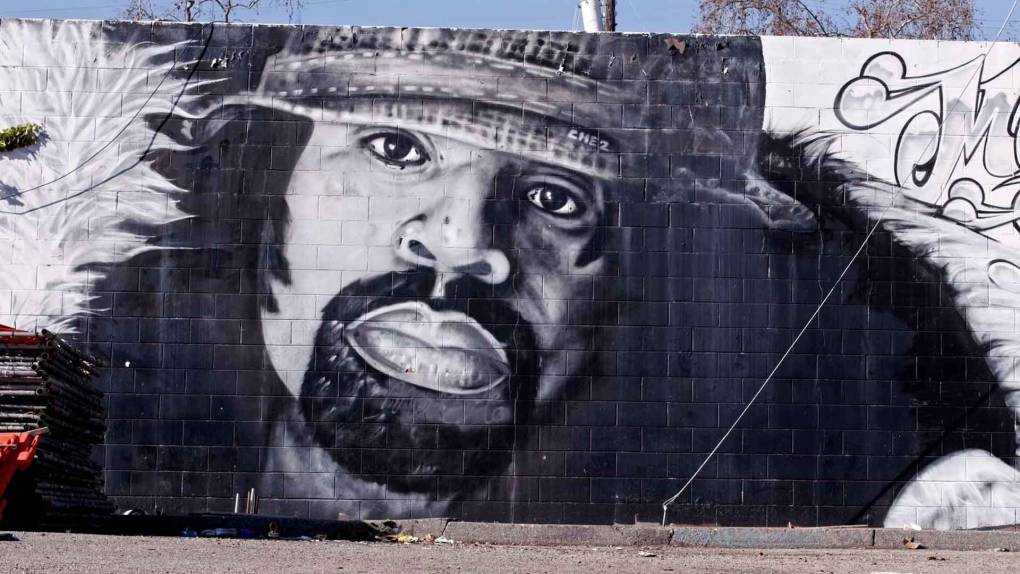
Watch: ‘We Were Hyphy’ Celebrates the Bay’s Innovative 2000s Rap Subculture
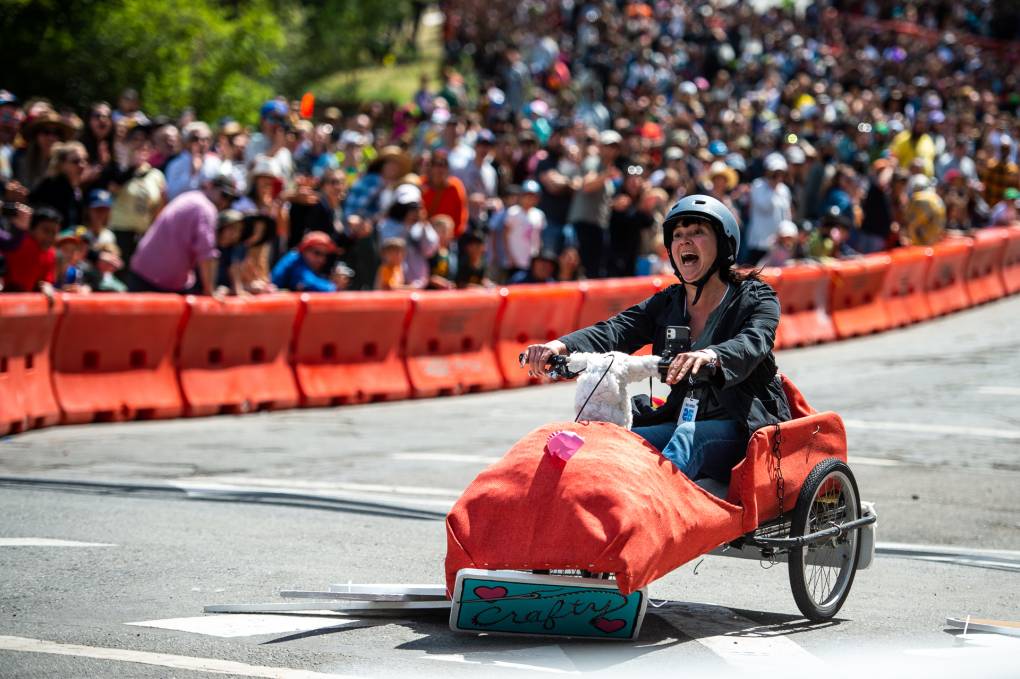
PHOTOS: The Soapbox Derby's Wild Downhill Action in San Francisco
E-40 and Too $hort’s Verzuz Battle: A Treasure Trove of Bay Area Hip-Hop Culture
Navigating Burnout? Rapper Call Me Ace Has a Few Ideas
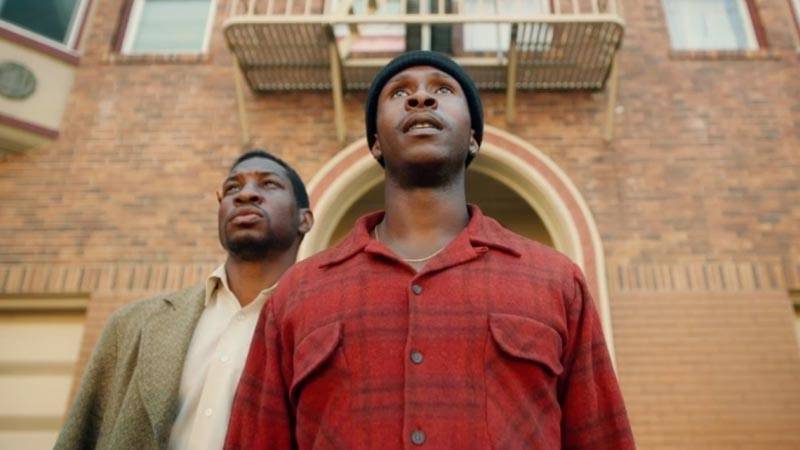
'The Last Black Man in San Francisco' Hits Home in Oakland
Talking With Artist Hank Willis Thomas About Political Struggle
Oakland Gentrification Beyond the Stats: A Conversation with Pendarvis Harshaw
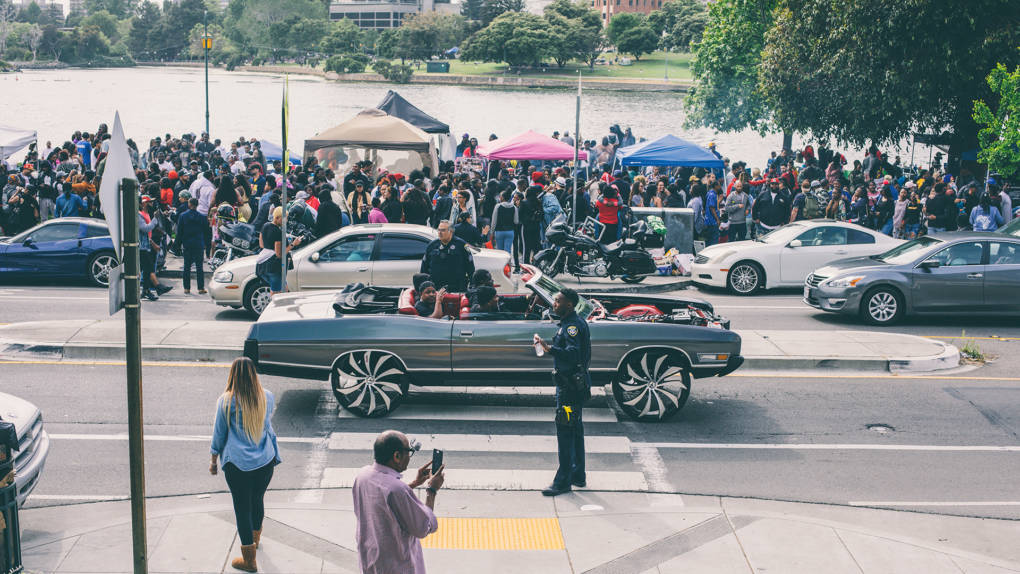
Books About Oakland, Race, Sports and Tech to Add to Your Summer Reading List
Sponsored
Player sponsored by
window.__IS_SSR__=true
window.__INITIAL_STATE__={
"attachmentsReducer": {
"audio_0": {
"type": "attachments",
"id": "audio_0",
"imgSizes": {
"kqedFullSize": {
"file": "https://ww2.kqed.org/news/wp-content/themes/KQED-unified/img/audio_bgs/background0.jpg"
}
}
},
"audio_1": {
"type": "attachments",
"id": "audio_1",
"imgSizes": {
"kqedFullSize": {
"file": "https://ww2.kqed.org/news/wp-content/themes/KQED-unified/img/audio_bgs/background1.jpg"
}
}
},
"audio_2": {
"type": "attachments",
"id": "audio_2",
"imgSizes": {
"kqedFullSize": {
"file": "https://ww2.kqed.org/news/wp-content/themes/KQED-unified/img/audio_bgs/background2.jpg"
}
}
},
"audio_3": {
"type": "attachments",
"id": "audio_3",
"imgSizes": {
"kqedFullSize": {
"file": "https://ww2.kqed.org/news/wp-content/themes/KQED-unified/img/audio_bgs/background3.jpg"
}
}
},
"audio_4": {
"type": "attachments",
"id": "audio_4",
"imgSizes": {
"kqedFullSize": {
"file": "https://ww2.kqed.org/news/wp-content/themes/KQED-unified/img/audio_bgs/background4.jpg"
}
}
},
"placeholder": {
"type": "attachments",
"id": "placeholder",
"imgSizes": {
"thumbnail": {
"file": "https://cdn.kqed.org/wp-content/uploads/2024/12/KQED-Default-Image-816638274-2000x1333-1-160x107.jpg",
"width": 160,
"height": 107,
"mimeType": "image/jpeg"
},
"medium": {
"file": "https://cdn.kqed.org/wp-content/uploads/2024/12/KQED-Default-Image-816638274-2000x1333-1-800x533.jpg",
"width": 800,
"height": 533,
"mimeType": "image/jpeg"
},
"medium_large": {
"file": "https://cdn.kqed.org/wp-content/uploads/2024/12/KQED-Default-Image-816638274-2000x1333-1-768x512.jpg",
"width": 768,
"height": 512,
"mimeType": "image/jpeg"
},
"large": {
"file": "https://cdn.kqed.org/wp-content/uploads/2024/12/KQED-Default-Image-816638274-2000x1333-1-1020x680.jpg",
"width": 1020,
"height": 680,
"mimeType": "image/jpeg"
},
"1536x1536": {
"file": "https://cdn.kqed.org/wp-content/uploads/2024/12/KQED-Default-Image-816638274-2000x1333-1-1536x1024.jpg",
"width": 1536,
"height": 1024,
"mimeType": "image/jpeg"
},
"fd-lrg": {
"file": "https://cdn.kqed.org/wp-content/uploads/2024/12/KQED-Default-Image-816638274-2000x1333-1-1536x1024.jpg",
"width": 1536,
"height": 1024,
"mimeType": "image/jpeg"
},
"fd-med": {
"file": "https://cdn.kqed.org/wp-content/uploads/2024/12/KQED-Default-Image-816638274-2000x1333-1-1020x680.jpg",
"width": 1020,
"height": 680,
"mimeType": "image/jpeg"
},
"fd-sm": {
"file": "https://cdn.kqed.org/wp-content/uploads/2024/12/KQED-Default-Image-816638274-2000x1333-1-800x533.jpg",
"width": 800,
"height": 533,
"mimeType": "image/jpeg"
},
"post-thumbnail": {
"file": "https://cdn.kqed.org/wp-content/uploads/2024/12/KQED-Default-Image-816638274-2000x1333-1-672x372.jpg",
"width": 672,
"height": 372,
"mimeType": "image/jpeg"
},
"twentyfourteen-full-width": {
"file": "https://cdn.kqed.org/wp-content/uploads/2024/12/KQED-Default-Image-816638274-2000x1333-1-1038x576.jpg",
"width": 1038,
"height": 576,
"mimeType": "image/jpeg"
},
"xxsmall": {
"file": "https://cdn.kqed.org/wp-content/uploads/2024/12/KQED-Default-Image-816638274-2000x1333-1-160x107.jpg",
"width": 160,
"height": 107,
"mimeType": "image/jpeg"
},
"xsmall": {
"file": "https://cdn.kqed.org/wp-content/uploads/2024/12/KQED-Default-Image-816638274-2000x1333-1-672x372.jpg",
"width": 672,
"height": 372,
"mimeType": "image/jpeg"
},
"small": {
"file": "https://cdn.kqed.org/wp-content/uploads/2024/12/KQED-Default-Image-816638274-2000x1333-1-672x372.jpg",
"width": 672,
"height": 372,
"mimeType": "image/jpeg"
},
"xlarge": {
"file": "https://cdn.kqed.org/wp-content/uploads/2024/12/KQED-Default-Image-816638274-2000x1333-1-1020x680.jpg",
"width": 1020,
"height": 680,
"mimeType": "image/jpeg"
},
"full-width": {
"file": "https://cdn.kqed.org/wp-content/uploads/2024/12/KQED-Default-Image-816638274-2000x1333-1-1920x1280.jpg",
"width": 1920,
"height": 1280,
"mimeType": "image/jpeg"
},
"guest-author-32": {
"file": "https://cdn.kqed.org/wp-content/uploads/2025/01/KQED-Default-Image-816638274-1333x1333-1-160x160.jpg",
"width": 32,
"height": 32,
"mimeType": "image/jpeg"
},
"guest-author-50": {
"file": "https://cdn.kqed.org/wp-content/uploads/2025/01/KQED-Default-Image-816638274-1333x1333-1-160x160.jpg",
"width": 50,
"height": 50,
"mimeType": "image/jpeg"
},
"guest-author-64": {
"file": "https://cdn.kqed.org/wp-content/uploads/2025/01/KQED-Default-Image-816638274-1333x1333-1-160x160.jpg",
"width": 64,
"height": 64,
"mimeType": "image/jpeg"
},
"guest-author-96": {
"file": "https://cdn.kqed.org/wp-content/uploads/2025/01/KQED-Default-Image-816638274-1333x1333-1-160x160.jpg",
"width": 96,
"height": 96,
"mimeType": "image/jpeg"
},
"guest-author-128": {
"file": "https://cdn.kqed.org/wp-content/uploads/2025/01/KQED-Default-Image-816638274-1333x1333-1-160x160.jpg",
"width": 128,
"height": 128,
"mimeType": "image/jpeg"
},
"detail": {
"file": "https://cdn.kqed.org/wp-content/uploads/2025/01/KQED-Default-Image-816638274-1333x1333-1-160x160.jpg",
"width": 160,
"height": 160,
"mimeType": "image/jpeg"
},
"kqedFullSize": {
"file": "https://cdn.kqed.org/wp-content/uploads/2024/12/KQED-Default-Image-816638274-2000x1333-1.jpg",
"width": 2000,
"height": 1333
}
}
},
"arts_13930171": {
"type": "attachments",
"id": "arts_13930171",
"meta": {
"index": "attachments_1716263798",
"site": "arts",
"id": "13930171",
"found": true
},
"parent": 13930119,
"imgSizes": {
"twentyfourteen-full-width": {
"file": "https://ww2.kqed.org/app/uploads/sites/2/2023/06/2022-Afrocentric-Oakland-Juneteenth-Nate-King-1038x576.jpg",
"width": 1038,
"mimeType": "image/jpeg",
"height": 576
},
"thumbnail": {
"file": "https://ww2.kqed.org/app/uploads/sites/2/2023/06/2022-Afrocentric-Oakland-Juneteenth-Nate-King-160x107.jpg",
"width": 160,
"mimeType": "image/jpeg",
"height": 107
},
"post-thumbnail": {
"file": "https://ww2.kqed.org/app/uploads/sites/2/2023/06/2022-Afrocentric-Oakland-Juneteenth-Nate-King-672x372.jpg",
"width": 672,
"mimeType": "image/jpeg",
"height": 372
},
"kqedFullSize": {
"file": "https://ww2.kqed.org/app/uploads/sites/2/2023/06/2022-Afrocentric-Oakland-Juneteenth-Nate-King.jpg",
"width": 2048,
"height": 1365
},
"large": {
"file": "https://ww2.kqed.org/app/uploads/sites/2/2023/06/2022-Afrocentric-Oakland-Juneteenth-Nate-King-1020x680.jpg",
"width": 1020,
"mimeType": "image/jpeg",
"height": 680
},
"1536x1536": {
"file": "https://ww2.kqed.org/app/uploads/sites/2/2023/06/2022-Afrocentric-Oakland-Juneteenth-Nate-King-1536x1024.jpg",
"width": 1536,
"mimeType": "image/jpeg",
"height": 1024
},
"full-width": {
"file": "https://ww2.kqed.org/app/uploads/sites/2/2023/06/2022-Afrocentric-Oakland-Juneteenth-Nate-King-1920x1280.jpg",
"width": 1920,
"mimeType": "image/jpeg",
"height": 1280
},
"medium": {
"file": "https://ww2.kqed.org/app/uploads/sites/2/2023/06/2022-Afrocentric-Oakland-Juneteenth-Nate-King-800x533.jpg",
"width": 800,
"mimeType": "image/jpeg",
"height": 533
},
"medium_large": {
"file": "https://ww2.kqed.org/app/uploads/sites/2/2023/06/2022-Afrocentric-Oakland-Juneteenth-Nate-King-768x512.jpg",
"width": 768,
"mimeType": "image/jpeg",
"height": 512
}
},
"publishDate": 1686083929,
"modified": 1686083978,
"caption": "Attendees dance at the 2022 Afrocentric Oakland Juneteenth celebration. ",
"description": null,
"title": "2022 Afrocentric Oakland Juneteenth (Nate King)",
"credit": "Nate King",
"status": "inherit",
"altTag": null,
"fetchFailed": false,
"isLoading": false
},
"arts_13924556": {
"type": "attachments",
"id": "arts_13924556",
"meta": {
"index": "attachments_1716263798",
"site": "arts",
"id": "13924556",
"found": true
},
"title": "MacDre.chez.featured",
"publishDate": 1675236609,
"status": "inherit",
"parent": 13924109,
"modified": 1730330549,
"caption": "A Mac Dre mural on Foothill Boulevard in Oakland by artist Chez.",
"credit": "Laurence Madrigal/We Were Hyphy",
"altTag": "a spraypainted mural of the rap artist mac dre",
"description": null,
"imgSizes": {
"medium": {
"file": "https://cdn.kqed.org/wp-content/uploads/sites/2/2023/01/MacDre.chez_.featured-800x450.jpg",
"width": 800,
"height": 450,
"mimeType": "image/jpeg"
},
"large": {
"file": "https://cdn.kqed.org/wp-content/uploads/sites/2/2023/01/MacDre.chez_.featured-1020x574.jpg",
"width": 1020,
"height": 574,
"mimeType": "image/jpeg"
},
"thumbnail": {
"file": "https://cdn.kqed.org/wp-content/uploads/sites/2/2023/01/MacDre.chez_.featured-160x90.jpg",
"width": 160,
"height": 90,
"mimeType": "image/jpeg"
},
"medium_large": {
"file": "https://cdn.kqed.org/wp-content/uploads/sites/2/2023/01/MacDre.chez_.featured-768x432.jpg",
"width": 768,
"height": 432,
"mimeType": "image/jpeg"
},
"1536x1536": {
"file": "https://cdn.kqed.org/wp-content/uploads/sites/2/2023/01/MacDre.chez_.featured-1536x864.jpg",
"width": 1536,
"height": 864,
"mimeType": "image/jpeg"
},
"post-thumbnail": {
"file": "https://cdn.kqed.org/wp-content/uploads/sites/2/2023/01/MacDre.chez_.featured-672x372.jpg",
"width": 672,
"height": 372,
"mimeType": "image/jpeg"
},
"twentyfourteen-full-width": {
"file": "https://cdn.kqed.org/wp-content/uploads/sites/2/2023/01/MacDre.chez_.featured-1038x576.jpg",
"width": 1038,
"height": 576,
"mimeType": "image/jpeg"
},
"kqedFullSize": {
"file": "https://cdn.kqed.org/wp-content/uploads/sites/2/2023/01/MacDre.chez_.featured.jpg",
"width": 1920,
"height": 1080
}
},
"fetchFailed": false,
"isLoading": false
},
"arts_13911747": {
"type": "attachments",
"id": "arts_13911747",
"meta": {
"index": "attachments_1716263798",
"site": "arts",
"id": "13911747",
"found": true
},
"parent": 0,
"imgSizes": {
"twentyfourteen-full-width": {
"file": "https://ww2.kqed.org/app/uploads/sites/2/2022/04/075_KQEDArts_SFMOMASoapboxDerby_04102022-1038x576.jpg",
"width": 1038,
"mimeType": "image/jpeg",
"height": 576
},
"thumbnail": {
"file": "https://ww2.kqed.org/app/uploads/sites/2/2022/04/075_KQEDArts_SFMOMASoapboxDerby_04102022-160x107.jpg",
"width": 160,
"mimeType": "image/jpeg",
"height": 107
},
"post-thumbnail": {
"file": "https://ww2.kqed.org/app/uploads/sites/2/2022/04/075_KQEDArts_SFMOMASoapboxDerby_04102022-672x372.jpg",
"width": 672,
"mimeType": "image/jpeg",
"height": 372
},
"kqedFullSize": {
"file": "https://ww2.kqed.org/app/uploads/sites/2/2022/04/075_KQEDArts_SFMOMASoapboxDerby_04102022.jpg",
"width": 1920,
"height": 1278
},
"large": {
"file": "https://ww2.kqed.org/app/uploads/sites/2/2022/04/075_KQEDArts_SFMOMASoapboxDerby_04102022-1020x679.jpg",
"width": 1020,
"mimeType": "image/jpeg",
"height": 679
},
"1536x1536": {
"file": "https://ww2.kqed.org/app/uploads/sites/2/2022/04/075_KQEDArts_SFMOMASoapboxDerby_04102022-1536x1022.jpg",
"width": 1536,
"mimeType": "image/jpeg",
"height": 1022
},
"medium": {
"file": "https://ww2.kqed.org/app/uploads/sites/2/2022/04/075_KQEDArts_SFMOMASoapboxDerby_04102022-800x533.jpg",
"width": 800,
"mimeType": "image/jpeg",
"height": 533
},
"medium_large": {
"file": "https://ww2.kqed.org/app/uploads/sites/2/2022/04/075_KQEDArts_SFMOMASoapboxDerby_04102022-768x511.jpg",
"width": 768,
"mimeType": "image/jpeg",
"height": 511
}
},
"publishDate": 1649699615,
"modified": 1649701190,
"caption": "'Roshambo' crosses the finish line after losing some pieces on the course during the San Francisco Museum of Modern Art Soapbox Derby in McLaren Park, San Francisco on April 10, 2022. Created by Rock Paper Scissors Collective. ",
"description": null,
"title": "075_KQEDArts_SFMOMASoapboxDerby_04102022",
"credit": "Beth LaBerge/KQED",
"status": "inherit",
"altTag": null,
"fetchFailed": false,
"isLoading": false
},
"arts_13890444": {
"type": "attachments",
"id": "arts_13890444",
"meta": {
"index": "attachments_1716263798",
"site": "arts",
"id": "13890444",
"found": true
},
"parent": 13890437,
"imgSizes": {
"twentyfourteen-full-width": {
"file": "https://ww2.kqed.org/app/uploads/sites/2/2020/12/EJbsFORUEAApF9v-1038x576.jpg",
"width": 1038,
"mimeType": "image/jpeg",
"height": 576
},
"thumbnail": {
"file": "https://ww2.kqed.org/app/uploads/sites/2/2020/12/EJbsFORUEAApF9v-160x107.jpg",
"width": 160,
"mimeType": "image/jpeg",
"height": 107
},
"post-thumbnail": {
"file": "https://ww2.kqed.org/app/uploads/sites/2/2020/12/EJbsFORUEAApF9v-672x372.jpg",
"width": 672,
"mimeType": "image/jpeg",
"height": 372
},
"kqedFullSize": {
"file": "https://ww2.kqed.org/app/uploads/sites/2/2020/12/EJbsFORUEAApF9v.jpg",
"width": 1200,
"height": 800
},
"large": {
"file": "https://ww2.kqed.org/app/uploads/sites/2/2020/12/EJbsFORUEAApF9v-1020x680.jpg",
"width": 1020,
"mimeType": "image/jpeg",
"height": 680
},
"medium": {
"file": "https://ww2.kqed.org/app/uploads/sites/2/2020/12/EJbsFORUEAApF9v-800x533.jpg",
"width": 800,
"mimeType": "image/jpeg",
"height": 533
},
"medium_large": {
"file": "https://ww2.kqed.org/app/uploads/sites/2/2020/12/EJbsFORUEAApF9v-768x512.jpg",
"width": 768,
"mimeType": "image/jpeg",
"height": 512
}
},
"publishDate": 1608028447,
"modified": 1608028510,
"caption": "Jesus El stares into the camera as I video interview E-40 at Youth Uprising in Deep East Oakland. ",
"description": "Jesus El stares into the camera as I video interview E-40 at Youth Uprising in Deep East Oakland. ",
"title": "Jesus El stares into the camera as I video interview E-40 at Youth Uprising in Deep East Oakland.",
"credit": "Jacky Johnson",
"status": "inherit",
"altTag": "Jesus El stares into the camera as I video interview E-40 at Youth Uprising in Deep East Oakland.",
"fetchFailed": false,
"isLoading": false
},
"arts_13861041": {
"type": "attachments",
"id": "arts_13861041",
"meta": {
"index": "attachments_1716263798",
"site": "arts",
"id": "13861041",
"found": true
},
"parent": 13860961,
"imgSizes": {
"twentyfourteen-full-width": {
"file": "https://ww2.kqed.org/app/uploads/sites/2/2019/07/Call-Me-Ace-Performing-02-1-1038x576.jpg",
"width": 1038,
"mimeType": "image/jpeg",
"height": 576
},
"thumbnail": {
"file": "https://ww2.kqed.org/app/uploads/sites/2/2019/07/Call-Me-Ace-Performing-02-1-160x90.jpg",
"width": 160,
"mimeType": "image/jpeg",
"height": 90
},
"post-thumbnail": {
"file": "https://ww2.kqed.org/app/uploads/sites/2/2019/07/Call-Me-Ace-Performing-02-1-672x372.jpg",
"width": 672,
"mimeType": "image/jpeg",
"height": 372
},
"kqedFullSize": {
"file": "https://ww2.kqed.org/app/uploads/sites/2/2019/07/Call-Me-Ace-Performing-02-1.jpg",
"width": 1451,
"height": 816
},
"large": {
"file": "https://ww2.kqed.org/app/uploads/sites/2/2019/07/Call-Me-Ace-Performing-02-1-1020x574.jpg",
"width": 1020,
"mimeType": "image/jpeg",
"height": 574
},
"complete_open_graph": {
"file": "https://ww2.kqed.org/app/uploads/sites/2/2019/07/Call-Me-Ace-Performing-02-1-1200x675.jpg",
"width": 1200,
"mimeType": "image/jpeg",
"height": 675
},
"medium": {
"file": "https://ww2.kqed.org/app/uploads/sites/2/2019/07/Call-Me-Ace-Performing-02-1-800x450.jpg",
"width": 800,
"mimeType": "image/jpeg",
"height": 450
},
"medium_large": {
"file": "https://ww2.kqed.org/app/uploads/sites/2/2019/07/Call-Me-Ace-Performing-02-1-768x432.jpg",
"width": 768,
"mimeType": "image/jpeg",
"height": 432
}
},
"publishDate": 1562717873,
"modified": 1562717889,
"caption": "Rapper Call Me Ace tackles burnout on his new album 'Airplane Mode'—recorded during his downtime from his marketing career at Facebook.",
"description": "Rapper Call Me Ace tackles burnout on his new album 'Airplane Mode'—recorded during his downtime from his marketing career at Facebook.",
"title": "Call-Me-Ace-Performing-02",
"credit": "Courtesy of Call Me Ace",
"status": "inherit",
"fetchFailed": false,
"isLoading": false
},
"arts_13858090": {
"type": "attachments",
"id": "arts_13858090",
"meta": {
"index": "attachments_1716263798",
"site": "arts",
"id": "13858090",
"found": true
},
"parent": 13858037,
"imgSizes": {
"thumbnail": {
"file": "https://ww2.kqed.org/app/uploads/sites/2/2019/05/LastBlackManinSF-160x90.jpg",
"width": 160,
"mimeType": "image/jpeg",
"height": 90
},
"post-thumbnail": {
"file": "https://ww2.kqed.org/app/uploads/sites/2/2019/05/LastBlackManinSF-672x372.jpg",
"width": 672,
"mimeType": "image/jpeg",
"height": 372
},
"kqedFullSize": {
"file": "https://ww2.kqed.org/app/uploads/sites/2/2019/05/LastBlackManinSF.jpg",
"width": 800,
"height": 450
},
"medium": {
"file": "https://ww2.kqed.org/app/uploads/sites/2/2019/05/LastBlackManinSF-800x450.jpg",
"width": 800,
"mimeType": "image/jpeg",
"height": 450
},
"medium_large": {
"file": "https://ww2.kqed.org/app/uploads/sites/2/2019/05/LastBlackManinSF-768x432.jpg",
"width": 768,
"mimeType": "image/jpeg",
"height": 432
}
},
"publishDate": 1558630738,
"modified": 1558630809,
"caption": "Last year brought the summer of Oakland film; now, with 'The Last Black Man in San Francisco,' the attention crosses back over the Bay.",
"description": "Last year brought the summer of Oakland film; now, with 'The Last Black Man in San Francisco,' the attention crosses back over the Bay.",
"title": "LastBlackManinSF",
"credit": "A24",
"status": "inherit",
"fetchFailed": false,
"isLoading": false
},
"arts_13844095": {
"type": "attachments",
"id": "arts_13844095",
"meta": {
"index": "attachments_1716263798",
"site": "arts",
"id": "13844095",
"found": true
},
"parent": 13844050,
"imgSizes": {
"small": {
"file": "https://ww2.kqed.org/app/uploads/sites/2/2018/11/HankWillisThomas.MAIN_-520x293.jpg",
"width": 520,
"mimeType": "image/jpeg",
"height": 293
},
"twentyfourteen-full-width": {
"file": "https://ww2.kqed.org/app/uploads/sites/2/2018/11/HankWillisThomas.MAIN_-1038x576.jpg",
"width": 1038,
"mimeType": "image/jpeg",
"height": 576
},
"thumbnail": {
"file": "https://ww2.kqed.org/app/uploads/sites/2/2018/11/HankWillisThomas.MAIN_-160x90.jpg",
"width": 160,
"mimeType": "image/jpeg",
"height": 90
},
"fd-sm": {
"file": "https://ww2.kqed.org/app/uploads/sites/2/2018/11/HankWillisThomas.MAIN_-960x540.jpg",
"width": 960,
"mimeType": "image/jpeg",
"height": 540
},
"post-thumbnail": {
"file": "https://ww2.kqed.org/app/uploads/sites/2/2018/11/HankWillisThomas.MAIN_-672x372.jpg",
"width": 672,
"mimeType": "image/jpeg",
"height": 372
},
"xsmall": {
"file": "https://ww2.kqed.org/app/uploads/sites/2/2018/11/HankWillisThomas.MAIN_-375x211.jpg",
"width": 375,
"mimeType": "image/jpeg",
"height": 211
},
"kqedFullSize": {
"file": "https://ww2.kqed.org/app/uploads/sites/2/2018/11/HankWillisThomas.MAIN_.jpg",
"width": 1920,
"height": 1080
},
"large": {
"file": "https://ww2.kqed.org/app/uploads/sites/2/2018/11/HankWillisThomas.MAIN_-1020x574.jpg",
"width": 1020,
"mimeType": "image/jpeg",
"height": 574
},
"xlarge": {
"file": "https://ww2.kqed.org/app/uploads/sites/2/2018/11/HankWillisThomas.MAIN_-1180x664.jpg",
"width": 1180,
"mimeType": "image/jpeg",
"height": 664
},
"complete_open_graph": {
"file": "https://ww2.kqed.org/app/uploads/sites/2/2018/11/HankWillisThomas.MAIN_-1200x675.jpg",
"width": 1200,
"mimeType": "image/jpeg",
"height": 675
},
"guest-author-50": {
"file": "https://ww2.kqed.org/app/uploads/sites/2/2018/11/HankWillisThomas.MAIN_-50x50.jpg",
"width": 50,
"mimeType": "image/jpeg",
"height": 50
},
"guest-author-96": {
"file": "https://ww2.kqed.org/app/uploads/sites/2/2018/11/HankWillisThomas.MAIN_-96x96.jpg",
"width": 96,
"mimeType": "image/jpeg",
"height": 96
},
"medium": {
"file": "https://ww2.kqed.org/app/uploads/sites/2/2018/11/HankWillisThomas.MAIN_-800x450.jpg",
"width": 800,
"mimeType": "image/jpeg",
"height": 450
},
"guest-author-64": {
"file": "https://ww2.kqed.org/app/uploads/sites/2/2018/11/HankWillisThomas.MAIN_-64x64.jpg",
"width": 64,
"mimeType": "image/jpeg",
"height": 64
},
"guest-author-32": {
"file": "https://ww2.kqed.org/app/uploads/sites/2/2018/11/HankWillisThomas.MAIN_-32x32.jpg",
"width": 32,
"mimeType": "image/jpeg",
"height": 32
},
"fd-lrg": {
"file": "https://ww2.kqed.org/app/uploads/sites/2/2018/11/HankWillisThomas.MAIN_-1920x1080.jpg",
"width": 1920,
"mimeType": "image/jpeg",
"height": 1080
},
"fd-med": {
"file": "https://ww2.kqed.org/app/uploads/sites/2/2018/11/HankWillisThomas.MAIN_-1180x664.jpg",
"width": 1180,
"mimeType": "image/jpeg",
"height": 664
},
"full-width": {
"file": "https://ww2.kqed.org/app/uploads/sites/2/2018/11/HankWillisThomas.MAIN_-1920x1080.jpg",
"width": 1920,
"mimeType": "image/jpeg",
"height": 1080
},
"detail": {
"file": "https://ww2.kqed.org/app/uploads/sites/2/2018/11/HankWillisThomas.MAIN_-150x150.jpg",
"width": 150,
"mimeType": "image/jpeg",
"height": 150
},
"medium_large": {
"file": "https://ww2.kqed.org/app/uploads/sites/2/2018/11/HankWillisThomas.MAIN_-768x432.jpg",
"width": 768,
"mimeType": "image/jpeg",
"height": 432
},
"guest-author-128": {
"file": "https://ww2.kqed.org/app/uploads/sites/2/2018/11/HankWillisThomas.MAIN_-128x128.jpg",
"width": 128,
"mimeType": "image/jpeg",
"height": 128
},
"xxsmall": {
"file": "https://ww2.kqed.org/app/uploads/sites/2/2018/11/HankWillisThomas.MAIN_-240x135.jpg",
"width": 240,
"mimeType": "image/jpeg",
"height": 135
}
},
"publishDate": 1541181718,
"modified": 1541182950,
"caption": "Hank Willis Thomas at CCA's Hubbell Street Gallery, with Sharon Daniels' 'Amends / Civil Death.'",
"description": "Hank Willis Thomas at CCA's Hubbell Street Gallery, with Sharon Daniels' 'Amends / Civil Death.'",
"title": "HankWillisThomas.MAIN",
"credit": "Pendarvis Harshaw/KQED",
"status": "inherit",
"fetchFailed": false,
"isLoading": false
},
"arts_13832899": {
"type": "attachments",
"id": "arts_13832899",
"meta": {
"index": "attachments_1716263798",
"site": "arts",
"id": "13832899",
"found": true
},
"parent": 13832886,
"imgSizes": {
"small": {
"file": "https://ww2.kqed.org/app/uploads/sites/2/2018/05/cover-520x293.jpg",
"width": 520,
"mimeType": "image/jpeg",
"height": 293
},
"twentyfourteen-full-width": {
"file": "https://ww2.kqed.org/app/uploads/sites/2/2018/05/cover-1038x576.jpg",
"width": 1038,
"mimeType": "image/jpeg",
"height": 576
},
"thumbnail": {
"file": "https://ww2.kqed.org/app/uploads/sites/2/2018/05/cover-160x90.jpg",
"width": 160,
"mimeType": "image/jpeg",
"height": 90
},
"fd-sm": {
"file": "https://ww2.kqed.org/app/uploads/sites/2/2018/05/cover-960x540.jpg",
"width": 960,
"mimeType": "image/jpeg",
"height": 540
},
"post-thumbnail": {
"file": "https://ww2.kqed.org/app/uploads/sites/2/2018/05/cover-672x372.jpg",
"width": 672,
"mimeType": "image/jpeg",
"height": 372
},
"xsmall": {
"file": "https://ww2.kqed.org/app/uploads/sites/2/2018/05/cover-375x211.jpg",
"width": 375,
"mimeType": "image/jpeg",
"height": 211
},
"kqedFullSize": {
"file": "https://ww2.kqed.org/app/uploads/sites/2/2018/05/cover.jpg",
"width": 1920,
"height": 1080
},
"large": {
"file": "https://ww2.kqed.org/app/uploads/sites/2/2018/05/cover-1020x574.jpg",
"width": 1020,
"mimeType": "image/jpeg",
"height": 574
},
"xlarge": {
"file": "https://ww2.kqed.org/app/uploads/sites/2/2018/05/cover-1180x664.jpg",
"width": 1180,
"mimeType": "image/jpeg",
"height": 664
},
"complete_open_graph": {
"file": "https://ww2.kqed.org/app/uploads/sites/2/2018/05/cover-1200x675.jpg",
"width": 1200,
"mimeType": "image/jpeg",
"height": 675
},
"guest-author-50": {
"file": "https://ww2.kqed.org/app/uploads/sites/2/2018/05/cover-50x50.jpg",
"width": 50,
"mimeType": "image/jpeg",
"height": 50
},
"guest-author-96": {
"file": "https://ww2.kqed.org/app/uploads/sites/2/2018/05/cover-96x96.jpg",
"width": 96,
"mimeType": "image/jpeg",
"height": 96
},
"medium": {
"file": "https://ww2.kqed.org/app/uploads/sites/2/2018/05/cover-800x450.jpg",
"width": 800,
"mimeType": "image/jpeg",
"height": 450
},
"guest-author-64": {
"file": "https://ww2.kqed.org/app/uploads/sites/2/2018/05/cover-64x64.jpg",
"width": 64,
"mimeType": "image/jpeg",
"height": 64
},
"guest-author-32": {
"file": "https://ww2.kqed.org/app/uploads/sites/2/2018/05/cover-32x32.jpg",
"width": 32,
"mimeType": "image/jpeg",
"height": 32
},
"fd-lrg": {
"file": "https://ww2.kqed.org/app/uploads/sites/2/2018/05/cover-1920x1080.jpg",
"width": 1920,
"mimeType": "image/jpeg",
"height": 1080
},
"fd-med": {
"file": "https://ww2.kqed.org/app/uploads/sites/2/2018/05/cover-1180x664.jpg",
"width": 1180,
"mimeType": "image/jpeg",
"height": 664
},
"full-width": {
"file": "https://ww2.kqed.org/app/uploads/sites/2/2018/05/cover-1920x1080.jpg",
"width": 1920,
"mimeType": "image/jpeg",
"height": 1080
},
"detail": {
"file": "https://ww2.kqed.org/app/uploads/sites/2/2018/05/cover-150x150.jpg",
"width": 150,
"mimeType": "image/jpeg",
"height": 150
},
"medium_large": {
"file": "https://ww2.kqed.org/app/uploads/sites/2/2018/05/cover-768x432.jpg",
"width": 768,
"mimeType": "image/jpeg",
"height": 432
},
"guest-author-128": {
"file": "https://ww2.kqed.org/app/uploads/sites/2/2018/05/cover-128x128.jpg",
"width": 128,
"mimeType": "image/jpeg",
"height": 128
},
"xxsmall": {
"file": "https://ww2.kqed.org/app/uploads/sites/2/2018/05/cover-240x135.jpg",
"width": 240,
"mimeType": "image/jpeg",
"height": 135
}
},
"publishDate": 1526932428,
"modified": 1526935431,
"caption": "Hundreds of black Oaklanders and their supporters came to \"BBQ'n While Black\" at Lake Merritt on May 20 following a white woman's racially charged police complaint.",
"description": "Hundreds of black Oaklanders and their supporters came to BBQ'n While Black at Lake Merritt on May 20 following a white woman's racially charged police complaint.",
"title": "cover",
"credit": "Kevin Allen",
"status": "inherit",
"fetchFailed": false,
"isLoading": false
},
"arts_13834718": {
"type": "attachments",
"id": "arts_13834718",
"meta": {
"index": "attachments_1716263798",
"site": "arts",
"id": "13834718",
"found": true
},
"parent": 13834645,
"imgSizes": {
"small": {
"file": "https://ww2.kqed.org/app/uploads/sites/2/2018/06/books-collage-520x293.jpg",
"width": 520,
"mimeType": "image/jpeg",
"height": 293
},
"thumbnail": {
"file": "https://ww2.kqed.org/app/uploads/sites/2/2018/06/books-collage-160x90.jpg",
"width": 160,
"mimeType": "image/jpeg",
"height": 90
},
"post-thumbnail": {
"file": "https://ww2.kqed.org/app/uploads/sites/2/2018/06/books-collage-672x372.jpg",
"width": 672,
"mimeType": "image/jpeg",
"height": 372
},
"xsmall": {
"file": "https://ww2.kqed.org/app/uploads/sites/2/2018/06/books-collage-375x211.jpg",
"width": 375,
"mimeType": "image/jpeg",
"height": 211
},
"kqedFullSize": {
"file": "https://ww2.kqed.org/app/uploads/sites/2/2018/06/books-collage.jpg",
"width": 800,
"height": 450
},
"guest-author-50": {
"file": "https://ww2.kqed.org/app/uploads/sites/2/2018/06/books-collage-50x50.jpg",
"width": 50,
"mimeType": "image/jpeg",
"height": 50
},
"guest-author-96": {
"file": "https://ww2.kqed.org/app/uploads/sites/2/2018/06/books-collage-96x96.jpg",
"width": 96,
"mimeType": "image/jpeg",
"height": 96
},
"medium": {
"file": "https://ww2.kqed.org/app/uploads/sites/2/2018/06/books-collage-800x450.jpg",
"width": 800,
"mimeType": "image/jpeg",
"height": 450
},
"guest-author-64": {
"file": "https://ww2.kqed.org/app/uploads/sites/2/2018/06/books-collage-64x64.jpg",
"width": 64,
"mimeType": "image/jpeg",
"height": 64
},
"guest-author-32": {
"file": "https://ww2.kqed.org/app/uploads/sites/2/2018/06/books-collage-32x32.jpg",
"width": 32,
"mimeType": "image/jpeg",
"height": 32
},
"detail": {
"file": "https://ww2.kqed.org/app/uploads/sites/2/2018/06/books-collage-150x150.jpg",
"width": 150,
"mimeType": "image/jpeg",
"height": 150
},
"medium_large": {
"file": "https://ww2.kqed.org/app/uploads/sites/2/2018/06/books-collage-768x432.jpg",
"width": 768,
"mimeType": "image/jpeg",
"height": 432
},
"guest-author-128": {
"file": "https://ww2.kqed.org/app/uploads/sites/2/2018/06/books-collage-128x128.jpg",
"width": 128,
"mimeType": "image/jpeg",
"height": 128
},
"xxsmall": {
"file": "https://ww2.kqed.org/app/uploads/sites/2/2018/06/books-collage-240x135.jpg",
"width": 240,
"mimeType": "image/jpeg",
"height": 135
}
},
"publishDate": 1528482074,
"modified": 1528482074,
"caption": null,
"description": null,
"title": "books collage",
"credit": null,
"status": "inherit",
"fetchFailed": false,
"isLoading": false
}
},
"audioPlayerReducer": {
"postId": "stream_live",
"isPaused": true,
"isPlaying": false,
"pfsActive": false,
"pledgeModalIsOpen": true,
"playerDrawerIsOpen": false
},
"authorsReducer": {
"gmeline": {
"type": "authors",
"id": "185",
"meta": {
"index": "authors_1716337520",
"id": "185",
"found": true
},
"name": "Gabe Meline",
"firstName": "Gabe",
"lastName": "Meline",
"slug": "gmeline",
"email": "gmeline@kqed.org",
"display_author_email": false,
"staff_mastheads": [
"arts"
],
"title": "Senior Editor, KQED Arts & Culture",
"bio": "Gabe Meline entered journalism at age 15 making photocopied zines, and has since earned awards from the Edward R. Murrow Awards, the Society for Professional Journalists, the Online Journalism Awards, the Association of Alternative Newsweeklies and the California Newspaper Publishers Association. Prior to KQED, he was the editor of the \u003cem>North Bay Bohemian\u003c/em> and a touring musician. He lives with his wife, his daughter, and a 1964 Volvo in his hometown of Santa Rosa, CA.",
"avatar": "https://secure.gravatar.com/avatar/80e9715844c5fc3f07edac5b08973b76?s=600&d=blank&r=g",
"twitter": null,
"facebook": null,
"instagram": "gmeline",
"linkedin": null,
"sites": [
{
"site": "",
"roles": [
"editor"
]
},
{
"site": "arts",
"roles": [
"administrator"
]
},
{
"site": "artschool",
"roles": [
"editor"
]
},
{
"site": "news",
"roles": [
"author"
]
},
{
"site": "pop",
"roles": [
"editor"
]
},
{
"site": "bayareabites",
"roles": [
"editor"
]
},
{
"site": "food",
"roles": [
"editor"
]
},
{
"site": "liveblog",
"roles": [
"editor"
]
},
{
"site": "hiphop",
"roles": [
"editor"
]
}
],
"headData": {
"title": "Gabe Meline | KQED",
"description": "Senior Editor, KQED Arts & Culture",
"ogImgSrc": "https://secure.gravatar.com/avatar/80e9715844c5fc3f07edac5b08973b76?s=600&d=blank&r=g",
"twImgSrc": "https://secure.gravatar.com/avatar/80e9715844c5fc3f07edac5b08973b76?s=600&d=blank&r=g"
},
"isLoading": false,
"link": "/author/gmeline"
},
"nvoynovskaya": {
"type": "authors",
"id": "11387",
"meta": {
"index": "authors_1716337520",
"id": "11387",
"found": true
},
"name": "Nastia Voynovskaya",
"firstName": "Nastia",
"lastName": "Voynovskaya",
"slug": "nvoynovskaya",
"email": "nvoynovskaya@kqed.org",
"display_author_email": false,
"staff_mastheads": [
"arts"
],
"title": "Editor and reporter",
"bio": "Nastia Voynovskaya is a reporter and editor at KQED Arts & Culture. She's been covering the arts in the Bay Area for over a decade, with a focus on music, queer culture, labor issues and grassroots organizing. She has edited KQED story series such as Trans Bay: A History of San Francisco's Gender-Diverse Community, and co-created KQED's Bay Area hip-hop history project, That's My Word. Nastia's work has been recognized by the Society of Professional Journalists and San Francisco Press Club. She holds a BA in comparative literature from UC Berkeley.",
"avatar": "https://secure.gravatar.com/avatar/310649817772dd2a98e5dfecb6b24842?s=600&d=blank&r=g",
"twitter": null,
"facebook": null,
"instagram": "https://www.instagram.com/nananastia/",
"linkedin": null,
"sites": [
{
"site": "arts",
"roles": [
"administrator"
]
},
{
"site": "news",
"roles": [
"editor"
]
},
{
"site": "pop",
"roles": [
"administrator"
]
},
{
"site": "bayareabites",
"roles": [
"editor"
]
},
{
"site": "podcasts",
"roles": [
"editor"
]
},
{
"site": "hiphop",
"roles": [
"editor"
]
}
],
"headData": {
"title": "Nastia Voynovskaya | KQED",
"description": "Editor and reporter",
"ogImgSrc": "https://secure.gravatar.com/avatar/310649817772dd2a98e5dfecb6b24842?s=600&d=blank&r=g",
"twImgSrc": "https://secure.gravatar.com/avatar/310649817772dd2a98e5dfecb6b24842?s=600&d=blank&r=g"
},
"isLoading": false,
"link": "/author/nvoynovskaya"
},
"ogpenn": {
"type": "authors",
"id": "11491",
"meta": {
"index": "authors_1716337520",
"id": "11491",
"found": true
},
"name": "Pendarvis Harshaw",
"firstName": "Pendarvis",
"lastName": "Harshaw",
"slug": "ogpenn",
"email": "ogpenn@gmail.com",
"display_author_email": false,
"staff_mastheads": [
"arts"
],
"title": "Community Engagement Reporter",
"bio": "Pendarvis Harshaw is an educator, host and writer with KQED Arts.",
"avatar": "https://secure.gravatar.com/avatar/093d33baff5354890e29ad83d58d2c49?s=600&d=blank&r=g",
"twitter": null,
"facebook": null,
"instagram": "ogpenn",
"linkedin": null,
"sites": [
{
"site": "arts",
"roles": [
"editor"
]
},
{
"site": "news",
"roles": [
"editor"
]
},
{
"site": "bayareabites",
"roles": [
"author"
]
},
{
"site": "hiphop",
"roles": [
"editor"
]
}
],
"headData": {
"title": "Pendarvis Harshaw | KQED",
"description": "Community Engagement Reporter",
"ogImgSrc": "https://secure.gravatar.com/avatar/093d33baff5354890e29ad83d58d2c49?s=600&d=blank&r=g",
"twImgSrc": "https://secure.gravatar.com/avatar/093d33baff5354890e29ad83d58d2c49?s=600&d=blank&r=g"
},
"isLoading": false,
"link": "/author/ogpenn"
},
"blaberge": {
"type": "authors",
"id": "11667",
"meta": {
"index": "authors_1716337520",
"id": "11667",
"found": true
},
"name": "Beth LaBerge",
"firstName": "Beth",
"lastName": "LaBerge",
"slug": "blaberge",
"email": "blaberge@KQED.org",
"display_author_email": true,
"staff_mastheads": [
"news"
],
"title": "Photographer, News",
"bio": "Beth LaBerge is a visual journalist for \u003ca href=\"https://www.kqed.org/news\">KQED News\u003c/a>.",
"avatar": "https://secure.gravatar.com/avatar/15e224cd55918d1876693b8280954875?s=600&d=blank&r=g",
"twitter": null,
"facebook": null,
"instagram": "https://www.instagram.com/bethlaberge/",
"linkedin": null,
"sites": [
{
"site": "arts",
"roles": [
"editor"
]
},
{
"site": "news",
"roles": [
"editor"
]
},
{
"site": "science",
"roles": [
"editor",
"contributor",
"author"
]
},
{
"site": "liveblog",
"roles": [
"editor"
]
}
],
"headData": {
"title": "Beth LaBerge | KQED",
"description": "Photographer, News",
"ogImgSrc": "https://secure.gravatar.com/avatar/15e224cd55918d1876693b8280954875?s=600&d=blank&r=g",
"twImgSrc": "https://secure.gravatar.com/avatar/15e224cd55918d1876693b8280954875?s=600&d=blank&r=g"
},
"isLoading": false,
"link": "/author/blaberge"
},
"ksong": {
"type": "authors",
"id": "11813",
"meta": {
"index": "authors_1716337520",
"id": "11813",
"found": true
},
"name": "Kristie Song",
"firstName": "Kristie",
"lastName": "Song",
"slug": "ksong",
"email": "ksong@kqed.org",
"display_author_email": false,
"staff_mastheads": [],
"title": "Editorial Intern ",
"bio": "Kristie Song is an Arts & Culture Intern at KQED. She is currently a graduate student at UC Berkeley, where she studies audio and multimedia journalism. Previously, she covered the local community for Oakland North, produced episodes for The Science of Happiness, and served as news director for KUCI, UC Irvine’s radio station. Outside of reporting, she likes drawing comics, listening to angsty rock, and practicing the guitar.",
"avatar": "https://secure.gravatar.com/avatar/c1149e78c3c44f92d4945a8ab0711af6?s=600&d=blank&r=g",
"twitter": null,
"facebook": null,
"instagram": null,
"linkedin": null,
"sites": [
{
"site": "arts",
"roles": [
"editor"
]
}
],
"headData": {
"title": "Kristie Song | KQED",
"description": "Editorial Intern ",
"ogImgSrc": "https://secure.gravatar.com/avatar/c1149e78c3c44f92d4945a8ab0711af6?s=600&d=blank&r=g",
"twImgSrc": "https://secure.gravatar.com/avatar/c1149e78c3c44f92d4945a8ab0711af6?s=600&d=blank&r=g"
},
"isLoading": false,
"link": "/author/ksong"
}
},
"breakingNewsReducer": {},
"pagesReducer": {},
"postsReducer": {
"stream_live": {
"type": "live",
"id": "stream_live",
"audioUrl": "https://streams.kqed.org/kqedradio",
"title": "Live Stream",
"excerpt": "Live Stream information currently unavailable.",
"link": "/radio",
"featImg": "",
"label": {
"name": "KQED Live",
"link": "/"
}
},
"stream_kqedNewscast": {
"type": "posts",
"id": "stream_kqedNewscast",
"audioUrl": "https://www.kqed.org/.stream/anon/radio/RDnews/newscast.mp3?_=1",
"title": "KQED Newscast",
"featImg": "",
"label": {
"name": "88.5 FM",
"link": "/"
}
},
"arts_13930119": {
"type": "posts",
"id": "arts_13930119",
"meta": {
"index": "posts_1716263798",
"site": "arts",
"id": "13930119",
"score": null,
"sort": [
1686150039000
]
},
"guestAuthors": [],
"slug": "how-to-celebrate-juneteenth-2023-in-the-bay-area",
"title": "How to Celebrate Juneteenth 2023 in the Bay Area",
"publishDate": 1686150039,
"format": "aside",
"headTitle": "How to Celebrate Juneteenth 2023 in the Bay Area | KQED",
"labelTerm": {},
"content": "\u003cp>This year’s roundup of Juneteenth events celebrates the communities and organizations forging unity through education, technology, art, dance and music — highlighting joyful local traditions as well as innovative new projects and spaces honoring Black freedom.\u003c/p>\n\u003cfigure id=\"attachment_13930153\" class=\"wp-caption aligncenter\" style=\"max-width: 800px\">\u003ca href=\"https://ww2.kqed.org/app/uploads/sites/2/2023/06/Juneteenth-on-the-Waterfront-credit-Foodwise-scaled.jpg\">\u003cimg loading=\"lazy\" decoding=\"async\" class=\"size-medium wp-image-13930153\" src=\"https://ww2.kqed.org/app/uploads/sites/2/2023/06/Juneteenth-on-the-Waterfront-credit-Foodwise-800x533.jpg\" alt=\"people at an outdoor farmers' market against a blue sky in San Francisco\" width=\"800\" height=\"533\" srcset=\"https://cdn.kqed.org/wp-content/uploads/sites/2/2023/06/Juneteenth-on-the-Waterfront-credit-Foodwise-800x533.jpg 800w, https://cdn.kqed.org/wp-content/uploads/sites/2/2023/06/Juneteenth-on-the-Waterfront-credit-Foodwise-1020x680.jpg 1020w, https://cdn.kqed.org/wp-content/uploads/sites/2/2023/06/Juneteenth-on-the-Waterfront-credit-Foodwise-160x107.jpg 160w, https://cdn.kqed.org/wp-content/uploads/sites/2/2023/06/Juneteenth-on-the-Waterfront-credit-Foodwise-768x512.jpg 768w, https://cdn.kqed.org/wp-content/uploads/sites/2/2023/06/Juneteenth-on-the-Waterfront-credit-Foodwise-1536x1024.jpg 1536w, https://cdn.kqed.org/wp-content/uploads/sites/2/2023/06/Juneteenth-on-the-Waterfront-credit-Foodwise-2048x1365.jpg 2048w, https://cdn.kqed.org/wp-content/uploads/sites/2/2023/06/Juneteenth-on-the-Waterfront-credit-Foodwise-1920x1280.jpg 1920w\" sizes=\"(max-width: 800px) 100vw, 800px\">\u003c/a>\u003cfigcaption class=\"wp-caption-text\">Attendees explore different Black-owned food businesses at Juneteenth on the Waterfront, an annual pop-up event at the Embarcadero Ferry Terminal Plaza in San Francisco. \u003ccite>(Courtesy of Foodwise)\u003c/cite>\u003c/figcaption>\u003c/figure>\n\u003ch3>\u003ca href=\"https://foodwise.org/events/pop-ups-on-the-plaza-juneteenth-on-the-waterfront/\">Juneteenth on the Waterfront\u003c/a>\u003c/h3>\n\u003cp>\u003cstrong>\u003cem>June 10\u003c/em>\u003c/strong>\u003cbr>\n\u003cstrong>\u003cem>Embarcadero Ferry Terminal Plaza, San Francisco\u003c/em>\u003c/strong>\u003c/p>\n\u003cp>The weekend farmers’ market trip was something I delighted in as a kid. It was a chance for me and my brother to explore new scents and foods, happening upon morsels we’d never have at home. Here, the magic was in the search.\u003c/p>\n\u003cp>Juneteenth on the Waterfront provides this familiar wonder, with a focus on uplifting and highlighting local Black-owned businesses. Organized by \u003ca href=\"https://www.instagram.com/foodwise/\">Foodwise\u003c/a>, a nonprofit that manages farmers markets and education programs rooted in food equity and sustainability, the event features 15 Black-owned pop-up vendors selling hearty meals, desserts and drinks. Now in its third year, Juneteenth on the Waterfront will also be debuting a craft market, where several Black creators will be selling accessories, attire, skincare and more.\u003c/p>\n\u003cp>There will also be a Black Chefs and Wine Makers talk, where a panel of restaurateurs and sommeliers that includes \u003ca href=\"https://www.instagram.com/mstanyaholland/?hl=en\">chef Tanya Holland\u003c/a> will discuss the history of Black farmers and food migration to California.\u003c/p>\n\u003cp>[ad fullwidth]\u003c/p>\n\u003cp>https://www.youtube.com/watch?v=PIolFf_j3AE\u003c/p>\n\u003cp>\u003cspan style=\"color: #ffffff\">..\u003c/span>\u003c/p>\n\u003ch3>\u003ca href=\"https://www.oigc.org/news/2023-juneteenth-concert-series\">Oakland Interfaith Gospel Choir Juneteenth Concert Series\u003c/a>\u003c/h3>\n\u003cp>\u003cstrong>\u003cem>June 16, Freight & Salvage, Berkeley; June 23, Bankhead Theater, Livermore; June 25, \u003c/em>\u003cem>Great American Music Hall, San Francisco \u003c/em>\u003c/strong>\u003c/p>\n\u003cp>With the aim to connect people through Black gospel music, local minister and composer Terrance Kelly founded the Oakland Interfaith Gospel Choir in 1986. In this upcoming three-part concert series, the passionate and diverse choir will perform songs that highlight the significance of gospel music to African American identity and history. Each performance is dynamic — rarely are the choir members static. They sing with exuberance, dancing as they harmonize through numbers that explore both historical and contemporary gospel styles.\u003c/p>\n\u003cp>The choir will perform at \u003ca href=\"https://thefreight.org/\">Freight & Salvage\u003c/a> in Berkeley on June 16, \u003ca href=\"https://livermorearts.org/\">Bankhead Theater\u003c/a> in Livermore on June 23 and \u003ca href=\"https://gamh.com/\">Great American Music Hall\u003c/a> in San Francisco on June 25. Tickets range from $22–30; \u003ca href=\"https://www.oigc.org/tickets\">more info here\u003c/a>.\u003c/p>\n\u003cfigure id=\"attachment_13930155\" class=\"wp-caption aligncenter\" style=\"max-width: 800px\">\u003ca href=\"https://ww2.kqed.org/app/uploads/sites/2/2023/06/2022-Afrocentric-Oakland-Nate-King.jpg\">\u003cimg loading=\"lazy\" decoding=\"async\" class=\"size-medium wp-image-13930155\" src=\"https://ww2.kqed.org/app/uploads/sites/2/2023/06/2022-Afrocentric-Oakland-Nate-King-800x534.jpg\" alt=\"attendees dance together at an outdoor Black music and culture festival\" width=\"800\" height=\"534\" srcset=\"https://cdn.kqed.org/wp-content/uploads/sites/2/2023/06/2022-Afrocentric-Oakland-Nate-King-800x534.jpg 800w, https://cdn.kqed.org/wp-content/uploads/sites/2/2023/06/2022-Afrocentric-Oakland-Nate-King-1020x681.jpg 1020w, https://cdn.kqed.org/wp-content/uploads/sites/2/2023/06/2022-Afrocentric-Oakland-Nate-King-160x107.jpg 160w, https://cdn.kqed.org/wp-content/uploads/sites/2/2023/06/2022-Afrocentric-Oakland-Nate-King-768x513.jpg 768w, https://cdn.kqed.org/wp-content/uploads/sites/2/2023/06/2022-Afrocentric-Oakland-Nate-King-1536x1025.jpg 1536w, https://cdn.kqed.org/wp-content/uploads/sites/2/2023/06/2022-Afrocentric-Oakland-Nate-King-1920x1282.jpg 1920w, https://cdn.kqed.org/wp-content/uploads/sites/2/2023/06/2022-Afrocentric-Oakland-Nate-King.jpg 2048w\" sizes=\"(max-width: 800px) 100vw, 800px\">\u003c/a>\u003cfigcaption class=\"wp-caption-text\">Attendees dance together at the 2022 Afrocentric Oakland’s Juneteenth Festival at Lake Merritt. \u003ccite>(Nate King)\u003c/cite>\u003c/figcaption>\u003c/figure>\n\u003ch3>\u003ca href=\"https://www.eventbrite.com/e/fam-bam-oaklands-14th-annual-juneteenth-festival-registration-596989340187\">Afrocentric Oakland’s 14th Annual Juneteenth Festival\u003c/a>\u003c/h3>\n\u003cp>\u003cstrong>\u003cem>June 17\u003c/em>\u003c/strong>\u003cbr>\n\u003cstrong>\u003cem>Lake Merritt Amphitheater, Oakland\u003c/em>\u003c/strong>\u003c/p>\n\u003cp>\u003ca href=\"https://www.instagram.com/afrocentricoakland/\">Afrocentric Oakland\u003c/a>’s beloved yearly Juneteenth Festival returns on June 17 with an array of live music performances, vendors, art installations and other activities. This large-scale event draws in eager crowds every year, with attendees in their breeziest outfits coming together to sing, dance and celebrate freedom. This year’s festival will be headlined by Vallejo rapper \u003ca href=\"https://www.instagram.com/larussell/\">LaRussell\u003c/a> and hosted by writer and poet \u003ca href=\"https://www.instagram.com/prenticepowell1906/\">Prentice Powell\u003c/a>, comedian \u003ca href=\"https://www.instagram.com/jayrich510/\">J. Rich\u003c/a> and artist-activist \u003ca href=\"https://www.instagram.com/msryannicole/\">RyanNicole\u003c/a>. General admission tickets are $25.\u003c/p>\n\u003cfigure id=\"attachment_13930156\" class=\"wp-caption aligncenter\" style=\"max-width: 528px\">\u003ca href=\"https://ww2.kqed.org/app/uploads/sites/2/2023/06/C-Notes-at-MoAD-Community-Day-cred_-MoAD-scaled.jpg\">\u003cimg loading=\"lazy\" decoding=\"async\" class=\" wp-image-13930156\" src=\"https://ww2.kqed.org/app/uploads/sites/2/2023/06/C-Notes-at-MoAD-Community-Day-cred_-MoAD-800x533.jpg\" alt=\"a musical group of seven people dressed in black and white, most of them with Afros, pose while holding instruments and smiling\" width=\"528\" height=\"352\" srcset=\"https://cdn.kqed.org/wp-content/uploads/sites/2/2023/06/C-Notes-at-MoAD-Community-Day-cred_-MoAD-800x533.jpg 800w, https://cdn.kqed.org/wp-content/uploads/sites/2/2023/06/C-Notes-at-MoAD-Community-Day-cred_-MoAD-1020x680.jpg 1020w, https://cdn.kqed.org/wp-content/uploads/sites/2/2023/06/C-Notes-at-MoAD-Community-Day-cred_-MoAD-160x107.jpg 160w, https://cdn.kqed.org/wp-content/uploads/sites/2/2023/06/C-Notes-at-MoAD-Community-Day-cred_-MoAD-768x512.jpg 768w, https://cdn.kqed.org/wp-content/uploads/sites/2/2023/06/C-Notes-at-MoAD-Community-Day-cred_-MoAD-1536x1024.jpg 1536w, https://cdn.kqed.org/wp-content/uploads/sites/2/2023/06/C-Notes-at-MoAD-Community-Day-cred_-MoAD-2048x1365.jpg 2048w, https://cdn.kqed.org/wp-content/uploads/sites/2/2023/06/C-Notes-at-MoAD-Community-Day-cred_-MoAD-1920x1280.jpg 1920w\" sizes=\"(max-width: 528px) 100vw, 528px\">\u003c/a>\u003cfigcaption class=\"wp-caption-text\">The Curtis Family C-notes will be performing at MoAD’s free community day. \u003ccite>(Courtesy of MoAD)\u003c/cite>\u003c/figcaption>\u003c/figure>\n\u003ch3>\u003ca href=\"https://www.moadsf.org/event/free-community-day-celebrate-juneteenth\">Free Community Day at MoAD\u003c/a>\u003c/h3>\n\u003cp>\u003cstrong>\u003cem>June 17\u003c/em>\u003c/strong>\u003cbr>\n\u003cstrong>\u003cem>Museum of the African Diaspora, San Francisco\u003c/em>\u003c/strong>\u003c/p>\n\u003cp>As part of its Juneteenth celebration, the \u003ca href=\"https://www.moadsf.org/\">Museum of the African Diaspora\u003c/a> will offer free admission to its current exhibitions and a variety of events from 11 a.m. to 6 p.m. These include a conversation between Oakland librarian and writer \u003ca href=\"https://dorothylazard.com/\">Dorothy Lazard\u003c/a> and KQED’s own \u003ca href=\"https://www.kqed.org/author/ogpenn\">Pendarvis Harshaw\u003c/a>; a family art workshop with the museum’s teaching artists; and musical performances by \u003ca href=\"https://www.instagram.com/thecurtisfamilycnotes/?hl=en\">The Curtis Family C-notes\u003c/a> and faculty from the \u003ca href=\"https://sfcmc.org/adults/group-classes-and-ensembles/black-music-studies-program/\">San Francisco Community Music Center’s Black Music Studies program\u003c/a>.\u003c/p>\n\u003cfigure id=\"attachment_13930158\" class=\"wp-caption aligncenter\" style=\"max-width: 800px\">\u003ca href=\"https://ww2.kqed.org/app/uploads/sites/2/2023/06/GettyImages-1321982884.jpg\">\u003cimg loading=\"lazy\" decoding=\"async\" class=\"size-medium wp-image-13930158\" src=\"https://ww2.kqed.org/app/uploads/sites/2/2023/06/GettyImages-1321982884-800x502.jpg\" alt=\"a group of joyous young Black girls in colorful shirts dance in the street as part of a parade \" width=\"800\" height=\"502\" srcset=\"https://cdn.kqed.org/wp-content/uploads/sites/2/2023/06/GettyImages-1321982884-800x502.jpg 800w, https://cdn.kqed.org/wp-content/uploads/sites/2/2023/06/GettyImages-1321982884-1020x640.jpg 1020w, https://cdn.kqed.org/wp-content/uploads/sites/2/2023/06/GettyImages-1321982884-160x100.jpg 160w, https://cdn.kqed.org/wp-content/uploads/sites/2/2023/06/GettyImages-1321982884-768x482.jpg 768w, https://cdn.kqed.org/wp-content/uploads/sites/2/2023/06/GettyImages-1321982884.jpg 1024w\" sizes=\"(max-width: 800px) 100vw, 800px\">\u003c/a>\u003cfigcaption class=\"wp-caption-text\">Children dance as the Juneteenth parade rolls through the Fillmore District in 2014. The event celebrates the abolition of slavery in the U.S. \u003ccite>(Michael Macor/The San Francisco Chronicle via Getty Images)\u003c/cite>\u003c/figcaption>\u003c/figure>\n\u003ch3>\u003ca href=\"https://juneteenth-sf.org/\">Juneteenth SF Freedom Celebration\u003c/a>\u003c/h3>\n\u003cp>\u003cstrong>\u003cem>June 17\u003c/em>\u003c/strong>\u003cbr>\n\u003cstrong>\u003cem>1330 Fillmore St., San Francisco\u003c/em>\u003c/strong>\u003c/p>\n\u003cp>Spread throughout eight blocks of the Fillmore District — a historic neighborhood that became an epicenter for a thriving Black arts, music and entertainment scene in the 1940s — the Juneteenth SF Freedom Celebration will host thousands in its wide-ranging festivities. The event will be divided into six “districts” that include live performances, food, community and family-oriented games and rides, a classic car show and a hair and fashion show. Equipped with a carnival ride and ferris wheel, the festival both embodies the quintessential summer fair and centers the rich traditions of Black culture and history.\u003c/p>\n\u003cp>The event runs from 11 a.m. to 6 p.m. and admission is free. \u003ca href=\"https://www.eventbrite.com/e/juneteenth-festival-fillmore-sf-live-music-kids-zone-fashion-free-rsvp-tickets-616663736837\">More information here\u003c/a>.\u003c/p>\n\u003ch3>\u003ca href=\"https://www.ci.richmond.ca.us/CivicAlerts.aspx?AID=2296\">Juneteenth in Richmond \u003c/a>\u003c/h3>\n\u003cp>\u003cstrong>\u003cem>June 17\u003c/em>\u003c/strong>\u003cbr>\n\u003cstrong>\u003cem>Nicholl Park, Richmond\u003c/em>\u003c/strong>\u003c/p>\n\u003cp>The centerpiece for Richmond’s Juneteenth celebrations is its lively annual parade: a joyous procession made up of the city’s local leaders, youth groups and community organizations. The parade begins at 10 a.m. at the \u003ca href=\"https://www.ci.richmond.ca.us/2177/Booker-T-Anderson\">Booker T. Anderson Center\u003c/a> and will be followed by an 11 a.m. festival that includes live music, family activities and more.\u003c/p>\n\u003cfigure id=\"attachment_13930167\" class=\"wp-caption aligncenter\" style=\"max-width: 800px\">\u003ca href=\"https://ww2.kqed.org/app/uploads/sites/2/2023/06/2019-Vallejo-Juneteenth-Angela-Jones-scaled.jpg\">\u003cimg loading=\"lazy\" decoding=\"async\" class=\"size-medium wp-image-13930167\" src=\"https://ww2.kqed.org/app/uploads/sites/2/2023/06/2019-Vallejo-Juneteenth-Angela-Jones-800x450.jpg\" alt=\"two people, seen from the back, look at bracelets at a vendor's stand\" width=\"800\" height=\"450\" srcset=\"https://cdn.kqed.org/wp-content/uploads/sites/2/2023/06/2019-Vallejo-Juneteenth-Angela-Jones-800x450.jpg 800w, https://cdn.kqed.org/wp-content/uploads/sites/2/2023/06/2019-Vallejo-Juneteenth-Angela-Jones-1020x574.jpg 1020w, https://cdn.kqed.org/wp-content/uploads/sites/2/2023/06/2019-Vallejo-Juneteenth-Angela-Jones-160x90.jpg 160w, https://cdn.kqed.org/wp-content/uploads/sites/2/2023/06/2019-Vallejo-Juneteenth-Angela-Jones-768x432.jpg 768w, https://cdn.kqed.org/wp-content/uploads/sites/2/2023/06/2019-Vallejo-Juneteenth-Angela-Jones-1536x864.jpg 1536w, https://cdn.kqed.org/wp-content/uploads/sites/2/2023/06/2019-Vallejo-Juneteenth-Angela-Jones-2048x1152.jpg 2048w, https://cdn.kqed.org/wp-content/uploads/sites/2/2023/06/2019-Vallejo-Juneteenth-Angela-Jones-1920x1080.jpg 1920w\" sizes=\"(max-width: 800px) 100vw, 800px\">\u003c/a>\u003cfigcaption class=\"wp-caption-text\">People browse a vendor’s wares at the 2019 Vallejo Juneteenth Festival. \u003ccite>(Angela Jones)\u003c/cite>\u003c/figcaption>\u003c/figure>\n\u003ch3>\u003ca href=\"https://vallejojuneteenth.com/\">Vallejo Juneteenth Festival and Parade\u003c/a>\u003c/h3>\n\u003cp>\u003cstrong>\u003cem>June 17\u003c/em>\u003c/strong>\u003cbr>\n\u003cstrong>\u003cem>301 Mare Island Way, Vallejo\u003c/em>\u003c/strong>\u003c/p>\n\u003cp>Returning for its 33rd year, the Vallejo Juneteenth Festival will kick off with a parade at 9 a.m. before attendees are invited to wander among vendor booths, groove to live music and learn about local organizations and resources related to health and wellness, education, small business development and more.\u003c/p>\n\u003cfigure id=\"attachment_13930168\" class=\"wp-caption aligncenter\" style=\"max-width: 800px\">\u003ca href=\"https://ww2.kqed.org/app/uploads/sites/2/2023/06/2018-Berkeley-Juneteenth-Malaika-Kabon.jpg\">\u003cimg loading=\"lazy\" decoding=\"async\" class=\"size-medium wp-image-13930168\" src=\"https://ww2.kqed.org/app/uploads/sites/2/2023/06/2018-Berkeley-Juneteenth-Malaika-Kabon-800x600.jpg\" alt=\"three adorable little Black girls hold balloon animals and wear stickers that read 'I heart being Black' at a festival\" width=\"800\" height=\"600\" srcset=\"https://cdn.kqed.org/wp-content/uploads/sites/2/2023/06/2018-Berkeley-Juneteenth-Malaika-Kabon-800x600.jpg 800w, https://cdn.kqed.org/wp-content/uploads/sites/2/2023/06/2018-Berkeley-Juneteenth-Malaika-Kabon-1020x765.jpg 1020w, https://cdn.kqed.org/wp-content/uploads/sites/2/2023/06/2018-Berkeley-Juneteenth-Malaika-Kabon-160x120.jpg 160w, https://cdn.kqed.org/wp-content/uploads/sites/2/2023/06/2018-Berkeley-Juneteenth-Malaika-Kabon-768x576.jpg 768w, https://cdn.kqed.org/wp-content/uploads/sites/2/2023/06/2018-Berkeley-Juneteenth-Malaika-Kabon.jpg 1500w\" sizes=\"(max-width: 800px) 100vw, 800px\">\u003c/a>\u003cfigcaption class=\"wp-caption-text\">Young community members celebrate at the 2018 Berkeley Juneteenth Festival. \u003ccite>(Malaika Kabon)\u003c/cite>\u003c/figcaption>\u003c/figure>\n\u003ch3>\u003ca href=\"https://berkeleyjuneteenth.org/festival-2023/\">36th Annual Berkeley Juneteenth Festival\u003c/a>\u003c/h3>\n\u003cp>\u003cstrong>\u003cem>June 18\u003c/em>\u003c/strong>\u003cbr>\n\u003cstrong>\u003cem>Adeline and Alcatraz, Berkeley\u003c/em>\u003c/strong>\u003c/p>\n\u003cp>The longstanding Berkeley Juneteenth Festival returns with vendors and musical performances that include Oakland jazz artist \u003ca href=\"https://www.instagram.com/fairleysonny/\">Sonny Fairley\u003c/a>, reggae singer \u003ca href=\"https://www.instagram.com/juniortoots/\">Junior Toots\u003c/a>, musical trio \u003ca href=\"https://www.instagram.com/guitartrifecta/\">Guitar Trifecta\u003c/a> and other local talent. Since its first iteration in 1987, the festival not only emphasizes the historical significance of Black emancipation but also the steps community members can take today to work towards healing and justice.\u003c/p>\n\u003cp>Preceding the festival is a weeklong schedule of programming from June 11–17 that includes an open house at Berkeley’s African American Holistic Resource Center, workshops on identifying and working through intergenerational trauma, using legal and policy tools to support formerly incarcerated individuals and how to document and preserve family stories. There will also be a farmer’s market specifically aimed towards supporting residents living in South Berkeley, an area that has seen limited fresh food access.\u003c/p>\n\u003ch3>\u003ca href=\"https://juneteenthcommunityfestival.info/\">7th Marin City Juneteenth Festival\u003c/a>\u003c/h3>\n\u003cp>\u003cstrong>\u003cem>June 19\u003c/em>\u003c/strong>\u003cbr>\n\u003cstrong>\u003cem>800 Drake Ave., Marin City\u003c/em>\u003c/strong>\u003c/p>\n\u003cp>Marin City’s Juneteenth Festival begins at 9 a.m. with a hearty and reflective prayer breakfast at the Marguerite Johnson Senior Center, before attendees are ushered into a day packed with eclectic and energetic dance and musical performances. The lineup includes rapper \u003ca href=\"https://www.instagram.com/will_believe/\">Will Believe\u003c/a>, Parliament tribute band \u003ca href=\"https://www.instagram.com/purifiedment_funkensurance_/\">Purifiedment Funkensurance\u003c/a> and Zimbabwe neo-soul artist \u003ca href=\"https://www.instagram.com/piwaiofficial/\">Piwai\u003c/a>, among others.\u003c/p>\n\u003cp>The free festival will also feature a marketplace where vendors will be selling food, art, hair and skin products, handmade crafts and more.\u003c/p>\n\u003cfigure id=\"attachment_13930170\" class=\"wp-caption aligncenter\" style=\"max-width: 800px\">\u003ca href=\"https://ww2.kqed.org/app/uploads/sites/2/2023/06/George-Hofstetter-Shayan-Davaloo-scaled.jpeg\">\u003cimg loading=\"lazy\" decoding=\"async\" class=\"size-medium wp-image-13930170\" src=\"https://ww2.kqed.org/app/uploads/sites/2/2023/06/George-Hofstetter-Shayan-Davaloo-800x444.jpeg\" alt=\"a young Black man in glasses and a black hoodie delivers a lecture\" width=\"800\" height=\"444\" srcset=\"https://cdn.kqed.org/wp-content/uploads/sites/2/2023/06/George-Hofstetter-Shayan-Davaloo-800x444.jpeg 800w, https://cdn.kqed.org/wp-content/uploads/sites/2/2023/06/George-Hofstetter-Shayan-Davaloo-1020x567.jpeg 1020w, https://cdn.kqed.org/wp-content/uploads/sites/2/2023/06/George-Hofstetter-Shayan-Davaloo-160x89.jpeg 160w, https://cdn.kqed.org/wp-content/uploads/sites/2/2023/06/George-Hofstetter-Shayan-Davaloo-768x427.jpeg 768w, https://cdn.kqed.org/wp-content/uploads/sites/2/2023/06/George-Hofstetter-Shayan-Davaloo-1536x853.jpeg 1536w, https://cdn.kqed.org/wp-content/uploads/sites/2/2023/06/George-Hofstetter-Shayan-Davaloo-2048x1138.jpeg 2048w, https://cdn.kqed.org/wp-content/uploads/sites/2/2023/06/George-Hofstetter-Shayan-Davaloo-672x372.jpeg 672w, https://cdn.kqed.org/wp-content/uploads/sites/2/2023/06/George-Hofstetter-Shayan-Davaloo-1038x576.jpeg 1038w, https://cdn.kqed.org/wp-content/uploads/sites/2/2023/06/George-Hofstetter-Shayan-Davaloo-1920x1067.jpeg 1920w\" sizes=\"(max-width: 800px) 100vw, 800px\">\u003c/a>\u003cfigcaption class=\"wp-caption-text\">GHTech founder George Hofstetter delivers a lecture on Black creativity and technology. \u003ccite>(Shayan Davaloo)\u003c/cite>\u003c/figcaption>\u003c/figure>\n\u003ch3>\u003ca href=\"https://www.eventbrite.com/e/tech-summit-tickets-640827170317\">GHTech and KitsCubed Juneteenth Tech Summit\u003c/a>\u003c/h3>\n\u003cp>\u003cstrong>\u003cem>June 19\u003c/em>\u003c/strong>\u003cbr>\n\u003cstrong>\u003cem>Broadway Event Hall, Oakland \u003c/em>\u003c/strong>\u003c/p>\n\u003cp>When Oakland software engineer and educator George Hofstetter founded \u003ca href=\"https://www.instagram.com/ghtechinc/\">GHTech\u003c/a>, he aimed to uplift and encourage people of marginalized communities to carve out their own space in the tech world. Hofstetter became aware of the lack of diverse voices in the field and sought to change that, creating \u003ca href=\"https://www.georgehofstettertechnologies.com/project/hbcu-lecture-series-on-black-creativity-and-hacktivism\">a lecture series highlighting Black creativity\u003c/a> and the intersections of social justice and technology at various HBCU campuses across the U.S.\u003c/p>\n\u003cp>In collaboration with \u003ca href=\"https://www.kitscubed.com/\">KitsCubed\u003c/a> — an Oakland organization dedicated to youth-oriented science education — GHTech will conclude its lecture series with a celebratory tech summit on June 19, where people of all ages, backgrounds and experience levels can network and listen to talks on hacktivism and technology through the lens of Black liberation. The event is free to attend and will run from 5–9 p.m.\u003c/p>\n\u003cp>[ad floatright]\u003c/p>\n\u003cp>\u003cimg loading=\"lazy\" decoding=\"async\" class=\"aligncenter size-full wp-image-12127869\" src=\"https://ww2.kqed.org/app/uploads/sites/2/2016/09/Q.Logo_.Break_.jpg\" alt=\"\" width=\"800\" height=\"78\" srcset=\"https://cdn.kqed.org/wp-content/uploads/sites/2/2016/09/Q.Logo_.Break_.jpg 800w, https://cdn.kqed.org/wp-content/uploads/sites/2/2016/09/Q.Logo_.Break_-400x39.jpg 400w, https://cdn.kqed.org/wp-content/uploads/sites/2/2016/09/Q.Logo_.Break_-768x75.jpg 768w\" sizes=\"(max-width: 800px) 100vw, 800px\">\u003c/p>\n\n",
"blocks": [],
"excerpt": "With live music and dance, film, food, tech talks and kids' activities, these celebrations of Black freedom have something for everyone.",
"status": "publish",
"parent": 0,
"modified": 1726758564,
"stats": {
"hasAudio": false,
"hasVideo": true,
"hasChartOrMap": false,
"iframeSrcs": [],
"hasGoogleForm": false,
"hasGallery": false,
"hasHearkenModule": false,
"hasPolis": false,
"paragraphCount": 32,
"wordCount": 1362
},
"headData": {
"title": "How to Celebrate Juneteenth 2023 in the Bay Area | KQED",
"description": "With live music and dance, film, food, tech talks and kids' activities, these celebrations of Black freedom have something for everyone.",
"ogTitle": "",
"ogDescription": "",
"ogImgId": "",
"twTitle": "",
"twDescription": "",
"twImgId": "",
"schema": {
"@context": "https://schema.org",
"@type": "Article",
"headline": "How to Celebrate Juneteenth 2023 in the Bay Area",
"datePublished": "2023-06-07T08:00:39-07:00",
"dateModified": "2024-09-19T08:09:24-07:00",
"image": "https://cdn.kqed.org/wp-content/uploads/2020/02/KQED-OG-Image@1x.png"
}
},
"source": "Hot Summer Guide 2023",
"sourceUrl": "/summerguide2023",
"sticky": false,
"excludeFromSiteSearch": "Include",
"articleAge": "0",
"path": "/arts/13930119/how-to-celebrate-juneteenth-2023-in-the-bay-area",
"audioTrackLength": null,
"parsedContent": [
{
"type": "contentString",
"content": "\u003cdiv class=\"post-body\">\u003cp>\u003cp>This year’s roundup of Juneteenth events celebrates the communities and organizations forging unity through education, technology, art, dance and music — highlighting joyful local traditions as well as innovative new projects and spaces honoring Black freedom.\u003c/p>\n\u003cfigure id=\"attachment_13930153\" class=\"wp-caption aligncenter\" style=\"max-width: 800px\">\u003ca href=\"https://ww2.kqed.org/app/uploads/sites/2/2023/06/Juneteenth-on-the-Waterfront-credit-Foodwise-scaled.jpg\">\u003cimg loading=\"lazy\" decoding=\"async\" class=\"size-medium wp-image-13930153\" src=\"https://ww2.kqed.org/app/uploads/sites/2/2023/06/Juneteenth-on-the-Waterfront-credit-Foodwise-800x533.jpg\" alt=\"people at an outdoor farmers' market against a blue sky in San Francisco\" width=\"800\" height=\"533\" srcset=\"https://cdn.kqed.org/wp-content/uploads/sites/2/2023/06/Juneteenth-on-the-Waterfront-credit-Foodwise-800x533.jpg 800w, https://cdn.kqed.org/wp-content/uploads/sites/2/2023/06/Juneteenth-on-the-Waterfront-credit-Foodwise-1020x680.jpg 1020w, https://cdn.kqed.org/wp-content/uploads/sites/2/2023/06/Juneteenth-on-the-Waterfront-credit-Foodwise-160x107.jpg 160w, https://cdn.kqed.org/wp-content/uploads/sites/2/2023/06/Juneteenth-on-the-Waterfront-credit-Foodwise-768x512.jpg 768w, https://cdn.kqed.org/wp-content/uploads/sites/2/2023/06/Juneteenth-on-the-Waterfront-credit-Foodwise-1536x1024.jpg 1536w, https://cdn.kqed.org/wp-content/uploads/sites/2/2023/06/Juneteenth-on-the-Waterfront-credit-Foodwise-2048x1365.jpg 2048w, https://cdn.kqed.org/wp-content/uploads/sites/2/2023/06/Juneteenth-on-the-Waterfront-credit-Foodwise-1920x1280.jpg 1920w\" sizes=\"(max-width: 800px) 100vw, 800px\">\u003c/a>\u003cfigcaption class=\"wp-caption-text\">Attendees explore different Black-owned food businesses at Juneteenth on the Waterfront, an annual pop-up event at the Embarcadero Ferry Terminal Plaza in San Francisco. \u003ccite>(Courtesy of Foodwise)\u003c/cite>\u003c/figcaption>\u003c/figure>\n\u003ch3>\u003ca href=\"https://foodwise.org/events/pop-ups-on-the-plaza-juneteenth-on-the-waterfront/\">Juneteenth on the Waterfront\u003c/a>\u003c/h3>\n\u003cp>\u003cstrong>\u003cem>June 10\u003c/em>\u003c/strong>\u003cbr>\n\u003cstrong>\u003cem>Embarcadero Ferry Terminal Plaza, San Francisco\u003c/em>\u003c/strong>\u003c/p>\n\u003cp>The weekend farmers’ market trip was something I delighted in as a kid. It was a chance for me and my brother to explore new scents and foods, happening upon morsels we’d never have at home. Here, the magic was in the search.\u003c/p>\n\u003cp>Juneteenth on the Waterfront provides this familiar wonder, with a focus on uplifting and highlighting local Black-owned businesses. Organized by \u003ca href=\"https://www.instagram.com/foodwise/\">Foodwise\u003c/a>, a nonprofit that manages farmers markets and education programs rooted in food equity and sustainability, the event features 15 Black-owned pop-up vendors selling hearty meals, desserts and drinks. Now in its third year, Juneteenth on the Waterfront will also be debuting a craft market, where several Black creators will be selling accessories, attire, skincare and more.\u003c/p>\n\u003cp>There will also be a Black Chefs and Wine Makers talk, where a panel of restaurateurs and sommeliers that includes \u003ca href=\"https://www.instagram.com/mstanyaholland/?hl=en\">chef Tanya Holland\u003c/a> will discuss the history of Black farmers and food migration to California.\u003c/p>\n\u003cp>\u003c/p>\u003c/div>",
"attributes": {
"named": {},
"numeric": []
}
},
{
"type": "component",
"content": "",
"name": "ad",
"attributes": {
"named": {
"label": "fullwidth"
},
"numeric": [
"fullwidth"
]
}
},
{
"type": "contentString",
"content": "\u003cdiv class=\"post-body\">\u003cp>\u003c/p>\u003c/p>\u003cp>\u003cspan class='utils-parseShortcode-shortcodes-__youtubeShortcode__embedYoutube'>\n \u003cspan class='utils-parseShortcode-shortcodes-__youtubeShortcode__embedYoutubeInside'>\n \u003ciframe\n loading='lazy'\n class='utils-parseShortcode-shortcodes-__youtubeShortcode__youtubePlayer'\n type='text/html'\n src='//www.youtube.com/embed/PIolFf_j3AE'\n title='//www.youtube.com/embed/PIolFf_j3AE'\n allowfullscreen='true'\n style='border:0;'>\u003c/iframe>\n \u003c/span>\n \u003c/span>\u003c/p>\u003cp>\u003cp>\u003cspan style=\"color: #ffffff\">..\u003c/span>\u003c/p>\n\u003ch3>\u003ca href=\"https://www.oigc.org/news/2023-juneteenth-concert-series\">Oakland Interfaith Gospel Choir Juneteenth Concert Series\u003c/a>\u003c/h3>\n\u003cp>\u003cstrong>\u003cem>June 16, Freight & Salvage, Berkeley; June 23, Bankhead Theater, Livermore; June 25, \u003c/em>\u003cem>Great American Music Hall, San Francisco \u003c/em>\u003c/strong>\u003c/p>\n\u003cp>With the aim to connect people through Black gospel music, local minister and composer Terrance Kelly founded the Oakland Interfaith Gospel Choir in 1986. In this upcoming three-part concert series, the passionate and diverse choir will perform songs that highlight the significance of gospel music to African American identity and history. Each performance is dynamic — rarely are the choir members static. They sing with exuberance, dancing as they harmonize through numbers that explore both historical and contemporary gospel styles.\u003c/p>\n\u003cp>The choir will perform at \u003ca href=\"https://thefreight.org/\">Freight & Salvage\u003c/a> in Berkeley on June 16, \u003ca href=\"https://livermorearts.org/\">Bankhead Theater\u003c/a> in Livermore on June 23 and \u003ca href=\"https://gamh.com/\">Great American Music Hall\u003c/a> in San Francisco on June 25. Tickets range from $22–30; \u003ca href=\"https://www.oigc.org/tickets\">more info here\u003c/a>.\u003c/p>\n\u003cfigure id=\"attachment_13930155\" class=\"wp-caption aligncenter\" style=\"max-width: 800px\">\u003ca href=\"https://ww2.kqed.org/app/uploads/sites/2/2023/06/2022-Afrocentric-Oakland-Nate-King.jpg\">\u003cimg loading=\"lazy\" decoding=\"async\" class=\"size-medium wp-image-13930155\" src=\"https://ww2.kqed.org/app/uploads/sites/2/2023/06/2022-Afrocentric-Oakland-Nate-King-800x534.jpg\" alt=\"attendees dance together at an outdoor Black music and culture festival\" width=\"800\" height=\"534\" srcset=\"https://cdn.kqed.org/wp-content/uploads/sites/2/2023/06/2022-Afrocentric-Oakland-Nate-King-800x534.jpg 800w, https://cdn.kqed.org/wp-content/uploads/sites/2/2023/06/2022-Afrocentric-Oakland-Nate-King-1020x681.jpg 1020w, https://cdn.kqed.org/wp-content/uploads/sites/2/2023/06/2022-Afrocentric-Oakland-Nate-King-160x107.jpg 160w, https://cdn.kqed.org/wp-content/uploads/sites/2/2023/06/2022-Afrocentric-Oakland-Nate-King-768x513.jpg 768w, https://cdn.kqed.org/wp-content/uploads/sites/2/2023/06/2022-Afrocentric-Oakland-Nate-King-1536x1025.jpg 1536w, https://cdn.kqed.org/wp-content/uploads/sites/2/2023/06/2022-Afrocentric-Oakland-Nate-King-1920x1282.jpg 1920w, https://cdn.kqed.org/wp-content/uploads/sites/2/2023/06/2022-Afrocentric-Oakland-Nate-King.jpg 2048w\" sizes=\"(max-width: 800px) 100vw, 800px\">\u003c/a>\u003cfigcaption class=\"wp-caption-text\">Attendees dance together at the 2022 Afrocentric Oakland’s Juneteenth Festival at Lake Merritt. \u003ccite>(Nate King)\u003c/cite>\u003c/figcaption>\u003c/figure>\n\u003ch3>\u003ca href=\"https://www.eventbrite.com/e/fam-bam-oaklands-14th-annual-juneteenth-festival-registration-596989340187\">Afrocentric Oakland’s 14th Annual Juneteenth Festival\u003c/a>\u003c/h3>\n\u003cp>\u003cstrong>\u003cem>June 17\u003c/em>\u003c/strong>\u003cbr>\n\u003cstrong>\u003cem>Lake Merritt Amphitheater, Oakland\u003c/em>\u003c/strong>\u003c/p>\n\u003cp>\u003ca href=\"https://www.instagram.com/afrocentricoakland/\">Afrocentric Oakland\u003c/a>’s beloved yearly Juneteenth Festival returns on June 17 with an array of live music performances, vendors, art installations and other activities. This large-scale event draws in eager crowds every year, with attendees in their breeziest outfits coming together to sing, dance and celebrate freedom. This year’s festival will be headlined by Vallejo rapper \u003ca href=\"https://www.instagram.com/larussell/\">LaRussell\u003c/a> and hosted by writer and poet \u003ca href=\"https://www.instagram.com/prenticepowell1906/\">Prentice Powell\u003c/a>, comedian \u003ca href=\"https://www.instagram.com/jayrich510/\">J. Rich\u003c/a> and artist-activist \u003ca href=\"https://www.instagram.com/msryannicole/\">RyanNicole\u003c/a>. General admission tickets are $25.\u003c/p>\n\u003cfigure id=\"attachment_13930156\" class=\"wp-caption aligncenter\" style=\"max-width: 528px\">\u003ca href=\"https://ww2.kqed.org/app/uploads/sites/2/2023/06/C-Notes-at-MoAD-Community-Day-cred_-MoAD-scaled.jpg\">\u003cimg loading=\"lazy\" decoding=\"async\" class=\" wp-image-13930156\" src=\"https://ww2.kqed.org/app/uploads/sites/2/2023/06/C-Notes-at-MoAD-Community-Day-cred_-MoAD-800x533.jpg\" alt=\"a musical group of seven people dressed in black and white, most of them with Afros, pose while holding instruments and smiling\" width=\"528\" height=\"352\" srcset=\"https://cdn.kqed.org/wp-content/uploads/sites/2/2023/06/C-Notes-at-MoAD-Community-Day-cred_-MoAD-800x533.jpg 800w, https://cdn.kqed.org/wp-content/uploads/sites/2/2023/06/C-Notes-at-MoAD-Community-Day-cred_-MoAD-1020x680.jpg 1020w, https://cdn.kqed.org/wp-content/uploads/sites/2/2023/06/C-Notes-at-MoAD-Community-Day-cred_-MoAD-160x107.jpg 160w, https://cdn.kqed.org/wp-content/uploads/sites/2/2023/06/C-Notes-at-MoAD-Community-Day-cred_-MoAD-768x512.jpg 768w, https://cdn.kqed.org/wp-content/uploads/sites/2/2023/06/C-Notes-at-MoAD-Community-Day-cred_-MoAD-1536x1024.jpg 1536w, https://cdn.kqed.org/wp-content/uploads/sites/2/2023/06/C-Notes-at-MoAD-Community-Day-cred_-MoAD-2048x1365.jpg 2048w, https://cdn.kqed.org/wp-content/uploads/sites/2/2023/06/C-Notes-at-MoAD-Community-Day-cred_-MoAD-1920x1280.jpg 1920w\" sizes=\"(max-width: 528px) 100vw, 528px\">\u003c/a>\u003cfigcaption class=\"wp-caption-text\">The Curtis Family C-notes will be performing at MoAD’s free community day. \u003ccite>(Courtesy of MoAD)\u003c/cite>\u003c/figcaption>\u003c/figure>\n\u003ch3>\u003ca href=\"https://www.moadsf.org/event/free-community-day-celebrate-juneteenth\">Free Community Day at MoAD\u003c/a>\u003c/h3>\n\u003cp>\u003cstrong>\u003cem>June 17\u003c/em>\u003c/strong>\u003cbr>\n\u003cstrong>\u003cem>Museum of the African Diaspora, San Francisco\u003c/em>\u003c/strong>\u003c/p>\n\u003cp>As part of its Juneteenth celebration, the \u003ca href=\"https://www.moadsf.org/\">Museum of the African Diaspora\u003c/a> will offer free admission to its current exhibitions and a variety of events from 11 a.m. to 6 p.m. These include a conversation between Oakland librarian and writer \u003ca href=\"https://dorothylazard.com/\">Dorothy Lazard\u003c/a> and KQED’s own \u003ca href=\"https://www.kqed.org/author/ogpenn\">Pendarvis Harshaw\u003c/a>; a family art workshop with the museum’s teaching artists; and musical performances by \u003ca href=\"https://www.instagram.com/thecurtisfamilycnotes/?hl=en\">The Curtis Family C-notes\u003c/a> and faculty from the \u003ca href=\"https://sfcmc.org/adults/group-classes-and-ensembles/black-music-studies-program/\">San Francisco Community Music Center’s Black Music Studies program\u003c/a>.\u003c/p>\n\u003cfigure id=\"attachment_13930158\" class=\"wp-caption aligncenter\" style=\"max-width: 800px\">\u003ca href=\"https://ww2.kqed.org/app/uploads/sites/2/2023/06/GettyImages-1321982884.jpg\">\u003cimg loading=\"lazy\" decoding=\"async\" class=\"size-medium wp-image-13930158\" src=\"https://ww2.kqed.org/app/uploads/sites/2/2023/06/GettyImages-1321982884-800x502.jpg\" alt=\"a group of joyous young Black girls in colorful shirts dance in the street as part of a parade \" width=\"800\" height=\"502\" srcset=\"https://cdn.kqed.org/wp-content/uploads/sites/2/2023/06/GettyImages-1321982884-800x502.jpg 800w, https://cdn.kqed.org/wp-content/uploads/sites/2/2023/06/GettyImages-1321982884-1020x640.jpg 1020w, https://cdn.kqed.org/wp-content/uploads/sites/2/2023/06/GettyImages-1321982884-160x100.jpg 160w, https://cdn.kqed.org/wp-content/uploads/sites/2/2023/06/GettyImages-1321982884-768x482.jpg 768w, https://cdn.kqed.org/wp-content/uploads/sites/2/2023/06/GettyImages-1321982884.jpg 1024w\" sizes=\"(max-width: 800px) 100vw, 800px\">\u003c/a>\u003cfigcaption class=\"wp-caption-text\">Children dance as the Juneteenth parade rolls through the Fillmore District in 2014. The event celebrates the abolition of slavery in the U.S. \u003ccite>(Michael Macor/The San Francisco Chronicle via Getty Images)\u003c/cite>\u003c/figcaption>\u003c/figure>\n\u003ch3>\u003ca href=\"https://juneteenth-sf.org/\">Juneteenth SF Freedom Celebration\u003c/a>\u003c/h3>\n\u003cp>\u003cstrong>\u003cem>June 17\u003c/em>\u003c/strong>\u003cbr>\n\u003cstrong>\u003cem>1330 Fillmore St., San Francisco\u003c/em>\u003c/strong>\u003c/p>\n\u003cp>Spread throughout eight blocks of the Fillmore District — a historic neighborhood that became an epicenter for a thriving Black arts, music and entertainment scene in the 1940s — the Juneteenth SF Freedom Celebration will host thousands in its wide-ranging festivities. The event will be divided into six “districts” that include live performances, food, community and family-oriented games and rides, a classic car show and a hair and fashion show. Equipped with a carnival ride and ferris wheel, the festival both embodies the quintessential summer fair and centers the rich traditions of Black culture and history.\u003c/p>\n\u003cp>The event runs from 11 a.m. to 6 p.m. and admission is free. \u003ca href=\"https://www.eventbrite.com/e/juneteenth-festival-fillmore-sf-live-music-kids-zone-fashion-free-rsvp-tickets-616663736837\">More information here\u003c/a>.\u003c/p>\n\u003ch3>\u003ca href=\"https://www.ci.richmond.ca.us/CivicAlerts.aspx?AID=2296\">Juneteenth in Richmond \u003c/a>\u003c/h3>\n\u003cp>\u003cstrong>\u003cem>June 17\u003c/em>\u003c/strong>\u003cbr>\n\u003cstrong>\u003cem>Nicholl Park, Richmond\u003c/em>\u003c/strong>\u003c/p>\n\u003cp>The centerpiece for Richmond’s Juneteenth celebrations is its lively annual parade: a joyous procession made up of the city’s local leaders, youth groups and community organizations. The parade begins at 10 a.m. at the \u003ca href=\"https://www.ci.richmond.ca.us/2177/Booker-T-Anderson\">Booker T. Anderson Center\u003c/a> and will be followed by an 11 a.m. festival that includes live music, family activities and more.\u003c/p>\n\u003cfigure id=\"attachment_13930167\" class=\"wp-caption aligncenter\" style=\"max-width: 800px\">\u003ca href=\"https://ww2.kqed.org/app/uploads/sites/2/2023/06/2019-Vallejo-Juneteenth-Angela-Jones-scaled.jpg\">\u003cimg loading=\"lazy\" decoding=\"async\" class=\"size-medium wp-image-13930167\" src=\"https://ww2.kqed.org/app/uploads/sites/2/2023/06/2019-Vallejo-Juneteenth-Angela-Jones-800x450.jpg\" alt=\"two people, seen from the back, look at bracelets at a vendor's stand\" width=\"800\" height=\"450\" srcset=\"https://cdn.kqed.org/wp-content/uploads/sites/2/2023/06/2019-Vallejo-Juneteenth-Angela-Jones-800x450.jpg 800w, https://cdn.kqed.org/wp-content/uploads/sites/2/2023/06/2019-Vallejo-Juneteenth-Angela-Jones-1020x574.jpg 1020w, https://cdn.kqed.org/wp-content/uploads/sites/2/2023/06/2019-Vallejo-Juneteenth-Angela-Jones-160x90.jpg 160w, https://cdn.kqed.org/wp-content/uploads/sites/2/2023/06/2019-Vallejo-Juneteenth-Angela-Jones-768x432.jpg 768w, https://cdn.kqed.org/wp-content/uploads/sites/2/2023/06/2019-Vallejo-Juneteenth-Angela-Jones-1536x864.jpg 1536w, https://cdn.kqed.org/wp-content/uploads/sites/2/2023/06/2019-Vallejo-Juneteenth-Angela-Jones-2048x1152.jpg 2048w, https://cdn.kqed.org/wp-content/uploads/sites/2/2023/06/2019-Vallejo-Juneteenth-Angela-Jones-1920x1080.jpg 1920w\" sizes=\"(max-width: 800px) 100vw, 800px\">\u003c/a>\u003cfigcaption class=\"wp-caption-text\">People browse a vendor’s wares at the 2019 Vallejo Juneteenth Festival. \u003ccite>(Angela Jones)\u003c/cite>\u003c/figcaption>\u003c/figure>\n\u003ch3>\u003ca href=\"https://vallejojuneteenth.com/\">Vallejo Juneteenth Festival and Parade\u003c/a>\u003c/h3>\n\u003cp>\u003cstrong>\u003cem>June 17\u003c/em>\u003c/strong>\u003cbr>\n\u003cstrong>\u003cem>301 Mare Island Way, Vallejo\u003c/em>\u003c/strong>\u003c/p>\n\u003cp>Returning for its 33rd year, the Vallejo Juneteenth Festival will kick off with a parade at 9 a.m. before attendees are invited to wander among vendor booths, groove to live music and learn about local organizations and resources related to health and wellness, education, small business development and more.\u003c/p>\n\u003cfigure id=\"attachment_13930168\" class=\"wp-caption aligncenter\" style=\"max-width: 800px\">\u003ca href=\"https://ww2.kqed.org/app/uploads/sites/2/2023/06/2018-Berkeley-Juneteenth-Malaika-Kabon.jpg\">\u003cimg loading=\"lazy\" decoding=\"async\" class=\"size-medium wp-image-13930168\" src=\"https://ww2.kqed.org/app/uploads/sites/2/2023/06/2018-Berkeley-Juneteenth-Malaika-Kabon-800x600.jpg\" alt=\"three adorable little Black girls hold balloon animals and wear stickers that read 'I heart being Black' at a festival\" width=\"800\" height=\"600\" srcset=\"https://cdn.kqed.org/wp-content/uploads/sites/2/2023/06/2018-Berkeley-Juneteenth-Malaika-Kabon-800x600.jpg 800w, https://cdn.kqed.org/wp-content/uploads/sites/2/2023/06/2018-Berkeley-Juneteenth-Malaika-Kabon-1020x765.jpg 1020w, https://cdn.kqed.org/wp-content/uploads/sites/2/2023/06/2018-Berkeley-Juneteenth-Malaika-Kabon-160x120.jpg 160w, https://cdn.kqed.org/wp-content/uploads/sites/2/2023/06/2018-Berkeley-Juneteenth-Malaika-Kabon-768x576.jpg 768w, https://cdn.kqed.org/wp-content/uploads/sites/2/2023/06/2018-Berkeley-Juneteenth-Malaika-Kabon.jpg 1500w\" sizes=\"(max-width: 800px) 100vw, 800px\">\u003c/a>\u003cfigcaption class=\"wp-caption-text\">Young community members celebrate at the 2018 Berkeley Juneteenth Festival. \u003ccite>(Malaika Kabon)\u003c/cite>\u003c/figcaption>\u003c/figure>\n\u003ch3>\u003ca href=\"https://berkeleyjuneteenth.org/festival-2023/\">36th Annual Berkeley Juneteenth Festival\u003c/a>\u003c/h3>\n\u003cp>\u003cstrong>\u003cem>June 18\u003c/em>\u003c/strong>\u003cbr>\n\u003cstrong>\u003cem>Adeline and Alcatraz, Berkeley\u003c/em>\u003c/strong>\u003c/p>\n\u003cp>The longstanding Berkeley Juneteenth Festival returns with vendors and musical performances that include Oakland jazz artist \u003ca href=\"https://www.instagram.com/fairleysonny/\">Sonny Fairley\u003c/a>, reggae singer \u003ca href=\"https://www.instagram.com/juniortoots/\">Junior Toots\u003c/a>, musical trio \u003ca href=\"https://www.instagram.com/guitartrifecta/\">Guitar Trifecta\u003c/a> and other local talent. Since its first iteration in 1987, the festival not only emphasizes the historical significance of Black emancipation but also the steps community members can take today to work towards healing and justice.\u003c/p>\n\u003cp>Preceding the festival is a weeklong schedule of programming from June 11–17 that includes an open house at Berkeley’s African American Holistic Resource Center, workshops on identifying and working through intergenerational trauma, using legal and policy tools to support formerly incarcerated individuals and how to document and preserve family stories. There will also be a farmer’s market specifically aimed towards supporting residents living in South Berkeley, an area that has seen limited fresh food access.\u003c/p>\n\u003ch3>\u003ca href=\"https://juneteenthcommunityfestival.info/\">7th Marin City Juneteenth Festival\u003c/a>\u003c/h3>\n\u003cp>\u003cstrong>\u003cem>June 19\u003c/em>\u003c/strong>\u003cbr>\n\u003cstrong>\u003cem>800 Drake Ave., Marin City\u003c/em>\u003c/strong>\u003c/p>\n\u003cp>Marin City’s Juneteenth Festival begins at 9 a.m. with a hearty and reflective prayer breakfast at the Marguerite Johnson Senior Center, before attendees are ushered into a day packed with eclectic and energetic dance and musical performances. The lineup includes rapper \u003ca href=\"https://www.instagram.com/will_believe/\">Will Believe\u003c/a>, Parliament tribute band \u003ca href=\"https://www.instagram.com/purifiedment_funkensurance_/\">Purifiedment Funkensurance\u003c/a> and Zimbabwe neo-soul artist \u003ca href=\"https://www.instagram.com/piwaiofficial/\">Piwai\u003c/a>, among others.\u003c/p>\n\u003cp>The free festival will also feature a marketplace where vendors will be selling food, art, hair and skin products, handmade crafts and more.\u003c/p>\n\u003cfigure id=\"attachment_13930170\" class=\"wp-caption aligncenter\" style=\"max-width: 800px\">\u003ca href=\"https://ww2.kqed.org/app/uploads/sites/2/2023/06/George-Hofstetter-Shayan-Davaloo-scaled.jpeg\">\u003cimg loading=\"lazy\" decoding=\"async\" class=\"size-medium wp-image-13930170\" src=\"https://ww2.kqed.org/app/uploads/sites/2/2023/06/George-Hofstetter-Shayan-Davaloo-800x444.jpeg\" alt=\"a young Black man in glasses and a black hoodie delivers a lecture\" width=\"800\" height=\"444\" srcset=\"https://cdn.kqed.org/wp-content/uploads/sites/2/2023/06/George-Hofstetter-Shayan-Davaloo-800x444.jpeg 800w, https://cdn.kqed.org/wp-content/uploads/sites/2/2023/06/George-Hofstetter-Shayan-Davaloo-1020x567.jpeg 1020w, https://cdn.kqed.org/wp-content/uploads/sites/2/2023/06/George-Hofstetter-Shayan-Davaloo-160x89.jpeg 160w, https://cdn.kqed.org/wp-content/uploads/sites/2/2023/06/George-Hofstetter-Shayan-Davaloo-768x427.jpeg 768w, https://cdn.kqed.org/wp-content/uploads/sites/2/2023/06/George-Hofstetter-Shayan-Davaloo-1536x853.jpeg 1536w, https://cdn.kqed.org/wp-content/uploads/sites/2/2023/06/George-Hofstetter-Shayan-Davaloo-2048x1138.jpeg 2048w, https://cdn.kqed.org/wp-content/uploads/sites/2/2023/06/George-Hofstetter-Shayan-Davaloo-672x372.jpeg 672w, https://cdn.kqed.org/wp-content/uploads/sites/2/2023/06/George-Hofstetter-Shayan-Davaloo-1038x576.jpeg 1038w, https://cdn.kqed.org/wp-content/uploads/sites/2/2023/06/George-Hofstetter-Shayan-Davaloo-1920x1067.jpeg 1920w\" sizes=\"(max-width: 800px) 100vw, 800px\">\u003c/a>\u003cfigcaption class=\"wp-caption-text\">GHTech founder George Hofstetter delivers a lecture on Black creativity and technology. \u003ccite>(Shayan Davaloo)\u003c/cite>\u003c/figcaption>\u003c/figure>\n\u003ch3>\u003ca href=\"https://www.eventbrite.com/e/tech-summit-tickets-640827170317\">GHTech and KitsCubed Juneteenth Tech Summit\u003c/a>\u003c/h3>\n\u003cp>\u003cstrong>\u003cem>June 19\u003c/em>\u003c/strong>\u003cbr>\n\u003cstrong>\u003cem>Broadway Event Hall, Oakland \u003c/em>\u003c/strong>\u003c/p>\n\u003cp>When Oakland software engineer and educator George Hofstetter founded \u003ca href=\"https://www.instagram.com/ghtechinc/\">GHTech\u003c/a>, he aimed to uplift and encourage people of marginalized communities to carve out their own space in the tech world. Hofstetter became aware of the lack of diverse voices in the field and sought to change that, creating \u003ca href=\"https://www.georgehofstettertechnologies.com/project/hbcu-lecture-series-on-black-creativity-and-hacktivism\">a lecture series highlighting Black creativity\u003c/a> and the intersections of social justice and technology at various HBCU campuses across the U.S.\u003c/p>\n\u003cp>In collaboration with \u003ca href=\"https://www.kitscubed.com/\">KitsCubed\u003c/a> — an Oakland organization dedicated to youth-oriented science education — GHTech will conclude its lecture series with a celebratory tech summit on June 19, where people of all ages, backgrounds and experience levels can network and listen to talks on hacktivism and technology through the lens of Black liberation. The event is free to attend and will run from 5–9 p.m.\u003c/p>\n\u003cp>\u003c/p>\u003c/div>",
"attributes": {
"named": {},
"numeric": []
}
},
{
"type": "component",
"content": "",
"name": "ad",
"attributes": {
"named": {
"label": "floatright"
},
"numeric": [
"floatright"
]
}
},
{
"type": "contentString",
"content": "\u003cdiv class=\"post-body\">\u003cp>\u003c/p>\n\u003cp>\u003cimg loading=\"lazy\" decoding=\"async\" class=\"aligncenter size-full wp-image-12127869\" src=\"https://ww2.kqed.org/app/uploads/sites/2/2016/09/Q.Logo_.Break_.jpg\" alt=\"\" width=\"800\" height=\"78\" srcset=\"https://cdn.kqed.org/wp-content/uploads/sites/2/2016/09/Q.Logo_.Break_.jpg 800w, https://cdn.kqed.org/wp-content/uploads/sites/2/2016/09/Q.Logo_.Break_-400x39.jpg 400w, https://cdn.kqed.org/wp-content/uploads/sites/2/2016/09/Q.Logo_.Break_-768x75.jpg 768w\" sizes=\"(max-width: 800px) 100vw, 800px\">\u003c/p>\n\n\u003c/div>\u003c/p>",
"attributes": {
"named": {},
"numeric": []
}
}
],
"link": "/arts/13930119/how-to-celebrate-juneteenth-2023-in-the-bay-area",
"authors": [
"11813"
],
"categories": [
"arts_1"
],
"tags": [
"arts_4003",
"arts_5016",
"arts_1006",
"arts_7465",
"arts_1987",
"arts_746",
"arts_2442",
"arts_4814",
"arts_20565"
],
"featImg": "arts_13930171",
"label": "source_arts_13930119"
},
"arts_13924109": {
"type": "posts",
"id": "arts_13924109",
"meta": {
"index": "posts_1716263798",
"site": "arts",
"id": "13924109",
"score": null,
"sort": [
1675281895000
]
},
"guestAuthors": [],
"slug": "stream-we-were-hyphy-documentary",
"title": "Watch: ‘We Were Hyphy’ Celebrates the Bay’s Innovative 2000s Rap Subculture",
"publishDate": 1675281895,
"format": "video",
"headTitle": "Watch: ‘We Were Hyphy’ Celebrates the Bay’s Innovative 2000s Rap Subculture | KQED",
"labelTerm": {},
"content": "\u003cp>\u003cb>\u003ci>Editor’s note:\u003c/i>\u003c/b>\u003ci>\u003cspan style=\"font-weight: 400\"> This story is part of\u003c/span>\u003c/i>\u003ca href=\"http://kqed.org/bayareahiphop\"> \u003cspan style=\"font-weight: 400\">That’s My Word\u003c/span>\u003c/a>\u003ci>\u003cspan style=\"font-weight: 400\">, KQED’s year-long exploration of Bay Area hip-hop history, with new content dropping all throughout 2023.\u003c/span>\u003c/i>\u003c/p>\n\u003cp>The hyphy movement looms large in the Bay Area. Its trunk-rattling beats, high-energy dance moves and flamboyant fashion still sit at the core of local culture over a decade since its peak in the mid-2000s. But there’s a lot more to hyphy than going dumb. For a generation that came up in the aftermath of the crack epidemic and mass incarceration, the subculture’s wild expressions of joy also made room for catharsis, protest and liberation.\u003c/p>\n\u003cp>Laurence Madrigal’s feature documentary \u003ca href=\"https://www.wewerehyphy.com/\" target=\"_blank\" rel=\"noopener\">\u003ci>We Were Hyphy\u003c/i>\u003c/a> puts the movement in this larger social context. The director enlisted an expert team of executive producers: “I Gott Grapes” hitmaker \u003ca href=\"https://www.instagram.com/ceo_nump_beastmobile/\" target=\"_blank\" rel=\"noopener\">Nump\u003c/a>, Thizz Nation photographer \u003ca href=\"https://www.instagram.com/isawdray/\" target=\"_blank\" rel=\"noopener\">D-Ray\u003c/a>, \u003ca href=\"https://www.thizzler.com/\" target=\"_blank\" rel=\"noopener\">Thizzler\u003c/a> founder Matt Werner and \u003ca href=\"https://www.imdb.com/title/tt7242142/\" target=\"_blank\" rel=\"noopener\">\u003ci>Blindspotting\u003c/i>\u003c/a>’s Rafael Casal, all of whom except Werner appear as commentators in the film. [aside postid='arts_13924042']\u003c/p>\n\u003cp>\u003ci>We Were Hyphy\u003c/i> celebrates big hits like E-40’s “Tell Me When To Go,” but it doesn’t miss the deep cuts. We hear from artists like Mistah F.A.B. and Keak Da Sneak — the latter of whom introduced the word “hyphy” to the masses — as well as the turf dancers, independent label bosses and sideshow drivers at the heart of the grassroots subculture. Interviews with Sacramento State University’s Dr. Andrea Moore and \u003ca href=\"https://www.kqed.org/podcasts/rightnowish\" target=\"_blank\" rel=\"noopener\">KQED’s Pendarvis Harshaw\u003c/a> take the narrative a layer deeper, showing how creative innovation thrived in spite of oppressive circumstances. And testimonies from big-name artists raised on the hyphy movement, including G-Eazy and Kamaiyah, create a throughline to its enduring influence.\u003c/p>\n\u003cp>\u003ci>We Were Hyphy\u003c/i> is not the first hyphy film. In the 2000s, while the movement was ongoing, Mac Dre’s \u003ci>Treal TV\u003c/i> and the sideshow doc \u003ci>Go Dumb USA\u003c/i> captured the good times. Madrigal was a teenager in Antioch in those days, when hyphy made its way from inner cities to the suburbs, and onto the radio and MTV. Now, with the gift of hindsight, he and his collaborators evolve the conversation.\u003c/p>\n\u003cp>[ad fullwidth]\u003c/p>\n\u003cp>After making its premiere at Cinequest Film & Creativity Festival in San Jose in 2022, \u003ci>We Were Hyphy\u003c/i> is now available for streaming on KQED and the PBS app. It will also \u003ca href=\"https://www.kqed.org/tv/schedules/weekly?date=2023-02-05&channel=KQED-HD\" target=\"_blank\" rel=\"noopener\">broadcast on PBS stations\u003c/a> nationwide (Feb. 5 at 9 p.m. on KQED PLUS, and Feb. 7 at 9 p.m. for KQED Channel 9). As you watch it, don’t be surprised if you find yourself dancing in your seat one minute and wiping a tear the next. [aside postid='arts_13900205']\u003c/p>\n\u003cp>As Madrigal says, “Let’s just be wowed about how this community of people made something so beautiful out of nothing. It’s the classic story, [similar to] the birth of hip-hop.”\u003c/p>\n\u003cp>\u003c/p>\n\u003cp>\u003cimg loading=\"lazy\" decoding=\"async\" class=\"aligncenter size-medium wp-image-11687704\" src=\"https://ww2.kqed.org/app/uploads/sites/2/2016/06/Turntable.Break_-800x60.jpg\" alt=\"\" width=\"800\" height=\"60\" srcset=\"https://cdn.kqed.org/wp-content/uploads/sites/2/2016/06/Turntable.Break_.jpg 800w, https://cdn.kqed.org/wp-content/uploads/sites/2/2016/06/Turntable.Break_-400x30.jpg 400w, https://cdn.kqed.org/wp-content/uploads/sites/2/2016/06/Turntable.Break_-768x58.jpg 768w\" sizes=\"(max-width: 800px) 100vw, 800px\">\u003c/p>\n\n",
"blocks": [],
"excerpt": "The documentary, streaming on KQED, goes beyond stunna shades and sideshows to tell hyphy's deeper story.",
"status": "publish",
"parent": 0,
"modified": 1726791210,
"stats": {
"hasAudio": false,
"hasVideo": false,
"hasChartOrMap": false,
"iframeSrcs": [],
"hasGoogleForm": false,
"hasGallery": false,
"hasHearkenModule": false,
"hasPolis": false,
"paragraphCount": 10,
"wordCount": 503
},
"headData": {
"title": "Watch: ‘We Were Hyphy’ Celebrates the Bay’s Innovative 2000s Rap Subculture | KQED",
"description": "The documentary, streaming on KQED, goes beyond stunna shades and sideshows to tell hyphy's deeper story.",
"ogTitle": "",
"ogDescription": "",
"ogImgId": "",
"twTitle": "",
"twDescription": "",
"twImgId": "",
"schema": {
"@context": "https://schema.org",
"@type": "Article",
"headline": "Watch: ‘We Were Hyphy’ Celebrates the Bay’s Innovative 2000s Rap Subculture",
"datePublished": "2023-02-01T12:04:55-08:00",
"dateModified": "2024-09-19T17:13:30-07:00",
"image": "https://cdn.kqed.org/wp-content/uploads/2020/02/KQED-OG-Image@1x.png"
}
},
"pbsMediaId": "3076673253",
"source": "That's My Word",
"sourceUrl": "http://kqed.org/bayareahiphop",
"sticky": false,
"templateType": "standard",
"featuredImageType": "standard",
"excludeFromSiteSearch": "Include",
"articleAge": "0",
"path": "/arts/13924109/stream-we-were-hyphy-documentary",
"audioTrackLength": null,
"parsedContent": [
{
"type": "contentString",
"content": "\u003cdiv class=\"post-body\">\u003cp>\u003cp>\u003cb>\u003ci>Editor’s note:\u003c/i>\u003c/b>\u003ci>\u003cspan style=\"font-weight: 400\"> This story is part of\u003c/span>\u003c/i>\u003ca href=\"http://kqed.org/bayareahiphop\"> \u003cspan style=\"font-weight: 400\">That’s My Word\u003c/span>\u003c/a>\u003ci>\u003cspan style=\"font-weight: 400\">, KQED’s year-long exploration of Bay Area hip-hop history, with new content dropping all throughout 2023.\u003c/span>\u003c/i>\u003c/p>\n\u003cp>The hyphy movement looms large in the Bay Area. Its trunk-rattling beats, high-energy dance moves and flamboyant fashion still sit at the core of local culture over a decade since its peak in the mid-2000s. But there’s a lot more to hyphy than going dumb. For a generation that came up in the aftermath of the crack epidemic and mass incarceration, the subculture’s wild expressions of joy also made room for catharsis, protest and liberation.\u003c/p>\n\u003cp>Laurence Madrigal’s feature documentary \u003ca href=\"https://www.wewerehyphy.com/\" target=\"_blank\" rel=\"noopener\">\u003ci>We Were Hyphy\u003c/i>\u003c/a> puts the movement in this larger social context. The director enlisted an expert team of executive producers: “I Gott Grapes” hitmaker \u003ca href=\"https://www.instagram.com/ceo_nump_beastmobile/\" target=\"_blank\" rel=\"noopener\">Nump\u003c/a>, Thizz Nation photographer \u003ca href=\"https://www.instagram.com/isawdray/\" target=\"_blank\" rel=\"noopener\">D-Ray\u003c/a>, \u003ca href=\"https://www.thizzler.com/\" target=\"_blank\" rel=\"noopener\">Thizzler\u003c/a> founder Matt Werner and \u003ca href=\"https://www.imdb.com/title/tt7242142/\" target=\"_blank\" rel=\"noopener\">\u003ci>Blindspotting\u003c/i>\u003c/a>’s Rafael Casal, all of whom except Werner appear as commentators in the film. \u003c/p>\u003c/div>",
"attributes": {
"named": {},
"numeric": []
}
},
{
"type": "component",
"content": "",
"name": "aside",
"attributes": {
"named": {
"postid": "arts_13924042",
"label": ""
},
"numeric": []
}
},
{
"type": "contentString",
"content": "\u003cdiv class=\"post-body\">\u003cp>\u003c/p>\n\u003cp>\u003ci>We Were Hyphy\u003c/i> celebrates big hits like E-40’s “Tell Me When To Go,” but it doesn’t miss the deep cuts. We hear from artists like Mistah F.A.B. and Keak Da Sneak — the latter of whom introduced the word “hyphy” to the masses — as well as the turf dancers, independent label bosses and sideshow drivers at the heart of the grassroots subculture. Interviews with Sacramento State University’s Dr. Andrea Moore and \u003ca href=\"https://www.kqed.org/podcasts/rightnowish\" target=\"_blank\" rel=\"noopener\">KQED’s Pendarvis Harshaw\u003c/a> take the narrative a layer deeper, showing how creative innovation thrived in spite of oppressive circumstances. And testimonies from big-name artists raised on the hyphy movement, including G-Eazy and Kamaiyah, create a throughline to its enduring influence.\u003c/p>\n\u003cp>\u003ci>We Were Hyphy\u003c/i> is not the first hyphy film. In the 2000s, while the movement was ongoing, Mac Dre’s \u003ci>Treal TV\u003c/i> and the sideshow doc \u003ci>Go Dumb USA\u003c/i> captured the good times. Madrigal was a teenager in Antioch in those days, when hyphy made its way from inner cities to the suburbs, and onto the radio and MTV. Now, with the gift of hindsight, he and his collaborators evolve the conversation.\u003c/p>\n\u003cp>\u003c/p>\u003c/div>",
"attributes": {
"named": {},
"numeric": []
}
},
{
"type": "component",
"content": "",
"name": "ad",
"attributes": {
"named": {
"label": "fullwidth"
},
"numeric": [
"fullwidth"
]
}
},
{
"type": "contentString",
"content": "\u003cdiv class=\"post-body\">\u003cp>\u003c/p>\n\u003cp>After making its premiere at Cinequest Film & Creativity Festival in San Jose in 2022, \u003ci>We Were Hyphy\u003c/i> is now available for streaming on KQED and the PBS app. It will also \u003ca href=\"https://www.kqed.org/tv/schedules/weekly?date=2023-02-05&channel=KQED-HD\" target=\"_blank\" rel=\"noopener\">broadcast on PBS stations\u003c/a> nationwide (Feb. 5 at 9 p.m. on KQED PLUS, and Feb. 7 at 9 p.m. for KQED Channel 9). As you watch it, don’t be surprised if you find yourself dancing in your seat one minute and wiping a tear the next. \u003c/p>\u003c/div>",
"attributes": {
"named": {},
"numeric": []
}
},
{
"type": "component",
"content": "",
"name": "aside",
"attributes": {
"named": {
"postid": "arts_13900205",
"label": ""
},
"numeric": []
}
},
{
"type": "contentString",
"content": "\u003cdiv class=\"post-body\">\u003cp>\u003c/p>\n\u003cp>As Madrigal says, “Let’s just be wowed about how this community of people made something so beautiful out of nothing. It’s the classic story, [similar to] the birth of hip-hop.”\u003c/p>\n\u003cp>\u003c/p>\n\u003cp>\u003cimg loading=\"lazy\" decoding=\"async\" class=\"aligncenter size-medium wp-image-11687704\" src=\"https://ww2.kqed.org/app/uploads/sites/2/2016/06/Turntable.Break_-800x60.jpg\" alt=\"\" width=\"800\" height=\"60\" srcset=\"https://cdn.kqed.org/wp-content/uploads/sites/2/2016/06/Turntable.Break_.jpg 800w, https://cdn.kqed.org/wp-content/uploads/sites/2/2016/06/Turntable.Break_-400x30.jpg 400w, https://cdn.kqed.org/wp-content/uploads/sites/2/2016/06/Turntable.Break_-768x58.jpg 768w\" sizes=\"(max-width: 800px) 100vw, 800px\">\u003c/p>\n\n\u003c/div>\u003c/p>",
"attributes": {
"named": {},
"numeric": []
}
}
],
"link": "/arts/13924109/stream-we-were-hyphy-documentary",
"authors": [
"11387"
],
"series": [
"arts_22314"
],
"categories": [
"arts_1",
"arts_69"
],
"tags": [
"arts_19561",
"arts_831",
"arts_6975",
"arts_4814",
"arts_19347"
],
"featImg": "arts_13924556",
"label": "source_arts_13924109"
},
"arts_13911741": {
"type": "posts",
"id": "arts_13911741",
"meta": {
"index": "posts_1716263798",
"site": "arts",
"id": "13911741",
"score": null,
"sort": [
1649702428000
]
},
"guestAuthors": [],
"slug": "soapbox-derby-photos-mclaren-park-san-francisco",
"title": "PHOTOS: The Soapbox Derby's Wild Downhill Action in San Francisco",
"publishDate": 1649702428,
"format": "standard",
"headTitle": "PHOTOS: The Soapbox Derby’s Wild Downhill Action in San Francisco | KQED",
"labelTerm": {
"site": "arts"
},
"content": "\u003cp>The Soapbox Derby made its grand, colorful return to McLaren Park in San Francisco on Sunday with thrills, hills, and spills.\u003c/p>\n\u003cp>Thousands turned out to see 57 art cars, none of them equipped with engines or motors, hurl (and occasionally crawl) precariously downhill. The races took place on John F. Shelly Drive, an under-maintained asphalt obstacle of a street, complete with potholes, cracks, and—presenting a source of sometimes slapstick comedy for the crowd—a speed bump.\u003c/p>\n\u003cp>[aside postID='news_11910363']This was not your ordinary Indy 500-style race. Among the Soapbox Derby categories ranked by the judges: “Slowest,” “Best of the Worst” and “Most Graceful Wipeout.”\u003c/p>\n\u003cp>KGO news anchor Kumasi Aaron and KQED’s own Pendarvis Harshaw, host of \u003cem>\u003ca href=\"https://www.kqed.org/podcasts/rightnowish\" rel=\"noopener noreferrer\" target=\"_blank\">Rightnowish\u003c/a>\u003c/em>, served as race announcers, giving color to every rattling mishap over the “cheese grater” portion of the track. Judges included musician \u003ca href=\"https://www.kqed.org/arts/13900272/de-san-francisco-para-el-mundo-la-donas-star-rises\" rel=\"noopener noreferrer\" target=\"_blank\">La Doña\u003c/a>; Dorcas Moulton, who created the famed “bread car” as \u003ca href=\"https://www.kqed.org/news/11910363/wacky-homemade-cars-will-soon-roll-down-the-hill-in-sfs-mclaren-park-again\" rel=\"noopener noreferrer\" target=\"_blank\">part of the original Soapbox Derby\u003c/a>; drag queen and educator \u003ca href=\"https://www.kqed.org/arts/13472763/storytime-and-stilettos-with-persia\" rel=\"noopener noreferrer\" target=\"_blank\">Per Sia\u003c/a>; and USC professor Amanda Pope.\u003c/p>\n\u003cp>KQED’s Beth LaBerge was there to capture the scene. See the Soapbox Derby’s colorful, creative cars, and the action that ensued, in her photos below. \u003c/p>\n\u003cfigure id=\"attachment_13911742\" class=\"wp-caption aligncenter\" style=\"max-width: 800px\">\u003cimg loading=\"lazy\" decoding=\"async\" src=\"https://ww2.kqed.org/app/uploads/sites/2/2022/04/010_KQEDArts_SFMOMASoapboxDerby_04102022-800x533.jpg\" alt=\"\" width=\"800\" height=\"533\" class=\"size-medium wp-image-13911742\" srcset=\"https://cdn.kqed.org/wp-content/uploads/sites/2/2022/04/010_KQEDArts_SFMOMASoapboxDerby_04102022-800x533.jpg 800w, https://cdn.kqed.org/wp-content/uploads/sites/2/2022/04/010_KQEDArts_SFMOMASoapboxDerby_04102022-1020x680.jpg 1020w, https://cdn.kqed.org/wp-content/uploads/sites/2/2022/04/010_KQEDArts_SFMOMASoapboxDerby_04102022-160x107.jpg 160w, https://cdn.kqed.org/wp-content/uploads/sites/2/2022/04/010_KQEDArts_SFMOMASoapboxDerby_04102022-768x512.jpg 768w, https://cdn.kqed.org/wp-content/uploads/sites/2/2022/04/010_KQEDArts_SFMOMASoapboxDerby_04102022-1536x1024.jpg 1536w, https://cdn.kqed.org/wp-content/uploads/sites/2/2022/04/010_KQEDArts_SFMOMASoapboxDerby_04102022.jpg 1920w\" sizes=\"(max-width: 800px) 100vw, 800px\">\u003cfigcaption class=\"wp-caption-text\">Alex Morris and Noah Pilchen sit in a bathtub before racing at the San Francisco Museum of Modern Art Soapbox Derby in McLaren Park, San Francisco on April 10, 2022. \u003ccite>(Beth LaBerge/KQED)\u003c/cite>\u003c/figcaption>\u003c/figure>\n\u003cfigure id=\"attachment_13911748\" class=\"wp-caption aligncenter\" style=\"max-width: 800px\">\u003cimg loading=\"lazy\" decoding=\"async\" src=\"https://ww2.kqed.org/app/uploads/sites/2/2022/04/097_KQEDArts_SFMOMASoapboxDerby_04102022-800x533.jpg\" alt=\"\" width=\"800\" height=\"533\" class=\"size-medium wp-image-13911748\" srcset=\"https://cdn.kqed.org/wp-content/uploads/sites/2/2022/04/097_KQEDArts_SFMOMASoapboxDerby_04102022-800x533.jpg 800w, https://cdn.kqed.org/wp-content/uploads/sites/2/2022/04/097_KQEDArts_SFMOMASoapboxDerby_04102022-1020x680.jpg 1020w, https://cdn.kqed.org/wp-content/uploads/sites/2/2022/04/097_KQEDArts_SFMOMASoapboxDerby_04102022-160x107.jpg 160w, https://cdn.kqed.org/wp-content/uploads/sites/2/2022/04/097_KQEDArts_SFMOMASoapboxDerby_04102022-768x512.jpg 768w, https://cdn.kqed.org/wp-content/uploads/sites/2/2022/04/097_KQEDArts_SFMOMASoapboxDerby_04102022-1536x1024.jpg 1536w, https://cdn.kqed.org/wp-content/uploads/sites/2/2022/04/097_KQEDArts_SFMOMASoapboxDerby_04102022.jpg 1920w\" sizes=\"(max-width: 800px) 100vw, 800px\">\u003cfigcaption class=\"wp-caption-text\">Whitney Shaw-Brandborg prepares to race in the pencil shaped car, created by her father Richard Shaw, at the San Francisco Museum of Modern Art Soapbox Derby in McLaren Park, San Francisco on April 10, 2022. \u003ccite>(Beth LaBerge/KQED)\u003c/cite>\u003c/figcaption>\u003c/figure>\n\u003cfigure id=\"attachment_13911746\" class=\"wp-caption aligncenter\" style=\"max-width: 800px\">\u003cimg loading=\"lazy\" decoding=\"async\" src=\"https://ww2.kqed.org/app/uploads/sites/2/2022/04/073_KQEDArts_SFMOMASoapboxDerby_04102022-800x533.jpg\" alt=\"\" width=\"800\" height=\"533\" class=\"size-medium wp-image-13911746\" srcset=\"https://cdn.kqed.org/wp-content/uploads/sites/2/2022/04/073_KQEDArts_SFMOMASoapboxDerby_04102022-800x533.jpg 800w, https://cdn.kqed.org/wp-content/uploads/sites/2/2022/04/073_KQEDArts_SFMOMASoapboxDerby_04102022-1020x679.jpg 1020w, https://cdn.kqed.org/wp-content/uploads/sites/2/2022/04/073_KQEDArts_SFMOMASoapboxDerby_04102022-160x107.jpg 160w, https://cdn.kqed.org/wp-content/uploads/sites/2/2022/04/073_KQEDArts_SFMOMASoapboxDerby_04102022-768x511.jpg 768w, https://cdn.kqed.org/wp-content/uploads/sites/2/2022/04/073_KQEDArts_SFMOMASoapboxDerby_04102022-1536x1022.jpg 1536w, https://cdn.kqed.org/wp-content/uploads/sites/2/2022/04/073_KQEDArts_SFMOMASoapboxDerby_04102022.jpg 1920w\" sizes=\"(max-width: 800px) 100vw, 800px\">\u003cfigcaption class=\"wp-caption-text\">‘The Wondering Eye’ crashes in a part of the course called the ‘Cheese Grater’ during the San Francisco Museum of Modern Art Soapbox Derby in McLaren Park, San Francisco on April 10, 2022. \u003ccite>(Beth LaBerge/KQED)\u003c/cite>\u003c/figcaption>\u003c/figure>\n\u003cfigure id=\"attachment_13911751\" class=\"wp-caption aligncenter\" style=\"max-width: 800px\">\u003cimg loading=\"lazy\" decoding=\"async\" src=\"https://ww2.kqed.org/app/uploads/sites/2/2022/04/123_KQEDArts_SFMOMASoapboxDerby_04102022-800x533.jpg\" alt=\"\" width=\"800\" height=\"533\" class=\"size-medium wp-image-13911751\" srcset=\"https://cdn.kqed.org/wp-content/uploads/sites/2/2022/04/123_KQEDArts_SFMOMASoapboxDerby_04102022-800x533.jpg 800w, https://cdn.kqed.org/wp-content/uploads/sites/2/2022/04/123_KQEDArts_SFMOMASoapboxDerby_04102022-1020x680.jpg 1020w, https://cdn.kqed.org/wp-content/uploads/sites/2/2022/04/123_KQEDArts_SFMOMASoapboxDerby_04102022-160x107.jpg 160w, https://cdn.kqed.org/wp-content/uploads/sites/2/2022/04/123_KQEDArts_SFMOMASoapboxDerby_04102022-768x512.jpg 768w, https://cdn.kqed.org/wp-content/uploads/sites/2/2022/04/123_KQEDArts_SFMOMASoapboxDerby_04102022-1536x1024.jpg 1536w, https://cdn.kqed.org/wp-content/uploads/sites/2/2022/04/123_KQEDArts_SFMOMASoapboxDerby_04102022.jpg 1920w\" sizes=\"(max-width: 800px) 100vw, 800px\">\u003cfigcaption class=\"wp-caption-text\">Peter Taylor races behind ‘MUNI Tunes’ while crossing the finish line at the San Francisco Museum of Modern Art Soapbox Derby in McLaren Park, San Francisco on April 10, 2022. \u003ccite>(Beth LaBerge/KQED)\u003c/cite>\u003c/figcaption>\u003c/figure>\n\u003cfigure id=\"attachment_13911750\" class=\"wp-caption aligncenter\" style=\"max-width: 800px\">\u003cimg loading=\"lazy\" decoding=\"async\" src=\"https://ww2.kqed.org/app/uploads/sites/2/2022/04/106_KQEDArts_SFMOMASoapboxDerby_04102022-800x533.jpg\" alt=\"\" width=\"800\" height=\"533\" class=\"size-medium wp-image-13911750\" srcset=\"https://cdn.kqed.org/wp-content/uploads/sites/2/2022/04/106_KQEDArts_SFMOMASoapboxDerby_04102022-800x533.jpg 800w, https://cdn.kqed.org/wp-content/uploads/sites/2/2022/04/106_KQEDArts_SFMOMASoapboxDerby_04102022-1020x680.jpg 1020w, https://cdn.kqed.org/wp-content/uploads/sites/2/2022/04/106_KQEDArts_SFMOMASoapboxDerby_04102022-160x107.jpg 160w, https://cdn.kqed.org/wp-content/uploads/sites/2/2022/04/106_KQEDArts_SFMOMASoapboxDerby_04102022-768x512.jpg 768w, https://cdn.kqed.org/wp-content/uploads/sites/2/2022/04/106_KQEDArts_SFMOMASoapboxDerby_04102022-1536x1024.jpg 1536w, https://cdn.kqed.org/wp-content/uploads/sites/2/2022/04/106_KQEDArts_SFMOMASoapboxDerby_04102022.jpg 1920w\" sizes=\"(max-width: 800px) 100vw, 800px\">\u003cfigcaption class=\"wp-caption-text\">Cecilia Cassandra Peña-Govea, AKA La Dona, and drag queen and educator Per Sia judge contestants during the San Francisco Museum of Modern Art Soapbox Derby in McLaren Park, San Francisco on April 10, 2022. \u003ccite>(Beth LaBerge/KQED)\u003c/cite>\u003c/figcaption>\u003c/figure>\n\u003cfigure id=\"attachment_13911745\" class=\"wp-caption aligncenter\" style=\"max-width: 800px\">\u003cimg loading=\"lazy\" decoding=\"async\" src=\"https://ww2.kqed.org/app/uploads/sites/2/2022/04/065_KQEDArts_SFMOMASoapboxDerby_04102022-800x533.jpg\" alt=\"\" width=\"800\" height=\"533\" class=\"size-medium wp-image-13911745\" srcset=\"https://cdn.kqed.org/wp-content/uploads/sites/2/2022/04/065_KQEDArts_SFMOMASoapboxDerby_04102022-800x533.jpg 800w, https://cdn.kqed.org/wp-content/uploads/sites/2/2022/04/065_KQEDArts_SFMOMASoapboxDerby_04102022-1020x679.jpg 1020w, https://cdn.kqed.org/wp-content/uploads/sites/2/2022/04/065_KQEDArts_SFMOMASoapboxDerby_04102022-160x107.jpg 160w, https://cdn.kqed.org/wp-content/uploads/sites/2/2022/04/065_KQEDArts_SFMOMASoapboxDerby_04102022-768x511.jpg 768w, https://cdn.kqed.org/wp-content/uploads/sites/2/2022/04/065_KQEDArts_SFMOMASoapboxDerby_04102022-1536x1022.jpg 1536w, https://cdn.kqed.org/wp-content/uploads/sites/2/2022/04/065_KQEDArts_SFMOMASoapboxDerby_04102022.jpg 1920w\" sizes=\"(max-width: 800px) 100vw, 800px\">\u003cfigcaption class=\"wp-caption-text\">The ‘Shrimp Car’ crosses the finish line during the San Francisco Museum of Modern Art Soapbox Derby in McLaren Park, San Francisco on April 10, 2022. \u003ccite>(Beth LaBerge/KQED)\u003c/cite>\u003c/figcaption>\u003c/figure>\n\u003cfigure id=\"attachment_13911757\" class=\"wp-caption aligncenter\" style=\"max-width: 800px\">\u003cimg loading=\"lazy\" decoding=\"async\" src=\"https://ww2.kqed.org/app/uploads/sites/2/2022/04/RS55099_040_KQEDArts_SFMOMASoapboxDerby_04102022-qut-800x533.jpg\" alt=\"\" width=\"800\" height=\"533\" class=\"size-medium wp-image-13911757\" srcset=\"https://cdn.kqed.org/wp-content/uploads/sites/2/2022/04/RS55099_040_KQEDArts_SFMOMASoapboxDerby_04102022-qut-800x533.jpg 800w, https://cdn.kqed.org/wp-content/uploads/sites/2/2022/04/RS55099_040_KQEDArts_SFMOMASoapboxDerby_04102022-qut-1020x680.jpg 1020w, https://cdn.kqed.org/wp-content/uploads/sites/2/2022/04/RS55099_040_KQEDArts_SFMOMASoapboxDerby_04102022-qut-160x107.jpg 160w, https://cdn.kqed.org/wp-content/uploads/sites/2/2022/04/RS55099_040_KQEDArts_SFMOMASoapboxDerby_04102022-qut-768x512.jpg 768w, https://cdn.kqed.org/wp-content/uploads/sites/2/2022/04/RS55099_040_KQEDArts_SFMOMASoapboxDerby_04102022-qut-1536x1024.jpg 1536w, https://cdn.kqed.org/wp-content/uploads/sites/2/2022/04/RS55099_040_KQEDArts_SFMOMASoapboxDerby_04102022-qut.jpg 1920w\" sizes=\"(max-width: 800px) 100vw, 800px\">\u003cfigcaption class=\"wp-caption-text\">Joey Enos prepares to race his creation, the ‘Fine To Adequate Art Shipping Crate’, in the San Francisco Museum of Modern Art Soapbox Derby in McLaren Park, San Francisco on April 10, 2022. \u003ccite>(Beth LaBerge/KQED)\u003c/cite>\u003c/figcaption>\u003c/figure>\n\u003cfigure id=\"attachment_13911744\" class=\"wp-caption aligncenter\" style=\"max-width: 800px\">\u003cimg loading=\"lazy\" decoding=\"async\" src=\"https://ww2.kqed.org/app/uploads/sites/2/2022/04/058_KQEDArts_SFMOMASoapboxDerby_04102022-800x533.jpg\" alt=\"\" width=\"800\" height=\"533\" class=\"size-medium wp-image-13911744\" srcset=\"https://cdn.kqed.org/wp-content/uploads/sites/2/2022/04/058_KQEDArts_SFMOMASoapboxDerby_04102022-800x533.jpg 800w, https://cdn.kqed.org/wp-content/uploads/sites/2/2022/04/058_KQEDArts_SFMOMASoapboxDerby_04102022-1020x679.jpg 1020w, https://cdn.kqed.org/wp-content/uploads/sites/2/2022/04/058_KQEDArts_SFMOMASoapboxDerby_04102022-160x107.jpg 160w, https://cdn.kqed.org/wp-content/uploads/sites/2/2022/04/058_KQEDArts_SFMOMASoapboxDerby_04102022-768x511.jpg 768w, https://cdn.kqed.org/wp-content/uploads/sites/2/2022/04/058_KQEDArts_SFMOMASoapboxDerby_04102022-1536x1022.jpg 1536w, https://cdn.kqed.org/wp-content/uploads/sites/2/2022/04/058_KQEDArts_SFMOMASoapboxDerby_04102022.jpg 1920w\" sizes=\"(max-width: 800px) 100vw, 800px\">\u003cfigcaption class=\"wp-caption-text\">The ‘Crumple Car’ crosses the finish line during the San Francisco Museum of Modern Art Soapbox Derby in McLaren Park, San Francisco on April 10, 2022. \u003ccite>(Beth LaBerge/KQED)\u003c/cite>\u003c/figcaption>\u003c/figure>\n\u003cfigure id=\"attachment_13911753\" class=\"wp-caption aligncenter\" style=\"max-width: 800px\">\u003cimg loading=\"lazy\" decoding=\"async\" src=\"https://ww2.kqed.org/app/uploads/sites/2/2022/04/RS55075_023_KQEDArts_SFMOMASoapboxDerby_04102022-qut-800x533.jpg\" alt=\"\" width=\"800\" height=\"533\" class=\"size-medium wp-image-13911753\" srcset=\"https://cdn.kqed.org/wp-content/uploads/sites/2/2022/04/RS55075_023_KQEDArts_SFMOMASoapboxDerby_04102022-qut-800x533.jpg 800w, https://cdn.kqed.org/wp-content/uploads/sites/2/2022/04/RS55075_023_KQEDArts_SFMOMASoapboxDerby_04102022-qut-1020x679.jpg 1020w, https://cdn.kqed.org/wp-content/uploads/sites/2/2022/04/RS55075_023_KQEDArts_SFMOMASoapboxDerby_04102022-qut-160x107.jpg 160w, https://cdn.kqed.org/wp-content/uploads/sites/2/2022/04/RS55075_023_KQEDArts_SFMOMASoapboxDerby_04102022-qut-768x511.jpg 768w, https://cdn.kqed.org/wp-content/uploads/sites/2/2022/04/RS55075_023_KQEDArts_SFMOMASoapboxDerby_04102022-qut-1536x1022.jpg 1536w, https://cdn.kqed.org/wp-content/uploads/sites/2/2022/04/RS55075_023_KQEDArts_SFMOMASoapboxDerby_04102022-qut.jpg 1920w\" sizes=\"(max-width: 800px) 100vw, 800px\">\u003cfigcaption class=\"wp-caption-text\">The ‘Hairy Eyeball’, created by John Casey, races during the San Francisco Museum of Modern Art Soapbox Derby in McLaren Park, San Francisco on April 10, 2022. \u003ccite>(Beth LaBerge/KQED)\u003c/cite>\u003c/figcaption>\u003c/figure>\n\u003cfigure id=\"attachment_13911756\" class=\"wp-caption aligncenter\" style=\"max-width: 800px\">\u003cimg loading=\"lazy\" decoding=\"async\" src=\"https://ww2.kqed.org/app/uploads/sites/2/2022/04/RS55098_046_KQEDArts_SFMOMASoapboxDerby_04102022-qut-800x533.jpg\" alt=\"\" width=\"800\" height=\"533\" class=\"size-medium wp-image-13911756\" srcset=\"https://cdn.kqed.org/wp-content/uploads/sites/2/2022/04/RS55098_046_KQEDArts_SFMOMASoapboxDerby_04102022-qut-800x533.jpg 800w, https://cdn.kqed.org/wp-content/uploads/sites/2/2022/04/RS55098_046_KQEDArts_SFMOMASoapboxDerby_04102022-qut-1020x679.jpg 1020w, https://cdn.kqed.org/wp-content/uploads/sites/2/2022/04/RS55098_046_KQEDArts_SFMOMASoapboxDerby_04102022-qut-160x107.jpg 160w, https://cdn.kqed.org/wp-content/uploads/sites/2/2022/04/RS55098_046_KQEDArts_SFMOMASoapboxDerby_04102022-qut-768x511.jpg 768w, https://cdn.kqed.org/wp-content/uploads/sites/2/2022/04/RS55098_046_KQEDArts_SFMOMASoapboxDerby_04102022-qut-1536x1022.jpg 1536w, https://cdn.kqed.org/wp-content/uploads/sites/2/2022/04/RS55098_046_KQEDArts_SFMOMASoapboxDerby_04102022-qut.jpg 1920w\" sizes=\"(max-width: 800px) 100vw, 800px\">\u003cfigcaption class=\"wp-caption-text\">‘Girls Garage’ leaves the startling line during the San Francisco Museum of Modern Art Soapbox Derby in McLaren Park, San Francisco on April 10, 2022. \u003ccite>(Beth LaBerge/KQED)\u003c/cite>\u003c/figcaption>\u003c/figure>\n\u003cfigure id=\"attachment_13911758\" class=\"wp-caption aligncenter\" style=\"max-width: 800px\">\u003cimg loading=\"lazy\" decoding=\"async\" src=\"https://ww2.kqed.org/app/uploads/sites/2/2022/04/RS55128_079_KQEDArts_SFMOMASoapboxDerby_04102022-qut-800x533.jpg\" alt=\"\" width=\"800\" height=\"533\" class=\"size-medium wp-image-13911758\" srcset=\"https://cdn.kqed.org/wp-content/uploads/sites/2/2022/04/RS55128_079_KQEDArts_SFMOMASoapboxDerby_04102022-qut-800x533.jpg 800w, https://cdn.kqed.org/wp-content/uploads/sites/2/2022/04/RS55128_079_KQEDArts_SFMOMASoapboxDerby_04102022-qut-1020x679.jpg 1020w, https://cdn.kqed.org/wp-content/uploads/sites/2/2022/04/RS55128_079_KQEDArts_SFMOMASoapboxDerby_04102022-qut-160x107.jpg 160w, https://cdn.kqed.org/wp-content/uploads/sites/2/2022/04/RS55128_079_KQEDArts_SFMOMASoapboxDerby_04102022-qut-768x511.jpg 768w, https://cdn.kqed.org/wp-content/uploads/sites/2/2022/04/RS55128_079_KQEDArts_SFMOMASoapboxDerby_04102022-qut-1536x1022.jpg 1536w, https://cdn.kqed.org/wp-content/uploads/sites/2/2022/04/RS55128_079_KQEDArts_SFMOMASoapboxDerby_04102022-qut.jpg 1920w\" sizes=\"(max-width: 800px) 100vw, 800px\">\u003cfigcaption class=\"wp-caption-text\">Announcer Pendarvis Harshaw, host of KQED’s Rightnowish, speaks during the San Francisco Museum of Modern Art Soapbox Derby in McLaren Park, San Francisco on April 10, 2022. \u003ccite>(Beth LaBerge/KQED)\u003c/cite>\u003c/figcaption>\u003c/figure>\n\u003cfigure id=\"attachment_13911743\" class=\"wp-caption aligncenter\" style=\"max-width: 800px\">\u003cimg loading=\"lazy\" decoding=\"async\" src=\"https://ww2.kqed.org/app/uploads/sites/2/2022/04/034_KQEDArts_SFMOMASoapboxDerby_04102022-800x533.jpg\" alt=\"\" width=\"800\" height=\"533\" class=\"size-medium wp-image-13911743\" srcset=\"https://cdn.kqed.org/wp-content/uploads/sites/2/2022/04/034_KQEDArts_SFMOMASoapboxDerby_04102022-800x533.jpg 800w, https://cdn.kqed.org/wp-content/uploads/sites/2/2022/04/034_KQEDArts_SFMOMASoapboxDerby_04102022-1020x679.jpg 1020w, https://cdn.kqed.org/wp-content/uploads/sites/2/2022/04/034_KQEDArts_SFMOMASoapboxDerby_04102022-160x107.jpg 160w, https://cdn.kqed.org/wp-content/uploads/sites/2/2022/04/034_KQEDArts_SFMOMASoapboxDerby_04102022-768x511.jpg 768w, https://cdn.kqed.org/wp-content/uploads/sites/2/2022/04/034_KQEDArts_SFMOMASoapboxDerby_04102022-1536x1022.jpg 1536w, https://cdn.kqed.org/wp-content/uploads/sites/2/2022/04/034_KQEDArts_SFMOMASoapboxDerby_04102022.jpg 1920w\" sizes=\"(max-width: 800px) 100vw, 800px\">\u003cfigcaption class=\"wp-caption-text\">‘Flora 5000’, created by Macro Waves, races at the San Francisco Museum of Modern Art Soapbox Derby in McLaren Park, San Francisco on April 10, 2022. \u003ccite>(Beth LaBerge/KQED)\u003c/cite>\u003c/figcaption>\u003c/figure>\n\u003cfigure id=\"attachment_13911752\" class=\"wp-caption aligncenter\" style=\"max-width: 800px\">\u003cimg loading=\"lazy\" decoding=\"async\" src=\"https://ww2.kqed.org/app/uploads/sites/2/2022/04/RS55063_001_KQEDArts_SFMOMASoapboxDerby_04102022-qut-800x533.jpg\" alt=\"\" width=\"800\" height=\"533\" class=\"size-medium wp-image-13911752\" srcset=\"https://cdn.kqed.org/wp-content/uploads/sites/2/2022/04/RS55063_001_KQEDArts_SFMOMASoapboxDerby_04102022-qut-800x533.jpg 800w, https://cdn.kqed.org/wp-content/uploads/sites/2/2022/04/RS55063_001_KQEDArts_SFMOMASoapboxDerby_04102022-qut-1020x680.jpg 1020w, https://cdn.kqed.org/wp-content/uploads/sites/2/2022/04/RS55063_001_KQEDArts_SFMOMASoapboxDerby_04102022-qut-160x107.jpg 160w, https://cdn.kqed.org/wp-content/uploads/sites/2/2022/04/RS55063_001_KQEDArts_SFMOMASoapboxDerby_04102022-qut-768x512.jpg 768w, https://cdn.kqed.org/wp-content/uploads/sites/2/2022/04/RS55063_001_KQEDArts_SFMOMASoapboxDerby_04102022-qut-1536x1024.jpg 1536w, https://cdn.kqed.org/wp-content/uploads/sites/2/2022/04/RS55063_001_KQEDArts_SFMOMASoapboxDerby_04102022-qut.jpg 1920w\" sizes=\"(max-width: 800px) 100vw, 800px\">\u003cfigcaption class=\"wp-caption-text\">Cutouts of drag queens fill the window of Muni Tunes at the San Francisco Museum of Modern Art Soapbox Derby in McLaren Park, San Francisco on April 10, 2022. \u003ccite>(Beth LaBerge/KQED)\u003c/cite>\u003c/figcaption>\u003c/figure>\n\u003cfigure id=\"attachment_13911760\" class=\"wp-caption aligncenter\" style=\"max-width: 800px\">\u003cimg loading=\"lazy\" decoding=\"async\" src=\"https://ww2.kqed.org/app/uploads/sites/2/2022/04/RS55137_092_KQEDArts_SFMOMASoapboxDerby_04102022-qut-800x533.jpg\" alt=\"\" width=\"800\" height=\"533\" class=\"size-medium wp-image-13911760\" srcset=\"https://cdn.kqed.org/wp-content/uploads/sites/2/2022/04/RS55137_092_KQEDArts_SFMOMASoapboxDerby_04102022-qut-800x533.jpg 800w, https://cdn.kqed.org/wp-content/uploads/sites/2/2022/04/RS55137_092_KQEDArts_SFMOMASoapboxDerby_04102022-qut-1020x679.jpg 1020w, https://cdn.kqed.org/wp-content/uploads/sites/2/2022/04/RS55137_092_KQEDArts_SFMOMASoapboxDerby_04102022-qut-160x107.jpg 160w, https://cdn.kqed.org/wp-content/uploads/sites/2/2022/04/RS55137_092_KQEDArts_SFMOMASoapboxDerby_04102022-qut-768x511.jpg 768w, https://cdn.kqed.org/wp-content/uploads/sites/2/2022/04/RS55137_092_KQEDArts_SFMOMASoapboxDerby_04102022-qut-1536x1022.jpg 1536w, https://cdn.kqed.org/wp-content/uploads/sites/2/2022/04/RS55137_092_KQEDArts_SFMOMASoapboxDerby_04102022-qut.jpg 1920w\" sizes=\"(max-width: 800px) 100vw, 800px\">\u003cfigcaption class=\"wp-caption-text\">The ‘SCRAPmobile’ creative reuse center soapbox prepares to race during the SFMOMA Soapbox Derby in McLaren Park, San Francisco on April 10, 2022. \u003ccite>(Beth LaBerge/KQED)\u003c/cite>\u003c/figcaption>\u003c/figure>\n\u003cfigure id=\"attachment_13911755\" class=\"wp-caption aligncenter\" style=\"max-width: 800px\">\u003cimg loading=\"lazy\" decoding=\"async\" src=\"https://ww2.kqed.org/app/uploads/sites/2/2022/04/RS55087_030_KQEDArts_SFMOMASoapboxDerby_04102022-qut-800x533.jpg\" alt=\"\" width=\"800\" height=\"533\" class=\"size-medium wp-image-13911755\" srcset=\"https://cdn.kqed.org/wp-content/uploads/sites/2/2022/04/RS55087_030_KQEDArts_SFMOMASoapboxDerby_04102022-qut-800x533.jpg 800w, https://cdn.kqed.org/wp-content/uploads/sites/2/2022/04/RS55087_030_KQEDArts_SFMOMASoapboxDerby_04102022-qut-1020x680.jpg 1020w, https://cdn.kqed.org/wp-content/uploads/sites/2/2022/04/RS55087_030_KQEDArts_SFMOMASoapboxDerby_04102022-qut-160x107.jpg 160w, https://cdn.kqed.org/wp-content/uploads/sites/2/2022/04/RS55087_030_KQEDArts_SFMOMASoapboxDerby_04102022-qut-768x512.jpg 768w, https://cdn.kqed.org/wp-content/uploads/sites/2/2022/04/RS55087_030_KQEDArts_SFMOMASoapboxDerby_04102022-qut-1536x1024.jpg 1536w, https://cdn.kqed.org/wp-content/uploads/sites/2/2022/04/RS55087_030_KQEDArts_SFMOMASoapboxDerby_04102022-qut.jpg 1920w\" sizes=\"(max-width: 800px) 100vw, 800px\">\u003cfigcaption class=\"wp-caption-text\">‘Flora 5000’, created by Macro Waves, races at the San Francisco Museum of Modern Art Soapbox Derby in McLaren Park, San Francisco on April 10, 2022. \u003ccite>(Beth LaBerge/KQED)\u003c/cite>\u003c/figcaption>\u003c/figure>\n\u003cp>[ad fullwidth]\u003c/p>\u003cp>\u003c/p>\n",
"blocks": [],
"excerpt": "See photos from the Soapbox Derby's grand return to McLaren Park, and its colorful, creative cars. ",
"status": "publish",
"parent": 0,
"modified": 1716315121,
"stats": {
"hasAudio": false,
"hasVideo": false,
"hasChartOrMap": false,
"iframeSrcs": [],
"hasGoogleForm": false,
"hasGallery": false,
"hasHearkenModule": false,
"hasPolis": false,
"paragraphCount": 7,
"wordCount": 720
},
"headData": {
"title": "PHOTOS: The Soapbox Derby's Wild Downhill Action in San Francisco | KQED",
"description": "See photos from the Soapbox Derby's grand return to McLaren Park, and its colorful, creative cars. ",
"ogTitle": "",
"ogDescription": "",
"ogImgId": "",
"twTitle": "",
"twDescription": "",
"twImgId": "",
"schema": {
"@context": "https://schema.org",
"@type": "Article",
"headline": "PHOTOS: The Soapbox Derby's Wild Downhill Action in San Francisco",
"datePublished": "2022-04-11T11:40:28-07:00",
"dateModified": "2024-05-21T11:12:01-07:00",
"image": "https://cdn.kqed.org/wp-content/uploads/2020/02/KQED-OG-Image@1x.png"
}
},
"sticky": false,
"WpOldSlug": "photos-the-soapbox-derbys-wild-downhill-action-in-san-francisco",
"templateType": "standard",
"featuredImageType": "standard",
"excludeFromSiteSearch": "Include",
"articleAge": "0",
"path": "/arts/13911741/soapbox-derby-photos-mclaren-park-san-francisco",
"audioTrackLength": null,
"parsedContent": [
{
"type": "contentString",
"content": "\u003cdiv class=\"post-body\">\u003cp>\u003cp>The Soapbox Derby made its grand, colorful return to McLaren Park in San Francisco on Sunday with thrills, hills, and spills.\u003c/p>\n\u003cp>Thousands turned out to see 57 art cars, none of them equipped with engines or motors, hurl (and occasionally crawl) precariously downhill. The races took place on John F. Shelly Drive, an under-maintained asphalt obstacle of a street, complete with potholes, cracks, and—presenting a source of sometimes slapstick comedy for the crowd—a speed bump.\u003c/p>\n\u003cp>\u003c/p>\u003c/div>",
"attributes": {
"named": {},
"numeric": []
}
},
{
"type": "component",
"content": "",
"name": "aside",
"attributes": {
"named": {
"postid": "news_11910363",
"label": ""
},
"numeric": []
}
},
{
"type": "contentString",
"content": "\u003cdiv class=\"post-body\">\u003cp>This was not your ordinary Indy 500-style race. Among the Soapbox Derby categories ranked by the judges: “Slowest,” “Best of the Worst” and “Most Graceful Wipeout.”\u003c/p>\n\u003cp>KGO news anchor Kumasi Aaron and KQED’s own Pendarvis Harshaw, host of \u003cem>\u003ca href=\"https://www.kqed.org/podcasts/rightnowish\" rel=\"noopener noreferrer\" target=\"_blank\">Rightnowish\u003c/a>\u003c/em>, served as race announcers, giving color to every rattling mishap over the “cheese grater” portion of the track. Judges included musician \u003ca href=\"https://www.kqed.org/arts/13900272/de-san-francisco-para-el-mundo-la-donas-star-rises\" rel=\"noopener noreferrer\" target=\"_blank\">La Doña\u003c/a>; Dorcas Moulton, who created the famed “bread car” as \u003ca href=\"https://www.kqed.org/news/11910363/wacky-homemade-cars-will-soon-roll-down-the-hill-in-sfs-mclaren-park-again\" rel=\"noopener noreferrer\" target=\"_blank\">part of the original Soapbox Derby\u003c/a>; drag queen and educator \u003ca href=\"https://www.kqed.org/arts/13472763/storytime-and-stilettos-with-persia\" rel=\"noopener noreferrer\" target=\"_blank\">Per Sia\u003c/a>; and USC professor Amanda Pope.\u003c/p>\n\u003cp>KQED’s Beth LaBerge was there to capture the scene. See the Soapbox Derby’s colorful, creative cars, and the action that ensued, in her photos below. \u003c/p>\n\u003cfigure id=\"attachment_13911742\" class=\"wp-caption aligncenter\" style=\"max-width: 800px\">\u003cimg loading=\"lazy\" decoding=\"async\" src=\"https://ww2.kqed.org/app/uploads/sites/2/2022/04/010_KQEDArts_SFMOMASoapboxDerby_04102022-800x533.jpg\" alt=\"\" width=\"800\" height=\"533\" class=\"size-medium wp-image-13911742\" srcset=\"https://cdn.kqed.org/wp-content/uploads/sites/2/2022/04/010_KQEDArts_SFMOMASoapboxDerby_04102022-800x533.jpg 800w, https://cdn.kqed.org/wp-content/uploads/sites/2/2022/04/010_KQEDArts_SFMOMASoapboxDerby_04102022-1020x680.jpg 1020w, https://cdn.kqed.org/wp-content/uploads/sites/2/2022/04/010_KQEDArts_SFMOMASoapboxDerby_04102022-160x107.jpg 160w, https://cdn.kqed.org/wp-content/uploads/sites/2/2022/04/010_KQEDArts_SFMOMASoapboxDerby_04102022-768x512.jpg 768w, https://cdn.kqed.org/wp-content/uploads/sites/2/2022/04/010_KQEDArts_SFMOMASoapboxDerby_04102022-1536x1024.jpg 1536w, https://cdn.kqed.org/wp-content/uploads/sites/2/2022/04/010_KQEDArts_SFMOMASoapboxDerby_04102022.jpg 1920w\" sizes=\"(max-width: 800px) 100vw, 800px\">\u003cfigcaption class=\"wp-caption-text\">Alex Morris and Noah Pilchen sit in a bathtub before racing at the San Francisco Museum of Modern Art Soapbox Derby in McLaren Park, San Francisco on April 10, 2022. \u003ccite>(Beth LaBerge/KQED)\u003c/cite>\u003c/figcaption>\u003c/figure>\n\u003cfigure id=\"attachment_13911748\" class=\"wp-caption aligncenter\" style=\"max-width: 800px\">\u003cimg loading=\"lazy\" decoding=\"async\" src=\"https://ww2.kqed.org/app/uploads/sites/2/2022/04/097_KQEDArts_SFMOMASoapboxDerby_04102022-800x533.jpg\" alt=\"\" width=\"800\" height=\"533\" class=\"size-medium wp-image-13911748\" srcset=\"https://cdn.kqed.org/wp-content/uploads/sites/2/2022/04/097_KQEDArts_SFMOMASoapboxDerby_04102022-800x533.jpg 800w, https://cdn.kqed.org/wp-content/uploads/sites/2/2022/04/097_KQEDArts_SFMOMASoapboxDerby_04102022-1020x680.jpg 1020w, https://cdn.kqed.org/wp-content/uploads/sites/2/2022/04/097_KQEDArts_SFMOMASoapboxDerby_04102022-160x107.jpg 160w, https://cdn.kqed.org/wp-content/uploads/sites/2/2022/04/097_KQEDArts_SFMOMASoapboxDerby_04102022-768x512.jpg 768w, https://cdn.kqed.org/wp-content/uploads/sites/2/2022/04/097_KQEDArts_SFMOMASoapboxDerby_04102022-1536x1024.jpg 1536w, https://cdn.kqed.org/wp-content/uploads/sites/2/2022/04/097_KQEDArts_SFMOMASoapboxDerby_04102022.jpg 1920w\" sizes=\"(max-width: 800px) 100vw, 800px\">\u003cfigcaption class=\"wp-caption-text\">Whitney Shaw-Brandborg prepares to race in the pencil shaped car, created by her father Richard Shaw, at the San Francisco Museum of Modern Art Soapbox Derby in McLaren Park, San Francisco on April 10, 2022. \u003ccite>(Beth LaBerge/KQED)\u003c/cite>\u003c/figcaption>\u003c/figure>\n\u003cfigure id=\"attachment_13911746\" class=\"wp-caption aligncenter\" style=\"max-width: 800px\">\u003cimg loading=\"lazy\" decoding=\"async\" src=\"https://ww2.kqed.org/app/uploads/sites/2/2022/04/073_KQEDArts_SFMOMASoapboxDerby_04102022-800x533.jpg\" alt=\"\" width=\"800\" height=\"533\" class=\"size-medium wp-image-13911746\" srcset=\"https://cdn.kqed.org/wp-content/uploads/sites/2/2022/04/073_KQEDArts_SFMOMASoapboxDerby_04102022-800x533.jpg 800w, https://cdn.kqed.org/wp-content/uploads/sites/2/2022/04/073_KQEDArts_SFMOMASoapboxDerby_04102022-1020x679.jpg 1020w, https://cdn.kqed.org/wp-content/uploads/sites/2/2022/04/073_KQEDArts_SFMOMASoapboxDerby_04102022-160x107.jpg 160w, https://cdn.kqed.org/wp-content/uploads/sites/2/2022/04/073_KQEDArts_SFMOMASoapboxDerby_04102022-768x511.jpg 768w, https://cdn.kqed.org/wp-content/uploads/sites/2/2022/04/073_KQEDArts_SFMOMASoapboxDerby_04102022-1536x1022.jpg 1536w, https://cdn.kqed.org/wp-content/uploads/sites/2/2022/04/073_KQEDArts_SFMOMASoapboxDerby_04102022.jpg 1920w\" sizes=\"(max-width: 800px) 100vw, 800px\">\u003cfigcaption class=\"wp-caption-text\">‘The Wondering Eye’ crashes in a part of the course called the ‘Cheese Grater’ during the San Francisco Museum of Modern Art Soapbox Derby in McLaren Park, San Francisco on April 10, 2022. \u003ccite>(Beth LaBerge/KQED)\u003c/cite>\u003c/figcaption>\u003c/figure>\n\u003cfigure id=\"attachment_13911751\" class=\"wp-caption aligncenter\" style=\"max-width: 800px\">\u003cimg loading=\"lazy\" decoding=\"async\" src=\"https://ww2.kqed.org/app/uploads/sites/2/2022/04/123_KQEDArts_SFMOMASoapboxDerby_04102022-800x533.jpg\" alt=\"\" width=\"800\" height=\"533\" class=\"size-medium wp-image-13911751\" srcset=\"https://cdn.kqed.org/wp-content/uploads/sites/2/2022/04/123_KQEDArts_SFMOMASoapboxDerby_04102022-800x533.jpg 800w, https://cdn.kqed.org/wp-content/uploads/sites/2/2022/04/123_KQEDArts_SFMOMASoapboxDerby_04102022-1020x680.jpg 1020w, https://cdn.kqed.org/wp-content/uploads/sites/2/2022/04/123_KQEDArts_SFMOMASoapboxDerby_04102022-160x107.jpg 160w, https://cdn.kqed.org/wp-content/uploads/sites/2/2022/04/123_KQEDArts_SFMOMASoapboxDerby_04102022-768x512.jpg 768w, https://cdn.kqed.org/wp-content/uploads/sites/2/2022/04/123_KQEDArts_SFMOMASoapboxDerby_04102022-1536x1024.jpg 1536w, https://cdn.kqed.org/wp-content/uploads/sites/2/2022/04/123_KQEDArts_SFMOMASoapboxDerby_04102022.jpg 1920w\" sizes=\"(max-width: 800px) 100vw, 800px\">\u003cfigcaption class=\"wp-caption-text\">Peter Taylor races behind ‘MUNI Tunes’ while crossing the finish line at the San Francisco Museum of Modern Art Soapbox Derby in McLaren Park, San Francisco on April 10, 2022. \u003ccite>(Beth LaBerge/KQED)\u003c/cite>\u003c/figcaption>\u003c/figure>\n\u003cfigure id=\"attachment_13911750\" class=\"wp-caption aligncenter\" style=\"max-width: 800px\">\u003cimg loading=\"lazy\" decoding=\"async\" src=\"https://ww2.kqed.org/app/uploads/sites/2/2022/04/106_KQEDArts_SFMOMASoapboxDerby_04102022-800x533.jpg\" alt=\"\" width=\"800\" height=\"533\" class=\"size-medium wp-image-13911750\" srcset=\"https://cdn.kqed.org/wp-content/uploads/sites/2/2022/04/106_KQEDArts_SFMOMASoapboxDerby_04102022-800x533.jpg 800w, https://cdn.kqed.org/wp-content/uploads/sites/2/2022/04/106_KQEDArts_SFMOMASoapboxDerby_04102022-1020x680.jpg 1020w, https://cdn.kqed.org/wp-content/uploads/sites/2/2022/04/106_KQEDArts_SFMOMASoapboxDerby_04102022-160x107.jpg 160w, https://cdn.kqed.org/wp-content/uploads/sites/2/2022/04/106_KQEDArts_SFMOMASoapboxDerby_04102022-768x512.jpg 768w, https://cdn.kqed.org/wp-content/uploads/sites/2/2022/04/106_KQEDArts_SFMOMASoapboxDerby_04102022-1536x1024.jpg 1536w, https://cdn.kqed.org/wp-content/uploads/sites/2/2022/04/106_KQEDArts_SFMOMASoapboxDerby_04102022.jpg 1920w\" sizes=\"(max-width: 800px) 100vw, 800px\">\u003cfigcaption class=\"wp-caption-text\">Cecilia Cassandra Peña-Govea, AKA La Dona, and drag queen and educator Per Sia judge contestants during the San Francisco Museum of Modern Art Soapbox Derby in McLaren Park, San Francisco on April 10, 2022. \u003ccite>(Beth LaBerge/KQED)\u003c/cite>\u003c/figcaption>\u003c/figure>\n\u003cfigure id=\"attachment_13911745\" class=\"wp-caption aligncenter\" style=\"max-width: 800px\">\u003cimg loading=\"lazy\" decoding=\"async\" src=\"https://ww2.kqed.org/app/uploads/sites/2/2022/04/065_KQEDArts_SFMOMASoapboxDerby_04102022-800x533.jpg\" alt=\"\" width=\"800\" height=\"533\" class=\"size-medium wp-image-13911745\" srcset=\"https://cdn.kqed.org/wp-content/uploads/sites/2/2022/04/065_KQEDArts_SFMOMASoapboxDerby_04102022-800x533.jpg 800w, https://cdn.kqed.org/wp-content/uploads/sites/2/2022/04/065_KQEDArts_SFMOMASoapboxDerby_04102022-1020x679.jpg 1020w, https://cdn.kqed.org/wp-content/uploads/sites/2/2022/04/065_KQEDArts_SFMOMASoapboxDerby_04102022-160x107.jpg 160w, https://cdn.kqed.org/wp-content/uploads/sites/2/2022/04/065_KQEDArts_SFMOMASoapboxDerby_04102022-768x511.jpg 768w, https://cdn.kqed.org/wp-content/uploads/sites/2/2022/04/065_KQEDArts_SFMOMASoapboxDerby_04102022-1536x1022.jpg 1536w, https://cdn.kqed.org/wp-content/uploads/sites/2/2022/04/065_KQEDArts_SFMOMASoapboxDerby_04102022.jpg 1920w\" sizes=\"(max-width: 800px) 100vw, 800px\">\u003cfigcaption class=\"wp-caption-text\">The ‘Shrimp Car’ crosses the finish line during the San Francisco Museum of Modern Art Soapbox Derby in McLaren Park, San Francisco on April 10, 2022. \u003ccite>(Beth LaBerge/KQED)\u003c/cite>\u003c/figcaption>\u003c/figure>\n\u003cfigure id=\"attachment_13911757\" class=\"wp-caption aligncenter\" style=\"max-width: 800px\">\u003cimg loading=\"lazy\" decoding=\"async\" src=\"https://ww2.kqed.org/app/uploads/sites/2/2022/04/RS55099_040_KQEDArts_SFMOMASoapboxDerby_04102022-qut-800x533.jpg\" alt=\"\" width=\"800\" height=\"533\" class=\"size-medium wp-image-13911757\" srcset=\"https://cdn.kqed.org/wp-content/uploads/sites/2/2022/04/RS55099_040_KQEDArts_SFMOMASoapboxDerby_04102022-qut-800x533.jpg 800w, https://cdn.kqed.org/wp-content/uploads/sites/2/2022/04/RS55099_040_KQEDArts_SFMOMASoapboxDerby_04102022-qut-1020x680.jpg 1020w, https://cdn.kqed.org/wp-content/uploads/sites/2/2022/04/RS55099_040_KQEDArts_SFMOMASoapboxDerby_04102022-qut-160x107.jpg 160w, https://cdn.kqed.org/wp-content/uploads/sites/2/2022/04/RS55099_040_KQEDArts_SFMOMASoapboxDerby_04102022-qut-768x512.jpg 768w, https://cdn.kqed.org/wp-content/uploads/sites/2/2022/04/RS55099_040_KQEDArts_SFMOMASoapboxDerby_04102022-qut-1536x1024.jpg 1536w, https://cdn.kqed.org/wp-content/uploads/sites/2/2022/04/RS55099_040_KQEDArts_SFMOMASoapboxDerby_04102022-qut.jpg 1920w\" sizes=\"(max-width: 800px) 100vw, 800px\">\u003cfigcaption class=\"wp-caption-text\">Joey Enos prepares to race his creation, the ‘Fine To Adequate Art Shipping Crate’, in the San Francisco Museum of Modern Art Soapbox Derby in McLaren Park, San Francisco on April 10, 2022. \u003ccite>(Beth LaBerge/KQED)\u003c/cite>\u003c/figcaption>\u003c/figure>\n\u003cfigure id=\"attachment_13911744\" class=\"wp-caption aligncenter\" style=\"max-width: 800px\">\u003cimg loading=\"lazy\" decoding=\"async\" src=\"https://ww2.kqed.org/app/uploads/sites/2/2022/04/058_KQEDArts_SFMOMASoapboxDerby_04102022-800x533.jpg\" alt=\"\" width=\"800\" height=\"533\" class=\"size-medium wp-image-13911744\" srcset=\"https://cdn.kqed.org/wp-content/uploads/sites/2/2022/04/058_KQEDArts_SFMOMASoapboxDerby_04102022-800x533.jpg 800w, https://cdn.kqed.org/wp-content/uploads/sites/2/2022/04/058_KQEDArts_SFMOMASoapboxDerby_04102022-1020x679.jpg 1020w, https://cdn.kqed.org/wp-content/uploads/sites/2/2022/04/058_KQEDArts_SFMOMASoapboxDerby_04102022-160x107.jpg 160w, https://cdn.kqed.org/wp-content/uploads/sites/2/2022/04/058_KQEDArts_SFMOMASoapboxDerby_04102022-768x511.jpg 768w, https://cdn.kqed.org/wp-content/uploads/sites/2/2022/04/058_KQEDArts_SFMOMASoapboxDerby_04102022-1536x1022.jpg 1536w, https://cdn.kqed.org/wp-content/uploads/sites/2/2022/04/058_KQEDArts_SFMOMASoapboxDerby_04102022.jpg 1920w\" sizes=\"(max-width: 800px) 100vw, 800px\">\u003cfigcaption class=\"wp-caption-text\">The ‘Crumple Car’ crosses the finish line during the San Francisco Museum of Modern Art Soapbox Derby in McLaren Park, San Francisco on April 10, 2022. \u003ccite>(Beth LaBerge/KQED)\u003c/cite>\u003c/figcaption>\u003c/figure>\n\u003cfigure id=\"attachment_13911753\" class=\"wp-caption aligncenter\" style=\"max-width: 800px\">\u003cimg loading=\"lazy\" decoding=\"async\" src=\"https://ww2.kqed.org/app/uploads/sites/2/2022/04/RS55075_023_KQEDArts_SFMOMASoapboxDerby_04102022-qut-800x533.jpg\" alt=\"\" width=\"800\" height=\"533\" class=\"size-medium wp-image-13911753\" srcset=\"https://cdn.kqed.org/wp-content/uploads/sites/2/2022/04/RS55075_023_KQEDArts_SFMOMASoapboxDerby_04102022-qut-800x533.jpg 800w, https://cdn.kqed.org/wp-content/uploads/sites/2/2022/04/RS55075_023_KQEDArts_SFMOMASoapboxDerby_04102022-qut-1020x679.jpg 1020w, https://cdn.kqed.org/wp-content/uploads/sites/2/2022/04/RS55075_023_KQEDArts_SFMOMASoapboxDerby_04102022-qut-160x107.jpg 160w, https://cdn.kqed.org/wp-content/uploads/sites/2/2022/04/RS55075_023_KQEDArts_SFMOMASoapboxDerby_04102022-qut-768x511.jpg 768w, https://cdn.kqed.org/wp-content/uploads/sites/2/2022/04/RS55075_023_KQEDArts_SFMOMASoapboxDerby_04102022-qut-1536x1022.jpg 1536w, https://cdn.kqed.org/wp-content/uploads/sites/2/2022/04/RS55075_023_KQEDArts_SFMOMASoapboxDerby_04102022-qut.jpg 1920w\" sizes=\"(max-width: 800px) 100vw, 800px\">\u003cfigcaption class=\"wp-caption-text\">The ‘Hairy Eyeball’, created by John Casey, races during the San Francisco Museum of Modern Art Soapbox Derby in McLaren Park, San Francisco on April 10, 2022. \u003ccite>(Beth LaBerge/KQED)\u003c/cite>\u003c/figcaption>\u003c/figure>\n\u003cfigure id=\"attachment_13911756\" class=\"wp-caption aligncenter\" style=\"max-width: 800px\">\u003cimg loading=\"lazy\" decoding=\"async\" src=\"https://ww2.kqed.org/app/uploads/sites/2/2022/04/RS55098_046_KQEDArts_SFMOMASoapboxDerby_04102022-qut-800x533.jpg\" alt=\"\" width=\"800\" height=\"533\" class=\"size-medium wp-image-13911756\" srcset=\"https://cdn.kqed.org/wp-content/uploads/sites/2/2022/04/RS55098_046_KQEDArts_SFMOMASoapboxDerby_04102022-qut-800x533.jpg 800w, https://cdn.kqed.org/wp-content/uploads/sites/2/2022/04/RS55098_046_KQEDArts_SFMOMASoapboxDerby_04102022-qut-1020x679.jpg 1020w, https://cdn.kqed.org/wp-content/uploads/sites/2/2022/04/RS55098_046_KQEDArts_SFMOMASoapboxDerby_04102022-qut-160x107.jpg 160w, https://cdn.kqed.org/wp-content/uploads/sites/2/2022/04/RS55098_046_KQEDArts_SFMOMASoapboxDerby_04102022-qut-768x511.jpg 768w, https://cdn.kqed.org/wp-content/uploads/sites/2/2022/04/RS55098_046_KQEDArts_SFMOMASoapboxDerby_04102022-qut-1536x1022.jpg 1536w, https://cdn.kqed.org/wp-content/uploads/sites/2/2022/04/RS55098_046_KQEDArts_SFMOMASoapboxDerby_04102022-qut.jpg 1920w\" sizes=\"(max-width: 800px) 100vw, 800px\">\u003cfigcaption class=\"wp-caption-text\">‘Girls Garage’ leaves the startling line during the San Francisco Museum of Modern Art Soapbox Derby in McLaren Park, San Francisco on April 10, 2022. \u003ccite>(Beth LaBerge/KQED)\u003c/cite>\u003c/figcaption>\u003c/figure>\n\u003cfigure id=\"attachment_13911758\" class=\"wp-caption aligncenter\" style=\"max-width: 800px\">\u003cimg loading=\"lazy\" decoding=\"async\" src=\"https://ww2.kqed.org/app/uploads/sites/2/2022/04/RS55128_079_KQEDArts_SFMOMASoapboxDerby_04102022-qut-800x533.jpg\" alt=\"\" width=\"800\" height=\"533\" class=\"size-medium wp-image-13911758\" srcset=\"https://cdn.kqed.org/wp-content/uploads/sites/2/2022/04/RS55128_079_KQEDArts_SFMOMASoapboxDerby_04102022-qut-800x533.jpg 800w, https://cdn.kqed.org/wp-content/uploads/sites/2/2022/04/RS55128_079_KQEDArts_SFMOMASoapboxDerby_04102022-qut-1020x679.jpg 1020w, https://cdn.kqed.org/wp-content/uploads/sites/2/2022/04/RS55128_079_KQEDArts_SFMOMASoapboxDerby_04102022-qut-160x107.jpg 160w, https://cdn.kqed.org/wp-content/uploads/sites/2/2022/04/RS55128_079_KQEDArts_SFMOMASoapboxDerby_04102022-qut-768x511.jpg 768w, https://cdn.kqed.org/wp-content/uploads/sites/2/2022/04/RS55128_079_KQEDArts_SFMOMASoapboxDerby_04102022-qut-1536x1022.jpg 1536w, https://cdn.kqed.org/wp-content/uploads/sites/2/2022/04/RS55128_079_KQEDArts_SFMOMASoapboxDerby_04102022-qut.jpg 1920w\" sizes=\"(max-width: 800px) 100vw, 800px\">\u003cfigcaption class=\"wp-caption-text\">Announcer Pendarvis Harshaw, host of KQED’s Rightnowish, speaks during the San Francisco Museum of Modern Art Soapbox Derby in McLaren Park, San Francisco on April 10, 2022. \u003ccite>(Beth LaBerge/KQED)\u003c/cite>\u003c/figcaption>\u003c/figure>\n\u003cfigure id=\"attachment_13911743\" class=\"wp-caption aligncenter\" style=\"max-width: 800px\">\u003cimg loading=\"lazy\" decoding=\"async\" src=\"https://ww2.kqed.org/app/uploads/sites/2/2022/04/034_KQEDArts_SFMOMASoapboxDerby_04102022-800x533.jpg\" alt=\"\" width=\"800\" height=\"533\" class=\"size-medium wp-image-13911743\" srcset=\"https://cdn.kqed.org/wp-content/uploads/sites/2/2022/04/034_KQEDArts_SFMOMASoapboxDerby_04102022-800x533.jpg 800w, https://cdn.kqed.org/wp-content/uploads/sites/2/2022/04/034_KQEDArts_SFMOMASoapboxDerby_04102022-1020x679.jpg 1020w, https://cdn.kqed.org/wp-content/uploads/sites/2/2022/04/034_KQEDArts_SFMOMASoapboxDerby_04102022-160x107.jpg 160w, https://cdn.kqed.org/wp-content/uploads/sites/2/2022/04/034_KQEDArts_SFMOMASoapboxDerby_04102022-768x511.jpg 768w, https://cdn.kqed.org/wp-content/uploads/sites/2/2022/04/034_KQEDArts_SFMOMASoapboxDerby_04102022-1536x1022.jpg 1536w, https://cdn.kqed.org/wp-content/uploads/sites/2/2022/04/034_KQEDArts_SFMOMASoapboxDerby_04102022.jpg 1920w\" sizes=\"(max-width: 800px) 100vw, 800px\">\u003cfigcaption class=\"wp-caption-text\">‘Flora 5000’, created by Macro Waves, races at the San Francisco Museum of Modern Art Soapbox Derby in McLaren Park, San Francisco on April 10, 2022. \u003ccite>(Beth LaBerge/KQED)\u003c/cite>\u003c/figcaption>\u003c/figure>\n\u003cfigure id=\"attachment_13911752\" class=\"wp-caption aligncenter\" style=\"max-width: 800px\">\u003cimg loading=\"lazy\" decoding=\"async\" src=\"https://ww2.kqed.org/app/uploads/sites/2/2022/04/RS55063_001_KQEDArts_SFMOMASoapboxDerby_04102022-qut-800x533.jpg\" alt=\"\" width=\"800\" height=\"533\" class=\"size-medium wp-image-13911752\" srcset=\"https://cdn.kqed.org/wp-content/uploads/sites/2/2022/04/RS55063_001_KQEDArts_SFMOMASoapboxDerby_04102022-qut-800x533.jpg 800w, https://cdn.kqed.org/wp-content/uploads/sites/2/2022/04/RS55063_001_KQEDArts_SFMOMASoapboxDerby_04102022-qut-1020x680.jpg 1020w, https://cdn.kqed.org/wp-content/uploads/sites/2/2022/04/RS55063_001_KQEDArts_SFMOMASoapboxDerby_04102022-qut-160x107.jpg 160w, https://cdn.kqed.org/wp-content/uploads/sites/2/2022/04/RS55063_001_KQEDArts_SFMOMASoapboxDerby_04102022-qut-768x512.jpg 768w, https://cdn.kqed.org/wp-content/uploads/sites/2/2022/04/RS55063_001_KQEDArts_SFMOMASoapboxDerby_04102022-qut-1536x1024.jpg 1536w, https://cdn.kqed.org/wp-content/uploads/sites/2/2022/04/RS55063_001_KQEDArts_SFMOMASoapboxDerby_04102022-qut.jpg 1920w\" sizes=\"(max-width: 800px) 100vw, 800px\">\u003cfigcaption class=\"wp-caption-text\">Cutouts of drag queens fill the window of Muni Tunes at the San Francisco Museum of Modern Art Soapbox Derby in McLaren Park, San Francisco on April 10, 2022. \u003ccite>(Beth LaBerge/KQED)\u003c/cite>\u003c/figcaption>\u003c/figure>\n\u003cfigure id=\"attachment_13911760\" class=\"wp-caption aligncenter\" style=\"max-width: 800px\">\u003cimg loading=\"lazy\" decoding=\"async\" src=\"https://ww2.kqed.org/app/uploads/sites/2/2022/04/RS55137_092_KQEDArts_SFMOMASoapboxDerby_04102022-qut-800x533.jpg\" alt=\"\" width=\"800\" height=\"533\" class=\"size-medium wp-image-13911760\" srcset=\"https://cdn.kqed.org/wp-content/uploads/sites/2/2022/04/RS55137_092_KQEDArts_SFMOMASoapboxDerby_04102022-qut-800x533.jpg 800w, https://cdn.kqed.org/wp-content/uploads/sites/2/2022/04/RS55137_092_KQEDArts_SFMOMASoapboxDerby_04102022-qut-1020x679.jpg 1020w, https://cdn.kqed.org/wp-content/uploads/sites/2/2022/04/RS55137_092_KQEDArts_SFMOMASoapboxDerby_04102022-qut-160x107.jpg 160w, https://cdn.kqed.org/wp-content/uploads/sites/2/2022/04/RS55137_092_KQEDArts_SFMOMASoapboxDerby_04102022-qut-768x511.jpg 768w, https://cdn.kqed.org/wp-content/uploads/sites/2/2022/04/RS55137_092_KQEDArts_SFMOMASoapboxDerby_04102022-qut-1536x1022.jpg 1536w, https://cdn.kqed.org/wp-content/uploads/sites/2/2022/04/RS55137_092_KQEDArts_SFMOMASoapboxDerby_04102022-qut.jpg 1920w\" sizes=\"(max-width: 800px) 100vw, 800px\">\u003cfigcaption class=\"wp-caption-text\">The ‘SCRAPmobile’ creative reuse center soapbox prepares to race during the SFMOMA Soapbox Derby in McLaren Park, San Francisco on April 10, 2022. \u003ccite>(Beth LaBerge/KQED)\u003c/cite>\u003c/figcaption>\u003c/figure>\n\u003cfigure id=\"attachment_13911755\" class=\"wp-caption aligncenter\" style=\"max-width: 800px\">\u003cimg loading=\"lazy\" decoding=\"async\" src=\"https://ww2.kqed.org/app/uploads/sites/2/2022/04/RS55087_030_KQEDArts_SFMOMASoapboxDerby_04102022-qut-800x533.jpg\" alt=\"\" width=\"800\" height=\"533\" class=\"size-medium wp-image-13911755\" srcset=\"https://cdn.kqed.org/wp-content/uploads/sites/2/2022/04/RS55087_030_KQEDArts_SFMOMASoapboxDerby_04102022-qut-800x533.jpg 800w, https://cdn.kqed.org/wp-content/uploads/sites/2/2022/04/RS55087_030_KQEDArts_SFMOMASoapboxDerby_04102022-qut-1020x680.jpg 1020w, https://cdn.kqed.org/wp-content/uploads/sites/2/2022/04/RS55087_030_KQEDArts_SFMOMASoapboxDerby_04102022-qut-160x107.jpg 160w, https://cdn.kqed.org/wp-content/uploads/sites/2/2022/04/RS55087_030_KQEDArts_SFMOMASoapboxDerby_04102022-qut-768x512.jpg 768w, https://cdn.kqed.org/wp-content/uploads/sites/2/2022/04/RS55087_030_KQEDArts_SFMOMASoapboxDerby_04102022-qut-1536x1024.jpg 1536w, https://cdn.kqed.org/wp-content/uploads/sites/2/2022/04/RS55087_030_KQEDArts_SFMOMASoapboxDerby_04102022-qut.jpg 1920w\" sizes=\"(max-width: 800px) 100vw, 800px\">\u003cfigcaption class=\"wp-caption-text\">‘Flora 5000’, created by Macro Waves, races at the San Francisco Museum of Modern Art Soapbox Derby in McLaren Park, San Francisco on April 10, 2022. \u003ccite>(Beth LaBerge/KQED)\u003c/cite>\u003c/figcaption>\u003c/figure>\n\u003cp>\u003c/p>\u003c/div>",
"attributes": {
"named": {},
"numeric": []
}
},
{
"type": "component",
"content": "",
"name": "ad",
"attributes": {
"named": {
"label": "fullwidth"
},
"numeric": [
"fullwidth"
]
}
},
{
"type": "contentString",
"content": "\u003cdiv class=\"post-body\">\u003cp>\u003c/p>\u003cp>\u003c/p>\n\u003c/div>\u003c/p>",
"attributes": {
"named": {},
"numeric": []
}
}
],
"link": "/arts/13911741/soapbox-derby-photos-mclaren-park-san-francisco",
"authors": [
"11667",
"185"
],
"categories": [
"arts_1",
"arts_76",
"arts_235"
],
"tags": [
"arts_10342",
"arts_10278",
"arts_10422",
"arts_2640",
"arts_17162",
"arts_746",
"arts_4814",
"arts_1146",
"arts_1381"
],
"featImg": "arts_13911747",
"label": "arts"
},
"arts_13890437": {
"type": "posts",
"id": "arts_13890437",
"meta": {
"index": "posts_1716263798",
"site": "arts",
"id": "13890437",
"score": null,
"sort": [
1608070437000
]
},
"guestAuthors": [],
"slug": "e-40-and-too-horts-verzuz-battle-a-treasure-trove-of-bay-area-hip-hop-culture",
"title": "E-40 and Too $hort’s Verzuz Battle: A Treasure Trove of Bay Area Hip-Hop Culture",
"publishDate": 1608070437,
"format": "standard",
"headTitle": "E-40 and Too $hort’s Verzuz Battle: A Treasure Trove of Bay Area Hip-Hop Culture | KQED",
"labelTerm": {},
"content": "\u003cp>\u003cspan style=\"font-size: 4.6875em;float: left;line-height: 0.733em;padding: 0.05em 0.1em 0 0;font-family: times, serif, georgia\">T\u003c/span>\u003cspan style=\"font-weight: 400\">he Bay Area’s hip-hop culture is as rich as the soil from which it grows. We should value it like the property in the region.\u003c/span>\u003c/p>\n\u003cp>\u003cimg loading=\"lazy\" decoding=\"async\" class=\"alignright size-thumbnail wp-image-13833985\" src=\"https://ww2.kqed.org/app/uploads/sites/2/2018/05/OGPenn.Cap_-160x184.jpg\" alt=\"\" width=\"160\" height=\"184\" srcset=\"https://cdn.kqed.org/wp-content/uploads/sites/2/2018/05/OGPenn.Cap_-160x184.jpg 160w, https://cdn.kqed.org/wp-content/uploads/sites/2/2018/05/OGPenn.Cap_.jpg 180w\" sizes=\"(max-width: 160px) 100vw, 160px\">\u003c/p>\n\u003cp>\u003cspan style=\"font-weight: 400\">In the bedroom closet of this little apartment I’ve been renting for just over a year (in Sacramento because the Bay is too damn expensive), I’ve got a little bit of that history tucked off in a shoebox. It’s full of printed photos and digital images archived on external drives. It’s my stash of golden nuggets that I’ve mined during my 15-plus years of being a documentarian, and lifetime of soaking up \u003c/span>\u003ci>\u003cspan style=\"font-weight: 400\">game\u003c/span>\u003c/i>\u003cspan style=\"font-weight: 400\"> in the Bay. \u003c/span>\u003c/p>\n\u003cp>\u003cspan style=\"font-weight: 400\">Since our rich Bay Area hip-hop culture will be center stage this coming weekend, I figured it’s time to share a little bit of the wealth. \u003c/span>\u003c/p>\n\u003cp>\u003ca href=\"https://www.billboard.com/articles/columns/hip-hop/9389058/verzuz-battles-ranked-instagram\" target=\"_blank\" rel=\"noopener noreferrer\">Verzuz\u003c/a>, the online musical battle series backed by mega-producers Timbaland and Swizz Beatz, is scheduled to feature Bay Area superstars \u003ca href=\"https://www.instagram.com/p/CIwO8zqDVw3/\" target=\"_blank\" rel=\"noopener noreferrer\">E-40 and Too $hort\u003c/a> on Saturday, Dec. 19.\u003c/p>\n\u003cfigure id=\"attachment_13890442\" class=\"wp-caption alignnone\" style=\"max-width: 800px\">\u003cimg loading=\"lazy\" decoding=\"async\" class=\"size-medium wp-image-13890442\" src=\"https://ww2.kqed.org/app/uploads/sites/2/2020/12/E-40-in-NY-800x455.jpg\" alt=\"Me in New York pointing to a small poster advertising the release of E-40's My Ghetto Report Card\" width=\"800\" height=\"455\" srcset=\"https://cdn.kqed.org/wp-content/uploads/sites/2/2020/12/E-40-in-NY-800x455.jpg 800w, https://cdn.kqed.org/wp-content/uploads/sites/2/2020/12/E-40-in-NY-1020x580.jpg 1020w, https://cdn.kqed.org/wp-content/uploads/sites/2/2020/12/E-40-in-NY-160x91.jpg 160w, https://cdn.kqed.org/wp-content/uploads/sites/2/2020/12/E-40-in-NY-768x437.jpg 768w, https://cdn.kqed.org/wp-content/uploads/sites/2/2020/12/E-40-in-NY.jpg 1023w\" sizes=\"(max-width: 800px) 100vw, 800px\">\u003cfigcaption class=\"wp-caption-text\">Me in New York pointing to a small poster advertising the release of E-40’s My Ghetto Report Card in late January, 2006. \u003ccite>(Pendarvis Harshaw)\u003c/cite>\u003c/figcaption>\u003c/figure>\n\u003cp>\u003cspan style=\"font-weight: 400\">Just after the event’s announcement on Sunday, a virtual chat room titled “The Bay Is In The Area” on the all-audio social media app Clubhouse got a surprise appearance from Mr. 40 Water himself. \u003c/span>\u003c/p>\n\u003cp>[ad fullwidth]\u003c/p>\n\u003cp>\u003cspan style=\"font-weight: 400\">E-40 Fonzarelli explained that during the upcoming battle he’ll be wearing his rapper hat, so he can’t be “the goon with the spoon,” for catering purposes. He said his Bay Area rap Mount Rushmore includes himself, Too $hort, Mac Dre and MC Hammer (with a nod to Tupac, but Pac is also on the overall hip-hop Mount Rushmore, so there’s that). \u003c/span>\u003c/p>\n\u003cp>\u003cspan style=\"font-weight: 400\">I asked 40 Belafonte about his 1996 track “\u003c/span>\u003ca href=\"https://genius.com/E-40-record-haters-lyrics\">\u003cspan style=\"font-weight: 400\">Record Haters\u003c/span>\u003c/a>\u003cspan style=\"font-weight: 400\">,” (a diss to Brooklyn rapper AZ and NBA star Rasheed Wallace), in which Uncle Earl says, “My niggas 3X Krazy laced me/ \u003c/span>\u003cspan style=\"font-weight: 400\">Taught me how to say ‘fa sheezy.’” \u003c/span>\u003c/p>\n\u003cfigure id=\"attachment_13890440\" class=\"wp-caption aligncenter\" style=\"max-width: 800px\">\u003cimg loading=\"lazy\" decoding=\"async\" class=\"size-medium wp-image-13890440\" src=\"https://ww2.kqed.org/app/uploads/sites/2/2020/12/PEN-and-DWAYNE-800x528.png\" alt=\"Pendarvis Harshaw wearing a "100% Intelligent Black Child" shirt while standing next to D'Wayne Wiggins backstage at the S.O.S. Hurricane Katrina Benefit Concert in Oakland.\" width=\"800\" height=\"528\" srcset=\"https://cdn.kqed.org/wp-content/uploads/sites/2/2020/12/PEN-and-DWAYNE-800x528.png 800w, https://cdn.kqed.org/wp-content/uploads/sites/2/2020/12/PEN-and-DWAYNE-1020x673.png 1020w, https://cdn.kqed.org/wp-content/uploads/sites/2/2020/12/PEN-and-DWAYNE-160x106.png 160w, https://cdn.kqed.org/wp-content/uploads/sites/2/2020/12/PEN-and-DWAYNE-768x506.png 768w, https://cdn.kqed.org/wp-content/uploads/sites/2/2020/12/PEN-and-DWAYNE-1536x1013.png 1536w, https://cdn.kqed.org/wp-content/uploads/sites/2/2020/12/PEN-and-DWAYNE-2048x1350.png 2048w, https://cdn.kqed.org/wp-content/uploads/sites/2/2020/12/PEN-and-DWAYNE-1920x1266.png 1920w\" sizes=\"(max-width: 800px) 100vw, 800px\">\u003cfigcaption class=\"wp-caption-text\">Pendarvis Harshaw wearing a “100% Intelligent Black Child” shirt while standing next to D’Wayne Wiggins backstage at the S.O.S. Hurricane Katrina Benefit Concert in Oakland. \u003ccite>(Pendarvis Harshaw)\u003c/cite>\u003c/figcaption>\u003c/figure>\n\u003cp>\u003cspan style=\"font-weight: 400\">My question: did 3x Krazy, a popular East Oakland rap group from the late ’90s and early ’00s consisting of Keak Da Sneak, Agerman and Bart, really teach The Ambassador how to say “fa sheezy”? \u003c/span>\u003c/p>\n\u003cp>\u003cspan style=\"font-weight: 400\">Mr. Charlie Hustle confirmed that they did indeed. And then The Ballatician went on to explain how that term gave birth to a new way of speaking, one that’s evident in Lil Wayne’s usage of “Lil Weezy,” Kanye West’s moniker of “Kanyeezy” and more. \u003c/span>\u003c/p>\n\u003cp>\u003cspan style=\"font-weight: 400\">It was a preview of the larger lesson on the etymology of popular slang we’re sure to get during the upcoming battle. \u003c/span>\u003c/p>\n\u003cp>\u003cspan style=\"font-weight: 400\">Earl Stevens told the attendees of the chat that he “hardly has enough time to eat a pistachio,” so he’d have to exit the convo. It’s true—the 53-year-old fixture from the hillside in Vallejo dropped multiple albums in 2020, and he’s working on \u003ca href=\"https://hiphopdx.com/news/id.59525/title.too-short-explains-snoop-dogg-ice-cube-e-40-supergroup-is-for-hip-hop-not-the-bag#signup\" target=\"_blank\" rel=\"noopener noreferrer\">an album with Snoop, Too $hort and Ice Cube\u003c/a> for 2021. But before he left the virtual room, he mentioned he’d be posting old photos ahead of this weekend’s battle, just to let people see a bit of his story. Which is \u003c/span>\u003ci>\u003cspan style=\"font-weight: 400\">lightweight\u003c/span>\u003c/i>\u003cspan style=\"font-weight: 400\"> our story. Our culture. \u003c/span>\u003c/p>\n\u003cp>\u003cspan style=\"font-weight: 400\">It got me to thinking about that collection in my closet.\u003c/span>\u003c/p>\n\u003cp>\u003cspan style=\"font-size: 4.6875em;float: left;line-height: 0.733em;padding: 0.05em 0.1em 0 0;font-family: times, serif, georgia\">I\u003c/span>\u003cspan style=\"font-weight: 400\">t’s not \u003c/span>\u003ci>\u003cspan style=\"font-weight: 400\">all\u003c/span>\u003c/i>\u003cspan style=\"font-weight: 400\"> there. I’ve lost all the airbrushed shirts. And I’m wounded because those size 38, baggy Girbaud jeans with the straps that I wore when I weighed 140 pounds would probably fit well right about now. But a\u003c/span>\u003cspan style=\"font-weight: 400\">t least \u003c/span>\u003ca href=\"https://www.youtube.com/watch?v=zdst63FWSCs\">\u003cspan style=\"font-weight: 400\">my video of Stomper goin’ dumb\u003c/span>\u003c/a>\u003cspan style=\"font-weight: 400\"> still exists.\u003c/span>\u003c/p>\n\u003cp>\u003cspan style=\"font-weight: 400\">I hold tight to what I do have: my photos of that time\u003ca href=\"https://www.kqed.org/arts/13854043/when-nipsey-hussle-brought-his-marathon-mindset-to-oakland\" target=\"_blank\" rel=\"noopener noreferrer\"> Nipsey Hussle brought the Jacka on stage\u003c/a> in December of 2013. (Both of them are now deceased.) Dear to me, too, are the pictures from that evening \u003ca href=\"http://hiphopandpolitics.com/2012/03/15/oaklands-townhall-on-misogyny-teen-violence-the-influence-of-rap-music-w-too-short/\" target=\"_blank\" rel=\"noopener noreferrer\">Rev. Dereca Blackmon and Too $hort\u003c/a> sat in Oakland’s City Hall chambers and held a conversation about misogyny in hip-hop in March of 2012.\u003c/span>\u003c/p>\n\u003cp>\u003cspan style=\"font-weight: 400\">Arguably my most important stash of printed photos is from \u003c/span>\u003cspan style=\"font-weight: 400\">October 2005. A little more than a month after Hurricane Katrina ravaged the gulf coast, there was a \u003ca href=\"https://archive.upcoming.org/event/bay-area-saving-ourselves-sos-benefit-concert-32878\" target=\"_blank\" rel=\"noopener noreferrer\">Saving Ourselves S.O.S. Hurricane Katrina Benefit\u003c/a> concert held at the Henry J. Kaiser Convention Center in Oakland in effort to support folks in the south. \u003c/span>\u003c/p>\n\u003cp>\u003cspan style=\"font-weight: 400\">Backed by Comcast Cable and The First African Methodist Episcopal (A.M.E.) Church of Oakland\u003c/span>, the event was organized by former Oakland City Councilperson Desley Brooks, the late trumpeter \u003ca href=\"https://www.kqed.org/arts/13869182/oaktown-jazz-workshops-a-beacon-of-youth-music-programs-turns-25\" target=\"_blank\" rel=\"noopener noreferrer\">Khalil Shaheed\u003c/a> and Tony! Toni! Toné!’s Dwayne Wiggins. \u003cspan style=\"font-weight: 400\">The show featured jazz greats Bobby Hutcherson and Nicholas Payton. Hip-hop and R&B artists like Spice-1, EA-Ski and Jennifer Johns were also in the building. \u003c/span>\u003c/p>\n\u003cp>\u003cspan style=\"font-weight: 400\">It was one of the first events I ever covered. \u003c/span>\u003c/p>\n\u003cfigure id=\"attachment_13890445\" class=\"wp-caption alignnone\" style=\"max-width: 800px\">\u003cimg loading=\"lazy\" decoding=\"async\" class=\"size-medium wp-image-13890445\" src=\"https://ww2.kqed.org/app/uploads/sites/2/2020/12/Left-Frontline-800x1067.jpg\" alt=\"Dr. Ameer Loggins when he was known as Left, half of the the Frontline duo.\" width=\"800\" height=\"1067\" srcset=\"https://cdn.kqed.org/wp-content/uploads/sites/2/2020/12/Left-Frontline-800x1067.jpg 800w, https://cdn.kqed.org/wp-content/uploads/sites/2/2020/12/Left-Frontline-1020x1360.jpg 1020w, https://cdn.kqed.org/wp-content/uploads/sites/2/2020/12/Left-Frontline-160x213.jpg 160w, https://cdn.kqed.org/wp-content/uploads/sites/2/2020/12/Left-Frontline-768x1024.jpg 768w, https://cdn.kqed.org/wp-content/uploads/sites/2/2020/12/Left-Frontline-1152x1536.jpg 1152w, https://cdn.kqed.org/wp-content/uploads/sites/2/2020/12/Left-Frontline-1536x2048.jpg 1536w, https://cdn.kqed.org/wp-content/uploads/sites/2/2020/12/Left-Frontline-scaled.jpg 1920w\" sizes=\"(max-width: 800px) 100vw, 800px\">\u003cfigcaption class=\"wp-caption-text\">Dr. Ameer Loggins, aka Left, half of the the Frontline duo posing for a photo at the Henry J. Kaiser Auditorium. \u003ccite>(Pendarvis Harshaw)\u003c/cite>\u003c/figcaption>\u003c/figure>\n\u003cp>\u003cspan style=\"font-weight: 400\">En route to the show I hit the Walgreens on 14th and Broadway and liberated two disposable cameras. I had a digital video camera and a small voice recorder too, but those have since vanished. All that’s left are the photos from the disposable cameras.\u003c/span>\u003c/p>\n\u003cp>\u003cspan style=\"font-weight: 400\">Within the stack of image after image of people in airbrushed T-shirts is a photo of Keak The Sneak—wearing an airbrushed T-shirt of himself. I took the photo right after he told me about his family roots in Alabama, and why the event meant so much to him. \u003c/span>\u003c/p>\n\u003cfigure id=\"attachment_13890439\" class=\"wp-caption alignnone\" style=\"max-width: 419px\">\u003cimg loading=\"lazy\" decoding=\"async\" class=\" wp-image-13890439\" src=\"https://ww2.kqed.org/app/uploads/sites/2/2020/12/Keak-800x1162.png\" alt=\"East Oakland emcee Keak Da Sneak wearing an airbrushed shirt of Keak Da Sneak.\" width=\"419\" height=\"608\" srcset=\"https://cdn.kqed.org/wp-content/uploads/sites/2/2020/12/Keak-800x1162.png 800w, https://cdn.kqed.org/wp-content/uploads/sites/2/2020/12/Keak-1020x1481.png 1020w, https://cdn.kqed.org/wp-content/uploads/sites/2/2020/12/Keak-160x232.png 160w, https://cdn.kqed.org/wp-content/uploads/sites/2/2020/12/Keak-768x1115.png 768w, https://cdn.kqed.org/wp-content/uploads/sites/2/2020/12/Keak-1058x1536.png 1058w, https://cdn.kqed.org/wp-content/uploads/sites/2/2020/12/Keak-1410x2048.png 1410w, https://cdn.kqed.org/wp-content/uploads/sites/2/2020/12/Keak-1920x2789.png 1920w, https://cdn.kqed.org/wp-content/uploads/sites/2/2020/12/Keak.png 1941w\" sizes=\"(max-width: 419px) 100vw, 419px\">\u003cfigcaption class=\"wp-caption-text\">East Oakland rapper Keak Da Sneak wearing an airbrushed shirt of Keak Da Sneak. \u003ccite>(Pendarvis Harshaw)\u003c/cite>\u003c/figcaption>\u003c/figure>\n\u003cp>\u003cspan style=\"font-weight: 400\">There’s also a photo of rapper San Quinn in the dressing room, surrounded by his folks from the City, including Big Rich, Ya Boy (also known as Rich Rocka) and Bailey, whose song “U C It” (featuring J. Valentine) was getting a lot of spins at the time. After the photo, I recall Quinn pulling me aside and suggesting I interview a firefighter who was in the room—saying he was the real star. \u003c/span>\u003c/p>\n\u003cp>\u003cspan style=\"font-weight: 400\">The night ended with a good friend of mine, Jesus El, being harassed and arrested by the Oakland Police Department. The overly aggressive officers made for an anti-climatic ending to the evening, and simultaneously exemplified another aspect of Bay Area hip-hop culture.\u003c/span>\u003c/p>\n\u003cp>\u003cspan style=\"font-weight: 400\">But what came from that night was a small sample—a couple of golden nuggets—of what the culture was like at the time. (My Lord, did we really wear that many airbrushed shirts?) \u003c/span>\u003c/p>\n\u003cfigure id=\"attachment_13890441\" class=\"wp-caption alignnone\" style=\"max-width: 800px\">\u003cimg loading=\"lazy\" decoding=\"async\" class=\"wp-image-13890441 size-medium\" src=\"https://ww2.kqed.org/app/uploads/sites/2/2020/12/Quinn-800x600.jpg\" alt=\"San Francisco rappers, including Ya Boy (sunglasses), San Quinn (center, far back), Bailey (Blue SF hat) and Big Rich (far right) pose for a photo at the Henry J. Kaiser Auditorium in Oakland. October 2005. \" width=\"800\" height=\"600\" srcset=\"https://cdn.kqed.org/wp-content/uploads/sites/2/2020/12/Quinn-800x600.jpg 800w, https://cdn.kqed.org/wp-content/uploads/sites/2/2020/12/Quinn-1020x765.jpg 1020w, https://cdn.kqed.org/wp-content/uploads/sites/2/2020/12/Quinn-160x120.jpg 160w, https://cdn.kqed.org/wp-content/uploads/sites/2/2020/12/Quinn-768x576.jpg 768w, https://cdn.kqed.org/wp-content/uploads/sites/2/2020/12/Quinn-1536x1152.jpg 1536w, https://cdn.kqed.org/wp-content/uploads/sites/2/2020/12/Quinn-2048x1536.jpg 2048w, https://cdn.kqed.org/wp-content/uploads/sites/2/2020/12/Quinn-1920x1440.jpg 1920w\" sizes=\"(max-width: 800px) 100vw, 800px\">\u003cfigcaption class=\"wp-caption-text\">San Francisco rappers, including Ya Boy (sunglasses), San Quinn (center, far back), Bailey (Blue SF hat) and Big Rich (far right) pose for a photo at the Henry J. Kaiser Auditorium in Oakland. October 2005.\u003c/figcaption>\u003c/figure>\n\u003cp>\u003cspan style=\"font-weight: 400\">It also shows the importance of\u003c/span>\u003cspan style=\"font-weight: 400\"> someone valuing the story of the Bay Area’s hip-hop culture. \u003c/span>And with that said, I’m kicking myself because there should be so much more.\u003c/p>\n\u003cp>\u003cspan style=\"font-size: 4.6875em;float: left;line-height: 0.733em;padding: 0.05em 0.1em 0 0;font-family: times, serif, georgia\">I\u003c/span>\u003cspan style=\"font-weight: 400\"> should have the video I shot from the night before Husalah turned himself in to face federal time. I should have the photos from that evening I sat in on a studio session with a group of youngsters named \u003ca href=\"https://www.youtube.com/watch?v=X03wPJpQG4U&ab_channel=kellymdickpromotions\" target=\"_blank\" rel=\"noopener noreferrer\">Poplyfe\u003c/a>, which featured a vocalist named \u003ca href=\"https://www.kqed.org/arts/13830316/kehlani-is-queering-mainstream-pop-and-the-bay-area-is-here-for-it\" target=\"_blank\" rel=\"noopener noreferrer\">Kehlani\u003c/a>. I should have the tapes from the day I interviewed journalist \u003ca href=\"http://www.daveyd.com/\" target=\"_blank\" rel=\"noopener noreferrer\">Davey D\u003c/a>, when he told me about Tupac living on the other side of the Lake—a conversation that lasted two hours and concluded with me going to the Federation’s video shoot for the song “\u003ca href=\"https://www.youtube.com/watch?v=kuVwF80ydqA\" target=\"_blank\" rel=\"noopener noreferrer\">18 Dummy\u003c/a>,” on Alameda’s Naval Air Station. \u003c/span>\u003c/p>\n\u003cfigure id=\"attachment_13890443\" class=\"wp-caption alignnone\" style=\"max-width: 800px\">\u003cimg loading=\"lazy\" decoding=\"async\" class=\"size-medium wp-image-13890443\" src=\"https://ww2.kqed.org/app/uploads/sites/2/2020/12/Goapele-in-SF-800x1204.png\" alt=\"Goapele singing at an event at SF State in 2005. \" width=\"800\" height=\"1204\" srcset=\"https://cdn.kqed.org/wp-content/uploads/sites/2/2020/12/Goapele-in-SF-800x1204.png 800w, https://cdn.kqed.org/wp-content/uploads/sites/2/2020/12/Goapele-in-SF-160x241.png 160w, https://cdn.kqed.org/wp-content/uploads/sites/2/2020/12/Goapele-in-SF-768x1156.png 768w, https://cdn.kqed.org/wp-content/uploads/sites/2/2020/12/Goapele-in-SF.png 876w\" sizes=\"(max-width: 800px) 100vw, 800px\">\u003cfigcaption class=\"wp-caption-text\">Also found in my archives: a photo of Goapele singing at an event at San Francisco State University in 2005. \u003ccite>(Pendarvis Harshaw)\u003c/cite>\u003c/figcaption>\u003c/figure>\n\u003cp>\u003cspan style=\"font-weight: 400\">I’m hella salty about all the stories untold, photos unpublished and videos unshared, because I know each tale pushes the value of the culture that much further.\u003c/span>\u003c/p>\n\u003cp>\u003cspan style=\"font-weight: 400\">\u003cem>… all the more reason to share what I do have. \u003c/em> \u003c/span>\u003c/p>\n\u003cp>\u003ca href=\"https://www.hot97.com/hip-hop-news/hot-news/ashanti-vs-keyshia-cole-verzuz-cancelled-singer-tested-postive-for-covid-19/\" target=\"_blank\" rel=\"noopener noreferrer\">If this weekend’s event happens\u003c/a>, I’m sure it’ll bring about more gold than one can hold. [aside postid='arts_13890048']\u003c/p>\n\u003cp>My hope is that the event not only pushes our region a step further down the path of the recognition it deserves, but also inspires other folks to dig in their crates, closets and computer chips and share some of the cultural riches they’re sitting on.\u003c/p>\n\u003cp> \u003c/p>\n\u003cp>[ad floatright]\u003c/p>\n\u003cp>\u003c!-- iframe plugin v.4.3 wordpress.org/plugins/iframe/ -->\u003cbr>\n\u003ciframe loading=\"lazy\" frameborder=\"0\" height=\"200\" scrolling=\"no\" src=\"https://playlist.megaphone.fm?e=KQINC2198604807\" width=\"100%\" class=\"iframe-class\">\u003c/iframe>\u003c/p>\n\n",
"blocks": [],
"excerpt": "A musical battle between two heavyweights inspires columnist Pendarvis Harshaw to dig into his personal archives.",
"status": "publish",
"parent": 0,
"modified": 1726791259,
"stats": {
"hasAudio": true,
"hasVideo": false,
"hasChartOrMap": false,
"iframeSrcs": [],
"hasGoogleForm": false,
"hasGallery": false,
"hasHearkenModule": false,
"hasPolis": false,
"paragraphCount": 32,
"wordCount": 1528
},
"headData": {
"title": "E-40 and Too $hort’s Verzuz Battle: A Treasure Trove of Bay Area Hip-Hop Culture | KQED",
"description": "A musical battle between two heavyweights inspires columnist Pendarvis Harshaw to dig into his personal archives.",
"ogTitle": "",
"ogDescription": "",
"ogImgId": "",
"twTitle": "",
"twDescription": "",
"twImgId": "",
"schema": {
"@context": "https://schema.org",
"@type": "Article",
"headline": "E-40 and Too $hort’s Verzuz Battle: A Treasure Trove of Bay Area Hip-Hop Culture",
"datePublished": "2020-12-15T14:13:57-08:00",
"dateModified": "2024-09-19T17:14:19-07:00",
"image": "https://cdn.kqed.org/wp-content/uploads/2020/02/KQED-OG-Image@1x.png"
}
},
"source": "Commentary",
"sourceUrl": "https://www.kqed.org/artscommentary",
"sticky": false,
"templateType": "standard",
"featuredImageType": "standard",
"excludeFromSiteSearch": "Include",
"articleAge": "0",
"path": "/arts/13890437/e-40-and-too-horts-verzuz-battle-a-treasure-trove-of-bay-area-hip-hop-culture",
"audioTrackLength": null,
"parsedContent": [
{
"type": "contentString",
"content": "\u003cdiv class=\"post-body\">\u003cp>\u003cp>\u003cspan style=\"font-size: 4.6875em;float: left;line-height: 0.733em;padding: 0.05em 0.1em 0 0;font-family: times, serif, georgia\">T\u003c/span>\u003cspan style=\"font-weight: 400\">he Bay Area’s hip-hop culture is as rich as the soil from which it grows. We should value it like the property in the region.\u003c/span>\u003c/p>\n\u003cp>\u003cimg loading=\"lazy\" decoding=\"async\" class=\"alignright size-thumbnail wp-image-13833985\" src=\"https://ww2.kqed.org/app/uploads/sites/2/2018/05/OGPenn.Cap_-160x184.jpg\" alt=\"\" width=\"160\" height=\"184\" srcset=\"https://cdn.kqed.org/wp-content/uploads/sites/2/2018/05/OGPenn.Cap_-160x184.jpg 160w, https://cdn.kqed.org/wp-content/uploads/sites/2/2018/05/OGPenn.Cap_.jpg 180w\" sizes=\"(max-width: 160px) 100vw, 160px\">\u003c/p>\n\u003cp>\u003cspan style=\"font-weight: 400\">In the bedroom closet of this little apartment I’ve been renting for just over a year (in Sacramento because the Bay is too damn expensive), I’ve got a little bit of that history tucked off in a shoebox. It’s full of printed photos and digital images archived on external drives. It’s my stash of golden nuggets that I’ve mined during my 15-plus years of being a documentarian, and lifetime of soaking up \u003c/span>\u003ci>\u003cspan style=\"font-weight: 400\">game\u003c/span>\u003c/i>\u003cspan style=\"font-weight: 400\"> in the Bay. \u003c/span>\u003c/p>\n\u003cp>\u003cspan style=\"font-weight: 400\">Since our rich Bay Area hip-hop culture will be center stage this coming weekend, I figured it’s time to share a little bit of the wealth. \u003c/span>\u003c/p>\n\u003cp>\u003ca href=\"https://www.billboard.com/articles/columns/hip-hop/9389058/verzuz-battles-ranked-instagram\" target=\"_blank\" rel=\"noopener noreferrer\">Verzuz\u003c/a>, the online musical battle series backed by mega-producers Timbaland and Swizz Beatz, is scheduled to feature Bay Area superstars \u003ca href=\"https://www.instagram.com/p/CIwO8zqDVw3/\" target=\"_blank\" rel=\"noopener noreferrer\">E-40 and Too $hort\u003c/a> on Saturday, Dec. 19.\u003c/p>\n\u003cfigure id=\"attachment_13890442\" class=\"wp-caption alignnone\" style=\"max-width: 800px\">\u003cimg loading=\"lazy\" decoding=\"async\" class=\"size-medium wp-image-13890442\" src=\"https://ww2.kqed.org/app/uploads/sites/2/2020/12/E-40-in-NY-800x455.jpg\" alt=\"Me in New York pointing to a small poster advertising the release of E-40's My Ghetto Report Card\" width=\"800\" height=\"455\" srcset=\"https://cdn.kqed.org/wp-content/uploads/sites/2/2020/12/E-40-in-NY-800x455.jpg 800w, https://cdn.kqed.org/wp-content/uploads/sites/2/2020/12/E-40-in-NY-1020x580.jpg 1020w, https://cdn.kqed.org/wp-content/uploads/sites/2/2020/12/E-40-in-NY-160x91.jpg 160w, https://cdn.kqed.org/wp-content/uploads/sites/2/2020/12/E-40-in-NY-768x437.jpg 768w, https://cdn.kqed.org/wp-content/uploads/sites/2/2020/12/E-40-in-NY.jpg 1023w\" sizes=\"(max-width: 800px) 100vw, 800px\">\u003cfigcaption class=\"wp-caption-text\">Me in New York pointing to a small poster advertising the release of E-40’s My Ghetto Report Card in late January, 2006. \u003ccite>(Pendarvis Harshaw)\u003c/cite>\u003c/figcaption>\u003c/figure>\n\u003cp>\u003cspan style=\"font-weight: 400\">Just after the event’s announcement on Sunday, a virtual chat room titled “The Bay Is In The Area” on the all-audio social media app Clubhouse got a surprise appearance from Mr. 40 Water himself. \u003c/span>\u003c/p>\n\u003cp>\u003c/p>\u003c/div>",
"attributes": {
"named": {},
"numeric": []
}
},
{
"type": "component",
"content": "",
"name": "ad",
"attributes": {
"named": {
"label": "fullwidth"
},
"numeric": [
"fullwidth"
]
}
},
{
"type": "contentString",
"content": "\u003cdiv class=\"post-body\">\u003cp>\u003c/p>\n\u003cp>\u003cspan style=\"font-weight: 400\">E-40 Fonzarelli explained that during the upcoming battle he’ll be wearing his rapper hat, so he can’t be “the goon with the spoon,” for catering purposes. He said his Bay Area rap Mount Rushmore includes himself, Too $hort, Mac Dre and MC Hammer (with a nod to Tupac, but Pac is also on the overall hip-hop Mount Rushmore, so there’s that). \u003c/span>\u003c/p>\n\u003cp>\u003cspan style=\"font-weight: 400\">I asked 40 Belafonte about his 1996 track “\u003c/span>\u003ca href=\"https://genius.com/E-40-record-haters-lyrics\">\u003cspan style=\"font-weight: 400\">Record Haters\u003c/span>\u003c/a>\u003cspan style=\"font-weight: 400\">,” (a diss to Brooklyn rapper AZ and NBA star Rasheed Wallace), in which Uncle Earl says, “My niggas 3X Krazy laced me/ \u003c/span>\u003cspan style=\"font-weight: 400\">Taught me how to say ‘fa sheezy.’” \u003c/span>\u003c/p>\n\u003cfigure id=\"attachment_13890440\" class=\"wp-caption aligncenter\" style=\"max-width: 800px\">\u003cimg loading=\"lazy\" decoding=\"async\" class=\"size-medium wp-image-13890440\" src=\"https://ww2.kqed.org/app/uploads/sites/2/2020/12/PEN-and-DWAYNE-800x528.png\" alt=\"Pendarvis Harshaw wearing a "100% Intelligent Black Child" shirt while standing next to D'Wayne Wiggins backstage at the S.O.S. Hurricane Katrina Benefit Concert in Oakland.\" width=\"800\" height=\"528\" srcset=\"https://cdn.kqed.org/wp-content/uploads/sites/2/2020/12/PEN-and-DWAYNE-800x528.png 800w, https://cdn.kqed.org/wp-content/uploads/sites/2/2020/12/PEN-and-DWAYNE-1020x673.png 1020w, https://cdn.kqed.org/wp-content/uploads/sites/2/2020/12/PEN-and-DWAYNE-160x106.png 160w, https://cdn.kqed.org/wp-content/uploads/sites/2/2020/12/PEN-and-DWAYNE-768x506.png 768w, https://cdn.kqed.org/wp-content/uploads/sites/2/2020/12/PEN-and-DWAYNE-1536x1013.png 1536w, https://cdn.kqed.org/wp-content/uploads/sites/2/2020/12/PEN-and-DWAYNE-2048x1350.png 2048w, https://cdn.kqed.org/wp-content/uploads/sites/2/2020/12/PEN-and-DWAYNE-1920x1266.png 1920w\" sizes=\"(max-width: 800px) 100vw, 800px\">\u003cfigcaption class=\"wp-caption-text\">Pendarvis Harshaw wearing a “100% Intelligent Black Child” shirt while standing next to D’Wayne Wiggins backstage at the S.O.S. Hurricane Katrina Benefit Concert in Oakland. \u003ccite>(Pendarvis Harshaw)\u003c/cite>\u003c/figcaption>\u003c/figure>\n\u003cp>\u003cspan style=\"font-weight: 400\">My question: did 3x Krazy, a popular East Oakland rap group from the late ’90s and early ’00s consisting of Keak Da Sneak, Agerman and Bart, really teach The Ambassador how to say “fa sheezy”? \u003c/span>\u003c/p>\n\u003cp>\u003cspan style=\"font-weight: 400\">Mr. Charlie Hustle confirmed that they did indeed. And then The Ballatician went on to explain how that term gave birth to a new way of speaking, one that’s evident in Lil Wayne’s usage of “Lil Weezy,” Kanye West’s moniker of “Kanyeezy” and more. \u003c/span>\u003c/p>\n\u003cp>\u003cspan style=\"font-weight: 400\">It was a preview of the larger lesson on the etymology of popular slang we’re sure to get during the upcoming battle. \u003c/span>\u003c/p>\n\u003cp>\u003cspan style=\"font-weight: 400\">Earl Stevens told the attendees of the chat that he “hardly has enough time to eat a pistachio,” so he’d have to exit the convo. It’s true—the 53-year-old fixture from the hillside in Vallejo dropped multiple albums in 2020, and he’s working on \u003ca href=\"https://hiphopdx.com/news/id.59525/title.too-short-explains-snoop-dogg-ice-cube-e-40-supergroup-is-for-hip-hop-not-the-bag#signup\" target=\"_blank\" rel=\"noopener noreferrer\">an album with Snoop, Too $hort and Ice Cube\u003c/a> for 2021. But before he left the virtual room, he mentioned he’d be posting old photos ahead of this weekend’s battle, just to let people see a bit of his story. Which is \u003c/span>\u003ci>\u003cspan style=\"font-weight: 400\">lightweight\u003c/span>\u003c/i>\u003cspan style=\"font-weight: 400\"> our story. Our culture. \u003c/span>\u003c/p>\n\u003cp>\u003cspan style=\"font-weight: 400\">It got me to thinking about that collection in my closet.\u003c/span>\u003c/p>\n\u003cp>\u003cspan style=\"font-size: 4.6875em;float: left;line-height: 0.733em;padding: 0.05em 0.1em 0 0;font-family: times, serif, georgia\">I\u003c/span>\u003cspan style=\"font-weight: 400\">t’s not \u003c/span>\u003ci>\u003cspan style=\"font-weight: 400\">all\u003c/span>\u003c/i>\u003cspan style=\"font-weight: 400\"> there. I’ve lost all the airbrushed shirts. And I’m wounded because those size 38, baggy Girbaud jeans with the straps that I wore when I weighed 140 pounds would probably fit well right about now. But a\u003c/span>\u003cspan style=\"font-weight: 400\">t least \u003c/span>\u003ca href=\"https://www.youtube.com/watch?v=zdst63FWSCs\">\u003cspan style=\"font-weight: 400\">my video of Stomper goin’ dumb\u003c/span>\u003c/a>\u003cspan style=\"font-weight: 400\"> still exists.\u003c/span>\u003c/p>\n\u003cp>\u003cspan style=\"font-weight: 400\">I hold tight to what I do have: my photos of that time\u003ca href=\"https://www.kqed.org/arts/13854043/when-nipsey-hussle-brought-his-marathon-mindset-to-oakland\" target=\"_blank\" rel=\"noopener noreferrer\"> Nipsey Hussle brought the Jacka on stage\u003c/a> in December of 2013. (Both of them are now deceased.) Dear to me, too, are the pictures from that evening \u003ca href=\"http://hiphopandpolitics.com/2012/03/15/oaklands-townhall-on-misogyny-teen-violence-the-influence-of-rap-music-w-too-short/\" target=\"_blank\" rel=\"noopener noreferrer\">Rev. Dereca Blackmon and Too $hort\u003c/a> sat in Oakland’s City Hall chambers and held a conversation about misogyny in hip-hop in March of 2012.\u003c/span>\u003c/p>\n\u003cp>\u003cspan style=\"font-weight: 400\">Arguably my most important stash of printed photos is from \u003c/span>\u003cspan style=\"font-weight: 400\">October 2005. A little more than a month after Hurricane Katrina ravaged the gulf coast, there was a \u003ca href=\"https://archive.upcoming.org/event/bay-area-saving-ourselves-sos-benefit-concert-32878\" target=\"_blank\" rel=\"noopener noreferrer\">Saving Ourselves S.O.S. Hurricane Katrina Benefit\u003c/a> concert held at the Henry J. Kaiser Convention Center in Oakland in effort to support folks in the south. \u003c/span>\u003c/p>\n\u003cp>\u003cspan style=\"font-weight: 400\">Backed by Comcast Cable and The First African Methodist Episcopal (A.M.E.) Church of Oakland\u003c/span>, the event was organized by former Oakland City Councilperson Desley Brooks, the late trumpeter \u003ca href=\"https://www.kqed.org/arts/13869182/oaktown-jazz-workshops-a-beacon-of-youth-music-programs-turns-25\" target=\"_blank\" rel=\"noopener noreferrer\">Khalil Shaheed\u003c/a> and Tony! Toni! Toné!’s Dwayne Wiggins. \u003cspan style=\"font-weight: 400\">The show featured jazz greats Bobby Hutcherson and Nicholas Payton. Hip-hop and R&B artists like Spice-1, EA-Ski and Jennifer Johns were also in the building. \u003c/span>\u003c/p>\n\u003cp>\u003cspan style=\"font-weight: 400\">It was one of the first events I ever covered. \u003c/span>\u003c/p>\n\u003cfigure id=\"attachment_13890445\" class=\"wp-caption alignnone\" style=\"max-width: 800px\">\u003cimg loading=\"lazy\" decoding=\"async\" class=\"size-medium wp-image-13890445\" src=\"https://ww2.kqed.org/app/uploads/sites/2/2020/12/Left-Frontline-800x1067.jpg\" alt=\"Dr. Ameer Loggins when he was known as Left, half of the the Frontline duo.\" width=\"800\" height=\"1067\" srcset=\"https://cdn.kqed.org/wp-content/uploads/sites/2/2020/12/Left-Frontline-800x1067.jpg 800w, https://cdn.kqed.org/wp-content/uploads/sites/2/2020/12/Left-Frontline-1020x1360.jpg 1020w, https://cdn.kqed.org/wp-content/uploads/sites/2/2020/12/Left-Frontline-160x213.jpg 160w, https://cdn.kqed.org/wp-content/uploads/sites/2/2020/12/Left-Frontline-768x1024.jpg 768w, https://cdn.kqed.org/wp-content/uploads/sites/2/2020/12/Left-Frontline-1152x1536.jpg 1152w, https://cdn.kqed.org/wp-content/uploads/sites/2/2020/12/Left-Frontline-1536x2048.jpg 1536w, https://cdn.kqed.org/wp-content/uploads/sites/2/2020/12/Left-Frontline-scaled.jpg 1920w\" sizes=\"(max-width: 800px) 100vw, 800px\">\u003cfigcaption class=\"wp-caption-text\">Dr. Ameer Loggins, aka Left, half of the the Frontline duo posing for a photo at the Henry J. Kaiser Auditorium. \u003ccite>(Pendarvis Harshaw)\u003c/cite>\u003c/figcaption>\u003c/figure>\n\u003cp>\u003cspan style=\"font-weight: 400\">En route to the show I hit the Walgreens on 14th and Broadway and liberated two disposable cameras. I had a digital video camera and a small voice recorder too, but those have since vanished. All that’s left are the photos from the disposable cameras.\u003c/span>\u003c/p>\n\u003cp>\u003cspan style=\"font-weight: 400\">Within the stack of image after image of people in airbrushed T-shirts is a photo of Keak The Sneak—wearing an airbrushed T-shirt of himself. I took the photo right after he told me about his family roots in Alabama, and why the event meant so much to him. \u003c/span>\u003c/p>\n\u003cfigure id=\"attachment_13890439\" class=\"wp-caption alignnone\" style=\"max-width: 419px\">\u003cimg loading=\"lazy\" decoding=\"async\" class=\" wp-image-13890439\" src=\"https://ww2.kqed.org/app/uploads/sites/2/2020/12/Keak-800x1162.png\" alt=\"East Oakland emcee Keak Da Sneak wearing an airbrushed shirt of Keak Da Sneak.\" width=\"419\" height=\"608\" srcset=\"https://cdn.kqed.org/wp-content/uploads/sites/2/2020/12/Keak-800x1162.png 800w, https://cdn.kqed.org/wp-content/uploads/sites/2/2020/12/Keak-1020x1481.png 1020w, https://cdn.kqed.org/wp-content/uploads/sites/2/2020/12/Keak-160x232.png 160w, https://cdn.kqed.org/wp-content/uploads/sites/2/2020/12/Keak-768x1115.png 768w, https://cdn.kqed.org/wp-content/uploads/sites/2/2020/12/Keak-1058x1536.png 1058w, https://cdn.kqed.org/wp-content/uploads/sites/2/2020/12/Keak-1410x2048.png 1410w, https://cdn.kqed.org/wp-content/uploads/sites/2/2020/12/Keak-1920x2789.png 1920w, https://cdn.kqed.org/wp-content/uploads/sites/2/2020/12/Keak.png 1941w\" sizes=\"(max-width: 419px) 100vw, 419px\">\u003cfigcaption class=\"wp-caption-text\">East Oakland rapper Keak Da Sneak wearing an airbrushed shirt of Keak Da Sneak. \u003ccite>(Pendarvis Harshaw)\u003c/cite>\u003c/figcaption>\u003c/figure>\n\u003cp>\u003cspan style=\"font-weight: 400\">There’s also a photo of rapper San Quinn in the dressing room, surrounded by his folks from the City, including Big Rich, Ya Boy (also known as Rich Rocka) and Bailey, whose song “U C It” (featuring J. Valentine) was getting a lot of spins at the time. After the photo, I recall Quinn pulling me aside and suggesting I interview a firefighter who was in the room—saying he was the real star. \u003c/span>\u003c/p>\n\u003cp>\u003cspan style=\"font-weight: 400\">The night ended with a good friend of mine, Jesus El, being harassed and arrested by the Oakland Police Department. The overly aggressive officers made for an anti-climatic ending to the evening, and simultaneously exemplified another aspect of Bay Area hip-hop culture.\u003c/span>\u003c/p>\n\u003cp>\u003cspan style=\"font-weight: 400\">But what came from that night was a small sample—a couple of golden nuggets—of what the culture was like at the time. (My Lord, did we really wear that many airbrushed shirts?) \u003c/span>\u003c/p>\n\u003cfigure id=\"attachment_13890441\" class=\"wp-caption alignnone\" style=\"max-width: 800px\">\u003cimg loading=\"lazy\" decoding=\"async\" class=\"wp-image-13890441 size-medium\" src=\"https://ww2.kqed.org/app/uploads/sites/2/2020/12/Quinn-800x600.jpg\" alt=\"San Francisco rappers, including Ya Boy (sunglasses), San Quinn (center, far back), Bailey (Blue SF hat) and Big Rich (far right) pose for a photo at the Henry J. Kaiser Auditorium in Oakland. October 2005. \" width=\"800\" height=\"600\" srcset=\"https://cdn.kqed.org/wp-content/uploads/sites/2/2020/12/Quinn-800x600.jpg 800w, https://cdn.kqed.org/wp-content/uploads/sites/2/2020/12/Quinn-1020x765.jpg 1020w, https://cdn.kqed.org/wp-content/uploads/sites/2/2020/12/Quinn-160x120.jpg 160w, https://cdn.kqed.org/wp-content/uploads/sites/2/2020/12/Quinn-768x576.jpg 768w, https://cdn.kqed.org/wp-content/uploads/sites/2/2020/12/Quinn-1536x1152.jpg 1536w, https://cdn.kqed.org/wp-content/uploads/sites/2/2020/12/Quinn-2048x1536.jpg 2048w, https://cdn.kqed.org/wp-content/uploads/sites/2/2020/12/Quinn-1920x1440.jpg 1920w\" sizes=\"(max-width: 800px) 100vw, 800px\">\u003cfigcaption class=\"wp-caption-text\">San Francisco rappers, including Ya Boy (sunglasses), San Quinn (center, far back), Bailey (Blue SF hat) and Big Rich (far right) pose for a photo at the Henry J. Kaiser Auditorium in Oakland. October 2005.\u003c/figcaption>\u003c/figure>\n\u003cp>\u003cspan style=\"font-weight: 400\">It also shows the importance of\u003c/span>\u003cspan style=\"font-weight: 400\"> someone valuing the story of the Bay Area’s hip-hop culture. \u003c/span>And with that said, I’m kicking myself because there should be so much more.\u003c/p>\n\u003cp>\u003cspan style=\"font-size: 4.6875em;float: left;line-height: 0.733em;padding: 0.05em 0.1em 0 0;font-family: times, serif, georgia\">I\u003c/span>\u003cspan style=\"font-weight: 400\"> should have the video I shot from the night before Husalah turned himself in to face federal time. I should have the photos from that evening I sat in on a studio session with a group of youngsters named \u003ca href=\"https://www.youtube.com/watch?v=X03wPJpQG4U&ab_channel=kellymdickpromotions\" target=\"_blank\" rel=\"noopener noreferrer\">Poplyfe\u003c/a>, which featured a vocalist named \u003ca href=\"https://www.kqed.org/arts/13830316/kehlani-is-queering-mainstream-pop-and-the-bay-area-is-here-for-it\" target=\"_blank\" rel=\"noopener noreferrer\">Kehlani\u003c/a>. I should have the tapes from the day I interviewed journalist \u003ca href=\"http://www.daveyd.com/\" target=\"_blank\" rel=\"noopener noreferrer\">Davey D\u003c/a>, when he told me about Tupac living on the other side of the Lake—a conversation that lasted two hours and concluded with me going to the Federation’s video shoot for the song “\u003ca href=\"https://www.youtube.com/watch?v=kuVwF80ydqA\" target=\"_blank\" rel=\"noopener noreferrer\">18 Dummy\u003c/a>,” on Alameda’s Naval Air Station. \u003c/span>\u003c/p>\n\u003cfigure id=\"attachment_13890443\" class=\"wp-caption alignnone\" style=\"max-width: 800px\">\u003cimg loading=\"lazy\" decoding=\"async\" class=\"size-medium wp-image-13890443\" src=\"https://ww2.kqed.org/app/uploads/sites/2/2020/12/Goapele-in-SF-800x1204.png\" alt=\"Goapele singing at an event at SF State in 2005. \" width=\"800\" height=\"1204\" srcset=\"https://cdn.kqed.org/wp-content/uploads/sites/2/2020/12/Goapele-in-SF-800x1204.png 800w, https://cdn.kqed.org/wp-content/uploads/sites/2/2020/12/Goapele-in-SF-160x241.png 160w, https://cdn.kqed.org/wp-content/uploads/sites/2/2020/12/Goapele-in-SF-768x1156.png 768w, https://cdn.kqed.org/wp-content/uploads/sites/2/2020/12/Goapele-in-SF.png 876w\" sizes=\"(max-width: 800px) 100vw, 800px\">\u003cfigcaption class=\"wp-caption-text\">Also found in my archives: a photo of Goapele singing at an event at San Francisco State University in 2005. \u003ccite>(Pendarvis Harshaw)\u003c/cite>\u003c/figcaption>\u003c/figure>\n\u003cp>\u003cspan style=\"font-weight: 400\">I’m hella salty about all the stories untold, photos unpublished and videos unshared, because I know each tale pushes the value of the culture that much further.\u003c/span>\u003c/p>\n\u003cp>\u003cspan style=\"font-weight: 400\">\u003cem>… all the more reason to share what I do have. \u003c/em> \u003c/span>\u003c/p>\n\u003cp>\u003ca href=\"https://www.hot97.com/hip-hop-news/hot-news/ashanti-vs-keyshia-cole-verzuz-cancelled-singer-tested-postive-for-covid-19/\" target=\"_blank\" rel=\"noopener noreferrer\">If this weekend’s event happens\u003c/a>, I’m sure it’ll bring about more gold than one can hold. \u003c/p>\u003c/div>",
"attributes": {
"named": {},
"numeric": []
}
},
{
"type": "component",
"content": "",
"name": "aside",
"attributes": {
"named": {
"postid": "arts_13890048",
"label": ""
},
"numeric": []
}
},
{
"type": "contentString",
"content": "\u003cdiv class=\"post-body\">\u003cp>\u003c/p>\n\u003cp>My hope is that the event not only pushes our region a step further down the path of the recognition it deserves, but also inspires other folks to dig in their crates, closets and computer chips and share some of the cultural riches they’re sitting on.\u003c/p>\n\u003cp> \u003c/p>\n\u003cp>\u003c/p>\u003c/div>",
"attributes": {
"named": {},
"numeric": []
}
},
{
"type": "component",
"content": "",
"name": "ad",
"attributes": {
"named": {
"label": "floatright"
},
"numeric": [
"floatright"
]
}
},
{
"type": "contentString",
"content": "\u003cdiv class=\"post-body\">\u003cp>\u003c/p>\n\u003cp>\u003c!-- iframe plugin v.4.3 wordpress.org/plugins/iframe/ -->\u003cbr>\n\u003ciframe loading=\"lazy\" frameborder=\"0\" height=\"200\" scrolling=\"no\" src=\"https://playlist.megaphone.fm?e=KQINC2198604807\" width=\"100%\" class=\"iframe-class\">\u003c/iframe>\u003c/p>\n\n\u003c/div>\u003c/p>",
"attributes": {
"named": {},
"numeric": []
}
}
],
"link": "/arts/13890437/e-40-and-too-horts-verzuz-battle-a-treasure-trove-of-bay-area-hip-hop-culture",
"authors": [
"11491"
],
"series": [
"arts_22314"
],
"categories": [
"arts_1"
],
"tags": [
"arts_1331",
"arts_1601",
"arts_10278",
"arts_831",
"arts_2173",
"arts_1143",
"arts_4814",
"arts_974",
"arts_19347",
"arts_9963",
"arts_3800"
],
"featImg": "arts_13890444",
"label": "source_arts_13890437"
},
"arts_13860961": {
"type": "posts",
"id": "arts_13860961",
"meta": {
"index": "posts_1716263798",
"site": "arts",
"id": "13860961",
"score": null,
"sort": [
1562785202000
]
},
"parent": 0,
"labelTerm": {
"site": "arts"
},
"blocks": [],
"publishDate": 1562785202,
"format": "standard",
"title": "Navigating Burnout? Rapper Call Me Ace Has a Few Ideas",
"headTitle": "Navigating Burnout? Rapper Call Me Ace Has a Few Ideas | KQED",
"content": "\u003cp>\u003cspan style=\"font-size: 4.6875em;float: left;line-height: 0.733em;padding: 0.05em 0.1em 0 0;font-family: times, serif, georgia\">L\u003c/span>ook man, I don’t care what 19th-century Welsh labor rights activist Robert Owen said. The idea of “eight hours’ labor, eight hours’ recreation, eight hours’ rest” is obsolete in 2019.\u003c/p>\n\u003cp>I mean, I get it, his philosophy predates the invention of electricity—let alone email on cell phones. But you get what I’m saying: there’s no such thing as an eight-hour work day, nor a 40-hour work week. We’re always on the clock.\u003c/p>\n\u003cp>\u003cimg loading=\"lazy\" decoding=\"async\" class=\"alignright size-thumbnail wp-image-13833985\" src=\"https://ww2.kqed.org/arts/wp-content/uploads/sites/2/2018/05/OGPenn.Cap_-160x184.jpg\" alt=\"\" width=\"160\" height=\"184\" srcset=\"https://cdn.kqed.org/wp-content/uploads/sites/2/2018/05/OGPenn.Cap_-160x184.jpg 160w, https://cdn.kqed.org/wp-content/uploads/sites/2/2018/05/OGPenn.Cap_.jpg 180w\" sizes=\"(max-width: 160px) 100vw, 160px\">\u003c/p>\n\u003cp>The result is a population that suffers from burnout syndrome—which is a real thing. The \u003ca href=\"https://www.who.int/mental_health/evidence/burn-out/en/\">World Health Organization\u003c/a> recognized it as an actual illness in May of this year.\u003c/p>\n\u003cp>The symptoms include:\u003c/p>\n\u003cul>\n\u003cli>Feelings of energy depletion or exhaustion\u003c/li>\n\u003cli>Increased mental distance from one’s job, or feelings of negativism or cynicism related to one’s job\u003c/li>\n\u003cli>Reduced professional efficacy\u003c/li>\n\u003c/ul>\n\u003cp>That’s how rapper Call Me Ace recently felt. His new video for the song “5:15am” shows just how it happens. Waking up every day at time mentioned in the title, and sometimes working his day job from “9am until 7pm.” Other times working from “9am until God knows when.”\u003c/p>\n\u003cp>[ad fullwidth]\u003c/p>\n\u003cp>https://www.youtube.com/watch?v=kYyPFEWzFTU\u003c/p>\n\u003cp>The song is the first single from Ace’s latest album, \u003cem>Airplane Mode\u003c/em>, and it’s a slice of the reality he’s living.\u003c/p>\n\u003cp>After talking to Ace, I realized his story highlights something that doesn’t get discussed much during conversations around the idea of burnout. He’s a highly motivated achiever who pushes himself the extra mile and a half because he comes from a rough background, and some of his family is still there. It’s like a survivor’s remorse of sorts.\u003c/p>\n\u003cp>I know exactly what that feels like.\u003c/p>\n\u003cfigure id=\"attachment_13860965\" class=\"wp-caption alignright\" style=\"max-width: 800px\">\u003cimg loading=\"lazy\" decoding=\"async\" class=\"size-medium wp-image-13860965\" src=\"https://ww2.kqed.org/arts/wp-content/uploads/sites/2/2019/07/Call-Me-Ace-Airplane-Mode-Album-Cover-800x800.png\" alt=\"Album art for Call Me Ace's 'Airplane Mode.'\" width=\"800\" height=\"800\" srcset=\"https://cdn.kqed.org/wp-content/uploads/sites/2/2019/07/Call-Me-Ace-Airplane-Mode-Album-Cover-800x800.png 800w, https://cdn.kqed.org/wp-content/uploads/sites/2/2019/07/Call-Me-Ace-Airplane-Mode-Album-Cover-160x160.png 160w, https://cdn.kqed.org/wp-content/uploads/sites/2/2019/07/Call-Me-Ace-Airplane-Mode-Album-Cover-768x768.png 768w, https://cdn.kqed.org/wp-content/uploads/sites/2/2019/07/Call-Me-Ace-Airplane-Mode-Album-Cover-1020x1020.png 1020w, https://cdn.kqed.org/wp-content/uploads/sites/2/2019/07/Call-Me-Ace-Airplane-Mode-Album-Cover-1200x1200.png 1200w, https://cdn.kqed.org/wp-content/uploads/sites/2/2019/07/Call-Me-Ace-Airplane-Mode-Album-Cover-1920x1920.png 1920w, https://cdn.kqed.org/wp-content/uploads/sites/2/2019/07/Call-Me-Ace-Airplane-Mode-Album-Cover.png 2048w\" sizes=\"(max-width: 800px) 100vw, 800px\">\u003cfigcaption class=\"wp-caption-text\">Album art for Call Me Ace’s ‘Airplane Mode.’ \u003ccite>(Call Me Ace)\u003c/cite>\u003c/figcaption>\u003c/figure>\n\u003cp>\u003cspan style=\"font-size: 4.6875em;float: left;line-height: 0.733em;padding: 0.05em 0.1em 0 0;font-family: times, serif, georgia\">A\u003c/span>ce, originally from Bridgeport, Connecticut, has lived in the Bay for just over four years, ever since attending and graduating from UC Berkeley’s business school. He now works at Facebook, where he does marketing. And when time permits, he works on his other career: rapping.\u003c/p>\n\u003cp>When does time permit? Well, let’s backtrack:\u003c/p>\n\u003cp>Ace first sent me a message on Twitter at 10:44pm on March 5:\u003c/p>\n\u003cp style=\"text-align: left;padding-left: 30px\">\u003cem>Hey Pendarvis! I’d like to invite you to my pre-album release party happening Fri March 15th, 2019 @ Uptown Nightclub. Are you available and able to come? — \u003c/em>\u003cem>Ace\u003c/em>\u003c/p>\n\u003cp>Of course, I was overwhelmed with work at the time, so I responded a month later—at 9:28pm on April 2, asking for a working link to his music. He answered almost immediately, first on Twitter and then through email. My response:\u003c/p>\n\u003cp style=\"text-align: left;padding-left: 30px\">\u003cem>Thanks for following up. I’m up to my ears in work this week, had a rough start so I’m just recovering. I’ll check out your music and hit you next week.\u003c/em>\u003c/p>\n\u003cp>On April 11, I finally listened to the album. I sent him this message at 9:37pm:\u003c/p>\n\u003cp style=\"padding-left: 30px\">\u003cem>Got yo email. That’s how you do it! Stay on folks. I’m sure you know, I’ve either been in Nipsey mode or no rap at all—hella jazz and blues. I just listened. You got a cold a– flow. How many different languages? 3? Sh-t’s cold. “Bombay” might be my fav “\u003c/em>\u003cem>commercial”\u003c/em>\u003cem> joint. And I like a few others as sh-t to slap in the headphones. The features flame too. Ok, what’s the plan. You got shows coming? Visuals?\u003c/em>\u003c/p>\n\u003cp>For over two months, we went back and forth in random spurts when time allowed. Texting, emailing, Instagram DMs and Twitter messages. Some exchanges happened midday, others first thing in the morning and some late at night. We talked about burnout, artists getting paid a fair wage and more.\u003c/p>\n\u003cp>\u003cspan style=\"font-size: 4.6875em;float: left;line-height: 0.733em;padding: 0.05em 0.1em 0 0;font-family: times, serif, georgia\">F\u003c/span>inally, we found one hour to meet face-to-face on June 14, at the Facebook HQ in downtown San Francisco. [aside postid='arts_13858424']\u003c/p>\n\u003cp>Ace was a few minutes late because his midday meeting went over, but somehow we managed to have a full conversation in our shortened time window.\u003c/p>\n\u003cp>We talked about how his academic success led to a scholarship to Columbia University, where he founded the Columbia University Society of Hip-Hop (CUSHH)—which allowed Ace to open up for Snoop Dogg some years ago.\u003c/p>\n\u003cp>Ace also told me about the time he got hit by a car in 2012. He went right back to work that week.\u003c/p>\n\u003cp>“I’m telling you,” said Ace semi-jokingly. “Jamaicans yo, we work hard!”\u003c/p>\n\u003cp>He opened up about his family tree and how he doesn’t fall too far from their philosophies. “My dad is a hustler, and my mom is a dreamer,” said Ace, “So, that’s my thing: dream big and hustle hard.”\u003c/p>\n\u003cp>[aside postid='arts_13860097']\u003c/p>\n\u003cp>I cleaned the food off my plate as Ace continued, “I’m a first generation Jamaican-American. Like, it would be sin to not go hard… Bruh, cause all this stuff don’t matter. The free food is cool and all, but there’s people downstairs without it. So, what are we doing with these powers and privileges that we’re getting? Because some people don’t like to acknowledge it, but I like to see and recognize the privilege I have by even being here.”\u003c/p>\n\u003cp>It’s a lot easier to recognize privilege when you’ve seen the other side.\u003c/p>\n\u003cp>Ace, who had stints of being homeless, told me about a dark time when he lost his ambition to be an MC. Wise words from a good friend led Ace to pick the mic up again: “Yo, just write a song a week. Just get back to riding the bike.” And Ace hasn’t put the mic down since.\u003c/p>\n\u003cp>\u003cspan style=\"font-size: 4.6875em;float: left;line-height: 0.733em;padding: 0.05em 0.1em 0 0;font-family: times, serif, georgia\">W\u003c/span>hen Ace touched down in the Bay, he bought some studio time at the Grill in North Oakland. That’s where he met longtime producer and factor in the hip-hop scene Sean T, who’s responsible for iconic Bay Area tracks like Mac Dre’s “Feelin’ Myself.” Little did Ace know who he was in the presence of. “I just went there to record, I didn’t even know who Sean T was!” he said. And then Sean T started producing for Ace.\u003c/p>\n\u003cfigure id=\"attachment_13860966\" class=\"wp-caption alignright\" style=\"max-width: 800px\">\u003cimg loading=\"lazy\" decoding=\"async\" class=\"size-medium wp-image-13860966\" src=\"https://ww2.kqed.org/arts/wp-content/uploads/sites/2/2019/07/Call-Me-Ace-Photoshoot-04-800x876.jpg\" alt=\"Motivated to help his family, Call Me Ace navigates the fine line between being booked and burning out. \" width=\"800\" height=\"876\" srcset=\"https://cdn.kqed.org/wp-content/uploads/sites/2/2019/07/Call-Me-Ace-Photoshoot-04-800x876.jpg 800w, https://cdn.kqed.org/wp-content/uploads/sites/2/2019/07/Call-Me-Ace-Photoshoot-04-160x175.jpg 160w, https://cdn.kqed.org/wp-content/uploads/sites/2/2019/07/Call-Me-Ace-Photoshoot-04-768x841.jpg 768w, https://cdn.kqed.org/wp-content/uploads/sites/2/2019/07/Call-Me-Ace-Photoshoot-04-1020x1117.jpg 1020w, https://cdn.kqed.org/wp-content/uploads/sites/2/2019/07/Call-Me-Ace-Photoshoot-04-1096x1200.jpg 1096w, https://cdn.kqed.org/wp-content/uploads/sites/2/2019/07/Call-Me-Ace-Photoshoot-04.jpg 1870w\" sizes=\"(max-width: 800px) 100vw, 800px\">\u003cfigcaption class=\"wp-caption-text\">Motivated to help his family, Call Me Ace navigates the fine line between being booked and burning out. \u003ccite>(Call Me Ace)\u003c/cite>\u003c/figcaption>\u003c/figure>\n\u003cp>As the Bay’s music scene opened up for him, so did the tech world.\u003c/p>\n\u003cp>After introducing himself on the internal chatboard at Facebook, he got a lot of folks wanting to hear his music. “Here they do a good job of letting people be themselves,” said Ace, who was rocking a plain black shirt. “Normally I walk around with my merchandise on, ya know what I mean?”\u003c/p>\n\u003cp>He started to tell me about a lady who recently asked for a link to his merchandise. And then he cut himself off mid-story, and pulled out his phone, “Me saying this right now—I need to add it to my to-do list,” said Ace.\u003c/p>\n\u003cp>After making a note, he showed me his screen: the damn notes on the digital app were longer than a CVS receipt. No wonder he’s so busy!\u003c/p>\n\u003cp>“Honestly, where I’m at right now, it’s like: I need a team in order to not live this grand burnout culture,” he reflected. “And it’s not [that I] need a team because I don’t want to do the work. It’s actually the opposite. I’d rather do the work… I enjoy the process.”\u003c/p>\n\u003cp>But he has plans to scale up what he’s currently doing. And he’s motivated by his family. In fact, the day we met up—June 14—was his late aunt’s birthday. It was her death last year that pushed him to make his latest album.\u003c/p>\n\u003cp>“I have this dream, that I can get my family out,” Ace said, finishing up his plate.\u003c/p>\n\u003cp>“I’m the only one out here, ya know what I mean? It doesn’t make any sense,” he added, getting choked up.\u003c/p>\n\u003cp>That’s the conflict: wanting to be a high achiever because your people need you to win. But learning to pace yourself so that you can maintain your health. After all, it’s hard to support people if you’re dead.\u003c/p>\n\u003cp>He told me of a recent trip he and his wife took to Hawaii. “The trip was in order to reflect, unwind and realize that I cannot do it all. In fact, I should not do it all,” said Ace before wrapping up our conversation.\u003c/p>\n\u003cp>[ad floatright]\u003c/p>\n\u003cp>“That mentality of staying on 24/7, that will kill you.”\u003c/p>\n\n",
"stats": {
"hasVideo": true,
"hasChartOrMap": false,
"hasAudio": false,
"hasPolis": false,
"wordCount": 1580,
"hasGoogleForm": false,
"hasGallery": false,
"hasHearkenModule": false,
"iframeSrcs": [],
"paragraphCount": 39
},
"modified": 1705022558,
"excerpt": "Making moves in music and tech, Ace shares what it's like to pursue his passions when his family depends on him.",
"headData": {
"twImgId": "",
"twTitle": "",
"ogTitle": "",
"ogImgId": "",
"twDescription": "",
"description": "Making moves in music and tech, Ace shares what it's like to pursue his passions when his family depends on him.",
"title": "Navigating Burnout? Rapper Call Me Ace Has a Few Ideas | KQED",
"ogDescription": "",
"schema": {
"@context": "https://schema.org",
"@type": "Article",
"headline": "Navigating Burnout? Rapper Call Me Ace Has a Few Ideas",
"datePublished": "2019-07-10T12:00:02-07:00",
"dateModified": "2024-01-11T17:22:38-08:00",
"image": "https://cdn.kqed.org/wp-content/uploads/2020/02/KQED-OG-Image@1x.png"
}
},
"guestAuthors": [],
"slug": "navigating-burnout-rapper-call-me-ace-has-a-few-ideas",
"status": "publish",
"excludeFromSiteSearch": "Include",
"sticky": false,
"articleAge": "0",
"path": "/arts/13860961/navigating-burnout-rapper-call-me-ace-has-a-few-ideas",
"audioTrackLength": null,
"parsedContent": [
{
"type": "contentString",
"content": "\u003cdiv class=\"post-body\">\u003cp>\u003cp>\u003cspan style=\"font-size: 4.6875em;float: left;line-height: 0.733em;padding: 0.05em 0.1em 0 0;font-family: times, serif, georgia\">L\u003c/span>ook man, I don’t care what 19th-century Welsh labor rights activist Robert Owen said. The idea of “eight hours’ labor, eight hours’ recreation, eight hours’ rest” is obsolete in 2019.\u003c/p>\n\u003cp>I mean, I get it, his philosophy predates the invention of electricity—let alone email on cell phones. But you get what I’m saying: there’s no such thing as an eight-hour work day, nor a 40-hour work week. We’re always on the clock.\u003c/p>\n\u003cp>\u003cimg loading=\"lazy\" decoding=\"async\" class=\"alignright size-thumbnail wp-image-13833985\" src=\"https://ww2.kqed.org/arts/wp-content/uploads/sites/2/2018/05/OGPenn.Cap_-160x184.jpg\" alt=\"\" width=\"160\" height=\"184\" srcset=\"https://cdn.kqed.org/wp-content/uploads/sites/2/2018/05/OGPenn.Cap_-160x184.jpg 160w, https://cdn.kqed.org/wp-content/uploads/sites/2/2018/05/OGPenn.Cap_.jpg 180w\" sizes=\"(max-width: 160px) 100vw, 160px\">\u003c/p>\n\u003cp>The result is a population that suffers from burnout syndrome—which is a real thing. The \u003ca href=\"https://www.who.int/mental_health/evidence/burn-out/en/\">World Health Organization\u003c/a> recognized it as an actual illness in May of this year.\u003c/p>\n\u003cp>The symptoms include:\u003c/p>\n\u003cul>\n\u003cli>Feelings of energy depletion or exhaustion\u003c/li>\n\u003cli>Increased mental distance from one’s job, or feelings of negativism or cynicism related to one’s job\u003c/li>\n\u003cli>Reduced professional efficacy\u003c/li>\n\u003c/ul>\n\u003cp>That’s how rapper Call Me Ace recently felt. His new video for the song “5:15am” shows just how it happens. Waking up every day at time mentioned in the title, and sometimes working his day job from “9am until 7pm.” Other times working from “9am until God knows when.”\u003c/p>\n\u003cp>\u003c/p>\u003c/div>",
"attributes": {
"named": {},
"numeric": []
}
},
{
"type": "component",
"content": "",
"name": "ad",
"attributes": {
"named": {
"label": "fullwidth"
},
"numeric": [
"fullwidth"
]
}
},
{
"type": "contentString",
"content": "\u003cdiv class=\"post-body\">\u003cp>\u003c/p>\u003c/p>\u003cp>\u003cspan class='utils-parseShortcode-shortcodes-__youtubeShortcode__embedYoutube'>\n \u003cspan class='utils-parseShortcode-shortcodes-__youtubeShortcode__embedYoutubeInside'>\n \u003ciframe\n loading='lazy'\n class='utils-parseShortcode-shortcodes-__youtubeShortcode__youtubePlayer'\n type='text/html'\n src='//www.youtube.com/embed/kYyPFEWzFTU'\n title='//www.youtube.com/embed/kYyPFEWzFTU'\n allowfullscreen='true'\n style='border:0;'>\u003c/iframe>\n \u003c/span>\n \u003c/span>\u003c/p>\u003cp>\u003cp>The song is the first single from Ace’s latest album, \u003cem>Airplane Mode\u003c/em>, and it’s a slice of the reality he’s living.\u003c/p>\n\u003cp>After talking to Ace, I realized his story highlights something that doesn’t get discussed much during conversations around the idea of burnout. He’s a highly motivated achiever who pushes himself the extra mile and a half because he comes from a rough background, and some of his family is still there. It’s like a survivor’s remorse of sorts.\u003c/p>\n\u003cp>I know exactly what that feels like.\u003c/p>\n\u003cfigure id=\"attachment_13860965\" class=\"wp-caption alignright\" style=\"max-width: 800px\">\u003cimg loading=\"lazy\" decoding=\"async\" class=\"size-medium wp-image-13860965\" src=\"https://ww2.kqed.org/arts/wp-content/uploads/sites/2/2019/07/Call-Me-Ace-Airplane-Mode-Album-Cover-800x800.png\" alt=\"Album art for Call Me Ace's 'Airplane Mode.'\" width=\"800\" height=\"800\" srcset=\"https://cdn.kqed.org/wp-content/uploads/sites/2/2019/07/Call-Me-Ace-Airplane-Mode-Album-Cover-800x800.png 800w, https://cdn.kqed.org/wp-content/uploads/sites/2/2019/07/Call-Me-Ace-Airplane-Mode-Album-Cover-160x160.png 160w, https://cdn.kqed.org/wp-content/uploads/sites/2/2019/07/Call-Me-Ace-Airplane-Mode-Album-Cover-768x768.png 768w, https://cdn.kqed.org/wp-content/uploads/sites/2/2019/07/Call-Me-Ace-Airplane-Mode-Album-Cover-1020x1020.png 1020w, https://cdn.kqed.org/wp-content/uploads/sites/2/2019/07/Call-Me-Ace-Airplane-Mode-Album-Cover-1200x1200.png 1200w, https://cdn.kqed.org/wp-content/uploads/sites/2/2019/07/Call-Me-Ace-Airplane-Mode-Album-Cover-1920x1920.png 1920w, https://cdn.kqed.org/wp-content/uploads/sites/2/2019/07/Call-Me-Ace-Airplane-Mode-Album-Cover.png 2048w\" sizes=\"(max-width: 800px) 100vw, 800px\">\u003cfigcaption class=\"wp-caption-text\">Album art for Call Me Ace’s ‘Airplane Mode.’ \u003ccite>(Call Me Ace)\u003c/cite>\u003c/figcaption>\u003c/figure>\n\u003cp>\u003cspan style=\"font-size: 4.6875em;float: left;line-height: 0.733em;padding: 0.05em 0.1em 0 0;font-family: times, serif, georgia\">A\u003c/span>ce, originally from Bridgeport, Connecticut, has lived in the Bay for just over four years, ever since attending and graduating from UC Berkeley’s business school. He now works at Facebook, where he does marketing. And when time permits, he works on his other career: rapping.\u003c/p>\n\u003cp>When does time permit? Well, let’s backtrack:\u003c/p>\n\u003cp>Ace first sent me a message on Twitter at 10:44pm on March 5:\u003c/p>\n\u003cp style=\"text-align: left;padding-left: 30px\">\u003cem>Hey Pendarvis! I’d like to invite you to my pre-album release party happening Fri March 15th, 2019 @ Uptown Nightclub. Are you available and able to come? — \u003c/em>\u003cem>Ace\u003c/em>\u003c/p>\n\u003cp>Of course, I was overwhelmed with work at the time, so I responded a month later—at 9:28pm on April 2, asking for a working link to his music. He answered almost immediately, first on Twitter and then through email. My response:\u003c/p>\n\u003cp style=\"text-align: left;padding-left: 30px\">\u003cem>Thanks for following up. I’m up to my ears in work this week, had a rough start so I’m just recovering. I’ll check out your music and hit you next week.\u003c/em>\u003c/p>\n\u003cp>On April 11, I finally listened to the album. I sent him this message at 9:37pm:\u003c/p>\n\u003cp style=\"padding-left: 30px\">\u003cem>Got yo email. That’s how you do it! Stay on folks. I’m sure you know, I’ve either been in Nipsey mode or no rap at all—hella jazz and blues. I just listened. You got a cold a– flow. How many different languages? 3? Sh-t’s cold. “Bombay” might be my fav “\u003c/em>\u003cem>commercial”\u003c/em>\u003cem> joint. And I like a few others as sh-t to slap in the headphones. The features flame too. Ok, what’s the plan. You got shows coming? Visuals?\u003c/em>\u003c/p>\n\u003cp>For over two months, we went back and forth in random spurts when time allowed. Texting, emailing, Instagram DMs and Twitter messages. Some exchanges happened midday, others first thing in the morning and some late at night. We talked about burnout, artists getting paid a fair wage and more.\u003c/p>\n\u003cp>\u003cspan style=\"font-size: 4.6875em;float: left;line-height: 0.733em;padding: 0.05em 0.1em 0 0;font-family: times, serif, georgia\">F\u003c/span>inally, we found one hour to meet face-to-face on June 14, at the Facebook HQ in downtown San Francisco. \u003c/p>\u003c/div>",
"attributes": {
"named": {},
"numeric": []
}
},
{
"type": "component",
"content": "",
"name": "aside",
"attributes": {
"named": {
"postid": "arts_13858424",
"label": ""
},
"numeric": []
}
},
{
"type": "contentString",
"content": "\u003cdiv class=\"post-body\">\u003cp>\u003c/p>\n\u003cp>Ace was a few minutes late because his midday meeting went over, but somehow we managed to have a full conversation in our shortened time window.\u003c/p>\n\u003cp>We talked about how his academic success led to a scholarship to Columbia University, where he founded the Columbia University Society of Hip-Hop (CUSHH)—which allowed Ace to open up for Snoop Dogg some years ago.\u003c/p>\n\u003cp>Ace also told me about the time he got hit by a car in 2012. He went right back to work that week.\u003c/p>\n\u003cp>“I’m telling you,” said Ace semi-jokingly. “Jamaicans yo, we work hard!”\u003c/p>\n\u003cp>He opened up about his family tree and how he doesn’t fall too far from their philosophies. “My dad is a hustler, and my mom is a dreamer,” said Ace, “So, that’s my thing: dream big and hustle hard.”\u003c/p>\n\u003cp>\u003c/p>\u003c/div>",
"attributes": {
"named": {},
"numeric": []
}
},
{
"type": "component",
"content": "",
"name": "aside",
"attributes": {
"named": {
"postid": "arts_13860097",
"label": ""
},
"numeric": []
}
},
{
"type": "contentString",
"content": "\u003cdiv class=\"post-body\">\u003cp>\u003c/p>\n\u003cp>I cleaned the food off my plate as Ace continued, “I’m a first generation Jamaican-American. Like, it would be sin to not go hard… Bruh, cause all this stuff don’t matter. The free food is cool and all, but there’s people downstairs without it. So, what are we doing with these powers and privileges that we’re getting? Because some people don’t like to acknowledge it, but I like to see and recognize the privilege I have by even being here.”\u003c/p>\n\u003cp>It’s a lot easier to recognize privilege when you’ve seen the other side.\u003c/p>\n\u003cp>Ace, who had stints of being homeless, told me about a dark time when he lost his ambition to be an MC. Wise words from a good friend led Ace to pick the mic up again: “Yo, just write a song a week. Just get back to riding the bike.” And Ace hasn’t put the mic down since.\u003c/p>\n\u003cp>\u003cspan style=\"font-size: 4.6875em;float: left;line-height: 0.733em;padding: 0.05em 0.1em 0 0;font-family: times, serif, georgia\">W\u003c/span>hen Ace touched down in the Bay, he bought some studio time at the Grill in North Oakland. That’s where he met longtime producer and factor in the hip-hop scene Sean T, who’s responsible for iconic Bay Area tracks like Mac Dre’s “Feelin’ Myself.” Little did Ace know who he was in the presence of. “I just went there to record, I didn’t even know who Sean T was!” he said. And then Sean T started producing for Ace.\u003c/p>\n\u003cfigure id=\"attachment_13860966\" class=\"wp-caption alignright\" style=\"max-width: 800px\">\u003cimg loading=\"lazy\" decoding=\"async\" class=\"size-medium wp-image-13860966\" src=\"https://ww2.kqed.org/arts/wp-content/uploads/sites/2/2019/07/Call-Me-Ace-Photoshoot-04-800x876.jpg\" alt=\"Motivated to help his family, Call Me Ace navigates the fine line between being booked and burning out. \" width=\"800\" height=\"876\" srcset=\"https://cdn.kqed.org/wp-content/uploads/sites/2/2019/07/Call-Me-Ace-Photoshoot-04-800x876.jpg 800w, https://cdn.kqed.org/wp-content/uploads/sites/2/2019/07/Call-Me-Ace-Photoshoot-04-160x175.jpg 160w, https://cdn.kqed.org/wp-content/uploads/sites/2/2019/07/Call-Me-Ace-Photoshoot-04-768x841.jpg 768w, https://cdn.kqed.org/wp-content/uploads/sites/2/2019/07/Call-Me-Ace-Photoshoot-04-1020x1117.jpg 1020w, https://cdn.kqed.org/wp-content/uploads/sites/2/2019/07/Call-Me-Ace-Photoshoot-04-1096x1200.jpg 1096w, https://cdn.kqed.org/wp-content/uploads/sites/2/2019/07/Call-Me-Ace-Photoshoot-04.jpg 1870w\" sizes=\"(max-width: 800px) 100vw, 800px\">\u003cfigcaption class=\"wp-caption-text\">Motivated to help his family, Call Me Ace navigates the fine line between being booked and burning out. \u003ccite>(Call Me Ace)\u003c/cite>\u003c/figcaption>\u003c/figure>\n\u003cp>As the Bay’s music scene opened up for him, so did the tech world.\u003c/p>\n\u003cp>After introducing himself on the internal chatboard at Facebook, he got a lot of folks wanting to hear his music. “Here they do a good job of letting people be themselves,” said Ace, who was rocking a plain black shirt. “Normally I walk around with my merchandise on, ya know what I mean?”\u003c/p>\n\u003cp>He started to tell me about a lady who recently asked for a link to his merchandise. And then he cut himself off mid-story, and pulled out his phone, “Me saying this right now—I need to add it to my to-do list,” said Ace.\u003c/p>\n\u003cp>After making a note, he showed me his screen: the damn notes on the digital app were longer than a CVS receipt. No wonder he’s so busy!\u003c/p>\n\u003cp>“Honestly, where I’m at right now, it’s like: I need a team in order to not live this grand burnout culture,” he reflected. “And it’s not [that I] need a team because I don’t want to do the work. It’s actually the opposite. I’d rather do the work… I enjoy the process.”\u003c/p>\n\u003cp>But he has plans to scale up what he’s currently doing. And he’s motivated by his family. In fact, the day we met up—June 14—was his late aunt’s birthday. It was her death last year that pushed him to make his latest album.\u003c/p>\n\u003cp>“I have this dream, that I can get my family out,” Ace said, finishing up his plate.\u003c/p>\n\u003cp>“I’m the only one out here, ya know what I mean? It doesn’t make any sense,” he added, getting choked up.\u003c/p>\n\u003cp>That’s the conflict: wanting to be a high achiever because your people need you to win. But learning to pace yourself so that you can maintain your health. After all, it’s hard to support people if you’re dead.\u003c/p>\n\u003cp>He told me of a recent trip he and his wife took to Hawaii. “The trip was in order to reflect, unwind and realize that I cannot do it all. In fact, I should not do it all,” said Ace before wrapping up our conversation.\u003c/p>\n\u003cp>\u003c/p>\u003c/div>",
"attributes": {
"named": {},
"numeric": []
}
},
{
"type": "component",
"content": "",
"name": "ad",
"attributes": {
"named": {
"label": "floatright"
},
"numeric": [
"floatright"
]
}
},
{
"type": "contentString",
"content": "\u003cdiv class=\"post-body\">\u003cp>\u003c/p>\n\u003cp>“That mentality of staying on 24/7, that will kill you.”\u003c/p>\n\n\u003c/div>\u003c/p>",
"attributes": {
"named": {},
"numeric": []
}
}
],
"link": "/arts/13860961/navigating-burnout-rapper-call-me-ace-has-a-few-ideas",
"authors": [
"11491"
],
"categories": [
"arts_2303"
],
"tags": [
"arts_2767",
"arts_1118",
"arts_9598",
"arts_4814"
],
"featImg": "arts_13861041",
"label": "arts"
},
"arts_13858829": {
"type": "posts",
"id": "arts_13858829",
"meta": {
"index": "posts_1716263798",
"site": "arts",
"id": "13858829",
"score": null,
"sort": [
1559606402000
]
},
"parent": 0,
"labelTerm": {
"site": "arts"
},
"blocks": [],
"publishDate": 1559606402,
"format": "standard",
"title": "'The Last Black Man in San Francisco' Hits Home in Oakland",
"headTitle": "‘The Last Black Man in San Francisco’ Hits Home in Oakland | KQED",
"content": "\u003cp>\u003cspan style=\"font-size: 4.6875em;float: left;line-height: 0.733em;padding: 0.05em 0.1em 0 0;font-family: times, serif, georgia\">A\u003c/span>ight, so boom: Last Thursday I’m on stage at the Grand Lake Theatre, hosting a panel discussion after a screening of \u003cem>The Last Black Man in San Francisco\u003c/em>.\u003c/p>\n\u003cp>\u003cimg loading=\"lazy\" decoding=\"async\" class=\"alignright size-thumbnail wp-image-13833985\" src=\"https://ww2.kqed.org/arts/wp-content/uploads/sites/2/2018/05/OGPenn.Cap_-160x184.jpg\" alt=\"\" width=\"160\" height=\"184\" srcset=\"https://cdn.kqed.org/wp-content/uploads/sites/2/2018/05/OGPenn.Cap_-160x184.jpg 160w, https://cdn.kqed.org/wp-content/uploads/sites/2/2018/05/OGPenn.Cap_.jpg 180w\" sizes=\"(max-width: 160px) 100vw, 160px\">\u003c/p>\n\u003cp>I’m underdressed: a black T-shirt, jean jacket and a Warriors hat. I mean, the event was happening at the same time as the first game of the NBA finals, so I’m rocking the hat for a reason. But I’m missing the game because—well, I told you: I’m hosting a panel. And it’s not just any panel, but one that pushed me to look at my personal experiences inside of those same theater walls in a way that made me realize: the doorways of the Grand Lake Theatre could tell the story of my maturation into manhood.\u003c/p>\n\u003cp>But we weren’t there to talk about me, we were there to talk about the film. And I had some heavyweights on the set.\u003c/p>\n\u003cp>To my left was director Joe Talbot. Next to him sat lead actor Jimmie Fails IV and legendary actor, activist and Bay Area native Danny Glover. And on the side of Glover was actor Rob Morgan, who you might know from his role in \u003cem>Stranger Things\u003c/em> or \u003cem>Mudbound\u003c/em>. And at the end of the stage was film and TV star Tichina Arnold.\u003c/p>\n\u003cfigure id=\"attachment_13858841\" class=\"wp-caption aligncenter\" style=\"max-width: 750px\">\u003cimg loading=\"lazy\" decoding=\"async\" class=\"size-full wp-image-13858841\" src=\"https://ww2.kqed.org/arts/wp-content/uploads/sites/2/2019/06/IMG_5336.jpg\" alt=\"The cast of 'The Last Black Man in San Francisco.'\" width=\"750\" height=\"560\" srcset=\"https://cdn.kqed.org/wp-content/uploads/sites/2/2019/06/IMG_5336.jpg 750w, https://cdn.kqed.org/wp-content/uploads/sites/2/2019/06/IMG_5336-160x119.jpg 160w\" sizes=\"(max-width: 750px) 100vw, 750px\">\u003cfigcaption class=\"wp-caption-text\">The cast of ‘The Last Black Man in San Francisco.’ \u003ccite>(Pendarvis Harshaw)\u003c/cite>\u003c/figcaption>\u003c/figure>\n\u003cp>In the audience sat congresswoman Barbara Lee, former Oakland council member Desley Brooks and former Berkeley mayor Gus Newport. Actor Delroy Lindo was there, as well as rapper and \u003cem>Sorry To Bother You\u003c/em> director Boots Riley and his father, the labor attorney Walter Riley. In fact, I was sitting right in front of the older Riley during the screening.\u003c/p>\n\u003cp>[ad fullwidth]\u003c/p>\n\u003cp>\u003cspan style=\"font-size: 4.6875em;float: left;line-height: 0.733em;padding: 0.05em 0.1em 0 0;font-family: times, serif, georgia\">I\u003c/span> took as many notes as I could in the dimly lit, fancy, Art Deco-style movie house.\u003c/p>\n\u003cp>\u003cem>The Last Black Man in San Francisco\u003c/em> is based on the real life experiences of Jimmie Fails IV (who plays the character of the same name), a native San Franciscan who wants nothing more than to regain this beautiful mammoth of a house in the Fillmore District. In the movie, the story goes that Jimmie’s father’s father was no carpenter, but managed to buy the lot and construct the building with his own hands. Due to Jimmie’s father’s mismanagement, the family lost the house when Jimmie was young, but he never lost his affection for the place.\u003c/p>\n\u003cp>Through this tale of Jimmie’s efforts to preserve family legacy, you not only get a look at a rapidly changing San Francisco, but a perspective on how the concept of home is intertwined with identity and masculinity—especially for a black man who grew up as a have-not.\u003c/p>\n\u003cp>Jimmie’s best friend Montgomery Allen, played by Jonathan Majors, is a quirky creative who has a front row seat to the play that is Jimmie’s life. He sees Jimmie’s broken family, the hood cats that Jimmie grew up with and Jimmie’s escape mechanism and top mode of transportation—his skateboard. [aside postid='arts_13858037']\u003c/p>\n\u003cp>It’s Monty, as they call him, who portrays Jimmie’s experiences in his art in an effort to tell his friend: he’s much more than four walls—he’s a nuanced human being in a rapidly changing world, and that’s OK.\u003c/p>\n\u003cp>Does Jimmie hear that? I don’t think so. I wouldn’t have heard it either.\u003c/p>\n\u003cp>I grew up moving every few years. Never owned property or had a family home. But Oakland is my home, much in the same way that building is Jimmie’s. I don’t own anything in Oakland, but, like Jimmie, I do my best to make sure the trim is painted and the perennials are pruned.\u003c/p>\n\u003cp>It’s more than home, it’s intertwined with my concept of identity, manhood, ego, id—me. Whatever you want to call it. And I shudder at the thought of having to leave here because I can’t afford a place to live.\u003c/p>\n\u003cp>(Now we’re not talking about the film, we’re talking about me.)\u003c/p>\n\u003cp>To watch this film in the Grand Lake Theatre meant something. It’s the place where I ran out of\u003cem> Jurassic Park\u003c/em> crying because I was a scared elementary school kid. It’s where I got to third base with my middle school girlfriend while we watched \u003cem>Shallow Hal\u003c/em>.\u003c/p>\n\u003cp>I’ve brought in whole meals from the nearby KFC and propped open the back door to let friends in to films they couldn’t afford.\u003c/p>\n\u003cp>I have memories of shedding tears while watching \u003cem>Selma\u003c/em> with my mom on one side of the theatre, and memories of the whole audience seemingly crying in unison as we all watched \u003cem>Fruitvale Station \u003c/em>on the other side\u003cem>—\u003c/em>with Oscar Grant’s mom not too far from me.\u003c/p>\n\u003cp>So we we talked about this idea of manhood and place on the panel. The plan was to discuss more, but this concept took over the discussion.\u003c/p>\n\u003cfigure id=\"attachment_13858094\" class=\"wp-caption aligncenter\" style=\"max-width: 800px\">\u003cimg loading=\"lazy\" decoding=\"async\" class=\"size-medium wp-image-13858094\" src=\"https://ww2.kqed.org/arts/wp-content/uploads/sites/2/2019/05/LBMISF_COVER-800x450.jpg\" alt=\"Still from Joe Talbot's 'The Last Black Man in San Francisco,' with Jonathan Majors and Jimmie Fails.\" width=\"800\" height=\"450\" srcset=\"https://cdn.kqed.org/wp-content/uploads/sites/2/2019/05/LBMISF_COVER-800x450.jpg 800w, https://cdn.kqed.org/wp-content/uploads/sites/2/2019/05/LBMISF_COVER-160x90.jpg 160w, https://cdn.kqed.org/wp-content/uploads/sites/2/2019/05/LBMISF_COVER-768x432.jpg 768w, https://cdn.kqed.org/wp-content/uploads/sites/2/2019/05/LBMISF_COVER-1020x574.jpg 1020w, https://cdn.kqed.org/wp-content/uploads/sites/2/2019/05/LBMISF_COVER-1200x675.jpg 1200w, https://cdn.kqed.org/wp-content/uploads/sites/2/2019/05/LBMISF_COVER.jpg 1920w\" sizes=\"(max-width: 800px) 100vw, 800px\">\u003cfigcaption class=\"wp-caption-text\">Still from Joe Talbot’s ‘The Last Black Man in San Francisco,’ with Jonathan Majors and Jimmie Fails. \u003ccite>(Photo by Peter Prato; Courtesy of A24)\u003c/cite>\u003c/figcaption>\u003c/figure>\n\u003cp>I wanted to ask Joe Talbot, a white man, about his thought process while writing about himself as Jimmie’s good friend—a role that was portrayed by a black man. I wanted to know more about the soundtrack, how live instruments and Joni Mitchell samples were chosen. And who was the genius who made sure San Francisco rap greats like Willie Hen and San Quinn had cameos?\u003c/p>\n\u003cp>What significance did doorways play in the film, as they seemed to serve as a mechanism to stepping into someone’s world?\u003c/p>\n\u003cp>I wanted to ask Tichina Arnold about her outpouring of appreciation for film producer and Oakland native Khaliah Neal—who Arnold pulled to the center of the stage prior to the screening to give her the spotlight. When I saw Neal, wearing an ‘East Side of Oakland’ shirt, I noted that identity, place and home aren’t just concepts impacting black men.\u003c/p>\n\u003cp>I wanted to ask Jimmie Fails IV about skating down those San Francisco hills without a stunt double.\u003c/p>\n\u003cp>But instead of going as I planned, the conversation went the way it was supposed to go.\u003c/p>\n\u003cp>\u003cspan style=\"font-size: 4.6875em;float: left;line-height: 0.733em;padding: 0.05em 0.1em 0 0;font-family: times, serif, georgia\">J\u003c/span>immie and Joe talked about how the film concept evolved from a joke, to a trailer and then a Kickstarter campaign before becoming a full-length film.\u003c/p>\n\u003cp>I asked Danny Glover his initial reaction when he saw the premise of the film, and he opened up his personal history book—noting nearly a century of family history in the City, and how major events, like the longshoreman strike of 1934 and WWII, are intertwined with his own tale.\u003c/p>\n\u003cp>The next day I was conversing with \u003ca href=\"https://twitter.com/isanaka\">Isanaka\u003c/a> on Twitter, letting her know I had never experienced a lesson like the one Glover offered by merging his lived experience with the seldom-told story of San Francisco’s African-American history. I tagged Glover in the tweet, Glover responded with this:\u003c/p>\n\u003cfigure id=\"attachment_13858844\" class=\"wp-caption alignnone\" style=\"max-width: 750px\">\u003cimg loading=\"lazy\" decoding=\"async\" class=\"size-full wp-image-13858844\" src=\"https://ww2.kqed.org/arts/wp-content/uploads/sites/2/2019/06/IMG_5301.jpg\" alt=\"Danny Glover's Tweet to me\" width=\"750\" height=\"716\" srcset=\"https://cdn.kqed.org/wp-content/uploads/sites/2/2019/06/IMG_5301.jpg 750w, https://cdn.kqed.org/wp-content/uploads/sites/2/2019/06/IMG_5301-160x153.jpg 160w\" sizes=\"(max-width: 750px) 100vw, 750px\">\u003cfigcaption class=\"wp-caption-text\">Danny Glover’s Tweet to me \u003ccite>(Pendarvis Harshaw)\u003c/cite>\u003c/figcaption>\u003c/figure>\n\u003cp>But it was Tichina Arnold’s words that resonated the most. “I always say, ‘Black men are everything,’” Arnold said on the topic of how important it is to show the complexities of African-American men in film.\u003c/p>\n\u003cfigure id=\"attachment_13858842\" class=\"wp-caption alignnone\" style=\"max-width: 750px\">\u003cimg loading=\"lazy\" decoding=\"async\" class=\"size-full wp-image-13858842\" src=\"https://ww2.kqed.org/arts/wp-content/uploads/sites/2/2019/06/IMG_5337.jpg\" alt=\"Panel discussion after screen The Last Black Man in San Francisco\" width=\"750\" height=\"750\" srcset=\"https://cdn.kqed.org/wp-content/uploads/sites/2/2019/06/IMG_5337.jpg 750w, https://cdn.kqed.org/wp-content/uploads/sites/2/2019/06/IMG_5337-160x160.jpg 160w\" sizes=\"(max-width: 750px) 100vw, 750px\">\u003cfigcaption class=\"wp-caption-text\">Panel discussion after screen The Last Black Man in San Francisco \u003ccite>(Pendarvis Harshaw)\u003c/cite>\u003c/figcaption>\u003c/figure>\n\u003cp>And by everything, she meant that they—we—should be shown in totality. And that’s what the film did.\u003c/p>\n\u003cp>\u003cem>The Last Black Man in San Francisco\u003c/em> made me think about Kehinde Wiley paintings. It brought to mind \u003cem>Moonlight\u003c/em>, \u003cem>Boyz n the Hood\u003c/em> and \u003cem>Blindspotting\u003c/em>. Flashes of photos from Gordon Parks or Devin Allen. It was the visual equivalent of a verse from Common or a James Baldwin poem.\u003c/p>\n\u003cp>It’s a damn good film about San Francisco, and a cold depiction of black manhood. It hit home for me, even if Oakland wasn’t mentioned.\u003c/p>\n\u003cp>There were images that I recognized: like the joy Jimmie exuded when he finally got into the house—running around wildly until he slipped and busted his lip. And there were depictions of tense moments, like after Kofi (played by \u003ca href=\"https://www.npr.org/2019/03/20/705019611/san-francisco-to-pay-13-1-million-to-man-framed-by-police-for-murder\" target=\"_blank\" rel=\"noopener noreferrer\">Jamal Trulove\u003c/a>) was killed and his crew members came toe-to-toe with Jimmie for asking questions regarding the homicide, only to open up for a hug.\u003c/p>\n\u003cp>There weren’t any images of Pier 39 or Alcatraz. I can’t recall if they even showed the Golden Gate. Instead, \u003cem>The Last Black Man in San Francisco\u003c/em> reminded us that the Fillmore was “the Harlem of the West,” and made mention of the toxic water and soil due to the Navy’s presence in the Bayview–Hunters Point neighborhood.\u003c/p>\n\u003cp>Cable cars were there, but that was only when we saw main character barreling down those massive SF hills on a skateboard like he runs the joint—I still want to know how he mastered that craft of navigating the City like that.\u003c/p>\n\u003cp>[ad floatright]\u003c/p>\n\u003cp>But I guess when a place is home, you just own it.\u003c/p>\n\n",
"stats": {
"hasVideo": false,
"hasChartOrMap": false,
"hasAudio": false,
"hasPolis": false,
"wordCount": 1603,
"hasGoogleForm": false,
"hasGallery": false,
"hasHearkenModule": false,
"iframeSrcs": [],
"paragraphCount": 37
},
"modified": 1705026102,
"excerpt": "Joe Talbot and Jimmie Fails IV's new film explores black masculinity amid displacement. ",
"headData": {
"twImgId": "",
"twTitle": "",
"ogTitle": "",
"ogImgId": "",
"twDescription": "",
"description": "Joe Talbot and Jimmie Fails IV's new film explores black masculinity amid displacement. ",
"title": "'The Last Black Man in San Francisco' Hits Home in Oakland | KQED",
"ogDescription": "",
"schema": {
"@context": "https://schema.org",
"@type": "Article",
"headline": "'The Last Black Man in San Francisco' Hits Home in Oakland",
"datePublished": "2019-06-03T17:00:02-07:00",
"dateModified": "2024-01-11T18:21:42-08:00",
"image": "https://cdn.kqed.org/wp-content/uploads/2020/02/KQED-OG-Image@1x.png"
}
},
"guestAuthors": [],
"slug": "the-last-black-man-in-san-francisco-hits-home-in-oakland",
"status": "publish",
"excludeFromSiteSearch": "Include",
"sticky": false,
"articleAge": "0",
"path": "/arts/13858829/the-last-black-man-in-san-francisco-hits-home-in-oakland",
"audioTrackLength": null,
"parsedContent": [
{
"type": "contentString",
"content": "\u003cdiv class=\"post-body\">\u003cp>\u003cp>\u003cspan style=\"font-size: 4.6875em;float: left;line-height: 0.733em;padding: 0.05em 0.1em 0 0;font-family: times, serif, georgia\">A\u003c/span>ight, so boom: Last Thursday I’m on stage at the Grand Lake Theatre, hosting a panel discussion after a screening of \u003cem>The Last Black Man in San Francisco\u003c/em>.\u003c/p>\n\u003cp>\u003cimg loading=\"lazy\" decoding=\"async\" class=\"alignright size-thumbnail wp-image-13833985\" src=\"https://ww2.kqed.org/arts/wp-content/uploads/sites/2/2018/05/OGPenn.Cap_-160x184.jpg\" alt=\"\" width=\"160\" height=\"184\" srcset=\"https://cdn.kqed.org/wp-content/uploads/sites/2/2018/05/OGPenn.Cap_-160x184.jpg 160w, https://cdn.kqed.org/wp-content/uploads/sites/2/2018/05/OGPenn.Cap_.jpg 180w\" sizes=\"(max-width: 160px) 100vw, 160px\">\u003c/p>\n\u003cp>I’m underdressed: a black T-shirt, jean jacket and a Warriors hat. I mean, the event was happening at the same time as the first game of the NBA finals, so I’m rocking the hat for a reason. But I’m missing the game because—well, I told you: I’m hosting a panel. And it’s not just any panel, but one that pushed me to look at my personal experiences inside of those same theater walls in a way that made me realize: the doorways of the Grand Lake Theatre could tell the story of my maturation into manhood.\u003c/p>\n\u003cp>But we weren’t there to talk about me, we were there to talk about the film. And I had some heavyweights on the set.\u003c/p>\n\u003cp>To my left was director Joe Talbot. Next to him sat lead actor Jimmie Fails IV and legendary actor, activist and Bay Area native Danny Glover. And on the side of Glover was actor Rob Morgan, who you might know from his role in \u003cem>Stranger Things\u003c/em> or \u003cem>Mudbound\u003c/em>. And at the end of the stage was film and TV star Tichina Arnold.\u003c/p>\n\u003cfigure id=\"attachment_13858841\" class=\"wp-caption aligncenter\" style=\"max-width: 750px\">\u003cimg loading=\"lazy\" decoding=\"async\" class=\"size-full wp-image-13858841\" src=\"https://ww2.kqed.org/arts/wp-content/uploads/sites/2/2019/06/IMG_5336.jpg\" alt=\"The cast of 'The Last Black Man in San Francisco.'\" width=\"750\" height=\"560\" srcset=\"https://cdn.kqed.org/wp-content/uploads/sites/2/2019/06/IMG_5336.jpg 750w, https://cdn.kqed.org/wp-content/uploads/sites/2/2019/06/IMG_5336-160x119.jpg 160w\" sizes=\"(max-width: 750px) 100vw, 750px\">\u003cfigcaption class=\"wp-caption-text\">The cast of ‘The Last Black Man in San Francisco.’ \u003ccite>(Pendarvis Harshaw)\u003c/cite>\u003c/figcaption>\u003c/figure>\n\u003cp>In the audience sat congresswoman Barbara Lee, former Oakland council member Desley Brooks and former Berkeley mayor Gus Newport. Actor Delroy Lindo was there, as well as rapper and \u003cem>Sorry To Bother You\u003c/em> director Boots Riley and his father, the labor attorney Walter Riley. In fact, I was sitting right in front of the older Riley during the screening.\u003c/p>\n\u003cp>\u003c/p>\u003c/div>",
"attributes": {
"named": {},
"numeric": []
}
},
{
"type": "component",
"content": "",
"name": "ad",
"attributes": {
"named": {
"label": "fullwidth"
},
"numeric": [
"fullwidth"
]
}
},
{
"type": "contentString",
"content": "\u003cdiv class=\"post-body\">\u003cp>\u003c/p>\n\u003cp>\u003cspan style=\"font-size: 4.6875em;float: left;line-height: 0.733em;padding: 0.05em 0.1em 0 0;font-family: times, serif, georgia\">I\u003c/span> took as many notes as I could in the dimly lit, fancy, Art Deco-style movie house.\u003c/p>\n\u003cp>\u003cem>The Last Black Man in San Francisco\u003c/em> is based on the real life experiences of Jimmie Fails IV (who plays the character of the same name), a native San Franciscan who wants nothing more than to regain this beautiful mammoth of a house in the Fillmore District. In the movie, the story goes that Jimmie’s father’s father was no carpenter, but managed to buy the lot and construct the building with his own hands. Due to Jimmie’s father’s mismanagement, the family lost the house when Jimmie was young, but he never lost his affection for the place.\u003c/p>\n\u003cp>Through this tale of Jimmie’s efforts to preserve family legacy, you not only get a look at a rapidly changing San Francisco, but a perspective on how the concept of home is intertwined with identity and masculinity—especially for a black man who grew up as a have-not.\u003c/p>\n\u003cp>Jimmie’s best friend Montgomery Allen, played by Jonathan Majors, is a quirky creative who has a front row seat to the play that is Jimmie’s life. He sees Jimmie’s broken family, the hood cats that Jimmie grew up with and Jimmie’s escape mechanism and top mode of transportation—his skateboard. \u003c/p>\u003c/div>",
"attributes": {
"named": {},
"numeric": []
}
},
{
"type": "component",
"content": "",
"name": "aside",
"attributes": {
"named": {
"postid": "arts_13858037",
"label": ""
},
"numeric": []
}
},
{
"type": "contentString",
"content": "\u003cdiv class=\"post-body\">\u003cp>\u003c/p>\n\u003cp>It’s Monty, as they call him, who portrays Jimmie’s experiences in his art in an effort to tell his friend: he’s much more than four walls—he’s a nuanced human being in a rapidly changing world, and that’s OK.\u003c/p>\n\u003cp>Does Jimmie hear that? I don’t think so. I wouldn’t have heard it either.\u003c/p>\n\u003cp>I grew up moving every few years. Never owned property or had a family home. But Oakland is my home, much in the same way that building is Jimmie’s. I don’t own anything in Oakland, but, like Jimmie, I do my best to make sure the trim is painted and the perennials are pruned.\u003c/p>\n\u003cp>It’s more than home, it’s intertwined with my concept of identity, manhood, ego, id—me. Whatever you want to call it. And I shudder at the thought of having to leave here because I can’t afford a place to live.\u003c/p>\n\u003cp>(Now we’re not talking about the film, we’re talking about me.)\u003c/p>\n\u003cp>To watch this film in the Grand Lake Theatre meant something. It’s the place where I ran out of\u003cem> Jurassic Park\u003c/em> crying because I was a scared elementary school kid. It’s where I got to third base with my middle school girlfriend while we watched \u003cem>Shallow Hal\u003c/em>.\u003c/p>\n\u003cp>I’ve brought in whole meals from the nearby KFC and propped open the back door to let friends in to films they couldn’t afford.\u003c/p>\n\u003cp>I have memories of shedding tears while watching \u003cem>Selma\u003c/em> with my mom on one side of the theatre, and memories of the whole audience seemingly crying in unison as we all watched \u003cem>Fruitvale Station \u003c/em>on the other side\u003cem>—\u003c/em>with Oscar Grant’s mom not too far from me.\u003c/p>\n\u003cp>So we we talked about this idea of manhood and place on the panel. The plan was to discuss more, but this concept took over the discussion.\u003c/p>\n\u003cfigure id=\"attachment_13858094\" class=\"wp-caption aligncenter\" style=\"max-width: 800px\">\u003cimg loading=\"lazy\" decoding=\"async\" class=\"size-medium wp-image-13858094\" src=\"https://ww2.kqed.org/arts/wp-content/uploads/sites/2/2019/05/LBMISF_COVER-800x450.jpg\" alt=\"Still from Joe Talbot's 'The Last Black Man in San Francisco,' with Jonathan Majors and Jimmie Fails.\" width=\"800\" height=\"450\" srcset=\"https://cdn.kqed.org/wp-content/uploads/sites/2/2019/05/LBMISF_COVER-800x450.jpg 800w, https://cdn.kqed.org/wp-content/uploads/sites/2/2019/05/LBMISF_COVER-160x90.jpg 160w, https://cdn.kqed.org/wp-content/uploads/sites/2/2019/05/LBMISF_COVER-768x432.jpg 768w, https://cdn.kqed.org/wp-content/uploads/sites/2/2019/05/LBMISF_COVER-1020x574.jpg 1020w, https://cdn.kqed.org/wp-content/uploads/sites/2/2019/05/LBMISF_COVER-1200x675.jpg 1200w, https://cdn.kqed.org/wp-content/uploads/sites/2/2019/05/LBMISF_COVER.jpg 1920w\" sizes=\"(max-width: 800px) 100vw, 800px\">\u003cfigcaption class=\"wp-caption-text\">Still from Joe Talbot’s ‘The Last Black Man in San Francisco,’ with Jonathan Majors and Jimmie Fails. \u003ccite>(Photo by Peter Prato; Courtesy of A24)\u003c/cite>\u003c/figcaption>\u003c/figure>\n\u003cp>I wanted to ask Joe Talbot, a white man, about his thought process while writing about himself as Jimmie’s good friend—a role that was portrayed by a black man. I wanted to know more about the soundtrack, how live instruments and Joni Mitchell samples were chosen. And who was the genius who made sure San Francisco rap greats like Willie Hen and San Quinn had cameos?\u003c/p>\n\u003cp>What significance did doorways play in the film, as they seemed to serve as a mechanism to stepping into someone’s world?\u003c/p>\n\u003cp>I wanted to ask Tichina Arnold about her outpouring of appreciation for film producer and Oakland native Khaliah Neal—who Arnold pulled to the center of the stage prior to the screening to give her the spotlight. When I saw Neal, wearing an ‘East Side of Oakland’ shirt, I noted that identity, place and home aren’t just concepts impacting black men.\u003c/p>\n\u003cp>I wanted to ask Jimmie Fails IV about skating down those San Francisco hills without a stunt double.\u003c/p>\n\u003cp>But instead of going as I planned, the conversation went the way it was supposed to go.\u003c/p>\n\u003cp>\u003cspan style=\"font-size: 4.6875em;float: left;line-height: 0.733em;padding: 0.05em 0.1em 0 0;font-family: times, serif, georgia\">J\u003c/span>immie and Joe talked about how the film concept evolved from a joke, to a trailer and then a Kickstarter campaign before becoming a full-length film.\u003c/p>\n\u003cp>I asked Danny Glover his initial reaction when he saw the premise of the film, and he opened up his personal history book—noting nearly a century of family history in the City, and how major events, like the longshoreman strike of 1934 and WWII, are intertwined with his own tale.\u003c/p>\n\u003cp>The next day I was conversing with \u003ca href=\"https://twitter.com/isanaka\">Isanaka\u003c/a> on Twitter, letting her know I had never experienced a lesson like the one Glover offered by merging his lived experience with the seldom-told story of San Francisco’s African-American history. I tagged Glover in the tweet, Glover responded with this:\u003c/p>\n\u003cfigure id=\"attachment_13858844\" class=\"wp-caption alignnone\" style=\"max-width: 750px\">\u003cimg loading=\"lazy\" decoding=\"async\" class=\"size-full wp-image-13858844\" src=\"https://ww2.kqed.org/arts/wp-content/uploads/sites/2/2019/06/IMG_5301.jpg\" alt=\"Danny Glover's Tweet to me\" width=\"750\" height=\"716\" srcset=\"https://cdn.kqed.org/wp-content/uploads/sites/2/2019/06/IMG_5301.jpg 750w, https://cdn.kqed.org/wp-content/uploads/sites/2/2019/06/IMG_5301-160x153.jpg 160w\" sizes=\"(max-width: 750px) 100vw, 750px\">\u003cfigcaption class=\"wp-caption-text\">Danny Glover’s Tweet to me \u003ccite>(Pendarvis Harshaw)\u003c/cite>\u003c/figcaption>\u003c/figure>\n\u003cp>But it was Tichina Arnold’s words that resonated the most. “I always say, ‘Black men are everything,’” Arnold said on the topic of how important it is to show the complexities of African-American men in film.\u003c/p>\n\u003cfigure id=\"attachment_13858842\" class=\"wp-caption alignnone\" style=\"max-width: 750px\">\u003cimg loading=\"lazy\" decoding=\"async\" class=\"size-full wp-image-13858842\" src=\"https://ww2.kqed.org/arts/wp-content/uploads/sites/2/2019/06/IMG_5337.jpg\" alt=\"Panel discussion after screen The Last Black Man in San Francisco\" width=\"750\" height=\"750\" srcset=\"https://cdn.kqed.org/wp-content/uploads/sites/2/2019/06/IMG_5337.jpg 750w, https://cdn.kqed.org/wp-content/uploads/sites/2/2019/06/IMG_5337-160x160.jpg 160w\" sizes=\"(max-width: 750px) 100vw, 750px\">\u003cfigcaption class=\"wp-caption-text\">Panel discussion after screen The Last Black Man in San Francisco \u003ccite>(Pendarvis Harshaw)\u003c/cite>\u003c/figcaption>\u003c/figure>\n\u003cp>And by everything, she meant that they—we—should be shown in totality. And that’s what the film did.\u003c/p>\n\u003cp>\u003cem>The Last Black Man in San Francisco\u003c/em> made me think about Kehinde Wiley paintings. It brought to mind \u003cem>Moonlight\u003c/em>, \u003cem>Boyz n the Hood\u003c/em> and \u003cem>Blindspotting\u003c/em>. Flashes of photos from Gordon Parks or Devin Allen. It was the visual equivalent of a verse from Common or a James Baldwin poem.\u003c/p>\n\u003cp>It’s a damn good film about San Francisco, and a cold depiction of black manhood. It hit home for me, even if Oakland wasn’t mentioned.\u003c/p>\n\u003cp>There were images that I recognized: like the joy Jimmie exuded when he finally got into the house—running around wildly until he slipped and busted his lip. And there were depictions of tense moments, like after Kofi (played by \u003ca href=\"https://www.npr.org/2019/03/20/705019611/san-francisco-to-pay-13-1-million-to-man-framed-by-police-for-murder\" target=\"_blank\" rel=\"noopener noreferrer\">Jamal Trulove\u003c/a>) was killed and his crew members came toe-to-toe with Jimmie for asking questions regarding the homicide, only to open up for a hug.\u003c/p>\n\u003cp>There weren’t any images of Pier 39 or Alcatraz. I can’t recall if they even showed the Golden Gate. Instead, \u003cem>The Last Black Man in San Francisco\u003c/em> reminded us that the Fillmore was “the Harlem of the West,” and made mention of the toxic water and soil due to the Navy’s presence in the Bayview–Hunters Point neighborhood.\u003c/p>\n\u003cp>Cable cars were there, but that was only when we saw main character barreling down those massive SF hills on a skateboard like he runs the joint—I still want to know how he mastered that craft of navigating the City like that.\u003c/p>\n\u003cp>\u003c/p>\u003c/div>",
"attributes": {
"named": {},
"numeric": []
}
},
{
"type": "component",
"content": "",
"name": "ad",
"attributes": {
"named": {
"label": "floatright"
},
"numeric": [
"floatright"
]
}
},
{
"type": "contentString",
"content": "\u003cdiv class=\"post-body\">\u003cp>\u003c/p>\n\u003cp>But I guess when a place is home, you just own it.\u003c/p>\n\n\u003c/div>\u003c/p>",
"attributes": {
"named": {},
"numeric": []
}
}
],
"link": "/arts/13858829/the-last-black-man-in-san-francisco-hits-home-in-oakland",
"authors": [
"11491"
],
"categories": [
"arts_2303",
"arts_74"
],
"tags": [
"arts_2767",
"arts_1118",
"arts_831",
"arts_1143",
"arts_4814",
"arts_7478"
],
"featImg": "arts_13858090",
"label": "arts"
},
"arts_13844050": {
"type": "posts",
"id": "arts_13844050",
"meta": {
"index": "posts_1716263798",
"site": "arts",
"id": "13844050",
"score": null,
"sort": [
1541466041000
]
},
"guestAuthors": [],
"slug": "talking-with-artist-hank-willis-thomas-about-political-struggle",
"title": "Talking With Artist Hank Willis Thomas About Political Struggle",
"publishDate": 1541466041,
"format": "image",
"headTitle": "Talking With Artist Hank Willis Thomas About Political Struggle | KQED",
"labelTerm": {
"site": "arts"
},
"content": "\u003cp>\u003cspan style=\"font-size: 4.6875em;float: left;line-height: 0.733em;padding: 0.05em 0.1em 0 0;font-family: times, serif, georgia\">A\u003c/span>bout a week ago, I found myself standing next to \u003ca href=\"https://www.hankwillisthomas.com/\">Hank Willis Thomas\u003c/a>, the world-renowned conceptual artist who built a career by creating pieces that critique aspects of race, pop culture and politics.\u003c/p>\n\u003cp>\u003cimg loading=\"lazy\" decoding=\"async\" class=\"alignright size-thumbnail wp-image-13833985\" src=\"https://ww2.kqed.org/arts/wp-content/uploads/sites/2/2018/05/OGPenn.Cap_-160x184.jpg\" alt=\"\" width=\"160\" height=\"184\" srcset=\"https://cdn.kqed.org/wp-content/uploads/sites/2/2018/05/OGPenn.Cap_-160x184.jpg 160w, https://cdn.kqed.org/wp-content/uploads/sites/2/2018/05/OGPenn.Cap_.jpg 180w\" sizes=\"(max-width: 160px) 100vw, 160px\">\u003c/p>\n\u003cp>I first heard about Thomas through his series of images that place aspects of slavery—chains, nooses and cotton—next to different athletes in action, a cold depiction of the similarities between the two institutions. I’d also seen Thomas’ image of \u003ca href=\"http://www.in-terms-of.com/personal-branding-with-hank-willis-thomas/\" target=\"_blank\" rel=\"noopener\">a Nike swoosh logo branded upon a bald African-American person’s head\u003c/a>, binding the company to a socio-political statement much different than the one Nike projected with Colin Kaepernick earlier this year.\u003c/p>\n\u003cp>And just about two years ago, Thomas co-founded (along with artist \u003ca href=\"https://www.ericgottesman.net/\">Eric Gottesman\u003c/a>) a hub for artists like him; a platform for “creative civic engagement, discourse, and direct action” called \u003ca href=\"https://forfreedoms.org/\">For Freedoms\u003c/a>. Currently, the group is leading actions, conversations and exhibitions \u003ca href=\"https://forfreedoms.org/explore/\">all across the United States\u003c/a>, including at California College of the Arts’ Hubbell Street Art Gallery in San Francisco, where Thomas and I stood side-by-side last week.\u003c/p>\n\u003cp>We both wore headphones, plugged into a small screen mounted on a wall. On the monitor, Beverly Henry, an African-American woman who spent 40 years in California prisons, sat holding a full-sized American flag.\u003c/p>\n\u003cfigure id=\"attachment_13844061\" class=\"wp-caption aligncenter\" style=\"max-width: 640px\">\u003cimg loading=\"lazy\" decoding=\"async\" class=\"size-complete_open_graph wp-image-13844061\" src=\"https://ww2.kqed.org/arts/wp-content/uploads/sites/2/2018/11/TakeAction030-800x1200.jpg\" alt=\"Beverly Henry in 'Pledge,' a work of video art by Sharon Daniel.\" width=\"640\" height=\"960\" srcset=\"https://cdn.kqed.org/wp-content/uploads/sites/2/2018/11/TakeAction030-800x1200.jpg 800w, https://cdn.kqed.org/wp-content/uploads/sites/2/2018/11/TakeAction030-160x240.jpg 160w, https://cdn.kqed.org/wp-content/uploads/sites/2/2018/11/TakeAction030-768x1152.jpg 768w, https://cdn.kqed.org/wp-content/uploads/sites/2/2018/11/TakeAction030-240x360.jpg 240w, https://cdn.kqed.org/wp-content/uploads/sites/2/2018/11/TakeAction030-375x563.jpg 375w, https://cdn.kqed.org/wp-content/uploads/sites/2/2018/11/TakeAction030-520x780.jpg 520w, https://cdn.kqed.org/wp-content/uploads/sites/2/2018/11/TakeAction030.jpg 869w\" sizes=\"(max-width: 640px) 100vw, 640px\">\u003cfigcaption class=\"wp-caption-text\">Beverly Henry in ‘Pledge,’ a work of video art by Sharon Daniel. \u003ccite>(Josef Jacques)\u003c/cite>\u003c/figcaption>\u003c/figure>\n\u003cp>Henry told us that during her time in prison, she earned 65 cents per hour sewing flags. As she talked, she used a seam ripper to unstitch the flag, at times using her bare hands to disassemble the materials.\u003c/p>\n\u003cp>[ad fullwidth]\u003c/p>\n\u003cp>“It would be nice,” she said while pulling the flag apart, “if undoing the injustices was as easy as this.”\u003c/p>\n\u003cp>Thomas took off the headphones and exhaled. “That’s deep,” he said solemnly, before continuing his walk around the gallery.\u003c/p>\n\u003cp>The video, \u003cem>Pledge,\u003c/em> is a part of Sharon Daniel’s \u003ca href=\"http://www.sharondaniel.net/#pledge\">\u003cem>Undoing Time\u003c/em>\u003c/a> installation, which takes an artistic approach to exposing injustices in the American penal system.\u003c/p>\n\u003cp>Daniel’s installation also includes an actual American flag draped from the ceiling, inscribed with quotes taken from constitutional amendments, and overlapped with testimonies of people whose rights have been violated. There’s also a series of red caps in the style of Donald Trump’s “Make America Great Again” hats, but these ones are embroidered with statistics instead of slogans.\u003c/p>\n\u003cp>“It really comes down to these two hats that Sharon produced,” Jaime Austin, the gallery’s director of exhibitions & public programs, told me. “These all have different statistics about felon disenfranchisement. This one says 418,224 black former prisoners couldn’t vote in Florida in 2016,” Austin said, pointing from one hat to the other, “and Trump’s margin of victory was only 112,911 votes. That’s why this matters, because this is a form of voter suppression.”\u003c/p>\n\u003cfigure id=\"attachment_13844058\" class=\"wp-caption aligncenter\" style=\"max-width: 800px\">\u003cimg loading=\"lazy\" decoding=\"async\" class=\"size-medium wp-image-13844058\" src=\"https://ww2.kqed.org/arts/wp-content/uploads/sites/2/2018/11/TakeAction024-800x533.jpg\" alt=\"'Undoing Time,' by Sharon Daniel.\" width=\"800\" height=\"533\" srcset=\"https://cdn.kqed.org/wp-content/uploads/sites/2/2018/11/TakeAction024-800x533.jpg 800w, https://cdn.kqed.org/wp-content/uploads/sites/2/2018/11/TakeAction024-160x107.jpg 160w, https://cdn.kqed.org/wp-content/uploads/sites/2/2018/11/TakeAction024-768x512.jpg 768w, https://cdn.kqed.org/wp-content/uploads/sites/2/2018/11/TakeAction024-1020x680.jpg 1020w, https://cdn.kqed.org/wp-content/uploads/sites/2/2018/11/TakeAction024-1200x800.jpg 1200w, https://cdn.kqed.org/wp-content/uploads/sites/2/2018/11/TakeAction024-1920x1280.jpg 1920w, https://cdn.kqed.org/wp-content/uploads/sites/2/2018/11/TakeAction024-1180x786.jpg 1180w, https://cdn.kqed.org/wp-content/uploads/sites/2/2018/11/TakeAction024-960x640.jpg 960w, https://cdn.kqed.org/wp-content/uploads/sites/2/2018/11/TakeAction024-240x160.jpg 240w, https://cdn.kqed.org/wp-content/uploads/sites/2/2018/11/TakeAction024-375x250.jpg 375w, https://cdn.kqed.org/wp-content/uploads/sites/2/2018/11/TakeAction024-520x347.jpg 520w, https://cdn.kqed.org/wp-content/uploads/sites/2/2018/11/TakeAction024.jpg 2000w\" sizes=\"(max-width: 800px) 100vw, 800px\">\u003cfigcaption class=\"wp-caption-text\">Part of ‘Undoing Time,’ by Sharon Daniel. \u003ccite>(Josef Jacques)\u003c/cite>\u003c/figcaption>\u003c/figure>\n\u003cp>\u003cspan style=\"font-size: 4.6875em;float: left;line-height: 0.733em;padding: 0.05em 0.1em 0 0;font-family: times, serif, georgia\">D\u003c/span>aniel is just one of a number of artists whose work is part of \u003ca href=\"https://www.cca.edu/calendar/2018/take-action\" target=\"_blank\" rel=\"noopener\">CCA’s \u003cem>Take Action\u003c/em> exhibition\u003c/a>, running through Nov. 16. The pieces range from the somber to the humorous: the Center for Tactical Magic’s \u003ca href=\"http://tacticalmagic.org/project%20pages/Universal_Keys.htm\">\u003cem>Universal Keys\u003c/em>\u003c/a>—a wall sculpture of real handcuff keys—shares the space with 100 Days Action’s \u003ca href=\"http://100daysaction.net\">People’s Oval Office\u003c/a>, a mock oval office made of cardboard in which people are encouraged to draw up their own executive orders. The orders are then posted on a wall not too far the desk; the one that spoke to my heart simply read, “More Unicorns.”\u003c/p>\n\u003cp>Along with being able to demand more fictional animals, attendees are invited to fully participate in the art. There’s space for people to pick up cards that suggest doing political actions outside of the gallery, from simple acts, like saying hi to their neighbors, to more rigorous ones, like defending DREAMers from deportation.\u003c/p>\n\u003cp>Meanwhile, across the nation, For Freedoms partners continue to host town-hall chats, create billboards and register people to vote.\u003c/p>\n\u003cfigure id=\"attachment_13844062\" class=\"wp-caption aligncenter\" style=\"max-width: 800px\">\u003cimg loading=\"lazy\" decoding=\"async\" class=\"size-medium wp-image-13844062\" src=\"https://ww2.kqed.org/arts/wp-content/uploads/sites/2/2018/11/0-800x600.jpg\" alt=\"'The People's Oval Office,' from 100 Days Action.\" width=\"800\" height=\"600\" srcset=\"https://cdn.kqed.org/wp-content/uploads/sites/2/2018/11/0-800x600.jpg 800w, https://cdn.kqed.org/wp-content/uploads/sites/2/2018/11/0-160x120.jpg 160w, https://cdn.kqed.org/wp-content/uploads/sites/2/2018/11/0-768x576.jpg 768w, https://cdn.kqed.org/wp-content/uploads/sites/2/2018/11/0-1020x765.jpg 1020w, https://cdn.kqed.org/wp-content/uploads/sites/2/2018/11/0-1200x900.jpg 1200w, https://cdn.kqed.org/wp-content/uploads/sites/2/2018/11/0-1180x885.jpg 1180w, https://cdn.kqed.org/wp-content/uploads/sites/2/2018/11/0-960x720.jpg 960w, https://cdn.kqed.org/wp-content/uploads/sites/2/2018/11/0-240x180.jpg 240w, https://cdn.kqed.org/wp-content/uploads/sites/2/2018/11/0-375x281.jpg 375w, https://cdn.kqed.org/wp-content/uploads/sites/2/2018/11/0-520x390.jpg 520w, https://cdn.kqed.org/wp-content/uploads/sites/2/2018/11/0.jpg 1869w\" sizes=\"(max-width: 800px) 100vw, 800px\">\u003cfigcaption class=\"wp-caption-text\">‘The People’s Oval Office,’ from 100 Days Action. \u003ccite>(Pendarvis Harshaw/KQED)\u003c/cite>\u003c/figcaption>\u003c/figure>\n\u003cp>In September, the San Jose Musuem of Art hosted “\u003ca href=\"https://forfreedoms.org/events/san-jose-museum-of-art-will-host-future-supper-a-p/\">Future Supper\u003c/a>,” which was both a meal and a public reading. In October, UC Berkeley and SFMOMA hosted an event about data and the political landscape called “\u003ca href=\"https://forfreedoms.org/events/uc-berkeley-center-for-new-media-sfmoma-uc-berkele/\">Hacking Politics\u003c/a>.” And this past weekend, the Oakland Museum of California just finished showing the work of Chris Johnson, “\u003ca href=\"http://museumca.org/projects/question-faith\">A Question of Faith\u003c/a>,” which juxtaposes images from the Depression-era photographer Dorothea Lange with quotes from Theodore Parker, the American Transcendentalist.\u003c/p>\n\u003cp>For those of us who aren’t planning on hitting an art gallery or museum anytime before midterm elections, it’s OK: you might see the art during your daily commute. Just a few Muni Metro stops from the new Warriors stadium in San Francisco, artist William Scott’s \u003ca href=\"http://www.creativegrowth.org/news/william-scott-billboard-freedoms-project/\">billboard\u003c/a> is mounted above Third Avenue at 22nd Street.\u003c/p>\n\u003cfigure id=\"attachment_13844359\" class=\"wp-caption aligncenter\" style=\"max-width: 640px\">\u003cimg loading=\"lazy\" decoding=\"async\" class=\"size-full wp-image-13844359\" src=\"https://ww2.kqed.org/arts/wp-content/uploads/sites/2/2018/11/WilliamScott.Billboard.jpg\" alt=\"William Scott's billboard above San Francisco.\" width=\"640\" height=\"428\" srcset=\"https://cdn.kqed.org/wp-content/uploads/sites/2/2018/11/WilliamScott.Billboard.jpg 640w, https://cdn.kqed.org/wp-content/uploads/sites/2/2018/11/WilliamScott.Billboard-160x107.jpg 160w, https://cdn.kqed.org/wp-content/uploads/sites/2/2018/11/WilliamScott.Billboard-240x161.jpg 240w, https://cdn.kqed.org/wp-content/uploads/sites/2/2018/11/WilliamScott.Billboard-375x251.jpg 375w, https://cdn.kqed.org/wp-content/uploads/sites/2/2018/11/WilliamScott.Billboard-520x348.jpg 520w\" sizes=\"(max-width: 640px) 100vw, 640px\">\u003cfigcaption class=\"wp-caption-text\">William Scott’s billboard above San Francisco. \u003ccite>(Barry Schwartz)\u003c/cite>\u003c/figcaption>\u003c/figure>\n\u003cp>\u003cspan style=\"font-size: 4.6875em;float: left;line-height: 0.733em;padding: 0.05em 0.1em 0 0;font-family: times, serif, georgia\">“C\u003c/span>ollaboration, in itself, is amazing to see happen,” For Freedoms’ Program Manager Emma Nuzzo told me. Although Nuzzo doesn’t consider herself an artist, bringing together over 300 creators and 200 institutional partners from across the nation is a testament to the art of organizing.\u003c/p>\n\u003cp>Nuzzo was in the gallery with me and Thomas as we discussed this project and where it fits into the current state of politics.\u003c/p>\n\u003cp>“It’s great to be able to be a part of the conversation on how people can be involved in 2018,” said Thomas, a CCA graduate and the college’s first to be awarded the Creative Citizenship Fellowship. “But it isn’t just about picking a simple side. It’s about being informed.”\u003c/p>\n\u003cp>He alluded to some of the art on the wall as way to get informed, specifically \u003ca href=\"https://www.stephaniesyjuco.com/\">Stephanie Syjuco’s\u003c/a> “Free Text” installation, which features tear-away tabs of papers that have URLs, guiding people to free downloadable copies of books—titles such as \u003cem>The Activists Cookbook\u003c/em>, \u003cem>The Age of Intelligent Machines\u003c/em> and \u003cem>The New Jim Crow\u003c/em>. “What we want is free generosity and exchange in recent art. I’m just excited to be part of it all,” said Thomas.\u003c/p>\n\u003cp>When asked what success looks like, Thomas told me, “Until you’re dead, you can never be complete with the work. There’s that saying ‘the struggle continues,’ and in various political struggles and movements across the world, it does. The problem is, just when you think the work is done… that’s when the work really starts.”\u003c/p>\n\u003cp>I hear him on that. There was a widespread idea that we reached the zenith when President Obama was elected, which Thomas cautions against.\u003c/p>\n\u003cp>“People thought the work was done in 2008,” Thomas told me. “That might’ve been when the real work began.”\u003c/p>\n\u003cp>\u003cimg loading=\"lazy\" decoding=\"async\" class=\"aligncenter size-medium wp-image-12127869\" src=\"https://ww2.kqed.org/arts/wp-content/uploads/sites/2/2016/09/Q.Logo_.Break_-800x78.jpg\" alt=\"\" width=\"800\" height=\"78\" srcset=\"https://cdn.kqed.org/wp-content/uploads/sites/2/2016/09/Q.Logo_.Break_.jpg 800w, https://cdn.kqed.org/wp-content/uploads/sites/2/2016/09/Q.Logo_.Break_-400x39.jpg 400w, https://cdn.kqed.org/wp-content/uploads/sites/2/2016/09/Q.Logo_.Break_-768x75.jpg 768w\" sizes=\"(max-width: 800px) 100vw, 800px\">\u003c/p>\n\u003cp>[ad floatright]\u003c/p>\n\u003cp>\u003cem>‘Take Action’ runs through Nov. 16 at CCA’s Hubbell Street Gallery. \u003ca href=\"https://www.cca.edu/calendar/2018/take-action\" target=\"_blank\" rel=\"noopener\">Details here\u003c/a>. The gallery also hosts a free live viewing of election results on Tuesday, Nov. 6.\u003c/em>\u003c/p>\n\n",
"blocks": [],
"excerpt": "Thomas, cofounder of For Freedoms, visited San Francisco as part of a nationwide project of exhibitions, town halls, billboards and more.",
"status": "publish",
"parent": 0,
"modified": 1726770915,
"stats": {
"hasAudio": false,
"hasVideo": false,
"hasChartOrMap": false,
"iframeSrcs": [],
"hasGoogleForm": false,
"hasGallery": false,
"hasHearkenModule": false,
"hasPolis": false,
"paragraphCount": 27,
"wordCount": 1255
},
"headData": {
"title": "Talking With Artist Hank Willis Thomas About Political Struggle | KQED",
"description": "Thomas, cofounder of For Freedoms, visited San Francisco as part of a nationwide project of exhibitions, town halls, billboards and more.",
"ogTitle": "",
"ogDescription": "",
"ogImgId": "",
"twTitle": "",
"twDescription": "",
"twImgId": "",
"schema": {
"@context": "https://schema.org",
"@type": "Article",
"headline": "Talking With Artist Hank Willis Thomas About Political Struggle",
"datePublished": "2018-11-05T17:00:41-08:00",
"dateModified": "2024-09-19T11:35:15-07:00",
"image": "https://cdn.kqed.org/wp-content/uploads/2020/02/KQED-OG-Image@1x.png"
}
},
"sticky": false,
"path": "/arts/13844050/talking-with-artist-hank-willis-thomas-about-political-struggle",
"audioTrackLength": null,
"parsedContent": [
{
"type": "contentString",
"content": "\u003cdiv class=\"post-body\">\u003cp>\u003cp>\u003cspan style=\"font-size: 4.6875em;float: left;line-height: 0.733em;padding: 0.05em 0.1em 0 0;font-family: times, serif, georgia\">A\u003c/span>bout a week ago, I found myself standing next to \u003ca href=\"https://www.hankwillisthomas.com/\">Hank Willis Thomas\u003c/a>, the world-renowned conceptual artist who built a career by creating pieces that critique aspects of race, pop culture and politics.\u003c/p>\n\u003cp>\u003cimg loading=\"lazy\" decoding=\"async\" class=\"alignright size-thumbnail wp-image-13833985\" src=\"https://ww2.kqed.org/arts/wp-content/uploads/sites/2/2018/05/OGPenn.Cap_-160x184.jpg\" alt=\"\" width=\"160\" height=\"184\" srcset=\"https://cdn.kqed.org/wp-content/uploads/sites/2/2018/05/OGPenn.Cap_-160x184.jpg 160w, https://cdn.kqed.org/wp-content/uploads/sites/2/2018/05/OGPenn.Cap_.jpg 180w\" sizes=\"(max-width: 160px) 100vw, 160px\">\u003c/p>\n\u003cp>I first heard about Thomas through his series of images that place aspects of slavery—chains, nooses and cotton—next to different athletes in action, a cold depiction of the similarities between the two institutions. I’d also seen Thomas’ image of \u003ca href=\"http://www.in-terms-of.com/personal-branding-with-hank-willis-thomas/\" target=\"_blank\" rel=\"noopener\">a Nike swoosh logo branded upon a bald African-American person’s head\u003c/a>, binding the company to a socio-political statement much different than the one Nike projected with Colin Kaepernick earlier this year.\u003c/p>\n\u003cp>And just about two years ago, Thomas co-founded (along with artist \u003ca href=\"https://www.ericgottesman.net/\">Eric Gottesman\u003c/a>) a hub for artists like him; a platform for “creative civic engagement, discourse, and direct action” called \u003ca href=\"https://forfreedoms.org/\">For Freedoms\u003c/a>. Currently, the group is leading actions, conversations and exhibitions \u003ca href=\"https://forfreedoms.org/explore/\">all across the United States\u003c/a>, including at California College of the Arts’ Hubbell Street Art Gallery in San Francisco, where Thomas and I stood side-by-side last week.\u003c/p>\n\u003cp>We both wore headphones, plugged into a small screen mounted on a wall. On the monitor, Beverly Henry, an African-American woman who spent 40 years in California prisons, sat holding a full-sized American flag.\u003c/p>\n\u003cfigure id=\"attachment_13844061\" class=\"wp-caption aligncenter\" style=\"max-width: 640px\">\u003cimg loading=\"lazy\" decoding=\"async\" class=\"size-complete_open_graph wp-image-13844061\" src=\"https://ww2.kqed.org/arts/wp-content/uploads/sites/2/2018/11/TakeAction030-800x1200.jpg\" alt=\"Beverly Henry in 'Pledge,' a work of video art by Sharon Daniel.\" width=\"640\" height=\"960\" srcset=\"https://cdn.kqed.org/wp-content/uploads/sites/2/2018/11/TakeAction030-800x1200.jpg 800w, https://cdn.kqed.org/wp-content/uploads/sites/2/2018/11/TakeAction030-160x240.jpg 160w, https://cdn.kqed.org/wp-content/uploads/sites/2/2018/11/TakeAction030-768x1152.jpg 768w, https://cdn.kqed.org/wp-content/uploads/sites/2/2018/11/TakeAction030-240x360.jpg 240w, https://cdn.kqed.org/wp-content/uploads/sites/2/2018/11/TakeAction030-375x563.jpg 375w, https://cdn.kqed.org/wp-content/uploads/sites/2/2018/11/TakeAction030-520x780.jpg 520w, https://cdn.kqed.org/wp-content/uploads/sites/2/2018/11/TakeAction030.jpg 869w\" sizes=\"(max-width: 640px) 100vw, 640px\">\u003cfigcaption class=\"wp-caption-text\">Beverly Henry in ‘Pledge,’ a work of video art by Sharon Daniel. \u003ccite>(Josef Jacques)\u003c/cite>\u003c/figcaption>\u003c/figure>\n\u003cp>Henry told us that during her time in prison, she earned 65 cents per hour sewing flags. As she talked, she used a seam ripper to unstitch the flag, at times using her bare hands to disassemble the materials.\u003c/p>\n\u003cp>\u003c/p>\u003c/div>",
"attributes": {
"named": {},
"numeric": []
}
},
{
"type": "component",
"content": "",
"name": "ad",
"attributes": {
"named": {
"label": "fullwidth"
},
"numeric": [
"fullwidth"
]
}
},
{
"type": "contentString",
"content": "\u003cdiv class=\"post-body\">\u003cp>\u003c/p>\n\u003cp>“It would be nice,” she said while pulling the flag apart, “if undoing the injustices was as easy as this.”\u003c/p>\n\u003cp>Thomas took off the headphones and exhaled. “That’s deep,” he said solemnly, before continuing his walk around the gallery.\u003c/p>\n\u003cp>The video, \u003cem>Pledge,\u003c/em> is a part of Sharon Daniel’s \u003ca href=\"http://www.sharondaniel.net/#pledge\">\u003cem>Undoing Time\u003c/em>\u003c/a> installation, which takes an artistic approach to exposing injustices in the American penal system.\u003c/p>\n\u003cp>Daniel’s installation also includes an actual American flag draped from the ceiling, inscribed with quotes taken from constitutional amendments, and overlapped with testimonies of people whose rights have been violated. There’s also a series of red caps in the style of Donald Trump’s “Make America Great Again” hats, but these ones are embroidered with statistics instead of slogans.\u003c/p>\n\u003cp>“It really comes down to these two hats that Sharon produced,” Jaime Austin, the gallery’s director of exhibitions & public programs, told me. “These all have different statistics about felon disenfranchisement. This one says 418,224 black former prisoners couldn’t vote in Florida in 2016,” Austin said, pointing from one hat to the other, “and Trump’s margin of victory was only 112,911 votes. That’s why this matters, because this is a form of voter suppression.”\u003c/p>\n\u003cfigure id=\"attachment_13844058\" class=\"wp-caption aligncenter\" style=\"max-width: 800px\">\u003cimg loading=\"lazy\" decoding=\"async\" class=\"size-medium wp-image-13844058\" src=\"https://ww2.kqed.org/arts/wp-content/uploads/sites/2/2018/11/TakeAction024-800x533.jpg\" alt=\"'Undoing Time,' by Sharon Daniel.\" width=\"800\" height=\"533\" srcset=\"https://cdn.kqed.org/wp-content/uploads/sites/2/2018/11/TakeAction024-800x533.jpg 800w, https://cdn.kqed.org/wp-content/uploads/sites/2/2018/11/TakeAction024-160x107.jpg 160w, https://cdn.kqed.org/wp-content/uploads/sites/2/2018/11/TakeAction024-768x512.jpg 768w, https://cdn.kqed.org/wp-content/uploads/sites/2/2018/11/TakeAction024-1020x680.jpg 1020w, https://cdn.kqed.org/wp-content/uploads/sites/2/2018/11/TakeAction024-1200x800.jpg 1200w, https://cdn.kqed.org/wp-content/uploads/sites/2/2018/11/TakeAction024-1920x1280.jpg 1920w, https://cdn.kqed.org/wp-content/uploads/sites/2/2018/11/TakeAction024-1180x786.jpg 1180w, https://cdn.kqed.org/wp-content/uploads/sites/2/2018/11/TakeAction024-960x640.jpg 960w, https://cdn.kqed.org/wp-content/uploads/sites/2/2018/11/TakeAction024-240x160.jpg 240w, https://cdn.kqed.org/wp-content/uploads/sites/2/2018/11/TakeAction024-375x250.jpg 375w, https://cdn.kqed.org/wp-content/uploads/sites/2/2018/11/TakeAction024-520x347.jpg 520w, https://cdn.kqed.org/wp-content/uploads/sites/2/2018/11/TakeAction024.jpg 2000w\" sizes=\"(max-width: 800px) 100vw, 800px\">\u003cfigcaption class=\"wp-caption-text\">Part of ‘Undoing Time,’ by Sharon Daniel. \u003ccite>(Josef Jacques)\u003c/cite>\u003c/figcaption>\u003c/figure>\n\u003cp>\u003cspan style=\"font-size: 4.6875em;float: left;line-height: 0.733em;padding: 0.05em 0.1em 0 0;font-family: times, serif, georgia\">D\u003c/span>aniel is just one of a number of artists whose work is part of \u003ca href=\"https://www.cca.edu/calendar/2018/take-action\" target=\"_blank\" rel=\"noopener\">CCA’s \u003cem>Take Action\u003c/em> exhibition\u003c/a>, running through Nov. 16. The pieces range from the somber to the humorous: the Center for Tactical Magic’s \u003ca href=\"http://tacticalmagic.org/project%20pages/Universal_Keys.htm\">\u003cem>Universal Keys\u003c/em>\u003c/a>—a wall sculpture of real handcuff keys—shares the space with 100 Days Action’s \u003ca href=\"http://100daysaction.net\">People’s Oval Office\u003c/a>, a mock oval office made of cardboard in which people are encouraged to draw up their own executive orders. The orders are then posted on a wall not too far the desk; the one that spoke to my heart simply read, “More Unicorns.”\u003c/p>\n\u003cp>Along with being able to demand more fictional animals, attendees are invited to fully participate in the art. There’s space for people to pick up cards that suggest doing political actions outside of the gallery, from simple acts, like saying hi to their neighbors, to more rigorous ones, like defending DREAMers from deportation.\u003c/p>\n\u003cp>Meanwhile, across the nation, For Freedoms partners continue to host town-hall chats, create billboards and register people to vote.\u003c/p>\n\u003cfigure id=\"attachment_13844062\" class=\"wp-caption aligncenter\" style=\"max-width: 800px\">\u003cimg loading=\"lazy\" decoding=\"async\" class=\"size-medium wp-image-13844062\" src=\"https://ww2.kqed.org/arts/wp-content/uploads/sites/2/2018/11/0-800x600.jpg\" alt=\"'The People's Oval Office,' from 100 Days Action.\" width=\"800\" height=\"600\" srcset=\"https://cdn.kqed.org/wp-content/uploads/sites/2/2018/11/0-800x600.jpg 800w, https://cdn.kqed.org/wp-content/uploads/sites/2/2018/11/0-160x120.jpg 160w, https://cdn.kqed.org/wp-content/uploads/sites/2/2018/11/0-768x576.jpg 768w, https://cdn.kqed.org/wp-content/uploads/sites/2/2018/11/0-1020x765.jpg 1020w, https://cdn.kqed.org/wp-content/uploads/sites/2/2018/11/0-1200x900.jpg 1200w, https://cdn.kqed.org/wp-content/uploads/sites/2/2018/11/0-1180x885.jpg 1180w, https://cdn.kqed.org/wp-content/uploads/sites/2/2018/11/0-960x720.jpg 960w, https://cdn.kqed.org/wp-content/uploads/sites/2/2018/11/0-240x180.jpg 240w, https://cdn.kqed.org/wp-content/uploads/sites/2/2018/11/0-375x281.jpg 375w, https://cdn.kqed.org/wp-content/uploads/sites/2/2018/11/0-520x390.jpg 520w, https://cdn.kqed.org/wp-content/uploads/sites/2/2018/11/0.jpg 1869w\" sizes=\"(max-width: 800px) 100vw, 800px\">\u003cfigcaption class=\"wp-caption-text\">‘The People’s Oval Office,’ from 100 Days Action. \u003ccite>(Pendarvis Harshaw/KQED)\u003c/cite>\u003c/figcaption>\u003c/figure>\n\u003cp>In September, the San Jose Musuem of Art hosted “\u003ca href=\"https://forfreedoms.org/events/san-jose-museum-of-art-will-host-future-supper-a-p/\">Future Supper\u003c/a>,” which was both a meal and a public reading. In October, UC Berkeley and SFMOMA hosted an event about data and the political landscape called “\u003ca href=\"https://forfreedoms.org/events/uc-berkeley-center-for-new-media-sfmoma-uc-berkele/\">Hacking Politics\u003c/a>.” And this past weekend, the Oakland Museum of California just finished showing the work of Chris Johnson, “\u003ca href=\"http://museumca.org/projects/question-faith\">A Question of Faith\u003c/a>,” which juxtaposes images from the Depression-era photographer Dorothea Lange with quotes from Theodore Parker, the American Transcendentalist.\u003c/p>\n\u003cp>For those of us who aren’t planning on hitting an art gallery or museum anytime before midterm elections, it’s OK: you might see the art during your daily commute. Just a few Muni Metro stops from the new Warriors stadium in San Francisco, artist William Scott’s \u003ca href=\"http://www.creativegrowth.org/news/william-scott-billboard-freedoms-project/\">billboard\u003c/a> is mounted above Third Avenue at 22nd Street.\u003c/p>\n\u003cfigure id=\"attachment_13844359\" class=\"wp-caption aligncenter\" style=\"max-width: 640px\">\u003cimg loading=\"lazy\" decoding=\"async\" class=\"size-full wp-image-13844359\" src=\"https://ww2.kqed.org/arts/wp-content/uploads/sites/2/2018/11/WilliamScott.Billboard.jpg\" alt=\"William Scott's billboard above San Francisco.\" width=\"640\" height=\"428\" srcset=\"https://cdn.kqed.org/wp-content/uploads/sites/2/2018/11/WilliamScott.Billboard.jpg 640w, https://cdn.kqed.org/wp-content/uploads/sites/2/2018/11/WilliamScott.Billboard-160x107.jpg 160w, https://cdn.kqed.org/wp-content/uploads/sites/2/2018/11/WilliamScott.Billboard-240x161.jpg 240w, https://cdn.kqed.org/wp-content/uploads/sites/2/2018/11/WilliamScott.Billboard-375x251.jpg 375w, https://cdn.kqed.org/wp-content/uploads/sites/2/2018/11/WilliamScott.Billboard-520x348.jpg 520w\" sizes=\"(max-width: 640px) 100vw, 640px\">\u003cfigcaption class=\"wp-caption-text\">William Scott’s billboard above San Francisco. \u003ccite>(Barry Schwartz)\u003c/cite>\u003c/figcaption>\u003c/figure>\n\u003cp>\u003cspan style=\"font-size: 4.6875em;float: left;line-height: 0.733em;padding: 0.05em 0.1em 0 0;font-family: times, serif, georgia\">“C\u003c/span>ollaboration, in itself, is amazing to see happen,” For Freedoms’ Program Manager Emma Nuzzo told me. Although Nuzzo doesn’t consider herself an artist, bringing together over 300 creators and 200 institutional partners from across the nation is a testament to the art of organizing.\u003c/p>\n\u003cp>Nuzzo was in the gallery with me and Thomas as we discussed this project and where it fits into the current state of politics.\u003c/p>\n\u003cp>“It’s great to be able to be a part of the conversation on how people can be involved in 2018,” said Thomas, a CCA graduate and the college’s first to be awarded the Creative Citizenship Fellowship. “But it isn’t just about picking a simple side. It’s about being informed.”\u003c/p>\n\u003cp>He alluded to some of the art on the wall as way to get informed, specifically \u003ca href=\"https://www.stephaniesyjuco.com/\">Stephanie Syjuco’s\u003c/a> “Free Text” installation, which features tear-away tabs of papers that have URLs, guiding people to free downloadable copies of books—titles such as \u003cem>The Activists Cookbook\u003c/em>, \u003cem>The Age of Intelligent Machines\u003c/em> and \u003cem>The New Jim Crow\u003c/em>. “What we want is free generosity and exchange in recent art. I’m just excited to be part of it all,” said Thomas.\u003c/p>\n\u003cp>When asked what success looks like, Thomas told me, “Until you’re dead, you can never be complete with the work. There’s that saying ‘the struggle continues,’ and in various political struggles and movements across the world, it does. The problem is, just when you think the work is done… that’s when the work really starts.”\u003c/p>\n\u003cp>I hear him on that. There was a widespread idea that we reached the zenith when President Obama was elected, which Thomas cautions against.\u003c/p>\n\u003cp>“People thought the work was done in 2008,” Thomas told me. “That might’ve been when the real work began.”\u003c/p>\n\u003cp>\u003cimg loading=\"lazy\" decoding=\"async\" class=\"aligncenter size-medium wp-image-12127869\" src=\"https://ww2.kqed.org/arts/wp-content/uploads/sites/2/2016/09/Q.Logo_.Break_-800x78.jpg\" alt=\"\" width=\"800\" height=\"78\" srcset=\"https://cdn.kqed.org/wp-content/uploads/sites/2/2016/09/Q.Logo_.Break_.jpg 800w, https://cdn.kqed.org/wp-content/uploads/sites/2/2016/09/Q.Logo_.Break_-400x39.jpg 400w, https://cdn.kqed.org/wp-content/uploads/sites/2/2016/09/Q.Logo_.Break_-768x75.jpg 768w\" sizes=\"(max-width: 800px) 100vw, 800px\">\u003c/p>\n\u003cp>\u003c/p>\u003c/div>",
"attributes": {
"named": {},
"numeric": []
}
},
{
"type": "component",
"content": "",
"name": "ad",
"attributes": {
"named": {
"label": "floatright"
},
"numeric": [
"floatright"
]
}
},
{
"type": "contentString",
"content": "\u003cdiv class=\"post-body\">\u003cp>\u003c/p>\n\u003cp>\u003cem>‘Take Action’ runs through Nov. 16 at CCA’s Hubbell Street Gallery. \u003ca href=\"https://www.cca.edu/calendar/2018/take-action\" target=\"_blank\" rel=\"noopener\">Details here\u003c/a>. The gallery also hosts a free live viewing of election results on Tuesday, Nov. 6.\u003c/em>\u003c/p>\n\n\u003c/div>\u003c/p>",
"attributes": {
"named": {},
"numeric": []
}
}
],
"link": "/arts/13844050/talking-with-artist-hank-willis-thomas-about-political-struggle",
"authors": [
"11491"
],
"categories": [
"arts_70"
],
"tags": [
"arts_5936",
"arts_1118",
"arts_596",
"arts_2356",
"arts_4814",
"arts_5826",
"arts_5939",
"arts_901"
],
"featImg": "arts_13844095",
"label": "arts"
},
"arts_13837971": {
"type": "posts",
"id": "arts_13837971",
"meta": {
"index": "posts_1716263798",
"site": "arts",
"id": "13837971",
"score": null,
"sort": [
1532973832000
]
},
"guestAuthors": [],
"slug": "oakland-gentrification-beyond-the-stats-a-conversation-with-pendarvis-harshaw",
"title": "Oakland Gentrification Beyond the Stats: A Conversation with Pendarvis Harshaw",
"publishDate": 1532973832,
"format": "image",
"headTitle": "Oakland Gentrification Beyond the Stats: A Conversation with Pendarvis Harshaw | KQED",
"labelTerm": {
"site": "arts"
},
"content": "\u003cp>The “\u003ca href=\"https://www.kqed.org/arts/13832886/were-still-here-bbqn-while-black-draws-out-oaklanders-in-force\" target=\"_blank\" rel=\"noopener noreferrer\">BBQ’n While Black\u003c/a>” protest. Marshawn Lynch’s \u003ca href=\"https://www.kqed.org/arts/13836150/the-power-of-taking-up-space-at-marshawn-lynchs-oakland-rideout\" target=\"_blank\" rel=\"noopener noreferrer\">community bike ride\u003c/a>. \u003ca href=\"https://www.kqed.org/arts/13828811/in-the-field-with-east-oakland-collective-a-grassroots-group-aiding-the-homeless\" target=\"_blank\" rel=\"noopener noreferrer\">The East Oakland Collective\u003c/a>‘s grassroots efforts to help the homeless. What do these things have in common? Regular readers of Pendarvis Harshaw’s \u003ca href=\"https://www.kqed.org/author/ogpenn\" target=\"_blank\" rel=\"noopener noreferrer\">KQED Arts column\u003c/a> will know that these are examples of Oakland’s African-American community’s resilience in the face of gentrification and displacement.\u003c/p>\n\u003cp>You’ve likely heard stories of friends and neighbors leaving The Town for cities with cheaper rents, like Antioch and Sacramento. You’ve probably noticed that homeless encampments in Oakland have grown substantially in the past few years, and that there are a lot more unsheltered people on Oakland’s streets. And you’ve seen the viral videos of the white woman who called the cops on a black family having a barbecue at Lake Merritt (prompting “BBQ’n While Black”); or the white man who \u003ca href=\"https://www.sfchronicle.com/crime/article/Charges-filed-against-Oakland-s-Jogger-12991999.php\" target=\"_blank\" rel=\"noopener noreferrer\">threw a homeless man’s belongings\u003c/a> into the same lake; or read about white residents \u003ca href=\"https://www.sfchronicle.com/bayarea/article/Black-firefighter-on-inspection-duty-in-Oakland-13021084.php\" target=\"_blank\" rel=\"noopener noreferrer\">calling the police on black firefighters\u003c/a> doing their jobs in the Oakland hills—the list goes on.\u003c/p>\n\u003cp>In a recent conversation on Facebook Live, Harshaw and I took a look at some of the statistics that tell us how much Oakland has actually changed in the past 15 years, as well as the human stories and anecdotes behind the numbers. How has Oakland’s culture shifted as its black population, which in 1980 made up 48 percent of the city’s total population, now hovers around 24 percent? What legislation has made low-income renters vulnerable to eviction and accelerated the homelessness crisis? What are Oakland natives, and black Oaklanders especially, doing to fight cultural erasure?\u003c/p>\n\u003cp>Watch below as we investigate these questions, and keep up with \u003ca href=\"https://www.kqed.org/author/ogpenn\" target=\"_blank\" rel=\"noopener noreferrer\">Harshaw’s column\u003c/a> as he continues to explore the issues facing his hometown.\u003c/p>\n\u003cp>\u003c!-- iframe plugin v.4.3 wordpress.org/plugins/iframe/ -->\u003cbr>\n\u003ciframe loading=\"lazy\" src=\"https://www.facebook.com/plugins/video.php?href=https%3A%2F%2Fwww.facebook.com%2FKQED%2Fvideos%2F10155318032461191%2F&show_text=0&width=560\" width=\"560\" height=\"315\" style=\"border:none;overflow:hidden\" scrolling=\"no\" frameborder=\"0\" allowtransparency=\"true\" allowfullscreen=\"true\" class=\"iframe-class\">\u003c/iframe>\u003c/p>\n\u003cp>[ad fullwidth]\u003c/p>\u003cp>\u003c/p>\n",
"blocks": [],
"excerpt": "Watch a statistics-based discussion of population shifts, displacement, rent control and cultural erasure.",
"status": "publish",
"parent": 0,
"modified": 1726771021,
"stats": {
"hasAudio": false,
"hasVideo": false,
"hasChartOrMap": false,
"iframeSrcs": [],
"hasGoogleForm": false,
"hasGallery": false,
"hasHearkenModule": false,
"hasPolis": false,
"paragraphCount": 7,
"wordCount": 323
},
"headData": {
"title": "Oakland Gentrification Beyond the Stats: A Conversation with Pendarvis Harshaw | KQED",
"description": "Watch a statistics-based discussion of population shifts, displacement, rent control and cultural erasure.",
"ogTitle": "",
"ogDescription": "",
"ogImgId": "",
"twTitle": "",
"twDescription": "",
"twImgId": "",
"schema": {
"@context": "https://schema.org",
"@type": "Article",
"headline": "Oakland Gentrification Beyond the Stats: A Conversation with Pendarvis Harshaw",
"datePublished": "2018-07-30T11:03:52-07:00",
"dateModified": "2024-09-19T11:37:01-07:00",
"image": "https://cdn.kqed.org/wp-content/uploads/2020/02/KQED-OG-Image@1x.png"
}
},
"sticky": false,
"excludeFromSiteSearch": "Include",
"articleAge": "0",
"path": "/arts/13837971/oakland-gentrification-beyond-the-stats-a-conversation-with-pendarvis-harshaw",
"audioTrackLength": null,
"parsedContent": [
{
"type": "contentString",
"content": "\u003cdiv class=\"post-body\">\u003cp>\u003cp>The “\u003ca href=\"https://www.kqed.org/arts/13832886/were-still-here-bbqn-while-black-draws-out-oaklanders-in-force\" target=\"_blank\" rel=\"noopener noreferrer\">BBQ’n While Black\u003c/a>” protest. Marshawn Lynch’s \u003ca href=\"https://www.kqed.org/arts/13836150/the-power-of-taking-up-space-at-marshawn-lynchs-oakland-rideout\" target=\"_blank\" rel=\"noopener noreferrer\">community bike ride\u003c/a>. \u003ca href=\"https://www.kqed.org/arts/13828811/in-the-field-with-east-oakland-collective-a-grassroots-group-aiding-the-homeless\" target=\"_blank\" rel=\"noopener noreferrer\">The East Oakland Collective\u003c/a>‘s grassroots efforts to help the homeless. What do these things have in common? Regular readers of Pendarvis Harshaw’s \u003ca href=\"https://www.kqed.org/author/ogpenn\" target=\"_blank\" rel=\"noopener noreferrer\">KQED Arts column\u003c/a> will know that these are examples of Oakland’s African-American community’s resilience in the face of gentrification and displacement.\u003c/p>\n\u003cp>You’ve likely heard stories of friends and neighbors leaving The Town for cities with cheaper rents, like Antioch and Sacramento. You’ve probably noticed that homeless encampments in Oakland have grown substantially in the past few years, and that there are a lot more unsheltered people on Oakland’s streets. And you’ve seen the viral videos of the white woman who called the cops on a black family having a barbecue at Lake Merritt (prompting “BBQ’n While Black”); or the white man who \u003ca href=\"https://www.sfchronicle.com/crime/article/Charges-filed-against-Oakland-s-Jogger-12991999.php\" target=\"_blank\" rel=\"noopener noreferrer\">threw a homeless man’s belongings\u003c/a> into the same lake; or read about white residents \u003ca href=\"https://www.sfchronicle.com/bayarea/article/Black-firefighter-on-inspection-duty-in-Oakland-13021084.php\" target=\"_blank\" rel=\"noopener noreferrer\">calling the police on black firefighters\u003c/a> doing their jobs in the Oakland hills—the list goes on.\u003c/p>\n\u003cp>In a recent conversation on Facebook Live, Harshaw and I took a look at some of the statistics that tell us how much Oakland has actually changed in the past 15 years, as well as the human stories and anecdotes behind the numbers. How has Oakland’s culture shifted as its black population, which in 1980 made up 48 percent of the city’s total population, now hovers around 24 percent? What legislation has made low-income renters vulnerable to eviction and accelerated the homelessness crisis? What are Oakland natives, and black Oaklanders especially, doing to fight cultural erasure?\u003c/p>\n\u003cp>Watch below as we investigate these questions, and keep up with \u003ca href=\"https://www.kqed.org/author/ogpenn\" target=\"_blank\" rel=\"noopener noreferrer\">Harshaw’s column\u003c/a> as he continues to explore the issues facing his hometown.\u003c/p>\n\u003cp>\u003c!-- iframe plugin v.4.3 wordpress.org/plugins/iframe/ -->\u003cbr>\n\u003ciframe loading=\"lazy\" src=\"https://www.facebook.com/plugins/video.php?href=https%3A%2F%2Fwww.facebook.com%2FKQED%2Fvideos%2F10155318032461191%2F&show_text=0&width=560\" width=\"560\" height=\"315\" style=\"border:none;overflow:hidden\" scrolling=\"no\" frameborder=\"0\" allowtransparency=\"true\" allowfullscreen=\"true\" class=\"iframe-class\">\u003c/iframe>\u003c/p>\n\u003cp>\u003c/p>\u003c/div>",
"attributes": {
"named": {},
"numeric": []
}
},
{
"type": "component",
"content": "",
"name": "ad",
"attributes": {
"named": {
"label": "fullwidth"
},
"numeric": [
"fullwidth"
]
}
},
{
"type": "contentString",
"content": "\u003cdiv class=\"post-body\">\u003cp>\u003c/p>\u003cp>\u003c/p>\n\u003c/div>\u003c/p>",
"attributes": {
"named": {},
"numeric": []
}
}
],
"link": "/arts/13837971/oakland-gentrification-beyond-the-stats-a-conversation-with-pendarvis-harshaw",
"authors": [
"11387"
],
"categories": [
"arts_2303"
],
"tags": [
"arts_4898",
"arts_2767",
"arts_1118",
"arts_1332",
"arts_1143",
"arts_4814"
],
"featImg": "arts_13832899",
"label": "arts"
},
"arts_13834645": {
"type": "posts",
"id": "arts_13834645",
"meta": {
"index": "posts_1716263798",
"site": "arts",
"id": "13834645",
"score": null,
"sort": [
1528642823000
]
},
"parent": 0,
"labelTerm": {
"site": "arts"
},
"blocks": [],
"publishDate": 1528642823,
"format": "standard",
"title": "Books About Oakland, Race, Sports and Tech to Add to Your Summer Reading List",
"headTitle": "Books About Oakland, Race, Sports and Tech to Add to Your Summer Reading List | KQED",
"content": "\u003cp>\u003cspan style=\"font-size: 4.6875em;float: left;line-height: 0.733em;padding: 0.05em 0.1em 0 0;font-family: times, serif, georgia\">S\u003c/span>ummer is almost here, and that means it’s time to make a million plans and actually complete only three of them, two of which you didn’t plan on doing in the first place.\u003c/p>\n\u003cp>\u003cimg loading=\"lazy\" decoding=\"async\" class=\"alignright size-thumbnail wp-image-13833985\" src=\"https://ww2.kqed.org/arts/wp-content/uploads/sites/2/2018/05/OGPenn.Cap_-160x184.jpg\" alt=\"\" width=\"160\" height=\"184\" srcset=\"https://cdn.kqed.org/wp-content/uploads/sites/2/2018/05/OGPenn.Cap_-160x184.jpg 160w, https://cdn.kqed.org/wp-content/uploads/sites/2/2018/05/OGPenn.Cap_.jpg 180w\" sizes=\"(max-width: 160px) 100vw, 160px\">\u003c/p>\n\u003cp>That said, the one thing I’m committed to this summer is reading. In order to stick to it, I’ve created a summer reading list and a system of accountability. Well, it’s more like this: I’ll write this list and hold myself accountable.\u003c/p>\n\u003cp>I’ve done this in the past with certain books I just had to read. Books about my hometown, like Summer Brenner’s \u003cem>Oakland Tales\u003c/em> and Tobie Gene Levingston’s \u003cem>Soul on Bikes\u003c/em>. Or the book I’m currently reading, Isabel Wilkerson’s \u003cem>The Warmth Of Other Suns\u003c/em>, which isn’t about Oakland specifically, but mentions it along with other cities north of the Mason-Dixon Line and west of the Mississippi River, in a deep dive into the Great Migration.\u003c/p>\n\u003cp>After I finish this book, I’m going on a reading spree. All summer. Here’s my list:\u003c/p>\n\u003cp>[ad fullwidth]\u003c/p>\n\u003cp>\u003cimg loading=\"lazy\" decoding=\"async\" class=\"alignright size-full wp-image-13834719\" src=\"https://ww2.kqed.org/arts/wp-content/uploads/sites/2/2018/06/Chinaka.jpg\" alt=\"\" width=\"343\" height=\"499\" srcset=\"https://cdn.kqed.org/wp-content/uploads/sites/2/2018/06/Chinaka.jpg 343w, https://cdn.kqed.org/wp-content/uploads/sites/2/2018/06/Chinaka-160x233.jpg 160w, https://cdn.kqed.org/wp-content/uploads/sites/2/2018/06/Chinaka-240x349.jpg 240w\" sizes=\"(max-width: 343px) 100vw, 343px\">\u003cspan style=\"font-size: 4.6875em;float: left;line-height: 0.733em;padding: 0.05em 0.1em 0 0;font-family: times, serif, georgia\">F\u003c/span>irst up is Chinaka’s Hodge’s \u003cem>Dated Emcees\u003c/em>. Hodge, a well-known poet and playwright, is also a friend and writer I’ve long admired. Needless to say, she’s going to have some strong words for me when she finds out I haven’t read the book she published over a year ago.\u003c/p>\n\u003cp>I also plan to read \u003cem>Golden\u003c/em> by Marcus Thompson II, another writer I know from Oakland. It’s an unauthorized biography of Steph Curry from the point of view of a journalist and longtime Warriors fan. I got it a year ago, and Thompson even signed it himself. I was going to read the book as soon as I bought it, but then the Warriors won the championship, I celebrated and played with my daughter all summer and forgot about reading in general. Not happening this year. Well, I will celebrate the Warriors winning the finals and I’ll certainly play with my daughter, but I won’t forget about reading.\u003c/p>\n\u003cp>I \u003cem>have\u003c/em> to read Darryl “Lil D” Reed’s \u003cem>Weight\u003c/em>. Reed, who I met at the \u003ca href=\"https://www.eastbayexpress.com/oakland/510-day-2018/Slideshow/15971843/15971848\" target=\"_blank\" rel=\"noopener noreferrer\">510 Day\u003c/a> anti-gentrification gathering on the bank of the tidal lagoon we call Lake Merritt, is an Oakland legend. The former drug kingpin rose to the status of a local folk hero in the ’80s. He was sentenced to 35 years in federal prison and served 26 before being pardoned by former President Barack Obama. He’s been an active member of the community since his release, attending local events and making appearances in the media, sharing his perspective as a formerly incarcerated person. I’m inspired by his influence and can’t wait to learn more about how he used to move back in the day.\u003c/p>\n\u003cp>\u003cspan style=\"font-size: 4.6875em;float: left;line-height: 0.733em;padding: 0.05em 0.1em 0 0;font-family: times, serif, georgia\">L\u003c/span>et’s talk about new releases.\u003c/p>\n\u003cp>The ones I’m interested in include collections of personal poetry, investigations of data breaches and the anti-black political philosophy of the United States. And all of the authors are either originally from or currently reside in the Bay.\u003c/p>\n\u003cp>Zoé Samudzi, a doctoral student at the University of California San Francisco, a public scholar and probably one of my top-10 people to follow on \u003ca href=\"https://twitter.com/ztsamudzi\" target=\"_blank\" rel=\"noopener noreferrer\">Twitter\u003c/a>, is on the verge of publishing her first book co-written by William C. Anderson, \u003cem>As Black As Resistance\u003c/em>. When I asked Samudzi about the book, she said, “I’d love readers to walk away with a better idea of how central anti-blackness is to how race in the United States is organized. And also that we can’t simply be reactive in our politics, we have to have a more thorough understanding of this country’s origins and what it was created to protect and maintain.”\u003c/p>\n\u003cp>Russell Morse, with whom I spent a couple summers at the now defunct New America Media, just published his book, \u003cem>Holy Name\u003c/em>. Morse, a native San Franciscan who once wrote for \u003cem>Rolling Stone\u003c/em>, told me that this publication is a “lyric memoir.” He says it chronicles the journey of a formerly incarcerated kid who lost a girlfriend to a police shooting, only to find his redemption byway of writing his way through the “apocalyptic” Bush years. “Readers can expect an acute, at times poetic reminder that political issues—police shootings, mass incarceration—are intensely personal and emotional experiences that transcend discourse and might be better understood poetically,” said Morse.\u003c/p>\n\u003cp>\u003cimg loading=\"lazy\" decoding=\"async\" class=\"alignleft size-full wp-image-13834720\" src=\"https://ww2.kqed.org/arts/wp-content/uploads/sites/2/2018/06/Cyrus-2.jpg\" alt=\"\" width=\"333\" height=\"499\" srcset=\"https://cdn.kqed.org/wp-content/uploads/sites/2/2018/06/Cyrus-2.jpg 333w, https://cdn.kqed.org/wp-content/uploads/sites/2/2018/06/Cyrus-2-160x240.jpg 160w, https://cdn.kqed.org/wp-content/uploads/sites/2/2018/06/Cyrus-2-240x360.jpg 240w\" sizes=\"(max-width: 333px) 100vw, 333px\">Dameon Bledsoe, an author from Richmond, just published his first book, \u003cem>America’s Young Black Male 2000\u003c/em>. This lengthy coming-of-age memoir is “a testimonial meant to help broaden horizons, provide reason and dispel stereotypes,” as the author and emcee told me.\u003c/p>\n\u003cp>Melissa Jones’ \u003cem>Black Girl Mango Seeds\u003c/em> is a collection of poetry that I’m excited to pick up. Jones, whom I know as another active member of my community—a dancer, educator and now published author—told me that the book “focuses on the multi-layered experiences of black women, both traumatic and celebratory, which is an opportunity for readers to build awareness around the beauty and complexity of black womanhood.”\u003c/p>\n\u003cp>Cyrus Farivar, editor at \u003cem>Ars Technica\u003c/em>, is a go-to voice on the issue of data and surveillance. Farivar’s book \u003cem>Habeas Data\u003c/em> is “about 50 years of surveillance law in America and how the current state of the law is in many ways inadequate for the type of police tech commonly in use nationwide, including in Oakland,” as he told me. I’ve been reading his work for over four years now, and I’ve even had a chance to have a beer with him to discuss more than just the world of data, as we are both fathers, bearded bikers, avid baseball fans (although he likes the Dodgers—yuck!) and regulars at the Oakland Museum’s weekly Friday night festivities. Can’t wait to read his book!\u003c/p>\n\u003cp>\u003cspan style=\"font-size: 4.6875em;float: left;line-height: 0.733em;padding: 0.05em 0.1em 0 0;font-family: times, serif, georgia\">L\u003c/span>astly, the books I’m most excited about: children’s books!\u003c/p>\n\u003cp>My daughter and I have been meaning to read Robert Trujillo’s \u003cem>Furqan’s First Flat Top: El Primer Corte de Mesita de Furqan\u003c/em> and Jesse Byrd’s \u003cem>A Sunny Tale For Rainy Days\u003c/em>. And I’ll get to those, but it might have to wait until I finish \u003cem>The Three Gems\u003c/em>, which is written by an elementary school-aged author named Maureen Tran, with illustrations by Jessica Jones. Jones is another longtime friend and creator whom I’ve admired since—sheesh, I can’t even tell you.\u003c/p>\n\u003cfigure id=\"attachment_13834721\" class=\"wp-caption aligncenter\" style=\"max-width: 800px\">\u003cimg loading=\"lazy\" decoding=\"async\" class=\"size-medium wp-image-13834721\" src=\"https://ww2.kqed.org/arts/wp-content/uploads/sites/2/2018/06/image2-800x618.jpeg\" alt=\"An illustration by Jessica Jones from Maureen Tran's 'The Three Gems.'\" width=\"800\" height=\"618\" srcset=\"https://cdn.kqed.org/wp-content/uploads/sites/2/2018/06/image2-800x618.jpeg 800w, https://cdn.kqed.org/wp-content/uploads/sites/2/2018/06/image2-160x124.jpeg 160w, https://cdn.kqed.org/wp-content/uploads/sites/2/2018/06/image2-768x593.jpeg 768w, https://cdn.kqed.org/wp-content/uploads/sites/2/2018/06/image2-1020x788.jpeg 1020w, https://cdn.kqed.org/wp-content/uploads/sites/2/2018/06/image2-1200x927.jpeg 1200w, https://cdn.kqed.org/wp-content/uploads/sites/2/2018/06/image2-1920x1484.jpeg 1920w, https://cdn.kqed.org/wp-content/uploads/sites/2/2018/06/image2-1180x912.jpeg 1180w, https://cdn.kqed.org/wp-content/uploads/sites/2/2018/06/image2-960x742.jpeg 960w, https://cdn.kqed.org/wp-content/uploads/sites/2/2018/06/image2-240x185.jpeg 240w, https://cdn.kqed.org/wp-content/uploads/sites/2/2018/06/image2-375x290.jpeg 375w, https://cdn.kqed.org/wp-content/uploads/sites/2/2018/06/image2-520x402.jpeg 520w, https://cdn.kqed.org/wp-content/uploads/sites/2/2018/06/image2.jpeg 2048w\" sizes=\"(max-width: 800px) 100vw, 800px\">\u003cfigcaption class=\"wp-caption-text\">An illustration by Jessica Jones from Maureen Tran’s ‘The Three Gems.’ \u003ccite>(Jessica Jones)\u003c/cite>\u003c/figcaption>\u003c/figure>\n\u003cp>I’ve commissioned Jones for illustrations, asked her about designing tattoos for me and dreamed about the day I’ll be able to afford one of her large art pieces. One day. But until then, I’ll settle for having a book of her work. And not just any book, but a children’s book that is written by a young person. When I asked Jones about the book, coming out this weekend through Chapter 510, she said, “If the reader can take anything from this story, it would be that you can accomplish the strangest things with determination and support.”\u003c/p>\n\u003cp>[ad floatright]\u003c/p>\n\u003cp>Accomplish strange things, like reading all summer? Sounds like the perfect motivation for me to complete my summer \u003cdel datetime=\"2018-06-07T22:34:19+00:00\">reading\u003c/del> to-do list.\u003c/p>\n\n",
"stats": {
"hasVideo": false,
"hasChartOrMap": false,
"hasAudio": false,
"hasPolis": false,
"wordCount": 1304,
"hasGoogleForm": false,
"hasGallery": false,
"hasHearkenModule": false,
"iframeSrcs": [],
"paragraphCount": 21
},
"modified": 1705027669,
"excerpt": "Columnist Pendarvis Harshaw shares his summer reading list, which includes crucial nonfiction and uplifting children's books. ",
"headData": {
"twImgId": "",
"twTitle": "",
"ogTitle": "",
"ogImgId": "",
"twDescription": "",
"description": "Columnist Pendarvis Harshaw shares his summer reading list, which includes crucial nonfiction and uplifting children's books. ",
"title": "Books About Oakland, Race, Sports and Tech to Add to Your Summer Reading List | KQED",
"ogDescription": "",
"schema": {
"@context": "https://schema.org",
"@type": "Article",
"headline": "Books About Oakland, Race, Sports and Tech to Add to Your Summer Reading List",
"datePublished": "2018-06-10T08:00:23-07:00",
"dateModified": "2024-01-11T18:47:49-08:00",
"image": "https://cdn.kqed.org/wp-content/uploads/2020/02/KQED-OG-Image@1x.png"
}
},
"guestAuthors": [],
"slug": "books-about-oakland-race-sports-and-tech-to-add-to-your-summer-reading-list",
"status": "publish",
"excludeFromSiteSearch": "Include",
"sticky": false,
"articleAge": "0",
"path": "/arts/13834645/books-about-oakland-race-sports-and-tech-to-add-to-your-summer-reading-list",
"audioTrackLength": null,
"parsedContent": [
{
"type": "contentString",
"content": "\u003cdiv class=\"post-body\">\u003cp>\u003cp>\u003cspan style=\"font-size: 4.6875em;float: left;line-height: 0.733em;padding: 0.05em 0.1em 0 0;font-family: times, serif, georgia\">S\u003c/span>ummer is almost here, and that means it’s time to make a million plans and actually complete only three of them, two of which you didn’t plan on doing in the first place.\u003c/p>\n\u003cp>\u003cimg loading=\"lazy\" decoding=\"async\" class=\"alignright size-thumbnail wp-image-13833985\" src=\"https://ww2.kqed.org/arts/wp-content/uploads/sites/2/2018/05/OGPenn.Cap_-160x184.jpg\" alt=\"\" width=\"160\" height=\"184\" srcset=\"https://cdn.kqed.org/wp-content/uploads/sites/2/2018/05/OGPenn.Cap_-160x184.jpg 160w, https://cdn.kqed.org/wp-content/uploads/sites/2/2018/05/OGPenn.Cap_.jpg 180w\" sizes=\"(max-width: 160px) 100vw, 160px\">\u003c/p>\n\u003cp>That said, the one thing I’m committed to this summer is reading. In order to stick to it, I’ve created a summer reading list and a system of accountability. Well, it’s more like this: I’ll write this list and hold myself accountable.\u003c/p>\n\u003cp>I’ve done this in the past with certain books I just had to read. Books about my hometown, like Summer Brenner’s \u003cem>Oakland Tales\u003c/em> and Tobie Gene Levingston’s \u003cem>Soul on Bikes\u003c/em>. Or the book I’m currently reading, Isabel Wilkerson’s \u003cem>The Warmth Of Other Suns\u003c/em>, which isn’t about Oakland specifically, but mentions it along with other cities north of the Mason-Dixon Line and west of the Mississippi River, in a deep dive into the Great Migration.\u003c/p>\n\u003cp>After I finish this book, I’m going on a reading spree. All summer. Here’s my list:\u003c/p>\n\u003cp>\u003c/p>\u003c/div>",
"attributes": {
"named": {},
"numeric": []
}
},
{
"type": "component",
"content": "",
"name": "ad",
"attributes": {
"named": {
"label": "fullwidth"
},
"numeric": [
"fullwidth"
]
}
},
{
"type": "contentString",
"content": "\u003cdiv class=\"post-body\">\u003cp>\u003c/p>\n\u003cp>\u003cimg loading=\"lazy\" decoding=\"async\" class=\"alignright size-full wp-image-13834719\" src=\"https://ww2.kqed.org/arts/wp-content/uploads/sites/2/2018/06/Chinaka.jpg\" alt=\"\" width=\"343\" height=\"499\" srcset=\"https://cdn.kqed.org/wp-content/uploads/sites/2/2018/06/Chinaka.jpg 343w, https://cdn.kqed.org/wp-content/uploads/sites/2/2018/06/Chinaka-160x233.jpg 160w, https://cdn.kqed.org/wp-content/uploads/sites/2/2018/06/Chinaka-240x349.jpg 240w\" sizes=\"(max-width: 343px) 100vw, 343px\">\u003cspan style=\"font-size: 4.6875em;float: left;line-height: 0.733em;padding: 0.05em 0.1em 0 0;font-family: times, serif, georgia\">F\u003c/span>irst up is Chinaka’s Hodge’s \u003cem>Dated Emcees\u003c/em>. Hodge, a well-known poet and playwright, is also a friend and writer I’ve long admired. Needless to say, she’s going to have some strong words for me when she finds out I haven’t read the book she published over a year ago.\u003c/p>\n\u003cp>I also plan to read \u003cem>Golden\u003c/em> by Marcus Thompson II, another writer I know from Oakland. It’s an unauthorized biography of Steph Curry from the point of view of a journalist and longtime Warriors fan. I got it a year ago, and Thompson even signed it himself. I was going to read the book as soon as I bought it, but then the Warriors won the championship, I celebrated and played with my daughter all summer and forgot about reading in general. Not happening this year. Well, I will celebrate the Warriors winning the finals and I’ll certainly play with my daughter, but I won’t forget about reading.\u003c/p>\n\u003cp>I \u003cem>have\u003c/em> to read Darryl “Lil D” Reed’s \u003cem>Weight\u003c/em>. Reed, who I met at the \u003ca href=\"https://www.eastbayexpress.com/oakland/510-day-2018/Slideshow/15971843/15971848\" target=\"_blank\" rel=\"noopener noreferrer\">510 Day\u003c/a> anti-gentrification gathering on the bank of the tidal lagoon we call Lake Merritt, is an Oakland legend. The former drug kingpin rose to the status of a local folk hero in the ’80s. He was sentenced to 35 years in federal prison and served 26 before being pardoned by former President Barack Obama. He’s been an active member of the community since his release, attending local events and making appearances in the media, sharing his perspective as a formerly incarcerated person. I’m inspired by his influence and can’t wait to learn more about how he used to move back in the day.\u003c/p>\n\u003cp>\u003cspan style=\"font-size: 4.6875em;float: left;line-height: 0.733em;padding: 0.05em 0.1em 0 0;font-family: times, serif, georgia\">L\u003c/span>et’s talk about new releases.\u003c/p>\n\u003cp>The ones I’m interested in include collections of personal poetry, investigations of data breaches and the anti-black political philosophy of the United States. And all of the authors are either originally from or currently reside in the Bay.\u003c/p>\n\u003cp>Zoé Samudzi, a doctoral student at the University of California San Francisco, a public scholar and probably one of my top-10 people to follow on \u003ca href=\"https://twitter.com/ztsamudzi\" target=\"_blank\" rel=\"noopener noreferrer\">Twitter\u003c/a>, is on the verge of publishing her first book co-written by William C. Anderson, \u003cem>As Black As Resistance\u003c/em>. When I asked Samudzi about the book, she said, “I’d love readers to walk away with a better idea of how central anti-blackness is to how race in the United States is organized. And also that we can’t simply be reactive in our politics, we have to have a more thorough understanding of this country’s origins and what it was created to protect and maintain.”\u003c/p>\n\u003cp>Russell Morse, with whom I spent a couple summers at the now defunct New America Media, just published his book, \u003cem>Holy Name\u003c/em>. Morse, a native San Franciscan who once wrote for \u003cem>Rolling Stone\u003c/em>, told me that this publication is a “lyric memoir.” He says it chronicles the journey of a formerly incarcerated kid who lost a girlfriend to a police shooting, only to find his redemption byway of writing his way through the “apocalyptic” Bush years. “Readers can expect an acute, at times poetic reminder that political issues—police shootings, mass incarceration—are intensely personal and emotional experiences that transcend discourse and might be better understood poetically,” said Morse.\u003c/p>\n\u003cp>\u003cimg loading=\"lazy\" decoding=\"async\" class=\"alignleft size-full wp-image-13834720\" src=\"https://ww2.kqed.org/arts/wp-content/uploads/sites/2/2018/06/Cyrus-2.jpg\" alt=\"\" width=\"333\" height=\"499\" srcset=\"https://cdn.kqed.org/wp-content/uploads/sites/2/2018/06/Cyrus-2.jpg 333w, https://cdn.kqed.org/wp-content/uploads/sites/2/2018/06/Cyrus-2-160x240.jpg 160w, https://cdn.kqed.org/wp-content/uploads/sites/2/2018/06/Cyrus-2-240x360.jpg 240w\" sizes=\"(max-width: 333px) 100vw, 333px\">Dameon Bledsoe, an author from Richmond, just published his first book, \u003cem>America’s Young Black Male 2000\u003c/em>. This lengthy coming-of-age memoir is “a testimonial meant to help broaden horizons, provide reason and dispel stereotypes,” as the author and emcee told me.\u003c/p>\n\u003cp>Melissa Jones’ \u003cem>Black Girl Mango Seeds\u003c/em> is a collection of poetry that I’m excited to pick up. Jones, whom I know as another active member of my community—a dancer, educator and now published author—told me that the book “focuses on the multi-layered experiences of black women, both traumatic and celebratory, which is an opportunity for readers to build awareness around the beauty and complexity of black womanhood.”\u003c/p>\n\u003cp>Cyrus Farivar, editor at \u003cem>Ars Technica\u003c/em>, is a go-to voice on the issue of data and surveillance. Farivar’s book \u003cem>Habeas Data\u003c/em> is “about 50 years of surveillance law in America and how the current state of the law is in many ways inadequate for the type of police tech commonly in use nationwide, including in Oakland,” as he told me. I’ve been reading his work for over four years now, and I’ve even had a chance to have a beer with him to discuss more than just the world of data, as we are both fathers, bearded bikers, avid baseball fans (although he likes the Dodgers—yuck!) and regulars at the Oakland Museum’s weekly Friday night festivities. Can’t wait to read his book!\u003c/p>\n\u003cp>\u003cspan style=\"font-size: 4.6875em;float: left;line-height: 0.733em;padding: 0.05em 0.1em 0 0;font-family: times, serif, georgia\">L\u003c/span>astly, the books I’m most excited about: children’s books!\u003c/p>\n\u003cp>My daughter and I have been meaning to read Robert Trujillo’s \u003cem>Furqan’s First Flat Top: El Primer Corte de Mesita de Furqan\u003c/em> and Jesse Byrd’s \u003cem>A Sunny Tale For Rainy Days\u003c/em>. And I’ll get to those, but it might have to wait until I finish \u003cem>The Three Gems\u003c/em>, which is written by an elementary school-aged author named Maureen Tran, with illustrations by Jessica Jones. Jones is another longtime friend and creator whom I’ve admired since—sheesh, I can’t even tell you.\u003c/p>\n\u003cfigure id=\"attachment_13834721\" class=\"wp-caption aligncenter\" style=\"max-width: 800px\">\u003cimg loading=\"lazy\" decoding=\"async\" class=\"size-medium wp-image-13834721\" src=\"https://ww2.kqed.org/arts/wp-content/uploads/sites/2/2018/06/image2-800x618.jpeg\" alt=\"An illustration by Jessica Jones from Maureen Tran's 'The Three Gems.'\" width=\"800\" height=\"618\" srcset=\"https://cdn.kqed.org/wp-content/uploads/sites/2/2018/06/image2-800x618.jpeg 800w, https://cdn.kqed.org/wp-content/uploads/sites/2/2018/06/image2-160x124.jpeg 160w, https://cdn.kqed.org/wp-content/uploads/sites/2/2018/06/image2-768x593.jpeg 768w, https://cdn.kqed.org/wp-content/uploads/sites/2/2018/06/image2-1020x788.jpeg 1020w, https://cdn.kqed.org/wp-content/uploads/sites/2/2018/06/image2-1200x927.jpeg 1200w, https://cdn.kqed.org/wp-content/uploads/sites/2/2018/06/image2-1920x1484.jpeg 1920w, https://cdn.kqed.org/wp-content/uploads/sites/2/2018/06/image2-1180x912.jpeg 1180w, https://cdn.kqed.org/wp-content/uploads/sites/2/2018/06/image2-960x742.jpeg 960w, https://cdn.kqed.org/wp-content/uploads/sites/2/2018/06/image2-240x185.jpeg 240w, https://cdn.kqed.org/wp-content/uploads/sites/2/2018/06/image2-375x290.jpeg 375w, https://cdn.kqed.org/wp-content/uploads/sites/2/2018/06/image2-520x402.jpeg 520w, https://cdn.kqed.org/wp-content/uploads/sites/2/2018/06/image2.jpeg 2048w\" sizes=\"(max-width: 800px) 100vw, 800px\">\u003cfigcaption class=\"wp-caption-text\">An illustration by Jessica Jones from Maureen Tran’s ‘The Three Gems.’ \u003ccite>(Jessica Jones)\u003c/cite>\u003c/figcaption>\u003c/figure>\n\u003cp>I’ve commissioned Jones for illustrations, asked her about designing tattoos for me and dreamed about the day I’ll be able to afford one of her large art pieces. One day. But until then, I’ll settle for having a book of her work. And not just any book, but a children’s book that is written by a young person. When I asked Jones about the book, coming out this weekend through Chapter 510, she said, “If the reader can take anything from this story, it would be that you can accomplish the strangest things with determination and support.”\u003c/p>\n\u003cp>\u003c/p>\u003c/div>",
"attributes": {
"named": {},
"numeric": []
}
},
{
"type": "component",
"content": "",
"name": "ad",
"attributes": {
"named": {
"label": "floatright"
},
"numeric": [
"floatright"
]
}
},
{
"type": "contentString",
"content": "\u003cdiv class=\"post-body\">\u003cp>\u003c/p>\n\u003cp>Accomplish strange things, like reading all summer? Sounds like the perfect motivation for me to complete my summer \u003cdel datetime=\"2018-06-07T22:34:19+00:00\">reading\u003c/del> to-do list.\u003c/p>\n\n\u003c/div>\u003c/p>",
"attributes": {
"named": {},
"numeric": []
}
}
],
"link": "/arts/13834645/books-about-oakland-race-sports-and-tech-to-add-to-your-summer-reading-list",
"authors": [
"11491"
],
"categories": [
"arts_73",
"arts_2303"
],
"tags": [
"arts_2767",
"arts_1118",
"arts_596",
"arts_2356",
"arts_4814",
"arts_1496"
],
"featImg": "arts_13834718",
"label": "arts"
}
},
"programsReducer": {
"all-things-considered": {
"id": "all-things-considered",
"title": "All Things Considered",
"info": "Every weekday, \u003cem>All Things Considered\u003c/em> hosts Robert Siegel, Audie Cornish, Ari Shapiro, and Kelly McEvers present the program's trademark mix of news, interviews, commentaries, reviews, and offbeat features. Michel Martin hosts on the weekends.",
"airtime": "MON-FRI 1pm-2pm, 4:30pm-6:30pm\u003cbr />SAT-SUN 5pm-6pm",
"imageSrc": "https://cdn.kqed.org/wp-content/uploads/2024/04/All-Things-Considered-Podcast-Tile-360x360-1.jpg",
"officialWebsiteLink": "https://www.npr.org/programs/all-things-considered/",
"meta": {
"site": "news",
"source": "npr"
},
"link": "/radio/program/all-things-considered"
},
"american-suburb-podcast": {
"id": "american-suburb-podcast",
"title": "American Suburb: The Podcast",
"tagline": "The flip side of gentrification, told through one town",
"info": "Gentrification is changing cities across America, forcing people from neighborhoods they have long called home. Call them the displaced. Now those priced out of the Bay Area are looking for a better life in an unlikely place. American Suburb follows this migration to one California town along the Delta, 45 miles from San Francisco. But is this once sleepy suburb ready for them?",
"imageSrc": "https://cdn.kqed.org/wp-content/uploads/2024/04/American-Suburb-Podcast-Tile-703x703-1.jpg",
"officialWebsiteLink": "/news/series/american-suburb-podcast",
"meta": {
"site": "news",
"source": "kqed",
"order": 19
},
"link": "/news/series/american-suburb-podcast/",
"subscribe": {
"npr": "https://rpb3r.app.goo.gl/RBrW",
"apple": "https://itunes.apple.com/WebObjects/MZStore.woa/wa/viewPodcast?mt=2&id=1287748328",
"tuneIn": "https://tunein.com/radio/American-Suburb-p1086805/",
"rss": "https://ww2.kqed.org/news/series/american-suburb-podcast/feed/podcast",
"google": "https://podcasts.google.com/feed/aHR0cHM6Ly9mZWVkcy5tZWdhcGhvbmUuZm0vS1FJTkMzMDExODgxNjA5"
}
},
"baycurious": {
"id": "baycurious",
"title": "Bay Curious",
"tagline": "Exploring the Bay Area, one question at a time",
"info": "KQED’s new podcast, Bay Curious, gets to the bottom of the mysteries — both profound and peculiar — that give the Bay Area its unique identity. And we’ll do it with your help! You ask the questions. You decide what Bay Curious investigates. And you join us on the journey to find the answers.",
"imageSrc": "https://cdn.kqed.org/wp-content/uploads/2024/04/Bay-Curious-Podcast-Tile-703x703-1.jpg",
"imageAlt": "\"KQED Bay Curious",
"officialWebsiteLink": "/news/series/baycurious",
"meta": {
"site": "news",
"source": "kqed",
"order": 3
},
"link": "/podcasts/baycurious",
"subscribe": {
"apple": "https://podcasts.apple.com/us/podcast/bay-curious/id1172473406",
"npr": "https://www.npr.org/podcasts/500557090/bay-curious",
"rss": "https://ww2.kqed.org/news/category/bay-curious-podcast/feed/podcast",
"google": "https://podcasts.google.com/feed/aHR0cHM6Ly93dzIua3FlZC5vcmcvbmV3cy9jYXRlZ29yeS9iYXktY3VyaW91cy1wb2RjYXN0L2ZlZWQvcG9kY2FzdA",
"stitcher": "https://www.stitcher.com/podcast/kqed/bay-curious",
"spotify": "https://open.spotify.com/show/6O76IdmhixfijmhTZLIJ8k"
}
},
"bbc-world-service": {
"id": "bbc-world-service",
"title": "BBC World Service",
"info": "The day's top stories from BBC News compiled twice daily in the week, once at weekends.",
"airtime": "MON-FRI 9pm-10pm, TUE-FRI 1am-2am",
"imageSrc": "https://cdn.kqed.org/wp-content/uploads/2024/04/BBC-World-Service-Podcast-Tile-360x360-1.jpg",
"officialWebsiteLink": "https://www.bbc.co.uk/sounds/play/live:bbc_world_service",
"meta": {
"site": "news",
"source": "BBC World Service"
},
"link": "/radio/program/bbc-world-service",
"subscribe": {
"apple": "https://itunes.apple.com/us/podcast/global-news-podcast/id135067274?mt=2",
"tuneIn": "https://tunein.com/radio/BBC-World-Service-p455581/",
"rss": "https://podcasts.files.bbci.co.uk/p02nq0gn.rss"
}
},
"californiareport": {
"id": "californiareport",
"title": "The California Report",
"tagline": "California, day by day",
"info": "KQED’s statewide radio news program providing daily coverage of issues, trends and public policy decisions.",
"imageSrc": "https://cdn.kqed.org/wp-content/uploads/2024/04/The-California-Report-Podcast-Tile-703x703-1.jpg",
"imageAlt": "KQED The California Report",
"officialWebsiteLink": "/californiareport",
"meta": {
"site": "news",
"source": "kqed",
"order": 8
},
"link": "/californiareport",
"subscribe": {
"apple": "https://podcasts.apple.com/us/podcast/kqeds-the-california-report/id79681292",
"google": "https://podcasts.google.com/feed/aHR0cHM6Ly9mZWVkcy5tZWdhcGhvbmUuZm0vS1FJTkM1MDAyODE4NTgz",
"npr": "https://www.npr.org/podcasts/432285393/the-california-report",
"stitcher": "https://www.stitcher.com/podcast/kqedfm-kqeds-the-california-report-podcast-8838",
"rss": "https://ww2.kqed.org/news/tag/tcram/feed/podcast"
}
},
"californiareportmagazine": {
"id": "californiareportmagazine",
"title": "The California Report Magazine",
"tagline": "Your state, your stories",
"info": "Every week, The California Report Magazine takes you on a road trip for the ears: to visit the places and meet the people who make California unique. The in-depth storytelling podcast from the California Report.",
"airtime": "FRI 4:30pm-5pm, 6:30pm-7pm, 11pm-11:30pm",
"imageSrc": "https://cdn.kqed.org/wp-content/uploads/2024/04/The-California-Report-Magazine-Podcast-Tile-703x703-1.jpg",
"imageAlt": "KQED The California Report Magazine",
"officialWebsiteLink": "/californiareportmagazine",
"meta": {
"site": "news",
"source": "kqed",
"order": 10
},
"link": "/californiareportmagazine",
"subscribe": {
"apple": "https://podcasts.apple.com/us/podcast/the-california-report-magazine/id1314750545",
"google": "https://podcasts.google.com/feed/aHR0cHM6Ly9mZWVkcy5tZWdhcGhvbmUuZm0vS1FJTkM3NjkwNjk1OTAz",
"npr": "https://www.npr.org/podcasts/564733126/the-california-report-magazine",
"stitcher": "https://www.stitcher.com/podcast/kqed/the-california-report-magazine",
"rss": "https://ww2.kqed.org/news/tag/tcrmag/feed/podcast"
}
},
"city-arts": {
"id": "city-arts",
"title": "City Arts & Lectures",
"info": "A one-hour radio program to hear celebrated writers, artists and thinkers address contemporary ideas and values, often discussing the creative process. Please note: tapes or transcripts are not available",
"imageSrc": "https://ww2.kqed.org/radio/wp-content/uploads/sites/50/2018/05/cityartsandlecture-300x300.jpg",
"officialWebsiteLink": "https://www.cityarts.net/",
"airtime": "SUN 1pm-2pm, TUE 10pm, WED 1am",
"meta": {
"site": "news",
"source": "City Arts & Lectures"
},
"link": "https://www.cityarts.net",
"subscribe": {
"tuneIn": "https://tunein.com/radio/City-Arts-and-Lectures-p692/",
"rss": "https://www.cityarts.net/feed/"
}
},
"closealltabs": {
"id": "closealltabs",
"title": "Close All Tabs",
"tagline": "Your irreverent guide to the trends redefining our world",
"info": "Close All Tabs breaks down how digital culture shapes our world through thoughtful insights and irreverent humor.",
"imageSrc": "https://cdn.kqed.org/wp-content/uploads/2025/02/CAT_2_Tile-scaled.jpg",
"imageAlt": "\"KQED Close All Tabs",
"officialWebsiteLink": "/podcasts/closealltabs",
"meta": {
"site": "news",
"source": "kqed",
"order": 1
},
"link": "/podcasts/closealltabs",
"subscribe": {
"apple": "https://podcasts.apple.com/us/podcast/close-all-tabs/id214663465",
"rss": "https://feeds.megaphone.fm/KQINC6993880386",
"amazon": "https://music.amazon.com/podcasts/92d9d4ac-67a3-4eed-b10a-fb45d45b1ef2/close-all-tabs",
"spotify": "https://open.spotify.com/show/6LAJFHnGK1pYXYzv6SIol6?si=deb0cae19813417c"
}
},
"code-switch-life-kit": {
"id": "code-switch-life-kit",
"title": "Code Switch / Life Kit",
"info": "\u003cem>Code Switch\u003c/em>, which listeners will hear in the first part of the hour, has fearless and much-needed conversations about race. Hosted by journalists of color, the show tackles the subject of race head-on, exploring how it impacts every part of society — from politics and pop culture to history, sports and more.\u003cbr />\u003cbr />\u003cem>Life Kit\u003c/em>, which will be in the second part of the hour, guides you through spaces and feelings no one prepares you for — from finances to mental health, from workplace microaggressions to imposter syndrome, from relationships to parenting. The show features experts with real world experience and shares their knowledge. Because everyone needs a little help being human.\u003cbr />\u003cbr />\u003ca href=\"https://www.npr.org/podcasts/510312/codeswitch\">\u003cem>Code Switch\u003c/em> offical site and podcast\u003c/a>\u003cbr />\u003ca href=\"https://www.npr.org/lifekit\">\u003cem>Life Kit\u003c/em> offical site and podcast\u003c/a>\u003cbr />",
"airtime": "SUN 9pm-10pm",
"imageSrc": "https://cdn.kqed.org/wp-content/uploads/2024/04/Code-Switch-Life-Kit-Podcast-Tile-360x360-1.jpg",
"meta": {
"site": "radio",
"source": "npr"
},
"link": "/radio/program/code-switch-life-kit",
"subscribe": {
"apple": "https://podcasts.apple.com/podcast/1112190608?mt=2&at=11l79Y&ct=nprdirectory",
"google": "https://podcasts.google.com/feed/aHR0cHM6Ly93d3cubnByLm9yZy9yc3MvcG9kY2FzdC5waHA_aWQ9NTEwMzEy",
"spotify": "https://open.spotify.com/show/3bExJ9JQpkwNhoHvaIIuyV",
"rss": "https://feeds.npr.org/510312/podcast.xml"
}
},
"commonwealth-club": {
"id": "commonwealth-club",
"title": "Commonwealth Club of California Podcast",
"info": "The Commonwealth Club of California is the nation's oldest and largest public affairs forum. As a non-partisan forum, The Club brings to the public airwaves diverse viewpoints on important topics. The Club's weekly radio broadcast - the oldest in the U.S., dating back to 1924 - is carried across the nation on public radio stations and is now podcasting. Our website archive features audio of our recent programs, as well as selected speeches from our long and distinguished history. This podcast feed is usually updated twice a week and is always un-edited.",
"airtime": "THU 10pm, FRI 1am",
"imageSrc": "https://cdn.kqed.org/wp-content/uploads/2024/04/Commonwealth-Club-Podcast-Tile-360x360-1.jpg",
"officialWebsiteLink": "https://www.commonwealthclub.org/podcasts",
"meta": {
"site": "news",
"source": "Commonwealth Club of California"
},
"link": "/radio/program/commonwealth-club",
"subscribe": {
"apple": "https://itunes.apple.com/us/podcast/commonwealth-club-of-california-podcast/id976334034?mt=2",
"google": "https://podcasts.google.com/feed/aHR0cDovL3d3dy5jb21tb253ZWFsdGhjbHViLm9yZy9hdWRpby9wb2RjYXN0L3dlZWtseS54bWw",
"tuneIn": "https://tunein.com/radio/Commonwealth-Club-of-California-p1060/"
}
},
"forum": {
"id": "forum",
"title": "Forum",
"tagline": "The conversation starts here",
"info": "KQED’s live call-in program discussing local, state, national and international issues, as well as in-depth interviews.",
"airtime": "MON-FRI 9am-11am, 10pm-11pm",
"imageSrc": "https://cdn.kqed.org/wp-content/uploads/2024/04/Forum-Podcast-Tile-703x703-1.jpg",
"imageAlt": "KQED Forum with Mina Kim and Alexis Madrigal",
"officialWebsiteLink": "/forum",
"meta": {
"site": "news",
"source": "kqed",
"order": 9
},
"link": "/forum",
"subscribe": {
"apple": "https://podcasts.apple.com/us/podcast/kqeds-forum/id73329719",
"google": "https://podcasts.google.com/feed/aHR0cHM6Ly9mZWVkcy5tZWdhcGhvbmUuZm0vS1FJTkM5NTU3MzgxNjMz",
"npr": "https://www.npr.org/podcasts/432307980/forum",
"stitcher": "https://www.stitcher.com/podcast/kqedfm-kqeds-forum-podcast",
"rss": "https://feeds.megaphone.fm/KQINC9557381633"
}
},
"freakonomics-radio": {
"id": "freakonomics-radio",
"title": "Freakonomics Radio",
"info": "Freakonomics Radio is a one-hour award-winning podcast and public-radio project hosted by Stephen Dubner, with co-author Steve Levitt as a regular guest. It is produced in partnership with WNYC.",
"imageSrc": "https://ww2.kqed.org/news/wp-content/uploads/sites/10/2018/05/freakonomicsRadio.png",
"officialWebsiteLink": "http://freakonomics.com/",
"airtime": "SUN 1am-2am, SAT 3pm-4pm",
"meta": {
"site": "radio",
"source": "WNYC"
},
"link": "/radio/program/freakonomics-radio",
"subscribe": {
"npr": "https://rpb3r.app.goo.gl/4s8b",
"apple": "https://itunes.apple.com/us/podcast/freakonomics-radio/id354668519",
"tuneIn": "https://tunein.com/podcasts/WNYC-Podcasts/Freakonomics-Radio-p272293/",
"rss": "https://feeds.feedburner.com/freakonomicsradio"
}
},
"fresh-air": {
"id": "fresh-air",
"title": "Fresh Air",
"info": "Hosted by Terry Gross, \u003cem>Fresh Air from WHYY\u003c/em> is the Peabody Award-winning weekday magazine of contemporary arts and issues. One of public radio's most popular programs, Fresh Air features intimate conversations with today's biggest luminaries.",
"airtime": "MON-FRI 7pm-8pm",
"imageSrc": "https://cdn.kqed.org/wp-content/uploads/2024/04/Fresh-Air-Podcast-Tile-360x360-1.jpg",
"officialWebsiteLink": "https://www.npr.org/programs/fresh-air/",
"meta": {
"site": "radio",
"source": "npr"
},
"link": "/radio/program/fresh-air",
"subscribe": {
"npr": "https://rpb3r.app.goo.gl/4s8b",
"apple": "https://itunes.apple.com/WebObjects/MZStore.woa/wa/viewPodcast?s=143441&mt=2&id=214089682&at=11l79Y&ct=nprdirectory",
"tuneIn": "https://tunein.com/radio/Fresh-Air-p17/",
"rss": "https://feeds.npr.org/381444908/podcast.xml"
}
},
"here-and-now": {
"id": "here-and-now",
"title": "Here & Now",
"info": "A live production of NPR and WBUR Boston, in collaboration with stations across the country, Here & Now reflects the fluid world of news as it's happening in the middle of the day, with timely, in-depth news, interviews and conversation. Hosted by Robin Young, Jeremy Hobson and Tonya Mosley.",
"airtime": "MON-THU 11am-12pm",
"imageSrc": "https://cdn.kqed.org/wp-content/uploads/2024/04/Here-And-Now-Podcast-Tile-360x360-1.jpg",
"officialWebsiteLink": "http://www.wbur.org/hereandnow",
"meta": {
"site": "news",
"source": "npr"
},
"link": "/radio/program/here-and-now",
"subsdcribe": {
"apple": "https://itunes.apple.com/WebObjects/MZStore.woa/wa/viewPodcast?mt=2&id=426698661",
"tuneIn": "https://tunein.com/radio/Here--Now-p211/",
"rss": "https://feeds.npr.org/510051/podcast.xml"
}
},
"hidden-brain": {
"id": "hidden-brain",
"title": "Hidden Brain",
"info": "Shankar Vedantam uses science and storytelling to reveal the unconscious patterns that drive human behavior, shape our choices and direct our relationships.",
"imageSrc": "https://ww2.kqed.org/radio/wp-content/uploads/sites/50/2018/05/hiddenbrain.jpg",
"officialWebsiteLink": "https://www.npr.org/series/423302056/hidden-brain",
"airtime": "SUN 7pm-8pm",
"meta": {
"site": "news",
"source": "NPR"
},
"link": "/radio/program/hidden-brain",
"subscribe": {
"apple": "https://itunes.apple.com/us/podcast/hidden-brain/id1028908750?mt=2",
"tuneIn": "https://tunein.com/podcasts/Science-Podcasts/Hidden-Brain-p787503/",
"rss": "https://feeds.npr.org/510308/podcast.xml"
}
},
"how-i-built-this": {
"id": "how-i-built-this",
"title": "How I Built This with Guy Raz",
"info": "Guy Raz dives into the stories behind some of the world's best known companies. How I Built This weaves a narrative journey about innovators, entrepreneurs and idealists—and the movements they built.",
"imageSrc": "https://ww2.kqed.org/news/wp-content/uploads/sites/10/2018/05/howIBuiltThis.png",
"officialWebsiteLink": "https://www.npr.org/podcasts/510313/how-i-built-this",
"airtime": "SUN 7:30pm-8pm",
"meta": {
"site": "news",
"source": "npr"
},
"link": "/radio/program/how-i-built-this",
"subscribe": {
"npr": "https://rpb3r.app.goo.gl/3zxy",
"apple": "https://itunes.apple.com/us/podcast/how-i-built-this-with-guy-raz/id1150510297?mt=2",
"tuneIn": "https://tunein.com/podcasts/Arts--Culture-Podcasts/How-I-Built-This-p910896/",
"rss": "https://feeds.npr.org/510313/podcast.xml"
}
},
"hyphenacion": {
"id": "hyphenacion",
"title": "Hyphenación",
"tagline": "Where conversation and cultura meet",
"info": "What kind of no sabo word is Hyphenación? For us, it’s about living within a hyphenation. Like being a third-gen Mexican-American from the Texas border now living that Bay Area Chicano life. Like Xorje! Each week we bring together a couple of hyphenated Latinos to talk all about personal life choices: family, careers, relationships, belonging … everything is on the table. ",
"imageSrc": "https://cdn.kqed.org/wp-content/uploads/2025/03/Hyphenacion_FinalAssets_PodcastTile.png",
"imageAlt": "KQED Hyphenación",
"officialWebsiteLink": "/podcasts/hyphenacion",
"meta": {
"site": "news",
"source": "kqed",
"order": 15
},
"link": "/podcasts/hyphenacion",
"subscribe": {
"apple": "https://podcasts.apple.com/us/podcast/hyphenaci%C3%B3n/id1191591838",
"spotify": "https://open.spotify.com/show/2p3Fifq96nw9BPcmFdIq0o?si=39209f7b25774f38",
"youtube": "https://www.youtube.com/c/kqedarts",
"amazon": "https://music.amazon.com/podcasts/6c3dd23c-93fb-4aab-97ba-1725fa6315f1/hyphenaci%C3%B3n",
"rss": "https://feeds.megaphone.fm/KQINC2275451163"
}
},
"jerrybrown": {
"id": "jerrybrown",
"title": "The Political Mind of Jerry Brown",
"tagline": "Lessons from a lifetime in politics",
"info": "The Political Mind of Jerry Brown brings listeners the wisdom of the former Governor, Mayor, and presidential candidate. Scott Shafer interviewed Brown for more than 40 hours, covering the former governor's life and half-century in the political game – and Brown has some lessons he'd like to share. ",
"imageSrc": "https://cdn.kqed.org/wp-content/uploads/2024/04/The-Political-Mind-of-Jerry-Brown-Podcast-Tile-703x703-1.jpg",
"imageAlt": "KQED The Political Mind of Jerry Brown",
"officialWebsiteLink": "/podcasts/jerrybrown",
"meta": {
"site": "news",
"source": "kqed",
"order": 18
},
"link": "/podcasts/jerrybrown",
"subscribe": {
"npr": "https://www.npr.org/podcasts/790253322/the-political-mind-of-jerry-brown",
"apple": "https://itunes.apple.com/us/podcast/id1492194549",
"rss": "https://ww2.kqed.org/news/series/jerrybrown/feed/podcast/",
"tuneIn": "http://tun.in/pjGcK",
"stitcher": "https://www.stitcher.com/podcast/kqed/the-political-mind-of-jerry-brown",
"spotify": "https://open.spotify.com/show/54C1dmuyFyKMFttY6X2j6r?si=K8SgRCoISNK6ZbjpXrX5-w",
"google": "https://podcasts.google.com/feed/aHR0cHM6Ly93dzIua3FlZC5vcmcvbmV3cy9zZXJpZXMvamVycnlicm93bi9mZWVkL3BvZGNhc3Qv"
}
},
"latino-usa": {
"id": "latino-usa",
"title": "Latino USA",
"airtime": "MON 1am-2am, SUN 6pm-7pm",
"info": "Latino USA, the radio journal of news and culture, is the only national, English-language radio program produced from a Latino perspective.",
"imageSrc": "https://ww2.kqed.org/radio/wp-content/uploads/sites/50/2018/04/latinoUsa.jpg",
"officialWebsiteLink": "http://latinousa.org/",
"meta": {
"site": "news",
"source": "npr"
},
"link": "/radio/program/latino-usa",
"subscribe": {
"npr": "https://rpb3r.app.goo.gl/xtTd",
"apple": "https://itunes.apple.com/WebObjects/MZStore.woa/wa/viewPodcast?s=143441&mt=2&id=79681317&at=11l79Y&ct=nprdirectory",
"tuneIn": "https://tunein.com/radio/Latino-USA-p621/",
"rss": "https://feeds.npr.org/510016/podcast.xml"
}
},
"marketplace": {
"id": "marketplace",
"title": "Marketplace",
"info": "Our flagship program, helmed by Kai Ryssdal, examines what the day in money delivered, through stories, conversations, newsworthy numbers and more. Updated Monday through Friday at about 3:30 p.m. PT.",
"airtime": "MON-FRI 4pm-4:30pm, MON-WED 6:30pm-7pm",
"imageSrc": "https://cdn.kqed.org/wp-content/uploads/2024/04/Marketplace-Podcast-Tile-360x360-1.jpg",
"officialWebsiteLink": "https://www.marketplace.org/",
"meta": {
"site": "news",
"source": "American Public Media"
},
"link": "/radio/program/marketplace",
"subscribe": {
"apple": "https://itunes.apple.com/WebObjects/MZStore.woa/wa/viewPodcast?s=143441&mt=2&id=201853034&at=11l79Y&ct=nprdirectory",
"tuneIn": "https://tunein.com/radio/APM-Marketplace-p88/",
"rss": "https://feeds.publicradio.org/public_feeds/marketplace-pm/rss/rss"
}
},
"masters-of-scale": {
"id": "masters-of-scale",
"title": "Masters of Scale",
"info": "Masters of Scale is an original podcast in which LinkedIn co-founder and Greylock Partner Reid Hoffman sets out to describe and prove theories that explain how great entrepreneurs take their companies from zero to a gazillion in ingenious fashion.",
"airtime": "Every other Wednesday June 12 through October 16 at 8pm (repeats Thursdays at 2am)",
"imageSrc": "https://cdn.kqed.org/wp-content/uploads/2024/04/Masters-of-Scale-Podcast-Tile-360x360-1.jpg",
"officialWebsiteLink": "https://mastersofscale.com/",
"meta": {
"site": "radio",
"source": "WaitWhat"
},
"link": "/radio/program/masters-of-scale",
"subscribe": {
"apple": "http://mastersofscale.app.link/",
"rss": "https://rss.art19.com/masters-of-scale"
}
},
"mindshift": {
"id": "mindshift",
"title": "MindShift",
"tagline": "A podcast about the future of learning and how we raise our kids",
"info": "The MindShift podcast explores the innovations in education that are shaping how kids learn. Hosts Ki Sung and Katrina Schwartz introduce listeners to educators, researchers, parents and students who are developing effective ways to improve how kids learn. We cover topics like how fed-up administrators are developing surprising tactics to deal with classroom disruptions; how listening to podcasts are helping kids develop reading skills; the consequences of overparenting; and why interdisciplinary learning can engage students on all ends of the traditional achievement spectrum. This podcast is part of the MindShift education site, a division of KQED News. KQED is an NPR/PBS member station based in San Francisco. You can also visit the MindShift website for episodes and supplemental blog posts or tweet us \u003ca href=\"https://twitter.com/MindShiftKQED\">@MindShiftKQED\u003c/a> or visit us at \u003ca href=\"/mindshift\">MindShift.KQED.org\u003c/a>",
"imageSrc": "https://cdn.kqed.org/wp-content/uploads/2024/04/Mindshift-Podcast-Tile-703x703-1.jpg",
"imageAlt": "KQED MindShift: How We Will Learn",
"officialWebsiteLink": "/mindshift/",
"meta": {
"site": "news",
"source": "kqed",
"order": 12
},
"link": "/podcasts/mindshift",
"subscribe": {
"apple": "https://podcasts.apple.com/us/podcast/mindshift-podcast/id1078765985",
"google": "https://podcasts.google.com/feed/aHR0cHM6Ly9mZWVkcy5tZWdhcGhvbmUuZm0vS1FJTkM1NzY0NjAwNDI5",
"npr": "https://www.npr.org/podcasts/464615685/mind-shift-podcast",
"stitcher": "https://www.stitcher.com/podcast/kqed/stories-teachers-share",
"spotify": "https://open.spotify.com/show/0MxSpNYZKNprFLCl7eEtyx"
}
},
"morning-edition": {
"id": "morning-edition",
"title": "Morning Edition",
"info": "\u003cem>Morning Edition\u003c/em> takes listeners around the country and the world with multi-faceted stories and commentaries every weekday. Hosts Steve Inskeep, David Greene and Rachel Martin bring you the latest breaking news and features to prepare you for the day.",
"airtime": "MON-FRI 3am-9am",
"imageSrc": "https://cdn.kqed.org/wp-content/uploads/2024/04/Morning-Edition-Podcast-Tile-360x360-1.jpg",
"officialWebsiteLink": "https://www.npr.org/programs/morning-edition/",
"meta": {
"site": "news",
"source": "npr"
},
"link": "/radio/program/morning-edition"
},
"onourwatch": {
"id": "onourwatch",
"title": "On Our Watch",
"tagline": "Deeply-reported investigative journalism",
"info": "For decades, the process for how police police themselves has been inconsistent – if not opaque. In some states, like California, these proceedings were completely hidden. After a new police transparency law unsealed scores of internal affairs files, our reporters set out to examine these cases and the shadow world of police discipline. On Our Watch brings listeners into the rooms where officers are questioned and witnesses are interrogated to find out who this system is really protecting. Is it the officers, or the public they've sworn to serve?",
"imageSrc": "https://cdn.kqed.org/wp-content/uploads/2024/04/On-Our-Watch-Podcast-Tile-703x703-1.jpg",
"imageAlt": "On Our Watch from NPR and KQED",
"officialWebsiteLink": "/podcasts/onourwatch",
"meta": {
"site": "news",
"source": "kqed",
"order": 11
},
"link": "/podcasts/onourwatch",
"subscribe": {
"apple": "https://podcasts.apple.com/podcast/id1567098962",
"google": "https://podcasts.google.com/feed/aHR0cHM6Ly9mZWVkcy5ucHIub3JnLzUxMDM2MC9wb2RjYXN0LnhtbD9zYz1nb29nbGVwb2RjYXN0cw",
"npr": "https://rpb3r.app.goo.gl/onourwatch",
"spotify": "https://open.spotify.com/show/0OLWoyizopu6tY1XiuX70x",
"tuneIn": "https://tunein.com/radio/On-Our-Watch-p1436229/",
"stitcher": "https://www.stitcher.com/show/on-our-watch",
"rss": "https://feeds.npr.org/510360/podcast.xml"
}
},
"on-the-media": {
"id": "on-the-media",
"title": "On The Media",
"info": "Our weekly podcast explores how the media 'sausage' is made, casts an incisive eye on fluctuations in the marketplace of ideas, and examines threats to the freedom of information and expression in America and abroad. For one hour a week, the show tries to lift the veil from the process of \"making media,\" especially news media, because it's through that lens that we see the world and the world sees us",
"airtime": "SUN 2pm-3pm, MON 12am-1am",
"imageSrc": "https://ww2.kqed.org/radio/wp-content/uploads/sites/50/2018/04/onTheMedia.png",
"officialWebsiteLink": "https://www.wnycstudios.org/shows/otm",
"meta": {
"site": "news",
"source": "wnyc"
},
"link": "/radio/program/on-the-media",
"subscribe": {
"apple": "https://itunes.apple.com/us/podcast/on-the-media/id73330715?mt=2",
"tuneIn": "https://tunein.com/radio/On-the-Media-p69/",
"rss": "http://feeds.wnyc.org/onthemedia"
}
},
"pbs-newshour": {
"id": "pbs-newshour",
"title": "PBS NewsHour",
"info": "Analysis, background reports and updates from the PBS NewsHour putting today's news in context.",
"airtime": "MON-FRI 3pm-4pm",
"imageSrc": "https://cdn.kqed.org/wp-content/uploads/2024/04/PBS-News-Hour-Podcast-Tile-360x360-1.jpg",
"officialWebsiteLink": "https://www.pbs.org/newshour/",
"meta": {
"site": "news",
"source": "pbs"
},
"link": "/radio/program/pbs-newshour",
"subscribe": {
"apple": "https://itunes.apple.com/us/podcast/pbs-newshour-full-show/id394432287?mt=2",
"tuneIn": "https://tunein.com/radio/PBS-NewsHour---Full-Show-p425698/",
"rss": "https://www.pbs.org/newshour/feeds/rss/podcasts/show"
}
},
"perspectives": {
"id": "perspectives",
"title": "Perspectives",
"tagline": "KQED's series of daily listener commentaries since 1991",
"info": "KQED's series of daily listener commentaries since 1991.",
"imageSrc": "https://cdn.kqed.org/wp-content/uploads/2025/01/Perspectives_Tile_Final.jpg",
"officialWebsiteLink": "/perspectives/",
"meta": {
"site": "radio",
"source": "kqed",
"order": 14
},
"link": "/perspectives",
"subscribe": {
"apple": "https://podcasts.apple.com/us/podcast/id73801135",
"npr": "https://www.npr.org/podcasts/432309616/perspectives",
"rss": "https://ww2.kqed.org/perspectives/category/perspectives/feed/",
"google": "https://podcasts.google.com/feed/aHR0cHM6Ly93dzIua3FlZC5vcmcvcGVyc3BlY3RpdmVzL2NhdGVnb3J5L3BlcnNwZWN0aXZlcy9mZWVkLw"
}
},
"planet-money": {
"id": "planet-money",
"title": "Planet Money",
"info": "The economy explained. Imagine you could call up a friend and say, Meet me at the bar and tell me what's going on with the economy. Now imagine that's actually a fun evening.",
"airtime": "SUN 3pm-4pm",
"imageSrc": "https://ww2.kqed.org/radio/wp-content/uploads/sites/50/2018/04/planetmoney.jpg",
"officialWebsiteLink": "https://www.npr.org/sections/money/",
"meta": {
"site": "news",
"source": "npr"
},
"link": "/radio/program/planet-money",
"subscribe": {
"npr": "https://rpb3r.app.goo.gl/M4f5",
"apple": "https://itunes.apple.com/us/podcast/planet-money/id290783428?mt=2",
"tuneIn": "https://tunein.com/podcasts/Business--Economics-Podcasts/Planet-Money-p164680/",
"rss": "https://feeds.npr.org/510289/podcast.xml"
}
},
"politicalbreakdown": {
"id": "politicalbreakdown",
"title": "Political Breakdown",
"tagline": "Politics from a personal perspective",
"info": "Political Breakdown is a new series that explores the political intersection of California and the nation. Each week hosts Scott Shafer and Marisa Lagos are joined with a new special guest to unpack politics -- with personality — and offer an insider’s glimpse at how politics happens.",
"airtime": "THU 6:30pm-7pm",
"imageSrc": "https://cdn.kqed.org/wp-content/uploads/2024/04/Political-Breakdown-2024-Podcast-Tile-703x703-1.jpg",
"imageAlt": "KQED Political Breakdown",
"officialWebsiteLink": "/podcasts/politicalbreakdown",
"meta": {
"site": "radio",
"source": "kqed",
"order": 5
},
"link": "/podcasts/politicalbreakdown",
"subscribe": {
"apple": "https://podcasts.apple.com/us/podcast/political-breakdown/id1327641087",
"google": "https://podcasts.google.com/feed/aHR0cHM6Ly9mZWVkcy5tZWdhcGhvbmUuZm0vS1FJTkM5Nzk2MzI2MTEx",
"npr": "https://www.npr.org/podcasts/572155894/political-breakdown",
"stitcher": "https://www.stitcher.com/podcast/kqed/political-breakdown",
"spotify": "https://open.spotify.com/show/07RVyIjIdk2WDuVehvBMoN",
"rss": "https://ww2.kqed.org/news/tag/political-breakdown/feed/podcast"
}
},
"possible": {
"id": "possible",
"title": "Possible",
"info": "Possible is hosted by entrepreneur Reid Hoffman and writer Aria Finger. Together in Possible, Hoffman and Finger lead enlightening discussions about building a brighter collective future. The show features interviews with visionary guests like Trevor Noah, Sam Altman and Janette Sadik-Khan. Possible paints an optimistic portrait of the world we can create through science, policy, business, art and our shared humanity. It asks: What if everything goes right for once? How can we get there? Each episode also includes a short fiction story generated by advanced AI GPT-4, serving as a thought-provoking springboard to speculate how humanity could leverage technology for good.",
"airtime": "SUN 2pm",
"imageSrc": "https://cdn.kqed.org/wp-content/uploads/2024/04/Possible-Podcast-Tile-360x360-1.jpg",
"officialWebsiteLink": "https://www.possible.fm/",
"meta": {
"site": "news",
"source": "Possible"
},
"link": "/radio/program/possible",
"subscribe": {
"apple": "https://podcasts.apple.com/us/podcast/possible/id1677184070",
"spotify": "https://open.spotify.com/show/730YpdUSNlMyPQwNnyjp4k"
}
},
"pri-the-world": {
"id": "pri-the-world",
"title": "PRI's The World: Latest Edition",
"info": "Each weekday, host Marco Werman and his team of producers bring you the world's most interesting stories in an hour of radio that reminds us just how small our planet really is.",
"airtime": "MON-FRI 2pm-3pm",
"imageSrc": "https://cdn.kqed.org/wp-content/uploads/2024/04/The-World-Podcast-Tile-360x360-1.jpg",
"officialWebsiteLink": "https://www.pri.org/programs/the-world",
"meta": {
"site": "news",
"source": "PRI"
},
"link": "/radio/program/pri-the-world",
"subscribe": {
"apple": "https://itunes.apple.com/us/podcast/pris-the-world-latest-edition/id278196007?mt=2",
"tuneIn": "https://tunein.com/podcasts/News--Politics-Podcasts/PRIs-The-World-p24/",
"rss": "http://feeds.feedburner.com/pri/theworld"
}
},
"radiolab": {
"id": "radiolab",
"title": "Radiolab",
"info": "A two-time Peabody Award-winner, Radiolab is an investigation told through sounds and stories, and centered around one big idea. In the Radiolab world, information sounds like music and science and culture collide. Hosted by Jad Abumrad and Robert Krulwich, the show is designed for listeners who demand skepticism, but appreciate wonder. WNYC Studios is the producer of other leading podcasts including Freakonomics Radio, Death, Sex & Money, On the Media and many more.",
"airtime": "SUN 12am-1am, SAT 2pm-3pm",
"imageSrc": "https://ww2.kqed.org/radio/wp-content/uploads/sites/50/2018/04/radiolab1400.png",
"officialWebsiteLink": "https://www.wnycstudios.org/shows/radiolab/",
"meta": {
"site": "science",
"source": "WNYC"
},
"link": "/radio/program/radiolab",
"subscribe": {
"apple": "https://itunes.apple.com/us/podcast/radiolab/id152249110?mt=2",
"tuneIn": "https://tunein.com/radio/RadioLab-p68032/",
"rss": "https://feeds.wnyc.org/radiolab"
}
},
"reveal": {
"id": "reveal",
"title": "Reveal",
"info": "Created by The Center for Investigative Reporting and PRX, Reveal is public radios first one-hour weekly radio show and podcast dedicated to investigative reporting. Credible, fact based and without a partisan agenda, Reveal combines the power and artistry of driveway moment storytelling with data-rich reporting on critically important issues. The result is stories that inform and inspire, arming our listeners with information to right injustices, hold the powerful accountable and improve lives.Reveal is hosted by Al Letson and showcases the award-winning work of CIR and newsrooms large and small across the nation. In a radio and podcast market crowded with choices, Reveal focuses on important and often surprising stories that illuminate the world for our listeners.",
"airtime": "SAT 4pm-5pm",
"imageSrc": "https://ww2.kqed.org/radio/wp-content/uploads/sites/50/2018/04/reveal300px.png",
"officialWebsiteLink": "https://www.revealnews.org/episodes/",
"meta": {
"site": "news",
"source": "npr"
},
"link": "/radio/program/reveal",
"subscribe": {
"apple": "https://itunes.apple.com/us/podcast/reveal/id886009669",
"tuneIn": "https://tunein.com/radio/Reveal-p679597/",
"rss": "http://feeds.revealradio.org/revealpodcast"
}
},
"rightnowish": {
"id": "rightnowish",
"title": "Rightnowish",
"tagline": "Art is where you find it",
"info": "Rightnowish digs into life in the Bay Area right now… ish. Journalist Pendarvis Harshaw takes us to galleries painted on the sides of liquor stores in West Oakland. We'll dance in warehouses in the Bayview, make smoothies with kids in South Berkeley, and listen to classical music in a 1984 Cutlass Supreme in Richmond. Every week, Pen talks to movers and shakers about how the Bay Area shapes what they create, and how they shape the place we call home.",
"imageSrc": "https://cdn.kqed.org/wp-content/uploads/2024/04/Rightnowish-Podcast-Tile-500x500-1.jpg",
"imageAlt": "KQED Rightnowish with Pendarvis Harshaw",
"officialWebsiteLink": "/podcasts/rightnowish",
"meta": {
"site": "arts",
"source": "kqed",
"order": 16
},
"link": "/podcasts/rightnowish",
"subscribe": {
"npr": "https://www.npr.org/podcasts/721590300/rightnowish",
"rss": "https://ww2.kqed.org/arts/programs/rightnowish/feed/podcast",
"apple": "https://podcasts.apple.com/us/podcast/rightnowish/id1482187648",
"stitcher": "https://www.stitcher.com/podcast/kqed/rightnowish",
"google": "https://podcasts.google.com/feed/aHR0cHM6Ly9mZWVkcy5tZWdhcGhvbmUuZm0vS1FJTkMxMjU5MTY3NDc4",
"spotify": "https://open.spotify.com/show/7kEJuafTzTVan7B78ttz1I"
}
},
"science-friday": {
"id": "science-friday",
"title": "Science Friday",
"info": "Science Friday is a weekly science talk show, broadcast live over public radio stations nationwide. Each week, the show focuses on science topics that are in the news and tries to bring an educated, balanced discussion to bear on the scientific issues at hand. Panels of expert guests join host Ira Flatow, a veteran science journalist, to discuss science and to take questions from listeners during the call-in portion of the program.",
"airtime": "FRI 11am-1pm",
"imageSrc": "https://cdn.kqed.org/wp-content/uploads/2024/04/Science-Friday-Podcast-Tile-360x360-1.jpg",
"officialWebsiteLink": "https://www.wnycstudios.org/shows/science-friday",
"meta": {
"site": "news",
"source": "npr"
},
"link": "/radio/program/science-friday",
"subscribe": {
"apple": "https://itunes.apple.com/WebObjects/MZStore.woa/wa/viewPodcast?s=143441&mt=2&id=73329284&at=11l79Y&ct=nprdirectory",
"tuneIn": "https://tunein.com/radio/Science-Friday-p394/",
"rss": "http://feeds.wnyc.org/science-friday"
}
},
"snap-judgment": {
"id": "snap-judgment",
"title": "Snap Judgment",
"tagline": "Real stories with killer beats",
"info": "The Snap Judgment radio show and podcast mixes real stories with killer beats to produce cinematic, dramatic radio. Snap's musical brand of storytelling dares listeners to see the world through the eyes of another. This is storytelling... with a BEAT!! Snap first aired on public radio stations nationwide in July 2010. Today, Snap Judgment airs on over 450 public radio stations and is brought to the airwaves by KQED & PRX.",
"airtime": "SAT 1pm-2pm, 9pm-10pm",
"imageSrc": "https://cdn.kqed.org/wp-content/uploads/2024/05/Snap-Judgment-Podcast-Tile-703x703-1.jpg",
"officialWebsiteLink": "https://snapjudgment.org",
"meta": {
"site": "arts",
"source": "kqed",
"order": 4
},
"link": "https://snapjudgment.org",
"subscribe": {
"apple": "https://podcasts.apple.com/us/podcast/snap-judgment/id283657561",
"npr": "https://www.npr.org/podcasts/449018144/snap-judgment",
"stitcher": "https://www.pandora.com/podcast/snap-judgment/PC:241?source=stitcher-sunset",
"spotify": "https://open.spotify.com/show/3Cct7ZWmxHNAtLgBTqjC5v",
"rss": "https://snap.feed.snapjudgment.org/"
}
},
"soldout": {
"id": "soldout",
"title": "SOLD OUT: Rethinking Housing in America",
"tagline": "A new future for housing",
"info": "Sold Out: Rethinking Housing in America",
"imageSrc": "https://cdn.kqed.org/wp-content/uploads/2024/04/Sold-Out-Podcast-Tile-703x703-1.jpg",
"imageAlt": "KQED Sold Out: Rethinking Housing in America",
"officialWebsiteLink": "/podcasts/soldout",
"meta": {
"site": "news",
"source": "kqed",
"order": 13
},
"link": "/podcasts/soldout",
"subscribe": {
"npr": "https://www.npr.org/podcasts/911586047/s-o-l-d-o-u-t-a-new-future-for-housing",
"apple": "https://podcasts.apple.com/us/podcast/introducing-sold-out-rethinking-housing-in-america/id1531354937",
"rss": "https://feeds.megaphone.fm/soldout",
"spotify": "https://open.spotify.com/show/38dTBSk2ISFoPiyYNoKn1X",
"stitcher": "https://www.stitcher.com/podcast/kqed/sold-out-rethinking-housing-in-america",
"tunein": "https://tunein.com/radio/SOLD-OUT-Rethinking-Housing-in-America-p1365871/",
"google": "https://podcasts.google.com/feed/aHR0cHM6Ly9mZWVkcy5tZWdhcGhvbmUuZm0vc29sZG91dA"
}
},
"spooked": {
"id": "spooked",
"title": "Spooked",
"tagline": "True-life supernatural stories",
"info": "",
"imageSrc": "https://cdn.kqed.org/wp-content/uploads/2024/10/Spooked-Podcast-Tile-703x703-1.jpg",
"imageAlt": "",
"officialWebsiteLink": "https://spookedpodcast.org/",
"meta": {
"site": "news",
"source": "kqed",
"order": 7
},
"link": "https://spookedpodcast.org/",
"subscribe": {
"apple": "https://podcasts.apple.com/us/podcast/spooked/id1279361017",
"npr": "https://www.npr.org/podcasts/549547848/snap-judgment-presents-spooked",
"spotify": "https://open.spotify.com/show/76571Rfl3m7PLJQZKQIGCT",
"rss": "https://feeds.simplecast.com/TBotaapn"
}
},
"tech-nation": {
"id": "tech-nation",
"title": "Tech Nation Radio Podcast",
"info": "Tech Nation is a weekly public radio program, hosted by Dr. Moira Gunn. Founded in 1993, it has grown from a simple interview show to a multi-faceted production, featuring conversations with noted technology and science leaders, and a weekly science and technology-related commentary.",
"airtime": "FRI 10pm",
"imageSrc": "https://cdn.kqed.org/wp-content/uploads/2024/04/Tech-Nation-Radio-Podcast-Tile-360x360-1.jpg",
"officialWebsiteLink": "http://technation.podomatic.com/",
"meta": {
"site": "science",
"source": "Tech Nation Media"
},
"link": "/radio/program/tech-nation",
"subscribe": {
"rss": "https://technation.podomatic.com/rss2.xml"
}
},
"ted-radio-hour": {
"id": "ted-radio-hour",
"title": "TED Radio Hour",
"info": "The TED Radio Hour is a journey through fascinating ideas, astonishing inventions, fresh approaches to old problems, and new ways to think and create.",
"airtime": "SUN 3pm-4pm, SAT 10pm-11pm",
"imageSrc": "https://ww2.kqed.org/radio/wp-content/uploads/sites/50/2018/04/tedRadioHour.jpg",
"officialWebsiteLink": "https://www.npr.org/programs/ted-radio-hour/?showDate=2018-06-22",
"meta": {
"site": "news",
"source": "npr"
},
"link": "/radio/program/ted-radio-hour",
"subscribe": {
"npr": "https://rpb3r.app.goo.gl/8vsS",
"apple": "https://itunes.apple.com/WebObjects/MZStore.woa/wa/viewPodcast?s=143441&mt=2&id=523121474&at=11l79Y&ct=nprdirectory",
"tuneIn": "https://tunein.com/radio/TED-Radio-Hour-p418021/",
"rss": "https://feeds.npr.org/510298/podcast.xml"
}
},
"thebay": {
"id": "thebay",
"title": "The Bay",
"tagline": "Local news to keep you rooted",
"info": "Host Devin Katayama walks you through the biggest story of the day with reporters and newsmakers.",
"imageSrc": "https://cdn.kqed.org/wp-content/uploads/2024/04/The-Bay-Podcast-Tile-703x703-1.jpg",
"imageAlt": "KQED The Bay",
"officialWebsiteLink": "/podcasts/thebay",
"meta": {
"site": "radio",
"source": "kqed",
"order": 2
},
"link": "/podcasts/thebay",
"subscribe": {
"apple": "https://podcasts.apple.com/us/podcast/the-bay/id1350043452",
"google": "https://podcasts.google.com/feed/aHR0cHM6Ly9mZWVkcy5tZWdhcGhvbmUuZm0vS1FJTkM4MjU5Nzg2MzI3",
"npr": "https://www.npr.org/podcasts/586725995/the-bay",
"stitcher": "https://www.stitcher.com/podcast/kqed/the-bay",
"spotify": "https://open.spotify.com/show/4BIKBKIujizLHlIlBNaAqQ",
"rss": "https://feeds.megaphone.fm/KQINC8259786327"
}
},
"thelatest": {
"id": "thelatest",
"title": "The Latest",
"tagline": "Trusted local news in real time",
"info": "",
"imageSrc": "https://cdn.kqed.org/wp-content/uploads/2025/05/The-Latest-2025-Podcast-Tile-703x703-1.jpg",
"imageAlt": "KQED The Latest",
"officialWebsiteLink": "/thelatest",
"meta": {
"site": "news",
"source": "kqed",
"order": 6
},
"link": "/thelatest",
"subscribe": {
"apple": "https://podcasts.apple.com/us/podcast/the-latest-from-kqed/id1197721799",
"npr": "https://www.npr.org/podcasts/1257949365/the-latest-from-k-q-e-d",
"spotify": "https://open.spotify.com/show/5KIIXMgM9GTi5AepwOYvIZ?si=bd3053fec7244dba",
"rss": "https://feeds.megaphone.fm/KQINC9137121918"
}
},
"theleap": {
"id": "theleap",
"title": "The Leap",
"tagline": "What if you closed your eyes, and jumped?",
"info": "Stories about people making dramatic, risky changes, told by award-winning public radio reporter Judy Campbell.",
"imageSrc": "https://cdn.kqed.org/wp-content/uploads/2024/04/The-Leap-Podcast-Tile-703x703-1.jpg",
"imageAlt": "KQED The Leap",
"officialWebsiteLink": "/podcasts/theleap",
"meta": {
"site": "news",
"source": "kqed",
"order": 17
},
"link": "/podcasts/theleap",
"subscribe": {
"apple": "https://podcasts.apple.com/us/podcast/the-leap/id1046668171",
"google": "https://podcasts.google.com/feed/aHR0cHM6Ly9mZWVkcy5tZWdhcGhvbmUuZm0vS1FJTkM0NTcwODQ2MjY2",
"npr": "https://www.npr.org/podcasts/447248267/the-leap",
"stitcher": "https://www.stitcher.com/podcast/kqed/the-leap",
"spotify": "https://open.spotify.com/show/3sSlVHHzU0ytLwuGs1SD1U",
"rss": "https://ww2.kqed.org/news/programs/the-leap/feed/podcast"
}
},
"the-moth-radio-hour": {
"id": "the-moth-radio-hour",
"title": "The Moth Radio Hour",
"info": "Since its launch in 1997, The Moth has presented thousands of true stories, told live and without notes, to standing-room-only crowds worldwide. Moth storytellers stand alone, under a spotlight, with only a microphone and a roomful of strangers. The storyteller and the audience embark on a high-wire act of shared experience which is both terrifying and exhilarating. Since 2008, The Moth podcast has featured many of our favorite stories told live on Moth stages around the country. For information on all of our programs and live events, visit themoth.org.",
"airtime": "SAT 8pm-9pm and SUN 11am-12pm",
"imageSrc": "https://ww2.kqed.org/radio/wp-content/uploads/sites/50/2018/04/theMoth.jpg",
"officialWebsiteLink": "https://themoth.org/",
"meta": {
"site": "arts",
"source": "prx"
},
"link": "/radio/program/the-moth-radio-hour",
"subscribe": {
"apple": "https://itunes.apple.com/us/podcast/the-moth-podcast/id275699983?mt=2",
"tuneIn": "https://tunein.com/radio/The-Moth-p273888/",
"rss": "http://feeds.themoth.org/themothpodcast"
}
},
"the-new-yorker-radio-hour": {
"id": "the-new-yorker-radio-hour",
"title": "The New Yorker Radio Hour",
"info": "The New Yorker Radio Hour is a weekly program presented by the magazine's editor, David Remnick, and produced by WNYC Studios and The New Yorker. Each episode features a diverse mix of interviews, profiles, storytelling, and an occasional burst of humor inspired by the magazine, and shaped by its writers, artists, and editors. This isn't a radio version of a magazine, but something all its own, reflecting the rich possibilities of audio storytelling and conversation. Theme music for the show was composed and performed by Merrill Garbus of tUnE-YArDs.",
"airtime": "SAT 10am-11am",
"imageSrc": "https://cdn.kqed.org/wp-content/uploads/2024/04/The-New-Yorker-Podcast-Tile-360x360-1.jpg",
"officialWebsiteLink": "https://www.wnycstudios.org/shows/tnyradiohour",
"meta": {
"site": "arts",
"source": "WNYC"
},
"link": "/radio/program/the-new-yorker-radio-hour",
"subscribe": {
"apple": "https://itunes.apple.com/us/podcast/id1050430296",
"tuneIn": "https://tunein.com/podcasts/WNYC-Podcasts/New-Yorker-Radio-Hour-p803804/",
"rss": "https://feeds.feedburner.com/newyorkerradiohour"
}
},
"the-sam-sanders-show": {
"id": "the-sam-sanders-show",
"title": "The Sam Sanders Show",
"info": "One of public radio's most dynamic voices, Sam Sanders helped launch The NPR Politics Podcast and hosted NPR's hit show It's Been A Minute. Now, the award-winning host returns with something brand new, The Sam Sanders Show. Every week, Sam Sanders and friends dig into the culture that shapes our lives: what's driving the biggest trends, how artists really think, and even the memes you can't stop scrolling past. Sam is beloved for his way of unpacking the world and bringing you up close to fresh currents and engaging conversations. The Sam Sanders Show is smart, funny and always a good time.",
"airtime": "FRI 12-1pm AND SAT 11am-12pm",
"imageSrc": "https://cdn.kqed.org/wp-content/uploads/2025/11/The-Sam-Sanders-Show-Podcast-Tile-400x400-1.jpg",
"officialWebsiteLink": "https://www.kcrw.com/shows/the-sam-sanders-show/latest",
"meta": {
"site": "arts",
"source": "KCRW"
},
"link": "https://www.kcrw.com/shows/the-sam-sanders-show/latest",
"subscribe": {
"rss": "https://feed.cdnstream1.com/zjb/feed/download/ac/28/59/ac28594c-e1d0-4231-8728-61865cdc80e8.xml"
}
},
"the-splendid-table": {
"id": "the-splendid-table",
"title": "The Splendid Table",
"info": "\u003cem>The Splendid Table\u003c/em> hosts our nation's conversations about cooking, sustainability and food culture.",
"imageSrc": "https://cdn.kqed.org/wp-content/uploads/2024/04/The-Splendid-Table-Podcast-Tile-360x360-1.jpg",
"officialWebsiteLink": "https://www.splendidtable.org/",
"airtime": "SUN 10-11 pm",
"meta": {
"site": "radio",
"source": "npr"
},
"link": "/radio/program/the-splendid-table"
},
"this-american-life": {
"id": "this-american-life",
"title": "This American Life",
"info": "This American Life is a weekly public radio show, heard by 2.2 million people on more than 500 stations. Another 2.5 million people download the weekly podcast. It is hosted by Ira Glass, produced in collaboration with Chicago Public Media, delivered to stations by PRX The Public Radio Exchange, and has won all of the major broadcasting awards.",
"airtime": "SAT 12pm-1pm, 7pm-8pm",
"imageSrc": "https://ww2.kqed.org/radio/wp-content/uploads/sites/50/2018/04/thisAmericanLife.png",
"officialWebsiteLink": "https://www.thisamericanlife.org/",
"meta": {
"site": "news",
"source": "wbez"
},
"link": "/radio/program/this-american-life",
"subscribe": {
"apple": "https://itunes.apple.com/WebObjects/MZStore.woa/wa/viewPodcast?s=143441&mt=2&id=201671138&at=11l79Y&ct=nprdirectory",
"rss": "https://www.thisamericanlife.org/podcast/rss.xml"
}
},
"tinydeskradio": {
"id": "tinydeskradio",
"title": "Tiny Desk Radio",
"info": "We're bringing the best of Tiny Desk to the airwaves, only on public radio.",
"airtime": "SUN 8pm and SAT 9pm",
"imageSrc": "https://cdn.kqed.org/wp-content/uploads/2025/04/300x300-For-Member-Station-Logo-Tiny-Desk-Radio-@2x.png",
"officialWebsiteLink": "https://www.npr.org/series/g-s1-52030/tiny-desk-radio",
"meta": {
"site": "news",
"source": "npr"
},
"link": "/radio/program/tinydeskradio",
"subscribe": {
"rss": "https://feeds.npr.org/g-s1-52030/rss.xml"
}
},
"wait-wait-dont-tell-me": {
"id": "wait-wait-dont-tell-me",
"title": "Wait Wait... Don't Tell Me!",
"info": "Peter Sagal and Bill Kurtis host the weekly NPR News quiz show alongside some of the best and brightest news and entertainment personalities.",
"airtime": "SUN 10am-11am, SAT 11am-12pm, SAT 6pm-7pm",
"imageSrc": "https://cdn.kqed.org/wp-content/uploads/2024/04/Wait-Wait-Podcast-Tile-300x300-1.jpg",
"officialWebsiteLink": "https://www.npr.org/programs/wait-wait-dont-tell-me/",
"meta": {
"site": "news",
"source": "npr"
},
"link": "/radio/program/wait-wait-dont-tell-me",
"subscribe": {
"npr": "https://rpb3r.app.goo.gl/Xogv",
"apple": "https://itunes.apple.com/WebObjects/MZStore.woa/wa/viewPodcast?s=143441&mt=2&id=121493804&at=11l79Y&ct=nprdirectory",
"tuneIn": "https://tunein.com/radio/Wait-Wait-Dont-Tell-Me-p46/",
"rss": "https://feeds.npr.org/344098539/podcast.xml"
}
},
"weekend-edition-saturday": {
"id": "weekend-edition-saturday",
"title": "Weekend Edition Saturday",
"info": "Weekend Edition Saturday wraps up the week's news and offers a mix of analysis and features on a wide range of topics, including arts, sports, entertainment, and human interest stories. The two-hour program is hosted by NPR's Peabody Award-winning Scott Simon.",
"airtime": "SAT 5am-10am",
"imageSrc": "https://cdn.kqed.org/wp-content/uploads/2024/04/Weekend-Edition-Podcast-Tile-360x360-1.jpg",
"officialWebsiteLink": "https://www.npr.org/programs/weekend-edition-saturday/",
"meta": {
"site": "news",
"source": "npr"
},
"link": "/radio/program/weekend-edition-saturday"
},
"weekend-edition-sunday": {
"id": "weekend-edition-sunday",
"title": "Weekend Edition Sunday",
"info": "Weekend Edition Sunday features interviews with newsmakers, artists, scientists, politicians, musicians, writers, theologians and historians. The program has covered news events from Nelson Mandela's 1990 release from a South African prison to the capture of Saddam Hussein.",
"airtime": "SUN 5am-10am",
"imageSrc": "https://cdn.kqed.org/wp-content/uploads/2024/04/Weekend-Edition-Podcast-Tile-360x360-1.jpg",
"officialWebsiteLink": "https://www.npr.org/programs/weekend-edition-sunday/",
"meta": {
"site": "news",
"source": "npr"
},
"link": "/radio/program/weekend-edition-sunday"
}
},
"racesReducer": {},
"racesGenElectionReducer": {},
"radioSchedulesReducer": {},
"listsReducer": {
"posts/arts?tag=pendarvis-harshaw": {
"isFetching": false,
"latestQuery": {
"from": 0,
"postsToRender": 9
},
"tag": null,
"vitalsOnly": true,
"totalRequested": 9,
"isLoading": false,
"isLoadingMore": true,
"total": {
"value": 10,
"relation": "eq"
},
"items": [
"arts_13930119",
"arts_13924109",
"arts_13911741",
"arts_13890437",
"arts_13860961",
"arts_13858829",
"arts_13844050",
"arts_13837971",
"arts_13834645"
]
}
},
"recallGuideReducer": {
"intros": {},
"policy": {},
"candidates": {}
},
"savedArticleReducer": {
"articles": [],
"status": {}
},
"pfsSessionReducer": {},
"subscriptionsReducer": {},
"termsReducer": {
"about": {
"name": "About",
"type": "terms",
"id": "about",
"slug": "about",
"link": "/about",
"taxonomy": "site"
},
"arts": {
"name": "Arts & Culture",
"grouping": [
"arts",
"pop",
"trulyca"
],
"description": "KQED Arts provides daily in-depth coverage of the Bay Area's music, art, film, performing arts, literature and arts news, as well as cultural commentary and criticism.",
"type": "terms",
"id": "arts",
"slug": "arts",
"link": "/arts",
"taxonomy": "site"
},
"artschool": {
"name": "Art School",
"parent": "arts",
"type": "terms",
"id": "artschool",
"slug": "artschool",
"link": "/artschool",
"taxonomy": "site"
},
"bayareabites": {
"name": "KQED food",
"grouping": [
"food",
"bayareabites",
"checkplease"
],
"parent": "food",
"type": "terms",
"id": "bayareabites",
"slug": "bayareabites",
"link": "/food",
"taxonomy": "site"
},
"bayareahiphop": {
"name": "Bay Area Hiphop",
"type": "terms",
"id": "bayareahiphop",
"slug": "bayareahiphop",
"link": "/bayareahiphop",
"taxonomy": "site"
},
"campaign21": {
"name": "Campaign 21",
"type": "terms",
"id": "campaign21",
"slug": "campaign21",
"link": "/campaign21",
"taxonomy": "site"
},
"checkplease": {
"name": "KQED food",
"grouping": [
"food",
"bayareabites",
"checkplease"
],
"parent": "food",
"type": "terms",
"id": "checkplease",
"slug": "checkplease",
"link": "/food",
"taxonomy": "site"
},
"education": {
"name": "Education",
"grouping": [
"education"
],
"type": "terms",
"id": "education",
"slug": "education",
"link": "/education",
"taxonomy": "site"
},
"elections": {
"name": "Elections",
"type": "terms",
"id": "elections",
"slug": "elections",
"link": "/elections",
"taxonomy": "site"
},
"events": {
"name": "Events",
"type": "terms",
"id": "events",
"slug": "events",
"link": "/events",
"taxonomy": "site"
},
"event": {
"name": "Event",
"alias": "events",
"type": "terms",
"id": "event",
"slug": "event",
"link": "/event",
"taxonomy": "site"
},
"filmschoolshorts": {
"name": "Film School Shorts",
"type": "terms",
"id": "filmschoolshorts",
"slug": "filmschoolshorts",
"link": "/filmschoolshorts",
"taxonomy": "site"
},
"food": {
"name": "KQED food",
"grouping": [
"food",
"bayareabites",
"checkplease"
],
"type": "terms",
"id": "food",
"slug": "food",
"link": "/food",
"taxonomy": "site"
},
"forum": {
"name": "Forum",
"relatedContentQuery": "posts/forum?",
"parent": "news",
"type": "terms",
"id": "forum",
"slug": "forum",
"link": "/forum",
"taxonomy": "site"
},
"futureofyou": {
"name": "Future of You",
"grouping": [
"science",
"futureofyou"
],
"parent": "science",
"type": "terms",
"id": "futureofyou",
"slug": "futureofyou",
"link": "/futureofyou",
"taxonomy": "site"
},
"jpepinheart": {
"name": "KQED food",
"relatedContentQuery": "posts/food,bayareabites,checkplease",
"parent": "food",
"type": "terms",
"id": "jpepinheart",
"slug": "jpepinheart",
"link": "/food",
"taxonomy": "site"
},
"liveblog": {
"name": "Live Blog",
"type": "terms",
"id": "liveblog",
"slug": "liveblog",
"link": "/liveblog",
"taxonomy": "site"
},
"livetv": {
"name": "Live TV",
"parent": "tv",
"type": "terms",
"id": "livetv",
"slug": "livetv",
"link": "/livetv",
"taxonomy": "site"
},
"lowdown": {
"name": "The Lowdown",
"relatedContentQuery": "posts/lowdown?",
"parent": "news",
"type": "terms",
"id": "lowdown",
"slug": "lowdown",
"link": "/lowdown",
"taxonomy": "site"
},
"mindshift": {
"name": "Mindshift",
"parent": "news",
"description": "MindShift explores the future of education by highlighting the innovative – and sometimes counterintuitive – ways educators and parents are helping all children succeed.",
"type": "terms",
"id": "mindshift",
"slug": "mindshift",
"link": "/mindshift",
"taxonomy": "site"
},
"news": {
"name": "News",
"grouping": [
"news",
"forum"
],
"type": "terms",
"id": "news",
"slug": "news",
"link": "/news",
"taxonomy": "site"
},
"perspectives": {
"name": "Perspectives",
"parent": "radio",
"type": "terms",
"id": "perspectives",
"slug": "perspectives",
"link": "/perspectives",
"taxonomy": "site"
},
"podcasts": {
"name": "Podcasts",
"type": "terms",
"id": "podcasts",
"slug": "podcasts",
"link": "/podcasts",
"taxonomy": "site"
},
"pop": {
"name": "Pop",
"parent": "arts",
"type": "terms",
"id": "pop",
"slug": "pop",
"link": "/pop",
"taxonomy": "site"
},
"pressroom": {
"name": "Pressroom",
"type": "terms",
"id": "pressroom",
"slug": "pressroom",
"link": "/pressroom",
"taxonomy": "site"
},
"quest": {
"name": "Quest",
"parent": "science",
"type": "terms",
"id": "quest",
"slug": "quest",
"link": "/quest",
"taxonomy": "site"
},
"radio": {
"name": "Radio",
"grouping": [
"forum",
"perspectives"
],
"description": "Listen to KQED Public Radio – home of Forum and The California Report – on 88.5 FM in San Francisco, 89.3 FM in Sacramento, 88.3 FM in Santa Rosa and 88.1 FM in Martinez.",
"type": "terms",
"id": "radio",
"slug": "radio",
"link": "/radio",
"taxonomy": "site"
},
"root": {
"name": "KQED",
"image": "https://ww2.kqed.org/app/uploads/2020/02/KQED-OG-Image@1x.png",
"imageWidth": 1200,
"imageHeight": 630,
"headData": {
"title": "KQED | News, Radio, Podcasts, TV | Public Media for Northern California",
"description": "KQED provides public radio, television, and independent reporting on issues that matter to the Bay Area. We’re the NPR and PBS member station for Northern California."
},
"type": "terms",
"id": "root",
"slug": "root",
"link": "/root",
"taxonomy": "site"
},
"science": {
"name": "Science",
"grouping": [
"science",
"futureofyou"
],
"description": "KQED Science brings you award-winning science and environment coverage from the Bay Area and beyond.",
"type": "terms",
"id": "science",
"slug": "science",
"link": "/science",
"taxonomy": "site"
},
"stateofhealth": {
"name": "State of Health",
"parent": "science",
"type": "terms",
"id": "stateofhealth",
"slug": "stateofhealth",
"link": "/stateofhealth",
"taxonomy": "site"
},
"support": {
"name": "Support",
"type": "terms",
"id": "support",
"slug": "support",
"link": "/support",
"taxonomy": "site"
},
"thedolist": {
"name": "The Do List",
"parent": "arts",
"type": "terms",
"id": "thedolist",
"slug": "thedolist",
"link": "/thedolist",
"taxonomy": "site"
},
"trulyca": {
"name": "Truly CA",
"grouping": [
"arts",
"pop",
"trulyca"
],
"parent": "arts",
"type": "terms",
"id": "trulyca",
"slug": "trulyca",
"link": "/trulyca",
"taxonomy": "site"
},
"tv": {
"name": "TV",
"type": "terms",
"id": "tv",
"slug": "tv",
"link": "/tv",
"taxonomy": "site"
},
"voterguide": {
"name": "Voter Guide",
"parent": "elections",
"alias": "elections",
"type": "terms",
"id": "voterguide",
"slug": "voterguide",
"link": "/voterguide",
"taxonomy": "site"
},
"guiaelectoral": {
"name": "Guia Electoral",
"parent": "elections",
"alias": "elections",
"type": "terms",
"id": "guiaelectoral",
"slug": "guiaelectoral",
"link": "/guiaelectoral",
"taxonomy": "site"
},
"arts_4814": {
"type": "terms",
"id": "arts_4814",
"meta": {
"index": "terms_1716263798",
"site": "arts",
"id": "4814",
"found": true
},
"relationships": {},
"featImg": null,
"name": "pendarvis harshaw",
"description": null,
"taxonomy": "tag",
"headData": {
"twImgId": null,
"twTitle": null,
"ogTitle": null,
"ogImgId": null,
"twDescription": null,
"description": null,
"title": "pendarvis harshaw Archives | KQED Arts",
"ogDescription": null,
"imageData": {
"ogImageSize": {
"file": "https://cdn.kqed.org/wp-content/uploads/2020/02/KQED-OG-Image@1x.png",
"width": 1200,
"height": 630
},
"twImageSize": {
"file": "https://cdn.kqed.org/wp-content/uploads/2020/02/KQED-OG-Image@1x.png"
},
"twitterCard": "summary_large_image"
}
},
"ttid": 4826,
"slug": "pendarvis-harshaw",
"isLoading": false,
"link": "/arts/tag/pendarvis-harshaw"
},
"source_arts_13930119": {
"type": "terms",
"id": "source_arts_13930119",
"meta": {
"override": true
},
"name": "Hot Summer Guide 2023",
"link": "/summerguide2023",
"isLoading": false
},
"source_arts_13924109": {
"type": "terms",
"id": "source_arts_13924109",
"meta": {
"override": true
},
"name": "That's My Word",
"link": "http://kqed.org/bayareahiphop",
"isLoading": false
},
"source_arts_13890437": {
"type": "terms",
"id": "source_arts_13890437",
"meta": {
"override": true
},
"name": "Commentary",
"link": "https://www.kqed.org/artscommentary",
"isLoading": false
},
"arts_1": {
"type": "terms",
"id": "arts_1",
"meta": {
"index": "terms_1716263798",
"site": "arts",
"id": "1",
"found": true
},
"relationships": {},
"featImg": null,
"name": "Arts",
"description": null,
"taxonomy": "category",
"headData": {
"twImgId": null,
"twTitle": null,
"ogTitle": null,
"ogImgId": null,
"twDescription": null,
"description": null,
"title": "Arts Archives | KQED Arts",
"ogDescription": null
},
"ttid": 1,
"slug": "arts",
"isLoading": false,
"link": "/arts/category/arts"
},
"arts_4003": {
"type": "terms",
"id": "arts_4003",
"meta": {
"index": "terms_1716263798",
"site": "arts",
"id": "4003",
"found": true
},
"relationships": {},
"featImg": null,
"name": "afrofuturism",
"description": null,
"taxonomy": "tag",
"headData": {
"twImgId": null,
"twTitle": null,
"ogTitle": null,
"ogImgId": null,
"twDescription": null,
"description": null,
"title": "afrofuturism Archives | KQED Arts",
"ogDescription": null
},
"ttid": 4015,
"slug": "afrofuturism",
"isLoading": false,
"link": "/arts/tag/afrofuturism"
},
"arts_5016": {
"type": "terms",
"id": "arts_5016",
"meta": {
"index": "terms_1716263798",
"site": "arts",
"id": "5016",
"found": true
},
"relationships": {},
"featImg": null,
"name": "east oakland",
"description": null,
"taxonomy": "tag",
"headData": {
"twImgId": null,
"twTitle": null,
"ogTitle": null,
"ogImgId": null,
"twDescription": null,
"description": null,
"title": "east oakland Archives | KQED Arts",
"ogDescription": null
},
"ttid": 5028,
"slug": "east-oakland",
"isLoading": false,
"link": "/arts/tag/east-oakland"
},
"arts_1006": {
"type": "terms",
"id": "arts_1006",
"meta": {
"index": "terms_1716263798",
"site": "arts",
"id": "1006",
"found": true
},
"relationships": {},
"featImg": null,
"name": "guide",
"description": null,
"taxonomy": "tag",
"headData": {
"twImgId": null,
"twTitle": null,
"ogTitle": null,
"ogImgId": null,
"twDescription": null,
"description": null,
"title": "guide Archives | KQED Arts",
"ogDescription": null
},
"ttid": 1023,
"slug": "guide",
"isLoading": false,
"link": "/arts/tag/guide"
},
"arts_7465": {
"type": "terms",
"id": "arts_7465",
"meta": {
"index": "terms_1716263798",
"site": "arts",
"id": "7465",
"found": true
},
"relationships": {},
"featImg": null,
"name": "juneteenth",
"description": null,
"taxonomy": "tag",
"headData": {
"twImgId": null,
"twTitle": null,
"ogTitle": null,
"ogImgId": null,
"twDescription": null,
"description": null,
"title": "juneteenth Archives | KQED Arts",
"ogDescription": null
},
"ttid": 7477,
"slug": "juneteenth",
"isLoading": false,
"link": "/arts/tag/juneteenth"
},
"arts_1987": {
"type": "terms",
"id": "arts_1987",
"meta": {
"index": "terms_1716263798",
"site": "arts",
"id": "1987",
"found": true
},
"relationships": {},
"featImg": null,
"name": "Museum of the African Diaspora",
"description": null,
"taxonomy": "tag",
"headData": {
"twImgId": null,
"twTitle": null,
"ogTitle": null,
"ogImgId": null,
"twDescription": null,
"description": null,
"title": "Museum of the African Diaspora Archives | KQED Arts",
"ogDescription": null
},
"ttid": 1999,
"slug": "museum-of-the-african-diaspora",
"isLoading": false,
"link": "/arts/tag/museum-of-the-african-diaspora"
},
"arts_746": {
"type": "terms",
"id": "arts_746",
"meta": {
"index": "terms_1716263798",
"site": "arts",
"id": "746",
"found": true
},
"relationships": {},
"featImg": null,
"name": "news",
"description": null,
"taxonomy": "tag",
"headData": {
"twImgId": null,
"twTitle": null,
"ogTitle": null,
"ogImgId": null,
"twDescription": null,
"description": null,
"title": "news Archives | KQED Arts",
"ogDescription": null
},
"ttid": 764,
"slug": "news-2",
"isLoading": false,
"link": "/arts/tag/news-2"
},
"arts_2442": {
"type": "terms",
"id": "arts_2442",
"meta": {
"index": "terms_1716263798",
"site": "arts",
"id": "2442",
"found": true
},
"relationships": {},
"featImg": null,
"name": "oakland interfaith gospel choir",
"description": null,
"taxonomy": "tag",
"headData": {
"twImgId": null,
"twTitle": null,
"ogTitle": null,
"ogImgId": null,
"twDescription": null,
"description": null,
"title": "oakland interfaith gospel choir Archives | KQED Arts",
"ogDescription": null
},
"ttid": 2454,
"slug": "oakland-interfaith-gospel-choir",
"isLoading": false,
"link": "/arts/tag/oakland-interfaith-gospel-choir"
},
"arts_20565": {
"type": "terms",
"id": "arts_20565",
"meta": {
"index": "terms_1716263798",
"site": "arts",
"id": "20565",
"found": true
},
"relationships": {},
"featImg": null,
"name": "summerguide2023",
"description": null,
"taxonomy": "tag",
"headData": {
"twImgId": null,
"twTitle": null,
"ogTitle": null,
"ogImgId": null,
"twDescription": null,
"description": null,
"title": "summerguide2023 Archives | KQED Arts",
"ogDescription": null
},
"ttid": 20577,
"slug": "summerguide2023",
"isLoading": false,
"link": "/arts/tag/summerguide2023"
},
"arts_22314": {
"type": "terms",
"id": "arts_22314",
"meta": {
"index": "terms_1716263798",
"site": "arts",
"id": "22314",
"found": true
},
"relationships": {},
"name": "That’s My Word",
"slug": "thats-my-word",
"taxonomy": "series",
"description": null,
"featImg": null,
"headData": {
"title": "That’s My Word | KQED Arts",
"description": null,
"ogTitle": null,
"ogDescription": null,
"ogImgId": null,
"twTitle": null,
"twDescription": null,
"twImgId": null
},
"ttid": 22326,
"isLoading": false,
"link": "/arts/series/thats-my-word"
},
"arts_69": {
"type": "terms",
"id": "arts_69",
"meta": {
"index": "terms_1716263798",
"site": "arts",
"id": "69",
"found": true
},
"relationships": {},
"featImg": null,
"name": "Music",
"description": null,
"taxonomy": "category",
"headData": {
"twImgId": null,
"twTitle": null,
"ogTitle": null,
"ogImgId": null,
"twDescription": null,
"description": null,
"title": "Music Archives | KQED Arts",
"ogDescription": null
},
"ttid": 70,
"slug": "music",
"isLoading": false,
"link": "/arts/category/music"
},
"arts_19561": {
"type": "terms",
"id": "arts_19561",
"meta": {
"index": "terms_1716263798",
"site": "arts",
"id": "19561",
"found": true
},
"relationships": {},
"featImg": null,
"name": "D-Ray",
"description": null,
"taxonomy": "tag",
"headData": {
"twImgId": null,
"twTitle": null,
"ogTitle": null,
"ogImgId": null,
"twDescription": null,
"description": null,
"title": "D-Ray Archives | KQED Arts",
"ogDescription": null
},
"ttid": 19573,
"slug": "d-ray",
"isLoading": false,
"link": "/arts/tag/d-ray"
},
"arts_831": {
"type": "terms",
"id": "arts_831",
"meta": {
"index": "terms_1716263798",
"site": "arts",
"id": "831",
"found": true
},
"relationships": {},
"featImg": null,
"name": "Hip Hop",
"description": null,
"taxonomy": "tag",
"headData": {
"twImgId": null,
"twTitle": null,
"socialTitle": "Fresh Off the Streets: Get Amped by the Bay's Hottest Hip-Hop Stories",
"ogTitle": null,
"ogImgId": null,
"twDescription": null,
"description": "Discover rising stars, hidden gems, and live events that'll keep your head nodding. Find your next favorite local hip hop artist right here.",
"metaRobotsNoIndex": "index",
"title": "Fresh Off the Streets: Get Amped by the Bay's Hottest Hip-Hop Stories",
"ogDescription": null
},
"ttid": 849,
"slug": "hip-hop",
"isLoading": false,
"link": "/arts/tag/hip-hop"
},
"arts_6975": {
"type": "terms",
"id": "arts_6975",
"meta": {
"index": "terms_1716263798",
"site": "arts",
"id": "6975",
"found": true
},
"relationships": {},
"featImg": null,
"name": "Hyphy",
"description": null,
"taxonomy": "tag",
"headData": {
"twImgId": null,
"twTitle": null,
"ogTitle": null,
"ogImgId": null,
"twDescription": null,
"description": null,
"title": "Hyphy Archives | KQED Arts",
"ogDescription": null
},
"ttid": 6987,
"slug": "hyphy",
"isLoading": false,
"link": "/arts/tag/hyphy"
},
"arts_19347": {
"type": "terms",
"id": "arts_19347",
"meta": {
"index": "terms_1716263798",
"site": "arts",
"id": "19347",
"found": true
},
"relationships": {},
"featImg": null,
"name": "tmw-latest",
"description": null,
"taxonomy": "tag",
"headData": {
"twImgId": null,
"twTitle": null,
"ogTitle": null,
"ogImgId": null,
"twDescription": null,
"description": null,
"title": "tmw-latest Archives | KQED Arts",
"ogDescription": null
},
"ttid": 19359,
"slug": "tmw-latest",
"isLoading": false,
"link": "/arts/tag/tmw-latest"
},
"arts_76": {
"type": "terms",
"id": "arts_76",
"meta": {
"index": "terms_1716263798",
"site": "arts",
"id": "76",
"found": true
},
"relationships": {},
"featImg": null,
"name": "Fashion/Design",
"description": null,
"taxonomy": "category",
"headData": {
"twImgId": null,
"twTitle": null,
"ogTitle": null,
"ogImgId": null,
"twDescription": null,
"description": null,
"title": "Fashion/Design Archives | KQED Arts",
"ogDescription": null
},
"ttid": 77,
"slug": "design",
"isLoading": false,
"link": "/arts/category/design"
},
"arts_235": {
"type": "terms",
"id": "arts_235",
"meta": {
"index": "terms_1716263798",
"site": "arts",
"id": "235",
"found": true
},
"relationships": {},
"featImg": null,
"name": "News",
"description": null,
"taxonomy": "category",
"headData": {
"twImgId": null,
"twTitle": null,
"ogTitle": null,
"ogImgId": null,
"twDescription": null,
"description": null,
"title": "News Archives | KQED Arts",
"ogDescription": null
},
"ttid": 236,
"slug": "news",
"isLoading": false,
"link": "/arts/category/news"
},
"arts_10342": {
"type": "terms",
"id": "arts_10342",
"meta": {
"index": "terms_1716263798",
"site": "arts",
"id": "10342",
"found": true
},
"relationships": {},
"featImg": null,
"name": "editorspick",
"description": null,
"taxonomy": "tag",
"headData": {
"twImgId": null,
"twTitle": null,
"ogTitle": null,
"ogImgId": null,
"twDescription": null,
"description": null,
"title": "editorspick Archives | KQED Arts",
"ogDescription": null
},
"ttid": 10354,
"slug": "editorspick",
"isLoading": false,
"link": "/arts/tag/editorspick"
},
"arts_10278": {
"type": "terms",
"id": "arts_10278",
"meta": {
"index": "terms_1716263798",
"site": "arts",
"id": "10278",
"found": true
},
"relationships": {},
"featImg": null,
"name": "featured-arts",
"description": null,
"taxonomy": "tag",
"headData": {
"twImgId": null,
"twTitle": null,
"ogTitle": null,
"ogImgId": null,
"twDescription": null,
"description": null,
"title": "featured-arts Archives | KQED Arts",
"ogDescription": null
},
"ttid": 10290,
"slug": "featured-arts",
"isLoading": false,
"link": "/arts/tag/featured-arts"
},
"arts_10422": {
"type": "terms",
"id": "arts_10422",
"meta": {
"index": "terms_1716263798",
"site": "arts",
"id": "10422",
"found": true
},
"relationships": {},
"featImg": null,
"name": "featured-news",
"description": null,
"taxonomy": "tag",
"headData": {
"twImgId": null,
"twTitle": null,
"ogTitle": null,
"ogImgId": null,
"twDescription": null,
"description": null,
"title": "featured-news Archives | KQED Arts",
"ogDescription": null
},
"ttid": 10434,
"slug": "featured-news",
"isLoading": false,
"link": "/arts/tag/featured-news"
},
"arts_2640": {
"type": "terms",
"id": "arts_2640",
"meta": {
"index": "terms_1716263798",
"site": "arts",
"id": "2640",
"found": true
},
"relationships": {},
"featImg": null,
"name": "history",
"description": null,
"taxonomy": "tag",
"headData": {
"twImgId": null,
"twTitle": null,
"ogTitle": null,
"ogImgId": null,
"twDescription": null,
"description": null,
"title": "history Archives | KQED Arts",
"ogDescription": null
},
"ttid": 2652,
"slug": "history",
"isLoading": false,
"link": "/arts/tag/history"
},
"arts_17162": {
"type": "terms",
"id": "arts_17162",
"meta": {
"index": "terms_1716263798",
"site": "arts",
"id": "17162",
"found": true
},
"relationships": {},
"featImg": null,
"name": "Illegal Soapbox Society",
"description": null,
"taxonomy": "tag",
"headData": {
"twImgId": null,
"twTitle": null,
"ogTitle": null,
"ogImgId": null,
"twDescription": null,
"description": null,
"title": "Illegal Soapbox Society Archives | KQED Arts",
"ogDescription": null
},
"ttid": 17174,
"slug": "illegal-soapbox-society",
"isLoading": false,
"link": "/arts/tag/illegal-soapbox-society"
},
"arts_1146": {
"type": "terms",
"id": "arts_1146",
"meta": {
"index": "terms_1716263798",
"site": "arts",
"id": "1146",
"found": true
},
"relationships": {},
"featImg": null,
"name": "San Francisco",
"description": null,
"taxonomy": "tag",
"headData": {
"twImgId": null,
"twTitle": null,
"ogTitle": null,
"ogImgId": null,
"twDescription": null,
"description": null,
"title": "San Francisco Archives | KQED Arts",
"ogDescription": null
},
"ttid": 701,
"slug": "san-francisco",
"isLoading": false,
"link": "/arts/tag/san-francisco"
},
"arts_1381": {
"type": "terms",
"id": "arts_1381",
"meta": {
"index": "terms_1716263798",
"site": "arts",
"id": "1381",
"found": true
},
"relationships": {},
"featImg": null,
"name": "SFMOMA",
"description": null,
"taxonomy": "tag",
"headData": {
"twImgId": null,
"twTitle": null,
"ogTitle": null,
"ogImgId": null,
"twDescription": null,
"description": null,
"title": "SFMOMA Archives | KQED Arts",
"ogDescription": null
},
"ttid": 1393,
"slug": "sfmoma",
"isLoading": false,
"link": "/arts/tag/sfmoma"
},
"arts_1331": {
"type": "terms",
"id": "arts_1331",
"meta": {
"index": "terms_1716263798",
"site": "arts",
"id": "1331",
"found": true
},
"relationships": {},
"featImg": null,
"name": "bay area",
"description": null,
"taxonomy": "tag",
"headData": {
"twImgId": null,
"twTitle": null,
"ogTitle": null,
"ogImgId": null,
"twDescription": null,
"description": null,
"title": "bay area Archives | KQED Arts",
"ogDescription": null
},
"ttid": 1343,
"slug": "bay-area",
"isLoading": false,
"link": "/arts/tag/bay-area"
},
"arts_1601": {
"type": "terms",
"id": "arts_1601",
"meta": {
"index": "terms_1716263798",
"site": "arts",
"id": "1601",
"found": true
},
"relationships": {},
"featImg": null,
"name": "E-40",
"description": null,
"taxonomy": "tag",
"headData": {
"twImgId": null,
"twTitle": null,
"ogTitle": null,
"ogImgId": null,
"twDescription": null,
"description": null,
"title": "E-40 Archives | KQED Arts",
"ogDescription": null
},
"ttid": 1613,
"slug": "e-40",
"isLoading": false,
"link": "/arts/tag/e-40"
},
"arts_2173": {
"type": "terms",
"id": "arts_2173",
"meta": {
"index": "terms_1716263798",
"site": "arts",
"id": "2173",
"found": true
},
"relationships": {},
"featImg": null,
"name": "keak da sneak",
"description": null,
"taxonomy": "tag",
"headData": {
"twImgId": null,
"twTitle": null,
"ogTitle": null,
"ogImgId": null,
"twDescription": null,
"description": null,
"title": "keak da sneak Archives | KQED Arts",
"ogDescription": null
},
"ttid": 2185,
"slug": "keak-da-sneak",
"isLoading": false,
"link": "/arts/tag/keak-da-sneak"
},
"arts_1143": {
"type": "terms",
"id": "arts_1143",
"meta": {
"index": "terms_1716263798",
"site": "arts",
"id": "1143",
"found": true
},
"relationships": {},
"featImg": null,
"name": "Oakland",
"description": null,
"taxonomy": "tag",
"headData": {
"twImgId": null,
"twTitle": null,
"ogTitle": null,
"ogImgId": null,
"twDescription": null,
"description": null,
"title": "Oakland Archives | KQED Arts",
"ogDescription": null
},
"ttid": 692,
"slug": "oakland",
"isLoading": false,
"link": "/arts/tag/oakland"
},
"arts_974": {
"type": "terms",
"id": "arts_974",
"meta": {
"index": "terms_1716263798",
"site": "arts",
"id": "974",
"found": true
},
"relationships": {},
"featImg": null,
"name": "rap",
"description": null,
"taxonomy": "tag",
"headData": {
"twImgId": null,
"twTitle": null,
"ogTitle": null,
"ogImgId": null,
"twDescription": null,
"description": null,
"title": "rap Archives | KQED Arts",
"ogDescription": null
},
"ttid": 992,
"slug": "rap",
"isLoading": false,
"link": "/arts/tag/rap"
},
"arts_9963": {
"type": "terms",
"id": "arts_9963",
"meta": {
"index": "terms_1716263798",
"site": "arts",
"id": "9963",
"found": true
},
"relationships": {},
"featImg": null,
"name": "Too $hort",
"description": null,
"taxonomy": "tag",
"headData": {
"twImgId": null,
"twTitle": null,
"ogTitle": null,
"ogImgId": null,
"twDescription": null,
"description": null,
"title": "Too $hort Archives | KQED Arts",
"ogDescription": null
},
"ttid": 9975,
"slug": "too-hort",
"isLoading": false,
"link": "/arts/tag/too-hort"
},
"arts_3800": {
"type": "terms",
"id": "arts_3800",
"meta": {
"index": "terms_1716263798",
"site": "arts",
"id": "3800",
"found": true
},
"relationships": {},
"featImg": null,
"name": "vallejo",
"description": null,
"taxonomy": "tag",
"headData": {
"twImgId": null,
"twTitle": null,
"ogTitle": null,
"ogImgId": null,
"twDescription": null,
"description": null,
"title": "vallejo Archives | KQED Arts",
"ogDescription": null
},
"ttid": 3812,
"slug": "vallejo",
"isLoading": false,
"link": "/arts/tag/vallejo"
},
"arts_2303": {
"type": "terms",
"id": "arts_2303",
"meta": {
"index": "terms_1716263798",
"site": "arts",
"id": "2303",
"found": true
},
"relationships": {},
"featImg": null,
"name": "Commentary",
"description": null,
"taxonomy": "category",
"headData": {
"twImgId": null,
"twTitle": null,
"ogTitle": null,
"ogImgId": null,
"twDescription": null,
"description": null,
"title": "Commentary Archives | KQED Arts",
"ogDescription": null
},
"ttid": 2315,
"slug": "commentary",
"isLoading": false,
"link": "/arts/category/commentary"
},
"arts_2767": {
"type": "terms",
"id": "arts_2767",
"meta": {
"index": "terms_1716263798",
"site": "arts",
"id": "2767",
"found": true
},
"relationships": {},
"featImg": null,
"name": "commentary",
"description": null,
"taxonomy": "tag",
"headData": {
"twImgId": null,
"twTitle": null,
"ogTitle": null,
"ogImgId": null,
"twDescription": null,
"description": null,
"title": "commentary Archives | KQED Arts",
"ogDescription": null
},
"ttid": 2779,
"slug": "commentary",
"isLoading": false,
"link": "/arts/tag/commentary"
},
"arts_1118": {
"type": "terms",
"id": "arts_1118",
"meta": {
"index": "terms_1716263798",
"site": "arts",
"id": "1118",
"found": true
},
"relationships": {},
"featImg": null,
"name": "featured",
"description": null,
"taxonomy": "tag",
"headData": {
"twImgId": null,
"twTitle": null,
"ogTitle": null,
"ogImgId": null,
"twDescription": null,
"description": null,
"title": "featured Archives | KQED Arts",
"ogDescription": null
},
"ttid": 1135,
"slug": "featured",
"isLoading": false,
"link": "/arts/tag/featured"
},
"arts_9598": {
"type": "terms",
"id": "arts_9598",
"meta": {
"index": "terms_1716263798",
"site": "arts",
"id": "9598",
"found": true
},
"relationships": {},
"featImg": null,
"name": "health",
"description": null,
"taxonomy": "tag",
"headData": {
"twImgId": null,
"twTitle": null,
"ogTitle": null,
"ogImgId": null,
"twDescription": null,
"description": null,
"title": "health Archives | KQED Arts",
"ogDescription": null
},
"ttid": 9610,
"slug": "health",
"isLoading": false,
"link": "/arts/tag/health"
},
"arts_74": {
"type": "terms",
"id": "arts_74",
"meta": {
"index": "terms_1716263798",
"site": "arts",
"id": "74",
"found": true
},
"relationships": {},
"featImg": null,
"name": "Movies",
"description": null,
"taxonomy": "category",
"headData": {
"twImgId": null,
"twTitle": null,
"ogTitle": null,
"ogImgId": null,
"twDescription": null,
"description": null,
"title": "Movies Archives | KQED Arts",
"ogDescription": null
},
"ttid": 75,
"slug": "movies",
"isLoading": false,
"link": "/arts/category/movies"
},
"arts_7478": {
"type": "terms",
"id": "arts_7478",
"meta": {
"index": "terms_1716263798",
"site": "arts",
"id": "7478",
"found": true
},
"relationships": {},
"featImg": null,
"name": "the last black man in san francisco",
"description": null,
"taxonomy": "tag",
"headData": {
"twImgId": null,
"twTitle": null,
"ogTitle": null,
"ogImgId": null,
"twDescription": null,
"description": null,
"title": "the last black man in san francisco Archives | KQED Arts",
"ogDescription": null
},
"ttid": 7490,
"slug": "the-last-black-man-in-san-francisco",
"isLoading": false,
"link": "/arts/tag/the-last-black-man-in-san-francisco"
},
"arts_70": {
"type": "terms",
"id": "arts_70",
"meta": {
"index": "terms_1716263798",
"site": "arts",
"id": "70",
"found": true
},
"relationships": {},
"featImg": null,
"name": "Visual Arts",
"description": null,
"taxonomy": "category",
"headData": {
"twImgId": null,
"twTitle": null,
"ogTitle": null,
"ogImgId": null,
"twDescription": null,
"description": null,
"title": "Visual Arts Archives | KQED Arts",
"ogDescription": null
},
"ttid": 71,
"slug": "visualarts",
"isLoading": false,
"link": "/arts/category/visualarts"
},
"arts_5936": {
"type": "terms",
"id": "arts_5936",
"meta": {
"index": "terms_1716263798",
"site": "arts",
"id": "5936",
"found": true
},
"relationships": {},
"featImg": null,
"name": "California College of the Arts",
"description": null,
"taxonomy": "tag",
"headData": {
"twImgId": null,
"twTitle": null,
"ogTitle": null,
"ogImgId": null,
"twDescription": null,
"description": null,
"title": "California College of the Arts Archives | KQED Arts",
"ogDescription": null
},
"ttid": 5948,
"slug": "california-college-of-the-arts",
"isLoading": false,
"link": "/arts/tag/california-college-of-the-arts"
},
"arts_596": {
"type": "terms",
"id": "arts_596",
"meta": {
"index": "terms_1716263798",
"site": "arts",
"id": "596",
"found": true
},
"relationships": {},
"featImg": null,
"name": "ntv",
"description": null,
"taxonomy": "tag",
"headData": {
"twImgId": null,
"twTitle": null,
"ogTitle": null,
"ogImgId": null,
"twDescription": null,
"description": null,
"title": "ntv Archives | KQED Arts",
"ogDescription": null
},
"ttid": 602,
"slug": "ntv",
"isLoading": false,
"link": "/arts/tag/ntv"
},
"arts_2356": {
"type": "terms",
"id": "arts_2356",
"meta": {
"index": "terms_1716263798",
"site": "arts",
"id": "2356",
"found": true
},
"relationships": {},
"featImg": null,
"name": "ogpenn",
"description": null,
"taxonomy": "tag",
"headData": {
"twImgId": null,
"twTitle": null,
"ogTitle": null,
"ogImgId": null,
"twDescription": null,
"description": null,
"title": "ogpenn Archives | KQED Arts",
"ogDescription": null
},
"ttid": 2368,
"slug": "ogpenn",
"isLoading": false,
"link": "/arts/tag/ogpenn"
},
"arts_5826": {
"type": "terms",
"id": "arts_5826",
"meta": {
"index": "terms_1716263798",
"site": "arts",
"id": "5826",
"found": true
},
"relationships": {},
"featImg": null,
"name": "politics",
"description": null,
"taxonomy": "tag",
"headData": {
"twImgId": null,
"twTitle": null,
"ogTitle": null,
"ogImgId": null,
"twDescription": null,
"description": null,
"title": "politics Archives | KQED Arts",
"ogDescription": null
},
"ttid": 5838,
"slug": "politics",
"isLoading": false,
"link": "/arts/tag/politics"
},
"arts_5939": {
"type": "terms",
"id": "arts_5939",
"meta": {
"index": "terms_1716263798",
"site": "arts",
"id": "5939",
"found": true
},
"relationships": {},
"featImg": null,
"name": "SF",
"description": null,
"taxonomy": "tag",
"headData": {
"twImgId": null,
"twTitle": null,
"ogTitle": null,
"ogImgId": null,
"twDescription": null,
"description": null,
"title": "SF Archives | KQED Arts",
"ogDescription": null
},
"ttid": 5951,
"slug": "sf",
"isLoading": false,
"link": "/arts/tag/sf"
},
"arts_901": {
"type": "terms",
"id": "arts_901",
"meta": {
"index": "terms_1716263798",
"site": "arts",
"id": "901",
"found": true
},
"relationships": {},
"featImg": null,
"name": "visual art",
"description": null,
"taxonomy": "tag",
"headData": {
"twImgId": null,
"twTitle": null,
"ogTitle": null,
"ogImgId": null,
"twDescription": null,
"description": null,
"title": "visual art Archives | KQED Arts",
"ogDescription": null
},
"ttid": 919,
"slug": "visual-art",
"isLoading": false,
"link": "/arts/tag/visual-art"
},
"arts_4898": {
"type": "terms",
"id": "arts_4898",
"meta": {
"index": "terms_1716263798",
"site": "arts",
"id": "4898",
"found": true
},
"relationships": {},
"featImg": null,
"name": "bbq'n while black",
"description": null,
"taxonomy": "tag",
"headData": {
"twImgId": null,
"twTitle": null,
"ogTitle": null,
"ogImgId": null,
"twDescription": null,
"description": null,
"title": "bbq'n while black Archives | KQED Arts",
"ogDescription": null
},
"ttid": 4910,
"slug": "bbqn-while-black",
"isLoading": false,
"link": "/arts/tag/bbqn-while-black"
},
"arts_1332": {
"type": "terms",
"id": "arts_1332",
"meta": {
"index": "terms_1716263798",
"site": "arts",
"id": "1332",
"found": true
},
"relationships": {},
"featImg": null,
"name": "gentrification",
"description": null,
"taxonomy": "tag",
"headData": {
"twImgId": null,
"twTitle": null,
"ogTitle": null,
"ogImgId": null,
"twDescription": null,
"description": null,
"title": "gentrification Archives | KQED Arts",
"ogDescription": null
},
"ttid": 1344,
"slug": "gentrification",
"isLoading": false,
"link": "/arts/tag/gentrification"
},
"arts_73": {
"type": "terms",
"id": "arts_73",
"meta": {
"index": "terms_1716263798",
"site": "arts",
"id": "73",
"found": true
},
"relationships": {},
"featImg": null,
"name": "Books",
"description": null,
"taxonomy": "category",
"headData": {
"twImgId": null,
"twTitle": null,
"ogTitle": null,
"ogImgId": null,
"twDescription": null,
"description": null,
"title": "Books Archives | KQED Arts",
"ogDescription": null
},
"ttid": 74,
"slug": "literature",
"isLoading": false,
"link": "/arts/category/literature"
},
"arts_1496": {
"type": "terms",
"id": "arts_1496",
"meta": {
"index": "terms_1716263798",
"site": "arts",
"id": "1496",
"found": true
},
"relationships": {},
"featImg": null,
"name": "Poetry",
"description": null,
"taxonomy": "tag",
"headData": {
"twImgId": null,
"twTitle": null,
"ogTitle": null,
"ogImgId": null,
"twDescription": null,
"description": null,
"title": "Poetry Archives | KQED Arts",
"ogDescription": null
},
"ttid": 1508,
"slug": "poetry",
"isLoading": false,
"link": "/arts/tag/poetry"
}
},
"userAgentReducer": {
"userAgent": "Mozilla/5.0 AppleWebKit/537.36 (KHTML, like Gecko; compatible; ClaudeBot/1.0; +claudebot@anthropic.com)",
"isBot": true
},
"userPermissionsReducer": {
"wpLoggedIn": false
},
"localStorageReducer": {},
"browserHistoryReducer": [],
"eventsReducer": {},
"fssReducer": {},
"tvDailyScheduleReducer": {},
"tvWeeklyScheduleReducer": {},
"tvPrimetimeScheduleReducer": {},
"tvMonthlyScheduleReducer": {},
"userAccountReducer": {
"user": {
"email": null,
"emailStatus": "EMAIL_UNVALIDATED",
"loggedStatus": "LOGGED_OUT",
"loggingChecked": false,
"articles": [],
"firstName": null,
"lastName": null,
"phoneNumber": null,
"fetchingMembership": false,
"membershipError": false,
"memberships": [
{
"id": null,
"startDate": null,
"firstName": null,
"lastName": null,
"familyNumber": null,
"memberNumber": null,
"memberSince": null,
"expirationDate": null,
"pfsEligible": false,
"isSustaining": false,
"membershipLevel": "Prospect",
"membershipStatus": "Non Member",
"lastGiftDate": null,
"renewalDate": null,
"lastDonationAmount": null
}
]
},
"authModal": {
"isOpen": false,
"view": "LANDING_VIEW"
},
"error": null
},
"youthMediaReducer": {},
"checkPleaseReducer": {
"filterData": {},
"restaurantData": []
},
"location": {
"pathname": "/arts/tag/pendarvis-harshaw",
"previousPathname": "/"
}
}