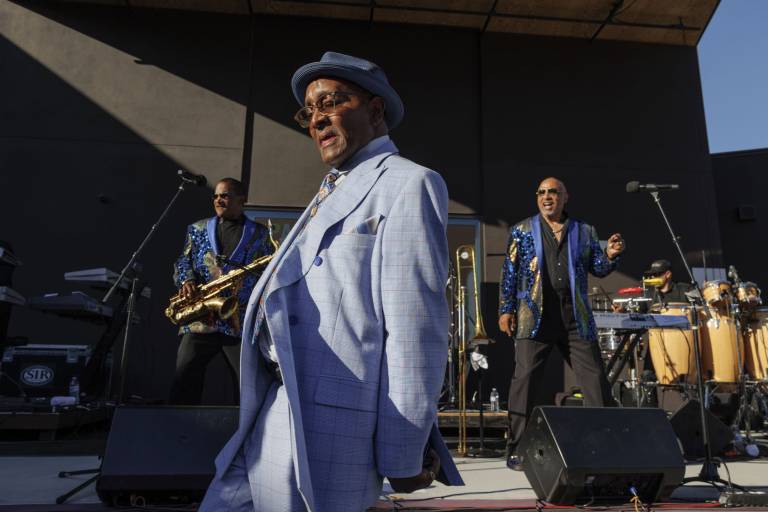
An East Palo Alto Youth Center Makes Space for Adults — With a Side of Funk
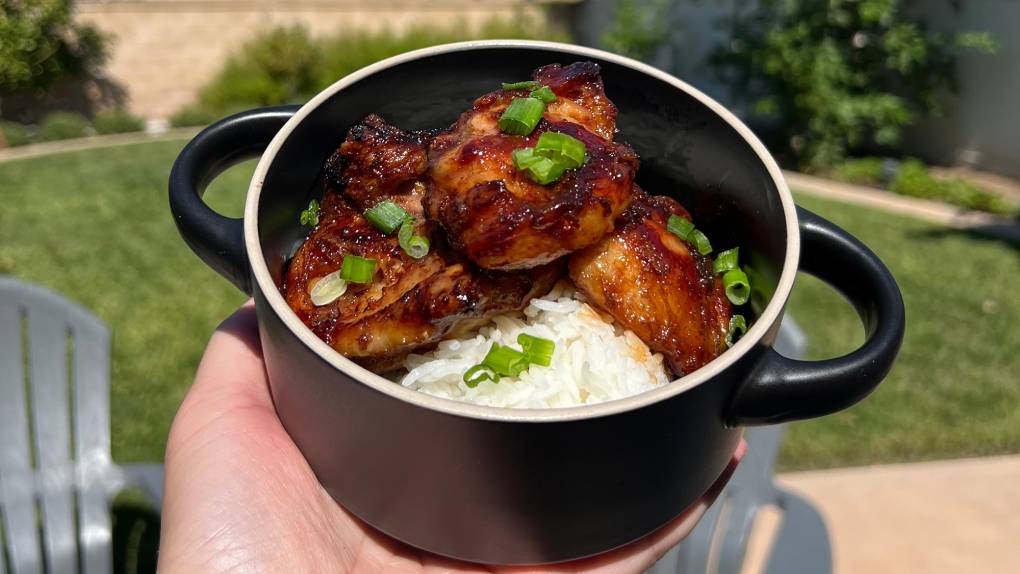
This Night Market Puts Pacific Island Cuisine Front and Center
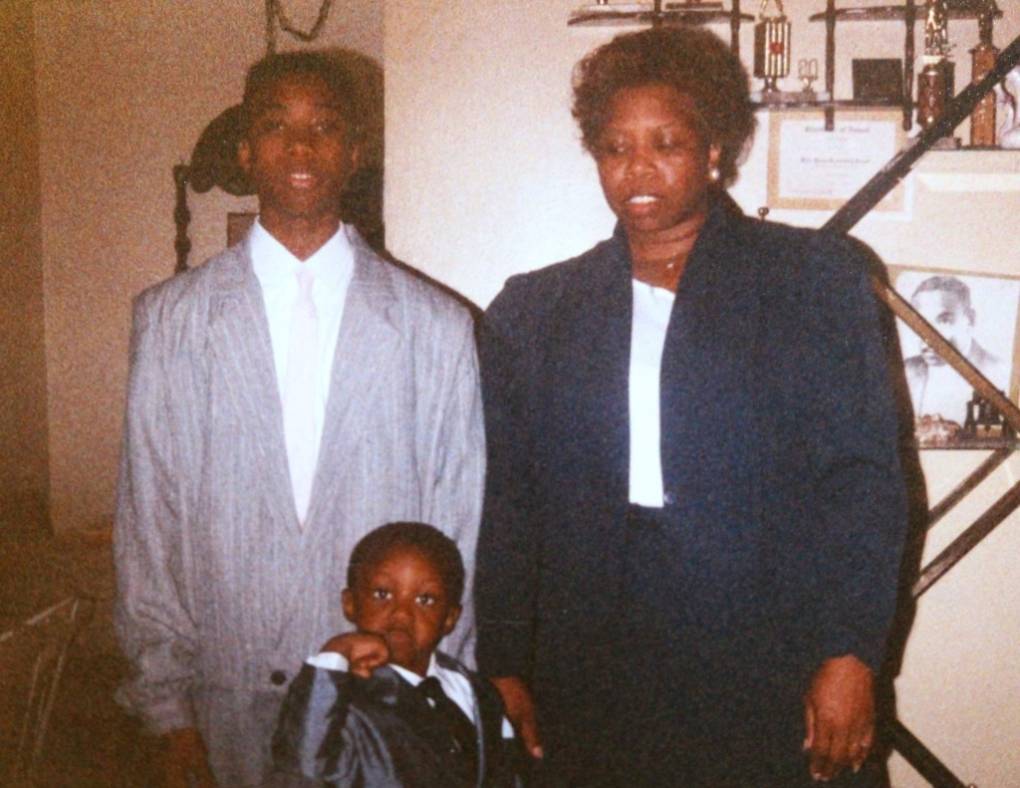
KMEL’s G-Biz On How ‘Scrillacon’ Valley Shaped Him
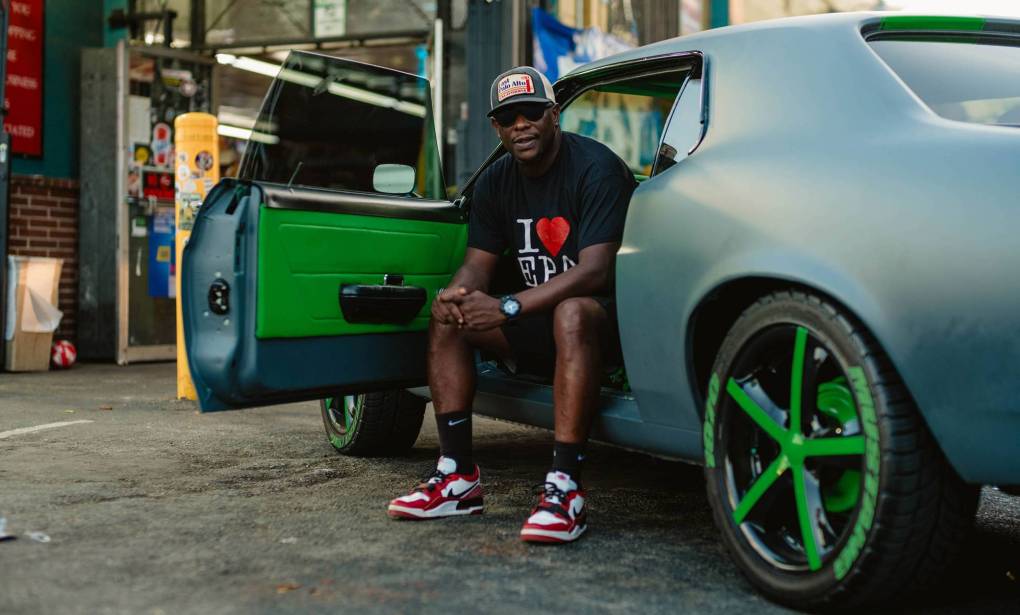
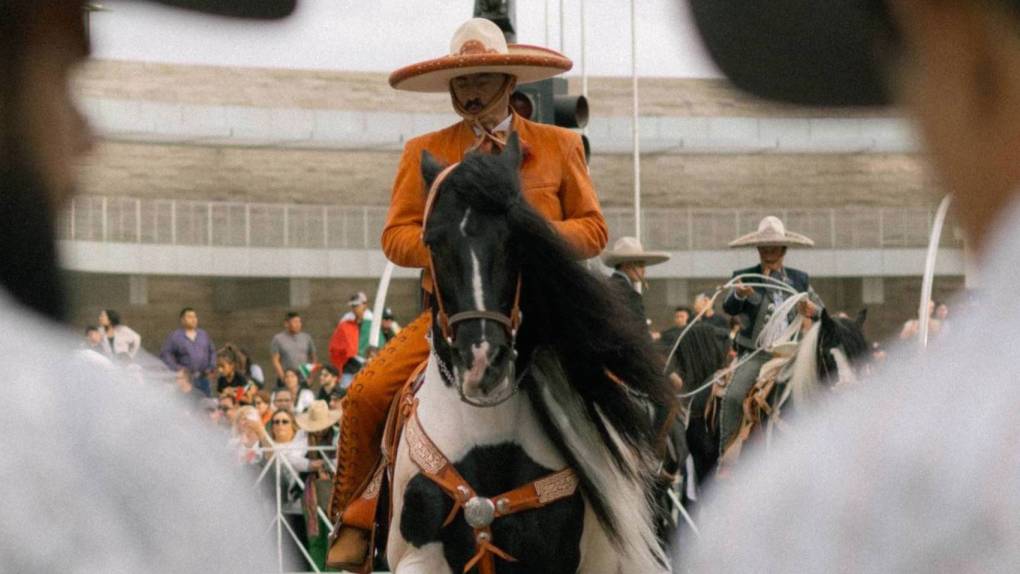
East Palo Alto’s Hidden Beauty
Silicon Valley Unseen: As Told By Locals
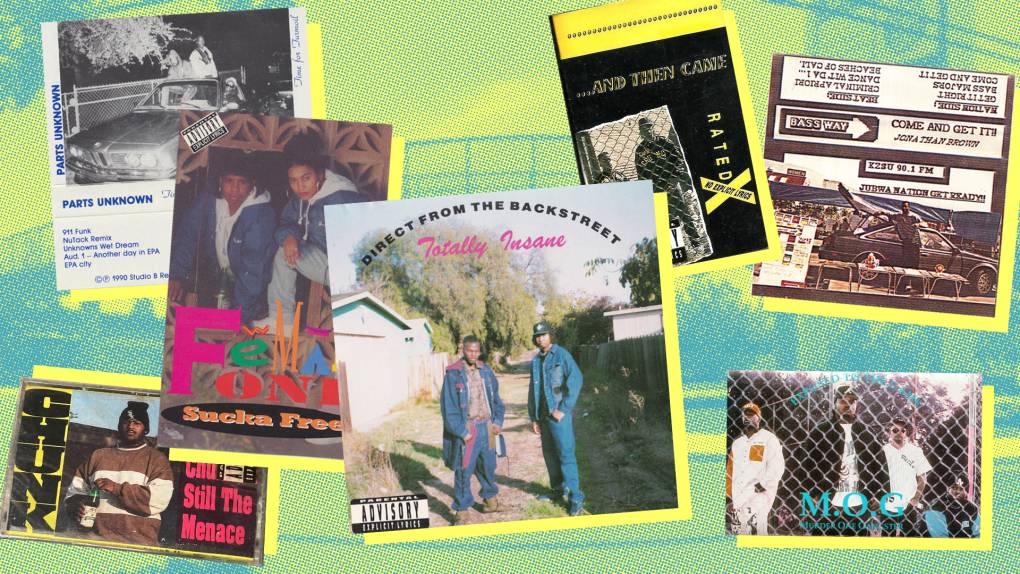
10 East Palo Alto Rap Tapes You’ve (Probably) Never Heard Before
Meet East Palo Alto’s Poet-Turned-Councilmember, Antonio López
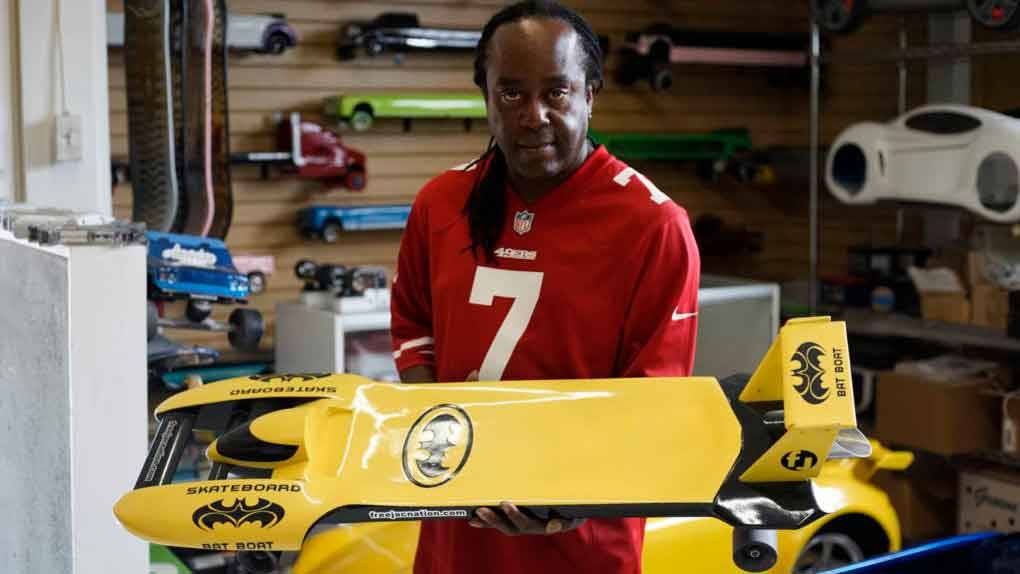
Meet Darren Powell, the Skateboard Re-Innovator of East Oakland
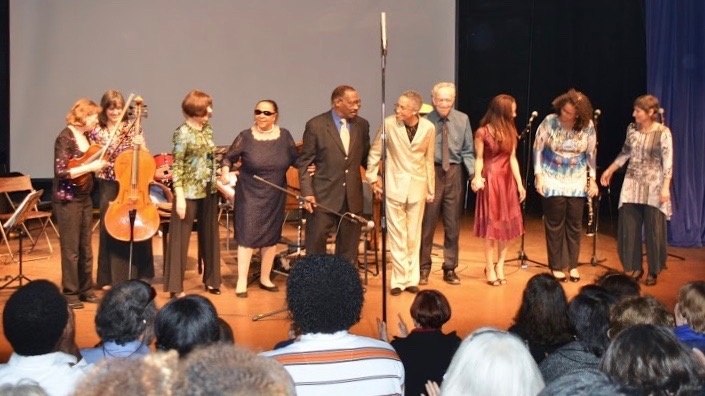
African American Composers Initiative a Local Musical Gem
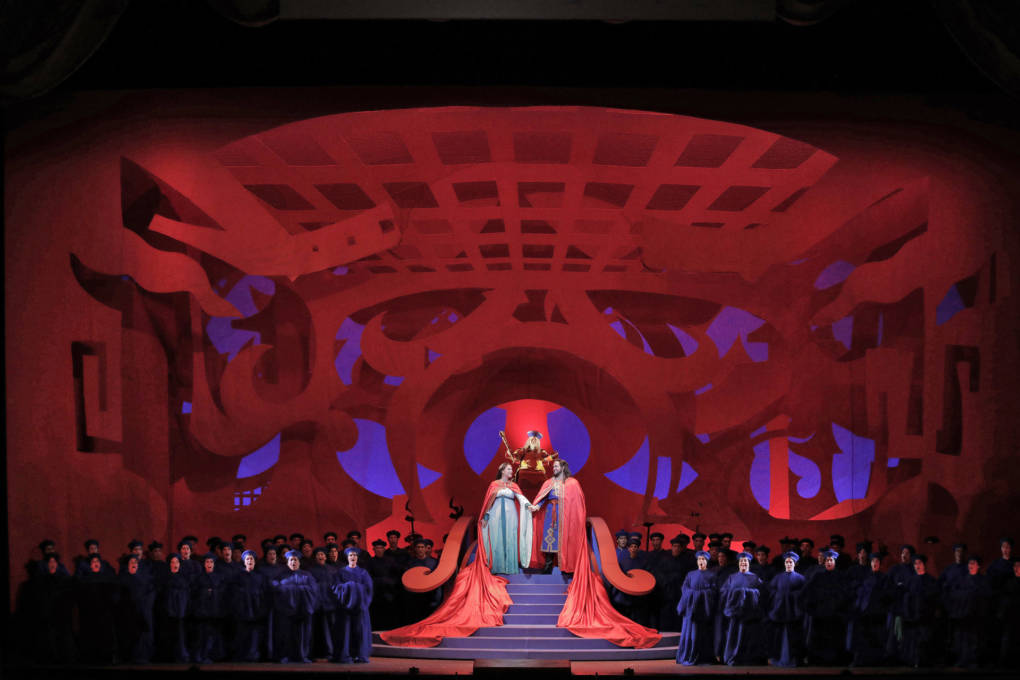
David Hockney Treating Elementary School Students to the Opera
Player sponsored by
window.__IS_SSR__=true
window.__INITIAL_STATE__={
"attachmentsReducer": {
"audio_0": {
"type": "attachments",
"id": "audio_0",
"imgSizes": {
"kqedFullSize": {
"file": "https://ww2.kqed.org/news/wp-content/themes/KQED-unified/img/audio_bgs/background0.jpg"
}
}
},
"audio_1": {
"type": "attachments",
"id": "audio_1",
"imgSizes": {
"kqedFullSize": {
"file": "https://ww2.kqed.org/news/wp-content/themes/KQED-unified/img/audio_bgs/background1.jpg"
}
}
},
"audio_2": {
"type": "attachments",
"id": "audio_2",
"imgSizes": {
"kqedFullSize": {
"file": "https://ww2.kqed.org/news/wp-content/themes/KQED-unified/img/audio_bgs/background2.jpg"
}
}
},
"audio_3": {
"type": "attachments",
"id": "audio_3",
"imgSizes": {
"kqedFullSize": {
"file": "https://ww2.kqed.org/news/wp-content/themes/KQED-unified/img/audio_bgs/background3.jpg"
}
}
},
"audio_4": {
"type": "attachments",
"id": "audio_4",
"imgSizes": {
"kqedFullSize": {
"file": "https://ww2.kqed.org/news/wp-content/themes/KQED-unified/img/audio_bgs/background4.jpg"
}
}
},
"placeholder": {
"type": "attachments",
"id": "placeholder",
"imgSizes": {
"thumbnail": {
"file": "https://cdn.kqed.org/wp-content/uploads/2024/12/KQED-Default-Image-816638274-2000x1333-1-160x107.jpg",
"width": 160,
"height": 107,
"mimeType": "image/jpeg"
},
"medium": {
"file": "https://cdn.kqed.org/wp-content/uploads/2024/12/KQED-Default-Image-816638274-2000x1333-1-800x533.jpg",
"width": 800,
"height": 533,
"mimeType": "image/jpeg"
},
"medium_large": {
"file": "https://cdn.kqed.org/wp-content/uploads/2024/12/KQED-Default-Image-816638274-2000x1333-1-768x512.jpg",
"width": 768,
"height": 512,
"mimeType": "image/jpeg"
},
"large": {
"file": "https://cdn.kqed.org/wp-content/uploads/2024/12/KQED-Default-Image-816638274-2000x1333-1-1020x680.jpg",
"width": 1020,
"height": 680,
"mimeType": "image/jpeg"
},
"1536x1536": {
"file": "https://cdn.kqed.org/wp-content/uploads/2024/12/KQED-Default-Image-816638274-2000x1333-1-1536x1024.jpg",
"width": 1536,
"height": 1024,
"mimeType": "image/jpeg"
},
"fd-lrg": {
"file": "https://cdn.kqed.org/wp-content/uploads/2024/12/KQED-Default-Image-816638274-2000x1333-1-1536x1024.jpg",
"width": 1536,
"height": 1024,
"mimeType": "image/jpeg"
},
"fd-med": {
"file": "https://cdn.kqed.org/wp-content/uploads/2024/12/KQED-Default-Image-816638274-2000x1333-1-1020x680.jpg",
"width": 1020,
"height": 680,
"mimeType": "image/jpeg"
},
"fd-sm": {
"file": "https://cdn.kqed.org/wp-content/uploads/2024/12/KQED-Default-Image-816638274-2000x1333-1-800x533.jpg",
"width": 800,
"height": 533,
"mimeType": "image/jpeg"
},
"post-thumbnail": {
"file": "https://cdn.kqed.org/wp-content/uploads/2024/12/KQED-Default-Image-816638274-2000x1333-1-672x372.jpg",
"width": 672,
"height": 372,
"mimeType": "image/jpeg"
},
"twentyfourteen-full-width": {
"file": "https://cdn.kqed.org/wp-content/uploads/2024/12/KQED-Default-Image-816638274-2000x1333-1-1038x576.jpg",
"width": 1038,
"height": 576,
"mimeType": "image/jpeg"
},
"xxsmall": {
"file": "https://cdn.kqed.org/wp-content/uploads/2024/12/KQED-Default-Image-816638274-2000x1333-1-160x107.jpg",
"width": 160,
"height": 107,
"mimeType": "image/jpeg"
},
"xsmall": {
"file": "https://cdn.kqed.org/wp-content/uploads/2024/12/KQED-Default-Image-816638274-2000x1333-1-672x372.jpg",
"width": 672,
"height": 372,
"mimeType": "image/jpeg"
},
"small": {
"file": "https://cdn.kqed.org/wp-content/uploads/2024/12/KQED-Default-Image-816638274-2000x1333-1-672x372.jpg",
"width": 672,
"height": 372,
"mimeType": "image/jpeg"
},
"xlarge": {
"file": "https://cdn.kqed.org/wp-content/uploads/2024/12/KQED-Default-Image-816638274-2000x1333-1-1020x680.jpg",
"width": 1020,
"height": 680,
"mimeType": "image/jpeg"
},
"full-width": {
"file": "https://cdn.kqed.org/wp-content/uploads/2024/12/KQED-Default-Image-816638274-2000x1333-1-1920x1280.jpg",
"width": 1920,
"height": 1280,
"mimeType": "image/jpeg"
},
"guest-author-32": {
"file": "https://cdn.kqed.org/wp-content/uploads/2025/01/KQED-Default-Image-816638274-1333x1333-1-160x160.jpg",
"width": 32,
"height": 32,
"mimeType": "image/jpeg"
},
"guest-author-50": {
"file": "https://cdn.kqed.org/wp-content/uploads/2025/01/KQED-Default-Image-816638274-1333x1333-1-160x160.jpg",
"width": 50,
"height": 50,
"mimeType": "image/jpeg"
},
"guest-author-64": {
"file": "https://cdn.kqed.org/wp-content/uploads/2025/01/KQED-Default-Image-816638274-1333x1333-1-160x160.jpg",
"width": 64,
"height": 64,
"mimeType": "image/jpeg"
},
"guest-author-96": {
"file": "https://cdn.kqed.org/wp-content/uploads/2025/01/KQED-Default-Image-816638274-1333x1333-1-160x160.jpg",
"width": 96,
"height": 96,
"mimeType": "image/jpeg"
},
"guest-author-128": {
"file": "https://cdn.kqed.org/wp-content/uploads/2025/01/KQED-Default-Image-816638274-1333x1333-1-160x160.jpg",
"width": 128,
"height": 128,
"mimeType": "image/jpeg"
},
"detail": {
"file": "https://cdn.kqed.org/wp-content/uploads/2025/01/KQED-Default-Image-816638274-1333x1333-1-160x160.jpg",
"width": 160,
"height": 160,
"mimeType": "image/jpeg"
},
"kqedFullSize": {
"file": "https://cdn.kqed.org/wp-content/uploads/2024/12/KQED-Default-Image-816638274-2000x1333-1.jpg",
"width": 2000,
"height": 1333
}
}
},
"arts_13992120": {
"type": "attachments",
"id": "arts_13992120",
"meta": {
"index": "attachments_1716263798",
"site": "arts",
"id": "13992120",
"found": true
},
"title": "260726-EPACenter-JY-04-KQED",
"publishDate": 1785278325,
"status": "inherit",
"parent": 0,
"modified": 1785514421,
"caption": "Kevin Harrison, center, dances as funk band Con Funk Shun plays at EPACENTER in East Palo Alto Calif., on Sunday, July 26, 2026. The youth center has recently expanded its programming to serve the city's elders in addition to its youth.",
"credit": "Juliana Yamada for KQED",
"altTag": null,
"description": null,
"imgSizes": {
"thumbnail": {
"file": "https://cdn.kqed.org/wp-content/uploads/sites/2/2026/07/260726-EPACenter-JY-04-KQED-160x107.jpg",
"width": 160,
"height": 107,
"mimeType": "image/jpeg"
},
"medium_large": {
"file": "https://cdn.kqed.org/wp-content/uploads/sites/2/2026/07/260726-EPACenter-JY-04-KQED-768x512.jpg",
"width": 768,
"height": 512,
"mimeType": "image/jpeg"
},
"1536x1536": {
"file": "https://cdn.kqed.org/wp-content/uploads/sites/2/2026/07/260726-EPACenter-JY-04-KQED-1536x1024.jpg",
"width": 1536,
"height": 1024,
"mimeType": "image/jpeg"
},
"post-thumbnail": {
"file": "https://cdn.kqed.org/wp-content/uploads/sites/2/2026/07/260726-EPACenter-JY-04-KQED-672x372.jpg",
"width": 672,
"height": 372,
"mimeType": "image/jpeg"
},
"twentyfourteen-full-width": {
"file": "https://cdn.kqed.org/wp-content/uploads/sites/2/2026/07/260726-EPACenter-JY-04-KQED-1038x576.jpg",
"width": 1038,
"height": 576,
"mimeType": "image/jpeg"
},
"npr-cds-wide": {
"file": "https://cdn.kqed.org/wp-content/uploads/sites/2/2026/07/260726-EPACenter-JY-04-KQED-1200x675.jpg",
"width": 1200,
"height": 675,
"mimeType": "image/jpeg"
},
"npr-cds-square": {
"file": "https://cdn.kqed.org/wp-content/uploads/sites/2/2026/07/260726-EPACenter-JY-04-KQED-600x600.jpg",
"width": 600,
"height": 600,
"mimeType": "image/jpeg"
},
"kqedFullSize": {
"file": "https://cdn.kqed.org/wp-content/uploads/sites/2/2026/07/260726-EPACenter-JY-04-KQED.jpg",
"width": 2000,
"height": 1333
}
},
"isLoading": false,
"fetchFailed": false
},
"arts_13966379": {
"type": "attachments",
"id": "arts_13966379",
"meta": {
"index": "attachments_1716263798",
"site": "arts",
"id": "13966379",
"found": true
},
"title": "Tokemoanas turkey tail bowl",
"publishDate": 1728516400,
"status": "inherit",
"parent": 13966361,
"modified": 1728516450,
"caption": "Braised turkey tails over rice — a Tongan specialty courtesy of Tokemoana.",
"credit": "Courtesy of Tokemoana Foods",
"altTag": "Braised turkey tails over rice in a small pot.",
"description": null,
"imgSizes": {
"medium": {
"file": "https://cdn.kqed.org/wp-content/uploads/sites/2/2024/10/Tokemoanas-turkey-tail-bowl-800x450.jpg",
"width": 800,
"height": 450,
"mimeType": "image/jpeg"
},
"large": {
"file": "https://cdn.kqed.org/wp-content/uploads/sites/2/2024/10/Tokemoanas-turkey-tail-bowl-1020x574.jpg",
"width": 1020,
"height": 574,
"mimeType": "image/jpeg"
},
"thumbnail": {
"file": "https://cdn.kqed.org/wp-content/uploads/sites/2/2024/10/Tokemoanas-turkey-tail-bowl-160x90.jpg",
"width": 160,
"height": 90,
"mimeType": "image/jpeg"
},
"medium_large": {
"file": "https://cdn.kqed.org/wp-content/uploads/sites/2/2024/10/Tokemoanas-turkey-tail-bowl-768x432.jpg",
"width": 768,
"height": 432,
"mimeType": "image/jpeg"
},
"1536x1536": {
"file": "https://cdn.kqed.org/wp-content/uploads/sites/2/2024/10/Tokemoanas-turkey-tail-bowl-1536x865.jpg",
"width": 1536,
"height": 865,
"mimeType": "image/jpeg"
},
"post-thumbnail": {
"file": "https://cdn.kqed.org/wp-content/uploads/sites/2/2024/10/Tokemoanas-turkey-tail-bowl-672x372.jpg",
"width": 672,
"height": 372,
"mimeType": "image/jpeg"
},
"twentyfourteen-full-width": {
"file": "https://cdn.kqed.org/wp-content/uploads/sites/2/2024/10/Tokemoanas-turkey-tail-bowl-1038x576.jpg",
"width": 1038,
"height": 576,
"mimeType": "image/jpeg"
},
"full-width": {
"file": "https://cdn.kqed.org/wp-content/uploads/sites/2/2024/10/Tokemoanas-turkey-tail-bowl-1920x1081.jpg",
"width": 1920,
"height": 1081,
"mimeType": "image/jpeg"
},
"kqedFullSize": {
"file": "https://cdn.kqed.org/wp-content/uploads/sites/2/2024/10/Tokemoanas-turkey-tail-bowl.jpg",
"width": 2000,
"height": 1126
}
},
"isLoading": false,
"fetchFailed": false
},
"arts_13965164": {
"type": "attachments",
"id": "arts_13965164",
"meta": {
"index": "attachments_1716263798",
"site": "arts",
"id": "13965164",
"found": true
},
"title": "IMG_8215",
"publishDate": 1726786571,
"status": "inherit",
"parent": 13965015,
"modified": 1726787203,
"caption": "KMEL's Gary Bizer a.k.a. G-Biz (center) takes a family photo with his mother and older brother in East Palo Alto.",
"credit": "Courtesy G-Biz",
"altTag": null,
"description": null,
"imgSizes": {
"medium": {
"file": "https://cdn.kqed.org/wp-content/uploads/sites/2/2024/09/IMG_8215-800x618.jpg",
"width": 800,
"height": 618,
"mimeType": "image/jpeg"
},
"large": {
"file": "https://cdn.kqed.org/wp-content/uploads/sites/2/2024/09/IMG_8215-1020x788.jpg",
"width": 1020,
"height": 788,
"mimeType": "image/jpeg"
},
"thumbnail": {
"file": "https://cdn.kqed.org/wp-content/uploads/sites/2/2024/09/IMG_8215-160x124.jpg",
"width": 160,
"height": 124,
"mimeType": "image/jpeg"
},
"medium_large": {
"file": "https://cdn.kqed.org/wp-content/uploads/sites/2/2024/09/IMG_8215-768x593.jpg",
"width": 768,
"height": 593,
"mimeType": "image/jpeg"
},
"post-thumbnail": {
"file": "https://cdn.kqed.org/wp-content/uploads/sites/2/2024/09/IMG_8215-672x372.jpg",
"width": 672,
"height": 372,
"mimeType": "image/jpeg"
},
"twentyfourteen-full-width": {
"file": "https://cdn.kqed.org/wp-content/uploads/sites/2/2024/09/IMG_8215-1024x576.jpg",
"width": 1024,
"height": 576,
"mimeType": "image/jpeg"
},
"kqedFullSize": {
"file": "https://cdn.kqed.org/wp-content/uploads/sites/2/2024/09/IMG_8215.jpg",
"width": 1024,
"height": 791
}
},
"isLoading": false,
"fetchFailed": false
},
"arts_13965148": {
"type": "attachments",
"id": "arts_13965148",
"meta": {
"index": "attachments_1716263798",
"site": "arts",
"id": "13965148",
"found": true
},
"title": "Darius.EPA.MAIN",
"publishDate": 1726781084,
"status": "inherit",
"parent": 13964439,
"modified": 1726781159,
"caption": "East Palo Alto has long been separated and ostracized from Palo Alto. The redlined city has cultivated a distinct identity and pride of its own.",
"credit": "Darius Riley/Hourvoyses",
"altTag": "a man wearing an 'I love EPA' shirt sits in the front seat of a vintage blue car, facing outward, in a cap and sneakers",
"description": null,
"imgSizes": {
"medium": {
"file": "https://cdn.kqed.org/wp-content/uploads/sites/2/2024/09/Darius.EPA_.MAIN_-800x482.jpg",
"width": 800,
"height": 482,
"mimeType": "image/jpeg"
},
"large": {
"file": "https://cdn.kqed.org/wp-content/uploads/sites/2/2024/09/Darius.EPA_.MAIN_-1020x615.jpg",
"width": 1020,
"height": 615,
"mimeType": "image/jpeg"
},
"thumbnail": {
"file": "https://cdn.kqed.org/wp-content/uploads/sites/2/2024/09/Darius.EPA_.MAIN_-160x96.jpg",
"width": 160,
"height": 96,
"mimeType": "image/jpeg"
},
"medium_large": {
"file": "https://cdn.kqed.org/wp-content/uploads/sites/2/2024/09/Darius.EPA_.MAIN_-768x463.jpg",
"width": 768,
"height": 463,
"mimeType": "image/jpeg"
},
"1536x1536": {
"file": "https://cdn.kqed.org/wp-content/uploads/sites/2/2024/09/Darius.EPA_.MAIN_-1536x925.jpg",
"width": 1536,
"height": 925,
"mimeType": "image/jpeg"
},
"post-thumbnail": {
"file": "https://cdn.kqed.org/wp-content/uploads/sites/2/2024/09/Darius.EPA_.MAIN_-672x372.jpg",
"width": 672,
"height": 372,
"mimeType": "image/jpeg"
},
"twentyfourteen-full-width": {
"file": "https://cdn.kqed.org/wp-content/uploads/sites/2/2024/09/Darius.EPA_.MAIN_-1038x576.jpg",
"width": 1038,
"height": 576,
"mimeType": "image/jpeg"
},
"full-width": {
"file": "https://cdn.kqed.org/wp-content/uploads/sites/2/2024/09/Darius.EPA_.MAIN_-1920x1157.jpg",
"width": 1920,
"height": 1157,
"mimeType": "image/jpeg"
},
"kqedFullSize": {
"file": "https://cdn.kqed.org/wp-content/uploads/sites/2/2024/09/Darius.EPA_.MAIN_.jpg",
"width": 2000,
"height": 1205
}
},
"isLoading": false,
"fetchFailed": false
},
"arts_13965133": {
"type": "attachments",
"id": "arts_13965133",
"meta": {
"index": "attachments_1716263798",
"site": "arts",
"id": "13965133",
"found": true
},
"title": "SVU.Intro.Thumbnail",
"publishDate": 1726779233,
"status": "inherit",
"parent": 13964538,
"modified": 1726779233,
"caption": null,
"credit": null,
"altTag": null,
"description": null,
"imgSizes": {
"medium": {
"file": "https://cdn.kqed.org/wp-content/uploads/sites/2/2024/09/SVU.Intro_.Thumbnail-800x450.jpg",
"width": 800,
"height": 450,
"mimeType": "image/jpeg"
},
"large": {
"file": "https://cdn.kqed.org/wp-content/uploads/sites/2/2024/09/SVU.Intro_.Thumbnail-1020x574.jpg",
"width": 1020,
"height": 574,
"mimeType": "image/jpeg"
},
"thumbnail": {
"file": "https://cdn.kqed.org/wp-content/uploads/sites/2/2024/09/SVU.Intro_.Thumbnail-160x90.jpg",
"width": 160,
"height": 90,
"mimeType": "image/jpeg"
},
"medium_large": {
"file": "https://cdn.kqed.org/wp-content/uploads/sites/2/2024/09/SVU.Intro_.Thumbnail-768x432.jpg",
"width": 768,
"height": 432,
"mimeType": "image/jpeg"
},
"1536x1536": {
"file": "https://cdn.kqed.org/wp-content/uploads/sites/2/2024/09/SVU.Intro_.Thumbnail-1536x864.jpg",
"width": 1536,
"height": 864,
"mimeType": "image/jpeg"
},
"post-thumbnail": {
"file": "https://cdn.kqed.org/wp-content/uploads/sites/2/2024/09/SVU.Intro_.Thumbnail-672x372.jpg",
"width": 672,
"height": 372,
"mimeType": "image/jpeg"
},
"twentyfourteen-full-width": {
"file": "https://cdn.kqed.org/wp-content/uploads/sites/2/2024/09/SVU.Intro_.Thumbnail-1038x576.jpg",
"width": 1038,
"height": 576,
"mimeType": "image/jpeg"
},
"kqedFullSize": {
"file": "https://cdn.kqed.org/wp-content/uploads/sites/2/2024/09/SVU.Intro_.Thumbnail.jpg",
"width": 1701,
"height": 957
}
},
"isLoading": false,
"fetchFailed": false
},
"arts_13937060": {
"type": "attachments",
"id": "arts_13937060",
"meta": {
"index": "attachments_1716263798",
"site": "arts",
"id": "13937060",
"found": true
},
"parent": 13936387,
"imgSizes": {
"twentyfourteen-full-width": {
"file": "https://ww2.kqed.org/app/uploads/sites/2/2023/10/epa_tapes_cover-1038x576.jpg",
"width": 1038,
"mimeType": "image/jpeg",
"height": 576
},
"thumbnail": {
"file": "https://ww2.kqed.org/app/uploads/sites/2/2023/10/epa_tapes_cover-160x90.jpg",
"width": 160,
"mimeType": "image/jpeg",
"height": 90
},
"post-thumbnail": {
"file": "https://ww2.kqed.org/app/uploads/sites/2/2023/10/epa_tapes_cover-672x372.jpg",
"width": 672,
"mimeType": "image/jpeg",
"height": 372
},
"kqedFullSize": {
"file": "https://ww2.kqed.org/app/uploads/sites/2/2023/10/epa_tapes_cover.jpg",
"width": 1920,
"height": 1080
},
"large": {
"file": "https://ww2.kqed.org/app/uploads/sites/2/2023/10/epa_tapes_cover-1020x574.jpg",
"width": 1020,
"mimeType": "image/jpeg",
"height": 574
},
"1536x1536": {
"file": "https://ww2.kqed.org/app/uploads/sites/2/2023/10/epa_tapes_cover-1536x864.jpg",
"width": 1536,
"mimeType": "image/jpeg",
"height": 864
},
"medium": {
"file": "https://ww2.kqed.org/app/uploads/sites/2/2023/10/epa_tapes_cover-800x450.jpg",
"width": 800,
"mimeType": "image/jpeg",
"height": 450
},
"medium_large": {
"file": "https://ww2.kqed.org/app/uploads/sites/2/2023/10/epa_tapes_cover-768x432.jpg",
"width": 768,
"mimeType": "image/jpeg",
"height": 432
}
},
"publishDate": 1698356460,
"modified": 1698383020,
"caption": "In the 1980s and 1990s, dozens of cassettes were released by independent artists in the small, under-resourced triangle of East Palo Alto.",
"description": null,
"title": "epa_tapes_cover",
"credit": "Collage by Sarah Hotchkiss",
"status": "inherit",
"altTag": null,
"isLoading": false,
"fetchFailed": false
},
"arts_13903671": {
"type": "attachments",
"id": "arts_13903671",
"meta": {
"index": "attachments_1716263798",
"site": "arts",
"id": "13903671",
"found": true
},
"parent": 13903633,
"imgSizes": {
"twentyfourteen-full-width": {
"file": "https://ww2.kqed.org/app/uploads/sites/2/2021/09/IMG_2450-1038x576.jpg",
"width": 1038,
"mimeType": "image/jpeg",
"height": 576
},
"thumbnail": {
"file": "https://ww2.kqed.org/app/uploads/sites/2/2021/09/IMG_2450-160x107.jpg",
"width": 160,
"mimeType": "image/jpeg",
"height": 107
},
"post-thumbnail": {
"file": "https://ww2.kqed.org/app/uploads/sites/2/2021/09/IMG_2450-672x372.jpg",
"width": 672,
"mimeType": "image/jpeg",
"height": 372
},
"kqedFullSize": {
"file": "https://ww2.kqed.org/app/uploads/sites/2/2021/09/IMG_2450-scaled.jpg",
"width": 2560,
"height": 1707
},
"2048x2048": {
"file": "https://ww2.kqed.org/app/uploads/sites/2/2021/09/IMG_2450-2048x1365.jpg",
"width": 2048,
"mimeType": "image/jpeg",
"height": 1365
},
"large": {
"file": "https://ww2.kqed.org/app/uploads/sites/2/2021/09/IMG_2450-1020x680.jpg",
"width": 1020,
"mimeType": "image/jpeg",
"height": 680
},
"1536x1536": {
"file": "https://ww2.kqed.org/app/uploads/sites/2/2021/09/IMG_2450-1536x1024.jpg",
"width": 1536,
"mimeType": "image/jpeg",
"height": 1024
},
"full-width": {
"file": "https://ww2.kqed.org/app/uploads/sites/2/2021/09/IMG_2450-1920x1280.jpg",
"width": 1920,
"mimeType": "image/jpeg",
"height": 1280
},
"medium": {
"file": "https://ww2.kqed.org/app/uploads/sites/2/2021/09/IMG_2450-800x533.jpg",
"width": 800,
"mimeType": "image/jpeg",
"height": 533
},
"medium_large": {
"file": "https://ww2.kqed.org/app/uploads/sites/2/2021/09/IMG_2450-768x512.jpg",
"width": 768,
"mimeType": "image/jpeg",
"height": 512
}
},
"publishDate": 1632353346,
"modified": 1632353461,
"caption": "27-year-old poet and East Palo Alto City Councilmember Antonio Lopez published a debut book that reflects on growing up in the shadow of Silicon Valley's power and privilege. ",
"description": "27-year-old poet and East Palo Alto City Councilmember Antonio Lopez published a debut book that reflects on growing up in the shadow of Silicon Valley's power and privilege. ",
"title": "IMG_2450",
"credit": "Briana Chazaro",
"status": "inherit",
"altTag": null,
"isLoading": false,
"fetchFailed": false
},
"arts_13857932": {
"type": "attachments",
"id": "arts_13857932",
"meta": {
"index": "attachments_1716263798",
"site": "arts",
"id": "13857932",
"found": true
},
"parent": 13857308,
"imgSizes": {
"thumbnail": {
"file": "https://ww2.kqed.org/app/uploads/sites/2/2019/05/DarrenPowell-160x90.jpg",
"width": 160,
"mimeType": "image/jpeg",
"height": 90
},
"post-thumbnail": {
"file": "https://ww2.kqed.org/app/uploads/sites/2/2019/05/DarrenPowell-672x372.jpg",
"width": 672,
"mimeType": "image/jpeg",
"height": 372
},
"kqedFullSize": {
"file": "https://ww2.kqed.org/app/uploads/sites/2/2019/05/DarrenPowell.jpg",
"width": 1020,
"height": 574
},
"large": {
"file": "https://ww2.kqed.org/app/uploads/sites/2/2019/05/DarrenPowell-1020x574.jpg",
"width": 1020,
"mimeType": "image/jpeg",
"height": 574
},
"medium": {
"file": "https://ww2.kqed.org/app/uploads/sites/2/2019/05/DarrenPowell-800x450.jpg",
"width": 800,
"mimeType": "image/jpeg",
"height": 450
},
"medium_large": {
"file": "https://ww2.kqed.org/app/uploads/sites/2/2019/05/DarrenPowell-768x432.jpg",
"width": 768,
"mimeType": "image/jpeg",
"height": 432
}
},
"publishDate": 1558477189,
"modified": 1558477221,
"caption": "Darren Powell of Freejack Nation showing off one of his creations.",
"description": "Darren Powell of Freejack Nation showing off one of his creations.",
"title": "DarrenPowell",
"credit": "Pendarvis Harshaw",
"status": "inherit",
"isLoading": false,
"fetchFailed": false
},
"arts_13818458": {
"type": "attachments",
"id": "arts_13818458",
"meta": {
"index": "attachments_1716263798",
"site": "arts",
"id": "13818458",
"found": true
},
"parent": 13818452,
"imgSizes": {
"small": {
"file": "https://ww2.kqed.org/app/uploads/sites/2/2018/01/group-2-520x292.jpg",
"width": 520,
"mimeType": "image/jpeg",
"height": 292
},
"thumbnail": {
"file": "https://ww2.kqed.org/app/uploads/sites/2/2018/01/group-2-160x90.jpg",
"width": 160,
"mimeType": "image/jpeg",
"height": 90
},
"post-thumbnail": {
"file": "https://ww2.kqed.org/app/uploads/sites/2/2018/01/group-2-672x372.jpg",
"width": 672,
"mimeType": "image/jpeg",
"height": 372
},
"xsmall": {
"file": "https://ww2.kqed.org/app/uploads/sites/2/2018/01/group-2-375x211.jpg",
"width": 375,
"mimeType": "image/jpeg",
"height": 211
},
"kqedFullSize": {
"file": "https://ww2.kqed.org/app/uploads/sites/2/2018/01/group-2.jpg",
"width": 705,
"height": 396
},
"guest-author-50": {
"file": "https://ww2.kqed.org/app/uploads/sites/2/2018/01/group-2-50x50.jpg",
"width": 50,
"mimeType": "image/jpeg",
"height": 50
},
"guest-author-96": {
"file": "https://ww2.kqed.org/app/uploads/sites/2/2018/01/group-2-96x96.jpg",
"width": 96,
"mimeType": "image/jpeg",
"height": 96
},
"guest-author-64": {
"file": "https://ww2.kqed.org/app/uploads/sites/2/2018/01/group-2-64x64.jpg",
"width": 64,
"mimeType": "image/jpeg",
"height": 64
},
"detail": {
"file": "https://ww2.kqed.org/app/uploads/sites/2/2018/01/group-2-150x150.jpg",
"width": 150,
"mimeType": "image/jpeg",
"height": 150
},
"guest-author-32": {
"file": "https://ww2.kqed.org/app/uploads/sites/2/2018/01/group-2-32x32.jpg",
"width": 32,
"mimeType": "image/jpeg",
"height": 32
},
"guest-author-128": {
"file": "https://ww2.kqed.org/app/uploads/sites/2/2018/01/group-2-128x128.jpg",
"width": 128,
"mimeType": "image/jpeg",
"height": 128
},
"xxsmall": {
"file": "https://ww2.kqed.org/app/uploads/sites/2/2018/01/group-2-240x135.jpg",
"width": 240,
"mimeType": "image/jpeg",
"height": 135
}
},
"publishDate": 1515028478,
"modified": 1515028674,
"caption": "Every year, the African American Composer Initiative celebrates a rich musical heritage in danger of being forgotten.",
"description": "Every year, the African American Composer Initiative celebrates a rich musical heritage in danger of being forgotten.",
"title": "group 2",
"credit": "Photo: Courtesy of the African American Composer Initiative",
"status": "inherit",
"isLoading": false,
"fetchFailed": false
},
"arts_13816490": {
"type": "attachments",
"id": "arts_13816490",
"meta": {
"index": "attachments_1716263798",
"site": "arts",
"id": "13816490",
"found": true
},
"parent": 13816481,
"imgSizes": {
"small": {
"file": "https://ww2.kqed.org/app/uploads/sites/2/2017/12/RS28237_Turandot-Act-III_David-Hockney-set_photo-Cory-Weaver-qut-520x347.jpg",
"width": 520,
"mimeType": "image/jpeg",
"height": 347
},
"twentyfourteen-full-width": {
"file": "https://ww2.kqed.org/app/uploads/sites/2/2017/12/RS28237_Turandot-Act-III_David-Hockney-set_photo-Cory-Weaver-qut-1038x576.jpg",
"width": 1038,
"mimeType": "image/jpeg",
"height": 576
},
"thumbnail": {
"file": "https://ww2.kqed.org/app/uploads/sites/2/2017/12/RS28237_Turandot-Act-III_David-Hockney-set_photo-Cory-Weaver-qut-160x107.jpg",
"width": 160,
"mimeType": "image/jpeg",
"height": 107
},
"fd-sm": {
"file": "https://ww2.kqed.org/app/uploads/sites/2/2017/12/RS28237_Turandot-Act-III_David-Hockney-set_photo-Cory-Weaver-qut-960x640.jpg",
"width": 960,
"mimeType": "image/jpeg",
"height": 640
},
"post-thumbnail": {
"file": "https://ww2.kqed.org/app/uploads/sites/2/2017/12/RS28237_Turandot-Act-III_David-Hockney-set_photo-Cory-Weaver-qut-672x372.jpg",
"width": 672,
"mimeType": "image/jpeg",
"height": 372
},
"xsmall": {
"file": "https://ww2.kqed.org/app/uploads/sites/2/2017/12/RS28237_Turandot-Act-III_David-Hockney-set_photo-Cory-Weaver-qut-375x250.jpg",
"width": 375,
"mimeType": "image/jpeg",
"height": 250
},
"kqedFullSize": {
"file": "https://ww2.kqed.org/app/uploads/sites/2/2017/12/RS28237_Turandot-Act-III_David-Hockney-set_photo-Cory-Weaver-qut.jpg",
"width": 1920,
"height": 1280
},
"large": {
"file": "https://ww2.kqed.org/app/uploads/sites/2/2017/12/RS28237_Turandot-Act-III_David-Hockney-set_photo-Cory-Weaver-qut-1020x680.jpg",
"width": 1020,
"mimeType": "image/jpeg",
"height": 680
},
"xlarge": {
"file": "https://ww2.kqed.org/app/uploads/sites/2/2017/12/RS28237_Turandot-Act-III_David-Hockney-set_photo-Cory-Weaver-qut-1180x787.jpg",
"width": 1180,
"mimeType": "image/jpeg",
"height": 787
},
"guest-author-50": {
"file": "https://ww2.kqed.org/app/uploads/sites/2/2017/12/RS28237_Turandot-Act-III_David-Hockney-set_photo-Cory-Weaver-qut-50x50.jpg",
"width": 50,
"mimeType": "image/jpeg",
"height": 50
},
"guest-author-96": {
"file": "https://ww2.kqed.org/app/uploads/sites/2/2017/12/RS28237_Turandot-Act-III_David-Hockney-set_photo-Cory-Weaver-qut-96x96.jpg",
"width": 96,
"mimeType": "image/jpeg",
"height": 96
},
"medium": {
"file": "https://ww2.kqed.org/app/uploads/sites/2/2017/12/RS28237_Turandot-Act-III_David-Hockney-set_photo-Cory-Weaver-qut-800x533.jpg",
"width": 800,
"mimeType": "image/jpeg",
"height": 533
},
"guest-author-64": {
"file": "https://ww2.kqed.org/app/uploads/sites/2/2017/12/RS28237_Turandot-Act-III_David-Hockney-set_photo-Cory-Weaver-qut-64x64.jpg",
"width": 64,
"mimeType": "image/jpeg",
"height": 64
},
"guest-author-32": {
"file": "https://ww2.kqed.org/app/uploads/sites/2/2017/12/RS28237_Turandot-Act-III_David-Hockney-set_photo-Cory-Weaver-qut-32x32.jpg",
"width": 32,
"mimeType": "image/jpeg",
"height": 32
},
"fd-lrg": {
"file": "https://ww2.kqed.org/app/uploads/sites/2/2017/12/RS28237_Turandot-Act-III_David-Hockney-set_photo-Cory-Weaver-qut-1920x1280.jpg",
"width": 1920,
"mimeType": "image/jpeg",
"height": 1280
},
"fd-med": {
"file": "https://ww2.kqed.org/app/uploads/sites/2/2017/12/RS28237_Turandot-Act-III_David-Hockney-set_photo-Cory-Weaver-qut-1180x787.jpg",
"width": 1180,
"mimeType": "image/jpeg",
"height": 787
},
"full-width": {
"file": "https://ww2.kqed.org/app/uploads/sites/2/2017/12/RS28237_Turandot-Act-III_David-Hockney-set_photo-Cory-Weaver-qut-1920x1280.jpg",
"width": 1920,
"mimeType": "image/jpeg",
"height": 1280
},
"detail": {
"file": "https://ww2.kqed.org/app/uploads/sites/2/2017/12/RS28237_Turandot-Act-III_David-Hockney-set_photo-Cory-Weaver-qut-150x150.jpg",
"width": 150,
"mimeType": "image/jpeg",
"height": 150
},
"medium_large": {
"file": "https://ww2.kqed.org/app/uploads/sites/2/2017/12/RS28237_Turandot-Act-III_David-Hockney-set_photo-Cory-Weaver-qut-768x512.jpg",
"width": 768,
"mimeType": "image/jpeg",
"height": 512
},
"guest-author-128": {
"file": "https://ww2.kqed.org/app/uploads/sites/2/2017/12/RS28237_Turandot-Act-III_David-Hockney-set_photo-Cory-Weaver-qut-128x128.jpg",
"width": 128,
"mimeType": "image/jpeg",
"height": 128
},
"xxsmall": {
"file": "https://ww2.kqed.org/app/uploads/sites/2/2017/12/RS28237_Turandot-Act-III_David-Hockney-set_photo-Cory-Weaver-qut-240x160.jpg",
"width": 240,
"mimeType": "image/jpeg",
"height": 160
}
},
"publishDate": 1512183026,
"modified": 1512183055,
"caption": "David Hockney's set design for Act III of SF Opera's \"Turandot.\" ",
"description": "David Hockney's set design for Act III of SF Opera's \"Turandot.\" ",
"title": "RS28237_Turandot Act III_David Hockney set_photo Cory Weaver-qut",
"credit": "Photo: Courtesy of Cory Weaver",
"status": "inherit",
"isLoading": false,
"fetchFailed": false
}
},
"audioPlayerReducer": {
"postId": "stream_live",
"isPaused": true,
"isPlaying": false,
"pfsActive": false,
"pledgeModalIsOpen": true,
"playerDrawerIsOpen": false,
"liveAudioPlayStartedAt": 0,
"liveAudioPlayContext": ""
},
"authorsReducer": {
"byline_arts_13964439": {
"type": "authors",
"id": "byline_arts_13964439",
"meta": {
"override": true
},
"slug": "byline_arts_13964439",
"name": "Darius Riley",
"isLoading": false
},
"byline_arts_13936387": {
"type": "authors",
"id": "byline_arts_13936387",
"meta": {
"override": true
},
"slug": "byline_arts_13936387",
"name": "J. Darrah ",
"isLoading": false
},
"rachael-myrow": {
"type": "authors",
"id": "251",
"meta": {
"index": "authors_1716337520",
"id": "251",
"found": true
},
"name": "Rachael Myrow",
"firstName": "Rachael",
"lastName": "Myrow",
"slug": "rachael-myrow",
"email": "rmyrow@kqed.org",
"display_author_email": true,
"staff_mastheads": [
"news"
],
"title": "Senior Editor of KQED's Silicon Valley News Desk",
"bio": "• I write and edit stories about how Silicon Valley power and policies shape everyday life in California. I’m also passionate about making Bay Area history and culture more accessible to a broad public. • I’ve been a journalist for most of my life, starting in high school with The Franklin Press in Los Angeles, where I grew up. While earning my first degree in English at UC Berkeley, I got my start in public radio at KALX-FM. After completing a second degree in journalism at Cal, I landed my first professional job at Marketplace, then moved on to KPCC (now LAist), and then KQED, where I hosted The California Report for more than seven years. • My reporting has appeared on NPR, The World, WBUR’s \u003ci>Here & Now\u003c/i>, and the BBC. I also guest host for KQED’s \u003ci>Forum\u003c/i>, as well as the Commonwealth Club in San Francisco. • I speak periodically on media, democracy and technology issues, and do voiceover work for documentaries and educational video projects. • Outside of the studio, you'll find me hiking Bay Area trails and whipping up Insta-ready meals in my kitchen. • I do not accept gifts, money, or favors from anyone connected to my reporting, I don't pay people for information, and I do not support or donate to political causes. • I strive to treat the people I report on with fairness, honesty, and respect. I also recognize there are often multiple sides to a story and work to verify information through multiple sources and documentation. If I get something wrong, I correct it.",
"avatar": "https://secure.gravatar.com/avatar/3ed8a3c5f26025e4a805ba634cda8cd764906b97438a6d9ce216b044e340da4e?s=600&d=blank&r=g",
"twitter": "rachaelmyrow",
"bluesky": null,
"facebook": null,
"instagram": null,
"linkedin": "https://www.linkedin.com/in/rachaelmyrow/",
"sites": [
{
"site": "arts",
"roles": [
"administrator"
]
},
{
"site": "news",
"roles": [
"edit_others_posts",
"editor"
]
},
{
"site": "futureofyou",
"roles": [
"editor"
]
},
{
"site": "bayareabites",
"roles": [
"editor"
]
},
{
"site": "stateofhealth",
"roles": [
"editor"
]
},
{
"site": "science",
"roles": [
"editor"
]
},
{
"site": "food",
"roles": [
"editor"
]
},
{
"site": "forum",
"roles": [
"editor"
]
},
{
"site": "liveblog",
"roles": [
"author"
]
}
],
"headData": {
"title": "Rachael Myrow | KQED",
"description": "Senior Editor of KQED's Silicon Valley News Desk",
"ogImgSrc": "https://secure.gravatar.com/avatar/3ed8a3c5f26025e4a805ba634cda8cd764906b97438a6d9ce216b044e340da4e?s=600&d=blank&r=g",
"twImgSrc": "https://secure.gravatar.com/avatar/3ed8a3c5f26025e4a805ba634cda8cd764906b97438a6d9ce216b044e340da4e?s=600&d=blank&r=g"
},
"isLoading": false,
"link": "/author/rachael-myrow"
},
"ogpenn": {
"type": "authors",
"id": "11491",
"meta": {
"index": "authors_1716337520",
"id": "11491",
"found": true
},
"name": "Pendarvis Harshaw",
"firstName": "Pendarvis",
"lastName": "Harshaw",
"slug": "ogpenn",
"email": "ogpenn@gmail.com",
"display_author_email": false,
"staff_mastheads": [
"arts"
],
"title": "Community Engagement Reporter",
"bio": "Pendarvis Harshaw is an educator, host and writer with KQED Arts.",
"avatar": "https://secure.gravatar.com/avatar/972b77ee8e3f346ae2b00622661187fbfabd059b5693bbdc1475ea7a722fd4cd?s=600&d=blank&r=g",
"twitter": null,
"bluesky": null,
"facebook": null,
"instagram": "ogpenn",
"linkedin": null,
"sites": [
{
"site": "arts",
"roles": [
"administrator"
]
},
{
"site": "news",
"roles": [
"editor"
]
},
{
"site": "bayareabites",
"roles": [
"author"
]
},
{
"site": "hiphop",
"roles": [
"editor"
]
}
],
"headData": {
"title": "Pendarvis Harshaw | KQED",
"description": "Community Engagement Reporter",
"ogImgSrc": "https://secure.gravatar.com/avatar/972b77ee8e3f346ae2b00622661187fbfabd059b5693bbdc1475ea7a722fd4cd?s=600&d=blank&r=g",
"twImgSrc": "https://secure.gravatar.com/avatar/972b77ee8e3f346ae2b00622661187fbfabd059b5693bbdc1475ea7a722fd4cd?s=600&d=blank&r=g"
},
"isLoading": false,
"link": "/author/ogpenn"
},
"ltsai": {
"type": "authors",
"id": "11743",
"meta": {
"index": "authors_1716337520",
"id": "11743",
"found": true
},
"name": "Luke Tsai",
"firstName": "Luke",
"lastName": "Tsai",
"slug": "ltsai",
"email": "ltsai@kqed.org",
"display_author_email": true,
"staff_mastheads": [
"arts"
],
"title": "Food Editor",
"bio": "Luke Tsai is KQED's food editor and resident stinky tofu connoisseur. Prior to KQED, he was an editor at Eater SF, \u003cem>San Francisco \u003c/em>magazine, and the \u003cem>East Bay Express\u003c/em>, and his work has also appeared in TASTE, the \u003cem>San Francisco Chronicle\u003c/em>, and the \u003cem>Best Food Writing\u003c/em> anthology. When he isn't writing or editing, you'll find him eating most everything he can get his hands on.",
"avatar": "https://secure.gravatar.com/avatar/1e59b45bf191526e7339d6ba46e33a57b2030d25c27660ecc64ea3cb863e34f7?s=600&d=blank&r=g",
"twitter": "theluketsai",
"bluesky": null,
"facebook": null,
"instagram": null,
"linkedin": null,
"sites": [
{
"site": "",
"roles": [
"editor"
]
},
{
"site": "arts",
"roles": [
"administrator"
]
},
{
"site": "news",
"roles": [
"editor",
"contributor"
]
},
{
"site": "bayareabites",
"roles": [
"editor"
]
},
{
"site": "food",
"roles": [
"editor"
]
}
],
"headData": {
"title": "Luke Tsai | KQED",
"description": "Food Editor",
"ogImgSrc": "https://secure.gravatar.com/avatar/1e59b45bf191526e7339d6ba46e33a57b2030d25c27660ecc64ea3cb863e34f7?s=600&d=blank&r=g",
"twImgSrc": "https://secure.gravatar.com/avatar/1e59b45bf191526e7339d6ba46e33a57b2030d25c27660ecc64ea3cb863e34f7?s=600&d=blank&r=g"
},
"isLoading": false,
"link": "/author/ltsai"
},
"achazaro": {
"type": "authors",
"id": "11748",
"meta": {
"index": "authors_1716337520",
"id": "11748",
"found": true
},
"name": "Alan Chazaro",
"firstName": "Alan",
"lastName": "Chazaro",
"slug": "achazaro",
"email": "agchazaro@gmail.com",
"display_author_email": true,
"staff_mastheads": [],
"title": "Food Writer and Reporter",
"bio": "Alan Chazaro is the author of \u003cem>This Is Not a Frank Ocean Cover Album\u003c/em> (Black Lawrence Press, 2019), \u003cem>Piñata Theory\u003c/em> (Black Lawrence Press, 2020), and \u003cem>Notes from the Eastern Span of the Bay Bridge\u003c/em> (Ghost City Press, 2021). He is a graduate of June Jordan’s Poetry for the People program at UC Berkeley and a former Lawrence Ferlinghetti Fellow at the University of San Francisco. He writes about sports, food, art, music, education, and culture while repping the Bay on \u003ca href=\"https://twitter.com/alan_chazaro\">Twitter\u003c/a> and \u003ca href=\"https://www.instagram.com/alan_chazaro/?hl=en\">Instagram\u003c/a> at @alan_chazaro.",
"avatar": "https://secure.gravatar.com/avatar/ea8b6dd970fc5c29e7a188e7d5861df7?s=600&d=blank&r=g",
"twitter": "alan_chazaro",
"facebook": null,
"instagram": null,
"linkedin": null,
"sites": [
{
"site": "arts",
"roles": [
"contributor"
]
},
{
"site": "news",
"roles": [
"editor"
]
}
],
"headData": {
"title": "Alan Chazaro | KQED",
"description": "Food Writer and Reporter",
"ogImgSrc": "https://secure.gravatar.com/avatar/ea8b6dd970fc5c29e7a188e7d5861df7?s=600&d=blank&r=g",
"twImgSrc": "https://secure.gravatar.com/avatar/ea8b6dd970fc5c29e7a188e7d5861df7?s=600&d=blank&r=g"
},
"isLoading": false,
"link": "/author/achazaro"
},
"ncoats": {
"type": "authors",
"id": "12013",
"meta": {
"index": "authors_1716337520",
"id": "12013",
"found": true
},
"name": "Nia Coats",
"firstName": "Nia",
"lastName": "Coats",
"slug": "ncoats",
"email": "ncoats@kqed.org",
"display_author_email": false,
"staff_mastheads": [],
"title": "Intern, KQED Arts & Culture",
"bio": "Nia Coats is KQED Arts & Culture's editorial intern. As a recent Berkeley School of Journalism graduate, she has covered arts and culture in the Bay Area and nationwide since 2021. She has a great love for music and the ways it soundtracks our lives. When she isn't reporting or writing, Nia is going to concerts, watching movies and working on her magazine, \u003cem>Lucky 7\u003c/em>.",
"avatar": "https://secure.gravatar.com/avatar/5603dfcf7b25a681fd9fcc1f691ee510bd6a2fdbb37b425d337245b9e330e449?s=600&d=blank&r=g",
"twitter": null,
"bluesky": null,
"facebook": null,
"instagram": null,
"linkedin": null,
"sites": [
{
"site": "arts",
"roles": [
"contributor"
]
}
],
"headData": {
"title": "Nia Coats | KQED",
"description": "Intern, KQED Arts & Culture",
"ogImgSrc": "https://secure.gravatar.com/avatar/5603dfcf7b25a681fd9fcc1f691ee510bd6a2fdbb37b425d337245b9e330e449?s=600&d=blank&r=g",
"twImgSrc": "https://secure.gravatar.com/avatar/5603dfcf7b25a681fd9fcc1f691ee510bd6a2fdbb37b425d337245b9e330e449?s=600&d=blank&r=g"
},
"isLoading": false,
"link": "/author/ncoats"
}
},
"pagesReducer": {
"arts_tag_east-palo-alto": {
"type": "terms",
"id": "arts_3315",
"meta": {
"index": "terms_1716263798",
"site": "arts",
"id": "3315",
"score": 9.105546
},
"featImg": null,
"name": "East Palo Alto",
"description": null,
"taxonomy": "tag",
"headData": {
"twImgId": null,
"twTitle": null,
"ogTitle": null,
"ogImgId": null,
"twDescription": null,
"description": null,
"title": "East Palo Alto Archives | KQED Arts",
"ogDescription": null
},
"ttid": 3327,
"slug": "east-palo-alto",
"isLoading": false,
"title": "East Palo Alto",
"pageMeta": {
"site": "arts",
"WpPageTemplate": "page-topic-editorial",
"currentPage": 1
},
"blocks": [
{
"blockName": "kqed/post-list",
"attrs": {
"layout": "cardArticle2",
"query": "posts/arts?tag=east-palo-alto",
"seeMore": false,
"paginated": true,
"page": 1
}
},
{
"blockName": "kqed/ad"
}
]
}
},
"pfsSessionReducer": {},
"postsReducer": {
"stream_live": {
"type": "live",
"id": "stream_live",
"audioUrl": "https://streams.kqed.org/kqedradio",
"title": "Live Stream",
"excerpt": "Live Stream information currently unavailable.",
"link": "/radio",
"featImg": "",
"label": {
"name": "KQED Live",
"link": "/"
}
},
"stream_kqedNewscast": {
"type": "posts",
"id": "stream_kqedNewscast",
"audioUrl": "https://www.kqed.org/.stream/anon/radio/RDnews/newscast.mp3?_=1",
"title": "KQED Newscast",
"featImg": "",
"label": {
"name": "88.5 FM",
"link": "/"
}
},
"arts_13992274": {
"type": "posts",
"id": "arts_13992274",
"meta": {
"index": "posts_1716263798",
"site": "arts",
"id": "13992274",
"score": null,
"sort": [
1785515230000
]
},
"guestAuthors": [],
"slug": "epacenter-east-palo-alto-youth-center-concerts",
"title": "An East Palo Alto Youth Center Makes Space for Adults — With a Side of Funk",
"publishDate": 1785515230,
"format": "standard",
"headTitle": "An East Palo Alto Youth Center Makes Space for Adults — With a Side of Funk | KQED",
"labelTerm": {
"site": "arts"
},
"content": "\n\u003cp>\u003ca href=\"https://www.kqed.org/arts/tag/east-palo-alto\">East Palo Alto\u003c/a> is often overshadowed by the neighboring city of Palo Alto, one of the Bay Area’s tech powerhouses. But it was a different story this past Sunday, when the newest youth center in East Palo Alto welcomed all generations for music from Vallejo’s own Con Funk Shun. \u003c/p>\n\n\n\n\u003cp>\u003ca href=\"https://epacenter.org/\">EPACENTER\u003c/a> officially opened its doors in 2022, with input from the city’s youth. As a space for students to cultivate their creativity, it offers workshops and studio space for design, art, dance, fashion and more.\u003c/p>\n\n\n\n\u003cp>More recently, they’ve expanded their programming to include the community’s elders. That includes this year’s summertime concert series, which before Sunday’s show had hosted artists like Sheila E., Tony Lindsay and Pete Escovedo. In an effort to make the concerts accessible to the community, tickets for East Palo Alto residents were offered at one-third the cost of general entry. \u003c/p>\n\n\n\n\u003cfigure class=\"wp-block-image size-full\">\u003cimg loading=\"lazy\" decoding=\"async\" width=\"2000\" height=\"1333\" src=\"https://cdn.kqed.org/wp-content/uploads/sites/2/2026/07/260726-EPACenter-JY-09-KQED.jpg\" alt=\"\" class=\"wp-image-13992123\" srcset=\"https://cdn.kqed.org/wp-content/uploads/sites/2/2026/07/260726-EPACenter-JY-09-KQED.jpg 2000w, https://cdn.kqed.org/wp-content/uploads/sites/2/2026/07/260726-EPACenter-JY-09-KQED-160x107.jpg 160w, https://cdn.kqed.org/wp-content/uploads/sites/2/2026/07/260726-EPACenter-JY-09-KQED-768x512.jpg 768w, https://cdn.kqed.org/wp-content/uploads/sites/2/2026/07/260726-EPACenter-JY-09-KQED-1536x1024.jpg 1536w\" sizes=\"auto, (max-width: 2000px) 100vw, 2000px\" />\u003cfigcaption class=\"wp-element-caption\">Cassandra Wilson, left, and Margaret Blackwell, right, enjoy the music as Con Funk Shun plays at EPACENTER in East Palo Alto on Sunday, July 26, 2026. (Juliana Yamada for KQED)\u003c/figcaption>\u003c/figure>\n\n\n\n\u003cp>With Con Funk Shun onstage to close out the concert series, the sun shined on stage, while a metaphorical light shined throughout the crowd. People spent the band’s set dancing, smiling and connecting.\u003c/p>\n\n\n\n\u003cp>Many in attendance remembered the site, in an industrial area on Bay Road, before EPACENTER was built. \u003c/p>\n\n\n\n\u003cp>“ I think it was a tire company, a moving company. It was a couple of different things that used to be in this area before they converted it over here to this good space that we never got to utilize before,” said Kabaila Everett, who came to the event with her mother Carol Dozier. \u003c/p>\n\n\n\n\u003cp>While the makeup of the crowd was older, many were excited to see that the next generation in East Palo Alto now has a space to cultivate their interests.\u003c/p>\n\n\n\n\u003cp>Both inside and outside the building, the impact of the students is visible in every corner. The signs above the entryway and the cafe read “Welcome” in English, “Bienvenido” in Spanish and “Talitali Fiefia” in Tongan to accommodate the diversity of the community that EPACENTER serves. \u003c/p>\n\n\n\n\u003cfigure class=\"wp-block-image size-full\">\u003cimg loading=\"lazy\" decoding=\"async\" width=\"2000\" height=\"1333\" src=\"https://cdn.kqed.org/wp-content/uploads/sites/2/2026/07/260726-EPACenter-JY-08-KQED.jpg\" alt=\"\" class=\"wp-image-13992122\" srcset=\"https://cdn.kqed.org/wp-content/uploads/sites/2/2026/07/260726-EPACenter-JY-08-KQED.jpg 2000w, https://cdn.kqed.org/wp-content/uploads/sites/2/2026/07/260726-EPACenter-JY-08-KQED-160x107.jpg 160w, https://cdn.kqed.org/wp-content/uploads/sites/2/2026/07/260726-EPACenter-JY-08-KQED-768x512.jpg 768w, https://cdn.kqed.org/wp-content/uploads/sites/2/2026/07/260726-EPACenter-JY-08-KQED-1536x1024.jpg 1536w\" sizes=\"auto, (max-width: 2000px) 100vw, 2000px\" />\u003cfigcaption class=\"wp-element-caption\">Felton Pilate of Con Funk Shun sings at EPACENTER in East Palo Alto on Sunday, July 26, 2026. (Juliana Yamada for KQED)\u003c/figcaption>\u003c/figure>\n\n\n\n\u003cp>Staci Edwards, the center’s strategic initiative associate, remembers being in middle school and wanting to take up playing the guitar, but there were few places in East Palo Alto where she could learn. Luckily, her sister attended a college preparatory program, and Edwards was able to take lessons in the same building.\u003c/p>\n\n\n\n\u003cp>In that same room where she played guitar, she would also join a group that led to the beginning of EPACENTER. With the help of the community’s youth, the vision for the center came to life. \u003c/p>\n\n\n\n\u003cp>“ I was excited,” Edwards said. “Just the idea of just being able to imagine what this could become, and how this could help our community, and give more opportunities to the youth in our community, was such an exhilarating feeling within itself.”\u003c/p>\n\n\n\n\n\n\u003cp>On Sunday, the walls painted with blue, green, orange and other vibrant colors — chosen by students —surrounded the amphitheater. On stage, East Palo Alto’s own Will Roc Project opened the show, playing the hits of Vanity 6, the Mary Jane Girls and more. \u003c/p>\n\n\n\n\u003cp>“It’s been very moving to know that you have a positive impact on all sorts of people who really didn’t have access to an opportunity like that before,” said Nadine Rambeau, EPACENTER’s executive director. “When people come up to me, they have such a light in their eyes. It’s almost like something that they have been wanting, and they’re lit up from the inside.”\u003c/p>\n\n\n\n\u003cp>Ronnie Matthews, who’s seen many changes over the 50 years he’s lived in East Palo Alto, welcomed the new energy brought by EPACENTER.\u003c/p>\n\n\n\n\u003cp>“This is beautiful for the community,” Matthews said. “Last week we had our first car show here, and it was really nice. It brought everything full circle. Me and my friends as kids, we grew up building our cars out of these wrecking yards that used to be down there.” \u003c/p>\n\n\n\n\u003cfigure class=\"wp-block-image size-full\">\u003cimg loading=\"lazy\" decoding=\"async\" width=\"2000\" height=\"1333\" src=\"https://cdn.kqed.org/wp-content/uploads/sites/2/2026/07/260726-EPACenter-JY-06-KQED.jpg\" alt=\"\" class=\"wp-image-13992121\" srcset=\"https://cdn.kqed.org/wp-content/uploads/sites/2/2026/07/260726-EPACenter-JY-06-KQED.jpg 2000w, https://cdn.kqed.org/wp-content/uploads/sites/2/2026/07/260726-EPACenter-JY-06-KQED-160x107.jpg 160w, https://cdn.kqed.org/wp-content/uploads/sites/2/2026/07/260726-EPACenter-JY-06-KQED-768x512.jpg 768w, https://cdn.kqed.org/wp-content/uploads/sites/2/2026/07/260726-EPACenter-JY-06-KQED-1536x1024.jpg 1536w\" sizes=\"auto, (max-width: 2000px) 100vw, 2000px\" />\u003cfigcaption class=\"wp-element-caption\">Funk band Con Funk Shun plays at EPACENTER in East Palo Alto,on Sunday, July 26, 2026. (Juliana Yamada for KQED)\u003c/figcaption>\u003c/figure>\n\n\n\n\u003cp>When Con Funk Shun hit the stage with their sparkling blazers and big brass instruments, the East Palo Alto community joined together in joy. A boy and his mother danced on the sidelines. The crowd hugged and celebrated to the music. \u003c/p>\n\n\n\n\u003cp>EPACENTER hopes to continue serving people of all ages in East Palo Alto, with the summer’s concert series as just a start. \u003c/p>\n\n\n\n\u003cp>“We have classes for young people. We have internships for young people,” Rambeau said. “But it was important for us to start thinking about other age groups, especially those who helped found the city and have been living in it for decades and decades, to finally gain access to our facility. That’s why we started here.” \u003c/p>\n",
"blocks": [
{
"blockName": "core/paragraph",
"attrs": {
"dropCap": false
},
"innerHTML": "\n\u003cp>\u003ca href=\"https://www.kqed.org/arts/tag/east-palo-alto\">East Palo Alto\u003c/a> is often overshadowed by the neighboring city of Palo Alto, one of the Bay Area’s tech powerhouses. But it was a different story this past Sunday, when the newest youth center in East Palo Alto welcomed all generations for music from Vallejo’s own Con Funk Shun. \u003c/p>\n",
"innerContent": [
"\n\u003cp>\u003ca href=\"https://www.kqed.org/arts/tag/east-palo-alto\">East Palo Alto\u003c/a> is often overshadowed by the neighboring city of Palo Alto, one of the Bay Area’s tech powerhouses. But it was a different story this past Sunday, when the newest youth center in East Palo Alto welcomed all generations for music from Vallejo’s own Con Funk Shun. \u003c/p>\n"
],
"innerBlocks": []
},
{
"blockName": "core/paragraph",
"attrs": {
"dropCap": false
},
"innerHTML": "\n\u003cp>\u003ca href=\"https://epacenter.org/\">EPACENTER\u003c/a> officially opened its doors in 2022, with input from the city’s youth. As a space for students to cultivate their creativity, it offers workshops and studio space for design, art, dance, fashion and more.\u003c/p>\n",
"innerContent": [
"\n\u003cp>\u003ca href=\"https://epacenter.org/\">EPACENTER\u003c/a> officially opened its doors in 2022, with input from the city’s youth. As a space for students to cultivate their creativity, it offers workshops and studio space for design, art, dance, fashion and more.\u003c/p>\n"
],
"innerBlocks": []
},
{
"blockName": "core/paragraph",
"attrs": {
"dropCap": false
},
"innerHTML": "\n\u003cp>More recently, they’ve expanded their programming to include the community’s elders. That includes this year’s summertime concert series, which before Sunday’s show had hosted artists like Sheila E., Tony Lindsay and Pete Escovedo. In an effort to make the concerts accessible to the community, tickets for East Palo Alto residents were offered at one-third the cost of general entry. \u003c/p>\n",
"innerContent": [
"\n\u003cp>More recently, they’ve expanded their programming to include the community’s elders. That includes this year’s summertime concert series, which before Sunday’s show had hosted artists like Sheila E., Tony Lindsay and Pete Escovedo. In an effort to make the concerts accessible to the community, tickets for East Palo Alto residents were offered at one-third the cost of general entry. \u003c/p>\n"
],
"innerBlocks": []
},
{
"blockName": "core/image",
"attrs": {
"id": 13992123,
"sizeSlug": "full",
"linkDestination": "none",
"alt": "",
"srcset": "https://cdn.kqed.org/wp-content/uploads/sites/2/2026/07/260726-EPACenter-JY-09-KQED.jpg 2000w, https://cdn.kqed.org/wp-content/uploads/sites/2/2026/07/260726-EPACenter-JY-09-KQED-160x107.jpg 160w, https://cdn.kqed.org/wp-content/uploads/sites/2/2026/07/260726-EPACenter-JY-09-KQED-768x512.jpg 768w, https://cdn.kqed.org/wp-content/uploads/sites/2/2026/07/260726-EPACenter-JY-09-KQED-1536x1024.jpg 1536w",
"sizes": "(min-width: 992px) min(100vw, 1536px), (min-width: 768px) min(100vw, 1280px), min(100vw, 1020px)"
},
"innerHTML": "\n\u003cfigure class=\"wp-block-image size-full\">\u003cimg src=\"https://cdn.kqed.org/wp-content/uploads/sites/2/2026/07/260726-EPACenter-JY-09-KQED.jpg\" alt=\"\" class=\"wp-image-13992123\" srcset=\"https://cdn.kqed.org/wp-content/uploads/sites/2/2026/07/260726-EPACenter-JY-09-KQED.jpg 2000w, https://cdn.kqed.org/wp-content/uploads/sites/2/2026/07/260726-EPACenter-JY-09-KQED-160x107.jpg 160w, https://cdn.kqed.org/wp-content/uploads/sites/2/2026/07/260726-EPACenter-JY-09-KQED-768x512.jpg 768w, https://cdn.kqed.org/wp-content/uploads/sites/2/2026/07/260726-EPACenter-JY-09-KQED-1536x1024.jpg 1536w\" sizes=\"(min-width: 992px) min(100vw, 1536px), (min-width: 768px) min(100vw, 1280px), min(100vw, 1020px)\"/>\u003cfigcaption class=\"wp-element-caption\">Cassandra Wilson, left, and Margaret Blackwell, right, enjoy the music as Con Funk Shun plays at EPACENTER in East Palo Alto on Sunday, July 26, 2026.\u003ccite class=\"wp-inline-image-credit\"> (Juliana Yamada for KQED)\u003c/cite>\u003c/figcaption>\u003c/figure>\n",
"innerContent": [
"\n\u003cfigure class=\"wp-block-image size-full\">\u003cimg src=\"https://cdn.kqed.org/wp-content/uploads/sites/2/2026/07/260726-EPACenter-JY-09-KQED.jpg\" alt=\"\" class=\"wp-image-13992123\"/>\u003cfigcaption class=\"wp-element-caption\">Cassandra Wilson, left, and Margaret Blackwell, right, enjoy the music as Con Funk Shun plays at EPACENTER in East Palo Alto on Sunday, July 26, 2026.\u003ccite class=\"wp-inline-image-credit\"> (Juliana Yamada for KQED)\u003c/cite>\u003c/figcaption>\u003c/figure>\n"
],
"innerBlocks": []
},
{
"blockName": "core/paragraph",
"attrs": {
"dropCap": false
},
"innerHTML": "\n\u003cp>With Con Funk Shun onstage to close out the concert series, the sun shined on stage, while a metaphorical light shined throughout the crowd. People spent the band’s set dancing, smiling and connecting.\u003c/p>\n",
"innerContent": [
"\n\u003cp>With Con Funk Shun onstage to close out the concert series, the sun shined on stage, while a metaphorical light shined throughout the crowd. People spent the band’s set dancing, smiling and connecting.\u003c/p>\n"
],
"innerBlocks": []
},
{
"blockName": "core/paragraph",
"attrs": {
"dropCap": false
},
"innerHTML": "\n\u003cp>Many in attendance remembered the site, in an industrial area on Bay Road, before EPACENTER was built. \u003c/p>\n",
"innerContent": [
"\n\u003cp>Many in attendance remembered the site, in an industrial area on Bay Road, before EPACENTER was built. \u003c/p>\n"
],
"innerBlocks": []
},
{
"blockName": "core/paragraph",
"attrs": {
"dropCap": false
},
"innerHTML": "\n\u003cp>“ I think it was a tire company, a moving company. It was a couple of different things that used to be in this area before they converted it over here to this good space that we never got to utilize before,” said Kabaila Everett, who came to the event with her mother Carol Dozier. \u003c/p>\n",
"innerContent": [
"\n\u003cp>“ I think it was a tire company, a moving company. It was a couple of different things that used to be in this area before they converted it over here to this good space that we never got to utilize before,” said Kabaila Everett, who came to the event with her mother Carol Dozier. \u003c/p>\n"
],
"innerBlocks": []
},
{
"blockName": "core/paragraph",
"attrs": {
"dropCap": false
},
"innerHTML": "\n\u003cp>While the makeup of the crowd was older, many were excited to see that the next generation in East Palo Alto now has a space to cultivate their interests.\u003c/p>\n",
"innerContent": [
"\n\u003cp>While the makeup of the crowd was older, many were excited to see that the next generation in East Palo Alto now has a space to cultivate their interests.\u003c/p>\n"
],
"innerBlocks": []
},
{
"blockName": "core/paragraph",
"attrs": {
"dropCap": false
},
"innerHTML": "\n\u003cp>Both inside and outside the building, the impact of the students is visible in every corner. The signs above the entryway and the cafe read “Welcome” in English, “Bienvenido” in Spanish and “Talitali Fiefia” in Tongan to accommodate the diversity of the community that EPACENTER serves. \u003c/p>\n",
"innerContent": [
"\n\u003cp>Both inside and outside the building, the impact of the students is visible in every corner. The signs above the entryway and the cafe read “Welcome” in English, “Bienvenido” in Spanish and “Talitali Fiefia” in Tongan to accommodate the diversity of the community that EPACENTER serves. \u003c/p>\n"
],
"innerBlocks": []
},
{
"blockName": "core/image",
"attrs": {
"id": 13992122,
"sizeSlug": "full",
"linkDestination": "none",
"alt": "",
"srcset": "https://cdn.kqed.org/wp-content/uploads/sites/2/2026/07/260726-EPACenter-JY-08-KQED.jpg 2000w, https://cdn.kqed.org/wp-content/uploads/sites/2/2026/07/260726-EPACenter-JY-08-KQED-160x107.jpg 160w, https://cdn.kqed.org/wp-content/uploads/sites/2/2026/07/260726-EPACenter-JY-08-KQED-768x512.jpg 768w, https://cdn.kqed.org/wp-content/uploads/sites/2/2026/07/260726-EPACenter-JY-08-KQED-1536x1024.jpg 1536w",
"sizes": "(min-width: 992px) min(100vw, 1536px), (min-width: 768px) min(100vw, 1280px), min(100vw, 1020px)"
},
"innerHTML": "\n\u003cfigure class=\"wp-block-image size-full\">\u003cimg src=\"https://cdn.kqed.org/wp-content/uploads/sites/2/2026/07/260726-EPACenter-JY-08-KQED.jpg\" alt=\"\" class=\"wp-image-13992122\" srcset=\"https://cdn.kqed.org/wp-content/uploads/sites/2/2026/07/260726-EPACenter-JY-08-KQED.jpg 2000w, https://cdn.kqed.org/wp-content/uploads/sites/2/2026/07/260726-EPACenter-JY-08-KQED-160x107.jpg 160w, https://cdn.kqed.org/wp-content/uploads/sites/2/2026/07/260726-EPACenter-JY-08-KQED-768x512.jpg 768w, https://cdn.kqed.org/wp-content/uploads/sites/2/2026/07/260726-EPACenter-JY-08-KQED-1536x1024.jpg 1536w\" sizes=\"(min-width: 992px) min(100vw, 1536px), (min-width: 768px) min(100vw, 1280px), min(100vw, 1020px)\"/>\u003cfigcaption class=\"wp-element-caption\">Felton Pilate of Con Funk Shun sings at EPACENTER in East Palo Alto on Sunday, July 26, 2026.\u003ccite class=\"wp-inline-image-credit\"> (Juliana Yamada for KQED)\u003c/cite>\u003c/figcaption>\u003c/figure>\n",
"innerContent": [
"\n\u003cfigure class=\"wp-block-image size-full\">\u003cimg src=\"https://cdn.kqed.org/wp-content/uploads/sites/2/2026/07/260726-EPACenter-JY-08-KQED.jpg\" alt=\"\" class=\"wp-image-13992122\"/>\u003cfigcaption class=\"wp-element-caption\">Felton Pilate of Con Funk Shun sings at EPACENTER in East Palo Alto on Sunday, July 26, 2026.\u003ccite class=\"wp-inline-image-credit\"> (Juliana Yamada for KQED)\u003c/cite>\u003c/figcaption>\u003c/figure>\n"
],
"innerBlocks": []
},
{
"blockName": "core/paragraph",
"attrs": {
"dropCap": false
},
"innerHTML": "\n\u003cp>Staci Edwards, the center’s strategic initiative associate, remembers being in middle school and wanting to take up playing the guitar, but there were few places in East Palo Alto where she could learn. Luckily, her sister attended a college preparatory program, and Edwards was able to take lessons in the same building.\u003c/p>\n",
"innerContent": [
"\n\u003cp>Staci Edwards, the center’s strategic initiative associate, remembers being in middle school and wanting to take up playing the guitar, but there were few places in East Palo Alto where she could learn. Luckily, her sister attended a college preparatory program, and Edwards was able to take lessons in the same building.\u003c/p>\n"
],
"innerBlocks": []
},
{
"blockName": "core/paragraph",
"attrs": {
"dropCap": false
},
"innerHTML": "\n\u003cp>In that same room where she played guitar, she would also join a group that led to the beginning of EPACENTER. With the help of the community’s youth, the vision for the center came to life. \u003c/p>\n",
"innerContent": [
"\n\u003cp>In that same room where she played guitar, she would also join a group that led to the beginning of EPACENTER. With the help of the community’s youth, the vision for the center came to life. \u003c/p>\n"
],
"innerBlocks": []
},
{
"blockName": "core/paragraph",
"attrs": {
"dropCap": false
},
"innerHTML": "\n\u003cp>“ I was excited,” Edwards said. “Just the idea of just being able to imagine what this could become, and how this could help our community, and give more opportunities to the youth in our community, was such an exhilarating feeling within itself.”\u003c/p>\n",
"innerContent": [
"\n\u003cp>“ I was excited,” Edwards said. “Just the idea of just being able to imagine what this could become, and how this could help our community, and give more opportunities to the youth in our community, was such an exhilarating feeling within itself.”\u003c/p>\n"
],
"innerBlocks": []
},
{
"blockName": "kqed-v2/related-articles",
"attrs": {
"label": "Related Articles",
"maxPosts": 2,
"heroImage": "https://cdn.kqed.org/wp-content/uploads/sites/2/2024/09/Darius.EPA_.MAIN_.jpg",
"heroImageLink": "https://www.kqed.org/arts/13964439/east-palo-alto-hidden-beauty-photography-darius-riley",
"manualLinks": [
{
"url": "https://www.kqed.org/arts/13964439/east-palo-alto-hidden-beauty-photography-darius-riley",
"title": "East Palo Alto’s Hidden Beauty"
}
],
"query": "",
"postIds": [],
"labelWasCleared": false,
"showImages": true,
"heroImageAlt": "",
"labelLink": "",
"alignment": "right",
"target": "_self",
"posts": []
},
"innerHTML": "",
"innerContent": [],
"innerBlocks": []
},
{
"blockName": "core/paragraph",
"attrs": {
"dropCap": false
},
"innerHTML": "\n\u003cp>On Sunday, the walls painted with blue, green, orange and other vibrant colors — chosen by students —surrounded the amphitheater. On stage, East Palo Alto’s own Will Roc Project opened the show, playing the hits of Vanity 6, the Mary Jane Girls and more. \u003c/p>\n",
"innerContent": [
"\n\u003cp>On Sunday, the walls painted with blue, green, orange and other vibrant colors — chosen by students —surrounded the amphitheater. On stage, East Palo Alto’s own Will Roc Project opened the show, playing the hits of Vanity 6, the Mary Jane Girls and more. \u003c/p>\n"
],
"innerBlocks": []
},
{
"blockName": "core/paragraph",
"attrs": {
"dropCap": false
},
"innerHTML": "\n\u003cp>“It’s been very moving to know that you have a positive impact on all sorts of people who really didn’t have access to an opportunity like that before,” said Nadine Rambeau, EPACENTER’s executive director. “When people come up to me, they have such a light in their eyes. It’s almost like something that they have been wanting, and they’re lit up from the inside.”\u003c/p>\n",
"innerContent": [
"\n\u003cp>“It’s been very moving to know that you have a positive impact on all sorts of people who really didn’t have access to an opportunity like that before,” said Nadine Rambeau, EPACENTER’s executive director. “When people come up to me, they have such a light in their eyes. It’s almost like something that they have been wanting, and they’re lit up from the inside.”\u003c/p>\n"
],
"innerBlocks": []
},
{
"blockName": "core/paragraph",
"attrs": {
"dropCap": false
},
"innerHTML": "\n\u003cp>Ronnie Matthews, who’s seen many changes over the 50 years he’s lived in East Palo Alto, welcomed the new energy brought by EPACENTER.\u003c/p>\n",
"innerContent": [
"\n\u003cp>Ronnie Matthews, who’s seen many changes over the 50 years he’s lived in East Palo Alto, welcomed the new energy brought by EPACENTER.\u003c/p>\n"
],
"innerBlocks": []
},
{
"blockName": "core/paragraph",
"attrs": {
"dropCap": false
},
"innerHTML": "\n\u003cp>“This is beautiful for the community,” Matthews said. “Last week we had our first car show here, and it was really nice. It brought everything full circle. Me and my friends as kids, we grew up building our cars out of these wrecking yards that used to be down there.” \u003c/p>\n",
"innerContent": [
"\n\u003cp>“This is beautiful for the community,” Matthews said. “Last week we had our first car show here, and it was really nice. It brought everything full circle. Me and my friends as kids, we grew up building our cars out of these wrecking yards that used to be down there.” \u003c/p>\n"
],
"innerBlocks": []
},
{
"blockName": "core/image",
"attrs": {
"id": 13992121,
"sizeSlug": "full",
"linkDestination": "none",
"alt": "",
"srcset": "https://cdn.kqed.org/wp-content/uploads/sites/2/2026/07/260726-EPACenter-JY-06-KQED.jpg 2000w, https://cdn.kqed.org/wp-content/uploads/sites/2/2026/07/260726-EPACenter-JY-06-KQED-160x107.jpg 160w, https://cdn.kqed.org/wp-content/uploads/sites/2/2026/07/260726-EPACenter-JY-06-KQED-768x512.jpg 768w, https://cdn.kqed.org/wp-content/uploads/sites/2/2026/07/260726-EPACenter-JY-06-KQED-1536x1024.jpg 1536w",
"sizes": "(min-width: 992px) min(100vw, 1536px), (min-width: 768px) min(100vw, 1280px), min(100vw, 1020px)"
},
"innerHTML": "\n\u003cfigure class=\"wp-block-image size-full\">\u003cimg src=\"https://cdn.kqed.org/wp-content/uploads/sites/2/2026/07/260726-EPACenter-JY-06-KQED.jpg\" alt=\"\" class=\"wp-image-13992121\" srcset=\"https://cdn.kqed.org/wp-content/uploads/sites/2/2026/07/260726-EPACenter-JY-06-KQED.jpg 2000w, https://cdn.kqed.org/wp-content/uploads/sites/2/2026/07/260726-EPACenter-JY-06-KQED-160x107.jpg 160w, https://cdn.kqed.org/wp-content/uploads/sites/2/2026/07/260726-EPACenter-JY-06-KQED-768x512.jpg 768w, https://cdn.kqed.org/wp-content/uploads/sites/2/2026/07/260726-EPACenter-JY-06-KQED-1536x1024.jpg 1536w\" sizes=\"(min-width: 992px) min(100vw, 1536px), (min-width: 768px) min(100vw, 1280px), min(100vw, 1020px)\"/>\u003cfigcaption class=\"wp-element-caption\">Funk band Con Funk Shun plays at EPACENTER in East Palo Alto,on Sunday, July 26, 2026.\u003ccite class=\"wp-inline-image-credit\"> (Juliana Yamada for KQED)\u003c/cite>\u003c/figcaption>\u003c/figure>\n",
"innerContent": [
"\n\u003cfigure class=\"wp-block-image size-full\">\u003cimg src=\"https://cdn.kqed.org/wp-content/uploads/sites/2/2026/07/260726-EPACenter-JY-06-KQED.jpg\" alt=\"\" class=\"wp-image-13992121\"/>\u003cfigcaption class=\"wp-element-caption\">Funk band Con Funk Shun plays at EPACENTER in East Palo Alto,on Sunday, July 26, 2026.\u003ccite class=\"wp-inline-image-credit\"> (Juliana Yamada for KQED)\u003c/cite>\u003c/figcaption>\u003c/figure>\n"
],
"innerBlocks": []
},
{
"blockName": "core/paragraph",
"attrs": {
"dropCap": false
},
"innerHTML": "\n\u003cp>When Con Funk Shun hit the stage with their sparkling blazers and big brass instruments, the East Palo Alto community joined together in joy. A boy and his mother danced on the sidelines. The crowd hugged and celebrated to the music. \u003c/p>\n",
"innerContent": [
"\n\u003cp>When Con Funk Shun hit the stage with their sparkling blazers and big brass instruments, the East Palo Alto community joined together in joy. A boy and his mother danced on the sidelines. The crowd hugged and celebrated to the music. \u003c/p>\n"
],
"innerBlocks": []
},
{
"blockName": "core/paragraph",
"attrs": {
"dropCap": false
},
"innerHTML": "\n\u003cp>EPACENTER hopes to continue serving people of all ages in East Palo Alto, with the summer’s concert series as just a start. \u003c/p>\n",
"innerContent": [
"\n\u003cp>EPACENTER hopes to continue serving people of all ages in East Palo Alto, with the summer’s concert series as just a start. \u003c/p>\n"
],
"innerBlocks": []
},
{
"blockName": "core/paragraph",
"attrs": {
"dropCap": false
},
"innerHTML": "\n\u003cp>“We have classes for young people. We have internships for young people,” Rambeau said. “But it was important for us to start thinking about other age groups, especially those who helped found the city and have been living in it for decades and decades, to finally gain access to our facility. That’s why we started here.” \u003c/p>\n",
"innerContent": [
"\n\u003cp>“We have classes for young people. We have internships for young people,” Rambeau said. “But it was important for us to start thinking about other age groups, especially those who helped found the city and have been living in it for decades and decades, to finally gain access to our facility. That’s why we started here.” \u003c/p>\n"
],
"innerBlocks": []
}
],
"excerpt": "At EPACENTER, generations bonded together during Con Funk Shun’s summertime set.",
"status": "publish",
"parent": 0,
"modified": 1789879347,
"stats": {
"hasAudio": false,
"hasVideo": false,
"hasChartOrMap": false,
"iframeSrcs": [],
"hasGoogleForm": false,
"hasGallery": false,
"hasHearkenModule": false,
"hasPolis": false,
"paragraphCount": 18,
"wordCount": 859
},
"headData": {
"title": "EPACENTER’s Concert Series in East Palo Alto Serves All Ages | KQED",
"description": "At the youth arts center, generations bonded during Con Funk Shun’s summertime set.",
"ogTitle": "An East Palo Alto Youth Center Makes Space for Adults — With a Side of Funk",
"ogDescription": "At EPACENTER, generations bonded together during Con Funk Shun’s summertime set.",
"ogImgId": "",
"twTitle": "An East Palo Alto Youth Center Makes Space for Adults — With a Side of Funk",
"twDescription": "At EPACENTER, generations bonded together during Con Funk Shun’s summertime set.",
"twImgId": "",
"socialTitle": "EPACENTER’s Concert Series in East Palo Alto Serves All Ages %%page%% %%sep%% KQED",
"socialDescription": "At the youth arts center, generations bonded during Con Funk Shun’s summertime set.",
"schema": {
"@context": "https://schema.org",
"@type": "Article",
"headline": "An East Palo Alto Youth Center Makes Space for Adults — With a Side of Funk",
"datePublished": "2026-07-31T09:27:10-07:00",
"dateModified": "2026-09-19T21:42:27-07:00",
"image": "https://cdn.kqed.org/wp-content/uploads/2020/02/KQED-OG-Image@1x.png"
}
},
"primaryCategory": {
"termId": 1,
"slug": "arts",
"name": "Arts"
},
"sticky": false,
"nprStoryId": "kqed-13992274",
"templateType": "standard",
"featuredImageType": "standard",
"excludeFromSiteSearch": "Include",
"showOnAuthorArchivePages": "No",
"articleAge": "0",
"path": "/arts/13992274/epacenter-east-palo-alto-youth-center-concerts",
"audioTrackLength": null,
"parsedContent": [
{
"type": "contentString",
"content": "\u003cdiv class=\"post-body\">\u003cp>\n\u003cp>\u003ca href=\"https://www.kqed.org/arts/tag/east-palo-alto\">East Palo Alto\u003c/a> is often overshadowed by the neighboring city of Palo Alto, one of the Bay Area’s tech powerhouses. But it was a different story this past Sunday, when the newest youth center in East Palo Alto welcomed all generations for music from Vallejo’s own Con Funk Shun. \u003c/p>\n\n\n\n\u003cp>\u003ca href=\"https://epacenter.org/\">EPACENTER\u003c/a> officially opened its doors in 2022, with input from the city’s youth. As a space for students to cultivate their creativity, it offers workshops and studio space for design, art, dance, fashion and more.\u003c/p>\n\n\n\n\u003cp>More recently, they’ve expanded their programming to include the community’s elders. That includes this year’s summertime concert series, which before Sunday’s show had hosted artists like Sheila E., Tony Lindsay and Pete Escovedo. In an effort to make the concerts accessible to the community, tickets for East Palo Alto residents were offered at one-third the cost of general entry. \u003c/p>\n\n\n\n\u003cfigure class=\"wp-block-image size-full\">\u003cimg loading=\"lazy\" decoding=\"async\" width=\"2000\" height=\"1333\" src=\"https://cdn.kqed.org/wp-content/uploads/sites/2/2026/07/260726-EPACenter-JY-09-KQED.jpg\" alt=\"\" class=\"wp-image-13992123\" srcset=\"https://cdn.kqed.org/wp-content/uploads/sites/2/2026/07/260726-EPACenter-JY-09-KQED.jpg 2000w, https://cdn.kqed.org/wp-content/uploads/sites/2/2026/07/260726-EPACenter-JY-09-KQED-160x107.jpg 160w, https://cdn.kqed.org/wp-content/uploads/sites/2/2026/07/260726-EPACenter-JY-09-KQED-768x512.jpg 768w, https://cdn.kqed.org/wp-content/uploads/sites/2/2026/07/260726-EPACenter-JY-09-KQED-1536x1024.jpg 1536w\" sizes=\"auto, (max-width: 2000px) 100vw, 2000px\" />\u003cfigcaption class=\"wp-element-caption\">Cassandra Wilson, left, and Margaret Blackwell, right, enjoy the music as Con Funk Shun plays at EPACENTER in East Palo Alto on Sunday, July 26, 2026. (Juliana Yamada for KQED)\u003c/figcaption>\u003c/figure>\n\n\n\n\u003cp>With Con Funk Shun onstage to close out the concert series, the sun shined on stage, while a metaphorical light shined throughout the crowd. People spent the band’s set dancing, smiling and connecting.\u003c/p>\n\n\n\n\u003cp>Many in attendance remembered the site, in an industrial area on Bay Road, before EPACENTER was built. \u003c/p>\n\n\n\n\u003cp>“ I think it was a tire company, a moving company. It was a couple of different things that used to be in this area before they converted it over here to this good space that we never got to utilize before,” said Kabaila Everett, who came to the event with her mother Carol Dozier. \u003c/p>\n\n\n\n\u003cp>While the makeup of the crowd was older, many were excited to see that the next generation in East Palo Alto now has a space to cultivate their interests.\u003c/p>\n\n\n\n\u003cp>Both inside and outside the building, the impact of the students is visible in every corner. The signs above the entryway and the cafe read “Welcome” in English, “Bienvenido” in Spanish and “Talitali Fiefia” in Tongan to accommodate the diversity of the community that EPACENTER serves. \u003c/p>\n\n\n\n\u003cfigure class=\"wp-block-image size-full\">\u003cimg loading=\"lazy\" decoding=\"async\" width=\"2000\" height=\"1333\" src=\"https://cdn.kqed.org/wp-content/uploads/sites/2/2026/07/260726-EPACenter-JY-08-KQED.jpg\" alt=\"\" class=\"wp-image-13992122\" srcset=\"https://cdn.kqed.org/wp-content/uploads/sites/2/2026/07/260726-EPACenter-JY-08-KQED.jpg 2000w, https://cdn.kqed.org/wp-content/uploads/sites/2/2026/07/260726-EPACenter-JY-08-KQED-160x107.jpg 160w, https://cdn.kqed.org/wp-content/uploads/sites/2/2026/07/260726-EPACenter-JY-08-KQED-768x512.jpg 768w, https://cdn.kqed.org/wp-content/uploads/sites/2/2026/07/260726-EPACenter-JY-08-KQED-1536x1024.jpg 1536w\" sizes=\"auto, (max-width: 2000px) 100vw, 2000px\" />\u003cfigcaption class=\"wp-element-caption\">Felton Pilate of Con Funk Shun sings at EPACENTER in East Palo Alto on Sunday, July 26, 2026. (Juliana Yamada for KQED)\u003c/figcaption>\u003c/figure>\n\n\n\n\u003cp>Staci Edwards, the center’s strategic initiative associate, remembers being in middle school and wanting to take up playing the guitar, but there were few places in East Palo Alto where she could learn. Luckily, her sister attended a college preparatory program, and Edwards was able to take lessons in the same building.\u003c/p>\n\n\n\n\u003cp>In that same room where she played guitar, she would also join a group that led to the beginning of EPACENTER. With the help of the community’s youth, the vision for the center came to life. \u003c/p>\n\n\n\n\u003cp>“ I was excited,” Edwards said. “Just the idea of just being able to imagine what this could become, and how this could help our community, and give more opportunities to the youth in our community, was such an exhilarating feeling within itself.”\u003c/p>\n\n\n\n\n\n\u003cp>On Sunday, the walls painted with blue, green, orange and other vibrant colors — chosen by students —surrounded the amphitheater. On stage, East Palo Alto’s own Will Roc Project opened the show, playing the hits of Vanity 6, the Mary Jane Girls and more. \u003c/p>\n\n\n\n\u003cp>“It’s been very moving to know that you have a positive impact on all sorts of people who really didn’t have access to an opportunity like that before,” said Nadine Rambeau, EPACENTER’s executive director. “When people come up to me, they have such a light in their eyes. It’s almost like something that they have been wanting, and they’re lit up from the inside.”\u003c/p>\n\n\n\n\u003cp>Ronnie Matthews, who’s seen many changes over the 50 years he’s lived in East Palo Alto, welcomed the new energy brought by EPACENTER.\u003c/p>\n\n\n\n\u003cp>“This is beautiful for the community,” Matthews said. “Last week we had our first car show here, and it was really nice. It brought everything full circle. Me and my friends as kids, we grew up building our cars out of these wrecking yards that used to be down there.” \u003c/p>\n\n\n\n\u003cfigure class=\"wp-block-image size-full\">\u003cimg loading=\"lazy\" decoding=\"async\" width=\"2000\" height=\"1333\" src=\"https://cdn.kqed.org/wp-content/uploads/sites/2/2026/07/260726-EPACenter-JY-06-KQED.jpg\" alt=\"\" class=\"wp-image-13992121\" srcset=\"https://cdn.kqed.org/wp-content/uploads/sites/2/2026/07/260726-EPACenter-JY-06-KQED.jpg 2000w, https://cdn.kqed.org/wp-content/uploads/sites/2/2026/07/260726-EPACenter-JY-06-KQED-160x107.jpg 160w, https://cdn.kqed.org/wp-content/uploads/sites/2/2026/07/260726-EPACenter-JY-06-KQED-768x512.jpg 768w, https://cdn.kqed.org/wp-content/uploads/sites/2/2026/07/260726-EPACenter-JY-06-KQED-1536x1024.jpg 1536w\" sizes=\"auto, (max-width: 2000px) 100vw, 2000px\" />\u003cfigcaption class=\"wp-element-caption\">Funk band Con Funk Shun plays at EPACENTER in East Palo Alto,on Sunday, July 26, 2026. (Juliana Yamada for KQED)\u003c/figcaption>\u003c/figure>\n\n\n\n\u003cp>When Con Funk Shun hit the stage with their sparkling blazers and big brass instruments, the East Palo Alto community joined together in joy. A boy and his mother danced on the sidelines. The crowd hugged and celebrated to the music. \u003c/p>\n\n\n\n\u003cp>EPACENTER hopes to continue serving people of all ages in East Palo Alto, with the summer’s concert series as just a start. \u003c/p>\n\n\n\n\u003cp>“We have classes for young people. We have internships for young people,” Rambeau said. “But it was important for us to start thinking about other age groups, especially those who helped found the city and have been living in it for decades and decades, to finally gain access to our facility. That’s why we started here.” \u003c/p>\n\u003c/div>\u003c/p>",
"attributes": {
"named": {},
"numeric": []
}
}
],
"link": "/arts/13992274/epacenter-east-palo-alto-youth-center-concerts",
"authors": [
"12013"
],
"categories": [
"arts_1",
"arts_76",
"arts_69",
"arts_235",
"arts_70"
],
"tags": [
"arts_3315",
"arts_10278",
"arts_22402",
"arts_21733"
],
"featImg": "arts_13992120",
"label": "arts"
},
"arts_13966361": {
"type": "posts",
"id": "arts_13966361",
"meta": {
"index": "posts_1716263798",
"site": "arts",
"id": "13966361",
"score": null,
"sort": [
1728517221000
]
},
"guestAuthors": [],
"slug": "pacific-islander-night-market-food-festival-east-palo-alto",
"title": "This Night Market Puts Pacific Island Cuisine Front and Center",
"publishDate": 1728517221,
"format": "aside",
"headTitle": "This Night Market Puts Pacific Island Cuisine Front and Center | KQED",
"labelTerm": {},
"content": "\u003cfigure id=\"attachment_13966376\" class=\"wp-caption alignnone\" style=\"max-width: 2000px\">\u003cimg loading=\"lazy\" decoding=\"async\" class=\"size-full wp-image-13966376\" src=\"https://cdn.kqed.org/wp-content/uploads/sites/2/2024/10/Tomemoanas-poly-plate2.jpg\" alt=\"A platter of assorted Tongan stews and other Polynesian dishes.\" width=\"2000\" height=\"1608\" srcset=\"https://cdn.kqed.org/wp-content/uploads/sites/2/2024/10/Tomemoanas-poly-plate2.jpg 2000w, https://cdn.kqed.org/wp-content/uploads/sites/2/2024/10/Tomemoanas-poly-plate2-800x643.jpg 800w, https://cdn.kqed.org/wp-content/uploads/sites/2/2024/10/Tomemoanas-poly-plate2-1020x820.jpg 1020w, https://cdn.kqed.org/wp-content/uploads/sites/2/2024/10/Tomemoanas-poly-plate2-160x129.jpg 160w, https://cdn.kqed.org/wp-content/uploads/sites/2/2024/10/Tomemoanas-poly-plate2-768x617.jpg 768w, https://cdn.kqed.org/wp-content/uploads/sites/2/2024/10/Tomemoanas-poly-plate2-1536x1235.jpg 1536w, https://cdn.kqed.org/wp-content/uploads/sites/2/2024/10/Tomemoanas-poly-plate2-1920x1544.jpg 1920w\" sizes=\"(max-width: 2000px) 100vw, 2000px\">\u003cfigcaption class=\"wp-caption-text\">A mixed platter from Tokemoana. The Tongan food business is one of several Pacific Island eateries that will be featured at the South Pacific Food Fest night market in East Palo Alto. \u003ccite>(Courtesy of Tokemoana Foods)\u003c/cite>\u003c/figcaption>\u003c/figure>\n\u003cp>These days the Bay Area is awash with so many \u003ca href=\"https://www.kqed.org/arts/13963258/bay-area-night-markets-food-fall-guide-2024\">night markets\u003c/a>, it’s possible for a hardcore street food lover to hit one up almost every single weekend. But the latest market to touch down on the Peninsula is almost certainly the only one where hungry visitors can feast on Fijian meat pies, Tongan teriyaki-braised turkey tails and \u003ca href=\"https://www.instagram.com/p/DAwQyYUyxYK/?hl=en\">watermelon ’otai\u003c/a>, \u003ci>and \u003c/i>Hawaiian barbecue plate lunches.\u003c/p>\n\u003cp>In fact, \u003ca href=\"https://www.instagram.com/southpacificfoodfest/?hl=en\">South Pacific Food Fest\u003c/a> is the Bay Area’s only night market dedicated exclusively to Pacific Island culture and cuisine. The annual event’s second edition takes place this Saturday, Oct. 12, at \u003ca href=\"https://www.university-circle.com/\">University Circle\u003c/a> in East Palo Alto.\u003c/p>\n\u003cp>[aside postID='arts_13963258,arts_13911062']The night market is the brainchild of Fusi Taaga (of \u003ca href=\"https://www.instagram.com/tokemoanafoods/?hl=en\">Tokemoana Foods\u003c/a>) and Angelina Hurrell, both of whom have spent years selling their island dishes at food events all over Northern California.\u003c/p>\n\u003cp>As Taaga tells it, many Pacific Island food vendors are no stranger to the Bay Area festival circuit, but they’re often relegated to supporting actor status at big events (like, say, \u003ca href=\"https://sfoutsidelands.com/food-and-drink/taste-of-the-bay-area/\">Outside Lands\u003c/a>) where food isn’t the main focus. And while the Bay is home to plenty of large-scale AAPI food festivals, the reality is that these tend to be heavy on the “AA” and relatively light on the “PI,” with maybe only one or two vendors at the most representing all of the different islands in the South Pacific.\u003c/p>\n\u003cfigure id=\"attachment_13966381\" class=\"wp-caption alignnone\" style=\"max-width: 2000px\">\u003cimg loading=\"lazy\" decoding=\"async\" class=\"size-full wp-image-13966381\" src=\"https://cdn.kqed.org/wp-content/uploads/sites/2/2024/10/south-pacific-food-fest-vendor.jpg\" alt=\"A vendor selling traditional woven crafts at a Pacific Islander festival.\" width=\"2000\" height=\"1377\" srcset=\"https://cdn.kqed.org/wp-content/uploads/sites/2/2024/10/south-pacific-food-fest-vendor.jpg 2000w, https://cdn.kqed.org/wp-content/uploads/sites/2/2024/10/south-pacific-food-fest-vendor-800x551.jpg 800w, https://cdn.kqed.org/wp-content/uploads/sites/2/2024/10/south-pacific-food-fest-vendor-1020x702.jpg 1020w, https://cdn.kqed.org/wp-content/uploads/sites/2/2024/10/south-pacific-food-fest-vendor-160x110.jpg 160w, https://cdn.kqed.org/wp-content/uploads/sites/2/2024/10/south-pacific-food-fest-vendor-768x529.jpg 768w, https://cdn.kqed.org/wp-content/uploads/sites/2/2024/10/south-pacific-food-fest-vendor-1536x1058.jpg 1536w, https://cdn.kqed.org/wp-content/uploads/sites/2/2024/10/south-pacific-food-fest-vendor-1920x1322.jpg 1920w\" sizes=\"(max-width: 2000px) 100vw, 2000px\">\u003cfigcaption class=\"wp-caption-text\">A crafts vendor at last year’s inaugural South Pacific Food Fest. \u003ccite>(Courtesy of Tokemoana Foods)\u003c/cite>\u003c/figcaption>\u003c/figure>\n\u003cp>“In a lot of those spaces, the actual representation from Pacific Islanders is very minimal,” Taaga says. “It’s not really anyone’s fault.” So, she and Hurrell decided to create a space of their own — a festival where Polynesian/Pacific Islander cuisine would be front and center.\u003c/p>\n\u003cp>[ad fullwidth]\u003c/p>\n\u003cp>In short, Taaga says, “We wanted to create an event where Pacific Islanders do feel like it’s about them and this community.”\u003c/p>\n\u003cp>The night market aspect was mostly just to accommodate working people’s schedules and help create an atmosphere — with art, music and other cultural performances — where folks would want to stay and hang out for a while, instead of just grabbing a meal on the run.\u003c/p>\n\u003cp>This year’s South Pacific Food Fest will feature 16 food vendors, culled from over 60 applications—an outpouring of interest that speaks to the abundance of island food here in the Bay Area. In fact, the local Pacific Islander food scene’s robustness may come as a surprise to those outside of the community: Apart from the ubiquity of \u003ca href=\"https://www.kqed.org/arts/13911062/hawaiian-barbecue-bay-area-multicultural-oakland-ilava\">Hawaiian barbecue restaurants\u003c/a> across the region, many of these businesses are food trucks, pop-ups and catering operations. Often, they don’t have a brick-and-mortar presence and haven’t gotten a ton of press coverage.\u003c/p>\n\u003cfigure id=\"attachment_13966377\" class=\"wp-caption alignnone\" style=\"max-width: 2000px\">\u003cimg loading=\"lazy\" decoding=\"async\" class=\"size-full wp-image-13966377\" src=\"https://cdn.kqed.org/wp-content/uploads/sites/2/2024/10/Bula-mince-n-cheese-pie.jpg\" alt=\"Fijian meat pie cut open so that the meaty cross section is visible.\" width=\"2000\" height=\"2500\" srcset=\"https://cdn.kqed.org/wp-content/uploads/sites/2/2024/10/Bula-mince-n-cheese-pie.jpg 2000w, https://cdn.kqed.org/wp-content/uploads/sites/2/2024/10/Bula-mince-n-cheese-pie-800x1000.jpg 800w, https://cdn.kqed.org/wp-content/uploads/sites/2/2024/10/Bula-mince-n-cheese-pie-1020x1275.jpg 1020w, https://cdn.kqed.org/wp-content/uploads/sites/2/2024/10/Bula-mince-n-cheese-pie-160x200.jpg 160w, https://cdn.kqed.org/wp-content/uploads/sites/2/2024/10/Bula-mince-n-cheese-pie-768x960.jpg 768w, https://cdn.kqed.org/wp-content/uploads/sites/2/2024/10/Bula-mince-n-cheese-pie-1229x1536.jpg 1229w, https://cdn.kqed.org/wp-content/uploads/sites/2/2024/10/Bula-mince-n-cheese-pie-1638x2048.jpg 1638w, https://cdn.kqed.org/wp-content/uploads/sites/2/2024/10/Bula-mince-n-cheese-pie-1920x2400.jpg 1920w\" sizes=\"(max-width: 2000px) 100vw, 2000px\">\u003cfigcaption class=\"wp-caption-text\">A Fijian mince and cheese pie from Bula Pies Fiji. \u003ccite>(Courtesy of Bula Pies Fiji)\u003c/cite>\u003c/figcaption>\u003c/figure>\n\u003cp>What Taaga and Hurrell hope, then, is that the night market will help showcase the tremendous diversity of Pacific Island cuisine. Saturday’s food lineup will include flaky-crusted Fijian-style minced beef pies and smoked brisket pies from \u003ca href=\"https://www.instagram.com/bula.pies.fiji/?hl=en\">Bula Pies Fiji\u003c/a> and lamb curry from \u003ca href=\"https://www.instagram.com/fijianbbq/\">Fijian BBQ\u003c/a>. Tokemoana, whose brick-and-mortar restaurant in San Mateo closed last year, will sell Tongan braised turkey tails and feke (octopus in cream sauce). And the chef for \u003ca href=\"https://www.instagram.com/p/DA2RsuwPIfn/\">Saia’s Spot in East Palo Alto\u003c/a> — perhaps the Bay Area’s first Tongan restaurant whose heyday was during the early 2000s — is coming out of retirement to serve lu kapapulu, a Polynesian staple made with taro leaves and corned beef.\u003c/p>\n\u003cp>Meanwhile, other Pacific Islander–owned businesses will serve dishes not typically associated with the South Pacific — like \u003ca href=\"https://www.instagram.com/p/DAokxVUyJ2c/\">hibachi\u003c/a> plates and \u003ca href=\"https://www.instagram.com/p/DAhqJo7vZ6E/\">Cajun seafood boil\u003c/a>, prepared with an island twist. Dessert options will include \u003ca href=\"https://www.instagram.com/p/DAzWk1OSmO0/?hl=en\">Dole whip\u003c/a> and the Samoan cinnamon cake known as puligi. And yes, there will be plenty of \u003ca href=\"https://www.instagram.com/its_poly_bbq_/\">Hawaiian barbecue\u003c/a> too.\u003c/p>\n\u003cfigure id=\"attachment_13966379\" class=\"wp-caption alignnone\" style=\"max-width: 2000px\">\u003cimg loading=\"lazy\" decoding=\"async\" class=\"size-full wp-image-13966379\" src=\"https://cdn.kqed.org/wp-content/uploads/sites/2/2024/10/Tokemoanas-turkey-tail-bowl.jpg\" alt=\"Braised turkey tails over rice in a small pot.\" width=\"2000\" height=\"1126\" srcset=\"https://cdn.kqed.org/wp-content/uploads/sites/2/2024/10/Tokemoanas-turkey-tail-bowl.jpg 2000w, https://cdn.kqed.org/wp-content/uploads/sites/2/2024/10/Tokemoanas-turkey-tail-bowl-800x450.jpg 800w, https://cdn.kqed.org/wp-content/uploads/sites/2/2024/10/Tokemoanas-turkey-tail-bowl-1020x574.jpg 1020w, https://cdn.kqed.org/wp-content/uploads/sites/2/2024/10/Tokemoanas-turkey-tail-bowl-160x90.jpg 160w, https://cdn.kqed.org/wp-content/uploads/sites/2/2024/10/Tokemoanas-turkey-tail-bowl-768x432.jpg 768w, https://cdn.kqed.org/wp-content/uploads/sites/2/2024/10/Tokemoanas-turkey-tail-bowl-1536x865.jpg 1536w, https://cdn.kqed.org/wp-content/uploads/sites/2/2024/10/Tokemoanas-turkey-tail-bowl-1920x1081.jpg 1920w\" sizes=\"(max-width: 2000px) 100vw, 2000px\">\u003cfigcaption class=\"wp-caption-text\">Braised turkey tails over rice — a Tongan specialty courtesy of Tokemoana. \u003ccite>(Courtesy of Tokemoana Foods)\u003c/cite>\u003c/figcaption>\u003c/figure>\n\u003cp>Taaga recalls that when she first opened her diner-like San Mateo restaurant, so many American customers came and ordered things like teriyaki cheeseburgers and banana macadamia nut pancakes — in other words, dishes that aren’t really Tongan foods at all. But then they would see, and become curious about, the more traditional dishes on the menu.\u003c/p>\n\u003cp>She hopes the South Pacific Food Fest can function in a similar way. The event will, first and foremost, be an opportunity for the local Pacific Island community to come together. But she also hopes those outside of the community will come, perhaps drawn in by the promise of poke bowls and Hawaiian barbecue. And once they’re there? Hopefully, Taaga says, they’ll also try some of the lesser-known foods on offer.\u003c/p>\n\u003cp>“It’s an opportunity for these businesses to showcase their food and their culture to the outside world,” Taaga says.\u003c/p>\n\u003chr>\n\u003cp>\u003c/p>\n\u003cp>\u003ca href=\"https://www.eventbrite.com/e/south-pacific-food-fest-tickets-1039309180737?aff=oddtdtcreator\">\u003ci>South Pacific Food Fest\u003c/i>\u003c/a>\u003ci> will take place on Saturday, Oct. 12, from 4–10 p.m. at University Circle in East Palo Alto. Admission is free.\u003c/i>\u003c/p>\n\n",
"blocks": [],
"excerpt": "The second annual South Pacific Food Fest comes to East Palo Alto.",
"status": "publish",
"parent": 0,
"modified": 1728517516,
"stats": {
"hasAudio": false,
"hasVideo": false,
"hasChartOrMap": false,
"iframeSrcs": [],
"hasGoogleForm": false,
"hasGallery": false,
"hasHearkenModule": false,
"hasPolis": false,
"paragraphCount": 16,
"wordCount": 926
},
"headData": {
"title": "South Pacific Night Market Puts Polynesian Food Front and Center | KQED",
"description": "The second annual South Pacific Food Fest comes to East Palo Alto.",
"ogTitle": "This Night Market Puts Pacific Island Cuisine Front and Center",
"ogDescription": "",
"ogImgId": "",
"twTitle": "This Night Market Puts Pacific Island Cuisine Front and Center",
"twDescription": "",
"twImgId": "",
"socialTitle": "South Pacific Night Market Puts Polynesian Food Front and Center %%page%% %%sep%% KQED",
"schema": {
"@context": "https://schema.org",
"@type": "Article",
"headline": "This Night Market Puts Pacific Island Cuisine Front and Center",
"datePublished": "2024-10-09T16:40:21-07:00",
"dateModified": "2024-10-09T16:45:16-07:00",
"image": "https://cdn.kqed.org/wp-content/uploads/2020/02/KQED-OG-Image@1x.png"
}
},
"source": "Food",
"sourceUrl": "https://www.kqed.org/food",
"sticky": false,
"nprStoryId": "kqed-13966361",
"excludeFromSiteSearch": "Include",
"articleAge": "0",
"path": "/arts/13966361/pacific-islander-night-market-food-festival-east-palo-alto",
"audioTrackLength": null,
"parsedContent": [
{
"type": "contentString",
"content": "\u003cdiv class=\"post-body\">\u003cp>\u003cfigure id=\"attachment_13966376\" class=\"wp-caption alignnone\" style=\"max-width: 2000px\">\u003cimg loading=\"lazy\" decoding=\"async\" class=\"size-full wp-image-13966376\" src=\"https://cdn.kqed.org/wp-content/uploads/sites/2/2024/10/Tomemoanas-poly-plate2.jpg\" alt=\"A platter of assorted Tongan stews and other Polynesian dishes.\" width=\"2000\" height=\"1608\" srcset=\"https://cdn.kqed.org/wp-content/uploads/sites/2/2024/10/Tomemoanas-poly-plate2.jpg 2000w, https://cdn.kqed.org/wp-content/uploads/sites/2/2024/10/Tomemoanas-poly-plate2-800x643.jpg 800w, https://cdn.kqed.org/wp-content/uploads/sites/2/2024/10/Tomemoanas-poly-plate2-1020x820.jpg 1020w, https://cdn.kqed.org/wp-content/uploads/sites/2/2024/10/Tomemoanas-poly-plate2-160x129.jpg 160w, https://cdn.kqed.org/wp-content/uploads/sites/2/2024/10/Tomemoanas-poly-plate2-768x617.jpg 768w, https://cdn.kqed.org/wp-content/uploads/sites/2/2024/10/Tomemoanas-poly-plate2-1536x1235.jpg 1536w, https://cdn.kqed.org/wp-content/uploads/sites/2/2024/10/Tomemoanas-poly-plate2-1920x1544.jpg 1920w\" sizes=\"(max-width: 2000px) 100vw, 2000px\">\u003cfigcaption class=\"wp-caption-text\">A mixed platter from Tokemoana. The Tongan food business is one of several Pacific Island eateries that will be featured at the South Pacific Food Fest night market in East Palo Alto. \u003ccite>(Courtesy of Tokemoana Foods)\u003c/cite>\u003c/figcaption>\u003c/figure>\n\u003cp>These days the Bay Area is awash with so many \u003ca href=\"https://www.kqed.org/arts/13963258/bay-area-night-markets-food-fall-guide-2024\">night markets\u003c/a>, it’s possible for a hardcore street food lover to hit one up almost every single weekend. But the latest market to touch down on the Peninsula is almost certainly the only one where hungry visitors can feast on Fijian meat pies, Tongan teriyaki-braised turkey tails and \u003ca href=\"https://www.instagram.com/p/DAwQyYUyxYK/?hl=en\">watermelon ’otai\u003c/a>, \u003ci>and \u003c/i>Hawaiian barbecue plate lunches.\u003c/p>\n\u003cp>In fact, \u003ca href=\"https://www.instagram.com/southpacificfoodfest/?hl=en\">South Pacific Food Fest\u003c/a> is the Bay Area’s only night market dedicated exclusively to Pacific Island culture and cuisine. The annual event’s second edition takes place this Saturday, Oct. 12, at \u003ca href=\"https://www.university-circle.com/\">University Circle\u003c/a> in East Palo Alto.\u003c/p>\n\u003cp>\u003c/p>\u003c/div>",
"attributes": {
"named": {},
"numeric": []
}
},
{
"type": "component",
"content": "",
"name": "aside",
"attributes": {
"named": {
"postid": "arts_13963258,arts_13911062",
"label": ""
},
"numeric": []
}
},
{
"type": "contentString",
"content": "\u003cdiv class=\"post-body\">\u003cp>The night market is the brainchild of Fusi Taaga (of \u003ca href=\"https://www.instagram.com/tokemoanafoods/?hl=en\">Tokemoana Foods\u003c/a>) and Angelina Hurrell, both of whom have spent years selling their island dishes at food events all over Northern California.\u003c/p>\n\u003cp>As Taaga tells it, many Pacific Island food vendors are no stranger to the Bay Area festival circuit, but they’re often relegated to supporting actor status at big events (like, say, \u003ca href=\"https://sfoutsidelands.com/food-and-drink/taste-of-the-bay-area/\">Outside Lands\u003c/a>) where food isn’t the main focus. And while the Bay is home to plenty of large-scale AAPI food festivals, the reality is that these tend to be heavy on the “AA” and relatively light on the “PI,” with maybe only one or two vendors at the most representing all of the different islands in the South Pacific.\u003c/p>\n\u003cfigure id=\"attachment_13966381\" class=\"wp-caption alignnone\" style=\"max-width: 2000px\">\u003cimg loading=\"lazy\" decoding=\"async\" class=\"size-full wp-image-13966381\" src=\"https://cdn.kqed.org/wp-content/uploads/sites/2/2024/10/south-pacific-food-fest-vendor.jpg\" alt=\"A vendor selling traditional woven crafts at a Pacific Islander festival.\" width=\"2000\" height=\"1377\" srcset=\"https://cdn.kqed.org/wp-content/uploads/sites/2/2024/10/south-pacific-food-fest-vendor.jpg 2000w, https://cdn.kqed.org/wp-content/uploads/sites/2/2024/10/south-pacific-food-fest-vendor-800x551.jpg 800w, https://cdn.kqed.org/wp-content/uploads/sites/2/2024/10/south-pacific-food-fest-vendor-1020x702.jpg 1020w, https://cdn.kqed.org/wp-content/uploads/sites/2/2024/10/south-pacific-food-fest-vendor-160x110.jpg 160w, https://cdn.kqed.org/wp-content/uploads/sites/2/2024/10/south-pacific-food-fest-vendor-768x529.jpg 768w, https://cdn.kqed.org/wp-content/uploads/sites/2/2024/10/south-pacific-food-fest-vendor-1536x1058.jpg 1536w, https://cdn.kqed.org/wp-content/uploads/sites/2/2024/10/south-pacific-food-fest-vendor-1920x1322.jpg 1920w\" sizes=\"(max-width: 2000px) 100vw, 2000px\">\u003cfigcaption class=\"wp-caption-text\">A crafts vendor at last year’s inaugural South Pacific Food Fest. \u003ccite>(Courtesy of Tokemoana Foods)\u003c/cite>\u003c/figcaption>\u003c/figure>\n\u003cp>“In a lot of those spaces, the actual representation from Pacific Islanders is very minimal,” Taaga says. “It’s not really anyone’s fault.” So, she and Hurrell decided to create a space of their own — a festival where Polynesian/Pacific Islander cuisine would be front and center.\u003c/p>\n\u003cp>\u003c/p>\u003c/div>",
"attributes": {
"named": {},
"numeric": []
}
},
{
"type": "component",
"content": "",
"name": "ad",
"attributes": {
"named": {
"label": "fullwidth"
},
"numeric": [
"fullwidth"
]
}
},
{
"type": "contentString",
"content": "\u003cdiv class=\"post-body\">\u003cp>\u003c/p>\n\u003cp>In short, Taaga says, “We wanted to create an event where Pacific Islanders do feel like it’s about them and this community.”\u003c/p>\n\u003cp>The night market aspect was mostly just to accommodate working people’s schedules and help create an atmosphere — with art, music and other cultural performances — where folks would want to stay and hang out for a while, instead of just grabbing a meal on the run.\u003c/p>\n\u003cp>This year’s South Pacific Food Fest will feature 16 food vendors, culled from over 60 applications—an outpouring of interest that speaks to the abundance of island food here in the Bay Area. In fact, the local Pacific Islander food scene’s robustness may come as a surprise to those outside of the community: Apart from the ubiquity of \u003ca href=\"https://www.kqed.org/arts/13911062/hawaiian-barbecue-bay-area-multicultural-oakland-ilava\">Hawaiian barbecue restaurants\u003c/a> across the region, many of these businesses are food trucks, pop-ups and catering operations. Often, they don’t have a brick-and-mortar presence and haven’t gotten a ton of press coverage.\u003c/p>\n\u003cfigure id=\"attachment_13966377\" class=\"wp-caption alignnone\" style=\"max-width: 2000px\">\u003cimg loading=\"lazy\" decoding=\"async\" class=\"size-full wp-image-13966377\" src=\"https://cdn.kqed.org/wp-content/uploads/sites/2/2024/10/Bula-mince-n-cheese-pie.jpg\" alt=\"Fijian meat pie cut open so that the meaty cross section is visible.\" width=\"2000\" height=\"2500\" srcset=\"https://cdn.kqed.org/wp-content/uploads/sites/2/2024/10/Bula-mince-n-cheese-pie.jpg 2000w, https://cdn.kqed.org/wp-content/uploads/sites/2/2024/10/Bula-mince-n-cheese-pie-800x1000.jpg 800w, https://cdn.kqed.org/wp-content/uploads/sites/2/2024/10/Bula-mince-n-cheese-pie-1020x1275.jpg 1020w, https://cdn.kqed.org/wp-content/uploads/sites/2/2024/10/Bula-mince-n-cheese-pie-160x200.jpg 160w, https://cdn.kqed.org/wp-content/uploads/sites/2/2024/10/Bula-mince-n-cheese-pie-768x960.jpg 768w, https://cdn.kqed.org/wp-content/uploads/sites/2/2024/10/Bula-mince-n-cheese-pie-1229x1536.jpg 1229w, https://cdn.kqed.org/wp-content/uploads/sites/2/2024/10/Bula-mince-n-cheese-pie-1638x2048.jpg 1638w, https://cdn.kqed.org/wp-content/uploads/sites/2/2024/10/Bula-mince-n-cheese-pie-1920x2400.jpg 1920w\" sizes=\"(max-width: 2000px) 100vw, 2000px\">\u003cfigcaption class=\"wp-caption-text\">A Fijian mince and cheese pie from Bula Pies Fiji. \u003ccite>(Courtesy of Bula Pies Fiji)\u003c/cite>\u003c/figcaption>\u003c/figure>\n\u003cp>What Taaga and Hurrell hope, then, is that the night market will help showcase the tremendous diversity of Pacific Island cuisine. Saturday’s food lineup will include flaky-crusted Fijian-style minced beef pies and smoked brisket pies from \u003ca href=\"https://www.instagram.com/bula.pies.fiji/?hl=en\">Bula Pies Fiji\u003c/a> and lamb curry from \u003ca href=\"https://www.instagram.com/fijianbbq/\">Fijian BBQ\u003c/a>. Tokemoana, whose brick-and-mortar restaurant in San Mateo closed last year, will sell Tongan braised turkey tails and feke (octopus in cream sauce). And the chef for \u003ca href=\"https://www.instagram.com/p/DA2RsuwPIfn/\">Saia’s Spot in East Palo Alto\u003c/a> — perhaps the Bay Area’s first Tongan restaurant whose heyday was during the early 2000s — is coming out of retirement to serve lu kapapulu, a Polynesian staple made with taro leaves and corned beef.\u003c/p>\n\u003cp>Meanwhile, other Pacific Islander–owned businesses will serve dishes not typically associated with the South Pacific — like \u003ca href=\"https://www.instagram.com/p/DAokxVUyJ2c/\">hibachi\u003c/a> plates and \u003ca href=\"https://www.instagram.com/p/DAhqJo7vZ6E/\">Cajun seafood boil\u003c/a>, prepared with an island twist. Dessert options will include \u003ca href=\"https://www.instagram.com/p/DAzWk1OSmO0/?hl=en\">Dole whip\u003c/a> and the Samoan cinnamon cake known as puligi. And yes, there will be plenty of \u003ca href=\"https://www.instagram.com/its_poly_bbq_/\">Hawaiian barbecue\u003c/a> too.\u003c/p>\n\u003cfigure id=\"attachment_13966379\" class=\"wp-caption alignnone\" style=\"max-width: 2000px\">\u003cimg loading=\"lazy\" decoding=\"async\" class=\"size-full wp-image-13966379\" src=\"https://cdn.kqed.org/wp-content/uploads/sites/2/2024/10/Tokemoanas-turkey-tail-bowl.jpg\" alt=\"Braised turkey tails over rice in a small pot.\" width=\"2000\" height=\"1126\" srcset=\"https://cdn.kqed.org/wp-content/uploads/sites/2/2024/10/Tokemoanas-turkey-tail-bowl.jpg 2000w, https://cdn.kqed.org/wp-content/uploads/sites/2/2024/10/Tokemoanas-turkey-tail-bowl-800x450.jpg 800w, https://cdn.kqed.org/wp-content/uploads/sites/2/2024/10/Tokemoanas-turkey-tail-bowl-1020x574.jpg 1020w, https://cdn.kqed.org/wp-content/uploads/sites/2/2024/10/Tokemoanas-turkey-tail-bowl-160x90.jpg 160w, https://cdn.kqed.org/wp-content/uploads/sites/2/2024/10/Tokemoanas-turkey-tail-bowl-768x432.jpg 768w, https://cdn.kqed.org/wp-content/uploads/sites/2/2024/10/Tokemoanas-turkey-tail-bowl-1536x865.jpg 1536w, https://cdn.kqed.org/wp-content/uploads/sites/2/2024/10/Tokemoanas-turkey-tail-bowl-1920x1081.jpg 1920w\" sizes=\"(max-width: 2000px) 100vw, 2000px\">\u003cfigcaption class=\"wp-caption-text\">Braised turkey tails over rice — a Tongan specialty courtesy of Tokemoana. \u003ccite>(Courtesy of Tokemoana Foods)\u003c/cite>\u003c/figcaption>\u003c/figure>\n\u003cp>Taaga recalls that when she first opened her diner-like San Mateo restaurant, so many American customers came and ordered things like teriyaki cheeseburgers and banana macadamia nut pancakes — in other words, dishes that aren’t really Tongan foods at all. But then they would see, and become curious about, the more traditional dishes on the menu.\u003c/p>\n\u003cp>She hopes the South Pacific Food Fest can function in a similar way. The event will, first and foremost, be an opportunity for the local Pacific Island community to come together. But she also hopes those outside of the community will come, perhaps drawn in by the promise of poke bowls and Hawaiian barbecue. And once they’re there? Hopefully, Taaga says, they’ll also try some of the lesser-known foods on offer.\u003c/p>\n\u003cp>“It’s an opportunity for these businesses to showcase their food and their culture to the outside world,” Taaga says.\u003c/p>\n\u003chr>\n\u003cp>\u003c/p>\n\u003cp>\u003ca href=\"https://www.eventbrite.com/e/south-pacific-food-fest-tickets-1039309180737?aff=oddtdtcreator\">\u003ci>South Pacific Food Fest\u003c/i>\u003c/a>\u003ci> will take place on Saturday, Oct. 12, from 4–10 p.m. at University Circle in East Palo Alto. Admission is free.\u003c/i>\u003c/p>\n\n\u003c/div>\u003c/p>",
"attributes": {
"named": {},
"numeric": []
}
}
],
"link": "/arts/13966361/pacific-islander-night-market-food-festival-east-palo-alto",
"authors": [
"11743"
],
"programs": [
"arts_140"
],
"categories": [
"arts_1",
"arts_12276",
"arts_22313"
],
"tags": [
"arts_11007",
"arts_3315",
"arts_10278",
"arts_1297",
"arts_22196",
"arts_17041",
"arts_12982",
"arts_585"
],
"featImg": "arts_13966379",
"label": "source_arts_13966361"
},
"arts_13965015": {
"type": "posts",
"id": "arts_13965015",
"meta": {
"index": "posts_1716263798",
"site": "arts",
"id": "13965015",
"score": null,
"sort": [
1727380802000
]
},
"guestAuthors": [],
"slug": "kmels-g-biz-scrillacon-valley-san-jose-east-palo-alto",
"title": "KMEL’s G-Biz On How ‘Scrillacon’ Valley Shaped Him",
"publishDate": 1727380802,
"format": "standard",
"headTitle": "KMEL’s G-Biz On How ‘Scrillacon’ Valley Shaped Him | KQED",
"labelTerm": {},
"content": "\u003cp>\u003cem>KQED’s \u003ca href=\"https://www.kqed.org/siliconvalleyunseen\">Silicon Valley Unseen\u003c/a> is a series of photo essays, original reporting and underreported histories that survey the tech capital’s overlooked communities and subcultures from a local perspective.\u003c/em>\u003c/p>\n\u003cp>[dropcap]I[/dropcap] first heard the phrase “Scrillacon Valley” at a record store on El Camino Real in Mountain View.\u003c/p>\n\u003cp>My friend had pulled a Norteño rap compilation off the discount CD rack. Like most Bay Area hip-hop during that era, the album’s cover displayed regional pride: a flamed-up crew of Chicano gang members in front of an all-red low rider in San Jose. Across the top, bold as a No Limit Records diamond-encrusted insignia, read the title: \u003ci>Scrillacon Valley.\u003c/i>\u003c/p>\n\u003cp>Today, Chicanos don’t have the same kind of presence in Mountain View, a city with no record stores left. But my memory of that time period endures, and particularly that phrase, a subversive play on Silicon Valley and its money.\u003c/p>\n\u003cp>[aside postID='arts_13964538']Indeed, this is one of the globe’s hubs of wealth — and, subsequently, wealth inequality. While \u003ca href=\"https://www.vox.com/2018/5/19/17370288/silicon-valley-how-many-billionaires-start-up-tech-bay-area\">more than half of the world’s tech billionaires live in Silicon Valley\u003c/a>, San Jose has \u003ca href=\"https://www.nbcbayarea.com/news/local/south-bay/san-jose-homeless-population/3579260/\">the fourth-highest rate of homelessness\u003c/a> in the United States. \u003c/p>\n\u003cp>[ad fullwidth]\u003c/p>\n\u003cp>Scrillacon — a play on the ’90s hip-hop slang for money — is aspirational. It’s used by those on the fringes of Silicon Valley, who live among the region’s absurd wealth but don’t get the same access to it.\u003c/p>\n\u003cp>So when I recently spoke on the phone with Gary Bizer, also known as KMEL’s G-Biz, I had to mention \u003ci>Scrillacon Valley\u003c/i>. We laughed at the bygone vestiges that shaped us in the ’90s and early aughts — the rap anthems, the house parties. And we mourned, too.\u003c/p>\n\u003cfigure id=\"attachment_13965163\" class=\"wp-caption alignnone\" style=\"max-width: 1170px\">\u003cimg loading=\"lazy\" decoding=\"async\" class=\"size-full wp-image-13965163\" src=\"https://cdn.kqed.org/wp-content/uploads/sites/2/2024/09/IMG_5574.jpg\" alt=\"\" width=\"1170\" height=\"831\" srcset=\"https://cdn.kqed.org/wp-content/uploads/sites/2/2024/09/IMG_5574.jpg 1170w, https://cdn.kqed.org/wp-content/uploads/sites/2/2024/09/IMG_5574-800x568.jpg 800w, https://cdn.kqed.org/wp-content/uploads/sites/2/2024/09/IMG_5574-1020x724.jpg 1020w, https://cdn.kqed.org/wp-content/uploads/sites/2/2024/09/IMG_5574-160x114.jpg 160w, https://cdn.kqed.org/wp-content/uploads/sites/2/2024/09/IMG_5574-768x545.jpg 768w\" sizes=\"(max-width: 1170px) 100vw, 1170px\">\u003cfigcaption class=\"wp-caption-text\">Gary Bizer (center bottom) graduated from Los Altos High School as a standout football player. He poses here with some of his closest friends and teammates. \u003ccite>(Courtesy G-Biz)\u003c/cite>\u003c/figcaption>\u003c/figure>\n\u003cp>Long before Gary became a fixture on local rap radio, we were friends in middle school. Raised in East Palo Alto, he moved to Mountain View to finish high school. At the time, our neighborhood marked the southeasternmost edge of the city, bounded by a confusing mix of U.S. Highway 101, former orchard fields, tech offices, motels, Section 8 housing, an RV park and an active military base. It’s where I once saw Gary break a grown man’s nose during a neighborhood boxing tilt.\u003c/p>\n\u003cp>Between the family of eight Samoan brothers in a two-bedroom home at the end of the block, Mexican kids like Pollo and Darby across the street, and football players like Gary in the nearby apartment complex, our neighborhood had no shortage of friendships — and fights. \u003c/p>\n\u003cp>Back then, our corner of Scrillacon Valley felt like an actual community where everyone knew each other. None of us imagined that the fight we should’ve actually been preparing for was much bigger and more invisibly pernicious: the preservation of our home.\u003c/p>\n\u003cp>\u003ci>This interview has been edited for length and clarity.\u003c/i>\u003c/p>\n\u003cp>\u003cimg loading=\"lazy\" decoding=\"async\" src=\"https://cdn.kqed.org/wp-content/uploads/sites/2/2024/09/SVU.LogoBreak.computer.jpg\" alt=\"\" width=\"800\" height=\"78\" class=\"aligncenter size-full wp-image-13965311\" srcset=\"https://cdn.kqed.org/wp-content/uploads/sites/2/2024/09/SVU.LogoBreak.computer.jpg 800w, https://cdn.kqed.org/wp-content/uploads/sites/2/2024/09/SVU.LogoBreak.computer-160x16.jpg 160w, https://cdn.kqed.org/wp-content/uploads/sites/2/2024/09/SVU.LogoBreak.computer-768x75.jpg 768w\" sizes=\"(max-width: 800px) 100vw, 800px\">\u003c/p>\n\u003cp>\u003cb>Alan Chazaro: Man, it’s been a minute. What’ve you been up to these days?\u003c/b>\u003c/p>\n\u003cp>\u003cb>G-Biz: \u003c/b>My brother, I’ve just been putting in work. I hit the 10-year mark at KMEL last month. Been doing nonprofit youth development for a while. I oversee the digital music lab for \u003ca href=\"https://devmission.org/\">Dev Mission\u003c/a>, a free enrichment program in San Francisco, focused on getting more people of color and women actively working in the tech industry. As Bay Area natives, it’s so difficult to break into that field, and people are being pushed out. So we focus on education around tech skills and opportunities, especially for those youth and folks from underserved areas.\u003c/p>\n\u003cp>\u003cb>That’s important. Especially since we grew up in the part of that Bay where tech work has really changed the affordability for local families.\u003c/b>\u003c/p>\n\u003cp>It goes back to gentrification. To think that Mountain View and EPA [East Palo Alto] are so different from what they were growing up. Those pockets of culture that used to exist have dissipated. Back in the day, you could walk down to the club in Mountain View, \u003ca href=\"https://www.mv-voice.com/morgue/2003/2003_08_29.limelt.html\">Limelight\u003c/a>, do whatever the fuck you wanted to do, and walk the fuck home, bruh. They had those little clubs out in Sunnyvale, we would go down there. I remember my homie Nicar, when he got his very first car, we pushed that little thing down to the club and all over, just rolling down 101. That’s the type of shit you don’t really see anymore.\u003c/p>\n\u003cp>It’s unaffordable. The culture has changed. So many of us have been pushed out, unless you were lucky enough to get a form of housing, or worked in the tech industry to sustain yourself. It’s just hard to keep up. It’s sad that it’s all dripped away. That sense of community leaves when the culture starts to fade. And we’re seeing it in the larger cities, too. Oakland, Richmond, San Francisco. You see that shit when someone new walking around and I’m like, hold on bruh, I ain’t never seen you before.\u003c/p>\n\u003cfigure id=\"attachment_13965167\" class=\"wp-caption alignnone\" style=\"max-width: 324px\">\u003cimg loading=\"lazy\" decoding=\"async\" class=\"size-full wp-image-13965167\" src=\"https://cdn.kqed.org/wp-content/uploads/sites/2/2024/09/IMG_8220.jpg\" alt=\"\" width=\"324\" height=\"480\" srcset=\"https://cdn.kqed.org/wp-content/uploads/sites/2/2024/09/IMG_8220.jpg 324w, https://cdn.kqed.org/wp-content/uploads/sites/2/2024/09/IMG_8220-160x237.jpg 160w\" sizes=\"(max-width: 324px) 100vw, 324px\">\u003cfigcaption class=\"wp-caption-text\">Though Gary Bizer was born in the Bay Area, his mom migrated from Arkansas to East Palo Alto to live with relatives. His family poses for a classic family portrait. \u003ccite>(Courtesy G-Biz)\u003c/cite>\u003c/figcaption>\u003c/figure>\n\u003cp>\u003cb>The \u003ca href=\"https://www.nbcbayarea.com/news/local/making-it-in-the-bay/mountain-view-rent-skyrockets/3472554/\">rent in Mountain View is among the highest in the country\u003c/a>. That’s the reality living in the Bay now, sadly. Where are you at these days?\u003c/b>\u003c/p>\n\u003cp>I live in Oakland, been based here for the past 13 years. I moved to the East Bay around college. Still trying to figure out how to stay in the area and afford it. It’s ridiculous trying to make it. But it’s lively here; it’s where the action is.\u003c/p>\n\u003cp>\u003cb>What’s your connection to Silicon Valley?\u003c/b>\u003c/p>\n\u003cp>I’m originally from East Palo Alto. My mom came out from Arkansas when she graduated high school and moved to EPA with her auntie and uncle. I had four great aunties and uncles. Two of them still live there; they’re the last ones living. I was born and raised there, but we always went to school in Mountain View, starting in kindergarten.\u003c/p>\n\u003cp>Education was always important in my home. My mom made sure that no matter what, we had access to it. Compared to EPA during that time, which was known as \u003ca href=\"https://www.latimes.com/california/newsletter/2024-01-10/how-east-palo-alto-went-from-u-s-murder-capital-to-murder-free-essential-california\">the murder capital\u003c/a>, Mountain View had better schools. We moved to Mountain View later on and lived there with my aunt and a few of my cousins. It made it easy during middle school and high school.\u003c/p>\n\u003cp>I got to develop a good understanding that a lot of folks don’t necessarily get. Lot of my family and friends in my old hood didn’t know how to interact with white people. I got to go to school and connect with all kinds of different people. That was extremely useful for me. But it wasn’t no easy walk in the park either.\u003c/p>\n\u003cp>\u003cb>What brought your family to this region from Arkansas? And how have you seen it change?\u003c/b>\u003c/p>\n\u003cp>My mom worked at Hewlett-Packard growing up. One of the biggest tech companies, the grandfather of what Apple is today. Having that insight, from her literally being in the tech industry, was major. I remember her talking about stuff in the ’90s that folks were just catching onto in the 2000s. I was able to see it continue to develop and grow firsthand, not realizing how massive it was getting. I remember when we finally got a computer at the house, that was big shit. From the days of dial-up internet to the first days of viruses and Napster and Limewire. We were that first generation that got to grow up with it and see the boom and impact. \u003c/p>\n\u003cp>Mountain View and what it looks like now, you don’t even recognize parts of the city anymore. The astronomical prices. When I drive back to EPA, bruh, \u003ca href=\"https://localnewsmatters.org/2022/05/18/east-palo-altos-battle-to-thrive-the-growing-pains-of-a-young-majority-minority-city/\">I don’t even recognize the streets I grew up on\u003c/a>. Now you got three of the largest tech companies in the world within a few miles’ radius. Amazon, Facebook, Google. Humongous hubs, all near each other. They’ve taken over and pushed the living rate up. \u003ca href=\"https://stanforddaily.com/2018/11/28/east-palo-alto-median-home-price-to-reach-1-million/\">EPA is a million-dollar city now\u003c/a>. You can’t buy a house under a million. My dad is like, what? He bought his house for $200,000 (laughs). When the property value was low, people came through and bought it off for cheap. People sold off in mass in the early 2000s, moved out to Tracy and those areas. That happened from EPA to Vallejo.\u003c/p>\n\u003cp>\u003cb>How have your experiences of traveling all over the Bay Area reshaped the way you see Silicon Valley now?\u003c/b>\u003c/p>\n\u003cp>With KMEL, I’m going hood to hood. From the Crest to Hunters Point. I have an understanding of those places. At the same time, I’m able to rub shoulders with folks in Santa Row, Danville, Blackhawk. I do a lot of work in different neighborhoods, and you can see that divide and who is under-resourced. There are people down the street with all the tools they need, but I’m over here working with kids who barely have running WiFi. As I’ve grown older, that divide has only gotten bigger and bigger in the Bay.\u003c/p>\n\u003cp>Silicon Valley was ground zero for all of that. We saw it happen here first. Now we’ve seen that ripple in Frisco, Oakland, Richmond. The Black population in SF is now around 5%, bruh. That’s ridiculous. Black, Asian, Latino folks have lived here for hella long. Earlier in the 20th century this is where you could get port jobs, working at the docks and offloading for the ships. Now that shift, from industrial to technological, has absolutely changed the makeup of folks who live here.\u003c/p>\n\u003cfigure id=\"attachment_13965165\" class=\"wp-caption alignnone\" style=\"max-width: 880px\">\u003cimg loading=\"lazy\" decoding=\"async\" class=\"size-full wp-image-13965165\" src=\"https://cdn.kqed.org/wp-content/uploads/sites/2/2024/09/IMG_8216.jpg\" alt=\"\" width=\"880\" height=\"1024\" srcset=\"https://cdn.kqed.org/wp-content/uploads/sites/2/2024/09/IMG_8216.jpg 880w, https://cdn.kqed.org/wp-content/uploads/sites/2/2024/09/IMG_8216-800x931.jpg 800w, https://cdn.kqed.org/wp-content/uploads/sites/2/2024/09/IMG_8216-160x186.jpg 160w, https://cdn.kqed.org/wp-content/uploads/sites/2/2024/09/IMG_8216-768x894.jpg 768w\" sizes=\"(max-width: 880px) 100vw, 880px\">\u003cfigcaption class=\"wp-caption-text\">Gary Bizer and his mother, who worked at Hewlett-Packard and raised her sons to value work and community. \u003ccite>(Courtesy G-Biz)\u003c/cite>\u003c/figcaption>\u003c/figure>\n\u003cp>\u003cb>Silicon Valley isn’t geographically listed on any map. It’s more of an idea than it is an actual place. But how would you define where it is for people who don’t know?\u003c/b>\u003c/p>\n\u003cp>Most of the Peninsula and South Bay is Silicon Valley. The true heart of it is San Jose. San Jose has been the hub for these mega companies. How many acres does Apple have out in Cupertino? Google is in Mountain View. Of course we know X [formerly Twitter] has been in Frisco for so long [and is now \u003ca href=\"https://www.kqed.org/news/11998860/x-reportedly-closing-san-francisco-office-amid-elon-musks-anti-california-turn\">reportedly moving to San Jose\u003c/a>]. Lyft and Uber have hubs in Oakland. Tesla has a huge factory down in Fremont. And you can’t forget about San Bruno [with YouTube]. It’s sprinkled all over, but the most centralized part of Silicon Valley is definitely the San Jose area.\u003c/p>\n\u003cp>\u003cb>I’ve heard people say things like “San Jose isn’t part of the Bay Area.” Why do you think this part of the Bay doesn’t get the same kind of love as our neighbors up north?\u003c/b>\u003c/p>\n\u003cp>Folks just talk out the side of they neck. Unless you have family in these other parts of the Bay, you might not travel here. My first time at KMEL when I was younger was my first time in Richmond. People were like, you ain’t never been to Hilltop? Hell no. What I’mma do there, breh? My family wasn’t traveling like that. So imagine someone in Vallejo, a place with a namesake, where you got 40, Mac Dre, all them. Same with SF, Richmond, Oakland. People who grew up out there don’t always have business going down to San Jose.\u003c/p>\n\u003cp>A lot of it ties into the music, too. Folks show love to other places because they got Dru Down, San Quinn, Rappin 4-Tay, JT the Bigga, Too $hort. All them held it down for their cities hella hard. San Jose doesn’t have that [name recognition in rap]. But what people don’t understand is that Shark City is the source of some of the most influential and historic Bay Area songs ever made, by none other than The Slapp Addict himself. Rest in peace to the good brother, \u003ca href=\"https://www.kqed.org/arts/13907735/remembering-traxamillion-whose-beats-defined-the-bay-area-sound\">Traxamillion\u003c/a>. He was from San Jose, and he had so much reach and pull and love around the Bay.\u003c/p>\n\u003cp>[ad floatright]\u003c/p>\n\u003cp>It’s easy for folks to not know that some of their favorite anthems came from San Jose, made by a guy from San Jose. Folks might not know about \u003ca href=\"https://www.youtube.com/watch?v=P9wXMkmmapg\">Sean T out of EPA and what he produced [including Mac Dre’s “Feelin’ Myself”]\u003c/a>. Folks forget about \u003ca href=\"https://www.kqed.org/arts/10840192/hoodstarz\">Dem Hoodstarz\u003c/a> being some of the biggest hyphy stars. \u003ca href=\"https://www.kqed.org/arts/13936387/east-palo-alto-rap-tapes\">Totally Insane\u003c/a>, \u003ca href=\"https://www.kqed.org/arts/13936387/east-palo-alto-rap-tapes\">Neva Legal\u003c/a>. That’s history. Folks might not know that. It’s funny because Pittsburg got rappers like Mob Figaz, so people say that’s the Bay, but then they turn around and say Antioch ain’t the Bay, even though it’s the next city over. Same thing happens with San Jose. There’s a separation of generations that contributes to it all. They might not know the musical history here. But they need to put some respect on this area.\u003c/p>\n\n",
"blocks": [],
"excerpt": "The on-air radio personality grew up in East Palo Alto and Mountain View before making his name at KMEL.",
"status": "publish",
"parent": 0,
"modified": 1727380667,
"stats": {
"hasAudio": false,
"hasVideo": false,
"hasChartOrMap": false,
"iframeSrcs": [],
"hasGoogleForm": false,
"hasGallery": false,
"hasHearkenModule": false,
"hasPolis": false,
"paragraphCount": 37,
"wordCount": 2310
},
"headData": {
"title": "KMEL’s G-Biz On How ‘Scrillacon’ Valley Shaped Him | KQED",
"description": "The on-air radio personality grew up in East Palo Alto and Mountain View before making his name at KMEL.",
"ogTitle": "",
"ogDescription": "",
"ogImgId": "",
"twTitle": "",
"twDescription": "",
"twImgId": "",
"schema": {
"@context": "https://schema.org",
"@type": "Article",
"headline": "KMEL’s G-Biz On How ‘Scrillacon’ Valley Shaped Him",
"datePublished": "2024-09-26T13:00:02-07:00",
"dateModified": "2024-09-26T12:57:47-07:00",
"image": "https://cdn.kqed.org/wp-content/uploads/2020/02/KQED-OG-Image@1x.png"
}
},
"source": "Silicon Valley Unseen",
"sourceUrl": "https://www.kqed.org/siliconvalleyunseen",
"sticky": false,
"templateType": "standard",
"featuredImageType": "standard",
"excludeFromSiteSearch": "Include",
"articleAge": "0",
"path": "/arts/13965015/kmels-g-biz-scrillacon-valley-san-jose-east-palo-alto",
"audioTrackLength": null,
"parsedContent": [
{
"type": "contentString",
"content": "\u003cdiv class=\"post-body\">\u003cp>\u003cp>\u003cem>KQED’s \u003ca href=\"https://www.kqed.org/siliconvalleyunseen\">Silicon Valley Unseen\u003c/a> is a series of photo essays, original reporting and underreported histories that survey the tech capital’s overlooked communities and subcultures from a local perspective.\u003c/em>\u003c/p>\n\u003cp>\u003c/p>\u003cp>\u003cspan class=\"utils-parseShortcode-shortcodes-__dropcapShortcode__dropcap\">I\u003c/span>\u003c/p>\u003cp> first heard the phrase “Scrillacon Valley” at a record store on El Camino Real in Mountain View.\u003c/p>\n\u003cp>My friend had pulled a Norteño rap compilation off the discount CD rack. Like most Bay Area hip-hop during that era, the album’s cover displayed regional pride: a flamed-up crew of Chicano gang members in front of an all-red low rider in San Jose. Across the top, bold as a No Limit Records diamond-encrusted insignia, read the title: \u003ci>Scrillacon Valley.\u003c/i>\u003c/p>\n\u003cp>Today, Chicanos don’t have the same kind of presence in Mountain View, a city with no record stores left. But my memory of that time period endures, and particularly that phrase, a subversive play on Silicon Valley and its money.\u003c/p>\n\u003cp>\u003c/p>\u003c/div>",
"attributes": {
"named": {},
"numeric": []
}
},
{
"type": "component",
"content": "",
"name": "aside",
"attributes": {
"named": {
"postid": "arts_13964538",
"label": ""
},
"numeric": []
}
},
{
"type": "contentString",
"content": "\u003cdiv class=\"post-body\">\u003cp>Indeed, this is one of the globe’s hubs of wealth — and, subsequently, wealth inequality. While \u003ca href=\"https://www.vox.com/2018/5/19/17370288/silicon-valley-how-many-billionaires-start-up-tech-bay-area\">more than half of the world’s tech billionaires live in Silicon Valley\u003c/a>, San Jose has \u003ca href=\"https://www.nbcbayarea.com/news/local/south-bay/san-jose-homeless-population/3579260/\">the fourth-highest rate of homelessness\u003c/a> in the United States. \u003c/p>\n\u003cp>\u003c/p>\u003c/div>",
"attributes": {
"named": {},
"numeric": []
}
},
{
"type": "component",
"content": "",
"name": "ad",
"attributes": {
"named": {
"label": "fullwidth"
},
"numeric": [
"fullwidth"
]
}
},
{
"type": "contentString",
"content": "\u003cdiv class=\"post-body\">\u003cp>\u003c/p>\n\u003cp>Scrillacon — a play on the ’90s hip-hop slang for money — is aspirational. It’s used by those on the fringes of Silicon Valley, who live among the region’s absurd wealth but don’t get the same access to it.\u003c/p>\n\u003cp>So when I recently spoke on the phone with Gary Bizer, also known as KMEL’s G-Biz, I had to mention \u003ci>Scrillacon Valley\u003c/i>. We laughed at the bygone vestiges that shaped us in the ’90s and early aughts — the rap anthems, the house parties. And we mourned, too.\u003c/p>\n\u003cfigure id=\"attachment_13965163\" class=\"wp-caption alignnone\" style=\"max-width: 1170px\">\u003cimg loading=\"lazy\" decoding=\"async\" class=\"size-full wp-image-13965163\" src=\"https://cdn.kqed.org/wp-content/uploads/sites/2/2024/09/IMG_5574.jpg\" alt=\"\" width=\"1170\" height=\"831\" srcset=\"https://cdn.kqed.org/wp-content/uploads/sites/2/2024/09/IMG_5574.jpg 1170w, https://cdn.kqed.org/wp-content/uploads/sites/2/2024/09/IMG_5574-800x568.jpg 800w, https://cdn.kqed.org/wp-content/uploads/sites/2/2024/09/IMG_5574-1020x724.jpg 1020w, https://cdn.kqed.org/wp-content/uploads/sites/2/2024/09/IMG_5574-160x114.jpg 160w, https://cdn.kqed.org/wp-content/uploads/sites/2/2024/09/IMG_5574-768x545.jpg 768w\" sizes=\"(max-width: 1170px) 100vw, 1170px\">\u003cfigcaption class=\"wp-caption-text\">Gary Bizer (center bottom) graduated from Los Altos High School as a standout football player. He poses here with some of his closest friends and teammates. \u003ccite>(Courtesy G-Biz)\u003c/cite>\u003c/figcaption>\u003c/figure>\n\u003cp>Long before Gary became a fixture on local rap radio, we were friends in middle school. Raised in East Palo Alto, he moved to Mountain View to finish high school. At the time, our neighborhood marked the southeasternmost edge of the city, bounded by a confusing mix of U.S. Highway 101, former orchard fields, tech offices, motels, Section 8 housing, an RV park and an active military base. It’s where I once saw Gary break a grown man’s nose during a neighborhood boxing tilt.\u003c/p>\n\u003cp>Between the family of eight Samoan brothers in a two-bedroom home at the end of the block, Mexican kids like Pollo and Darby across the street, and football players like Gary in the nearby apartment complex, our neighborhood had no shortage of friendships — and fights. \u003c/p>\n\u003cp>Back then, our corner of Scrillacon Valley felt like an actual community where everyone knew each other. None of us imagined that the fight we should’ve actually been preparing for was much bigger and more invisibly pernicious: the preservation of our home.\u003c/p>\n\u003cp>\u003ci>This interview has been edited for length and clarity.\u003c/i>\u003c/p>\n\u003cp>\u003cimg loading=\"lazy\" decoding=\"async\" src=\"https://cdn.kqed.org/wp-content/uploads/sites/2/2024/09/SVU.LogoBreak.computer.jpg\" alt=\"\" width=\"800\" height=\"78\" class=\"aligncenter size-full wp-image-13965311\" srcset=\"https://cdn.kqed.org/wp-content/uploads/sites/2/2024/09/SVU.LogoBreak.computer.jpg 800w, https://cdn.kqed.org/wp-content/uploads/sites/2/2024/09/SVU.LogoBreak.computer-160x16.jpg 160w, https://cdn.kqed.org/wp-content/uploads/sites/2/2024/09/SVU.LogoBreak.computer-768x75.jpg 768w\" sizes=\"(max-width: 800px) 100vw, 800px\">\u003c/p>\n\u003cp>\u003cb>Alan Chazaro: Man, it’s been a minute. What’ve you been up to these days?\u003c/b>\u003c/p>\n\u003cp>\u003cb>G-Biz: \u003c/b>My brother, I’ve just been putting in work. I hit the 10-year mark at KMEL last month. Been doing nonprofit youth development for a while. I oversee the digital music lab for \u003ca href=\"https://devmission.org/\">Dev Mission\u003c/a>, a free enrichment program in San Francisco, focused on getting more people of color and women actively working in the tech industry. As Bay Area natives, it’s so difficult to break into that field, and people are being pushed out. So we focus on education around tech skills and opportunities, especially for those youth and folks from underserved areas.\u003c/p>\n\u003cp>\u003cb>That’s important. Especially since we grew up in the part of that Bay where tech work has really changed the affordability for local families.\u003c/b>\u003c/p>\n\u003cp>It goes back to gentrification. To think that Mountain View and EPA [East Palo Alto] are so different from what they were growing up. Those pockets of culture that used to exist have dissipated. Back in the day, you could walk down to the club in Mountain View, \u003ca href=\"https://www.mv-voice.com/morgue/2003/2003_08_29.limelt.html\">Limelight\u003c/a>, do whatever the fuck you wanted to do, and walk the fuck home, bruh. They had those little clubs out in Sunnyvale, we would go down there. I remember my homie Nicar, when he got his very first car, we pushed that little thing down to the club and all over, just rolling down 101. That’s the type of shit you don’t really see anymore.\u003c/p>\n\u003cp>It’s unaffordable. The culture has changed. So many of us have been pushed out, unless you were lucky enough to get a form of housing, or worked in the tech industry to sustain yourself. It’s just hard to keep up. It’s sad that it’s all dripped away. That sense of community leaves when the culture starts to fade. And we’re seeing it in the larger cities, too. Oakland, Richmond, San Francisco. You see that shit when someone new walking around and I’m like, hold on bruh, I ain’t never seen you before.\u003c/p>\n\u003cfigure id=\"attachment_13965167\" class=\"wp-caption alignnone\" style=\"max-width: 324px\">\u003cimg loading=\"lazy\" decoding=\"async\" class=\"size-full wp-image-13965167\" src=\"https://cdn.kqed.org/wp-content/uploads/sites/2/2024/09/IMG_8220.jpg\" alt=\"\" width=\"324\" height=\"480\" srcset=\"https://cdn.kqed.org/wp-content/uploads/sites/2/2024/09/IMG_8220.jpg 324w, https://cdn.kqed.org/wp-content/uploads/sites/2/2024/09/IMG_8220-160x237.jpg 160w\" sizes=\"(max-width: 324px) 100vw, 324px\">\u003cfigcaption class=\"wp-caption-text\">Though Gary Bizer was born in the Bay Area, his mom migrated from Arkansas to East Palo Alto to live with relatives. His family poses for a classic family portrait. \u003ccite>(Courtesy G-Biz)\u003c/cite>\u003c/figcaption>\u003c/figure>\n\u003cp>\u003cb>The \u003ca href=\"https://www.nbcbayarea.com/news/local/making-it-in-the-bay/mountain-view-rent-skyrockets/3472554/\">rent in Mountain View is among the highest in the country\u003c/a>. That’s the reality living in the Bay now, sadly. Where are you at these days?\u003c/b>\u003c/p>\n\u003cp>I live in Oakland, been based here for the past 13 years. I moved to the East Bay around college. Still trying to figure out how to stay in the area and afford it. It’s ridiculous trying to make it. But it’s lively here; it’s where the action is.\u003c/p>\n\u003cp>\u003cb>What’s your connection to Silicon Valley?\u003c/b>\u003c/p>\n\u003cp>I’m originally from East Palo Alto. My mom came out from Arkansas when she graduated high school and moved to EPA with her auntie and uncle. I had four great aunties and uncles. Two of them still live there; they’re the last ones living. I was born and raised there, but we always went to school in Mountain View, starting in kindergarten.\u003c/p>\n\u003cp>Education was always important in my home. My mom made sure that no matter what, we had access to it. Compared to EPA during that time, which was known as \u003ca href=\"https://www.latimes.com/california/newsletter/2024-01-10/how-east-palo-alto-went-from-u-s-murder-capital-to-murder-free-essential-california\">the murder capital\u003c/a>, Mountain View had better schools. We moved to Mountain View later on and lived there with my aunt and a few of my cousins. It made it easy during middle school and high school.\u003c/p>\n\u003cp>I got to develop a good understanding that a lot of folks don’t necessarily get. Lot of my family and friends in my old hood didn’t know how to interact with white people. I got to go to school and connect with all kinds of different people. That was extremely useful for me. But it wasn’t no easy walk in the park either.\u003c/p>\n\u003cp>\u003cb>What brought your family to this region from Arkansas? And how have you seen it change?\u003c/b>\u003c/p>\n\u003cp>My mom worked at Hewlett-Packard growing up. One of the biggest tech companies, the grandfather of what Apple is today. Having that insight, from her literally being in the tech industry, was major. I remember her talking about stuff in the ’90s that folks were just catching onto in the 2000s. I was able to see it continue to develop and grow firsthand, not realizing how massive it was getting. I remember when we finally got a computer at the house, that was big shit. From the days of dial-up internet to the first days of viruses and Napster and Limewire. We were that first generation that got to grow up with it and see the boom and impact. \u003c/p>\n\u003cp>Mountain View and what it looks like now, you don’t even recognize parts of the city anymore. The astronomical prices. When I drive back to EPA, bruh, \u003ca href=\"https://localnewsmatters.org/2022/05/18/east-palo-altos-battle-to-thrive-the-growing-pains-of-a-young-majority-minority-city/\">I don’t even recognize the streets I grew up on\u003c/a>. Now you got three of the largest tech companies in the world within a few miles’ radius. Amazon, Facebook, Google. Humongous hubs, all near each other. They’ve taken over and pushed the living rate up. \u003ca href=\"https://stanforddaily.com/2018/11/28/east-palo-alto-median-home-price-to-reach-1-million/\">EPA is a million-dollar city now\u003c/a>. You can’t buy a house under a million. My dad is like, what? He bought his house for $200,000 (laughs). When the property value was low, people came through and bought it off for cheap. People sold off in mass in the early 2000s, moved out to Tracy and those areas. That happened from EPA to Vallejo.\u003c/p>\n\u003cp>\u003cb>How have your experiences of traveling all over the Bay Area reshaped the way you see Silicon Valley now?\u003c/b>\u003c/p>\n\u003cp>With KMEL, I’m going hood to hood. From the Crest to Hunters Point. I have an understanding of those places. At the same time, I’m able to rub shoulders with folks in Santa Row, Danville, Blackhawk. I do a lot of work in different neighborhoods, and you can see that divide and who is under-resourced. There are people down the street with all the tools they need, but I’m over here working with kids who barely have running WiFi. As I’ve grown older, that divide has only gotten bigger and bigger in the Bay.\u003c/p>\n\u003cp>Silicon Valley was ground zero for all of that. We saw it happen here first. Now we’ve seen that ripple in Frisco, Oakland, Richmond. The Black population in SF is now around 5%, bruh. That’s ridiculous. Black, Asian, Latino folks have lived here for hella long. Earlier in the 20th century this is where you could get port jobs, working at the docks and offloading for the ships. Now that shift, from industrial to technological, has absolutely changed the makeup of folks who live here.\u003c/p>\n\u003cfigure id=\"attachment_13965165\" class=\"wp-caption alignnone\" style=\"max-width: 880px\">\u003cimg loading=\"lazy\" decoding=\"async\" class=\"size-full wp-image-13965165\" src=\"https://cdn.kqed.org/wp-content/uploads/sites/2/2024/09/IMG_8216.jpg\" alt=\"\" width=\"880\" height=\"1024\" srcset=\"https://cdn.kqed.org/wp-content/uploads/sites/2/2024/09/IMG_8216.jpg 880w, https://cdn.kqed.org/wp-content/uploads/sites/2/2024/09/IMG_8216-800x931.jpg 800w, https://cdn.kqed.org/wp-content/uploads/sites/2/2024/09/IMG_8216-160x186.jpg 160w, https://cdn.kqed.org/wp-content/uploads/sites/2/2024/09/IMG_8216-768x894.jpg 768w\" sizes=\"(max-width: 880px) 100vw, 880px\">\u003cfigcaption class=\"wp-caption-text\">Gary Bizer and his mother, who worked at Hewlett-Packard and raised her sons to value work and community. \u003ccite>(Courtesy G-Biz)\u003c/cite>\u003c/figcaption>\u003c/figure>\n\u003cp>\u003cb>Silicon Valley isn’t geographically listed on any map. It’s more of an idea than it is an actual place. But how would you define where it is for people who don’t know?\u003c/b>\u003c/p>\n\u003cp>Most of the Peninsula and South Bay is Silicon Valley. The true heart of it is San Jose. San Jose has been the hub for these mega companies. How many acres does Apple have out in Cupertino? Google is in Mountain View. Of course we know X [formerly Twitter] has been in Frisco for so long [and is now \u003ca href=\"https://www.kqed.org/news/11998860/x-reportedly-closing-san-francisco-office-amid-elon-musks-anti-california-turn\">reportedly moving to San Jose\u003c/a>]. Lyft and Uber have hubs in Oakland. Tesla has a huge factory down in Fremont. And you can’t forget about San Bruno [with YouTube]. It’s sprinkled all over, but the most centralized part of Silicon Valley is definitely the San Jose area.\u003c/p>\n\u003cp>\u003cb>I’ve heard people say things like “San Jose isn’t part of the Bay Area.” Why do you think this part of the Bay doesn’t get the same kind of love as our neighbors up north?\u003c/b>\u003c/p>\n\u003cp>Folks just talk out the side of they neck. Unless you have family in these other parts of the Bay, you might not travel here. My first time at KMEL when I was younger was my first time in Richmond. People were like, you ain’t never been to Hilltop? Hell no. What I’mma do there, breh? My family wasn’t traveling like that. So imagine someone in Vallejo, a place with a namesake, where you got 40, Mac Dre, all them. Same with SF, Richmond, Oakland. People who grew up out there don’t always have business going down to San Jose.\u003c/p>\n\u003cp>A lot of it ties into the music, too. Folks show love to other places because they got Dru Down, San Quinn, Rappin 4-Tay, JT the Bigga, Too $hort. All them held it down for their cities hella hard. San Jose doesn’t have that [name recognition in rap]. But what people don’t understand is that Shark City is the source of some of the most influential and historic Bay Area songs ever made, by none other than The Slapp Addict himself. Rest in peace to the good brother, \u003ca href=\"https://www.kqed.org/arts/13907735/remembering-traxamillion-whose-beats-defined-the-bay-area-sound\">Traxamillion\u003c/a>. He was from San Jose, and he had so much reach and pull and love around the Bay.\u003c/p>\n\u003cp>\u003c/p>\u003c/div>",
"attributes": {
"named": {},
"numeric": []
}
},
{
"type": "component",
"content": "",
"name": "ad",
"attributes": {
"named": {
"label": "floatright"
},
"numeric": [
"floatright"
]
}
},
{
"type": "contentString",
"content": "\u003cdiv class=\"post-body\">\u003cp>\u003c/p>\n\u003cp>It’s easy for folks to not know that some of their favorite anthems came from San Jose, made by a guy from San Jose. Folks might not know about \u003ca href=\"https://www.youtube.com/watch?v=P9wXMkmmapg\">Sean T out of EPA and what he produced [including Mac Dre’s “Feelin’ Myself”]\u003c/a>. Folks forget about \u003ca href=\"https://www.kqed.org/arts/10840192/hoodstarz\">Dem Hoodstarz\u003c/a> being some of the biggest hyphy stars. \u003ca href=\"https://www.kqed.org/arts/13936387/east-palo-alto-rap-tapes\">Totally Insane\u003c/a>, \u003ca href=\"https://www.kqed.org/arts/13936387/east-palo-alto-rap-tapes\">Neva Legal\u003c/a>. That’s history. Folks might not know that. It’s funny because Pittsburg got rappers like Mob Figaz, so people say that’s the Bay, but then they turn around and say Antioch ain’t the Bay, even though it’s the next city over. Same thing happens with San Jose. There’s a separation of generations that contributes to it all. They might not know the musical history here. But they need to put some respect on this area.\u003c/p>\n\n\u003c/div>\u003c/p>",
"attributes": {
"named": {},
"numeric": []
}
}
],
"link": "/arts/13965015/kmels-g-biz-scrillacon-valley-san-jose-east-palo-alto",
"authors": [
"11748"
],
"series": [
"arts_22322"
],
"categories": [
"arts_1",
"arts_69"
],
"tags": [
"arts_3315",
"arts_10278",
"arts_22331",
"arts_1084",
"arts_3001",
"arts_21909"
],
"featImg": "arts_13965164",
"label": "source_arts_13965015"
},
"arts_13964439": {
"type": "posts",
"id": "arts_13964439",
"meta": {
"index": "posts_1716263798",
"site": "arts",
"id": "13964439",
"score": null,
"sort": [
1727121644000
]
},
"guestAuthors": [],
"slug": "east-palo-alto-hidden-beauty-photography-darius-riley",
"title": "East Palo Alto’s Hidden Beauty",
"publishDate": 1727121644,
"format": "standard",
"headTitle": "East Palo Alto’s Hidden Beauty | KQED",
"labelTerm": {},
"content": "\u003cp>\u003cem>KQED’s \u003ca href=\"https://www.kqed.org/siliconvalleyunseen\">Silicon Valley Unseen\u003c/a> is a series of photo essays, original reporting and underreported histories that survey the tech capital’s overlooked communities and subcultures from a local perspective.\u003c/em>\u003c/p>\n\u003cp>There’s nothing like summertime in my hometown of East Palo Alto (better known as EPA). The California weather is ideal, the whips are out and everyone lingers around longer than usual. It’s when the city feels most alive, and \u003ca href=\"https://youtu.be/f1758uUJVGw\">when I can best capture its warm vibrancy with my camera\u003c/a>.\u003c/p>\n\u003cp>Over the past few weeks, I hopped on my skateboard and mobbed through the hood, making it my duty to touch each section, snapping shots with my Fuji GFX50S II.\u003c/p>\n\u003cp>I criss-crossed the new catwalk stretching above Hwy. 101 — a new structure that continues to reshape the city’s infrastructure. I swung by Flooda, a neighborhood where I grew up, to tap in with family. I visited the G — another of EPA’s many sections, home to my high school — where the tough roads make it hard to enjoy a smooth ride. It’s the kind of place where you’re forced to slow down, observe, and interact with people.\u003c/p>\n\u003cfigure id=\"attachment_13965337\" class=\"wp-caption alignnone\" style=\"max-width: 2560px\">\u003cimg loading=\"lazy\" decoding=\"async\" class=\"size-full wp-image-13965337\" src=\"https://cdn.kqed.org/wp-content/uploads/sites/2/2024/09/DSCF8151-scaled.jpg\" alt=\"\" width=\"2560\" height=\"1920\" srcset=\"https://cdn.kqed.org/wp-content/uploads/sites/2/2024/09/DSCF8151-scaled.jpg 2560w, https://cdn.kqed.org/wp-content/uploads/sites/2/2024/09/DSCF8151-800x600.jpg 800w, https://cdn.kqed.org/wp-content/uploads/sites/2/2024/09/DSCF8151-1020x765.jpg 1020w, https://cdn.kqed.org/wp-content/uploads/sites/2/2024/09/DSCF8151-160x120.jpg 160w, https://cdn.kqed.org/wp-content/uploads/sites/2/2024/09/DSCF8151-768x576.jpg 768w, https://cdn.kqed.org/wp-content/uploads/sites/2/2024/09/DSCF8151-1536x1152.jpg 1536w, https://cdn.kqed.org/wp-content/uploads/sites/2/2024/09/DSCF8151-2048x1536.jpg 2048w, https://cdn.kqed.org/wp-content/uploads/sites/2/2024/09/DSCF8151-1920x1440.jpg 1920w\" sizes=\"(max-width: 2560px) 100vw, 2560px\">\u003cfigcaption class=\"wp-caption-text\">Father and daughter, Leon Golden and Lisa Golden, pose in front of their home in The G. Leon has lived in EPA for more than six decades. \u003ccite>(Darius Riley/HOUR VOYSES)\u003c/cite>\u003c/figcaption>\u003c/figure>\n\u003cp>For anyone from East Palo Alto, it’s essential to emphasize the “E” in EPA. Palo Alto and East Palo Alto are two different cities in two different counties, with two different demographics, and may as well be located on two different planets.\u003c/p>\n\u003cp>[ad fullwidth]\u003c/p>\n\u003cp>One five-mile stretch of road, University Avenue, directly connects Meta’s headquarters to Stanford’s campus. It shoots right through the heart of EPA, passing by an Amazon office complex, Silicon Valley’s only IKEA, and a ritzy Hilton Four Seasons hotel. But that’s not the EPA I remember. You’d never know that there used to be hella corner stores, family-owned shops, and a downtown community hub. Much of that local identity was replaced to cater to Silicon Valley’s corporate image.\u003c/p>\n\u003cp>After graduating high school, I attended Bowdoin College, a small liberal arts school in Maine. Whenever I’d tell my peers where I was from, they’d often fixate on the perception of tech companies founded in garages, or of Stanford and James Franco. That’s not the case for us. EPA breeds our own kind of history and innovation. If Palo Alto represents the Bay Area as Silicon Valley in its most suburbanized affluence, then East Palo Alto is an extension of the Yay Area’s rugged shortcomings, operating in the shadows of tech’s unreachable power. That contradiction is what makes EPA special, and arms us with an unbreakable resilience.\u003c/p>\n\u003cfigure id=\"attachment_13965338\" class=\"wp-caption alignnone\" style=\"max-width: 2560px\">\u003cimg loading=\"lazy\" decoding=\"async\" class=\"size-full wp-image-13965338\" src=\"https://cdn.kqed.org/wp-content/uploads/sites/2/2024/09/DSCF8185-scaled.jpg\" alt=\"\" width=\"2560\" height=\"1920\" srcset=\"https://cdn.kqed.org/wp-content/uploads/sites/2/2024/09/DSCF8185-scaled.jpg 2560w, https://cdn.kqed.org/wp-content/uploads/sites/2/2024/09/DSCF8185-800x600.jpg 800w, https://cdn.kqed.org/wp-content/uploads/sites/2/2024/09/DSCF8185-1020x765.jpg 1020w, https://cdn.kqed.org/wp-content/uploads/sites/2/2024/09/DSCF8185-160x120.jpg 160w, https://cdn.kqed.org/wp-content/uploads/sites/2/2024/09/DSCF8185-768x576.jpg 768w, https://cdn.kqed.org/wp-content/uploads/sites/2/2024/09/DSCF8185-1536x1152.jpg 1536w, https://cdn.kqed.org/wp-content/uploads/sites/2/2024/09/DSCF8185-2048x1536.jpg 2048w, https://cdn.kqed.org/wp-content/uploads/sites/2/2024/09/DSCF8185-1920x1440.jpg 1920w\" sizes=\"(max-width: 2560px) 100vw, 2560px\">\u003cfigcaption class=\"wp-caption-text\">An abuelita tenderly waters her garden in The Mid. I learned how to speak Spanish by growing up around hella Latino families in EPA. \u003ccite>(Darius Riley/HOUR VOYSES)\u003c/cite>\u003c/figcaption>\u003c/figure>\n\u003cp>One of East Palo Alto’s native sons, \u003ca href=\"https://www.nytimes.com/athletic/2966335/2021/11/23/davante-adams-journey-from-sleeping-on-couch-to-top-of-nfl-had-its-bumps/\">Davante Adams — an All-Pro NFL wide receiver for the Las Vegas Raiders\u003c/a> — said it best on \u003ca href=\"https://www.youtube.com/watch?v=iO2iKU7mTfA\">an episode of \u003ci>Pivot Podcast\u003c/i>\u003c/a>\u003ci>:\u003c/i> “In \u003cem>Lion King\u003c/em>, you got Pride Rock and then you got the elephant graveyard right there on top of each other, but it’s a whole different world. I’m from the elephant graveyard. I’m proud of where I’m from. I’m not proud of stuff that contributes to the reason why it’s not the same, but it is what it is and I stand on where I’m from.”\u003c/p>\n\u003cp>That’s how I feel when I tell people I’m from East Palo Alto. Some people may never understand the roguish ways of \u003ca href=\"https://hardknockradio.org/little-nairobi-the-story-of-east-palo-alto-black-rainbow-a-conversation-w-corinne-baily-rae/\">Little Nairobi\u003c/a>, but those who are tapped in know wassup. I feel proud to document the faces, familiar corners and current state of these neighborhoods.\u003c/p>\n\u003cp>So for those who don’t know what EPA looks like, here’s our beautiful “elephant graveyard,” down by the Bay’s shoreline.\u003c/p>\n\u003cfigure id=\"attachment_13964444\" class=\"wp-caption alignnone\" style=\"max-width: 1920px\">\u003cimg loading=\"lazy\" decoding=\"async\" class=\"size-full wp-image-13964444\" src=\"https://cdn.kqed.org/wp-content/uploads/sites/2/2024/09/DSCF3729-scaled.jpg\" alt=\"a stop sign in East Palo Alto at the intersection of Kavanaugh and Clarence\" width=\"1920\" height=\"2560\" srcset=\"https://cdn.kqed.org/wp-content/uploads/sites/2/2024/09/DSCF3729-scaled.jpg 1920w, https://cdn.kqed.org/wp-content/uploads/sites/2/2024/09/DSCF3729-800x1067.jpg 800w, https://cdn.kqed.org/wp-content/uploads/sites/2/2024/09/DSCF3729-1020x1360.jpg 1020w, https://cdn.kqed.org/wp-content/uploads/sites/2/2024/09/DSCF3729-160x213.jpg 160w, https://cdn.kqed.org/wp-content/uploads/sites/2/2024/09/DSCF3729-768x1024.jpg 768w, https://cdn.kqed.org/wp-content/uploads/sites/2/2024/09/DSCF3729-1152x1536.jpg 1152w, https://cdn.kqed.org/wp-content/uploads/sites/2/2024/09/DSCF3729-1536x2048.jpg 1536w\" sizes=\"(max-width: 1920px) 100vw, 1920px\">\u003cfigcaption class=\"wp-caption-text\">This is where it all began for me. The intersection where I grew up in Flooda. \u003ccite>(Darius Riley/HOUR VOYSES)\u003c/cite>\u003c/figcaption>\u003c/figure>\n\u003cfigure id=\"attachment_13964446\" class=\"wp-caption alignnone\" style=\"max-width: 1920px\">\u003cimg loading=\"lazy\" decoding=\"async\" class=\"size-full wp-image-13964446\" src=\"https://cdn.kqed.org/wp-content/uploads/sites/2/2024/09/DSCF5364-scaled.jpg\" alt=\"a father plays on the porch with his two children\" width=\"1920\" height=\"2560\" srcset=\"https://cdn.kqed.org/wp-content/uploads/sites/2/2024/09/DSCF5364-scaled.jpg 1920w, https://cdn.kqed.org/wp-content/uploads/sites/2/2024/09/DSCF5364-800x1067.jpg 800w, https://cdn.kqed.org/wp-content/uploads/sites/2/2024/09/DSCF5364-1020x1360.jpg 1020w, https://cdn.kqed.org/wp-content/uploads/sites/2/2024/09/DSCF5364-160x213.jpg 160w, https://cdn.kqed.org/wp-content/uploads/sites/2/2024/09/DSCF5364-768x1024.jpg 768w, https://cdn.kqed.org/wp-content/uploads/sites/2/2024/09/DSCF5364-1152x1536.jpg 1152w, https://cdn.kqed.org/wp-content/uploads/sites/2/2024/09/DSCF5364-1536x2048.jpg 1536w\" sizes=\"(max-width: 1920px) 100vw, 1920px\">\u003cfigcaption class=\"wp-caption-text\">The sight of a father and his children playing on their grandma’s porch. I’ve always appreciated driving past this house. It has a strong sense of family connection from the outside, so to be able to capture a flash of that in this moment meant a lot to me. \u003ccite>(Darius Riley/HOUR VOYSES)\u003c/cite>\u003c/figcaption>\u003c/figure>\n\u003cfigure id=\"attachment_13964445\" class=\"wp-caption alignnone\" style=\"max-width: 1920px\">\u003cimg loading=\"lazy\" decoding=\"async\" class=\"size-full wp-image-13964445\" src=\"https://cdn.kqed.org/wp-content/uploads/sites/2/2024/09/DSCF5035-scaled.jpg\" alt=\"an elderly woman stands in front of her yard with a bush trimmer\" width=\"1920\" height=\"2560\" srcset=\"https://cdn.kqed.org/wp-content/uploads/sites/2/2024/09/DSCF5035-scaled.jpg 1920w, https://cdn.kqed.org/wp-content/uploads/sites/2/2024/09/DSCF5035-800x1067.jpg 800w, https://cdn.kqed.org/wp-content/uploads/sites/2/2024/09/DSCF5035-1020x1360.jpg 1020w, https://cdn.kqed.org/wp-content/uploads/sites/2/2024/09/DSCF5035-160x213.jpg 160w, https://cdn.kqed.org/wp-content/uploads/sites/2/2024/09/DSCF5035-768x1024.jpg 768w, https://cdn.kqed.org/wp-content/uploads/sites/2/2024/09/DSCF5035-1152x1536.jpg 1152w, https://cdn.kqed.org/wp-content/uploads/sites/2/2024/09/DSCF5035-1536x2048.jpg 1536w\" sizes=\"(max-width: 1920px) 100vw, 1920px\">\u003cfigcaption class=\"wp-caption-text\">Irma Foster poses in front of her home while doing yard work. I met her while skating through The Ville. I stopped to take the photo, and she seemed like she had a lot more work to do. I was handed brooms and rakes to get the job done. I even got to mow part of her lawn. She was surprised to learn that it was my first time ever mowing a lawn. She asked me how that was possible. I told her I never had a lawn to mow. We talked about the changes she’s witnessed in EPA over the years. While dumping leaves and trimmings into the compost bin, we were both reminded of the value of community. Despite all the madness, moments like this, when two strangers from two different generations can come together and accomplish a goal, epitomize the heart and soul of our community. \u003ccite>(Darius Riley/HOUR VOYSES)\u003c/cite>\u003c/figcaption>\u003c/figure>\n\u003cfigure id=\"attachment_13964448\" class=\"wp-caption alignnone\" style=\"max-width: 2560px\">\u003cimg loading=\"lazy\" decoding=\"async\" class=\"size-full wp-image-13964448\" src=\"https://cdn.kqed.org/wp-content/uploads/sites/2/2024/09/DSCF6113-scaled.jpg\" alt=\"an unhoused man opens a can of beer in front of an abandoned post office in East Palo Alto\" width=\"2560\" height=\"1920\" srcset=\"https://cdn.kqed.org/wp-content/uploads/sites/2/2024/09/DSCF6113-scaled.jpg 2560w, https://cdn.kqed.org/wp-content/uploads/sites/2/2024/09/DSCF6113-800x600.jpg 800w, https://cdn.kqed.org/wp-content/uploads/sites/2/2024/09/DSCF6113-1020x765.jpg 1020w, https://cdn.kqed.org/wp-content/uploads/sites/2/2024/09/DSCF6113-160x120.jpg 160w, https://cdn.kqed.org/wp-content/uploads/sites/2/2024/09/DSCF6113-768x576.jpg 768w, https://cdn.kqed.org/wp-content/uploads/sites/2/2024/09/DSCF6113-1536x1152.jpg 1536w, https://cdn.kqed.org/wp-content/uploads/sites/2/2024/09/DSCF6113-2048x1536.jpg 2048w, https://cdn.kqed.org/wp-content/uploads/sites/2/2024/09/DSCF6113-1920x1440.jpg 1920w\" sizes=\"(max-width: 2560px) 100vw, 2560px\">\u003cfigcaption class=\"wp-caption-text\">On my way to Flooda, I stopped at Pal Market. A man named Ray gave me $2 to buy him a 211. He cracked it open in front of East Palo Alto’s abandoned post office at the intersection of University Ave. and Bay Road. \u003ccite>(Darius Riley/HOUR VOYSES)\u003c/cite>\u003c/figcaption>\u003c/figure>\n\u003cfigure id=\"attachment_13964454\" class=\"wp-caption alignnone\" style=\"max-width: 1920px\">\u003cimg loading=\"lazy\" decoding=\"async\" class=\"size-full wp-image-13964454\" src=\"https://cdn.kqed.org/wp-content/uploads/sites/2/2024/09/DSCF7336-1-scaled.jpg\" alt=\"a young man on a motor bike poses on the sidewalk\" width=\"1920\" height=\"2560\" srcset=\"https://cdn.kqed.org/wp-content/uploads/sites/2/2024/09/DSCF7336-1-scaled.jpg 1920w, https://cdn.kqed.org/wp-content/uploads/sites/2/2024/09/DSCF7336-1-800x1067.jpg 800w, https://cdn.kqed.org/wp-content/uploads/sites/2/2024/09/DSCF7336-1-1020x1360.jpg 1020w, https://cdn.kqed.org/wp-content/uploads/sites/2/2024/09/DSCF7336-1-160x213.jpg 160w, https://cdn.kqed.org/wp-content/uploads/sites/2/2024/09/DSCF7336-1-768x1024.jpg 768w, https://cdn.kqed.org/wp-content/uploads/sites/2/2024/09/DSCF7336-1-1152x1536.jpg 1152w, https://cdn.kqed.org/wp-content/uploads/sites/2/2024/09/DSCF7336-1-1536x2048.jpg 1536w\" sizes=\"(max-width: 1920px) 100vw, 1920px\">\u003cfigcaption class=\"wp-caption-text\">Lil E from the G poses at the intersection of Wisteria and Azalia with his motorbike. That day, I was in The Gardens, known as The G, where every street is named after a plant. I flagged bruh down while he was mobbing on Wisteria. \u003ccite>(Darius Riley/HOUR VOYSES)\u003c/cite>\u003c/figcaption>\u003c/figure>\n\u003cfigure id=\"attachment_13964451\" class=\"wp-caption alignnone\" style=\"max-width: 2560px\">\u003cimg loading=\"lazy\" decoding=\"async\" class=\"size-full wp-image-13964451\" src=\"https://cdn.kqed.org/wp-content/uploads/sites/2/2024/09/DSCF7302-scaled.jpg\" alt=\"a man in a classic car\" width=\"2560\" height=\"1920\" srcset=\"https://cdn.kqed.org/wp-content/uploads/sites/2/2024/09/DSCF7302-scaled.jpg 2560w, https://cdn.kqed.org/wp-content/uploads/sites/2/2024/09/DSCF7302-800x600.jpg 800w, https://cdn.kqed.org/wp-content/uploads/sites/2/2024/09/DSCF7302-1020x765.jpg 1020w, https://cdn.kqed.org/wp-content/uploads/sites/2/2024/09/DSCF7302-160x120.jpg 160w, https://cdn.kqed.org/wp-content/uploads/sites/2/2024/09/DSCF7302-768x576.jpg 768w, https://cdn.kqed.org/wp-content/uploads/sites/2/2024/09/DSCF7302-1536x1152.jpg 1536w, https://cdn.kqed.org/wp-content/uploads/sites/2/2024/09/DSCF7302-2048x1536.jpg 2048w, https://cdn.kqed.org/wp-content/uploads/sites/2/2024/09/DSCF7302-1920x1440.jpg 1920w\" sizes=\"(max-width: 2560px) 100vw, 2560px\">\u003cfigcaption class=\"wp-caption-text\">Shortly after photographing Lil E, I photographed Big E in his Ford Falcon sitting on Zeniths with mustard and mayonnaise on the wheels. \u003ccite>(Darius Riley/HOUR VOYSES)\u003c/cite>\u003c/figcaption>\u003c/figure>\n\u003cfigure id=\"attachment_13964450\" class=\"wp-caption alignnone\" style=\"max-width: 2116px\">\u003cimg loading=\"lazy\" decoding=\"async\" class=\"size-full wp-image-13964450\" src=\"https://cdn.kqed.org/wp-content/uploads/sites/2/2024/09/DSCF7264-scaled.jpg\" alt=\"a Latina woman poses with her paleta cart in front of a driveway in East Palo Alto\" width=\"2116\" height=\"2560\" srcset=\"https://cdn.kqed.org/wp-content/uploads/sites/2/2024/09/DSCF7264-scaled.jpg 2116w, https://cdn.kqed.org/wp-content/uploads/sites/2/2024/09/DSCF7264-800x968.jpg 800w, https://cdn.kqed.org/wp-content/uploads/sites/2/2024/09/DSCF7264-1020x1234.jpg 1020w, https://cdn.kqed.org/wp-content/uploads/sites/2/2024/09/DSCF7264-160x194.jpg 160w, https://cdn.kqed.org/wp-content/uploads/sites/2/2024/09/DSCF7264-768x929.jpg 768w, https://cdn.kqed.org/wp-content/uploads/sites/2/2024/09/DSCF7264-1270x1536.jpg 1270w, https://cdn.kqed.org/wp-content/uploads/sites/2/2024/09/DSCF7264-1693x2048.jpg 1693w, https://cdn.kqed.org/wp-content/uploads/sites/2/2024/09/DSCF7264-1920x2323.jpg 1920w\" sizes=\"(max-width: 2116px) 100vw, 2116px\">\u003cfigcaption class=\"wp-caption-text\">La Paletera is an ice cream lady who makes her rounds through EPA. I see her every time I’m outside. There used to be more variety of vendors, including elote men and churro sellers, but I haven’t seen them in some time. Things have changed over the years around here. La Paletera is still ten toes down, though. \u003ccite>(Darius Riley/HOUR VOYSES)\u003c/cite>\u003c/figcaption>\u003c/figure>\n\u003cfigure id=\"attachment_13964456\" class=\"wp-caption alignnone\" style=\"max-width: 1920px\">\u003cimg loading=\"lazy\" decoding=\"async\" class=\"size-full wp-image-13964456\" src=\"https://cdn.kqed.org/wp-content/uploads/sites/2/2024/09/DSCF7361-scaled.jpg\" alt='a profile shot of a man wearing an \"I Love East Palo Alto\" shirt and hat sits in his car with the door open in front of a liquor store' width=\"1920\" height=\"2560\" srcset=\"https://cdn.kqed.org/wp-content/uploads/sites/2/2024/09/DSCF7361-scaled.jpg 1920w, https://cdn.kqed.org/wp-content/uploads/sites/2/2024/09/DSCF7361-800x1067.jpg 800w, https://cdn.kqed.org/wp-content/uploads/sites/2/2024/09/DSCF7361-1020x1360.jpg 1020w, https://cdn.kqed.org/wp-content/uploads/sites/2/2024/09/DSCF7361-160x213.jpg 160w, https://cdn.kqed.org/wp-content/uploads/sites/2/2024/09/DSCF7361-768x1024.jpg 768w, https://cdn.kqed.org/wp-content/uploads/sites/2/2024/09/DSCF7361-1152x1536.jpg 1152w, https://cdn.kqed.org/wp-content/uploads/sites/2/2024/09/DSCF7361-1536x2048.jpg 1536w\" sizes=\"(max-width: 1920px) 100vw, 1920px\">\u003cfigcaption class=\"wp-caption-text\">G-Town Market store is where everybody be at. Folks are outside chopping it up, and people in front of the store get honked at by passersby who know each other from childhood. I saw this beautiful 1970 Mustang and had to tap in with the owner. He introduced himself as Coach Eric Stuart and said I looked familiar. “Did you used to have dreads? Who’s your people? Are you the Twins’ nephew?” I confirmed it all with a grin, as excitement lit up his face. “Man, Kash is your mom, right?! I went to school with her and I know your uncles! We go way back!” This is a common scenario for me. Coming from a small city where everyone in the 2.2 square miles melting pot is connected, it’s common to embrace one another. “If I don’t know you, I know someone in your family” is a common saying in EPA. \u003ccite>(Darius Riley/HOUR VOYSES)\u003c/cite>\u003c/figcaption>\u003c/figure>\n\u003cfigure id=\"attachment_13964457\" class=\"wp-caption alignnone\" style=\"max-width: 2560px\">\u003cimg loading=\"lazy\" decoding=\"async\" class=\"size-full wp-image-13964457\" src=\"https://cdn.kqed.org/wp-content/uploads/sites/2/2024/09/DSCF8091-scaled.jpg\" alt=\"a group of Polynesian family members at a park in East Palo Alto\" width=\"2560\" height=\"1920\" srcset=\"https://cdn.kqed.org/wp-content/uploads/sites/2/2024/09/DSCF8091-scaled.jpg 2560w, https://cdn.kqed.org/wp-content/uploads/sites/2/2024/09/DSCF8091-800x600.jpg 800w, https://cdn.kqed.org/wp-content/uploads/sites/2/2024/09/DSCF8091-1020x765.jpg 1020w, https://cdn.kqed.org/wp-content/uploads/sites/2/2024/09/DSCF8091-160x120.jpg 160w, https://cdn.kqed.org/wp-content/uploads/sites/2/2024/09/DSCF8091-768x576.jpg 768w, https://cdn.kqed.org/wp-content/uploads/sites/2/2024/09/DSCF8091-1536x1152.jpg 1536w, https://cdn.kqed.org/wp-content/uploads/sites/2/2024/09/DSCF8091-2048x1536.jpg 2048w, https://cdn.kqed.org/wp-content/uploads/sites/2/2024/09/DSCF8091-1920x1440.jpg 1920w\" sizes=\"(max-width: 2560px) 100vw, 2560px\">\u003cfigcaption class=\"wp-caption-text\">A group of Tongan kids pose for a photo at Jack Farrell Park. I offered $20 dollars to whoever could score against me on the basketball court. I left with $20 still in the bank. \u003ccite>(Darius Riley/HOUR VOYSES)\u003c/cite>\u003c/figcaption>\u003c/figure>\n\u003cfigure id=\"attachment_13964458\" class=\"wp-caption alignnone\" style=\"max-width: 2560px\">\u003cimg loading=\"lazy\" decoding=\"async\" class=\"size-full wp-image-13964458\" src=\"https://cdn.kqed.org/wp-content/uploads/sites/2/2024/09/DSCF8201-scaled.jpg\" alt=\"two adolescent boys ride their bikes in the twilight\" width=\"2560\" height=\"1920\" srcset=\"https://cdn.kqed.org/wp-content/uploads/sites/2/2024/09/DSCF8201-scaled.jpg 2560w, https://cdn.kqed.org/wp-content/uploads/sites/2/2024/09/DSCF8201-800x600.jpg 800w, https://cdn.kqed.org/wp-content/uploads/sites/2/2024/09/DSCF8201-1020x765.jpg 1020w, https://cdn.kqed.org/wp-content/uploads/sites/2/2024/09/DSCF8201-160x120.jpg 160w, https://cdn.kqed.org/wp-content/uploads/sites/2/2024/09/DSCF8201-768x576.jpg 768w, https://cdn.kqed.org/wp-content/uploads/sites/2/2024/09/DSCF8201-1536x1152.jpg 1536w, https://cdn.kqed.org/wp-content/uploads/sites/2/2024/09/DSCF8201-2048x1536.jpg 2048w, https://cdn.kqed.org/wp-content/uploads/sites/2/2024/09/DSCF8201-1920x1440.jpg 1920w\" sizes=\"(max-width: 2560px) 100vw, 2560px\">\u003cfigcaption class=\"wp-caption-text\">Two boys ride their bikes through The Mid, a neighborhood called that because it’s right in the middle of it all. I always looked forward to summers in EPA as a kid because my older brother would come into town from Modesto and we would stay with our pops. My dad had a three-wheeler that my brother and I would mob on while our pops was at work. I have vivid memories of my brother slappin’ “U-C-IT” by Champ Bailey on his Metro Sidekick on our way to Three Brothers tacos. \u003ccite>(Darius Riley/HOUR VOYSES)\u003c/cite>\u003c/figcaption>\u003c/figure>\n\u003cfigure id=\"attachment_13964459\" class=\"wp-caption alignnone\" style=\"max-width: 2560px\">\u003cimg loading=\"lazy\" decoding=\"async\" class=\"size-full wp-image-13964459\" src=\"https://cdn.kqed.org/wp-content/uploads/sites/2/2024/09/DSCF8289-scaled.jpg\" alt=\"a stripped down bicycle sits abandoned in the middle of a dry creek\" width=\"2560\" height=\"1920\" srcset=\"https://cdn.kqed.org/wp-content/uploads/sites/2/2024/09/DSCF8289-scaled.jpg 2560w, https://cdn.kqed.org/wp-content/uploads/sites/2/2024/09/DSCF8289-800x600.jpg 800w, https://cdn.kqed.org/wp-content/uploads/sites/2/2024/09/DSCF8289-1020x765.jpg 1020w, https://cdn.kqed.org/wp-content/uploads/sites/2/2024/09/DSCF8289-160x120.jpg 160w, https://cdn.kqed.org/wp-content/uploads/sites/2/2024/09/DSCF8289-768x576.jpg 768w, https://cdn.kqed.org/wp-content/uploads/sites/2/2024/09/DSCF8289-1536x1152.jpg 1536w, https://cdn.kqed.org/wp-content/uploads/sites/2/2024/09/DSCF8289-2048x1536.jpg 2048w, https://cdn.kqed.org/wp-content/uploads/sites/2/2024/09/DSCF8289-1920x1440.jpg 1920w\" sizes=\"(max-width: 2560px) 100vw, 2560px\">\u003cfigcaption class=\"wp-caption-text\">My mom grew up playing tag in the no man’s land between Pride Rock (Palo Alto) and the Elephant Graveyard (EPA). It’s officially known as the San Francisquito Creek, but in the hood we just call it “the creek.” This line represents the division between the haves and the have nots. The Bay Area and the Yay Area. Steve Jobs and Dem Hoodstarz. I trekked down into the creek and stood in the literal wealth gap between two different realities in Silicon Valley. I found old appliances, moldy clothes, and remnants of childhood. A man set up camp in his tent on the East Side of the creek bank. This stripped down bike felt like a symbol of what — and who — gets left behind around here. \u003ccite>(Darius Riley/HOUR VOYSES)\u003c/cite>\u003c/figcaption>\u003c/figure>\n\u003cfigure id=\"attachment_13964464\" class=\"wp-caption alignnone\" style=\"max-width: 2560px\">\u003cimg loading=\"lazy\" decoding=\"async\" class=\"size-full wp-image-13964464\" src=\"https://cdn.kqed.org/wp-content/uploads/sites/2/2024/09/G3012546-scaled.jpg\" alt=\"a Latino family stands outside of their home with a dog in East Palo Alto\" width=\"2560\" height=\"1707\" srcset=\"https://cdn.kqed.org/wp-content/uploads/sites/2/2024/09/G3012546-scaled.jpg 2560w, https://cdn.kqed.org/wp-content/uploads/sites/2/2024/09/G3012546-800x533.jpg 800w, https://cdn.kqed.org/wp-content/uploads/sites/2/2024/09/G3012546-1020x680.jpg 1020w, https://cdn.kqed.org/wp-content/uploads/sites/2/2024/09/G3012546-160x107.jpg 160w, https://cdn.kqed.org/wp-content/uploads/sites/2/2024/09/G3012546-768x512.jpg 768w, https://cdn.kqed.org/wp-content/uploads/sites/2/2024/09/G3012546-1536x1024.jpg 1536w, https://cdn.kqed.org/wp-content/uploads/sites/2/2024/09/G3012546-2048x1365.jpg 2048w, https://cdn.kqed.org/wp-content/uploads/sites/2/2024/09/G3012546-1920x1280.jpg 1920w\" sizes=\"(max-width: 2560px) 100vw, 2560px\">\u003cfigcaption class=\"wp-caption-text\">While riding through The Mid on my skateboard, I always pass by a lot of dogs and families. This dog looked like it was ready to chase me. But I simply like this photo because it’s another example of our city’s intergenerational fabrics. \u003ccite>(Darius Riley/Hourvoyses)\u003c/cite>\u003c/figcaption>\u003c/figure>\n\u003cfigure id=\"attachment_13964460\" class=\"wp-caption alignnone\" style=\"max-width: 2560px\">\u003cimg loading=\"lazy\" decoding=\"async\" class=\"size-full wp-image-13964460\" src=\"https://cdn.kqed.org/wp-content/uploads/sites/2/2024/09/G3012538-scaled.jpg\" alt=\"an elderly Latino man poses on the fence in front of his home in East Palo Alto\" width=\"2560\" height=\"1707\" srcset=\"https://cdn.kqed.org/wp-content/uploads/sites/2/2024/09/G3012538-scaled.jpg 2560w, https://cdn.kqed.org/wp-content/uploads/sites/2/2024/09/G3012538-800x533.jpg 800w, https://cdn.kqed.org/wp-content/uploads/sites/2/2024/09/G3012538-1020x680.jpg 1020w, https://cdn.kqed.org/wp-content/uploads/sites/2/2024/09/G3012538-160x107.jpg 160w, https://cdn.kqed.org/wp-content/uploads/sites/2/2024/09/G3012538-768x512.jpg 768w, https://cdn.kqed.org/wp-content/uploads/sites/2/2024/09/G3012538-1536x1024.jpg 1536w, https://cdn.kqed.org/wp-content/uploads/sites/2/2024/09/G3012538-2048x1365.jpg 2048w, https://cdn.kqed.org/wp-content/uploads/sites/2/2024/09/G3012538-1920x1280.jpg 1920w\" sizes=\"(max-width: 2560px) 100vw, 2560px\">\u003cfigcaption class=\"wp-caption-text\">Pedro stands outside of his home in The Mid with an obituary of his old friend, El Hajj Benjamin Abdul Wajeed Ahmad, a former pastor and activist in East Palo Alto. Pedro spoke about the need for solidarity between Blacks, Hispanics, and Polynesians to build community and create a better EPA. Our conversation was entirely in Spanish. \u003ccite>(Darius Riley/HOUR VOYSES)\u003c/cite>\u003c/figcaption>\u003c/figure>\n\u003cfigure id=\"attachment_13964447\" class=\"wp-caption alignnone\" style=\"max-width: 2560px\">\u003cimg loading=\"lazy\" decoding=\"async\" class=\"size-full wp-image-13964447\" src=\"https://cdn.kqed.org/wp-content/uploads/sites/2/2024/09/DSCF5965-scaled.jpg\" alt=\"a nighttime view of the Bayshore trail in East Palo Alto\" width=\"2560\" height=\"1920\" srcset=\"https://cdn.kqed.org/wp-content/uploads/sites/2/2024/09/DSCF5965-scaled.jpg 2560w, https://cdn.kqed.org/wp-content/uploads/sites/2/2024/09/DSCF5965-800x600.jpg 800w, https://cdn.kqed.org/wp-content/uploads/sites/2/2024/09/DSCF5965-1020x765.jpg 1020w, https://cdn.kqed.org/wp-content/uploads/sites/2/2024/09/DSCF5965-160x120.jpg 160w, https://cdn.kqed.org/wp-content/uploads/sites/2/2024/09/DSCF5965-768x576.jpg 768w, https://cdn.kqed.org/wp-content/uploads/sites/2/2024/09/DSCF5965-1536x1152.jpg 1536w, https://cdn.kqed.org/wp-content/uploads/sites/2/2024/09/DSCF5965-2048x1536.jpg 2048w, https://cdn.kqed.org/wp-content/uploads/sites/2/2024/09/DSCF5965-1920x1440.jpg 1920w\" sizes=\"(max-width: 2560px) 100vw, 2560px\">\u003cfigcaption class=\"wp-caption-text\">There have been times when I’ve told people I’m from East Palo Alto and they argue that it “isn’t really in the Bay.” Well, here are some photos of the Bay Lands, where the Bay Trail extends to San Francisco and where the Dumbarton Bridge connects EPA to Alameda County across the water. \u003ccite>(Darius Riley/HOUR VOYSES)\u003c/cite>\u003c/figcaption>\u003c/figure>\n\u003cfigure id=\"attachment_13964449\" class=\"wp-caption alignnone\" style=\"max-width: 2560px\">\u003cimg loading=\"lazy\" decoding=\"async\" class=\"size-full wp-image-13964449\" src=\"https://cdn.kqed.org/wp-content/uploads/sites/2/2024/09/DSCF7151-scaled.jpg\" alt=\"a memorial for a young man in East Palo Alto\" width=\"2560\" height=\"2560\" srcset=\"https://cdn.kqed.org/wp-content/uploads/sites/2/2024/09/DSCF7151-scaled.jpg 2560w, https://cdn.kqed.org/wp-content/uploads/sites/2/2024/09/DSCF7151-800x800.jpg 800w, https://cdn.kqed.org/wp-content/uploads/sites/2/2024/09/DSCF7151-1020x1020.jpg 1020w, https://cdn.kqed.org/wp-content/uploads/sites/2/2024/09/DSCF7151-160x160.jpg 160w, https://cdn.kqed.org/wp-content/uploads/sites/2/2024/09/DSCF7151-768x768.jpg 768w, https://cdn.kqed.org/wp-content/uploads/sites/2/2024/09/DSCF7151-1536x1536.jpg 1536w, https://cdn.kqed.org/wp-content/uploads/sites/2/2024/09/DSCF7151-2048x2048.jpg 2048w, https://cdn.kqed.org/wp-content/uploads/sites/2/2024/09/DSCF7151-1920x1920.jpg 1920w\" sizes=\"(max-width: 2560px) 100vw, 2560px\">\u003cfigcaption class=\"wp-caption-text\">I dedicate this all in honor of my good friend and brotha from Flooda, D’Andre “Doc” Stamper, who embodied EPA’s spirit with his love for the community. We miss you, Stamp. \u003ccite>(Darius Riley/HOUR VOYSES)\u003c/cite>\u003c/figcaption>\u003c/figure>\n\u003cp>\u003cimg loading=\"lazy\" decoding=\"async\" class=\"alignnone size-full wp-image-13965311\" src=\"https://cdn.kqed.org/wp-content/uploads/sites/2/2024/09/SVU.LogoBreak.computer.jpg\" alt=\"\" width=\"800\" height=\"78\" srcset=\"https://cdn.kqed.org/wp-content/uploads/sites/2/2024/09/SVU.LogoBreak.computer.jpg 800w, https://cdn.kqed.org/wp-content/uploads/sites/2/2024/09/SVU.LogoBreak.computer-160x16.jpg 160w, https://cdn.kqed.org/wp-content/uploads/sites/2/2024/09/SVU.LogoBreak.computer-768x75.jpg 768w\" sizes=\"(max-width: 800px) 100vw, 800px\">\u003c/p>\n\u003cp>[ad floatright]\u003c/p>\n\u003cp>\u003cem>\u003ca href=\"https://www.instagram.com/hourvoyses/?hl=en\">Darius Riley\u003c/a> is a photographer from East Palo Alto, CA. He is focused on empowering Bay Area communities through visual storytelling. More of his work can be viewed \u003ca href=\"https://www.hourvoyses.com/\">here\u003c/a>.\u003c/em>\u003c/p>\n\u003cfigure id=\"attachment_13964461\" class=\"wp-caption alignnone\" style=\"max-width: 2416px\">\u003cimg loading=\"lazy\" decoding=\"async\" class=\"size-full wp-image-13964461\" src=\"https://cdn.kqed.org/wp-content/uploads/sites/2/2024/09/HV00253-scaled.jpg\" alt=\"a photographer takes a self portrait in front of a horse in East Palo Alto\" width=\"2416\" height=\"2560\" srcset=\"https://cdn.kqed.org/wp-content/uploads/sites/2/2024/09/HV00253-scaled.jpg 2416w, https://cdn.kqed.org/wp-content/uploads/sites/2/2024/09/HV00253-800x848.jpg 800w, https://cdn.kqed.org/wp-content/uploads/sites/2/2024/09/HV00253-1020x1081.jpg 1020w, https://cdn.kqed.org/wp-content/uploads/sites/2/2024/09/HV00253-160x170.jpg 160w, https://cdn.kqed.org/wp-content/uploads/sites/2/2024/09/HV00253-768x814.jpg 768w, https://cdn.kqed.org/wp-content/uploads/sites/2/2024/09/HV00253-1450x1536.jpg 1450w, https://cdn.kqed.org/wp-content/uploads/sites/2/2024/09/HV00253-1933x2048.jpg 1933w, https://cdn.kqed.org/wp-content/uploads/sites/2/2024/09/HV00253-1920x2035.jpg 1920w\" sizes=\"(max-width: 2416px) 100vw, 2416px\">\u003cfigcaption class=\"wp-caption-text\">Darius Riley poses with a horse on the outskirts of EPA. \u003ccite>(Darius Riley/HOUR VOYSES)\u003c/cite>\u003c/figcaption>\u003c/figure>\n\n",
"blocks": [],
"excerpt": "Silicon Valley’s most resilient city is home for Darius Riley, whose photos beautifully capture a tight-knit community in the \"elephant graveyard\" of EPA.",
"status": "publish",
"parent": 0,
"modified": 1727197255,
"stats": {
"hasAudio": false,
"hasVideo": false,
"hasChartOrMap": false,
"iframeSrcs": [],
"hasGoogleForm": false,
"hasGallery": false,
"hasHearkenModule": false,
"hasPolis": false,
"paragraphCount": 14,
"wordCount": 1853
},
"headData": {
"title": "Photos of East Palo Alto’s Hidden Beauty | KQED",
"description": "Silicon Valley’s most resilient city is home for Darius Riley, whose photos beautifully capture a tight-knit community in the "elephant graveyard" of EPA.",
"ogTitle": "East Palo Alto’s Hidden Beauty",
"ogDescription": "",
"ogImgId": "",
"twTitle": "East Palo Alto’s Hidden Beauty",
"twDescription": "",
"twImgId": "",
"socialTitle": "Photos of East Palo Alto’s Hidden Beauty %%page%% %%sep%% KQED",
"socialDescription": "Silicon Valley’s most resilient city is home for Darius Riley, whose photos beautifully capture a tight-knit community in the "elephant graveyard" of EPA.",
"schema": {
"@context": "https://schema.org",
"@type": "Article",
"headline": "East Palo Alto’s Hidden Beauty",
"datePublished": "2024-09-23T13:00:44-07:00",
"dateModified": "2024-09-24T10:00:55-07:00",
"image": "https://cdn.kqed.org/wp-content/uploads/2020/02/KQED-OG-Image@1x.png"
}
},
"source": "Silicon Valley Unseen",
"sourceUrl": "https://www.kqed.org/siliconvalleyunseen",
"sticky": false,
"nprByline": "Darius Riley",
"nprStoryId": "kqed-13964439",
"templateType": "standard",
"featuredImageType": "standard",
"excludeFromSiteSearch": "Include",
"showOnAuthorArchivePages": "No",
"articleAge": "0",
"path": "/arts/13964439/east-palo-alto-hidden-beauty-photography-darius-riley",
"audioTrackLength": null,
"parsedContent": [
{
"type": "contentString",
"content": "\u003cdiv class=\"post-body\">\u003cp>\u003cp>\u003cem>KQED’s \u003ca href=\"https://www.kqed.org/siliconvalleyunseen\">Silicon Valley Unseen\u003c/a> is a series of photo essays, original reporting and underreported histories that survey the tech capital’s overlooked communities and subcultures from a local perspective.\u003c/em>\u003c/p>\n\u003cp>There’s nothing like summertime in my hometown of East Palo Alto (better known as EPA). The California weather is ideal, the whips are out and everyone lingers around longer than usual. It’s when the city feels most alive, and \u003ca href=\"https://youtu.be/f1758uUJVGw\">when I can best capture its warm vibrancy with my camera\u003c/a>.\u003c/p>\n\u003cp>Over the past few weeks, I hopped on my skateboard and mobbed through the hood, making it my duty to touch each section, snapping shots with my Fuji GFX50S II.\u003c/p>\n\u003cp>I criss-crossed the new catwalk stretching above Hwy. 101 — a new structure that continues to reshape the city’s infrastructure. I swung by Flooda, a neighborhood where I grew up, to tap in with family. I visited the G — another of EPA’s many sections, home to my high school — where the tough roads make it hard to enjoy a smooth ride. It’s the kind of place where you’re forced to slow down, observe, and interact with people.\u003c/p>\n\u003cfigure id=\"attachment_13965337\" class=\"wp-caption alignnone\" style=\"max-width: 2560px\">\u003cimg loading=\"lazy\" decoding=\"async\" class=\"size-full wp-image-13965337\" src=\"https://cdn.kqed.org/wp-content/uploads/sites/2/2024/09/DSCF8151-scaled.jpg\" alt=\"\" width=\"2560\" height=\"1920\" srcset=\"https://cdn.kqed.org/wp-content/uploads/sites/2/2024/09/DSCF8151-scaled.jpg 2560w, https://cdn.kqed.org/wp-content/uploads/sites/2/2024/09/DSCF8151-800x600.jpg 800w, https://cdn.kqed.org/wp-content/uploads/sites/2/2024/09/DSCF8151-1020x765.jpg 1020w, https://cdn.kqed.org/wp-content/uploads/sites/2/2024/09/DSCF8151-160x120.jpg 160w, https://cdn.kqed.org/wp-content/uploads/sites/2/2024/09/DSCF8151-768x576.jpg 768w, https://cdn.kqed.org/wp-content/uploads/sites/2/2024/09/DSCF8151-1536x1152.jpg 1536w, https://cdn.kqed.org/wp-content/uploads/sites/2/2024/09/DSCF8151-2048x1536.jpg 2048w, https://cdn.kqed.org/wp-content/uploads/sites/2/2024/09/DSCF8151-1920x1440.jpg 1920w\" sizes=\"(max-width: 2560px) 100vw, 2560px\">\u003cfigcaption class=\"wp-caption-text\">Father and daughter, Leon Golden and Lisa Golden, pose in front of their home in The G. Leon has lived in EPA for more than six decades. \u003ccite>(Darius Riley/HOUR VOYSES)\u003c/cite>\u003c/figcaption>\u003c/figure>\n\u003cp>For anyone from East Palo Alto, it’s essential to emphasize the “E” in EPA. Palo Alto and East Palo Alto are two different cities in two different counties, with two different demographics, and may as well be located on two different planets.\u003c/p>\n\u003cp>\u003c/p>\u003c/div>",
"attributes": {
"named": {},
"numeric": []
}
},
{
"type": "component",
"content": "",
"name": "ad",
"attributes": {
"named": {
"label": "fullwidth"
},
"numeric": [
"fullwidth"
]
}
},
{
"type": "contentString",
"content": "\u003cdiv class=\"post-body\">\u003cp>\u003c/p>\n\u003cp>One five-mile stretch of road, University Avenue, directly connects Meta’s headquarters to Stanford’s campus. It shoots right through the heart of EPA, passing by an Amazon office complex, Silicon Valley’s only IKEA, and a ritzy Hilton Four Seasons hotel. But that’s not the EPA I remember. You’d never know that there used to be hella corner stores, family-owned shops, and a downtown community hub. Much of that local identity was replaced to cater to Silicon Valley’s corporate image.\u003c/p>\n\u003cp>After graduating high school, I attended Bowdoin College, a small liberal arts school in Maine. Whenever I’d tell my peers where I was from, they’d often fixate on the perception of tech companies founded in garages, or of Stanford and James Franco. That’s not the case for us. EPA breeds our own kind of history and innovation. If Palo Alto represents the Bay Area as Silicon Valley in its most suburbanized affluence, then East Palo Alto is an extension of the Yay Area’s rugged shortcomings, operating in the shadows of tech’s unreachable power. That contradiction is what makes EPA special, and arms us with an unbreakable resilience.\u003c/p>\n\u003cfigure id=\"attachment_13965338\" class=\"wp-caption alignnone\" style=\"max-width: 2560px\">\u003cimg loading=\"lazy\" decoding=\"async\" class=\"size-full wp-image-13965338\" src=\"https://cdn.kqed.org/wp-content/uploads/sites/2/2024/09/DSCF8185-scaled.jpg\" alt=\"\" width=\"2560\" height=\"1920\" srcset=\"https://cdn.kqed.org/wp-content/uploads/sites/2/2024/09/DSCF8185-scaled.jpg 2560w, https://cdn.kqed.org/wp-content/uploads/sites/2/2024/09/DSCF8185-800x600.jpg 800w, https://cdn.kqed.org/wp-content/uploads/sites/2/2024/09/DSCF8185-1020x765.jpg 1020w, https://cdn.kqed.org/wp-content/uploads/sites/2/2024/09/DSCF8185-160x120.jpg 160w, https://cdn.kqed.org/wp-content/uploads/sites/2/2024/09/DSCF8185-768x576.jpg 768w, https://cdn.kqed.org/wp-content/uploads/sites/2/2024/09/DSCF8185-1536x1152.jpg 1536w, https://cdn.kqed.org/wp-content/uploads/sites/2/2024/09/DSCF8185-2048x1536.jpg 2048w, https://cdn.kqed.org/wp-content/uploads/sites/2/2024/09/DSCF8185-1920x1440.jpg 1920w\" sizes=\"(max-width: 2560px) 100vw, 2560px\">\u003cfigcaption class=\"wp-caption-text\">An abuelita tenderly waters her garden in The Mid. I learned how to speak Spanish by growing up around hella Latino families in EPA. \u003ccite>(Darius Riley/HOUR VOYSES)\u003c/cite>\u003c/figcaption>\u003c/figure>\n\u003cp>One of East Palo Alto’s native sons, \u003ca href=\"https://www.nytimes.com/athletic/2966335/2021/11/23/davante-adams-journey-from-sleeping-on-couch-to-top-of-nfl-had-its-bumps/\">Davante Adams — an All-Pro NFL wide receiver for the Las Vegas Raiders\u003c/a> — said it best on \u003ca href=\"https://www.youtube.com/watch?v=iO2iKU7mTfA\">an episode of \u003ci>Pivot Podcast\u003c/i>\u003c/a>\u003ci>:\u003c/i> “In \u003cem>Lion King\u003c/em>, you got Pride Rock and then you got the elephant graveyard right there on top of each other, but it’s a whole different world. I’m from the elephant graveyard. I’m proud of where I’m from. I’m not proud of stuff that contributes to the reason why it’s not the same, but it is what it is and I stand on where I’m from.”\u003c/p>\n\u003cp>That’s how I feel when I tell people I’m from East Palo Alto. Some people may never understand the roguish ways of \u003ca href=\"https://hardknockradio.org/little-nairobi-the-story-of-east-palo-alto-black-rainbow-a-conversation-w-corinne-baily-rae/\">Little Nairobi\u003c/a>, but those who are tapped in know wassup. I feel proud to document the faces, familiar corners and current state of these neighborhoods.\u003c/p>\n\u003cp>So for those who don’t know what EPA looks like, here’s our beautiful “elephant graveyard,” down by the Bay’s shoreline.\u003c/p>\n\u003cfigure id=\"attachment_13964444\" class=\"wp-caption alignnone\" style=\"max-width: 1920px\">\u003cimg loading=\"lazy\" decoding=\"async\" class=\"size-full wp-image-13964444\" src=\"https://cdn.kqed.org/wp-content/uploads/sites/2/2024/09/DSCF3729-scaled.jpg\" alt=\"a stop sign in East Palo Alto at the intersection of Kavanaugh and Clarence\" width=\"1920\" height=\"2560\" srcset=\"https://cdn.kqed.org/wp-content/uploads/sites/2/2024/09/DSCF3729-scaled.jpg 1920w, https://cdn.kqed.org/wp-content/uploads/sites/2/2024/09/DSCF3729-800x1067.jpg 800w, https://cdn.kqed.org/wp-content/uploads/sites/2/2024/09/DSCF3729-1020x1360.jpg 1020w, https://cdn.kqed.org/wp-content/uploads/sites/2/2024/09/DSCF3729-160x213.jpg 160w, https://cdn.kqed.org/wp-content/uploads/sites/2/2024/09/DSCF3729-768x1024.jpg 768w, https://cdn.kqed.org/wp-content/uploads/sites/2/2024/09/DSCF3729-1152x1536.jpg 1152w, https://cdn.kqed.org/wp-content/uploads/sites/2/2024/09/DSCF3729-1536x2048.jpg 1536w\" sizes=\"(max-width: 1920px) 100vw, 1920px\">\u003cfigcaption class=\"wp-caption-text\">This is where it all began for me. The intersection where I grew up in Flooda. \u003ccite>(Darius Riley/HOUR VOYSES)\u003c/cite>\u003c/figcaption>\u003c/figure>\n\u003cfigure id=\"attachment_13964446\" class=\"wp-caption alignnone\" style=\"max-width: 1920px\">\u003cimg loading=\"lazy\" decoding=\"async\" class=\"size-full wp-image-13964446\" src=\"https://cdn.kqed.org/wp-content/uploads/sites/2/2024/09/DSCF5364-scaled.jpg\" alt=\"a father plays on the porch with his two children\" width=\"1920\" height=\"2560\" srcset=\"https://cdn.kqed.org/wp-content/uploads/sites/2/2024/09/DSCF5364-scaled.jpg 1920w, https://cdn.kqed.org/wp-content/uploads/sites/2/2024/09/DSCF5364-800x1067.jpg 800w, https://cdn.kqed.org/wp-content/uploads/sites/2/2024/09/DSCF5364-1020x1360.jpg 1020w, https://cdn.kqed.org/wp-content/uploads/sites/2/2024/09/DSCF5364-160x213.jpg 160w, https://cdn.kqed.org/wp-content/uploads/sites/2/2024/09/DSCF5364-768x1024.jpg 768w, https://cdn.kqed.org/wp-content/uploads/sites/2/2024/09/DSCF5364-1152x1536.jpg 1152w, https://cdn.kqed.org/wp-content/uploads/sites/2/2024/09/DSCF5364-1536x2048.jpg 1536w\" sizes=\"(max-width: 1920px) 100vw, 1920px\">\u003cfigcaption class=\"wp-caption-text\">The sight of a father and his children playing on their grandma’s porch. I’ve always appreciated driving past this house. It has a strong sense of family connection from the outside, so to be able to capture a flash of that in this moment meant a lot to me. \u003ccite>(Darius Riley/HOUR VOYSES)\u003c/cite>\u003c/figcaption>\u003c/figure>\n\u003cfigure id=\"attachment_13964445\" class=\"wp-caption alignnone\" style=\"max-width: 1920px\">\u003cimg loading=\"lazy\" decoding=\"async\" class=\"size-full wp-image-13964445\" src=\"https://cdn.kqed.org/wp-content/uploads/sites/2/2024/09/DSCF5035-scaled.jpg\" alt=\"an elderly woman stands in front of her yard with a bush trimmer\" width=\"1920\" height=\"2560\" srcset=\"https://cdn.kqed.org/wp-content/uploads/sites/2/2024/09/DSCF5035-scaled.jpg 1920w, https://cdn.kqed.org/wp-content/uploads/sites/2/2024/09/DSCF5035-800x1067.jpg 800w, https://cdn.kqed.org/wp-content/uploads/sites/2/2024/09/DSCF5035-1020x1360.jpg 1020w, https://cdn.kqed.org/wp-content/uploads/sites/2/2024/09/DSCF5035-160x213.jpg 160w, https://cdn.kqed.org/wp-content/uploads/sites/2/2024/09/DSCF5035-768x1024.jpg 768w, https://cdn.kqed.org/wp-content/uploads/sites/2/2024/09/DSCF5035-1152x1536.jpg 1152w, https://cdn.kqed.org/wp-content/uploads/sites/2/2024/09/DSCF5035-1536x2048.jpg 1536w\" sizes=\"(max-width: 1920px) 100vw, 1920px\">\u003cfigcaption class=\"wp-caption-text\">Irma Foster poses in front of her home while doing yard work. I met her while skating through The Ville. I stopped to take the photo, and she seemed like she had a lot more work to do. I was handed brooms and rakes to get the job done. I even got to mow part of her lawn. She was surprised to learn that it was my first time ever mowing a lawn. She asked me how that was possible. I told her I never had a lawn to mow. We talked about the changes she’s witnessed in EPA over the years. While dumping leaves and trimmings into the compost bin, we were both reminded of the value of community. Despite all the madness, moments like this, when two strangers from two different generations can come together and accomplish a goal, epitomize the heart and soul of our community. \u003ccite>(Darius Riley/HOUR VOYSES)\u003c/cite>\u003c/figcaption>\u003c/figure>\n\u003cfigure id=\"attachment_13964448\" class=\"wp-caption alignnone\" style=\"max-width: 2560px\">\u003cimg loading=\"lazy\" decoding=\"async\" class=\"size-full wp-image-13964448\" src=\"https://cdn.kqed.org/wp-content/uploads/sites/2/2024/09/DSCF6113-scaled.jpg\" alt=\"an unhoused man opens a can of beer in front of an abandoned post office in East Palo Alto\" width=\"2560\" height=\"1920\" srcset=\"https://cdn.kqed.org/wp-content/uploads/sites/2/2024/09/DSCF6113-scaled.jpg 2560w, https://cdn.kqed.org/wp-content/uploads/sites/2/2024/09/DSCF6113-800x600.jpg 800w, https://cdn.kqed.org/wp-content/uploads/sites/2/2024/09/DSCF6113-1020x765.jpg 1020w, https://cdn.kqed.org/wp-content/uploads/sites/2/2024/09/DSCF6113-160x120.jpg 160w, https://cdn.kqed.org/wp-content/uploads/sites/2/2024/09/DSCF6113-768x576.jpg 768w, https://cdn.kqed.org/wp-content/uploads/sites/2/2024/09/DSCF6113-1536x1152.jpg 1536w, https://cdn.kqed.org/wp-content/uploads/sites/2/2024/09/DSCF6113-2048x1536.jpg 2048w, https://cdn.kqed.org/wp-content/uploads/sites/2/2024/09/DSCF6113-1920x1440.jpg 1920w\" sizes=\"(max-width: 2560px) 100vw, 2560px\">\u003cfigcaption class=\"wp-caption-text\">On my way to Flooda, I stopped at Pal Market. A man named Ray gave me $2 to buy him a 211. He cracked it open in front of East Palo Alto’s abandoned post office at the intersection of University Ave. and Bay Road. \u003ccite>(Darius Riley/HOUR VOYSES)\u003c/cite>\u003c/figcaption>\u003c/figure>\n\u003cfigure id=\"attachment_13964454\" class=\"wp-caption alignnone\" style=\"max-width: 1920px\">\u003cimg loading=\"lazy\" decoding=\"async\" class=\"size-full wp-image-13964454\" src=\"https://cdn.kqed.org/wp-content/uploads/sites/2/2024/09/DSCF7336-1-scaled.jpg\" alt=\"a young man on a motor bike poses on the sidewalk\" width=\"1920\" height=\"2560\" srcset=\"https://cdn.kqed.org/wp-content/uploads/sites/2/2024/09/DSCF7336-1-scaled.jpg 1920w, https://cdn.kqed.org/wp-content/uploads/sites/2/2024/09/DSCF7336-1-800x1067.jpg 800w, https://cdn.kqed.org/wp-content/uploads/sites/2/2024/09/DSCF7336-1-1020x1360.jpg 1020w, https://cdn.kqed.org/wp-content/uploads/sites/2/2024/09/DSCF7336-1-160x213.jpg 160w, https://cdn.kqed.org/wp-content/uploads/sites/2/2024/09/DSCF7336-1-768x1024.jpg 768w, https://cdn.kqed.org/wp-content/uploads/sites/2/2024/09/DSCF7336-1-1152x1536.jpg 1152w, https://cdn.kqed.org/wp-content/uploads/sites/2/2024/09/DSCF7336-1-1536x2048.jpg 1536w\" sizes=\"(max-width: 1920px) 100vw, 1920px\">\u003cfigcaption class=\"wp-caption-text\">Lil E from the G poses at the intersection of Wisteria and Azalia with his motorbike. That day, I was in The Gardens, known as The G, where every street is named after a plant. I flagged bruh down while he was mobbing on Wisteria. \u003ccite>(Darius Riley/HOUR VOYSES)\u003c/cite>\u003c/figcaption>\u003c/figure>\n\u003cfigure id=\"attachment_13964451\" class=\"wp-caption alignnone\" style=\"max-width: 2560px\">\u003cimg loading=\"lazy\" decoding=\"async\" class=\"size-full wp-image-13964451\" src=\"https://cdn.kqed.org/wp-content/uploads/sites/2/2024/09/DSCF7302-scaled.jpg\" alt=\"a man in a classic car\" width=\"2560\" height=\"1920\" srcset=\"https://cdn.kqed.org/wp-content/uploads/sites/2/2024/09/DSCF7302-scaled.jpg 2560w, https://cdn.kqed.org/wp-content/uploads/sites/2/2024/09/DSCF7302-800x600.jpg 800w, https://cdn.kqed.org/wp-content/uploads/sites/2/2024/09/DSCF7302-1020x765.jpg 1020w, https://cdn.kqed.org/wp-content/uploads/sites/2/2024/09/DSCF7302-160x120.jpg 160w, https://cdn.kqed.org/wp-content/uploads/sites/2/2024/09/DSCF7302-768x576.jpg 768w, https://cdn.kqed.org/wp-content/uploads/sites/2/2024/09/DSCF7302-1536x1152.jpg 1536w, https://cdn.kqed.org/wp-content/uploads/sites/2/2024/09/DSCF7302-2048x1536.jpg 2048w, https://cdn.kqed.org/wp-content/uploads/sites/2/2024/09/DSCF7302-1920x1440.jpg 1920w\" sizes=\"(max-width: 2560px) 100vw, 2560px\">\u003cfigcaption class=\"wp-caption-text\">Shortly after photographing Lil E, I photographed Big E in his Ford Falcon sitting on Zeniths with mustard and mayonnaise on the wheels. \u003ccite>(Darius Riley/HOUR VOYSES)\u003c/cite>\u003c/figcaption>\u003c/figure>\n\u003cfigure id=\"attachment_13964450\" class=\"wp-caption alignnone\" style=\"max-width: 2116px\">\u003cimg loading=\"lazy\" decoding=\"async\" class=\"size-full wp-image-13964450\" src=\"https://cdn.kqed.org/wp-content/uploads/sites/2/2024/09/DSCF7264-scaled.jpg\" alt=\"a Latina woman poses with her paleta cart in front of a driveway in East Palo Alto\" width=\"2116\" height=\"2560\" srcset=\"https://cdn.kqed.org/wp-content/uploads/sites/2/2024/09/DSCF7264-scaled.jpg 2116w, https://cdn.kqed.org/wp-content/uploads/sites/2/2024/09/DSCF7264-800x968.jpg 800w, https://cdn.kqed.org/wp-content/uploads/sites/2/2024/09/DSCF7264-1020x1234.jpg 1020w, https://cdn.kqed.org/wp-content/uploads/sites/2/2024/09/DSCF7264-160x194.jpg 160w, https://cdn.kqed.org/wp-content/uploads/sites/2/2024/09/DSCF7264-768x929.jpg 768w, https://cdn.kqed.org/wp-content/uploads/sites/2/2024/09/DSCF7264-1270x1536.jpg 1270w, https://cdn.kqed.org/wp-content/uploads/sites/2/2024/09/DSCF7264-1693x2048.jpg 1693w, https://cdn.kqed.org/wp-content/uploads/sites/2/2024/09/DSCF7264-1920x2323.jpg 1920w\" sizes=\"(max-width: 2116px) 100vw, 2116px\">\u003cfigcaption class=\"wp-caption-text\">La Paletera is an ice cream lady who makes her rounds through EPA. I see her every time I’m outside. There used to be more variety of vendors, including elote men and churro sellers, but I haven’t seen them in some time. Things have changed over the years around here. La Paletera is still ten toes down, though. \u003ccite>(Darius Riley/HOUR VOYSES)\u003c/cite>\u003c/figcaption>\u003c/figure>\n\u003cfigure id=\"attachment_13964456\" class=\"wp-caption alignnone\" style=\"max-width: 1920px\">\u003cimg loading=\"lazy\" decoding=\"async\" class=\"size-full wp-image-13964456\" src=\"https://cdn.kqed.org/wp-content/uploads/sites/2/2024/09/DSCF7361-scaled.jpg\" alt='a profile shot of a man wearing an \"I Love East Palo Alto\" shirt and hat sits in his car with the door open in front of a liquor store' width=\"1920\" height=\"2560\" srcset=\"https://cdn.kqed.org/wp-content/uploads/sites/2/2024/09/DSCF7361-scaled.jpg 1920w, https://cdn.kqed.org/wp-content/uploads/sites/2/2024/09/DSCF7361-800x1067.jpg 800w, https://cdn.kqed.org/wp-content/uploads/sites/2/2024/09/DSCF7361-1020x1360.jpg 1020w, https://cdn.kqed.org/wp-content/uploads/sites/2/2024/09/DSCF7361-160x213.jpg 160w, https://cdn.kqed.org/wp-content/uploads/sites/2/2024/09/DSCF7361-768x1024.jpg 768w, https://cdn.kqed.org/wp-content/uploads/sites/2/2024/09/DSCF7361-1152x1536.jpg 1152w, https://cdn.kqed.org/wp-content/uploads/sites/2/2024/09/DSCF7361-1536x2048.jpg 1536w\" sizes=\"(max-width: 1920px) 100vw, 1920px\">\u003cfigcaption class=\"wp-caption-text\">G-Town Market store is where everybody be at. Folks are outside chopping it up, and people in front of the store get honked at by passersby who know each other from childhood. I saw this beautiful 1970 Mustang and had to tap in with the owner. He introduced himself as Coach Eric Stuart and said I looked familiar. “Did you used to have dreads? Who’s your people? Are you the Twins’ nephew?” I confirmed it all with a grin, as excitement lit up his face. “Man, Kash is your mom, right?! I went to school with her and I know your uncles! We go way back!” This is a common scenario for me. Coming from a small city where everyone in the 2.2 square miles melting pot is connected, it’s common to embrace one another. “If I don’t know you, I know someone in your family” is a common saying in EPA. \u003ccite>(Darius Riley/HOUR VOYSES)\u003c/cite>\u003c/figcaption>\u003c/figure>\n\u003cfigure id=\"attachment_13964457\" class=\"wp-caption alignnone\" style=\"max-width: 2560px\">\u003cimg loading=\"lazy\" decoding=\"async\" class=\"size-full wp-image-13964457\" src=\"https://cdn.kqed.org/wp-content/uploads/sites/2/2024/09/DSCF8091-scaled.jpg\" alt=\"a group of Polynesian family members at a park in East Palo Alto\" width=\"2560\" height=\"1920\" srcset=\"https://cdn.kqed.org/wp-content/uploads/sites/2/2024/09/DSCF8091-scaled.jpg 2560w, https://cdn.kqed.org/wp-content/uploads/sites/2/2024/09/DSCF8091-800x600.jpg 800w, https://cdn.kqed.org/wp-content/uploads/sites/2/2024/09/DSCF8091-1020x765.jpg 1020w, https://cdn.kqed.org/wp-content/uploads/sites/2/2024/09/DSCF8091-160x120.jpg 160w, https://cdn.kqed.org/wp-content/uploads/sites/2/2024/09/DSCF8091-768x576.jpg 768w, https://cdn.kqed.org/wp-content/uploads/sites/2/2024/09/DSCF8091-1536x1152.jpg 1536w, https://cdn.kqed.org/wp-content/uploads/sites/2/2024/09/DSCF8091-2048x1536.jpg 2048w, https://cdn.kqed.org/wp-content/uploads/sites/2/2024/09/DSCF8091-1920x1440.jpg 1920w\" sizes=\"(max-width: 2560px) 100vw, 2560px\">\u003cfigcaption class=\"wp-caption-text\">A group of Tongan kids pose for a photo at Jack Farrell Park. I offered $20 dollars to whoever could score against me on the basketball court. I left with $20 still in the bank. \u003ccite>(Darius Riley/HOUR VOYSES)\u003c/cite>\u003c/figcaption>\u003c/figure>\n\u003cfigure id=\"attachment_13964458\" class=\"wp-caption alignnone\" style=\"max-width: 2560px\">\u003cimg loading=\"lazy\" decoding=\"async\" class=\"size-full wp-image-13964458\" src=\"https://cdn.kqed.org/wp-content/uploads/sites/2/2024/09/DSCF8201-scaled.jpg\" alt=\"two adolescent boys ride their bikes in the twilight\" width=\"2560\" height=\"1920\" srcset=\"https://cdn.kqed.org/wp-content/uploads/sites/2/2024/09/DSCF8201-scaled.jpg 2560w, https://cdn.kqed.org/wp-content/uploads/sites/2/2024/09/DSCF8201-800x600.jpg 800w, https://cdn.kqed.org/wp-content/uploads/sites/2/2024/09/DSCF8201-1020x765.jpg 1020w, https://cdn.kqed.org/wp-content/uploads/sites/2/2024/09/DSCF8201-160x120.jpg 160w, https://cdn.kqed.org/wp-content/uploads/sites/2/2024/09/DSCF8201-768x576.jpg 768w, https://cdn.kqed.org/wp-content/uploads/sites/2/2024/09/DSCF8201-1536x1152.jpg 1536w, https://cdn.kqed.org/wp-content/uploads/sites/2/2024/09/DSCF8201-2048x1536.jpg 2048w, https://cdn.kqed.org/wp-content/uploads/sites/2/2024/09/DSCF8201-1920x1440.jpg 1920w\" sizes=\"(max-width: 2560px) 100vw, 2560px\">\u003cfigcaption class=\"wp-caption-text\">Two boys ride their bikes through The Mid, a neighborhood called that because it’s right in the middle of it all. I always looked forward to summers in EPA as a kid because my older brother would come into town from Modesto and we would stay with our pops. My dad had a three-wheeler that my brother and I would mob on while our pops was at work. I have vivid memories of my brother slappin’ “U-C-IT” by Champ Bailey on his Metro Sidekick on our way to Three Brothers tacos. \u003ccite>(Darius Riley/HOUR VOYSES)\u003c/cite>\u003c/figcaption>\u003c/figure>\n\u003cfigure id=\"attachment_13964459\" class=\"wp-caption alignnone\" style=\"max-width: 2560px\">\u003cimg loading=\"lazy\" decoding=\"async\" class=\"size-full wp-image-13964459\" src=\"https://cdn.kqed.org/wp-content/uploads/sites/2/2024/09/DSCF8289-scaled.jpg\" alt=\"a stripped down bicycle sits abandoned in the middle of a dry creek\" width=\"2560\" height=\"1920\" srcset=\"https://cdn.kqed.org/wp-content/uploads/sites/2/2024/09/DSCF8289-scaled.jpg 2560w, https://cdn.kqed.org/wp-content/uploads/sites/2/2024/09/DSCF8289-800x600.jpg 800w, https://cdn.kqed.org/wp-content/uploads/sites/2/2024/09/DSCF8289-1020x765.jpg 1020w, https://cdn.kqed.org/wp-content/uploads/sites/2/2024/09/DSCF8289-160x120.jpg 160w, https://cdn.kqed.org/wp-content/uploads/sites/2/2024/09/DSCF8289-768x576.jpg 768w, https://cdn.kqed.org/wp-content/uploads/sites/2/2024/09/DSCF8289-1536x1152.jpg 1536w, https://cdn.kqed.org/wp-content/uploads/sites/2/2024/09/DSCF8289-2048x1536.jpg 2048w, https://cdn.kqed.org/wp-content/uploads/sites/2/2024/09/DSCF8289-1920x1440.jpg 1920w\" sizes=\"(max-width: 2560px) 100vw, 2560px\">\u003cfigcaption class=\"wp-caption-text\">My mom grew up playing tag in the no man’s land between Pride Rock (Palo Alto) and the Elephant Graveyard (EPA). It’s officially known as the San Francisquito Creek, but in the hood we just call it “the creek.” This line represents the division between the haves and the have nots. The Bay Area and the Yay Area. Steve Jobs and Dem Hoodstarz. I trekked down into the creek and stood in the literal wealth gap between two different realities in Silicon Valley. I found old appliances, moldy clothes, and remnants of childhood. A man set up camp in his tent on the East Side of the creek bank. This stripped down bike felt like a symbol of what — and who — gets left behind around here. \u003ccite>(Darius Riley/HOUR VOYSES)\u003c/cite>\u003c/figcaption>\u003c/figure>\n\u003cfigure id=\"attachment_13964464\" class=\"wp-caption alignnone\" style=\"max-width: 2560px\">\u003cimg loading=\"lazy\" decoding=\"async\" class=\"size-full wp-image-13964464\" src=\"https://cdn.kqed.org/wp-content/uploads/sites/2/2024/09/G3012546-scaled.jpg\" alt=\"a Latino family stands outside of their home with a dog in East Palo Alto\" width=\"2560\" height=\"1707\" srcset=\"https://cdn.kqed.org/wp-content/uploads/sites/2/2024/09/G3012546-scaled.jpg 2560w, https://cdn.kqed.org/wp-content/uploads/sites/2/2024/09/G3012546-800x533.jpg 800w, https://cdn.kqed.org/wp-content/uploads/sites/2/2024/09/G3012546-1020x680.jpg 1020w, https://cdn.kqed.org/wp-content/uploads/sites/2/2024/09/G3012546-160x107.jpg 160w, https://cdn.kqed.org/wp-content/uploads/sites/2/2024/09/G3012546-768x512.jpg 768w, https://cdn.kqed.org/wp-content/uploads/sites/2/2024/09/G3012546-1536x1024.jpg 1536w, https://cdn.kqed.org/wp-content/uploads/sites/2/2024/09/G3012546-2048x1365.jpg 2048w, https://cdn.kqed.org/wp-content/uploads/sites/2/2024/09/G3012546-1920x1280.jpg 1920w\" sizes=\"(max-width: 2560px) 100vw, 2560px\">\u003cfigcaption class=\"wp-caption-text\">While riding through The Mid on my skateboard, I always pass by a lot of dogs and families. This dog looked like it was ready to chase me. But I simply like this photo because it’s another example of our city’s intergenerational fabrics. \u003ccite>(Darius Riley/Hourvoyses)\u003c/cite>\u003c/figcaption>\u003c/figure>\n\u003cfigure id=\"attachment_13964460\" class=\"wp-caption alignnone\" style=\"max-width: 2560px\">\u003cimg loading=\"lazy\" decoding=\"async\" class=\"size-full wp-image-13964460\" src=\"https://cdn.kqed.org/wp-content/uploads/sites/2/2024/09/G3012538-scaled.jpg\" alt=\"an elderly Latino man poses on the fence in front of his home in East Palo Alto\" width=\"2560\" height=\"1707\" srcset=\"https://cdn.kqed.org/wp-content/uploads/sites/2/2024/09/G3012538-scaled.jpg 2560w, https://cdn.kqed.org/wp-content/uploads/sites/2/2024/09/G3012538-800x533.jpg 800w, https://cdn.kqed.org/wp-content/uploads/sites/2/2024/09/G3012538-1020x680.jpg 1020w, https://cdn.kqed.org/wp-content/uploads/sites/2/2024/09/G3012538-160x107.jpg 160w, https://cdn.kqed.org/wp-content/uploads/sites/2/2024/09/G3012538-768x512.jpg 768w, https://cdn.kqed.org/wp-content/uploads/sites/2/2024/09/G3012538-1536x1024.jpg 1536w, https://cdn.kqed.org/wp-content/uploads/sites/2/2024/09/G3012538-2048x1365.jpg 2048w, https://cdn.kqed.org/wp-content/uploads/sites/2/2024/09/G3012538-1920x1280.jpg 1920w\" sizes=\"(max-width: 2560px) 100vw, 2560px\">\u003cfigcaption class=\"wp-caption-text\">Pedro stands outside of his home in The Mid with an obituary of his old friend, El Hajj Benjamin Abdul Wajeed Ahmad, a former pastor and activist in East Palo Alto. Pedro spoke about the need for solidarity between Blacks, Hispanics, and Polynesians to build community and create a better EPA. Our conversation was entirely in Spanish. \u003ccite>(Darius Riley/HOUR VOYSES)\u003c/cite>\u003c/figcaption>\u003c/figure>\n\u003cfigure id=\"attachment_13964447\" class=\"wp-caption alignnone\" style=\"max-width: 2560px\">\u003cimg loading=\"lazy\" decoding=\"async\" class=\"size-full wp-image-13964447\" src=\"https://cdn.kqed.org/wp-content/uploads/sites/2/2024/09/DSCF5965-scaled.jpg\" alt=\"a nighttime view of the Bayshore trail in East Palo Alto\" width=\"2560\" height=\"1920\" srcset=\"https://cdn.kqed.org/wp-content/uploads/sites/2/2024/09/DSCF5965-scaled.jpg 2560w, https://cdn.kqed.org/wp-content/uploads/sites/2/2024/09/DSCF5965-800x600.jpg 800w, https://cdn.kqed.org/wp-content/uploads/sites/2/2024/09/DSCF5965-1020x765.jpg 1020w, https://cdn.kqed.org/wp-content/uploads/sites/2/2024/09/DSCF5965-160x120.jpg 160w, https://cdn.kqed.org/wp-content/uploads/sites/2/2024/09/DSCF5965-768x576.jpg 768w, https://cdn.kqed.org/wp-content/uploads/sites/2/2024/09/DSCF5965-1536x1152.jpg 1536w, https://cdn.kqed.org/wp-content/uploads/sites/2/2024/09/DSCF5965-2048x1536.jpg 2048w, https://cdn.kqed.org/wp-content/uploads/sites/2/2024/09/DSCF5965-1920x1440.jpg 1920w\" sizes=\"(max-width: 2560px) 100vw, 2560px\">\u003cfigcaption class=\"wp-caption-text\">There have been times when I’ve told people I’m from East Palo Alto and they argue that it “isn’t really in the Bay.” Well, here are some photos of the Bay Lands, where the Bay Trail extends to San Francisco and where the Dumbarton Bridge connects EPA to Alameda County across the water. \u003ccite>(Darius Riley/HOUR VOYSES)\u003c/cite>\u003c/figcaption>\u003c/figure>\n\u003cfigure id=\"attachment_13964449\" class=\"wp-caption alignnone\" style=\"max-width: 2560px\">\u003cimg loading=\"lazy\" decoding=\"async\" class=\"size-full wp-image-13964449\" src=\"https://cdn.kqed.org/wp-content/uploads/sites/2/2024/09/DSCF7151-scaled.jpg\" alt=\"a memorial for a young man in East Palo Alto\" width=\"2560\" height=\"2560\" srcset=\"https://cdn.kqed.org/wp-content/uploads/sites/2/2024/09/DSCF7151-scaled.jpg 2560w, https://cdn.kqed.org/wp-content/uploads/sites/2/2024/09/DSCF7151-800x800.jpg 800w, https://cdn.kqed.org/wp-content/uploads/sites/2/2024/09/DSCF7151-1020x1020.jpg 1020w, https://cdn.kqed.org/wp-content/uploads/sites/2/2024/09/DSCF7151-160x160.jpg 160w, https://cdn.kqed.org/wp-content/uploads/sites/2/2024/09/DSCF7151-768x768.jpg 768w, https://cdn.kqed.org/wp-content/uploads/sites/2/2024/09/DSCF7151-1536x1536.jpg 1536w, https://cdn.kqed.org/wp-content/uploads/sites/2/2024/09/DSCF7151-2048x2048.jpg 2048w, https://cdn.kqed.org/wp-content/uploads/sites/2/2024/09/DSCF7151-1920x1920.jpg 1920w\" sizes=\"(max-width: 2560px) 100vw, 2560px\">\u003cfigcaption class=\"wp-caption-text\">I dedicate this all in honor of my good friend and brotha from Flooda, D’Andre “Doc” Stamper, who embodied EPA’s spirit with his love for the community. We miss you, Stamp. \u003ccite>(Darius Riley/HOUR VOYSES)\u003c/cite>\u003c/figcaption>\u003c/figure>\n\u003cp>\u003cimg loading=\"lazy\" decoding=\"async\" class=\"alignnone size-full wp-image-13965311\" src=\"https://cdn.kqed.org/wp-content/uploads/sites/2/2024/09/SVU.LogoBreak.computer.jpg\" alt=\"\" width=\"800\" height=\"78\" srcset=\"https://cdn.kqed.org/wp-content/uploads/sites/2/2024/09/SVU.LogoBreak.computer.jpg 800w, https://cdn.kqed.org/wp-content/uploads/sites/2/2024/09/SVU.LogoBreak.computer-160x16.jpg 160w, https://cdn.kqed.org/wp-content/uploads/sites/2/2024/09/SVU.LogoBreak.computer-768x75.jpg 768w\" sizes=\"(max-width: 800px) 100vw, 800px\">\u003c/p>\n\u003cp>\u003c/p>\u003c/div>",
"attributes": {
"named": {},
"numeric": []
}
},
{
"type": "component",
"content": "",
"name": "ad",
"attributes": {
"named": {
"label": "floatright"
},
"numeric": [
"floatright"
]
}
},
{
"type": "contentString",
"content": "\u003cdiv class=\"post-body\">\u003cp>\u003c/p>\n\u003cp>\u003cem>\u003ca href=\"https://www.instagram.com/hourvoyses/?hl=en\">Darius Riley\u003c/a> is a photographer from East Palo Alto, CA. He is focused on empowering Bay Area communities through visual storytelling. More of his work can be viewed \u003ca href=\"https://www.hourvoyses.com/\">here\u003c/a>.\u003c/em>\u003c/p>\n\u003cfigure id=\"attachment_13964461\" class=\"wp-caption alignnone\" style=\"max-width: 2416px\">\u003cimg loading=\"lazy\" decoding=\"async\" class=\"size-full wp-image-13964461\" src=\"https://cdn.kqed.org/wp-content/uploads/sites/2/2024/09/HV00253-scaled.jpg\" alt=\"a photographer takes a self portrait in front of a horse in East Palo Alto\" width=\"2416\" height=\"2560\" srcset=\"https://cdn.kqed.org/wp-content/uploads/sites/2/2024/09/HV00253-scaled.jpg 2416w, https://cdn.kqed.org/wp-content/uploads/sites/2/2024/09/HV00253-800x848.jpg 800w, https://cdn.kqed.org/wp-content/uploads/sites/2/2024/09/HV00253-1020x1081.jpg 1020w, https://cdn.kqed.org/wp-content/uploads/sites/2/2024/09/HV00253-160x170.jpg 160w, https://cdn.kqed.org/wp-content/uploads/sites/2/2024/09/HV00253-768x814.jpg 768w, https://cdn.kqed.org/wp-content/uploads/sites/2/2024/09/HV00253-1450x1536.jpg 1450w, https://cdn.kqed.org/wp-content/uploads/sites/2/2024/09/HV00253-1933x2048.jpg 1933w, https://cdn.kqed.org/wp-content/uploads/sites/2/2024/09/HV00253-1920x2035.jpg 1920w\" sizes=\"(max-width: 2416px) 100vw, 2416px\">\u003cfigcaption class=\"wp-caption-text\">Darius Riley poses with a horse on the outskirts of EPA. \u003ccite>(Darius Riley/HOUR VOYSES)\u003c/cite>\u003c/figcaption>\u003c/figure>\n\n\u003c/div>\u003c/p>",
"attributes": {
"named": {},
"numeric": []
}
}
],
"link": "/arts/13964439/east-palo-alto-hidden-beauty-photography-darius-riley",
"authors": [
"byline_arts_13964439"
],
"series": [
"arts_22322"
],
"categories": [
"arts_1",
"arts_70"
],
"tags": [
"arts_3315",
"arts_10342",
"arts_1934",
"arts_10278",
"arts_822",
"arts_3001",
"arts_1935"
],
"featImg": "arts_13965148",
"label": "source_arts_13964439"
},
"arts_13964538": {
"type": "posts",
"id": "arts_13964538",
"meta": {
"index": "posts_1716263798",
"site": "arts",
"id": "13964538",
"score": null,
"sort": [
1727107249000
]
},
"guestAuthors": [],
"slug": "silicon-valley-unseen-san-jose-south-bay-locals",
"title": "Silicon Valley Unseen: As Told By Locals",
"publishDate": 1727107249,
"format": "aside",
"headTitle": "Silicon Valley Unseen: As Told By Locals | KQED",
"labelTerm": {},
"content": "\u003cfigure id=\"attachment_13965097\" class=\"wp-caption aligncenter\" style=\"max-width: 1701px\">\u003cimg loading=\"lazy\" decoding=\"async\" class=\"size-full wp-image-13965097\" src=\"https://cdn.kqed.org/wp-content/uploads/sites/2/2024/09/MexicanIndep_2024_Preview2-scaled-e1726774232466.jpg\" alt=\"\" width=\"1701\" height=\"1506\" srcset=\"https://cdn.kqed.org/wp-content/uploads/sites/2/2024/09/MexicanIndep_2024_Preview2-scaled-e1726774232466.jpg 1701w, https://cdn.kqed.org/wp-content/uploads/sites/2/2024/09/MexicanIndep_2024_Preview2-scaled-e1726774232466-800x708.jpg 800w, https://cdn.kqed.org/wp-content/uploads/sites/2/2024/09/MexicanIndep_2024_Preview2-scaled-e1726774232466-1020x903.jpg 1020w, https://cdn.kqed.org/wp-content/uploads/sites/2/2024/09/MexicanIndep_2024_Preview2-scaled-e1726774232466-160x142.jpg 160w, https://cdn.kqed.org/wp-content/uploads/sites/2/2024/09/MexicanIndep_2024_Preview2-scaled-e1726774232466-768x680.jpg 768w, https://cdn.kqed.org/wp-content/uploads/sites/2/2024/09/MexicanIndep_2024_Preview2-scaled-e1726774232466-1536x1360.jpg 1536w\" sizes=\"auto, (max-width: 1701px) 100vw, 1701px\">\u003cfigcaption class=\"wp-caption-text\">Silicon Valley is full of economic contradictions and diverse identities. Throughout the year, events like Mexican Independence Day (above) showcase the array of immigrant enclaves that reside in the tech capital. \u003ccite>(Alex Knowbody)\u003c/cite>\u003c/figcaption>\u003c/figure>\n\u003cp>\u003cem>KQED’s \u003ca href=\"https://www.kqed.org/siliconvalleyunseen\">Silicon Valley Unseen\u003c/a> is a series of photo essays, original reporting and underreported histories that survey the tech capital’s overlooked communities and subcultures from a local perspective.\u003c/em>\u003c/p>\n\u003cp>\u003cspan style=\"font-weight: 400\">[dropcap]F[/dropcap]or most of my life, when someone’s asked where I’m from, I’ve avoided saying “Silicon Valley.”\u003c/span>\u003c/p>\n\u003cp>\u003cspan style=\"font-weight: 400\">Instead, I’ve opted for a term more representative of my Bay Area upbringing: the South Bay. “Silicon Valley” and all it connotes is just too one-dimensional, too narrow-minded to hold the layered realities that have shaped my community.\u003c/span>\u003c/p>\n\u003cp>\u003ca href=\"https://www.computerhistory.org/revolution/digital-logic/12/328/1401\">\u003cspan style=\"font-weight: 400\">The name Silicon Valley dates back to 1971, when journalist Don Hoefler coined it\u003c/span>\u003c/a>\u003cspan style=\"font-weight: 400\"> in a series about Santa Clara County’s booming semiconductor industry. In the decades since, its promise has been lionized worldwide.\u003c/span>\u003c/p>\n\u003cp>\u003cspan style=\"font-weight: 400\">To outsiders, Silicon Valley is seen as the world’s biggest gold mine in the digital age. Whereas the pick-and-axe Gold Rush once attracted runaways and rogues westward in the mid-1800s, this tech boom signaled white collar excellence and limitless profiteering laced with uber-innovative thinking — a modern algorithm that has spawned replicas in Tel Aviv, London, Austin and Zhongguancun.\u003c/span>\u003c/p>\n\u003cp>[ad fullwidth]\u003c/p>\n\u003cp>\u003cspan style=\"font-weight: 400\">But this pristine, mainstream portrayal blithely ignores its de facto caste system. For every office building, there are tireless custodians who stay after hours to clean up, and security guards whose shifts begin at midnight. At local parks, groups of Spanish-speaking nannies gather while raising tech workers’ children. Silicon Valley is where you’ll see a scissor-door Lamborghini casually parked in a bland strip mall — right next to an Uber food delivery driver in a Toyota with a missing front bumper.\u003c/span>\u003c/p>\n\u003cfigure id=\"attachment_13965091\" class=\"wp-caption alignnone\" style=\"max-width: 2560px\">\u003cimg loading=\"lazy\" decoding=\"async\" class=\"size-full wp-image-13965091\" src=\"https://cdn.kqed.org/wp-content/uploads/sites/2/2024/09/DSCF6100-scaled.jpg\" alt=\"\" width=\"2560\" height=\"1920\" srcset=\"https://cdn.kqed.org/wp-content/uploads/sites/2/2024/09/DSCF6100-scaled.jpg 2560w, https://cdn.kqed.org/wp-content/uploads/sites/2/2024/09/DSCF6100-800x600.jpg 800w, https://cdn.kqed.org/wp-content/uploads/sites/2/2024/09/DSCF6100-1020x765.jpg 1020w, https://cdn.kqed.org/wp-content/uploads/sites/2/2024/09/DSCF6100-160x120.jpg 160w, https://cdn.kqed.org/wp-content/uploads/sites/2/2024/09/DSCF6100-768x576.jpg 768w, https://cdn.kqed.org/wp-content/uploads/sites/2/2024/09/DSCF6100-1536x1152.jpg 1536w, https://cdn.kqed.org/wp-content/uploads/sites/2/2024/09/DSCF6100-2048x1536.jpg 2048w, https://cdn.kqed.org/wp-content/uploads/sites/2/2024/09/DSCF6100-1920x1440.jpg 1920w\" sizes=\"auto, (max-width: 2560px) 100vw, 2560px\">\u003cfigcaption class=\"wp-caption-text\">Silicon Valley is often depicted as a monolithic capital of wealth and tech innovation, but the region has some of the highest rates of homelessness and wealth disparities in the nation. \u003ccite>(Darius Riley/HOUR VOYSES)\u003c/cite>\u003c/figcaption>\u003c/figure>\n\u003cp>As the son of Mexican immigrants, I’ve spent decades trying to understand the reverence others project onto my imperfect hometown. I’m someone who grew up surrounded by these privileges yet still fell through the institutional cracks.\u003c/p>\n\u003cp>I went to a high school where some students lived in the hills and sported a rotation of BMWs and Mercedes, while others lived with eight undocumented family members doing their best to get by on minimum wage and avoid deportation. I observed these disparities as someone in the middle, with access to both worlds. Constantly toggling between extremes warped my sense of place. I eventually gravitated towards graffiti, attended community college and read up on the Black Panther Party.\u003c/p>\n\u003cp>\u003cspan style=\"font-weight: 400\">In 2007, I left Mountain View (now known as the home of Google) for Berkeley in pursuit of art, education and personal growth. I eventually exited California entirely, and never planned on returning to Silicon Valley. But recently I moved back to my old neighborhood, right next to Highway 101 and Moffett Field. And the changes are enormous.\u003c/span>\u003c/p>\n\u003cfigure id=\"attachment_13965095\" class=\"wp-caption alignnone\" style=\"max-width: 1244px\">\u003cimg loading=\"lazy\" decoding=\"async\" class=\"size-full wp-image-13965095\" src=\"https://cdn.kqed.org/wp-content/uploads/sites/2/2024/09/Screen-Shot-2024-09-18-at-12.22.04-PM.png\" alt=\"\" width=\"1244\" height=\"908\" srcset=\"https://cdn.kqed.org/wp-content/uploads/sites/2/2024/09/Screen-Shot-2024-09-18-at-12.22.04-PM.png 1244w, https://cdn.kqed.org/wp-content/uploads/sites/2/2024/09/Screen-Shot-2024-09-18-at-12.22.04-PM-800x584.png 800w, https://cdn.kqed.org/wp-content/uploads/sites/2/2024/09/Screen-Shot-2024-09-18-at-12.22.04-PM-1020x745.png 1020w, https://cdn.kqed.org/wp-content/uploads/sites/2/2024/09/Screen-Shot-2024-09-18-at-12.22.04-PM-160x117.png 160w, https://cdn.kqed.org/wp-content/uploads/sites/2/2024/09/Screen-Shot-2024-09-18-at-12.22.04-PM-768x561.png 768w\" sizes=\"auto, (max-width: 1244px) 100vw, 1244px\">\u003cfigcaption class=\"wp-caption-text\">The author Alan Chazaro (left) stands with Knuckles (middle) and R.J. (right) during a graffiti outing in Mountain View, circa 2006. Knuckles still lives in Mountain View, as one of the only remaining families in the neighborhood from that time. R.J. has since passed away.\u003c/figcaption>\u003c/figure>\n\u003cp>\u003cspan style=\"font-weight: 400\">Gone are any bounce houses and taco trucks; any lowrider bikes and tinted windows on low-sitting Lexuses and Mustangs; any \u003c/span>\u003ca href=\"https://www.youtube.com/watch?v=AWf-sL1LFjE\">\u003cspan style=\"font-weight: 400\">aspiring Chicano rappers at the nearby park\u003c/span>\u003c/a>\u003cspan style=\"font-weight: 400\">; any Samoan, Vietnamese and Filipino house parties. They’ve mostly been replaced by empty holograms and dollar signs. There isn’t much space and affordability for anything else these days, it seems.\u003c/span>\u003c/p>\n\u003cp>\u003cspan style=\"font-weight: 400\">Headlines about my hometown make it seem like the world’s biggest capitalist theme park rather than an actual community of everyday people: “\u003c/span>\u003ca href=\"https://www.theguardian.com/technology/2019/apr/30/silicon-valley-wealth-second-richest-country-world-earth\">\u003cspan style=\"font-weight: 400\">If Silicon Valley Were a Country, It Would Be Among the Richest on Earth\u003c/span>\u003c/a>.” “\u003ca href=\"https://sfstandard.com/2024/07/28/kid-parties-silicon-valley-entertainers/\">\u003cspan style=\"font-weight: 400\">Inside the Opulent World of Six-Figure Kids Birthday Parties in Silicon Valley.\u003c/span>\u003c/a>” “\u003ca href=\"https://www.wired.com/2017/05/apple-park-new-silicon-valley-campus/\">\u003cspan style=\"font-weight: 400\">Inside Apple’s Insanely Great (or Just Insane) New Mothership\u003c/span>\u003c/a>\u003cspan style=\"font-weight: 400\">.” \u003c/span>\u003c/p>\n\u003cp>\u003cspan style=\"font-weight: 400\">Who gets to tell stories about Silicon Valley? And what do those stories reveal about who we really are? Perhaps more than ever, as the architectures of displacement continue to spread in every direction and the ongoing tides of entities like OpenAI encroach, there’s an urgency for preservation. For humanized connection.\u003c/span>\u003c/p>\n\u003cp>\u003cspan style=\"font-weight: 400\">This week on KQED, local activists, small business owners, car club enthusiasts, photographers, reporters, poets, filmmakers, rappers, radio hosts and longtime community members will converge to share our homegrown views about Silicon Valley — in our own words.\u003c/span>\u003c/p>\n\u003cp>\u003cspan style=\"font-weight: 400\">For too long, our region’s ordinary beauties and people have gone unseen.\u003c/span>\u003c/p>\n\u003cp>\u003cimg loading=\"lazy\" decoding=\"async\" class=\"aligncenter size-full wp-image-13965311\" src=\"https://cdn.kqed.org/wp-content/uploads/sites/2/2024/09/SVU.LogoBreak.computer.jpg\" alt=\"\" width=\"800\" height=\"78\" srcset=\"https://cdn.kqed.org/wp-content/uploads/sites/2/2024/09/SVU.LogoBreak.computer.jpg 800w, https://cdn.kqed.org/wp-content/uploads/sites/2/2024/09/SVU.LogoBreak.computer-160x16.jpg 160w, https://cdn.kqed.org/wp-content/uploads/sites/2/2024/09/SVU.LogoBreak.computer-768x75.jpg 768w\" sizes=\"auto, (max-width: 800px) 100vw, 800px\">\u003c/p>\n\u003cp>\u003cspan style=\"font-weight: 400\">[dropcap]M[/dropcap]y dad never goes to San Francisco’s Mission or Oakland’s Fruitvale — two of Northern California’s most celebrated Mexican and Central American neighborhoods — to order his favorite pupusas. He doesn’t have to.\u003c/span>\u003c/p>\n\u003cp>\u003cspan style=\"font-weight: 400\">His pupusas of choice are served by a Salvadoran woman who lives on a tree-lined suburban cul-de-sac in Mountain View.\u003c/span>\u003c/p>\n\u003cfigure id=\"attachment_13965092\" class=\"wp-caption aligncenter\" style=\"max-width: 2560px\">\u003cimg loading=\"lazy\" decoding=\"async\" class=\"size-full wp-image-13965092\" src=\"https://cdn.kqed.org/wp-content/uploads/sites/2/2024/09/IMG_6313-scaled.jpg\" alt=\"\" width=\"2560\" height=\"1707\" srcset=\"https://cdn.kqed.org/wp-content/uploads/sites/2/2024/09/IMG_6313-scaled.jpg 2560w, https://cdn.kqed.org/wp-content/uploads/sites/2/2024/09/IMG_6313-800x533.jpg 800w, https://cdn.kqed.org/wp-content/uploads/sites/2/2024/09/IMG_6313-1020x680.jpg 1020w, https://cdn.kqed.org/wp-content/uploads/sites/2/2024/09/IMG_6313-160x107.jpg 160w, https://cdn.kqed.org/wp-content/uploads/sites/2/2024/09/IMG_6313-768x512.jpg 768w, https://cdn.kqed.org/wp-content/uploads/sites/2/2024/09/IMG_6313-1536x1024.jpg 1536w, https://cdn.kqed.org/wp-content/uploads/sites/2/2024/09/IMG_6313-2048x1365.jpg 2048w, https://cdn.kqed.org/wp-content/uploads/sites/2/2024/09/IMG_6313-1920x1280.jpg 1920w\" sizes=\"auto, (max-width: 2560px) 100vw, 2560px\">\u003cfigcaption class=\"wp-caption-text\">There are many food vendors in Silicon Valley who set up their operations in front yards, public parks and parking lots. From pupusas to tacos, you’ll find a rich supply of immigrant dishes being served in unlikely locations. This particular taquero immigrated from Mexico City and serves al pastor tacos during local soccer games in Sunnyvale. \u003ccite>(Alex Knowbody)\u003c/cite>\u003c/figcaption>\u003c/figure>\n\u003cp>\u003cspan style=\"font-weight: 400\">In front of a shanty home that remains as a vestige from \u003c/span>\u003ca href=\"https://fortheloveofapricots.com/2016/07/valley-of-hearts-delight/\">\u003cspan style=\"font-weight: 400\">the South Bay’s centuries of fruit orchard prominence\u003c/span>\u003c/a>\u003cspan style=\"font-weight: 400\">, this señora slangs distinctly Salvadoran staples: pupusas, curtido, salsa roja, frijoles and arroz. Her offerings aren’t particularly creative, and she’s not the kind of trendy, underground TikTok food celebrity that attracts buzzing lines.\u003c/span>\u003c/p>\n\u003cp>\u003cspan style=\"font-weight: 400\">Primarily, she’s simply trying to survive the economic reality of Silicon Valley, a land where some people own Cybertrucks, and others ride public transit and help assemble Teslas in nearby factories. Silicon Valley isn’t the attractive, vibrant center of a major metropolis. It’s \u003c/span>\u003cspan style=\"font-weight: 400\">a \u003c/span>\u003ca href=\"https://twitter.com/mocutobi/status/1790549460562628764\">\u003cspan style=\"font-weight: 400\">sleepy stretch of homes that resemble just about any other suburb in the country\u003c/span>\u003c/a>\u003cspan style=\"font-weight: 400\">, except that property values are measured by the multi-millions.\u003c/span>\u003c/p>\n\u003cp>\u003cspan style=\"font-weight: 400\">This is the largest centrifugal cluster of moguldom on the planet. Google, Apple, Uber, Facebook, Waymo, LinkedIn, Netflix and Lockheed Martin are all within 15 miles from my front door. These surrounding corporations — rather than the hardworking residents who live here — are what get cared for and invested in.\u003c/span>\u003c/p>\n\u003cfigure id=\"attachment_13965094\" class=\"wp-caption aligncenter\" style=\"max-width: 2560px\">\u003cimg loading=\"lazy\" decoding=\"async\" class=\"size-full wp-image-13965094\" src=\"https://cdn.kqed.org/wp-content/uploads/sites/2/2024/09/Pa2-scaled.jpg\" alt=\"\" width=\"2560\" height=\"1705\" srcset=\"https://cdn.kqed.org/wp-content/uploads/sites/2/2024/09/Pa2-scaled.jpg 2560w, https://cdn.kqed.org/wp-content/uploads/sites/2/2024/09/Pa2-800x533.jpg 800w, https://cdn.kqed.org/wp-content/uploads/sites/2/2024/09/Pa2-1020x679.jpg 1020w, https://cdn.kqed.org/wp-content/uploads/sites/2/2024/09/Pa2-160x107.jpg 160w, https://cdn.kqed.org/wp-content/uploads/sites/2/2024/09/Pa2-768x511.jpg 768w, https://cdn.kqed.org/wp-content/uploads/sites/2/2024/09/Pa2-1536x1023.jpg 1536w, https://cdn.kqed.org/wp-content/uploads/sites/2/2024/09/Pa2-2048x1364.jpg 2048w, https://cdn.kqed.org/wp-content/uploads/sites/2/2024/09/Pa2-1920x1279.jpg 1920w\" sizes=\"auto, (max-width: 2560px) 100vw, 2560px\">\u003cfigcaption class=\"wp-caption-text\">Ignacio Chazaro immigrated from Mexico to the San Francisco Bay Area in 1976 without a high school education. Within a decade, he was hired as a mechanical designer in Menlo Park, part of what journalist Don Hoefler in 1971 termed “Silicon Valley USA” due to the region’s booming semiconductor industry. \u003ccite>(Courtesy Alan Chazaro)\u003c/cite>\u003c/figcaption>\u003c/figure>\n\u003cp>\u003cspan style=\"font-weight: 400\">Our pupusera prepares her homemade meals in a gravel driveway near a Google satellite campus, right beside a parked trailer where an immigrant Honduran handyman lives because rent in this zip code is too expensive to afford an actual bedroom. (The renovated house across the street from the pupusera is now valued at just shy of $4 million).\u003c/span>\u003c/p>\n\u003cp>\u003cspan style=\"font-weight: 400\">My dad arrived in the San Francisco Peninsula from Mexico as a middle school dropout. Like so many who cross the border into the United States, he sought opportunity. He enrolled at College of San Mateo while working nights as a restaurant cook near campus; miraculously, he managed to complete a program in mechanical design. My dad had known nothing about it, only that a recruiter from a nearby company visited his class and a counselor had encouraged him to sign up. \u003c/span>\u003c/p>\n\u003cfigure id=\"attachment_13965100\" class=\"wp-caption alignnone\" style=\"max-width: 1707px\">\u003cimg loading=\"lazy\" decoding=\"async\" class=\"size-full wp-image-13965100\" src=\"https://cdn.kqed.org/wp-content/uploads/sites/2/2024/09/BE029B9D-ED7C-4944-836B-56A285F04628-scaled.jpg\" alt=\"\" width=\"1707\" height=\"2560\" srcset=\"https://cdn.kqed.org/wp-content/uploads/sites/2/2024/09/BE029B9D-ED7C-4944-836B-56A285F04628-scaled.jpg 1707w, https://cdn.kqed.org/wp-content/uploads/sites/2/2024/09/BE029B9D-ED7C-4944-836B-56A285F04628-800x1200.jpg 800w, https://cdn.kqed.org/wp-content/uploads/sites/2/2024/09/BE029B9D-ED7C-4944-836B-56A285F04628-1020x1530.jpg 1020w, https://cdn.kqed.org/wp-content/uploads/sites/2/2024/09/BE029B9D-ED7C-4944-836B-56A285F04628-160x240.jpg 160w, https://cdn.kqed.org/wp-content/uploads/sites/2/2024/09/BE029B9D-ED7C-4944-836B-56A285F04628-768x1152.jpg 768w, https://cdn.kqed.org/wp-content/uploads/sites/2/2024/09/BE029B9D-ED7C-4944-836B-56A285F04628-1024x1536.jpg 1024w, https://cdn.kqed.org/wp-content/uploads/sites/2/2024/09/BE029B9D-ED7C-4944-836B-56A285F04628-1365x2048.jpg 1365w, https://cdn.kqed.org/wp-content/uploads/sites/2/2024/09/BE029B9D-ED7C-4944-836B-56A285F04628-1920x2880.jpg 1920w\" sizes=\"auto, (max-width: 1707px) 100vw, 1707px\">\u003cfigcaption class=\"wp-caption-text\">Alan Chazaro’s son, Maceo, explores the San Jose Flea Market, where the author often visited while growing up.\u003c/figcaption>\u003c/figure>\n\u003cp>\u003cspan style=\"font-weight: 400\">Prior to that, my dad, Nacho, was a free-floating hippie. By all accounts — from stories I’ve heard and photos I’ve unearthed — he was a marijuana-loving, laissez-faire artist who rocked a Mexican afro and wore a leather vest. A man who’d wandered off from a family of 12 siblings in Veracruz to chase something — anything — somewhere else. He’d never used or seen a computer before. In a recent conversation, when I asked what his plan had been upon reaching California, he told me he didn’t have one.\u003c/span>\u003c/p>\n\u003cp>\u003cspan style=\"font-weight: 400\">That all changed in Silicon Valley. Due to the fateful intersection of time, place and skills, my dad landed a gig in the early tech workforce as someone who could sketch detailed computer parts by hand. (He worked for a company that no longer exists, inside a building that has since been converted into Facebook’s headquarters). Back then, computer parts were drafted by pencil as illustrations. If there’s one thing my dad could do, it was drawing. Nearly four decades later, he does similar work, though he uses a computer now. It pays the bills, he enjoys it, and he never complains. I admire him for being able to plug into the system and reap the rewards of his immigrant scrappiness. By those metrics, he crushed it in life.\u003c/span>\u003c/p>\n\u003cp>\u003cspan style=\"font-weight: 400\">Plus, his life in tech has provided me and my older brother with invaluable tools. I remember when my dad got a computer at our first apartment, back in the days of floppy discs and MS-DOS in the mid-’90s. At the time, I thought it was part of normal childhood. Looking back, it’s clear I grew up with immediate access to technologies that my peers would later come to depend upon and even worship. It was a perk of being inside Silicon Valley, if only on the cultural fringes.\u003c/span>\u003c/p>\n\u003cp>\u003cspan style=\"font-weight: 400\">Try to imagine an unqualified Mexican immigrant waltzing into Silicon Valley for a lifelong career in tech these days. That backdoor has since been locked.\u003c/span>\u003c/p>\n\u003cp>\u003cimg loading=\"lazy\" decoding=\"async\" class=\"aligncenter size-full wp-image-13965311\" src=\"https://cdn.kqed.org/wp-content/uploads/sites/2/2024/09/SVU.LogoBreak.computer.jpg\" alt=\"\" width=\"800\" height=\"78\" srcset=\"https://cdn.kqed.org/wp-content/uploads/sites/2/2024/09/SVU.LogoBreak.computer.jpg 800w, https://cdn.kqed.org/wp-content/uploads/sites/2/2024/09/SVU.LogoBreak.computer-160x16.jpg 160w, https://cdn.kqed.org/wp-content/uploads/sites/2/2024/09/SVU.LogoBreak.computer-768x75.jpg 768w\" sizes=\"auto, (max-width: 800px) 100vw, 800px\">\u003c/p>\n\u003cp>\u003cspan style=\"font-weight: 400\">[dropcap]D[/dropcap]irt bikers popping twelve-o’clock wheelies at rush hour. That’s what you might see in East Palo Alto (EPA) — a redlined city off the eastern ramp of Highway 101, whose primary street leads directly to Stanford’s finely manicured campus. As one of \u003c/span>\u003ci>\u003cspan style=\"font-weight: 400\">Silicon Valley Unseen’\u003c/span>\u003c/i>\u003cspan style=\"font-weight: 400\">s eight collaborators, \u003c/span>\u003ca href=\"https://www.instagram.com/hourvoyses/\">\u003cspan style=\"font-weight: 400\">EPA-raised photographer Darius Riley\u003c/span>\u003c/a>\u003cspan style=\"font-weight: 400\"> rides around on his skateboard, capturing local sights and faces. He provides a glimpse into this ever-evolving community historically alienated from Silicon Valley.\u003c/span>\u003c/p>\n\u003cp>\u003cspan style=\"font-weight: 400\">Across the Dumbarton Bridge from EPA, you’ll find Fremont. The city marks the northeasternmost edge of Silicon Valley, home to a host of tech companies, including Tesla. More importantly, it’s a tranquil suburb known for its Indian cuisine, Afghan community and high-ranking safety. Recently, Fremont has provided the setting for popular films like \u003c/span>\u003ci>\u003cspan style=\"font-weight: 400\">Dìdi \u003c/span>\u003c/i>\u003cspan style=\"font-weight: 400\">and\u003c/span>\u003ci>\u003cspan style=\"font-weight: 400\"> Fremont\u003c/span>\u003c/i>\u003cspan style=\"font-weight: 400\">. East Bay journalist \u003c/span>\u003ca href=\"https://www.instagram.com/soup_.y/\">\u003cspan style=\"font-weight: 400\">Supriya Yelimeli\u003c/span>\u003c/a>\u003cspan style=\"font-weight: 400\"> dives into it all in a reflection on her own upbringing as a first-generation Indian American in the country’s “happiest city.”\u003c/span>\u003c/p>\n\u003cfigure id=\"attachment_13965093\" class=\"wp-caption alignnone\" style=\"max-width: 2560px\">\u003cimg loading=\"lazy\" decoding=\"async\" class=\"size-full wp-image-13965093\" src=\"https://cdn.kqed.org/wp-content/uploads/sites/2/2024/09/img20240917_12071490-scaled.jpg\" alt=\"\" width=\"2560\" height=\"1707\" srcset=\"https://cdn.kqed.org/wp-content/uploads/sites/2/2024/09/img20240917_12071490-scaled.jpg 2560w, https://cdn.kqed.org/wp-content/uploads/sites/2/2024/09/img20240917_12071490-800x533.jpg 800w, https://cdn.kqed.org/wp-content/uploads/sites/2/2024/09/img20240917_12071490-1020x680.jpg 1020w, https://cdn.kqed.org/wp-content/uploads/sites/2/2024/09/img20240917_12071490-160x107.jpg 160w, https://cdn.kqed.org/wp-content/uploads/sites/2/2024/09/img20240917_12071490-768x512.jpg 768w, https://cdn.kqed.org/wp-content/uploads/sites/2/2024/09/img20240917_12071490-1536x1024.jpg 1536w, https://cdn.kqed.org/wp-content/uploads/sites/2/2024/09/img20240917_12071490-2048x1365.jpg 2048w, https://cdn.kqed.org/wp-content/uploads/sites/2/2024/09/img20240917_12071490-1920x1280.jpg 1920w\" sizes=\"auto, (max-width: 2560px) 100vw, 2560px\">\u003cfigcaption class=\"wp-caption-text\">Contributing journalist, Supriya Yelimeli, grew up in Fremont during a time of rapid expansion. Here she is pictured riding BART with her family members. \u003ccite>(Courtesy Supriya Yelimeli)\u003c/cite>\u003c/figcaption>\u003c/figure>\n\u003cp>\u003cspan style=\"font-weight: 400\">From there, you’ll hop on 880, swerving past Union City and Milpitas toward the aortic valve of Silicon Valley: San Jose. \u003c/span>\u003c/p>\n\u003cp>\u003cspan style=\"font-weight: 400\">“Shark City” has multiple regions — East Side, West Side and South — each an ecosystem unto itself. In Japantown, you’ll hear from the Vietnamese American owner of \u003c/span>\u003ca href=\"https://www.instagram.com/classicloot/\">\u003cspan style=\"font-weight: 400\">a clothing boutique\u003c/span>\u003c/a>\u003cspan style=\"font-weight: 400\"> about what defines her sense of Silicon Valley fashion (and where to thrift shop). On San Jose’s East Side, you’ll meet folks like \u003c/span>\u003ca href=\"https://www.instagram.com/jiggyjoefresco/\">\u003cspan style=\"font-weight: 400\">Jiggy Joe Fresco\u003c/span>\u003c/a>\u003cspan style=\"font-weight: 400\"> and Pro Tribe’s \u003c/span>\u003ca href=\"https://www.instagram.com/tribe_general/\">\u003cspan style=\"font-weight: 400\">Stretch\u003c/span>\u003c/a>\u003cspan style=\"font-weight: 400\">. As \u003c/span>\u003ca href=\"https://www.instagram.com/ogpenn/\">\u003cspan style=\"font-weight: 400\">KQED reporter Pendarvis Harshaw\u003c/span>\u003c/a>\u003cspan style=\"font-weight: 400\"> learns over the span of his ride-alongs, the 408’s rap hustle parallels what he has seen in his own community in East Oakland.\u003c/span>\u003c/p>\n\u003cp>\u003ca href=\"https://www.instagram.com/alexknowbody/\">\u003cspan style=\"font-weight: 400\">Alex Knowbody\u003c/span>\u003c/a>\u003cspan style=\"font-weight: 400\"> takes over from there. A Mexican American photographer who spends his weekends at PayPal Park — home to the Bay Area’s only professional soccer clubs, the Earthquakes and Bay FC — he embraces the area’s fútbol passions. His photos reveal the sport’s deep legacy, proving Silicon Valley has long been an underrated hotbed for U.S. soccer.\u003c/span>\u003c/p>\n\u003cp>\u003cspan style=\"font-weight: 400\">Coming back up 101, crossing 237 (sorry, Cupertino and Campbell), you’ll zing past Alvarado and Santa Clara to reach Sunnyvale, home of \u003c/span>\u003ca href=\"https://www.instagram.com/duenascarclub/?hl=en\">\u003cspan style=\"font-weight: 400\">Dueñas, an all-women’s lowrider club\u003c/span>\u003c/a>\u003cspan style=\"font-weight: 400\">. The group’s founder Angel tells us how it all started, and why Silicon Valley is the undisputed lowrider mecca.\u003c/span>\u003c/p>\n\u003cfigure id=\"attachment_13965099\" class=\"wp-caption aligncenter\" style=\"max-width: 2000px\">\u003cimg loading=\"lazy\" decoding=\"async\" class=\"size-full wp-image-13965099\" src=\"https://cdn.kqed.org/wp-content/uploads/sites/2/2024/09/CanonPNS_Aug25-41.jpg\" alt=\"\" width=\"2000\" height=\"1500\" srcset=\"https://cdn.kqed.org/wp-content/uploads/sites/2/2024/09/CanonPNS_Aug25-41.jpg 2000w, https://cdn.kqed.org/wp-content/uploads/sites/2/2024/09/CanonPNS_Aug25-41-800x600.jpg 800w, https://cdn.kqed.org/wp-content/uploads/sites/2/2024/09/CanonPNS_Aug25-41-1020x765.jpg 1020w, https://cdn.kqed.org/wp-content/uploads/sites/2/2024/09/CanonPNS_Aug25-41-160x120.jpg 160w, https://cdn.kqed.org/wp-content/uploads/sites/2/2024/09/CanonPNS_Aug25-41-768x576.jpg 768w, https://cdn.kqed.org/wp-content/uploads/sites/2/2024/09/CanonPNS_Aug25-41-1536x1152.jpg 1536w, https://cdn.kqed.org/wp-content/uploads/sites/2/2024/09/CanonPNS_Aug25-41-1920x1440.jpg 1920w\" sizes=\"auto, (max-width: 2000px) 100vw, 2000px\">\u003cfigcaption class=\"wp-caption-text\">Dueñas are an all-women lowrider club based in Silicon Valley. Here, they pulled into a strip mall and turned heads from every passersby. \u003ccite>(Alex Knowbody)\u003c/cite>\u003c/figcaption>\u003c/figure>\n\u003cp>\u003cspan style=\"font-weight: 400\">Your last stop is in Mountain View, where \u003c/span>\u003ca href=\"https://www.instagram.com/_gbizness/\">\u003cspan style=\"font-weight: 400\">KMEL’s hip-hop radio host G-Biz\u003c/span>\u003c/a>\u003cspan style=\"font-weight: 400\"> moved after growing up in East Palo Alto. At one point, Gary and I were neighbors, and attended the same high school. He explains what the area means to him and his family after they moved from Arkansas.\u003c/span>\u003c/p>\n\u003cp>\u003cspan style=\"font-weight: 400\">And me? I went back to a 47-year-old Iranian market that has flourished near downtown Mountain View since my childhood. After being forced out of business for a few years, Rose Market is still supplying some of the best lahori chicken and basmati rice with saffron and zereshk. I weigh in on what they’ve meant to me, and hear from nearby \u003c/span>\u003ca href=\"https://www.instagram.com/mohammad.earth/?hl=en\">\u003cspan style=\"font-weight: 400\">Iranian American filmmaker Mohammed Gorjestani\u003c/span>\u003c/a>\u003cspan style=\"font-weight: 400\"> about both the importance and shortcomings of immigrant nostalgia.\u003c/span>\u003c/p>\n\u003cfigure id=\"attachment_13965090\" class=\"wp-caption aligncenter\" style=\"max-width: 2560px\">\u003cimg loading=\"lazy\" decoding=\"async\" class=\"size-full wp-image-13965090\" src=\"https://cdn.kqed.org/wp-content/uploads/sites/2/2024/09/DSCF5132-scaled.jpg\" alt=\"\" width=\"2560\" height=\"1920\" srcset=\"https://cdn.kqed.org/wp-content/uploads/sites/2/2024/09/DSCF5132-scaled.jpg 2560w, https://cdn.kqed.org/wp-content/uploads/sites/2/2024/09/DSCF5132-800x600.jpg 800w, https://cdn.kqed.org/wp-content/uploads/sites/2/2024/09/DSCF5132-1020x765.jpg 1020w, https://cdn.kqed.org/wp-content/uploads/sites/2/2024/09/DSCF5132-160x120.jpg 160w, https://cdn.kqed.org/wp-content/uploads/sites/2/2024/09/DSCF5132-768x576.jpg 768w, https://cdn.kqed.org/wp-content/uploads/sites/2/2024/09/DSCF5132-1536x1152.jpg 1536w, https://cdn.kqed.org/wp-content/uploads/sites/2/2024/09/DSCF5132-2048x1536.jpg 2048w, https://cdn.kqed.org/wp-content/uploads/sites/2/2024/09/DSCF5132-1920x1440.jpg 1920w\" sizes=\"auto, (max-width: 2560px) 100vw, 2560px\">\u003cfigcaption class=\"wp-caption-text\">A teenager shows off his motor bike in East Palo Alto, a city that has often been overlooked in the heart of Silicon Valley. \u003ccite>(Darius Riley/HOUR VOYSES)\u003c/cite>\u003c/figcaption>\u003c/figure>\n\u003cp>\u003cspan style=\"font-weight: 400\">To be born and bred in Silicon Valley is not to be enamored or mesmerized by it. On the contrary, it’s to be at once skeptical and open-hearted; to remain simultaneously inspired and disillusioned. It’s to understand that while this region has been the site of so many life-altering tech trends, it has obscured — if not completely dismissed — everyone doing the day-to-day working and living underneath it all.\u003c/span>\u003c/p>\n\u003cp>[ad floatright]\u003c/p>\n\u003cp>\u003cspan style=\"font-weight: 400\">I’m from here. We all are. And in the mighty words of Alex Knowbody: “There was a culture here before tech, and there will be a culture here after it, too.”\u003c/span>\u003c/p>\n\n",
"blocks": [],
"excerpt": "Alan Chazaro introduces the cultures and communities hidden in the world’s tech capital.",
"status": "publish",
"parent": 0,
"modified": 1743636248,
"stats": {
"hasAudio": false,
"hasVideo": false,
"hasChartOrMap": false,
"iframeSrcs": [],
"hasGoogleForm": false,
"hasGallery": false,
"hasHearkenModule": false,
"hasPolis": false,
"paragraphCount": 39,
"wordCount": 2470
},
"headData": {
"title": "Silicon Valley Unseen: As Told By Locals | KQED",
"description": "Alan Chazaro introduces the cultures and communities hidden in the world’s tech capital.",
"ogTitle": "",
"ogDescription": "",
"ogImgId": "",
"twTitle": "",
"twDescription": "",
"twImgId": "",
"schema": {
"@context": "https://schema.org",
"@type": "Article",
"headline": "Silicon Valley Unseen: As Told By Locals",
"datePublished": "2024-09-23T09:00:49-07:00",
"dateModified": "2025-04-02T16:24:08-07:00",
"image": "https://cdn.kqed.org/wp-content/uploads/2020/02/KQED-OG-Image@1x.png"
}
},
"source": "Silicon Valley Unseen",
"sourceUrl": "https://www.kqed.org/siliconvalleyunseen",
"sticky": false,
"nprStoryId": "kqed-13964538",
"templateType": "standard",
"featuredImageType": "standard",
"excludeFromSiteSearch": "Include",
"articleAge": "0",
"path": "/arts/13964538/silicon-valley-unseen-san-jose-south-bay-locals",
"audioTrackLength": null,
"parsedContent": [
{
"type": "contentString",
"content": "\u003cdiv class=\"post-body\">\u003cp>\u003cfigure id=\"attachment_13965097\" class=\"wp-caption aligncenter\" style=\"max-width: 1701px\">\u003cimg loading=\"lazy\" decoding=\"async\" class=\"size-full wp-image-13965097\" src=\"https://cdn.kqed.org/wp-content/uploads/sites/2/2024/09/MexicanIndep_2024_Preview2-scaled-e1726774232466.jpg\" alt=\"\" width=\"1701\" height=\"1506\" srcset=\"https://cdn.kqed.org/wp-content/uploads/sites/2/2024/09/MexicanIndep_2024_Preview2-scaled-e1726774232466.jpg 1701w, https://cdn.kqed.org/wp-content/uploads/sites/2/2024/09/MexicanIndep_2024_Preview2-scaled-e1726774232466-800x708.jpg 800w, https://cdn.kqed.org/wp-content/uploads/sites/2/2024/09/MexicanIndep_2024_Preview2-scaled-e1726774232466-1020x903.jpg 1020w, https://cdn.kqed.org/wp-content/uploads/sites/2/2024/09/MexicanIndep_2024_Preview2-scaled-e1726774232466-160x142.jpg 160w, https://cdn.kqed.org/wp-content/uploads/sites/2/2024/09/MexicanIndep_2024_Preview2-scaled-e1726774232466-768x680.jpg 768w, https://cdn.kqed.org/wp-content/uploads/sites/2/2024/09/MexicanIndep_2024_Preview2-scaled-e1726774232466-1536x1360.jpg 1536w\" sizes=\"auto, (max-width: 1701px) 100vw, 1701px\">\u003cfigcaption class=\"wp-caption-text\">Silicon Valley is full of economic contradictions and diverse identities. Throughout the year, events like Mexican Independence Day (above) showcase the array of immigrant enclaves that reside in the tech capital. \u003ccite>(Alex Knowbody)\u003c/cite>\u003c/figcaption>\u003c/figure>\n\u003cp>\u003cem>KQED’s \u003ca href=\"https://www.kqed.org/siliconvalleyunseen\">Silicon Valley Unseen\u003c/a> is a series of photo essays, original reporting and underreported histories that survey the tech capital’s overlooked communities and subcultures from a local perspective.\u003c/em>\u003c/p>\n\u003cp>\u003cspan style=\"font-weight: 400\">\u003c/p>\u003cp>\u003cspan class=\"utils-parseShortcode-shortcodes-__dropcapShortcode__dropcap\">F\u003c/span>\u003c/p>\u003cp>or most of my life, when someone’s asked where I’m from, I’ve avoided saying “Silicon Valley.”\u003c/span>\u003c/p>\n\u003cp>\u003cspan style=\"font-weight: 400\">Instead, I’ve opted for a term more representative of my Bay Area upbringing: the South Bay. “Silicon Valley” and all it connotes is just too one-dimensional, too narrow-minded to hold the layered realities that have shaped my community.\u003c/span>\u003c/p>\n\u003cp>\u003ca href=\"https://www.computerhistory.org/revolution/digital-logic/12/328/1401\">\u003cspan style=\"font-weight: 400\">The name Silicon Valley dates back to 1971, when journalist Don Hoefler coined it\u003c/span>\u003c/a>\u003cspan style=\"font-weight: 400\"> in a series about Santa Clara County’s booming semiconductor industry. In the decades since, its promise has been lionized worldwide.\u003c/span>\u003c/p>\n\u003cp>\u003cspan style=\"font-weight: 400\">To outsiders, Silicon Valley is seen as the world’s biggest gold mine in the digital age. Whereas the pick-and-axe Gold Rush once attracted runaways and rogues westward in the mid-1800s, this tech boom signaled white collar excellence and limitless profiteering laced with uber-innovative thinking — a modern algorithm that has spawned replicas in Tel Aviv, London, Austin and Zhongguancun.\u003c/span>\u003c/p>\n\u003cp>\u003c/p>\u003c/div>",
"attributes": {
"named": {},
"numeric": []
}
},
{
"type": "component",
"content": "",
"name": "ad",
"attributes": {
"named": {
"label": "fullwidth"
},
"numeric": [
"fullwidth"
]
}
},
{
"type": "contentString",
"content": "\u003cdiv class=\"post-body\">\u003cp>\u003c/p>\n\u003cp>\u003cspan style=\"font-weight: 400\">But this pristine, mainstream portrayal blithely ignores its de facto caste system. For every office building, there are tireless custodians who stay after hours to clean up, and security guards whose shifts begin at midnight. At local parks, groups of Spanish-speaking nannies gather while raising tech workers’ children. Silicon Valley is where you’ll see a scissor-door Lamborghini casually parked in a bland strip mall — right next to an Uber food delivery driver in a Toyota with a missing front bumper.\u003c/span>\u003c/p>\n\u003cfigure id=\"attachment_13965091\" class=\"wp-caption alignnone\" style=\"max-width: 2560px\">\u003cimg loading=\"lazy\" decoding=\"async\" class=\"size-full wp-image-13965091\" src=\"https://cdn.kqed.org/wp-content/uploads/sites/2/2024/09/DSCF6100-scaled.jpg\" alt=\"\" width=\"2560\" height=\"1920\" srcset=\"https://cdn.kqed.org/wp-content/uploads/sites/2/2024/09/DSCF6100-scaled.jpg 2560w, https://cdn.kqed.org/wp-content/uploads/sites/2/2024/09/DSCF6100-800x600.jpg 800w, https://cdn.kqed.org/wp-content/uploads/sites/2/2024/09/DSCF6100-1020x765.jpg 1020w, https://cdn.kqed.org/wp-content/uploads/sites/2/2024/09/DSCF6100-160x120.jpg 160w, https://cdn.kqed.org/wp-content/uploads/sites/2/2024/09/DSCF6100-768x576.jpg 768w, https://cdn.kqed.org/wp-content/uploads/sites/2/2024/09/DSCF6100-1536x1152.jpg 1536w, https://cdn.kqed.org/wp-content/uploads/sites/2/2024/09/DSCF6100-2048x1536.jpg 2048w, https://cdn.kqed.org/wp-content/uploads/sites/2/2024/09/DSCF6100-1920x1440.jpg 1920w\" sizes=\"auto, (max-width: 2560px) 100vw, 2560px\">\u003cfigcaption class=\"wp-caption-text\">Silicon Valley is often depicted as a monolithic capital of wealth and tech innovation, but the region has some of the highest rates of homelessness and wealth disparities in the nation. \u003ccite>(Darius Riley/HOUR VOYSES)\u003c/cite>\u003c/figcaption>\u003c/figure>\n\u003cp>As the son of Mexican immigrants, I’ve spent decades trying to understand the reverence others project onto my imperfect hometown. I’m someone who grew up surrounded by these privileges yet still fell through the institutional cracks.\u003c/p>\n\u003cp>I went to a high school where some students lived in the hills and sported a rotation of BMWs and Mercedes, while others lived with eight undocumented family members doing their best to get by on minimum wage and avoid deportation. I observed these disparities as someone in the middle, with access to both worlds. Constantly toggling between extremes warped my sense of place. I eventually gravitated towards graffiti, attended community college and read up on the Black Panther Party.\u003c/p>\n\u003cp>\u003cspan style=\"font-weight: 400\">In 2007, I left Mountain View (now known as the home of Google) for Berkeley in pursuit of art, education and personal growth. I eventually exited California entirely, and never planned on returning to Silicon Valley. But recently I moved back to my old neighborhood, right next to Highway 101 and Moffett Field. And the changes are enormous.\u003c/span>\u003c/p>\n\u003cfigure id=\"attachment_13965095\" class=\"wp-caption alignnone\" style=\"max-width: 1244px\">\u003cimg loading=\"lazy\" decoding=\"async\" class=\"size-full wp-image-13965095\" src=\"https://cdn.kqed.org/wp-content/uploads/sites/2/2024/09/Screen-Shot-2024-09-18-at-12.22.04-PM.png\" alt=\"\" width=\"1244\" height=\"908\" srcset=\"https://cdn.kqed.org/wp-content/uploads/sites/2/2024/09/Screen-Shot-2024-09-18-at-12.22.04-PM.png 1244w, https://cdn.kqed.org/wp-content/uploads/sites/2/2024/09/Screen-Shot-2024-09-18-at-12.22.04-PM-800x584.png 800w, https://cdn.kqed.org/wp-content/uploads/sites/2/2024/09/Screen-Shot-2024-09-18-at-12.22.04-PM-1020x745.png 1020w, https://cdn.kqed.org/wp-content/uploads/sites/2/2024/09/Screen-Shot-2024-09-18-at-12.22.04-PM-160x117.png 160w, https://cdn.kqed.org/wp-content/uploads/sites/2/2024/09/Screen-Shot-2024-09-18-at-12.22.04-PM-768x561.png 768w\" sizes=\"auto, (max-width: 1244px) 100vw, 1244px\">\u003cfigcaption class=\"wp-caption-text\">The author Alan Chazaro (left) stands with Knuckles (middle) and R.J. (right) during a graffiti outing in Mountain View, circa 2006. Knuckles still lives in Mountain View, as one of the only remaining families in the neighborhood from that time. R.J. has since passed away.\u003c/figcaption>\u003c/figure>\n\u003cp>\u003cspan style=\"font-weight: 400\">Gone are any bounce houses and taco trucks; any lowrider bikes and tinted windows on low-sitting Lexuses and Mustangs; any \u003c/span>\u003ca href=\"https://www.youtube.com/watch?v=AWf-sL1LFjE\">\u003cspan style=\"font-weight: 400\">aspiring Chicano rappers at the nearby park\u003c/span>\u003c/a>\u003cspan style=\"font-weight: 400\">; any Samoan, Vietnamese and Filipino house parties. They’ve mostly been replaced by empty holograms and dollar signs. There isn’t much space and affordability for anything else these days, it seems.\u003c/span>\u003c/p>\n\u003cp>\u003cspan style=\"font-weight: 400\">Headlines about my hometown make it seem like the world’s biggest capitalist theme park rather than an actual community of everyday people: “\u003c/span>\u003ca href=\"https://www.theguardian.com/technology/2019/apr/30/silicon-valley-wealth-second-richest-country-world-earth\">\u003cspan style=\"font-weight: 400\">If Silicon Valley Were a Country, It Would Be Among the Richest on Earth\u003c/span>\u003c/a>.” “\u003ca href=\"https://sfstandard.com/2024/07/28/kid-parties-silicon-valley-entertainers/\">\u003cspan style=\"font-weight: 400\">Inside the Opulent World of Six-Figure Kids Birthday Parties in Silicon Valley.\u003c/span>\u003c/a>” “\u003ca href=\"https://www.wired.com/2017/05/apple-park-new-silicon-valley-campus/\">\u003cspan style=\"font-weight: 400\">Inside Apple’s Insanely Great (or Just Insane) New Mothership\u003c/span>\u003c/a>\u003cspan style=\"font-weight: 400\">.” \u003c/span>\u003c/p>\n\u003cp>\u003cspan style=\"font-weight: 400\">Who gets to tell stories about Silicon Valley? And what do those stories reveal about who we really are? Perhaps more than ever, as the architectures of displacement continue to spread in every direction and the ongoing tides of entities like OpenAI encroach, there’s an urgency for preservation. For humanized connection.\u003c/span>\u003c/p>\n\u003cp>\u003cspan style=\"font-weight: 400\">This week on KQED, local activists, small business owners, car club enthusiasts, photographers, reporters, poets, filmmakers, rappers, radio hosts and longtime community members will converge to share our homegrown views about Silicon Valley — in our own words.\u003c/span>\u003c/p>\n\u003cp>\u003cspan style=\"font-weight: 400\">For too long, our region’s ordinary beauties and people have gone unseen.\u003c/span>\u003c/p>\n\u003cp>\u003cimg loading=\"lazy\" decoding=\"async\" class=\"aligncenter size-full wp-image-13965311\" src=\"https://cdn.kqed.org/wp-content/uploads/sites/2/2024/09/SVU.LogoBreak.computer.jpg\" alt=\"\" width=\"800\" height=\"78\" srcset=\"https://cdn.kqed.org/wp-content/uploads/sites/2/2024/09/SVU.LogoBreak.computer.jpg 800w, https://cdn.kqed.org/wp-content/uploads/sites/2/2024/09/SVU.LogoBreak.computer-160x16.jpg 160w, https://cdn.kqed.org/wp-content/uploads/sites/2/2024/09/SVU.LogoBreak.computer-768x75.jpg 768w\" sizes=\"auto, (max-width: 800px) 100vw, 800px\">\u003c/p>\n\u003cp>\u003cspan style=\"font-weight: 400\">\u003c/p>\u003cp>\u003cspan class=\"utils-parseShortcode-shortcodes-__dropcapShortcode__dropcap\">M\u003c/span>\u003c/p>\u003cp>y dad never goes to San Francisco’s Mission or Oakland’s Fruitvale — two of Northern California’s most celebrated Mexican and Central American neighborhoods — to order his favorite pupusas. He doesn’t have to.\u003c/span>\u003c/p>\n\u003cp>\u003cspan style=\"font-weight: 400\">His pupusas of choice are served by a Salvadoran woman who lives on a tree-lined suburban cul-de-sac in Mountain View.\u003c/span>\u003c/p>\n\u003cfigure id=\"attachment_13965092\" class=\"wp-caption aligncenter\" style=\"max-width: 2560px\">\u003cimg loading=\"lazy\" decoding=\"async\" class=\"size-full wp-image-13965092\" src=\"https://cdn.kqed.org/wp-content/uploads/sites/2/2024/09/IMG_6313-scaled.jpg\" alt=\"\" width=\"2560\" height=\"1707\" srcset=\"https://cdn.kqed.org/wp-content/uploads/sites/2/2024/09/IMG_6313-scaled.jpg 2560w, https://cdn.kqed.org/wp-content/uploads/sites/2/2024/09/IMG_6313-800x533.jpg 800w, https://cdn.kqed.org/wp-content/uploads/sites/2/2024/09/IMG_6313-1020x680.jpg 1020w, https://cdn.kqed.org/wp-content/uploads/sites/2/2024/09/IMG_6313-160x107.jpg 160w, https://cdn.kqed.org/wp-content/uploads/sites/2/2024/09/IMG_6313-768x512.jpg 768w, https://cdn.kqed.org/wp-content/uploads/sites/2/2024/09/IMG_6313-1536x1024.jpg 1536w, https://cdn.kqed.org/wp-content/uploads/sites/2/2024/09/IMG_6313-2048x1365.jpg 2048w, https://cdn.kqed.org/wp-content/uploads/sites/2/2024/09/IMG_6313-1920x1280.jpg 1920w\" sizes=\"auto, (max-width: 2560px) 100vw, 2560px\">\u003cfigcaption class=\"wp-caption-text\">There are many food vendors in Silicon Valley who set up their operations in front yards, public parks and parking lots. From pupusas to tacos, you’ll find a rich supply of immigrant dishes being served in unlikely locations. This particular taquero immigrated from Mexico City and serves al pastor tacos during local soccer games in Sunnyvale. \u003ccite>(Alex Knowbody)\u003c/cite>\u003c/figcaption>\u003c/figure>\n\u003cp>\u003cspan style=\"font-weight: 400\">In front of a shanty home that remains as a vestige from \u003c/span>\u003ca href=\"https://fortheloveofapricots.com/2016/07/valley-of-hearts-delight/\">\u003cspan style=\"font-weight: 400\">the South Bay’s centuries of fruit orchard prominence\u003c/span>\u003c/a>\u003cspan style=\"font-weight: 400\">, this señora slangs distinctly Salvadoran staples: pupusas, curtido, salsa roja, frijoles and arroz. Her offerings aren’t particularly creative, and she’s not the kind of trendy, underground TikTok food celebrity that attracts buzzing lines.\u003c/span>\u003c/p>\n\u003cp>\u003cspan style=\"font-weight: 400\">Primarily, she’s simply trying to survive the economic reality of Silicon Valley, a land where some people own Cybertrucks, and others ride public transit and help assemble Teslas in nearby factories. Silicon Valley isn’t the attractive, vibrant center of a major metropolis. It’s \u003c/span>\u003cspan style=\"font-weight: 400\">a \u003c/span>\u003ca href=\"https://twitter.com/mocutobi/status/1790549460562628764\">\u003cspan style=\"font-weight: 400\">sleepy stretch of homes that resemble just about any other suburb in the country\u003c/span>\u003c/a>\u003cspan style=\"font-weight: 400\">, except that property values are measured by the multi-millions.\u003c/span>\u003c/p>\n\u003cp>\u003cspan style=\"font-weight: 400\">This is the largest centrifugal cluster of moguldom on the planet. Google, Apple, Uber, Facebook, Waymo, LinkedIn, Netflix and Lockheed Martin are all within 15 miles from my front door. These surrounding corporations — rather than the hardworking residents who live here — are what get cared for and invested in.\u003c/span>\u003c/p>\n\u003cfigure id=\"attachment_13965094\" class=\"wp-caption aligncenter\" style=\"max-width: 2560px\">\u003cimg loading=\"lazy\" decoding=\"async\" class=\"size-full wp-image-13965094\" src=\"https://cdn.kqed.org/wp-content/uploads/sites/2/2024/09/Pa2-scaled.jpg\" alt=\"\" width=\"2560\" height=\"1705\" srcset=\"https://cdn.kqed.org/wp-content/uploads/sites/2/2024/09/Pa2-scaled.jpg 2560w, https://cdn.kqed.org/wp-content/uploads/sites/2/2024/09/Pa2-800x533.jpg 800w, https://cdn.kqed.org/wp-content/uploads/sites/2/2024/09/Pa2-1020x679.jpg 1020w, https://cdn.kqed.org/wp-content/uploads/sites/2/2024/09/Pa2-160x107.jpg 160w, https://cdn.kqed.org/wp-content/uploads/sites/2/2024/09/Pa2-768x511.jpg 768w, https://cdn.kqed.org/wp-content/uploads/sites/2/2024/09/Pa2-1536x1023.jpg 1536w, https://cdn.kqed.org/wp-content/uploads/sites/2/2024/09/Pa2-2048x1364.jpg 2048w, https://cdn.kqed.org/wp-content/uploads/sites/2/2024/09/Pa2-1920x1279.jpg 1920w\" sizes=\"auto, (max-width: 2560px) 100vw, 2560px\">\u003cfigcaption class=\"wp-caption-text\">Ignacio Chazaro immigrated from Mexico to the San Francisco Bay Area in 1976 without a high school education. Within a decade, he was hired as a mechanical designer in Menlo Park, part of what journalist Don Hoefler in 1971 termed “Silicon Valley USA” due to the region’s booming semiconductor industry. \u003ccite>(Courtesy Alan Chazaro)\u003c/cite>\u003c/figcaption>\u003c/figure>\n\u003cp>\u003cspan style=\"font-weight: 400\">Our pupusera prepares her homemade meals in a gravel driveway near a Google satellite campus, right beside a parked trailer where an immigrant Honduran handyman lives because rent in this zip code is too expensive to afford an actual bedroom. (The renovated house across the street from the pupusera is now valued at just shy of $4 million).\u003c/span>\u003c/p>\n\u003cp>\u003cspan style=\"font-weight: 400\">My dad arrived in the San Francisco Peninsula from Mexico as a middle school dropout. Like so many who cross the border into the United States, he sought opportunity. He enrolled at College of San Mateo while working nights as a restaurant cook near campus; miraculously, he managed to complete a program in mechanical design. My dad had known nothing about it, only that a recruiter from a nearby company visited his class and a counselor had encouraged him to sign up. \u003c/span>\u003c/p>\n\u003cfigure id=\"attachment_13965100\" class=\"wp-caption alignnone\" style=\"max-width: 1707px\">\u003cimg loading=\"lazy\" decoding=\"async\" class=\"size-full wp-image-13965100\" src=\"https://cdn.kqed.org/wp-content/uploads/sites/2/2024/09/BE029B9D-ED7C-4944-836B-56A285F04628-scaled.jpg\" alt=\"\" width=\"1707\" height=\"2560\" srcset=\"https://cdn.kqed.org/wp-content/uploads/sites/2/2024/09/BE029B9D-ED7C-4944-836B-56A285F04628-scaled.jpg 1707w, https://cdn.kqed.org/wp-content/uploads/sites/2/2024/09/BE029B9D-ED7C-4944-836B-56A285F04628-800x1200.jpg 800w, https://cdn.kqed.org/wp-content/uploads/sites/2/2024/09/BE029B9D-ED7C-4944-836B-56A285F04628-1020x1530.jpg 1020w, https://cdn.kqed.org/wp-content/uploads/sites/2/2024/09/BE029B9D-ED7C-4944-836B-56A285F04628-160x240.jpg 160w, https://cdn.kqed.org/wp-content/uploads/sites/2/2024/09/BE029B9D-ED7C-4944-836B-56A285F04628-768x1152.jpg 768w, https://cdn.kqed.org/wp-content/uploads/sites/2/2024/09/BE029B9D-ED7C-4944-836B-56A285F04628-1024x1536.jpg 1024w, https://cdn.kqed.org/wp-content/uploads/sites/2/2024/09/BE029B9D-ED7C-4944-836B-56A285F04628-1365x2048.jpg 1365w, https://cdn.kqed.org/wp-content/uploads/sites/2/2024/09/BE029B9D-ED7C-4944-836B-56A285F04628-1920x2880.jpg 1920w\" sizes=\"auto, (max-width: 1707px) 100vw, 1707px\">\u003cfigcaption class=\"wp-caption-text\">Alan Chazaro’s son, Maceo, explores the San Jose Flea Market, where the author often visited while growing up.\u003c/figcaption>\u003c/figure>\n\u003cp>\u003cspan style=\"font-weight: 400\">Prior to that, my dad, Nacho, was a free-floating hippie. By all accounts — from stories I’ve heard and photos I’ve unearthed — he was a marijuana-loving, laissez-faire artist who rocked a Mexican afro and wore a leather vest. A man who’d wandered off from a family of 12 siblings in Veracruz to chase something — anything — somewhere else. He’d never used or seen a computer before. In a recent conversation, when I asked what his plan had been upon reaching California, he told me he didn’t have one.\u003c/span>\u003c/p>\n\u003cp>\u003cspan style=\"font-weight: 400\">That all changed in Silicon Valley. Due to the fateful intersection of time, place and skills, my dad landed a gig in the early tech workforce as someone who could sketch detailed computer parts by hand. (He worked for a company that no longer exists, inside a building that has since been converted into Facebook’s headquarters). Back then, computer parts were drafted by pencil as illustrations. If there’s one thing my dad could do, it was drawing. Nearly four decades later, he does similar work, though he uses a computer now. It pays the bills, he enjoys it, and he never complains. I admire him for being able to plug into the system and reap the rewards of his immigrant scrappiness. By those metrics, he crushed it in life.\u003c/span>\u003c/p>\n\u003cp>\u003cspan style=\"font-weight: 400\">Plus, his life in tech has provided me and my older brother with invaluable tools. I remember when my dad got a computer at our first apartment, back in the days of floppy discs and MS-DOS in the mid-’90s. At the time, I thought it was part of normal childhood. Looking back, it’s clear I grew up with immediate access to technologies that my peers would later come to depend upon and even worship. It was a perk of being inside Silicon Valley, if only on the cultural fringes.\u003c/span>\u003c/p>\n\u003cp>\u003cspan style=\"font-weight: 400\">Try to imagine an unqualified Mexican immigrant waltzing into Silicon Valley for a lifelong career in tech these days. That backdoor has since been locked.\u003c/span>\u003c/p>\n\u003cp>\u003cimg loading=\"lazy\" decoding=\"async\" class=\"aligncenter size-full wp-image-13965311\" src=\"https://cdn.kqed.org/wp-content/uploads/sites/2/2024/09/SVU.LogoBreak.computer.jpg\" alt=\"\" width=\"800\" height=\"78\" srcset=\"https://cdn.kqed.org/wp-content/uploads/sites/2/2024/09/SVU.LogoBreak.computer.jpg 800w, https://cdn.kqed.org/wp-content/uploads/sites/2/2024/09/SVU.LogoBreak.computer-160x16.jpg 160w, https://cdn.kqed.org/wp-content/uploads/sites/2/2024/09/SVU.LogoBreak.computer-768x75.jpg 768w\" sizes=\"auto, (max-width: 800px) 100vw, 800px\">\u003c/p>\n\u003cp>\u003cspan style=\"font-weight: 400\">\u003c/p>\u003cp>\u003cspan class=\"utils-parseShortcode-shortcodes-__dropcapShortcode__dropcap\">D\u003c/span>\u003c/p>\u003cp>irt bikers popping twelve-o’clock wheelies at rush hour. That’s what you might see in East Palo Alto (EPA) — a redlined city off the eastern ramp of Highway 101, whose primary street leads directly to Stanford’s finely manicured campus. As one of \u003c/span>\u003ci>\u003cspan style=\"font-weight: 400\">Silicon Valley Unseen’\u003c/span>\u003c/i>\u003cspan style=\"font-weight: 400\">s eight collaborators, \u003c/span>\u003ca href=\"https://www.instagram.com/hourvoyses/\">\u003cspan style=\"font-weight: 400\">EPA-raised photographer Darius Riley\u003c/span>\u003c/a>\u003cspan style=\"font-weight: 400\"> rides around on his skateboard, capturing local sights and faces. He provides a glimpse into this ever-evolving community historically alienated from Silicon Valley.\u003c/span>\u003c/p>\n\u003cp>\u003cspan style=\"font-weight: 400\">Across the Dumbarton Bridge from EPA, you’ll find Fremont. The city marks the northeasternmost edge of Silicon Valley, home to a host of tech companies, including Tesla. More importantly, it’s a tranquil suburb known for its Indian cuisine, Afghan community and high-ranking safety. Recently, Fremont has provided the setting for popular films like \u003c/span>\u003ci>\u003cspan style=\"font-weight: 400\">Dìdi \u003c/span>\u003c/i>\u003cspan style=\"font-weight: 400\">and\u003c/span>\u003ci>\u003cspan style=\"font-weight: 400\"> Fremont\u003c/span>\u003c/i>\u003cspan style=\"font-weight: 400\">. East Bay journalist \u003c/span>\u003ca href=\"https://www.instagram.com/soup_.y/\">\u003cspan style=\"font-weight: 400\">Supriya Yelimeli\u003c/span>\u003c/a>\u003cspan style=\"font-weight: 400\"> dives into it all in a reflection on her own upbringing as a first-generation Indian American in the country’s “happiest city.”\u003c/span>\u003c/p>\n\u003cfigure id=\"attachment_13965093\" class=\"wp-caption alignnone\" style=\"max-width: 2560px\">\u003cimg loading=\"lazy\" decoding=\"async\" class=\"size-full wp-image-13965093\" src=\"https://cdn.kqed.org/wp-content/uploads/sites/2/2024/09/img20240917_12071490-scaled.jpg\" alt=\"\" width=\"2560\" height=\"1707\" srcset=\"https://cdn.kqed.org/wp-content/uploads/sites/2/2024/09/img20240917_12071490-scaled.jpg 2560w, https://cdn.kqed.org/wp-content/uploads/sites/2/2024/09/img20240917_12071490-800x533.jpg 800w, https://cdn.kqed.org/wp-content/uploads/sites/2/2024/09/img20240917_12071490-1020x680.jpg 1020w, https://cdn.kqed.org/wp-content/uploads/sites/2/2024/09/img20240917_12071490-160x107.jpg 160w, https://cdn.kqed.org/wp-content/uploads/sites/2/2024/09/img20240917_12071490-768x512.jpg 768w, https://cdn.kqed.org/wp-content/uploads/sites/2/2024/09/img20240917_12071490-1536x1024.jpg 1536w, https://cdn.kqed.org/wp-content/uploads/sites/2/2024/09/img20240917_12071490-2048x1365.jpg 2048w, https://cdn.kqed.org/wp-content/uploads/sites/2/2024/09/img20240917_12071490-1920x1280.jpg 1920w\" sizes=\"auto, (max-width: 2560px) 100vw, 2560px\">\u003cfigcaption class=\"wp-caption-text\">Contributing journalist, Supriya Yelimeli, grew up in Fremont during a time of rapid expansion. Here she is pictured riding BART with her family members. \u003ccite>(Courtesy Supriya Yelimeli)\u003c/cite>\u003c/figcaption>\u003c/figure>\n\u003cp>\u003cspan style=\"font-weight: 400\">From there, you’ll hop on 880, swerving past Union City and Milpitas toward the aortic valve of Silicon Valley: San Jose. \u003c/span>\u003c/p>\n\u003cp>\u003cspan style=\"font-weight: 400\">“Shark City” has multiple regions — East Side, West Side and South — each an ecosystem unto itself. In Japantown, you’ll hear from the Vietnamese American owner of \u003c/span>\u003ca href=\"https://www.instagram.com/classicloot/\">\u003cspan style=\"font-weight: 400\">a clothing boutique\u003c/span>\u003c/a>\u003cspan style=\"font-weight: 400\"> about what defines her sense of Silicon Valley fashion (and where to thrift shop). On San Jose’s East Side, you’ll meet folks like \u003c/span>\u003ca href=\"https://www.instagram.com/jiggyjoefresco/\">\u003cspan style=\"font-weight: 400\">Jiggy Joe Fresco\u003c/span>\u003c/a>\u003cspan style=\"font-weight: 400\"> and Pro Tribe’s \u003c/span>\u003ca href=\"https://www.instagram.com/tribe_general/\">\u003cspan style=\"font-weight: 400\">Stretch\u003c/span>\u003c/a>\u003cspan style=\"font-weight: 400\">. As \u003c/span>\u003ca href=\"https://www.instagram.com/ogpenn/\">\u003cspan style=\"font-weight: 400\">KQED reporter Pendarvis Harshaw\u003c/span>\u003c/a>\u003cspan style=\"font-weight: 400\"> learns over the span of his ride-alongs, the 408’s rap hustle parallels what he has seen in his own community in East Oakland.\u003c/span>\u003c/p>\n\u003cp>\u003ca href=\"https://www.instagram.com/alexknowbody/\">\u003cspan style=\"font-weight: 400\">Alex Knowbody\u003c/span>\u003c/a>\u003cspan style=\"font-weight: 400\"> takes over from there. A Mexican American photographer who spends his weekends at PayPal Park — home to the Bay Area’s only professional soccer clubs, the Earthquakes and Bay FC — he embraces the area’s fútbol passions. His photos reveal the sport’s deep legacy, proving Silicon Valley has long been an underrated hotbed for U.S. soccer.\u003c/span>\u003c/p>\n\u003cp>\u003cspan style=\"font-weight: 400\">Coming back up 101, crossing 237 (sorry, Cupertino and Campbell), you’ll zing past Alvarado and Santa Clara to reach Sunnyvale, home of \u003c/span>\u003ca href=\"https://www.instagram.com/duenascarclub/?hl=en\">\u003cspan style=\"font-weight: 400\">Dueñas, an all-women’s lowrider club\u003c/span>\u003c/a>\u003cspan style=\"font-weight: 400\">. The group’s founder Angel tells us how it all started, and why Silicon Valley is the undisputed lowrider mecca.\u003c/span>\u003c/p>\n\u003cfigure id=\"attachment_13965099\" class=\"wp-caption aligncenter\" style=\"max-width: 2000px\">\u003cimg loading=\"lazy\" decoding=\"async\" class=\"size-full wp-image-13965099\" src=\"https://cdn.kqed.org/wp-content/uploads/sites/2/2024/09/CanonPNS_Aug25-41.jpg\" alt=\"\" width=\"2000\" height=\"1500\" srcset=\"https://cdn.kqed.org/wp-content/uploads/sites/2/2024/09/CanonPNS_Aug25-41.jpg 2000w, https://cdn.kqed.org/wp-content/uploads/sites/2/2024/09/CanonPNS_Aug25-41-800x600.jpg 800w, https://cdn.kqed.org/wp-content/uploads/sites/2/2024/09/CanonPNS_Aug25-41-1020x765.jpg 1020w, https://cdn.kqed.org/wp-content/uploads/sites/2/2024/09/CanonPNS_Aug25-41-160x120.jpg 160w, https://cdn.kqed.org/wp-content/uploads/sites/2/2024/09/CanonPNS_Aug25-41-768x576.jpg 768w, https://cdn.kqed.org/wp-content/uploads/sites/2/2024/09/CanonPNS_Aug25-41-1536x1152.jpg 1536w, https://cdn.kqed.org/wp-content/uploads/sites/2/2024/09/CanonPNS_Aug25-41-1920x1440.jpg 1920w\" sizes=\"auto, (max-width: 2000px) 100vw, 2000px\">\u003cfigcaption class=\"wp-caption-text\">Dueñas are an all-women lowrider club based in Silicon Valley. Here, they pulled into a strip mall and turned heads from every passersby. \u003ccite>(Alex Knowbody)\u003c/cite>\u003c/figcaption>\u003c/figure>\n\u003cp>\u003cspan style=\"font-weight: 400\">Your last stop is in Mountain View, where \u003c/span>\u003ca href=\"https://www.instagram.com/_gbizness/\">\u003cspan style=\"font-weight: 400\">KMEL’s hip-hop radio host G-Biz\u003c/span>\u003c/a>\u003cspan style=\"font-weight: 400\"> moved after growing up in East Palo Alto. At one point, Gary and I were neighbors, and attended the same high school. He explains what the area means to him and his family after they moved from Arkansas.\u003c/span>\u003c/p>\n\u003cp>\u003cspan style=\"font-weight: 400\">And me? I went back to a 47-year-old Iranian market that has flourished near downtown Mountain View since my childhood. After being forced out of business for a few years, Rose Market is still supplying some of the best lahori chicken and basmati rice with saffron and zereshk. I weigh in on what they’ve meant to me, and hear from nearby \u003c/span>\u003ca href=\"https://www.instagram.com/mohammad.earth/?hl=en\">\u003cspan style=\"font-weight: 400\">Iranian American filmmaker Mohammed Gorjestani\u003c/span>\u003c/a>\u003cspan style=\"font-weight: 400\"> about both the importance and shortcomings of immigrant nostalgia.\u003c/span>\u003c/p>\n\u003cfigure id=\"attachment_13965090\" class=\"wp-caption aligncenter\" style=\"max-width: 2560px\">\u003cimg loading=\"lazy\" decoding=\"async\" class=\"size-full wp-image-13965090\" src=\"https://cdn.kqed.org/wp-content/uploads/sites/2/2024/09/DSCF5132-scaled.jpg\" alt=\"\" width=\"2560\" height=\"1920\" srcset=\"https://cdn.kqed.org/wp-content/uploads/sites/2/2024/09/DSCF5132-scaled.jpg 2560w, https://cdn.kqed.org/wp-content/uploads/sites/2/2024/09/DSCF5132-800x600.jpg 800w, https://cdn.kqed.org/wp-content/uploads/sites/2/2024/09/DSCF5132-1020x765.jpg 1020w, https://cdn.kqed.org/wp-content/uploads/sites/2/2024/09/DSCF5132-160x120.jpg 160w, https://cdn.kqed.org/wp-content/uploads/sites/2/2024/09/DSCF5132-768x576.jpg 768w, https://cdn.kqed.org/wp-content/uploads/sites/2/2024/09/DSCF5132-1536x1152.jpg 1536w, https://cdn.kqed.org/wp-content/uploads/sites/2/2024/09/DSCF5132-2048x1536.jpg 2048w, https://cdn.kqed.org/wp-content/uploads/sites/2/2024/09/DSCF5132-1920x1440.jpg 1920w\" sizes=\"auto, (max-width: 2560px) 100vw, 2560px\">\u003cfigcaption class=\"wp-caption-text\">A teenager shows off his motor bike in East Palo Alto, a city that has often been overlooked in the heart of Silicon Valley. \u003ccite>(Darius Riley/HOUR VOYSES)\u003c/cite>\u003c/figcaption>\u003c/figure>\n\u003cp>\u003cspan style=\"font-weight: 400\">To be born and bred in Silicon Valley is not to be enamored or mesmerized by it. On the contrary, it’s to be at once skeptical and open-hearted; to remain simultaneously inspired and disillusioned. It’s to understand that while this region has been the site of so many life-altering tech trends, it has obscured — if not completely dismissed — everyone doing the day-to-day working and living underneath it all.\u003c/span>\u003c/p>\n\u003cp>\u003c/p>\u003c/div>",
"attributes": {
"named": {},
"numeric": []
}
},
{
"type": "component",
"content": "",
"name": "ad",
"attributes": {
"named": {
"label": "floatright"
},
"numeric": [
"floatright"
]
}
},
{
"type": "contentString",
"content": "\u003cdiv class=\"post-body\">\u003cp>\u003c/p>\n\u003cp>\u003cspan style=\"font-weight: 400\">I’m from here. We all are. And in the mighty words of Alex Knowbody: “There was a culture here before tech, and there will be a culture here after it, too.”\u003c/span>\u003c/p>\n\n\u003c/div>\u003c/p>",
"attributes": {
"named": {},
"numeric": []
}
}
],
"link": "/arts/13964538/silicon-valley-unseen-san-jose-south-bay-locals",
"authors": [
"11748"
],
"series": [
"arts_22322"
],
"categories": [
"arts_1"
],
"tags": [
"arts_3315",
"arts_10342",
"arts_1934",
"arts_10278",
"arts_7496",
"arts_2304",
"arts_21920",
"arts_2286",
"arts_3324",
"arts_1315",
"arts_1084",
"arts_3001",
"arts_2475",
"arts_14954",
"arts_1935"
],
"featImg": "arts_13965133",
"label": "source_arts_13964538"
},
"arts_13936387": {
"type": "posts",
"id": "arts_13936387",
"meta": {
"index": "posts_1716263798",
"site": "arts",
"id": "13936387",
"score": null,
"sort": [
1698424243000
]
},
"guestAuthors": [],
"slug": "east-palo-alto-rap-tapes",
"title": "10 East Palo Alto Rap Tapes You’ve (Probably) Never Heard Before",
"publishDate": 1698424243,
"format": "standard",
"headTitle": "10 East Palo Alto Rap Tapes You’ve (Probably) Never Heard Before | KQED",
"labelTerm": {},
"content": "\u003cp>\u003cem>\u003cstrong>Editor’s note\u003c/strong>: This story is part of \u003c/em>\u003ca href=\"https://www.kqed.org/bayareahiphop\">That’s My Word\u003c/a>\u003cem>, KQED’s year-long exploration of \u003ca href=\"https://www.kqed.org/bayareahiphop\">Bay Area hip-hop\u003c/a> history.\u003c/em>\u003c/p>\n\u003cp>\u003cem>An obsessive collector of underground Bay Area rap cassettes, J. Darrah has chronicled \u003ca href=\"https://12manrambotapes.blogspot.com/\">over 500 Northern California hip-hop tapes from 1985–2000\u003c/a> on his blog, \u003ca href=\"https://12manrambotapes.blogspot.com/\">12ManRambo\u003c/a>. Here, he shares 10 standout tracks from his archive by lesser-known East Palo Alto rap artists.\u003c/em>\u003c/p>\n\u003cp>[dropcap]F[/dropcap]or its small size, the city of East Palo Alto has contributed immensely to underground Bay Area rap, and its influence goes much deeper than most people know. In fact, when a group of young men from the Fillmore ran into the Beastie Boys on the street in 1992, \u003ca href=\"https://www.youtube.com/watch?v=nYeTat_PB78&ab_channel=Porkys1982\">they got out their boomboxes and played Totally Insane’s East Palo Alto classic \u003cem>Direct From the Backstreet\u003c/em>\u003c/a> to show the Beasties what the hottest Bay Area rap was sounding like at the time.\u003c/p>\n\u003cfigure id=\"attachment_13937089\" class=\"wp-caption aligncenter\" style=\"max-width: 1008px\">\u003cimg loading=\"lazy\" decoding=\"async\" src=\"https://ww2.kqed.org/app/uploads/sites/2/2023/10/totallyinsane.jpg\" alt=\"\" width=\"1008\" height=\"1407\" class=\"size-full wp-image-13937089\" srcset=\"https://cdn.kqed.org/wp-content/uploads/sites/2/2023/10/totallyinsane.jpg 1008w, https://cdn.kqed.org/wp-content/uploads/sites/2/2023/10/totallyinsane-800x1117.jpg 800w, https://cdn.kqed.org/wp-content/uploads/sites/2/2023/10/totallyinsane-160x223.jpg 160w, https://cdn.kqed.org/wp-content/uploads/sites/2/2023/10/totallyinsane-768x1072.jpg 768w\" sizes=\"(max-width: 1008px) 100vw, 1008px\">\u003cfigcaption class=\"wp-caption-text\">Totally Insane, from East Palo Alto, pictured in 1991. \u003ccite>(In-A-Minute Records)\u003c/cite>\u003c/figcaption>\u003c/figure>\n\u003cp>Much of that credit goes to master producer Tomie Witherspoon, a.k.a. \u003ca href=\"https://www.discogs.com/artist/329739-TC-8\">T.C.\u003c/a>, a major factor in East Palo Alto who linked Totally Insane’s Ad Kapone and Mac-10 up with the likes of I.M.P., RBL Posse, Dre Dog and other San Francisco artists starting to bubble. At the time, it marked a rare cross-pollination between cities; up to that point (the 1988 \u003ca href=\"https://www.discogs.com/master/172622-The-Dangerous-Crew-Dangerous-Crew\">Dangerous Crew compilation\u003c/a> notwithstanding), rap in the Bay Area was largely hyper-regional. \u003c/p>\n\u003cp>[aside postID='arts_13923938']But something was different with this new EPA/SF connection, something which led to \u003ca href=\"https://www.youtube.com/watch?v=yveN6O38pgg\">countless rap compilations from the mid-’90s\u003c/a> spanning artists from virtually every pocket of the Bay — whereas just a few years prior, it was every artist for themself, struggling to be heard outside of their neighborhood (back)street.\u003c/p>\n\u003cp>[ad fullwidth]\u003c/p>\n\u003cp>The story that these 10 tracks tell isn’t one about how a small town had to assimilate into a larger city in order to gain acceptance. It’s about that smaller town coming fully formed from the get-go, with their own style and lingo, and letting their light shine through the whole Bay Area — showing that true “\u003ca href=\"https://www.urbandictionary.com/define.php?term=rogue&page=2\">rogues\u003c/a>” always get their piece of the pie.\u003c/p>\n\u003cp>https://www.youtube.com/watch?v=4EG5lWCt1ng\u003c/p>\n\u003ch2>1. Members Only Crew, ‘Rock Your Body’ (1985)\u003c/h2>\n\u003cp>Responsible for what’s likely the very first rap record out of Silicon Valley, the \u003ca href=\"https://www.youtube.com/watch?v=RiU_ysKjoyc\">Members Only Crew\u003c/a> were a group of young Stanford students who essentially created hip-hop radio as a format on campus station \u003ca href=\"https://kzsu.stanford.edu/\">KZSU 90.1 FM\u003c/a>. The two prominent crew members were DJ Kevvy Kev and Jonathan Brown. In addition to establishing \u003cem>The Drum\u003c/em> on KZSU — the longest-running hip-hop radio show in the country — \u003ca href=\"http://trueskool.com/page/dj-kevvy-kev\">Kevvy Kev\u003c/a> was a founding member of Sway & Tech’s \u003ca href=\"https://www.youtube.com/watch?v=HraCuAkZlBU&ab_channel=SWAY%27SUNIVERSE\">Wake Up Show\u003c/a> and later served as tour DJ to the RZA. \u003ca href=\"https://www.discogs.com/artist/248247-Jonathan-Brown\">Jonathan Brown\u003c/a>, a Tulsa transplant turned late ’80s/’90s EPA resident, is an endlessly prolific DJ, producer and MC who created his own eccentric, auteur-like musical universe via his \u003ca href=\"https://www.youtube.com/watch?v=iQgdn5i35uI\">Bass Way International\u003c/a> and \u003ca href=\"https://www.discogs.com/label/32556-Jubwa-Nation-Records\">Jubwa Nation\u003c/a> monikers.\u003c/p>\n\u003cp>Before there was even anything clearly defined as “EPA rap,” the influence of the Members Only Crew on the general region’s street scene was undeniable. Witness the final track of their 1985 four-song EP on their very own Cold Fresh label: the talk box-laced B-boy jam “Rock Your Body,” which showcases Jonathan Brown’s Egyptian Lover-esque freaky flow on each verse and foreshadows his solo “\u003ca href=\"https://www.youtube.com/watch?v=wEuMgpw5j6M&ab_channel=TorstenWolf\">Bass Creator\u003c/a>” sound to come. \u003c/p>\n\u003cp>https://www.youtube.com/watch?v=N_Two3MYH3U\u003c/p>\n\u003ch2>2. Rated X, ‘Be Cool To Your Girl’ (1990)\u003c/h2>\n\u003cp>Rated X were a group outta Midtown consisting of Cool Breeze, DJ Ajax and Captain Crunch, aka \u003ca href=\"https://www.discogs.com/artist/174133-C-Funk\">C-Funk\u003c/a>, who was a major factor in EPA rap while racking up production credits for Conscious Daughters, Rappin’ 4-Tay, Daz and Kurupt from the Dogg Pound and more. \u003c/p>\n\u003cp>“Be Cool To Your Girl” was a local hit, released on the well funded and Cameron Paul-associated label \u003ca href=\"https://www.discogs.com/label/39569-Tandem-Records?sort=year&sort_order=asc\">Tandem Records\u003c/a> (based out of the very un-‘urban’ peninsula town of Burlingame), and was the first of its kind to be played on mainstream radio. Utilizing a jazzy, deceptively rugged sample of Mel & Tim’s “\u003ca href=\"https://www.youtube.com/watch?v=nToIwbn3GJQ\">Keep The Faith\u003c/a>” (much later sampled by the likes of DJ Premier and Madlib), the song was a voice of compassion towards female companions which, \u003ca href=\"https://www.youtube.com/watch?v=Ts4ePdVAQP4\">in an era of heavy bitch ’n hoe raps\u003c/a>, was a breath of fresh air. But it was also a perfect target — whether due to jealousy, or simply to point fingers at a sucker ‘Captain Save a Hoe’ type — for an immediate backlash.\u003c/p>\n\u003cp>Cue Parts Unknown.\u003c/p>\n\u003cp>https://www.youtube.com/watch?v=Ylq1ejZwpDI\u003c/p>\n\u003ch2>3. Parts Unknown, ‘Another Day In EPA’ (1990)\u003c/h2>\n\u003cp>Released solely on cassette, \u003cem>Time For Turmoil\u003c/em> was essentially a raw, low-budget compilation of rap acts from ‘The Ville,’ The Village, who had a rivalry with Midtown and who finally made their voices heard after a couple years of anonymity. The whole tape starts with the above-mentioned Rated X’s regional hit \u003ca href=\"https://www.youtube.com/watch?v=4EVVaGp6QfQ\">promptly being scraped off the turntable\u003c/a>, and main rapper Kilo G boldly stating “FUCK CRUNCH” after each of his verses, stating “…Crunch has got an attitude / Girls approach him and they find his manner’s plenty rude” — implying that, in reality, the Rated X frontman may not have been so cool to his girls.\u003c/p>\n\u003cp>The tape’s centerpiece is “Another Day In EPA,” a long-winded piece of murderous street storytelling that doubles as an early roll call of fellow Village street stars and rappers. Young Mack and K-9, who went on to form \u003ca href=\"https://www.discogs.com/artist/365346-SIC-4\">S.I.C. (Sic Insane Criminals)\u003c/a>, rhyme over a beat that magically turns Soul II Soul’s “\u003ca href=\"https://www.youtube.com/watch?v=ZVooz47WUOE\">Keep On Movin’\u003c/a>” into mobbed-out menace. Mixed with \u003cem>Ultimate Breaks & Beats\u003c/em> sample staples like James Brown’s “Big Payback” and Esther Williams’ phone-ringing hit “Last Night Changed It All,” the track finds Young Mack cuttin’ town getting “a room at the ‘Cozy'” and later jumpin’ on the “‘Way Way’ to go chill with the n-ggas down in P.A.”\u003c/p>\n\u003cp>https://www.youtube.com/watch?v=qUQJ648MMfQ\u003c/p>\n\u003ch2>4. EPA’s Own Parental Advisory, ‘A N-gga Named Dopestyle’ (1990)\u003c/h2>\n\u003cp>A cassette-only project spearheaded by \u003ca href=\"https://www.discogs.com/artist/219951-MC-Dopestyle\">MC Dopestyle\u003c/a> outta The Gardens, \u003cem>The Cum Song\u003c/em> EP was an all-out assault on rap music and perhaps just music in general. Think the Cold Crush Brothers’ “\u003ca href=\"https://www.youtube.com/watch?v=f3Ze773VqLM\">Punk Rock Rap\u003c/a>” flipped on its head — or “Ultramagnetic MCs on steroids,” as a friend once described it — driving much harder into the essence of punk as utter rebellion rather than just a flashy look or surface sound. Dopestyle seeked to destroy. You can hear his frustration and total defiance on “A N-gga Named Dopestyle,” “gunning meatheads down with vocab,” a “pro-Black n-gga” who “drink(s) Clorox” and whose “shit I write is really Black literature.” This man was a true rogue, full of glorious contradictions.\u003c/p>\n\u003cp>https://www.youtube.com/watch?v=BxxbFJLfhCg\u003c/p>\n\u003ch2>5. Totally Insane, ‘What Ya Know’ (1991)\u003c/h2>\n\u003cp>Chances are you \u003cem>have\u003c/em> heard this one. Considered by many to be \u003cem>the\u003c/em> crown rulers of EPA Rap, Totally Insane consisted of rappers Ad Kapone and Mac-10, featuring supremely solid production — and a connection to San Francisco giants I.M.P., Dre Dog and RBL Posse — via official member \u003ca href=\"https://www.discogs.com/artist/329739-TC-8\">T.C.\u003c/a>\u003c/p>\n\u003cp>On “What Ya Know,” Ad Kapone, in his signature laid-back flow, schools us on his fateful meeting with neighborhood kingpin \u003ca href=\"https://www.discogs.com/artist/8817445\">Mike D. Washington\u003c/a>, who funded much of the group’s early activity. As Ad Kapone explains in his second verse, Washington “Jumped out his drop Benz like a Black god / He stepped to me and pulled out a fat-ass wad / He said ‘With this you will kick the gangster shit, Ad’ / I called up Mac-10 and Mac wasn’t even mad.”\u003c/p>\n\u003cp>With the track’s luxurious gangster flip of Idris Muhammad’s “\u003ca href=\"https://www.youtube.com/watch?v=3GB2w1J8FyY\">Power Of Soul\u003c/a>” that conjures grandiose images of pyramids in the EPA backstreets, it’s no wonder Totally Insane attained such status in the region, and to this day are held in the highest regard.\u003c/p>\n\u003cp>https://www.youtube.com/watch?v=luOXxmygtOs\u003c/p>\n\u003ch2>6. Chunk, ‘What Waz I To Do?’ (1992)\u003c/h2>\n\u003cp>A prolific artist who made three full-length albums in the span of just two years on the Tandem label, Chunk was a Midtown rapper graced mainly with classic C-Funk production before hooking up with the mighty \u003ca href=\"https://www.discogs.com/artist/362683-Sean-T-2\">Sean T\u003c/a> in 1993 and signing with \u003ca href=\"https://www.discogs.com/label/59339-Murder-One-Records\">Murder One Records\u003c/a>. Before going solo, Chunk was in a group called Reality with \u003ca href=\"https://www.discogs.com/artist/5038924-Doc-Loui\">Doc Loui\u003c/a> and Ad Kapone of Totally Insane. As Ad recently explained in \u003ca href=\"https://youtu.be/YxGYB18foZ0?si=91YlZiVWdIOGCdIO&t=1279\">a recent interview with Dregs One\u003c/a>, he had to stop making music with them due to the intense rivalry between Midtown and The Ville (Doc Loui was from the latter part of town), with a shootout at the local talent show proving just how heated the funk had gotten.\u003c/p>\n\u003cp>If there was ever a hit single from Chunk, “What Waz I To Do?” was it. Busting hardcore lyrics over a smooth \u003ca href=\"https://www.youtube.com/watch?v=LKFqciMVpI8\">Lonnie Liston Smith sample\u003c/a>, the perfect blend of “street” and “cosmic” is achieved as Chunk runs through the trials and tribulations of growing up in the EPA streets backed by a hopeful soundtrack.\u003c/p>\n\u003cp>https://www.youtube.com/watch?v=IrJhFnVjVaY\u003c/p>\n\u003ch2>7. Funk Lab All Stars, ‘La Da Da’ (1991)\u003c/h2>\n\u003cp>A heavily P-Funk-inspired project reminiscent of Oakland’s Digital Underground, Funk Lab All Stars were led by C-Funk and included a young \u003ca href=\"https://www.kqed.org/arts/13818092/pam-the-funkstress-pioneering-bay-area-dj-passes-away\">Pam The Funkstress\u003c/a> on the turntables. Boots Riley of The Coup once \u003ca href=\"https://m.facebook.com/story.php/?id=520078663&story_fbid=10155969256363664\">told of seeing Pam DJ for Funk Lab in 1992\u003c/a> and being dead-set on hiring her for his own group; she became The Coup’s DJ shortly afterward.\u003c/p>\n\u003cp>“La Da Da” is a silly but playful track and video, and the Funk Lab All Stars’ sole album \u003cem>Music From A Motion Picture Funktrack\u003c/em> is worth checking out for a fun late-night weekend party.\u003c/p>\n\u003cp>https://www.youtube.com/watch?v=Ngnmhkb_jJA\u003c/p>\n\u003ch2>8. Money Marc, Ad Kapone, Doc Loui & … – Demo Track (1991)\u003c/h2>\n\u003cp>When first unearthed, this was thought to be a lost track from Totally Insane’s \u003cem>Crazy Shit\u003c/em> album, which was scrapped due to Mike D. Washington passing away. But after a few listens, it became evident that it’s simply another slammin’-ass track that just never saw a proper release, likely recorded not too long after the release of Totally Insane’s classic \u003cem>Direct From The Backstreets\u003c/em>. Found on an old Maxell cassette, it’s being uploaded for the first time here.\u003c/p>\n\u003cp>The first MC to bat on this buried gem is Money Marc of \u003ca href=\"https://www.discogs.com/artist/785633-Neva-Legal\">Neva Legal\u003c/a>, a group that didn’t have a proper full-length release until 1998. The track is definitely rough and unfinished, as evidenced by the gritty, slightly slap-backed delay on Ad Kapone’s vocals on the second verse, sonically inconsistent with the other rappers’ sound. Ad slays the track, rhyming “test a ‘G'” with “recipe,” and the third verse features an pre-pubescent sounding Doc Loui rapping about the “first day in my life as a gangster,” during which he robs a local bank with his posse and makes a quick getaway from the cops “cuz they just too slow.” \u003c/p>\n\u003cp>The intro’s impression of then-president George Bush Sr. is comedy gold, claiming that those awful East Palo Alto Guys “are pulling too many jacks, and uhhh selling too many sacks…and it’s just uhhh ruining the nation.”\u003c/p>\n\u003cp>https://www.youtube.com/watch?v=vpN-KWPBc98\u003c/p>\n\u003ch2>9. M.O.G. – P.A. Thang (1992)\u003c/h2>\n\u003cp>While helping lead the Bay Area into a new era of mobb music with less samples and more live instrumentation, Sean T of M.O.G. (\u003ca href=\"https://www.discogs.com/artist/2914416\">Murder One Gangster\u003c/a>) gained massive cred blessing \u003ca href=\"https://www.discogs.com/artist/362683-Sean-T-2?superFilter=Credits\">artists from all around the Bay\u003c/a> with his unforeseen levels of musical talent. (Ever witnessed the club go crazy to Mac Dre’s “Feelin’ Myself”? That’s Sean T’s beat, right there.)\u003c/p>\n\u003cp>Along with G-Man Stan — the guitarist, engineer, producer and head of the Oakland-based \u003ca href=\"https://www.discogs.com/label/414121-Find-A-Way-Studios\">Find A Way Studios\u003c/a> — Sean T went on to define the EPA sound of the mid-’90s. The two formed \u003ca href=\"https://www.discogs.com/label/56694-Young-Gotti-Records\">Young Gotti Records\u003c/a> in 1996 and released Sean’s classic LP \u003ca href=\"https://www.discogs.com/release/2958772-Sean-T-Pimp-Lyrics-Dollar-Signs\">Pimp Lyrics & Dollar Signs\u003c/a>, among many others. \u003c/p>\n\u003cp>“P.A. Thang” is a slow-rolling, pimped-out track, with Sean and his groupmates Top Dog and Kaos narrating what it’s like to live and die in the EPA streets.\u003c/p>\n\u003cp>https://www.youtube.com/watch?v=ieS77wvQOcQ\u003c/p>\n\u003ch2>10. Female Fonk – Sucka Free\u003c/h2>\n\u003cp>Responsible for perhaps the first rap to turn Juicy’s “\u003ca href=\"https://www.youtube.com/watch?v=lHLCxviD7oY\">Sugar Free\u003c/a>” into a play on words, \u003ca href=\"https://www.discogs.com/artist/981327-Female-Fonk\">Female Fonk\u003c/a> were the duo of Ju Boo and Pam The Funkstress, signed to \u003ca href=\"https://www.discogs.com/label/97700-Buck-Fifty-Records\">Buck Fifty Records\u003c/a>.\u003c/p>\n\u003cp>[ad floatright]\u003c/p>\n\u003cp>With labelmates like Rappin’ 4-Tay and San Quinn, it’s a wonder that these two didn’t do more damage than a cassette-only release. But Pam was quickly snatched up by Boots Riley of The Coup, and the rest is history. RIP Pam The Funkstress. \u003c/p>\n\n",
"blocks": [],
"excerpt": "These 10 tracks prove that, for its size, East Palo Alto has contributed immensely to Bay Area rap.",
"status": "publish",
"parent": 0,
"modified": 1726790365,
"stats": {
"hasAudio": false,
"hasVideo": true,
"hasChartOrMap": false,
"iframeSrcs": [],
"hasGoogleForm": false,
"hasGallery": false,
"hasHearkenModule": false,
"hasPolis": false,
"paragraphCount": 31,
"wordCount": 2368
},
"headData": {
"title": "10 East Palo Alto Rap Tapes You’ve (Probably) Never Heard Before | KQED",
"description": "These 10 tracks prove that, for its size, East Palo Alto has contributed immensely to Bay Area rap.",
"ogTitle": "",
"ogDescription": "",
"ogImgId": "",
"twTitle": "",
"twDescription": "",
"twImgId": "",
"schema": {
"@context": "https://schema.org",
"@type": "Article",
"headline": "10 East Palo Alto Rap Tapes You’ve (Probably) Never Heard Before",
"datePublished": "2023-10-27T09:30:43-07:00",
"dateModified": "2024-09-19T16:59:25-07:00",
"image": "https://cdn.kqed.org/wp-content/uploads/2020/02/KQED-OG-Image@1x.png"
}
},
"source": "That's My Word",
"sourceUrl": "https://www.kqed.org/bayareahiphop",
"sticky": false,
"nprByline": "J. Darrah ",
"templateType": "standard",
"featuredImageType": "standard",
"excludeFromSiteSearch": "Include",
"showOnAuthorArchivePages": "No",
"articleAge": "0",
"path": "/arts/13936387/east-palo-alto-rap-tapes",
"audioTrackLength": null,
"parsedContent": [
{
"type": "contentString",
"content": "\u003cdiv class=\"post-body\">\u003cp>\u003cp>\u003cem>\u003cstrong>Editor’s note\u003c/strong>: This story is part of \u003c/em>\u003ca href=\"https://www.kqed.org/bayareahiphop\">That’s My Word\u003c/a>\u003cem>, KQED’s year-long exploration of \u003ca href=\"https://www.kqed.org/bayareahiphop\">Bay Area hip-hop\u003c/a> history.\u003c/em>\u003c/p>\n\u003cp>\u003cem>An obsessive collector of underground Bay Area rap cassettes, J. Darrah has chronicled \u003ca href=\"https://12manrambotapes.blogspot.com/\">over 500 Northern California hip-hop tapes from 1985–2000\u003c/a> on his blog, \u003ca href=\"https://12manrambotapes.blogspot.com/\">12ManRambo\u003c/a>. Here, he shares 10 standout tracks from his archive by lesser-known East Palo Alto rap artists.\u003c/em>\u003c/p>\n\u003cp>\u003c/p>\u003cp>\u003cspan class=\"utils-parseShortcode-shortcodes-__dropcapShortcode__dropcap\">F\u003c/span>\u003c/p>\u003cp>or its small size, the city of East Palo Alto has contributed immensely to underground Bay Area rap, and its influence goes much deeper than most people know. In fact, when a group of young men from the Fillmore ran into the Beastie Boys on the street in 1992, \u003ca href=\"https://www.youtube.com/watch?v=nYeTat_PB78&ab_channel=Porkys1982\">they got out their boomboxes and played Totally Insane’s East Palo Alto classic \u003cem>Direct From the Backstreet\u003c/em>\u003c/a> to show the Beasties what the hottest Bay Area rap was sounding like at the time.\u003c/p>\n\u003cfigure id=\"attachment_13937089\" class=\"wp-caption aligncenter\" style=\"max-width: 1008px\">\u003cimg loading=\"lazy\" decoding=\"async\" src=\"https://ww2.kqed.org/app/uploads/sites/2/2023/10/totallyinsane.jpg\" alt=\"\" width=\"1008\" height=\"1407\" class=\"size-full wp-image-13937089\" srcset=\"https://cdn.kqed.org/wp-content/uploads/sites/2/2023/10/totallyinsane.jpg 1008w, https://cdn.kqed.org/wp-content/uploads/sites/2/2023/10/totallyinsane-800x1117.jpg 800w, https://cdn.kqed.org/wp-content/uploads/sites/2/2023/10/totallyinsane-160x223.jpg 160w, https://cdn.kqed.org/wp-content/uploads/sites/2/2023/10/totallyinsane-768x1072.jpg 768w\" sizes=\"(max-width: 1008px) 100vw, 1008px\">\u003cfigcaption class=\"wp-caption-text\">Totally Insane, from East Palo Alto, pictured in 1991. \u003ccite>(In-A-Minute Records)\u003c/cite>\u003c/figcaption>\u003c/figure>\n\u003cp>Much of that credit goes to master producer Tomie Witherspoon, a.k.a. \u003ca href=\"https://www.discogs.com/artist/329739-TC-8\">T.C.\u003c/a>, a major factor in East Palo Alto who linked Totally Insane’s Ad Kapone and Mac-10 up with the likes of I.M.P., RBL Posse, Dre Dog and other San Francisco artists starting to bubble. At the time, it marked a rare cross-pollination between cities; up to that point (the 1988 \u003ca href=\"https://www.discogs.com/master/172622-The-Dangerous-Crew-Dangerous-Crew\">Dangerous Crew compilation\u003c/a> notwithstanding), rap in the Bay Area was largely hyper-regional. \u003c/p>\n\u003cp>\u003c/p>\u003c/div>",
"attributes": {
"named": {},
"numeric": []
}
},
{
"type": "component",
"content": "",
"name": "aside",
"attributes": {
"named": {
"postid": "arts_13923938",
"label": ""
},
"numeric": []
}
},
{
"type": "contentString",
"content": "\u003cdiv class=\"post-body\">\u003cp>But something was different with this new EPA/SF connection, something which led to \u003ca href=\"https://www.youtube.com/watch?v=yveN6O38pgg\">countless rap compilations from the mid-’90s\u003c/a> spanning artists from virtually every pocket of the Bay — whereas just a few years prior, it was every artist for themself, struggling to be heard outside of their neighborhood (back)street.\u003c/p>\n\u003cp>\u003c/p>\u003c/div>",
"attributes": {
"named": {},
"numeric": []
}
},
{
"type": "component",
"content": "",
"name": "ad",
"attributes": {
"named": {
"label": "fullwidth"
},
"numeric": [
"fullwidth"
]
}
},
{
"type": "contentString",
"content": "\u003cdiv class=\"post-body\">\u003cp>\u003c/p>\n\u003cp>The story that these 10 tracks tell isn’t one about how a small town had to assimilate into a larger city in order to gain acceptance. It’s about that smaller town coming fully formed from the get-go, with their own style and lingo, and letting their light shine through the whole Bay Area — showing that true “\u003ca href=\"https://www.urbandictionary.com/define.php?term=rogue&page=2\">rogues\u003c/a>” always get their piece of the pie.\u003c/p>\u003c/p>\u003cp>\u003cspan class='utils-parseShortcode-shortcodes-__youtubeShortcode__embedYoutube'>\n \u003cspan class='utils-parseShortcode-shortcodes-__youtubeShortcode__embedYoutubeInside'>\n \u003ciframe\n loading='lazy'\n class='utils-parseShortcode-shortcodes-__youtubeShortcode__youtubePlayer'\n type='text/html'\n src='//www.youtube.com/embed/4EG5lWCt1ng'\n title='//www.youtube.com/embed/4EG5lWCt1ng'\n allowfullscreen='true'\n style='border:0;'>\u003c/iframe>\n \u003c/span>\n \u003c/span>\u003c/p>\u003cp>\u003ch2>1. Members Only Crew, ‘Rock Your Body’ (1985)\u003c/h2>\n\u003cp>Responsible for what’s likely the very first rap record out of Silicon Valley, the \u003ca href=\"https://www.youtube.com/watch?v=RiU_ysKjoyc\">Members Only Crew\u003c/a> were a group of young Stanford students who essentially created hip-hop radio as a format on campus station \u003ca href=\"https://kzsu.stanford.edu/\">KZSU 90.1 FM\u003c/a>. The two prominent crew members were DJ Kevvy Kev and Jonathan Brown. In addition to establishing \u003cem>The Drum\u003c/em> on KZSU — the longest-running hip-hop radio show in the country — \u003ca href=\"http://trueskool.com/page/dj-kevvy-kev\">Kevvy Kev\u003c/a> was a founding member of Sway & Tech’s \u003ca href=\"https://www.youtube.com/watch?v=HraCuAkZlBU&ab_channel=SWAY%27SUNIVERSE\">Wake Up Show\u003c/a> and later served as tour DJ to the RZA. \u003ca href=\"https://www.discogs.com/artist/248247-Jonathan-Brown\">Jonathan Brown\u003c/a>, a Tulsa transplant turned late ’80s/’90s EPA resident, is an endlessly prolific DJ, producer and MC who created his own eccentric, auteur-like musical universe via his \u003ca href=\"https://www.youtube.com/watch?v=iQgdn5i35uI\">Bass Way International\u003c/a> and \u003ca href=\"https://www.discogs.com/label/32556-Jubwa-Nation-Records\">Jubwa Nation\u003c/a> monikers.\u003c/p>\n\u003cp>Before there was even anything clearly defined as “EPA rap,” the influence of the Members Only Crew on the general region’s street scene was undeniable. Witness the final track of their 1985 four-song EP on their very own Cold Fresh label: the talk box-laced B-boy jam “Rock Your Body,” which showcases Jonathan Brown’s Egyptian Lover-esque freaky flow on each verse and foreshadows his solo “\u003ca href=\"https://www.youtube.com/watch?v=wEuMgpw5j6M&ab_channel=TorstenWolf\">Bass Creator\u003c/a>” sound to come. \u003c/p>\u003c/p>\u003cp>\u003cspan class='utils-parseShortcode-shortcodes-__youtubeShortcode__embedYoutube'>\n \u003cspan class='utils-parseShortcode-shortcodes-__youtubeShortcode__embedYoutubeInside'>\n \u003ciframe\n loading='lazy'\n class='utils-parseShortcode-shortcodes-__youtubeShortcode__youtubePlayer'\n type='text/html'\n src='//www.youtube.com/embed/N_Two3MYH3U'\n title='//www.youtube.com/embed/N_Two3MYH3U'\n allowfullscreen='true'\n style='border:0;'>\u003c/iframe>\n \u003c/span>\n \u003c/span>\u003c/p>\u003cp>\u003ch2>2. Rated X, ‘Be Cool To Your Girl’ (1990)\u003c/h2>\n\u003cp>Rated X were a group outta Midtown consisting of Cool Breeze, DJ Ajax and Captain Crunch, aka \u003ca href=\"https://www.discogs.com/artist/174133-C-Funk\">C-Funk\u003c/a>, who was a major factor in EPA rap while racking up production credits for Conscious Daughters, Rappin’ 4-Tay, Daz and Kurupt from the Dogg Pound and more. \u003c/p>\n\u003cp>“Be Cool To Your Girl” was a local hit, released on the well funded and Cameron Paul-associated label \u003ca href=\"https://www.discogs.com/label/39569-Tandem-Records?sort=year&sort_order=asc\">Tandem Records\u003c/a> (based out of the very un-‘urban’ peninsula town of Burlingame), and was the first of its kind to be played on mainstream radio. Utilizing a jazzy, deceptively rugged sample of Mel & Tim’s “\u003ca href=\"https://www.youtube.com/watch?v=nToIwbn3GJQ\">Keep The Faith\u003c/a>” (much later sampled by the likes of DJ Premier and Madlib), the song was a voice of compassion towards female companions which, \u003ca href=\"https://www.youtube.com/watch?v=Ts4ePdVAQP4\">in an era of heavy bitch ’n hoe raps\u003c/a>, was a breath of fresh air. But it was also a perfect target — whether due to jealousy, or simply to point fingers at a sucker ‘Captain Save a Hoe’ type — for an immediate backlash.\u003c/p>\n\u003cp>Cue Parts Unknown.\u003c/p>\u003c/p>\u003cp>\u003cspan class='utils-parseShortcode-shortcodes-__youtubeShortcode__embedYoutube'>\n \u003cspan class='utils-parseShortcode-shortcodes-__youtubeShortcode__embedYoutubeInside'>\n \u003ciframe\n loading='lazy'\n class='utils-parseShortcode-shortcodes-__youtubeShortcode__youtubePlayer'\n type='text/html'\n src='//www.youtube.com/embed/Ylq1ejZwpDI'\n title='//www.youtube.com/embed/Ylq1ejZwpDI'\n allowfullscreen='true'\n style='border:0;'>\u003c/iframe>\n \u003c/span>\n \u003c/span>\u003c/p>\u003cp>\u003ch2>3. Parts Unknown, ‘Another Day In EPA’ (1990)\u003c/h2>\n\u003cp>Released solely on cassette, \u003cem>Time For Turmoil\u003c/em> was essentially a raw, low-budget compilation of rap acts from ‘The Ville,’ The Village, who had a rivalry with Midtown and who finally made their voices heard after a couple years of anonymity. The whole tape starts with the above-mentioned Rated X’s regional hit \u003ca href=\"https://www.youtube.com/watch?v=4EVVaGp6QfQ\">promptly being scraped off the turntable\u003c/a>, and main rapper Kilo G boldly stating “FUCK CRUNCH” after each of his verses, stating “…Crunch has got an attitude / Girls approach him and they find his manner’s plenty rude” — implying that, in reality, the Rated X frontman may not have been so cool to his girls.\u003c/p>\n\u003cp>The tape’s centerpiece is “Another Day In EPA,” a long-winded piece of murderous street storytelling that doubles as an early roll call of fellow Village street stars and rappers. Young Mack and K-9, who went on to form \u003ca href=\"https://www.discogs.com/artist/365346-SIC-4\">S.I.C. (Sic Insane Criminals)\u003c/a>, rhyme over a beat that magically turns Soul II Soul’s “\u003ca href=\"https://www.youtube.com/watch?v=ZVooz47WUOE\">Keep On Movin’\u003c/a>” into mobbed-out menace. Mixed with \u003cem>Ultimate Breaks & Beats\u003c/em> sample staples like James Brown’s “Big Payback” and Esther Williams’ phone-ringing hit “Last Night Changed It All,” the track finds Young Mack cuttin’ town getting “a room at the ‘Cozy'” and later jumpin’ on the “‘Way Way’ to go chill with the n-ggas down in P.A.”\u003c/p>\u003c/p>\u003cp>\u003cspan class='utils-parseShortcode-shortcodes-__youtubeShortcode__embedYoutube'>\n \u003cspan class='utils-parseShortcode-shortcodes-__youtubeShortcode__embedYoutubeInside'>\n \u003ciframe\n loading='lazy'\n class='utils-parseShortcode-shortcodes-__youtubeShortcode__youtubePlayer'\n type='text/html'\n src='//www.youtube.com/embed/qUQJ648MMfQ'\n title='//www.youtube.com/embed/qUQJ648MMfQ'\n allowfullscreen='true'\n style='border:0;'>\u003c/iframe>\n \u003c/span>\n \u003c/span>\u003c/p>\u003cp>\u003ch2>4. EPA’s Own Parental Advisory, ‘A N-gga Named Dopestyle’ (1990)\u003c/h2>\n\u003cp>A cassette-only project spearheaded by \u003ca href=\"https://www.discogs.com/artist/219951-MC-Dopestyle\">MC Dopestyle\u003c/a> outta The Gardens, \u003cem>The Cum Song\u003c/em> EP was an all-out assault on rap music and perhaps just music in general. Think the Cold Crush Brothers’ “\u003ca href=\"https://www.youtube.com/watch?v=f3Ze773VqLM\">Punk Rock Rap\u003c/a>” flipped on its head — or “Ultramagnetic MCs on steroids,” as a friend once described it — driving much harder into the essence of punk as utter rebellion rather than just a flashy look or surface sound. Dopestyle seeked to destroy. You can hear his frustration and total defiance on “A N-gga Named Dopestyle,” “gunning meatheads down with vocab,” a “pro-Black n-gga” who “drink(s) Clorox” and whose “shit I write is really Black literature.” This man was a true rogue, full of glorious contradictions.\u003c/p>\u003c/p>\u003cp>\u003cspan class='utils-parseShortcode-shortcodes-__youtubeShortcode__embedYoutube'>\n \u003cspan class='utils-parseShortcode-shortcodes-__youtubeShortcode__embedYoutubeInside'>\n \u003ciframe\n loading='lazy'\n class='utils-parseShortcode-shortcodes-__youtubeShortcode__youtubePlayer'\n type='text/html'\n src='//www.youtube.com/embed/BxxbFJLfhCg'\n title='//www.youtube.com/embed/BxxbFJLfhCg'\n allowfullscreen='true'\n style='border:0;'>\u003c/iframe>\n \u003c/span>\n \u003c/span>\u003c/p>\u003cp>\u003ch2>5. Totally Insane, ‘What Ya Know’ (1991)\u003c/h2>\n\u003cp>Chances are you \u003cem>have\u003c/em> heard this one. Considered by many to be \u003cem>the\u003c/em> crown rulers of EPA Rap, Totally Insane consisted of rappers Ad Kapone and Mac-10, featuring supremely solid production — and a connection to San Francisco giants I.M.P., Dre Dog and RBL Posse — via official member \u003ca href=\"https://www.discogs.com/artist/329739-TC-8\">T.C.\u003c/a>\u003c/p>\n\u003cp>On “What Ya Know,” Ad Kapone, in his signature laid-back flow, schools us on his fateful meeting with neighborhood kingpin \u003ca href=\"https://www.discogs.com/artist/8817445\">Mike D. Washington\u003c/a>, who funded much of the group’s early activity. As Ad Kapone explains in his second verse, Washington “Jumped out his drop Benz like a Black god / He stepped to me and pulled out a fat-ass wad / He said ‘With this you will kick the gangster shit, Ad’ / I called up Mac-10 and Mac wasn’t even mad.”\u003c/p>\n\u003cp>With the track’s luxurious gangster flip of Idris Muhammad’s “\u003ca href=\"https://www.youtube.com/watch?v=3GB2w1J8FyY\">Power Of Soul\u003c/a>” that conjures grandiose images of pyramids in the EPA backstreets, it’s no wonder Totally Insane attained such status in the region, and to this day are held in the highest regard.\u003c/p>\u003c/p>\u003cp>\u003cspan class='utils-parseShortcode-shortcodes-__youtubeShortcode__embedYoutube'>\n \u003cspan class='utils-parseShortcode-shortcodes-__youtubeShortcode__embedYoutubeInside'>\n \u003ciframe\n loading='lazy'\n class='utils-parseShortcode-shortcodes-__youtubeShortcode__youtubePlayer'\n type='text/html'\n src='//www.youtube.com/embed/luOXxmygtOs'\n title='//www.youtube.com/embed/luOXxmygtOs'\n allowfullscreen='true'\n style='border:0;'>\u003c/iframe>\n \u003c/span>\n \u003c/span>\u003c/p>\u003cp>\u003ch2>6. Chunk, ‘What Waz I To Do?’ (1992)\u003c/h2>\n\u003cp>A prolific artist who made three full-length albums in the span of just two years on the Tandem label, Chunk was a Midtown rapper graced mainly with classic C-Funk production before hooking up with the mighty \u003ca href=\"https://www.discogs.com/artist/362683-Sean-T-2\">Sean T\u003c/a> in 1993 and signing with \u003ca href=\"https://www.discogs.com/label/59339-Murder-One-Records\">Murder One Records\u003c/a>. Before going solo, Chunk was in a group called Reality with \u003ca href=\"https://www.discogs.com/artist/5038924-Doc-Loui\">Doc Loui\u003c/a> and Ad Kapone of Totally Insane. As Ad recently explained in \u003ca href=\"https://youtu.be/YxGYB18foZ0?si=91YlZiVWdIOGCdIO&t=1279\">a recent interview with Dregs One\u003c/a>, he had to stop making music with them due to the intense rivalry between Midtown and The Ville (Doc Loui was from the latter part of town), with a shootout at the local talent show proving just how heated the funk had gotten.\u003c/p>\n\u003cp>If there was ever a hit single from Chunk, “What Waz I To Do?” was it. Busting hardcore lyrics over a smooth \u003ca href=\"https://www.youtube.com/watch?v=LKFqciMVpI8\">Lonnie Liston Smith sample\u003c/a>, the perfect blend of “street” and “cosmic” is achieved as Chunk runs through the trials and tribulations of growing up in the EPA streets backed by a hopeful soundtrack.\u003c/p>\u003c/p>\u003cp>\u003cspan class='utils-parseShortcode-shortcodes-__youtubeShortcode__embedYoutube'>\n \u003cspan class='utils-parseShortcode-shortcodes-__youtubeShortcode__embedYoutubeInside'>\n \u003ciframe\n loading='lazy'\n class='utils-parseShortcode-shortcodes-__youtubeShortcode__youtubePlayer'\n type='text/html'\n src='//www.youtube.com/embed/IrJhFnVjVaY'\n title='//www.youtube.com/embed/IrJhFnVjVaY'\n allowfullscreen='true'\n style='border:0;'>\u003c/iframe>\n \u003c/span>\n \u003c/span>\u003c/p>\u003cp>\u003ch2>7. Funk Lab All Stars, ‘La Da Da’ (1991)\u003c/h2>\n\u003cp>A heavily P-Funk-inspired project reminiscent of Oakland’s Digital Underground, Funk Lab All Stars were led by C-Funk and included a young \u003ca href=\"https://www.kqed.org/arts/13818092/pam-the-funkstress-pioneering-bay-area-dj-passes-away\">Pam The Funkstress\u003c/a> on the turntables. Boots Riley of The Coup once \u003ca href=\"https://m.facebook.com/story.php/?id=520078663&story_fbid=10155969256363664\">told of seeing Pam DJ for Funk Lab in 1992\u003c/a> and being dead-set on hiring her for his own group; she became The Coup’s DJ shortly afterward.\u003c/p>\n\u003cp>“La Da Da” is a silly but playful track and video, and the Funk Lab All Stars’ sole album \u003cem>Music From A Motion Picture Funktrack\u003c/em> is worth checking out for a fun late-night weekend party.\u003c/p>\u003c/p>\u003cp>\u003cspan class='utils-parseShortcode-shortcodes-__youtubeShortcode__embedYoutube'>\n \u003cspan class='utils-parseShortcode-shortcodes-__youtubeShortcode__embedYoutubeInside'>\n \u003ciframe\n loading='lazy'\n class='utils-parseShortcode-shortcodes-__youtubeShortcode__youtubePlayer'\n type='text/html'\n src='//www.youtube.com/embed/Ngnmhkb_jJA'\n title='//www.youtube.com/embed/Ngnmhkb_jJA'\n allowfullscreen='true'\n style='border:0;'>\u003c/iframe>\n \u003c/span>\n \u003c/span>\u003c/p>\u003cp>\u003ch2>8. Money Marc, Ad Kapone, Doc Loui & … – Demo Track (1991)\u003c/h2>\n\u003cp>When first unearthed, this was thought to be a lost track from Totally Insane’s \u003cem>Crazy Shit\u003c/em> album, which was scrapped due to Mike D. Washington passing away. But after a few listens, it became evident that it’s simply another slammin’-ass track that just never saw a proper release, likely recorded not too long after the release of Totally Insane’s classic \u003cem>Direct From The Backstreets\u003c/em>. Found on an old Maxell cassette, it’s being uploaded for the first time here.\u003c/p>\n\u003cp>The first MC to bat on this buried gem is Money Marc of \u003ca href=\"https://www.discogs.com/artist/785633-Neva-Legal\">Neva Legal\u003c/a>, a group that didn’t have a proper full-length release until 1998. The track is definitely rough and unfinished, as evidenced by the gritty, slightly slap-backed delay on Ad Kapone’s vocals on the second verse, sonically inconsistent with the other rappers’ sound. Ad slays the track, rhyming “test a ‘G'” with “recipe,” and the third verse features an pre-pubescent sounding Doc Loui rapping about the “first day in my life as a gangster,” during which he robs a local bank with his posse and makes a quick getaway from the cops “cuz they just too slow.” \u003c/p>\n\u003cp>The intro’s impression of then-president George Bush Sr. is comedy gold, claiming that those awful East Palo Alto Guys “are pulling too many jacks, and uhhh selling too many sacks…and it’s just uhhh ruining the nation.”\u003c/p>\u003c/p>\u003cp>\u003cspan class='utils-parseShortcode-shortcodes-__youtubeShortcode__embedYoutube'>\n \u003cspan class='utils-parseShortcode-shortcodes-__youtubeShortcode__embedYoutubeInside'>\n \u003ciframe\n loading='lazy'\n class='utils-parseShortcode-shortcodes-__youtubeShortcode__youtubePlayer'\n type='text/html'\n src='//www.youtube.com/embed/vpN-KWPBc98'\n title='//www.youtube.com/embed/vpN-KWPBc98'\n allowfullscreen='true'\n style='border:0;'>\u003c/iframe>\n \u003c/span>\n \u003c/span>\u003c/p>\u003cp>\u003ch2>9. M.O.G. – P.A. Thang (1992)\u003c/h2>\n\u003cp>While helping lead the Bay Area into a new era of mobb music with less samples and more live instrumentation, Sean T of M.O.G. (\u003ca href=\"https://www.discogs.com/artist/2914416\">Murder One Gangster\u003c/a>) gained massive cred blessing \u003ca href=\"https://www.discogs.com/artist/362683-Sean-T-2?superFilter=Credits\">artists from all around the Bay\u003c/a> with his unforeseen levels of musical talent. (Ever witnessed the club go crazy to Mac Dre’s “Feelin’ Myself”? That’s Sean T’s beat, right there.)\u003c/p>\n\u003cp>Along with G-Man Stan — the guitarist, engineer, producer and head of the Oakland-based \u003ca href=\"https://www.discogs.com/label/414121-Find-A-Way-Studios\">Find A Way Studios\u003c/a> — Sean T went on to define the EPA sound of the mid-’90s. The two formed \u003ca href=\"https://www.discogs.com/label/56694-Young-Gotti-Records\">Young Gotti Records\u003c/a> in 1996 and released Sean’s classic LP \u003ca href=\"https://www.discogs.com/release/2958772-Sean-T-Pimp-Lyrics-Dollar-Signs\">Pimp Lyrics & Dollar Signs\u003c/a>, among many others. \u003c/p>\n\u003cp>“P.A. Thang” is a slow-rolling, pimped-out track, with Sean and his groupmates Top Dog and Kaos narrating what it’s like to live and die in the EPA streets.\u003c/p>\u003c/p>\u003cp>\u003cspan class='utils-parseShortcode-shortcodes-__youtubeShortcode__embedYoutube'>\n \u003cspan class='utils-parseShortcode-shortcodes-__youtubeShortcode__embedYoutubeInside'>\n \u003ciframe\n loading='lazy'\n class='utils-parseShortcode-shortcodes-__youtubeShortcode__youtubePlayer'\n type='text/html'\n src='//www.youtube.com/embed/ieS77wvQOcQ'\n title='//www.youtube.com/embed/ieS77wvQOcQ'\n allowfullscreen='true'\n style='border:0;'>\u003c/iframe>\n \u003c/span>\n \u003c/span>\u003c/p>\u003cp>\u003ch2>10. Female Fonk – Sucka Free\u003c/h2>\n\u003cp>Responsible for perhaps the first rap to turn Juicy’s “\u003ca href=\"https://www.youtube.com/watch?v=lHLCxviD7oY\">Sugar Free\u003c/a>” into a play on words, \u003ca href=\"https://www.discogs.com/artist/981327-Female-Fonk\">Female Fonk\u003c/a> were the duo of Ju Boo and Pam The Funkstress, signed to \u003ca href=\"https://www.discogs.com/label/97700-Buck-Fifty-Records\">Buck Fifty Records\u003c/a>.\u003c/p>\n\u003cp>\u003c/p>\u003c/div>",
"attributes": {
"named": {},
"numeric": []
}
},
{
"type": "component",
"content": "",
"name": "ad",
"attributes": {
"named": {
"label": "floatright"
},
"numeric": [
"floatright"
]
}
},
{
"type": "contentString",
"content": "\u003cdiv class=\"post-body\">\u003cp>\u003c/p>\n\u003cp>With labelmates like Rappin’ 4-Tay and San Quinn, it’s a wonder that these two didn’t do more damage than a cassette-only release. But Pam was quickly snatched up by Boots Riley of The Coup, and the rest is history. RIP Pam The Funkstress. \u003c/p>\n\n\u003c/div>\u003c/p>",
"attributes": {
"named": {},
"numeric": []
}
}
],
"link": "/arts/13936387/east-palo-alto-rap-tapes",
"authors": [
"byline_arts_13936387"
],
"series": [
"arts_22314"
],
"categories": [
"arts_1",
"arts_69"
],
"tags": [
"arts_8505",
"arts_3315",
"arts_10278",
"arts_4355",
"arts_19347"
],
"featImg": "arts_13937060",
"label": "source_arts_13936387"
},
"arts_13903633": {
"type": "posts",
"id": "arts_13903633",
"meta": {
"index": "posts_1716263798",
"site": "arts",
"id": "13903633",
"score": null,
"sort": [
1632356515000
]
},
"parent": 0,
"labelTerm": {
"site": "arts"
},
"blocks": [],
"publishDate": 1632356515,
"format": "standard",
"title": "Meet East Palo Alto’s Poet-Turned-Councilmember, Antonio López",
"headTitle": "Meet East Palo Alto’s Poet-Turned-Councilmember, Antonio López | KQED",
"content": "\u003cp>“Poetry teaches you to have radical honesty; politics teaches you how to survive,” says Antonio de Jesús López. “But I never thought I’d be a politician.”\u003c/p>\n\u003cp>He’s not speaking figuratively: López, whose parents immigrated to the San Francisco Peninsula from Mexico, currently serves as East Palo Alto’s youngest city councilmember, and the second youngest in the city’s history. The 27-year-old also happens to be an ascending poet.\u003c/p>\n\u003cp>Born and raised in East Palo Alto—a working-class community of less than 30,000 residents that was known as the “Murder Capital of the United States” in the ’90s—Lopez fearlessly explores the relationship between home, safety, faith, injustice, education and, of course, the politics of community in his poems.\u003c/p>\n\u003cfigure id=\"attachment_13903672\" class=\"wp-caption alignright\" style=\"max-width: 648px\">\u003cimg loading=\"lazy\" decoding=\"async\" class=\"size-full wp-image-13903672\" src=\"https://ww2.kqed.org/app/uploads/sites/2/2021/09/Screen-Shot-2021-09-14-at-1.08.10-PM.png\" alt=\"\" width=\"648\" height=\"982\" srcset=\"https://cdn.kqed.org/wp-content/uploads/sites/2/2021/09/Screen-Shot-2021-09-14-at-1.08.10-PM.png 648w, https://cdn.kqed.org/wp-content/uploads/sites/2/2021/09/Screen-Shot-2021-09-14-at-1.08.10-PM-160x242.png 160w\" sizes=\"(max-width: 648px) 100vw, 648px\">\u003cfigcaption class=\"wp-caption-text\">‘Gentefication’ by \u003cspan style=\"font-weight: 400\">Antonio de Jesús López\u003c/span>.\u003c/figcaption>\u003c/figure>\n\u003cp>Awarded the 2019 Larry Levis Prize from Four Way Books, López’ 2021 debut poetry collection, \u003ci>Gentefication\u003c/i>, takes readers on a journey of the speaker’s social and professional journey while navigating the complicated dynamics of a violently precarious, economically starved and constantly gentrifying environment. (López celebrates the book release with a \u003ca href=\"https://www.instagram.com/p/CUDv6EXhmiy/\" target=\"_blank\" rel=\"noopener noreferrer\">reading and panel discussion\u003c/a> on Sept. 23 at Alley Cat Books moderated by this reporter.)\u003c/p>\n\u003cp>López is a true factotum: part interior poet, part public servant; part Mexican, part American; part tender, part rugged; part academic, part street. You can feel his multidimensional selves in the alternating frequencies of his work, in which he interchanges tongues from fluent pocho’s Spanglish to professorial historian, and talks in ways that could reach audiences in places as disparate as San Quentin and Stanford.\u003c/p>\n\u003cp>In both his politics and poetry, López attempts to combine his myriad influences in order to reimagine our modern, fragmented Bay Area. In doing so, he brings attention to the vastly warped landscape of Silicon Valley and those who are trampled by its inequities. He believes Silicon Valley and East Palo Alto can mutually—and ethically—benefit one another.\u003c/p>\n\u003cp>“There is so much money in the Silicon Valley, how is this happening?” he asks during our interview. “We have a hood right in the middle of it all, and people treat us like just another freeway exit. But if you drive five minutes over, you’re at the Stanford Shopping Center in Palo Alto, with so much white opulence that never looked like us.”\u003c/p>\n\u003cp>It’s a topic that many Bay Area residents, particularly those with deep roots, have been grappling with for decades. Yet few have attempted to dismantle inequality on such disparate fronts, from East Palo Alto City Hall to the written page.\u003c/p>\n\u003cfigure id=\"attachment_13903673\" class=\"wp-caption aligncenter\" style=\"max-width: 800px\">\u003cimg loading=\"lazy\" decoding=\"async\" class=\"size-medium wp-image-13903673\" src=\"https://ww2.kqed.org/app/uploads/sites/2/2021/09/IMG_2558-800x534.jpg\" alt=\"\" width=\"800\" height=\"534\" srcset=\"https://cdn.kqed.org/wp-content/uploads/sites/2/2021/09/IMG_2558-800x534.jpg 800w, https://cdn.kqed.org/wp-content/uploads/sites/2/2021/09/IMG_2558-1020x681.jpg 1020w, https://cdn.kqed.org/wp-content/uploads/sites/2/2021/09/IMG_2558-160x107.jpg 160w, https://cdn.kqed.org/wp-content/uploads/sites/2/2021/09/IMG_2558-768x512.jpg 768w, https://cdn.kqed.org/wp-content/uploads/sites/2/2021/09/IMG_2558-1536x1025.jpg 1536w, https://cdn.kqed.org/wp-content/uploads/sites/2/2021/09/IMG_2558.jpg 1800w\" sizes=\"(max-width: 800px) 100vw, 800px\">\u003cfigcaption class=\"wp-caption-text\">Antonio de Jesus Lopez. \u003ccite>(Courtesy of the artist. )\u003c/cite>\u003c/figcaption>\u003c/figure>\n\u003cp>Modeled after a university syllabus, López’ sequence of poems mimics the idea of being “schooled” on various subjects. He investigates how some of us—namely young people of color—often code switch between multiple worlds, mastering the rules of each one in order to survive. The book simultaneously functions as an academic coursebook, a geographical map, a sociological study, a form of high art and a personal manifesto. At its core, the poet relies on the heart and soul of East Palo Alto to convey a narrative about his own attempt to redefine institutional biases by becoming a part of the institution himself.\u003c/p>\n\u003cp>Poems like “Course Description” provide a historically lensed look at racial demographics in neighboring zip codes, for example, and feature a literal map of the area’s ethnic composition to illustrate the segregation of his upbringing. “Students will flee the fenced discourses / of gentrification, which cage the conversation to strictly geographic / terms,” he writes. He then leaves the literal map and crosses into the “cultural and psychosomatic Sonoras of English / exile, into a space Chicana feminists coined ‘The Borderlands’,” summoning the legacy of Chicanx resistance from the 1970s as a model for what he considers sacred to his people’s survival.\u003c/p>\n\u003cp>[ad fullwidth]\u003c/p>\n\u003cp>López’ inventive language explores the tension between impersonal judicial systems and the brown body. “Misdebeaner” and “Magical Forrealism” delve into these brutalities in unexpectedly playful ways. Then, he surprises you with a piece like “After I take my Shahada,” which looks at his Muslim faith—an unorthodox conversion which he explores in the book, too.\u003c/p>\n\u003cp>Throughout it all, there’s a sense of deep responsibility, wholeness and genuine reflection in how López envisions himself, his city and the future “[his] people deserve.” Readers are relentlessly invited into a tapestry of the speaker’s nuanced perspectives. He reflects on immigrant women selling tortillas and vapor rub on street corners, and ruminates on why his father left Mexico. He processes the invisible traumas of elementary school, where white teachers exerted harsh discipline as a form of control over Black and brown students.\u003c/p>\n\u003cp>“We became guarded about everything, about how we built relationships with others,” López says. “It taught us how to hustle and how to give back to our own people, but also kept us on our toes. Just being in those classrooms, in the neighborhood, you saw it all. Your friends would get locked up and didn’t show up for basketball practice. You’re 13, 14, so you didn’t understand the world yet.” [aside postid='arts_13900077']\u003c/p>\n\u003cp>In writing about it all, López is taking responsibility for his past—and his future—by deconstructing the psychic freezes and social punishments he witnessed throughout his life. As a young man, he “lacked the vocabulary” to speak out, he says. Now, years later, López has reached a point where he can not only talk about it, but can leverage his experience to uplift those around him, so that the next generation doesn’t have to endure the same brokenness he felt.\u003c/p>\n\u003cp>López attended Duke University for undergrad, and later studied abroad as a Marshall Scholar at the University of Cambridge in England for his Masters in Fine Arts. Now, he’s attending Stanford University for his PhD in Modern Thought and Literature. It’s important for him, he says, because Stanford is a place where you might see a Latino from EPA “mowing the lawn or serving food in the cafeteria” but rarely, if ever, enrolled in doctorate courses.\u003c/p>\n\u003cp>Meanwhile, López is simultaneously serving a four-year term as an East Palo Alto councilmember from December 2020 to 2024. He wants to make tangible change for his city, not only in his writing.\u003c/p>\n\u003cp>And he’s doing what he can to make that a reality. Most recently, he’s advocated for a new library and spoken out against rent increases for residents of a mobile home park. However, there’s been pushback on some of his initiatives. In \u003ca href=\"https://paloaltoonline.com/news/2021/05/28/council-members-attempt-to-fire-city-attorney-met-with-outrage-accusations\" target=\"_blank\" rel=\"noopener noreferrer\">an early attempt to replace the city attorney\u003c/a>, he was met with resistance from the mayor and vice mayor. But López says he was only acting out of concern for his city’s betterment.\u003c/p>\n\u003cp>Ultimately, López knows that his work relies on collaboration with his community and key allies in Silicon Valley, such as the \u003ca href=\"https://chanzuckerberg.com/\">Chan Zuckerberg Initiative\u003c/a>, which donated $100,000 towards East Palo Alto’s summer youth programs. For his part, \u003ci>Gentefication\u003c/i> is merely an opening stanza to his larger vision. [aside postid='arts_13903617']\u003c/p>\n\u003cp>“It’s a gradual transformation and reimagination of health, prosperity, safety and allowing us to advocate in ways we couldn’t dream of because we were so locked into the carceral imagination, to a violent system which locked up my classmates and community in more ways than one,” he says.\u003c/p>\n\u003cp>He says he owes it to his city and family to make progress, but makes it clear that he does not want to be portrayed as a martyr or “success story.” There is danger in those individualistic narratives: brown kid from the hood makes it out. Instead, he wants to create a sustainable path through his work so that he isn’t a token, but “one out of many” placed in positions to socially thrive.\u003c/p>\n\u003cp>“I have an insatiable desire for knowledge but also community stability. Writing gave me the opportunity to humanize myself when I was a statistic,” he says. “This is for the people who gave me a bed to sleep in, who got to know me in church, who voted for me. I owe it to them to keep persevering. I’m starting this but others will finish it. I might make headlines today for my city, but what about tomorrow? Who will those people be? This book is for them.”\u003c/p>\n\u003cp>\u003cimg loading=\"lazy\" decoding=\"async\" class=\"aligncenter size-medium wp-image-12127869\" src=\"https://ww2.kqed.org/app/uploads/sites/2/2016/09/Q.Logo_.Break_-800x78.jpg\" alt=\"\" width=\"800\" height=\"78\" srcset=\"https://cdn.kqed.org/wp-content/uploads/sites/2/2016/09/Q.Logo_.Break_.jpg 800w, https://cdn.kqed.org/wp-content/uploads/sites/2/2016/09/Q.Logo_.Break_-400x39.jpg 400w, https://cdn.kqed.org/wp-content/uploads/sites/2/2016/09/Q.Logo_.Break_-768x75.jpg 768w\" sizes=\"(max-width: 800px) 100vw, 800px\">\u003c/p>\n\u003cp>\u003ci>Antonio López is the featured reader at \u003ca href=\"https://www.instagram.com/p/CUDv6EXhmiy/\" target=\"_blank\" rel=\"noopener noreferrer\">Alley Cat Bookstore and Gallery\u003c/a> in San Francisco’s Mission District on Thursday, Sept. 23rd. Alan Chazaro moderates a conversation between him and other Latinx poets (Leticia Hernández-Linares, Janel Pineda and Kevin Madrigal) about how their poetry intersects with their communities.\u003c/i>\u003c/p>\n\u003cp>[ad floatright]\u003c/p>\n",
"stats": {
"hasVideo": false,
"hasChartOrMap": false,
"hasAudio": false,
"hasPolis": false,
"wordCount": 1580,
"hasGoogleForm": false,
"hasGallery": false,
"hasHearkenModule": false,
"iframeSrcs": [],
"paragraphCount": 25
},
"modified": 1705007705,
"excerpt": "The 27-year-old poet, PhD student and elected official navigates power and privilege in a polarized Silicon Valley.",
"headData": {
"twImgId": "",
"twTitle": "Meet East Palo Alto's Poet-Turned-Councilmember, Antonio López",
"socialTitle": "Councilmember Antonio Lopez Publishes Book, 'Gentefication' %%page%% %%sep%% KQED",
"ogTitle": "Meet East Palo Alto's Poet-Turned-Councilmember, Antonio López",
"ogImgId": "",
"twDescription": "",
"description": "The 27-year-old poet, PhD student and elected official navigates power and privilege in a polarized Silicon Valley.",
"title": "Councilmember Antonio Lopez Publishes Book, 'Gentefication' | KQED",
"ogDescription": "",
"schema": {
"@context": "https://schema.org",
"@type": "Article",
"headline": "Meet East Palo Alto’s Poet-Turned-Councilmember, Antonio López",
"datePublished": "2021-09-22T17:21:55-07:00",
"dateModified": "2024-01-11T13:15:05-08:00",
"image": "https://cdn.kqed.org/wp-content/uploads/2020/02/KQED-OG-Image@1x.png"
}
},
"guestAuthors": [],
"slug": "meet-east-palo-altos-poet-turned-councilmember-antonio-lopez",
"status": "publish",
"templateType": "standard",
"featuredImageType": "standard",
"sticky": false,
"path": "/arts/13903633/meet-east-palo-altos-poet-turned-councilmember-antonio-lopez",
"audioTrackLength": null,
"parsedContent": [
{
"type": "contentString",
"content": "\u003cdiv class=\"post-body\">\u003cp>\u003cp>“Poetry teaches you to have radical honesty; politics teaches you how to survive,” says Antonio de Jesús López. “But I never thought I’d be a politician.”\u003c/p>\n\u003cp>He’s not speaking figuratively: López, whose parents immigrated to the San Francisco Peninsula from Mexico, currently serves as East Palo Alto’s youngest city councilmember, and the second youngest in the city’s history. The 27-year-old also happens to be an ascending poet.\u003c/p>\n\u003cp>Born and raised in East Palo Alto—a working-class community of less than 30,000 residents that was known as the “Murder Capital of the United States” in the ’90s—Lopez fearlessly explores the relationship between home, safety, faith, injustice, education and, of course, the politics of community in his poems.\u003c/p>\n\u003cfigure id=\"attachment_13903672\" class=\"wp-caption alignright\" style=\"max-width: 648px\">\u003cimg loading=\"lazy\" decoding=\"async\" class=\"size-full wp-image-13903672\" src=\"https://ww2.kqed.org/app/uploads/sites/2/2021/09/Screen-Shot-2021-09-14-at-1.08.10-PM.png\" alt=\"\" width=\"648\" height=\"982\" srcset=\"https://cdn.kqed.org/wp-content/uploads/sites/2/2021/09/Screen-Shot-2021-09-14-at-1.08.10-PM.png 648w, https://cdn.kqed.org/wp-content/uploads/sites/2/2021/09/Screen-Shot-2021-09-14-at-1.08.10-PM-160x242.png 160w\" sizes=\"(max-width: 648px) 100vw, 648px\">\u003cfigcaption class=\"wp-caption-text\">‘Gentefication’ by \u003cspan style=\"font-weight: 400\">Antonio de Jesús López\u003c/span>.\u003c/figcaption>\u003c/figure>\n\u003cp>Awarded the 2019 Larry Levis Prize from Four Way Books, López’ 2021 debut poetry collection, \u003ci>Gentefication\u003c/i>, takes readers on a journey of the speaker’s social and professional journey while navigating the complicated dynamics of a violently precarious, economically starved and constantly gentrifying environment. (López celebrates the book release with a \u003ca href=\"https://www.instagram.com/p/CUDv6EXhmiy/\" target=\"_blank\" rel=\"noopener noreferrer\">reading and panel discussion\u003c/a> on Sept. 23 at Alley Cat Books moderated by this reporter.)\u003c/p>\n\u003cp>López is a true factotum: part interior poet, part public servant; part Mexican, part American; part tender, part rugged; part academic, part street. You can feel his multidimensional selves in the alternating frequencies of his work, in which he interchanges tongues from fluent pocho’s Spanglish to professorial historian, and talks in ways that could reach audiences in places as disparate as San Quentin and Stanford.\u003c/p>\n\u003cp>In both his politics and poetry, López attempts to combine his myriad influences in order to reimagine our modern, fragmented Bay Area. In doing so, he brings attention to the vastly warped landscape of Silicon Valley and those who are trampled by its inequities. He believes Silicon Valley and East Palo Alto can mutually—and ethically—benefit one another.\u003c/p>\n\u003cp>“There is so much money in the Silicon Valley, how is this happening?” he asks during our interview. “We have a hood right in the middle of it all, and people treat us like just another freeway exit. But if you drive five minutes over, you’re at the Stanford Shopping Center in Palo Alto, with so much white opulence that never looked like us.”\u003c/p>\n\u003cp>It’s a topic that many Bay Area residents, particularly those with deep roots, have been grappling with for decades. Yet few have attempted to dismantle inequality on such disparate fronts, from East Palo Alto City Hall to the written page.\u003c/p>\n\u003cfigure id=\"attachment_13903673\" class=\"wp-caption aligncenter\" style=\"max-width: 800px\">\u003cimg loading=\"lazy\" decoding=\"async\" class=\"size-medium wp-image-13903673\" src=\"https://ww2.kqed.org/app/uploads/sites/2/2021/09/IMG_2558-800x534.jpg\" alt=\"\" width=\"800\" height=\"534\" srcset=\"https://cdn.kqed.org/wp-content/uploads/sites/2/2021/09/IMG_2558-800x534.jpg 800w, https://cdn.kqed.org/wp-content/uploads/sites/2/2021/09/IMG_2558-1020x681.jpg 1020w, https://cdn.kqed.org/wp-content/uploads/sites/2/2021/09/IMG_2558-160x107.jpg 160w, https://cdn.kqed.org/wp-content/uploads/sites/2/2021/09/IMG_2558-768x512.jpg 768w, https://cdn.kqed.org/wp-content/uploads/sites/2/2021/09/IMG_2558-1536x1025.jpg 1536w, https://cdn.kqed.org/wp-content/uploads/sites/2/2021/09/IMG_2558.jpg 1800w\" sizes=\"(max-width: 800px) 100vw, 800px\">\u003cfigcaption class=\"wp-caption-text\">Antonio de Jesus Lopez. \u003ccite>(Courtesy of the artist. )\u003c/cite>\u003c/figcaption>\u003c/figure>\n\u003cp>Modeled after a university syllabus, López’ sequence of poems mimics the idea of being “schooled” on various subjects. He investigates how some of us—namely young people of color—often code switch between multiple worlds, mastering the rules of each one in order to survive. The book simultaneously functions as an academic coursebook, a geographical map, a sociological study, a form of high art and a personal manifesto. At its core, the poet relies on the heart and soul of East Palo Alto to convey a narrative about his own attempt to redefine institutional biases by becoming a part of the institution himself.\u003c/p>\n\u003cp>Poems like “Course Description” provide a historically lensed look at racial demographics in neighboring zip codes, for example, and feature a literal map of the area’s ethnic composition to illustrate the segregation of his upbringing. “Students will flee the fenced discourses / of gentrification, which cage the conversation to strictly geographic / terms,” he writes. He then leaves the literal map and crosses into the “cultural and psychosomatic Sonoras of English / exile, into a space Chicana feminists coined ‘The Borderlands’,” summoning the legacy of Chicanx resistance from the 1970s as a model for what he considers sacred to his people’s survival.\u003c/p>\n\u003cp>\u003c/p>\u003c/div>",
"attributes": {
"named": {},
"numeric": []
}
},
{
"type": "component",
"content": "",
"name": "ad",
"attributes": {
"named": {
"label": "fullwidth"
},
"numeric": [
"fullwidth"
]
}
},
{
"type": "contentString",
"content": "\u003cdiv class=\"post-body\">\u003cp>\u003c/p>\n\u003cp>López’ inventive language explores the tension between impersonal judicial systems and the brown body. “Misdebeaner” and “Magical Forrealism” delve into these brutalities in unexpectedly playful ways. Then, he surprises you with a piece like “After I take my Shahada,” which looks at his Muslim faith—an unorthodox conversion which he explores in the book, too.\u003c/p>\n\u003cp>Throughout it all, there’s a sense of deep responsibility, wholeness and genuine reflection in how López envisions himself, his city and the future “[his] people deserve.” Readers are relentlessly invited into a tapestry of the speaker’s nuanced perspectives. He reflects on immigrant women selling tortillas and vapor rub on street corners, and ruminates on why his father left Mexico. He processes the invisible traumas of elementary school, where white teachers exerted harsh discipline as a form of control over Black and brown students.\u003c/p>\n\u003cp>“We became guarded about everything, about how we built relationships with others,” López says. “It taught us how to hustle and how to give back to our own people, but also kept us on our toes. Just being in those classrooms, in the neighborhood, you saw it all. Your friends would get locked up and didn’t show up for basketball practice. You’re 13, 14, so you didn’t understand the world yet.” \u003c/p>\u003c/div>",
"attributes": {
"named": {},
"numeric": []
}
},
{
"type": "component",
"content": "",
"name": "aside",
"attributes": {
"named": {
"postid": "arts_13900077",
"label": ""
},
"numeric": []
}
},
{
"type": "contentString",
"content": "\u003cdiv class=\"post-body\">\u003cp>\u003c/p>\n\u003cp>In writing about it all, López is taking responsibility for his past—and his future—by deconstructing the psychic freezes and social punishments he witnessed throughout his life. As a young man, he “lacked the vocabulary” to speak out, he says. Now, years later, López has reached a point where he can not only talk about it, but can leverage his experience to uplift those around him, so that the next generation doesn’t have to endure the same brokenness he felt.\u003c/p>\n\u003cp>López attended Duke University for undergrad, and later studied abroad as a Marshall Scholar at the University of Cambridge in England for his Masters in Fine Arts. Now, he’s attending Stanford University for his PhD in Modern Thought and Literature. It’s important for him, he says, because Stanford is a place where you might see a Latino from EPA “mowing the lawn or serving food in the cafeteria” but rarely, if ever, enrolled in doctorate courses.\u003c/p>\n\u003cp>Meanwhile, López is simultaneously serving a four-year term as an East Palo Alto councilmember from December 2020 to 2024. He wants to make tangible change for his city, not only in his writing.\u003c/p>\n\u003cp>And he’s doing what he can to make that a reality. Most recently, he’s advocated for a new library and spoken out against rent increases for residents of a mobile home park. However, there’s been pushback on some of his initiatives. In \u003ca href=\"https://paloaltoonline.com/news/2021/05/28/council-members-attempt-to-fire-city-attorney-met-with-outrage-accusations\" target=\"_blank\" rel=\"noopener noreferrer\">an early attempt to replace the city attorney\u003c/a>, he was met with resistance from the mayor and vice mayor. But López says he was only acting out of concern for his city’s betterment.\u003c/p>\n\u003cp>Ultimately, López knows that his work relies on collaboration with his community and key allies in Silicon Valley, such as the \u003ca href=\"https://chanzuckerberg.com/\">Chan Zuckerberg Initiative\u003c/a>, which donated $100,000 towards East Palo Alto’s summer youth programs. For his part, \u003ci>Gentefication\u003c/i> is merely an opening stanza to his larger vision. \u003c/p>\u003c/div>",
"attributes": {
"named": {},
"numeric": []
}
},
{
"type": "component",
"content": "",
"name": "aside",
"attributes": {
"named": {
"postid": "arts_13903617",
"label": ""
},
"numeric": []
}
},
{
"type": "contentString",
"content": "\u003cdiv class=\"post-body\">\u003cp>\u003c/p>\n\u003cp>“It’s a gradual transformation and reimagination of health, prosperity, safety and allowing us to advocate in ways we couldn’t dream of because we were so locked into the carceral imagination, to a violent system which locked up my classmates and community in more ways than one,” he says.\u003c/p>\n\u003cp>He says he owes it to his city and family to make progress, but makes it clear that he does not want to be portrayed as a martyr or “success story.” There is danger in those individualistic narratives: brown kid from the hood makes it out. Instead, he wants to create a sustainable path through his work so that he isn’t a token, but “one out of many” placed in positions to socially thrive.\u003c/p>\n\u003cp>“I have an insatiable desire for knowledge but also community stability. Writing gave me the opportunity to humanize myself when I was a statistic,” he says. “This is for the people who gave me a bed to sleep in, who got to know me in church, who voted for me. I owe it to them to keep persevering. I’m starting this but others will finish it. I might make headlines today for my city, but what about tomorrow? Who will those people be? This book is for them.”\u003c/p>\n\u003cp>\u003cimg loading=\"lazy\" decoding=\"async\" class=\"aligncenter size-medium wp-image-12127869\" src=\"https://ww2.kqed.org/app/uploads/sites/2/2016/09/Q.Logo_.Break_-800x78.jpg\" alt=\"\" width=\"800\" height=\"78\" srcset=\"https://cdn.kqed.org/wp-content/uploads/sites/2/2016/09/Q.Logo_.Break_.jpg 800w, https://cdn.kqed.org/wp-content/uploads/sites/2/2016/09/Q.Logo_.Break_-400x39.jpg 400w, https://cdn.kqed.org/wp-content/uploads/sites/2/2016/09/Q.Logo_.Break_-768x75.jpg 768w\" sizes=\"(max-width: 800px) 100vw, 800px\">\u003c/p>\n\u003cp>\u003ci>Antonio López is the featured reader at \u003ca href=\"https://www.instagram.com/p/CUDv6EXhmiy/\" target=\"_blank\" rel=\"noopener noreferrer\">Alley Cat Bookstore and Gallery\u003c/a> in San Francisco’s Mission District on Thursday, Sept. 23rd. Alan Chazaro moderates a conversation between him and other Latinx poets (Leticia Hernández-Linares, Janel Pineda and Kevin Madrigal) about how their poetry intersects with their communities.\u003c/i>\u003c/p>\n\u003cp>\u003c/p>\u003c/div>",
"attributes": {
"named": {},
"numeric": []
}
},
{
"type": "component",
"content": "",
"name": "ad",
"attributes": {
"named": {
"label": "floatright"
},
"numeric": [
"floatright"
]
}
},
{
"type": "contentString",
"content": "\u003cdiv class=\"post-body\">\u003cp>\u003c/p>\n\u003c/div>\u003c/p>",
"attributes": {
"named": {},
"numeric": []
}
}
],
"link": "/arts/13903633/meet-east-palo-altos-poet-turned-councilmember-antonio-lopez",
"authors": [
"11748"
],
"categories": [
"arts_1"
],
"tags": [
"arts_3315",
"arts_10342",
"arts_10278"
],
"featImg": "arts_13903671",
"label": "arts"
},
"arts_13857308": {
"type": "posts",
"id": "arts_13857308",
"meta": {
"index": "posts_1716263798",
"site": "arts",
"id": "13857308",
"score": null,
"sort": [
1558483234000
]
},
"guestAuthors": [],
"slug": "meet-darren-powell-the-skateboard-re-innovator-of-east-oakland",
"title": "Meet Darren Powell, the Skateboard Re-Innovator of East Oakland",
"publishDate": 1558483234,
"format": "standard",
"headTitle": "Meet Darren Powell, the Skateboard Re-Innovator of East Oakland | KQED",
"labelTerm": {
"site": "arts"
},
"content": "\u003cp>\u003cspan style=\"font-size: 4.6875em;float: left;line-height: 0.733em;padding: 0.05em 0.1em 0 0;font-family: times, serif, georgia\">I\u003c/span> get it: tech companies are moving to Oakland. But you can’t tell me “innovation” is coming to town. It’s been here. Man, I grew up watching folks make backpacks out of shoestrings and cereal boxes. On top of being functional, they made it look cool.\u003c/p>\n\u003cp>\u003cimg loading=\"lazy\" decoding=\"async\" class=\"alignright size-thumbnail wp-image-13833985\" src=\"https://ww2.kqed.org/arts/wp-content/uploads/sites/2/2018/05/OGPenn.Cap_-160x184.jpg\" alt=\"\" width=\"160\" height=\"184\" srcset=\"https://cdn.kqed.org/wp-content/uploads/sites/2/2018/05/OGPenn.Cap_-160x184.jpg 160w, https://cdn.kqed.org/wp-content/uploads/sites/2/2018/05/OGPenn.Cap_.jpg 180w\" sizes=\"(max-width: 160px) 100vw, 160px\">\u003c/p>\n\u003cp>Sure, having backing from a big venture capital firm is respectable and all, but you ever have nothing and needed something? And then use that need to fuel your creative process? And then have your invention turn heads?\u003c/p>\n\u003cp>While there are studies that say \u003ca href=\"https://qz.com/1120131/as-cities-become-more-innovative-they-also-become-more-unequal/\">innovation accelerates inequality\u003c/a>, I’m a firm believer of the inverse: that non-traditional forms of creativity are innate within lower- and working-class folks, especially black folks.\u003c/p>\n\u003cp>Every post-industrial urban American city currently being gutted and refurbished has been home to innovative people. But Oakland, in particular, has a thing about modifying its transportation: from \u003ca href=\"https://www.youtube.com/watch?v=C4QMffMAwAU\" rel=\"noopener\" target=\"_blank\">whistle tips\u003c/a> on car exhaust pipes to shiny wheels on \u003ca href=\"https://www.kqed.org/arts/11447684/video-meet-east-oaklands-scraper-bike-team\" rel=\"noopener\" target=\"_blank\">scraper bikes\u003c/a>, this town has a knack for recreating the wheel.\u003c/p>\n\u003cp>[ad fullwidth]\u003c/p>\n\u003cp>\u003cimg loading=\"lazy\" decoding=\"async\" class=\"alignnone size-medium wp-image-13857315\" src=\"https://ww2.kqed.org/arts/wp-content/uploads/sites/2/2019/05/LRG__DSC4511-800x535.jpg\" alt=\"\" width=\"800\" height=\"535\" srcset=\"https://cdn.kqed.org/wp-content/uploads/sites/2/2019/05/LRG__DSC4511-800x535.jpg 800w, https://cdn.kqed.org/wp-content/uploads/sites/2/2019/05/LRG__DSC4511-160x107.jpg 160w, https://cdn.kqed.org/wp-content/uploads/sites/2/2019/05/LRG__DSC4511-768x513.jpg 768w, https://cdn.kqed.org/wp-content/uploads/sites/2/2019/05/LRG__DSC4511-1020x682.jpg 1020w, https://cdn.kqed.org/wp-content/uploads/sites/2/2019/05/LRG__DSC4511-1200x802.jpg 1200w, https://cdn.kqed.org/wp-content/uploads/sites/2/2019/05/LRG__DSC4511.jpg 1616w\" sizes=\"(max-width: 800px) 100vw, 800px\">\u003c/p>\n\u003cp>\u003cspan style=\"font-size: 4.6875em;float: left;line-height: 0.733em;padding: 0.05em 0.1em 0 0;font-family: times, serif, georgia\">W\u003c/span>hen Larry Stevenson invented the skateboard in 1963, he could never have foreseen someone taking his piece of wood attached to four wheels and remixing it to look like a mini Mercedes Maybach automobile—complete with a slappin’-ass sound system and fully functioning pop-up TV screens. But Darren Powell has done that.\u003c/p>\n\u003cp>You might’ve seen one of his creations around town or in Droop-E & E40’s \u003ca href=\"https://youtu.be/fDUTa_Pi5Cc?t=103\">“Give Me a Light” music video.\u003c/a> Or maybe you’ve seen him on social media, where there’s plenty videos of Powell floating around town on his futuristic skateboards. “\u003ca href=\"https://twitter.com/AlexinOak/status/1032607756086206466\">There is no place like Oakland\u003c/a>,” one post says.\u003c/p>\n\u003cp>https://twitter.com/AlexinOak/status/1032607756086206466\u003c/p>\n\u003cp>Beyond their cool-looking exterior, Powell’s creation caught my eye for crisscrossing some significant storylines of the day: the current price of gas, complaints about \u003ca href=\"https://thebolditalic.com/oaklands-potholes-a-symbol-of-the-town-s-neighborhood-disparity-4de61413908a\">potholes in Oakland\u003c/a>, the development of \u003ca href=\"https://sf.streetsblog.org/2018/10/09/eyes-on-the-street-oaklands-new-dot-builds-some-sweet-protected-bikeways/\">citywide bike lanes\u003c/a> and, of course, the discussion about tech coming to town.\u003c/p>\n\u003cp>It also reaffirmed what I already knew: that in the shadow of whatever Silicon Valley has going on, the application of technology and innovation is something that’s been in the hood since day one.\u003c/p>\n\u003cp>\u003cimg loading=\"lazy\" decoding=\"async\" class=\"alignnone size-medium wp-image-13857314\" src=\"https://ww2.kqed.org/arts/wp-content/uploads/sites/2/2019/05/LRG__DSC4510-800x535.jpg\" alt=\"\" width=\"800\" height=\"535\" srcset=\"https://cdn.kqed.org/wp-content/uploads/sites/2/2019/05/LRG__DSC4510-800x535.jpg 800w, https://cdn.kqed.org/wp-content/uploads/sites/2/2019/05/LRG__DSC4510-160x107.jpg 160w, https://cdn.kqed.org/wp-content/uploads/sites/2/2019/05/LRG__DSC4510-768x513.jpg 768w, https://cdn.kqed.org/wp-content/uploads/sites/2/2019/05/LRG__DSC4510-1020x682.jpg 1020w, https://cdn.kqed.org/wp-content/uploads/sites/2/2019/05/LRG__DSC4510-1200x802.jpg 1200w, https://cdn.kqed.org/wp-content/uploads/sites/2/2019/05/LRG__DSC4510.jpg 1616w\" sizes=\"(max-width: 800px) 100vw, 800px\">\u003c/p>\n\u003cp>Powell is a middle-aged African American man with cornrows who lives in East Oakland. When he welcomed me into his home, wearing a Kaepernick jersey, he walked me past a showroom-slash-storage room of perfectly lined up skateboards, some battery-powered and some manual. All colorful. A Batman logo on a Batmobile looking board, and the wrapping from \u003cem>Soul Plane\u003c/em> on another. Powell handed me a ginger root beer, gutted a cigarillo and started with his origin story.\u003c/p>\n\u003cp>Professionally, Powell does architectural design. He says he’s always been a do-it-yourselfer. And his earliest memories of creating come from his brother.\u003c/p>\n\u003cp>“My older brother Quincy, he was the inventor as a kid,” Powell said, leaning up against the kitchen counter and using scissors to break down some weed. “I ended up being the inventor and he ended up going to the pen.”\u003c/p>\n\u003cp>Powell, who was raised in East Palo Alto (or “Scrilla-Con Valley,” as he calls it), said his older brother could make anything out of anything. “He’d gut my sister’s dolls and put a motor in them,” he said. But the real inspiration for Powell’s work came from the 1992 movie \u003cem>Freejack,\u003c/em> starring Emilio Estevez, Rene Russo and Mick Jagger.\u003c/p>\n\u003cp>In the movie, Mick Jagger’s character time-travels to kidnap Emilio Estevez’s character, and brings him to an old dude played by Anthony Hopkins who wants his consciousness downloaded onto a much younger and healthy body.\u003c/p>\n\u003cp>This idea inspired the name of Powell’s company, Free Jac Nation.\u003c/p>\n\u003cp>“Freejacking is when you take something and flip it, and take it to the next level,” said Powell.\u003c/p>\n\u003cp>“So, with skateboards, I freejacked it.”\u003c/p>\n\u003cp>\u003cimg loading=\"lazy\" decoding=\"async\" class=\"alignnone size-medium wp-image-13857312\" src=\"https://ww2.kqed.org/arts/wp-content/uploads/sites/2/2019/05/LRG__DSC4499-800x535.jpg\" alt=\"\" width=\"800\" height=\"535\" srcset=\"https://cdn.kqed.org/wp-content/uploads/sites/2/2019/05/LRG__DSC4499-800x535.jpg 800w, https://cdn.kqed.org/wp-content/uploads/sites/2/2019/05/LRG__DSC4499-160x107.jpg 160w, https://cdn.kqed.org/wp-content/uploads/sites/2/2019/05/LRG__DSC4499-768x513.jpg 768w, https://cdn.kqed.org/wp-content/uploads/sites/2/2019/05/LRG__DSC4499-1020x682.jpg 1020w, https://cdn.kqed.org/wp-content/uploads/sites/2/2019/05/LRG__DSC4499-1200x802.jpg 1200w, https://cdn.kqed.org/wp-content/uploads/sites/2/2019/05/LRG__DSC4499.jpg 1616w\" sizes=\"(max-width: 800px) 100vw, 800px\">\u003c/p>\n\u003cp>\u003cspan style=\"font-size: 4.6875em;float: left;line-height: 0.733em;padding: 0.05em 0.1em 0 0;font-family: times, serif, georgia\">P\u003c/span>owell first freejacked a vest with translucent pockets, tailored to hold cell phones in the front and tablets on the back. His next invention was a Bluetooth-enabled skateboard.\u003c/p>\n\u003cp>“And then I said, I want to make this skateboard that’s shaped like a car,” said Powell, taking a pull from his blunt has he talked.\u003c/p>\n\u003cp>To make his boards, Powell uses PVC, some plastic and an original mold that he made and patented. He then sends it to a company that stretches the PVC material, and the individual boards are made.\u003c/p>\n\u003cp>“It’s like Build-a-Bear workshop,” said Powell, passing me the herb. “You can order whatever color stickers, and I’ll custom make it, regular or electric…the other part is this: it comes in a kit.”\u003c/p>\n\u003cp>I exhaled and then asked: does that mean people can make their own skateboards?\u003c/p>\n\u003cp>“Yeah,” Powell exclaimed. “The hobby shops are going to love me!”\u003c/p>\n\u003cp>The DIY boards are the lower-end skateboards; he has some that are fully custom made and cost a bit more. Powell told me his skateboards go from $99 to $19,000.\u003c/p>\n\u003cp>Of the pricier skateboards, Powell said, “those are custom, there’s a lot of work that goes into them. I call myself the Chanel bag of skateboards. If you buy Jordans, you’ll buy my skateboards. If you buy a Gucci backpack, you’ll buy my skateboards—and you’ll take care of them.”\u003c/p>\n\u003cp>\u003cimg loading=\"lazy\" decoding=\"async\" class=\"alignnone size-medium wp-image-13857313\" src=\"https://ww2.kqed.org/arts/wp-content/uploads/sites/2/2019/05/LRG__DSC4495-800x535.jpg\" alt=\"\" width=\"800\" height=\"535\" srcset=\"https://cdn.kqed.org/wp-content/uploads/sites/2/2019/05/LRG__DSC4495-800x535.jpg 800w, https://cdn.kqed.org/wp-content/uploads/sites/2/2019/05/LRG__DSC4495-160x107.jpg 160w, https://cdn.kqed.org/wp-content/uploads/sites/2/2019/05/LRG__DSC4495-768x513.jpg 768w, https://cdn.kqed.org/wp-content/uploads/sites/2/2019/05/LRG__DSC4495-1020x682.jpg 1020w, https://cdn.kqed.org/wp-content/uploads/sites/2/2019/05/LRG__DSC4495-1200x802.jpg 1200w, https://cdn.kqed.org/wp-content/uploads/sites/2/2019/05/LRG__DSC4495.jpg 1616w\" sizes=\"(max-width: 800px) 100vw, 800px\">\u003c/p>\n\u003cp>\u003cspan style=\"font-size: 4.6875em;float: left;line-height: 0.733em;padding: 0.05em 0.1em 0 0;font-family: times, serif, georgia\">P\u003c/span>owell has yet to sell any of the high-end boards, but that may change soon. He’s been in contact with Lil Wayne about them, Snoop Dogg has posted one on social media, and he has E-40’s signature on a Slurricane-themed board. He’s working to get Rick Ross to sign his Maybach one.\u003c/p>\n\u003cp>Meanwhile, he’s sold over a dozen lower-end models and counting. Some of his battery-powered skateboards, which are controlled by handheld remotes, have dual battery packs. He told me the top speed he’s hit is around 25 mph, on his Volkswagen Bus modeled board, which has two motors.\u003c/p>\n\u003cp>I damn near blew his high when I asked if he’s fallen off of his board before. “Potholes!” Powell said, as if identifying the enemy. “You’ve got to really look out, my eyes are always on the move: potholes, doors, everyone else,” said Powell. (One time he fell, “I just popped off the goddamn skateboard and was cussing at these damn Oakland streets. Man, these are some raggedy-ass streets. But they’re starting to get better.”)\u003c/p>\n\u003cp>Powell’s a fan of the developing system of citywide bike lanes, and sees the need for changes to the traffic system in Oakland. He lives just blocks from where Alma Soraya Vasquez, and her 6 year-old son Angel Garcia-Vasquez were killed during a \u003ca href=\"https://www.nbcbayarea.com/news/local/Mother-and-7-Year-Old-Son-Dead-After-Hit-and-Run-Collision-508557251.html\">hit-and-run\u003c/a> accident last month.\u003c/p>\n\u003cp>Powell’s creations are just another push for alternative modes of transportation in the urban arena, an addition to the \u003ca href=\"https://www.kqed.org/pop/103762/electric-scooters-are-changing-the-fabric-of-society-says-twitter\" rel=\"noopener\" target=\"_blank\">flood of electric scooters\u003c/a> and the forthcoming \u003ca href=\"http://www.actransit.org/brt/\" rel=\"noopener\" target=\"_blank\">high-speed bus lines\u003c/a>. Those are clear signs that “technology” is coming to Oakland. Powell’s creations are a sign that innovation has been here.\u003c/p>\n\u003cp>Powell’s just getting started—again, he hasn’t sold a single high-end board. But that doesn’t phase him. “If there’s ever a skateboard hall of fame, I might just donate them,” Powell told me.\u003c/p>\n\u003cp>[ad floatright]\u003c/p>\n\u003cp>I looked it up, and there is a \u003ca href=\"http://www.skateboardinghalloffame.org/\" rel=\"noopener\" target=\"_blank\">Skateboarding Hall of Fame and Museum\u003c/a> in Southern California. But I hope he doesn’t donate his creations. I’d much rather see Rick Ross riding one in a video.\u003c/p>\n\n",
"blocks": [],
"excerpt": "If you've ever seen someone cruising the streets on a Maybach-shaped skateboard, you've seen the work of Darren Powell.",
"status": "publish",
"parent": 0,
"modified": 1726766964,
"stats": {
"hasAudio": false,
"hasVideo": false,
"hasChartOrMap": false,
"iframeSrcs": [],
"hasGoogleForm": false,
"hasGallery": false,
"hasHearkenModule": false,
"hasPolis": false,
"paragraphCount": 38,
"wordCount": 1352
},
"headData": {
"title": "Meet Darren Powell, the Skateboard Re-Innovator of East Oakland | KQED",
"description": "If you've ever seen someone cruising the streets on a Maybach-shaped skateboard, you've seen the work of Darren Powell.",
"ogTitle": "",
"ogDescription": "",
"ogImgId": "",
"twTitle": "",
"twDescription": "",
"twImgId": "",
"schema": {
"@context": "https://schema.org",
"@type": "Article",
"headline": "Meet Darren Powell, the Skateboard Re-Innovator of East Oakland",
"datePublished": "2019-05-21T17:00:34-07:00",
"dateModified": "2024-09-19T10:29:24-07:00",
"image": "https://cdn.kqed.org/wp-content/uploads/2020/02/KQED-OG-Image@1x.png"
}
},
"sticky": false,
"path": "/arts/13857308/meet-darren-powell-the-skateboard-re-innovator-of-east-oakland",
"audioTrackLength": null,
"parsedContent": [
{
"type": "contentString",
"content": "\u003cdiv class=\"post-body\">\u003cp>\u003cp>\u003cspan style=\"font-size: 4.6875em;float: left;line-height: 0.733em;padding: 0.05em 0.1em 0 0;font-family: times, serif, georgia\">I\u003c/span> get it: tech companies are moving to Oakland. But you can’t tell me “innovation” is coming to town. It’s been here. Man, I grew up watching folks make backpacks out of shoestrings and cereal boxes. On top of being functional, they made it look cool.\u003c/p>\n\u003cp>\u003cimg loading=\"lazy\" decoding=\"async\" class=\"alignright size-thumbnail wp-image-13833985\" src=\"https://ww2.kqed.org/arts/wp-content/uploads/sites/2/2018/05/OGPenn.Cap_-160x184.jpg\" alt=\"\" width=\"160\" height=\"184\" srcset=\"https://cdn.kqed.org/wp-content/uploads/sites/2/2018/05/OGPenn.Cap_-160x184.jpg 160w, https://cdn.kqed.org/wp-content/uploads/sites/2/2018/05/OGPenn.Cap_.jpg 180w\" sizes=\"(max-width: 160px) 100vw, 160px\">\u003c/p>\n\u003cp>Sure, having backing from a big venture capital firm is respectable and all, but you ever have nothing and needed something? And then use that need to fuel your creative process? And then have your invention turn heads?\u003c/p>\n\u003cp>While there are studies that say \u003ca href=\"https://qz.com/1120131/as-cities-become-more-innovative-they-also-become-more-unequal/\">innovation accelerates inequality\u003c/a>, I’m a firm believer of the inverse: that non-traditional forms of creativity are innate within lower- and working-class folks, especially black folks.\u003c/p>\n\u003cp>Every post-industrial urban American city currently being gutted and refurbished has been home to innovative people. But Oakland, in particular, has a thing about modifying its transportation: from \u003ca href=\"https://www.youtube.com/watch?v=C4QMffMAwAU\" rel=\"noopener\" target=\"_blank\">whistle tips\u003c/a> on car exhaust pipes to shiny wheels on \u003ca href=\"https://www.kqed.org/arts/11447684/video-meet-east-oaklands-scraper-bike-team\" rel=\"noopener\" target=\"_blank\">scraper bikes\u003c/a>, this town has a knack for recreating the wheel.\u003c/p>\n\u003cp>\u003c/p>\u003c/div>",
"attributes": {
"named": {},
"numeric": []
}
},
{
"type": "component",
"content": "",
"name": "ad",
"attributes": {
"named": {
"label": "fullwidth"
},
"numeric": [
"fullwidth"
]
}
},
{
"type": "contentString",
"content": "\u003cdiv class=\"post-body\">\u003cp>\u003c/p>\n\u003cp>\u003cimg loading=\"lazy\" decoding=\"async\" class=\"alignnone size-medium wp-image-13857315\" src=\"https://ww2.kqed.org/arts/wp-content/uploads/sites/2/2019/05/LRG__DSC4511-800x535.jpg\" alt=\"\" width=\"800\" height=\"535\" srcset=\"https://cdn.kqed.org/wp-content/uploads/sites/2/2019/05/LRG__DSC4511-800x535.jpg 800w, https://cdn.kqed.org/wp-content/uploads/sites/2/2019/05/LRG__DSC4511-160x107.jpg 160w, https://cdn.kqed.org/wp-content/uploads/sites/2/2019/05/LRG__DSC4511-768x513.jpg 768w, https://cdn.kqed.org/wp-content/uploads/sites/2/2019/05/LRG__DSC4511-1020x682.jpg 1020w, https://cdn.kqed.org/wp-content/uploads/sites/2/2019/05/LRG__DSC4511-1200x802.jpg 1200w, https://cdn.kqed.org/wp-content/uploads/sites/2/2019/05/LRG__DSC4511.jpg 1616w\" sizes=\"(max-width: 800px) 100vw, 800px\">\u003c/p>\n\u003cp>\u003cspan style=\"font-size: 4.6875em;float: left;line-height: 0.733em;padding: 0.05em 0.1em 0 0;font-family: times, serif, georgia\">W\u003c/span>hen Larry Stevenson invented the skateboard in 1963, he could never have foreseen someone taking his piece of wood attached to four wheels and remixing it to look like a mini Mercedes Maybach automobile—complete with a slappin’-ass sound system and fully functioning pop-up TV screens. But Darren Powell has done that.\u003c/p>\n\u003cp>You might’ve seen one of his creations around town or in Droop-E & E40’s \u003ca href=\"https://youtu.be/fDUTa_Pi5Cc?t=103\">“Give Me a Light” music video.\u003c/a> Or maybe you’ve seen him on social media, where there’s plenty videos of Powell floating around town on his futuristic skateboards. “\u003ca href=\"https://twitter.com/AlexinOak/status/1032607756086206466\">There is no place like Oakland\u003c/a>,” one post says.\u003c/p>\u003c/p>\u003c/div>",
"attributes": {
"named": {},
"numeric": []
}
},
{
"type": "component",
"content": "",
"name": "singleTwitterStatus",
"attributes": {
"named": {
"id": "1032607756086206466"
},
"numeric": []
}
},
{
"type": "contentString",
"content": "\u003cdiv class=\"post-body\">\u003cp>\n\u003cp>Beyond their cool-looking exterior, Powell’s creation caught my eye for crisscrossing some significant storylines of the day: the current price of gas, complaints about \u003ca href=\"https://thebolditalic.com/oaklands-potholes-a-symbol-of-the-town-s-neighborhood-disparity-4de61413908a\">potholes in Oakland\u003c/a>, the development of \u003ca href=\"https://sf.streetsblog.org/2018/10/09/eyes-on-the-street-oaklands-new-dot-builds-some-sweet-protected-bikeways/\">citywide bike lanes\u003c/a> and, of course, the discussion about tech coming to town.\u003c/p>\n\u003cp>It also reaffirmed what I already knew: that in the shadow of whatever Silicon Valley has going on, the application of technology and innovation is something that’s been in the hood since day one.\u003c/p>\n\u003cp>\u003cimg loading=\"lazy\" decoding=\"async\" class=\"alignnone size-medium wp-image-13857314\" src=\"https://ww2.kqed.org/arts/wp-content/uploads/sites/2/2019/05/LRG__DSC4510-800x535.jpg\" alt=\"\" width=\"800\" height=\"535\" srcset=\"https://cdn.kqed.org/wp-content/uploads/sites/2/2019/05/LRG__DSC4510-800x535.jpg 800w, https://cdn.kqed.org/wp-content/uploads/sites/2/2019/05/LRG__DSC4510-160x107.jpg 160w, https://cdn.kqed.org/wp-content/uploads/sites/2/2019/05/LRG__DSC4510-768x513.jpg 768w, https://cdn.kqed.org/wp-content/uploads/sites/2/2019/05/LRG__DSC4510-1020x682.jpg 1020w, https://cdn.kqed.org/wp-content/uploads/sites/2/2019/05/LRG__DSC4510-1200x802.jpg 1200w, https://cdn.kqed.org/wp-content/uploads/sites/2/2019/05/LRG__DSC4510.jpg 1616w\" sizes=\"(max-width: 800px) 100vw, 800px\">\u003c/p>\n\u003cp>Powell is a middle-aged African American man with cornrows who lives in East Oakland. When he welcomed me into his home, wearing a Kaepernick jersey, he walked me past a showroom-slash-storage room of perfectly lined up skateboards, some battery-powered and some manual. All colorful. A Batman logo on a Batmobile looking board, and the wrapping from \u003cem>Soul Plane\u003c/em> on another. Powell handed me a ginger root beer, gutted a cigarillo and started with his origin story.\u003c/p>\n\u003cp>Professionally, Powell does architectural design. He says he’s always been a do-it-yourselfer. And his earliest memories of creating come from his brother.\u003c/p>\n\u003cp>“My older brother Quincy, he was the inventor as a kid,” Powell said, leaning up against the kitchen counter and using scissors to break down some weed. “I ended up being the inventor and he ended up going to the pen.”\u003c/p>\n\u003cp>Powell, who was raised in East Palo Alto (or “Scrilla-Con Valley,” as he calls it), said his older brother could make anything out of anything. “He’d gut my sister’s dolls and put a motor in them,” he said. But the real inspiration for Powell’s work came from the 1992 movie \u003cem>Freejack,\u003c/em> starring Emilio Estevez, Rene Russo and Mick Jagger.\u003c/p>\n\u003cp>In the movie, Mick Jagger’s character time-travels to kidnap Emilio Estevez’s character, and brings him to an old dude played by Anthony Hopkins who wants his consciousness downloaded onto a much younger and healthy body.\u003c/p>\n\u003cp>This idea inspired the name of Powell’s company, Free Jac Nation.\u003c/p>\n\u003cp>“Freejacking is when you take something and flip it, and take it to the next level,” said Powell.\u003c/p>\n\u003cp>“So, with skateboards, I freejacked it.”\u003c/p>\n\u003cp>\u003cimg loading=\"lazy\" decoding=\"async\" class=\"alignnone size-medium wp-image-13857312\" src=\"https://ww2.kqed.org/arts/wp-content/uploads/sites/2/2019/05/LRG__DSC4499-800x535.jpg\" alt=\"\" width=\"800\" height=\"535\" srcset=\"https://cdn.kqed.org/wp-content/uploads/sites/2/2019/05/LRG__DSC4499-800x535.jpg 800w, https://cdn.kqed.org/wp-content/uploads/sites/2/2019/05/LRG__DSC4499-160x107.jpg 160w, https://cdn.kqed.org/wp-content/uploads/sites/2/2019/05/LRG__DSC4499-768x513.jpg 768w, https://cdn.kqed.org/wp-content/uploads/sites/2/2019/05/LRG__DSC4499-1020x682.jpg 1020w, https://cdn.kqed.org/wp-content/uploads/sites/2/2019/05/LRG__DSC4499-1200x802.jpg 1200w, https://cdn.kqed.org/wp-content/uploads/sites/2/2019/05/LRG__DSC4499.jpg 1616w\" sizes=\"(max-width: 800px) 100vw, 800px\">\u003c/p>\n\u003cp>\u003cspan style=\"font-size: 4.6875em;float: left;line-height: 0.733em;padding: 0.05em 0.1em 0 0;font-family: times, serif, georgia\">P\u003c/span>owell first freejacked a vest with translucent pockets, tailored to hold cell phones in the front and tablets on the back. His next invention was a Bluetooth-enabled skateboard.\u003c/p>\n\u003cp>“And then I said, I want to make this skateboard that’s shaped like a car,” said Powell, taking a pull from his blunt has he talked.\u003c/p>\n\u003cp>To make his boards, Powell uses PVC, some plastic and an original mold that he made and patented. He then sends it to a company that stretches the PVC material, and the individual boards are made.\u003c/p>\n\u003cp>“It’s like Build-a-Bear workshop,” said Powell, passing me the herb. “You can order whatever color stickers, and I’ll custom make it, regular or electric…the other part is this: it comes in a kit.”\u003c/p>\n\u003cp>I exhaled and then asked: does that mean people can make their own skateboards?\u003c/p>\n\u003cp>“Yeah,” Powell exclaimed. “The hobby shops are going to love me!”\u003c/p>\n\u003cp>The DIY boards are the lower-end skateboards; he has some that are fully custom made and cost a bit more. Powell told me his skateboards go from $99 to $19,000.\u003c/p>\n\u003cp>Of the pricier skateboards, Powell said, “those are custom, there’s a lot of work that goes into them. I call myself the Chanel bag of skateboards. If you buy Jordans, you’ll buy my skateboards. If you buy a Gucci backpack, you’ll buy my skateboards—and you’ll take care of them.”\u003c/p>\n\u003cp>\u003cimg loading=\"lazy\" decoding=\"async\" class=\"alignnone size-medium wp-image-13857313\" src=\"https://ww2.kqed.org/arts/wp-content/uploads/sites/2/2019/05/LRG__DSC4495-800x535.jpg\" alt=\"\" width=\"800\" height=\"535\" srcset=\"https://cdn.kqed.org/wp-content/uploads/sites/2/2019/05/LRG__DSC4495-800x535.jpg 800w, https://cdn.kqed.org/wp-content/uploads/sites/2/2019/05/LRG__DSC4495-160x107.jpg 160w, https://cdn.kqed.org/wp-content/uploads/sites/2/2019/05/LRG__DSC4495-768x513.jpg 768w, https://cdn.kqed.org/wp-content/uploads/sites/2/2019/05/LRG__DSC4495-1020x682.jpg 1020w, https://cdn.kqed.org/wp-content/uploads/sites/2/2019/05/LRG__DSC4495-1200x802.jpg 1200w, https://cdn.kqed.org/wp-content/uploads/sites/2/2019/05/LRG__DSC4495.jpg 1616w\" sizes=\"(max-width: 800px) 100vw, 800px\">\u003c/p>\n\u003cp>\u003cspan style=\"font-size: 4.6875em;float: left;line-height: 0.733em;padding: 0.05em 0.1em 0 0;font-family: times, serif, georgia\">P\u003c/span>owell has yet to sell any of the high-end boards, but that may change soon. He’s been in contact with Lil Wayne about them, Snoop Dogg has posted one on social media, and he has E-40’s signature on a Slurricane-themed board. He’s working to get Rick Ross to sign his Maybach one.\u003c/p>\n\u003cp>Meanwhile, he’s sold over a dozen lower-end models and counting. Some of his battery-powered skateboards, which are controlled by handheld remotes, have dual battery packs. He told me the top speed he’s hit is around 25 mph, on his Volkswagen Bus modeled board, which has two motors.\u003c/p>\n\u003cp>I damn near blew his high when I asked if he’s fallen off of his board before. “Potholes!” Powell said, as if identifying the enemy. “You’ve got to really look out, my eyes are always on the move: potholes, doors, everyone else,” said Powell. (One time he fell, “I just popped off the goddamn skateboard and was cussing at these damn Oakland streets. Man, these are some raggedy-ass streets. But they’re starting to get better.”)\u003c/p>\n\u003cp>Powell’s a fan of the developing system of citywide bike lanes, and sees the need for changes to the traffic system in Oakland. He lives just blocks from where Alma Soraya Vasquez, and her 6 year-old son Angel Garcia-Vasquez were killed during a \u003ca href=\"https://www.nbcbayarea.com/news/local/Mother-and-7-Year-Old-Son-Dead-After-Hit-and-Run-Collision-508557251.html\">hit-and-run\u003c/a> accident last month.\u003c/p>\n\u003cp>Powell’s creations are just another push for alternative modes of transportation in the urban arena, an addition to the \u003ca href=\"https://www.kqed.org/pop/103762/electric-scooters-are-changing-the-fabric-of-society-says-twitter\" rel=\"noopener\" target=\"_blank\">flood of electric scooters\u003c/a> and the forthcoming \u003ca href=\"http://www.actransit.org/brt/\" rel=\"noopener\" target=\"_blank\">high-speed bus lines\u003c/a>. Those are clear signs that “technology” is coming to Oakland. Powell’s creations are a sign that innovation has been here.\u003c/p>\n\u003cp>Powell’s just getting started—again, he hasn’t sold a single high-end board. But that doesn’t phase him. “If there’s ever a skateboard hall of fame, I might just donate them,” Powell told me.\u003c/p>\n\u003cp>\u003c/p>\u003c/div>",
"attributes": {
"named": {},
"numeric": []
}
},
{
"type": "component",
"content": "",
"name": "ad",
"attributes": {
"named": {
"label": "floatright"
},
"numeric": [
"floatright"
]
}
},
{
"type": "contentString",
"content": "\u003cdiv class=\"post-body\">\u003cp>\u003c/p>\n\u003cp>I looked it up, and there is a \u003ca href=\"http://www.skateboardinghalloffame.org/\" rel=\"noopener\" target=\"_blank\">Skateboarding Hall of Fame and Museum\u003c/a> in Southern California. But I hope he doesn’t donate his creations. I’d much rather see Rick Ross riding one in a video.\u003c/p>\n\n\u003c/div>\u003c/p>",
"attributes": {
"named": {},
"numeric": []
}
}
],
"link": "/arts/13857308/meet-darren-powell-the-skateboard-re-innovator-of-east-oakland",
"authors": [
"11491"
],
"categories": [
"arts_1",
"arts_70"
],
"tags": [
"arts_1601",
"arts_3315",
"arts_831",
"arts_1143",
"arts_3001",
"arts_1442",
"arts_1935"
],
"featImg": "arts_13857932",
"label": "arts"
},
"arts_13818452": {
"type": "posts",
"id": "arts_13818452",
"meta": {
"index": "posts_1716263798",
"site": "arts",
"id": "13818452",
"score": null,
"sort": [
1515031463000
]
},
"guestAuthors": [],
"slug": "african-american-composers-initiative-a-local-musical-gem",
"title": "African American Composers Initiative a Local Musical Gem",
"publishDate": 1515031463,
"format": "standard",
"headTitle": "African American Composers Initiative a Local Musical Gem | KQED",
"labelTerm": {
"term": 140,
"site": "arts"
},
"content": "\u003cp>The \u003ca href=\"http://aacinitiative.org\" target=\"_blank\" rel=\"noopener noreferrer\">African American Composers Initiative\u003c/a> presents its annual benefit concert Jan. 27 and 28 at the Performing Arts Center of Eastside College Preparatory School in East Palo Alto. The program is called “Out of the Blues: The Gift of Song.”\u003c/p>\n\u003cp>There are works old, there are works new, and there are works new inspired by the old: spirituals by Roland Hayes, Hall Johnson, and Harry Burleigh, instrumental music by William Grant Still, songs and instrumentals by Chicago-based composer Regina Baiocchi, new works by John Robinson and Valerie Capers, as well as songs by Florence Price, Roxanna Wright, Andre Myers, Charles Brown, and Charles Lloyd, Jr.\u003c/p>\n\u003cp>Below is an excerpt from last year’s concert, from the ensemble performing Zenobia Powell Perry’s “I Gotta Move When the Spirit Say Move”:\u003c/p>\n\u003cp>[youtube https://www.youtube.com/watch?v=BT-AhNXBlac]\u003c/p>\n\u003cp>For Silicon Valley locals, the most famous name in this outfit is one of the principals: Judge LaDoris Cordell. She’s a retired judge of the Superior Court of California, and a former Independent Police Auditor for the city of San Jose — as well as an accomplished pianist and singer. Together with her Menlo Park piano teacher Josephine “Jodi” Gandolfi, Cordell has become a tireless advocate for music history appreciation through the Initiative.\u003c/p>\n\u003cp>[ad fullwidth]\u003c/p>\n\u003cp>\u003c/p>\n\u003cp>\u003ca href=\"http://aacinitiative.org/outoftheblues_thegiftofsong/\" target=\"_blank\" rel=\"noopener noreferrer\">Details here.\u003c/a>\u003c/p>\n\n",
"blocks": [],
"excerpt": "This year's concert features works both old and new, with LaDoris Cordell among the principals.",
"status": "publish",
"parent": 0,
"modified": 1726781939,
"stats": {
"hasAudio": false,
"hasVideo": true,
"hasChartOrMap": false,
"iframeSrcs": [],
"hasGoogleForm": false,
"hasGallery": false,
"hasHearkenModule": false,
"hasPolis": false,
"paragraphCount": 8,
"wordCount": 230
},
"headData": {
"title": "African American Composers Initiative a Local Musical Gem | KQED",
"description": "This year's concert features works both old and new, with LaDoris Cordell among the principals.",
"ogTitle": "",
"ogDescription": "",
"ogImgId": "",
"twTitle": "",
"twDescription": "",
"twImgId": "",
"schema": {
"@context": "https://schema.org",
"@type": "Article",
"headline": "African American Composers Initiative a Local Musical Gem",
"datePublished": "2018-01-03T18:04:23-08:00",
"dateModified": "2024-09-19T14:38:59-07:00",
"image": "https://cdn.kqed.org/wp-content/uploads/2020/02/KQED-OG-Image@1x.png"
}
},
"sticky": false,
"path": "/arts/13818452/african-american-composers-initiative-a-local-musical-gem",
"audioTrackLength": null,
"parsedContent": [
{
"type": "contentString",
"content": "\u003cdiv class=\"post-body\">\u003cp>\u003cp>The \u003ca href=\"http://aacinitiative.org\" target=\"_blank\" rel=\"noopener noreferrer\">African American Composers Initiative\u003c/a> presents its annual benefit concert Jan. 27 and 28 at the Performing Arts Center of Eastside College Preparatory School in East Palo Alto. The program is called “Out of the Blues: The Gift of Song.”\u003c/p>\n\u003cp>There are works old, there are works new, and there are works new inspired by the old: spirituals by Roland Hayes, Hall Johnson, and Harry Burleigh, instrumental music by William Grant Still, songs and instrumentals by Chicago-based composer Regina Baiocchi, new works by John Robinson and Valerie Capers, as well as songs by Florence Price, Roxanna Wright, Andre Myers, Charles Brown, and Charles Lloyd, Jr.\u003c/p>\n\u003cp>Below is an excerpt from last year’s concert, from the ensemble performing Zenobia Powell Perry’s “I Gotta Move When the Spirit Say Move”:\u003c/p>\n\u003cp>\u003c/p>\u003cp>\u003cspan class='utils-parseShortcode-shortcodes-__youtubeShortcode__embedYoutube'>\n \u003cspan class='utils-parseShortcode-shortcodes-__youtubeShortcode__embedYoutubeInside'>\n \u003ciframe\n loading='lazy'\n class='utils-parseShortcode-shortcodes-__youtubeShortcode__youtubePlayer'\n type='text/html'\n src='//www.youtube.com/embed/BT-AhNXBlac'\n title='//www.youtube.com/embed/BT-AhNXBlac'\n allowfullscreen='true'\n style='border:0;'>\u003c/iframe>\n \u003c/span>\n \u003c/span>\u003c/p>\u003cp>\u003c/p>\n\u003cp>For Silicon Valley locals, the most famous name in this outfit is one of the principals: Judge LaDoris Cordell. She’s a retired judge of the Superior Court of California, and a former Independent Police Auditor for the city of San Jose — as well as an accomplished pianist and singer. Together with her Menlo Park piano teacher Josephine “Jodi” Gandolfi, Cordell has become a tireless advocate for music history appreciation through the Initiative.\u003c/p>\n\u003cp>\u003c/p>\u003c/div>",
"attributes": {
"named": {},
"numeric": []
}
},
{
"type": "component",
"content": "",
"name": "ad",
"attributes": {
"named": {
"label": "fullwidth"
},
"numeric": [
"fullwidth"
]
}
},
{
"type": "contentString",
"content": "\u003cdiv class=\"post-body\">\u003cp>\u003c/p>\n\u003cp>\u003c/p>\n\u003cp>\u003ca href=\"http://aacinitiative.org/outoftheblues_thegiftofsong/\" target=\"_blank\" rel=\"noopener noreferrer\">Details here.\u003c/a>\u003c/p>\n\n\u003c/div>\u003c/p>",
"attributes": {
"named": {},
"numeric": []
}
}
],
"link": "/arts/13818452/african-american-composers-initiative-a-local-musical-gem",
"authors": [
"251"
],
"programs": [
"arts_140"
],
"categories": [
"arts_69"
],
"tags": [
"arts_15393",
"arts_3315",
"arts_596",
"arts_4642"
],
"featImg": "arts_13818458",
"label": "arts_140"
},
"arts_13816481": {
"type": "posts",
"id": "arts_13816481",
"meta": {
"index": "posts_1716263798",
"site": "arts",
"id": "13816481",
"score": null,
"sort": [
1512223231000
]
},
"guestAuthors": [],
"slug": "david-hockney-treating-elementary-school-students-to-the-opera",
"title": "David Hockney Treating Elementary School Students to the Opera",
"publishDate": 1512223231,
"format": "standard",
"headTitle": "David Hockney Treating Elementary School Students to the Opera | KQED",
"labelTerm": {
"site": "arts"
},
"content": "\u003cp>Roughly 50 elementary school kids from East Palo Alto are being treated this Sunday to a one-of-a-kind tour of \u003ca href=\"https://sfopera.com/\">SF Opera\u003c/a>, led by the famous artist and opera set designer David Hockney.\u003c/p>\n\u003cp>Following a pre-show workshop on Hockney’s set design, originally created for the opera company’s 1993 season, they’re expected to have a meet-and-greet with the artist himself before settling in for a matinee performance of \u003ci>Turandot\u003c/i>.\u003c/p>\n\u003cp>\u003ca href=\"http://turnaroundartsca.org/\">Turnaround Arts\u003c/a>, a non-profit that pairs artists with lower performing schools, connected Hockney with the \u003ca href=\"https://costanoschool.weebly.com/about-us.html\" target=\"_blank\" rel=\"noopener\">Costaño School\u003c/a> last January. He visited the school around then and taught a couple classes on how to paint on an iPad.\u003c/p>\n\u003cp>“We’ve been really, really fortunate to have David Hockney adopt our school. It’s pretty amazing,” Angela Karamian, an arts specialist at the Costaño School, said. “The arts are relevant to everything they see in their classrooms. That’s a message I push all the time.”\u003c/p>\n\u003cp>[audio src=\"https://www.kqed.org/.stream/anon/radio/RDnews/2017/12/MyrowKidsOperaTrip.mp3\" Image=\"https://ww2.kqed.org/arts/wp-content/uploads/sites/2/2017/12/RS28235_Turandot-Act-I_David-Hockney-set_photo-Cory-Weaver-qut-800x490.jpg\" Title=\"Hockney Puts Opera Set Design on Curriculum for East Palo Alto Students\" program=\"KQED News\"]\u003c/p>\n\u003cp>The SF Opera idea came to Karamian not long ago while driving to work. She heard on the radio that the SF Opera was performing \u003cem>Turandot\u003c/em>, and that Hockney designed the sets.\u003c/p>\n\u003cp>[ad fullwidth]\u003c/p>\n\u003cp>Malissa Shriver, who heads the California chapter of Turnaround Arts, says Hockney was game to reconnect with the kids, and bankroll a field trip to San Francisco.\u003c/p>\n\u003cp>“You know, David said to me after the first visit at Costaño, that he hadn’t been so excited and inspired in such a long time,” Shriver said.\u003c/p>\n\u003cp>“The arts bridge so many divides,” Shriver added. “You know, across language, across culture, across age. Here’s a man of 80 years old interacting and being loved by these children who are in 3rd and 4th and 5th grade, you know? I feel like in our culture, young people often don’t really have a lot of time for old people — and vice versa.”\u003c/p>\n\u003cfigure id=\"attachment_13816494\" class=\"wp-caption aligncenter\" style=\"max-width: 800px\">\u003cimg loading=\"lazy\" decoding=\"async\" class=\"size-medium wp-image-13816494\" src=\"https://ww2.kqed.org/arts/wp-content/uploads/sites/2/2017/12/RS23676_IMG_2677-qut-800x450.jpg\" alt=\"David Hockney was a hit with the children of Costaño School back in January, but then it's fair to say they were a hit with him. \" width=\"800\" height=\"450\" srcset=\"https://cdn.kqed.org/wp-content/uploads/sites/2/2017/12/RS23676_IMG_2677-qut-800x450.jpg 800w, https://cdn.kqed.org/wp-content/uploads/sites/2/2017/12/RS23676_IMG_2677-qut-160x90.jpg 160w, https://cdn.kqed.org/wp-content/uploads/sites/2/2017/12/RS23676_IMG_2677-qut-768x432.jpg 768w, https://cdn.kqed.org/wp-content/uploads/sites/2/2017/12/RS23676_IMG_2677-qut-1020x574.jpg 1020w, https://cdn.kqed.org/wp-content/uploads/sites/2/2017/12/RS23676_IMG_2677-qut.jpg 1920w, https://cdn.kqed.org/wp-content/uploads/sites/2/2017/12/RS23676_IMG_2677-qut-1180x664.jpg 1180w, https://cdn.kqed.org/wp-content/uploads/sites/2/2017/12/RS23676_IMG_2677-qut-960x541.jpg 960w, https://cdn.kqed.org/wp-content/uploads/sites/2/2017/12/RS23676_IMG_2677-qut-240x135.jpg 240w, https://cdn.kqed.org/wp-content/uploads/sites/2/2017/12/RS23676_IMG_2677-qut-375x211.jpg 375w, https://cdn.kqed.org/wp-content/uploads/sites/2/2017/12/RS23676_IMG_2677-qut-520x293.jpg 520w\" sizes=\"(max-width: 800px) 100vw, 800px\">\u003cfigcaption class=\"wp-caption-text\">David Hockney was a hit with the children of Costaño School back in January, but then it’s fair to say they were a hit with him. \u003ccite>(Photo: Rachael Myrow/KQED)\u003c/cite>\u003c/figcaption>\u003c/figure>\n\u003cp>\u003c/p>\n\u003cp>SF Opera is also talking with the Costaño School about creating a class for 7th graders where they learn to write opera.\u003c/p>\n\n",
"blocks": [],
"excerpt": "The influential British artist is treating dozens of students to a one-of-a-kind opera experience. ",
"status": "publish",
"parent": 0,
"modified": 1726706801,
"stats": {
"hasAudio": true,
"hasVideo": false,
"hasChartOrMap": false,
"iframeSrcs": [],
"hasGoogleForm": false,
"hasGallery": false,
"hasHearkenModule": false,
"hasPolis": false,
"paragraphCount": 11,
"wordCount": 456
},
"headData": {
"title": "David Hockney Treating Elementary School Students to the Opera | KQED",
"description": "The influential British artist is treating dozens of students to a one-of-a-kind opera experience. ",
"ogTitle": "",
"ogDescription": "",
"ogImgId": "",
"twTitle": "",
"twDescription": "",
"twImgId": "",
"schema": {
"@context": "https://schema.org",
"@type": "Article",
"headline": "David Hockney Treating Elementary School Students to the Opera",
"datePublished": "2017-12-02T06:00:31-08:00",
"dateModified": "2024-09-18T17:46:41-07:00",
"image": "https://cdn.kqed.org/wp-content/uploads/2020/02/KQED-OG-Image@1x.png"
}
},
"sticky": false,
"path": "/arts/13816481/david-hockney-treating-elementary-school-students-to-the-opera",
"audioUrl": "https://www.kqed.org/.stream/anon/radio/RDnews/2017/12/MyrowKidsOperaTrip.mp3",
"audioDuration": null,
"audioTrackLength": null,
"parsedContent": [
{
"type": "contentString",
"content": "\u003cdiv class=\"post-body\">\u003cp>\u003cp>Roughly 50 elementary school kids from East Palo Alto are being treated this Sunday to a one-of-a-kind tour of \u003ca href=\"https://sfopera.com/\">SF Opera\u003c/a>, led by the famous artist and opera set designer David Hockney.\u003c/p>\n\u003cp>Following a pre-show workshop on Hockney’s set design, originally created for the opera company’s 1993 season, they’re expected to have a meet-and-greet with the artist himself before settling in for a matinee performance of \u003ci>Turandot\u003c/i>.\u003c/p>\n\u003cp>\u003ca href=\"http://turnaroundartsca.org/\">Turnaround Arts\u003c/a>, a non-profit that pairs artists with lower performing schools, connected Hockney with the \u003ca href=\"https://costanoschool.weebly.com/about-us.html\" target=\"_blank\" rel=\"noopener\">Costaño School\u003c/a> last January. He visited the school around then and taught a couple classes on how to paint on an iPad.\u003c/p>\n\u003cp>“We’ve been really, really fortunate to have David Hockney adopt our school. It’s pretty amazing,” Angela Karamian, an arts specialist at the Costaño School, said. “The arts are relevant to everything they see in their classrooms. That’s a message I push all the time.”\u003c/p>\n\u003cp>\u003c/p>\u003c/div>",
"attributes": {
"named": {},
"numeric": []
}
},
{
"type": "component",
"content": "",
"name": "audio",
"attributes": {
"named": {
"src": "https://www.kqed.org/.stream/anon/radio/RDnews/2017/12/MyrowKidsOperaTrip.mp3",
"image": "https://ww2.kqed.org/arts/wp-content/uploads/sites/2/2017/12/RS28235_Turandot-Act-I_David-Hockney-set_photo-Cory-Weaver-qut-800x490.jpg",
"title": "Hockney Puts Opera Set Design on Curriculum for East Palo Alto Students",
"program": "KQED News",
"label": ""
},
"numeric": []
}
},
{
"type": "contentString",
"content": "\u003cdiv class=\"post-body\">\u003cp>\u003c/p>\n\u003cp>The SF Opera idea came to Karamian not long ago while driving to work. She heard on the radio that the SF Opera was performing \u003cem>Turandot\u003c/em>, and that Hockney designed the sets.\u003c/p>\n\u003cp>\u003c/p>\u003c/div>",
"attributes": {
"named": {},
"numeric": []
}
},
{
"type": "component",
"content": "",
"name": "ad",
"attributes": {
"named": {
"label": "fullwidth"
},
"numeric": [
"fullwidth"
]
}
},
{
"type": "contentString",
"content": "\u003cdiv class=\"post-body\">\u003cp>\u003c/p>\n\u003cp>Malissa Shriver, who heads the California chapter of Turnaround Arts, says Hockney was game to reconnect with the kids, and bankroll a field trip to San Francisco.\u003c/p>\n\u003cp>“You know, David said to me after the first visit at Costaño, that he hadn’t been so excited and inspired in such a long time,” Shriver said.\u003c/p>\n\u003cp>“The arts bridge so many divides,” Shriver added. “You know, across language, across culture, across age. Here’s a man of 80 years old interacting and being loved by these children who are in 3rd and 4th and 5th grade, you know? I feel like in our culture, young people often don’t really have a lot of time for old people — and vice versa.”\u003c/p>\n\u003cfigure id=\"attachment_13816494\" class=\"wp-caption aligncenter\" style=\"max-width: 800px\">\u003cimg loading=\"lazy\" decoding=\"async\" class=\"size-medium wp-image-13816494\" src=\"https://ww2.kqed.org/arts/wp-content/uploads/sites/2/2017/12/RS23676_IMG_2677-qut-800x450.jpg\" alt=\"David Hockney was a hit with the children of Costaño School back in January, but then it's fair to say they were a hit with him. \" width=\"800\" height=\"450\" srcset=\"https://cdn.kqed.org/wp-content/uploads/sites/2/2017/12/RS23676_IMG_2677-qut-800x450.jpg 800w, https://cdn.kqed.org/wp-content/uploads/sites/2/2017/12/RS23676_IMG_2677-qut-160x90.jpg 160w, https://cdn.kqed.org/wp-content/uploads/sites/2/2017/12/RS23676_IMG_2677-qut-768x432.jpg 768w, https://cdn.kqed.org/wp-content/uploads/sites/2/2017/12/RS23676_IMG_2677-qut-1020x574.jpg 1020w, https://cdn.kqed.org/wp-content/uploads/sites/2/2017/12/RS23676_IMG_2677-qut.jpg 1920w, https://cdn.kqed.org/wp-content/uploads/sites/2/2017/12/RS23676_IMG_2677-qut-1180x664.jpg 1180w, https://cdn.kqed.org/wp-content/uploads/sites/2/2017/12/RS23676_IMG_2677-qut-960x541.jpg 960w, https://cdn.kqed.org/wp-content/uploads/sites/2/2017/12/RS23676_IMG_2677-qut-240x135.jpg 240w, https://cdn.kqed.org/wp-content/uploads/sites/2/2017/12/RS23676_IMG_2677-qut-375x211.jpg 375w, https://cdn.kqed.org/wp-content/uploads/sites/2/2017/12/RS23676_IMG_2677-qut-520x293.jpg 520w\" sizes=\"(max-width: 800px) 100vw, 800px\">\u003cfigcaption class=\"wp-caption-text\">David Hockney was a hit with the children of Costaño School back in January, but then it’s fair to say they were a hit with him. \u003ccite>(Photo: Rachael Myrow/KQED)\u003c/cite>\u003c/figcaption>\u003c/figure>\n\u003cp>\u003c/p>\n\u003cp>SF Opera is also talking with the Costaño School about creating a class for 7th graders where they learn to write opera.\u003c/p>\n\n\u003c/div>\u003c/p>",
"attributes": {
"named": {},
"numeric": []
}
}
],
"link": "/arts/13816481/david-hockney-treating-elementary-school-students-to-the-opera",
"authors": [
"251"
],
"categories": [
"arts_69",
"arts_235",
"arts_967",
"arts_70"
],
"tags": [
"arts_3315",
"arts_3316"
],
"featImg": "arts_13816490",
"label": "arts"
}
},
"podcastsReducer": {
"isFetching": false,
"fetchFailed": false,
"hasFetched": false,
"podcasts": {}
},
"radioProgramsReducer": {
"isFetching": false,
"fetchFailed": false,
"hasFetched": false,
"radioPrograms": {}
},
"radioSearchSegmentsReducer": {},
"programsReducer": {
"all-things-considered": {
"id": "all-things-considered",
"title": "All Things Considered",
"info": "Every weekday, \u003cem>All Things Considered\u003c/em> hosts Robert Siegel, Audie Cornish, Ari Shapiro, and Kelly McEvers present the program's trademark mix of news, interviews, commentaries, reviews, and offbeat features. Michel Martin hosts on the weekends.",
"airtime": "MON-FRI 1pm-2pm, 4:30pm-6:30pm\u003cbr />SAT-SUN 5pm-6pm",
"imageSrc": "https://cdn.kqed.org/wp-content/uploads/2024/04/All-Things-Considered-Podcast-Tile-360x360-1.jpg",
"officialWebsiteLink": "https://www.npr.org/programs/all-things-considered/",
"meta": {
"site": "news",
"source": "npr"
},
"link": "/radio/program/all-things-considered"
},
"american-suburb-podcast": {
"id": "american-suburb-podcast",
"title": "American Suburb: The Podcast",
"tagline": "The flip side of gentrification, told through one town",
"info": "Gentrification is changing cities across America, forcing people from neighborhoods they have long called home. Call them the displaced. Now those priced out of the Bay Area are looking for a better life in an unlikely place. American Suburb follows this migration to one California town along the Delta, 45 miles from San Francisco. But is this once sleepy suburb ready for them?",
"imageSrc": "https://cdn.kqed.org/wp-content/uploads/2024/04/American-Suburb-Podcast-Tile-703x703-1.jpg",
"officialWebsiteLink": "/news/series/american-suburb-podcast",
"meta": {
"site": "news",
"source": "kqed",
"order": 19
},
"link": "/news/series/american-suburb-podcast/",
"subscribe": {
"npr": "https://rpb3r.app.goo.gl/RBrW",
"apple": "https://itunes.apple.com/WebObjects/MZStore.woa/wa/viewPodcast?mt=2&id=1287748328",
"tuneIn": "https://tunein.com/radio/American-Suburb-p1086805/",
"rss": "https://ww2.kqed.org/news/series/american-suburb-podcast/feed/podcast",
"google": "https://podcasts.google.com/feed/aHR0cHM6Ly9mZWVkcy5tZWdhcGhvbmUuZm0vS1FJTkMzMDExODgxNjA5"
}
},
"baycurious": {
"id": "baycurious",
"title": "Bay Curious",
"tagline": "Exploring the Bay Area, one question at a time",
"info": "KQED’s new podcast, Bay Curious, gets to the bottom of the mysteries — both profound and peculiar — that give the Bay Area its unique identity. And we’ll do it with your help! You ask the questions. You decide what Bay Curious investigates. And you join us on the journey to find the answers.",
"imageSrc": "https://cdn.kqed.org/wp-content/uploads/2024/04/Bay-Curious-Podcast-Tile-703x703-1.jpg",
"imageAlt": "KQED Bay Curious",
"officialWebsiteLink": "/news/series/baycurious",
"meta": {
"site": "news",
"source": "kqed",
"order": 3
},
"link": "/podcasts/baycurious",
"subscribe": {
"apple": "https://podcasts.apple.com/us/podcast/bay-curious/id1172473406",
"npr": "https://www.npr.org/podcasts/500557090/bay-curious",
"rss": "https://ww2.kqed.org/news/category/bay-curious-podcast/feed/podcast",
"amazon": "https://music.amazon.com/podcasts/9a90d476-aa04-455d-9a4c-0871ed6216d4/bay-curious",
"stitcher": "https://www.stitcher.com/podcast/kqed/bay-curious",
"spotify": "https://open.spotify.com/show/6O76IdmhixfijmhTZLIJ8k"
}
},
"bbc-world-service": {
"id": "bbc-world-service",
"title": "BBC World Service",
"info": "The day's top stories from BBC News compiled twice daily in the week, once at weekends.",
"airtime": "MON-FRI 9pm-10pm, TUE-FRI 1am-2am",
"imageSrc": "https://cdn.kqed.org/wp-content/uploads/2024/04/BBC-World-Service-Podcast-Tile-360x360-1.jpg",
"officialWebsiteLink": "https://www.bbc.co.uk/sounds/play/live:bbc_world_service",
"meta": {
"site": "news",
"source": "BBC World Service"
},
"link": "/radio/program/bbc-world-service",
"subscribe": {
"apple": "https://itunes.apple.com/us/podcast/global-news-podcast/id135067274?mt=2",
"tuneIn": "https://tunein.com/radio/BBC-World-Service-p455581/",
"rss": "https://podcasts.files.bbci.co.uk/p02nq0gn.rss"
}
},
"californiareport": {
"id": "californiareport",
"title": "The California Report",
"tagline": "California, day by day",
"info": "KQED’s statewide radio news program providing daily coverage of issues, trends and public policy decisions.",
"imageSrc": "https://cdn.kqed.org/wp-content/uploads/2024/04/The-California-Report-Podcast-Tile-703x703-1.jpg",
"imageAlt": "KQED The California Report",
"officialWebsiteLink": "/californiareport",
"meta": {
"site": "news",
"source": "kqed",
"order": 8
},
"link": "/californiareport",
"subscribe": {
"apple": "https://podcasts.apple.com/us/podcast/kqeds-the-california-report/id79681292",
"amazon": "https://music.amazon.com/podcasts/26099305-72af-4542-9dde-ac1807fe36d5/kqed-s-the-california-report",
"npr": "https://www.npr.org/podcasts/432285393/the-california-report",
"stitcher": "https://www.stitcher.com/podcast/kqedfm-kqeds-the-california-report-podcast-8838",
"rss": "https://ww2.kqed.org/news/tag/tcram/feed/podcast"
}
},
"californiareportmagazine": {
"id": "californiareportmagazine",
"title": "The California Report Magazine",
"tagline": "Your state, your stories",
"info": "Every week, The California Report Magazine takes you on a road trip for the ears: to visit the places and meet the people who make California unique. The in-depth storytelling podcast from the California Report.",
"airtime": "FRI 4:30pm-5pm, 6:30pm-7pm, 11pm-11:30pm",
"imageSrc": "https://cdn.kqed.org/wp-content/uploads/2024/04/The-California-Report-Magazine-Podcast-Tile-703x703-1.jpg",
"imageAlt": "KQED The California Report Magazine",
"officialWebsiteLink": "/californiareportmagazine",
"meta": {
"site": "news",
"source": "kqed",
"order": 10
},
"link": "/californiareportmagazine",
"subscribe": {
"apple": "https://podcasts.apple.com/us/podcast/the-california-report-magazine/id1314750545",
"google": "https://podcasts.google.com/feed/aHR0cHM6Ly9mZWVkcy5tZWdhcGhvbmUuZm0vS1FJTkM3NjkwNjk1OTAz",
"npr": "https://www.npr.org/podcasts/564733126/the-california-report-magazine",
"stitcher": "https://www.stitcher.com/podcast/kqed/the-california-report-magazine",
"rss": "https://ww2.kqed.org/news/tag/tcrmag/feed/podcast"
}
},
"city-arts": {
"id": "city-arts",
"title": "City Arts & Lectures",
"info": "A one-hour radio program to hear celebrated writers, artists and thinkers address contemporary ideas and values, often discussing the creative process. Please note: tapes or transcripts are not available",
"imageSrc": "https://ww2.kqed.org/radio/wp-content/uploads/sites/50/2018/05/cityartsandlecture-300x300.jpg",
"officialWebsiteLink": "https://www.cityarts.net/",
"airtime": "SUN 1pm-2pm, TUE 10pm, WED 1am",
"meta": {
"site": "news",
"source": "City Arts & Lectures"
},
"link": "https://www.cityarts.net",
"subscribe": {
"tuneIn": "https://tunein.com/radio/City-Arts-and-Lectures-p692/",
"rss": "https://www.cityarts.net/feed/"
}
},
"closealltabs": {
"id": "closealltabs",
"title": "Close All Tabs",
"tagline": "Your irreverent guide to the trends redefining our world",
"info": "Close All Tabs breaks down how digital culture shapes our world through thoughtful insights and irreverent humor.",
"imageSrc": "https://cdn.kqed.org/wp-content/uploads/2025/02/CAT_2_Tile-scaled.jpg",
"imageAlt": "KQED Close All Tabs",
"officialWebsiteLink": "/podcasts/closealltabs",
"meta": {
"site": "news",
"source": "kqed",
"order": 1
},
"link": "/podcasts/closealltabs",
"subscribe": {
"apple": "https://podcasts.apple.com/us/podcast/close-all-tabs/id214663465",
"rss": "https://feeds.megaphone.fm/KQINC6993880386",
"amazon": "https://music.amazon.com/podcasts/92d9d4ac-67a3-4eed-b10a-fb45d45b1ef2/close-all-tabs",
"spotify": "https://open.spotify.com/show/6LAJFHnGK1pYXYzv6SIol6?si=deb0cae19813417c"
}
},
"code-switch-life-kit": {
"id": "code-switch-life-kit",
"title": "Code Switch / Life Kit",
"info": "\u003cem>Code Switch\u003c/em>, which listeners will hear in the first part of the hour, has fearless and much-needed conversations about race. Hosted by journalists of color, the show tackles the subject of race head-on, exploring how it impacts every part of society — from politics and pop culture to history, sports and more.\u003cbr />\u003cbr />\u003cem>Life Kit\u003c/em>, which will be in the second part of the hour, guides you through spaces and feelings no one prepares you for — from finances to mental health, from workplace microaggressions to imposter syndrome, from relationships to parenting. The show features experts with real world experience and shares their knowledge. Because everyone needs a little help being human.\u003cbr />\u003cbr />\u003ca href=\"https://www.npr.org/podcasts/510312/codeswitch\">\u003cem>Code Switch\u003c/em> offical site and podcast\u003c/a>\u003cbr />\u003ca href=\"https://www.npr.org/lifekit\">\u003cem>Life Kit\u003c/em> offical site and podcast\u003c/a>\u003cbr />",
"airtime": "SUN 9pm-10pm",
"imageSrc": "https://cdn.kqed.org/wp-content/uploads/2024/04/Code-Switch-Life-Kit-Podcast-Tile-360x360-1.jpg",
"meta": {
"site": "radio",
"source": "npr"
},
"link": "/radio/program/code-switch-life-kit",
"subscribe": {
"apple": "https://podcasts.apple.com/podcast/1112190608?mt=2&at=11l79Y&ct=nprdirectory",
"google": "https://podcasts.google.com/feed/aHR0cHM6Ly93d3cubnByLm9yZy9yc3MvcG9kY2FzdC5waHA_aWQ9NTEwMzEy",
"spotify": "https://open.spotify.com/show/3bExJ9JQpkwNhoHvaIIuyV",
"rss": "https://feeds.npr.org/510312/podcast.xml"
}
},
"commonwealth-club": {
"id": "commonwealth-club",
"title": "Commonwealth Club of California Podcast",
"info": "The Commonwealth Club of California is the nation's oldest and largest public affairs forum. As a non-partisan forum, The Club brings to the public airwaves diverse viewpoints on important topics. The Club's weekly radio broadcast - the oldest in the U.S., dating back to 1924 - is carried across the nation on public radio stations and is now podcasting. Our website archive features audio of our recent programs, as well as selected speeches from our long and distinguished history. This podcast feed is usually updated twice a week and is always un-edited.",
"airtime": "THU 10pm, FRI 1am",
"imageSrc": "https://cdn.kqed.org/wp-content/uploads/2024/04/Commonwealth-Club-Podcast-Tile-360x360-1.jpg",
"officialWebsiteLink": "https://www.commonwealthclub.org/podcasts",
"meta": {
"site": "news",
"source": "Commonwealth Club of California"
},
"link": "/radio/program/commonwealth-club",
"subscribe": {
"apple": "https://itunes.apple.com/us/podcast/commonwealth-club-of-california-podcast/id976334034?mt=2",
"google": "https://podcasts.google.com/feed/aHR0cDovL3d3dy5jb21tb253ZWFsdGhjbHViLm9yZy9hdWRpby9wb2RjYXN0L3dlZWtseS54bWw",
"tuneIn": "https://tunein.com/radio/Commonwealth-Club-of-California-p1060/"
}
},
"forum": {
"id": "forum",
"title": "Forum",
"tagline": "The conversation starts here",
"info": "KQED’s live call-in program discussing local, state, national and international issues, as well as in-depth interviews.",
"airtime": "MON-FRI 9am-11am, 10pm-11pm",
"imageSrc": "https://cdn.kqed.org/wp-content/uploads/2024/04/Forum-Podcast-Tile-703x703-1.jpg",
"imageAlt": "KQED Forum with Mina Kim and Alexis Madrigal",
"officialWebsiteLink": "/forum",
"meta": {
"site": "news",
"source": "kqed",
"order": 9
},
"link": "/forum",
"subscribe": {
"apple": "https://podcasts.apple.com/us/podcast/kqeds-forum/id73329719",
"google": "https://podcasts.google.com/feed/aHR0cHM6Ly9mZWVkcy5tZWdhcGhvbmUuZm0vS1FJTkM5NTU3MzgxNjMz",
"npr": "https://www.npr.org/podcasts/432307980/forum",
"stitcher": "https://www.stitcher.com/podcast/kqedfm-kqeds-forum-podcast",
"rss": "https://feeds.megaphone.fm/KQINC9557381633"
}
},
"freakonomics-radio": {
"id": "freakonomics-radio",
"title": "Freakonomics Radio",
"info": "Freakonomics Radio is a one-hour award-winning podcast and public-radio project hosted by Stephen Dubner, with co-author Steve Levitt as a regular guest. It is produced in partnership with WNYC.",
"imageSrc": "https://ww2.kqed.org/news/wp-content/uploads/sites/10/2018/05/freakonomicsRadio.png",
"officialWebsiteLink": "http://freakonomics.com/",
"airtime": "SUN 1am-2am, SAT 3pm-4pm",
"meta": {
"site": "radio",
"source": "WNYC"
},
"link": "/radio/program/freakonomics-radio",
"subscribe": {
"npr": "https://rpb3r.app.goo.gl/4s8b",
"apple": "https://itunes.apple.com/us/podcast/freakonomics-radio/id354668519",
"tuneIn": "https://tunein.com/podcasts/WNYC-Podcasts/Freakonomics-Radio-p272293/",
"rss": "https://feeds.feedburner.com/freakonomicsradio"
}
},
"fresh-air": {
"id": "fresh-air",
"title": "Fresh Air",
"info": "Hosted by Terry Gross, \u003cem>Fresh Air from WHYY\u003c/em> is the Peabody Award-winning weekday magazine of contemporary arts and issues. One of public radio's most popular programs, Fresh Air features intimate conversations with today's biggest luminaries.",
"airtime": "MON-FRI 7pm-8pm",
"imageSrc": "https://cdn.kqed.org/wp-content/uploads/2024/04/Fresh-Air-Podcast-Tile-360x360-1.jpg",
"officialWebsiteLink": "https://www.npr.org/programs/fresh-air/",
"meta": {
"site": "radio",
"source": "npr"
},
"link": "/radio/program/fresh-air",
"subscribe": {
"npr": "https://rpb3r.app.goo.gl/4s8b",
"apple": "https://itunes.apple.com/WebObjects/MZStore.woa/wa/viewPodcast?s=143441&mt=2&id=214089682&at=11l79Y&ct=nprdirectory",
"tuneIn": "https://tunein.com/radio/Fresh-Air-p17/",
"rss": "https://feeds.npr.org/381444908/podcast.xml"
}
},
"here-and-now": {
"id": "here-and-now",
"title": "Here & Now",
"info": "A live production of NPR and WBUR Boston, in collaboration with stations across the country, Here & Now reflects the fluid world of news as it's happening in the middle of the day, with timely, in-depth news, interviews and conversation. Hosted by Robin Young, Jeremy Hobson and Tonya Mosley.",
"airtime": "MON-THU 11am-12pm",
"imageSrc": "https://cdn.kqed.org/wp-content/uploads/2024/04/Here-And-Now-Podcast-Tile-360x360-1.jpg",
"officialWebsiteLink": "http://www.wbur.org/hereandnow",
"meta": {
"site": "news",
"source": "npr"
},
"link": "/radio/program/here-and-now",
"subsdcribe": {
"apple": "https://itunes.apple.com/WebObjects/MZStore.woa/wa/viewPodcast?mt=2&id=426698661",
"tuneIn": "https://tunein.com/radio/Here--Now-p211/",
"rss": "https://feeds.npr.org/510051/podcast.xml"
}
},
"hidden-brain": {
"id": "hidden-brain",
"title": "Hidden Brain",
"info": "Shankar Vedantam uses science and storytelling to reveal the unconscious patterns that drive human behavior, shape our choices and direct our relationships.",
"imageSrc": "https://ww2.kqed.org/radio/wp-content/uploads/sites/50/2018/05/hiddenbrain.jpg",
"officialWebsiteLink": "https://www.npr.org/series/423302056/hidden-brain",
"airtime": "SUN 7pm-8pm",
"meta": {
"site": "news",
"source": "NPR"
},
"link": "/radio/program/hidden-brain",
"subscribe": {
"apple": "https://itunes.apple.com/us/podcast/hidden-brain/id1028908750?mt=2",
"tuneIn": "https://tunein.com/podcasts/Science-Podcasts/Hidden-Brain-p787503/",
"rss": "https://feeds.npr.org/510308/podcast.xml"
}
},
"how-i-built-this": {
"id": "how-i-built-this",
"title": "How I Built This with Guy Raz",
"info": "Guy Raz dives into the stories behind some of the world's best known companies. How I Built This weaves a narrative journey about innovators, entrepreneurs and idealists—and the movements they built.",
"imageSrc": "https://ww2.kqed.org/news/wp-content/uploads/sites/10/2018/05/howIBuiltThis.png",
"officialWebsiteLink": "https://www.npr.org/podcasts/510313/how-i-built-this",
"airtime": "SUN 7:30pm-8pm",
"meta": {
"site": "news",
"source": "npr"
},
"link": "/radio/program/how-i-built-this",
"subscribe": {
"npr": "https://rpb3r.app.goo.gl/3zxy",
"apple": "https://itunes.apple.com/us/podcast/how-i-built-this-with-guy-raz/id1150510297?mt=2",
"tuneIn": "https://tunein.com/podcasts/Arts--Culture-Podcasts/How-I-Built-This-p910896/",
"rss": "https://feeds.npr.org/510313/podcast.xml"
}
},
"hyphenacion": {
"id": "hyphenacion",
"title": "Hyphenación",
"tagline": "Where conversation and cultura meet",
"info": "What kind of no sabo word is Hyphenación? For us, it’s about living within a hyphenation. Like being a third-gen Mexican-American from the Texas border now living that Bay Area Chicano life. Like Xorje! Each week we bring together a couple of hyphenated Latinos to talk all about personal life choices: family, careers, relationships, belonging … everything is on the table. ",
"imageSrc": "https://cdn.kqed.org/wp-content/uploads/2025/03/Hyphenacion_FinalAssets_PodcastTile.png",
"imageAlt": "KQED Hyphenación",
"officialWebsiteLink": "/podcasts/hyphenacion",
"meta": {
"site": "news",
"source": "kqed",
"order": 15
},
"link": "/podcasts/hyphenacion",
"subscribe": {
"apple": "https://podcasts.apple.com/us/podcast/hyphenaci%C3%B3n/id1191591838",
"spotify": "https://open.spotify.com/show/2p3Fifq96nw9BPcmFdIq0o?si=39209f7b25774f38",
"youtube": "https://www.youtube.com/c/kqedarts",
"amazon": "https://music.amazon.com/podcasts/6c3dd23c-93fb-4aab-97ba-1725fa6315f1/hyphenaci%C3%B3n",
"rss": "https://feeds.megaphone.fm/KQINC2275451163"
}
},
"jerrybrown": {
"id": "jerrybrown",
"title": "The Political Mind of Jerry Brown",
"tagline": "Lessons from a lifetime in politics",
"info": "The Political Mind of Jerry Brown brings listeners the wisdom of the former Governor, Mayor, and presidential candidate. Scott Shafer interviewed Brown for more than 40 hours, covering the former governor's life and half-century in the political game – and Brown has some lessons he'd like to share. ",
"imageSrc": "https://cdn.kqed.org/wp-content/uploads/2024/04/The-Political-Mind-of-Jerry-Brown-Podcast-Tile-703x703-1.jpg",
"imageAlt": "KQED The Political Mind of Jerry Brown",
"officialWebsiteLink": "/podcasts/jerrybrown",
"meta": {
"site": "news",
"source": "kqed",
"order": 18
},
"link": "/podcasts/jerrybrown",
"subscribe": {
"npr": "https://www.npr.org/podcasts/790253322/the-political-mind-of-jerry-brown",
"apple": "https://itunes.apple.com/us/podcast/id1492194549",
"rss": "https://ww2.kqed.org/news/series/jerrybrown/feed/podcast/",
"tuneIn": "http://tun.in/pjGcK",
"stitcher": "https://www.stitcher.com/podcast/kqed/the-political-mind-of-jerry-brown",
"spotify": "https://open.spotify.com/show/54C1dmuyFyKMFttY6X2j6r?si=K8SgRCoISNK6ZbjpXrX5-w",
"amazon": "https://music.amazon.com/podcasts/44420f75-3b0e-4301-ab3b-16da6b09e543/the-political-mind-of-jerry-brown"
}
},
"latino-usa": {
"id": "latino-usa",
"title": "Latino USA",
"airtime": "MON 1am-2am, SUN 6pm-7pm",
"info": "Latino USA, the radio journal of news and culture, is the only national, English-language radio program produced from a Latino perspective.",
"imageSrc": "https://ww2.kqed.org/radio/wp-content/uploads/sites/50/2018/04/latinoUsa.jpg",
"officialWebsiteLink": "http://latinousa.org/",
"meta": {
"site": "news",
"source": "npr"
},
"link": "/radio/program/latino-usa",
"subscribe": {
"npr": "https://rpb3r.app.goo.gl/xtTd",
"apple": "https://itunes.apple.com/WebObjects/MZStore.woa/wa/viewPodcast?s=143441&mt=2&id=79681317&at=11l79Y&ct=nprdirectory",
"tuneIn": "https://tunein.com/radio/Latino-USA-p621/",
"rss": "https://feeds.npr.org/510016/podcast.xml"
}
},
"marketplace": {
"id": "marketplace",
"title": "Marketplace",
"info": "Our flagship program, helmed by Kai Ryssdal, examines what the day in money delivered, through stories, conversations, newsworthy numbers and more. Updated Monday through Friday at about 3:30 p.m. PT.",
"airtime": "MON-FRI 4pm-4:30pm, MON-WED 6:30pm-7pm",
"imageSrc": "https://cdn.kqed.org/wp-content/uploads/2024/04/Marketplace-Podcast-Tile-360x360-1.jpg",
"officialWebsiteLink": "https://www.marketplace.org/",
"meta": {
"site": "news",
"source": "American Public Media"
},
"link": "/radio/program/marketplace",
"subscribe": {
"apple": "https://itunes.apple.com/WebObjects/MZStore.woa/wa/viewPodcast?s=143441&mt=2&id=201853034&at=11l79Y&ct=nprdirectory",
"tuneIn": "https://tunein.com/radio/APM-Marketplace-p88/",
"rss": "https://feeds.publicradio.org/public_feeds/marketplace-pm/rss/rss"
}
},
"masters-of-scale": {
"id": "masters-of-scale",
"title": "Masters of Scale",
"info": "Masters of Scale is an original podcast in which LinkedIn co-founder and Greylock Partner Reid Hoffman sets out to describe and prove theories that explain how great entrepreneurs take their companies from zero to a gazillion in ingenious fashion.",
"airtime": "Every other Wednesday June 12 through October 16 at 8pm (repeats Thursdays at 2am)",
"imageSrc": "https://cdn.kqed.org/wp-content/uploads/2024/04/Masters-of-Scale-Podcast-Tile-360x360-1.jpg",
"officialWebsiteLink": "https://mastersofscale.com/",
"meta": {
"site": "radio",
"source": "WaitWhat"
},
"link": "/radio/program/masters-of-scale",
"subscribe": {
"apple": "http://mastersofscale.app.link/",
"rss": "https://rss.art19.com/masters-of-scale"
}
},
"mindshift": {
"id": "mindshift",
"title": "MindShift",
"tagline": "A podcast about the future of learning and how we raise our kids",
"info": "The MindShift podcast explores the innovations in education that are shaping how kids learn. Hosts Ki Sung and Katrina Schwartz introduce listeners to educators, researchers, parents and students who are developing effective ways to improve how kids learn. We cover topics like how fed-up administrators are developing surprising tactics to deal with classroom disruptions; how listening to podcasts are helping kids develop reading skills; the consequences of overparenting; and why interdisciplinary learning can engage students on all ends of the traditional achievement spectrum. This podcast is part of the MindShift education site, a division of KQED News. KQED is an NPR/PBS member station based in San Francisco. You can also visit the MindShift website for episodes and supplemental blog posts or tweet us \u003ca href=\"https://twitter.com/MindShiftKQED\">@MindShiftKQED\u003c/a> or visit us at \u003ca href=\"/mindshift\">MindShift.KQED.org\u003c/a>",
"imageSrc": "https://cdn.kqed.org/wp-content/uploads/2024/04/Mindshift-Podcast-Tile-703x703-1.jpg",
"imageAlt": "KQED MindShift: How We Will Learn",
"officialWebsiteLink": "/mindshift/",
"meta": {
"site": "news",
"source": "kqed",
"order": 12
},
"link": "/podcasts/mindshift",
"subscribe": {
"apple": "https://podcasts.apple.com/us/podcast/mindshift-podcast/id1078765985",
"google": "https://podcasts.google.com/feed/aHR0cHM6Ly9mZWVkcy5tZWdhcGhvbmUuZm0vS1FJTkM1NzY0NjAwNDI5",
"npr": "https://www.npr.org/podcasts/464615685/mind-shift-podcast",
"stitcher": "https://www.stitcher.com/podcast/kqed/stories-teachers-share",
"spotify": "https://open.spotify.com/show/0MxSpNYZKNprFLCl7eEtyx"
}
},
"morning-edition": {
"id": "morning-edition",
"title": "Morning Edition",
"info": "\u003cem>Morning Edition\u003c/em> takes listeners around the country and the world with multi-faceted stories and commentaries every weekday. Hosts Steve Inskeep, David Greene and Rachel Martin bring you the latest breaking news and features to prepare you for the day.",
"airtime": "MON-FRI 3am-9am",
"imageSrc": "https://cdn.kqed.org/wp-content/uploads/2024/04/Morning-Edition-Podcast-Tile-360x360-1.jpg",
"officialWebsiteLink": "https://www.npr.org/programs/morning-edition/",
"meta": {
"site": "news",
"source": "npr"
},
"link": "/radio/program/morning-edition"
},
"onourwatch": {
"id": "onourwatch",
"title": "On Our Watch",
"tagline": "Deeply-reported investigative journalism",
"info": "For decades, the process for how police police themselves has been inconsistent – if not opaque. In some states, like California, these proceedings were completely hidden. After a new police transparency law unsealed scores of internal affairs files, our reporters set out to examine these cases and the shadow world of police discipline. On Our Watch brings listeners into the rooms where officers are questioned and witnesses are interrogated to find out who this system is really protecting. Is it the officers, or the public they've sworn to serve?",
"imageSrc": "https://cdn.kqed.org/wp-content/uploads/2024/04/On-Our-Watch-Podcast-Tile-703x703-1.jpg",
"imageAlt": "On Our Watch from NPR and KQED",
"officialWebsiteLink": "/podcasts/onourwatch",
"meta": {
"site": "news",
"source": "kqed",
"order": 11
},
"link": "/podcasts/onourwatch",
"subscribe": {
"apple": "https://podcasts.apple.com/podcast/id1567098962",
"google": "https://podcasts.google.com/feed/aHR0cHM6Ly9mZWVkcy5ucHIub3JnLzUxMDM2MC9wb2RjYXN0LnhtbD9zYz1nb29nbGVwb2RjYXN0cw",
"npr": "https://rpb3r.app.goo.gl/onourwatch",
"spotify": "https://open.spotify.com/show/0OLWoyizopu6tY1XiuX70x",
"tuneIn": "https://tunein.com/radio/On-Our-Watch-p1436229/",
"stitcher": "https://www.stitcher.com/show/on-our-watch",
"rss": "https://feeds.npr.org/510360/podcast.xml"
}
},
"on-the-media": {
"id": "on-the-media",
"title": "On The Media",
"info": "Our weekly podcast explores how the media 'sausage' is made, casts an incisive eye on fluctuations in the marketplace of ideas, and examines threats to the freedom of information and expression in America and abroad. For one hour a week, the show tries to lift the veil from the process of \"making media,\" especially news media, because it's through that lens that we see the world and the world sees us",
"airtime": "SUN 2pm-3pm, MON 12am-1am",
"imageSrc": "https://ww2.kqed.org/radio/wp-content/uploads/sites/50/2018/04/onTheMedia.png",
"officialWebsiteLink": "https://www.wnycstudios.org/shows/otm",
"meta": {
"site": "news",
"source": "wnyc"
},
"link": "/radio/program/on-the-media",
"subscribe": {
"apple": "https://itunes.apple.com/us/podcast/on-the-media/id73330715?mt=2",
"tuneIn": "https://tunein.com/radio/On-the-Media-p69/",
"rss": "http://feeds.wnyc.org/onthemedia"
}
},
"pbs-newshour": {
"id": "pbs-newshour",
"title": "PBS NewsHour",
"info": "Analysis, background reports and updates from the PBS NewsHour putting today's news in context.",
"airtime": "MON-FRI 3pm-4pm",
"imageSrc": "https://cdn.kqed.org/wp-content/uploads/2024/04/PBS-News-Hour-Podcast-Tile-360x360-1.jpg",
"officialWebsiteLink": "https://www.pbs.org/newshour/",
"meta": {
"site": "news",
"source": "pbs"
},
"link": "/radio/program/pbs-newshour",
"subscribe": {
"apple": "https://itunes.apple.com/us/podcast/pbs-newshour-full-show/id394432287?mt=2",
"tuneIn": "https://tunein.com/radio/PBS-NewsHour---Full-Show-p425698/",
"rss": "https://www.pbs.org/newshour/feeds/rss/podcasts/show"
}
},
"perspectives": {
"id": "perspectives",
"title": "Perspectives",
"tagline": "KQED's series of daily listener commentaries since 1991",
"info": "KQED's series of daily listener commentaries since 1991.",
"imageSrc": "https://cdn.kqed.org/wp-content/uploads/2025/01/Perspectives_Tile_Final.jpg",
"imageAlt": "KQED Perspectives",
"officialWebsiteLink": "/perspectives/",
"meta": {
"site": "radio",
"source": "kqed",
"order": 14
},
"link": "/perspectives",
"subscribe": {
"apple": "https://podcasts.apple.com/us/podcast/id73801135",
"npr": "https://www.npr.org/podcasts/432309616/perspectives",
"rss": "https://ww2.kqed.org/perspectives/category/perspectives/feed/",
"google": "https://podcasts.google.com/feed/aHR0cHM6Ly93dzIua3FlZC5vcmcvcGVyc3BlY3RpdmVzL2NhdGVnb3J5L3BlcnNwZWN0aXZlcy9mZWVkLw"
}
},
"planet-money": {
"id": "planet-money",
"title": "Planet Money",
"info": "The economy explained. Imagine you could call up a friend and say, Meet me at the bar and tell me what's going on with the economy. Now imagine that's actually a fun evening.",
"airtime": "SUN 3pm-4pm",
"imageSrc": "https://ww2.kqed.org/radio/wp-content/uploads/sites/50/2018/04/planetmoney.jpg",
"officialWebsiteLink": "https://www.npr.org/sections/money/",
"meta": {
"site": "news",
"source": "npr"
},
"link": "/radio/program/planet-money",
"subscribe": {
"npr": "https://rpb3r.app.goo.gl/M4f5",
"apple": "https://itunes.apple.com/us/podcast/planet-money/id290783428?mt=2",
"tuneIn": "https://tunein.com/podcasts/Business--Economics-Podcasts/Planet-Money-p164680/",
"rss": "https://feeds.npr.org/510289/podcast.xml"
}
},
"politicalbreakdown": {
"id": "politicalbreakdown",
"title": "Political Breakdown",
"tagline": "Politics from a personal perspective",
"info": "Political Breakdown is a new series that explores the political intersection of California and the nation. Each week hosts Scott Shafer and Marisa Lagos are joined with a new special guest to unpack politics -- with personality — and offer an insider’s glimpse at how politics happens.",
"airtime": "THU 6:30pm-7pm",
"imageSrc": "https://cdn.kqed.org/wp-content/uploads/2024/04/Political-Breakdown-2024-Podcast-Tile-703x703-1.jpg",
"imageAlt": "KQED Political Breakdown",
"officialWebsiteLink": "/podcasts/politicalbreakdown",
"meta": {
"site": "radio",
"source": "kqed",
"order": 5
},
"link": "/podcasts/politicalbreakdown",
"subscribe": {
"apple": "https://podcasts.apple.com/us/podcast/political-breakdown/id1327641087",
"amazon": "https://music.amazon.com/podcasts/e0c2d153-ad36-4c8d-901d-f1da6a724824/political-breakdown",
"npr": "https://www.npr.org/podcasts/572155894/political-breakdown",
"stitcher": "https://www.stitcher.com/podcast/kqed/political-breakdown",
"spotify": "https://open.spotify.com/show/07RVyIjIdk2WDuVehvBMoN",
"rss": "https://ww2.kqed.org/news/tag/political-breakdown/feed/podcast"
}
},
"possible": {
"id": "possible",
"title": "Possible",
"info": "Possible is hosted by entrepreneur Reid Hoffman and writer Aria Finger. Together in Possible, Hoffman and Finger lead enlightening discussions about building a brighter collective future. The show features interviews with visionary guests like Trevor Noah, Sam Altman and Janette Sadik-Khan. Possible paints an optimistic portrait of the world we can create through science, policy, business, art and our shared humanity. It asks: What if everything goes right for once? How can we get there? Each episode also includes a short fiction story generated by advanced AI GPT-4, serving as a thought-provoking springboard to speculate how humanity could leverage technology for good.",
"airtime": "SUN 2pm",
"imageSrc": "https://cdn.kqed.org/wp-content/uploads/2024/04/Possible-Podcast-Tile-360x360-1.jpg",
"officialWebsiteLink": "https://www.possible.fm/",
"meta": {
"site": "news",
"source": "Possible"
},
"link": "/radio/program/possible",
"subscribe": {
"apple": "https://podcasts.apple.com/us/podcast/possible/id1677184070",
"spotify": "https://open.spotify.com/show/730YpdUSNlMyPQwNnyjp4k"
}
},
"pri-the-world": {
"id": "pri-the-world",
"title": "PRI's The World: Latest Edition",
"info": "Each weekday, host Marco Werman and his team of producers bring you the world's most interesting stories in an hour of radio that reminds us just how small our planet really is.",
"airtime": "MON-FRI 2pm-3pm",
"imageSrc": "https://cdn.kqed.org/wp-content/uploads/2024/04/The-World-Podcast-Tile-360x360-1.jpg",
"officialWebsiteLink": "https://www.pri.org/programs/the-world",
"meta": {
"site": "news",
"source": "PRI"
},
"link": "/radio/program/pri-the-world",
"subscribe": {
"apple": "https://itunes.apple.com/us/podcast/pris-the-world-latest-edition/id278196007?mt=2",
"tuneIn": "https://tunein.com/podcasts/News--Politics-Podcasts/PRIs-The-World-p24/",
"rss": "http://feeds.feedburner.com/pri/theworld"
}
},
"radiolab": {
"id": "radiolab",
"title": "Radiolab",
"info": "A two-time Peabody Award-winner, Radiolab is an investigation told through sounds and stories, and centered around one big idea. In the Radiolab world, information sounds like music and science and culture collide. Hosted by Jad Abumrad and Robert Krulwich, the show is designed for listeners who demand skepticism, but appreciate wonder. WNYC Studios is the producer of other leading podcasts including Freakonomics Radio, Death, Sex & Money, On the Media and many more.",
"airtime": "SUN 12am-1am, SAT 2pm-3pm",
"imageSrc": "https://ww2.kqed.org/radio/wp-content/uploads/sites/50/2018/04/radiolab1400.png",
"officialWebsiteLink": "https://www.wnycstudios.org/shows/radiolab/",
"meta": {
"site": "science",
"source": "WNYC"
},
"link": "/radio/program/radiolab",
"subscribe": {
"apple": "https://itunes.apple.com/us/podcast/radiolab/id152249110?mt=2",
"tuneIn": "https://tunein.com/radio/RadioLab-p68032/",
"rss": "https://feeds.wnyc.org/radiolab"
}
},
"reveal": {
"id": "reveal",
"title": "Reveal",
"info": "Created by The Center for Investigative Reporting and PRX, Reveal is public radios first one-hour weekly radio show and podcast dedicated to investigative reporting. Credible, fact based and without a partisan agenda, Reveal combines the power and artistry of driveway moment storytelling with data-rich reporting on critically important issues. The result is stories that inform and inspire, arming our listeners with information to right injustices, hold the powerful accountable and improve lives.Reveal is hosted by Al Letson and showcases the award-winning work of CIR and newsrooms large and small across the nation. In a radio and podcast market crowded with choices, Reveal focuses on important and often surprising stories that illuminate the world for our listeners.",
"airtime": "SAT 4pm-5pm",
"imageSrc": "https://ww2.kqed.org/radio/wp-content/uploads/sites/50/2018/04/reveal300px.png",
"officialWebsiteLink": "https://www.revealnews.org/episodes/",
"meta": {
"site": "news",
"source": "npr"
},
"link": "/radio/program/reveal",
"subscribe": {
"apple": "https://itunes.apple.com/us/podcast/reveal/id886009669",
"tuneIn": "https://tunein.com/radio/Reveal-p679597/",
"rss": "http://feeds.revealradio.org/revealpodcast"
}
},
"rightnowish": {
"id": "rightnowish",
"title": "Rightnowish",
"tagline": "Art is where you find it",
"info": "Rightnowish digs into life in the Bay Area right now… ish. Journalist Pendarvis Harshaw takes us to galleries painted on the sides of liquor stores in West Oakland. We'll dance in warehouses in the Bayview, make smoothies with kids in South Berkeley, and listen to classical music in a 1984 Cutlass Supreme in Richmond. Every week, Pen talks to movers and shakers about how the Bay Area shapes what they create, and how they shape the place we call home.",
"imageSrc": "https://cdn.kqed.org/wp-content/uploads/2024/04/Rightnowish-Podcast-Tile-500x500-1.jpg",
"imageAlt": "KQED Rightnowish with Pendarvis Harshaw",
"officialWebsiteLink": "/podcasts/rightnowish",
"meta": {
"site": "arts",
"source": "kqed",
"order": 16
},
"link": "/podcasts/rightnowish",
"subscribe": {
"npr": "https://www.npr.org/podcasts/721590300/rightnowish",
"rss": "https://ww2.kqed.org/arts/programs/rightnowish/feed/podcast",
"apple": "https://podcasts.apple.com/us/podcast/rightnowish/id1482187648",
"stitcher": "https://www.stitcher.com/podcast/kqed/rightnowish",
"google": "https://podcasts.google.com/feed/aHR0cHM6Ly9mZWVkcy5tZWdhcGhvbmUuZm0vS1FJTkMxMjU5MTY3NDc4",
"spotify": "https://open.spotify.com/show/7kEJuafTzTVan7B78ttz1I"
}
},
"science-friday": {
"id": "science-friday",
"title": "Science Friday",
"info": "Science Friday is a weekly science talk show, broadcast live over public radio stations nationwide. Each week, the show focuses on science topics that are in the news and tries to bring an educated, balanced discussion to bear on the scientific issues at hand. Panels of expert guests join host Ira Flatow, a veteran science journalist, to discuss science and to take questions from listeners during the call-in portion of the program.",
"airtime": "FRI 11am-1pm",
"imageSrc": "https://cdn.kqed.org/wp-content/uploads/2024/04/Science-Friday-Podcast-Tile-360x360-1.jpg",
"officialWebsiteLink": "https://www.wnycstudios.org/shows/science-friday",
"meta": {
"site": "news",
"source": "npr"
},
"link": "/radio/program/science-friday",
"subscribe": {
"apple": "https://itunes.apple.com/WebObjects/MZStore.woa/wa/viewPodcast?s=143441&mt=2&id=73329284&at=11l79Y&ct=nprdirectory",
"tuneIn": "https://tunein.com/radio/Science-Friday-p394/",
"rss": "http://feeds.wnyc.org/science-friday"
}
},
"snap-judgment": {
"id": "snap-judgment",
"title": "Snap Judgment",
"tagline": "Real stories with killer beats",
"info": "The Snap Judgment radio show and podcast mixes real stories with killer beats to produce cinematic, dramatic radio. Snap's musical brand of storytelling dares listeners to see the world through the eyes of another. This is storytelling... with a BEAT!! Snap first aired on public radio stations nationwide in July 2010. Today, Snap Judgment airs on over 450 public radio stations and is brought to the airwaves by KQED & PRX.",
"airtime": "SAT 1pm-2pm, 9pm-10pm",
"imageSrc": "https://cdn.kqed.org/wp-content/uploads/2024/05/Snap-Judgment-Podcast-Tile-703x703-1.jpg",
"imageAlt": "KQED Snap Judgment",
"officialWebsiteLink": "https://snapjudgment.org",
"meta": {
"site": "arts",
"source": "kqed",
"order": 4
},
"link": "https://snapjudgment.org",
"subscribe": {
"apple": "https://podcasts.apple.com/us/podcast/snap-judgment/id283657561",
"npr": "https://www.npr.org/podcasts/449018144/snap-judgment",
"stitcher": "https://www.pandora.com/podcast/snap-judgment/PC:241?source=stitcher-sunset",
"spotify": "https://open.spotify.com/show/3Cct7ZWmxHNAtLgBTqjC5v",
"rss": "https://snap.feed.snapjudgment.org/"
}
},
"soldout": {
"id": "soldout",
"title": "SOLD OUT: Rethinking Housing in America",
"tagline": "A new future for housing",
"info": "Sold Out: Rethinking Housing in America",
"imageSrc": "https://cdn.kqed.org/wp-content/uploads/2024/04/Sold-Out-Podcast-Tile-703x703-1.jpg",
"imageAlt": "KQED Sold Out: Rethinking Housing in America",
"officialWebsiteLink": "/podcasts/soldout",
"meta": {
"site": "news",
"source": "kqed",
"order": 13
},
"link": "/podcasts/soldout",
"subscribe": {
"npr": "https://www.npr.org/podcasts/911586047/s-o-l-d-o-u-t-a-new-future-for-housing",
"apple": "https://podcasts.apple.com/us/podcast/introducing-sold-out-rethinking-housing-in-america/id1531354937",
"rss": "https://feeds.megaphone.fm/soldout",
"spotify": "https://open.spotify.com/show/38dTBSk2ISFoPiyYNoKn1X",
"stitcher": "https://www.stitcher.com/podcast/kqed/sold-out-rethinking-housing-in-america",
"tunein": "https://tunein.com/radio/SOLD-OUT-Rethinking-Housing-in-America-p1365871/"
}
},
"spooked": {
"id": "spooked",
"title": "Spooked",
"tagline": "True-life supernatural stories",
"info": "",
"imageSrc": "https://cdn.kqed.org/wp-content/uploads/2024/10/Spooked-Podcast-Tile-703x703-1.jpg",
"imageAlt": "KQED Spooked",
"officialWebsiteLink": "https://spookedpodcast.org/",
"meta": {
"site": "news",
"source": "kqed",
"order": 7
},
"link": "https://spookedpodcast.org/",
"subscribe": {
"apple": "https://podcasts.apple.com/us/podcast/spooked/id1279361017",
"npr": "https://www.npr.org/podcasts/549547848/snap-judgment-presents-spooked",
"spotify": "https://open.spotify.com/show/76571Rfl3m7PLJQZKQIGCT",
"rss": "https://feeds.simplecast.com/TBotaapn"
}
},
"tech-nation": {
"id": "tech-nation",
"title": "Tech Nation Radio Podcast",
"info": "Tech Nation is a weekly public radio program, hosted by Dr. Moira Gunn. Founded in 1993, it has grown from a simple interview show to a multi-faceted production, featuring conversations with noted technology and science leaders, and a weekly science and technology-related commentary.",
"airtime": "FRI 10pm",
"imageSrc": "https://cdn.kqed.org/wp-content/uploads/2024/04/Tech-Nation-Radio-Podcast-Tile-360x360-1.jpg",
"officialWebsiteLink": "http://technation.podomatic.com/",
"meta": {
"site": "science",
"source": "Tech Nation Media"
},
"link": "/radio/program/tech-nation",
"subscribe": {
"rss": "https://technation.podomatic.com/rss2.xml"
}
},
"ted-radio-hour": {
"id": "ted-radio-hour",
"title": "TED Radio Hour",
"info": "The TED Radio Hour is a journey through fascinating ideas, astonishing inventions, fresh approaches to old problems, and new ways to think and create.",
"airtime": "SUN 3pm-4pm, SAT 10pm-11pm",
"imageSrc": "https://ww2.kqed.org/radio/wp-content/uploads/sites/50/2018/04/tedRadioHour.jpg",
"officialWebsiteLink": "https://www.npr.org/programs/ted-radio-hour/?showDate=2018-06-22",
"meta": {
"site": "news",
"source": "npr"
},
"link": "/radio/program/ted-radio-hour",
"subscribe": {
"npr": "https://rpb3r.app.goo.gl/8vsS",
"apple": "https://itunes.apple.com/WebObjects/MZStore.woa/wa/viewPodcast?s=143441&mt=2&id=523121474&at=11l79Y&ct=nprdirectory",
"tuneIn": "https://tunein.com/radio/TED-Radio-Hour-p418021/",
"rss": "https://feeds.npr.org/510298/podcast.xml"
}
},
"thebay": {
"id": "thebay",
"title": "The Bay",
"tagline": "Local news to keep you rooted",
"info": "Host Devin Katayama walks you through the biggest story of the day with reporters and newsmakers.",
"imageSrc": "https://cdn.kqed.org/wp-content/uploads/2024/04/The-Bay-Podcast-Tile-703x703-1.jpg",
"imageAlt": "KQED The Bay",
"officialWebsiteLink": "/podcasts/thebay",
"meta": {
"site": "radio",
"source": "kqed",
"order": 2
},
"link": "/podcasts/thebay",
"subscribe": {
"apple": "https://podcasts.apple.com/us/podcast/the-bay/id1350043452",
"amazon": "https://music.amazon.com/podcasts/d800ea4c-7a2c-42f2-b861-edaf78a5db0b/the-bay",
"npr": "https://www.npr.org/podcasts/586725995/the-bay",
"stitcher": "https://www.stitcher.com/podcast/kqed/the-bay",
"spotify": "https://open.spotify.com/show/4BIKBKIujizLHlIlBNaAqQ",
"rss": "https://feeds.megaphone.fm/KQINC8259786327"
}
},
"thelatest": {
"id": "thelatest",
"title": "The Latest",
"tagline": "Trusted local news in real time",
"info": "",
"imageSrc": "https://cdn.kqed.org/wp-content/uploads/2025/05/The-Latest-2025-Podcast-Tile-703x703-1.jpg",
"imageAlt": "KQED The Latest",
"officialWebsiteLink": "/thelatest",
"meta": {
"site": "news",
"source": "kqed",
"order": 6
},
"link": "/thelatest",
"subscribe": {
"apple": "https://podcasts.apple.com/us/podcast/the-latest-from-kqed/id1197721799",
"npr": "https://www.npr.org/podcasts/1257949365/the-latest-from-k-q-e-d",
"spotify": "https://open.spotify.com/show/5KIIXMgM9GTi5AepwOYvIZ?si=bd3053fec7244dba",
"rss": "https://feeds.megaphone.fm/KQINC9137121918"
}
},
"theleap": {
"id": "theleap",
"title": "The Leap",
"tagline": "What if you closed your eyes, and jumped?",
"info": "Stories about people making dramatic, risky changes, told by award-winning public radio reporter Judy Campbell.",
"imageSrc": "https://cdn.kqed.org/wp-content/uploads/2024/04/The-Leap-Podcast-Tile-703x703-1.jpg",
"imageAlt": "KQED The Leap",
"officialWebsiteLink": "/podcasts/theleap",
"meta": {
"site": "news",
"source": "kqed",
"order": 17
},
"link": "/podcasts/theleap",
"subscribe": {
"apple": "https://podcasts.apple.com/us/podcast/the-leap/id1046668171",
"npr": "https://www.npr.org/podcasts/447248267/the-leap",
"stitcher": "https://www.stitcher.com/podcast/kqed/the-leap",
"spotify": "https://open.spotify.com/show/3sSlVHHzU0ytLwuGs1SD1U",
"rss": "https://ww2.kqed.org/news/programs/the-leap/feed/podcast"
}
},
"the-moth-radio-hour": {
"id": "the-moth-radio-hour",
"title": "The Moth Radio Hour",
"info": "Since its launch in 1997, The Moth has presented thousands of true stories, told live and without notes, to standing-room-only crowds worldwide. Moth storytellers stand alone, under a spotlight, with only a microphone and a roomful of strangers. The storyteller and the audience embark on a high-wire act of shared experience which is both terrifying and exhilarating. Since 2008, The Moth podcast has featured many of our favorite stories told live on Moth stages around the country. For information on all of our programs and live events, visit themoth.org.",
"airtime": "SAT 8pm-9pm and SUN 11am-12pm",
"imageSrc": "https://ww2.kqed.org/radio/wp-content/uploads/sites/50/2018/04/theMoth.jpg",
"officialWebsiteLink": "https://themoth.org/",
"meta": {
"site": "arts",
"source": "prx"
},
"link": "/radio/program/the-moth-radio-hour",
"subscribe": {
"apple": "https://itunes.apple.com/us/podcast/the-moth-podcast/id275699983?mt=2",
"tuneIn": "https://tunein.com/radio/The-Moth-p273888/",
"rss": "http://feeds.themoth.org/themothpodcast"
}
},
"the-new-yorker-radio-hour": {
"id": "the-new-yorker-radio-hour",
"title": "The New Yorker Radio Hour",
"info": "The New Yorker Radio Hour is a weekly program presented by the magazine's editor, David Remnick, and produced by WNYC Studios and The New Yorker. Each episode features a diverse mix of interviews, profiles, storytelling, and an occasional burst of humor inspired by the magazine, and shaped by its writers, artists, and editors. This isn't a radio version of a magazine, but something all its own, reflecting the rich possibilities of audio storytelling and conversation. Theme music for the show was composed and performed by Merrill Garbus of tUnE-YArDs.",
"airtime": "SAT 10am-11am",
"imageSrc": "https://cdn.kqed.org/wp-content/uploads/2024/04/The-New-Yorker-Podcast-Tile-360x360-1.jpg",
"officialWebsiteLink": "https://www.wnycstudios.org/shows/tnyradiohour",
"meta": {
"site": "arts",
"source": "WNYC"
},
"link": "/radio/program/the-new-yorker-radio-hour",
"subscribe": {
"apple": "https://itunes.apple.com/us/podcast/id1050430296",
"tuneIn": "https://tunein.com/podcasts/WNYC-Podcasts/New-Yorker-Radio-Hour-p803804/",
"rss": "https://feeds.feedburner.com/newyorkerradiohour"
}
},
"the-sam-sanders-show": {
"id": "the-sam-sanders-show",
"title": "The Sam Sanders Show",
"info": "One of public radio's most dynamic voices, Sam Sanders helped launch The NPR Politics Podcast and hosted NPR's hit show It's Been A Minute. Now, the award-winning host returns with something brand new, The Sam Sanders Show. Every week, Sam Sanders and friends dig into the culture that shapes our lives: what's driving the biggest trends, how artists really think, and even the memes you can't stop scrolling past. Sam is beloved for his way of unpacking the world and bringing you up close to fresh currents and engaging conversations. The Sam Sanders Show is smart, funny and always a good time.",
"airtime": "FRI 12-1pm AND SAT 11am-12pm",
"imageSrc": "https://cdn.kqed.org/wp-content/uploads/2025/11/The-Sam-Sanders-Show-Podcast-Tile-400x400-1.jpg",
"officialWebsiteLink": "https://www.kcrw.com/shows/the-sam-sanders-show/latest",
"meta": {
"site": "arts",
"source": "KCRW"
},
"link": "https://www.kcrw.com/shows/the-sam-sanders-show/latest",
"subscribe": {
"rss": "https://feed.cdnstream1.com/zjb/feed/download/ac/28/59/ac28594c-e1d0-4231-8728-61865cdc80e8.xml"
}
},
"the-splendid-table": {
"id": "the-splendid-table",
"title": "The Splendid Table",
"info": "\u003cem>The Splendid Table\u003c/em> hosts our nation's conversations about cooking, sustainability and food culture.",
"imageSrc": "https://cdn.kqed.org/wp-content/uploads/2024/04/The-Splendid-Table-Podcast-Tile-360x360-1.jpg",
"officialWebsiteLink": "https://www.splendidtable.org/",
"airtime": "SUN 10-11 pm",
"meta": {
"site": "radio",
"source": "npr"
},
"link": "/radio/program/the-splendid-table"
},
"this-american-life": {
"id": "this-american-life",
"title": "This American Life",
"info": "This American Life is a weekly public radio show, heard by 2.2 million people on more than 500 stations. Another 2.5 million people download the weekly podcast. It is hosted by Ira Glass, produced in collaboration with Chicago Public Media, delivered to stations by PRX The Public Radio Exchange, and has won all of the major broadcasting awards.",
"airtime": "SAT 12pm-1pm, 7pm-8pm",
"imageSrc": "https://ww2.kqed.org/radio/wp-content/uploads/sites/50/2018/04/thisAmericanLife.png",
"officialWebsiteLink": "https://www.thisamericanlife.org/",
"meta": {
"site": "news",
"source": "wbez"
},
"link": "/radio/program/this-american-life",
"subscribe": {
"apple": "https://itunes.apple.com/WebObjects/MZStore.woa/wa/viewPodcast?s=143441&mt=2&id=201671138&at=11l79Y&ct=nprdirectory",
"rss": "https://www.thisamericanlife.org/podcast/rss.xml"
}
},
"tinydeskradio": {
"id": "tinydeskradio",
"title": "Tiny Desk Radio",
"info": "We're bringing the best of Tiny Desk to the airwaves, only on public radio.",
"airtime": "SUN 8pm and SAT 9pm",
"imageSrc": "https://cdn.kqed.org/wp-content/uploads/2025/04/300x300-For-Member-Station-Logo-Tiny-Desk-Radio-@2x.png",
"officialWebsiteLink": "https://www.npr.org/series/g-s1-52030/tiny-desk-radio",
"meta": {
"site": "news",
"source": "npr"
},
"link": "/radio/program/tinydeskradio",
"subscribe": {
"rss": "https://feeds.npr.org/g-s1-52030/rss.xml"
}
},
"wait-wait-dont-tell-me": {
"id": "wait-wait-dont-tell-me",
"title": "Wait Wait... Don't Tell Me!",
"info": "Peter Sagal and Bill Kurtis host the weekly NPR News quiz show alongside some of the best and brightest news and entertainment personalities.",
"airtime": "SUN 10am-11am, SAT 11am-12pm, SAT 6pm-7pm",
"imageSrc": "https://cdn.kqed.org/wp-content/uploads/2024/04/Wait-Wait-Podcast-Tile-300x300-1.jpg",
"officialWebsiteLink": "https://www.npr.org/programs/wait-wait-dont-tell-me/",
"meta": {
"site": "news",
"source": "npr"
},
"link": "/radio/program/wait-wait-dont-tell-me",
"subscribe": {
"npr": "https://rpb3r.app.goo.gl/Xogv",
"apple": "https://itunes.apple.com/WebObjects/MZStore.woa/wa/viewPodcast?s=143441&mt=2&id=121493804&at=11l79Y&ct=nprdirectory",
"tuneIn": "https://tunein.com/radio/Wait-Wait-Dont-Tell-Me-p46/",
"rss": "https://feeds.npr.org/344098539/podcast.xml"
}
},
"weekend-edition-saturday": {
"id": "weekend-edition-saturday",
"title": "Weekend Edition Saturday",
"info": "Weekend Edition Saturday wraps up the week's news and offers a mix of analysis and features on a wide range of topics, including arts, sports, entertainment, and human interest stories. The two-hour program is hosted by NPR's Peabody Award-winning Scott Simon.",
"airtime": "SAT 5am-10am",
"imageSrc": "https://cdn.kqed.org/wp-content/uploads/2024/04/Weekend-Edition-Podcast-Tile-360x360-1.jpg",
"officialWebsiteLink": "https://www.npr.org/programs/weekend-edition-saturday/",
"meta": {
"site": "news",
"source": "npr"
},
"link": "/radio/program/weekend-edition-saturday"
},
"weekend-edition-sunday": {
"id": "weekend-edition-sunday",
"title": "Weekend Edition Sunday",
"info": "Weekend Edition Sunday features interviews with newsmakers, artists, scientists, politicians, musicians, writers, theologians and historians. The program has covered news events from Nelson Mandela's 1990 release from a South African prison to the capture of Saddam Hussein.",
"airtime": "SUN 5am-10am",
"imageSrc": "https://cdn.kqed.org/wp-content/uploads/2024/04/Weekend-Edition-Podcast-Tile-360x360-1.jpg",
"officialWebsiteLink": "https://www.npr.org/programs/weekend-edition-sunday/",
"meta": {
"site": "news",
"source": "npr"
},
"link": "/radio/program/weekend-edition-sunday"
}
},
"racesReducer": {},
"racesGenElectionReducer": {},
"racesGenElection2026Reducer": {},
"racesGenElection2026PresidentialReducer": {},
"radioSchedulesReducer": {},
"listsReducer": {
"posts/arts?tag=east-palo-alto": {
"isFetching": false,
"latestQuery": {
"from": 0,
"size": 12
},
"vitalsOnly": false,
"totalRequested": 10,
"isLoading": false,
"isLoadingMore": true,
"total": {
"value": 10,
"relation": "eq"
},
"items": [
"arts_13992274",
"arts_13966361",
"arts_13965015",
"arts_13964439",
"arts_13964538",
"arts_13936387",
"arts_13903633",
"arts_13857308",
"arts_13818452",
"arts_13816481"
],
"complete": true
}
},
"recallGuideReducer": {
"intros": {},
"policy": {},
"candidates": {}
},
"savedArticleReducer": {
"articles": [],
"status": {}
},
"newslettersReducer": {
"isFetching": false,
"fetchFailed": false,
"hasFetched": false,
"newsletters": {},
"isSubscribing": false,
"isUnsubscribing": false,
"subscribedNewsletters": {}
},
"termsReducer": {
"about": {
"name": "About",
"type": "terms",
"id": "about",
"slug": "about",
"link": "/about",
"taxonomy": "site"
},
"arts": {
"name": "Arts & Culture",
"grouping": [
"arts",
"pop",
"trulyca"
],
"description": "KQED Arts provides daily in-depth coverage of the Bay Area's music, art, film, performing arts, literature and arts news, as well as cultural commentary and criticism.",
"type": "terms",
"id": "arts",
"slug": "arts",
"link": "/arts",
"taxonomy": "site"
},
"artschool": {
"name": "Art School",
"parent": "arts",
"type": "terms",
"id": "artschool",
"slug": "artschool",
"link": "/artschool",
"taxonomy": "site"
},
"bayareabites": {
"name": "KQED food",
"grouping": [
"food",
"bayareabites",
"checkplease"
],
"parent": "food",
"type": "terms",
"id": "bayareabites",
"slug": "bayareabites",
"link": "/food",
"taxonomy": "site"
},
"bayareahiphop": {
"name": "Bay Area Hiphop",
"type": "terms",
"id": "bayareahiphop",
"slug": "bayareahiphop",
"link": "/bayareahiphop",
"taxonomy": "site"
},
"campaign21": {
"name": "Campaign 21",
"type": "terms",
"id": "campaign21",
"slug": "campaign21",
"link": "/campaign21",
"taxonomy": "site"
},
"careers": {
"name": "Careers",
"type": "terms",
"id": "careers",
"slug": "careers",
"link": "/careers",
"taxonomy": "site"
},
"checkplease": {
"name": "KQED food",
"grouping": [
"food",
"bayareabites",
"checkplease"
],
"parent": "food",
"type": "terms",
"id": "checkplease",
"slug": "checkplease",
"link": "/food",
"taxonomy": "site"
},
"education": {
"name": "Education",
"grouping": [
"education"
],
"type": "terms",
"id": "education",
"slug": "education",
"link": "/education",
"taxonomy": "site"
},
"elections": {
"name": "Elections",
"type": "terms",
"id": "elections",
"slug": "elections",
"link": "/elections",
"taxonomy": "site"
},
"events": {
"name": "Events",
"type": "terms",
"id": "events",
"slug": "events",
"link": "/events",
"taxonomy": "site"
},
"event": {
"name": "Event",
"alias": "events",
"type": "terms",
"id": "event",
"slug": "event",
"link": "/event",
"taxonomy": "site"
},
"filmschoolshorts": {
"name": "Film School Shorts",
"type": "terms",
"id": "filmschoolshorts",
"slug": "filmschoolshorts",
"link": "/filmschoolshorts",
"taxonomy": "site"
},
"food": {
"name": "KQED food",
"grouping": [
"food",
"bayareabites",
"checkplease"
],
"type": "terms",
"id": "food",
"slug": "food",
"link": "/food",
"taxonomy": "site"
},
"forum": {
"name": "Forum",
"relatedContentQuery": "posts/forum?",
"parent": "news",
"type": "terms",
"id": "forum",
"slug": "forum",
"link": "/forum",
"taxonomy": "site"
},
"futureofyou": {
"name": "Future of You",
"grouping": [
"science",
"futureofyou"
],
"parent": "science",
"type": "terms",
"id": "futureofyou",
"slug": "futureofyou",
"link": "/futureofyou",
"taxonomy": "site"
},
"jpepinheart": {
"name": "KQED food",
"relatedContentQuery": "posts/food,bayareabites,checkplease",
"parent": "food",
"type": "terms",
"id": "jpepinheart",
"slug": "jpepinheart",
"link": "/food",
"taxonomy": "site"
},
"liveblog": {
"name": "Live Blog",
"type": "terms",
"id": "liveblog",
"slug": "liveblog",
"link": "/liveblog",
"taxonomy": "site"
},
"livetv": {
"name": "Live TV",
"parent": "tv",
"type": "terms",
"id": "livetv",
"slug": "livetv",
"link": "/livetv",
"taxonomy": "site"
},
"lowdown": {
"name": "The Lowdown",
"relatedContentQuery": "posts/lowdown?",
"parent": "news",
"type": "terms",
"id": "lowdown",
"slug": "lowdown",
"link": "/lowdown",
"taxonomy": "site"
},
"mindshift": {
"name": "Mindshift",
"parent": "news",
"description": "MindShift explores the future of education by highlighting the innovative – and sometimes counterintuitive – ways educators and parents are helping all children succeed.",
"type": "terms",
"id": "mindshift",
"slug": "mindshift",
"link": "/mindshift",
"taxonomy": "site"
},
"news": {
"name": "News",
"grouping": [
"news",
"forum"
],
"type": "terms",
"id": "news",
"slug": "news",
"link": "/news",
"taxonomy": "site"
},
"newsletters": {
"name": "newsletters",
"type": "terms",
"id": "newsletters",
"slug": "newsletters",
"link": "/newsletters",
"taxonomy": "site"
},
"perspectives": {
"name": "Perspectives",
"parent": "radio",
"type": "terms",
"id": "perspectives",
"slug": "perspectives",
"link": "/perspectives",
"taxonomy": "site"
},
"podcasts": {
"name": "Podcasts",
"type": "terms",
"id": "podcasts",
"slug": "podcasts",
"link": "/podcasts",
"taxonomy": "site"
},
"pop": {
"name": "Pop",
"parent": "arts",
"type": "terms",
"id": "pop",
"slug": "pop",
"link": "/pop",
"taxonomy": "site"
},
"pressroom": {
"name": "Pressroom",
"type": "terms",
"id": "pressroom",
"slug": "pressroom",
"link": "/pressroom",
"taxonomy": "site"
},
"quest": {
"name": "Quest",
"parent": "science",
"type": "terms",
"id": "quest",
"slug": "quest",
"link": "/quest",
"taxonomy": "site"
},
"radio": {
"name": "Radio",
"grouping": [
"forum",
"perspectives"
],
"description": "Listen to KQED Public Radio – home of Forum and The California Report – on 88.5 FM in San Francisco, 89.3 FM in Sacramento, 88.3 FM in Santa Rosa and 88.1 FM in Martinez.",
"type": "terms",
"id": "radio",
"slug": "radio",
"link": "/radio",
"taxonomy": "site"
},
"root": {
"name": "KQED",
"image": "https://ww2.kqed.org/app/uploads/2020/02/KQED-OG-Image@1x.png",
"imageWidth": 1200,
"imageHeight": 630,
"headData": {
"title": "KQED | News, Radio, Podcasts, TV | Public Media for Northern California",
"description": "KQED provides public radio, television, and independent reporting on issues that matter to the Bay Area. We’re the NPR and PBS member station for Northern California."
},
"type": "terms",
"id": "root",
"slug": "root",
"link": "/root",
"taxonomy": "site"
},
"science": {
"name": "Science",
"grouping": [
"science",
"futureofyou"
],
"description": "KQED Science brings you award-winning science and environment coverage from the Bay Area and beyond.",
"type": "terms",
"id": "science",
"slug": "science",
"link": "/science",
"taxonomy": "site"
},
"stateofhealth": {
"name": "State of Health",
"parent": "science",
"type": "terms",
"id": "stateofhealth",
"slug": "stateofhealth",
"link": "/stateofhealth",
"taxonomy": "site"
},
"support": {
"name": "Support",
"type": "terms",
"id": "support",
"slug": "support",
"link": "/support",
"taxonomy": "site"
},
"thedolist": {
"name": "The Do List",
"parent": "arts",
"type": "terms",
"id": "thedolist",
"slug": "thedolist",
"link": "/thedolist",
"taxonomy": "site"
},
"trulyca": {
"name": "Truly CA",
"grouping": [
"arts",
"pop",
"trulyca"
],
"parent": "arts",
"type": "terms",
"id": "trulyca",
"slug": "trulyca",
"link": "/trulyca",
"taxonomy": "site"
},
"tv": {
"name": "TV",
"type": "terms",
"id": "tv",
"slug": "tv",
"link": "/tv",
"taxonomy": "site"
},
"voterguide": {
"name": "Voter Guide",
"parent": "elections",
"alias": "elections",
"type": "terms",
"id": "voterguide",
"slug": "voterguide",
"link": "/voterguide",
"taxonomy": "site"
},
"guiaelectoral": {
"name": "Guia Electoral",
"parent": "elections",
"alias": "elections",
"type": "terms",
"id": "guiaelectoral",
"slug": "guiaelectoral",
"link": "/guiaelectoral",
"taxonomy": "site"
},
"arts_tag_east-palo-alto": {
"isLoading": true
},
"arts_3315": {
"type": "terms",
"id": "arts_3315",
"meta": {
"index": "terms_1716263798",
"site": "arts",
"id": "3315",
"found": true
},
"relationships": {},
"featImg": null,
"name": "East Palo Alto",
"description": null,
"taxonomy": "tag",
"headData": {
"twImgId": null,
"twTitle": null,
"ogTitle": null,
"ogImgId": null,
"twDescription": null,
"description": null,
"title": "East Palo Alto Archives | KQED Arts",
"ogDescription": null
},
"ttid": 3327,
"slug": "east-palo-alto",
"isLoading": false,
"link": "/arts/tag/east-palo-alto"
},
"source_arts_13966361": {
"type": "terms",
"id": "source_arts_13966361",
"meta": {
"override": true
},
"name": "Food",
"link": "https://www.kqed.org/food",
"isLoading": false
},
"source_arts_13965015": {
"type": "terms",
"id": "source_arts_13965015",
"meta": {
"override": true
},
"name": "Silicon Valley Unseen",
"link": "https://www.kqed.org/siliconvalleyunseen",
"isLoading": false
},
"source_arts_13964439": {
"type": "terms",
"id": "source_arts_13964439",
"meta": {
"override": true
},
"name": "Silicon Valley Unseen",
"link": "https://www.kqed.org/siliconvalleyunseen",
"isLoading": false
},
"source_arts_13964538": {
"type": "terms",
"id": "source_arts_13964538",
"meta": {
"override": true
},
"name": "Silicon Valley Unseen",
"link": "https://www.kqed.org/siliconvalleyunseen",
"isLoading": false
},
"source_arts_13936387": {
"type": "terms",
"id": "source_arts_13936387",
"meta": {
"override": true
},
"name": "That's My Word",
"link": "https://www.kqed.org/bayareahiphop",
"isLoading": false
},
"arts_1": {
"type": "terms",
"id": "arts_1",
"meta": {
"index": "terms_1716263798",
"site": "arts",
"id": "1",
"found": true
},
"relationships": {},
"featImg": null,
"name": "Arts",
"description": null,
"taxonomy": "category",
"headData": {
"twImgId": null,
"twTitle": null,
"ogTitle": null,
"ogImgId": null,
"twDescription": null,
"description": null,
"title": "Arts Archives | KQED Arts",
"ogDescription": null
},
"ttid": 1,
"slug": "arts",
"isLoading": false,
"link": "/arts/category/arts"
},
"arts_76": {
"type": "terms",
"id": "arts_76",
"meta": {
"index": "terms_1716263798",
"site": "arts",
"id": "76",
"found": true
},
"relationships": {},
"featImg": null,
"name": "Fashion/Design",
"description": null,
"taxonomy": "category",
"headData": {
"twImgId": null,
"twTitle": null,
"ogTitle": null,
"ogImgId": null,
"twDescription": null,
"description": null,
"title": "Fashion/Design Archives | KQED Arts",
"ogDescription": null
},
"ttid": 77,
"slug": "design",
"isLoading": false,
"link": "/arts/category/design"
},
"arts_69": {
"type": "terms",
"id": "arts_69",
"meta": {
"index": "terms_1716263798",
"site": "arts",
"id": "69",
"found": true
},
"relationships": {},
"featImg": null,
"name": "Music",
"description": null,
"taxonomy": "category",
"headData": {
"twImgId": null,
"twTitle": null,
"ogTitle": null,
"ogImgId": null,
"twDescription": null,
"description": null,
"title": "Music Archives | KQED Arts",
"ogDescription": null
},
"ttid": 70,
"slug": "music",
"isLoading": false,
"link": "/arts/category/music"
},
"arts_235": {
"type": "terms",
"id": "arts_235",
"meta": {
"index": "terms_1716263798",
"site": "arts",
"id": "235",
"found": true
},
"relationships": {},
"featImg": null,
"name": "News",
"description": null,
"taxonomy": "category",
"headData": {
"twImgId": null,
"twTitle": null,
"ogTitle": null,
"ogImgId": null,
"twDescription": null,
"description": null,
"title": "News Archives | KQED Arts",
"ogDescription": null
},
"ttid": 236,
"slug": "news",
"isLoading": false,
"link": "/arts/category/news"
},
"arts_70": {
"type": "terms",
"id": "arts_70",
"meta": {
"index": "terms_1716263798",
"site": "arts",
"id": "70",
"found": true
},
"relationships": {},
"featImg": null,
"name": "Visual Arts",
"description": null,
"taxonomy": "category",
"headData": {
"twImgId": null,
"twTitle": null,
"ogTitle": null,
"ogImgId": null,
"twDescription": null,
"description": null,
"title": "Visual Arts Archives | KQED Arts",
"ogDescription": null
},
"ttid": 71,
"slug": "visualarts",
"isLoading": false,
"link": "/arts/category/visualarts"
},
"arts_10278": {
"type": "terms",
"id": "arts_10278",
"meta": {
"index": "terms_1716263798",
"site": "arts",
"id": "10278",
"found": true
},
"relationships": {},
"featImg": null,
"name": "featured-arts",
"description": null,
"taxonomy": "tag",
"headData": {
"twImgId": null,
"twTitle": null,
"ogTitle": null,
"ogImgId": null,
"twDescription": null,
"description": null,
"title": "featured-arts Archives | KQED Arts",
"ogDescription": null
},
"ttid": 10290,
"slug": "featured-arts",
"isLoading": false,
"link": "/arts/tag/featured-arts"
},
"arts_22402": {
"type": "terms",
"id": "arts_22402",
"meta": {
"index": "terms_1716263798",
"site": "arts",
"id": "22402",
"found": true
},
"relationships": {},
"name": "funk music",
"slug": "funk-music",
"taxonomy": "tag",
"description": null,
"featImg": null,
"headData": {
"title": "funk music | KQED Arts",
"description": null,
"ogTitle": null,
"ogDescription": null,
"ogImgId": null,
"twTitle": null,
"twDescription": null,
"twImgId": null
},
"ttid": 22414,
"isLoading": false,
"link": "/arts/tag/funk-music"
},
"arts_21733": {
"type": "terms",
"id": "arts_21733",
"meta": {
"index": "terms_1716263798",
"site": "arts",
"id": "21733",
"found": true
},
"relationships": {},
"featImg": null,
"name": "soul music",
"description": null,
"taxonomy": "tag",
"headData": {
"twImgId": null,
"twTitle": null,
"ogTitle": null,
"ogImgId": null,
"twDescription": null,
"description": null,
"title": "soul music Archives | KQED Arts",
"ogDescription": null
},
"ttid": 21745,
"slug": "soul-music",
"isLoading": false,
"link": "/arts/tag/soul-music"
},
"arts_21866": {
"type": "terms",
"id": "arts_21866",
"meta": {
"index": "terms_1716263798",
"site": "arts",
"id": "21866",
"found": true
},
"relationships": {},
"featImg": null,
"name": "Arts and Culture",
"description": null,
"taxonomy": "interest",
"headData": {
"twImgId": null,
"twTitle": null,
"ogTitle": null,
"ogImgId": null,
"twDescription": null,
"description": null,
"title": "Arts and Culture Archives | KQED Arts",
"ogDescription": null
},
"ttid": 21878,
"slug": "arts-and-culture",
"isLoading": false,
"link": "/arts/interest/arts-and-culture"
},
"arts_22662": {
"type": "terms",
"id": "arts_22662",
"meta": {
"index": "terms_1716263798",
"site": "arts",
"id": "22662",
"found": true
},
"relationships": {},
"name": "Music",
"slug": "music",
"taxonomy": "interest",
"description": null,
"featImg": null,
"headData": {
"title": "Music | KQED Arts",
"description": null,
"ogTitle": null,
"ogDescription": null,
"ogImgId": null,
"twTitle": null,
"twDescription": null,
"twImgId": null
},
"ttid": 22674,
"isLoading": false,
"link": "/arts/interest/music"
},
"arts_21874": {
"type": "terms",
"id": "arts_21874",
"meta": {
"index": "terms_1716263798",
"site": "arts",
"id": "21874",
"found": true
},
"relationships": {},
"featImg": null,
"name": "Peninsula",
"description": null,
"taxonomy": "interest",
"headData": {
"twImgId": null,
"twTitle": null,
"ogTitle": null,
"ogImgId": null,
"twDescription": null,
"description": null,
"title": "Peninsula Archives | KQED Arts",
"ogDescription": null
},
"ttid": 21886,
"slug": "peninsula",
"isLoading": false,
"link": "/arts/interest/peninsula"
},
"arts_140": {
"type": "terms",
"id": "arts_140",
"meta": {
"index": "terms_1716263798",
"site": "arts",
"id": "140",
"found": true
},
"relationships": {},
"name": "The Do List",
"slug": "the-do-list",
"taxonomy": "program",
"description": null,
"featImg": "https://cdn.kqed.org/wp-content/uploads/sites/2/2015/11/The-Do-LIst-logo-2014-horizontal-015.png",
"headData": {
"title": "The Do List Archives | KQED Arts",
"description": null,
"ogTitle": null,
"ogDescription": null,
"ogImgId": null,
"twTitle": null,
"twDescription": null,
"twImgId": null
},
"ttid": 141,
"isLoading": false,
"link": "/arts/program/the-do-list"
},
"arts_12276": {
"type": "terms",
"id": "arts_12276",
"meta": {
"index": "terms_1716263798",
"site": "arts",
"id": "12276",
"found": true
},
"relationships": {},
"featImg": null,
"name": "Food",
"description": null,
"taxonomy": "category",
"headData": {
"twImgId": null,
"twTitle": null,
"ogTitle": null,
"ogImgId": null,
"twDescription": null,
"description": "Explore the Bay Area culinary scene through KQED's food stories, recipes, dining experiences, and stories from the diverse tastemakers that define the Bay's cuisines.",
"title": "Bay Area Food Archives, Articles, News, and Reviews | KQED",
"ogDescription": null
},
"ttid": 12288,
"slug": "food",
"isLoading": false,
"link": "/arts/category/food"
},
"arts_22313": {
"type": "terms",
"id": "arts_22313",
"meta": {
"index": "terms_1716263798",
"site": "arts",
"id": "22313",
"found": true
},
"relationships": {},
"name": "The Do List",
"slug": "the-do-list",
"taxonomy": "category",
"description": null,
"featImg": null,
"headData": {
"title": "The Do List | KQED Arts",
"description": null,
"ogTitle": null,
"ogDescription": null,
"ogImgId": null,
"twTitle": null,
"twDescription": null,
"twImgId": null
},
"ttid": 22325,
"isLoading": false,
"link": "/arts/category/the-do-list"
},
"arts_11007": {
"type": "terms",
"id": "arts_11007",
"meta": {
"index": "terms_1716263798",
"site": "arts",
"id": "11007",
"found": true
},
"relationships": {},
"featImg": null,
"name": "AAPI",
"description": null,
"taxonomy": "tag",
"headData": {
"twImgId": null,
"twTitle": null,
"ogTitle": null,
"ogImgId": null,
"twDescription": null,
"description": null,
"title": "AAPI Archives | KQED Arts",
"ogDescription": null
},
"ttid": 11019,
"slug": "aapi",
"isLoading": false,
"link": "/arts/tag/aapi"
},
"arts_1297": {
"type": "terms",
"id": "arts_1297",
"meta": {
"index": "terms_1716263798",
"site": "arts",
"id": "1297",
"found": true
},
"relationships": {},
"featImg": null,
"name": "food",
"description": null,
"taxonomy": "tag",
"headData": {
"twImgId": null,
"twTitle": null,
"ogTitle": null,
"ogImgId": null,
"twDescription": null,
"description": null,
"title": "food Archives | KQED Arts",
"ogDescription": null
},
"ttid": 1309,
"slug": "food",
"isLoading": false,
"link": "/arts/tag/food"
},
"arts_22196": {
"type": "terms",
"id": "arts_22196",
"meta": {
"index": "terms_1716263798",
"site": "arts",
"id": "22196",
"found": true
},
"relationships": {},
"name": "food truck",
"slug": "food-truck",
"taxonomy": "tag",
"description": null,
"featImg": null,
"headData": {
"title": "food truck Archives | KQED Arts",
"description": null,
"ogTitle": null,
"ogDescription": null,
"ogImgId": null,
"twTitle": null,
"twDescription": null,
"twImgId": null
},
"ttid": 22208,
"isLoading": false,
"link": "/arts/tag/food-truck"
},
"arts_17041": {
"type": "terms",
"id": "arts_17041",
"meta": {
"index": "terms_1716263798",
"site": "arts",
"id": "17041",
"found": true
},
"relationships": {},
"featImg": null,
"name": "hawaiian barbecue",
"description": null,
"taxonomy": "tag",
"headData": {
"twImgId": null,
"twTitle": null,
"ogTitle": null,
"ogImgId": null,
"twDescription": null,
"description": null,
"title": "hawaiian barbecue Archives | KQED Arts",
"ogDescription": null
},
"ttid": 17053,
"slug": "hawaiian-barbecue",
"isLoading": false,
"link": "/arts/tag/hawaiian-barbecue"
},
"arts_12982": {
"type": "terms",
"id": "arts_12982",
"meta": {
"index": "terms_1716263798",
"site": "arts",
"id": "12982",
"found": true
},
"relationships": {},
"featImg": null,
"name": "street vendors",
"description": null,
"taxonomy": "tag",
"headData": {
"twImgId": null,
"twTitle": null,
"ogTitle": null,
"ogImgId": null,
"twDescription": null,
"description": null,
"title": "street vendors Archives | KQED Arts",
"ogDescription": null
},
"ttid": 12994,
"slug": "street-vendors",
"isLoading": false,
"link": "/arts/tag/street-vendors"
},
"arts_585": {
"type": "terms",
"id": "arts_585",
"meta": {
"index": "terms_1716263798",
"site": "arts",
"id": "585",
"found": true
},
"relationships": {},
"featImg": null,
"name": "thedolist",
"description": null,
"taxonomy": "tag",
"headData": {
"twImgId": null,
"twTitle": null,
"ogTitle": null,
"ogImgId": null,
"twDescription": null,
"description": null,
"title": "thedolist Archives | KQED Arts",
"ogDescription": null
},
"ttid": 590,
"slug": "thedolist",
"isLoading": false,
"link": "/arts/tag/thedolist"
},
"arts_21879": {
"type": "terms",
"id": "arts_21879",
"meta": {
"index": "terms_1716263798",
"site": "arts",
"id": "21879",
"found": true
},
"relationships": {},
"featImg": null,
"name": "Entertainment",
"description": null,
"taxonomy": "interest",
"headData": {
"twImgId": null,
"twTitle": null,
"ogTitle": null,
"ogImgId": null,
"twDescription": null,
"description": null,
"title": "Entertainment Archives | KQED Arts",
"ogDescription": null
},
"ttid": 21891,
"slug": "entertainment",
"isLoading": false,
"link": "/arts/interest/entertainment"
},
"arts_21870": {
"type": "terms",
"id": "arts_21870",
"meta": {
"index": "terms_1716263798",
"site": "arts",
"id": "21870",
"found": true
},
"relationships": {},
"featImg": null,
"name": "Events",
"description": null,
"taxonomy": "interest",
"headData": {
"twImgId": null,
"twTitle": null,
"ogTitle": null,
"ogImgId": null,
"twDescription": null,
"description": null,
"title": "Events Archives | KQED Arts",
"ogDescription": null
},
"ttid": 21882,
"slug": "events",
"isLoading": false,
"link": "/arts/interest/events"
},
"arts_21865": {
"type": "terms",
"id": "arts_21865",
"meta": {
"index": "terms_1716263798",
"site": "arts",
"id": "21865",
"found": true
},
"relationships": {},
"featImg": null,
"name": "Food and Drink",
"description": null,
"taxonomy": "interest",
"headData": {
"twImgId": null,
"twTitle": null,
"ogTitle": null,
"ogImgId": null,
"twDescription": null,
"description": null,
"title": "Food and Drink Archives | KQED Arts",
"ogDescription": null
},
"ttid": 21877,
"slug": "food-and-drink",
"isLoading": false,
"link": "/arts/interest/food-and-drink"
},
"arts_22322": {
"type": "terms",
"id": "arts_22322",
"meta": {
"index": "terms_1716263798",
"site": "arts",
"id": "22322",
"found": true
},
"relationships": {},
"name": "Silicon Valley Unseen",
"slug": "silicon-valley-unseen",
"taxonomy": "series",
"description": null,
"featImg": null,
"headData": {
"title": "Silicon Valley Unseen | KQED Arts",
"description": null,
"ogTitle": null,
"ogDescription": null,
"ogImgId": null,
"twTitle": null,
"twDescription": null,
"twImgId": null
},
"ttid": 22334,
"isLoading": false,
"link": "/arts/series/silicon-valley-unseen"
},
"arts_22331": {
"type": "terms",
"id": "arts_22331",
"meta": {
"index": "terms_1716263798",
"site": "arts",
"id": "22331",
"found": true
},
"relationships": {},
"name": "kmel",
"slug": "kmel",
"taxonomy": "tag",
"description": null,
"featImg": null,
"headData": {
"title": "kmel | KQED Arts",
"description": null,
"ogTitle": null,
"ogDescription": null,
"ogImgId": null,
"twTitle": null,
"twDescription": null,
"twImgId": null
},
"ttid": 22343,
"isLoading": false,
"link": "/arts/tag/kmel"
},
"arts_1084": {
"type": "terms",
"id": "arts_1084",
"meta": {
"index": "terms_1716263798",
"site": "arts",
"id": "1084",
"found": true
},
"relationships": {},
"featImg": null,
"name": "San Jose",
"description": null,
"taxonomy": "tag",
"headData": {
"twImgId": null,
"twTitle": null,
"ogTitle": null,
"ogImgId": null,
"twDescription": null,
"description": null,
"title": "San Jose Archives | KQED Arts",
"ogDescription": null
},
"ttid": 1101,
"slug": "san-jose",
"isLoading": false,
"link": "/arts/tag/san-jose"
},
"arts_3001": {
"type": "terms",
"id": "arts_3001",
"meta": {
"index": "terms_1716263798",
"site": "arts",
"id": "3001",
"found": true
},
"relationships": {},
"featImg": null,
"name": "silicon valley",
"description": null,
"taxonomy": "tag",
"headData": {
"twImgId": null,
"twTitle": null,
"ogTitle": null,
"ogImgId": null,
"twDescription": null,
"description": null,
"title": "silicon valley Archives | KQED Arts",
"ogDescription": null
},
"ttid": 3013,
"slug": "silicon-valley",
"isLoading": false,
"link": "/arts/tag/silicon-valley"
},
"arts_21909": {
"type": "terms",
"id": "arts_21909",
"meta": {
"index": "terms_1716263798",
"site": "arts",
"id": "21909",
"found": true
},
"relationships": {},
"featImg": null,
"name": "Traxamillion",
"description": null,
"taxonomy": "tag",
"headData": {
"twImgId": null,
"twTitle": null,
"ogTitle": null,
"ogImgId": null,
"twDescription": null,
"description": null,
"title": "Traxamillion Archives | KQED Arts",
"ogDescription": null
},
"ttid": 21921,
"slug": "traxamillion",
"isLoading": false,
"link": "/arts/tag/traxamillion"
},
"arts_21868": {
"type": "terms",
"id": "arts_21868",
"meta": {
"index": "terms_1716263798",
"site": "arts",
"id": "21868",
"found": true
},
"relationships": {},
"featImg": null,
"name": "California",
"description": null,
"taxonomy": "interest",
"headData": {
"twImgId": null,
"twTitle": null,
"ogTitle": null,
"ogImgId": null,
"twDescription": null,
"description": null,
"title": "California Archives | KQED Arts",
"ogDescription": null
},
"ttid": 21880,
"slug": "california",
"isLoading": false,
"link": "/arts/interest/california"
},
"arts_21861": {
"type": "terms",
"id": "arts_21861",
"meta": {
"index": "terms_1716263798",
"site": "arts",
"id": "21861",
"found": true
},
"relationships": {},
"featImg": null,
"name": "South Bay",
"description": null,
"taxonomy": "interest",
"headData": {
"twImgId": null,
"twTitle": null,
"ogTitle": null,
"ogImgId": null,
"twDescription": null,
"description": null,
"title": "South Bay Archives | KQED Arts",
"ogDescription": null
},
"ttid": 21873,
"slug": "south-bay",
"isLoading": false,
"link": "/arts/interest/south-bay"
},
"arts_10342": {
"type": "terms",
"id": "arts_10342",
"meta": {
"index": "terms_1716263798",
"site": "arts",
"id": "10342",
"found": true
},
"relationships": {},
"featImg": null,
"name": "editorspick",
"description": null,
"taxonomy": "tag",
"headData": {
"twImgId": null,
"twTitle": null,
"ogTitle": null,
"ogImgId": null,
"twDescription": null,
"description": null,
"title": "editorspick Archives | KQED Arts",
"ogDescription": null
},
"ttid": 10354,
"slug": "editorspick",
"isLoading": false,
"link": "/arts/tag/editorspick"
},
"arts_1934": {
"type": "terms",
"id": "arts_1934",
"meta": {
"index": "terms_1716263798",
"site": "arts",
"id": "1934",
"found": true
},
"relationships": {},
"featImg": null,
"name": "facebook",
"description": null,
"taxonomy": "tag",
"headData": {
"twImgId": null,
"twTitle": null,
"ogTitle": null,
"ogImgId": null,
"twDescription": null,
"description": null,
"title": "facebook Archives | KQED Arts",
"ogDescription": null
},
"ttid": 1946,
"slug": "facebook",
"isLoading": false,
"link": "/arts/tag/facebook"
},
"arts_822": {
"type": "terms",
"id": "arts_822",
"meta": {
"index": "terms_1716263798",
"site": "arts",
"id": "822",
"found": true
},
"relationships": {},
"featImg": null,
"name": "photography",
"description": null,
"taxonomy": "tag",
"headData": {
"twImgId": null,
"twTitle": null,
"ogTitle": null,
"ogImgId": null,
"twDescription": null,
"description": null,
"title": "photography Archives | KQED Arts",
"ogDescription": null
},
"ttid": 840,
"slug": "photography",
"isLoading": false,
"link": "/arts/tag/photography"
},
"arts_1935": {
"type": "terms",
"id": "arts_1935",
"meta": {
"index": "terms_1716263798",
"site": "arts",
"id": "1935",
"found": true
},
"relationships": {},
"featImg": null,
"name": "tech",
"description": null,
"taxonomy": "tag",
"headData": {
"twImgId": null,
"twTitle": null,
"ogTitle": null,
"ogImgId": null,
"twDescription": null,
"description": null,
"title": "tech Archives | KQED Arts",
"ogDescription": null
},
"ttid": 1947,
"slug": "tech",
"isLoading": false,
"link": "/arts/tag/tech"
},
"arts_7496": {
"type": "terms",
"id": "arts_7496",
"meta": {
"index": "terms_1716263798",
"site": "arts",
"id": "7496",
"found": true
},
"relationships": {},
"featImg": null,
"name": "Fremont",
"description": null,
"taxonomy": "tag",
"headData": {
"twImgId": null,
"twTitle": null,
"ogTitle": null,
"ogImgId": null,
"twDescription": null,
"description": null,
"title": "Fremont Archives | KQED Arts",
"ogDescription": null
},
"ttid": 7508,
"slug": "fremont",
"isLoading": false,
"link": "/arts/tag/fremont"
},
"arts_2304": {
"type": "terms",
"id": "arts_2304",
"meta": {
"index": "terms_1716263798",
"site": "arts",
"id": "2304",
"found": true
},
"relationships": {},
"featImg": null,
"name": "Google",
"description": null,
"taxonomy": "tag",
"headData": {
"twImgId": null,
"twTitle": null,
"ogTitle": null,
"ogImgId": null,
"twDescription": null,
"description": null,
"title": "Google Archives | KQED Arts",
"ogDescription": null
},
"ttid": 2316,
"slug": "google",
"isLoading": false,
"link": "/arts/tag/google"
},
"arts_21920": {
"type": "terms",
"id": "arts_21920",
"meta": {
"index": "terms_1716263798",
"site": "arts",
"id": "21920",
"found": true
},
"relationships": {},
"featImg": null,
"name": "menlo park",
"description": null,
"taxonomy": "tag",
"headData": {
"twImgId": null,
"twTitle": null,
"ogTitle": null,
"ogImgId": null,
"twDescription": null,
"description": null,
"title": "menlo park Archives | KQED Arts",
"ogDescription": null
},
"ttid": 21932,
"slug": "menlo-park",
"isLoading": false,
"link": "/arts/tag/menlo-park"
},
"arts_2286": {
"type": "terms",
"id": "arts_2286",
"meta": {
"index": "terms_1716263798",
"site": "arts",
"id": "2286",
"found": true
},
"relationships": {},
"featImg": null,
"name": "Mountain View",
"description": null,
"taxonomy": "tag",
"headData": {
"twImgId": null,
"twTitle": null,
"ogTitle": null,
"ogImgId": null,
"twDescription": null,
"description": null,
"title": "Mountain View Archives | KQED Arts",
"ogDescription": null
},
"ttid": 2298,
"slug": "mountain-view",
"isLoading": false,
"link": "/arts/tag/mountain-view"
},
"arts_3324": {
"type": "terms",
"id": "arts_3324",
"meta": {
"index": "terms_1716263798",
"site": "arts",
"id": "3324",
"found": true
},
"relationships": {},
"featImg": null,
"name": "Netflix",
"description": null,
"taxonomy": "tag",
"headData": {
"twImgId": null,
"twTitle": null,
"ogTitle": null,
"ogImgId": null,
"twDescription": null,
"description": null,
"title": "Netflix Archives | KQED Arts",
"ogDescription": null
},
"ttid": 3336,
"slug": "netflix",
"isLoading": false,
"link": "/arts/tag/netflix"
},
"arts_1315": {
"type": "terms",
"id": "arts_1315",
"meta": {
"index": "terms_1716263798",
"site": "arts",
"id": "1315",
"found": true
},
"relationships": {},
"featImg": null,
"name": "Palo Alto",
"description": null,
"taxonomy": "tag",
"headData": {
"twImgId": null,
"twTitle": null,
"ogTitle": null,
"ogImgId": null,
"twDescription": null,
"description": null,
"title": "Palo Alto Archives | KQED Arts",
"ogDescription": null
},
"ttid": 1327,
"slug": "palo-alto",
"isLoading": false,
"link": "/arts/tag/palo-alto"
},
"arts_2475": {
"type": "terms",
"id": "arts_2475",
"meta": {
"index": "terms_1716263798",
"site": "arts",
"id": "2475",
"found": true
},
"relationships": {},
"featImg": null,
"name": "South Bay",
"description": null,
"taxonomy": "tag",
"headData": {
"twImgId": null,
"twTitle": null,
"ogTitle": null,
"ogImgId": null,
"twDescription": null,
"description": null,
"title": "South Bay Archives | KQED Arts",
"ogDescription": null
},
"ttid": 2487,
"slug": "south-bay",
"isLoading": false,
"link": "/arts/tag/south-bay"
},
"arts_14954": {
"type": "terms",
"id": "arts_14954",
"meta": {
"index": "terms_1716263798",
"site": "arts",
"id": "14954",
"found": true
},
"relationships": {},
"featImg": null,
"name": "Sunnyvale",
"description": null,
"taxonomy": "tag",
"headData": {
"twImgId": null,
"twTitle": null,
"ogTitle": null,
"ogImgId": null,
"twDescription": null,
"description": null,
"title": "Sunnyvale Archives | KQED Arts",
"ogDescription": null
},
"ttid": 14966,
"slug": "sunnyvale",
"isLoading": false,
"link": "/arts/tag/sunnyvale"
},
"arts_22314": {
"type": "terms",
"id": "arts_22314",
"meta": {
"index": "terms_1716263798",
"site": "arts",
"id": "22314",
"found": true
},
"relationships": {},
"name": "That’s My Word",
"slug": "thats-my-word",
"taxonomy": "series",
"description": null,
"featImg": null,
"headData": {
"title": "That’s My Word | KQED Arts",
"description": null,
"ogTitle": null,
"ogDescription": null,
"ogImgId": null,
"twTitle": null,
"twDescription": null,
"twImgId": null
},
"ttid": 22326,
"isLoading": false,
"link": "/arts/series/thats-my-word"
},
"arts_8505": {
"type": "terms",
"id": "arts_8505",
"meta": {
"index": "terms_1716263798",
"site": "arts",
"id": "8505",
"found": true
},
"relationships": {},
"featImg": null,
"name": "bay area hip-hop",
"description": null,
"taxonomy": "tag",
"headData": {
"twImgId": null,
"twTitle": null,
"ogTitle": null,
"ogImgId": null,
"twDescription": null,
"description": null,
"title": "bay area hip-hop Archives | KQED Arts",
"ogDescription": null
},
"ttid": 8517,
"slug": "bay-area-hip-hop",
"isLoading": false,
"link": "/arts/tag/bay-area-hip-hop"
},
"arts_4355": {
"type": "terms",
"id": "arts_4355",
"meta": {
"index": "terms_1716263798",
"site": "arts",
"id": "4355",
"found": true
},
"relationships": {},
"featImg": null,
"name": "rbl posse",
"description": null,
"taxonomy": "tag",
"headData": {
"twImgId": null,
"twTitle": null,
"ogTitle": null,
"ogImgId": null,
"twDescription": null,
"description": null,
"title": "rbl posse Archives | KQED Arts",
"ogDescription": null
},
"ttid": 4367,
"slug": "rbl-posse",
"isLoading": false,
"link": "/arts/tag/rbl-posse"
},
"arts_19347": {
"type": "terms",
"id": "arts_19347",
"meta": {
"index": "terms_1716263798",
"site": "arts",
"id": "19347",
"found": true
},
"relationships": {},
"featImg": null,
"name": "tmw-latest",
"description": null,
"taxonomy": "tag",
"headData": {
"twImgId": null,
"twTitle": null,
"ogTitle": null,
"ogImgId": null,
"twDescription": null,
"description": null,
"title": "tmw-latest Archives | KQED Arts",
"ogDescription": null
},
"ttid": 19359,
"slug": "tmw-latest",
"isLoading": false,
"link": "/arts/tag/tmw-latest"
},
"arts_1601": {
"type": "terms",
"id": "arts_1601",
"meta": {
"index": "terms_1716263798",
"site": "arts",
"id": "1601",
"found": true
},
"relationships": {},
"featImg": null,
"name": "E-40",
"description": null,
"taxonomy": "tag",
"headData": {
"twImgId": null,
"twTitle": null,
"ogTitle": null,
"ogImgId": null,
"twDescription": null,
"description": null,
"title": "E-40 Archives | KQED Arts",
"ogDescription": null
},
"ttid": 1613,
"slug": "e-40",
"isLoading": false,
"link": "/arts/tag/e-40"
},
"arts_831": {
"type": "terms",
"id": "arts_831",
"meta": {
"index": "terms_1716263798",
"site": "arts",
"id": "831",
"found": true
},
"relationships": {},
"featImg": null,
"name": "Hip Hop",
"description": null,
"taxonomy": "tag",
"headData": {
"twImgId": null,
"twTitle": null,
"socialTitle": "Fresh Off the Streets: Get Amped by the Bay's Hottest Hip-Hop Stories",
"ogTitle": null,
"ogImgId": null,
"twDescription": null,
"description": "Discover rising stars, hidden gems, and live events that'll keep your head nodding. Find your next favorite local hip hop artist right here.",
"metaRobotsNoIndex": "index",
"title": "Fresh Off the Streets: Get Amped by the Bay's Hottest Hip-Hop Stories",
"ogDescription": null
},
"ttid": 849,
"slug": "hip-hop",
"isLoading": false,
"link": "/arts/tag/hip-hop"
},
"arts_1143": {
"type": "terms",
"id": "arts_1143",
"meta": {
"index": "terms_1716263798",
"site": "arts",
"id": "1143",
"found": true
},
"relationships": {},
"featImg": null,
"name": "Oakland",
"description": null,
"taxonomy": "tag",
"headData": {
"twImgId": null,
"twTitle": null,
"ogTitle": null,
"ogImgId": null,
"twDescription": null,
"description": null,
"title": "Oakland Archives | KQED Arts",
"ogDescription": null
},
"ttid": 692,
"slug": "oakland",
"isLoading": false,
"link": "/arts/tag/oakland"
},
"arts_1442": {
"type": "terms",
"id": "arts_1442",
"meta": {
"index": "terms_1716263798",
"site": "arts",
"id": "1442",
"found": true
},
"relationships": {},
"featImg": null,
"name": "skateboarding",
"description": null,
"taxonomy": "tag",
"headData": {
"twImgId": null,
"twTitle": null,
"ogTitle": null,
"ogImgId": null,
"twDescription": null,
"description": null,
"title": "skateboarding Archives | KQED Arts",
"ogDescription": null
},
"ttid": 1454,
"slug": "skateboarding",
"isLoading": false,
"link": "/arts/tag/skateboarding"
},
"arts_15393": {
"type": "terms",
"id": "arts_15393",
"meta": {
"index": "terms_1716263798",
"site": "arts",
"id": "15393",
"found": true
},
"relationships": {},
"featImg": null,
"name": "classical",
"description": null,
"taxonomy": "tag",
"headData": {
"twImgId": null,
"twTitle": null,
"ogTitle": null,
"ogImgId": null,
"twDescription": null,
"description": null,
"title": "classical Archives | KQED Arts",
"ogDescription": null
},
"ttid": 15405,
"slug": "classical",
"isLoading": false,
"link": "/arts/tag/classical"
},
"arts_596": {
"type": "terms",
"id": "arts_596",
"meta": {
"index": "terms_1716263798",
"site": "arts",
"id": "596",
"found": true
},
"relationships": {},
"featImg": null,
"name": "ntv",
"description": null,
"taxonomy": "tag",
"headData": {
"twImgId": null,
"twTitle": null,
"ogTitle": null,
"ogImgId": null,
"twDescription": null,
"description": null,
"title": "ntv Archives | KQED Arts",
"ogDescription": null
},
"ttid": 602,
"slug": "ntv",
"isLoading": false,
"link": "/arts/tag/ntv"
},
"arts_4642": {
"type": "terms",
"id": "arts_4642",
"meta": {
"index": "terms_1716263798",
"site": "arts",
"id": "4642",
"found": true
},
"relationships": {},
"featImg": null,
"name": "Rachael Myrow",
"description": null,
"taxonomy": "tag",
"headData": {
"twImgId": null,
"twTitle": null,
"ogTitle": null,
"ogImgId": null,
"twDescription": null,
"description": null,
"title": "Rachael Myrow Archives | KQED Arts",
"ogDescription": null
},
"ttid": 4654,
"slug": "rachael-myrow",
"isLoading": false,
"link": "/arts/tag/rachael-myrow"
},
"arts_967": {
"type": "terms",
"id": "arts_967",
"meta": {
"index": "terms_1716263798",
"site": "arts",
"id": "967",
"found": true
},
"relationships": {},
"featImg": null,
"name": "Theater",
"description": null,
"taxonomy": "category",
"headData": {
"twImgId": null,
"twTitle": null,
"ogTitle": null,
"ogImgId": null,
"twDescription": null,
"description": null,
"title": "Theater Archives | KQED Arts",
"ogDescription": null
},
"ttid": 985,
"slug": "theater",
"isLoading": false,
"link": "/arts/category/theater"
},
"arts_3316": {
"type": "terms",
"id": "arts_3316",
"meta": {
"index": "terms_1716263798",
"site": "arts",
"id": "3316",
"found": true
},
"relationships": {},
"featImg": null,
"name": "SF Opera",
"description": null,
"taxonomy": "tag",
"headData": {
"twImgId": null,
"twTitle": null,
"ogTitle": null,
"ogImgId": null,
"twDescription": null,
"description": null,
"title": "SF Opera Archives | KQED Arts",
"ogDescription": null
},
"ttid": 3328,
"slug": "sf-opera",
"isLoading": false,
"link": "/arts/tag/sf-opera"
}
},
"userPermissionsReducer": {
"wpLoggedIn": false
},
"eventsReducer": {},
"fssReducer": {},
"tvDailyScheduleReducer": {},
"tvWeeklyScheduleReducer": {},
"tvPrimetimeScheduleReducer": {},
"tvMonthlyScheduleReducer": {},
"userAccountReducer": {
"user": {
"email": null,
"emailStatus": "EMAIL_UNVALIDATED",
"loggedStatus": "LOGGED_OUT",
"loggingChecked": false,
"articles": [],
"firstName": null,
"lastName": null,
"phoneNumber": null,
"fetchingMembership": false,
"membershipError": false,
"memberships": [
{
"id": null,
"startDate": null,
"firstName": null,
"lastName": null,
"familyNumber": null,
"memberNumber": null,
"memberSince": null,
"expirationDate": null,
"pfsEligible": false,
"isSustaining": false,
"membershipLevel": "Prospect",
"membershipStatus": "Non Member",
"lastGiftDate": null,
"renewalDate": null,
"lastDonationAmount": null
}
]
},
"authModal": {
"isOpen": false,
"view": "LANDING_VIEW"
},
"error": null
},
"youthMediaReducer": {},
"checkPleaseReducer": {
"filterData": {
"region": {
"key": "Restaurant Region",
"filters": [
"Any Region"
]
},
"cuisine": {
"key": "Restaurant Cuisine",
"filters": [
"Any Cuisine"
]
}
},
"restaurantDataById": {},
"restaurantIdsSorted": [],
"error": null
},
"userAgentReducer": {
"userAgent": "Mozilla/5.0 AppleWebKit/537.36 (KHTML, like Gecko; compatible; ClaudeBot/1.0; +claudebot@anthropic.com)",
"isBot": true
},
"requestOutcomesReducer": {
"notFound": []
}
}