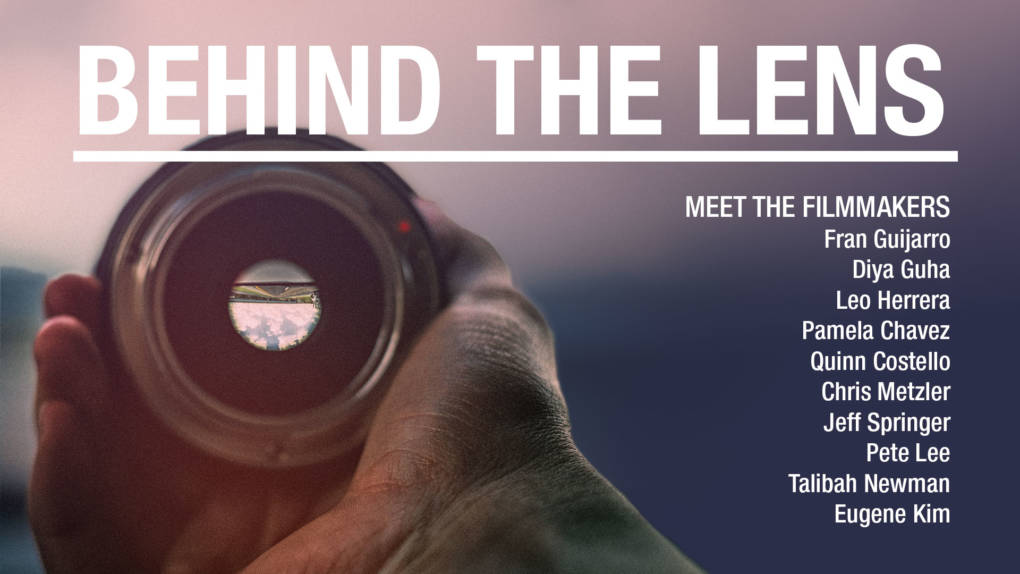
Behind the Lens features bold California indie filmmakers pushing the boundaries of their craft. Each episode focuses on a documentary, narrative or animated film director, capturing the personal experiences that inform their films, and the risks they take to bring stories to the screen. Step behind the lens and follow the journeys of a new generation of storytellers.
Dec 21
Meet 10 Bold Indie Filmmakers: Behind the Lens Screening, Panel and Mixer
Dec 11
Music, Cars and Don't Forget the Hair: Eugene Kim's 'Cherry' Channels 90s Daly City
Dec 05
Scars Become Badges of Honor in Talibah Newman’s Children-Centered Films
Nov 13
Loners, Rappers, and Bankrobbers: Pete Lee Brings the Bay's Scrappiness to Life
Nov 07
Nijla Mu'min Brings a Black Muslim Coming-of-Age Story to the Big Screen
Oct 23
In ‘Rodents of Unusual Size,’ Truth is Stranger Than Fiction
Player sponsored by
window.__IS_SSR__=true
window.__INITIAL_STATE__={
"attachmentsReducer": {
"audio_0": {
"type": "attachments",
"id": "audio_0",
"imgSizes": {
"kqedFullSize": {
"file": "https://ww2.kqed.org/news/wp-content/themes/KQED-unified/img/audio_bgs/background0.jpg"
}
}
},
"audio_1": {
"type": "attachments",
"id": "audio_1",
"imgSizes": {
"kqedFullSize": {
"file": "https://ww2.kqed.org/news/wp-content/themes/KQED-unified/img/audio_bgs/background1.jpg"
}
}
},
"audio_2": {
"type": "attachments",
"id": "audio_2",
"imgSizes": {
"kqedFullSize": {
"file": "https://ww2.kqed.org/news/wp-content/themes/KQED-unified/img/audio_bgs/background2.jpg"
}
}
},
"audio_3": {
"type": "attachments",
"id": "audio_3",
"imgSizes": {
"kqedFullSize": {
"file": "https://ww2.kqed.org/news/wp-content/themes/KQED-unified/img/audio_bgs/background3.jpg"
}
}
},
"audio_4": {
"type": "attachments",
"id": "audio_4",
"imgSizes": {
"kqedFullSize": {
"file": "https://ww2.kqed.org/news/wp-content/themes/KQED-unified/img/audio_bgs/background4.jpg"
}
}
},
"placeholder": {
"type": "attachments",
"id": "placeholder",
"imgSizes": {
"thumbnail": {
"file": "https://cdn.kqed.org/wp-content/uploads/2024/12/KQED-Default-Image-816638274-2000x1333-1-160x107.jpg",
"width": 160,
"height": 107,
"mimeType": "image/jpeg"
},
"medium": {
"file": "https://cdn.kqed.org/wp-content/uploads/2024/12/KQED-Default-Image-816638274-2000x1333-1-800x533.jpg",
"width": 800,
"height": 533,
"mimeType": "image/jpeg"
},
"medium_large": {
"file": "https://cdn.kqed.org/wp-content/uploads/2024/12/KQED-Default-Image-816638274-2000x1333-1-768x512.jpg",
"width": 768,
"height": 512,
"mimeType": "image/jpeg"
},
"large": {
"file": "https://cdn.kqed.org/wp-content/uploads/2024/12/KQED-Default-Image-816638274-2000x1333-1-1020x680.jpg",
"width": 1020,
"height": 680,
"mimeType": "image/jpeg"
},
"1536x1536": {
"file": "https://cdn.kqed.org/wp-content/uploads/2024/12/KQED-Default-Image-816638274-2000x1333-1-1536x1024.jpg",
"width": 1536,
"height": 1024,
"mimeType": "image/jpeg"
},
"fd-lrg": {
"file": "https://cdn.kqed.org/wp-content/uploads/2024/12/KQED-Default-Image-816638274-2000x1333-1-1536x1024.jpg",
"width": 1536,
"height": 1024,
"mimeType": "image/jpeg"
},
"fd-med": {
"file": "https://cdn.kqed.org/wp-content/uploads/2024/12/KQED-Default-Image-816638274-2000x1333-1-1020x680.jpg",
"width": 1020,
"height": 680,
"mimeType": "image/jpeg"
},
"fd-sm": {
"file": "https://cdn.kqed.org/wp-content/uploads/2024/12/KQED-Default-Image-816638274-2000x1333-1-800x533.jpg",
"width": 800,
"height": 533,
"mimeType": "image/jpeg"
},
"post-thumbnail": {
"file": "https://cdn.kqed.org/wp-content/uploads/2024/12/KQED-Default-Image-816638274-2000x1333-1-672x372.jpg",
"width": 672,
"height": 372,
"mimeType": "image/jpeg"
},
"twentyfourteen-full-width": {
"file": "https://cdn.kqed.org/wp-content/uploads/2024/12/KQED-Default-Image-816638274-2000x1333-1-1038x576.jpg",
"width": 1038,
"height": 576,
"mimeType": "image/jpeg"
},
"xxsmall": {
"file": "https://cdn.kqed.org/wp-content/uploads/2024/12/KQED-Default-Image-816638274-2000x1333-1-160x107.jpg",
"width": 160,
"height": 107,
"mimeType": "image/jpeg"
},
"xsmall": {
"file": "https://cdn.kqed.org/wp-content/uploads/2024/12/KQED-Default-Image-816638274-2000x1333-1-672x372.jpg",
"width": 672,
"height": 372,
"mimeType": "image/jpeg"
},
"small": {
"file": "https://cdn.kqed.org/wp-content/uploads/2024/12/KQED-Default-Image-816638274-2000x1333-1-672x372.jpg",
"width": 672,
"height": 372,
"mimeType": "image/jpeg"
},
"xlarge": {
"file": "https://cdn.kqed.org/wp-content/uploads/2024/12/KQED-Default-Image-816638274-2000x1333-1-1020x680.jpg",
"width": 1020,
"height": 680,
"mimeType": "image/jpeg"
},
"full-width": {
"file": "https://cdn.kqed.org/wp-content/uploads/2024/12/KQED-Default-Image-816638274-2000x1333-1-1920x1280.jpg",
"width": 1920,
"height": 1280,
"mimeType": "image/jpeg"
},
"guest-author-32": {
"file": "https://cdn.kqed.org/wp-content/uploads/2025/01/KQED-Default-Image-816638274-1333x1333-1-160x160.jpg",
"width": 32,
"height": 32,
"mimeType": "image/jpeg"
},
"guest-author-50": {
"file": "https://cdn.kqed.org/wp-content/uploads/2025/01/KQED-Default-Image-816638274-1333x1333-1-160x160.jpg",
"width": 50,
"height": 50,
"mimeType": "image/jpeg"
},
"guest-author-64": {
"file": "https://cdn.kqed.org/wp-content/uploads/2025/01/KQED-Default-Image-816638274-1333x1333-1-160x160.jpg",
"width": 64,
"height": 64,
"mimeType": "image/jpeg"
},
"guest-author-96": {
"file": "https://cdn.kqed.org/wp-content/uploads/2025/01/KQED-Default-Image-816638274-1333x1333-1-160x160.jpg",
"width": 96,
"height": 96,
"mimeType": "image/jpeg"
},
"guest-author-128": {
"file": "https://cdn.kqed.org/wp-content/uploads/2025/01/KQED-Default-Image-816638274-1333x1333-1-160x160.jpg",
"width": 128,
"height": 128,
"mimeType": "image/jpeg"
},
"detail": {
"file": "https://cdn.kqed.org/wp-content/uploads/2025/01/KQED-Default-Image-816638274-1333x1333-1-160x160.jpg",
"width": 160,
"height": 160,
"mimeType": "image/jpeg"
},
"kqedFullSize": {
"file": "https://cdn.kqed.org/wp-content/uploads/2024/12/KQED-Default-Image-816638274-2000x1333-1.jpg",
"width": 2000,
"height": 1333
}
}
},
"arts_13847545": {
"type": "attachments",
"id": "arts_13847545",
"meta": {
"index": "attachments_1716263798",
"site": "arts",
"id": "13847545",
"found": true
},
"parent": 13847542,
"imgSizes": {
"small": {
"file": "https://ww2.kqed.org/app/uploads/sites/2/2018/12/BTL_EventPromo_Lens_Names-1-520x293.jpg",
"width": 520,
"mimeType": "image/jpeg",
"height": 293
},
"twentyfourteen-full-width": {
"file": "https://ww2.kqed.org/app/uploads/sites/2/2018/12/BTL_EventPromo_Lens_Names-1-1038x576.jpg",
"width": 1038,
"mimeType": "image/jpeg",
"height": 576
},
"thumbnail": {
"file": "https://ww2.kqed.org/app/uploads/sites/2/2018/12/BTL_EventPromo_Lens_Names-1-160x90.jpg",
"width": 160,
"mimeType": "image/jpeg",
"height": 90
},
"fd-sm": {
"file": "https://ww2.kqed.org/app/uploads/sites/2/2018/12/BTL_EventPromo_Lens_Names-1-960x540.jpg",
"width": 960,
"mimeType": "image/jpeg",
"height": 540
},
"post-thumbnail": {
"file": "https://ww2.kqed.org/app/uploads/sites/2/2018/12/BTL_EventPromo_Lens_Names-1-672x372.jpg",
"width": 672,
"mimeType": "image/jpeg",
"height": 372
},
"xsmall": {
"file": "https://ww2.kqed.org/app/uploads/sites/2/2018/12/BTL_EventPromo_Lens_Names-1-375x211.jpg",
"width": 375,
"mimeType": "image/jpeg",
"height": 211
},
"kqedFullSize": {
"file": "https://ww2.kqed.org/app/uploads/sites/2/2018/12/BTL_EventPromo_Lens_Names-1.jpg",
"width": 1920,
"height": 1080
},
"large": {
"file": "https://ww2.kqed.org/app/uploads/sites/2/2018/12/BTL_EventPromo_Lens_Names-1-1020x574.jpg",
"width": 1020,
"mimeType": "image/jpeg",
"height": 574
},
"xlarge": {
"file": "https://ww2.kqed.org/app/uploads/sites/2/2018/12/BTL_EventPromo_Lens_Names-1-1180x664.jpg",
"width": 1180,
"mimeType": "image/jpeg",
"height": 664
},
"complete_open_graph": {
"file": "https://ww2.kqed.org/app/uploads/sites/2/2018/12/BTL_EventPromo_Lens_Names-1-1200x675.jpg",
"width": 1200,
"mimeType": "image/jpeg",
"height": 675
},
"guest-author-50": {
"file": "https://ww2.kqed.org/app/uploads/sites/2/2018/12/BTL_EventPromo_Lens_Names-1-50x50.jpg",
"width": 50,
"mimeType": "image/jpeg",
"height": 50
},
"guest-author-96": {
"file": "https://ww2.kqed.org/app/uploads/sites/2/2018/12/BTL_EventPromo_Lens_Names-1-96x96.jpg",
"width": 96,
"mimeType": "image/jpeg",
"height": 96
},
"medium": {
"file": "https://ww2.kqed.org/app/uploads/sites/2/2018/12/BTL_EventPromo_Lens_Names-1-800x450.jpg",
"width": 800,
"mimeType": "image/jpeg",
"height": 450
},
"guest-author-64": {
"file": "https://ww2.kqed.org/app/uploads/sites/2/2018/12/BTL_EventPromo_Lens_Names-1-64x64.jpg",
"width": 64,
"mimeType": "image/jpeg",
"height": 64
},
"guest-author-32": {
"file": "https://ww2.kqed.org/app/uploads/sites/2/2018/12/BTL_EventPromo_Lens_Names-1-32x32.jpg",
"width": 32,
"mimeType": "image/jpeg",
"height": 32
},
"fd-lrg": {
"file": "https://ww2.kqed.org/app/uploads/sites/2/2018/12/BTL_EventPromo_Lens_Names-1-1920x1080.jpg",
"width": 1920,
"mimeType": "image/jpeg",
"height": 1080
},
"fd-med": {
"file": "https://ww2.kqed.org/app/uploads/sites/2/2018/12/BTL_EventPromo_Lens_Names-1-1180x664.jpg",
"width": 1180,
"mimeType": "image/jpeg",
"height": 664
},
"full-width": {
"file": "https://ww2.kqed.org/app/uploads/sites/2/2018/12/BTL_EventPromo_Lens_Names-1-1920x1080.jpg",
"width": 1920,
"mimeType": "image/jpeg",
"height": 1080
},
"detail": {
"file": "https://ww2.kqed.org/app/uploads/sites/2/2018/12/BTL_EventPromo_Lens_Names-1-150x150.jpg",
"width": 150,
"mimeType": "image/jpeg",
"height": 150
},
"medium_large": {
"file": "https://ww2.kqed.org/app/uploads/sites/2/2018/12/BTL_EventPromo_Lens_Names-1-768x432.jpg",
"width": 768,
"mimeType": "image/jpeg",
"height": 432
},
"guest-author-128": {
"file": "https://ww2.kqed.org/app/uploads/sites/2/2018/12/BTL_EventPromo_Lens_Names-1-128x128.jpg",
"width": 128,
"mimeType": "image/jpeg",
"height": 128
},
"xxsmall": {
"file": "https://ww2.kqed.org/app/uploads/sites/2/2018/12/BTL_EventPromo_Lens_Names-1-240x135.jpg",
"width": 240,
"mimeType": "image/jpeg",
"height": 135
}
},
"publishDate": 1545416146,
"modified": 1545416198,
"caption": null,
"description": null,
"title": "BTL_EventPromo_Lens_Names (1)",
"credit": null,
"status": "inherit",
"isLoading": false,
"fetchFailed": false
},
"arts_13846974": {
"type": "attachments",
"id": "arts_13846974",
"meta": {
"index": "attachments_1716263798",
"site": "arts",
"id": "13846974",
"found": true
},
"parent": 13846936,
"imgSizes": {
"small": {
"file": "https://ww2.kqed.org/app/uploads/sites/2/2018/12/Eugene_BTL_Thumbnail-520x292.jpg",
"width": 520,
"mimeType": "image/jpeg",
"height": 292
},
"twentyfourteen-full-width": {
"file": "https://ww2.kqed.org/app/uploads/sites/2/2018/12/Eugene_BTL_Thumbnail-1038x576.jpg",
"width": 1038,
"mimeType": "image/jpeg",
"height": 576
},
"thumbnail": {
"file": "https://ww2.kqed.org/app/uploads/sites/2/2018/12/Eugene_BTL_Thumbnail-160x90.jpg",
"width": 160,
"mimeType": "image/jpeg",
"height": 90
},
"fd-sm": {
"file": "https://ww2.kqed.org/app/uploads/sites/2/2018/12/Eugene_BTL_Thumbnail-960x540.jpg",
"width": 960,
"mimeType": "image/jpeg",
"height": 540
},
"post-thumbnail": {
"file": "https://ww2.kqed.org/app/uploads/sites/2/2018/12/Eugene_BTL_Thumbnail-672x372.jpg",
"width": 672,
"mimeType": "image/jpeg",
"height": 372
},
"xsmall": {
"file": "https://ww2.kqed.org/app/uploads/sites/2/2018/12/Eugene_BTL_Thumbnail-375x211.jpg",
"width": 375,
"mimeType": "image/jpeg",
"height": 211
},
"kqedFullSize": {
"file": "https://ww2.kqed.org/app/uploads/sites/2/2018/12/Eugene_BTL_Thumbnail.jpg",
"width": 1920,
"height": 1079
},
"large": {
"file": "https://ww2.kqed.org/app/uploads/sites/2/2018/12/Eugene_BTL_Thumbnail-1020x573.jpg",
"width": 1020,
"mimeType": "image/jpeg",
"height": 573
},
"xlarge": {
"file": "https://ww2.kqed.org/app/uploads/sites/2/2018/12/Eugene_BTL_Thumbnail-1180x663.jpg",
"width": 1180,
"mimeType": "image/jpeg",
"height": 663
},
"complete_open_graph": {
"file": "https://ww2.kqed.org/app/uploads/sites/2/2018/12/Eugene_BTL_Thumbnail-1200x674.jpg",
"width": 1200,
"mimeType": "image/jpeg",
"height": 674
},
"guest-author-50": {
"file": "https://ww2.kqed.org/app/uploads/sites/2/2018/12/Eugene_BTL_Thumbnail-50x50.jpg",
"width": 50,
"mimeType": "image/jpeg",
"height": 50
},
"guest-author-96": {
"file": "https://ww2.kqed.org/app/uploads/sites/2/2018/12/Eugene_BTL_Thumbnail-96x96.jpg",
"width": 96,
"mimeType": "image/jpeg",
"height": 96
},
"medium": {
"file": "https://ww2.kqed.org/app/uploads/sites/2/2018/12/Eugene_BTL_Thumbnail-800x450.jpg",
"width": 800,
"mimeType": "image/jpeg",
"height": 450
},
"guest-author-64": {
"file": "https://ww2.kqed.org/app/uploads/sites/2/2018/12/Eugene_BTL_Thumbnail-64x64.jpg",
"width": 64,
"mimeType": "image/jpeg",
"height": 64
},
"guest-author-32": {
"file": "https://ww2.kqed.org/app/uploads/sites/2/2018/12/Eugene_BTL_Thumbnail-32x32.jpg",
"width": 32,
"mimeType": "image/jpeg",
"height": 32
},
"fd-lrg": {
"file": "https://ww2.kqed.org/app/uploads/sites/2/2018/12/Eugene_BTL_Thumbnail-1920x1079.jpg",
"width": 1920,
"mimeType": "image/jpeg",
"height": 1079
},
"fd-med": {
"file": "https://ww2.kqed.org/app/uploads/sites/2/2018/12/Eugene_BTL_Thumbnail-1180x663.jpg",
"width": 1180,
"mimeType": "image/jpeg",
"height": 663
},
"full-width": {
"file": "https://ww2.kqed.org/app/uploads/sites/2/2018/12/Eugene_BTL_Thumbnail-1920x1079.jpg",
"width": 1920,
"mimeType": "image/jpeg",
"height": 1079
},
"detail": {
"file": "https://ww2.kqed.org/app/uploads/sites/2/2018/12/Eugene_BTL_Thumbnail-150x150.jpg",
"width": 150,
"mimeType": "image/jpeg",
"height": 150
},
"medium_large": {
"file": "https://ww2.kqed.org/app/uploads/sites/2/2018/12/Eugene_BTL_Thumbnail-768x432.jpg",
"width": 768,
"mimeType": "image/jpeg",
"height": 432
},
"guest-author-128": {
"file": "https://ww2.kqed.org/app/uploads/sites/2/2018/12/Eugene_BTL_Thumbnail-128x128.jpg",
"width": 128,
"mimeType": "image/jpeg",
"height": 128
},
"xxsmall": {
"file": "https://ww2.kqed.org/app/uploads/sites/2/2018/12/Eugene_BTL_Thumbnail-240x135.jpg",
"width": 240,
"mimeType": "image/jpeg",
"height": 135
}
},
"publishDate": 1544563160,
"modified": 1544563160,
"caption": null,
"description": null,
"title": "Eugene_BTL_Thumbnail",
"credit": null,
"status": "inherit",
"isLoading": false,
"fetchFailed": false
},
"arts_13846341": {
"type": "attachments",
"id": "arts_13846341",
"meta": {
"index": "attachments_1716263798",
"site": "arts",
"id": "13846341",
"found": true
},
"parent": 13846310,
"imgSizes": {
"twentyfourteen-full-width": {
"file": "https://ww2.kqed.org/app/uploads/sites/2/2018/12/Talibah_BTL_Thumbnail-copy-1038x576.jpg",
"width": 1038,
"mimeType": "image/jpeg",
"height": 576
},
"thumbnail": {
"file": "https://ww2.kqed.org/app/uploads/sites/2/2018/12/Talibah_BTL_Thumbnail-copy-160x90.jpg",
"width": 160,
"mimeType": "image/jpeg",
"height": 90
},
"post-thumbnail": {
"file": "https://ww2.kqed.org/app/uploads/sites/2/2018/12/Talibah_BTL_Thumbnail-copy-672x372.jpg",
"width": 672,
"mimeType": "image/jpeg",
"height": 372
},
"kqedFullSize": {
"file": "https://ww2.kqed.org/app/uploads/sites/2/2018/12/Talibah_BTL_Thumbnail-copy.jpg",
"width": 1920,
"height": 1079
},
"large": {
"file": "https://ww2.kqed.org/app/uploads/sites/2/2018/12/Talibah_BTL_Thumbnail-copy-1020x573.jpg",
"width": 1020,
"mimeType": "image/jpeg",
"height": 573
},
"complete_open_graph": {
"file": "https://ww2.kqed.org/app/uploads/sites/2/2018/12/Talibah_BTL_Thumbnail-copy-1200x674.jpg",
"width": 1200,
"mimeType": "image/jpeg",
"height": 674
},
"guest-author-50": {
"file": "https://ww2.kqed.org/app/uploads/sites/2/2018/12/Talibah_BTL_Thumbnail-copy-50x50.jpg",
"width": 50,
"mimeType": "image/jpeg",
"height": 50
},
"guest-author-96": {
"file": "https://ww2.kqed.org/app/uploads/sites/2/2018/12/Talibah_BTL_Thumbnail-copy-96x96.jpg",
"width": 96,
"mimeType": "image/jpeg",
"height": 96
},
"medium": {
"file": "https://ww2.kqed.org/app/uploads/sites/2/2018/12/Talibah_BTL_Thumbnail-copy-800x450.jpg",
"width": 800,
"mimeType": "image/jpeg",
"height": 450
},
"guest-author-64": {
"file": "https://ww2.kqed.org/app/uploads/sites/2/2018/12/Talibah_BTL_Thumbnail-copy-64x64.jpg",
"width": 64,
"mimeType": "image/jpeg",
"height": 64
},
"guest-author-32": {
"file": "https://ww2.kqed.org/app/uploads/sites/2/2018/12/Talibah_BTL_Thumbnail-copy-32x32.jpg",
"width": 32,
"mimeType": "image/jpeg",
"height": 32
},
"full-width": {
"file": "https://ww2.kqed.org/app/uploads/sites/2/2018/12/Talibah_BTL_Thumbnail-copy-1920x1079.jpg",
"width": 1920,
"mimeType": "image/jpeg",
"height": 1079
},
"detail": {
"file": "https://ww2.kqed.org/app/uploads/sites/2/2018/12/Talibah_BTL_Thumbnail-copy-150x150.jpg",
"width": 150,
"mimeType": "image/jpeg",
"height": 150
},
"medium_large": {
"file": "https://ww2.kqed.org/app/uploads/sites/2/2018/12/Talibah_BTL_Thumbnail-copy-768x432.jpg",
"width": 768,
"mimeType": "image/jpeg",
"height": 432
},
"guest-author-128": {
"file": "https://ww2.kqed.org/app/uploads/sites/2/2018/12/Talibah_BTL_Thumbnail-copy-128x128.jpg",
"width": 128,
"mimeType": "image/jpeg",
"height": 128
}
},
"publishDate": 1543958800,
"modified": 1543958800,
"caption": null,
"description": null,
"title": "Talibah_BTL_Thumbnail copy",
"credit": null,
"status": "inherit",
"isLoading": false,
"fetchFailed": false
},
"arts_13844955": {
"type": "attachments",
"id": "arts_13844955",
"meta": {
"index": "attachments_1716263798",
"site": "arts",
"id": "13844955",
"found": true
},
"parent": 13844798,
"imgSizes": {
"small": {
"file": "https://ww2.kqed.org/app/uploads/sites/2/2018/11/Pete_BTL_Thumbnail_Smaller_Logo-520x293.jpg",
"width": 520,
"mimeType": "image/jpeg",
"height": 293
},
"twentyfourteen-full-width": {
"file": "https://ww2.kqed.org/app/uploads/sites/2/2018/11/Pete_BTL_Thumbnail_Smaller_Logo-1038x576.jpg",
"width": 1038,
"mimeType": "image/jpeg",
"height": 576
},
"thumbnail": {
"file": "https://ww2.kqed.org/app/uploads/sites/2/2018/11/Pete_BTL_Thumbnail_Smaller_Logo-160x90.jpg",
"width": 160,
"mimeType": "image/jpeg",
"height": 90
},
"fd-sm": {
"file": "https://ww2.kqed.org/app/uploads/sites/2/2018/11/Pete_BTL_Thumbnail_Smaller_Logo-960x540.jpg",
"width": 960,
"mimeType": "image/jpeg",
"height": 540
},
"post-thumbnail": {
"file": "https://ww2.kqed.org/app/uploads/sites/2/2018/11/Pete_BTL_Thumbnail_Smaller_Logo-672x372.jpg",
"width": 672,
"mimeType": "image/jpeg",
"height": 372
},
"xsmall": {
"file": "https://ww2.kqed.org/app/uploads/sites/2/2018/11/Pete_BTL_Thumbnail_Smaller_Logo-375x211.jpg",
"width": 375,
"mimeType": "image/jpeg",
"height": 211
},
"kqedFullSize": {
"file": "https://ww2.kqed.org/app/uploads/sites/2/2018/11/Pete_BTL_Thumbnail_Smaller_Logo.jpg",
"width": 1920,
"height": 1080
},
"large": {
"file": "https://ww2.kqed.org/app/uploads/sites/2/2018/11/Pete_BTL_Thumbnail_Smaller_Logo-1020x574.jpg",
"width": 1020,
"mimeType": "image/jpeg",
"height": 574
},
"xlarge": {
"file": "https://ww2.kqed.org/app/uploads/sites/2/2018/11/Pete_BTL_Thumbnail_Smaller_Logo-1180x664.jpg",
"width": 1180,
"mimeType": "image/jpeg",
"height": 664
},
"complete_open_graph": {
"file": "https://ww2.kqed.org/app/uploads/sites/2/2018/11/Pete_BTL_Thumbnail_Smaller_Logo-1200x675.jpg",
"width": 1200,
"mimeType": "image/jpeg",
"height": 675
},
"guest-author-50": {
"file": "https://ww2.kqed.org/app/uploads/sites/2/2018/11/Pete_BTL_Thumbnail_Smaller_Logo-50x50.jpg",
"width": 50,
"mimeType": "image/jpeg",
"height": 50
},
"guest-author-96": {
"file": "https://ww2.kqed.org/app/uploads/sites/2/2018/11/Pete_BTL_Thumbnail_Smaller_Logo-96x96.jpg",
"width": 96,
"mimeType": "image/jpeg",
"height": 96
},
"medium": {
"file": "https://ww2.kqed.org/app/uploads/sites/2/2018/11/Pete_BTL_Thumbnail_Smaller_Logo-800x450.jpg",
"width": 800,
"mimeType": "image/jpeg",
"height": 450
},
"guest-author-64": {
"file": "https://ww2.kqed.org/app/uploads/sites/2/2018/11/Pete_BTL_Thumbnail_Smaller_Logo-64x64.jpg",
"width": 64,
"mimeType": "image/jpeg",
"height": 64
},
"guest-author-32": {
"file": "https://ww2.kqed.org/app/uploads/sites/2/2018/11/Pete_BTL_Thumbnail_Smaller_Logo-32x32.jpg",
"width": 32,
"mimeType": "image/jpeg",
"height": 32
},
"fd-lrg": {
"file": "https://ww2.kqed.org/app/uploads/sites/2/2018/11/Pete_BTL_Thumbnail_Smaller_Logo-1920x1080.jpg",
"width": 1920,
"mimeType": "image/jpeg",
"height": 1080
},
"fd-med": {
"file": "https://ww2.kqed.org/app/uploads/sites/2/2018/11/Pete_BTL_Thumbnail_Smaller_Logo-1180x664.jpg",
"width": 1180,
"mimeType": "image/jpeg",
"height": 664
},
"full-width": {
"file": "https://ww2.kqed.org/app/uploads/sites/2/2018/11/Pete_BTL_Thumbnail_Smaller_Logo-1920x1080.jpg",
"width": 1920,
"mimeType": "image/jpeg",
"height": 1080
},
"detail": {
"file": "https://ww2.kqed.org/app/uploads/sites/2/2018/11/Pete_BTL_Thumbnail_Smaller_Logo-150x150.jpg",
"width": 150,
"mimeType": "image/jpeg",
"height": 150
},
"medium_large": {
"file": "https://ww2.kqed.org/app/uploads/sites/2/2018/11/Pete_BTL_Thumbnail_Smaller_Logo-768x432.jpg",
"width": 768,
"mimeType": "image/jpeg",
"height": 432
},
"guest-author-128": {
"file": "https://ww2.kqed.org/app/uploads/sites/2/2018/11/Pete_BTL_Thumbnail_Smaller_Logo-128x128.jpg",
"width": 128,
"mimeType": "image/jpeg",
"height": 128
},
"xxsmall": {
"file": "https://ww2.kqed.org/app/uploads/sites/2/2018/11/Pete_BTL_Thumbnail_Smaller_Logo-240x135.jpg",
"width": 240,
"mimeType": "image/jpeg",
"height": 135
}
},
"publishDate": 1542244002,
"modified": 1542244561,
"caption": "Pete Lee sits on a rooftop in San Francisco's Chinatown",
"description": null,
"title": "Pete_BTL_Thumbnail_Smaller_Logo",
"credit": null,
"status": "inherit",
"isLoading": false,
"fetchFailed": false
},
"arts_13844960": {
"type": "attachments",
"id": "arts_13844960",
"meta": {
"index": "attachments_1716263798",
"site": "arts",
"id": "13844960",
"found": true
},
"parent": 13844441,
"imgSizes": {
"small": {
"file": "https://ww2.kqed.org/app/uploads/sites/2/2018/11/Nijla_BTL_Thumbnail-520x293.jpg",
"width": 520,
"mimeType": "image/jpeg",
"height": 293
},
"twentyfourteen-full-width": {
"file": "https://ww2.kqed.org/app/uploads/sites/2/2018/11/Nijla_BTL_Thumbnail-1038x576.jpg",
"width": 1038,
"mimeType": "image/jpeg",
"height": 576
},
"thumbnail": {
"file": "https://ww2.kqed.org/app/uploads/sites/2/2018/11/Nijla_BTL_Thumbnail-160x90.jpg",
"width": 160,
"mimeType": "image/jpeg",
"height": 90
},
"fd-sm": {
"file": "https://ww2.kqed.org/app/uploads/sites/2/2018/11/Nijla_BTL_Thumbnail-960x540.jpg",
"width": 960,
"mimeType": "image/jpeg",
"height": 540
},
"post-thumbnail": {
"file": "https://ww2.kqed.org/app/uploads/sites/2/2018/11/Nijla_BTL_Thumbnail-672x372.jpg",
"width": 672,
"mimeType": "image/jpeg",
"height": 372
},
"xsmall": {
"file": "https://ww2.kqed.org/app/uploads/sites/2/2018/11/Nijla_BTL_Thumbnail-375x211.jpg",
"width": 375,
"mimeType": "image/jpeg",
"height": 211
},
"kqedFullSize": {
"file": "https://ww2.kqed.org/app/uploads/sites/2/2018/11/Nijla_BTL_Thumbnail.jpg",
"width": 1920,
"height": 1080
},
"large": {
"file": "https://ww2.kqed.org/app/uploads/sites/2/2018/11/Nijla_BTL_Thumbnail-1020x574.jpg",
"width": 1020,
"mimeType": "image/jpeg",
"height": 574
},
"xlarge": {
"file": "https://ww2.kqed.org/app/uploads/sites/2/2018/11/Nijla_BTL_Thumbnail-1180x664.jpg",
"width": 1180,
"mimeType": "image/jpeg",
"height": 664
},
"complete_open_graph": {
"file": "https://ww2.kqed.org/app/uploads/sites/2/2018/11/Nijla_BTL_Thumbnail-1200x675.jpg",
"width": 1200,
"mimeType": "image/jpeg",
"height": 675
},
"guest-author-50": {
"file": "https://ww2.kqed.org/app/uploads/sites/2/2018/11/Nijla_BTL_Thumbnail-50x50.jpg",
"width": 50,
"mimeType": "image/jpeg",
"height": 50
},
"guest-author-96": {
"file": "https://ww2.kqed.org/app/uploads/sites/2/2018/11/Nijla_BTL_Thumbnail-96x96.jpg",
"width": 96,
"mimeType": "image/jpeg",
"height": 96
},
"medium": {
"file": "https://ww2.kqed.org/app/uploads/sites/2/2018/11/Nijla_BTL_Thumbnail-800x450.jpg",
"width": 800,
"mimeType": "image/jpeg",
"height": 450
},
"guest-author-64": {
"file": "https://ww2.kqed.org/app/uploads/sites/2/2018/11/Nijla_BTL_Thumbnail-64x64.jpg",
"width": 64,
"mimeType": "image/jpeg",
"height": 64
},
"guest-author-32": {
"file": "https://ww2.kqed.org/app/uploads/sites/2/2018/11/Nijla_BTL_Thumbnail-32x32.jpg",
"width": 32,
"mimeType": "image/jpeg",
"height": 32
},
"fd-lrg": {
"file": "https://ww2.kqed.org/app/uploads/sites/2/2018/11/Nijla_BTL_Thumbnail-1920x1080.jpg",
"width": 1920,
"mimeType": "image/jpeg",
"height": 1080
},
"fd-med": {
"file": "https://ww2.kqed.org/app/uploads/sites/2/2018/11/Nijla_BTL_Thumbnail-1180x664.jpg",
"width": 1180,
"mimeType": "image/jpeg",
"height": 664
},
"full-width": {
"file": "https://ww2.kqed.org/app/uploads/sites/2/2018/11/Nijla_BTL_Thumbnail-1920x1080.jpg",
"width": 1920,
"mimeType": "image/jpeg",
"height": 1080
},
"detail": {
"file": "https://ww2.kqed.org/app/uploads/sites/2/2018/11/Nijla_BTL_Thumbnail-150x150.jpg",
"width": 150,
"mimeType": "image/jpeg",
"height": 150
},
"medium_large": {
"file": "https://ww2.kqed.org/app/uploads/sites/2/2018/11/Nijla_BTL_Thumbnail-768x432.jpg",
"width": 768,
"mimeType": "image/jpeg",
"height": 432
},
"guest-author-128": {
"file": "https://ww2.kqed.org/app/uploads/sites/2/2018/11/Nijla_BTL_Thumbnail-128x128.jpg",
"width": 128,
"mimeType": "image/jpeg",
"height": 128
},
"xxsmall": {
"file": "https://ww2.kqed.org/app/uploads/sites/2/2018/11/Nijla_BTL_Thumbnail-240x135.jpg",
"width": 240,
"mimeType": "image/jpeg",
"height": 135
}
},
"publishDate": 1542244692,
"modified": 1542244692,
"caption": null,
"description": null,
"title": "Nijla_BTL_Thumbnail",
"credit": null,
"status": "inherit",
"isLoading": false,
"fetchFailed": false
},
"arts_13844962": {
"type": "attachments",
"id": "arts_13844962",
"meta": {
"index": "attachments_1716263798",
"site": "arts",
"id": "13844962",
"found": true
},
"parent": 13843368,
"imgSizes": {
"small": {
"file": "https://ww2.kqed.org/app/uploads/sites/2/2018/10/ROUS_BTL_Thumbnail-520x293.jpg",
"width": 520,
"mimeType": "image/jpeg",
"height": 293
},
"twentyfourteen-full-width": {
"file": "https://ww2.kqed.org/app/uploads/sites/2/2018/10/ROUS_BTL_Thumbnail-1038x576.jpg",
"width": 1038,
"mimeType": "image/jpeg",
"height": 576
},
"thumbnail": {
"file": "https://ww2.kqed.org/app/uploads/sites/2/2018/10/ROUS_BTL_Thumbnail-160x90.jpg",
"width": 160,
"mimeType": "image/jpeg",
"height": 90
},
"fd-sm": {
"file": "https://ww2.kqed.org/app/uploads/sites/2/2018/10/ROUS_BTL_Thumbnail-960x540.jpg",
"width": 960,
"mimeType": "image/jpeg",
"height": 540
},
"post-thumbnail": {
"file": "https://ww2.kqed.org/app/uploads/sites/2/2018/10/ROUS_BTL_Thumbnail-672x372.jpg",
"width": 672,
"mimeType": "image/jpeg",
"height": 372
},
"xsmall": {
"file": "https://ww2.kqed.org/app/uploads/sites/2/2018/10/ROUS_BTL_Thumbnail-375x211.jpg",
"width": 375,
"mimeType": "image/jpeg",
"height": 211
},
"kqedFullSize": {
"file": "https://ww2.kqed.org/app/uploads/sites/2/2018/10/ROUS_BTL_Thumbnail.jpg",
"width": 1920,
"height": 1080
},
"large": {
"file": "https://ww2.kqed.org/app/uploads/sites/2/2018/10/ROUS_BTL_Thumbnail-1020x574.jpg",
"width": 1020,
"mimeType": "image/jpeg",
"height": 574
},
"xlarge": {
"file": "https://ww2.kqed.org/app/uploads/sites/2/2018/10/ROUS_BTL_Thumbnail-1180x664.jpg",
"width": 1180,
"mimeType": "image/jpeg",
"height": 664
},
"complete_open_graph": {
"file": "https://ww2.kqed.org/app/uploads/sites/2/2018/10/ROUS_BTL_Thumbnail-1200x675.jpg",
"width": 1200,
"mimeType": "image/jpeg",
"height": 675
},
"guest-author-50": {
"file": "https://ww2.kqed.org/app/uploads/sites/2/2018/10/ROUS_BTL_Thumbnail-50x50.jpg",
"width": 50,
"mimeType": "image/jpeg",
"height": 50
},
"guest-author-96": {
"file": "https://ww2.kqed.org/app/uploads/sites/2/2018/10/ROUS_BTL_Thumbnail-96x96.jpg",
"width": 96,
"mimeType": "image/jpeg",
"height": 96
},
"medium": {
"file": "https://ww2.kqed.org/app/uploads/sites/2/2018/10/ROUS_BTL_Thumbnail-800x450.jpg",
"width": 800,
"mimeType": "image/jpeg",
"height": 450
},
"guest-author-64": {
"file": "https://ww2.kqed.org/app/uploads/sites/2/2018/10/ROUS_BTL_Thumbnail-64x64.jpg",
"width": 64,
"mimeType": "image/jpeg",
"height": 64
},
"guest-author-32": {
"file": "https://ww2.kqed.org/app/uploads/sites/2/2018/10/ROUS_BTL_Thumbnail-32x32.jpg",
"width": 32,
"mimeType": "image/jpeg",
"height": 32
},
"fd-lrg": {
"file": "https://ww2.kqed.org/app/uploads/sites/2/2018/10/ROUS_BTL_Thumbnail-1920x1080.jpg",
"width": 1920,
"mimeType": "image/jpeg",
"height": 1080
},
"fd-med": {
"file": "https://ww2.kqed.org/app/uploads/sites/2/2018/10/ROUS_BTL_Thumbnail-1180x664.jpg",
"width": 1180,
"mimeType": "image/jpeg",
"height": 664
},
"full-width": {
"file": "https://ww2.kqed.org/app/uploads/sites/2/2018/10/ROUS_BTL_Thumbnail-1920x1080.jpg",
"width": 1920,
"mimeType": "image/jpeg",
"height": 1080
},
"detail": {
"file": "https://ww2.kqed.org/app/uploads/sites/2/2018/10/ROUS_BTL_Thumbnail-150x150.jpg",
"width": 150,
"mimeType": "image/jpeg",
"height": 150
},
"medium_large": {
"file": "https://ww2.kqed.org/app/uploads/sites/2/2018/10/ROUS_BTL_Thumbnail-768x432.jpg",
"width": 768,
"mimeType": "image/jpeg",
"height": 432
},
"guest-author-128": {
"file": "https://ww2.kqed.org/app/uploads/sites/2/2018/10/ROUS_BTL_Thumbnail-128x128.jpg",
"width": 128,
"mimeType": "image/jpeg",
"height": 128
},
"xxsmall": {
"file": "https://ww2.kqed.org/app/uploads/sites/2/2018/10/ROUS_BTL_Thumbnail-240x135.jpg",
"width": 240,
"mimeType": "image/jpeg",
"height": 135
}
},
"publishDate": 1542246742,
"modified": 1542246742,
"caption": null,
"description": null,
"title": "ROUS_BTL_Thumbnail",
"credit": null,
"status": "inherit",
"isLoading": false,
"fetchFailed": false
}
},
"audioPlayerReducer": {
"postId": "stream_live",
"isPaused": true,
"isPlaying": false,
"pfsActive": false,
"pledgeModalIsOpen": true,
"playerDrawerIsOpen": false,
"liveAudioPlayStartedAt": 0,
"liveAudioPlayContext": ""
},
"authorsReducer": {
"byline_arts_13846936": {
"type": "authors",
"id": "byline_arts_13846936",
"meta": {
"override": true
},
"slug": "byline_arts_13846936",
"name": "Rachel Boyoung Kim",
"isLoading": false
},
"byline_arts_13844441": {
"type": "authors",
"id": "byline_arts_13844441",
"meta": {
"override": true
},
"slug": "byline_arts_13844441",
"name": "Benjamin Michel",
"isLoading": false
},
"soki": {
"type": "authors",
"id": "99",
"meta": {
"index": "authors_1716337520",
"id": "99",
"found": true
},
"name": "Siouxsie Oki",
"firstName": "Siouxsie",
"lastName": "Oki",
"slug": "soki",
"email": "soki@KQED.org",
"display_author_email": false,
"staff_mastheads": [],
"title": "KQED Contributor",
"bio": "Siouxsie is an activist and artist, dedicated to building community by celebrating the diverse voices and perspectives of the Bay Area. She is a former director of KQED’s community engagement efforts, developing dynamic partnerships throughout our coverage area utilizing local and national content to foster two-way engagement and collaboration between different industries, organizations and audience segments.",
"avatar": "https://secure.gravatar.com/avatar/8e29f2b375533bd6aa16f5879c5f8e81ecc1436c730c773f24228969e7569650?s=600&d=blank&r=g",
"twitter": null,
"bluesky": null,
"facebook": null,
"instagram": null,
"linkedin": null,
"sites": [
{
"site": "arts",
"roles": [
"subscriber"
]
},
{
"site": "news",
"roles": [
"subscriber"
]
},
{
"site": "about",
"roles": [
"editor"
]
},
{
"site": "bayareabites",
"roles": [
"editor"
]
},
{
"site": "checkplease",
"roles": [
"contributor"
]
},
{
"site": "pressroom",
"roles": [
"editor"
]
},
{
"site": "events",
"roles": [
"editor"
]
}
],
"headData": {
"title": "Siouxsie Oki | KQED",
"description": "KQED Contributor",
"ogImgSrc": "https://secure.gravatar.com/avatar/8e29f2b375533bd6aa16f5879c5f8e81ecc1436c730c773f24228969e7569650?s=600&d=blank&r=g",
"twImgSrc": "https://secure.gravatar.com/avatar/8e29f2b375533bd6aa16f5879c5f8e81ecc1436c730c773f24228969e7569650?s=600&d=blank&r=g"
},
"isLoading": false,
"link": "/author/soki"
},
"kwhalen": {
"type": "authors",
"id": "3248",
"meta": {
"index": "authors_1716337520",
"id": "3248",
"found": true
},
"name": "Kelly Whalen",
"firstName": "Kelly",
"lastName": "Whalen",
"slug": "kwhalen",
"email": "kwhalen@kqed.org",
"display_author_email": false,
"staff_mastheads": [],
"title": "Senior Video Producer",
"bio": "Kelly Whalen is a filmmaker and educator who directs and produces social justice documentaries and award-winning arts and culture web series. She is the creator of KQED Arts’ three-time Webby Award-winning YouTube series \u003cem>If Cities Could Dance\u003c/em>, featuring dancers across the country representing their cities’ signature moves, and the director of \u003cem>When the Waters Get Deep\u003c/em>, a documentary about Oakland-based artists SOL Development and their work toward healing their communities’ trauma from gun violence.",
"avatar": "https://secure.gravatar.com/avatar/1a2b57e8a13abdcfc3d4966d9c0e1512?s=600&d=blank&r=g",
"twitter": "kellyfilmmaker",
"facebook": null,
"instagram": null,
"linkedin": null,
"sites": [
{
"site": "arts",
"roles": [
"subscriber"
]
}
],
"headData": {
"title": "Kelly Whalen | KQED",
"description": "Senior Video Producer",
"ogImgSrc": "https://secure.gravatar.com/avatar/1a2b57e8a13abdcfc3d4966d9c0e1512?s=600&d=blank&r=g",
"twImgSrc": "https://secure.gravatar.com/avatar/1a2b57e8a13abdcfc3d4966d9c0e1512?s=600&d=blank&r=g"
},
"isLoading": false,
"link": "/author/kwhalen"
},
"cescobar": {
"type": "authors",
"id": "11241",
"meta": {
"index": "authors_1716337520",
"id": "11241",
"found": true
},
"name": "Claudia Escobar",
"firstName": "Claudia",
"lastName": "Escobar",
"slug": "cescobar",
"email": "cescobar@kqed.org",
"display_author_email": false,
"staff_mastheads": [],
"title": "KQED Contributor",
"bio": "Tropical latin visual story teller extraordinaire! bread maker apprentice.",
"avatar": "https://secure.gravatar.com/avatar/39af590a0e19126bafbf121ec9d891a77a3d680061d7cc03d720efe706992707?s=600&d=blank&r=g",
"twitter": null,
"bluesky": null,
"facebook": null,
"instagram": null,
"linkedin": null,
"sites": [
{
"site": "arts",
"roles": [
"subscriber"
]
},
{
"site": "news",
"roles": [
"author"
]
}
],
"headData": {
"title": "Claudia Escobar | KQED",
"description": "KQED Contributor",
"ogImgSrc": "https://secure.gravatar.com/avatar/39af590a0e19126bafbf121ec9d891a77a3d680061d7cc03d720efe706992707?s=600&d=blank&r=g",
"twImgSrc": "https://secure.gravatar.com/avatar/39af590a0e19126bafbf121ec9d891a77a3d680061d7cc03d720efe706992707?s=600&d=blank&r=g"
},
"isLoading": false,
"link": "/author/cescobar"
}
},
"pagesReducer": {
"root-site_behind-the-lens": {
"type": "pages",
"id": "root-site_15643",
"meta": {
"index": "pages_1716337520",
"site": "root-site",
"id": "15643",
"score": 0
},
"parent": 0,
"pageMeta": {
"excludeFromSiteSearch": "Include",
"sticky": false,
"adSlotOverride": "300x250_arts",
"WpPageTemplate": "page-topic-editorial"
},
"labelTerm": {
"site": ""
},
"blocks": [
{
"innerHTML": "\n\u003cp>Behind the Lens features bold California indie filmmakers pushing the boundaries of their craft. Each episode focuses on a documentary, narrative or animated film director, capturing the personal experiences that inform their films, and the risks they take to bring stories to the screen. Step behind the lens and follow the journeys of a new generation of storytellers.\u003c/p>\n",
"blockName": "core/paragraph",
"innerContent": [
"\n\u003cp>Behind the Lens features bold California indie filmmakers pushing the boundaries of their craft. Each episode focuses on a documentary, narrative or animated film director, capturing the personal experiences that inform their films, and the risks they take to bring stories to the screen. Step behind the lens and follow the journeys of a new generation of storytellers.\u003c/p>\n"
],
"innerBlocks": [],
"attrs": []
},
{
"innerHTML": "",
"blockName": "kqed/post-list",
"innerContent": [],
"innerBlocks": [],
"attrs": {
"layout": "cardVideo2",
"useSSR": true,
"sizeBase": 6,
"seeMore": true,
"query": "posts/arts?series=behind-the-lens&queryId=c1404e4e59"
}
},
{
"innerHTML": "",
"blockName": "kqed/ad",
"innerContent": [],
"innerBlocks": [],
"attrs": []
}
],
"publishDate": 1581446596,
"title": "Behind the Lens",
"pagePath": "behind-the-lens",
"headTitle": "Behind the Lens | KQED",
"content": "\u003cp>Behind the Lens features bold California indie filmmakers pushing the boundaries of their craft. Each episode focuses on a documentary, narrative or animated film director, capturing the personal experiences that inform their films, and the risks they take to bring stories to the screen. Step behind the lens and follow the journeys of a new generation of storytellers.\u003c/p>\n\n\n\n\n\u003cp>[ad fullwidth]\u003c/p>\u003cp>\u003c/p>\n",
"modified": 1690468968,
"headData": {
"twImgId": "",
"twTitle": "",
"socialTitle": "Behind the Lens - California Indie Filmmakers | KQED",
"ogTitle": "",
"ogImgId": "",
"twDescription": "",
"description": "Learn about the personal experiences that shape the work of California indie filmmakers through KQED's "Behind the Lens" series.",
"socialDescription": "Learn about the personal experiences that shape the work of California indie filmmakers through KQED's "Behind the Lens" series.",
"title": "Behind the Lens - California Indie Filmmakers | KQED",
"ogDescription": ""
},
"slug": "behind-the-lens",
"status": "publish",
"format": "standard",
"path": "/root-site/15643/behind-the-lens",
"audioTrackLength": null,
"parsedContent": [
{
"type": "contentString",
"content": "\u003cdiv class=\"post-body\">\u003cp>\u003cp>Behind the Lens features bold California indie filmmakers pushing the boundaries of their craft. Each episode focuses on a documentary, narrative or animated film director, capturing the personal experiences that inform their films, and the risks they take to bring stories to the screen. Step behind the lens and follow the journeys of a new generation of storytellers.\u003c/p>\n\n\n\n\n\u003cp>\u003c/p>\u003c/div>",
"attributes": {
"named": {},
"numeric": []
}
},
{
"type": "component",
"content": "",
"name": "ad",
"attributes": {
"named": {
"label": "fullwidth"
},
"numeric": [
"fullwidth"
]
}
},
{
"type": "contentString",
"content": "\u003cdiv class=\"post-body\">\u003cp>\u003c/p>\u003cp>\u003c/p>\n\u003c/div>\u003c/p>",
"attributes": {
"named": {},
"numeric": []
}
}
],
"label": "root-site",
"isLoading": false
}
},
"pfsSessionReducer": {},
"postsReducer": {
"stream_live": {
"type": "live",
"id": "stream_live",
"audioUrl": "https://hls.kqed.org/hls/kqed_app/playlist.m3u8",
"title": "Live Stream",
"excerpt": "Live Stream information currently unavailable.",
"link": "/radio",
"featImg": "",
"label": {
"name": "KQED Live",
"link": "/"
}
},
"stream_kqedNewscast": {
"type": "posts",
"id": "stream_kqedNewscast",
"audioUrl": "https://www.kqed.org/.stream/anon/radio/RDnews/newscast.mp3?_=1",
"title": "KQED Newscast",
"featImg": "",
"label": {
"name": "88.5 FM",
"link": "/"
}
},
"arts_13847542": {
"type": "posts",
"id": "arts_13847542",
"meta": {
"index": "posts_1716263798",
"site": "arts",
"id": "13847542",
"score": null,
"sort": [
1545426784000
]
},
"parent": 0,
"labelTerm": {
"site": "arts",
"term": 3500
},
"blocks": [],
"publishDate": 1545426784,
"format": "standard",
"title": "Meet 10 Bold Indie Filmmakers: Behind the Lens Screening, Panel and Mixer",
"headTitle": "Meet 10 Bold Indie Filmmakers: Behind the Lens Screening, Panel and Mixer | KQED",
"content": "\u003cp>This event has already passed. Check out photos from the event \u003ca href=\"https://flic.kr/s/aHskN1sq8k\" target=\"_blank\" rel=\"noopener noreferrer\">HERE\u003c/a>.\u003c/p>\n\u003cp>\u003cspan style=\"font-weight: 400\">Join KQED for an intimate evening filled with conversation and short films about the next generation of storytellers who are dedicated to doing it their way: with courage, honesty and sincere curiosity about the world around them. \u003c/span>\u003c/p>\n\u003ch2>Meet the Filmmakers:\u003c/h2>\n\u003cp>\u003cstrong>\u003ca href=\"https://www.kqed.org/arts/13811487/moses-documentary-changes-lead-character-and-filmmakers-lives\">Fran Guijarro and Diya Guha\u003c/a>, directors of \u003ci>Moses\u003c/i>\u003c/strong>\u003c/p>\n\u003cp>Fran and Diya’s work following one man’s journey off the streets of San Francisco transformed the lives of everyone involved.\u003c/p>\n\u003cp>\u003cstrong>\u003ca href=\"https://www.kqed.org/arts/13825213/filmmaker-leo-herrera-imagines-an-alternate-world-without-aids\">Leo Herrera\u003c/a>, director of \u003ci>Fathers\u003c/i>\u003c/strong>\u003c/p>\n\u003cp>[ad fullwidth]\u003c/p>\n\u003cp>Leo re-creates and explores an alternate universe where the work of notable queer artists and activists were never stopped short by AIDS.\u003c/p>\n\u003cp>\u003cstrong>\u003ca href=\"https://www.kqed.org/arts/13842424/behind-the-lens-pamela-chavez\">Pamela Chavez\u003c/a>, director of \u003ci>Caracol Cruzando\u003c/i> \u003c/strong>\u003c/p>\n\u003cp>\u003cspan style=\"font-weight: 400\">Pamela draws on memories of her own family’s migration from Costa Rica to the U.S. in her animated short. \u003c/span>\u003c/p>\n\u003cp>\u003cstrong>\u003ca href=\"https://www.kqed.org/arts/13843368/behind-the-lens-rodents-of-unusual-size\">Chris Metzler, Quinn Costello and Jeff Springer\u003c/a>, directors of \u003ci>Rodents of Unusual Size\u003c/i>\u003c/strong>\u003c/p>\n\u003cp>\u003cspan style=\"font-weight: 400\">Quinn, Chris and Jeff \u003c/span>\u003cspan style=\"font-weight: 400\">spent four years following giant swamp rats decimating the Louisiana coastline—and the local hunters committed to stopping them\u003c/span>\u003cspan style=\"font-weight: 400\">.\u003c/span>\u003c/p>\n\u003cp>\u003cstrong>\u003ca href=\"https://www.kqed.org/arts/13844798/loners-rappers-and-bankrobbers-pete-lee-brings-the-bays-scrappiness-to-life\">Pete Lee\u003c/a>, director of \u003cem>Don’t Be A Hero\u003c/em>\u003c/strong>\u003c/p>\n\u003cp>\u003cspan style=\"font-weight: 400\">Pete, the Taiwanese-born director and lifelong kung-fu aficionado has worked on martial arts shorts, music videos and a Sundance-selected heist film.\u003c/span>\u003c/p>\n\u003cp>\u003cstrong>\u003ca href=\"https://www.kqed.org/arts/13846310/behind-the-lens-talibah-newman\">Talibah Newman\u003c/a>, director of \u003ci>Busted on Brigham Lane\u003c/i>, \u003ci>Sweet Honey Chile’\u003c/i> and T\u003ci>he Greenwood Project\u003c/i>\u003c/strong>\u003c/p>\n\u003cp>\u003cspan style=\"font-weight: 400\">Talibah creates stories about children’s innocence and resilience to inspire growth and healing for the black community and within families.\u003c/span>\u003c/p>\n\u003cp>\u003cstrong>\u003ca href=\"https://www.kqed.org/arts/13846936/behind-the-lens-eugene-kim\">Eugene Kim\u003c/a>, director of \u003ci>Cherry\u003c/i>\u003c/strong>\u003c/p>\n\u003cp>\u003cspan style=\"font-weight: 400\">Eugene \u003c/span>\u003cspan style=\"font-weight: 400\">captured his experiences growing up in 1990s Daly City, California, when Filipino DJs pioneered a new style, B-Boys competed at car shows and everyone knew they were part of a historic moment in music history. \u003c/span>\u003c/p>\n\u003cp>\u003ca href=\"https://www.kqed.org/arts/series/behind-the-lens\" target=\"_blank\" rel=\"noopener noreferrer\">\u003ci>\u003cspan style=\"font-weight: 400\">Behind the Lens\u003c/span>\u003c/i>\u003c/a>\u003cspan style=\"font-weight: 400\">, a new KQED digital series about indie California filmmakers, features these filmmakers and more.\u003c/span>\u003cspan style=\"font-weight: 400\"> Each episode focuses on a documentary, narrative or animated film director, capturing the personal experiences that inform their films, and the risks they take to bring stories to the screen. Step behind the lens and follow the journeys of a new generation of storytellers.\u003c/span>\u003c/p>\n\u003cp>\u003cspan style=\"font-weight: 400\">Big thanks to our community partners:\u003c/span>\u003c/p>\n\u003cp>\u003ca href=\"https://www.sffilm.org/artist-development\" target=\"_blank\" rel=\"noopener noreferrer\">\u003cspan style=\"font-weight: 400\">SFFILM\u003c/span>\u003c/a>\u003cspan style=\"font-weight: 400\">, \u003c/span>\u003ca href=\"https://bavc.org/\" target=\"_blank\" rel=\"noopener noreferrer\">\u003cspan style=\"font-weight: 400\">BAVC\u003c/span>\u003c/a>\u003cspan style=\"font-weight: 400\">, \u003c/span>\u003ca href=\"https://itvs.org/\" target=\"_blank\" rel=\"noopener noreferrer\">\u003cspan style=\"font-weight: 400\">ITVS\u003c/span>\u003c/a>\u003cspan style=\"font-weight: 400\"> and \u003c/span>\u003ca href=\"https://youthbeat.org/\" target=\"_blank\" rel=\"noopener noreferrer\">\u003cspan style=\"font-weight: 400\">Youth Beat\u003c/span>\u003c/a>\u003c/p>\n\u003cp>\u003cspan style=\"font-weight: 400\">Behind the Lens : \u003c/span>\u003cspan style=\"font-weight: 400\">Screening, Panel and Mixer\u003c/span>\u003cbr>\nWednesday, January 16, 2019\u003cbr>\n6:30PM Doors\u003cbr>\n7:00PM Event starts\u003cbr>\nFREE, \u003ca href=\"https://behindthelens2019.eventbrite.com\" target=\"_blank\" rel=\"noopener noreferrer\">\u003cspan style=\"font-weight: 400\">RSVP is required for attendance\u003c/span>\u003c/a>\u003c/p>\n\u003cp>\u003cspan style=\"font-weight: 400\">KQED\u003c/span>\u003cbr>\n2601 Mariposa Street\u003cbr>\nSan Francisco, CA 94110\u003c/p>\n\u003cp>\u003c/p>\n\u003cp>\u003cem>This event is supported in part by the \u003ca href=\"http://www.arts.ca.gov/\" target=\"_blank\" rel=\"noopener noreferrer\">California Arts Council\u003c/a>\u003c/em>.\u003c/p>\n\n",
"stats": {
"hasVideo": false,
"hasChartOrMap": false,
"hasAudio": false,
"hasPolis": false,
"wordCount": 414,
"hasGoogleForm": false,
"hasGallery": false,
"hasHearkenModule": false,
"iframeSrcs": [],
"paragraphCount": 24
},
"modified": 1705026830,
"excerpt": "Join KQED for an intimate evening filled with conversation and short films about the next generation of storytellers.",
"headData": {
"twImgId": "",
"twTitle": "",
"ogTitle": "",
"ogImgId": "",
"twDescription": "",
"description": "Join KQED for an intimate evening filled with conversation and short films about the next generation of storytellers.",
"title": "Meet 10 Bold Indie Filmmakers: Behind the Lens Screening, Panel and Mixer | KQED",
"ogDescription": "",
"schema": {
"@context": "https://schema.org",
"@type": "Article",
"headline": "Meet 10 Bold Indie Filmmakers: Behind the Lens Screening, Panel and Mixer",
"datePublished": "2018-12-21T13:13:04-08:00",
"dateModified": "2024-01-11T18:33:50-08:00",
"image": "https://cdn.kqed.org/wp-content/uploads/2020/02/KQED-OG-Image@1x.png"
}
},
"guestAuthors": [],
"slug": "meet-10-bold-indie-filmmakers-behind-the-lens-screening-panel-and-mixer",
"status": "publish",
"excludeFromSiteSearch": "Include",
"sticky": false,
"path": "/arts/13847542/meet-10-bold-indie-filmmakers-behind-the-lens-screening-panel-and-mixer",
"audioTrackLength": null,
"parsedContent": [
{
"type": "contentString",
"content": "\u003cdiv class=\"post-body\">\u003cp>\u003cp>This event has already passed. Check out photos from the event \u003ca href=\"https://flic.kr/s/aHskN1sq8k\" target=\"_blank\" rel=\"noopener noreferrer\">HERE\u003c/a>.\u003c/p>\n\u003cp>\u003cspan style=\"font-weight: 400\">Join KQED for an intimate evening filled with conversation and short films about the next generation of storytellers who are dedicated to doing it their way: with courage, honesty and sincere curiosity about the world around them. \u003c/span>\u003c/p>\n\u003ch2>Meet the Filmmakers:\u003c/h2>\n\u003cp>\u003cstrong>\u003ca href=\"https://www.kqed.org/arts/13811487/moses-documentary-changes-lead-character-and-filmmakers-lives\">Fran Guijarro and Diya Guha\u003c/a>, directors of \u003ci>Moses\u003c/i>\u003c/strong>\u003c/p>\n\u003cp>Fran and Diya’s work following one man’s journey off the streets of San Francisco transformed the lives of everyone involved.\u003c/p>\n\u003cp>\u003cstrong>\u003ca href=\"https://www.kqed.org/arts/13825213/filmmaker-leo-herrera-imagines-an-alternate-world-without-aids\">Leo Herrera\u003c/a>, director of \u003ci>Fathers\u003c/i>\u003c/strong>\u003c/p>\n\u003cp>\u003c/p>\u003c/div>",
"attributes": {
"named": {},
"numeric": []
}
},
{
"type": "component",
"content": "",
"name": "ad",
"attributes": {
"named": {
"label": "fullwidth"
},
"numeric": [
"fullwidth"
]
}
},
{
"type": "contentString",
"content": "\u003cdiv class=\"post-body\">\u003cp>\u003c/p>\n\u003cp>Leo re-creates and explores an alternate universe where the work of notable queer artists and activists were never stopped short by AIDS.\u003c/p>\n\u003cp>\u003cstrong>\u003ca href=\"https://www.kqed.org/arts/13842424/behind-the-lens-pamela-chavez\">Pamela Chavez\u003c/a>, director of \u003ci>Caracol Cruzando\u003c/i> \u003c/strong>\u003c/p>\n\u003cp>\u003cspan style=\"font-weight: 400\">Pamela draws on memories of her own family’s migration from Costa Rica to the U.S. in her animated short. \u003c/span>\u003c/p>\n\u003cp>\u003cstrong>\u003ca href=\"https://www.kqed.org/arts/13843368/behind-the-lens-rodents-of-unusual-size\">Chris Metzler, Quinn Costello and Jeff Springer\u003c/a>, directors of \u003ci>Rodents of Unusual Size\u003c/i>\u003c/strong>\u003c/p>\n\u003cp>\u003cspan style=\"font-weight: 400\">Quinn, Chris and Jeff \u003c/span>\u003cspan style=\"font-weight: 400\">spent four years following giant swamp rats decimating the Louisiana coastline—and the local hunters committed to stopping them\u003c/span>\u003cspan style=\"font-weight: 400\">.\u003c/span>\u003c/p>\n\u003cp>\u003cstrong>\u003ca href=\"https://www.kqed.org/arts/13844798/loners-rappers-and-bankrobbers-pete-lee-brings-the-bays-scrappiness-to-life\">Pete Lee\u003c/a>, director of \u003cem>Don’t Be A Hero\u003c/em>\u003c/strong>\u003c/p>\n\u003cp>\u003cspan style=\"font-weight: 400\">Pete, the Taiwanese-born director and lifelong kung-fu aficionado has worked on martial arts shorts, music videos and a Sundance-selected heist film.\u003c/span>\u003c/p>\n\u003cp>\u003cstrong>\u003ca href=\"https://www.kqed.org/arts/13846310/behind-the-lens-talibah-newman\">Talibah Newman\u003c/a>, director of \u003ci>Busted on Brigham Lane\u003c/i>, \u003ci>Sweet Honey Chile’\u003c/i> and T\u003ci>he Greenwood Project\u003c/i>\u003c/strong>\u003c/p>\n\u003cp>\u003cspan style=\"font-weight: 400\">Talibah creates stories about children’s innocence and resilience to inspire growth and healing for the black community and within families.\u003c/span>\u003c/p>\n\u003cp>\u003cstrong>\u003ca href=\"https://www.kqed.org/arts/13846936/behind-the-lens-eugene-kim\">Eugene Kim\u003c/a>, director of \u003ci>Cherry\u003c/i>\u003c/strong>\u003c/p>\n\u003cp>\u003cspan style=\"font-weight: 400\">Eugene \u003c/span>\u003cspan style=\"font-weight: 400\">captured his experiences growing up in 1990s Daly City, California, when Filipino DJs pioneered a new style, B-Boys competed at car shows and everyone knew they were part of a historic moment in music history. \u003c/span>\u003c/p>\n\u003cp>\u003ca href=\"https://www.kqed.org/arts/series/behind-the-lens\" target=\"_blank\" rel=\"noopener noreferrer\">\u003ci>\u003cspan style=\"font-weight: 400\">Behind the Lens\u003c/span>\u003c/i>\u003c/a>\u003cspan style=\"font-weight: 400\">, a new KQED digital series about indie California filmmakers, features these filmmakers and more.\u003c/span>\u003cspan style=\"font-weight: 400\"> Each episode focuses on a documentary, narrative or animated film director, capturing the personal experiences that inform their films, and the risks they take to bring stories to the screen. Step behind the lens and follow the journeys of a new generation of storytellers.\u003c/span>\u003c/p>\n\u003cp>\u003cspan style=\"font-weight: 400\">Big thanks to our community partners:\u003c/span>\u003c/p>\n\u003cp>\u003ca href=\"https://www.sffilm.org/artist-development\" target=\"_blank\" rel=\"noopener noreferrer\">\u003cspan style=\"font-weight: 400\">SFFILM\u003c/span>\u003c/a>\u003cspan style=\"font-weight: 400\">, \u003c/span>\u003ca href=\"https://bavc.org/\" target=\"_blank\" rel=\"noopener noreferrer\">\u003cspan style=\"font-weight: 400\">BAVC\u003c/span>\u003c/a>\u003cspan style=\"font-weight: 400\">, \u003c/span>\u003ca href=\"https://itvs.org/\" target=\"_blank\" rel=\"noopener noreferrer\">\u003cspan style=\"font-weight: 400\">ITVS\u003c/span>\u003c/a>\u003cspan style=\"font-weight: 400\"> and \u003c/span>\u003ca href=\"https://youthbeat.org/\" target=\"_blank\" rel=\"noopener noreferrer\">\u003cspan style=\"font-weight: 400\">Youth Beat\u003c/span>\u003c/a>\u003c/p>\n\u003cp>\u003cspan style=\"font-weight: 400\">Behind the Lens : \u003c/span>\u003cspan style=\"font-weight: 400\">Screening, Panel and Mixer\u003c/span>\u003cbr>\nWednesday, January 16, 2019\u003cbr>\n6:30PM Doors\u003cbr>\n7:00PM Event starts\u003cbr>\nFREE, \u003ca href=\"https://behindthelens2019.eventbrite.com\" target=\"_blank\" rel=\"noopener noreferrer\">\u003cspan style=\"font-weight: 400\">RSVP is required for attendance\u003c/span>\u003c/a>\u003c/p>\n\u003cp>\u003cspan style=\"font-weight: 400\">KQED\u003c/span>\u003cbr>\n2601 Mariposa Street\u003cbr>\nSan Francisco, CA 94110\u003c/p>\n\u003cp>\u003c/p>\n\u003cp>\u003cem>This event is supported in part by the \u003ca href=\"http://www.arts.ca.gov/\" target=\"_blank\" rel=\"noopener noreferrer\">California Arts Council\u003c/a>\u003c/em>.\u003c/p>\n\n\u003c/div>\u003c/p>",
"attributes": {
"named": {},
"numeric": []
}
}
],
"link": "/arts/13847542/meet-10-bold-indie-filmmakers-behind-the-lens-screening-panel-and-mixer",
"authors": [
"99"
],
"series": [
"arts_3500"
],
"categories": [
"arts_74"
],
"tags": [
"arts_2696"
],
"featImg": "arts_13847545",
"label": "arts_3500"
},
"arts_13846936": {
"type": "posts",
"id": "arts_13846936",
"meta": {
"index": "posts_1716263798",
"site": "arts",
"id": "13846936",
"score": null,
"sort": [
1544569248000
]
},
"parent": 0,
"labelTerm": {
"site": "arts",
"term": 3500
},
"blocks": [],
"publishDate": 1544569248,
"format": "video",
"title": "Music, Cars and Don't Forget the Hair: Eugene Kim's 'Cherry' Channels 90s Daly City",
"headTitle": "Music, Cars and Don’t Forget the Hair: Eugene Kim’s ‘Cherry’ Channels 90s Daly City | KQED",
"content": "\u003cp>\u003cem>Editor’s Note: \u003ca href=\"https://www.kqed.org/arts/series/behind-the-lens\" target=\"_blank\" rel=\"noopener noreferrer\">Behind the Lens\u003c/a> is a digital video series featuring bold California indie filmmakers pushing the boundaries of their craft. Each episode captures the personal experiences that inform a filmmaker’s work and the risks they take to bring stories to the screen.\u003c/em>\u003c/p>\n\u003cp>\u003cspan style=\"font-weight: 400\">When Eugene Kim put his filmmaking career on hold to help his parents achieve financial stability, he didn’t know if he’d ever make it back to the career of his dreams. \u003c/span>\u003c/p>\n\u003cp>\u003cspan style=\"font-weight: 400\">“The dream kept getting further and further away,” he remembers. But eight years later, he owns three San Francisco coffee shops. And a little voice in his head told him it was time to get back into filmmaking.\u003c/span>\u003cspan style=\"font-weight: 400\"> (\u003ca href=\"https://www.hbovisionaries.com/\" target=\"_blank\" rel=\"noopener noreferrer\">HBO’s Asian Pacific American Visionaries short film competition,\u003c/a> and its submission deadline, didn’t hurt his motivation either.) \u003c/span>\u003c/p>\n\u003cp>\u003cspan style=\"font-weight: 400\">With the help of a small crew of film school friends from San Jose State, Kim just wrapped shooting his short film, \u003ca href=\"https://www.instagram.com/cherrythemovie/\" target=\"_blank\" rel=\"noopener noreferrer\">\u003cem>Cherry\u003c/em>\u003c/a>, the story of an R&B artist coming up in 1990s Daly City. It’s a script pulled from Kim’s own memories of growing up on the peninsula in that very scene, where \u003ca href=\"https://www.kqed.org/arts/13812554/how-daly-citys-filipino-mobile-dj-scene-changed-hip-hop-forever\" target=\"_blank\" rel=\"noopener noreferrer\">Filipino DJs were pioneering a new style\u003c/a>, B-Boys competed at car shows and everyone knew they were part of a historic moment in music history.\u003c/span>\u003c/p>\n\u003cfigure id=\"attachment_13847002\" class=\"wp-caption aligncenter\" style=\"max-width: 800px\">\u003cimg loading=\"lazy\" decoding=\"async\" class=\"size-medium wp-image-13847002\" src=\"https://ww2.kqed.org/arts/wp-content/uploads/sites/2/2018/12/in-the-car_2-800x450.jpg\" alt=\"\" width=\"800\" height=\"450\" srcset=\"https://cdn.kqed.org/wp-content/uploads/sites/2/2018/12/in-the-car_2-800x450.jpg 800w, https://cdn.kqed.org/wp-content/uploads/sites/2/2018/12/in-the-car_2-160x90.jpg 160w, https://cdn.kqed.org/wp-content/uploads/sites/2/2018/12/in-the-car_2-768x432.jpg 768w, https://cdn.kqed.org/wp-content/uploads/sites/2/2018/12/in-the-car_2-1020x574.jpg 1020w, https://cdn.kqed.org/wp-content/uploads/sites/2/2018/12/in-the-car_2-1200x675.jpg 1200w, https://cdn.kqed.org/wp-content/uploads/sites/2/2018/12/in-the-car_2.jpg 1920w, https://cdn.kqed.org/wp-content/uploads/sites/2/2018/12/in-the-car_2-1180x664.jpg 1180w, https://cdn.kqed.org/wp-content/uploads/sites/2/2018/12/in-the-car_2-960x540.jpg 960w, https://cdn.kqed.org/wp-content/uploads/sites/2/2018/12/in-the-car_2-240x135.jpg 240w, https://cdn.kqed.org/wp-content/uploads/sites/2/2018/12/in-the-car_2-375x211.jpg 375w, https://cdn.kqed.org/wp-content/uploads/sites/2/2018/12/in-the-car_2-520x293.jpg 520w\" sizes=\"(max-width: 800px) 100vw, 800px\">\u003cfigcaption class=\"wp-caption-text\">Still from ‘Cherry’, courtesy of Eugene Kim\u003c/figcaption>\u003c/figure>\n\u003cp>\u003cspan style=\"font-weight: 400\">“There were so many Asian kids involved with different subcultures,” Kim says. He channeled those memories of music, hair, style and romances into one day in the life of Christian Flores, a singer trying to find the money to get his car out of the impound lot, and a girl named Cherry he meets along the way. \u003c/span>\u003c/p>\n\u003cp>[ad fullwidth]\u003c/p>\n\u003cp>\u003cspan style=\"font-weight: 400\">“The thing that I’m most proud of with \u003cem>Cherry\u003c/em> is just the fact that we got it done,” Kim says. “We all promised to take time off and prioritize this project, that in itself felt like a victory.”\u003c/span>\u003c/p>\n\u003cfigure id=\"attachment_13847006\" class=\"wp-caption aligncenter\" style=\"max-width: 800px\">\u003cimg loading=\"lazy\" decoding=\"async\" class=\"size-medium wp-image-13847006\" src=\"https://ww2.kqed.org/arts/wp-content/uploads/sites/2/2018/12/BTS_4-800x450.jpg\" alt=\"\" width=\"800\" height=\"450\" srcset=\"https://cdn.kqed.org/wp-content/uploads/sites/2/2018/12/BTS_4-800x450.jpg 800w, https://cdn.kqed.org/wp-content/uploads/sites/2/2018/12/BTS_4-160x90.jpg 160w, https://cdn.kqed.org/wp-content/uploads/sites/2/2018/12/BTS_4-768x432.jpg 768w, https://cdn.kqed.org/wp-content/uploads/sites/2/2018/12/BTS_4-1020x574.jpg 1020w, https://cdn.kqed.org/wp-content/uploads/sites/2/2018/12/BTS_4-1200x675.jpg 1200w, https://cdn.kqed.org/wp-content/uploads/sites/2/2018/12/BTS_4.jpg 1698w\" sizes=\"(max-width: 800px) 100vw, 800px\">\u003cfigcaption class=\"wp-caption-text\">Eugene Kim on the set of ‘Cherry’\u003c/figcaption>\u003c/figure>\n\u003cp>\u003cspan style=\"font-weight: 400\">The biggest lesson he learned getting back into the filmmaking game? “There’s no time limit or an expiration date on your creativity.” \u003c/span>\u003c/p>\n\u003cp>\u003cspan style=\"font-weight: 400\">KQED sat down with Kim to talk about growing up with a supportive family, not holding yourself to outdated timelines and learning from small stories. — \u003cem>Introductory Text by Sarah Hotchkiss\u003c/em>\u003c/span>\u003c/p>\n\u003cp>\u003cstrong>How did you get your start in filmmaking?\u003c/strong>\u003c/p>\n\u003cp>\u003cspan style=\"font-weight: 400\">I feel like I’ve always had an imagination ever since I was a kid, and it’s just fun to tell stories. My parents were so open to us being creative and artistic, they let me feel like it was OK to pursue something like that. We spent a lot of time watching movies. My dad always had a camera. He filmed us growing up, especially me because I was the first child. And then my friends growing up used to skateboard and rollerblade, [and] make weird goofy films together. Finally I thought, “You could do that as a major in college.” \u003c/span>\u003c/p>\n\u003cp>\u003cstrong>How do you define success for yourself?\u003c/strong>\u003c/p>\n\u003cp>\u003cspan style=\"font-weight: 400\">If you are able to create something and you continue doing so and you grow with each project. Let’s say I put out a project, and the next project, something’s better. Maybe it’s just cinematography. Maybe it’s the sound, maybe it’s the writing or the acting. As long as you’re progressing and getting better with each project and learning something from your previous project, I feel like that’s success. Some projects you might not find any success [with], but being able to pick yourself up and say, “Hey, onto the next project.” We have to keep working towards becoming better storytellers or filmmakers. \u003c/span>\u003c/p>\n\u003cp>\u003cstrong>What’s something you wish you could say to your younger self?\u003c/strong>\u003c/p>\n\u003cp>\u003cspan style=\"font-weight: 400\">There’s no need to rush. There’s no time limit or an expiration date on when your creativity stops. When I was younger, I felt like I put all these limitations on myself. As long as you’re creating something that you’re happy with there’s no point to stopping. If you’re in it because you like to create stuff with your friends and just put out cool stuff, there’s really no limit to [creativity].\u003c/span>\u003c/p>\n\u003cfigure id=\"attachment_13847007\" class=\"wp-caption aligncenter\" style=\"max-width: 800px\">\u003cimg loading=\"lazy\" decoding=\"async\" class=\"size-medium wp-image-13847007\" src=\"https://ww2.kqed.org/arts/wp-content/uploads/sites/2/2018/12/Cherry-3-800x450.jpg\" alt=\"\" width=\"800\" height=\"450\" srcset=\"https://cdn.kqed.org/wp-content/uploads/sites/2/2018/12/Cherry-3-800x450.jpg 800w, https://cdn.kqed.org/wp-content/uploads/sites/2/2018/12/Cherry-3-160x90.jpg 160w, https://cdn.kqed.org/wp-content/uploads/sites/2/2018/12/Cherry-3-768x432.jpg 768w, https://cdn.kqed.org/wp-content/uploads/sites/2/2018/12/Cherry-3-1020x574.jpg 1020w, https://cdn.kqed.org/wp-content/uploads/sites/2/2018/12/Cherry-3-1200x675.jpg 1200w, https://cdn.kqed.org/wp-content/uploads/sites/2/2018/12/Cherry-3.jpg 1920w, https://cdn.kqed.org/wp-content/uploads/sites/2/2018/12/Cherry-3-1180x664.jpg 1180w, https://cdn.kqed.org/wp-content/uploads/sites/2/2018/12/Cherry-3-960x540.jpg 960w, https://cdn.kqed.org/wp-content/uploads/sites/2/2018/12/Cherry-3-240x135.jpg 240w, https://cdn.kqed.org/wp-content/uploads/sites/2/2018/12/Cherry-3-375x211.jpg 375w, https://cdn.kqed.org/wp-content/uploads/sites/2/2018/12/Cherry-3-520x293.jpg 520w\" sizes=\"(max-width: 800px) 100vw, 800px\">\u003cfigcaption class=\"wp-caption-text\">Still from ‘Cherry’, courtesy of Eugene Kim\u003c/figcaption>\u003c/figure>\n\u003cp>\u003cstrong>What is a source of inspiration to you that might be surprising to other people?\u003c/strong>\u003c/p>\n\u003cp>\u003cspan style=\"font-weight: 400\">I feel like a source of inspiration for me is my friends and family. The older I get, the more I realize how important it is to have people that surround me, that support me. Building a strong support system has been huge for me. Overall I’m just inspired by real people—the stories that I’ve heard from the people in my life. [It’s the] little things that you learn through life that inspire you and give you ideas for stories and characters.\u003c/span>\u003c/p>\n\u003cp>\u003cstrong>What does the future of filmmaking look like in your ideal world?\u003c/strong>\u003c/p>\n\u003cp>\u003c/p>\n\u003cp>\u003cspan style=\"font-weight: 400\">I’d like to see more stories about different people, different ethnicities, different races. I feel like we’re going to start realizing that lead male or female doesn’t have to look like a supermodel. I feel like we’re going to see more and more stories that we can all relate to as people—at least that’s what I’d like to see. And I feel like it’s starting to happen. But, I think we’re going to start seeing a lot more from people in terms of small stories, small things that we can all grow from, the stories that are going to educate us a little more and teach us about different types of people [from] different backgrounds.\u003c/span>\u003c/p>\n\n",
"stats": {
"hasVideo": false,
"hasChartOrMap": false,
"hasAudio": false,
"hasPolis": false,
"wordCount": 1011,
"hasGoogleForm": false,
"hasGallery": false,
"hasHearkenModule": false,
"iframeSrcs": [],
"paragraphCount": 20
},
"modified": 1705026877,
"excerpt": "Eugene Kim took an eight-year hiatus from filmmaking, but learned there's no time limit on creativity.",
"headData": {
"twImgId": "",
"twTitle": "",
"ogTitle": "",
"ogImgId": "",
"twDescription": "",
"description": "Eugene Kim took an eight-year hiatus from filmmaking, but learned there's no time limit on creativity.",
"title": "Music, Cars and Don't Forget the Hair: Eugene Kim's 'Cherry' Channels 90s Daly City | KQED",
"ogDescription": "",
"schema": {
"@context": "https://schema.org",
"@type": "Article",
"headline": "Music, Cars and Don't Forget the Hair: Eugene Kim's 'Cherry' Channels 90s Daly City",
"datePublished": "2018-12-11T15:00:48-08:00",
"dateModified": "2024-01-11T18:34:37-08:00",
"image": "https://cdn.kqed.org/wp-content/uploads/2020/02/KQED-OG-Image@1x.png"
}
},
"guestAuthors": [],
"slug": "behind-the-lens-eugene-kim",
"status": "publish",
"videoEmbed": "https://www.youtube.com/watch?v=Xws01rjwwG4",
"nprByline": "Rachel Boyoung Kim",
"excludeFromSiteSearch": "Include",
"pbsMediaId": "3019559371",
"sticky": false,
"showOnAuthorArchivePages": "No",
"path": "/arts/13846936/behind-the-lens-eugene-kim",
"audioTrackLength": null,
"parsedContent": [
{
"type": "contentString",
"content": "\u003cdiv class=\"post-body\">\u003cp>\u003cp>\u003cem>Editor’s Note: \u003ca href=\"https://www.kqed.org/arts/series/behind-the-lens\" target=\"_blank\" rel=\"noopener noreferrer\">Behind the Lens\u003c/a> is a digital video series featuring bold California indie filmmakers pushing the boundaries of their craft. Each episode captures the personal experiences that inform a filmmaker’s work and the risks they take to bring stories to the screen.\u003c/em>\u003c/p>\n\u003cp>\u003cspan style=\"font-weight: 400\">When Eugene Kim put his filmmaking career on hold to help his parents achieve financial stability, he didn’t know if he’d ever make it back to the career of his dreams. \u003c/span>\u003c/p>\n\u003cp>\u003cspan style=\"font-weight: 400\">“The dream kept getting further and further away,” he remembers. But eight years later, he owns three San Francisco coffee shops. And a little voice in his head told him it was time to get back into filmmaking.\u003c/span>\u003cspan style=\"font-weight: 400\"> (\u003ca href=\"https://www.hbovisionaries.com/\" target=\"_blank\" rel=\"noopener noreferrer\">HBO’s Asian Pacific American Visionaries short film competition,\u003c/a> and its submission deadline, didn’t hurt his motivation either.) \u003c/span>\u003c/p>\n\u003cp>\u003cspan style=\"font-weight: 400\">With the help of a small crew of film school friends from San Jose State, Kim just wrapped shooting his short film, \u003ca href=\"https://www.instagram.com/cherrythemovie/\" target=\"_blank\" rel=\"noopener noreferrer\">\u003cem>Cherry\u003c/em>\u003c/a>, the story of an R&B artist coming up in 1990s Daly City. It’s a script pulled from Kim’s own memories of growing up on the peninsula in that very scene, where \u003ca href=\"https://www.kqed.org/arts/13812554/how-daly-citys-filipino-mobile-dj-scene-changed-hip-hop-forever\" target=\"_blank\" rel=\"noopener noreferrer\">Filipino DJs were pioneering a new style\u003c/a>, B-Boys competed at car shows and everyone knew they were part of a historic moment in music history.\u003c/span>\u003c/p>\n\u003cfigure id=\"attachment_13847002\" class=\"wp-caption aligncenter\" style=\"max-width: 800px\">\u003cimg loading=\"lazy\" decoding=\"async\" class=\"size-medium wp-image-13847002\" src=\"https://ww2.kqed.org/arts/wp-content/uploads/sites/2/2018/12/in-the-car_2-800x450.jpg\" alt=\"\" width=\"800\" height=\"450\" srcset=\"https://cdn.kqed.org/wp-content/uploads/sites/2/2018/12/in-the-car_2-800x450.jpg 800w, https://cdn.kqed.org/wp-content/uploads/sites/2/2018/12/in-the-car_2-160x90.jpg 160w, https://cdn.kqed.org/wp-content/uploads/sites/2/2018/12/in-the-car_2-768x432.jpg 768w, https://cdn.kqed.org/wp-content/uploads/sites/2/2018/12/in-the-car_2-1020x574.jpg 1020w, https://cdn.kqed.org/wp-content/uploads/sites/2/2018/12/in-the-car_2-1200x675.jpg 1200w, https://cdn.kqed.org/wp-content/uploads/sites/2/2018/12/in-the-car_2.jpg 1920w, https://cdn.kqed.org/wp-content/uploads/sites/2/2018/12/in-the-car_2-1180x664.jpg 1180w, https://cdn.kqed.org/wp-content/uploads/sites/2/2018/12/in-the-car_2-960x540.jpg 960w, https://cdn.kqed.org/wp-content/uploads/sites/2/2018/12/in-the-car_2-240x135.jpg 240w, https://cdn.kqed.org/wp-content/uploads/sites/2/2018/12/in-the-car_2-375x211.jpg 375w, https://cdn.kqed.org/wp-content/uploads/sites/2/2018/12/in-the-car_2-520x293.jpg 520w\" sizes=\"(max-width: 800px) 100vw, 800px\">\u003cfigcaption class=\"wp-caption-text\">Still from ‘Cherry’, courtesy of Eugene Kim\u003c/figcaption>\u003c/figure>\n\u003cp>\u003cspan style=\"font-weight: 400\">“There were so many Asian kids involved with different subcultures,” Kim says. He channeled those memories of music, hair, style and romances into one day in the life of Christian Flores, a singer trying to find the money to get his car out of the impound lot, and a girl named Cherry he meets along the way. \u003c/span>\u003c/p>\n\u003cp>\u003c/p>\u003c/div>",
"attributes": {
"named": {},
"numeric": []
}
},
{
"type": "component",
"content": "",
"name": "ad",
"attributes": {
"named": {
"label": "fullwidth"
},
"numeric": [
"fullwidth"
]
}
},
{
"type": "contentString",
"content": "\u003cdiv class=\"post-body\">\u003cp>\u003c/p>\n\u003cp>\u003cspan style=\"font-weight: 400\">“The thing that I’m most proud of with \u003cem>Cherry\u003c/em> is just the fact that we got it done,” Kim says. “We all promised to take time off and prioritize this project, that in itself felt like a victory.”\u003c/span>\u003c/p>\n\u003cfigure id=\"attachment_13847006\" class=\"wp-caption aligncenter\" style=\"max-width: 800px\">\u003cimg loading=\"lazy\" decoding=\"async\" class=\"size-medium wp-image-13847006\" src=\"https://ww2.kqed.org/arts/wp-content/uploads/sites/2/2018/12/BTS_4-800x450.jpg\" alt=\"\" width=\"800\" height=\"450\" srcset=\"https://cdn.kqed.org/wp-content/uploads/sites/2/2018/12/BTS_4-800x450.jpg 800w, https://cdn.kqed.org/wp-content/uploads/sites/2/2018/12/BTS_4-160x90.jpg 160w, https://cdn.kqed.org/wp-content/uploads/sites/2/2018/12/BTS_4-768x432.jpg 768w, https://cdn.kqed.org/wp-content/uploads/sites/2/2018/12/BTS_4-1020x574.jpg 1020w, https://cdn.kqed.org/wp-content/uploads/sites/2/2018/12/BTS_4-1200x675.jpg 1200w, https://cdn.kqed.org/wp-content/uploads/sites/2/2018/12/BTS_4.jpg 1698w\" sizes=\"(max-width: 800px) 100vw, 800px\">\u003cfigcaption class=\"wp-caption-text\">Eugene Kim on the set of ‘Cherry’\u003c/figcaption>\u003c/figure>\n\u003cp>\u003cspan style=\"font-weight: 400\">The biggest lesson he learned getting back into the filmmaking game? “There’s no time limit or an expiration date on your creativity.” \u003c/span>\u003c/p>\n\u003cp>\u003cspan style=\"font-weight: 400\">KQED sat down with Kim to talk about growing up with a supportive family, not holding yourself to outdated timelines and learning from small stories. — \u003cem>Introductory Text by Sarah Hotchkiss\u003c/em>\u003c/span>\u003c/p>\n\u003cp>\u003cstrong>How did you get your start in filmmaking?\u003c/strong>\u003c/p>\n\u003cp>\u003cspan style=\"font-weight: 400\">I feel like I’ve always had an imagination ever since I was a kid, and it’s just fun to tell stories. My parents were so open to us being creative and artistic, they let me feel like it was OK to pursue something like that. We spent a lot of time watching movies. My dad always had a camera. He filmed us growing up, especially me because I was the first child. And then my friends growing up used to skateboard and rollerblade, [and] make weird goofy films together. Finally I thought, “You could do that as a major in college.” \u003c/span>\u003c/p>\n\u003cp>\u003cstrong>How do you define success for yourself?\u003c/strong>\u003c/p>\n\u003cp>\u003cspan style=\"font-weight: 400\">If you are able to create something and you continue doing so and you grow with each project. Let’s say I put out a project, and the next project, something’s better. Maybe it’s just cinematography. Maybe it’s the sound, maybe it’s the writing or the acting. As long as you’re progressing and getting better with each project and learning something from your previous project, I feel like that’s success. Some projects you might not find any success [with], but being able to pick yourself up and say, “Hey, onto the next project.” We have to keep working towards becoming better storytellers or filmmakers. \u003c/span>\u003c/p>\n\u003cp>\u003cstrong>What’s something you wish you could say to your younger self?\u003c/strong>\u003c/p>\n\u003cp>\u003cspan style=\"font-weight: 400\">There’s no need to rush. There’s no time limit or an expiration date on when your creativity stops. When I was younger, I felt like I put all these limitations on myself. As long as you’re creating something that you’re happy with there’s no point to stopping. If you’re in it because you like to create stuff with your friends and just put out cool stuff, there’s really no limit to [creativity].\u003c/span>\u003c/p>\n\u003cfigure id=\"attachment_13847007\" class=\"wp-caption aligncenter\" style=\"max-width: 800px\">\u003cimg loading=\"lazy\" decoding=\"async\" class=\"size-medium wp-image-13847007\" src=\"https://ww2.kqed.org/arts/wp-content/uploads/sites/2/2018/12/Cherry-3-800x450.jpg\" alt=\"\" width=\"800\" height=\"450\" srcset=\"https://cdn.kqed.org/wp-content/uploads/sites/2/2018/12/Cherry-3-800x450.jpg 800w, https://cdn.kqed.org/wp-content/uploads/sites/2/2018/12/Cherry-3-160x90.jpg 160w, https://cdn.kqed.org/wp-content/uploads/sites/2/2018/12/Cherry-3-768x432.jpg 768w, https://cdn.kqed.org/wp-content/uploads/sites/2/2018/12/Cherry-3-1020x574.jpg 1020w, https://cdn.kqed.org/wp-content/uploads/sites/2/2018/12/Cherry-3-1200x675.jpg 1200w, https://cdn.kqed.org/wp-content/uploads/sites/2/2018/12/Cherry-3.jpg 1920w, https://cdn.kqed.org/wp-content/uploads/sites/2/2018/12/Cherry-3-1180x664.jpg 1180w, https://cdn.kqed.org/wp-content/uploads/sites/2/2018/12/Cherry-3-960x540.jpg 960w, https://cdn.kqed.org/wp-content/uploads/sites/2/2018/12/Cherry-3-240x135.jpg 240w, https://cdn.kqed.org/wp-content/uploads/sites/2/2018/12/Cherry-3-375x211.jpg 375w, https://cdn.kqed.org/wp-content/uploads/sites/2/2018/12/Cherry-3-520x293.jpg 520w\" sizes=\"(max-width: 800px) 100vw, 800px\">\u003cfigcaption class=\"wp-caption-text\">Still from ‘Cherry’, courtesy of Eugene Kim\u003c/figcaption>\u003c/figure>\n\u003cp>\u003cstrong>What is a source of inspiration to you that might be surprising to other people?\u003c/strong>\u003c/p>\n\u003cp>\u003cspan style=\"font-weight: 400\">I feel like a source of inspiration for me is my friends and family. The older I get, the more I realize how important it is to have people that surround me, that support me. Building a strong support system has been huge for me. Overall I’m just inspired by real people—the stories that I’ve heard from the people in my life. [It’s the] little things that you learn through life that inspire you and give you ideas for stories and characters.\u003c/span>\u003c/p>\n\u003cp>\u003cstrong>What does the future of filmmaking look like in your ideal world?\u003c/strong>\u003c/p>\n\u003cp>\u003c/p>\n\u003cp>\u003cspan style=\"font-weight: 400\">I’d like to see more stories about different people, different ethnicities, different races. I feel like we’re going to start realizing that lead male or female doesn’t have to look like a supermodel. I feel like we’re going to see more and more stories that we can all relate to as people—at least that’s what I’d like to see. And I feel like it’s starting to happen. But, I think we’re going to start seeing a lot more from people in terms of small stories, small things that we can all grow from, the stories that are going to educate us a little more and teach us about different types of people [from] different backgrounds.\u003c/span>\u003c/p>\n\n\u003c/div>\u003c/p>",
"attributes": {
"named": {},
"numeric": []
}
}
],
"link": "/arts/13846936/behind-the-lens-eugene-kim",
"authors": [
"byline_arts_13846936"
],
"series": [
"arts_3500"
],
"categories": [
"arts_74"
],
"tags": [
"arts_6222",
"arts_2771",
"arts_2854",
"arts_1118",
"arts_2855",
"arts_977",
"arts_5266",
"arts_596",
"arts_1007"
],
"featImg": "arts_13846974",
"label": "arts_3500"
},
"arts_13846310": {
"type": "posts",
"id": "arts_13846310",
"meta": {
"index": "posts_1716263798",
"site": "arts",
"id": "13846310",
"score": null,
"sort": [
1543971001000
]
},
"parent": 0,
"labelTerm": {
"site": "arts",
"term": 3500
},
"blocks": [],
"publishDate": 1543971001,
"format": "video",
"title": "Scars Become Badges of Honor in Talibah Newman’s Children-Centered Films",
"headTitle": "Scars Become Badges of Honor in Talibah Newman’s Children-Centered Films | KQED",
"content": "\u003cp>\u003cem>Editor’s Note: \u003ca href=\"https://www.kqed.org/arts/series/behind-the-lens\" target=\"_blank\" rel=\"noopener noreferrer\">Behind the Lens\u003c/a> is a digital video series featuring bold California indie filmmakers pushing the boundaries of their craft. Each episode captures the personal experiences that inform a filmmaker’s work and the risks they take to bring stories to the screen.\u003c/em>\u003c/p>\n\u003cp>\u003cspan style=\"font-weight: 400\">Talibah Newman doesn’t back down from a challenge. In her 14-year career as a writer, director and producer, she’s worked predominantly with children (no easy task), to tell stories about their innocence and resilience.\u003c/span>\u003c/p>\n\u003cp>\u003cspan style=\"font-weight: 400\">“I’m trying to be Peter Pan, in a way,” says \u003ca href=\"http://talibahnewman.com/\" target=\"_blank\" rel=\"noopener noreferrer\">the Oakland-based filmmaker\u003c/a>, “trying to recreate children who are fierce no matter what they’ve experienced in life.” Instead of Neverland, those efforts have landed her films at American Black Film Festival and Los Angeles Film Festival, and with distribution by HBO and \u003c/span>\u003ca href=\"https://ww2.kqed.org/filmschoolshorts/\" target=\"_blank\" rel=\"noopener noreferrer\">\u003ci>\u003cspan style=\"font-weight: 400\">Film School Shorts\u003c/span>\u003c/i>\u003cspan style=\"font-weight: 400\">.\u003c/span>\u003c/a>\u003c/p>\n\u003cp>\u003cspan style=\"font-weight: 400\">The oldest of five, Newman grew up in South Dallas and often draws from her family’s experiences in the stories she creates. In \u003c/span>\u003ci>\u003cspan style=\"font-weight: 400\">\u003ca href=\"http://ww2.kqed.org/filmschoolshorts/films/busted-on-brigham-lane-2/\" target=\"_blank\" rel=\"noopener noreferrer\">Busted on Brigham Lane\u003c/a>,\u003c/span>\u003c/i>\u003cspan style=\"font-weight: 400\"> two sisters have very different relationships with their estranged father. (While Newman is close with her father, she watched her half-siblings struggle with their father’s absence at birthdays and school recitals.)\u003c/span>\u003c/p>\n\u003cp>\u003cspan style=\"font-weight: 400\">In her 18-minute short, \u003c/span>\u003ci>\u003cspan style=\"font-weight: 400\">Sweet Honey Chile’\u003c/span>\u003c/i>\u003cspan style=\"font-weight: 400\">, a boy explores his gender identity while searching for meaning after his gay grandfather’s death. It’s Newman’s way of honoring her own brother, who experienced hardship when he came out as a teenager. “I want to show how that which you feel might have been a permanent scar, can be your own blessing or your own badge of honor,” she says.\u003c/span>\u003c/p>\n\u003cp>[ad fullwidth]\u003c/p>\n\u003cp>\u003cspan style=\"font-weight: 400\">More recently, Newman directed an episode of \u003c/span>\u003ci>\u003cspan style=\"font-weight: 400\">Greenwood Avenue: A Virtual Reality Project\u003c/span>\u003c/i>\u003cspan style=\"font-weight: 400\">, revisiting the destruction of a thriving black community in 1921 Tulsa, Oklahoma, through the eyes of a young girl. The series, created by Ayana Baraka, will be distributed on Youtube’s VR180 platform next year.\u003c/span>\u003c/p>\n\u003cp>\u003cspan style=\"font-weight: 400\">Newman believes filmmaking provides her with a space to share a sense of hope—in the possibility of growth, understanding and healing—for the black community, for women and within families.\u003c/span>\u003c/p>\n\u003cp>\u003cspan style=\"font-weight: 400\">KQED sat down with Newman to talk about the value of film school, balancing filmmaking with motherhood, and the gap between creative talent and financiers she hopes will one day be bridged. — \u003cem>Introductory Text by Sarah Hotchkiss\u003c/em>\u003c/span>\u003c/p>\n\u003cfigure id=\"attachment_13846376\" class=\"wp-caption aligncenter\" style=\"max-width: 800px\">\u003cimg loading=\"lazy\" decoding=\"async\" class=\"size-medium wp-image-13846376\" src=\"https://ww2.kqed.org/arts/wp-content/uploads/sites/2/2018/12/Talibah_SweetHoneyChile-1-800x450.jpg\" alt=\"\" width=\"800\" height=\"450\" srcset=\"https://cdn.kqed.org/wp-content/uploads/sites/2/2018/12/Talibah_SweetHoneyChile-1-800x450.jpg 800w, https://cdn.kqed.org/wp-content/uploads/sites/2/2018/12/Talibah_SweetHoneyChile-1-160x90.jpg 160w, https://cdn.kqed.org/wp-content/uploads/sites/2/2018/12/Talibah_SweetHoneyChile-1-768x432.jpg 768w, https://cdn.kqed.org/wp-content/uploads/sites/2/2018/12/Talibah_SweetHoneyChile-1-1020x574.jpg 1020w, https://cdn.kqed.org/wp-content/uploads/sites/2/2018/12/Talibah_SweetHoneyChile-1-1200x675.jpg 1200w, https://cdn.kqed.org/wp-content/uploads/sites/2/2018/12/Talibah_SweetHoneyChile-1.jpg 1433w\" sizes=\"(max-width: 800px) 100vw, 800px\">\u003cfigcaption class=\"wp-caption-text\">Still from Sweet Honey Chile, courtesy of Talibah Newman\u003c/figcaption>\u003c/figure>\n\u003cp>\u003cb>How did you get your start in writing and directing film?\u003c/b>\u003c/p>\n\u003cp>\u003cspan style=\"font-weight: 400\">I come from a family of artists. \u003c/span>\u003cspan style=\"font-weight: 400\">So I think my intuitive desire to be a filmmaker comes from being raised in a family that sees the world through art. \u003c/span>\u003cspan style=\"font-weight: 400\">Growing up, I was always the child in the corner writing a poem or my own plays. Then in high school, I had a teacher who introduced me to screenwriting as a profession, and I ended up going to Columbia University to study film. \u003c/span>\u003c/p>\n\u003cp>\u003cspan style=\"font-weight: 400\">I also interned for a lot of different production companies, and through a friend of my late grandfather, I connected with Malcolm Lee, who hired me as a post-production assistant on \u003c/span>\u003ci>\u003cspan style=\"font-weight: 400\">Welcome Home, Roscoe Jenkins\u003c/span>\u003c/i>\u003cspan style=\"font-weight: 400\">, then on \u003c/span>\u003ci>\u003cspan style=\"font-weight: 400\">Soul Men\u003c/span>\u003c/i>\u003cspan style=\"font-weight: 400\">, as Malcolm’s assistant. Working on \u003c/span>\u003ci>\u003cspan style=\"font-weight: 400\">Soul Men\u003c/span>\u003c/i>\u003cspan style=\"font-weight: 400\"> from start to finish was a great way for me to be able to see all of the moving parts involved in making a feature-length film. Afterwards, I knew I wanted to follow the same path as Malcolm and ended up choosing Columbia for graduate school. The price tag for an M.F.A. in film is exorbitant, but that traditional route, studying the craft of filmmaking, being amongst a class of only 60 people, and the structure, where we were constantly creating, was really beneficial for me. I wouldn’t trade it for the world. \u003c/span>\u003c/p>\n\u003cp>\u003cb>After studying and working in New York for 15 years, how are you adjusting to life in Oakland? \u003c/b>\u003c/p>\n\u003cp>\u003cspan style=\"font-weight: 400\">When moving to Oakland, I didn’t know what creative community I would encounter. To my surprise, \u003c/span>\u003cspan style=\"font-weight: 400\">I’ve found that there is a thriving creative community here, rooted in activism and around community work. I’m very grateful for the spirit of Oakland. The people are extremely strong and driven, and they’re proud of their community and their city, and that’s been something that’s really beautiful to witness. \u003c/span>\u003c/p>\n\u003cp>\u003cb>How do you define success for yourself?\u003c/b>\u003c/p>\n\u003cp>\u003cspan style=\"font-weight: 400\">I define success by being able to work on projects I’m passionate about, and also by contributing something to my community, and to the people that I’m working with at this stage in my career. I can’t offer a lot of money, but it’s important to me to help teach others some of the things that I might have learned in film school. So I consider mentorship a huge part of what it is that I do as a filmmaker. \u003c/span>\u003c/p>\n\u003cp>\u003cspan style=\"font-weight: 400\">Initially when wanting to become a filmmaker I had thought that becoming a parent would inhibit some of the things that I was trying to do creatively. But now that I’m a mother, success for me is finding the balance of flow, and integrating all of those things, because I think that every piece of my life, every facet, should inform each other.\u003c/span>\u003c/p>\n\u003cfigure id=\"attachment_13846336\" class=\"wp-caption aligncenter\" style=\"max-width: 800px\">\u003cimg loading=\"lazy\" decoding=\"async\" class=\"size-medium wp-image-13846336\" src=\"https://ww2.kqed.org/arts/wp-content/uploads/sites/2/2018/12/Talibahdaughterrunning-800x450.jpg\" alt=\"\" width=\"800\" height=\"450\" srcset=\"https://cdn.kqed.org/wp-content/uploads/sites/2/2018/12/Talibahdaughterrunning-800x450.jpg 800w, https://cdn.kqed.org/wp-content/uploads/sites/2/2018/12/Talibahdaughterrunning-160x90.jpg 160w, https://cdn.kqed.org/wp-content/uploads/sites/2/2018/12/Talibahdaughterrunning-768x432.jpg 768w, https://cdn.kqed.org/wp-content/uploads/sites/2/2018/12/Talibahdaughterrunning-1020x574.jpg 1020w, https://cdn.kqed.org/wp-content/uploads/sites/2/2018/12/Talibahdaughterrunning-1200x675.jpg 1200w, https://cdn.kqed.org/wp-content/uploads/sites/2/2018/12/Talibahdaughterrunning.jpg 1920w\" sizes=\"(max-width: 800px) 100vw, 800px\">\u003cfigcaption class=\"wp-caption-text\">Talibah Newman with daughter Samba \u003ccite>(Kelly Whalen)\u003c/cite>\u003c/figcaption>\u003c/figure>\n\u003cp>\u003cb>What’s something you wish you could say to your younger self?\u003c/b>\u003c/p>\n\u003cp>\u003cspan style=\"font-weight: 400\">Don’t be hard on yourself for making mistakes. Mistakes are important to learn from and grow. Also, never shrink yourself to accommodate those around you. In grad school, I was one of maybe three or four black people in a class of 60. And it was majority male. Sometimes, to be a female filmmaker of color in this atmosphere can be daunting–enough to make you give up. I remind myself that there aren’t necessarily only a few slots for women of color filmmakers. But it’s important to take action and create your own agency and create these spaces where you can make your own work, without having to be chosen by someone to make work. \u003c/span>\u003c/p>\n\u003cp>\u003cb>What is a source of inspiration to you that might be surprising to other people?\u003c/b>\u003c/p>\n\u003cp>\u003cspan style=\"font-weight: 400\">Water–whether it’s in a shower or going to the ocean to say a small prayer, or just sitting, allowing nature to unfold around me–helps to inspire my flow of ideas as a filmmaker. I think it’s something my mother instilled in me. My mother is \u003c/span>\u003cspan style=\"font-weight: 400\">an Ifa priestess, part of a West African tradition, and water rituals, water cleansings, have been a huge part of my life.\u003c/span>\u003c/p>\n\u003cp>\u003cspan style=\"font-weight: 400\">I think about the significance of ancestors traversing water, and the numerous rituals that those ancestors held onto when they got to America. There are so many ways that water can be transformed. And I think that, as a filmmaker, it’s important to be malleable like water. Sometimes you need to move fast, like boiling water, and sometimes you need to be still in certain parts of your process. \u003c/span>\u003c/p>\n\u003cp>\u003cb>What does the future of filmmaking look like in your ideal world?\u003c/b>\u003c/p>\n\u003cp>[ad floatright]\u003c/p>\n\u003cp>\u003cspan style=\"font-weight: 400\">It would be a space where women and people of color, in particular, had direct access to the network of people financing films. \u003c/span>\u003cspan style=\"font-weight: 400\">There are a lot of programs that promote the craft, but there aren’t a lot of programs that promote how to finance your films. So there are tons of wonderful, talented filmmakers out there that just don’t have the access to the means to make larger budget films. Every story probably has someone who wants to make it and wants to finance it–you just have to find that match. Tinder for filmmakers and financiers. I think it will make it a lot easier for us to be able to see the talent that is out there and for it to not just to be on the shoulders of five people who the industry has selected to make everything. \u003c/span>\u003c/p>\n\n",
"stats": {
"hasVideo": false,
"hasChartOrMap": false,
"hasAudio": false,
"hasPolis": false,
"wordCount": 1378,
"hasGoogleForm": false,
"hasGallery": false,
"hasHearkenModule": false,
"iframeSrcs": [],
"paragraphCount": 25
},
"modified": 1705026920,
"excerpt": "The Oakland filmmaker creates stories of children’s innocence and resilience to inspire growth and healing for the black community and within families.\r\n",
"headData": {
"twImgId": "",
"twTitle": "",
"ogTitle": "",
"ogImgId": "",
"twDescription": "",
"description": "The Oakland filmmaker creates stories of children’s innocence and resilience to inspire growth and healing for the black community and within families.\r\n",
"title": "Scars Become Badges of Honor in Talibah Newman’s Children-Centered Films | KQED",
"ogDescription": "",
"schema": {
"@context": "https://schema.org",
"@type": "Article",
"headline": "Scars Become Badges of Honor in Talibah Newman’s Children-Centered Films",
"datePublished": "2018-12-04T16:50:01-08:00",
"dateModified": "2024-01-11T18:35:20-08:00",
"image": "https://cdn.kqed.org/wp-content/uploads/2020/02/KQED-OG-Image@1x.png"
}
},
"guestAuthors": [],
"slug": "behind-the-lens-talibah-newman",
"status": "publish",
"videoEmbed": "https://vimeo.com/304491380",
"excludeFromSiteSearch": "Include",
"pbsMediaId": "3019558893",
"sticky": false,
"WpOldSlug": "scars-become-badges-of-honor-in-talibah-newmans-children-centered-films",
"path": "/arts/13846310/behind-the-lens-talibah-newman",
"audioTrackLength": null,
"parsedContent": [
{
"type": "contentString",
"content": "\u003cdiv class=\"post-body\">\u003cp>\u003cp>\u003cem>Editor’s Note: \u003ca href=\"https://www.kqed.org/arts/series/behind-the-lens\" target=\"_blank\" rel=\"noopener noreferrer\">Behind the Lens\u003c/a> is a digital video series featuring bold California indie filmmakers pushing the boundaries of their craft. Each episode captures the personal experiences that inform a filmmaker’s work and the risks they take to bring stories to the screen.\u003c/em>\u003c/p>\n\u003cp>\u003cspan style=\"font-weight: 400\">Talibah Newman doesn’t back down from a challenge. In her 14-year career as a writer, director and producer, she’s worked predominantly with children (no easy task), to tell stories about their innocence and resilience.\u003c/span>\u003c/p>\n\u003cp>\u003cspan style=\"font-weight: 400\">“I’m trying to be Peter Pan, in a way,” says \u003ca href=\"http://talibahnewman.com/\" target=\"_blank\" rel=\"noopener noreferrer\">the Oakland-based filmmaker\u003c/a>, “trying to recreate children who are fierce no matter what they’ve experienced in life.” Instead of Neverland, those efforts have landed her films at American Black Film Festival and Los Angeles Film Festival, and with distribution by HBO and \u003c/span>\u003ca href=\"https://ww2.kqed.org/filmschoolshorts/\" target=\"_blank\" rel=\"noopener noreferrer\">\u003ci>\u003cspan style=\"font-weight: 400\">Film School Shorts\u003c/span>\u003c/i>\u003cspan style=\"font-weight: 400\">.\u003c/span>\u003c/a>\u003c/p>\n\u003cp>\u003cspan style=\"font-weight: 400\">The oldest of five, Newman grew up in South Dallas and often draws from her family’s experiences in the stories she creates. In \u003c/span>\u003ci>\u003cspan style=\"font-weight: 400\">\u003ca href=\"http://ww2.kqed.org/filmschoolshorts/films/busted-on-brigham-lane-2/\" target=\"_blank\" rel=\"noopener noreferrer\">Busted on Brigham Lane\u003c/a>,\u003c/span>\u003c/i>\u003cspan style=\"font-weight: 400\"> two sisters have very different relationships with their estranged father. (While Newman is close with her father, she watched her half-siblings struggle with their father’s absence at birthdays and school recitals.)\u003c/span>\u003c/p>\n\u003cp>\u003cspan style=\"font-weight: 400\">In her 18-minute short, \u003c/span>\u003ci>\u003cspan style=\"font-weight: 400\">Sweet Honey Chile’\u003c/span>\u003c/i>\u003cspan style=\"font-weight: 400\">, a boy explores his gender identity while searching for meaning after his gay grandfather’s death. It’s Newman’s way of honoring her own brother, who experienced hardship when he came out as a teenager. “I want to show how that which you feel might have been a permanent scar, can be your own blessing or your own badge of honor,” she says.\u003c/span>\u003c/p>\n\u003cp>\u003c/p>\u003c/div>",
"attributes": {
"named": {},
"numeric": []
}
},
{
"type": "component",
"content": "",
"name": "ad",
"attributes": {
"named": {
"label": "fullwidth"
},
"numeric": [
"fullwidth"
]
}
},
{
"type": "contentString",
"content": "\u003cdiv class=\"post-body\">\u003cp>\u003c/p>\n\u003cp>\u003cspan style=\"font-weight: 400\">More recently, Newman directed an episode of \u003c/span>\u003ci>\u003cspan style=\"font-weight: 400\">Greenwood Avenue: A Virtual Reality Project\u003c/span>\u003c/i>\u003cspan style=\"font-weight: 400\">, revisiting the destruction of a thriving black community in 1921 Tulsa, Oklahoma, through the eyes of a young girl. The series, created by Ayana Baraka, will be distributed on Youtube’s VR180 platform next year.\u003c/span>\u003c/p>\n\u003cp>\u003cspan style=\"font-weight: 400\">Newman believes filmmaking provides her with a space to share a sense of hope—in the possibility of growth, understanding and healing—for the black community, for women and within families.\u003c/span>\u003c/p>\n\u003cp>\u003cspan style=\"font-weight: 400\">KQED sat down with Newman to talk about the value of film school, balancing filmmaking with motherhood, and the gap between creative talent and financiers she hopes will one day be bridged. — \u003cem>Introductory Text by Sarah Hotchkiss\u003c/em>\u003c/span>\u003c/p>\n\u003cfigure id=\"attachment_13846376\" class=\"wp-caption aligncenter\" style=\"max-width: 800px\">\u003cimg loading=\"lazy\" decoding=\"async\" class=\"size-medium wp-image-13846376\" src=\"https://ww2.kqed.org/arts/wp-content/uploads/sites/2/2018/12/Talibah_SweetHoneyChile-1-800x450.jpg\" alt=\"\" width=\"800\" height=\"450\" srcset=\"https://cdn.kqed.org/wp-content/uploads/sites/2/2018/12/Talibah_SweetHoneyChile-1-800x450.jpg 800w, https://cdn.kqed.org/wp-content/uploads/sites/2/2018/12/Talibah_SweetHoneyChile-1-160x90.jpg 160w, https://cdn.kqed.org/wp-content/uploads/sites/2/2018/12/Talibah_SweetHoneyChile-1-768x432.jpg 768w, https://cdn.kqed.org/wp-content/uploads/sites/2/2018/12/Talibah_SweetHoneyChile-1-1020x574.jpg 1020w, https://cdn.kqed.org/wp-content/uploads/sites/2/2018/12/Talibah_SweetHoneyChile-1-1200x675.jpg 1200w, https://cdn.kqed.org/wp-content/uploads/sites/2/2018/12/Talibah_SweetHoneyChile-1.jpg 1433w\" sizes=\"(max-width: 800px) 100vw, 800px\">\u003cfigcaption class=\"wp-caption-text\">Still from Sweet Honey Chile, courtesy of Talibah Newman\u003c/figcaption>\u003c/figure>\n\u003cp>\u003cb>How did you get your start in writing and directing film?\u003c/b>\u003c/p>\n\u003cp>\u003cspan style=\"font-weight: 400\">I come from a family of artists. \u003c/span>\u003cspan style=\"font-weight: 400\">So I think my intuitive desire to be a filmmaker comes from being raised in a family that sees the world through art. \u003c/span>\u003cspan style=\"font-weight: 400\">Growing up, I was always the child in the corner writing a poem or my own plays. Then in high school, I had a teacher who introduced me to screenwriting as a profession, and I ended up going to Columbia University to study film. \u003c/span>\u003c/p>\n\u003cp>\u003cspan style=\"font-weight: 400\">I also interned for a lot of different production companies, and through a friend of my late grandfather, I connected with Malcolm Lee, who hired me as a post-production assistant on \u003c/span>\u003ci>\u003cspan style=\"font-weight: 400\">Welcome Home, Roscoe Jenkins\u003c/span>\u003c/i>\u003cspan style=\"font-weight: 400\">, then on \u003c/span>\u003ci>\u003cspan style=\"font-weight: 400\">Soul Men\u003c/span>\u003c/i>\u003cspan style=\"font-weight: 400\">, as Malcolm’s assistant. Working on \u003c/span>\u003ci>\u003cspan style=\"font-weight: 400\">Soul Men\u003c/span>\u003c/i>\u003cspan style=\"font-weight: 400\"> from start to finish was a great way for me to be able to see all of the moving parts involved in making a feature-length film. Afterwards, I knew I wanted to follow the same path as Malcolm and ended up choosing Columbia for graduate school. The price tag for an M.F.A. in film is exorbitant, but that traditional route, studying the craft of filmmaking, being amongst a class of only 60 people, and the structure, where we were constantly creating, was really beneficial for me. I wouldn’t trade it for the world. \u003c/span>\u003c/p>\n\u003cp>\u003cb>After studying and working in New York for 15 years, how are you adjusting to life in Oakland? \u003c/b>\u003c/p>\n\u003cp>\u003cspan style=\"font-weight: 400\">When moving to Oakland, I didn’t know what creative community I would encounter. To my surprise, \u003c/span>\u003cspan style=\"font-weight: 400\">I’ve found that there is a thriving creative community here, rooted in activism and around community work. I’m very grateful for the spirit of Oakland. The people are extremely strong and driven, and they’re proud of their community and their city, and that’s been something that’s really beautiful to witness. \u003c/span>\u003c/p>\n\u003cp>\u003cb>How do you define success for yourself?\u003c/b>\u003c/p>\n\u003cp>\u003cspan style=\"font-weight: 400\">I define success by being able to work on projects I’m passionate about, and also by contributing something to my community, and to the people that I’m working with at this stage in my career. I can’t offer a lot of money, but it’s important to me to help teach others some of the things that I might have learned in film school. So I consider mentorship a huge part of what it is that I do as a filmmaker. \u003c/span>\u003c/p>\n\u003cp>\u003cspan style=\"font-weight: 400\">Initially when wanting to become a filmmaker I had thought that becoming a parent would inhibit some of the things that I was trying to do creatively. But now that I’m a mother, success for me is finding the balance of flow, and integrating all of those things, because I think that every piece of my life, every facet, should inform each other.\u003c/span>\u003c/p>\n\u003cfigure id=\"attachment_13846336\" class=\"wp-caption aligncenter\" style=\"max-width: 800px\">\u003cimg loading=\"lazy\" decoding=\"async\" class=\"size-medium wp-image-13846336\" src=\"https://ww2.kqed.org/arts/wp-content/uploads/sites/2/2018/12/Talibahdaughterrunning-800x450.jpg\" alt=\"\" width=\"800\" height=\"450\" srcset=\"https://cdn.kqed.org/wp-content/uploads/sites/2/2018/12/Talibahdaughterrunning-800x450.jpg 800w, https://cdn.kqed.org/wp-content/uploads/sites/2/2018/12/Talibahdaughterrunning-160x90.jpg 160w, https://cdn.kqed.org/wp-content/uploads/sites/2/2018/12/Talibahdaughterrunning-768x432.jpg 768w, https://cdn.kqed.org/wp-content/uploads/sites/2/2018/12/Talibahdaughterrunning-1020x574.jpg 1020w, https://cdn.kqed.org/wp-content/uploads/sites/2/2018/12/Talibahdaughterrunning-1200x675.jpg 1200w, https://cdn.kqed.org/wp-content/uploads/sites/2/2018/12/Talibahdaughterrunning.jpg 1920w\" sizes=\"(max-width: 800px) 100vw, 800px\">\u003cfigcaption class=\"wp-caption-text\">Talibah Newman with daughter Samba \u003ccite>(Kelly Whalen)\u003c/cite>\u003c/figcaption>\u003c/figure>\n\u003cp>\u003cb>What’s something you wish you could say to your younger self?\u003c/b>\u003c/p>\n\u003cp>\u003cspan style=\"font-weight: 400\">Don’t be hard on yourself for making mistakes. Mistakes are important to learn from and grow. Also, never shrink yourself to accommodate those around you. In grad school, I was one of maybe three or four black people in a class of 60. And it was majority male. Sometimes, to be a female filmmaker of color in this atmosphere can be daunting–enough to make you give up. I remind myself that there aren’t necessarily only a few slots for women of color filmmakers. But it’s important to take action and create your own agency and create these spaces where you can make your own work, without having to be chosen by someone to make work. \u003c/span>\u003c/p>\n\u003cp>\u003cb>What is a source of inspiration to you that might be surprising to other people?\u003c/b>\u003c/p>\n\u003cp>\u003cspan style=\"font-weight: 400\">Water–whether it’s in a shower or going to the ocean to say a small prayer, or just sitting, allowing nature to unfold around me–helps to inspire my flow of ideas as a filmmaker. I think it’s something my mother instilled in me. My mother is \u003c/span>\u003cspan style=\"font-weight: 400\">an Ifa priestess, part of a West African tradition, and water rituals, water cleansings, have been a huge part of my life.\u003c/span>\u003c/p>\n\u003cp>\u003cspan style=\"font-weight: 400\">I think about the significance of ancestors traversing water, and the numerous rituals that those ancestors held onto when they got to America. There are so many ways that water can be transformed. And I think that, as a filmmaker, it’s important to be malleable like water. Sometimes you need to move fast, like boiling water, and sometimes you need to be still in certain parts of your process. \u003c/span>\u003c/p>\n\u003cp>\u003cb>What does the future of filmmaking look like in your ideal world?\u003c/b>\u003c/p>\n\u003cp>\u003c/p>\u003c/div>",
"attributes": {
"named": {},
"numeric": []
}
},
{
"type": "component",
"content": "",
"name": "ad",
"attributes": {
"named": {
"label": "floatright"
},
"numeric": [
"floatright"
]
}
},
{
"type": "contentString",
"content": "\u003cdiv class=\"post-body\">\u003cp>\u003c/p>\n\u003cp>\u003cspan style=\"font-weight: 400\">It would be a space where women and people of color, in particular, had direct access to the network of people financing films. \u003c/span>\u003cspan style=\"font-weight: 400\">There are a lot of programs that promote the craft, but there aren’t a lot of programs that promote how to finance your films. So there are tons of wonderful, talented filmmakers out there that just don’t have the access to the means to make larger budget films. Every story probably has someone who wants to make it and wants to finance it–you just have to find that match. Tinder for filmmakers and financiers. I think it will make it a lot easier for us to be able to see the talent that is out there and for it to not just to be on the shoulders of five people who the industry has selected to make everything. \u003c/span>\u003c/p>\n\n\u003c/div>\u003c/p>",
"attributes": {
"named": {},
"numeric": []
}
}
],
"link": "/arts/13846310/behind-the-lens-talibah-newman",
"authors": [
"3248"
],
"series": [
"arts_3500"
],
"categories": [
"arts_74"
],
"tags": [
"arts_2771",
"arts_1118",
"arts_977",
"arts_596",
"arts_1007"
],
"featImg": "arts_13846341",
"label": "arts_3500"
},
"arts_13844798": {
"type": "posts",
"id": "arts_13844798",
"meta": {
"index": "posts_1716263798",
"site": "arts",
"id": "13844798",
"score": null,
"sort": [
1542151140000
]
},
"parent": 0,
"labelTerm": {
"site": "arts",
"term": 3500
},
"blocks": [],
"publishDate": 1542151140,
"format": "video",
"title": "Loners, Rappers, and Bankrobbers: Pete Lee Brings the Bay's Scrappiness to Life",
"headTitle": "Loners, Rappers, and Bankrobbers: Pete Lee Brings the Bay’s Scrappiness to Life | KQED",
"content": "\u003cp>\u003ci>\u003cspan style=\"font-weight: 400\">Editor’s Note: \u003c/span>\u003c/i>\u003ca href=\"https://www.kqed.org/arts/series/behind-the-lens\">\u003ci>\u003cspan style=\"font-weight: 400\">Behind the Lens\u003c/span>\u003c/i>\u003c/a>\u003ci>\u003cspan style=\"font-weight: 400\"> is a digital video series featuring bold California indie filmmakers pushing the boundaries of their craft. Each episode captures the personal experiences that inform a filmmaker’s work and the risks they take to bring stories to the screen.\u003c/span>\u003c/i>\u003c/p>\n\u003cp>\u003ca href=\"http://www.ohpetelee.com\" target=\"_blank\" rel=\"noopener noreferrer\">\u003cem>Pete Lee\u003c/em>\u003c/a> has never been known to stay in one lane. He’s a writer and director; his short film \u003ca href=\"https://vimeo.com/223838773\" target=\"_blank\" rel=\"noopener noreferrer\">\u003cem>Don’t Be a Hero\u003c/em>\u003c/a> premiered as an official selection at 2018’s Sundance Film Festival. He makes stylish, athletic music videos (for \u003ca href=\"https://www.youtube.com/watch?v=uaFQw52wJug\" target=\"_blank\" rel=\"noopener noreferrer\">The Coup\u003c/a>, \u003ca href=\"https://www.youtube.com/watch?v=3JrDVPsVbVA\" target=\"_blank\" rel=\"noopener noreferrer\">Atmosphere\u003c/a> and \u003ca href=\"https://www.youtube.com/watch?v=XabAnAJjDik\" target=\"_blank\" rel=\"noopener noreferrer\">Aesop Rock\u003c/a>, among others). He’s also a food photographer, a lifelong kung fu aficionado, an outspoken advocate for immigrants and homeless folks, and an erstwhile musician-slash-standup-comedian who likes to cover Mariah Carey.\u003c/p>\n\u003cp>But the most accurate word for Lee, really, is ringleader: wherever he goes, interesting people follow. You only need one glimpse of the Taiwan-born, Boston suburb-raised 36-year-old giving direction on a film set—or making jokes and bossing his friends-turned-sous-chefs around in his tiny kitchen in the Mission District as he cooks dinner for a packed house of local artists, writers and musicians—to understand you’re dealing with someone special.\u003c/p>\n\u003cp>Lee’s a ham, but there’s a distinctly collaborative thread that runs through his films: an eye for an unlikely pairing or mashup, a gift for knowing when to step back and let magic work—and then a tendency to just say “to hell with it” and invite everyone to join in. He’s scrappy in a way that screams Bay Area, drawn to artistic and logistical challenges that would make other filmmakers balk. And, whether solo or through \u003ca href=\"http://www.wearescandinavia.com\" target=\"_blank\" rel=\"noopener noreferrer\">\u003cem>Scandinavia\u003c/em>\u003c/a>, the Bay Area production company he co-founded, he always manages to get others excited about outrageous, sometimes far-from-lucrative creative endeavors as well.\u003c/p>\n\u003cp>His protagonists are often loners and outsiders. But: “I’m at my best when I’m in the company of other people,” is how Lee puts it. KQED Arts sat down with the filmmaker to hear more. —\u003cem>Intro by Emma Silvers\u003c/em>\u003c/p>\n\u003cfigure id=\"attachment_13844805\" class=\"wp-caption aligncenter\" style=\"max-width: 800px\">\u003cimg loading=\"lazy\" decoding=\"async\" class=\"size-medium wp-image-13844805\" src=\"https://ww2.kqed.org/arts/wp-content/uploads/sites/2/2018/11/BTL_PeteLee_DBAH-800x450.jpg\" alt=\"\" width=\"800\" height=\"450\" srcset=\"https://cdn.kqed.org/wp-content/uploads/sites/2/2018/11/BTL_PeteLee_DBAH-800x450.jpg 800w, https://cdn.kqed.org/wp-content/uploads/sites/2/2018/11/BTL_PeteLee_DBAH-160x90.jpg 160w, https://cdn.kqed.org/wp-content/uploads/sites/2/2018/11/BTL_PeteLee_DBAH-768x432.jpg 768w, https://cdn.kqed.org/wp-content/uploads/sites/2/2018/11/BTL_PeteLee_DBAH-1020x574.jpg 1020w, https://cdn.kqed.org/wp-content/uploads/sites/2/2018/11/BTL_PeteLee_DBAH-1200x675.jpg 1200w, https://cdn.kqed.org/wp-content/uploads/sites/2/2018/11/BTL_PeteLee_DBAH-1180x664.jpg 1180w, https://cdn.kqed.org/wp-content/uploads/sites/2/2018/11/BTL_PeteLee_DBAH-960x540.jpg 960w, https://cdn.kqed.org/wp-content/uploads/sites/2/2018/11/BTL_PeteLee_DBAH-240x135.jpg 240w, https://cdn.kqed.org/wp-content/uploads/sites/2/2018/11/BTL_PeteLee_DBAH-375x211.jpg 375w, https://cdn.kqed.org/wp-content/uploads/sites/2/2018/11/BTL_PeteLee_DBAH-520x293.jpg 520w, https://cdn.kqed.org/wp-content/uploads/sites/2/2018/11/BTL_PeteLee_DBAH.jpg 1390w\" sizes=\"(max-width: 800px) 100vw, 800px\">\u003cfigcaption class=\"wp-caption-text\">Still from “Don’t be A Hero” \u003ccite>(Courtesy of Pete Lee)\u003c/cite>\u003c/figcaption>\u003c/figure>\n\u003cp>\u003cb>How did you get your start in filmmaking?\u003c/b>\u003c/p>\n\u003cp>[ad fullwidth]\u003c/p>\n\u003cp>\u003cb>Pete: \u003c/b>\u003cspan style=\"font-weight: 400\">When I was 16, my cousin got me a bootleg DVD, an instructional video of Jackie Chan teaching how to shoot fight scenes. So I got a camera and grabbed one of my high school classmates who could do backflips, and then we started making things. But my first like real gig was working with a local hip-hop group Zion I. They were looking to do some guerrilla-style music videos for their new album coming out. They didn’t have any money, but I knew that that was probably going to be the quickest way for me to really get some practice, so I started working with them and made six music videos that summer. The first, I had two or three helpers, and by the end, I had formed this pretty sizable film crew, with a lot of people in film who didn’t just want to hustle on commercial sets. So we kept a very loose, collaborative atmosphere, and I think the payoff was a lot of really interesting work from people with very different backgrounds. And that was the start of this little family [of filmmakers] forming in Oakland. \u003c/span>\u003c/p>\n\u003cp>\u003cb>How do you define success for yourself? \u003c/b>\u003c/p>\n\u003cp>\u003cb>Pete: \u003c/b>\u003cspan style=\"font-weight: 400\">Success for me is if I can keep working with inspiring people whose work I admire. Most of my friends I’ve met on film sets through filmmaking, and most of the people that I’ve considered family, I’ve met through film, so I just want to keep doing that. Also, by “inspiring,” I don’t mean in a high school counselor kind of way. Sometimes motivation comes from being competitive with one another and sometimes it can come from hearing really tough words from people you like.\u003c/span>\u003c/p>\n\u003cfigure id=\"attachment_13844808\" class=\"wp-caption aligncenter\" style=\"max-width: 800px\">\u003cimg loading=\"lazy\" decoding=\"async\" class=\"wp-image-13844808 size-medium\" src=\"https://ww2.kqed.org/arts/wp-content/uploads/sites/2/2018/11/RopeAdope2-800x450.jpg\" alt=\"\" width=\"800\" height=\"450\" srcset=\"https://cdn.kqed.org/wp-content/uploads/sites/2/2018/11/RopeAdope2-800x450.jpg 800w, https://cdn.kqed.org/wp-content/uploads/sites/2/2018/11/RopeAdope2-160x90.jpg 160w, https://cdn.kqed.org/wp-content/uploads/sites/2/2018/11/RopeAdope2-768x432.jpg 768w, https://cdn.kqed.org/wp-content/uploads/sites/2/2018/11/RopeAdope2-1020x574.jpg 1020w, https://cdn.kqed.org/wp-content/uploads/sites/2/2018/11/RopeAdope2-1200x675.jpg 1200w, https://cdn.kqed.org/wp-content/uploads/sites/2/2018/11/RopeAdope2.jpg 1920w, https://cdn.kqed.org/wp-content/uploads/sites/2/2018/11/RopeAdope2-1180x664.jpg 1180w, https://cdn.kqed.org/wp-content/uploads/sites/2/2018/11/RopeAdope2-960x540.jpg 960w, https://cdn.kqed.org/wp-content/uploads/sites/2/2018/11/RopeAdope2-240x135.jpg 240w, https://cdn.kqed.org/wp-content/uploads/sites/2/2018/11/RopeAdope2-375x211.jpg 375w, https://cdn.kqed.org/wp-content/uploads/sites/2/2018/11/RopeAdope2-520x293.jpg 520w\" sizes=\"(max-width: 800px) 100vw, 800px\">\u003cfigcaption class=\"wp-caption-text\">Still from “Rope A Dope 2”\u003cbr>Courtesy of Pete Lee\u003c/figcaption>\u003c/figure>\n\u003cp>\u003cb>What’s something you wish you could say to your younger self?\u003c/b>\u003c/p>\n\u003cp>\u003cb>Pete: \u003c/b>Filmmaking, freelancing, can be a really tough business. When times get slow, it can feel really, really lonely, especially in a place like San Francisco when there’s not much of a film industry. I would tell myself: ‘Hang in there, and whether you are hibernating or working on your passion projects or trying to reach out to everyone, just understand that we’ve been conditioned to be embarrassed by things beyond our control, like money. Just ride it out, and worry about whether or not you’re putting good work into the world.’\u003c/p>\n\u003cp>There are so many setbacks in filmmaking, so many moving parts. Even when you feel like you failed, it can be hard to know by the final product what adjustments should’ve been made, because the situations are so specific. Was it that I didn’t know how to talk to the actors, or because the weather was just bad that day so the shot looks bad, or that I’m not very good at logistics and making a schedule? And you can think, ‘I’m not meant for this,’ and question, ‘Am I a real artist, a \u003cem>filmmaker\u003c/em>?’ When I was younger I think that identity, that status, was really important to me.\u003c/p>\n\u003cp>\u003cb>What is a source of inspiration to you that might be surprising to other people?\u003c/b>\u003c/p>\n\u003cp>There’s a really beautiful church and community called the \u003ca href=\"http://www.cityofrefugeucc.org/\" target=\"_blank\" rel=\"noopener noreferrer\">City of Refuge\u003c/a> that used to be in San Francisco, but I think, because of gentrification, they are now in East Oakland. They don’t have the biggest choir, church band or whatever, and it’s not a super polished church. But there’s something about their music, and their Sunday services that just really, really moves me. A lot of the people that the church serves are queer and transgender, and I always just feel like it really is true to its name, City of Refuge. And sometimes when I feel disconnected from humanity, or I get a little cynical or whatever, I go there to get lost in the music and the spirit of the place.\u003c/p>\n\u003cfigure id=\"attachment_13844809\" class=\"wp-caption aligncenter\" style=\"max-width: 800px\">\u003cimg loading=\"lazy\" decoding=\"async\" class=\"size-medium wp-image-13844809\" src=\"https://ww2.kqed.org/arts/wp-content/uploads/sites/2/2018/11/BTL_Pete_Meklit_SuperNova-800x450.jpg\" alt=\"\" width=\"800\" height=\"450\" srcset=\"https://cdn.kqed.org/wp-content/uploads/sites/2/2018/11/BTL_Pete_Meklit_SuperNova-800x450.jpg 800w, https://cdn.kqed.org/wp-content/uploads/sites/2/2018/11/BTL_Pete_Meklit_SuperNova-160x90.jpg 160w, https://cdn.kqed.org/wp-content/uploads/sites/2/2018/11/BTL_Pete_Meklit_SuperNova-768x432.jpg 768w, https://cdn.kqed.org/wp-content/uploads/sites/2/2018/11/BTL_Pete_Meklit_SuperNova-1020x574.jpg 1020w, https://cdn.kqed.org/wp-content/uploads/sites/2/2018/11/BTL_Pete_Meklit_SuperNova-1200x675.jpg 1200w, https://cdn.kqed.org/wp-content/uploads/sites/2/2018/11/BTL_Pete_Meklit_SuperNova-1180x664.jpg 1180w, https://cdn.kqed.org/wp-content/uploads/sites/2/2018/11/BTL_Pete_Meklit_SuperNova-960x540.jpg 960w, https://cdn.kqed.org/wp-content/uploads/sites/2/2018/11/BTL_Pete_Meklit_SuperNova-240x135.jpg 240w, https://cdn.kqed.org/wp-content/uploads/sites/2/2018/11/BTL_Pete_Meklit_SuperNova-375x211.jpg 375w, https://cdn.kqed.org/wp-content/uploads/sites/2/2018/11/BTL_Pete_Meklit_SuperNova-520x293.jpg 520w, https://cdn.kqed.org/wp-content/uploads/sites/2/2018/11/BTL_Pete_Meklit_SuperNova.jpg 1440w\" sizes=\"(max-width: 800px) 100vw, 800px\">\u003cfigcaption class=\"wp-caption-text\">Still from Meklit’s video “Super Nova”\u003cbr>Courtesy of Pete Lee\u003c/figcaption>\u003c/figure>\n\u003cp>\u003cb>What does the future of filmmaking look like in your ideal world?\u003c/b>\u003c/p>\n\u003cp>[ad floatright]\u003c/p>\n\u003cp>\u003cspan style=\"font-weight: 400\">I’m really excited by this resurgence of different types of stories and approaches. They kind of come in booms, like very personal independent films and really intelligent takes on genre films with political implications, like \u003c/span>\u003ci>\u003cspan style=\"font-weight: 400\">Get Out\u003c/span>\u003c/i>\u003cspan style=\"font-weight: 400\">. And on television and in web series too, all these artists are figuring out different ways to break storytelling [conventions]. Shows like \u003c/span>\u003ci>\u003cspan style=\"font-weight: 400\">Atlanta\u003c/span>\u003c/i>;\u003cspan style=\"font-weight: 400\"> or \u003c/span>\u003ci>\u003cspan style=\"font-weight: 400\">Nanette\u003c/span>\u003c/i>\u003cspan style=\"font-weight: 400\">,\u003c/span>\u003cspan style=\"font-weight: 400\"> the Netflix comedy special [featuring Australian Hannah Gadsby]; \u003c/span>\u003cspan style=\"font-weight: 400\">the really personal documentary \u003c/span>\u003ci>\u003cspan style=\"font-weight: 400\">Minding the Gap \u003c/span>\u003c/i>\u003cspan style=\"font-weight: 400\">that came out this year. I’m excited that we have all these really young filmmakers who are learning to put all of that together—to tell personal stories that are fun, or infused with genre and pop culture that we grow up with, and using that to a political end, and to give strength to people. Very quickly the boom can fade, or things could turn formulaic quickly and everyone turns lazy—that might also be a possible outcome. But I’m excited by the possibility that we might get 10 great years of personal filmmaking that’s really joyful and vibrant and has the ability to change the discourse. \u003cem>–Interview by Masha Pershay\u003c/em>\u003c/span>\u003c/p>\n\n",
"stats": {
"hasVideo": false,
"hasChartOrMap": false,
"hasAudio": false,
"hasPolis": false,
"wordCount": 1326,
"hasGoogleForm": false,
"hasGallery": false,
"hasHearkenModule": false,
"iframeSrcs": [],
"paragraphCount": 18
},
"modified": 1705027022,
"excerpt": "San Francisco filmmaker Pete Lee is a creative ringleader: wherever the Taiwan-born, 36-year-old goes, interesting people follow. ",
"headData": {
"twImgId": "",
"twTitle": "",
"ogTitle": "",
"ogImgId": "",
"twDescription": "",
"description": "San Francisco filmmaker Pete Lee is a creative ringleader: wherever the Taiwan-born, 36-year-old goes, interesting people follow. ",
"title": "Loners, Rappers, and Bankrobbers: Pete Lee Brings the Bay's Scrappiness to Life | KQED",
"ogDescription": "",
"schema": {
"@context": "https://schema.org",
"@type": "Article",
"headline": "Loners, Rappers, and Bankrobbers: Pete Lee Brings the Bay's Scrappiness to Life",
"datePublished": "2018-11-13T15:19:00-08:00",
"dateModified": "2024-01-11T18:37:02-08:00",
"image": "https://cdn.kqed.org/wp-content/uploads/2020/02/KQED-OG-Image@1x.png"
}
},
"guestAuthors": [],
"slug": "loners-rappers-and-bankrobbers-pete-lee-brings-the-bays-scrappiness-to-life",
"status": "publish",
"videoEmbed": "https://vimeo.com/300596576",
"excludeFromSiteSearch": "Include",
"pbsMediaId": "3018604747",
"sticky": false,
"path": "/arts/13844798/loners-rappers-and-bankrobbers-pete-lee-brings-the-bays-scrappiness-to-life",
"audioTrackLength": null,
"parsedContent": [
{
"type": "contentString",
"content": "\u003cdiv class=\"post-body\">\u003cp>\u003cp>\u003ci>\u003cspan style=\"font-weight: 400\">Editor’s Note: \u003c/span>\u003c/i>\u003ca href=\"https://www.kqed.org/arts/series/behind-the-lens\">\u003ci>\u003cspan style=\"font-weight: 400\">Behind the Lens\u003c/span>\u003c/i>\u003c/a>\u003ci>\u003cspan style=\"font-weight: 400\"> is a digital video series featuring bold California indie filmmakers pushing the boundaries of their craft. Each episode captures the personal experiences that inform a filmmaker’s work and the risks they take to bring stories to the screen.\u003c/span>\u003c/i>\u003c/p>\n\u003cp>\u003ca href=\"http://www.ohpetelee.com\" target=\"_blank\" rel=\"noopener noreferrer\">\u003cem>Pete Lee\u003c/em>\u003c/a> has never been known to stay in one lane. He’s a writer and director; his short film \u003ca href=\"https://vimeo.com/223838773\" target=\"_blank\" rel=\"noopener noreferrer\">\u003cem>Don’t Be a Hero\u003c/em>\u003c/a> premiered as an official selection at 2018’s Sundance Film Festival. He makes stylish, athletic music videos (for \u003ca href=\"https://www.youtube.com/watch?v=uaFQw52wJug\" target=\"_blank\" rel=\"noopener noreferrer\">The Coup\u003c/a>, \u003ca href=\"https://www.youtube.com/watch?v=3JrDVPsVbVA\" target=\"_blank\" rel=\"noopener noreferrer\">Atmosphere\u003c/a> and \u003ca href=\"https://www.youtube.com/watch?v=XabAnAJjDik\" target=\"_blank\" rel=\"noopener noreferrer\">Aesop Rock\u003c/a>, among others). He’s also a food photographer, a lifelong kung fu aficionado, an outspoken advocate for immigrants and homeless folks, and an erstwhile musician-slash-standup-comedian who likes to cover Mariah Carey.\u003c/p>\n\u003cp>But the most accurate word for Lee, really, is ringleader: wherever he goes, interesting people follow. You only need one glimpse of the Taiwan-born, Boston suburb-raised 36-year-old giving direction on a film set—or making jokes and bossing his friends-turned-sous-chefs around in his tiny kitchen in the Mission District as he cooks dinner for a packed house of local artists, writers and musicians—to understand you’re dealing with someone special.\u003c/p>\n\u003cp>Lee’s a ham, but there’s a distinctly collaborative thread that runs through his films: an eye for an unlikely pairing or mashup, a gift for knowing when to step back and let magic work—and then a tendency to just say “to hell with it” and invite everyone to join in. He’s scrappy in a way that screams Bay Area, drawn to artistic and logistical challenges that would make other filmmakers balk. And, whether solo or through \u003ca href=\"http://www.wearescandinavia.com\" target=\"_blank\" rel=\"noopener noreferrer\">\u003cem>Scandinavia\u003c/em>\u003c/a>, the Bay Area production company he co-founded, he always manages to get others excited about outrageous, sometimes far-from-lucrative creative endeavors as well.\u003c/p>\n\u003cp>His protagonists are often loners and outsiders. But: “I’m at my best when I’m in the company of other people,” is how Lee puts it. KQED Arts sat down with the filmmaker to hear more. —\u003cem>Intro by Emma Silvers\u003c/em>\u003c/p>\n\u003cfigure id=\"attachment_13844805\" class=\"wp-caption aligncenter\" style=\"max-width: 800px\">\u003cimg loading=\"lazy\" decoding=\"async\" class=\"size-medium wp-image-13844805\" src=\"https://ww2.kqed.org/arts/wp-content/uploads/sites/2/2018/11/BTL_PeteLee_DBAH-800x450.jpg\" alt=\"\" width=\"800\" height=\"450\" srcset=\"https://cdn.kqed.org/wp-content/uploads/sites/2/2018/11/BTL_PeteLee_DBAH-800x450.jpg 800w, https://cdn.kqed.org/wp-content/uploads/sites/2/2018/11/BTL_PeteLee_DBAH-160x90.jpg 160w, https://cdn.kqed.org/wp-content/uploads/sites/2/2018/11/BTL_PeteLee_DBAH-768x432.jpg 768w, https://cdn.kqed.org/wp-content/uploads/sites/2/2018/11/BTL_PeteLee_DBAH-1020x574.jpg 1020w, https://cdn.kqed.org/wp-content/uploads/sites/2/2018/11/BTL_PeteLee_DBAH-1200x675.jpg 1200w, https://cdn.kqed.org/wp-content/uploads/sites/2/2018/11/BTL_PeteLee_DBAH-1180x664.jpg 1180w, https://cdn.kqed.org/wp-content/uploads/sites/2/2018/11/BTL_PeteLee_DBAH-960x540.jpg 960w, https://cdn.kqed.org/wp-content/uploads/sites/2/2018/11/BTL_PeteLee_DBAH-240x135.jpg 240w, https://cdn.kqed.org/wp-content/uploads/sites/2/2018/11/BTL_PeteLee_DBAH-375x211.jpg 375w, https://cdn.kqed.org/wp-content/uploads/sites/2/2018/11/BTL_PeteLee_DBAH-520x293.jpg 520w, https://cdn.kqed.org/wp-content/uploads/sites/2/2018/11/BTL_PeteLee_DBAH.jpg 1390w\" sizes=\"(max-width: 800px) 100vw, 800px\">\u003cfigcaption class=\"wp-caption-text\">Still from “Don’t be A Hero” \u003ccite>(Courtesy of Pete Lee)\u003c/cite>\u003c/figcaption>\u003c/figure>\n\u003cp>\u003cb>How did you get your start in filmmaking?\u003c/b>\u003c/p>\n\u003cp>\u003c/p>\u003c/div>",
"attributes": {
"named": {},
"numeric": []
}
},
{
"type": "component",
"content": "",
"name": "ad",
"attributes": {
"named": {
"label": "fullwidth"
},
"numeric": [
"fullwidth"
]
}
},
{
"type": "contentString",
"content": "\u003cdiv class=\"post-body\">\u003cp>\u003c/p>\n\u003cp>\u003cb>Pete: \u003c/b>\u003cspan style=\"font-weight: 400\">When I was 16, my cousin got me a bootleg DVD, an instructional video of Jackie Chan teaching how to shoot fight scenes. So I got a camera and grabbed one of my high school classmates who could do backflips, and then we started making things. But my first like real gig was working with a local hip-hop group Zion I. They were looking to do some guerrilla-style music videos for their new album coming out. They didn’t have any money, but I knew that that was probably going to be the quickest way for me to really get some practice, so I started working with them and made six music videos that summer. The first, I had two or three helpers, and by the end, I had formed this pretty sizable film crew, with a lot of people in film who didn’t just want to hustle on commercial sets. So we kept a very loose, collaborative atmosphere, and I think the payoff was a lot of really interesting work from people with very different backgrounds. And that was the start of this little family [of filmmakers] forming in Oakland. \u003c/span>\u003c/p>\n\u003cp>\u003cb>How do you define success for yourself? \u003c/b>\u003c/p>\n\u003cp>\u003cb>Pete: \u003c/b>\u003cspan style=\"font-weight: 400\">Success for me is if I can keep working with inspiring people whose work I admire. Most of my friends I’ve met on film sets through filmmaking, and most of the people that I’ve considered family, I’ve met through film, so I just want to keep doing that. Also, by “inspiring,” I don’t mean in a high school counselor kind of way. Sometimes motivation comes from being competitive with one another and sometimes it can come from hearing really tough words from people you like.\u003c/span>\u003c/p>\n\u003cfigure id=\"attachment_13844808\" class=\"wp-caption aligncenter\" style=\"max-width: 800px\">\u003cimg loading=\"lazy\" decoding=\"async\" class=\"wp-image-13844808 size-medium\" src=\"https://ww2.kqed.org/arts/wp-content/uploads/sites/2/2018/11/RopeAdope2-800x450.jpg\" alt=\"\" width=\"800\" height=\"450\" srcset=\"https://cdn.kqed.org/wp-content/uploads/sites/2/2018/11/RopeAdope2-800x450.jpg 800w, https://cdn.kqed.org/wp-content/uploads/sites/2/2018/11/RopeAdope2-160x90.jpg 160w, https://cdn.kqed.org/wp-content/uploads/sites/2/2018/11/RopeAdope2-768x432.jpg 768w, https://cdn.kqed.org/wp-content/uploads/sites/2/2018/11/RopeAdope2-1020x574.jpg 1020w, https://cdn.kqed.org/wp-content/uploads/sites/2/2018/11/RopeAdope2-1200x675.jpg 1200w, https://cdn.kqed.org/wp-content/uploads/sites/2/2018/11/RopeAdope2.jpg 1920w, https://cdn.kqed.org/wp-content/uploads/sites/2/2018/11/RopeAdope2-1180x664.jpg 1180w, https://cdn.kqed.org/wp-content/uploads/sites/2/2018/11/RopeAdope2-960x540.jpg 960w, https://cdn.kqed.org/wp-content/uploads/sites/2/2018/11/RopeAdope2-240x135.jpg 240w, https://cdn.kqed.org/wp-content/uploads/sites/2/2018/11/RopeAdope2-375x211.jpg 375w, https://cdn.kqed.org/wp-content/uploads/sites/2/2018/11/RopeAdope2-520x293.jpg 520w\" sizes=\"(max-width: 800px) 100vw, 800px\">\u003cfigcaption class=\"wp-caption-text\">Still from “Rope A Dope 2”\u003cbr>Courtesy of Pete Lee\u003c/figcaption>\u003c/figure>\n\u003cp>\u003cb>What’s something you wish you could say to your younger self?\u003c/b>\u003c/p>\n\u003cp>\u003cb>Pete: \u003c/b>Filmmaking, freelancing, can be a really tough business. When times get slow, it can feel really, really lonely, especially in a place like San Francisco when there’s not much of a film industry. I would tell myself: ‘Hang in there, and whether you are hibernating or working on your passion projects or trying to reach out to everyone, just understand that we’ve been conditioned to be embarrassed by things beyond our control, like money. Just ride it out, and worry about whether or not you’re putting good work into the world.’\u003c/p>\n\u003cp>There are so many setbacks in filmmaking, so many moving parts. Even when you feel like you failed, it can be hard to know by the final product what adjustments should’ve been made, because the situations are so specific. Was it that I didn’t know how to talk to the actors, or because the weather was just bad that day so the shot looks bad, or that I’m not very good at logistics and making a schedule? And you can think, ‘I’m not meant for this,’ and question, ‘Am I a real artist, a \u003cem>filmmaker\u003c/em>?’ When I was younger I think that identity, that status, was really important to me.\u003c/p>\n\u003cp>\u003cb>What is a source of inspiration to you that might be surprising to other people?\u003c/b>\u003c/p>\n\u003cp>There’s a really beautiful church and community called the \u003ca href=\"http://www.cityofrefugeucc.org/\" target=\"_blank\" rel=\"noopener noreferrer\">City of Refuge\u003c/a> that used to be in San Francisco, but I think, because of gentrification, they are now in East Oakland. They don’t have the biggest choir, church band or whatever, and it’s not a super polished church. But there’s something about their music, and their Sunday services that just really, really moves me. A lot of the people that the church serves are queer and transgender, and I always just feel like it really is true to its name, City of Refuge. And sometimes when I feel disconnected from humanity, or I get a little cynical or whatever, I go there to get lost in the music and the spirit of the place.\u003c/p>\n\u003cfigure id=\"attachment_13844809\" class=\"wp-caption aligncenter\" style=\"max-width: 800px\">\u003cimg loading=\"lazy\" decoding=\"async\" class=\"size-medium wp-image-13844809\" src=\"https://ww2.kqed.org/arts/wp-content/uploads/sites/2/2018/11/BTL_Pete_Meklit_SuperNova-800x450.jpg\" alt=\"\" width=\"800\" height=\"450\" srcset=\"https://cdn.kqed.org/wp-content/uploads/sites/2/2018/11/BTL_Pete_Meklit_SuperNova-800x450.jpg 800w, https://cdn.kqed.org/wp-content/uploads/sites/2/2018/11/BTL_Pete_Meklit_SuperNova-160x90.jpg 160w, https://cdn.kqed.org/wp-content/uploads/sites/2/2018/11/BTL_Pete_Meklit_SuperNova-768x432.jpg 768w, https://cdn.kqed.org/wp-content/uploads/sites/2/2018/11/BTL_Pete_Meklit_SuperNova-1020x574.jpg 1020w, https://cdn.kqed.org/wp-content/uploads/sites/2/2018/11/BTL_Pete_Meklit_SuperNova-1200x675.jpg 1200w, https://cdn.kqed.org/wp-content/uploads/sites/2/2018/11/BTL_Pete_Meklit_SuperNova-1180x664.jpg 1180w, https://cdn.kqed.org/wp-content/uploads/sites/2/2018/11/BTL_Pete_Meklit_SuperNova-960x540.jpg 960w, https://cdn.kqed.org/wp-content/uploads/sites/2/2018/11/BTL_Pete_Meklit_SuperNova-240x135.jpg 240w, https://cdn.kqed.org/wp-content/uploads/sites/2/2018/11/BTL_Pete_Meklit_SuperNova-375x211.jpg 375w, https://cdn.kqed.org/wp-content/uploads/sites/2/2018/11/BTL_Pete_Meklit_SuperNova-520x293.jpg 520w, https://cdn.kqed.org/wp-content/uploads/sites/2/2018/11/BTL_Pete_Meklit_SuperNova.jpg 1440w\" sizes=\"(max-width: 800px) 100vw, 800px\">\u003cfigcaption class=\"wp-caption-text\">Still from Meklit’s video “Super Nova”\u003cbr>Courtesy of Pete Lee\u003c/figcaption>\u003c/figure>\n\u003cp>\u003cb>What does the future of filmmaking look like in your ideal world?\u003c/b>\u003c/p>\n\u003cp>\u003c/p>\u003c/div>",
"attributes": {
"named": {},
"numeric": []
}
},
{
"type": "component",
"content": "",
"name": "ad",
"attributes": {
"named": {
"label": "floatright"
},
"numeric": [
"floatright"
]
}
},
{
"type": "contentString",
"content": "\u003cdiv class=\"post-body\">\u003cp>\u003c/p>\n\u003cp>\u003cspan style=\"font-weight: 400\">I’m really excited by this resurgence of different types of stories and approaches. They kind of come in booms, like very personal independent films and really intelligent takes on genre films with political implications, like \u003c/span>\u003ci>\u003cspan style=\"font-weight: 400\">Get Out\u003c/span>\u003c/i>\u003cspan style=\"font-weight: 400\">. And on television and in web series too, all these artists are figuring out different ways to break storytelling [conventions]. Shows like \u003c/span>\u003ci>\u003cspan style=\"font-weight: 400\">Atlanta\u003c/span>\u003c/i>;\u003cspan style=\"font-weight: 400\"> or \u003c/span>\u003ci>\u003cspan style=\"font-weight: 400\">Nanette\u003c/span>\u003c/i>\u003cspan style=\"font-weight: 400\">,\u003c/span>\u003cspan style=\"font-weight: 400\"> the Netflix comedy special [featuring Australian Hannah Gadsby]; \u003c/span>\u003cspan style=\"font-weight: 400\">the really personal documentary \u003c/span>\u003ci>\u003cspan style=\"font-weight: 400\">Minding the Gap \u003c/span>\u003c/i>\u003cspan style=\"font-weight: 400\">that came out this year. I’m excited that we have all these really young filmmakers who are learning to put all of that together—to tell personal stories that are fun, or infused with genre and pop culture that we grow up with, and using that to a political end, and to give strength to people. Very quickly the boom can fade, or things could turn formulaic quickly and everyone turns lazy—that might also be a possible outcome. But I’m excited by the possibility that we might get 10 great years of personal filmmaking that’s really joyful and vibrant and has the ability to change the discourse. \u003cem>–Interview by Masha Pershay\u003c/em>\u003c/span>\u003c/p>\n\n\u003c/div>\u003c/p>",
"attributes": {
"named": {},
"numeric": []
}
}
],
"link": "/arts/13844798/loners-rappers-and-bankrobbers-pete-lee-brings-the-bays-scrappiness-to-life",
"authors": [
"11241"
],
"series": [
"arts_3500"
],
"categories": [
"arts_74"
],
"tags": [
"arts_1331",
"arts_2771",
"arts_1118",
"arts_977",
"arts_831",
"arts_596",
"arts_924",
"arts_1007"
],
"featImg": "arts_13844955",
"label": "arts_3500"
},
"arts_13844441": {
"type": "posts",
"id": "arts_13844441",
"meta": {
"index": "posts_1716263798",
"site": "arts",
"id": "13844441",
"score": null,
"sort": [
1541549463000
]
},
"parent": 0,
"labelTerm": {
"site": "arts",
"term": 3500
},
"blocks": [],
"publishDate": 1541549463,
"format": "video",
"title": "Nijla Mu'min Brings a Black Muslim Coming-of-Age Story to the Big Screen",
"headTitle": "Nijla Mu’min Brings a Black Muslim Coming-of-Age Story to the Big Screen | KQED",
"content": "\u003cp>\u003cem>Editor’s Note: \u003ca href=\"https://www.kqed.org/arts/series/behind-the-lens\" target=\"_blank\" rel=\"noopener noreferrer\">Behind the Lens\u003c/a> is a digital video series featuring bold California indie filmmakers pushing the boundaries of their craft. Each episode captures the personal experiences that inform a filmmaker’s work and the risks they take to bring stories to the screen.\u003c/em>\u003c/p>\n\u003cp>\u003cspan style=\"font-weight: 400\">Nijla Mu’min didn’t grow up with much media that reflected her experience as an African-American Muslim woman, so she created her own. Her semi-autobiographical film, \u003c/span>\u003ci>\u003cspan style=\"font-weight: 400\">Jinn\u003c/span>\u003c/i>\u003cspan style=\"font-weight: 400\">, follows a teen girl named Summer as she navigates friendship, love, sexuality—and all the confusing territory that comes with being a teenager—while adjusting to her mom’s newfound Islamic faith. “I love the African-American Muslim community I was born into, but just like many teenage girls and teenagers, I began to question a lot as I got older,” says \u003ca href=\"https://www.nijlamumin.com/\" target=\"_blank\" rel=\"noopener noreferrer\">Mu’min\u003c/a>, who was born and raised in the East Bay and attended a mosque in East Oakland.\u003c/span>\u003c/p>\n\u003cp>\u003cspan style=\"font-weight: 400\">After Summer’s mom converts to Islam, her expectations of her daughter clash with Summer’s lived reality as a high schooler in Los Angeles, where Mu’min shot the film. Questions of family and belonging, faith and community arise as Summer attempts to balance her religion and the pressures of being a teen—something Mu’min went through as a young girl in the Bay Area, though she says her parents weren’t quite as strict. Mu’min, whose directorial credits include Ava Duvernay’s hit series \u003ci>Queen Sugar\u003c/i> on Oprah’s TV network\u003c/span>\u003cspan style=\"font-weight: 400\">, addresses these threads of inquiry with skill; her characters don’t have all the answers, and the messy ways they respond to their complex circumstances makes them feel all the more human.\u003c/span>\u003c/p>\n\u003cp>\u003ca href=\"https://www.jinnfilm.com/\" target=\"_blank\" rel=\"noopener noreferrer\">\u003ci>\u003cspan style=\"font-weight: 400\">Jinn\u003c/span>\u003c/i>\u003c/a>\u003cspan style=\"font-weight: 400\"> enjoyed a successful run on the festival circuit, picking up awards at SXSW and the Blackstar Film Festival. Following a sold-out Oakland premiere last month at the Matatu Festival at Grand Lake Theatre, \u003c/span>\u003ci>\u003cspan style=\"font-weight: 400\">Jinn\u003c/span>\u003c/i>\u003cspan style=\"font-weight: 400\"> hits theaters on Nov. 15. KQED Arts sat down with Mu’min to learn more about her first love of poetry, the motivations behind her filmmaking and how more diverse representation in Hollywood can lead to better, more nuanced storytelling.\u003c/span>\u003c/p>\n\u003cp> \u003c/p>\n\u003cfigure id=\"attachment_13844456\" class=\"wp-caption aligncenter\" style=\"max-width: 800px\">\u003cimg loading=\"lazy\" decoding=\"async\" class=\"wp-image-13844456 size-medium\" src=\"https://ww2.kqed.org/arts/wp-content/uploads/sites/2/2018/11/JInn_Screenshot3-2-800x450.jpg\" alt=\"\" width=\"800\" height=\"450\" srcset=\"https://cdn.kqed.org/wp-content/uploads/sites/2/2018/11/JInn_Screenshot3-2-800x450.jpg 800w, https://cdn.kqed.org/wp-content/uploads/sites/2/2018/11/JInn_Screenshot3-2-160x90.jpg 160w, https://cdn.kqed.org/wp-content/uploads/sites/2/2018/11/JInn_Screenshot3-2-768x432.jpg 768w, https://cdn.kqed.org/wp-content/uploads/sites/2/2018/11/JInn_Screenshot3-2-1020x574.jpg 1020w, https://cdn.kqed.org/wp-content/uploads/sites/2/2018/11/JInn_Screenshot3-2-1200x675.jpg 1200w, https://cdn.kqed.org/wp-content/uploads/sites/2/2018/11/JInn_Screenshot3-2-1180x664.jpg 1180w, https://cdn.kqed.org/wp-content/uploads/sites/2/2018/11/JInn_Screenshot3-2-960x540.jpg 960w, https://cdn.kqed.org/wp-content/uploads/sites/2/2018/11/JInn_Screenshot3-2-240x135.jpg 240w, https://cdn.kqed.org/wp-content/uploads/sites/2/2018/11/JInn_Screenshot3-2-375x211.jpg 375w, https://cdn.kqed.org/wp-content/uploads/sites/2/2018/11/JInn_Screenshot3-2-520x293.jpg 520w, https://cdn.kqed.org/wp-content/uploads/sites/2/2018/11/JInn_Screenshot3-2.jpg 1512w\" sizes=\"(max-width: 800px) 100vw, 800px\">\u003cfigcaption class=\"wp-caption-text\">Still from Jinn, courtesy of Nijla Mu’min\u003c/figcaption>\u003c/figure>\n\u003cp> \u003c/p>\n\u003cp>[ad fullwidth]\u003c/p>\n\u003cp>\u003cb>How did you get your start in filmmaking?\u003c/b>\u003c/p>\n\u003cp>\u003cspan style=\"font-weight: 400\">Filmmaking was a natural progression from other arts forms that I was immersed in first — creative writing and poetry. I started writing poetry when I was a young girl and continued throughout college into adulthood. Then when I attended UC Berkeley, I developed a love of 35 millimeter film photography; developing and printing my own photos was just very cathartic for me, and I loved telling stories through photography. So I felt like filmmaking was the next destination for me. I started to take film classes at UC Berkeley and made my first short film on a North Oakland street corner. And from there I went to film school at \u003c/span>\u003cspan style=\"font-weight: 400\">the California Institute of the Arts (CalArts.) \u003c/span>\u003c/p>\n\u003cp>\u003cb>How do you define success for yourself?\u003c/b>\u003c/p>\n\u003cp>\u003cspan style=\"font-weight: 400\">Success for me is being able to create and keep creating and to know that those creations are impacting people on an emotional level. At the same time I want to be able to live comfortably and be able to have a car and pay my bills. So that is a part of success too. We’re taught, ‘oh, we’re just artists, and we’re just here to make art.’ But we have to have a sustainable life. And I’m trying to get to the point where I don’t have to worry about how am I going to pay my rent and I can create every single day. \u003c/span>\u003c/p>\n\u003cp>\u003cb>What is a source of inspiration for you that might be surprising to other people? \u003c/b>\u003c/p>\n\u003cp>\u003cspan style=\"font-weight: 400\">I don’t really share this a lot, but when I was a young girl, in the first grade, I had some struggles with reading. Reading and writing was difficult. And I had a teacher who even went to the point of saying that maybe I should repeat the grade. I didn’t want that, so it became like an obsession. I became such an avid reader. I started reading novels, adult fiction, black fiction, black history books, anything I could get my hands on. Then I started writing. So that core inspiration is I was doubted at an early age. I was told that I couldn’t do something, and I said, ‘no, I can do it.’ And I feel like that’s my greatest strength. Being told that I couldn’t do something, only made me do it better.\u003c/span>\u003c/p>\n\u003cfigure id=\"attachment_13844457\" class=\"wp-caption aligncenter\" style=\"max-width: 800px\">\u003cimg loading=\"lazy\" decoding=\"async\" class=\"size-medium wp-image-13844457\" src=\"https://ww2.kqed.org/arts/wp-content/uploads/sites/2/2018/11/Jinn_screenshot-2-800x450.jpg\" alt=\"\" width=\"800\" height=\"450\" srcset=\"https://cdn.kqed.org/wp-content/uploads/sites/2/2018/11/Jinn_screenshot-2-800x450.jpg 800w, https://cdn.kqed.org/wp-content/uploads/sites/2/2018/11/Jinn_screenshot-2-160x90.jpg 160w, https://cdn.kqed.org/wp-content/uploads/sites/2/2018/11/Jinn_screenshot-2-768x432.jpg 768w, https://cdn.kqed.org/wp-content/uploads/sites/2/2018/11/Jinn_screenshot-2-1020x574.jpg 1020w, https://cdn.kqed.org/wp-content/uploads/sites/2/2018/11/Jinn_screenshot-2-1200x675.jpg 1200w, https://cdn.kqed.org/wp-content/uploads/sites/2/2018/11/Jinn_screenshot-2-1180x664.jpg 1180w, https://cdn.kqed.org/wp-content/uploads/sites/2/2018/11/Jinn_screenshot-2-960x540.jpg 960w, https://cdn.kqed.org/wp-content/uploads/sites/2/2018/11/Jinn_screenshot-2-240x135.jpg 240w, https://cdn.kqed.org/wp-content/uploads/sites/2/2018/11/Jinn_screenshot-2-375x211.jpg 375w, https://cdn.kqed.org/wp-content/uploads/sites/2/2018/11/Jinn_screenshot-2-520x292.jpg 520w, https://cdn.kqed.org/wp-content/uploads/sites/2/2018/11/Jinn_screenshot-2.jpg 1513w\" sizes=\"(max-width: 800px) 100vw, 800px\">\u003cfigcaption class=\"wp-caption-text\">Still from Jinn, courtesy of Nijla Mu’min\u003c/figcaption>\u003c/figure>\n\u003cp>\u003cb>What is something you wish you could say to your younger self?\u003c/b>\u003c/p>\n\u003cp>\u003cspan style=\"font-weight: 400\">I would tell myself to not always seek approval from other people, because if that’s what’s motivating you, that is not going to be sustainable. Early on, I wanted to be in certain places; I wanted to be accepted by certain people. Sometimes we need that approval to just remind us that we need to keep going. But when it doesn’t come, you have to find another way to be inspired — either from inside yourself or being around other like-minded artists or going to a movie and being moved by someone else’s art. You have to know in your heart that you have to tell your truth, and you’re going to do it no matter what, and it’s something that people want to see.\u003c/span>\u003c/p>\n\u003cp>\u003cb>What does the future of filmmaking look like in your ideal world?\u003c/b>\u003c/p>\n\u003cp>[ad floatright]\u003c/p>\n\u003cp>\u003cspan style=\"font-weight: 400\">In my ideal world, women, people of color, LGBTQ people are running the studio system and greenlighting films. That’s really the only way that we’ll see an influx of nuanced, meaningful films — if the people who are making the decisions reflect the creators and we see those positions being taken by people that look like us. Then I think we could see true equity in terms of hiring practices, in terms of people getting in the door. You know it is hard to just get in the room. So that’s what I envision for the future — more of us in decision-making roles to make it possible for us to be successful, and to direct those hundred million dollar-plus films. Because it’s not that we can’t do it, the opportunities just are not given to us. \u003c/span>\u003c/p>\n\n",
"stats": {
"hasVideo": false,
"hasChartOrMap": false,
"hasAudio": false,
"hasPolis": false,
"wordCount": 1129,
"hasGoogleForm": false,
"hasGallery": false,
"hasHearkenModule": false,
"iframeSrcs": [],
"paragraphCount": 16
},
"modified": 1705027048,
"excerpt": "Meet the award-winning director and writer whose experience growing up Muslim in the Bay Area inspired 'Jinn'.",
"headData": {
"twImgId": "",
"twTitle": "",
"ogTitle": "",
"ogImgId": "",
"twDescription": "",
"description": "Meet the award-winning director and writer whose experience growing up Muslim in the Bay Area inspired 'Jinn'.",
"title": "Nijla Mu'min Brings a Black Muslim Coming-of-Age Story to the Big Screen | KQED",
"ogDescription": "",
"schema": {
"@context": "https://schema.org",
"@type": "Article",
"headline": "Nijla Mu'min Brings a Black Muslim Coming-of-Age Story to the Big Screen",
"datePublished": "2018-11-06T16:11:03-08:00",
"dateModified": "2024-01-11T18:37:28-08:00",
"image": "https://cdn.kqed.org/wp-content/uploads/2020/02/KQED-OG-Image@1x.png"
}
},
"guestAuthors": [],
"slug": "behind-the-lens-nijla-mumin",
"status": "publish",
"videoEmbed": "https://vimeo.com/299335974",
"nprByline": "Benjamin Michel",
"excludeFromSiteSearch": "Include",
"pbsMediaId": "3018296311",
"sticky": false,
"showOnAuthorArchivePages": "No",
"path": "/arts/13844441/behind-the-lens-nijla-mumin",
"audioTrackLength": null,
"parsedContent": [
{
"type": "contentString",
"content": "\u003cdiv class=\"post-body\">\u003cp>\u003cp>\u003cem>Editor’s Note: \u003ca href=\"https://www.kqed.org/arts/series/behind-the-lens\" target=\"_blank\" rel=\"noopener noreferrer\">Behind the Lens\u003c/a> is a digital video series featuring bold California indie filmmakers pushing the boundaries of their craft. Each episode captures the personal experiences that inform a filmmaker’s work and the risks they take to bring stories to the screen.\u003c/em>\u003c/p>\n\u003cp>\u003cspan style=\"font-weight: 400\">Nijla Mu’min didn’t grow up with much media that reflected her experience as an African-American Muslim woman, so she created her own. Her semi-autobiographical film, \u003c/span>\u003ci>\u003cspan style=\"font-weight: 400\">Jinn\u003c/span>\u003c/i>\u003cspan style=\"font-weight: 400\">, follows a teen girl named Summer as she navigates friendship, love, sexuality—and all the confusing territory that comes with being a teenager—while adjusting to her mom’s newfound Islamic faith. “I love the African-American Muslim community I was born into, but just like many teenage girls and teenagers, I began to question a lot as I got older,” says \u003ca href=\"https://www.nijlamumin.com/\" target=\"_blank\" rel=\"noopener noreferrer\">Mu’min\u003c/a>, who was born and raised in the East Bay and attended a mosque in East Oakland.\u003c/span>\u003c/p>\n\u003cp>\u003cspan style=\"font-weight: 400\">After Summer’s mom converts to Islam, her expectations of her daughter clash with Summer’s lived reality as a high schooler in Los Angeles, where Mu’min shot the film. Questions of family and belonging, faith and community arise as Summer attempts to balance her religion and the pressures of being a teen—something Mu’min went through as a young girl in the Bay Area, though she says her parents weren’t quite as strict. Mu’min, whose directorial credits include Ava Duvernay’s hit series \u003ci>Queen Sugar\u003c/i> on Oprah’s TV network\u003c/span>\u003cspan style=\"font-weight: 400\">, addresses these threads of inquiry with skill; her characters don’t have all the answers, and the messy ways they respond to their complex circumstances makes them feel all the more human.\u003c/span>\u003c/p>\n\u003cp>\u003ca href=\"https://www.jinnfilm.com/\" target=\"_blank\" rel=\"noopener noreferrer\">\u003ci>\u003cspan style=\"font-weight: 400\">Jinn\u003c/span>\u003c/i>\u003c/a>\u003cspan style=\"font-weight: 400\"> enjoyed a successful run on the festival circuit, picking up awards at SXSW and the Blackstar Film Festival. Following a sold-out Oakland premiere last month at the Matatu Festival at Grand Lake Theatre, \u003c/span>\u003ci>\u003cspan style=\"font-weight: 400\">Jinn\u003c/span>\u003c/i>\u003cspan style=\"font-weight: 400\"> hits theaters on Nov. 15. KQED Arts sat down with Mu’min to learn more about her first love of poetry, the motivations behind her filmmaking and how more diverse representation in Hollywood can lead to better, more nuanced storytelling.\u003c/span>\u003c/p>\n\u003cp> \u003c/p>\n\u003cfigure id=\"attachment_13844456\" class=\"wp-caption aligncenter\" style=\"max-width: 800px\">\u003cimg loading=\"lazy\" decoding=\"async\" class=\"wp-image-13844456 size-medium\" src=\"https://ww2.kqed.org/arts/wp-content/uploads/sites/2/2018/11/JInn_Screenshot3-2-800x450.jpg\" alt=\"\" width=\"800\" height=\"450\" srcset=\"https://cdn.kqed.org/wp-content/uploads/sites/2/2018/11/JInn_Screenshot3-2-800x450.jpg 800w, https://cdn.kqed.org/wp-content/uploads/sites/2/2018/11/JInn_Screenshot3-2-160x90.jpg 160w, https://cdn.kqed.org/wp-content/uploads/sites/2/2018/11/JInn_Screenshot3-2-768x432.jpg 768w, https://cdn.kqed.org/wp-content/uploads/sites/2/2018/11/JInn_Screenshot3-2-1020x574.jpg 1020w, https://cdn.kqed.org/wp-content/uploads/sites/2/2018/11/JInn_Screenshot3-2-1200x675.jpg 1200w, https://cdn.kqed.org/wp-content/uploads/sites/2/2018/11/JInn_Screenshot3-2-1180x664.jpg 1180w, https://cdn.kqed.org/wp-content/uploads/sites/2/2018/11/JInn_Screenshot3-2-960x540.jpg 960w, https://cdn.kqed.org/wp-content/uploads/sites/2/2018/11/JInn_Screenshot3-2-240x135.jpg 240w, https://cdn.kqed.org/wp-content/uploads/sites/2/2018/11/JInn_Screenshot3-2-375x211.jpg 375w, https://cdn.kqed.org/wp-content/uploads/sites/2/2018/11/JInn_Screenshot3-2-520x293.jpg 520w, https://cdn.kqed.org/wp-content/uploads/sites/2/2018/11/JInn_Screenshot3-2.jpg 1512w\" sizes=\"(max-width: 800px) 100vw, 800px\">\u003cfigcaption class=\"wp-caption-text\">Still from Jinn, courtesy of Nijla Mu’min\u003c/figcaption>\u003c/figure>\n\u003cp> \u003c/p>\n\u003cp>\u003c/p>\u003c/div>",
"attributes": {
"named": {},
"numeric": []
}
},
{
"type": "component",
"content": "",
"name": "ad",
"attributes": {
"named": {
"label": "fullwidth"
},
"numeric": [
"fullwidth"
]
}
},
{
"type": "contentString",
"content": "\u003cdiv class=\"post-body\">\u003cp>\u003c/p>\n\u003cp>\u003cb>How did you get your start in filmmaking?\u003c/b>\u003c/p>\n\u003cp>\u003cspan style=\"font-weight: 400\">Filmmaking was a natural progression from other arts forms that I was immersed in first — creative writing and poetry. I started writing poetry when I was a young girl and continued throughout college into adulthood. Then when I attended UC Berkeley, I developed a love of 35 millimeter film photography; developing and printing my own photos was just very cathartic for me, and I loved telling stories through photography. So I felt like filmmaking was the next destination for me. I started to take film classes at UC Berkeley and made my first short film on a North Oakland street corner. And from there I went to film school at \u003c/span>\u003cspan style=\"font-weight: 400\">the California Institute of the Arts (CalArts.) \u003c/span>\u003c/p>\n\u003cp>\u003cb>How do you define success for yourself?\u003c/b>\u003c/p>\n\u003cp>\u003cspan style=\"font-weight: 400\">Success for me is being able to create and keep creating and to know that those creations are impacting people on an emotional level. At the same time I want to be able to live comfortably and be able to have a car and pay my bills. So that is a part of success too. We’re taught, ‘oh, we’re just artists, and we’re just here to make art.’ But we have to have a sustainable life. And I’m trying to get to the point where I don’t have to worry about how am I going to pay my rent and I can create every single day. \u003c/span>\u003c/p>\n\u003cp>\u003cb>What is a source of inspiration for you that might be surprising to other people? \u003c/b>\u003c/p>\n\u003cp>\u003cspan style=\"font-weight: 400\">I don’t really share this a lot, but when I was a young girl, in the first grade, I had some struggles with reading. Reading and writing was difficult. And I had a teacher who even went to the point of saying that maybe I should repeat the grade. I didn’t want that, so it became like an obsession. I became such an avid reader. I started reading novels, adult fiction, black fiction, black history books, anything I could get my hands on. Then I started writing. So that core inspiration is I was doubted at an early age. I was told that I couldn’t do something, and I said, ‘no, I can do it.’ And I feel like that’s my greatest strength. Being told that I couldn’t do something, only made me do it better.\u003c/span>\u003c/p>\n\u003cfigure id=\"attachment_13844457\" class=\"wp-caption aligncenter\" style=\"max-width: 800px\">\u003cimg loading=\"lazy\" decoding=\"async\" class=\"size-medium wp-image-13844457\" src=\"https://ww2.kqed.org/arts/wp-content/uploads/sites/2/2018/11/Jinn_screenshot-2-800x450.jpg\" alt=\"\" width=\"800\" height=\"450\" srcset=\"https://cdn.kqed.org/wp-content/uploads/sites/2/2018/11/Jinn_screenshot-2-800x450.jpg 800w, https://cdn.kqed.org/wp-content/uploads/sites/2/2018/11/Jinn_screenshot-2-160x90.jpg 160w, https://cdn.kqed.org/wp-content/uploads/sites/2/2018/11/Jinn_screenshot-2-768x432.jpg 768w, https://cdn.kqed.org/wp-content/uploads/sites/2/2018/11/Jinn_screenshot-2-1020x574.jpg 1020w, https://cdn.kqed.org/wp-content/uploads/sites/2/2018/11/Jinn_screenshot-2-1200x675.jpg 1200w, https://cdn.kqed.org/wp-content/uploads/sites/2/2018/11/Jinn_screenshot-2-1180x664.jpg 1180w, https://cdn.kqed.org/wp-content/uploads/sites/2/2018/11/Jinn_screenshot-2-960x540.jpg 960w, https://cdn.kqed.org/wp-content/uploads/sites/2/2018/11/Jinn_screenshot-2-240x135.jpg 240w, https://cdn.kqed.org/wp-content/uploads/sites/2/2018/11/Jinn_screenshot-2-375x211.jpg 375w, https://cdn.kqed.org/wp-content/uploads/sites/2/2018/11/Jinn_screenshot-2-520x292.jpg 520w, https://cdn.kqed.org/wp-content/uploads/sites/2/2018/11/Jinn_screenshot-2.jpg 1513w\" sizes=\"(max-width: 800px) 100vw, 800px\">\u003cfigcaption class=\"wp-caption-text\">Still from Jinn, courtesy of Nijla Mu’min\u003c/figcaption>\u003c/figure>\n\u003cp>\u003cb>What is something you wish you could say to your younger self?\u003c/b>\u003c/p>\n\u003cp>\u003cspan style=\"font-weight: 400\">I would tell myself to not always seek approval from other people, because if that’s what’s motivating you, that is not going to be sustainable. Early on, I wanted to be in certain places; I wanted to be accepted by certain people. Sometimes we need that approval to just remind us that we need to keep going. But when it doesn’t come, you have to find another way to be inspired — either from inside yourself or being around other like-minded artists or going to a movie and being moved by someone else’s art. You have to know in your heart that you have to tell your truth, and you’re going to do it no matter what, and it’s something that people want to see.\u003c/span>\u003c/p>\n\u003cp>\u003cb>What does the future of filmmaking look like in your ideal world?\u003c/b>\u003c/p>\n\u003cp>\u003c/p>\u003c/div>",
"attributes": {
"named": {},
"numeric": []
}
},
{
"type": "component",
"content": "",
"name": "ad",
"attributes": {
"named": {
"label": "floatright"
},
"numeric": [
"floatright"
]
}
},
{
"type": "contentString",
"content": "\u003cdiv class=\"post-body\">\u003cp>\u003c/p>\n\u003cp>\u003cspan style=\"font-weight: 400\">In my ideal world, women, people of color, LGBTQ people are running the studio system and greenlighting films. That’s really the only way that we’ll see an influx of nuanced, meaningful films — if the people who are making the decisions reflect the creators and we see those positions being taken by people that look like us. Then I think we could see true equity in terms of hiring practices, in terms of people getting in the door. You know it is hard to just get in the room. So that’s what I envision for the future — more of us in decision-making roles to make it possible for us to be successful, and to direct those hundred million dollar-plus films. Because it’s not that we can’t do it, the opportunities just are not given to us. \u003c/span>\u003c/p>\n\n\u003c/div>\u003c/p>",
"attributes": {
"named": {},
"numeric": []
}
}
],
"link": "/arts/13844441/behind-the-lens-nijla-mumin",
"authors": [
"byline_arts_13844441"
],
"series": [
"arts_3500"
],
"categories": [
"arts_74"
],
"tags": [
"arts_2771",
"arts_1118",
"arts_977",
"arts_3851",
"arts_596",
"arts_1007"
],
"featImg": "arts_13844960",
"label": "arts_3500"
},
"arts_13843368": {
"type": "posts",
"id": "arts_13843368",
"meta": {
"index": "posts_1716263798",
"site": "arts",
"id": "13843368",
"score": null,
"sort": [
1540334636000
]
},
"parent": 0,
"labelTerm": {
"site": "arts",
"term": 3500
},
"blocks": [],
"publishDate": 1540334636,
"format": "video",
"title": "In ‘Rodents of Unusual Size,’ Truth is Stranger Than Fiction",
"headTitle": "In ‘Rodents of Unusual Size,’ Truth is Stranger Than Fiction | KQED",
"content": "\u003cp>\u003cem>Editor’s Note: \u003ca href=\"https://www.kqed.org/arts/series/behind-the-lens\" target=\"_blank\" rel=\"noopener noreferrer\">Behind the Lens\u003c/a> is a digital video series featuring bold California indie filmmakers pushing the boundaries of their craft. Each episode captures the personal experiences that inform a filmmaker’s work and the risks they take to bring stories to the screen.\u003c/em>\u003c/p>\n\u003cp>\u003cspan style=\"font-weight: 400\">For Bay Area filmmakers Quinn Costello, Chris Metzler and Jeff Springer, it’s the suspense of not knowing where a story will end up that makes documentaries so exciting. \u003c/span>\u003c/p>\n\u003cp>\u003cspan style=\"font-weight: 400\">When they started working on \u003cem>Rodents of Unusual Size\u003c/em> four years ago, they didn’t know if they’d be able to gain the trust of the Louisiana communities fighting to eradicate nutria—an invasive species of monstrous, 20-pound swamp rats wreaking havoc on the wetlands that prevent coastal erosion and help protect residents from hurricanes.\u003c/span>\u003c/p>\n\u003cp>\u003cspan style=\"font-weight: 400\">“People were really used to TV crews coming and caricaturing them, blowing their stories up and kind of making fun of them,” says Costello. But Costello, Metzler and Springer weren’t just another reality television crew. The trio shared a genuine curiosity about the nutria hunters and their families, forming close relationships with their subjects on over a dozen visits to Louisiana during hunting four seasons.\u003c/span>\u003c/p>\n\u003cfigure id=\"attachment_13843390\" class=\"wp-caption aligncenter\" style=\"max-width: 800px\">\u003cimg loading=\"lazy\" decoding=\"async\" class=\"wp-image-13843390 size-medium\" src=\"https://ww2.kqed.org/arts/wp-content/uploads/sites/2/2018/10/THOMAS_GONZALES-800x450.png\" alt=\"\" width=\"800\" height=\"450\" srcset=\"https://cdn.kqed.org/wp-content/uploads/sites/2/2018/10/THOMAS_GONZALES-800x450.png 800w, https://cdn.kqed.org/wp-content/uploads/sites/2/2018/10/THOMAS_GONZALES-160x90.png 160w, https://cdn.kqed.org/wp-content/uploads/sites/2/2018/10/THOMAS_GONZALES-768x432.png 768w, https://cdn.kqed.org/wp-content/uploads/sites/2/2018/10/THOMAS_GONZALES-1020x574.png 1020w, https://cdn.kqed.org/wp-content/uploads/sites/2/2018/10/THOMAS_GONZALES-1200x675.png 1200w, https://cdn.kqed.org/wp-content/uploads/sites/2/2018/10/THOMAS_GONZALES.png 1920w, https://cdn.kqed.org/wp-content/uploads/sites/2/2018/10/THOMAS_GONZALES-1180x664.png 1180w, https://cdn.kqed.org/wp-content/uploads/sites/2/2018/10/THOMAS_GONZALES-960x540.png 960w, https://cdn.kqed.org/wp-content/uploads/sites/2/2018/10/THOMAS_GONZALES-240x135.png 240w, https://cdn.kqed.org/wp-content/uploads/sites/2/2018/10/THOMAS_GONZALES-375x211.png 375w, https://cdn.kqed.org/wp-content/uploads/sites/2/2018/10/THOMAS_GONZALES-520x293.png 520w\" sizes=\"(max-width: 800px) 100vw, 800px\">\u003cfigcaption class=\"wp-caption-text\">Thomas Gonzales in ‘Rodents of Unusual Size’\u003c/figcaption>\u003c/figure>\n\u003cp>\u003cspan style=\"font-weight: 400\">The filmmakers are no strangers to unusual stories. They routinely tackle projects most would dismiss as impossible, whether that’s \u003ca href=\"https://www.kqed.org/trulyca/57/plagues-and-pleasures-on-the-salton-sea\" target=\"_blank\" rel=\"noopener noreferrer\">documenting the eccentric community around the stagnant Salton Sea \u003c/a>\u003c/span>\u003cspan style=\"font-weight: 400\">or the \u003ca href=\"https://www.kqed.org/trulyca/87/everyday-sunshine-the-story-of-fishbone\" target=\"_blank\" rel=\"noopener noreferrer\">unclassifiable, tumultuous band of Fishbone\u003c/a>. \u003c/span>\u003c/p>\n\u003cp>[ad fullwidth]\u003c/p>\n\u003cp>\u003cspan style=\"font-weight: 400\">And for the trio behind \u003cem>Rodents of Unusual Size\u003c/em>, which screens with the filmmakers present at \u003ca href=\"https://rafaelfilm.cafilm.org/rodents-of-unusual-size/?fbclid=IwAR14S-Q8aYGvTwdGVeKFDY8ulrWlzFksIP2YCOjQqJ5NF1pKtoCOIZmmk8o\" target=\"_blank\" rel=\"noopener noreferrer\">the Smith Rafael Center on Thursday, Oct. 25,\u003c/a> and premieres on PBS’ \u003cem>Independent Lens\u003c/em> in January 2019, there’s far more to their film than the drama of the hunt.\u003c/span>\u003c/p>\n\u003cp>\u003cspan style=\"font-weight: 400\">(Local audiences should also note giant swamp rats are not just a Louisiana problem: \u003ca href=\"https://www.sfgate.com/news/article/nutria-California-swamp-rats-300-dead-hunt-traps-13303143.php\" target=\"_blank\" rel=\"noopener noreferrer\">The California Department of Fish and Wildlife recently caught their 300th nutria at a pond in Merced County\u003c/a>.) \u003c/span>\u003c/p>\n\u003cp>\u003cspan style=\"font-weight: 400\">KQED Arts sat down with Costello, Metzler and Springer to find out more about making a film with three directors and how documentaries can be portals into other worlds.\u003c/span>\u003c/p>\n\u003cp>\u003cb>How did you get your start in documentary filmmaking?\u003c/b>\u003c/p>\n\u003cp>\u003cb>Jeff: \u003c/b>\u003cspan style=\"font-weight: 400\">Chris and I met at USC as undergraduates, and later we ended up in film school making more narrative-oriented projects together. Toward the end of school, we both found that nonfiction film was really a lot more interesting than fiction. A few years later, we made our first feature-length documentary film, \u003cem>Plagues and Pleasures on the Salton Sea\u003c/em>.\u003c/span>\u003c/p>\n\u003cp>\u003cb>Chris: \u003c/b>\u003cspan style=\"font-weight: 400\">I remember when Jeff and I went and saw [the documentary] \u003cem>Fast, Cheap and Out of Control\u003c/em>. It gave me the permission to say, documentaries can be a lot like narrative films and you could take on interesting, unique subject matter that you wouldn’t normally think a film could be made of.\u003c/span>\u003c/p>\n\u003cp>\u003cb>Quinn: \u003c/b>\u003cspan style=\"font-weight: 400\">One of my first jobs in film was working as an assistant editor for two veteran documentary filmmakers in the Bay Area, Will Parrinello and John Antonelli. That experience was really priceless because it gave me an access point to see how people are making a living as independent documentary filmmakers. This is one path that you can take. \u003c/span>\u003c/p>\n\u003cp>\u003cb>How did the three of you team up to make this film? \u003c/b>\u003c/p>\n\u003cp>\u003cb>Quinn: \u003c/b>\u003cspan style=\"font-weight: 400\">I met Chris serendipitously at a KQED \u003cem>Truly CA\u003c/em> filmmakers party and was always interested in the films he and Jeff were making. There was some overlap in that I was working on a lot of environmental films. I had this idea, originally, to make a short in Louisiana about nutria, and as it turned out, Chris and Jeff also knew about the subject. We started talking about collaborating and how we could pull this off and eventually we decided to buy plane tickets, head down to Louisiana and just start filming.\u003c/span>\u003c/p>\n\u003cp>\u003cb>Jeff: \u003c/b>\u003cspan style=\"font-weight: 400\">A lot of people wonder, how can you have three directors on a film? I think it’s worked out really well because I think we each bring different skill sets to the team. I also shot the film, Quinn edited it, and Chris does a lot of the producing. So I think that we can collaborate very well that way, because we kind of have our craft area that we are also able to focus on. If there’s any disagreement, we take it to vote, and with three of us, it’s easy to make decisions.\u003c/span>\u003c/p>\n\u003cfigure id=\"attachment_13834029\" class=\"wp-caption aligncenter\" style=\"max-width: 720px\">\u003cimg loading=\"lazy\" decoding=\"async\" class=\"size-full wp-image-13834029\" src=\"https://ww2.kqed.org/arts/wp-content/uploads/sites/2/2018/05/ROUS2.jpg\" alt=\"Filmmakers Jeff Springer, Chris Metzler and Quinn Costello\" width=\"720\" height=\"576\" srcset=\"https://cdn.kqed.org/wp-content/uploads/sites/2/2018/05/ROUS2.jpg 720w, https://cdn.kqed.org/wp-content/uploads/sites/2/2018/05/ROUS2-160x128.jpg 160w, https://cdn.kqed.org/wp-content/uploads/sites/2/2018/05/ROUS2-240x192.jpg 240w, https://cdn.kqed.org/wp-content/uploads/sites/2/2018/05/ROUS2-375x300.jpg 375w, https://cdn.kqed.org/wp-content/uploads/sites/2/2018/05/ROUS2-520x416.jpg 520w\" sizes=\"(max-width: 720px) 100vw, 720px\">\u003cfigcaption class=\"wp-caption-text\">Filmmakers Jeff Springer, Chris Metzler and Quinn Costello \u003ccite>(Courtesy of the filmmakers)\u003c/cite>\u003c/figcaption>\u003c/figure>\n\u003cp>\u003cb>How do you define success?\u003c/b>\u003c/p>\n\u003cp>\u003cb>Chris: \u003c/b>\u003cspan style=\"font-weight: 400\">For me, there really isn’t any kind of a point in the film [when you can say], “Okay, we’ve succeeded.” Some people ask, “What about your world premiere, or getting your film on TV, or a sold-out crowd to a screening, is that the thing that kind of makes you excited?” Those things are always fun, but they’re kind of expectations going in. \u003c/span>\u003c/p>\n\u003cp>\u003cspan style=\"font-weight: 400\">It’s really about meeting all these people and winding up in these unique situations and places, whether it’s the deserts of California, on tour with a punk rock band like Fishbone, or being down in Louisiana chasing giant swamp rats. \u003c/span>\u003c/p>\n\u003cp>\u003cb>Quinn: \u003c/b>\u003cspan style=\"font-weight: 400\">It’s like opening a door, a portal into all of these different parts of the world that maybe you wouldn’t get to see otherwise and you get to share that experience for a while. \u003c/span>\u003c/p>\n\u003cp>\u003cb>What’s something you would tell your younger self?\u003c/b>\u003c/p>\n\u003cp>\u003cb>Quinn: \u003c/b>\u003cspan style=\"font-weight: 400\">Put one foot in front of the other. Don’t think about the end product; just think about the next right step. Don’t let what you want this film to be at the end get in the way of getting the film started. Start the film and the end will figure itself out. \u003c/span>\u003c/p>\n\u003cp>\u003cspan style=\"font-weight: 400\">With \u003cem>Rodents of Unusual Size\u003c/em>, we thought we would be finished years ago, and if we had known it was going to take as long as it did—not that we wouldn’t have done it—we would have been a little bewildered by that.\u003c/span>\u003c/p>\n\u003cp>[ad floatright]\u003c/p>\n\u003cp>\u003cb>Chris: \u003c/b>Making a documentary is a marathon and while it sounds a little bit trite, there are just highs and lows throughout. There’s times when you love the project that you’re working on and other times that you hate it; hopefully you choose a project that you can continue to fall in love with. —\u003ci style=\"font-weight: 400\"> \u003c/i>\u003ci>Introductory\u003c/i>\u003ci style=\"font-weight: 400\"> text by Sarah Hotchkiss, and interview by Kelly Whalen\u003c/i>\u003c/p>\n\n",
"stats": {
"hasVideo": false,
"hasChartOrMap": false,
"hasAudio": false,
"hasPolis": false,
"wordCount": 1124,
"hasGoogleForm": false,
"hasGallery": false,
"hasHearkenModule": false,
"iframeSrcs": [],
"paragraphCount": 25
},
"modified": 1705027102,
"excerpt": "Documentary filmmakers Quinn Costello, Chris Metzler and Jeff Springer spent four years following giant swamp rats decimating the Louisiana coastline—and the local hunters committed to stopping them.\r\n",
"headData": {
"twImgId": "",
"twTitle": "",
"ogTitle": "",
"ogImgId": "",
"twDescription": "",
"description": "Documentary filmmakers Quinn Costello, Chris Metzler and Jeff Springer spent four years following giant swamp rats decimating the Louisiana coastline—and the local hunters committed to stopping them.\r\n",
"title": "In ‘Rodents of Unusual Size,’ Truth is Stranger Than Fiction | KQED",
"ogDescription": "",
"schema": {
"@context": "https://schema.org",
"@type": "Article",
"headline": "In ‘Rodents of Unusual Size,’ Truth is Stranger Than Fiction",
"datePublished": "2018-10-23T15:43:56-07:00",
"dateModified": "2024-01-11T18:38:22-08:00",
"image": "https://cdn.kqed.org/wp-content/uploads/2020/02/KQED-OG-Image@1x.png"
}
},
"guestAuthors": [],
"slug": "behind-the-lens-rodents-of-unusual-size",
"status": "publish",
"videoEmbed": "https://vimeo.com/296753792",
"excludeFromSiteSearch": "Include",
"pbsMediaId": "3018261432",
"sticky": false,
"WpOldSlug": "in-rodents-of-unusual-size-truth-is-stranger-than-fiction",
"path": "/arts/13843368/behind-the-lens-rodents-of-unusual-size",
"audioTrackLength": null,
"parsedContent": [
{
"type": "contentString",
"content": "\u003cdiv class=\"post-body\">\u003cp>\u003cp>\u003cem>Editor’s Note: \u003ca href=\"https://www.kqed.org/arts/series/behind-the-lens\" target=\"_blank\" rel=\"noopener noreferrer\">Behind the Lens\u003c/a> is a digital video series featuring bold California indie filmmakers pushing the boundaries of their craft. Each episode captures the personal experiences that inform a filmmaker’s work and the risks they take to bring stories to the screen.\u003c/em>\u003c/p>\n\u003cp>\u003cspan style=\"font-weight: 400\">For Bay Area filmmakers Quinn Costello, Chris Metzler and Jeff Springer, it’s the suspense of not knowing where a story will end up that makes documentaries so exciting. \u003c/span>\u003c/p>\n\u003cp>\u003cspan style=\"font-weight: 400\">When they started working on \u003cem>Rodents of Unusual Size\u003c/em> four years ago, they didn’t know if they’d be able to gain the trust of the Louisiana communities fighting to eradicate nutria—an invasive species of monstrous, 20-pound swamp rats wreaking havoc on the wetlands that prevent coastal erosion and help protect residents from hurricanes.\u003c/span>\u003c/p>\n\u003cp>\u003cspan style=\"font-weight: 400\">“People were really used to TV crews coming and caricaturing them, blowing their stories up and kind of making fun of them,” says Costello. But Costello, Metzler and Springer weren’t just another reality television crew. The trio shared a genuine curiosity about the nutria hunters and their families, forming close relationships with their subjects on over a dozen visits to Louisiana during hunting four seasons.\u003c/span>\u003c/p>\n\u003cfigure id=\"attachment_13843390\" class=\"wp-caption aligncenter\" style=\"max-width: 800px\">\u003cimg loading=\"lazy\" decoding=\"async\" class=\"wp-image-13843390 size-medium\" src=\"https://ww2.kqed.org/arts/wp-content/uploads/sites/2/2018/10/THOMAS_GONZALES-800x450.png\" alt=\"\" width=\"800\" height=\"450\" srcset=\"https://cdn.kqed.org/wp-content/uploads/sites/2/2018/10/THOMAS_GONZALES-800x450.png 800w, https://cdn.kqed.org/wp-content/uploads/sites/2/2018/10/THOMAS_GONZALES-160x90.png 160w, https://cdn.kqed.org/wp-content/uploads/sites/2/2018/10/THOMAS_GONZALES-768x432.png 768w, https://cdn.kqed.org/wp-content/uploads/sites/2/2018/10/THOMAS_GONZALES-1020x574.png 1020w, https://cdn.kqed.org/wp-content/uploads/sites/2/2018/10/THOMAS_GONZALES-1200x675.png 1200w, https://cdn.kqed.org/wp-content/uploads/sites/2/2018/10/THOMAS_GONZALES.png 1920w, https://cdn.kqed.org/wp-content/uploads/sites/2/2018/10/THOMAS_GONZALES-1180x664.png 1180w, https://cdn.kqed.org/wp-content/uploads/sites/2/2018/10/THOMAS_GONZALES-960x540.png 960w, https://cdn.kqed.org/wp-content/uploads/sites/2/2018/10/THOMAS_GONZALES-240x135.png 240w, https://cdn.kqed.org/wp-content/uploads/sites/2/2018/10/THOMAS_GONZALES-375x211.png 375w, https://cdn.kqed.org/wp-content/uploads/sites/2/2018/10/THOMAS_GONZALES-520x293.png 520w\" sizes=\"(max-width: 800px) 100vw, 800px\">\u003cfigcaption class=\"wp-caption-text\">Thomas Gonzales in ‘Rodents of Unusual Size’\u003c/figcaption>\u003c/figure>\n\u003cp>\u003cspan style=\"font-weight: 400\">The filmmakers are no strangers to unusual stories. They routinely tackle projects most would dismiss as impossible, whether that’s \u003ca href=\"https://www.kqed.org/trulyca/57/plagues-and-pleasures-on-the-salton-sea\" target=\"_blank\" rel=\"noopener noreferrer\">documenting the eccentric community around the stagnant Salton Sea \u003c/a>\u003c/span>\u003cspan style=\"font-weight: 400\">or the \u003ca href=\"https://www.kqed.org/trulyca/87/everyday-sunshine-the-story-of-fishbone\" target=\"_blank\" rel=\"noopener noreferrer\">unclassifiable, tumultuous band of Fishbone\u003c/a>. \u003c/span>\u003c/p>\n\u003cp>\u003c/p>\u003c/div>",
"attributes": {
"named": {},
"numeric": []
}
},
{
"type": "component",
"content": "",
"name": "ad",
"attributes": {
"named": {
"label": "fullwidth"
},
"numeric": [
"fullwidth"
]
}
},
{
"type": "contentString",
"content": "\u003cdiv class=\"post-body\">\u003cp>\u003c/p>\n\u003cp>\u003cspan style=\"font-weight: 400\">And for the trio behind \u003cem>Rodents of Unusual Size\u003c/em>, which screens with the filmmakers present at \u003ca href=\"https://rafaelfilm.cafilm.org/rodents-of-unusual-size/?fbclid=IwAR14S-Q8aYGvTwdGVeKFDY8ulrWlzFksIP2YCOjQqJ5NF1pKtoCOIZmmk8o\" target=\"_blank\" rel=\"noopener noreferrer\">the Smith Rafael Center on Thursday, Oct. 25,\u003c/a> and premieres on PBS’ \u003cem>Independent Lens\u003c/em> in January 2019, there’s far more to their film than the drama of the hunt.\u003c/span>\u003c/p>\n\u003cp>\u003cspan style=\"font-weight: 400\">(Local audiences should also note giant swamp rats are not just a Louisiana problem: \u003ca href=\"https://www.sfgate.com/news/article/nutria-California-swamp-rats-300-dead-hunt-traps-13303143.php\" target=\"_blank\" rel=\"noopener noreferrer\">The California Department of Fish and Wildlife recently caught their 300th nutria at a pond in Merced County\u003c/a>.) \u003c/span>\u003c/p>\n\u003cp>\u003cspan style=\"font-weight: 400\">KQED Arts sat down with Costello, Metzler and Springer to find out more about making a film with three directors and how documentaries can be portals into other worlds.\u003c/span>\u003c/p>\n\u003cp>\u003cb>How did you get your start in documentary filmmaking?\u003c/b>\u003c/p>\n\u003cp>\u003cb>Jeff: \u003c/b>\u003cspan style=\"font-weight: 400\">Chris and I met at USC as undergraduates, and later we ended up in film school making more narrative-oriented projects together. Toward the end of school, we both found that nonfiction film was really a lot more interesting than fiction. A few years later, we made our first feature-length documentary film, \u003cem>Plagues and Pleasures on the Salton Sea\u003c/em>.\u003c/span>\u003c/p>\n\u003cp>\u003cb>Chris: \u003c/b>\u003cspan style=\"font-weight: 400\">I remember when Jeff and I went and saw [the documentary] \u003cem>Fast, Cheap and Out of Control\u003c/em>. It gave me the permission to say, documentaries can be a lot like narrative films and you could take on interesting, unique subject matter that you wouldn’t normally think a film could be made of.\u003c/span>\u003c/p>\n\u003cp>\u003cb>Quinn: \u003c/b>\u003cspan style=\"font-weight: 400\">One of my first jobs in film was working as an assistant editor for two veteran documentary filmmakers in the Bay Area, Will Parrinello and John Antonelli. That experience was really priceless because it gave me an access point to see how people are making a living as independent documentary filmmakers. This is one path that you can take. \u003c/span>\u003c/p>\n\u003cp>\u003cb>How did the three of you team up to make this film? \u003c/b>\u003c/p>\n\u003cp>\u003cb>Quinn: \u003c/b>\u003cspan style=\"font-weight: 400\">I met Chris serendipitously at a KQED \u003cem>Truly CA\u003c/em> filmmakers party and was always interested in the films he and Jeff were making. There was some overlap in that I was working on a lot of environmental films. I had this idea, originally, to make a short in Louisiana about nutria, and as it turned out, Chris and Jeff also knew about the subject. We started talking about collaborating and how we could pull this off and eventually we decided to buy plane tickets, head down to Louisiana and just start filming.\u003c/span>\u003c/p>\n\u003cp>\u003cb>Jeff: \u003c/b>\u003cspan style=\"font-weight: 400\">A lot of people wonder, how can you have three directors on a film? I think it’s worked out really well because I think we each bring different skill sets to the team. I also shot the film, Quinn edited it, and Chris does a lot of the producing. So I think that we can collaborate very well that way, because we kind of have our craft area that we are also able to focus on. If there’s any disagreement, we take it to vote, and with three of us, it’s easy to make decisions.\u003c/span>\u003c/p>\n\u003cfigure id=\"attachment_13834029\" class=\"wp-caption aligncenter\" style=\"max-width: 720px\">\u003cimg loading=\"lazy\" decoding=\"async\" class=\"size-full wp-image-13834029\" src=\"https://ww2.kqed.org/arts/wp-content/uploads/sites/2/2018/05/ROUS2.jpg\" alt=\"Filmmakers Jeff Springer, Chris Metzler and Quinn Costello\" width=\"720\" height=\"576\" srcset=\"https://cdn.kqed.org/wp-content/uploads/sites/2/2018/05/ROUS2.jpg 720w, https://cdn.kqed.org/wp-content/uploads/sites/2/2018/05/ROUS2-160x128.jpg 160w, https://cdn.kqed.org/wp-content/uploads/sites/2/2018/05/ROUS2-240x192.jpg 240w, https://cdn.kqed.org/wp-content/uploads/sites/2/2018/05/ROUS2-375x300.jpg 375w, https://cdn.kqed.org/wp-content/uploads/sites/2/2018/05/ROUS2-520x416.jpg 520w\" sizes=\"(max-width: 720px) 100vw, 720px\">\u003cfigcaption class=\"wp-caption-text\">Filmmakers Jeff Springer, Chris Metzler and Quinn Costello \u003ccite>(Courtesy of the filmmakers)\u003c/cite>\u003c/figcaption>\u003c/figure>\n\u003cp>\u003cb>How do you define success?\u003c/b>\u003c/p>\n\u003cp>\u003cb>Chris: \u003c/b>\u003cspan style=\"font-weight: 400\">For me, there really isn’t any kind of a point in the film [when you can say], “Okay, we’ve succeeded.” Some people ask, “What about your world premiere, or getting your film on TV, or a sold-out crowd to a screening, is that the thing that kind of makes you excited?” Those things are always fun, but they’re kind of expectations going in. \u003c/span>\u003c/p>\n\u003cp>\u003cspan style=\"font-weight: 400\">It’s really about meeting all these people and winding up in these unique situations and places, whether it’s the deserts of California, on tour with a punk rock band like Fishbone, or being down in Louisiana chasing giant swamp rats. \u003c/span>\u003c/p>\n\u003cp>\u003cb>Quinn: \u003c/b>\u003cspan style=\"font-weight: 400\">It’s like opening a door, a portal into all of these different parts of the world that maybe you wouldn’t get to see otherwise and you get to share that experience for a while. \u003c/span>\u003c/p>\n\u003cp>\u003cb>What’s something you would tell your younger self?\u003c/b>\u003c/p>\n\u003cp>\u003cb>Quinn: \u003c/b>\u003cspan style=\"font-weight: 400\">Put one foot in front of the other. Don’t think about the end product; just think about the next right step. Don’t let what you want this film to be at the end get in the way of getting the film started. Start the film and the end will figure itself out. \u003c/span>\u003c/p>\n\u003cp>\u003cspan style=\"font-weight: 400\">With \u003cem>Rodents of Unusual Size\u003c/em>, we thought we would be finished years ago, and if we had known it was going to take as long as it did—not that we wouldn’t have done it—we would have been a little bewildered by that.\u003c/span>\u003c/p>\n\u003cp>\u003c/p>\u003c/div>",
"attributes": {
"named": {},
"numeric": []
}
},
{
"type": "component",
"content": "",
"name": "ad",
"attributes": {
"named": {
"label": "floatright"
},
"numeric": [
"floatright"
]
}
},
{
"type": "contentString",
"content": "\u003cdiv class=\"post-body\">\u003cp>\u003c/p>\n\u003cp>\u003cb>Chris: \u003c/b>Making a documentary is a marathon and while it sounds a little bit trite, there are just highs and lows throughout. There’s times when you love the project that you’re working on and other times that you hate it; hopefully you choose a project that you can continue to fall in love with. —\u003ci style=\"font-weight: 400\"> \u003c/i>\u003ci>Introductory\u003c/i>\u003ci style=\"font-weight: 400\"> text by Sarah Hotchkiss, and interview by Kelly Whalen\u003c/i>\u003c/p>\n\n\u003c/div>\u003c/p>",
"attributes": {
"named": {},
"numeric": []
}
}
],
"link": "/arts/13843368/behind-the-lens-rodents-of-unusual-size",
"authors": [
"3248"
],
"series": [
"arts_3500"
],
"categories": [
"arts_74"
],
"tags": [
"arts_2771",
"arts_1118",
"arts_977",
"arts_596",
"arts_989",
"arts_1007"
],
"featImg": "arts_13844962",
"label": "arts_3500"
}
},
"podcastsReducer": {
"isFetching": false,
"fetchFailed": false,
"hasFetched": false,
"podcasts": {}
},
"radioProgramsReducer": {
"isFetching": false,
"fetchFailed": false,
"hasFetched": false,
"radioPrograms": {}
},
"radioSearchSegmentsReducer": {},
"programsReducer": {
"all-things-considered": {
"id": "all-things-considered",
"title": "All Things Considered",
"info": "Every weekday, \u003cem>All Things Considered\u003c/em> hosts Robert Siegel, Audie Cornish, Ari Shapiro, and Kelly McEvers present the program's trademark mix of news, interviews, commentaries, reviews, and offbeat features. Michel Martin hosts on the weekends.",
"airtime": "MON-FRI 1pm-2pm, 4:30pm-6:30pm\u003cbr />SAT-SUN 5pm-6pm",
"imageSrc": "https://cdn.kqed.org/wp-content/uploads/2024/04/All-Things-Considered-Podcast-Tile-360x360-1.jpg",
"officialWebsiteLink": "https://www.npr.org/programs/all-things-considered/",
"meta": {
"site": "news",
"source": "npr"
},
"link": "/radio/program/all-things-considered"
},
"american-suburb-podcast": {
"id": "american-suburb-podcast",
"title": "American Suburb: The Podcast",
"tagline": "The flip side of gentrification, told through one town",
"info": "Gentrification is changing cities across America, forcing people from neighborhoods they have long called home. Call them the displaced. Now those priced out of the Bay Area are looking for a better life in an unlikely place. American Suburb follows this migration to one California town along the Delta, 45 miles from San Francisco. But is this once sleepy suburb ready for them?",
"imageSrc": "https://cdn.kqed.org/wp-content/uploads/2024/04/American-Suburb-Podcast-Tile-703x703-1.jpg",
"officialWebsiteLink": "/news/series/american-suburb-podcast",
"meta": {
"site": "news",
"source": "kqed",
"order": 19
},
"link": "/news/series/american-suburb-podcast/",
"subscribe": {
"npr": "https://rpb3r.app.goo.gl/RBrW",
"apple": "https://itunes.apple.com/WebObjects/MZStore.woa/wa/viewPodcast?mt=2&id=1287748328",
"tuneIn": "https://tunein.com/radio/American-Suburb-p1086805/",
"rss": "https://ww2.kqed.org/news/series/american-suburb-podcast/feed/podcast",
"google": "https://podcasts.google.com/feed/aHR0cHM6Ly9mZWVkcy5tZWdhcGhvbmUuZm0vS1FJTkMzMDExODgxNjA5"
}
},
"baycurious": {
"id": "baycurious",
"title": "Bay Curious",
"tagline": "Exploring the Bay Area, one question at a time",
"info": "KQED’s new podcast, Bay Curious, gets to the bottom of the mysteries — both profound and peculiar — that give the Bay Area its unique identity. And we’ll do it with your help! You ask the questions. You decide what Bay Curious investigates. And you join us on the journey to find the answers.",
"imageSrc": "https://cdn.kqed.org/wp-content/uploads/2024/04/Bay-Curious-Podcast-Tile-703x703-1.jpg",
"imageAlt": "KQED Bay Curious",
"officialWebsiteLink": "/news/series/baycurious",
"meta": {
"site": "news",
"source": "kqed",
"order": 3
},
"link": "/podcasts/baycurious",
"subscribe": {
"apple": "https://podcasts.apple.com/us/podcast/bay-curious/id1172473406",
"npr": "https://www.npr.org/podcasts/500557090/bay-curious",
"rss": "https://ww2.kqed.org/news/category/bay-curious-podcast/feed/podcast",
"amazon": "https://music.amazon.com/podcasts/9a90d476-aa04-455d-9a4c-0871ed6216d4/bay-curious",
"stitcher": "https://www.stitcher.com/podcast/kqed/bay-curious",
"spotify": "https://open.spotify.com/show/6O76IdmhixfijmhTZLIJ8k"
}
},
"bbc-world-service": {
"id": "bbc-world-service",
"title": "BBC World Service",
"info": "The day's top stories from BBC News compiled twice daily in the week, once at weekends.",
"airtime": "MON-FRI 9pm-10pm, TUE-FRI 1am-2am",
"imageSrc": "https://cdn.kqed.org/wp-content/uploads/2024/04/BBC-World-Service-Podcast-Tile-360x360-1.jpg",
"officialWebsiteLink": "https://www.bbc.co.uk/sounds/play/live:bbc_world_service",
"meta": {
"site": "news",
"source": "BBC World Service"
},
"link": "/radio/program/bbc-world-service",
"subscribe": {
"apple": "https://itunes.apple.com/us/podcast/global-news-podcast/id135067274?mt=2",
"tuneIn": "https://tunein.com/radio/BBC-World-Service-p455581/",
"rss": "https://podcasts.files.bbci.co.uk/p02nq0gn.rss"
}
},
"californiareport": {
"id": "californiareport",
"title": "The California Report",
"tagline": "California, day by day",
"info": "KQED’s statewide radio news program providing daily coverage of issues, trends and public policy decisions.",
"imageSrc": "https://cdn.kqed.org/wp-content/uploads/2024/04/The-California-Report-Podcast-Tile-703x703-1.jpg",
"imageAlt": "KQED The California Report",
"officialWebsiteLink": "/californiareport",
"meta": {
"site": "news",
"source": "kqed",
"order": 8
},
"link": "/californiareport",
"subscribe": {
"apple": "https://podcasts.apple.com/us/podcast/kqeds-the-california-report/id79681292",
"amazon": "https://music.amazon.com/podcasts/26099305-72af-4542-9dde-ac1807fe36d5/kqed-s-the-california-report",
"npr": "https://www.npr.org/podcasts/432285393/the-california-report",
"stitcher": "https://www.stitcher.com/podcast/kqedfm-kqeds-the-california-report-podcast-8838",
"rss": "https://ww2.kqed.org/news/tag/tcram/feed/podcast"
}
},
"californiareportmagazine": {
"id": "californiareportmagazine",
"title": "The California Report Magazine",
"tagline": "Your state, your stories",
"info": "Every week, The California Report Magazine takes you on a road trip for the ears: to visit the places and meet the people who make California unique. The in-depth storytelling podcast from the California Report.",
"airtime": "FRI 4:30pm-5pm, 6:30pm-7pm, 11pm-11:30pm",
"imageSrc": "https://cdn.kqed.org/wp-content/uploads/2024/04/The-California-Report-Magazine-Podcast-Tile-703x703-1.jpg",
"imageAlt": "KQED The California Report Magazine",
"officialWebsiteLink": "/californiareportmagazine",
"meta": {
"site": "news",
"source": "kqed",
"order": 10
},
"link": "/californiareportmagazine",
"subscribe": {
"apple": "https://podcasts.apple.com/us/podcast/the-california-report-magazine/id1314750545",
"google": "https://podcasts.google.com/feed/aHR0cHM6Ly9mZWVkcy5tZWdhcGhvbmUuZm0vS1FJTkM3NjkwNjk1OTAz",
"npr": "https://www.npr.org/podcasts/564733126/the-california-report-magazine",
"stitcher": "https://www.stitcher.com/podcast/kqed/the-california-report-magazine",
"rss": "https://ww2.kqed.org/news/tag/tcrmag/feed/podcast"
}
},
"city-arts": {
"id": "city-arts",
"title": "City Arts & Lectures",
"info": "A one-hour radio program to hear celebrated writers, artists and thinkers address contemporary ideas and values, often discussing the creative process. Please note: tapes or transcripts are not available",
"imageSrc": "https://ww2.kqed.org/radio/wp-content/uploads/sites/50/2018/05/cityartsandlecture-300x300.jpg",
"officialWebsiteLink": "https://www.cityarts.net/",
"airtime": "SUN 1pm-2pm, TUE 10pm, WED 1am",
"meta": {
"site": "news",
"source": "City Arts & Lectures"
},
"link": "https://www.cityarts.net",
"subscribe": {
"tuneIn": "https://tunein.com/radio/City-Arts-and-Lectures-p692/",
"rss": "https://www.cityarts.net/feed/"
}
},
"closealltabs": {
"id": "closealltabs",
"title": "Close All Tabs",
"tagline": "Your irreverent guide to the trends redefining our world",
"info": "Close All Tabs breaks down how digital culture shapes our world through thoughtful insights and irreverent humor.",
"imageSrc": "https://cdn.kqed.org/wp-content/uploads/2025/02/CAT_2_Tile-scaled.jpg",
"imageAlt": "KQED Close All Tabs",
"officialWebsiteLink": "/podcasts/closealltabs",
"meta": {
"site": "news",
"source": "kqed",
"order": 1
},
"link": "/podcasts/closealltabs",
"subscribe": {
"apple": "https://podcasts.apple.com/us/podcast/close-all-tabs/id214663465",
"rss": "https://feeds.megaphone.fm/KQINC6993880386",
"amazon": "https://music.amazon.com/podcasts/92d9d4ac-67a3-4eed-b10a-fb45d45b1ef2/close-all-tabs",
"spotify": "https://open.spotify.com/show/6LAJFHnGK1pYXYzv6SIol6?si=deb0cae19813417c"
}
},
"code-switch-life-kit": {
"id": "code-switch-life-kit",
"title": "Code Switch / Life Kit",
"info": "\u003cem>Code Switch\u003c/em>, which listeners will hear in the first part of the hour, has fearless and much-needed conversations about race. Hosted by journalists of color, the show tackles the subject of race head-on, exploring how it impacts every part of society — from politics and pop culture to history, sports and more.\u003cbr />\u003cbr />\u003cem>Life Kit\u003c/em>, which will be in the second part of the hour, guides you through spaces and feelings no one prepares you for — from finances to mental health, from workplace microaggressions to imposter syndrome, from relationships to parenting. The show features experts with real world experience and shares their knowledge. Because everyone needs a little help being human.\u003cbr />\u003cbr />\u003ca href=\"https://www.npr.org/podcasts/510312/codeswitch\">\u003cem>Code Switch\u003c/em> offical site and podcast\u003c/a>\u003cbr />\u003ca href=\"https://www.npr.org/lifekit\">\u003cem>Life Kit\u003c/em> offical site and podcast\u003c/a>\u003cbr />",
"airtime": "SUN 9pm-10pm",
"imageSrc": "https://cdn.kqed.org/wp-content/uploads/2024/04/Code-Switch-Life-Kit-Podcast-Tile-360x360-1.jpg",
"meta": {
"site": "radio",
"source": "npr"
},
"link": "/radio/program/code-switch-life-kit",
"subscribe": {
"apple": "https://podcasts.apple.com/podcast/1112190608?mt=2&at=11l79Y&ct=nprdirectory",
"google": "https://podcasts.google.com/feed/aHR0cHM6Ly93d3cubnByLm9yZy9yc3MvcG9kY2FzdC5waHA_aWQ9NTEwMzEy",
"spotify": "https://open.spotify.com/show/3bExJ9JQpkwNhoHvaIIuyV",
"rss": "https://feeds.npr.org/510312/podcast.xml"
}
},
"commonwealth-club": {
"id": "commonwealth-club",
"title": "Commonwealth Club of California Podcast",
"info": "The Commonwealth Club of California is the nation's oldest and largest public affairs forum. As a non-partisan forum, The Club brings to the public airwaves diverse viewpoints on important topics. The Club's weekly radio broadcast - the oldest in the U.S., dating back to 1924 - is carried across the nation on public radio stations and is now podcasting. Our website archive features audio of our recent programs, as well as selected speeches from our long and distinguished history. This podcast feed is usually updated twice a week and is always un-edited.",
"airtime": "THU 10pm, FRI 1am",
"imageSrc": "https://cdn.kqed.org/wp-content/uploads/2024/04/Commonwealth-Club-Podcast-Tile-360x360-1.jpg",
"officialWebsiteLink": "https://www.commonwealthclub.org/podcasts",
"meta": {
"site": "news",
"source": "Commonwealth Club of California"
},
"link": "/radio/program/commonwealth-club",
"subscribe": {
"apple": "https://itunes.apple.com/us/podcast/commonwealth-club-of-california-podcast/id976334034?mt=2",
"google": "https://podcasts.google.com/feed/aHR0cDovL3d3dy5jb21tb253ZWFsdGhjbHViLm9yZy9hdWRpby9wb2RjYXN0L3dlZWtseS54bWw",
"tuneIn": "https://tunein.com/radio/Commonwealth-Club-of-California-p1060/"
}
},
"forum": {
"id": "forum",
"title": "Forum",
"tagline": "The conversation starts here",
"info": "KQED’s live call-in program discussing local, state, national and international issues, as well as in-depth interviews.",
"airtime": "MON-FRI 9am-11am, 10pm-11pm",
"imageSrc": "https://cdn.kqed.org/wp-content/uploads/2024/04/Forum-Podcast-Tile-703x703-1.jpg",
"imageAlt": "KQED Forum with Mina Kim and Alexis Madrigal",
"officialWebsiteLink": "/forum",
"meta": {
"site": "news",
"source": "kqed",
"order": 9
},
"link": "/forum",
"subscribe": {
"apple": "https://podcasts.apple.com/us/podcast/kqeds-forum/id73329719",
"google": "https://podcasts.google.com/feed/aHR0cHM6Ly9mZWVkcy5tZWdhcGhvbmUuZm0vS1FJTkM5NTU3MzgxNjMz",
"npr": "https://www.npr.org/podcasts/432307980/forum",
"stitcher": "https://www.stitcher.com/podcast/kqedfm-kqeds-forum-podcast",
"rss": "https://feeds.megaphone.fm/KQINC9557381633"
}
},
"freakonomics-radio": {
"id": "freakonomics-radio",
"title": "Freakonomics Radio",
"info": "Freakonomics Radio is a one-hour award-winning podcast and public-radio project hosted by Stephen Dubner, with co-author Steve Levitt as a regular guest. It is produced in partnership with WNYC.",
"imageSrc": "https://ww2.kqed.org/news/wp-content/uploads/sites/10/2018/05/freakonomicsRadio.png",
"officialWebsiteLink": "http://freakonomics.com/",
"airtime": "SUN 1am-2am, SAT 3pm-4pm",
"meta": {
"site": "radio",
"source": "WNYC"
},
"link": "/radio/program/freakonomics-radio",
"subscribe": {
"npr": "https://rpb3r.app.goo.gl/4s8b",
"apple": "https://itunes.apple.com/us/podcast/freakonomics-radio/id354668519",
"tuneIn": "https://tunein.com/podcasts/WNYC-Podcasts/Freakonomics-Radio-p272293/",
"rss": "https://feeds.feedburner.com/freakonomicsradio"
}
},
"fresh-air": {
"id": "fresh-air",
"title": "Fresh Air",
"info": "Hosted by Terry Gross, \u003cem>Fresh Air from WHYY\u003c/em> is the Peabody Award-winning weekday magazine of contemporary arts and issues. One of public radio's most popular programs, Fresh Air features intimate conversations with today's biggest luminaries.",
"airtime": "MON-FRI 7pm-8pm",
"imageSrc": "https://cdn.kqed.org/wp-content/uploads/2024/04/Fresh-Air-Podcast-Tile-360x360-1.jpg",
"officialWebsiteLink": "https://www.npr.org/programs/fresh-air/",
"meta": {
"site": "radio",
"source": "npr"
},
"link": "/radio/program/fresh-air",
"subscribe": {
"npr": "https://rpb3r.app.goo.gl/4s8b",
"apple": "https://itunes.apple.com/WebObjects/MZStore.woa/wa/viewPodcast?s=143441&mt=2&id=214089682&at=11l79Y&ct=nprdirectory",
"tuneIn": "https://tunein.com/radio/Fresh-Air-p17/",
"rss": "https://feeds.npr.org/381444908/podcast.xml"
}
},
"here-and-now": {
"id": "here-and-now",
"title": "Here & Now",
"info": "A live production of NPR and WBUR Boston, in collaboration with stations across the country, Here & Now reflects the fluid world of news as it's happening in the middle of the day, with timely, in-depth news, interviews and conversation. Hosted by Robin Young, Jeremy Hobson and Tonya Mosley.",
"airtime": "MON-THU 11am-12pm",
"imageSrc": "https://cdn.kqed.org/wp-content/uploads/2024/04/Here-And-Now-Podcast-Tile-360x360-1.jpg",
"officialWebsiteLink": "http://www.wbur.org/hereandnow",
"meta": {
"site": "news",
"source": "npr"
},
"link": "/radio/program/here-and-now",
"subsdcribe": {
"apple": "https://itunes.apple.com/WebObjects/MZStore.woa/wa/viewPodcast?mt=2&id=426698661",
"tuneIn": "https://tunein.com/radio/Here--Now-p211/",
"rss": "https://feeds.npr.org/510051/podcast.xml"
}
},
"hidden-brain": {
"id": "hidden-brain",
"title": "Hidden Brain",
"info": "Shankar Vedantam uses science and storytelling to reveal the unconscious patterns that drive human behavior, shape our choices and direct our relationships.",
"imageSrc": "https://ww2.kqed.org/radio/wp-content/uploads/sites/50/2018/05/hiddenbrain.jpg",
"officialWebsiteLink": "https://www.npr.org/series/423302056/hidden-brain",
"airtime": "SUN 7pm-8pm",
"meta": {
"site": "news",
"source": "NPR"
},
"link": "/radio/program/hidden-brain",
"subscribe": {
"apple": "https://itunes.apple.com/us/podcast/hidden-brain/id1028908750?mt=2",
"tuneIn": "https://tunein.com/podcasts/Science-Podcasts/Hidden-Brain-p787503/",
"rss": "https://feeds.npr.org/510308/podcast.xml"
}
},
"how-i-built-this": {
"id": "how-i-built-this",
"title": "How I Built This with Guy Raz",
"info": "Guy Raz dives into the stories behind some of the world's best known companies. How I Built This weaves a narrative journey about innovators, entrepreneurs and idealists—and the movements they built.",
"imageSrc": "https://ww2.kqed.org/news/wp-content/uploads/sites/10/2018/05/howIBuiltThis.png",
"officialWebsiteLink": "https://www.npr.org/podcasts/510313/how-i-built-this",
"airtime": "SUN 7:30pm-8pm",
"meta": {
"site": "news",
"source": "npr"
},
"link": "/radio/program/how-i-built-this",
"subscribe": {
"npr": "https://rpb3r.app.goo.gl/3zxy",
"apple": "https://itunes.apple.com/us/podcast/how-i-built-this-with-guy-raz/id1150510297?mt=2",
"tuneIn": "https://tunein.com/podcasts/Arts--Culture-Podcasts/How-I-Built-This-p910896/",
"rss": "https://feeds.npr.org/510313/podcast.xml"
}
},
"hyphenacion": {
"id": "hyphenacion",
"title": "Hyphenación",
"tagline": "Where conversation and cultura meet",
"info": "What kind of no sabo word is Hyphenación? For us, it’s about living within a hyphenation. Like being a third-gen Mexican-American from the Texas border now living that Bay Area Chicano life. Like Xorje! Each week we bring together a couple of hyphenated Latinos to talk all about personal life choices: family, careers, relationships, belonging … everything is on the table. ",
"imageSrc": "https://cdn.kqed.org/wp-content/uploads/2025/03/Hyphenacion_FinalAssets_PodcastTile.png",
"imageAlt": "KQED Hyphenación",
"officialWebsiteLink": "/podcasts/hyphenacion",
"meta": {
"site": "news",
"source": "kqed",
"order": 15
},
"link": "/podcasts/hyphenacion",
"subscribe": {
"apple": "https://podcasts.apple.com/us/podcast/hyphenaci%C3%B3n/id1191591838",
"spotify": "https://open.spotify.com/show/2p3Fifq96nw9BPcmFdIq0o?si=39209f7b25774f38",
"youtube": "https://www.youtube.com/c/kqedarts",
"amazon": "https://music.amazon.com/podcasts/6c3dd23c-93fb-4aab-97ba-1725fa6315f1/hyphenaci%C3%B3n",
"rss": "https://feeds.megaphone.fm/KQINC2275451163"
}
},
"jerrybrown": {
"id": "jerrybrown",
"title": "The Political Mind of Jerry Brown",
"tagline": "Lessons from a lifetime in politics",
"info": "The Political Mind of Jerry Brown brings listeners the wisdom of the former Governor, Mayor, and presidential candidate. Scott Shafer interviewed Brown for more than 40 hours, covering the former governor's life and half-century in the political game – and Brown has some lessons he'd like to share. ",
"imageSrc": "https://cdn.kqed.org/wp-content/uploads/2024/04/The-Political-Mind-of-Jerry-Brown-Podcast-Tile-703x703-1.jpg",
"imageAlt": "KQED The Political Mind of Jerry Brown",
"officialWebsiteLink": "/podcasts/jerrybrown",
"meta": {
"site": "news",
"source": "kqed",
"order": 18
},
"link": "/podcasts/jerrybrown",
"subscribe": {
"npr": "https://www.npr.org/podcasts/790253322/the-political-mind-of-jerry-brown",
"apple": "https://itunes.apple.com/us/podcast/id1492194549",
"rss": "https://ww2.kqed.org/news/series/jerrybrown/feed/podcast/",
"tuneIn": "http://tun.in/pjGcK",
"stitcher": "https://www.stitcher.com/podcast/kqed/the-political-mind-of-jerry-brown",
"spotify": "https://open.spotify.com/show/54C1dmuyFyKMFttY6X2j6r?si=K8SgRCoISNK6ZbjpXrX5-w",
"amazon": "https://music.amazon.com/podcasts/44420f75-3b0e-4301-ab3b-16da6b09e543/the-political-mind-of-jerry-brown"
}
},
"latino-usa": {
"id": "latino-usa",
"title": "Latino USA",
"airtime": "MON 1am-2am, SUN 6pm-7pm",
"info": "Latino USA, the radio journal of news and culture, is the only national, English-language radio program produced from a Latino perspective.",
"imageSrc": "https://ww2.kqed.org/radio/wp-content/uploads/sites/50/2018/04/latinoUsa.jpg",
"officialWebsiteLink": "http://latinousa.org/",
"meta": {
"site": "news",
"source": "npr"
},
"link": "/radio/program/latino-usa",
"subscribe": {
"npr": "https://rpb3r.app.goo.gl/xtTd",
"apple": "https://itunes.apple.com/WebObjects/MZStore.woa/wa/viewPodcast?s=143441&mt=2&id=79681317&at=11l79Y&ct=nprdirectory",
"tuneIn": "https://tunein.com/radio/Latino-USA-p621/",
"rss": "https://feeds.npr.org/510016/podcast.xml"
}
},
"marketplace": {
"id": "marketplace",
"title": "Marketplace",
"info": "Our flagship program, helmed by Kai Ryssdal, examines what the day in money delivered, through stories, conversations, newsworthy numbers and more. Updated Monday through Friday at about 3:30 p.m. PT.",
"airtime": "MON-FRI 4pm-4:30pm, MON-WED 6:30pm-7pm",
"imageSrc": "https://cdn.kqed.org/wp-content/uploads/2024/04/Marketplace-Podcast-Tile-360x360-1.jpg",
"officialWebsiteLink": "https://www.marketplace.org/",
"meta": {
"site": "news",
"source": "American Public Media"
},
"link": "/radio/program/marketplace",
"subscribe": {
"apple": "https://itunes.apple.com/WebObjects/MZStore.woa/wa/viewPodcast?s=143441&mt=2&id=201853034&at=11l79Y&ct=nprdirectory",
"tuneIn": "https://tunein.com/radio/APM-Marketplace-p88/",
"rss": "https://feeds.publicradio.org/public_feeds/marketplace-pm/rss/rss"
}
},
"masters-of-scale": {
"id": "masters-of-scale",
"title": "Masters of Scale",
"info": "Masters of Scale is an original podcast in which LinkedIn co-founder and Greylock Partner Reid Hoffman sets out to describe and prove theories that explain how great entrepreneurs take their companies from zero to a gazillion in ingenious fashion.",
"airtime": "Every other Wednesday June 12 through October 16 at 8pm (repeats Thursdays at 2am)",
"imageSrc": "https://cdn.kqed.org/wp-content/uploads/2024/04/Masters-of-Scale-Podcast-Tile-360x360-1.jpg",
"officialWebsiteLink": "https://mastersofscale.com/",
"meta": {
"site": "radio",
"source": "WaitWhat"
},
"link": "/radio/program/masters-of-scale",
"subscribe": {
"apple": "http://mastersofscale.app.link/",
"rss": "https://rss.art19.com/masters-of-scale"
}
},
"mindshift": {
"id": "mindshift",
"title": "MindShift",
"tagline": "A podcast about the future of learning and how we raise our kids",
"info": "The MindShift podcast explores the innovations in education that are shaping how kids learn. Hosts Ki Sung and Katrina Schwartz introduce listeners to educators, researchers, parents and students who are developing effective ways to improve how kids learn. We cover topics like how fed-up administrators are developing surprising tactics to deal with classroom disruptions; how listening to podcasts are helping kids develop reading skills; the consequences of overparenting; and why interdisciplinary learning can engage students on all ends of the traditional achievement spectrum. This podcast is part of the MindShift education site, a division of KQED News. KQED is an NPR/PBS member station based in San Francisco. You can also visit the MindShift website for episodes and supplemental blog posts or tweet us \u003ca href=\"https://twitter.com/MindShiftKQED\">@MindShiftKQED\u003c/a> or visit us at \u003ca href=\"/mindshift\">MindShift.KQED.org\u003c/a>",
"imageSrc": "https://cdn.kqed.org/wp-content/uploads/2024/04/Mindshift-Podcast-Tile-703x703-1.jpg",
"imageAlt": "KQED MindShift: How We Will Learn",
"officialWebsiteLink": "/mindshift/",
"meta": {
"site": "news",
"source": "kqed",
"order": 12
},
"link": "/podcasts/mindshift",
"subscribe": {
"apple": "https://podcasts.apple.com/us/podcast/mindshift-podcast/id1078765985",
"google": "https://podcasts.google.com/feed/aHR0cHM6Ly9mZWVkcy5tZWdhcGhvbmUuZm0vS1FJTkM1NzY0NjAwNDI5",
"npr": "https://www.npr.org/podcasts/464615685/mind-shift-podcast",
"stitcher": "https://www.stitcher.com/podcast/kqed/stories-teachers-share",
"spotify": "https://open.spotify.com/show/0MxSpNYZKNprFLCl7eEtyx"
}
},
"morning-edition": {
"id": "morning-edition",
"title": "Morning Edition",
"info": "\u003cem>Morning Edition\u003c/em> takes listeners around the country and the world with multi-faceted stories and commentaries every weekday. Hosts Steve Inskeep, David Greene and Rachel Martin bring you the latest breaking news and features to prepare you for the day.",
"airtime": "MON-FRI 3am-9am",
"imageSrc": "https://cdn.kqed.org/wp-content/uploads/2024/04/Morning-Edition-Podcast-Tile-360x360-1.jpg",
"officialWebsiteLink": "https://www.npr.org/programs/morning-edition/",
"meta": {
"site": "news",
"source": "npr"
},
"link": "/radio/program/morning-edition"
},
"onourwatch": {
"id": "onourwatch",
"title": "On Our Watch",
"tagline": "Deeply-reported investigative journalism",
"info": "For decades, the process for how police police themselves has been inconsistent – if not opaque. In some states, like California, these proceedings were completely hidden. After a new police transparency law unsealed scores of internal affairs files, our reporters set out to examine these cases and the shadow world of police discipline. On Our Watch brings listeners into the rooms where officers are questioned and witnesses are interrogated to find out who this system is really protecting. Is it the officers, or the public they've sworn to serve?",
"imageSrc": "https://cdn.kqed.org/wp-content/uploads/2024/04/On-Our-Watch-Podcast-Tile-703x703-1.jpg",
"imageAlt": "On Our Watch from NPR and KQED",
"officialWebsiteLink": "/podcasts/onourwatch",
"meta": {
"site": "news",
"source": "kqed",
"order": 11
},
"link": "/podcasts/onourwatch",
"subscribe": {
"apple": "https://podcasts.apple.com/podcast/id1567098962",
"google": "https://podcasts.google.com/feed/aHR0cHM6Ly9mZWVkcy5ucHIub3JnLzUxMDM2MC9wb2RjYXN0LnhtbD9zYz1nb29nbGVwb2RjYXN0cw",
"npr": "https://rpb3r.app.goo.gl/onourwatch",
"spotify": "https://open.spotify.com/show/0OLWoyizopu6tY1XiuX70x",
"tuneIn": "https://tunein.com/radio/On-Our-Watch-p1436229/",
"stitcher": "https://www.stitcher.com/show/on-our-watch",
"rss": "https://feeds.npr.org/510360/podcast.xml"
}
},
"on-the-media": {
"id": "on-the-media",
"title": "On The Media",
"info": "Our weekly podcast explores how the media 'sausage' is made, casts an incisive eye on fluctuations in the marketplace of ideas, and examines threats to the freedom of information and expression in America and abroad. For one hour a week, the show tries to lift the veil from the process of \"making media,\" especially news media, because it's through that lens that we see the world and the world sees us",
"airtime": "SUN 2pm-3pm, MON 12am-1am",
"imageSrc": "https://ww2.kqed.org/radio/wp-content/uploads/sites/50/2018/04/onTheMedia.png",
"officialWebsiteLink": "https://www.wnycstudios.org/shows/otm",
"meta": {
"site": "news",
"source": "wnyc"
},
"link": "/radio/program/on-the-media",
"subscribe": {
"apple": "https://itunes.apple.com/us/podcast/on-the-media/id73330715?mt=2",
"tuneIn": "https://tunein.com/radio/On-the-Media-p69/",
"rss": "http://feeds.wnyc.org/onthemedia"
}
},
"pbs-newshour": {
"id": "pbs-newshour",
"title": "PBS NewsHour",
"info": "Analysis, background reports and updates from the PBS NewsHour putting today's news in context.",
"airtime": "MON-FRI 3pm-4pm",
"imageSrc": "https://cdn.kqed.org/wp-content/uploads/2024/04/PBS-News-Hour-Podcast-Tile-360x360-1.jpg",
"officialWebsiteLink": "https://www.pbs.org/newshour/",
"meta": {
"site": "news",
"source": "pbs"
},
"link": "/radio/program/pbs-newshour",
"subscribe": {
"apple": "https://itunes.apple.com/us/podcast/pbs-newshour-full-show/id394432287?mt=2",
"tuneIn": "https://tunein.com/radio/PBS-NewsHour---Full-Show-p425698/",
"rss": "https://www.pbs.org/newshour/feeds/rss/podcasts/show"
}
},
"perspectives": {
"id": "perspectives",
"title": "Perspectives",
"tagline": "KQED's series of daily listener commentaries since 1991",
"info": "KQED's series of daily listener commentaries since 1991.",
"imageSrc": "https://cdn.kqed.org/wp-content/uploads/2025/01/Perspectives_Tile_Final.jpg",
"imageAlt": "KQED Perspectives",
"officialWebsiteLink": "/perspectives/",
"meta": {
"site": "radio",
"source": "kqed",
"order": 14
},
"link": "/perspectives",
"subscribe": {
"apple": "https://podcasts.apple.com/us/podcast/id73801135",
"npr": "https://www.npr.org/podcasts/432309616/perspectives",
"rss": "https://ww2.kqed.org/perspectives/category/perspectives/feed/",
"google": "https://podcasts.google.com/feed/aHR0cHM6Ly93dzIua3FlZC5vcmcvcGVyc3BlY3RpdmVzL2NhdGVnb3J5L3BlcnNwZWN0aXZlcy9mZWVkLw"
}
},
"planet-money": {
"id": "planet-money",
"title": "Planet Money",
"info": "The economy explained. Imagine you could call up a friend and say, Meet me at the bar and tell me what's going on with the economy. Now imagine that's actually a fun evening.",
"airtime": "SUN 3pm-4pm",
"imageSrc": "https://ww2.kqed.org/radio/wp-content/uploads/sites/50/2018/04/planetmoney.jpg",
"officialWebsiteLink": "https://www.npr.org/sections/money/",
"meta": {
"site": "news",
"source": "npr"
},
"link": "/radio/program/planet-money",
"subscribe": {
"npr": "https://rpb3r.app.goo.gl/M4f5",
"apple": "https://itunes.apple.com/us/podcast/planet-money/id290783428?mt=2",
"tuneIn": "https://tunein.com/podcasts/Business--Economics-Podcasts/Planet-Money-p164680/",
"rss": "https://feeds.npr.org/510289/podcast.xml"
}
},
"politicalbreakdown": {
"id": "politicalbreakdown",
"title": "Political Breakdown",
"tagline": "Politics from a personal perspective",
"info": "Political Breakdown is a new series that explores the political intersection of California and the nation. Each week hosts Scott Shafer and Marisa Lagos are joined with a new special guest to unpack politics -- with personality — and offer an insider’s glimpse at how politics happens.",
"airtime": "THU 6:30pm-7pm",
"imageSrc": "https://cdn.kqed.org/wp-content/uploads/2024/04/Political-Breakdown-2024-Podcast-Tile-703x703-1.jpg",
"imageAlt": "KQED Political Breakdown",
"officialWebsiteLink": "/podcasts/politicalbreakdown",
"meta": {
"site": "radio",
"source": "kqed",
"order": 5
},
"link": "/podcasts/politicalbreakdown",
"subscribe": {
"apple": "https://podcasts.apple.com/us/podcast/political-breakdown/id1327641087",
"amazon": "https://music.amazon.com/podcasts/e0c2d153-ad36-4c8d-901d-f1da6a724824/political-breakdown",
"npr": "https://www.npr.org/podcasts/572155894/political-breakdown",
"stitcher": "https://www.stitcher.com/podcast/kqed/political-breakdown",
"spotify": "https://open.spotify.com/show/07RVyIjIdk2WDuVehvBMoN",
"rss": "https://ww2.kqed.org/news/tag/political-breakdown/feed/podcast"
}
},
"possible": {
"id": "possible",
"title": "Possible",
"info": "Possible is hosted by entrepreneur Reid Hoffman and writer Aria Finger. Together in Possible, Hoffman and Finger lead enlightening discussions about building a brighter collective future. The show features interviews with visionary guests like Trevor Noah, Sam Altman and Janette Sadik-Khan. Possible paints an optimistic portrait of the world we can create through science, policy, business, art and our shared humanity. It asks: What if everything goes right for once? How can we get there? Each episode also includes a short fiction story generated by advanced AI GPT-4, serving as a thought-provoking springboard to speculate how humanity could leverage technology for good.",
"airtime": "SUN 2pm",
"imageSrc": "https://cdn.kqed.org/wp-content/uploads/2024/04/Possible-Podcast-Tile-360x360-1.jpg",
"officialWebsiteLink": "https://www.possible.fm/",
"meta": {
"site": "news",
"source": "Possible"
},
"link": "/radio/program/possible",
"subscribe": {
"apple": "https://podcasts.apple.com/us/podcast/possible/id1677184070",
"spotify": "https://open.spotify.com/show/730YpdUSNlMyPQwNnyjp4k"
}
},
"pri-the-world": {
"id": "pri-the-world",
"title": "PRI's The World: Latest Edition",
"info": "Each weekday, host Marco Werman and his team of producers bring you the world's most interesting stories in an hour of radio that reminds us just how small our planet really is.",
"airtime": "MON-FRI 2pm-3pm",
"imageSrc": "https://cdn.kqed.org/wp-content/uploads/2024/04/The-World-Podcast-Tile-360x360-1.jpg",
"officialWebsiteLink": "https://www.pri.org/programs/the-world",
"meta": {
"site": "news",
"source": "PRI"
},
"link": "/radio/program/pri-the-world",
"subscribe": {
"apple": "https://itunes.apple.com/us/podcast/pris-the-world-latest-edition/id278196007?mt=2",
"tuneIn": "https://tunein.com/podcasts/News--Politics-Podcasts/PRIs-The-World-p24/",
"rss": "http://feeds.feedburner.com/pri/theworld"
}
},
"radiolab": {
"id": "radiolab",
"title": "Radiolab",
"info": "A two-time Peabody Award-winner, Radiolab is an investigation told through sounds and stories, and centered around one big idea. In the Radiolab world, information sounds like music and science and culture collide. Hosted by Jad Abumrad and Robert Krulwich, the show is designed for listeners who demand skepticism, but appreciate wonder. WNYC Studios is the producer of other leading podcasts including Freakonomics Radio, Death, Sex & Money, On the Media and many more.",
"airtime": "SUN 12am-1am, SAT 2pm-3pm",
"imageSrc": "https://ww2.kqed.org/radio/wp-content/uploads/sites/50/2018/04/radiolab1400.png",
"officialWebsiteLink": "https://www.wnycstudios.org/shows/radiolab/",
"meta": {
"site": "science",
"source": "WNYC"
},
"link": "/radio/program/radiolab",
"subscribe": {
"apple": "https://itunes.apple.com/us/podcast/radiolab/id152249110?mt=2",
"tuneIn": "https://tunein.com/radio/RadioLab-p68032/",
"rss": "https://feeds.wnyc.org/radiolab"
}
},
"reveal": {
"id": "reveal",
"title": "Reveal",
"info": "Created by The Center for Investigative Reporting and PRX, Reveal is public radios first one-hour weekly radio show and podcast dedicated to investigative reporting. Credible, fact based and without a partisan agenda, Reveal combines the power and artistry of driveway moment storytelling with data-rich reporting on critically important issues. The result is stories that inform and inspire, arming our listeners with information to right injustices, hold the powerful accountable and improve lives.Reveal is hosted by Al Letson and showcases the award-winning work of CIR and newsrooms large and small across the nation. In a radio and podcast market crowded with choices, Reveal focuses on important and often surprising stories that illuminate the world for our listeners.",
"airtime": "SAT 4pm-5pm",
"imageSrc": "https://ww2.kqed.org/radio/wp-content/uploads/sites/50/2018/04/reveal300px.png",
"officialWebsiteLink": "https://www.revealnews.org/episodes/",
"meta": {
"site": "news",
"source": "npr"
},
"link": "/radio/program/reveal",
"subscribe": {
"apple": "https://itunes.apple.com/us/podcast/reveal/id886009669",
"tuneIn": "https://tunein.com/radio/Reveal-p679597/",
"rss": "http://feeds.revealradio.org/revealpodcast"
}
},
"rightnowish": {
"id": "rightnowish",
"title": "Rightnowish",
"tagline": "Art is where you find it",
"info": "Rightnowish digs into life in the Bay Area right now… ish. Journalist Pendarvis Harshaw takes us to galleries painted on the sides of liquor stores in West Oakland. We'll dance in warehouses in the Bayview, make smoothies with kids in South Berkeley, and listen to classical music in a 1984 Cutlass Supreme in Richmond. Every week, Pen talks to movers and shakers about how the Bay Area shapes what they create, and how they shape the place we call home.",
"imageSrc": "https://cdn.kqed.org/wp-content/uploads/2024/04/Rightnowish-Podcast-Tile-500x500-1.jpg",
"imageAlt": "KQED Rightnowish with Pendarvis Harshaw",
"officialWebsiteLink": "/podcasts/rightnowish",
"meta": {
"site": "arts",
"source": "kqed",
"order": 16
},
"link": "/podcasts/rightnowish",
"subscribe": {
"npr": "https://www.npr.org/podcasts/721590300/rightnowish",
"rss": "https://ww2.kqed.org/arts/programs/rightnowish/feed/podcast",
"apple": "https://podcasts.apple.com/us/podcast/rightnowish/id1482187648",
"stitcher": "https://www.stitcher.com/podcast/kqed/rightnowish",
"google": "https://podcasts.google.com/feed/aHR0cHM6Ly9mZWVkcy5tZWdhcGhvbmUuZm0vS1FJTkMxMjU5MTY3NDc4",
"spotify": "https://open.spotify.com/show/7kEJuafTzTVan7B78ttz1I"
}
},
"science-friday": {
"id": "science-friday",
"title": "Science Friday",
"info": "Science Friday is a weekly science talk show, broadcast live over public radio stations nationwide. Each week, the show focuses on science topics that are in the news and tries to bring an educated, balanced discussion to bear on the scientific issues at hand. Panels of expert guests join host Ira Flatow, a veteran science journalist, to discuss science and to take questions from listeners during the call-in portion of the program.",
"airtime": "FRI 11am-1pm",
"imageSrc": "https://cdn.kqed.org/wp-content/uploads/2024/04/Science-Friday-Podcast-Tile-360x360-1.jpg",
"officialWebsiteLink": "https://www.wnycstudios.org/shows/science-friday",
"meta": {
"site": "news",
"source": "npr"
},
"link": "/radio/program/science-friday",
"subscribe": {
"apple": "https://itunes.apple.com/WebObjects/MZStore.woa/wa/viewPodcast?s=143441&mt=2&id=73329284&at=11l79Y&ct=nprdirectory",
"tuneIn": "https://tunein.com/radio/Science-Friday-p394/",
"rss": "http://feeds.wnyc.org/science-friday"
}
},
"snap-judgment": {
"id": "snap-judgment",
"title": "Snap Judgment",
"tagline": "Real stories with killer beats",
"info": "The Snap Judgment radio show and podcast mixes real stories with killer beats to produce cinematic, dramatic radio. Snap's musical brand of storytelling dares listeners to see the world through the eyes of another. This is storytelling... with a BEAT!! Snap first aired on public radio stations nationwide in July 2010. Today, Snap Judgment airs on over 450 public radio stations and is brought to the airwaves by KQED & PRX.",
"airtime": "SAT 1pm-2pm, 9pm-10pm",
"imageSrc": "https://cdn.kqed.org/wp-content/uploads/2024/05/Snap-Judgment-Podcast-Tile-703x703-1.jpg",
"imageAlt": "KQED Snap Judgment",
"officialWebsiteLink": "https://snapjudgment.org",
"meta": {
"site": "arts",
"source": "kqed",
"order": 4
},
"link": "https://snapjudgment.org",
"subscribe": {
"apple": "https://podcasts.apple.com/us/podcast/snap-judgment/id283657561",
"npr": "https://www.npr.org/podcasts/449018144/snap-judgment",
"stitcher": "https://www.pandora.com/podcast/snap-judgment/PC:241?source=stitcher-sunset",
"spotify": "https://open.spotify.com/show/3Cct7ZWmxHNAtLgBTqjC5v",
"rss": "https://snap.feed.snapjudgment.org/"
}
},
"soldout": {
"id": "soldout",
"title": "SOLD OUT: Rethinking Housing in America",
"tagline": "A new future for housing",
"info": "Sold Out: Rethinking Housing in America",
"imageSrc": "https://cdn.kqed.org/wp-content/uploads/2024/04/Sold-Out-Podcast-Tile-703x703-1.jpg",
"imageAlt": "KQED Sold Out: Rethinking Housing in America",
"officialWebsiteLink": "/podcasts/soldout",
"meta": {
"site": "news",
"source": "kqed",
"order": 13
},
"link": "/podcasts/soldout",
"subscribe": {
"npr": "https://www.npr.org/podcasts/911586047/s-o-l-d-o-u-t-a-new-future-for-housing",
"apple": "https://podcasts.apple.com/us/podcast/introducing-sold-out-rethinking-housing-in-america/id1531354937",
"rss": "https://feeds.megaphone.fm/soldout",
"spotify": "https://open.spotify.com/show/38dTBSk2ISFoPiyYNoKn1X",
"stitcher": "https://www.stitcher.com/podcast/kqed/sold-out-rethinking-housing-in-america",
"tunein": "https://tunein.com/radio/SOLD-OUT-Rethinking-Housing-in-America-p1365871/"
}
},
"spooked": {
"id": "spooked",
"title": "Spooked",
"tagline": "True-life supernatural stories",
"info": "",
"imageSrc": "https://cdn.kqed.org/wp-content/uploads/2024/10/Spooked-Podcast-Tile-703x703-1.jpg",
"imageAlt": "KQED Spooked",
"officialWebsiteLink": "https://spookedpodcast.org/",
"meta": {
"site": "news",
"source": "kqed",
"order": 7
},
"link": "https://spookedpodcast.org/",
"subscribe": {
"apple": "https://podcasts.apple.com/us/podcast/spooked/id1279361017",
"npr": "https://www.npr.org/podcasts/549547848/snap-judgment-presents-spooked",
"spotify": "https://open.spotify.com/show/76571Rfl3m7PLJQZKQIGCT",
"rss": "https://feeds.simplecast.com/TBotaapn"
}
},
"tech-nation": {
"id": "tech-nation",
"title": "Tech Nation Radio Podcast",
"info": "Tech Nation is a weekly public radio program, hosted by Dr. Moira Gunn. Founded in 1993, it has grown from a simple interview show to a multi-faceted production, featuring conversations with noted technology and science leaders, and a weekly science and technology-related commentary.",
"airtime": "FRI 10pm",
"imageSrc": "https://cdn.kqed.org/wp-content/uploads/2024/04/Tech-Nation-Radio-Podcast-Tile-360x360-1.jpg",
"officialWebsiteLink": "http://technation.podomatic.com/",
"meta": {
"site": "science",
"source": "Tech Nation Media"
},
"link": "/radio/program/tech-nation",
"subscribe": {
"rss": "https://technation.podomatic.com/rss2.xml"
}
},
"ted-radio-hour": {
"id": "ted-radio-hour",
"title": "TED Radio Hour",
"info": "The TED Radio Hour is a journey through fascinating ideas, astonishing inventions, fresh approaches to old problems, and new ways to think and create.",
"airtime": "SUN 3pm-4pm, SAT 10pm-11pm",
"imageSrc": "https://ww2.kqed.org/radio/wp-content/uploads/sites/50/2018/04/tedRadioHour.jpg",
"officialWebsiteLink": "https://www.npr.org/programs/ted-radio-hour/?showDate=2018-06-22",
"meta": {
"site": "news",
"source": "npr"
},
"link": "/radio/program/ted-radio-hour",
"subscribe": {
"npr": "https://rpb3r.app.goo.gl/8vsS",
"apple": "https://itunes.apple.com/WebObjects/MZStore.woa/wa/viewPodcast?s=143441&mt=2&id=523121474&at=11l79Y&ct=nprdirectory",
"tuneIn": "https://tunein.com/radio/TED-Radio-Hour-p418021/",
"rss": "https://feeds.npr.org/510298/podcast.xml"
}
},
"thebay": {
"id": "thebay",
"title": "The Bay",
"tagline": "Local news to keep you rooted",
"info": "Host Devin Katayama walks you through the biggest story of the day with reporters and newsmakers.",
"imageSrc": "https://cdn.kqed.org/wp-content/uploads/2024/04/The-Bay-Podcast-Tile-703x703-1.jpg",
"imageAlt": "KQED The Bay",
"officialWebsiteLink": "/podcasts/thebay",
"meta": {
"site": "radio",
"source": "kqed",
"order": 2
},
"link": "/podcasts/thebay",
"subscribe": {
"apple": "https://podcasts.apple.com/us/podcast/the-bay/id1350043452",
"amazon": "https://music.amazon.com/podcasts/d800ea4c-7a2c-42f2-b861-edaf78a5db0b/the-bay",
"npr": "https://www.npr.org/podcasts/586725995/the-bay",
"stitcher": "https://www.stitcher.com/podcast/kqed/the-bay",
"spotify": "https://open.spotify.com/show/4BIKBKIujizLHlIlBNaAqQ",
"rss": "https://feeds.megaphone.fm/KQINC8259786327"
}
},
"thelatest": {
"id": "thelatest",
"title": "The Latest",
"tagline": "Trusted local news in real time",
"info": "",
"imageSrc": "https://cdn.kqed.org/wp-content/uploads/2025/05/The-Latest-2025-Podcast-Tile-703x703-1.jpg",
"imageAlt": "KQED The Latest",
"officialWebsiteLink": "/thelatest",
"meta": {
"site": "news",
"source": "kqed",
"order": 6
},
"link": "/thelatest",
"subscribe": {
"apple": "https://podcasts.apple.com/us/podcast/the-latest-from-kqed/id1197721799",
"npr": "https://www.npr.org/podcasts/1257949365/the-latest-from-k-q-e-d",
"spotify": "https://open.spotify.com/show/5KIIXMgM9GTi5AepwOYvIZ?si=bd3053fec7244dba",
"rss": "https://feeds.megaphone.fm/KQINC9137121918"
}
},
"theleap": {
"id": "theleap",
"title": "The Leap",
"tagline": "What if you closed your eyes, and jumped?",
"info": "Stories about people making dramatic, risky changes, told by award-winning public radio reporter Judy Campbell.",
"imageSrc": "https://cdn.kqed.org/wp-content/uploads/2024/04/The-Leap-Podcast-Tile-703x703-1.jpg",
"imageAlt": "KQED The Leap",
"officialWebsiteLink": "/podcasts/theleap",
"meta": {
"site": "news",
"source": "kqed",
"order": 17
},
"link": "/podcasts/theleap",
"subscribe": {
"apple": "https://podcasts.apple.com/us/podcast/the-leap/id1046668171",
"npr": "https://www.npr.org/podcasts/447248267/the-leap",
"stitcher": "https://www.stitcher.com/podcast/kqed/the-leap",
"spotify": "https://open.spotify.com/show/3sSlVHHzU0ytLwuGs1SD1U",
"rss": "https://ww2.kqed.org/news/programs/the-leap/feed/podcast"
}
},
"the-moth-radio-hour": {
"id": "the-moth-radio-hour",
"title": "The Moth Radio Hour",
"info": "Since its launch in 1997, The Moth has presented thousands of true stories, told live and without notes, to standing-room-only crowds worldwide. Moth storytellers stand alone, under a spotlight, with only a microphone and a roomful of strangers. The storyteller and the audience embark on a high-wire act of shared experience which is both terrifying and exhilarating. Since 2008, The Moth podcast has featured many of our favorite stories told live on Moth stages around the country. For information on all of our programs and live events, visit themoth.org.",
"airtime": "SAT 8pm-9pm and SUN 11am-12pm",
"imageSrc": "https://ww2.kqed.org/radio/wp-content/uploads/sites/50/2018/04/theMoth.jpg",
"officialWebsiteLink": "https://themoth.org/",
"meta": {
"site": "arts",
"source": "prx"
},
"link": "/radio/program/the-moth-radio-hour",
"subscribe": {
"apple": "https://itunes.apple.com/us/podcast/the-moth-podcast/id275699983?mt=2",
"tuneIn": "https://tunein.com/radio/The-Moth-p273888/",
"rss": "http://feeds.themoth.org/themothpodcast"
}
},
"the-new-yorker-radio-hour": {
"id": "the-new-yorker-radio-hour",
"title": "The New Yorker Radio Hour",
"info": "The New Yorker Radio Hour is a weekly program presented by the magazine's editor, David Remnick, and produced by WNYC Studios and The New Yorker. Each episode features a diverse mix of interviews, profiles, storytelling, and an occasional burst of humor inspired by the magazine, and shaped by its writers, artists, and editors. This isn't a radio version of a magazine, but something all its own, reflecting the rich possibilities of audio storytelling and conversation. Theme music for the show was composed and performed by Merrill Garbus of tUnE-YArDs.",
"airtime": "SAT 10am-11am",
"imageSrc": "https://cdn.kqed.org/wp-content/uploads/2024/04/The-New-Yorker-Podcast-Tile-360x360-1.jpg",
"officialWebsiteLink": "https://www.wnycstudios.org/shows/tnyradiohour",
"meta": {
"site": "arts",
"source": "WNYC"
},
"link": "/radio/program/the-new-yorker-radio-hour",
"subscribe": {
"apple": "https://itunes.apple.com/us/podcast/id1050430296",
"tuneIn": "https://tunein.com/podcasts/WNYC-Podcasts/New-Yorker-Radio-Hour-p803804/",
"rss": "https://feeds.feedburner.com/newyorkerradiohour"
}
},
"the-sam-sanders-show": {
"id": "the-sam-sanders-show",
"title": "The Sam Sanders Show",
"info": "One of public radio's most dynamic voices, Sam Sanders helped launch The NPR Politics Podcast and hosted NPR's hit show It's Been A Minute. Now, the award-winning host returns with something brand new, The Sam Sanders Show. Every week, Sam Sanders and friends dig into the culture that shapes our lives: what's driving the biggest trends, how artists really think, and even the memes you can't stop scrolling past. Sam is beloved for his way of unpacking the world and bringing you up close to fresh currents and engaging conversations. The Sam Sanders Show is smart, funny and always a good time.",
"airtime": "FRI 12-1pm AND SAT 11am-12pm",
"imageSrc": "https://cdn.kqed.org/wp-content/uploads/2025/11/The-Sam-Sanders-Show-Podcast-Tile-400x400-1.jpg",
"officialWebsiteLink": "https://www.kcrw.com/shows/the-sam-sanders-show/latest",
"meta": {
"site": "arts",
"source": "KCRW"
},
"link": "https://www.kcrw.com/shows/the-sam-sanders-show/latest",
"subscribe": {
"rss": "https://feed.cdnstream1.com/zjb/feed/download/ac/28/59/ac28594c-e1d0-4231-8728-61865cdc80e8.xml"
}
},
"the-splendid-table": {
"id": "the-splendid-table",
"title": "The Splendid Table",
"info": "\u003cem>The Splendid Table\u003c/em> hosts our nation's conversations about cooking, sustainability and food culture.",
"imageSrc": "https://cdn.kqed.org/wp-content/uploads/2024/04/The-Splendid-Table-Podcast-Tile-360x360-1.jpg",
"officialWebsiteLink": "https://www.splendidtable.org/",
"airtime": "SUN 10-11 pm",
"meta": {
"site": "radio",
"source": "npr"
},
"link": "/radio/program/the-splendid-table"
},
"this-american-life": {
"id": "this-american-life",
"title": "This American Life",
"info": "This American Life is a weekly public radio show, heard by 2.2 million people on more than 500 stations. Another 2.5 million people download the weekly podcast. It is hosted by Ira Glass, produced in collaboration with Chicago Public Media, delivered to stations by PRX The Public Radio Exchange, and has won all of the major broadcasting awards.",
"airtime": "SAT 12pm-1pm, 7pm-8pm",
"imageSrc": "https://ww2.kqed.org/radio/wp-content/uploads/sites/50/2018/04/thisAmericanLife.png",
"officialWebsiteLink": "https://www.thisamericanlife.org/",
"meta": {
"site": "news",
"source": "wbez"
},
"link": "/radio/program/this-american-life",
"subscribe": {
"apple": "https://itunes.apple.com/WebObjects/MZStore.woa/wa/viewPodcast?s=143441&mt=2&id=201671138&at=11l79Y&ct=nprdirectory",
"rss": "https://www.thisamericanlife.org/podcast/rss.xml"
}
},
"tinydeskradio": {
"id": "tinydeskradio",
"title": "Tiny Desk Radio",
"info": "We're bringing the best of Tiny Desk to the airwaves, only on public radio.",
"airtime": "SUN 8pm and SAT 9pm",
"imageSrc": "https://cdn.kqed.org/wp-content/uploads/2025/04/300x300-For-Member-Station-Logo-Tiny-Desk-Radio-@2x.png",
"officialWebsiteLink": "https://www.npr.org/series/g-s1-52030/tiny-desk-radio",
"meta": {
"site": "news",
"source": "npr"
},
"link": "/radio/program/tinydeskradio",
"subscribe": {
"rss": "https://feeds.npr.org/g-s1-52030/rss.xml"
}
},
"wait-wait-dont-tell-me": {
"id": "wait-wait-dont-tell-me",
"title": "Wait Wait... Don't Tell Me!",
"info": "Peter Sagal and Bill Kurtis host the weekly NPR News quiz show alongside some of the best and brightest news and entertainment personalities.",
"airtime": "SUN 10am-11am, SAT 11am-12pm, SAT 6pm-7pm",
"imageSrc": "https://cdn.kqed.org/wp-content/uploads/2024/04/Wait-Wait-Podcast-Tile-300x300-1.jpg",
"officialWebsiteLink": "https://www.npr.org/programs/wait-wait-dont-tell-me/",
"meta": {
"site": "news",
"source": "npr"
},
"link": "/radio/program/wait-wait-dont-tell-me",
"subscribe": {
"npr": "https://rpb3r.app.goo.gl/Xogv",
"apple": "https://itunes.apple.com/WebObjects/MZStore.woa/wa/viewPodcast?s=143441&mt=2&id=121493804&at=11l79Y&ct=nprdirectory",
"tuneIn": "https://tunein.com/radio/Wait-Wait-Dont-Tell-Me-p46/",
"rss": "https://feeds.npr.org/344098539/podcast.xml"
}
},
"weekend-edition-saturday": {
"id": "weekend-edition-saturday",
"title": "Weekend Edition Saturday",
"info": "Weekend Edition Saturday wraps up the week's news and offers a mix of analysis and features on a wide range of topics, including arts, sports, entertainment, and human interest stories. The two-hour program is hosted by NPR's Peabody Award-winning Scott Simon.",
"airtime": "SAT 5am-10am",
"imageSrc": "https://cdn.kqed.org/wp-content/uploads/2024/04/Weekend-Edition-Podcast-Tile-360x360-1.jpg",
"officialWebsiteLink": "https://www.npr.org/programs/weekend-edition-saturday/",
"meta": {
"site": "news",
"source": "npr"
},
"link": "/radio/program/weekend-edition-saturday"
},
"weekend-edition-sunday": {
"id": "weekend-edition-sunday",
"title": "Weekend Edition Sunday",
"info": "Weekend Edition Sunday features interviews with newsmakers, artists, scientists, politicians, musicians, writers, theologians and historians. The program has covered news events from Nelson Mandela's 1990 release from a South African prison to the capture of Saddam Hussein.",
"airtime": "SUN 5am-10am",
"imageSrc": "https://cdn.kqed.org/wp-content/uploads/2024/04/Weekend-Edition-Podcast-Tile-360x360-1.jpg",
"officialWebsiteLink": "https://www.npr.org/programs/weekend-edition-sunday/",
"meta": {
"site": "news",
"source": "npr"
},
"link": "/radio/program/weekend-edition-sunday"
}
},
"racesReducer": {},
"racesGenElectionReducer": {},
"racesGenElection2026Reducer": {},
"racesGenElection2026PresidentialReducer": {},
"radioSchedulesReducer": {},
"listsReducer": {
"posts/arts?series=behind-the-lens&queryId=c1404e4e59": {
"isFetching": false,
"latestQuery": {
"from": 0,
"size": 6
},
"vitalsOnly": false,
"totalRequested": 6,
"isLoading": false,
"isLoadingMore": true,
"total": {
"value": 11,
"relation": "eq"
},
"items": [
"arts_13847542",
"arts_13846936",
"arts_13846310",
"arts_13844798",
"arts_13844441",
"arts_13843368"
],
"complete": true
}
},
"recallGuideReducer": {
"intros": {},
"policy": {},
"candidates": {}
},
"savedArticleReducer": {
"articles": [],
"status": {}
},
"newslettersReducer": {
"isFetching": false,
"fetchFailed": false,
"hasFetched": false,
"newsletters": {},
"isSubscribing": false,
"isUnsubscribing": false,
"subscribedNewsletters": {}
},
"termsReducer": {
"about": {
"name": "About",
"type": "terms",
"id": "about",
"slug": "about",
"link": "/about",
"taxonomy": "site"
},
"arts": {
"name": "Arts & Culture",
"grouping": [
"arts",
"pop",
"trulyca"
],
"description": "KQED Arts provides daily in-depth coverage of the Bay Area's music, art, film, performing arts, literature and arts news, as well as cultural commentary and criticism.",
"type": "terms",
"id": "arts",
"slug": "arts",
"link": "/arts",
"taxonomy": "site"
},
"artschool": {
"name": "Art School",
"parent": "arts",
"type": "terms",
"id": "artschool",
"slug": "artschool",
"link": "/artschool",
"taxonomy": "site"
},
"bayareabites": {
"name": "KQED food",
"grouping": [
"food",
"bayareabites",
"checkplease"
],
"parent": "food",
"type": "terms",
"id": "bayareabites",
"slug": "bayareabites",
"link": "/food",
"taxonomy": "site"
},
"bayareahiphop": {
"name": "Bay Area Hiphop",
"type": "terms",
"id": "bayareahiphop",
"slug": "bayareahiphop",
"link": "/bayareahiphop",
"taxonomy": "site"
},
"campaign21": {
"name": "Campaign 21",
"type": "terms",
"id": "campaign21",
"slug": "campaign21",
"link": "/campaign21",
"taxonomy": "site"
},
"careers": {
"name": "Careers",
"type": "terms",
"id": "careers",
"slug": "careers",
"link": "/careers",
"taxonomy": "site"
},
"checkplease": {
"name": "KQED food",
"grouping": [
"food",
"bayareabites",
"checkplease"
],
"parent": "food",
"type": "terms",
"id": "checkplease",
"slug": "checkplease",
"link": "/food",
"taxonomy": "site"
},
"education": {
"name": "Education",
"grouping": [
"education"
],
"type": "terms",
"id": "education",
"slug": "education",
"link": "/education",
"taxonomy": "site"
},
"elections": {
"name": "Elections",
"type": "terms",
"id": "elections",
"slug": "elections",
"link": "/elections",
"taxonomy": "site"
},
"events": {
"name": "Events",
"type": "terms",
"id": "events",
"slug": "events",
"link": "/events",
"taxonomy": "site"
},
"event": {
"name": "Event",
"alias": "events",
"type": "terms",
"id": "event",
"slug": "event",
"link": "/event",
"taxonomy": "site"
},
"filmschoolshorts": {
"name": "Film School Shorts",
"type": "terms",
"id": "filmschoolshorts",
"slug": "filmschoolshorts",
"link": "/filmschoolshorts",
"taxonomy": "site"
},
"food": {
"name": "KQED food",
"grouping": [
"food",
"bayareabites",
"checkplease"
],
"type": "terms",
"id": "food",
"slug": "food",
"link": "/food",
"taxonomy": "site"
},
"forum": {
"name": "Forum",
"relatedContentQuery": "posts/forum?",
"parent": "news",
"type": "terms",
"id": "forum",
"slug": "forum",
"link": "/forum",
"taxonomy": "site"
},
"futureofyou": {
"name": "Future of You",
"grouping": [
"science",
"futureofyou"
],
"parent": "science",
"type": "terms",
"id": "futureofyou",
"slug": "futureofyou",
"link": "/futureofyou",
"taxonomy": "site"
},
"jpepinheart": {
"name": "KQED food",
"relatedContentQuery": "posts/food,bayareabites,checkplease",
"parent": "food",
"type": "terms",
"id": "jpepinheart",
"slug": "jpepinheart",
"link": "/food",
"taxonomy": "site"
},
"liveblog": {
"name": "Live Blog",
"type": "terms",
"id": "liveblog",
"slug": "liveblog",
"link": "/liveblog",
"taxonomy": "site"
},
"livetv": {
"name": "Live TV",
"parent": "tv",
"type": "terms",
"id": "livetv",
"slug": "livetv",
"link": "/livetv",
"taxonomy": "site"
},
"lowdown": {
"name": "The Lowdown",
"relatedContentQuery": "posts/lowdown?",
"parent": "news",
"type": "terms",
"id": "lowdown",
"slug": "lowdown",
"link": "/lowdown",
"taxonomy": "site"
},
"mindshift": {
"name": "Mindshift",
"parent": "news",
"description": "MindShift explores the future of education by highlighting the innovative – and sometimes counterintuitive – ways educators and parents are helping all children succeed.",
"type": "terms",
"id": "mindshift",
"slug": "mindshift",
"link": "/mindshift",
"taxonomy": "site"
},
"news": {
"name": "News",
"grouping": [
"news",
"forum"
],
"type": "terms",
"id": "news",
"slug": "news",
"link": "/news",
"taxonomy": "site"
},
"newsletters": {
"name": "newsletters",
"type": "terms",
"id": "newsletters",
"slug": "newsletters",
"link": "/newsletters",
"taxonomy": "site"
},
"perspectives": {
"name": "Perspectives",
"parent": "radio",
"type": "terms",
"id": "perspectives",
"slug": "perspectives",
"link": "/perspectives",
"taxonomy": "site"
},
"podcasts": {
"name": "Podcasts",
"type": "terms",
"id": "podcasts",
"slug": "podcasts",
"link": "/podcasts",
"taxonomy": "site"
},
"pop": {
"name": "Pop",
"parent": "arts",
"type": "terms",
"id": "pop",
"slug": "pop",
"link": "/pop",
"taxonomy": "site"
},
"pressroom": {
"name": "Pressroom",
"type": "terms",
"id": "pressroom",
"slug": "pressroom",
"link": "/pressroom",
"taxonomy": "site"
},
"quest": {
"name": "Quest",
"parent": "science",
"type": "terms",
"id": "quest",
"slug": "quest",
"link": "/quest",
"taxonomy": "site"
},
"radio": {
"name": "Radio",
"grouping": [
"forum",
"perspectives"
],
"description": "Listen to KQED Public Radio – home of Forum and The California Report – on 88.5 FM in San Francisco, 89.3 FM in Sacramento, 88.3 FM in Santa Rosa and 88.1 FM in Martinez.",
"type": "terms",
"id": "radio",
"slug": "radio",
"link": "/radio",
"taxonomy": "site"
},
"root": {
"name": "KQED",
"image": "https://ww2.kqed.org/app/uploads/2020/02/KQED-OG-Image@1x.png",
"imageWidth": 1200,
"imageHeight": 630,
"headData": {
"title": "KQED | News, Radio, Podcasts, TV | Public Media for Northern California",
"description": "KQED provides public radio, television, and independent reporting on issues that matter to the Bay Area. We’re the NPR and PBS member station for Northern California."
},
"type": "terms",
"id": "root",
"slug": "root",
"link": "/root",
"taxonomy": "site"
},
"science": {
"name": "Science",
"grouping": [
"science",
"futureofyou"
],
"description": "KQED Science brings you award-winning science and environment coverage from the Bay Area and beyond.",
"type": "terms",
"id": "science",
"slug": "science",
"link": "/science",
"taxonomy": "site"
},
"stateofhealth": {
"name": "State of Health",
"parent": "science",
"type": "terms",
"id": "stateofhealth",
"slug": "stateofhealth",
"link": "/stateofhealth",
"taxonomy": "site"
},
"support": {
"name": "Support",
"type": "terms",
"id": "support",
"slug": "support",
"link": "/support",
"taxonomy": "site"
},
"thedolist": {
"name": "The Do List",
"parent": "arts",
"type": "terms",
"id": "thedolist",
"slug": "thedolist",
"link": "/thedolist",
"taxonomy": "site"
},
"trulyca": {
"name": "Truly CA",
"grouping": [
"arts",
"pop",
"trulyca"
],
"parent": "arts",
"type": "terms",
"id": "trulyca",
"slug": "trulyca",
"link": "/trulyca",
"taxonomy": "site"
},
"tv": {
"name": "TV",
"type": "terms",
"id": "tv",
"slug": "tv",
"link": "/tv",
"taxonomy": "site"
},
"voterguide": {
"name": "Voter Guide",
"parent": "elections",
"alias": "elections",
"type": "terms",
"id": "voterguide",
"slug": "voterguide",
"link": "/voterguide",
"taxonomy": "site"
},
"guiaelectoral": {
"name": "Guia Electoral",
"parent": "elections",
"alias": "elections",
"type": "terms",
"id": "guiaelectoral",
"slug": "guiaelectoral",
"link": "/guiaelectoral",
"taxonomy": "site"
},
"arts_3500": {
"type": "terms",
"id": "arts_3500",
"meta": {
"index": "terms_1716263798",
"site": "arts",
"id": "3500",
"found": true
},
"relationships": {},
"featImg": "https://ww2.kqed.org/app/uploads/sites/2/2017/12/MosesFinal.jpg",
"name": "Behind the Lens",
"description": "\u003cstrong>\u003cem>Behind the Lens\u003c/em>\u003c/strong> is a KQED Arts web video series featuring up and coming Bay Area documentary and narrative filmmakers, committed to telling compelling stories about our communities and their aspirations.",
"taxonomy": "series",
"headData": {
"twImgId": null,
"twTitle": null,
"ogTitle": null,
"ogImgId": null,
"twDescription": null,
"description": "Behind the Lens is a KQED Arts web video series featuring up and coming Bay Area documentary and narrative filmmakers, committed to telling compelling stories about our communities and their aspirations.",
"title": "Behind the Lens Archives | KQED Arts",
"ogDescription": null
},
"ttid": 3512,
"slug": "behind-the-lens",
"isLoading": false,
"link": "/arts/series/behind-the-lens"
},
"arts_74": {
"type": "terms",
"id": "arts_74",
"meta": {
"index": "terms_1716263798",
"site": "arts",
"id": "74",
"found": true
},
"relationships": {},
"featImg": null,
"name": "Movies",
"description": null,
"taxonomy": "category",
"headData": {
"twImgId": null,
"twTitle": null,
"ogTitle": null,
"ogImgId": null,
"twDescription": null,
"description": null,
"title": "Movies Archives | KQED Arts",
"ogDescription": null
},
"ttid": 75,
"slug": "movies",
"isLoading": false,
"link": "/arts/category/movies"
},
"arts_2696": {
"type": "terms",
"id": "arts_2696",
"meta": {
"index": "terms_1716263798",
"site": "arts",
"id": "2696",
"found": true
},
"relationships": {},
"featImg": null,
"name": "KQED",
"description": null,
"taxonomy": "tag",
"headData": {
"twImgId": null,
"twTitle": null,
"ogTitle": null,
"ogImgId": null,
"twDescription": null,
"description": null,
"title": "KQED Archives | KQED Arts",
"ogDescription": null
},
"ttid": 2708,
"slug": "kqed",
"isLoading": false,
"link": "/arts/tag/kqed"
},
"arts_6222": {
"type": "terms",
"id": "arts_6222",
"meta": {
"index": "terms_1716263798",
"site": "arts",
"id": "6222",
"found": true
},
"relationships": {},
"featImg": null,
"name": "90s",
"description": null,
"taxonomy": "tag",
"headData": {
"twImgId": null,
"twTitle": null,
"ogTitle": null,
"ogImgId": null,
"twDescription": null,
"description": null,
"title": "90s Archives | KQED Arts",
"ogDescription": null
},
"ttid": 6234,
"slug": "90s",
"isLoading": false,
"link": "/arts/tag/90s"
},
"arts_2771": {
"type": "terms",
"id": "arts_2771",
"meta": {
"index": "terms_1716263798",
"site": "arts",
"id": "2771",
"found": true
},
"relationships": {},
"featImg": null,
"name": "behind the lens",
"description": null,
"taxonomy": "tag",
"headData": {
"twImgId": null,
"twTitle": null,
"ogTitle": null,
"ogImgId": null,
"twDescription": null,
"description": null,
"title": "behind the lens Archives | KQED Arts",
"ogDescription": null
},
"ttid": 2783,
"slug": "behind-the-lens",
"isLoading": false,
"link": "/arts/tag/behind-the-lens"
},
"arts_2854": {
"type": "terms",
"id": "arts_2854",
"meta": {
"index": "terms_1716263798",
"site": "arts",
"id": "2854",
"found": true
},
"relationships": {},
"featImg": null,
"name": "daly city",
"description": null,
"taxonomy": "tag",
"headData": {
"twImgId": null,
"twTitle": null,
"ogTitle": null,
"ogImgId": null,
"twDescription": null,
"description": null,
"title": "daly city Archives | KQED Arts",
"ogDescription": null
},
"ttid": 2866,
"slug": "daly-city",
"isLoading": false,
"link": "/arts/tag/daly-city"
},
"arts_1118": {
"type": "terms",
"id": "arts_1118",
"meta": {
"index": "terms_1716263798",
"site": "arts",
"id": "1118",
"found": true
},
"relationships": {},
"featImg": null,
"name": "featured",
"description": null,
"taxonomy": "tag",
"headData": {
"twImgId": null,
"twTitle": null,
"ogTitle": null,
"ogImgId": null,
"twDescription": null,
"description": null,
"title": "featured Archives | KQED Arts",
"ogDescription": null
},
"ttid": 1135,
"slug": "featured",
"isLoading": false,
"link": "/arts/tag/featured"
},
"arts_2855": {
"type": "terms",
"id": "arts_2855",
"meta": {
"index": "terms_1716263798",
"site": "arts",
"id": "2855",
"found": true
},
"relationships": {},
"featImg": null,
"name": "Filipino",
"description": null,
"taxonomy": "tag",
"headData": {
"twImgId": null,
"twTitle": null,
"ogTitle": null,
"ogImgId": null,
"twDescription": null,
"description": null,
"title": "Filipino Archives | KQED Arts",
"ogDescription": null
},
"ttid": 2867,
"slug": "filipino",
"isLoading": false,
"link": "/arts/tag/filipino"
},
"arts_977": {
"type": "terms",
"id": "arts_977",
"meta": {
"index": "terms_1716263798",
"site": "arts",
"id": "977",
"found": true
},
"relationships": {},
"name": "Film",
"slug": "film",
"taxonomy": "tag",
"description": null,
"featImg": null,
"headData": {
"title": "Film Archives | KQED Arts",
"description": null,
"ogTitle": null,
"ogDescription": null,
"ogImgId": null,
"twTitle": null,
"twDescription": null,
"twImgId": null
},
"ttid": 995,
"isLoading": false,
"link": "/arts/tag/film"
},
"arts_5266": {
"type": "terms",
"id": "arts_5266",
"meta": {
"index": "terms_1716263798",
"site": "arts",
"id": "5266",
"found": true
},
"relationships": {},
"featImg": null,
"name": "KQED Arts",
"description": null,
"taxonomy": "tag",
"headData": {
"twImgId": null,
"twTitle": null,
"ogTitle": null,
"ogImgId": null,
"twDescription": null,
"description": null,
"title": "KQED Arts Archives | KQED Arts",
"ogDescription": null
},
"ttid": 5278,
"slug": "kqed-arts",
"isLoading": false,
"link": "/arts/tag/kqed-arts"
},
"arts_596": {
"type": "terms",
"id": "arts_596",
"meta": {
"index": "terms_1716263798",
"site": "arts",
"id": "596",
"found": true
},
"relationships": {},
"featImg": null,
"name": "ntv",
"description": null,
"taxonomy": "tag",
"headData": {
"twImgId": null,
"twTitle": null,
"ogTitle": null,
"ogImgId": null,
"twDescription": null,
"description": null,
"title": "ntv Archives | KQED Arts",
"ogDescription": null
},
"ttid": 602,
"slug": "ntv",
"isLoading": false,
"link": "/arts/tag/ntv"
},
"arts_1007": {
"type": "terms",
"id": "arts_1007",
"meta": {
"index": "terms_1716263798",
"site": "arts",
"id": "1007",
"found": true
},
"relationships": {},
"featImg": null,
"name": "video",
"description": null,
"taxonomy": "tag",
"headData": {
"twImgId": null,
"twTitle": null,
"ogTitle": null,
"ogImgId": null,
"twDescription": null,
"description": null,
"title": "video Archives | KQED Arts",
"ogDescription": null
},
"ttid": 1024,
"slug": "video",
"isLoading": false,
"link": "/arts/tag/video"
},
"arts_1331": {
"type": "terms",
"id": "arts_1331",
"meta": {
"index": "terms_1716263798",
"site": "arts",
"id": "1331",
"found": true
},
"relationships": {},
"featImg": null,
"name": "bay area",
"description": null,
"taxonomy": "tag",
"headData": {
"twImgId": null,
"twTitle": null,
"ogTitle": null,
"ogImgId": null,
"twDescription": null,
"description": null,
"title": "bay area Archives | KQED Arts",
"ogDescription": null
},
"ttid": 1343,
"slug": "bay-area",
"isLoading": false,
"link": "/arts/tag/bay-area"
},
"arts_831": {
"type": "terms",
"id": "arts_831",
"meta": {
"index": "terms_1716263798",
"site": "arts",
"id": "831",
"found": true
},
"relationships": {},
"featImg": null,
"name": "Hip Hop",
"description": null,
"taxonomy": "tag",
"headData": {
"twImgId": null,
"twTitle": null,
"socialTitle": "Fresh Off the Streets: Get Amped by the Bay's Hottest Hip-Hop Stories",
"ogTitle": null,
"ogImgId": null,
"twDescription": null,
"description": "Discover rising stars, hidden gems, and live events that'll keep your head nodding. Find your next favorite local hip hop artist right here.",
"metaRobotsNoIndex": "index",
"title": "Fresh Off the Streets: Get Amped by the Bay's Hottest Hip-Hop Stories",
"ogDescription": null
},
"ttid": 849,
"slug": "hip-hop",
"isLoading": false,
"link": "/arts/tag/hip-hop"
},
"arts_924": {
"type": "terms",
"id": "arts_924",
"meta": {
"index": "terms_1716263798",
"site": "arts",
"id": "924",
"found": true
},
"relationships": {},
"featImg": null,
"name": "R&B",
"description": null,
"taxonomy": "tag",
"headData": {
"twImgId": null,
"twTitle": null,
"ogTitle": null,
"ogImgId": null,
"twDescription": null,
"description": null,
"title": "R&B Archives | KQED Arts",
"ogDescription": null
},
"ttid": 942,
"slug": "rb",
"isLoading": false,
"link": "/arts/tag/rb"
},
"arts_3851": {
"type": "terms",
"id": "arts_3851",
"meta": {
"index": "terms_1716263798",
"site": "arts",
"id": "3851",
"found": true
},
"relationships": {},
"featImg": null,
"name": "Nijla Mu’min",
"description": null,
"taxonomy": "tag",
"headData": {
"twImgId": null,
"twTitle": null,
"ogTitle": null,
"ogImgId": null,
"twDescription": null,
"description": null,
"title": "Nijla Mu’min Archives | KQED Arts",
"ogDescription": null
},
"ttid": 3863,
"slug": "nijla-mumin",
"isLoading": false,
"link": "/arts/tag/nijla-mumin"
},
"arts_989": {
"type": "terms",
"id": "arts_989",
"meta": {
"index": "terms_1716263798",
"site": "arts",
"id": "989",
"found": true
},
"relationships": {},
"featImg": null,
"name": "Q&A",
"description": null,
"taxonomy": "tag",
"headData": {
"twImgId": null,
"twTitle": null,
"ogTitle": null,
"ogImgId": null,
"twDescription": null,
"description": null,
"title": "Q&A Archives | KQED Arts",
"ogDescription": null
},
"ttid": 1007,
"slug": "qa",
"isLoading": false,
"link": "/arts/tag/qa"
}
},
"userPermissionsReducer": {
"wpLoggedIn": false
},
"eventsReducer": {},
"fssReducer": {},
"tvDailyScheduleReducer": {},
"tvWeeklyScheduleReducer": {},
"tvPrimetimeScheduleReducer": {},
"tvMonthlyScheduleReducer": {},
"userAccountReducer": {
"user": {
"email": null,
"emailStatus": "EMAIL_UNVALIDATED",
"loggedStatus": "LOGGED_OUT",
"loggingChecked": false,
"articles": [],
"firstName": null,
"lastName": null,
"phoneNumber": null,
"fetchingMembership": false,
"membershipError": false,
"memberships": [
{
"id": null,
"startDate": null,
"firstName": null,
"lastName": null,
"familyNumber": null,
"memberNumber": null,
"memberSince": null,
"expirationDate": null,
"pfsEligible": false,
"isSustaining": false,
"membershipLevel": "Prospect",
"membershipStatus": "Non Member",
"lastGiftDate": null,
"renewalDate": null,
"lastDonationAmount": null
}
]
},
"authModal": {
"isOpen": false,
"view": "LANDING_VIEW"
},
"error": null
},
"youthMediaReducer": {},
"checkPleaseReducer": {
"filterData": {
"region": {
"key": "Restaurant Region",
"filters": [
"Any Region"
]
},
"cuisine": {
"key": "Restaurant Cuisine",
"filters": [
"Any Cuisine"
]
}
},
"restaurantDataById": {},
"restaurantIdsSorted": [],
"error": null
},
"userAgentReducer": {
"userAgent": "Mozilla/5.0 AppleWebKit/537.36 (KHTML, like Gecko; compatible; ClaudeBot/1.0; +claudebot@anthropic.com)",
"isBot": true
},
"requestOutcomesReducer": {
"notFound": []
},
"navPromosReducer": {
"isFetching": false,
"fetchFailed": false,
"hasFetched": true,
"promos": {
"news": {
"name": "2026 Voter Guide",
"link": "/voterguide",
"imageURL": "https://cdn.kqed.org/wp-content/uploads/2026/10/Nav-News-Nov2026ElectionCoverage@2x-7bd4aad4.png",
"description": "Get informed in minutes with our Voter Guide for California’s November 3 election."
},
"podcasts-radio": {},
"video-tv": {},
"events": {},
"support": {}
}
}
}