In San Francisco, a Reckoning With Toppled Statues Gives Rise to New Monuments
In the weeks of protests following the murder of George Floyd, monuments across the country became the focus of intense, righteous energy. For too long, the demonstrators argued, these representations of oppression and violence — sometimes, of outright sedition — had presided over public spaces, warping our understanding of America’s past.
In some instances, the statues had been the subject of years of organizing and petitions for removal, to no avail. So in 2020, people took matters into their own hands, either tagging the monuments’ pedestals, pouring red paint on them or toppling the statues altogether.
It was these actions — and the physical danger to those doing the toppling — that led the San Francisco Arts Commission (SFAC) to preemptively remove the Christopher Columbus statue from the base of Coit Tower on June 18, 2020. The following day, protesters pulled down three statues in Golden Gate Park’s Music Concourse: monuments to Francis Scott Key, Junípero Serra and Ulysses S. Grant.
While the plinths have stood empty, the SFAC has engaged in an unprecedented effort to truly reckon with the city’s monuments. Over the past six years, the agency has deeply researched all 105 monuments in San Francisco’s Civic Art Collection, holding community meetings and soliciting feedback. In 2025, the SFAC released a 521-page audit report.
Now, as its final act, the Shaping Legacy project has commissioned five artists and collaboratives to create temporary monuments to subjects of their choice.
Instead of nativist leaders or military victories, these artworks celebrate refugees, paleteros, garment and shipyard workers, and families of the Great Migration. Currently playing out as installations and events, and spreading from Civic Center to Hunters Point, these pieces of public art challenge the very notion of what San Francisco’s future monuments can be.
A monument to invisible labor
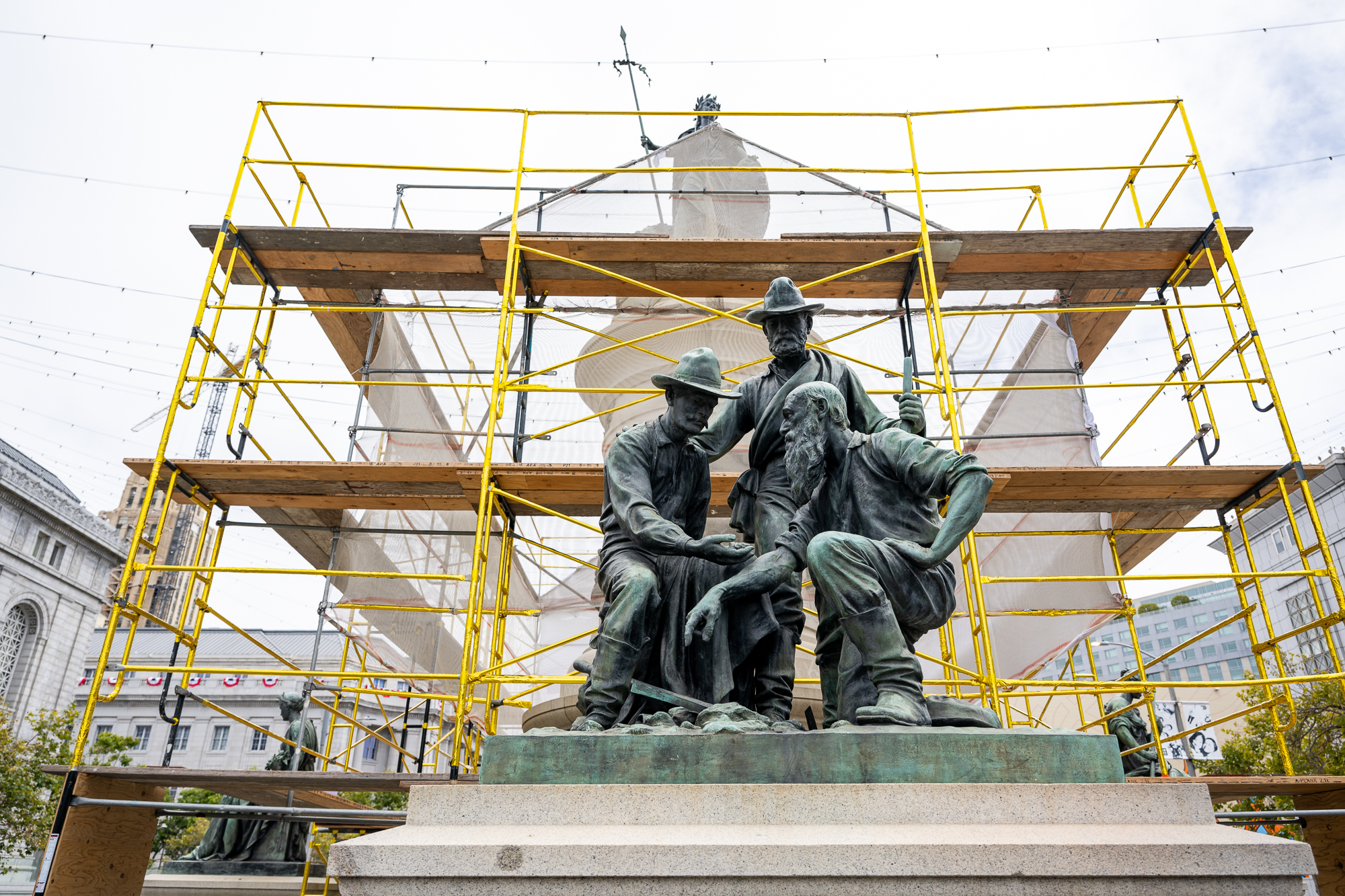
The Civic Center is home to nearly a quarter of the city’s monuments, the most prominent of which sits between the main library and the Asian Art Museum. Created in 1894 by sculptor Frank Happersberger, the Pioneer Monument tells a selective and glorified story of California’s founding, illustrated by the white Americans (plus a few Spanish and Mexican leaders) who conquered the land and its Indigenous people.
For decades, Native American activists called for the removal of one especially offensive component of the monument. Early Days depicted Junípero Serra “converting” a supine Indigenous man (depicted as a Plains Indian). A triumphant vaquero stood by with his arm raised.
In 2018, after successful lobbying, Early Days was removed. Even so, according to a 2023 community survey by the Monuments and Memorials Advisory Committee (MMAC, a precursor to the Shaping Legacy project), the Pioneer Monument remains one of the city’s least-liked monuments.
The site’s contentious history provides a rare opportunity for an artist to confront such historical symbols of power. And Kaleb Duarte is up to the task.
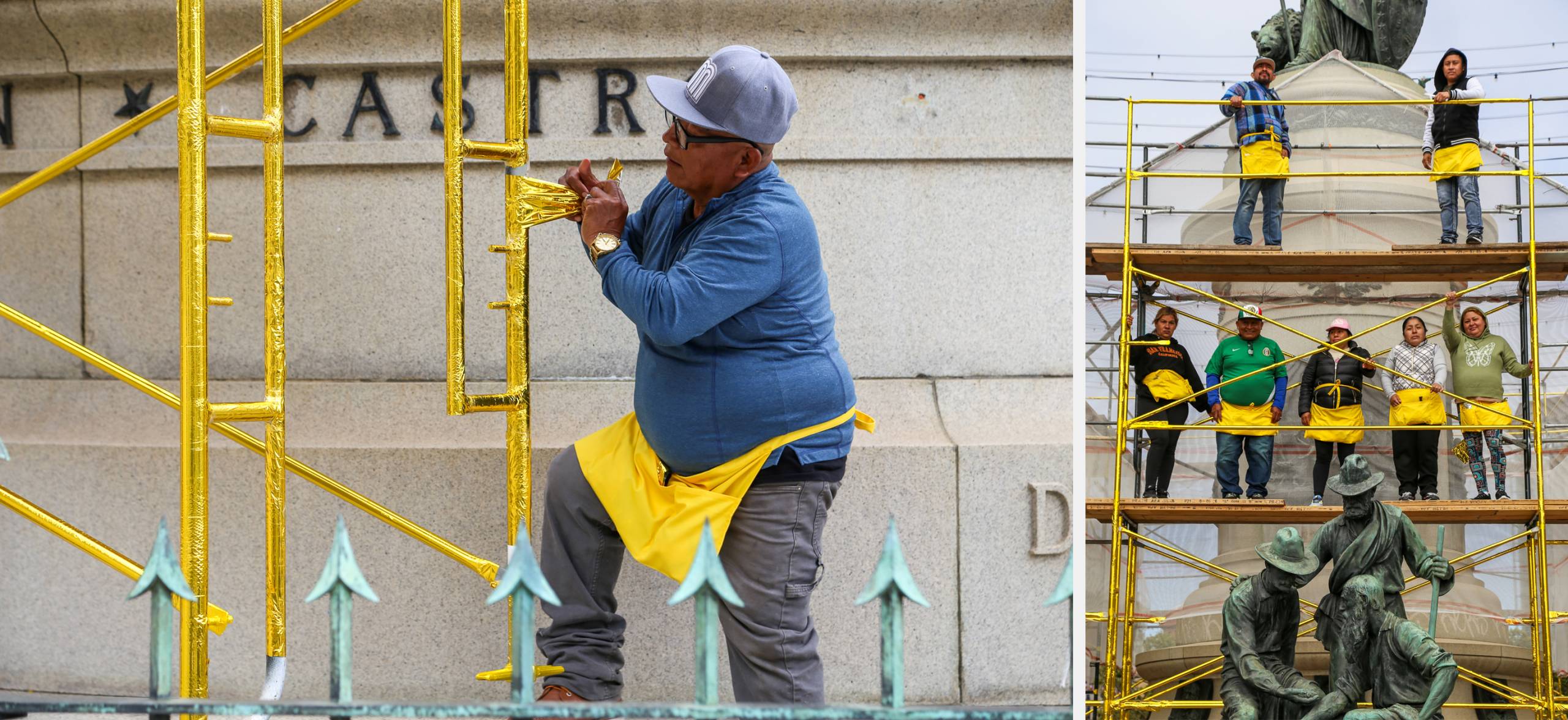
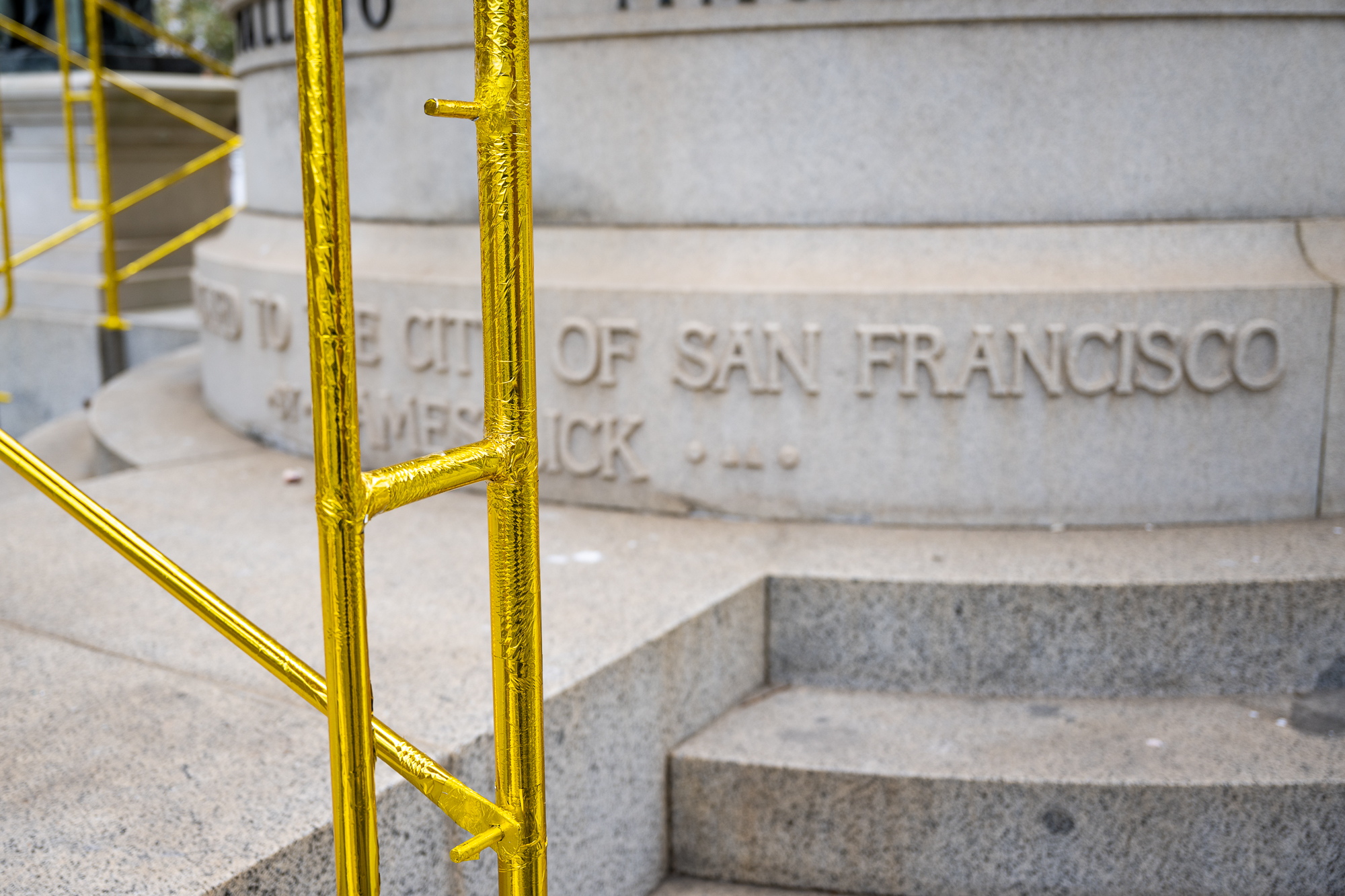
Currently, a delicate scaffolding and scrim sits around the center of the Pioneer Monument, obscuring the view of its bronze reliefs. Since early June, Duarte and a team of “artist ambassadors” have been working on site, covering the metal poles of the scaffolding with strips of gold mylar. They are, in effect, gilding the structure. The piece, titled Embassy of the Refugee, is part of an ongoing series.
“The scaffold is an ugly thing that you try to not look at when you’re looking at architecture,” Duarte says on a windy farmers market day, “but I think it represents the worker and the forgotten.” Duarte’s collaborators are from Guatemala, Honduras, El Salvador and Mexico; the participants have been in the United States anywhere from two to 15 years.
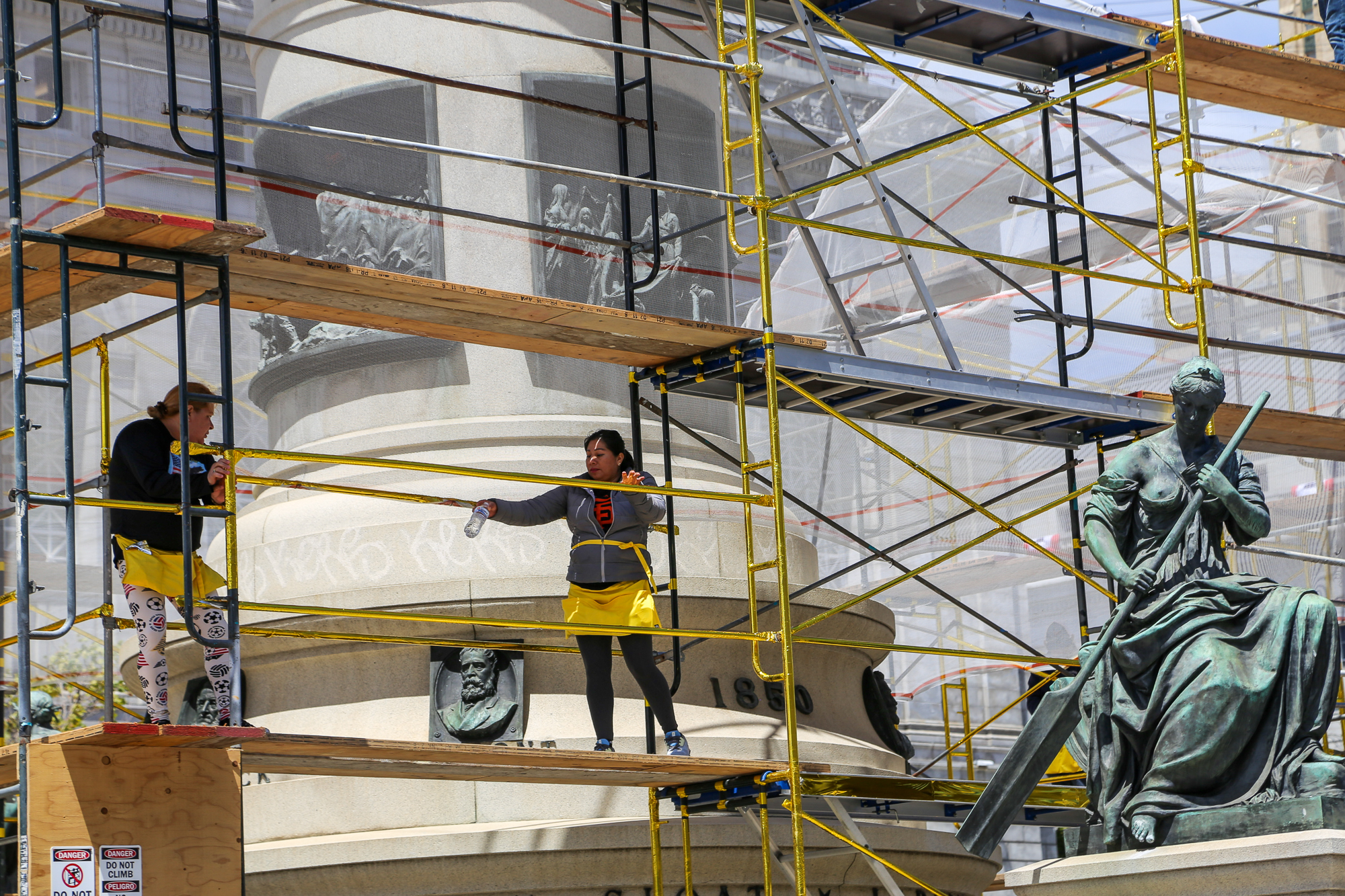
In outdoor workshops, the group has discussed memories of home next to the installation, recording these histories as a way of documenting the Bay Area’s larger immigrant and refugee networks. The gold mylar, which flutters in the plaza’s always-present breeze, references the emergency blankets used at detention centers. Turning “a symbol of potential trauma into something beautiful,” as Duarte says, is one of the piece’s many acts of transformation.
In keeping with the idea of a living, active monument, Embassy of the Refugee will host performances on July 25 by Guatemala-based artists Regina José Galindo and Marilyn Boror Bor (Maya-Kaqchikel), along with Duarte’s frequent collaborator Mia Eve Rollow.
Within the scaffolding, a ghostly mesh tent echoes both refugee tents and the pediment of City Hall. “The idea of home and house is carried by the body and by memory, not by architecture,” Duarte says, gesturing at the Pioneer Monument. “Memory is always in movement, rather than these solid structures that force us to remember certain things. They don’t really engage us.”
‘More work to be done’
By design, most monuments are built to withstand the ravages of time, even as the world shifts radically around them. It takes events like the 2020 topplings to shift a city’s inertia into action.
Shortly after the removal of the Golden Gate Park statues, Mayor London Breed called on the SFAC and other city agencies to change the guidelines around monuments “to reflect the values of the city.” In May 2023, the MMAC’s final report made recommendations for evaluating the collection further, while noting, hopefully, that “this is the beginning phase of a larger process; there is more work to be done.”
“The city loves reports,” says Angela Carrier, Shaping Legacy’s senior project manager. Normally, she explains, that MMAC report might have just sat there, inert. But a $3 million Mellon Foundation grant meant the city could actually implement some of the MMAC recommendations.
Shaping Legacy’s first step was to truly audit the San Francisco’s 105 monuments: what do they commemorate, who paid for their construction, what was the context of their creation? “‘We don’t know what we don’t know,’ is what my colleague Allison Cummings says often,” Carrier says.
The audit found that 41 of the city’s monuments pre-dated the SFAC, which was established by city charter in 1932. Another 46 entered the Civic Art Collection as gifts from wealthy donors or organized civic groups. Only 18 monuments were explicitly commissioned or acquired by the city. A whopping 77% of the city’s monuments were made by male artists.
Then, the work shifted to the present: “Who’s here now? What’s our new understanding of these monuments and the power and public memory at play?” Carrier says. Partnering with the community organizations Gray Area, 500 Capp Street, the Samoan Community Development Center and the Tenderloin Museum, Shaping Legacy funded artist-led film screenings, walking tours, discussions and performances across the city.
This year, further collaborations with SOMA Pilipinas, the California Migration Museum and Shaping San Francisco have addressed some of the city’s most contentious sites: the Dewey Monument in Union Square, the now-empty plinth of Christopher Columbus, and the trio of sculptures toppled in Golden Gate Park.
Ultimately, the SFAC will make recommendations about the future of these sites, and how the city should consider the removal, relocation or destruction of monuments moving forward. One of the crucial findings from the Shaping Legacy audit is that the public is far more interested in the creation of new work than the removal of existing statues.
“New monuments have the opportunity to tell the complete story of San Francisco by memorializing stories previously untold and marginalized,” the report states. “New monuments can also be an opportunity for community empowerment, celebration and joy.”
Memorializing the everyday
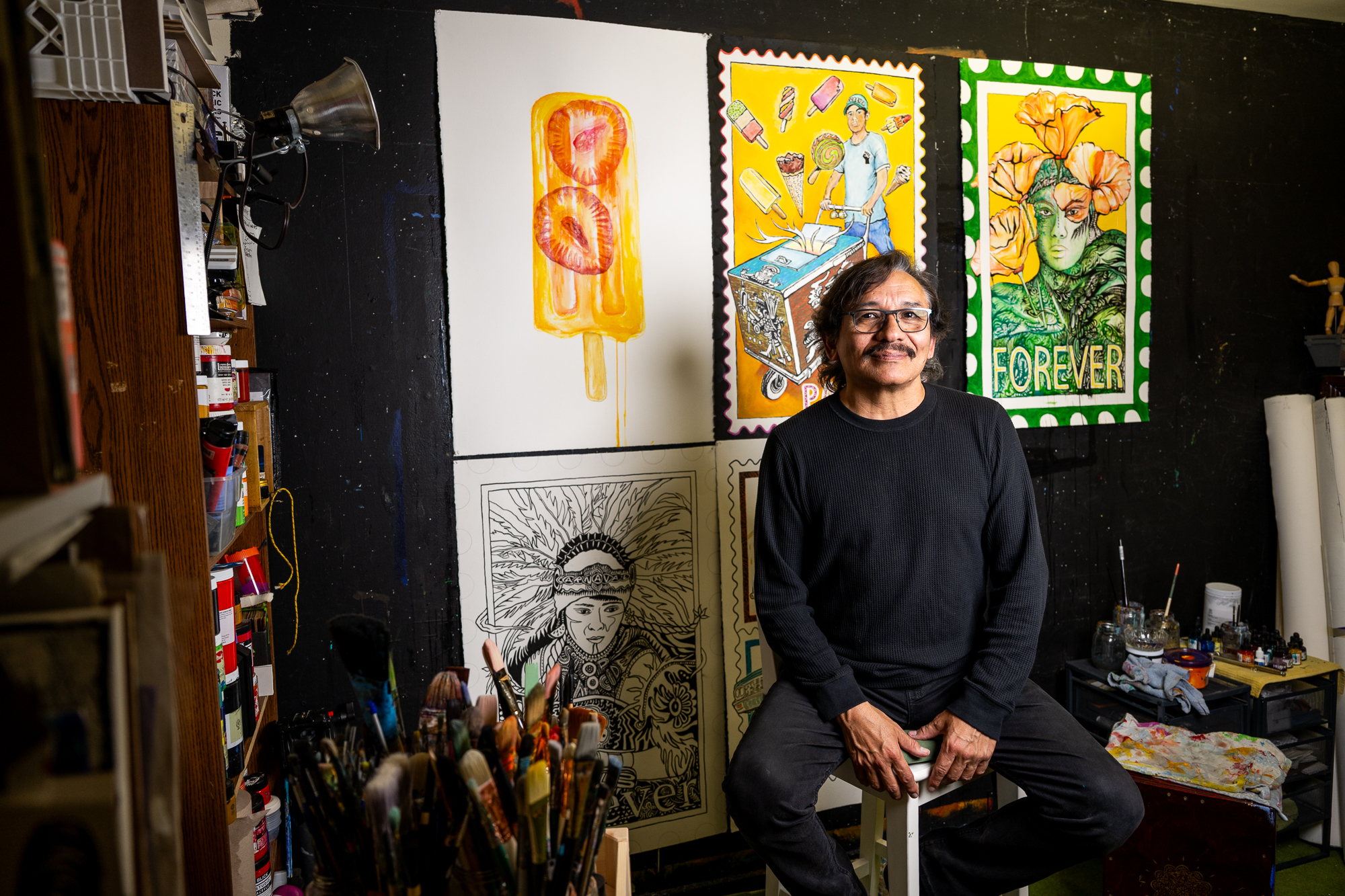
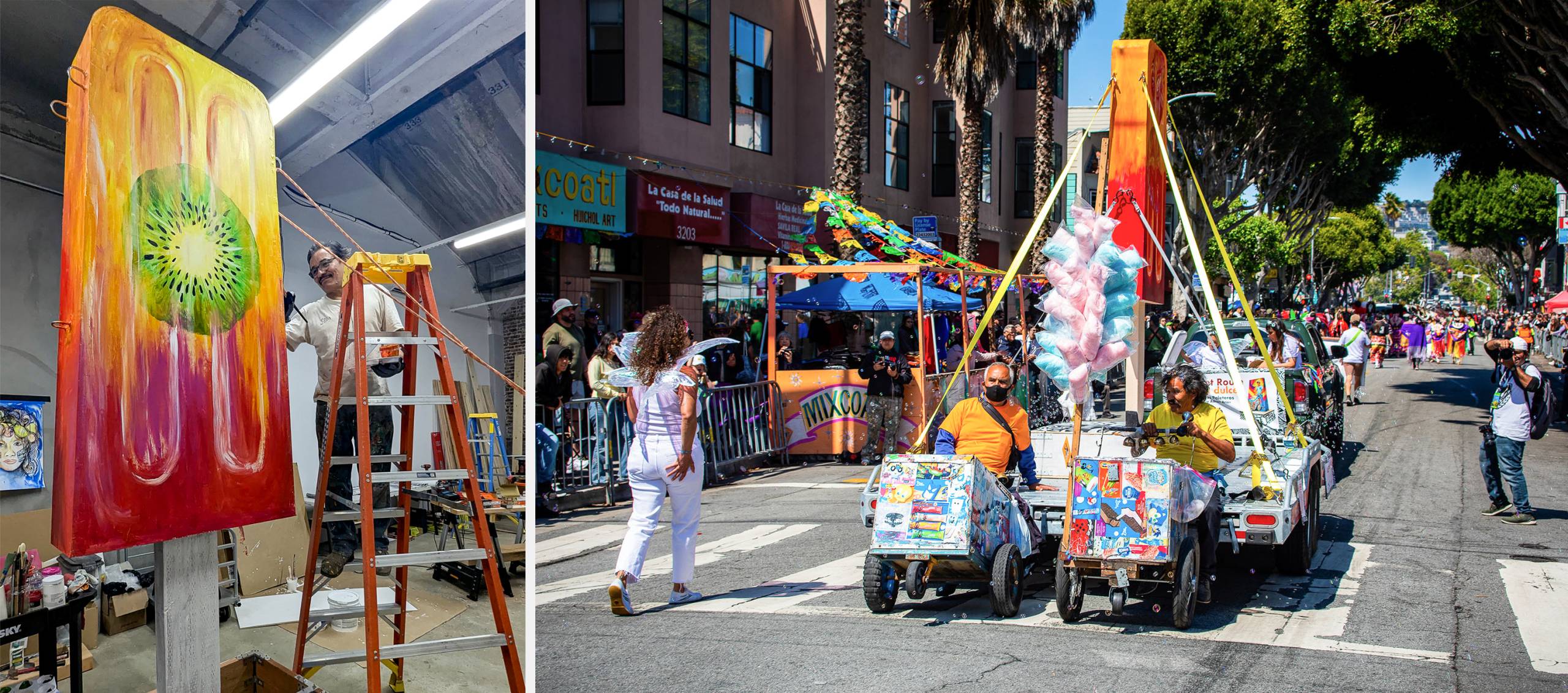
It’s difficult to find something more joyful than Adrián Arias’ enthusiasm for paletas. The Shaping Legacy grantee has built a roving, multifaceted homage to the paleteros and paleteras who trace a “sweet route” through the Mission District.
A Sweet Route kicked off during Carnaval with a small army of paleteros handing out free treats, as they rolled down the parade route. At their center was Arias’ sculpture of eight-foot-tall vibrantly painted paleta. “It was a very happy moment for everybody,” he says. “And a very special recognition for immigrant workers.”
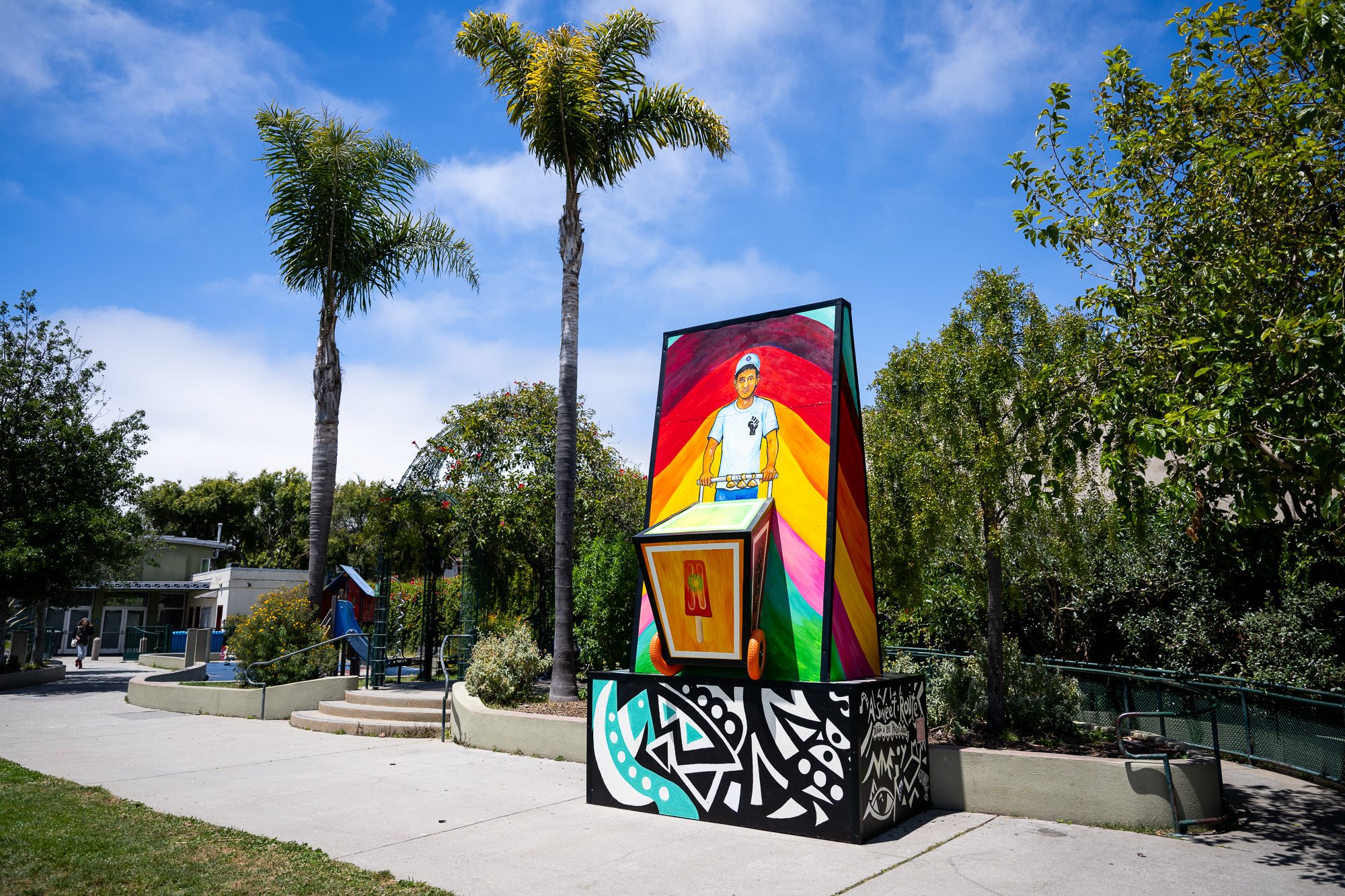
The celebrations continued on June 20 with a music- and dance-fueled walk from the 24th Street BART Plaza to Parque Niños Unidos, where the Oakland band LoCura and Anaís Azul performed the specially commissioned (and very catchy) song “Paleter@.” A painted wooden monument to two local paleteros now stands in the park, watching over playing children. On Aug. 2, the project will move, with equal fanfare, to Potrero del Sol.
Arias is brimming with ideas for even more temporary monuments, particularly for the Mission, which has no permanent city monuments. “I really like the idea of the ephemeral thing that is a temporary monument moving around,” Arias says. He believes ardently in “recognizing our own heroes in our own neighborhoods.”
A hallmark of the five Shaping Legacy artists is a drive toward dispersal — to share their own enthusiasm for their chosen subject with as many members of the public and in as many formats as possible.
Ariana Martinez-Cruz is currently hard at work on Threaded Histories, a monument to San Francisco’s garment workers, which will connect the city’s Latino and Chinese immigrant communities through a July 11 mending workshop, a Chinatown-Rose Pak Station information kiosk, a large-scale textile sculpture and the distribution of custom-made patches (among other manifestations).
For Martinez-Cruz, a big part of her work is empowering others to see the monumental in their own ordinary actions.
“When I do community workshops, at least three if not more people will come to me and say ‘I remember when my mom sewed like this,’” she says. “And then I’m listening to their stories of their loved things that were mended or made for a special occasion. It’s helping people connect to what they didn’t realize was living history in front of them.”
Monuments to the future
The many aspects of the Shaping Legacy commissions fill a timeline that stretches well into October, including forthcoming temporary monuments by Afatasi the Artist and Stacey Carter and a team of collaborators, both in Bayview-Hunters Point.
The grant period comes to a close at the end of 2026. Carrier says the project aims to leave the city with real recommendations about the future of its monuments, especially the ones that have been removed from view in recent years.
There will be no one-size-fits-all solution, she emphasizes. But so far, public feedback and the current commissions make a very good case for the power of adding even temporary artwork to the city’s so-called “commemorative landscape.”
It may take another infusion of non-taxpayer money like the Mellon grant, however, for Shaping Legacy’s final recommendations to be turned into action. The SFAC has limited staffing and funding to continue commissioning temporary artworks.
Meanwhile, the desire for more monuments to everyday life and ordinary people is palpable. Arias recalls, “Installing the other day at Parque Niños Unidos, a group of nannies came to me and said, ‘Where will be the monument for nannies?’”
For the most up-to-date list of Shaping Legacy artworks and events, click here.
Upcoming events include Ariana Martinez-Cruz’s ‘Threaded Histories’ Community Mending Circle at Cultura y Arte Nativa de las Americas (683 Florida St., San Francisco), on July 11, 12–4 p.m. and a ‘Threaded Histories’ Monument patch distribution and celebration at CANA on July 25, 12–4 p.m.
Kaleb Duarte’s ‘Embassy of the Refugee’ will host performances on July 25 at Fulton Plaza.
Adrián Arias’ ‘A Sweet Route’ will be on view at Parque Niños Unidos (23rd and Treat Streets) through July 20 and will move to Potrero del Sol (Potrero Avenue and 25th Street) for a celebration on Aug. 2.
Stacey Carter’s ‘CRANE project’ will illuminate the Hunters Point Shipyard Gantry Crane Oct. 9–11 and 16–18.