How an Old Friendship Brought Chaka Khan to an Oakland Stage
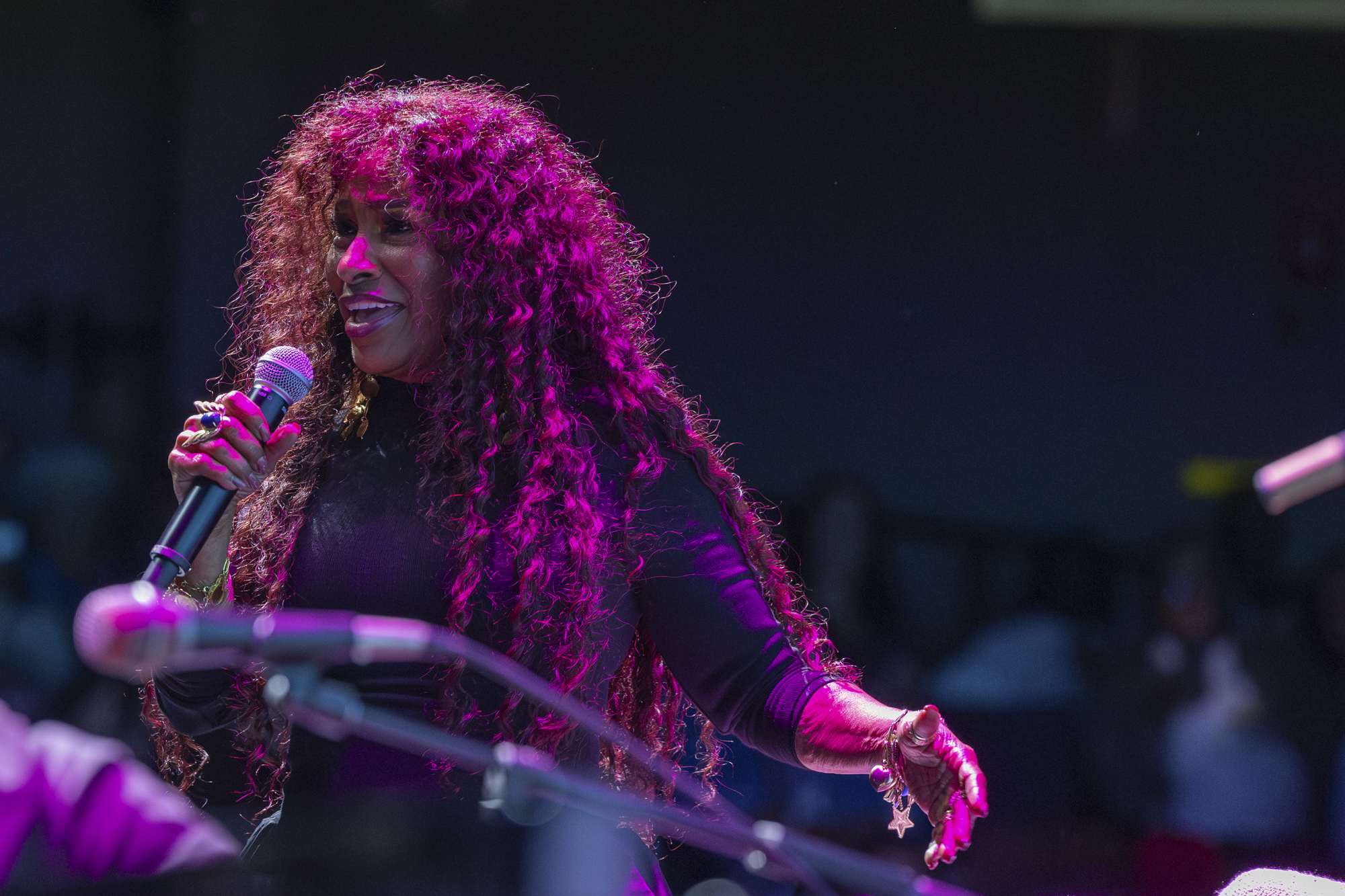
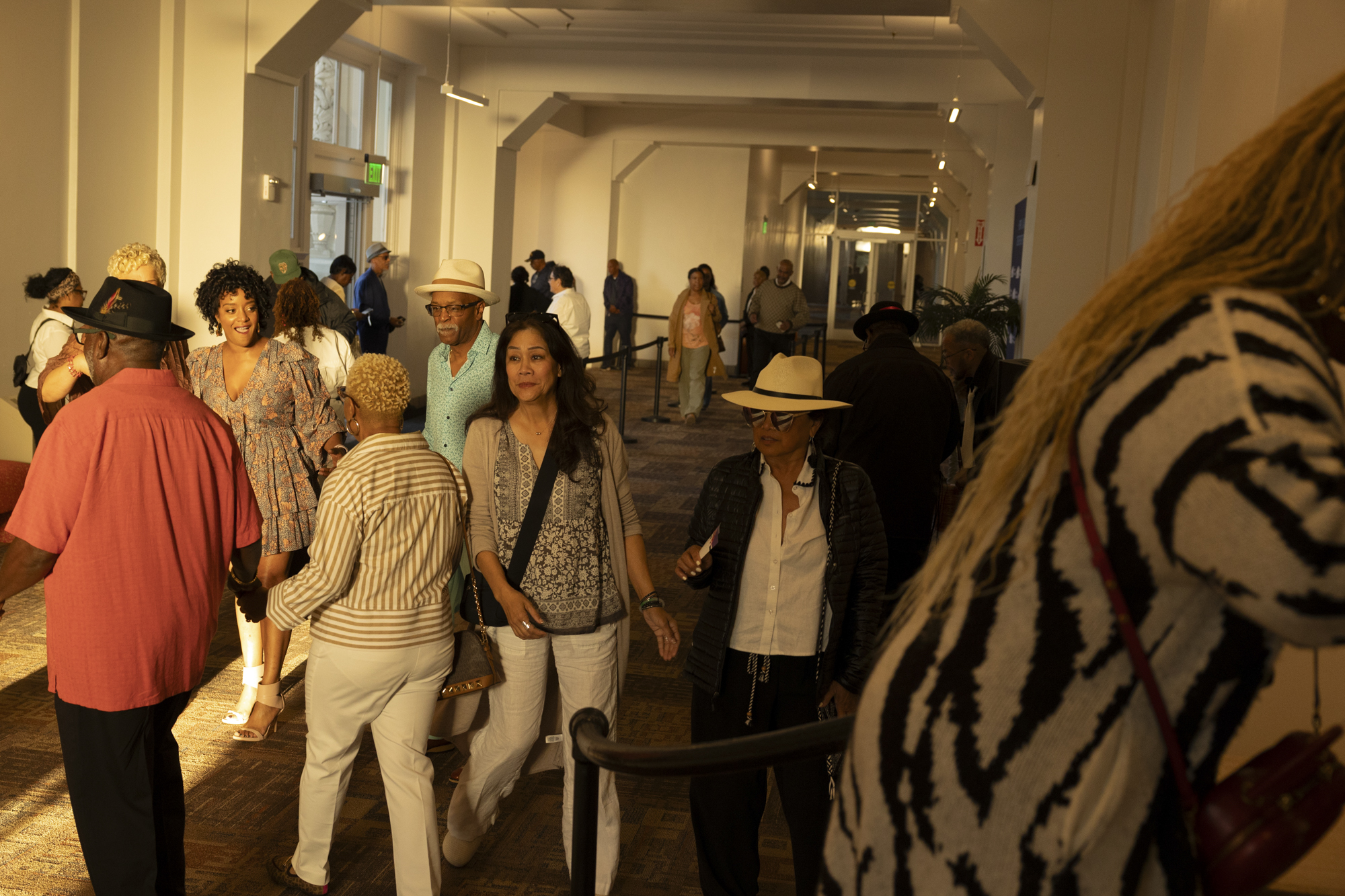
Last Wednesday night, as Chaka Khan’s song “Like Sugar” blasted over the sound system at the Calvin Simmons Theatre at Oakland’s Henry J. Kaiser Center for the Arts, rows of folks in fly attire stood and danced.
On stage, wearing an all-black ensemble complete with golden rings on her fingers, her trademark auburn-colored hair flowing beyond her shoulders, 10-time Grammy Award-winning vocalist Chaka Khan danced as well.
The crowd had just taken in a fireside chat that covered a range of topics from Khan’s career: Sarah Vaughan’s influence; her experience with the group Rufus; raising children while traveling and performing; and the feeling of owning 80 acres of land in Georgia.
Khan opened up about her time as a member of the Black Panther Party for Self-Defense in Chicago, where she was a friend of the late Chairman Fred Hampton. And she took questions from the crowd; at one point she got an aspiring singer to perform on the spot.
During the event, Khan also sang, performing the songs “Destiny,” “Alfie,” “I Love You Porgy,” and “Love Me Still” to thunderous applause.
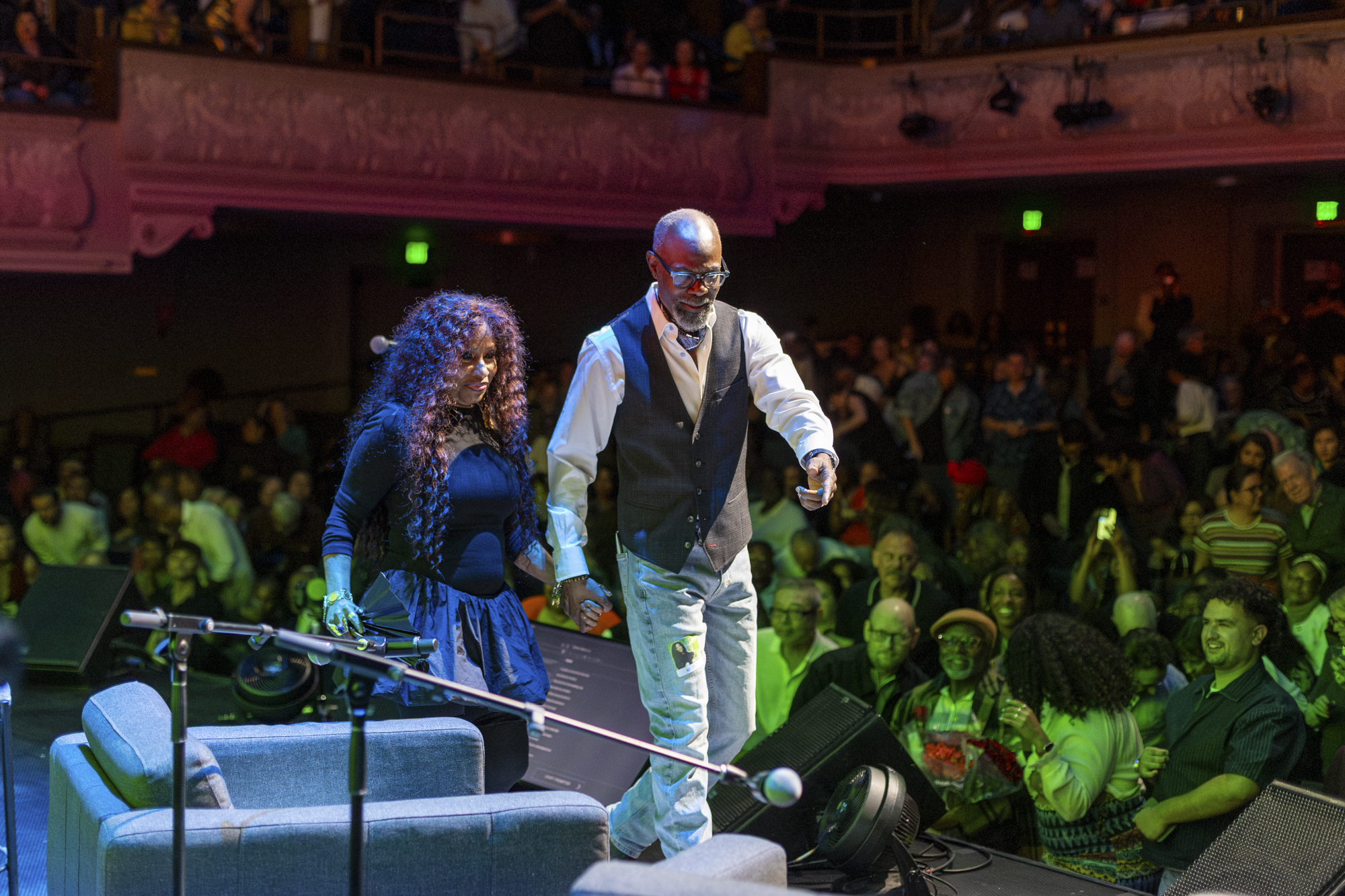
The flowing performance and intimate conversation was a product of the renowned artist’s relationship to the host, filmmaker and longtime friend of Chaka Khan, D. Channsin “Chann” Berry.
“We’re spiritually aligned,” Berry tells me while discussing their friendship. “And have been for many, many, many years.”
Ahead of the event, while sitting in a dressing room with white walls and a soft evening light coming through a western-facing window, Berry tells me all about his connection with Khan and why he chose to kick off his Conversations in Music live podcast series in Oakland.
A musician and filmmaker himself, known for producing and directing Dark Girls (2011) and Dark Girls 2 (2020), as well as The Black Line (2013) and The Church House… Sexuality In The Black Church (2015), Berry is originally from New Jersey. After attending Rutgers University he launched his career by taking a cross-country leap.
“And it was where God wanted me to be,” Berry says, discussing his move to Oakland in the 1980s. “There’s something magical and special for a young Black man coming from New Jersey or New York, and landing in the Bay.”
As an artist, he found this region nurturing. “It was just positive energy that came to me and from everybody,” says Berry, “whether I’m in Oakland or I’m in San Francisco, or I’m in Sausalito, Marin or Tiburon.”

He harnessed that positive energy and support, and over the span of a decade he produced his first film, titled My Father’s Music… Jazz. The documentary featured Dizzy Gillespie, Max Roach, Miles Davis, Mary Stallings, Stanley Turrentine, Oscar Peterson, Joe Williams, Chaka Khan and Carlos Santana.
“It premiered at the Castro in San Francisco to a packed audience,” says Berry, who at the time was terrified because he pieced the whole film together with pocket money earned while working multiple media-related jobs, including as a jock on 102.9 KBLX. “I saved up my coins — and a lot of people helped me out as well — and did my first film.”
Berry later moved to Los Angeles. For eight years he worked in development for feature films at Disney, delivering million dollar checks and learning how the industry works. “I got a chance to find out what the business was all about from the mouse,” Berry says with a laugh.
A filmmaker and songwriter, his career has included collaborations with the likes of Bill Duke, Oprah and Prince.
“I wrote a song for Rosie Gaines,” Berry says, referring to the singer from Pittsburg known for her hit song “Closer than Close,” and her duet with Tevin Campbell from the film A Goofy Movie, “I2I” (Eye to Eye).
Gaines, a member of Prince’s New Power Generation group, worked with Prince to “Pain,” a song Berry wrote. Then she called Berry. “She told me to sit down,” says Berry. “Prince gets on the phone, and then he’s like ‘Nice to meet you. Funky song, man. I hope you like what I did to it.’” The musicians then played the song over the phone.
“I was just laid out, man!” Berry exclaims, eyes growing wide behind his glasses.
Due to Prince’s conflict with Warner Bros. at the time, their version of the song was never released. Berry took it back and Chaka Khan later recorded it. “Pain” appeared on the soundtrack for the hit TV show Living Single.
But his connection with Khan goes back far before that track, and prior to Berry’s first film.
“I was like 16, she was 21,” Berry says, discussing their first interaction. “She was with Rufus, and they had come to North New Jersey, to Symphony Hall, to do a concert. And I was a fan.” He met her backstage and their friendship developed from there.
As Berry worked, he learned to navigate “the system” by retaining independence as a film producer. He locked in on telling stories that center Black women, tailoring his works for Black audiences. And at the same time, Khan’s career progressed profoundly.
Now, after numerous hit songs and dealing with the highs and lows of stardom, Khan is a member of the Rock & Roll of Fame.
Her music has influenced generations, and her songs have been widely sampled. One of Kanye West’s first hits, “Through The Wire” was pulled from Khan’s 1985 groove “Through the Fire.” And Mac Dre’s classic “Too Hard for The F*ckin Radio,” which was recently interpolated by Drake, was built on a sample from Khan’s “Tell Me Something Good” (which was written by Stevie Wonder).
When asked why he’d start his series of live podcast events by interviewing Chaka Khan, Berry simply retorts, “Because she’s an icon.”
He adds that Khan is one of “the last great vocalists of our time.” He puts her alongside Aretha Franklin, Mahalia Jackson and Barbra Streisand as voices we’ll never hear again.
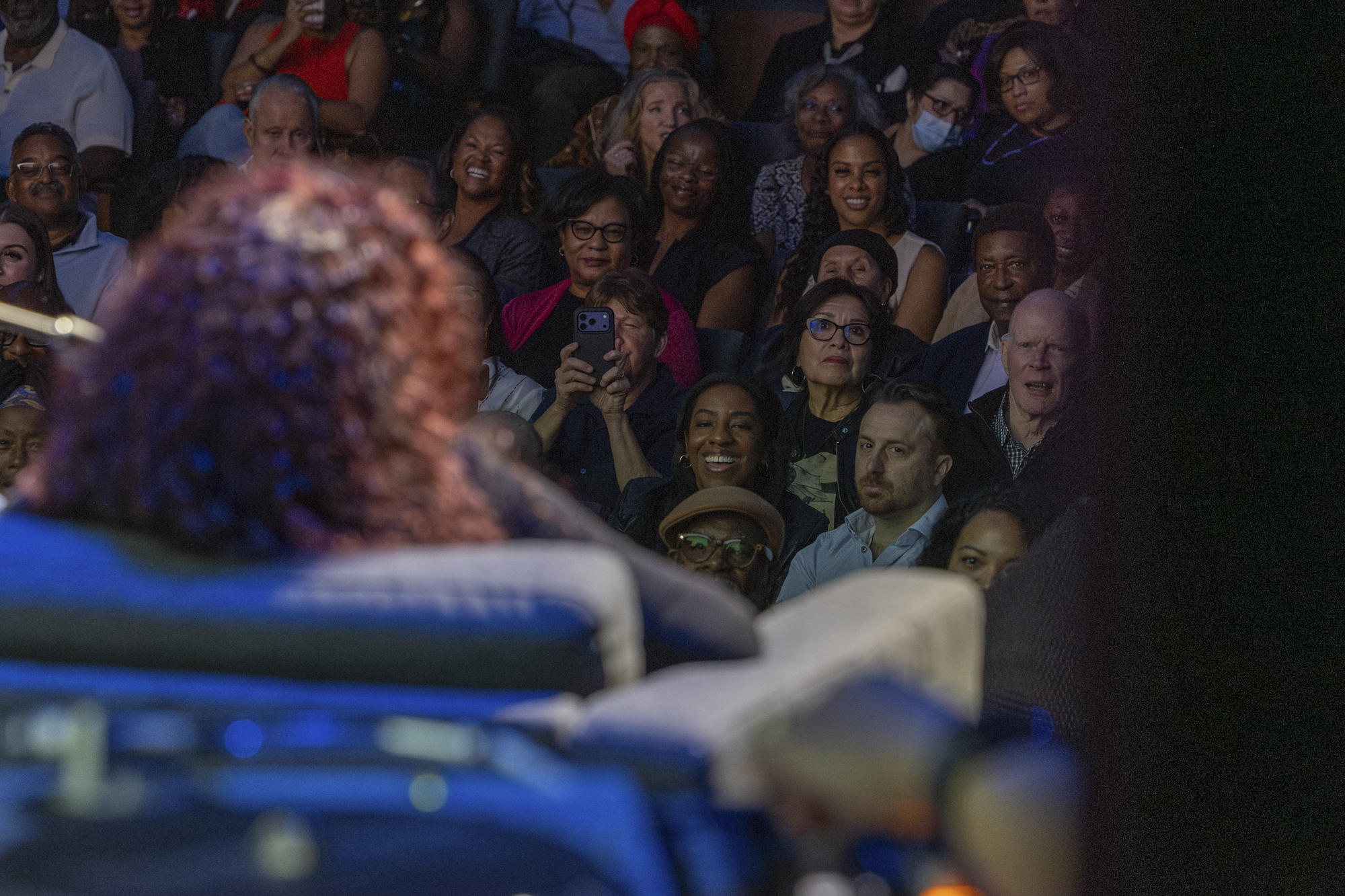
Despite the lofty admiration, their close relationship was on display all evening. The audience laughed and made comments as the duo talked like two old friends having a phone conversation. And at the end of the event, they showed just how in-step they are.
As “Like Sugar” played over the sound system and the audience got up to dance, Khan’s old friend was the first one two-stepping alongside her.