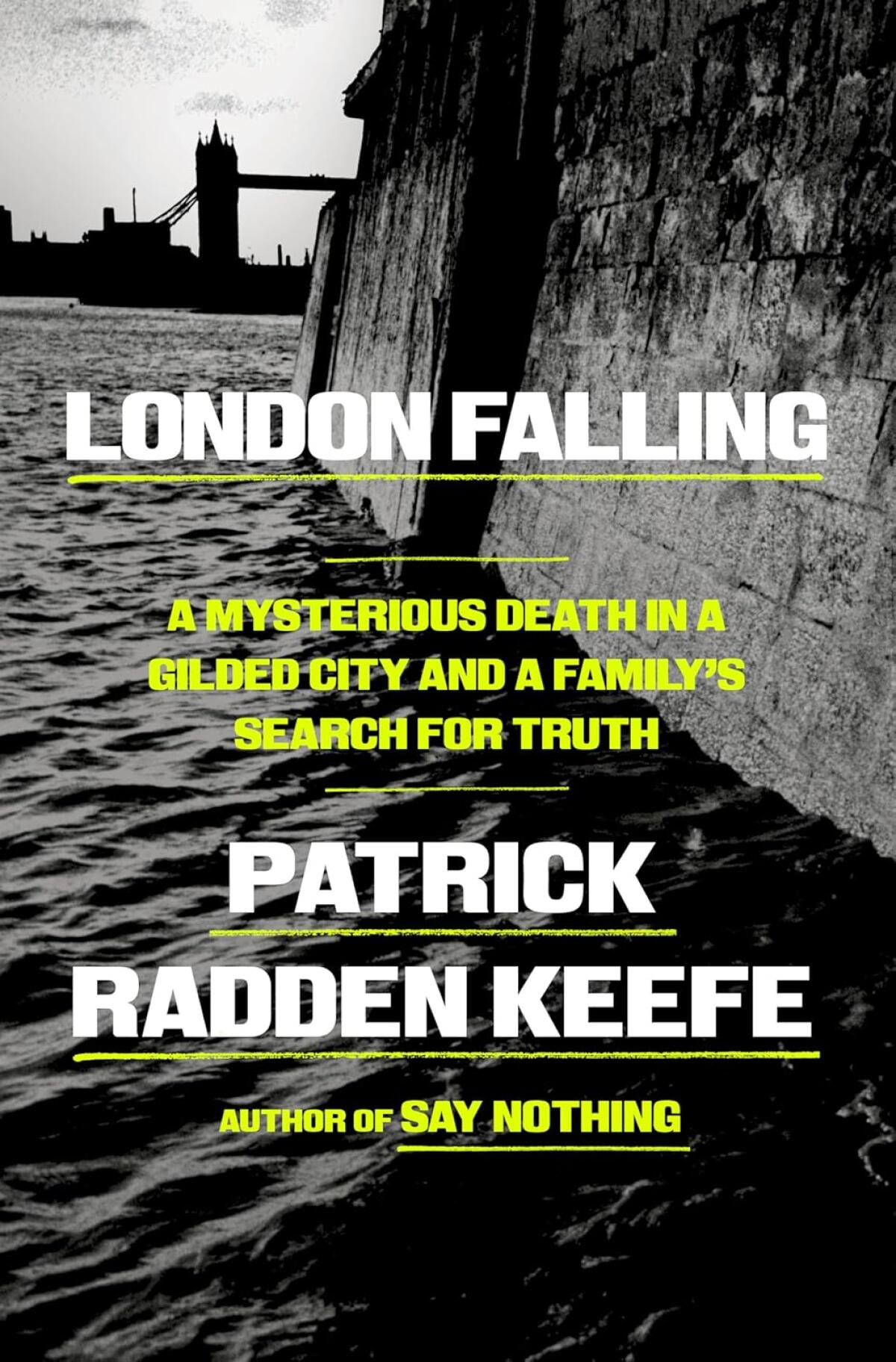
‘London Falling’: A Teen Imposter, an Aging Gangster and a Body in the River
In 2019, a 19-year-old leapt from a fifth-floor in London. Patrick Radden Keefe investigates his story.
Frank Langfitt, NPR
(Doubleday)
A young man named Zac Brettler walked onto the balcony of a fifth-floor luxury apartment in central London early one morning in 2019 and leapt towards the black water of the River Thames. He didn’t make it. Brettler’s hip clipped the embankment and he ended up face-down in the muck along the river bank. A passerby found his body after dawn.
Brettler was just 19, a recent graduate of an expensive private school, and the grandson of a famous London rabbi. The apartment from which he jumped was worth more than $5 million, owned by a Saudi princess and occupied by a feared London gangster and leg-breaker named Dave Sharma.
Related Article
Brettler had been living a double life. He’d convinced Sharma he was “Zac Ismailov,” the son of a fictitious Russian oligarch, and was poised to inherit more than $270 million. Not long before Brettler’s death, Sharma had learned the kid had tricked him.
This is how Patrick Radden Keefe opens his gripping new book: London Falling: A Mysterious Death in a Gilded City and a Family’s Search for Truth.
The London Metropolitan Police and Bretter’s parents — who knew nothing of their son’s alter ego — had many questions. Among them, did Brettler commit suicide or did he jump trying to save himself?
Keefe, a New Yorker staff writer, is a master at using true crime as a vehicle for exploring social and political pathologies. His book The Snakehead focuses on “Sister Ping,” a Chinatown grandma and people smuggler, to examine the human pipeline from China’s Fujian province to the U.S. In Say Nothing, published in 2019, Keefe effectively solves a decades-old cold case of a missing mother of 10 in Belfast, a killing that illustrates the nihilistic violence and human toll of the Troubles.
Related Article
On the surface, London Falling documents the Brettler’s investigation into the death of their son and the mystery of his life. But it is also — like The Snakehead — a journey into an urban underworld.
Most visitors to London see an old-world scrim of royal palaces, ancient pubs and West End theaters. The modern city is a different place. Over decades, London has become a safety-deposit box for the global, uber-rich to stash unexplained wealth, often in multi-million dollar homes that sit dark and empty most of the year.
Zac Brettler. (Chrysa DaCosta/Courtesy of Doubleday)
As the Brettlers dig into their son’s secret life, they realize that London is not just the glittering cultural capital they thought, but a hotspot for money-laundering and, as Keefe writes, a “city full of crooks with pretensions to legitimacy.”
“This whole world we didn’t know about,” Zac’s mother Rochelle tells Keefe, “this underworld that exists on our doorstep.”
Related Article
Zac is an underachieving fabulist with an Instagram-fueled ambition to bypass hard work and conventional success to become a high-roller. The Brettlers are not poor. Zac’s father works in finance; his mother writes for the Financial Times‘ How To Spend It magazine. The family car is a Mazda, but Zac daydreams of a Bugatti Veyron.
Keefe recounts a conversation in which Zac tells a school friend, referring to his father’s wealth, “It’s not enough. I want to be bigger.”
Zac has a Walter Mitty quality. Keefe also writes that it’s tempting to compare him to Tom Ripley, Patricia Highsmith’s sociopathic striver. But Ripley’s con had an economic logic. How exactly did Zac plan to profit from his? It was only a matter of time until Zac’s fraud would be revealed and he would face the fury of the criminal he’d conned.
Stories of aspirational conmen fascinate readers. We marvel at their resourcefulness and audacity, and squirm as they build a false identity, Jenga-like, higher and higher. Characters such as Jay Gatsby — a bootlegger whose real name was Gatz — are also appealing because they express extreme examples of common, human traits.
The story of Zac and his parents also turned out to be relatable in ways I didn’t anticipate. I worked as NPR’s London correspondent from 2016 to 2023. On my various trips to the Tate Britain art museum, I walked past the same spot where Brettler had jumped, but knew nothing of his death at the time. The story did not appear in the London papers when it happened. Keefe effectively broke the story in the The New Yorker nearly five years later.
During my family’s time in London, we — like Zac — also brushed up against stratospheric wealth. My kids went to a private school with the children of a real Russian oligarch and others whose families were fantastically rich. One of my son’s classmates roamed the Mediterranean one summer on his parent’s Amex Centurion Card, which is available by invitation only.
To compete in such an environment, some kids can feel pressure to embellish. Keefe reports that Zac claimed his father was an arms dealer and the family lived next to Hyde Park, but schoolmates knew he was lying and confronted him about it. Among the book’s intriguing questions is how someone who spun such transparent lies was able to trick a seasoned criminal. The answer may be that Sharma, like Zac, was also less than he appeared. By the time he took Zac under his wing — so to speak — Sharma was an aging, drug-addled gangster who had lost his edge.
Related Article
Keefe writes that Sharma may have seen Zac and his impending “fortune” as one last score. One of Sharma’s gangster associates tells Keefe that once Sharma realized he’d been conned, there was no way Zac was leaving the apartment alive.
In the end, Zac — who pretended to be rich — and Sharma — who pretended to be his mentor — were both imposters. As Keefe writes, they “were caught up in the glitzy, mercenary aspirational culture of modern London.”
Neither would survive it.
Frank Langfitt served as NPR’s London correspondent from 2016 to 2023. He is the author of‘The Shanghai Free Taxi: Journeys with the Hustlers and Rebels of the New China.’