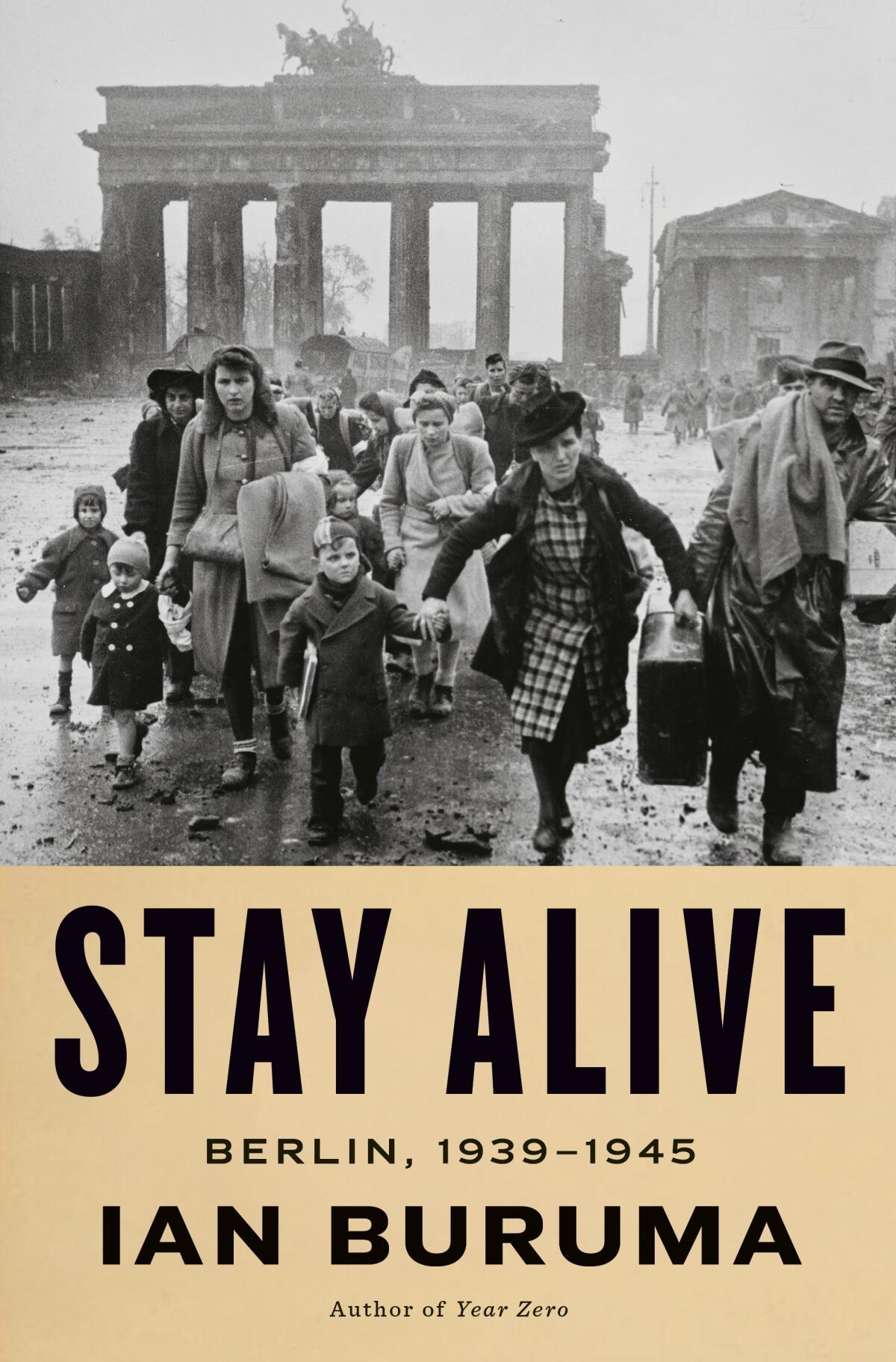
It’s been 80 years since Adolf Hitler shot himself in his bunker, yet our fascination with the Nazi era seems eternal. By now I’ve read and seen so many different things that I’m always surprised when somebody offers a new angle on what the Nazis wrought.
Ian Buruma does this in Stay Alive: Berlin, 1939-1945, a new book about living in a country where you have no control over what happens. Inspired by the experience of his Dutch father, Leo, who was forced to do factory work in Berlin, Buruma uses diaries, memoirs and some personal interviews — most of the witnesses are dead, of course — to explore how it felt to be in Berlin during World War II. He weaves together a chronicle that carries Berliners from the triumphant days when Germany steamrolled Poland and daily life felt almost “normal” (unless you were Jewish, of course) through the end of the war when bombs pulverized the city, and Soviet soldiers arrived to rape and pillage.
As he writes of air raid drills, food shortages and the incessant deluge of rumors, Buruma has to deal with the difficulty that most ordinary Germans left behind very little record. They kept their heads down and tried to stay alive. And so the book moves among more interesting characters whose multiplicity gives dimension to our usual flattened sense of Nazi Germany.
We meet Coco Schumann, a young Jewish guitarist who risks his life to play the jazz music that Nazis considered degenerate. We meet 15-year-old Lilo, who starts off thinking that Nazi ideals make life beautiful, but comes to admire the greater nobility of those who tried to assassinate Hitler. There’s the dissident intelligence officer Helmuth von Moltke, a conservative who seeks to work from inside against the Nazis (he gets hanged for his trouble). And there’s Erich Alenfeld, a Jew who converted to Christianity and remained a German patriot: He sent a letter to Reichsminister Hermann Göring asking if he could serve.
We also encounter several of the usual suspects, most notably propaganda minister Joseph Goebbels who, when not coercing young actresses into sex, is busy generating false headlines, ordering movie spectacles to distract the masses (he loved Disney films), and monitoring the city’s morale. Always laying down edicts — like ordering Jews to wear the yellow star — he’s the Nazi who may have done most to affect Berlin’s daily life: He even keeps banning and reinstating dancing.