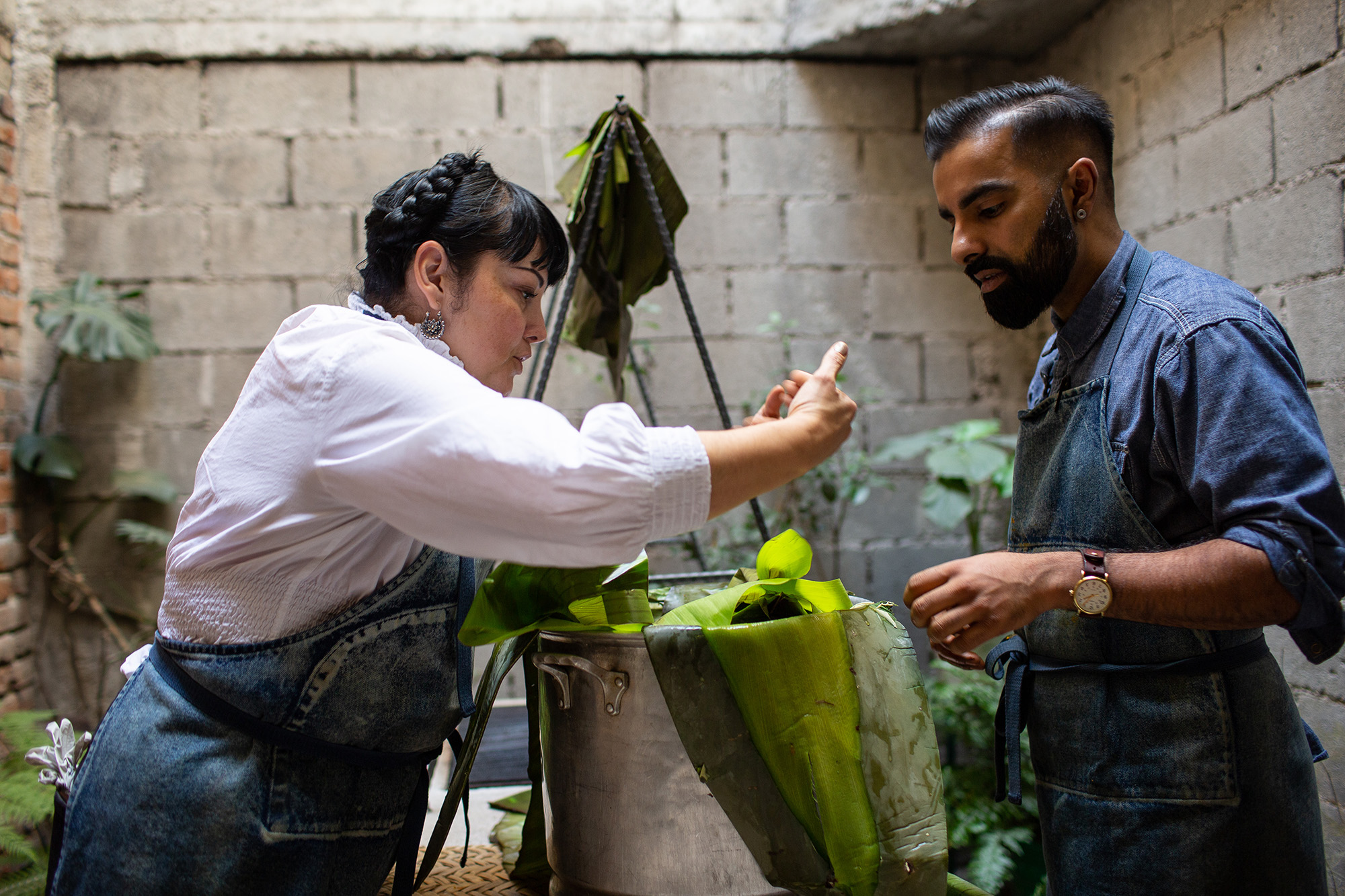
Though Norma Listman and Saqib Keval met in Oakland in the late aughts, the couple didn't formally begin cooking together until they arrived in Mexico City, circa 2017. Here they are making tamales rancheros with banana leaves at the inaugural iteration of their restaurant, Masala y Maiz, in the San Miguel Chapultepec district. (Sana Javeri Kadri, courtesy of Masala y Maiz)
W
hen you first enter Masala y Maiz — a Michelin-starred renegade of a restaurant in Mexico City that has been profiled on Netflix’s “Chef’s Table” — you wouldn’t necessarily know that Oakland is at the heart of its soulful appeal. The concrete, brutalist design of the space denotes an air of Mexican modernism that’s unlike anything you’d find in the Bay Area.
Yet according to chef and co-owner Saqib Keval, a Northern California–raised son of Ethiopian and Kenyan immigrants of Indian descent, Oakland is central to the restaurant’s ethos.
“The restaurant feels like an extension of Oakland at times, in terms of the music, politics, culture, vibe,” says Keval, who opened Masala y Maiz with his wife Norma Listman in 2017. “It feels like an embassy. Oakland is a place we miss.”
Bay Area activists may remember Keval as one of the co-founders of the People’s Kitchen Collective (PKC), among Oakland’s most prominent food justice organizations. Listman, meanwhile, was born and raised in Texcoco, Mexico, before she migrated to the Bay in the ’90s to work as a multidisciplinary artist and, eventually, a chef, cutting her teeth at esteemed Oakland restaurants like Tamarindo, Bay Wolf and Camino.
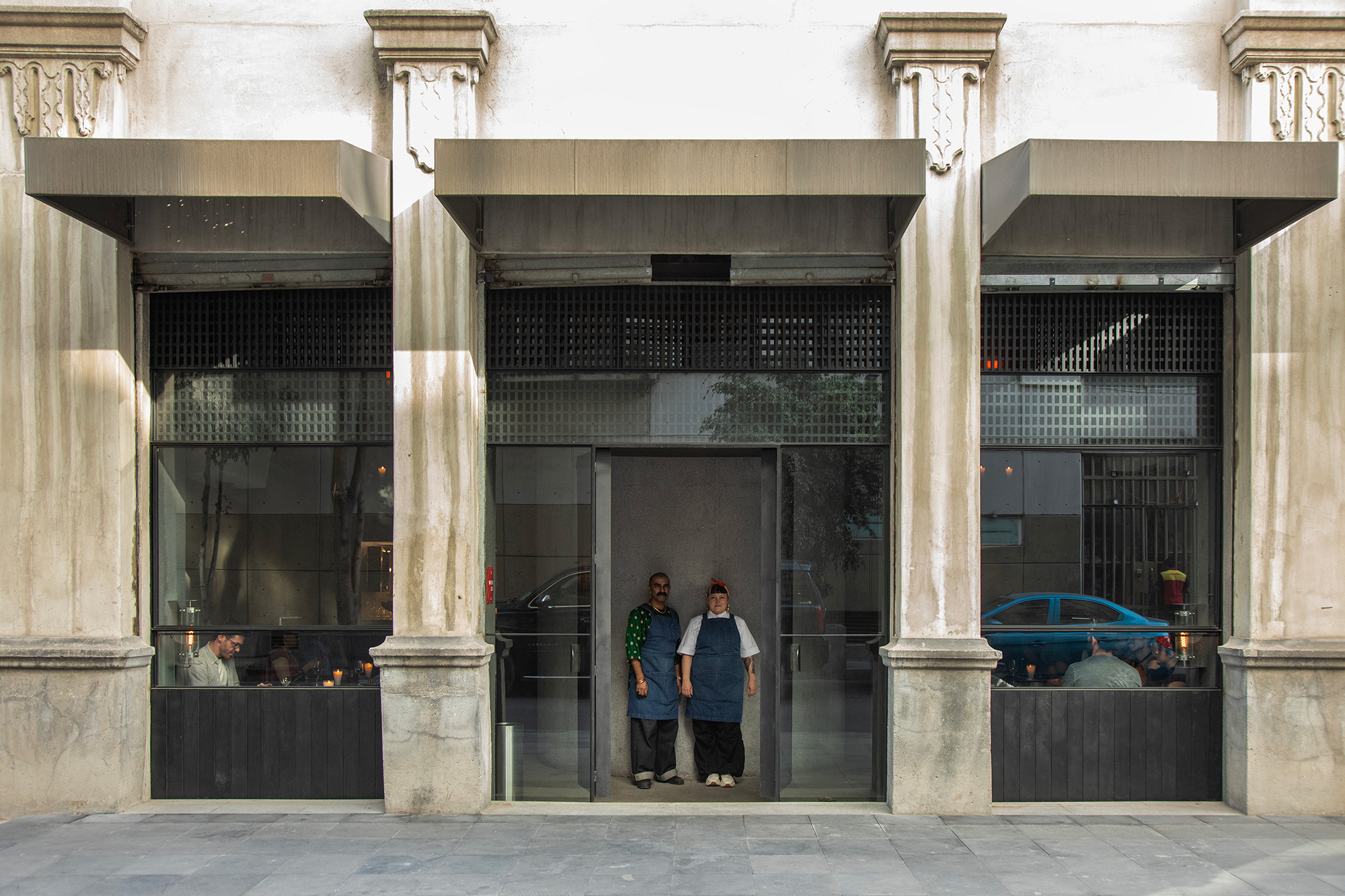
Keval and Listman stand in front of the current iteration of Masala y Maiz in Mexico City’s historic centro, where the restaurant relocated in 2024. (Ana Lorenzana, courtesy of Masala y Maiz)
“I have Oakland tattooed on my leg,” she says. “We hold a romantic idea of the Bay, of Oakland, when we lived there. I was in the Bay for 18 years. I was there during the dot-com boom in ’99. A lot of our communities left because it was impossible to keep going. The restaurants we worked at closed because it wasn’t sustainable. [But] my mentors are still there, and that’s where I came into food.”
Oakland’s grassroots influences, along with Listman’s leftist upbringing in Mexico and Keval’s anti-colonial literary acumen from his days at Humboldt State University, are unmistakably baked into Masala y Maiz’s philosophies of collectivism, equity and universal workers rights. A few times a year, the restaurant hosts an “Eat What You Want, Pay What You Can” day, inviting anyone — particularly locals combating the rising cost of living in a gentrified Mexico City — to enjoy a Michelin-starred meal, even if all they can afford to pay for it with is a piece of original artwork. The restaurant’s regular menus often feature large, bilingual phrases (“white supremacy is terrorism”; “que vive la lucha femenista”) based on current events.
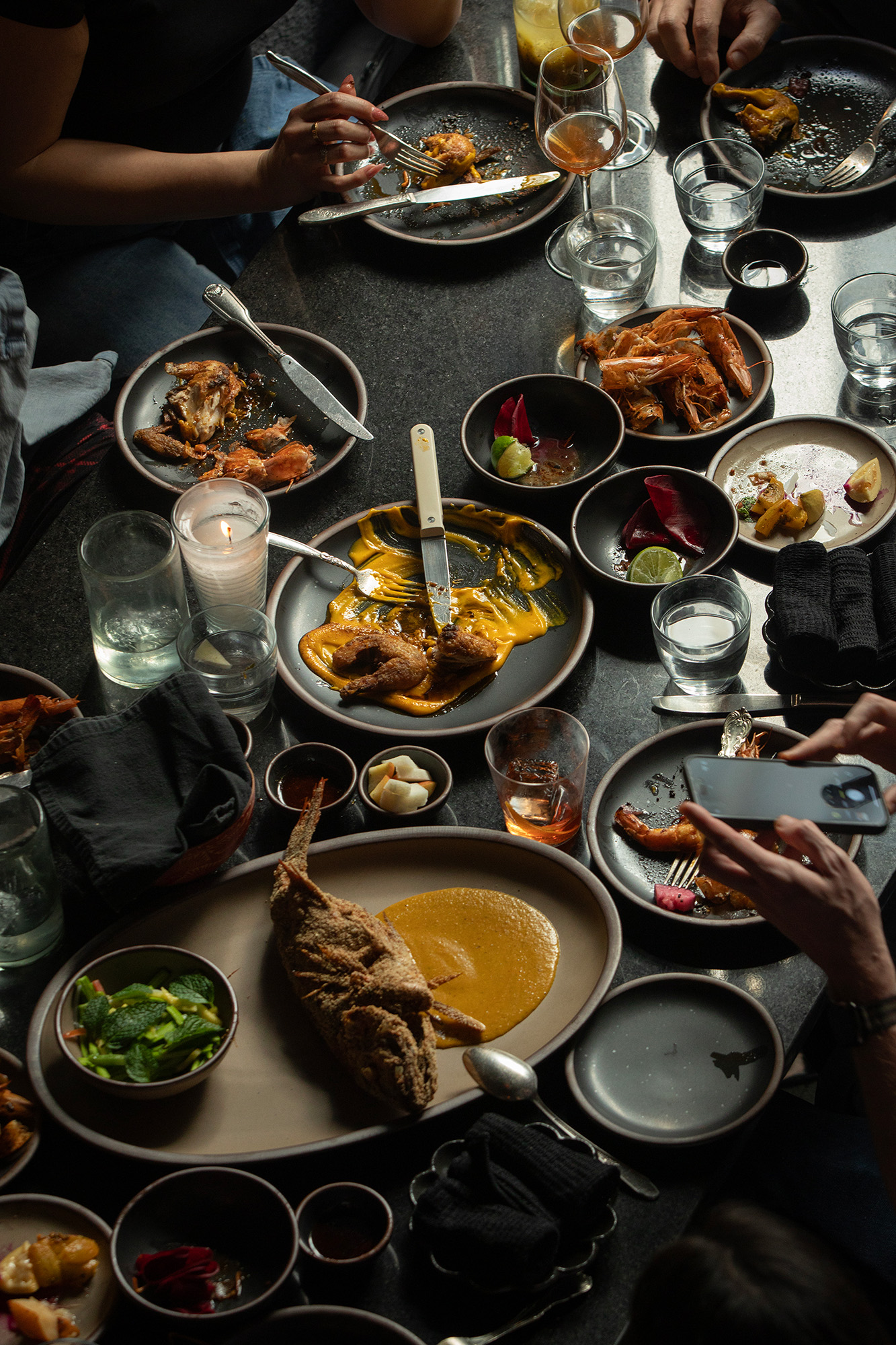
An impressive spread of dishes at Masa y Maiz. (Ana Lorenzana, courtesy of Masala y Maiz)
The messaging isn’t only for show. In 2018, the restaurant boldly challenged Mexico City’s government officials, citing corruption and bribery — and somehow came out unscathed. Then, in 2021, the couple rejected a nomination from The World’s 50 Best Restaurants, calling out the foundation’s culture of exploitation and sexism. On Instagram, Masala y Maiz expressed gratitude for the recognition but didn’t yield, sharing a graphic of their invitation with a simple declaration overlaid above it: “Gracias, no gracias.”
The restaurant has also proven to be far more transcendentally savory than any political statement could ever be on its own. That is to say, the food at Masala y Maiz reflects Oakland’s famously eclectic flavors, too, in its borderless mezcla of dishes: an edible tapestry of Mexican, Indian and East African ingredients. The paratha quesadilla, which uses Indian flatbread in place of traditional corn tortillas, is gooed together with a blend of Oaxacan and mountain cheeses, and served with a side of salsa machaar and herb salad. For the uttapam gordita, a thick South Indian dosa is topped with shredded barbacoa, butternut squash, asparagus and housemade salsa verde. And the esquites makai pakka is a Kenyan remix of Mexico’s beloved street corn dish — a stir of corn kernels, coconut milk, East African masala, in-house mayo and crumbled cotija cheese.
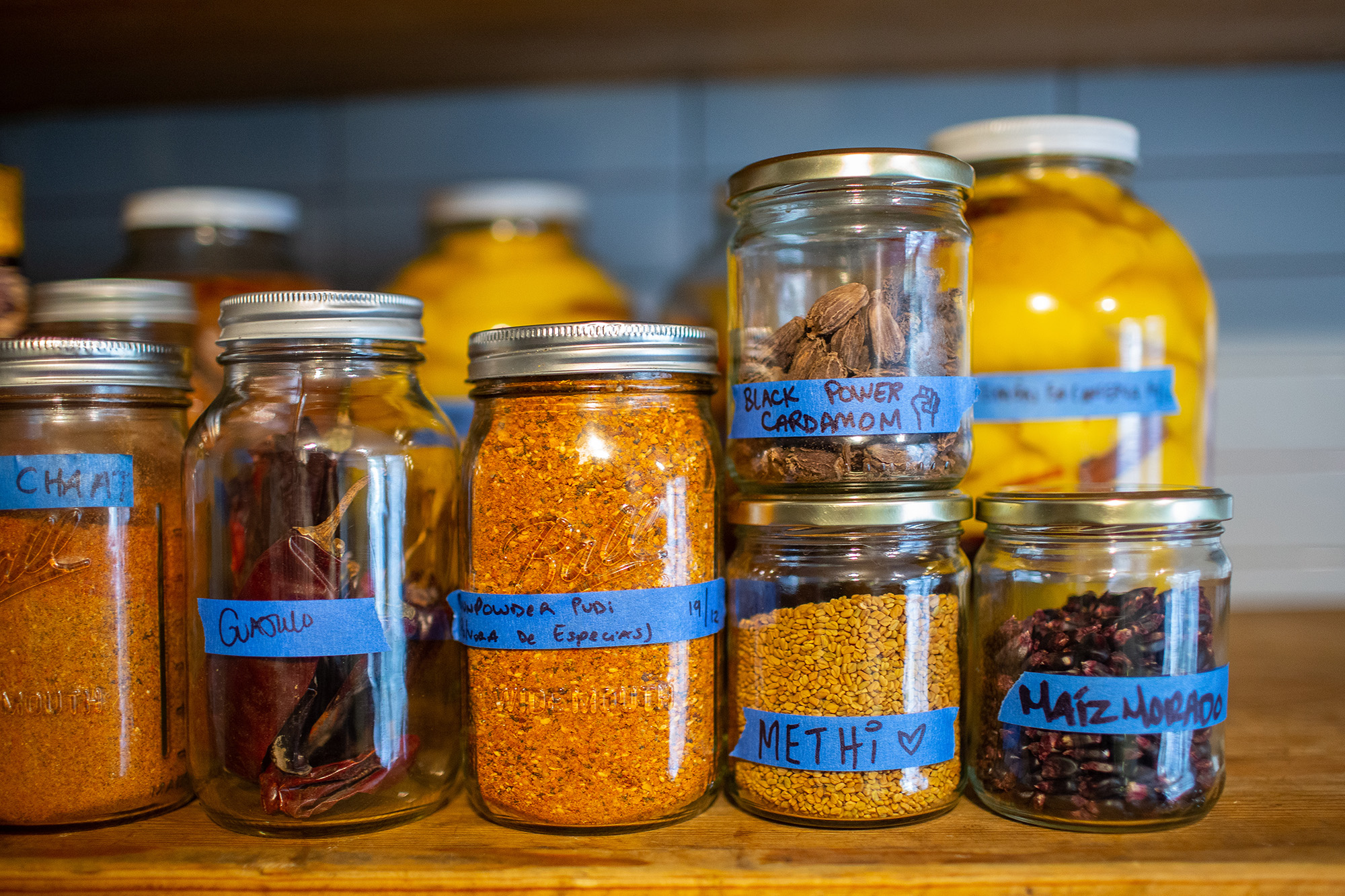
Masala y Maiz is a reflection of the commonalities that can be found across different parts the Global South. Here, a medley of Indian and East African spices sit beside Mexican ingredients like corn and guajillo peppers. (Sana Javeri Kadri, courtesy of Masala y Maiz)
Now, Oakland’s past is reuniting with the restaurant’s present. This month, the duo is hosting a series of guest chefs from all over the map in honor of International Women’s Month. The series concludes on March 25 with a collaborative dinner featuring the Bay Area’s own Reem Assil and Nite Yun, who both got their starts cooking in Oakland. Yun is the Cambodian American chef behind Lunette, a Khmer gem inside San Francisco’s Ferry Building; Assil is the Palestinian-Syrian culinary icon of Reem’s California fame. The Bay Area chefs will join Listman and Keval to create a one-night-only menu centered on their Cambodian, Palestinian, Indian and Mexican backgrounds.
But how, exactly, did this internationally renowned hot spot make it all the way down from the East Bay’s shores to the pedestrian-flooded Centro Historico of Mexico’s trending capital to begin with? As it turns out, it all originated as an Oakland love story.
‘Ghetto Gourmet’ and PKC — that’s Oakland, baby
Before landing in the Bay, Listman had already established herself in the Mexico City art scene. When she came to Oakland in the ’90s, she quickly felt aligned with the city’s unsugared realness, laissez-faire freedoms and artistic energy.
“The art scene in Mexico City was very avant garde, very international; it was exhilarating. I felt the same way about Oakland,” she says. “I fell in love with the Bay because of that similarity.”
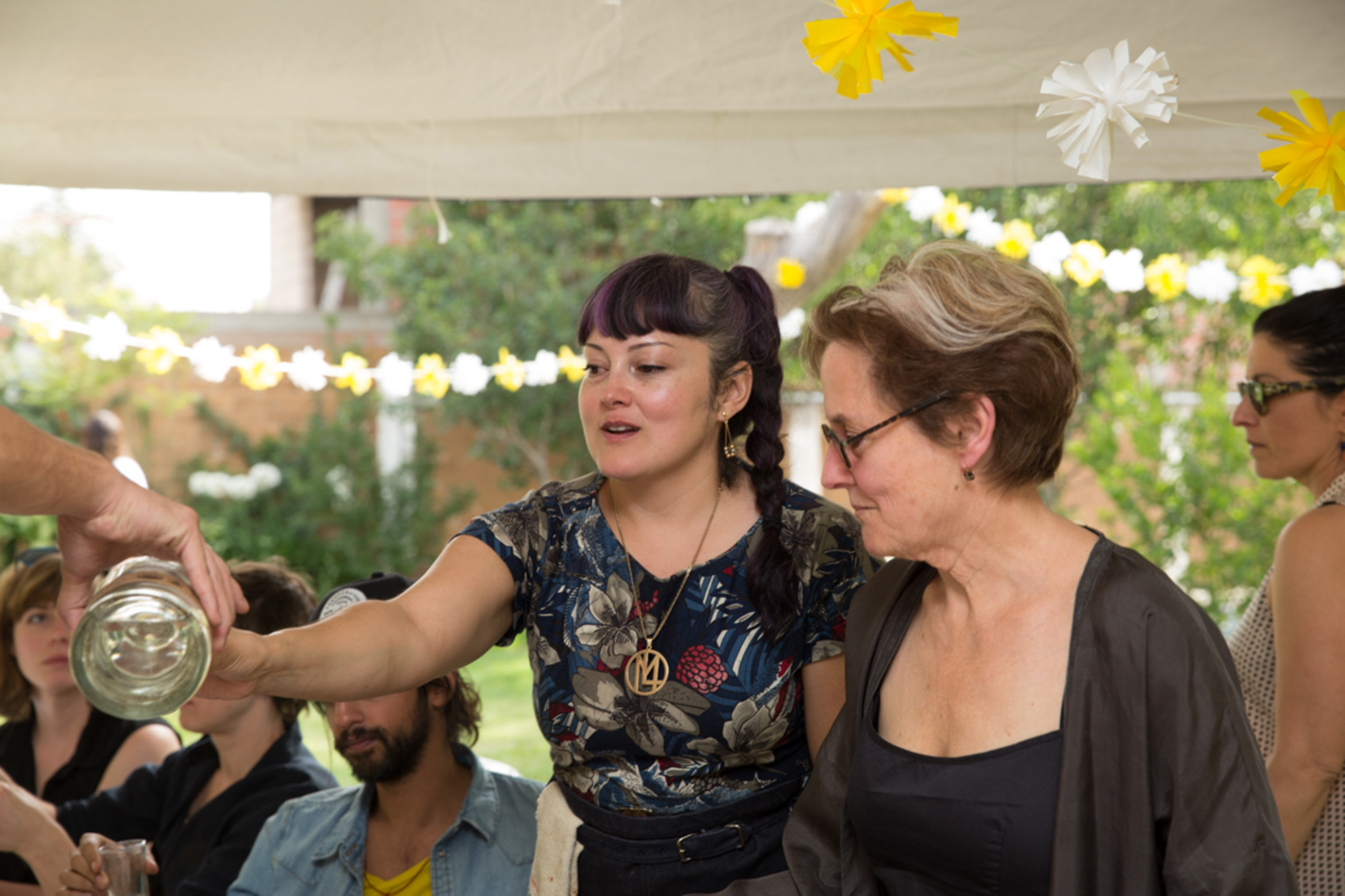
During her time in the Bay Area, Listman brought her expertise and insights as a Mexican-born artist and foodmaker, helping to introduce mezcal to the region when it was relatively unknown. Alice Waters (right), the founder of Berkeley’s Chez Panisse, attended one of her many events. (Courtesy of Norma Listman)
The Oakland of then was far from the Oakland it would later become. In the mid-to-late aughts, Listman was among the first in the Town to purvey artisanal mezcals, when the libation was more mystery than mainstream. She was invested in fashion, design and art. In 2007, she began working front of house in various Oakland restaurants, eventually finding her way into the kitchen. She independently experimented with food as “a medium to tell a larger story” with a project she titled The Salon Dinners. Listman recalls those times fondly, before tech billionaires and real estate conglomerates completely uprooted artists and storytellers in the region, leaving a profit-driven void in their wake.
“In Oakland, there was something called ‘Ghetto Gourmet,’” she says, describing an underground community of Oakland home chefs at the time, not to be confused with the Berkeley neighborhood nickname. “People turned their houses into restaurants and began cooking their own food, and it was a really cool time in the Bay to have those experiences and to be experimental. I started doing some of that,” she says. “Where I grew up in Mexico, it’s common that some homes and garages and family dining rooms become restaurants to serve pozole or some other dish that the family matriarch does well. [My dinners] felt like a blend of that, in terms of food, but it was shot down by the health department. It lasted about a year and a half, and it was so cool.”
For Listman, these kinds of secretive, word-of-mouth happenings gave Oakland a certain magic in that era: “Everything felt more hidden. Back in the day, nothing was exposed, but if you knocked on a door, it would open, and then another door would appear behind that, and you’d find another world inside.”
From left: Keval, Sita Kuratomi Bhaumik and Jocelyn Jackson. The trio co-founded the People’s Kitchen Collective in 2007. (Courtesy of Saqib Keval)
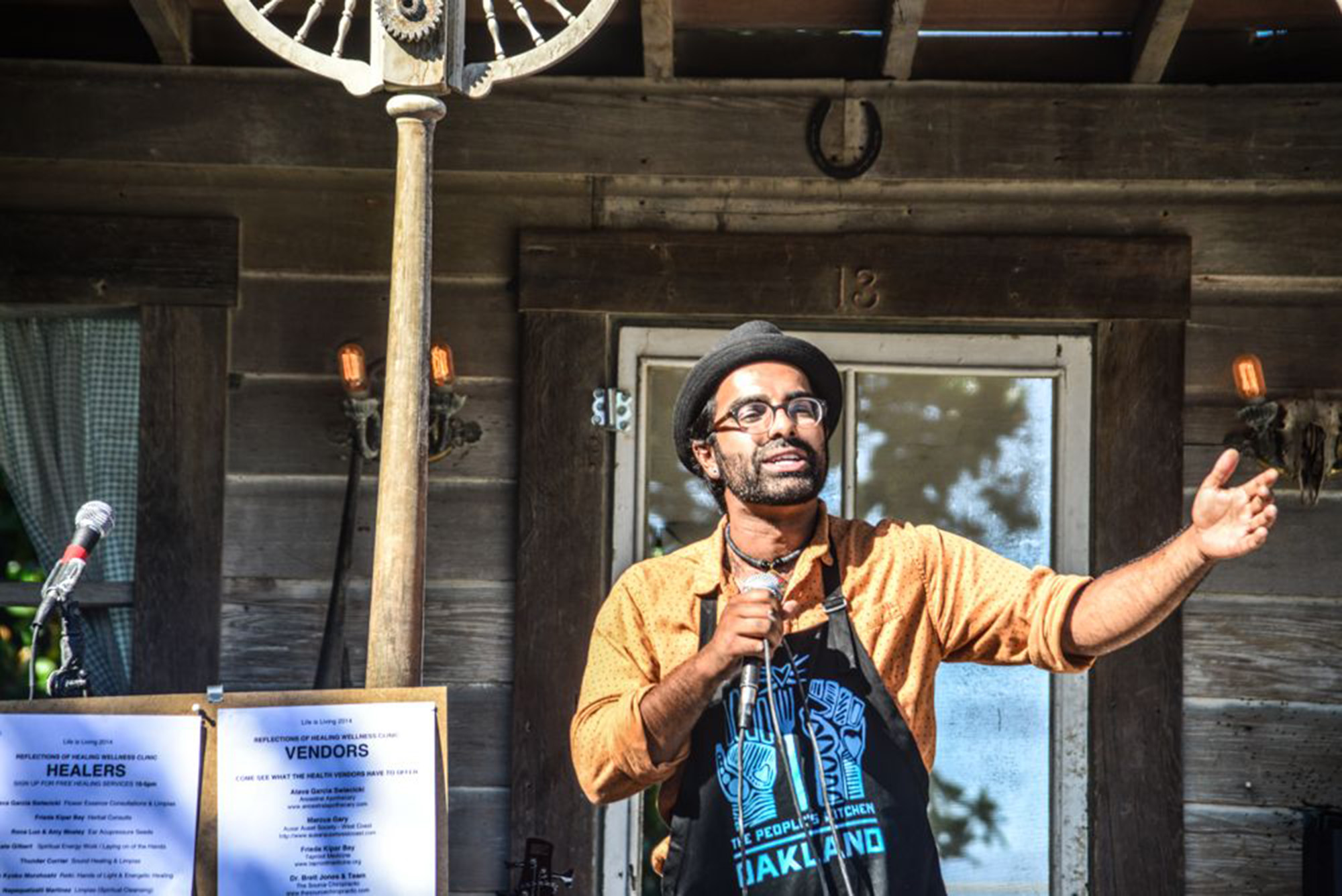
During that same span, Keval was steadily building up PKC, a political food program he co-founded in 2007, along with Jocelyn Jackson and Sita Kuratomi Bhaumik, in West Oakland. Keval’s evolving vision for the group was inspired by his involvement in Bay Area restaurants and food nonprofits like Restaurant Opportunities Center of the Bay Area and West Oakland’s People’s Grocery, where he helped start the Growing Justice Institute, an urban agriculture project.
During Keval’s time at PKC, the group held large-scale public meals at Lil Bobby Hutton Park and at urban farms. Keval developed connections with Black Panther Party elders and collaborated with the likes of Emory Douglas, who created the fliers for the Panthers’ Free Breakfast Program. “It was formative for me as an activist to understand the Black and Brown and South Asian history in the Bay. That was vital,” Keval says of those years.
Soon, his path would serendipitously intertwine with Listman’s.
In the late aughts, Keval rallied communities in Oakland and beyond around issues of food justice. (Courtesy of Saqib Keval)
The road to Mexico City goes through Old Oakland
Maybe no neighborhood in Oakland has retained as much of the clandestine enchantment that Listman recalls from the aughts as Old Oakland. In particular, the historic downtown neighborhood — crammed into a quaint, relatively sleepy four-block nook bordered by Highway 880, Broadway and West Oakland — has long been an overlooked bastion of delicious eats.
In prior years, you’d find beloved gems like Miss Ollie’s, the Afro-Caribbean staple with out-the-door lines, where Keval once worked. Today, the neighborhood is home to chef Anthony Salguero’s Popoca, a Salvadoran American powerhouse slanging woodfired pupusas, and T’chaka, Oakland’s first and only Haitian joint (which, poetically, exists in the former Miss Ollie’s space). But arguably no other restaurant in Old Oakland has left more of an imprint than Cosecha. Until it shuttered in 2021, the Mexican eatery inside of Swan Market was one of the most influential restaurants in the Bay Area’s culinary landscape.
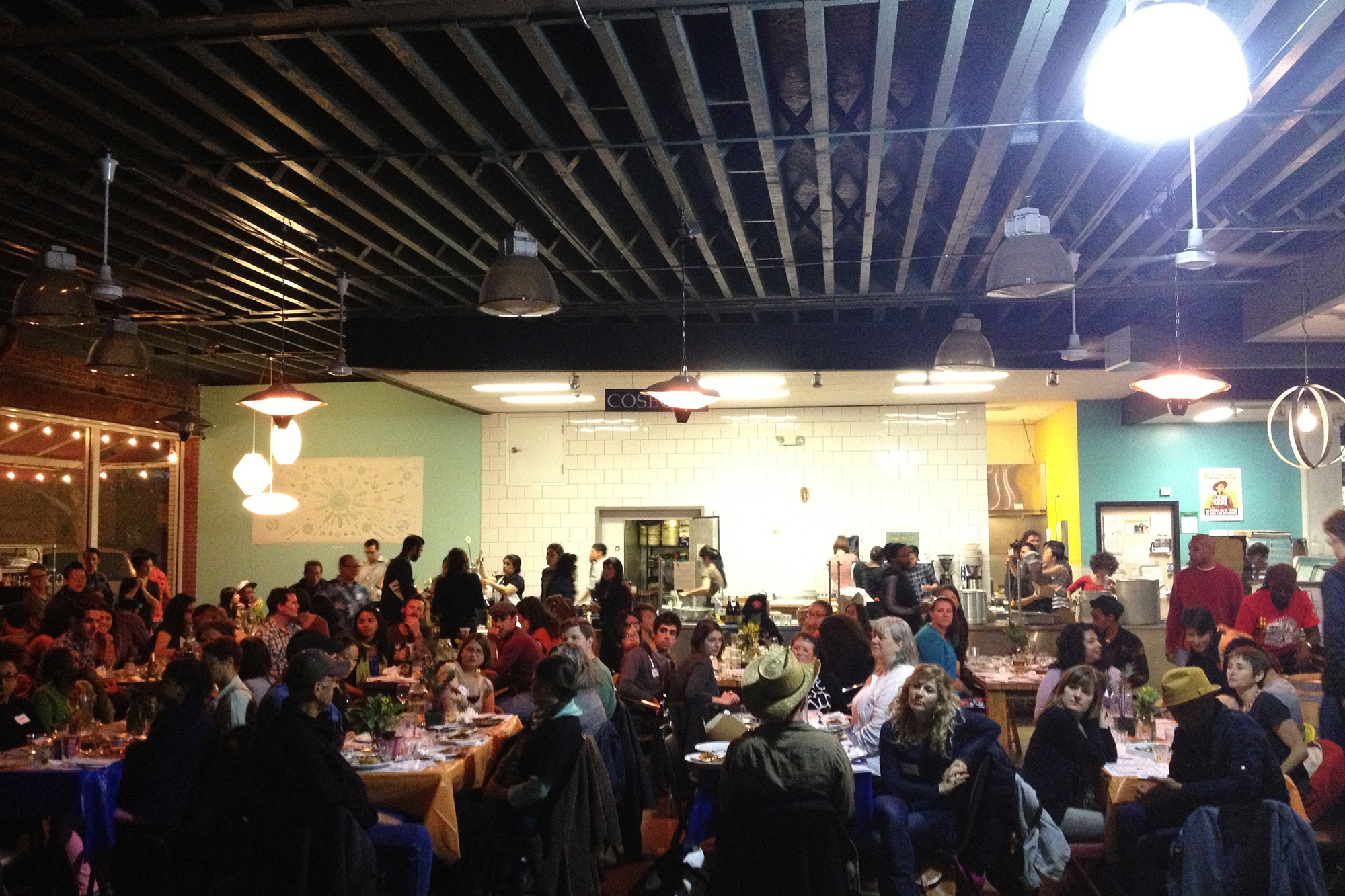
Coincidentally, Cosecha is also where Listman and Keval first met, around 2013. At that time, Listman was working with the restaurant to host mezcal tastings and community art events; Keval and PKC used Cosecha as a space to provide meals and build a shared foundation.
Old Oakland’s now-shuttered Cosecha was an instrumental space for Keval and Listman, who used it as a venue to build community and inspire change. For a time, the restaurant hosted many of the People’s Kitchen Collective’s pay-what-you-can meals. (Courtesy of Saqib Keval/People's Kitchen Collective)
In terms of how they started dating? Listman tells it straight: “We never really engaged that much. We were busy in our own worlds.” That changed when the Museum of the African Diaspora in San Francisco began a new residency program and recruited both Listman and PKC to collaborate. Listman smiles: “We worked together on that event, and since then we’ve never stopped working together.”
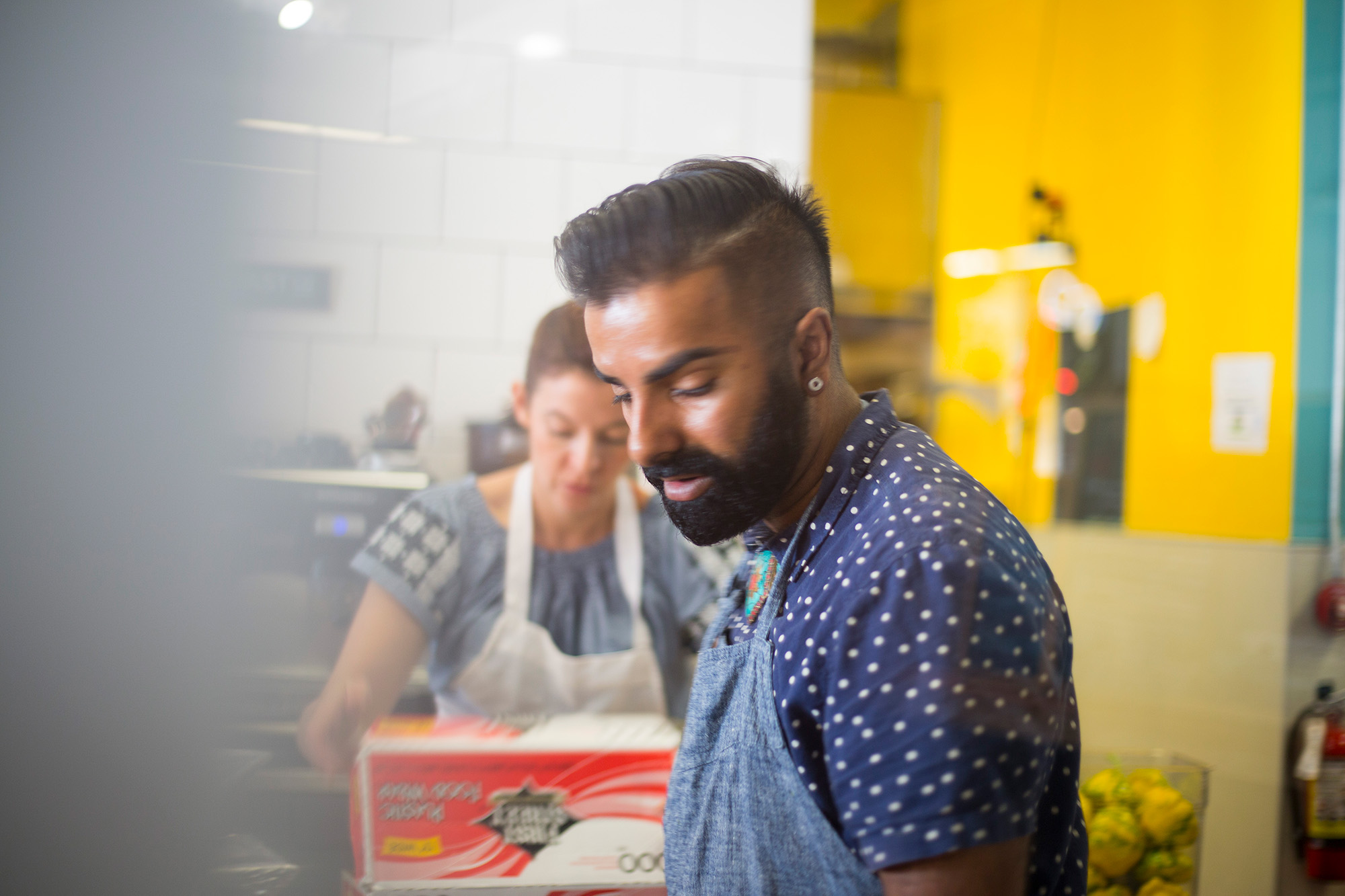
Dominica Rice-Cisneros, Cosecha’s Mexican American chef-owner who currently runs Bombera in the Dimond District, knew the couple long before they were star chefs. Since hosting them in her own restaurant, Rice-Cisneros has gone on to eat at every version of Masala y Maiz (the restaurant has had different locations in Mexico City over the years).
“I consider Masala y Maiz to be a Bay Area restaurant, even though they’re in Mexico City. They are an Oakland restaurant, to be exact. True Oakland,” says Rice-Cisneros. “It’s definitely international and could do well everywhere, but first and foremost, it’s Oakland.”
Keval drew inspiration from Bay Area restaurants like Cosecha, where he is pictured in this photo during his People’s Kitchen Collective years. Behind him, Cosecha chef Dominica Rice-Cisneros prepares a dish. (Courtesy of Saqib Keval)
This week, Rice-Cisneros will be flying out to attend the International Women’s Month dinner that Listman is hosting along with Assil and Yun. It doesn’t get more Bay Area — in Mexico City — than that.
While Rice-Cisneros doesn’t take any credit for uniting Listman and Keval, the couple is quick to point out Cosecha’s importance in their lives. “Masala y Maiz exists because of Dominica. We exist [as a couple] because of PKC,” Keval says.
In 2017, Listman moved back to Mexico to research corn foodways. Unexpectedly, she was offered an on-the-spot chance to take over a dining space in the San Miguel Chapultepec neighborhood of Mexico City. She took the risk and invited Keval to join her. The result was Masala y Maiz: a combination of their families’ migratory lineages told through recipes. In that way, the restaurant is an expression of all of the parallels that Listman and Keval have found between the cuisines and cultures across Mexico, India, Kenya and the Global South at large.
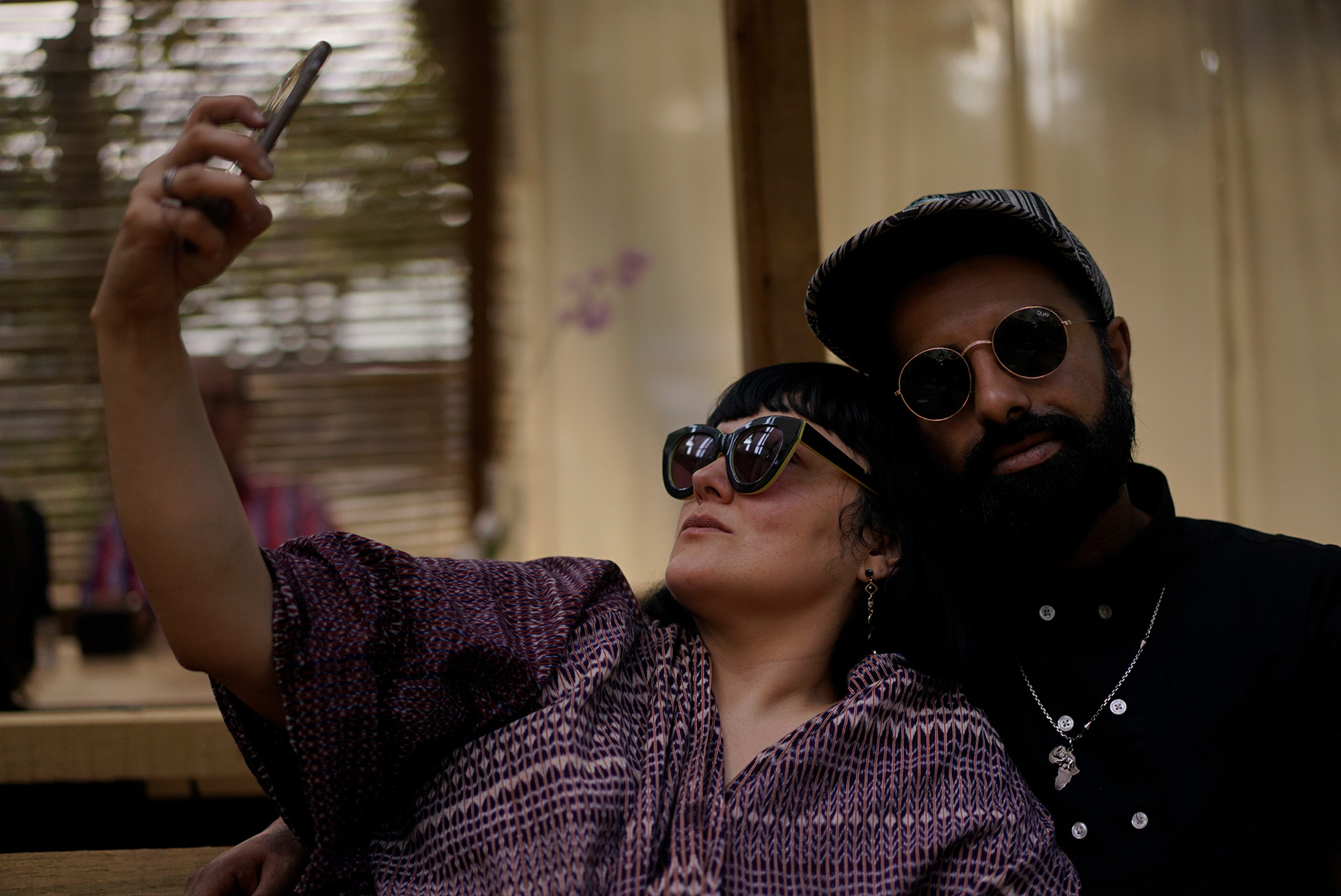
In 2017, Listman and Keval left the Bay Area, where they had met and began dating, with the shared vision of changing the restaurant industry together. (Courtesy of Saqib Keval)
The restaurant’s stature has only grown over the years as it moved into larger spaces and solidified itself as a culinary destination and activist force in Mexico City. But even as the couple was building out their restaurant, the Bay Area was always close to their hearts — and the Bay hadn’t forgotten about them, either. Listman notes that her former mentor, the legendary Slanted Door chef Charles Phan (who passed away last year), supplied Masala y Maiz with its inaugural set of silverware. Eight years later, it’s still the crown jewel of the restaurant’s collection.
Related Articles
For Listman, the Bay resonates in their work — but it’s not the only factor. “The Bay Area is a very revolutionary place with incredible political movements,” she says. “But it’s not the only thing. A lot of the movements in Mexico and in different communities inform what we do.”
Keval is even more effusive in his praise of the Bay. “The thing about the restaurants in the Bay we worked at was that they showed us the possibilities of what a restaurant can be, and the authenticity of each person expressing who they are in their own way,” he says. “We learned what it means to do right by your employees and your team. We worked with chefs who cared, who worked alongside everyone else. That helped me form this idea of what a restaurant could be and how to critique patriarchy, capitalism and so forth. Oakland gave me space to try that out and tweak it and work on service and hospitality from a different point of view, one that was community-based and centered on dignity.”
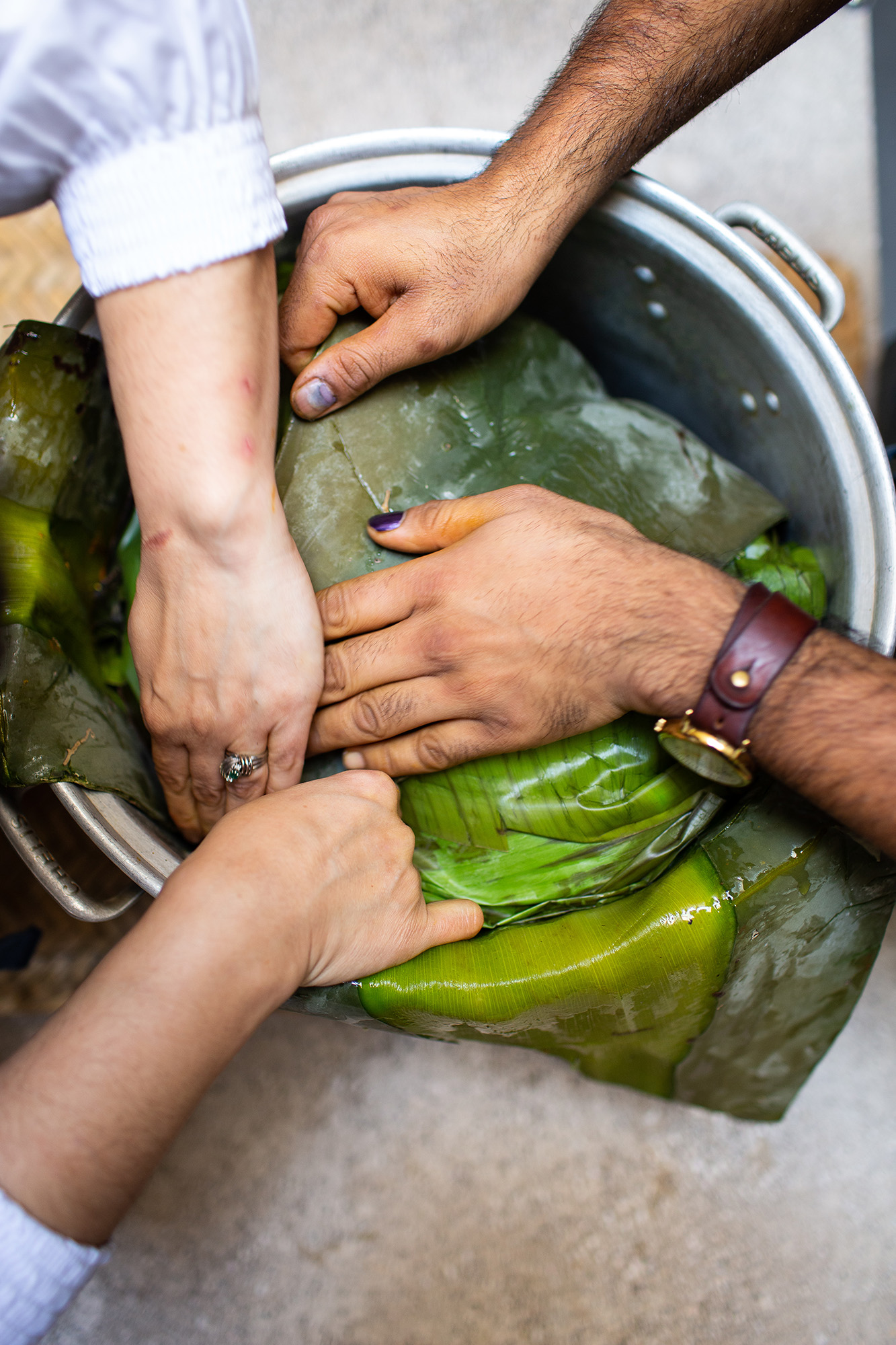
At Masala y Maiz, Listman and Keval combine culinary traditions from their respective backgrounds. (Sana Javeri Kadri, courtesy of Masala y Maiz)
In a fine dining industry where headlines about institutions abusing their workers are not uncommon, and in which high-end establishments have a reputation of being financially inaccessible to the working class, Masala y Maiz’s egalitarian for-the-people, by-the-people mantras are far from the norm. But they’re deeply rooted in the Bay’s insurgent ecosystem, where Listman and Keval were shaped and influenced for years while also carving out space for themselves, long before Masala y Maiz’s opened its proverbial doors to would-be diners.
As Keval puts it, “That’s who we are, and that’s a direct line to the Bay. That won’t ever stop being home.”
After all, is there anything more truly Oakland than feeding revolutions, building cross-communal solidarity, and inviting everyone to share in discourse amid today’s hetero-capitalist dystopia — all while eating some of the best meals of your life?
Correction: An earlier version of this article credited chef Anthony Strong with providing Masala y Maiz’s first set of silverware. Strong was also a mentor to Listman, but Charles Phan of Slanted Door was the one who gifted them the silverware.
Masala y Maiz (116 C. Artículo 123, Edificio Humboldt, Mexico City) is open every day from noon to 6 p.m., except on Tuesdays. On Wednesday, March 25 at 7:30 p.m., the restaurant will host its final International Women’s Month series dinner with chefs Reem Assil and Nite Yun. The communal meal will include a six-course collaborative tasting, with a welcome drink and tip included for $2,200 MXN, or roughly $115 USD, per person. Tickets here.
lower waypointnext waypoint
Player sponsored by
window.__IS_SSR__=true
window.__INITIAL_STATE__={
"attachmentsReducer": {
"audio_0": {
"type": "attachments",
"id": "audio_0",
"imgSizes": {
"kqedFullSize": {
"file": "https://ww2.kqed.org/news/wp-content/themes/KQED-unified/img/audio_bgs/background0.jpg"
}
}
},
"audio_1": {
"type": "attachments",
"id": "audio_1",
"imgSizes": {
"kqedFullSize": {
"file": "https://ww2.kqed.org/news/wp-content/themes/KQED-unified/img/audio_bgs/background1.jpg"
}
}
},
"audio_2": {
"type": "attachments",
"id": "audio_2",
"imgSizes": {
"kqedFullSize": {
"file": "https://ww2.kqed.org/news/wp-content/themes/KQED-unified/img/audio_bgs/background2.jpg"
}
}
},
"audio_3": {
"type": "attachments",
"id": "audio_3",
"imgSizes": {
"kqedFullSize": {
"file": "https://ww2.kqed.org/news/wp-content/themes/KQED-unified/img/audio_bgs/background3.jpg"
}
}
},
"audio_4": {
"type": "attachments",
"id": "audio_4",
"imgSizes": {
"kqedFullSize": {
"file": "https://ww2.kqed.org/news/wp-content/themes/KQED-unified/img/audio_bgs/background4.jpg"
}
}
},
"placeholder": {
"type": "attachments",
"id": "placeholder",
"imgSizes": {
"thumbnail": {
"file": "https://cdn.kqed.org/wp-content/uploads/2024/12/KQED-Default-Image-816638274-2000x1333-1-160x107.jpg",
"width": 160,
"height": 107,
"mimeType": "image/jpeg"
},
"medium": {
"file": "https://cdn.kqed.org/wp-content/uploads/2024/12/KQED-Default-Image-816638274-2000x1333-1-800x533.jpg",
"width": 800,
"height": 533,
"mimeType": "image/jpeg"
},
"medium_large": {
"file": "https://cdn.kqed.org/wp-content/uploads/2024/12/KQED-Default-Image-816638274-2000x1333-1-768x512.jpg",
"width": 768,
"height": 512,
"mimeType": "image/jpeg"
},
"large": {
"file": "https://cdn.kqed.org/wp-content/uploads/2024/12/KQED-Default-Image-816638274-2000x1333-1-1020x680.jpg",
"width": 1020,
"height": 680,
"mimeType": "image/jpeg"
},
"1536x1536": {
"file": "https://cdn.kqed.org/wp-content/uploads/2024/12/KQED-Default-Image-816638274-2000x1333-1-1536x1024.jpg",
"width": 1536,
"height": 1024,
"mimeType": "image/jpeg"
},
"fd-lrg": {
"file": "https://cdn.kqed.org/wp-content/uploads/2024/12/KQED-Default-Image-816638274-2000x1333-1-1536x1024.jpg",
"width": 1536,
"height": 1024,
"mimeType": "image/jpeg"
},
"fd-med": {
"file": "https://cdn.kqed.org/wp-content/uploads/2024/12/KQED-Default-Image-816638274-2000x1333-1-1020x680.jpg",
"width": 1020,
"height": 680,
"mimeType": "image/jpeg"
},
"fd-sm": {
"file": "https://cdn.kqed.org/wp-content/uploads/2024/12/KQED-Default-Image-816638274-2000x1333-1-800x533.jpg",
"width": 800,
"height": 533,
"mimeType": "image/jpeg"
},
"post-thumbnail": {
"file": "https://cdn.kqed.org/wp-content/uploads/2024/12/KQED-Default-Image-816638274-2000x1333-1-672x372.jpg",
"width": 672,
"height": 372,
"mimeType": "image/jpeg"
},
"twentyfourteen-full-width": {
"file": "https://cdn.kqed.org/wp-content/uploads/2024/12/KQED-Default-Image-816638274-2000x1333-1-1038x576.jpg",
"width": 1038,
"height": 576,
"mimeType": "image/jpeg"
},
"xxsmall": {
"file": "https://cdn.kqed.org/wp-content/uploads/2024/12/KQED-Default-Image-816638274-2000x1333-1-160x107.jpg",
"width": 160,
"height": 107,
"mimeType": "image/jpeg"
},
"xsmall": {
"file": "https://cdn.kqed.org/wp-content/uploads/2024/12/KQED-Default-Image-816638274-2000x1333-1-672x372.jpg",
"width": 672,
"height": 372,
"mimeType": "image/jpeg"
},
"small": {
"file": "https://cdn.kqed.org/wp-content/uploads/2024/12/KQED-Default-Image-816638274-2000x1333-1-672x372.jpg",
"width": 672,
"height": 372,
"mimeType": "image/jpeg"
},
"xlarge": {
"file": "https://cdn.kqed.org/wp-content/uploads/2024/12/KQED-Default-Image-816638274-2000x1333-1-1020x680.jpg",
"width": 1020,
"height": 680,
"mimeType": "image/jpeg"
},
"full-width": {
"file": "https://cdn.kqed.org/wp-content/uploads/2024/12/KQED-Default-Image-816638274-2000x1333-1-1920x1280.jpg",
"width": 1920,
"height": 1280,
"mimeType": "image/jpeg"
},
"guest-author-32": {
"file": "https://cdn.kqed.org/wp-content/uploads/2025/01/KQED-Default-Image-816638274-1333x1333-1-160x160.jpg",
"width": 32,
"height": 32,
"mimeType": "image/jpeg"
},
"guest-author-50": {
"file": "https://cdn.kqed.org/wp-content/uploads/2025/01/KQED-Default-Image-816638274-1333x1333-1-160x160.jpg",
"width": 50,
"height": 50,
"mimeType": "image/jpeg"
},
"guest-author-64": {
"file": "https://cdn.kqed.org/wp-content/uploads/2025/01/KQED-Default-Image-816638274-1333x1333-1-160x160.jpg",
"width": 64,
"height": 64,
"mimeType": "image/jpeg"
},
"guest-author-96": {
"file": "https://cdn.kqed.org/wp-content/uploads/2025/01/KQED-Default-Image-816638274-1333x1333-1-160x160.jpg",
"width": 96,
"height": 96,
"mimeType": "image/jpeg"
},
"guest-author-128": {
"file": "https://cdn.kqed.org/wp-content/uploads/2025/01/KQED-Default-Image-816638274-1333x1333-1-160x160.jpg",
"width": 128,
"height": 128,
"mimeType": "image/jpeg"
},
"detail": {
"file": "https://cdn.kqed.org/wp-content/uploads/2025/01/KQED-Default-Image-816638274-1333x1333-1-160x160.jpg",
"width": 160,
"height": 160,
"mimeType": "image/jpeg"
},
"kqedFullSize": {
"file": "https://cdn.kqed.org/wp-content/uploads/2024/12/KQED-Default-Image-816638274-2000x1333-1.jpg",
"width": 2000,
"height": 1333
}
}
},
"arts_13987862": {
"type": "attachments",
"id": "arts_13987862",
"meta": {
"index": "attachments_1716263798",
"site": "arts",
"id": "13987862",
"found": true
},
"title": "8_PhotoCredit Sana Javeri Kadri",
"publishDate": 1774298986,
"status": "inherit",
"parent": 13987839,
"modified": 1774314163,
"caption": "Though Norma Listman and Saqib Keval met in Oakland in the late aughts, the couple didn't formally begin cooking together until they arrived in Mexico City, circa 2017. Here they are making tamales rancheros with banana leaves at the inaugural iteration of their restaurant, Masala y Maiz, in the San Miguel Chapultepec district.",
"credit": "Sana Javeri Kadri, courtesy of Masala y Maiz",
"altTag": "In an outdoor courtyard, a man and woman in blue aprons prepare banana-leaf tamales in a large pot.",
"description": null,
"imgSizes": {
"thumbnail": {
"file": "https://cdn.kqed.org/wp-content/uploads/sites/2/2026/03/8_PhotoCredit-Sana-Javeri-Kadri-160x107.jpg",
"width": 160,
"height": 107,
"mimeType": "image/jpeg"
},
"medium_large": {
"file": "https://cdn.kqed.org/wp-content/uploads/sites/2/2026/03/8_PhotoCredit-Sana-Javeri-Kadri-768x512.jpg",
"width": 768,
"height": 512,
"mimeType": "image/jpeg"
},
"1536x1536": {
"file": "https://cdn.kqed.org/wp-content/uploads/sites/2/2026/03/8_PhotoCredit-Sana-Javeri-Kadri-1536x1024.jpg",
"width": 1536,
"height": 1024,
"mimeType": "image/jpeg"
},
"post-thumbnail": {
"file": "https://cdn.kqed.org/wp-content/uploads/sites/2/2026/03/8_PhotoCredit-Sana-Javeri-Kadri-672x372.jpg",
"width": 672,
"height": 372,
"mimeType": "image/jpeg"
},
"twentyfourteen-full-width": {
"file": "https://cdn.kqed.org/wp-content/uploads/sites/2/2026/03/8_PhotoCredit-Sana-Javeri-Kadri-1038x576.jpg",
"width": 1038,
"height": 576,
"mimeType": "image/jpeg"
},
"npr-cds-wide": {
"file": "https://cdn.kqed.org/wp-content/uploads/sites/2/2026/03/8_PhotoCredit-Sana-Javeri-Kadri-1200x675.jpg",
"width": 1200,
"height": 675,
"mimeType": "image/jpeg"
},
"kqedFullSize": {
"file": "https://cdn.kqed.org/wp-content/uploads/sites/2/2026/03/8_PhotoCredit-Sana-Javeri-Kadri.jpg",
"width": 2000,
"height": 1333
}
},
"isLoading": false,
"fetchFailed": false
}
},
"audioPlayerReducer": {
"postId": "stream_live",
"isPaused": true,
"isPlaying": false,
"pfsActive": false,
"pledgeModalIsOpen": true,
"playerDrawerIsOpen": false,
"liveAudioPlayStartedAt": 0,
"liveAudioPlayContext": ""
},
"authorsReducer": {
"achazaro": {
"type": "authors",
"id": "11748",
"meta": {
"index": "authors_1716337520",
"id": "11748",
"found": true
},
"name": "Alan Chazaro",
"firstName": "Alan",
"lastName": "Chazaro",
"slug": "achazaro",
"email": "agchazaro@gmail.com",
"display_author_email": true,
"staff_mastheads": [],
"title": "Food Writer and Reporter",
"bio": "Alan Chazaro is the author of \u003cem>This Is Not a Frank Ocean Cover Album\u003c/em> (Black Lawrence Press, 2019), \u003cem>Piñata Theory\u003c/em> (Black Lawrence Press, 2020), and \u003cem>Notes from the Eastern Span of the Bay Bridge\u003c/em> (Ghost City Press, 2021). He is a graduate of June Jordan’s Poetry for the People program at UC Berkeley and a former Lawrence Ferlinghetti Fellow at the University of San Francisco. He writes about sports, food, art, music, education, and culture while repping the Bay on \u003ca href=\"https://twitter.com/alan_chazaro\">Twitter\u003c/a> and \u003ca href=\"https://www.instagram.com/alan_chazaro/?hl=en\">Instagram\u003c/a> at @alan_chazaro.",
"avatar": "https://secure.gravatar.com/avatar/ea8b6dd970fc5c29e7a188e7d5861df7?s=600&d=blank&r=g",
"twitter": "alan_chazaro",
"facebook": null,
"instagram": null,
"linkedin": null,
"sites": [
{
"site": "arts",
"roles": [
"contributor"
]
},
{
"site": "news",
"roles": [
"editor"
]
}
],
"headData": {
"title": "Alan Chazaro | KQED",
"description": "Food Writer and Reporter",
"ogImgSrc": "https://secure.gravatar.com/avatar/ea8b6dd970fc5c29e7a188e7d5861df7?s=600&d=blank&r=g",
"twImgSrc": "https://secure.gravatar.com/avatar/ea8b6dd970fc5c29e7a188e7d5861df7?s=600&d=blank&r=g"
},
"isLoading": false,
"link": "/author/achazaro"
}
},
"pagesReducer": {},
"pfsSessionReducer": {},
"postsReducer": {
"stream_live": {
"type": "live",
"id": "stream_live",
"audioUrl": "https://hls.kqed.org/hls/kqed_app/playlist.m3u8",
"title": "Live Stream",
"excerpt": "Live Stream information currently unavailable.",
"link": "/radio",
"featImg": "",
"label": {
"name": "KQED Live",
"link": "/"
}
},
"stream_kqedNewscast": {
"type": "posts",
"id": "stream_kqedNewscast",
"audioUrl": "https://www.kqed.org/.stream/anon/radio/RDnews/newscast.mp3?_=1",
"title": "KQED Newscast",
"featImg": "",
"label": {
"name": "88.5 FM",
"link": "/"
}
},
"arts_13987839": {
"type": "posts",
"id": "arts_13987839",
"meta": {
"index": "posts_1716263798",
"site": "arts",
"id": "13987839",
"found": true
},
"articlePosition": 0,
"guestAuthors": [],
"slug": "masala-y-maiz-mexico-city-restaurant-oakland-bay-area-roots",
"title": "How One of Mexico City’s Most Acclaimed Restaurants Began in Oakland",
"publishDate": 1774377154,
"format": "standard",
"headTitle": "How One of Mexico City’s Most Acclaimed Restaurants Began in Oakland | KQED",
"labelTerm": {},
"content": "\u003cp>[dropcap]W[/dropcap]hen you first enter Masala y Maiz — a Michelin-starred renegade of a restaurant in Mexico City that has been profiled on Netflix’s “Chef’s Table” — you wouldn’t necessarily know that Oakland is at the heart of its soulful appeal. The concrete, brutalist design of the space denotes an air of Mexican modernism that’s unlike anything you’d find in the Bay Area.\u003c/p>\n\u003cp>Yet according to chef and co-owner Saqib Keval, a Northern California–raised son of Ethiopian and Kenyan immigrants of Indian descent, Oakland is central to the restaurant’s ethos.\u003c/p>\n\u003cp>“The restaurant feels like an extension of Oakland at times, in terms of the music, politics, culture, vibe,” says Keval, who opened Masala y Maiz with his wife Norma Listman in 2017. “It feels like an embassy. Oakland is a place we miss.”\u003c/p>\n\u003cp>Bay Area activists may remember Keval as one of the co-founders of the \u003ca href=\"https://www.instagram.com/peopleskitchencollective/\">People’s Kitchen Collective\u003c/a> (PKC), among Oakland’s most prominent food justice organizations. Listman, meanwhile, was born and raised in Texcoco, Mexico, before she migrated to the Bay in the ’90s to work as a multidisciplinary artist and, eventually, a chef, cutting her teeth at esteemed Oakland restaurants like Tamarindo, Bay Wolf and Camino.\u003c/p>\n\u003cfigure id=\"attachment_13987860\" class=\"wp-caption alignnone\" style=\"max-width: 2000px\">\u003cimg loading=\"lazy\" decoding=\"async\" class=\"size-full wp-image-13987860\" src=\"https://cdn.kqed.org/wp-content/uploads/sites/2/2026/03/Credit_Ana-Lorenzana_OutsideRestaurant.jpg\" alt=\"Two chefs in blue aprons pose in front a restaurant, underneath massive cement columns.\" width=\"2000\" height=\"1333\" srcset=\"https://cdn.kqed.org/wp-content/uploads/sites/2/2026/03/Credit_Ana-Lorenzana_OutsideRestaurant.jpg 2000w, https://cdn.kqed.org/wp-content/uploads/sites/2/2026/03/Credit_Ana-Lorenzana_OutsideRestaurant-160x107.jpg 160w, https://cdn.kqed.org/wp-content/uploads/sites/2/2026/03/Credit_Ana-Lorenzana_OutsideRestaurant-768x512.jpg 768w, https://cdn.kqed.org/wp-content/uploads/sites/2/2026/03/Credit_Ana-Lorenzana_OutsideRestaurant-1536x1024.jpg 1536w\" sizes=\"auto, (max-width: 2000px) 100vw, 2000px\">\u003cfigcaption class=\"wp-caption-text\">Keval and Listman stand in front of the current iteration of Masala y Maiz in Mexico City’s historic centro, where the restaurant relocated in 2024. \u003ccite>(Ana Lorenzana, courtesy of Masala y Maiz)\u003c/cite>\u003c/figcaption>\u003c/figure>\n\u003cp>“I have Oakland tattooed on my leg,” she says. “We hold a romantic idea of the Bay, of Oakland, when we lived there. I was in the Bay for 18 years. I was there during the dot-com boom in ’99. A lot of our communities left because it was impossible to keep going. The restaurants we worked at closed because it wasn’t sustainable. [But] my mentors are still there, and that’s where I came into food.”\u003c/p>\n\u003cp>[ad fullwidth]\u003c/p>\n\u003cp>Oakland’s grassroots influences, along with Listman’s leftist upbringing in Mexico and Keval’s anti-colonial literary acumen from his days at Humboldt State University, are unmistakably baked into Masala y Maiz’s philosophies of collectivism, equity and universal workers rights. A few times a year, the restaurant hosts an “Eat What You Want, Pay What You Can” day, inviting anyone — particularly locals combating the rising cost of living in \u003ca href=\"https://www.cntraveler.com/story/how-gentrification-continues-to-change-mexico-city\">a gentrified Mexico City\u003c/a> — to enjoy a Michelin-starred meal, even if all they can afford to pay for it with is \u003ca href=\"https://www.bbc.com/travel/article/20250825-pay-what-you-can-for-a-michelin-starred-meal\">a piece of original artwork\u003c/a>. The restaurant’s regular menus often feature large, bilingual phrases (“white supremacy is terrorism”; “que vive la lucha femenista”) based on current events.\u003c/p>\n\u003cfigure id=\"attachment_13987864\" class=\"wp-caption alignnone\" style=\"max-width: 1333px\">\u003cimg loading=\"lazy\" decoding=\"async\" class=\"size-full wp-image-13987864\" src=\"https://cdn.kqed.org/wp-content/uploads/sites/2/2026/03/Credit_Ana-Lorenzana_TableSpread.jpg\" alt=\"A spread of dishes on a black tabletop — included is a fried whole fish, head-on shrimp, and salad.\" width=\"1333\" height=\"2000\" srcset=\"https://cdn.kqed.org/wp-content/uploads/sites/2/2026/03/Credit_Ana-Lorenzana_TableSpread.jpg 1333w, https://cdn.kqed.org/wp-content/uploads/sites/2/2026/03/Credit_Ana-Lorenzana_TableSpread-160x240.jpg 160w, https://cdn.kqed.org/wp-content/uploads/sites/2/2026/03/Credit_Ana-Lorenzana_TableSpread-768x1152.jpg 768w, https://cdn.kqed.org/wp-content/uploads/sites/2/2026/03/Credit_Ana-Lorenzana_TableSpread-1024x1536.jpg 1024w\" sizes=\"auto, (max-width: 1333px) 100vw, 1333px\">\u003cfigcaption class=\"wp-caption-text\">An impressive spread of dishes at Masa y Maiz. \u003ccite>(Ana Lorenzana, courtesy of Masala y Maiz)\u003c/cite>\u003c/figcaption>\u003c/figure>\n\u003cp>The messaging isn’t only for show. In 2018, the restaurant boldly \u003ca href=\"https://www.latimes.com/world/la-fg-mexico-city-restaurant-20180512-story.html\">challenged Mexico City’s government officials, citing corruption and bribery\u003c/a> — and somehow came out unscathed. Then, in 2021, the couple rejected a nomination from The World’s 50 Best Restaurants, calling out the foundation’s culture of exploitation and sexism. On Instagram, Masala y Maiz expressed gratitude for the recognition but didn’t yield, sharing a graphic of their invitation with a simple declaration overlaid above it: “\u003ca href=\"https://www.instagram.com/p/CVfYu1rL7oT/?utm_source=ig_embed&ig_rid=128bcd38-88bd-4ee8-a174-fd802ac4baae\">Gracias, no gracias\u003c/a>.”\u003c/p>\n\u003cp>The restaurant has also proven to be far more transcendentally savory than any political statement could ever be on its own. That is to say, the food at Masala y Maiz reflects Oakland’s famously eclectic flavors, too, in its borderless mezcla of dishes: an edible tapestry of Mexican, Indian and East African ingredients. The paratha quesadilla, which uses Indian flatbread in place of traditional corn tortillas, is gooed together with a blend of Oaxacan and mountain cheeses, and served with a side of salsa machaar and herb salad. For the uttapam gordita, a thick South Indian dosa is topped with shredded barbacoa, butternut squash, asparagus and housemade salsa verde. And the esquites makai pakka is a Kenyan remix of Mexico’s beloved street corn dish — a stir of corn kernels, coconut milk, East African masala, in-house mayo and crumbled cotija cheese.\u003c/p>\n\u003cfigure id=\"attachment_13987857\" class=\"wp-caption alignnone\" style=\"max-width: 2000px\">\u003cimg loading=\"lazy\" decoding=\"async\" class=\"size-full wp-image-13987857\" src=\"https://cdn.kqed.org/wp-content/uploads/sites/2/2026/03/36_PhotoCredit-Sana-Javeri-Kadri.jpg\" alt='Jars of spices labeled with blue tape, including dried guajillo chiles, gunpowder pudi, \"Black Power cardamom,\" methi, and maiz morado.' width=\"2000\" height=\"1333\" srcset=\"https://cdn.kqed.org/wp-content/uploads/sites/2/2026/03/36_PhotoCredit-Sana-Javeri-Kadri.jpg 2000w, https://cdn.kqed.org/wp-content/uploads/sites/2/2026/03/36_PhotoCredit-Sana-Javeri-Kadri-160x107.jpg 160w, https://cdn.kqed.org/wp-content/uploads/sites/2/2026/03/36_PhotoCredit-Sana-Javeri-Kadri-768x512.jpg 768w, https://cdn.kqed.org/wp-content/uploads/sites/2/2026/03/36_PhotoCredit-Sana-Javeri-Kadri-1536x1024.jpg 1536w\" sizes=\"auto, (max-width: 2000px) 100vw, 2000px\">\u003cfigcaption class=\"wp-caption-text\">Masala y Maiz is a reflection of the commonalities that can be found across different parts the Global South. Here, a medley of Indian and East African spices sit beside Mexican ingredients like corn and guajillo peppers. \u003ccite>(Sana Javeri Kadri, courtesy of Masala y Maiz)\u003c/cite>\u003c/figcaption>\u003c/figure>\n\u003cp>Now, Oakland’s past is reuniting with the restaurant’s present. This month, the duo is hosting a series of guest chefs from all over the map in honor of International Women’s Month. The series concludes on March 25 with a collaborative dinner featuring the Bay Area’s own Reem Assil and Nite Yun, who both got their starts cooking in Oakland. Yun is the Cambodian American chef behind \u003ca href=\"https://www.instagram.com/lunette_cambodia/?hl=en\">Lunette\u003c/a>, a Khmer gem inside San Francisco’s Ferry Building; Assil is the Palestinian-Syrian culinary icon of \u003ca href=\"https://www.instagram.com/reemscalifornia/?hl=en\">Reem’s California\u003c/a> fame. The Bay Area chefs will join Listman and Keval to create a one-night-only menu centered on their Cambodian, Palestinian, Indian and Mexican backgrounds.\u003c/p>\n\u003cp>But how, exactly, did this internationally renowned hot spot make it all the way down from the East Bay’s shores to the pedestrian-flooded Centro Historico of Mexico’s trending capital to begin with? As it turns out, it all originated as an Oakland love story.\u003c/p>\n\u003ch2>\u003cb>‘Ghetto Gourmet’ and PKC — that’s Oakland, baby\u003c/b>\u003c/h2>\n\u003cp>Before landing in the Bay, Listman had already established herself in the Mexico City art scene. When she came to Oakland in the ’90s, she quickly felt aligned with the city’s unsugared realness, laissez-faire freedoms and artistic energy.\u003c/p>\n\u003cp>“The art scene in Mexico City was very avant garde, very international; it was exhilarating. I felt the same way about Oakland,” she says. “I fell in love with the Bay because of that similarity.”\u003c/p>\n\u003cfigure id=\"attachment_13987856\" class=\"wp-caption alignnone\" style=\"max-width: 2000px\">\u003cimg loading=\"lazy\" decoding=\"async\" class=\"size-full wp-image-13987856\" src=\"https://cdn.kqed.org/wp-content/uploads/sites/2/2026/03/MX14-700-preview.jpg\" alt=\"In a backyard garden setting, a woman holds out a glass while a bottle wine is poured.\" width=\"2000\" height=\"1333\" srcset=\"https://cdn.kqed.org/wp-content/uploads/sites/2/2026/03/MX14-700-preview.jpg 2000w, https://cdn.kqed.org/wp-content/uploads/sites/2/2026/03/MX14-700-preview-160x107.jpg 160w, https://cdn.kqed.org/wp-content/uploads/sites/2/2026/03/MX14-700-preview-768x512.jpg 768w, https://cdn.kqed.org/wp-content/uploads/sites/2/2026/03/MX14-700-preview-1536x1024.jpg 1536w\" sizes=\"auto, (max-width: 2000px) 100vw, 2000px\">\u003cfigcaption class=\"wp-caption-text\">During her time in the Bay Area, Listman brought her expertise and insights as a Mexican-born artist and foodmaker, helping to introduce mezcal to the region when it was relatively unknown. Alice Waters (right), the founder of Berkeley’s Chez Panisse, attended one of her many events. \u003ccite>(Courtesy of Norma Listman)\u003c/cite>\u003c/figcaption>\u003c/figure>\n\u003cp>The Oakland of then was far from the Oakland it would later become. In the mid-to-late aughts, Listman was among the first in the Town to purvey artisanal mezcals, when the libation was more mystery than mainstream. She was invested in fashion, design and art. In 2007, she began working front of house in various Oakland restaurants, eventually finding her way into the kitchen. She independently experimented with food as “a medium to tell a larger story” with a project she titled The Salon Dinners. Listman recalls those times fondly, before tech billionaires and real estate conglomerates completely uprooted artists and storytellers in the region, leaving a profit-driven void in their wake.\u003c/p>\n\u003cp>“In Oakland, there was something called ‘Ghetto Gourmet,’” she says, describing an underground community of Oakland home chefs at the time, not to be confused with the \u003ca href=\"https://www.kqed.org/news/11777049/why-berkeleys-gourmet-ghetto-is-a-problem-for-some\">Berkeley neighborhood nickname\u003c/a>. “People turned their houses into restaurants and began cooking their own food, and it was a really cool time in the Bay to have those experiences and to be experimental. I started doing some of that,” she says. “Where I grew up in Mexico, it’s common that some homes and garages and family dining rooms become restaurants to serve pozole or some other dish that the family matriarch does well. [My dinners] felt like a blend of that, in terms of food, but it was shot down by the health department. It lasted about a year and a half, and it was so cool.”\u003c/p>\n\u003cp>For Listman, these kinds of secretive, word-of-mouth happenings gave Oakland a certain magic in that era: “Everything felt more hidden. Back in the day, nothing was exposed, but if you knocked on a door, it would open, and then another door would appear behind that, and you’d find another world inside.”\u003c/p>\n\u003cfigure id=\"attachment_13987852\" class=\"wp-caption alignnone\" style=\"max-width: 2000px\">\u003cimg loading=\"lazy\" decoding=\"async\" class=\"size-full wp-image-13987852\" src=\"https://cdn.kqed.org/wp-content/uploads/sites/2/2026/03/pkc-founders.jpg\" alt=\"Three smiling people posing for a portrait in front of some kitchen cabinets\" width=\"2000\" height=\"2000\" srcset=\"https://cdn.kqed.org/wp-content/uploads/sites/2/2026/03/pkc-founders.jpg 2000w, https://cdn.kqed.org/wp-content/uploads/sites/2/2026/03/pkc-founders-160x160.jpg 160w, https://cdn.kqed.org/wp-content/uploads/sites/2/2026/03/pkc-founders-768x768.jpg 768w, https://cdn.kqed.org/wp-content/uploads/sites/2/2026/03/pkc-founders-1536x1536.jpg 1536w\" sizes=\"auto, (max-width: 2000px) 100vw, 2000px\">\u003cfigcaption class=\"wp-caption-text\">From left: Keval, Sita Kuratomi Bhaumik and Jocelyn Jackson. The trio co-founded the People’s Kitchen Collective in 2007. \u003ccite>(Courtesy of Saqib Keval)\u003c/cite>\u003c/figcaption>\u003c/figure>\n\u003cp>During that same span, \u003ca href=\"https://edibleeastbay.com/2013/08/15/it-takes-a-grandmother/\">Keval was steadily building up PKC\u003c/a>, a political food program he co-founded in 2007, along with \u003ca href=\"https://www.kqed.org/arts/13923936/moad-new-chef-in-residence-jocelyn-jackson-peoples-kitchen-collective\">Jocelyn Jackson\u003c/a> and Sita Kuratomi Bhaumik, in West Oakland. Keval’s evolving vision for the group was inspired by his involvement in Bay Area restaurants and food nonprofits like Restaurant Opportunities Center of the Bay Area and West Oakland’s People’s Grocery, where he helped start the \u003ca href=\"https://growingjusticeinstitute.wordpress.com/about/\">Growing Justice Institute\u003c/a>, an urban agriculture project.\u003c/p>\n\u003cp>During Keval’s time at PKC, the group held large-scale public meals at Lil Bobby Hutton Park and at urban farms. Keval developed connections with Black Panther Party elders and collaborated with the likes of \u003ca href=\"https://www.kqed.org/arts/13986932/emory-douglas-black-panthers-interview-aaacc-san-francisco\">Emory Douglas\u003c/a>, who created the fliers for the Panthers’ Free Breakfast Program. “It was formative for me as an activist to understand the Black and Brown and South Asian history in the Bay. That was vital,” Keval says of those years.\u003c/p>\n\u003cp>Soon, his path would serendipitously intertwine with Listman’s.\u003c/p>\n\u003cfigure id=\"attachment_13987854\" class=\"wp-caption alignnone\" style=\"max-width: 2000px\">\u003cimg loading=\"lazy\" decoding=\"async\" class=\"size-full wp-image-13987854\" src=\"https://cdn.kqed.org/wp-content/uploads/sites/2/2026/03/kaval-pkc.jpg\" alt=\"A South Asian man holds a microphone as he addresses a gathering. His apron reads, "The People's Kitchen, OAKLAND."\" width=\"2000\" height=\"1336\" srcset=\"https://cdn.kqed.org/wp-content/uploads/sites/2/2026/03/kaval-pkc.jpg 2000w, https://cdn.kqed.org/wp-content/uploads/sites/2/2026/03/kaval-pkc-160x107.jpg 160w, https://cdn.kqed.org/wp-content/uploads/sites/2/2026/03/kaval-pkc-768x513.jpg 768w, https://cdn.kqed.org/wp-content/uploads/sites/2/2026/03/kaval-pkc-1536x1026.jpg 1536w\" sizes=\"auto, (max-width: 2000px) 100vw, 2000px\">\u003cfigcaption class=\"wp-caption-text\">In the late aughts, Keval rallied communities in Oakland and beyond around issues of food justice. \u003ccite>(Courtesy of Saqib Keval)\u003c/cite>\u003c/figcaption>\u003c/figure>\n\u003ch2>\u003cb>The road to Mexico City goes through Old Oakland\u003c/b>\u003c/h2>\n\u003cp>Maybe no neighborhood in Oakland has retained as much of the clandestine enchantment that Listman recalls from the aughts as Old Oakland. In particular, the historic downtown neighborhood — crammed into a quaint, relatively sleepy four-block nook bordered by Highway 880, Broadway and West Oakland — has long been an overlooked bastion of delicious eats.\u003c/p>\n\u003cp>In prior years, you’d find beloved gems like \u003ca href=\"https://www.kqed.org/arts/13910410/miss-ollies-oakland-closing\">Miss Ollie’s\u003c/a>, the Afro-Caribbean staple with out-the-door lines, where Keval once worked. Today, the neighborhood is home to chef Anthony Salguero’s Popoca, a Salvadoran American powerhouse slanging woodfired pupusas, and \u003ca href=\"https://www.kqed.org/arts/13936332/tchaka-haitian-restaurant-oakland\">T’chaka\u003c/a>, Oakland’s first and only Haitian joint (which, poetically, exists in the former Miss Ollie’s space). But arguably no other restaurant in Old Oakland has left more of an imprint than Cosecha. Until it shuttered in 2021, the Mexican eatery inside of Swan Market was one of the most influential restaurants in the Bay Area’s culinary landscape.\u003c/p>\n\u003cp>Coincidentally, Cosecha is also where Listman and Keval first met, around 2013. At that time, Listman was working with the restaurant to host mezcal tastings and community art events; Keval and PKC used Cosecha as a space to provide meals and build a shared foundation.\u003c/p>\n\u003cfigure id=\"attachment_13987858\" class=\"wp-caption alignnone\" style=\"max-width: 2000px\">\u003cimg loading=\"lazy\" decoding=\"async\" class=\"size-full wp-image-13987858\" src=\"https://cdn.kqed.org/wp-content/uploads/sites/2/2026/03/pkc-at-cosecha.jpg\" alt=\"Crowded communal tables inside a food hall.\" width=\"2000\" height=\"1333\" srcset=\"https://cdn.kqed.org/wp-content/uploads/sites/2/2026/03/pkc-at-cosecha.jpg 2000w, https://cdn.kqed.org/wp-content/uploads/sites/2/2026/03/pkc-at-cosecha-160x107.jpg 160w, https://cdn.kqed.org/wp-content/uploads/sites/2/2026/03/pkc-at-cosecha-768x512.jpg 768w, https://cdn.kqed.org/wp-content/uploads/sites/2/2026/03/pkc-at-cosecha-1536x1024.jpg 1536w\" sizes=\"auto, (max-width: 2000px) 100vw, 2000px\">\u003cfigcaption class=\"wp-caption-text\">Old Oakland’s now-shuttered Cosecha was an instrumental space for Keval and Listman, who used it as a venue to build community and inspire change. For a time, the restaurant hosted many of the People’s Kitchen Collective’s pay-what-you-can meals. \u003ccite>(Courtesy of Saqib Keval/People's Kitchen Collective)\u003c/cite>\u003c/figcaption>\u003c/figure>\n\u003cp>In terms of how they started dating? Listman tells it straight: “We never really engaged that much. We were busy in our own worlds.” That changed when the Museum of the African Diaspora in San Francisco began a new residency program and recruited both Listman and PKC to collaborate. Listman smiles: “We worked together on that event, and since then we’ve never stopped working together.”\u003c/p>\n\u003cp>Dominica Rice-Cisneros, Cosecha’s Mexican American chef-owner who currently runs Bombera in the Dimond District, knew the couple long before they were star chefs. Since hosting them in her own restaurant, Rice-Cisneros has gone on to eat at every version of Masala y Maiz (the restaurant has had different locations in Mexico City over the years).\u003c/p>\n\u003cp>“I consider Masala y Maiz to be a Bay Area restaurant, even though they’re in Mexico City. They are an Oakland restaurant, to be exact. True Oakland,” says Rice-Cisneros. “It’s definitely international and could do well everywhere, but first and foremost, it’s Oakland.”\u003c/p>\n\u003cfigure id=\"attachment_13987859\" class=\"wp-caption alignnone\" style=\"max-width: 2000px\">\u003cimg loading=\"lazy\" decoding=\"async\" class=\"size-full wp-image-13987859\" src=\"https://cdn.kqed.org/wp-content/uploads/sites/2/2026/03/PKC25.jpg\" alt=\"A man in a blue apron looking down in front of a restaurant kitchen, where a woman is prepping food.\" width=\"2000\" height=\"1333\" srcset=\"https://cdn.kqed.org/wp-content/uploads/sites/2/2026/03/PKC25.jpg 2000w, https://cdn.kqed.org/wp-content/uploads/sites/2/2026/03/PKC25-160x107.jpg 160w, https://cdn.kqed.org/wp-content/uploads/sites/2/2026/03/PKC25-768x512.jpg 768w, https://cdn.kqed.org/wp-content/uploads/sites/2/2026/03/PKC25-1536x1024.jpg 1536w\" sizes=\"auto, (max-width: 2000px) 100vw, 2000px\">\u003cfigcaption class=\"wp-caption-text\">Keval drew inspiration from Bay Area restaurants like Cosecha, where he is pictured in this photo during his People’s Kitchen Collective years. Behind him, Cosecha chef Dominica Rice-Cisneros prepares a dish. \u003ccite>(Courtesy of Saqib Keval)\u003c/cite>\u003c/figcaption>\u003c/figure>\n\u003cp>This week, Rice-Cisneros will be flying out to attend the International Women’s Month dinner that Listman is hosting along with Assil and Yun. It doesn’t get more Bay Area — in Mexico City — than that.\u003c/p>\n\u003cp>While Rice-Cisneros doesn’t take any credit for uniting Listman and Keval, the couple is quick to point out Cosecha’s importance in their lives. “Masala y Maiz exists because of Dominica. We exist [as a couple] because of PKC,” Keval says.\u003c/p>\n\u003cp>In 2017, Listman moved back to Mexico to research corn foodways. Unexpectedly, she was offered an on-the-spot chance to take over a dining space in the San Miguel Chapultepec neighborhood of Mexico City. She took the risk and invited Keval to join her. The result was Masala y Maiz: a combination of their families’ migratory lineages told through recipes. In that way, the restaurant is an expression of all of the parallels that Listman and Keval have found between the cuisines and cultures across Mexico, India, Kenya and the Global South at large.\u003c/p>\n\u003cfigure id=\"attachment_13987855\" class=\"wp-caption alignnone\" style=\"max-width: 2000px\">\u003cimg loading=\"lazy\" decoding=\"async\" class=\"size-full wp-image-13987855\" src=\"https://cdn.kqed.org/wp-content/uploads/sites/2/2026/03/norma-and-saqib.jpg\" alt=\"A man and a woman, both in sunglasses, sit close together while the woman takes a selfie of the two of them with her phone.\" width=\"2000\" height=\"1337\" srcset=\"https://cdn.kqed.org/wp-content/uploads/sites/2/2026/03/norma-and-saqib.jpg 2000w, https://cdn.kqed.org/wp-content/uploads/sites/2/2026/03/norma-and-saqib-160x107.jpg 160w, https://cdn.kqed.org/wp-content/uploads/sites/2/2026/03/norma-and-saqib-768x513.jpg 768w, https://cdn.kqed.org/wp-content/uploads/sites/2/2026/03/norma-and-saqib-1536x1027.jpg 1536w\" sizes=\"auto, (max-width: 2000px) 100vw, 2000px\">\u003cfigcaption class=\"wp-caption-text\">In 2017, Listman and Keval left the Bay Area, where they had met and began dating, with the shared vision of changing the restaurant industry together. \u003ccite>(Courtesy of Saqib Keval)\u003c/cite>\u003c/figcaption>\u003c/figure>\n\u003cp>The restaurant’s stature has only grown over the years as it moved into larger spaces and solidified itself as a culinary destination and activist force in Mexico City. But even as the couple was building out their restaurant, the Bay Area was always close to their hearts — and the Bay hadn’t forgotten about them, either. Listman notes that her former mentor, the legendary Slanted Door chef Charles Phan (who \u003ca href=\"https://www.kqed.org/arts/13970535/charles-phan-the-innovative-chef-of-sfs-slanted-door-has-died\">passed away last year\u003c/a>), supplied Masala y Maiz with its inaugural set of silverware. Eight years later, it’s still the crown jewel of the restaurant’s collection.\u003c/p>\n\u003cp>\u003cspan style=\"font-weight: 400;\">\u003cspan style=\"color: #2b2b2b; font-weight: 400;\">[aside postID='arts_13960139,arts_13932089,arts_13912706']\u003c/span>\u003c/span>For Listman, the Bay resonates in their work — but it’s not the only factor. “The Bay Area is a very revolutionary place with incredible political movements,” she says. “But it’s not the only thing. A lot of the movements in Mexico and in different communities inform what we do.”\u003c/p>\n\u003cp>Keval is even more effusive in his praise of the Bay. “The thing about the restaurants in the Bay we worked at was that they showed us the possibilities of what a restaurant can be, and the authenticity of each person expressing who they are in their own way,” he says. “We learned what it means to do right by your employees and your team. We worked with chefs who cared, who worked alongside everyone else. That helped me form this idea of what a restaurant could be and how to critique patriarchy, capitalism and so forth. Oakland gave me space to try that out and tweak it and work on service and hospitality from a different point of view, one that was community-based and centered on dignity.”\u003c/p>\n\u003cfigure id=\"attachment_13987861\" class=\"wp-caption alignnone\" style=\"max-width: 1333px\">\u003cimg loading=\"lazy\" decoding=\"async\" class=\"size-full wp-image-13987861\" src=\"https://cdn.kqed.org/wp-content/uploads/sites/2/2026/03/9_PhotoCredit-Sana-Javeri-Kadri.jpg\" alt=\"Two pairs of hands pressing down on banana leaves in a large pot.\" width=\"1333\" height=\"2000\" srcset=\"https://cdn.kqed.org/wp-content/uploads/sites/2/2026/03/9_PhotoCredit-Sana-Javeri-Kadri.jpg 1333w, https://cdn.kqed.org/wp-content/uploads/sites/2/2026/03/9_PhotoCredit-Sana-Javeri-Kadri-160x240.jpg 160w, https://cdn.kqed.org/wp-content/uploads/sites/2/2026/03/9_PhotoCredit-Sana-Javeri-Kadri-768x1152.jpg 768w, https://cdn.kqed.org/wp-content/uploads/sites/2/2026/03/9_PhotoCredit-Sana-Javeri-Kadri-1024x1536.jpg 1024w\" sizes=\"auto, (max-width: 1333px) 100vw, 1333px\">\u003cfigcaption class=\"wp-caption-text\">At Masala y Maiz, Listman and Keval combine culinary traditions from their respective backgrounds. \u003ccite>(Sana Javeri Kadri, courtesy of Masala y Maiz)\u003c/cite>\u003c/figcaption>\u003c/figure>\n\u003cp>In a fine dining industry where headlines about \u003ca href=\"https://www.nytimes.com/2026/03/07/dining/rene-redzepi-noma-abuse-allegations.html\">institutions abusing their workers\u003c/a> are not uncommon, and in which high-end establishments have a reputation of being financially inaccessible to the working class, Masala y Maiz’s egalitarian for-the-people, by-the-people mantras are far from the norm. But they’re deeply rooted in the Bay’s insurgent ecosystem, where Listman and Keval were shaped and influenced for years while also carving out space for themselves, long before Masala y Maiz’s opened its proverbial doors to would-be diners.\u003c/p>\n\u003cp>As Keval puts it, “That’s who we are, and that’s a direct line to the Bay. That won’t ever stop being home.”\u003c/p>\n\u003cp>After all, is there anything more truly Oakland than feeding revolutions, building cross-communal solidarity, and inviting everyone to share in discourse amid today’s hetero-capitalist dystopia — all while eating some of the best meals of your life?\u003c/p>\n\u003cp>\u003cem>Correction: An earlier version of this article credited chef Anthony Strong with providing Masala y Maiz’s first set of silverware. Strong was also a mentor to Listman, but Charles Phan of Slanted Door was the one who gifted them the silverware.\u003c/em>\u003c/p>\n\u003chr>\n\u003cp>[ad floatright]\u003c/p>\n\u003cp>\u003ca href=\"https://www.instagram.com/masalaymaiz/\">\u003ci>Masala y Maiz\u003c/i>\u003c/a>\u003ci> (116 C. Artículo 123, Edificio Humboldt, Mexico City) is open every day from noon to 6 p.m., except on Tuesdays. On Wednesday, March 25 at 7:30 p.m., the restaurant will host its final International Women’s Month series dinner with chefs Reem Assil and Nite Yun. The communal meal will include a six-course collaborative tasting, with a welcome drink and tip included for $2,200 MXN, or roughly $115 USD, per person. \u003c/i>\u003ca href=\"https://www.exploretock.com/masala-y-maiz-mexico-city/event/595460\">\u003ci>Tickets here\u003c/i>\u003c/a>\u003ci>.\u003c/i>\u003c/p>\n\n",
"blocks": [],
"excerpt": "Masala y Maiz is the loving result of two founding chefs who met, and started reimagining the food industry together, in Old Oakland.",
"status": "publish",
"parent": 0,
"modified": 1774377146,
"stats": {
"hasAudio": false,
"hasVideo": false,
"hasChartOrMap": false,
"iframeSrcs": [],
"hasGoogleForm": false,
"hasGallery": false,
"hasHearkenModule": false,
"hasPolis": false,
"paragraphCount": 37,
"wordCount": 2964
},
"headData": {
"title": "One of Mexico City’s Best Restaurants Began in Oakland | KQED",
"description": "Masala y Maiz is the loving result of two founding chefs who met, and started reimagining the food industry together, in Old Oakland.",
"ogTitle": "How One of Mexico City’s Most Acclaimed Restaurants Began in Oakland",
"ogDescription": "",
"ogImgId": "",
"twTitle": "How One of Mexico City’s Most Acclaimed Restaurants Began in Oakland",
"twDescription": "",
"twImgId": "",
"socialTitle": "One of Mexico City’s Best Restaurants Began in Oakland %%page%% %%sep%% KQED",
"schema": {
"@context": "https://schema.org",
"@type": "Article",
"headline": "How One of Mexico City’s Most Acclaimed Restaurants Began in Oakland",
"datePublished": "2026-03-24T11:32:34-07:00",
"dateModified": "2026-03-24T11:32:26-07:00",
"image": "https://cdn.kqed.org/wp-content/uploads/2020/02/KQED-OG-Image@1x.png",
"author": {
"@type": "Person",
"name": "Alan Chazaro",
"jobTitle": "Food Writer and Reporter",
"url": "https://www.kqed.org/author/achazaro"
}
},
"authorsData": [],
"tagData": []
},
"primaryCategory": {
"termId": 12276,
"slug": "food",
"name": "Food"
},
"source": "Food",
"sourceUrl": "https://www.kqed.org/food",
"sticky": false,
"nprStoryId": "kqed-13987839",
"templateType": "standard",
"featuredImageType": "standard",
"excludeFromSiteSearch": "Include",
"articleAge": "0",
"path": "/arts/13987839/masala-y-maiz-mexico-city-restaurant-oakland-bay-area-roots",
"audioTrackLength": null,
"parsedContent": [
{
"type": "contentString",
"content": "\u003cdiv class=\"post-body\">\u003cp>\u003cp>\u003c/p>\u003cp>\u003cspan class=\"utils-parseShortcode-shortcodes-__dropcapShortcode__dropcap\">W\u003c/span>\u003c/p>\u003cp>hen you first enter Masala y Maiz — a Michelin-starred renegade of a restaurant in Mexico City that has been profiled on Netflix’s “Chef’s Table” — you wouldn’t necessarily know that Oakland is at the heart of its soulful appeal. The concrete, brutalist design of the space denotes an air of Mexican modernism that’s unlike anything you’d find in the Bay Area.\u003c/p>\n\u003cp>Yet according to chef and co-owner Saqib Keval, a Northern California–raised son of Ethiopian and Kenyan immigrants of Indian descent, Oakland is central to the restaurant’s ethos.\u003c/p>\n\u003cp>“The restaurant feels like an extension of Oakland at times, in terms of the music, politics, culture, vibe,” says Keval, who opened Masala y Maiz with his wife Norma Listman in 2017. “It feels like an embassy. Oakland is a place we miss.”\u003c/p>\n\u003cp>Bay Area activists may remember Keval as one of the co-founders of the \u003ca href=\"https://www.instagram.com/peopleskitchencollective/\">People’s Kitchen Collective\u003c/a> (PKC), among Oakland’s most prominent food justice organizations. Listman, meanwhile, was born and raised in Texcoco, Mexico, before she migrated to the Bay in the ’90s to work as a multidisciplinary artist and, eventually, a chef, cutting her teeth at esteemed Oakland restaurants like Tamarindo, Bay Wolf and Camino.\u003c/p>\n\u003cfigure id=\"attachment_13987860\" class=\"wp-caption alignnone\" style=\"max-width: 2000px\">\u003cimg loading=\"lazy\" decoding=\"async\" class=\"size-full wp-image-13987860\" src=\"https://cdn.kqed.org/wp-content/uploads/sites/2/2026/03/Credit_Ana-Lorenzana_OutsideRestaurant.jpg\" alt=\"Two chefs in blue aprons pose in front a restaurant, underneath massive cement columns.\" width=\"2000\" height=\"1333\" srcset=\"https://cdn.kqed.org/wp-content/uploads/sites/2/2026/03/Credit_Ana-Lorenzana_OutsideRestaurant.jpg 2000w, https://cdn.kqed.org/wp-content/uploads/sites/2/2026/03/Credit_Ana-Lorenzana_OutsideRestaurant-160x107.jpg 160w, https://cdn.kqed.org/wp-content/uploads/sites/2/2026/03/Credit_Ana-Lorenzana_OutsideRestaurant-768x512.jpg 768w, https://cdn.kqed.org/wp-content/uploads/sites/2/2026/03/Credit_Ana-Lorenzana_OutsideRestaurant-1536x1024.jpg 1536w\" sizes=\"auto, (max-width: 2000px) 100vw, 2000px\">\u003cfigcaption class=\"wp-caption-text\">Keval and Listman stand in front of the current iteration of Masala y Maiz in Mexico City’s historic centro, where the restaurant relocated in 2024. \u003ccite>(Ana Lorenzana, courtesy of Masala y Maiz)\u003c/cite>\u003c/figcaption>\u003c/figure>\n\u003cp>“I have Oakland tattooed on my leg,” she says. “We hold a romantic idea of the Bay, of Oakland, when we lived there. I was in the Bay for 18 years. I was there during the dot-com boom in ’99. A lot of our communities left because it was impossible to keep going. The restaurants we worked at closed because it wasn’t sustainable. [But] my mentors are still there, and that’s where I came into food.”\u003c/p>\n\u003cp>\u003c/p>\u003c/div>",
"attributes": {
"named": {},
"numeric": []
}
},
{
"type": "component",
"content": "",
"name": "ad",
"attributes": {
"named": {
"label": "fullwidth"
},
"numeric": [
"fullwidth"
]
}
},
{
"type": "contentString",
"content": "\u003cdiv class=\"post-body\">\u003cp>\u003c/p>\n\u003cp>Oakland’s grassroots influences, along with Listman’s leftist upbringing in Mexico and Keval’s anti-colonial literary acumen from his days at Humboldt State University, are unmistakably baked into Masala y Maiz’s philosophies of collectivism, equity and universal workers rights. A few times a year, the restaurant hosts an “Eat What You Want, Pay What You Can” day, inviting anyone — particularly locals combating the rising cost of living in \u003ca href=\"https://www.cntraveler.com/story/how-gentrification-continues-to-change-mexico-city\">a gentrified Mexico City\u003c/a> — to enjoy a Michelin-starred meal, even if all they can afford to pay for it with is \u003ca href=\"https://www.bbc.com/travel/article/20250825-pay-what-you-can-for-a-michelin-starred-meal\">a piece of original artwork\u003c/a>. The restaurant’s regular menus often feature large, bilingual phrases (“white supremacy is terrorism”; “que vive la lucha femenista”) based on current events.\u003c/p>\n\u003cfigure id=\"attachment_13987864\" class=\"wp-caption alignnone\" style=\"max-width: 1333px\">\u003cimg loading=\"lazy\" decoding=\"async\" class=\"size-full wp-image-13987864\" src=\"https://cdn.kqed.org/wp-content/uploads/sites/2/2026/03/Credit_Ana-Lorenzana_TableSpread.jpg\" alt=\"A spread of dishes on a black tabletop — included is a fried whole fish, head-on shrimp, and salad.\" width=\"1333\" height=\"2000\" srcset=\"https://cdn.kqed.org/wp-content/uploads/sites/2/2026/03/Credit_Ana-Lorenzana_TableSpread.jpg 1333w, https://cdn.kqed.org/wp-content/uploads/sites/2/2026/03/Credit_Ana-Lorenzana_TableSpread-160x240.jpg 160w, https://cdn.kqed.org/wp-content/uploads/sites/2/2026/03/Credit_Ana-Lorenzana_TableSpread-768x1152.jpg 768w, https://cdn.kqed.org/wp-content/uploads/sites/2/2026/03/Credit_Ana-Lorenzana_TableSpread-1024x1536.jpg 1024w\" sizes=\"auto, (max-width: 1333px) 100vw, 1333px\">\u003cfigcaption class=\"wp-caption-text\">An impressive spread of dishes at Masa y Maiz. \u003ccite>(Ana Lorenzana, courtesy of Masala y Maiz)\u003c/cite>\u003c/figcaption>\u003c/figure>\n\u003cp>The messaging isn’t only for show. In 2018, the restaurant boldly \u003ca href=\"https://www.latimes.com/world/la-fg-mexico-city-restaurant-20180512-story.html\">challenged Mexico City’s government officials, citing corruption and bribery\u003c/a> — and somehow came out unscathed. Then, in 2021, the couple rejected a nomination from The World’s 50 Best Restaurants, calling out the foundation’s culture of exploitation and sexism. On Instagram, Masala y Maiz expressed gratitude for the recognition but didn’t yield, sharing a graphic of their invitation with a simple declaration overlaid above it: “\u003ca href=\"https://www.instagram.com/p/CVfYu1rL7oT/?utm_source=ig_embed&ig_rid=128bcd38-88bd-4ee8-a174-fd802ac4baae\">Gracias, no gracias\u003c/a>.”\u003c/p>\n\u003cp>The restaurant has also proven to be far more transcendentally savory than any political statement could ever be on its own. That is to say, the food at Masala y Maiz reflects Oakland’s famously eclectic flavors, too, in its borderless mezcla of dishes: an edible tapestry of Mexican, Indian and East African ingredients. The paratha quesadilla, which uses Indian flatbread in place of traditional corn tortillas, is gooed together with a blend of Oaxacan and mountain cheeses, and served with a side of salsa machaar and herb salad. For the uttapam gordita, a thick South Indian dosa is topped with shredded barbacoa, butternut squash, asparagus and housemade salsa verde. And the esquites makai pakka is a Kenyan remix of Mexico’s beloved street corn dish — a stir of corn kernels, coconut milk, East African masala, in-house mayo and crumbled cotija cheese.\u003c/p>\n\u003cfigure id=\"attachment_13987857\" class=\"wp-caption alignnone\" style=\"max-width: 2000px\">\u003cimg loading=\"lazy\" decoding=\"async\" class=\"size-full wp-image-13987857\" src=\"https://cdn.kqed.org/wp-content/uploads/sites/2/2026/03/36_PhotoCredit-Sana-Javeri-Kadri.jpg\" alt='Jars of spices labeled with blue tape, including dried guajillo chiles, gunpowder pudi, \"Black Power cardamom,\" methi, and maiz morado.' width=\"2000\" height=\"1333\" srcset=\"https://cdn.kqed.org/wp-content/uploads/sites/2/2026/03/36_PhotoCredit-Sana-Javeri-Kadri.jpg 2000w, https://cdn.kqed.org/wp-content/uploads/sites/2/2026/03/36_PhotoCredit-Sana-Javeri-Kadri-160x107.jpg 160w, https://cdn.kqed.org/wp-content/uploads/sites/2/2026/03/36_PhotoCredit-Sana-Javeri-Kadri-768x512.jpg 768w, https://cdn.kqed.org/wp-content/uploads/sites/2/2026/03/36_PhotoCredit-Sana-Javeri-Kadri-1536x1024.jpg 1536w\" sizes=\"auto, (max-width: 2000px) 100vw, 2000px\">\u003cfigcaption class=\"wp-caption-text\">Masala y Maiz is a reflection of the commonalities that can be found across different parts the Global South. Here, a medley of Indian and East African spices sit beside Mexican ingredients like corn and guajillo peppers. \u003ccite>(Sana Javeri Kadri, courtesy of Masala y Maiz)\u003c/cite>\u003c/figcaption>\u003c/figure>\n\u003cp>Now, Oakland’s past is reuniting with the restaurant’s present. This month, the duo is hosting a series of guest chefs from all over the map in honor of International Women’s Month. The series concludes on March 25 with a collaborative dinner featuring the Bay Area’s own Reem Assil and Nite Yun, who both got their starts cooking in Oakland. Yun is the Cambodian American chef behind \u003ca href=\"https://www.instagram.com/lunette_cambodia/?hl=en\">Lunette\u003c/a>, a Khmer gem inside San Francisco’s Ferry Building; Assil is the Palestinian-Syrian culinary icon of \u003ca href=\"https://www.instagram.com/reemscalifornia/?hl=en\">Reem’s California\u003c/a> fame. The Bay Area chefs will join Listman and Keval to create a one-night-only menu centered on their Cambodian, Palestinian, Indian and Mexican backgrounds.\u003c/p>\n\u003cp>But how, exactly, did this internationally renowned hot spot make it all the way down from the East Bay’s shores to the pedestrian-flooded Centro Historico of Mexico’s trending capital to begin with? As it turns out, it all originated as an Oakland love story.\u003c/p>\n\u003ch2>\u003cb>‘Ghetto Gourmet’ and PKC — that’s Oakland, baby\u003c/b>\u003c/h2>\n\u003cp>Before landing in the Bay, Listman had already established herself in the Mexico City art scene. When she came to Oakland in the ’90s, she quickly felt aligned with the city’s unsugared realness, laissez-faire freedoms and artistic energy.\u003c/p>\n\u003cp>“The art scene in Mexico City was very avant garde, very international; it was exhilarating. I felt the same way about Oakland,” she says. “I fell in love with the Bay because of that similarity.”\u003c/p>\n\u003cfigure id=\"attachment_13987856\" class=\"wp-caption alignnone\" style=\"max-width: 2000px\">\u003cimg loading=\"lazy\" decoding=\"async\" class=\"size-full wp-image-13987856\" src=\"https://cdn.kqed.org/wp-content/uploads/sites/2/2026/03/MX14-700-preview.jpg\" alt=\"In a backyard garden setting, a woman holds out a glass while a bottle wine is poured.\" width=\"2000\" height=\"1333\" srcset=\"https://cdn.kqed.org/wp-content/uploads/sites/2/2026/03/MX14-700-preview.jpg 2000w, https://cdn.kqed.org/wp-content/uploads/sites/2/2026/03/MX14-700-preview-160x107.jpg 160w, https://cdn.kqed.org/wp-content/uploads/sites/2/2026/03/MX14-700-preview-768x512.jpg 768w, https://cdn.kqed.org/wp-content/uploads/sites/2/2026/03/MX14-700-preview-1536x1024.jpg 1536w\" sizes=\"auto, (max-width: 2000px) 100vw, 2000px\">\u003cfigcaption class=\"wp-caption-text\">During her time in the Bay Area, Listman brought her expertise and insights as a Mexican-born artist and foodmaker, helping to introduce mezcal to the region when it was relatively unknown. Alice Waters (right), the founder of Berkeley’s Chez Panisse, attended one of her many events. \u003ccite>(Courtesy of Norma Listman)\u003c/cite>\u003c/figcaption>\u003c/figure>\n\u003cp>The Oakland of then was far from the Oakland it would later become. In the mid-to-late aughts, Listman was among the first in the Town to purvey artisanal mezcals, when the libation was more mystery than mainstream. She was invested in fashion, design and art. In 2007, she began working front of house in various Oakland restaurants, eventually finding her way into the kitchen. She independently experimented with food as “a medium to tell a larger story” with a project she titled The Salon Dinners. Listman recalls those times fondly, before tech billionaires and real estate conglomerates completely uprooted artists and storytellers in the region, leaving a profit-driven void in their wake.\u003c/p>\n\u003cp>“In Oakland, there was something called ‘Ghetto Gourmet,’” she says, describing an underground community of Oakland home chefs at the time, not to be confused with the \u003ca href=\"https://www.kqed.org/news/11777049/why-berkeleys-gourmet-ghetto-is-a-problem-for-some\">Berkeley neighborhood nickname\u003c/a>. “People turned their houses into restaurants and began cooking their own food, and it was a really cool time in the Bay to have those experiences and to be experimental. I started doing some of that,” she says. “Where I grew up in Mexico, it’s common that some homes and garages and family dining rooms become restaurants to serve pozole or some other dish that the family matriarch does well. [My dinners] felt like a blend of that, in terms of food, but it was shot down by the health department. It lasted about a year and a half, and it was so cool.”\u003c/p>\n\u003cp>For Listman, these kinds of secretive, word-of-mouth happenings gave Oakland a certain magic in that era: “Everything felt more hidden. Back in the day, nothing was exposed, but if you knocked on a door, it would open, and then another door would appear behind that, and you’d find another world inside.”\u003c/p>\n\u003cfigure id=\"attachment_13987852\" class=\"wp-caption alignnone\" style=\"max-width: 2000px\">\u003cimg loading=\"lazy\" decoding=\"async\" class=\"size-full wp-image-13987852\" src=\"https://cdn.kqed.org/wp-content/uploads/sites/2/2026/03/pkc-founders.jpg\" alt=\"Three smiling people posing for a portrait in front of some kitchen cabinets\" width=\"2000\" height=\"2000\" srcset=\"https://cdn.kqed.org/wp-content/uploads/sites/2/2026/03/pkc-founders.jpg 2000w, https://cdn.kqed.org/wp-content/uploads/sites/2/2026/03/pkc-founders-160x160.jpg 160w, https://cdn.kqed.org/wp-content/uploads/sites/2/2026/03/pkc-founders-768x768.jpg 768w, https://cdn.kqed.org/wp-content/uploads/sites/2/2026/03/pkc-founders-1536x1536.jpg 1536w\" sizes=\"auto, (max-width: 2000px) 100vw, 2000px\">\u003cfigcaption class=\"wp-caption-text\">From left: Keval, Sita Kuratomi Bhaumik and Jocelyn Jackson. The trio co-founded the People’s Kitchen Collective in 2007. \u003ccite>(Courtesy of Saqib Keval)\u003c/cite>\u003c/figcaption>\u003c/figure>\n\u003cp>During that same span, \u003ca href=\"https://edibleeastbay.com/2013/08/15/it-takes-a-grandmother/\">Keval was steadily building up PKC\u003c/a>, a political food program he co-founded in 2007, along with \u003ca href=\"https://www.kqed.org/arts/13923936/moad-new-chef-in-residence-jocelyn-jackson-peoples-kitchen-collective\">Jocelyn Jackson\u003c/a> and Sita Kuratomi Bhaumik, in West Oakland. Keval’s evolving vision for the group was inspired by his involvement in Bay Area restaurants and food nonprofits like Restaurant Opportunities Center of the Bay Area and West Oakland’s People’s Grocery, where he helped start the \u003ca href=\"https://growingjusticeinstitute.wordpress.com/about/\">Growing Justice Institute\u003c/a>, an urban agriculture project.\u003c/p>\n\u003cp>During Keval’s time at PKC, the group held large-scale public meals at Lil Bobby Hutton Park and at urban farms. Keval developed connections with Black Panther Party elders and collaborated with the likes of \u003ca href=\"https://www.kqed.org/arts/13986932/emory-douglas-black-panthers-interview-aaacc-san-francisco\">Emory Douglas\u003c/a>, who created the fliers for the Panthers’ Free Breakfast Program. “It was formative for me as an activist to understand the Black and Brown and South Asian history in the Bay. That was vital,” Keval says of those years.\u003c/p>\n\u003cp>Soon, his path would serendipitously intertwine with Listman’s.\u003c/p>\n\u003cfigure id=\"attachment_13987854\" class=\"wp-caption alignnone\" style=\"max-width: 2000px\">\u003cimg loading=\"lazy\" decoding=\"async\" class=\"size-full wp-image-13987854\" src=\"https://cdn.kqed.org/wp-content/uploads/sites/2/2026/03/kaval-pkc.jpg\" alt=\"A South Asian man holds a microphone as he addresses a gathering. His apron reads, "The People's Kitchen, OAKLAND."\" width=\"2000\" height=\"1336\" srcset=\"https://cdn.kqed.org/wp-content/uploads/sites/2/2026/03/kaval-pkc.jpg 2000w, https://cdn.kqed.org/wp-content/uploads/sites/2/2026/03/kaval-pkc-160x107.jpg 160w, https://cdn.kqed.org/wp-content/uploads/sites/2/2026/03/kaval-pkc-768x513.jpg 768w, https://cdn.kqed.org/wp-content/uploads/sites/2/2026/03/kaval-pkc-1536x1026.jpg 1536w\" sizes=\"auto, (max-width: 2000px) 100vw, 2000px\">\u003cfigcaption class=\"wp-caption-text\">In the late aughts, Keval rallied communities in Oakland and beyond around issues of food justice. \u003ccite>(Courtesy of Saqib Keval)\u003c/cite>\u003c/figcaption>\u003c/figure>\n\u003ch2>\u003cb>The road to Mexico City goes through Old Oakland\u003c/b>\u003c/h2>\n\u003cp>Maybe no neighborhood in Oakland has retained as much of the clandestine enchantment that Listman recalls from the aughts as Old Oakland. In particular, the historic downtown neighborhood — crammed into a quaint, relatively sleepy four-block nook bordered by Highway 880, Broadway and West Oakland — has long been an overlooked bastion of delicious eats.\u003c/p>\n\u003cp>In prior years, you’d find beloved gems like \u003ca href=\"https://www.kqed.org/arts/13910410/miss-ollies-oakland-closing\">Miss Ollie’s\u003c/a>, the Afro-Caribbean staple with out-the-door lines, where Keval once worked. Today, the neighborhood is home to chef Anthony Salguero’s Popoca, a Salvadoran American powerhouse slanging woodfired pupusas, and \u003ca href=\"https://www.kqed.org/arts/13936332/tchaka-haitian-restaurant-oakland\">T’chaka\u003c/a>, Oakland’s first and only Haitian joint (which, poetically, exists in the former Miss Ollie’s space). But arguably no other restaurant in Old Oakland has left more of an imprint than Cosecha. Until it shuttered in 2021, the Mexican eatery inside of Swan Market was one of the most influential restaurants in the Bay Area’s culinary landscape.\u003c/p>\n\u003cp>Coincidentally, Cosecha is also where Listman and Keval first met, around 2013. At that time, Listman was working with the restaurant to host mezcal tastings and community art events; Keval and PKC used Cosecha as a space to provide meals and build a shared foundation.\u003c/p>\n\u003cfigure id=\"attachment_13987858\" class=\"wp-caption alignnone\" style=\"max-width: 2000px\">\u003cimg loading=\"lazy\" decoding=\"async\" class=\"size-full wp-image-13987858\" src=\"https://cdn.kqed.org/wp-content/uploads/sites/2/2026/03/pkc-at-cosecha.jpg\" alt=\"Crowded communal tables inside a food hall.\" width=\"2000\" height=\"1333\" srcset=\"https://cdn.kqed.org/wp-content/uploads/sites/2/2026/03/pkc-at-cosecha.jpg 2000w, https://cdn.kqed.org/wp-content/uploads/sites/2/2026/03/pkc-at-cosecha-160x107.jpg 160w, https://cdn.kqed.org/wp-content/uploads/sites/2/2026/03/pkc-at-cosecha-768x512.jpg 768w, https://cdn.kqed.org/wp-content/uploads/sites/2/2026/03/pkc-at-cosecha-1536x1024.jpg 1536w\" sizes=\"auto, (max-width: 2000px) 100vw, 2000px\">\u003cfigcaption class=\"wp-caption-text\">Old Oakland’s now-shuttered Cosecha was an instrumental space for Keval and Listman, who used it as a venue to build community and inspire change. For a time, the restaurant hosted many of the People’s Kitchen Collective’s pay-what-you-can meals. \u003ccite>(Courtesy of Saqib Keval/People's Kitchen Collective)\u003c/cite>\u003c/figcaption>\u003c/figure>\n\u003cp>In terms of how they started dating? Listman tells it straight: “We never really engaged that much. We were busy in our own worlds.” That changed when the Museum of the African Diaspora in San Francisco began a new residency program and recruited both Listman and PKC to collaborate. Listman smiles: “We worked together on that event, and since then we’ve never stopped working together.”\u003c/p>\n\u003cp>Dominica Rice-Cisneros, Cosecha’s Mexican American chef-owner who currently runs Bombera in the Dimond District, knew the couple long before they were star chefs. Since hosting them in her own restaurant, Rice-Cisneros has gone on to eat at every version of Masala y Maiz (the restaurant has had different locations in Mexico City over the years).\u003c/p>\n\u003cp>“I consider Masala y Maiz to be a Bay Area restaurant, even though they’re in Mexico City. They are an Oakland restaurant, to be exact. True Oakland,” says Rice-Cisneros. “It’s definitely international and could do well everywhere, but first and foremost, it’s Oakland.”\u003c/p>\n\u003cfigure id=\"attachment_13987859\" class=\"wp-caption alignnone\" style=\"max-width: 2000px\">\u003cimg loading=\"lazy\" decoding=\"async\" class=\"size-full wp-image-13987859\" src=\"https://cdn.kqed.org/wp-content/uploads/sites/2/2026/03/PKC25.jpg\" alt=\"A man in a blue apron looking down in front of a restaurant kitchen, where a woman is prepping food.\" width=\"2000\" height=\"1333\" srcset=\"https://cdn.kqed.org/wp-content/uploads/sites/2/2026/03/PKC25.jpg 2000w, https://cdn.kqed.org/wp-content/uploads/sites/2/2026/03/PKC25-160x107.jpg 160w, https://cdn.kqed.org/wp-content/uploads/sites/2/2026/03/PKC25-768x512.jpg 768w, https://cdn.kqed.org/wp-content/uploads/sites/2/2026/03/PKC25-1536x1024.jpg 1536w\" sizes=\"auto, (max-width: 2000px) 100vw, 2000px\">\u003cfigcaption class=\"wp-caption-text\">Keval drew inspiration from Bay Area restaurants like Cosecha, where he is pictured in this photo during his People’s Kitchen Collective years. Behind him, Cosecha chef Dominica Rice-Cisneros prepares a dish. \u003ccite>(Courtesy of Saqib Keval)\u003c/cite>\u003c/figcaption>\u003c/figure>\n\u003cp>This week, Rice-Cisneros will be flying out to attend the International Women’s Month dinner that Listman is hosting along with Assil and Yun. It doesn’t get more Bay Area — in Mexico City — than that.\u003c/p>\n\u003cp>While Rice-Cisneros doesn’t take any credit for uniting Listman and Keval, the couple is quick to point out Cosecha’s importance in their lives. “Masala y Maiz exists because of Dominica. We exist [as a couple] because of PKC,” Keval says.\u003c/p>\n\u003cp>In 2017, Listman moved back to Mexico to research corn foodways. Unexpectedly, she was offered an on-the-spot chance to take over a dining space in the San Miguel Chapultepec neighborhood of Mexico City. She took the risk and invited Keval to join her. The result was Masala y Maiz: a combination of their families’ migratory lineages told through recipes. In that way, the restaurant is an expression of all of the parallels that Listman and Keval have found between the cuisines and cultures across Mexico, India, Kenya and the Global South at large.\u003c/p>\n\u003cfigure id=\"attachment_13987855\" class=\"wp-caption alignnone\" style=\"max-width: 2000px\">\u003cimg loading=\"lazy\" decoding=\"async\" class=\"size-full wp-image-13987855\" src=\"https://cdn.kqed.org/wp-content/uploads/sites/2/2026/03/norma-and-saqib.jpg\" alt=\"A man and a woman, both in sunglasses, sit close together while the woman takes a selfie of the two of them with her phone.\" width=\"2000\" height=\"1337\" srcset=\"https://cdn.kqed.org/wp-content/uploads/sites/2/2026/03/norma-and-saqib.jpg 2000w, https://cdn.kqed.org/wp-content/uploads/sites/2/2026/03/norma-and-saqib-160x107.jpg 160w, https://cdn.kqed.org/wp-content/uploads/sites/2/2026/03/norma-and-saqib-768x513.jpg 768w, https://cdn.kqed.org/wp-content/uploads/sites/2/2026/03/norma-and-saqib-1536x1027.jpg 1536w\" sizes=\"auto, (max-width: 2000px) 100vw, 2000px\">\u003cfigcaption class=\"wp-caption-text\">In 2017, Listman and Keval left the Bay Area, where they had met and began dating, with the shared vision of changing the restaurant industry together. \u003ccite>(Courtesy of Saqib Keval)\u003c/cite>\u003c/figcaption>\u003c/figure>\n\u003cp>The restaurant’s stature has only grown over the years as it moved into larger spaces and solidified itself as a culinary destination and activist force in Mexico City. But even as the couple was building out their restaurant, the Bay Area was always close to their hearts — and the Bay hadn’t forgotten about them, either. Listman notes that her former mentor, the legendary Slanted Door chef Charles Phan (who \u003ca href=\"https://www.kqed.org/arts/13970535/charles-phan-the-innovative-chef-of-sfs-slanted-door-has-died\">passed away last year\u003c/a>), supplied Masala y Maiz with its inaugural set of silverware. Eight years later, it’s still the crown jewel of the restaurant’s collection.\u003c/p>\n\u003cp>\u003cspan style=\"font-weight: 400;\">\u003cspan style=\"color: #2b2b2b; font-weight: 400;\">\u003c/p>\u003c/div>",
"attributes": {
"named": {},
"numeric": []
}
},
{
"type": "component",
"content": "",
"name": "aside",
"attributes": {
"named": {
"postid": "arts_13960139,arts_13932089,arts_13912706",
"label": ""
},
"numeric": []
}
},
{
"type": "contentString",
"content": "\u003cdiv class=\"post-body\">\u003cp>\u003c/span>\u003c/span>For Listman, the Bay resonates in their work — but it’s not the only factor. “The Bay Area is a very revolutionary place with incredible political movements,” she says. “But it’s not the only thing. A lot of the movements in Mexico and in different communities inform what we do.”\u003c/p>\n\u003cp>Keval is even more effusive in his praise of the Bay. “The thing about the restaurants in the Bay we worked at was that they showed us the possibilities of what a restaurant can be, and the authenticity of each person expressing who they are in their own way,” he says. “We learned what it means to do right by your employees and your team. We worked with chefs who cared, who worked alongside everyone else. That helped me form this idea of what a restaurant could be and how to critique patriarchy, capitalism and so forth. Oakland gave me space to try that out and tweak it and work on service and hospitality from a different point of view, one that was community-based and centered on dignity.”\u003c/p>\n\u003cfigure id=\"attachment_13987861\" class=\"wp-caption alignnone\" style=\"max-width: 1333px\">\u003cimg loading=\"lazy\" decoding=\"async\" class=\"size-full wp-image-13987861\" src=\"https://cdn.kqed.org/wp-content/uploads/sites/2/2026/03/9_PhotoCredit-Sana-Javeri-Kadri.jpg\" alt=\"Two pairs of hands pressing down on banana leaves in a large pot.\" width=\"1333\" height=\"2000\" srcset=\"https://cdn.kqed.org/wp-content/uploads/sites/2/2026/03/9_PhotoCredit-Sana-Javeri-Kadri.jpg 1333w, https://cdn.kqed.org/wp-content/uploads/sites/2/2026/03/9_PhotoCredit-Sana-Javeri-Kadri-160x240.jpg 160w, https://cdn.kqed.org/wp-content/uploads/sites/2/2026/03/9_PhotoCredit-Sana-Javeri-Kadri-768x1152.jpg 768w, https://cdn.kqed.org/wp-content/uploads/sites/2/2026/03/9_PhotoCredit-Sana-Javeri-Kadri-1024x1536.jpg 1024w\" sizes=\"auto, (max-width: 1333px) 100vw, 1333px\">\u003cfigcaption class=\"wp-caption-text\">At Masala y Maiz, Listman and Keval combine culinary traditions from their respective backgrounds. \u003ccite>(Sana Javeri Kadri, courtesy of Masala y Maiz)\u003c/cite>\u003c/figcaption>\u003c/figure>\n\u003cp>In a fine dining industry where headlines about \u003ca href=\"https://www.nytimes.com/2026/03/07/dining/rene-redzepi-noma-abuse-allegations.html\">institutions abusing their workers\u003c/a> are not uncommon, and in which high-end establishments have a reputation of being financially inaccessible to the working class, Masala y Maiz’s egalitarian for-the-people, by-the-people mantras are far from the norm. But they’re deeply rooted in the Bay’s insurgent ecosystem, where Listman and Keval were shaped and influenced for years while also carving out space for themselves, long before Masala y Maiz’s opened its proverbial doors to would-be diners.\u003c/p>\n\u003cp>As Keval puts it, “That’s who we are, and that’s a direct line to the Bay. That won’t ever stop being home.”\u003c/p>\n\u003cp>After all, is there anything more truly Oakland than feeding revolutions, building cross-communal solidarity, and inviting everyone to share in discourse amid today’s hetero-capitalist dystopia — all while eating some of the best meals of your life?\u003c/p>\n\u003cp>\u003cem>Correction: An earlier version of this article credited chef Anthony Strong with providing Masala y Maiz’s first set of silverware. Strong was also a mentor to Listman, but Charles Phan of Slanted Door was the one who gifted them the silverware.\u003c/em>\u003c/p>\n\u003chr>\n\u003cp>\u003c/p>\u003c/div>",
"attributes": {
"named": {},
"numeric": []
}
},
{
"type": "component",
"content": "",
"name": "ad",
"attributes": {
"named": {
"label": "floatright"
},
"numeric": [
"floatright"
]
}
},
{
"type": "contentString",
"content": "\u003cdiv class=\"post-body\">\u003cp>\u003c/p>\n\u003cp>\u003ca href=\"https://www.instagram.com/masalaymaiz/\">\u003ci>Masala y Maiz\u003c/i>\u003c/a>\u003ci> (116 C. Artículo 123, Edificio Humboldt, Mexico City) is open every day from noon to 6 p.m., except on Tuesdays. On Wednesday, March 25 at 7:30 p.m., the restaurant will host its final International Women’s Month series dinner with chefs Reem Assil and Nite Yun. The communal meal will include a six-course collaborative tasting, with a welcome drink and tip included for $2,200 MXN, or roughly $115 USD, per person. \u003c/i>\u003ca href=\"https://www.exploretock.com/masala-y-maiz-mexico-city/event/595460\">\u003ci>Tickets here\u003c/i>\u003c/a>\u003ci>.\u003c/i>\u003c/p>\n\n\u003c/div>\u003c/p>",
"attributes": {
"named": {},
"numeric": []
}
}
],
"link": "/arts/13987839/masala-y-maiz-mexico-city-restaurant-oakland-bay-area-roots",
"authors": [
"11748"
],
"programs": [
"arts_140"
],
"categories": [
"arts_1",
"arts_12276",
"arts_235"
],
"tags": [
"arts_4459",
"arts_10278",
"arts_10422",
"arts_1297",
"arts_14985",
"arts_5573",
"arts_1143",
"arts_15755",
"arts_5264",
"arts_585"
],
"featImg": "arts_13987862",
"label": "source_arts_13987839",
"isLoading": false,
"hasAllInfo": true
}
},
"podcastsReducer": {
"isFetching": false,
"fetchFailed": false,
"hasFetched": false,
"podcasts": {}
},
"radioProgramsReducer": {
"isFetching": false,
"fetchFailed": false,
"hasFetched": false,
"radioPrograms": {}
},
"radioSearchSegmentsReducer": {},
"programsReducer": {
"all-things-considered": {
"id": "all-things-considered",
"title": "All Things Considered",
"info": "Every weekday, \u003cem>All Things Considered\u003c/em> hosts Robert Siegel, Audie Cornish, Ari Shapiro, and Kelly McEvers present the program's trademark mix of news, interviews, commentaries, reviews, and offbeat features. Michel Martin hosts on the weekends.",
"airtime": "MON-FRI 1pm-2pm, 4:30pm-6:30pm\u003cbr />SAT-SUN 5pm-6pm",
"imageSrc": "https://cdn.kqed.org/wp-content/uploads/2024/04/All-Things-Considered-Podcast-Tile-360x360-1.jpg",
"officialWebsiteLink": "https://www.npr.org/programs/all-things-considered/",
"meta": {
"site": "news",
"source": "npr"
},
"link": "/radio/program/all-things-considered"
},
"american-suburb-podcast": {
"id": "american-suburb-podcast",
"title": "American Suburb: The Podcast",
"tagline": "The flip side of gentrification, told through one town",
"info": "Gentrification is changing cities across America, forcing people from neighborhoods they have long called home. Call them the displaced. Now those priced out of the Bay Area are looking for a better life in an unlikely place. American Suburb follows this migration to one California town along the Delta, 45 miles from San Francisco. But is this once sleepy suburb ready for them?",
"imageSrc": "https://cdn.kqed.org/wp-content/uploads/2024/04/American-Suburb-Podcast-Tile-703x703-1.jpg",
"officialWebsiteLink": "/news/series/american-suburb-podcast",
"meta": {
"site": "news",
"source": "kqed",
"order": 19
},
"link": "/news/series/american-suburb-podcast/",
"subscribe": {
"npr": "https://rpb3r.app.goo.gl/RBrW",
"apple": "https://itunes.apple.com/WebObjects/MZStore.woa/wa/viewPodcast?mt=2&id=1287748328",
"tuneIn": "https://tunein.com/radio/American-Suburb-p1086805/",
"rss": "https://ww2.kqed.org/news/series/american-suburb-podcast/feed/podcast",
"google": "https://podcasts.google.com/feed/aHR0cHM6Ly9mZWVkcy5tZWdhcGhvbmUuZm0vS1FJTkMzMDExODgxNjA5"
}
},
"baycurious": {
"id": "baycurious",
"title": "Bay Curious",
"tagline": "Exploring the Bay Area, one question at a time",
"info": "KQED’s new podcast, Bay Curious, gets to the bottom of the mysteries — both profound and peculiar — that give the Bay Area its unique identity. And we’ll do it with your help! You ask the questions. You decide what Bay Curious investigates. And you join us on the journey to find the answers.",
"imageSrc": "https://cdn.kqed.org/wp-content/uploads/2024/04/Bay-Curious-Podcast-Tile-703x703-1.jpg",
"imageAlt": "KQED Bay Curious",
"officialWebsiteLink": "/news/series/baycurious",
"meta": {
"site": "news",
"source": "kqed",
"order": 3
},
"link": "/podcasts/baycurious",
"subscribe": {
"apple": "https://podcasts.apple.com/us/podcast/bay-curious/id1172473406",
"npr": "https://www.npr.org/podcasts/500557090/bay-curious",
"rss": "https://ww2.kqed.org/news/category/bay-curious-podcast/feed/podcast",
"amazon": "https://music.amazon.com/podcasts/9a90d476-aa04-455d-9a4c-0871ed6216d4/bay-curious",
"stitcher": "https://www.stitcher.com/podcast/kqed/bay-curious",
"spotify": "https://open.spotify.com/show/6O76IdmhixfijmhTZLIJ8k"
}
},
"bbc-world-service": {
"id": "bbc-world-service",
"title": "BBC World Service",
"info": "The day's top stories from BBC News compiled twice daily in the week, once at weekends.",
"airtime": "MON-FRI 9pm-10pm, TUE-FRI 1am-2am",
"imageSrc": "https://cdn.kqed.org/wp-content/uploads/2024/04/BBC-World-Service-Podcast-Tile-360x360-1.jpg",
"officialWebsiteLink": "https://www.bbc.co.uk/sounds/play/live:bbc_world_service",
"meta": {
"site": "news",
"source": "BBC World Service"
},
"link": "/radio/program/bbc-world-service",
"subscribe": {
"apple": "https://itunes.apple.com/us/podcast/global-news-podcast/id135067274?mt=2",
"tuneIn": "https://tunein.com/radio/BBC-World-Service-p455581/",
"rss": "https://podcasts.files.bbci.co.uk/p02nq0gn.rss"
}
},
"californiareport": {
"id": "californiareport",
"title": "The California Report",
"tagline": "California, day by day",
"info": "KQED’s statewide radio news program providing daily coverage of issues, trends and public policy decisions.",
"imageSrc": "https://cdn.kqed.org/wp-content/uploads/2024/04/The-California-Report-Podcast-Tile-703x703-1.jpg",
"imageAlt": "KQED The California Report",
"officialWebsiteLink": "/californiareport",
"meta": {
"site": "news",
"source": "kqed",
"order": 8
},
"link": "/californiareport",
"subscribe": {
"apple": "https://podcasts.apple.com/us/podcast/kqeds-the-california-report/id79681292",
"amazon": "https://music.amazon.com/podcasts/26099305-72af-4542-9dde-ac1807fe36d5/kqed-s-the-california-report",
"npr": "https://www.npr.org/podcasts/432285393/the-california-report",
"stitcher": "https://www.stitcher.com/podcast/kqedfm-kqeds-the-california-report-podcast-8838",
"rss": "https://ww2.kqed.org/news/tag/tcram/feed/podcast"
}
},
"californiareportmagazine": {
"id": "californiareportmagazine",
"title": "The California Report Magazine",
"tagline": "Your state, your stories",
"info": "Every week, The California Report Magazine takes you on a road trip for the ears: to visit the places and meet the people who make California unique. The in-depth storytelling podcast from the California Report.",
"airtime": "FRI 4:30pm-5pm, 6:30pm-7pm, 11pm-11:30pm",
"imageSrc": "https://cdn.kqed.org/wp-content/uploads/2024/04/The-California-Report-Magazine-Podcast-Tile-703x703-1.jpg",
"imageAlt": "KQED The California Report Magazine",
"officialWebsiteLink": "/californiareportmagazine",
"meta": {
"site": "news",
"source": "kqed",
"order": 10
},
"link": "/californiareportmagazine",
"subscribe": {
"apple": "https://podcasts.apple.com/us/podcast/the-california-report-magazine/id1314750545",
"google": "https://podcasts.google.com/feed/aHR0cHM6Ly9mZWVkcy5tZWdhcGhvbmUuZm0vS1FJTkM3NjkwNjk1OTAz",
"npr": "https://www.npr.org/podcasts/564733126/the-california-report-magazine",
"stitcher": "https://www.stitcher.com/podcast/kqed/the-california-report-magazine",
"rss": "https://ww2.kqed.org/news/tag/tcrmag/feed/podcast"
}
},
"city-arts": {
"id": "city-arts",
"title": "City Arts & Lectures",
"info": "A one-hour radio program to hear celebrated writers, artists and thinkers address contemporary ideas and values, often discussing the creative process. Please note: tapes or transcripts are not available",
"imageSrc": "https://ww2.kqed.org/radio/wp-content/uploads/sites/50/2018/05/cityartsandlecture-300x300.jpg",
"officialWebsiteLink": "https://www.cityarts.net/",
"airtime": "SUN 1pm-2pm, TUE 10pm, WED 1am",
"meta": {
"site": "news",
"source": "City Arts & Lectures"
},
"link": "https://www.cityarts.net",
"subscribe": {
"tuneIn": "https://tunein.com/radio/City-Arts-and-Lectures-p692/",
"rss": "https://www.cityarts.net/feed/"
}
},
"closealltabs": {
"id": "closealltabs",
"title": "Close All Tabs",
"tagline": "Your irreverent guide to the trends redefining our world",
"info": "Close All Tabs breaks down how digital culture shapes our world through thoughtful insights and irreverent humor.",
"imageSrc": "https://cdn.kqed.org/wp-content/uploads/2025/02/CAT_2_Tile-scaled.jpg",
"imageAlt": "KQED Close All Tabs",
"officialWebsiteLink": "/podcasts/closealltabs",
"meta": {
"site": "news",
"source": "kqed",
"order": 1
},
"link": "/podcasts/closealltabs",
"subscribe": {
"apple": "https://podcasts.apple.com/us/podcast/close-all-tabs/id214663465",
"rss": "https://feeds.megaphone.fm/KQINC6993880386",
"amazon": "https://music.amazon.com/podcasts/92d9d4ac-67a3-4eed-b10a-fb45d45b1ef2/close-all-tabs",
"spotify": "https://open.spotify.com/show/6LAJFHnGK1pYXYzv6SIol6?si=deb0cae19813417c"
}
},
"code-switch-life-kit": {
"id": "code-switch-life-kit",
"title": "Code Switch / Life Kit",
"info": "\u003cem>Code Switch\u003c/em>, which listeners will hear in the first part of the hour, has fearless and much-needed conversations about race. Hosted by journalists of color, the show tackles the subject of race head-on, exploring how it impacts every part of society — from politics and pop culture to history, sports and more.\u003cbr />\u003cbr />\u003cem>Life Kit\u003c/em>, which will be in the second part of the hour, guides you through spaces and feelings no one prepares you for — from finances to mental health, from workplace microaggressions to imposter syndrome, from relationships to parenting. The show features experts with real world experience and shares their knowledge. Because everyone needs a little help being human.\u003cbr />\u003cbr />\u003ca href=\"https://www.npr.org/podcasts/510312/codeswitch\">\u003cem>Code Switch\u003c/em> offical site and podcast\u003c/a>\u003cbr />\u003ca href=\"https://www.npr.org/lifekit\">\u003cem>Life Kit\u003c/em> offical site and podcast\u003c/a>\u003cbr />",
"airtime": "SUN 9pm-10pm",
"imageSrc": "https://cdn.kqed.org/wp-content/uploads/2024/04/Code-Switch-Life-Kit-Podcast-Tile-360x360-1.jpg",
"meta": {
"site": "radio",
"source": "npr"
},
"link": "/radio/program/code-switch-life-kit",
"subscribe": {
"apple": "https://podcasts.apple.com/podcast/1112190608?mt=2&at=11l79Y&ct=nprdirectory",
"google": "https://podcasts.google.com/feed/aHR0cHM6Ly93d3cubnByLm9yZy9yc3MvcG9kY2FzdC5waHA_aWQ9NTEwMzEy",
"spotify": "https://open.spotify.com/show/3bExJ9JQpkwNhoHvaIIuyV",
"rss": "https://feeds.npr.org/510312/podcast.xml"
}
},
"commonwealth-club": {
"id": "commonwealth-club",
"title": "Commonwealth Club of California Podcast",
"info": "The Commonwealth Club of California is the nation's oldest and largest public affairs forum. As a non-partisan forum, The Club brings to the public airwaves diverse viewpoints on important topics. The Club's weekly radio broadcast - the oldest in the U.S., dating back to 1924 - is carried across the nation on public radio stations and is now podcasting. Our website archive features audio of our recent programs, as well as selected speeches from our long and distinguished history. This podcast feed is usually updated twice a week and is always un-edited.",
"airtime": "THU 10pm, FRI 1am",
"imageSrc": "https://cdn.kqed.org/wp-content/uploads/2024/04/Commonwealth-Club-Podcast-Tile-360x360-1.jpg",
"officialWebsiteLink": "https://www.commonwealthclub.org/podcasts",
"meta": {
"site": "news",
"source": "Commonwealth Club of California"
},
"link": "/radio/program/commonwealth-club",
"subscribe": {
"apple": "https://itunes.apple.com/us/podcast/commonwealth-club-of-california-podcast/id976334034?mt=2",
"google": "https://podcasts.google.com/feed/aHR0cDovL3d3dy5jb21tb253ZWFsdGhjbHViLm9yZy9hdWRpby9wb2RjYXN0L3dlZWtseS54bWw",
"tuneIn": "https://tunein.com/radio/Commonwealth-Club-of-California-p1060/"
}
},
"forum": {
"id": "forum",
"title": "Forum",
"tagline": "The conversation starts here",
"info": "KQED’s live call-in program discussing local, state, national and international issues, as well as in-depth interviews.",
"airtime": "MON-FRI 9am-11am, 10pm-11pm",
"imageSrc": "https://cdn.kqed.org/wp-content/uploads/2024/04/Forum-Podcast-Tile-703x703-1.jpg",
"imageAlt": "KQED Forum with Mina Kim and Alexis Madrigal",
"officialWebsiteLink": "/forum",
"meta": {
"site": "news",
"source": "kqed",
"order": 9
},
"link": "/forum",
"subscribe": {
"apple": "https://podcasts.apple.com/us/podcast/kqeds-forum/id73329719",
"google": "https://podcasts.google.com/feed/aHR0cHM6Ly9mZWVkcy5tZWdhcGhvbmUuZm0vS1FJTkM5NTU3MzgxNjMz",
"npr": "https://www.npr.org/podcasts/432307980/forum",
"stitcher": "https://www.stitcher.com/podcast/kqedfm-kqeds-forum-podcast",
"rss": "https://feeds.megaphone.fm/KQINC9557381633"
}
},
"freakonomics-radio": {
"id": "freakonomics-radio",
"title": "Freakonomics Radio",
"info": "Freakonomics Radio is a one-hour award-winning podcast and public-radio project hosted by Stephen Dubner, with co-author Steve Levitt as a regular guest. It is produced in partnership with WNYC.",
"imageSrc": "https://ww2.kqed.org/news/wp-content/uploads/sites/10/2018/05/freakonomicsRadio.png",
"officialWebsiteLink": "http://freakonomics.com/",
"airtime": "SUN 1am-2am, SAT 3pm-4pm",
"meta": {
"site": "radio",
"source": "WNYC"
},
"link": "/radio/program/freakonomics-radio",
"subscribe": {
"npr": "https://rpb3r.app.goo.gl/4s8b",
"apple": "https://itunes.apple.com/us/podcast/freakonomics-radio/id354668519",
"tuneIn": "https://tunein.com/podcasts/WNYC-Podcasts/Freakonomics-Radio-p272293/",
"rss": "https://feeds.feedburner.com/freakonomicsradio"
}
},
"fresh-air": {
"id": "fresh-air",
"title": "Fresh Air",
"info": "Hosted by Terry Gross, \u003cem>Fresh Air from WHYY\u003c/em> is the Peabody Award-winning weekday magazine of contemporary arts and issues. One of public radio's most popular programs, Fresh Air features intimate conversations with today's biggest luminaries.",
"airtime": "MON-FRI 7pm-8pm",
"imageSrc": "https://cdn.kqed.org/wp-content/uploads/2024/04/Fresh-Air-Podcast-Tile-360x360-1.jpg",
"officialWebsiteLink": "https://www.npr.org/programs/fresh-air/",
"meta": {
"site": "radio",
"source": "npr"
},
"link": "/radio/program/fresh-air",
"subscribe": {
"npr": "https://rpb3r.app.goo.gl/4s8b",
"apple": "https://itunes.apple.com/WebObjects/MZStore.woa/wa/viewPodcast?s=143441&mt=2&id=214089682&at=11l79Y&ct=nprdirectory",
"tuneIn": "https://tunein.com/radio/Fresh-Air-p17/",
"rss": "https://feeds.npr.org/381444908/podcast.xml"
}
},
"here-and-now": {
"id": "here-and-now",
"title": "Here & Now",
"info": "A live production of NPR and WBUR Boston, in collaboration with stations across the country, Here & Now reflects the fluid world of news as it's happening in the middle of the day, with timely, in-depth news, interviews and conversation. Hosted by Robin Young, Jeremy Hobson and Tonya Mosley.",
"airtime": "MON-THU 11am-12pm",
"imageSrc": "https://cdn.kqed.org/wp-content/uploads/2024/04/Here-And-Now-Podcast-Tile-360x360-1.jpg",
"officialWebsiteLink": "http://www.wbur.org/hereandnow",
"meta": {
"site": "news",
"source": "npr"
},
"link": "/radio/program/here-and-now",
"subsdcribe": {
"apple": "https://itunes.apple.com/WebObjects/MZStore.woa/wa/viewPodcast?mt=2&id=426698661",
"tuneIn": "https://tunein.com/radio/Here--Now-p211/",
"rss": "https://feeds.npr.org/510051/podcast.xml"
}
},
"hidden-brain": {
"id": "hidden-brain",
"title": "Hidden Brain",
"info": "Shankar Vedantam uses science and storytelling to reveal the unconscious patterns that drive human behavior, shape our choices and direct our relationships.",
"imageSrc": "https://ww2.kqed.org/radio/wp-content/uploads/sites/50/2018/05/hiddenbrain.jpg",
"officialWebsiteLink": "https://www.npr.org/series/423302056/hidden-brain",
"airtime": "SUN 7pm-8pm",
"meta": {
"site": "news",
"source": "NPR"
},
"link": "/radio/program/hidden-brain",
"subscribe": {
"apple": "https://itunes.apple.com/us/podcast/hidden-brain/id1028908750?mt=2",
"tuneIn": "https://tunein.com/podcasts/Science-Podcasts/Hidden-Brain-p787503/",
"rss": "https://feeds.npr.org/510308/podcast.xml"
}
},
"how-i-built-this": {
"id": "how-i-built-this",
"title": "How I Built This with Guy Raz",
"info": "Guy Raz dives into the stories behind some of the world's best known companies. How I Built This weaves a narrative journey about innovators, entrepreneurs and idealists—and the movements they built.",
"imageSrc": "https://ww2.kqed.org/news/wp-content/uploads/sites/10/2018/05/howIBuiltThis.png",
"officialWebsiteLink": "https://www.npr.org/podcasts/510313/how-i-built-this",
"airtime": "SUN 7:30pm-8pm",
"meta": {
"site": "news",
"source": "npr"
},
"link": "/radio/program/how-i-built-this",
"subscribe": {
"npr": "https://rpb3r.app.goo.gl/3zxy",
"apple": "https://itunes.apple.com/us/podcast/how-i-built-this-with-guy-raz/id1150510297?mt=2",
"tuneIn": "https://tunein.com/podcasts/Arts--Culture-Podcasts/How-I-Built-This-p910896/",
"rss": "https://feeds.npr.org/510313/podcast.xml"
}
},
"hyphenacion": {
"id": "hyphenacion",
"title": "Hyphenación",
"tagline": "Where conversation and cultura meet",
"info": "What kind of no sabo word is Hyphenación? For us, it’s about living within a hyphenation. Like being a third-gen Mexican-American from the Texas border now living that Bay Area Chicano life. Like Xorje! Each week we bring together a couple of hyphenated Latinos to talk all about personal life choices: family, careers, relationships, belonging … everything is on the table. ",
"imageSrc": "https://cdn.kqed.org/wp-content/uploads/2025/03/Hyphenacion_FinalAssets_PodcastTile.png",
"imageAlt": "KQED Hyphenación",
"officialWebsiteLink": "/podcasts/hyphenacion",
"meta": {
"site": "news",
"source": "kqed",
"order": 15
},
"link": "/podcasts/hyphenacion",
"subscribe": {
"apple": "https://podcasts.apple.com/us/podcast/hyphenaci%C3%B3n/id1191591838",
"spotify": "https://open.spotify.com/show/2p3Fifq96nw9BPcmFdIq0o?si=39209f7b25774f38",
"youtube": "https://www.youtube.com/c/kqedarts",
"amazon": "https://music.amazon.com/podcasts/6c3dd23c-93fb-4aab-97ba-1725fa6315f1/hyphenaci%C3%B3n",
"rss": "https://feeds.megaphone.fm/KQINC2275451163"
}
},
"jerrybrown": {
"id": "jerrybrown",
"title": "The Political Mind of Jerry Brown",
"tagline": "Lessons from a lifetime in politics",
"info": "The Political Mind of Jerry Brown brings listeners the wisdom of the former Governor, Mayor, and presidential candidate. Scott Shafer interviewed Brown for more than 40 hours, covering the former governor's life and half-century in the political game – and Brown has some lessons he'd like to share. ",
"imageSrc": "https://cdn.kqed.org/wp-content/uploads/2024/04/The-Political-Mind-of-Jerry-Brown-Podcast-Tile-703x703-1.jpg",
"imageAlt": "KQED The Political Mind of Jerry Brown",
"officialWebsiteLink": "/podcasts/jerrybrown",
"meta": {
"site": "news",
"source": "kqed",
"order": 18
},
"link": "/podcasts/jerrybrown",
"subscribe": {
"npr": "https://www.npr.org/podcasts/790253322/the-political-mind-of-jerry-brown",
"apple": "https://itunes.apple.com/us/podcast/id1492194549",
"rss": "https://ww2.kqed.org/news/series/jerrybrown/feed/podcast/",
"tuneIn": "http://tun.in/pjGcK",
"stitcher": "https://www.stitcher.com/podcast/kqed/the-political-mind-of-jerry-brown",
"spotify": "https://open.spotify.com/show/54C1dmuyFyKMFttY6X2j6r?si=K8SgRCoISNK6ZbjpXrX5-w",
"amazon": "https://music.amazon.com/podcasts/44420f75-3b0e-4301-ab3b-16da6b09e543/the-political-mind-of-jerry-brown"
}
},
"latino-usa": {
"id": "latino-usa",
"title": "Latino USA",
"airtime": "MON 1am-2am, SUN 6pm-7pm",
"info": "Latino USA, the radio journal of news and culture, is the only national, English-language radio program produced from a Latino perspective.",
"imageSrc": "https://ww2.kqed.org/radio/wp-content/uploads/sites/50/2018/04/latinoUsa.jpg",
"officialWebsiteLink": "http://latinousa.org/",
"meta": {
"site": "news",
"source": "npr"
},
"link": "/radio/program/latino-usa",
"subscribe": {
"npr": "https://rpb3r.app.goo.gl/xtTd",
"apple": "https://itunes.apple.com/WebObjects/MZStore.woa/wa/viewPodcast?s=143441&mt=2&id=79681317&at=11l79Y&ct=nprdirectory",
"tuneIn": "https://tunein.com/radio/Latino-USA-p621/",
"rss": "https://feeds.npr.org/510016/podcast.xml"
}
},
"marketplace": {
"id": "marketplace",
"title": "Marketplace",
"info": "Our flagship program, helmed by Kai Ryssdal, examines what the day in money delivered, through stories, conversations, newsworthy numbers and more. Updated Monday through Friday at about 3:30 p.m. PT.",
"airtime": "MON-FRI 4pm-4:30pm, MON-WED 6:30pm-7pm",
"imageSrc": "https://cdn.kqed.org/wp-content/uploads/2024/04/Marketplace-Podcast-Tile-360x360-1.jpg",
"officialWebsiteLink": "https://www.marketplace.org/",
"meta": {
"site": "news",
"source": "American Public Media"
},
"link": "/radio/program/marketplace",
"subscribe": {
"apple": "https://itunes.apple.com/WebObjects/MZStore.woa/wa/viewPodcast?s=143441&mt=2&id=201853034&at=11l79Y&ct=nprdirectory",
"tuneIn": "https://tunein.com/radio/APM-Marketplace-p88/",
"rss": "https://feeds.publicradio.org/public_feeds/marketplace-pm/rss/rss"
}
},
"masters-of-scale": {
"id": "masters-of-scale",
"title": "Masters of Scale",
"info": "Masters of Scale is an original podcast in which LinkedIn co-founder and Greylock Partner Reid Hoffman sets out to describe and prove theories that explain how great entrepreneurs take their companies from zero to a gazillion in ingenious fashion.",
"airtime": "Every other Wednesday June 12 through October 16 at 8pm (repeats Thursdays at 2am)",
"imageSrc": "https://cdn.kqed.org/wp-content/uploads/2024/04/Masters-of-Scale-Podcast-Tile-360x360-1.jpg",
"officialWebsiteLink": "https://mastersofscale.com/",
"meta": {
"site": "radio",
"source": "WaitWhat"
},
"link": "/radio/program/masters-of-scale",
"subscribe": {
"apple": "http://mastersofscale.app.link/",
"rss": "https://rss.art19.com/masters-of-scale"
}
},
"mindshift": {
"id": "mindshift",
"title": "MindShift",
"tagline": "A podcast about the future of learning and how we raise our kids",
"info": "The MindShift podcast explores the innovations in education that are shaping how kids learn. Hosts Ki Sung and Katrina Schwartz introduce listeners to educators, researchers, parents and students who are developing effective ways to improve how kids learn. We cover topics like how fed-up administrators are developing surprising tactics to deal with classroom disruptions; how listening to podcasts are helping kids develop reading skills; the consequences of overparenting; and why interdisciplinary learning can engage students on all ends of the traditional achievement spectrum. This podcast is part of the MindShift education site, a division of KQED News. KQED is an NPR/PBS member station based in San Francisco. You can also visit the MindShift website for episodes and supplemental blog posts or tweet us \u003ca href=\"https://twitter.com/MindShiftKQED\">@MindShiftKQED\u003c/a> or visit us at \u003ca href=\"/mindshift\">MindShift.KQED.org\u003c/a>",
"imageSrc": "https://cdn.kqed.org/wp-content/uploads/2024/04/Mindshift-Podcast-Tile-703x703-1.jpg",
"imageAlt": "KQED MindShift: How We Will Learn",
"officialWebsiteLink": "/mindshift/",
"meta": {
"site": "news",
"source": "kqed",
"order": 12
},
"link": "/podcasts/mindshift",
"subscribe": {
"apple": "https://podcasts.apple.com/us/podcast/mindshift-podcast/id1078765985",
"google": "https://podcasts.google.com/feed/aHR0cHM6Ly9mZWVkcy5tZWdhcGhvbmUuZm0vS1FJTkM1NzY0NjAwNDI5",
"npr": "https://www.npr.org/podcasts/464615685/mind-shift-podcast",
"stitcher": "https://www.stitcher.com/podcast/kqed/stories-teachers-share",
"spotify": "https://open.spotify.com/show/0MxSpNYZKNprFLCl7eEtyx"
}
},
"morning-edition": {
"id": "morning-edition",
"title": "Morning Edition",
"info": "\u003cem>Morning Edition\u003c/em> takes listeners around the country and the world with multi-faceted stories and commentaries every weekday. Hosts Steve Inskeep, David Greene and Rachel Martin bring you the latest breaking news and features to prepare you for the day.",
"airtime": "MON-FRI 3am-9am",
"imageSrc": "https://cdn.kqed.org/wp-content/uploads/2024/04/Morning-Edition-Podcast-Tile-360x360-1.jpg",
"officialWebsiteLink": "https://www.npr.org/programs/morning-edition/",
"meta": {
"site": "news",
"source": "npr"
},
"link": "/radio/program/morning-edition"
},
"onourwatch": {
"id": "onourwatch",
"title": "On Our Watch",
"tagline": "Deeply-reported investigative journalism",
"info": "For decades, the process for how police police themselves has been inconsistent – if not opaque. In some states, like California, these proceedings were completely hidden. After a new police transparency law unsealed scores of internal affairs files, our reporters set out to examine these cases and the shadow world of police discipline. On Our Watch brings listeners into the rooms where officers are questioned and witnesses are interrogated to find out who this system is really protecting. Is it the officers, or the public they've sworn to serve?",
"imageSrc": "https://cdn.kqed.org/wp-content/uploads/2024/04/On-Our-Watch-Podcast-Tile-703x703-1.jpg",
"imageAlt": "On Our Watch from NPR and KQED",
"officialWebsiteLink": "/podcasts/onourwatch",
"meta": {
"site": "news",
"source": "kqed",
"order": 11
},
"link": "/podcasts/onourwatch",
"subscribe": {
"apple": "https://podcasts.apple.com/podcast/id1567098962",
"google": "https://podcasts.google.com/feed/aHR0cHM6Ly9mZWVkcy5ucHIub3JnLzUxMDM2MC9wb2RjYXN0LnhtbD9zYz1nb29nbGVwb2RjYXN0cw",
"npr": "https://rpb3r.app.goo.gl/onourwatch",
"spotify": "https://open.spotify.com/show/0OLWoyizopu6tY1XiuX70x",
"tuneIn": "https://tunein.com/radio/On-Our-Watch-p1436229/",
"stitcher": "https://www.stitcher.com/show/on-our-watch",
"rss": "https://feeds.npr.org/510360/podcast.xml"
}
},
"on-the-media": {
"id": "on-the-media",
"title": "On The Media",
"info": "Our weekly podcast explores how the media 'sausage' is made, casts an incisive eye on fluctuations in the marketplace of ideas, and examines threats to the freedom of information and expression in America and abroad. For one hour a week, the show tries to lift the veil from the process of \"making media,\" especially news media, because it's through that lens that we see the world and the world sees us",
"airtime": "SUN 2pm-3pm, MON 12am-1am",
"imageSrc": "https://ww2.kqed.org/radio/wp-content/uploads/sites/50/2018/04/onTheMedia.png",
"officialWebsiteLink": "https://www.wnycstudios.org/shows/otm",
"meta": {
"site": "news",
"source": "wnyc"
},
"link": "/radio/program/on-the-media",
"subscribe": {
"apple": "https://itunes.apple.com/us/podcast/on-the-media/id73330715?mt=2",
"tuneIn": "https://tunein.com/radio/On-the-Media-p69/",
"rss": "http://feeds.wnyc.org/onthemedia"
}
},
"pbs-newshour": {
"id": "pbs-newshour",
"title": "PBS NewsHour",
"info": "Analysis, background reports and updates from the PBS NewsHour putting today's news in context.",
"airtime": "MON-FRI 3pm-4pm",
"imageSrc": "https://cdn.kqed.org/wp-content/uploads/2024/04/PBS-News-Hour-Podcast-Tile-360x360-1.jpg",
"officialWebsiteLink": "https://www.pbs.org/newshour/",
"meta": {
"site": "news",
"source": "pbs"
},
"link": "/radio/program/pbs-newshour",
"subscribe": {
"apple": "https://itunes.apple.com/us/podcast/pbs-newshour-full-show/id394432287?mt=2",
"tuneIn": "https://tunein.com/radio/PBS-NewsHour---Full-Show-p425698/",
"rss": "https://www.pbs.org/newshour/feeds/rss/podcasts/show"
}
},
"perspectives": {
"id": "perspectives",
"title": "Perspectives",
"tagline": "KQED's series of daily listener commentaries since 1991",
"info": "KQED's series of daily listener commentaries since 1991.",
"imageSrc": "https://cdn.kqed.org/wp-content/uploads/2025/01/Perspectives_Tile_Final.jpg",
"imageAlt": "KQED Perspectives",
"officialWebsiteLink": "/perspectives/",
"meta": {
"site": "radio",
"source": "kqed",
"order": 14
},
"link": "/perspectives",
"subscribe": {
"apple": "https://podcasts.apple.com/us/podcast/id73801135",
"npr": "https://www.npr.org/podcasts/432309616/perspectives",
"rss": "https://ww2.kqed.org/perspectives/category/perspectives/feed/",
"google": "https://podcasts.google.com/feed/aHR0cHM6Ly93dzIua3FlZC5vcmcvcGVyc3BlY3RpdmVzL2NhdGVnb3J5L3BlcnNwZWN0aXZlcy9mZWVkLw"
}
},
"planet-money": {
"id": "planet-money",
"title": "Planet Money",
"info": "The economy explained. Imagine you could call up a friend and say, Meet me at the bar and tell me what's going on with the economy. Now imagine that's actually a fun evening.",
"airtime": "SUN 3pm-4pm",
"imageSrc": "https://ww2.kqed.org/radio/wp-content/uploads/sites/50/2018/04/planetmoney.jpg",
"officialWebsiteLink": "https://www.npr.org/sections/money/",
"meta": {
"site": "news",
"source": "npr"
},
"link": "/radio/program/planet-money",
"subscribe": {
"npr": "https://rpb3r.app.goo.gl/M4f5",
"apple": "https://itunes.apple.com/us/podcast/planet-money/id290783428?mt=2",
"tuneIn": "https://tunein.com/podcasts/Business--Economics-Podcasts/Planet-Money-p164680/",
"rss": "https://feeds.npr.org/510289/podcast.xml"
}
},
"politicalbreakdown": {
"id": "politicalbreakdown",
"title": "Political Breakdown",
"tagline": "Politics from a personal perspective",
"info": "Political Breakdown is a new series that explores the political intersection of California and the nation. Each week hosts Scott Shafer and Marisa Lagos are joined with a new special guest to unpack politics -- with personality — and offer an insider’s glimpse at how politics happens.",
"airtime": "THU 6:30pm-7pm",
"imageSrc": "https://cdn.kqed.org/wp-content/uploads/2024/04/Political-Breakdown-2024-Podcast-Tile-703x703-1.jpg",
"imageAlt": "KQED Political Breakdown",
"officialWebsiteLink": "/podcasts/politicalbreakdown",
"meta": {
"site": "radio",
"source": "kqed",
"order": 5
},
"link": "/podcasts/politicalbreakdown",
"subscribe": {
"apple": "https://podcasts.apple.com/us/podcast/political-breakdown/id1327641087",
"amazon": "https://music.amazon.com/podcasts/e0c2d153-ad36-4c8d-901d-f1da6a724824/political-breakdown",
"npr": "https://www.npr.org/podcasts/572155894/political-breakdown",
"stitcher": "https://www.stitcher.com/podcast/kqed/political-breakdown",
"spotify": "https://open.spotify.com/show/07RVyIjIdk2WDuVehvBMoN",
"rss": "https://ww2.kqed.org/news/tag/political-breakdown/feed/podcast"
}
},
"possible": {
"id": "possible",
"title": "Possible",
"info": "Possible is hosted by entrepreneur Reid Hoffman and writer Aria Finger. Together in Possible, Hoffman and Finger lead enlightening discussions about building a brighter collective future. The show features interviews with visionary guests like Trevor Noah, Sam Altman and Janette Sadik-Khan. Possible paints an optimistic portrait of the world we can create through science, policy, business, art and our shared humanity. It asks: What if everything goes right for once? How can we get there? Each episode also includes a short fiction story generated by advanced AI GPT-4, serving as a thought-provoking springboard to speculate how humanity could leverage technology for good.",
"airtime": "SUN 2pm",
"imageSrc": "https://cdn.kqed.org/wp-content/uploads/2024/04/Possible-Podcast-Tile-360x360-1.jpg",
"officialWebsiteLink": "https://www.possible.fm/",
"meta": {
"site": "news",
"source": "Possible"
},
"link": "/radio/program/possible",
"subscribe": {
"apple": "https://podcasts.apple.com/us/podcast/possible/id1677184070",
"spotify": "https://open.spotify.com/show/730YpdUSNlMyPQwNnyjp4k"
}
},
"pri-the-world": {
"id": "pri-the-world",
"title": "PRI's The World: Latest Edition",
"info": "Each weekday, host Marco Werman and his team of producers bring you the world's most interesting stories in an hour of radio that reminds us just how small our planet really is.",
"airtime": "MON-FRI 2pm-3pm",
"imageSrc": "https://cdn.kqed.org/wp-content/uploads/2024/04/The-World-Podcast-Tile-360x360-1.jpg",
"officialWebsiteLink": "https://www.pri.org/programs/the-world",
"meta": {
"site": "news",
"source": "PRI"
},
"link": "/radio/program/pri-the-world",
"subscribe": {
"apple": "https://itunes.apple.com/us/podcast/pris-the-world-latest-edition/id278196007?mt=2",
"tuneIn": "https://tunein.com/podcasts/News--Politics-Podcasts/PRIs-The-World-p24/",
"rss": "http://feeds.feedburner.com/pri/theworld"
}
},
"radiolab": {
"id": "radiolab",
"title": "Radiolab",
"info": "A two-time Peabody Award-winner, Radiolab is an investigation told through sounds and stories, and centered around one big idea. In the Radiolab world, information sounds like music and science and culture collide. Hosted by Jad Abumrad and Robert Krulwich, the show is designed for listeners who demand skepticism, but appreciate wonder. WNYC Studios is the producer of other leading podcasts including Freakonomics Radio, Death, Sex & Money, On the Media and many more.",
"airtime": "SUN 12am-1am, SAT 2pm-3pm",
"imageSrc": "https://ww2.kqed.org/radio/wp-content/uploads/sites/50/2018/04/radiolab1400.png",
"officialWebsiteLink": "https://www.wnycstudios.org/shows/radiolab/",
"meta": {
"site": "science",
"source": "WNYC"
},
"link": "/radio/program/radiolab",
"subscribe": {
"apple": "https://itunes.apple.com/us/podcast/radiolab/id152249110?mt=2",
"tuneIn": "https://tunein.com/radio/RadioLab-p68032/",
"rss": "https://feeds.wnyc.org/radiolab"
}
},
"reveal": {
"id": "reveal",
"title": "Reveal",
"info": "Created by The Center for Investigative Reporting and PRX, Reveal is public radios first one-hour weekly radio show and podcast dedicated to investigative reporting. Credible, fact based and without a partisan agenda, Reveal combines the power and artistry of driveway moment storytelling with data-rich reporting on critically important issues. The result is stories that inform and inspire, arming our listeners with information to right injustices, hold the powerful accountable and improve lives.Reveal is hosted by Al Letson and showcases the award-winning work of CIR and newsrooms large and small across the nation. In a radio and podcast market crowded with choices, Reveal focuses on important and often surprising stories that illuminate the world for our listeners.",
"airtime": "SAT 4pm-5pm",
"imageSrc": "https://ww2.kqed.org/radio/wp-content/uploads/sites/50/2018/04/reveal300px.png",
"officialWebsiteLink": "https://www.revealnews.org/episodes/",
"meta": {
"site": "news",
"source": "npr"
},
"link": "/radio/program/reveal",
"subscribe": {
"apple": "https://itunes.apple.com/us/podcast/reveal/id886009669",
"tuneIn": "https://tunein.com/radio/Reveal-p679597/",
"rss": "http://feeds.revealradio.org/revealpodcast"
}
},
"rightnowish": {
"id": "rightnowish",
"title": "Rightnowish",
"tagline": "Art is where you find it",
"info": "Rightnowish digs into life in the Bay Area right now… ish. Journalist Pendarvis Harshaw takes us to galleries painted on the sides of liquor stores in West Oakland. We'll dance in warehouses in the Bayview, make smoothies with kids in South Berkeley, and listen to classical music in a 1984 Cutlass Supreme in Richmond. Every week, Pen talks to movers and shakers about how the Bay Area shapes what they create, and how they shape the place we call home.",
"imageSrc": "https://cdn.kqed.org/wp-content/uploads/2024/04/Rightnowish-Podcast-Tile-500x500-1.jpg",
"imageAlt": "KQED Rightnowish with Pendarvis Harshaw",
"officialWebsiteLink": "/podcasts/rightnowish",
"meta": {
"site": "arts",
"source": "kqed",
"order": 16
},
"link": "/podcasts/rightnowish",
"subscribe": {
"npr": "https://www.npr.org/podcasts/721590300/rightnowish",
"rss": "https://ww2.kqed.org/arts/programs/rightnowish/feed/podcast",
"apple": "https://podcasts.apple.com/us/podcast/rightnowish/id1482187648",
"stitcher": "https://www.stitcher.com/podcast/kqed/rightnowish",
"google": "https://podcasts.google.com/feed/aHR0cHM6Ly9mZWVkcy5tZWdhcGhvbmUuZm0vS1FJTkMxMjU5MTY3NDc4",
"spotify": "https://open.spotify.com/show/7kEJuafTzTVan7B78ttz1I"
}
},
"science-friday": {
"id": "science-friday",
"title": "Science Friday",
"info": "Science Friday is a weekly science talk show, broadcast live over public radio stations nationwide. Each week, the show focuses on science topics that are in the news and tries to bring an educated, balanced discussion to bear on the scientific issues at hand. Panels of expert guests join host Ira Flatow, a veteran science journalist, to discuss science and to take questions from listeners during the call-in portion of the program.",
"airtime": "FRI 11am-1pm",
"imageSrc": "https://cdn.kqed.org/wp-content/uploads/2024/04/Science-Friday-Podcast-Tile-360x360-1.jpg",
"officialWebsiteLink": "https://www.wnycstudios.org/shows/science-friday",
"meta": {
"site": "news",
"source": "npr"
},
"link": "/radio/program/science-friday",
"subscribe": {
"apple": "https://itunes.apple.com/WebObjects/MZStore.woa/wa/viewPodcast?s=143441&mt=2&id=73329284&at=11l79Y&ct=nprdirectory",
"tuneIn": "https://tunein.com/radio/Science-Friday-p394/",
"rss": "http://feeds.wnyc.org/science-friday"
}
},
"snap-judgment": {
"id": "snap-judgment",
"title": "Snap Judgment",
"tagline": "Real stories with killer beats",
"info": "The Snap Judgment radio show and podcast mixes real stories with killer beats to produce cinematic, dramatic radio. Snap's musical brand of storytelling dares listeners to see the world through the eyes of another. This is storytelling... with a BEAT!! Snap first aired on public radio stations nationwide in July 2010. Today, Snap Judgment airs on over 450 public radio stations and is brought to the airwaves by KQED & PRX.",
"airtime": "SAT 1pm-2pm, 9pm-10pm",
"imageSrc": "https://cdn.kqed.org/wp-content/uploads/2024/05/Snap-Judgment-Podcast-Tile-703x703-1.jpg",
"imageAlt": "KQED Snap Judgment",
"officialWebsiteLink": "https://snapjudgment.org",
"meta": {
"site": "arts",
"source": "kqed",
"order": 4
},
"link": "https://snapjudgment.org",
"subscribe": {
"apple": "https://podcasts.apple.com/us/podcast/snap-judgment/id283657561",
"npr": "https://www.npr.org/podcasts/449018144/snap-judgment",
"stitcher": "https://www.pandora.com/podcast/snap-judgment/PC:241?source=stitcher-sunset",
"spotify": "https://open.spotify.com/show/3Cct7ZWmxHNAtLgBTqjC5v",
"rss": "https://snap.feed.snapjudgment.org/"
}
},
"soldout": {
"id": "soldout",
"title": "SOLD OUT: Rethinking Housing in America",
"tagline": "A new future for housing",
"info": "Sold Out: Rethinking Housing in America",
"imageSrc": "https://cdn.kqed.org/wp-content/uploads/2024/04/Sold-Out-Podcast-Tile-703x703-1.jpg",
"imageAlt": "KQED Sold Out: Rethinking Housing in America",
"officialWebsiteLink": "/podcasts/soldout",
"meta": {
"site": "news",
"source": "kqed",
"order": 13
},
"link": "/podcasts/soldout",
"subscribe": {
"npr": "https://www.npr.org/podcasts/911586047/s-o-l-d-o-u-t-a-new-future-for-housing",
"apple": "https://podcasts.apple.com/us/podcast/introducing-sold-out-rethinking-housing-in-america/id1531354937",
"rss": "https://feeds.megaphone.fm/soldout",
"spotify": "https://open.spotify.com/show/38dTBSk2ISFoPiyYNoKn1X",
"stitcher": "https://www.stitcher.com/podcast/kqed/sold-out-rethinking-housing-in-america",
"tunein": "https://tunein.com/radio/SOLD-OUT-Rethinking-Housing-in-America-p1365871/"
}
},
"spooked": {
"id": "spooked",
"title": "Spooked",
"tagline": "True-life supernatural stories",
"info": "",
"imageSrc": "https://cdn.kqed.org/wp-content/uploads/2024/10/Spooked-Podcast-Tile-703x703-1.jpg",
"imageAlt": "KQED Spooked",
"officialWebsiteLink": "https://spookedpodcast.org/",
"meta": {
"site": "news",
"source": "kqed",
"order": 7
},
"link": "https://spookedpodcast.org/",
"subscribe": {
"apple": "https://podcasts.apple.com/us/podcast/spooked/id1279361017",
"npr": "https://www.npr.org/podcasts/549547848/snap-judgment-presents-spooked",
"spotify": "https://open.spotify.com/show/76571Rfl3m7PLJQZKQIGCT",
"rss": "https://feeds.simplecast.com/TBotaapn"
}
},
"tech-nation": {
"id": "tech-nation",
"title": "Tech Nation Radio Podcast",
"info": "Tech Nation is a weekly public radio program, hosted by Dr. Moira Gunn. Founded in 1993, it has grown from a simple interview show to a multi-faceted production, featuring conversations with noted technology and science leaders, and a weekly science and technology-related commentary.",
"airtime": "FRI 10pm",
"imageSrc": "https://cdn.kqed.org/wp-content/uploads/2024/04/Tech-Nation-Radio-Podcast-Tile-360x360-1.jpg",
"officialWebsiteLink": "http://technation.podomatic.com/",
"meta": {
"site": "science",
"source": "Tech Nation Media"
},
"link": "/radio/program/tech-nation",
"subscribe": {
"rss": "https://technation.podomatic.com/rss2.xml"
}
},
"ted-radio-hour": {
"id": "ted-radio-hour",
"title": "TED Radio Hour",
"info": "The TED Radio Hour is a journey through fascinating ideas, astonishing inventions, fresh approaches to old problems, and new ways to think and create.",
"airtime": "SUN 3pm-4pm, SAT 10pm-11pm",
"imageSrc": "https://ww2.kqed.org/radio/wp-content/uploads/sites/50/2018/04/tedRadioHour.jpg",
"officialWebsiteLink": "https://www.npr.org/programs/ted-radio-hour/?showDate=2018-06-22",
"meta": {
"site": "news",
"source": "npr"
},
"link": "/radio/program/ted-radio-hour",
"subscribe": {
"npr": "https://rpb3r.app.goo.gl/8vsS",
"apple": "https://itunes.apple.com/WebObjects/MZStore.woa/wa/viewPodcast?s=143441&mt=2&id=523121474&at=11l79Y&ct=nprdirectory",
"tuneIn": "https://tunein.com/radio/TED-Radio-Hour-p418021/",
"rss": "https://feeds.npr.org/510298/podcast.xml"
}
},
"thebay": {
"id": "thebay",
"title": "The Bay",
"tagline": "Local news to keep you rooted",
"info": "Host Devin Katayama walks you through the biggest story of the day with reporters and newsmakers.",
"imageSrc": "https://cdn.kqed.org/wp-content/uploads/2024/04/The-Bay-Podcast-Tile-703x703-1.jpg",
"imageAlt": "KQED The Bay",
"officialWebsiteLink": "/podcasts/thebay",
"meta": {
"site": "radio",
"source": "kqed",
"order": 2
},
"link": "/podcasts/thebay",
"subscribe": {
"apple": "https://podcasts.apple.com/us/podcast/the-bay/id1350043452",
"amazon": "https://music.amazon.com/podcasts/d800ea4c-7a2c-42f2-b861-edaf78a5db0b/the-bay",
"npr": "https://www.npr.org/podcasts/586725995/the-bay",
"stitcher": "https://www.stitcher.com/podcast/kqed/the-bay",
"spotify": "https://open.spotify.com/show/4BIKBKIujizLHlIlBNaAqQ",
"rss": "https://feeds.megaphone.fm/KQINC8259786327"
}
},
"thelatest": {
"id": "thelatest",
"title": "The Latest",
"tagline": "Trusted local news in real time",
"info": "",
"imageSrc": "https://cdn.kqed.org/wp-content/uploads/2025/05/The-Latest-2025-Podcast-Tile-703x703-1.jpg",
"imageAlt": "KQED The Latest",
"officialWebsiteLink": "/thelatest",
"meta": {
"site": "news",
"source": "kqed",
"order": 6
},
"link": "/thelatest",
"subscribe": {
"apple": "https://podcasts.apple.com/us/podcast/the-latest-from-kqed/id1197721799",
"npr": "https://www.npr.org/podcasts/1257949365/the-latest-from-k-q-e-d",
"spotify": "https://open.spotify.com/show/5KIIXMgM9GTi5AepwOYvIZ?si=bd3053fec7244dba",
"rss": "https://feeds.megaphone.fm/KQINC9137121918"
}
},
"theleap": {
"id": "theleap",
"title": "The Leap",
"tagline": "What if you closed your eyes, and jumped?",
"info": "Stories about people making dramatic, risky changes, told by award-winning public radio reporter Judy Campbell.",
"imageSrc": "https://cdn.kqed.org/wp-content/uploads/2024/04/The-Leap-Podcast-Tile-703x703-1.jpg",
"imageAlt": "KQED The Leap",
"officialWebsiteLink": "/podcasts/theleap",
"meta": {
"site": "news",
"source": "kqed",
"order": 17
},
"link": "/podcasts/theleap",
"subscribe": {
"apple": "https://podcasts.apple.com/us/podcast/the-leap/id1046668171",
"npr": "https://www.npr.org/podcasts/447248267/the-leap",
"stitcher": "https://www.stitcher.com/podcast/kqed/the-leap",
"spotify": "https://open.spotify.com/show/3sSlVHHzU0ytLwuGs1SD1U",
"rss": "https://ww2.kqed.org/news/programs/the-leap/feed/podcast"
}
},
"the-moth-radio-hour": {
"id": "the-moth-radio-hour",
"title": "The Moth Radio Hour",
"info": "Since its launch in 1997, The Moth has presented thousands of true stories, told live and without notes, to standing-room-only crowds worldwide. Moth storytellers stand alone, under a spotlight, with only a microphone and a roomful of strangers. The storyteller and the audience embark on a high-wire act of shared experience which is both terrifying and exhilarating. Since 2008, The Moth podcast has featured many of our favorite stories told live on Moth stages around the country. For information on all of our programs and live events, visit themoth.org.",
"airtime": "SAT 8pm-9pm and SUN 11am-12pm",
"imageSrc": "https://ww2.kqed.org/radio/wp-content/uploads/sites/50/2018/04/theMoth.jpg",
"officialWebsiteLink": "https://themoth.org/",
"meta": {
"site": "arts",
"source": "prx"
},
"link": "/radio/program/the-moth-radio-hour",
"subscribe": {
"apple": "https://itunes.apple.com/us/podcast/the-moth-podcast/id275699983?mt=2",
"tuneIn": "https://tunein.com/radio/The-Moth-p273888/",
"rss": "http://feeds.themoth.org/themothpodcast"
}
},
"the-new-yorker-radio-hour": {
"id": "the-new-yorker-radio-hour",
"title": "The New Yorker Radio Hour",
"info": "The New Yorker Radio Hour is a weekly program presented by the magazine's editor, David Remnick, and produced by WNYC Studios and The New Yorker. Each episode features a diverse mix of interviews, profiles, storytelling, and an occasional burst of humor inspired by the magazine, and shaped by its writers, artists, and editors. This isn't a radio version of a magazine, but something all its own, reflecting the rich possibilities of audio storytelling and conversation. Theme music for the show was composed and performed by Merrill Garbus of tUnE-YArDs.",
"airtime": "SAT 10am-11am",
"imageSrc": "https://cdn.kqed.org/wp-content/uploads/2024/04/The-New-Yorker-Podcast-Tile-360x360-1.jpg",
"officialWebsiteLink": "https://www.wnycstudios.org/shows/tnyradiohour",
"meta": {
"site": "arts",
"source": "WNYC"
},
"link": "/radio/program/the-new-yorker-radio-hour",
"subscribe": {
"apple": "https://itunes.apple.com/us/podcast/id1050430296",
"tuneIn": "https://tunein.com/podcasts/WNYC-Podcasts/New-Yorker-Radio-Hour-p803804/",
"rss": "https://feeds.feedburner.com/newyorkerradiohour"
}
},
"the-sam-sanders-show": {
"id": "the-sam-sanders-show",
"title": "The Sam Sanders Show",
"info": "One of public radio's most dynamic voices, Sam Sanders helped launch The NPR Politics Podcast and hosted NPR's hit show It's Been A Minute. Now, the award-winning host returns with something brand new, The Sam Sanders Show. Every week, Sam Sanders and friends dig into the culture that shapes our lives: what's driving the biggest trends, how artists really think, and even the memes you can't stop scrolling past. Sam is beloved for his way of unpacking the world and bringing you up close to fresh currents and engaging conversations. The Sam Sanders Show is smart, funny and always a good time.",
"airtime": "FRI 12-1pm AND SAT 11am-12pm",
"imageSrc": "https://cdn.kqed.org/wp-content/uploads/2025/11/The-Sam-Sanders-Show-Podcast-Tile-400x400-1.jpg",
"officialWebsiteLink": "https://www.kcrw.com/shows/the-sam-sanders-show/latest",
"meta": {
"site": "arts",
"source": "KCRW"
},
"link": "https://www.kcrw.com/shows/the-sam-sanders-show/latest",
"subscribe": {
"rss": "https://feed.cdnstream1.com/zjb/feed/download/ac/28/59/ac28594c-e1d0-4231-8728-61865cdc80e8.xml"
}
},
"the-splendid-table": {
"id": "the-splendid-table",
"title": "The Splendid Table",
"info": "\u003cem>The Splendid Table\u003c/em> hosts our nation's conversations about cooking, sustainability and food culture.",
"imageSrc": "https://cdn.kqed.org/wp-content/uploads/2024/04/The-Splendid-Table-Podcast-Tile-360x360-1.jpg",
"officialWebsiteLink": "https://www.splendidtable.org/",
"airtime": "SUN 10-11 pm",
"meta": {
"site": "radio",
"source": "npr"
},
"link": "/radio/program/the-splendid-table"
},
"this-american-life": {
"id": "this-american-life",
"title": "This American Life",
"info": "This American Life is a weekly public radio show, heard by 2.2 million people on more than 500 stations. Another 2.5 million people download the weekly podcast. It is hosted by Ira Glass, produced in collaboration with Chicago Public Media, delivered to stations by PRX The Public Radio Exchange, and has won all of the major broadcasting awards.",
"airtime": "SAT 12pm-1pm, 7pm-8pm",
"imageSrc": "https://ww2.kqed.org/radio/wp-content/uploads/sites/50/2018/04/thisAmericanLife.png",
"officialWebsiteLink": "https://www.thisamericanlife.org/",
"meta": {
"site": "news",
"source": "wbez"
},
"link": "/radio/program/this-american-life",
"subscribe": {
"apple": "https://itunes.apple.com/WebObjects/MZStore.woa/wa/viewPodcast?s=143441&mt=2&id=201671138&at=11l79Y&ct=nprdirectory",
"rss": "https://www.thisamericanlife.org/podcast/rss.xml"
}
},
"tinydeskradio": {
"id": "tinydeskradio",
"title": "Tiny Desk Radio",
"info": "We're bringing the best of Tiny Desk to the airwaves, only on public radio.",
"airtime": "SUN 8pm and SAT 9pm",
"imageSrc": "https://cdn.kqed.org/wp-content/uploads/2025/04/300x300-For-Member-Station-Logo-Tiny-Desk-Radio-@2x.png",
"officialWebsiteLink": "https://www.npr.org/series/g-s1-52030/tiny-desk-radio",
"meta": {
"site": "news",
"source": "npr"
},
"link": "/radio/program/tinydeskradio",
"subscribe": {
"rss": "https://feeds.npr.org/g-s1-52030/rss.xml"
}
},
"wait-wait-dont-tell-me": {
"id": "wait-wait-dont-tell-me",
"title": "Wait Wait... Don't Tell Me!",
"info": "Peter Sagal and Bill Kurtis host the weekly NPR News quiz show alongside some of the best and brightest news and entertainment personalities.",
"airtime": "SUN 10am-11am, SAT 11am-12pm, SAT 6pm-7pm",
"imageSrc": "https://cdn.kqed.org/wp-content/uploads/2024/04/Wait-Wait-Podcast-Tile-300x300-1.jpg",
"officialWebsiteLink": "https://www.npr.org/programs/wait-wait-dont-tell-me/",
"meta": {
"site": "news",
"source": "npr"
},
"link": "/radio/program/wait-wait-dont-tell-me",
"subscribe": {
"npr": "https://rpb3r.app.goo.gl/Xogv",
"apple": "https://itunes.apple.com/WebObjects/MZStore.woa/wa/viewPodcast?s=143441&mt=2&id=121493804&at=11l79Y&ct=nprdirectory",
"tuneIn": "https://tunein.com/radio/Wait-Wait-Dont-Tell-Me-p46/",
"rss": "https://feeds.npr.org/344098539/podcast.xml"
}
},
"weekend-edition-saturday": {
"id": "weekend-edition-saturday",
"title": "Weekend Edition Saturday",
"info": "Weekend Edition Saturday wraps up the week's news and offers a mix of analysis and features on a wide range of topics, including arts, sports, entertainment, and human interest stories. The two-hour program is hosted by NPR's Peabody Award-winning Scott Simon.",
"airtime": "SAT 5am-10am",
"imageSrc": "https://cdn.kqed.org/wp-content/uploads/2024/04/Weekend-Edition-Podcast-Tile-360x360-1.jpg",
"officialWebsiteLink": "https://www.npr.org/programs/weekend-edition-saturday/",
"meta": {
"site": "news",
"source": "npr"
},
"link": "/radio/program/weekend-edition-saturday"
},
"weekend-edition-sunday": {
"id": "weekend-edition-sunday",
"title": "Weekend Edition Sunday",
"info": "Weekend Edition Sunday features interviews with newsmakers, artists, scientists, politicians, musicians, writers, theologians and historians. The program has covered news events from Nelson Mandela's 1990 release from a South African prison to the capture of Saddam Hussein.",
"airtime": "SUN 5am-10am",
"imageSrc": "https://cdn.kqed.org/wp-content/uploads/2024/04/Weekend-Edition-Podcast-Tile-360x360-1.jpg",
"officialWebsiteLink": "https://www.npr.org/programs/weekend-edition-sunday/",
"meta": {
"site": "news",
"source": "npr"
},
"link": "/radio/program/weekend-edition-sunday"
}
},
"racesReducer": {},
"racesGenElectionReducer": {},
"racesGenElection2026Reducer": {},
"racesGenElection2026PresidentialReducer": {},
"radioSchedulesReducer": {},
"listsReducer": {},
"recallGuideReducer": {
"intros": {},
"policy": {},
"candidates": {}
},
"savedArticleReducer": {
"articles": [],
"status": {}
},
"newslettersReducer": {
"isFetching": false,
"fetchFailed": false,
"hasFetched": false,
"newsletters": {},
"isSubscribing": false,
"isUnsubscribing": false,
"subscribedNewsletters": {}
},
"termsReducer": {
"about": {
"name": "About",
"type": "terms",
"id": "about",
"slug": "about",
"link": "/about",
"taxonomy": "site"
},
"arts": {
"name": "Arts & Culture",
"grouping": [
"arts",
"pop",
"trulyca"
],
"description": "KQED Arts provides daily in-depth coverage of the Bay Area's music, art, film, performing arts, literature and arts news, as well as cultural commentary and criticism.",
"type": "terms",
"id": "arts",
"slug": "arts",
"link": "/arts",
"taxonomy": "site"
},
"artschool": {
"name": "Art School",
"parent": "arts",
"type": "terms",
"id": "artschool",
"slug": "artschool",
"link": "/artschool",
"taxonomy": "site"
},
"bayareabites": {
"name": "KQED food",
"grouping": [
"food",
"bayareabites",
"checkplease"
],
"parent": "food",
"type": "terms",
"id": "bayareabites",
"slug": "bayareabites",
"link": "/food",
"taxonomy": "site"
},
"bayareahiphop": {
"name": "Bay Area Hiphop",
"type": "terms",
"id": "bayareahiphop",
"slug": "bayareahiphop",
"link": "/bayareahiphop",
"taxonomy": "site"
},
"campaign21": {
"name": "Campaign 21",
"type": "terms",
"id": "campaign21",
"slug": "campaign21",
"link": "/campaign21",
"taxonomy": "site"
},
"careers": {
"name": "Careers",
"type": "terms",
"id": "careers",
"slug": "careers",
"link": "/careers",
"taxonomy": "site"
},
"checkplease": {
"name": "KQED food",
"grouping": [
"food",
"bayareabites",
"checkplease"
],
"parent": "food",
"type": "terms",
"id": "checkplease",
"slug": "checkplease",
"link": "/food",
"taxonomy": "site"
},
"education": {
"name": "Education",
"grouping": [
"education"
],
"type": "terms",
"id": "education",
"slug": "education",
"link": "/education",
"taxonomy": "site"
},
"elections": {
"name": "Elections",
"type": "terms",
"id": "elections",
"slug": "elections",
"link": "/elections",
"taxonomy": "site"
},
"events": {
"name": "Events",
"type": "terms",
"id": "events",
"slug": "events",
"link": "/events",
"taxonomy": "site"
},
"event": {
"name": "Event",
"alias": "events",
"type": "terms",
"id": "event",
"slug": "event",
"link": "/event",
"taxonomy": "site"
},
"filmschoolshorts": {
"name": "Film School Shorts",
"type": "terms",
"id": "filmschoolshorts",
"slug": "filmschoolshorts",
"link": "/filmschoolshorts",
"taxonomy": "site"
},
"food": {
"name": "KQED food",
"grouping": [
"food",
"bayareabites",
"checkplease"
],
"type": "terms",
"id": "food",
"slug": "food",
"link": "/food",
"taxonomy": "site"
},
"forum": {
"name": "Forum",
"relatedContentQuery": "posts/forum?",
"parent": "news",
"type": "terms",
"id": "forum",
"slug": "forum",
"link": "/forum",
"taxonomy": "site"
},
"futureofyou": {
"name": "Future of You",
"grouping": [
"science",
"futureofyou"
],
"parent": "science",
"type": "terms",
"id": "futureofyou",
"slug": "futureofyou",
"link": "/futureofyou",
"taxonomy": "site"
},
"jpepinheart": {
"name": "KQED food",
"relatedContentQuery": "posts/food,bayareabites,checkplease",
"parent": "food",
"type": "terms",
"id": "jpepinheart",
"slug": "jpepinheart",
"link": "/food",
"taxonomy": "site"
},
"liveblog": {
"name": "Live Blog",
"type": "terms",
"id": "liveblog",
"slug": "liveblog",
"link": "/liveblog",
"taxonomy": "site"
},
"livetv": {
"name": "Live TV",
"parent": "tv",
"type": "terms",
"id": "livetv",
"slug": "livetv",
"link": "/livetv",
"taxonomy": "site"
},
"lowdown": {
"name": "The Lowdown",
"relatedContentQuery": "posts/lowdown?",
"parent": "news",
"type": "terms",
"id": "lowdown",
"slug": "lowdown",
"link": "/lowdown",
"taxonomy": "site"
},
"mindshift": {
"name": "Mindshift",
"parent": "news",
"description": "MindShift explores the future of education by highlighting the innovative – and sometimes counterintuitive – ways educators and parents are helping all children succeed.",
"type": "terms",
"id": "mindshift",
"slug": "mindshift",
"link": "/mindshift",
"taxonomy": "site"
},
"news": {
"name": "News",
"grouping": [
"news",
"forum"
],
"type": "terms",
"id": "news",
"slug": "news",
"link": "/news",
"taxonomy": "site"
},
"newsletters": {
"name": "newsletters",
"type": "terms",
"id": "newsletters",
"slug": "newsletters",
"link": "/newsletters",
"taxonomy": "site"
},
"perspectives": {
"name": "Perspectives",
"parent": "radio",
"type": "terms",
"id": "perspectives",
"slug": "perspectives",
"link": "/perspectives",
"taxonomy": "site"
},
"podcasts": {
"name": "Podcasts",
"type": "terms",
"id": "podcasts",
"slug": "podcasts",
"link": "/podcasts",
"taxonomy": "site"
},
"pop": {
"name": "Pop",
"parent": "arts",
"type": "terms",
"id": "pop",
"slug": "pop",
"link": "/pop",
"taxonomy": "site"
},
"pressroom": {
"name": "Pressroom",
"type": "terms",
"id": "pressroom",
"slug": "pressroom",
"link": "/pressroom",
"taxonomy": "site"
},
"quest": {
"name": "Quest",
"parent": "science",
"type": "terms",
"id": "quest",
"slug": "quest",
"link": "/quest",
"taxonomy": "site"
},
"radio": {
"name": "Radio",
"grouping": [
"forum",
"perspectives"
],
"description": "Listen to KQED Public Radio – home of Forum and The California Report – on 88.5 FM in San Francisco, 89.3 FM in Sacramento, 88.3 FM in Santa Rosa and 88.1 FM in Martinez.",
"type": "terms",
"id": "radio",
"slug": "radio",
"link": "/radio",
"taxonomy": "site"
},
"root": {
"name": "KQED",
"image": "https://ww2.kqed.org/app/uploads/2020/02/KQED-OG-Image@1x.png",
"imageWidth": 1200,
"imageHeight": 630,
"headData": {
"title": "KQED | News, Radio, Podcasts, TV | Public Media for Northern California",
"description": "KQED provides public radio, television, and independent reporting on issues that matter to the Bay Area. We’re the NPR and PBS member station for Northern California."
},
"type": "terms",
"id": "root",
"slug": "root",
"link": "/root",
"taxonomy": "site"
},
"science": {
"name": "Science",
"grouping": [
"science",
"futureofyou"
],
"description": "KQED Science brings you award-winning science and environment coverage from the Bay Area and beyond.",
"type": "terms",
"id": "science",
"slug": "science",
"link": "/science",
"taxonomy": "site"
},
"stateofhealth": {
"name": "State of Health",
"parent": "science",
"type": "terms",
"id": "stateofhealth",
"slug": "stateofhealth",
"link": "/stateofhealth",
"taxonomy": "site"
},
"support": {
"name": "Support",
"type": "terms",
"id": "support",
"slug": "support",
"link": "/support",
"taxonomy": "site"
},
"thedolist": {
"name": "The Do List",
"parent": "arts",
"type": "terms",
"id": "thedolist",
"slug": "thedolist",
"link": "/thedolist",
"taxonomy": "site"
},
"trulyca": {
"name": "Truly CA",
"grouping": [
"arts",
"pop",
"trulyca"
],
"parent": "arts",
"type": "terms",
"id": "trulyca",
"slug": "trulyca",
"link": "/trulyca",
"taxonomy": "site"
},
"tv": {
"name": "TV",
"type": "terms",
"id": "tv",
"slug": "tv",
"link": "/tv",
"taxonomy": "site"
},
"voterguide": {
"name": "Voter Guide",
"parent": "elections",
"alias": "elections",
"type": "terms",
"id": "voterguide",
"slug": "voterguide",
"link": "/voterguide",
"taxonomy": "site"
},
"guiaelectoral": {
"name": "Guia Electoral",
"parent": "elections",
"alias": "elections",
"type": "terms",
"id": "guiaelectoral",
"slug": "guiaelectoral",
"link": "/guiaelectoral",
"taxonomy": "site"
},
"source_arts_13987839": {
"type": "terms",
"id": "source_arts_13987839",
"meta": {
"override": true
},
"name": "Food",
"link": "https://www.kqed.org/food",
"isLoading": false
},
"arts_140": {
"type": "terms",
"id": "arts_140",
"meta": {
"index": "terms_1716263798",
"site": "arts",
"id": "140",
"found": true
},
"relationships": {},
"name": "The Do List",
"slug": "the-do-list",
"taxonomy": "program",
"description": null,
"featImg": "https://cdn.kqed.org/wp-content/uploads/sites/2/2015/11/The-Do-LIst-logo-2014-horizontal-015.png",
"headData": {
"title": "The Do List Archives | KQED Arts",
"description": null,
"ogTitle": null,
"ogDescription": null,
"ogImgId": null,
"twTitle": null,
"twDescription": null,
"twImgId": null
},
"ttid": 141,
"isLoading": false,
"link": "/arts/program/the-do-list"
},
"arts_1": {
"type": "terms",
"id": "arts_1",
"meta": {
"index": "terms_1716263798",
"site": "arts",
"id": "1",
"found": true
},
"relationships": {},
"featImg": null,
"name": "Arts",
"description": null,
"taxonomy": "category",
"headData": {
"twImgId": null,
"twTitle": null,
"ogTitle": null,
"ogImgId": null,
"twDescription": null,
"description": null,
"title": "Arts Archives | KQED Arts",
"ogDescription": null
},
"ttid": 1,
"slug": "arts",
"isLoading": false,
"link": "/arts/category/arts"
},
"arts_12276": {
"type": "terms",
"id": "arts_12276",
"meta": {
"index": "terms_1716263798",
"site": "arts",
"id": "12276",
"found": true
},
"relationships": {},
"featImg": null,
"name": "Food",
"description": null,
"taxonomy": "category",
"headData": {
"twImgId": null,
"twTitle": null,
"ogTitle": null,
"ogImgId": null,
"twDescription": null,
"description": "Explore the Bay Area culinary scene through KQED's food stories, recipes, dining experiences, and stories from the diverse tastemakers that define the Bay's cuisines.",
"title": "Bay Area Food Archives, Articles, News, and Reviews | KQED",
"ogDescription": null
},
"ttid": 12288,
"slug": "food",
"isLoading": false,
"link": "/arts/category/food"
},
"arts_235": {
"type": "terms",
"id": "arts_235",
"meta": {
"index": "terms_1716263798",
"site": "arts",
"id": "235",
"found": true
},
"relationships": {},
"featImg": null,
"name": "News",
"description": null,
"taxonomy": "category",
"headData": {
"twImgId": null,
"twTitle": null,
"ogTitle": null,
"ogImgId": null,
"twDescription": null,
"description": null,
"title": "News Archives | KQED Arts",
"ogDescription": null
},
"ttid": 236,
"slug": "news",
"isLoading": false,
"link": "/arts/category/news"
},
"arts_4459": {
"type": "terms",
"id": "arts_4459",
"meta": {
"index": "terms_1716263798",
"site": "arts",
"id": "4459",
"found": true
},
"relationships": {},
"featImg": null,
"name": "activism",
"description": null,
"taxonomy": "tag",
"headData": {
"twImgId": null,
"twTitle": null,
"ogTitle": null,
"ogImgId": null,
"twDescription": null,
"description": null,
"title": "activism Archives | KQED Arts",
"ogDescription": null
},
"ttid": 4471,
"slug": "activism",
"isLoading": false,
"link": "/arts/tag/activism"
},
"arts_10278": {
"type": "terms",
"id": "arts_10278",
"meta": {
"index": "terms_1716263798",
"site": "arts",
"id": "10278",
"found": true
},
"relationships": {},
"featImg": null,
"name": "featured-arts",
"description": null,
"taxonomy": "tag",
"headData": {
"twImgId": null,
"twTitle": null,
"ogTitle": null,
"ogImgId": null,
"twDescription": null,
"description": null,
"title": "featured-arts Archives | KQED Arts",
"ogDescription": null
},
"ttid": 10290,
"slug": "featured-arts",
"isLoading": false,
"link": "/arts/tag/featured-arts"
},
"arts_10422": {
"type": "terms",
"id": "arts_10422",
"meta": {
"index": "terms_1716263798",
"site": "arts",
"id": "10422",
"found": true
},
"relationships": {},
"featImg": null,
"name": "featured-news",
"description": null,
"taxonomy": "tag",
"headData": {
"twImgId": null,
"twTitle": null,
"ogTitle": null,
"ogImgId": null,
"twDescription": null,
"description": null,
"title": "featured-news Archives | KQED Arts",
"ogDescription": null
},
"ttid": 10434,
"slug": "featured-news",
"isLoading": false,
"link": "/arts/tag/featured-news"
},
"arts_1297": {
"type": "terms",
"id": "arts_1297",
"meta": {
"index": "terms_1716263798",
"site": "arts",
"id": "1297",
"found": true
},
"relationships": {},
"featImg": null,
"name": "food",
"description": null,
"taxonomy": "tag",
"headData": {
"twImgId": null,
"twTitle": null,
"ogTitle": null,
"ogImgId": null,
"twDescription": null,
"description": null,
"title": "food Archives | KQED Arts",
"ogDescription": null
},
"ttid": 1309,
"slug": "food",
"isLoading": false,
"link": "/arts/tag/food"
},
"arts_14985": {
"type": "terms",
"id": "arts_14985",
"meta": {
"index": "terms_1716263798",
"site": "arts",
"id": "14985",
"found": true
},
"relationships": {},
"featImg": null,
"name": "mexican food",
"description": null,
"taxonomy": "tag",
"headData": {
"twImgId": null,
"twTitle": null,
"ogTitle": null,
"ogImgId": null,
"twDescription": null,
"description": null,
"title": "mexican food Archives | KQED Arts",
"ogDescription": null
},
"ttid": 14997,
"slug": "mexican-food",
"isLoading": false,
"link": "/arts/tag/mexican-food"
},
"arts_5573": {
"type": "terms",
"id": "arts_5573",
"meta": {
"index": "terms_1716263798",
"site": "arts",
"id": "5573",
"found": true
},
"relationships": {},
"featImg": null,
"name": "mexico",
"description": null,
"taxonomy": "tag",
"headData": {
"twImgId": null,
"twTitle": null,
"ogTitle": null,
"ogImgId": null,
"twDescription": null,
"description": null,
"title": "mexico Archives | KQED Arts",
"ogDescription": null
},
"ttid": 5585,
"slug": "mexico",
"isLoading": false,
"link": "/arts/tag/mexico"
},
"arts_1143": {
"type": "terms",
"id": "arts_1143",
"meta": {
"index": "terms_1716263798",
"site": "arts",
"id": "1143",
"found": true
},
"relationships": {},
"featImg": null,
"name": "Oakland",
"description": null,
"taxonomy": "tag",
"headData": {
"twImgId": null,
"twTitle": null,
"ogTitle": null,
"ogImgId": null,
"twDescription": null,
"description": null,
"title": "Oakland Archives | KQED Arts",
"ogDescription": null
},
"ttid": 692,
"slug": "oakland",
"isLoading": false,
"link": "/arts/tag/oakland"
},
"arts_15755": {
"type": "terms",
"id": "arts_15755",
"meta": {
"index": "terms_1716263798",
"site": "arts",
"id": "15755",
"found": true
},
"relationships": {},
"featImg": null,
"name": "Old Oakland",
"description": null,
"taxonomy": "tag",
"headData": {
"twImgId": null,
"twTitle": null,
"ogTitle": null,
"ogImgId": null,
"twDescription": null,
"description": null,
"title": "Old Oakland Archives | KQED Arts",
"ogDescription": null
},
"ttid": 15767,
"slug": "old-oakland",
"isLoading": false,
"link": "/arts/tag/old-oakland"
},
"arts_5264": {
"type": "terms",
"id": "arts_5264",
"meta": {
"index": "terms_1716263798",
"site": "arts",
"id": "5264",
"found": true
},
"relationships": {},
"featImg": null,
"name": "People's Kitchen Collective",
"description": null,
"taxonomy": "tag",
"headData": {
"twImgId": null,
"twTitle": null,
"ogTitle": null,
"ogImgId": null,
"twDescription": null,
"description": null,
"title": "People's Kitchen Collective Archives | KQED Arts",
"ogDescription": null
},
"ttid": 5276,
"slug": "peoples-kitchen-collective",
"isLoading": false,
"link": "/arts/tag/peoples-kitchen-collective"
},
"arts_585": {
"type": "terms",
"id": "arts_585",
"meta": {
"index": "terms_1716263798",
"site": "arts",
"id": "585",
"found": true
},
"relationships": {},
"featImg": null,
"name": "thedolist",
"description": null,
"taxonomy": "tag",
"headData": {
"twImgId": null,
"twTitle": null,
"ogTitle": null,
"ogImgId": null,
"twDescription": null,
"description": null,
"title": "thedolist Archives | KQED Arts",
"ogDescription": null
},
"ttid": 590,
"slug": "thedolist",
"isLoading": false,
"link": "/arts/tag/thedolist"
},
"arts_21866": {
"type": "terms",
"id": "arts_21866",
"meta": {
"index": "terms_1716263798",
"site": "arts",
"id": "21866",
"found": true
},
"relationships": {},
"featImg": null,
"name": "Arts and Culture",
"description": null,
"taxonomy": "interest",
"headData": {
"twImgId": null,
"twTitle": null,
"ogTitle": null,
"ogImgId": null,
"twDescription": null,
"description": null,
"title": "Arts and Culture Archives | KQED Arts",
"ogDescription": null
},
"ttid": 21878,
"slug": "arts-and-culture",
"isLoading": false,
"link": "/arts/interest/arts-and-culture"
},
"arts_21865": {
"type": "terms",
"id": "arts_21865",
"meta": {
"index": "terms_1716263798",
"site": "arts",
"id": "21865",
"found": true
},
"relationships": {},
"featImg": null,
"name": "Food and Drink",
"description": null,
"taxonomy": "interest",
"headData": {
"twImgId": null,
"twTitle": null,
"ogTitle": null,
"ogImgId": null,
"twDescription": null,
"description": null,
"title": "Food and Drink Archives | KQED Arts",
"ogDescription": null
},
"ttid": 21877,
"slug": "food-and-drink",
"isLoading": false,
"link": "/arts/interest/food-and-drink"
},
"arts_21860": {
"type": "terms",
"id": "arts_21860",
"meta": {
"index": "terms_1716263798",
"site": "arts",
"id": "21860",
"found": true
},
"relationships": {},
"featImg": null,
"name": "Oakland",
"description": null,
"taxonomy": "interest",
"headData": {
"twImgId": null,
"twTitle": null,
"ogTitle": null,
"ogImgId": null,
"twDescription": null,
"description": null,
"title": "Oakland Archives | KQED Arts",
"ogDescription": null
},
"ttid": 21872,
"slug": "oakland",
"isLoading": false,
"link": "/arts/interest/oakland"
}
},
"userPermissionsReducer": {
"wpLoggedIn": false
},
"eventsReducer": {},
"fssReducer": {},
"tvDailyScheduleReducer": {},
"tvWeeklyScheduleReducer": {},
"tvPrimetimeScheduleReducer": {},
"tvMonthlyScheduleReducer": {},
"userAccountReducer": {
"user": {
"email": null,
"emailStatus": "EMAIL_UNVALIDATED",
"loggedStatus": "LOGGED_OUT",
"loggingChecked": false,
"articles": [],
"firstName": null,
"lastName": null,
"phoneNumber": null,
"fetchingMembership": false,
"membershipError": false,
"memberships": [
{
"id": null,
"startDate": null,
"firstName": null,
"lastName": null,
"familyNumber": null,
"memberNumber": null,
"memberSince": null,
"expirationDate": null,
"pfsEligible": false,
"isSustaining": false,
"membershipLevel": "Prospect",
"membershipStatus": "Non Member",
"lastGiftDate": null,
"renewalDate": null,
"lastDonationAmount": null
}
]
},
"authModal": {
"isOpen": false,
"view": "LANDING_VIEW"
},
"error": null
},
"youthMediaReducer": {},
"checkPleaseReducer": {
"filterData": {
"region": {
"key": "Restaurant Region",
"filters": [
"Any Region"
]
},
"cuisine": {
"key": "Restaurant Cuisine",
"filters": [
"Any Cuisine"
]
}
},
"restaurantDataById": {},
"restaurantIdsSorted": [],
"error": null
},
"userAgentReducer": {
"userAgent": "Mozilla/5.0 AppleWebKit/537.36 (KHTML, like Gecko; compatible; ClaudeBot/1.0; +claudebot@anthropic.com)",
"isBot": true
},
"requestOutcomesReducer": {
"notFound": []
},
"navPromosReducer": {
"isFetching": false,
"fetchFailed": false,
"hasFetched": true,
"promos": {
"news": {
"name": "2026 Voter Guide",
"link": "/voterguide",
"imageURL": "https://cdn.kqed.org/wp-content/uploads/2026/10/Nav-News-Nov2026ElectionCoverage@2x-7bd4aad4.png",
"description": "Get informed in minutes with our Voter Guide for California’s November 3 election."
},
"podcasts-radio": {},
"video-tv": {},
"events": {},
"support": {}
}
}
}