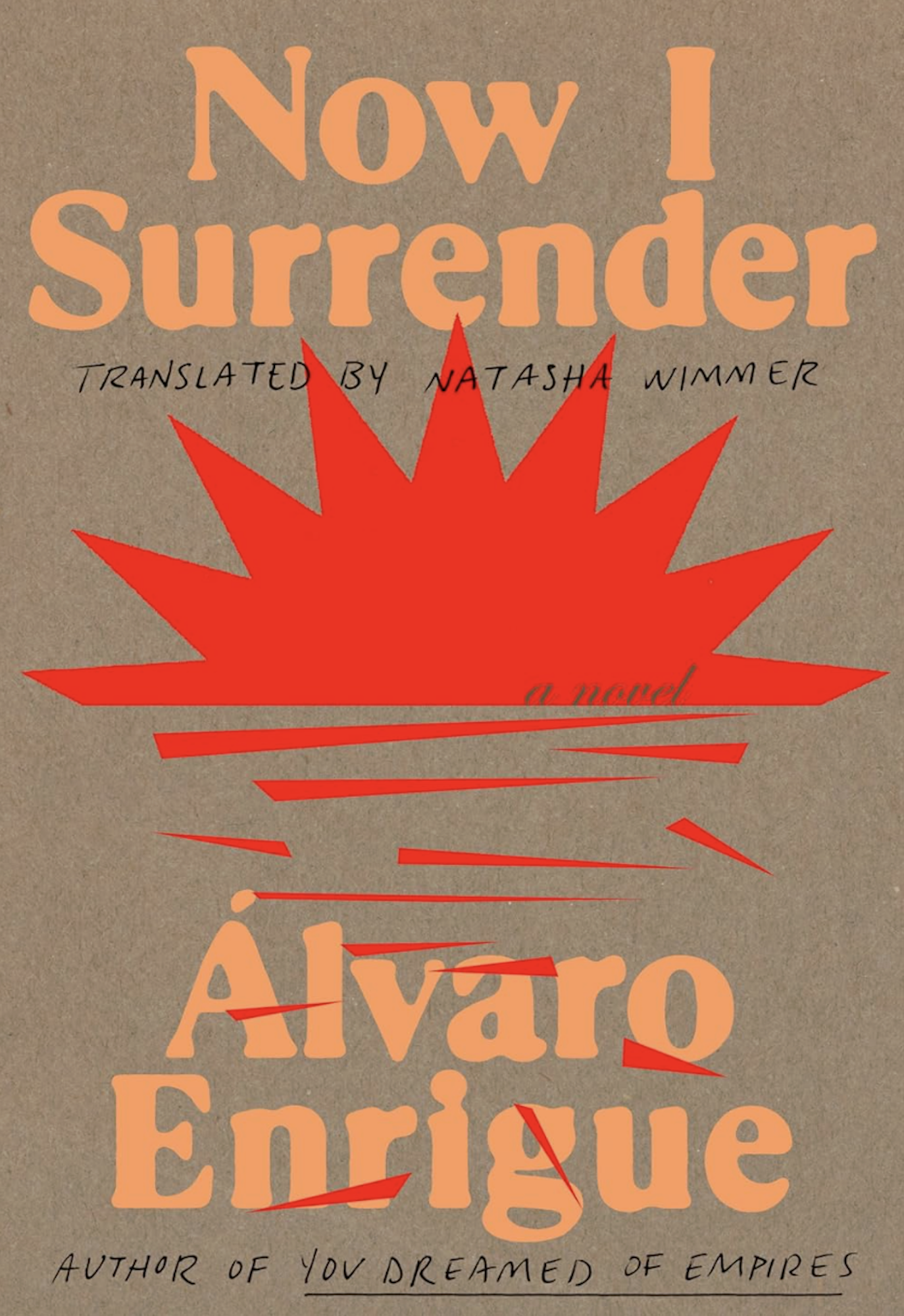
Before the captivity narrative about a Mexican woman abducted by the Apache in the mid-1800s; before the storyline about Geronimo’s surrender; before the torrent of details about the life and peoples on the borderlands between present-day Mexico and the U.S.; there’s this first sentence:
In the beginning, things appear. Writing is a defiant gesture we’ve long since gotten used to: where there was nothing, somebody put something, and now everybody sees it. For example, the prairie.
That’s the opening of Álvaro Enrigue’s new novel, Now I Surrender. The words are spoken by Enrigue himself: He appears throughout the novel as a writer traveling on a road trip through the Southwest with his family. They’re visiting sites that tell the story of the Apache fight for survival.
That Prospero-like opening gives readers fair warning about how defiantly challenging, occasionally overblown, and, at times, magical this epic novel is going to be. In the self-conscious hallucinatory tradition of historical novelists like E.L. Doctorow and Don DeLillo, Enrigue keeps intrusively reminding us that this overpacked tale of the past is something he’s constructing, as much as resurrecting. And, like his predecessors, Enrigue subscribes to a paranoid reading of history. As a character in Libra, DeLillo’s novel about the Kennedy assassination, says: “This is what history consists of. It is the sum total of the things they aren’t telling us.”
There’s so much that “official history” hasn’t told us about “how the West was won” that Enrique here works furiously to fill in some of the silences.
The novel’s most engrossing, if brutal, storyline follows a young Mexican woman named Camila. We first see her running into the prairie after an Apache raid wipes out everyone else living on her elderly husband’s ranch. To give you a sense of how immediate and visual Enrigue’s writing can be, here’s the moment when the Apache catch up with Camila:
[S]he didn’t look back, but she clearly heard a group of horses breaking away from the herd of running cattle and swerving toward her. When the dust raised by the pounding of the horses’ hooves began to sting her eyes, she threw herself on the ground and curled into a ball, hoping to be trampled to death.
Then she was yanked up by her braids, her neck wrenched, her legs kicking, her brown underskirts a flower in the wind. …
Camila’s abduction spurs a second narrative featuring a rag-tag search party assembled under a Lieutenant Colonel of the Mexican Republic. The searchers ride far into the vast territory that was once known as Apachería. Enrigue tells us this ancient homeland of the various Apache tribes:
was taken away from us like cassette tapes or incandescent light bulbs. Where Sonora, Chihuahua, Arizona, and New Mexico meet today was an Atlantis, an in-between country. And straddling it were the Mexicans and the gringos, like two children, eyes shut, their backs to each other, while the Apaches scuttled back and forth between their legs, not sure where to go with strangers bubbling up everywhere, filling their lands.
The end game for the Apache began in March 1886 when their great leader and shaman, Geronimo, surrendered with a small band of warriors to the U.S. Army. According to the official transcript of that moment, Geronimo said, “Once I moved like the wind. Now I surrender to you and that is all.”