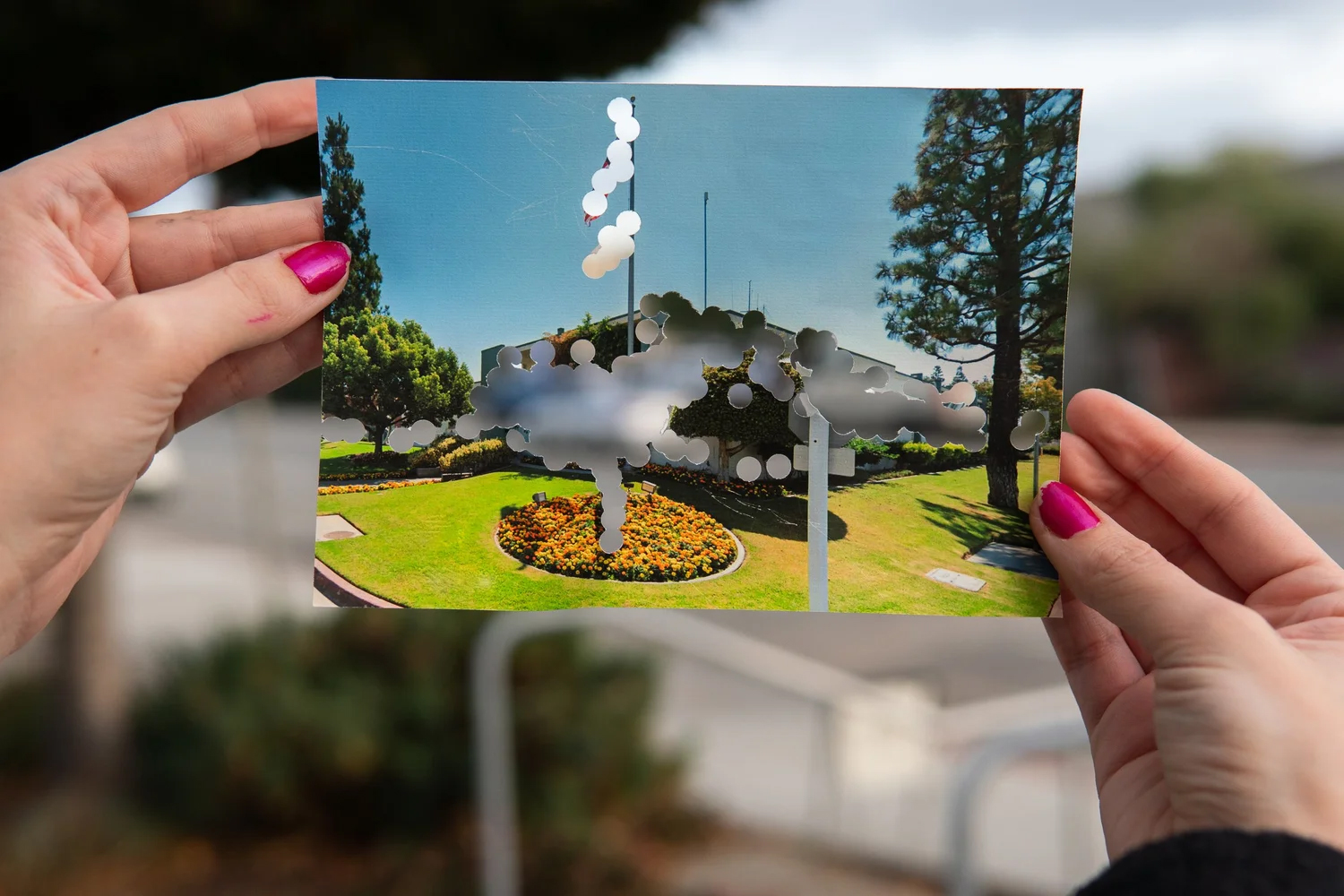
A participant holds up a hole-punched photograph after a 'Disappearance Jail' workshop facilitated by artist Maria Gaspar. (Courtesy of the artist)
As major institutions retreat from political controversy into safe exhibitions on anodyne subjects, it behooves the art lover to explore locations too often overlooked. If you seek art that makes you think, slow burn at San Francisco State University’s Fine Arts Gallery is just the thing.
slow burn gathers an impressive roster of artists who explore slowness as a form of resistance — without the glib simplicity of self-care mantras co-opted by bath salt companies. Instead, artworks made by Mara Duvra, Tesora Garcia, Maria Gaspar, Tianzong Jiang, Ana Mendieta, Joshua Moreno and Elaine T. Nguyen employ slowness as a force to counter the cultural erasures, carceral oppression, and capitalistic pressure for urgency that flow from U.S. imperialism.
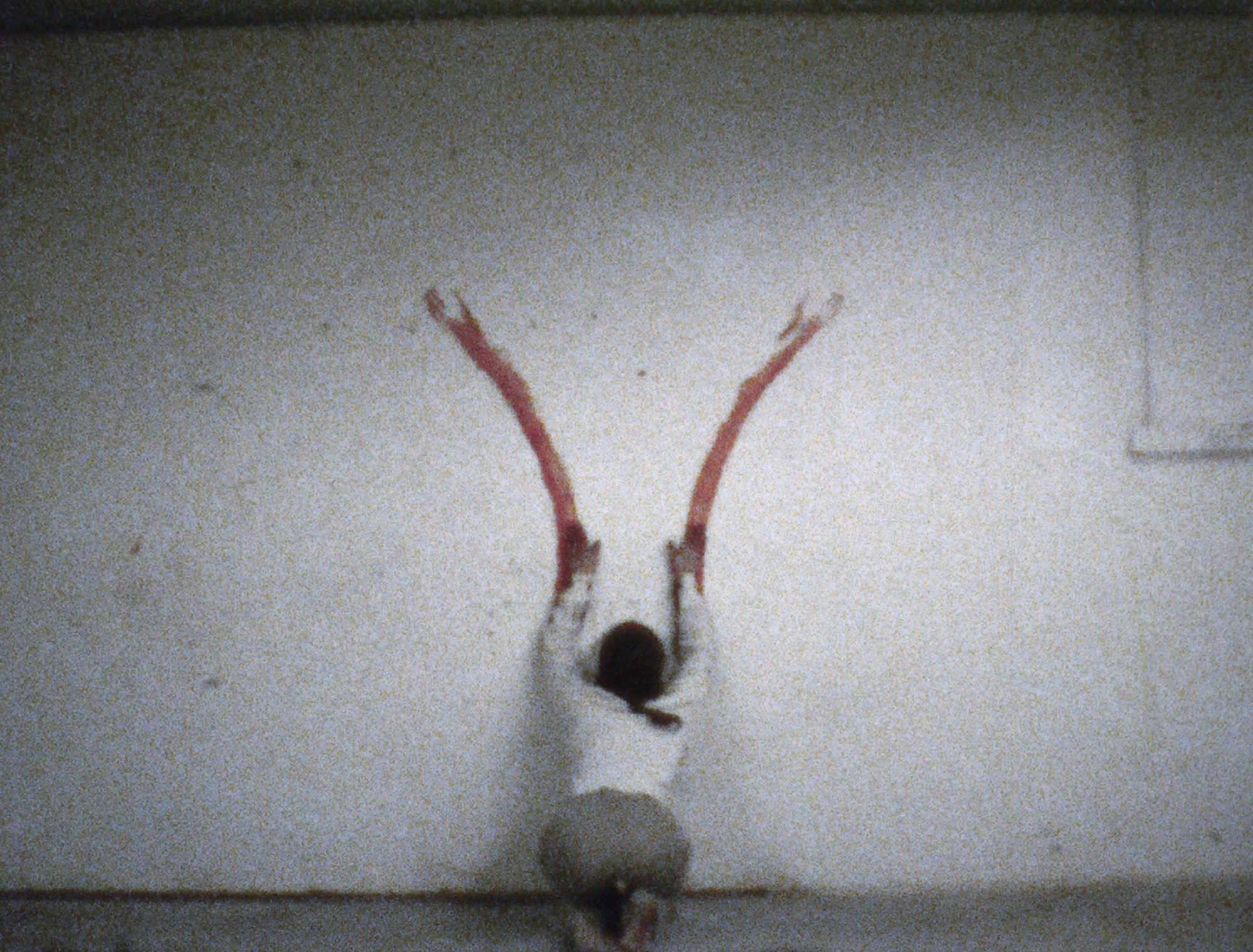
The artworks can be surprisingly beautiful. In a Super 8 film I could watch on repeat for hours, Ana Mendieta sinuously drags her arms down a wall, leaving bloody tracks resembling a branchless tree. In a video piece titled Ecstatic Visions from Outer Space, Tesora Garcia kneels before monuments on the National Mall, sometimes draping her body, clad all in white, over stone inscriptions.
Some artworks ask the viewer to relinquish what curator Lorena Molina calls “manufactured urgency.” Mara Duvra’s installation a holding place offers a chair, desk and notebook for recording what you hold space for. In Eating a Bowl of Rice, artist Tianzong Jiang films himself slowly consuming the bowl, grain by single grain, trying to fully concentrate on the task at hand.
“It is about opening up the wisdom,” Jiang tells KQED. “You will be able to achieve this state of stillness if you’re at the present moment.”
The present moment might be the only time to see Joshua Guadalupe Moreno’s installation of precariously balanced found objects from Watsonville (where he currently lives), San Francisco (where his community resides), and Palo Alto and San José (where he works).
Rocks, stacked pencils, and sculptural discarded chewing gum sit lightly on unsecured supports of Styrofoam packaging and balanced rulers. A bottle cap, a tooth floss pick, daisies and other flora rest on glass tiles, but unlike their scientific counterparts squished between two planes, Moreno’s specimens rest unrestrained. The slight movement of a passerby is guaranteed to blow an unsecured piece of paper to the ground before the exhibition closes.
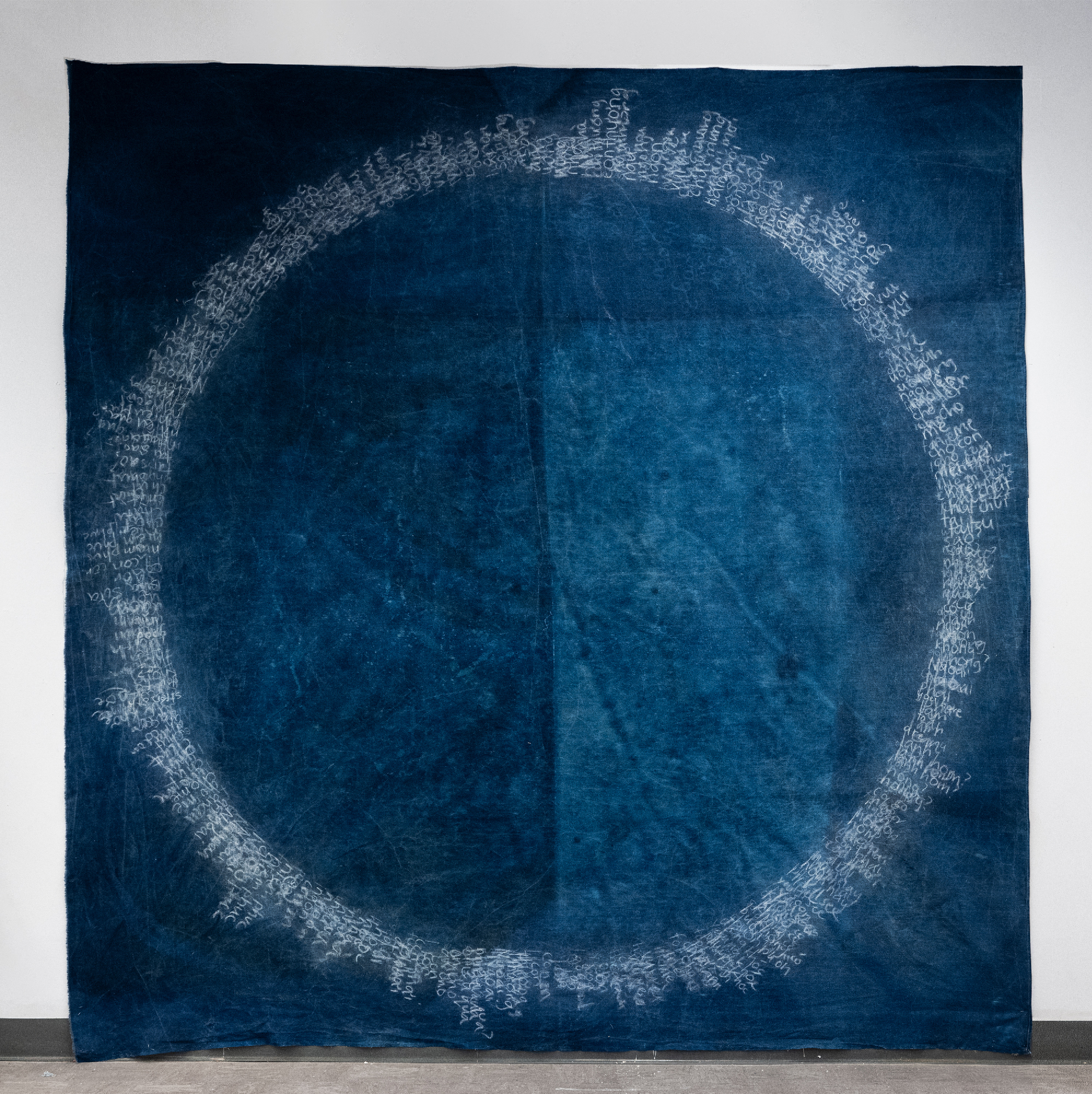
Elaine Nguyen, ‘Ngoại ăn, Ngoại có sức khỏe,’ 2024; porcelain and cyanotype on canvas, 12 x 12 feet. (Courtesy of Fine Arts Gallery, San Francisco State University)
Perhaps the exhibition’s most moving work is Elaine Nguyen’s large canvas cyanotype hung on the gallery’s back wall, titled Ngoại ăn, Ngoại có sức khỏe, roughly translated to “grandma eat, grandma regain your strength, your health.”
Those were some of the few simple Vietnamese phrases Nguyen could pull out of the language, she explains: “It was always an extraction.” Her immigrant parents insisted she speak English to succeed in America. When Nguyen’s grandmother fell ill while Nguyen was in college, she began to teach herself Vietnamese — even though she feared it might be too late.
For this 2024 artwork, she inscribed phrases with porcelain chalk on a 12-foot-tall square cyanotype, a photographic printing process that colors deep blue with exposure to light. Its shade records the amount of time it was exposed to light while Nguyen walked on top of the words. “It becomes this act of remembering, writing, and then also erasing what you’ve written and preserving it in the mind instead,” says Nguyen.
“Every time it’s unfurled, it loses its vibrance,” she explains. The porcelain fades, the cyanotype absorbs more light. “It’s like every time you remember a memory, it changes a little bit.”
“Slow work demands a lot from the viewer,” Molina tells KQED. “To slow down is to really engage with what we’re witnessing, as a way to try to understand what we can do to care for ourselves and our communities.” She notes that slowness can also be employed as oppression, as “slow violence.” Like bureaucracy that stymies immigration or access to social services.
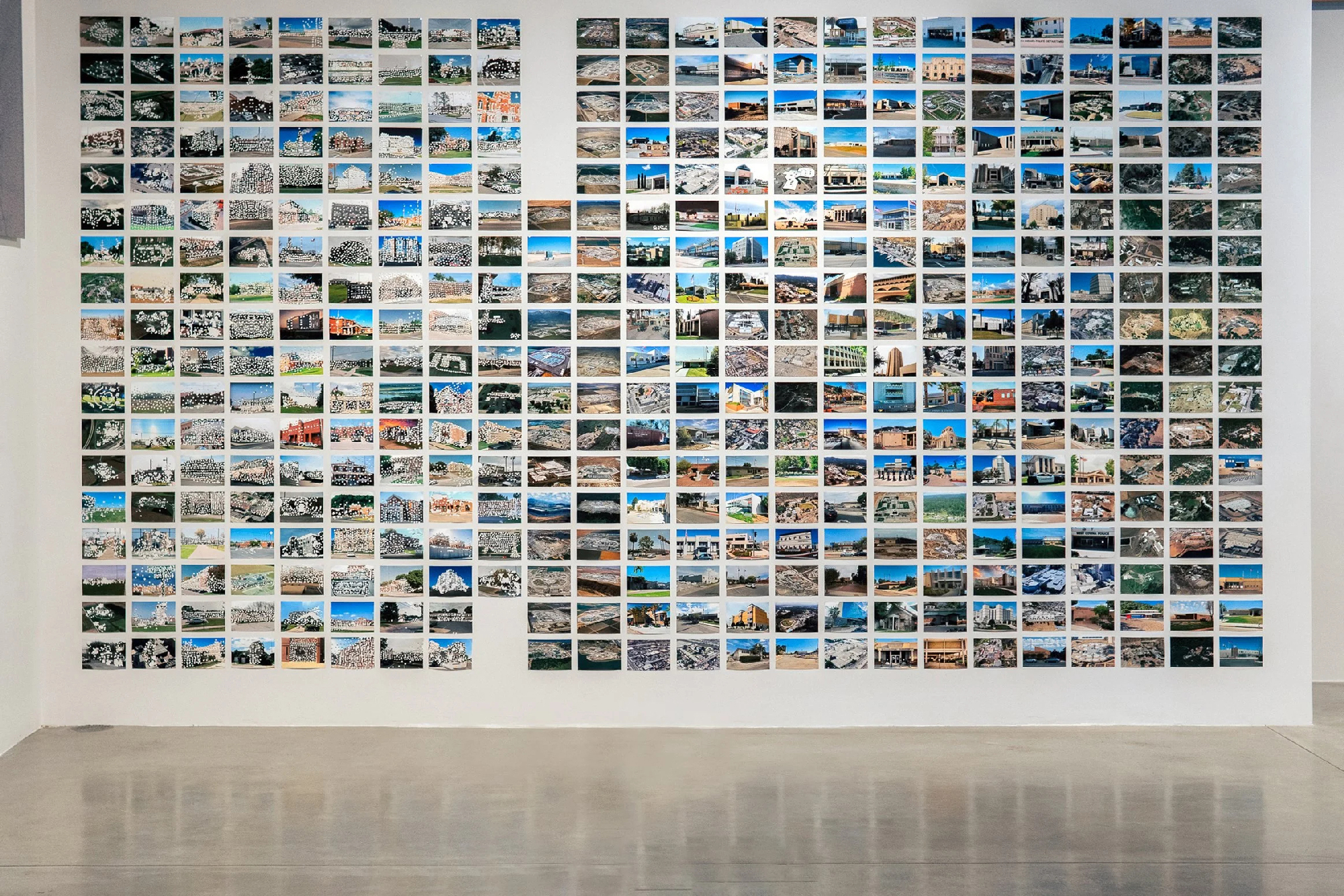
Maria Gaspar, ‘Disappearance Jail,’ 2021–ongoing. A selection of 556 images from a series of perforated archival inkjet prints on rice paper, 5 x 7 inches each. (Courtesy of Fine Arts Gallery, San Francisco State University)
The slow violence of the state appears in the 556 individual photographs from Maria Gaspar’s Disappearance Jail project. State by state, Gaspar creates an index of jails, prisons and detention centers; locates an image of each site; and presents the photographs to community members with a hole punch. As individuals punch holes in the prison photographs, “people are invited to think about abolition, but through the lens of freedom,” she explains.
The perforated, transformed images are more affecting than one might guess. To see ponderous buildings disappeared visualizes freedom from a carceral system so entrenched its removal seems nearly impossible — until thousands of small holes are made.
As art programs and schools close in dismaying succession, a university gallery is an increasingly rare resource for Bay Area students. I arrived at slow burn the day before the opening to find faculty member Kevin Chen’s ART 619 Exhibition Design class busily checking plumb lines for Gaspar’s photo grid. Presented on a slim budget of $4,000, resourcefully deployed, slow burn would not have been possible without the work performed by SF State students, many of whom will later pursue curatorial careers.
Students are lucky to learn curating in an environment that can focus on the merits of the exhibition without external stakeholders urging political caution. So it’s worth noting the Fine Arts Gallery is responsible for its own fundraising, which gallery director Sharon Bliss says “gives us this weird freedom.” As for the viewing public, taking advantage of the gallery is easy: admission is free and so is nearby parking.
It’s one place in San Francisco unafraid of challenging topics.
‘slow burn’ is on view at the Fine Arts Gallery at San Francisco State University (1600 Holloway Ave., San Francisco) through April 4, 2026.