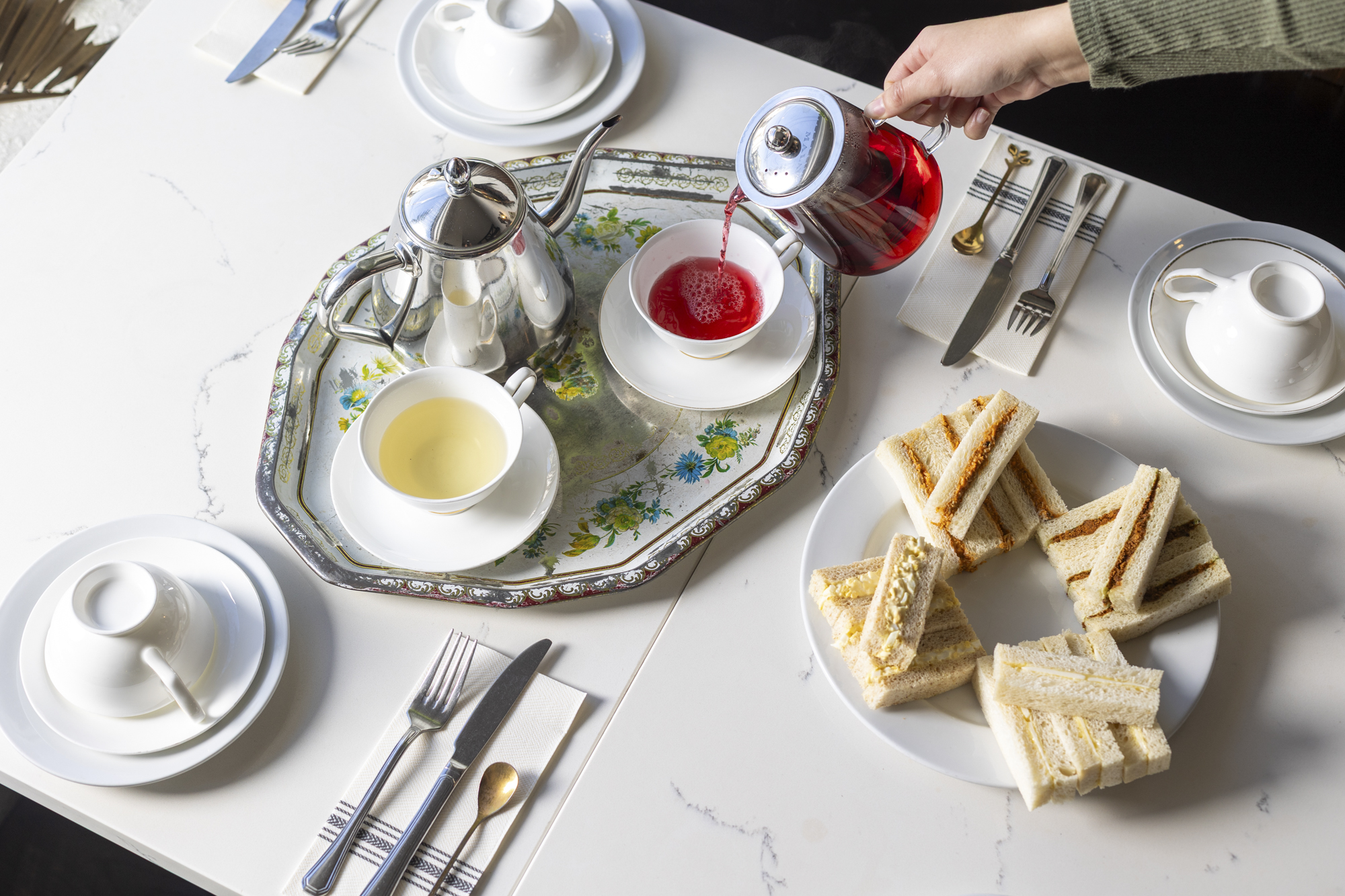
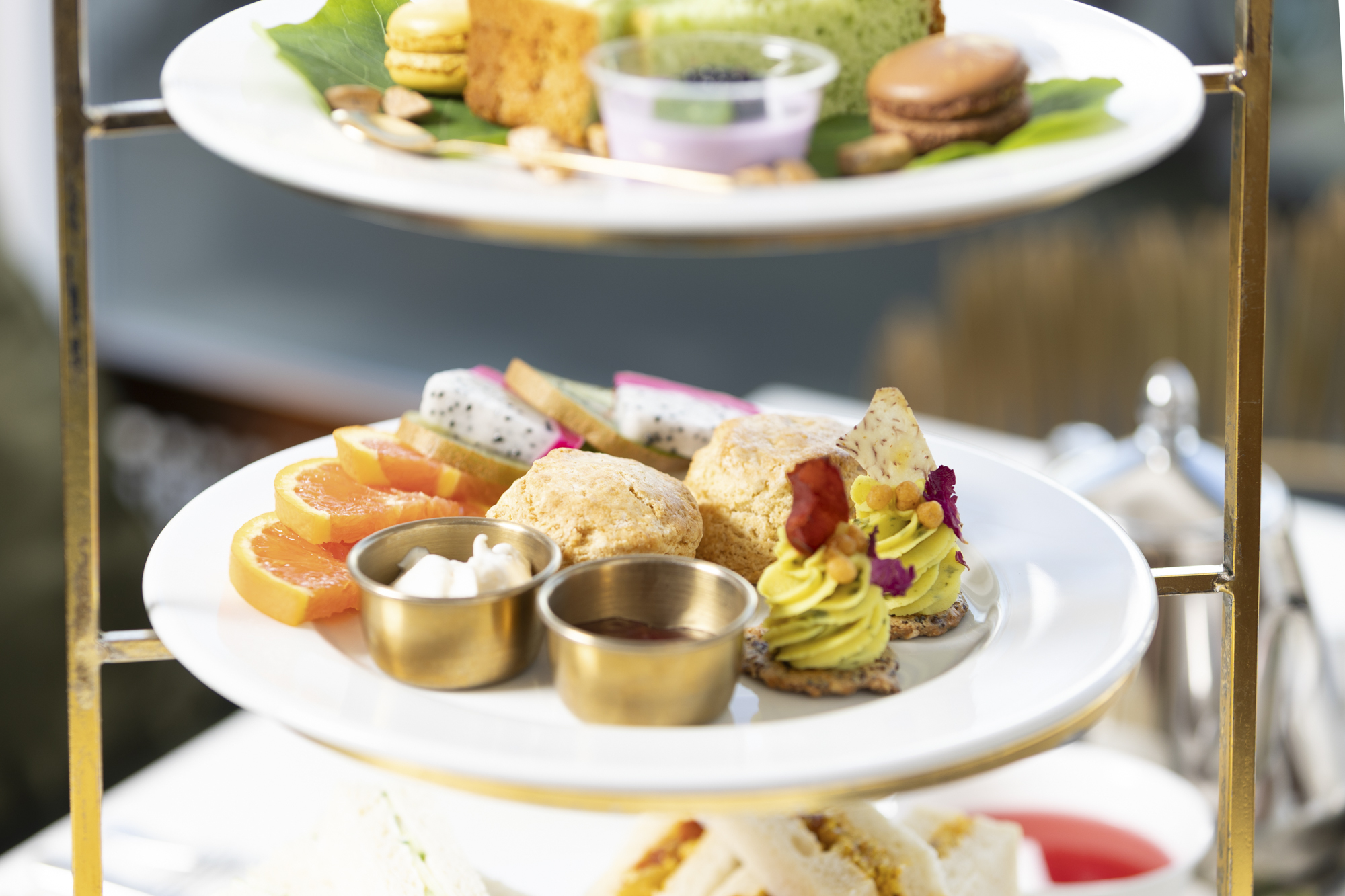
Hibiscus tea is poured during afternoon service at Malaya Tea Room in Alameda on Feb. 6, 2026. Savory options include both British-style cucumber finger sandwiches and Malaysian-inspired offerings, such as spicy tofu sambal. (Gustavo Hernandez/KQED)
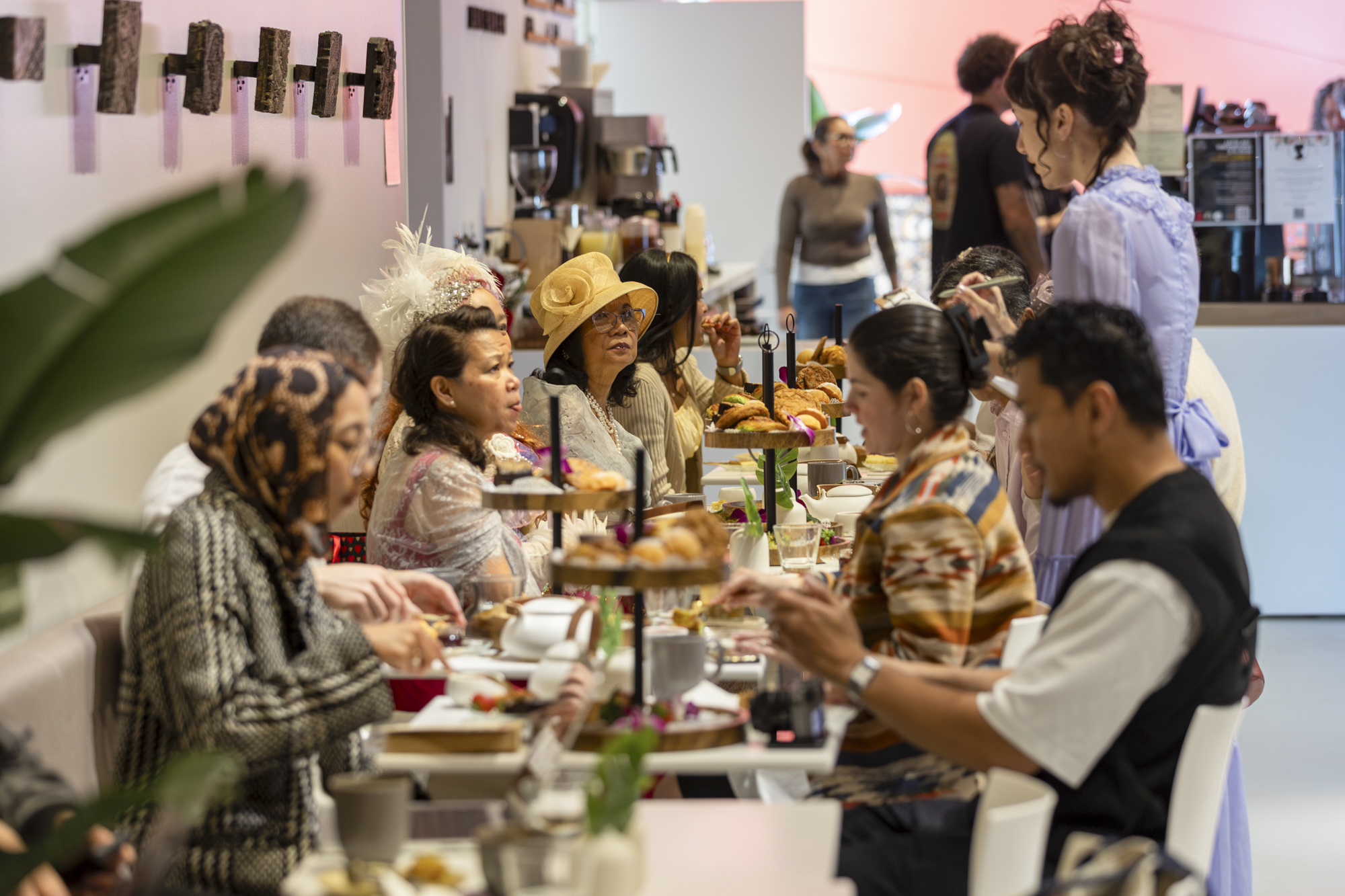
On a recent Saturday morning, about a dozen elegantly dressed pastry lovers, decked out in their finest Regency-era gowns and dainty flower hats, promenaded into the Berkeley Art Museum and Pacific Film Archive. Up the museum’s bright red staircase they went, pausing occasionally to snap a selfie, until they’d reached the second-floor cafe, where a handsome spread of teacakes and finger sandwiches awaited.
The occasion? A Bridgerton-themed tea party, which the cafe, Kopi Bar, had timed to coincide with the soapy Netflix costume drama’s fourth season premiere. Thus the cavalcade of pearls and frilly chiffon gowns. Everything about the event appeared to be oh-so-perfectly British in its sensibilities — except that the food displayed on the wooden two-tier cake stands wasn’t only your typical array of scones, clotted cream and cucumber sandwiches.
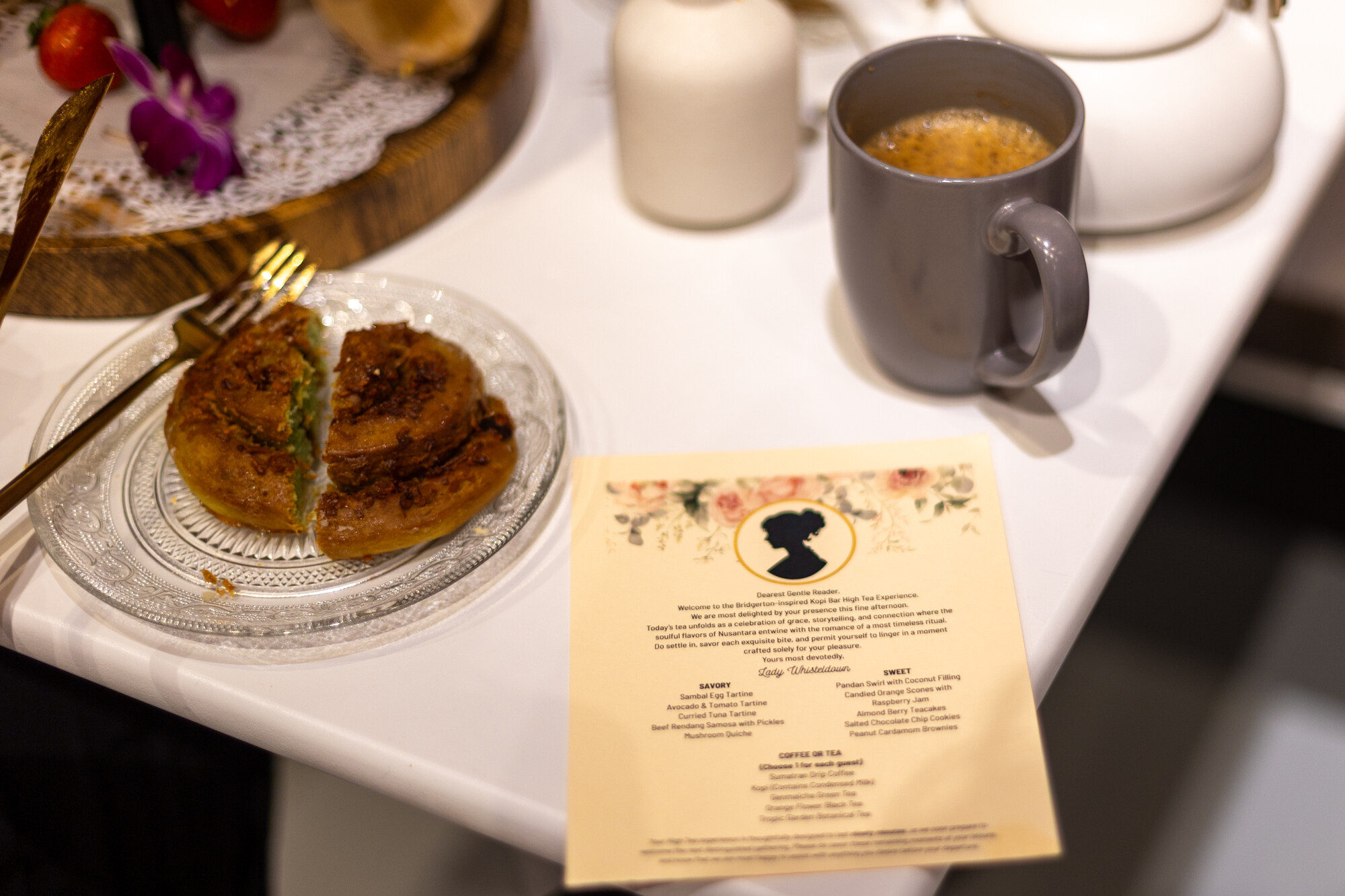
Cinnamon-roll-like pastry swirls shot through with sweet pandan and coconut sat next to crispy beef rendang samosas. Curried tuna salad topped delicate open-face sourdough brioche sandwiches. And while one sandwich did feature sliced cucumbers, they were mainly there to provide a cooling counterpoint to the fiery sambal-spiked egg salad on top.
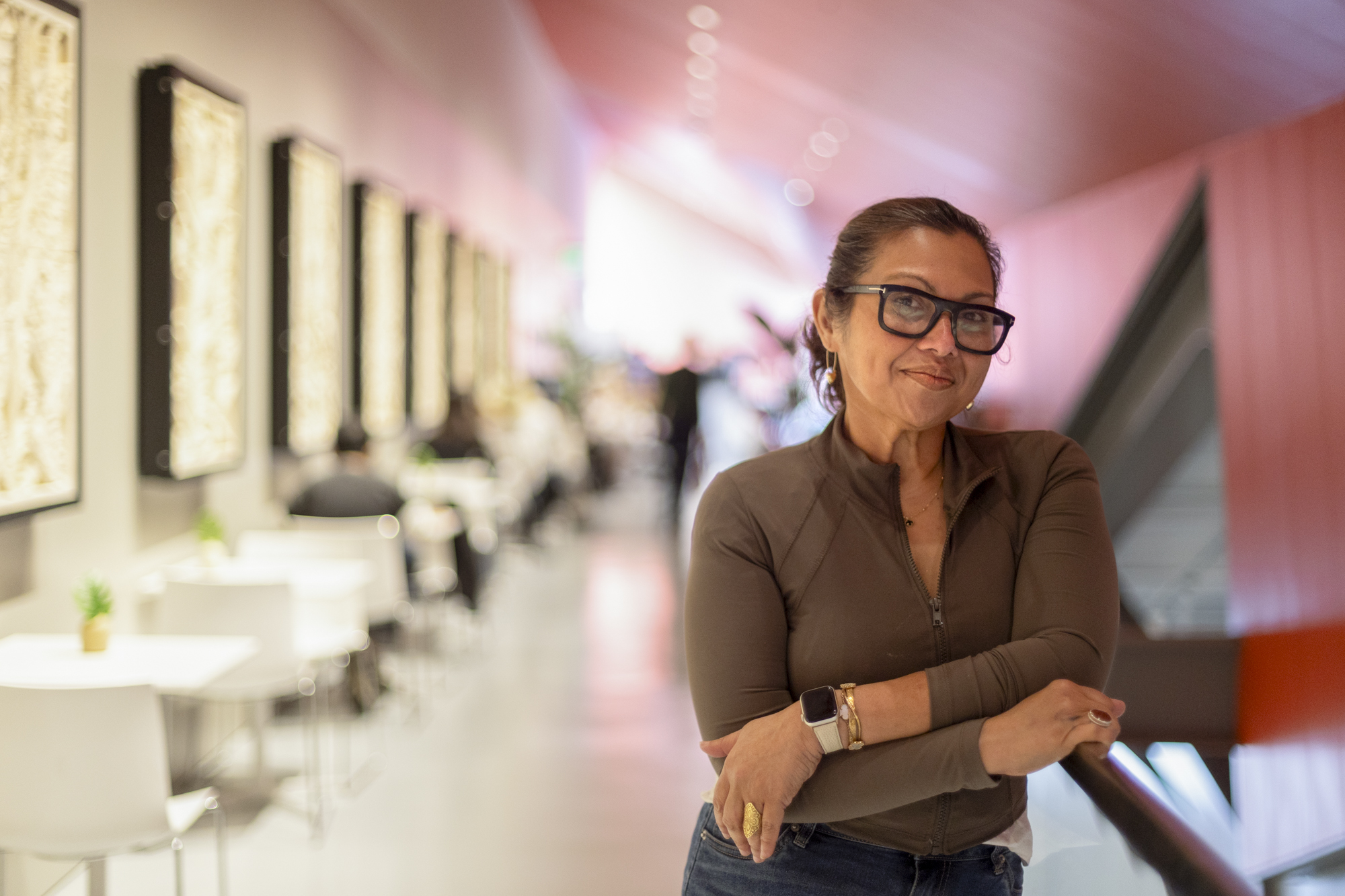
This is the kind of food that chef-owner Nora Haron likes to serve at Kopi Bar — a reflection of her background as a Singaporean immigrant of Indonesian-Indian descent. And while the spread might have surprised some Anglophile tea party enthusiasts, anyone who’s taken high tea at, say, one of Singapore’s grand hotels would find the mix of Eastern and Western flavors utterly familiar.
After all, in countries like Singapore and Malaysia, where afternoon tea is a well-loved remnant of British colonization, it’s standard practice to combine the format and the aesthetics of English-style tea service with an infusion of Asian flavors. There, too, Haron likes to point out, guests get dressed up and sip their Earl Grey with their pinkies out.
Guests share tea and pastries while dressed in “Bridgerton”-inspired outfits during Kopi Bar’s themed high tea service on Jan. 31, 2026, at the Berkeley Art Museum and Pacific Film Archive in Berkeley. (Gustavo Hernandez/KQED)
The Bay Area has its own rich tea party traditions, mostly nodding to the British style. But up until a couple of years ago, it was nearly impossible to find this kind of hybridized, Asian-inspired afternoon tea service.
That’s no longer the case. In fact, we’re experiencing something of a golden age for Asian-style afternoon tea here in the Bay Area, as new pop-ups and standalone tea rooms crop up to satisfy the growing demand.
To wit: Kopi Bar’s aforementioned Bridgerton tea series will take over a section of the cafe every Saturday at least through the end of February. Little Moon Bakehouse, an Asian American vegan baking company in Oakland, hosts “reimagined” afternoon tea pop-ups at different venues around the Bay — packing 100 sweets lovers onto, say, the second floor of San Francisco’s Ferry Building for moon cakes and mini pork floss buns. Meanwhile, Pamana Plantas, a plant store in Berkeley, has started throwing kamayan-inspired Filipino tea parties, lining the tables with banana leaves and ube pastries. And while the afternoon tea program at San Francisco’s Son & Garden, a lavishly flower-bedecked spot from the owners of the Farmhouse Thai restaurant empire, doesn’t have an explicit Asian focus, its themed tea sets often include delicacies like Japanese cherry blossom cookies and homemade samosas.
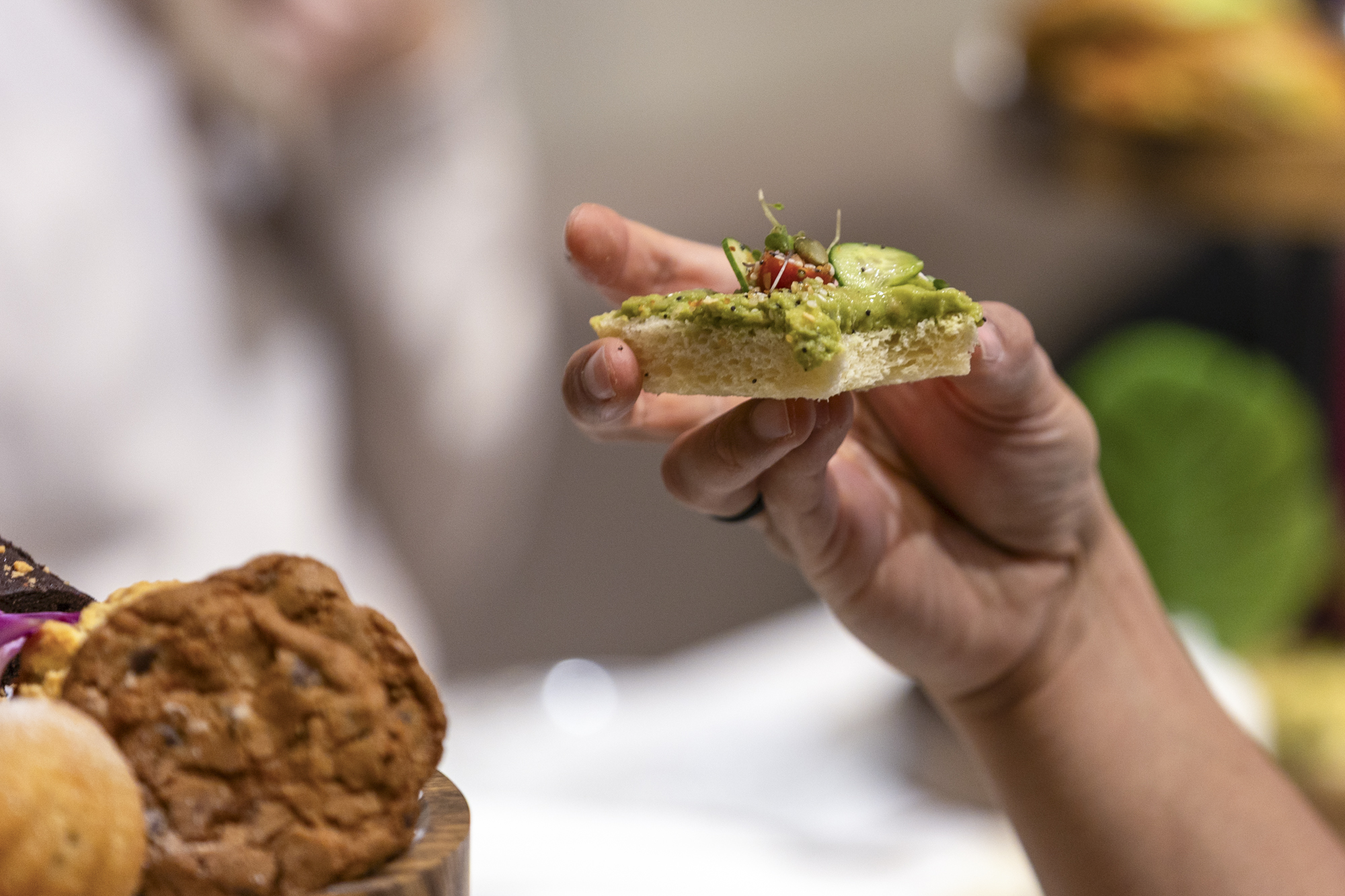
A guest at Kopi Bar holds a tea sandwich topped with avocado and herbs. (Gustavo Hernandez/KQED)
Then there’s the OG of the genre, Alameda’s Malaya Tea Room, which has served elegant Malaysian afternoon tea sets, both in person and as a take-home kit, for nearly seven years.
For her part, Haron says the tea parties have by far been her most popular events since she started hosting them last year. After she moved Kopi Bar to Berkeley from its original Walnut Creek location this past fall, she received a steady stream of DMs from old customers, pleading with her: “Please, please, will you do this again?”
In response to such a groundswell of support, Haron says, laughing, “How can I not?”
Reclaiming a colonial history
Of course, the British were the ones who brought the practice of a light afternoon meal with tea to Singapore and Malaysia during their long period of colonial rule — from 1819 to 1963, in the case of Singapore. The Raffles Hotel, probably the most iconic place to take tea in Singapore, started offering its afternoon tea service — complete with live orchestra — in 1918.
“The new enterprise should be warmly encouraged by the public of both sexes who often find the hours between 4:30 and dinner time hang heavily,” an article in Singaporean newspaper The Straits Times enthused at the time. Meanwhile, a popular restaurant called Emmerson’s Tiffin Room was advertising a more modest daily afternoon tea as early as 1898.
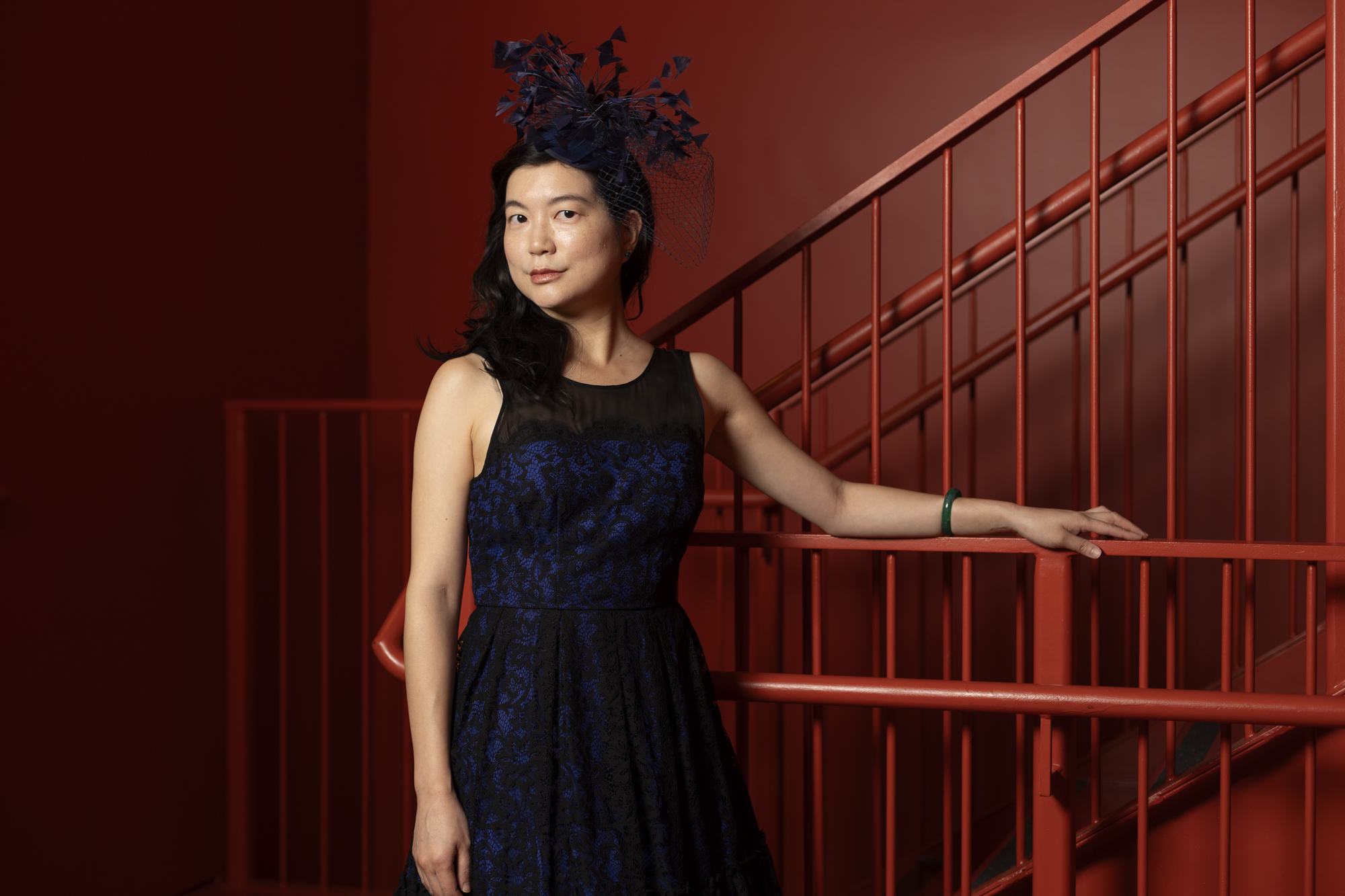
Cindy Lee, a guest at Kopi Bar’s “Bridgerton”-themed high tea, poses in the stairwell at BAMPFA. (Gustavo Hernandez/KQED)
These initial offerings were mostly geared toward Singapore’s British residents, as well as wealthy travelers visiting from Europe. But the custom of taking afternoon tea was eventually taken up by locals as well — and persisted long after the British left.
Local expressions of the tradition began as early as the 1960s, says KF Seetoh, probably the foremost street food expert in Singapore. Cafes began selling kaya toast and local coffee in the afternoon; curry puffs and pandan cakes also first appeared around this time.
“These days at Raffles, you’ll find Indian tiffin meals and tiered trays of high tea offerings, [everything] from the usual British fare to even Nyonya cakes,” Seetoh says. “The evolution [can be] credited to finding an identity true to the mishmash of cultures in Singapore — the best of everyone’s kitchens and grandmas’ recipes.”
A similar story played out in Malaysia. For Malaya Tea Room owner Leena Lim, going out for tea was an occasional mother-daughter treat she remembers enjoying all through her childhood. Every couple of months, her mother would bring her to afternoon tea at the Shangri-La Hotel in Kuala Lumpur, where she’d marvel at all of the fancy cakes and finger sandwiches.
Related Article
“It was such an intimate, beautiful experience,” she says.
Back then, in the ’80s and ’90s, most of the upscale hotel afternoon tea places in Malaysia still served food that was overwhelmingly British. At most, Lim recalls, maybe one item — say, a curry puff — would nod toward the local food culture. Because afternoon tea at the big hotels was “fancy” and expensive, Lim says even locals wanted the food to be authentically British. Why would anyone pay so much to eat a Malaysian snack they could buy down the street for just a few ringgits?
Lim estimates it’s only in the last 10 years or so that even the fanciest British-style tea rooms in Malaysia and Singapore have started leaning more into local flavors, adding sambals and curries and kuehs (assorted bite-size treats made with glutinous rice) into the mix with the scones and cucumber sandwiches that people still expect.
When Lim opened Malaya Tea Room in 2019, on a quiet stretch of Central Avenue in Alameda, she wanted it to be more of a hybrid. At the time, she didn’t know of any other businesses that were throwing Asian–inspired afternoon tea parties. Beloved local institutions like Lovejoy’s more or less replicate the British traditions.
Lim wanted to do both. She planned to do the British stuff just as well as, or maybe even better than, the purely Anglophilic places — to, for instance, be one of the only places that make their clotted cream from scratch. But she also wanted to introduce customers to elegant, afternoon tea versions of some of her favorite Malaysian street snacks — in other words, to serve food that actually tastes good. (She’d grown to find the British standards to be quite bland and boring.) Her menu included one finger sandwich that’s based on kaya toast, another that combines pork floss with a homemade basil spread, and yet another that features bakkwa (Malaysian pork jerky).
British-style scones with clotted cream and strawberry jam sit alongside curried potato canapés on gluten-free crackers during afternoon tea at Malaya Tea Room in Alameda on Feb. 6, 2026. (Gustavo Hernandez/KQED)
When my family arrived at Malaya on a recent Sunday, the atmosphere inside the cozy tea room was languid and vaguely tropical — lush greenery sprawled in every direction; a ceiling fan spun lazily up above. Nostalgic knickknacks (antique Chinese vases, an abacus, an old Hup Seng cracker tin) decorated the display cabinets. On the table was a little bell to ring when you were ready for your server to come take your order.
The sandwiches we loved best included the curry chicken, made with coconut milk and a secret spice blend, and a sardine-and-cucumber number that Lim makes by doctoring the canned sardines in tomato sauce that you can buy at Asian grocers. On the sweets side, we enjoyed an airy-light pandan chiffon cake that wasn’t too sweet — the ultimate compliment for an Asian dessert.
Even the egg salad sandwich, which we ordered off the British side of the menu, was uncommonly good — lush with Kewpie mayonnaise and served on fluffy milk bread. It tasted exactly like the ones you get at 7-Eleven in Japan.
Lim says that’s exactly what she was going for: a familiar flavor that reminds you of childhood.
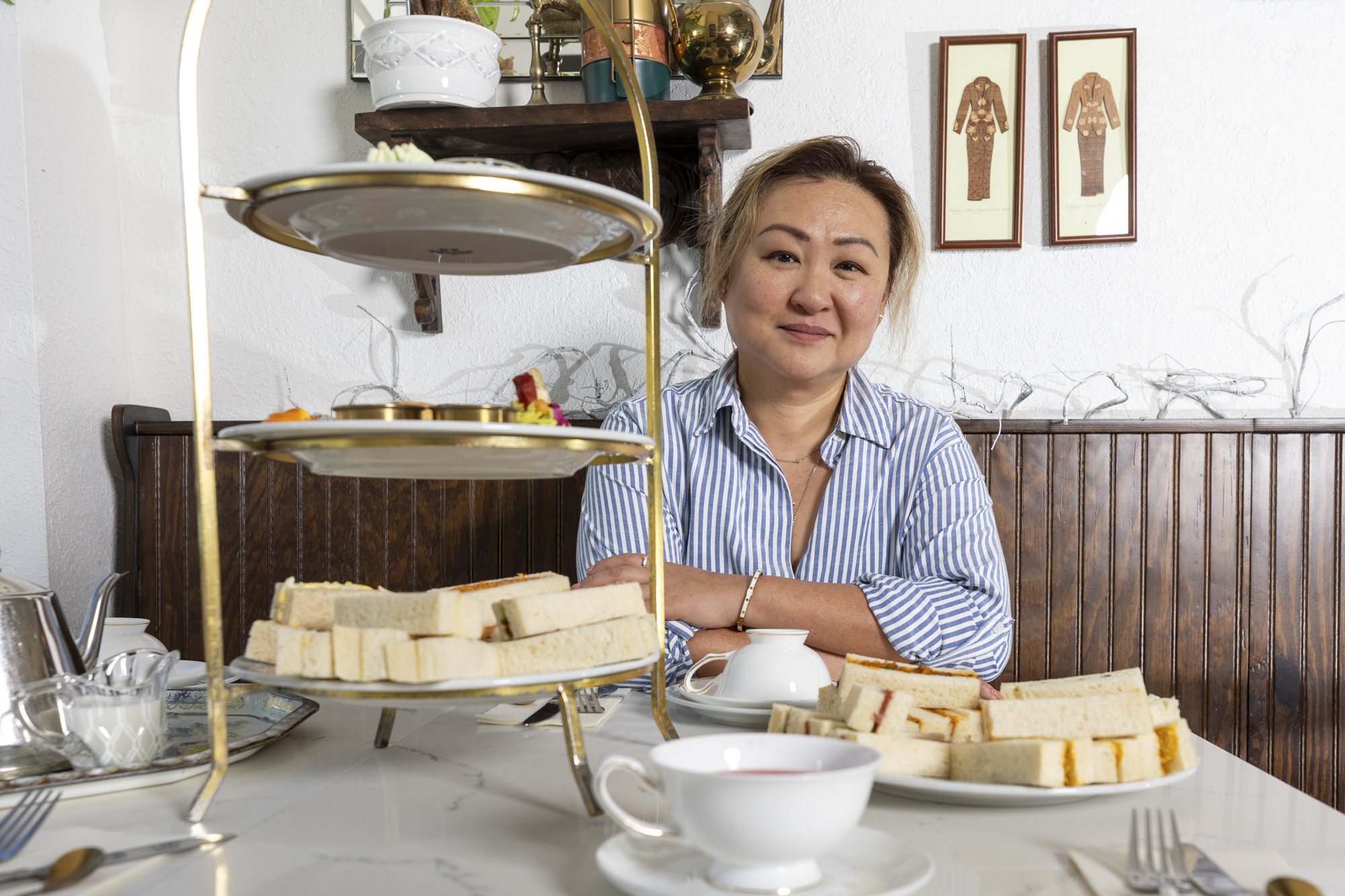
Leena Lim, owner of Malaya Tea Room, sits behind a table set for afternoon tea. The tea room opened in Alameda in 2019 and has become a destination for specialty tea service in the East Bay. (Gustavo Hernandez/KQED)
Her business has had its ups and downs over the past seven years, especially with the pandemic hitting just months after it opened. But she’s developed a loyal customer base, and people do seem to better understand Malaya’s afternoon tea offerings now than they did in the shop’s early days. Part of that, she says, just has to do with how much more popular Asian food is these days — how there’s now a cultural cachet to being the sort of person who understands pandan and ube: “Otherwise, it’s like who are you? Do you even live here?”
It helps that afternoon tea is the ultimate Instagram-friendly meal. Plus, Lim says, “people love dressing up,” and going out for tea provides a rare opportunity to do that. Every year, she has a big group that comes in cosplaying as anime characters.
During our visit, we spotted three elderly women enjoying a quiet conversation, a table of Gen Z Taiwanese ladies chattering happily in Mandarin, and a group of white otaku having an intense debate about Dragon Ball Z.
“Now I even get groups of men who come in by themselves,” Lim says. “I think that’s awesome.”
Tea with a twist
The bakeries and cafes that offer Asian-style afternoon tea in the Bay Area all have their own charm — and their own little twists on the genre.
Little Moon Bakehouse owner Annie Wang says her pop-ups are a natural extension of the fact that she started baking bread for the first time in 2024, adding a variety of Chinese bakery–style buns to her repertoire of plant-based cookies and mooncakes. Unlike Wang’s other baked goods, the breads don’t have long enough of a shelf life to ship nationally.
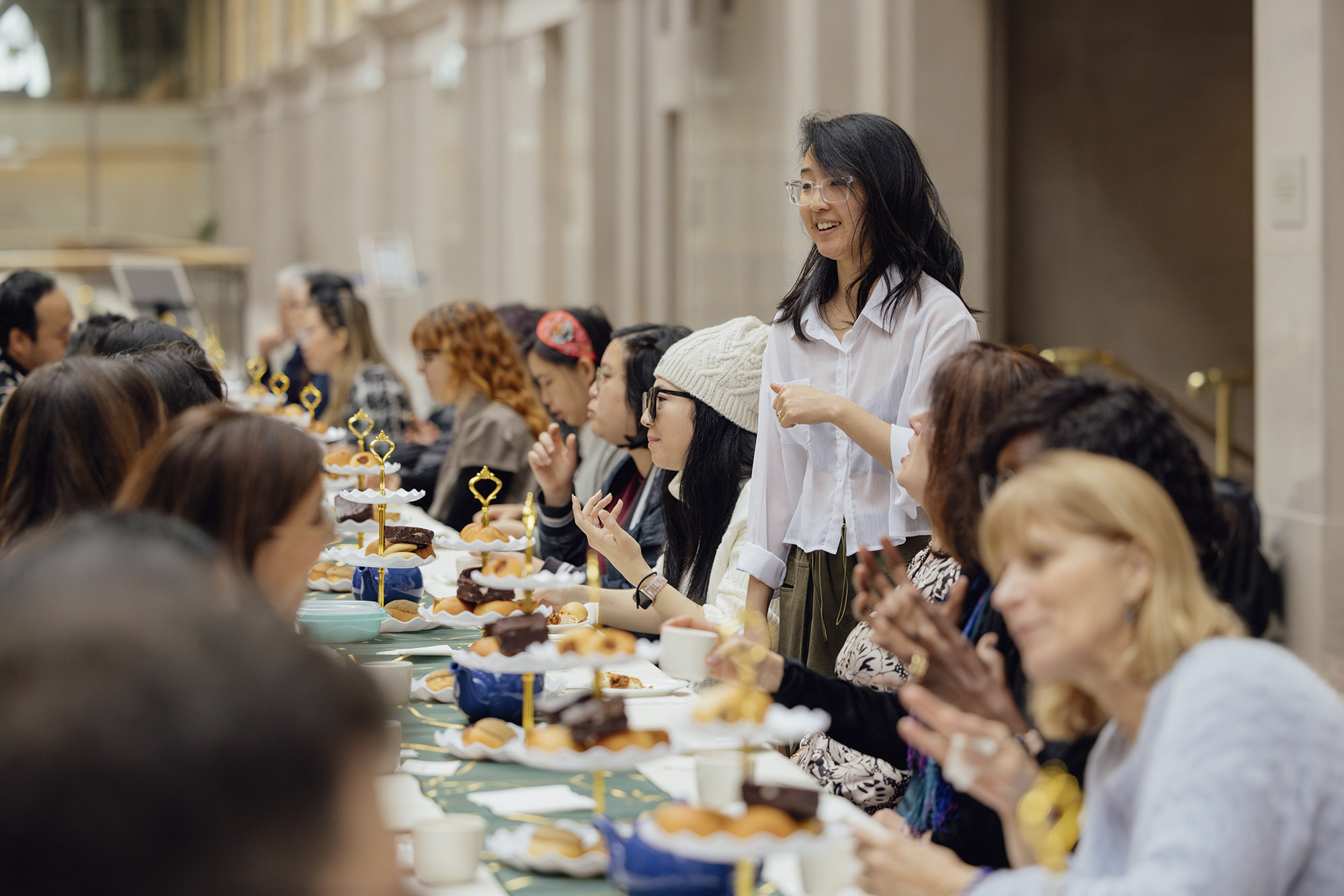
Little Moon Bakehouse owner Annie Wang (standing) mingles with guests at her afternoon tea pop-up at the San Francisco Ferry Building on Dec. 14, 2025. Featured items included plant-based mooncakes and mini pork floss buns. (Phil Stockbridge/SF Event Photo)
“I realized that this would be great for an experience,” she says. She started renting out venues across the Bay Area to host one-day afternoon tea pop-ups, filling up three-tier cake stands with an equal split of sweet and savory treats.
On Feb. 22, she’ll host her second tea pop-up in the San Francisco Ferry Building — a Lunar New Year–themed bash for 100 guests, seated at long tables that stretch the length of the festive second-floor Grand Hall.
The menu will include miniature pork floss buns, garlic butter buns, and citrus zest sugar cookies filled with soy sauce–spiked white chocolate (that one is a collaboration with Heydoh, a Taiwanese American soy sauce brand). In the coming months, she’ll host additional pop-ups in SF Chinatown, the Sunset District and San José.
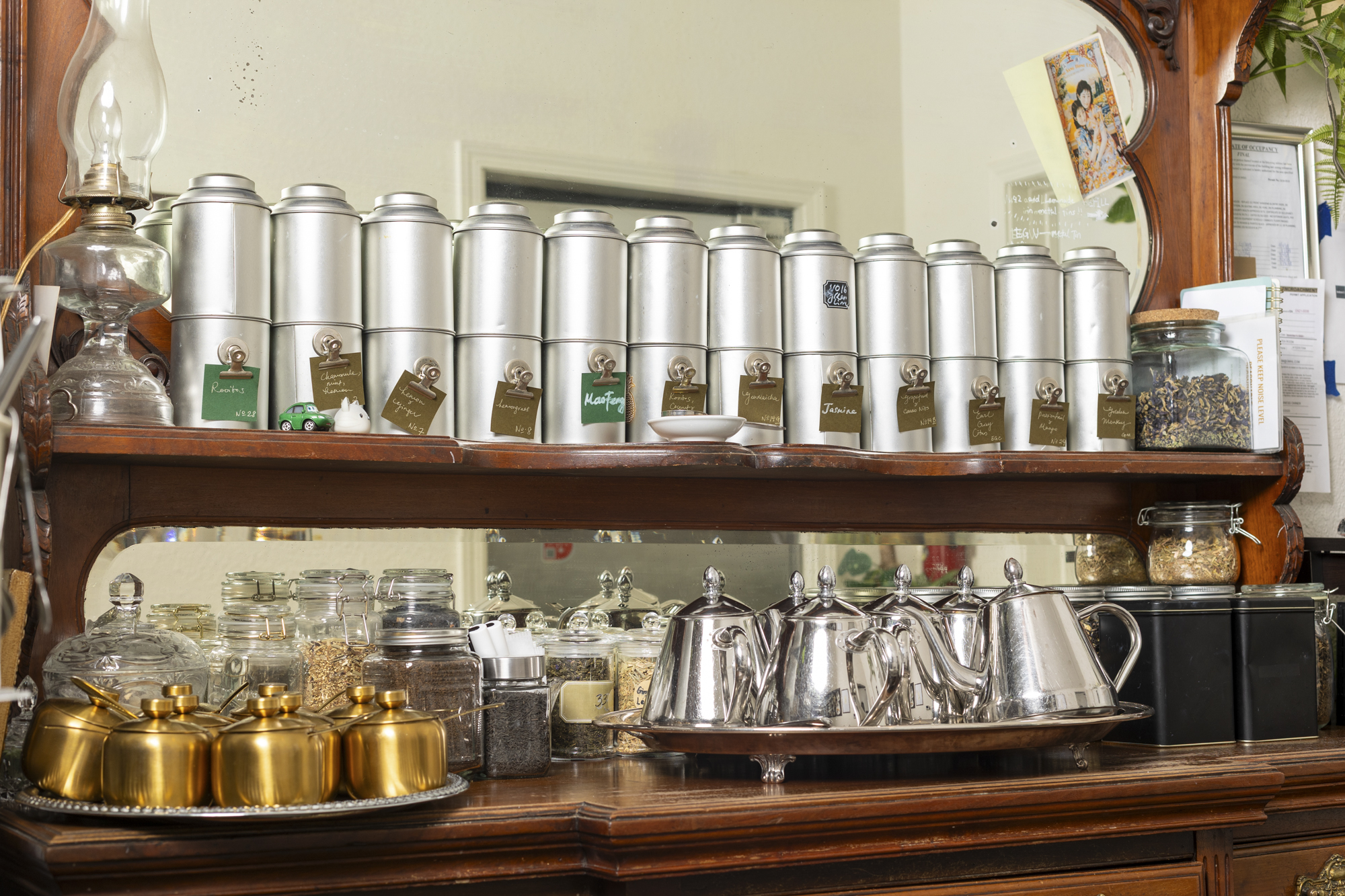
Loose-leaf teas line a wooden cabinet at Malaya Tea Room. The tea room serves a wide selection of teas in a space filled with nostalgic antique furnishings. (Gustavo Hernandez/KQED)
Meanwhile, Jai Kandayah, the owner of Pleasanton’s recently closed Curry Leaves Bistro, says he never intended to serve afternoon tea at his restaurant. He, too, grew up taking afternoon tea in Malaysia, but not the kind served at fancy hotels, which wasn’t accessible for working-class people. For the majority of Malaysians, afternoon tea — or high tea — was more of a home ritual.
(In Kandayah’s experience, Malaysians are more likely to talk about “high tea” than afternoon tea, referring to a heartier meal eaten later in the afternoon, at perhaps 4 or 5 p.m. after they get home from work — much more practical for working-class folks who can’t leave their jobs to eat cakes for an hour at 2 in the afternoon.)
These meals always featured local flavors, Kandayah recalls. “I remember my mom would make a big pot of tea in the afternoon and then usually a savory snack — banana fritters, fried yucca, fried yams, fried taro,” he says. Sometimes the bread man would come around, and they’d buy a loaf and dip the bread in the curry that was left over from lunch.
The local high tea buffets he remembers frequenting as a young man similarly skewed toward Malaysian flavors. Many of them would even serve fried noodles.
But again, Kandayah never had a high tea menu at Curry Leaves Bistro. Instead, regular customers — all of them older Malaysian immigrants — would knock on his door on Friday or Saturday afternoons, when the restaurant was closed.
“People would call and say, ‘Hey, there are eight of us coming in at 4 o’clock after our golf game. Can you prepare some tea and roti, and a plate of noodles?’” Kandayah says. “And we would do that.”
Curry Leaves Bistro wound up closing this past fall after the landlord increased the rent, but Kandayah has already scouted out a new location in the East Bay and hopes to reopen later this year.
This time, he says, afternoon tea on the restaurant’s backyard patio is going to come officially baked into the program.
A celebration of immigration
Meanwhile, Kopi Bar has leaned into the cosplay of it all. In addition to her Bridgerton series, Haron has also hosted Bollywood- and Arabian Nights–themed afternoon teas, and encourages guests to come dressed up to reflect the theme. People come for Haron’s stellar baked goods, sure. But they also come because the tea parties are joyful and extravagant — an all-out happening, as they say.
And for Haron, in the current political climate — while masked federal agents whisk soccer moms and five-year-old kids away to far-off detention centers — her tea parties aren’t just some frivolous, let-them-eat-cake moments to cosplay as British aristocrats. They’re important rituals that allow immigrants like her to come together and celebrate.
Chef Nora Haron, owner of Kopi Bar and Bakery, poses in her cafe on the second floor of BAMPFA. (Gustavo Hernandez/KQED)
“This idea of ‘illegal’ immigrants being criminals — that’s obnoxious. We’re doing something for the community. You know, we’re bringing people together. We’re creating jobs,” she says. “So it’s wonderful to be able to support one another this way.”
After all, she says, food is intertwined with the immigration process. And traditions like afternoon tea are a vital way for immigrants to maintain their cultural identity.
Back in Singapore and Malaysia, the history of afternoon tea followed the same path as so many other things in Southeast Asia: The colonizers brought it, but locals improved it.
A pandan and coconut pastry swirl sits next to Kopi Bar’s “Bridgerton”-inspired high tea menu. (Gustavo Hernandez/KQED)
As the food writer Seetoh puts it, “You can still spend over a hundred bucks for the little pinky high teas at posh hotels flavored with affluence, but the majority, even the well-heeled, prefer a kueh salat, curry puff or ang ku kueh at local cafes.”
“It feels more like a Singapore story,” he says.
So it goes here in the diaspora, as Asian Americans create a new set of traditions replete with sourdough, vegan pork floss and the Bay Area’s own unique sense of swagger. They, too, are making afternoon tea their own.
Kopi Bar’s Bridgerton high tea series will run every Saturday through Feb. 28, plus an additional date on March 1, with seatings at 11 a.m., 1 p.m. and 3 p.m. Tickets are limited. The cafe is located on the second floor of BAMPFA, at 2155 Center St. in Berkeley.
Little Moon Bakehouse’s Lunar New Year–themed afternoon tea will take place on Feb. 22, 11:30-1:30 p.m., at the SF Ferry Building (1 Ferry Building, San Francisco). Tickets are limited. Future tea events are scheduled to take place in SF Chinatown, the Sunset District, and San José.
Malaya Tea Room has three seatings per day, Thu.-Sun., at 11 a.m., 1:15 p.m. and 3:30 p.m. It’s located at 920 Central Ave. in Alameda.
lower waypointnext waypoint
Player sponsored by
window.__IS_SSR__=true
window.__INITIAL_STATE__={
"attachmentsReducer": {
"audio_0": {
"type": "attachments",
"id": "audio_0",
"imgSizes": {
"kqedFullSize": {
"file": "https://ww2.kqed.org/news/wp-content/themes/KQED-unified/img/audio_bgs/background0.jpg"
}
}
},
"audio_1": {
"type": "attachments",
"id": "audio_1",
"imgSizes": {
"kqedFullSize": {
"file": "https://ww2.kqed.org/news/wp-content/themes/KQED-unified/img/audio_bgs/background1.jpg"
}
}
},
"audio_2": {
"type": "attachments",
"id": "audio_2",
"imgSizes": {
"kqedFullSize": {
"file": "https://ww2.kqed.org/news/wp-content/themes/KQED-unified/img/audio_bgs/background2.jpg"
}
}
},
"audio_3": {
"type": "attachments",
"id": "audio_3",
"imgSizes": {
"kqedFullSize": {
"file": "https://ww2.kqed.org/news/wp-content/themes/KQED-unified/img/audio_bgs/background3.jpg"
}
}
},
"audio_4": {
"type": "attachments",
"id": "audio_4",
"imgSizes": {
"kqedFullSize": {
"file": "https://ww2.kqed.org/news/wp-content/themes/KQED-unified/img/audio_bgs/background4.jpg"
}
}
},
"placeholder": {
"type": "attachments",
"id": "placeholder",
"imgSizes": {
"thumbnail": {
"file": "https://cdn.kqed.org/wp-content/uploads/2024/12/KQED-Default-Image-816638274-2000x1333-1-160x107.jpg",
"width": 160,
"height": 107,
"mimeType": "image/jpeg"
},
"medium": {
"file": "https://cdn.kqed.org/wp-content/uploads/2024/12/KQED-Default-Image-816638274-2000x1333-1-800x533.jpg",
"width": 800,
"height": 533,
"mimeType": "image/jpeg"
},
"medium_large": {
"file": "https://cdn.kqed.org/wp-content/uploads/2024/12/KQED-Default-Image-816638274-2000x1333-1-768x512.jpg",
"width": 768,
"height": 512,
"mimeType": "image/jpeg"
},
"large": {
"file": "https://cdn.kqed.org/wp-content/uploads/2024/12/KQED-Default-Image-816638274-2000x1333-1-1020x680.jpg",
"width": 1020,
"height": 680,
"mimeType": "image/jpeg"
},
"1536x1536": {
"file": "https://cdn.kqed.org/wp-content/uploads/2024/12/KQED-Default-Image-816638274-2000x1333-1-1536x1024.jpg",
"width": 1536,
"height": 1024,
"mimeType": "image/jpeg"
},
"fd-lrg": {
"file": "https://cdn.kqed.org/wp-content/uploads/2024/12/KQED-Default-Image-816638274-2000x1333-1-1536x1024.jpg",
"width": 1536,
"height": 1024,
"mimeType": "image/jpeg"
},
"fd-med": {
"file": "https://cdn.kqed.org/wp-content/uploads/2024/12/KQED-Default-Image-816638274-2000x1333-1-1020x680.jpg",
"width": 1020,
"height": 680,
"mimeType": "image/jpeg"
},
"fd-sm": {
"file": "https://cdn.kqed.org/wp-content/uploads/2024/12/KQED-Default-Image-816638274-2000x1333-1-800x533.jpg",
"width": 800,
"height": 533,
"mimeType": "image/jpeg"
},
"post-thumbnail": {
"file": "https://cdn.kqed.org/wp-content/uploads/2024/12/KQED-Default-Image-816638274-2000x1333-1-672x372.jpg",
"width": 672,
"height": 372,
"mimeType": "image/jpeg"
},
"twentyfourteen-full-width": {
"file": "https://cdn.kqed.org/wp-content/uploads/2024/12/KQED-Default-Image-816638274-2000x1333-1-1038x576.jpg",
"width": 1038,
"height": 576,
"mimeType": "image/jpeg"
},
"xxsmall": {
"file": "https://cdn.kqed.org/wp-content/uploads/2024/12/KQED-Default-Image-816638274-2000x1333-1-160x107.jpg",
"width": 160,
"height": 107,
"mimeType": "image/jpeg"
},
"xsmall": {
"file": "https://cdn.kqed.org/wp-content/uploads/2024/12/KQED-Default-Image-816638274-2000x1333-1-672x372.jpg",
"width": 672,
"height": 372,
"mimeType": "image/jpeg"
},
"small": {
"file": "https://cdn.kqed.org/wp-content/uploads/2024/12/KQED-Default-Image-816638274-2000x1333-1-672x372.jpg",
"width": 672,
"height": 372,
"mimeType": "image/jpeg"
},
"xlarge": {
"file": "https://cdn.kqed.org/wp-content/uploads/2024/12/KQED-Default-Image-816638274-2000x1333-1-1020x680.jpg",
"width": 1020,
"height": 680,
"mimeType": "image/jpeg"
},
"full-width": {
"file": "https://cdn.kqed.org/wp-content/uploads/2024/12/KQED-Default-Image-816638274-2000x1333-1-1920x1280.jpg",
"width": 1920,
"height": 1280,
"mimeType": "image/jpeg"
},
"guest-author-32": {
"file": "https://cdn.kqed.org/wp-content/uploads/2025/01/KQED-Default-Image-816638274-1333x1333-1-160x160.jpg",
"width": 32,
"height": 32,
"mimeType": "image/jpeg"
},
"guest-author-50": {
"file": "https://cdn.kqed.org/wp-content/uploads/2025/01/KQED-Default-Image-816638274-1333x1333-1-160x160.jpg",
"width": 50,
"height": 50,
"mimeType": "image/jpeg"
},
"guest-author-64": {
"file": "https://cdn.kqed.org/wp-content/uploads/2025/01/KQED-Default-Image-816638274-1333x1333-1-160x160.jpg",
"width": 64,
"height": 64,
"mimeType": "image/jpeg"
},
"guest-author-96": {
"file": "https://cdn.kqed.org/wp-content/uploads/2025/01/KQED-Default-Image-816638274-1333x1333-1-160x160.jpg",
"width": 96,
"height": 96,
"mimeType": "image/jpeg"
},
"guest-author-128": {
"file": "https://cdn.kqed.org/wp-content/uploads/2025/01/KQED-Default-Image-816638274-1333x1333-1-160x160.jpg",
"width": 128,
"height": 128,
"mimeType": "image/jpeg"
},
"detail": {
"file": "https://cdn.kqed.org/wp-content/uploads/2025/01/KQED-Default-Image-816638274-1333x1333-1-160x160.jpg",
"width": 160,
"height": 160,
"mimeType": "image/jpeg"
},
"kqedFullSize": {
"file": "https://cdn.kqed.org/wp-content/uploads/2024/12/KQED-Default-Image-816638274-2000x1333-1.jpg",
"width": 2000,
"height": 1333
}
}
},
"arts_13986560": {
"type": "attachments",
"id": "arts_13986560",
"meta": {
"index": "attachments_1716263798",
"site": "arts",
"id": "13986560",
"found": true
},
"title": "020626GOLDEN AGE OF ASIAN-STYLE HIGH TEA_GH_037-KQED",
"publishDate": 1770746327,
"status": "inherit",
"parent": 0,
"modified": 1770799411,
"caption": "Hibiscus tea is poured during afternoon service at Malaya Tea Room in Alameda on Feb. 6, 2026. Savory options include both British-style cucumber finger sandwiches and Malaysian-inspired offerings, such as spicy tofu sambal.",
"credit": "Gustavo Hernandez/KQED",
"altTag": "A woman's hand is seen pouring red hibiscus tea into a porcelain tea cup. On the table is a plate of finger sandwiches.",
"description": null,
"imgSizes": {
"thumbnail": {
"file": "https://cdn.kqed.org/wp-content/uploads/sites/2/2026/02/020626GOLDEN-AGE-OF-ASIAN-STYLE-HIGH-TEA_GH_037-KQED-160x107.jpg",
"width": 160,
"height": 107,
"mimeType": "image/jpeg"
},
"medium_large": {
"file": "https://cdn.kqed.org/wp-content/uploads/sites/2/2026/02/020626GOLDEN-AGE-OF-ASIAN-STYLE-HIGH-TEA_GH_037-KQED-768x512.jpg",
"width": 768,
"height": 512,
"mimeType": "image/jpeg"
},
"1536x1536": {
"file": "https://cdn.kqed.org/wp-content/uploads/sites/2/2026/02/020626GOLDEN-AGE-OF-ASIAN-STYLE-HIGH-TEA_GH_037-KQED-1536x1024.jpg",
"width": 1536,
"height": 1024,
"mimeType": "image/jpeg"
},
"post-thumbnail": {
"file": "https://cdn.kqed.org/wp-content/uploads/sites/2/2026/02/020626GOLDEN-AGE-OF-ASIAN-STYLE-HIGH-TEA_GH_037-KQED-672x372.jpg",
"width": 672,
"height": 372,
"mimeType": "image/jpeg"
},
"twentyfourteen-full-width": {
"file": "https://cdn.kqed.org/wp-content/uploads/sites/2/2026/02/020626GOLDEN-AGE-OF-ASIAN-STYLE-HIGH-TEA_GH_037-KQED-1038x576.jpg",
"width": 1038,
"height": 576,
"mimeType": "image/jpeg"
},
"npr-cds-wide": {
"file": "https://cdn.kqed.org/wp-content/uploads/sites/2/2026/02/020626GOLDEN-AGE-OF-ASIAN-STYLE-HIGH-TEA_GH_037-KQED-1200x675.jpg",
"width": 1200,
"height": 675,
"mimeType": "image/jpeg"
},
"kqedFullSize": {
"file": "https://cdn.kqed.org/wp-content/uploads/sites/2/2026/02/020626GOLDEN-AGE-OF-ASIAN-STYLE-HIGH-TEA_GH_037-KQED.jpg",
"width": 2000,
"height": 1333
}
},
"isLoading": false,
"fetchFailed": false
}
},
"audioPlayerReducer": {
"postId": "stream_live",
"isPaused": true,
"isPlaying": false,
"pfsActive": false,
"pledgeModalIsOpen": true,
"playerDrawerIsOpen": false,
"liveAudioPlayStartedAt": 0,
"liveAudioPlayContext": ""
},
"authorsReducer": {
"ltsai": {
"type": "authors",
"id": "11743",
"meta": {
"index": "authors_1716337520",
"id": "11743",
"found": true
},
"name": "Luke Tsai",
"firstName": "Luke",
"lastName": "Tsai",
"slug": "ltsai",
"email": "ltsai@kqed.org",
"display_author_email": true,
"staff_mastheads": [
"arts"
],
"title": "Food Editor",
"bio": "Luke Tsai is KQED's food editor and resident stinky tofu connoisseur. Prior to KQED, he was an editor at Eater SF, \u003cem>San Francisco \u003c/em>magazine, and the \u003cem>East Bay Express\u003c/em>, and his work has also appeared in TASTE, the \u003cem>San Francisco Chronicle\u003c/em>, and the \u003cem>Best Food Writing\u003c/em> anthology. When he isn't writing or editing, you'll find him eating most everything he can get his hands on.",
"avatar": "https://secure.gravatar.com/avatar/1e59b45bf191526e7339d6ba46e33a57b2030d25c27660ecc64ea3cb863e34f7?s=600&d=blank&r=g",
"twitter": "theluketsai",
"bluesky": null,
"facebook": null,
"instagram": null,
"linkedin": null,
"sites": [
{
"site": "",
"roles": [
"editor"
]
},
{
"site": "arts",
"roles": [
"administrator"
]
},
{
"site": "news",
"roles": [
"editor",
"contributor"
]
},
{
"site": "bayareabites",
"roles": [
"editor"
]
},
{
"site": "food",
"roles": [
"editor"
]
}
],
"headData": {
"title": "Luke Tsai | KQED",
"description": "Food Editor",
"ogImgSrc": "https://secure.gravatar.com/avatar/1e59b45bf191526e7339d6ba46e33a57b2030d25c27660ecc64ea3cb863e34f7?s=600&d=blank&r=g",
"twImgSrc": "https://secure.gravatar.com/avatar/1e59b45bf191526e7339d6ba46e33a57b2030d25c27660ecc64ea3cb863e34f7?s=600&d=blank&r=g"
},
"isLoading": false,
"link": "/author/ltsai"
}
},
"pagesReducer": {},
"pfsSessionReducer": {},
"postsReducer": {
"stream_live": {
"type": "live",
"id": "stream_live",
"audioUrl": "https://streams.kqed.org/kqedradio",
"title": "Live Stream",
"excerpt": "Live Stream information currently unavailable.",
"link": "/radio",
"featImg": "",
"label": {
"name": "KQED Live",
"link": "/"
}
},
"stream_kqedNewscast": {
"type": "posts",
"id": "stream_kqedNewscast",
"audioUrl": "https://www.kqed.org/.stream/anon/radio/RDnews/newscast.mp3?_=1",
"title": "KQED Newscast",
"featImg": "",
"label": {
"name": "88.5 FM",
"link": "/"
}
},
"arts_13986607": {
"type": "posts",
"id": "arts_13986607",
"meta": {
"index": "posts_1716263798",
"site": "arts",
"id": "13986607",
"found": true
},
"articlePosition": 0,
"guestAuthors": [],
"slug": "asian-high-tea-afternoon-tea-singaporean-malaysian-bay-area-kopi-bar-malaya-tea-room",
"title": "It’s a Golden Age for Asian-Style Afternoon Tea in the Bay Area",
"publishDate": 1770908428,
"format": "standard",
"headTitle": "It’s a Golden Age for Asian-Style Afternoon Tea in the Bay Area | KQED",
"labelTerm": {},
"content": "\u003cp>On a recent Saturday morning, about a dozen elegantly dressed pastry lovers, decked out in their finest Regency-era gowns and dainty flower hats, promenaded into the \u003ca href=\"https://www.kqed.org/arts/tag/bampfa\">Berkeley Art Museum and Pacific Film Archive\u003c/a>. Up the museum’s bright red staircase they went, pausing occasionally to snap a selfie, until they’d reached the second-floor cafe, where a handsome spread of teacakes and finger sandwiches awaited.\u003c/p>\n\u003cp>The occasion? A \u003cem>Bridgerton\u003c/em>-themed tea party, which the cafe, \u003ca href=\"https://www.kqed.org/arts/13980465/kopi-bar-bampfa-cafe-berkeley-avocado-iced-coffee-kaya-toast\">Kopi Bar\u003c/a>, had timed to coincide with the soapy Netflix costume drama’s fourth season premiere. Thus the cavalcade of pearls and frilly chiffon gowns. Everything about the event appeared to be oh-so-perfectly British in its sensibilities — except that the food displayed on the wooden two-tier cake stands wasn’t \u003cem>only \u003c/em>your typical array of scones, clotted cream and cucumber sandwiches.\u003c/p>\n\u003cp>Cinnamon-roll-like pastry swirls shot through with sweet pandan and coconut sat next to crispy beef rendang samosas. Curried tuna salad topped delicate open-face sourdough brioche sandwiches. And while one sandwich did feature sliced cucumbers, they were mainly there to provide a cooling counterpoint to the fiery sambal-spiked egg salad on top.\u003c/p>\n\u003cp>[ad fullwidth]\u003c/p>\n\u003cp>This is the kind of food that chef-owner Nora Haron likes to serve at Kopi Bar — a reflection of her background as a Singaporean immigrant of Indonesian-Indian descent. And while the spread might have surprised some Anglophile tea party enthusiasts, anyone who’s taken high tea at, say, one of Singapore’s grand hotels would find the mix of Eastern and Western flavors utterly familiar.\u003c/p>\n\u003cp>After all, in countries like Singapore and Malaysia, where afternoon tea is a well-loved remnant of British colonization, it’s standard practice to combine the format and the aesthetics of English-style tea service with an infusion of Asian flavors. There, too, Haron likes to point out, guests get dressed up and \u003ca href=\"https://www.kqed.org/arts/13963228/indonesian-high-tea-kopi-bar-sandai-walnut-creek\">sip their Earl Grey with their pinkies out\u003c/a>.\u003c/p>\n\u003cfigure id=\"attachment_13986143\" class=\"wp-caption alignnone\" style=\"max-width: 2000px\">\u003cimg loading=\"lazy\" decoding=\"async\" class=\"size-full wp-image-13986143\" src=\"https://cdn.kqed.org/wp-content/uploads/sites/2/2026/02/013126GOLDENAGEOFASIANSTYLEHIGH-TEA_GH_003-KQED.jpg\" alt=\"Diners enjoying an afternoon tea spread inside a busy cafe.\" width=\"2000\" height=\"1333\" srcset=\"https://cdn.kqed.org/wp-content/uploads/sites/2/2026/02/013126GOLDENAGEOFASIANSTYLEHIGH-TEA_GH_003-KQED.jpg 2000w, https://cdn.kqed.org/wp-content/uploads/sites/2/2026/02/013126GOLDENAGEOFASIANSTYLEHIGH-TEA_GH_003-KQED-160x107.jpg 160w, https://cdn.kqed.org/wp-content/uploads/sites/2/2026/02/013126GOLDENAGEOFASIANSTYLEHIGH-TEA_GH_003-KQED-768x512.jpg 768w, https://cdn.kqed.org/wp-content/uploads/sites/2/2026/02/013126GOLDENAGEOFASIANSTYLEHIGH-TEA_GH_003-KQED-1536x1024.jpg 1536w\" sizes=\"auto, (max-width: 2000px) 100vw, 2000px\">\u003cfigcaption class=\"wp-caption-text\">Guests share tea and pastries while dressed in “Bridgerton”-inspired outfits during Kopi Bar’s themed high tea service on Jan. 31, 2026, at the Berkeley Art Museum and Pacific Film Archive in Berkeley. \u003ccite>(Gustavo Hernandez/KQED)\u003c/cite>\u003c/figcaption>\u003c/figure>\n\u003cp>The Bay Area has its own rich tea party traditions, mostly nodding to the British style. But up until a couple of years ago, it was nearly impossible to find this kind of hybridized, Asian-inspired afternoon tea service.\u003c/p>\n\u003cp>That’s no longer the case. In fact, we’re experiencing something of a golden age for Asian-style afternoon tea here in the Bay Area, as new pop-ups and standalone tea rooms crop up to satisfy the growing demand.\u003c/p>\n\u003cp>To wit: Kopi Bar’s aforementioned \u003cem>Bridgerton \u003c/em>tea series will take over a section of the cafe every Saturday at least through the end of February. \u003ca href=\"https://www.instagram.com/littlemoonbakehouse/?hl=en\">Little Moon Bakehouse\u003c/a>, an Asian American vegan baking company in Oakland, hosts “reimagined” afternoon tea pop-ups at different venues around the Bay — packing 100 sweets lovers onto, say, the second floor of San Francisco’s Ferry Building for moon cakes and mini pork floss buns. Meanwhile, \u003ca href=\"https://www.instagram.com/pamanaplantas/?hl=en\">Pamana Plantas\u003c/a>, a plant store in Berkeley, has started throwing kamayan-inspired \u003ca href=\"https://pamanaplantas.com/pages/kamayan-tea-parties\">Filipino tea parties\u003c/a>, lining the tables with banana leaves and ube pastries. And while the afternoon tea program at San Francisco’s \u003ca href=\"https://www.instagram.com/sonandgarden/?hl=en\">Son & Garden\u003c/a>, a lavishly flower-bedecked spot from the owners of the Farmhouse Thai restaurant empire, doesn’t have an explicit Asian focus, its \u003ca href=\"https://www.yelp.com/biz_photos/son-and-garden-san-francisco?select=WSZlwDtjjA9iLKVlv9XNng\">themed tea sets\u003c/a> often include delicacies like Japanese cherry blossom cookies and homemade samosas.\u003c/p>\n\u003cfigure id=\"attachment_13986142\" class=\"wp-caption alignnone\" style=\"max-width: 2000px\">\u003cimg loading=\"lazy\" decoding=\"async\" class=\"size-full wp-image-13986142\" src=\"https://cdn.kqed.org/wp-content/uploads/sites/2/2026/02/013126GOLDENAGEOFASIANSTYLEHIGH-TEA_GH_001-KQED.jpg\" alt=\"Close-up of a diner's hand holding up an open-face avocado sandwich.\" width=\"2000\" height=\"1333\" srcset=\"https://cdn.kqed.org/wp-content/uploads/sites/2/2026/02/013126GOLDENAGEOFASIANSTYLEHIGH-TEA_GH_001-KQED.jpg 2000w, https://cdn.kqed.org/wp-content/uploads/sites/2/2026/02/013126GOLDENAGEOFASIANSTYLEHIGH-TEA_GH_001-KQED-160x107.jpg 160w, https://cdn.kqed.org/wp-content/uploads/sites/2/2026/02/013126GOLDENAGEOFASIANSTYLEHIGH-TEA_GH_001-KQED-768x512.jpg 768w, https://cdn.kqed.org/wp-content/uploads/sites/2/2026/02/013126GOLDENAGEOFASIANSTYLEHIGH-TEA_GH_001-KQED-1536x1024.jpg 1536w\" sizes=\"auto, (max-width: 2000px) 100vw, 2000px\">\u003cfigcaption class=\"wp-caption-text\">A guest at Kopi Bar holds a tea sandwich topped with avocado and herbs. \u003ccite>(Gustavo Hernandez/KQED)\u003c/cite>\u003c/figcaption>\u003c/figure>\n\u003cp>Then there’s the OG of the genre, Alameda’s \u003ca href=\"https://www.instagram.com/malayatearoom/?hl=en\">Malaya Tea Room\u003c/a>, which has served elegant Malaysian afternoon tea sets, both in person and as a take-home kit, for nearly seven years.\u003c/p>\n\u003cp>For her part, Haron says the tea parties have by far been her most popular events since she started hosting them last year. After she \u003ca href=\"https://www.kqed.org/arts/13980465/kopi-bar-bampfa-cafe-berkeley-avocado-iced-coffee-kaya-toast\">moved Kopi Bar to Berkeley\u003c/a> from its original Walnut Creek location this past fall, she received a steady stream of DMs from old customers, pleading with her: “Please, please, will you do this again?”\u003c/p>\n\u003cp>In response to such a groundswell of support, Haron says, laughing, “How can I not?”\u003c/p>\n\u003ch2>Reclaiming a colonial history\u003c/h2>\n\u003cp>Of course, the British were the ones who brought the practice of a light afternoon meal with tea to Singapore and Malaysia during their long period of colonial rule — from 1819 to 1963, in the case of Singapore. The Raffles Hotel, probably the most iconic place to take tea in Singapore, started offering its afternoon tea service — complete with live orchestra — in 1918.\u003c/p>\n\u003cp>“The new enterprise should be warmly encouraged by the public of both sexes who often find the hours between 4:30 and dinner time hang heavily,” an \u003ca href=\"https://eresources.nlb.gov.sg/newspapers/digitised/article/straitstimes19180109-1.2.26?qt=%22afternoon%20tea%22,%20%22raffles%20hotel%22&q=%22afternoon%20tea%22%20%22raffles%20hotel%22\">article in Singaporean newspaper \u003cem>The Straits Times\u003c/em>\u003c/a> enthused at the time. Meanwhile, a popular restaurant called Emmerson’s Tiffin Room was advertising a more modest daily afternoon tea \u003ca href=\"https://eresources.nlb.gov.sg/newspapers/digitised/article/singfreepressb18980702-1.2.32.2?qt=%22afternoon%20tea%22,%20emmerson&q=%22afternoon%20tea%22%20%22emmerson%27s%22\">as early as 1898\u003c/a>.\u003c/p>\n\u003cfigure id=\"attachment_13986151\" class=\"wp-caption alignnone\" style=\"max-width: 2000px\">\u003cimg loading=\"lazy\" decoding=\"async\" class=\"size-full wp-image-13986151\" src=\"https://cdn.kqed.org/wp-content/uploads/sites/2/2026/02/013126GOLDENAGEOFASIANSTYLEHIGH-TEA_GH_031-KQED.jpg\" alt=\"A woman in an elegant dark blue dress with matching floral hat.\" width=\"2000\" height=\"1333\" srcset=\"https://cdn.kqed.org/wp-content/uploads/sites/2/2026/02/013126GOLDENAGEOFASIANSTYLEHIGH-TEA_GH_031-KQED.jpg 2000w, https://cdn.kqed.org/wp-content/uploads/sites/2/2026/02/013126GOLDENAGEOFASIANSTYLEHIGH-TEA_GH_031-KQED-160x107.jpg 160w, https://cdn.kqed.org/wp-content/uploads/sites/2/2026/02/013126GOLDENAGEOFASIANSTYLEHIGH-TEA_GH_031-KQED-768x512.jpg 768w, https://cdn.kqed.org/wp-content/uploads/sites/2/2026/02/013126GOLDENAGEOFASIANSTYLEHIGH-TEA_GH_031-KQED-1536x1024.jpg 1536w\" sizes=\"auto, (max-width: 2000px) 100vw, 2000px\">\u003cfigcaption class=\"wp-caption-text\">Cindy Lee, a guest at Kopi Bar’s “Bridgerton”-themed high tea, poses in the stairwell at BAMPFA. \u003ccite>(Gustavo Hernandez/KQED)\u003c/cite>\u003c/figcaption>\u003c/figure>\n\u003cp>These initial offerings were mostly geared toward Singapore’s British residents, as well as wealthy travelers visiting from Europe. But the custom of taking afternoon tea was eventually taken up by locals as well — and persisted long after the British left.\u003c/p>\n\u003cp>Local expressions of the tradition began as early as the 1960s, says \u003ca href=\"https://www.instagram.com/kfseetoh/?hl=en\">KF Seetoh\u003c/a>, probably the foremost street food expert in Singapore. Cafes began selling kaya toast and local coffee in the afternoon; curry puffs and pandan cakes also first appeared around this time.\u003c/p>\n\u003cp>“These days at Raffles, you’ll find Indian tiffin meals \u003cem>and\u003c/em> tiered trays of high tea offerings, [everything] from the usual British fare to even \u003ca href=\"https://ccs.city/en/chinese-cultural-club/chinese-culinary/nyonya-cake\">Nyonya cakes\u003c/a>,” Seetoh says. “The evolution [can be] credited to finding an identity true to the mishmash of cultures in Singapore — the best of everyone’s kitchens and grandmas’ recipes.”\u003c/p>\n\u003cp>A similar story played out in Malaysia. For Malaya Tea Room owner Leena Lim, going out for tea was an occasional mother-daughter treat she remembers enjoying all through her childhood. Every couple of months, her mother would bring her to afternoon tea at the Shangri-La Hotel in Kuala Lumpur, where she’d marvel at all of the fancy cakes and finger sandwiches.[aside postID=arts_13986360 hero='https://cdn.kqed.org/wp-content/uploads/sites/2/2026/02/yaichi-kaisendon.jpg']“It was such an intimate, beautiful experience,” she says.\u003c/p>\n\u003cp>Back then, in the ’80s and ’90s, most of the upscale hotel afternoon tea places in Malaysia still served food that was overwhelmingly British. At most, Lim recalls, maybe one item — say, a curry puff — would nod toward the local food culture. Because afternoon tea at the big hotels was “fancy” and expensive, Lim says even locals \u003cem>wanted\u003c/em> the food to be authentically British. Why would anyone pay so much to eat a Malaysian snack they could buy down the street for just a few ringgits?\u003c/p>\n\u003cp>Lim estimates it’s only in the last 10 years or so that even the fanciest British-style tea rooms in Malaysia and Singapore have started leaning more into local flavors, adding sambals and curries and kuehs (assorted bite-size treats made with glutinous rice) into the mix with the scones and cucumber sandwiches that people still expect.\u003c/p>\n\u003cp>When Lim opened Malaya Tea Room in 2019, on a quiet stretch of Central Avenue in Alameda, she wanted it to be more of a hybrid. At the time, she didn’t know of any other businesses that were throwing Asian–inspired afternoon tea parties. Beloved local institutions like Lovejoy’s more or less replicate the British traditions.\u003c/p>\n\u003cp>\u003ca href=\"https://sf.eater.com/2020/9/14/21436496/malaya-tea-room-afternoon-tea-takeout-box-kaya-jam-rendang-alameda\">Lim wanted to do both\u003c/a>. She planned to do the British stuff just as well as, or maybe even better than, the purely Anglophilic places — to, for instance, be one of the only places that make their clotted cream from scratch. But she also wanted to introduce customers to elegant, afternoon tea versions of some of her favorite Malaysian street snacks — in other words, to serve food that actually tastes \u003cem>good\u003c/em>. (She’d grown to find the British standards to be quite bland and boring.) Her menu included one finger sandwich that’s based on kaya toast, another that combines pork floss with a homemade basil spread, and yet another that features bakkwa (Malaysian pork jerky).\u003c/p>\n\u003cfigure id=\"attachment_13986561\" class=\"wp-caption aligncenter\" style=\"max-width: 2000px\">\u003cimg loading=\"lazy\" decoding=\"async\" class=\"size-full wp-image-13986561\" src=\"https://cdn.kqed.org/wp-content/uploads/sites/2/2026/02/020626GOLDEN-AGE-OF-ASIAN-STYLE-HIGH-TEA_GH_039-KQED.jpg\" alt=\"Three-tiered cake stand with an array of cakes, pastries and finger sandwiches.\" width=\"2000\" height=\"1333\" srcset=\"https://cdn.kqed.org/wp-content/uploads/sites/2/2026/02/020626GOLDEN-AGE-OF-ASIAN-STYLE-HIGH-TEA_GH_039-KQED.jpg 2000w, https://cdn.kqed.org/wp-content/uploads/sites/2/2026/02/020626GOLDEN-AGE-OF-ASIAN-STYLE-HIGH-TEA_GH_039-KQED-160x107.jpg 160w, https://cdn.kqed.org/wp-content/uploads/sites/2/2026/02/020626GOLDEN-AGE-OF-ASIAN-STYLE-HIGH-TEA_GH_039-KQED-768x512.jpg 768w, https://cdn.kqed.org/wp-content/uploads/sites/2/2026/02/020626GOLDEN-AGE-OF-ASIAN-STYLE-HIGH-TEA_GH_039-KQED-1536x1024.jpg 1536w\" sizes=\"auto, (max-width: 2000px) 100vw, 2000px\">\u003cfigcaption class=\"wp-caption-text\">British-style scones with clotted cream and strawberry jam sit alongside curried potato canapés on gluten-free crackers during afternoon tea at Malaya Tea Room in Alameda on Feb. 6, 2026. \u003ccite>(Gustavo Hernandez/KQED)\u003c/cite>\u003c/figcaption>\u003c/figure>\n\u003cp>When my family arrived at Malaya on a recent Sunday, the atmosphere inside the cozy tea room was languid and vaguely tropical — lush greenery sprawled in every direction; a ceiling fan spun lazily up above. Nostalgic knickknacks (antique Chinese vases, an abacus, an old Hup Seng cracker tin) decorated the display cabinets. On the table was a little bell to ring when you were ready for your server to come take your order.\u003c/p>\n\u003cp>The sandwiches we loved best included the curry chicken, made with coconut milk and a secret spice blend, and a sardine-and-cucumber number that Lim makes by doctoring the canned sardines in tomato sauce that you can buy at Asian grocers. On the sweets side, we enjoyed an airy-light pandan chiffon cake that wasn’t \u003cem>too \u003c/em>sweet — the ultimate compliment for an Asian dessert.\u003c/p>\n\u003cp>Even the egg salad sandwich, which we ordered off the British side of the menu, was uncommonly good — lush with Kewpie mayonnaise and served on fluffy milk bread. It tasted exactly like the ones you get at 7-Eleven in Japan.\u003c/p>\n\u003cp>Lim says that’s exactly what she was going for: a familiar flavor that reminds you of childhood.\u003c/p>\n\u003cfigure id=\"attachment_13986559\" class=\"wp-caption aligncenter\" style=\"max-width: 2000px\">\u003cimg loading=\"lazy\" decoding=\"async\" class=\"size-full wp-image-13986559\" src=\"https://cdn.kqed.org/wp-content/uploads/sites/2/2026/02/020626GOLDEN-AGE-OF-ASIAN-STYLE-HIGH-TEA_GH_034-KQED.jpg\" alt=\"An Asian woman poses in front of a tiered cake stand with pastries and sandwiches.\" width=\"2000\" height=\"1333\" srcset=\"https://cdn.kqed.org/wp-content/uploads/sites/2/2026/02/020626GOLDEN-AGE-OF-ASIAN-STYLE-HIGH-TEA_GH_034-KQED.jpg 2000w, https://cdn.kqed.org/wp-content/uploads/sites/2/2026/02/020626GOLDEN-AGE-OF-ASIAN-STYLE-HIGH-TEA_GH_034-KQED-160x107.jpg 160w, https://cdn.kqed.org/wp-content/uploads/sites/2/2026/02/020626GOLDEN-AGE-OF-ASIAN-STYLE-HIGH-TEA_GH_034-KQED-768x512.jpg 768w, https://cdn.kqed.org/wp-content/uploads/sites/2/2026/02/020626GOLDEN-AGE-OF-ASIAN-STYLE-HIGH-TEA_GH_034-KQED-1536x1024.jpg 1536w\" sizes=\"auto, (max-width: 2000px) 100vw, 2000px\">\u003cfigcaption class=\"wp-caption-text\">Leena Lim, owner of Malaya Tea Room, sits behind a table set for afternoon tea. The tea room opened in Alameda in 2019 and has become a destination for specialty tea service in the East Bay. \u003ccite>(Gustavo Hernandez/KQED)\u003c/cite>\u003c/figcaption>\u003c/figure>\n\u003cp>Her business has had its ups and downs over the past seven years, especially with the pandemic hitting just months after it opened. But she’s developed a loyal customer base, and people do seem to better understand Malaya’s afternoon tea offerings now than they did in the shop’s early days. Part of that, she says, just has to do with how much more popular Asian food is these days — how there’s now a cultural cachet to being the sort of person who understands pandan and ube: “Otherwise, it’s like who are you? Do you even live here?”\u003c/p>\n\u003cp>It helps that afternoon tea is the ultimate Instagram-friendly meal. Plus, Lim says, “people love dressing up,” and going out for tea provides a rare opportunity to do that. Every year, she has a big group that comes in cosplaying as anime characters.\u003c/p>\n\u003cp>[ad fullwidth]\u003c/p>\n\u003cp>During our visit, we spotted three elderly women enjoying a quiet conversation, a table of Gen Z Taiwanese ladies chattering happily in Mandarin, and a group of white otaku having an intense debate about \u003cem>Dragon Ball Z\u003c/em>.\u003c/p>\n\u003cp>“Now I even get groups of men who come in by themselves,” Lim says. “I think that’s awesome.”\u003c/p>\n\u003ch2>Tea with a twist\u003c/h2>\n\u003cp>The bakeries and cafes that offer Asian-style afternoon tea in the Bay Area all have their own charm — and their own little twists on the genre.\u003c/p>\n\u003cp>Little Moon Bakehouse owner Annie Wang says her pop-ups are a natural extension of the fact that she started baking bread for the first time in 2024, adding a variety of Chinese bakery–style buns to her repertoire of plant-based cookies and mooncakes. Unlike Wang’s other baked goods, the breads don’t have long enough of a shelf life to ship nationally.\u003c/p>\n\u003cfigure id=\"attachment_13986606\" class=\"wp-caption aligncenter\" style=\"max-width: 2000px\">\u003cimg loading=\"lazy\" decoding=\"async\" class=\"size-full wp-image-13986606\" src=\"https://cdn.kqed.org/wp-content/uploads/sites/2/2026/02/LITTLE-MOON-BAKEHOUSE-TEA-PARTY-2025-136-KQED.jpg\" alt=\"\" width=\"2000\" height=\"1334\" srcset=\"https://cdn.kqed.org/wp-content/uploads/sites/2/2026/02/LITTLE-MOON-BAKEHOUSE-TEA-PARTY-2025-136-KQED.jpg 2000w, https://cdn.kqed.org/wp-content/uploads/sites/2/2026/02/LITTLE-MOON-BAKEHOUSE-TEA-PARTY-2025-136-KQED-160x107.jpg 160w, https://cdn.kqed.org/wp-content/uploads/sites/2/2026/02/LITTLE-MOON-BAKEHOUSE-TEA-PARTY-2025-136-KQED-768x512.jpg 768w, https://cdn.kqed.org/wp-content/uploads/sites/2/2026/02/LITTLE-MOON-BAKEHOUSE-TEA-PARTY-2025-136-KQED-1536x1025.jpg 1536w\" sizes=\"auto, (max-width: 2000px) 100vw, 2000px\">\u003cfigcaption class=\"wp-caption-text\">Little Moon Bakehouse owner Annie Wang (standing) mingles with guests at her afternoon tea pop-up at the San Francisco Ferry Building on Dec. 14, 2025. Featured items included plant-based mooncakes and mini pork floss buns. \u003ccite>(Phil Stockbridge/SF Event Photo)\u003c/cite>\u003c/figcaption>\u003c/figure>\n\u003cp>“I realized that this would be great for an experience,” she says. She started renting out venues across the Bay Area to host one-day afternoon tea pop-ups, filling up three-tier cake stands with an equal split of sweet and savory treats.\u003c/p>\n\u003cp>On Feb. 22, she’ll host her second tea pop-up in the San Francisco Ferry Building — a \u003ca href=\"https://littlemoonbakehouse.com/products/afternoon-tea-in-sf-sun-dec-14-ferry-building-copy\">Lunar New Year–themed bash\u003c/a> for 100 guests, seated at long tables that stretch the length of the festive second-floor Grand Hall.\u003c/p>\n\u003cp>The menu will include miniature pork floss buns, garlic butter buns, and \u003ca href=\"https://littlemoonbakehouse.com/products/preorder-soy-sauce-chocolate-citrus-cookie-sandwich-heydoh-x-little-moon-bakehouse\">citrus zest sugar cookies\u003c/a> filled with soy sauce–spiked white chocolate (that one is a collaboration with \u003ca href=\"https://www.instagram.com/heydoh.co/\">Heydoh\u003c/a>, a Taiwanese American soy sauce brand). In the coming months, she’ll host \u003ca href=\"https://littlemoonbakehouse.com/collections/afternoon-tea\">additional pop-ups\u003c/a> in SF Chinatown, the Sunset District and San José.\u003c/p>\n\u003cfigure id=\"attachment_13986562\" class=\"wp-caption alignnone\" style=\"max-width: 2000px\">\u003cimg loading=\"lazy\" decoding=\"async\" class=\"size-full wp-image-13986562\" src=\"https://cdn.kqed.org/wp-content/uploads/sites/2/2026/02/020626GOLDEN-AGE-OF-ASIAN-STYLE-HIGH-TEA_GH_042-KQED.jpg\" alt=\"Tea kettles, sugar bowls and metal canisters of loose-leaf tea on a wooden credenza.\" width=\"2000\" height=\"1333\" srcset=\"https://cdn.kqed.org/wp-content/uploads/sites/2/2026/02/020626GOLDEN-AGE-OF-ASIAN-STYLE-HIGH-TEA_GH_042-KQED.jpg 2000w, https://cdn.kqed.org/wp-content/uploads/sites/2/2026/02/020626GOLDEN-AGE-OF-ASIAN-STYLE-HIGH-TEA_GH_042-KQED-160x107.jpg 160w, https://cdn.kqed.org/wp-content/uploads/sites/2/2026/02/020626GOLDEN-AGE-OF-ASIAN-STYLE-HIGH-TEA_GH_042-KQED-768x512.jpg 768w, https://cdn.kqed.org/wp-content/uploads/sites/2/2026/02/020626GOLDEN-AGE-OF-ASIAN-STYLE-HIGH-TEA_GH_042-KQED-1536x1024.jpg 1536w\" sizes=\"auto, (max-width: 2000px) 100vw, 2000px\">\u003cfigcaption class=\"wp-caption-text\">Loose-leaf teas line a wooden cabinet at Malaya Tea Room. The tea room serves a wide selection of teas in a space filled with nostalgic antique furnishings. \u003ccite>(Gustavo Hernandez/KQED)\u003c/cite>\u003c/figcaption>\u003c/figure>\n\u003cp>Meanwhile, Jai Kandayah, the owner of Pleasanton’s recently closed \u003ca href=\"https://www.instagram.com/curryleavesbistro/?hl=en\">Curry Leaves Bistro\u003c/a>, says he never \u003cem>intended \u003c/em>to serve afternoon tea at his restaurant. He, too, grew up taking afternoon tea in Malaysia, but not the kind served at fancy hotels, which wasn’t accessible for working-class people. For the majority of Malaysians, afternoon tea — or high tea — was more of a home ritual.\u003c/p>\n\u003cp>(In Kandayah’s experience, Malaysians are more likely to talk about “high tea” than afternoon tea, referring to a heartier meal eaten later in the afternoon, at perhaps 4 or 5 p.m. after they get home from work — much more practical for working-class folks who can’t leave their jobs to eat cakes for an hour at 2 in the afternoon.)\u003c/p>\n\u003cp>These meals always featured local flavors, Kandayah recalls. “I remember my mom would make a big pot of tea in the afternoon and then usually a savory snack — banana fritters, fried yucca, fried yams, fried taro,” he says. Sometimes the bread man would come around, and they’d buy a loaf and dip the bread in the curry that was left over from lunch.\u003c/p>\n\u003cp>The local high tea buffets he remembers frequenting as a young man similarly skewed toward Malaysian flavors. Many of them would even serve fried noodles.\u003c/p>\n\u003cp>But again, Kandayah never had a high tea menu at Curry Leaves Bistro. Instead, regular customers — all of them older Malaysian immigrants — would knock on his door on Friday or Saturday afternoons, when the restaurant was closed.\u003c/p>\n\u003cp>“People would call and say, ‘Hey, there are eight of us coming in at 4 o’clock after our golf game. Can you prepare some tea and roti, and a plate of noodles?’” Kandayah says. “And we would do that.”\u003c/p>\n\u003cp>Curry Leaves Bistro wound up closing this past fall after the landlord increased the rent, but Kandayah has already scouted out a new location in the East Bay and hopes to reopen later this year.\u003c/p>\n\u003cp>This time, he says, afternoon tea on the restaurant’s backyard patio is going to come officially baked into the program.\u003c/p>\n\u003ch2>A celebration of immigration\u003c/h2>\n\u003cp>Meanwhile, Kopi Bar has leaned into the cosplay of it all. In addition to her \u003cem>Bridgerton\u003c/em> series, Haron has also hosted Bollywood- and \u003cem>Arabian Nights\u003c/em>–themed afternoon teas, and encourages guests to come dressed up to reflect the theme. People come for Haron’s stellar baked goods, sure. But they also come because the tea parties are joyful and extravagant — an all-out happening, as they say.\u003c/p>\n\u003cp>And for Haron, in the current political climate — while masked federal agents whisk soccer moms and five-year-old kids away to far-off detention centers — her tea parties aren’t just some frivolous, let-them-eat-cake moments to cosplay as British aristocrats. They’re important rituals that allow immigrants like her to come together and celebrate.\u003c/p>\n\u003cfigure id=\"attachment_13986148\" class=\"wp-caption alignnone\" style=\"max-width: 2000px\">\u003cimg loading=\"lazy\" decoding=\"async\" class=\"size-full wp-image-13986148\" src=\"https://cdn.kqed.org/wp-content/uploads/sites/2/2026/02/013126GOLDENAGEOFASIANSTYLEHIGH-TEA_GH_019-KQED.jpg\" alt=\"A woman in glasses poses inside a cafe.\" width=\"2000\" height=\"1333\" srcset=\"https://cdn.kqed.org/wp-content/uploads/sites/2/2026/02/013126GOLDENAGEOFASIANSTYLEHIGH-TEA_GH_019-KQED.jpg 2000w, https://cdn.kqed.org/wp-content/uploads/sites/2/2026/02/013126GOLDENAGEOFASIANSTYLEHIGH-TEA_GH_019-KQED-160x107.jpg 160w, https://cdn.kqed.org/wp-content/uploads/sites/2/2026/02/013126GOLDENAGEOFASIANSTYLEHIGH-TEA_GH_019-KQED-768x512.jpg 768w, https://cdn.kqed.org/wp-content/uploads/sites/2/2026/02/013126GOLDENAGEOFASIANSTYLEHIGH-TEA_GH_019-KQED-1536x1024.jpg 1536w\" sizes=\"auto, (max-width: 2000px) 100vw, 2000px\">\u003cfigcaption class=\"wp-caption-text\">Chef Nora Haron, owner of Kopi Bar and Bakery, poses in her cafe on the second floor of BAMPFA. \u003ccite>(Gustavo Hernandez/KQED)\u003c/cite>\u003c/figcaption>\u003c/figure>\n\u003cp>“This idea of ‘illegal’ immigrants being criminals — that’s obnoxious. We’re doing something for the community. You know, we’re bringing people together. We’re creating jobs,” she says. “So it’s wonderful to be able to support one another this way.”\u003c/p>\n\u003cp>After all, she says, food is intertwined with the immigration process. And traditions like afternoon tea are a vital way for immigrants to maintain their cultural identity.\u003c/p>\n\u003cp>Back in Singapore and Malaysia, the history of afternoon tea followed the same path as so many other things in Southeast Asia: The colonizers brought it, but locals improved it.\u003c/p>\n\u003cfigure id=\"attachment_13986547\" class=\"wp-caption alignnone\" style=\"max-width: 2000px\">\u003cimg loading=\"lazy\" decoding=\"async\" class=\"size-full wp-image-13986547\" src=\"https://cdn.kqed.org/wp-content/uploads/sites/2/2026/02/013126GoldenAgeofAsianStyleHigh-Tea_GH_020_qed.jpg\" alt=\"Close-up on a pandan pastry, a cup of tea and a menu for a special high tea event.\" width=\"2000\" height=\"1333\" srcset=\"https://cdn.kqed.org/wp-content/uploads/sites/2/2026/02/013126GoldenAgeofAsianStyleHigh-Tea_GH_020_qed.jpg 2000w, https://cdn.kqed.org/wp-content/uploads/sites/2/2026/02/013126GoldenAgeofAsianStyleHigh-Tea_GH_020_qed-160x107.jpg 160w, https://cdn.kqed.org/wp-content/uploads/sites/2/2026/02/013126GoldenAgeofAsianStyleHigh-Tea_GH_020_qed-768x512.jpg 768w, https://cdn.kqed.org/wp-content/uploads/sites/2/2026/02/013126GoldenAgeofAsianStyleHigh-Tea_GH_020_qed-1536x1024.jpg 1536w\" sizes=\"auto, (max-width: 2000px) 100vw, 2000px\">\u003cfigcaption class=\"wp-caption-text\">A pandan and coconut pastry swirl sits next to Kopi Bar’s “Bridgerton”-inspired high tea menu. \u003ccite>(Gustavo Hernandez/KQED)\u003c/cite>\u003c/figcaption>\u003c/figure>\n\u003cp>As the food writer Seetoh puts it, “You can still spend over a hundred bucks for the little pinky high teas at posh hotels flavored with affluence, but the majority, even the well-heeled, prefer a kueh salat, curry puff or ang ku kueh at local cafes.”\u003c/p>\n\u003cp>“It feels more like a Singapore story,” he says.\u003c/p>\n\u003cp>So it goes here in the diaspora, as Asian Americans create a new set of traditions replete with sourdough, vegan pork floss and the Bay Area’s own unique sense of swagger. They, too, are making afternoon tea their own.\u003c/p>\n\u003chr>\n\u003cp>\u003cem>Kopi Bar’s \u003c/em>Bridgerton \u003cem>high tea series will run every Saturday through Feb. 28, plus an additional date on March 1, with seatings at 11 a.m., 1 p.m. and 3 p.m. \u003c/em>\u003ca href=\"https://www.eventbrite.com/e/a-bridgerton-inspired-high-tea-at-kopi-bar-tickets-1979138513571\">\u003cem>Tickets\u003c/em>\u003c/a>\u003cem> are limited. The cafe is located on the second floor of BAMPFA, at 2155 Center St. in Berkeley.\u003c/em>\u003c/p>\n\u003cp>\u003cem>Little Moon Bakehouse’s Lunar New Year–themed afternoon tea will take place on Feb. 22, 11:30-1:30 p.m., at the SF Ferry Building (1 Ferry Building, San Francisco). \u003c/em>\u003ca href=\"https://littlemoonbakehouse.com/products/afternoon-tea-in-sf-sun-dec-14-ferry-building-copy\">\u003cem>Tickets\u003c/em>\u003c/a>\u003cem> are limited. \u003c/em>\u003ca href=\"https://littlemoonbakehouse.com/collections/afternoon-tea\">\u003cem>Future tea events\u003c/em>\u003c/a>\u003cem> are scheduled to take place in SF Chinatown, the Sunset District, and San José.\u003c/em>\u003c/p>\n\u003cp>\u003ca href=\"https://malayatearoom.com/\">\u003cem>Malaya Tea Room\u003c/em>\u003c/a>\u003cem> has three seatings per day, Thu.-Sun., at 11 a.m., 1:15 p.m. and 3:30 p.m. It’s located at 920 Central Ave. in Alameda.\u003c/em>\u003c/p>\n\u003cp>[ad floatright]\u003c/p>\n",
"blocks": [],
"excerpt": "Scones and clotted cream come with a side of pandan and curry.",
"status": "publish",
"parent": 0,
"modified": 1771527443,
"stats": {
"hasAudio": false,
"hasVideo": false,
"hasChartOrMap": false,
"iframeSrcs": [],
"hasGoogleForm": false,
"hasGallery": false,
"hasHearkenModule": false,
"hasPolis": false,
"paragraphCount": 56,
"wordCount": 3204
},
"headData": {
"title": "It’s a Golden Age for Asian-Style Afternoon Tea in the Bay Area | KQED",
"description": "Scones and clotted cream come with a side of pandan and curry.",
"ogTitle": "",
"ogDescription": "",
"ogImgId": "",
"twTitle": "",
"twDescription": "",
"twImgId": "",
"schema": {
"@context": "https://schema.org",
"@type": "Article",
"headline": "It’s a Golden Age for Asian-Style Afternoon Tea in the Bay Area",
"datePublished": "2026-02-12T07:00:28-08:00",
"dateModified": "2026-02-19T10:57:23-08:00",
"image": "https://cdn.kqed.org/wp-content/uploads/2020/02/KQED-OG-Image@1x.png",
"author": {
"@type": "Person",
"name": "Luke Tsai",
"jobTitle": "Food Editor",
"url": "https://www.kqed.org/author/ltsai"
}
},
"authorsData": [],
"tagData": []
},
"primaryCategory": {
"termId": 12276,
"slug": "food",
"name": "Food"
},
"source": "Food",
"sourceUrl": "https://www.kqed.org/food",
"audioUrl": "https://traffic.omny.fm/d/clips/0af137ef-751e-4b19-a055-aaef00d2d578/ffca7e9f-6831-41c5-bcaf-aaef00f5a073/0bd46228-fbbf-4e55-b93e-b3f6011e496e/audio.mp3",
"sticky": false,
"nprStoryId": "kqed-13986607",
"templateType": "standard",
"featuredImageType": "standard",
"excludeFromSiteSearch": "Include",
"articleAge": "0",
"path": "/arts/13986607/asian-high-tea-afternoon-tea-singaporean-malaysian-bay-area-kopi-bar-malaya-tea-room",
"audioTrackLength": null,
"parsedContent": [
{
"type": "contentString",
"content": "\u003cdiv class=\"post-body\">\u003cp>\u003cp>On a recent Saturday morning, about a dozen elegantly dressed pastry lovers, decked out in their finest Regency-era gowns and dainty flower hats, promenaded into the \u003ca href=\"https://www.kqed.org/arts/tag/bampfa\">Berkeley Art Museum and Pacific Film Archive\u003c/a>. Up the museum’s bright red staircase they went, pausing occasionally to snap a selfie, until they’d reached the second-floor cafe, where a handsome spread of teacakes and finger sandwiches awaited.\u003c/p>\n\u003cp>The occasion? A \u003cem>Bridgerton\u003c/em>-themed tea party, which the cafe, \u003ca href=\"https://www.kqed.org/arts/13980465/kopi-bar-bampfa-cafe-berkeley-avocado-iced-coffee-kaya-toast\">Kopi Bar\u003c/a>, had timed to coincide with the soapy Netflix costume drama’s fourth season premiere. Thus the cavalcade of pearls and frilly chiffon gowns. Everything about the event appeared to be oh-so-perfectly British in its sensibilities — except that the food displayed on the wooden two-tier cake stands wasn’t \u003cem>only \u003c/em>your typical array of scones, clotted cream and cucumber sandwiches.\u003c/p>\n\u003cp>Cinnamon-roll-like pastry swirls shot through with sweet pandan and coconut sat next to crispy beef rendang samosas. Curried tuna salad topped delicate open-face sourdough brioche sandwiches. And while one sandwich did feature sliced cucumbers, they were mainly there to provide a cooling counterpoint to the fiery sambal-spiked egg salad on top.\u003c/p>\n\u003cp>\u003c/p>\u003c/div>",
"attributes": {
"named": {},
"numeric": []
}
},
{
"type": "component",
"content": "",
"name": "ad",
"attributes": {
"named": {
"label": "fullwidth"
},
"numeric": [
"fullwidth"
]
}
},
{
"type": "contentString",
"content": "\u003cdiv class=\"post-body\">\u003cp>\u003c/p>\n\u003cp>This is the kind of food that chef-owner Nora Haron likes to serve at Kopi Bar — a reflection of her background as a Singaporean immigrant of Indonesian-Indian descent. And while the spread might have surprised some Anglophile tea party enthusiasts, anyone who’s taken high tea at, say, one of Singapore’s grand hotels would find the mix of Eastern and Western flavors utterly familiar.\u003c/p>\n\u003cp>After all, in countries like Singapore and Malaysia, where afternoon tea is a well-loved remnant of British colonization, it’s standard practice to combine the format and the aesthetics of English-style tea service with an infusion of Asian flavors. There, too, Haron likes to point out, guests get dressed up and \u003ca href=\"https://www.kqed.org/arts/13963228/indonesian-high-tea-kopi-bar-sandai-walnut-creek\">sip their Earl Grey with their pinkies out\u003c/a>.\u003c/p>\n\u003cfigure id=\"attachment_13986143\" class=\"wp-caption alignnone\" style=\"max-width: 2000px\">\u003cimg loading=\"lazy\" decoding=\"async\" class=\"size-full wp-image-13986143\" src=\"https://cdn.kqed.org/wp-content/uploads/sites/2/2026/02/013126GOLDENAGEOFASIANSTYLEHIGH-TEA_GH_003-KQED.jpg\" alt=\"Diners enjoying an afternoon tea spread inside a busy cafe.\" width=\"2000\" height=\"1333\" srcset=\"https://cdn.kqed.org/wp-content/uploads/sites/2/2026/02/013126GOLDENAGEOFASIANSTYLEHIGH-TEA_GH_003-KQED.jpg 2000w, https://cdn.kqed.org/wp-content/uploads/sites/2/2026/02/013126GOLDENAGEOFASIANSTYLEHIGH-TEA_GH_003-KQED-160x107.jpg 160w, https://cdn.kqed.org/wp-content/uploads/sites/2/2026/02/013126GOLDENAGEOFASIANSTYLEHIGH-TEA_GH_003-KQED-768x512.jpg 768w, https://cdn.kqed.org/wp-content/uploads/sites/2/2026/02/013126GOLDENAGEOFASIANSTYLEHIGH-TEA_GH_003-KQED-1536x1024.jpg 1536w\" sizes=\"auto, (max-width: 2000px) 100vw, 2000px\">\u003cfigcaption class=\"wp-caption-text\">Guests share tea and pastries while dressed in “Bridgerton”-inspired outfits during Kopi Bar’s themed high tea service on Jan. 31, 2026, at the Berkeley Art Museum and Pacific Film Archive in Berkeley. \u003ccite>(Gustavo Hernandez/KQED)\u003c/cite>\u003c/figcaption>\u003c/figure>\n\u003cp>The Bay Area has its own rich tea party traditions, mostly nodding to the British style. But up until a couple of years ago, it was nearly impossible to find this kind of hybridized, Asian-inspired afternoon tea service.\u003c/p>\n\u003cp>That’s no longer the case. In fact, we’re experiencing something of a golden age for Asian-style afternoon tea here in the Bay Area, as new pop-ups and standalone tea rooms crop up to satisfy the growing demand.\u003c/p>\n\u003cp>To wit: Kopi Bar’s aforementioned \u003cem>Bridgerton \u003c/em>tea series will take over a section of the cafe every Saturday at least through the end of February. \u003ca href=\"https://www.instagram.com/littlemoonbakehouse/?hl=en\">Little Moon Bakehouse\u003c/a>, an Asian American vegan baking company in Oakland, hosts “reimagined” afternoon tea pop-ups at different venues around the Bay — packing 100 sweets lovers onto, say, the second floor of San Francisco’s Ferry Building for moon cakes and mini pork floss buns. Meanwhile, \u003ca href=\"https://www.instagram.com/pamanaplantas/?hl=en\">Pamana Plantas\u003c/a>, a plant store in Berkeley, has started throwing kamayan-inspired \u003ca href=\"https://pamanaplantas.com/pages/kamayan-tea-parties\">Filipino tea parties\u003c/a>, lining the tables with banana leaves and ube pastries. And while the afternoon tea program at San Francisco’s \u003ca href=\"https://www.instagram.com/sonandgarden/?hl=en\">Son & Garden\u003c/a>, a lavishly flower-bedecked spot from the owners of the Farmhouse Thai restaurant empire, doesn’t have an explicit Asian focus, its \u003ca href=\"https://www.yelp.com/biz_photos/son-and-garden-san-francisco?select=WSZlwDtjjA9iLKVlv9XNng\">themed tea sets\u003c/a> often include delicacies like Japanese cherry blossom cookies and homemade samosas.\u003c/p>\n\u003cfigure id=\"attachment_13986142\" class=\"wp-caption alignnone\" style=\"max-width: 2000px\">\u003cimg loading=\"lazy\" decoding=\"async\" class=\"size-full wp-image-13986142\" src=\"https://cdn.kqed.org/wp-content/uploads/sites/2/2026/02/013126GOLDENAGEOFASIANSTYLEHIGH-TEA_GH_001-KQED.jpg\" alt=\"Close-up of a diner's hand holding up an open-face avocado sandwich.\" width=\"2000\" height=\"1333\" srcset=\"https://cdn.kqed.org/wp-content/uploads/sites/2/2026/02/013126GOLDENAGEOFASIANSTYLEHIGH-TEA_GH_001-KQED.jpg 2000w, https://cdn.kqed.org/wp-content/uploads/sites/2/2026/02/013126GOLDENAGEOFASIANSTYLEHIGH-TEA_GH_001-KQED-160x107.jpg 160w, https://cdn.kqed.org/wp-content/uploads/sites/2/2026/02/013126GOLDENAGEOFASIANSTYLEHIGH-TEA_GH_001-KQED-768x512.jpg 768w, https://cdn.kqed.org/wp-content/uploads/sites/2/2026/02/013126GOLDENAGEOFASIANSTYLEHIGH-TEA_GH_001-KQED-1536x1024.jpg 1536w\" sizes=\"auto, (max-width: 2000px) 100vw, 2000px\">\u003cfigcaption class=\"wp-caption-text\">A guest at Kopi Bar holds a tea sandwich topped with avocado and herbs. \u003ccite>(Gustavo Hernandez/KQED)\u003c/cite>\u003c/figcaption>\u003c/figure>\n\u003cp>Then there’s the OG of the genre, Alameda’s \u003ca href=\"https://www.instagram.com/malayatearoom/?hl=en\">Malaya Tea Room\u003c/a>, which has served elegant Malaysian afternoon tea sets, both in person and as a take-home kit, for nearly seven years.\u003c/p>\n\u003cp>For her part, Haron says the tea parties have by far been her most popular events since she started hosting them last year. After she \u003ca href=\"https://www.kqed.org/arts/13980465/kopi-bar-bampfa-cafe-berkeley-avocado-iced-coffee-kaya-toast\">moved Kopi Bar to Berkeley\u003c/a> from its original Walnut Creek location this past fall, she received a steady stream of DMs from old customers, pleading with her: “Please, please, will you do this again?”\u003c/p>\n\u003cp>In response to such a groundswell of support, Haron says, laughing, “How can I not?”\u003c/p>\n\u003ch2>Reclaiming a colonial history\u003c/h2>\n\u003cp>Of course, the British were the ones who brought the practice of a light afternoon meal with tea to Singapore and Malaysia during their long period of colonial rule — from 1819 to 1963, in the case of Singapore. The Raffles Hotel, probably the most iconic place to take tea in Singapore, started offering its afternoon tea service — complete with live orchestra — in 1918.\u003c/p>\n\u003cp>“The new enterprise should be warmly encouraged by the public of both sexes who often find the hours between 4:30 and dinner time hang heavily,” an \u003ca href=\"https://eresources.nlb.gov.sg/newspapers/digitised/article/straitstimes19180109-1.2.26?qt=%22afternoon%20tea%22,%20%22raffles%20hotel%22&q=%22afternoon%20tea%22%20%22raffles%20hotel%22\">article in Singaporean newspaper \u003cem>The Straits Times\u003c/em>\u003c/a> enthused at the time. Meanwhile, a popular restaurant called Emmerson’s Tiffin Room was advertising a more modest daily afternoon tea \u003ca href=\"https://eresources.nlb.gov.sg/newspapers/digitised/article/singfreepressb18980702-1.2.32.2?qt=%22afternoon%20tea%22,%20emmerson&q=%22afternoon%20tea%22%20%22emmerson%27s%22\">as early as 1898\u003c/a>.\u003c/p>\n\u003cfigure id=\"attachment_13986151\" class=\"wp-caption alignnone\" style=\"max-width: 2000px\">\u003cimg loading=\"lazy\" decoding=\"async\" class=\"size-full wp-image-13986151\" src=\"https://cdn.kqed.org/wp-content/uploads/sites/2/2026/02/013126GOLDENAGEOFASIANSTYLEHIGH-TEA_GH_031-KQED.jpg\" alt=\"A woman in an elegant dark blue dress with matching floral hat.\" width=\"2000\" height=\"1333\" srcset=\"https://cdn.kqed.org/wp-content/uploads/sites/2/2026/02/013126GOLDENAGEOFASIANSTYLEHIGH-TEA_GH_031-KQED.jpg 2000w, https://cdn.kqed.org/wp-content/uploads/sites/2/2026/02/013126GOLDENAGEOFASIANSTYLEHIGH-TEA_GH_031-KQED-160x107.jpg 160w, https://cdn.kqed.org/wp-content/uploads/sites/2/2026/02/013126GOLDENAGEOFASIANSTYLEHIGH-TEA_GH_031-KQED-768x512.jpg 768w, https://cdn.kqed.org/wp-content/uploads/sites/2/2026/02/013126GOLDENAGEOFASIANSTYLEHIGH-TEA_GH_031-KQED-1536x1024.jpg 1536w\" sizes=\"auto, (max-width: 2000px) 100vw, 2000px\">\u003cfigcaption class=\"wp-caption-text\">Cindy Lee, a guest at Kopi Bar’s “Bridgerton”-themed high tea, poses in the stairwell at BAMPFA. \u003ccite>(Gustavo Hernandez/KQED)\u003c/cite>\u003c/figcaption>\u003c/figure>\n\u003cp>These initial offerings were mostly geared toward Singapore’s British residents, as well as wealthy travelers visiting from Europe. But the custom of taking afternoon tea was eventually taken up by locals as well — and persisted long after the British left.\u003c/p>\n\u003cp>Local expressions of the tradition began as early as the 1960s, says \u003ca href=\"https://www.instagram.com/kfseetoh/?hl=en\">KF Seetoh\u003c/a>, probably the foremost street food expert in Singapore. Cafes began selling kaya toast and local coffee in the afternoon; curry puffs and pandan cakes also first appeared around this time.\u003c/p>\n\u003cp>“These days at Raffles, you’ll find Indian tiffin meals \u003cem>and\u003c/em> tiered trays of high tea offerings, [everything] from the usual British fare to even \u003ca href=\"https://ccs.city/en/chinese-cultural-club/chinese-culinary/nyonya-cake\">Nyonya cakes\u003c/a>,” Seetoh says. “The evolution [can be] credited to finding an identity true to the mishmash of cultures in Singapore — the best of everyone’s kitchens and grandmas’ recipes.”\u003c/p>\n\u003cp>A similar story played out in Malaysia. For Malaya Tea Room owner Leena Lim, going out for tea was an occasional mother-daughter treat she remembers enjoying all through her childhood. Every couple of months, her mother would bring her to afternoon tea at the Shangri-La Hotel in Kuala Lumpur, where she’d marvel at all of the fancy cakes and finger sandwiches.\u003c/p>\u003c/div>",
"attributes": {
"named": {},
"numeric": []
}
},
{
"type": "component",
"content": "",
"name": "aside",
"attributes": {
"named": {
"postid": "arts_13986360",
"hero": "https://cdn.kqed.org/wp-content/uploads/sites/2/2026/02/yaichi-kaisendon.jpg",
"label": ""
},
"numeric": []
}
},
{
"type": "contentString",
"content": "\u003cdiv class=\"post-body\">\u003cp>“It was such an intimate, beautiful experience,” she says.\u003c/p>\n\u003cp>Back then, in the ’80s and ’90s, most of the upscale hotel afternoon tea places in Malaysia still served food that was overwhelmingly British. At most, Lim recalls, maybe one item — say, a curry puff — would nod toward the local food culture. Because afternoon tea at the big hotels was “fancy” and expensive, Lim says even locals \u003cem>wanted\u003c/em> the food to be authentically British. Why would anyone pay so much to eat a Malaysian snack they could buy down the street for just a few ringgits?\u003c/p>\n\u003cp>Lim estimates it’s only in the last 10 years or so that even the fanciest British-style tea rooms in Malaysia and Singapore have started leaning more into local flavors, adding sambals and curries and kuehs (assorted bite-size treats made with glutinous rice) into the mix with the scones and cucumber sandwiches that people still expect.\u003c/p>\n\u003cp>When Lim opened Malaya Tea Room in 2019, on a quiet stretch of Central Avenue in Alameda, she wanted it to be more of a hybrid. At the time, she didn’t know of any other businesses that were throwing Asian–inspired afternoon tea parties. Beloved local institutions like Lovejoy’s more or less replicate the British traditions.\u003c/p>\n\u003cp>\u003ca href=\"https://sf.eater.com/2020/9/14/21436496/malaya-tea-room-afternoon-tea-takeout-box-kaya-jam-rendang-alameda\">Lim wanted to do both\u003c/a>. She planned to do the British stuff just as well as, or maybe even better than, the purely Anglophilic places — to, for instance, be one of the only places that make their clotted cream from scratch. But she also wanted to introduce customers to elegant, afternoon tea versions of some of her favorite Malaysian street snacks — in other words, to serve food that actually tastes \u003cem>good\u003c/em>. (She’d grown to find the British standards to be quite bland and boring.) Her menu included one finger sandwich that’s based on kaya toast, another that combines pork floss with a homemade basil spread, and yet another that features bakkwa (Malaysian pork jerky).\u003c/p>\n\u003cfigure id=\"attachment_13986561\" class=\"wp-caption aligncenter\" style=\"max-width: 2000px\">\u003cimg loading=\"lazy\" decoding=\"async\" class=\"size-full wp-image-13986561\" src=\"https://cdn.kqed.org/wp-content/uploads/sites/2/2026/02/020626GOLDEN-AGE-OF-ASIAN-STYLE-HIGH-TEA_GH_039-KQED.jpg\" alt=\"Three-tiered cake stand with an array of cakes, pastries and finger sandwiches.\" width=\"2000\" height=\"1333\" srcset=\"https://cdn.kqed.org/wp-content/uploads/sites/2/2026/02/020626GOLDEN-AGE-OF-ASIAN-STYLE-HIGH-TEA_GH_039-KQED.jpg 2000w, https://cdn.kqed.org/wp-content/uploads/sites/2/2026/02/020626GOLDEN-AGE-OF-ASIAN-STYLE-HIGH-TEA_GH_039-KQED-160x107.jpg 160w, https://cdn.kqed.org/wp-content/uploads/sites/2/2026/02/020626GOLDEN-AGE-OF-ASIAN-STYLE-HIGH-TEA_GH_039-KQED-768x512.jpg 768w, https://cdn.kqed.org/wp-content/uploads/sites/2/2026/02/020626GOLDEN-AGE-OF-ASIAN-STYLE-HIGH-TEA_GH_039-KQED-1536x1024.jpg 1536w\" sizes=\"auto, (max-width: 2000px) 100vw, 2000px\">\u003cfigcaption class=\"wp-caption-text\">British-style scones with clotted cream and strawberry jam sit alongside curried potato canapés on gluten-free crackers during afternoon tea at Malaya Tea Room in Alameda on Feb. 6, 2026. \u003ccite>(Gustavo Hernandez/KQED)\u003c/cite>\u003c/figcaption>\u003c/figure>\n\u003cp>When my family arrived at Malaya on a recent Sunday, the atmosphere inside the cozy tea room was languid and vaguely tropical — lush greenery sprawled in every direction; a ceiling fan spun lazily up above. Nostalgic knickknacks (antique Chinese vases, an abacus, an old Hup Seng cracker tin) decorated the display cabinets. On the table was a little bell to ring when you were ready for your server to come take your order.\u003c/p>\n\u003cp>The sandwiches we loved best included the curry chicken, made with coconut milk and a secret spice blend, and a sardine-and-cucumber number that Lim makes by doctoring the canned sardines in tomato sauce that you can buy at Asian grocers. On the sweets side, we enjoyed an airy-light pandan chiffon cake that wasn’t \u003cem>too \u003c/em>sweet — the ultimate compliment for an Asian dessert.\u003c/p>\n\u003cp>Even the egg salad sandwich, which we ordered off the British side of the menu, was uncommonly good — lush with Kewpie mayonnaise and served on fluffy milk bread. It tasted exactly like the ones you get at 7-Eleven in Japan.\u003c/p>\n\u003cp>Lim says that’s exactly what she was going for: a familiar flavor that reminds you of childhood.\u003c/p>\n\u003cfigure id=\"attachment_13986559\" class=\"wp-caption aligncenter\" style=\"max-width: 2000px\">\u003cimg loading=\"lazy\" decoding=\"async\" class=\"size-full wp-image-13986559\" src=\"https://cdn.kqed.org/wp-content/uploads/sites/2/2026/02/020626GOLDEN-AGE-OF-ASIAN-STYLE-HIGH-TEA_GH_034-KQED.jpg\" alt=\"An Asian woman poses in front of a tiered cake stand with pastries and sandwiches.\" width=\"2000\" height=\"1333\" srcset=\"https://cdn.kqed.org/wp-content/uploads/sites/2/2026/02/020626GOLDEN-AGE-OF-ASIAN-STYLE-HIGH-TEA_GH_034-KQED.jpg 2000w, https://cdn.kqed.org/wp-content/uploads/sites/2/2026/02/020626GOLDEN-AGE-OF-ASIAN-STYLE-HIGH-TEA_GH_034-KQED-160x107.jpg 160w, https://cdn.kqed.org/wp-content/uploads/sites/2/2026/02/020626GOLDEN-AGE-OF-ASIAN-STYLE-HIGH-TEA_GH_034-KQED-768x512.jpg 768w, https://cdn.kqed.org/wp-content/uploads/sites/2/2026/02/020626GOLDEN-AGE-OF-ASIAN-STYLE-HIGH-TEA_GH_034-KQED-1536x1024.jpg 1536w\" sizes=\"auto, (max-width: 2000px) 100vw, 2000px\">\u003cfigcaption class=\"wp-caption-text\">Leena Lim, owner of Malaya Tea Room, sits behind a table set for afternoon tea. The tea room opened in Alameda in 2019 and has become a destination for specialty tea service in the East Bay. \u003ccite>(Gustavo Hernandez/KQED)\u003c/cite>\u003c/figcaption>\u003c/figure>\n\u003cp>Her business has had its ups and downs over the past seven years, especially with the pandemic hitting just months after it opened. But she’s developed a loyal customer base, and people do seem to better understand Malaya’s afternoon tea offerings now than they did in the shop’s early days. Part of that, she says, just has to do with how much more popular Asian food is these days — how there’s now a cultural cachet to being the sort of person who understands pandan and ube: “Otherwise, it’s like who are you? Do you even live here?”\u003c/p>\n\u003cp>It helps that afternoon tea is the ultimate Instagram-friendly meal. Plus, Lim says, “people love dressing up,” and going out for tea provides a rare opportunity to do that. Every year, she has a big group that comes in cosplaying as anime characters.\u003c/p>\n\u003cp>\u003c/p>\u003c/div>",
"attributes": {
"named": {},
"numeric": []
}
},
{
"type": "component",
"content": "",
"name": "ad",
"attributes": {
"named": {
"label": "fullwidth"
},
"numeric": [
"fullwidth"
]
}
},
{
"type": "contentString",
"content": "\u003cdiv class=\"post-body\">\u003cp>\u003c/p>\n\u003cp>During our visit, we spotted three elderly women enjoying a quiet conversation, a table of Gen Z Taiwanese ladies chattering happily in Mandarin, and a group of white otaku having an intense debate about \u003cem>Dragon Ball Z\u003c/em>.\u003c/p>\n\u003cp>“Now I even get groups of men who come in by themselves,” Lim says. “I think that’s awesome.”\u003c/p>\n\u003ch2>Tea with a twist\u003c/h2>\n\u003cp>The bakeries and cafes that offer Asian-style afternoon tea in the Bay Area all have their own charm — and their own little twists on the genre.\u003c/p>\n\u003cp>Little Moon Bakehouse owner Annie Wang says her pop-ups are a natural extension of the fact that she started baking bread for the first time in 2024, adding a variety of Chinese bakery–style buns to her repertoire of plant-based cookies and mooncakes. Unlike Wang’s other baked goods, the breads don’t have long enough of a shelf life to ship nationally.\u003c/p>\n\u003cfigure id=\"attachment_13986606\" class=\"wp-caption aligncenter\" style=\"max-width: 2000px\">\u003cimg loading=\"lazy\" decoding=\"async\" class=\"size-full wp-image-13986606\" src=\"https://cdn.kqed.org/wp-content/uploads/sites/2/2026/02/LITTLE-MOON-BAKEHOUSE-TEA-PARTY-2025-136-KQED.jpg\" alt=\"\" width=\"2000\" height=\"1334\" srcset=\"https://cdn.kqed.org/wp-content/uploads/sites/2/2026/02/LITTLE-MOON-BAKEHOUSE-TEA-PARTY-2025-136-KQED.jpg 2000w, https://cdn.kqed.org/wp-content/uploads/sites/2/2026/02/LITTLE-MOON-BAKEHOUSE-TEA-PARTY-2025-136-KQED-160x107.jpg 160w, https://cdn.kqed.org/wp-content/uploads/sites/2/2026/02/LITTLE-MOON-BAKEHOUSE-TEA-PARTY-2025-136-KQED-768x512.jpg 768w, https://cdn.kqed.org/wp-content/uploads/sites/2/2026/02/LITTLE-MOON-BAKEHOUSE-TEA-PARTY-2025-136-KQED-1536x1025.jpg 1536w\" sizes=\"auto, (max-width: 2000px) 100vw, 2000px\">\u003cfigcaption class=\"wp-caption-text\">Little Moon Bakehouse owner Annie Wang (standing) mingles with guests at her afternoon tea pop-up at the San Francisco Ferry Building on Dec. 14, 2025. Featured items included plant-based mooncakes and mini pork floss buns. \u003ccite>(Phil Stockbridge/SF Event Photo)\u003c/cite>\u003c/figcaption>\u003c/figure>\n\u003cp>“I realized that this would be great for an experience,” she says. She started renting out venues across the Bay Area to host one-day afternoon tea pop-ups, filling up three-tier cake stands with an equal split of sweet and savory treats.\u003c/p>\n\u003cp>On Feb. 22, she’ll host her second tea pop-up in the San Francisco Ferry Building — a \u003ca href=\"https://littlemoonbakehouse.com/products/afternoon-tea-in-sf-sun-dec-14-ferry-building-copy\">Lunar New Year–themed bash\u003c/a> for 100 guests, seated at long tables that stretch the length of the festive second-floor Grand Hall.\u003c/p>\n\u003cp>The menu will include miniature pork floss buns, garlic butter buns, and \u003ca href=\"https://littlemoonbakehouse.com/products/preorder-soy-sauce-chocolate-citrus-cookie-sandwich-heydoh-x-little-moon-bakehouse\">citrus zest sugar cookies\u003c/a> filled with soy sauce–spiked white chocolate (that one is a collaboration with \u003ca href=\"https://www.instagram.com/heydoh.co/\">Heydoh\u003c/a>, a Taiwanese American soy sauce brand). In the coming months, she’ll host \u003ca href=\"https://littlemoonbakehouse.com/collections/afternoon-tea\">additional pop-ups\u003c/a> in SF Chinatown, the Sunset District and San José.\u003c/p>\n\u003cfigure id=\"attachment_13986562\" class=\"wp-caption alignnone\" style=\"max-width: 2000px\">\u003cimg loading=\"lazy\" decoding=\"async\" class=\"size-full wp-image-13986562\" src=\"https://cdn.kqed.org/wp-content/uploads/sites/2/2026/02/020626GOLDEN-AGE-OF-ASIAN-STYLE-HIGH-TEA_GH_042-KQED.jpg\" alt=\"Tea kettles, sugar bowls and metal canisters of loose-leaf tea on a wooden credenza.\" width=\"2000\" height=\"1333\" srcset=\"https://cdn.kqed.org/wp-content/uploads/sites/2/2026/02/020626GOLDEN-AGE-OF-ASIAN-STYLE-HIGH-TEA_GH_042-KQED.jpg 2000w, https://cdn.kqed.org/wp-content/uploads/sites/2/2026/02/020626GOLDEN-AGE-OF-ASIAN-STYLE-HIGH-TEA_GH_042-KQED-160x107.jpg 160w, https://cdn.kqed.org/wp-content/uploads/sites/2/2026/02/020626GOLDEN-AGE-OF-ASIAN-STYLE-HIGH-TEA_GH_042-KQED-768x512.jpg 768w, https://cdn.kqed.org/wp-content/uploads/sites/2/2026/02/020626GOLDEN-AGE-OF-ASIAN-STYLE-HIGH-TEA_GH_042-KQED-1536x1024.jpg 1536w\" sizes=\"auto, (max-width: 2000px) 100vw, 2000px\">\u003cfigcaption class=\"wp-caption-text\">Loose-leaf teas line a wooden cabinet at Malaya Tea Room. The tea room serves a wide selection of teas in a space filled with nostalgic antique furnishings. \u003ccite>(Gustavo Hernandez/KQED)\u003c/cite>\u003c/figcaption>\u003c/figure>\n\u003cp>Meanwhile, Jai Kandayah, the owner of Pleasanton’s recently closed \u003ca href=\"https://www.instagram.com/curryleavesbistro/?hl=en\">Curry Leaves Bistro\u003c/a>, says he never \u003cem>intended \u003c/em>to serve afternoon tea at his restaurant. He, too, grew up taking afternoon tea in Malaysia, but not the kind served at fancy hotels, which wasn’t accessible for working-class people. For the majority of Malaysians, afternoon tea — or high tea — was more of a home ritual.\u003c/p>\n\u003cp>(In Kandayah’s experience, Malaysians are more likely to talk about “high tea” than afternoon tea, referring to a heartier meal eaten later in the afternoon, at perhaps 4 or 5 p.m. after they get home from work — much more practical for working-class folks who can’t leave their jobs to eat cakes for an hour at 2 in the afternoon.)\u003c/p>\n\u003cp>These meals always featured local flavors, Kandayah recalls. “I remember my mom would make a big pot of tea in the afternoon and then usually a savory snack — banana fritters, fried yucca, fried yams, fried taro,” he says. Sometimes the bread man would come around, and they’d buy a loaf and dip the bread in the curry that was left over from lunch.\u003c/p>\n\u003cp>The local high tea buffets he remembers frequenting as a young man similarly skewed toward Malaysian flavors. Many of them would even serve fried noodles.\u003c/p>\n\u003cp>But again, Kandayah never had a high tea menu at Curry Leaves Bistro. Instead, regular customers — all of them older Malaysian immigrants — would knock on his door on Friday or Saturday afternoons, when the restaurant was closed.\u003c/p>\n\u003cp>“People would call and say, ‘Hey, there are eight of us coming in at 4 o’clock after our golf game. Can you prepare some tea and roti, and a plate of noodles?’” Kandayah says. “And we would do that.”\u003c/p>\n\u003cp>Curry Leaves Bistro wound up closing this past fall after the landlord increased the rent, but Kandayah has already scouted out a new location in the East Bay and hopes to reopen later this year.\u003c/p>\n\u003cp>This time, he says, afternoon tea on the restaurant’s backyard patio is going to come officially baked into the program.\u003c/p>\n\u003ch2>A celebration of immigration\u003c/h2>\n\u003cp>Meanwhile, Kopi Bar has leaned into the cosplay of it all. In addition to her \u003cem>Bridgerton\u003c/em> series, Haron has also hosted Bollywood- and \u003cem>Arabian Nights\u003c/em>–themed afternoon teas, and encourages guests to come dressed up to reflect the theme. People come for Haron’s stellar baked goods, sure. But they also come because the tea parties are joyful and extravagant — an all-out happening, as they say.\u003c/p>\n\u003cp>And for Haron, in the current political climate — while masked federal agents whisk soccer moms and five-year-old kids away to far-off detention centers — her tea parties aren’t just some frivolous, let-them-eat-cake moments to cosplay as British aristocrats. They’re important rituals that allow immigrants like her to come together and celebrate.\u003c/p>\n\u003cfigure id=\"attachment_13986148\" class=\"wp-caption alignnone\" style=\"max-width: 2000px\">\u003cimg loading=\"lazy\" decoding=\"async\" class=\"size-full wp-image-13986148\" src=\"https://cdn.kqed.org/wp-content/uploads/sites/2/2026/02/013126GOLDENAGEOFASIANSTYLEHIGH-TEA_GH_019-KQED.jpg\" alt=\"A woman in glasses poses inside a cafe.\" width=\"2000\" height=\"1333\" srcset=\"https://cdn.kqed.org/wp-content/uploads/sites/2/2026/02/013126GOLDENAGEOFASIANSTYLEHIGH-TEA_GH_019-KQED.jpg 2000w, https://cdn.kqed.org/wp-content/uploads/sites/2/2026/02/013126GOLDENAGEOFASIANSTYLEHIGH-TEA_GH_019-KQED-160x107.jpg 160w, https://cdn.kqed.org/wp-content/uploads/sites/2/2026/02/013126GOLDENAGEOFASIANSTYLEHIGH-TEA_GH_019-KQED-768x512.jpg 768w, https://cdn.kqed.org/wp-content/uploads/sites/2/2026/02/013126GOLDENAGEOFASIANSTYLEHIGH-TEA_GH_019-KQED-1536x1024.jpg 1536w\" sizes=\"auto, (max-width: 2000px) 100vw, 2000px\">\u003cfigcaption class=\"wp-caption-text\">Chef Nora Haron, owner of Kopi Bar and Bakery, poses in her cafe on the second floor of BAMPFA. \u003ccite>(Gustavo Hernandez/KQED)\u003c/cite>\u003c/figcaption>\u003c/figure>\n\u003cp>“This idea of ‘illegal’ immigrants being criminals — that’s obnoxious. We’re doing something for the community. You know, we’re bringing people together. We’re creating jobs,” she says. “So it’s wonderful to be able to support one another this way.”\u003c/p>\n\u003cp>After all, she says, food is intertwined with the immigration process. And traditions like afternoon tea are a vital way for immigrants to maintain their cultural identity.\u003c/p>\n\u003cp>Back in Singapore and Malaysia, the history of afternoon tea followed the same path as so many other things in Southeast Asia: The colonizers brought it, but locals improved it.\u003c/p>\n\u003cfigure id=\"attachment_13986547\" class=\"wp-caption alignnone\" style=\"max-width: 2000px\">\u003cimg loading=\"lazy\" decoding=\"async\" class=\"size-full wp-image-13986547\" src=\"https://cdn.kqed.org/wp-content/uploads/sites/2/2026/02/013126GoldenAgeofAsianStyleHigh-Tea_GH_020_qed.jpg\" alt=\"Close-up on a pandan pastry, a cup of tea and a menu for a special high tea event.\" width=\"2000\" height=\"1333\" srcset=\"https://cdn.kqed.org/wp-content/uploads/sites/2/2026/02/013126GoldenAgeofAsianStyleHigh-Tea_GH_020_qed.jpg 2000w, https://cdn.kqed.org/wp-content/uploads/sites/2/2026/02/013126GoldenAgeofAsianStyleHigh-Tea_GH_020_qed-160x107.jpg 160w, https://cdn.kqed.org/wp-content/uploads/sites/2/2026/02/013126GoldenAgeofAsianStyleHigh-Tea_GH_020_qed-768x512.jpg 768w, https://cdn.kqed.org/wp-content/uploads/sites/2/2026/02/013126GoldenAgeofAsianStyleHigh-Tea_GH_020_qed-1536x1024.jpg 1536w\" sizes=\"auto, (max-width: 2000px) 100vw, 2000px\">\u003cfigcaption class=\"wp-caption-text\">A pandan and coconut pastry swirl sits next to Kopi Bar’s “Bridgerton”-inspired high tea menu. \u003ccite>(Gustavo Hernandez/KQED)\u003c/cite>\u003c/figcaption>\u003c/figure>\n\u003cp>As the food writer Seetoh puts it, “You can still spend over a hundred bucks for the little pinky high teas at posh hotels flavored with affluence, but the majority, even the well-heeled, prefer a kueh salat, curry puff or ang ku kueh at local cafes.”\u003c/p>\n\u003cp>“It feels more like a Singapore story,” he says.\u003c/p>\n\u003cp>So it goes here in the diaspora, as Asian Americans create a new set of traditions replete with sourdough, vegan pork floss and the Bay Area’s own unique sense of swagger. They, too, are making afternoon tea their own.\u003c/p>\n\u003chr>\n\u003cp>\u003cem>Kopi Bar’s \u003c/em>Bridgerton \u003cem>high tea series will run every Saturday through Feb. 28, plus an additional date on March 1, with seatings at 11 a.m., 1 p.m. and 3 p.m. \u003c/em>\u003ca href=\"https://www.eventbrite.com/e/a-bridgerton-inspired-high-tea-at-kopi-bar-tickets-1979138513571\">\u003cem>Tickets\u003c/em>\u003c/a>\u003cem> are limited. The cafe is located on the second floor of BAMPFA, at 2155 Center St. in Berkeley.\u003c/em>\u003c/p>\n\u003cp>\u003cem>Little Moon Bakehouse’s Lunar New Year–themed afternoon tea will take place on Feb. 22, 11:30-1:30 p.m., at the SF Ferry Building (1 Ferry Building, San Francisco). \u003c/em>\u003ca href=\"https://littlemoonbakehouse.com/products/afternoon-tea-in-sf-sun-dec-14-ferry-building-copy\">\u003cem>Tickets\u003c/em>\u003c/a>\u003cem> are limited. \u003c/em>\u003ca href=\"https://littlemoonbakehouse.com/collections/afternoon-tea\">\u003cem>Future tea events\u003c/em>\u003c/a>\u003cem> are scheduled to take place in SF Chinatown, the Sunset District, and San José.\u003c/em>\u003c/p>\n\u003cp>\u003ca href=\"https://malayatearoom.com/\">\u003cem>Malaya Tea Room\u003c/em>\u003c/a>\u003cem> has three seatings per day, Thu.-Sun., at 11 a.m., 1:15 p.m. and 3:30 p.m. It’s located at 920 Central Ave. in Alameda.\u003c/em>\u003c/p>\n\u003cp>\u003c/p>\u003c/div>",
"attributes": {
"named": {},
"numeric": []
}
},
{
"type": "component",
"content": "",
"name": "ad",
"attributes": {
"named": {
"label": "floatright"
},
"numeric": [
"floatright"
]
}
},
{
"type": "contentString",
"content": "\u003cdiv class=\"post-body\">\u003cp>\u003c/p>\n\u003c/div>\u003c/p>",
"attributes": {
"named": {},
"numeric": []
}
}
],
"link": "/arts/13986607/asian-high-tea-afternoon-tea-singaporean-malaysian-bay-area-kopi-bar-malaya-tea-room",
"authors": [
"11743"
],
"categories": [
"arts_1",
"arts_12276",
"arts_235"
],
"tags": [
"arts_14987",
"arts_1270",
"arts_10278",
"arts_10422",
"arts_1297",
"arts_13164",
"arts_822",
"arts_1146",
"arts_6772"
],
"featImg": "arts_13986560",
"label": "source_arts_13986607",
"isLoading": false,
"hasAllInfo": true
}
},
"podcastsReducer": {
"isFetching": false,
"fetchFailed": false,
"hasFetched": false,
"podcasts": {}
},
"radioProgramsReducer": {
"isFetching": false,
"fetchFailed": false,
"hasFetched": false,
"radioPrograms": {}
},
"radioSearchSegmentsReducer": {},
"programsReducer": {
"all-things-considered": {
"id": "all-things-considered",
"title": "All Things Considered",
"info": "Every weekday, \u003cem>All Things Considered\u003c/em> hosts Robert Siegel, Audie Cornish, Ari Shapiro, and Kelly McEvers present the program's trademark mix of news, interviews, commentaries, reviews, and offbeat features. Michel Martin hosts on the weekends.",
"airtime": "MON-FRI 1pm-2pm, 4:30pm-6:30pm\u003cbr />SAT-SUN 5pm-6pm",
"imageSrc": "https://cdn.kqed.org/wp-content/uploads/2024/04/All-Things-Considered-Podcast-Tile-360x360-1.jpg",
"officialWebsiteLink": "https://www.npr.org/programs/all-things-considered/",
"meta": {
"site": "news",
"source": "npr"
},
"link": "/radio/program/all-things-considered"
},
"american-suburb-podcast": {
"id": "american-suburb-podcast",
"title": "American Suburb: The Podcast",
"tagline": "The flip side of gentrification, told through one town",
"info": "Gentrification is changing cities across America, forcing people from neighborhoods they have long called home. Call them the displaced. Now those priced out of the Bay Area are looking for a better life in an unlikely place. American Suburb follows this migration to one California town along the Delta, 45 miles from San Francisco. But is this once sleepy suburb ready for them?",
"imageSrc": "https://cdn.kqed.org/wp-content/uploads/2024/04/American-Suburb-Podcast-Tile-703x703-1.jpg",
"officialWebsiteLink": "/news/series/american-suburb-podcast",
"meta": {
"site": "news",
"source": "kqed",
"order": 19
},
"link": "/news/series/american-suburb-podcast/",
"subscribe": {
"npr": "https://rpb3r.app.goo.gl/RBrW",
"apple": "https://itunes.apple.com/WebObjects/MZStore.woa/wa/viewPodcast?mt=2&id=1287748328",
"tuneIn": "https://tunein.com/radio/American-Suburb-p1086805/",
"rss": "https://ww2.kqed.org/news/series/american-suburb-podcast/feed/podcast",
"google": "https://podcasts.google.com/feed/aHR0cHM6Ly9mZWVkcy5tZWdhcGhvbmUuZm0vS1FJTkMzMDExODgxNjA5"
}
},
"baycurious": {
"id": "baycurious",
"title": "Bay Curious",
"tagline": "Exploring the Bay Area, one question at a time",
"info": "KQED’s new podcast, Bay Curious, gets to the bottom of the mysteries — both profound and peculiar — that give the Bay Area its unique identity. And we’ll do it with your help! You ask the questions. You decide what Bay Curious investigates. And you join us on the journey to find the answers.",
"imageSrc": "https://cdn.kqed.org/wp-content/uploads/2024/04/Bay-Curious-Podcast-Tile-703x703-1.jpg",
"imageAlt": "KQED Bay Curious",
"officialWebsiteLink": "/news/series/baycurious",
"meta": {
"site": "news",
"source": "kqed",
"order": 3
},
"link": "/podcasts/baycurious",
"subscribe": {
"apple": "https://podcasts.apple.com/us/podcast/bay-curious/id1172473406",
"npr": "https://www.npr.org/podcasts/500557090/bay-curious",
"rss": "https://ww2.kqed.org/news/category/bay-curious-podcast/feed/podcast",
"amazon": "https://music.amazon.com/podcasts/9a90d476-aa04-455d-9a4c-0871ed6216d4/bay-curious",
"stitcher": "https://www.stitcher.com/podcast/kqed/bay-curious",
"spotify": "https://open.spotify.com/show/6O76IdmhixfijmhTZLIJ8k"
}
},
"bbc-world-service": {
"id": "bbc-world-service",
"title": "BBC World Service",
"info": "The day's top stories from BBC News compiled twice daily in the week, once at weekends.",
"airtime": "MON-FRI 9pm-10pm, TUE-FRI 1am-2am",
"imageSrc": "https://cdn.kqed.org/wp-content/uploads/2024/04/BBC-World-Service-Podcast-Tile-360x360-1.jpg",
"officialWebsiteLink": "https://www.bbc.co.uk/sounds/play/live:bbc_world_service",
"meta": {
"site": "news",
"source": "BBC World Service"
},
"link": "/radio/program/bbc-world-service",
"subscribe": {
"apple": "https://itunes.apple.com/us/podcast/global-news-podcast/id135067274?mt=2",
"tuneIn": "https://tunein.com/radio/BBC-World-Service-p455581/",
"rss": "https://podcasts.files.bbci.co.uk/p02nq0gn.rss"
}
},
"californiareport": {
"id": "californiareport",
"title": "The California Report",
"tagline": "California, day by day",
"info": "KQED’s statewide radio news program providing daily coverage of issues, trends and public policy decisions.",
"imageSrc": "https://cdn.kqed.org/wp-content/uploads/2024/04/The-California-Report-Podcast-Tile-703x703-1.jpg",
"imageAlt": "KQED The California Report",
"officialWebsiteLink": "/californiareport",
"meta": {
"site": "news",
"source": "kqed",
"order": 8
},
"link": "/californiareport",
"subscribe": {
"apple": "https://podcasts.apple.com/us/podcast/kqeds-the-california-report/id79681292",
"amazon": "https://music.amazon.com/podcasts/26099305-72af-4542-9dde-ac1807fe36d5/kqed-s-the-california-report",
"npr": "https://www.npr.org/podcasts/432285393/the-california-report",
"stitcher": "https://www.stitcher.com/podcast/kqedfm-kqeds-the-california-report-podcast-8838",
"rss": "https://ww2.kqed.org/news/tag/tcram/feed/podcast"
}
},
"californiareportmagazine": {
"id": "californiareportmagazine",
"title": "The California Report Magazine",
"tagline": "Your state, your stories",
"info": "Every week, The California Report Magazine takes you on a road trip for the ears: to visit the places and meet the people who make California unique. The in-depth storytelling podcast from the California Report.",
"airtime": "FRI 4:30pm-5pm, 6:30pm-7pm, 11pm-11:30pm",
"imageSrc": "https://cdn.kqed.org/wp-content/uploads/2024/04/The-California-Report-Magazine-Podcast-Tile-703x703-1.jpg",
"imageAlt": "KQED The California Report Magazine",
"officialWebsiteLink": "/californiareportmagazine",
"meta": {
"site": "news",
"source": "kqed",
"order": 10
},
"link": "/californiareportmagazine",
"subscribe": {
"apple": "https://podcasts.apple.com/us/podcast/the-california-report-magazine/id1314750545",
"google": "https://podcasts.google.com/feed/aHR0cHM6Ly9mZWVkcy5tZWdhcGhvbmUuZm0vS1FJTkM3NjkwNjk1OTAz",
"npr": "https://www.npr.org/podcasts/564733126/the-california-report-magazine",
"stitcher": "https://www.stitcher.com/podcast/kqed/the-california-report-magazine",
"rss": "https://ww2.kqed.org/news/tag/tcrmag/feed/podcast"
}
},
"city-arts": {
"id": "city-arts",
"title": "City Arts & Lectures",
"info": "A one-hour radio program to hear celebrated writers, artists and thinkers address contemporary ideas and values, often discussing the creative process. Please note: tapes or transcripts are not available",
"imageSrc": "https://ww2.kqed.org/radio/wp-content/uploads/sites/50/2018/05/cityartsandlecture-300x300.jpg",
"officialWebsiteLink": "https://www.cityarts.net/",
"airtime": "SUN 1pm-2pm, TUE 10pm, WED 1am",
"meta": {
"site": "news",
"source": "City Arts & Lectures"
},
"link": "https://www.cityarts.net",
"subscribe": {
"tuneIn": "https://tunein.com/radio/City-Arts-and-Lectures-p692/",
"rss": "https://www.cityarts.net/feed/"
}
},
"closealltabs": {
"id": "closealltabs",
"title": "Close All Tabs",
"tagline": "Your irreverent guide to the trends redefining our world",
"info": "Close All Tabs breaks down how digital culture shapes our world through thoughtful insights and irreverent humor.",
"imageSrc": "https://cdn.kqed.org/wp-content/uploads/2025/02/CAT_2_Tile-scaled.jpg",
"imageAlt": "KQED Close All Tabs",
"officialWebsiteLink": "/podcasts/closealltabs",
"meta": {
"site": "news",
"source": "kqed",
"order": 1
},
"link": "/podcasts/closealltabs",
"subscribe": {
"apple": "https://podcasts.apple.com/us/podcast/close-all-tabs/id214663465",
"rss": "https://feeds.megaphone.fm/KQINC6993880386",
"amazon": "https://music.amazon.com/podcasts/92d9d4ac-67a3-4eed-b10a-fb45d45b1ef2/close-all-tabs",
"spotify": "https://open.spotify.com/show/6LAJFHnGK1pYXYzv6SIol6?si=deb0cae19813417c"
}
},
"code-switch-life-kit": {
"id": "code-switch-life-kit",
"title": "Code Switch / Life Kit",
"info": "\u003cem>Code Switch\u003c/em>, which listeners will hear in the first part of the hour, has fearless and much-needed conversations about race. Hosted by journalists of color, the show tackles the subject of race head-on, exploring how it impacts every part of society — from politics and pop culture to history, sports and more.\u003cbr />\u003cbr />\u003cem>Life Kit\u003c/em>, which will be in the second part of the hour, guides you through spaces and feelings no one prepares you for — from finances to mental health, from workplace microaggressions to imposter syndrome, from relationships to parenting. The show features experts with real world experience and shares their knowledge. Because everyone needs a little help being human.\u003cbr />\u003cbr />\u003ca href=\"https://www.npr.org/podcasts/510312/codeswitch\">\u003cem>Code Switch\u003c/em> offical site and podcast\u003c/a>\u003cbr />\u003ca href=\"https://www.npr.org/lifekit\">\u003cem>Life Kit\u003c/em> offical site and podcast\u003c/a>\u003cbr />",
"airtime": "SUN 9pm-10pm",
"imageSrc": "https://cdn.kqed.org/wp-content/uploads/2024/04/Code-Switch-Life-Kit-Podcast-Tile-360x360-1.jpg",
"meta": {
"site": "radio",
"source": "npr"
},
"link": "/radio/program/code-switch-life-kit",
"subscribe": {
"apple": "https://podcasts.apple.com/podcast/1112190608?mt=2&at=11l79Y&ct=nprdirectory",
"google": "https://podcasts.google.com/feed/aHR0cHM6Ly93d3cubnByLm9yZy9yc3MvcG9kY2FzdC5waHA_aWQ9NTEwMzEy",
"spotify": "https://open.spotify.com/show/3bExJ9JQpkwNhoHvaIIuyV",
"rss": "https://feeds.npr.org/510312/podcast.xml"
}
},
"commonwealth-club": {
"id": "commonwealth-club",
"title": "Commonwealth Club of California Podcast",
"info": "The Commonwealth Club of California is the nation's oldest and largest public affairs forum. As a non-partisan forum, The Club brings to the public airwaves diverse viewpoints on important topics. The Club's weekly radio broadcast - the oldest in the U.S., dating back to 1924 - is carried across the nation on public radio stations and is now podcasting. Our website archive features audio of our recent programs, as well as selected speeches from our long and distinguished history. This podcast feed is usually updated twice a week and is always un-edited.",
"airtime": "THU 10pm, FRI 1am",
"imageSrc": "https://cdn.kqed.org/wp-content/uploads/2024/04/Commonwealth-Club-Podcast-Tile-360x360-1.jpg",
"officialWebsiteLink": "https://www.commonwealthclub.org/podcasts",
"meta": {
"site": "news",
"source": "Commonwealth Club of California"
},
"link": "/radio/program/commonwealth-club",
"subscribe": {
"apple": "https://itunes.apple.com/us/podcast/commonwealth-club-of-california-podcast/id976334034?mt=2",
"google": "https://podcasts.google.com/feed/aHR0cDovL3d3dy5jb21tb253ZWFsdGhjbHViLm9yZy9hdWRpby9wb2RjYXN0L3dlZWtseS54bWw",
"tuneIn": "https://tunein.com/radio/Commonwealth-Club-of-California-p1060/"
}
},
"forum": {
"id": "forum",
"title": "Forum",
"tagline": "The conversation starts here",
"info": "KQED’s live call-in program discussing local, state, national and international issues, as well as in-depth interviews.",
"airtime": "MON-FRI 9am-11am, 10pm-11pm",
"imageSrc": "https://cdn.kqed.org/wp-content/uploads/2024/04/Forum-Podcast-Tile-703x703-1.jpg",
"imageAlt": "KQED Forum with Mina Kim and Alexis Madrigal",
"officialWebsiteLink": "/forum",
"meta": {
"site": "news",
"source": "kqed",
"order": 9
},
"link": "/forum",
"subscribe": {
"apple": "https://podcasts.apple.com/us/podcast/kqeds-forum/id73329719",
"google": "https://podcasts.google.com/feed/aHR0cHM6Ly9mZWVkcy5tZWdhcGhvbmUuZm0vS1FJTkM5NTU3MzgxNjMz",
"npr": "https://www.npr.org/podcasts/432307980/forum",
"stitcher": "https://www.stitcher.com/podcast/kqedfm-kqeds-forum-podcast",
"rss": "https://feeds.megaphone.fm/KQINC9557381633"
}
},
"freakonomics-radio": {
"id": "freakonomics-radio",
"title": "Freakonomics Radio",
"info": "Freakonomics Radio is a one-hour award-winning podcast and public-radio project hosted by Stephen Dubner, with co-author Steve Levitt as a regular guest. It is produced in partnership with WNYC.",
"imageSrc": "https://ww2.kqed.org/news/wp-content/uploads/sites/10/2018/05/freakonomicsRadio.png",
"officialWebsiteLink": "http://freakonomics.com/",
"airtime": "SUN 1am-2am, SAT 3pm-4pm",
"meta": {
"site": "radio",
"source": "WNYC"
},
"link": "/radio/program/freakonomics-radio",
"subscribe": {
"npr": "https://rpb3r.app.goo.gl/4s8b",
"apple": "https://itunes.apple.com/us/podcast/freakonomics-radio/id354668519",
"tuneIn": "https://tunein.com/podcasts/WNYC-Podcasts/Freakonomics-Radio-p272293/",
"rss": "https://feeds.feedburner.com/freakonomicsradio"
}
},
"fresh-air": {
"id": "fresh-air",
"title": "Fresh Air",
"info": "Hosted by Terry Gross, \u003cem>Fresh Air from WHYY\u003c/em> is the Peabody Award-winning weekday magazine of contemporary arts and issues. One of public radio's most popular programs, Fresh Air features intimate conversations with today's biggest luminaries.",
"airtime": "MON-FRI 7pm-8pm",
"imageSrc": "https://cdn.kqed.org/wp-content/uploads/2024/04/Fresh-Air-Podcast-Tile-360x360-1.jpg",
"officialWebsiteLink": "https://www.npr.org/programs/fresh-air/",
"meta": {
"site": "radio",
"source": "npr"
},
"link": "/radio/program/fresh-air",
"subscribe": {
"npr": "https://rpb3r.app.goo.gl/4s8b",
"apple": "https://itunes.apple.com/WebObjects/MZStore.woa/wa/viewPodcast?s=143441&mt=2&id=214089682&at=11l79Y&ct=nprdirectory",
"tuneIn": "https://tunein.com/radio/Fresh-Air-p17/",
"rss": "https://feeds.npr.org/381444908/podcast.xml"
}
},
"here-and-now": {
"id": "here-and-now",
"title": "Here & Now",
"info": "A live production of NPR and WBUR Boston, in collaboration with stations across the country, Here & Now reflects the fluid world of news as it's happening in the middle of the day, with timely, in-depth news, interviews and conversation. Hosted by Robin Young, Jeremy Hobson and Tonya Mosley.",
"airtime": "MON-THU 11am-12pm",
"imageSrc": "https://cdn.kqed.org/wp-content/uploads/2024/04/Here-And-Now-Podcast-Tile-360x360-1.jpg",
"officialWebsiteLink": "http://www.wbur.org/hereandnow",
"meta": {
"site": "news",
"source": "npr"
},
"link": "/radio/program/here-and-now",
"subsdcribe": {
"apple": "https://itunes.apple.com/WebObjects/MZStore.woa/wa/viewPodcast?mt=2&id=426698661",
"tuneIn": "https://tunein.com/radio/Here--Now-p211/",
"rss": "https://feeds.npr.org/510051/podcast.xml"
}
},
"hidden-brain": {
"id": "hidden-brain",
"title": "Hidden Brain",
"info": "Shankar Vedantam uses science and storytelling to reveal the unconscious patterns that drive human behavior, shape our choices and direct our relationships.",
"imageSrc": "https://ww2.kqed.org/radio/wp-content/uploads/sites/50/2018/05/hiddenbrain.jpg",
"officialWebsiteLink": "https://www.npr.org/series/423302056/hidden-brain",
"airtime": "SUN 7pm-8pm",
"meta": {
"site": "news",
"source": "NPR"
},
"link": "/radio/program/hidden-brain",
"subscribe": {
"apple": "https://itunes.apple.com/us/podcast/hidden-brain/id1028908750?mt=2",
"tuneIn": "https://tunein.com/podcasts/Science-Podcasts/Hidden-Brain-p787503/",
"rss": "https://feeds.npr.org/510308/podcast.xml"
}
},
"how-i-built-this": {
"id": "how-i-built-this",
"title": "How I Built This with Guy Raz",
"info": "Guy Raz dives into the stories behind some of the world's best known companies. How I Built This weaves a narrative journey about innovators, entrepreneurs and idealists—and the movements they built.",
"imageSrc": "https://ww2.kqed.org/news/wp-content/uploads/sites/10/2018/05/howIBuiltThis.png",
"officialWebsiteLink": "https://www.npr.org/podcasts/510313/how-i-built-this",
"airtime": "SUN 7:30pm-8pm",
"meta": {
"site": "news",
"source": "npr"
},
"link": "/radio/program/how-i-built-this",
"subscribe": {
"npr": "https://rpb3r.app.goo.gl/3zxy",
"apple": "https://itunes.apple.com/us/podcast/how-i-built-this-with-guy-raz/id1150510297?mt=2",
"tuneIn": "https://tunein.com/podcasts/Arts--Culture-Podcasts/How-I-Built-This-p910896/",
"rss": "https://feeds.npr.org/510313/podcast.xml"
}
},
"hyphenacion": {
"id": "hyphenacion",
"title": "Hyphenación",
"tagline": "Where conversation and cultura meet",
"info": "What kind of no sabo word is Hyphenación? For us, it’s about living within a hyphenation. Like being a third-gen Mexican-American from the Texas border now living that Bay Area Chicano life. Like Xorje! Each week we bring together a couple of hyphenated Latinos to talk all about personal life choices: family, careers, relationships, belonging … everything is on the table. ",
"imageSrc": "https://cdn.kqed.org/wp-content/uploads/2025/03/Hyphenacion_FinalAssets_PodcastTile.png",
"imageAlt": "KQED Hyphenación",
"officialWebsiteLink": "/podcasts/hyphenacion",
"meta": {
"site": "news",
"source": "kqed",
"order": 15
},
"link": "/podcasts/hyphenacion",
"subscribe": {
"apple": "https://podcasts.apple.com/us/podcast/hyphenaci%C3%B3n/id1191591838",
"spotify": "https://open.spotify.com/show/2p3Fifq96nw9BPcmFdIq0o?si=39209f7b25774f38",
"youtube": "https://www.youtube.com/c/kqedarts",
"amazon": "https://music.amazon.com/podcasts/6c3dd23c-93fb-4aab-97ba-1725fa6315f1/hyphenaci%C3%B3n",
"rss": "https://feeds.megaphone.fm/KQINC2275451163"
}
},
"jerrybrown": {
"id": "jerrybrown",
"title": "The Political Mind of Jerry Brown",
"tagline": "Lessons from a lifetime in politics",
"info": "The Political Mind of Jerry Brown brings listeners the wisdom of the former Governor, Mayor, and presidential candidate. Scott Shafer interviewed Brown for more than 40 hours, covering the former governor's life and half-century in the political game – and Brown has some lessons he'd like to share. ",
"imageSrc": "https://cdn.kqed.org/wp-content/uploads/2024/04/The-Political-Mind-of-Jerry-Brown-Podcast-Tile-703x703-1.jpg",
"imageAlt": "KQED The Political Mind of Jerry Brown",
"officialWebsiteLink": "/podcasts/jerrybrown",
"meta": {
"site": "news",
"source": "kqed",
"order": 18
},
"link": "/podcasts/jerrybrown",
"subscribe": {
"npr": "https://www.npr.org/podcasts/790253322/the-political-mind-of-jerry-brown",
"apple": "https://itunes.apple.com/us/podcast/id1492194549",
"rss": "https://ww2.kqed.org/news/series/jerrybrown/feed/podcast/",
"tuneIn": "http://tun.in/pjGcK",
"stitcher": "https://www.stitcher.com/podcast/kqed/the-political-mind-of-jerry-brown",
"spotify": "https://open.spotify.com/show/54C1dmuyFyKMFttY6X2j6r?si=K8SgRCoISNK6ZbjpXrX5-w",
"amazon": "https://music.amazon.com/podcasts/44420f75-3b0e-4301-ab3b-16da6b09e543/the-political-mind-of-jerry-brown"
}
},
"latino-usa": {
"id": "latino-usa",
"title": "Latino USA",
"airtime": "MON 1am-2am, SUN 6pm-7pm",
"info": "Latino USA, the radio journal of news and culture, is the only national, English-language radio program produced from a Latino perspective.",
"imageSrc": "https://ww2.kqed.org/radio/wp-content/uploads/sites/50/2018/04/latinoUsa.jpg",
"officialWebsiteLink": "http://latinousa.org/",
"meta": {
"site": "news",
"source": "npr"
},
"link": "/radio/program/latino-usa",
"subscribe": {
"npr": "https://rpb3r.app.goo.gl/xtTd",
"apple": "https://itunes.apple.com/WebObjects/MZStore.woa/wa/viewPodcast?s=143441&mt=2&id=79681317&at=11l79Y&ct=nprdirectory",
"tuneIn": "https://tunein.com/radio/Latino-USA-p621/",
"rss": "https://feeds.npr.org/510016/podcast.xml"
}
},
"marketplace": {
"id": "marketplace",
"title": "Marketplace",
"info": "Our flagship program, helmed by Kai Ryssdal, examines what the day in money delivered, through stories, conversations, newsworthy numbers and more. Updated Monday through Friday at about 3:30 p.m. PT.",
"airtime": "MON-FRI 4pm-4:30pm, MON-WED 6:30pm-7pm",
"imageSrc": "https://cdn.kqed.org/wp-content/uploads/2024/04/Marketplace-Podcast-Tile-360x360-1.jpg",
"officialWebsiteLink": "https://www.marketplace.org/",
"meta": {
"site": "news",
"source": "American Public Media"
},
"link": "/radio/program/marketplace",
"subscribe": {
"apple": "https://itunes.apple.com/WebObjects/MZStore.woa/wa/viewPodcast?s=143441&mt=2&id=201853034&at=11l79Y&ct=nprdirectory",
"tuneIn": "https://tunein.com/radio/APM-Marketplace-p88/",
"rss": "https://feeds.publicradio.org/public_feeds/marketplace-pm/rss/rss"
}
},
"masters-of-scale": {
"id": "masters-of-scale",
"title": "Masters of Scale",
"info": "Masters of Scale is an original podcast in which LinkedIn co-founder and Greylock Partner Reid Hoffman sets out to describe and prove theories that explain how great entrepreneurs take their companies from zero to a gazillion in ingenious fashion.",
"airtime": "Every other Wednesday June 12 through October 16 at 8pm (repeats Thursdays at 2am)",
"imageSrc": "https://cdn.kqed.org/wp-content/uploads/2024/04/Masters-of-Scale-Podcast-Tile-360x360-1.jpg",
"officialWebsiteLink": "https://mastersofscale.com/",
"meta": {
"site": "radio",
"source": "WaitWhat"
},
"link": "/radio/program/masters-of-scale",
"subscribe": {
"apple": "http://mastersofscale.app.link/",
"rss": "https://rss.art19.com/masters-of-scale"
}
},
"mindshift": {
"id": "mindshift",
"title": "MindShift",
"tagline": "A podcast about the future of learning and how we raise our kids",
"info": "The MindShift podcast explores the innovations in education that are shaping how kids learn. Hosts Ki Sung and Katrina Schwartz introduce listeners to educators, researchers, parents and students who are developing effective ways to improve how kids learn. We cover topics like how fed-up administrators are developing surprising tactics to deal with classroom disruptions; how listening to podcasts are helping kids develop reading skills; the consequences of overparenting; and why interdisciplinary learning can engage students on all ends of the traditional achievement spectrum. This podcast is part of the MindShift education site, a division of KQED News. KQED is an NPR/PBS member station based in San Francisco. You can also visit the MindShift website for episodes and supplemental blog posts or tweet us \u003ca href=\"https://twitter.com/MindShiftKQED\">@MindShiftKQED\u003c/a> or visit us at \u003ca href=\"/mindshift\">MindShift.KQED.org\u003c/a>",
"imageSrc": "https://cdn.kqed.org/wp-content/uploads/2024/04/Mindshift-Podcast-Tile-703x703-1.jpg",
"imageAlt": "KQED MindShift: How We Will Learn",
"officialWebsiteLink": "/mindshift/",
"meta": {
"site": "news",
"source": "kqed",
"order": 12
},
"link": "/podcasts/mindshift",
"subscribe": {
"apple": "https://podcasts.apple.com/us/podcast/mindshift-podcast/id1078765985",
"google": "https://podcasts.google.com/feed/aHR0cHM6Ly9mZWVkcy5tZWdhcGhvbmUuZm0vS1FJTkM1NzY0NjAwNDI5",
"npr": "https://www.npr.org/podcasts/464615685/mind-shift-podcast",
"stitcher": "https://www.stitcher.com/podcast/kqed/stories-teachers-share",
"spotify": "https://open.spotify.com/show/0MxSpNYZKNprFLCl7eEtyx"
}
},
"morning-edition": {
"id": "morning-edition",
"title": "Morning Edition",
"info": "\u003cem>Morning Edition\u003c/em> takes listeners around the country and the world with multi-faceted stories and commentaries every weekday. Hosts Steve Inskeep, David Greene and Rachel Martin bring you the latest breaking news and features to prepare you for the day.",
"airtime": "MON-FRI 3am-9am",
"imageSrc": "https://cdn.kqed.org/wp-content/uploads/2024/04/Morning-Edition-Podcast-Tile-360x360-1.jpg",
"officialWebsiteLink": "https://www.npr.org/programs/morning-edition/",
"meta": {
"site": "news",
"source": "npr"
},
"link": "/radio/program/morning-edition"
},
"onourwatch": {
"id": "onourwatch",
"title": "On Our Watch",
"tagline": "Deeply-reported investigative journalism",
"info": "For decades, the process for how police police themselves has been inconsistent – if not opaque. In some states, like California, these proceedings were completely hidden. After a new police transparency law unsealed scores of internal affairs files, our reporters set out to examine these cases and the shadow world of police discipline. On Our Watch brings listeners into the rooms where officers are questioned and witnesses are interrogated to find out who this system is really protecting. Is it the officers, or the public they've sworn to serve?",
"imageSrc": "https://cdn.kqed.org/wp-content/uploads/2024/04/On-Our-Watch-Podcast-Tile-703x703-1.jpg",
"imageAlt": "On Our Watch from NPR and KQED",
"officialWebsiteLink": "/podcasts/onourwatch",
"meta": {
"site": "news",
"source": "kqed",
"order": 11
},
"link": "/podcasts/onourwatch",
"subscribe": {
"apple": "https://podcasts.apple.com/podcast/id1567098962",
"google": "https://podcasts.google.com/feed/aHR0cHM6Ly9mZWVkcy5ucHIub3JnLzUxMDM2MC9wb2RjYXN0LnhtbD9zYz1nb29nbGVwb2RjYXN0cw",
"npr": "https://rpb3r.app.goo.gl/onourwatch",
"spotify": "https://open.spotify.com/show/0OLWoyizopu6tY1XiuX70x",
"tuneIn": "https://tunein.com/radio/On-Our-Watch-p1436229/",
"stitcher": "https://www.stitcher.com/show/on-our-watch",
"rss": "https://feeds.npr.org/510360/podcast.xml"
}
},
"on-the-media": {
"id": "on-the-media",
"title": "On The Media",
"info": "Our weekly podcast explores how the media 'sausage' is made, casts an incisive eye on fluctuations in the marketplace of ideas, and examines threats to the freedom of information and expression in America and abroad. For one hour a week, the show tries to lift the veil from the process of \"making media,\" especially news media, because it's through that lens that we see the world and the world sees us",
"airtime": "SUN 2pm-3pm, MON 12am-1am",
"imageSrc": "https://ww2.kqed.org/radio/wp-content/uploads/sites/50/2018/04/onTheMedia.png",
"officialWebsiteLink": "https://www.wnycstudios.org/shows/otm",
"meta": {
"site": "news",
"source": "wnyc"
},
"link": "/radio/program/on-the-media",
"subscribe": {
"apple": "https://itunes.apple.com/us/podcast/on-the-media/id73330715?mt=2",
"tuneIn": "https://tunein.com/radio/On-the-Media-p69/",
"rss": "http://feeds.wnyc.org/onthemedia"
}
},
"pbs-newshour": {
"id": "pbs-newshour",
"title": "PBS NewsHour",
"info": "Analysis, background reports and updates from the PBS NewsHour putting today's news in context.",
"airtime": "MON-FRI 3pm-4pm",
"imageSrc": "https://cdn.kqed.org/wp-content/uploads/2024/04/PBS-News-Hour-Podcast-Tile-360x360-1.jpg",
"officialWebsiteLink": "https://www.pbs.org/newshour/",
"meta": {
"site": "news",
"source": "pbs"
},
"link": "/radio/program/pbs-newshour",
"subscribe": {
"apple": "https://itunes.apple.com/us/podcast/pbs-newshour-full-show/id394432287?mt=2",
"tuneIn": "https://tunein.com/radio/PBS-NewsHour---Full-Show-p425698/",
"rss": "https://www.pbs.org/newshour/feeds/rss/podcasts/show"
}
},
"perspectives": {
"id": "perspectives",
"title": "Perspectives",
"tagline": "KQED's series of daily listener commentaries since 1991",
"info": "KQED's series of daily listener commentaries since 1991.",
"imageSrc": "https://cdn.kqed.org/wp-content/uploads/2025/01/Perspectives_Tile_Final.jpg",
"imageAlt": "KQED Perspectives",
"officialWebsiteLink": "/perspectives/",
"meta": {
"site": "radio",
"source": "kqed",
"order": 14
},
"link": "/perspectives",
"subscribe": {
"apple": "https://podcasts.apple.com/us/podcast/id73801135",
"npr": "https://www.npr.org/podcasts/432309616/perspectives",
"rss": "https://ww2.kqed.org/perspectives/category/perspectives/feed/",
"google": "https://podcasts.google.com/feed/aHR0cHM6Ly93dzIua3FlZC5vcmcvcGVyc3BlY3RpdmVzL2NhdGVnb3J5L3BlcnNwZWN0aXZlcy9mZWVkLw"
}
},
"planet-money": {
"id": "planet-money",
"title": "Planet Money",
"info": "The economy explained. Imagine you could call up a friend and say, Meet me at the bar and tell me what's going on with the economy. Now imagine that's actually a fun evening.",
"airtime": "SUN 3pm-4pm",
"imageSrc": "https://ww2.kqed.org/radio/wp-content/uploads/sites/50/2018/04/planetmoney.jpg",
"officialWebsiteLink": "https://www.npr.org/sections/money/",
"meta": {
"site": "news",
"source": "npr"
},
"link": "/radio/program/planet-money",
"subscribe": {
"npr": "https://rpb3r.app.goo.gl/M4f5",
"apple": "https://itunes.apple.com/us/podcast/planet-money/id290783428?mt=2",
"tuneIn": "https://tunein.com/podcasts/Business--Economics-Podcasts/Planet-Money-p164680/",
"rss": "https://feeds.npr.org/510289/podcast.xml"
}
},
"politicalbreakdown": {
"id": "politicalbreakdown",
"title": "Political Breakdown",
"tagline": "Politics from a personal perspective",
"info": "Political Breakdown is a new series that explores the political intersection of California and the nation. Each week hosts Scott Shafer and Marisa Lagos are joined with a new special guest to unpack politics -- with personality — and offer an insider’s glimpse at how politics happens.",
"airtime": "THU 6:30pm-7pm",
"imageSrc": "https://cdn.kqed.org/wp-content/uploads/2024/04/Political-Breakdown-2024-Podcast-Tile-703x703-1.jpg",
"imageAlt": "KQED Political Breakdown",
"officialWebsiteLink": "/podcasts/politicalbreakdown",
"meta": {
"site": "radio",
"source": "kqed",
"order": 5
},
"link": "/podcasts/politicalbreakdown",
"subscribe": {
"apple": "https://podcasts.apple.com/us/podcast/political-breakdown/id1327641087",
"amazon": "https://music.amazon.com/podcasts/e0c2d153-ad36-4c8d-901d-f1da6a724824/political-breakdown",
"npr": "https://www.npr.org/podcasts/572155894/political-breakdown",
"stitcher": "https://www.stitcher.com/podcast/kqed/political-breakdown",
"spotify": "https://open.spotify.com/show/07RVyIjIdk2WDuVehvBMoN",
"rss": "https://ww2.kqed.org/news/tag/political-breakdown/feed/podcast"
}
},
"possible": {
"id": "possible",
"title": "Possible",
"info": "Possible is hosted by entrepreneur Reid Hoffman and writer Aria Finger. Together in Possible, Hoffman and Finger lead enlightening discussions about building a brighter collective future. The show features interviews with visionary guests like Trevor Noah, Sam Altman and Janette Sadik-Khan. Possible paints an optimistic portrait of the world we can create through science, policy, business, art and our shared humanity. It asks: What if everything goes right for once? How can we get there? Each episode also includes a short fiction story generated by advanced AI GPT-4, serving as a thought-provoking springboard to speculate how humanity could leverage technology for good.",
"airtime": "SUN 2pm",
"imageSrc": "https://cdn.kqed.org/wp-content/uploads/2024/04/Possible-Podcast-Tile-360x360-1.jpg",
"officialWebsiteLink": "https://www.possible.fm/",
"meta": {
"site": "news",
"source": "Possible"
},
"link": "/radio/program/possible",
"subscribe": {
"apple": "https://podcasts.apple.com/us/podcast/possible/id1677184070",
"spotify": "https://open.spotify.com/show/730YpdUSNlMyPQwNnyjp4k"
}
},
"pri-the-world": {
"id": "pri-the-world",
"title": "PRI's The World: Latest Edition",
"info": "Each weekday, host Marco Werman and his team of producers bring you the world's most interesting stories in an hour of radio that reminds us just how small our planet really is.",
"airtime": "MON-FRI 2pm-3pm",
"imageSrc": "https://cdn.kqed.org/wp-content/uploads/2024/04/The-World-Podcast-Tile-360x360-1.jpg",
"officialWebsiteLink": "https://www.pri.org/programs/the-world",
"meta": {
"site": "news",
"source": "PRI"
},
"link": "/radio/program/pri-the-world",
"subscribe": {
"apple": "https://itunes.apple.com/us/podcast/pris-the-world-latest-edition/id278196007?mt=2",
"tuneIn": "https://tunein.com/podcasts/News--Politics-Podcasts/PRIs-The-World-p24/",
"rss": "http://feeds.feedburner.com/pri/theworld"
}
},
"radiolab": {
"id": "radiolab",
"title": "Radiolab",
"info": "A two-time Peabody Award-winner, Radiolab is an investigation told through sounds and stories, and centered around one big idea. In the Radiolab world, information sounds like music and science and culture collide. Hosted by Jad Abumrad and Robert Krulwich, the show is designed for listeners who demand skepticism, but appreciate wonder. WNYC Studios is the producer of other leading podcasts including Freakonomics Radio, Death, Sex & Money, On the Media and many more.",
"airtime": "SUN 12am-1am, SAT 2pm-3pm",
"imageSrc": "https://ww2.kqed.org/radio/wp-content/uploads/sites/50/2018/04/radiolab1400.png",
"officialWebsiteLink": "https://www.wnycstudios.org/shows/radiolab/",
"meta": {
"site": "science",
"source": "WNYC"
},
"link": "/radio/program/radiolab",
"subscribe": {
"apple": "https://itunes.apple.com/us/podcast/radiolab/id152249110?mt=2",
"tuneIn": "https://tunein.com/radio/RadioLab-p68032/",
"rss": "https://feeds.wnyc.org/radiolab"
}
},
"reveal": {
"id": "reveal",
"title": "Reveal",
"info": "Created by The Center for Investigative Reporting and PRX, Reveal is public radios first one-hour weekly radio show and podcast dedicated to investigative reporting. Credible, fact based and without a partisan agenda, Reveal combines the power and artistry of driveway moment storytelling with data-rich reporting on critically important issues. The result is stories that inform and inspire, arming our listeners with information to right injustices, hold the powerful accountable and improve lives.Reveal is hosted by Al Letson and showcases the award-winning work of CIR and newsrooms large and small across the nation. In a radio and podcast market crowded with choices, Reveal focuses on important and often surprising stories that illuminate the world for our listeners.",
"airtime": "SAT 4pm-5pm",
"imageSrc": "https://ww2.kqed.org/radio/wp-content/uploads/sites/50/2018/04/reveal300px.png",
"officialWebsiteLink": "https://www.revealnews.org/episodes/",
"meta": {
"site": "news",
"source": "npr"
},
"link": "/radio/program/reveal",
"subscribe": {
"apple": "https://itunes.apple.com/us/podcast/reveal/id886009669",
"tuneIn": "https://tunein.com/radio/Reveal-p679597/",
"rss": "http://feeds.revealradio.org/revealpodcast"
}
},
"rightnowish": {
"id": "rightnowish",
"title": "Rightnowish",
"tagline": "Art is where you find it",
"info": "Rightnowish digs into life in the Bay Area right now… ish. Journalist Pendarvis Harshaw takes us to galleries painted on the sides of liquor stores in West Oakland. We'll dance in warehouses in the Bayview, make smoothies with kids in South Berkeley, and listen to classical music in a 1984 Cutlass Supreme in Richmond. Every week, Pen talks to movers and shakers about how the Bay Area shapes what they create, and how they shape the place we call home.",
"imageSrc": "https://cdn.kqed.org/wp-content/uploads/2024/04/Rightnowish-Podcast-Tile-500x500-1.jpg",
"imageAlt": "KQED Rightnowish with Pendarvis Harshaw",
"officialWebsiteLink": "/podcasts/rightnowish",
"meta": {
"site": "arts",
"source": "kqed",
"order": 16
},
"link": "/podcasts/rightnowish",
"subscribe": {
"npr": "https://www.npr.org/podcasts/721590300/rightnowish",
"rss": "https://ww2.kqed.org/arts/programs/rightnowish/feed/podcast",
"apple": "https://podcasts.apple.com/us/podcast/rightnowish/id1482187648",
"stitcher": "https://www.stitcher.com/podcast/kqed/rightnowish",
"google": "https://podcasts.google.com/feed/aHR0cHM6Ly9mZWVkcy5tZWdhcGhvbmUuZm0vS1FJTkMxMjU5MTY3NDc4",
"spotify": "https://open.spotify.com/show/7kEJuafTzTVan7B78ttz1I"
}
},
"science-friday": {
"id": "science-friday",
"title": "Science Friday",
"info": "Science Friday is a weekly science talk show, broadcast live over public radio stations nationwide. Each week, the show focuses on science topics that are in the news and tries to bring an educated, balanced discussion to bear on the scientific issues at hand. Panels of expert guests join host Ira Flatow, a veteran science journalist, to discuss science and to take questions from listeners during the call-in portion of the program.",
"airtime": "FRI 11am-1pm",
"imageSrc": "https://cdn.kqed.org/wp-content/uploads/2024/04/Science-Friday-Podcast-Tile-360x360-1.jpg",
"officialWebsiteLink": "https://www.wnycstudios.org/shows/science-friday",
"meta": {
"site": "news",
"source": "npr"
},
"link": "/radio/program/science-friday",
"subscribe": {
"apple": "https://itunes.apple.com/WebObjects/MZStore.woa/wa/viewPodcast?s=143441&mt=2&id=73329284&at=11l79Y&ct=nprdirectory",
"tuneIn": "https://tunein.com/radio/Science-Friday-p394/",
"rss": "http://feeds.wnyc.org/science-friday"
}
},
"snap-judgment": {
"id": "snap-judgment",
"title": "Snap Judgment",
"tagline": "Real stories with killer beats",
"info": "The Snap Judgment radio show and podcast mixes real stories with killer beats to produce cinematic, dramatic radio. Snap's musical brand of storytelling dares listeners to see the world through the eyes of another. This is storytelling... with a BEAT!! Snap first aired on public radio stations nationwide in July 2010. Today, Snap Judgment airs on over 450 public radio stations and is brought to the airwaves by KQED & PRX.",
"airtime": "SAT 1pm-2pm, 9pm-10pm",
"imageSrc": "https://cdn.kqed.org/wp-content/uploads/2024/05/Snap-Judgment-Podcast-Tile-703x703-1.jpg",
"imageAlt": "KQED Snap Judgment",
"officialWebsiteLink": "https://snapjudgment.org",
"meta": {
"site": "arts",
"source": "kqed",
"order": 4
},
"link": "https://snapjudgment.org",
"subscribe": {
"apple": "https://podcasts.apple.com/us/podcast/snap-judgment/id283657561",
"npr": "https://www.npr.org/podcasts/449018144/snap-judgment",
"stitcher": "https://www.pandora.com/podcast/snap-judgment/PC:241?source=stitcher-sunset",
"spotify": "https://open.spotify.com/show/3Cct7ZWmxHNAtLgBTqjC5v",
"rss": "https://snap.feed.snapjudgment.org/"
}
},
"soldout": {
"id": "soldout",
"title": "SOLD OUT: Rethinking Housing in America",
"tagline": "A new future for housing",
"info": "Sold Out: Rethinking Housing in America",
"imageSrc": "https://cdn.kqed.org/wp-content/uploads/2024/04/Sold-Out-Podcast-Tile-703x703-1.jpg",
"imageAlt": "KQED Sold Out: Rethinking Housing in America",
"officialWebsiteLink": "/podcasts/soldout",
"meta": {
"site": "news",
"source": "kqed",
"order": 13
},
"link": "/podcasts/soldout",
"subscribe": {
"npr": "https://www.npr.org/podcasts/911586047/s-o-l-d-o-u-t-a-new-future-for-housing",
"apple": "https://podcasts.apple.com/us/podcast/introducing-sold-out-rethinking-housing-in-america/id1531354937",
"rss": "https://feeds.megaphone.fm/soldout",
"spotify": "https://open.spotify.com/show/38dTBSk2ISFoPiyYNoKn1X",
"stitcher": "https://www.stitcher.com/podcast/kqed/sold-out-rethinking-housing-in-america",
"tunein": "https://tunein.com/radio/SOLD-OUT-Rethinking-Housing-in-America-p1365871/"
}
},
"spooked": {
"id": "spooked",
"title": "Spooked",
"tagline": "True-life supernatural stories",
"info": "",
"imageSrc": "https://cdn.kqed.org/wp-content/uploads/2024/10/Spooked-Podcast-Tile-703x703-1.jpg",
"imageAlt": "KQED Spooked",
"officialWebsiteLink": "https://spookedpodcast.org/",
"meta": {
"site": "news",
"source": "kqed",
"order": 7
},
"link": "https://spookedpodcast.org/",
"subscribe": {
"apple": "https://podcasts.apple.com/us/podcast/spooked/id1279361017",
"npr": "https://www.npr.org/podcasts/549547848/snap-judgment-presents-spooked",
"spotify": "https://open.spotify.com/show/76571Rfl3m7PLJQZKQIGCT",
"rss": "https://feeds.simplecast.com/TBotaapn"
}
},
"tech-nation": {
"id": "tech-nation",
"title": "Tech Nation Radio Podcast",
"info": "Tech Nation is a weekly public radio program, hosted by Dr. Moira Gunn. Founded in 1993, it has grown from a simple interview show to a multi-faceted production, featuring conversations with noted technology and science leaders, and a weekly science and technology-related commentary.",
"airtime": "FRI 10pm",
"imageSrc": "https://cdn.kqed.org/wp-content/uploads/2024/04/Tech-Nation-Radio-Podcast-Tile-360x360-1.jpg",
"officialWebsiteLink": "http://technation.podomatic.com/",
"meta": {
"site": "science",
"source": "Tech Nation Media"
},
"link": "/radio/program/tech-nation",
"subscribe": {
"rss": "https://technation.podomatic.com/rss2.xml"
}
},
"ted-radio-hour": {
"id": "ted-radio-hour",
"title": "TED Radio Hour",
"info": "The TED Radio Hour is a journey through fascinating ideas, astonishing inventions, fresh approaches to old problems, and new ways to think and create.",
"airtime": "SUN 3pm-4pm, SAT 10pm-11pm",
"imageSrc": "https://ww2.kqed.org/radio/wp-content/uploads/sites/50/2018/04/tedRadioHour.jpg",
"officialWebsiteLink": "https://www.npr.org/programs/ted-radio-hour/?showDate=2018-06-22",
"meta": {
"site": "news",
"source": "npr"
},
"link": "/radio/program/ted-radio-hour",
"subscribe": {
"npr": "https://rpb3r.app.goo.gl/8vsS",
"apple": "https://itunes.apple.com/WebObjects/MZStore.woa/wa/viewPodcast?s=143441&mt=2&id=523121474&at=11l79Y&ct=nprdirectory",
"tuneIn": "https://tunein.com/radio/TED-Radio-Hour-p418021/",
"rss": "https://feeds.npr.org/510298/podcast.xml"
}
},
"thebay": {
"id": "thebay",
"title": "The Bay",
"tagline": "Local news to keep you rooted",
"info": "Host Devin Katayama walks you through the biggest story of the day with reporters and newsmakers.",
"imageSrc": "https://cdn.kqed.org/wp-content/uploads/2024/04/The-Bay-Podcast-Tile-703x703-1.jpg",
"imageAlt": "KQED The Bay",
"officialWebsiteLink": "/podcasts/thebay",
"meta": {
"site": "radio",
"source": "kqed",
"order": 2
},
"link": "/podcasts/thebay",
"subscribe": {
"apple": "https://podcasts.apple.com/us/podcast/the-bay/id1350043452",
"amazon": "https://music.amazon.com/podcasts/d800ea4c-7a2c-42f2-b861-edaf78a5db0b/the-bay",
"npr": "https://www.npr.org/podcasts/586725995/the-bay",
"stitcher": "https://www.stitcher.com/podcast/kqed/the-bay",
"spotify": "https://open.spotify.com/show/4BIKBKIujizLHlIlBNaAqQ",
"rss": "https://feeds.megaphone.fm/KQINC8259786327"
}
},
"thelatest": {
"id": "thelatest",
"title": "The Latest",
"tagline": "Trusted local news in real time",
"info": "",
"imageSrc": "https://cdn.kqed.org/wp-content/uploads/2025/05/The-Latest-2025-Podcast-Tile-703x703-1.jpg",
"imageAlt": "KQED The Latest",
"officialWebsiteLink": "/thelatest",
"meta": {
"site": "news",
"source": "kqed",
"order": 6
},
"link": "/thelatest",
"subscribe": {
"apple": "https://podcasts.apple.com/us/podcast/the-latest-from-kqed/id1197721799",
"npr": "https://www.npr.org/podcasts/1257949365/the-latest-from-k-q-e-d",
"spotify": "https://open.spotify.com/show/5KIIXMgM9GTi5AepwOYvIZ?si=bd3053fec7244dba",
"rss": "https://feeds.megaphone.fm/KQINC9137121918"
}
},
"theleap": {
"id": "theleap",
"title": "The Leap",
"tagline": "What if you closed your eyes, and jumped?",
"info": "Stories about people making dramatic, risky changes, told by award-winning public radio reporter Judy Campbell.",
"imageSrc": "https://cdn.kqed.org/wp-content/uploads/2024/04/The-Leap-Podcast-Tile-703x703-1.jpg",
"imageAlt": "KQED The Leap",
"officialWebsiteLink": "/podcasts/theleap",
"meta": {
"site": "news",
"source": "kqed",
"order": 17
},
"link": "/podcasts/theleap",
"subscribe": {
"apple": "https://podcasts.apple.com/us/podcast/the-leap/id1046668171",
"npr": "https://www.npr.org/podcasts/447248267/the-leap",
"stitcher": "https://www.stitcher.com/podcast/kqed/the-leap",
"spotify": "https://open.spotify.com/show/3sSlVHHzU0ytLwuGs1SD1U",
"rss": "https://ww2.kqed.org/news/programs/the-leap/feed/podcast"
}
},
"the-moth-radio-hour": {
"id": "the-moth-radio-hour",
"title": "The Moth Radio Hour",
"info": "Since its launch in 1997, The Moth has presented thousands of true stories, told live and without notes, to standing-room-only crowds worldwide. Moth storytellers stand alone, under a spotlight, with only a microphone and a roomful of strangers. The storyteller and the audience embark on a high-wire act of shared experience which is both terrifying and exhilarating. Since 2008, The Moth podcast has featured many of our favorite stories told live on Moth stages around the country. For information on all of our programs and live events, visit themoth.org.",
"airtime": "SAT 8pm-9pm and SUN 11am-12pm",
"imageSrc": "https://ww2.kqed.org/radio/wp-content/uploads/sites/50/2018/04/theMoth.jpg",
"officialWebsiteLink": "https://themoth.org/",
"meta": {
"site": "arts",
"source": "prx"
},
"link": "/radio/program/the-moth-radio-hour",
"subscribe": {
"apple": "https://itunes.apple.com/us/podcast/the-moth-podcast/id275699983?mt=2",
"tuneIn": "https://tunein.com/radio/The-Moth-p273888/",
"rss": "http://feeds.themoth.org/themothpodcast"
}
},
"the-new-yorker-radio-hour": {
"id": "the-new-yorker-radio-hour",
"title": "The New Yorker Radio Hour",
"info": "The New Yorker Radio Hour is a weekly program presented by the magazine's editor, David Remnick, and produced by WNYC Studios and The New Yorker. Each episode features a diverse mix of interviews, profiles, storytelling, and an occasional burst of humor inspired by the magazine, and shaped by its writers, artists, and editors. This isn't a radio version of a magazine, but something all its own, reflecting the rich possibilities of audio storytelling and conversation. Theme music for the show was composed and performed by Merrill Garbus of tUnE-YArDs.",
"airtime": "SAT 10am-11am",
"imageSrc": "https://cdn.kqed.org/wp-content/uploads/2024/04/The-New-Yorker-Podcast-Tile-360x360-1.jpg",
"officialWebsiteLink": "https://www.wnycstudios.org/shows/tnyradiohour",
"meta": {
"site": "arts",
"source": "WNYC"
},
"link": "/radio/program/the-new-yorker-radio-hour",
"subscribe": {
"apple": "https://itunes.apple.com/us/podcast/id1050430296",
"tuneIn": "https://tunein.com/podcasts/WNYC-Podcasts/New-Yorker-Radio-Hour-p803804/",
"rss": "https://feeds.feedburner.com/newyorkerradiohour"
}
},
"the-sam-sanders-show": {
"id": "the-sam-sanders-show",
"title": "The Sam Sanders Show",
"info": "One of public radio's most dynamic voices, Sam Sanders helped launch The NPR Politics Podcast and hosted NPR's hit show It's Been A Minute. Now, the award-winning host returns with something brand new, The Sam Sanders Show. Every week, Sam Sanders and friends dig into the culture that shapes our lives: what's driving the biggest trends, how artists really think, and even the memes you can't stop scrolling past. Sam is beloved for his way of unpacking the world and bringing you up close to fresh currents and engaging conversations. The Sam Sanders Show is smart, funny and always a good time.",
"airtime": "FRI 12-1pm AND SAT 11am-12pm",
"imageSrc": "https://cdn.kqed.org/wp-content/uploads/2025/11/The-Sam-Sanders-Show-Podcast-Tile-400x400-1.jpg",
"officialWebsiteLink": "https://www.kcrw.com/shows/the-sam-sanders-show/latest",
"meta": {
"site": "arts",
"source": "KCRW"
},
"link": "https://www.kcrw.com/shows/the-sam-sanders-show/latest",
"subscribe": {
"rss": "https://feed.cdnstream1.com/zjb/feed/download/ac/28/59/ac28594c-e1d0-4231-8728-61865cdc80e8.xml"
}
},
"the-splendid-table": {
"id": "the-splendid-table",
"title": "The Splendid Table",
"info": "\u003cem>The Splendid Table\u003c/em> hosts our nation's conversations about cooking, sustainability and food culture.",
"imageSrc": "https://cdn.kqed.org/wp-content/uploads/2024/04/The-Splendid-Table-Podcast-Tile-360x360-1.jpg",
"officialWebsiteLink": "https://www.splendidtable.org/",
"airtime": "SUN 10-11 pm",
"meta": {
"site": "radio",
"source": "npr"
},
"link": "/radio/program/the-splendid-table"
},
"this-american-life": {
"id": "this-american-life",
"title": "This American Life",
"info": "This American Life is a weekly public radio show, heard by 2.2 million people on more than 500 stations. Another 2.5 million people download the weekly podcast. It is hosted by Ira Glass, produced in collaboration with Chicago Public Media, delivered to stations by PRX The Public Radio Exchange, and has won all of the major broadcasting awards.",
"airtime": "SAT 12pm-1pm, 7pm-8pm",
"imageSrc": "https://ww2.kqed.org/radio/wp-content/uploads/sites/50/2018/04/thisAmericanLife.png",
"officialWebsiteLink": "https://www.thisamericanlife.org/",
"meta": {
"site": "news",
"source": "wbez"
},
"link": "/radio/program/this-american-life",
"subscribe": {
"apple": "https://itunes.apple.com/WebObjects/MZStore.woa/wa/viewPodcast?s=143441&mt=2&id=201671138&at=11l79Y&ct=nprdirectory",
"rss": "https://www.thisamericanlife.org/podcast/rss.xml"
}
},
"tinydeskradio": {
"id": "tinydeskradio",
"title": "Tiny Desk Radio",
"info": "We're bringing the best of Tiny Desk to the airwaves, only on public radio.",
"airtime": "SUN 8pm and SAT 9pm",
"imageSrc": "https://cdn.kqed.org/wp-content/uploads/2025/04/300x300-For-Member-Station-Logo-Tiny-Desk-Radio-@2x.png",
"officialWebsiteLink": "https://www.npr.org/series/g-s1-52030/tiny-desk-radio",
"meta": {
"site": "news",
"source": "npr"
},
"link": "/radio/program/tinydeskradio",
"subscribe": {
"rss": "https://feeds.npr.org/g-s1-52030/rss.xml"
}
},
"wait-wait-dont-tell-me": {
"id": "wait-wait-dont-tell-me",
"title": "Wait Wait... Don't Tell Me!",
"info": "Peter Sagal and Bill Kurtis host the weekly NPR News quiz show alongside some of the best and brightest news and entertainment personalities.",
"airtime": "SUN 10am-11am, SAT 11am-12pm, SAT 6pm-7pm",
"imageSrc": "https://cdn.kqed.org/wp-content/uploads/2024/04/Wait-Wait-Podcast-Tile-300x300-1.jpg",
"officialWebsiteLink": "https://www.npr.org/programs/wait-wait-dont-tell-me/",
"meta": {
"site": "news",
"source": "npr"
},
"link": "/radio/program/wait-wait-dont-tell-me",
"subscribe": {
"npr": "https://rpb3r.app.goo.gl/Xogv",
"apple": "https://itunes.apple.com/WebObjects/MZStore.woa/wa/viewPodcast?s=143441&mt=2&id=121493804&at=11l79Y&ct=nprdirectory",
"tuneIn": "https://tunein.com/radio/Wait-Wait-Dont-Tell-Me-p46/",
"rss": "https://feeds.npr.org/344098539/podcast.xml"
}
},
"weekend-edition-saturday": {
"id": "weekend-edition-saturday",
"title": "Weekend Edition Saturday",
"info": "Weekend Edition Saturday wraps up the week's news and offers a mix of analysis and features on a wide range of topics, including arts, sports, entertainment, and human interest stories. The two-hour program is hosted by NPR's Peabody Award-winning Scott Simon.",
"airtime": "SAT 5am-10am",
"imageSrc": "https://cdn.kqed.org/wp-content/uploads/2024/04/Weekend-Edition-Podcast-Tile-360x360-1.jpg",
"officialWebsiteLink": "https://www.npr.org/programs/weekend-edition-saturday/",
"meta": {
"site": "news",
"source": "npr"
},
"link": "/radio/program/weekend-edition-saturday"
},
"weekend-edition-sunday": {
"id": "weekend-edition-sunday",
"title": "Weekend Edition Sunday",
"info": "Weekend Edition Sunday features interviews with newsmakers, artists, scientists, politicians, musicians, writers, theologians and historians. The program has covered news events from Nelson Mandela's 1990 release from a South African prison to the capture of Saddam Hussein.",
"airtime": "SUN 5am-10am",
"imageSrc": "https://cdn.kqed.org/wp-content/uploads/2024/04/Weekend-Edition-Podcast-Tile-360x360-1.jpg",
"officialWebsiteLink": "https://www.npr.org/programs/weekend-edition-sunday/",
"meta": {
"site": "news",
"source": "npr"
},
"link": "/radio/program/weekend-edition-sunday"
}
},
"racesReducer": {},
"racesGenElectionReducer": {},
"racesGenElection2026Reducer": {},
"racesGenElection2026PresidentialReducer": {},
"radioSchedulesReducer": {},
"listsReducer": {},
"recallGuideReducer": {
"intros": {},
"policy": {},
"candidates": {}
},
"savedArticleReducer": {
"articles": [],
"status": {}
},
"newslettersReducer": {
"isFetching": false,
"fetchFailed": false,
"hasFetched": false,
"newsletters": {},
"isSubscribing": false,
"isUnsubscribing": false,
"subscribedNewsletters": {}
},
"termsReducer": {
"about": {
"name": "About",
"type": "terms",
"id": "about",
"slug": "about",
"link": "/about",
"taxonomy": "site"
},
"arts": {
"name": "Arts & Culture",
"grouping": [
"arts",
"pop",
"trulyca"
],
"description": "KQED Arts provides daily in-depth coverage of the Bay Area's music, art, film, performing arts, literature and arts news, as well as cultural commentary and criticism.",
"type": "terms",
"id": "arts",
"slug": "arts",
"link": "/arts",
"taxonomy": "site"
},
"artschool": {
"name": "Art School",
"parent": "arts",
"type": "terms",
"id": "artschool",
"slug": "artschool",
"link": "/artschool",
"taxonomy": "site"
},
"bayareabites": {
"name": "KQED food",
"grouping": [
"food",
"bayareabites",
"checkplease"
],
"parent": "food",
"type": "terms",
"id": "bayareabites",
"slug": "bayareabites",
"link": "/food",
"taxonomy": "site"
},
"bayareahiphop": {
"name": "Bay Area Hiphop",
"type": "terms",
"id": "bayareahiphop",
"slug": "bayareahiphop",
"link": "/bayareahiphop",
"taxonomy": "site"
},
"campaign21": {
"name": "Campaign 21",
"type": "terms",
"id": "campaign21",
"slug": "campaign21",
"link": "/campaign21",
"taxonomy": "site"
},
"careers": {
"name": "Careers",
"type": "terms",
"id": "careers",
"slug": "careers",
"link": "/careers",
"taxonomy": "site"
},
"checkplease": {
"name": "KQED food",
"grouping": [
"food",
"bayareabites",
"checkplease"
],
"parent": "food",
"type": "terms",
"id": "checkplease",
"slug": "checkplease",
"link": "/food",
"taxonomy": "site"
},
"education": {
"name": "Education",
"grouping": [
"education"
],
"type": "terms",
"id": "education",
"slug": "education",
"link": "/education",
"taxonomy": "site"
},
"elections": {
"name": "Elections",
"type": "terms",
"id": "elections",
"slug": "elections",
"link": "/elections",
"taxonomy": "site"
},
"events": {
"name": "Events",
"type": "terms",
"id": "events",
"slug": "events",
"link": "/events",
"taxonomy": "site"
},
"event": {
"name": "Event",
"alias": "events",
"type": "terms",
"id": "event",
"slug": "event",
"link": "/event",
"taxonomy": "site"
},
"filmschoolshorts": {
"name": "Film School Shorts",
"type": "terms",
"id": "filmschoolshorts",
"slug": "filmschoolshorts",
"link": "/filmschoolshorts",
"taxonomy": "site"
},
"food": {
"name": "KQED food",
"grouping": [
"food",
"bayareabites",
"checkplease"
],
"type": "terms",
"id": "food",
"slug": "food",
"link": "/food",
"taxonomy": "site"
},
"forum": {
"name": "Forum",
"relatedContentQuery": "posts/forum?",
"parent": "news",
"type": "terms",
"id": "forum",
"slug": "forum",
"link": "/forum",
"taxonomy": "site"
},
"futureofyou": {
"name": "Future of You",
"grouping": [
"science",
"futureofyou"
],
"parent": "science",
"type": "terms",
"id": "futureofyou",
"slug": "futureofyou",
"link": "/futureofyou",
"taxonomy": "site"
},
"jpepinheart": {
"name": "KQED food",
"relatedContentQuery": "posts/food,bayareabites,checkplease",
"parent": "food",
"type": "terms",
"id": "jpepinheart",
"slug": "jpepinheart",
"link": "/food",
"taxonomy": "site"
},
"liveblog": {
"name": "Live Blog",
"type": "terms",
"id": "liveblog",
"slug": "liveblog",
"link": "/liveblog",
"taxonomy": "site"
},
"livetv": {
"name": "Live TV",
"parent": "tv",
"type": "terms",
"id": "livetv",
"slug": "livetv",
"link": "/livetv",
"taxonomy": "site"
},
"lowdown": {
"name": "The Lowdown",
"relatedContentQuery": "posts/lowdown?",
"parent": "news",
"type": "terms",
"id": "lowdown",
"slug": "lowdown",
"link": "/lowdown",
"taxonomy": "site"
},
"mindshift": {
"name": "Mindshift",
"parent": "news",
"description": "MindShift explores the future of education by highlighting the innovative – and sometimes counterintuitive – ways educators and parents are helping all children succeed.",
"type": "terms",
"id": "mindshift",
"slug": "mindshift",
"link": "/mindshift",
"taxonomy": "site"
},
"news": {
"name": "News",
"grouping": [
"news",
"forum"
],
"type": "terms",
"id": "news",
"slug": "news",
"link": "/news",
"taxonomy": "site"
},
"newsletters": {
"name": "newsletters",
"type": "terms",
"id": "newsletters",
"slug": "newsletters",
"link": "/newsletters",
"taxonomy": "site"
},
"perspectives": {
"name": "Perspectives",
"parent": "radio",
"type": "terms",
"id": "perspectives",
"slug": "perspectives",
"link": "/perspectives",
"taxonomy": "site"
},
"podcasts": {
"name": "Podcasts",
"type": "terms",
"id": "podcasts",
"slug": "podcasts",
"link": "/podcasts",
"taxonomy": "site"
},
"pop": {
"name": "Pop",
"parent": "arts",
"type": "terms",
"id": "pop",
"slug": "pop",
"link": "/pop",
"taxonomy": "site"
},
"pressroom": {
"name": "Pressroom",
"type": "terms",
"id": "pressroom",
"slug": "pressroom",
"link": "/pressroom",
"taxonomy": "site"
},
"quest": {
"name": "Quest",
"parent": "science",
"type": "terms",
"id": "quest",
"slug": "quest",
"link": "/quest",
"taxonomy": "site"
},
"radio": {
"name": "Radio",
"grouping": [
"forum",
"perspectives"
],
"description": "Listen to KQED Public Radio – home of Forum and The California Report – on 88.5 FM in San Francisco, 89.3 FM in Sacramento, 88.3 FM in Santa Rosa and 88.1 FM in Martinez.",
"type": "terms",
"id": "radio",
"slug": "radio",
"link": "/radio",
"taxonomy": "site"
},
"root": {
"name": "KQED",
"image": "https://ww2.kqed.org/app/uploads/2020/02/KQED-OG-Image@1x.png",
"imageWidth": 1200,
"imageHeight": 630,
"headData": {
"title": "KQED | News, Radio, Podcasts, TV | Public Media for Northern California",
"description": "KQED provides public radio, television, and independent reporting on issues that matter to the Bay Area. We’re the NPR and PBS member station for Northern California."
},
"type": "terms",
"id": "root",
"slug": "root",
"link": "/root",
"taxonomy": "site"
},
"science": {
"name": "Science",
"grouping": [
"science",
"futureofyou"
],
"description": "KQED Science brings you award-winning science and environment coverage from the Bay Area and beyond.",
"type": "terms",
"id": "science",
"slug": "science",
"link": "/science",
"taxonomy": "site"
},
"stateofhealth": {
"name": "State of Health",
"parent": "science",
"type": "terms",
"id": "stateofhealth",
"slug": "stateofhealth",
"link": "/stateofhealth",
"taxonomy": "site"
},
"support": {
"name": "Support",
"type": "terms",
"id": "support",
"slug": "support",
"link": "/support",
"taxonomy": "site"
},
"thedolist": {
"name": "The Do List",
"parent": "arts",
"type": "terms",
"id": "thedolist",
"slug": "thedolist",
"link": "/thedolist",
"taxonomy": "site"
},
"trulyca": {
"name": "Truly CA",
"grouping": [
"arts",
"pop",
"trulyca"
],
"parent": "arts",
"type": "terms",
"id": "trulyca",
"slug": "trulyca",
"link": "/trulyca",
"taxonomy": "site"
},
"tv": {
"name": "TV",
"type": "terms",
"id": "tv",
"slug": "tv",
"link": "/tv",
"taxonomy": "site"
},
"voterguide": {
"name": "Voter Guide",
"parent": "elections",
"alias": "elections",
"type": "terms",
"id": "voterguide",
"slug": "voterguide",
"link": "/voterguide",
"taxonomy": "site"
},
"guiaelectoral": {
"name": "Guia Electoral",
"parent": "elections",
"alias": "elections",
"type": "terms",
"id": "guiaelectoral",
"slug": "guiaelectoral",
"link": "/guiaelectoral",
"taxonomy": "site"
},
"source_arts_13986607": {
"type": "terms",
"id": "source_arts_13986607",
"meta": {
"override": true
},
"name": "Food",
"link": "https://www.kqed.org/food",
"isLoading": false
},
"arts_1": {
"type": "terms",
"id": "arts_1",
"meta": {
"index": "terms_1716263798",
"site": "arts",
"id": "1",
"found": true
},
"relationships": {},
"featImg": null,
"name": "Arts",
"description": null,
"taxonomy": "category",
"headData": {
"twImgId": null,
"twTitle": null,
"ogTitle": null,
"ogImgId": null,
"twDescription": null,
"description": null,
"title": "Arts Archives | KQED Arts",
"ogDescription": null
},
"ttid": 1,
"slug": "arts",
"isLoading": false,
"link": "/arts/category/arts"
},
"arts_12276": {
"type": "terms",
"id": "arts_12276",
"meta": {
"index": "terms_1716263798",
"site": "arts",
"id": "12276",
"found": true
},
"relationships": {},
"featImg": null,
"name": "Food",
"description": null,
"taxonomy": "category",
"headData": {
"twImgId": null,
"twTitle": null,
"ogTitle": null,
"ogImgId": null,
"twDescription": null,
"description": "Explore the Bay Area culinary scene through KQED's food stories, recipes, dining experiences, and stories from the diverse tastemakers that define the Bay's cuisines.",
"title": "Bay Area Food Archives, Articles, News, and Reviews | KQED",
"ogDescription": null
},
"ttid": 12288,
"slug": "food",
"isLoading": false,
"link": "/arts/category/food"
},
"arts_235": {
"type": "terms",
"id": "arts_235",
"meta": {
"index": "terms_1716263798",
"site": "arts",
"id": "235",
"found": true
},
"relationships": {},
"featImg": null,
"name": "News",
"description": null,
"taxonomy": "category",
"headData": {
"twImgId": null,
"twTitle": null,
"ogTitle": null,
"ogImgId": null,
"twDescription": null,
"description": null,
"title": "News Archives | KQED Arts",
"ogDescription": null
},
"ttid": 236,
"slug": "news",
"isLoading": false,
"link": "/arts/category/news"
},
"arts_14987": {
"type": "terms",
"id": "arts_14987",
"meta": {
"index": "terms_1716263798",
"site": "arts",
"id": "14987",
"found": true
},
"relationships": {},
"featImg": null,
"name": "Alameda",
"description": null,
"taxonomy": "tag",
"headData": {
"twImgId": null,
"twTitle": null,
"ogTitle": null,
"ogImgId": null,
"twDescription": null,
"description": null,
"title": "Alameda Archives | KQED Arts",
"ogDescription": null
},
"ttid": 14999,
"slug": "alameda",
"isLoading": false,
"link": "/arts/tag/alameda"
},
"arts_1270": {
"type": "terms",
"id": "arts_1270",
"meta": {
"index": "terms_1716263798",
"site": "arts",
"id": "1270",
"found": true
},
"relationships": {},
"featImg": null,
"name": "Berkeley",
"description": null,
"taxonomy": "tag",
"headData": {
"twImgId": null,
"twTitle": null,
"ogTitle": null,
"ogImgId": null,
"twDescription": null,
"description": null,
"title": "Berkeley Archives | KQED Arts",
"ogDescription": null
},
"ttid": 1282,
"slug": "berkeley",
"isLoading": false,
"link": "/arts/tag/berkeley"
},
"arts_10278": {
"type": "terms",
"id": "arts_10278",
"meta": {
"index": "terms_1716263798",
"site": "arts",
"id": "10278",
"found": true
},
"relationships": {},
"featImg": null,
"name": "featured-arts",
"description": null,
"taxonomy": "tag",
"headData": {
"twImgId": null,
"twTitle": null,
"ogTitle": null,
"ogImgId": null,
"twDescription": null,
"description": null,
"title": "featured-arts Archives | KQED Arts",
"ogDescription": null
},
"ttid": 10290,
"slug": "featured-arts",
"isLoading": false,
"link": "/arts/tag/featured-arts"
},
"arts_10422": {
"type": "terms",
"id": "arts_10422",
"meta": {
"index": "terms_1716263798",
"site": "arts",
"id": "10422",
"found": true
},
"relationships": {},
"featImg": null,
"name": "featured-news",
"description": null,
"taxonomy": "tag",
"headData": {
"twImgId": null,
"twTitle": null,
"ogTitle": null,
"ogImgId": null,
"twDescription": null,
"description": null,
"title": "featured-news Archives | KQED Arts",
"ogDescription": null
},
"ttid": 10434,
"slug": "featured-news",
"isLoading": false,
"link": "/arts/tag/featured-news"
},
"arts_1297": {
"type": "terms",
"id": "arts_1297",
"meta": {
"index": "terms_1716263798",
"site": "arts",
"id": "1297",
"found": true
},
"relationships": {},
"featImg": null,
"name": "food",
"description": null,
"taxonomy": "tag",
"headData": {
"twImgId": null,
"twTitle": null,
"ogTitle": null,
"ogImgId": null,
"twDescription": null,
"description": null,
"title": "food Archives | KQED Arts",
"ogDescription": null
},
"ttid": 1309,
"slug": "food",
"isLoading": false,
"link": "/arts/tag/food"
},
"arts_13164": {
"type": "terms",
"id": "arts_13164",
"meta": {
"index": "terms_1716263798",
"site": "arts",
"id": "13164",
"found": true
},
"relationships": {},
"featImg": null,
"name": "Lunar New Year",
"description": null,
"taxonomy": "tag",
"headData": {
"twImgId": null,
"twTitle": null,
"ogTitle": null,
"ogImgId": null,
"twDescription": null,
"description": null,
"title": "Lunar New Year Archives | KQED Arts",
"ogDescription": null
},
"ttid": 13176,
"slug": "lunar-new-year",
"isLoading": false,
"link": "/arts/tag/lunar-new-year"
},
"arts_822": {
"type": "terms",
"id": "arts_822",
"meta": {
"index": "terms_1716263798",
"site": "arts",
"id": "822",
"found": true
},
"relationships": {},
"featImg": null,
"name": "photography",
"description": null,
"taxonomy": "tag",
"headData": {
"twImgId": null,
"twTitle": null,
"ogTitle": null,
"ogImgId": null,
"twDescription": null,
"description": null,
"title": "photography Archives | KQED Arts",
"ogDescription": null
},
"ttid": 840,
"slug": "photography",
"isLoading": false,
"link": "/arts/tag/photography"
},
"arts_1146": {
"type": "terms",
"id": "arts_1146",
"meta": {
"index": "terms_1716263798",
"site": "arts",
"id": "1146",
"found": true
},
"relationships": {},
"featImg": null,
"name": "San Francisco",
"description": null,
"taxonomy": "tag",
"headData": {
"twImgId": null,
"twTitle": null,
"ogTitle": null,
"ogImgId": null,
"twDescription": null,
"description": null,
"title": "San Francisco Archives | KQED Arts",
"ogDescription": null
},
"ttid": 701,
"slug": "san-francisco",
"isLoading": false,
"link": "/arts/tag/san-francisco"
},
"arts_6772": {
"type": "terms",
"id": "arts_6772",
"meta": {
"index": "terms_1716263798",
"site": "arts",
"id": "6772",
"found": true
},
"relationships": {},
"featImg": null,
"name": "singapore",
"description": null,
"taxonomy": "tag",
"headData": {
"twImgId": null,
"twTitle": null,
"ogTitle": null,
"ogImgId": null,
"twDescription": null,
"description": null,
"title": "singapore Archives | KQED Arts",
"ogDescription": null
},
"ttid": 6784,
"slug": "singapore",
"isLoading": false,
"link": "/arts/tag/singapore"
},
"arts_21866": {
"type": "terms",
"id": "arts_21866",
"meta": {
"index": "terms_1716263798",
"site": "arts",
"id": "21866",
"found": true
},
"relationships": {},
"featImg": null,
"name": "Arts and Culture",
"description": null,
"taxonomy": "interest",
"headData": {
"twImgId": null,
"twTitle": null,
"ogTitle": null,
"ogImgId": null,
"twDescription": null,
"description": null,
"title": "Arts and Culture Archives | KQED Arts",
"ogDescription": null
},
"ttid": 21878,
"slug": "arts-and-culture",
"isLoading": false,
"link": "/arts/interest/arts-and-culture"
},
"arts_21871": {
"type": "terms",
"id": "arts_21871",
"meta": {
"index": "terms_1716263798",
"site": "arts",
"id": "21871",
"found": true
},
"relationships": {},
"featImg": null,
"name": "East Bay",
"description": null,
"taxonomy": "interest",
"headData": {
"twImgId": null,
"twTitle": null,
"ogTitle": null,
"ogImgId": null,
"twDescription": null,
"description": null,
"title": "East Bay Archives | KQED Arts",
"ogDescription": null
},
"ttid": 21883,
"slug": "east-bay",
"isLoading": false,
"link": "/arts/interest/east-bay"
},
"arts_21865": {
"type": "terms",
"id": "arts_21865",
"meta": {
"index": "terms_1716263798",
"site": "arts",
"id": "21865",
"found": true
},
"relationships": {},
"featImg": null,
"name": "Food and Drink",
"description": null,
"taxonomy": "interest",
"headData": {
"twImgId": null,
"twTitle": null,
"ogTitle": null,
"ogImgId": null,
"twDescription": null,
"description": null,
"title": "Food and Drink Archives | KQED Arts",
"ogDescription": null
},
"ttid": 21877,
"slug": "food-and-drink",
"isLoading": false,
"link": "/arts/interest/food-and-drink"
},
"arts_21863": {
"type": "terms",
"id": "arts_21863",
"meta": {
"index": "terms_1716263798",
"site": "arts",
"id": "21863",
"found": true
},
"relationships": {},
"featImg": null,
"name": "News",
"description": null,
"taxonomy": "interest",
"headData": {
"twImgId": null,
"twTitle": null,
"ogTitle": null,
"ogImgId": null,
"twDescription": null,
"description": null,
"title": "News Archives | KQED Arts",
"ogDescription": null
},
"ttid": 21875,
"slug": "news",
"isLoading": false,
"link": "/arts/interest/news"
}
},
"userPermissionsReducer": {
"wpLoggedIn": false
},
"eventsReducer": {},
"fssReducer": {},
"tvDailyScheduleReducer": {},
"tvWeeklyScheduleReducer": {},
"tvPrimetimeScheduleReducer": {},
"tvMonthlyScheduleReducer": {},
"userAccountReducer": {
"user": {
"email": null,
"emailStatus": "EMAIL_UNVALIDATED",
"loggedStatus": "LOGGED_OUT",
"loggingChecked": false,
"articles": [],
"firstName": null,
"lastName": null,
"phoneNumber": null,
"fetchingMembership": false,
"membershipError": false,
"memberships": [
{
"id": null,
"startDate": null,
"firstName": null,
"lastName": null,
"familyNumber": null,
"memberNumber": null,
"memberSince": null,
"expirationDate": null,
"pfsEligible": false,
"isSustaining": false,
"membershipLevel": "Prospect",
"membershipStatus": "Non Member",
"lastGiftDate": null,
"renewalDate": null,
"lastDonationAmount": null
}
]
},
"authModal": {
"isOpen": false,
"view": "LANDING_VIEW"
},
"error": null
},
"youthMediaReducer": {},
"checkPleaseReducer": {
"filterData": {
"region": {
"key": "Restaurant Region",
"filters": [
"Any Region"
]
},
"cuisine": {
"key": "Restaurant Cuisine",
"filters": [
"Any Cuisine"
]
}
},
"restaurantDataById": {},
"restaurantIdsSorted": [],
"error": null
},
"userAgentReducer": {
"userAgent": "Mozilla/5.0 AppleWebKit/537.36 (KHTML, like Gecko; compatible; ClaudeBot/1.0; +claudebot@anthropic.com)",
"isBot": true
},
"requestOutcomesReducer": {
"notFound": []
}
}