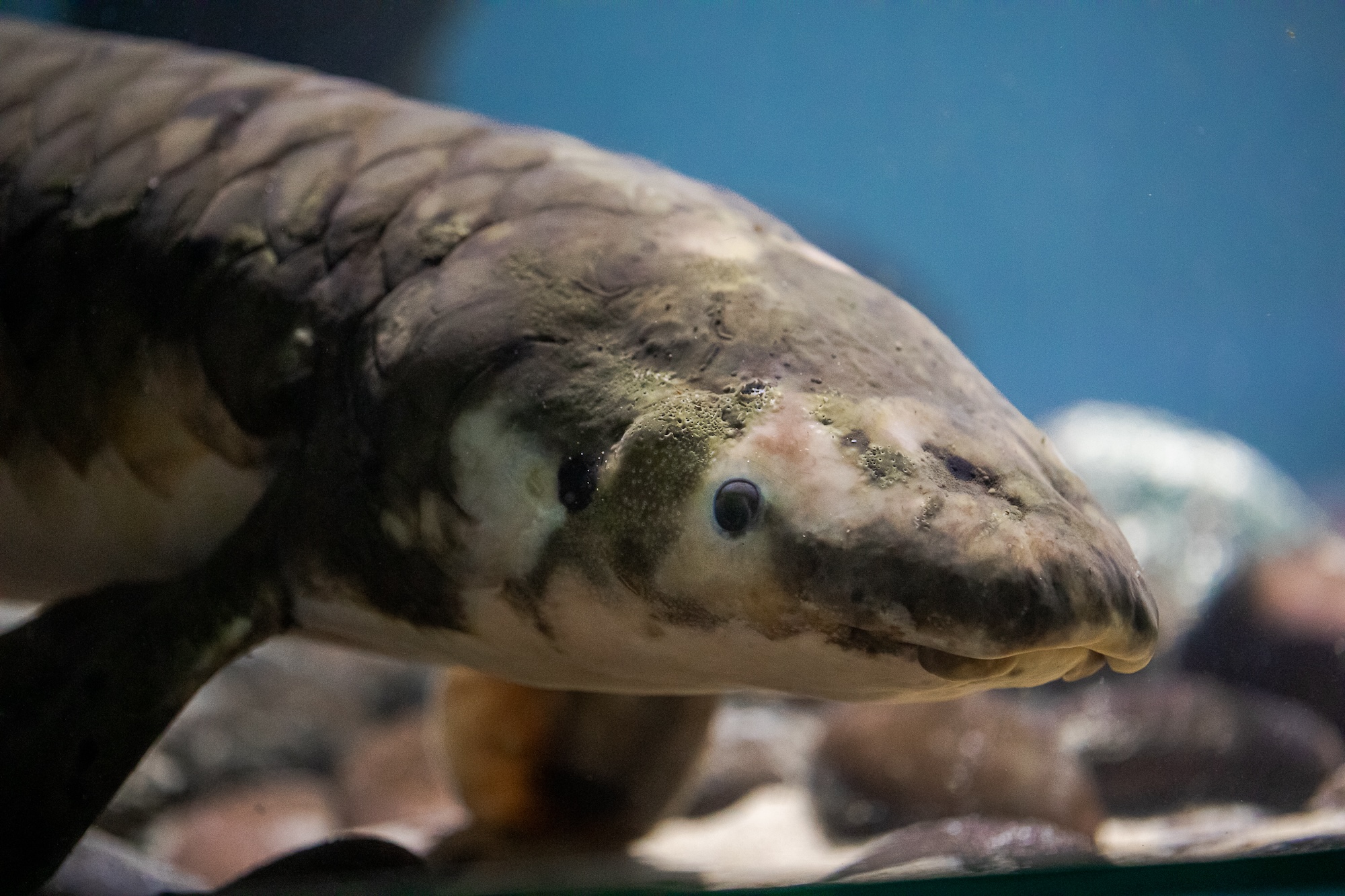
Methuselah: feed her the wrong snacks and feel her fiery wrath. (Gayle Laird/California Academy of Sciences)
If you go down to the California Academy of Sciences any time before Sept. 15, you will notice a fair amount of hullaballoo concerning Claude the albino alligator’s imminent 30th birthday. That’s nice, but there’s one cool creature at Cal Academy whose age deserves to be celebrated every day. It’s Methuselah: the museum’s centenarian lungfish, and most demanding diva.
I know what you’re probably thinking: “But it’s a fish.” Or more specifically: “But it’s a brown fish.” And also: “When are the African penguins having birthdays though?”
Related Article
But Methuselah is no ordinary lungfish. She’s a cranky old broad who knows what she wants and how to get it. We know this because we talked to her primary caretaker, biologist Laura McMillan, who has been at the mercy of Methuselah’s mood swings for the last 18 months. McMillan refers to her legless charge as “charismatic” and “personable when she wants to be,” which sounds like something people would say about Mariah Carey, so that’s cool.
Here then, while you’re getting to know her, are the dos and don’ts of keeping Methuselah happy.
Do: let Methuselah train you
McMillan says that Methuselah tends to train her handlers, not the other way around.
“We’ve been through so many iterations of: ‘How should I hold my hand? Does she like it when I’m wearing gloves?‘ No. Absolutely no gloves. We also think perhaps she doesn’t like Apple watches. There’s definitely a bit of finicky stuff going on,” says McMillan.
That’s not all.
“If I’m in there and doing [rounds] really quickly, she doesn’t respond well to that,” McMillan notes. “Your behavior is going to elicit the response. You can see who she’s comfortable with. She just makes her decision and she’s done.”
Don’t: get tricky with her snacks
McMillan’s tasks include things like temperature and flow checks on Methuselah’s aquarium, as well as making sure her charge appears “normal and rested.” Sometimes, McMillan provides lettuce in dog toys to encourage Methuselah’s natural foraging urges. But McMillan hand feeds her fish friend as well. These sessions are loving — so long as McMillan doesn’t try to switch up Methuselah’s snacks.
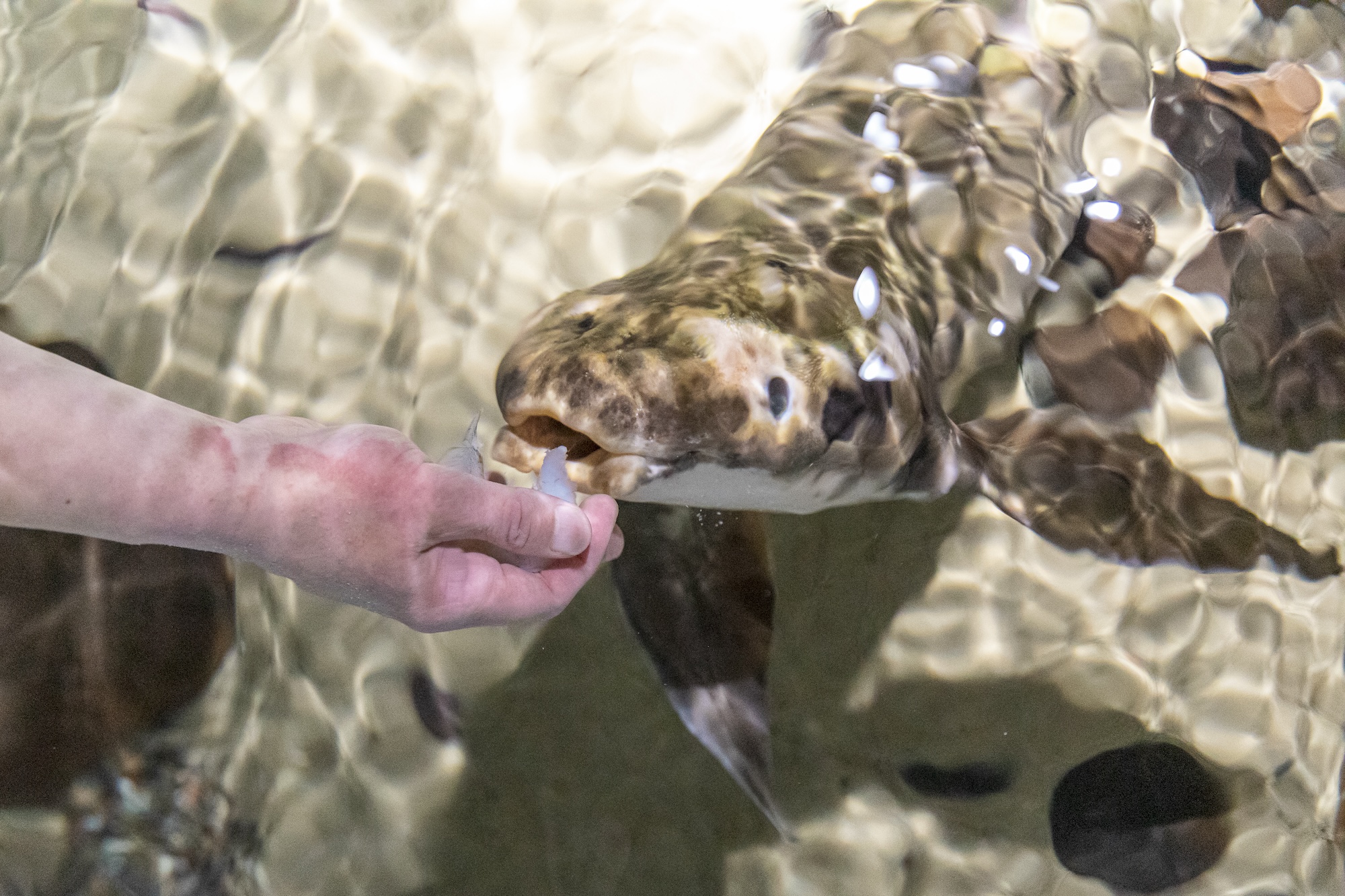
“She’ll be beautiful and great-natured and sit on my arm and do belly rubs if I’m giving her worms and figs,” explains McMillan. “She loves worms. We can be there for 15 minutes. But I give her one piece of something she doesn’t like — like a clam or a snail — and she just turns her back on me and swims off to the other corner and pouts. She looks away from me and that is it. She won’t come back for the rest of the day.”
Methuselah isn’t just the oldest fish at the Steinhart Aquarium, she’s the oldest living aquarium fish in the world. Methuselah arrived at the Steinhart Aquarium all the way back in November 1938, via steam boat. She’s likely somewhere around 95, give or take nine years, according to in-depth research. McMillan says that the white-gray marks on Methuselah’s face are a sign of her advanced years.
“It’s been explained to me that it’s similar to us losing color in our hair as we age. She also has pock marks and little dents around her face and her swimming and eating is a little slow,” says McMillan. “We don’t really know how old lungfish get. There was another lungfish called Grandad [at Chicago’s Shedd Aquarium] who got to his 80s, I believe. But we think Methuselah’s setting the standard at this point.”
Don’t: mess with her house, bro
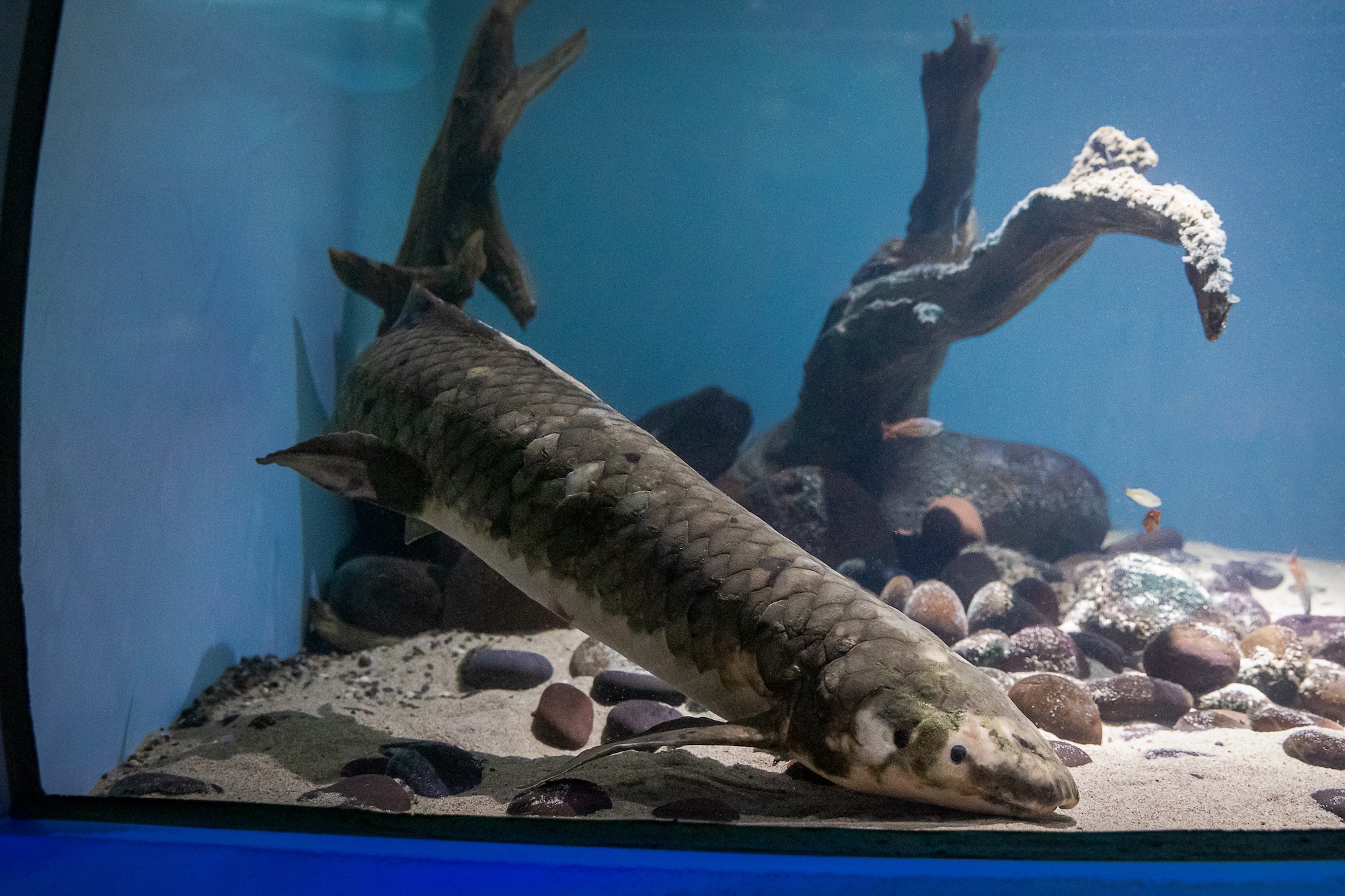
Of Methuselah’s current aquarium, McMillan says, “We’ve been hesitant to change anything in there for a long time because she’s happy as she is.”
Related Article
Serious lessons were learned about Methuselah’s decor preferences around 20 years ago. In 2005, the Steinhart Aquarium had to be torn down because of damage caused by 1989’s Loma Prieta earthquake. During the three years it took to rebuild, Methuselah was housed in a transition site at 875 Howard St. in San Francisco.
In what seems an awful lot like a dramatic protest, one day the feisty fish took it upon herself to jump out of her tank and lay around on the floor for a while. She was found and returned to the water unharmed because Methuselah is a survivor. (Also, lungfish can survive on land for short periods, so there’s that.)
Just to be on the safe side, the scientists immediately stuck a nylon jump guard on Methuselah’s tank to stop her from attempting a similar escape in future. It has not been needed since, but the net remains in place to this day.
Methuselah in her tank. Which she likes. Don’t move anything or she’ll get mad. (Gayle Laird/California Academy of Sciences)
Do: let her live with Herb Caen
Starting in 1952, Methuselah lived with a smaller lungfish named after beloved San Francisco writer Herb Caen.
In 1992, after finding out about his lungfish counterpart, Caen wrote in the San Francisco Chronicle: “Well, rust my scuppers, or whatever. I’ve had many an honor heaped upon this pointy old head but that, I would say, takes the fishcake.”
Methuselah and Herb Caen cohabited for more than 60 years and it was a harmonious partnership despite Methuselah’s reputation for being the Dorothy Zbornak of the fish world. No one at Cal Academy can tell me exactly when Herb Caen died — but I bet Methuselah could.
Don’t: ask her to live with any other lungfish
At some point post-Herb Caen, it was deemed a good idea to put Methuselah into a new tank with two younger lungfish. Methuselah immediately let Academy staff know that this wasn’t going to work for her, going “tail up” in the tank repeatedly.
Related Article
“I don’t think she was playing dead,” McMillan says. “I think it was probably a stress response. The flow in her exhibit now, I have to have at specifically 55% on the pump dial. Otherwise she will get mad. The percentage of the other tank was 85%, so maybe she wasn’t able to manage her buoyancy.”
Methuselah is now housed with rainbow fish from a similar region of Australia who she peacefully coexists with.
“They all get along fine,” McMillan says. “[Methuselah] is not exactly speedy and she’s not interested in being a huge predator. She just wants to hang out.”
Methuselah during (a successful) snack time. (Gayle Laird/California Academy of Sciences)
All of this might seem like a lot of hoops to jump through for an extremely old fish. But McMillan emphasizes that it’s all worth it.
“It’s really special when we get those feeding moments and she’s happy for me to play with her fins and be pet on the back and the belly and her face, and she’s chewing away,” McMillan says. “She’ll just look at me with those cute little beady eyes. It’s somewhat indescribable having an ancient being that’s come through so much and traveled so far and come through all these decades just being there with you, for a moment in time.”
To visit Methuselah in person, head to the Steinhart Aquarium at the California Academy of Sciences. Step down into the Water Planet exhibit and you can find Methuselah’s habitat on your left.