
Welcome to the first episode of Liner Notes, the Rightnowish podcast series all about jazz in the Bay Area. We’re starting this off with a conversation with someone who has a wealth of knowledge, especially when it comes to jazz, Greg Bridges.
As a journalist and longtime radio host at Bay Area radio stations KCSM and KPFA, Greg is steeped in Bay Area jazz history. As a reoccurring host of events like the San Jose Jazz Festival, he also has his finger on the current pulse of the culture. But this isn’t just a career choice, he was born into the world of jazz.
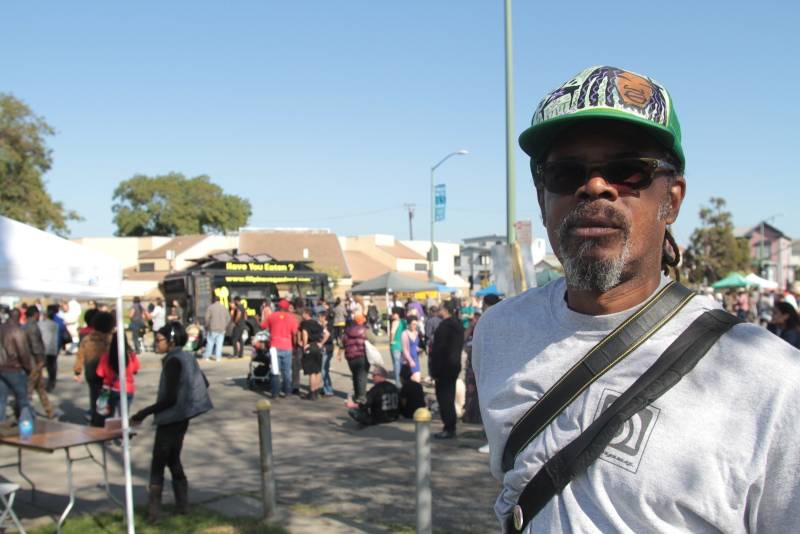
His father, Oliver Johnson, played the drums with other notable musicians like Bobby Hutcherson, Dexter Gordon and Pharaoh Sanders. Now the musical legacy continues as Greg’s children, Simone a.k.a. Nappy Nina is a hip-hop artist, and his son Miles a.k.a. Théo Mode is a guitarist in the grunge punk band babyfang.
In this episode, Greg shares some family history and gives us the lay of the land when it comes to jazz in the Bay, he also shares some of the stories behind key cultural institutions and the secret ingredient that makes the Bay Area’s jazz scene unique.
Below are lightly edited excerpts of my conversation with Greg Bridges
HARSHAW: The “jazz voice.” When did you know that you had the “jazz voice?”
GREG BRIDGES, GUEST: I didn’t really know that I had, like a “jazz voice” per say. When I was in high school, I’d get comments that maybe I sounded older than I was.
Even as a kid, I wanted to work in radio, and most of my heroes were cats that were on like KDIA, KBLX, the old KSOL, KSAN, things like that and I would hear them and try and imitate some of them. You know, cats like Nick Harper, “Big Daddy” Roy Lee Freeman.
You know, I guess through imitating them I kind of developed a little something.
HARSHAW: What is it that makes the Bay Area’s jazz scene unique?
BRIDGES: There’s a bit of everything here, you know, everything that goes into jazz. There is, of course, you know the Black and the African-American experience that’s here. There’s also the Cuban influences, the Latin Influences, the Asian-American influences. There’s so much, so many different flavors here in the Bay Area and it all comes together, to make its own individual space or to blend in and create something totally new.
