northern california wildfiresnorthern california wildfires
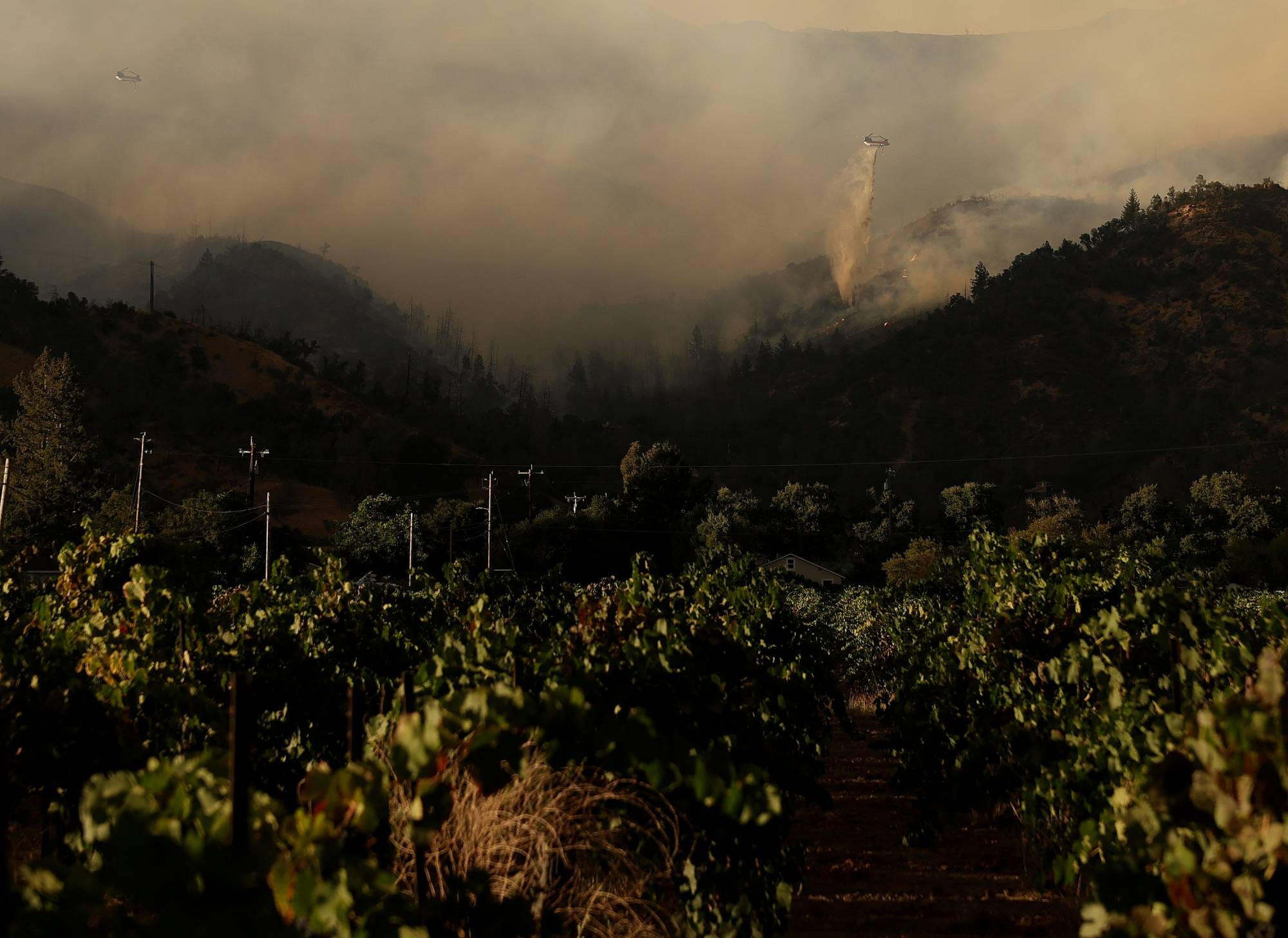
Firefighters Gain First Foothold on Pickett Fire in Napa County
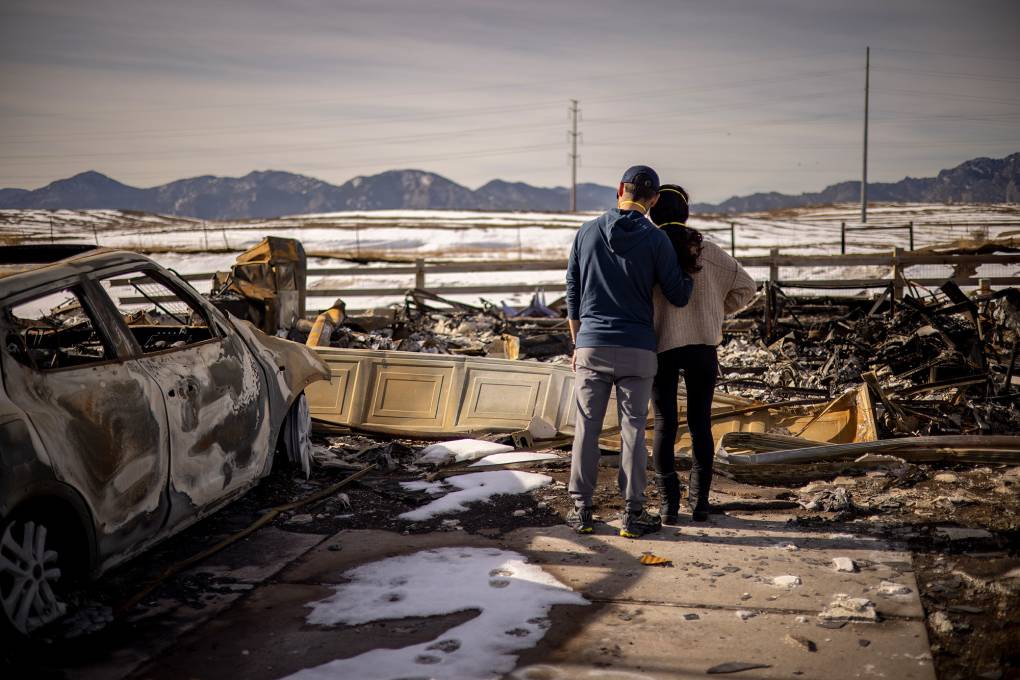
How These Former Wildfire Survivors Are Supporting Victims of the LA Blazes
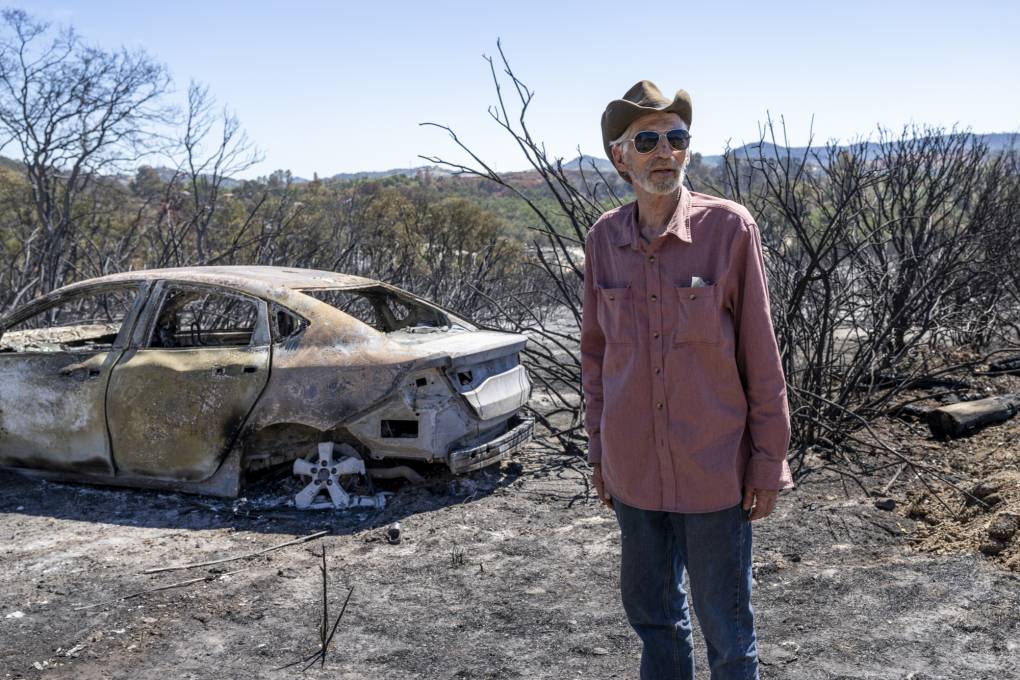
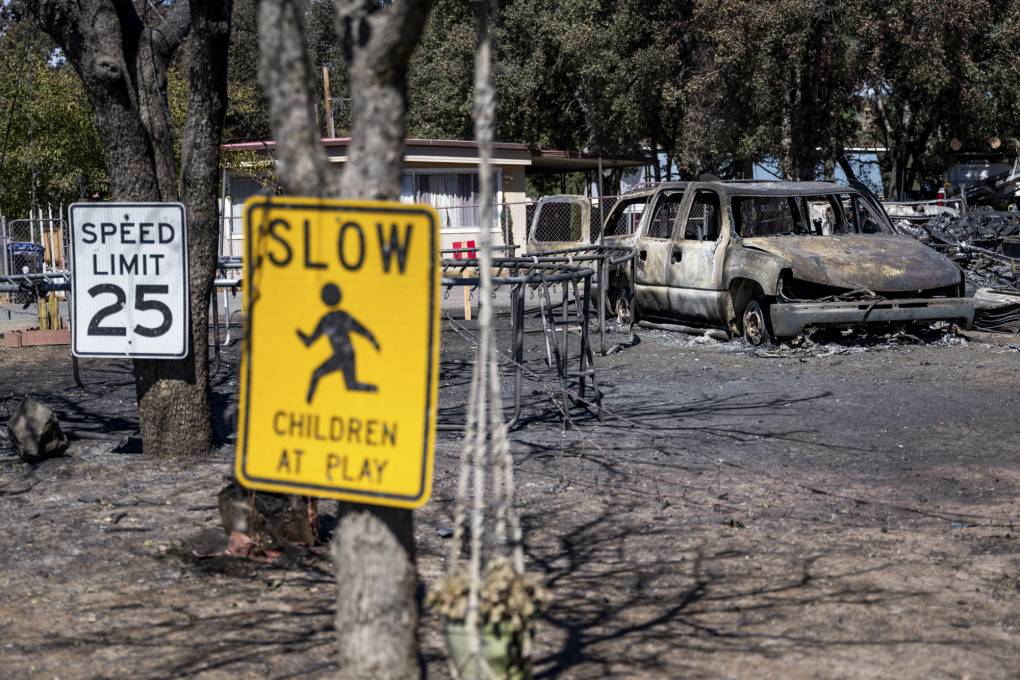
Fire-Weary Lake County Again Faces a Tough Recovery and Questions Over Rebuilding
California Fire Season Wakes Up Again With Major Wildfires and Hot, Dry Conditions
California on Fire Watch This Weekend With Dry Lightning Over Sierra Nevada
Sonoma County Point Fire Foreshadows a Busy Summer to Come, Climate Expert Says
What California's Wet Winter Means for Fire Season
Climate Reality Clashes With California Dreams
Here's What Makes the Winds Driving the Kincade Fire So Unusual
Sponsored
Player sponsored by
window.__IS_SSR__=true
window.__INITIAL_STATE__={
"attachmentsReducer": {
"audio_0": {
"type": "attachments",
"id": "audio_0",
"imgSizes": {
"kqedFullSize": {
"file": "https://ww2.kqed.org/news/wp-content/themes/KQED-unified/img/audio_bgs/background0.jpg"
}
}
},
"audio_1": {
"type": "attachments",
"id": "audio_1",
"imgSizes": {
"kqedFullSize": {
"file": "https://ww2.kqed.org/news/wp-content/themes/KQED-unified/img/audio_bgs/background1.jpg"
}
}
},
"audio_2": {
"type": "attachments",
"id": "audio_2",
"imgSizes": {
"kqedFullSize": {
"file": "https://ww2.kqed.org/news/wp-content/themes/KQED-unified/img/audio_bgs/background2.jpg"
}
}
},
"audio_3": {
"type": "attachments",
"id": "audio_3",
"imgSizes": {
"kqedFullSize": {
"file": "https://ww2.kqed.org/news/wp-content/themes/KQED-unified/img/audio_bgs/background3.jpg"
}
}
},
"audio_4": {
"type": "attachments",
"id": "audio_4",
"imgSizes": {
"kqedFullSize": {
"file": "https://ww2.kqed.org/news/wp-content/themes/KQED-unified/img/audio_bgs/background4.jpg"
}
}
},
"placeholder": {
"type": "attachments",
"id": "placeholder",
"imgSizes": {
"thumbnail": {
"file": "https://cdn.kqed.org/wp-content/uploads/2024/12/KQED-Default-Image-816638274-2000x1333-1-160x107.jpg",
"width": 160,
"height": 107,
"mimeType": "image/jpeg"
},
"medium": {
"file": "https://cdn.kqed.org/wp-content/uploads/2024/12/KQED-Default-Image-816638274-2000x1333-1-800x533.jpg",
"width": 800,
"height": 533,
"mimeType": "image/jpeg"
},
"medium_large": {
"file": "https://cdn.kqed.org/wp-content/uploads/2024/12/KQED-Default-Image-816638274-2000x1333-1-768x512.jpg",
"width": 768,
"height": 512,
"mimeType": "image/jpeg"
},
"large": {
"file": "https://cdn.kqed.org/wp-content/uploads/2024/12/KQED-Default-Image-816638274-2000x1333-1-1020x680.jpg",
"width": 1020,
"height": 680,
"mimeType": "image/jpeg"
},
"1536x1536": {
"file": "https://cdn.kqed.org/wp-content/uploads/2024/12/KQED-Default-Image-816638274-2000x1333-1-1536x1024.jpg",
"width": 1536,
"height": 1024,
"mimeType": "image/jpeg"
},
"fd-lrg": {
"file": "https://cdn.kqed.org/wp-content/uploads/2024/12/KQED-Default-Image-816638274-2000x1333-1-1536x1024.jpg",
"width": 1536,
"height": 1024,
"mimeType": "image/jpeg"
},
"fd-med": {
"file": "https://cdn.kqed.org/wp-content/uploads/2024/12/KQED-Default-Image-816638274-2000x1333-1-1020x680.jpg",
"width": 1020,
"height": 680,
"mimeType": "image/jpeg"
},
"fd-sm": {
"file": "https://cdn.kqed.org/wp-content/uploads/2024/12/KQED-Default-Image-816638274-2000x1333-1-800x533.jpg",
"width": 800,
"height": 533,
"mimeType": "image/jpeg"
},
"post-thumbnail": {
"file": "https://cdn.kqed.org/wp-content/uploads/2024/12/KQED-Default-Image-816638274-2000x1333-1-672x372.jpg",
"width": 672,
"height": 372,
"mimeType": "image/jpeg"
},
"twentyfourteen-full-width": {
"file": "https://cdn.kqed.org/wp-content/uploads/2024/12/KQED-Default-Image-816638274-2000x1333-1-1038x576.jpg",
"width": 1038,
"height": 576,
"mimeType": "image/jpeg"
},
"xxsmall": {
"file": "https://cdn.kqed.org/wp-content/uploads/2024/12/KQED-Default-Image-816638274-2000x1333-1-160x107.jpg",
"width": 160,
"height": 107,
"mimeType": "image/jpeg"
},
"xsmall": {
"file": "https://cdn.kqed.org/wp-content/uploads/2024/12/KQED-Default-Image-816638274-2000x1333-1-672x372.jpg",
"width": 672,
"height": 372,
"mimeType": "image/jpeg"
},
"small": {
"file": "https://cdn.kqed.org/wp-content/uploads/2024/12/KQED-Default-Image-816638274-2000x1333-1-672x372.jpg",
"width": 672,
"height": 372,
"mimeType": "image/jpeg"
},
"xlarge": {
"file": "https://cdn.kqed.org/wp-content/uploads/2024/12/KQED-Default-Image-816638274-2000x1333-1-1020x680.jpg",
"width": 1020,
"height": 680,
"mimeType": "image/jpeg"
},
"full-width": {
"file": "https://cdn.kqed.org/wp-content/uploads/2024/12/KQED-Default-Image-816638274-2000x1333-1-1920x1280.jpg",
"width": 1920,
"height": 1280,
"mimeType": "image/jpeg"
},
"guest-author-32": {
"file": "https://cdn.kqed.org/wp-content/uploads/2025/01/KQED-Default-Image-816638274-1333x1333-1-160x160.jpg",
"width": 32,
"height": 32,
"mimeType": "image/jpeg"
},
"guest-author-50": {
"file": "https://cdn.kqed.org/wp-content/uploads/2025/01/KQED-Default-Image-816638274-1333x1333-1-160x160.jpg",
"width": 50,
"height": 50,
"mimeType": "image/jpeg"
},
"guest-author-64": {
"file": "https://cdn.kqed.org/wp-content/uploads/2025/01/KQED-Default-Image-816638274-1333x1333-1-160x160.jpg",
"width": 64,
"height": 64,
"mimeType": "image/jpeg"
},
"guest-author-96": {
"file": "https://cdn.kqed.org/wp-content/uploads/2025/01/KQED-Default-Image-816638274-1333x1333-1-160x160.jpg",
"width": 96,
"height": 96,
"mimeType": "image/jpeg"
},
"guest-author-128": {
"file": "https://cdn.kqed.org/wp-content/uploads/2025/01/KQED-Default-Image-816638274-1333x1333-1-160x160.jpg",
"width": 128,
"height": 128,
"mimeType": "image/jpeg"
},
"detail": {
"file": "https://cdn.kqed.org/wp-content/uploads/2025/01/KQED-Default-Image-816638274-1333x1333-1-160x160.jpg",
"width": 160,
"height": 160,
"mimeType": "image/jpeg"
},
"kqedFullSize": {
"file": "https://cdn.kqed.org/wp-content/uploads/2024/12/KQED-Default-Image-816638274-2000x1333-1.jpg",
"width": 2000,
"height": 1333
}
}
},
"science_1998204": {
"type": "attachments",
"id": "science_1998204",
"meta": {
"index": "attachments_1716263798",
"site": "science",
"id": "1998204",
"found": true
},
"title": "Pickett Fire Burns In California's Napa County",
"publishDate": 1755881843,
"status": "inherit",
"parent": 1998202,
"modified": 1755881927,
"caption": "A firefighting helicopter drops water onto the Pickett Fire as it burns in the hills near a vineyard on Aug. 21, 2025, in Calistoga, California. The Pickett fire has burned over 1,200 acres in the Napa Valley and is 5% contained. Crews are working bulldozers, aircraft and hand lines to hold back the flames, as evacuation orders remain in place for dozens of residents.",
"credit": "Justin Sullivan/Getty Images",
"altTag": null,
"description": null,
"imgSizes": {
"medium": {
"file": "https://cdn.kqed.org/wp-content/uploads/sites/35/2025/08/Pickett-Fire-in-Napa-County-AP-2000x1456.jpg",
"width": 2000,
"height": 1456,
"mimeType": "image/jpeg"
},
"large": {
"file": "https://cdn.kqed.org/wp-content/uploads/sites/35/2025/08/Pickett-Fire-in-Napa-County-AP-2000x1456.jpg",
"width": 2000,
"height": 1456,
"mimeType": "image/jpeg"
},
"thumbnail": {
"file": "https://cdn.kqed.org/wp-content/uploads/sites/35/2025/08/Pickett-Fire-in-Napa-County-AP-160x116.jpg",
"width": 160,
"height": 116,
"mimeType": "image/jpeg"
},
"medium_large": {
"file": "https://cdn.kqed.org/wp-content/uploads/sites/35/2025/08/Pickett-Fire-in-Napa-County-AP-768x559.jpg",
"width": 768,
"height": 559,
"mimeType": "image/jpeg"
},
"1536x1536": {
"file": "https://cdn.kqed.org/wp-content/uploads/sites/35/2025/08/Pickett-Fire-in-Napa-County-AP-1536x1118.jpg",
"width": 1536,
"height": 1118,
"mimeType": "image/jpeg"
},
"2048x2048": {
"file": "https://cdn.kqed.org/wp-content/uploads/sites/35/2025/08/Pickett-Fire-in-Napa-County-AP-2048x1491.jpg",
"width": 2048,
"height": 1491,
"mimeType": "image/jpeg"
},
"post-thumbnail": {
"file": "https://cdn.kqed.org/wp-content/uploads/sites/35/2025/08/Pickett-Fire-in-Napa-County-AP-672x372.jpg",
"width": 672,
"height": 372,
"mimeType": "image/jpeg"
},
"twentyfourteen-full-width": {
"file": "https://cdn.kqed.org/wp-content/uploads/sites/35/2025/08/Pickett-Fire-in-Napa-County-AP-1038x576.jpg",
"width": 1038,
"height": 576,
"mimeType": "image/jpeg"
},
"full-width": {
"file": "https://cdn.kqed.org/wp-content/uploads/sites/35/2025/08/Pickett-Fire-in-Napa-County-AP-2000x1456.jpg",
"width": 2000,
"height": 1456,
"mimeType": "image/jpeg"
},
"kqedFullSize": {
"file": "https://cdn.kqed.org/wp-content/uploads/sites/35/2025/08/Pickett-Fire-in-Napa-County-AP-scaled.jpg",
"width": 2560,
"height": 1864
}
},
"fetchFailed": false,
"isLoading": false
},
"science_1996117": {
"type": "attachments",
"id": "science_1996117",
"meta": {
"index": "attachments_1716263798",
"site": "science",
"id": "1996117",
"found": true
},
"title": "GettyImages-1238313931",
"publishDate": 1739321153,
"status": "inherit",
"parent": 1996110,
"modified": 1739325218,
"caption": "Erica and Jon Solove look at the remains of their home in Superior, Colorado, for the first time on Jan. 13, 2022, after the Marshall Fire destroyed it.",
"credit": "Chet Strange/Washington Post via Getty Images",
"altTag": "A couple holds each other while looking at a burned-down building.",
"description": null,
"imgSizes": {
"medium": {
"file": "https://cdn.kqed.org/wp-content/uploads/sites/35/2025/02/GettyImages-1238313931-800x534.jpg",
"width": 800,
"height": 534,
"mimeType": "image/jpeg"
},
"large": {
"file": "https://cdn.kqed.org/wp-content/uploads/sites/35/2025/02/GettyImages-1238313931-1020x680.jpg",
"width": 1020,
"height": 680,
"mimeType": "image/jpeg"
},
"thumbnail": {
"file": "https://cdn.kqed.org/wp-content/uploads/sites/35/2025/02/GettyImages-1238313931-160x107.jpg",
"width": 160,
"height": 107,
"mimeType": "image/jpeg"
},
"medium_large": {
"file": "https://cdn.kqed.org/wp-content/uploads/sites/35/2025/02/GettyImages-1238313931-768x512.jpg",
"width": 768,
"height": 512,
"mimeType": "image/jpeg"
},
"1536x1536": {
"file": "https://cdn.kqed.org/wp-content/uploads/sites/35/2025/02/GettyImages-1238313931-1536x1025.jpg",
"width": 1536,
"height": 1025,
"mimeType": "image/jpeg"
},
"post-thumbnail": {
"file": "https://cdn.kqed.org/wp-content/uploads/sites/35/2025/02/GettyImages-1238313931-672x372.jpg",
"width": 672,
"height": 372,
"mimeType": "image/jpeg"
},
"twentyfourteen-full-width": {
"file": "https://cdn.kqed.org/wp-content/uploads/sites/35/2025/02/GettyImages-1238313931-1038x576.jpg",
"width": 1038,
"height": 576,
"mimeType": "image/jpeg"
},
"full-width": {
"file": "https://cdn.kqed.org/wp-content/uploads/sites/35/2025/02/GettyImages-1238313931-1920x1281.jpg",
"width": 1920,
"height": 1281,
"mimeType": "image/jpeg"
},
"kqedFullSize": {
"file": "https://cdn.kqed.org/wp-content/uploads/sites/35/2025/02/GettyImages-1238313931.jpg",
"width": 2000,
"height": 1334
}
},
"fetchFailed": false,
"isLoading": false
},
"science_1994250": {
"type": "attachments",
"id": "science_1994250",
"meta": {
"index": "attachments_1716263798",
"site": "science",
"id": "1994250",
"found": true
},
"title": "240909-BOYLESFIRE-09-BL-KQED",
"publishDate": 1725915619,
"status": "inherit",
"parent": 0,
"modified": 1725917492,
"caption": "Clearlake resident Jeff Stanley walks along 18th Avenue in Clearlake on Sept. 9, 2024.",
"credit": "Beth LaBerge/KQED",
"altTag": null,
"description": null,
"imgSizes": {
"medium": {
"file": "https://cdn.kqed.org/wp-content/uploads/sites/35/2024/09/240909-BOYLESFIRE-09-BL-KQED-800x533.jpg",
"width": 800,
"height": 533,
"mimeType": "image/jpeg"
},
"large": {
"file": "https://cdn.kqed.org/wp-content/uploads/sites/35/2024/09/240909-BOYLESFIRE-09-BL-KQED-1020x680.jpg",
"width": 1020,
"height": 680,
"mimeType": "image/jpeg"
},
"thumbnail": {
"file": "https://cdn.kqed.org/wp-content/uploads/sites/35/2024/09/240909-BOYLESFIRE-09-BL-KQED-160x107.jpg",
"width": 160,
"height": 107,
"mimeType": "image/jpeg"
},
"medium_large": {
"file": "https://cdn.kqed.org/wp-content/uploads/sites/35/2024/09/240909-BOYLESFIRE-09-BL-KQED-768x512.jpg",
"width": 768,
"height": 512,
"mimeType": "image/jpeg"
},
"1536x1536": {
"file": "https://cdn.kqed.org/wp-content/uploads/sites/35/2024/09/240909-BOYLESFIRE-09-BL-KQED-1536x1024.jpg",
"width": 1536,
"height": 1024,
"mimeType": "image/jpeg"
},
"post-thumbnail": {
"file": "https://cdn.kqed.org/wp-content/uploads/sites/35/2024/09/240909-BOYLESFIRE-09-BL-KQED-672x372.jpg",
"width": 672,
"height": 372,
"mimeType": "image/jpeg"
},
"twentyfourteen-full-width": {
"file": "https://cdn.kqed.org/wp-content/uploads/sites/35/2024/09/240909-BOYLESFIRE-09-BL-KQED-1038x576.jpg",
"width": 1038,
"height": 576,
"mimeType": "image/jpeg"
},
"full-width": {
"file": "https://cdn.kqed.org/wp-content/uploads/sites/35/2024/09/240909-BOYLESFIRE-09-BL-KQED-1920x1280.jpg",
"width": 1920,
"height": 1280,
"mimeType": "image/jpeg"
},
"kqedFullSize": {
"file": "https://cdn.kqed.org/wp-content/uploads/sites/35/2024/09/240909-BOYLESFIRE-09-BL-KQED.jpg",
"width": 2000,
"height": 1333
}
},
"fetchFailed": false,
"isLoading": false
},
"science_1994259": {
"type": "attachments",
"id": "science_1994259",
"meta": {
"index": "attachments_1716263798",
"site": "science",
"id": "1994259",
"found": true
},
"title": "240909-BOYLESFIRE-45-BL-KQED",
"publishDate": 1725925574,
"status": "inherit",
"parent": 0,
"modified": 1725996122,
"caption": "A burned vehicle in Clearlake on Sept. 9, 2024, after the Boyles Fire swept through the area on Sept. 8.",
"credit": "Beth LaBerge/KQED",
"altTag": null,
"description": null,
"imgSizes": {
"medium": {
"file": "https://cdn.kqed.org/wp-content/uploads/sites/35/2024/09/240909-BOYLESFIRE-45-BL-KQED-800x533.jpg",
"width": 800,
"height": 533,
"mimeType": "image/jpeg"
},
"large": {
"file": "https://cdn.kqed.org/wp-content/uploads/sites/35/2024/09/240909-BOYLESFIRE-45-BL-KQED-1020x680.jpg",
"width": 1020,
"height": 680,
"mimeType": "image/jpeg"
},
"thumbnail": {
"file": "https://cdn.kqed.org/wp-content/uploads/sites/35/2024/09/240909-BOYLESFIRE-45-BL-KQED-160x107.jpg",
"width": 160,
"height": 107,
"mimeType": "image/jpeg"
},
"medium_large": {
"file": "https://cdn.kqed.org/wp-content/uploads/sites/35/2024/09/240909-BOYLESFIRE-45-BL-KQED-768x512.jpg",
"width": 768,
"height": 512,
"mimeType": "image/jpeg"
},
"1536x1536": {
"file": "https://cdn.kqed.org/wp-content/uploads/sites/35/2024/09/240909-BOYLESFIRE-45-BL-KQED-1536x1024.jpg",
"width": 1536,
"height": 1024,
"mimeType": "image/jpeg"
},
"post-thumbnail": {
"file": "https://cdn.kqed.org/wp-content/uploads/sites/35/2024/09/240909-BOYLESFIRE-45-BL-KQED-672x372.jpg",
"width": 672,
"height": 372,
"mimeType": "image/jpeg"
},
"twentyfourteen-full-width": {
"file": "https://cdn.kqed.org/wp-content/uploads/sites/35/2024/09/240909-BOYLESFIRE-45-BL-KQED-1038x576.jpg",
"width": 1038,
"height": 576,
"mimeType": "image/jpeg"
},
"full-width": {
"file": "https://cdn.kqed.org/wp-content/uploads/sites/35/2024/09/240909-BOYLESFIRE-45-BL-KQED-1920x1280.jpg",
"width": 1920,
"height": 1280,
"mimeType": "image/jpeg"
},
"kqedFullSize": {
"file": "https://cdn.kqed.org/wp-content/uploads/sites/35/2024/09/240909-BOYLESFIRE-45-BL-KQED.jpg",
"width": 2000,
"height": 1333
}
},
"fetchFailed": false,
"isLoading": false
},
"science_1993616": {
"type": "attachments",
"id": "science_1993616",
"meta": {
"index": "attachments_1716263798",
"site": "science",
"id": "1993616",
"found": true
},
"title": "TOPSHOT-US-FIRE-CALIFORNIA",
"publishDate": 1720811155,
"status": "inherit",
"parent": 1993613,
"modified": 1720813119,
"caption": "Embers glow at night as the Basin Fire burned in the Sierra National Forest in Fresno County, on June 26, 2024. A trio of wildfires, named the 'June Lightning Complex Fire,' were sparked by lightning during a thunderstorm that rolled through the county. The fires are now fully contained.",
"credit": "David Swanson/AFP via Getty Images",
"altTag": null,
"description": null,
"imgSizes": {
"medium": {
"file": "https://cdn.kqed.org/wp-content/uploads/sites/35/2024/07/SierraNevadaNationalForestBasinFire-800x533.jpg",
"width": 800,
"height": 533,
"mimeType": "image/jpeg"
},
"large": {
"file": "https://cdn.kqed.org/wp-content/uploads/sites/35/2024/07/SierraNevadaNationalForestBasinFire-1020x680.jpg",
"width": 1020,
"height": 680,
"mimeType": "image/jpeg"
},
"thumbnail": {
"file": "https://cdn.kqed.org/wp-content/uploads/sites/35/2024/07/SierraNevadaNationalForestBasinFire-160x107.jpg",
"width": 160,
"height": 107,
"mimeType": "image/jpeg"
},
"medium_large": {
"file": "https://cdn.kqed.org/wp-content/uploads/sites/35/2024/07/SierraNevadaNationalForestBasinFire-768x512.jpg",
"width": 768,
"height": 512,
"mimeType": "image/jpeg"
},
"1536x1536": {
"file": "https://cdn.kqed.org/wp-content/uploads/sites/35/2024/07/SierraNevadaNationalForestBasinFire-1536x1024.jpg",
"width": 1536,
"height": 1024,
"mimeType": "image/jpeg"
},
"post-thumbnail": {
"file": "https://cdn.kqed.org/wp-content/uploads/sites/35/2024/07/SierraNevadaNationalForestBasinFire-672x372.jpg",
"width": 672,
"height": 372,
"mimeType": "image/jpeg"
},
"twentyfourteen-full-width": {
"file": "https://cdn.kqed.org/wp-content/uploads/sites/35/2024/07/SierraNevadaNationalForestBasinFire-1038x576.jpg",
"width": 1038,
"height": 576,
"mimeType": "image/jpeg"
},
"full-width": {
"file": "https://cdn.kqed.org/wp-content/uploads/sites/35/2024/07/SierraNevadaNationalForestBasinFire-1920x1280.jpg",
"width": 1920,
"height": 1280,
"mimeType": "image/jpeg"
},
"kqedFullSize": {
"file": "https://cdn.kqed.org/wp-content/uploads/sites/35/2024/07/SierraNevadaNationalForestBasinFire.jpg",
"width": 2000,
"height": 1333
}
},
"fetchFailed": false,
"isLoading": false
},
"science_1993415": {
"type": "attachments",
"id": "science_1993415",
"meta": {
"index": "attachments_1716263798",
"site": "science",
"id": "1993415",
"found": true
},
"title": "California Wildfires",
"publishDate": 1718655136,
"status": "inherit",
"parent": 1993411,
"modified": 1718655176,
"caption": "A firefighter carries a hose while battling the Point Fire along West Dry Creek Road in Healdsburg, Calif. on Sunday, June 16, 2024.",
"credit": "Noah Berger/AP Photo",
"altTag": null,
"description": null,
"imgSizes": {
"medium": {
"file": "https://cdn.kqed.org/wp-content/uploads/sites/35/2024/06/SonomaCountyPointFire01-800x532.jpg",
"width": 800,
"height": 532,
"mimeType": "image/jpeg"
},
"large": {
"file": "https://cdn.kqed.org/wp-content/uploads/sites/35/2024/06/SonomaCountyPointFire01-1020x678.jpg",
"width": 1020,
"height": 678,
"mimeType": "image/jpeg"
},
"thumbnail": {
"file": "https://cdn.kqed.org/wp-content/uploads/sites/35/2024/06/SonomaCountyPointFire01-160x106.jpg",
"width": 160,
"height": 106,
"mimeType": "image/jpeg"
},
"medium_large": {
"file": "https://cdn.kqed.org/wp-content/uploads/sites/35/2024/06/SonomaCountyPointFire01-768x511.jpg",
"width": 768,
"height": 511,
"mimeType": "image/jpeg"
},
"1536x1536": {
"file": "https://cdn.kqed.org/wp-content/uploads/sites/35/2024/06/SonomaCountyPointFire01-1536x1022.jpg",
"width": 1536,
"height": 1022,
"mimeType": "image/jpeg"
},
"post-thumbnail": {
"file": "https://cdn.kqed.org/wp-content/uploads/sites/35/2024/06/SonomaCountyPointFire01-672x372.jpg",
"width": 672,
"height": 372,
"mimeType": "image/jpeg"
},
"twentyfourteen-full-width": {
"file": "https://cdn.kqed.org/wp-content/uploads/sites/35/2024/06/SonomaCountyPointFire01-1038x576.jpg",
"width": 1038,
"height": 576,
"mimeType": "image/jpeg"
},
"kqedFullSize": {
"file": "https://cdn.kqed.org/wp-content/uploads/sites/35/2024/06/SonomaCountyPointFire01.jpg",
"width": 1920,
"height": 1277
}
},
"fetchFailed": false,
"isLoading": false
},
"science_1983108": {
"type": "attachments",
"id": "science_1983108",
"meta": {
"index": "attachments_1716263798",
"site": "science",
"id": "1983108",
"found": true
},
"parent": 1983097,
"imgSizes": {
"twentyfourteen-full-width": {
"file": "https://ww2.kqed.org/app/uploads/sites/35/2023/06/RS66481_230620-TallDryGrass-04-BL-qut-1038x576.jpg",
"width": 1038,
"mimeType": "image/jpeg",
"height": 576
},
"thumbnail": {
"file": "https://ww2.kqed.org/app/uploads/sites/35/2023/06/RS66481_230620-TallDryGrass-04-BL-qut-160x107.jpg",
"width": 160,
"mimeType": "image/jpeg",
"height": 107
},
"post-thumbnail": {
"file": "https://ww2.kqed.org/app/uploads/sites/35/2023/06/RS66481_230620-TallDryGrass-04-BL-qut-672x372.jpg",
"width": 672,
"mimeType": "image/jpeg",
"height": 372
},
"kqedFullSize": {
"file": "https://ww2.kqed.org/app/uploads/sites/35/2023/06/RS66481_230620-TallDryGrass-04-BL-qut.jpg",
"width": 1920,
"height": 1280
},
"large": {
"file": "https://ww2.kqed.org/app/uploads/sites/35/2023/06/RS66481_230620-TallDryGrass-04-BL-qut-1020x680.jpg",
"width": 1020,
"mimeType": "image/jpeg",
"height": 680
},
"1536x1536": {
"file": "https://ww2.kqed.org/app/uploads/sites/35/2023/06/RS66481_230620-TallDryGrass-04-BL-qut-1536x1024.jpg",
"width": 1536,
"mimeType": "image/jpeg",
"height": 1024
},
"medium": {
"file": "https://ww2.kqed.org/app/uploads/sites/35/2023/06/RS66481_230620-TallDryGrass-04-BL-qut-800x533.jpg",
"width": 800,
"mimeType": "image/jpeg",
"height": 533
},
"medium_large": {
"file": "https://ww2.kqed.org/app/uploads/sites/35/2023/06/RS66481_230620-TallDryGrass-04-BL-qut-768x512.jpg",
"width": 768,
"mimeType": "image/jpeg",
"height": 512
}
},
"publishDate": 1687459121,
"modified": 1687459172,
"caption": "Tall dry grass covers a hillside in John McLaren Park in San Francisco on June 20, 2023.",
"description": null,
"title": "RS66481_230620-TallDryGrass-04-BL-qut",
"credit": "Beth LaBerge/KQED",
"status": "inherit",
"altTag": "Dry yellow grass and a blue bird sky.",
"fetchFailed": false,
"isLoading": false
},
"science_1950521": {
"type": "attachments",
"id": "science_1950521",
"meta": {
"index": "attachments_1716263798",
"site": "science",
"id": "1950521",
"found": true
},
"parent": 1950517,
"imgSizes": {
"twentyfourteen-full-width": {
"file": "https://ww2.kqed.org/app/uploads/sites/35/2019/10/Van-Gelders-profile-1-1038x576.jpg",
"width": 1038,
"mimeType": "image/jpeg",
"height": 576
},
"thumbnail": {
"file": "https://ww2.kqed.org/app/uploads/sites/35/2019/10/Van-Gelders-profile-1-160x120.jpg",
"width": 160,
"mimeType": "image/jpeg",
"height": 120
},
"post-thumbnail": {
"file": "https://ww2.kqed.org/app/uploads/sites/35/2019/10/Van-Gelders-profile-1-672x372.jpg",
"width": 672,
"mimeType": "image/jpeg",
"height": 372
},
"kqedFullSize": {
"file": "https://ww2.kqed.org/app/uploads/sites/35/2019/10/Van-Gelders-profile-1.jpg",
"width": 5184,
"height": 3888
},
"large": {
"file": "https://ww2.kqed.org/app/uploads/sites/35/2019/10/Van-Gelders-profile-1-1020x765.jpg",
"width": 1020,
"mimeType": "image/jpeg",
"height": 765
},
"complete_open_graph": {
"file": "https://ww2.kqed.org/app/uploads/sites/35/2019/10/Van-Gelders-profile-1-1200x900.jpg",
"width": 1200,
"mimeType": "image/jpeg",
"height": 900
},
"full-width": {
"file": "https://ww2.kqed.org/app/uploads/sites/35/2019/10/Van-Gelders-profile-1-1920x1440.jpg",
"width": 1920,
"mimeType": "image/jpeg",
"height": 1440
},
"medium": {
"file": "https://ww2.kqed.org/app/uploads/sites/35/2019/10/Van-Gelders-profile-1-800x600.jpg",
"width": 800,
"mimeType": "image/jpeg",
"height": 600
},
"medium_large": {
"file": "https://ww2.kqed.org/app/uploads/sites/35/2019/10/Van-Gelders-profile-1-768x576.jpg",
"width": 768,
"mimeType": "image/jpeg",
"height": 576
}
},
"publishDate": 1572550349,
"modified": 1572550457,
"caption": "Philip and Sherry Van Gelder in Oakland, where they're staying with their daughter.",
"description": null,
"title": null,
"credit": "Darcy Vasudev",
"status": "inherit",
"fetchFailed": false,
"isLoading": false
},
"science_1950393": {
"type": "attachments",
"id": "science_1950393",
"meta": {
"index": "attachments_1716263798",
"site": "science",
"id": "1950393",
"found": true
},
"parent": 1950377,
"imgSizes": {
"twentyfourteen-full-width": {
"file": "https://ww2.kqed.org/app/uploads/sites/35/2019/10/GettyImages-1178415170-1038x576.jpg",
"width": 1038,
"mimeType": "image/jpeg",
"height": 576
},
"thumbnail": {
"file": "https://ww2.kqed.org/app/uploads/sites/35/2019/10/GettyImages-1178415170-160x107.jpg",
"width": 160,
"mimeType": "image/jpeg",
"height": 107
},
"post-thumbnail": {
"file": "https://ww2.kqed.org/app/uploads/sites/35/2019/10/GettyImages-1178415170-672x372.jpg",
"width": 672,
"mimeType": "image/jpeg",
"height": 372
},
"kqedFullSize": {
"file": "https://ww2.kqed.org/app/uploads/sites/35/2019/10/GettyImages-1178415170-e1572366172728.jpg",
"width": 1920,
"height": 1280
},
"large": {
"file": "https://ww2.kqed.org/app/uploads/sites/35/2019/10/GettyImages-1178415170-1020x680.jpg",
"width": 1020,
"mimeType": "image/jpeg",
"height": 680
},
"complete_open_graph": {
"file": "https://ww2.kqed.org/app/uploads/sites/35/2019/10/GettyImages-1178415170-1200x800.jpg",
"width": 1200,
"mimeType": "image/jpeg",
"height": 800
},
"full-width": {
"file": "https://ww2.kqed.org/app/uploads/sites/35/2019/10/GettyImages-1178415170-1920x1280.jpg",
"width": 1920,
"mimeType": "image/jpeg",
"height": 1280
},
"medium": {
"file": "https://ww2.kqed.org/app/uploads/sites/35/2019/10/GettyImages-1178415170-800x533.jpg",
"width": 800,
"mimeType": "image/jpeg",
"height": 533
},
"medium_large": {
"file": "https://ww2.kqed.org/app/uploads/sites/35/2019/10/GettyImages-1178415170-768x512.jpg",
"width": 768,
"mimeType": "image/jpeg",
"height": 512
}
},
"publishDate": 1572307917,
"modified": 1572366181,
"caption": "A firefighter watches over a back fire along a hillside during firefighting operations to battle the Kincade Fire in Healdsburg, California. ",
"description": "A firefighter watches over a back fire along a hillside during firefighting operations to battle the Kincade Fire in Healdsburg, California. ",
"title": "US-CALIFORNIA-FIRE-EMERGENCY",
"credit": "(Photo by PHILIP PACHECO/AFP via Getty Images)",
"status": "inherit",
"fetchFailed": false,
"isLoading": false
}
},
"audioPlayerReducer": {
"postId": "stream_live",
"isPaused": true,
"isPlaying": false,
"pfsActive": false,
"pledgeModalIsOpen": true,
"playerDrawerIsOpen": false
},
"authorsReducer": {
"lklivans": {
"type": "authors",
"id": "8648",
"meta": {
"index": "authors_1716337520",
"id": "8648",
"found": true
},
"name": "Laura Klivans",
"firstName": "Laura",
"lastName": "Klivans",
"slug": "lklivans",
"email": "lklivans@kqed.org",
"display_author_email": true,
"staff_mastheads": [
"news",
"science"
],
"title": "Reporter",
"bio": "Laura Klivans is an award-winning science reporter for KQED News, where she covers climate change with an eye on both groundbreaking progress and gaps in action. She is the former host of KQED's blockbuster video series about tiny, amazing animals, \u003cem>Deep Look\u003c/em>. Her work reaches national audiences through NPR, \u003cem>Here & Now, \u003c/em>PRI, and other major outlets. \r\n\r\nLaura’s won five Northern California Area Emmy Awards for Deep Look and First Place in the Greater Bay Area Journalism Awards for a podcast exploring how one Oakland neighborhood teamed up to reduce planet-heating pollution.\r\n\r\nBeyond her reporting, she hosts and moderates events. In the past, she taught audio storytelling at the UC Berkeley Graduate School of Journalism, led international education programs, worked with immigrants and refugees along the Thai-Burmese border, taught high schoolers sex ed, and was an actress. \r\n\r\nShe's a former UC Berkeley Human Rights Fellow, USC Center for Health Journalism's California Fellow and Coro Fellow in Public Affairs. Laura has a master’s in journalism from UC Berkeley, a master’s in education from Harvard, and an undergraduate degree from Northwestern University.\r\n\r\nShe loves trying to riddle the meaning out of vanity license plates.",
"avatar": "https://secure.gravatar.com/avatar/af8e757bb8ce7b7fee6160ba66e37327?s=600&d=blank&r=g",
"twitter": "lauraklivans",
"facebook": null,
"instagram": null,
"linkedin": null,
"sites": [
{
"site": "news",
"roles": [
"editor"
]
},
{
"site": "stateofhealth",
"roles": [
"contributor",
"editor"
]
},
{
"site": "science",
"roles": [
"editor"
]
},
{
"site": "forum",
"roles": [
"editor"
]
}
],
"headData": {
"title": "Laura Klivans | KQED",
"description": "Reporter",
"ogImgSrc": "https://secure.gravatar.com/avatar/af8e757bb8ce7b7fee6160ba66e37327?s=600&d=blank&r=g",
"twImgSrc": "https://secure.gravatar.com/avatar/af8e757bb8ce7b7fee6160ba66e37327?s=600&d=blank&r=g"
},
"isLoading": false,
"link": "/author/lklivans"
},
"dventon": {
"type": "authors",
"id": "11088",
"meta": {
"index": "authors_1716337520",
"id": "11088",
"found": true
},
"name": "Danielle Venton",
"firstName": "Danielle",
"lastName": "Venton",
"slug": "dventon",
"email": "dventon@kqed.org",
"display_author_email": true,
"staff_mastheads": [
"science"
],
"title": "Science reporter",
"bio": "Danielle Venton is a reporter for KQED Science. She covers wildfires, space and oceans (though she is prone to sea sickness).\r\n\r\nBefore joining KQED in 2015, Danielle was a staff reporter at KRCB in Sonoma County and a freelancer. She studied science communication at UC Santa Cruz and formerly worked at CERN in Geneva, Switzerland where she wrote about computing. She lives in Sonoma County and enjoys backpacking.",
"avatar": "https://secure.gravatar.com/avatar/ebaf11ee6cfb7bb40329a143d463829e?s=600&d=blank&r=g",
"twitter": "DanielleVenton",
"facebook": null,
"instagram": null,
"linkedin": null,
"sites": [
{
"site": "arts",
"roles": [
"contributor"
]
},
{
"site": "news",
"roles": [
"editor"
]
},
{
"site": "futureofyou",
"roles": [
"editor"
]
},
{
"site": "science",
"roles": [
"editor"
]
},
{
"site": "liveblog",
"roles": [
"contributor"
]
}
],
"headData": {
"title": "Danielle Venton | KQED",
"description": "Science reporter",
"ogImgSrc": "https://secure.gravatar.com/avatar/ebaf11ee6cfb7bb40329a143d463829e?s=600&d=blank&r=g",
"twImgSrc": "https://secure.gravatar.com/avatar/ebaf11ee6cfb7bb40329a143d463829e?s=600&d=blank&r=g"
},
"isLoading": false,
"link": "/author/dventon"
},
"lesleymcclurg": {
"type": "authors",
"id": "11229",
"meta": {
"index": "authors_1716337520",
"id": "11229",
"found": true
},
"name": "Lesley McClurg",
"firstName": "Lesley",
"lastName": "McClurg",
"slug": "lesleymcclurg",
"email": "lmcclurg@KQED.org",
"display_author_email": false,
"staff_mastheads": [
"news",
"science"
],
"title": "KQED Health Correspondent",
"bio": "Lesley McClurg is a health correspondent and fill-in host whose work is regularly rebroadcast on NPR and PBS programs. She’s earned multiple regional Emmy awards, a national and a regional Edward R. Murrow award, and was named Best Beat Reporter by the Association of Health Care Journalists. The Society of Professional Journalists has recognized her work several times, and the Society of Environmental Journalists spotlighted her coverage of California’s historic drought.\r\n\r\nBefore joining KQED in 2016, Lesley covered food and sustainability for Capital Public Radio, environmental issues for Colorado Public Radio, and reported for KUOW and KCTS 9 in Seattle. Away from the newsroom, she loves skiing with her daughter, mountain biking with her partner, and playing with Ollie, the family’s goldendoodle. On deadline, she runs almost entirely on chocolate chips.\r\n\r\n ",
"avatar": "https://secure.gravatar.com/avatar/3fb78e873af3312f34d0bc1d60a07c7f?s=600&d=blank&r=g",
"twitter": "lesleywmcclurg",
"facebook": null,
"instagram": null,
"linkedin": null,
"sites": [
{
"site": "arts",
"roles": [
"author"
]
},
{
"site": "news",
"roles": [
"editor"
]
},
{
"site": "futureofyou",
"roles": [
"editor"
]
},
{
"site": "stateofhealth",
"roles": [
"author"
]
},
{
"site": "science",
"roles": [
"editor"
]
},
{
"site": "quest",
"roles": [
"subscriber"
]
},
{
"site": "forum",
"roles": [
"administrator"
]
},
{
"site": "liveblog",
"roles": [
"author"
]
}
],
"headData": {
"title": "Lesley McClurg | KQED",
"description": "KQED Health Correspondent",
"ogImgSrc": "https://secure.gravatar.com/avatar/3fb78e873af3312f34d0bc1d60a07c7f?s=600&d=blank&r=g",
"twImgSrc": "https://secure.gravatar.com/avatar/3fb78e873af3312f34d0bc1d60a07c7f?s=600&d=blank&r=g"
},
"isLoading": false,
"link": "/author/lesleymcclurg"
},
"dcronin": {
"type": "authors",
"id": "11362",
"meta": {
"index": "authors_1716337520",
"id": "11362",
"found": true
},
"name": "Dana Cronin",
"firstName": "Dana",
"lastName": "Cronin",
"slug": "dcronin",
"email": "dcronin@KQED.org",
"display_author_email": true,
"staff_mastheads": [],
"title": "KQED Contributor",
"bio": "Dana Cronin is a reporter for KQED News. She loves writing stories about climate change, environmental issues, food and agriculture. She's reported across the country, from Colorado to Washington D.C. to Illinois, and has won numerous awards for her coverage. Her work is regularly featured on national broadcasts, including NPR’s Morning Edition, All Things Considered, PBS Newshour and Science Friday. She lives in Oakland and has an avocado tree in her back yard.",
"avatar": "https://secure.gravatar.com/avatar/bcf89e3455ff7235f96ab6fa7258dd95?s=600&d=blank&r=g",
"twitter": "DanaHCronin",
"facebook": null,
"instagram": null,
"linkedin": null,
"sites": [
{
"site": "arts",
"roles": [
"author"
]
},
{
"site": "news",
"roles": [
"editor"
]
},
{
"site": "science",
"roles": [
"author"
]
},
{
"site": "liveblog",
"roles": [
"author"
]
}
],
"headData": {
"title": "Dana Cronin | KQED",
"description": "KQED Contributor",
"ogImgSrc": "https://secure.gravatar.com/avatar/bcf89e3455ff7235f96ab6fa7258dd95?s=600&d=blank&r=g",
"twImgSrc": "https://secure.gravatar.com/avatar/bcf89e3455ff7235f96ab6fa7258dd95?s=600&d=blank&r=g"
},
"isLoading": false,
"link": "/author/dcronin"
},
"parcuni": {
"type": "authors",
"id": "11368",
"meta": {
"index": "authors_1716337520",
"id": "11368",
"found": true
},
"name": "Peter Arcuni",
"firstName": "Peter",
"lastName": "Arcuni",
"slug": "parcuni",
"email": "parcuni@KQED.org",
"display_author_email": false,
"staff_mastheads": [
"science"
],
"title": "Reporter",
"bio": "Peter reports radio and online stories for \u003cem>KQED Science\u003c/em>. His work has also appeared on the \u003cem>The California Report\u003c/em> morning show and \u003cem>KQED News\u003c/em>. His production credits include \u003cem>The California Report, The California Report Magazine\u003c/em> and KQED's local news podcast \u003cem>The Bay\u003c/em>. Other credits include NPR's \u003cem>All Things Considered\u003c/em>, WNYC's \u003cem>Science Friday\u003c/em>, WBUR's \u003cem>Here & Now\u003c/em>, WIRED and SFGate. Peter graduated from Brown University and earned a master's degree in journalism from Stanford. He's covered everything from homelessness to wildfires, health, the environment, arts and Thanksgiving in San Quentin prison. In other lives, he played rock n roll music and studied neuroscience. You can email him at: parcuni@kqed.org",
"avatar": "https://secure.gravatar.com/avatar/d5032f6f27199d478af34ad2e1d98732?s=600&d=blank&r=g",
"twitter": "peterarcuni",
"facebook": null,
"instagram": null,
"linkedin": null,
"sites": [
{
"site": "news",
"roles": [
"editor"
]
},
{
"site": "science",
"roles": [
"editor"
]
}
],
"headData": {
"title": "Peter Arcuni | KQED",
"description": "Reporter",
"ogImgSrc": "https://secure.gravatar.com/avatar/d5032f6f27199d478af34ad2e1d98732?s=600&d=blank&r=g",
"twImgSrc": "https://secure.gravatar.com/avatar/d5032f6f27199d478af34ad2e1d98732?s=600&d=blank&r=g"
},
"isLoading": false,
"link": "/author/parcuni"
},
"kevinstark": {
"type": "authors",
"id": "11608",
"meta": {
"index": "authors_1716337520",
"id": "11608",
"found": true
},
"name": "Kevin Stark",
"firstName": "Kevin",
"lastName": "Stark",
"slug": "kevinstark",
"email": "kstark@kqed.org",
"display_author_email": true,
"staff_mastheads": [
"science"
],
"title": "Senior Editor",
"bio": "Kevin is a senior editor for KQED Science, managing the station's health and climate desks. His journalism career began in the Pacific Northwest, and he later became a lead reporter for the San Francisco Public Press. His work has appeared in Pacific Standard magazine, the Energy News Network, the Center for Investigative Reporting's Reveal and WBEZ in Chicago. Kevin joined KQED in 2019, and has covered issues related to energy, wildfire, climate change and the environment.",
"avatar": "https://secure.gravatar.com/avatar/1f646bf546a63d638e04ff23b52b0e79?s=600&d=blank&r=g",
"twitter": "starkkev",
"facebook": null,
"instagram": null,
"linkedin": null,
"sites": [
{
"site": "",
"roles": [
"editor"
]
},
{
"site": "news",
"roles": [
"editor"
]
},
{
"site": "science",
"roles": [
"administrator"
]
}
],
"headData": {
"title": "Kevin Stark | KQED",
"description": "Senior Editor",
"ogImgSrc": "https://secure.gravatar.com/avatar/1f646bf546a63d638e04ff23b52b0e79?s=600&d=blank&r=g",
"twImgSrc": "https://secure.gravatar.com/avatar/1f646bf546a63d638e04ff23b52b0e79?s=600&d=blank&r=g"
},
"isLoading": false,
"link": "/author/kevinstark"
},
"eromero": {
"type": "authors",
"id": "11746",
"meta": {
"index": "authors_1716337520",
"id": "11746",
"found": true
},
"name": "Ezra David Romero",
"firstName": "Ezra David",
"lastName": "Romero",
"slug": "eromero",
"email": "eromero@kqed.org",
"display_author_email": true,
"staff_mastheads": [
"news",
"science"
],
"title": "Climate Reporter",
"bio": "Ezra David Romero is a climate reporter for KQED News. He covers the absence and excess of water in the Bay Area — think sea level rise, flooding and drought. For nearly a decade he’s covered how warming temperatures are altering the lives of Californians. He’s reported on farmers worried their pistachio trees aren’t getting enough sleep, families desperate for water, scientists studying dying giant sequoias, and alongside firefighters containing wildfires. His work has appeared on local stations across California and nationally on public radio shows like Morning Edition, Here and Now, All Things Considered and Science Friday. ",
"avatar": "https://secure.gravatar.com/avatar/9c15bb8bab267e058708a9eeaeef16bf?s=600&d=blank&r=g",
"twitter": "ezraromero",
"facebook": null,
"instagram": null,
"linkedin": null,
"sites": [
{
"site": "arts",
"roles": [
"editor"
]
},
{
"site": "news",
"roles": [
"editor"
]
},
{
"site": "science",
"roles": [
"editor"
]
},
{
"site": "liveblog",
"roles": [
"author"
]
}
],
"headData": {
"title": "Ezra David Romero | KQED",
"description": "Climate Reporter",
"ogImgSrc": "https://secure.gravatar.com/avatar/9c15bb8bab267e058708a9eeaeef16bf?s=600&d=blank&r=g",
"twImgSrc": "https://secure.gravatar.com/avatar/9c15bb8bab267e058708a9eeaeef16bf?s=600&d=blank&r=g"
},
"isLoading": false,
"link": "/author/eromero"
},
"kdebenedetti": {
"type": "authors",
"id": "11913",
"meta": {
"index": "authors_1716337520",
"id": "11913",
"found": true
},
"name": "Katie DeBenedetti",
"firstName": "Katie",
"lastName": "DeBenedetti",
"slug": "kdebenedetti",
"email": "kdebenedetti@kqed.org",
"display_author_email": false,
"staff_mastheads": [
"news",
"science"
],
"title": "KQED Contributor",
"bio": "Katie DeBenedetti is a digital reporter covering daily news for the Express Desk. Prior to joining KQED as a culture reporting intern in January 2024, she covered education and city government for the Napa Valley Register.",
"avatar": "https://secure.gravatar.com/avatar/6e31073cb8f7e4214ab03f42771d0f45?s=600&d=blank&r=g",
"twitter": null,
"facebook": null,
"instagram": null,
"linkedin": null,
"sites": [
{
"site": "news",
"roles": [
"author"
]
},
{
"site": "science",
"roles": [
"author"
]
},
{
"site": "liveblog",
"roles": [
"author"
]
}
],
"headData": {
"title": "Katie DeBenedetti | KQED",
"description": "KQED Contributor",
"ogImgSrc": "https://secure.gravatar.com/avatar/6e31073cb8f7e4214ab03f42771d0f45?s=600&d=blank&r=g",
"twImgSrc": "https://secure.gravatar.com/avatar/6e31073cb8f7e4214ab03f42771d0f45?s=600&d=blank&r=g"
},
"isLoading": false,
"link": "/author/kdebenedetti"
}
},
"breakingNewsReducer": {},
"pagesReducer": {},
"postsReducer": {
"stream_live": {
"type": "live",
"id": "stream_live",
"audioUrl": "https://streams.kqed.org/kqedradio",
"title": "Live Stream",
"excerpt": "Live Stream information currently unavailable.",
"link": "/radio",
"featImg": "",
"label": {
"name": "KQED Live",
"link": "/"
}
},
"stream_kqedNewscast": {
"type": "posts",
"id": "stream_kqedNewscast",
"audioUrl": "https://www.kqed.org/.stream/anon/radio/RDnews/newscast.mp3?_=1",
"title": "KQED Newscast",
"featImg": "",
"label": {
"name": "88.5 FM",
"link": "/"
}
},
"science_1998202": {
"type": "posts",
"id": "science_1998202",
"meta": {
"index": "posts_1716263798",
"site": "science",
"id": "1998202",
"score": null,
"sort": [
1755899355000
]
},
"guestAuthors": [],
"slug": "firefighters-gain-first-foothold-on-pickett-fire-in-napa-county",
"title": "Firefighters Gain First Foothold on Pickett Fire in Napa County",
"publishDate": 1755899355,
"format": "standard",
"headTitle": "Firefighters Gain First Foothold on Pickett Fire in Napa County | KQED",
"labelTerm": {},
"content": "\u003cp>Firefighters have started to make progress on the Pickett Fire burning in \u003ca href=\"https://www.kqed.org/news/tag/napa-county\">Napa County\u003c/a>.\u003c/p>\n\u003cp>The fire is now 5% contained, Cal Fire said in a \u003ca href=\"https://x.com/CALFIRELNU/status/1958988486331310221\">mid-day update\u003c/a> Friday. About 2,000 acres are estimated to have burned. That number is likely to rise.\u003c/p>\n\u003cp>“Today and tomorrow will be pretty darn critical” for building more lines of containment around the fire, said Mike Wilson of the Napa Communities Firewise Foundation. Wilson assisted with the fire response Thursday night after the fire broke out.\u003c/p>\n\u003cp>[ad fullwidth]\u003c/p>\n\u003cp>On Friday, firefighters used bulldozers to reinforce firebreaks and access roads, some of which were previously laid down during the Glass Fire, which burned in the same area five years ago.\u003c/p>\n\u003cp>“We have been able to utilize some of the fire history in the region, reestablishing old fire access roads,” said Jason Clay, Cal Fire public information officer with the Sonoma-Lake-Napa unit.\u003c/p>\n\u003cp>Crews have also used lines constructed by Napa Firewise to build contingency lines for backup in case the fire makes unexpected runs, Clay said.\u003c/p>\n\u003cp>Dozer crews are being supported by aircraft, engines, water tenders and hand crews to connect fuel breaks and control lines in this remote, rugged area to protect communities to the east of the fire, including Pope Valley, Angwin, Deer Park and Larkmead. More than 400 people are assigned to work on the fire.[aside postID=science_1998156 hero='https://cdn.kqed.org/wp-content/uploads/sites/35/2025/08/MontereyBayGetty.jpg']Crews will work overnight on the fire, said Clay.\u003c/p>\n\u003cp>As of Friday afternoon, Cal Fire reported no loss of life, injuries or structures damaged.\u003c/p>\n\u003cp>Clay estimated fewer than 40 people were under evacuation orders. Many more, however, are under evacuation warnings and are advised to prepare to leave quickly, if needed.\u003c/p>\n\u003cp>The fire is responding to vegetation and the landscape primarily, not behaving as a wind-driven fire, said Wilson. That’s good because wind-driven fires are generally more destructive and harder to suppress than fuel- and terrain-driven fires.\u003c/p>\n\u003cp>Winds could pick up late Friday, however, Wilson added. The fire is burning in an area of mostly grass and brush, with some trees.\u003c/p>\n\u003cp>The cause of the fire is still under investigation. Cal Fire investigators visited the scene on Thursday, off Pickett Road in Calistoga, to try to determine the cause of ignition.\u003c/p>\n\u003cp>The Bay Area Air Quality District issued an \u003ca href=\"https://www.baaqmd.gov/en/news-and-events/page-resources/2025-news/082225-aq-advisory\">air quality advisory\u003c/a> due to smoke from the fire.\u003c/p>\n\u003cp>The smoke may be affecting grapes on the vine, ripening before harvest. Wine makers contacted by KQED said they would be testing this year’s grapes for smoke taint.\u003c/p>\n\u003cp>\u003c/p>\n",
"blocks": [],
"excerpt": "Crews are working bulldozers, aircraft and hand lines to hold back flames near Calistoga, as evacuation orders remain in place for dozens of residents.",
"status": "publish",
"parent": 0,
"modified": 1756222042,
"stats": {
"hasAudio": false,
"hasVideo": false,
"hasChartOrMap": false,
"iframeSrcs": [],
"hasGoogleForm": false,
"hasGallery": false,
"hasHearkenModule": false,
"hasPolis": false,
"paragraphCount": 16,
"wordCount": 440
},
"headData": {
"title": "Firefighters Gain First Foothold on Pickett Fire in Napa County | KQED",
"description": "Crews are working bulldozers, aircraft and hand lines to hold back flames near Calistoga, as evacuation orders remain in place for dozens of residents.",
"ogTitle": "",
"ogDescription": "",
"ogImgId": "",
"twTitle": "",
"twDescription": "",
"twImgId": "",
"schema": {
"@context": "https://schema.org",
"@type": "Article",
"headline": "Firefighters Gain First Foothold on Pickett Fire in Napa County",
"datePublished": "2025-08-22T14:49:15-07:00",
"dateModified": "2025-08-26T08:27:22-07:00",
"image": "https://cdn.kqed.org/wp-content/uploads/2020/02/KQED-OG-Image@1x.png"
}
},
"primaryCategory": {
"termId": 40,
"slug": "news",
"name": "News"
},
"source": "News",
"sticky": false,
"nprStoryId": "kqed-1998202",
"templateType": "standard",
"featuredImageType": "standard",
"excludeFromSiteSearch": "Include",
"articleAge": "0",
"path": "/science/1998202/firefighters-gain-first-foothold-on-pickett-fire-in-napa-county",
"audioTrackLength": null,
"parsedContent": [
{
"type": "contentString",
"content": "\u003cdiv class=\"post-body\">\u003cp>\u003cp>Firefighters have started to make progress on the Pickett Fire burning in \u003ca href=\"https://www.kqed.org/news/tag/napa-county\">Napa County\u003c/a>.\u003c/p>\n\u003cp>The fire is now 5% contained, Cal Fire said in a \u003ca href=\"https://x.com/CALFIRELNU/status/1958988486331310221\">mid-day update\u003c/a> Friday. About 2,000 acres are estimated to have burned. That number is likely to rise.\u003c/p>\n\u003cp>“Today and tomorrow will be pretty darn critical” for building more lines of containment around the fire, said Mike Wilson of the Napa Communities Firewise Foundation. Wilson assisted with the fire response Thursday night after the fire broke out.\u003c/p>\n\u003cp>\u003c/p>\u003c/div>",
"attributes": {
"named": {},
"numeric": []
}
},
{
"type": "component",
"content": "",
"name": "ad",
"attributes": {
"named": {
"label": "fullwidth"
},
"numeric": [
"fullwidth"
]
}
},
{
"type": "contentString",
"content": "\u003cdiv class=\"post-body\">\u003cp>\u003c/p>\n\u003cp>On Friday, firefighters used bulldozers to reinforce firebreaks and access roads, some of which were previously laid down during the Glass Fire, which burned in the same area five years ago.\u003c/p>\n\u003cp>“We have been able to utilize some of the fire history in the region, reestablishing old fire access roads,” said Jason Clay, Cal Fire public information officer with the Sonoma-Lake-Napa unit.\u003c/p>\n\u003cp>Crews have also used lines constructed by Napa Firewise to build contingency lines for backup in case the fire makes unexpected runs, Clay said.\u003c/p>\n\u003cp>Dozer crews are being supported by aircraft, engines, water tenders and hand crews to connect fuel breaks and control lines in this remote, rugged area to protect communities to the east of the fire, including Pope Valley, Angwin, Deer Park and Larkmead. More than 400 people are assigned to work on the fire.\u003c/p>\u003c/div>",
"attributes": {
"named": {},
"numeric": []
}
},
{
"type": "component",
"content": "",
"name": "aside",
"attributes": {
"named": {
"postid": "science_1998156",
"hero": "https://cdn.kqed.org/wp-content/uploads/sites/35/2025/08/MontereyBayGetty.jpg",
"label": ""
},
"numeric": []
}
},
{
"type": "contentString",
"content": "\u003cdiv class=\"post-body\">\u003cp>Crews will work overnight on the fire, said Clay.\u003c/p>\n\u003cp>As of Friday afternoon, Cal Fire reported no loss of life, injuries or structures damaged.\u003c/p>\n\u003cp>Clay estimated fewer than 40 people were under evacuation orders. Many more, however, are under evacuation warnings and are advised to prepare to leave quickly, if needed.\u003c/p>\n\u003cp>The fire is responding to vegetation and the landscape primarily, not behaving as a wind-driven fire, said Wilson. That’s good because wind-driven fires are generally more destructive and harder to suppress than fuel- and terrain-driven fires.\u003c/p>\n\u003cp>Winds could pick up late Friday, however, Wilson added. The fire is burning in an area of mostly grass and brush, with some trees.\u003c/p>\n\u003cp>The cause of the fire is still under investigation. Cal Fire investigators visited the scene on Thursday, off Pickett Road in Calistoga, to try to determine the cause of ignition.\u003c/p>\n\u003cp>The Bay Area Air Quality District issued an \u003ca href=\"https://www.baaqmd.gov/en/news-and-events/page-resources/2025-news/082225-aq-advisory\">air quality advisory\u003c/a> due to smoke from the fire.\u003c/p>\n\u003cp>The smoke may be affecting grapes on the vine, ripening before harvest. Wine makers contacted by KQED said they would be testing this year’s grapes for smoke taint.\u003c/p>\n\u003cp>\u003c/p>\n\u003c/div>\u003c/p>",
"attributes": {
"named": {},
"numeric": []
}
}
],
"link": "/science/1998202/firefighters-gain-first-foothold-on-pickett-fire-in-napa-county",
"authors": [
"11088"
],
"categories": [
"science_31",
"science_40",
"science_4450",
"science_3730"
],
"tags": [
"science_5178",
"science_4417",
"science_4414",
"science_1231",
"science_3464",
"science_5347"
],
"featImg": "science_1998204",
"label": "source_science_1998202"
},
"science_1996110": {
"type": "posts",
"id": "science_1996110",
"meta": {
"index": "posts_1716263798",
"site": "science",
"id": "1996110",
"score": null,
"sort": [
1739361603000
]
},
"guestAuthors": [],
"slug": "how-these-former-wildfire-survivors-are-supporting-victims-of-the-la-blazes",
"title": "How These Former Wildfire Survivors Are Supporting Victims of the LA Blazes",
"publishDate": 1739361603,
"format": "audio",
"headTitle": "How These Former Wildfire Survivors Are Supporting Victims of the LA Blazes | KQED",
"labelTerm": {
"site": "science"
},
"content": "\u003cp>Jeff and Jodi Moreno took turns staying awake late into the night of Tuesday, Jan. 7; their eyes cemented to the Watch Duty app on their phones, which showed real-time updates and alerts for the fast-moving Eaton Fire.\u003c/p>\n\u003cp>The winds howled so strongly that the Morenos worried a tree might crash through the bedroom windows of their Altadena home they had just remodeled. So, their three daughters slept on makeshift beds in the living room, just in case.\u003c/p>\n\u003cp>At 2:15 a.m., the couple heard people calling over a PA system from outside, instructing them to evacuate. The family of five loaded their cars and left the home they’ve lived in for the past 19 years.\u003c/p>\n\u003cp>When they turned down their street the next afternoon, no houses came into view, just the stark, vertical lines of chimney after chimney.\u003c/p>\n\u003cp>“The shock was almost too much to feel much of anything,” Jeff Moreno said.\u003c/p>\n\u003cp>[ad fullwidth]\u003c/p>\n\u003cp>It’s a kind of loss that’s hard to relate to unless you’ve been through it before. And given that extreme weather disasters are becoming more frequent due to climate change, a growing number of people are actually able to understand this feeling.\u003c/p>\n\u003cp>No one asks to join the club of extreme weather survivors, but being a member makes you uniquely suited to help others once you are out of an acute crisis.\u003c/p>\n\u003cfigure id=\"attachment_1996121\" class=\"wp-caption alignnone\" style=\"max-width: 2000px\">\u003ca href=\"https://cdn.kqed.org/wp-content/uploads/sites/35/2025/02/IMG_5331_duo.jpg\">\u003cimg loading=\"lazy\" decoding=\"async\" class=\"size-full wp-image-1996121\" src=\"https://cdn.kqed.org/wp-content/uploads/sites/35/2025/02/IMG_5331_duo.jpg\" alt=\"A before and after picture of a small, one-story, nicely kept home, and the remains of it after it was burned down.\" width=\"2000\" height=\"990\" srcset=\"https://cdn.kqed.org/wp-content/uploads/sites/35/2025/02/IMG_5331_duo.jpg 2000w, https://cdn.kqed.org/wp-content/uploads/sites/35/2025/02/IMG_5331_duo-800x396.jpg 800w, https://cdn.kqed.org/wp-content/uploads/sites/35/2025/02/IMG_5331_duo-1020x505.jpg 1020w, https://cdn.kqed.org/wp-content/uploads/sites/35/2025/02/IMG_5331_duo-160x79.jpg 160w, https://cdn.kqed.org/wp-content/uploads/sites/35/2025/02/IMG_5331_duo-768x380.jpg 768w, https://cdn.kqed.org/wp-content/uploads/sites/35/2025/02/IMG_5331_duo-1536x760.jpg 1536w, https://cdn.kqed.org/wp-content/uploads/sites/35/2025/02/IMG_5331_duo-1920x950.jpg 1920w\" sizes=\"auto, (max-width: 2000px) 100vw, 2000px\">\u003c/a>\u003cfigcaption class=\"wp-caption-text\">The Moreno’s home in Altadena, California, before and after the Eaton Fire ravaged the community in January. \u003ccite>(Courtesy of Moreno family)\u003c/cite>\u003c/figcaption>\u003c/figure>\n\u003cp>A nonprofit called \u003ca href=\"https://www.extremeweathersurvivors.org/\">Extreme Weather Survivors\u003c/a> links these veteran survivors with the newest ranks.\u003c/p>\n\u003cp>The group has put together a Slack community for \u003ca href=\"https://www.kqed.org/news/tag/los-angeles-fires\">Los Angeles wildfire victims\u003c/a>, with sections devoted to insurance, debris removal and mental health. Doctors and scientists are involved in answering questions about smoke damage and children’s health.\u003c/p>\n\u003cp>The more than 800 L.A. wildfire victims using the resource can also get advice from survivors of past wildfires who have walked this road before.\u003c/p>\n\u003cp>“Right away from interacting with it, I was like, ‘Wow, there’s people on the other side of this,’” said Jodi Moreno, Jeff’s wife.\u003c/p>\n\u003cp>“We can emotionally connect with all of our friends who are surviving this,” Jeff said. “But none of us know what the next step is.”\u003c/p>\n\u003cfigure id=\"attachment_1996129\" class=\"wp-caption alignright\" style=\"max-width: 800px\">\u003ca href=\"https://cdn.kqed.org/wp-content/uploads/sites/35/2025/02/JodiEditBonus-1.jpg\">\u003cimg loading=\"lazy\" decoding=\"async\" class=\"size-medium wp-image-1996129\" src=\"https://cdn.kqed.org/wp-content/uploads/sites/35/2025/02/JodiEditBonus-1-800x1000.jpg\" alt=\"A portrait of a wife and husband and three daughters.\" width=\"800\" height=\"1000\" srcset=\"https://cdn.kqed.org/wp-content/uploads/sites/35/2025/02/JodiEditBonus-1-800x1000.jpg 800w, https://cdn.kqed.org/wp-content/uploads/sites/35/2025/02/JodiEditBonus-1-1020x1275.jpg 1020w, https://cdn.kqed.org/wp-content/uploads/sites/35/2025/02/JodiEditBonus-1-160x200.jpg 160w, https://cdn.kqed.org/wp-content/uploads/sites/35/2025/02/JodiEditBonus-1-768x960.jpg 768w, https://cdn.kqed.org/wp-content/uploads/sites/35/2025/02/JodiEditBonus-1-1229x1536.jpg 1229w, https://cdn.kqed.org/wp-content/uploads/sites/35/2025/02/JodiEditBonus-1.jpg 1600w\" sizes=\"auto, (max-width: 800px) 100vw, 800px\">\u003c/a>\u003cfigcaption class=\"wp-caption-text\">Jeff and Jodi Moreno (center) and their daughters. \u003ccite>(Courtesy of the Moreno family)\u003c/cite>\u003c/figcaption>\u003c/figure>\n\u003cp>While most L.A. wildfire survivors are connecting asynchronously online, which can work well in the unsteady early days after displacement, the Morenos recently connected to a former wildfire survivor in real time over Zoom.\u003c/p>\n\u003cp>Erica Solove lost her home to Colorado’s \u003ca href=\"https://research.noaa.gov/looking-back-at-colorados-marshall-fire/\">Marshall Fire\u003c/a> in December 2021. The blaze moved so quickly that Solove’s husband was the only member of their family of four who had time to put shoes on before fleeing.\u003c/p>\n\u003cp>Solove and her family rebuilt their home and moved back a year and a half later, a relatively quick timeline. She attributes that speed to a strong community and an outpouring of care and assistance from both friends and strangers.\u003c/p>\n\u003cp>In one instance, Solove met a woman who’d also lost a home in a wildfire. The two spoke for just a few minutes, but having “a person who had that shared human experience to reassure me meant everything,” Solove said.\u003c/p>\n\u003cp>Solove recently began working for Extreme Weather Survivors after volunteering with the group for months.\u003c/p>\n\u003cp>In their call, Solove and the Morenos spoke about feelings: the surge of adrenaline in the first few days and then slowing down as a new reality sets in. They talked about kids: how to emotionally support them in the short and long term.\u003c/p>\n\u003cp>And the Morenos asked questions that only someone who’s been in their position could answer. Things like, if you do decide to move back, do you ever regain a sense of safety?\u003c/p>\n\u003cp>Solove said she, too, had feared that she wouldn’t. But the night her family moved into their new home, she felt “the purest joy and pride,” she said. “The only other life experience I could compare it to was giving birth to my two children.”\u003c/p>\n\u003cp>Solove does, at times, get nervous when there are strong winds, but overall, she is satisfied with her family’s decision.\u003c/p>\n\u003cp>As the three spoke, Jodi Moreno held back tears. “There’s a knowingness in the way you’re talking that is deeply comforting,” she said. And while it’s likely too soon for survivors of the L.A. fires to feel this, Solove said she is actually grateful for the life experience of living through a catastrophic wildfire. She has learned how to comfort people during crises and that she, her family, and her community are stronger than she realized.\u003c/p>\n\u003cfigure id=\"attachment_1996120\" class=\"wp-caption alignnone\" style=\"max-width: 2000px\">\u003ca href=\"https://cdn.kqed.org/wp-content/uploads/sites/35/2025/02/PXL_20210315_182808193.jpg\">\u003cimg loading=\"lazy\" decoding=\"async\" class=\"size-full wp-image-1996120\" src=\"https://cdn.kqed.org/wp-content/uploads/sites/35/2025/02/PXL_20210315_182808193.jpg\" alt=\"A two-story home, with snow covering the yard in front.\" width=\"2000\" height=\"1500\" srcset=\"https://cdn.kqed.org/wp-content/uploads/sites/35/2025/02/PXL_20210315_182808193.jpg 2000w, https://cdn.kqed.org/wp-content/uploads/sites/35/2025/02/PXL_20210315_182808193-800x600.jpg 800w, https://cdn.kqed.org/wp-content/uploads/sites/35/2025/02/PXL_20210315_182808193-1020x765.jpg 1020w, https://cdn.kqed.org/wp-content/uploads/sites/35/2025/02/PXL_20210315_182808193-160x120.jpg 160w, https://cdn.kqed.org/wp-content/uploads/sites/35/2025/02/PXL_20210315_182808193-768x576.jpg 768w, https://cdn.kqed.org/wp-content/uploads/sites/35/2025/02/PXL_20210315_182808193-1536x1152.jpg 1536w, https://cdn.kqed.org/wp-content/uploads/sites/35/2025/02/PXL_20210315_182808193-1920x1440.jpg 1920w\" sizes=\"auto, (max-width: 2000px) 100vw, 2000px\">\u003c/a>\u003cfigcaption class=\"wp-caption-text\">The former home of Erica and Jon Solove in Superior, Colorado, the winter before it burned down in the 2021 Marshall Fire. \u003ccite>(Courtesy of the Solove family)\u003c/cite>\u003c/figcaption>\u003c/figure>\n\u003cp>The disaster also put things into focus. “I have forever changed my perspective on what is or isn’t important, what I value and what I hope to do and accomplish with my time here,” Solove said.\u003c/p>\n\u003cp>Solove wasn’t able to save anything from her home that burned down, except for one partially melted mug salvaged from the ashes.\u003c/p>\n\u003cp>When she moved into her rebuilt home, she planted a succulent in the damaged mug. She keeps it in the center of her family’s kitchen table.\u003c/p>\n\u003cp>\u003c/p>\n\u003cp>It is scarred, yet fostering life. It represents resilience.\u003c/p>\n\n",
"blocks": [],
"excerpt": "No one asks to join the club of extreme weather survivors, but being a member makes you uniquely suited to helping others. The nonprofit Extreme Weather Survivors links veteran survivors with the newest ranks.",
"status": "publish",
"parent": 0,
"modified": 1739402597,
"stats": {
"hasAudio": false,
"hasVideo": false,
"hasChartOrMap": false,
"iframeSrcs": [],
"hasGoogleForm": false,
"hasGallery": false,
"hasHearkenModule": false,
"hasPolis": false,
"paragraphCount": 28,
"wordCount": 955
},
"headData": {
"title": "How These Former Wildfire Survivors Are Supporting Victims of the LA Blazes | KQED",
"description": "No one asks to join the club of extreme weather survivors, but being a member makes you uniquely suited to helping others. The nonprofit Extreme Weather Survivors links veteran survivors with the newest ranks.",
"ogTitle": "",
"ogDescription": "",
"ogImgId": "",
"twTitle": "",
"twDescription": "",
"twImgId": "",
"schema": {
"@context": "https://schema.org",
"@type": "Article",
"headline": "How These Former Wildfire Survivors Are Supporting Victims of the LA Blazes",
"datePublished": "2025-02-12T04:00:03-08:00",
"dateModified": "2025-02-12T15:23:17-08:00",
"image": "https://cdn.kqed.org/wp-content/uploads/2020/02/KQED-OG-Image@1x.png"
}
},
"audioUrl": "https://traffic.omny.fm/d/clips/0af137ef-751e-4b19-a055-aaef00d2d578/ffca7e9f-6831-4[…]f-aaef00f5a073/f4dcfab4-fd42-4aba-aca7-b280010ed1f8/audio.mp3",
"sticky": false,
"nprStoryId": "kqed-1996110",
"excludeFromSiteSearch": "Include",
"articleAge": "0",
"path": "/science/1996110/how-these-former-wildfire-survivors-are-supporting-victims-of-the-la-blazes",
"audioTrackLength": null,
"parsedContent": [
{
"type": "contentString",
"content": "\u003cdiv class=\"post-body\">\u003cp>\u003cp>Jeff and Jodi Moreno took turns staying awake late into the night of Tuesday, Jan. 7; their eyes cemented to the Watch Duty app on their phones, which showed real-time updates and alerts for the fast-moving Eaton Fire.\u003c/p>\n\u003cp>The winds howled so strongly that the Morenos worried a tree might crash through the bedroom windows of their Altadena home they had just remodeled. So, their three daughters slept on makeshift beds in the living room, just in case.\u003c/p>\n\u003cp>At 2:15 a.m., the couple heard people calling over a PA system from outside, instructing them to evacuate. The family of five loaded their cars and left the home they’ve lived in for the past 19 years.\u003c/p>\n\u003cp>When they turned down their street the next afternoon, no houses came into view, just the stark, vertical lines of chimney after chimney.\u003c/p>\n\u003cp>“The shock was almost too much to feel much of anything,” Jeff Moreno said.\u003c/p>\n\u003cp>\u003c/p>\u003c/div>",
"attributes": {
"named": {},
"numeric": []
}
},
{
"type": "component",
"content": "",
"name": "ad",
"attributes": {
"named": {
"label": "fullwidth"
},
"numeric": [
"fullwidth"
]
}
},
{
"type": "contentString",
"content": "\u003cdiv class=\"post-body\">\u003cp>\u003c/p>\n\u003cp>It’s a kind of loss that’s hard to relate to unless you’ve been through it before. And given that extreme weather disasters are becoming more frequent due to climate change, a growing number of people are actually able to understand this feeling.\u003c/p>\n\u003cp>No one asks to join the club of extreme weather survivors, but being a member makes you uniquely suited to help others once you are out of an acute crisis.\u003c/p>\n\u003cfigure id=\"attachment_1996121\" class=\"wp-caption alignnone\" style=\"max-width: 2000px\">\u003ca href=\"https://cdn.kqed.org/wp-content/uploads/sites/35/2025/02/IMG_5331_duo.jpg\">\u003cimg loading=\"lazy\" decoding=\"async\" class=\"size-full wp-image-1996121\" src=\"https://cdn.kqed.org/wp-content/uploads/sites/35/2025/02/IMG_5331_duo.jpg\" alt=\"A before and after picture of a small, one-story, nicely kept home, and the remains of it after it was burned down.\" width=\"2000\" height=\"990\" srcset=\"https://cdn.kqed.org/wp-content/uploads/sites/35/2025/02/IMG_5331_duo.jpg 2000w, https://cdn.kqed.org/wp-content/uploads/sites/35/2025/02/IMG_5331_duo-800x396.jpg 800w, https://cdn.kqed.org/wp-content/uploads/sites/35/2025/02/IMG_5331_duo-1020x505.jpg 1020w, https://cdn.kqed.org/wp-content/uploads/sites/35/2025/02/IMG_5331_duo-160x79.jpg 160w, https://cdn.kqed.org/wp-content/uploads/sites/35/2025/02/IMG_5331_duo-768x380.jpg 768w, https://cdn.kqed.org/wp-content/uploads/sites/35/2025/02/IMG_5331_duo-1536x760.jpg 1536w, https://cdn.kqed.org/wp-content/uploads/sites/35/2025/02/IMG_5331_duo-1920x950.jpg 1920w\" sizes=\"auto, (max-width: 2000px) 100vw, 2000px\">\u003c/a>\u003cfigcaption class=\"wp-caption-text\">The Moreno’s home in Altadena, California, before and after the Eaton Fire ravaged the community in January. \u003ccite>(Courtesy of Moreno family)\u003c/cite>\u003c/figcaption>\u003c/figure>\n\u003cp>A nonprofit called \u003ca href=\"https://www.extremeweathersurvivors.org/\">Extreme Weather Survivors\u003c/a> links these veteran survivors with the newest ranks.\u003c/p>\n\u003cp>The group has put together a Slack community for \u003ca href=\"https://www.kqed.org/news/tag/los-angeles-fires\">Los Angeles wildfire victims\u003c/a>, with sections devoted to insurance, debris removal and mental health. Doctors and scientists are involved in answering questions about smoke damage and children’s health.\u003c/p>\n\u003cp>The more than 800 L.A. wildfire victims using the resource can also get advice from survivors of past wildfires who have walked this road before.\u003c/p>\n\u003cp>“Right away from interacting with it, I was like, ‘Wow, there’s people on the other side of this,’” said Jodi Moreno, Jeff’s wife.\u003c/p>\n\u003cp>“We can emotionally connect with all of our friends who are surviving this,” Jeff said. “But none of us know what the next step is.”\u003c/p>\n\u003cfigure id=\"attachment_1996129\" class=\"wp-caption alignright\" style=\"max-width: 800px\">\u003ca href=\"https://cdn.kqed.org/wp-content/uploads/sites/35/2025/02/JodiEditBonus-1.jpg\">\u003cimg loading=\"lazy\" decoding=\"async\" class=\"size-medium wp-image-1996129\" src=\"https://cdn.kqed.org/wp-content/uploads/sites/35/2025/02/JodiEditBonus-1-800x1000.jpg\" alt=\"A portrait of a wife and husband and three daughters.\" width=\"800\" height=\"1000\" srcset=\"https://cdn.kqed.org/wp-content/uploads/sites/35/2025/02/JodiEditBonus-1-800x1000.jpg 800w, https://cdn.kqed.org/wp-content/uploads/sites/35/2025/02/JodiEditBonus-1-1020x1275.jpg 1020w, https://cdn.kqed.org/wp-content/uploads/sites/35/2025/02/JodiEditBonus-1-160x200.jpg 160w, https://cdn.kqed.org/wp-content/uploads/sites/35/2025/02/JodiEditBonus-1-768x960.jpg 768w, https://cdn.kqed.org/wp-content/uploads/sites/35/2025/02/JodiEditBonus-1-1229x1536.jpg 1229w, https://cdn.kqed.org/wp-content/uploads/sites/35/2025/02/JodiEditBonus-1.jpg 1600w\" sizes=\"auto, (max-width: 800px) 100vw, 800px\">\u003c/a>\u003cfigcaption class=\"wp-caption-text\">Jeff and Jodi Moreno (center) and their daughters. \u003ccite>(Courtesy of the Moreno family)\u003c/cite>\u003c/figcaption>\u003c/figure>\n\u003cp>While most L.A. wildfire survivors are connecting asynchronously online, which can work well in the unsteady early days after displacement, the Morenos recently connected to a former wildfire survivor in real time over Zoom.\u003c/p>\n\u003cp>Erica Solove lost her home to Colorado’s \u003ca href=\"https://research.noaa.gov/looking-back-at-colorados-marshall-fire/\">Marshall Fire\u003c/a> in December 2021. The blaze moved so quickly that Solove’s husband was the only member of their family of four who had time to put shoes on before fleeing.\u003c/p>\n\u003cp>Solove and her family rebuilt their home and moved back a year and a half later, a relatively quick timeline. She attributes that speed to a strong community and an outpouring of care and assistance from both friends and strangers.\u003c/p>\n\u003cp>In one instance, Solove met a woman who’d also lost a home in a wildfire. The two spoke for just a few minutes, but having “a person who had that shared human experience to reassure me meant everything,” Solove said.\u003c/p>\n\u003cp>Solove recently began working for Extreme Weather Survivors after volunteering with the group for months.\u003c/p>\n\u003cp>In their call, Solove and the Morenos spoke about feelings: the surge of adrenaline in the first few days and then slowing down as a new reality sets in. They talked about kids: how to emotionally support them in the short and long term.\u003c/p>\n\u003cp>And the Morenos asked questions that only someone who’s been in their position could answer. Things like, if you do decide to move back, do you ever regain a sense of safety?\u003c/p>\n\u003cp>Solove said she, too, had feared that she wouldn’t. But the night her family moved into their new home, she felt “the purest joy and pride,” she said. “The only other life experience I could compare it to was giving birth to my two children.”\u003c/p>\n\u003cp>Solove does, at times, get nervous when there are strong winds, but overall, she is satisfied with her family’s decision.\u003c/p>\n\u003cp>As the three spoke, Jodi Moreno held back tears. “There’s a knowingness in the way you’re talking that is deeply comforting,” she said. And while it’s likely too soon for survivors of the L.A. fires to feel this, Solove said she is actually grateful for the life experience of living through a catastrophic wildfire. She has learned how to comfort people during crises and that she, her family, and her community are stronger than she realized.\u003c/p>\n\u003cfigure id=\"attachment_1996120\" class=\"wp-caption alignnone\" style=\"max-width: 2000px\">\u003ca href=\"https://cdn.kqed.org/wp-content/uploads/sites/35/2025/02/PXL_20210315_182808193.jpg\">\u003cimg loading=\"lazy\" decoding=\"async\" class=\"size-full wp-image-1996120\" src=\"https://cdn.kqed.org/wp-content/uploads/sites/35/2025/02/PXL_20210315_182808193.jpg\" alt=\"A two-story home, with snow covering the yard in front.\" width=\"2000\" height=\"1500\" srcset=\"https://cdn.kqed.org/wp-content/uploads/sites/35/2025/02/PXL_20210315_182808193.jpg 2000w, https://cdn.kqed.org/wp-content/uploads/sites/35/2025/02/PXL_20210315_182808193-800x600.jpg 800w, https://cdn.kqed.org/wp-content/uploads/sites/35/2025/02/PXL_20210315_182808193-1020x765.jpg 1020w, https://cdn.kqed.org/wp-content/uploads/sites/35/2025/02/PXL_20210315_182808193-160x120.jpg 160w, https://cdn.kqed.org/wp-content/uploads/sites/35/2025/02/PXL_20210315_182808193-768x576.jpg 768w, https://cdn.kqed.org/wp-content/uploads/sites/35/2025/02/PXL_20210315_182808193-1536x1152.jpg 1536w, https://cdn.kqed.org/wp-content/uploads/sites/35/2025/02/PXL_20210315_182808193-1920x1440.jpg 1920w\" sizes=\"auto, (max-width: 2000px) 100vw, 2000px\">\u003c/a>\u003cfigcaption class=\"wp-caption-text\">The former home of Erica and Jon Solove in Superior, Colorado, the winter before it burned down in the 2021 Marshall Fire. \u003ccite>(Courtesy of the Solove family)\u003c/cite>\u003c/figcaption>\u003c/figure>\n\u003cp>The disaster also put things into focus. “I have forever changed my perspective on what is or isn’t important, what I value and what I hope to do and accomplish with my time here,” Solove said.\u003c/p>\n\u003cp>Solove wasn’t able to save anything from her home that burned down, except for one partially melted mug salvaged from the ashes.\u003c/p>\n\u003cp>When she moved into her rebuilt home, she planted a succulent in the damaged mug. She keeps it in the center of her family’s kitchen table.\u003c/p>\n\u003cp>\u003c/p>\n\u003cp>It is scarred, yet fostering life. It represents resilience.\u003c/p>\n\n\u003c/div>\u003c/p>",
"attributes": {
"named": {},
"numeric": []
}
}
],
"link": "/science/1996110/how-these-former-wildfire-survivors-are-supporting-victims-of-the-la-blazes",
"authors": [
"8648"
],
"categories": [
"science_40",
"science_4450"
],
"tags": [
"science_194",
"science_4417",
"science_3779",
"science_3464",
"science_5347"
],
"featImg": "science_1996117",
"label": "science"
},
"science_1994265": {
"type": "posts",
"id": "science_1994265",
"meta": {
"index": "posts_1716263798",
"site": "science",
"id": "1994265",
"score": null,
"sort": [
1726003892000
]
},
"guestAuthors": [],
"slug": "fire-weary-lake-county-again-faces-a-tough-recovery-and-questions-over-rebuilding",
"title": "Fire-Weary Lake County Again Faces a Tough Recovery and Questions Over Rebuilding",
"publishDate": 1726003892,
"format": "standard",
"headTitle": "Fire-Weary Lake County Again Faces a Tough Recovery and Questions Over Rebuilding | KQED",
"labelTerm": {
"site": "science"
},
"content": "\u003cp>Jeff Stanley watched in horror as \u003ca href=\"https://www.kqed.org/science/1994218/after-lake-county-fire-burns-dozens-of-homes-and-vehicles-crews-will-search-for-potential-casualties\">the Boyles Fire\u003c/a> enveloped his hilly Clearlake neighborhood Sunday, consuming his friends’ homes and cars. Standing near the rubble, Stanley reached down to pick up a handful of golden, dry grass.\u003c/p>\n\u003cp>“If you put a match to it, it’s almost like TNT,” he said.\u003c/p>\n\u003cp>Fire crews stopped the fire just blocks from his home in a Lake County neighborhood painted fluorescent pink with fire retardant and charred black with the short-term memory of flames. Thirty of his neighbors’ homes weren’t so lucky.\u003c/p>\n\u003cp>Stanley worries that the community won’t be able to rebound quickly due to a lack of money to rebuild.\u003c/p>\n\u003cp>[ad fullwidth]\u003c/p>\n\u003cp>“Most of us here are on government checks,” he said. “I’m on Social Security. When a house here burns to the ground, they’ve lost everything. There’s some sad stories here.”\u003c/p>\n\u003cp>Two days after the fire scorched the southern edge of Clearlake, in a region that is no stranger to wildfires, authorities are strategizing how to rebuild.\u003c/p>\n\u003cfigure id=\"attachment_1994258\" class=\"wp-caption aligncenter\" style=\"max-width: 2000px\">\u003cimg loading=\"lazy\" decoding=\"async\" class=\"size-full wp-image-1994258\" src=\"https://cdn.kqed.org/wp-content/uploads/sites/35/2024/09/240909-BOYLESFIRE-25-BL-KQED.jpg\" alt=\"\" width=\"2000\" height=\"1333\" srcset=\"https://cdn.kqed.org/wp-content/uploads/sites/35/2024/09/240909-BOYLESFIRE-25-BL-KQED.jpg 2000w, https://cdn.kqed.org/wp-content/uploads/sites/35/2024/09/240909-BOYLESFIRE-25-BL-KQED-800x533.jpg 800w, https://cdn.kqed.org/wp-content/uploads/sites/35/2024/09/240909-BOYLESFIRE-25-BL-KQED-1020x680.jpg 1020w, https://cdn.kqed.org/wp-content/uploads/sites/35/2024/09/240909-BOYLESFIRE-25-BL-KQED-160x107.jpg 160w, https://cdn.kqed.org/wp-content/uploads/sites/35/2024/09/240909-BOYLESFIRE-25-BL-KQED-768x512.jpg 768w, https://cdn.kqed.org/wp-content/uploads/sites/35/2024/09/240909-BOYLESFIRE-25-BL-KQED-1536x1024.jpg 1536w, https://cdn.kqed.org/wp-content/uploads/sites/35/2024/09/240909-BOYLESFIRE-25-BL-KQED-1920x1280.jpg 1920w\" sizes=\"(max-width: 2000px) 100vw, 2000px\">\u003cfigcaption class=\"wp-caption-text\">Fire retardant covers a home on 18th Avenue in Clearlake on Sept. 9, 2024, after the Boyles Fire swept through the area on Sept. 8. \u003ccite>(Beth LaBerge/KQED)\u003c/cite>\u003c/figcaption>\u003c/figure>\n\u003cp>The city is working with State Sen. Mike McGuire to fund temporary housing for the families who lost their homes. But the recovery won’t be easy — complicated by a potential lack of home insurance — and while the char isn’t visible from nearby Highway 53, the scar left on the community will be felt for decades, Clearlake Mayor David Claffey said.\u003c/p>\n\u003cp>“Every fire leaves a scar on the community, and a large part of that is because it’s so tough to rebuild here in California,” Claffey said. “Unfortunately, Lake County has experienced a lot of them.”\u003c/p>\n\u003cp>No other county has felt \u003ca href=\"https://www.kqed.org/science/1994263/california-fire-season-wakes-up-again-with-major-wildfires-and-hot-dry-conditions\">California’s wildfire crisis\u003c/a> like Lake County, where over 60% of land has burned since the 2015 Valley Fire, according to Claffey.\u003c/p>\n\u003cp>The destruction from the Boyles Fire could have been worse, Claffey said, attributing brush thinning near the burned area as part of the reason the fire didn’t spread farther.\u003c/p>\n\u003cfigure id=\"attachment_1994261\" class=\"wp-caption aligncenter\" style=\"max-width: 2000px\">\u003cimg loading=\"lazy\" decoding=\"async\" class=\"size-full wp-image-1994261\" src=\"https://cdn.kqed.org/wp-content/uploads/sites/35/2024/09/240909-BOYLESFIRE-67-BL-KQED.jpg\" alt=\"\" width=\"2000\" height=\"1333\" srcset=\"https://cdn.kqed.org/wp-content/uploads/sites/35/2024/09/240909-BOYLESFIRE-67-BL-KQED.jpg 2000w, https://cdn.kqed.org/wp-content/uploads/sites/35/2024/09/240909-BOYLESFIRE-67-BL-KQED-800x533.jpg 800w, https://cdn.kqed.org/wp-content/uploads/sites/35/2024/09/240909-BOYLESFIRE-67-BL-KQED-1020x680.jpg 1020w, https://cdn.kqed.org/wp-content/uploads/sites/35/2024/09/240909-BOYLESFIRE-67-BL-KQED-160x107.jpg 160w, https://cdn.kqed.org/wp-content/uploads/sites/35/2024/09/240909-BOYLESFIRE-67-BL-KQED-768x512.jpg 768w, https://cdn.kqed.org/wp-content/uploads/sites/35/2024/09/240909-BOYLESFIRE-67-BL-KQED-1536x1024.jpg 1536w, https://cdn.kqed.org/wp-content/uploads/sites/35/2024/09/240909-BOYLESFIRE-67-BL-KQED-1920x1280.jpg 1920w\" sizes=\"(max-width: 2000px) 100vw, 2000px\">\u003cfigcaption class=\"wp-caption-text\">Flames can be seen inside a tree near Boyles Avenue in Clearlake on Sept. 9, 2024, after the Boyles Fire swept through the area on Sept. 8. \u003ccite>(Beth LaBerge/KQED)\u003c/cite>\u003c/figcaption>\u003c/figure>\n\u003cp>“Only losing about 30 homes is a testament to all that work,” he said.\u003c/p>\n\u003cp>The other helpful break: a city police officer who lives nearby saw the plume of smoke and evacuated the first family out of a house that caught fire.\u003c/p>\n\u003cp>Claffey said as many as 2,300 people are still under evacuation orders, staying with family and friends or at a Red Cross shelter in the nearby city of Middletown.\u003c/p>\n\u003cp>They include Samantha Tarver and her 17-year-old son, Jeremy Cova, who stayed at a hotel Sunday night and visited the Red Cross shelter Monday to find out what aid might be available.\u003c/p>\n\u003cp>“We don’t know what we are going to do if our house burns. We just rented our place in May,” Tarver said, explaining that when the family evacuated, the fire was right across the street from their mobile home. As of Monday, she wasn’t sure if her home had burned. “I don’t want to live there anymore. I want to go somewhere that isn’t dangerous.”\u003c/p>\n\u003cfigure id=\"attachment_1994260\" class=\"wp-caption aligncenter\" style=\"max-width: 2000px\">\u003cimg loading=\"lazy\" decoding=\"async\" class=\"size-full wp-image-1994260\" src=\"https://cdn.kqed.org/wp-content/uploads/sites/35/2024/09/240909-BOYLESFIRE-57-BL-KQED.jpg\" alt=\"\" width=\"2000\" height=\"1333\" srcset=\"https://cdn.kqed.org/wp-content/uploads/sites/35/2024/09/240909-BOYLESFIRE-57-BL-KQED.jpg 2000w, https://cdn.kqed.org/wp-content/uploads/sites/35/2024/09/240909-BOYLESFIRE-57-BL-KQED-800x533.jpg 800w, https://cdn.kqed.org/wp-content/uploads/sites/35/2024/09/240909-BOYLESFIRE-57-BL-KQED-1020x680.jpg 1020w, https://cdn.kqed.org/wp-content/uploads/sites/35/2024/09/240909-BOYLESFIRE-57-BL-KQED-160x107.jpg 160w, https://cdn.kqed.org/wp-content/uploads/sites/35/2024/09/240909-BOYLESFIRE-57-BL-KQED-768x512.jpg 768w, https://cdn.kqed.org/wp-content/uploads/sites/35/2024/09/240909-BOYLESFIRE-57-BL-KQED-1536x1024.jpg 1536w, https://cdn.kqed.org/wp-content/uploads/sites/35/2024/09/240909-BOYLESFIRE-57-BL-KQED-1920x1280.jpg 1920w\" sizes=\"(max-width: 2000px) 100vw, 2000px\">\u003cfigcaption class=\"wp-caption-text\">El Cerrito Fire Department firefighter Henry Becker chainsaws a tree near Boyles Avenue in Clearlake on Sept. 9, 2024. \u003ccite>(Beth LaBerge/KQED)\u003c/cite>\u003c/figcaption>\u003c/figure>\n\u003cp>The city’s temporary housing plan in the works with McGuire would put people who lost their homes into local hotels free of charge, according to Claffey.\u003c/p>\n\u003cp>“We’re committed to getting folks out of the shelter as soon as possible,” he said. “The temporary housing could last several months or a very long time. Our goal is to get them in a more comfortable environment.”\u003c/p>\n\u003cp>Another issue the blaze surfaces is a potential lack of home insurance in the neighborhood. Claffey said the city is calculating how many people have insurance, are underinsured or are uninsured.\u003c/p>\n\u003cp>[aside postID=news_11834132 hero='https://cdn.kqed.org/wp-content/uploads/sites/10/2024/06/FireMapCap.jpg']\u003c/p>\n\u003cp>Kirsten Priebe lives several streets away from where the fire burned. Her anxiety was heightened given that Social Security checks make up most of her monthly income, and she gave up her home insurance a few years ago when the price doubled from $900 to $1,900.\u003c/p>\n\u003cp>“That’s two of my two checks,” she said. “I had to let my insurance go because I couldn’t afford it. So, it makes it extra scary.”\u003c/p>\n\u003cp>Because Priebe can’t afford home insurance, over the past few years she has prepared her home to withstand blazes like the Boyles Fire. She installed cement board siding on the home’s exterior, cut trees back, removed the grass in her yard and paved a lot of her property.\u003c/p>\n\u003cp>Still, the question remains whether staying in such a highly fire-prone area is feasible. UC Santa Cruz professor Miriam Greenberg, who studies the effects of climate catastrophes like fires on housing in the wildland-urban interface, cautioned the city and its residents to think about whether rebuilding in Clearlake is a good idea.\u003c/p>\n\u003cp>“It’s a question that should be asked sensitively because a fire may have already displaced them from an affordable housing community,” she said. “We haven’t had these conversations about fire-prone areas, but it’s beginning to happen.”\u003c/p>\n\u003cp>With all the issues that arise from living in a fire-vulnerable region like Lake County, Greenberg suggested considering the idea of managed retreat — choosing to leave because of the growing risk of wildfires fueled by human-caused climate change.\u003c/p>\n\u003cp>The idea might sound simple in theory but, in reality, is complex and can change the makeup of a community, she said, adding that for it to work, authorities must develop equitable solutions for those who want to stay and “for those individuals or families or communities that are actually interested in leaving but just can’t afford to do so.”\u003c/p>\n\u003cp>\u003c/p>\n",
"blocks": [],
"excerpt": "The Boyles Fire destroyed as many as 30 homes in Clearlake, where many are on fixed incomes and experts question whether it’s time to move out of the fire-prone area.",
"status": "publish",
"parent": 0,
"modified": 1726005654,
"stats": {
"hasAudio": false,
"hasVideo": false,
"hasChartOrMap": false,
"iframeSrcs": [],
"hasGoogleForm": false,
"hasGallery": false,
"hasHearkenModule": false,
"hasPolis": false,
"paragraphCount": 28,
"wordCount": 1076
},
"headData": {
"title": "Fire-Weary Lake County Again Faces a Tough Recovery and Questions Over Rebuilding | KQED",
"description": "The Boyles Fire destroyed as many as 30 homes in Clearlake, where many are on fixed incomes and experts question whether it’s time to move out of the fire-prone area.",
"ogTitle": "",
"ogDescription": "",
"ogImgId": "",
"twTitle": "",
"twDescription": "",
"twImgId": "",
"schema": {
"@context": "https://schema.org",
"@type": "Article",
"headline": "Fire-Weary Lake County Again Faces a Tough Recovery and Questions Over Rebuilding",
"datePublished": "2024-09-10T14:31:32-07:00",
"dateModified": "2024-09-10T15:00:54-07:00",
"image": "https://cdn.kqed.org/wp-content/uploads/2020/02/KQED-OG-Image@1x.png"
}
},
"sticky": false,
"nprStoryId": "kqed-1994265",
"excludeFromSiteSearch": "Include",
"articleAge": "0",
"path": "/science/1994265/fire-weary-lake-county-again-faces-a-tough-recovery-and-questions-over-rebuilding",
"audioTrackLength": null,
"parsedContent": [
{
"type": "contentString",
"content": "\u003cdiv class=\"post-body\">\u003cp>\u003cp>Jeff Stanley watched in horror as \u003ca href=\"https://www.kqed.org/science/1994218/after-lake-county-fire-burns-dozens-of-homes-and-vehicles-crews-will-search-for-potential-casualties\">the Boyles Fire\u003c/a> enveloped his hilly Clearlake neighborhood Sunday, consuming his friends’ homes and cars. Standing near the rubble, Stanley reached down to pick up a handful of golden, dry grass.\u003c/p>\n\u003cp>“If you put a match to it, it’s almost like TNT,” he said.\u003c/p>\n\u003cp>Fire crews stopped the fire just blocks from his home in a Lake County neighborhood painted fluorescent pink with fire retardant and charred black with the short-term memory of flames. Thirty of his neighbors’ homes weren’t so lucky.\u003c/p>\n\u003cp>Stanley worries that the community won’t be able to rebound quickly due to a lack of money to rebuild.\u003c/p>\n\u003cp>\u003c/p>\u003c/div>",
"attributes": {
"named": {},
"numeric": []
}
},
{
"type": "component",
"content": "",
"name": "ad",
"attributes": {
"named": {
"label": "fullwidth"
},
"numeric": [
"fullwidth"
]
}
},
{
"type": "contentString",
"content": "\u003cdiv class=\"post-body\">\u003cp>\u003c/p>\n\u003cp>“Most of us here are on government checks,” he said. “I’m on Social Security. When a house here burns to the ground, they’ve lost everything. There’s some sad stories here.”\u003c/p>\n\u003cp>Two days after the fire scorched the southern edge of Clearlake, in a region that is no stranger to wildfires, authorities are strategizing how to rebuild.\u003c/p>\n\u003cfigure id=\"attachment_1994258\" class=\"wp-caption aligncenter\" style=\"max-width: 2000px\">\u003cimg loading=\"lazy\" decoding=\"async\" class=\"size-full wp-image-1994258\" src=\"https://cdn.kqed.org/wp-content/uploads/sites/35/2024/09/240909-BOYLESFIRE-25-BL-KQED.jpg\" alt=\"\" width=\"2000\" height=\"1333\" srcset=\"https://cdn.kqed.org/wp-content/uploads/sites/35/2024/09/240909-BOYLESFIRE-25-BL-KQED.jpg 2000w, https://cdn.kqed.org/wp-content/uploads/sites/35/2024/09/240909-BOYLESFIRE-25-BL-KQED-800x533.jpg 800w, https://cdn.kqed.org/wp-content/uploads/sites/35/2024/09/240909-BOYLESFIRE-25-BL-KQED-1020x680.jpg 1020w, https://cdn.kqed.org/wp-content/uploads/sites/35/2024/09/240909-BOYLESFIRE-25-BL-KQED-160x107.jpg 160w, https://cdn.kqed.org/wp-content/uploads/sites/35/2024/09/240909-BOYLESFIRE-25-BL-KQED-768x512.jpg 768w, https://cdn.kqed.org/wp-content/uploads/sites/35/2024/09/240909-BOYLESFIRE-25-BL-KQED-1536x1024.jpg 1536w, https://cdn.kqed.org/wp-content/uploads/sites/35/2024/09/240909-BOYLESFIRE-25-BL-KQED-1920x1280.jpg 1920w\" sizes=\"(max-width: 2000px) 100vw, 2000px\">\u003cfigcaption class=\"wp-caption-text\">Fire retardant covers a home on 18th Avenue in Clearlake on Sept. 9, 2024, after the Boyles Fire swept through the area on Sept. 8. \u003ccite>(Beth LaBerge/KQED)\u003c/cite>\u003c/figcaption>\u003c/figure>\n\u003cp>The city is working with State Sen. Mike McGuire to fund temporary housing for the families who lost their homes. But the recovery won’t be easy — complicated by a potential lack of home insurance — and while the char isn’t visible from nearby Highway 53, the scar left on the community will be felt for decades, Clearlake Mayor David Claffey said.\u003c/p>\n\u003cp>“Every fire leaves a scar on the community, and a large part of that is because it’s so tough to rebuild here in California,” Claffey said. “Unfortunately, Lake County has experienced a lot of them.”\u003c/p>\n\u003cp>No other county has felt \u003ca href=\"https://www.kqed.org/science/1994263/california-fire-season-wakes-up-again-with-major-wildfires-and-hot-dry-conditions\">California’s wildfire crisis\u003c/a> like Lake County, where over 60% of land has burned since the 2015 Valley Fire, according to Claffey.\u003c/p>\n\u003cp>The destruction from the Boyles Fire could have been worse, Claffey said, attributing brush thinning near the burned area as part of the reason the fire didn’t spread farther.\u003c/p>\n\u003cfigure id=\"attachment_1994261\" class=\"wp-caption aligncenter\" style=\"max-width: 2000px\">\u003cimg loading=\"lazy\" decoding=\"async\" class=\"size-full wp-image-1994261\" src=\"https://cdn.kqed.org/wp-content/uploads/sites/35/2024/09/240909-BOYLESFIRE-67-BL-KQED.jpg\" alt=\"\" width=\"2000\" height=\"1333\" srcset=\"https://cdn.kqed.org/wp-content/uploads/sites/35/2024/09/240909-BOYLESFIRE-67-BL-KQED.jpg 2000w, https://cdn.kqed.org/wp-content/uploads/sites/35/2024/09/240909-BOYLESFIRE-67-BL-KQED-800x533.jpg 800w, https://cdn.kqed.org/wp-content/uploads/sites/35/2024/09/240909-BOYLESFIRE-67-BL-KQED-1020x680.jpg 1020w, https://cdn.kqed.org/wp-content/uploads/sites/35/2024/09/240909-BOYLESFIRE-67-BL-KQED-160x107.jpg 160w, https://cdn.kqed.org/wp-content/uploads/sites/35/2024/09/240909-BOYLESFIRE-67-BL-KQED-768x512.jpg 768w, https://cdn.kqed.org/wp-content/uploads/sites/35/2024/09/240909-BOYLESFIRE-67-BL-KQED-1536x1024.jpg 1536w, https://cdn.kqed.org/wp-content/uploads/sites/35/2024/09/240909-BOYLESFIRE-67-BL-KQED-1920x1280.jpg 1920w\" sizes=\"(max-width: 2000px) 100vw, 2000px\">\u003cfigcaption class=\"wp-caption-text\">Flames can be seen inside a tree near Boyles Avenue in Clearlake on Sept. 9, 2024, after the Boyles Fire swept through the area on Sept. 8. \u003ccite>(Beth LaBerge/KQED)\u003c/cite>\u003c/figcaption>\u003c/figure>\n\u003cp>“Only losing about 30 homes is a testament to all that work,” he said.\u003c/p>\n\u003cp>The other helpful break: a city police officer who lives nearby saw the plume of smoke and evacuated the first family out of a house that caught fire.\u003c/p>\n\u003cp>Claffey said as many as 2,300 people are still under evacuation orders, staying with family and friends or at a Red Cross shelter in the nearby city of Middletown.\u003c/p>\n\u003cp>They include Samantha Tarver and her 17-year-old son, Jeremy Cova, who stayed at a hotel Sunday night and visited the Red Cross shelter Monday to find out what aid might be available.\u003c/p>\n\u003cp>“We don’t know what we are going to do if our house burns. We just rented our place in May,” Tarver said, explaining that when the family evacuated, the fire was right across the street from their mobile home. As of Monday, she wasn’t sure if her home had burned. “I don’t want to live there anymore. I want to go somewhere that isn’t dangerous.”\u003c/p>\n\u003cfigure id=\"attachment_1994260\" class=\"wp-caption aligncenter\" style=\"max-width: 2000px\">\u003cimg loading=\"lazy\" decoding=\"async\" class=\"size-full wp-image-1994260\" src=\"https://cdn.kqed.org/wp-content/uploads/sites/35/2024/09/240909-BOYLESFIRE-57-BL-KQED.jpg\" alt=\"\" width=\"2000\" height=\"1333\" srcset=\"https://cdn.kqed.org/wp-content/uploads/sites/35/2024/09/240909-BOYLESFIRE-57-BL-KQED.jpg 2000w, https://cdn.kqed.org/wp-content/uploads/sites/35/2024/09/240909-BOYLESFIRE-57-BL-KQED-800x533.jpg 800w, https://cdn.kqed.org/wp-content/uploads/sites/35/2024/09/240909-BOYLESFIRE-57-BL-KQED-1020x680.jpg 1020w, https://cdn.kqed.org/wp-content/uploads/sites/35/2024/09/240909-BOYLESFIRE-57-BL-KQED-160x107.jpg 160w, https://cdn.kqed.org/wp-content/uploads/sites/35/2024/09/240909-BOYLESFIRE-57-BL-KQED-768x512.jpg 768w, https://cdn.kqed.org/wp-content/uploads/sites/35/2024/09/240909-BOYLESFIRE-57-BL-KQED-1536x1024.jpg 1536w, https://cdn.kqed.org/wp-content/uploads/sites/35/2024/09/240909-BOYLESFIRE-57-BL-KQED-1920x1280.jpg 1920w\" sizes=\"(max-width: 2000px) 100vw, 2000px\">\u003cfigcaption class=\"wp-caption-text\">El Cerrito Fire Department firefighter Henry Becker chainsaws a tree near Boyles Avenue in Clearlake on Sept. 9, 2024. \u003ccite>(Beth LaBerge/KQED)\u003c/cite>\u003c/figcaption>\u003c/figure>\n\u003cp>The city’s temporary housing plan in the works with McGuire would put people who lost their homes into local hotels free of charge, according to Claffey.\u003c/p>\n\u003cp>“We’re committed to getting folks out of the shelter as soon as possible,” he said. “The temporary housing could last several months or a very long time. Our goal is to get them in a more comfortable environment.”\u003c/p>\n\u003cp>Another issue the blaze surfaces is a potential lack of home insurance in the neighborhood. Claffey said the city is calculating how many people have insurance, are underinsured or are uninsured.\u003c/p>\n\u003cp>\u003c/p>\u003c/div>",
"attributes": {
"named": {},
"numeric": []
}
},
{
"type": "component",
"content": "",
"name": "aside",
"attributes": {
"named": {
"postid": "news_11834132",
"hero": "https://cdn.kqed.org/wp-content/uploads/sites/10/2024/06/FireMapCap.jpg",
"label": ""
},
"numeric": []
}
},
{
"type": "contentString",
"content": "\u003cdiv class=\"post-body\">\u003cp>\u003c/p>\n\u003cp>Kirsten Priebe lives several streets away from where the fire burned. Her anxiety was heightened given that Social Security checks make up most of her monthly income, and she gave up her home insurance a few years ago when the price doubled from $900 to $1,900.\u003c/p>\n\u003cp>“That’s two of my two checks,” she said. “I had to let my insurance go because I couldn’t afford it. So, it makes it extra scary.”\u003c/p>\n\u003cp>Because Priebe can’t afford home insurance, over the past few years she has prepared her home to withstand blazes like the Boyles Fire. She installed cement board siding on the home’s exterior, cut trees back, removed the grass in her yard and paved a lot of her property.\u003c/p>\n\u003cp>Still, the question remains whether staying in such a highly fire-prone area is feasible. UC Santa Cruz professor Miriam Greenberg, who studies the effects of climate catastrophes like fires on housing in the wildland-urban interface, cautioned the city and its residents to think about whether rebuilding in Clearlake is a good idea.\u003c/p>\n\u003cp>“It’s a question that should be asked sensitively because a fire may have already displaced them from an affordable housing community,” she said. “We haven’t had these conversations about fire-prone areas, but it’s beginning to happen.”\u003c/p>\n\u003cp>With all the issues that arise from living in a fire-vulnerable region like Lake County, Greenberg suggested considering the idea of managed retreat — choosing to leave because of the growing risk of wildfires fueled by human-caused climate change.\u003c/p>\n\u003cp>The idea might sound simple in theory but, in reality, is complex and can change the makeup of a community, she said, adding that for it to work, authorities must develop equitable solutions for those who want to stay and “for those individuals or families or communities that are actually interested in leaving but just can’t afford to do so.”\u003c/p>\n\u003cp>\u003c/p>\n\u003c/div>\u003c/p>",
"attributes": {
"named": {},
"numeric": []
}
}
],
"link": "/science/1994265/fire-weary-lake-county-again-faces-a-tough-recovery-and-questions-over-rebuilding",
"authors": [
"11746"
],
"categories": [
"science_40",
"science_4450",
"science_3730"
],
"tags": [
"science_5178",
"science_182",
"science_194",
"science_192",
"science_4417",
"science_4414",
"science_3464",
"science_309",
"science_5347"
],
"featImg": "science_1994250",
"label": "science"
},
"science_1994263": {
"type": "posts",
"id": "science_1994263",
"meta": {
"index": "posts_1716263798",
"site": "science",
"id": "1994263",
"score": null,
"sort": [
1725996947000
]
},
"guestAuthors": [],
"slug": "california-fire-season-wakes-up-again-with-major-wildfires-and-hot-dry-conditions",
"title": "California Fire Season Wakes Up Again With Major Wildfires and Hot, Dry Conditions",
"publishDate": 1725996947,
"format": "standard",
"headTitle": "California Fire Season Wakes Up Again With Major Wildfires and Hot, Dry Conditions | KQED",
"labelTerm": {
"site": "science"
},
"content": "\u003cp>California’s fire season has roared back to life in September after settling down somewhat during a cooler-than-average August, and forecasters warn that new powerful \u003ca href=\"https://www.kqed.org/wildfires\">wildfires could\u003c/a> still come before the winter rains.\u003c/p>\n\u003cp>In Lake County, \u003ca href=\"https://www.kqed.org/science/1994265/fire-weary-lake-county-again-faces-a-tough-recovery-and-questions-over-rebuilding\">the Boyles Fire\u003c/a> exploded Sunday afternoon amid hot, dry conditions and quickly destroyed scores of homes. Firefighters have stopped its spread as crews continue to assess the damage, but the conditions that fueled the fire are being felt around the state, as grass and brush are kept critically dry and primed to burn.\u003c/p>\n\u003cp>\u003ca href=\"https://www.kqed.org/news/11834132/see-where-wildfires-are-burning-in-california\">Several powerful wildfires\u003c/a> now burning out of control in Northern and Southern California, forcing thousands of people from their homes, closing schools and causing power outages.\u003c/p>\n\u003cp>[ad fullwidth]\u003c/p>\n\u003cp>In Southern California, three major fires — the Line, Bridge and Airport fires — threaten thousands of structures and leave populations swathed by deep smoke. Meanwhile, the region is at the tail end of a heat wave that has broken several records, with an excessive heat warning for multiple counties.\u003c/p>\n\u003cp>Gov. Gavin Newsom has \u003ca href=\"https://www.gov.ca.gov/2024/09/07/governor-newsom-proclaims-state-of-emergency-in-san-bernardino-county-secures-federal-assistance-to-support-response-to-line-fire\">proclaimed\u003c/a> a state of emergency in San Bernardino County in response to the Line Fire, which has burned over 26,000 acres and threatens over 65,000 structures, \u003ca href=\"https://www.fire.ca.gov/incidents/2024/9/5/line-fire\">according to Cal Fire\u003c/a>.\u003c/p>\n\u003cp>[aside postID=news_11834132 hero='https://cdn.kqed.org/wp-content/uploads/sites/10/2024/06/FireMapCap.jpg']\u003c/p>\n\u003cp>In Northern California, fire officials forecast above-normal conditions for bad fires between now and October.\u003c/p>\n\u003cp>Although the Bay Area in the next few days can expect a relaxing of the heat and low humidity that fed blazes like the Boyles Fire, it will come with the tradeoff of higher winds.\u003c/p>\n\u003cp>“We’re seeing that ridge that was responsible for the hot and dry conditions break down,” said Nicole Sarment, a meteorologist with the National Weather Service. It’ll be replaced by a pool of cold air sweeping into the upper atmosphere.\u003c/p>\n\u003cp>“Our main concern that we’re really trying to hammer home is wind,” Sarment said. “People should take precautions, secure objects, trash cans, etc.”\u003c/p>\n\u003cp>While this will welcome the cooler, moister marine layer, windy conditions could still pose a problem. If fires do get started, Sarment said, they will burn through fuels that are still critically dry and could be carried by the winds.\u003c/p>\n\u003cp>\u003c/p>\n",
"blocks": [],
"excerpt": "After a cooler-than-average August, a September heat wave has helped fuel major wildfires across California, and forecasters warn there could be new powerful fires still to come.",
"status": "publish",
"parent": 0,
"modified": 1727907050,
"stats": {
"hasAudio": false,
"hasVideo": false,
"hasChartOrMap": false,
"iframeSrcs": [],
"hasGoogleForm": false,
"hasGallery": false,
"hasHearkenModule": false,
"hasPolis": false,
"paragraphCount": 13,
"wordCount": 388
},
"headData": {
"title": "California Fire Season Wakes Up Again With Major Wildfires and Hot, Dry Conditions | KQED",
"description": "After a cooler-than-average August, a September heat wave has helped fuel major wildfires across California, and forecasters warn there could be new powerful fires still to come.",
"ogTitle": "",
"ogDescription": "",
"ogImgId": "",
"twTitle": "",
"twDescription": "",
"twImgId": "",
"schema": {
"@context": "https://schema.org",
"@type": "Article",
"headline": "California Fire Season Wakes Up Again With Major Wildfires and Hot, Dry Conditions",
"datePublished": "2024-09-10T12:35:47-07:00",
"dateModified": "2024-10-02T15:10:50-07:00",
"image": "https://cdn.kqed.org/wp-content/uploads/2020/02/KQED-OG-Image@1x.png"
}
},
"sticky": false,
"nprStoryId": "kqed-1994263",
"excludeFromSiteSearch": "Include",
"articleAge": "0",
"path": "/science/1994263/california-fire-season-wakes-up-again-with-major-wildfires-and-hot-dry-conditions",
"audioTrackLength": null,
"parsedContent": [
{
"type": "contentString",
"content": "\u003cdiv class=\"post-body\">\u003cp>\u003cp>California’s fire season has roared back to life in September after settling down somewhat during a cooler-than-average August, and forecasters warn that new powerful \u003ca href=\"https://www.kqed.org/wildfires\">wildfires could\u003c/a> still come before the winter rains.\u003c/p>\n\u003cp>In Lake County, \u003ca href=\"https://www.kqed.org/science/1994265/fire-weary-lake-county-again-faces-a-tough-recovery-and-questions-over-rebuilding\">the Boyles Fire\u003c/a> exploded Sunday afternoon amid hot, dry conditions and quickly destroyed scores of homes. Firefighters have stopped its spread as crews continue to assess the damage, but the conditions that fueled the fire are being felt around the state, as grass and brush are kept critically dry and primed to burn.\u003c/p>\n\u003cp>\u003ca href=\"https://www.kqed.org/news/11834132/see-where-wildfires-are-burning-in-california\">Several powerful wildfires\u003c/a> now burning out of control in Northern and Southern California, forcing thousands of people from their homes, closing schools and causing power outages.\u003c/p>\n\u003cp>\u003c/p>\u003c/div>",
"attributes": {
"named": {},
"numeric": []
}
},
{
"type": "component",
"content": "",
"name": "ad",
"attributes": {
"named": {
"label": "fullwidth"
},
"numeric": [
"fullwidth"
]
}
},
{
"type": "contentString",
"content": "\u003cdiv class=\"post-body\">\u003cp>\u003c/p>\n\u003cp>In Southern California, three major fires — the Line, Bridge and Airport fires — threaten thousands of structures and leave populations swathed by deep smoke. Meanwhile, the region is at the tail end of a heat wave that has broken several records, with an excessive heat warning for multiple counties.\u003c/p>\n\u003cp>Gov. Gavin Newsom has \u003ca href=\"https://www.gov.ca.gov/2024/09/07/governor-newsom-proclaims-state-of-emergency-in-san-bernardino-county-secures-federal-assistance-to-support-response-to-line-fire\">proclaimed\u003c/a> a state of emergency in San Bernardino County in response to the Line Fire, which has burned over 26,000 acres and threatens over 65,000 structures, \u003ca href=\"https://www.fire.ca.gov/incidents/2024/9/5/line-fire\">according to Cal Fire\u003c/a>.\u003c/p>\n\u003cp>\u003c/p>\u003c/div>",
"attributes": {
"named": {},
"numeric": []
}
},
{
"type": "component",
"content": "",
"name": "aside",
"attributes": {
"named": {
"postid": "news_11834132",
"hero": "https://cdn.kqed.org/wp-content/uploads/sites/10/2024/06/FireMapCap.jpg",
"label": ""
},
"numeric": []
}
},
{
"type": "contentString",
"content": "\u003cdiv class=\"post-body\">\u003cp>\u003c/p>\n\u003cp>In Northern California, fire officials forecast above-normal conditions for bad fires between now and October.\u003c/p>\n\u003cp>Although the Bay Area in the next few days can expect a relaxing of the heat and low humidity that fed blazes like the Boyles Fire, it will come with the tradeoff of higher winds.\u003c/p>\n\u003cp>“We’re seeing that ridge that was responsible for the hot and dry conditions break down,” said Nicole Sarment, a meteorologist with the National Weather Service. It’ll be replaced by a pool of cold air sweeping into the upper atmosphere.\u003c/p>\n\u003cp>“Our main concern that we’re really trying to hammer home is wind,” Sarment said. “People should take precautions, secure objects, trash cans, etc.”\u003c/p>\n\u003cp>While this will welcome the cooler, moister marine layer, windy conditions could still pose a problem. If fires do get started, Sarment said, they will burn through fuels that are still critically dry and could be carried by the winds.\u003c/p>\n\u003cp>\u003c/p>\n\u003c/div>\u003c/p>",
"attributes": {
"named": {},
"numeric": []
}
}
],
"link": "/science/1994263/california-fire-season-wakes-up-again-with-major-wildfires-and-hot-dry-conditions",
"authors": [
"11088"
],
"categories": [
"science_31",
"science_40",
"science_4450",
"science_3730"
],
"tags": [
"science_5178",
"science_182",
"science_194",
"science_192",
"science_4414",
"science_3464",
"science_5347"
],
"featImg": "science_1994259",
"label": "science"
},
"science_1993613": {
"type": "posts",
"id": "science_1993613",
"meta": {
"index": "posts_1716263798",
"site": "science",
"id": "1993613",
"score": null,
"sort": [
1720812840000
]
},
"guestAuthors": [],
"slug": "california-on-fire-watch-this-weekend-with-dry-lightning-over-sierra-nevada",
"title": "California on Fire Watch This Weekend With Dry Lightning Over Sierra Nevada",
"publishDate": 1720812840,
"format": "standard",
"headTitle": "California on Fire Watch This Weekend With Dry Lightning Over Sierra Nevada | KQED",
"labelTerm": {
"site": "science"
},
"content": "\u003cp>Dry lightning is in the California forecast this weekend, especially for the \u003ca href=\"https://www.kqed.org/news/tag/sierra-nevada\">Sierra Nevada\u003c/a>, elevating the risk of fires touching off that could quickly become a bigger conflagration.\u003c/p>\n\u003cp>The National Weather Service in Sacramento forecasts a 15%–35% chance of thunderstorms over the Sierra on Saturday afternoon and evening and a 10%–30% chance on Sunday.\u003c/p>\n\u003cp>The thunderstorms could come at a bad time, just as a long-running heat wave that baked the state finally eases and vegetation is totally dried out.\u003c/p>\n\u003cp>[ad fullwidth]\u003c/p>\n\u003cp>People out in the mountains this weekend should be careful, the weather service warned.\u003c/p>\n\u003cp>“Any storms that develop could be capable of gusty winds and possible fire starts from lightning strikes,” their latest \u003ca href=\"https://www.weather.gov/wrh/TextProduct?product=afdsto\">forecast discussion\u003c/a> said.\u003c/p>\n\u003cp>https://twitter.com/Weather_West/status/1811801058231886181\u003c/p>\n\u003cp>Dead brush on the ground across Northern California is critically flammable after two weeks of record-shattering heat, with temperatures tacking far north of 110 degrees in many cities from Redding to Palm Springs and beyond.\u003c/p>\n\u003cp>The \u003ca href=\"https://fsapps.nwcg.gov/psp/npsg/forecast/#/outlooks?forecastDay=2015-07-07&forecastInView=2015-07-07&state=sideBySide&gaccId=4\">latest National Interagency Fire Center\u003c/a> forecast notes “high confidence in isolated to widely scattered, mostly dry T-storms” moving north across the Sierra to the north and far east side on Saturday and Sunday.\u003c/p>\n\u003cp>They also note a chance of “isolated dry lightning” over the East Bay and Santa Cruz Mountains.\u003c/p>\n\u003cp>\u003c/p>\n",
"blocks": [],
"excerpt": "Thunderstorms are forecast for California, just as a long-running heat wave finally eases and vegetation is totally dried out. ",
"status": "publish",
"parent": 0,
"modified": 1720813293,
"stats": {
"hasAudio": false,
"hasVideo": false,
"hasChartOrMap": false,
"iframeSrcs": [],
"hasGoogleForm": false,
"hasGallery": false,
"hasHearkenModule": false,
"hasPolis": false,
"paragraphCount": 10,
"wordCount": 223
},
"headData": {
"title": "California on Fire Watch This Weekend With Dry Lightning Over Sierra Nevada | KQED",
"description": "Thunderstorms are forecast for California, just as a long-running heat wave finally eases and vegetation is totally dried out. ",
"ogTitle": "",
"ogDescription": "",
"ogImgId": "",
"twTitle": "",
"twDescription": "",
"twImgId": "",
"schema": {
"@context": "https://schema.org",
"@type": "Article",
"headline": "California on Fire Watch This Weekend With Dry Lightning Over Sierra Nevada",
"datePublished": "2024-07-12T12:34:00-07:00",
"dateModified": "2024-07-12T12:41:33-07:00",
"image": "https://cdn.kqed.org/wp-content/uploads/2020/02/KQED-OG-Image@1x.png"
}
},
"sticky": false,
"nprStoryId": "kqed-1993613",
"excludeFromSiteSearch": "Include",
"articleAge": "0",
"path": "/science/1993613/california-on-fire-watch-this-weekend-with-dry-lightning-over-sierra-nevada",
"audioTrackLength": null,
"parsedContent": [
{
"type": "contentString",
"content": "\u003cdiv class=\"post-body\">\u003cp>\u003cp>Dry lightning is in the California forecast this weekend, especially for the \u003ca href=\"https://www.kqed.org/news/tag/sierra-nevada\">Sierra Nevada\u003c/a>, elevating the risk of fires touching off that could quickly become a bigger conflagration.\u003c/p>\n\u003cp>The National Weather Service in Sacramento forecasts a 15%–35% chance of thunderstorms over the Sierra on Saturday afternoon and evening and a 10%–30% chance on Sunday.\u003c/p>\n\u003cp>The thunderstorms could come at a bad time, just as a long-running heat wave that baked the state finally eases and vegetation is totally dried out.\u003c/p>\n\u003cp>\u003c/p>\u003c/div>",
"attributes": {
"named": {},
"numeric": []
}
},
{
"type": "component",
"content": "",
"name": "ad",
"attributes": {
"named": {
"label": "fullwidth"
},
"numeric": [
"fullwidth"
]
}
},
{
"type": "contentString",
"content": "\u003cdiv class=\"post-body\">\u003cp>\u003c/p>\n\u003cp>People out in the mountains this weekend should be careful, the weather service warned.\u003c/p>\n\u003cp>“Any storms that develop could be capable of gusty winds and possible fire starts from lightning strikes,” their latest \u003ca href=\"https://www.weather.gov/wrh/TextProduct?product=afdsto\">forecast discussion\u003c/a> said.\u003c/p>\u003c/p>\u003c/div>",
"attributes": {
"named": {},
"numeric": []
}
},
{
"type": "component",
"content": "",
"name": "singleTwitterStatus",
"attributes": {
"named": {
"id": "1811801058231886181"
},
"numeric": []
}
},
{
"type": "contentString",
"content": "\u003cdiv class=\"post-body\">\u003cp>\n\u003cp>Dead brush on the ground across Northern California is critically flammable after two weeks of record-shattering heat, with temperatures tacking far north of 110 degrees in many cities from Redding to Palm Springs and beyond.\u003c/p>\n\u003cp>The \u003ca href=\"https://fsapps.nwcg.gov/psp/npsg/forecast/#/outlooks?forecastDay=2015-07-07&forecastInView=2015-07-07&state=sideBySide&gaccId=4\">latest National Interagency Fire Center\u003c/a> forecast notes “high confidence in isolated to widely scattered, mostly dry T-storms” moving north across the Sierra to the north and far east side on Saturday and Sunday.\u003c/p>\n\u003cp>They also note a chance of “isolated dry lightning” over the East Bay and Santa Cruz Mountains.\u003c/p>\n\u003cp>\u003c/p>\n\u003c/div>\u003c/p>",
"attributes": {
"named": {},
"numeric": []
}
}
],
"link": "/science/1993613/california-on-fire-watch-this-weekend-with-dry-lightning-over-sierra-nevada",
"authors": [
"11608"
],
"categories": [
"science_40"
],
"tags": [
"science_182",
"science_1746",
"science_3464",
"science_109",
"science_5347"
],
"featImg": "science_1993616",
"label": "science"
},
"science_1993411": {
"type": "posts",
"id": "science_1993411",
"meta": {
"index": "posts_1716263798",
"site": "science",
"id": "1993411",
"score": null,
"sort": [
1718655430000
]
},
"guestAuthors": [],
"slug": "sonoma-county-point-fire-foreshadows-a-busy-summer-to-come-climate-expert-says",
"title": "Sonoma County Point Fire Foreshadows a Busy Summer to Come, Climate Expert Says",
"publishDate": 1718655430,
"format": "standard",
"headTitle": "Sonoma County Point Fire Foreshadows a Busy Summer to Come, Climate Expert Says | KQED",
"labelTerm": {
"site": "science"
},
"content": "\u003cp>Driven by gusty winds as it burns through dry brush, the Point Fire in \u003ca href=\"https://www.kqed.org/news/tag/sonoma-county\">Sonoma County\u003c/a> has grown to almost 1,200 acres amid a series of early-season wildfires as climate experts warn that California is likely to experience increased fire activity this year.\u003c/p>\n\u003cp>According to UCLA climate scientist Daniel Swain, the Sonoma County fire foreshadows a busy fire season throughout the state, fueled by heavy grass and brush that grew during back-to-back wet winters and will dry out during a prolonged warming trend anticipated this summer and fall.\u003c/p>\n\u003cp>“This is a season where I do expect to see a transition back to that really active fire regime across much of California and the West,” Swain said during his “Weather West” blog’s YouTube livestream on Monday.\u003c/p>\n\u003cp>[ad fullwidth]\u003c/p>\n\u003cp>Over the last two years, Swain said, brush and grass growth was heavier than average due to high winter precipitation, but it was kept fairly moist throughout mild summers, making for less combustible wildfire fuel.\u003c/p>\n\u003cp>However, California is expected to hit above-average temperatures this summer and fall, drying out the fire fuel. Coupled with low precipitation and summer winds, dry grass and brush make for great fire fodder, Swain said.[aside postID=news_11990619 hero='https://cdn.kqed.org/wp-content/uploads/sites/10/2024/06/AP24169207707642-KQED-1020x679.jpg']The Point Fire, which ignited near Lake Sonoma on Sunday afternoon and has caused orange, smoky skies to descend over much of Napa and Sonoma counties, offers a look at how similar fires could affect Northern California in the coming months.\u003c/p>\n\u003cp>As it pushed deeper into Sonoma County wine country on Sunday, staff at Quivira Vineyards northeast of Healdsburg were forced to stop production and head into town after fire officials announced an evacuation order.\u003c/p>\n\u003cp>Before Curtis McCullohs, the owner’s executive assistant, finished loading his truck, he sprayed fire retardant around buildings, storing giant steel tanks of wine and thousands of beverage cases. “That’s a lot of liquid,” he said.\u003c/p>\n\u003cp>The winery is one of about a dozen within the fire evacuation zone, and staff have yet to be able to check on the vineyard. As of Monday afternoon, McCullohs said the blaze was around three miles from the winery, so he’s not worried that the fire could destroy the 55 acres of grapes around the operation.\u003c/p>\n\u003cp>But he is nervous about thousands of gallons of chilled wine now cooling off in the winery’s buildings because the power went out around 6 p.m. Sunday. He said the wine could withstand about two more days without additional cooling. If the power remains out, the winery, known for wines like Grenache and Sauvignon Blanc, could suffer a significant blow.\u003c/p>\n\u003cp>“Even though it’s sealed up, it’ll become ambient temperature,” he said. “Wine can spoil at very high temperatures.”\u003c/p>\n\u003cp>McCullohs is also worried about another killer of wine that wildfires have on vineyards: smoke taint, which can infuse the aroma of a campfire into grapes, making them virtually unusable for winemaking.\u003c/p>\n\u003cp>“It’s not technically summer yet, so to have this happening now will continue to bring up the conversation of how weather patterns could be changing and if the winegrowing region might be shifting,” he said. “I think that’s what’s frightening.”\u003c/p>\n\u003cp>Fires are not uncommon in June in California. The Point Fire and others burning across the state have made it clear that “we are into fire season now,” said Craig Clements, director of the Wildfire Interdisciplinary Research Center at San José State University.\u003c/p>\n\u003cp>“Even though we’re getting into some slightly bigger fires right now, in general, it should be below normal for most of the summer,” Clements said. “In September and October, that should change. And we should be at higher risk for larger fires.”\u003c/p>\n\u003cp>Still, he cautioned that fires are a function of day-to-day weather, topography and the condition of vegetation. One extended heat wave could accelerate that timeline, for example.\u003c/p>\n\u003cp>Dry grass and brush are fueling much of the spread of the Sonoma County fire, which has even ignited oak woodlands and other trees that likely wouldn’t have burned this time of year on their own, Swain said. Winds of 30 to 40 mph drove the mixed vegetation fire south throughout Sunday afternoon before its spread slowed overnight as the wind and heat eased.\u003c/p>\n\u003cp>As the season progresses, Swain said, similar fires could be more dangerous because temperatures don’t drop as low and relative humidity increases less overnight in autumn.\u003c/p>\n\u003cp>“This is a different fire than if we had this fire, say, in September or October. The winds are not as strong as they would be, and more importantly, the grass is not as dry as it could be or will be later this season,” Swain said.\u003c/p>\n\u003cp>Winds in Sonoma County are expected to slow Monday, offering firefighters a chance to increase the Point Fire’s containment, Cal Fire spokesperson Will Powers told KQED.\u003c/p>\n\u003cp>Swain expects the fire to last for at least another few days. Evacuation orders are still in place for the areas closest to the fire, and the National Weather Service has issued \u003ca href=\"https://x.com/CAL_FIRE/status/1802753124282855465\">a red flag warning\u003c/a> for the North Bay until 8 a.m. Tuesday.\u003c/p>\n\u003cp>\u003c/p>\n",
"blocks": [],
"excerpt": "The Point Fire in Sonoma County is fueled by dry grass and brush, which is expected to drive increased fire activity during a warmer-than-average summer.",
"status": "publish",
"parent": 0,
"modified": 1719343146,
"stats": {
"hasAudio": false,
"hasVideo": false,
"hasChartOrMap": false,
"iframeSrcs": [],
"hasGoogleForm": false,
"hasGallery": false,
"hasHearkenModule": false,
"hasPolis": false,
"paragraphCount": 22,
"wordCount": 912
},
"headData": {
"title": "Sonoma County Point Fire Foreshadows a Busy Summer to Come, Climate Expert Says | KQED",
"description": "The Point Fire in Sonoma County is fueled by dry grass and brush, which is expected to drive increased fire activity during a warmer-than-average summer.",
"ogTitle": "",
"ogDescription": "",
"ogImgId": "",
"twTitle": "",
"twDescription": "",
"twImgId": "",
"schema": {
"@context": "https://schema.org",
"@type": "Article",
"headline": "Sonoma County Point Fire Foreshadows a Busy Summer to Come, Climate Expert Says",
"datePublished": "2024-06-17T13:17:10-07:00",
"dateModified": "2024-06-25T12:19:06-07:00",
"image": "https://cdn.kqed.org/wp-content/uploads/2020/02/KQED-OG-Image@1x.png"
}
},
"audioUrl": "https://traffic.omny.fm/d/clips/0af137ef-751e-4b19-a055-aaef00d2d578/ffca7e9f-6831-4[…]f-aaef00f5a073/aab7e5a7-f654-430c-83a7-b193010877e2/audio.mp3",
"sticky": false,
"nprStoryId": "kqed-1993411",
"excludeFromSiteSearch": "Include",
"showOnAuthorArchivePages": "No",
"articleAge": "0",
"path": "/science/1993411/sonoma-county-point-fire-foreshadows-a-busy-summer-to-come-climate-expert-says",
"audioTrackLength": null,
"parsedContent": [
{
"type": "contentString",
"content": "\u003cdiv class=\"post-body\">\u003cp>\u003cp>Driven by gusty winds as it burns through dry brush, the Point Fire in \u003ca href=\"https://www.kqed.org/news/tag/sonoma-county\">Sonoma County\u003c/a> has grown to almost 1,200 acres amid a series of early-season wildfires as climate experts warn that California is likely to experience increased fire activity this year.\u003c/p>\n\u003cp>According to UCLA climate scientist Daniel Swain, the Sonoma County fire foreshadows a busy fire season throughout the state, fueled by heavy grass and brush that grew during back-to-back wet winters and will dry out during a prolonged warming trend anticipated this summer and fall.\u003c/p>\n\u003cp>“This is a season where I do expect to see a transition back to that really active fire regime across much of California and the West,” Swain said during his “Weather West” blog’s YouTube livestream on Monday.\u003c/p>\n\u003cp>\u003c/p>\u003c/div>",
"attributes": {
"named": {},
"numeric": []
}
},
{
"type": "component",
"content": "",
"name": "ad",
"attributes": {
"named": {
"label": "fullwidth"
},
"numeric": [
"fullwidth"
]
}
},
{
"type": "contentString",
"content": "\u003cdiv class=\"post-body\">\u003cp>\u003c/p>\n\u003cp>Over the last two years, Swain said, brush and grass growth was heavier than average due to high winter precipitation, but it was kept fairly moist throughout mild summers, making for less combustible wildfire fuel.\u003c/p>\n\u003cp>However, California is expected to hit above-average temperatures this summer and fall, drying out the fire fuel. Coupled with low precipitation and summer winds, dry grass and brush make for great fire fodder, Swain said.\u003c/p>\u003c/div>",
"attributes": {
"named": {},
"numeric": []
}
},
{
"type": "component",
"content": "",
"name": "aside",
"attributes": {
"named": {
"postid": "news_11990619",
"hero": "https://cdn.kqed.org/wp-content/uploads/sites/10/2024/06/AP24169207707642-KQED-1020x679.jpg",
"label": ""
},
"numeric": []
}
},
{
"type": "contentString",
"content": "\u003cdiv class=\"post-body\">\u003cp>The Point Fire, which ignited near Lake Sonoma on Sunday afternoon and has caused orange, smoky skies to descend over much of Napa and Sonoma counties, offers a look at how similar fires could affect Northern California in the coming months.\u003c/p>\n\u003cp>As it pushed deeper into Sonoma County wine country on Sunday, staff at Quivira Vineyards northeast of Healdsburg were forced to stop production and head into town after fire officials announced an evacuation order.\u003c/p>\n\u003cp>Before Curtis McCullohs, the owner’s executive assistant, finished loading his truck, he sprayed fire retardant around buildings, storing giant steel tanks of wine and thousands of beverage cases. “That’s a lot of liquid,” he said.\u003c/p>\n\u003cp>The winery is one of about a dozen within the fire evacuation zone, and staff have yet to be able to check on the vineyard. As of Monday afternoon, McCullohs said the blaze was around three miles from the winery, so he’s not worried that the fire could destroy the 55 acres of grapes around the operation.\u003c/p>\n\u003cp>But he is nervous about thousands of gallons of chilled wine now cooling off in the winery’s buildings because the power went out around 6 p.m. Sunday. He said the wine could withstand about two more days without additional cooling. If the power remains out, the winery, known for wines like Grenache and Sauvignon Blanc, could suffer a significant blow.\u003c/p>\n\u003cp>“Even though it’s sealed up, it’ll become ambient temperature,” he said. “Wine can spoil at very high temperatures.”\u003c/p>\n\u003cp>McCullohs is also worried about another killer of wine that wildfires have on vineyards: smoke taint, which can infuse the aroma of a campfire into grapes, making them virtually unusable for winemaking.\u003c/p>\n\u003cp>“It’s not technically summer yet, so to have this happening now will continue to bring up the conversation of how weather patterns could be changing and if the winegrowing region might be shifting,” he said. “I think that’s what’s frightening.”\u003c/p>\n\u003cp>Fires are not uncommon in June in California. The Point Fire and others burning across the state have made it clear that “we are into fire season now,” said Craig Clements, director of the Wildfire Interdisciplinary Research Center at San José State University.\u003c/p>\n\u003cp>“Even though we’re getting into some slightly bigger fires right now, in general, it should be below normal for most of the summer,” Clements said. “In September and October, that should change. And we should be at higher risk for larger fires.”\u003c/p>\n\u003cp>Still, he cautioned that fires are a function of day-to-day weather, topography and the condition of vegetation. One extended heat wave could accelerate that timeline, for example.\u003c/p>\n\u003cp>Dry grass and brush are fueling much of the spread of the Sonoma County fire, which has even ignited oak woodlands and other trees that likely wouldn’t have burned this time of year on their own, Swain said. Winds of 30 to 40 mph drove the mixed vegetation fire south throughout Sunday afternoon before its spread slowed overnight as the wind and heat eased.\u003c/p>\n\u003cp>As the season progresses, Swain said, similar fires could be more dangerous because temperatures don’t drop as low and relative humidity increases less overnight in autumn.\u003c/p>\n\u003cp>“This is a different fire than if we had this fire, say, in September or October. The winds are not as strong as they would be, and more importantly, the grass is not as dry as it could be or will be later this season,” Swain said.\u003c/p>\n\u003cp>Winds in Sonoma County are expected to slow Monday, offering firefighters a chance to increase the Point Fire’s containment, Cal Fire spokesperson Will Powers told KQED.\u003c/p>\n\u003cp>Swain expects the fire to last for at least another few days. Evacuation orders are still in place for the areas closest to the fire, and the National Weather Service has issued \u003ca href=\"https://x.com/CAL_FIRE/status/1802753124282855465\">a red flag warning\u003c/a> for the North Bay until 8 a.m. Tuesday.\u003c/p>\n\u003cp>\u003c/p>\n\u003c/div>\u003c/p>",
"attributes": {
"named": {},
"numeric": []
}
}
],
"link": "/science/1993411/sonoma-county-point-fire-foreshadows-a-busy-summer-to-come-climate-expert-says",
"authors": [
"11746",
"11913"
],
"categories": [
"science_31",
"science_40",
"science_4450"
],
"tags": [
"science_4877",
"science_182",
"science_4417",
"science_4414",
"science_3464",
"science_5338",
"science_113"
],
"featImg": "science_1993415",
"label": "science"
},
"science_1983097": {
"type": "posts",
"id": "science_1983097",
"meta": {
"index": "posts_1716263798",
"site": "science",
"id": "1983097",
"score": null,
"sort": [
1688036429000
]
},
"parent": 0,
"labelTerm": {},
"blocks": [],
"publishDate": 1688036429,
"format": "standard",
"title": "What California's Wet Winter Means for Fire Season",
"headTitle": "What California’s Wet Winter Means for Fire Season | KQED",
"content": "\u003cp>The series of 31 atmospheric rivers that drenched California this past winter has wildfire officials and scientists breathing sighs of relief — for the most part.\u003c/p>\n\u003cp>According to a coalition of state and federal fire directors, which puts out regular \u003ca href=\"https://gacc.nifc.gov/oncc/predictive/outlooks/Outlook_NOps.pdf\">predictions about wildfire season in Northern California (PDF)\u003c/a>, the potential for significant fires this year is normal to below normal.\u003c/p>\n\u003cp>That Northern California Geographic Area Coordination Center’s prediction comes from a compilation of factors, chief among them weather (past, present and future) and fuel moisture (how much water trees and plants are holding onto). Given the wet, cool winter and spring months, this year’s fire season is off to a slow start. The ground is still wet and grasses, shrubs and trees are holding onto that moisture, making them less likely to burn.\u003c/p>\n\u003cp>“It’s the same thing as when you try to start a campfire: You don’t use wet wood. It’s very hard to get wet wood to ignite,” said Craig Clements, \u003ca href=\"https://www.sjsu.edu/wildfire/team/faculty.php\">director\u003c/a> of the Wildfire Interdisciplinary Research Center at San José State University.\u003c/p>\n\u003cp>\u003c!-- iframe plugin v.4.3 wordpress.org/plugins/iframe/ -->\u003cbr>\n\u003ciframe loading=\"lazy\" title=\"California Statewide Rainfall/Acres Burned (2000-2022) \" aria-label=\"Scatter Plot\" id=\"datawrapper-chart-61l7B\" src=\"https://datawrapper.dwcdn.net/61l7B/4/\" scrolling=\"no\" frameborder=\"0\" style=\"border: none;\" width=\"800\" height=\"600\" data-external=\"1\" class=\"iframe-class\">\u003c/iframe>\u003c/p>\n\u003ch2>But what about all that extra vegetation?\u003c/h2>\n\u003cp>Maybe you’ve heard that all that rain means more vegetation, and that more vegetation means more fuel for wildfires. That’s true — but only in certain ecosystems.\u003c/p>\n\u003cp>For example, you might’ve noticed grasses are extra tall this year due to all the rain. Grassland ecosystems are certainly more dense this year and once those grasses cure, they’ll be primed for burning. Thus, if conditions are ripe for fires in August, September and October, grassy environments could be at increased risk. That risk could spill over into next year, too, depending on the weather.\u003c/p>\n\u003cp>“This year is going to be more a function of the soil moisture content being so high,” said Clements. In other words, because grasses, shrubs and trees are holding onto their moisture longer than usual, the window for them to cure — and for severe wildfire risk — is narrower.\u003c/p>\n\u003cp>Plus, Clements added, grass fires are among the least concerning to firefighters.\u003c/p>\n\u003cp>“They’re dangerous, they spread rapidly, but aircraft suppression works really well on grass fires,” he said.\u003c/p>\n\u003cp>Cal Fire ramped up its flight suppression last year, which the agency said helped prevent wildfires from blazing out of control.\u003c/p>\n\u003ch2>So where will fires be worst this year?\u003c/h2>\n\u003cp>In short: likely in the coastal grasslands.\u003c/p>\n\u003cp>“If we do get significant heat waves or wind events in August, September and October, there could be a high level of fire activity in [the grasslands],” UCLA climate scientist Daniel Swain said in a recent live YouTube \u003ca href=\"https://www.youtube.com/watch?v=E45I9YeO0ek\">video\u003c/a>.\u003c/p>\n\u003cp>[ad fullwidth]\u003c/p>\n\u003cp>Much of the Bay Area is considered coastal grassland and, depending on the late summer weather — particularly heat waves followed by gusty, dry offshore winds — the region could see increased fire activity later this year.\u003c/p>\n\u003cp>On the other hand, forest and mountain ecosystems like the Sierra Nevada are still blanketed in snow, which could mean they’ll be spared this fire season. The \u003ca href=\"https://www.washingtonpost.com/weather/2023/03/30/california-snowpack-record-sierra/\">record-breaking snowpack in the mountains is lingering into the summer months\u003c/a>, thereby decreasing fire danger. Even when it all melts later this summer, the fuel moisture will likely stay high enough to ward off any severe burning.\u003c/p>\n\u003ch2>How will this summer’s weather factor in?\u003c/h2>\n\u003cp>Of course all of these predictions are contingent upon the weather, which in California is notoriously fickle. June has already been cooler and wetter than usual, and with \u003ca href=\"https://www.kqed.org/science/1982822/6-common-misconceptions-about-el-nino-and-its-impact-on-california-weather\">El\u003c/a> \u003ca href=\"https://www.kqed.org/science/1982822/6-common-misconceptions-about-el-nino-and-its-impact-on-california-weather\">Niño\u003c/a> conditions here, that trend is likely to continue later on this year. That narrows the window for high fire danger conditions.\u003c/p>\n\u003cp>But that window will still exist. Although fuel moisture is higher than normal right now, the tall grasses and shrubs will cure at some point this summer, likely in August, and will be ready to burn. August, September and October are notoriously hot, dry and windy across California, and even the dozens of atmospheric rivers from the previous winter won’t be enough to quell the fire season entirely. That’s thanks in part to climate change.\u003c/p>\n\u003cp>“We’re getting more fire weather days and worse high fire risk days because of climate change,” said Clements. “It’s day-to-day weather that really drives fire behavior on the ground.”\u003c/p>\n\u003cp>One heatwave can drastically change the fire danger outlook. “It can happen just in a matter of days,” said Clements.\u003c/p>\n\u003cp>It’s too soon to know how those late summer months will play out weather-wise, but one thing is for sure: There will be fires in California this year. Because fire is a natural part of the state’s landscape, and many ecosystems are adapted to it and even need it to survive and thrive.\u003c/p>\n\u003cp>\u003c/p>\n",
"stats": {
"hasVideo": false,
"hasChartOrMap": true,
"hasAudio": false,
"hasPolis": false,
"wordCount": 823,
"hasGoogleForm": false,
"hasGallery": false,
"hasHearkenModule": false,
"iframeSrcs": [
"https://datawrapper.dwcdn.net/61l7B/4/"
],
"paragraphCount": 22
},
"modified": 1704845974,
"excerpt": "A group of fire directors say the potential for big fires this year is much less than in recent years. ",
"headData": {
"twImgId": "",
"twTitle": "",
"ogTitle": "",
"ogImgId": "",
"twDescription": "",
"description": "A group of fire directors say the potential for big fires this year is much less than in recent years. ",
"title": "What California's Wet Winter Means for Fire Season | KQED",
"ogDescription": "",
"schema": {
"@context": "https://schema.org",
"@type": "Article",
"headline": "What California's Wet Winter Means for Fire Season",
"datePublished": "2023-06-29T04:00:29-07:00",
"dateModified": "2024-01-09T16:19:34-08:00",
"image": "https://cdn.kqed.org/wp-content/uploads/2020/02/KQED-OG-Image@1x.png"
}
},
"guestAuthors": [],
"slug": "what-californias-wet-winter-means-for-fire-season",
"status": "publish",
"audioUrl": "https://traffic.omny.fm/d/clips/0af137ef-751e-4b19-a055-aaef00d2d578/ffca7e9f-6831-4[…]f-aaef00f5a073/ead9443b-000b-47bb-a085-b02801224935/audio.mp3",
"excludeFromSiteSearch": "Include",
"sticky": false,
"source": "Wildfire ",
"articleAge": "0",
"path": "/science/1983097/what-californias-wet-winter-means-for-fire-season",
"audioTrackLength": null,
"parsedContent": [
{
"type": "contentString",
"content": "\u003cdiv class=\"post-body\">\u003cp>\u003cp>The series of 31 atmospheric rivers that drenched California this past winter has wildfire officials and scientists breathing sighs of relief — for the most part.\u003c/p>\n\u003cp>According to a coalition of state and federal fire directors, which puts out regular \u003ca href=\"https://gacc.nifc.gov/oncc/predictive/outlooks/Outlook_NOps.pdf\">predictions about wildfire season in Northern California (PDF)\u003c/a>, the potential for significant fires this year is normal to below normal.\u003c/p>\n\u003cp>That Northern California Geographic Area Coordination Center’s prediction comes from a compilation of factors, chief among them weather (past, present and future) and fuel moisture (how much water trees and plants are holding onto). Given the wet, cool winter and spring months, this year’s fire season is off to a slow start. The ground is still wet and grasses, shrubs and trees are holding onto that moisture, making them less likely to burn.\u003c/p>\n\u003cp>“It’s the same thing as when you try to start a campfire: You don’t use wet wood. It’s very hard to get wet wood to ignite,” said Craig Clements, \u003ca href=\"https://www.sjsu.edu/wildfire/team/faculty.php\">director\u003c/a> of the Wildfire Interdisciplinary Research Center at San José State University.\u003c/p>\n\u003cp>\u003c!-- iframe plugin v.4.3 wordpress.org/plugins/iframe/ -->\u003cbr>\n\u003ciframe loading=\"lazy\" title=\"California Statewide Rainfall/Acres Burned (2000-2022) \" aria-label=\"Scatter Plot\" id=\"datawrapper-chart-61l7B\" src=\"https://datawrapper.dwcdn.net/61l7B/4/\" scrolling=\"no\" frameborder=\"0\" style=\"border: none;\" width=\"800\" height=\"600\" data-external=\"1\" class=\"iframe-class\">\u003c/iframe>\u003c/p>\n\u003ch2>But what about all that extra vegetation?\u003c/h2>\n\u003cp>Maybe you’ve heard that all that rain means more vegetation, and that more vegetation means more fuel for wildfires. That’s true — but only in certain ecosystems.\u003c/p>\n\u003cp>For example, you might’ve noticed grasses are extra tall this year due to all the rain. Grassland ecosystems are certainly more dense this year and once those grasses cure, they’ll be primed for burning. Thus, if conditions are ripe for fires in August, September and October, grassy environments could be at increased risk. That risk could spill over into next year, too, depending on the weather.\u003c/p>\n\u003cp>“This year is going to be more a function of the soil moisture content being so high,” said Clements. In other words, because grasses, shrubs and trees are holding onto their moisture longer than usual, the window for them to cure — and for severe wildfire risk — is narrower.\u003c/p>\n\u003cp>Plus, Clements added, grass fires are among the least concerning to firefighters.\u003c/p>\n\u003cp>“They’re dangerous, they spread rapidly, but aircraft suppression works really well on grass fires,” he said.\u003c/p>\n\u003cp>Cal Fire ramped up its flight suppression last year, which the agency said helped prevent wildfires from blazing out of control.\u003c/p>\n\u003ch2>So where will fires be worst this year?\u003c/h2>\n\u003cp>In short: likely in the coastal grasslands.\u003c/p>\n\u003cp>“If we do get significant heat waves or wind events in August, September and October, there could be a high level of fire activity in [the grasslands],” UCLA climate scientist Daniel Swain said in a recent live YouTube \u003ca href=\"https://www.youtube.com/watch?v=E45I9YeO0ek\">video\u003c/a>.\u003c/p>\n\u003cp>\u003c/p>\u003c/div>",
"attributes": {
"named": {},
"numeric": []
}
},
{
"type": "component",
"content": "",
"name": "ad",
"attributes": {
"named": {
"label": "fullwidth"
},
"numeric": [
"fullwidth"
]
}
},
{
"type": "contentString",
"content": "\u003cdiv class=\"post-body\">\u003cp>\u003c/p>\n\u003cp>Much of the Bay Area is considered coastal grassland and, depending on the late summer weather — particularly heat waves followed by gusty, dry offshore winds — the region could see increased fire activity later this year.\u003c/p>\n\u003cp>On the other hand, forest and mountain ecosystems like the Sierra Nevada are still blanketed in snow, which could mean they’ll be spared this fire season. The \u003ca href=\"https://www.washingtonpost.com/weather/2023/03/30/california-snowpack-record-sierra/\">record-breaking snowpack in the mountains is lingering into the summer months\u003c/a>, thereby decreasing fire danger. Even when it all melts later this summer, the fuel moisture will likely stay high enough to ward off any severe burning.\u003c/p>\n\u003ch2>How will this summer’s weather factor in?\u003c/h2>\n\u003cp>Of course all of these predictions are contingent upon the weather, which in California is notoriously fickle. June has already been cooler and wetter than usual, and with \u003ca href=\"https://www.kqed.org/science/1982822/6-common-misconceptions-about-el-nino-and-its-impact-on-california-weather\">El\u003c/a> \u003ca href=\"https://www.kqed.org/science/1982822/6-common-misconceptions-about-el-nino-and-its-impact-on-california-weather\">Niño\u003c/a> conditions here, that trend is likely to continue later on this year. That narrows the window for high fire danger conditions.\u003c/p>\n\u003cp>But that window will still exist. Although fuel moisture is higher than normal right now, the tall grasses and shrubs will cure at some point this summer, likely in August, and will be ready to burn. August, September and October are notoriously hot, dry and windy across California, and even the dozens of atmospheric rivers from the previous winter won’t be enough to quell the fire season entirely. That’s thanks in part to climate change.\u003c/p>\n\u003cp>“We’re getting more fire weather days and worse high fire risk days because of climate change,” said Clements. “It’s day-to-day weather that really drives fire behavior on the ground.”\u003c/p>\n\u003cp>One heatwave can drastically change the fire danger outlook. “It can happen just in a matter of days,” said Clements.\u003c/p>\n\u003cp>It’s too soon to know how those late summer months will play out weather-wise, but one thing is for sure: There will be fires in California this year. Because fire is a natural part of the state’s landscape, and many ecosystems are adapted to it and even need it to survive and thrive.\u003c/p>\n\u003cp>\u003c/p>\n\u003c/div>\u003c/p>",
"attributes": {
"named": {},
"numeric": []
}
}
],
"link": "/science/1983097/what-californias-wet-winter-means-for-fire-season",
"authors": [
"11362"
],
"categories": [
"science_31",
"science_35",
"science_40",
"science_4450"
],
"tags": [
"science_5194",
"science_4877",
"science_194",
"science_1596",
"science_3464",
"science_113"
],
"featImg": "science_1983108",
"label": "source_science_1983097"
},
"science_1950517": {
"type": "posts",
"id": "science_1950517",
"meta": {
"index": "posts_1716263798",
"site": "science",
"id": "1950517",
"score": null,
"sort": [
1572556118000
]
},
"parent": 0,
"labelTerm": {},
"blocks": [],
"publishDate": 1572556118,
"format": "standard",
"title": "Climate Reality Clashes With California Dreams",
"headTitle": "Climate Reality Clashes With California Dreams | KQED",
"content": "\u003cp>\u003cspan style=\"font-weight: 400\">Thousands of people remain under mandatory evacuation orders in Northern California. Some have endured wildfires, smoke, floods, blackouts and evacuations many times. Now, even though the state’s population is predicted to top 40 million this year, some are wondering whether California is the dream they’d hoped for. \u003c/span>\u003c/p>\n\u003cp>\u003cspan style=\"font-weight: 400\">A few weeks ago, Philip Van Gelder’s biggest chore was clearing crusty mud and debris from his land. He and his wife live on an idyllic property nestled among vineyards and rolling hills in the tiny town of Geyserville, a few hours north of San Francisco. Last winter, record-breaking downpours turned the community into an island. \u003c/span>\u003c/p>\n\u003cp>\u003cspan style=\"font-weight: 400\">“We’ve been through several flood situations there,” said Van Gelder, a 74-year-old musician. “This was the worst we’ve seen in 40 years.”\u003c/span>\u003c/p>\n\u003cp>\u003cspan style=\"font-weight: 400\">He and his wife watched water creep toward the front porch of their green wooden cottage. When the top step disappeared underwater, the couple fled. They lost fruit orchards, a woodshop and an art studio. \u003c/span>\u003c/p>\n\u003cp>\u003cspan style=\"font-weight: 400\">“We’ll be cleaning up from that flood for the rest of our lives,” Van Gelder said. \u003c/span>\u003c/p>\n\u003cp>[ad fullwidth]\u003c/p>\n\u003cp>\u003cspan style=\"font-weight: 400\">The property was starting to look normal a week ago when he heard explosions in the wee hours of the morning. Hot, gusty winds shook the windows. Wildfire raged through the surrounding hills. Firefighters warned his family that flames could level the town. Authorities ordered a mandatory evacuation for his neighborhood. \u003c/span>\u003c/p>\n\u003cp>\u003cspan style=\"font-weight: 400\">Van Gelder refused to abandon his property, though he told officials he would remain vigilant. He and his wife weathered a few smoky days without electricity or gas, before ferocious winds picked up again.\u003c/span>\u003c/p>\n\u003cp>\u003cspan style=\"font-weight: 400\">“The hills exploded in flames,” Van Gelder said. “The house was surrounded by soot and ash blowing everywhere.” \u003c/span>\u003c/p>\n\u003cp>\u003cspan style=\"font-weight: 400\">They raced to their car with their cat, a few guitars and some key documents. The husband and wife are now staying with their daughter a few hours south, in Oakland. Van Gelder says he can’t relax. \u003c/span>\u003c/p>\n\u003cp>\u003cspan style=\"font-weight: 400\">He questions his future in California.\u003c/span>\u003c/p>\n\u003cp>\u003cspan style=\"font-weight: 400\">“I think the climate is definitely becoming extreme,” he said. \u003c/span>\u003c/p>\n\u003cp>Climate change did not, by itself, cause the Kincade Fire or the winds that propelled it. But it has increased the risk of wildfire in California and throughout the nation, along with the rapid spread of those fires when they do start.\u003c/p>\n\u003cp>\u003cstrong>Still Running\u003c/strong>\u003c/p>\n\u003cp>\u003cspan style=\"font-weight: 400\">Two years after wildfires in Santa Rosa chased her from her home, Danielle Bryant feels as if she’s still running for her life. \u003c/span>\u003c/p>\n\u003cp>\u003cspan style=\"font-weight: 400\">The fire, which killed 44 people, consumed her neighborhood, including her house. The next year, a few hours away, the Camp Fire killed more than 80 people. \u003c/span>\u003c/p>\n\u003cp>\u003cspan style=\"font-weight: 400\">Last weekend at dawn, sirens woke Bryant and her husband again. \u003c/span>\u003c/p>\n\u003cp>\u003cspan style=\"font-weight: 400\">“My heart was racing. I couldn’t think. I felt very on guard,” Bryant recalled. “I tried to put myself into action but also I felt frozen.”\u003c/span>\u003c/p>\n\u003cp>\u003cspan style=\"font-weight: 400\">They hit a fog bank of smoke as they drove from their temporary apartment, less than a mile from their old house. “It looked like we were driving through hell.”\u003c/span>\u003c/p>\n\u003cp>\u003cspan style=\"font-weight: 400\">Since then, Bryant has lost her appetite. Bad dreams keep her up at night. She and her husband are talking about selling the house they’re rebuilding. Construction is way behind schedule. \u003c/span>\u003c/p>\n\u003cp>\u003cspan style=\"font-weight: 400\">“Everyone is stretched and stressed because our builder took on too many homes,” she said. “There are so many stories about people folding and leaving.”\u003c/span>\u003c/p>\n\u003cp>\u003cspan style=\"font-weight: 400\">She says a sense of humor has helped her cope. But at the same time, she said, “It feels very scary. \u003c/span>I just don’t know where home is right now.”\u003c/p>\n\u003cp>\u003cspan style=\"font-weight: 400\">Every day she thinks about relocating. The stress and trauma have taxed her marriage, her work and her health. But leaving would not be \u003c/span>\u003cspan style=\"font-weight: 400\">simple. Bryant grew up here. Her aging mother lives nearby. And moving is no guarantee of safety. \u003c/span>\u003c/p>\n\u003cp>\u003cspan style=\"font-weight: 400\"> “What place doesn’t have fire?” she said. “Iceland? Vast wide open spaces like the Mojave desert?” \u003c/span>\u003c/p>\n\u003cp>\u003c/p>\n\u003cp>Is it possible, she wonders, to outrun climate change?\u003c/p>\n\n",
"stats": {
"hasVideo": false,
"hasChartOrMap": false,
"hasAudio": false,
"hasPolis": false,
"wordCount": 719,
"hasGoogleForm": false,
"hasGallery": false,
"hasHearkenModule": false,
"iframeSrcs": [],
"paragraphCount": 25
},
"modified": 1704848180,
"excerpt": "The state’s population is predicted to top 40 million this year, but amid serial catastrophes, some are wondering whether the dream of California is still alive.",
"headData": {
"twImgId": "",
"twTitle": "",
"ogTitle": "",
"ogImgId": "",
"twDescription": "",
"description": "The state’s population is predicted to top 40 million this year, but amid serial catastrophes, some are wondering whether the dream of California is still alive.",
"title": "Climate Reality Clashes With California Dreams | KQED",
"ogDescription": "",
"schema": {
"@context": "https://schema.org",
"@type": "Article",
"headline": "Climate Reality Clashes With California Dreams",
"datePublished": "2019-10-31T14:08:38-07:00",
"dateModified": "2024-01-09T16:56:20-08:00",
"image": "https://cdn.kqed.org/wp-content/uploads/2020/02/KQED-OG-Image@1x.png"
}
},
"guestAuthors": [],
"slug": "climate-reality-clashes-with-california-dreams",
"status": "publish",
"audioUrl": "https://www.kqed.org/.stream/anon/radio/RDnews/2019/11/McClurgLeaveCalifornia.mp3",
"sticky": false,
"source": "Wildfires",
"path": "/science/1950517/climate-reality-clashes-with-california-dreams",
"audioTrackLength": null,
"parsedContent": [
{
"type": "contentString",
"content": "\u003cdiv class=\"post-body\">\u003cp>\u003cp>\u003cspan style=\"font-weight: 400\">Thousands of people remain under mandatory evacuation orders in Northern California. Some have endured wildfires, smoke, floods, blackouts and evacuations many times. Now, even though the state’s population is predicted to top 40 million this year, some are wondering whether California is the dream they’d hoped for. \u003c/span>\u003c/p>\n\u003cp>\u003cspan style=\"font-weight: 400\">A few weeks ago, Philip Van Gelder’s biggest chore was clearing crusty mud and debris from his land. He and his wife live on an idyllic property nestled among vineyards and rolling hills in the tiny town of Geyserville, a few hours north of San Francisco. Last winter, record-breaking downpours turned the community into an island. \u003c/span>\u003c/p>\n\u003cp>\u003cspan style=\"font-weight: 400\">“We’ve been through several flood situations there,” said Van Gelder, a 74-year-old musician. “This was the worst we’ve seen in 40 years.”\u003c/span>\u003c/p>\n\u003cp>\u003cspan style=\"font-weight: 400\">He and his wife watched water creep toward the front porch of their green wooden cottage. When the top step disappeared underwater, the couple fled. They lost fruit orchards, a woodshop and an art studio. \u003c/span>\u003c/p>\n\u003cp>\u003cspan style=\"font-weight: 400\">“We’ll be cleaning up from that flood for the rest of our lives,” Van Gelder said. \u003c/span>\u003c/p>\n\u003cp>\u003c/p>\u003c/div>",
"attributes": {
"named": {},
"numeric": []
}
},
{
"type": "component",
"content": "",
"name": "ad",
"attributes": {
"named": {
"label": "fullwidth"
},
"numeric": [
"fullwidth"
]
}
},
{
"type": "contentString",
"content": "\u003cdiv class=\"post-body\">\u003cp>\u003c/p>\n\u003cp>\u003cspan style=\"font-weight: 400\">The property was starting to look normal a week ago when he heard explosions in the wee hours of the morning. Hot, gusty winds shook the windows. Wildfire raged through the surrounding hills. Firefighters warned his family that flames could level the town. Authorities ordered a mandatory evacuation for his neighborhood. \u003c/span>\u003c/p>\n\u003cp>\u003cspan style=\"font-weight: 400\">Van Gelder refused to abandon his property, though he told officials he would remain vigilant. He and his wife weathered a few smoky days without electricity or gas, before ferocious winds picked up again.\u003c/span>\u003c/p>\n\u003cp>\u003cspan style=\"font-weight: 400\">“The hills exploded in flames,” Van Gelder said. “The house was surrounded by soot and ash blowing everywhere.” \u003c/span>\u003c/p>\n\u003cp>\u003cspan style=\"font-weight: 400\">They raced to their car with their cat, a few guitars and some key documents. The husband and wife are now staying with their daughter a few hours south, in Oakland. Van Gelder says he can’t relax. \u003c/span>\u003c/p>\n\u003cp>\u003cspan style=\"font-weight: 400\">He questions his future in California.\u003c/span>\u003c/p>\n\u003cp>\u003cspan style=\"font-weight: 400\">“I think the climate is definitely becoming extreme,” he said. \u003c/span>\u003c/p>\n\u003cp>Climate change did not, by itself, cause the Kincade Fire or the winds that propelled it. But it has increased the risk of wildfire in California and throughout the nation, along with the rapid spread of those fires when they do start.\u003c/p>\n\u003cp>\u003cstrong>Still Running\u003c/strong>\u003c/p>\n\u003cp>\u003cspan style=\"font-weight: 400\">Two years after wildfires in Santa Rosa chased her from her home, Danielle Bryant feels as if she’s still running for her life. \u003c/span>\u003c/p>\n\u003cp>\u003cspan style=\"font-weight: 400\">The fire, which killed 44 people, consumed her neighborhood, including her house. The next year, a few hours away, the Camp Fire killed more than 80 people. \u003c/span>\u003c/p>\n\u003cp>\u003cspan style=\"font-weight: 400\">Last weekend at dawn, sirens woke Bryant and her husband again. \u003c/span>\u003c/p>\n\u003cp>\u003cspan style=\"font-weight: 400\">“My heart was racing. I couldn’t think. I felt very on guard,” Bryant recalled. “I tried to put myself into action but also I felt frozen.”\u003c/span>\u003c/p>\n\u003cp>\u003cspan style=\"font-weight: 400\">They hit a fog bank of smoke as they drove from their temporary apartment, less than a mile from their old house. “It looked like we were driving through hell.”\u003c/span>\u003c/p>\n\u003cp>\u003cspan style=\"font-weight: 400\">Since then, Bryant has lost her appetite. Bad dreams keep her up at night. She and her husband are talking about selling the house they’re rebuilding. Construction is way behind schedule. \u003c/span>\u003c/p>\n\u003cp>\u003cspan style=\"font-weight: 400\">“Everyone is stretched and stressed because our builder took on too many homes,” she said. “There are so many stories about people folding and leaving.”\u003c/span>\u003c/p>\n\u003cp>\u003cspan style=\"font-weight: 400\">She says a sense of humor has helped her cope. But at the same time, she said, “It feels very scary. \u003c/span>I just don’t know where home is right now.”\u003c/p>\n\u003cp>\u003cspan style=\"font-weight: 400\">Every day she thinks about relocating. The stress and trauma have taxed her marriage, her work and her health. But leaving would not be \u003c/span>\u003cspan style=\"font-weight: 400\">simple. Bryant grew up here. Her aging mother lives nearby. And moving is no guarantee of safety. \u003c/span>\u003c/p>\n\u003cp>\u003cspan style=\"font-weight: 400\"> “What place doesn’t have fire?” she said. “Iceland? Vast wide open spaces like the Mojave desert?” \u003c/span>\u003c/p>\n\u003cp>\u003c/p>\n\u003cp>Is it possible, she wonders, to outrun climate change?\u003c/p>\n\n\u003c/div>\u003c/p>",
"attributes": {
"named": {},
"numeric": []
}
}
],
"link": "/science/1950517/climate-reality-clashes-with-california-dreams",
"authors": [
"11229"
],
"categories": [
"science_31",
"science_3730"
],
"tags": [
"science_3370",
"science_3779",
"science_249",
"science_813",
"science_3464"
],
"featImg": "science_1950521",
"label": "source_science_1950517"
},
"science_1950377": {
"type": "posts",
"id": "science_1950377",
"meta": {
"index": "posts_1716263798",
"site": "science",
"id": "1950377",
"score": null,
"sort": [
1572308239000
]
},
"parent": 0,
"labelTerm": {
"site": "science"
},
"blocks": [],
"publishDate": 1572308239,
"format": "standard",
"title": "Here's What Makes the Winds Driving the Kincade Fire So Unusual",
"headTitle": "Here’s What Makes the Winds Driving the Kincade Fire So Unusual | KQED",
"content": "\u003cp>\u003cspan style=\"font-weight: 400;\">Almost a week after it began, the Kincade Fire in Sonoma County is only 15% contained. Emergency officials and meteorologists say this fire has been so hard to control because intense winds have caused flames to spread rapidly and unpredictably.\u003c/span>\u003c/p>\n\u003cp>\u003cspan style=\"font-weight: 400;\">Last Wednesday evening, high winds predicted for Sonoma County prompted power shutoffs in the region, and PG&E reported that equipment on a transmission tower near the fire’s origin broke right around the time it ignited.\u003c/span>\u003c/p>\n\u003cp>\u003cspan style=\"font-weight: 400;\">On Sunday, winds blew with speeds upward of 90 mph; a single gust recorded from a PG&E weather sensor in northern Sonoma County passed the 100 mph mark. Fire officials warn that another high-wind event forecast for Tuesday night into Wednesday morning could continue to prevent crews from bringing the fire under control. \u003c/span>\u003c/p>\n\u003cp>\u003cspan style=\"font-weight: 400;\">Brian Garcia, warning coordination meteorologist with the National Weather Service for the Bay Area, says several characteristics of the winds in the region make the current conditions “unprecedented.”\u003c/span>\u003c/p>\n\u003cp>\u003cb>Three Events in Less Than a Week \u003c/b>\u003c/p>\n\u003cp>[ad fullwidth]\u003c/p>\n\u003cp>\u003cspan style=\"font-weight: 400;\">It’s unusual to log so many offshore wind events (i.e., winds blowing from land out toward the ocean) in such a short span of time, Garcia says. Including the winds predicted for Tuesday night, there will have been three major wind events in fewer than seven days. \u003c/span>\u003c/p>\n\u003cp>\u003cspan style=\"font-weight: 400;\">“I’ve never seen it happen this way in my 10 years forecasting on the California coast,” he adds.\u003c/span>\u003c/p>\n\u003cp>https://twitter.com/NWSBayArea/status/1188833512020819968\u003c/p>\n\u003cp>\u003cspan style=\"font-weight: 400;\">Garcia says people in his field don’t record wind records in databases the same way they keep temperature data. Because winds shift constantly they’re harder to monitor. So weather watchers track wind data in “storm reports” that chronicle the effects of extreme weather events.\u003c/span>\u003c/p>\n\u003cp>\u003cspan style=\"font-weight: 400;\">After the 2017 Wine Country fires, Garcia says PG&E and the National Weather Service have gotten better at tracking the speed of winds in the region.\u003c/span>\u003c/p>\n\u003cp>\u003cb>Wind Speeds Topping 100 Miles Per Hour\u003c/b>\u003c/p>\n\u003cp>\u003cspan style=\"font-weight: 400;\">An analysis of weather data captured during the Wine Country fires estimated that wind gusts in isolated areas topped 100 mph.\u003c/span>\u003c/p>\n\u003cp>\u003cspan style=\"font-weight: 400;\">“That event … was the biggest event we’ve ever seen in the Bay Area, at least in recorded history and personal knowledge from various people around the Bay Area,” Garcia says. \u003c/span>\u003c/p>\n\u003cp>\u003cspan style=\"font-weight: 400;\">In the aftermath, PG&E increased the number of wind sensors in the region. The utility shares this data with the National Weather Service. \u003c/span>\u003c/p>\n\u003cp>\u003cspan style=\"font-weight: 400;\">Garcia says another wind event on Sunday with speeds between 80 and 90 mph eventually crossing the 100 mph barrier, only two years after 2017’s historic wind event, may signal a significant shift in what to expect from now on.\u003c/span>\u003c/p>\n\u003cp>\u003cb>Historic? It’s All About Duration \u003c/b>\u003c/p>\n\u003cp>\u003cspan style=\"font-weight: 400;\">In addition to the wind speed Sunday, he says, another factor makes them stand out. \u003c/span>\u003c/p>\n\u003cp>\u003cspan style=\"font-weight: 400;\">“The thing that really made it historic and unprecedented is the longevity of those winds. So we went for over 24 hours with very strong wind,” Garcia says. \u003c/span>\u003c/p>\n\u003cp>https://twitter.com/Mithris/status/1188509885865979905\u003c/p>\n\u003cp>\u003cspan style=\"font-weight: 400;\">That type of high wind event typically lasts for 6 to 12 hours, he says, then adds, “this one was extended by about double of what we typically see as our max.”\u003c/span>\u003c/p>\n\u003cp>While downslope, dry winds are not unusual for autumns in California, the strength of this event \u003cem>\u003cstrong>was\u003c/strong>\u003c/em>, says Craig Clements, director of San Jose State University’s Fire Weather Research Lab.\u003c/p>\n\u003cp>“To have 100-mile-an-hour winds, at these mountain peaks, is extraordinary. That’s not common. 75? You know, that happens, not all the time, but it does happen a lot,” Clements observes. “I would say that because these winds were so extreme, that made this event unique.”\u003c/p>\n\u003cp>\u003c/p>\n\u003cp>\u003cspan style=\"font-weight: 400;\">Fire crews will have a short respite from windy conditions until Tuesday night. Garcia says weather models forecast the next event to last into Wednesday morning. Then they expect speeds in the 40 to 50 mph range — significantly less intense than Sunday’s gusts, but similar to speeds observed last Wednesday when the fire broke out.\u003c/span>\u003c/p>\n\n",
"stats": {
"hasVideo": false,
"hasChartOrMap": false,
"hasAudio": false,
"hasPolis": false,
"wordCount": 707,
"hasGoogleForm": false,
"hasGallery": false,
"hasHearkenModule": false,
"iframeSrcs": [],
"paragraphCount": 23
},
"modified": 1704848189,
"excerpt": "'I’ve never seen it happen this way in my 10 years forecasting on the California coast,' said one Bay Area meteorologist for the National Weather Service.",
"headData": {
"twImgId": "",
"twTitle": "",
"ogTitle": "",
"ogImgId": "",
"twDescription": "",
"description": "'I’ve never seen it happen this way in my 10 years forecasting on the California coast,' said one Bay Area meteorologist for the National Weather Service.",
"title": "Here's What Makes the Winds Driving the Kincade Fire So Unusual | KQED",
"ogDescription": "",
"schema": {
"@context": "https://schema.org",
"@type": "Article",
"headline": "Here's What Makes the Winds Driving the Kincade Fire So Unusual",
"datePublished": "2019-10-28T17:17:19-07:00",
"dateModified": "2024-01-09T16:56:29-08:00",
"image": "https://cdn.kqed.org/wp-content/uploads/2020/02/KQED-OG-Image@1x.png"
}
},
"guestAuthors": [],
"slug": "heres-what-makes-the-winds-driving-the-kincade-fire-so-unusual",
"status": "publish",
"sticky": false,
"path": "/science/1950377/heres-what-makes-the-winds-driving-the-kincade-fire-so-unusual",
"audioTrackLength": null,
"parsedContent": [
{
"type": "contentString",
"content": "\u003cdiv class=\"post-body\">\u003cp>\u003cp>\u003cspan style=\"font-weight: 400;\">Almost a week after it began, the Kincade Fire in Sonoma County is only 15% contained. Emergency officials and meteorologists say this fire has been so hard to control because intense winds have caused flames to spread rapidly and unpredictably.\u003c/span>\u003c/p>\n\u003cp>\u003cspan style=\"font-weight: 400;\">Last Wednesday evening, high winds predicted for Sonoma County prompted power shutoffs in the region, and PG&E reported that equipment on a transmission tower near the fire’s origin broke right around the time it ignited.\u003c/span>\u003c/p>\n\u003cp>\u003cspan style=\"font-weight: 400;\">On Sunday, winds blew with speeds upward of 90 mph; a single gust recorded from a PG&E weather sensor in northern Sonoma County passed the 100 mph mark. Fire officials warn that another high-wind event forecast for Tuesday night into Wednesday morning could continue to prevent crews from bringing the fire under control. \u003c/span>\u003c/p>\n\u003cp>\u003cspan style=\"font-weight: 400;\">Brian Garcia, warning coordination meteorologist with the National Weather Service for the Bay Area, says several characteristics of the winds in the region make the current conditions “unprecedented.”\u003c/span>\u003c/p>\n\u003cp>\u003cb>Three Events in Less Than a Week \u003c/b>\u003c/p>\n\u003cp>\u003c/p>\u003c/div>",
"attributes": {
"named": {},
"numeric": []
}
},
{
"type": "component",
"content": "",
"name": "ad",
"attributes": {
"named": {
"label": "fullwidth"
},
"numeric": [
"fullwidth"
]
}
},
{
"type": "contentString",
"content": "\u003cdiv class=\"post-body\">\u003cp>\u003c/p>\n\u003cp>\u003cspan style=\"font-weight: 400;\">It’s unusual to log so many offshore wind events (i.e., winds blowing from land out toward the ocean) in such a short span of time, Garcia says. Including the winds predicted for Tuesday night, there will have been three major wind events in fewer than seven days. \u003c/span>\u003c/p>\n\u003cp>\u003cspan style=\"font-weight: 400;\">“I’ve never seen it happen this way in my 10 years forecasting on the California coast,” he adds.\u003c/span>\u003c/p>\u003c/p>\u003c/div>",
"attributes": {
"named": {},
"numeric": []
}
},
{
"type": "component",
"content": "",
"name": "singleTwitterStatus",
"attributes": {
"named": {
"id": "1188833512020819968"
},
"numeric": []
}
},
{
"type": "contentString",
"content": "\u003cdiv class=\"post-body\">\u003cp>\n\u003cp>\u003cspan style=\"font-weight: 400;\">Garcia says people in his field don’t record wind records in databases the same way they keep temperature data. Because winds shift constantly they’re harder to monitor. So weather watchers track wind data in “storm reports” that chronicle the effects of extreme weather events.\u003c/span>\u003c/p>\n\u003cp>\u003cspan style=\"font-weight: 400;\">After the 2017 Wine Country fires, Garcia says PG&E and the National Weather Service have gotten better at tracking the speed of winds in the region.\u003c/span>\u003c/p>\n\u003cp>\u003cb>Wind Speeds Topping 100 Miles Per Hour\u003c/b>\u003c/p>\n\u003cp>\u003cspan style=\"font-weight: 400;\">An analysis of weather data captured during the Wine Country fires estimated that wind gusts in isolated areas topped 100 mph.\u003c/span>\u003c/p>\n\u003cp>\u003cspan style=\"font-weight: 400;\">“That event … was the biggest event we’ve ever seen in the Bay Area, at least in recorded history and personal knowledge from various people around the Bay Area,” Garcia says. \u003c/span>\u003c/p>\n\u003cp>\u003cspan style=\"font-weight: 400;\">In the aftermath, PG&E increased the number of wind sensors in the region. The utility shares this data with the National Weather Service. \u003c/span>\u003c/p>\n\u003cp>\u003cspan style=\"font-weight: 400;\">Garcia says another wind event on Sunday with speeds between 80 and 90 mph eventually crossing the 100 mph barrier, only two years after 2017’s historic wind event, may signal a significant shift in what to expect from now on.\u003c/span>\u003c/p>\n\u003cp>\u003cb>Historic? It’s All About Duration \u003c/b>\u003c/p>\n\u003cp>\u003cspan style=\"font-weight: 400;\">In addition to the wind speed Sunday, he says, another factor makes them stand out. \u003c/span>\u003c/p>\n\u003cp>\u003cspan style=\"font-weight: 400;\">“The thing that really made it historic and unprecedented is the longevity of those winds. So we went for over 24 hours with very strong wind,” Garcia says. \u003c/span>\u003c/p>\u003c/p>\u003c/div>",
"attributes": {
"named": {},
"numeric": []
}
},
{
"type": "component",
"content": "",
"name": "singleTwitterStatus",
"attributes": {
"named": {
"id": "1188509885865979905"
},
"numeric": []
}
},
{
"type": "contentString",
"content": "\u003cdiv class=\"post-body\">\u003cp>\n\u003cp>\u003cspan style=\"font-weight: 400;\">That type of high wind event typically lasts for 6 to 12 hours, he says, then adds, “this one was extended by about double of what we typically see as our max.”\u003c/span>\u003c/p>\n\u003cp>While downslope, dry winds are not unusual for autumns in California, the strength of this event \u003cem>\u003cstrong>was\u003c/strong>\u003c/em>, says Craig Clements, director of San Jose State University’s Fire Weather Research Lab.\u003c/p>\n\u003cp>“To have 100-mile-an-hour winds, at these mountain peaks, is extraordinary. That’s not common. 75? You know, that happens, not all the time, but it does happen a lot,” Clements observes. “I would say that because these winds were so extreme, that made this event unique.”\u003c/p>\n\u003cp>\u003c/p>\n\u003cp>\u003cspan style=\"font-weight: 400;\">Fire crews will have a short respite from windy conditions until Tuesday night. Garcia says weather models forecast the next event to last into Wednesday morning. Then they expect speeds in the 40 to 50 mph range — significantly less intense than Sunday’s gusts, but similar to speeds observed last Wednesday when the fire broke out.\u003c/span>\u003c/p>\n\n\u003c/div>\u003c/p>",
"attributes": {
"named": {},
"numeric": []
}
}
],
"link": "/science/1950377/heres-what-makes-the-winds-driving-the-kincade-fire-so-unusual",
"authors": [
"11368"
],
"categories": [
"science_40"
],
"tags": [
"science_3464",
"science_365",
"science_187"
],
"featImg": "science_1950393",
"label": "science"
}
},
"programsReducer": {
"all-things-considered": {
"id": "all-things-considered",
"title": "All Things Considered",
"info": "Every weekday, \u003cem>All Things Considered\u003c/em> hosts Robert Siegel, Audie Cornish, Ari Shapiro, and Kelly McEvers present the program's trademark mix of news, interviews, commentaries, reviews, and offbeat features. Michel Martin hosts on the weekends.",
"airtime": "MON-FRI 1pm-2pm, 4:30pm-6:30pm\u003cbr />SAT-SUN 5pm-6pm",
"imageSrc": "https://cdn.kqed.org/wp-content/uploads/2024/04/All-Things-Considered-Podcast-Tile-360x360-1.jpg",
"officialWebsiteLink": "https://www.npr.org/programs/all-things-considered/",
"meta": {
"site": "news",
"source": "npr"
},
"link": "/radio/program/all-things-considered"
},
"american-suburb-podcast": {
"id": "american-suburb-podcast",
"title": "American Suburb: The Podcast",
"tagline": "The flip side of gentrification, told through one town",
"info": "Gentrification is changing cities across America, forcing people from neighborhoods they have long called home. Call them the displaced. Now those priced out of the Bay Area are looking for a better life in an unlikely place. American Suburb follows this migration to one California town along the Delta, 45 miles from San Francisco. But is this once sleepy suburb ready for them?",
"imageSrc": "https://cdn.kqed.org/wp-content/uploads/2024/04/American-Suburb-Podcast-Tile-703x703-1.jpg",
"officialWebsiteLink": "/news/series/american-suburb-podcast",
"meta": {
"site": "news",
"source": "kqed",
"order": 19
},
"link": "/news/series/american-suburb-podcast/",
"subscribe": {
"npr": "https://rpb3r.app.goo.gl/RBrW",
"apple": "https://itunes.apple.com/WebObjects/MZStore.woa/wa/viewPodcast?mt=2&id=1287748328",
"tuneIn": "https://tunein.com/radio/American-Suburb-p1086805/",
"rss": "https://ww2.kqed.org/news/series/american-suburb-podcast/feed/podcast",
"google": "https://podcasts.google.com/feed/aHR0cHM6Ly9mZWVkcy5tZWdhcGhvbmUuZm0vS1FJTkMzMDExODgxNjA5"
}
},
"baycurious": {
"id": "baycurious",
"title": "Bay Curious",
"tagline": "Exploring the Bay Area, one question at a time",
"info": "KQED’s new podcast, Bay Curious, gets to the bottom of the mysteries — both profound and peculiar — that give the Bay Area its unique identity. And we’ll do it with your help! You ask the questions. You decide what Bay Curious investigates. And you join us on the journey to find the answers.",
"imageSrc": "https://cdn.kqed.org/wp-content/uploads/2024/04/Bay-Curious-Podcast-Tile-703x703-1.jpg",
"imageAlt": "\"KQED Bay Curious",
"officialWebsiteLink": "/news/series/baycurious",
"meta": {
"site": "news",
"source": "kqed",
"order": 3
},
"link": "/podcasts/baycurious",
"subscribe": {
"apple": "https://podcasts.apple.com/us/podcast/bay-curious/id1172473406",
"npr": "https://www.npr.org/podcasts/500557090/bay-curious",
"rss": "https://ww2.kqed.org/news/category/bay-curious-podcast/feed/podcast",
"google": "https://podcasts.google.com/feed/aHR0cHM6Ly93dzIua3FlZC5vcmcvbmV3cy9jYXRlZ29yeS9iYXktY3VyaW91cy1wb2RjYXN0L2ZlZWQvcG9kY2FzdA",
"stitcher": "https://www.stitcher.com/podcast/kqed/bay-curious",
"spotify": "https://open.spotify.com/show/6O76IdmhixfijmhTZLIJ8k"
}
},
"bbc-world-service": {
"id": "bbc-world-service",
"title": "BBC World Service",
"info": "The day's top stories from BBC News compiled twice daily in the week, once at weekends.",
"airtime": "MON-FRI 9pm-10pm, TUE-FRI 1am-2am",
"imageSrc": "https://cdn.kqed.org/wp-content/uploads/2024/04/BBC-World-Service-Podcast-Tile-360x360-1.jpg",
"officialWebsiteLink": "https://www.bbc.co.uk/sounds/play/live:bbc_world_service",
"meta": {
"site": "news",
"source": "BBC World Service"
},
"link": "/radio/program/bbc-world-service",
"subscribe": {
"apple": "https://itunes.apple.com/us/podcast/global-news-podcast/id135067274?mt=2",
"tuneIn": "https://tunein.com/radio/BBC-World-Service-p455581/",
"rss": "https://podcasts.files.bbci.co.uk/p02nq0gn.rss"
}
},
"californiareport": {
"id": "californiareport",
"title": "The California Report",
"tagline": "California, day by day",
"info": "KQED’s statewide radio news program providing daily coverage of issues, trends and public policy decisions.",
"imageSrc": "https://cdn.kqed.org/wp-content/uploads/2024/04/The-California-Report-Podcast-Tile-703x703-1.jpg",
"imageAlt": "KQED The California Report",
"officialWebsiteLink": "/californiareport",
"meta": {
"site": "news",
"source": "kqed",
"order": 8
},
"link": "/californiareport",
"subscribe": {
"apple": "https://podcasts.apple.com/us/podcast/kqeds-the-california-report/id79681292",
"google": "https://podcasts.google.com/feed/aHR0cHM6Ly9mZWVkcy5tZWdhcGhvbmUuZm0vS1FJTkM1MDAyODE4NTgz",
"npr": "https://www.npr.org/podcasts/432285393/the-california-report",
"stitcher": "https://www.stitcher.com/podcast/kqedfm-kqeds-the-california-report-podcast-8838",
"rss": "https://ww2.kqed.org/news/tag/tcram/feed/podcast"
}
},
"californiareportmagazine": {
"id": "californiareportmagazine",
"title": "The California Report Magazine",
"tagline": "Your state, your stories",
"info": "Every week, The California Report Magazine takes you on a road trip for the ears: to visit the places and meet the people who make California unique. The in-depth storytelling podcast from the California Report.",
"airtime": "FRI 4:30pm-5pm, 6:30pm-7pm, 11pm-11:30pm",
"imageSrc": "https://cdn.kqed.org/wp-content/uploads/2024/04/The-California-Report-Magazine-Podcast-Tile-703x703-1.jpg",
"imageAlt": "KQED The California Report Magazine",
"officialWebsiteLink": "/californiareportmagazine",
"meta": {
"site": "news",
"source": "kqed",
"order": 10
},
"link": "/californiareportmagazine",
"subscribe": {
"apple": "https://podcasts.apple.com/us/podcast/the-california-report-magazine/id1314750545",
"google": "https://podcasts.google.com/feed/aHR0cHM6Ly9mZWVkcy5tZWdhcGhvbmUuZm0vS1FJTkM3NjkwNjk1OTAz",
"npr": "https://www.npr.org/podcasts/564733126/the-california-report-magazine",
"stitcher": "https://www.stitcher.com/podcast/kqed/the-california-report-magazine",
"rss": "https://ww2.kqed.org/news/tag/tcrmag/feed/podcast"
}
},
"city-arts": {
"id": "city-arts",
"title": "City Arts & Lectures",
"info": "A one-hour radio program to hear celebrated writers, artists and thinkers address contemporary ideas and values, often discussing the creative process. Please note: tapes or transcripts are not available",
"imageSrc": "https://ww2.kqed.org/radio/wp-content/uploads/sites/50/2018/05/cityartsandlecture-300x300.jpg",
"officialWebsiteLink": "https://www.cityarts.net/",
"airtime": "SUN 1pm-2pm, TUE 10pm, WED 1am",
"meta": {
"site": "news",
"source": "City Arts & Lectures"
},
"link": "https://www.cityarts.net",
"subscribe": {
"tuneIn": "https://tunein.com/radio/City-Arts-and-Lectures-p692/",
"rss": "https://www.cityarts.net/feed/"
}
},
"closealltabs": {
"id": "closealltabs",
"title": "Close All Tabs",
"tagline": "Your irreverent guide to the trends redefining our world",
"info": "Close All Tabs breaks down how digital culture shapes our world through thoughtful insights and irreverent humor.",
"imageSrc": "https://cdn.kqed.org/wp-content/uploads/2025/02/CAT_2_Tile-scaled.jpg",
"imageAlt": "\"KQED Close All Tabs",
"officialWebsiteLink": "/podcasts/closealltabs",
"meta": {
"site": "news",
"source": "kqed",
"order": 1
},
"link": "/podcasts/closealltabs",
"subscribe": {
"apple": "https://podcasts.apple.com/us/podcast/close-all-tabs/id214663465",
"rss": "https://feeds.megaphone.fm/KQINC6993880386",
"amazon": "https://music.amazon.com/podcasts/92d9d4ac-67a3-4eed-b10a-fb45d45b1ef2/close-all-tabs",
"spotify": "https://open.spotify.com/show/6LAJFHnGK1pYXYzv6SIol6?si=deb0cae19813417c"
}
},
"code-switch-life-kit": {
"id": "code-switch-life-kit",
"title": "Code Switch / Life Kit",
"info": "\u003cem>Code Switch\u003c/em>, which listeners will hear in the first part of the hour, has fearless and much-needed conversations about race. Hosted by journalists of color, the show tackles the subject of race head-on, exploring how it impacts every part of society — from politics and pop culture to history, sports and more.\u003cbr />\u003cbr />\u003cem>Life Kit\u003c/em>, which will be in the second part of the hour, guides you through spaces and feelings no one prepares you for — from finances to mental health, from workplace microaggressions to imposter syndrome, from relationships to parenting. The show features experts with real world experience and shares their knowledge. Because everyone needs a little help being human.\u003cbr />\u003cbr />\u003ca href=\"https://www.npr.org/podcasts/510312/codeswitch\">\u003cem>Code Switch\u003c/em> offical site and podcast\u003c/a>\u003cbr />\u003ca href=\"https://www.npr.org/lifekit\">\u003cem>Life Kit\u003c/em> offical site and podcast\u003c/a>\u003cbr />",
"airtime": "SUN 9pm-10pm",
"imageSrc": "https://cdn.kqed.org/wp-content/uploads/2024/04/Code-Switch-Life-Kit-Podcast-Tile-360x360-1.jpg",
"meta": {
"site": "radio",
"source": "npr"
},
"link": "/radio/program/code-switch-life-kit",
"subscribe": {
"apple": "https://podcasts.apple.com/podcast/1112190608?mt=2&at=11l79Y&ct=nprdirectory",
"google": "https://podcasts.google.com/feed/aHR0cHM6Ly93d3cubnByLm9yZy9yc3MvcG9kY2FzdC5waHA_aWQ9NTEwMzEy",
"spotify": "https://open.spotify.com/show/3bExJ9JQpkwNhoHvaIIuyV",
"rss": "https://feeds.npr.org/510312/podcast.xml"
}
},
"commonwealth-club": {
"id": "commonwealth-club",
"title": "Commonwealth Club of California Podcast",
"info": "The Commonwealth Club of California is the nation's oldest and largest public affairs forum. As a non-partisan forum, The Club brings to the public airwaves diverse viewpoints on important topics. The Club's weekly radio broadcast - the oldest in the U.S., dating back to 1924 - is carried across the nation on public radio stations and is now podcasting. Our website archive features audio of our recent programs, as well as selected speeches from our long and distinguished history. This podcast feed is usually updated twice a week and is always un-edited.",
"airtime": "THU 10pm, FRI 1am",
"imageSrc": "https://cdn.kqed.org/wp-content/uploads/2024/04/Commonwealth-Club-Podcast-Tile-360x360-1.jpg",
"officialWebsiteLink": "https://www.commonwealthclub.org/podcasts",
"meta": {
"site": "news",
"source": "Commonwealth Club of California"
},
"link": "/radio/program/commonwealth-club",
"subscribe": {
"apple": "https://itunes.apple.com/us/podcast/commonwealth-club-of-california-podcast/id976334034?mt=2",
"google": "https://podcasts.google.com/feed/aHR0cDovL3d3dy5jb21tb253ZWFsdGhjbHViLm9yZy9hdWRpby9wb2RjYXN0L3dlZWtseS54bWw",
"tuneIn": "https://tunein.com/radio/Commonwealth-Club-of-California-p1060/"
}
},
"forum": {
"id": "forum",
"title": "Forum",
"tagline": "The conversation starts here",
"info": "KQED’s live call-in program discussing local, state, national and international issues, as well as in-depth interviews.",
"airtime": "MON-FRI 9am-11am, 10pm-11pm",
"imageSrc": "https://cdn.kqed.org/wp-content/uploads/2024/04/Forum-Podcast-Tile-703x703-1.jpg",
"imageAlt": "KQED Forum with Mina Kim and Alexis Madrigal",
"officialWebsiteLink": "/forum",
"meta": {
"site": "news",
"source": "kqed",
"order": 9
},
"link": "/forum",
"subscribe": {
"apple": "https://podcasts.apple.com/us/podcast/kqeds-forum/id73329719",
"google": "https://podcasts.google.com/feed/aHR0cHM6Ly9mZWVkcy5tZWdhcGhvbmUuZm0vS1FJTkM5NTU3MzgxNjMz",
"npr": "https://www.npr.org/podcasts/432307980/forum",
"stitcher": "https://www.stitcher.com/podcast/kqedfm-kqeds-forum-podcast",
"rss": "https://feeds.megaphone.fm/KQINC9557381633"
}
},
"freakonomics-radio": {
"id": "freakonomics-radio",
"title": "Freakonomics Radio",
"info": "Freakonomics Radio is a one-hour award-winning podcast and public-radio project hosted by Stephen Dubner, with co-author Steve Levitt as a regular guest. It is produced in partnership with WNYC.",
"imageSrc": "https://ww2.kqed.org/news/wp-content/uploads/sites/10/2018/05/freakonomicsRadio.png",
"officialWebsiteLink": "http://freakonomics.com/",
"airtime": "SUN 1am-2am, SAT 3pm-4pm",
"meta": {
"site": "radio",
"source": "WNYC"
},
"link": "/radio/program/freakonomics-radio",
"subscribe": {
"npr": "https://rpb3r.app.goo.gl/4s8b",
"apple": "https://itunes.apple.com/us/podcast/freakonomics-radio/id354668519",
"tuneIn": "https://tunein.com/podcasts/WNYC-Podcasts/Freakonomics-Radio-p272293/",
"rss": "https://feeds.feedburner.com/freakonomicsradio"
}
},
"fresh-air": {
"id": "fresh-air",
"title": "Fresh Air",
"info": "Hosted by Terry Gross, \u003cem>Fresh Air from WHYY\u003c/em> is the Peabody Award-winning weekday magazine of contemporary arts and issues. One of public radio's most popular programs, Fresh Air features intimate conversations with today's biggest luminaries.",
"airtime": "MON-FRI 7pm-8pm",
"imageSrc": "https://cdn.kqed.org/wp-content/uploads/2024/04/Fresh-Air-Podcast-Tile-360x360-1.jpg",
"officialWebsiteLink": "https://www.npr.org/programs/fresh-air/",
"meta": {
"site": "radio",
"source": "npr"
},
"link": "/radio/program/fresh-air",
"subscribe": {
"npr": "https://rpb3r.app.goo.gl/4s8b",
"apple": "https://itunes.apple.com/WebObjects/MZStore.woa/wa/viewPodcast?s=143441&mt=2&id=214089682&at=11l79Y&ct=nprdirectory",
"tuneIn": "https://tunein.com/radio/Fresh-Air-p17/",
"rss": "https://feeds.npr.org/381444908/podcast.xml"
}
},
"here-and-now": {
"id": "here-and-now",
"title": "Here & Now",
"info": "A live production of NPR and WBUR Boston, in collaboration with stations across the country, Here & Now reflects the fluid world of news as it's happening in the middle of the day, with timely, in-depth news, interviews and conversation. Hosted by Robin Young, Jeremy Hobson and Tonya Mosley.",
"airtime": "MON-THU 11am-12pm",
"imageSrc": "https://cdn.kqed.org/wp-content/uploads/2024/04/Here-And-Now-Podcast-Tile-360x360-1.jpg",
"officialWebsiteLink": "http://www.wbur.org/hereandnow",
"meta": {
"site": "news",
"source": "npr"
},
"link": "/radio/program/here-and-now",
"subsdcribe": {
"apple": "https://itunes.apple.com/WebObjects/MZStore.woa/wa/viewPodcast?mt=2&id=426698661",
"tuneIn": "https://tunein.com/radio/Here--Now-p211/",
"rss": "https://feeds.npr.org/510051/podcast.xml"
}
},
"hidden-brain": {
"id": "hidden-brain",
"title": "Hidden Brain",
"info": "Shankar Vedantam uses science and storytelling to reveal the unconscious patterns that drive human behavior, shape our choices and direct our relationships.",
"imageSrc": "https://ww2.kqed.org/radio/wp-content/uploads/sites/50/2018/05/hiddenbrain.jpg",
"officialWebsiteLink": "https://www.npr.org/series/423302056/hidden-brain",
"airtime": "SUN 7pm-8pm",
"meta": {
"site": "news",
"source": "NPR"
},
"link": "/radio/program/hidden-brain",
"subscribe": {
"apple": "https://itunes.apple.com/us/podcast/hidden-brain/id1028908750?mt=2",
"tuneIn": "https://tunein.com/podcasts/Science-Podcasts/Hidden-Brain-p787503/",
"rss": "https://feeds.npr.org/510308/podcast.xml"
}
},
"how-i-built-this": {
"id": "how-i-built-this",
"title": "How I Built This with Guy Raz",
"info": "Guy Raz dives into the stories behind some of the world's best known companies. How I Built This weaves a narrative journey about innovators, entrepreneurs and idealists—and the movements they built.",
"imageSrc": "https://ww2.kqed.org/news/wp-content/uploads/sites/10/2018/05/howIBuiltThis.png",
"officialWebsiteLink": "https://www.npr.org/podcasts/510313/how-i-built-this",
"airtime": "SUN 7:30pm-8pm",
"meta": {
"site": "news",
"source": "npr"
},
"link": "/radio/program/how-i-built-this",
"subscribe": {
"npr": "https://rpb3r.app.goo.gl/3zxy",
"apple": "https://itunes.apple.com/us/podcast/how-i-built-this-with-guy-raz/id1150510297?mt=2",
"tuneIn": "https://tunein.com/podcasts/Arts--Culture-Podcasts/How-I-Built-This-p910896/",
"rss": "https://feeds.npr.org/510313/podcast.xml"
}
},
"hyphenacion": {
"id": "hyphenacion",
"title": "Hyphenación",
"tagline": "Where conversation and cultura meet",
"info": "What kind of no sabo word is Hyphenación? For us, it’s about living within a hyphenation. Like being a third-gen Mexican-American from the Texas border now living that Bay Area Chicano life. Like Xorje! Each week we bring together a couple of hyphenated Latinos to talk all about personal life choices: family, careers, relationships, belonging … everything is on the table. ",
"imageSrc": "https://cdn.kqed.org/wp-content/uploads/2025/03/Hyphenacion_FinalAssets_PodcastTile.png",
"imageAlt": "KQED Hyphenación",
"officialWebsiteLink": "/podcasts/hyphenacion",
"meta": {
"site": "news",
"source": "kqed",
"order": 15
},
"link": "/podcasts/hyphenacion",
"subscribe": {
"apple": "https://podcasts.apple.com/us/podcast/hyphenaci%C3%B3n/id1191591838",
"spotify": "https://open.spotify.com/show/2p3Fifq96nw9BPcmFdIq0o?si=39209f7b25774f38",
"youtube": "https://www.youtube.com/c/kqedarts",
"amazon": "https://music.amazon.com/podcasts/6c3dd23c-93fb-4aab-97ba-1725fa6315f1/hyphenaci%C3%B3n",
"rss": "https://feeds.megaphone.fm/KQINC2275451163"
}
},
"jerrybrown": {
"id": "jerrybrown",
"title": "The Political Mind of Jerry Brown",
"tagline": "Lessons from a lifetime in politics",
"info": "The Political Mind of Jerry Brown brings listeners the wisdom of the former Governor, Mayor, and presidential candidate. Scott Shafer interviewed Brown for more than 40 hours, covering the former governor's life and half-century in the political game – and Brown has some lessons he'd like to share. ",
"imageSrc": "https://cdn.kqed.org/wp-content/uploads/2024/04/The-Political-Mind-of-Jerry-Brown-Podcast-Tile-703x703-1.jpg",
"imageAlt": "KQED The Political Mind of Jerry Brown",
"officialWebsiteLink": "/podcasts/jerrybrown",
"meta": {
"site": "news",
"source": "kqed",
"order": 18
},
"link": "/podcasts/jerrybrown",
"subscribe": {
"npr": "https://www.npr.org/podcasts/790253322/the-political-mind-of-jerry-brown",
"apple": "https://itunes.apple.com/us/podcast/id1492194549",
"rss": "https://ww2.kqed.org/news/series/jerrybrown/feed/podcast/",
"tuneIn": "http://tun.in/pjGcK",
"stitcher": "https://www.stitcher.com/podcast/kqed/the-political-mind-of-jerry-brown",
"spotify": "https://open.spotify.com/show/54C1dmuyFyKMFttY6X2j6r?si=K8SgRCoISNK6ZbjpXrX5-w",
"google": "https://podcasts.google.com/feed/aHR0cHM6Ly93dzIua3FlZC5vcmcvbmV3cy9zZXJpZXMvamVycnlicm93bi9mZWVkL3BvZGNhc3Qv"
}
},
"latino-usa": {
"id": "latino-usa",
"title": "Latino USA",
"airtime": "MON 1am-2am, SUN 6pm-7pm",
"info": "Latino USA, the radio journal of news and culture, is the only national, English-language radio program produced from a Latino perspective.",
"imageSrc": "https://ww2.kqed.org/radio/wp-content/uploads/sites/50/2018/04/latinoUsa.jpg",
"officialWebsiteLink": "http://latinousa.org/",
"meta": {
"site": "news",
"source": "npr"
},
"link": "/radio/program/latino-usa",
"subscribe": {
"npr": "https://rpb3r.app.goo.gl/xtTd",
"apple": "https://itunes.apple.com/WebObjects/MZStore.woa/wa/viewPodcast?s=143441&mt=2&id=79681317&at=11l79Y&ct=nprdirectory",
"tuneIn": "https://tunein.com/radio/Latino-USA-p621/",
"rss": "https://feeds.npr.org/510016/podcast.xml"
}
},
"marketplace": {
"id": "marketplace",
"title": "Marketplace",
"info": "Our flagship program, helmed by Kai Ryssdal, examines what the day in money delivered, through stories, conversations, newsworthy numbers and more. Updated Monday through Friday at about 3:30 p.m. PT.",
"airtime": "MON-FRI 4pm-4:30pm, MON-WED 6:30pm-7pm",
"imageSrc": "https://cdn.kqed.org/wp-content/uploads/2024/04/Marketplace-Podcast-Tile-360x360-1.jpg",
"officialWebsiteLink": "https://www.marketplace.org/",
"meta": {
"site": "news",
"source": "American Public Media"
},
"link": "/radio/program/marketplace",
"subscribe": {
"apple": "https://itunes.apple.com/WebObjects/MZStore.woa/wa/viewPodcast?s=143441&mt=2&id=201853034&at=11l79Y&ct=nprdirectory",
"tuneIn": "https://tunein.com/radio/APM-Marketplace-p88/",
"rss": "https://feeds.publicradio.org/public_feeds/marketplace-pm/rss/rss"
}
},
"masters-of-scale": {
"id": "masters-of-scale",
"title": "Masters of Scale",
"info": "Masters of Scale is an original podcast in which LinkedIn co-founder and Greylock Partner Reid Hoffman sets out to describe and prove theories that explain how great entrepreneurs take their companies from zero to a gazillion in ingenious fashion.",
"airtime": "Every other Wednesday June 12 through October 16 at 8pm (repeats Thursdays at 2am)",
"imageSrc": "https://cdn.kqed.org/wp-content/uploads/2024/04/Masters-of-Scale-Podcast-Tile-360x360-1.jpg",
"officialWebsiteLink": "https://mastersofscale.com/",
"meta": {
"site": "radio",
"source": "WaitWhat"
},
"link": "/radio/program/masters-of-scale",
"subscribe": {
"apple": "http://mastersofscale.app.link/",
"rss": "https://rss.art19.com/masters-of-scale"
}
},
"mindshift": {
"id": "mindshift",
"title": "MindShift",
"tagline": "A podcast about the future of learning and how we raise our kids",
"info": "The MindShift podcast explores the innovations in education that are shaping how kids learn. Hosts Ki Sung and Katrina Schwartz introduce listeners to educators, researchers, parents and students who are developing effective ways to improve how kids learn. We cover topics like how fed-up administrators are developing surprising tactics to deal with classroom disruptions; how listening to podcasts are helping kids develop reading skills; the consequences of overparenting; and why interdisciplinary learning can engage students on all ends of the traditional achievement spectrum. This podcast is part of the MindShift education site, a division of KQED News. KQED is an NPR/PBS member station based in San Francisco. You can also visit the MindShift website for episodes and supplemental blog posts or tweet us \u003ca href=\"https://twitter.com/MindShiftKQED\">@MindShiftKQED\u003c/a> or visit us at \u003ca href=\"/mindshift\">MindShift.KQED.org\u003c/a>",
"imageSrc": "https://cdn.kqed.org/wp-content/uploads/2024/04/Mindshift-Podcast-Tile-703x703-1.jpg",
"imageAlt": "KQED MindShift: How We Will Learn",
"officialWebsiteLink": "/mindshift/",
"meta": {
"site": "news",
"source": "kqed",
"order": 12
},
"link": "/podcasts/mindshift",
"subscribe": {
"apple": "https://podcasts.apple.com/us/podcast/mindshift-podcast/id1078765985",
"google": "https://podcasts.google.com/feed/aHR0cHM6Ly9mZWVkcy5tZWdhcGhvbmUuZm0vS1FJTkM1NzY0NjAwNDI5",
"npr": "https://www.npr.org/podcasts/464615685/mind-shift-podcast",
"stitcher": "https://www.stitcher.com/podcast/kqed/stories-teachers-share",
"spotify": "https://open.spotify.com/show/0MxSpNYZKNprFLCl7eEtyx"
}
},
"morning-edition": {
"id": "morning-edition",
"title": "Morning Edition",
"info": "\u003cem>Morning Edition\u003c/em> takes listeners around the country and the world with multi-faceted stories and commentaries every weekday. Hosts Steve Inskeep, David Greene and Rachel Martin bring you the latest breaking news and features to prepare you for the day.",
"airtime": "MON-FRI 3am-9am",
"imageSrc": "https://cdn.kqed.org/wp-content/uploads/2024/04/Morning-Edition-Podcast-Tile-360x360-1.jpg",
"officialWebsiteLink": "https://www.npr.org/programs/morning-edition/",
"meta": {
"site": "news",
"source": "npr"
},
"link": "/radio/program/morning-edition"
},
"onourwatch": {
"id": "onourwatch",
"title": "On Our Watch",
"tagline": "Deeply-reported investigative journalism",
"info": "For decades, the process for how police police themselves has been inconsistent – if not opaque. In some states, like California, these proceedings were completely hidden. After a new police transparency law unsealed scores of internal affairs files, our reporters set out to examine these cases and the shadow world of police discipline. On Our Watch brings listeners into the rooms where officers are questioned and witnesses are interrogated to find out who this system is really protecting. Is it the officers, or the public they've sworn to serve?",
"imageSrc": "https://cdn.kqed.org/wp-content/uploads/2024/04/On-Our-Watch-Podcast-Tile-703x703-1.jpg",
"imageAlt": "On Our Watch from NPR and KQED",
"officialWebsiteLink": "/podcasts/onourwatch",
"meta": {
"site": "news",
"source": "kqed",
"order": 11
},
"link": "/podcasts/onourwatch",
"subscribe": {
"apple": "https://podcasts.apple.com/podcast/id1567098962",
"google": "https://podcasts.google.com/feed/aHR0cHM6Ly9mZWVkcy5ucHIub3JnLzUxMDM2MC9wb2RjYXN0LnhtbD9zYz1nb29nbGVwb2RjYXN0cw",
"npr": "https://rpb3r.app.goo.gl/onourwatch",
"spotify": "https://open.spotify.com/show/0OLWoyizopu6tY1XiuX70x",
"tuneIn": "https://tunein.com/radio/On-Our-Watch-p1436229/",
"stitcher": "https://www.stitcher.com/show/on-our-watch",
"rss": "https://feeds.npr.org/510360/podcast.xml"
}
},
"on-the-media": {
"id": "on-the-media",
"title": "On The Media",
"info": "Our weekly podcast explores how the media 'sausage' is made, casts an incisive eye on fluctuations in the marketplace of ideas, and examines threats to the freedom of information and expression in America and abroad. For one hour a week, the show tries to lift the veil from the process of \"making media,\" especially news media, because it's through that lens that we see the world and the world sees us",
"airtime": "SUN 2pm-3pm, MON 12am-1am",
"imageSrc": "https://ww2.kqed.org/radio/wp-content/uploads/sites/50/2018/04/onTheMedia.png",
"officialWebsiteLink": "https://www.wnycstudios.org/shows/otm",
"meta": {
"site": "news",
"source": "wnyc"
},
"link": "/radio/program/on-the-media",
"subscribe": {
"apple": "https://itunes.apple.com/us/podcast/on-the-media/id73330715?mt=2",
"tuneIn": "https://tunein.com/radio/On-the-Media-p69/",
"rss": "http://feeds.wnyc.org/onthemedia"
}
},
"pbs-newshour": {
"id": "pbs-newshour",
"title": "PBS NewsHour",
"info": "Analysis, background reports and updates from the PBS NewsHour putting today's news in context.",
"airtime": "MON-FRI 3pm-4pm",
"imageSrc": "https://cdn.kqed.org/wp-content/uploads/2024/04/PBS-News-Hour-Podcast-Tile-360x360-1.jpg",
"officialWebsiteLink": "https://www.pbs.org/newshour/",
"meta": {
"site": "news",
"source": "pbs"
},
"link": "/radio/program/pbs-newshour",
"subscribe": {
"apple": "https://itunes.apple.com/us/podcast/pbs-newshour-full-show/id394432287?mt=2",
"tuneIn": "https://tunein.com/radio/PBS-NewsHour---Full-Show-p425698/",
"rss": "https://www.pbs.org/newshour/feeds/rss/podcasts/show"
}
},
"perspectives": {
"id": "perspectives",
"title": "Perspectives",
"tagline": "KQED's series of daily listener commentaries since 1991",
"info": "KQED's series of daily listener commentaries since 1991.",
"imageSrc": "https://cdn.kqed.org/wp-content/uploads/2025/01/Perspectives_Tile_Final.jpg",
"officialWebsiteLink": "/perspectives/",
"meta": {
"site": "radio",
"source": "kqed",
"order": 14
},
"link": "/perspectives",
"subscribe": {
"apple": "https://podcasts.apple.com/us/podcast/id73801135",
"npr": "https://www.npr.org/podcasts/432309616/perspectives",
"rss": "https://ww2.kqed.org/perspectives/category/perspectives/feed/",
"google": "https://podcasts.google.com/feed/aHR0cHM6Ly93dzIua3FlZC5vcmcvcGVyc3BlY3RpdmVzL2NhdGVnb3J5L3BlcnNwZWN0aXZlcy9mZWVkLw"
}
},
"planet-money": {
"id": "planet-money",
"title": "Planet Money",
"info": "The economy explained. Imagine you could call up a friend and say, Meet me at the bar and tell me what's going on with the economy. Now imagine that's actually a fun evening.",
"airtime": "SUN 3pm-4pm",
"imageSrc": "https://ww2.kqed.org/radio/wp-content/uploads/sites/50/2018/04/planetmoney.jpg",
"officialWebsiteLink": "https://www.npr.org/sections/money/",
"meta": {
"site": "news",
"source": "npr"
},
"link": "/radio/program/planet-money",
"subscribe": {
"npr": "https://rpb3r.app.goo.gl/M4f5",
"apple": "https://itunes.apple.com/us/podcast/planet-money/id290783428?mt=2",
"tuneIn": "https://tunein.com/podcasts/Business--Economics-Podcasts/Planet-Money-p164680/",
"rss": "https://feeds.npr.org/510289/podcast.xml"
}
},
"politicalbreakdown": {
"id": "politicalbreakdown",
"title": "Political Breakdown",
"tagline": "Politics from a personal perspective",
"info": "Political Breakdown is a new series that explores the political intersection of California and the nation. Each week hosts Scott Shafer and Marisa Lagos are joined with a new special guest to unpack politics -- with personality — and offer an insider’s glimpse at how politics happens.",
"airtime": "THU 6:30pm-7pm",
"imageSrc": "https://cdn.kqed.org/wp-content/uploads/2024/04/Political-Breakdown-2024-Podcast-Tile-703x703-1.jpg",
"imageAlt": "KQED Political Breakdown",
"officialWebsiteLink": "/podcasts/politicalbreakdown",
"meta": {
"site": "radio",
"source": "kqed",
"order": 5
},
"link": "/podcasts/politicalbreakdown",
"subscribe": {
"apple": "https://podcasts.apple.com/us/podcast/political-breakdown/id1327641087",
"google": "https://podcasts.google.com/feed/aHR0cHM6Ly9mZWVkcy5tZWdhcGhvbmUuZm0vS1FJTkM5Nzk2MzI2MTEx",
"npr": "https://www.npr.org/podcasts/572155894/political-breakdown",
"stitcher": "https://www.stitcher.com/podcast/kqed/political-breakdown",
"spotify": "https://open.spotify.com/show/07RVyIjIdk2WDuVehvBMoN",
"rss": "https://ww2.kqed.org/news/tag/political-breakdown/feed/podcast"
}
},
"possible": {
"id": "possible",
"title": "Possible",
"info": "Possible is hosted by entrepreneur Reid Hoffman and writer Aria Finger. Together in Possible, Hoffman and Finger lead enlightening discussions about building a brighter collective future. The show features interviews with visionary guests like Trevor Noah, Sam Altman and Janette Sadik-Khan. Possible paints an optimistic portrait of the world we can create through science, policy, business, art and our shared humanity. It asks: What if everything goes right for once? How can we get there? Each episode also includes a short fiction story generated by advanced AI GPT-4, serving as a thought-provoking springboard to speculate how humanity could leverage technology for good.",
"airtime": "SUN 2pm",
"imageSrc": "https://cdn.kqed.org/wp-content/uploads/2024/04/Possible-Podcast-Tile-360x360-1.jpg",
"officialWebsiteLink": "https://www.possible.fm/",
"meta": {
"site": "news",
"source": "Possible"
},
"link": "/radio/program/possible",
"subscribe": {
"apple": "https://podcasts.apple.com/us/podcast/possible/id1677184070",
"spotify": "https://open.spotify.com/show/730YpdUSNlMyPQwNnyjp4k"
}
},
"pri-the-world": {
"id": "pri-the-world",
"title": "PRI's The World: Latest Edition",
"info": "Each weekday, host Marco Werman and his team of producers bring you the world's most interesting stories in an hour of radio that reminds us just how small our planet really is.",
"airtime": "MON-FRI 2pm-3pm",
"imageSrc": "https://cdn.kqed.org/wp-content/uploads/2024/04/The-World-Podcast-Tile-360x360-1.jpg",
"officialWebsiteLink": "https://www.pri.org/programs/the-world",
"meta": {
"site": "news",
"source": "PRI"
},
"link": "/radio/program/pri-the-world",
"subscribe": {
"apple": "https://itunes.apple.com/us/podcast/pris-the-world-latest-edition/id278196007?mt=2",
"tuneIn": "https://tunein.com/podcasts/News--Politics-Podcasts/PRIs-The-World-p24/",
"rss": "http://feeds.feedburner.com/pri/theworld"
}
},
"radiolab": {
"id": "radiolab",
"title": "Radiolab",
"info": "A two-time Peabody Award-winner, Radiolab is an investigation told through sounds and stories, and centered around one big idea. In the Radiolab world, information sounds like music and science and culture collide. Hosted by Jad Abumrad and Robert Krulwich, the show is designed for listeners who demand skepticism, but appreciate wonder. WNYC Studios is the producer of other leading podcasts including Freakonomics Radio, Death, Sex & Money, On the Media and many more.",
"airtime": "SUN 12am-1am, SAT 2pm-3pm",
"imageSrc": "https://ww2.kqed.org/radio/wp-content/uploads/sites/50/2018/04/radiolab1400.png",
"officialWebsiteLink": "https://www.wnycstudios.org/shows/radiolab/",
"meta": {
"site": "science",
"source": "WNYC"
},
"link": "/radio/program/radiolab",
"subscribe": {
"apple": "https://itunes.apple.com/us/podcast/radiolab/id152249110?mt=2",
"tuneIn": "https://tunein.com/radio/RadioLab-p68032/",
"rss": "https://feeds.wnyc.org/radiolab"
}
},
"reveal": {
"id": "reveal",
"title": "Reveal",
"info": "Created by The Center for Investigative Reporting and PRX, Reveal is public radios first one-hour weekly radio show and podcast dedicated to investigative reporting. Credible, fact based and without a partisan agenda, Reveal combines the power and artistry of driveway moment storytelling with data-rich reporting on critically important issues. The result is stories that inform and inspire, arming our listeners with information to right injustices, hold the powerful accountable and improve lives.Reveal is hosted by Al Letson and showcases the award-winning work of CIR and newsrooms large and small across the nation. In a radio and podcast market crowded with choices, Reveal focuses on important and often surprising stories that illuminate the world for our listeners.",
"airtime": "SAT 4pm-5pm",
"imageSrc": "https://ww2.kqed.org/radio/wp-content/uploads/sites/50/2018/04/reveal300px.png",
"officialWebsiteLink": "https://www.revealnews.org/episodes/",
"meta": {
"site": "news",
"source": "npr"
},
"link": "/radio/program/reveal",
"subscribe": {
"apple": "https://itunes.apple.com/us/podcast/reveal/id886009669",
"tuneIn": "https://tunein.com/radio/Reveal-p679597/",
"rss": "http://feeds.revealradio.org/revealpodcast"
}
},
"rightnowish": {
"id": "rightnowish",
"title": "Rightnowish",
"tagline": "Art is where you find it",
"info": "Rightnowish digs into life in the Bay Area right now… ish. Journalist Pendarvis Harshaw takes us to galleries painted on the sides of liquor stores in West Oakland. We'll dance in warehouses in the Bayview, make smoothies with kids in South Berkeley, and listen to classical music in a 1984 Cutlass Supreme in Richmond. Every week, Pen talks to movers and shakers about how the Bay Area shapes what they create, and how they shape the place we call home.",
"imageSrc": "https://cdn.kqed.org/wp-content/uploads/2024/04/Rightnowish-Podcast-Tile-500x500-1.jpg",
"imageAlt": "KQED Rightnowish with Pendarvis Harshaw",
"officialWebsiteLink": "/podcasts/rightnowish",
"meta": {
"site": "arts",
"source": "kqed",
"order": 16
},
"link": "/podcasts/rightnowish",
"subscribe": {
"npr": "https://www.npr.org/podcasts/721590300/rightnowish",
"rss": "https://ww2.kqed.org/arts/programs/rightnowish/feed/podcast",
"apple": "https://podcasts.apple.com/us/podcast/rightnowish/id1482187648",
"stitcher": "https://www.stitcher.com/podcast/kqed/rightnowish",
"google": "https://podcasts.google.com/feed/aHR0cHM6Ly9mZWVkcy5tZWdhcGhvbmUuZm0vS1FJTkMxMjU5MTY3NDc4",
"spotify": "https://open.spotify.com/show/7kEJuafTzTVan7B78ttz1I"
}
},
"science-friday": {
"id": "science-friday",
"title": "Science Friday",
"info": "Science Friday is a weekly science talk show, broadcast live over public radio stations nationwide. Each week, the show focuses on science topics that are in the news and tries to bring an educated, balanced discussion to bear on the scientific issues at hand. Panels of expert guests join host Ira Flatow, a veteran science journalist, to discuss science and to take questions from listeners during the call-in portion of the program.",
"airtime": "FRI 11am-1pm",
"imageSrc": "https://cdn.kqed.org/wp-content/uploads/2024/04/Science-Friday-Podcast-Tile-360x360-1.jpg",
"officialWebsiteLink": "https://www.wnycstudios.org/shows/science-friday",
"meta": {
"site": "news",
"source": "npr"
},
"link": "/radio/program/science-friday",
"subscribe": {
"apple": "https://itunes.apple.com/WebObjects/MZStore.woa/wa/viewPodcast?s=143441&mt=2&id=73329284&at=11l79Y&ct=nprdirectory",
"tuneIn": "https://tunein.com/radio/Science-Friday-p394/",
"rss": "http://feeds.wnyc.org/science-friday"
}
},
"snap-judgment": {
"id": "snap-judgment",
"title": "Snap Judgment",
"tagline": "Real stories with killer beats",
"info": "The Snap Judgment radio show and podcast mixes real stories with killer beats to produce cinematic, dramatic radio. Snap's musical brand of storytelling dares listeners to see the world through the eyes of another. This is storytelling... with a BEAT!! Snap first aired on public radio stations nationwide in July 2010. Today, Snap Judgment airs on over 450 public radio stations and is brought to the airwaves by KQED & PRX.",
"airtime": "SAT 1pm-2pm, 9pm-10pm",
"imageSrc": "https://cdn.kqed.org/wp-content/uploads/2024/05/Snap-Judgment-Podcast-Tile-703x703-1.jpg",
"officialWebsiteLink": "https://snapjudgment.org",
"meta": {
"site": "arts",
"source": "kqed",
"order": 4
},
"link": "https://snapjudgment.org",
"subscribe": {
"apple": "https://podcasts.apple.com/us/podcast/snap-judgment/id283657561",
"npr": "https://www.npr.org/podcasts/449018144/snap-judgment",
"stitcher": "https://www.pandora.com/podcast/snap-judgment/PC:241?source=stitcher-sunset",
"spotify": "https://open.spotify.com/show/3Cct7ZWmxHNAtLgBTqjC5v",
"rss": "https://snap.feed.snapjudgment.org/"
}
},
"soldout": {
"id": "soldout",
"title": "SOLD OUT: Rethinking Housing in America",
"tagline": "A new future for housing",
"info": "Sold Out: Rethinking Housing in America",
"imageSrc": "https://cdn.kqed.org/wp-content/uploads/2024/04/Sold-Out-Podcast-Tile-703x703-1.jpg",
"imageAlt": "KQED Sold Out: Rethinking Housing in America",
"officialWebsiteLink": "/podcasts/soldout",
"meta": {
"site": "news",
"source": "kqed",
"order": 13
},
"link": "/podcasts/soldout",
"subscribe": {
"npr": "https://www.npr.org/podcasts/911586047/s-o-l-d-o-u-t-a-new-future-for-housing",
"apple": "https://podcasts.apple.com/us/podcast/introducing-sold-out-rethinking-housing-in-america/id1531354937",
"rss": "https://feeds.megaphone.fm/soldout",
"spotify": "https://open.spotify.com/show/38dTBSk2ISFoPiyYNoKn1X",
"stitcher": "https://www.stitcher.com/podcast/kqed/sold-out-rethinking-housing-in-america",
"tunein": "https://tunein.com/radio/SOLD-OUT-Rethinking-Housing-in-America-p1365871/",
"google": "https://podcasts.google.com/feed/aHR0cHM6Ly9mZWVkcy5tZWdhcGhvbmUuZm0vc29sZG91dA"
}
},
"spooked": {
"id": "spooked",
"title": "Spooked",
"tagline": "True-life supernatural stories",
"info": "",
"imageSrc": "https://cdn.kqed.org/wp-content/uploads/2024/10/Spooked-Podcast-Tile-703x703-1.jpg",
"imageAlt": "",
"officialWebsiteLink": "https://spookedpodcast.org/",
"meta": {
"site": "news",
"source": "kqed",
"order": 7
},
"link": "https://spookedpodcast.org/",
"subscribe": {
"apple": "https://podcasts.apple.com/us/podcast/spooked/id1279361017",
"npr": "https://www.npr.org/podcasts/549547848/snap-judgment-presents-spooked",
"spotify": "https://open.spotify.com/show/76571Rfl3m7PLJQZKQIGCT",
"rss": "https://feeds.simplecast.com/TBotaapn"
}
},
"tech-nation": {
"id": "tech-nation",
"title": "Tech Nation Radio Podcast",
"info": "Tech Nation is a weekly public radio program, hosted by Dr. Moira Gunn. Founded in 1993, it has grown from a simple interview show to a multi-faceted production, featuring conversations with noted technology and science leaders, and a weekly science and technology-related commentary.",
"airtime": "FRI 10pm",
"imageSrc": "https://cdn.kqed.org/wp-content/uploads/2024/04/Tech-Nation-Radio-Podcast-Tile-360x360-1.jpg",
"officialWebsiteLink": "http://technation.podomatic.com/",
"meta": {
"site": "science",
"source": "Tech Nation Media"
},
"link": "/radio/program/tech-nation",
"subscribe": {
"rss": "https://technation.podomatic.com/rss2.xml"
}
},
"ted-radio-hour": {
"id": "ted-radio-hour",
"title": "TED Radio Hour",
"info": "The TED Radio Hour is a journey through fascinating ideas, astonishing inventions, fresh approaches to old problems, and new ways to think and create.",
"airtime": "SUN 3pm-4pm, SAT 10pm-11pm",
"imageSrc": "https://ww2.kqed.org/radio/wp-content/uploads/sites/50/2018/04/tedRadioHour.jpg",
"officialWebsiteLink": "https://www.npr.org/programs/ted-radio-hour/?showDate=2018-06-22",
"meta": {
"site": "news",
"source": "npr"
},
"link": "/radio/program/ted-radio-hour",
"subscribe": {
"npr": "https://rpb3r.app.goo.gl/8vsS",
"apple": "https://itunes.apple.com/WebObjects/MZStore.woa/wa/viewPodcast?s=143441&mt=2&id=523121474&at=11l79Y&ct=nprdirectory",
"tuneIn": "https://tunein.com/radio/TED-Radio-Hour-p418021/",
"rss": "https://feeds.npr.org/510298/podcast.xml"
}
},
"thebay": {
"id": "thebay",
"title": "The Bay",
"tagline": "Local news to keep you rooted",
"info": "Host Devin Katayama walks you through the biggest story of the day with reporters and newsmakers.",
"imageSrc": "https://cdn.kqed.org/wp-content/uploads/2024/04/The-Bay-Podcast-Tile-703x703-1.jpg",
"imageAlt": "KQED The Bay",
"officialWebsiteLink": "/podcasts/thebay",
"meta": {
"site": "radio",
"source": "kqed",
"order": 2
},
"link": "/podcasts/thebay",
"subscribe": {
"apple": "https://podcasts.apple.com/us/podcast/the-bay/id1350043452",
"google": "https://podcasts.google.com/feed/aHR0cHM6Ly9mZWVkcy5tZWdhcGhvbmUuZm0vS1FJTkM4MjU5Nzg2MzI3",
"npr": "https://www.npr.org/podcasts/586725995/the-bay",
"stitcher": "https://www.stitcher.com/podcast/kqed/the-bay",
"spotify": "https://open.spotify.com/show/4BIKBKIujizLHlIlBNaAqQ",
"rss": "https://feeds.megaphone.fm/KQINC8259786327"
}
},
"thelatest": {
"id": "thelatest",
"title": "The Latest",
"tagline": "Trusted local news in real time",
"info": "",
"imageSrc": "https://cdn.kqed.org/wp-content/uploads/2025/05/The-Latest-2025-Podcast-Tile-703x703-1.jpg",
"imageAlt": "KQED The Latest",
"officialWebsiteLink": "/thelatest",
"meta": {
"site": "news",
"source": "kqed",
"order": 6
},
"link": "/thelatest",
"subscribe": {
"apple": "https://podcasts.apple.com/us/podcast/the-latest-from-kqed/id1197721799",
"npr": "https://www.npr.org/podcasts/1257949365/the-latest-from-k-q-e-d",
"spotify": "https://open.spotify.com/show/5KIIXMgM9GTi5AepwOYvIZ?si=bd3053fec7244dba",
"rss": "https://feeds.megaphone.fm/KQINC9137121918"
}
},
"theleap": {
"id": "theleap",
"title": "The Leap",
"tagline": "What if you closed your eyes, and jumped?",
"info": "Stories about people making dramatic, risky changes, told by award-winning public radio reporter Judy Campbell.",
"imageSrc": "https://cdn.kqed.org/wp-content/uploads/2024/04/The-Leap-Podcast-Tile-703x703-1.jpg",
"imageAlt": "KQED The Leap",
"officialWebsiteLink": "/podcasts/theleap",
"meta": {
"site": "news",
"source": "kqed",
"order": 17
},
"link": "/podcasts/theleap",
"subscribe": {
"apple": "https://podcasts.apple.com/us/podcast/the-leap/id1046668171",
"google": "https://podcasts.google.com/feed/aHR0cHM6Ly9mZWVkcy5tZWdhcGhvbmUuZm0vS1FJTkM0NTcwODQ2MjY2",
"npr": "https://www.npr.org/podcasts/447248267/the-leap",
"stitcher": "https://www.stitcher.com/podcast/kqed/the-leap",
"spotify": "https://open.spotify.com/show/3sSlVHHzU0ytLwuGs1SD1U",
"rss": "https://ww2.kqed.org/news/programs/the-leap/feed/podcast"
}
},
"the-moth-radio-hour": {
"id": "the-moth-radio-hour",
"title": "The Moth Radio Hour",
"info": "Since its launch in 1997, The Moth has presented thousands of true stories, told live and without notes, to standing-room-only crowds worldwide. Moth storytellers stand alone, under a spotlight, with only a microphone and a roomful of strangers. The storyteller and the audience embark on a high-wire act of shared experience which is both terrifying and exhilarating. Since 2008, The Moth podcast has featured many of our favorite stories told live on Moth stages around the country. For information on all of our programs and live events, visit themoth.org.",
"airtime": "SAT 8pm-9pm and SUN 11am-12pm",
"imageSrc": "https://ww2.kqed.org/radio/wp-content/uploads/sites/50/2018/04/theMoth.jpg",
"officialWebsiteLink": "https://themoth.org/",
"meta": {
"site": "arts",
"source": "prx"
},
"link": "/radio/program/the-moth-radio-hour",
"subscribe": {
"apple": "https://itunes.apple.com/us/podcast/the-moth-podcast/id275699983?mt=2",
"tuneIn": "https://tunein.com/radio/The-Moth-p273888/",
"rss": "http://feeds.themoth.org/themothpodcast"
}
},
"the-new-yorker-radio-hour": {
"id": "the-new-yorker-radio-hour",
"title": "The New Yorker Radio Hour",
"info": "The New Yorker Radio Hour is a weekly program presented by the magazine's editor, David Remnick, and produced by WNYC Studios and The New Yorker. Each episode features a diverse mix of interviews, profiles, storytelling, and an occasional burst of humor inspired by the magazine, and shaped by its writers, artists, and editors. This isn't a radio version of a magazine, but something all its own, reflecting the rich possibilities of audio storytelling and conversation. Theme music for the show was composed and performed by Merrill Garbus of tUnE-YArDs.",
"airtime": "SAT 10am-11am",
"imageSrc": "https://cdn.kqed.org/wp-content/uploads/2024/04/The-New-Yorker-Podcast-Tile-360x360-1.jpg",
"officialWebsiteLink": "https://www.wnycstudios.org/shows/tnyradiohour",
"meta": {
"site": "arts",
"source": "WNYC"
},
"link": "/radio/program/the-new-yorker-radio-hour",
"subscribe": {
"apple": "https://itunes.apple.com/us/podcast/id1050430296",
"tuneIn": "https://tunein.com/podcasts/WNYC-Podcasts/New-Yorker-Radio-Hour-p803804/",
"rss": "https://feeds.feedburner.com/newyorkerradiohour"
}
},
"the-sam-sanders-show": {
"id": "the-sam-sanders-show",
"title": "The Sam Sanders Show",
"info": "One of public radio's most dynamic voices, Sam Sanders helped launch The NPR Politics Podcast and hosted NPR's hit show It's Been A Minute. Now, the award-winning host returns with something brand new, The Sam Sanders Show. Every week, Sam Sanders and friends dig into the culture that shapes our lives: what's driving the biggest trends, how artists really think, and even the memes you can't stop scrolling past. Sam is beloved for his way of unpacking the world and bringing you up close to fresh currents and engaging conversations. The Sam Sanders Show is smart, funny and always a good time.",
"airtime": "FRI 12-1pm AND SAT 11am-12pm",
"imageSrc": "https://cdn.kqed.org/wp-content/uploads/2025/11/The-Sam-Sanders-Show-Podcast-Tile-400x400-1.jpg",
"officialWebsiteLink": "https://www.kcrw.com/shows/the-sam-sanders-show/latest",
"meta": {
"site": "arts",
"source": "KCRW"
},
"link": "https://www.kcrw.com/shows/the-sam-sanders-show/latest",
"subscribe": {
"rss": "https://feed.cdnstream1.com/zjb/feed/download/ac/28/59/ac28594c-e1d0-4231-8728-61865cdc80e8.xml"
}
},
"the-splendid-table": {
"id": "the-splendid-table",
"title": "The Splendid Table",
"info": "\u003cem>The Splendid Table\u003c/em> hosts our nation's conversations about cooking, sustainability and food culture.",
"imageSrc": "https://cdn.kqed.org/wp-content/uploads/2024/04/The-Splendid-Table-Podcast-Tile-360x360-1.jpg",
"officialWebsiteLink": "https://www.splendidtable.org/",
"airtime": "SUN 10-11 pm",
"meta": {
"site": "radio",
"source": "npr"
},
"link": "/radio/program/the-splendid-table"
},
"this-american-life": {
"id": "this-american-life",
"title": "This American Life",
"info": "This American Life is a weekly public radio show, heard by 2.2 million people on more than 500 stations. Another 2.5 million people download the weekly podcast. It is hosted by Ira Glass, produced in collaboration with Chicago Public Media, delivered to stations by PRX The Public Radio Exchange, and has won all of the major broadcasting awards.",
"airtime": "SAT 12pm-1pm, 7pm-8pm",
"imageSrc": "https://ww2.kqed.org/radio/wp-content/uploads/sites/50/2018/04/thisAmericanLife.png",
"officialWebsiteLink": "https://www.thisamericanlife.org/",
"meta": {
"site": "news",
"source": "wbez"
},
"link": "/radio/program/this-american-life",
"subscribe": {
"apple": "https://itunes.apple.com/WebObjects/MZStore.woa/wa/viewPodcast?s=143441&mt=2&id=201671138&at=11l79Y&ct=nprdirectory",
"rss": "https://www.thisamericanlife.org/podcast/rss.xml"
}
},
"tinydeskradio": {
"id": "tinydeskradio",
"title": "Tiny Desk Radio",
"info": "We're bringing the best of Tiny Desk to the airwaves, only on public radio.",
"airtime": "SUN 8pm and SAT 9pm",
"imageSrc": "https://cdn.kqed.org/wp-content/uploads/2025/04/300x300-For-Member-Station-Logo-Tiny-Desk-Radio-@2x.png",
"officialWebsiteLink": "https://www.npr.org/series/g-s1-52030/tiny-desk-radio",
"meta": {
"site": "news",
"source": "npr"
},
"link": "/radio/program/tinydeskradio",
"subscribe": {
"rss": "https://feeds.npr.org/g-s1-52030/rss.xml"
}
},
"wait-wait-dont-tell-me": {
"id": "wait-wait-dont-tell-me",
"title": "Wait Wait... Don't Tell Me!",
"info": "Peter Sagal and Bill Kurtis host the weekly NPR News quiz show alongside some of the best and brightest news and entertainment personalities.",
"airtime": "SUN 10am-11am, SAT 11am-12pm, SAT 6pm-7pm",
"imageSrc": "https://cdn.kqed.org/wp-content/uploads/2024/04/Wait-Wait-Podcast-Tile-300x300-1.jpg",
"officialWebsiteLink": "https://www.npr.org/programs/wait-wait-dont-tell-me/",
"meta": {
"site": "news",
"source": "npr"
},
"link": "/radio/program/wait-wait-dont-tell-me",
"subscribe": {
"npr": "https://rpb3r.app.goo.gl/Xogv",
"apple": "https://itunes.apple.com/WebObjects/MZStore.woa/wa/viewPodcast?s=143441&mt=2&id=121493804&at=11l79Y&ct=nprdirectory",
"tuneIn": "https://tunein.com/radio/Wait-Wait-Dont-Tell-Me-p46/",
"rss": "https://feeds.npr.org/344098539/podcast.xml"
}
},
"weekend-edition-saturday": {
"id": "weekend-edition-saturday",
"title": "Weekend Edition Saturday",
"info": "Weekend Edition Saturday wraps up the week's news and offers a mix of analysis and features on a wide range of topics, including arts, sports, entertainment, and human interest stories. The two-hour program is hosted by NPR's Peabody Award-winning Scott Simon.",
"airtime": "SAT 5am-10am",
"imageSrc": "https://cdn.kqed.org/wp-content/uploads/2024/04/Weekend-Edition-Podcast-Tile-360x360-1.jpg",
"officialWebsiteLink": "https://www.npr.org/programs/weekend-edition-saturday/",
"meta": {
"site": "news",
"source": "npr"
},
"link": "/radio/program/weekend-edition-saturday"
},
"weekend-edition-sunday": {
"id": "weekend-edition-sunday",
"title": "Weekend Edition Sunday",
"info": "Weekend Edition Sunday features interviews with newsmakers, artists, scientists, politicians, musicians, writers, theologians and historians. The program has covered news events from Nelson Mandela's 1990 release from a South African prison to the capture of Saddam Hussein.",
"airtime": "SUN 5am-10am",
"imageSrc": "https://cdn.kqed.org/wp-content/uploads/2024/04/Weekend-Edition-Podcast-Tile-360x360-1.jpg",
"officialWebsiteLink": "https://www.npr.org/programs/weekend-edition-sunday/",
"meta": {
"site": "news",
"source": "npr"
},
"link": "/radio/program/weekend-edition-sunday"
}
},
"racesReducer": {},
"racesGenElectionReducer": {},
"radioSchedulesReducer": {},
"listsReducer": {
"posts/science?tag=northern-california-wildfires": {
"isFetching": false,
"latestQuery": {
"from": 0,
"postsToRender": 9
},
"tag": null,
"vitalsOnly": true,
"totalRequested": 9,
"isLoading": false,
"isLoadingMore": true,
"total": {
"value": 19,
"relation": "eq"
},
"items": [
"science_1998202",
"science_1996110",
"science_1994265",
"science_1994263",
"science_1993613",
"science_1993411",
"science_1983097",
"science_1950517",
"science_1950377"
]
}
},
"recallGuideReducer": {
"intros": {},
"policy": {},
"candidates": {}
},
"savedArticleReducer": {
"articles": [],
"status": {}
},
"pfsSessionReducer": {},
"subscriptionsReducer": {},
"termsReducer": {
"about": {
"name": "About",
"type": "terms",
"id": "about",
"slug": "about",
"link": "/about",
"taxonomy": "site"
},
"arts": {
"name": "Arts & Culture",
"grouping": [
"arts",
"pop",
"trulyca"
],
"description": "KQED Arts provides daily in-depth coverage of the Bay Area's music, art, film, performing arts, literature and arts news, as well as cultural commentary and criticism.",
"type": "terms",
"id": "arts",
"slug": "arts",
"link": "/arts",
"taxonomy": "site"
},
"artschool": {
"name": "Art School",
"parent": "arts",
"type": "terms",
"id": "artschool",
"slug": "artschool",
"link": "/artschool",
"taxonomy": "site"
},
"bayareabites": {
"name": "KQED food",
"grouping": [
"food",
"bayareabites",
"checkplease"
],
"parent": "food",
"type": "terms",
"id": "bayareabites",
"slug": "bayareabites",
"link": "/food",
"taxonomy": "site"
},
"bayareahiphop": {
"name": "Bay Area Hiphop",
"type": "terms",
"id": "bayareahiphop",
"slug": "bayareahiphop",
"link": "/bayareahiphop",
"taxonomy": "site"
},
"campaign21": {
"name": "Campaign 21",
"type": "terms",
"id": "campaign21",
"slug": "campaign21",
"link": "/campaign21",
"taxonomy": "site"
},
"checkplease": {
"name": "KQED food",
"grouping": [
"food",
"bayareabites",
"checkplease"
],
"parent": "food",
"type": "terms",
"id": "checkplease",
"slug": "checkplease",
"link": "/food",
"taxonomy": "site"
},
"education": {
"name": "Education",
"grouping": [
"education"
],
"type": "terms",
"id": "education",
"slug": "education",
"link": "/education",
"taxonomy": "site"
},
"elections": {
"name": "Elections",
"type": "terms",
"id": "elections",
"slug": "elections",
"link": "/elections",
"taxonomy": "site"
},
"events": {
"name": "Events",
"type": "terms",
"id": "events",
"slug": "events",
"link": "/events",
"taxonomy": "site"
},
"event": {
"name": "Event",
"alias": "events",
"type": "terms",
"id": "event",
"slug": "event",
"link": "/event",
"taxonomy": "site"
},
"filmschoolshorts": {
"name": "Film School Shorts",
"type": "terms",
"id": "filmschoolshorts",
"slug": "filmschoolshorts",
"link": "/filmschoolshorts",
"taxonomy": "site"
},
"food": {
"name": "KQED food",
"grouping": [
"food",
"bayareabites",
"checkplease"
],
"type": "terms",
"id": "food",
"slug": "food",
"link": "/food",
"taxonomy": "site"
},
"forum": {
"name": "Forum",
"relatedContentQuery": "posts/forum?",
"parent": "news",
"type": "terms",
"id": "forum",
"slug": "forum",
"link": "/forum",
"taxonomy": "site"
},
"futureofyou": {
"name": "Future of You",
"grouping": [
"science",
"futureofyou"
],
"parent": "science",
"type": "terms",
"id": "futureofyou",
"slug": "futureofyou",
"link": "/futureofyou",
"taxonomy": "site"
},
"jpepinheart": {
"name": "KQED food",
"relatedContentQuery": "posts/food,bayareabites,checkplease",
"parent": "food",
"type": "terms",
"id": "jpepinheart",
"slug": "jpepinheart",
"link": "/food",
"taxonomy": "site"
},
"liveblog": {
"name": "Live Blog",
"type": "terms",
"id": "liveblog",
"slug": "liveblog",
"link": "/liveblog",
"taxonomy": "site"
},
"livetv": {
"name": "Live TV",
"parent": "tv",
"type": "terms",
"id": "livetv",
"slug": "livetv",
"link": "/livetv",
"taxonomy": "site"
},
"lowdown": {
"name": "The Lowdown",
"relatedContentQuery": "posts/lowdown?",
"parent": "news",
"type": "terms",
"id": "lowdown",
"slug": "lowdown",
"link": "/lowdown",
"taxonomy": "site"
},
"mindshift": {
"name": "Mindshift",
"parent": "news",
"description": "MindShift explores the future of education by highlighting the innovative – and sometimes counterintuitive – ways educators and parents are helping all children succeed.",
"type": "terms",
"id": "mindshift",
"slug": "mindshift",
"link": "/mindshift",
"taxonomy": "site"
},
"news": {
"name": "News",
"grouping": [
"news",
"forum"
],
"type": "terms",
"id": "news",
"slug": "news",
"link": "/news",
"taxonomy": "site"
},
"perspectives": {
"name": "Perspectives",
"parent": "radio",
"type": "terms",
"id": "perspectives",
"slug": "perspectives",
"link": "/perspectives",
"taxonomy": "site"
},
"podcasts": {
"name": "Podcasts",
"type": "terms",
"id": "podcasts",
"slug": "podcasts",
"link": "/podcasts",
"taxonomy": "site"
},
"pop": {
"name": "Pop",
"parent": "arts",
"type": "terms",
"id": "pop",
"slug": "pop",
"link": "/pop",
"taxonomy": "site"
},
"pressroom": {
"name": "Pressroom",
"type": "terms",
"id": "pressroom",
"slug": "pressroom",
"link": "/pressroom",
"taxonomy": "site"
},
"quest": {
"name": "Quest",
"parent": "science",
"type": "terms",
"id": "quest",
"slug": "quest",
"link": "/quest",
"taxonomy": "site"
},
"radio": {
"name": "Radio",
"grouping": [
"forum",
"perspectives"
],
"description": "Listen to KQED Public Radio – home of Forum and The California Report – on 88.5 FM in San Francisco, 89.3 FM in Sacramento, 88.3 FM in Santa Rosa and 88.1 FM in Martinez.",
"type": "terms",
"id": "radio",
"slug": "radio",
"link": "/radio",
"taxonomy": "site"
},
"root": {
"name": "KQED",
"image": "https://ww2.kqed.org/app/uploads/2020/02/KQED-OG-Image@1x.png",
"imageWidth": 1200,
"imageHeight": 630,
"headData": {
"title": "KQED | News, Radio, Podcasts, TV | Public Media for Northern California",
"description": "KQED provides public radio, television, and independent reporting on issues that matter to the Bay Area. We’re the NPR and PBS member station for Northern California."
},
"type": "terms",
"id": "root",
"slug": "root",
"link": "/root",
"taxonomy": "site"
},
"science": {
"name": "Science",
"grouping": [
"science",
"futureofyou"
],
"description": "KQED Science brings you award-winning science and environment coverage from the Bay Area and beyond.",
"type": "terms",
"id": "science",
"slug": "science",
"link": "/science",
"taxonomy": "site"
},
"stateofhealth": {
"name": "State of Health",
"parent": "science",
"type": "terms",
"id": "stateofhealth",
"slug": "stateofhealth",
"link": "/stateofhealth",
"taxonomy": "site"
},
"support": {
"name": "Support",
"type": "terms",
"id": "support",
"slug": "support",
"link": "/support",
"taxonomy": "site"
},
"thedolist": {
"name": "The Do List",
"parent": "arts",
"type": "terms",
"id": "thedolist",
"slug": "thedolist",
"link": "/thedolist",
"taxonomy": "site"
},
"trulyca": {
"name": "Truly CA",
"grouping": [
"arts",
"pop",
"trulyca"
],
"parent": "arts",
"type": "terms",
"id": "trulyca",
"slug": "trulyca",
"link": "/trulyca",
"taxonomy": "site"
},
"tv": {
"name": "TV",
"type": "terms",
"id": "tv",
"slug": "tv",
"link": "/tv",
"taxonomy": "site"
},
"voterguide": {
"name": "Voter Guide",
"parent": "elections",
"alias": "elections",
"type": "terms",
"id": "voterguide",
"slug": "voterguide",
"link": "/voterguide",
"taxonomy": "site"
},
"guiaelectoral": {
"name": "Guia Electoral",
"parent": "elections",
"alias": "elections",
"type": "terms",
"id": "guiaelectoral",
"slug": "guiaelectoral",
"link": "/guiaelectoral",
"taxonomy": "site"
},
"science_3464": {
"type": "terms",
"id": "science_3464",
"meta": {
"index": "terms_1716263798",
"site": "science",
"id": "3464",
"found": true
},
"relationships": {},
"featImg": null,
"name": "northern california wildfires",
"description": null,
"taxonomy": "tag",
"headData": {
"twImgId": null,
"twTitle": null,
"ogTitle": null,
"ogImgId": null,
"twDescription": null,
"description": null,
"title": "northern california wildfires Archives | KQED Science",
"ogDescription": null,
"imageData": {
"ogImageSize": {
"file": "https://cdn.kqed.org/wp-content/uploads/2020/02/KQED-OG-Image@1x.png",
"width": 1200,
"height": 630
},
"twImageSize": {
"file": "https://cdn.kqed.org/wp-content/uploads/2020/02/KQED-OG-Image@1x.png"
},
"twitterCard": "summary_large_image"
}
},
"ttid": 3464,
"slug": "northern-california-wildfires",
"isLoading": false,
"link": "/science/tag/northern-california-wildfires"
},
"source_science_1998202": {
"type": "terms",
"id": "source_science_1998202",
"meta": {
"override": true
},
"name": "News",
"isLoading": false
},
"source_science_1983097": {
"type": "terms",
"id": "source_science_1983097",
"meta": {
"override": true
},
"name": "Wildfire ",
"isLoading": false
},
"source_science_1950517": {
"type": "terms",
"id": "source_science_1950517",
"meta": {
"override": true
},
"name": "Wildfires",
"isLoading": false
},
"science_31": {
"type": "terms",
"id": "science_31",
"meta": {
"index": "terms_1716263798",
"site": "science",
"id": "31",
"found": true
},
"relationships": {},
"featImg": null,
"name": "Climate",
"description": null,
"taxonomy": "category",
"headData": {
"twImgId": null,
"twTitle": null,
"ogTitle": null,
"ogImgId": null,
"twDescription": null,
"description": null,
"title": "Climate Archives | KQED Science",
"ogDescription": null
},
"ttid": 33,
"slug": "climate",
"isLoading": false,
"link": "/science/category/climate"
},
"science_40": {
"type": "terms",
"id": "science_40",
"meta": {
"index": "terms_1716263798",
"site": "science",
"id": "40",
"found": true
},
"relationships": {},
"featImg": null,
"name": "News",
"description": null,
"taxonomy": "category",
"headData": {
"twImgId": null,
"twTitle": null,
"ogTitle": null,
"ogImgId": null,
"twDescription": null,
"description": null,
"title": "News Archives | KQED Science",
"ogDescription": null
},
"ttid": 42,
"slug": "news",
"isLoading": false,
"link": "/science/category/news"
},
"science_4450": {
"type": "terms",
"id": "science_4450",
"meta": {
"index": "terms_1716263798",
"site": "science",
"id": "4450",
"found": true
},
"relationships": {},
"featImg": null,
"name": "Science",
"description": null,
"taxonomy": "category",
"headData": {
"twImgId": null,
"twTitle": null,
"ogTitle": null,
"ogImgId": null,
"twDescription": null,
"description": null,
"title": "Science Archives | KQED Science",
"ogDescription": null
},
"ttid": 4450,
"slug": "science",
"isLoading": false,
"link": "/science/category/science"
},
"science_3730": {
"type": "terms",
"id": "science_3730",
"meta": {
"index": "terms_1716263798",
"site": "science",
"id": "3730",
"found": true
},
"relationships": {},
"featImg": null,
"name": "Wildfires",
"description": null,
"taxonomy": "category",
"headData": {
"twImgId": null,
"twTitle": null,
"ogTitle": null,
"ogImgId": null,
"twDescription": null,
"description": null,
"title": "Wildfires Archives | KQED Science",
"ogDescription": null
},
"ttid": 3730,
"slug": "wildfires",
"isLoading": false,
"link": "/science/category/wildfires"
},
"science_5178": {
"type": "terms",
"id": "science_5178",
"meta": {
"index": "terms_1716263798",
"site": "science",
"id": "5178",
"found": true
},
"relationships": {},
"featImg": null,
"name": "California",
"description": null,
"taxonomy": "tag",
"headData": {
"twImgId": null,
"twTitle": null,
"ogTitle": null,
"ogImgId": null,
"twDescription": null,
"description": null,
"title": "California Archives | KQED Science",
"ogDescription": null
},
"ttid": 5178,
"slug": "california",
"isLoading": false,
"link": "/science/tag/california"
},
"science_4417": {
"type": "terms",
"id": "science_4417",
"meta": {
"index": "terms_1716263798",
"site": "science",
"id": "4417",
"found": true
},
"relationships": {},
"featImg": null,
"name": "featured-news",
"description": null,
"taxonomy": "tag",
"headData": {
"twImgId": null,
"twTitle": null,
"ogTitle": null,
"ogImgId": null,
"twDescription": null,
"description": null,
"title": "featured-news Archives | KQED Science",
"ogDescription": null
},
"ttid": 4417,
"slug": "featured-news",
"isLoading": false,
"link": "/science/tag/featured-news"
},
"science_4414": {
"type": "terms",
"id": "science_4414",
"meta": {
"index": "terms_1716263798",
"site": "science",
"id": "4414",
"found": true
},
"relationships": {},
"featImg": null,
"name": "featured-science",
"description": null,
"taxonomy": "tag",
"headData": {
"twImgId": null,
"twTitle": null,
"ogTitle": null,
"ogImgId": null,
"twDescription": null,
"description": null,
"title": "featured-science Archives | KQED Science",
"ogDescription": null
},
"ttid": 4414,
"slug": "featured-science",
"isLoading": false,
"link": "/science/tag/featured-science"
},
"science_1231": {
"type": "terms",
"id": "science_1231",
"meta": {
"index": "terms_1716263798",
"site": "science",
"id": "1231",
"found": true
},
"relationships": {},
"featImg": null,
"name": "napa valley",
"description": null,
"taxonomy": "tag",
"headData": {
"twImgId": null,
"twTitle": null,
"ogTitle": null,
"ogImgId": null,
"twDescription": null,
"description": null,
"title": "napa valley Archives | KQED Science",
"ogDescription": null
},
"ttid": 1240,
"slug": "napa-valley",
"isLoading": false,
"link": "/science/tag/napa-valley"
},
"science_5347": {
"type": "terms",
"id": "science_5347",
"meta": {
"index": "terms_1716263798",
"site": "science",
"id": "5347",
"found": true
},
"relationships": {},
"name": "wildfires",
"slug": "wildfires",
"taxonomy": "tag",
"description": null,
"featImg": null,
"headData": {
"title": "wildfires Archives | KQED Science",
"description": null,
"ogTitle": null,
"ogDescription": null,
"ogImgId": null,
"twTitle": null,
"twDescription": null,
"twImgId": null
},
"ttid": 5347,
"isLoading": false,
"link": "/science/tag/wildfires"
},
"science_5217": {
"type": "terms",
"id": "science_5217",
"meta": {
"index": "terms_1716263798",
"site": "science",
"id": "5217",
"found": true
},
"relationships": {},
"featImg": null,
"name": "California",
"description": null,
"taxonomy": "interest",
"headData": {
"twImgId": null,
"twTitle": null,
"ogTitle": null,
"ogImgId": null,
"twDescription": null,
"description": null,
"title": "California Archives | KQED Science",
"ogDescription": null
},
"ttid": 5217,
"slug": "california",
"isLoading": false,
"link": "/science/interest/california"
},
"science_5229": {
"type": "terms",
"id": "science_5229",
"meta": {
"index": "terms_1716263798",
"site": "science",
"id": "5229",
"found": true
},
"relationships": {},
"featImg": null,
"name": "Climate",
"description": null,
"taxonomy": "interest",
"headData": {
"twImgId": null,
"twTitle": null,
"ogTitle": null,
"ogImgId": null,
"twDescription": null,
"description": null,
"title": "Climate Archives | KQED Science",
"ogDescription": null
},
"ttid": 5229,
"slug": "climate",
"isLoading": false,
"link": "/science/interest/climate"
},
"science_5212": {
"type": "terms",
"id": "science_5212",
"meta": {
"index": "terms_1716263798",
"site": "science",
"id": "5212",
"found": true
},
"relationships": {},
"featImg": null,
"name": "News",
"description": null,
"taxonomy": "interest",
"headData": {
"twImgId": null,
"twTitle": null,
"ogTitle": null,
"ogImgId": null,
"twDescription": null,
"description": null,
"title": "News Archives | KQED Science",
"ogDescription": null
},
"ttid": 5212,
"slug": "news",
"isLoading": false,
"link": "/science/interest/news"
},
"science_194": {
"type": "terms",
"id": "science_194",
"meta": {
"index": "terms_1716263798",
"site": "science",
"id": "194",
"found": true
},
"relationships": {},
"featImg": null,
"name": "climate change",
"description": null,
"taxonomy": "tag",
"headData": {
"twImgId": null,
"twTitle": null,
"ogTitle": null,
"ogImgId": null,
"twDescription": null,
"description": null,
"title": "climate change Archives | KQED Science",
"ogDescription": null
},
"ttid": 198,
"slug": "climate-change",
"isLoading": false,
"link": "/science/tag/climate-change"
},
"science_3779": {
"type": "terms",
"id": "science_3779",
"meta": {
"index": "terms_1716263798",
"site": "science",
"id": "3779",
"found": true
},
"relationships": {},
"featImg": null,
"name": "housing",
"description": null,
"taxonomy": "tag",
"headData": {
"twImgId": null,
"twTitle": null,
"ogTitle": null,
"ogImgId": null,
"twDescription": null,
"description": null,
"title": "housing Archives | KQED Science",
"ogDescription": null
},
"ttid": 3779,
"slug": "housing",
"isLoading": false,
"link": "/science/tag/housing"
},
"science_5218": {
"type": "terms",
"id": "science_5218",
"meta": {
"index": "terms_1716263798",
"site": "science",
"id": "5218",
"found": true
},
"relationships": {},
"featImg": null,
"name": "Housing",
"description": null,
"taxonomy": "interest",
"headData": {
"twImgId": null,
"twTitle": null,
"ogTitle": null,
"ogImgId": null,
"twDescription": null,
"description": null,
"title": "Housing Archives | KQED Science",
"ogDescription": null
},
"ttid": 5218,
"slug": "housing",
"isLoading": false,
"link": "/science/interest/housing"
},
"science_182": {
"type": "terms",
"id": "science_182",
"meta": {
"index": "terms_1716263798",
"site": "science",
"id": "182",
"found": true
},
"relationships": {},
"featImg": null,
"name": "climate",
"description": null,
"taxonomy": "tag",
"headData": {
"twImgId": null,
"twTitle": null,
"ogTitle": null,
"ogImgId": null,
"twDescription": null,
"description": null,
"title": "climate Archives | KQED Science",
"ogDescription": null
},
"ttid": 186,
"slug": "climate-2",
"isLoading": false,
"link": "/science/tag/climate-2"
},
"science_192": {
"type": "terms",
"id": "science_192",
"meta": {
"index": "terms_1716263798",
"site": "science",
"id": "192",
"found": true
},
"relationships": {},
"featImg": null,
"name": "environment",
"description": null,
"taxonomy": "tag",
"headData": {
"twImgId": null,
"twTitle": null,
"ogTitle": null,
"ogImgId": null,
"twDescription": null,
"description": null,
"title": "environment Archives | KQED Science",
"ogDescription": null
},
"ttid": 196,
"slug": "environment-2",
"isLoading": false,
"link": "/science/tag/environment-2"
},
"science_309": {
"type": "terms",
"id": "science_309",
"meta": {
"index": "terms_1716263798",
"site": "science",
"id": "309",
"found": true
},
"relationships": {},
"featImg": null,
"name": "science",
"description": null,
"taxonomy": "tag",
"headData": {
"twImgId": null,
"twTitle": null,
"ogTitle": null,
"ogImgId": null,
"twDescription": null,
"description": null,
"title": "science Archives | KQED Science",
"ogDescription": null
},
"ttid": 314,
"slug": "science",
"isLoading": false,
"link": "/science/tag/science"
},
"science_1746": {
"type": "terms",
"id": "science_1746",
"meta": {
"index": "terms_1716263798",
"site": "science",
"id": "1746",
"found": true
},
"relationships": {},
"featImg": null,
"name": "lightning",
"description": null,
"taxonomy": "tag",
"headData": {
"twImgId": null,
"twTitle": null,
"ogTitle": null,
"ogImgId": null,
"twDescription": null,
"description": null,
"title": "lightning Archives | KQED Science",
"ogDescription": null
},
"ttid": 1756,
"slug": "lightning",
"isLoading": false,
"link": "/science/tag/lightning"
},
"science_109": {
"type": "terms",
"id": "science_109",
"meta": {
"index": "terms_1716263798",
"site": "science",
"id": "109",
"found": true
},
"relationships": {},
"featImg": null,
"name": "sierra nevada",
"description": null,
"taxonomy": "tag",
"headData": {
"twImgId": null,
"twTitle": null,
"ogTitle": null,
"ogImgId": null,
"twDescription": null,
"description": null,
"title": "sierra nevada Archives | KQED Science",
"ogDescription": null
},
"ttid": 113,
"slug": "sierra-nevada",
"isLoading": false,
"link": "/science/tag/sierra-nevada"
},
"science_4877": {
"type": "terms",
"id": "science_4877",
"meta": {
"index": "terms_1716263798",
"site": "science",
"id": "4877",
"found": true
},
"relationships": {},
"featImg": null,
"name": "California Wildfire",
"description": null,
"taxonomy": "tag",
"headData": {
"twImgId": null,
"twTitle": null,
"ogTitle": null,
"ogImgId": null,
"twDescription": null,
"description": null,
"title": "California Wildfire Archives | KQED Science",
"ogDescription": null
},
"ttid": 4877,
"slug": "california-wildfire",
"isLoading": false,
"link": "/science/tag/california-wildfire"
},
"science_5338": {
"type": "terms",
"id": "science_5338",
"meta": {
"index": "terms_1716263798",
"site": "science",
"id": "5338",
"found": true
},
"relationships": {},
"name": "Sonoma County",
"slug": "sonoma-county",
"taxonomy": "tag",
"description": null,
"featImg": null,
"headData": {
"title": "Sonoma County Archives | KQED Science",
"description": null,
"ogTitle": null,
"ogDescription": null,
"ogImgId": null,
"twTitle": null,
"twDescription": null,
"twImgId": null
},
"ttid": 5338,
"isLoading": false,
"link": "/science/tag/sonoma-county"
},
"science_113": {
"type": "terms",
"id": "science_113",
"meta": {
"index": "terms_1716263798",
"site": "science",
"id": "113",
"found": true
},
"relationships": {},
"featImg": null,
"name": "wildfire",
"description": null,
"taxonomy": "tag",
"headData": {
"twImgId": null,
"twTitle": null,
"ogTitle": null,
"ogImgId": null,
"twDescription": null,
"description": null,
"title": "wildfire Archives | KQED Science",
"ogDescription": null
},
"ttid": 117,
"slug": "wildfire",
"isLoading": false,
"link": "/science/tag/wildfire"
},
"science_35": {
"type": "terms",
"id": "science_35",
"meta": {
"index": "terms_1716263798",
"site": "science",
"id": "35",
"found": true
},
"relationships": {},
"featImg": null,
"name": "Environment",
"description": null,
"taxonomy": "category",
"headData": {
"twImgId": null,
"twTitle": null,
"ogTitle": null,
"ogImgId": null,
"twDescription": null,
"description": null,
"title": "Environment Archives | KQED Science",
"ogDescription": null
},
"ttid": 37,
"slug": "environment",
"isLoading": false,
"link": "/science/category/environment"
},
"science_5194": {
"type": "terms",
"id": "science_5194",
"meta": {
"index": "terms_1716263798",
"site": "science",
"id": "5194",
"found": true
},
"relationships": {},
"featImg": null,
"name": "CAL FIRE",
"description": null,
"taxonomy": "tag",
"headData": {
"twImgId": null,
"twTitle": null,
"ogTitle": null,
"ogImgId": null,
"twDescription": null,
"description": null,
"title": "CAL FIRE Archives | KQED Science",
"ogDescription": null
},
"ttid": 5194,
"slug": "cal-fire",
"isLoading": false,
"link": "/science/tag/cal-fire"
},
"science_1596": {
"type": "terms",
"id": "science_1596",
"meta": {
"index": "terms_1716263798",
"site": "science",
"id": "1596",
"found": true
},
"relationships": {},
"featImg": null,
"name": "fire season",
"description": null,
"taxonomy": "tag",
"headData": {
"twImgId": null,
"twTitle": null,
"ogTitle": null,
"ogImgId": null,
"twDescription": null,
"description": null,
"title": "fire season Archives | KQED Science",
"ogDescription": null
},
"ttid": 1605,
"slug": "fire-season",
"isLoading": false,
"link": "/science/tag/fire-season"
},
"science_3370": {
"type": "terms",
"id": "science_3370",
"meta": {
"index": "terms_1716263798",
"site": "science",
"id": "3370",
"found": true
},
"relationships": {},
"featImg": null,
"name": "featured",
"description": null,
"taxonomy": "tag",
"headData": {
"twImgId": null,
"twTitle": null,
"ogTitle": null,
"ogImgId": null,
"twDescription": null,
"description": null,
"title": "featured Archives | KQED Science",
"ogDescription": null
},
"ttid": 3370,
"slug": "featured",
"isLoading": false,
"link": "/science/tag/featured"
},
"science_249": {
"type": "terms",
"id": "science_249",
"meta": {
"index": "terms_1716263798",
"site": "science",
"id": "249",
"found": true
},
"relationships": {},
"featImg": null,
"name": "mental health",
"description": null,
"taxonomy": "tag",
"headData": {
"twImgId": null,
"twTitle": null,
"ogTitle": null,
"ogImgId": null,
"twDescription": null,
"description": null,
"title": "mental health Archives | KQED Science",
"ogDescription": null
},
"ttid": 253,
"slug": "mental-health",
"isLoading": false,
"link": "/science/tag/mental-health"
},
"science_813": {
"type": "terms",
"id": "science_813",
"meta": {
"index": "terms_1716263798",
"site": "science",
"id": "813",
"found": true
},
"relationships": {},
"featImg": null,
"name": "news",
"description": null,
"taxonomy": "tag",
"headData": {
"twImgId": null,
"twTitle": null,
"ogTitle": null,
"ogImgId": null,
"twDescription": null,
"description": null,
"title": "news Archives | KQED Science",
"ogDescription": null
},
"ttid": 820,
"slug": "news-2",
"isLoading": false,
"link": "/science/tag/news-2"
},
"science_365": {
"type": "terms",
"id": "science_365",
"meta": {
"index": "terms_1716263798",
"site": "science",
"id": "365",
"found": true
},
"relationships": {},
"featImg": null,
"name": "weather",
"description": null,
"taxonomy": "tag",
"headData": {
"twImgId": null,
"twTitle": null,
"ogTitle": null,
"ogImgId": null,
"twDescription": null,
"description": null,
"title": "weather Archives | KQED Science",
"ogDescription": null
},
"ttid": 371,
"slug": "weather",
"isLoading": false,
"link": "/science/tag/weather"
},
"science_187": {
"type": "terms",
"id": "science_187",
"meta": {
"index": "terms_1716263798",
"site": "science",
"id": "187",
"found": true
},
"relationships": {},
"featImg": null,
"name": "wind",
"description": null,
"taxonomy": "tag",
"headData": {
"twImgId": null,
"twTitle": null,
"ogTitle": null,
"ogImgId": null,
"twDescription": null,
"description": null,
"title": "wind Archives | KQED Science",
"ogDescription": null
},
"ttid": 191,
"slug": "wind",
"isLoading": false,
"link": "/science/tag/wind"
}
},
"userAgentReducer": {
"userAgent": "Mozilla/5.0 AppleWebKit/537.36 (KHTML, like Gecko; compatible; ClaudeBot/1.0; +claudebot@anthropic.com)",
"isBot": true
},
"userPermissionsReducer": {
"wpLoggedIn": false
},
"localStorageReducer": {},
"browserHistoryReducer": [],
"eventsReducer": {},
"fssReducer": {},
"tvDailyScheduleReducer": {},
"tvWeeklyScheduleReducer": {},
"tvPrimetimeScheduleReducer": {},
"tvMonthlyScheduleReducer": {},
"userAccountReducer": {
"user": {
"email": null,
"emailStatus": "EMAIL_UNVALIDATED",
"loggedStatus": "LOGGED_OUT",
"loggingChecked": false,
"articles": [],
"firstName": null,
"lastName": null,
"phoneNumber": null,
"fetchingMembership": false,
"membershipError": false,
"memberships": [
{
"id": null,
"startDate": null,
"firstName": null,
"lastName": null,
"familyNumber": null,
"memberNumber": null,
"memberSince": null,
"expirationDate": null,
"pfsEligible": false,
"isSustaining": false,
"membershipLevel": "Prospect",
"membershipStatus": "Non Member",
"lastGiftDate": null,
"renewalDate": null,
"lastDonationAmount": null
}
]
},
"authModal": {
"isOpen": false,
"view": "LANDING_VIEW"
},
"error": null
},
"youthMediaReducer": {},
"checkPleaseReducer": {
"filterData": {},
"restaurantData": []
},
"location": {
"pathname": "/science/tag/northern-california-wildfires",
"previousPathname": "/"
}
}