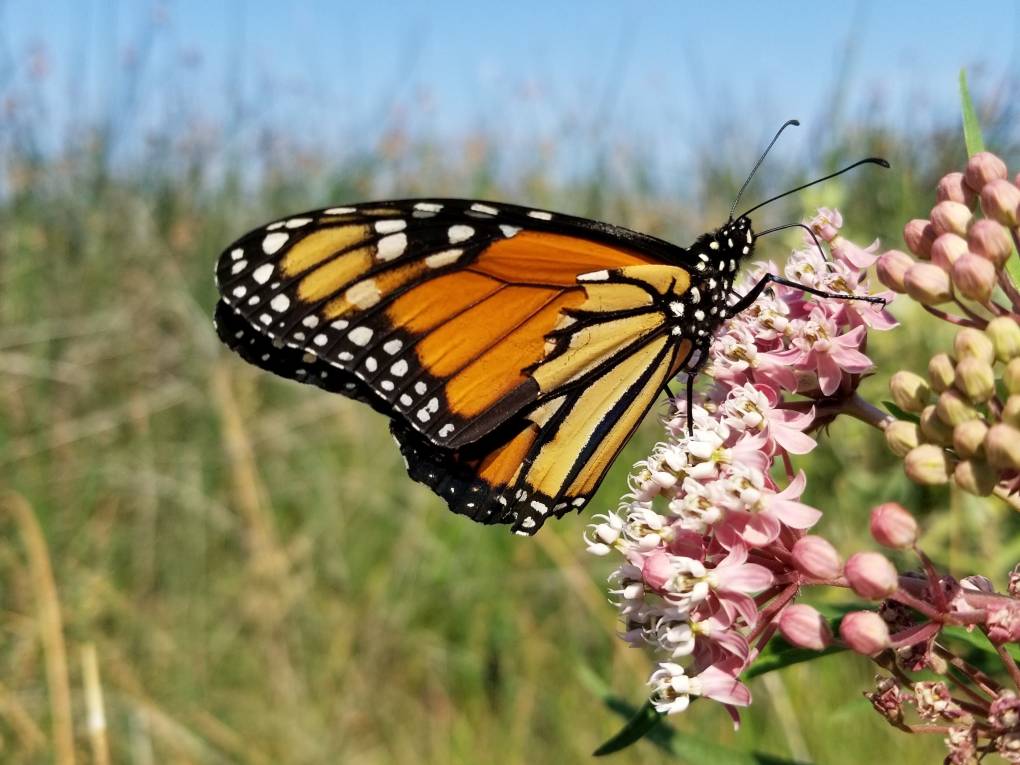
Monarch Butterflies Now Wear Tiny Tags — for Scientists to Track Them in Real Time
Monarch Butterflies Are on the Decline in California. Here’s Why
How Do You Protect a Species That Lives Across a Continent? Monarch Butterfly Decision May Soon Try
How Record-Breaking Heat Waves Add to Risks for Western Monarch Butterflies
The Bay Area Butterfly Festival Is Happening This Weekend in Vallejo
Where to Hike in the Bay Area for the Best Wildlife Encounters
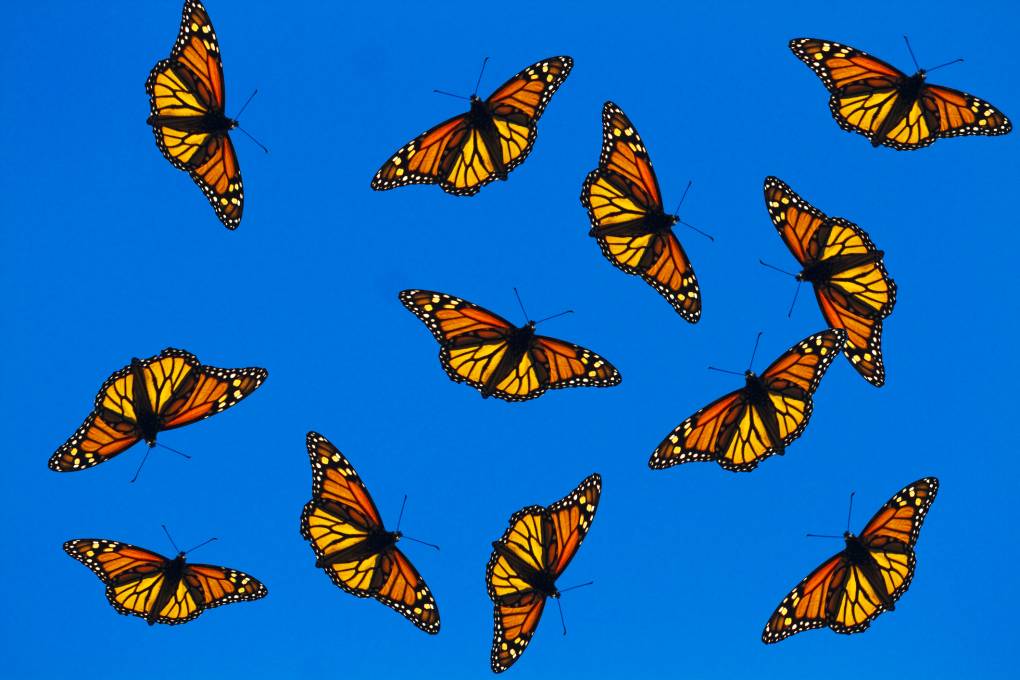
Top Locations to See Monarch Butterflies in California
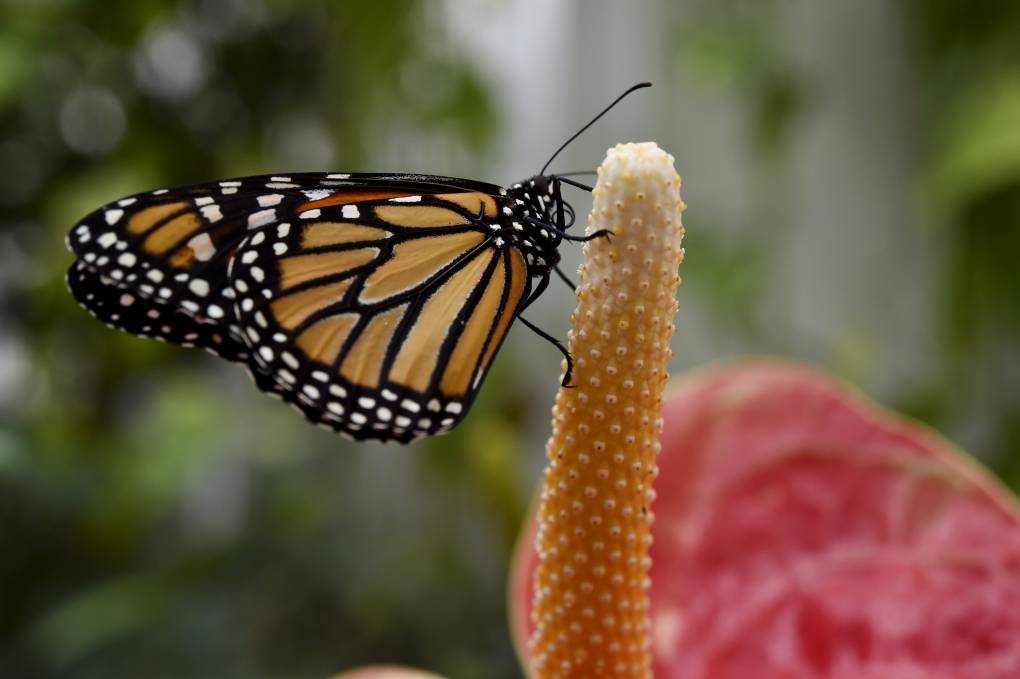
Only 2,000 Monarch Butterflies Remain in California. But They Still Don’t Have Protection
Just 29,000 Western Monarch Butterflies Are Left in California. That's Down From Millions
Sponsored
Player sponsored by
window.__IS_SSR__=true
window.__INITIAL_STATE__={
"attachmentsReducer": {
"audio_0": {
"type": "attachments",
"id": "audio_0",
"imgSizes": {
"kqedFullSize": {
"file": "https://ww2.kqed.org/news/wp-content/themes/KQED-unified/img/audio_bgs/background0.jpg"
}
}
},
"audio_1": {
"type": "attachments",
"id": "audio_1",
"imgSizes": {
"kqedFullSize": {
"file": "https://ww2.kqed.org/news/wp-content/themes/KQED-unified/img/audio_bgs/background1.jpg"
}
}
},
"audio_2": {
"type": "attachments",
"id": "audio_2",
"imgSizes": {
"kqedFullSize": {
"file": "https://ww2.kqed.org/news/wp-content/themes/KQED-unified/img/audio_bgs/background2.jpg"
}
}
},
"audio_3": {
"type": "attachments",
"id": "audio_3",
"imgSizes": {
"kqedFullSize": {
"file": "https://ww2.kqed.org/news/wp-content/themes/KQED-unified/img/audio_bgs/background3.jpg"
}
}
},
"audio_4": {
"type": "attachments",
"id": "audio_4",
"imgSizes": {
"kqedFullSize": {
"file": "https://ww2.kqed.org/news/wp-content/themes/KQED-unified/img/audio_bgs/background4.jpg"
}
}
},
"placeholder": {
"type": "attachments",
"id": "placeholder",
"imgSizes": {
"thumbnail": {
"file": "https://cdn.kqed.org/wp-content/uploads/2024/12/KQED-Default-Image-816638274-2000x1333-1-160x107.jpg",
"width": 160,
"height": 107,
"mimeType": "image/jpeg"
},
"medium": {
"file": "https://cdn.kqed.org/wp-content/uploads/2024/12/KQED-Default-Image-816638274-2000x1333-1-800x533.jpg",
"width": 800,
"height": 533,
"mimeType": "image/jpeg"
},
"medium_large": {
"file": "https://cdn.kqed.org/wp-content/uploads/2024/12/KQED-Default-Image-816638274-2000x1333-1-768x512.jpg",
"width": 768,
"height": 512,
"mimeType": "image/jpeg"
},
"large": {
"file": "https://cdn.kqed.org/wp-content/uploads/2024/12/KQED-Default-Image-816638274-2000x1333-1-1020x680.jpg",
"width": 1020,
"height": 680,
"mimeType": "image/jpeg"
},
"1536x1536": {
"file": "https://cdn.kqed.org/wp-content/uploads/2024/12/KQED-Default-Image-816638274-2000x1333-1-1536x1024.jpg",
"width": 1536,
"height": 1024,
"mimeType": "image/jpeg"
},
"fd-lrg": {
"file": "https://cdn.kqed.org/wp-content/uploads/2024/12/KQED-Default-Image-816638274-2000x1333-1-1536x1024.jpg",
"width": 1536,
"height": 1024,
"mimeType": "image/jpeg"
},
"fd-med": {
"file": "https://cdn.kqed.org/wp-content/uploads/2024/12/KQED-Default-Image-816638274-2000x1333-1-1020x680.jpg",
"width": 1020,
"height": 680,
"mimeType": "image/jpeg"
},
"fd-sm": {
"file": "https://cdn.kqed.org/wp-content/uploads/2024/12/KQED-Default-Image-816638274-2000x1333-1-800x533.jpg",
"width": 800,
"height": 533,
"mimeType": "image/jpeg"
},
"post-thumbnail": {
"file": "https://cdn.kqed.org/wp-content/uploads/2024/12/KQED-Default-Image-816638274-2000x1333-1-672x372.jpg",
"width": 672,
"height": 372,
"mimeType": "image/jpeg"
},
"twentyfourteen-full-width": {
"file": "https://cdn.kqed.org/wp-content/uploads/2024/12/KQED-Default-Image-816638274-2000x1333-1-1038x576.jpg",
"width": 1038,
"height": 576,
"mimeType": "image/jpeg"
},
"xxsmall": {
"file": "https://cdn.kqed.org/wp-content/uploads/2024/12/KQED-Default-Image-816638274-2000x1333-1-160x107.jpg",
"width": 160,
"height": 107,
"mimeType": "image/jpeg"
},
"xsmall": {
"file": "https://cdn.kqed.org/wp-content/uploads/2024/12/KQED-Default-Image-816638274-2000x1333-1-672x372.jpg",
"width": 672,
"height": 372,
"mimeType": "image/jpeg"
},
"small": {
"file": "https://cdn.kqed.org/wp-content/uploads/2024/12/KQED-Default-Image-816638274-2000x1333-1-672x372.jpg",
"width": 672,
"height": 372,
"mimeType": "image/jpeg"
},
"xlarge": {
"file": "https://cdn.kqed.org/wp-content/uploads/2024/12/KQED-Default-Image-816638274-2000x1333-1-1020x680.jpg",
"width": 1020,
"height": 680,
"mimeType": "image/jpeg"
},
"full-width": {
"file": "https://cdn.kqed.org/wp-content/uploads/2024/12/KQED-Default-Image-816638274-2000x1333-1-1920x1280.jpg",
"width": 1920,
"height": 1280,
"mimeType": "image/jpeg"
},
"guest-author-32": {
"file": "https://cdn.kqed.org/wp-content/uploads/2025/01/KQED-Default-Image-816638274-1333x1333-1-160x160.jpg",
"width": 32,
"height": 32,
"mimeType": "image/jpeg"
},
"guest-author-50": {
"file": "https://cdn.kqed.org/wp-content/uploads/2025/01/KQED-Default-Image-816638274-1333x1333-1-160x160.jpg",
"width": 50,
"height": 50,
"mimeType": "image/jpeg"
},
"guest-author-64": {
"file": "https://cdn.kqed.org/wp-content/uploads/2025/01/KQED-Default-Image-816638274-1333x1333-1-160x160.jpg",
"width": 64,
"height": 64,
"mimeType": "image/jpeg"
},
"guest-author-96": {
"file": "https://cdn.kqed.org/wp-content/uploads/2025/01/KQED-Default-Image-816638274-1333x1333-1-160x160.jpg",
"width": 96,
"height": 96,
"mimeType": "image/jpeg"
},
"guest-author-128": {
"file": "https://cdn.kqed.org/wp-content/uploads/2025/01/KQED-Default-Image-816638274-1333x1333-1-160x160.jpg",
"width": 128,
"height": 128,
"mimeType": "image/jpeg"
},
"detail": {
"file": "https://cdn.kqed.org/wp-content/uploads/2025/01/KQED-Default-Image-816638274-1333x1333-1-160x160.jpg",
"width": 160,
"height": 160,
"mimeType": "image/jpeg"
},
"kqedFullSize": {
"file": "https://cdn.kqed.org/wp-content/uploads/2024/12/KQED-Default-Image-816638274-2000x1333-1.jpg",
"width": 2000,
"height": 1333
}
}
},
"science_1999591": {
"type": "attachments",
"id": "science_1999591",
"meta": {
"index": "attachments_1716263798",
"site": "science",
"id": "1999591",
"found": true
},
"title": "MonarchButterfly",
"publishDate": 1765490874,
"status": "inherit",
"parent": 1999589,
"modified": 1765490903,
"caption": "A monarch butterfly wearing one of Cellular Tracking Technologies’ transmitters.",
"credit": "Courtesy of Cellular Tracking Technologies",
"altTag": null,
"description": null,
"imgSizes": {
"thumbnail": {
"file": "https://cdn.kqed.org/wp-content/uploads/sites/35/2025/12/MonarchButterfly-160x103.jpg",
"width": 160,
"height": 103,
"mimeType": "image/jpeg"
},
"medium_large": {
"file": "https://cdn.kqed.org/wp-content/uploads/sites/35/2025/12/MonarchButterfly-768x496.jpg",
"width": 768,
"height": 496,
"mimeType": "image/jpeg"
},
"1536x1536": {
"file": "https://cdn.kqed.org/wp-content/uploads/sites/35/2025/12/MonarchButterfly-1536x992.jpg",
"width": 1536,
"height": 992,
"mimeType": "image/jpeg"
},
"post-thumbnail": {
"file": "https://cdn.kqed.org/wp-content/uploads/sites/35/2025/12/MonarchButterfly-672x372.jpg",
"width": 672,
"height": 372,
"mimeType": "image/jpeg"
},
"twentyfourteen-full-width": {
"file": "https://cdn.kqed.org/wp-content/uploads/sites/35/2025/12/MonarchButterfly-1038x576.jpg",
"width": 1038,
"height": 576,
"mimeType": "image/jpeg"
},
"npr-cds-wide": {
"file": "https://cdn.kqed.org/wp-content/uploads/sites/35/2025/12/MonarchButterfly-1200x675.jpg",
"width": 1200,
"height": 675,
"mimeType": "image/jpeg"
},
"kqedFullSize": {
"file": "https://cdn.kqed.org/wp-content/uploads/sites/35/2025/12/MonarchButterfly.jpg",
"width": 2000,
"height": 1292
}
},
"fetchFailed": false,
"isLoading": false
},
"science_1995511": {
"type": "attachments",
"id": "science_1995511",
"meta": {
"index": "attachments_1716263798",
"site": "science",
"id": "1995511",
"found": true
},
"title": "025_KQEDScience_IntCommunitySchoolOakland_10202022_qed",
"publishDate": 1738264785,
"status": "inherit",
"parent": 1995508,
"modified": 1738264801,
"caption": "A monarch butterfly lands on a plant growing in the schoolyard at International Community School in Oakland on Oct. 20, 2022.",
"credit": "Beth LaBerge/KQED",
"altTag": null,
"description": null,
"imgSizes": {
"medium": {
"file": "https://cdn.kqed.org/wp-content/uploads/sites/35/2025/01/025_KQEDScience_IntCommunitySchoolOakland_10202022_qed-800x533.jpg",
"width": 800,
"height": 533,
"mimeType": "image/jpeg"
},
"large": {
"file": "https://cdn.kqed.org/wp-content/uploads/sites/35/2025/01/025_KQEDScience_IntCommunitySchoolOakland_10202022_qed-1020x680.jpg",
"width": 1020,
"height": 680,
"mimeType": "image/jpeg"
},
"thumbnail": {
"file": "https://cdn.kqed.org/wp-content/uploads/sites/35/2025/01/025_KQEDScience_IntCommunitySchoolOakland_10202022_qed-160x107.jpg",
"width": 160,
"height": 107,
"mimeType": "image/jpeg"
},
"medium_large": {
"file": "https://cdn.kqed.org/wp-content/uploads/sites/35/2025/01/025_KQEDScience_IntCommunitySchoolOakland_10202022_qed-768x512.jpg",
"width": 768,
"height": 512,
"mimeType": "image/jpeg"
},
"1536x1536": {
"file": "https://cdn.kqed.org/wp-content/uploads/sites/35/2025/01/025_KQEDScience_IntCommunitySchoolOakland_10202022_qed-1536x1024.jpg",
"width": 1536,
"height": 1024,
"mimeType": "image/jpeg"
},
"post-thumbnail": {
"file": "https://cdn.kqed.org/wp-content/uploads/sites/35/2025/01/025_KQEDScience_IntCommunitySchoolOakland_10202022_qed-672x372.jpg",
"width": 672,
"height": 372,
"mimeType": "image/jpeg"
},
"twentyfourteen-full-width": {
"file": "https://cdn.kqed.org/wp-content/uploads/sites/35/2025/01/025_KQEDScience_IntCommunitySchoolOakland_10202022_qed-1038x576.jpg",
"width": 1038,
"height": 576,
"mimeType": "image/jpeg"
},
"full-width": {
"file": "https://cdn.kqed.org/wp-content/uploads/sites/35/2025/01/025_KQEDScience_IntCommunitySchoolOakland_10202022_qed-1920x1280.jpg",
"width": 1920,
"height": 1280,
"mimeType": "image/jpeg"
},
"kqedFullSize": {
"file": "https://cdn.kqed.org/wp-content/uploads/sites/35/2025/01/025_KQEDScience_IntCommunitySchoolOakland_10202022_qed.jpg",
"width": 2000,
"height": 1333
}
},
"fetchFailed": false,
"isLoading": false
},
"science_1995229": {
"type": "attachments",
"id": "science_1995229",
"meta": {
"index": "attachments_1716263798",
"site": "science",
"id": "1995229",
"found": true
},
"title": "Monarch Butterflies California",
"publishDate": 1732061109,
"status": "inherit",
"parent": 1995228,
"modified": 1732061526,
"caption": "A cluster of butterflies sit on a pine tree at Monarch Grove Sanctuary in Pacific Grove, Calif., on Nov. 10, 2021. Researchers announced Tuesday, Jan. 31, 2023, that the population of western monarch butterflies wintering along the California coast has rebounded for a second year in a row after a precipitous drop in 2020, but the population of orange-and-black insects is still well below what it used to be.",
"credit": "Nic Coury/AP Photo",
"altTag": "Many monarch butterflies sit on a tree branch",
"description": "A cluster of butterflies sit on a pine tree at Monarch Grove Sanctuary in Pacific Grove, Calif., on Nov. 10, 2021. Researchers announced Tuesday, Jan. 31, 2023, that the population of western monarch butterflies wintering along the California coast has rebounded for a second year in a row after a precipitous drop in 2020, but the population of orange-and-black insects is still well below what it used to be.",
"imgSizes": {
"medium": {
"file": "https://cdn.kqed.org/wp-content/uploads/sites/35/2024/11/ap23031858418007-800x533.jpeg",
"width": 800,
"height": 533,
"mimeType": "image/jpeg"
},
"large": {
"file": "https://cdn.kqed.org/wp-content/uploads/sites/35/2024/11/ap23031858418007-1020x680.jpeg",
"width": 1020,
"height": 680,
"mimeType": "image/jpeg"
},
"thumbnail": {
"file": "https://cdn.kqed.org/wp-content/uploads/sites/35/2024/11/ap23031858418007-160x107.jpeg",
"width": 160,
"height": 107,
"mimeType": "image/jpeg"
},
"medium_large": {
"file": "https://cdn.kqed.org/wp-content/uploads/sites/35/2024/11/ap23031858418007-768x512.jpeg",
"width": 768,
"height": 512,
"mimeType": "image/jpeg"
},
"1536x1536": {
"file": "https://cdn.kqed.org/wp-content/uploads/sites/35/2024/11/ap23031858418007-1536x1024.jpeg",
"width": 1536,
"height": 1024,
"mimeType": "image/jpeg"
},
"2048x2048": {
"file": "https://cdn.kqed.org/wp-content/uploads/sites/35/2024/11/ap23031858418007-2048x1365.jpeg",
"width": 2048,
"height": 1365,
"mimeType": "image/jpeg"
},
"post-thumbnail": {
"file": "https://cdn.kqed.org/wp-content/uploads/sites/35/2024/11/ap23031858418007-672x372.jpeg",
"width": 672,
"height": 372,
"mimeType": "image/jpeg"
},
"twentyfourteen-full-width": {
"file": "https://cdn.kqed.org/wp-content/uploads/sites/35/2024/11/ap23031858418007-1038x576.jpeg",
"width": 1038,
"height": 576,
"mimeType": "image/jpeg"
},
"full-width": {
"file": "https://cdn.kqed.org/wp-content/uploads/sites/35/2024/11/ap23031858418007-1920x1280.jpeg",
"width": 1920,
"height": 1280,
"mimeType": "image/jpeg"
},
"kqedFullSize": {
"file": "https://cdn.kqed.org/wp-content/uploads/sites/35/2024/11/ap23031858418007-scaled.jpeg",
"width": 2560,
"height": 1706
}
},
"fetchFailed": false,
"isLoading": false
},
"science_1994688": {
"type": "attachments",
"id": "science_1994688",
"meta": {
"index": "attachments_1716263798",
"site": "science",
"id": "1994688",
"found": true
},
"title": "Monarch Butterflies",
"publishDate": 1728495716,
"status": "inherit",
"parent": 1994687,
"modified": 1765496655,
"caption": "Western monarchs feed on Pacific aster nectar while overwintering in the Monarch Butterfly Sanctuary in Pacific Grove, California.",
"credit": "Courtesy of Barry Bergman",
"altTag": "Orange and black-colored butterflies flutter around white-petaled flower plants. The backdrop is the blue sky.",
"description": null,
"imgSizes": {
"medium": {
"file": "https://cdn.kqed.org/wp-content/uploads/sites/35/2024/10/IMG_1398-2048x1365-1-800x533.jpg",
"width": 800,
"height": 533,
"mimeType": "image/jpeg"
},
"large": {
"file": "https://cdn.kqed.org/wp-content/uploads/sites/35/2024/10/IMG_1398-2048x1365-1-1020x680.jpg",
"width": 1020,
"height": 680,
"mimeType": "image/jpeg"
},
"thumbnail": {
"file": "https://cdn.kqed.org/wp-content/uploads/sites/35/2024/10/IMG_1398-2048x1365-1-160x107.jpg",
"width": 160,
"height": 107,
"mimeType": "image/jpeg"
},
"medium_large": {
"file": "https://cdn.kqed.org/wp-content/uploads/sites/35/2024/10/IMG_1398-2048x1365-1-768x512.jpg",
"width": 768,
"height": 512,
"mimeType": "image/jpeg"
},
"1536x1536": {
"file": "https://cdn.kqed.org/wp-content/uploads/sites/35/2024/10/IMG_1398-2048x1365-1-1536x1024.jpg",
"width": 1536,
"height": 1024,
"mimeType": "image/jpeg"
},
"post-thumbnail": {
"file": "https://cdn.kqed.org/wp-content/uploads/sites/35/2024/10/IMG_1398-2048x1365-1-672x372.jpg",
"width": 672,
"height": 372,
"mimeType": "image/jpeg"
},
"twentyfourteen-full-width": {
"file": "https://cdn.kqed.org/wp-content/uploads/sites/35/2024/10/IMG_1398-2048x1365-1-1038x576.jpg",
"width": 1038,
"height": 576,
"mimeType": "image/jpeg"
},
"full-width": {
"file": "https://cdn.kqed.org/wp-content/uploads/sites/35/2024/10/IMG_1398-2048x1365-1-1920x1280.jpg",
"width": 1920,
"height": 1280,
"mimeType": "image/jpeg"
},
"kqedFullSize": {
"file": "https://cdn.kqed.org/wp-content/uploads/sites/35/2024/10/IMG_1398-2048x1365-1.jpg",
"width": 2048,
"height": 1365
}
},
"fetchFailed": false,
"isLoading": false
},
"science_1956195": {
"type": "attachments",
"id": "science_1956195",
"meta": {
"index": "attachments_1716263798",
"site": "science",
"id": "1956195",
"found": true
},
"parent": 1956190,
"imgSizes": {
"twentyfourteen-full-width": {
"file": "https://ww2.kqed.org/app/uploads/sites/35/2020/01/Monarch-1-1038x576.jpg",
"width": 1038,
"mimeType": "image/jpeg",
"height": 576
},
"thumbnail": {
"file": "https://ww2.kqed.org/app/uploads/sites/35/2020/01/Monarch-1-160x120.jpg",
"width": 160,
"mimeType": "image/jpeg",
"height": 120
},
"post-thumbnail": {
"file": "https://ww2.kqed.org/app/uploads/sites/35/2020/01/Monarch-1-672x372.jpg",
"width": 672,
"mimeType": "image/jpeg",
"height": 372
},
"kqedFullSize": {
"file": "https://ww2.kqed.org/app/uploads/sites/35/2020/01/Monarch-1.jpg",
"width": 3024,
"height": 2269
},
"large": {
"file": "https://ww2.kqed.org/app/uploads/sites/35/2020/01/Monarch-1-1020x765.jpg",
"width": 1020,
"mimeType": "image/jpeg",
"height": 765
},
"full-width": {
"file": "https://ww2.kqed.org/app/uploads/sites/35/2020/01/Monarch-1-1920x1441.jpg",
"width": 1920,
"mimeType": "image/jpeg",
"height": 1441
},
"medium": {
"file": "https://ww2.kqed.org/app/uploads/sites/35/2020/01/Monarch-1-800x600.jpg",
"width": 800,
"mimeType": "image/jpeg",
"height": 600
},
"medium_large": {
"file": "https://ww2.kqed.org/app/uploads/sites/35/2020/01/Monarch-1-768x576.jpg",
"width": 768,
"mimeType": "image/jpeg",
"height": 576
}
},
"publishDate": 1579917116,
"modified": 1579917365,
"caption": "A monarch butterfly nectaring on swamp milkweed.",
"description": null,
"title": "Monarch 1",
"credit": "Stephanie McKnight/Xerces Society",
"status": "inherit",
"fetchFailed": false,
"isLoading": false
},
"science_1985498": {
"type": "attachments",
"id": "science_1985498",
"meta": {
"index": "attachments_1716263798",
"site": "science",
"id": "1985498",
"found": true
},
"parent": 1985496,
"imgSizes": {
"twentyfourteen-full-width": {
"file": "https://ww2.kqed.org/app/uploads/sites/35/2023/11/GettyImages-534340452-1038x576.jpg",
"width": 1038,
"mimeType": "image/jpeg",
"height": 576
},
"thumbnail": {
"file": "https://ww2.kqed.org/app/uploads/sites/35/2023/11/GettyImages-534340452-160x107.jpg",
"width": 160,
"mimeType": "image/jpeg",
"height": 107
},
"post-thumbnail": {
"file": "https://ww2.kqed.org/app/uploads/sites/35/2023/11/GettyImages-534340452-672x372.jpg",
"width": 672,
"mimeType": "image/jpeg",
"height": 372
},
"kqedFullSize": {
"file": "https://ww2.kqed.org/app/uploads/sites/35/2023/11/GettyImages-534340452-scaled.jpg",
"width": 2560,
"height": 1710
},
"2048x2048": {
"file": "https://ww2.kqed.org/app/uploads/sites/35/2023/11/GettyImages-534340452-2048x1368.jpg",
"width": 2048,
"mimeType": "image/jpeg",
"height": 1368
},
"large": {
"file": "https://ww2.kqed.org/app/uploads/sites/35/2023/11/GettyImages-534340452-1020x681.jpg",
"width": 1020,
"mimeType": "image/jpeg",
"height": 681
},
"1536x1536": {
"file": "https://ww2.kqed.org/app/uploads/sites/35/2023/11/GettyImages-534340452-1536x1026.jpg",
"width": 1536,
"mimeType": "image/jpeg",
"height": 1026
},
"full-width": {
"file": "https://ww2.kqed.org/app/uploads/sites/35/2023/11/GettyImages-534340452-1920x1283.jpg",
"width": 1920,
"mimeType": "image/jpeg",
"height": 1283
},
"medium": {
"file": "https://ww2.kqed.org/app/uploads/sites/35/2023/11/GettyImages-534340452-800x534.jpg",
"width": 800,
"mimeType": "image/jpeg",
"height": 534
},
"medium_large": {
"file": "https://ww2.kqed.org/app/uploads/sites/35/2023/11/GettyImages-534340452-768x513.jpg",
"width": 768,
"mimeType": "image/jpeg",
"height": 513
}
},
"publishDate": 1700498417,
"modified": 1700527089,
"caption": "Tule elk at Point Reyes National Seashore.",
"description": null,
"title": "best-hikes-near-me",
"credit": "Galen Rowell/Getty Images",
"status": "inherit",
"altTag": "An elk stand on green grass and a blue sky in the background.",
"fetchFailed": false,
"isLoading": false
},
"science_1985061": {
"type": "attachments",
"id": "science_1985061",
"meta": {
"index": "attachments_1716263798",
"site": "science",
"id": "1985061",
"found": true
},
"parent": 1985049,
"imgSizes": {
"twentyfourteen-full-width": {
"file": "https://ww2.kqed.org/app/uploads/sites/35/2023/11/GettyImages-460036505-1038x576.jpg",
"width": 1038,
"mimeType": "image/jpeg",
"height": 576
},
"thumbnail": {
"file": "https://ww2.kqed.org/app/uploads/sites/35/2023/11/GettyImages-460036505-160x107.jpg",
"width": 160,
"mimeType": "image/jpeg",
"height": 107
},
"post-thumbnail": {
"file": "https://ww2.kqed.org/app/uploads/sites/35/2023/11/GettyImages-460036505-672x372.jpg",
"width": 672,
"mimeType": "image/jpeg",
"height": 372
},
"kqedFullSize": {
"file": "https://ww2.kqed.org/app/uploads/sites/35/2023/11/GettyImages-460036505.jpg",
"width": 2121,
"height": 1414
},
"2048x2048": {
"file": "https://ww2.kqed.org/app/uploads/sites/35/2023/11/GettyImages-460036505-2048x1365.jpg",
"width": 2048,
"mimeType": "image/jpeg",
"height": 1365
},
"large": {
"file": "https://ww2.kqed.org/app/uploads/sites/35/2023/11/GettyImages-460036505-1020x680.jpg",
"width": 1020,
"mimeType": "image/jpeg",
"height": 680
},
"1536x1536": {
"file": "https://ww2.kqed.org/app/uploads/sites/35/2023/11/GettyImages-460036505-1536x1024.jpg",
"width": 1536,
"mimeType": "image/jpeg",
"height": 1024
},
"full-width": {
"file": "https://ww2.kqed.org/app/uploads/sites/35/2023/11/GettyImages-460036505-1920x1280.jpg",
"width": 1920,
"mimeType": "image/jpeg",
"height": 1280
},
"medium": {
"file": "https://ww2.kqed.org/app/uploads/sites/35/2023/11/GettyImages-460036505-800x533.jpg",
"width": 800,
"mimeType": "image/jpeg",
"height": 533
},
"medium_large": {
"file": "https://ww2.kqed.org/app/uploads/sites/35/2023/11/GettyImages-460036505-768x512.jpg",
"width": 768,
"mimeType": "image/jpeg",
"height": 512
}
},
"publishDate": 1698958930,
"modified": 1699031280,
"caption": "Monarch butterfly photos flying in the sky near Santa Cruz, California, during migration.",
"description": null,
"title": "where-to-see-butterflies",
"credit": "Mark Miller Photos/Getty Images",
"status": "inherit",
"altTag": "A number of brightly colored monarch butterflies in hues of orange and yellow against a bright blue backdrop",
"fetchFailed": false,
"isLoading": false
},
"science_1971798": {
"type": "attachments",
"id": "science_1971798",
"meta": {
"index": "attachments_1716263798",
"site": "science",
"id": "1971798",
"found": true
},
"parent": 1971791,
"imgSizes": {
"twentyfourteen-full-width": {
"file": "https://ww2.kqed.org/app/uploads/sites/35/2020/12/GettyImages-466895050-1-1038x576.jpg",
"width": 1038,
"mimeType": "image/jpeg",
"height": 576
},
"thumbnail": {
"file": "https://ww2.kqed.org/app/uploads/sites/35/2020/12/GettyImages-466895050-1-160x106.jpg",
"width": 160,
"mimeType": "image/jpeg",
"height": 106
},
"post-thumbnail": {
"file": "https://ww2.kqed.org/app/uploads/sites/35/2020/12/GettyImages-466895050-1-672x372.jpg",
"width": 672,
"mimeType": "image/jpeg",
"height": 372
},
"kqedFullSize": {
"file": "https://ww2.kqed.org/app/uploads/sites/35/2020/12/GettyImages-466895050-1-scaled.jpg",
"width": 2560,
"height": 1704
},
"2048x2048": {
"file": "https://ww2.kqed.org/app/uploads/sites/35/2020/12/GettyImages-466895050-1-2048x1363.jpg",
"width": 2048,
"mimeType": "image/jpeg",
"height": 1363
},
"large": {
"file": "https://ww2.kqed.org/app/uploads/sites/35/2020/12/GettyImages-466895050-1-1020x679.jpg",
"width": 1020,
"mimeType": "image/jpeg",
"height": 679
},
"1536x1536": {
"file": "https://ww2.kqed.org/app/uploads/sites/35/2020/12/GettyImages-466895050-1-1536x1022.jpg",
"width": 1536,
"mimeType": "image/jpeg",
"height": 1022
},
"full-width": {
"file": "https://ww2.kqed.org/app/uploads/sites/35/2020/12/GettyImages-466895050-1-1920x1278.jpg",
"width": 1920,
"mimeType": "image/jpeg",
"height": 1278
},
"medium": {
"file": "https://ww2.kqed.org/app/uploads/sites/35/2020/12/GettyImages-466895050-1-800x532.jpg",
"width": 800,
"mimeType": "image/jpeg",
"height": 532
},
"medium_large": {
"file": "https://ww2.kqed.org/app/uploads/sites/35/2020/12/GettyImages-466895050-1-768x511.jpg",
"width": 768,
"mimeType": "image/jpeg",
"height": 511
}
},
"publishDate": 1608248965,
"modified": 1608330162,
"caption": "Despite dwindling numbers, monarch butterflies still don't have endangered species status.",
"description": null,
"title": "MEXICO-NATURE-BUTTERFLIES",
"credit": "Yuri Cortez/AFP via Getty Images",
"status": "inherit",
"altTag": null,
"fetchFailed": false,
"isLoading": false
}
},
"audioPlayerReducer": {
"postId": "stream_live",
"isPaused": true,
"isPlaying": false,
"pfsActive": false,
"pledgeModalIsOpen": true,
"playerDrawerIsOpen": false
},
"authorsReducer": {
"byline_science_1995228": {
"type": "authors",
"id": "byline_science_1995228",
"meta": {
"override": true
},
"slug": "byline_science_1995228",
"name": "Nathan Rott \u003cbr> NPR",
"isLoading": false
},
"byline_science_1994687": {
"type": "authors",
"id": "byline_science_1994687",
"meta": {
"override": true
},
"slug": "byline_science_1994687",
"name": "Liza Gross",
"isLoading": false
},
"parcuni": {
"type": "authors",
"id": "11368",
"meta": {
"index": "authors_1716337520",
"id": "11368",
"found": true
},
"name": "Peter Arcuni",
"firstName": "Peter",
"lastName": "Arcuni",
"slug": "parcuni",
"email": "parcuni@KQED.org",
"display_author_email": false,
"staff_mastheads": [
"science"
],
"title": "Reporter",
"bio": "Peter reports radio and online stories for \u003cem>KQED Science\u003c/em>. His work has also appeared on the \u003cem>The California Report\u003c/em> morning show and \u003cem>KQED News\u003c/em>. His production credits include \u003cem>The California Report, The California Report Magazine\u003c/em> and KQED's local news podcast \u003cem>The Bay\u003c/em>. Other credits include NPR's \u003cem>All Things Considered\u003c/em>, WNYC's \u003cem>Science Friday\u003c/em>, WBUR's \u003cem>Here & Now\u003c/em>, WIRED and SFGate. Peter graduated from Brown University and earned a master's degree in journalism from Stanford. He's covered everything from homelessness to wildfires, health, the environment, arts and Thanksgiving in San Quentin prison. In other lives, he played rock n roll music and studied neuroscience. You can email him at: parcuni@kqed.org",
"avatar": "https://secure.gravatar.com/avatar/d5032f6f27199d478af34ad2e1d98732?s=600&d=blank&r=g",
"twitter": "peterarcuni",
"facebook": null,
"instagram": null,
"linkedin": null,
"sites": [
{
"site": "news",
"roles": [
"editor"
]
},
{
"site": "science",
"roles": [
"editor"
]
}
],
"headData": {
"title": "Peter Arcuni | KQED",
"description": "Reporter",
"ogImgSrc": "https://secure.gravatar.com/avatar/d5032f6f27199d478af34ad2e1d98732?s=600&d=blank&r=g",
"twImgSrc": "https://secure.gravatar.com/avatar/d5032f6f27199d478af34ad2e1d98732?s=600&d=blank&r=g"
},
"isLoading": false,
"link": "/author/parcuni"
},
"smohamad": {
"type": "authors",
"id": "11631",
"meta": {
"index": "authors_1716337520",
"id": "11631",
"found": true
},
"name": "Sarah Mohamad",
"firstName": "Sarah",
"lastName": "Mohamad",
"slug": "smohamad",
"email": "smohamad@KQED.org",
"display_author_email": true,
"staff_mastheads": [],
"title": "Engagement Producer and Reporter, KQED Science",
"bio": "Sarah Mohamad is an audience engagement reporter and producer for KQED Science. She reports on audience-focused science and environment stories and manages the team's social media, newsletter, and engagement efforts. Prior to this role, she played a key role as project manager for NSF's \u003ca href=\"https://www.kqed.org/crackingthecode\">\u003cem>Cracking the Code: Influencing Millennial Science Engagement\u003c/em> \u003c/a>audience research.",
"avatar": "https://secure.gravatar.com/avatar/085f65bb82616965f87e3d12f8550931?s=600&d=blank&r=g",
"twitter": "sarahkmohamad",
"facebook": null,
"instagram": null,
"linkedin": null,
"sites": [
{
"site": "arts",
"roles": [
"editor"
]
},
{
"site": "news",
"roles": [
"editor"
]
},
{
"site": "about",
"roles": [
"editor"
]
},
{
"site": "science",
"roles": [
"editor"
]
}
],
"headData": {
"title": "Sarah Mohamad | KQED",
"description": "Engagement Producer and Reporter, KQED Science",
"ogImgSrc": "https://secure.gravatar.com/avatar/085f65bb82616965f87e3d12f8550931?s=600&d=blank&r=g",
"twImgSrc": "https://secure.gravatar.com/avatar/085f65bb82616965f87e3d12f8550931?s=600&d=blank&r=g"
},
"isLoading": false,
"link": "/author/smohamad"
},
"sarahwright": {
"type": "authors",
"id": "11956",
"meta": {
"index": "authors_1716337520",
"id": "11956",
"found": true
},
"name": "Sarah Wright",
"firstName": "Sarah",
"lastName": "Wright",
"slug": "sarahwright",
"email": "swright@kqed.org",
"display_author_email": true,
"staff_mastheads": [],
"title": "Outdoors Engagement Reporter",
"bio": "Sarah Wright is KQED's Outdoors Engagement Reporter. Originally from Lake Tahoe, she completed a thru-hike of the Pacific Crest Trail in 2019 and was a U.S. Fulbright Program grantee to Argentina in 2023. Her journalism has appeared in The Guardian, The San Francisco Standard, The Palo Alto Weekly and the Half Moon Bay Review.",
"avatar": "https://secure.gravatar.com/avatar/585b7a53f459b86d1d3ca1561541ab4b?s=600&d=blank&r=g",
"twitter": null,
"facebook": null,
"instagram": null,
"linkedin": null,
"sites": [
{
"site": "arts",
"roles": [
"editor"
]
},
{
"site": "news",
"roles": [
"editor"
]
},
{
"site": "science",
"roles": [
"contributor",
"author"
]
},
{
"site": "forum",
"roles": [
"editor"
]
}
],
"headData": {
"title": "Sarah Wright | KQED",
"description": "Outdoors Engagement Reporter",
"ogImgSrc": "https://secure.gravatar.com/avatar/585b7a53f459b86d1d3ca1561541ab4b?s=600&d=blank&r=g",
"twImgSrc": "https://secure.gravatar.com/avatar/585b7a53f459b86d1d3ca1561541ab4b?s=600&d=blank&r=g"
},
"isLoading": false,
"link": "/author/sarahwright"
}
},
"breakingNewsReducer": {},
"pagesReducer": {},
"postsReducer": {
"stream_live": {
"type": "live",
"id": "stream_live",
"audioUrl": "https://streams.kqed.org/kqedradio",
"title": "Live Stream",
"excerpt": "Live Stream information currently unavailable.",
"link": "/radio",
"featImg": "",
"label": {
"name": "KQED Live",
"link": "/"
}
},
"stream_kqedNewscast": {
"type": "posts",
"id": "stream_kqedNewscast",
"audioUrl": "https://www.kqed.org/.stream/anon/radio/RDnews/newscast.mp3?_=1",
"title": "KQED Newscast",
"featImg": "",
"label": {
"name": "88.5 FM",
"link": "/"
}
},
"science_1999589": {
"type": "posts",
"id": "science_1999589",
"meta": {
"index": "posts_1716263798",
"site": "science",
"id": "1999589",
"score": null,
"sort": [
1765800000000
]
},
"guestAuthors": [],
"slug": "monarch-butterflies-now-wear-tiny-tags-for-scientists-to-track-them-in-real-time",
"title": "Monarch Butterflies Now Wear Tiny Tags — for Scientists to Track Them in Real Time",
"publishDate": 1765800000,
"format": "standard",
"headTitle": "Monarch Butterflies Now Wear Tiny Tags — for Scientists to Track Them in Real Time | KQED",
"labelTerm": {},
"content": "\u003cp>Thanks to \u003ca href=\"https://xerces.org/press/new-ultralight-radio-tags-are-tracking-monarch-butterflies-in-santa-cruz\">tiny new ultralight radio tags\u003c/a> small enough for a fragile butterfly to carry, scientists are getting a rare, real-time look at how western monarchs move through their winter habitat.\u003c/p>\n\u003cp>It’s part of a breakthrough tracking effort reshaping what we know about one of North America’s most iconic migrations.\u003c/p>\n\u003cp>In November, the \u003ca href=\"https://xerces.org/\">Xerces Society\u003c/a> for Invertebrate Conservation joined with scientific collaborators to deploy roughly 100 ultra-light Bluetooth tags along the Central Coast, offering an unprecedented look at how Western monarchs move through their fragmented winter habitat.\u003c/p>\n\u003cp>Eyelash glue was delicately applied to each monarch’s thorax and used to attach the tiny tag.\u003c/p>\n\u003cp>[ad fullwidth]\u003c/p>\n\u003cp>The solar-powered tag, developed by \u003ca href=\"https://celltracktech.com/\">Cellular Tracking Technologies\u003c/a>, weighs about 60 milligrams, which works out to only about a tenth of the weight of a monarch. By broadcasting its signals to billions of Bluetooth-enabled devices, the system allows researchers to follow individual butterflies through an app called \u003ca href=\"https://apps.apple.com/us/app/project-monarch-science/id6460006970\">Project Monarch Science\u003c/a>.\u003c/p>\n\u003cp>The public can follow along on the monarch’s journey, too. If you want to participate in tracking monarch populations, you can download the Project Monarch App, where you can log any sightings, and the Bluetooth technology in your phone will also help triangulate other butterflies that might be in the area.\u003c/p>\n\u003cfigure id=\"attachment_1999596\" class=\"wp-caption aligncenter\" style=\"max-width: 2000px\">\u003cimg loading=\"lazy\" decoding=\"async\" class=\"size-full wp-image-1999596\" src=\"https://cdn.kqed.org/wp-content/uploads/sites/35/2025/12/monarchTagging_overhead_cCapeMayPointArtsAndScienceCenter.jpg\" alt=\"\" width=\"2000\" height=\"1647\" srcset=\"https://cdn.kqed.org/wp-content/uploads/sites/35/2025/12/monarchTagging_overhead_cCapeMayPointArtsAndScienceCenter.jpg 2000w, https://cdn.kqed.org/wp-content/uploads/sites/35/2025/12/monarchTagging_overhead_cCapeMayPointArtsAndScienceCenter-160x132.jpg 160w, https://cdn.kqed.org/wp-content/uploads/sites/35/2025/12/monarchTagging_overhead_cCapeMayPointArtsAndScienceCenter-768x632.jpg 768w, https://cdn.kqed.org/wp-content/uploads/sites/35/2025/12/monarchTagging_overhead_cCapeMayPointArtsAndScienceCenter-1536x1265.jpg 1536w\" sizes=\"auto, (max-width: 2000px) 100vw, 2000px\">\u003cfigcaption class=\"wp-caption-text\">A monarch butterfly wearing one of Cellular Tracking Technologies’ transmitters. \u003ccite>(Courtesy of Cellular Tracking Technologies)\u003c/cite>\u003c/figcaption>\u003c/figure>\n\u003cp>In late 2024, a tagged monarch named Lionel migrated from New Jersey to Florida, logging thousands of detections along the way. “For the first time, we got a full southbound track of a monarch for over a thousand miles along that track,” said Dr. David La Puma, director of global market development at CTT.\u003c/p>\n\u003cp>More than 400 monarchs like Lionel have since been tagged, revealing detailed flight paths, unexpected detours and long-distance movements never documented before.\u003c/p>\n\u003ch2>The monarch picture in California\u003c/h2>\n\u003cp>In California, the project tagged over 40 monarchs in Santa Cruz County, covering Natural Bridges, Lighthouse Field, and Moran Lake. Additional researchers tagged monarchs in San Luis Obispo and Santa Barbara, bringing the West Coast total to about 100 individual butterflies. The effort required more than a year of preparation and buy-in from the California Department of Fish and Wildlife.\u003c/p>\n\u003cp>Early detections already hint at butterfly behavior that scientists had previously only theorized about. “We knew they moved between overwintering sites, but the frequency we’re seeing is just very quick,” said Ashley Fisher, conservation biologist at the Xerces Society.\u003c/p>\n\u003cfigure id=\"attachment_1985061\" class=\"wp-caption aligncenter\" style=\"max-width: 2121px\">\u003cimg loading=\"lazy\" decoding=\"async\" class=\"size-full wp-image-1985061\" src=\"https://cdn.kqed.org/wp-content/uploads/sites/35/2023/11/GettyImages-460036505.jpg\" alt=\"A number of brightly colored monarch butterflies in hues of orange and yellow against a bright blue backdrop\" width=\"2121\" height=\"1414\" srcset=\"https://cdn.kqed.org/wp-content/uploads/sites/35/2023/11/GettyImages-460036505.jpg 2121w, https://cdn.kqed.org/wp-content/uploads/sites/35/2023/11/GettyImages-460036505-800x533.jpg 800w, https://cdn.kqed.org/wp-content/uploads/sites/35/2023/11/GettyImages-460036505-1020x680.jpg 1020w, https://cdn.kqed.org/wp-content/uploads/sites/35/2023/11/GettyImages-460036505-160x107.jpg 160w, https://cdn.kqed.org/wp-content/uploads/sites/35/2023/11/GettyImages-460036505-768x512.jpg 768w, https://cdn.kqed.org/wp-content/uploads/sites/35/2023/11/GettyImages-460036505-1536x1024.jpg 1536w, https://cdn.kqed.org/wp-content/uploads/sites/35/2023/11/GettyImages-460036505-2048x1365.jpg 2048w, https://cdn.kqed.org/wp-content/uploads/sites/35/2023/11/GettyImages-460036505-1920x1280.jpg 1920w\" sizes=\"auto, (max-width: 2121px) 100vw, 2121px\">\u003cfigcaption class=\"wp-caption-text\">Monarch butterfly photos flying in the sky near Santa Cruz, California, during migration. \u003ccite>(Mark Miller Photos/Getty Images)\u003c/cite>\u003c/figcaption>\u003c/figure>\n\u003cp>According to the Bluetooth tracking, one monarch traveled more than 100 miles in just two days, passing several known winter sites and surprising researchers with long-distance movement during the overwintering season — when butterflies are hibernating, conserving energy for the upcoming spring migration.\u003c/p>\n\u003cp>The \u003ca href=\"https://www.kqed.org/science/1995508/monarch-butterflies-are-on-the-decline-in-california-heres-why\">Western monarch population has plummeted \u003c/a>by more than 99% since the 1980s due to habitat loss, pesticide use and human-caused climate change affecting migration and nectar sources.\u003c/p>\n\u003cp>Protecting the coastal groves where they overwinter is a cornerstone of recovery — but scientists have long lacked a clear view of how individual butterflies travel during the season.[aside postID=science_1995508 hero='https://cdn.kqed.org/wp-content/uploads/sites/35/2025/01/025_KQEDScience_IntCommunitySchoolOakland_10202022_qed-1020x680.jpg']This California deployment is key for understanding how Western monarchs use coastal habitat, especially as populations remain low, with a preliminary estimate of about \u003ca href=\"https://westernmonarchcount.org/mid-season-western-monarch-count-tally-reaches-8000/\">8,000 butterflies counted\u003c/a> so far this winter.\u003c/p>\n\u003cp>By revealing which sites monarchs rely on, how often they leave to forage and where they disperse in early spring, the data will help California agencies and conservation groups identify critical habitat, guide restoration and reduce threats like pesticide exposure.\u003c/p>\n\u003cp>“The detailed day-to-day movements are blowing the lid off our understanding” of these creatures, Fisher said.\u003c/p>\n\u003cp>The tagged butterflies will also help researchers understand when and where monarchs move \u003cem>among \u003c/em>overwintering sites and the surrounding areas, said Emma Pelton, senior conservation biologist with the Xerces Society.\u003c/p>\n\u003cp>“These details will help us identify where to prioritize conservation of western monarch habitat, as well as provide the most accurate picture of their home range to date,” she said.\u003c/p>\n\u003ch2>Where can I see monarchs in and around the Bay Area?\u003c/h2>\n\u003cp>For the best Western monarch butterfly viewing, head south along the coast to groves in Monterey, Santa Cruz and San Luis Obispo. Some exceptional viewing sites include:\u003c/p>\n\u003cul>\n\u003cli>\u003ca href=\"https://www.pgmuseum.org/monarch-viewing/\">Pacific Grove’s butterfly grove\u003c/a> near Monterey\u003c/li>\n\u003cli>\u003ca href=\"https://www.parks.ca.gov/?page_id=541\">Natural Bridges State Beach\u003c/a> in Santa Cruz\u003c/li>\n\u003cli>\u003ca href=\"https://www.parks.ca.gov/?page_id=550\">Lighthouse Field State Beach\u003c/a> in Santa Cruz\u003c/li>\n\u003cli>\u003ca href=\"http://www.parks.ca.gov/?page_id=595\">Pismo State Beach\u003c/a> in San Luis Obispo\u003c/li>\n\u003c/ul>\n\u003cp>There have also been reports of monarchs in the East Bay, at spots like:\u003c/p>\n\u003cul>\n\u003cli>\u003ca href=\"https://www.ebparks.org/parks/ardenwood\">The Ardenwood Historic Farm\u003c/a> in Fremont\u003c/li>\n\u003cli>\u003ca href=\"https://berkeleyca.gov/community-recreation/parks-recreation/parks/aquatic-park\">Berkeley Aquatic Park\u003c/a> in Berkeley\u003c/li>\n\u003cli>\u003ca href=\"https://www.ebparks.org/parks/oyster-bay\">Oyster Bay Regional Shoreline\u003c/a> and \u003ca href=\"https://www.ebparks.org/parks/point-pinole\">Point Pinole Regional Shoreline\u003c/a>\u003c/li>\n\u003cli>\u003ca href=\"https://www.albanyca.gov/Residents/Parks-Open-Space/Albany-Hill\">Albany Hill Park\u003c/a> in Albany\u003c/li>\n\u003c/ul>\n\u003cp>Xerces has a \u003ca href=\"https://westernmonarchcount.org/map-of-overwintering-sites/\">map of all the monarch butterfly overwintering sites in California\u003c/a>, but please note that some of these locations might not be open to the public.\u003c/p>\n\u003ch2>What attracts monarch butterflies to a certain spot?\u003c/h2>\n\u003cp>Monarch butterflies gravitate toward coastal areas, said Natalie Johnston, education manager at Pacific Grove Museum of Natural History, and the largest population in the state this year was recorded in Santa Cruz.\u003c/p>\n\u003cp>Martha Nitzberg, an interpreter at \u003ca href=\"https://www.parks.ca.gov/?page_id=541\">Natural Bridges State Beach\u003c/a> in Santa Cruz, said their location is an apt example of how a particular place can offer up a welcoming, attractive environment for migrating butterflies.\u003c/p>\n\u003cfigure id=\"attachment_1985064\" class=\"wp-caption aligncenter\" style=\"max-width: 2124px\">\u003cimg loading=\"lazy\" decoding=\"async\" class=\"size-full wp-image-1985064\" src=\"https://cdn.kqed.org/wp-content/uploads/sites/35/2023/11/GettyImages-184945669.jpg\" alt=\"\" width=\"2124\" height=\"1411\" srcset=\"https://cdn.kqed.org/wp-content/uploads/sites/35/2023/11/GettyImages-184945669.jpg 2124w, https://cdn.kqed.org/wp-content/uploads/sites/35/2023/11/GettyImages-184945669-800x531.jpg 800w, https://cdn.kqed.org/wp-content/uploads/sites/35/2023/11/GettyImages-184945669-1020x678.jpg 1020w, https://cdn.kqed.org/wp-content/uploads/sites/35/2023/11/GettyImages-184945669-160x106.jpg 160w, https://cdn.kqed.org/wp-content/uploads/sites/35/2023/11/GettyImages-184945669-768x510.jpg 768w, https://cdn.kqed.org/wp-content/uploads/sites/35/2023/11/GettyImages-184945669-1536x1020.jpg 1536w, https://cdn.kqed.org/wp-content/uploads/sites/35/2023/11/GettyImages-184945669-2048x1361.jpg 2048w, https://cdn.kqed.org/wp-content/uploads/sites/35/2023/11/GettyImages-184945669-1920x1275.jpg 1920w\" sizes=\"auto, (max-width: 2124px) 100vw, 2124px\">\u003cfigcaption class=\"wp-caption-text\">Monarch butterfly (Danaus plexippus) resting on a tree branch in its winter nesting area. Taken in Santa Cruz, California. \u003ccite>(GomezDavid/Getty Images)\u003c/cite>\u003c/figcaption>\u003c/figure>\n\u003cp>First, like many other top viewing spots in the state, it’s by the ocean, where winter temperatures are moderate and frost can’t permeate the ground and vegetation.\u003c/p>\n\u003cp>At Natural Bridges, monarchs find extra protection from the elements, too. Located in a canyon, a series of concentric rings of trees helps block wind and protect the monarchs.\u003c/p>\n\u003cp>“They find a microclimate, as they don’t like wind,” Nitzberg said.\u003c/p>\n\u003cp>Nitzberg said they even have owls living nearby that scare off other birds that could be potential predators for these butterflies.\u003c/p>\n\u003ch2>When is peak monarch butterfly viewing season?\u003c/h2>\n\u003cp>Nitzberg said the butterflies start to become more numerous in the middle of October, and their visit tends to peak in Santa Cruz right around Thanksgiving. This year’s peak count at Natural Bridges, Nitzberg said, was 1,700 on Nov. 28.\u003c/p>\n\u003cp>At Pacific Grove, by contrast, Johnston said they \u003ca href=\"https://www.pgmuseum.org/monarchs\">recorded fewer than 200 butterflies\u003c/a> at their peak this year.\u003c/p>\n\u003cfigure id=\"attachment_1994688\" class=\"wp-caption aligncenter\" style=\"max-width: 2048px\">\u003cimg loading=\"lazy\" decoding=\"async\" class=\"size-full wp-image-1994688\" src=\"https://cdn.kqed.org/wp-content/uploads/sites/35/2024/10/IMG_1398-2048x1365-1.jpg\" alt=\"Orange and black-colored butterflies flutter around white-petaled flower plants. The backdrop is the blue sky.\" width=\"2048\" height=\"1365\" srcset=\"https://cdn.kqed.org/wp-content/uploads/sites/35/2024/10/IMG_1398-2048x1365-1.jpg 2048w, https://cdn.kqed.org/wp-content/uploads/sites/35/2024/10/IMG_1398-2048x1365-1-800x533.jpg 800w, https://cdn.kqed.org/wp-content/uploads/sites/35/2024/10/IMG_1398-2048x1365-1-1020x680.jpg 1020w, https://cdn.kqed.org/wp-content/uploads/sites/35/2024/10/IMG_1398-2048x1365-1-160x107.jpg 160w, https://cdn.kqed.org/wp-content/uploads/sites/35/2024/10/IMG_1398-2048x1365-1-768x512.jpg 768w, https://cdn.kqed.org/wp-content/uploads/sites/35/2024/10/IMG_1398-2048x1365-1-1536x1024.jpg 1536w, https://cdn.kqed.org/wp-content/uploads/sites/35/2024/10/IMG_1398-2048x1365-1-1920x1280.jpg 1920w\" sizes=\"auto, (max-width: 2048px) 100vw, 2048px\">\u003cfigcaption class=\"wp-caption-text\">Western monarchs feed on Pacific aster nectar while overwintering in the Monarch Butterfly Sanctuary in Pacific Grove, California. \u003ccite>(Courtesy of Barry Bergman)\u003c/cite>\u003c/figcaption>\u003c/figure>\n\u003cp>Fall is also the best time to visit if you’re hoping to see a lot of action, as they’re actively hunting for flowers and nectar to build up stores for winter.\u003c/p>\n\u003cp>But keep in mind: Monarch butterflies can’t actually fly if it’s under 56 degrees Fahrenheit. So in the colder months or times of day, it’s unlikely you’ll see any fluttering around at all.\u003c/p>\n\u003ch2>What should you know about viewing monarchs?\u003c/h2>\n\u003cp>Nitzberg said it’s best to bring binoculars, although many state parks like Natural Bridges also set up spotting scopes and hand out some binoculars to visitors.\u003c/p>\n\u003cp>Without binoculars, monarchs can admittedly sometimes be hard to spot, she said. Visitors might be more likely to mistake their dark “clumps” high up in the eucalyptus trees for pinecones, until they get a closer look.\u003c/p>\n\u003cp>If you’re hoping to see them flying about, Johnston recommends visiting in the afternoon, when the sun has had time to warm their tiny bodies up a touch.\u003c/p>\n\u003ch2>Why do monarch butterflies migrate?\u003c/h2>\n\u003cp>“The sun is the key to their migration,” Nitzberg said. “The butterflies are always looking for spring.”\u003c/p>\n\u003cp>On their migration path, the butterflies are looking for milkweed and flowers. And as the seasons turn and plants dry up, the monarchs continue northward, inland, and, oftentimes, to higher elevations, in search of places where they’re most likely to find springtime conditions into summer.\u003c/p>\n\u003cfigure id=\"attachment_1999598\" class=\"wp-caption aligncenter\" style=\"max-width: 1920px\">\u003cimg loading=\"lazy\" decoding=\"async\" class=\"size-full wp-image-1999598\" src=\"https://cdn.kqed.org/wp-content/uploads/sites/35/2025/12/Monarch-cluster.jpg\" alt=\"\" width=\"1920\" height=\"1080\" srcset=\"https://cdn.kqed.org/wp-content/uploads/sites/35/2025/12/Monarch-cluster.jpg 1920w, https://cdn.kqed.org/wp-content/uploads/sites/35/2025/12/Monarch-cluster-160x90.jpg 160w, https://cdn.kqed.org/wp-content/uploads/sites/35/2025/12/Monarch-cluster-768x432.jpg 768w, https://cdn.kqed.org/wp-content/uploads/sites/35/2025/12/Monarch-cluster-1536x864.jpg 1536w, https://cdn.kqed.org/wp-content/uploads/sites/35/2025/12/Monarch-cluster-1200x675.jpg 1200w\" sizes=\"auto, (max-width: 1920px) 100vw, 1920px\">\u003cfigcaption class=\"wp-caption-text\">When monarch butterflies overwinter, they cluster on trees, making them look like orange and black chandeliers. \u003ccite>(JHVEPhoto/iStock)\u003c/cite>\u003c/figcaption>\u003c/figure>\n\u003cp>But because butterflies live only a handful of weeks, the journey north and east can see up to four generations of monarchs passing the baton to each other as the season progresses.\u003c/p>\n\u003cp>Their short lifespan makes them “like little flitting beauties,” Johnston said. ”You get a glimpse of them, and then they’re gone.”\u003c/p>\n\u003cp>The reverse is also true: In the fall, the monarchs head south, following the sun toward warmer temperatures.[aside postID=science_1985049 hero='https://cdn.kqed.org/wp-content/uploads/sites/35/2022/10/DEEP_914_This_Parasite_Is_Cramping_the_Monarch_Butterflys_Style_V2_KQED.jpg']These butterflies, Nitzberg explained, experience a hormone shift on their travels south that allows them to accumulate fat and live longer. This can extend a monarch’s lifespan to as many as 9 months: a “super generation,” Johnston said.\u003c/p>\n\u003cp>“Instead of just going dormant like most insects do when it gets cold, they all migrate down and become social, and hang out in these beautiful clusters,” she said.\u003c/p>\n\u003cp>That’s also what makes them prime for tagging, Johnston explained – not only because they live long enough to get useful tracking information, but also because one butterfly’s location can reveal that of a cluster of monarchs, which can then be counted and interpreted.\u003c/p>\n\u003cp>“By tracking the monarch butterfly population, we can essentially use that to extrapolate how other important pollinators like other species of butterflies or even bumblebees, which require the same similar conditions, how they’re doing,” she said. “We can study them and learn from them in a way that we can’t with other insects.”\u003c/p>\n\u003ch2>What can you do to aid monarchs’ migration?\u003c/h2>\n\u003cp>In your own garden, if you have \u003ca href=\"https://xerces.org/sites/default/files/publications/19-004.pdf\">milkweed plants native to your area\u003c/a>, planting them can help the butterflies find food. However, Nitzberg warned against planting \u003ca href=\"https://www.nwf.org/-/media/Documents/PDFs/Garden-for-Wildlife/Tip-Sheets/Native-vs-Tropical-Milkweed.pdf\">non-native milkweed\u003c/a>, as it remains active in winter and can therefore aid in the spread of disease and confuse monarchs’ migrations.\u003c/p>\n\u003cp>And don’t forget that protecting the caterpillar is the first step to a healthy monarch — so if you have a lot of yellow jackets or wasps, removing those can create a haven for caterpillar populations.\u003c/p>\n\u003cp>But it’s not just monarchs at risk, stressed Nitzberg, so creating a garden without pesticides can benefit all species of butterflies.\u003c/p>\n\u003cp>“Poisons are really hard on all butterflies, especially these migrating monarchs,” she said.\u003c/p>\n\u003cp>[ad floatright]\u003c/p>\n",
"blocks": [],
"excerpt": "Plus, where you can see the beauty of monarch butterflies for yourself in the Bay Area.",
"status": "publish",
"parent": 0,
"modified": 1765499269,
"stats": {
"hasAudio": false,
"hasVideo": false,
"hasChartOrMap": false,
"iframeSrcs": [],
"hasGoogleForm": false,
"hasGallery": false,
"hasHearkenModule": false,
"hasPolis": false,
"paragraphCount": 47,
"wordCount": 1812
},
"headData": {
"title": "Monarch Butterflies Now Wear Tiny Tags — for Scientists to Track Them in Real Time | KQED",
"description": "Plus, where you can see the beauty of monarch butterflies for yourself in the Bay Area.",
"ogTitle": "",
"ogDescription": "",
"ogImgId": "",
"twTitle": "",
"twDescription": "",
"twImgId": "",
"schema": {
"@context": "https://schema.org",
"@type": "Article",
"headline": "Monarch Butterflies Now Wear Tiny Tags — for Scientists to Track Them in Real Time",
"datePublished": "2025-12-15T04:00:00-08:00",
"dateModified": "2025-12-11T16:27:49-08:00",
"image": "https://cdn.kqed.org/wp-content/uploads/2020/02/KQED-OG-Image@1x.png"
}
},
"primaryCategory": {
"termId": 40,
"slug": "news",
"name": "News"
},
"source": "News",
"sticky": false,
"templateType": "standard",
"featuredImageType": "standard",
"excludeFromSiteSearch": "Include",
"articleAge": "0",
"path": "/science/1999589/monarch-butterflies-now-wear-tiny-tags-for-scientists-to-track-them-in-real-time",
"audioTrackLength": null,
"parsedContent": [
{
"type": "contentString",
"content": "\u003cdiv class=\"post-body\">\u003cp>\u003cp>Thanks to \u003ca href=\"https://xerces.org/press/new-ultralight-radio-tags-are-tracking-monarch-butterflies-in-santa-cruz\">tiny new ultralight radio tags\u003c/a> small enough for a fragile butterfly to carry, scientists are getting a rare, real-time look at how western monarchs move through their winter habitat.\u003c/p>\n\u003cp>It’s part of a breakthrough tracking effort reshaping what we know about one of North America’s most iconic migrations.\u003c/p>\n\u003cp>In November, the \u003ca href=\"https://xerces.org/\">Xerces Society\u003c/a> for Invertebrate Conservation joined with scientific collaborators to deploy roughly 100 ultra-light Bluetooth tags along the Central Coast, offering an unprecedented look at how Western monarchs move through their fragmented winter habitat.\u003c/p>\n\u003cp>Eyelash glue was delicately applied to each monarch’s thorax and used to attach the tiny tag.\u003c/p>\n\u003cp>\u003c/p>\u003c/div>",
"attributes": {
"named": {},
"numeric": []
}
},
{
"type": "component",
"content": "",
"name": "ad",
"attributes": {
"named": {
"label": "fullwidth"
},
"numeric": [
"fullwidth"
]
}
},
{
"type": "contentString",
"content": "\u003cdiv class=\"post-body\">\u003cp>\u003c/p>\n\u003cp>The solar-powered tag, developed by \u003ca href=\"https://celltracktech.com/\">Cellular Tracking Technologies\u003c/a>, weighs about 60 milligrams, which works out to only about a tenth of the weight of a monarch. By broadcasting its signals to billions of Bluetooth-enabled devices, the system allows researchers to follow individual butterflies through an app called \u003ca href=\"https://apps.apple.com/us/app/project-monarch-science/id6460006970\">Project Monarch Science\u003c/a>.\u003c/p>\n\u003cp>The public can follow along on the monarch’s journey, too. If you want to participate in tracking monarch populations, you can download the Project Monarch App, where you can log any sightings, and the Bluetooth technology in your phone will also help triangulate other butterflies that might be in the area.\u003c/p>\n\u003cfigure id=\"attachment_1999596\" class=\"wp-caption aligncenter\" style=\"max-width: 2000px\">\u003cimg loading=\"lazy\" decoding=\"async\" class=\"size-full wp-image-1999596\" src=\"https://cdn.kqed.org/wp-content/uploads/sites/35/2025/12/monarchTagging_overhead_cCapeMayPointArtsAndScienceCenter.jpg\" alt=\"\" width=\"2000\" height=\"1647\" srcset=\"https://cdn.kqed.org/wp-content/uploads/sites/35/2025/12/monarchTagging_overhead_cCapeMayPointArtsAndScienceCenter.jpg 2000w, https://cdn.kqed.org/wp-content/uploads/sites/35/2025/12/monarchTagging_overhead_cCapeMayPointArtsAndScienceCenter-160x132.jpg 160w, https://cdn.kqed.org/wp-content/uploads/sites/35/2025/12/monarchTagging_overhead_cCapeMayPointArtsAndScienceCenter-768x632.jpg 768w, https://cdn.kqed.org/wp-content/uploads/sites/35/2025/12/monarchTagging_overhead_cCapeMayPointArtsAndScienceCenter-1536x1265.jpg 1536w\" sizes=\"auto, (max-width: 2000px) 100vw, 2000px\">\u003cfigcaption class=\"wp-caption-text\">A monarch butterfly wearing one of Cellular Tracking Technologies’ transmitters. \u003ccite>(Courtesy of Cellular Tracking Technologies)\u003c/cite>\u003c/figcaption>\u003c/figure>\n\u003cp>In late 2024, a tagged monarch named Lionel migrated from New Jersey to Florida, logging thousands of detections along the way. “For the first time, we got a full southbound track of a monarch for over a thousand miles along that track,” said Dr. David La Puma, director of global market development at CTT.\u003c/p>\n\u003cp>More than 400 monarchs like Lionel have since been tagged, revealing detailed flight paths, unexpected detours and long-distance movements never documented before.\u003c/p>\n\u003ch2>The monarch picture in California\u003c/h2>\n\u003cp>In California, the project tagged over 40 monarchs in Santa Cruz County, covering Natural Bridges, Lighthouse Field, and Moran Lake. Additional researchers tagged monarchs in San Luis Obispo and Santa Barbara, bringing the West Coast total to about 100 individual butterflies. The effort required more than a year of preparation and buy-in from the California Department of Fish and Wildlife.\u003c/p>\n\u003cp>Early detections already hint at butterfly behavior that scientists had previously only theorized about. “We knew they moved between overwintering sites, but the frequency we’re seeing is just very quick,” said Ashley Fisher, conservation biologist at the Xerces Society.\u003c/p>\n\u003cfigure id=\"attachment_1985061\" class=\"wp-caption aligncenter\" style=\"max-width: 2121px\">\u003cimg loading=\"lazy\" decoding=\"async\" class=\"size-full wp-image-1985061\" src=\"https://cdn.kqed.org/wp-content/uploads/sites/35/2023/11/GettyImages-460036505.jpg\" alt=\"A number of brightly colored monarch butterflies in hues of orange and yellow against a bright blue backdrop\" width=\"2121\" height=\"1414\" srcset=\"https://cdn.kqed.org/wp-content/uploads/sites/35/2023/11/GettyImages-460036505.jpg 2121w, https://cdn.kqed.org/wp-content/uploads/sites/35/2023/11/GettyImages-460036505-800x533.jpg 800w, https://cdn.kqed.org/wp-content/uploads/sites/35/2023/11/GettyImages-460036505-1020x680.jpg 1020w, https://cdn.kqed.org/wp-content/uploads/sites/35/2023/11/GettyImages-460036505-160x107.jpg 160w, https://cdn.kqed.org/wp-content/uploads/sites/35/2023/11/GettyImages-460036505-768x512.jpg 768w, https://cdn.kqed.org/wp-content/uploads/sites/35/2023/11/GettyImages-460036505-1536x1024.jpg 1536w, https://cdn.kqed.org/wp-content/uploads/sites/35/2023/11/GettyImages-460036505-2048x1365.jpg 2048w, https://cdn.kqed.org/wp-content/uploads/sites/35/2023/11/GettyImages-460036505-1920x1280.jpg 1920w\" sizes=\"auto, (max-width: 2121px) 100vw, 2121px\">\u003cfigcaption class=\"wp-caption-text\">Monarch butterfly photos flying in the sky near Santa Cruz, California, during migration. \u003ccite>(Mark Miller Photos/Getty Images)\u003c/cite>\u003c/figcaption>\u003c/figure>\n\u003cp>According to the Bluetooth tracking, one monarch traveled more than 100 miles in just two days, passing several known winter sites and surprising researchers with long-distance movement during the overwintering season — when butterflies are hibernating, conserving energy for the upcoming spring migration.\u003c/p>\n\u003cp>The \u003ca href=\"https://www.kqed.org/science/1995508/monarch-butterflies-are-on-the-decline-in-california-heres-why\">Western monarch population has plummeted \u003c/a>by more than 99% since the 1980s due to habitat loss, pesticide use and human-caused climate change affecting migration and nectar sources.\u003c/p>\n\u003cp>Protecting the coastal groves where they overwinter is a cornerstone of recovery — but scientists have long lacked a clear view of how individual butterflies travel during the season.\u003c/p>\u003c/div>",
"attributes": {
"named": {},
"numeric": []
}
},
{
"type": "component",
"content": "",
"name": "aside",
"attributes": {
"named": {
"postid": "science_1995508",
"hero": "https://cdn.kqed.org/wp-content/uploads/sites/35/2025/01/025_KQEDScience_IntCommunitySchoolOakland_10202022_qed-1020x680.jpg",
"label": ""
},
"numeric": []
}
},
{
"type": "contentString",
"content": "\u003cdiv class=\"post-body\">\u003cp>This California deployment is key for understanding how Western monarchs use coastal habitat, especially as populations remain low, with a preliminary estimate of about \u003ca href=\"https://westernmonarchcount.org/mid-season-western-monarch-count-tally-reaches-8000/\">8,000 butterflies counted\u003c/a> so far this winter.\u003c/p>\n\u003cp>By revealing which sites monarchs rely on, how often they leave to forage and where they disperse in early spring, the data will help California agencies and conservation groups identify critical habitat, guide restoration and reduce threats like pesticide exposure.\u003c/p>\n\u003cp>“The detailed day-to-day movements are blowing the lid off our understanding” of these creatures, Fisher said.\u003c/p>\n\u003cp>The tagged butterflies will also help researchers understand when and where monarchs move \u003cem>among \u003c/em>overwintering sites and the surrounding areas, said Emma Pelton, senior conservation biologist with the Xerces Society.\u003c/p>\n\u003cp>“These details will help us identify where to prioritize conservation of western monarch habitat, as well as provide the most accurate picture of their home range to date,” she said.\u003c/p>\n\u003ch2>Where can I see monarchs in and around the Bay Area?\u003c/h2>\n\u003cp>For the best Western monarch butterfly viewing, head south along the coast to groves in Monterey, Santa Cruz and San Luis Obispo. Some exceptional viewing sites include:\u003c/p>\n\u003cul>\n\u003cli>\u003ca href=\"https://www.pgmuseum.org/monarch-viewing/\">Pacific Grove’s butterfly grove\u003c/a> near Monterey\u003c/li>\n\u003cli>\u003ca href=\"https://www.parks.ca.gov/?page_id=541\">Natural Bridges State Beach\u003c/a> in Santa Cruz\u003c/li>\n\u003cli>\u003ca href=\"https://www.parks.ca.gov/?page_id=550\">Lighthouse Field State Beach\u003c/a> in Santa Cruz\u003c/li>\n\u003cli>\u003ca href=\"http://www.parks.ca.gov/?page_id=595\">Pismo State Beach\u003c/a> in San Luis Obispo\u003c/li>\n\u003c/ul>\n\u003cp>There have also been reports of monarchs in the East Bay, at spots like:\u003c/p>\n\u003cul>\n\u003cli>\u003ca href=\"https://www.ebparks.org/parks/ardenwood\">The Ardenwood Historic Farm\u003c/a> in Fremont\u003c/li>\n\u003cli>\u003ca href=\"https://berkeleyca.gov/community-recreation/parks-recreation/parks/aquatic-park\">Berkeley Aquatic Park\u003c/a> in Berkeley\u003c/li>\n\u003cli>\u003ca href=\"https://www.ebparks.org/parks/oyster-bay\">Oyster Bay Regional Shoreline\u003c/a> and \u003ca href=\"https://www.ebparks.org/parks/point-pinole\">Point Pinole Regional Shoreline\u003c/a>\u003c/li>\n\u003cli>\u003ca href=\"https://www.albanyca.gov/Residents/Parks-Open-Space/Albany-Hill\">Albany Hill Park\u003c/a> in Albany\u003c/li>\n\u003c/ul>\n\u003cp>Xerces has a \u003ca href=\"https://westernmonarchcount.org/map-of-overwintering-sites/\">map of all the monarch butterfly overwintering sites in California\u003c/a>, but please note that some of these locations might not be open to the public.\u003c/p>\n\u003ch2>What attracts monarch butterflies to a certain spot?\u003c/h2>\n\u003cp>Monarch butterflies gravitate toward coastal areas, said Natalie Johnston, education manager at Pacific Grove Museum of Natural History, and the largest population in the state this year was recorded in Santa Cruz.\u003c/p>\n\u003cp>Martha Nitzberg, an interpreter at \u003ca href=\"https://www.parks.ca.gov/?page_id=541\">Natural Bridges State Beach\u003c/a> in Santa Cruz, said their location is an apt example of how a particular place can offer up a welcoming, attractive environment for migrating butterflies.\u003c/p>\n\u003cfigure id=\"attachment_1985064\" class=\"wp-caption aligncenter\" style=\"max-width: 2124px\">\u003cimg loading=\"lazy\" decoding=\"async\" class=\"size-full wp-image-1985064\" src=\"https://cdn.kqed.org/wp-content/uploads/sites/35/2023/11/GettyImages-184945669.jpg\" alt=\"\" width=\"2124\" height=\"1411\" srcset=\"https://cdn.kqed.org/wp-content/uploads/sites/35/2023/11/GettyImages-184945669.jpg 2124w, https://cdn.kqed.org/wp-content/uploads/sites/35/2023/11/GettyImages-184945669-800x531.jpg 800w, https://cdn.kqed.org/wp-content/uploads/sites/35/2023/11/GettyImages-184945669-1020x678.jpg 1020w, https://cdn.kqed.org/wp-content/uploads/sites/35/2023/11/GettyImages-184945669-160x106.jpg 160w, https://cdn.kqed.org/wp-content/uploads/sites/35/2023/11/GettyImages-184945669-768x510.jpg 768w, https://cdn.kqed.org/wp-content/uploads/sites/35/2023/11/GettyImages-184945669-1536x1020.jpg 1536w, https://cdn.kqed.org/wp-content/uploads/sites/35/2023/11/GettyImages-184945669-2048x1361.jpg 2048w, https://cdn.kqed.org/wp-content/uploads/sites/35/2023/11/GettyImages-184945669-1920x1275.jpg 1920w\" sizes=\"auto, (max-width: 2124px) 100vw, 2124px\">\u003cfigcaption class=\"wp-caption-text\">Monarch butterfly (Danaus plexippus) resting on a tree branch in its winter nesting area. Taken in Santa Cruz, California. \u003ccite>(GomezDavid/Getty Images)\u003c/cite>\u003c/figcaption>\u003c/figure>\n\u003cp>First, like many other top viewing spots in the state, it’s by the ocean, where winter temperatures are moderate and frost can’t permeate the ground and vegetation.\u003c/p>\n\u003cp>At Natural Bridges, monarchs find extra protection from the elements, too. Located in a canyon, a series of concentric rings of trees helps block wind and protect the monarchs.\u003c/p>\n\u003cp>“They find a microclimate, as they don’t like wind,” Nitzberg said.\u003c/p>\n\u003cp>Nitzberg said they even have owls living nearby that scare off other birds that could be potential predators for these butterflies.\u003c/p>\n\u003ch2>When is peak monarch butterfly viewing season?\u003c/h2>\n\u003cp>Nitzberg said the butterflies start to become more numerous in the middle of October, and their visit tends to peak in Santa Cruz right around Thanksgiving. This year’s peak count at Natural Bridges, Nitzberg said, was 1,700 on Nov. 28.\u003c/p>\n\u003cp>At Pacific Grove, by contrast, Johnston said they \u003ca href=\"https://www.pgmuseum.org/monarchs\">recorded fewer than 200 butterflies\u003c/a> at their peak this year.\u003c/p>\n\u003cfigure id=\"attachment_1994688\" class=\"wp-caption aligncenter\" style=\"max-width: 2048px\">\u003cimg loading=\"lazy\" decoding=\"async\" class=\"size-full wp-image-1994688\" src=\"https://cdn.kqed.org/wp-content/uploads/sites/35/2024/10/IMG_1398-2048x1365-1.jpg\" alt=\"Orange and black-colored butterflies flutter around white-petaled flower plants. The backdrop is the blue sky.\" width=\"2048\" height=\"1365\" srcset=\"https://cdn.kqed.org/wp-content/uploads/sites/35/2024/10/IMG_1398-2048x1365-1.jpg 2048w, https://cdn.kqed.org/wp-content/uploads/sites/35/2024/10/IMG_1398-2048x1365-1-800x533.jpg 800w, https://cdn.kqed.org/wp-content/uploads/sites/35/2024/10/IMG_1398-2048x1365-1-1020x680.jpg 1020w, https://cdn.kqed.org/wp-content/uploads/sites/35/2024/10/IMG_1398-2048x1365-1-160x107.jpg 160w, https://cdn.kqed.org/wp-content/uploads/sites/35/2024/10/IMG_1398-2048x1365-1-768x512.jpg 768w, https://cdn.kqed.org/wp-content/uploads/sites/35/2024/10/IMG_1398-2048x1365-1-1536x1024.jpg 1536w, https://cdn.kqed.org/wp-content/uploads/sites/35/2024/10/IMG_1398-2048x1365-1-1920x1280.jpg 1920w\" sizes=\"auto, (max-width: 2048px) 100vw, 2048px\">\u003cfigcaption class=\"wp-caption-text\">Western monarchs feed on Pacific aster nectar while overwintering in the Monarch Butterfly Sanctuary in Pacific Grove, California. \u003ccite>(Courtesy of Barry Bergman)\u003c/cite>\u003c/figcaption>\u003c/figure>\n\u003cp>Fall is also the best time to visit if you’re hoping to see a lot of action, as they’re actively hunting for flowers and nectar to build up stores for winter.\u003c/p>\n\u003cp>But keep in mind: Monarch butterflies can’t actually fly if it’s under 56 degrees Fahrenheit. So in the colder months or times of day, it’s unlikely you’ll see any fluttering around at all.\u003c/p>\n\u003ch2>What should you know about viewing monarchs?\u003c/h2>\n\u003cp>Nitzberg said it’s best to bring binoculars, although many state parks like Natural Bridges also set up spotting scopes and hand out some binoculars to visitors.\u003c/p>\n\u003cp>Without binoculars, monarchs can admittedly sometimes be hard to spot, she said. Visitors might be more likely to mistake their dark “clumps” high up in the eucalyptus trees for pinecones, until they get a closer look.\u003c/p>\n\u003cp>If you’re hoping to see them flying about, Johnston recommends visiting in the afternoon, when the sun has had time to warm their tiny bodies up a touch.\u003c/p>\n\u003ch2>Why do monarch butterflies migrate?\u003c/h2>\n\u003cp>“The sun is the key to their migration,” Nitzberg said. “The butterflies are always looking for spring.”\u003c/p>\n\u003cp>On their migration path, the butterflies are looking for milkweed and flowers. And as the seasons turn and plants dry up, the monarchs continue northward, inland, and, oftentimes, to higher elevations, in search of places where they’re most likely to find springtime conditions into summer.\u003c/p>\n\u003cfigure id=\"attachment_1999598\" class=\"wp-caption aligncenter\" style=\"max-width: 1920px\">\u003cimg loading=\"lazy\" decoding=\"async\" class=\"size-full wp-image-1999598\" src=\"https://cdn.kqed.org/wp-content/uploads/sites/35/2025/12/Monarch-cluster.jpg\" alt=\"\" width=\"1920\" height=\"1080\" srcset=\"https://cdn.kqed.org/wp-content/uploads/sites/35/2025/12/Monarch-cluster.jpg 1920w, https://cdn.kqed.org/wp-content/uploads/sites/35/2025/12/Monarch-cluster-160x90.jpg 160w, https://cdn.kqed.org/wp-content/uploads/sites/35/2025/12/Monarch-cluster-768x432.jpg 768w, https://cdn.kqed.org/wp-content/uploads/sites/35/2025/12/Monarch-cluster-1536x864.jpg 1536w, https://cdn.kqed.org/wp-content/uploads/sites/35/2025/12/Monarch-cluster-1200x675.jpg 1200w\" sizes=\"auto, (max-width: 1920px) 100vw, 1920px\">\u003cfigcaption class=\"wp-caption-text\">When monarch butterflies overwinter, they cluster on trees, making them look like orange and black chandeliers. \u003ccite>(JHVEPhoto/iStock)\u003c/cite>\u003c/figcaption>\u003c/figure>\n\u003cp>But because butterflies live only a handful of weeks, the journey north and east can see up to four generations of monarchs passing the baton to each other as the season progresses.\u003c/p>\n\u003cp>Their short lifespan makes them “like little flitting beauties,” Johnston said. ”You get a glimpse of them, and then they’re gone.”\u003c/p>\n\u003cp>The reverse is also true: In the fall, the monarchs head south, following the sun toward warmer temperatures.\u003c/p>\u003c/div>",
"attributes": {
"named": {},
"numeric": []
}
},
{
"type": "component",
"content": "",
"name": "aside",
"attributes": {
"named": {
"postid": "science_1985049",
"hero": "https://cdn.kqed.org/wp-content/uploads/sites/35/2022/10/DEEP_914_This_Parasite_Is_Cramping_the_Monarch_Butterflys_Style_V2_KQED.jpg",
"label": ""
},
"numeric": []
}
},
{
"type": "contentString",
"content": "\u003cdiv class=\"post-body\">\u003cp>These butterflies, Nitzberg explained, experience a hormone shift on their travels south that allows them to accumulate fat and live longer. This can extend a monarch’s lifespan to as many as 9 months: a “super generation,” Johnston said.\u003c/p>\n\u003cp>“Instead of just going dormant like most insects do when it gets cold, they all migrate down and become social, and hang out in these beautiful clusters,” she said.\u003c/p>\n\u003cp>That’s also what makes them prime for tagging, Johnston explained – not only because they live long enough to get useful tracking information, but also because one butterfly’s location can reveal that of a cluster of monarchs, which can then be counted and interpreted.\u003c/p>\n\u003cp>“By tracking the monarch butterfly population, we can essentially use that to extrapolate how other important pollinators like other species of butterflies or even bumblebees, which require the same similar conditions, how they’re doing,” she said. “We can study them and learn from them in a way that we can’t with other insects.”\u003c/p>\n\u003ch2>What can you do to aid monarchs’ migration?\u003c/h2>\n\u003cp>In your own garden, if you have \u003ca href=\"https://xerces.org/sites/default/files/publications/19-004.pdf\">milkweed plants native to your area\u003c/a>, planting them can help the butterflies find food. However, Nitzberg warned against planting \u003ca href=\"https://www.nwf.org/-/media/Documents/PDFs/Garden-for-Wildlife/Tip-Sheets/Native-vs-Tropical-Milkweed.pdf\">non-native milkweed\u003c/a>, as it remains active in winter and can therefore aid in the spread of disease and confuse monarchs’ migrations.\u003c/p>\n\u003cp>And don’t forget that protecting the caterpillar is the first step to a healthy monarch — so if you have a lot of yellow jackets or wasps, removing those can create a haven for caterpillar populations.\u003c/p>\n\u003cp>But it’s not just monarchs at risk, stressed Nitzberg, so creating a garden without pesticides can benefit all species of butterflies.\u003c/p>\n\u003cp>“Poisons are really hard on all butterflies, especially these migrating monarchs,” she said.\u003c/p>\n\u003cp>\u003c/p>\u003c/div>",
"attributes": {
"named": {},
"numeric": []
}
},
{
"type": "component",
"content": "",
"name": "ad",
"attributes": {
"named": {
"label": "floatright"
},
"numeric": [
"floatright"
]
}
},
{
"type": "contentString",
"content": "\u003cdiv class=\"post-body\">\u003cp>\u003c/p>\n\u003c/div>\u003c/p>",
"attributes": {
"named": {},
"numeric": []
}
}
],
"link": "/science/1999589/monarch-butterflies-now-wear-tiny-tags-for-scientists-to-track-them-in-real-time",
"authors": [
"11631",
"11956"
],
"categories": [
"science_4550",
"science_40",
"science_4450"
],
"tags": [
"science_4992",
"science_856",
"science_5178",
"science_5468",
"science_4417",
"science_4414",
"science_2053",
"science_4729"
],
"featImg": "science_1999591",
"label": "source_science_1999589"
},
"science_1995508": {
"type": "posts",
"id": "science_1995508",
"meta": {
"index": "posts_1716263798",
"site": "science",
"id": "1995508",
"score": null,
"sort": [
1738274440000
]
},
"guestAuthors": [],
"slug": "monarch-butterflies-are-on-the-decline-in-california-heres-why",
"title": "Monarch Butterflies Are on the Decline in California. Here’s Why",
"publishDate": 1738274440,
"format": "standard",
"headTitle": "Monarch Butterflies Are on the Decline in California. Here’s Why | KQED",
"labelTerm": {
"site": "science"
},
"content": "\u003cp>California’s iconic monarch butterfly population saw a sharp decline this year, which biologists attribute to the hot summer and fall temperatures across the state affecting the species’ migratory path.\u003c/p>\n\u003cp>The latest Western Monarch Count by Xerces Society recorded 9,119 overwintering monarch butterflies — those that travel to warmer climates in the winter — in California, marking the second-lowest population since tracking began in 1997. This sharp decline follows three consecutive years of over 200,000 monarchs and remains well below the \u003ca href=\"https://westernmonarchcount.org/the-current-status-of-western-monarch-butterflies-by-the-numbers/\">millions observed in the 1980s\u003c/a>.\u003c/p>\n\u003cp>“The specific drop we saw this year largely attributed to the really hot temperatures and the drought that we saw across the West in July, somewhat into August and again in September and October, when that migratory generation should be making its way to the overwintering sites,” said Emma Pelton, an endangered species biologist with the Xerces Society for Invertebrate Conservation.\u003c/p>\n\u003cp>Santa Cruz County had the most overwintering monarch clusters this year, with Lighthouse Field State Park reporting 1,406 butterflies, Natural Bridges State Park counting 1,400, and Moran Lake recording 645. The fourth-largest site was Pismo Beach Monarch Butterfly Grove in San Luis Obispo County, with 556 monarchs recorded in late November. Skywest Golf Course in Hayward ranked fifth with 477 butterflies.\u003c/p>\n\u003cp>Other locations with higher densities of monarchs include the Pacific Grove Butterfly Sanctuary in Monterey County, which had 228, and UC Gill Tract Community Farm in Alameda, which recorded 196 and was one of the few sites to see a population increase this year.\u003c/p>\n\u003cp>[ad fullwidth]\u003c/p>\n\u003cp>Meanwhile, some historically significant sites experienced drastic declines. The Goleta Monarch Butterfly Grove at Ellwood Mesa had almost no clusters, with only three monarchs spotted across multiple locations. A privately-owned Santa Barbara site managed by The Nature Conservancy, which hosted 33,200 monarchs last winter, dramatically dropped to 198 this season.\u003c/p>\n\u003cp>Experts say the decline is caused by habitat loss, pesticide exposure, and climate change. Record-high temperatures and drought throughout the summer and fall months last year likely also contributed to the drop. In January, fires in Los Angeles County burned tree groves where monarchs overwinter, including a site in Lower Topanga Canyon.\u003c/p>\n\u003cp>The western monarch population, which migrates separately from eastern monarchs overwintering in Mexico, relies on California’s coastal tree groves for shelter. Experts say voluntary efforts like pollinator gardens have helped prevent even steeper declines but that broader policy changes are needed.\u003c/p>\n\u003cp>[aside label='Related Coverage' tag='science']\u003c/p>\n\u003cp>“There’s a huge number of people that care about monarchs and are planting habitat or trying to protect the species. But the evidence points to how we need this work done at a much higher level,” Pelton said, referring to the \u003ca href=\"https://www.fws.gov/press-release/2024-12/monarch-butterfly-proposed-endangered-species-act-protection\">U.S. Fish and Wildlife Service’s proposal\u003c/a> to list monarchs as a threatened species under the Endangered Species Act.\u003c/p>\n\u003cp>\u003c/p>\n\u003cp>If approved, the proposal would provide improved protection for monarch overwintering habitat in California and more incentives for habitat restoration. A \u003ca href=\"https://www.fws.gov/initiative/pollinators/save-monarch\">public comment period on the listing is open\u003c/a> until March 12, and Xerces Society is asking individuals \u003ca href=\"https://win.newmode.net/xerces-fws-monarch\">to sign on to support the listing\u003c/a>.\u003c/p>\n\n",
"blocks": [],
"excerpt": "The latest Western Monarch Count by the Xerces Society marks the second-lowest population since tracking began in 1997. Biologists say hot temperatures and drought are to blame.",
"status": "publish",
"parent": 0,
"modified": 1738268329,
"stats": {
"hasAudio": false,
"hasVideo": false,
"hasChartOrMap": false,
"iframeSrcs": [],
"hasGoogleForm": false,
"hasGallery": false,
"hasHearkenModule": false,
"hasPolis": false,
"paragraphCount": 13,
"wordCount": 529
},
"headData": {
"title": "Monarch Butterflies Are on the Decline in California. Here’s Why | KQED",
"description": "The latest Western Monarch Count by the Xerces Society marks the second-lowest population since tracking began in 1997. Biologists say hot temperatures and drought are to blame.",
"ogTitle": "",
"ogDescription": "",
"ogImgId": "",
"twTitle": "",
"twDescription": "",
"twImgId": "",
"schema": {
"@context": "https://schema.org",
"@type": "Article",
"headline": "Monarch Butterflies Are on the Decline in California. Here’s Why",
"datePublished": "2025-01-30T14:00:40-08:00",
"dateModified": "2025-01-30T12:18:49-08:00",
"image": "https://cdn.kqed.org/wp-content/uploads/2020/02/KQED-OG-Image@1x.png"
}
},
"sticky": false,
"excludeFromSiteSearch": "Include",
"articleAge": "0",
"path": "/science/1995508/monarch-butterflies-are-on-the-decline-in-california-heres-why",
"audioTrackLength": null,
"parsedContent": [
{
"type": "contentString",
"content": "\u003cdiv class=\"post-body\">\u003cp>\u003cp>California’s iconic monarch butterfly population saw a sharp decline this year, which biologists attribute to the hot summer and fall temperatures across the state affecting the species’ migratory path.\u003c/p>\n\u003cp>The latest Western Monarch Count by Xerces Society recorded 9,119 overwintering monarch butterflies — those that travel to warmer climates in the winter — in California, marking the second-lowest population since tracking began in 1997. This sharp decline follows three consecutive years of over 200,000 monarchs and remains well below the \u003ca href=\"https://westernmonarchcount.org/the-current-status-of-western-monarch-butterflies-by-the-numbers/\">millions observed in the 1980s\u003c/a>.\u003c/p>\n\u003cp>“The specific drop we saw this year largely attributed to the really hot temperatures and the drought that we saw across the West in July, somewhat into August and again in September and October, when that migratory generation should be making its way to the overwintering sites,” said Emma Pelton, an endangered species biologist with the Xerces Society for Invertebrate Conservation.\u003c/p>\n\u003cp>Santa Cruz County had the most overwintering monarch clusters this year, with Lighthouse Field State Park reporting 1,406 butterflies, Natural Bridges State Park counting 1,400, and Moran Lake recording 645. The fourth-largest site was Pismo Beach Monarch Butterfly Grove in San Luis Obispo County, with 556 monarchs recorded in late November. Skywest Golf Course in Hayward ranked fifth with 477 butterflies.\u003c/p>\n\u003cp>Other locations with higher densities of monarchs include the Pacific Grove Butterfly Sanctuary in Monterey County, which had 228, and UC Gill Tract Community Farm in Alameda, which recorded 196 and was one of the few sites to see a population increase this year.\u003c/p>\n\u003cp>\u003c/p>\u003c/div>",
"attributes": {
"named": {},
"numeric": []
}
},
{
"type": "component",
"content": "",
"name": "ad",
"attributes": {
"named": {
"label": "fullwidth"
},
"numeric": [
"fullwidth"
]
}
},
{
"type": "contentString",
"content": "\u003cdiv class=\"post-body\">\u003cp>\u003c/p>\n\u003cp>Meanwhile, some historically significant sites experienced drastic declines. The Goleta Monarch Butterfly Grove at Ellwood Mesa had almost no clusters, with only three monarchs spotted across multiple locations. A privately-owned Santa Barbara site managed by The Nature Conservancy, which hosted 33,200 monarchs last winter, dramatically dropped to 198 this season.\u003c/p>\n\u003cp>Experts say the decline is caused by habitat loss, pesticide exposure, and climate change. Record-high temperatures and drought throughout the summer and fall months last year likely also contributed to the drop. In January, fires in Los Angeles County burned tree groves where monarchs overwinter, including a site in Lower Topanga Canyon.\u003c/p>\n\u003cp>The western monarch population, which migrates separately from eastern monarchs overwintering in Mexico, relies on California’s coastal tree groves for shelter. Experts say voluntary efforts like pollinator gardens have helped prevent even steeper declines but that broader policy changes are needed.\u003c/p>\n\u003cp>\u003c/p>\u003c/div>",
"attributes": {
"named": {},
"numeric": []
}
},
{
"type": "component",
"content": "",
"name": "aside",
"attributes": {
"named": {
"label": "Related Coverage ",
"tag": "science"
},
"numeric": []
}
},
{
"type": "contentString",
"content": "\u003cdiv class=\"post-body\">\u003cp>\u003c/p>\n\u003cp>“There’s a huge number of people that care about monarchs and are planting habitat or trying to protect the species. But the evidence points to how we need this work done at a much higher level,” Pelton said, referring to the \u003ca href=\"https://www.fws.gov/press-release/2024-12/monarch-butterfly-proposed-endangered-species-act-protection\">U.S. Fish and Wildlife Service’s proposal\u003c/a> to list monarchs as a threatened species under the Endangered Species Act.\u003c/p>\n\u003cp>\u003c/p>\n\u003cp>If approved, the proposal would provide improved protection for monarch overwintering habitat in California and more incentives for habitat restoration. A \u003ca href=\"https://www.fws.gov/initiative/pollinators/save-monarch\">public comment period on the listing is open\u003c/a> until March 12, and Xerces Society is asking individuals \u003ca href=\"https://win.newmode.net/xerces-fws-monarch\">to sign on to support the listing\u003c/a>.\u003c/p>\n\n\u003c/div>\u003c/p>",
"attributes": {
"named": {},
"numeric": []
}
}
],
"link": "/science/1995508/monarch-butterflies-are-on-the-decline-in-california-heres-why",
"authors": [
"11631"
],
"categories": [
"science_30",
"science_31",
"science_35",
"science_40",
"science_4450"
],
"tags": [
"science_194",
"science_261",
"science_2053"
],
"featImg": "science_1995511",
"label": "science"
},
"science_1995228": {
"type": "posts",
"id": "science_1995228",
"meta": {
"index": "posts_1716263798",
"site": "science",
"id": "1995228",
"score": null,
"sort": [
1732132823000
]
},
"guestAuthors": [],
"slug": "how-do-you-protect-a-species-that-lives-across-a-continent-monarch-butterfly-decision-may-soon-try",
"title": "How Do You Protect a Species That Lives Across a Continent? Monarch Butterfly Decision May Soon Try",
"publishDate": 1732132823,
"format": "standard",
"headTitle": "How Do You Protect a Species That Lives Across a Continent? Monarch Butterfly Decision May Soon Try | KQED",
"labelTerm": {},
"content": "\u003cp>One of the most recognizable and widely dispersed insects in North America may soon be headed for protections under the Endangered Species Act.\u003c/p>\n\u003cp>In early December, federal wildlife officials will decide whether the monarch butterfly, which pollinates plants and flutters through backyards in nearly every U.S. state, is deserving of federal protections.\u003c/p>\n\u003cp>The decision comes after a decade of efforts by wildlife groups, ecologists as well as non-scientists, who have documented declining monarch populations. And \u003ca href=\"https://www.npr.org/2023/10/01/1202923463/scientists-and-volunteers-work-together-to-monitor-annual-butterfly-migration\">a diverse network\u003c/a> of monarch enthusiasts, conservation efforts and landowners are anxious to see whether or how the federal government plans to protect the widespread monarch.\u003c/p>\n\u003cp>“I think for the general public and for a lot of scientists, it [might] feel kind of strange to have formal protections for something that spans the continent and reaches very high numbers in the summer,” said \u003ca href=\"https://www.unr.edu/biology/people/matt-forister\">Matt Forister\u003c/a>, a plant and insect ecologist at the University of Nevada, Reno. “But I think that’s a sign that the world is in that state, like the threats are that severe.”\u003c/p>\n\u003cp>“It’s a new frontier,” he said.\u003c/p>\n\u003cp>[ad fullwidth]\u003c/p>\n\u003cp>The U.S. Fish and Wildlife Service (FWS) said if protections are still deemed necessary (in 2020 the agency said they \u003ca href=\"https://www.npr.org/2020/12/15/946827294/trump-administration-postpones-listing-monarch-butterfly-as-endangered-species\">were warranted\u003c/a> but precluded by higher priorities), it plans to submit a proposed rule to the Federal Register by Dec. 4, 2024. That rule would still be subject to public comment and possible revisions before taking effect.\u003c/p>\n\u003cp>The expectation from many monarch experts is that FWS will propose to list the monarch butterfly under the Endangered Species Act as threatened — not endangered — with accommodations for some of the people and industries that interact with the migrating species day-to-day.\u003c/p>\n\u003cp>During their migration, monarchs depend on flowering plants and milkweed, often found on private land. State, local and private efforts are underway to plant and protect milkweed. Monarch advocates hope a listing would better coordinate those efforts and give them a sizable boost, but there are concerns it could also spoil goodwill.\u003c/p>\n\u003cp>“I think there’s a big concern amongst farmers in particular,” said \u003ca href=\"https://nationalaglawcenter.org/author/brollins/\">Brigit Rollins\u003c/a>, a staff attorney at the National Agricultural Law Center. “We’ve done all this work we’ve been trying to do right by [monarchs], but maybe now we’re going to be in a position where our good work makes it actually harder for us once the species is listed.”\u003c/p>\n\u003cp>An incoming Trump administration also muddies the water. The previous Trump administration \u003ca href=\"https://www.npr.org/2020/12/15/946827294/trump-administration-postpones-listing-monarch-butterfly-as-endangered-species\">postponed the decision to list the monarch\u003c/a> and \u003ca href=\"https://www.npr.org/2019/08/12/750479370/trump-administration-makes-major-changes-to-protections-for-endangered-species\">rolled back some endangered species\u003c/a> protections.\u003c/p>\n\u003ch3>Monarch populations have been declining for decades\u003c/h3>\n\u003cp>Alarm bells have been going off for those following monarch populations for years.\u003c/p>\n\u003cp>Monarch butterflies migrate over generations — their offspring or great-great-great offspring completing the journey — so their populations can fluctuate greatly.\u003c/p>\n\u003cp>“There’s a lot of noise in the data,” said Cat Darst, a wildlife biologist and assistant field supervisor with FWS, who’s helping with the agency’s species status assessment for the monarch. “You can’t just look at one good year or one bad year. You have to look at data over time.”\u003c/p>\n\u003cp>The overall trend has been pretty clear, she said. “And that is down.”\u003c/p>\n\u003cp>Eastern monarch populations, which migrate between Canada and overwintering sites in Mexico, are estimated to have declined by \u003ca href=\"https://www.fws.gov/story/2021-08/plight-monarch\">more than 80\u003c/a>% in the 1990s. Counts at overwintering sites on the California coast estimate that Western monarch numbers have plunged by \u003ca href=\"https://www.researchgate.net/publication/334208364_Western_Monarch_Population_Plummets_Status_Probable_Causes_and_Recommended_Conservation_Actions\">more than 95% \u003c/a>since the 1980s.\u003c/p>\n\u003cp>“We are seeing staggering declines,” said \u003ca href=\"https://sbs.wsu.edu/cheryl-schultz/\">Cheryl Schultz\u003c/a>, a butterfly ecologist at Washington State University.\u003c/p>\n\u003cp>There are three prominent drivers of the declines: habitat loss, pesticides and climate change. Overwintering grounds on the California coast and Mexico have been destroyed. Milkweed plants, which monarch larvae and caterpillars feed on, have been torn out for sidewalks, tennis courts and crops. Some of the flowering plants that remain are \u003ca href=\"https://www.sciencedirect.com/science/article/pii/S000632072200252X\">covered in harmful pesticides\u003c/a>. Worsening wildfires, droughts and heatwaves are putting even more habitat at risk.\u003c/p>\n\u003cp>“You want to have an overall landscape that supports your butterflies so [their populations] can be bouncing way up high and not bouncing so low that when they crash, they’re not able to come back up,” Schultz said.\u003c/p>\n\u003cp>In 2014, wildlife groups \u003ca href=\"https://www.biologicaldiversity.org/species/invertebrates/pdfs/Monarch_ESA_Petition.pdf\">petitioned\u003c/a> FWS to protect the monarch butterfly under the Endangered Species Act. In 2020, after years of litigation from the Center for Biological Diversity, the agency declared that the species was deserving of federal protections, but those protections \u003ca href=\"https://www.fws.gov/press-release/2020-12/endangered-species-act-listing-monarch-butterfly-warranted-precluded\">wouldn’t be given\u003c/a> because of higher priorities. After more litigation, FWS was mandated by a court to make a new determination by early December 2024.\u003c/p>\n\u003cp>Darst said the agency intends to meet that deadline and make a new determination but could not speculate as to what it will decide.\u003c/p>\n\u003cp>“One of the coolest things about the fact that monarchs are kind of everywhere is that everyone can get involved with conservation. And there’s not a species where everyone can get involved,” she said. “One of our goals at the U.S. Fish and Wildlife Service is to maintain that magic for the public.”\u003c/p>\n\u003ch3>The difference between threatened and endangered\u003c/h3>\n\u003cp>The expectation from many following the process is that FWS will propose to list the monarch butterfly as threatened — not endangered.\u003c/p>\n\u003cp>A species listed as endangered gets the full suite of federal protections. It’s illegal to kill, capture, harass or harm one. A threatened species \u003ca href=\"https://www.npr.org/2019/08/12/750479370/trump-administration-makes-major-changes-to-protections-for-endangered-species\">doesn’t automatically\u003c/a> get the same protections. Federal wildlife managers can tailor protections to allow some activities that might harm, harass or kill a threatened species to continue.[aside tag=\"animals, monarch-butterflies\" label=\"More Related Stories\"]\u003c/p>\n\u003cp>“We really want to see some common sense middle ground about exempting activities that are beneficial,” said Emma Pelton, senior endangered species biologist at the Xerces Society for Invertebrate Conservation, one of the groups that’s been pushing for federal protection. “This is a unique animal. It’s in classrooms, it’s in homes, it’s in gardens, it’s used in educational outreach. So we don’t want to see that taken off the plate.”\u003c/p>\n\u003cp>But it’s also important, she said, that a ruling doesn’t exempt so many activities that it makes the protections ineffective at stopping monarch declines.\u003c/p>\n\u003cp>“I’m really interested in how the service strikes that balance,” Pelton said. “And I think this is where it will be a little bit groundbreaking — and hopefully in a really good way. How do we get large-scale landscape conservation moving without creating a lot of regulatory fear?”\u003c/p>\n\u003cp>The biggest fears may come from the agricultural community, which has a lot at stake.\u003c/p>\n\u003cp>Rollins, who talks to farmers in the heartland of the U.S., said if FWS designates wide areas as critical habitats for monarch butterflies, it would impact where farmers plow and plant. A listing could also possibly limit their use of insecticides and herbicides.\u003c/p>\n\u003cp>“There’s a lot of concern about how listing the monarch butterfly could impact use of pesticides,” she said.\u003c/p>\n\u003cp>Interest groups on every side of the issue are planning to closely read the proposed rule and flag concerns during the 60–90-day public comment period that follows. A final rule likely would be published later in 2025.\u003c/p>\n\u003cp>Forister said it may be easy for people to look at the plight of the monarch butterfly and think the federal government should be focused on species with smaller ranges.\u003c/p>\n\u003cp>[ad floatright]\u003c/p>\n\u003cp>“That’s not the future,” he said. “The threats are so widespread now that it’s even affecting widespread species, so we got to take this on. Conservation on a large scale, that’s what we got to figure out how to do as a society.”\u003c/p>\n\u003cdiv class=\"npr-transcript\">\n\u003cp>\u003cstrong>Transcript:\u003c/strong>\u003c/p>\n\u003cp>MARY LOUISE KELLY, HOST:\u003c/p>\n\u003cp>The monarch butterfly is one of the most recognizable insects in the country. Its orange and black wings can be spotted in nearly every U.S. state. And yet soon, federal wildlife officials will decide whether these butterflies should be listed under the Endangered Species Act. NPR’s Nathan Rott reports.\u003c/p>\n\u003cp>NATHAN ROTT, BYLINE: The monarch butterfly presents a bit of a paradox. On one hand, yeah, you can pretty much find them anywhere in the continental U.S.\u003c/p>\n\u003cp>KAREN SINCLAIR: One up there?\u003c/p>\n\u003cp>ROTT: There’s one right there.\u003c/p>\n\u003cp>SINCLAIR: Oh, yeah, there is one right over there. That’s a good sign.\u003c/p>\n\u003cp>ROTT: Like I did while talking to Karen Sinclair, a biologist at the U.S. Fish and Wildlife Service at a park in Southern California. But…\u003c/p>\n\u003cp>SINCLAIR: But we’re seeing less monarch butterflies.\u003c/p>\n\u003cp>ROTT: …There are fewer of them overall. Sinclair trains volunteers to count monarchs every year in Ventura at places like this park, where the migrating insects reliably cluster come winter.\u003c/p>\n\u003cp>SINCLAIR: And the number of times I have had the locals walk up to us, and they go, oh, what are you doing? We’re like, oh, we’re counting monarchs. The monarchs are here. And, like, oh, my gosh. I used to see monarchs all the time when I was a kid, you know? You could see them just dripping off the trees. And I didn’t think they were here anymore, you know? I haven’t seen them like that in a long time.\u003c/p>\n\u003cp>ROTT: There are two big populations of monarch butterflies in the U.S. The eastern population, which migrates between overwintering sites in Mexico to Canada, has dropped by more than 80% since the ’90s. For the western population, which migrates between the California coast and the Mountain West…\u003c/p>\n\u003cp>SINCLAIR: Now there’s less than 5% of what there used to be.\u003c/p>\n\u003cp>ROTT: The decline has spurred countless conservation efforts by states, communities, tribes, wildlife groups and landowners all over the country. But, says Emma Pelton…\u003c/p>\n\u003cp>EMMA PELTON: But there’s been really good evidence that we are not scaling to the levels that we need for recovery.\u003c/p>\n\u003cp>ROTT: Pelton is an endangered species biologist at the Xerces Society for Invertebrate Conservation. In one of the groups, it’s been calling for the U.S. Fish and Wildlife Service to list the monarch butterfly as threatened, not endangered.\u003c/p>\n\u003cp>PELTON: Yeah. I don’t think anyone has argued for endangered. I don’t think it qualifies.\u003c/p>\n\u003cp>ROTT: Which is an important distinction because when a plant or animal is listed as endangered, it gets the top level of federal protection. Like this species is nearly extinct. Do not touch or mess with it. If a species is listed as threatened, the protections can be a little more flexible to accommodate for the people interacting with the species, which Pelton says for the monarch is somewhat necessary.\u003c/p>\n\u003cp>PELTON: We really want to see some common-sense middle ground about exempting activities that are beneficial. This is a unique animal. It’s in classrooms. It’s in homes. It’s in gardens. This is something used for education and outreach. So we don’t want that to, you know, be taken off the plate.\u003c/p>\n\u003cp>ROTT: And she doesn’t want a potential listing to hamper existing conservation efforts. And that’s the challenge. Monarch butterfly populations are declining for three main reasons — habitat loss, the use of pesticides and climate change. So, perhaps unsurprisingly, when Brigit Rollins, a staff attorney at the National Agricultural Law Center, talks to farmers in the heartland, people who she says are working to conserve monarchs…\u003c/p>\n\u003cp>BRIGIT ROLLINS: There’s a lot of concern about how listing the monarch butterfly could impact use of pesticides.\u003c/p>\n\u003cp>ROTT: And how it could impact where they plow or plant. Rollins says she’s expecting the Fish and Wildlife Service to recommend listing the monarch when it makes its decision in early December. But she notes it would only be a proposed rule, subject to public comments, revisions and, soon, a new presidential administration.\u003c/p>\n\u003cp>ROLLINS: We know that during the Trump administration, the administration was interested in rolling back a lot of environmental regulations.\u003c/p>\n\u003cp>ROTT: Including many long-held aspects of the Endangered Species Act.\u003c/p>\n\u003cp>ROLLINS: So I would not be surprised to see that again.\u003c/p>\n\u003cp>ROTT: Still, advocates and scientists like Matt Forister, a plant and insect ecologist at the University of Nevada, Reno, are excited to see how the federal government proposes to protect an insect that lives practically everywhere because, he says, it’s necessary.\u003c/p>\n\u003cp>MATT FORISTER: We all grew up with this idea that there — you know, there’s National Parks, right? And, like, they’ve got a fence around them, and that’s going to be fine. But nothing’s fine now, right? All threats are completely pervasive now, and we got to deal with that.\u003c/p>\n\u003cp>ROTT: We’ve got to figure out, he says, how to do conservation at a large scale. Nathan Rott, NPR News, Ventura, California.\u003c/p>\n\u003cp>(SOUNDBITE OF KACEY MUSGRAVES SONG, “BUTTERFLIES”)\u003c/p>\n\u003c/div>\n\n",
"blocks": [],
"excerpt": "The monarch butterfly is widely recognized and widely dispersed across North America and it's in trouble. Federal officials decide soon whether it gets protection under the Endangered Species Act.",
"status": "publish",
"parent": 0,
"modified": 1732063666,
"stats": {
"hasAudio": false,
"hasVideo": false,
"hasChartOrMap": false,
"iframeSrcs": [],
"hasGoogleForm": false,
"hasGallery": false,
"hasHearkenModule": false,
"hasPolis": false,
"paragraphCount": 63,
"wordCount": 2252
},
"headData": {
"title": "How Do You Protect a Species That Lives Across a Continent? Monarch Butterfly Decision May Soon Try | KQED",
"description": "The monarch butterfly is widely recognized and widely dispersed across North America and it's in trouble. Federal officials decide soon whether it gets protection under the Endangered Species Act.",
"ogTitle": "",
"ogDescription": "",
"ogImgId": "",
"twTitle": "",
"twDescription": "",
"twImgId": "",
"schema": {
"@context": "https://schema.org",
"@type": "Article",
"headline": "How Do You Protect a Species That Lives Across a Continent? Monarch Butterfly Decision May Soon Try",
"datePublished": "2024-11-20T12:00:23-08:00",
"dateModified": "2024-11-19T16:47:46-08:00",
"image": "https://cdn.kqed.org/wp-content/uploads/2020/02/KQED-OG-Image@1x.png"
}
},
"source": "NPR",
"sourceUrl": "https://www.npr.org/",
"sticky": false,
"nprByline": "Nathan Rott \u003cbr> NPR",
"nprStoryId": "nx-s1-5179002",
"nprHtmlLink": "https://www.npr.org/2024/11/18/nx-s1-5179002/protect-species-monarch-butterfly-decision-may-soon-try",
"nprRetrievedStory": "1",
"nprPubDate": "2024-11-19T10:00:50.18-05:00",
"nprStoryDate": "2024-11-19T10:00:50.18-05:00",
"nprLastModifiedDate": "2024-11-19T10:00:06.32-05:00",
"nprAudio": "https://ondemand.npr.org/anon.npr-mp3/npr/atc/2024/11/20241118_atc_monarch_mega-decision.mp3?size=4473044&d=279528&e=nx-s1-5179002",
"excludeFromSiteSearch": "Include",
"showOnAuthorArchivePages": "No",
"articleAge": "0",
"path": "/science/1995228/how-do-you-protect-a-species-that-lives-across-a-continent-monarch-butterfly-decision-may-soon-try",
"audioUrl": "https://ondemand.npr.org/anon.npr-mp3/npr/atc/2024/11/20241118_atc_monarch_mega-decision.mp3?size=4473044&d=279528&e=nx-s1-5179002",
"audioTrackLength": null,
"parsedContent": [
{
"type": "contentString",
"content": "\u003cdiv class=\"post-body\">\u003cp>\u003cp>One of the most recognizable and widely dispersed insects in North America may soon be headed for protections under the Endangered Species Act.\u003c/p>\n\u003cp>In early December, federal wildlife officials will decide whether the monarch butterfly, which pollinates plants and flutters through backyards in nearly every U.S. state, is deserving of federal protections.\u003c/p>\n\u003cp>The decision comes after a decade of efforts by wildlife groups, ecologists as well as non-scientists, who have documented declining monarch populations. And \u003ca href=\"https://www.npr.org/2023/10/01/1202923463/scientists-and-volunteers-work-together-to-monitor-annual-butterfly-migration\">a diverse network\u003c/a> of monarch enthusiasts, conservation efforts and landowners are anxious to see whether or how the federal government plans to protect the widespread monarch.\u003c/p>\n\u003cp>“I think for the general public and for a lot of scientists, it [might] feel kind of strange to have formal protections for something that spans the continent and reaches very high numbers in the summer,” said \u003ca href=\"https://www.unr.edu/biology/people/matt-forister\">Matt Forister\u003c/a>, a plant and insect ecologist at the University of Nevada, Reno. “But I think that’s a sign that the world is in that state, like the threats are that severe.”\u003c/p>\n\u003cp>“It’s a new frontier,” he said.\u003c/p>\n\u003cp>\u003c/p>\u003c/div>",
"attributes": {
"named": {},
"numeric": []
}
},
{
"type": "component",
"content": "",
"name": "ad",
"attributes": {
"named": {
"label": "fullwidth"
},
"numeric": [
"fullwidth"
]
}
},
{
"type": "contentString",
"content": "\u003cdiv class=\"post-body\">\u003cp>\u003c/p>\n\u003cp>The U.S. Fish and Wildlife Service (FWS) said if protections are still deemed necessary (in 2020 the agency said they \u003ca href=\"https://www.npr.org/2020/12/15/946827294/trump-administration-postpones-listing-monarch-butterfly-as-endangered-species\">were warranted\u003c/a> but precluded by higher priorities), it plans to submit a proposed rule to the Federal Register by Dec. 4, 2024. That rule would still be subject to public comment and possible revisions before taking effect.\u003c/p>\n\u003cp>The expectation from many monarch experts is that FWS will propose to list the monarch butterfly under the Endangered Species Act as threatened — not endangered — with accommodations for some of the people and industries that interact with the migrating species day-to-day.\u003c/p>\n\u003cp>During their migration, monarchs depend on flowering plants and milkweed, often found on private land. State, local and private efforts are underway to plant and protect milkweed. Monarch advocates hope a listing would better coordinate those efforts and give them a sizable boost, but there are concerns it could also spoil goodwill.\u003c/p>\n\u003cp>“I think there’s a big concern amongst farmers in particular,” said \u003ca href=\"https://nationalaglawcenter.org/author/brollins/\">Brigit Rollins\u003c/a>, a staff attorney at the National Agricultural Law Center. “We’ve done all this work we’ve been trying to do right by [monarchs], but maybe now we’re going to be in a position where our good work makes it actually harder for us once the species is listed.”\u003c/p>\n\u003cp>An incoming Trump administration also muddies the water. The previous Trump administration \u003ca href=\"https://www.npr.org/2020/12/15/946827294/trump-administration-postpones-listing-monarch-butterfly-as-endangered-species\">postponed the decision to list the monarch\u003c/a> and \u003ca href=\"https://www.npr.org/2019/08/12/750479370/trump-administration-makes-major-changes-to-protections-for-endangered-species\">rolled back some endangered species\u003c/a> protections.\u003c/p>\n\u003ch3>Monarch populations have been declining for decades\u003c/h3>\n\u003cp>Alarm bells have been going off for those following monarch populations for years.\u003c/p>\n\u003cp>Monarch butterflies migrate over generations — their offspring or great-great-great offspring completing the journey — so their populations can fluctuate greatly.\u003c/p>\n\u003cp>“There’s a lot of noise in the data,” said Cat Darst, a wildlife biologist and assistant field supervisor with FWS, who’s helping with the agency’s species status assessment for the monarch. “You can’t just look at one good year or one bad year. You have to look at data over time.”\u003c/p>\n\u003cp>The overall trend has been pretty clear, she said. “And that is down.”\u003c/p>\n\u003cp>Eastern monarch populations, which migrate between Canada and overwintering sites in Mexico, are estimated to have declined by \u003ca href=\"https://www.fws.gov/story/2021-08/plight-monarch\">more than 80\u003c/a>% in the 1990s. Counts at overwintering sites on the California coast estimate that Western monarch numbers have plunged by \u003ca href=\"https://www.researchgate.net/publication/334208364_Western_Monarch_Population_Plummets_Status_Probable_Causes_and_Recommended_Conservation_Actions\">more than 95% \u003c/a>since the 1980s.\u003c/p>\n\u003cp>“We are seeing staggering declines,” said \u003ca href=\"https://sbs.wsu.edu/cheryl-schultz/\">Cheryl Schultz\u003c/a>, a butterfly ecologist at Washington State University.\u003c/p>\n\u003cp>There are three prominent drivers of the declines: habitat loss, pesticides and climate change. Overwintering grounds on the California coast and Mexico have been destroyed. Milkweed plants, which monarch larvae and caterpillars feed on, have been torn out for sidewalks, tennis courts and crops. Some of the flowering plants that remain are \u003ca href=\"https://www.sciencedirect.com/science/article/pii/S000632072200252X\">covered in harmful pesticides\u003c/a>. Worsening wildfires, droughts and heatwaves are putting even more habitat at risk.\u003c/p>\n\u003cp>“You want to have an overall landscape that supports your butterflies so [their populations] can be bouncing way up high and not bouncing so low that when they crash, they’re not able to come back up,” Schultz said.\u003c/p>\n\u003cp>In 2014, wildlife groups \u003ca href=\"https://www.biologicaldiversity.org/species/invertebrates/pdfs/Monarch_ESA_Petition.pdf\">petitioned\u003c/a> FWS to protect the monarch butterfly under the Endangered Species Act. In 2020, after years of litigation from the Center for Biological Diversity, the agency declared that the species was deserving of federal protections, but those protections \u003ca href=\"https://www.fws.gov/press-release/2020-12/endangered-species-act-listing-monarch-butterfly-warranted-precluded\">wouldn’t be given\u003c/a> because of higher priorities. After more litigation, FWS was mandated by a court to make a new determination by early December 2024.\u003c/p>\n\u003cp>Darst said the agency intends to meet that deadline and make a new determination but could not speculate as to what it will decide.\u003c/p>\n\u003cp>“One of the coolest things about the fact that monarchs are kind of everywhere is that everyone can get involved with conservation. And there’s not a species where everyone can get involved,” she said. “One of our goals at the U.S. Fish and Wildlife Service is to maintain that magic for the public.”\u003c/p>\n\u003ch3>The difference between threatened and endangered\u003c/h3>\n\u003cp>The expectation from many following the process is that FWS will propose to list the monarch butterfly as threatened — not endangered.\u003c/p>\n\u003cp>A species listed as endangered gets the full suite of federal protections. It’s illegal to kill, capture, harass or harm one. A threatened species \u003ca href=\"https://www.npr.org/2019/08/12/750479370/trump-administration-makes-major-changes-to-protections-for-endangered-species\">doesn’t automatically\u003c/a> get the same protections. Federal wildlife managers can tailor protections to allow some activities that might harm, harass or kill a threatened species to continue.\u003c/p>\u003c/div>",
"attributes": {
"named": {},
"numeric": []
}
},
{
"type": "component",
"content": "",
"name": "aside",
"attributes": {
"named": {
"tag": "animals, monarch-butterflies",
"label": "More Related Stories "
},
"numeric": []
}
},
{
"type": "contentString",
"content": "\u003cdiv class=\"post-body\">\u003cp>\u003c/p>\n\u003cp>“We really want to see some common sense middle ground about exempting activities that are beneficial,” said Emma Pelton, senior endangered species biologist at the Xerces Society for Invertebrate Conservation, one of the groups that’s been pushing for federal protection. “This is a unique animal. It’s in classrooms, it’s in homes, it’s in gardens, it’s used in educational outreach. So we don’t want to see that taken off the plate.”\u003c/p>\n\u003cp>But it’s also important, she said, that a ruling doesn’t exempt so many activities that it makes the protections ineffective at stopping monarch declines.\u003c/p>\n\u003cp>“I’m really interested in how the service strikes that balance,” Pelton said. “And I think this is where it will be a little bit groundbreaking — and hopefully in a really good way. How do we get large-scale landscape conservation moving without creating a lot of regulatory fear?”\u003c/p>\n\u003cp>The biggest fears may come from the agricultural community, which has a lot at stake.\u003c/p>\n\u003cp>Rollins, who talks to farmers in the heartland of the U.S., said if FWS designates wide areas as critical habitats for monarch butterflies, it would impact where farmers plow and plant. A listing could also possibly limit their use of insecticides and herbicides.\u003c/p>\n\u003cp>“There’s a lot of concern about how listing the monarch butterfly could impact use of pesticides,” she said.\u003c/p>\n\u003cp>Interest groups on every side of the issue are planning to closely read the proposed rule and flag concerns during the 60–90-day public comment period that follows. A final rule likely would be published later in 2025.\u003c/p>\n\u003cp>Forister said it may be easy for people to look at the plight of the monarch butterfly and think the federal government should be focused on species with smaller ranges.\u003c/p>\n\u003cp>\u003c/p>\u003c/div>",
"attributes": {
"named": {},
"numeric": []
}
},
{
"type": "component",
"content": "",
"name": "ad",
"attributes": {
"named": {
"label": "floatright"
},
"numeric": [
"floatright"
]
}
},
{
"type": "contentString",
"content": "\u003cdiv class=\"post-body\">\u003cp>\u003c/p>\n\u003cp>“That’s not the future,” he said. “The threats are so widespread now that it’s even affecting widespread species, so we got to take this on. Conservation on a large scale, that’s what we got to figure out how to do as a society.”\u003c/p>\n\u003cdiv class=\"npr-transcript\">\n\u003cp>\u003cstrong>Transcript:\u003c/strong>\u003c/p>\n\u003cp>MARY LOUISE KELLY, HOST:\u003c/p>\n\u003cp>The monarch butterfly is one of the most recognizable insects in the country. Its orange and black wings can be spotted in nearly every U.S. state. And yet soon, federal wildlife officials will decide whether these butterflies should be listed under the Endangered Species Act. NPR’s Nathan Rott reports.\u003c/p>\n\u003cp>NATHAN ROTT, BYLINE: The monarch butterfly presents a bit of a paradox. On one hand, yeah, you can pretty much find them anywhere in the continental U.S.\u003c/p>\n\u003cp>KAREN SINCLAIR: One up there?\u003c/p>\n\u003cp>ROTT: There’s one right there.\u003c/p>\n\u003cp>SINCLAIR: Oh, yeah, there is one right over there. That’s a good sign.\u003c/p>\n\u003cp>ROTT: Like I did while talking to Karen Sinclair, a biologist at the U.S. Fish and Wildlife Service at a park in Southern California. But…\u003c/p>\n\u003cp>SINCLAIR: But we’re seeing less monarch butterflies.\u003c/p>\n\u003cp>ROTT: …There are fewer of them overall. Sinclair trains volunteers to count monarchs every year in Ventura at places like this park, where the migrating insects reliably cluster come winter.\u003c/p>\n\u003cp>SINCLAIR: And the number of times I have had the locals walk up to us, and they go, oh, what are you doing? We’re like, oh, we’re counting monarchs. The monarchs are here. And, like, oh, my gosh. I used to see monarchs all the time when I was a kid, you know? You could see them just dripping off the trees. And I didn’t think they were here anymore, you know? I haven’t seen them like that in a long time.\u003c/p>\n\u003cp>ROTT: There are two big populations of monarch butterflies in the U.S. The eastern population, which migrates between overwintering sites in Mexico to Canada, has dropped by more than 80% since the ’90s. For the western population, which migrates between the California coast and the Mountain West…\u003c/p>\n\u003cp>SINCLAIR: Now there’s less than 5% of what there used to be.\u003c/p>\n\u003cp>ROTT: The decline has spurred countless conservation efforts by states, communities, tribes, wildlife groups and landowners all over the country. But, says Emma Pelton…\u003c/p>\n\u003cp>EMMA PELTON: But there’s been really good evidence that we are not scaling to the levels that we need for recovery.\u003c/p>\n\u003cp>ROTT: Pelton is an endangered species biologist at the Xerces Society for Invertebrate Conservation. In one of the groups, it’s been calling for the U.S. Fish and Wildlife Service to list the monarch butterfly as threatened, not endangered.\u003c/p>\n\u003cp>PELTON: Yeah. I don’t think anyone has argued for endangered. I don’t think it qualifies.\u003c/p>\n\u003cp>ROTT: Which is an important distinction because when a plant or animal is listed as endangered, it gets the top level of federal protection. Like this species is nearly extinct. Do not touch or mess with it. If a species is listed as threatened, the protections can be a little more flexible to accommodate for the people interacting with the species, which Pelton says for the monarch is somewhat necessary.\u003c/p>\n\u003cp>PELTON: We really want to see some common-sense middle ground about exempting activities that are beneficial. This is a unique animal. It’s in classrooms. It’s in homes. It’s in gardens. This is something used for education and outreach. So we don’t want that to, you know, be taken off the plate.\u003c/p>\n\u003cp>ROTT: And she doesn’t want a potential listing to hamper existing conservation efforts. And that’s the challenge. Monarch butterfly populations are declining for three main reasons — habitat loss, the use of pesticides and climate change. So, perhaps unsurprisingly, when Brigit Rollins, a staff attorney at the National Agricultural Law Center, talks to farmers in the heartland, people who she says are working to conserve monarchs…\u003c/p>\n\u003cp>BRIGIT ROLLINS: There’s a lot of concern about how listing the monarch butterfly could impact use of pesticides.\u003c/p>\n\u003cp>ROTT: And how it could impact where they plow or plant. Rollins says she’s expecting the Fish and Wildlife Service to recommend listing the monarch when it makes its decision in early December. But she notes it would only be a proposed rule, subject to public comments, revisions and, soon, a new presidential administration.\u003c/p>\n\u003cp>ROLLINS: We know that during the Trump administration, the administration was interested in rolling back a lot of environmental regulations.\u003c/p>\n\u003cp>ROTT: Including many long-held aspects of the Endangered Species Act.\u003c/p>\n\u003cp>ROLLINS: So I would not be surprised to see that again.\u003c/p>\n\u003cp>ROTT: Still, advocates and scientists like Matt Forister, a plant and insect ecologist at the University of Nevada, Reno, are excited to see how the federal government proposes to protect an insect that lives practically everywhere because, he says, it’s necessary.\u003c/p>\n\u003cp>MATT FORISTER: We all grew up with this idea that there — you know, there’s National Parks, right? And, like, they’ve got a fence around them, and that’s going to be fine. But nothing’s fine now, right? All threats are completely pervasive now, and we got to deal with that.\u003c/p>\n\u003cp>ROTT: We’ve got to figure out, he says, how to do conservation at a large scale. Nathan Rott, NPR News, Ventura, California.\u003c/p>\n\u003cp>(SOUNDBITE OF KACEY MUSGRAVES SONG, “BUTTERFLIES”)\u003c/p>\n\u003c/div>\n\n\u003c/div>\u003c/p>",
"attributes": {
"named": {},
"numeric": []
}
}
],
"link": "/science/1995228/how-do-you-protect-a-species-that-lives-across-a-continent-monarch-butterfly-decision-may-soon-try",
"authors": [
"byline_science_1995228"
],
"categories": [
"science_2874",
"science_40",
"science_4450"
],
"tags": [
"science_1119",
"science_703",
"science_2053"
],
"featImg": "science_1995229",
"label": "source_science_1995228"
},
"science_1994687": {
"type": "posts",
"id": "science_1994687",
"meta": {
"index": "posts_1716263798",
"site": "science",
"id": "1994687",
"score": null,
"sort": [
1728570630000
]
},
"guestAuthors": [],
"slug": "how-record-breaking-heat-waves-add-to-risks-for-western-monarch-butterflies",
"title": "How Record-Breaking Heat Waves Add to Risks for Western Monarch Butterflies",
"publishDate": 1728570630,
"format": "standard",
"headTitle": "How Record-Breaking Heat Waves Add to Risks for Western Monarch Butterflies | KQED",
"labelTerm": {},
"content": "\u003cp>About a week ago, several monarch caterpillars were busily munching on the native narrowleaf milkweed I’d planted in my backyard in the San Francisco Bay Area to provide habitat for the imperiled pollinators. Then, a record-breaking fall heat wave triggered warnings about extremely dangerous temperatures across the region.\u003c/p>\n\u003cp>Hopefully, most of the caterpillars crawled off to find a safe place away from predators to form the pupa, or chrysalis, that envelops them as their wings and adult organs take shape. But at least one fellow wasn’t so lucky. One day, he was active and feeding; the next, he looked lethargic, stopped eating and began to shrivel as his bright yellow stripes disappeared under a sickly dark film. Most likely, he succumbed to a fatal viral or parasitic infection known as black death.\u003c/p>\n\u003cp>Ecologists have long worried about the effects of a rapidly changing climate on specialists like monarchs, whose reproductive success depends on closely linked interactions with a single family of plants.\u003c/p>\n\u003cp>Monarch caterpillars feed almost exclusively on milkweed plants within the genus Asclepias, which contain toxic chemicals called cardenolides. The caterpillars absorb the toxins, which deter predators that might otherwise eat them, but typically don’t harm the larvae—that is unless high temperatures cause plants to produce much higher levels of the chemical, as \u003ca href=\"https://esajournals.onlinelibrary.wiley.com/doi/full/10.1002/ecy.2198\">researchers reported\u003c/a> in 2018.\u003c/p>\n\u003cp>Monarchs (and other butterflies) are highly sensitive to temperature, the environmental cue that tells them when to reproduce, migrate and hibernate during the winter. Climate change, particularly warmer falls over several decades, has led to widespread declines of 250 butterfly species, including monarchs, across largely undeveloped landscapes in the West, a \u003ca href=\"https://www.science.org/doi/10.1126/science.abe5585\">2021 study\u003c/a> published in the journal Science found.\u003c/p>\n\u003cp>[ad fullwidth]\u003c/p>\n\u003cp>Scientists are scrambling to understand how these temperature changes will likely affect monarchs throughout their life cycle, as they develop from egg to butterfly, interact with their sole host plant and navigate the world as adults.\u003c/p>\n\u003cp>Evidence is emerging, including \u003ca href=\"https://www.ncbi.nlm.nih.gov/pmc/articles/PMC10791526/\">research published\u003c/a> earlier this year, that prolonged exposure to high heat can prove fatal for monarchs.\u003c/p>\n\u003cp>“Exposure to constant heat of 93 degrees Fahrenheit caused about 50 percent mortality,” said study coauthor Sonia Altizer, an infectious disease ecologist at the Odum School of Ecology at the University of Georgia. Monarch size and survival “declined sharply” at 93 degrees, the researchers found, along with the probability of infection from the monarch’s parasitic nemesis, a single-celled protozoan known as OE, for Ophryocystis elektroscirrha.\u003c/p>\n\u003cp>Just as the monarch evolved as a milkweed specialist, OE infects only monarchs and a few other butterfly species.\u003c/p>\n\u003cp>Deaths happened around the time the caterpillars were pupating or trying to emerge as a butterfly, Altizer said.\u003c/p>\n\u003cp>Interestingly, she added, “We found that the protozoan parasite does not like the heat either.”\u003c/p>\n\u003cp>It’s conceivable that as rising temperatures in a warming world harm both monarchs and their parasites, lower infection rates could potentially offset the negative impacts of extreme heat on monarchs. But with so many other variables at play—differences in monarch immunity, parasite strains’ heat tolerance, milkweed quality and chemistry, to name a few—more research is needed to tease apart all the possible scenarios.\u003c/p>\n\u003cp>In a three-year field experiment that recreated elements of the natural landscape in California’s Central Valley, researchers found that both monarch eggs and caterpillars experienced strong negative effects from heat stress late in the season. “We speculate that the increasing incidence and intensity of heat waves may have reduced the developmental success of monarchs,” the authors concluded in the study, \u003ca href=\"https://onlinelibrary.wiley.com/doi/epdf/10.1002/ece3.9039\">published\u003c/a> in 2022.\u003c/p>\n\u003cp>Monarchs can tolerate short periods of heat as caterpillars, as long as they find respite each day, \u003ca href=\"https://www.jstor.org/stable/25481789\">research shows\u003c/a>. Altizer thought heat stress may have played a role in the rapid decline of the caterpillar that succumbed to disease in my garden.\u003c/p>\n\u003ch2>Conservation Conundrum\u003c/h2>\n\u003cp>Biologists gauge the health of monarch butterfly populations by tallying their numbers over the winter when they take a break from breeding and cluster in groves of trees. North America has two populations of migratory monarchs: the western monarchs, which breed west of the Rocky Mountains, and the much larger eastern population, which overwinters in Mexico. They’re genetically similar and have both suffered major declines over the past several decades.\u003c/p>\n\u003cp>Scientists have identified \u003ca href=\"https://academic.oup.com/icb/article/56/2/343/2240655?login=false#36133590\">loss of milkweed habitat\u003c/a> and use of weed-killing pesticides across the eastern monarchs’ core breeding ground in the Midwest as a major driver of the population’s decline. \u003ca href=\"https://xerces.org/blog/western-monarch-population-closer-to-extinction-as-wait-continues-for-monarchs-protection\">Loss of overwintering habitat\u003c/a> appears to be a primary cause of the western monarchs’ decline, though in both cases, experts warn, it’s likely that many factors are playing a role.\u003c/p>\n\u003cp>\u003cimg loading=\"lazy\" decoding=\"async\" class=\"alignnone size-full wp-image-1994699\" src=\"https://cdn.kqed.org/wp-content/uploads/sites/35/2024/10/MonarchButterflyCount2023-750px.png\" alt=\"\" width=\"750\" height=\"666\" srcset=\"https://cdn.kqed.org/wp-content/uploads/sites/35/2024/10/MonarchButterflyCount2023-750px.png 750w, https://cdn.kqed.org/wp-content/uploads/sites/35/2024/10/MonarchButterflyCount2023-750px-160x142.png 160w\" sizes=\"(max-width: 750px) 100vw, 750px\">\u003c/p>\n\u003cp>“Land-use change, including agricultural practices, chemical inputs, habitat fragmentation, pollution, development, disturbance, and so forth, is what has been incrementally creeping up over the last century,” wrote Anurag Agrawal, Cornell University evolutionary ecologist and author of “Monarchs and Milkweed,” in a \u003ca href=\"https://www.pnas.org/doi/pdf/10.1073/pnas.1903409116\">2019 commentary\u003c/a> in the journal PNAS. “Which of the many aspects of this long-term environmental crumbling is responsible for monarch declines is unclear.”\u003c/p>\n\u003cp>Western monarchs overwinter in groves of non-native eucalyptus and native Monterey pine and cypress trees, primarily at sites along the Pacific coast. Last year, the nonprofit Xerces Society for Invertebrate Conservation, which supervises the \u003ca href=\"https://westernmonarchcount.org/\">Western Monarch Count\u003c/a>, reported 233,394 butterflies at 257 overwintering sites along the coast of California, northern Baja California and Mexico, as well as a few inland sites. California’s Central Coast hosts the largest overwintering sites, where butterfly lovers can see as many as 10,000 in Santa Cruz and more than 15,000 in Santa Barbara.\u003c/p>\n\u003cp>The count offered a bit of good news after a dire few years. A \u003ca href=\"https://www.sciencedirect.com/science/article/abs/pii/S0006320717304809\">2017 study\u003c/a> reported a “sharp decline” in the western population, from an estimated 4.5 million in the 1980s to about 300,000 in 2016. More losses followed.\u003c/p>\n\u003cp>By the winter of 2018-2019, overwintering western monarch populations had plummeted to about 30,000, \u003ca href=\"https://www.frontiersin.org/journals/ecology-and-evolution/articles/10.3389/fevo.2019.00258/full\">researchers reported\u003c/a> in 2019. The decline followed a prolonged multi-year drought, at the time the \u003ca href=\"https://lao.ca.gov/Publications/Report/4429#:~:text=Severe%20Drought%20Lasted%20From%202012,third%20driest%20year%20on%20record.\">driest consecutive four years\u003c/a> on record, a late rainy season marked by heavy storms and a summer filled with wildfire smoke. Unusually heavy rains during the spring of 2018 may have played a role in the population decline, the researchers noted, and it’s possible the storms compounded problems with habitat quality at overwintering sites or inland breeding locations.\u003c/p>\n\u003cp>As if those declines weren’t bad enough, “the bottom fell out” in 2020, with only 2,000 butterflies overwintering, said Emma Pelton, senior conservation biologist with the Xerces Society who contributed to the 2017 and 2019 studies.\u003c/p>\n\u003cp>The overwintering population of western monarchs currently hovers around 5 percent of historic figures.\u003c/p>\n\u003cp>Climate change has made the butterfly’s range warmer, drier and more prone to heatwaves, wildfires and winter storms. And groves at the Central Coast wintering sites have still not recovered from the historic drought during the last decade, said Pelton. The eucalyptus trees that monarchs rely on were “really hammered” by drought and created a fire risk, she said.\u003c/p>\n\u003cp>Such indirect effects of drought and heat stress on critical overwintering habitat are an unappreciated impact of climate change, she said.\u003c/p>\n\u003cp>That same winter, when just a few thousand butterflies showed up to hibernate, scientists reported “substantial numbers” of monarchs breeding primarily on non-native ornamental milkweed at two urban sites about an hour south of San Francisco. Non-native tropical milkweed species, unlike western natives, stay green year-round and can act as a cue to fall migrants—which emerge in a nonreproductive state called diapause—that it’s breeding time.\u003c/p>\n\u003cp>However, year-round milkweed accumulates higher concentrations of that parasitic nemesis OE. Monarchs that stay on these patches to breed during winter have higher parasite loads and become a vehicle for disease transmission. OE infected as many as 77 percent of newly emerged butterflies throughout the study, \u003ca href=\"https://www.mdpi.com/2075-4450/12/10/946\">published in 2021\u003c/a>.\u003c/p>\n\u003cp>Western monarchs were found breeding in winter before the 2021 study. Scientists in Altizer’s lab sampled more than 1,200 monarchs at 42 year-round breeding sites in Southern California between 2013 and 2016. Most of the year-round breeders were on non-native tropical milkweed (A. curassavica), a popular garden plant, though a few sites had native species that supported breeding until they died back in late winter.\u003c/p>\n\u003cp>The prevalence of OE infection was nine times higher among monarchs sampled in gardens with year-round breeding compared to monarchs that had migrated to overwintering sites during that time, they reported in the study, \u003ca href=\"https://academic.oup.com/icb/article/56/2/343/2240655?login=false\">published in 2016\u003c/a>.\u003c/p>\n\u003ch2>Can Adaptation Save Monarchs?\u003c/h2>\n\u003cp>David James, who documented the winter breeders, supports efforts to grow native milkweed where possible and grows it in his own garden in western Washington. However, he believes that winter breeding on non-native milkweed may reflect the species’ ability to adapt to rapidly changing conditions and could be important for the continued sustainability of western monarch populations.\u003c/p>\n\u003cp>“Any milkweed is good milkweed as far as the monarch is concerned,” he said.\u003c/p>\n\u003cp>It is not a position that is widely shared among monarch ecologists and conservation biologists.\u003c/p>\n\u003cp>There’s been some debate about whether monarchs, which are found in more than 90 countries and islands around the world, evolved as a tropical species. However, a genetic analysis of the monarch’s evolutionary history and dispersal, \u003ca href=\"https://www.nature.com/articles/nature13812\">published in 2014\u003c/a>, found that it originated as a migratory species in North America, which suggests millennia of munching milkweed species native to that environment.\u003c/p>\n\u003cp>That means non-native milkweeds could lead to a host of unforeseen effects on monarchs, experts say.\u003c/p>\n\u003cp>“There’s a healthy debate going on in the research world around the role of tropical milkweed,” said Pelton. The evidence is strong that it adds to disease, she said, so the question is whether the increase in butterflies counterbalances the increase in disease.\u003c/p>\n\u003cfigure id=\"attachment_1994692\" class=\"wp-caption alignnone\" style=\"max-width: 500px\">\u003cimg loading=\"lazy\" decoding=\"async\" class=\"wp-image-1994692\" src=\"https://cdn.kqed.org/wp-content/uploads/sites/35/2024/10/monarch-alive-1536x1536-1-1020x1020.jpg\" alt=\"\" width=\"500\" height=\"500\" srcset=\"https://cdn.kqed.org/wp-content/uploads/sites/35/2024/10/monarch-alive-1536x1536-1-1020x1020.jpg 1020w, https://cdn.kqed.org/wp-content/uploads/sites/35/2024/10/monarch-alive-1536x1536-1-800x800.jpg 800w, https://cdn.kqed.org/wp-content/uploads/sites/35/2024/10/monarch-alive-1536x1536-1-160x160.jpg 160w, https://cdn.kqed.org/wp-content/uploads/sites/35/2024/10/monarch-alive-1536x1536-1-768x768.jpg 768w, https://cdn.kqed.org/wp-content/uploads/sites/35/2024/10/monarch-alive-1536x1536-1.jpg 1536w\" sizes=\"(max-width: 500px) 100vw, 500px\">\u003cfigcaption class=\"wp-caption-text\">A western monarch is seen healthy and eating native narrowleaf milkweed the day a heatwave hits the San Francisco Bay Area. \u003ccite>(Liza Gross/Inside Climate News)\u003c/cite>\u003c/figcaption>\u003c/figure>\n\u003cfigure id=\"attachment_1994693\" class=\"wp-caption alignnone\" style=\"max-width: 500px\">\u003cimg loading=\"lazy\" decoding=\"async\" class=\"wp-image-1994693\" src=\"https://cdn.kqed.org/wp-content/uploads/sites/35/2024/10/monarch-diseased-1536x1536-1-1020x1020.jpg\" alt=\"\" width=\"500\" height=\"500\" srcset=\"https://cdn.kqed.org/wp-content/uploads/sites/35/2024/10/monarch-diseased-1536x1536-1-1020x1020.jpg 1020w, https://cdn.kqed.org/wp-content/uploads/sites/35/2024/10/monarch-diseased-1536x1536-1-800x800.jpg 800w, https://cdn.kqed.org/wp-content/uploads/sites/35/2024/10/monarch-diseased-1536x1536-1-160x160.jpg 160w, https://cdn.kqed.org/wp-content/uploads/sites/35/2024/10/monarch-diseased-1536x1536-1-768x768.jpg 768w, https://cdn.kqed.org/wp-content/uploads/sites/35/2024/10/monarch-diseased-1536x1536-1.jpg 1536w\" sizes=\"(max-width: 500px) 100vw, 500px\">\u003cfigcaption class=\"wp-caption-text\">A few days after the heatwave hit, the western monarch shows signs of an infection that will soon kill the caterpillar. \u003ccite>(Liza Gross/Inside Climate News)\u003c/cite>\u003c/figcaption>\u003c/figure>\n\u003cp>Pelton, along with her Xerces colleagues, takes a precautionary approach. “We have a struggling population, and this is a non-native plant with some proven evidence that it increases OE,” she said, adding that it may also interfere with migration.\u003c/p>\n\u003cp>OE is an infection that monarchs evolved with, Pelton said, which is probably why they migrate. Infected individuals may not be strong enough to travel and could die on the way, reducing the number of disease carriers, while migration reduces population density and, thus, transmission.\u003c/p>\n\u003cp>“Throwing more disease in the mix with these declining populations just seems like a bad idea,” Pelton said. “All things being equal, let’s use the native plant the monarch co-evolved with, that’s providing resources to other animals and not adding this X factor, especially in a changing climate.”\u003c/p>\n\u003cp>Pelton is sympathetic to gardeners who enjoy seeing caterpillars on their tropical milkweed and believes it’s important not to demonize people for wanting to grow it. But there’s some dissonance between the personal perspective—the thrill of seeing butterflies in your yard—and the bigger perspective of what’s actually aiding western monarchs over the long term, she said.\u003c/p>\n\u003cp>“What they need is enough habitat that’s not poisoned by pesticides or impacted by extreme heat,” she said.\u003c/p>\n\u003cp>“Saving an iconic butterfly is important and would help us sustain beauty, wonder, and majesty in nature,” Cornell’s Agrawal said in his PNAS commentary. But he sees the monarch as a sentinel species that offers warnings about the environmental health of the continent and biodiversity at large.\u003c/p>\n\u003cp>Humans are very good at tinkering, Agrawal told Inside Climate News. “When we have tinkered in known ways, there have been unintended consequences. As we are tinkering in unintentional ways,” he said, citing climate change as an example, “there are similarly unknown consequences.”\u003c/p>\n\u003cp>While monarchs are experiencing higher levels of disease, changing migratory patterns and habitat loss, Agrawal said, they’re also flexible, and he believes the species will persist.\u003c/p>\n\u003cp>Still, he said, “We should do less tinkering and more habitat preservation.” And that means protecting and restoring the wildlands and native species that have supported monarchs over millennia.\u003c/p>\n\u003cp>[ad floatright]\u003c/p>\n\u003cp>\u003cem>\u003ca href=\"https://insideclimatenews.org/\">Inside Climate News\u003c/a> is a nonprofit, independent news organization that covers climate, energy and the environment. Sign up for the ICN newsletter \u003ca href=\"https://insideclimatenews.org/newsletter\">here\u003c/a>.\u003c/em>\u003c/p>\n\n",
"blocks": [],
"excerpt": "The increasing intensity and frequency of extreme heat likely compounds stresses on the iconic butterfly, worrying biologists about how the struggling population will respond.",
"status": "publish",
"parent": 0,
"modified": 1728578915,
"stats": {
"hasAudio": false,
"hasVideo": false,
"hasChartOrMap": false,
"iframeSrcs": [],
"hasGoogleForm": false,
"hasGallery": false,
"hasHearkenModule": false,
"hasPolis": false,
"paragraphCount": 47,
"wordCount": 2156
},
"headData": {
"title": "How Record-Breaking Heat Waves Add to Risks for Western Monarch Butterflies | KQED",
"description": "The increasing intensity and frequency of extreme heat likely compounds stresses on the iconic butterfly, worrying biologists about how the struggling population will respond.",
"ogTitle": "",
"ogDescription": "",
"ogImgId": "",
"twTitle": "",
"twDescription": "",
"twImgId": "",
"schema": {
"@context": "https://schema.org",
"@type": "Article",
"headline": "How Record-Breaking Heat Waves Add to Risks for Western Monarch Butterflies",
"datePublished": "2024-10-10T07:30:30-07:00",
"dateModified": "2024-10-10T09:48:35-07:00",
"image": "https://cdn.kqed.org/wp-content/uploads/2020/02/KQED-OG-Image@1x.png"
}
},
"source": "Inside Climate News",
"sticky": false,
"nprByline": "Liza Gross",
"nprStoryId": "kqed-1994687",
"excludeFromSiteSearch": "Include",
"showOnAuthorArchivePages": "No",
"articleAge": "0",
"path": "/science/1994687/how-record-breaking-heat-waves-add-to-risks-for-western-monarch-butterflies",
"audioTrackLength": null,
"parsedContent": [
{
"type": "contentString",
"content": "\u003cdiv class=\"post-body\">\u003cp>\u003cp>About a week ago, several monarch caterpillars were busily munching on the native narrowleaf milkweed I’d planted in my backyard in the San Francisco Bay Area to provide habitat for the imperiled pollinators. Then, a record-breaking fall heat wave triggered warnings about extremely dangerous temperatures across the region.\u003c/p>\n\u003cp>Hopefully, most of the caterpillars crawled off to find a safe place away from predators to form the pupa, or chrysalis, that envelops them as their wings and adult organs take shape. But at least one fellow wasn’t so lucky. One day, he was active and feeding; the next, he looked lethargic, stopped eating and began to shrivel as his bright yellow stripes disappeared under a sickly dark film. Most likely, he succumbed to a fatal viral or parasitic infection known as black death.\u003c/p>\n\u003cp>Ecologists have long worried about the effects of a rapidly changing climate on specialists like monarchs, whose reproductive success depends on closely linked interactions with a single family of plants.\u003c/p>\n\u003cp>Monarch caterpillars feed almost exclusively on milkweed plants within the genus Asclepias, which contain toxic chemicals called cardenolides. The caterpillars absorb the toxins, which deter predators that might otherwise eat them, but typically don’t harm the larvae—that is unless high temperatures cause plants to produce much higher levels of the chemical, as \u003ca href=\"https://esajournals.onlinelibrary.wiley.com/doi/full/10.1002/ecy.2198\">researchers reported\u003c/a> in 2018.\u003c/p>\n\u003cp>Monarchs (and other butterflies) are highly sensitive to temperature, the environmental cue that tells them when to reproduce, migrate and hibernate during the winter. Climate change, particularly warmer falls over several decades, has led to widespread declines of 250 butterfly species, including monarchs, across largely undeveloped landscapes in the West, a \u003ca href=\"https://www.science.org/doi/10.1126/science.abe5585\">2021 study\u003c/a> published in the journal Science found.\u003c/p>\n\u003cp>\u003c/p>\u003c/div>",
"attributes": {
"named": {},
"numeric": []
}
},
{
"type": "component",
"content": "",
"name": "ad",
"attributes": {
"named": {
"label": "fullwidth"
},
"numeric": [
"fullwidth"
]
}
},
{
"type": "contentString",
"content": "\u003cdiv class=\"post-body\">\u003cp>\u003c/p>\n\u003cp>Scientists are scrambling to understand how these temperature changes will likely affect monarchs throughout their life cycle, as they develop from egg to butterfly, interact with their sole host plant and navigate the world as adults.\u003c/p>\n\u003cp>Evidence is emerging, including \u003ca href=\"https://www.ncbi.nlm.nih.gov/pmc/articles/PMC10791526/\">research published\u003c/a> earlier this year, that prolonged exposure to high heat can prove fatal for monarchs.\u003c/p>\n\u003cp>“Exposure to constant heat of 93 degrees Fahrenheit caused about 50 percent mortality,” said study coauthor Sonia Altizer, an infectious disease ecologist at the Odum School of Ecology at the University of Georgia. Monarch size and survival “declined sharply” at 93 degrees, the researchers found, along with the probability of infection from the monarch’s parasitic nemesis, a single-celled protozoan known as OE, for Ophryocystis elektroscirrha.\u003c/p>\n\u003cp>Just as the monarch evolved as a milkweed specialist, OE infects only monarchs and a few other butterfly species.\u003c/p>\n\u003cp>Deaths happened around the time the caterpillars were pupating or trying to emerge as a butterfly, Altizer said.\u003c/p>\n\u003cp>Interestingly, she added, “We found that the protozoan parasite does not like the heat either.”\u003c/p>\n\u003cp>It’s conceivable that as rising temperatures in a warming world harm both monarchs and their parasites, lower infection rates could potentially offset the negative impacts of extreme heat on monarchs. But with so many other variables at play—differences in monarch immunity, parasite strains’ heat tolerance, milkweed quality and chemistry, to name a few—more research is needed to tease apart all the possible scenarios.\u003c/p>\n\u003cp>In a three-year field experiment that recreated elements of the natural landscape in California’s Central Valley, researchers found that both monarch eggs and caterpillars experienced strong negative effects from heat stress late in the season. “We speculate that the increasing incidence and intensity of heat waves may have reduced the developmental success of monarchs,” the authors concluded in the study, \u003ca href=\"https://onlinelibrary.wiley.com/doi/epdf/10.1002/ece3.9039\">published\u003c/a> in 2022.\u003c/p>\n\u003cp>Monarchs can tolerate short periods of heat as caterpillars, as long as they find respite each day, \u003ca href=\"https://www.jstor.org/stable/25481789\">research shows\u003c/a>. Altizer thought heat stress may have played a role in the rapid decline of the caterpillar that succumbed to disease in my garden.\u003c/p>\n\u003ch2>Conservation Conundrum\u003c/h2>\n\u003cp>Biologists gauge the health of monarch butterfly populations by tallying their numbers over the winter when they take a break from breeding and cluster in groves of trees. North America has two populations of migratory monarchs: the western monarchs, which breed west of the Rocky Mountains, and the much larger eastern population, which overwinters in Mexico. They’re genetically similar and have both suffered major declines over the past several decades.\u003c/p>\n\u003cp>Scientists have identified \u003ca href=\"https://academic.oup.com/icb/article/56/2/343/2240655?login=false#36133590\">loss of milkweed habitat\u003c/a> and use of weed-killing pesticides across the eastern monarchs’ core breeding ground in the Midwest as a major driver of the population’s decline. \u003ca href=\"https://xerces.org/blog/western-monarch-population-closer-to-extinction-as-wait-continues-for-monarchs-protection\">Loss of overwintering habitat\u003c/a> appears to be a primary cause of the western monarchs’ decline, though in both cases, experts warn, it’s likely that many factors are playing a role.\u003c/p>\n\u003cp>\u003cimg loading=\"lazy\" decoding=\"async\" class=\"alignnone size-full wp-image-1994699\" src=\"https://cdn.kqed.org/wp-content/uploads/sites/35/2024/10/MonarchButterflyCount2023-750px.png\" alt=\"\" width=\"750\" height=\"666\" srcset=\"https://cdn.kqed.org/wp-content/uploads/sites/35/2024/10/MonarchButterflyCount2023-750px.png 750w, https://cdn.kqed.org/wp-content/uploads/sites/35/2024/10/MonarchButterflyCount2023-750px-160x142.png 160w\" sizes=\"(max-width: 750px) 100vw, 750px\">\u003c/p>\n\u003cp>“Land-use change, including agricultural practices, chemical inputs, habitat fragmentation, pollution, development, disturbance, and so forth, is what has been incrementally creeping up over the last century,” wrote Anurag Agrawal, Cornell University evolutionary ecologist and author of “Monarchs and Milkweed,” in a \u003ca href=\"https://www.pnas.org/doi/pdf/10.1073/pnas.1903409116\">2019 commentary\u003c/a> in the journal PNAS. “Which of the many aspects of this long-term environmental crumbling is responsible for monarch declines is unclear.”\u003c/p>\n\u003cp>Western monarchs overwinter in groves of non-native eucalyptus and native Monterey pine and cypress trees, primarily at sites along the Pacific coast. Last year, the nonprofit Xerces Society for Invertebrate Conservation, which supervises the \u003ca href=\"https://westernmonarchcount.org/\">Western Monarch Count\u003c/a>, reported 233,394 butterflies at 257 overwintering sites along the coast of California, northern Baja California and Mexico, as well as a few inland sites. California’s Central Coast hosts the largest overwintering sites, where butterfly lovers can see as many as 10,000 in Santa Cruz and more than 15,000 in Santa Barbara.\u003c/p>\n\u003cp>The count offered a bit of good news after a dire few years. A \u003ca href=\"https://www.sciencedirect.com/science/article/abs/pii/S0006320717304809\">2017 study\u003c/a> reported a “sharp decline” in the western population, from an estimated 4.5 million in the 1980s to about 300,000 in 2016. More losses followed.\u003c/p>\n\u003cp>By the winter of 2018-2019, overwintering western monarch populations had plummeted to about 30,000, \u003ca href=\"https://www.frontiersin.org/journals/ecology-and-evolution/articles/10.3389/fevo.2019.00258/full\">researchers reported\u003c/a> in 2019. The decline followed a prolonged multi-year drought, at the time the \u003ca href=\"https://lao.ca.gov/Publications/Report/4429#:~:text=Severe%20Drought%20Lasted%20From%202012,third%20driest%20year%20on%20record.\">driest consecutive four years\u003c/a> on record, a late rainy season marked by heavy storms and a summer filled with wildfire smoke. Unusually heavy rains during the spring of 2018 may have played a role in the population decline, the researchers noted, and it’s possible the storms compounded problems with habitat quality at overwintering sites or inland breeding locations.\u003c/p>\n\u003cp>As if those declines weren’t bad enough, “the bottom fell out” in 2020, with only 2,000 butterflies overwintering, said Emma Pelton, senior conservation biologist with the Xerces Society who contributed to the 2017 and 2019 studies.\u003c/p>\n\u003cp>The overwintering population of western monarchs currently hovers around 5 percent of historic figures.\u003c/p>\n\u003cp>Climate change has made the butterfly’s range warmer, drier and more prone to heatwaves, wildfires and winter storms. And groves at the Central Coast wintering sites have still not recovered from the historic drought during the last decade, said Pelton. The eucalyptus trees that monarchs rely on were “really hammered” by drought and created a fire risk, she said.\u003c/p>\n\u003cp>Such indirect effects of drought and heat stress on critical overwintering habitat are an unappreciated impact of climate change, she said.\u003c/p>\n\u003cp>That same winter, when just a few thousand butterflies showed up to hibernate, scientists reported “substantial numbers” of monarchs breeding primarily on non-native ornamental milkweed at two urban sites about an hour south of San Francisco. Non-native tropical milkweed species, unlike western natives, stay green year-round and can act as a cue to fall migrants—which emerge in a nonreproductive state called diapause—that it’s breeding time.\u003c/p>\n\u003cp>However, year-round milkweed accumulates higher concentrations of that parasitic nemesis OE. Monarchs that stay on these patches to breed during winter have higher parasite loads and become a vehicle for disease transmission. OE infected as many as 77 percent of newly emerged butterflies throughout the study, \u003ca href=\"https://www.mdpi.com/2075-4450/12/10/946\">published in 2021\u003c/a>.\u003c/p>\n\u003cp>Western monarchs were found breeding in winter before the 2021 study. Scientists in Altizer’s lab sampled more than 1,200 monarchs at 42 year-round breeding sites in Southern California between 2013 and 2016. Most of the year-round breeders were on non-native tropical milkweed (A. curassavica), a popular garden plant, though a few sites had native species that supported breeding until they died back in late winter.\u003c/p>\n\u003cp>The prevalence of OE infection was nine times higher among monarchs sampled in gardens with year-round breeding compared to monarchs that had migrated to overwintering sites during that time, they reported in the study, \u003ca href=\"https://academic.oup.com/icb/article/56/2/343/2240655?login=false\">published in 2016\u003c/a>.\u003c/p>\n\u003ch2>Can Adaptation Save Monarchs?\u003c/h2>\n\u003cp>David James, who documented the winter breeders, supports efforts to grow native milkweed where possible and grows it in his own garden in western Washington. However, he believes that winter breeding on non-native milkweed may reflect the species’ ability to adapt to rapidly changing conditions and could be important for the continued sustainability of western monarch populations.\u003c/p>\n\u003cp>“Any milkweed is good milkweed as far as the monarch is concerned,” he said.\u003c/p>\n\u003cp>It is not a position that is widely shared among monarch ecologists and conservation biologists.\u003c/p>\n\u003cp>There’s been some debate about whether monarchs, which are found in more than 90 countries and islands around the world, evolved as a tropical species. However, a genetic analysis of the monarch’s evolutionary history and dispersal, \u003ca href=\"https://www.nature.com/articles/nature13812\">published in 2014\u003c/a>, found that it originated as a migratory species in North America, which suggests millennia of munching milkweed species native to that environment.\u003c/p>\n\u003cp>That means non-native milkweeds could lead to a host of unforeseen effects on monarchs, experts say.\u003c/p>\n\u003cp>“There’s a healthy debate going on in the research world around the role of tropical milkweed,” said Pelton. The evidence is strong that it adds to disease, she said, so the question is whether the increase in butterflies counterbalances the increase in disease.\u003c/p>\n\u003cfigure id=\"attachment_1994692\" class=\"wp-caption alignnone\" style=\"max-width: 500px\">\u003cimg loading=\"lazy\" decoding=\"async\" class=\"wp-image-1994692\" src=\"https://cdn.kqed.org/wp-content/uploads/sites/35/2024/10/monarch-alive-1536x1536-1-1020x1020.jpg\" alt=\"\" width=\"500\" height=\"500\" srcset=\"https://cdn.kqed.org/wp-content/uploads/sites/35/2024/10/monarch-alive-1536x1536-1-1020x1020.jpg 1020w, https://cdn.kqed.org/wp-content/uploads/sites/35/2024/10/monarch-alive-1536x1536-1-800x800.jpg 800w, https://cdn.kqed.org/wp-content/uploads/sites/35/2024/10/monarch-alive-1536x1536-1-160x160.jpg 160w, https://cdn.kqed.org/wp-content/uploads/sites/35/2024/10/monarch-alive-1536x1536-1-768x768.jpg 768w, https://cdn.kqed.org/wp-content/uploads/sites/35/2024/10/monarch-alive-1536x1536-1.jpg 1536w\" sizes=\"(max-width: 500px) 100vw, 500px\">\u003cfigcaption class=\"wp-caption-text\">A western monarch is seen healthy and eating native narrowleaf milkweed the day a heatwave hits the San Francisco Bay Area. \u003ccite>(Liza Gross/Inside Climate News)\u003c/cite>\u003c/figcaption>\u003c/figure>\n\u003cfigure id=\"attachment_1994693\" class=\"wp-caption alignnone\" style=\"max-width: 500px\">\u003cimg loading=\"lazy\" decoding=\"async\" class=\"wp-image-1994693\" src=\"https://cdn.kqed.org/wp-content/uploads/sites/35/2024/10/monarch-diseased-1536x1536-1-1020x1020.jpg\" alt=\"\" width=\"500\" height=\"500\" srcset=\"https://cdn.kqed.org/wp-content/uploads/sites/35/2024/10/monarch-diseased-1536x1536-1-1020x1020.jpg 1020w, https://cdn.kqed.org/wp-content/uploads/sites/35/2024/10/monarch-diseased-1536x1536-1-800x800.jpg 800w, https://cdn.kqed.org/wp-content/uploads/sites/35/2024/10/monarch-diseased-1536x1536-1-160x160.jpg 160w, https://cdn.kqed.org/wp-content/uploads/sites/35/2024/10/monarch-diseased-1536x1536-1-768x768.jpg 768w, https://cdn.kqed.org/wp-content/uploads/sites/35/2024/10/monarch-diseased-1536x1536-1.jpg 1536w\" sizes=\"(max-width: 500px) 100vw, 500px\">\u003cfigcaption class=\"wp-caption-text\">A few days after the heatwave hit, the western monarch shows signs of an infection that will soon kill the caterpillar. \u003ccite>(Liza Gross/Inside Climate News)\u003c/cite>\u003c/figcaption>\u003c/figure>\n\u003cp>Pelton, along with her Xerces colleagues, takes a precautionary approach. “We have a struggling population, and this is a non-native plant with some proven evidence that it increases OE,” she said, adding that it may also interfere with migration.\u003c/p>\n\u003cp>OE is an infection that monarchs evolved with, Pelton said, which is probably why they migrate. Infected individuals may not be strong enough to travel and could die on the way, reducing the number of disease carriers, while migration reduces population density and, thus, transmission.\u003c/p>\n\u003cp>“Throwing more disease in the mix with these declining populations just seems like a bad idea,” Pelton said. “All things being equal, let’s use the native plant the monarch co-evolved with, that’s providing resources to other animals and not adding this X factor, especially in a changing climate.”\u003c/p>\n\u003cp>Pelton is sympathetic to gardeners who enjoy seeing caterpillars on their tropical milkweed and believes it’s important not to demonize people for wanting to grow it. But there’s some dissonance between the personal perspective—the thrill of seeing butterflies in your yard—and the bigger perspective of what’s actually aiding western monarchs over the long term, she said.\u003c/p>\n\u003cp>“What they need is enough habitat that’s not poisoned by pesticides or impacted by extreme heat,” she said.\u003c/p>\n\u003cp>“Saving an iconic butterfly is important and would help us sustain beauty, wonder, and majesty in nature,” Cornell’s Agrawal said in his PNAS commentary. But he sees the monarch as a sentinel species that offers warnings about the environmental health of the continent and biodiversity at large.\u003c/p>\n\u003cp>Humans are very good at tinkering, Agrawal told Inside Climate News. “When we have tinkered in known ways, there have been unintended consequences. As we are tinkering in unintentional ways,” he said, citing climate change as an example, “there are similarly unknown consequences.”\u003c/p>\n\u003cp>While monarchs are experiencing higher levels of disease, changing migratory patterns and habitat loss, Agrawal said, they’re also flexible, and he believes the species will persist.\u003c/p>\n\u003cp>Still, he said, “We should do less tinkering and more habitat preservation.” And that means protecting and restoring the wildlands and native species that have supported monarchs over millennia.\u003c/p>\n\u003cp>\u003c/p>\u003c/div>",
"attributes": {
"named": {},
"numeric": []
}
},
{
"type": "component",
"content": "",
"name": "ad",
"attributes": {
"named": {
"label": "floatright"
},
"numeric": [
"floatright"
]
}
},
{
"type": "contentString",
"content": "\u003cdiv class=\"post-body\">\u003cp>\u003c/p>\n\u003cp>\u003cem>\u003ca href=\"https://insideclimatenews.org/\">Inside Climate News\u003c/a> is a nonprofit, independent news organization that covers climate, energy and the environment. Sign up for the ICN newsletter \u003ca href=\"https://insideclimatenews.org/newsletter\">here\u003c/a>.\u003c/em>\u003c/p>\n\n\u003c/div>\u003c/p>",
"attributes": {
"named": {},
"numeric": []
}
}
],
"link": "/science/1994687/how-record-breaking-heat-waves-add-to-risks-for-western-monarch-butterflies",
"authors": [
"byline_science_1994687"
],
"categories": [
"science_2874",
"science_31",
"science_40",
"science_4450"
],
"tags": [
"science_205",
"science_2053"
],
"featImg": "science_1994688",
"label": "source_science_1994687"
},
"science_1992696": {
"type": "posts",
"id": "science_1992696",
"meta": {
"index": "posts_1716263798",
"site": "science",
"id": "1992696",
"score": null,
"sort": [
1715691651000
]
},
"parent": 0,
"labelTerm": {
"site": "science"
},
"blocks": [],
"publishDate": 1715691651,
"format": "standard",
"title": "The Bay Area Butterfly Festival Is Happening This Weekend in Vallejo",
"headTitle": "The Bay Area Butterfly Festival Is Happening This Weekend in Vallejo | KQED",
"content": "\u003cp>When Vilma Aquino first moved to Mare Island back in 2007, she would see hundreds of butterflies as she drove along the main drag of Vallejo’s peninsula.\u003c/p>\n\u003cp>“I thought I had died and gone to heaven,” she said, recalling the beautiful black and orange hues of the winged insect, fluttering against the backdrop of the San Francisco Bay.\u003c/p>\n\u003cp>Nowadays, when she goes over to the overwintering grounds of the monarch butterflies near Saint Peter’s Chapel, her experience is much different. Recently, she was there, and when she looked up, “I could see twelve,” she said.\u003c/p>\n\u003cp>The decline of monarch butterflies and other pollinators in this area is an urgent problem, she said, because they’re important for pollinating all kinds of different wildflowers and other plants like blueberries, figs, and more.\u003c/p>\n\u003cp>Aquino is the founding member of \u003ca href=\"http://www.vallejopeoplesgarden.org/\">Vallejo People’s Garden\u003c/a>, a nonprofit, volunteer-run community organization that focuses on educating the community about organic gardening and ways people can steward the land to help pollinators and the health of the community.\u003c/p>\n\u003cp>[ad fullwidth]\u003c/p>\n\u003cp>She helped organize the \u003ca href=\"https://www.eventbrite.com/e/bay-area-butterfly-festival-2024-tickets-807492420567\">Bay Area Butterfly Festival\u003c/a> on Mare Island, happening on May 19. The event aims to bring thousands of people together to enjoy a day learning about the importance of pollinators and sustainability while enjoying food, live music, and a beautiful view of the Carquinez Strait from the boardwalk on Mare Island.\u003c/p>\n\u003cp>Organizers said it’s the first of its kind for the region.\u003c/p>\n\u003cp>Vallejo is a major migration path for the western monarch butterfly and used to be a place where thousands of monarchs overwinter. Across California, habitat loss, use of pesticides, disease, and a changing climate have contributed to the decline in their population. \u003ca href=\"https://www.smithsonianmag.com/smart-news/monarch-butterflies-wintering-california-down-30-percent-from-last-year-180983720/\">Monarch populations in California are 30% down from last year \u003c/a>and are a tiny fraction of what they were a few decades ago, according to the \u003ca href=\"https://xerces.org/\">Xerces Society for Invertebrate Conservation\u003c/a>.\u003c/p>\n\u003cp>“We have a historic overwintering site in Vallejo,” said Annina Puccio, executive director of the \u003ca href=\"https://monarchmilkweedproject.org/\">Monarch Milkweed Project\u003c/a>, a nonprofit organization focused on education around pollinators, especially monarch butterflies. The group is helping organize the festival/\u003c/p>\n\u003cp>\u003cspan style=\"font-weight: 400\">[aside postID=news_11901374 hero='https://ww2.kqed.org/app/uploads/sites/10/2022/01/Monarch-flower-1020x574.jpg']\u003c/span>\u003c/p>\n\u003cp>“The problem is with the decimation of the monarch population; we have not seen the amount of monarchs that we used to see,” she said. “We’re running out of time, and we need to save [our pollinators]. It’s so important to our food sources.”\u003c/p>\n\u003cp>“There’s a whole diversity of pollinators out there that most people don’t realize that they are pollinators and how important they are to the environment,” Puccio said.\u003c/p>\n\u003cp>At this family-friendly festival, there will be more than a hundred vendors and exhibitors sharing the importance of butterflies like monarchs and ways people can help with the population decline of these pollinators.\u003c/p>\n\u003cp>There will be kid-friendly activities like arts and crafts and educational games, local businesses selling sustainable art and ware, and food trucks offering a variety of cuisines.\u003c/p>\n\u003cp>The proceeds from the event will go back to educating the community, Aquino added. “For the Vallejo People’s Garden, it would be hyperlocal, where we can make a change in our own backyard to teach our community in helping bring back the population of the monarchs that overwinter here on Mare Island,” Aquino said.\u003c/p>\n\u003cp>“Our goal is when people walk away from [the festival], they’re going to know so much more about our pollinators, and they’re going to know what they can do to make a difference,” Puccio said.\u003c/p>\n\u003cp>\u003c/p>\n\u003cp>\u003cem>The Bay Area Butterfly Festival is on Sunday, May 19, 10 a.m. – 5 p.m. at 860 Nimitz Ave., Vallejo.\u003c/em>\u003c/p>\n\n",
"stats": {
"hasVideo": false,
"hasChartOrMap": false,
"hasAudio": false,
"hasPolis": false,
"wordCount": 649,
"hasGoogleForm": false,
"hasGallery": false,
"hasHearkenModule": false,
"iframeSrcs": [],
"paragraphCount": 19
},
"modified": 1715703423,
"excerpt": "Monarch butterflies, bees, birds, and other pollinators play an important role in our environment. That’s why community members want to make them the star of the show at the Bay Area Butterfly Festival on Mare Island, Vallejo.",
"headData": {
"twImgId": "",
"twTitle": "",
"ogTitle": "",
"ogImgId": "",
"twDescription": "",
"description": "Monarch butterflies, bees, birds, and other pollinators play an important role in our environment. That’s why community members want to make them the star of the show at the Bay Area Butterfly Festival on Mare Island, Vallejo.",
"title": "The Bay Area Butterfly Festival Is Happening This Weekend in Vallejo | KQED",
"ogDescription": "",
"schema": {
"@context": "https://schema.org",
"@type": "Article",
"headline": "The Bay Area Butterfly Festival Is Happening This Weekend in Vallejo",
"datePublished": "2024-05-14T06:00:51-07:00",
"dateModified": "2024-05-14T09:17:03-07:00",
"image": "https://cdn.kqed.org/wp-content/uploads/2020/02/KQED-OG-Image@1x.png"
}
},
"guestAuthors": [],
"slug": "the-bay-area-butterfly-festival-is-happening-this-weekend-in-vallejo",
"status": "publish",
"excludeFromSiteSearch": "Include",
"sticky": false,
"articleAge": "0",
"path": "/science/1992696/the-bay-area-butterfly-festival-is-happening-this-weekend-in-vallejo",
"audioTrackLength": null,
"parsedContent": [
{
"type": "contentString",
"content": "\u003cdiv class=\"post-body\">\u003cp>\u003cp>When Vilma Aquino first moved to Mare Island back in 2007, she would see hundreds of butterflies as she drove along the main drag of Vallejo’s peninsula.\u003c/p>\n\u003cp>“I thought I had died and gone to heaven,” she said, recalling the beautiful black and orange hues of the winged insect, fluttering against the backdrop of the San Francisco Bay.\u003c/p>\n\u003cp>Nowadays, when she goes over to the overwintering grounds of the monarch butterflies near Saint Peter’s Chapel, her experience is much different. Recently, she was there, and when she looked up, “I could see twelve,” she said.\u003c/p>\n\u003cp>The decline of monarch butterflies and other pollinators in this area is an urgent problem, she said, because they’re important for pollinating all kinds of different wildflowers and other plants like blueberries, figs, and more.\u003c/p>\n\u003cp>Aquino is the founding member of \u003ca href=\"http://www.vallejopeoplesgarden.org/\">Vallejo People’s Garden\u003c/a>, a nonprofit, volunteer-run community organization that focuses on educating the community about organic gardening and ways people can steward the land to help pollinators and the health of the community.\u003c/p>\n\u003cp>\u003c/p>\u003c/div>",
"attributes": {
"named": {},
"numeric": []
}
},
{
"type": "component",
"content": "",
"name": "ad",
"attributes": {
"named": {
"label": "fullwidth"
},
"numeric": [
"fullwidth"
]
}
},
{
"type": "contentString",
"content": "\u003cdiv class=\"post-body\">\u003cp>\u003c/p>\n\u003cp>She helped organize the \u003ca href=\"https://www.eventbrite.com/e/bay-area-butterfly-festival-2024-tickets-807492420567\">Bay Area Butterfly Festival\u003c/a> on Mare Island, happening on May 19. The event aims to bring thousands of people together to enjoy a day learning about the importance of pollinators and sustainability while enjoying food, live music, and a beautiful view of the Carquinez Strait from the boardwalk on Mare Island.\u003c/p>\n\u003cp>Organizers said it’s the first of its kind for the region.\u003c/p>\n\u003cp>Vallejo is a major migration path for the western monarch butterfly and used to be a place where thousands of monarchs overwinter. Across California, habitat loss, use of pesticides, disease, and a changing climate have contributed to the decline in their population. \u003ca href=\"https://www.smithsonianmag.com/smart-news/monarch-butterflies-wintering-california-down-30-percent-from-last-year-180983720/\">Monarch populations in California are 30% down from last year \u003c/a>and are a tiny fraction of what they were a few decades ago, according to the \u003ca href=\"https://xerces.org/\">Xerces Society for Invertebrate Conservation\u003c/a>.\u003c/p>\n\u003cp>“We have a historic overwintering site in Vallejo,” said Annina Puccio, executive director of the \u003ca href=\"https://monarchmilkweedproject.org/\">Monarch Milkweed Project\u003c/a>, a nonprofit organization focused on education around pollinators, especially monarch butterflies. The group is helping organize the festival/\u003c/p>\n\u003cp>\u003cspan style=\"font-weight: 400\">\u003c/p>\u003c/div>",
"attributes": {
"named": {},
"numeric": []
}
},
{
"type": "component",
"content": "",
"name": "aside",
"attributes": {
"named": {
"postid": "news_11901374",
"hero": "https://ww2.kqed.org/app/uploads/sites/10/2022/01/Monarch-flower-1020x574.jpg",
"label": ""
},
"numeric": []
}
},
{
"type": "contentString",
"content": "\u003cdiv class=\"post-body\">\u003cp>\u003c/span>\u003c/p>\n\u003cp>“The problem is with the decimation of the monarch population; we have not seen the amount of monarchs that we used to see,” she said. “We’re running out of time, and we need to save [our pollinators]. It’s so important to our food sources.”\u003c/p>\n\u003cp>“There’s a whole diversity of pollinators out there that most people don’t realize that they are pollinators and how important they are to the environment,” Puccio said.\u003c/p>\n\u003cp>At this family-friendly festival, there will be more than a hundred vendors and exhibitors sharing the importance of butterflies like monarchs and ways people can help with the population decline of these pollinators.\u003c/p>\n\u003cp>There will be kid-friendly activities like arts and crafts and educational games, local businesses selling sustainable art and ware, and food trucks offering a variety of cuisines.\u003c/p>\n\u003cp>The proceeds from the event will go back to educating the community, Aquino added. “For the Vallejo People’s Garden, it would be hyperlocal, where we can make a change in our own backyard to teach our community in helping bring back the population of the monarchs that overwinter here on Mare Island,” Aquino said.\u003c/p>\n\u003cp>“Our goal is when people walk away from [the festival], they’re going to know so much more about our pollinators, and they’re going to know what they can do to make a difference,” Puccio said.\u003c/p>\n\u003cp>\u003c/p>\n\u003cp>\u003cem>The Bay Area Butterfly Festival is on Sunday, May 19, 10 a.m. – 5 p.m. at 860 Nimitz Ave., Vallejo.\u003c/em>\u003c/p>\n\n\u003c/div>\u003c/p>",
"attributes": {
"named": {},
"numeric": []
}
}
],
"link": "/science/1992696/the-bay-area-butterfly-festival-is-happening-this-weekend-in-vallejo",
"authors": [
"11631"
],
"categories": [
"science_40",
"science_4450"
],
"tags": [
"science_1120",
"science_205",
"science_2053"
],
"featImg": "science_1956195",
"label": "science"
},
"science_1985496": {
"type": "posts",
"id": "science_1985496",
"meta": {
"index": "posts_1716263798",
"site": "science",
"id": "1985496",
"score": null,
"sort": [
1703793351000
]
},
"guestAuthors": [],
"slug": "best-bay-area-hikes-wildlife-near-me",
"title": "Where to Hike in the Bay Area for the Best Wildlife Encounters",
"publishDate": 1703793351,
"format": "standard",
"headTitle": "Where to Hike in the Bay Area for the Best Wildlife Encounters | KQED",
"labelTerm": {
"site": "science"
},
"content": "\u003cp>From \u003ca href=\"https://www.kqed.org/science/1984932/how-can-i-protect-my-dog-from-san-francisco-coyotes\">coyotes\u003c/a> to \u003ca href=\"https://www.kqed.org/science/1985049/how-to-see-monarch-butterflies-are-visiting-california\">monarch butterflies\u003c/a> and \u003ca href=\"https://www.kqed.org/science/11762/river-otters-are-thriving-all-over-the-bay-area#:~:text=River%20otters%20have%20proven%20themselves,the%20continued%20otter%20population%20growth.\">river otters\u003c/a> to \u003ca href=\"https://www.kqed.org/science/27260/banana-slugs-secret-of-the-slime\">banana slugs\u003c/a>, the Bay Area — and California more widely — offers an incredible array of wildlife and biodiversity on our front doorstep.\u003c/p>\n\u003cp>And if you have loved ones visiting for the holiday season, it’s a great time to get outdoors on a hike to see the many species of slimy, furry, majestic animals California has to offer.\u003c/p>\n\u003cp>\u003cstrong>Jump straight to:\u003c/strong>\u003c/p>\n\u003cul>\n\u003cli>\u003cstrong>\u003ca href=\"#besthikessanfrancisco\">Wildlife hikes in San Francisco\u003c/a>\u003c/strong>\u003c/li>\n\u003cli>\u003cstrong>\u003ca href=\"#besthikeseastbay\">Wildlife hikes in East Bay\u003c/a>\u003c/strong>\u003c/li>\n\u003cli>\u003cstrong>\u003ca href=\"#besthikesnorthbay\">Wildlife hikes in North Bay\u003c/a>\u003c/strong>\u003c/li>\n\u003cli>\u003cstrong>\u003ca href=\"#besthikessouthbay\">Wildlife hikes in South Bay and the Peninsula\u003c/a>\u003c/strong>\u003c/li>\n\u003c/ul>\n\u003cp>California is home to over 30,000 species of plants and animals — and over half of them are in the Bay Area alone. The state is a hotspot for biodiversity thanks to its Mediterranean climate, our huge degree of latitudes and the wide range of habitats for plants and animals. With our soaring mountains and low-valley deserts, we also have the greatest range of elevation of any state.\u003c/p>\n\u003cfigure id=\"attachment_1985513\" class=\"wp-caption alignnone\" style=\"max-width: 1920px\">\u003cimg loading=\"lazy\" decoding=\"async\" class=\"size-full wp-image-1985513\" src=\"https://ww2.kqed.org/app/uploads/sites/35/2023/11/GettyImages-1252553761-qut.jpg\" alt=\"\" width=\"1920\" height=\"1280\" srcset=\"https://cdn.kqed.org/wp-content/uploads/sites/35/2023/11/GettyImages-1252553761-qut.jpg 1920w, https://cdn.kqed.org/wp-content/uploads/sites/35/2023/11/GettyImages-1252553761-qut-800x533.jpg 800w, https://cdn.kqed.org/wp-content/uploads/sites/35/2023/11/GettyImages-1252553761-qut-1020x680.jpg 1020w, https://cdn.kqed.org/wp-content/uploads/sites/35/2023/11/GettyImages-1252553761-qut-160x107.jpg 160w, https://cdn.kqed.org/wp-content/uploads/sites/35/2023/11/GettyImages-1252553761-qut-768x512.jpg 768w, https://cdn.kqed.org/wp-content/uploads/sites/35/2023/11/GettyImages-1252553761-qut-1536x1024.jpg 1536w\" sizes=\"auto, (max-width: 1920px) 100vw, 1920px\">\u003cfigcaption class=\"wp-caption-text\">A banana slug eats from the soil in the Big Basin area of the Santa Cruz Mountains. \u003ccite>(Melina Mara/The Washington Post via Getty Images)\u003c/cite>\u003c/figcaption>\u003c/figure>\n\u003cp>“Those latitudinal gradients also create all these different climates for different plants and animals to live in as well,” said Alison Young, co-director of the Center for Biodiversity and Community Science at the California Academy of Sciences.\u003c/p>\n\u003cp>[ad fullwidth]\u003c/p>\n\u003cp>The Bay Area has many different ecosystems, from oak woodlands to shrubby chaparral, grasslands and redwood forests, said Julie Andersen, senior wildlife biologist at Midpeninsula Regional Open Space District. Each area hosts unique animal species, from acorn woodpeckers to kangaroo rats, burrowing owls, banana slugs and migratory birds. We are also located along the \u003ca href=\"https://www.audubon.org/pacific-flyway\">Pacific Flyway\u003c/a>, a major flight path for migratory birds in the Americas, extending from Alaska to Patagonia.\u003c/p>\n\u003cp>“Learning how to coexist with nature, providing pathways for wildlife, and being respectful will hopefully allow our amazing wildlife species to continue to thrive,” Andersen said.\u003c/p>\n\u003cul>\n\u003cli>\u003cstrong>\u003ca href=\"#tellus\">Tell us: What else would you like to read a guide to from KQED?\u003c/a>\u003c/strong>\u003c/li>\n\u003c/ul>\n\u003cp>All this means that we’re spoiled for choice in the Bay Area and beyond for hikes that offer the chance to see a wide range of wildlife. And as for where the experts themselves favor, Young, a marine biologist, said she especially loves exploring the different tide pools in the Bay Area. Nudibranchs, seastars, and anemones are some of her favorite finds when out tide pooling, like those at \u003ca href=\"https://wildlife.ca.gov/Conservation/Marine/MPAs/Duxbury-Reef\">Duxbury Reef\u003c/a>, \u003ca href=\"https://www.smcgov.org/parks/fitzgerald-marine-reserve\">Fitzgerald Marine Reserve\u003c/a> or \u003ca href=\"https://www.treesandtents.com/trailguide/pillar-point-loop-easy-coastal-walk-near-half-moon-bay/#:~:text=When%20the%20weather%20is%20stormy,the%20famous%20Mavericks%20surf%20break.\">Pillar Points and Mavericks Cliffs Trail\u003c/a>. (Mark your calendars for the best times during the day to enjoy tide pools around the holidays, according to Young: The weekend after Thanksgiving, on Christmas Eve, Christmas Day and the day after Christmas.)[aside postID='science_1985049,news_11910495,news_11953794' label='Related coverage']\u003c/p>\n\u003cp>“When I talk to people about tide pooling, everyone’s always like, “Oh, like it’s great, but you just have to wake up so early in the morning. I just can’t do it.” But this time of year in the winter, our low tides are actually in the afternoon,” Young said.\u003c/p>\n\u003cp>For an optimal tide-pooling experience, Young advises people to look for low tides between -1.0 feet and -1.4 feet on tide charts like \u003ca href=\"https://www.saltwatertides.com/\">Saltwater Tides\u003c/a> or \u003ca href=\"https://tidesandcurrents.noaa.gov/tide_predictions.html\">NOAA Tide Predictions\u003c/a>. She also advises folks to wear rubber boots or shoes with good tread to avoid slipping.\u003c/p>\n\u003cfigure id=\"attachment_1930228\" class=\"wp-caption alignnone\" style=\"max-width: 1920px\">\u003cimg loading=\"lazy\" decoding=\"async\" class=\"size-full wp-image-1930228\" src=\"https://ww2.kqed.org/app/uploads/sites/35/2018/08/Emily-at-Pillar-ooint-2.jpg\" alt=\"\" width=\"1920\" height=\"1080\" srcset=\"https://cdn.kqed.org/wp-content/uploads/sites/35/2018/08/Emily-at-Pillar-ooint-2.jpg 1920w, https://cdn.kqed.org/wp-content/uploads/sites/35/2018/08/Emily-at-Pillar-ooint-2-160x90.jpg 160w, https://cdn.kqed.org/wp-content/uploads/sites/35/2018/08/Emily-at-Pillar-ooint-2-800x450.jpg 800w, https://cdn.kqed.org/wp-content/uploads/sites/35/2018/08/Emily-at-Pillar-ooint-2-768x432.jpg 768w, https://cdn.kqed.org/wp-content/uploads/sites/35/2018/08/Emily-at-Pillar-ooint-2-1020x574.jpg 1020w, https://cdn.kqed.org/wp-content/uploads/sites/35/2018/08/Emily-at-Pillar-ooint-2-1200x675.jpg 1200w, https://cdn.kqed.org/wp-content/uploads/sites/35/2018/08/Emily-at-Pillar-ooint-2-1180x664.jpg 1180w, https://cdn.kqed.org/wp-content/uploads/sites/35/2018/08/Emily-at-Pillar-ooint-2-960x540.jpg 960w, https://cdn.kqed.org/wp-content/uploads/sites/35/2018/08/Emily-at-Pillar-ooint-2-240x135.jpg 240w, https://cdn.kqed.org/wp-content/uploads/sites/35/2018/08/Emily-at-Pillar-ooint-2-375x211.jpg 375w, https://cdn.kqed.org/wp-content/uploads/sites/35/2018/08/Emily-at-Pillar-ooint-2-520x293.jpg 520w\" sizes=\"auto, (max-width: 1920px) 100vw, 1920px\">\u003cfigcaption class=\"wp-caption-text\">Emily Otstott, a graduate student at San Francisco State University, searches for nudibranchs in the tidepools at Pillar Point, just north of Half Moon Bay, California, as part of her work for the California Academy of Sciences. \u003ccite>(Josh Cassidy/KQED)\u003c/cite>\u003c/figcaption>\u003c/figure>\n\u003cp>Keep reading for a list of some favorite Bay Area trails from the \u003ca href=\"https://protect-us.mimecast.com/s/HZzRC0R94PIrAv8rCwOQ7m?domain=url.avanan.click\">California Academy of Sciences\u003c/a> and KQED staff that showcase our magnificent biodiversity. Be sure to \u003ca href=\"https://www.inaturalist.org/\">download the iNaturalist app\u003c/a>, log your sightings, and have a great time admiring our wonderful wildlife. \u003ca href=\"https://www.google.com/maps/d/u/0/edit?mid=1AD26VqjvhrvZt9EGcWGf_ol-0j-dj5s&usp=sharing\">You can also consult our map of the best wildlife hikes around the Bay Area:\u003c/a>\u003c/p>\n\u003cp>\u003c!-- iframe plugin v.4.3 wordpress.org/plugins/iframe/ -->\u003cbr>\n\u003ciframe loading=\"lazy\" src=\"https://www.google.com/maps/d/u/0/embed?mid=1AD26VqjvhrvZt9EGcWGf_ol-0j-dj5s&ehbc=2E312F&ll=37.82111339029839%2C-122.2362494962034&z=9\" width=\"800\" height=\"600\" scrolling=\"yes\" class=\"iframe-class\" frameborder=\"0\">\u003c/iframe>\u003c/p>\n\u003ch2>\u003ca id=\"besthikessanfrancisco\">\u003c/a>Wildlife hikes in San Francisco\u003c/h2>\n\u003cul>\n\u003cli>\u003ca href=\"https://www.parksconservancy.org/gallery/red-tailed-hawk\">See the red-tailed hawk in the Golden Gate Park\u003c/a>.\u003c/li>\n\u003cli>While you’re in the area, don’t forget to pay a visit to the \u003ca href=\"https://sfrecpark.org/facilities/facility/details/Bison-Paddock-224\">bison paddock at Golden Gate Park\u003c/a>.\u003c/li>\n\u003cli>\u003ca href=\"https://www.pbs.org/independentlens/documentaries/wildparrots/\">See some wild parrots on Telegraph Hill\u003c/a>.\u003c/li>\n\u003cli>Don’t forget about the sea lions on \u003ca href=\"https://www.pier39.com/sealions/\">Pier 39 in Embarcadero\u003c/a>.\u003c/li>\n\u003cli>See swans and turtles at the \u003ca href=\"https://palaceoffinearts.com/\">Palace of Fine Arts\u003c/a>.\u003c/li>\n\u003cli>If you’re on \u003ca href=\"https://goldengateaudubon.org/conservation/snowy-plovers/snowy-plovers-in-san-francisco/\">Ocean Beach\u003c/a>, be on the lookout for Snowy Plovers (and if you’ve got a pole and snare, Dungeness Crab!)\u003c/li>\n\u003cli>There are a few places in San Francisco where you might be able to see coyotes, such as Glen Canyon Park, Presidio, McLaren Park and Golden Gate Park. However, be warned that the number of conflicts between coyotes and people with dogs has been on the rise. \u003ca href=\"https://www.kqed.org/science/1984932/how-can-i-protect-my-dog-from-san-francisco-coyotes\">Here’s a guide about how to keep yourself and your pets safe with coyotes around\u003c/a>.\u003c/li>\n\u003c/ul>\n\u003cfigure id=\"attachment_1985509\" class=\"wp-caption alignnone\" style=\"max-width: 1920px\">\u003cimg loading=\"lazy\" decoding=\"async\" class=\"size-full wp-image-1985509\" src=\"https://ww2.kqed.org/app/uploads/sites/35/2023/11/Bison_1-qut.jpg\" alt=\"bison-golden-gate-park\" width=\"1920\" height=\"1080\" srcset=\"https://cdn.kqed.org/wp-content/uploads/sites/35/2023/11/Bison_1-qut.jpg 1920w, https://cdn.kqed.org/wp-content/uploads/sites/35/2023/11/Bison_1-qut-800x450.jpg 800w, https://cdn.kqed.org/wp-content/uploads/sites/35/2023/11/Bison_1-qut-1020x574.jpg 1020w, https://cdn.kqed.org/wp-content/uploads/sites/35/2023/11/Bison_1-qut-160x90.jpg 160w, https://cdn.kqed.org/wp-content/uploads/sites/35/2023/11/Bison_1-qut-768x432.jpg 768w, https://cdn.kqed.org/wp-content/uploads/sites/35/2023/11/Bison_1-qut-1536x864.jpg 1536w\" sizes=\"auto, (max-width: 1920px) 100vw, 1920px\">\u003cfigcaption class=\"wp-caption-text\">San Francisco has been replenishing the bison herd in Golden Gate Park since the late 1800s. \u003ccite>(Erasmo Martinez)\u003c/cite>\u003c/figcaption>\u003c/figure>\n\u003ch2>\u003ca id=\"besthikesnorthbay\">\u003c/a>Wildlife hikes in North Bay\u003c/h2>\n\u003cul>\n\u003cli>Head on over to \u003ca href=\"https://www.nps.gov/pore/learn/nature/tule_elk.htm\">Point Reyes National Seashore in Marin\u003c/a> to see tule elk, a native to California.\u003c/li>\n\u003cli>\u003ca href=\"https://www.parks.ca.gov/?page_id=450\">Armstrong Redwoods in Sonoma\u003c/a> is a great spot to see some banana slugs, especially after the rain.\u003c/li>\n\u003cli>One recommended spot to see spawning salmon is the \u003ca href=\"https://www.nps.gov/pore/planyourvisit/wildlife_viewing_cohosalmon.htm\">Leo T. Cronin Fish Viewing Area\u003c/a> in Marin. The best time to see them is from early October to late December.\u003c/li>\n\u003cli>If you’re at \u003ca href=\"https://www.nps.gov/muwo/index.htm\">Muir Woods National Monument\u003c/a>, be sure to look around for banana slugs.\u003c/li>\n\u003cli>See river otters at \u003ca href=\"https://www.sonomacounty.com/lodging/spring-lake-regional-park\">Spring Lake Regional Park in Sonoma\u003c/a>. Take part in the \u003ca href=\"https://riverotterecology.org/otter-spotter-community-based-science/\">Otter Spotter\u003c/a>, a community science program designed to collect, map and save otter sightings.\u003c/li>\n\u003cli>Looking to do some kayaking to see some bioluminescent plankton? Book a tour in \u003ca href=\"https://www.nps.gov/pore/learn/nature/otherlifeforms.htm\">Tomales Bay\u003c/a> or \u003ca href=\"https://www.kqed.org/science/1983841/glittering-tides-where-to-spot-bioluminescence-in-the-bay-area\">read our KQED guide to spotting bioluminescence\u003c/a>.\u003c/li>\n\u003cli>The annual gray whale migration blows through Sonoma County from January to May, with good opportunities for whale spotting\u003ca href=\"https://www.sonomacounty.com/articles/whale-watching-along-sonoma-coast\"> all along the Sonoma Coast\u003c/a>, like at Salt Point State Park. \u003ca href=\"https://www.kqed.org/news/11953794/where-can-i-see-whales-around-the-bay-area\">Read KQED’s guide to seeing whales around the Bay Area.\u003c/a>\u003c/li>\n\u003cli>\u003ca href=\"https://wildlife.ca.gov/Conservation/Marine/MPAs/Duxbury-Reef\">Duxbury Reef\u003c/a> in the southernmost part of Point Reyes in Marin is a great spot for tide pooling.\u003c/li>\n\u003c/ul>\n\u003cfigure id=\"attachment_1985512\" class=\"wp-caption alignnone\" style=\"max-width: 1920px\">\u003cimg loading=\"lazy\" decoding=\"async\" class=\"size-full wp-image-1985512\" src=\"https://ww2.kqed.org/app/uploads/sites/35/2023/11/GettyImages-1156639917-qut.jpg\" alt=\"\" width=\"1920\" height=\"1294\" srcset=\"https://cdn.kqed.org/wp-content/uploads/sites/35/2023/11/GettyImages-1156639917-qut.jpg 1920w, https://cdn.kqed.org/wp-content/uploads/sites/35/2023/11/GettyImages-1156639917-qut-800x539.jpg 800w, https://cdn.kqed.org/wp-content/uploads/sites/35/2023/11/GettyImages-1156639917-qut-1020x687.jpg 1020w, https://cdn.kqed.org/wp-content/uploads/sites/35/2023/11/GettyImages-1156639917-qut-160x108.jpg 160w, https://cdn.kqed.org/wp-content/uploads/sites/35/2023/11/GettyImages-1156639917-qut-768x518.jpg 768w, https://cdn.kqed.org/wp-content/uploads/sites/35/2023/11/GettyImages-1156639917-qut-1536x1035.jpg 1536w\" sizes=\"auto, (max-width: 1920px) 100vw, 1920px\">\u003cfigcaption class=\"wp-caption-text\">North American river otter (Lontra canadensis). \u003ccite>(C. Dani and I. Jeske / De Agostini Picture Library via Getty Images)\u003c/cite>\u003c/figcaption>\u003c/figure>\n\u003ch2>\u003ca id=\"besthikeseastbay\">\u003c/a>Wildlife hikes in East Bay\u003c/h2>\n\u003cul>\n\u003cli>Head to \u003ca href=\"https://www.ebparks.org/parks/tilden\">Tilden Regional Park\u003c/a>, Berkeley, to see banana slugs, newts, and salamanders. Take note that some roads in the park are closed to make way for newt crossings during newt migration season from November until March.\u003c/li>\n\u003cli>\u003ca href=\"https://www.ebparks.org/parks/reinhardt-redwood\">Reinhardt Redwood Regional Park\u003c/a> is also another great place to see banana slugs and salamanders, especially during or after the rain. “I think visiting the redwoods when it’s raining is one of the most magical things you can do,” Young said.\u003c/li>\n\u003cli>Not a trail, but a great spot to see the fastest bird in the world, the Peregrine Falcon. The falcons have called the \u003ca href=\"https://visit.berkeley.edu/campus-attractions/campanile\">Historic Campanile\u003c/a> on the UC Berkeley Campus their home since 2016. \u003ca href=\"https://calfalcons.berkeley.edu/\">See them live via their webcams\u003c/a>.\u003c/li>\n\u003cli>You might also be able to see more Peregrine Falcons in \u003ca href=\"https://www.ebparks.org/parks/castle-rock\">Castle Rock Regional Recreation Area\u003c/a>, Contra Costa.\u003c/li>\n\u003cli>If you’re looking for \u003ca href=\"https://www.kqed.org/science/1984392/its-tarantula-mating-season-in-the-bay-area-heres-where-to-see-some-fuzzy-friends\">tarantulas during their mating season\u003c/a> (peaks in mid-October),\u003ca href=\"https://www.ebparks.org/parks/sunol\"> Sunol Regional Wilderness\u003c/a> and \u003ca href=\"https://www.parks.ca.gov/mountdiablo/\">Mount Diablo\u003c/a> are great places to see them.\u003c/li>\n\u003cli>To see some turkeys in the area, you can head on over to the Strawberry Creek fire trail in \u003ca href=\"https://recwell.berkeley.edu/self-guided-adventures-strawberry-canyon/\">Strawberry Canyon\u003c/a> in Berkeley.\u003c/li>\n\u003cli>You can see rabbits, lizards, snowy egrets, scaup and many other birds at \u003ca href=\"https://www.ebparks.org/parks/martin-luther-king\">Martin Luther King Shoreline Park\u003c/a> in Oakland.\u003c/li>\n\u003cli>Bat rays and night herons at \u003ca href=\"https://www.lakemerritt.org/\">Lake Merrit\u003c/a> are animals you can look out for in Oakland.\u003c/li>\n\u003cli>During the winter, western monarch butterflies make their way to a number of overwintering sites in the Bay Area. You can also see them at the \u003ca href=\"https://www.ebparks.org/parks/ardenwood\">Ardenwood Historic Farm,\u003c/a> \u003ca href=\"https://berkeleyca.gov/community-recreation/parks-recreation/parks/aquatic-park\">Berkeley Aquatic Park\u003c/a>, and \u003ca href=\"https://www.albanyca.org/Home/Components/FacilityDirectory/FacilityDirectory/56/1670\">Albany Hill Park\u003c/a>.\u003c/li>\n\u003c/ul>\n\u003cfigure id=\"attachment_1984337\" class=\"wp-caption alignnone\" style=\"max-width: 2560px\">\u003cimg loading=\"lazy\" decoding=\"async\" class=\"size-full wp-image-1984337\" src=\"https://ww2.kqed.org/app/uploads/sites/35/2023/09/GettyImages-1343594336-scaled.jpg\" alt=\"A view of tall redwood trees seen towering above.\" width=\"2560\" height=\"1707\" srcset=\"https://cdn.kqed.org/wp-content/uploads/sites/35/2023/09/GettyImages-1343594336-scaled.jpg 2560w, https://cdn.kqed.org/wp-content/uploads/sites/35/2023/09/GettyImages-1343594336-800x533.jpg 800w, https://cdn.kqed.org/wp-content/uploads/sites/35/2023/09/GettyImages-1343594336-1020x680.jpg 1020w, https://cdn.kqed.org/wp-content/uploads/sites/35/2023/09/GettyImages-1343594336-160x107.jpg 160w, https://cdn.kqed.org/wp-content/uploads/sites/35/2023/09/GettyImages-1343594336-768x512.jpg 768w, https://cdn.kqed.org/wp-content/uploads/sites/35/2023/09/GettyImages-1343594336-1536x1024.jpg 1536w, https://cdn.kqed.org/wp-content/uploads/sites/35/2023/09/GettyImages-1343594336-2048x1365.jpg 2048w, https://cdn.kqed.org/wp-content/uploads/sites/35/2023/09/GettyImages-1343594336-1920x1280.jpg 1920w\" sizes=\"auto, (max-width: 2560px) 100vw, 2560px\">\u003cfigcaption class=\"wp-caption-text\">Reinhardt Redwood Regional Park is a sprawling forest featuring redwood groves and rare wildlife, as well as trails, picnic areas and campsites. \u003ccite>(John Hudson Photography/Getty Images)\u003c/cite>\u003c/figcaption>\u003c/figure>\n\u003ch2>\u003ca id=\"besthikessouthbay\">\u003c/a>Wildlife hikes in South Bay and on the Peninsula\u003c/h2>\n\u003cul>\n\u003cli>The \u003ca href=\"https://www.parks.ca.gov/?page_id=27619\">Franklin Point Trail\u003c/a> in San Mateo leads to dunes and magnificent empty beaches. Once on the lookout, you might be able to get quite close to elephant seals. There’s also a chance to see whales, dolphins, and seabirds around.\u003c/li>\n\u003cli>During a low tide, the \u003ca href=\"https://www.smcgov.org/parks/fitzgerald-marine-reserve\">Fitzgerald Marine Reserve\u003c/a> in San Mateo is a great place to enjoy the tide pools. You can see sea creatures like nudibranchs and sea stars.\u003c/li>\n\u003cli>The \u003ca href=\"https://openspacetrust.org/hike/mindego-hill/\">Mindego Hill trail in the Russian Ridge Open Space Preserve\u003c/a> is a favorite location for bobcats and rabbits. If this strenuous hike is not for you, another recommendation is the \u003ca href=\"https://www.alltrails.com/trail/us/california/ancient-oaks\">Ancient Oaks trail\u003c/a> — a great place to see woodland birds.\u003c/li>\n\u003c/ul>\n\u003cfigure id=\"attachment_77890\" class=\"wp-caption alignnone\" style=\"max-width: 3627px\">\u003cimg loading=\"lazy\" decoding=\"async\" class=\"size-full wp-image-77890\" src=\"https://ww2.kqed.org/app/uploads/sites/35/2015/06/8443220498_1708484588_o.jpg\" alt=\"\" width=\"3627\" height=\"2258\" srcset=\"https://cdn.kqed.org/wp-content/uploads/sites/35/2015/06/8443220498_1708484588_o.jpg 3627w, https://cdn.kqed.org/wp-content/uploads/sites/35/2015/06/8443220498_1708484588_o-400x249.jpg 400w, https://cdn.kqed.org/wp-content/uploads/sites/35/2015/06/8443220498_1708484588_o-800x498.jpg 800w, https://cdn.kqed.org/wp-content/uploads/sites/35/2015/06/8443220498_1708484588_o-1440x896.jpg 1440w, https://cdn.kqed.org/wp-content/uploads/sites/35/2015/06/8443220498_1708484588_o-1180x735.jpg 1180w, https://cdn.kqed.org/wp-content/uploads/sites/35/2015/06/8443220498_1708484588_o-960x598.jpg 960w\" sizes=\"auto, (max-width: 3627px) 100vw, 3627px\">\u003cfigcaption class=\"wp-caption-text\">A northern elephant seal along the California coast. Elephant seals come out of the water to molt between May and July and to breed between December and April. \u003ccite>(Frank Schulenburg/flickr)\u003c/cite>\u003c/figcaption>\u003c/figure>\n\u003ch2>Beyond the Bay Area\u003c/h2>\n\u003cul>\n\u003cli>You can see western monarchs overwintering at the Monarch Butterfly Grove in \u003ca href=\"https://www.parks.ca.gov/?page_id=541\">Natural Bridges State Beach in Santa Cruz\u003c/a>.\u003c/li>\n\u003cli>The \u003ca href=\"http://www.parks.ca.gov/?page_id=666\">Forest of Nisene Marks State Park\u003c/a> in Santa Cruz, just south of the Peninsula, is a great hiking area, and you’re bound to see a banana slug or two on your hikes.\u003c/li>\n\u003cli>\u003ca href=\"https://www.parks.ca.gov/henrycowell/\">Henry Cowell Redwoods State Park\u003c/a> in Felton has some great trails to see banana slugs.\u003c/li>\n\u003cli>See California condors and rare bats at \u003ca href=\"https://www.nps.gov/pinn/\">Pinnacles National Park\u003c/a>.\u003c/li>\n\u003cli>Enjoy a coastal hike and see some cool tide pools at \u003ca href=\"https://www.treesandtents.com/trailguide/pillar-point-loop-easy-coastal-walk-near-half-moon-bay/#:~:text=When%20the%20weather%20is%20stormy,the%20famous%20Mavericks%20surf%20break.\">Pillar Point and Mavericks Cliff trail\u003c/a> in Half Moon Bay.\u003c/li>\n\u003cli>See migrating Sandhill Cranes near \u003ca href=\"https://wildlife.ca.gov/Regions/3/Crane-Tour\">Lodi in the California Delta\u003c/a>.\u003c/li>\n\u003c/ul>\n\u003cfigure id=\"attachment_1983212\" class=\"wp-caption alignnone\" style=\"max-width: 1920px\">\u003cimg loading=\"lazy\" decoding=\"async\" class=\"size-full wp-image-1983212\" src=\"https://ww2.kqed.org/app/uploads/sites/35/2023/06/RS59528_025_KQEDScience_IntCommunitySchoolOakland_10202022-qut.jpg\" alt=\"A monarch butterfly rests on a plant outside.\" width=\"1920\" height=\"1280\" srcset=\"https://cdn.kqed.org/wp-content/uploads/sites/35/2023/06/RS59528_025_KQEDScience_IntCommunitySchoolOakland_10202022-qut.jpg 1920w, https://cdn.kqed.org/wp-content/uploads/sites/35/2023/06/RS59528_025_KQEDScience_IntCommunitySchoolOakland_10202022-qut-800x533.jpg 800w, https://cdn.kqed.org/wp-content/uploads/sites/35/2023/06/RS59528_025_KQEDScience_IntCommunitySchoolOakland_10202022-qut-1020x680.jpg 1020w, https://cdn.kqed.org/wp-content/uploads/sites/35/2023/06/RS59528_025_KQEDScience_IntCommunitySchoolOakland_10202022-qut-160x107.jpg 160w, https://cdn.kqed.org/wp-content/uploads/sites/35/2023/06/RS59528_025_KQEDScience_IntCommunitySchoolOakland_10202022-qut-768x512.jpg 768w, https://cdn.kqed.org/wp-content/uploads/sites/35/2023/06/RS59528_025_KQEDScience_IntCommunitySchoolOakland_10202022-qut-1536x1024.jpg 1536w\" sizes=\"auto, (max-width: 1920px) 100vw, 1920px\">\u003cfigcaption class=\"wp-caption-text\">A monarch butterfly lands on a plant growing in the schoolyard at International Community School in Oakland on Oct. 20, 2022. \u003ccite>(Beth LaBerge/KQED)\u003c/cite>\u003c/figcaption>\u003c/figure>\n\u003ch2>\u003ca id=\"tellus\">\u003c/a>Tell us: What else would you like an explainer on from KQED?\u003c/h2>\n\u003cp>At KQED News, we know that it can sometimes be hard to track down the answers to navigate life in the Bay Area in 2023. We’ve published \u003ca href=\"https://www.kqed.org/news/tag/coronavirus-resources-and-explainers\">clear, practical explainers and guides about COVID-19\u003c/a>, \u003ca href=\"https://www.kqed.org/news/11936674/how-to-prepare-for-this-weeks-atmospheric-river-storm-sandbags-emergency-kits-and-more\">how to cope with intense winter weather\u003c/a>, and \u003ca href=\"https://www.kqed.org/news/11821950/how-to-safely-attend-a-protest-in-the-bay-area\">how to exercise your right to protest safely\u003c/a>.\u003c/p>\n\u003cp>So tell us: What do you need to know more about? Tell us, and you could see your question answered online or on social media. What you submit will make our reporting stronger, and help us decide what to cover here on our site and on KQED Public Radio, too.\u003c/p>\n\u003cp>[hearken id=\"10483\" src=\"https://modules.wearehearken.com/kqed/embed/10483.js\"]\u003c/p>\n\u003cp>\u003cem>This story was originally published on November 24.\u003c/em>\u003c/p>\n\u003cp>[ad floatright]\u003c/p>\n",
"blocks": [],
"excerpt": "If you’re looking for holiday hikes near you in the Bay Area, we’ve rounded up our recommendations for the best ones that offer the chance to spot some of our region’s incredible wildlife.",
"status": "publish",
"parent": 0,
"modified": 1749129405,
"stats": {
"hasAudio": false,
"hasVideo": false,
"hasChartOrMap": true,
"iframeSrcs": [
"https://www.google.com/maps/d/u/0/embed"
],
"hasGoogleForm": false,
"hasGallery": false,
"hasHearkenModule": true,
"hasPolis": false,
"paragraphCount": 18,
"wordCount": 1798
},
"headData": {
"title": "Top Bay Area Hikes for Wildlife Spotting | KQED",
"description": "Discover scenic Bay Area trails perfect for spotting wildlife, from birds to mammals. Plan your next adventure with these top hiking spots.",
"ogTitle": "",
"ogDescription": "",
"ogImgId": "",
"twTitle": "",
"twDescription": "",
"twImgId": "",
"socialTitle": "Top Bay Area Hikes for Wildlife Spotting | KQED",
"socialDescription": "Discover scenic Bay Area trails perfect for spotting wildlife, from birds to mammals. Plan your next adventure with these top hiking spots.",
"schema": {
"@context": "https://schema.org",
"@type": "Article",
"headline": "Where to Hike in the Bay Area for the Best Wildlife Encounters",
"datePublished": "2023-12-28T11:55:51-08:00",
"dateModified": "2025-06-05T06:16:45-07:00",
"image": "https://cdn.kqed.org/wp-content/uploads/2020/02/KQED-OG-Image@1x.png"
}
},
"sticky": false,
"templateType": "standard",
"featuredImageType": "standard",
"excludeFromSiteSearch": "Include",
"articleAge": "0",
"path": "/science/1985496/best-bay-area-hikes-wildlife-near-me",
"audioTrackLength": null,
"parsedContent": [
{
"type": "contentString",
"content": "\u003cdiv class=\"post-body\">\u003cp>\u003cp>From \u003ca href=\"https://www.kqed.org/science/1984932/how-can-i-protect-my-dog-from-san-francisco-coyotes\">coyotes\u003c/a> to \u003ca href=\"https://www.kqed.org/science/1985049/how-to-see-monarch-butterflies-are-visiting-california\">monarch butterflies\u003c/a> and \u003ca href=\"https://www.kqed.org/science/11762/river-otters-are-thriving-all-over-the-bay-area#:~:text=River%20otters%20have%20proven%20themselves,the%20continued%20otter%20population%20growth.\">river otters\u003c/a> to \u003ca href=\"https://www.kqed.org/science/27260/banana-slugs-secret-of-the-slime\">banana slugs\u003c/a>, the Bay Area — and California more widely — offers an incredible array of wildlife and biodiversity on our front doorstep.\u003c/p>\n\u003cp>And if you have loved ones visiting for the holiday season, it’s a great time to get outdoors on a hike to see the many species of slimy, furry, majestic animals California has to offer.\u003c/p>\n\u003cp>\u003cstrong>Jump straight to:\u003c/strong>\u003c/p>\n\u003cul>\n\u003cli>\u003cstrong>\u003ca href=\"#besthikessanfrancisco\">Wildlife hikes in San Francisco\u003c/a>\u003c/strong>\u003c/li>\n\u003cli>\u003cstrong>\u003ca href=\"#besthikeseastbay\">Wildlife hikes in East Bay\u003c/a>\u003c/strong>\u003c/li>\n\u003cli>\u003cstrong>\u003ca href=\"#besthikesnorthbay\">Wildlife hikes in North Bay\u003c/a>\u003c/strong>\u003c/li>\n\u003cli>\u003cstrong>\u003ca href=\"#besthikessouthbay\">Wildlife hikes in South Bay and the Peninsula\u003c/a>\u003c/strong>\u003c/li>\n\u003c/ul>\n\u003cp>California is home to over 30,000 species of plants and animals — and over half of them are in the Bay Area alone. The state is a hotspot for biodiversity thanks to its Mediterranean climate, our huge degree of latitudes and the wide range of habitats for plants and animals. With our soaring mountains and low-valley deserts, we also have the greatest range of elevation of any state.\u003c/p>\n\u003cfigure id=\"attachment_1985513\" class=\"wp-caption alignnone\" style=\"max-width: 1920px\">\u003cimg loading=\"lazy\" decoding=\"async\" class=\"size-full wp-image-1985513\" src=\"https://ww2.kqed.org/app/uploads/sites/35/2023/11/GettyImages-1252553761-qut.jpg\" alt=\"\" width=\"1920\" height=\"1280\" srcset=\"https://cdn.kqed.org/wp-content/uploads/sites/35/2023/11/GettyImages-1252553761-qut.jpg 1920w, https://cdn.kqed.org/wp-content/uploads/sites/35/2023/11/GettyImages-1252553761-qut-800x533.jpg 800w, https://cdn.kqed.org/wp-content/uploads/sites/35/2023/11/GettyImages-1252553761-qut-1020x680.jpg 1020w, https://cdn.kqed.org/wp-content/uploads/sites/35/2023/11/GettyImages-1252553761-qut-160x107.jpg 160w, https://cdn.kqed.org/wp-content/uploads/sites/35/2023/11/GettyImages-1252553761-qut-768x512.jpg 768w, https://cdn.kqed.org/wp-content/uploads/sites/35/2023/11/GettyImages-1252553761-qut-1536x1024.jpg 1536w\" sizes=\"auto, (max-width: 1920px) 100vw, 1920px\">\u003cfigcaption class=\"wp-caption-text\">A banana slug eats from the soil in the Big Basin area of the Santa Cruz Mountains. \u003ccite>(Melina Mara/The Washington Post via Getty Images)\u003c/cite>\u003c/figcaption>\u003c/figure>\n\u003cp>“Those latitudinal gradients also create all these different climates for different plants and animals to live in as well,” said Alison Young, co-director of the Center for Biodiversity and Community Science at the California Academy of Sciences.\u003c/p>\n\u003cp>\u003c/p>\u003c/div>",
"attributes": {
"named": {},
"numeric": []
}
},
{
"type": "component",
"content": "",
"name": "ad",
"attributes": {
"named": {
"label": "fullwidth"
},
"numeric": [
"fullwidth"
]
}
},
{
"type": "contentString",
"content": "\u003cdiv class=\"post-body\">\u003cp>\u003c/p>\n\u003cp>The Bay Area has many different ecosystems, from oak woodlands to shrubby chaparral, grasslands and redwood forests, said Julie Andersen, senior wildlife biologist at Midpeninsula Regional Open Space District. Each area hosts unique animal species, from acorn woodpeckers to kangaroo rats, burrowing owls, banana slugs and migratory birds. We are also located along the \u003ca href=\"https://www.audubon.org/pacific-flyway\">Pacific Flyway\u003c/a>, a major flight path for migratory birds in the Americas, extending from Alaska to Patagonia.\u003c/p>\n\u003cp>“Learning how to coexist with nature, providing pathways for wildlife, and being respectful will hopefully allow our amazing wildlife species to continue to thrive,” Andersen said.\u003c/p>\n\u003cul>\n\u003cli>\u003cstrong>\u003ca href=\"#tellus\">Tell us: What else would you like to read a guide to from KQED?\u003c/a>\u003c/strong>\u003c/li>\n\u003c/ul>\n\u003cp>All this means that we’re spoiled for choice in the Bay Area and beyond for hikes that offer the chance to see a wide range of wildlife. And as for where the experts themselves favor, Young, a marine biologist, said she especially loves exploring the different tide pools in the Bay Area. Nudibranchs, seastars, and anemones are some of her favorite finds when out tide pooling, like those at \u003ca href=\"https://wildlife.ca.gov/Conservation/Marine/MPAs/Duxbury-Reef\">Duxbury Reef\u003c/a>, \u003ca href=\"https://www.smcgov.org/parks/fitzgerald-marine-reserve\">Fitzgerald Marine Reserve\u003c/a> or \u003ca href=\"https://www.treesandtents.com/trailguide/pillar-point-loop-easy-coastal-walk-near-half-moon-bay/#:~:text=When%20the%20weather%20is%20stormy,the%20famous%20Mavericks%20surf%20break.\">Pillar Points and Mavericks Cliffs Trail\u003c/a>. (Mark your calendars for the best times during the day to enjoy tide pools around the holidays, according to Young: The weekend after Thanksgiving, on Christmas Eve, Christmas Day and the day after Christmas.)\u003c/p>\u003c/div>",
"attributes": {
"named": {},
"numeric": []
}
},
{
"type": "component",
"content": "",
"name": "aside",
"attributes": {
"named": {
"postid": "science_1985049,news_11910495,news_11953794",
"label": "Related coverage "
},
"numeric": []
}
},
{
"type": "contentString",
"content": "\u003cdiv class=\"post-body\">\u003cp>\u003c/p>\n\u003cp>“When I talk to people about tide pooling, everyone’s always like, “Oh, like it’s great, but you just have to wake up so early in the morning. I just can’t do it.” But this time of year in the winter, our low tides are actually in the afternoon,” Young said.\u003c/p>\n\u003cp>For an optimal tide-pooling experience, Young advises people to look for low tides between -1.0 feet and -1.4 feet on tide charts like \u003ca href=\"https://www.saltwatertides.com/\">Saltwater Tides\u003c/a> or \u003ca href=\"https://tidesandcurrents.noaa.gov/tide_predictions.html\">NOAA Tide Predictions\u003c/a>. She also advises folks to wear rubber boots or shoes with good tread to avoid slipping.\u003c/p>\n\u003cfigure id=\"attachment_1930228\" class=\"wp-caption alignnone\" style=\"max-width: 1920px\">\u003cimg loading=\"lazy\" decoding=\"async\" class=\"size-full wp-image-1930228\" src=\"https://ww2.kqed.org/app/uploads/sites/35/2018/08/Emily-at-Pillar-ooint-2.jpg\" alt=\"\" width=\"1920\" height=\"1080\" srcset=\"https://cdn.kqed.org/wp-content/uploads/sites/35/2018/08/Emily-at-Pillar-ooint-2.jpg 1920w, https://cdn.kqed.org/wp-content/uploads/sites/35/2018/08/Emily-at-Pillar-ooint-2-160x90.jpg 160w, https://cdn.kqed.org/wp-content/uploads/sites/35/2018/08/Emily-at-Pillar-ooint-2-800x450.jpg 800w, https://cdn.kqed.org/wp-content/uploads/sites/35/2018/08/Emily-at-Pillar-ooint-2-768x432.jpg 768w, https://cdn.kqed.org/wp-content/uploads/sites/35/2018/08/Emily-at-Pillar-ooint-2-1020x574.jpg 1020w, https://cdn.kqed.org/wp-content/uploads/sites/35/2018/08/Emily-at-Pillar-ooint-2-1200x675.jpg 1200w, https://cdn.kqed.org/wp-content/uploads/sites/35/2018/08/Emily-at-Pillar-ooint-2-1180x664.jpg 1180w, https://cdn.kqed.org/wp-content/uploads/sites/35/2018/08/Emily-at-Pillar-ooint-2-960x540.jpg 960w, https://cdn.kqed.org/wp-content/uploads/sites/35/2018/08/Emily-at-Pillar-ooint-2-240x135.jpg 240w, https://cdn.kqed.org/wp-content/uploads/sites/35/2018/08/Emily-at-Pillar-ooint-2-375x211.jpg 375w, https://cdn.kqed.org/wp-content/uploads/sites/35/2018/08/Emily-at-Pillar-ooint-2-520x293.jpg 520w\" sizes=\"auto, (max-width: 1920px) 100vw, 1920px\">\u003cfigcaption class=\"wp-caption-text\">Emily Otstott, a graduate student at San Francisco State University, searches for nudibranchs in the tidepools at Pillar Point, just north of Half Moon Bay, California, as part of her work for the California Academy of Sciences. \u003ccite>(Josh Cassidy/KQED)\u003c/cite>\u003c/figcaption>\u003c/figure>\n\u003cp>Keep reading for a list of some favorite Bay Area trails from the \u003ca href=\"https://protect-us.mimecast.com/s/HZzRC0R94PIrAv8rCwOQ7m?domain=url.avanan.click\">California Academy of Sciences\u003c/a> and KQED staff that showcase our magnificent biodiversity. Be sure to \u003ca href=\"https://www.inaturalist.org/\">download the iNaturalist app\u003c/a>, log your sightings, and have a great time admiring our wonderful wildlife. \u003ca href=\"https://www.google.com/maps/d/u/0/edit?mid=1AD26VqjvhrvZt9EGcWGf_ol-0j-dj5s&usp=sharing\">You can also consult our map of the best wildlife hikes around the Bay Area:\u003c/a>\u003c/p>\n\u003cp>\u003c!-- iframe plugin v.4.3 wordpress.org/plugins/iframe/ -->\u003cbr>\n\u003ciframe loading=\"lazy\" src=\"https://www.google.com/maps/d/u/0/embed?mid=1AD26VqjvhrvZt9EGcWGf_ol-0j-dj5s&ehbc=2E312F&ll=37.82111339029839%2C-122.2362494962034&z=9\" width=\"800\" height=\"600\" scrolling=\"yes\" class=\"iframe-class\" frameborder=\"0\">\u003c/iframe>\u003c/p>\n\u003ch2>\u003ca id=\"besthikessanfrancisco\">\u003c/a>Wildlife hikes in San Francisco\u003c/h2>\n\u003cul>\n\u003cli>\u003ca href=\"https://www.parksconservancy.org/gallery/red-tailed-hawk\">See the red-tailed hawk in the Golden Gate Park\u003c/a>.\u003c/li>\n\u003cli>While you’re in the area, don’t forget to pay a visit to the \u003ca href=\"https://sfrecpark.org/facilities/facility/details/Bison-Paddock-224\">bison paddock at Golden Gate Park\u003c/a>.\u003c/li>\n\u003cli>\u003ca href=\"https://www.pbs.org/independentlens/documentaries/wildparrots/\">See some wild parrots on Telegraph Hill\u003c/a>.\u003c/li>\n\u003cli>Don’t forget about the sea lions on \u003ca href=\"https://www.pier39.com/sealions/\">Pier 39 in Embarcadero\u003c/a>.\u003c/li>\n\u003cli>See swans and turtles at the \u003ca href=\"https://palaceoffinearts.com/\">Palace of Fine Arts\u003c/a>.\u003c/li>\n\u003cli>If you’re on \u003ca href=\"https://goldengateaudubon.org/conservation/snowy-plovers/snowy-plovers-in-san-francisco/\">Ocean Beach\u003c/a>, be on the lookout for Snowy Plovers (and if you’ve got a pole and snare, Dungeness Crab!)\u003c/li>\n\u003cli>There are a few places in San Francisco where you might be able to see coyotes, such as Glen Canyon Park, Presidio, McLaren Park and Golden Gate Park. However, be warned that the number of conflicts between coyotes and people with dogs has been on the rise. \u003ca href=\"https://www.kqed.org/science/1984932/how-can-i-protect-my-dog-from-san-francisco-coyotes\">Here’s a guide about how to keep yourself and your pets safe with coyotes around\u003c/a>.\u003c/li>\n\u003c/ul>\n\u003cfigure id=\"attachment_1985509\" class=\"wp-caption alignnone\" style=\"max-width: 1920px\">\u003cimg loading=\"lazy\" decoding=\"async\" class=\"size-full wp-image-1985509\" src=\"https://ww2.kqed.org/app/uploads/sites/35/2023/11/Bison_1-qut.jpg\" alt=\"bison-golden-gate-park\" width=\"1920\" height=\"1080\" srcset=\"https://cdn.kqed.org/wp-content/uploads/sites/35/2023/11/Bison_1-qut.jpg 1920w, https://cdn.kqed.org/wp-content/uploads/sites/35/2023/11/Bison_1-qut-800x450.jpg 800w, https://cdn.kqed.org/wp-content/uploads/sites/35/2023/11/Bison_1-qut-1020x574.jpg 1020w, https://cdn.kqed.org/wp-content/uploads/sites/35/2023/11/Bison_1-qut-160x90.jpg 160w, https://cdn.kqed.org/wp-content/uploads/sites/35/2023/11/Bison_1-qut-768x432.jpg 768w, https://cdn.kqed.org/wp-content/uploads/sites/35/2023/11/Bison_1-qut-1536x864.jpg 1536w\" sizes=\"auto, (max-width: 1920px) 100vw, 1920px\">\u003cfigcaption class=\"wp-caption-text\">San Francisco has been replenishing the bison herd in Golden Gate Park since the late 1800s. \u003ccite>(Erasmo Martinez)\u003c/cite>\u003c/figcaption>\u003c/figure>\n\u003ch2>\u003ca id=\"besthikesnorthbay\">\u003c/a>Wildlife hikes in North Bay\u003c/h2>\n\u003cul>\n\u003cli>Head on over to \u003ca href=\"https://www.nps.gov/pore/learn/nature/tule_elk.htm\">Point Reyes National Seashore in Marin\u003c/a> to see tule elk, a native to California.\u003c/li>\n\u003cli>\u003ca href=\"https://www.parks.ca.gov/?page_id=450\">Armstrong Redwoods in Sonoma\u003c/a> is a great spot to see some banana slugs, especially after the rain.\u003c/li>\n\u003cli>One recommended spot to see spawning salmon is the \u003ca href=\"https://www.nps.gov/pore/planyourvisit/wildlife_viewing_cohosalmon.htm\">Leo T. Cronin Fish Viewing Area\u003c/a> in Marin. The best time to see them is from early October to late December.\u003c/li>\n\u003cli>If you’re at \u003ca href=\"https://www.nps.gov/muwo/index.htm\">Muir Woods National Monument\u003c/a>, be sure to look around for banana slugs.\u003c/li>\n\u003cli>See river otters at \u003ca href=\"https://www.sonomacounty.com/lodging/spring-lake-regional-park\">Spring Lake Regional Park in Sonoma\u003c/a>. Take part in the \u003ca href=\"https://riverotterecology.org/otter-spotter-community-based-science/\">Otter Spotter\u003c/a>, a community science program designed to collect, map and save otter sightings.\u003c/li>\n\u003cli>Looking to do some kayaking to see some bioluminescent plankton? Book a tour in \u003ca href=\"https://www.nps.gov/pore/learn/nature/otherlifeforms.htm\">Tomales Bay\u003c/a> or \u003ca href=\"https://www.kqed.org/science/1983841/glittering-tides-where-to-spot-bioluminescence-in-the-bay-area\">read our KQED guide to spotting bioluminescence\u003c/a>.\u003c/li>\n\u003cli>The annual gray whale migration blows through Sonoma County from January to May, with good opportunities for whale spotting\u003ca href=\"https://www.sonomacounty.com/articles/whale-watching-along-sonoma-coast\"> all along the Sonoma Coast\u003c/a>, like at Salt Point State Park. \u003ca href=\"https://www.kqed.org/news/11953794/where-can-i-see-whales-around-the-bay-area\">Read KQED’s guide to seeing whales around the Bay Area.\u003c/a>\u003c/li>\n\u003cli>\u003ca href=\"https://wildlife.ca.gov/Conservation/Marine/MPAs/Duxbury-Reef\">Duxbury Reef\u003c/a> in the southernmost part of Point Reyes in Marin is a great spot for tide pooling.\u003c/li>\n\u003c/ul>\n\u003cfigure id=\"attachment_1985512\" class=\"wp-caption alignnone\" style=\"max-width: 1920px\">\u003cimg loading=\"lazy\" decoding=\"async\" class=\"size-full wp-image-1985512\" src=\"https://ww2.kqed.org/app/uploads/sites/35/2023/11/GettyImages-1156639917-qut.jpg\" alt=\"\" width=\"1920\" height=\"1294\" srcset=\"https://cdn.kqed.org/wp-content/uploads/sites/35/2023/11/GettyImages-1156639917-qut.jpg 1920w, https://cdn.kqed.org/wp-content/uploads/sites/35/2023/11/GettyImages-1156639917-qut-800x539.jpg 800w, https://cdn.kqed.org/wp-content/uploads/sites/35/2023/11/GettyImages-1156639917-qut-1020x687.jpg 1020w, https://cdn.kqed.org/wp-content/uploads/sites/35/2023/11/GettyImages-1156639917-qut-160x108.jpg 160w, https://cdn.kqed.org/wp-content/uploads/sites/35/2023/11/GettyImages-1156639917-qut-768x518.jpg 768w, https://cdn.kqed.org/wp-content/uploads/sites/35/2023/11/GettyImages-1156639917-qut-1536x1035.jpg 1536w\" sizes=\"auto, (max-width: 1920px) 100vw, 1920px\">\u003cfigcaption class=\"wp-caption-text\">North American river otter (Lontra canadensis). \u003ccite>(C. Dani and I. Jeske / De Agostini Picture Library via Getty Images)\u003c/cite>\u003c/figcaption>\u003c/figure>\n\u003ch2>\u003ca id=\"besthikeseastbay\">\u003c/a>Wildlife hikes in East Bay\u003c/h2>\n\u003cul>\n\u003cli>Head to \u003ca href=\"https://www.ebparks.org/parks/tilden\">Tilden Regional Park\u003c/a>, Berkeley, to see banana slugs, newts, and salamanders. Take note that some roads in the park are closed to make way for newt crossings during newt migration season from November until March.\u003c/li>\n\u003cli>\u003ca href=\"https://www.ebparks.org/parks/reinhardt-redwood\">Reinhardt Redwood Regional Park\u003c/a> is also another great place to see banana slugs and salamanders, especially during or after the rain. “I think visiting the redwoods when it’s raining is one of the most magical things you can do,” Young said.\u003c/li>\n\u003cli>Not a trail, but a great spot to see the fastest bird in the world, the Peregrine Falcon. The falcons have called the \u003ca href=\"https://visit.berkeley.edu/campus-attractions/campanile\">Historic Campanile\u003c/a> on the UC Berkeley Campus their home since 2016. \u003ca href=\"https://calfalcons.berkeley.edu/\">See them live via their webcams\u003c/a>.\u003c/li>\n\u003cli>You might also be able to see more Peregrine Falcons in \u003ca href=\"https://www.ebparks.org/parks/castle-rock\">Castle Rock Regional Recreation Area\u003c/a>, Contra Costa.\u003c/li>\n\u003cli>If you’re looking for \u003ca href=\"https://www.kqed.org/science/1984392/its-tarantula-mating-season-in-the-bay-area-heres-where-to-see-some-fuzzy-friends\">tarantulas during their mating season\u003c/a> (peaks in mid-October),\u003ca href=\"https://www.ebparks.org/parks/sunol\"> Sunol Regional Wilderness\u003c/a> and \u003ca href=\"https://www.parks.ca.gov/mountdiablo/\">Mount Diablo\u003c/a> are great places to see them.\u003c/li>\n\u003cli>To see some turkeys in the area, you can head on over to the Strawberry Creek fire trail in \u003ca href=\"https://recwell.berkeley.edu/self-guided-adventures-strawberry-canyon/\">Strawberry Canyon\u003c/a> in Berkeley.\u003c/li>\n\u003cli>You can see rabbits, lizards, snowy egrets, scaup and many other birds at \u003ca href=\"https://www.ebparks.org/parks/martin-luther-king\">Martin Luther King Shoreline Park\u003c/a> in Oakland.\u003c/li>\n\u003cli>Bat rays and night herons at \u003ca href=\"https://www.lakemerritt.org/\">Lake Merrit\u003c/a> are animals you can look out for in Oakland.\u003c/li>\n\u003cli>During the winter, western monarch butterflies make their way to a number of overwintering sites in the Bay Area. You can also see them at the \u003ca href=\"https://www.ebparks.org/parks/ardenwood\">Ardenwood Historic Farm,\u003c/a> \u003ca href=\"https://berkeleyca.gov/community-recreation/parks-recreation/parks/aquatic-park\">Berkeley Aquatic Park\u003c/a>, and \u003ca href=\"https://www.albanyca.org/Home/Components/FacilityDirectory/FacilityDirectory/56/1670\">Albany Hill Park\u003c/a>.\u003c/li>\n\u003c/ul>\n\u003cfigure id=\"attachment_1984337\" class=\"wp-caption alignnone\" style=\"max-width: 2560px\">\u003cimg loading=\"lazy\" decoding=\"async\" class=\"size-full wp-image-1984337\" src=\"https://ww2.kqed.org/app/uploads/sites/35/2023/09/GettyImages-1343594336-scaled.jpg\" alt=\"A view of tall redwood trees seen towering above.\" width=\"2560\" height=\"1707\" srcset=\"https://cdn.kqed.org/wp-content/uploads/sites/35/2023/09/GettyImages-1343594336-scaled.jpg 2560w, https://cdn.kqed.org/wp-content/uploads/sites/35/2023/09/GettyImages-1343594336-800x533.jpg 800w, https://cdn.kqed.org/wp-content/uploads/sites/35/2023/09/GettyImages-1343594336-1020x680.jpg 1020w, https://cdn.kqed.org/wp-content/uploads/sites/35/2023/09/GettyImages-1343594336-160x107.jpg 160w, https://cdn.kqed.org/wp-content/uploads/sites/35/2023/09/GettyImages-1343594336-768x512.jpg 768w, https://cdn.kqed.org/wp-content/uploads/sites/35/2023/09/GettyImages-1343594336-1536x1024.jpg 1536w, https://cdn.kqed.org/wp-content/uploads/sites/35/2023/09/GettyImages-1343594336-2048x1365.jpg 2048w, https://cdn.kqed.org/wp-content/uploads/sites/35/2023/09/GettyImages-1343594336-1920x1280.jpg 1920w\" sizes=\"auto, (max-width: 2560px) 100vw, 2560px\">\u003cfigcaption class=\"wp-caption-text\">Reinhardt Redwood Regional Park is a sprawling forest featuring redwood groves and rare wildlife, as well as trails, picnic areas and campsites. \u003ccite>(John Hudson Photography/Getty Images)\u003c/cite>\u003c/figcaption>\u003c/figure>\n\u003ch2>\u003ca id=\"besthikessouthbay\">\u003c/a>Wildlife hikes in South Bay and on the Peninsula\u003c/h2>\n\u003cul>\n\u003cli>The \u003ca href=\"https://www.parks.ca.gov/?page_id=27619\">Franklin Point Trail\u003c/a> in San Mateo leads to dunes and magnificent empty beaches. Once on the lookout, you might be able to get quite close to elephant seals. There’s also a chance to see whales, dolphins, and seabirds around.\u003c/li>\n\u003cli>During a low tide, the \u003ca href=\"https://www.smcgov.org/parks/fitzgerald-marine-reserve\">Fitzgerald Marine Reserve\u003c/a> in San Mateo is a great place to enjoy the tide pools. You can see sea creatures like nudibranchs and sea stars.\u003c/li>\n\u003cli>The \u003ca href=\"https://openspacetrust.org/hike/mindego-hill/\">Mindego Hill trail in the Russian Ridge Open Space Preserve\u003c/a> is a favorite location for bobcats and rabbits. If this strenuous hike is not for you, another recommendation is the \u003ca href=\"https://www.alltrails.com/trail/us/california/ancient-oaks\">Ancient Oaks trail\u003c/a> — a great place to see woodland birds.\u003c/li>\n\u003c/ul>\n\u003cfigure id=\"attachment_77890\" class=\"wp-caption alignnone\" style=\"max-width: 3627px\">\u003cimg loading=\"lazy\" decoding=\"async\" class=\"size-full wp-image-77890\" src=\"https://ww2.kqed.org/app/uploads/sites/35/2015/06/8443220498_1708484588_o.jpg\" alt=\"\" width=\"3627\" height=\"2258\" srcset=\"https://cdn.kqed.org/wp-content/uploads/sites/35/2015/06/8443220498_1708484588_o.jpg 3627w, https://cdn.kqed.org/wp-content/uploads/sites/35/2015/06/8443220498_1708484588_o-400x249.jpg 400w, https://cdn.kqed.org/wp-content/uploads/sites/35/2015/06/8443220498_1708484588_o-800x498.jpg 800w, https://cdn.kqed.org/wp-content/uploads/sites/35/2015/06/8443220498_1708484588_o-1440x896.jpg 1440w, https://cdn.kqed.org/wp-content/uploads/sites/35/2015/06/8443220498_1708484588_o-1180x735.jpg 1180w, https://cdn.kqed.org/wp-content/uploads/sites/35/2015/06/8443220498_1708484588_o-960x598.jpg 960w\" sizes=\"auto, (max-width: 3627px) 100vw, 3627px\">\u003cfigcaption class=\"wp-caption-text\">A northern elephant seal along the California coast. Elephant seals come out of the water to molt between May and July and to breed between December and April. \u003ccite>(Frank Schulenburg/flickr)\u003c/cite>\u003c/figcaption>\u003c/figure>\n\u003ch2>Beyond the Bay Area\u003c/h2>\n\u003cul>\n\u003cli>You can see western monarchs overwintering at the Monarch Butterfly Grove in \u003ca href=\"https://www.parks.ca.gov/?page_id=541\">Natural Bridges State Beach in Santa Cruz\u003c/a>.\u003c/li>\n\u003cli>The \u003ca href=\"http://www.parks.ca.gov/?page_id=666\">Forest of Nisene Marks State Park\u003c/a> in Santa Cruz, just south of the Peninsula, is a great hiking area, and you’re bound to see a banana slug or two on your hikes.\u003c/li>\n\u003cli>\u003ca href=\"https://www.parks.ca.gov/henrycowell/\">Henry Cowell Redwoods State Park\u003c/a> in Felton has some great trails to see banana slugs.\u003c/li>\n\u003cli>See California condors and rare bats at \u003ca href=\"https://www.nps.gov/pinn/\">Pinnacles National Park\u003c/a>.\u003c/li>\n\u003cli>Enjoy a coastal hike and see some cool tide pools at \u003ca href=\"https://www.treesandtents.com/trailguide/pillar-point-loop-easy-coastal-walk-near-half-moon-bay/#:~:text=When%20the%20weather%20is%20stormy,the%20famous%20Mavericks%20surf%20break.\">Pillar Point and Mavericks Cliff trail\u003c/a> in Half Moon Bay.\u003c/li>\n\u003cli>See migrating Sandhill Cranes near \u003ca href=\"https://wildlife.ca.gov/Regions/3/Crane-Tour\">Lodi in the California Delta\u003c/a>.\u003c/li>\n\u003c/ul>\n\u003cfigure id=\"attachment_1983212\" class=\"wp-caption alignnone\" style=\"max-width: 1920px\">\u003cimg loading=\"lazy\" decoding=\"async\" class=\"size-full wp-image-1983212\" src=\"https://ww2.kqed.org/app/uploads/sites/35/2023/06/RS59528_025_KQEDScience_IntCommunitySchoolOakland_10202022-qut.jpg\" alt=\"A monarch butterfly rests on a plant outside.\" width=\"1920\" height=\"1280\" srcset=\"https://cdn.kqed.org/wp-content/uploads/sites/35/2023/06/RS59528_025_KQEDScience_IntCommunitySchoolOakland_10202022-qut.jpg 1920w, https://cdn.kqed.org/wp-content/uploads/sites/35/2023/06/RS59528_025_KQEDScience_IntCommunitySchoolOakland_10202022-qut-800x533.jpg 800w, https://cdn.kqed.org/wp-content/uploads/sites/35/2023/06/RS59528_025_KQEDScience_IntCommunitySchoolOakland_10202022-qut-1020x680.jpg 1020w, https://cdn.kqed.org/wp-content/uploads/sites/35/2023/06/RS59528_025_KQEDScience_IntCommunitySchoolOakland_10202022-qut-160x107.jpg 160w, https://cdn.kqed.org/wp-content/uploads/sites/35/2023/06/RS59528_025_KQEDScience_IntCommunitySchoolOakland_10202022-qut-768x512.jpg 768w, https://cdn.kqed.org/wp-content/uploads/sites/35/2023/06/RS59528_025_KQEDScience_IntCommunitySchoolOakland_10202022-qut-1536x1024.jpg 1536w\" sizes=\"auto, (max-width: 1920px) 100vw, 1920px\">\u003cfigcaption class=\"wp-caption-text\">A monarch butterfly lands on a plant growing in the schoolyard at International Community School in Oakland on Oct. 20, 2022. \u003ccite>(Beth LaBerge/KQED)\u003c/cite>\u003c/figcaption>\u003c/figure>\n\u003ch2>\u003ca id=\"tellus\">\u003c/a>Tell us: What else would you like an explainer on from KQED?\u003c/h2>\n\u003cp>At KQED News, we know that it can sometimes be hard to track down the answers to navigate life in the Bay Area in 2023. We’ve published \u003ca href=\"https://www.kqed.org/news/tag/coronavirus-resources-and-explainers\">clear, practical explainers and guides about COVID-19\u003c/a>, \u003ca href=\"https://www.kqed.org/news/11936674/how-to-prepare-for-this-weeks-atmospheric-river-storm-sandbags-emergency-kits-and-more\">how to cope with intense winter weather\u003c/a>, and \u003ca href=\"https://www.kqed.org/news/11821950/how-to-safely-attend-a-protest-in-the-bay-area\">how to exercise your right to protest safely\u003c/a>.\u003c/p>\n\u003cp>So tell us: What do you need to know more about? Tell us, and you could see your question answered online or on social media. What you submit will make our reporting stronger, and help us decide what to cover here on our site and on KQED Public Radio, too.\u003c/p>\n\u003cp>\u003c/p>\u003c/div>",
"attributes": {
"named": {},
"numeric": []
}
},
{
"type": "component",
"content": "",
"name": "hearken",
"attributes": {
"named": {
"id": "10483",
"src": "https://modules.wearehearken.com/kqed/embed/10483.js",
"label": ""
},
"numeric": []
}
},
{
"type": "contentString",
"content": "\u003cdiv class=\"post-body\">\u003cp>\u003c/p>\n\u003cp>\u003cem>This story was originally published on November 24.\u003c/em>\u003c/p>\n\u003cp>\u003c/p>\u003c/div>",
"attributes": {
"named": {},
"numeric": []
}
},
{
"type": "component",
"content": "",
"name": "ad",
"attributes": {
"named": {
"label": "floatright"
},
"numeric": [
"floatright"
]
}
},
{
"type": "contentString",
"content": "\u003cdiv class=\"post-body\">\u003cp>\u003c/p>\n\u003c/div>\u003c/p>",
"attributes": {
"named": {},
"numeric": []
}
}
],
"link": "/science/1985496/best-bay-area-hikes-wildlife-near-me",
"authors": [
"11631"
],
"categories": [
"science_2874",
"science_40",
"science_4450"
],
"tags": [
"science_119",
"science_2265",
"science_1120",
"science_4992",
"science_454",
"science_261",
"science_192",
"science_4417",
"science_254",
"science_2549",
"science_2053",
"science_179",
"science_4729",
"science_804"
],
"featImg": "science_1985498",
"label": "science"
},
"science_1985049": {
"type": "posts",
"id": "science_1985049",
"meta": {
"index": "posts_1716263798",
"site": "science",
"id": "1985049",
"score": null,
"sort": [
1699032916000
]
},
"guestAuthors": [],
"slug": "how-to-see-monarch-butterflies-are-visiting-california",
"title": "Top Locations to See Monarch Butterflies in California",
"publishDate": 1699032916,
"format": "image",
"headTitle": "Top Locations to See Monarch Butterflies in California | KQED",
"labelTerm": {},
"content": "\u003cp>\u003cem>Update, 11:30 a.m., Jan. 31\u003c/em>\u003c/p>\n\u003cp>Citizen scientists and volunteers have counted over 233,300 monarch butterflies across the western United States as part of \u003ca href=\"https://westernmonarchcount.org/western-monarch-count-tallies-233394-butterflies/\">Xerces Society’s 27th annual count\u003c/a>.\u003c/p>\n\u003cp>This total, calculated from Nov. 11 through Dec. 3, 2023, is slightly lower than last year’s count — and remains at just 5% of their \u003ca href=\"https://www.xerces.org/blog/current-status-of-western-monarch-butterflies-by-numbers\">numbers from the 1980s when the monarch population was in the millions\u003c/a>. But it is far better than \u003ca href=\"https://www.kqed.org/science/1971791/only-2000-monarch-butterflies-remain-in-california-but-they-still-dont-have-protection\">2020’s record-low count of just 2,000 butterflies \u003c/a>or \u003ca href=\"https://www.kqed.org/science/1956190/just-29000-western-monarch-butterflies-are-left-in-california-thats-down-from-millions\">2021’s meager 29,000.\u003c/a>\u003c/p>\n\u003cp>Despite ongoing efforts to save the butterflies, western monarchs face a decades-long severe decline. “A lot of insect loss — not just for monarchs — is linked to habitat loss, and part of the solution is widespread rewilding and habitat restoration,” said Emma Pelton, a monarch conservation biologist with the Xerces Society.\u003c/p>\n\u003cp>The use of pesticides, disease and a changing climate may also have contributed to the decline in monarch butterflies, Pelton said.\u003c/p>\n\u003cp>Over 400 volunteers and partners participated in the annual Thanksgiving count coordinated by the Xerces Society. “Volunteers and partners are the heartbeat of the Western Monarch Count community science effort,” said Isis Howard, who coordinates the count for the Xerces Society. “They embody a collective commitment to the conservation of western monarch butterflies.”\u003c/p>\n\u003cp>\u003ca href=\"https://xerces.org/volunteer/wmc\">Read more about volunteering for the monarch butterfly count\u003c/a>.\u003c/p>\n\u003cp>\u003cem>Original story from Nov. 3, 2023, continues:\u003c/em>\u003c/p>\n\u003cp>Fall and winter are when western monarch butterflies get all the spotlight here in California.\u003c/p>\n\u003cp>In the fall, \u003ca href=\"https://www.kqed.org/news/11901374/how-you-can-help-save-the-monarch-butterfly-and-other-pollinators\">these brilliant fluttering insects in hues of orange and black\u003c/a> make their way from west of the Rocky Mountain Range to the many overwintering sites in coastal California. Our coastal forests provide a mild seaside climate and suitable microhabitat for them to cluster to stay warm before leaving again in early spring.\u003c/p>\n\u003cp>The annual monarch butterfly migration cycle is one of the most spectacular events in the insect world. Western monarchs usually start showing up here in coastal California right around mid-October. This year, some of the very first clusters were reported at the very beginning of October — which is a little earlier than in the past few years, according to Emma Pelton, a conservation biologist at Xerces Society, a wildlife organization.\u003c/p>\n\u003cp>“In really warm fall years, we see later aggregating and clustering,” Pelton said. But because the Pacific coast has had more “chaotic weather patterns” in recent years due to climate change, she noted, it’s not always easy to predict precisely when the monarch clustering will occur. And it’s local weather conditions that really drive a lot of these butterflies to cluster or then break up, Pelton said.\u003c/p>\n\u003cfigure id=\"attachment_1985064\" class=\"wp-caption alignnone\" style=\"max-width: 2124px\">\u003cimg loading=\"lazy\" decoding=\"async\" class=\"size-full wp-image-1985064\" src=\"https://ww2.kqed.org/app/uploads/sites/35/2023/11/GettyImages-184945669.jpg\" alt=\"\" width=\"2124\" height=\"1411\" srcset=\"https://cdn.kqed.org/wp-content/uploads/sites/35/2023/11/GettyImages-184945669.jpg 2124w, https://cdn.kqed.org/wp-content/uploads/sites/35/2023/11/GettyImages-184945669-800x531.jpg 800w, https://cdn.kqed.org/wp-content/uploads/sites/35/2023/11/GettyImages-184945669-1020x678.jpg 1020w, https://cdn.kqed.org/wp-content/uploads/sites/35/2023/11/GettyImages-184945669-160x106.jpg 160w, https://cdn.kqed.org/wp-content/uploads/sites/35/2023/11/GettyImages-184945669-768x510.jpg 768w, https://cdn.kqed.org/wp-content/uploads/sites/35/2023/11/GettyImages-184945669-1536x1020.jpg 1536w, https://cdn.kqed.org/wp-content/uploads/sites/35/2023/11/GettyImages-184945669-2048x1361.jpg 2048w, https://cdn.kqed.org/wp-content/uploads/sites/35/2023/11/GettyImages-184945669-1920x1275.jpg 1920w\" sizes=\"auto, (max-width: 2124px) 100vw, 2124px\">\u003cfigcaption class=\"wp-caption-text\">Monarch butterflies (Danaus plexippus) resting on a tree branch in their winter nesting area. Taken in Santa Cruz, California. \u003ccite>(GomezDavid/Getty Images)\u003c/cite>\u003c/figcaption>\u003c/figure>\n\u003ch2>Where to see monarchs near the Bay Area\u003c/h2>\n\u003cp>Coastal groves and eucalyptus trees provide a temperate and protected environment for the butterflies during their hibernation. So, if you want to see their bright colors, you’ll want to head south on Hwy 1 from the Bay Area.\u003c/p>\n\u003cp>A few places in California where monarchs frequently find refuge in colder winter months:\u003c/p>\n\u003cul>\n\u003cli>\u003ca href=\"https://www.pgmuseum.org/monarch-viewing/\">Pacific Grove’s butterfly grove\u003c/a> near Monterey\u003c/li>\n\u003cli>\u003ca href=\"https://www.parks.ca.gov/?page_id=541\">Natural Bridges State Beach\u003c/a> in Santa Cruz\u003c/li>\n\u003cli>\u003ca href=\"https://www.parks.ca.gov/?page_id=550\">Lighthouse Field State Beach\u003c/a> in Santa Cruz\u003c/li>\n\u003cli>\u003ca href=\"http://www.parks.ca.gov/?page_id=595\">Pismo State Beach\u003c/a> in San Luis Obispo\u003c/li>\n\u003c/ul>\n\u003cp>Some lesser-known sites in Alameda county in the Bay Area where monarchs have been seen in the past include:\u003c/p>\n\u003cul>\n\u003cli>\u003ca href=\"https://www.ebparks.org/parks/ardenwood\">The Ardenwood Historic Farm\u003c/a> in Fremont\u003c/li>\n\u003cli>\u003ca href=\"https://berkeleyca.gov/community-recreation/parks-recreation/parks/aquatic-park\">Berkeley Aquatic Park\u003c/a> in Berkeley\u003c/li>\n\u003cli>\u003ca href=\"https://www.albanyca.org/Home/Components/FacilityDirectory/FacilityDirectory/56/1670\">Albany Hill Park\u003c/a> in Albany\u003c/li>\n\u003c/ul>\n\u003cp>Xerces has a \u003ca href=\"https://westernmonarchcount.org/map-of-overwintering-sites/\">map of all the monarch butterfly overwintering sites in California\u003c/a>, but note that some of these locations might not be open to the public.\u003c/p>\n\u003cp>[ad fullwidth]\u003c/p>\n\u003ch2>Western monarch numbers over the years\u003c/h2>\n\u003cp>[aside postID='science_1980427,news_11901374,science_1956190' label='Related coverage']In the 1980s, \u003ca href=\"https://www.calparks.org/monarchs\">over 4 million western monarch butterflies migrated to the coast annually\u003c/a>. But by the mid-2010s, the population had declined to around 200,000 butterflies.\u003c/p>\n\u003cp>In both 2018 and 2019, volunteers counted under 30,000 monarchs. That downward pattern continued in 2020, when volunteers counted a record low of less than 2,000 monarchs, according to Xerces.\u003c/p>\n\u003cp>Some good news, however, has come in more recent years. In 2021 and 2022, the numbers went back up to around the 300,000 mark.\u003c/p>\n\u003cp>“I think this has inspired a lot more hope that the migration can be saved. And we need to double down on our conservation actions,” said Pelton, with the Xerces Society.\u003c/p>\n\u003cp>Reasons like \u003ca href=\"https://www.kqed.org/science/1956190/just-29000-western-monarch-butterflies-are-left-in-california-thats-down-from-millions\">habitat loss, use of pesticides, disease, and a changing climate\u003c/a> may have contributed to the decline in monarch butterflies.\u003c/p>\n\u003ch2>How can I help monarch butterflies?\u003c/h2>\n\u003cp>The easiest way to get involved is to log your monarch sightings.\u003c/p>\n\u003cp>When you see a monarch, Pelton encourages folks to record that on community science applications like \u003ca href=\"https://www.inaturalist.org/\">iNaturalist\u003c/a>. Not only that, you can also help by logging sightings of milkweed, \u003ca href=\"https://www.xerces.org/milkweed-faq\">the plant monarch butterfly’s need for their caterpillars\u003c/a>. The data from iNaturalist feeds into the \u003ca href=\"https://www.monarchmilkweedmapper.org/\">Western Monarch Milkweed Mapper\u003c/a>, which is used by researchers in the monarch world to “understand where and when butterflies are, where and when milkweed is,” Pelton said.\u003c/p>\n\u003cp>Another way people can help with monarch butterfly conservation is by planting more native milkweed in their home gardens or neighborhoods, like in community gardens, schools or at places of worship. “I think everyone has a role in planting nectar plants that support monarchs,” Pelton said. Through programs like the \u003ca href=\"https://xerces.org/pollinator-conservation/habitat-kits\">Xerces Habitat Kit\u003c/a>, folks can apply for free native milkweed and other host plants for other butterflies.\u003c/p>\n\u003cp>https://www.youtube.com/watch?v=3DC8INr7tvQ\u003c/p>\n\u003cp> \u003c/p>\n\u003cp>One thing to note: Pelton advises avoiding the tropical milkweed species Asclepias Curassavica. Tropical milkweed can potentially interrupt monarch migration and help spread disease caused by a parasite called Ophryocystis elektroscirrha, or OE.\u003c/p>\n\u003cp>There’s increasing evidence showing that pesticides may be contributing to the declining monarch populations, Pelton said. This means that thinking about ways to lower our reliance on pesticides in general, both in our agricultural and urban areas, can be a significant way to support the habitat for monarchs.\u003c/p>\n\u003cp>Pelton advocates for focusing on “the bigger picture issues like climate change policies, pesticide regulation and registration — things that support wildlife, native plants, and native habitats on our landscape.”\u003c/p>\n\u003cp>How can I take part in the annual Thanksgiving and New Year’s count of monarchs?[pullquote align=\"right\" size=\"medium\" citation=\"Emma Pelton, a conservation biologist at Xerces Society\"]“I like to think of monarchs as a little bit of a Trojan horse. We’re going to get people hooked, and then really we’re going to get them into all these other conservation [efforts].”[/pullquote]\u003c/p>\n\u003cp>Peak numbers for monarch butterflies begin in November — which is also the time when Xerces conducts their annual Thanksgiving monarch count.\u003c/p>\n\u003cp>This year will be the 27th annual \u003ca href=\"https://westernmonarchcount.org/\">Western Monarch Count\u003c/a>, and volunteers can take part between Nov. 11 and Dec. 3 during the Thanksgiving count and again between Dec. 23 and Jan. 7 during the New Year’s count.\u003c/p>\n\u003cp>You can \u003ca href=\"https://docs.google.com/forms/d/e/1FAIpQLSdILTQuNbV0SOT7IJ7MaGqHtTrBU8NlCCxeupxtmjtzb7xa9w/viewform\">sign up\u003c/a> to join a \u003ca href=\"https://www.eventbrite.com/e/sunrise-monarch-count-training-with-zach-zito-and-the-xerces-society-tickets-740309725317?utm_source=eventbrite&utm_medium=email&utm_content=follow_notification&utm_campaign=following_published_event&utm_term=Sunrise+Monarch+Count+Training+with+Zach+Zito+and+the+Xerces+Society&aff=ebemoffollowpublishemail\">free training on Nov. 4\u003c/a>. You’ll also have access to \u003ca href=\"https://www.westernmonarchcount.org/training-videos/\">online training videos\u003c/a>.\u003c/p>\n\u003ch2>Next step for conservation enthusiasts\u003c/h2>\n\u003cp>Pelton hopes that some of the excitement around western monarch conservation can spread to other insects that are maybe less beloved. “I like to think of monarchs as a little bit of a Trojan horse,” she said. “We’re going to get people hooked, and then really we’re going to get them into all these other conservation [efforts].”\u003c/p>\n\u003cp>Like the conservation of California’s beautiful black and yellow bumble bees, for example. The California Bumble Bee Atlas is a community science effort to track and conserve the species, which Pelton calls “big, fuzzy, beautiful.”\u003c/p>\n\u003cp>“They have very clear patterns on them,” she said — and it doesn’t take a ton of training or time to start to be able to identify individual species of the bumblebee.\u003c/p>\n\u003cp>The biodiversity crisis and how that intersects with the climate change crisis is something that we also all should be thinking about, Pelton said.\u003c/p>\n\u003cp>“Habitat is just one of those really great ways where we can tackle the problem — by creating refuges and creating a diversity of habitats [wildlife] can use, so they can adapt in a changing climate,” she said.\u003c/p>\n\u003cp>[ad floatright]\u003c/p>\n",
"blocks": [],
"excerpt": null,
"status": "publish",
"parent": 0,
"modified": 1749130973,
"stats": {
"hasAudio": false,
"hasVideo": true,
"hasChartOrMap": false,
"iframeSrcs": [],
"hasGoogleForm": false,
"hasGallery": false,
"hasHearkenModule": false,
"hasPolis": false,
"paragraphCount": 38,
"wordCount": 1446
},
"headData": {
"title": "Best Spots to See Monarch Butterflies in California | KQED",
"description": "Locate the best spots in California to see monarch butterflies during their migration. Plan your visit and enjoy this stunning natural spectacle.",
"ogTitle": "",
"ogDescription": "",
"ogImgId": "",
"twTitle": "",
"twDescription": "",
"twImgId": "",
"socialTitle": "Best Spots to See Monarch Butterflies in California | KQED",
"socialDescription": "Locate the best spots in California to see monarch butterflies during their migration. Plan your visit and enjoy this stunning natural spectacle.",
"schema": {
"@context": "https://schema.org",
"@type": "Article",
"headline": "Top Locations to See Monarch Butterflies in California",
"datePublished": "2023-11-03T10:35:16-07:00",
"dateModified": "2025-06-05T06:42:53-07:00",
"image": "https://cdn.kqed.org/wp-content/uploads/2020/02/KQED-OG-Image@1x.png"
}
},
"source": "Monarch Butterflies",
"sticky": false,
"templateType": "standard",
"featuredImageType": "standard",
"excludeFromSiteSearch": "Include",
"articleAge": "0",
"path": "/science/1985049/how-to-see-monarch-butterflies-are-visiting-california",
"audioTrackLength": null,
"parsedContent": [
{
"type": "contentString",
"content": "\u003cdiv class=\"post-body\">\u003cp>\u003cp>\u003cem>Update, 11:30 a.m., Jan. 31\u003c/em>\u003c/p>\n\u003cp>Citizen scientists and volunteers have counted over 233,300 monarch butterflies across the western United States as part of \u003ca href=\"https://westernmonarchcount.org/western-monarch-count-tallies-233394-butterflies/\">Xerces Society’s 27th annual count\u003c/a>.\u003c/p>\n\u003cp>This total, calculated from Nov. 11 through Dec. 3, 2023, is slightly lower than last year’s count — and remains at just 5% of their \u003ca href=\"https://www.xerces.org/blog/current-status-of-western-monarch-butterflies-by-numbers\">numbers from the 1980s when the monarch population was in the millions\u003c/a>. But it is far better than \u003ca href=\"https://www.kqed.org/science/1971791/only-2000-monarch-butterflies-remain-in-california-but-they-still-dont-have-protection\">2020’s record-low count of just 2,000 butterflies \u003c/a>or \u003ca href=\"https://www.kqed.org/science/1956190/just-29000-western-monarch-butterflies-are-left-in-california-thats-down-from-millions\">2021’s meager 29,000.\u003c/a>\u003c/p>\n\u003cp>Despite ongoing efforts to save the butterflies, western monarchs face a decades-long severe decline. “A lot of insect loss — not just for monarchs — is linked to habitat loss, and part of the solution is widespread rewilding and habitat restoration,” said Emma Pelton, a monarch conservation biologist with the Xerces Society.\u003c/p>\n\u003cp>The use of pesticides, disease and a changing climate may also have contributed to the decline in monarch butterflies, Pelton said.\u003c/p>\n\u003cp>Over 400 volunteers and partners participated in the annual Thanksgiving count coordinated by the Xerces Society. “Volunteers and partners are the heartbeat of the Western Monarch Count community science effort,” said Isis Howard, who coordinates the count for the Xerces Society. “They embody a collective commitment to the conservation of western monarch butterflies.”\u003c/p>\n\u003cp>\u003ca href=\"https://xerces.org/volunteer/wmc\">Read more about volunteering for the monarch butterfly count\u003c/a>.\u003c/p>\n\u003cp>\u003cem>Original story from Nov. 3, 2023, continues:\u003c/em>\u003c/p>\n\u003cp>Fall and winter are when western monarch butterflies get all the spotlight here in California.\u003c/p>\n\u003cp>In the fall, \u003ca href=\"https://www.kqed.org/news/11901374/how-you-can-help-save-the-monarch-butterfly-and-other-pollinators\">these brilliant fluttering insects in hues of orange and black\u003c/a> make their way from west of the Rocky Mountain Range to the many overwintering sites in coastal California. Our coastal forests provide a mild seaside climate and suitable microhabitat for them to cluster to stay warm before leaving again in early spring.\u003c/p>\n\u003cp>The annual monarch butterfly migration cycle is one of the most spectacular events in the insect world. Western monarchs usually start showing up here in coastal California right around mid-October. This year, some of the very first clusters were reported at the very beginning of October — which is a little earlier than in the past few years, according to Emma Pelton, a conservation biologist at Xerces Society, a wildlife organization.\u003c/p>\n\u003cp>“In really warm fall years, we see later aggregating and clustering,” Pelton said. But because the Pacific coast has had more “chaotic weather patterns” in recent years due to climate change, she noted, it’s not always easy to predict precisely when the monarch clustering will occur. And it’s local weather conditions that really drive a lot of these butterflies to cluster or then break up, Pelton said.\u003c/p>\n\u003cfigure id=\"attachment_1985064\" class=\"wp-caption alignnone\" style=\"max-width: 2124px\">\u003cimg loading=\"lazy\" decoding=\"async\" class=\"size-full wp-image-1985064\" src=\"https://ww2.kqed.org/app/uploads/sites/35/2023/11/GettyImages-184945669.jpg\" alt=\"\" width=\"2124\" height=\"1411\" srcset=\"https://cdn.kqed.org/wp-content/uploads/sites/35/2023/11/GettyImages-184945669.jpg 2124w, https://cdn.kqed.org/wp-content/uploads/sites/35/2023/11/GettyImages-184945669-800x531.jpg 800w, https://cdn.kqed.org/wp-content/uploads/sites/35/2023/11/GettyImages-184945669-1020x678.jpg 1020w, https://cdn.kqed.org/wp-content/uploads/sites/35/2023/11/GettyImages-184945669-160x106.jpg 160w, https://cdn.kqed.org/wp-content/uploads/sites/35/2023/11/GettyImages-184945669-768x510.jpg 768w, https://cdn.kqed.org/wp-content/uploads/sites/35/2023/11/GettyImages-184945669-1536x1020.jpg 1536w, https://cdn.kqed.org/wp-content/uploads/sites/35/2023/11/GettyImages-184945669-2048x1361.jpg 2048w, https://cdn.kqed.org/wp-content/uploads/sites/35/2023/11/GettyImages-184945669-1920x1275.jpg 1920w\" sizes=\"auto, (max-width: 2124px) 100vw, 2124px\">\u003cfigcaption class=\"wp-caption-text\">Monarch butterflies (Danaus plexippus) resting on a tree branch in their winter nesting area. Taken in Santa Cruz, California. \u003ccite>(GomezDavid/Getty Images)\u003c/cite>\u003c/figcaption>\u003c/figure>\n\u003ch2>Where to see monarchs near the Bay Area\u003c/h2>\n\u003cp>Coastal groves and eucalyptus trees provide a temperate and protected environment for the butterflies during their hibernation. So, if you want to see their bright colors, you’ll want to head south on Hwy 1 from the Bay Area.\u003c/p>\n\u003cp>A few places in California where monarchs frequently find refuge in colder winter months:\u003c/p>\n\u003cul>\n\u003cli>\u003ca href=\"https://www.pgmuseum.org/monarch-viewing/\">Pacific Grove’s butterfly grove\u003c/a> near Monterey\u003c/li>\n\u003cli>\u003ca href=\"https://www.parks.ca.gov/?page_id=541\">Natural Bridges State Beach\u003c/a> in Santa Cruz\u003c/li>\n\u003cli>\u003ca href=\"https://www.parks.ca.gov/?page_id=550\">Lighthouse Field State Beach\u003c/a> in Santa Cruz\u003c/li>\n\u003cli>\u003ca href=\"http://www.parks.ca.gov/?page_id=595\">Pismo State Beach\u003c/a> in San Luis Obispo\u003c/li>\n\u003c/ul>\n\u003cp>Some lesser-known sites in Alameda county in the Bay Area where monarchs have been seen in the past include:\u003c/p>\n\u003cul>\n\u003cli>\u003ca href=\"https://www.ebparks.org/parks/ardenwood\">The Ardenwood Historic Farm\u003c/a> in Fremont\u003c/li>\n\u003cli>\u003ca href=\"https://berkeleyca.gov/community-recreation/parks-recreation/parks/aquatic-park\">Berkeley Aquatic Park\u003c/a> in Berkeley\u003c/li>\n\u003cli>\u003ca href=\"https://www.albanyca.org/Home/Components/FacilityDirectory/FacilityDirectory/56/1670\">Albany Hill Park\u003c/a> in Albany\u003c/li>\n\u003c/ul>\n\u003cp>Xerces has a \u003ca href=\"https://westernmonarchcount.org/map-of-overwintering-sites/\">map of all the monarch butterfly overwintering sites in California\u003c/a>, but note that some of these locations might not be open to the public.\u003c/p>\n\u003cp>\u003c/p>\u003c/div>",
"attributes": {
"named": {},
"numeric": []
}
},
{
"type": "component",
"content": "",
"name": "ad",
"attributes": {
"named": {
"label": "fullwidth"
},
"numeric": [
"fullwidth"
]
}
},
{
"type": "contentString",
"content": "\u003cdiv class=\"post-body\">\u003cp>\u003c/p>\n\u003ch2>Western monarch numbers over the years\u003c/h2>\n\u003cp>\u003c/p>\u003c/div>",
"attributes": {
"named": {},
"numeric": []
}
},
{
"type": "component",
"content": "",
"name": "aside",
"attributes": {
"named": {
"postid": "science_1980427,news_11901374,science_1956190",
"label": "Related coverage "
},
"numeric": []
}
},
{
"type": "contentString",
"content": "\u003cdiv class=\"post-body\">\u003cp>In the 1980s, \u003ca href=\"https://www.calparks.org/monarchs\">over 4 million western monarch butterflies migrated to the coast annually\u003c/a>. But by the mid-2010s, the population had declined to around 200,000 butterflies.\u003c/p>\n\u003cp>In both 2018 and 2019, volunteers counted under 30,000 monarchs. That downward pattern continued in 2020, when volunteers counted a record low of less than 2,000 monarchs, according to Xerces.\u003c/p>\n\u003cp>Some good news, however, has come in more recent years. In 2021 and 2022, the numbers went back up to around the 300,000 mark.\u003c/p>\n\u003cp>“I think this has inspired a lot more hope that the migration can be saved. And we need to double down on our conservation actions,” said Pelton, with the Xerces Society.\u003c/p>\n\u003cp>Reasons like \u003ca href=\"https://www.kqed.org/science/1956190/just-29000-western-monarch-butterflies-are-left-in-california-thats-down-from-millions\">habitat loss, use of pesticides, disease, and a changing climate\u003c/a> may have contributed to the decline in monarch butterflies.\u003c/p>\n\u003ch2>How can I help monarch butterflies?\u003c/h2>\n\u003cp>The easiest way to get involved is to log your monarch sightings.\u003c/p>\n\u003cp>When you see a monarch, Pelton encourages folks to record that on community science applications like \u003ca href=\"https://www.inaturalist.org/\">iNaturalist\u003c/a>. Not only that, you can also help by logging sightings of milkweed, \u003ca href=\"https://www.xerces.org/milkweed-faq\">the plant monarch butterfly’s need for their caterpillars\u003c/a>. The data from iNaturalist feeds into the \u003ca href=\"https://www.monarchmilkweedmapper.org/\">Western Monarch Milkweed Mapper\u003c/a>, which is used by researchers in the monarch world to “understand where and when butterflies are, where and when milkweed is,” Pelton said.\u003c/p>\n\u003cp>Another way people can help with monarch butterfly conservation is by planting more native milkweed in their home gardens or neighborhoods, like in community gardens, schools or at places of worship. “I think everyone has a role in planting nectar plants that support monarchs,” Pelton said. Through programs like the \u003ca href=\"https://xerces.org/pollinator-conservation/habitat-kits\">Xerces Habitat Kit\u003c/a>, folks can apply for free native milkweed and other host plants for other butterflies.\u003c/p>\u003c/p>\u003cp>\u003cspan class='utils-parseShortcode-shortcodes-__youtubeShortcode__embedYoutube'>\n \u003cspan class='utils-parseShortcode-shortcodes-__youtubeShortcode__embedYoutubeInside'>\n \u003ciframe\n loading='lazy'\n class='utils-parseShortcode-shortcodes-__youtubeShortcode__youtubePlayer'\n type='text/html'\n src='//www.youtube.com/embed/3DC8INr7tvQ'\n title='//www.youtube.com/embed/3DC8INr7tvQ'\n allowfullscreen='true'\n style='border:0;'>\u003c/iframe>\n \u003c/span>\n \u003c/span>\u003c/p>\u003cp>\u003cp> \u003c/p>\n\u003cp>One thing to note: Pelton advises avoiding the tropical milkweed species Asclepias Curassavica. Tropical milkweed can potentially interrupt monarch migration and help spread disease caused by a parasite called Ophryocystis elektroscirrha, or OE.\u003c/p>\n\u003cp>There’s increasing evidence showing that pesticides may be contributing to the declining monarch populations, Pelton said. This means that thinking about ways to lower our reliance on pesticides in general, both in our agricultural and urban areas, can be a significant way to support the habitat for monarchs.\u003c/p>\n\u003cp>Pelton advocates for focusing on “the bigger picture issues like climate change policies, pesticide regulation and registration — things that support wildlife, native plants, and native habitats on our landscape.”\u003c/p>\n\u003cp>How can I take part in the annual Thanksgiving and New Year’s count of monarchs?\u003c/p>\u003c/div>",
"attributes": {
"named": {},
"numeric": []
}
},
{
"type": "component",
"content": "“I like to think of monarchs as a little bit of a Trojan horse. We’re going to get people hooked, and then really we’re going to get them into all these other conservation [efforts].”",
"name": "pullquote",
"attributes": {
"named": {
"align": "right",
"size": "medium",
"citation": "Emma Pelton, a conservation biologist at Xerces Society",
"label": ""
},
"numeric": []
}
},
{
"type": "contentString",
"content": "\u003cdiv class=\"post-body\">\u003cp>\u003c/p>\n\u003cp>Peak numbers for monarch butterflies begin in November — which is also the time when Xerces conducts their annual Thanksgiving monarch count.\u003c/p>\n\u003cp>This year will be the 27th annual \u003ca href=\"https://westernmonarchcount.org/\">Western Monarch Count\u003c/a>, and volunteers can take part between Nov. 11 and Dec. 3 during the Thanksgiving count and again between Dec. 23 and Jan. 7 during the New Year’s count.\u003c/p>\n\u003cp>You can \u003ca href=\"https://docs.google.com/forms/d/e/1FAIpQLSdILTQuNbV0SOT7IJ7MaGqHtTrBU8NlCCxeupxtmjtzb7xa9w/viewform\">sign up\u003c/a> to join a \u003ca href=\"https://www.eventbrite.com/e/sunrise-monarch-count-training-with-zach-zito-and-the-xerces-society-tickets-740309725317?utm_source=eventbrite&utm_medium=email&utm_content=follow_notification&utm_campaign=following_published_event&utm_term=Sunrise+Monarch+Count+Training+with+Zach+Zito+and+the+Xerces+Society&aff=ebemoffollowpublishemail\">free training on Nov. 4\u003c/a>. You’ll also have access to \u003ca href=\"https://www.westernmonarchcount.org/training-videos/\">online training videos\u003c/a>.\u003c/p>\n\u003ch2>Next step for conservation enthusiasts\u003c/h2>\n\u003cp>Pelton hopes that some of the excitement around western monarch conservation can spread to other insects that are maybe less beloved. “I like to think of monarchs as a little bit of a Trojan horse,” she said. “We’re going to get people hooked, and then really we’re going to get them into all these other conservation [efforts].”\u003c/p>\n\u003cp>Like the conservation of California’s beautiful black and yellow bumble bees, for example. The California Bumble Bee Atlas is a community science effort to track and conserve the species, which Pelton calls “big, fuzzy, beautiful.”\u003c/p>\n\u003cp>“They have very clear patterns on them,” she said — and it doesn’t take a ton of training or time to start to be able to identify individual species of the bumblebee.\u003c/p>\n\u003cp>The biodiversity crisis and how that intersects with the climate change crisis is something that we also all should be thinking about, Pelton said.\u003c/p>\n\u003cp>“Habitat is just one of those really great ways where we can tackle the problem — by creating refuges and creating a diversity of habitats [wildlife] can use, so they can adapt in a changing climate,” she said.\u003c/p>\n\u003cp>\u003c/p>\u003c/div>",
"attributes": {
"named": {},
"numeric": []
}
},
{
"type": "component",
"content": "",
"name": "ad",
"attributes": {
"named": {
"label": "floatright"
},
"numeric": [
"floatright"
]
}
},
{
"type": "contentString",
"content": "\u003cdiv class=\"post-body\">\u003cp>\u003c/p>\n\u003c/div>\u003c/p>",
"attributes": {
"named": {},
"numeric": []
}
}
],
"link": "/science/1985049/how-to-see-monarch-butterflies-are-visiting-california",
"authors": [
"11631"
],
"categories": [
"science_2874",
"science_31",
"science_35",
"science_40",
"science_4450"
],
"tags": [
"science_4992",
"science_259",
"science_5178",
"science_194",
"science_205",
"science_83",
"science_157",
"science_703",
"science_2053",
"science_804"
],
"featImg": "science_1985061",
"label": "source_science_1985049"
},
"science_1971791": {
"type": "posts",
"id": "science_1971791",
"meta": {
"index": "posts_1716263798",
"site": "science",
"id": "1971791",
"score": null,
"sort": [
1608250412000
]
},
"guestAuthors": [],
"slug": "only-2000-monarch-butterflies-remain-in-california-but-they-still-dont-have-protection",
"title": "Only 2,000 Monarch Butterflies Remain in California. But They Still Don’t Have Protection",
"publishDate": 1608250412,
"format": "image",
"headTitle": "Only 2,000 Monarch Butterflies Remain in California. But They Still Don’t Have Protection | KQED",
"labelTerm": {},
"content": "\u003cp>Federal wildlife officials announced this week that monarch butterflies qualify to be protected as an endangered species. But, the iconic insect won’t be receiving that status under the Endangered Species Act due to a backlog of other species in line for protection.\u003c/p>\n\u003cp>In California, where monarchs west of the Rocky Mountains mostly flock for the winter, numbers have dipped to a record low. Last year, the state’s annual Thanksgiving monarch count revealed less than 30,000 butterflies, down from millions in the 1980s. Early projections from the 2020 survey put the California population at a mere 2,000, approximately.\u003c/p>\n\u003cp>“We’re at 99.9 percent decline in the population. It’s kind of shocking even for us,” said Emma Pelton, a conservation biologist with the \u003ca href=\"https://xerces.org/western-monarch-call-to-action\" target=\"_blank\" rel=\"noopener noreferrer\">Xerces Society\u003c/a>, the nonprofit that runs the count. Pelton says a combination of habitat loss, pesticides, climate change and wildfire is driving the collapse.\u003c/p>\n\u003cp>“It’s definitely an example of death by a thousand cuts,” she said.\u003c/p>\n\u003cp>The monarch can’t be protected under the California Endangered Species Act, because a Sacramento Superior Court judge \u003ca href=\"https://www.xerces.org/blog/court-decision-undermines-state-of-californias-ability-to-protect-insects-under-its-endangered\" target=\"_blank\" rel=\"noopener noreferrer\">ruled in November\u003c/a> that the act does not cover insects. Pelton says that makes federal protection critical.\u003c/p>\n\u003cp>[ad fullwidth]\u003c/p>\n\u003cp>“It would really be kind of a lifeline to Western monarchs,” she said. “And I think at this point, that’s absolutely what we need\u003ci>.”\u003c/i>\u003c/p>\n\u003cp>The Golden State provides a safe haven for the orange- and black-winged butterfly to escape harsh temperatures while \u003ca href=\"https://monarchjointventure.org/monarch-biology/monarch-migration/overwintering\" target=\"_blank\" rel=\"noopener noreferrer\">overwintering\u003c/a> in coastal forest groves. In the spring, monarchs give birth to the next generation of butterflies, laying their eggs on native milkweed plants. Pelton says protecting this habitat is key for the insect’s survival.\u003c/p>\n\u003cp>A status assessment conducted by the U.S. Fish and Wildlife Service found that the Western population of monarchs has a 60% or more chance of going extinct within the next decade. While the Eastern migratory population has fared somewhat better, it’s experienced a 70% decline since the 1990s.\u003c/p>\n\u003cp>Fish and Wildlife published the \u003ca href=\"https://www.federalregister.gov/documents/2020/12/17/2020-27523/endangered-and-threatened-wildlife-and-plants-12-month-finding-for-the-monarch-butterfly\" target=\"_blank\" rel=\"noopener noreferrer\">results of its assessment\u003c/a>, which don’t account for this year’s precipitous drop in Western monarch populations, in the Federal Register on Thursday.\u003c/p>\n\u003cp>“We conducted an intensive, thorough review, using a rigorous, transparent science-based process and found that the monarch meets listing criteria under the Endangered Species Act,” said agency Director Aurelia Skipwith in a statement. “However, before we can propose listing, we must focus resources on our higher-priority listing actions.”\u003c/p>\n\u003cp>There are currently \u003ca href=\"https://www.fws.gov/endangered/esa-library/pdf/5-Year%20Listing%20Workplan%20May%20Version.pdf\" target=\"_blank\" rel=\"noopener noreferrer\">more than 160 species\u003c/a> in front of the monarch in line for listing, according to the agency. Officials attribute the delay to workload constraints and the critical status of other species.\u003c/p>\n\u003cp>“It gives no protection. That’s I think the biggest takeaway,” Pelton said of the decision. “It’s saying that we don’t have the capacity to deal with this right now.\u003c/p>\n\u003cp>Without legal protections, the survival of monarchs will, for now, hinge on grassroots conservation efforts from groups like the Xerces Society and others.\u003c/p>\n\u003cp>\u003ci>“\u003c/i>A little bit of a silver lining with monarchs is that all of the efforts to conserve the species across North America have made and continue to make a big difference,” said Charlie Wooley, Fish and Wildlife director for the Great Lakes region, at a press conference Tuesday. “We are just so impressed with the way the American public have raised their hands, gotten engaged in planting milkweed on their private properties in their backyards, developing wildflower gardens that help monarchs and other pollinators.”\u003c/p>\n\u003cp>\u003c/p>\n\u003cp>Unless the species rebounds, wildlife officials say, monarchs could receive endangered status in 2024.\u003c/p>\n\n",
"blocks": [],
"excerpt": "Federal wildlife officials say that monarch butterflies qualify to be protected as an endangered species but won't be receiving that protection for now.",
"status": "publish",
"parent": 0,
"modified": 1727135443,
"stats": {
"hasAudio": false,
"hasVideo": false,
"hasChartOrMap": false,
"iframeSrcs": [],
"hasGoogleForm": false,
"hasGallery": false,
"hasHearkenModule": false,
"hasPolis": false,
"paragraphCount": 17,
"wordCount": 630
},
"headData": {
"title": "Only 2,000 Monarch Butterflies Remain in California. But They Still Don’t Have Protection | KQED",
"description": "Federal wildlife officials say that monarch butterflies qualify to be protected as an endangered species but won't be receiving that protection for now.",
"ogTitle": "",
"ogDescription": "",
"ogImgId": "",
"twTitle": "",
"twDescription": "",
"twImgId": "",
"schema": {
"@context": "https://schema.org",
"@type": "Article",
"headline": "Only 2,000 Monarch Butterflies Remain in California. But They Still Don’t Have Protection",
"datePublished": "2020-12-17T16:13:32-08:00",
"dateModified": "2024-09-23T16:50:43-07:00",
"image": "https://cdn.kqed.org/wp-content/uploads/2020/02/KQED-OG-Image@1x.png"
}
},
"source": "Endangered Species",
"audioUrl": "https://traffic.omny.fm/d/clips/0af137ef-751e-4b19-a055-aaef00d2d578/ffca7e9f-6831-41c5-bcaf-aaef00f5a073/3dc1b252-32d5-46b0-94eb-ac9301227309/audio.mp3",
"sticky": false,
"templateType": "standard",
"featuredImageType": "standard",
"path": "/science/1971791/only-2000-monarch-butterflies-remain-in-california-but-they-still-dont-have-protection",
"audioDuration": 105000,
"audioTrackLength": null,
"parsedContent": [
{
"type": "contentString",
"content": "\u003cdiv class=\"post-body\">\u003cp>\u003cp>Federal wildlife officials announced this week that monarch butterflies qualify to be protected as an endangered species. But, the iconic insect won’t be receiving that status under the Endangered Species Act due to a backlog of other species in line for protection.\u003c/p>\n\u003cp>In California, where monarchs west of the Rocky Mountains mostly flock for the winter, numbers have dipped to a record low. Last year, the state’s annual Thanksgiving monarch count revealed less than 30,000 butterflies, down from millions in the 1980s. Early projections from the 2020 survey put the California population at a mere 2,000, approximately.\u003c/p>\n\u003cp>“We’re at 99.9 percent decline in the population. It’s kind of shocking even for us,” said Emma Pelton, a conservation biologist with the \u003ca href=\"https://xerces.org/western-monarch-call-to-action\" target=\"_blank\" rel=\"noopener noreferrer\">Xerces Society\u003c/a>, the nonprofit that runs the count. Pelton says a combination of habitat loss, pesticides, climate change and wildfire is driving the collapse.\u003c/p>\n\u003cp>“It’s definitely an example of death by a thousand cuts,” she said.\u003c/p>\n\u003cp>The monarch can’t be protected under the California Endangered Species Act, because a Sacramento Superior Court judge \u003ca href=\"https://www.xerces.org/blog/court-decision-undermines-state-of-californias-ability-to-protect-insects-under-its-endangered\" target=\"_blank\" rel=\"noopener noreferrer\">ruled in November\u003c/a> that the act does not cover insects. Pelton says that makes federal protection critical.\u003c/p>\n\u003cp>\u003c/p>\u003c/div>",
"attributes": {
"named": {},
"numeric": []
}
},
{
"type": "component",
"content": "",
"name": "ad",
"attributes": {
"named": {
"label": "fullwidth"
},
"numeric": [
"fullwidth"
]
}
},
{
"type": "contentString",
"content": "\u003cdiv class=\"post-body\">\u003cp>\u003c/p>\n\u003cp>“It would really be kind of a lifeline to Western monarchs,” she said. “And I think at this point, that’s absolutely what we need\u003ci>.”\u003c/i>\u003c/p>\n\u003cp>The Golden State provides a safe haven for the orange- and black-winged butterfly to escape harsh temperatures while \u003ca href=\"https://monarchjointventure.org/monarch-biology/monarch-migration/overwintering\" target=\"_blank\" rel=\"noopener noreferrer\">overwintering\u003c/a> in coastal forest groves. In the spring, monarchs give birth to the next generation of butterflies, laying their eggs on native milkweed plants. Pelton says protecting this habitat is key for the insect’s survival.\u003c/p>\n\u003cp>A status assessment conducted by the U.S. Fish and Wildlife Service found that the Western population of monarchs has a 60% or more chance of going extinct within the next decade. While the Eastern migratory population has fared somewhat better, it’s experienced a 70% decline since the 1990s.\u003c/p>\n\u003cp>Fish and Wildlife published the \u003ca href=\"https://www.federalregister.gov/documents/2020/12/17/2020-27523/endangered-and-threatened-wildlife-and-plants-12-month-finding-for-the-monarch-butterfly\" target=\"_blank\" rel=\"noopener noreferrer\">results of its assessment\u003c/a>, which don’t account for this year’s precipitous drop in Western monarch populations, in the Federal Register on Thursday.\u003c/p>\n\u003cp>“We conducted an intensive, thorough review, using a rigorous, transparent science-based process and found that the monarch meets listing criteria under the Endangered Species Act,” said agency Director Aurelia Skipwith in a statement. “However, before we can propose listing, we must focus resources on our higher-priority listing actions.”\u003c/p>\n\u003cp>There are currently \u003ca href=\"https://www.fws.gov/endangered/esa-library/pdf/5-Year%20Listing%20Workplan%20May%20Version.pdf\" target=\"_blank\" rel=\"noopener noreferrer\">more than 160 species\u003c/a> in front of the monarch in line for listing, according to the agency. Officials attribute the delay to workload constraints and the critical status of other species.\u003c/p>\n\u003cp>“It gives no protection. That’s I think the biggest takeaway,” Pelton said of the decision. “It’s saying that we don’t have the capacity to deal with this right now.\u003c/p>\n\u003cp>Without legal protections, the survival of monarchs will, for now, hinge on grassroots conservation efforts from groups like the Xerces Society and others.\u003c/p>\n\u003cp>\u003ci>“\u003c/i>A little bit of a silver lining with monarchs is that all of the efforts to conserve the species across North America have made and continue to make a big difference,” said Charlie Wooley, Fish and Wildlife director for the Great Lakes region, at a press conference Tuesday. “We are just so impressed with the way the American public have raised their hands, gotten engaged in planting milkweed on their private properties in their backyards, developing wildflower gardens that help monarchs and other pollinators.”\u003c/p>\n\u003cp>\u003c/p>\n\u003cp>Unless the species rebounds, wildlife officials say, monarchs could receive endangered status in 2024.\u003c/p>\n\n\u003c/div>\u003c/p>",
"attributes": {
"named": {},
"numeric": []
}
}
],
"link": "/science/1971791/only-2000-monarch-butterflies-remain-in-california-but-they-still-dont-have-protection",
"authors": [
"11368"
],
"programs": [
"science_5376"
],
"categories": [
"science_46",
"science_31",
"science_35",
"science_5141",
"science_4450",
"science_3423"
],
"tags": [
"science_194",
"science_261",
"science_4414",
"science_157",
"science_2053"
],
"featImg": "science_1971798",
"label": "source_science_1971791"
},
"science_1956190": {
"type": "posts",
"id": "science_1956190",
"meta": {
"index": "posts_1716263798",
"site": "science",
"id": "1956190",
"score": null,
"sort": [
1580163344000
]
},
"guestAuthors": [],
"slug": "just-29000-western-monarch-butterflies-are-left-in-california-thats-down-from-millions",
"title": "Just 29,000 Western Monarch Butterflies Are Left in California. That's Down From Millions",
"publishDate": 1580163344,
"format": "audio",
"headTitle": "Just 29,000 Western Monarch Butterflies Are Left in California. That’s Down From Millions | KQED",
"labelTerm": {},
"content": "\u003cp>Each fall, monarch butterflies from across the western United States flutter their way to the California coast to hole up for the winter. Mild temperatures, abundant nectar and protection offered by coastal forests have historically made California an ideal place for monarchs to survive into spring, and the majority of the population west of the Rocky Mountains make the annual trip to the state.\u003c/p>\n\u003cp>[pullquote]The conservation society that conducts the annual monarch butterfly count recommends Californians plant native milkweed in inland breeding areas, as well as nectar-producing flowers for monarchs to feed on.[/pullquote]As recently as the 1980s, these iconic orange and black butterflies numbered in the millions. This season’s count, however, was much in line with the monarch’s decades-long \u003ca href=\"https://www.westernmonarchcount.org/\" target=\"_blank\" rel=\"noopener noreferrer\">severe decline\u003c/a>. This year’s estimate, released last week, stands at about 29,000 monarchs, just above last year’s all-time low.\u003c/p>\n\u003cp>“This population has declined by over 99 percent,” said Emma Pelton, a conservation biologist with the \u003ca href=\"https://xerces.org/western-monarch-call-to-action\" target=\"_blank\" rel=\"noopener noreferrer\">Xerces Society for Invertebrate Conservation\u003c/a>, which conducts the survey each year around Thanksgiving.\u003c/p>\n\u003cp>Pelton says the numbers indicate the historic western monarch migratory population is in danger of going extinct.\u003c/p>\n\u003cp>In the spring, monarchs fly inland to lay their eggs on milkweed plants. The caterpillars that hatch feed on the leaves. Milkweed is the \u003ca href=\"https://www.fs.fed.us/wildflowers/pollinators/Monarch_Butterfly/habitat/index.shtml\" target=\"_blank\" rel=\"noopener noreferrer\">only thing monarch caterpillars eat\u003c/a> and essential to their survival. The new generation will help populate areas from California to the Rockies.\u003c/p>\n\u003cp>[ad fullwidth]\u003c/p>\n\u003cp>“That first generation that’s born in the new year in California is really the generation that’s going to continue the migration.” Pelton said. “They’re going to populate the western United States.”\u003c/p>\n\u003cp>Eastern monarchs make a similar migration to Mexico for the winter months.\u003c/p>\n\u003cp>“California’s the only place in the U.S. where monarchs spend the winter in large numbers and that is worth protecting,” Pelton said.\u003c/p>\n\u003cp>\u003cstrong>Reasons for the Decline\u003c/strong>\u003c/p>\n\u003cp>Samantha Marcum, a biologist with the U.S. Fish and Wildlife Service, says habitat loss, the use of pesticides, disease and the changing climate have all likely contributed to the decline of western monarchs.\u003c/p>\n\u003cfigure id=\"attachment_1956198\" class=\"wp-caption alignright\" style=\"max-width: 800px\">\u003cimg loading=\"lazy\" decoding=\"async\" class=\"size-medium wp-image-1956198\" src=\"https://ww2.kqed.org/app/uploads/sites/35/2020/01/Monarch-2-800x600.jpg\" alt=\"\" width=\"800\" height=\"600\" srcset=\"https://cdn.kqed.org/wp-content/uploads/sites/35/2020/01/Monarch-2-800x600.jpg 800w, https://cdn.kqed.org/wp-content/uploads/sites/35/2020/01/Monarch-2-160x120.jpg 160w, https://cdn.kqed.org/wp-content/uploads/sites/35/2020/01/Monarch-2-768x576.jpg 768w, https://cdn.kqed.org/wp-content/uploads/sites/35/2020/01/Monarch-2-1020x765.jpg 1020w, https://cdn.kqed.org/wp-content/uploads/sites/35/2020/01/Monarch-2-1920x1440.jpg 1920w\" sizes=\"(max-width: 800px) 100vw, 800px\">\u003cfigcaption class=\"wp-caption-text\">Monarch butterflies from the across the Western U.S. spend the winter in California. Pictured above, monarchs in Pacific Grove on the Central Coast. \u003ccite>(Carly Voight/Xerces Society)\u003c/cite>\u003c/figcaption>\u003c/figure>\n\u003cp>“There’s no singular reason for the extreme drop in numbers over the last two to three decades.” Marcum said. “There’s several factors.”\u003c/p>\n\u003cp>One major reason for the drastically reduced numbers, she says, is the loss of coastal forest groves, where monarchs can safely roost in the winter months, and their shrinking springtime breeding habitat, due to land development, forest management practices and wildfire.\u003c/p>\n\u003cp>“Drought, increased storm frequency and intensity, and temperature extremes” have also likely made California a less hospitable place for monarchs, said Marcum.\u003c/p>\n\u003cp>Federal officials are considering listing monarch butterflies for protection under the Endangered Species Act. A decision is expected in December.\u003c/p>\n\u003cp>Marcum says protecting and restoring the forest groves where monarchs spend their winter on the California coast will be key to their recovery. The Xerces Society \u003ca href=\"https://xerces.org/western-monarch-call-to-action\" target=\"_blank\" rel=\"noopener noreferrer\">recommends\u003c/a> Californians plant native milkweed in inland breeding areas, as well as nectar-producing flowers for monarchs to feed on.\u003c/p>\n\u003cp>Pelton says citizen science efforts like monarch counts help researchers monitor butterfly populations and target conservation efforts. The \u003ca href=\"https://www.monarchmilkweedmapper.org/\" target=\"_blank\" rel=\"noopener noreferrer\">Western Monarch Milkweed Mapper\u003c/a> and the \u003ca href=\"https://www.inaturalist.org/\" target=\"_blank\" rel=\"noopener noreferrer\">iNaturalist App\u003c/a> are two ways people can record their own monarch sightings.\u003c/p>\n\u003cp>\u003c/p>\n\u003cp>“Even if you’re not someone that necessarily thinks of yourself as someone who likes bugs, you probably know what a monarch looks like,” Pelton said. “The fact that they move and travel all over the United States and Canada and Mexico is just a really incredible story of a single species connecting us across the country.”\u003c/p>\n\n",
"blocks": [],
"excerpt": "Monarch butterflies from across the western U.S. migrate to California for the winter. A new count shows a species in continued decline.",
"status": "publish",
"parent": 0,
"modified": 1721120209,
"stats": {
"hasAudio": false,
"hasVideo": false,
"hasChartOrMap": false,
"iframeSrcs": [],
"hasGoogleForm": false,
"hasGallery": false,
"hasHearkenModule": false,
"hasPolis": false,
"paragraphCount": 19,
"wordCount": 654
},
"headData": {
"title": "Just 29,000 Western Monarch Butterflies Are Left in California. That's Down From Millions | KQED",
"description": "Monarch butterflies from across the western U.S. migrate to California for the winter. A new count shows a species in continued decline.",
"ogTitle": "",
"ogDescription": "",
"ogImgId": "",
"twTitle": "",
"twDescription": "",
"twImgId": "",
"schema": {
"@context": "https://schema.org",
"@type": "Article",
"headline": "Just 29,000 Western Monarch Butterflies Are Left in California. That's Down From Millions",
"datePublished": "2020-01-27T14:15:44-08:00",
"dateModified": "2024-07-16T01:56:49-07:00",
"image": "https://cdn.kqed.org/wp-content/uploads/2020/02/KQED-OG-Image@1x.png"
}
},
"source": "Animals",
"audioUrl": "https://www.kqed.org/.stream/anon/radio/tcr/2020/01/ArcuniButterflies.mp3",
"sticky": false,
"path": "/science/1956190/just-29000-western-monarch-butterflies-are-left-in-california-thats-down-from-millions",
"audioTrackLength": null,
"parsedContent": [
{
"type": "contentString",
"content": "\u003cdiv class=\"post-body\">\u003cp>\u003cp>Each fall, monarch butterflies from across the western United States flutter their way to the California coast to hole up for the winter. Mild temperatures, abundant nectar and protection offered by coastal forests have historically made California an ideal place for monarchs to survive into spring, and the majority of the population west of the Rocky Mountains make the annual trip to the state.\u003c/p>\n\u003cp>\u003c/p>\u003c/div>",
"attributes": {
"named": {},
"numeric": []
}
},
{
"type": "component",
"content": "The conservation society that conducts the annual monarch butterfly count recommends Californians plant native milkweed in inland breeding areas, as well as nectar-producing flowers for monarchs to feed on.",
"name": "pullquote",
"attributes": {
"named": {
"label": ""
},
"numeric": []
}
},
{
"type": "contentString",
"content": "\u003cdiv class=\"post-body\">\u003cp>As recently as the 1980s, these iconic orange and black butterflies numbered in the millions. This season’s count, however, was much in line with the monarch’s decades-long \u003ca href=\"https://www.westernmonarchcount.org/\" target=\"_blank\" rel=\"noopener noreferrer\">severe decline\u003c/a>. This year’s estimate, released last week, stands at about 29,000 monarchs, just above last year’s all-time low.\u003c/p>\n\u003cp>“This population has declined by over 99 percent,” said Emma Pelton, a conservation biologist with the \u003ca href=\"https://xerces.org/western-monarch-call-to-action\" target=\"_blank\" rel=\"noopener noreferrer\">Xerces Society for Invertebrate Conservation\u003c/a>, which conducts the survey each year around Thanksgiving.\u003c/p>\n\u003cp>Pelton says the numbers indicate the historic western monarch migratory population is in danger of going extinct.\u003c/p>\n\u003cp>In the spring, monarchs fly inland to lay their eggs on milkweed plants. The caterpillars that hatch feed on the leaves. Milkweed is the \u003ca href=\"https://www.fs.fed.us/wildflowers/pollinators/Monarch_Butterfly/habitat/index.shtml\" target=\"_blank\" rel=\"noopener noreferrer\">only thing monarch caterpillars eat\u003c/a> and essential to their survival. The new generation will help populate areas from California to the Rockies.\u003c/p>\n\u003cp>\u003c/p>\u003c/div>",
"attributes": {
"named": {},
"numeric": []
}
},
{
"type": "component",
"content": "",
"name": "ad",
"attributes": {
"named": {
"label": "fullwidth"
},
"numeric": [
"fullwidth"
]
}
},
{
"type": "contentString",
"content": "\u003cdiv class=\"post-body\">\u003cp>\u003c/p>\n\u003cp>“That first generation that’s born in the new year in California is really the generation that’s going to continue the migration.” Pelton said. “They’re going to populate the western United States.”\u003c/p>\n\u003cp>Eastern monarchs make a similar migration to Mexico for the winter months.\u003c/p>\n\u003cp>“California’s the only place in the U.S. where monarchs spend the winter in large numbers and that is worth protecting,” Pelton said.\u003c/p>\n\u003cp>\u003cstrong>Reasons for the Decline\u003c/strong>\u003c/p>\n\u003cp>Samantha Marcum, a biologist with the U.S. Fish and Wildlife Service, says habitat loss, the use of pesticides, disease and the changing climate have all likely contributed to the decline of western monarchs.\u003c/p>\n\u003cfigure id=\"attachment_1956198\" class=\"wp-caption alignright\" style=\"max-width: 800px\">\u003cimg loading=\"lazy\" decoding=\"async\" class=\"size-medium wp-image-1956198\" src=\"https://ww2.kqed.org/app/uploads/sites/35/2020/01/Monarch-2-800x600.jpg\" alt=\"\" width=\"800\" height=\"600\" srcset=\"https://cdn.kqed.org/wp-content/uploads/sites/35/2020/01/Monarch-2-800x600.jpg 800w, https://cdn.kqed.org/wp-content/uploads/sites/35/2020/01/Monarch-2-160x120.jpg 160w, https://cdn.kqed.org/wp-content/uploads/sites/35/2020/01/Monarch-2-768x576.jpg 768w, https://cdn.kqed.org/wp-content/uploads/sites/35/2020/01/Monarch-2-1020x765.jpg 1020w, https://cdn.kqed.org/wp-content/uploads/sites/35/2020/01/Monarch-2-1920x1440.jpg 1920w\" sizes=\"(max-width: 800px) 100vw, 800px\">\u003cfigcaption class=\"wp-caption-text\">Monarch butterflies from the across the Western U.S. spend the winter in California. Pictured above, monarchs in Pacific Grove on the Central Coast. \u003ccite>(Carly Voight/Xerces Society)\u003c/cite>\u003c/figcaption>\u003c/figure>\n\u003cp>“There’s no singular reason for the extreme drop in numbers over the last two to three decades.” Marcum said. “There’s several factors.”\u003c/p>\n\u003cp>One major reason for the drastically reduced numbers, she says, is the loss of coastal forest groves, where monarchs can safely roost in the winter months, and their shrinking springtime breeding habitat, due to land development, forest management practices and wildfire.\u003c/p>\n\u003cp>“Drought, increased storm frequency and intensity, and temperature extremes” have also likely made California a less hospitable place for monarchs, said Marcum.\u003c/p>\n\u003cp>Federal officials are considering listing monarch butterflies for protection under the Endangered Species Act. A decision is expected in December.\u003c/p>\n\u003cp>Marcum says protecting and restoring the forest groves where monarchs spend their winter on the California coast will be key to their recovery. The Xerces Society \u003ca href=\"https://xerces.org/western-monarch-call-to-action\" target=\"_blank\" rel=\"noopener noreferrer\">recommends\u003c/a> Californians plant native milkweed in inland breeding areas, as well as nectar-producing flowers for monarchs to feed on.\u003c/p>\n\u003cp>Pelton says citizen science efforts like monarch counts help researchers monitor butterfly populations and target conservation efforts. The \u003ca href=\"https://www.monarchmilkweedmapper.org/\" target=\"_blank\" rel=\"noopener noreferrer\">Western Monarch Milkweed Mapper\u003c/a> and the \u003ca href=\"https://www.inaturalist.org/\" target=\"_blank\" rel=\"noopener noreferrer\">iNaturalist App\u003c/a> are two ways people can record their own monarch sightings.\u003c/p>\n\u003cp>\u003c/p>\n\u003cp>“Even if you’re not someone that necessarily thinks of yourself as someone who likes bugs, you probably know what a monarch looks like,” Pelton said. “The fact that they move and travel all over the United States and Canada and Mexico is just a really incredible story of a single species connecting us across the country.”\u003c/p>\n\n\u003c/div>\u003c/p>",
"attributes": {
"named": {},
"numeric": []
}
}
],
"link": "/science/1956190/just-29000-western-monarch-butterflies-are-left-in-california-thats-down-from-millions",
"authors": [
"11368"
],
"categories": [
"science_2874",
"science_30",
"science_31",
"science_35",
"science_40"
],
"tags": [
"science_3370",
"science_2053"
],
"featImg": "science_1956195",
"label": "source_science_1956190"
}
},
"programsReducer": {
"all-things-considered": {
"id": "all-things-considered",
"title": "All Things Considered",
"info": "Every weekday, \u003cem>All Things Considered\u003c/em> hosts Robert Siegel, Audie Cornish, Ari Shapiro, and Kelly McEvers present the program's trademark mix of news, interviews, commentaries, reviews, and offbeat features. Michel Martin hosts on the weekends.",
"airtime": "MON-FRI 1pm-2pm, 4:30pm-6:30pm\u003cbr />SAT-SUN 5pm-6pm",
"imageSrc": "https://cdn.kqed.org/wp-content/uploads/2024/04/All-Things-Considered-Podcast-Tile-360x360-1.jpg",
"officialWebsiteLink": "https://www.npr.org/programs/all-things-considered/",
"meta": {
"site": "news",
"source": "npr"
},
"link": "/radio/program/all-things-considered"
},
"american-suburb-podcast": {
"id": "american-suburb-podcast",
"title": "American Suburb: The Podcast",
"tagline": "The flip side of gentrification, told through one town",
"info": "Gentrification is changing cities across America, forcing people from neighborhoods they have long called home. Call them the displaced. Now those priced out of the Bay Area are looking for a better life in an unlikely place. American Suburb follows this migration to one California town along the Delta, 45 miles from San Francisco. But is this once sleepy suburb ready for them?",
"imageSrc": "https://cdn.kqed.org/wp-content/uploads/2024/04/American-Suburb-Podcast-Tile-703x703-1.jpg",
"officialWebsiteLink": "/news/series/american-suburb-podcast",
"meta": {
"site": "news",
"source": "kqed",
"order": 19
},
"link": "/news/series/american-suburb-podcast/",
"subscribe": {
"npr": "https://rpb3r.app.goo.gl/RBrW",
"apple": "https://itunes.apple.com/WebObjects/MZStore.woa/wa/viewPodcast?mt=2&id=1287748328",
"tuneIn": "https://tunein.com/radio/American-Suburb-p1086805/",
"rss": "https://ww2.kqed.org/news/series/american-suburb-podcast/feed/podcast",
"google": "https://podcasts.google.com/feed/aHR0cHM6Ly9mZWVkcy5tZWdhcGhvbmUuZm0vS1FJTkMzMDExODgxNjA5"
}
},
"baycurious": {
"id": "baycurious",
"title": "Bay Curious",
"tagline": "Exploring the Bay Area, one question at a time",
"info": "KQED’s new podcast, Bay Curious, gets to the bottom of the mysteries — both profound and peculiar — that give the Bay Area its unique identity. And we’ll do it with your help! You ask the questions. You decide what Bay Curious investigates. And you join us on the journey to find the answers.",
"imageSrc": "https://cdn.kqed.org/wp-content/uploads/2024/04/Bay-Curious-Podcast-Tile-703x703-1.jpg",
"imageAlt": "\"KQED Bay Curious",
"officialWebsiteLink": "/news/series/baycurious",
"meta": {
"site": "news",
"source": "kqed",
"order": 3
},
"link": "/podcasts/baycurious",
"subscribe": {
"apple": "https://podcasts.apple.com/us/podcast/bay-curious/id1172473406",
"npr": "https://www.npr.org/podcasts/500557090/bay-curious",
"rss": "https://ww2.kqed.org/news/category/bay-curious-podcast/feed/podcast",
"google": "https://podcasts.google.com/feed/aHR0cHM6Ly93dzIua3FlZC5vcmcvbmV3cy9jYXRlZ29yeS9iYXktY3VyaW91cy1wb2RjYXN0L2ZlZWQvcG9kY2FzdA",
"stitcher": "https://www.stitcher.com/podcast/kqed/bay-curious",
"spotify": "https://open.spotify.com/show/6O76IdmhixfijmhTZLIJ8k"
}
},
"bbc-world-service": {
"id": "bbc-world-service",
"title": "BBC World Service",
"info": "The day's top stories from BBC News compiled twice daily in the week, once at weekends.",
"airtime": "MON-FRI 9pm-10pm, TUE-FRI 1am-2am",
"imageSrc": "https://cdn.kqed.org/wp-content/uploads/2024/04/BBC-World-Service-Podcast-Tile-360x360-1.jpg",
"officialWebsiteLink": "https://www.bbc.co.uk/sounds/play/live:bbc_world_service",
"meta": {
"site": "news",
"source": "BBC World Service"
},
"link": "/radio/program/bbc-world-service",
"subscribe": {
"apple": "https://itunes.apple.com/us/podcast/global-news-podcast/id135067274?mt=2",
"tuneIn": "https://tunein.com/radio/BBC-World-Service-p455581/",
"rss": "https://podcasts.files.bbci.co.uk/p02nq0gn.rss"
}
},
"californiareport": {
"id": "californiareport",
"title": "The California Report",
"tagline": "California, day by day",
"info": "KQED’s statewide radio news program providing daily coverage of issues, trends and public policy decisions.",
"imageSrc": "https://cdn.kqed.org/wp-content/uploads/2024/04/The-California-Report-Podcast-Tile-703x703-1.jpg",
"imageAlt": "KQED The California Report",
"officialWebsiteLink": "/californiareport",
"meta": {
"site": "news",
"source": "kqed",
"order": 8
},
"link": "/californiareport",
"subscribe": {
"apple": "https://podcasts.apple.com/us/podcast/kqeds-the-california-report/id79681292",
"google": "https://podcasts.google.com/feed/aHR0cHM6Ly9mZWVkcy5tZWdhcGhvbmUuZm0vS1FJTkM1MDAyODE4NTgz",
"npr": "https://www.npr.org/podcasts/432285393/the-california-report",
"stitcher": "https://www.stitcher.com/podcast/kqedfm-kqeds-the-california-report-podcast-8838",
"rss": "https://ww2.kqed.org/news/tag/tcram/feed/podcast"
}
},
"californiareportmagazine": {
"id": "californiareportmagazine",
"title": "The California Report Magazine",
"tagline": "Your state, your stories",
"info": "Every week, The California Report Magazine takes you on a road trip for the ears: to visit the places and meet the people who make California unique. The in-depth storytelling podcast from the California Report.",
"airtime": "FRI 4:30pm-5pm, 6:30pm-7pm, 11pm-11:30pm",
"imageSrc": "https://cdn.kqed.org/wp-content/uploads/2024/04/The-California-Report-Magazine-Podcast-Tile-703x703-1.jpg",
"imageAlt": "KQED The California Report Magazine",
"officialWebsiteLink": "/californiareportmagazine",
"meta": {
"site": "news",
"source": "kqed",
"order": 10
},
"link": "/californiareportmagazine",
"subscribe": {
"apple": "https://podcasts.apple.com/us/podcast/the-california-report-magazine/id1314750545",
"google": "https://podcasts.google.com/feed/aHR0cHM6Ly9mZWVkcy5tZWdhcGhvbmUuZm0vS1FJTkM3NjkwNjk1OTAz",
"npr": "https://www.npr.org/podcasts/564733126/the-california-report-magazine",
"stitcher": "https://www.stitcher.com/podcast/kqed/the-california-report-magazine",
"rss": "https://ww2.kqed.org/news/tag/tcrmag/feed/podcast"
}
},
"city-arts": {
"id": "city-arts",
"title": "City Arts & Lectures",
"info": "A one-hour radio program to hear celebrated writers, artists and thinkers address contemporary ideas and values, often discussing the creative process. Please note: tapes or transcripts are not available",
"imageSrc": "https://ww2.kqed.org/radio/wp-content/uploads/sites/50/2018/05/cityartsandlecture-300x300.jpg",
"officialWebsiteLink": "https://www.cityarts.net/",
"airtime": "SUN 1pm-2pm, TUE 10pm, WED 1am",
"meta": {
"site": "news",
"source": "City Arts & Lectures"
},
"link": "https://www.cityarts.net",
"subscribe": {
"tuneIn": "https://tunein.com/radio/City-Arts-and-Lectures-p692/",
"rss": "https://www.cityarts.net/feed/"
}
},
"closealltabs": {
"id": "closealltabs",
"title": "Close All Tabs",
"tagline": "Your irreverent guide to the trends redefining our world",
"info": "Close All Tabs breaks down how digital culture shapes our world through thoughtful insights and irreverent humor.",
"imageSrc": "https://cdn.kqed.org/wp-content/uploads/2025/02/CAT_2_Tile-scaled.jpg",
"imageAlt": "\"KQED Close All Tabs",
"officialWebsiteLink": "/podcasts/closealltabs",
"meta": {
"site": "news",
"source": "kqed",
"order": 1
},
"link": "/podcasts/closealltabs",
"subscribe": {
"apple": "https://podcasts.apple.com/us/podcast/close-all-tabs/id214663465",
"rss": "https://feeds.megaphone.fm/KQINC6993880386",
"amazon": "https://music.amazon.com/podcasts/92d9d4ac-67a3-4eed-b10a-fb45d45b1ef2/close-all-tabs",
"spotify": "https://open.spotify.com/show/6LAJFHnGK1pYXYzv6SIol6?si=deb0cae19813417c"
}
},
"code-switch-life-kit": {
"id": "code-switch-life-kit",
"title": "Code Switch / Life Kit",
"info": "\u003cem>Code Switch\u003c/em>, which listeners will hear in the first part of the hour, has fearless and much-needed conversations about race. Hosted by journalists of color, the show tackles the subject of race head-on, exploring how it impacts every part of society — from politics and pop culture to history, sports and more.\u003cbr />\u003cbr />\u003cem>Life Kit\u003c/em>, which will be in the second part of the hour, guides you through spaces and feelings no one prepares you for — from finances to mental health, from workplace microaggressions to imposter syndrome, from relationships to parenting. The show features experts with real world experience and shares their knowledge. Because everyone needs a little help being human.\u003cbr />\u003cbr />\u003ca href=\"https://www.npr.org/podcasts/510312/codeswitch\">\u003cem>Code Switch\u003c/em> offical site and podcast\u003c/a>\u003cbr />\u003ca href=\"https://www.npr.org/lifekit\">\u003cem>Life Kit\u003c/em> offical site and podcast\u003c/a>\u003cbr />",
"airtime": "SUN 9pm-10pm",
"imageSrc": "https://cdn.kqed.org/wp-content/uploads/2024/04/Code-Switch-Life-Kit-Podcast-Tile-360x360-1.jpg",
"meta": {
"site": "radio",
"source": "npr"
},
"link": "/radio/program/code-switch-life-kit",
"subscribe": {
"apple": "https://podcasts.apple.com/podcast/1112190608?mt=2&at=11l79Y&ct=nprdirectory",
"google": "https://podcasts.google.com/feed/aHR0cHM6Ly93d3cubnByLm9yZy9yc3MvcG9kY2FzdC5waHA_aWQ9NTEwMzEy",
"spotify": "https://open.spotify.com/show/3bExJ9JQpkwNhoHvaIIuyV",
"rss": "https://feeds.npr.org/510312/podcast.xml"
}
},
"commonwealth-club": {
"id": "commonwealth-club",
"title": "Commonwealth Club of California Podcast",
"info": "The Commonwealth Club of California is the nation's oldest and largest public affairs forum. As a non-partisan forum, The Club brings to the public airwaves diverse viewpoints on important topics. The Club's weekly radio broadcast - the oldest in the U.S., dating back to 1924 - is carried across the nation on public radio stations and is now podcasting. Our website archive features audio of our recent programs, as well as selected speeches from our long and distinguished history. This podcast feed is usually updated twice a week and is always un-edited.",
"airtime": "THU 10pm, FRI 1am",
"imageSrc": "https://cdn.kqed.org/wp-content/uploads/2024/04/Commonwealth-Club-Podcast-Tile-360x360-1.jpg",
"officialWebsiteLink": "https://www.commonwealthclub.org/podcasts",
"meta": {
"site": "news",
"source": "Commonwealth Club of California"
},
"link": "/radio/program/commonwealth-club",
"subscribe": {
"apple": "https://itunes.apple.com/us/podcast/commonwealth-club-of-california-podcast/id976334034?mt=2",
"google": "https://podcasts.google.com/feed/aHR0cDovL3d3dy5jb21tb253ZWFsdGhjbHViLm9yZy9hdWRpby9wb2RjYXN0L3dlZWtseS54bWw",
"tuneIn": "https://tunein.com/radio/Commonwealth-Club-of-California-p1060/"
}
},
"forum": {
"id": "forum",
"title": "Forum",
"tagline": "The conversation starts here",
"info": "KQED’s live call-in program discussing local, state, national and international issues, as well as in-depth interviews.",
"airtime": "MON-FRI 9am-11am, 10pm-11pm",
"imageSrc": "https://cdn.kqed.org/wp-content/uploads/2024/04/Forum-Podcast-Tile-703x703-1.jpg",
"imageAlt": "KQED Forum with Mina Kim and Alexis Madrigal",
"officialWebsiteLink": "/forum",
"meta": {
"site": "news",
"source": "kqed",
"order": 9
},
"link": "/forum",
"subscribe": {
"apple": "https://podcasts.apple.com/us/podcast/kqeds-forum/id73329719",
"google": "https://podcasts.google.com/feed/aHR0cHM6Ly9mZWVkcy5tZWdhcGhvbmUuZm0vS1FJTkM5NTU3MzgxNjMz",
"npr": "https://www.npr.org/podcasts/432307980/forum",
"stitcher": "https://www.stitcher.com/podcast/kqedfm-kqeds-forum-podcast",
"rss": "https://feeds.megaphone.fm/KQINC9557381633"
}
},
"freakonomics-radio": {
"id": "freakonomics-radio",
"title": "Freakonomics Radio",
"info": "Freakonomics Radio is a one-hour award-winning podcast and public-radio project hosted by Stephen Dubner, with co-author Steve Levitt as a regular guest. It is produced in partnership with WNYC.",
"imageSrc": "https://ww2.kqed.org/news/wp-content/uploads/sites/10/2018/05/freakonomicsRadio.png",
"officialWebsiteLink": "http://freakonomics.com/",
"airtime": "SUN 1am-2am, SAT 3pm-4pm",
"meta": {
"site": "radio",
"source": "WNYC"
},
"link": "/radio/program/freakonomics-radio",
"subscribe": {
"npr": "https://rpb3r.app.goo.gl/4s8b",
"apple": "https://itunes.apple.com/us/podcast/freakonomics-radio/id354668519",
"tuneIn": "https://tunein.com/podcasts/WNYC-Podcasts/Freakonomics-Radio-p272293/",
"rss": "https://feeds.feedburner.com/freakonomicsradio"
}
},
"fresh-air": {
"id": "fresh-air",
"title": "Fresh Air",
"info": "Hosted by Terry Gross, \u003cem>Fresh Air from WHYY\u003c/em> is the Peabody Award-winning weekday magazine of contemporary arts and issues. One of public radio's most popular programs, Fresh Air features intimate conversations with today's biggest luminaries.",
"airtime": "MON-FRI 7pm-8pm",
"imageSrc": "https://cdn.kqed.org/wp-content/uploads/2024/04/Fresh-Air-Podcast-Tile-360x360-1.jpg",
"officialWebsiteLink": "https://www.npr.org/programs/fresh-air/",
"meta": {
"site": "radio",
"source": "npr"
},
"link": "/radio/program/fresh-air",
"subscribe": {
"npr": "https://rpb3r.app.goo.gl/4s8b",
"apple": "https://itunes.apple.com/WebObjects/MZStore.woa/wa/viewPodcast?s=143441&mt=2&id=214089682&at=11l79Y&ct=nprdirectory",
"tuneIn": "https://tunein.com/radio/Fresh-Air-p17/",
"rss": "https://feeds.npr.org/381444908/podcast.xml"
}
},
"here-and-now": {
"id": "here-and-now",
"title": "Here & Now",
"info": "A live production of NPR and WBUR Boston, in collaboration with stations across the country, Here & Now reflects the fluid world of news as it's happening in the middle of the day, with timely, in-depth news, interviews and conversation. Hosted by Robin Young, Jeremy Hobson and Tonya Mosley.",
"airtime": "MON-THU 11am-12pm",
"imageSrc": "https://cdn.kqed.org/wp-content/uploads/2024/04/Here-And-Now-Podcast-Tile-360x360-1.jpg",
"officialWebsiteLink": "http://www.wbur.org/hereandnow",
"meta": {
"site": "news",
"source": "npr"
},
"link": "/radio/program/here-and-now",
"subsdcribe": {
"apple": "https://itunes.apple.com/WebObjects/MZStore.woa/wa/viewPodcast?mt=2&id=426698661",
"tuneIn": "https://tunein.com/radio/Here--Now-p211/",
"rss": "https://feeds.npr.org/510051/podcast.xml"
}
},
"hidden-brain": {
"id": "hidden-brain",
"title": "Hidden Brain",
"info": "Shankar Vedantam uses science and storytelling to reveal the unconscious patterns that drive human behavior, shape our choices and direct our relationships.",
"imageSrc": "https://ww2.kqed.org/radio/wp-content/uploads/sites/50/2018/05/hiddenbrain.jpg",
"officialWebsiteLink": "https://www.npr.org/series/423302056/hidden-brain",
"airtime": "SUN 7pm-8pm",
"meta": {
"site": "news",
"source": "NPR"
},
"link": "/radio/program/hidden-brain",
"subscribe": {
"apple": "https://itunes.apple.com/us/podcast/hidden-brain/id1028908750?mt=2",
"tuneIn": "https://tunein.com/podcasts/Science-Podcasts/Hidden-Brain-p787503/",
"rss": "https://feeds.npr.org/510308/podcast.xml"
}
},
"how-i-built-this": {
"id": "how-i-built-this",
"title": "How I Built This with Guy Raz",
"info": "Guy Raz dives into the stories behind some of the world's best known companies. How I Built This weaves a narrative journey about innovators, entrepreneurs and idealists—and the movements they built.",
"imageSrc": "https://ww2.kqed.org/news/wp-content/uploads/sites/10/2018/05/howIBuiltThis.png",
"officialWebsiteLink": "https://www.npr.org/podcasts/510313/how-i-built-this",
"airtime": "SUN 7:30pm-8pm",
"meta": {
"site": "news",
"source": "npr"
},
"link": "/radio/program/how-i-built-this",
"subscribe": {
"npr": "https://rpb3r.app.goo.gl/3zxy",
"apple": "https://itunes.apple.com/us/podcast/how-i-built-this-with-guy-raz/id1150510297?mt=2",
"tuneIn": "https://tunein.com/podcasts/Arts--Culture-Podcasts/How-I-Built-This-p910896/",
"rss": "https://feeds.npr.org/510313/podcast.xml"
}
},
"hyphenacion": {
"id": "hyphenacion",
"title": "Hyphenación",
"tagline": "Where conversation and cultura meet",
"info": "What kind of no sabo word is Hyphenación? For us, it’s about living within a hyphenation. Like being a third-gen Mexican-American from the Texas border now living that Bay Area Chicano life. Like Xorje! Each week we bring together a couple of hyphenated Latinos to talk all about personal life choices: family, careers, relationships, belonging … everything is on the table. ",
"imageSrc": "https://cdn.kqed.org/wp-content/uploads/2025/03/Hyphenacion_FinalAssets_PodcastTile.png",
"imageAlt": "KQED Hyphenación",
"officialWebsiteLink": "/podcasts/hyphenacion",
"meta": {
"site": "news",
"source": "kqed",
"order": 15
},
"link": "/podcasts/hyphenacion",
"subscribe": {
"apple": "https://podcasts.apple.com/us/podcast/hyphenaci%C3%B3n/id1191591838",
"spotify": "https://open.spotify.com/show/2p3Fifq96nw9BPcmFdIq0o?si=39209f7b25774f38",
"youtube": "https://www.youtube.com/c/kqedarts",
"amazon": "https://music.amazon.com/podcasts/6c3dd23c-93fb-4aab-97ba-1725fa6315f1/hyphenaci%C3%B3n",
"rss": "https://feeds.megaphone.fm/KQINC2275451163"
}
},
"jerrybrown": {
"id": "jerrybrown",
"title": "The Political Mind of Jerry Brown",
"tagline": "Lessons from a lifetime in politics",
"info": "The Political Mind of Jerry Brown brings listeners the wisdom of the former Governor, Mayor, and presidential candidate. Scott Shafer interviewed Brown for more than 40 hours, covering the former governor's life and half-century in the political game – and Brown has some lessons he'd like to share. ",
"imageSrc": "https://cdn.kqed.org/wp-content/uploads/2024/04/The-Political-Mind-of-Jerry-Brown-Podcast-Tile-703x703-1.jpg",
"imageAlt": "KQED The Political Mind of Jerry Brown",
"officialWebsiteLink": "/podcasts/jerrybrown",
"meta": {
"site": "news",
"source": "kqed",
"order": 18
},
"link": "/podcasts/jerrybrown",
"subscribe": {
"npr": "https://www.npr.org/podcasts/790253322/the-political-mind-of-jerry-brown",
"apple": "https://itunes.apple.com/us/podcast/id1492194549",
"rss": "https://ww2.kqed.org/news/series/jerrybrown/feed/podcast/",
"tuneIn": "http://tun.in/pjGcK",
"stitcher": "https://www.stitcher.com/podcast/kqed/the-political-mind-of-jerry-brown",
"spotify": "https://open.spotify.com/show/54C1dmuyFyKMFttY6X2j6r?si=K8SgRCoISNK6ZbjpXrX5-w",
"google": "https://podcasts.google.com/feed/aHR0cHM6Ly93dzIua3FlZC5vcmcvbmV3cy9zZXJpZXMvamVycnlicm93bi9mZWVkL3BvZGNhc3Qv"
}
},
"latino-usa": {
"id": "latino-usa",
"title": "Latino USA",
"airtime": "MON 1am-2am, SUN 6pm-7pm",
"info": "Latino USA, the radio journal of news and culture, is the only national, English-language radio program produced from a Latino perspective.",
"imageSrc": "https://ww2.kqed.org/radio/wp-content/uploads/sites/50/2018/04/latinoUsa.jpg",
"officialWebsiteLink": "http://latinousa.org/",
"meta": {
"site": "news",
"source": "npr"
},
"link": "/radio/program/latino-usa",
"subscribe": {
"npr": "https://rpb3r.app.goo.gl/xtTd",
"apple": "https://itunes.apple.com/WebObjects/MZStore.woa/wa/viewPodcast?s=143441&mt=2&id=79681317&at=11l79Y&ct=nprdirectory",
"tuneIn": "https://tunein.com/radio/Latino-USA-p621/",
"rss": "https://feeds.npr.org/510016/podcast.xml"
}
},
"marketplace": {
"id": "marketplace",
"title": "Marketplace",
"info": "Our flagship program, helmed by Kai Ryssdal, examines what the day in money delivered, through stories, conversations, newsworthy numbers and more. Updated Monday through Friday at about 3:30 p.m. PT.",
"airtime": "MON-FRI 4pm-4:30pm, MON-WED 6:30pm-7pm",
"imageSrc": "https://cdn.kqed.org/wp-content/uploads/2024/04/Marketplace-Podcast-Tile-360x360-1.jpg",
"officialWebsiteLink": "https://www.marketplace.org/",
"meta": {
"site": "news",
"source": "American Public Media"
},
"link": "/radio/program/marketplace",
"subscribe": {
"apple": "https://itunes.apple.com/WebObjects/MZStore.woa/wa/viewPodcast?s=143441&mt=2&id=201853034&at=11l79Y&ct=nprdirectory",
"tuneIn": "https://tunein.com/radio/APM-Marketplace-p88/",
"rss": "https://feeds.publicradio.org/public_feeds/marketplace-pm/rss/rss"
}
},
"masters-of-scale": {
"id": "masters-of-scale",
"title": "Masters of Scale",
"info": "Masters of Scale is an original podcast in which LinkedIn co-founder and Greylock Partner Reid Hoffman sets out to describe and prove theories that explain how great entrepreneurs take their companies from zero to a gazillion in ingenious fashion.",
"airtime": "Every other Wednesday June 12 through October 16 at 8pm (repeats Thursdays at 2am)",
"imageSrc": "https://cdn.kqed.org/wp-content/uploads/2024/04/Masters-of-Scale-Podcast-Tile-360x360-1.jpg",
"officialWebsiteLink": "https://mastersofscale.com/",
"meta": {
"site": "radio",
"source": "WaitWhat"
},
"link": "/radio/program/masters-of-scale",
"subscribe": {
"apple": "http://mastersofscale.app.link/",
"rss": "https://rss.art19.com/masters-of-scale"
}
},
"mindshift": {
"id": "mindshift",
"title": "MindShift",
"tagline": "A podcast about the future of learning and how we raise our kids",
"info": "The MindShift podcast explores the innovations in education that are shaping how kids learn. Hosts Ki Sung and Katrina Schwartz introduce listeners to educators, researchers, parents and students who are developing effective ways to improve how kids learn. We cover topics like how fed-up administrators are developing surprising tactics to deal with classroom disruptions; how listening to podcasts are helping kids develop reading skills; the consequences of overparenting; and why interdisciplinary learning can engage students on all ends of the traditional achievement spectrum. This podcast is part of the MindShift education site, a division of KQED News. KQED is an NPR/PBS member station based in San Francisco. You can also visit the MindShift website for episodes and supplemental blog posts or tweet us \u003ca href=\"https://twitter.com/MindShiftKQED\">@MindShiftKQED\u003c/a> or visit us at \u003ca href=\"/mindshift\">MindShift.KQED.org\u003c/a>",
"imageSrc": "https://cdn.kqed.org/wp-content/uploads/2024/04/Mindshift-Podcast-Tile-703x703-1.jpg",
"imageAlt": "KQED MindShift: How We Will Learn",
"officialWebsiteLink": "/mindshift/",
"meta": {
"site": "news",
"source": "kqed",
"order": 12
},
"link": "/podcasts/mindshift",
"subscribe": {
"apple": "https://podcasts.apple.com/us/podcast/mindshift-podcast/id1078765985",
"google": "https://podcasts.google.com/feed/aHR0cHM6Ly9mZWVkcy5tZWdhcGhvbmUuZm0vS1FJTkM1NzY0NjAwNDI5",
"npr": "https://www.npr.org/podcasts/464615685/mind-shift-podcast",
"stitcher": "https://www.stitcher.com/podcast/kqed/stories-teachers-share",
"spotify": "https://open.spotify.com/show/0MxSpNYZKNprFLCl7eEtyx"
}
},
"morning-edition": {
"id": "morning-edition",
"title": "Morning Edition",
"info": "\u003cem>Morning Edition\u003c/em> takes listeners around the country and the world with multi-faceted stories and commentaries every weekday. Hosts Steve Inskeep, David Greene and Rachel Martin bring you the latest breaking news and features to prepare you for the day.",
"airtime": "MON-FRI 3am-9am",
"imageSrc": "https://cdn.kqed.org/wp-content/uploads/2024/04/Morning-Edition-Podcast-Tile-360x360-1.jpg",
"officialWebsiteLink": "https://www.npr.org/programs/morning-edition/",
"meta": {
"site": "news",
"source": "npr"
},
"link": "/radio/program/morning-edition"
},
"onourwatch": {
"id": "onourwatch",
"title": "On Our Watch",
"tagline": "Deeply-reported investigative journalism",
"info": "For decades, the process for how police police themselves has been inconsistent – if not opaque. In some states, like California, these proceedings were completely hidden. After a new police transparency law unsealed scores of internal affairs files, our reporters set out to examine these cases and the shadow world of police discipline. On Our Watch brings listeners into the rooms where officers are questioned and witnesses are interrogated to find out who this system is really protecting. Is it the officers, or the public they've sworn to serve?",
"imageSrc": "https://cdn.kqed.org/wp-content/uploads/2024/04/On-Our-Watch-Podcast-Tile-703x703-1.jpg",
"imageAlt": "On Our Watch from NPR and KQED",
"officialWebsiteLink": "/podcasts/onourwatch",
"meta": {
"site": "news",
"source": "kqed",
"order": 11
},
"link": "/podcasts/onourwatch",
"subscribe": {
"apple": "https://podcasts.apple.com/podcast/id1567098962",
"google": "https://podcasts.google.com/feed/aHR0cHM6Ly9mZWVkcy5ucHIub3JnLzUxMDM2MC9wb2RjYXN0LnhtbD9zYz1nb29nbGVwb2RjYXN0cw",
"npr": "https://rpb3r.app.goo.gl/onourwatch",
"spotify": "https://open.spotify.com/show/0OLWoyizopu6tY1XiuX70x",
"tuneIn": "https://tunein.com/radio/On-Our-Watch-p1436229/",
"stitcher": "https://www.stitcher.com/show/on-our-watch",
"rss": "https://feeds.npr.org/510360/podcast.xml"
}
},
"on-the-media": {
"id": "on-the-media",
"title": "On The Media",
"info": "Our weekly podcast explores how the media 'sausage' is made, casts an incisive eye on fluctuations in the marketplace of ideas, and examines threats to the freedom of information and expression in America and abroad. For one hour a week, the show tries to lift the veil from the process of \"making media,\" especially news media, because it's through that lens that we see the world and the world sees us",
"airtime": "SUN 2pm-3pm, MON 12am-1am",
"imageSrc": "https://ww2.kqed.org/radio/wp-content/uploads/sites/50/2018/04/onTheMedia.png",
"officialWebsiteLink": "https://www.wnycstudios.org/shows/otm",
"meta": {
"site": "news",
"source": "wnyc"
},
"link": "/radio/program/on-the-media",
"subscribe": {
"apple": "https://itunes.apple.com/us/podcast/on-the-media/id73330715?mt=2",
"tuneIn": "https://tunein.com/radio/On-the-Media-p69/",
"rss": "http://feeds.wnyc.org/onthemedia"
}
},
"pbs-newshour": {
"id": "pbs-newshour",
"title": "PBS NewsHour",
"info": "Analysis, background reports and updates from the PBS NewsHour putting today's news in context.",
"airtime": "MON-FRI 3pm-4pm",
"imageSrc": "https://cdn.kqed.org/wp-content/uploads/2024/04/PBS-News-Hour-Podcast-Tile-360x360-1.jpg",
"officialWebsiteLink": "https://www.pbs.org/newshour/",
"meta": {
"site": "news",
"source": "pbs"
},
"link": "/radio/program/pbs-newshour",
"subscribe": {
"apple": "https://itunes.apple.com/us/podcast/pbs-newshour-full-show/id394432287?mt=2",
"tuneIn": "https://tunein.com/radio/PBS-NewsHour---Full-Show-p425698/",
"rss": "https://www.pbs.org/newshour/feeds/rss/podcasts/show"
}
},
"perspectives": {
"id": "perspectives",
"title": "Perspectives",
"tagline": "KQED's series of daily listener commentaries since 1991",
"info": "KQED's series of daily listener commentaries since 1991.",
"imageSrc": "https://cdn.kqed.org/wp-content/uploads/2025/01/Perspectives_Tile_Final.jpg",
"officialWebsiteLink": "/perspectives/",
"meta": {
"site": "radio",
"source": "kqed",
"order": 14
},
"link": "/perspectives",
"subscribe": {
"apple": "https://podcasts.apple.com/us/podcast/id73801135",
"npr": "https://www.npr.org/podcasts/432309616/perspectives",
"rss": "https://ww2.kqed.org/perspectives/category/perspectives/feed/",
"google": "https://podcasts.google.com/feed/aHR0cHM6Ly93dzIua3FlZC5vcmcvcGVyc3BlY3RpdmVzL2NhdGVnb3J5L3BlcnNwZWN0aXZlcy9mZWVkLw"
}
},
"planet-money": {
"id": "planet-money",
"title": "Planet Money",
"info": "The economy explained. Imagine you could call up a friend and say, Meet me at the bar and tell me what's going on with the economy. Now imagine that's actually a fun evening.",
"airtime": "SUN 3pm-4pm",
"imageSrc": "https://ww2.kqed.org/radio/wp-content/uploads/sites/50/2018/04/planetmoney.jpg",
"officialWebsiteLink": "https://www.npr.org/sections/money/",
"meta": {
"site": "news",
"source": "npr"
},
"link": "/radio/program/planet-money",
"subscribe": {
"npr": "https://rpb3r.app.goo.gl/M4f5",
"apple": "https://itunes.apple.com/us/podcast/planet-money/id290783428?mt=2",
"tuneIn": "https://tunein.com/podcasts/Business--Economics-Podcasts/Planet-Money-p164680/",
"rss": "https://feeds.npr.org/510289/podcast.xml"
}
},
"politicalbreakdown": {
"id": "politicalbreakdown",
"title": "Political Breakdown",
"tagline": "Politics from a personal perspective",
"info": "Political Breakdown is a new series that explores the political intersection of California and the nation. Each week hosts Scott Shafer and Marisa Lagos are joined with a new special guest to unpack politics -- with personality — and offer an insider’s glimpse at how politics happens.",
"airtime": "THU 6:30pm-7pm",
"imageSrc": "https://cdn.kqed.org/wp-content/uploads/2024/04/Political-Breakdown-2024-Podcast-Tile-703x703-1.jpg",
"imageAlt": "KQED Political Breakdown",
"officialWebsiteLink": "/podcasts/politicalbreakdown",
"meta": {
"site": "radio",
"source": "kqed",
"order": 5
},
"link": "/podcasts/politicalbreakdown",
"subscribe": {
"apple": "https://podcasts.apple.com/us/podcast/political-breakdown/id1327641087",
"google": "https://podcasts.google.com/feed/aHR0cHM6Ly9mZWVkcy5tZWdhcGhvbmUuZm0vS1FJTkM5Nzk2MzI2MTEx",
"npr": "https://www.npr.org/podcasts/572155894/political-breakdown",
"stitcher": "https://www.stitcher.com/podcast/kqed/political-breakdown",
"spotify": "https://open.spotify.com/show/07RVyIjIdk2WDuVehvBMoN",
"rss": "https://ww2.kqed.org/news/tag/political-breakdown/feed/podcast"
}
},
"possible": {
"id": "possible",
"title": "Possible",
"info": "Possible is hosted by entrepreneur Reid Hoffman and writer Aria Finger. Together in Possible, Hoffman and Finger lead enlightening discussions about building a brighter collective future. The show features interviews with visionary guests like Trevor Noah, Sam Altman and Janette Sadik-Khan. Possible paints an optimistic portrait of the world we can create through science, policy, business, art and our shared humanity. It asks: What if everything goes right for once? How can we get there? Each episode also includes a short fiction story generated by advanced AI GPT-4, serving as a thought-provoking springboard to speculate how humanity could leverage technology for good.",
"airtime": "SUN 2pm",
"imageSrc": "https://cdn.kqed.org/wp-content/uploads/2024/04/Possible-Podcast-Tile-360x360-1.jpg",
"officialWebsiteLink": "https://www.possible.fm/",
"meta": {
"site": "news",
"source": "Possible"
},
"link": "/radio/program/possible",
"subscribe": {
"apple": "https://podcasts.apple.com/us/podcast/possible/id1677184070",
"spotify": "https://open.spotify.com/show/730YpdUSNlMyPQwNnyjp4k"
}
},
"pri-the-world": {
"id": "pri-the-world",
"title": "PRI's The World: Latest Edition",
"info": "Each weekday, host Marco Werman and his team of producers bring you the world's most interesting stories in an hour of radio that reminds us just how small our planet really is.",
"airtime": "MON-FRI 2pm-3pm",
"imageSrc": "https://cdn.kqed.org/wp-content/uploads/2024/04/The-World-Podcast-Tile-360x360-1.jpg",
"officialWebsiteLink": "https://www.pri.org/programs/the-world",
"meta": {
"site": "news",
"source": "PRI"
},
"link": "/radio/program/pri-the-world",
"subscribe": {
"apple": "https://itunes.apple.com/us/podcast/pris-the-world-latest-edition/id278196007?mt=2",
"tuneIn": "https://tunein.com/podcasts/News--Politics-Podcasts/PRIs-The-World-p24/",
"rss": "http://feeds.feedburner.com/pri/theworld"
}
},
"radiolab": {
"id": "radiolab",
"title": "Radiolab",
"info": "A two-time Peabody Award-winner, Radiolab is an investigation told through sounds and stories, and centered around one big idea. In the Radiolab world, information sounds like music and science and culture collide. Hosted by Jad Abumrad and Robert Krulwich, the show is designed for listeners who demand skepticism, but appreciate wonder. WNYC Studios is the producer of other leading podcasts including Freakonomics Radio, Death, Sex & Money, On the Media and many more.",
"airtime": "SUN 12am-1am, SAT 2pm-3pm",
"imageSrc": "https://ww2.kqed.org/radio/wp-content/uploads/sites/50/2018/04/radiolab1400.png",
"officialWebsiteLink": "https://www.wnycstudios.org/shows/radiolab/",
"meta": {
"site": "science",
"source": "WNYC"
},
"link": "/radio/program/radiolab",
"subscribe": {
"apple": "https://itunes.apple.com/us/podcast/radiolab/id152249110?mt=2",
"tuneIn": "https://tunein.com/radio/RadioLab-p68032/",
"rss": "https://feeds.wnyc.org/radiolab"
}
},
"reveal": {
"id": "reveal",
"title": "Reveal",
"info": "Created by The Center for Investigative Reporting and PRX, Reveal is public radios first one-hour weekly radio show and podcast dedicated to investigative reporting. Credible, fact based and without a partisan agenda, Reveal combines the power and artistry of driveway moment storytelling with data-rich reporting on critically important issues. The result is stories that inform and inspire, arming our listeners with information to right injustices, hold the powerful accountable and improve lives.Reveal is hosted by Al Letson and showcases the award-winning work of CIR and newsrooms large and small across the nation. In a radio and podcast market crowded with choices, Reveal focuses on important and often surprising stories that illuminate the world for our listeners.",
"airtime": "SAT 4pm-5pm",
"imageSrc": "https://ww2.kqed.org/radio/wp-content/uploads/sites/50/2018/04/reveal300px.png",
"officialWebsiteLink": "https://www.revealnews.org/episodes/",
"meta": {
"site": "news",
"source": "npr"
},
"link": "/radio/program/reveal",
"subscribe": {
"apple": "https://itunes.apple.com/us/podcast/reveal/id886009669",
"tuneIn": "https://tunein.com/radio/Reveal-p679597/",
"rss": "http://feeds.revealradio.org/revealpodcast"
}
},
"rightnowish": {
"id": "rightnowish",
"title": "Rightnowish",
"tagline": "Art is where you find it",
"info": "Rightnowish digs into life in the Bay Area right now… ish. Journalist Pendarvis Harshaw takes us to galleries painted on the sides of liquor stores in West Oakland. We'll dance in warehouses in the Bayview, make smoothies with kids in South Berkeley, and listen to classical music in a 1984 Cutlass Supreme in Richmond. Every week, Pen talks to movers and shakers about how the Bay Area shapes what they create, and how they shape the place we call home.",
"imageSrc": "https://cdn.kqed.org/wp-content/uploads/2024/04/Rightnowish-Podcast-Tile-500x500-1.jpg",
"imageAlt": "KQED Rightnowish with Pendarvis Harshaw",
"officialWebsiteLink": "/podcasts/rightnowish",
"meta": {
"site": "arts",
"source": "kqed",
"order": 16
},
"link": "/podcasts/rightnowish",
"subscribe": {
"npr": "https://www.npr.org/podcasts/721590300/rightnowish",
"rss": "https://ww2.kqed.org/arts/programs/rightnowish/feed/podcast",
"apple": "https://podcasts.apple.com/us/podcast/rightnowish/id1482187648",
"stitcher": "https://www.stitcher.com/podcast/kqed/rightnowish",
"google": "https://podcasts.google.com/feed/aHR0cHM6Ly9mZWVkcy5tZWdhcGhvbmUuZm0vS1FJTkMxMjU5MTY3NDc4",
"spotify": "https://open.spotify.com/show/7kEJuafTzTVan7B78ttz1I"
}
},
"science-friday": {
"id": "science-friday",
"title": "Science Friday",
"info": "Science Friday is a weekly science talk show, broadcast live over public radio stations nationwide. Each week, the show focuses on science topics that are in the news and tries to bring an educated, balanced discussion to bear on the scientific issues at hand. Panels of expert guests join host Ira Flatow, a veteran science journalist, to discuss science and to take questions from listeners during the call-in portion of the program.",
"airtime": "FRI 11am-1pm",
"imageSrc": "https://cdn.kqed.org/wp-content/uploads/2024/04/Science-Friday-Podcast-Tile-360x360-1.jpg",
"officialWebsiteLink": "https://www.wnycstudios.org/shows/science-friday",
"meta": {
"site": "news",
"source": "npr"
},
"link": "/radio/program/science-friday",
"subscribe": {
"apple": "https://itunes.apple.com/WebObjects/MZStore.woa/wa/viewPodcast?s=143441&mt=2&id=73329284&at=11l79Y&ct=nprdirectory",
"tuneIn": "https://tunein.com/radio/Science-Friday-p394/",
"rss": "http://feeds.wnyc.org/science-friday"
}
},
"snap-judgment": {
"id": "snap-judgment",
"title": "Snap Judgment",
"tagline": "Real stories with killer beats",
"info": "The Snap Judgment radio show and podcast mixes real stories with killer beats to produce cinematic, dramatic radio. Snap's musical brand of storytelling dares listeners to see the world through the eyes of another. This is storytelling... with a BEAT!! Snap first aired on public radio stations nationwide in July 2010. Today, Snap Judgment airs on over 450 public radio stations and is brought to the airwaves by KQED & PRX.",
"airtime": "SAT 1pm-2pm, 9pm-10pm",
"imageSrc": "https://cdn.kqed.org/wp-content/uploads/2024/05/Snap-Judgment-Podcast-Tile-703x703-1.jpg",
"officialWebsiteLink": "https://snapjudgment.org",
"meta": {
"site": "arts",
"source": "kqed",
"order": 4
},
"link": "https://snapjudgment.org",
"subscribe": {
"apple": "https://podcasts.apple.com/us/podcast/snap-judgment/id283657561",
"npr": "https://www.npr.org/podcasts/449018144/snap-judgment",
"stitcher": "https://www.pandora.com/podcast/snap-judgment/PC:241?source=stitcher-sunset",
"spotify": "https://open.spotify.com/show/3Cct7ZWmxHNAtLgBTqjC5v",
"rss": "https://snap.feed.snapjudgment.org/"
}
},
"soldout": {
"id": "soldout",
"title": "SOLD OUT: Rethinking Housing in America",
"tagline": "A new future for housing",
"info": "Sold Out: Rethinking Housing in America",
"imageSrc": "https://cdn.kqed.org/wp-content/uploads/2024/04/Sold-Out-Podcast-Tile-703x703-1.jpg",
"imageAlt": "KQED Sold Out: Rethinking Housing in America",
"officialWebsiteLink": "/podcasts/soldout",
"meta": {
"site": "news",
"source": "kqed",
"order": 13
},
"link": "/podcasts/soldout",
"subscribe": {
"npr": "https://www.npr.org/podcasts/911586047/s-o-l-d-o-u-t-a-new-future-for-housing",
"apple": "https://podcasts.apple.com/us/podcast/introducing-sold-out-rethinking-housing-in-america/id1531354937",
"rss": "https://feeds.megaphone.fm/soldout",
"spotify": "https://open.spotify.com/show/38dTBSk2ISFoPiyYNoKn1X",
"stitcher": "https://www.stitcher.com/podcast/kqed/sold-out-rethinking-housing-in-america",
"tunein": "https://tunein.com/radio/SOLD-OUT-Rethinking-Housing-in-America-p1365871/",
"google": "https://podcasts.google.com/feed/aHR0cHM6Ly9mZWVkcy5tZWdhcGhvbmUuZm0vc29sZG91dA"
}
},
"spooked": {
"id": "spooked",
"title": "Spooked",
"tagline": "True-life supernatural stories",
"info": "",
"imageSrc": "https://cdn.kqed.org/wp-content/uploads/2024/10/Spooked-Podcast-Tile-703x703-1.jpg",
"imageAlt": "",
"officialWebsiteLink": "https://spookedpodcast.org/",
"meta": {
"site": "news",
"source": "kqed",
"order": 7
},
"link": "https://spookedpodcast.org/",
"subscribe": {
"apple": "https://podcasts.apple.com/us/podcast/spooked/id1279361017",
"npr": "https://www.npr.org/podcasts/549547848/snap-judgment-presents-spooked",
"spotify": "https://open.spotify.com/show/76571Rfl3m7PLJQZKQIGCT",
"rss": "https://feeds.simplecast.com/TBotaapn"
}
},
"tech-nation": {
"id": "tech-nation",
"title": "Tech Nation Radio Podcast",
"info": "Tech Nation is a weekly public radio program, hosted by Dr. Moira Gunn. Founded in 1993, it has grown from a simple interview show to a multi-faceted production, featuring conversations with noted technology and science leaders, and a weekly science and technology-related commentary.",
"airtime": "FRI 10pm",
"imageSrc": "https://cdn.kqed.org/wp-content/uploads/2024/04/Tech-Nation-Radio-Podcast-Tile-360x360-1.jpg",
"officialWebsiteLink": "http://technation.podomatic.com/",
"meta": {
"site": "science",
"source": "Tech Nation Media"
},
"link": "/radio/program/tech-nation",
"subscribe": {
"rss": "https://technation.podomatic.com/rss2.xml"
}
},
"ted-radio-hour": {
"id": "ted-radio-hour",
"title": "TED Radio Hour",
"info": "The TED Radio Hour is a journey through fascinating ideas, astonishing inventions, fresh approaches to old problems, and new ways to think and create.",
"airtime": "SUN 3pm-4pm, SAT 10pm-11pm",
"imageSrc": "https://ww2.kqed.org/radio/wp-content/uploads/sites/50/2018/04/tedRadioHour.jpg",
"officialWebsiteLink": "https://www.npr.org/programs/ted-radio-hour/?showDate=2018-06-22",
"meta": {
"site": "news",
"source": "npr"
},
"link": "/radio/program/ted-radio-hour",
"subscribe": {
"npr": "https://rpb3r.app.goo.gl/8vsS",
"apple": "https://itunes.apple.com/WebObjects/MZStore.woa/wa/viewPodcast?s=143441&mt=2&id=523121474&at=11l79Y&ct=nprdirectory",
"tuneIn": "https://tunein.com/radio/TED-Radio-Hour-p418021/",
"rss": "https://feeds.npr.org/510298/podcast.xml"
}
},
"thebay": {
"id": "thebay",
"title": "The Bay",
"tagline": "Local news to keep you rooted",
"info": "Host Devin Katayama walks you through the biggest story of the day with reporters and newsmakers.",
"imageSrc": "https://cdn.kqed.org/wp-content/uploads/2024/04/The-Bay-Podcast-Tile-703x703-1.jpg",
"imageAlt": "KQED The Bay",
"officialWebsiteLink": "/podcasts/thebay",
"meta": {
"site": "radio",
"source": "kqed",
"order": 2
},
"link": "/podcasts/thebay",
"subscribe": {
"apple": "https://podcasts.apple.com/us/podcast/the-bay/id1350043452",
"google": "https://podcasts.google.com/feed/aHR0cHM6Ly9mZWVkcy5tZWdhcGhvbmUuZm0vS1FJTkM4MjU5Nzg2MzI3",
"npr": "https://www.npr.org/podcasts/586725995/the-bay",
"stitcher": "https://www.stitcher.com/podcast/kqed/the-bay",
"spotify": "https://open.spotify.com/show/4BIKBKIujizLHlIlBNaAqQ",
"rss": "https://feeds.megaphone.fm/KQINC8259786327"
}
},
"thelatest": {
"id": "thelatest",
"title": "The Latest",
"tagline": "Trusted local news in real time",
"info": "",
"imageSrc": "https://cdn.kqed.org/wp-content/uploads/2025/05/The-Latest-2025-Podcast-Tile-703x703-1.jpg",
"imageAlt": "KQED The Latest",
"officialWebsiteLink": "/thelatest",
"meta": {
"site": "news",
"source": "kqed",
"order": 6
},
"link": "/thelatest",
"subscribe": {
"apple": "https://podcasts.apple.com/us/podcast/the-latest-from-kqed/id1197721799",
"npr": "https://www.npr.org/podcasts/1257949365/the-latest-from-k-q-e-d",
"spotify": "https://open.spotify.com/show/5KIIXMgM9GTi5AepwOYvIZ?si=bd3053fec7244dba",
"rss": "https://feeds.megaphone.fm/KQINC9137121918"
}
},
"theleap": {
"id": "theleap",
"title": "The Leap",
"tagline": "What if you closed your eyes, and jumped?",
"info": "Stories about people making dramatic, risky changes, told by award-winning public radio reporter Judy Campbell.",
"imageSrc": "https://cdn.kqed.org/wp-content/uploads/2024/04/The-Leap-Podcast-Tile-703x703-1.jpg",
"imageAlt": "KQED The Leap",
"officialWebsiteLink": "/podcasts/theleap",
"meta": {
"site": "news",
"source": "kqed",
"order": 17
},
"link": "/podcasts/theleap",
"subscribe": {
"apple": "https://podcasts.apple.com/us/podcast/the-leap/id1046668171",
"google": "https://podcasts.google.com/feed/aHR0cHM6Ly9mZWVkcy5tZWdhcGhvbmUuZm0vS1FJTkM0NTcwODQ2MjY2",
"npr": "https://www.npr.org/podcasts/447248267/the-leap",
"stitcher": "https://www.stitcher.com/podcast/kqed/the-leap",
"spotify": "https://open.spotify.com/show/3sSlVHHzU0ytLwuGs1SD1U",
"rss": "https://ww2.kqed.org/news/programs/the-leap/feed/podcast"
}
},
"the-moth-radio-hour": {
"id": "the-moth-radio-hour",
"title": "The Moth Radio Hour",
"info": "Since its launch in 1997, The Moth has presented thousands of true stories, told live and without notes, to standing-room-only crowds worldwide. Moth storytellers stand alone, under a spotlight, with only a microphone and a roomful of strangers. The storyteller and the audience embark on a high-wire act of shared experience which is both terrifying and exhilarating. Since 2008, The Moth podcast has featured many of our favorite stories told live on Moth stages around the country. For information on all of our programs and live events, visit themoth.org.",
"airtime": "SAT 8pm-9pm and SUN 11am-12pm",
"imageSrc": "https://ww2.kqed.org/radio/wp-content/uploads/sites/50/2018/04/theMoth.jpg",
"officialWebsiteLink": "https://themoth.org/",
"meta": {
"site": "arts",
"source": "prx"
},
"link": "/radio/program/the-moth-radio-hour",
"subscribe": {
"apple": "https://itunes.apple.com/us/podcast/the-moth-podcast/id275699983?mt=2",
"tuneIn": "https://tunein.com/radio/The-Moth-p273888/",
"rss": "http://feeds.themoth.org/themothpodcast"
}
},
"the-new-yorker-radio-hour": {
"id": "the-new-yorker-radio-hour",
"title": "The New Yorker Radio Hour",
"info": "The New Yorker Radio Hour is a weekly program presented by the magazine's editor, David Remnick, and produced by WNYC Studios and The New Yorker. Each episode features a diverse mix of interviews, profiles, storytelling, and an occasional burst of humor inspired by the magazine, and shaped by its writers, artists, and editors. This isn't a radio version of a magazine, but something all its own, reflecting the rich possibilities of audio storytelling and conversation. Theme music for the show was composed and performed by Merrill Garbus of tUnE-YArDs.",
"airtime": "SAT 10am-11am",
"imageSrc": "https://cdn.kqed.org/wp-content/uploads/2024/04/The-New-Yorker-Podcast-Tile-360x360-1.jpg",
"officialWebsiteLink": "https://www.wnycstudios.org/shows/tnyradiohour",
"meta": {
"site": "arts",
"source": "WNYC"
},
"link": "/radio/program/the-new-yorker-radio-hour",
"subscribe": {
"apple": "https://itunes.apple.com/us/podcast/id1050430296",
"tuneIn": "https://tunein.com/podcasts/WNYC-Podcasts/New-Yorker-Radio-Hour-p803804/",
"rss": "https://feeds.feedburner.com/newyorkerradiohour"
}
},
"the-sam-sanders-show": {
"id": "the-sam-sanders-show",
"title": "The Sam Sanders Show",
"info": "One of public radio's most dynamic voices, Sam Sanders helped launch The NPR Politics Podcast and hosted NPR's hit show It's Been A Minute. Now, the award-winning host returns with something brand new, The Sam Sanders Show. Every week, Sam Sanders and friends dig into the culture that shapes our lives: what's driving the biggest trends, how artists really think, and even the memes you can't stop scrolling past. Sam is beloved for his way of unpacking the world and bringing you up close to fresh currents and engaging conversations. The Sam Sanders Show is smart, funny and always a good time.",
"airtime": "FRI 12-1pm AND SAT 11am-12pm",
"imageSrc": "https://cdn.kqed.org/wp-content/uploads/2025/11/The-Sam-Sanders-Show-Podcast-Tile-400x400-1.jpg",
"officialWebsiteLink": "https://www.kcrw.com/shows/the-sam-sanders-show/latest",
"meta": {
"site": "arts",
"source": "KCRW"
},
"link": "https://www.kcrw.com/shows/the-sam-sanders-show/latest",
"subscribe": {
"rss": "https://feed.cdnstream1.com/zjb/feed/download/ac/28/59/ac28594c-e1d0-4231-8728-61865cdc80e8.xml"
}
},
"the-splendid-table": {
"id": "the-splendid-table",
"title": "The Splendid Table",
"info": "\u003cem>The Splendid Table\u003c/em> hosts our nation's conversations about cooking, sustainability and food culture.",
"imageSrc": "https://cdn.kqed.org/wp-content/uploads/2024/04/The-Splendid-Table-Podcast-Tile-360x360-1.jpg",
"officialWebsiteLink": "https://www.splendidtable.org/",
"airtime": "SUN 10-11 pm",
"meta": {
"site": "radio",
"source": "npr"
},
"link": "/radio/program/the-splendid-table"
},
"this-american-life": {
"id": "this-american-life",
"title": "This American Life",
"info": "This American Life is a weekly public radio show, heard by 2.2 million people on more than 500 stations. Another 2.5 million people download the weekly podcast. It is hosted by Ira Glass, produced in collaboration with Chicago Public Media, delivered to stations by PRX The Public Radio Exchange, and has won all of the major broadcasting awards.",
"airtime": "SAT 12pm-1pm, 7pm-8pm",
"imageSrc": "https://ww2.kqed.org/radio/wp-content/uploads/sites/50/2018/04/thisAmericanLife.png",
"officialWebsiteLink": "https://www.thisamericanlife.org/",
"meta": {
"site": "news",
"source": "wbez"
},
"link": "/radio/program/this-american-life",
"subscribe": {
"apple": "https://itunes.apple.com/WebObjects/MZStore.woa/wa/viewPodcast?s=143441&mt=2&id=201671138&at=11l79Y&ct=nprdirectory",
"rss": "https://www.thisamericanlife.org/podcast/rss.xml"
}
},
"tinydeskradio": {
"id": "tinydeskradio",
"title": "Tiny Desk Radio",
"info": "We're bringing the best of Tiny Desk to the airwaves, only on public radio.",
"airtime": "SUN 8pm and SAT 9pm",
"imageSrc": "https://cdn.kqed.org/wp-content/uploads/2025/04/300x300-For-Member-Station-Logo-Tiny-Desk-Radio-@2x.png",
"officialWebsiteLink": "https://www.npr.org/series/g-s1-52030/tiny-desk-radio",
"meta": {
"site": "news",
"source": "npr"
},
"link": "/radio/program/tinydeskradio",
"subscribe": {
"rss": "https://feeds.npr.org/g-s1-52030/rss.xml"
}
},
"wait-wait-dont-tell-me": {
"id": "wait-wait-dont-tell-me",
"title": "Wait Wait... Don't Tell Me!",
"info": "Peter Sagal and Bill Kurtis host the weekly NPR News quiz show alongside some of the best and brightest news and entertainment personalities.",
"airtime": "SUN 10am-11am, SAT 11am-12pm, SAT 6pm-7pm",
"imageSrc": "https://cdn.kqed.org/wp-content/uploads/2024/04/Wait-Wait-Podcast-Tile-300x300-1.jpg",
"officialWebsiteLink": "https://www.npr.org/programs/wait-wait-dont-tell-me/",
"meta": {
"site": "news",
"source": "npr"
},
"link": "/radio/program/wait-wait-dont-tell-me",
"subscribe": {
"npr": "https://rpb3r.app.goo.gl/Xogv",
"apple": "https://itunes.apple.com/WebObjects/MZStore.woa/wa/viewPodcast?s=143441&mt=2&id=121493804&at=11l79Y&ct=nprdirectory",
"tuneIn": "https://tunein.com/radio/Wait-Wait-Dont-Tell-Me-p46/",
"rss": "https://feeds.npr.org/344098539/podcast.xml"
}
},
"weekend-edition-saturday": {
"id": "weekend-edition-saturday",
"title": "Weekend Edition Saturday",
"info": "Weekend Edition Saturday wraps up the week's news and offers a mix of analysis and features on a wide range of topics, including arts, sports, entertainment, and human interest stories. The two-hour program is hosted by NPR's Peabody Award-winning Scott Simon.",
"airtime": "SAT 5am-10am",
"imageSrc": "https://cdn.kqed.org/wp-content/uploads/2024/04/Weekend-Edition-Podcast-Tile-360x360-1.jpg",
"officialWebsiteLink": "https://www.npr.org/programs/weekend-edition-saturday/",
"meta": {
"site": "news",
"source": "npr"
},
"link": "/radio/program/weekend-edition-saturday"
},
"weekend-edition-sunday": {
"id": "weekend-edition-sunday",
"title": "Weekend Edition Sunday",
"info": "Weekend Edition Sunday features interviews with newsmakers, artists, scientists, politicians, musicians, writers, theologians and historians. The program has covered news events from Nelson Mandela's 1990 release from a South African prison to the capture of Saddam Hussein.",
"airtime": "SUN 5am-10am",
"imageSrc": "https://cdn.kqed.org/wp-content/uploads/2024/04/Weekend-Edition-Podcast-Tile-360x360-1.jpg",
"officialWebsiteLink": "https://www.npr.org/programs/weekend-edition-sunday/",
"meta": {
"site": "news",
"source": "npr"
},
"link": "/radio/program/weekend-edition-sunday"
}
},
"racesReducer": {},
"racesGenElectionReducer": {},
"radioSchedulesReducer": {},
"listsReducer": {
"posts/science?tag=monarch-butterflies": {
"isFetching": false,
"latestQuery": {
"from": 0,
"postsToRender": 9
},
"tag": null,
"vitalsOnly": true,
"totalRequested": 9,
"isLoading": false,
"isLoadingMore": true,
"total": {
"value": 10,
"relation": "eq"
},
"items": [
"science_1999589",
"science_1995508",
"science_1995228",
"science_1994687",
"science_1992696",
"science_1985496",
"science_1985049",
"science_1971791",
"science_1956190"
]
}
},
"recallGuideReducer": {
"intros": {},
"policy": {},
"candidates": {}
},
"savedArticleReducer": {
"articles": [],
"status": {}
},
"pfsSessionReducer": {},
"subscriptionsReducer": {},
"termsReducer": {
"about": {
"name": "About",
"type": "terms",
"id": "about",
"slug": "about",
"link": "/about",
"taxonomy": "site"
},
"arts": {
"name": "Arts & Culture",
"grouping": [
"arts",
"pop",
"trulyca"
],
"description": "KQED Arts provides daily in-depth coverage of the Bay Area's music, art, film, performing arts, literature and arts news, as well as cultural commentary and criticism.",
"type": "terms",
"id": "arts",
"slug": "arts",
"link": "/arts",
"taxonomy": "site"
},
"artschool": {
"name": "Art School",
"parent": "arts",
"type": "terms",
"id": "artschool",
"slug": "artschool",
"link": "/artschool",
"taxonomy": "site"
},
"bayareabites": {
"name": "KQED food",
"grouping": [
"food",
"bayareabites",
"checkplease"
],
"parent": "food",
"type": "terms",
"id": "bayareabites",
"slug": "bayareabites",
"link": "/food",
"taxonomy": "site"
},
"bayareahiphop": {
"name": "Bay Area Hiphop",
"type": "terms",
"id": "bayareahiphop",
"slug": "bayareahiphop",
"link": "/bayareahiphop",
"taxonomy": "site"
},
"campaign21": {
"name": "Campaign 21",
"type": "terms",
"id": "campaign21",
"slug": "campaign21",
"link": "/campaign21",
"taxonomy": "site"
},
"checkplease": {
"name": "KQED food",
"grouping": [
"food",
"bayareabites",
"checkplease"
],
"parent": "food",
"type": "terms",
"id": "checkplease",
"slug": "checkplease",
"link": "/food",
"taxonomy": "site"
},
"education": {
"name": "Education",
"grouping": [
"education"
],
"type": "terms",
"id": "education",
"slug": "education",
"link": "/education",
"taxonomy": "site"
},
"elections": {
"name": "Elections",
"type": "terms",
"id": "elections",
"slug": "elections",
"link": "/elections",
"taxonomy": "site"
},
"events": {
"name": "Events",
"type": "terms",
"id": "events",
"slug": "events",
"link": "/events",
"taxonomy": "site"
},
"event": {
"name": "Event",
"alias": "events",
"type": "terms",
"id": "event",
"slug": "event",
"link": "/event",
"taxonomy": "site"
},
"filmschoolshorts": {
"name": "Film School Shorts",
"type": "terms",
"id": "filmschoolshorts",
"slug": "filmschoolshorts",
"link": "/filmschoolshorts",
"taxonomy": "site"
},
"food": {
"name": "KQED food",
"grouping": [
"food",
"bayareabites",
"checkplease"
],
"type": "terms",
"id": "food",
"slug": "food",
"link": "/food",
"taxonomy": "site"
},
"forum": {
"name": "Forum",
"relatedContentQuery": "posts/forum?",
"parent": "news",
"type": "terms",
"id": "forum",
"slug": "forum",
"link": "/forum",
"taxonomy": "site"
},
"futureofyou": {
"name": "Future of You",
"grouping": [
"science",
"futureofyou"
],
"parent": "science",
"type": "terms",
"id": "futureofyou",
"slug": "futureofyou",
"link": "/futureofyou",
"taxonomy": "site"
},
"jpepinheart": {
"name": "KQED food",
"relatedContentQuery": "posts/food,bayareabites,checkplease",
"parent": "food",
"type": "terms",
"id": "jpepinheart",
"slug": "jpepinheart",
"link": "/food",
"taxonomy": "site"
},
"liveblog": {
"name": "Live Blog",
"type": "terms",
"id": "liveblog",
"slug": "liveblog",
"link": "/liveblog",
"taxonomy": "site"
},
"livetv": {
"name": "Live TV",
"parent": "tv",
"type": "terms",
"id": "livetv",
"slug": "livetv",
"link": "/livetv",
"taxonomy": "site"
},
"lowdown": {
"name": "The Lowdown",
"relatedContentQuery": "posts/lowdown?",
"parent": "news",
"type": "terms",
"id": "lowdown",
"slug": "lowdown",
"link": "/lowdown",
"taxonomy": "site"
},
"mindshift": {
"name": "Mindshift",
"parent": "news",
"description": "MindShift explores the future of education by highlighting the innovative – and sometimes counterintuitive – ways educators and parents are helping all children succeed.",
"type": "terms",
"id": "mindshift",
"slug": "mindshift",
"link": "/mindshift",
"taxonomy": "site"
},
"news": {
"name": "News",
"grouping": [
"news",
"forum"
],
"type": "terms",
"id": "news",
"slug": "news",
"link": "/news",
"taxonomy": "site"
},
"perspectives": {
"name": "Perspectives",
"parent": "radio",
"type": "terms",
"id": "perspectives",
"slug": "perspectives",
"link": "/perspectives",
"taxonomy": "site"
},
"podcasts": {
"name": "Podcasts",
"type": "terms",
"id": "podcasts",
"slug": "podcasts",
"link": "/podcasts",
"taxonomy": "site"
},
"pop": {
"name": "Pop",
"parent": "arts",
"type": "terms",
"id": "pop",
"slug": "pop",
"link": "/pop",
"taxonomy": "site"
},
"pressroom": {
"name": "Pressroom",
"type": "terms",
"id": "pressroom",
"slug": "pressroom",
"link": "/pressroom",
"taxonomy": "site"
},
"quest": {
"name": "Quest",
"parent": "science",
"type": "terms",
"id": "quest",
"slug": "quest",
"link": "/quest",
"taxonomy": "site"
},
"radio": {
"name": "Radio",
"grouping": [
"forum",
"perspectives"
],
"description": "Listen to KQED Public Radio – home of Forum and The California Report – on 88.5 FM in San Francisco, 89.3 FM in Sacramento, 88.3 FM in Santa Rosa and 88.1 FM in Martinez.",
"type": "terms",
"id": "radio",
"slug": "radio",
"link": "/radio",
"taxonomy": "site"
},
"root": {
"name": "KQED",
"image": "https://ww2.kqed.org/app/uploads/2020/02/KQED-OG-Image@1x.png",
"imageWidth": 1200,
"imageHeight": 630,
"headData": {
"title": "KQED | News, Radio, Podcasts, TV | Public Media for Northern California",
"description": "KQED provides public radio, television, and independent reporting on issues that matter to the Bay Area. We’re the NPR and PBS member station for Northern California."
},
"type": "terms",
"id": "root",
"slug": "root",
"link": "/root",
"taxonomy": "site"
},
"science": {
"name": "Science",
"grouping": [
"science",
"futureofyou"
],
"description": "KQED Science brings you award-winning science and environment coverage from the Bay Area and beyond.",
"type": "terms",
"id": "science",
"slug": "science",
"link": "/science",
"taxonomy": "site"
},
"stateofhealth": {
"name": "State of Health",
"parent": "science",
"type": "terms",
"id": "stateofhealth",
"slug": "stateofhealth",
"link": "/stateofhealth",
"taxonomy": "site"
},
"support": {
"name": "Support",
"type": "terms",
"id": "support",
"slug": "support",
"link": "/support",
"taxonomy": "site"
},
"thedolist": {
"name": "The Do List",
"parent": "arts",
"type": "terms",
"id": "thedolist",
"slug": "thedolist",
"link": "/thedolist",
"taxonomy": "site"
},
"trulyca": {
"name": "Truly CA",
"grouping": [
"arts",
"pop",
"trulyca"
],
"parent": "arts",
"type": "terms",
"id": "trulyca",
"slug": "trulyca",
"link": "/trulyca",
"taxonomy": "site"
},
"tv": {
"name": "TV",
"type": "terms",
"id": "tv",
"slug": "tv",
"link": "/tv",
"taxonomy": "site"
},
"voterguide": {
"name": "Voter Guide",
"parent": "elections",
"alias": "elections",
"type": "terms",
"id": "voterguide",
"slug": "voterguide",
"link": "/voterguide",
"taxonomy": "site"
},
"guiaelectoral": {
"name": "Guia Electoral",
"parent": "elections",
"alias": "elections",
"type": "terms",
"id": "guiaelectoral",
"slug": "guiaelectoral",
"link": "/guiaelectoral",
"taxonomy": "site"
},
"science_2053": {
"type": "terms",
"id": "science_2053",
"meta": {
"index": "terms_1716263798",
"site": "science",
"id": "2053",
"found": true
},
"relationships": {},
"featImg": null,
"name": "monarch butterflies",
"description": null,
"taxonomy": "tag",
"headData": {
"twImgId": null,
"twTitle": null,
"ogTitle": null,
"ogImgId": null,
"twDescription": null,
"description": null,
"title": "monarch butterflies Archives | KQED Science",
"ogDescription": null,
"imageData": {
"ogImageSize": {
"file": "https://cdn.kqed.org/wp-content/uploads/2020/02/KQED-OG-Image@1x.png",
"width": 1200,
"height": 630
},
"twImageSize": {
"file": "https://cdn.kqed.org/wp-content/uploads/2020/02/KQED-OG-Image@1x.png"
},
"twitterCard": "summary_large_image"
}
},
"ttid": 2064,
"slug": "monarch-butterflies",
"isLoading": false,
"link": "/science/tag/monarch-butterflies"
},
"source_science_1999589": {
"type": "terms",
"id": "source_science_1999589",
"meta": {
"override": true
},
"name": "News",
"isLoading": false
},
"source_science_1995228": {
"type": "terms",
"id": "source_science_1995228",
"meta": {
"override": true
},
"name": "NPR",
"link": "https://www.npr.org/",
"isLoading": false
},
"source_science_1994687": {
"type": "terms",
"id": "source_science_1994687",
"meta": {
"override": true
},
"name": "Inside Climate News",
"isLoading": false
},
"source_science_1985049": {
"type": "terms",
"id": "source_science_1985049",
"meta": {
"override": true
},
"name": "Monarch Butterflies",
"isLoading": false
},
"source_science_1971791": {
"type": "terms",
"id": "source_science_1971791",
"meta": {
"override": true
},
"name": "Endangered Species",
"isLoading": false
},
"source_science_1956190": {
"type": "terms",
"id": "source_science_1956190",
"meta": {
"override": true
},
"name": "Animals",
"isLoading": false
},
"science_4550": {
"type": "terms",
"id": "science_4550",
"meta": {
"index": "terms_1716263798",
"site": "science",
"id": "4550",
"found": true
},
"relationships": {},
"featImg": null,
"name": "Local",
"description": null,
"taxonomy": "category",
"headData": {
"twImgId": null,
"twTitle": null,
"ogTitle": null,
"ogImgId": null,
"twDescription": null,
"description": null,
"title": "Local Archives | KQED Science",
"ogDescription": null
},
"ttid": 4550,
"slug": "local",
"isLoading": false,
"link": "/science/category/local"
},
"science_40": {
"type": "terms",
"id": "science_40",
"meta": {
"index": "terms_1716263798",
"site": "science",
"id": "40",
"found": true
},
"relationships": {},
"featImg": null,
"name": "News",
"description": null,
"taxonomy": "category",
"headData": {
"twImgId": null,
"twTitle": null,
"ogTitle": null,
"ogImgId": null,
"twDescription": null,
"description": null,
"title": "News Archives | KQED Science",
"ogDescription": null
},
"ttid": 42,
"slug": "news",
"isLoading": false,
"link": "/science/category/news"
},
"science_4450": {
"type": "terms",
"id": "science_4450",
"meta": {
"index": "terms_1716263798",
"site": "science",
"id": "4450",
"found": true
},
"relationships": {},
"featImg": null,
"name": "Science",
"description": null,
"taxonomy": "category",
"headData": {
"twImgId": null,
"twTitle": null,
"ogTitle": null,
"ogImgId": null,
"twDescription": null,
"description": null,
"title": "Science Archives | KQED Science",
"ogDescription": null
},
"ttid": 4450,
"slug": "science",
"isLoading": false,
"link": "/science/category/science"
},
"science_4992": {
"type": "terms",
"id": "science_4992",
"meta": {
"index": "terms_1716263798",
"site": "science",
"id": "4992",
"found": true
},
"relationships": {},
"featImg": null,
"name": "audience-news",
"description": null,
"taxonomy": "tag",
"headData": {
"twImgId": null,
"twTitle": null,
"ogTitle": null,
"ogImgId": null,
"twDescription": null,
"description": null,
"title": "audience-news Archives | KQED Science",
"ogDescription": null
},
"ttid": 4992,
"slug": "audience-news",
"isLoading": false,
"link": "/science/tag/audience-news"
},
"science_856": {
"type": "terms",
"id": "science_856",
"meta": {
"index": "terms_1716263798",
"site": "science",
"id": "856",
"found": true
},
"relationships": {},
"featImg": null,
"name": "bay area",
"description": null,
"taxonomy": "tag",
"headData": {
"twImgId": null,
"twTitle": null,
"ogTitle": null,
"ogImgId": null,
"twDescription": null,
"description": null,
"title": "bay area Archives | KQED Science",
"ogDescription": null
},
"ttid": 862,
"slug": "bay-area",
"isLoading": false,
"link": "/science/tag/bay-area"
},
"science_5178": {
"type": "terms",
"id": "science_5178",
"meta": {
"index": "terms_1716263798",
"site": "science",
"id": "5178",
"found": true
},
"relationships": {},
"featImg": null,
"name": "California",
"description": null,
"taxonomy": "tag",
"headData": {
"twImgId": null,
"twTitle": null,
"ogTitle": null,
"ogImgId": null,
"twDescription": null,
"description": null,
"title": "California Archives | KQED Science",
"ogDescription": null
},
"ttid": 5178,
"slug": "california",
"isLoading": false,
"link": "/science/tag/california"
},
"science_5468": {
"type": "terms",
"id": "science_5468",
"meta": {
"index": "terms_1716263798",
"site": "science",
"id": "5468",
"found": true
},
"relationships": {},
"name": "featured-audience-news",
"slug": "featured-audience-news",
"taxonomy": "tag",
"description": null,
"featImg": null,
"headData": {
"title": "featured-audience-news | KQED Science",
"description": null,
"ogTitle": null,
"ogDescription": null,
"ogImgId": null,
"twTitle": null,
"twDescription": null,
"twImgId": null
},
"ttid": 5468,
"isLoading": false,
"link": "/science/tag/featured-audience-news"
},
"science_4417": {
"type": "terms",
"id": "science_4417",
"meta": {
"index": "terms_1716263798",
"site": "science",
"id": "4417",
"found": true
},
"relationships": {},
"featImg": null,
"name": "featured-news",
"description": null,
"taxonomy": "tag",
"headData": {
"twImgId": null,
"twTitle": null,
"ogTitle": null,
"ogImgId": null,
"twDescription": null,
"description": null,
"title": "featured-news Archives | KQED Science",
"ogDescription": null
},
"ttid": 4417,
"slug": "featured-news",
"isLoading": false,
"link": "/science/tag/featured-news"
},
"science_4414": {
"type": "terms",
"id": "science_4414",
"meta": {
"index": "terms_1716263798",
"site": "science",
"id": "4414",
"found": true
},
"relationships": {},
"featImg": null,
"name": "featured-science",
"description": null,
"taxonomy": "tag",
"headData": {
"twImgId": null,
"twTitle": null,
"ogTitle": null,
"ogImgId": null,
"twDescription": null,
"description": null,
"title": "featured-science Archives | KQED Science",
"ogDescription": null
},
"ttid": 4414,
"slug": "featured-science",
"isLoading": false,
"link": "/science/tag/featured-science"
},
"science_4729": {
"type": "terms",
"id": "science_4729",
"meta": {
"index": "terms_1716263798",
"site": "science",
"id": "4729",
"found": true
},
"relationships": {},
"featImg": null,
"name": "outdoors",
"description": null,
"taxonomy": "tag",
"headData": {
"twImgId": null,
"twTitle": null,
"ogTitle": null,
"ogImgId": null,
"twDescription": null,
"description": null,
"title": "outdoors Archives | KQED Science",
"ogDescription": null
},
"ttid": 4729,
"slug": "outdoors",
"isLoading": false,
"link": "/science/tag/outdoors"
},
"science_5217": {
"type": "terms",
"id": "science_5217",
"meta": {
"index": "terms_1716263798",
"site": "science",
"id": "5217",
"found": true
},
"relationships": {},
"featImg": null,
"name": "California",
"description": null,
"taxonomy": "interest",
"headData": {
"twImgId": null,
"twTitle": null,
"ogTitle": null,
"ogImgId": null,
"twDescription": null,
"description": null,
"title": "California Archives | KQED Science",
"ogDescription": null
},
"ttid": 5217,
"slug": "california",
"isLoading": false,
"link": "/science/interest/california"
},
"science_5212": {
"type": "terms",
"id": "science_5212",
"meta": {
"index": "terms_1716263798",
"site": "science",
"id": "5212",
"found": true
},
"relationships": {},
"featImg": null,
"name": "News",
"description": null,
"taxonomy": "interest",
"headData": {
"twImgId": null,
"twTitle": null,
"ogTitle": null,
"ogImgId": null,
"twDescription": null,
"description": null,
"title": "News Archives | KQED Science",
"ogDescription": null
},
"ttid": 5212,
"slug": "news",
"isLoading": false,
"link": "/science/interest/news"
},
"science_5216": {
"type": "terms",
"id": "science_5216",
"meta": {
"index": "terms_1716263798",
"site": "science",
"id": "5216",
"found": true
},
"relationships": {},
"featImg": null,
"name": "Science",
"description": null,
"taxonomy": "interest",
"headData": {
"twImgId": null,
"twTitle": null,
"ogTitle": null,
"ogImgId": null,
"twDescription": null,
"description": null,
"title": "Science Archives | KQED Science",
"ogDescription": null
},
"ttid": 5216,
"slug": "science",
"isLoading": false,
"link": "/science/interest/science"
},
"science_30": {
"type": "terms",
"id": "science_30",
"meta": {
"index": "terms_1716263798",
"site": "science",
"id": "30",
"found": true
},
"relationships": {},
"featImg": null,
"name": "Biology",
"description": null,
"taxonomy": "category",
"headData": {
"twImgId": null,
"twTitle": null,
"ogTitle": null,
"ogImgId": null,
"twDescription": null,
"description": null,
"title": "Biology Archives | KQED Science",
"ogDescription": null
},
"ttid": 32,
"slug": "biology",
"isLoading": false,
"link": "/science/category/biology"
},
"science_31": {
"type": "terms",
"id": "science_31",
"meta": {
"index": "terms_1716263798",
"site": "science",
"id": "31",
"found": true
},
"relationships": {},
"featImg": null,
"name": "Climate",
"description": null,
"taxonomy": "category",
"headData": {
"twImgId": null,
"twTitle": null,
"ogTitle": null,
"ogImgId": null,
"twDescription": null,
"description": null,
"title": "Climate Archives | KQED Science",
"ogDescription": null
},
"ttid": 33,
"slug": "climate",
"isLoading": false,
"link": "/science/category/climate"
},
"science_35": {
"type": "terms",
"id": "science_35",
"meta": {
"index": "terms_1716263798",
"site": "science",
"id": "35",
"found": true
},
"relationships": {},
"featImg": null,
"name": "Environment",
"description": null,
"taxonomy": "category",
"headData": {
"twImgId": null,
"twTitle": null,
"ogTitle": null,
"ogImgId": null,
"twDescription": null,
"description": null,
"title": "Environment Archives | KQED Science",
"ogDescription": null
},
"ttid": 37,
"slug": "environment",
"isLoading": false,
"link": "/science/category/environment"
},
"science_194": {
"type": "terms",
"id": "science_194",
"meta": {
"index": "terms_1716263798",
"site": "science",
"id": "194",
"found": true
},
"relationships": {},
"featImg": null,
"name": "climate change",
"description": null,
"taxonomy": "tag",
"headData": {
"twImgId": null,
"twTitle": null,
"ogTitle": null,
"ogImgId": null,
"twDescription": null,
"description": null,
"title": "climate change Archives | KQED Science",
"ogDescription": null
},
"ttid": 198,
"slug": "climate-change",
"isLoading": false,
"link": "/science/tag/climate-change"
},
"science_261": {
"type": "terms",
"id": "science_261",
"meta": {
"index": "terms_1716263798",
"site": "science",
"id": "261",
"found": true
},
"relationships": {},
"featImg": null,
"name": "endangered species",
"description": null,
"taxonomy": "tag",
"headData": {
"twImgId": null,
"twTitle": null,
"ogTitle": null,
"ogImgId": null,
"twDescription": null,
"description": null,
"title": "endangered species Archives | KQED Science",
"ogDescription": null
},
"ttid": 265,
"slug": "endangered-species",
"isLoading": false,
"link": "/science/tag/endangered-species"
},
"science_5229": {
"type": "terms",
"id": "science_5229",
"meta": {
"index": "terms_1716263798",
"site": "science",
"id": "5229",
"found": true
},
"relationships": {},
"featImg": null,
"name": "Climate",
"description": null,
"taxonomy": "interest",
"headData": {
"twImgId": null,
"twTitle": null,
"ogTitle": null,
"ogImgId": null,
"twDescription": null,
"description": null,
"title": "Climate Archives | KQED Science",
"ogDescription": null
},
"ttid": 5229,
"slug": "climate",
"isLoading": false,
"link": "/science/interest/climate"
},
"science_2874": {
"type": "terms",
"id": "science_2874",
"meta": {
"index": "terms_1716263798",
"site": "science",
"id": "2874",
"found": true
},
"relationships": {},
"featImg": null,
"name": "Animals",
"description": null,
"taxonomy": "category",
"headData": {
"twImgId": null,
"twTitle": null,
"ogTitle": null,
"ogImgId": null,
"twDescription": null,
"description": null,
"title": "Animals Archives | KQED Science",
"ogDescription": null
},
"ttid": 2874,
"slug": "animals",
"isLoading": false,
"link": "/science/category/animals"
},
"science_1119": {
"type": "terms",
"id": "science_1119",
"meta": {
"index": "terms_1716263798",
"site": "science",
"id": "1119",
"found": true
},
"relationships": {},
"featImg": null,
"name": "endangered species act",
"description": null,
"taxonomy": "tag",
"headData": {
"twImgId": null,
"twTitle": null,
"ogTitle": null,
"ogImgId": null,
"twDescription": null,
"description": null,
"title": "endangered species act Archives | KQED Science",
"ogDescription": null
},
"ttid": 1127,
"slug": "endangered-species-act",
"isLoading": false,
"link": "/science/tag/endangered-species-act"
},
"science_703": {
"type": "terms",
"id": "science_703",
"meta": {
"index": "terms_1716263798",
"site": "science",
"id": "703",
"found": true
},
"relationships": {},
"featImg": null,
"name": "migration",
"description": null,
"taxonomy": "tag",
"headData": {
"twImgId": null,
"twTitle": null,
"ogTitle": null,
"ogImgId": null,
"twDescription": null,
"description": null,
"title": "migration Archives | KQED Science",
"ogDescription": null
},
"ttid": 710,
"slug": "migration",
"isLoading": false,
"link": "/science/tag/migration"
},
"science_205": {
"type": "terms",
"id": "science_205",
"meta": {
"index": "terms_1716263798",
"site": "science",
"id": "205",
"found": true
},
"relationships": {},
"featImg": null,
"name": "conservation",
"description": null,
"taxonomy": "tag",
"headData": {
"twImgId": null,
"twTitle": null,
"ogTitle": null,
"ogImgId": null,
"twDescription": null,
"description": null,
"title": "conservation Archives | KQED Science",
"ogDescription": null
},
"ttid": 209,
"slug": "conservation",
"isLoading": false,
"link": "/science/tag/conservation"
},
"science_1120": {
"type": "terms",
"id": "science_1120",
"meta": {
"index": "terms_1716263798",
"site": "science",
"id": "1120",
"found": true
},
"relationships": {},
"featImg": null,
"name": "animals",
"description": null,
"taxonomy": "tag",
"headData": {
"twImgId": null,
"twTitle": null,
"ogTitle": null,
"ogImgId": null,
"twDescription": null,
"description": null,
"title": "animals Archives | KQED Science",
"ogDescription": null
},
"ttid": 1128,
"slug": "animals",
"isLoading": false,
"link": "/science/tag/animals"
},
"science_5219": {
"type": "terms",
"id": "science_5219",
"meta": {
"index": "terms_1716263798",
"site": "science",
"id": "5219",
"found": true
},
"relationships": {},
"featImg": null,
"name": "Events",
"description": null,
"taxonomy": "interest",
"headData": {
"twImgId": null,
"twTitle": null,
"ogTitle": null,
"ogImgId": null,
"twDescription": null,
"description": null,
"title": "Events Archives | KQED Science",
"ogDescription": null
},
"ttid": 5219,
"slug": "events",
"isLoading": false,
"link": "/science/interest/events"
},
"science_119": {
"type": "terms",
"id": "science_119",
"meta": {
"index": "terms_1716263798",
"site": "science",
"id": "119",
"found": true
},
"relationships": {},
"featImg": null,
"name": "animal behavior",
"description": null,
"taxonomy": "tag",
"headData": {
"twImgId": null,
"twTitle": null,
"ogTitle": null,
"ogImgId": null,
"twDescription": null,
"description": null,
"title": "animal behavior Archives | KQED Science",
"ogDescription": null
},
"ttid": 123,
"slug": "animal-behavior",
"isLoading": false,
"link": "/science/tag/animal-behavior"
},
"science_2265": {
"type": "terms",
"id": "science_2265",
"meta": {
"index": "terms_1716263798",
"site": "science",
"id": "2265",
"found": true
},
"relationships": {},
"featImg": null,
"name": "animal mating",
"description": null,
"taxonomy": "tag",
"headData": {
"twImgId": null,
"twTitle": null,
"ogTitle": null,
"ogImgId": null,
"twDescription": null,
"description": null,
"title": "animal mating Archives | KQED Science",
"ogDescription": null
},
"ttid": 2277,
"slug": "animal-mating",
"isLoading": false,
"link": "/science/tag/animal-mating"
},
"science_454": {
"type": "terms",
"id": "science_454",
"meta": {
"index": "terms_1716263798",
"site": "science",
"id": "454",
"found": true
},
"relationships": {},
"featImg": null,
"name": "east bay regional parks district",
"description": null,
"taxonomy": "tag",
"headData": {
"twImgId": null,
"twTitle": null,
"ogTitle": null,
"ogImgId": null,
"twDescription": null,
"description": null,
"title": "east bay regional parks district Archives | KQED Science",
"ogDescription": null
},
"ttid": 460,
"slug": "east-bay-regional-parks-district",
"isLoading": false,
"link": "/science/tag/east-bay-regional-parks-district"
},
"science_192": {
"type": "terms",
"id": "science_192",
"meta": {
"index": "terms_1716263798",
"site": "science",
"id": "192",
"found": true
},
"relationships": {},
"featImg": null,
"name": "environment",
"description": null,
"taxonomy": "tag",
"headData": {
"twImgId": null,
"twTitle": null,
"ogTitle": null,
"ogImgId": null,
"twDescription": null,
"description": null,
"title": "environment Archives | KQED Science",
"ogDescription": null
},
"ttid": 196,
"slug": "environment-2",
"isLoading": false,
"link": "/science/tag/environment-2"
},
"science_254": {
"type": "terms",
"id": "science_254",
"meta": {
"index": "terms_1716263798",
"site": "science",
"id": "254",
"found": true
},
"relationships": {},
"featImg": null,
"name": "hiking",
"description": null,
"taxonomy": "tag",
"headData": {
"twImgId": null,
"twTitle": null,
"ogTitle": null,
"ogImgId": null,
"twDescription": null,
"description": null,
"title": "hiking Archives | KQED Science",
"ogDescription": null
},
"ttid": 258,
"slug": "hiking",
"isLoading": false,
"link": "/science/tag/hiking"
},
"science_2549": {
"type": "terms",
"id": "science_2549",
"meta": {
"index": "terms_1716263798",
"site": "science",
"id": "2549",
"found": true
},
"relationships": {},
"featImg": null,
"name": "marine animals",
"description": null,
"taxonomy": "tag",
"headData": {
"twImgId": null,
"twTitle": null,
"ogTitle": null,
"ogImgId": null,
"twDescription": null,
"description": null,
"title": "marine animals Archives | KQED Science",
"ogDescription": null
},
"ttid": 2561,
"slug": "marine-animals",
"isLoading": false,
"link": "/science/tag/marine-animals"
},
"science_179": {
"type": "terms",
"id": "science_179",
"meta": {
"index": "terms_1716263798",
"site": "science",
"id": "179",
"found": true
},
"relationships": {},
"featImg": null,
"name": "nature",
"description": null,
"taxonomy": "tag",
"headData": {
"twImgId": null,
"twTitle": null,
"ogTitle": null,
"ogImgId": null,
"twDescription": null,
"description": null,
"title": "nature Archives | KQED Science",
"ogDescription": null
},
"ttid": 183,
"slug": "nature",
"isLoading": false,
"link": "/science/tag/nature"
},
"science_804": {
"type": "terms",
"id": "science_804",
"meta": {
"index": "terms_1716263798",
"site": "science",
"id": "804",
"found": true
},
"relationships": {},
"featImg": null,
"name": "wildlife",
"description": null,
"taxonomy": "tag",
"headData": {
"twImgId": null,
"twTitle": null,
"ogTitle": null,
"ogImgId": null,
"twDescription": null,
"description": null,
"title": "wildlife Archives | KQED Science",
"ogDescription": null
},
"ttid": 811,
"slug": "wildlife",
"isLoading": false,
"link": "/science/tag/wildlife"
},
"science_259": {
"type": "terms",
"id": "science_259",
"meta": {
"index": "terms_1716263798",
"site": "science",
"id": "259",
"found": true
},
"relationships": {},
"featImg": null,
"name": "biodiversity",
"description": null,
"taxonomy": "tag",
"headData": {
"twImgId": null,
"twTitle": null,
"ogTitle": null,
"ogImgId": null,
"twDescription": null,
"description": null,
"title": "biodiversity Archives | KQED Science",
"ogDescription": null
},
"ttid": 263,
"slug": "biodiversity",
"isLoading": false,
"link": "/science/tag/biodiversity"
},
"science_83": {
"type": "terms",
"id": "science_83",
"meta": {
"index": "terms_1716263798",
"site": "science",
"id": "83",
"found": true
},
"relationships": {},
"featImg": null,
"name": "insect",
"description": null,
"taxonomy": "tag",
"headData": {
"twImgId": null,
"twTitle": null,
"ogTitle": null,
"ogImgId": null,
"twDescription": null,
"description": null,
"title": "insect Archives | KQED Science",
"ogDescription": null
},
"ttid": 86,
"slug": "insect",
"isLoading": false,
"link": "/science/tag/insect"
},
"science_157": {
"type": "terms",
"id": "science_157",
"meta": {
"index": "terms_1716263798",
"site": "science",
"id": "157",
"found": true
},
"relationships": {},
"featImg": null,
"name": "insects",
"description": null,
"taxonomy": "tag",
"headData": {
"twImgId": null,
"twTitle": null,
"ogTitle": null,
"ogImgId": null,
"twDescription": null,
"description": null,
"title": "insects Archives | KQED Science",
"ogDescription": null
},
"ttid": 161,
"slug": "insects",
"isLoading": false,
"link": "/science/tag/insects"
},
"science_5376": {
"type": "terms",
"id": "science_5376",
"meta": {
"index": "terms_1716263798",
"site": "science",
"id": "5376",
"found": true
},
"relationships": {},
"name": "Science Podcast",
"slug": "science-podcast",
"taxonomy": "program",
"description": null,
"featImg": null,
"headData": {
"title": "Science Podcast | KQED Science",
"description": null,
"ogTitle": null,
"ogDescription": null,
"ogImgId": null,
"twTitle": null,
"twDescription": null,
"twImgId": null
},
"ttid": 5376,
"isLoading": false,
"link": "/science/program/science-podcast"
},
"science_46": {
"type": "terms",
"id": "science_46",
"meta": {
"index": "terms_1716263798",
"site": "science",
"id": "46",
"found": true
},
"relationships": {},
"featImg": null,
"name": "Audio",
"description": null,
"taxonomy": "category",
"headData": {
"twImgId": null,
"twTitle": null,
"ogTitle": null,
"ogImgId": null,
"twDescription": null,
"description": null,
"title": "Audio Archives | KQED Science",
"ogDescription": null
},
"ttid": 48,
"slug": "audio",
"isLoading": false,
"link": "/science/category/audio"
},
"science_5141": {
"type": "terms",
"id": "science_5141",
"meta": {
"index": "terms_1716263798",
"site": "science",
"id": "5141",
"found": true
},
"relationships": {},
"featImg": null,
"name": "Podcast",
"description": null,
"taxonomy": "category",
"headData": {
"twImgId": null,
"twTitle": null,
"ogTitle": null,
"ogImgId": null,
"twDescription": null,
"description": null,
"title": "Podcast Archives | KQED Science",
"ogDescription": null
},
"ttid": 5141,
"slug": "podcast",
"isLoading": false,
"link": "/science/category/podcast"
},
"science_3423": {
"type": "terms",
"id": "science_3423",
"meta": {
"index": "terms_1716263798",
"site": "science",
"id": "3423",
"found": true
},
"relationships": {},
"featImg": null,
"name": "Science Podcast",
"description": null,
"taxonomy": "category",
"headData": {
"twImgId": null,
"twTitle": null,
"socialTitle": "Bay Area Science: Stories & Insights with KQED's Science Podcasts",
"ogTitle": null,
"ogImgId": null,
"twDescription": null,
"description": "Our captivating podcasts take you on a journey through the Bay Area's vibrant scientific landscape. Discover groundbreaking research & hear expert insights.",
"title": "Bay Area Science: Stories & Insights with KQED's Science Podcasts",
"ogDescription": null
},
"ttid": 3423,
"slug": "science-podcast",
"isLoading": false,
"link": "/science/category/science-podcast"
},
"science_3370": {
"type": "terms",
"id": "science_3370",
"meta": {
"index": "terms_1716263798",
"site": "science",
"id": "3370",
"found": true
},
"relationships": {},
"featImg": null,
"name": "featured",
"description": null,
"taxonomy": "tag",
"headData": {
"twImgId": null,
"twTitle": null,
"ogTitle": null,
"ogImgId": null,
"twDescription": null,
"description": null,
"title": "featured Archives | KQED Science",
"ogDescription": null
},
"ttid": 3370,
"slug": "featured",
"isLoading": false,
"link": "/science/tag/featured"
}
},
"userAgentReducer": {
"userAgent": "Mozilla/5.0 AppleWebKit/537.36 (KHTML, like Gecko; compatible; ClaudeBot/1.0; +claudebot@anthropic.com)",
"isBot": true
},
"userPermissionsReducer": {
"wpLoggedIn": false
},
"localStorageReducer": {},
"browserHistoryReducer": [],
"eventsReducer": {},
"fssReducer": {},
"tvDailyScheduleReducer": {},
"tvWeeklyScheduleReducer": {},
"tvPrimetimeScheduleReducer": {},
"tvMonthlyScheduleReducer": {},
"userAccountReducer": {
"user": {
"email": null,
"emailStatus": "EMAIL_UNVALIDATED",
"loggedStatus": "LOGGED_OUT",
"loggingChecked": false,
"articles": [],
"firstName": null,
"lastName": null,
"phoneNumber": null,
"fetchingMembership": false,
"membershipError": false,
"memberships": [
{
"id": null,
"startDate": null,
"firstName": null,
"lastName": null,
"familyNumber": null,
"memberNumber": null,
"memberSince": null,
"expirationDate": null,
"pfsEligible": false,
"isSustaining": false,
"membershipLevel": "Prospect",
"membershipStatus": "Non Member",
"lastGiftDate": null,
"renewalDate": null,
"lastDonationAmount": null
}
]
},
"authModal": {
"isOpen": false,
"view": "LANDING_VIEW"
},
"error": null
},
"youthMediaReducer": {},
"checkPleaseReducer": {
"filterData": {},
"restaurantData": []
},
"location": {
"pathname": "/science/tag/monarch-butterflies",
"previousPathname": "/"
}
}