Promising to Prevent Floods at Treasure Island, Builders Downplay Risk of Sea Rise
One environmental model predicts that by 2100, stormwater could threaten a neighborhood now under construction. Protecting the community depends on extreme waterfront engineering decades into the future.
Kristi Coale San Francisco Public Press
Developers have redesigned Treasure Island to withstand a rising San Francisco Bay, elevating land and setting aside space for ever-higher seawalls. Engineers say planned fortifications will hold — but with flood risk accelerating, no one knows for how long. (Yesica Prado/San Francisco Public Press)
This story was reported by the San Francisco Public Press, an independent nonprofit newsroom focused on accountability journalism, in partnership with Inside Climate News.
Sea level rise is forcing cities around San Francisco Bay to weigh demand for new housing against the need to protect communities from flooding. Builders say they can solve this dilemma with cutting-edge civil engineering. But no one knows whether their ambitious efforts will be enough to keep newly built waterfront real estate safe in coming decades.
Meanwhile, developers are busy building — and telling the public that they can mitigate this one effect of climate change, despite mounting evidence that it could be a bigger problem than previously believed.
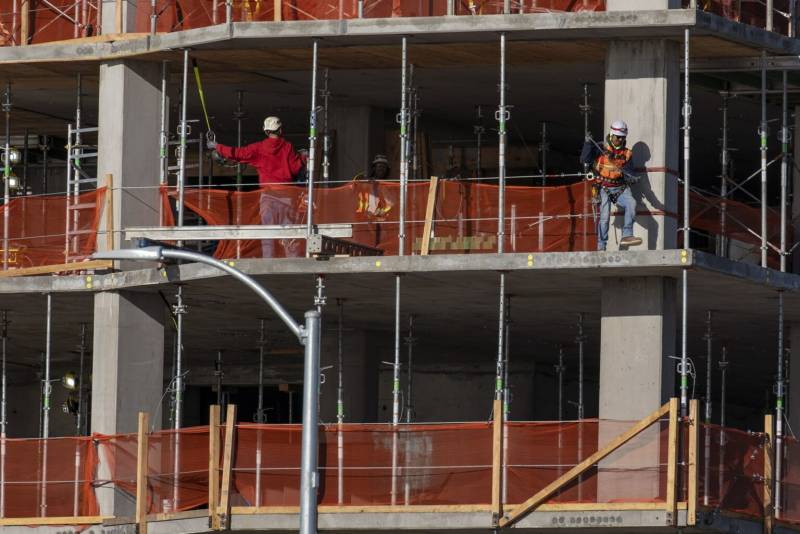
On Treasure Island, a flat tract of 20th-century landfill with epic bay vistas, workers have poured the foundation for a 22-story tower, the first of six planned high-rise buildings, and broken ground on an affordable housing complex. Another, for families and unhoused veterans, is nearly complete. Townhomes, retail space and a waterfront transit hub are also in the pipeline. All told, the $6 billion development would be home to 20,000 people or more.
Engineers for the public-private consortium transforming the island, Treasure Island Community Development, say they are pursuing aggressive sea rise adaptation strategies. Improvements include raising some of the land by several feet, preparing a buffer zone for future levees and pumps, and setting aside low-lying open space that could convert to floodable marshland as higher bay waters spill onshore.
This is not a cheap endeavor. The development group’s director, Bob Beck, did not return multiple emails and phone calls regarding costs for this work. A 2011 report by the city of San Francisco, which includes Treasure Island, estimated that “geotechnical stabilization” measures would cost $137 million. Storm drains, soil grading and landscape and open-space improvements would add about $120 million.
Dilip Trivedi, the site’s project manager with international engineering firm Moffatt and Nichol, has been touting the consortium’s efforts for more than a decade. He said in a recent interview that the most built-up parts of the island should be safe from sea rise through at least 2070. Fifty years or so is a reasonable planning horizon for new developments, he added, and additional phased seawall construction can help future generations stay a step ahead of ever-higher tides.
“When you put together significant infrastructure, you don’t want to have to maintain it for about that time,” Trivedi said. “It is what we call project life.”
After years of planning, construction has started on residential towers with sweeping views of San Francisco and the Bay Area. At least 20,000 residents are expected to live on the island by 2035. (Yesica Prado/San Francisco Public Press)
Climate scientists, however, commonly try to predict sea rise out at least to the year 2100, a time when some current schoolchildren could be octogenarian residents of the island.
Every contemporary climate model predicts that, even with deep carbon reductions starting this decade, several feet of sea rise are locked in. The debates for climate adaptation strategy are how many feet and how far down the road we should consider.
With ever more sophisticated climate predictions, the outlook for sea level rise has continued to darken, indicating that current trends will likely accelerate through the end of the century. In one pessimistic scenario — which researchers say is among the possibilities in a “business as usual” global greenhouse gas emissions future — much of the island could find itself underwater frequently, and some of the most developed areas could occasionally be threatened with flooding.
To home in on Treasure Island’s future, the San Francisco Public Press asked researchers at the United States Geological Survey’s Pacific Coastal and Marine Science Center, based in Santa Cruz, to create a highly localized model of sea rise conditions under various climate scenarios. They found that bay waters could surge higher than the developers have long been saying publicly.
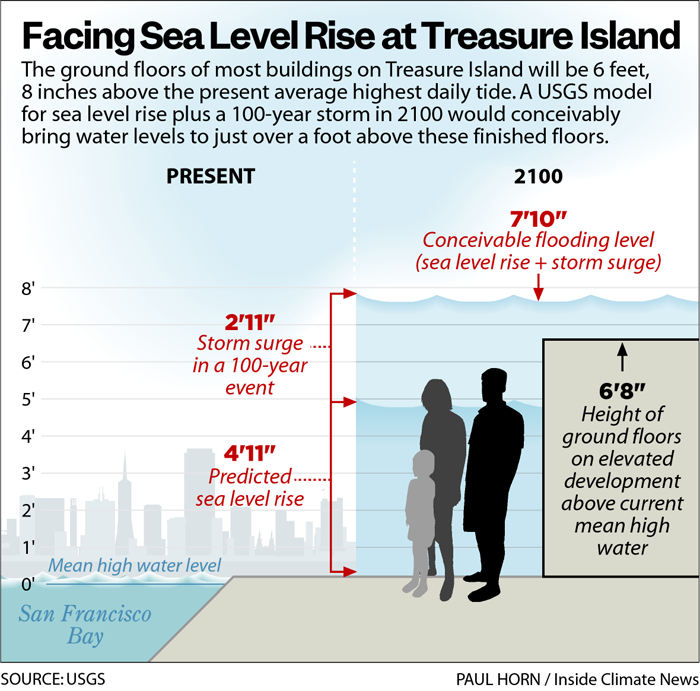
In that model, by 2100 there is a small but not insignificant chance of 4 feet, 11 inches of sea level rise — slightly more than what the island’s engineers have accounted for. Adding in the effects of tides, weather and other transient events, such as in the kind of extreme storm seen once in a century, that total could be 2 feet, 11 inches higher.
The resulting surge would, at least temporarily, send waves 1 foot, 2 inches higher than the lowest ground floors of some planned housing complexes.
While the project’s engineers never address this possibility in their public narratives, documents they have prepared show they have known about similar scenarios for years.
Their own maps, which superimpose flood conditions on existing land elevations, line up fairly closely to the Geological Survey’s findings. Yet the engineers have chosen to downplay the likelihood of these outcomes as they pursued permits to build, arguing that novel construction technologies could make the development invulnerable to flooding under any reasonable course of events.
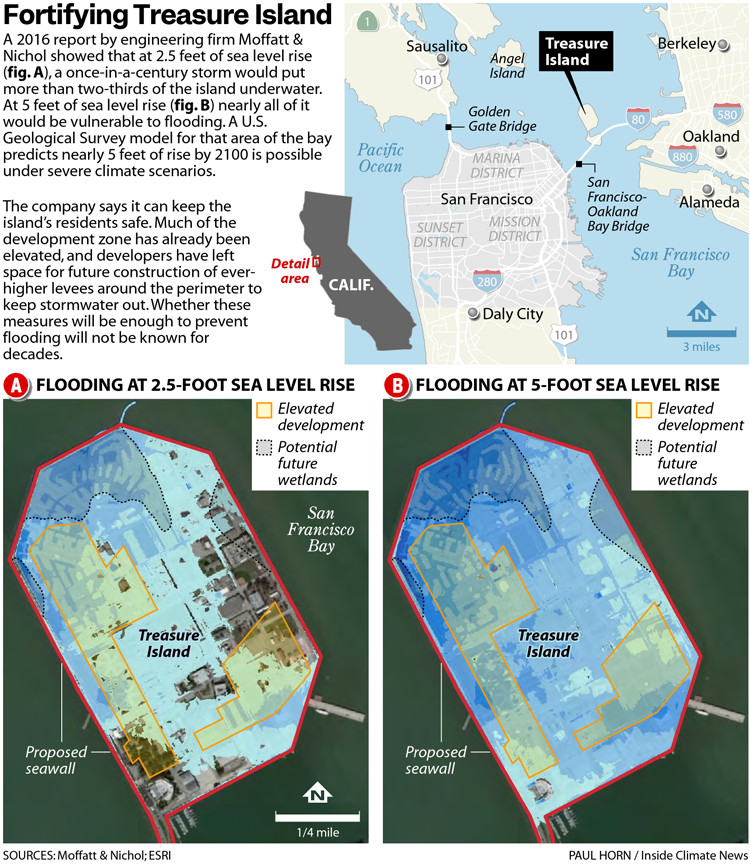
In a 2016 sea rise adaptation filing with a regional watershed agency, Moffatt and Nichol included six maps showing potential flood conditions in each construction phase, side by side with maps showing how the planned short- and long-term sea level rise protections would prevent inundation.
One map shows 4 feet of sea rise. Before any land improvements, nearly the entire island would have been inundated — up to 8 feet in places — during flooding calculated by FEMA to have a 1% chance of occurring per year. Another part of that document showed a graph that indicated a 4-foot rise was possible by around 2093. The Geological Survey’s extreme scenario model for 2100 puts sea rise closer to 5 feet.
But Trivedi said that the raising of the land under many of the buildings, plus additional shoreline improvements, would protect key infrastructure. Beside that map, the engineers showed how the existing 3.5-mile perimeter wall could be raised by 1 to 3 feet, depending on location, which they said would keep much of the island dry, although a note appended to the diagram said: “Does not show intentional flooding from managed retreat on northern and eastern shorelines — TBD.”
Within the last year, regulators have started questioning whether the steps developers are taking are sufficient to guarantee that the island remains dry in the long term.
“This is a community that will be around a while,” said Ethan Lavine, chief of permits for shoreline development for the Bay Conservation and Development Commission. “At a certain point in time, they will need levee protection.” Lavine’s office is pressing Trivedi and his colleagues to use a more cautious view of climate change when assessing whether Treasure Island’s flood prevention techniques can handle what nature might throw at them.
When evaluating permit applications, government agencies require developers to reference the “best available science” to assess threats from climate change. In October 2021, the engineers issued an update to the 2016 filing. In it, Trivedi compared his firm’s sea level rise expectations against studies by several scientific bodies, including California’s Ocean Protection Council and the U.S. Army Corps of Engineers. His preferred predictions minimized the effect of the worst-case scenarios. The only needed change, he argued, would be to move up the time frame for planning adaptations by as much as five years.
Yet climate policy experts point out that with significant scientific papers being released each year, guidance for builders has become a moving target. Because they admit a great deal of uncertainty in their predictions, scientists always publish their results in charts that consider an array of environmental assumptions.
That gives developers leeway to choose which predictions to focus on when describing the risks to their capital investments. Treasure Island could be the most expensive local project in the region’s history to take advantage of this ambiguity.
Projecting optimism
All of Trivedi’s recent public statements conclude that the likelihood of the gloomiest climate scenarios is remote, and that the level of risk to property and lives is insignificant given the proposed engineering fixes. But a close examination of the 2021 adaptation plan offers a few reasons for concern:
It dismisses high-end forecasts, in which global warming accelerates due to uncontrolled carbon emissions.
It selectively cites climate models that make planned infrastructure appear sufficient to virtually eliminate future flood risk.
It focuses on relatively short time frames, such as 20 or 50 years, while offering little specificity about expected conditions at the end of the century, which falls within the lifetimes of some children alive today.
Trivedi said in an interview that for planning purposes, he is focused on one recent predicted milestone: 3 feet of sea rise by 2080. In that circumstance, the ground floors of most buildings, to be built upon a now-elevated development pad, would still have a buffer of nearly 4 feet above the average highest tide of today.
He also asserted that the Intergovernmental Panel on Climate Change, a scientific committee organized by the United Nations, recently reported sea rise could be less severe than previously forecasted, based on the track record of recent years. “What has been observed is that sea level rise is not tracking” to the most pessimistic scenarios, he said. But there are reasons to question his conclusion.
The localized scenario for 2100 examined by the Geological Survey — the one resulting in water levels 1 foot, 2 inches above some developed areas — relies on a climate change prediction assessed to have a probability of 0.5%, that is, a 1-in-200 statistical chance of occurring. That prediction was published by the California Ocean Protection Council, a body of experts organized by the state government, in recent guidelines for community planning.
Trivedi said the international group’s current report indicates there’s “low confidence in that scenario happening.” When asked for a citation to back up this claim, Trivedi referenced a “localized model” of the findings from NASA, the National Oceanic and Atmospheric Administration and five other federal agencies.
A report these agencies jointly issued in February 2022 in fact gave a more nuanced view. In a section titled “Future Mean Sea Level,” the authors did exclude one scenario used by the Ocean Protection Council that had been labeled “extreme” and not given a numerical probability. But that is not the scenario Trivedi said the group ruled out. This same report indicates that the West Coast is likely to see 4 to 8 inches of rise over 30 years, accelerating later in the century.
Regardless of the pace of the increase, Treasure Island developers say they have contingency plans relying on future residents or taxpayers to fund the construction of progressively higher walls around the urban zone — several feet every few decades. In its latest update, Moffatt and Nichol said sea level rise of 1 foot by 2043 would trigger the plan to elevate the perimeter.
A strategy reliant on levees might seem risky in light of Hurricane Katrina in 2005, when faulty engineering of levees led to catastrophic flooding of parts of New Orleans that sit below the level of the Mississippi River and the Gulf of Mexico. In light of this recent history, Bay Area regulators are starting to ask whether the Treasure Island plan is entirely watertight.
A March 2022 letter from the Bay Conservation and Development Commission, the agency that issued the island’s 2016 permit for waterfront areas, called the update too optimistic and tolerant of long-term flooding potential.
“Public access along a shoreline and a big mixed-use development require using a medium-to-high-risk projection for sea level rise,” said the commission’s planning manager, Erik Buehmann.
Reengineering shaky ground
On an island built by the government generations ago out of rocks, soil and dredged sand, preparing high-and-dry land would be difficult even if it were not in an earthquake and tsunami zone.
In numerous reports and public presentations, Trivedi has said construction workers have elevated land on the 100-acre development pad to 3 feet, 6 inches above the “base flood elevation” — a height calculated by Federal Emergency Management Agency representing a 1% chance of flooding each year. The homes, hotels and businesses there will be set back from the shoreline by 200 to 300 feet on most sides and as much as 1,000 feet from the northern shore because that area is more prone to flooding. Building is planned to roll out in phases through 2035.
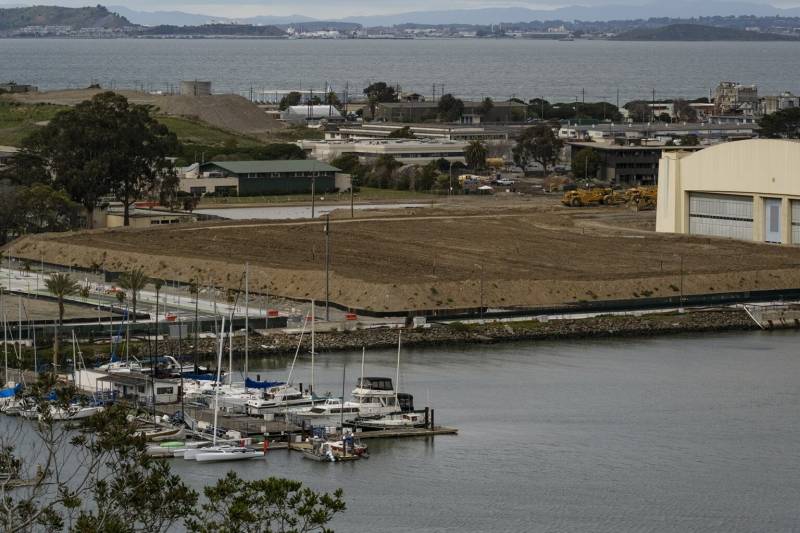
Workers have spent years using cranes to repeatedly drop heavy weights to compact the soil. They have driven vibrating probes into the earth, filling the holes with concrete for stabilization. They then piled 1 million cubic yards of soil atop the compacted layer. These measures are intended to prevent the kind of ground liquefaction seen in the Marina District and elsewhere during the devastating 1989 Loma Prieta earthquake. Other geological improvements include inserting vertical wick drains, akin to long drinking straws, to help remove water from the soil as it compresses. These techniques have been used by civil engineers around the world for more than 30 years to develop areas without easy access to bedrock.
Developers have trucked in and compacted 1 million cubic yards of soil to raise the land underneath new buildings in one strategy to mitigate flood risk. (Yesica Prado/San Francisco Public Press)
Trivedi said these measures, together with a jagged, rocky seawall raised to allow for just over 1 foot of sea rise, would help take energy out of large waves, and the setback would use the landscape to dissipate any possible overtopping before it reaches valuable structures.
At the same time, the engineers have recognized that much of the island — particularly the low-lying northern end — are indefensible. Areas that have flooded in the past will eventually be sacrificed to rising waters. That strategy has immediate, concrete consequences: Dozens of existing structures, including homes of about 3,000 people currently living there, are set to be demolished to create open space. Over time these areas could be turned into tidal marshland to protect the newly developed areas from storms.
Regulators balk at a sunny assessment
The Bay Conservation and Development Commission, the agency most empowered to weigh in on new waterfront building, is hamstrung by a legal mandate to regulate only what happens 100 feet inland, regardless of elevation — an artifact of legislation dating from before climate change was a dominant concern.
The 2016 permit the agency issued for improvements on Treasure Island’s margins, including a ferry terminal, required adaptation updates every five years. Moffatt and Nichol’s 2021 update concluded that the original adaptation plans needed few changes, except for possibly needing to accelerate, by five years, the planning process for building higher perimeter levees.
Regulators balked at the assessment. In a March 2022 letter, the commission advised Moffatt and Nichol to plan more conservatively. The agency demanded consideration of a 1-in-200 chance sea rise scenario, in which seas rise 6 feet, 11 inches by 2100. Adding in a 100-year storm surge, waves could plausibly overtop portions of the sea wall along the southeastern side by about 1 to 2 feet, and along the northern end by about 1 foot. That is an even worse outcome than that predicted by Geological Survey’s localized flooding model.
The commission said Moffatt and Nichol seemed too dismissive of chances that things could go wrong.
“The permittees decided to design the project considering very low risk of sea level rise related impacts” the letter said, noting also that engineers seemed too focused on the short time horizon of 2080.
Trivedi counters that the Treasure Island development was never built upon projections of a certain sea level happening by a certain date, because seawalls can, for all practical purposes, be built arbitrarily high, on whatever schedule is needed.
“We adopted an approach where we decided on an allowance we are building into the project,” he said in the interview. “As future projections come out, we will adjust the date of the adaptation.”
Commission staff met with planners from Moffatt and Nichol last summer to work out the requested additions to the 2021 adaptation strategy. Buehmann, who worked on the original permit, said follow-up discussions were to be expected because the Treasure Island permit was the first since the commission began requiring builders to submit sea rise assessments. “We didn’t expect it to be perfect the first time,” he said.
Whatever comes of this process which Trivedi referred to as merely “an internal thing” that was required for the filing — the adaptation plan is unlikely to change significantly, because the development pad is already in place and huge construction cranes are sprouting up on Treasure Island’s skyline. What is left in the playbook is raising future seawalls, ceding the northern open space and the installation of pumps.
Government officials have long acknowledged the inevitability of Treasure Island’s relying on artificial barriers. In 2015, Brad McCrea, regulatory program director at the commission, told the Public Press: “At the end of the day, this will be a levee-protected community — there’s no getting around that.” Since then, agency staff have not changed their view.
Rapidly outdated climate science
To determine how high to raise the building pad, Treasure Island builders consulted several climate studies published as early as 1987 and as recently as 2007. At that point, scientists were predicting that by 2100, oceans could rise as much as 4 feet, 7 inches.
This forecast was echoed by a state panel of scientists and policy experts in 2009, when then-Gov. Arnold Schwarzenegger visited Treasure Island to announce its findings and call for better sea level rise mitigation.
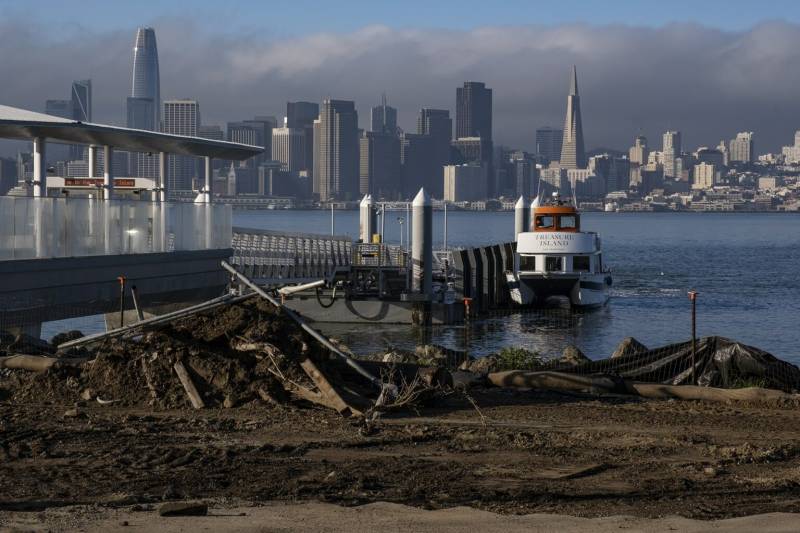
When finished, Treasure Island could be a spectacular locale for commuters to San Francisco to settle. But residents will face similar flooding challenges to those in waterfront communities throughout the Bay Area. (Yesica Prado/San Francisco Public Press)
Moffatt and Nichol then relied on these studies to anticipate that the oceans would rise 3 feet by 2075. So the company proposed raising the development pad to 3 feet, 6 inches above the predicted levels for a once-in-a-hundred-year flood.
Moffatt and Nichol did not spell out a rationale for setting the height of the development pad, as the Public Press reported in 2010. The firm did argue that raising it higher could create other problems, such as jeopardizing the island’s stability under the weight of packed soil and adding expense. “At some point it doesn’t become cost-effective — it’s a matter of acceptable levels of risk over your planning horizon,” Trivedi said in an interview then.
To be sure, when Treasure Island plans were drawn up, scientific modeling showed wide uncertainty about how much global temperatures could increase. In 2009, scientists around the world were saying that oceans could rise anywhere from a minimum of 3 feet, 3 inches to a maximum of 4 feet, 11 inches by 2100. At that time, the effects of ice melt from land via glaciers, snowpacks and ice caps were little understood.
Today, European and U.S. scientists using satellite imagery to measure the shape of Greenland’s ice sheets say melting is outstripping gains from snowfall. In a paper published last August, they found that no matter how much countries curb emissions, seas will rise by a minimum of 11 inches from this effect alone.
The Public Press requested that the agency simulate a small section of San Francisco Bay, in the vicinity of Treasure Island, relying on probability scenarios for global sea levels in 2100 developed by the California Ocean Protection Council in a 2018 guidance paper (PDF). This report offered up sea rise projections of likelihoods as high as 50% and as low as 0.5%.
The Ocean Protection Council’s examination of a wide array of probabilities heavily influenced the Bay Conservation and Development Commission’s critique of the Treasure Island adaptation update. The commission’s biggest concern was that change might happen faster than the engineers were anticipating.
Explore sea level rise scenarios using Climate Central’s interactive tool. Here we show floodwaters at 7.8 feet above the present-day high tide line.
But Trivedi said the Ocean Protection Council’s past predictions had already failed. “If you look at the year 2022 projections, follow the OPC formulas,” Trivedi said. “We should have seen about 8 inches of sea level rise since 2000. In reality, it has been about 2 inches or less.”
Most forecasts predict increased global temperatures due to persistent carbon pollution. But the emissions projections are still hotly contested.
The Ocean Protection Council examined two emissions scenarios. One assumed that carbon dioxide output doubles through 2050. The other imagined more aggressive greenhouse gas reductions — 70% by 2050 and “net zero” emissions by 2080.
For the purposes of seeing how bad things could plausibly get, the U.S. Geological Survey used a midlevel emissions scenario. This decision was based on detailed simulations into the next century of swell and waves along the Pacific Ocean. What the researchers found was that paradoxically, milder greenhouse gas levels generated worse storms for California’s coast than do extreme ones.
“What’s really changed in the research community is that worst-case scenarios have become more common,” said Patrick Barnard, a research geologist with the agency. “The state is asking communities to prepare for these.”
This approach helps waterfront areas learn to be more risk-averse to protect property and lives.
Avoiding mistakes of the past
Foster City is paying a high price for waterfront sprawl. Like Treasure Island, the mid-Peninsula community 25 miles to the south was built entirely on landfill, not unusual in the Bay Area, where efforts to accommodate population growth stretching back to the Gold Rush consumed most of the wetlands and tidal marshes.
Foster City did have worries about flooding decades ago. It is shot through with artificial waterways, including two sloughs, several small canals and an artificial lagoon. Barely above sea level before being developed, it would not exist if not for its levees and seawalls.
Yet, in 2014 FEMA informed Foster City officials that new studies showed (PDF) the levee system was neither strong nor tall enough to withstand a major storm and the large waves that would result. Update the seawalls and levees, or the entire city would be designated a floodplain, the agency said.
Sixty years ago, developers there hauled in tons of sand to raise the land several feet to construct thousands of homes in what became a 33,000-resident community. That was a time when climate change was not a part of city planning vernacular. Today workers are busy widening and raising levees and adding interlocking steel plates as a bulwark against the storms federal regulators warned of, as well as rising seas.
But Treasure Island, which is slated to add 8,000 units of housing to accommodate more than 20,000 residents, is still more than a decade away from build-out. What the engineers put in place there in the next few years could avoid Foster City’s mistakes — or compound them.
To be sure, some cities are starting to alter blueprints on pace with the evolving science. In October, the Port of San Francisco announced it was collaborating with the Army Corps of Engineers to study how to shore up the city’s seawall along its eastern waterfront (PDF), from Fisherman’s Wharf to the Hunters Point Shipyard, to combat both sea rise and earthquake risk. This area includes attractions like the Chase Center sports arena, a project green-lighted before a city-commissioned study surfaced that predicted flooding from sea level rise in the new Mission Bay neighborhood, as the Public Press reported in 2017.
Port officials now say they anticipate 7 feet of sea level rise by the end of the century. That is 2 feet, 5 inches higher than the level Treasure Island’s developers are planning for in their adaptation strategy.
The Port’s yearlong effort will consider elevating barriers along the Embarcadero, installing a system of locks at Mission Creek and buying back and cleaning up privately owned landfill areas around Islais Creek to return them to the tidal zone.
Not easy to abandon a home
In the grips of a housing affordability crisis, San Francisco needs new construction. But is a flood zone the wisest place to build? That could depend on how long we expect buildings to last.
Barnard, of the U.S. Geological Survey, has traveled to many communities, including Okracoke Island, part of North Carolina’s Outer Banks, to assess how to protect people from storms. In September 2019, Hurricane Dorian shut the island down to visitors. For residents, it was hard to consider leaving a place they have inhabited for seven or eight generations. “You can’t detach people from their place, or their heart,” Barnard said. “They’ll stay until water is up to their nose.”
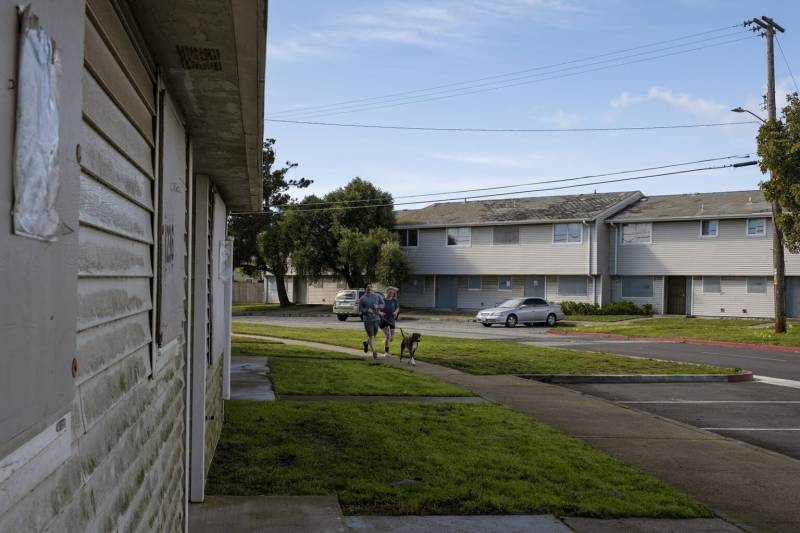
Before the developers moved in, Treasure Island had roughly 3,000 residents, according to the 2020 Census, many living in homes built for the U.S. Navy in the mid-20th century when it was a military base. Nearly half have a household income less than $50,000, and many do not speak English.
Now these residents are on tenterhooks. Under an agreement with the developer, people who lived on Treasure Island before 2011 are guaranteed new affordable and rent-controlled units. But the wait times and other inconveniences have been tough. Everyone is living in a construction site with an unreliable electrical grid that browns and blacks out frequently.
Most of the existing low-lying homes on the island, built decades ago, will be razed to make room for new condos, as well as open space that developers say could be abandoned to bay waters as seas rise. (Yesica Prado/San Francisco Public Press)
The new units are supposed to be comparable to what they had, but longtime islander Christoph Opperman said they have been offered “interim” units that, for example, might not have enough space for a family, or lack laundry facilities.
“They’re picking us off one neighborhood at a time by making us do two moves,” Opperman said. “We’re not entitled to just anything on the island, but we are entitled to fair treatment.”
Treasure Island’s planners are essentially acknowledging that they must sacrifice part of the island to the bay, even while pursuing a more built-up urban environment just several hundred feet away. This combination of advance and retreat is all part of the plan, the engineers say.
Asked whether he would move to Treasure Island, Trivedi did not hesitate to say yes, observing that no part of the Bay Area was completely free of danger.
“I don’t see why not,” he said. “I mean, should people be moving to San Francisco, because of the seismic risk? Buildings are being designed to codes. And flooding is the same way.”
window.__IS_SSR__=true
window.__INITIAL_STATE__={
"attachmentsReducer": {
"audio_0": {
"type": "attachments",
"id": "audio_0",
"imgSizes": {
"kqedFullSize": {
"file": "https://ww2.kqed.org/news/wp-content/themes/KQED-unified/img/audio_bgs/background0.jpg"
}
}
},
"audio_1": {
"type": "attachments",
"id": "audio_1",
"imgSizes": {
"kqedFullSize": {
"file": "https://ww2.kqed.org/news/wp-content/themes/KQED-unified/img/audio_bgs/background1.jpg"
}
}
},
"audio_2": {
"type": "attachments",
"id": "audio_2",
"imgSizes": {
"kqedFullSize": {
"file": "https://ww2.kqed.org/news/wp-content/themes/KQED-unified/img/audio_bgs/background2.jpg"
}
}
},
"audio_3": {
"type": "attachments",
"id": "audio_3",
"imgSizes": {
"kqedFullSize": {
"file": "https://ww2.kqed.org/news/wp-content/themes/KQED-unified/img/audio_bgs/background3.jpg"
}
}
},
"audio_4": {
"type": "attachments",
"id": "audio_4",
"imgSizes": {
"kqedFullSize": {
"file": "https://ww2.kqed.org/news/wp-content/themes/KQED-unified/img/audio_bgs/background4.jpg"
}
}
},
"placeholder": {
"type": "attachments",
"id": "placeholder",
"imgSizes": {
"thumbnail": {
"file": "https://cdn.kqed.org/wp-content/uploads/2024/12/KQED-Default-Image-816638274-2000x1333-1-160x107.jpg",
"width": 160,
"height": 107,
"mimeType": "image/jpeg"
},
"medium": {
"file": "https://cdn.kqed.org/wp-content/uploads/2024/12/KQED-Default-Image-816638274-2000x1333-1-800x533.jpg",
"width": 800,
"height": 533,
"mimeType": "image/jpeg"
},
"medium_large": {
"file": "https://cdn.kqed.org/wp-content/uploads/2024/12/KQED-Default-Image-816638274-2000x1333-1-768x512.jpg",
"width": 768,
"height": 512,
"mimeType": "image/jpeg"
},
"large": {
"file": "https://cdn.kqed.org/wp-content/uploads/2024/12/KQED-Default-Image-816638274-2000x1333-1-1020x680.jpg",
"width": 1020,
"height": 680,
"mimeType": "image/jpeg"
},
"1536x1536": {
"file": "https://cdn.kqed.org/wp-content/uploads/2024/12/KQED-Default-Image-816638274-2000x1333-1-1536x1024.jpg",
"width": 1536,
"height": 1024,
"mimeType": "image/jpeg"
},
"fd-lrg": {
"file": "https://cdn.kqed.org/wp-content/uploads/2024/12/KQED-Default-Image-816638274-2000x1333-1-1536x1024.jpg",
"width": 1536,
"height": 1024,
"mimeType": "image/jpeg"
},
"fd-med": {
"file": "https://cdn.kqed.org/wp-content/uploads/2024/12/KQED-Default-Image-816638274-2000x1333-1-1020x680.jpg",
"width": 1020,
"height": 680,
"mimeType": "image/jpeg"
},
"fd-sm": {
"file": "https://cdn.kqed.org/wp-content/uploads/2024/12/KQED-Default-Image-816638274-2000x1333-1-800x533.jpg",
"width": 800,
"height": 533,
"mimeType": "image/jpeg"
},
"post-thumbnail": {
"file": "https://cdn.kqed.org/wp-content/uploads/2024/12/KQED-Default-Image-816638274-2000x1333-1-672x372.jpg",
"width": 672,
"height": 372,
"mimeType": "image/jpeg"
},
"twentyfourteen-full-width": {
"file": "https://cdn.kqed.org/wp-content/uploads/2024/12/KQED-Default-Image-816638274-2000x1333-1-1038x576.jpg",
"width": 1038,
"height": 576,
"mimeType": "image/jpeg"
},
"xxsmall": {
"file": "https://cdn.kqed.org/wp-content/uploads/2024/12/KQED-Default-Image-816638274-2000x1333-1-160x107.jpg",
"width": 160,
"height": 107,
"mimeType": "image/jpeg"
},
"xsmall": {
"file": "https://cdn.kqed.org/wp-content/uploads/2024/12/KQED-Default-Image-816638274-2000x1333-1-672x372.jpg",
"width": 672,
"height": 372,
"mimeType": "image/jpeg"
},
"small": {
"file": "https://cdn.kqed.org/wp-content/uploads/2024/12/KQED-Default-Image-816638274-2000x1333-1-672x372.jpg",
"width": 672,
"height": 372,
"mimeType": "image/jpeg"
},
"xlarge": {
"file": "https://cdn.kqed.org/wp-content/uploads/2024/12/KQED-Default-Image-816638274-2000x1333-1-1020x680.jpg",
"width": 1020,
"height": 680,
"mimeType": "image/jpeg"
},
"full-width": {
"file": "https://cdn.kqed.org/wp-content/uploads/2024/12/KQED-Default-Image-816638274-2000x1333-1-1920x1280.jpg",
"width": 1920,
"height": 1280,
"mimeType": "image/jpeg"
},
"guest-author-32": {
"file": "https://cdn.kqed.org/wp-content/uploads/2025/01/KQED-Default-Image-816638274-1333x1333-1-160x160.jpg",
"width": 32,
"height": 32,
"mimeType": "image/jpeg"
},
"guest-author-50": {
"file": "https://cdn.kqed.org/wp-content/uploads/2025/01/KQED-Default-Image-816638274-1333x1333-1-160x160.jpg",
"width": 50,
"height": 50,
"mimeType": "image/jpeg"
},
"guest-author-64": {
"file": "https://cdn.kqed.org/wp-content/uploads/2025/01/KQED-Default-Image-816638274-1333x1333-1-160x160.jpg",
"width": 64,
"height": 64,
"mimeType": "image/jpeg"
},
"guest-author-96": {
"file": "https://cdn.kqed.org/wp-content/uploads/2025/01/KQED-Default-Image-816638274-1333x1333-1-160x160.jpg",
"width": 96,
"height": 96,
"mimeType": "image/jpeg"
},
"guest-author-128": {
"file": "https://cdn.kqed.org/wp-content/uploads/2025/01/KQED-Default-Image-816638274-1333x1333-1-160x160.jpg",
"width": 128,
"height": 128,
"mimeType": "image/jpeg"
},
"detail": {
"file": "https://cdn.kqed.org/wp-content/uploads/2025/01/KQED-Default-Image-816638274-1333x1333-1-160x160.jpg",
"width": 160,
"height": 160,
"mimeType": "image/jpeg"
},
"kqedFullSize": {
"file": "https://cdn.kqed.org/wp-content/uploads/2024/12/KQED-Default-Image-816638274-2000x1333-1.jpg",
"width": 2000,
"height": 1333
}
}
},
"science_1982131": {
"type": "attachments",
"id": "science_1982131",
"meta": {
"index": "attachments_1716263798",
"site": "science",
"id": "1982131",
"found": true
},
"parent": 1982130,
"imgSizes": {
"twentyfourteen-full-width": {
"file": "https://ww2.kqed.org/app/uploads/sites/35/2023/04/Treasure_Island_05-1038x576.jpg",
"width": 1038,
"mimeType": "image/jpeg",
"height": 576
},
"thumbnail": {
"file": "https://ww2.kqed.org/app/uploads/sites/35/2023/04/Treasure_Island_05-160x107.jpg",
"width": 160,
"mimeType": "image/jpeg",
"height": 107
},
"post-thumbnail": {
"file": "https://ww2.kqed.org/app/uploads/sites/35/2023/04/Treasure_Island_05-672x372.jpg",
"width": 672,
"mimeType": "image/jpeg",
"height": 372
},
"kqedFullSize": {
"file": "https://ww2.kqed.org/app/uploads/sites/35/2023/04/Treasure_Island_05.jpg",
"width": 1872,
"height": 1248
},
"large": {
"file": "https://ww2.kqed.org/app/uploads/sites/35/2023/04/Treasure_Island_05-1020x680.jpg",
"width": 1020,
"mimeType": "image/jpeg",
"height": 680
},
"1536x1536": {
"file": "https://ww2.kqed.org/app/uploads/sites/35/2023/04/Treasure_Island_05-1536x1024.jpg",
"width": 1536,
"mimeType": "image/jpeg",
"height": 1024
},
"medium": {
"file": "https://ww2.kqed.org/app/uploads/sites/35/2023/04/Treasure_Island_05-800x533.jpg",
"width": 800,
"mimeType": "image/jpeg",
"height": 533
},
"medium_large": {
"file": "https://ww2.kqed.org/app/uploads/sites/35/2023/04/Treasure_Island_05-768x512.jpg",
"width": 768,
"mimeType": "image/jpeg",
"height": 512
}
},
"publishDate": 1680558446,
"modified": 1680664071,
"caption": "Developers have redesigned Treasure Island to withstand a rising San Francisco Bay, elevating land and setting aside space for ever-higher seawalls. Engineers say planned fortifications will hold — but with flood risk accelerating, no one knows for how long.",
"description": "Developers have redesigned Treasure Island to withstand a rising San Francisco Bay, elevating land and setting aside space for ever-higher sea walls. Engineers say planned fortifications will hold — but with flood risk accelerating, no one knows for how long. ",
"title": "Treasure Island",
"credit": "Yesica Prado/San Francisco Public Press",
"status": "inherit",
"altTag": "An aerial view of treasure Island.",
"isLoading": false,
"fetchFailed": false
}
},
"audioPlayerReducer": {
"postId": "stream_live",
"isPaused": true,
"isPlaying": false,
"pfsActive": false,
"pledgeModalIsOpen": true,
"playerDrawerIsOpen": false,
"liveAudioPlayStartedAt": 0,
"liveAudioPlayContext": ""
},
"authorsReducer": {
"byline_science_1982130": {
"type": "authors",
"id": "byline_science_1982130",
"meta": {
"override": true
},
"slug": "byline_science_1982130",
"name": "Kristi Coale\u003cbr>San Francisco Public Press",
"isLoading": false
}
},
"pagesReducer": {},
"pfsSessionReducer": {},
"postsReducer": {
"stream_live": {
"type": "live",
"id": "stream_live",
"audioUrl": "https://streams.kqed.org/kqedradio",
"title": "Live Stream",
"excerpt": "Live Stream information currently unavailable.",
"link": "/radio",
"featImg": "",
"label": {
"name": "KQED Live",
"link": "/"
}
},
"stream_kqedNewscast": {
"type": "posts",
"id": "stream_kqedNewscast",
"audioUrl": "https://www.kqed.org/.stream/anon/radio/RDnews/newscast.mp3?_=1",
"title": "KQED Newscast",
"featImg": "",
"label": {
"name": "88.5 FM",
"link": "/"
}
},
"science_1982130": {
"type": "posts",
"id": "science_1982130",
"meta": {
"index": "posts_1716263798",
"site": "science",
"id": "1982130",
"found": true
},
"articlePosition": 0,
"parent": 0,
"labelTerm": {},
"blocks": [],
"publishDate": 1680699603,
"format": "standard",
"title": "Promising to Prevent Floods at Treasure Island, Builders Downplay Risk of Sea Rise",
"headTitle": "Promising to Prevent Floods at Treasure Island, Builders Downplay Risk of Sea Rise | KQED",
"content": "\u003cp>\u003cem>This story was reported by the \u003ca href=\"https://sfpublicpress.org/\">San Francisco Public Press\u003c/a>, an independent nonprofit newsroom focused on accountability journalism, in partnership with Inside Climate News.\u003c/em>\u003c/p>\n\u003cp>Sea level rise is forcing cities around San Francisco Bay to weigh demand for new housing against the need to protect communities from flooding. Builders say they can solve this dilemma with cutting-edge civil engineering. But no one knows whether their ambitious efforts will be enough to keep newly built waterfront real estate safe in coming decades.\u003c/p>\n\u003cp>Meanwhile, developers are busy building — and telling the public that they can mitigate this one effect of climate change, despite mounting evidence that it could be a bigger problem than previously believed.\u003c/p>\n\u003cp>On Treasure Island, a flat tract of 20th-century landfill with epic bay vistas, workers have poured the foundation for a 22-story tower, the first of six planned high-rise buildings, and broken ground on an affordable housing complex. Another, for families and unhoused veterans, is nearly complete. Townhomes, retail space and a waterfront transit hub are also in the pipeline. All told, the $6 billion development would be home to 20,000 people or more.\u003c/p>\n\u003cp>Engineers for the public-private consortium transforming the island, Treasure Island Community Development, say they are pursuing aggressive sea rise adaptation strategies. Improvements include raising some of the land by several feet, preparing a buffer zone for future levees and pumps, and setting aside low-lying open space that could convert to floodable marshland as higher bay waters spill onshore.\u003c/p>\n\u003cp>[ad fullwidth]\u003c/p>\n\u003cp>This is not a cheap endeavor. The development group’s director, Bob Beck, did not return multiple emails and phone calls regarding costs for this work. A 2011 report by the city of San Francisco, which includes Treasure Island, estimated that “geotechnical stabilization” measures would cost $137 million. Storm drains, soil grading and landscape and open-space improvements would add about $120 million.\u003c/p>\n\u003cp>Dilip Trivedi, the site’s project manager with international engineering firm Moffatt and Nichol, has been touting the consortium’s efforts for more than a decade. He said in a recent interview that the most built-up parts of the island should be safe from sea rise through at least 2070. Fifty years or so is a reasonable planning horizon for new developments, he added, and additional phased seawall construction can help future generations stay a step ahead of ever-higher tides.\u003c/p>\n\u003cp>“When you put together significant infrastructure, you don’t want to have to maintain it for about that time,” Trivedi said. “It is what we call project life.”\u003c/p>\n\u003cfigure id=\"attachment_1982132\" class=\"wp-caption alignnone\" style=\"max-width: 800px\">\u003cimg loading=\"lazy\" decoding=\"async\" class=\"size-medium wp-image-1982132\" src=\"https://ww2.kqed.org/app/uploads/sites/35/2023/04/Treasure_Island_03-1536x1025-1-800x534.jpg\" alt=\"Two construction workers seen on the job on residential tower. \" width=\"800\" height=\"534\" srcset=\"https://cdn.kqed.org/wp-content/uploads/sites/35/2023/04/Treasure_Island_03-1536x1025-1-800x534.jpg 800w, https://cdn.kqed.org/wp-content/uploads/sites/35/2023/04/Treasure_Island_03-1536x1025-1-1020x681.jpg 1020w, https://cdn.kqed.org/wp-content/uploads/sites/35/2023/04/Treasure_Island_03-1536x1025-1-160x107.jpg 160w, https://cdn.kqed.org/wp-content/uploads/sites/35/2023/04/Treasure_Island_03-1536x1025-1-768x513.jpg 768w, https://cdn.kqed.org/wp-content/uploads/sites/35/2023/04/Treasure_Island_03-1536x1025-1.jpg 1536w\" sizes=\"(max-width: 800px) 100vw, 800px\">\u003cfigcaption class=\"wp-caption-text\">After years of planning, construction has started on residential towers with sweeping views of San Francisco and the Bay Area. At least 20,000 residents are expected to live on the island by 2035. \u003ccite>(Yesica Prado/San Francisco Public Press)\u003c/cite>\u003c/figcaption>\u003c/figure>\n\u003cp>Climate scientists, however, commonly try to predict sea rise out at least to the year 2100, a time when some current schoolchildren could be octogenarian residents of the island.\u003c/p>\n\u003cp>Every contemporary climate model predicts that, even with deep carbon reductions starting this decade, several feet of sea rise are locked in. The debates for climate adaptation strategy are how many feet and how far down the road we should consider.\u003c/p>\n\u003cp>With ever more sophisticated climate predictions, the outlook for sea level rise has continued to darken, indicating that current trends will likely accelerate through the end of the century. In one pessimistic scenario — which researchers say is among the possibilities in a “business as usual” global greenhouse gas emissions future — much of the island could find itself underwater frequently, and some of the most developed areas could occasionally be threatened with flooding.\u003c/p>\n\u003cp>To home in on Treasure Island’s future, the San Francisco Public Press asked researchers at the United States Geological Survey’s Pacific Coastal and Marine Science Center, based in Santa Cruz, to create a highly localized model of sea rise conditions under various climate scenarios. They found that bay waters could surge higher than the developers have long been saying publicly.\u003c/p>\n\u003cp>In that model, by 2100 there is a small but not insignificant chance of 4 feet, 11 inches of sea level rise — slightly more than what the island’s engineers have accounted for. Adding in the effects of tides, weather and other transient events, such as in the kind of extreme storm seen once in a century, that total could be 2 feet, 11 inches higher.\u003c/p>\n\u003cp>The resulting surge would, at least temporarily, send waves 1 foot, 2 inches higher than the lowest ground floors of some planned housing complexes.\u003c/p>\n\u003cp>\u003cimg loading=\"lazy\" decoding=\"async\" class=\"alignnone size-full wp-image-1982133\" src=\"https://ww2.kqed.org/app/uploads/sites/35/2023/04/SeaLevelRiseSchematic700px.png\" alt=\"Facing Sea Level Rise at Treasure Island\" width=\"700\" height=\"691\" srcset=\"https://cdn.kqed.org/wp-content/uploads/sites/35/2023/04/SeaLevelRiseSchematic700px.png 700w, https://cdn.kqed.org/wp-content/uploads/sites/35/2023/04/SeaLevelRiseSchematic700px-160x158.png 160w\" sizes=\"(max-width: 700px) 100vw, 700px\">\u003c/p>\n\u003cp>While the project’s engineers never address this possibility in their public narratives, documents they have prepared show they have known about similar scenarios for years.\u003c/p>\n\u003cp>Their own maps, which superimpose flood conditions on existing land elevations, line up fairly closely to the Geological Survey’s findings. Yet the engineers have chosen to downplay the likelihood of these outcomes as they pursued permits to build, arguing that novel construction technologies could make the development invulnerable to flooding under any reasonable course of events.\u003c/p>\n\u003cp>In a 2016 sea rise adaptation filing with a regional watershed agency, Moffatt and Nichol included six maps showing potential flood conditions in each construction phase, side by side with maps showing how the planned short- and long-term sea level rise protections would prevent inundation.\u003c/p>\n\u003cp>One map shows 4 feet of sea rise. Before any land improvements, nearly the entire island would have been inundated — up to 8 feet in places — during flooding calculated by FEMA to have a 1% chance of occurring per year. Another part of that document showed a graph that indicated a 4-foot rise was possible by around 2093. The Geological Survey’s extreme scenario model for 2100 puts sea rise closer to 5 feet.\u003c/p>\n\u003cp>But Trivedi said that the raising of the land under many of the buildings, plus additional shoreline improvements, would protect key infrastructure. Beside that map, the engineers showed how the existing 3.5-mile perimeter wall could be raised by 1 to 3 feet, depending on location, which they said would keep much of the island dry, although a note appended to the diagram said: “Does not show intentional flooding from managed retreat on northern and eastern shorelines — TBD.”\u003c/p>\n\u003cp>Within the last year, regulators have started questioning whether the steps developers are taking are sufficient to guarantee that the island remains dry in the long term.\u003c/p>\n\u003cp>“This is a community that will be around a while,” said Ethan Lavine, chief of permits for shoreline development for the Bay Conservation and Development Commission. “At a certain point in time, they will need levee protection.” Lavine’s office is pressing Trivedi and his colleagues to use a more cautious view of climate change when assessing whether Treasure Island’s flood prevention techniques can handle what nature might throw at them.\u003c/p>\n\u003cp>When evaluating permit applications, government agencies require developers to reference the “best available science” to assess threats from climate change. In October 2021, the engineers issued an update to the 2016 filing. In it, Trivedi compared his firm’s sea level rise expectations against studies by several scientific bodies, including California’s Ocean Protection Council and the U.S. Army Corps of Engineers. His preferred predictions minimized the effect of the worst-case scenarios. The only needed change, he argued, would be to move up the time frame for planning adaptations by as much as five years.\u003c/p>\n\u003cp>\u003cimg loading=\"lazy\" decoding=\"async\" class=\"alignnone size-full wp-image-1982134\" src=\"https://ww2.kqed.org/app/uploads/sites/35/2023/04/TreasureIslandSFCA750px.png\" alt=\"Fortifying Treasure Island\" width=\"750\" height=\"864\" srcset=\"https://cdn.kqed.org/wp-content/uploads/sites/35/2023/04/TreasureIslandSFCA750px.png 750w, https://cdn.kqed.org/wp-content/uploads/sites/35/2023/04/TreasureIslandSFCA750px-160x184.png 160w\" sizes=\"(max-width: 750px) 100vw, 750px\">\u003c/p>\n\u003cp>Yet climate policy experts point out that with significant scientific papers being released each year, guidance for builders has become a moving target. Because they admit a great deal of uncertainty in their predictions, scientists always publish their results in charts that consider an array of environmental assumptions.\u003c/p>\n\u003cp>That gives developers leeway to choose which predictions to focus on when describing the risks to their capital investments. Treasure Island could be the most expensive local project in the region’s history to take advantage of this ambiguity.\u003c/p>\n\u003ch2>Projecting optimism\u003c/h2>\n\u003cp>All of Trivedi’s recent public statements conclude that the likelihood of the gloomiest climate scenarios is remote, and that the level of risk to property and lives is insignificant given the proposed engineering fixes. But a close examination of the 2021 adaptation plan offers a few reasons for concern:\u003c/p>\n\u003cul>\n\u003cli>It dismisses high-end forecasts, in which global warming accelerates due to uncontrolled carbon emissions.\u003c/li>\n\u003cli>It selectively cites climate models that make planned infrastructure appear sufficient to virtually eliminate future flood risk.\u003c/li>\n\u003cli>It focuses on relatively short time frames, such as 20 or 50 years, while offering little specificity about expected conditions at the end of the century, which falls within the lifetimes of some children alive today.\u003c/li>\n\u003c/ul>\n\u003cp>Trivedi said in an interview that for planning purposes, he is focused on one recent predicted milestone: 3 feet of sea rise by 2080. In that circumstance, the ground floors of most buildings, to be built upon a now-elevated development pad, would still have a buffer of nearly 4 feet above the average highest tide of today.\u003c/p>\n\u003cp>He also asserted that the Intergovernmental Panel on Climate Change, a scientific committee organized by the United Nations, recently reported sea rise could be less severe than previously forecasted, based on the track record of recent years. “What has been observed is that sea level rise is not tracking” to the most pessimistic scenarios, he said. But there are reasons to question his conclusion.\u003c/p>\n\u003cp>The localized scenario for 2100 examined by the Geological Survey — the one resulting in water levels 1 foot, 2 inches above some developed areas — relies on a climate change prediction assessed to have a probability of 0.5%, that is, a 1-in-200 statistical chance of occurring. That prediction was published by the California Ocean Protection Council, a body of experts organized by the state government, in recent guidelines for community planning.\u003c/p>\n\u003cp>Trivedi said the international group’s current report indicates there’s “low confidence in that scenario happening.” When asked for a citation to back up this claim, Trivedi referenced a “localized model” of the findings from NASA, the National Oceanic and Atmospheric Administration and five other federal agencies.\u003c/p>\n\u003cp>A \u003ca href=\"https://oceanservice.noaa.gov/hazards/sealevelrise/sealevelrise-tech-report.html\">report these agencies jointly issued in February 2022\u003c/a> in fact gave a more nuanced view. In a section titled “Future Mean Sea Level,” the authors did exclude one scenario used by the Ocean Protection Council that had been labeled “extreme” and not given a numerical probability. But that is not the scenario Trivedi said the group ruled out. This same report indicates that the West Coast is likely to see 4 to 8 inches of rise over 30 years, accelerating later in the century.\u003c/p>\n\u003cp>Regardless of the pace of the increase, Treasure Island developers say they have contingency plans relying on future residents or taxpayers to fund the construction of progressively higher walls around the urban zone — several feet every few decades. In its latest update, Moffatt and Nichol said sea level rise of 1 foot by 2043 would trigger the plan to elevate the perimeter.\u003c/p>\n\u003cp>A strategy reliant on levees might seem risky in light of Hurricane Katrina in 2005, when faulty engineering of levees led to catastrophic flooding of parts of New Orleans that sit below the level of the Mississippi River and the Gulf of Mexico. In light of this recent history, Bay Area regulators are starting to ask whether the Treasure Island plan is entirely watertight.\u003c/p>\n\u003cp>A March 2022 letter from the Bay Conservation and Development Commission, the agency that issued the island’s 2016 permit for waterfront areas, called the update too optimistic and tolerant of long-term flooding potential.\u003c/p>\n\u003cp>“Public access along a shoreline and a big mixed-use development require using a medium-to-high-risk projection for sea level rise,” said the commission’s planning manager, Erik Buehmann.\u003c/p>\n\u003ch2>Reengineering shaky ground\u003c/h2>\n\u003cp>On an island built by the government generations ago out of rocks, soil and dredged sand, preparing high-and-dry land would be difficult even if it were not in an earthquake and tsunami zone.\u003c/p>\n\u003cp>In numerous reports and public presentations, Trivedi has said construction workers have elevated land on the 100-acre development pad to 3 feet, 6 inches above the “base flood elevation” — a height calculated by Federal Emergency Management Agency representing a 1% chance of flooding each year. The homes, hotels and businesses there will be set back from the shoreline by 200 to 300 feet on most sides and as much as 1,000 feet from the northern shore because that area is more prone to flooding. Building is planned to roll out in phases through 2035.\u003c/p>\n\u003cp>Workers have spent years using cranes to repeatedly drop heavy weights to compact the soil. They have driven vibrating probes into the earth, filling the holes with concrete for stabilization. They then piled 1 million cubic yards of soil atop the compacted layer. These measures are intended to prevent the kind of ground liquefaction seen in the Marina District and elsewhere during the devastating 1989 Loma Prieta earthquake. Other geological improvements include inserting vertical wick drains, akin to long drinking straws, to help remove water from the soil as it compresses. These techniques have been used by civil engineers around the world for more than 30 years to develop areas without easy access to bedrock.\u003c/p>\n\u003cfigure id=\"attachment_1982135\" class=\"wp-caption alignnone\" style=\"max-width: 800px\">\u003cimg loading=\"lazy\" decoding=\"async\" class=\"size-medium wp-image-1982135\" src=\"https://ww2.kqed.org/app/uploads/sites/35/2023/04/Treasure_Island_07-1536x1024-1-800x533.jpg\" alt=\"A view of compacted yards of soil.\" width=\"800\" height=\"533\" srcset=\"https://cdn.kqed.org/wp-content/uploads/sites/35/2023/04/Treasure_Island_07-1536x1024-1-800x533.jpg 800w, https://cdn.kqed.org/wp-content/uploads/sites/35/2023/04/Treasure_Island_07-1536x1024-1-1020x680.jpg 1020w, https://cdn.kqed.org/wp-content/uploads/sites/35/2023/04/Treasure_Island_07-1536x1024-1-160x107.jpg 160w, https://cdn.kqed.org/wp-content/uploads/sites/35/2023/04/Treasure_Island_07-1536x1024-1-768x512.jpg 768w, https://cdn.kqed.org/wp-content/uploads/sites/35/2023/04/Treasure_Island_07-1536x1024-1.jpg 1536w\" sizes=\"(max-width: 800px) 100vw, 800px\">\u003cfigcaption class=\"wp-caption-text\">Developers have trucked in and compacted 1 million cubic yards of soil to raise the land underneath new buildings in one strategy to mitigate flood risk. \u003ccite>(Yesica Prado/San Francisco Public Press)\u003c/cite>\u003c/figcaption>\u003c/figure>\n\u003cp>Trivedi said these measures, together with a jagged, rocky seawall raised to allow for just over 1 foot of sea rise, would help take energy out of large waves, and the setback would use the landscape to dissipate any possible overtopping before it reaches valuable structures.\u003c/p>\n\u003cp>At the same time, the engineers have recognized that much of the island — particularly the low-lying northern end — are indefensible. Areas that have flooded in the past will eventually be sacrificed to rising waters. That strategy has immediate, concrete consequences: Dozens of existing structures, including homes of about 3,000 people currently living there, are set to be demolished to create open space. Over time these areas could be turned into tidal marshland to protect the newly developed areas from storms.\u003c/p>\n\u003ch2>Regulators balk at a sunny assessment\u003c/h2>\n\u003cp>The Bay Conservation and Development Commission, the agency most empowered to weigh in on new waterfront building, is hamstrung by a legal mandate to regulate only what happens 100 feet inland, regardless of elevation — an artifact of legislation dating from before climate change was a dominant concern.\u003c/p>\n\u003cp>The 2016 permit the agency issued for improvements on Treasure Island’s margins, including a ferry terminal, required adaptation updates every five years. Moffatt and Nichol’s 2021 update concluded that the original adaptation plans needed few changes, except for possibly needing to accelerate, by five years, the planning process for building higher perimeter levees.\u003c/p>\n\u003cp>Regulators balked at the assessment. In a March 2022 letter, the commission advised Moffatt and Nichol to plan more conservatively. The agency demanded consideration of a 1-in-200 chance sea rise scenario, in which seas rise 6 feet, 11 inches by 2100. Adding in a 100-year storm surge, waves could plausibly overtop portions of the sea wall along the southeastern side by about 1 to 2 feet, and along the northern end by about 1 foot. That is an even worse outcome than that predicted by Geological Survey’s localized flooding model.\u003c/p>\n\u003cp>The commission said Moffatt and Nichol seemed too dismissive of chances that things could go wrong.\u003c/p>\n\u003cp>“The permittees decided to design the project considering very low risk of sea level rise related impacts” the letter said, noting also that engineers seemed too focused on the short time horizon of 2080.\u003c/p>\n\u003cp>Trivedi counters that the Treasure Island development was never built upon projections of a certain sea level happening by a certain date, because seawalls can, for all practical purposes, be built arbitrarily high, on whatever schedule is needed.\u003c/p>\n\u003cp>“We adopted an approach where we decided on an allowance we are building into the project,” he said in the interview. “As future projections come out, we will adjust the date of the adaptation.”\u003c/p>\n\u003cp>Commission staff met with planners from Moffatt and Nichol last summer to work out the requested additions to the 2021 adaptation strategy. Buehmann, who worked on the original permit, said follow-up discussions were to be expected because the Treasure Island permit was the first since the commission began requiring builders to submit sea rise assessments. “We didn’t expect it to be perfect the first time,” he said.\u003c/p>\n\u003cp>Whatever comes of this process which Trivedi referred to as merely “an internal thing” that was required for the filing — the adaptation plan is unlikely to change significantly, because the development pad is already in place and huge construction cranes are sprouting up on Treasure Island’s skyline. What is left in the playbook is raising future seawalls, ceding the northern open space and the installation of pumps.\u003c/p>\n\u003cp>Government officials have long acknowledged the inevitability of Treasure Island’s relying on artificial barriers. In 2015, Brad McCrea, regulatory program director at the commission, \u003ca href=\"https://www.sfpublicpress.org/major-s-f-bayfront-developments-advance-despite-sea-rise-warnings/\">told the Public Press\u003c/a>: “At the end of the day, this will be a levee-protected community — there’s no getting around that.” Since then, agency staff have not changed their view.\u003c/p>\n\u003ch2>Rapidly outdated climate science\u003c/h2>\n\u003cp>To determine how high to raise the building pad, Treasure Island builders consulted several climate studies published as early as 1987 and as recently as 2007. At that point, scientists were predicting that by 2100, oceans could rise as much as 4 feet, 7 inches.\u003c/p>\n\u003cp>This forecast was echoed by a state panel of scientists and policy experts in 2009, when then-Gov. Arnold Schwarzenegger visited Treasure Island to announce its findings and call for better sea level rise mitigation.\u003c/p>\n\u003cfigure id=\"attachment_1982136\" class=\"wp-caption alignnone\" style=\"max-width: 800px\">\u003cimg loading=\"lazy\" decoding=\"async\" class=\"size-medium wp-image-1982136\" src=\"https://ww2.kqed.org/app/uploads/sites/35/2023/04/Treasure_Island_09-1536x1024-1-800x533.jpg\" alt=\"A view of the San Francisco skyline from Treasure Island.\" width=\"800\" height=\"533\" srcset=\"https://cdn.kqed.org/wp-content/uploads/sites/35/2023/04/Treasure_Island_09-1536x1024-1-800x533.jpg 800w, https://cdn.kqed.org/wp-content/uploads/sites/35/2023/04/Treasure_Island_09-1536x1024-1-1020x680.jpg 1020w, https://cdn.kqed.org/wp-content/uploads/sites/35/2023/04/Treasure_Island_09-1536x1024-1-160x107.jpg 160w, https://cdn.kqed.org/wp-content/uploads/sites/35/2023/04/Treasure_Island_09-1536x1024-1-768x512.jpg 768w, https://cdn.kqed.org/wp-content/uploads/sites/35/2023/04/Treasure_Island_09-1536x1024-1.jpg 1536w\" sizes=\"(max-width: 800px) 100vw, 800px\">\u003cfigcaption class=\"wp-caption-text\">When finished, Treasure Island could be a spectacular locale for commuters to San Francisco to settle. But residents will face similar flooding challenges to those in waterfront communities throughout the Bay Area. \u003ccite>(Yesica Prado/San Francisco Public Press)\u003c/cite>\u003c/figcaption>\u003c/figure>\n\u003cp>Moffatt and Nichol then relied on these studies to anticipate that the oceans would rise 3 feet by 2075. So the company proposed raising the development pad to 3 feet, 6 inches above the predicted levels for a once-in-a-hundred-year flood.\u003c/p>\n\u003cp>Moffatt and Nichol did not spell out a rationale for setting the height of the development pad, as the \u003ca href=\"https://www.sfpublicpress.org/uncertain-about-rising-seas-developers-using-mid-range-estimate-to-build-up-island/\">Public Press reported in 2010\u003c/a>. The firm did argue that raising it higher could create other problems, such as jeopardizing the island’s stability under the weight of packed soil and adding expense. “At some point it doesn’t become cost-effective — it’s a matter of acceptable levels of risk over your planning horizon,” Trivedi said in an interview then.\u003c/p>\n\u003cp>To be sure, when Treasure Island plans were drawn up, scientific modeling showed wide uncertainty about how much global temperatures could increase. In 2009, scientists around the world were saying that oceans could rise anywhere from a minimum of 3 feet, 3 inches to a maximum of 4 feet, 11 inches by 2100. At that time, the effects of ice melt from land via glaciers, snowpacks and ice caps were little understood.\u003c/p>\n\u003cp>Today, European and U.S. scientists using satellite imagery to measure the shape of Greenland’s ice sheets say melting is outstripping gains from snowfall. In \u003ca href=\"https://www.nature.com/articles/s41558-022-01441-2\">a paper published last August\u003c/a>, they found that no matter how much countries curb emissions, seas will rise by a minimum of 11 inches from this effect alone.\u003c/p>\n\u003ch2>Focusing locally\u003c/h2>\n\u003cp>The U.S. Geological Survey developed the \u003ca href=\"https://ourcoastourfuture.org/science-and-modeling/\">Coastal Storm Modeling System\u003c/a> to help protect waterfront communities. It simulates \u003ca href=\"https://www.nature.com/articles/s41598-019-40742-z#MOESM1\">the forces behind wave and wind data and translates them into local flood projections\u003c/a> that include tides, storm surges, waves and seasonal events such as El Niño.\u003c/p>\n\u003cp>The Public Press requested that the agency simulate a small section of San Francisco Bay, in the vicinity of Treasure Island, relying on probability scenarios for global sea levels in 2100 developed by the \u003ca href=\"https://www.opc.ca.gov/opc-climate-change-program/sea-level-rise-2/\">California Ocean Protection Council\u003c/a> in \u003ca href=\"https://www.opc.ca.gov/webmaster/ftp/pdf/agenda_items/20180314/Item3_Exhibit-A_OPC_SLR_Guidance-rd3.pdf\">a 2018 guidance paper (PDF)\u003c/a>. This report offered up sea rise projections of likelihoods as high as 50% and as low as 0.5%.\u003c/p>\n\u003cp>The Ocean Protection Council’s examination of a wide array of probabilities heavily influenced the Bay Conservation and Development Commission’s critique of the Treasure Island adaptation update. The commission’s biggest concern was that change might happen faster than the engineers were anticipating.\u003c/p>\n\u003cp>\u003c!-- iframe plugin v.4.3 wordpress.org/plugins/iframe/ -->\u003cbr>\n\u003ciframe loading=\"lazy\" allow=\"fullscreen 'none'\" frameborder=\"0\" src=\"https://coastal.climatecentral.org/embed/map/13/-122.3736/37.8082/?theme=water_level&map_type=water_level_above_mhhw&basemap=roadmap&contiguous=true&elevation_model=best_available&water_level=7.8&water_unit=ft\" width=\"100%\" height=\"450\" title=\"Climate Central | Land below 7.8 feet of water\" scrolling=\"yes\" class=\"iframe-class\">\u003c/iframe>\u003c/p>\n\u003cp>\u003cem>\u003cstrong>Explore sea level rise scenarios using \u003ca href=\"https://climatecentral.org/\">Climate Central\u003c/a>’s interactive tool. Here we show floodwaters at 7.8 feet above the present-day high tide line.\u003c/strong>\u003c/em>\u003c/p>\n\u003cp>But Trivedi said the Ocean Protection Council’s past predictions had already failed. “If you look at the year 2022 projections, follow the OPC formulas,” Trivedi said. “We should have seen about 8 inches of sea level rise since 2000. In reality, it has been about 2 inches or less.”\u003c/p>\n\u003cp>Most forecasts predict increased global temperatures due to persistent carbon pollution. But the emissions projections are still hotly contested.\u003c/p>\n\u003cp>The Ocean Protection Council examined two emissions scenarios. \u003ca href=\"https://www.sciencedaily.com/releases/2020/08/200804085912.htm\">One assumed that\u003c/a> carbon dioxide output doubles through 2050. The other imagined more aggressive greenhouse gas reductions — 70% by 2050 and “net zero” emissions by 2080.\u003c/p>\n\u003cp>For the purposes of seeing how bad things could plausibly get, the U.S. Geological Survey used a midlevel emissions scenario. This decision was based on detailed simulations into the next century of swell and waves along the Pacific Ocean. What the researchers found was that paradoxically, milder greenhouse gas levels generated worse storms for California’s coast than do extreme ones.\u003c/p>\n\u003cp>“What’s really changed in the research community is that worst-case scenarios have become more common,” said Patrick Barnard, a research geologist with the agency. “The state is asking communities to prepare for these.”\u003c/p>\n\u003cp>This approach helps waterfront areas learn to be more risk-averse to protect property and lives.\u003c/p>\n\u003ch2>Avoiding mistakes of the past\u003c/h2>\n\u003cp>Foster City is paying a high price for waterfront sprawl. Like Treasure Island, the mid-Peninsula community 25 miles to the south was built entirely on landfill, not unusual in the Bay Area, where efforts to accommodate population growth stretching back to the Gold Rush consumed most of the wetlands and tidal marshes.\u003c/p>\n\u003cp>Foster City did have worries about flooding decades ago. It is shot through with artificial waterways, including two sloughs, several small canals and an artificial lagoon. Barely above sea level before being developed, it would not exist if not for its levees and seawalls.\u003c/p>\n\u003cp>Yet, in 2014 FEMA informed Foster City officials that \u003ca href=\"https://fostercitylevee.org/wp-content/uploads/2021/01/coastal_flood_hazard_study.pdf\">new studies showed (PDF)\u003c/a> the levee system was neither strong nor tall enough to withstand a major storm and the large waves that would result. Update the seawalls and levees, or the entire city would be designated a floodplain, the agency said.\u003c/p>\n\u003cp>Sixty years ago, developers there hauled in tons of sand to raise the land several feet to construct thousands of homes in what became a 33,000-resident community. That was a time when climate change was not a part of city planning vernacular. Today workers are busy widening and raising levees and adding interlocking steel plates as a bulwark against the storms federal regulators warned of, as well as rising seas.\u003c/p>\n\u003cp>But Treasure Island, which is slated to add 8,000 units of housing to accommodate more than 20,000 residents, is still more than a decade away from build-out. What the engineers put in place there in the next few years could avoid Foster City’s mistakes — or compound them.\u003c/p>\n\u003cp>To be sure, some cities are starting to alter blueprints on pace with the evolving science. In October, the Port of San Francisco announced it was collaborating with the Army Corps of Engineers \u003ca href=\"https://sfport.com/files/2022-10/10112022_item_11a_draft_waterfront_adaptation_strategies_final.pdf\">to study how to shore up the city’s seawall along its eastern waterfront (PDF)\u003c/a>, from Fisherman’s Wharf to the Hunters Point Shipyard, to combat both sea rise and earthquake risk. This area includes attractions like the Chase Center sports arena, a project green-lighted before a city-commissioned study surfaced that predicted flooding from sea level rise in the new Mission Bay neighborhood, as \u003ca href=\"https://www.sfpublicpress.org/projects-sailed-through-despite-dire-flood-study/\">the Public Press reported in 2017\u003c/a>.\u003c/p>\n\u003cp>Port officials now say they anticipate 7 feet of sea level rise by the end of the century. That is 2 feet, 5 inches higher than the level Treasure Island’s developers are planning for in their adaptation strategy.\u003c/p>\n\u003cp>The Port’s yearlong effort will consider elevating barriers along the Embarcadero, installing a system of locks at Mission Creek and buying back and cleaning up privately owned landfill areas around Islais Creek to return them to the tidal zone.\u003c/p>\n\u003ch2>Not easy to abandon a home\u003c/h2>\n\u003cp>In the grips of a housing affordability crisis, San Francisco needs new construction. But is a flood zone the wisest place to build? That could depend on how long we expect buildings to last.\u003c/p>\n\u003cp>Barnard, of the U.S. Geological Survey, has traveled to many communities, including Okracoke Island, part of North Carolina’s Outer Banks, to assess how to protect people from storms. In September 2019, Hurricane Dorian shut the island down to visitors. For residents, it was hard to consider leaving a place they have inhabited for seven or eight generations. “You can’t detach people from their place, or their heart,” Barnard said. “They’ll stay until water is up to their nose.”\u003c/p>\n\u003cp>Before the developers moved in, Treasure Island had \u003ca href=\"https://censusreporter.org/profiles/15000US060750179031-bg-1-tract-17903-san-francisco-ca/\">roughly 3,000 residents, according to the 2020 Census\u003c/a>, many living in homes built for the U.S. Navy in the mid-20th century when it was a military base. Nearly half have a household income less than $50,000, and many do not speak English.\u003c/p>\n\u003cp>Now these residents are on tenterhooks. Under an agreement with the developer, people who lived on Treasure Island before 2011 are guaranteed new affordable and rent-controlled units. But the wait times and other inconveniences have been tough. Everyone is living in a construction site with an unreliable electrical grid that browns and blacks out frequently.\u003c/p>\n\u003cfigure id=\"attachment_1982137\" class=\"wp-caption alignnone\" style=\"max-width: 800px\">\u003cimg loading=\"lazy\" decoding=\"async\" class=\"size-medium wp-image-1982137\" src=\"https://ww2.kqed.org/app/uploads/sites/35/2023/04/Treasure_Island_12-1536x1024-1-800x533.jpg\" alt=\"Two people run in a residential area with their dog.\" width=\"800\" height=\"533\" srcset=\"https://cdn.kqed.org/wp-content/uploads/sites/35/2023/04/Treasure_Island_12-1536x1024-1-800x533.jpg 800w, https://cdn.kqed.org/wp-content/uploads/sites/35/2023/04/Treasure_Island_12-1536x1024-1-1020x680.jpg 1020w, https://cdn.kqed.org/wp-content/uploads/sites/35/2023/04/Treasure_Island_12-1536x1024-1-160x107.jpg 160w, https://cdn.kqed.org/wp-content/uploads/sites/35/2023/04/Treasure_Island_12-1536x1024-1-768x512.jpg 768w, https://cdn.kqed.org/wp-content/uploads/sites/35/2023/04/Treasure_Island_12-1536x1024-1.jpg 1536w\" sizes=\"(max-width: 800px) 100vw, 800px\">\u003cfigcaption class=\"wp-caption-text\">Most of the existing low-lying homes on the island, built decades ago, will be razed to make room for new condos, as well as open space that developers say could be abandoned to bay waters as seas rise. \u003ccite>(Yesica Prado/San Francisco Public Press)\u003c/cite>\u003c/figcaption>\u003c/figure>\n\u003cp>The new units are supposed to be comparable to what they had, but longtime islander Christoph Opperman said they have been offered “interim” units that, for example, might not have enough space for a family, or lack laundry facilities.\u003c/p>\n\u003cp>“They’re picking us off one neighborhood at a time by making us do two moves,” Opperman said. “We’re not entitled to just anything on the island, but we are entitled to fair treatment.”\u003c/p>\n\u003cp>Treasure Island’s planners are essentially acknowledging that they must sacrifice part of the island to the bay, even while pursuing a more built-up urban environment just several hundred feet away. This combination of \u003ca href=\"https://www.sfpublicpress.org/researchers-abandon-neighborhoods-avoid-flood-zone-to-limit-sea-level-rise/\">advance and retreat\u003c/a> is all part of the plan, the engineers say.\u003c/p>\n\u003cp>Asked whether he would move to Treasure Island, Trivedi did not hesitate to say yes, observing that no part of the Bay Area was completely free of danger.\u003c/p>\n\u003cp>“I don’t see why not,” he said. “I mean, should people be moving to San Francisco, because of the seismic risk? Buildings are being designed to codes. And flooding is the same way.”\u003c/p>\n\u003cp>\u003cem>This reporting is supported by grants from the\u003ca href=\"https://www.solutionsjournalism.org/topics/business-and-sustainability\"> Solutions Journalism Network’s Business and Sustainability Initiative\u003c/a> and by the \u003ca href=\"http://fij.org/\">Fund for Investigative Journalism\u003c/a>.\u003c/em>\u003c/p>\n\u003cp>[ad floatright]\u003c/p>\n\u003cp>\u003cem>\u003ca href=\"https://insideclimatenews.org/\">Inside Climate News\u003c/a> is a nonprofit, independent news organization that covers climate, energy and the environment. \u003ca href=\"https://insideclimatenews.org/newsletter/\">Sign up for the ICN newsletter here.\u003c/a>\u003c/em>\u003c/p>\n\n",
"stats": {
"hasVideo": false,
"hasChartOrMap": true,
"hasAudio": false,
"hasPolis": false,
"wordCount": 4767,
"hasGoogleForm": false,
"hasGallery": false,
"hasHearkenModule": false,
"iframeSrcs": [
"https://coastal.climatecentral.org/embed/map/13/-122.3736/37.8082/"
],
"paragraphCount": 89
},
"modified": 1704846057,
"excerpt": "One environmental model predicts that by 2100, stormwater could threaten a neighborhood now under construction. Protecting the community depends on extreme waterfront engineering decades into the future.",
"headData": {
"twImgId": "",
"twTitle": "",
"ogTitle": "",
"ogImgId": "",
"twDescription": "",
"description": "One environmental model predicts that by 2100, stormwater could threaten a neighborhood now under construction. Protecting the community depends on extreme waterfront engineering decades into the future.",
"title": "Promising to Prevent Floods at Treasure Island, Builders Downplay Risk of Sea Rise | KQED",
"ogDescription": "",
"schema": {
"@context": "https://schema.org",
"@type": "Article",
"headline": "Promising to Prevent Floods at Treasure Island, Builders Downplay Risk of Sea Rise",
"datePublished": "2023-04-05T06:00:03-07:00",
"dateModified": "2024-01-09T16:20:57-08:00",
"image": "https://ww2.kqed.org/app/uploads/sites/35/2023/04/Treasure_Island_05-1020x680.jpg"
},
"authorsData": [],
"tagData": []
},
"guestAuthors": [],
"slug": "promising-to-prevent-floods-at-treasure-island-builders-downplay-risk-of-sea-rise",
"status": "publish",
"nprByline": "Kristi Coale\u003cbr>San Francisco Public Press",
"excludeFromSiteSearch": "Include",
"sticky": false,
"source": "Inside Climate News",
"showOnAuthorArchivePages": "No",
"articleAge": "0",
"path": "/science/1982130/promising-to-prevent-floods-at-treasure-island-builders-downplay-risk-of-sea-rise",
"audioTrackLength": null,
"parsedContent": [
{
"type": "contentString",
"content": "\u003cdiv class=\"post-body\">\u003cp>\u003cp>\u003cem>This story was reported by the \u003ca href=\"https://sfpublicpress.org/\">San Francisco Public Press\u003c/a>, an independent nonprofit newsroom focused on accountability journalism, in partnership with Inside Climate News.\u003c/em>\u003c/p>\n\u003cp>Sea level rise is forcing cities around San Francisco Bay to weigh demand for new housing against the need to protect communities from flooding. Builders say they can solve this dilemma with cutting-edge civil engineering. But no one knows whether their ambitious efforts will be enough to keep newly built waterfront real estate safe in coming decades.\u003c/p>\n\u003cp>Meanwhile, developers are busy building — and telling the public that they can mitigate this one effect of climate change, despite mounting evidence that it could be a bigger problem than previously believed.\u003c/p>\n\u003cp>On Treasure Island, a flat tract of 20th-century landfill with epic bay vistas, workers have poured the foundation for a 22-story tower, the first of six planned high-rise buildings, and broken ground on an affordable housing complex. Another, for families and unhoused veterans, is nearly complete. Townhomes, retail space and a waterfront transit hub are also in the pipeline. All told, the $6 billion development would be home to 20,000 people or more.\u003c/p>\n\u003cp>Engineers for the public-private consortium transforming the island, Treasure Island Community Development, say they are pursuing aggressive sea rise adaptation strategies. Improvements include raising some of the land by several feet, preparing a buffer zone for future levees and pumps, and setting aside low-lying open space that could convert to floodable marshland as higher bay waters spill onshore.\u003c/p>\n\u003cp>\u003c/p>\u003c/div>",
"attributes": {
"named": {},
"numeric": []
}
},
{
"type": "component",
"content": "",
"name": "ad",
"attributes": {
"named": {
"label": "fullwidth"
},
"numeric": [
"fullwidth"
]
}
},
{
"type": "contentString",
"content": "\u003cdiv class=\"post-body\">\u003cp>\u003c/p>\n\u003cp>This is not a cheap endeavor. The development group’s director, Bob Beck, did not return multiple emails and phone calls regarding costs for this work. A 2011 report by the city of San Francisco, which includes Treasure Island, estimated that “geotechnical stabilization” measures would cost $137 million. Storm drains, soil grading and landscape and open-space improvements would add about $120 million.\u003c/p>\n\u003cp>Dilip Trivedi, the site’s project manager with international engineering firm Moffatt and Nichol, has been touting the consortium’s efforts for more than a decade. He said in a recent interview that the most built-up parts of the island should be safe from sea rise through at least 2070. Fifty years or so is a reasonable planning horizon for new developments, he added, and additional phased seawall construction can help future generations stay a step ahead of ever-higher tides.\u003c/p>\n\u003cp>“When you put together significant infrastructure, you don’t want to have to maintain it for about that time,” Trivedi said. “It is what we call project life.”\u003c/p>\n\u003cfigure id=\"attachment_1982132\" class=\"wp-caption alignnone\" style=\"max-width: 800px\">\u003cimg loading=\"lazy\" decoding=\"async\" class=\"size-medium wp-image-1982132\" src=\"https://ww2.kqed.org/app/uploads/sites/35/2023/04/Treasure_Island_03-1536x1025-1-800x534.jpg\" alt=\"Two construction workers seen on the job on residential tower. \" width=\"800\" height=\"534\" srcset=\"https://cdn.kqed.org/wp-content/uploads/sites/35/2023/04/Treasure_Island_03-1536x1025-1-800x534.jpg 800w, https://cdn.kqed.org/wp-content/uploads/sites/35/2023/04/Treasure_Island_03-1536x1025-1-1020x681.jpg 1020w, https://cdn.kqed.org/wp-content/uploads/sites/35/2023/04/Treasure_Island_03-1536x1025-1-160x107.jpg 160w, https://cdn.kqed.org/wp-content/uploads/sites/35/2023/04/Treasure_Island_03-1536x1025-1-768x513.jpg 768w, https://cdn.kqed.org/wp-content/uploads/sites/35/2023/04/Treasure_Island_03-1536x1025-1.jpg 1536w\" sizes=\"(max-width: 800px) 100vw, 800px\">\u003cfigcaption class=\"wp-caption-text\">After years of planning, construction has started on residential towers with sweeping views of San Francisco and the Bay Area. At least 20,000 residents are expected to live on the island by 2035. \u003ccite>(Yesica Prado/San Francisco Public Press)\u003c/cite>\u003c/figcaption>\u003c/figure>\n\u003cp>Climate scientists, however, commonly try to predict sea rise out at least to the year 2100, a time when some current schoolchildren could be octogenarian residents of the island.\u003c/p>\n\u003cp>Every contemporary climate model predicts that, even with deep carbon reductions starting this decade, several feet of sea rise are locked in. The debates for climate adaptation strategy are how many feet and how far down the road we should consider.\u003c/p>\n\u003cp>With ever more sophisticated climate predictions, the outlook for sea level rise has continued to darken, indicating that current trends will likely accelerate through the end of the century. In one pessimistic scenario — which researchers say is among the possibilities in a “business as usual” global greenhouse gas emissions future — much of the island could find itself underwater frequently, and some of the most developed areas could occasionally be threatened with flooding.\u003c/p>\n\u003cp>To home in on Treasure Island’s future, the San Francisco Public Press asked researchers at the United States Geological Survey’s Pacific Coastal and Marine Science Center, based in Santa Cruz, to create a highly localized model of sea rise conditions under various climate scenarios. They found that bay waters could surge higher than the developers have long been saying publicly.\u003c/p>\n\u003cp>In that model, by 2100 there is a small but not insignificant chance of 4 feet, 11 inches of sea level rise — slightly more than what the island’s engineers have accounted for. Adding in the effects of tides, weather and other transient events, such as in the kind of extreme storm seen once in a century, that total could be 2 feet, 11 inches higher.\u003c/p>\n\u003cp>The resulting surge would, at least temporarily, send waves 1 foot, 2 inches higher than the lowest ground floors of some planned housing complexes.\u003c/p>\n\u003cp>\u003cimg loading=\"lazy\" decoding=\"async\" class=\"alignnone size-full wp-image-1982133\" src=\"https://ww2.kqed.org/app/uploads/sites/35/2023/04/SeaLevelRiseSchematic700px.png\" alt=\"Facing Sea Level Rise at Treasure Island\" width=\"700\" height=\"691\" srcset=\"https://cdn.kqed.org/wp-content/uploads/sites/35/2023/04/SeaLevelRiseSchematic700px.png 700w, https://cdn.kqed.org/wp-content/uploads/sites/35/2023/04/SeaLevelRiseSchematic700px-160x158.png 160w\" sizes=\"(max-width: 700px) 100vw, 700px\">\u003c/p>\n\u003cp>While the project’s engineers never address this possibility in their public narratives, documents they have prepared show they have known about similar scenarios for years.\u003c/p>\n\u003cp>Their own maps, which superimpose flood conditions on existing land elevations, line up fairly closely to the Geological Survey’s findings. Yet the engineers have chosen to downplay the likelihood of these outcomes as they pursued permits to build, arguing that novel construction technologies could make the development invulnerable to flooding under any reasonable course of events.\u003c/p>\n\u003cp>In a 2016 sea rise adaptation filing with a regional watershed agency, Moffatt and Nichol included six maps showing potential flood conditions in each construction phase, side by side with maps showing how the planned short- and long-term sea level rise protections would prevent inundation.\u003c/p>\n\u003cp>One map shows 4 feet of sea rise. Before any land improvements, nearly the entire island would have been inundated — up to 8 feet in places — during flooding calculated by FEMA to have a 1% chance of occurring per year. Another part of that document showed a graph that indicated a 4-foot rise was possible by around 2093. The Geological Survey’s extreme scenario model for 2100 puts sea rise closer to 5 feet.\u003c/p>\n\u003cp>But Trivedi said that the raising of the land under many of the buildings, plus additional shoreline improvements, would protect key infrastructure. Beside that map, the engineers showed how the existing 3.5-mile perimeter wall could be raised by 1 to 3 feet, depending on location, which they said would keep much of the island dry, although a note appended to the diagram said: “Does not show intentional flooding from managed retreat on northern and eastern shorelines — TBD.”\u003c/p>\n\u003cp>Within the last year, regulators have started questioning whether the steps developers are taking are sufficient to guarantee that the island remains dry in the long term.\u003c/p>\n\u003cp>“This is a community that will be around a while,” said Ethan Lavine, chief of permits for shoreline development for the Bay Conservation and Development Commission. “At a certain point in time, they will need levee protection.” Lavine’s office is pressing Trivedi and his colleagues to use a more cautious view of climate change when assessing whether Treasure Island’s flood prevention techniques can handle what nature might throw at them.\u003c/p>\n\u003cp>When evaluating permit applications, government agencies require developers to reference the “best available science” to assess threats from climate change. In October 2021, the engineers issued an update to the 2016 filing. In it, Trivedi compared his firm’s sea level rise expectations against studies by several scientific bodies, including California’s Ocean Protection Council and the U.S. Army Corps of Engineers. His preferred predictions minimized the effect of the worst-case scenarios. The only needed change, he argued, would be to move up the time frame for planning adaptations by as much as five years.\u003c/p>\n\u003cp>\u003cimg loading=\"lazy\" decoding=\"async\" class=\"alignnone size-full wp-image-1982134\" src=\"https://ww2.kqed.org/app/uploads/sites/35/2023/04/TreasureIslandSFCA750px.png\" alt=\"Fortifying Treasure Island\" width=\"750\" height=\"864\" srcset=\"https://cdn.kqed.org/wp-content/uploads/sites/35/2023/04/TreasureIslandSFCA750px.png 750w, https://cdn.kqed.org/wp-content/uploads/sites/35/2023/04/TreasureIslandSFCA750px-160x184.png 160w\" sizes=\"(max-width: 750px) 100vw, 750px\">\u003c/p>\n\u003cp>Yet climate policy experts point out that with significant scientific papers being released each year, guidance for builders has become a moving target. Because they admit a great deal of uncertainty in their predictions, scientists always publish their results in charts that consider an array of environmental assumptions.\u003c/p>\n\u003cp>That gives developers leeway to choose which predictions to focus on when describing the risks to their capital investments. Treasure Island could be the most expensive local project in the region’s history to take advantage of this ambiguity.\u003c/p>\n\u003ch2>Projecting optimism\u003c/h2>\n\u003cp>All of Trivedi’s recent public statements conclude that the likelihood of the gloomiest climate scenarios is remote, and that the level of risk to property and lives is insignificant given the proposed engineering fixes. But a close examination of the 2021 adaptation plan offers a few reasons for concern:\u003c/p>\n\u003cul>\n\u003cli>It dismisses high-end forecasts, in which global warming accelerates due to uncontrolled carbon emissions.\u003c/li>\n\u003cli>It selectively cites climate models that make planned infrastructure appear sufficient to virtually eliminate future flood risk.\u003c/li>\n\u003cli>It focuses on relatively short time frames, such as 20 or 50 years, while offering little specificity about expected conditions at the end of the century, which falls within the lifetimes of some children alive today.\u003c/li>\n\u003c/ul>\n\u003cp>Trivedi said in an interview that for planning purposes, he is focused on one recent predicted milestone: 3 feet of sea rise by 2080. In that circumstance, the ground floors of most buildings, to be built upon a now-elevated development pad, would still have a buffer of nearly 4 feet above the average highest tide of today.\u003c/p>\n\u003cp>He also asserted that the Intergovernmental Panel on Climate Change, a scientific committee organized by the United Nations, recently reported sea rise could be less severe than previously forecasted, based on the track record of recent years. “What has been observed is that sea level rise is not tracking” to the most pessimistic scenarios, he said. But there are reasons to question his conclusion.\u003c/p>\n\u003cp>The localized scenario for 2100 examined by the Geological Survey — the one resulting in water levels 1 foot, 2 inches above some developed areas — relies on a climate change prediction assessed to have a probability of 0.5%, that is, a 1-in-200 statistical chance of occurring. That prediction was published by the California Ocean Protection Council, a body of experts organized by the state government, in recent guidelines for community planning.\u003c/p>\n\u003cp>Trivedi said the international group’s current report indicates there’s “low confidence in that scenario happening.” When asked for a citation to back up this claim, Trivedi referenced a “localized model” of the findings from NASA, the National Oceanic and Atmospheric Administration and five other federal agencies.\u003c/p>\n\u003cp>A \u003ca href=\"https://oceanservice.noaa.gov/hazards/sealevelrise/sealevelrise-tech-report.html\">report these agencies jointly issued in February 2022\u003c/a> in fact gave a more nuanced view. In a section titled “Future Mean Sea Level,” the authors did exclude one scenario used by the Ocean Protection Council that had been labeled “extreme” and not given a numerical probability. But that is not the scenario Trivedi said the group ruled out. This same report indicates that the West Coast is likely to see 4 to 8 inches of rise over 30 years, accelerating later in the century.\u003c/p>\n\u003cp>Regardless of the pace of the increase, Treasure Island developers say they have contingency plans relying on future residents or taxpayers to fund the construction of progressively higher walls around the urban zone — several feet every few decades. In its latest update, Moffatt and Nichol said sea level rise of 1 foot by 2043 would trigger the plan to elevate the perimeter.\u003c/p>\n\u003cp>A strategy reliant on levees might seem risky in light of Hurricane Katrina in 2005, when faulty engineering of levees led to catastrophic flooding of parts of New Orleans that sit below the level of the Mississippi River and the Gulf of Mexico. In light of this recent history, Bay Area regulators are starting to ask whether the Treasure Island plan is entirely watertight.\u003c/p>\n\u003cp>A March 2022 letter from the Bay Conservation and Development Commission, the agency that issued the island’s 2016 permit for waterfront areas, called the update too optimistic and tolerant of long-term flooding potential.\u003c/p>\n\u003cp>“Public access along a shoreline and a big mixed-use development require using a medium-to-high-risk projection for sea level rise,” said the commission’s planning manager, Erik Buehmann.\u003c/p>\n\u003ch2>Reengineering shaky ground\u003c/h2>\n\u003cp>On an island built by the government generations ago out of rocks, soil and dredged sand, preparing high-and-dry land would be difficult even if it were not in an earthquake and tsunami zone.\u003c/p>\n\u003cp>In numerous reports and public presentations, Trivedi has said construction workers have elevated land on the 100-acre development pad to 3 feet, 6 inches above the “base flood elevation” — a height calculated by Federal Emergency Management Agency representing a 1% chance of flooding each year. The homes, hotels and businesses there will be set back from the shoreline by 200 to 300 feet on most sides and as much as 1,000 feet from the northern shore because that area is more prone to flooding. Building is planned to roll out in phases through 2035.\u003c/p>\n\u003cp>Workers have spent years using cranes to repeatedly drop heavy weights to compact the soil. They have driven vibrating probes into the earth, filling the holes with concrete for stabilization. They then piled 1 million cubic yards of soil atop the compacted layer. These measures are intended to prevent the kind of ground liquefaction seen in the Marina District and elsewhere during the devastating 1989 Loma Prieta earthquake. Other geological improvements include inserting vertical wick drains, akin to long drinking straws, to help remove water from the soil as it compresses. These techniques have been used by civil engineers around the world for more than 30 years to develop areas without easy access to bedrock.\u003c/p>\n\u003cfigure id=\"attachment_1982135\" class=\"wp-caption alignnone\" style=\"max-width: 800px\">\u003cimg loading=\"lazy\" decoding=\"async\" class=\"size-medium wp-image-1982135\" src=\"https://ww2.kqed.org/app/uploads/sites/35/2023/04/Treasure_Island_07-1536x1024-1-800x533.jpg\" alt=\"A view of compacted yards of soil.\" width=\"800\" height=\"533\" srcset=\"https://cdn.kqed.org/wp-content/uploads/sites/35/2023/04/Treasure_Island_07-1536x1024-1-800x533.jpg 800w, https://cdn.kqed.org/wp-content/uploads/sites/35/2023/04/Treasure_Island_07-1536x1024-1-1020x680.jpg 1020w, https://cdn.kqed.org/wp-content/uploads/sites/35/2023/04/Treasure_Island_07-1536x1024-1-160x107.jpg 160w, https://cdn.kqed.org/wp-content/uploads/sites/35/2023/04/Treasure_Island_07-1536x1024-1-768x512.jpg 768w, https://cdn.kqed.org/wp-content/uploads/sites/35/2023/04/Treasure_Island_07-1536x1024-1.jpg 1536w\" sizes=\"(max-width: 800px) 100vw, 800px\">\u003cfigcaption class=\"wp-caption-text\">Developers have trucked in and compacted 1 million cubic yards of soil to raise the land underneath new buildings in one strategy to mitigate flood risk. \u003ccite>(Yesica Prado/San Francisco Public Press)\u003c/cite>\u003c/figcaption>\u003c/figure>\n\u003cp>Trivedi said these measures, together with a jagged, rocky seawall raised to allow for just over 1 foot of sea rise, would help take energy out of large waves, and the setback would use the landscape to dissipate any possible overtopping before it reaches valuable structures.\u003c/p>\n\u003cp>At the same time, the engineers have recognized that much of the island — particularly the low-lying northern end — are indefensible. Areas that have flooded in the past will eventually be sacrificed to rising waters. That strategy has immediate, concrete consequences: Dozens of existing structures, including homes of about 3,000 people currently living there, are set to be demolished to create open space. Over time these areas could be turned into tidal marshland to protect the newly developed areas from storms.\u003c/p>\n\u003ch2>Regulators balk at a sunny assessment\u003c/h2>\n\u003cp>The Bay Conservation and Development Commission, the agency most empowered to weigh in on new waterfront building, is hamstrung by a legal mandate to regulate only what happens 100 feet inland, regardless of elevation — an artifact of legislation dating from before climate change was a dominant concern.\u003c/p>\n\u003cp>The 2016 permit the agency issued for improvements on Treasure Island’s margins, including a ferry terminal, required adaptation updates every five years. Moffatt and Nichol’s 2021 update concluded that the original adaptation plans needed few changes, except for possibly needing to accelerate, by five years, the planning process for building higher perimeter levees.\u003c/p>\n\u003cp>Regulators balked at the assessment. In a March 2022 letter, the commission advised Moffatt and Nichol to plan more conservatively. The agency demanded consideration of a 1-in-200 chance sea rise scenario, in which seas rise 6 feet, 11 inches by 2100. Adding in a 100-year storm surge, waves could plausibly overtop portions of the sea wall along the southeastern side by about 1 to 2 feet, and along the northern end by about 1 foot. That is an even worse outcome than that predicted by Geological Survey’s localized flooding model.\u003c/p>\n\u003cp>The commission said Moffatt and Nichol seemed too dismissive of chances that things could go wrong.\u003c/p>\n\u003cp>“The permittees decided to design the project considering very low risk of sea level rise related impacts” the letter said, noting also that engineers seemed too focused on the short time horizon of 2080.\u003c/p>\n\u003cp>Trivedi counters that the Treasure Island development was never built upon projections of a certain sea level happening by a certain date, because seawalls can, for all practical purposes, be built arbitrarily high, on whatever schedule is needed.\u003c/p>\n\u003cp>“We adopted an approach where we decided on an allowance we are building into the project,” he said in the interview. “As future projections come out, we will adjust the date of the adaptation.”\u003c/p>\n\u003cp>Commission staff met with planners from Moffatt and Nichol last summer to work out the requested additions to the 2021 adaptation strategy. Buehmann, who worked on the original permit, said follow-up discussions were to be expected because the Treasure Island permit was the first since the commission began requiring builders to submit sea rise assessments. “We didn’t expect it to be perfect the first time,” he said.\u003c/p>\n\u003cp>Whatever comes of this process which Trivedi referred to as merely “an internal thing” that was required for the filing — the adaptation plan is unlikely to change significantly, because the development pad is already in place and huge construction cranes are sprouting up on Treasure Island’s skyline. What is left in the playbook is raising future seawalls, ceding the northern open space and the installation of pumps.\u003c/p>\n\u003cp>Government officials have long acknowledged the inevitability of Treasure Island’s relying on artificial barriers. In 2015, Brad McCrea, regulatory program director at the commission, \u003ca href=\"https://www.sfpublicpress.org/major-s-f-bayfront-developments-advance-despite-sea-rise-warnings/\">told the Public Press\u003c/a>: “At the end of the day, this will be a levee-protected community — there’s no getting around that.” Since then, agency staff have not changed their view.\u003c/p>\n\u003ch2>Rapidly outdated climate science\u003c/h2>\n\u003cp>To determine how high to raise the building pad, Treasure Island builders consulted several climate studies published as early as 1987 and as recently as 2007. At that point, scientists were predicting that by 2100, oceans could rise as much as 4 feet, 7 inches.\u003c/p>\n\u003cp>This forecast was echoed by a state panel of scientists and policy experts in 2009, when then-Gov. Arnold Schwarzenegger visited Treasure Island to announce its findings and call for better sea level rise mitigation.\u003c/p>\n\u003cfigure id=\"attachment_1982136\" class=\"wp-caption alignnone\" style=\"max-width: 800px\">\u003cimg loading=\"lazy\" decoding=\"async\" class=\"size-medium wp-image-1982136\" src=\"https://ww2.kqed.org/app/uploads/sites/35/2023/04/Treasure_Island_09-1536x1024-1-800x533.jpg\" alt=\"A view of the San Francisco skyline from Treasure Island.\" width=\"800\" height=\"533\" srcset=\"https://cdn.kqed.org/wp-content/uploads/sites/35/2023/04/Treasure_Island_09-1536x1024-1-800x533.jpg 800w, https://cdn.kqed.org/wp-content/uploads/sites/35/2023/04/Treasure_Island_09-1536x1024-1-1020x680.jpg 1020w, https://cdn.kqed.org/wp-content/uploads/sites/35/2023/04/Treasure_Island_09-1536x1024-1-160x107.jpg 160w, https://cdn.kqed.org/wp-content/uploads/sites/35/2023/04/Treasure_Island_09-1536x1024-1-768x512.jpg 768w, https://cdn.kqed.org/wp-content/uploads/sites/35/2023/04/Treasure_Island_09-1536x1024-1.jpg 1536w\" sizes=\"(max-width: 800px) 100vw, 800px\">\u003cfigcaption class=\"wp-caption-text\">When finished, Treasure Island could be a spectacular locale for commuters to San Francisco to settle. But residents will face similar flooding challenges to those in waterfront communities throughout the Bay Area. \u003ccite>(Yesica Prado/San Francisco Public Press)\u003c/cite>\u003c/figcaption>\u003c/figure>\n\u003cp>Moffatt and Nichol then relied on these studies to anticipate that the oceans would rise 3 feet by 2075. So the company proposed raising the development pad to 3 feet, 6 inches above the predicted levels for a once-in-a-hundred-year flood.\u003c/p>\n\u003cp>Moffatt and Nichol did not spell out a rationale for setting the height of the development pad, as the \u003ca href=\"https://www.sfpublicpress.org/uncertain-about-rising-seas-developers-using-mid-range-estimate-to-build-up-island/\">Public Press reported in 2010\u003c/a>. The firm did argue that raising it higher could create other problems, such as jeopardizing the island’s stability under the weight of packed soil and adding expense. “At some point it doesn’t become cost-effective — it’s a matter of acceptable levels of risk over your planning horizon,” Trivedi said in an interview then.\u003c/p>\n\u003cp>To be sure, when Treasure Island plans were drawn up, scientific modeling showed wide uncertainty about how much global temperatures could increase. In 2009, scientists around the world were saying that oceans could rise anywhere from a minimum of 3 feet, 3 inches to a maximum of 4 feet, 11 inches by 2100. At that time, the effects of ice melt from land via glaciers, snowpacks and ice caps were little understood.\u003c/p>\n\u003cp>Today, European and U.S. scientists using satellite imagery to measure the shape of Greenland’s ice sheets say melting is outstripping gains from snowfall. In \u003ca href=\"https://www.nature.com/articles/s41558-022-01441-2\">a paper published last August\u003c/a>, they found that no matter how much countries curb emissions, seas will rise by a minimum of 11 inches from this effect alone.\u003c/p>\n\u003ch2>Focusing locally\u003c/h2>\n\u003cp>The U.S. Geological Survey developed the \u003ca href=\"https://ourcoastourfuture.org/science-and-modeling/\">Coastal Storm Modeling System\u003c/a> to help protect waterfront communities. It simulates \u003ca href=\"https://www.nature.com/articles/s41598-019-40742-z#MOESM1\">the forces behind wave and wind data and translates them into local flood projections\u003c/a> that include tides, storm surges, waves and seasonal events such as El Niño.\u003c/p>\n\u003cp>The Public Press requested that the agency simulate a small section of San Francisco Bay, in the vicinity of Treasure Island, relying on probability scenarios for global sea levels in 2100 developed by the \u003ca href=\"https://www.opc.ca.gov/opc-climate-change-program/sea-level-rise-2/\">California Ocean Protection Council\u003c/a> in \u003ca href=\"https://www.opc.ca.gov/webmaster/ftp/pdf/agenda_items/20180314/Item3_Exhibit-A_OPC_SLR_Guidance-rd3.pdf\">a 2018 guidance paper (PDF)\u003c/a>. This report offered up sea rise projections of likelihoods as high as 50% and as low as 0.5%.\u003c/p>\n\u003cp>The Ocean Protection Council’s examination of a wide array of probabilities heavily influenced the Bay Conservation and Development Commission’s critique of the Treasure Island adaptation update. The commission’s biggest concern was that change might happen faster than the engineers were anticipating.\u003c/p>\n\u003cp>\u003c!-- iframe plugin v.4.3 wordpress.org/plugins/iframe/ -->\u003cbr>\n\u003ciframe loading=\"lazy\" allow=\"fullscreen 'none'\" frameborder=\"0\" src=\"https://coastal.climatecentral.org/embed/map/13/-122.3736/37.8082/?theme=water_level&map_type=water_level_above_mhhw&basemap=roadmap&contiguous=true&elevation_model=best_available&water_level=7.8&water_unit=ft\" width=\"100%\" height=\"450\" title=\"Climate Central | Land below 7.8 feet of water\" scrolling=\"yes\" class=\"iframe-class\">\u003c/iframe>\u003c/p>\n\u003cp>\u003cem>\u003cstrong>Explore sea level rise scenarios using \u003ca href=\"https://climatecentral.org/\">Climate Central\u003c/a>’s interactive tool. Here we show floodwaters at 7.8 feet above the present-day high tide line.\u003c/strong>\u003c/em>\u003c/p>\n\u003cp>But Trivedi said the Ocean Protection Council’s past predictions had already failed. “If you look at the year 2022 projections, follow the OPC formulas,” Trivedi said. “We should have seen about 8 inches of sea level rise since 2000. In reality, it has been about 2 inches or less.”\u003c/p>\n\u003cp>Most forecasts predict increased global temperatures due to persistent carbon pollution. But the emissions projections are still hotly contested.\u003c/p>\n\u003cp>The Ocean Protection Council examined two emissions scenarios. \u003ca href=\"https://www.sciencedaily.com/releases/2020/08/200804085912.htm\">One assumed that\u003c/a> carbon dioxide output doubles through 2050. The other imagined more aggressive greenhouse gas reductions — 70% by 2050 and “net zero” emissions by 2080.\u003c/p>\n\u003cp>For the purposes of seeing how bad things could plausibly get, the U.S. Geological Survey used a midlevel emissions scenario. This decision was based on detailed simulations into the next century of swell and waves along the Pacific Ocean. What the researchers found was that paradoxically, milder greenhouse gas levels generated worse storms for California’s coast than do extreme ones.\u003c/p>\n\u003cp>“What’s really changed in the research community is that worst-case scenarios have become more common,” said Patrick Barnard, a research geologist with the agency. “The state is asking communities to prepare for these.”\u003c/p>\n\u003cp>This approach helps waterfront areas learn to be more risk-averse to protect property and lives.\u003c/p>\n\u003ch2>Avoiding mistakes of the past\u003c/h2>\n\u003cp>Foster City is paying a high price for waterfront sprawl. Like Treasure Island, the mid-Peninsula community 25 miles to the south was built entirely on landfill, not unusual in the Bay Area, where efforts to accommodate population growth stretching back to the Gold Rush consumed most of the wetlands and tidal marshes.\u003c/p>\n\u003cp>Foster City did have worries about flooding decades ago. It is shot through with artificial waterways, including two sloughs, several small canals and an artificial lagoon. Barely above sea level before being developed, it would not exist if not for its levees and seawalls.\u003c/p>\n\u003cp>Yet, in 2014 FEMA informed Foster City officials that \u003ca href=\"https://fostercitylevee.org/wp-content/uploads/2021/01/coastal_flood_hazard_study.pdf\">new studies showed (PDF)\u003c/a> the levee system was neither strong nor tall enough to withstand a major storm and the large waves that would result. Update the seawalls and levees, or the entire city would be designated a floodplain, the agency said.\u003c/p>\n\u003cp>Sixty years ago, developers there hauled in tons of sand to raise the land several feet to construct thousands of homes in what became a 33,000-resident community. That was a time when climate change was not a part of city planning vernacular. Today workers are busy widening and raising levees and adding interlocking steel plates as a bulwark against the storms federal regulators warned of, as well as rising seas.\u003c/p>\n\u003cp>But Treasure Island, which is slated to add 8,000 units of housing to accommodate more than 20,000 residents, is still more than a decade away from build-out. What the engineers put in place there in the next few years could avoid Foster City’s mistakes — or compound them.\u003c/p>\n\u003cp>To be sure, some cities are starting to alter blueprints on pace with the evolving science. In October, the Port of San Francisco announced it was collaborating with the Army Corps of Engineers \u003ca href=\"https://sfport.com/files/2022-10/10112022_item_11a_draft_waterfront_adaptation_strategies_final.pdf\">to study how to shore up the city’s seawall along its eastern waterfront (PDF)\u003c/a>, from Fisherman’s Wharf to the Hunters Point Shipyard, to combat both sea rise and earthquake risk. This area includes attractions like the Chase Center sports arena, a project green-lighted before a city-commissioned study surfaced that predicted flooding from sea level rise in the new Mission Bay neighborhood, as \u003ca href=\"https://www.sfpublicpress.org/projects-sailed-through-despite-dire-flood-study/\">the Public Press reported in 2017\u003c/a>.\u003c/p>\n\u003cp>Port officials now say they anticipate 7 feet of sea level rise by the end of the century. That is 2 feet, 5 inches higher than the level Treasure Island’s developers are planning for in their adaptation strategy.\u003c/p>\n\u003cp>The Port’s yearlong effort will consider elevating barriers along the Embarcadero, installing a system of locks at Mission Creek and buying back and cleaning up privately owned landfill areas around Islais Creek to return them to the tidal zone.\u003c/p>\n\u003ch2>Not easy to abandon a home\u003c/h2>\n\u003cp>In the grips of a housing affordability crisis, San Francisco needs new construction. But is a flood zone the wisest place to build? That could depend on how long we expect buildings to last.\u003c/p>\n\u003cp>Barnard, of the U.S. Geological Survey, has traveled to many communities, including Okracoke Island, part of North Carolina’s Outer Banks, to assess how to protect people from storms. In September 2019, Hurricane Dorian shut the island down to visitors. For residents, it was hard to consider leaving a place they have inhabited for seven or eight generations. “You can’t detach people from their place, or their heart,” Barnard said. “They’ll stay until water is up to their nose.”\u003c/p>\n\u003cp>Before the developers moved in, Treasure Island had \u003ca href=\"https://censusreporter.org/profiles/15000US060750179031-bg-1-tract-17903-san-francisco-ca/\">roughly 3,000 residents, according to the 2020 Census\u003c/a>, many living in homes built for the U.S. Navy in the mid-20th century when it was a military base. Nearly half have a household income less than $50,000, and many do not speak English.\u003c/p>\n\u003cp>Now these residents are on tenterhooks. Under an agreement with the developer, people who lived on Treasure Island before 2011 are guaranteed new affordable and rent-controlled units. But the wait times and other inconveniences have been tough. Everyone is living in a construction site with an unreliable electrical grid that browns and blacks out frequently.\u003c/p>\n\u003cfigure id=\"attachment_1982137\" class=\"wp-caption alignnone\" style=\"max-width: 800px\">\u003cimg loading=\"lazy\" decoding=\"async\" class=\"size-medium wp-image-1982137\" src=\"https://ww2.kqed.org/app/uploads/sites/35/2023/04/Treasure_Island_12-1536x1024-1-800x533.jpg\" alt=\"Two people run in a residential area with their dog.\" width=\"800\" height=\"533\" srcset=\"https://cdn.kqed.org/wp-content/uploads/sites/35/2023/04/Treasure_Island_12-1536x1024-1-800x533.jpg 800w, https://cdn.kqed.org/wp-content/uploads/sites/35/2023/04/Treasure_Island_12-1536x1024-1-1020x680.jpg 1020w, https://cdn.kqed.org/wp-content/uploads/sites/35/2023/04/Treasure_Island_12-1536x1024-1-160x107.jpg 160w, https://cdn.kqed.org/wp-content/uploads/sites/35/2023/04/Treasure_Island_12-1536x1024-1-768x512.jpg 768w, https://cdn.kqed.org/wp-content/uploads/sites/35/2023/04/Treasure_Island_12-1536x1024-1.jpg 1536w\" sizes=\"(max-width: 800px) 100vw, 800px\">\u003cfigcaption class=\"wp-caption-text\">Most of the existing low-lying homes on the island, built decades ago, will be razed to make room for new condos, as well as open space that developers say could be abandoned to bay waters as seas rise. \u003ccite>(Yesica Prado/San Francisco Public Press)\u003c/cite>\u003c/figcaption>\u003c/figure>\n\u003cp>The new units are supposed to be comparable to what they had, but longtime islander Christoph Opperman said they have been offered “interim” units that, for example, might not have enough space for a family, or lack laundry facilities.\u003c/p>\n\u003cp>“They’re picking us off one neighborhood at a time by making us do two moves,” Opperman said. “We’re not entitled to just anything on the island, but we are entitled to fair treatment.”\u003c/p>\n\u003cp>Treasure Island’s planners are essentially acknowledging that they must sacrifice part of the island to the bay, even while pursuing a more built-up urban environment just several hundred feet away. This combination of \u003ca href=\"https://www.sfpublicpress.org/researchers-abandon-neighborhoods-avoid-flood-zone-to-limit-sea-level-rise/\">advance and retreat\u003c/a> is all part of the plan, the engineers say.\u003c/p>\n\u003cp>Asked whether he would move to Treasure Island, Trivedi did not hesitate to say yes, observing that no part of the Bay Area was completely free of danger.\u003c/p>\n\u003cp>“I don’t see why not,” he said. “I mean, should people be moving to San Francisco, because of the seismic risk? Buildings are being designed to codes. And flooding is the same way.”\u003c/p>\n\u003cp>\u003cem>This reporting is supported by grants from the\u003ca href=\"https://www.solutionsjournalism.org/topics/business-and-sustainability\"> Solutions Journalism Network’s Business and Sustainability Initiative\u003c/a> and by the \u003ca href=\"http://fij.org/\">Fund for Investigative Journalism\u003c/a>.\u003c/em>\u003c/p>\n\u003cp>\u003c/p>\u003c/div>",
"attributes": {
"named": {},
"numeric": []
}
},
{
"type": "component",
"content": "",
"name": "ad",
"attributes": {
"named": {
"label": "floatright"
},
"numeric": [
"floatright"
]
}
},
{
"type": "contentString",
"content": "\u003cdiv class=\"post-body\">\u003cp>\u003c/p>\n\u003cp>\u003cem>\u003ca href=\"https://insideclimatenews.org/\">Inside Climate News\u003c/a> is a nonprofit, independent news organization that covers climate, energy and the environment. \u003ca href=\"https://insideclimatenews.org/newsletter/\">Sign up for the ICN newsletter here.\u003c/a>\u003c/em>\u003c/p>\n\n\u003c/div>\u003c/p>",
"attributes": {
"named": {},
"numeric": []
}
}
],
"link": "/science/1982130/promising-to-prevent-floods-at-treasure-island-builders-downplay-risk-of-sea-rise",
"authors": [
"byline_science_1982130"
],
"categories": [
"science_31",
"science_35",
"science_40",
"science_4450"
],
"tags": [
"science_2455",
"science_194",
"science_460",
"science_206"
],
"featImg": "science_1982131",
"label": "source_science_1982130",
"isLoading": false,
"hasAllInfo": true
}
},
"podcastsReducer": {
"isFetching": false,
"fetchFailed": false,
"hasFetched": false,
"podcasts": {}
},
"radioProgramsReducer": {
"isFetching": false,
"fetchFailed": false,
"hasFetched": false,
"radioPrograms": {}
},
"radioSearchSegmentsReducer": {},
"programsReducer": {
"all-things-considered": {
"id": "all-things-considered",
"title": "All Things Considered",
"info": "Every weekday, \u003cem>All Things Considered\u003c/em> hosts Robert Siegel, Audie Cornish, Ari Shapiro, and Kelly McEvers present the program's trademark mix of news, interviews, commentaries, reviews, and offbeat features. Michel Martin hosts on the weekends.",
"airtime": "MON-FRI 1pm-2pm, 4:30pm-6:30pm\u003cbr />SAT-SUN 5pm-6pm",
"imageSrc": "https://cdn.kqed.org/wp-content/uploads/2024/04/All-Things-Considered-Podcast-Tile-360x360-1.jpg",
"officialWebsiteLink": "https://www.npr.org/programs/all-things-considered/",
"meta": {
"site": "news",
"source": "npr"
},
"link": "/radio/program/all-things-considered"
},
"american-suburb-podcast": {
"id": "american-suburb-podcast",
"title": "American Suburb: The Podcast",
"tagline": "The flip side of gentrification, told through one town",
"info": "Gentrification is changing cities across America, forcing people from neighborhoods they have long called home. Call them the displaced. Now those priced out of the Bay Area are looking for a better life in an unlikely place. American Suburb follows this migration to one California town along the Delta, 45 miles from San Francisco. But is this once sleepy suburb ready for them?",
"imageSrc": "https://cdn.kqed.org/wp-content/uploads/2024/04/American-Suburb-Podcast-Tile-703x703-1.jpg",
"officialWebsiteLink": "/news/series/american-suburb-podcast",
"meta": {
"site": "news",
"source": "kqed",
"order": 19
},
"link": "/news/series/american-suburb-podcast/",
"subscribe": {
"npr": "https://rpb3r.app.goo.gl/RBrW",
"apple": "https://itunes.apple.com/WebObjects/MZStore.woa/wa/viewPodcast?mt=2&id=1287748328",
"tuneIn": "https://tunein.com/radio/American-Suburb-p1086805/",
"rss": "https://ww2.kqed.org/news/series/american-suburb-podcast/feed/podcast",
"google": "https://podcasts.google.com/feed/aHR0cHM6Ly9mZWVkcy5tZWdhcGhvbmUuZm0vS1FJTkMzMDExODgxNjA5"
}
},
"baycurious": {
"id": "baycurious",
"title": "Bay Curious",
"tagline": "Exploring the Bay Area, one question at a time",
"info": "KQED’s new podcast, Bay Curious, gets to the bottom of the mysteries — both profound and peculiar — that give the Bay Area its unique identity. And we’ll do it with your help! You ask the questions. You decide what Bay Curious investigates. And you join us on the journey to find the answers.",
"imageSrc": "https://cdn.kqed.org/wp-content/uploads/2024/04/Bay-Curious-Podcast-Tile-703x703-1.jpg",
"imageAlt": "KQED Bay Curious",
"officialWebsiteLink": "/news/series/baycurious",
"meta": {
"site": "news",
"source": "kqed",
"order": 3
},
"link": "/podcasts/baycurious",
"subscribe": {
"apple": "https://podcasts.apple.com/us/podcast/bay-curious/id1172473406",
"npr": "https://www.npr.org/podcasts/500557090/bay-curious",
"rss": "https://ww2.kqed.org/news/category/bay-curious-podcast/feed/podcast",
"amazon": "https://music.amazon.com/podcasts/9a90d476-aa04-455d-9a4c-0871ed6216d4/bay-curious",
"stitcher": "https://www.stitcher.com/podcast/kqed/bay-curious",
"spotify": "https://open.spotify.com/show/6O76IdmhixfijmhTZLIJ8k"
}
},
"bbc-world-service": {
"id": "bbc-world-service",
"title": "BBC World Service",
"info": "The day's top stories from BBC News compiled twice daily in the week, once at weekends.",
"airtime": "MON-FRI 9pm-10pm, TUE-FRI 1am-2am",
"imageSrc": "https://cdn.kqed.org/wp-content/uploads/2024/04/BBC-World-Service-Podcast-Tile-360x360-1.jpg",
"officialWebsiteLink": "https://www.bbc.co.uk/sounds/play/live:bbc_world_service",
"meta": {
"site": "news",
"source": "BBC World Service"
},
"link": "/radio/program/bbc-world-service",
"subscribe": {
"apple": "https://itunes.apple.com/us/podcast/global-news-podcast/id135067274?mt=2",
"tuneIn": "https://tunein.com/radio/BBC-World-Service-p455581/",
"rss": "https://podcasts.files.bbci.co.uk/p02nq0gn.rss"
}
},
"californiareport": {
"id": "californiareport",
"title": "The California Report",
"tagline": "California, day by day",
"info": "KQED’s statewide radio news program providing daily coverage of issues, trends and public policy decisions.",
"imageSrc": "https://cdn.kqed.org/wp-content/uploads/2024/04/The-California-Report-Podcast-Tile-703x703-1.jpg",
"imageAlt": "KQED The California Report",
"officialWebsiteLink": "/californiareport",
"meta": {
"site": "news",
"source": "kqed",
"order": 8
},
"link": "/californiareport",
"subscribe": {
"apple": "https://podcasts.apple.com/us/podcast/kqeds-the-california-report/id79681292",
"amazon": "https://music.amazon.com/podcasts/26099305-72af-4542-9dde-ac1807fe36d5/kqed-s-the-california-report",
"npr": "https://www.npr.org/podcasts/432285393/the-california-report",
"stitcher": "https://www.stitcher.com/podcast/kqedfm-kqeds-the-california-report-podcast-8838",
"rss": "https://ww2.kqed.org/news/tag/tcram/feed/podcast"
}
},
"californiareportmagazine": {
"id": "californiareportmagazine",
"title": "The California Report Magazine",
"tagline": "Your state, your stories",
"info": "Every week, The California Report Magazine takes you on a road trip for the ears: to visit the places and meet the people who make California unique. The in-depth storytelling podcast from the California Report.",
"airtime": "FRI 4:30pm-5pm, 6:30pm-7pm, 11pm-11:30pm",
"imageSrc": "https://cdn.kqed.org/wp-content/uploads/2024/04/The-California-Report-Magazine-Podcast-Tile-703x703-1.jpg",
"imageAlt": "KQED The California Report Magazine",
"officialWebsiteLink": "/californiareportmagazine",
"meta": {
"site": "news",
"source": "kqed",
"order": 10
},
"link": "/californiareportmagazine",
"subscribe": {
"apple": "https://podcasts.apple.com/us/podcast/the-california-report-magazine/id1314750545",
"google": "https://podcasts.google.com/feed/aHR0cHM6Ly9mZWVkcy5tZWdhcGhvbmUuZm0vS1FJTkM3NjkwNjk1OTAz",
"npr": "https://www.npr.org/podcasts/564733126/the-california-report-magazine",
"stitcher": "https://www.stitcher.com/podcast/kqed/the-california-report-magazine",
"rss": "https://ww2.kqed.org/news/tag/tcrmag/feed/podcast"
}
},
"city-arts": {
"id": "city-arts",
"title": "City Arts & Lectures",
"info": "A one-hour radio program to hear celebrated writers, artists and thinkers address contemporary ideas and values, often discussing the creative process. Please note: tapes or transcripts are not available",
"imageSrc": "https://ww2.kqed.org/radio/wp-content/uploads/sites/50/2018/05/cityartsandlecture-300x300.jpg",
"officialWebsiteLink": "https://www.cityarts.net/",
"airtime": "SUN 1pm-2pm, TUE 10pm, WED 1am",
"meta": {
"site": "news",
"source": "City Arts & Lectures"
},
"link": "https://www.cityarts.net",
"subscribe": {
"tuneIn": "https://tunein.com/radio/City-Arts-and-Lectures-p692/",
"rss": "https://www.cityarts.net/feed/"
}
},
"closealltabs": {
"id": "closealltabs",
"title": "Close All Tabs",
"tagline": "Your irreverent guide to the trends redefining our world",
"info": "Close All Tabs breaks down how digital culture shapes our world through thoughtful insights and irreverent humor.",
"imageSrc": "https://cdn.kqed.org/wp-content/uploads/2025/02/CAT_2_Tile-scaled.jpg",
"imageAlt": "KQED Close All Tabs",
"officialWebsiteLink": "/podcasts/closealltabs",
"meta": {
"site": "news",
"source": "kqed",
"order": 1
},
"link": "/podcasts/closealltabs",
"subscribe": {
"apple": "https://podcasts.apple.com/us/podcast/close-all-tabs/id214663465",
"rss": "https://feeds.megaphone.fm/KQINC6993880386",
"amazon": "https://music.amazon.com/podcasts/92d9d4ac-67a3-4eed-b10a-fb45d45b1ef2/close-all-tabs",
"spotify": "https://open.spotify.com/show/6LAJFHnGK1pYXYzv6SIol6?si=deb0cae19813417c"
}
},
"code-switch-life-kit": {
"id": "code-switch-life-kit",
"title": "Code Switch / Life Kit",
"info": "\u003cem>Code Switch\u003c/em>, which listeners will hear in the first part of the hour, has fearless and much-needed conversations about race. Hosted by journalists of color, the show tackles the subject of race head-on, exploring how it impacts every part of society — from politics and pop culture to history, sports and more.\u003cbr />\u003cbr />\u003cem>Life Kit\u003c/em>, which will be in the second part of the hour, guides you through spaces and feelings no one prepares you for — from finances to mental health, from workplace microaggressions to imposter syndrome, from relationships to parenting. The show features experts with real world experience and shares their knowledge. Because everyone needs a little help being human.\u003cbr />\u003cbr />\u003ca href=\"https://www.npr.org/podcasts/510312/codeswitch\">\u003cem>Code Switch\u003c/em> offical site and podcast\u003c/a>\u003cbr />\u003ca href=\"https://www.npr.org/lifekit\">\u003cem>Life Kit\u003c/em> offical site and podcast\u003c/a>\u003cbr />",
"airtime": "SUN 9pm-10pm",
"imageSrc": "https://cdn.kqed.org/wp-content/uploads/2024/04/Code-Switch-Life-Kit-Podcast-Tile-360x360-1.jpg",
"meta": {
"site": "radio",
"source": "npr"
},
"link": "/radio/program/code-switch-life-kit",
"subscribe": {
"apple": "https://podcasts.apple.com/podcast/1112190608?mt=2&at=11l79Y&ct=nprdirectory",
"google": "https://podcasts.google.com/feed/aHR0cHM6Ly93d3cubnByLm9yZy9yc3MvcG9kY2FzdC5waHA_aWQ9NTEwMzEy",
"spotify": "https://open.spotify.com/show/3bExJ9JQpkwNhoHvaIIuyV",
"rss": "https://feeds.npr.org/510312/podcast.xml"
}
},
"commonwealth-club": {
"id": "commonwealth-club",
"title": "Commonwealth Club of California Podcast",
"info": "The Commonwealth Club of California is the nation's oldest and largest public affairs forum. As a non-partisan forum, The Club brings to the public airwaves diverse viewpoints on important topics. The Club's weekly radio broadcast - the oldest in the U.S., dating back to 1924 - is carried across the nation on public radio stations and is now podcasting. Our website archive features audio of our recent programs, as well as selected speeches from our long and distinguished history. This podcast feed is usually updated twice a week and is always un-edited.",
"airtime": "THU 10pm, FRI 1am",
"imageSrc": "https://cdn.kqed.org/wp-content/uploads/2024/04/Commonwealth-Club-Podcast-Tile-360x360-1.jpg",
"officialWebsiteLink": "https://www.commonwealthclub.org/podcasts",
"meta": {
"site": "news",
"source": "Commonwealth Club of California"
},
"link": "/radio/program/commonwealth-club",
"subscribe": {
"apple": "https://itunes.apple.com/us/podcast/commonwealth-club-of-california-podcast/id976334034?mt=2",
"google": "https://podcasts.google.com/feed/aHR0cDovL3d3dy5jb21tb253ZWFsdGhjbHViLm9yZy9hdWRpby9wb2RjYXN0L3dlZWtseS54bWw",
"tuneIn": "https://tunein.com/radio/Commonwealth-Club-of-California-p1060/"
}
},
"forum": {
"id": "forum",
"title": "Forum",
"tagline": "The conversation starts here",
"info": "KQED’s live call-in program discussing local, state, national and international issues, as well as in-depth interviews.",
"airtime": "MON-FRI 9am-11am, 10pm-11pm",
"imageSrc": "https://cdn.kqed.org/wp-content/uploads/2024/04/Forum-Podcast-Tile-703x703-1.jpg",
"imageAlt": "KQED Forum with Mina Kim and Alexis Madrigal",
"officialWebsiteLink": "/forum",
"meta": {
"site": "news",
"source": "kqed",
"order": 9
},
"link": "/forum",
"subscribe": {
"apple": "https://podcasts.apple.com/us/podcast/kqeds-forum/id73329719",
"google": "https://podcasts.google.com/feed/aHR0cHM6Ly9mZWVkcy5tZWdhcGhvbmUuZm0vS1FJTkM5NTU3MzgxNjMz",
"npr": "https://www.npr.org/podcasts/432307980/forum",
"stitcher": "https://www.stitcher.com/podcast/kqedfm-kqeds-forum-podcast",
"rss": "https://feeds.megaphone.fm/KQINC9557381633"
}
},
"freakonomics-radio": {
"id": "freakonomics-radio",
"title": "Freakonomics Radio",
"info": "Freakonomics Radio is a one-hour award-winning podcast and public-radio project hosted by Stephen Dubner, with co-author Steve Levitt as a regular guest. It is produced in partnership with WNYC.",
"imageSrc": "https://ww2.kqed.org/news/wp-content/uploads/sites/10/2018/05/freakonomicsRadio.png",
"officialWebsiteLink": "http://freakonomics.com/",
"airtime": "SUN 1am-2am, SAT 3pm-4pm",
"meta": {
"site": "radio",
"source": "WNYC"
},
"link": "/radio/program/freakonomics-radio",
"subscribe": {
"npr": "https://rpb3r.app.goo.gl/4s8b",
"apple": "https://itunes.apple.com/us/podcast/freakonomics-radio/id354668519",
"tuneIn": "https://tunein.com/podcasts/WNYC-Podcasts/Freakonomics-Radio-p272293/",
"rss": "https://feeds.feedburner.com/freakonomicsradio"
}
},
"fresh-air": {
"id": "fresh-air",
"title": "Fresh Air",
"info": "Hosted by Terry Gross, \u003cem>Fresh Air from WHYY\u003c/em> is the Peabody Award-winning weekday magazine of contemporary arts and issues. One of public radio's most popular programs, Fresh Air features intimate conversations with today's biggest luminaries.",
"airtime": "MON-FRI 7pm-8pm",
"imageSrc": "https://cdn.kqed.org/wp-content/uploads/2024/04/Fresh-Air-Podcast-Tile-360x360-1.jpg",
"officialWebsiteLink": "https://www.npr.org/programs/fresh-air/",
"meta": {
"site": "radio",
"source": "npr"
},
"link": "/radio/program/fresh-air",
"subscribe": {
"npr": "https://rpb3r.app.goo.gl/4s8b",
"apple": "https://itunes.apple.com/WebObjects/MZStore.woa/wa/viewPodcast?s=143441&mt=2&id=214089682&at=11l79Y&ct=nprdirectory",
"tuneIn": "https://tunein.com/radio/Fresh-Air-p17/",
"rss": "https://feeds.npr.org/381444908/podcast.xml"
}
},
"here-and-now": {
"id": "here-and-now",
"title": "Here & Now",
"info": "A live production of NPR and WBUR Boston, in collaboration with stations across the country, Here & Now reflects the fluid world of news as it's happening in the middle of the day, with timely, in-depth news, interviews and conversation. Hosted by Robin Young, Jeremy Hobson and Tonya Mosley.",
"airtime": "MON-THU 11am-12pm",
"imageSrc": "https://cdn.kqed.org/wp-content/uploads/2024/04/Here-And-Now-Podcast-Tile-360x360-1.jpg",
"officialWebsiteLink": "http://www.wbur.org/hereandnow",
"meta": {
"site": "news",
"source": "npr"
},
"link": "/radio/program/here-and-now",
"subsdcribe": {
"apple": "https://itunes.apple.com/WebObjects/MZStore.woa/wa/viewPodcast?mt=2&id=426698661",
"tuneIn": "https://tunein.com/radio/Here--Now-p211/",
"rss": "https://feeds.npr.org/510051/podcast.xml"
}
},
"hidden-brain": {
"id": "hidden-brain",
"title": "Hidden Brain",
"info": "Shankar Vedantam uses science and storytelling to reveal the unconscious patterns that drive human behavior, shape our choices and direct our relationships.",
"imageSrc": "https://ww2.kqed.org/radio/wp-content/uploads/sites/50/2018/05/hiddenbrain.jpg",
"officialWebsiteLink": "https://www.npr.org/series/423302056/hidden-brain",
"airtime": "SUN 7pm-8pm",
"meta": {
"site": "news",
"source": "NPR"
},
"link": "/radio/program/hidden-brain",
"subscribe": {
"apple": "https://itunes.apple.com/us/podcast/hidden-brain/id1028908750?mt=2",
"tuneIn": "https://tunein.com/podcasts/Science-Podcasts/Hidden-Brain-p787503/",
"rss": "https://feeds.npr.org/510308/podcast.xml"
}
},
"how-i-built-this": {
"id": "how-i-built-this",
"title": "How I Built This with Guy Raz",
"info": "Guy Raz dives into the stories behind some of the world's best known companies. How I Built This weaves a narrative journey about innovators, entrepreneurs and idealists—and the movements they built.",
"imageSrc": "https://ww2.kqed.org/news/wp-content/uploads/sites/10/2018/05/howIBuiltThis.png",
"officialWebsiteLink": "https://www.npr.org/podcasts/510313/how-i-built-this",
"airtime": "SUN 7:30pm-8pm",
"meta": {
"site": "news",
"source": "npr"
},
"link": "/radio/program/how-i-built-this",
"subscribe": {
"npr": "https://rpb3r.app.goo.gl/3zxy",
"apple": "https://itunes.apple.com/us/podcast/how-i-built-this-with-guy-raz/id1150510297?mt=2",
"tuneIn": "https://tunein.com/podcasts/Arts--Culture-Podcasts/How-I-Built-This-p910896/",
"rss": "https://feeds.npr.org/510313/podcast.xml"
}
},
"hyphenacion": {
"id": "hyphenacion",
"title": "Hyphenación",
"tagline": "Where conversation and cultura meet",
"info": "What kind of no sabo word is Hyphenación? For us, it’s about living within a hyphenation. Like being a third-gen Mexican-American from the Texas border now living that Bay Area Chicano life. Like Xorje! Each week we bring together a couple of hyphenated Latinos to talk all about personal life choices: family, careers, relationships, belonging … everything is on the table. ",
"imageSrc": "https://cdn.kqed.org/wp-content/uploads/2025/03/Hyphenacion_FinalAssets_PodcastTile.png",
"imageAlt": "KQED Hyphenación",
"officialWebsiteLink": "/podcasts/hyphenacion",
"meta": {
"site": "news",
"source": "kqed",
"order": 15
},
"link": "/podcasts/hyphenacion",
"subscribe": {
"apple": "https://podcasts.apple.com/us/podcast/hyphenaci%C3%B3n/id1191591838",
"spotify": "https://open.spotify.com/show/2p3Fifq96nw9BPcmFdIq0o?si=39209f7b25774f38",
"youtube": "https://www.youtube.com/c/kqedarts",
"amazon": "https://music.amazon.com/podcasts/6c3dd23c-93fb-4aab-97ba-1725fa6315f1/hyphenaci%C3%B3n",
"rss": "https://feeds.megaphone.fm/KQINC2275451163"
}
},
"jerrybrown": {
"id": "jerrybrown",
"title": "The Political Mind of Jerry Brown",
"tagline": "Lessons from a lifetime in politics",
"info": "The Political Mind of Jerry Brown brings listeners the wisdom of the former Governor, Mayor, and presidential candidate. Scott Shafer interviewed Brown for more than 40 hours, covering the former governor's life and half-century in the political game – and Brown has some lessons he'd like to share. ",
"imageSrc": "https://cdn.kqed.org/wp-content/uploads/2024/04/The-Political-Mind-of-Jerry-Brown-Podcast-Tile-703x703-1.jpg",
"imageAlt": "KQED The Political Mind of Jerry Brown",
"officialWebsiteLink": "/podcasts/jerrybrown",
"meta": {
"site": "news",
"source": "kqed",
"order": 18
},
"link": "/podcasts/jerrybrown",
"subscribe": {
"npr": "https://www.npr.org/podcasts/790253322/the-political-mind-of-jerry-brown",
"apple": "https://itunes.apple.com/us/podcast/id1492194549",
"rss": "https://ww2.kqed.org/news/series/jerrybrown/feed/podcast/",
"tuneIn": "http://tun.in/pjGcK",
"stitcher": "https://www.stitcher.com/podcast/kqed/the-political-mind-of-jerry-brown",
"spotify": "https://open.spotify.com/show/54C1dmuyFyKMFttY6X2j6r?si=K8SgRCoISNK6ZbjpXrX5-w",
"amazon": "https://music.amazon.com/podcasts/44420f75-3b0e-4301-ab3b-16da6b09e543/the-political-mind-of-jerry-brown"
}
},
"latino-usa": {
"id": "latino-usa",
"title": "Latino USA",
"airtime": "MON 1am-2am, SUN 6pm-7pm",
"info": "Latino USA, the radio journal of news and culture, is the only national, English-language radio program produced from a Latino perspective.",
"imageSrc": "https://ww2.kqed.org/radio/wp-content/uploads/sites/50/2018/04/latinoUsa.jpg",
"officialWebsiteLink": "http://latinousa.org/",
"meta": {
"site": "news",
"source": "npr"
},
"link": "/radio/program/latino-usa",
"subscribe": {
"npr": "https://rpb3r.app.goo.gl/xtTd",
"apple": "https://itunes.apple.com/WebObjects/MZStore.woa/wa/viewPodcast?s=143441&mt=2&id=79681317&at=11l79Y&ct=nprdirectory",
"tuneIn": "https://tunein.com/radio/Latino-USA-p621/",
"rss": "https://feeds.npr.org/510016/podcast.xml"
}
},
"marketplace": {
"id": "marketplace",
"title": "Marketplace",
"info": "Our flagship program, helmed by Kai Ryssdal, examines what the day in money delivered, through stories, conversations, newsworthy numbers and more. Updated Monday through Friday at about 3:30 p.m. PT.",
"airtime": "MON-FRI 4pm-4:30pm, MON-WED 6:30pm-7pm",
"imageSrc": "https://cdn.kqed.org/wp-content/uploads/2024/04/Marketplace-Podcast-Tile-360x360-1.jpg",
"officialWebsiteLink": "https://www.marketplace.org/",
"meta": {
"site": "news",
"source": "American Public Media"
},
"link": "/radio/program/marketplace",
"subscribe": {
"apple": "https://itunes.apple.com/WebObjects/MZStore.woa/wa/viewPodcast?s=143441&mt=2&id=201853034&at=11l79Y&ct=nprdirectory",
"tuneIn": "https://tunein.com/radio/APM-Marketplace-p88/",
"rss": "https://feeds.publicradio.org/public_feeds/marketplace-pm/rss/rss"
}
},
"masters-of-scale": {
"id": "masters-of-scale",
"title": "Masters of Scale",
"info": "Masters of Scale is an original podcast in which LinkedIn co-founder and Greylock Partner Reid Hoffman sets out to describe and prove theories that explain how great entrepreneurs take their companies from zero to a gazillion in ingenious fashion.",
"airtime": "Every other Wednesday June 12 through October 16 at 8pm (repeats Thursdays at 2am)",
"imageSrc": "https://cdn.kqed.org/wp-content/uploads/2024/04/Masters-of-Scale-Podcast-Tile-360x360-1.jpg",
"officialWebsiteLink": "https://mastersofscale.com/",
"meta": {
"site": "radio",
"source": "WaitWhat"
},
"link": "/radio/program/masters-of-scale",
"subscribe": {
"apple": "http://mastersofscale.app.link/",
"rss": "https://rss.art19.com/masters-of-scale"
}
},
"mindshift": {
"id": "mindshift",
"title": "MindShift",
"tagline": "A podcast about the future of learning and how we raise our kids",
"info": "The MindShift podcast explores the innovations in education that are shaping how kids learn. Hosts Ki Sung and Katrina Schwartz introduce listeners to educators, researchers, parents and students who are developing effective ways to improve how kids learn. We cover topics like how fed-up administrators are developing surprising tactics to deal with classroom disruptions; how listening to podcasts are helping kids develop reading skills; the consequences of overparenting; and why interdisciplinary learning can engage students on all ends of the traditional achievement spectrum. This podcast is part of the MindShift education site, a division of KQED News. KQED is an NPR/PBS member station based in San Francisco. You can also visit the MindShift website for episodes and supplemental blog posts or tweet us \u003ca href=\"https://twitter.com/MindShiftKQED\">@MindShiftKQED\u003c/a> or visit us at \u003ca href=\"/mindshift\">MindShift.KQED.org\u003c/a>",
"imageSrc": "https://cdn.kqed.org/wp-content/uploads/2024/04/Mindshift-Podcast-Tile-703x703-1.jpg",
"imageAlt": "KQED MindShift: How We Will Learn",
"officialWebsiteLink": "/mindshift/",
"meta": {
"site": "news",
"source": "kqed",
"order": 12
},
"link": "/podcasts/mindshift",
"subscribe": {
"apple": "https://podcasts.apple.com/us/podcast/mindshift-podcast/id1078765985",
"google": "https://podcasts.google.com/feed/aHR0cHM6Ly9mZWVkcy5tZWdhcGhvbmUuZm0vS1FJTkM1NzY0NjAwNDI5",
"npr": "https://www.npr.org/podcasts/464615685/mind-shift-podcast",
"stitcher": "https://www.stitcher.com/podcast/kqed/stories-teachers-share",
"spotify": "https://open.spotify.com/show/0MxSpNYZKNprFLCl7eEtyx"
}
},
"morning-edition": {
"id": "morning-edition",
"title": "Morning Edition",
"info": "\u003cem>Morning Edition\u003c/em> takes listeners around the country and the world with multi-faceted stories and commentaries every weekday. Hosts Steve Inskeep, David Greene and Rachel Martin bring you the latest breaking news and features to prepare you for the day.",
"airtime": "MON-FRI 3am-9am",
"imageSrc": "https://cdn.kqed.org/wp-content/uploads/2024/04/Morning-Edition-Podcast-Tile-360x360-1.jpg",
"officialWebsiteLink": "https://www.npr.org/programs/morning-edition/",
"meta": {
"site": "news",
"source": "npr"
},
"link": "/radio/program/morning-edition"
},
"onourwatch": {
"id": "onourwatch",
"title": "On Our Watch",
"tagline": "Deeply-reported investigative journalism",
"info": "For decades, the process for how police police themselves has been inconsistent – if not opaque. In some states, like California, these proceedings were completely hidden. After a new police transparency law unsealed scores of internal affairs files, our reporters set out to examine these cases and the shadow world of police discipline. On Our Watch brings listeners into the rooms where officers are questioned and witnesses are interrogated to find out who this system is really protecting. Is it the officers, or the public they've sworn to serve?",
"imageSrc": "https://cdn.kqed.org/wp-content/uploads/2024/04/On-Our-Watch-Podcast-Tile-703x703-1.jpg",
"imageAlt": "On Our Watch from NPR and KQED",
"officialWebsiteLink": "/podcasts/onourwatch",
"meta": {
"site": "news",
"source": "kqed",
"order": 11
},
"link": "/podcasts/onourwatch",
"subscribe": {
"apple": "https://podcasts.apple.com/podcast/id1567098962",
"google": "https://podcasts.google.com/feed/aHR0cHM6Ly9mZWVkcy5ucHIub3JnLzUxMDM2MC9wb2RjYXN0LnhtbD9zYz1nb29nbGVwb2RjYXN0cw",
"npr": "https://rpb3r.app.goo.gl/onourwatch",
"spotify": "https://open.spotify.com/show/0OLWoyizopu6tY1XiuX70x",
"tuneIn": "https://tunein.com/radio/On-Our-Watch-p1436229/",
"stitcher": "https://www.stitcher.com/show/on-our-watch",
"rss": "https://feeds.npr.org/510360/podcast.xml"
}
},
"on-the-media": {
"id": "on-the-media",
"title": "On The Media",
"info": "Our weekly podcast explores how the media 'sausage' is made, casts an incisive eye on fluctuations in the marketplace of ideas, and examines threats to the freedom of information and expression in America and abroad. For one hour a week, the show tries to lift the veil from the process of \"making media,\" especially news media, because it's through that lens that we see the world and the world sees us",
"airtime": "SUN 2pm-3pm, MON 12am-1am",
"imageSrc": "https://ww2.kqed.org/radio/wp-content/uploads/sites/50/2018/04/onTheMedia.png",
"officialWebsiteLink": "https://www.wnycstudios.org/shows/otm",
"meta": {
"site": "news",
"source": "wnyc"
},
"link": "/radio/program/on-the-media",
"subscribe": {
"apple": "https://itunes.apple.com/us/podcast/on-the-media/id73330715?mt=2",
"tuneIn": "https://tunein.com/radio/On-the-Media-p69/",
"rss": "http://feeds.wnyc.org/onthemedia"
}
},
"pbs-newshour": {
"id": "pbs-newshour",
"title": "PBS NewsHour",
"info": "Analysis, background reports and updates from the PBS NewsHour putting today's news in context.",
"airtime": "MON-FRI 3pm-4pm",
"imageSrc": "https://cdn.kqed.org/wp-content/uploads/2024/04/PBS-News-Hour-Podcast-Tile-360x360-1.jpg",
"officialWebsiteLink": "https://www.pbs.org/newshour/",
"meta": {
"site": "news",
"source": "pbs"
},
"link": "/radio/program/pbs-newshour",
"subscribe": {
"apple": "https://itunes.apple.com/us/podcast/pbs-newshour-full-show/id394432287?mt=2",
"tuneIn": "https://tunein.com/radio/PBS-NewsHour---Full-Show-p425698/",
"rss": "https://www.pbs.org/newshour/feeds/rss/podcasts/show"
}
},
"perspectives": {
"id": "perspectives",
"title": "Perspectives",
"tagline": "KQED's series of daily listener commentaries since 1991",
"info": "KQED's series of daily listener commentaries since 1991.",
"imageSrc": "https://cdn.kqed.org/wp-content/uploads/2025/01/Perspectives_Tile_Final.jpg",
"imageAlt": "KQED Perspectives",
"officialWebsiteLink": "/perspectives/",
"meta": {
"site": "radio",
"source": "kqed",
"order": 14
},
"link": "/perspectives",
"subscribe": {
"apple": "https://podcasts.apple.com/us/podcast/id73801135",
"npr": "https://www.npr.org/podcasts/432309616/perspectives",
"rss": "https://ww2.kqed.org/perspectives/category/perspectives/feed/",
"google": "https://podcasts.google.com/feed/aHR0cHM6Ly93dzIua3FlZC5vcmcvcGVyc3BlY3RpdmVzL2NhdGVnb3J5L3BlcnNwZWN0aXZlcy9mZWVkLw"
}
},
"planet-money": {
"id": "planet-money",
"title": "Planet Money",
"info": "The economy explained. Imagine you could call up a friend and say, Meet me at the bar and tell me what's going on with the economy. Now imagine that's actually a fun evening.",
"airtime": "SUN 3pm-4pm",
"imageSrc": "https://ww2.kqed.org/radio/wp-content/uploads/sites/50/2018/04/planetmoney.jpg",
"officialWebsiteLink": "https://www.npr.org/sections/money/",
"meta": {
"site": "news",
"source": "npr"
},
"link": "/radio/program/planet-money",
"subscribe": {
"npr": "https://rpb3r.app.goo.gl/M4f5",
"apple": "https://itunes.apple.com/us/podcast/planet-money/id290783428?mt=2",
"tuneIn": "https://tunein.com/podcasts/Business--Economics-Podcasts/Planet-Money-p164680/",
"rss": "https://feeds.npr.org/510289/podcast.xml"
}
},
"politicalbreakdown": {
"id": "politicalbreakdown",
"title": "Political Breakdown",
"tagline": "Politics from a personal perspective",
"info": "Political Breakdown is a new series that explores the political intersection of California and the nation. Each week hosts Scott Shafer and Marisa Lagos are joined with a new special guest to unpack politics -- with personality — and offer an insider’s glimpse at how politics happens.",
"airtime": "THU 6:30pm-7pm",
"imageSrc": "https://cdn.kqed.org/wp-content/uploads/2024/04/Political-Breakdown-2024-Podcast-Tile-703x703-1.jpg",
"imageAlt": "KQED Political Breakdown",
"officialWebsiteLink": "/podcasts/politicalbreakdown",
"meta": {
"site": "radio",
"source": "kqed",
"order": 5
},
"link": "/podcasts/politicalbreakdown",
"subscribe": {
"apple": "https://podcasts.apple.com/us/podcast/political-breakdown/id1327641087",
"amazon": "https://music.amazon.com/podcasts/e0c2d153-ad36-4c8d-901d-f1da6a724824/political-breakdown",
"npr": "https://www.npr.org/podcasts/572155894/political-breakdown",
"stitcher": "https://www.stitcher.com/podcast/kqed/political-breakdown",
"spotify": "https://open.spotify.com/show/07RVyIjIdk2WDuVehvBMoN",
"rss": "https://ww2.kqed.org/news/tag/political-breakdown/feed/podcast"
}
},
"possible": {
"id": "possible",
"title": "Possible",
"info": "Possible is hosted by entrepreneur Reid Hoffman and writer Aria Finger. Together in Possible, Hoffman and Finger lead enlightening discussions about building a brighter collective future. The show features interviews with visionary guests like Trevor Noah, Sam Altman and Janette Sadik-Khan. Possible paints an optimistic portrait of the world we can create through science, policy, business, art and our shared humanity. It asks: What if everything goes right for once? How can we get there? Each episode also includes a short fiction story generated by advanced AI GPT-4, serving as a thought-provoking springboard to speculate how humanity could leverage technology for good.",
"airtime": "SUN 2pm",
"imageSrc": "https://cdn.kqed.org/wp-content/uploads/2024/04/Possible-Podcast-Tile-360x360-1.jpg",
"officialWebsiteLink": "https://www.possible.fm/",
"meta": {
"site": "news",
"source": "Possible"
},
"link": "/radio/program/possible",
"subscribe": {
"apple": "https://podcasts.apple.com/us/podcast/possible/id1677184070",
"spotify": "https://open.spotify.com/show/730YpdUSNlMyPQwNnyjp4k"
}
},
"pri-the-world": {
"id": "pri-the-world",
"title": "PRI's The World: Latest Edition",
"info": "Each weekday, host Marco Werman and his team of producers bring you the world's most interesting stories in an hour of radio that reminds us just how small our planet really is.",
"airtime": "MON-FRI 2pm-3pm",
"imageSrc": "https://cdn.kqed.org/wp-content/uploads/2024/04/The-World-Podcast-Tile-360x360-1.jpg",
"officialWebsiteLink": "https://www.pri.org/programs/the-world",
"meta": {
"site": "news",
"source": "PRI"
},
"link": "/radio/program/pri-the-world",
"subscribe": {
"apple": "https://itunes.apple.com/us/podcast/pris-the-world-latest-edition/id278196007?mt=2",
"tuneIn": "https://tunein.com/podcasts/News--Politics-Podcasts/PRIs-The-World-p24/",
"rss": "http://feeds.feedburner.com/pri/theworld"
}
},
"radiolab": {
"id": "radiolab",
"title": "Radiolab",
"info": "A two-time Peabody Award-winner, Radiolab is an investigation told through sounds and stories, and centered around one big idea. In the Radiolab world, information sounds like music and science and culture collide. Hosted by Jad Abumrad and Robert Krulwich, the show is designed for listeners who demand skepticism, but appreciate wonder. WNYC Studios is the producer of other leading podcasts including Freakonomics Radio, Death, Sex & Money, On the Media and many more.",
"airtime": "SUN 12am-1am, SAT 2pm-3pm",
"imageSrc": "https://ww2.kqed.org/radio/wp-content/uploads/sites/50/2018/04/radiolab1400.png",
"officialWebsiteLink": "https://www.wnycstudios.org/shows/radiolab/",
"meta": {
"site": "science",
"source": "WNYC"
},
"link": "/radio/program/radiolab",
"subscribe": {
"apple": "https://itunes.apple.com/us/podcast/radiolab/id152249110?mt=2",
"tuneIn": "https://tunein.com/radio/RadioLab-p68032/",
"rss": "https://feeds.wnyc.org/radiolab"
}
},
"reveal": {
"id": "reveal",
"title": "Reveal",
"info": "Created by The Center for Investigative Reporting and PRX, Reveal is public radios first one-hour weekly radio show and podcast dedicated to investigative reporting. Credible, fact based and without a partisan agenda, Reveal combines the power and artistry of driveway moment storytelling with data-rich reporting on critically important issues. The result is stories that inform and inspire, arming our listeners with information to right injustices, hold the powerful accountable and improve lives.Reveal is hosted by Al Letson and showcases the award-winning work of CIR and newsrooms large and small across the nation. In a radio and podcast market crowded with choices, Reveal focuses on important and often surprising stories that illuminate the world for our listeners.",
"airtime": "SAT 4pm-5pm",
"imageSrc": "https://ww2.kqed.org/radio/wp-content/uploads/sites/50/2018/04/reveal300px.png",
"officialWebsiteLink": "https://www.revealnews.org/episodes/",
"meta": {
"site": "news",
"source": "npr"
},
"link": "/radio/program/reveal",
"subscribe": {
"apple": "https://itunes.apple.com/us/podcast/reveal/id886009669",
"tuneIn": "https://tunein.com/radio/Reveal-p679597/",
"rss": "http://feeds.revealradio.org/revealpodcast"
}
},
"rightnowish": {
"id": "rightnowish",
"title": "Rightnowish",
"tagline": "Art is where you find it",
"info": "Rightnowish digs into life in the Bay Area right now… ish. Journalist Pendarvis Harshaw takes us to galleries painted on the sides of liquor stores in West Oakland. We'll dance in warehouses in the Bayview, make smoothies with kids in South Berkeley, and listen to classical music in a 1984 Cutlass Supreme in Richmond. Every week, Pen talks to movers and shakers about how the Bay Area shapes what they create, and how they shape the place we call home.",
"imageSrc": "https://cdn.kqed.org/wp-content/uploads/2024/04/Rightnowish-Podcast-Tile-500x500-1.jpg",
"imageAlt": "KQED Rightnowish with Pendarvis Harshaw",
"officialWebsiteLink": "/podcasts/rightnowish",
"meta": {
"site": "arts",
"source": "kqed",
"order": 16
},
"link": "/podcasts/rightnowish",
"subscribe": {
"npr": "https://www.npr.org/podcasts/721590300/rightnowish",
"rss": "https://ww2.kqed.org/arts/programs/rightnowish/feed/podcast",
"apple": "https://podcasts.apple.com/us/podcast/rightnowish/id1482187648",
"stitcher": "https://www.stitcher.com/podcast/kqed/rightnowish",
"google": "https://podcasts.google.com/feed/aHR0cHM6Ly9mZWVkcy5tZWdhcGhvbmUuZm0vS1FJTkMxMjU5MTY3NDc4",
"spotify": "https://open.spotify.com/show/7kEJuafTzTVan7B78ttz1I"
}
},
"science-friday": {
"id": "science-friday",
"title": "Science Friday",
"info": "Science Friday is a weekly science talk show, broadcast live over public radio stations nationwide. Each week, the show focuses on science topics that are in the news and tries to bring an educated, balanced discussion to bear on the scientific issues at hand. Panels of expert guests join host Ira Flatow, a veteran science journalist, to discuss science and to take questions from listeners during the call-in portion of the program.",
"airtime": "FRI 11am-1pm",
"imageSrc": "https://cdn.kqed.org/wp-content/uploads/2024/04/Science-Friday-Podcast-Tile-360x360-1.jpg",
"officialWebsiteLink": "https://www.wnycstudios.org/shows/science-friday",
"meta": {
"site": "news",
"source": "npr"
},
"link": "/radio/program/science-friday",
"subscribe": {
"apple": "https://itunes.apple.com/WebObjects/MZStore.woa/wa/viewPodcast?s=143441&mt=2&id=73329284&at=11l79Y&ct=nprdirectory",
"tuneIn": "https://tunein.com/radio/Science-Friday-p394/",
"rss": "http://feeds.wnyc.org/science-friday"
}
},
"snap-judgment": {
"id": "snap-judgment",
"title": "Snap Judgment",
"tagline": "Real stories with killer beats",
"info": "The Snap Judgment radio show and podcast mixes real stories with killer beats to produce cinematic, dramatic radio. Snap's musical brand of storytelling dares listeners to see the world through the eyes of another. This is storytelling... with a BEAT!! Snap first aired on public radio stations nationwide in July 2010. Today, Snap Judgment airs on over 450 public radio stations and is brought to the airwaves by KQED & PRX.",
"airtime": "SAT 1pm-2pm, 9pm-10pm",
"imageSrc": "https://cdn.kqed.org/wp-content/uploads/2024/05/Snap-Judgment-Podcast-Tile-703x703-1.jpg",
"imageAlt": "KQED Snap Judgment",
"officialWebsiteLink": "https://snapjudgment.org",
"meta": {
"site": "arts",
"source": "kqed",
"order": 4
},
"link": "https://snapjudgment.org",
"subscribe": {
"apple": "https://podcasts.apple.com/us/podcast/snap-judgment/id283657561",
"npr": "https://www.npr.org/podcasts/449018144/snap-judgment",
"stitcher": "https://www.pandora.com/podcast/snap-judgment/PC:241?source=stitcher-sunset",
"spotify": "https://open.spotify.com/show/3Cct7ZWmxHNAtLgBTqjC5v",
"rss": "https://snap.feed.snapjudgment.org/"
}
},
"soldout": {
"id": "soldout",
"title": "SOLD OUT: Rethinking Housing in America",
"tagline": "A new future for housing",
"info": "Sold Out: Rethinking Housing in America",
"imageSrc": "https://cdn.kqed.org/wp-content/uploads/2024/04/Sold-Out-Podcast-Tile-703x703-1.jpg",
"imageAlt": "KQED Sold Out: Rethinking Housing in America",
"officialWebsiteLink": "/podcasts/soldout",
"meta": {
"site": "news",
"source": "kqed",
"order": 13
},
"link": "/podcasts/soldout",
"subscribe": {
"npr": "https://www.npr.org/podcasts/911586047/s-o-l-d-o-u-t-a-new-future-for-housing",
"apple": "https://podcasts.apple.com/us/podcast/introducing-sold-out-rethinking-housing-in-america/id1531354937",
"rss": "https://feeds.megaphone.fm/soldout",
"spotify": "https://open.spotify.com/show/38dTBSk2ISFoPiyYNoKn1X",
"stitcher": "https://www.stitcher.com/podcast/kqed/sold-out-rethinking-housing-in-america",
"tunein": "https://tunein.com/radio/SOLD-OUT-Rethinking-Housing-in-America-p1365871/"
}
},
"spooked": {
"id": "spooked",
"title": "Spooked",
"tagline": "True-life supernatural stories",
"info": "",
"imageSrc": "https://cdn.kqed.org/wp-content/uploads/2024/10/Spooked-Podcast-Tile-703x703-1.jpg",
"imageAlt": "KQED Spooked",
"officialWebsiteLink": "https://spookedpodcast.org/",
"meta": {
"site": "news",
"source": "kqed",
"order": 7
},
"link": "https://spookedpodcast.org/",
"subscribe": {
"apple": "https://podcasts.apple.com/us/podcast/spooked/id1279361017",
"npr": "https://www.npr.org/podcasts/549547848/snap-judgment-presents-spooked",
"spotify": "https://open.spotify.com/show/76571Rfl3m7PLJQZKQIGCT",
"rss": "https://feeds.simplecast.com/TBotaapn"
}
},
"tech-nation": {
"id": "tech-nation",
"title": "Tech Nation Radio Podcast",
"info": "Tech Nation is a weekly public radio program, hosted by Dr. Moira Gunn. Founded in 1993, it has grown from a simple interview show to a multi-faceted production, featuring conversations with noted technology and science leaders, and a weekly science and technology-related commentary.",
"airtime": "FRI 10pm",
"imageSrc": "https://cdn.kqed.org/wp-content/uploads/2024/04/Tech-Nation-Radio-Podcast-Tile-360x360-1.jpg",
"officialWebsiteLink": "http://technation.podomatic.com/",
"meta": {
"site": "science",
"source": "Tech Nation Media"
},
"link": "/radio/program/tech-nation",
"subscribe": {
"rss": "https://technation.podomatic.com/rss2.xml"
}
},
"ted-radio-hour": {
"id": "ted-radio-hour",
"title": "TED Radio Hour",
"info": "The TED Radio Hour is a journey through fascinating ideas, astonishing inventions, fresh approaches to old problems, and new ways to think and create.",
"airtime": "SUN 3pm-4pm, SAT 10pm-11pm",
"imageSrc": "https://ww2.kqed.org/radio/wp-content/uploads/sites/50/2018/04/tedRadioHour.jpg",
"officialWebsiteLink": "https://www.npr.org/programs/ted-radio-hour/?showDate=2018-06-22",
"meta": {
"site": "news",
"source": "npr"
},
"link": "/radio/program/ted-radio-hour",
"subscribe": {
"npr": "https://rpb3r.app.goo.gl/8vsS",
"apple": "https://itunes.apple.com/WebObjects/MZStore.woa/wa/viewPodcast?s=143441&mt=2&id=523121474&at=11l79Y&ct=nprdirectory",
"tuneIn": "https://tunein.com/radio/TED-Radio-Hour-p418021/",
"rss": "https://feeds.npr.org/510298/podcast.xml"
}
},
"thebay": {
"id": "thebay",
"title": "The Bay",
"tagline": "Local news to keep you rooted",
"info": "Host Devin Katayama walks you through the biggest story of the day with reporters and newsmakers.",
"imageSrc": "https://cdn.kqed.org/wp-content/uploads/2024/04/The-Bay-Podcast-Tile-703x703-1.jpg",
"imageAlt": "KQED The Bay",
"officialWebsiteLink": "/podcasts/thebay",
"meta": {
"site": "radio",
"source": "kqed",
"order": 2
},
"link": "/podcasts/thebay",
"subscribe": {
"apple": "https://podcasts.apple.com/us/podcast/the-bay/id1350043452",
"amazon": "https://music.amazon.com/podcasts/d800ea4c-7a2c-42f2-b861-edaf78a5db0b/the-bay",
"npr": "https://www.npr.org/podcasts/586725995/the-bay",
"stitcher": "https://www.stitcher.com/podcast/kqed/the-bay",
"spotify": "https://open.spotify.com/show/4BIKBKIujizLHlIlBNaAqQ",
"rss": "https://feeds.megaphone.fm/KQINC8259786327"
}
},
"thelatest": {
"id": "thelatest",
"title": "The Latest",
"tagline": "Trusted local news in real time",
"info": "",
"imageSrc": "https://cdn.kqed.org/wp-content/uploads/2025/05/The-Latest-2025-Podcast-Tile-703x703-1.jpg",
"imageAlt": "KQED The Latest",
"officialWebsiteLink": "/thelatest",
"meta": {
"site": "news",
"source": "kqed",
"order": 6
},
"link": "/thelatest",
"subscribe": {
"apple": "https://podcasts.apple.com/us/podcast/the-latest-from-kqed/id1197721799",
"npr": "https://www.npr.org/podcasts/1257949365/the-latest-from-k-q-e-d",
"spotify": "https://open.spotify.com/show/5KIIXMgM9GTi5AepwOYvIZ?si=bd3053fec7244dba",
"rss": "https://feeds.megaphone.fm/KQINC9137121918"
}
},
"theleap": {
"id": "theleap",
"title": "The Leap",
"tagline": "What if you closed your eyes, and jumped?",
"info": "Stories about people making dramatic, risky changes, told by award-winning public radio reporter Judy Campbell.",
"imageSrc": "https://cdn.kqed.org/wp-content/uploads/2024/04/The-Leap-Podcast-Tile-703x703-1.jpg",
"imageAlt": "KQED The Leap",
"officialWebsiteLink": "/podcasts/theleap",
"meta": {
"site": "news",
"source": "kqed",
"order": 17
},
"link": "/podcasts/theleap",
"subscribe": {
"apple": "https://podcasts.apple.com/us/podcast/the-leap/id1046668171",
"npr": "https://www.npr.org/podcasts/447248267/the-leap",
"stitcher": "https://www.stitcher.com/podcast/kqed/the-leap",
"spotify": "https://open.spotify.com/show/3sSlVHHzU0ytLwuGs1SD1U",
"rss": "https://ww2.kqed.org/news/programs/the-leap/feed/podcast"
}
},
"the-moth-radio-hour": {
"id": "the-moth-radio-hour",
"title": "The Moth Radio Hour",
"info": "Since its launch in 1997, The Moth has presented thousands of true stories, told live and without notes, to standing-room-only crowds worldwide. Moth storytellers stand alone, under a spotlight, with only a microphone and a roomful of strangers. The storyteller and the audience embark on a high-wire act of shared experience which is both terrifying and exhilarating. Since 2008, The Moth podcast has featured many of our favorite stories told live on Moth stages around the country. For information on all of our programs and live events, visit themoth.org.",
"airtime": "SAT 8pm-9pm and SUN 11am-12pm",
"imageSrc": "https://ww2.kqed.org/radio/wp-content/uploads/sites/50/2018/04/theMoth.jpg",
"officialWebsiteLink": "https://themoth.org/",
"meta": {
"site": "arts",
"source": "prx"
},
"link": "/radio/program/the-moth-radio-hour",
"subscribe": {
"apple": "https://itunes.apple.com/us/podcast/the-moth-podcast/id275699983?mt=2",
"tuneIn": "https://tunein.com/radio/The-Moth-p273888/",
"rss": "http://feeds.themoth.org/themothpodcast"
}
},
"the-new-yorker-radio-hour": {
"id": "the-new-yorker-radio-hour",
"title": "The New Yorker Radio Hour",
"info": "The New Yorker Radio Hour is a weekly program presented by the magazine's editor, David Remnick, and produced by WNYC Studios and The New Yorker. Each episode features a diverse mix of interviews, profiles, storytelling, and an occasional burst of humor inspired by the magazine, and shaped by its writers, artists, and editors. This isn't a radio version of a magazine, but something all its own, reflecting the rich possibilities of audio storytelling and conversation. Theme music for the show was composed and performed by Merrill Garbus of tUnE-YArDs.",
"airtime": "SAT 10am-11am",
"imageSrc": "https://cdn.kqed.org/wp-content/uploads/2024/04/The-New-Yorker-Podcast-Tile-360x360-1.jpg",
"officialWebsiteLink": "https://www.wnycstudios.org/shows/tnyradiohour",
"meta": {
"site": "arts",
"source": "WNYC"
},
"link": "/radio/program/the-new-yorker-radio-hour",
"subscribe": {
"apple": "https://itunes.apple.com/us/podcast/id1050430296",
"tuneIn": "https://tunein.com/podcasts/WNYC-Podcasts/New-Yorker-Radio-Hour-p803804/",
"rss": "https://feeds.feedburner.com/newyorkerradiohour"
}
},
"the-sam-sanders-show": {
"id": "the-sam-sanders-show",
"title": "The Sam Sanders Show",
"info": "One of public radio's most dynamic voices, Sam Sanders helped launch The NPR Politics Podcast and hosted NPR's hit show It's Been A Minute. Now, the award-winning host returns with something brand new, The Sam Sanders Show. Every week, Sam Sanders and friends dig into the culture that shapes our lives: what's driving the biggest trends, how artists really think, and even the memes you can't stop scrolling past. Sam is beloved for his way of unpacking the world and bringing you up close to fresh currents and engaging conversations. The Sam Sanders Show is smart, funny and always a good time.",
"airtime": "FRI 12-1pm AND SAT 11am-12pm",
"imageSrc": "https://cdn.kqed.org/wp-content/uploads/2025/11/The-Sam-Sanders-Show-Podcast-Tile-400x400-1.jpg",
"officialWebsiteLink": "https://www.kcrw.com/shows/the-sam-sanders-show/latest",
"meta": {
"site": "arts",
"source": "KCRW"
},
"link": "https://www.kcrw.com/shows/the-sam-sanders-show/latest",
"subscribe": {
"rss": "https://feed.cdnstream1.com/zjb/feed/download/ac/28/59/ac28594c-e1d0-4231-8728-61865cdc80e8.xml"
}
},
"the-splendid-table": {
"id": "the-splendid-table",
"title": "The Splendid Table",
"info": "\u003cem>The Splendid Table\u003c/em> hosts our nation's conversations about cooking, sustainability and food culture.",
"imageSrc": "https://cdn.kqed.org/wp-content/uploads/2024/04/The-Splendid-Table-Podcast-Tile-360x360-1.jpg",
"officialWebsiteLink": "https://www.splendidtable.org/",
"airtime": "SUN 10-11 pm",
"meta": {
"site": "radio",
"source": "npr"
},
"link": "/radio/program/the-splendid-table"
},
"this-american-life": {
"id": "this-american-life",
"title": "This American Life",
"info": "This American Life is a weekly public radio show, heard by 2.2 million people on more than 500 stations. Another 2.5 million people download the weekly podcast. It is hosted by Ira Glass, produced in collaboration with Chicago Public Media, delivered to stations by PRX The Public Radio Exchange, and has won all of the major broadcasting awards.",
"airtime": "SAT 12pm-1pm, 7pm-8pm",
"imageSrc": "https://ww2.kqed.org/radio/wp-content/uploads/sites/50/2018/04/thisAmericanLife.png",
"officialWebsiteLink": "https://www.thisamericanlife.org/",
"meta": {
"site": "news",
"source": "wbez"
},
"link": "/radio/program/this-american-life",
"subscribe": {
"apple": "https://itunes.apple.com/WebObjects/MZStore.woa/wa/viewPodcast?s=143441&mt=2&id=201671138&at=11l79Y&ct=nprdirectory",
"rss": "https://www.thisamericanlife.org/podcast/rss.xml"
}
},
"tinydeskradio": {
"id": "tinydeskradio",
"title": "Tiny Desk Radio",
"info": "We're bringing the best of Tiny Desk to the airwaves, only on public radio.",
"airtime": "SUN 8pm and SAT 9pm",
"imageSrc": "https://cdn.kqed.org/wp-content/uploads/2025/04/300x300-For-Member-Station-Logo-Tiny-Desk-Radio-@2x.png",
"officialWebsiteLink": "https://www.npr.org/series/g-s1-52030/tiny-desk-radio",
"meta": {
"site": "news",
"source": "npr"
},
"link": "/radio/program/tinydeskradio",
"subscribe": {
"rss": "https://feeds.npr.org/g-s1-52030/rss.xml"
}
},
"wait-wait-dont-tell-me": {
"id": "wait-wait-dont-tell-me",
"title": "Wait Wait... Don't Tell Me!",
"info": "Peter Sagal and Bill Kurtis host the weekly NPR News quiz show alongside some of the best and brightest news and entertainment personalities.",
"airtime": "SUN 10am-11am, SAT 11am-12pm, SAT 6pm-7pm",
"imageSrc": "https://cdn.kqed.org/wp-content/uploads/2024/04/Wait-Wait-Podcast-Tile-300x300-1.jpg",
"officialWebsiteLink": "https://www.npr.org/programs/wait-wait-dont-tell-me/",
"meta": {
"site": "news",
"source": "npr"
},
"link": "/radio/program/wait-wait-dont-tell-me",
"subscribe": {
"npr": "https://rpb3r.app.goo.gl/Xogv",
"apple": "https://itunes.apple.com/WebObjects/MZStore.woa/wa/viewPodcast?s=143441&mt=2&id=121493804&at=11l79Y&ct=nprdirectory",
"tuneIn": "https://tunein.com/radio/Wait-Wait-Dont-Tell-Me-p46/",
"rss": "https://feeds.npr.org/344098539/podcast.xml"
}
},
"weekend-edition-saturday": {
"id": "weekend-edition-saturday",
"title": "Weekend Edition Saturday",
"info": "Weekend Edition Saturday wraps up the week's news and offers a mix of analysis and features on a wide range of topics, including arts, sports, entertainment, and human interest stories. The two-hour program is hosted by NPR's Peabody Award-winning Scott Simon.",
"airtime": "SAT 5am-10am",
"imageSrc": "https://cdn.kqed.org/wp-content/uploads/2024/04/Weekend-Edition-Podcast-Tile-360x360-1.jpg",
"officialWebsiteLink": "https://www.npr.org/programs/weekend-edition-saturday/",
"meta": {
"site": "news",
"source": "npr"
},
"link": "/radio/program/weekend-edition-saturday"
},
"weekend-edition-sunday": {
"id": "weekend-edition-sunday",
"title": "Weekend Edition Sunday",
"info": "Weekend Edition Sunday features interviews with newsmakers, artists, scientists, politicians, musicians, writers, theologians and historians. The program has covered news events from Nelson Mandela's 1990 release from a South African prison to the capture of Saddam Hussein.",
"airtime": "SUN 5am-10am",
"imageSrc": "https://cdn.kqed.org/wp-content/uploads/2024/04/Weekend-Edition-Podcast-Tile-360x360-1.jpg",
"officialWebsiteLink": "https://www.npr.org/programs/weekend-edition-sunday/",
"meta": {
"site": "news",
"source": "npr"
},
"link": "/radio/program/weekend-edition-sunday"
}
},
"racesReducer": {},
"racesGenElectionReducer": {},
"racesGenElection2026Reducer": {},
"racesGenElection2026PresidentialReducer": {},
"radioSchedulesReducer": {},
"listsReducer": {},
"recallGuideReducer": {
"intros": {},
"policy": {},
"candidates": {}
},
"savedArticleReducer": {
"articles": [],
"status": {}
},
"newslettersReducer": {
"isFetching": false,
"fetchFailed": false,
"hasFetched": false,
"newsletters": {},
"isSubscribing": false,
"isUnsubscribing": false,
"subscribedNewsletters": {}
},
"termsReducer": {
"about": {
"name": "About",
"type": "terms",
"id": "about",
"slug": "about",
"link": "/about",
"taxonomy": "site"
},
"arts": {
"name": "Arts & Culture",
"grouping": [
"arts",
"pop",
"trulyca"
],
"description": "KQED Arts provides daily in-depth coverage of the Bay Area's music, art, film, performing arts, literature and arts news, as well as cultural commentary and criticism.",
"type": "terms",
"id": "arts",
"slug": "arts",
"link": "/arts",
"taxonomy": "site"
},
"artschool": {
"name": "Art School",
"parent": "arts",
"type": "terms",
"id": "artschool",
"slug": "artschool",
"link": "/artschool",
"taxonomy": "site"
},
"bayareabites": {
"name": "KQED food",
"grouping": [
"food",
"bayareabites",
"checkplease"
],
"parent": "food",
"type": "terms",
"id": "bayareabites",
"slug": "bayareabites",
"link": "/food",
"taxonomy": "site"
},
"bayareahiphop": {
"name": "Bay Area Hiphop",
"type": "terms",
"id": "bayareahiphop",
"slug": "bayareahiphop",
"link": "/bayareahiphop",
"taxonomy": "site"
},
"campaign21": {
"name": "Campaign 21",
"type": "terms",
"id": "campaign21",
"slug": "campaign21",
"link": "/campaign21",
"taxonomy": "site"
},
"careers": {
"name": "Careers",
"type": "terms",
"id": "careers",
"slug": "careers",
"link": "/careers",
"taxonomy": "site"
},
"checkplease": {
"name": "KQED food",
"grouping": [
"food",
"bayareabites",
"checkplease"
],
"parent": "food",
"type": "terms",
"id": "checkplease",
"slug": "checkplease",
"link": "/food",
"taxonomy": "site"
},
"education": {
"name": "Education",
"grouping": [
"education"
],
"type": "terms",
"id": "education",
"slug": "education",
"link": "/education",
"taxonomy": "site"
},
"elections": {
"name": "Elections",
"type": "terms",
"id": "elections",
"slug": "elections",
"link": "/elections",
"taxonomy": "site"
},
"events": {
"name": "Events",
"type": "terms",
"id": "events",
"slug": "events",
"link": "/events",
"taxonomy": "site"
},
"event": {
"name": "Event",
"alias": "events",
"type": "terms",
"id": "event",
"slug": "event",
"link": "/event",
"taxonomy": "site"
},
"filmschoolshorts": {
"name": "Film School Shorts",
"type": "terms",
"id": "filmschoolshorts",
"slug": "filmschoolshorts",
"link": "/filmschoolshorts",
"taxonomy": "site"
},
"food": {
"name": "KQED food",
"grouping": [
"food",
"bayareabites",
"checkplease"
],
"type": "terms",
"id": "food",
"slug": "food",
"link": "/food",
"taxonomy": "site"
},
"forum": {
"name": "Forum",
"relatedContentQuery": "posts/forum?",
"parent": "news",
"type": "terms",
"id": "forum",
"slug": "forum",
"link": "/forum",
"taxonomy": "site"
},
"futureofyou": {
"name": "Future of You",
"grouping": [
"science",
"futureofyou"
],
"parent": "science",
"type": "terms",
"id": "futureofyou",
"slug": "futureofyou",
"link": "/futureofyou",
"taxonomy": "site"
},
"jpepinheart": {
"name": "KQED food",
"relatedContentQuery": "posts/food,bayareabites,checkplease",
"parent": "food",
"type": "terms",
"id": "jpepinheart",
"slug": "jpepinheart",
"link": "/food",
"taxonomy": "site"
},
"liveblog": {
"name": "Live Blog",
"type": "terms",
"id": "liveblog",
"slug": "liveblog",
"link": "/liveblog",
"taxonomy": "site"
},
"livetv": {
"name": "Live TV",
"parent": "tv",
"type": "terms",
"id": "livetv",
"slug": "livetv",
"link": "/livetv",
"taxonomy": "site"
},
"lowdown": {
"name": "The Lowdown",
"relatedContentQuery": "posts/lowdown?",
"parent": "news",
"type": "terms",
"id": "lowdown",
"slug": "lowdown",
"link": "/lowdown",
"taxonomy": "site"
},
"mindshift": {
"name": "Mindshift",
"parent": "news",
"description": "MindShift explores the future of education by highlighting the innovative – and sometimes counterintuitive – ways educators and parents are helping all children succeed.",
"type": "terms",
"id": "mindshift",
"slug": "mindshift",
"link": "/mindshift",
"taxonomy": "site"
},
"news": {
"name": "News",
"grouping": [
"news",
"forum"
],
"type": "terms",
"id": "news",
"slug": "news",
"link": "/news",
"taxonomy": "site"
},
"newsletters": {
"name": "newsletters",
"type": "terms",
"id": "newsletters",
"slug": "newsletters",
"link": "/newsletters",
"taxonomy": "site"
},
"perspectives": {
"name": "Perspectives",
"parent": "radio",
"type": "terms",
"id": "perspectives",
"slug": "perspectives",
"link": "/perspectives",
"taxonomy": "site"
},
"podcasts": {
"name": "Podcasts",
"type": "terms",
"id": "podcasts",
"slug": "podcasts",
"link": "/podcasts",
"taxonomy": "site"
},
"pop": {
"name": "Pop",
"parent": "arts",
"type": "terms",
"id": "pop",
"slug": "pop",
"link": "/pop",
"taxonomy": "site"
},
"pressroom": {
"name": "Pressroom",
"type": "terms",
"id": "pressroom",
"slug": "pressroom",
"link": "/pressroom",
"taxonomy": "site"
},
"quest": {
"name": "Quest",
"parent": "science",
"type": "terms",
"id": "quest",
"slug": "quest",
"link": "/quest",
"taxonomy": "site"
},
"radio": {
"name": "Radio",
"grouping": [
"forum",
"perspectives"
],
"description": "Listen to KQED Public Radio – home of Forum and The California Report – on 88.5 FM in San Francisco, 89.3 FM in Sacramento, 88.3 FM in Santa Rosa and 88.1 FM in Martinez.",
"type": "terms",
"id": "radio",
"slug": "radio",
"link": "/radio",
"taxonomy": "site"
},
"root": {
"name": "KQED",
"image": "https://ww2.kqed.org/app/uploads/2020/02/KQED-OG-Image@1x.png",
"imageWidth": 1200,
"imageHeight": 630,
"headData": {
"title": "KQED | News, Radio, Podcasts, TV | Public Media for Northern California",
"description": "KQED provides public radio, television, and independent reporting on issues that matter to the Bay Area. We’re the NPR and PBS member station for Northern California."
},
"type": "terms",
"id": "root",
"slug": "root",
"link": "/root",
"taxonomy": "site"
},
"science": {
"name": "Science",
"grouping": [
"science",
"futureofyou"
],
"description": "KQED Science brings you award-winning science and environment coverage from the Bay Area and beyond.",
"type": "terms",
"id": "science",
"slug": "science",
"link": "/science",
"taxonomy": "site"
},
"stateofhealth": {
"name": "State of Health",
"parent": "science",
"type": "terms",
"id": "stateofhealth",
"slug": "stateofhealth",
"link": "/stateofhealth",
"taxonomy": "site"
},
"support": {
"name": "Support",
"type": "terms",
"id": "support",
"slug": "support",
"link": "/support",
"taxonomy": "site"
},
"thedolist": {
"name": "The Do List",
"parent": "arts",
"type": "terms",
"id": "thedolist",
"slug": "thedolist",
"link": "/thedolist",
"taxonomy": "site"
},
"trulyca": {
"name": "Truly CA",
"grouping": [
"arts",
"pop",
"trulyca"
],
"parent": "arts",
"type": "terms",
"id": "trulyca",
"slug": "trulyca",
"link": "/trulyca",
"taxonomy": "site"
},
"tv": {
"name": "TV",
"type": "terms",
"id": "tv",
"slug": "tv",
"link": "/tv",
"taxonomy": "site"
},
"voterguide": {
"name": "Voter Guide",
"parent": "elections",
"alias": "elections",
"type": "terms",
"id": "voterguide",
"slug": "voterguide",
"link": "/voterguide",
"taxonomy": "site"
},
"guiaelectoral": {
"name": "Guia Electoral",
"parent": "elections",
"alias": "elections",
"type": "terms",
"id": "guiaelectoral",
"slug": "guiaelectoral",
"link": "/guiaelectoral",
"taxonomy": "site"
},
"source_science_1982130": {
"type": "terms",
"id": "source_science_1982130",
"meta": {
"override": true
},
"name": "Inside Climate News",
"isLoading": false
},
"science_31": {
"type": "terms",
"id": "science_31",
"meta": {
"index": "terms_1716263798",
"site": "science",
"id": "31",
"found": true
},
"relationships": {},
"featImg": null,
"name": "Climate",
"description": null,
"taxonomy": "category",
"headData": {
"twImgId": null,
"twTitle": null,
"ogTitle": null,
"ogImgId": null,
"twDescription": null,
"description": null,
"title": "Climate Archives | KQED Science",
"ogDescription": null
},
"ttid": 33,
"slug": "climate",
"isLoading": false,
"link": "/science/category/climate"
},
"science_35": {
"type": "terms",
"id": "science_35",
"meta": {
"index": "terms_1716263798",
"site": "science",
"id": "35",
"found": true
},
"relationships": {},
"featImg": null,
"name": "Environment",
"description": null,
"taxonomy": "category",
"headData": {
"twImgId": null,
"twTitle": null,
"ogTitle": null,
"ogImgId": null,
"twDescription": null,
"description": null,
"title": "Environment Archives | KQED Science",
"ogDescription": null
},
"ttid": 37,
"slug": "environment",
"isLoading": false,
"link": "/science/category/environment"
},
"science_40": {
"type": "terms",
"id": "science_40",
"meta": {
"index": "terms_1716263798",
"site": "science",
"id": "40",
"found": true
},
"relationships": {},
"featImg": null,
"name": "News",
"description": null,
"taxonomy": "category",
"headData": {
"twImgId": null,
"twTitle": null,
"ogTitle": null,
"ogImgId": null,
"twDescription": null,
"description": null,
"title": "News Archives | KQED Science",
"ogDescription": null
},
"ttid": 42,
"slug": "news",
"isLoading": false,
"link": "/science/category/news"
},
"science_4450": {
"type": "terms",
"id": "science_4450",
"meta": {
"index": "terms_1716263798",
"site": "science",
"id": "4450",
"found": true
},
"relationships": {},
"featImg": null,
"name": "Science",
"description": null,
"taxonomy": "category",
"headData": {
"twImgId": null,
"twTitle": null,
"ogTitle": null,
"ogImgId": null,
"twDescription": null,
"description": null,
"title": "Science Archives | KQED Science",
"ogDescription": null
},
"ttid": 4450,
"slug": "science",
"isLoading": false,
"link": "/science/category/science"
},
"science_2455": {
"type": "terms",
"id": "science_2455",
"meta": {
"index": "terms_1716263798",
"site": "science",
"id": "2455",
"found": true
},
"relationships": {},
"featImg": null,
"name": "California climate",
"description": null,
"taxonomy": "tag",
"headData": {
"twImgId": null,
"twTitle": null,
"ogTitle": null,
"ogImgId": null,
"twDescription": null,
"description": null,
"title": "California climate Archives | KQED Science",
"ogDescription": null
},
"ttid": 2467,
"slug": "california-climate",
"isLoading": false,
"link": "/science/tag/california-climate"
},
"science_194": {
"type": "terms",
"id": "science_194",
"meta": {
"index": "terms_1716263798",
"site": "science",
"id": "194",
"found": true
},
"relationships": {},
"featImg": null,
"name": "climate change",
"description": null,
"taxonomy": "tag",
"headData": {
"twImgId": null,
"twTitle": null,
"ogTitle": null,
"ogImgId": null,
"twDescription": null,
"description": null,
"title": "climate change Archives | KQED Science",
"ogDescription": null
},
"ttid": 198,
"slug": "climate-change",
"isLoading": false,
"link": "/science/tag/climate-change"
},
"science_460": {
"type": "terms",
"id": "science_460",
"meta": {
"index": "terms_1716263798",
"site": "science",
"id": "460",
"found": true
},
"relationships": {},
"featImg": null,
"name": "engineering",
"description": null,
"taxonomy": "tag",
"headData": {
"twImgId": null,
"twTitle": null,
"ogTitle": null,
"ogImgId": null,
"twDescription": null,
"description": null,
"title": "engineering Archives | KQED Science",
"ogDescription": null
},
"ttid": 466,
"slug": "engineering-2",
"isLoading": false,
"link": "/science/tag/engineering-2"
},
"science_206": {
"type": "terms",
"id": "science_206",
"meta": {
"index": "terms_1716263798",
"site": "science",
"id": "206",
"found": true
},
"relationships": {},
"featImg": null,
"name": "sea level rise",
"description": null,
"taxonomy": "tag",
"headData": {
"twImgId": null,
"twTitle": null,
"ogTitle": null,
"ogImgId": null,
"twDescription": null,
"description": null,
"title": "sea level rise Archives | KQED Science",
"ogDescription": null
},
"ttid": 210,
"slug": "sea-level-rise",
"isLoading": false,
"link": "/science/tag/sea-level-rise"
}
},
"userPermissionsReducer": {
"wpLoggedIn": false
},
"eventsReducer": {},
"fssReducer": {},
"tvDailyScheduleReducer": {},
"tvWeeklyScheduleReducer": {},
"tvPrimetimeScheduleReducer": {},
"tvMonthlyScheduleReducer": {},
"userAccountReducer": {
"user": {
"email": null,
"emailStatus": "EMAIL_UNVALIDATED",
"loggedStatus": "LOGGED_OUT",
"loggingChecked": false,
"articles": [],
"firstName": null,
"lastName": null,
"phoneNumber": null,
"fetchingMembership": false,
"membershipError": false,
"memberships": [
{
"id": null,
"startDate": null,
"firstName": null,
"lastName": null,
"familyNumber": null,
"memberNumber": null,
"memberSince": null,
"expirationDate": null,
"pfsEligible": false,
"isSustaining": false,
"membershipLevel": "Prospect",
"membershipStatus": "Non Member",
"lastGiftDate": null,
"renewalDate": null,
"lastDonationAmount": null
}
]
},
"authModal": {
"isOpen": false,
"view": "LANDING_VIEW"
},
"error": null
},
"youthMediaReducer": {},
"checkPleaseReducer": {
"filterData": {
"region": {
"key": "Restaurant Region",
"filters": [
"Any Region"
]
},
"cuisine": {
"key": "Restaurant Cuisine",
"filters": [
"Any Cuisine"
]
}
},
"restaurantDataById": {},
"restaurantIdsSorted": [],
"error": null
},
"userAgentReducer": {
"userAgent": "Mozilla/5.0 AppleWebKit/537.36 (KHTML, like Gecko; compatible; ClaudeBot/1.0; +claudebot@anthropic.com)",
"isBot": true
},
"requestOutcomesReducer": {
"notFound": []
}
}