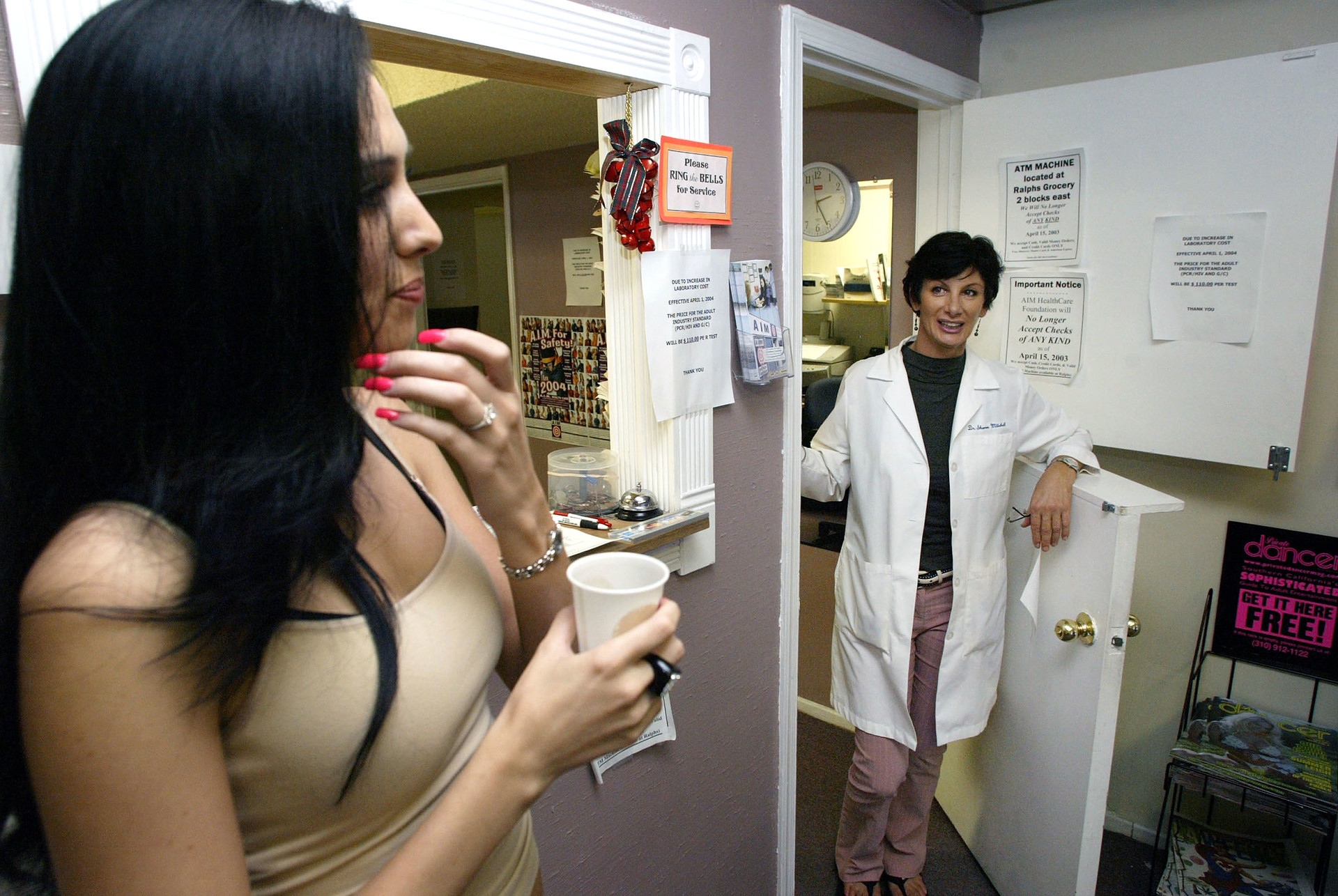
Gorbach’s 2017 study of 360 adult film workers showed 24% of performers were infected with either chlamydia or gonorrhea. One-third of those infections were found in the throat or rectum, she said, undetectable by the urine tests the industry uses to screen for sexually transmitted infections and serving as reservoirs for ongoing transmission. The findings show that testing protocols need to be carefully thought through, she said. (Chlamydia and gonorrhea, for example, can be transmitted within the 14-day repeat testing window that was chosen because it works to prevent HIV transmission.)
Her study also found more than 20% of film workers were self-treating without medical advice when they had symptoms, hoping to shorten the time they might miss work. Gorbach said she feared the same thing could happen with Covid-19, with people misusing or overusing inappropriate treatments in an attempt to cure themselves or mask symptoms so they won’t miss work. (Porn performers don’t get paid when they can’t get to sets, just like other workers without paid sick leave.)
Gorbach said she did see clear lessons that coronavirus testing programs could take from the film industry, including thinking about how to address people who “float,” or work at multiple locations that have vastly different standards for screening or protection. “People in nursing homes float, just like the adult film industry. They float, they work at multiple places with different rules and standards,” she said. “If one place they work screens for infection and one doesn’t, they can take the infection from one place to another.”
The film industry deals with this through frequent testing, and Stabile said most performers won’t work with untested partners. While the testing program is voluntary, Stabile said clear test results are a requirement on most mainstream sets.
Who would pay for tests is also an issue. In the film industry, performers generally pay the roughly $150 testing fee to be cleared to work. Public health officials argue that workers, especially low-wage workers, should not bear the brunt of coronavirus-testing costs. “In public health, we try to reduce barriers to prevent the spread of disease, especially economic barriers,” said Angela Bazzi, an assistant professor of community health sciences at Boston University School of Public Health who has studied the health of sex workers in Mexico, Kenya, Ghana, and Boston. “If we place this burden on individuals, that’s worrisome.”
The geography of testing is also a concern; when permits and condoms were required on film sets in Los Angeles, many producers moved filming to less restrictive locations. Employers might do the same, experts said, to avoid coronavirus testing programs they deem costly or onerous.
Bazzi said it was fascinating to think about what could be learned from a program that increased safety for actors in the adult film industry. “It’s informative,” she said. “They’ve clearly gone through a decision-making process.” But she added that coronavirus testing would likely be far trickier for practical reasons. Adult film testing started more than a decade after the HIV outbreak, and only after years of research to improve HIV tests. Coronavirus tests are still a work in progress.
“In HIV, we saw this progression of tests that took decades, and there are still new tests being developed,” Bazzi said. “With coronavirus, there are still a lot of unknowns with testing.”
Politics will also likely play a role in coronavirus testing programs, if the film industry is an indicator. The testing program continually comes under fire from the AIDS Healthcare Foundation, whose leaders think testing does not do enough to prevent on-set HIV transmission and that condoms should be required. Another issue has been a simmering argument over whether HIV-positive performers who have such low levels of the virus that they cannot transmit it should be allowed to participate in filming. For now, any HIV-positive result, regardless of viral titre, disqualifies a performer from being cleared to film in the PASS program.
Now, fears about sexually transmitted infections have faded into the background as those in the film industry grapple with the coronavirus. Performers can obtain the tests they need to be cleared to work because medical clinics remain open, but Stabile said few were participating, mainly because production is on hold due to the coronavirus. (People can still shoot solo videos, or videos with people they are quarantining with.)
Like many industries, Stabile’s group is trying to determine when and how it could safely resume work. Like workers across the country, those in the film industry are feeling the economic pain of loss of work — although those who run subscription porn sites say their business is booming during quarantine. “My revenue is through the roof,” said Hart, who, while at home with his wife and four cats, is raising money for makeup artists, production assistants, and other set workers who are struggling.
A Free Speech Coalition task force is meeting twice a week by Zoom, grappling with questions like whether they can incorporate Covid-19 in their testing protocols and how to protect camera operators, makeup artists, and other on-set employees that did not require testing before. “We’re asking questions like whether directors and camera people can shoot with N95 masks on,” Stabile said. “We are actively trying to figure out how to make sets safe, and that means coronavirus as well as HIV.”