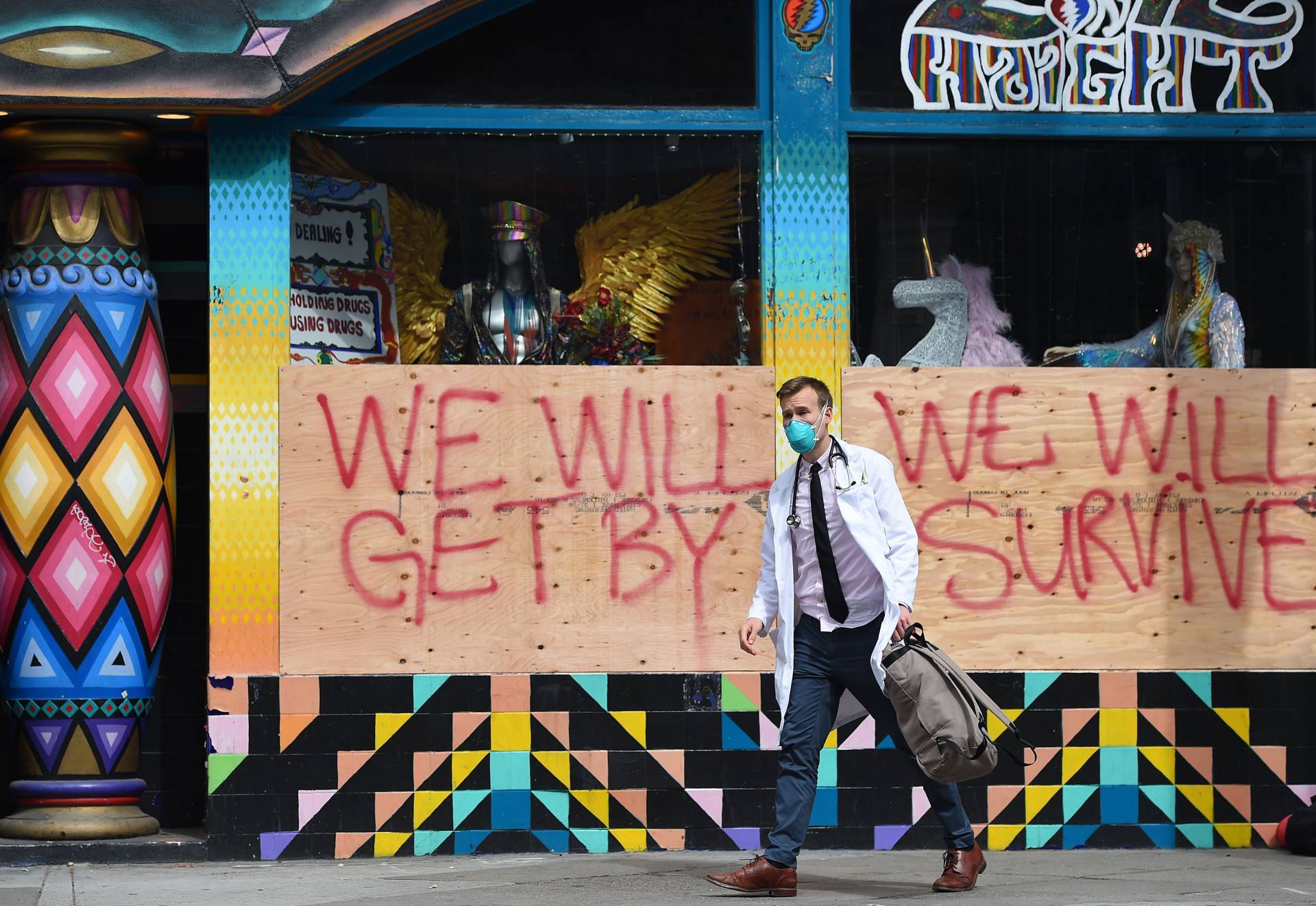
A doctor with the Haight Ashbury Free Clinic walks by a supportive sign on a boarded-up shop in the Haight Ashbury area of San Francisco on March 17, 2020. (Josh Edelson/AFP via Getty Images)
Updated June 5
California continues to relax its stay-at-home order. Meanwhile, six Bay Area counties have followed suit, but are going at a slower pace due to their adoption of targets related to a different set of metrics than the state follows; you can read what the specific Bay Area goals are here.
Alameda, Contra Costa, Marin, San Francisco, San Mateo and Santa Clara counties make up the bloc of counties that have lagged behind the state's road map for loosening restrictions, while Napa, Solano and Sonoma, along with the majority of other California counties, have received permission to accelerate reopening ahead of the state's schedule.
You can see each Bay Area county's reopening status by clicking on the links below.
Science
Get the best of KQED’s science coverage in your inbox weekly.
The county allows for curbside pickup at some stores, and the resumption of manufacturing and logistics operations, in addition to essential and outdoor businesses.
Gatherings in which people stay in their cars are allowed, subject to restrictions.
Of the nine Bay Area counties, Alameda has been the slowest to reopen, with the last revision to its original stay-at-home order on May 18. Out of the state’s 58 counties, Alameda has the sixth highest number of coronavirus cases and seventh highest number of deaths as of June 5. Oakland is a particular hot spot in Northern California and has the most cases in Alameda County.
Contra Costa
As of June 3, indoor retail shopping, business offices, outdoor museums and pet grooming are among the businesses that can now reopen in Contra Costa County. Services that don’t require close customer contact, such as housekeeping, car washes, plumbing and pet grooming, can also resume.
The new county health order also allows for small outdoor social gatherings, as well as child care and camps for all children, limiting the size of each group to 12.
Libraries can reopen for curbside pickup. Religious services will be able to resume June 15, subject to restrictions.
The county is also considering opening swimming pools and outdoor dining.
Gatherings where people stay in their cars are allowed, subject to restrictions.
Courthouses are open.
Read the full health order for all businesses and activities that are allowed to resume plus requirements for reopening.
You can follow the county's progress on meeting its goals for relaxing restrictions on its indicators dashboard.
Marin
As of June 5, the county is permitting religious and cultural services for groups of less than 100, subject to requirements for social distancing, face coverings and signage, among other directives.
Also as of June 5, charter boats, swimming pools for limited use and dog parks are allowed to resume operations. The county has in addition expanded outdoor recreational businesses that can open, subject to guidelines, and is allowing indoor recreational businesses to move outdoors if local jurisdictions approve. Guidance for public protests was also released.
Marin allows retailers to display merchandise curbside or to create an outdoor retail location. Office space, outdoor dining and curbside library services are also approved, providing county guidelines are followed. Businesses preparing to reopen must complete a Site-Specific Protection Plan. Child care operations and summer camps can also reopen for children of nonessential workers. Manufacturers and construction were previously allowed to resume.
Most parks and recreation areas are open. Local authorities are allowed but not required to reopen parking lots so that people can drive to these areas. Here are a map and list showing the status of regional, state and national parks, plus open spaces, in the area.
During the first half of June, some county departments are opening back up for in-person service. See a list and schedule here.
Reopening hair salons and indoor restaurants are under consideration.
On May 29, the county extended the closure of short-term rentals, timeshares, hotels, motels and bed and breakfasts.
The county has released an indicators dashboard where you can check the key metrics health officials are monitoring in determining when to expand the resumption of various activities.
Napa
With the lowest number of cases and deaths in the Bay Area, Napa County has been following the state's reopening road map and is currently in Stage 2.
When the county first applied for a Stage 2 variance, which enables counties that meet certain requirements to jump ahead of the state in an expansion of businesses and locations that can reopen, it did not qualify under the criteria for approval. However, the state relaxed those stipulations, and the variance was granted on Tuesday, May 19.
The current criteria for obtaining a variance are:
Stable hospitalizations of COVID individuals on a seven-day average of daily percent change of less than 5% OR no more than 20 COVID hospitalizations on any single day in the past 14 days
Less than 25 new cases per 100,000 residents in the past 14 days OR less than 8% testing positive in the past seven days
The variance allows for some lower-medium risk businesses to reopen, including restaurants for dine-in eating and retail shops with physical distancing and other precautionary measures in place. Wineries and tasting rooms will remain closed for the time being.
Schools in Napa County are allowed to reopen June 1 provided they make modifications.
On May 26, the California Department of Public Health announced that counties who are on the accelerated reopening track, which includes Napa, can reopen hair salons and barbershops with mandatory face coverings for workers and customers. Any service that requires touching the client's face is prohibited. In addition, places of worship can reopen provided they limit attendance to 25% of building capacity or a maximum of 100 people, whichever is lower.
The county wrote the following in its Variance Attestation report to the state on May 18:
(A)lthough an anticipated outcome of further progression into Stage 2 in any jurisdiction is a likely increase of positive cases, the County has the capacity to meet the resultant public health response. Broadly speaking, the County has sufficiently flattened the curve, it has healthcare surge capacity, it will monitor local conditions, and it remains prepared to restrict its Shelter-at-Home Order, if and when necessary, in order to protect the public health of its community.
San Francisco
On May 28, San Francisco announced a timeline for reopening a host of businesses and activities at different junctures through mid-August, contingent on continuing progress on meeting goals to slow the spread of the coronavirus.
The plan allows for everything from indoor retail, religious services, outdoor dining and pro sports with no spectators to open on June 15. Hair salons, barbershops, indoor dining and real estate open houses are slated for July 13. Schools, bars, nail salons, tattoo parlors, gyms, playgrounds and museums are scheduled for mid-August. Here is the full schedule with all of the planned reopenings.
Retailers are already allowed to operate with curbside operations and delivery, as long as they have access to the street. Construction and manufacturing and warehouse operations have resumed as well.
Beginning June 1, child care programs can open for all children, subject to restrictions, including limiting group sizes to 10-12, depending on age. Sessions must be a minimum of three weeks. Summer camps and summer learning sessions can open on June 15, with group sizes of no more than 12 children attending for a minimum of three weeks. You can read the full order here.
On Saturday June 6, San Francisco Recreation and Parks department will reopen public tennis courts with safety precautions in place. Players must mark their tennis balls for identification and only touch their own balls. No sports aside from tennis will be allowed on the courts. Read the full safety rules here.
On May 28, San Francisco also issued more stringent requirements for wearing a face mask. These include the mandate that you wear a mask any time you see someone within 30 feet.
San Mateo
San Mateo County will allow outdoor dining, charter boat trips and funerals to resume as of Saturday, June 6.
According to the latest public health order, restaurants that reopen must designate an on-site employee to maintain health, safety and proper social distancing protocols during opening hours.
Additionally, tables must be set up more than 6 feet apart, and patrons are required to wear face coverings, except when seated at a table.
Charter boats will be allowed to operate, so long as 6 feet of distance can be maintained at all times between passengers. The passengers on the boat "must not shake hands, share food or drinks, or engage in any physical contact with each other or with the captain and crew."
Outdoor funerals can be conducted with 25 people or fewer, while indoor funerals will be allowed with 10 people or fewer.
The county already allows retailers to provide curbside sales or drive-through pickup, and to let shoppers inside stores provided the businesses identify and enforce the number of people that can be accommodated given social distancing requirements, which must be posted.
Manufacturing and logistics operations that provide goods for retail stores are also allowed.
Offices can open for employees who cannot perform their jobs from home. Businesses that are deemed essential by the state of California can also operate.
Outdoor museums, indoor and outdoor pools, and outdoor recreation areas can also reopen, subject to restrictions.
Religous services can resume, subject to adherence to guidelines provided by the state and the Centers for Disease Control and Prevention. These include limiting attendance to a maximum of 25% of building capacity or 100 individuals, whichever is lower, one-way aisles and social distancing markers.
Santa Clara
A screen capture from Dr. Cody's presentation to county supervisors.
Santa Clara on Monday announced that multiple sectors and activities can resume Friday, June 5. These include in-store retail, outdoor dining, all manufacturing, small service businesses, child care and summer programs, as well as religious, cultural, and civic activities.
Summer educational and recreational programs for children will be limited to 12 or fewer participants per group. For religious services and cultural ceremonies, outdoor gatherings of up to 25 will be allowed. Residents will be able to go camping should they follow social distancing requirements. All pet grooming will open, and dog walking will be permitted.
No-contact in-home services like house cleaning can resume, as can low-contact businesses like shoe or watch repair.
Any outdoor recreational activities that do not involve physical contact and adhere to social distancing protocols, such as swimming in pools, are already allowed to resume. Car-based gatherings are permitted, including drive-in theaters.
In-person shopping at small retail stores, as well as shopping centers will resume, but social distancing protocols must be followed.
The June 1 announcement that reopenings will expand comes five days after county Health Officer Dr. Sara Cody expressed concern the state of California was moving too fast in broadening activities that can resume.
"This announcement to authorize county health officers to allow religious, cultural and political gatherings of 100 people poses a very serious risk of the spread of COVID-19," Cody told the Santa Clara County Board of Supervisors.
Santa Clara County recently announced it is building a corps of 1,000 disease investigators and contact tracers who can help contain the spread of the coronavirus by calling people who have been in close contact with those who have tested positive for the coronavirus.
Solano
Solano County also opted out of the specific indicators adopted by other Bay Area counties.
Instead, Solano has its own road map to recovery, organizing businesses and activities into low- medium-, and high-risk categories, with designations based on “how easy it is to socially distance and to have good sanitation,” said Public Health Administrator Jayleen Richards.
On May 20, Solano was approved for a variance from the state's reopening schedule, so that it could expand which businesses are allowed to resume operations. The county now allows for in-restaurant dining and in-store retail shopping, provided businesses meet the state's social distancing guidelines. Shopping malls, swap meets and office-based businesses can also reopen with social distancing restrictions in place.
On May 27, the county said it would allow barbershops and hair salons to open provided they made modifications to their operations, following the state's announcement the day before that counties on an accelerated track could do so. Face coverings for workers and customers are mandatory, and any service that requires touching the client's face is prohibited. In addition, places of worship can reopen provided they limit attendance to 25% of building capacity or a maximum of 100 people, whichever is lower, per the state's guidelines.
The criteria for obtaining a variance, which the state loosened in May, are:
Stable hospitalizations of COVID individuals on a seven-day average of daily percent change of less than 5% OR no more than 20 COVID hospitalizations on any single day in the past 14 days
Less than 25 new cases per 100,000 residents in the past 14 days OR less than 8% testing positive in the past seven days
Sonoma
Sonoma County is following California's recovery road map and has received a variance to move beyond the state's schedule.
On June 3, Sonoma County further eased restrictions on outdoor recreation for residents, reopening coastal parking lots and restoring daytime visiting hours at beaches.
The amended parks order, which you can read here, permits individuals and households to drive to coastal parks for lower-risk activities, including hiking, walking, running, fishing and surfing, as well as relaxing or sunbathing on the beach.
Under the order, visitors must practice physical distancing and wear face coverings when within six feet of people outside of their household.
Picnic and barbecue areas, playgrounds, dog parks, outdoor exercise equipment, drinking fountains and recreational campgrounds remain closed.
The county already allows restaurants, breweries, bars, craft distilleries, wineries and tasting rooms to operate outdoors if they offer sit-down meals. Summer day camps and drive-in movies can also open, as can libraries for curbside pickup. Counseling provided by faith-based organizations can be performed in person with members of a single household if online options are not available. All of these and other operations that are now sanctioned are subject to limitations and social distancing guidelines, which you can read in the order.
On May 26, the California Department of Public Health announced that counties who are on the accelerated track can reopen hair salons, barbershops and places of worship, subject to restrictions and modifications. At that time, Sonoma County Health Officer Dr. Sundari Mase said the county was not currently expanding openings in these areas due to concern over crossing the required threshold for cases per 100,000 residents that allows for loosening restrictions.
However As reported in the Press Democrat Tuesday, Mase told the Board of Supervisors she expects to allow the resumption of indoor operations at restaurants, wineries, brewpubs, and mall stores this week, as well as some services at barbershops and hair salons. Religious services will also be able to resume, subject to restrictions.
On May 28, Sonoma County Sheriff Mark Essick posted an open letter on Facebook stating that his office would no longer enforce Sonoma County public health orders.
Michelle Wiley contributed to this post.
Sponsored
Sponsored
Get the best of KQED’s science coverage in your inbox weekly.